Copyright © 2009, Oracle. All rights reserved.
Retrieving Data Using
the SQL SELECT Statement
Copyright © 2009, Oracle. All rights reserved.
1 - 2
Objectives
After completing this lesson, you should be able to do the
following:
• List the capabilities of SQL SELECT statements
• Execute a basic SELECT statement
Copyright © 2009, Oracle. All rights reserved.
1 - 3
Lesson Agenda
• Basic SELECT statement
• Arithmetic expressions and NULL values in the SELECT
statement
• Column aliases
• Use of concatenation operator, literal character strings,
alternative quote operator, and the DISTINCT keyword
• DESCRIBE command
Copyright © 2009, Oracle. All rights reserved.
1 - 4
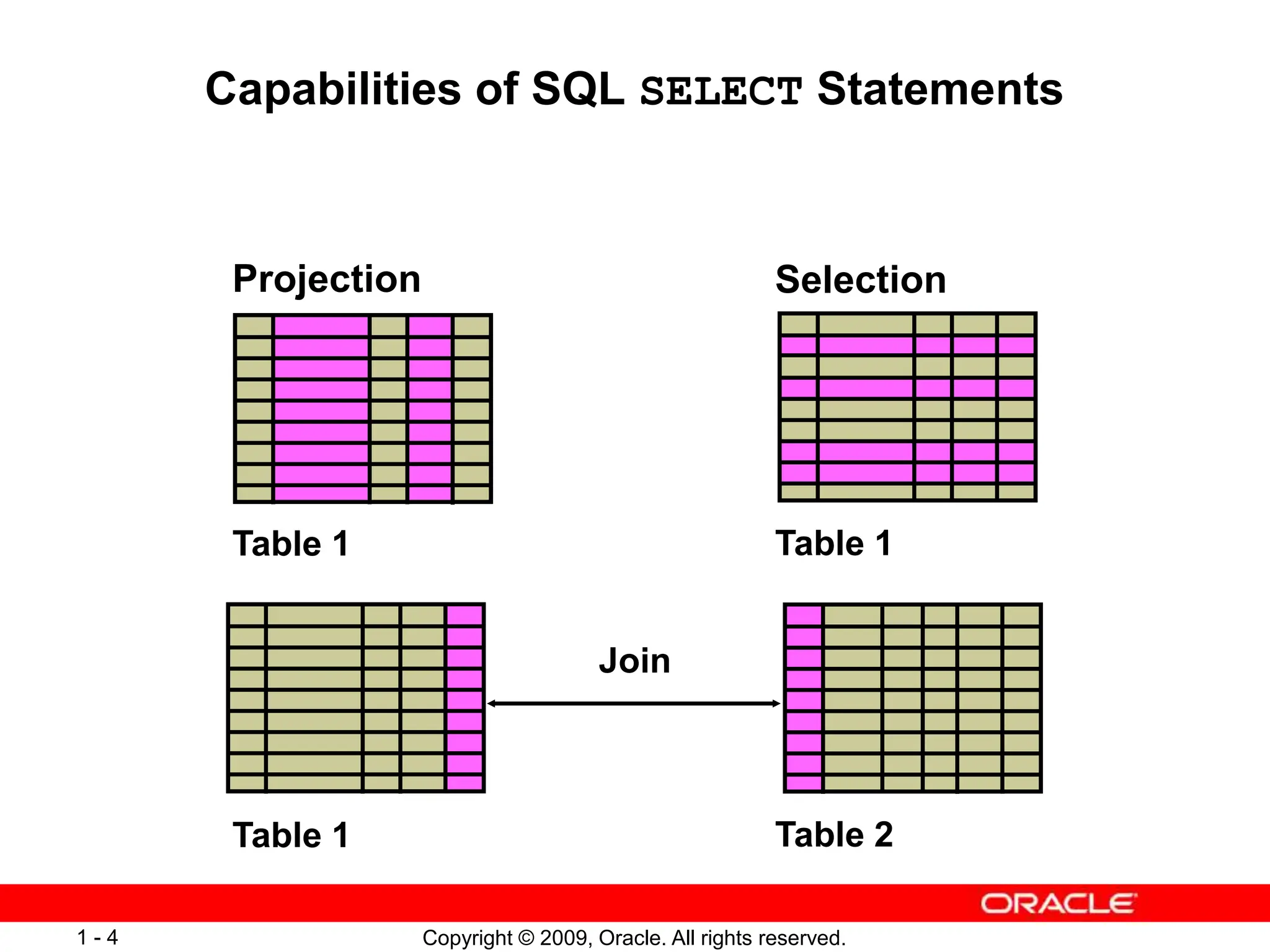
Capabilities of SQL SELECT Statements
Selection
Projection
Table 1 Table 2
Table 1
Table 1
Join
Copyright © 2009, Oracle. All rights reserved.
1 - 5
Basic SELECT Statement
• SELECT identifies the columns to be displayed.
• FROM identifies the table containing those columns.
SELECT *|{[DISTINCT] column|expression [alias],...}
FROM table;
Copyright © 2009, Oracle. All rights reserved.
1 - 6
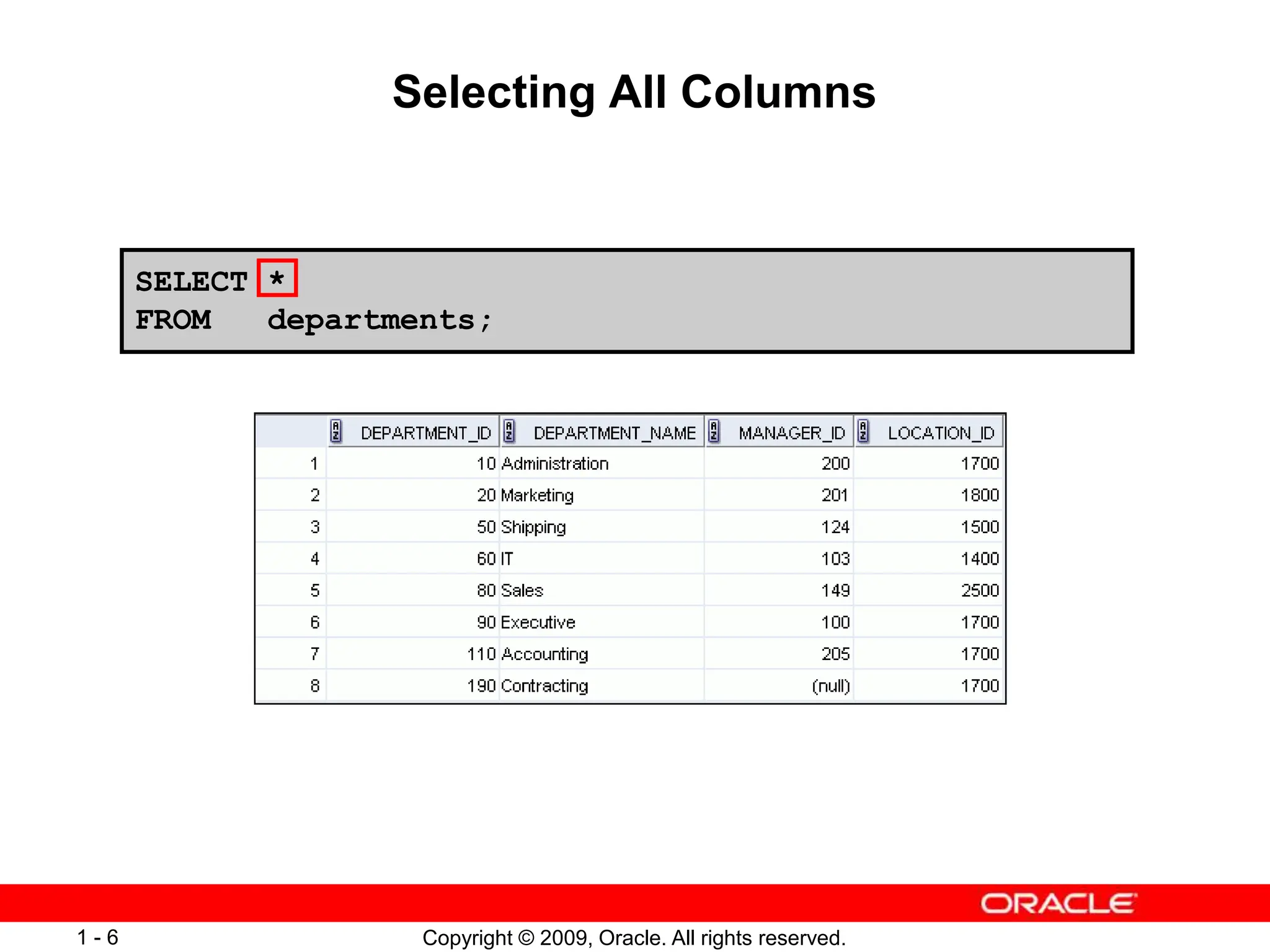
Selecting All Columns
SELECT *
FROM departments;
Copyright © 2009, Oracle. All rights reserved.
1 - 7
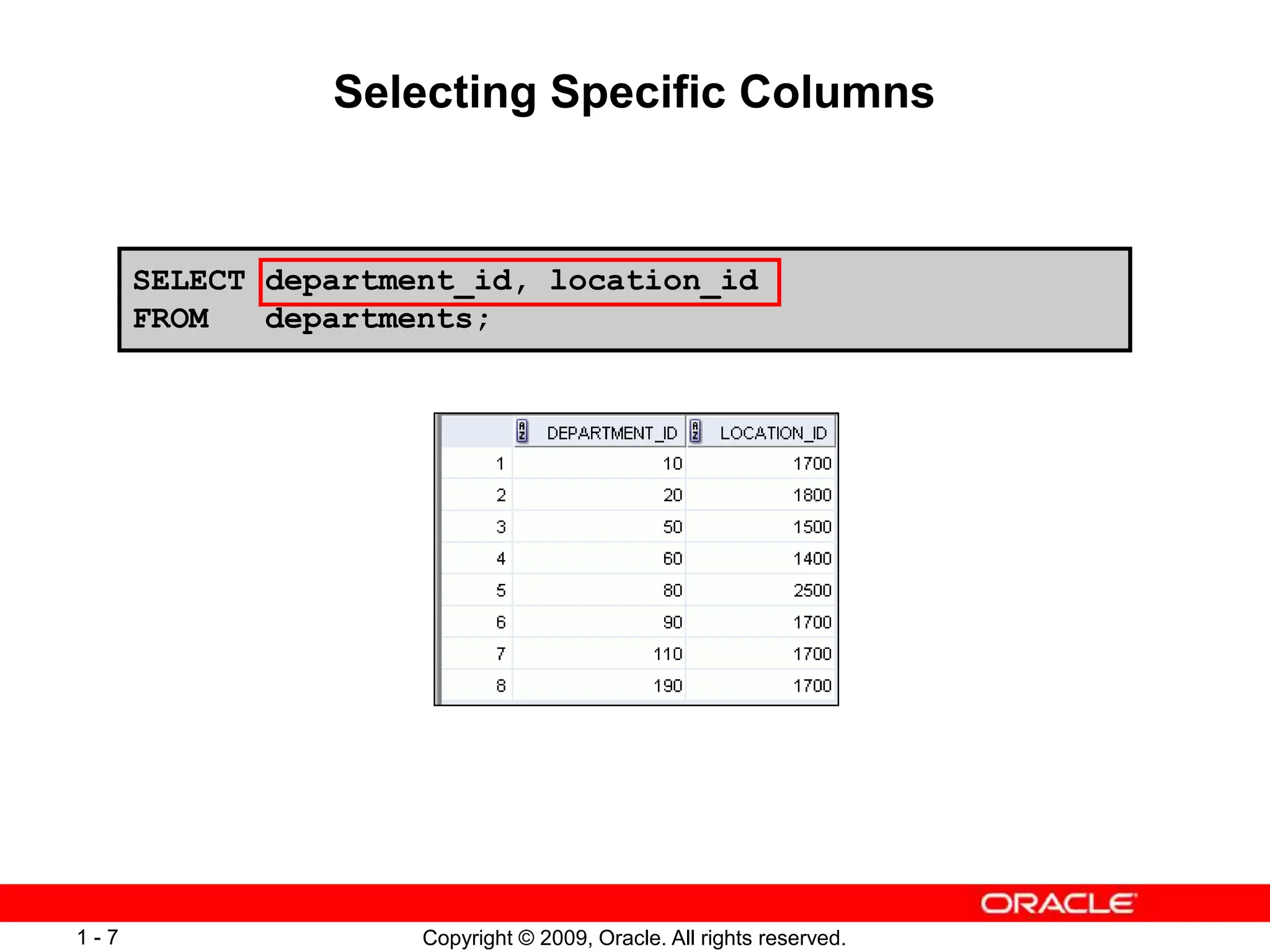
Selecting Specific Columns
SELECT department_id, location_id
FROM departments;
Copyright © 2009, Oracle. All rights reserved.
1 - 8
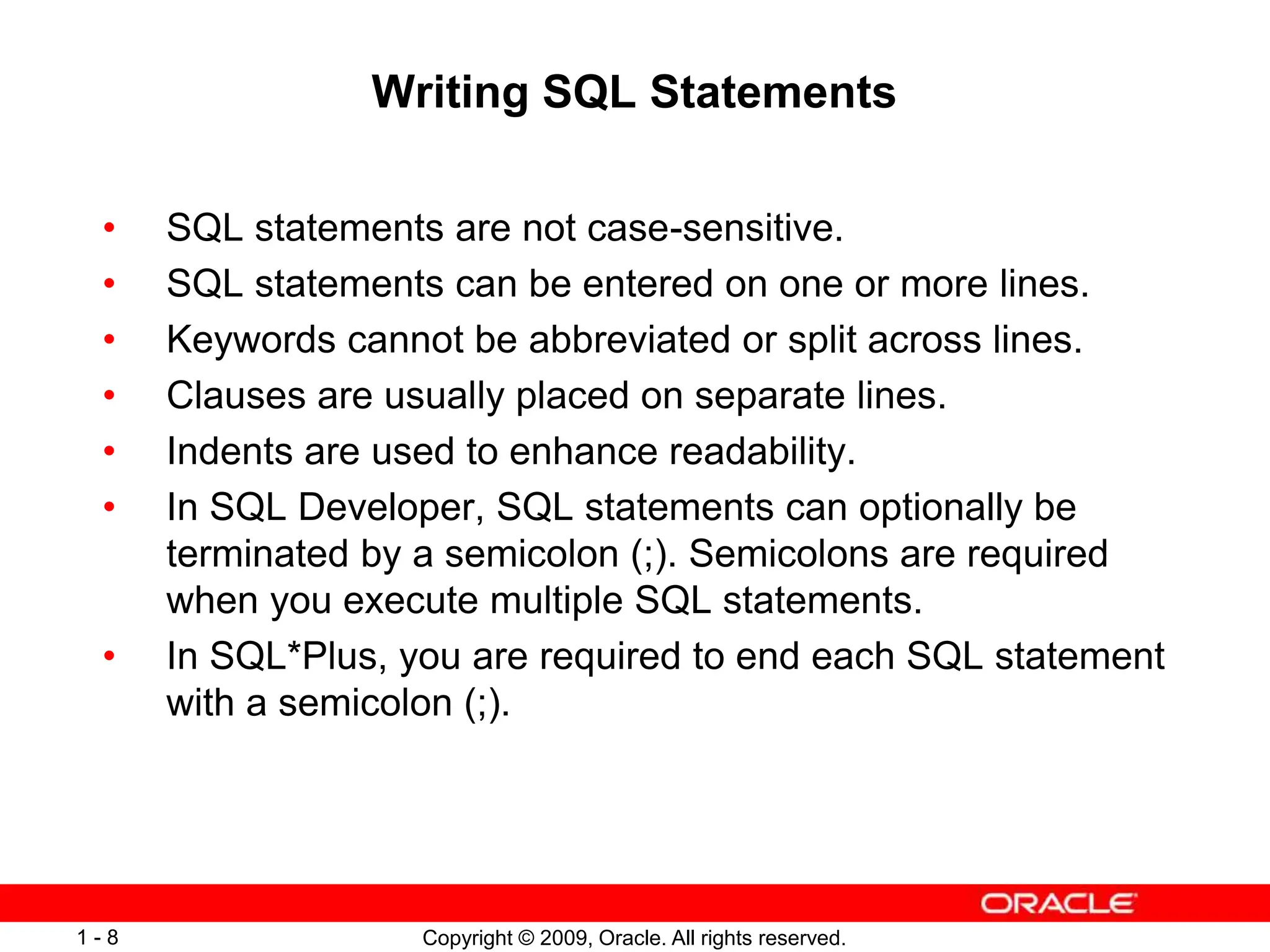
Writing SQL Statements
• SQL statements are not case-sensitive.
• SQL statements can be entered on one or more lines.
• Keywords cannot be abbreviated or split across lines.
• Clauses are usually placed on separate lines.
• Indents are used to enhance readability.
• In SQL Developer, SQL statements can optionally be
terminated by a semicolon (;). Semicolons are required
when you execute multiple SQL statements.
• In SQL*Plus, you are required to end each SQL statement
with a semicolon (;).
Copyright © 2009, Oracle. All rights reserved.
1 - 9
Column Heading Defaults
• SQL Developer:
– Default heading alignment: Left-aligned
– Default heading display: Uppercase
• SQL*Plus:
– Character and Date column headings are left-aligned.
– Number column headings are right-aligned.
– Default heading display: Uppercase
Copyright © 2009, Oracle. All rights reserved.
1 - 10
Lesson Agenda
• Basic SELECT statement
• Arithmetic expressions and NULL values in the SELECT
statement
• Column Aliases
• Use of concatenation operator, literal character strings,
alternative quote operator, and the DISTINCT keyword
• DESCRIBE command
Copyright © 2009, Oracle. All rights reserved.
1 - 11
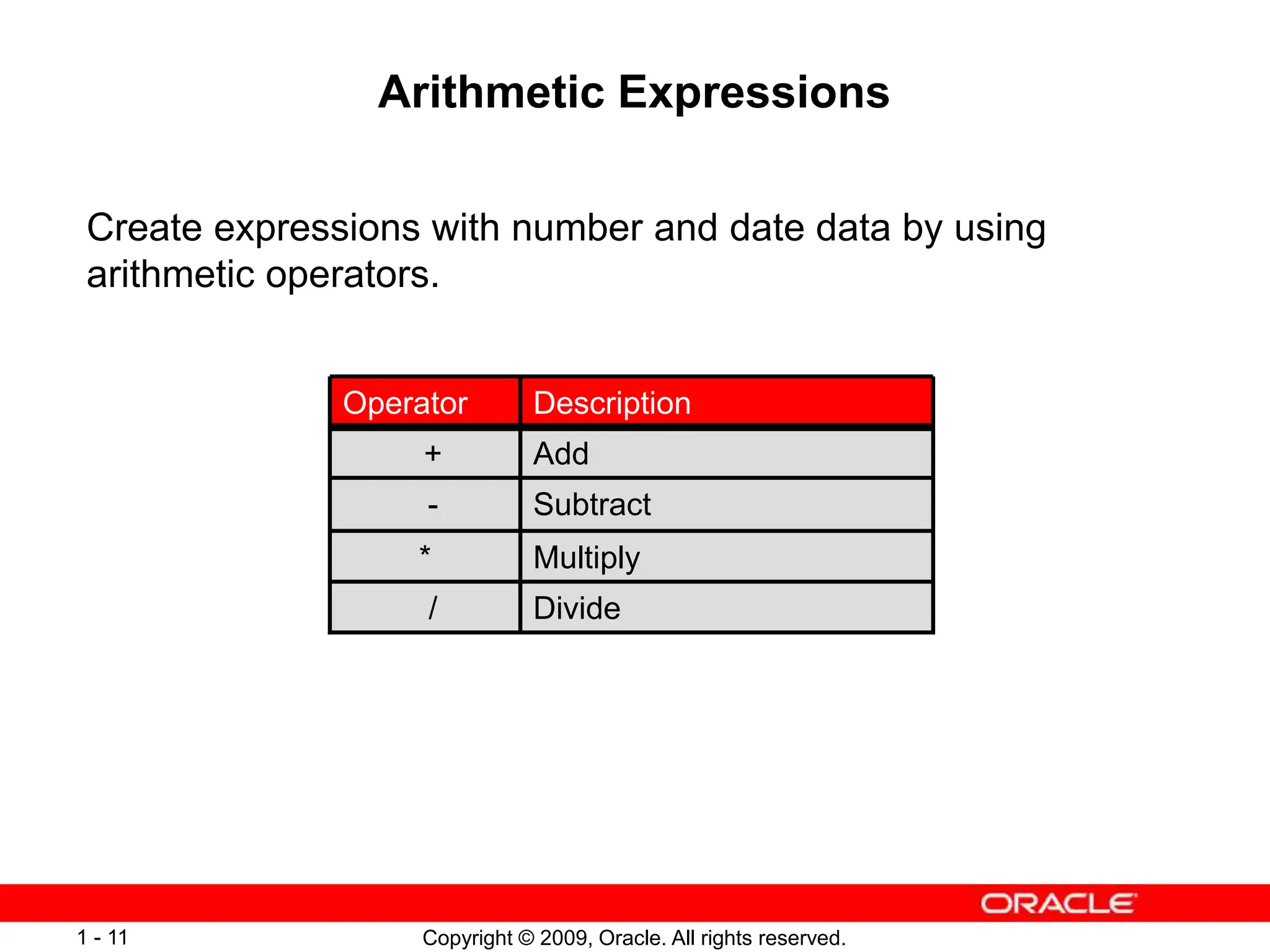
Arithmetic Expressions
Create expressions with number and date data by using
arithmetic operators.
Multiply
*
Divide
/
Subtract
-
Add
+
Description
Operator
Copyright © 2009, Oracle. All rights reserved.
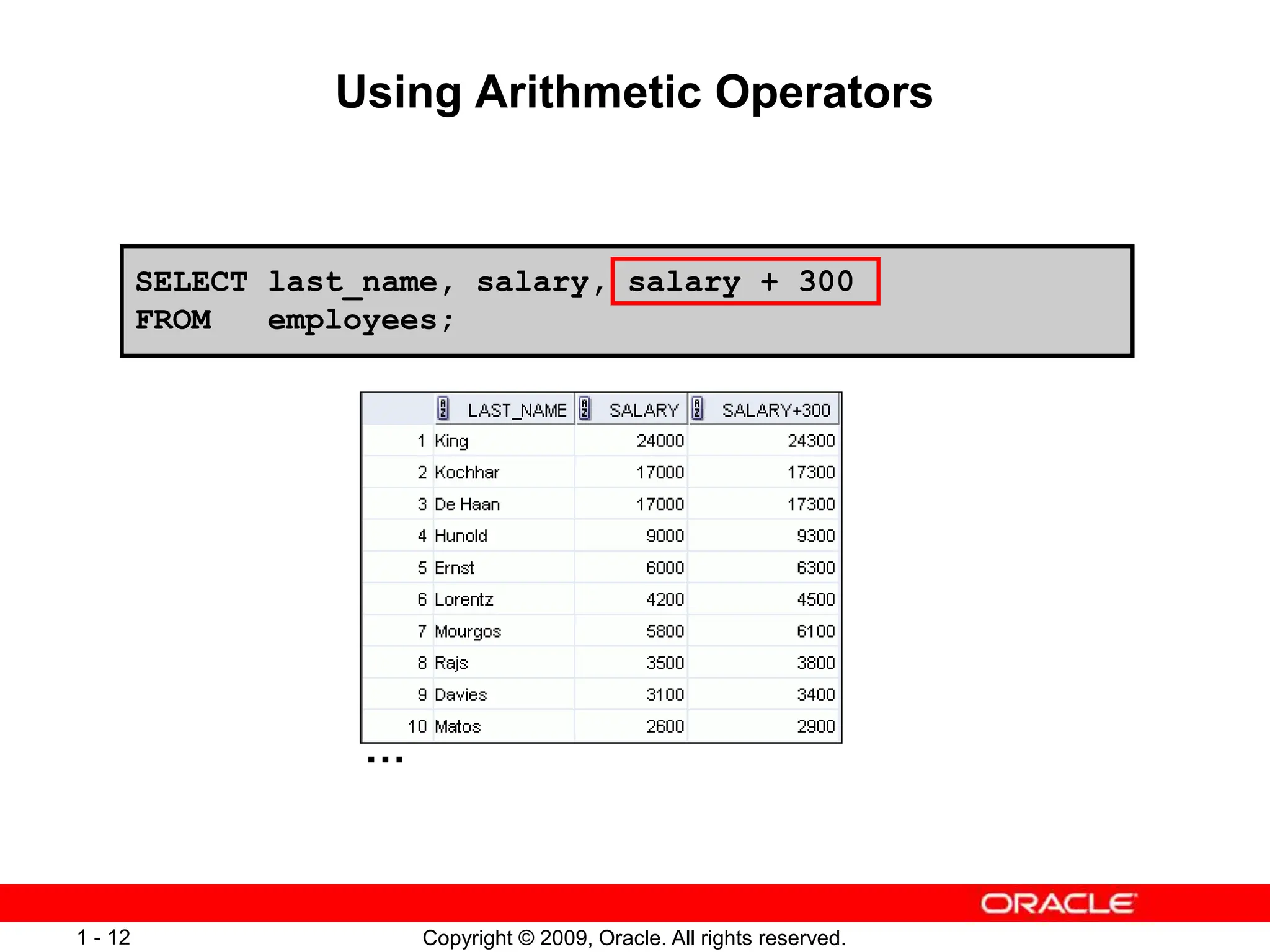
1 - 12
SELECT last_name, salary, salary + 300
FROM employees;
Using Arithmetic Operators
…
Copyright © 2009, Oracle. All rights reserved.
1 - 13
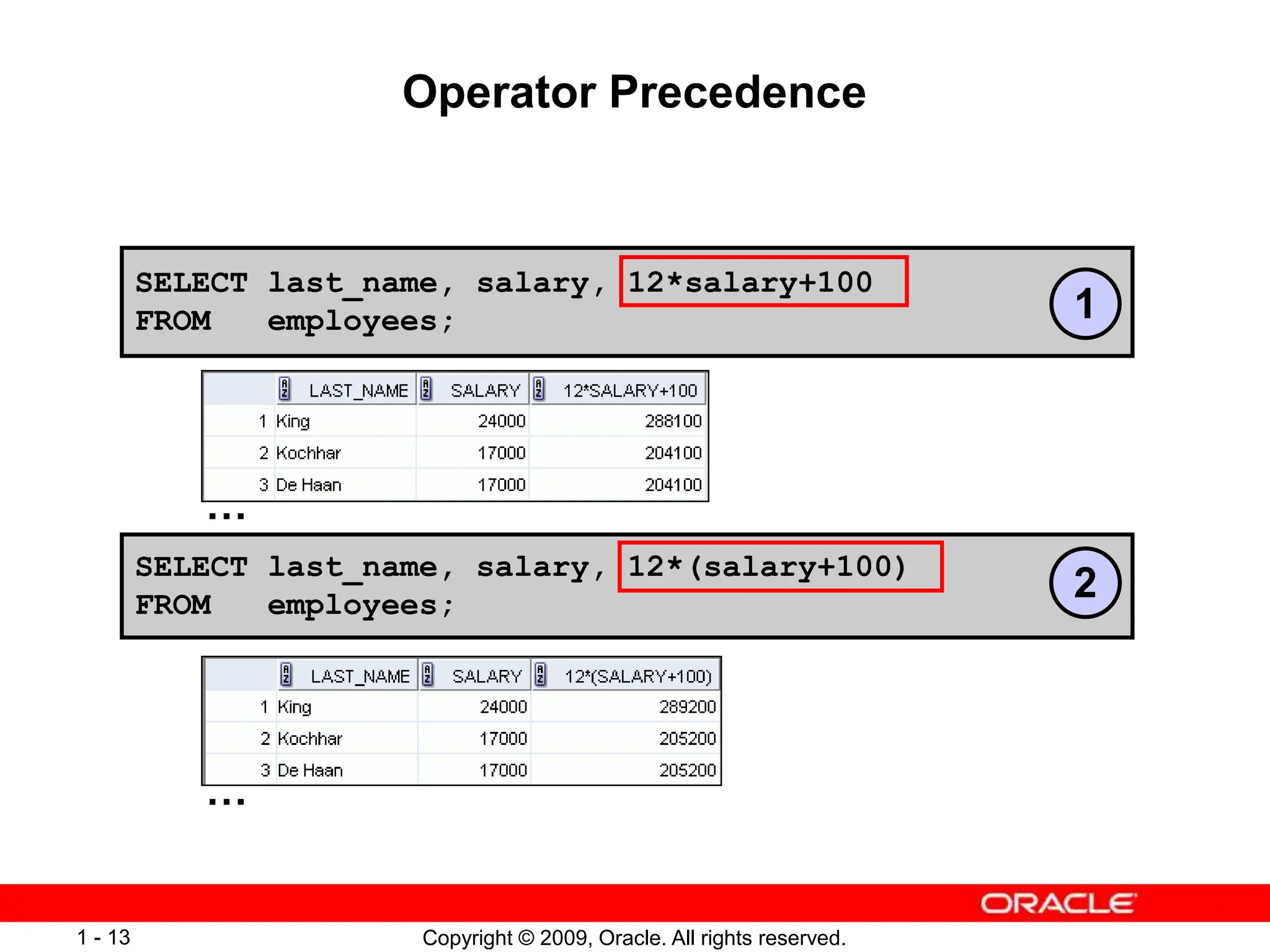
SELECT last_name, salary, 12*salary+100
FROM employees;
Operator Precedence
SELECT last_name, salary, 12*(salary+100)
FROM employees;
…
…
1
2
Copyright © 2009, Oracle. All rights reserved.
1 - 14
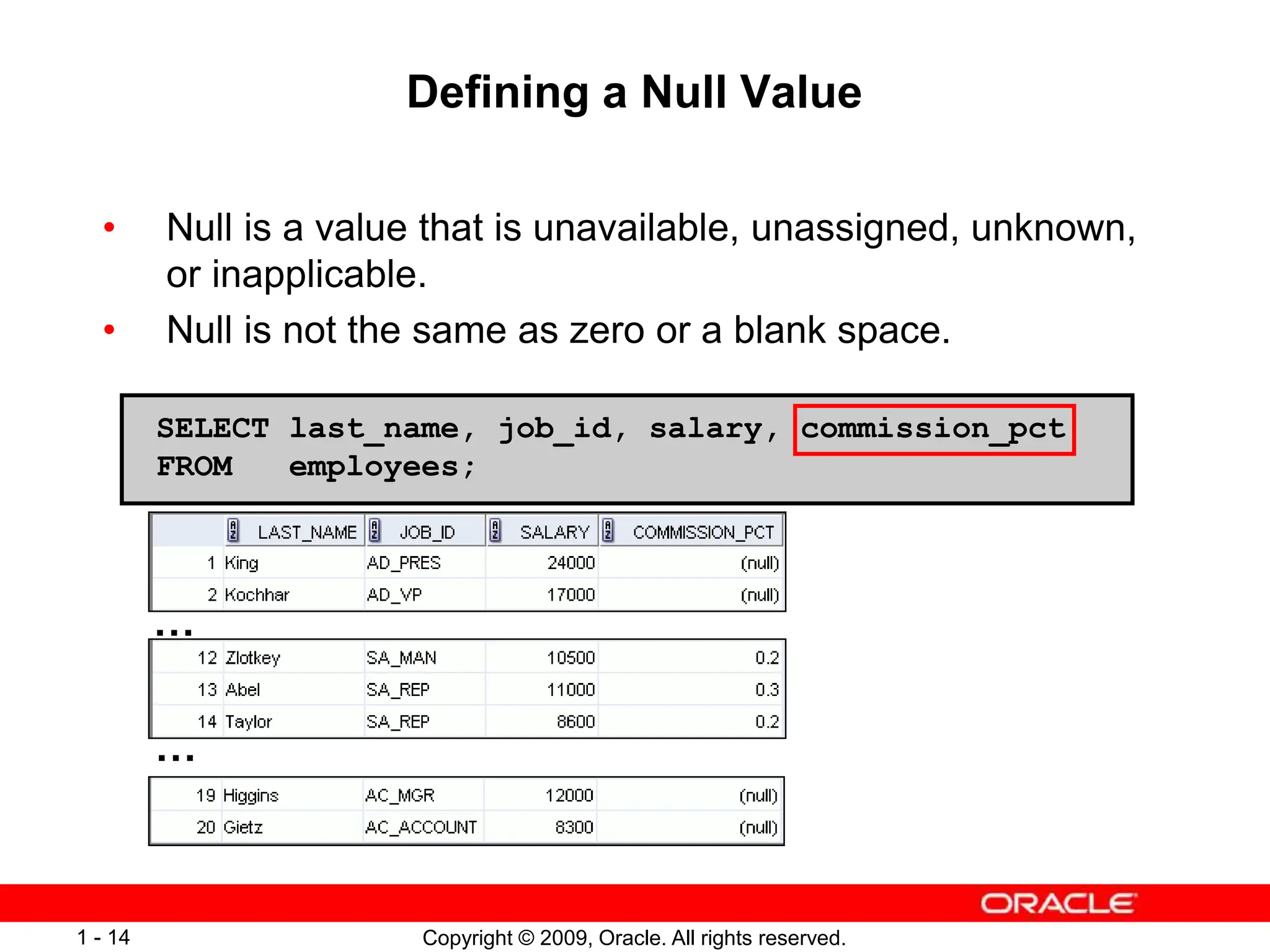
Defining a Null Value
• Null is a value that is unavailable, unassigned, unknown,
or inapplicable.
• Null is not the same as zero or a blank space.
SELECT last_name, job_id, salary, commission_pct
FROM employees;
…
…
Copyright © 2009, Oracle. All rights reserved.
1 - 15
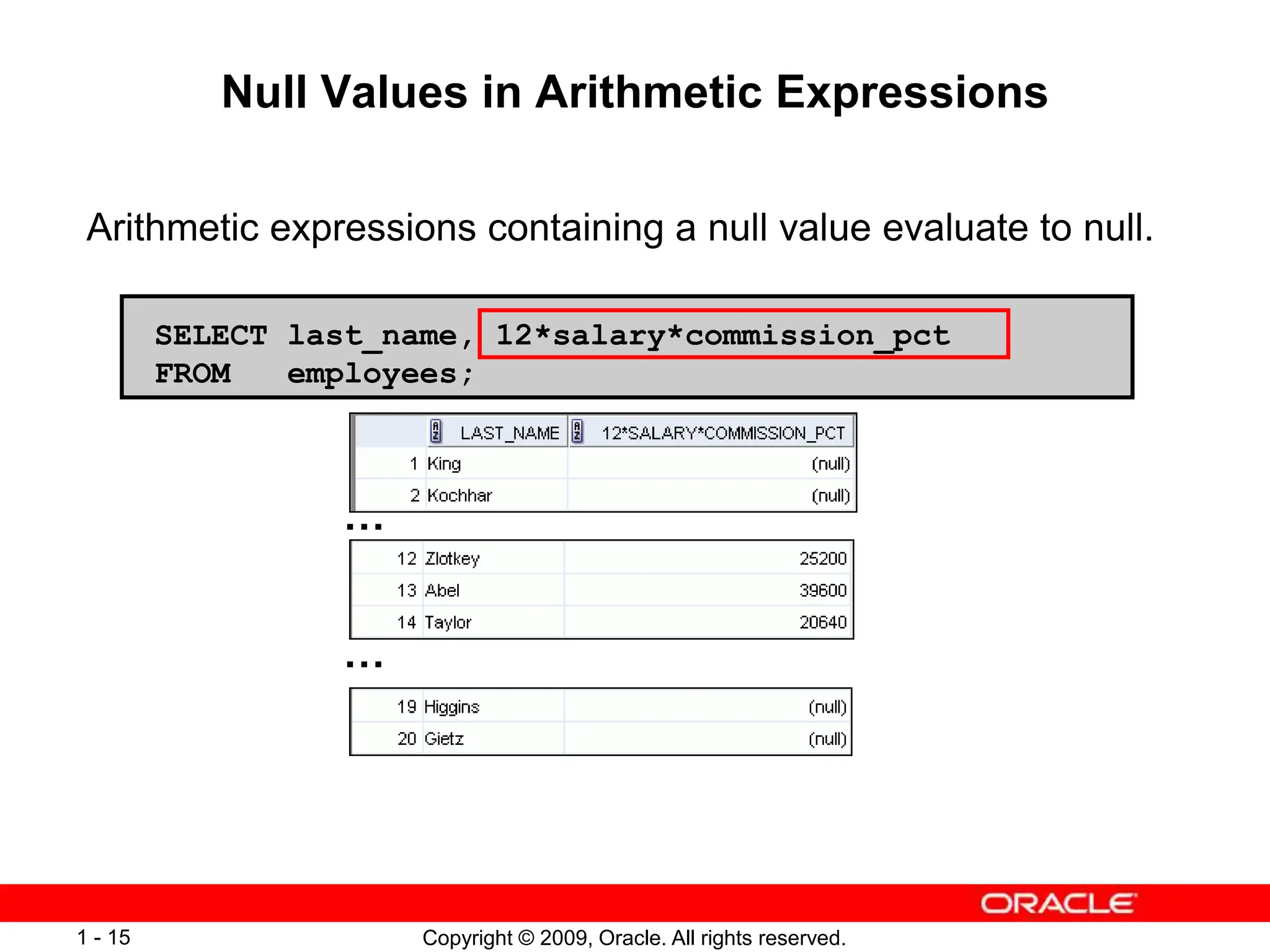
SELECT last_name, 12*salary*commission_pct
FROM employees;
Null Values in Arithmetic Expressions
Arithmetic expressions containing a null value evaluate to null.
…
…
Copyright © 2009, Oracle. All rights reserved.
1 - 16
Lesson Agenda
• Basic SELECT statement
• Arithmetic expressions and NULL values in the SELECT
statement
• Column aliases
• Use of concatenation operator, literal character strings,
alternative quote operator, and the DISTINCT keyword
• DESCRIBE command
Copyright © 2009, Oracle. All rights reserved.
1 - 17
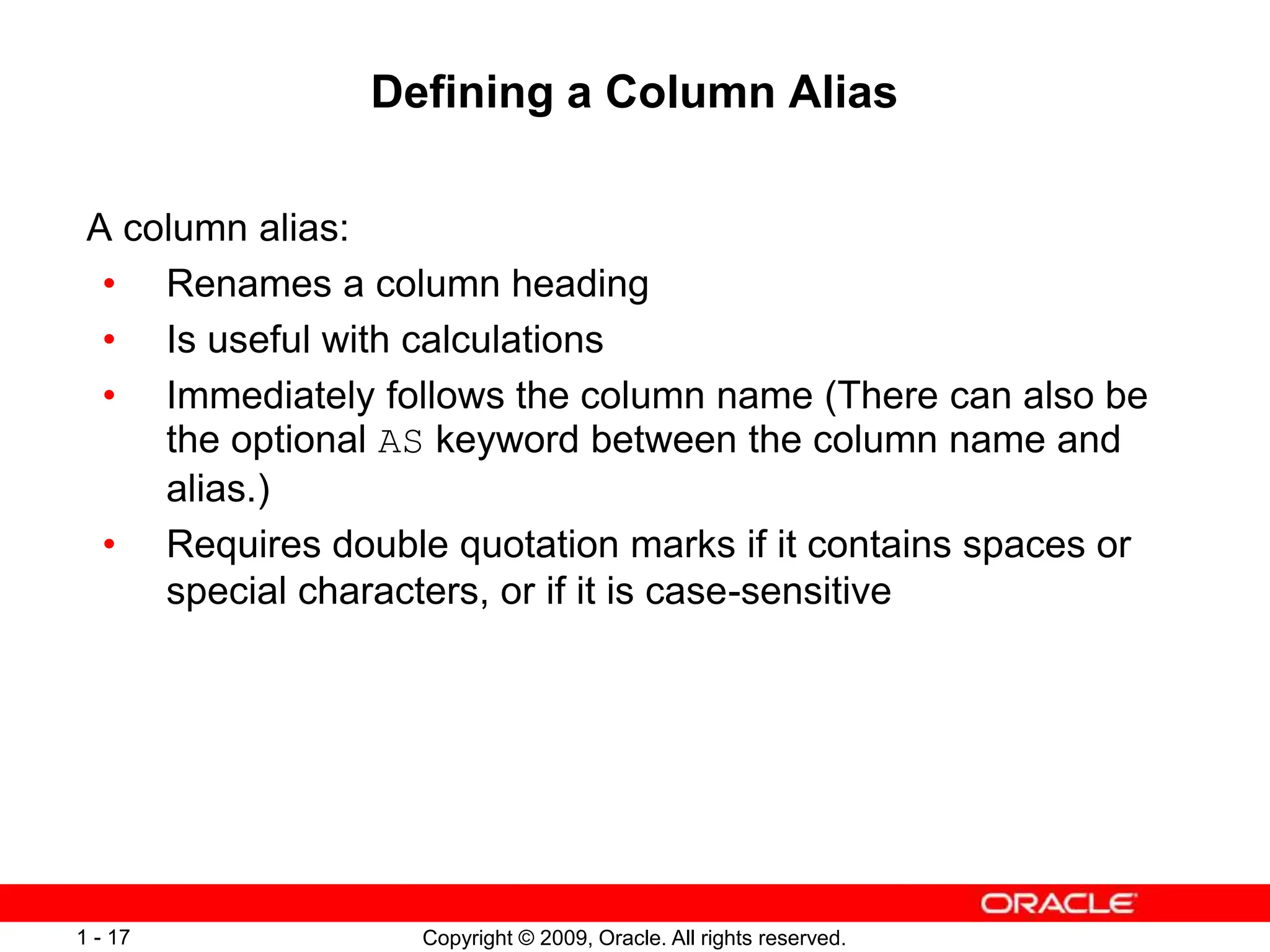
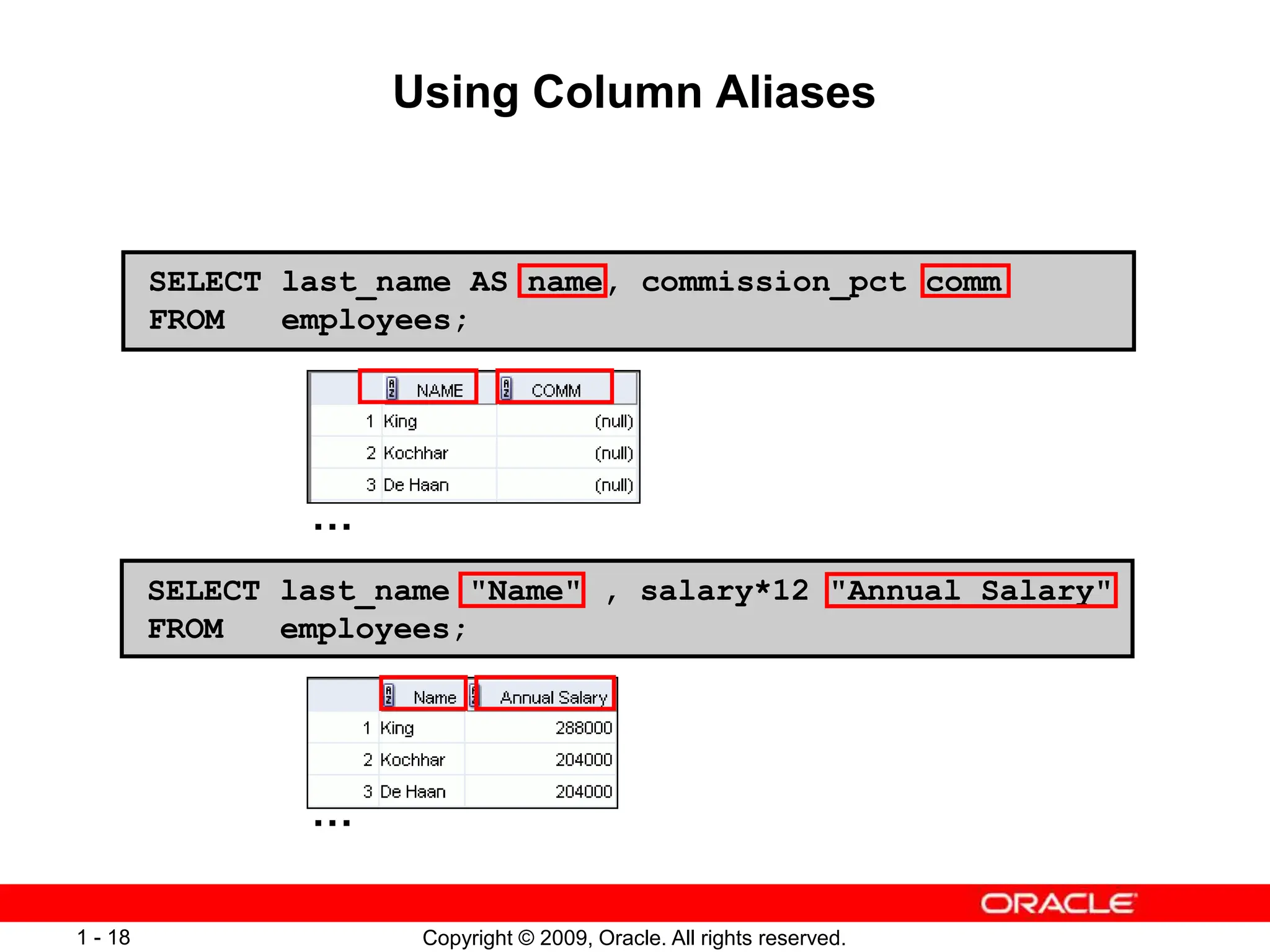
Defining a Column Alias
A column alias:
• Renames a column heading
• Is useful with calculations
• Immediately follows the column name (There can also be
the optional AS keyword between the column name and
alias.)
• Requires double quotation marks if it contains spaces or
special characters, or if it is case-sensitive
Copyright © 2009, Oracle. All rights reserved.
1 - 18
Using Column Aliases
SELECT last_name "Name" , salary*12 "Annual Salary"
FROM employees;
SELECT last_name AS name, commission_pct comm
FROM employees;
…
…
Copyright © 2009, Oracle. All rights reserved.
1 - 19
Lesson Agenda
• Basic SELECT Statement
• Arithmetic Expressions and NULL values in SELECT
statement
• Column Aliases
• Use of concatenation operator, literal character strings,
alternative quote operator, and the DISTINCT keyword
• DESCRIBE command
Copyright © 2009, Oracle. All rights reserved.
1 - 20
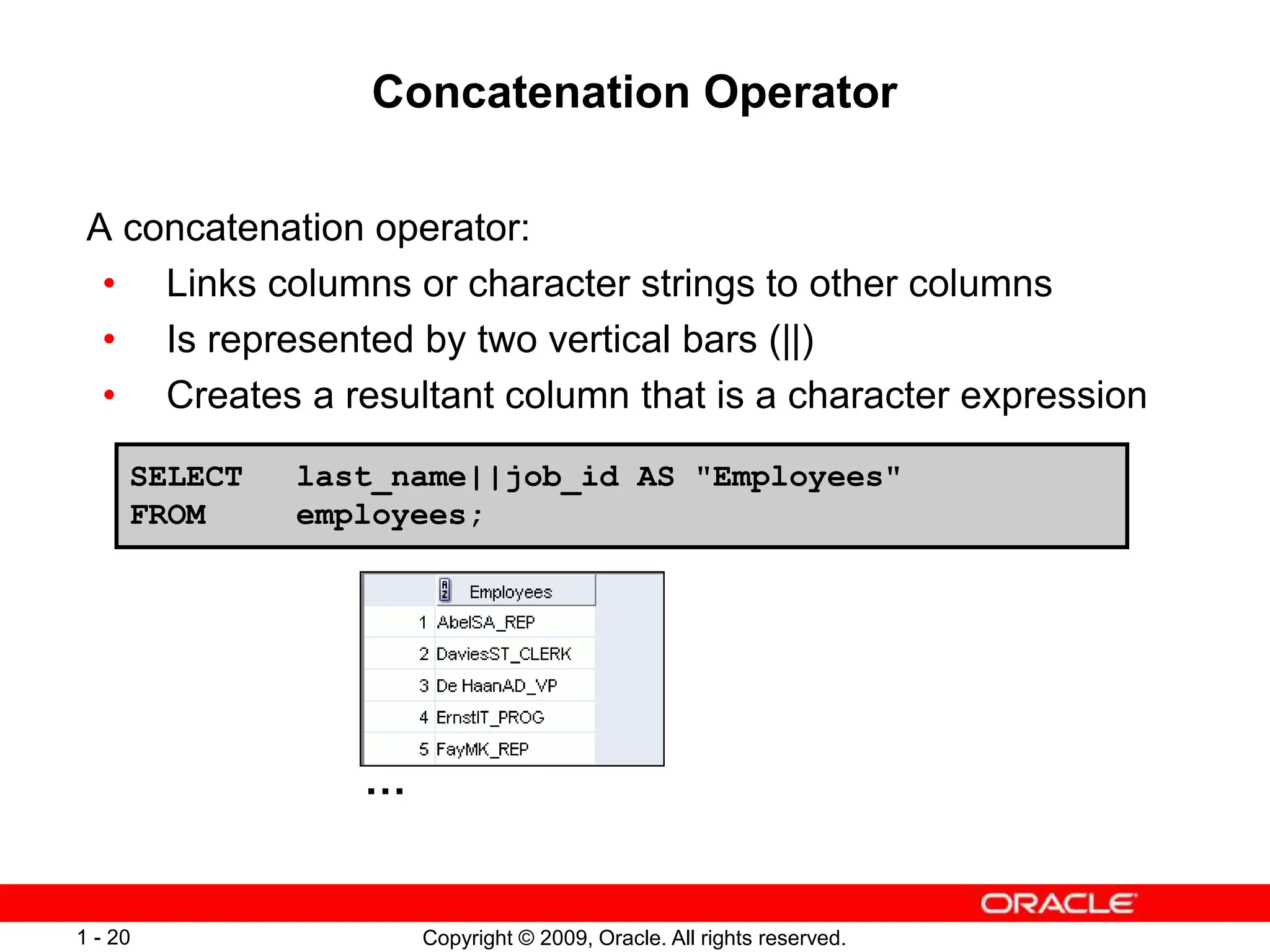
Concatenation Operator
A concatenation operator:
• Links columns or character strings to other columns
• Is represented by two vertical bars (||)
• Creates a resultant column that is a character expression
SELECT last_name||job_id AS "Employees"
FROM employees;
…
Copyright © 2009, Oracle. All rights reserved.
1 - 21
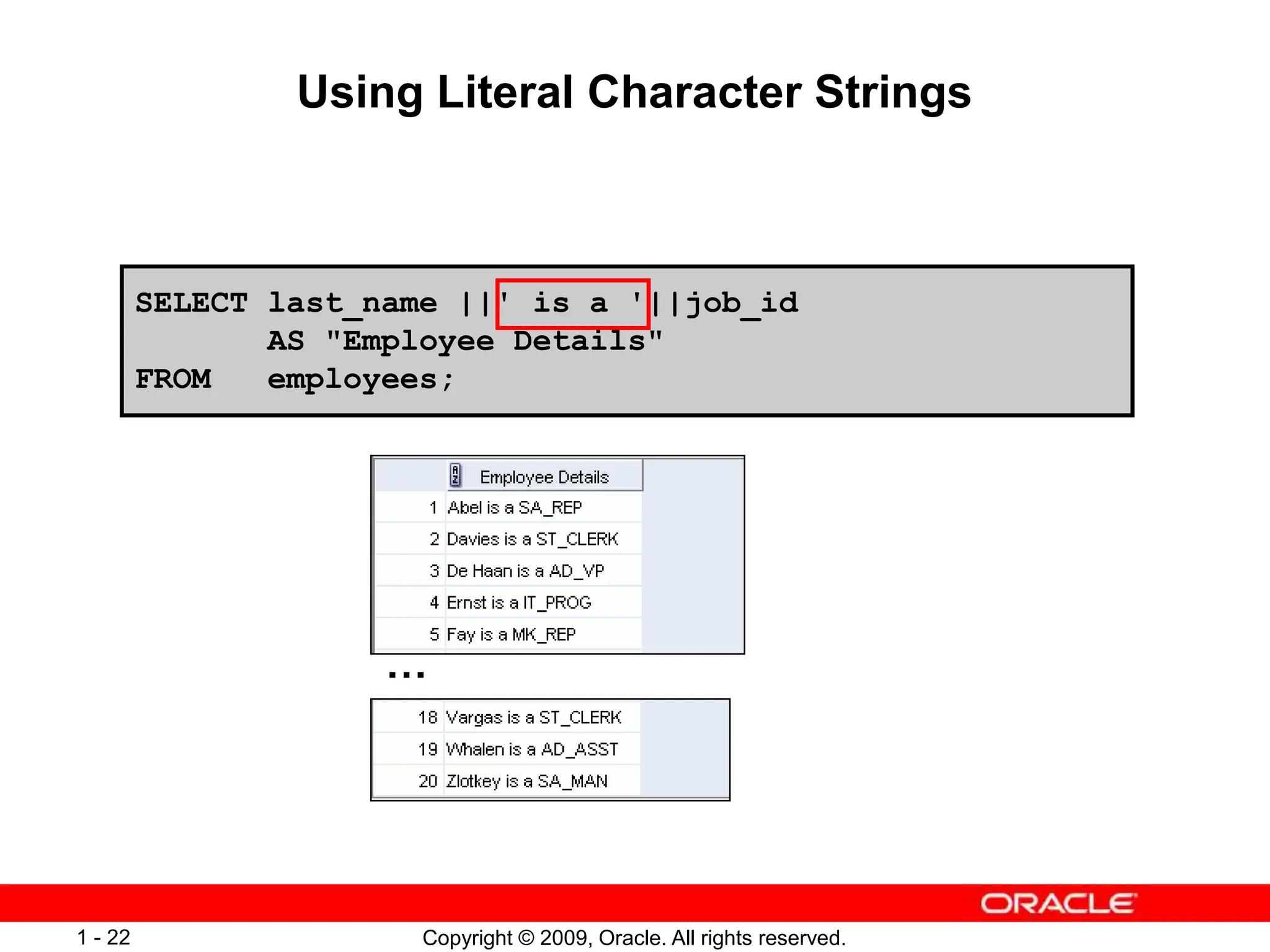
Literal Character Strings
• A literal is a character, a number, or a date that is included
in the SELECT statement.
• Date and character literal values must be enclosed within
single quotation marks.
• Each character string is output once for each row returned.
Copyright © 2009, Oracle. All rights reserved.
1 - 22
Using Literal Character Strings
…
SELECT last_name ||' is a '||job_id
AS "Employee Details"
FROM employees;
Copyright © 2009, Oracle. All rights reserved.
1 - 23
Alternative Quote (q) Operator
• Specify your own quotation mark delimiter.
• Select any delimiter.
• Increase readability and usability.
SELECT department_name || q'[ Department's Manager Id: ]'
|| manager_id
AS "Department and Manager"
FROM departments;
Copyright © 2009, Oracle. All rights reserved.
1 - 24
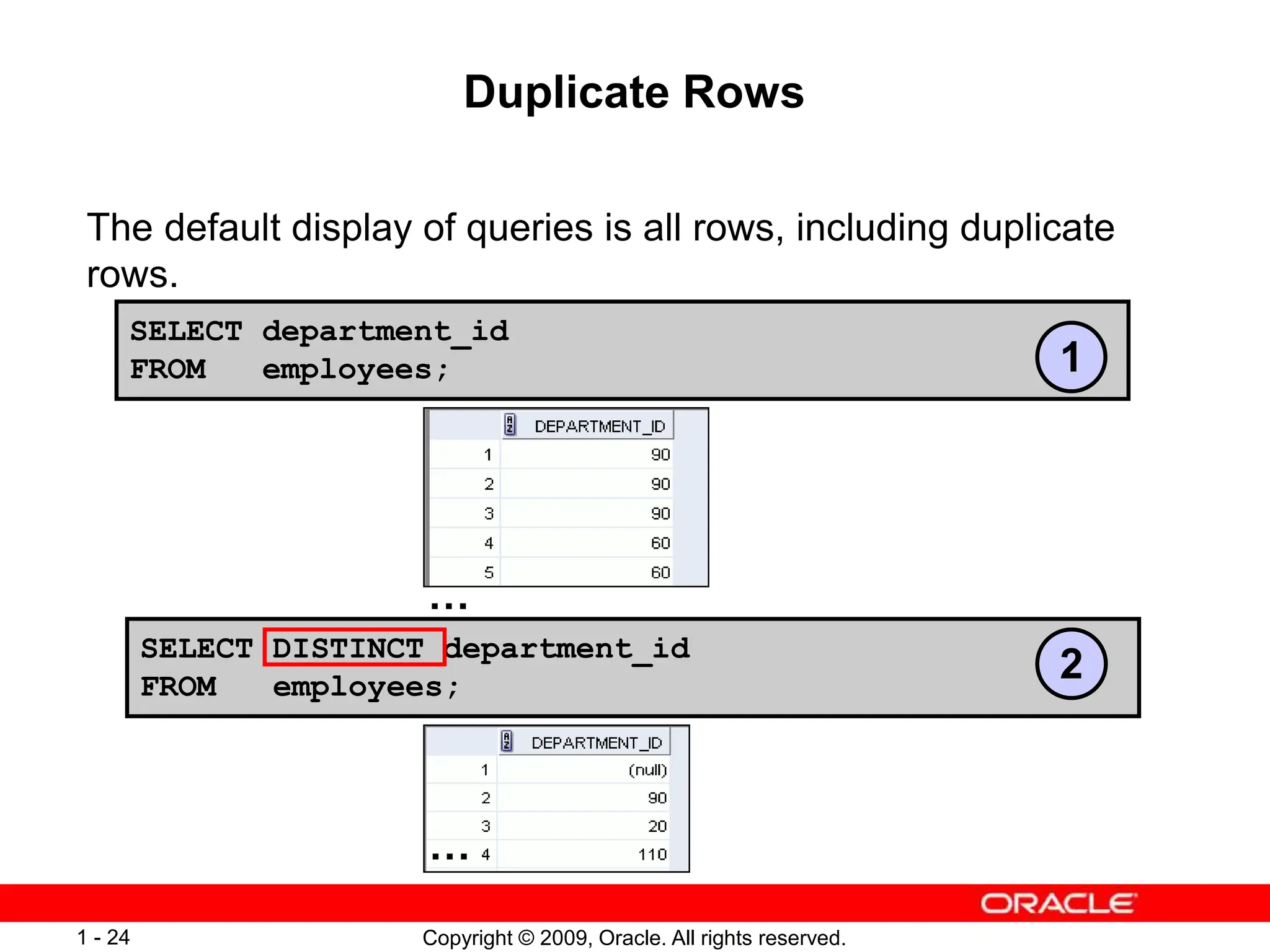
Duplicate Rows
The default display of queries is all rows, including duplicate
rows.
SELECT department_id
FROM employees;
SELECT DISTINCT department_id
FROM employees;
1
2
…
…
Copyright © 2009, Oracle. All rights reserved.
1 - 25
Lesson Agenda
• Basic SELECT statement
• Arithmetic expressions and NULL values in the SELECT
statement
• Column aliases
• Use of concatenation operator, literal character strings,
alternative quote operator, and the DISTINCT keyword
• DESCRIBE command
Copyright © 2009, Oracle. All rights reserved.
1 - 26
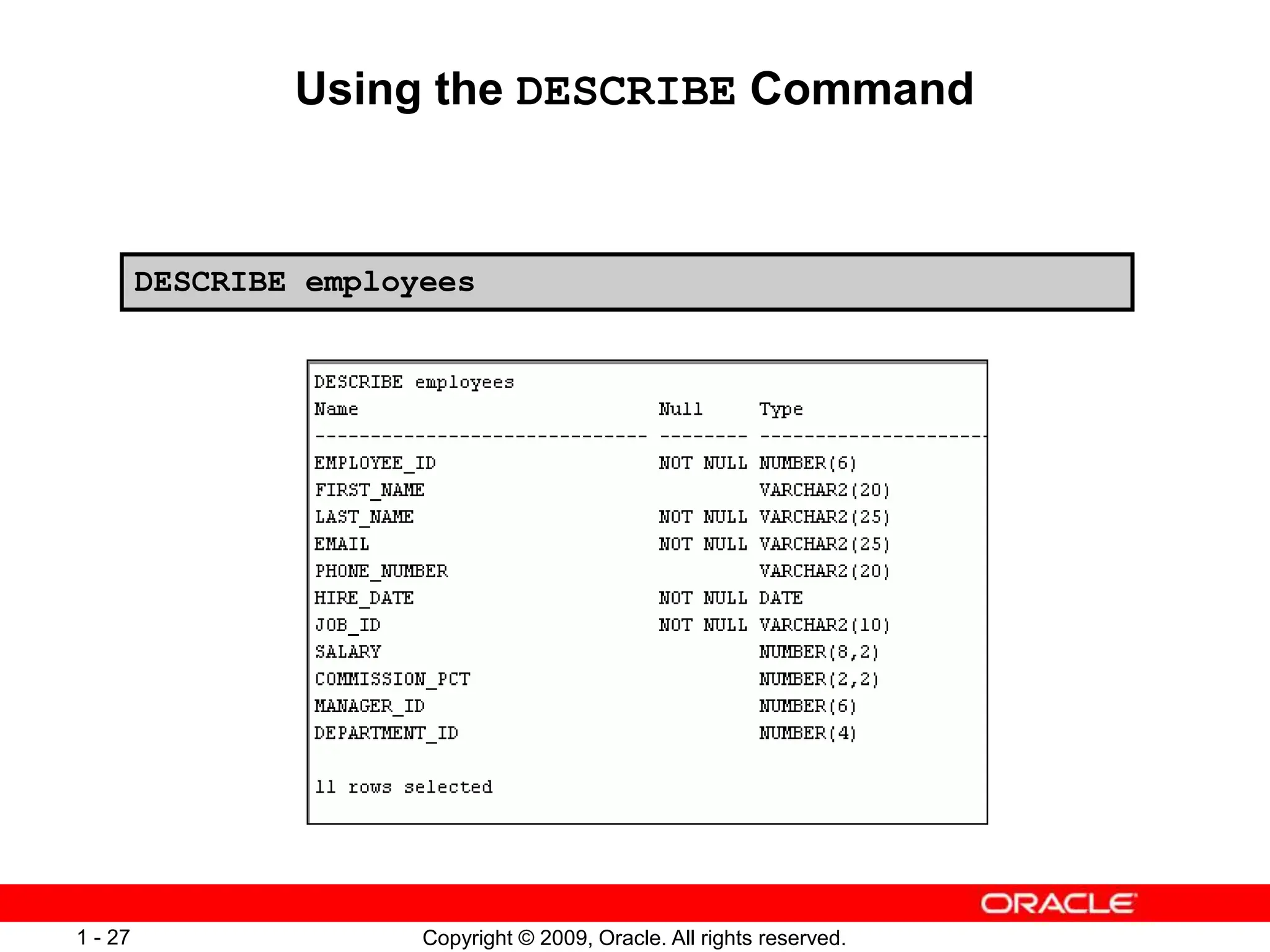
Displaying the Table Structure
• Use the DESCRIBE command to display the structure of a
table.
• Or, select the table in the Connections tree and use the
Columns tab to view the table structure.
DESC[RIBE] tablename
Copyright © 2009, Oracle. All rights reserved.
1 - 27
Using the DESCRIBE Command
DESCRIBE employees
Copyright © 2009, Oracle. All rights reserved.
1 - 28
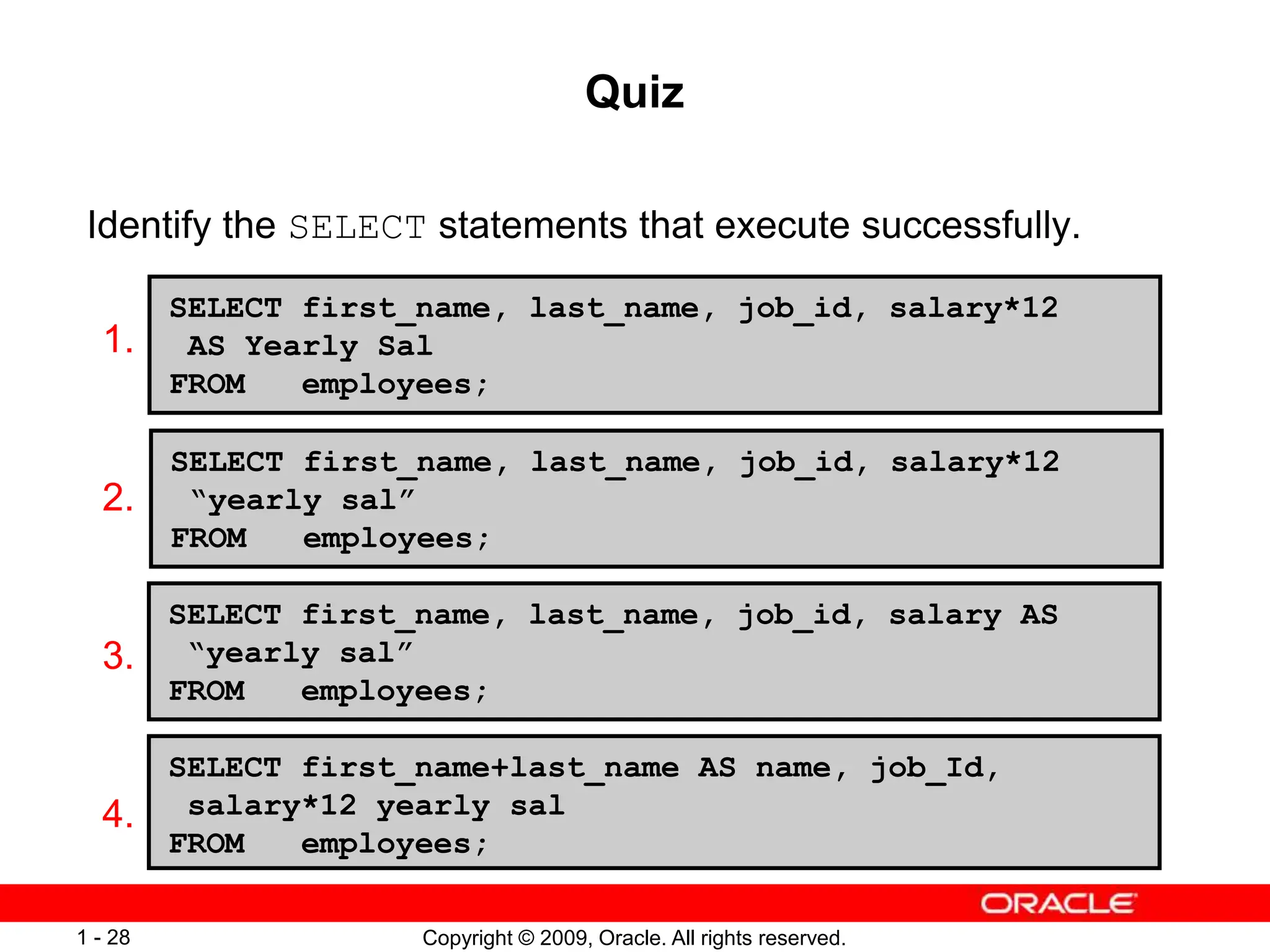
Quiz
Identify the SELECT statements that execute successfully.
1.
2.
3.
4.
SELECT first_name, last_name, job_id, salary*12
AS Yearly Sal
FROM employees;
SELECT first_name, last_name, job_id, salary*12
“yearly sal”
FROM employees;
SELECT first_name, last_name, job_id, salary AS
“yearly sal”
FROM employees;
SELECT first_name+last_name AS name, job_Id,
salary*12 yearly sal
FROM employees;
Copyright © 2009, Oracle. All rights reserved.
1 - 29
Summary
In this lesson, you should have learned how to:
• Write a SELECT statement that:
– Returns all rows and columns from a table
– Returns specified columns from a table
– Uses column aliases to display more descriptive column
headings
SELECT *|{[DISTINCT] column|expression [alias],...}
FROM table;
Copyright © 2009, Oracle. All rights reserved.
1 - 30
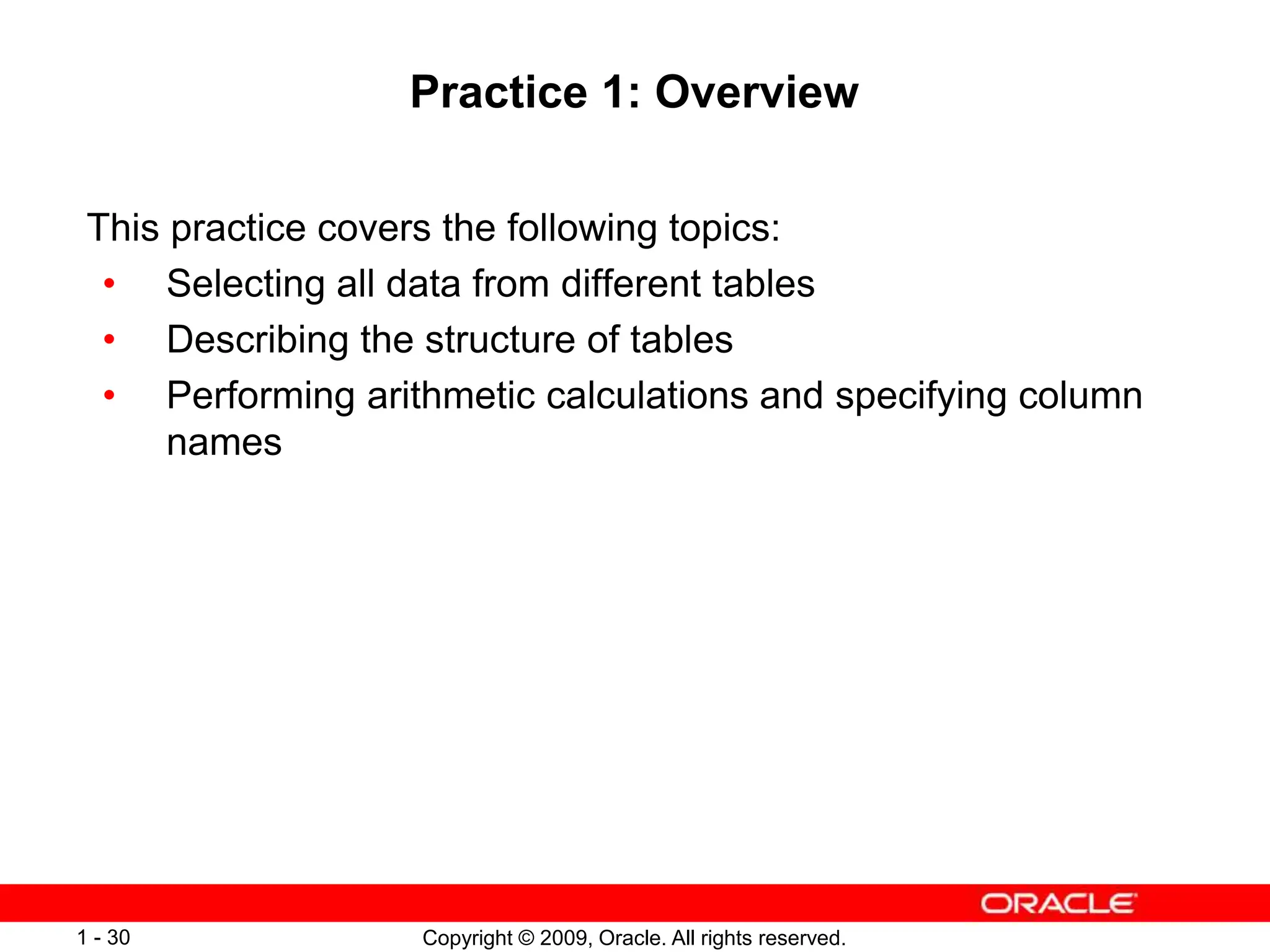
Practice 1: Overview
This practice covers the following topics:
• Selecting all data from different tables
• Describing the structure of tables
• Performing arithmetic calculations and specifying column
names

SQL, consultas rapidas y sencillas, oracle

  • 1.
    Copyright © 2009,Oracle. All rights reserved. Retrieving Data Using the SQL SELECT Statement
  • 2.
    Copyright © 2009,Oracle. All rights reserved. 1 - 2 Objectives After completing this lesson, you should be able to do the following: • List the capabilities of SQL SELECT statements • Execute a basic SELECT statement
  • 3.
    Copyright © 2009,Oracle. All rights reserved. 1 - 3 Lesson Agenda • Basic SELECT statement • Arithmetic expressions and NULL values in the SELECT statement • Column aliases • Use of concatenation operator, literal character strings, alternative quote operator, and the DISTINCT keyword • DESCRIBE command
  • 4.
    Copyright © 2009,Oracle. All rights reserved. 1 - 4 Capabilities of SQL SELECT Statements Selection Projection Table 1 Table 2 Table 1 Table 1 Join
  • 5.
    Copyright © 2009,Oracle. All rights reserved. 1 - 5 Basic SELECT Statement • SELECT identifies the columns to be displayed. • FROM identifies the table containing those columns. SELECT *|{[DISTINCT] column|expression [alias],...} FROM table;
  • 6.
    Copyright © 2009,Oracle. All rights reserved. 1 - 6 Selecting All Columns SELECT * FROM departments;
  • 7.
    Copyright © 2009,Oracle. All rights reserved. 1 - 7 Selecting Specific Columns SELECT department_id, location_id FROM departments;
  • 8.
    Copyright © 2009,Oracle. All rights reserved. 1 - 8 Writing SQL Statements • SQL statements are not case-sensitive. • SQL statements can be entered on one or more lines. • Keywords cannot be abbreviated or split across lines. • Clauses are usually placed on separate lines. • Indents are used to enhance readability. • In SQL Developer, SQL statements can optionally be terminated by a semicolon (;). Semicolons are required when you execute multiple SQL statements. • In SQL*Plus, you are required to end each SQL statement with a semicolon (;).
  • 9.
    Copyright © 2009,Oracle. All rights reserved. 1 - 9 Column Heading Defaults • SQL Developer: – Default heading alignment: Left-aligned – Default heading display: Uppercase • SQL*Plus: – Character and Date column headings are left-aligned. – Number column headings are right-aligned. – Default heading display: Uppercase
  • 10.
    Copyright © 2009,Oracle. All rights reserved. 1 - 10 Lesson Agenda • Basic SELECT statement • Arithmetic expressions and NULL values in the SELECT statement • Column Aliases • Use of concatenation operator, literal character strings, alternative quote operator, and the DISTINCT keyword • DESCRIBE command
  • 11.
    Copyright © 2009,Oracle. All rights reserved. 1 - 11 Arithmetic Expressions Create expressions with number and date data by using arithmetic operators. Multiply * Divide / Subtract - Add + Description Operator
  • 12.
    Copyright © 2009,Oracle. All rights reserved. 1 - 12 SELECT last_name, salary, salary + 300 FROM employees; Using Arithmetic Operators …
  • 13.
    Copyright © 2009,Oracle. All rights reserved. 1 - 13 SELECT last_name, salary, 12*salary+100 FROM employees; Operator Precedence SELECT last_name, salary, 12*(salary+100) FROM employees; … … 1 2
  • 14.
    Copyright © 2009,Oracle. All rights reserved. 1 - 14 Defining a Null Value • Null is a value that is unavailable, unassigned, unknown, or inapplicable. • Null is not the same as zero or a blank space. SELECT last_name, job_id, salary, commission_pct FROM employees; … …
  • 15.
    Copyright © 2009,Oracle. All rights reserved. 1 - 15 SELECT last_name, 12*salary*commission_pct FROM employees; Null Values in Arithmetic Expressions Arithmetic expressions containing a null value evaluate to null. … …
  • 16.
    Copyright © 2009,Oracle. All rights reserved. 1 - 16 Lesson Agenda • Basic SELECT statement • Arithmetic expressions and NULL values in the SELECT statement • Column aliases • Use of concatenation operator, literal character strings, alternative quote operator, and the DISTINCT keyword • DESCRIBE command
  • 17.
    Copyright © 2009,Oracle. All rights reserved. 1 - 17 Defining a Column Alias A column alias: • Renames a column heading • Is useful with calculations • Immediately follows the column name (There can also be the optional AS keyword between the column name and alias.) • Requires double quotation marks if it contains spaces or special characters, or if it is case-sensitive
  • 18.
    Copyright © 2009,Oracle. All rights reserved. 1 - 18 Using Column Aliases SELECT last_name "Name" , salary*12 "Annual Salary" FROM employees; SELECT last_name AS name, commission_pct comm FROM employees; … …
  • 19.
    Copyright © 2009,Oracle. All rights reserved. 1 - 19 Lesson Agenda • Basic SELECT Statement • Arithmetic Expressions and NULL values in SELECT statement • Column Aliases • Use of concatenation operator, literal character strings, alternative quote operator, and the DISTINCT keyword • DESCRIBE command
  • 20.
    Copyright © 2009,Oracle. All rights reserved. 1 - 20 Concatenation Operator A concatenation operator: • Links columns or character strings to other columns • Is represented by two vertical bars (||) • Creates a resultant column that is a character expression SELECT last_name||job_id AS "Employees" FROM employees; …
  • 21.
    Copyright © 2009,Oracle. All rights reserved. 1 - 21 Literal Character Strings • A literal is a character, a number, or a date that is included in the SELECT statement. • Date and character literal values must be enclosed within single quotation marks. • Each character string is output once for each row returned.
  • 22.
    Copyright © 2009,Oracle. All rights reserved. 1 - 22 Using Literal Character Strings … SELECT last_name ||' is a '||job_id AS "Employee Details" FROM employees;
  • 23.
    Copyright © 2009,Oracle. All rights reserved. 1 - 23 Alternative Quote (q) Operator • Specify your own quotation mark delimiter. • Select any delimiter. • Increase readability and usability. SELECT department_name || q'[ Department's Manager Id: ]' || manager_id AS "Department and Manager" FROM departments;
  • 24.
    Copyright © 2009,Oracle. All rights reserved. 1 - 24 Duplicate Rows The default display of queries is all rows, including duplicate rows. SELECT department_id FROM employees; SELECT DISTINCT department_id FROM employees; 1 2 … …
  • 25.
    Copyright © 2009,Oracle. All rights reserved. 1 - 25 Lesson Agenda • Basic SELECT statement • Arithmetic expressions and NULL values in the SELECT statement • Column aliases • Use of concatenation operator, literal character strings, alternative quote operator, and the DISTINCT keyword • DESCRIBE command
  • 26.
    Copyright © 2009,Oracle. All rights reserved. 1 - 26 Displaying the Table Structure • Use the DESCRIBE command to display the structure of a table. • Or, select the table in the Connections tree and use the Columns tab to view the table structure. DESC[RIBE] tablename
  • 27.
    Copyright © 2009,Oracle. All rights reserved. 1 - 27 Using the DESCRIBE Command DESCRIBE employees
  • 28.
    Copyright © 2009,Oracle. All rights reserved. 1 - 28 Quiz Identify the SELECT statements that execute successfully. 1. 2. 3. 4. SELECT first_name, last_name, job_id, salary*12 AS Yearly Sal FROM employees; SELECT first_name, last_name, job_id, salary*12 “yearly sal” FROM employees; SELECT first_name, last_name, job_id, salary AS “yearly sal” FROM employees; SELECT first_name+last_name AS name, job_Id, salary*12 yearly sal FROM employees;
  • 29.
    Copyright © 2009,Oracle. All rights reserved. 1 - 29 Summary In this lesson, you should have learned how to: • Write a SELECT statement that: – Returns all rows and columns from a table – Returns specified columns from a table – Uses column aliases to display more descriptive column headings SELECT *|{[DISTINCT] column|expression [alias],...} FROM table;
  • 30.
    Copyright © 2009,Oracle. All rights reserved. 1 - 30 Practice 1: Overview This practice covers the following topics: • Selecting all data from different tables • Describing the structure of tables • Performing arithmetic calculations and specifying column names