Workshop:
SPACE CAREERS
Dr Anastasiya Boiko
European Schoolnet
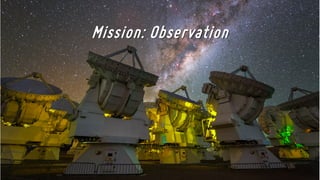
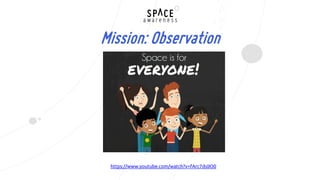
Mission: Observation
https://www.youtube.com/watch?v=fArc7dslIO0
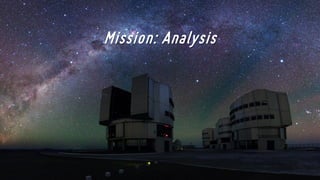
Mission: Analysis
Choosing (potential) role models
• Instead of being perfect people, they should be ‘real people’, such as:
- People with families, outside interests
- People who faced struggles along the way (e.g. found maths challenging)
- NOT ‘super-geniuses’, not ‘perfect’ (may be especially important for girls)
• Pathways to their jobs
- What attracted them to space science?
- How did they actually get there? (What choices did they make?)
• Acknowledging the reality of the field (lack of diversity but hope for the future)
Project gives access to high-quality resources with a focus on current missions and global concerns:
The resources are created using inquiry based methods and hands on approaches for primary and secondary
schools, and science museums
Ready to use quality material selected through peer-review
Easy integration in European curricula, easy to use in non-science disciplines
High attention to diversity
Material translated into 8 European languages
Space Awareness educational resources
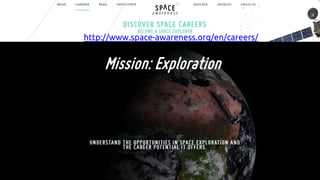
Mission: Exploration
http://www.space-awareness.org/en/careers/
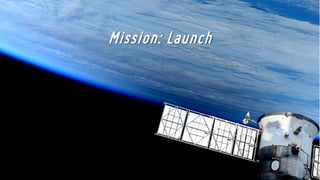
Mission: Launch
This material was developed under the Space Awareness project
funded by the European Commission’s Horizon 2020 Programme
under the grant agreement no. 638653
Follow us on social media @space_awe
T h e m a t e r i a l p r e s e n t e d i n t h e w o r k s h o p i s b a s e d o n
S p a c e A w a r e n e s s M O O C “ T e a c h i n g w i t h S p a c e a n d A s t r o n o m y i n y o u r C l a s s r o o m ” h t t p : / / w w w . s p a c e - a w a r e n e s s . o r g / e n / s k i l l s /
P i c t u r e c r e d i t s : w i k i p e d i a . o r g

#SPW13 - Space Awareness Space Careers workshop

  • 1.
    Workshop: SPACE CAREERS Dr AnastasiyaBoiko European Schoolnet
  • 3.
  • 4.
  • 5.
  • 6.
    Choosing (potential) rolemodels • Instead of being perfect people, they should be ‘real people’, such as: - People with families, outside interests - People who faced struggles along the way (e.g. found maths challenging) - NOT ‘super-geniuses’, not ‘perfect’ (may be especially important for girls) • Pathways to their jobs - What attracted them to space science? - How did they actually get there? (What choices did they make?) • Acknowledging the reality of the field (lack of diversity but hope for the future)
  • 7.
    Project gives accessto high-quality resources with a focus on current missions and global concerns: The resources are created using inquiry based methods and hands on approaches for primary and secondary schools, and science museums Ready to use quality material selected through peer-review Easy integration in European curricula, easy to use in non-science disciplines High attention to diversity Material translated into 8 European languages Space Awareness educational resources
  • 8.
  • 9.
  • 10.
    This material wasdeveloped under the Space Awareness project funded by the European Commission’s Horizon 2020 Programme under the grant agreement no. 638653 Follow us on social media @space_awe T h e m a t e r i a l p r e s e n t e d i n t h e w o r k s h o p i s b a s e d o n S p a c e A w a r e n e s s M O O C “ T e a c h i n g w i t h S p a c e a n d A s t r o n o m y i n y o u r C l a s s r o o m ” h t t p : / / w w w . s p a c e - a w a r e n e s s . o r g / e n / s k i l l s / P i c t u r e c r e d i t s : w i k i p e d i a . o r g