Standard Penetration Test(SPT)
• Soil Investigation Test
• Presented by: Rupam Kumar
• Department of Civil Engineering
2.
Introduction
• • StandardPenetration Test (SPT) is an in-situ
test.
• • It is widely used to determine soil
properties.
• • Mainly conducted in boreholes during site
investigation.
3.
Objective of SPT
•The main objectives are:
• • To determine soil bearing capacity
• • To find relative density of sand
• • To evaluate soil strength parameters
• • To obtain N-value for foundation design
4.
Apparatus Required
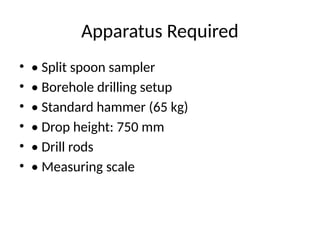
• •Split spoon sampler
• • Borehole drilling setup
• • Standard hammer (65 kg)
• • Drop height: 750 mm
• • Drill rods
• • Measuring scale
5.
Test Procedure
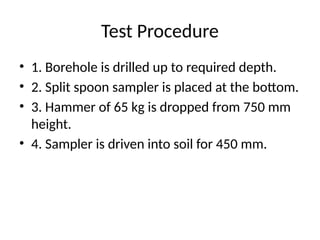
• 1.Borehole is drilled up to required depth.
• 2. Split spoon sampler is placed at the bottom.
• 3. Hammer of 65 kg is dropped from 750 mm
height.
• 4. Sampler is driven into soil for 450 mm.
6.
N-Value Calculation
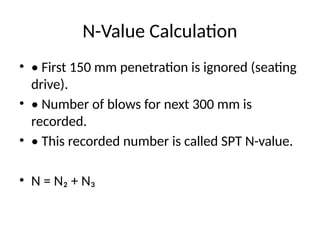
• •First 150 mm penetration is ignored (seating
drive).
• • Number of blows for next 300 mm is
recorded.
• • This recorded number is called SPT N-value.
• N = N₂ + N₃
7.
Interpretation of N-Value
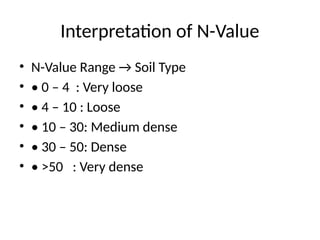
•N-Value Range → Soil Type
• • 0 – 4 : Very loose
• • 4 – 10 : Loose
• • 10 – 30: Medium dense
• • 30 – 50: Dense
• • >50 : Very dense
8.
Applications of SPT
•• Foundation design
• • Soil classification
• • Estimation of settlement
• • Liquefaction analysis
• • Site investigation reports
9.
Advantages
• • Simpleand economical test
• • Suitable for sandy soils
• • Provides quick soil strength estimation
• • Widely accepted standard method
10.
Limitations
• • Notreliable in soft clay
• • Results depend on equipment and operator
• • Disturbed soil sample obtained
• • Correction factors required
11.
Conclusion
• • SPTis one of the most common field tests in
geotechnical engineering.
• • N-value helps in determining soil strength
and foundation safety.