Union City High School
By Cristen Pennello
Introduction

 Who
   Open to all students, grades 10-12
 What
   Dance I course
   Elective
   Meets every day
   Year long
   Fine Arts Credit
 Where
 Union City High School (Union City, NJ)
Mission Statement
 Union City High School is dedicated to producing
    independent, lifelong learners in a safe and secure
    environment. As a family of educators, we are committed
    to providing our culturally diverse community with the
    skills needed to become productive members of society.

    All students will think critically, work collaboratively,
    communicate effectively, and utilize relevant technology
    in an ever-changing demanding world.

    In a state of the art school, the students, as stakeholders,
    will be empowered to realize personal growth and to
    prepare for their individual goals.
   http://www.union-city.k12.nj.us/schools/uchs/uchs/index.php#
Dance Education Philosophy
 Develops the whole child
 Organized activity helps to build life skills
 Encourage relationships
 Provide a safe environment
 Promote dexterity across the board between a student’s
  family, school, and community (Bartko & Eccles, 2003, p.
  240)
 Builds self confidence
 Community outreach

These skills will enable students to become well-
  rounded, productive members of society.
Rationale
 Inner-city children require a unique form of teaching:
  structure, positive reinforcement, and motivation
  (Randall & Bohnert , 2009, p. 1195).
 Equally important: flexibility and creativity.
 The teacher’s responsibility: to present a comfortable
  environment that adheres to all types of learners and
  personalities (Gardner, 1999, p. 32).
 Trust and motivation (Scanlon, et al., 2008, p. 174)
 Use the arts as a positive outlet to enhance and enrich
  their lives (Hanna, 1994, p. 83).
 Dissolving prejudice (Hanna, 2003, p. 78)
Aims, Goals, Objectives
 Aim: To define dance and describe its various forms, examine how
  technology can be used in the field of dance, and recognize how
  skills developed can be applicable toward various career choices
  on an introductory level to students in an urban high school.

 Goal: The students will experience dance on an introductory level.
  Students will find coherence of diverse ideas, beliefs, and cultures
  as communicated through movement. Students will obtain life
  skills, define dance as a form of self expression, as well as develop
  a general appreciation for dance as an art form.

 Overall objectives: Students will focus on areas such as anatomy,
  body, weight, shape, space, time, effort, history, and technology.
  Through the help of these concepts, students will work to
  interpret, appreciate, and compose dance.
Content Goals
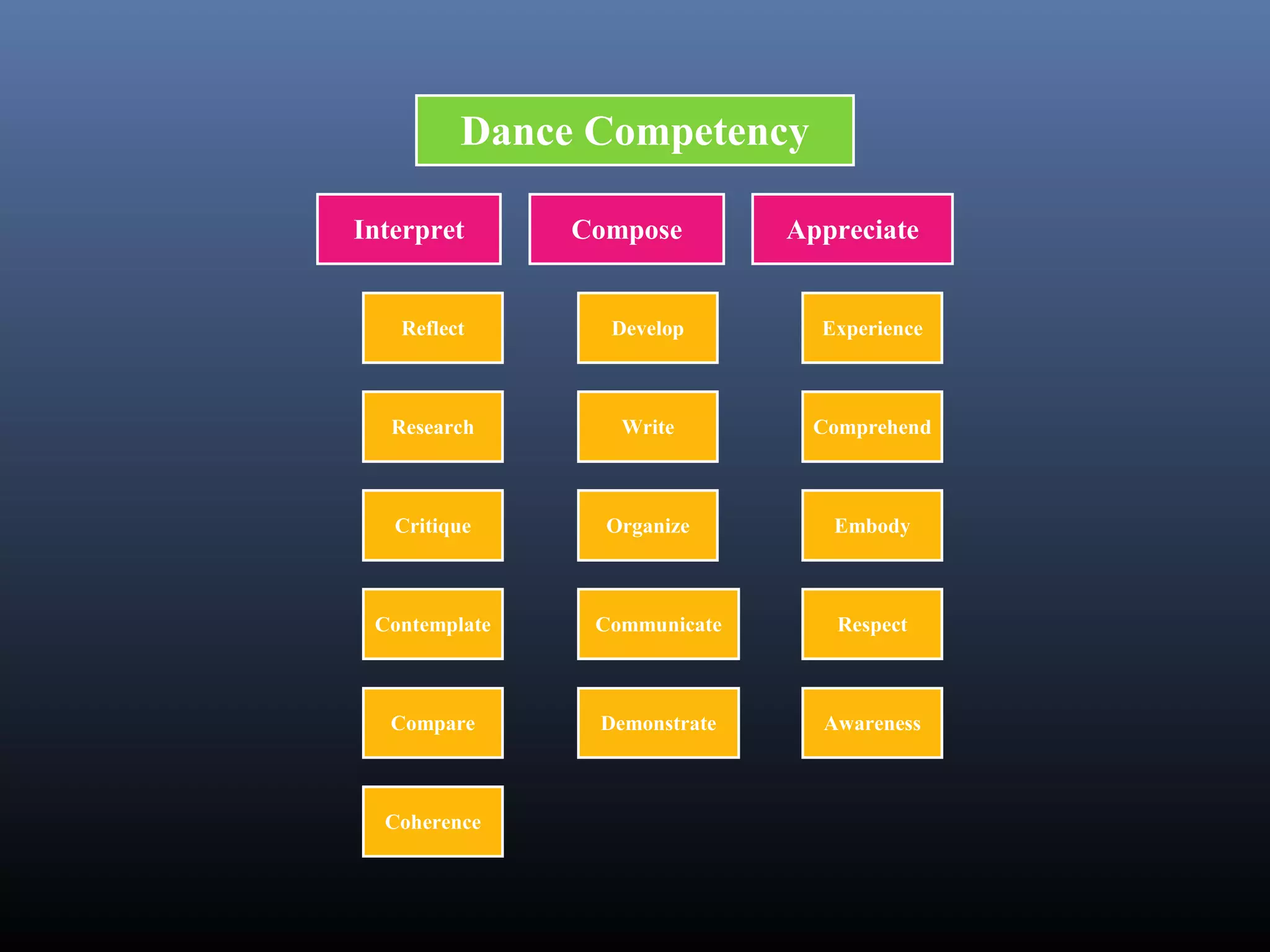
Dance Competency

Interpret      Compose        Appreciate


   Reflect       Develop        Experience


   Research       Write         Comprehend


   Critique      Organize        Embody


 Contemplate    Communicate       Respect


   Compare      Demonstrate     Awareness


  Coherence
Content
 Students will demonstrate and          Quarter 1: Ballet
  classify with the purposes of          Quarter 2: Jazz, Musical Theater & Hip hop
  technical skills, formulating a rich
  perception of dance and its            Quarter 3: Modern Dance
  various forms.                         Quarter 4: Improvisation & Composition
 Students will examine the history
  of dance, and asses how its
  various beliefs, ideas, and
  cultures are communicated
  through movement.
 Students will perceive the
  benefits of dance notation.
  Students will also use critical and
  analytical skills to demonstrate,
  discuss, and evaluate dances, as
  well as construct them.
Assessment & Evaluation
Daily Evaluation        Content Assessment
                      Performances
   Effort            Podcasts
                      Video portfolio
   Promptness        Blogs/Discussion forums
   Dress code        Journal reflection
                      Rubrics
   Etiquette         Compositions Partner/Group work
   Rubrics           Research & media projects
                      Drawing a period costume
                      Fictional letter to a historical figure
                      History timelines & family trees
                      Traditional quizzes, with both written and
                       movement aspects
                      Large group presentations/discussion/analysis
                      Movement notation
                      Peer/Self Evaluation
                      Dance Terminology
Materials

Essentials                 If possible
 A dance studio (ballet    Book/media library
  barres, dance floors,     Book shelf
  mirrors)                  File cabinet
 A sound system            Costume closet
 CDs                       Printer
 ipod connection           Crayons
 projector                 Folders
 computer                  Construction paper
                            Bulletin board
References
Bartko, W. T. & Eccles, J. S. (2003). Adolescent participation in structured
  and unstructured activities: A Person-oriented analysis. Journal of
  Youth and Adolescence, 32(4), 233-241.
Gardner, H. (1999). Intelligence Reframed: Multiple Intelligences for the
  21st Century. New York: Basic Books.
Hanna, J. L. (1994). Issues in supporting school diversity: Academics,
  social relations, and the arts. Anthropology & Education Quarterly, 25
  (1), 66-85.
Hanna, J. (2003). Intelligent moves: A dance-education pas de deux. The
  World & I, 18(2), 78.
Randall, E. T. & Bohnert, A. M. (2009). Organized activity involvement,
  depressive symptoms, and social adjustment in adolescents: Ethnicity
  and socioeconomic status as moderators. Journal of Youth and
  Adolescence, 38(9), 1187-1198.
Scanlon, D., Saxon, K., Cowell, M., & Kenny, M. E. (2008). Urban
  adolescents’ post school aspirations and awareness. Remedial and
  Special Education, 29(3), 161-175.
Planning Ahead…
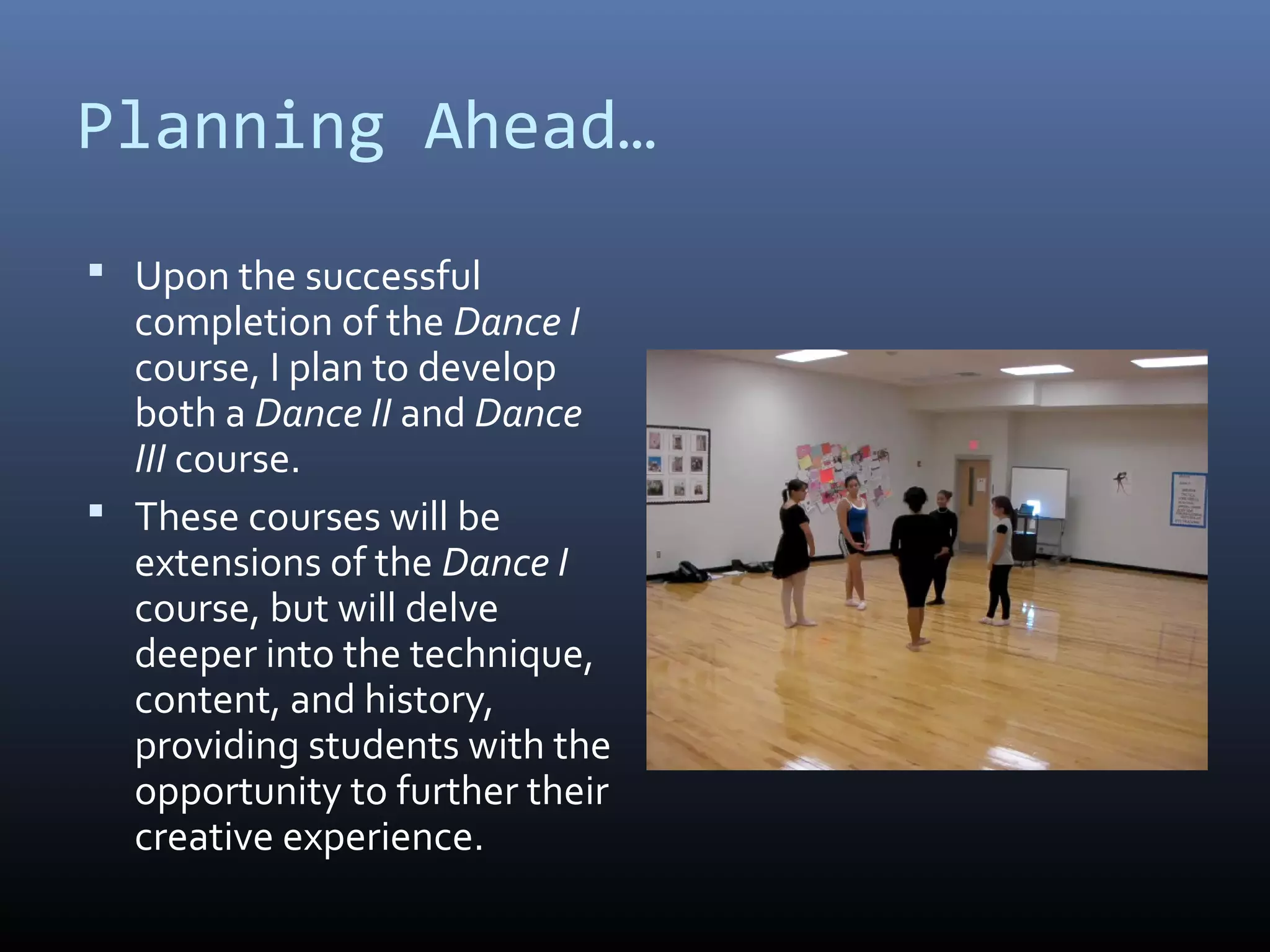
 Upon the successful
  completion of the Dance I
  course, I plan to develop
  both a Dance II and Dance
  III course.
 These courses will be
  extensions of the Dance I
  course, but will delve
  deeper into the technique,
  content, and history,
  providing students with the
  opportunity to further their
  creative experience.

Seminar curriculumppt

  • 1.
    Union City HighSchool By Cristen Pennello
  • 2.
    Introduction  Who  Open to all students, grades 10-12  What  Dance I course  Elective  Meets every day  Year long  Fine Arts Credit  Where  Union City High School (Union City, NJ)
  • 3.
    Mission Statement  UnionCity High School is dedicated to producing independent, lifelong learners in a safe and secure environment. As a family of educators, we are committed to providing our culturally diverse community with the skills needed to become productive members of society. All students will think critically, work collaboratively, communicate effectively, and utilize relevant technology in an ever-changing demanding world. In a state of the art school, the students, as stakeholders, will be empowered to realize personal growth and to prepare for their individual goals.  http://www.union-city.k12.nj.us/schools/uchs/uchs/index.php#
  • 4.
    Dance Education Philosophy Develops the whole child  Organized activity helps to build life skills  Encourage relationships  Provide a safe environment  Promote dexterity across the board between a student’s family, school, and community (Bartko & Eccles, 2003, p. 240)  Builds self confidence  Community outreach These skills will enable students to become well- rounded, productive members of society.
  • 5.
    Rationale  Inner-city childrenrequire a unique form of teaching: structure, positive reinforcement, and motivation (Randall & Bohnert , 2009, p. 1195).  Equally important: flexibility and creativity.  The teacher’s responsibility: to present a comfortable environment that adheres to all types of learners and personalities (Gardner, 1999, p. 32).  Trust and motivation (Scanlon, et al., 2008, p. 174)  Use the arts as a positive outlet to enhance and enrich their lives (Hanna, 1994, p. 83).  Dissolving prejudice (Hanna, 2003, p. 78)
  • 6.
    Aims, Goals, Objectives Aim: To define dance and describe its various forms, examine how technology can be used in the field of dance, and recognize how skills developed can be applicable toward various career choices on an introductory level to students in an urban high school.  Goal: The students will experience dance on an introductory level. Students will find coherence of diverse ideas, beliefs, and cultures as communicated through movement. Students will obtain life skills, define dance as a form of self expression, as well as develop a general appreciation for dance as an art form.  Overall objectives: Students will focus on areas such as anatomy, body, weight, shape, space, time, effort, history, and technology. Through the help of these concepts, students will work to interpret, appreciate, and compose dance.
  • 7.
  • 8.
    Dance Competency Interpret Compose Appreciate Reflect Develop Experience Research Write Comprehend Critique Organize Embody Contemplate Communicate Respect Compare Demonstrate Awareness Coherence
  • 9.
    Content  Students willdemonstrate and Quarter 1: Ballet classify with the purposes of Quarter 2: Jazz, Musical Theater & Hip hop technical skills, formulating a rich perception of dance and its Quarter 3: Modern Dance various forms. Quarter 4: Improvisation & Composition  Students will examine the history of dance, and asses how its various beliefs, ideas, and cultures are communicated through movement.  Students will perceive the benefits of dance notation. Students will also use critical and analytical skills to demonstrate, discuss, and evaluate dances, as well as construct them.
  • 10.
    Assessment & Evaluation DailyEvaluation Content Assessment  Performances  Effort  Podcasts  Video portfolio  Promptness  Blogs/Discussion forums  Dress code  Journal reflection  Rubrics  Etiquette  Compositions Partner/Group work  Rubrics  Research & media projects  Drawing a period costume  Fictional letter to a historical figure  History timelines & family trees  Traditional quizzes, with both written and movement aspects  Large group presentations/discussion/analysis  Movement notation  Peer/Self Evaluation  Dance Terminology
  • 11.
    Materials Essentials If possible  A dance studio (ballet  Book/media library barres, dance floors,  Book shelf mirrors)  File cabinet  A sound system  Costume closet  CDs  Printer  ipod connection  Crayons  projector  Folders  computer  Construction paper  Bulletin board
  • 12.
    References Bartko, W. T.& Eccles, J. S. (2003). Adolescent participation in structured and unstructured activities: A Person-oriented analysis. Journal of Youth and Adolescence, 32(4), 233-241. Gardner, H. (1999). Intelligence Reframed: Multiple Intelligences for the 21st Century. New York: Basic Books. Hanna, J. L. (1994). Issues in supporting school diversity: Academics, social relations, and the arts. Anthropology & Education Quarterly, 25 (1), 66-85. Hanna, J. (2003). Intelligent moves: A dance-education pas de deux. The World & I, 18(2), 78. Randall, E. T. & Bohnert, A. M. (2009). Organized activity involvement, depressive symptoms, and social adjustment in adolescents: Ethnicity and socioeconomic status as moderators. Journal of Youth and Adolescence, 38(9), 1187-1198. Scanlon, D., Saxon, K., Cowell, M., & Kenny, M. E. (2008). Urban adolescents’ post school aspirations and awareness. Remedial and Special Education, 29(3), 161-175.
  • 13.
    Planning Ahead…  Uponthe successful completion of the Dance I course, I plan to develop both a Dance II and Dance III course.  These courses will be extensions of the Dance I course, but will delve deeper into the technique, content, and history, providing students with the opportunity to further their creative experience.