BUSINESS PRIORITIES

FOR FASTER
GROWTH
Organization of
Employers of
Macedonia
P r e face
The Republicof Macedonia may beacountrywith a
small market,but despite this constraint,by
implementingarangeof measuresandpolicies, it
canimprovethe competitivenessof its economy
andbecomeacountrywheredoing businessis
morecost-effectiveandlifeis better asaresult.
Therearemultiple andcomplexfactorsthat affect
competitiveness; thebusinessclimatecan be
improvedandacompetitive Macedonianeconomy
created only with the joint effort of all
stakeholders, including the government, the
businesssector and civil society.
Inrecent years Macedonia hasmadesignificant
progressin termsof improving its business
climate, which hasbeenacknowledgedin
studies commissioned by theWorldBank,
theWorldEconomicF
orum, the International
Monetary Fundandthe InternationalLabour
Organization(ILO).However,enhancingthe
businessclimateisacontinuousprocessthat
requiresregularimprovement andadvancement.
T
othat end, the Organizationof Employersof
Macedonia andthe Business Confederation of
Macedonia, with the support of the ILOandwith
theprofessional assistanceof the Macedonian
Centerfor International Cooperation and
M-prospect, implementedresearchon thetheme
of anImprovedBusiness Climatefor Sustainable
Enterprises,aimed at identifying keyareasthat
constrainthe businessclimatein Macedonia and
proposingrecommendations for its improvement.
Recommendationssuchasimproving the legal
andregulatoryenvironment by increasingthe
time available for consultationswith the business
community,strengtheningthe roleof theEconomicSocial Council, andgiving alonger period for
companies to adjust to newandamendedlabour
regulations areall aspects that arecrucial to an
efficient market economythat should serveasa
creatorof newemployment, andagenerator of
economic growth, improvedliving standardsand
overall progress.

companies andthoseyet to beestablished, and
for both domestic investorsandforeigndirect
investments.The merepassing of laws and
amendments isnot sufficient to createamore
stablebusinessenvironment; in thefuture,we need
to work harder onthe implementationof
laws, judicial reformsandthepreventionof
corruption.
The growth of Macedoniancompanies still depends
onself-financingandbank loans. Thismeansthat
highinterestrateshaveto beaddressed,andeasier
accessto financialservices for small andmedium
enterpriseshasto beprovided.
The gapbetween the economy‟sdemands and
thesupply of qualified labour is still anissue. Links
between vocational schools andenterprisesneed
to beimproved. Further,trainingand re-training
should beencouraged for unemployed people, to
improvetheir professional development and their
accessto employment.
Despitethe fact that Macedonia isoneof the
countriesin theregion that offersthebest
conditionsfor businessstart-ups,strongerfinancial
support for theimplementationof theProgramme
for theDevelopment of
Entrepreneurship, CompetitivenessandInnovation
for Small and MediumEnterprises is required.
Webelieve that the recommendations made in this
document will be of benefit to policy-makers, social
partners,businessassociationsand civil society
in their effortsto createabusinessclimatethat will
improvethecompetitivenessandsuccessof
domesticcompanies,both in domestic and foreign
markets.
Organization of
Employersof
Macedonia

Business
Confederation of
Macedonia

President
Angel Dimitrov

President
Mile Boskov

The ruleof law andsecureproperty rightsare
essential for the creationof apredictable, stable
andsafeenvironment, both for currentlyexisting
3
COMPANIES DESERVE QUALITY
REGULA
TION AND ITS FAIR
IMPLEMENTATION

Macedonia

has achieved
considerable
progressin assessmentof the ease of doing
business in the country,being ranked23rd out of
185economiesin 2012 by the World Bank‟s Doing
Business (DB)report. However, the quality of the
regulatoryenvironment iscomparativelylow,as
assessed by the World Bank‟s RegulatoryQuality
Index.

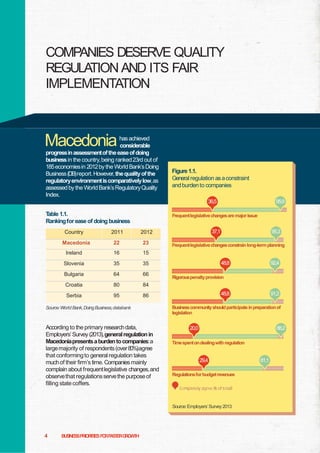
Figure 1.1.
General regulation as a constraint
and burden to companies
36,5

T
able 1.1.
Rankingfor ease of doing business
Country

95,9

Frequentlegislative changesare major issue

2011
22

23

Ireland

16
35

35

Bulgaria

64

66

Croatia

80

84

Serbia

95

86

95,3

15

Slovenia

37,1

2012

Macedonia

Source:World Bank,Doing Business,databank

According to the primary research data,
Employers‟ Survey (2013),general regulation in
Macedoniapresents a burden to companies:a
large majority of respondents (over 80%)agree
that conforming to general regulation takes
much of their firm‟s time. Companies mainly
complain about frequent legislative changes, and
observethat regulations serve the purpose of
filling state coffers.

Frequentlegislative changesconstrain long-term planning

48,8
Rigorouspenalty provision

48,8

BUSINESSPRIORITIESFO A TE R W H
RF S RG O T

91,2

Businesscommunity should participate in preparation of
legislation

20,0

88,2

Timespentondealingwith regulation

29,4
Regulationsfor budgetrevenues

Source:Employers‟ Survey 2013

4

92,4

81,1
T
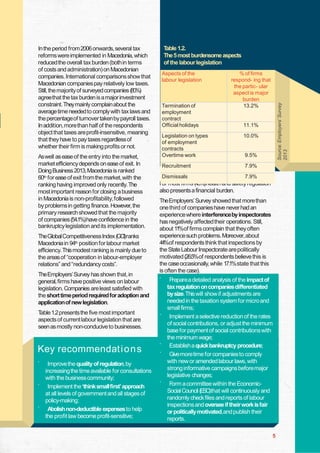
able 1.2.
The 5 most burdensome aspects
of the labour legislation

Aswell as ease of the entry into the
market, market efficiency depends on ease
of exit. In Doing Business 2013,Macedonia is
ranked
60th for ease of exit from the market,with the
ranking having improved only recently.The
most important reason for closing a business
in Macedonia is non-profitability,followed
by problems in getting finance. However, the
primary research showed that the majority
of companies(54.1%)have confidence in the
bankruptcylegislation and its implementation.
TheGlobalCompetitivenessIndex (GCI)ranks
Macedonia in 94th position for labour market
efficiency.This modest ranking is mainly due to
the areas of “cooperation in labour-employer
relations” and “redundancy costs”.
TheEmployers‟ Survey has shown that, in
general, firms have positive views on labour
legislation. Companies areleast satisfied with
the short timeperiod requiredfor adoption and
application of new legislation.
T
able 1.2presentsthe five most important
aspects of current labour legislation that are
seen as mostly non-conducive to businesses.

Key recommendat i o n s
Improvethe quality of regulation,by
increasingthe time available for consultations
with the business community;
` Implement the „thinksmallfirst‟ approach
at all levels of government and all stages of
policy-making;
` Abolishnon-deductible expensesto help
the profit law become profit-sensitive;

Aspects of the
labour legislation

Termination of
employment
contract
Official holidays

% of firms
respond- ing that
the partic- ular
aspect is major
burden
13.2%

Source: Employers‟ Survey
2013

In the period from2006 onwards, several tax
reformswere implemented in Macedonia, which
reducedthe overall tax burden (bothin terms
of costs and administration) on Macedonian
companies. International comparisons show that
Macedonian companiespay relatively low taxes.
Still, the majorityof surveyed companies (80%)
agreethat the tax burden is amajor investment
constraint.Theymainly complainabout the
averagetime neededto comply with tax laws and
the percentageof turnover takenby payroll taxes.
In addition,morethan half of the respondents
object that taxes areprofit-insensitive, meaning
that they have to pay taxes regardlessof
whether their firm is making profits or not.

11.1%

Legislation on types
of employment
contracts
Overtime work

10.0%

Recruitment

7.9%

Dismissals

7.9%

9.5%

F most firms (45%)health and safety regulation
or
also presentsa financial burden.
TheEmployers‟ Survey showed that morethan
one third of companieshave never had an
experiencewhere interferenceby inspectorates
has negatively affectedtheir operations.
Still, about 11%of firms complain that they often
experiencesuch problems.Moreover,about
44%of respondents think that inspections by
the State Labour Inspectorate arepolitically
motivated (26.5%of respondents believe this is
the case occasionally, while 17.1%state that this
is often the case).
`

`

`
`

`

`

Preparea detailed analysis of the impact of
tax regulation on companiesdifferentiated
bysize.This will show if adjustments are
needed in the taxation system for micro and
small firms;
Implement a selective reduction of the rates
of social contributions, or adjust the minimum
base for payment of social contributions with
the minimum wage;
Establish a quickbankruptcy procedure;
Givemoretime for companiesto comply
with new or amended labour laws, with
strong informative campaigns beforemajor
legislative changes;
F
orm a committee within the EconomicSocial Council (E C
S )that will continuously and
randomly check files and reports of labour
inspections and oversee if their workisfair
or politically motivated,and publish their
reports.
5
STRONG RULE
OF LAW TOUGH
,
FIGHT AGAINST
CORRUPTION

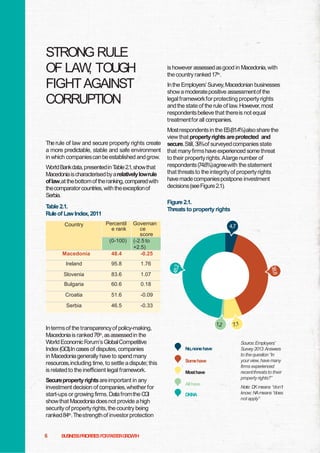
is however assessed as good in Macedonia, with
the country ranked17th.
In the Employers‟ Survey,Macedonian businesses
show a moderate positive assessmentof the
legal framework for protecting property rights
and the state of the rule of law. However, most
respondents believe that thereis not equal
treatment for all companies.

The rule of law and secure property rights create
a more predictable, stable and safe environment
in which companiescan be established and grow.
WorldBankdata, presentedin T
able2.1,showthat
Macedonia ischaracterised by arelativelylowrule
of law,at thebottom of theranking, comparedwith
thecomparator countries, with the exceptionof
Serbia.

Figure 2.1.
Threats to property rights

T
able 2.1.
Rule of Law Index, 2011

48.4

Governan
ce
score
(-2.5 to
+2.5)
-0.25

Ireland

95.8

1.76

Slovenia

83.6

1.07

Bulgaria

60.6

0.18

Croatia

51.6

-0.09

Serbia

46.5

-0.33

Country

Percentil
e rank
(0-100)

Macedonia

Source:World Bank,GovernanceMatters

In terms of the transparency of policy-making,
Macedonia is ranked76th,as assessed in the
World Economic F
orum‟s GlobalCompetitive
Index (GCI).In cases of disputes, companies
in Macedonia generally have to spend many
resources,including time, to settle a dispute; this
is related to the inefficient legal framework.
Secureproperty rights areimportant in any
investment decision of companies,whether for
start-ups or growing firms. Data fromthe C I
G
show that Macedonia does not provide a high
security of property rights, the country being
ranked84th.Thestrength of investor protection

6

Most respondents in the E
S(81.4%)also share the
view that propertyrights are protected and
secure.Still, 39%of surveyed companies state
that many firms have experienced some threat
to their property rights. Alarge number of
respondents (74.6%)agreewith the statement
that threats to the integrity of property rights
have made companiespostpone investment
decisions(seeFigure 2.1).

BUSINESSPRIORITIESFO A TE R W H
RF S RG O T

4,7

No,nonehave
Somehave
Mosthave
Allhave
DK/NA

Source:Employers‟
Survey 2013: Answers
to the question “In
your view, have many
firms experienced
recent threats to their
property rights?”
Note: D means “don‟t
K
know; NAmeans “does
not apply”
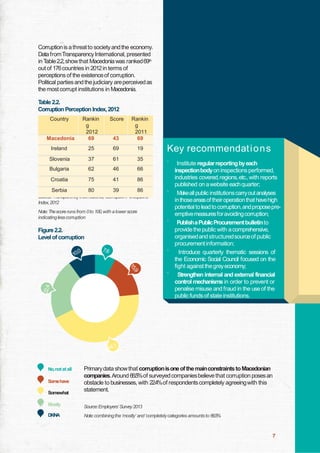
Corruption is a threat to society and the economy.
Data fromTransparency International, presented
in T
able 2.2,show that Macedonia was ranked69th
out of 176 countries in 2012 in terms of
perceptions of the existence of corruption.
Political parties and the judiciary areperceived as
the most corrupt institutions in Macedonia.
T
able 2.2.
Corruption Perception Index, 2012
Country

Score

Macedonia

Rankin
g
2012
69

43

Rankin
g
2011
69

Ireland

25

69

19

Slovenia

37

61

35

Bulgaria

62

46

66

Croatia

75

41

86

Serbia

80

39

86

Source:Transparency International, Corruption Perceptions
Index,2012

Key recommendat i o n s
`

`

Note:Thescore runs from 0to 100,with a lower score
indicating lesscorruption

`
Figure 2.2.
Level of corruption
`

`

No,not at all
Somehave
Somewhat

Institute regular reporting by each
inspectionbodyon inspections performed,
industries covered,regions,etc., with reports
published on a website each quarter;
Makeall public institutionscarryout analyses
in thoseareasof their operation that havehigh
potential to lead to corruption,andproposepreemptivemeasuresfor avoidingcorruption;
Publisha PublicProcurement bulletin to
provide the public with a comprehensive,
organisedand structuredsourceof public
procurement information;
Introduce quarterly thematic sessions of
the Economic Social Council focused on the
fight against the greyeconomy;
Strengthen internal and external financial
control mechanisms in order to prevent or
penalise misuse and fraud in the use of the
public funds of state institutions.

Primary data show that corruptionisone of the mainconstraints to Macedonian
companies.Around 66.5%of surveyed companiesbelieve that corruption poses an
obstacle to businesses, with 22.4%of respondents completely agreeingwith this
statement.

Mostly

Source:Employers‟ Survey 2013

DK/NA

Note:combining the „mostly‟ and „completely categories amounts to 66.5%

7
Growt h Depends on
Access t o E x t e r n a l Finance
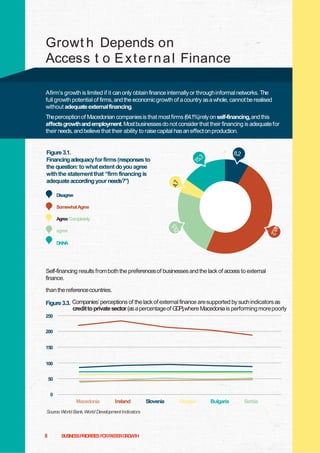
Afirm‟s growth is limited if it can only obtain finance internally or throughinformal networks. The
full growth potential of firms, and the economicgrowth of a country as a whole, cannot be realised
without adequate externalfinancing.
Theperception of Macedonian companiesis that most firms (64.1%)rely on self-financing, and this
affectsgrowthand employment.Most businesses do not consider that their financing is adequate for
their needs, and believe that their ability to raise capital has an effect on production.

Figure 3.1.
Financingadequacy for firms (responses to
the question: to what extent do you agree
with the statement that “firm financing is
adequate according your needs?”)
Disagree
SomewhatAgree
Agree Completely
agree
DK/NA

Self-financing results from both the preferences of businesses and the lack of access to external
finance.
than the reference countries.
Figure 3.3. Companies‟ perceptions of the lack of external finance aresupported by such indicators as
credit to private sector (asa percentageof GD ),where Macedonia is performing morepoorly
P
250
200
150
100
50
0

Macedonia

Ireland

Source:World Bank,World Development Indicators

8

BUSINESSPRIORITIESFO A TE R W H
RF S RG O T

Slovenia

Croatia

Bulgaria

Serbia
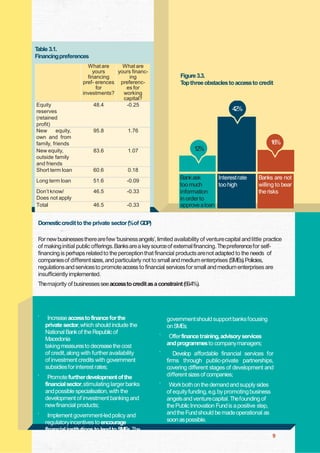
T
able 3.1.
Financingpreferences

Equity
reserves
(retained
profit)
New
equity,
own and from
family, friends
New equity,
outside family
and friends
Short term loan

What are
What are
yours
yours financfinancing
ing
pref- erences preferencfor
es for
investments?
working
capital?
48.4
-0.25

95.8

1.07

60.6

0.18

Long term loan

51.6

-0.09

Don‟t know/
Does not apply
Total

46.5

-0.33

46.5

42%

1.76

83.6

Figure 3.3.
T three obstacles to access to credit
op

-0.33

16%
12%

Bankask
Interest rate
too much
too high
information
in order to
approve a loan

Banks are not
willing to bear
the risks

Domesticcredit to the private sector (
%of GDP)
F new businesses therearefew „business angels‟, limited availability of venturecapital and little practice
or
of making initial public offerings.Banksarea key sourceof external financing. Thepreference for selffinancing is perhaps related to the perception that financial products arenot adapted to the needs of
companiesof different sizes, and particularly not to small and medium enterprises (SMEs).Policies,
regulations and services to promote access to financial services for small and medium enterprises are
insufficiently implemented.
Themajority of businesses see accessto credit as a constraint (69.4%).

Key recommendat i o n s
`

`

`

Increase accessto finance for the
private sector,which should include the
National Bank of the Republic of
Macedonia
taking measuresto decrease the cost
of credit, along with further availability
of investment credits with government
subsidiesfor interest rates;
Promote furtherdevelopment of the
financial sector,stimulating larger banks
and possible specialisation, with the
development of investment banking and
new financial products;
Implement government-led policy and
regulatoryincentives to encourage
financial institutions to lend to SMEs.The

government should support banks focusing
on SMEs;
`

Offer finance training,advisory services
and programmesto companymanagers;

`

Develop affordable financial services for
firms through public-private partnerships,
covering different stages of development and
different sizes of companies;

`

Work both on the demand and supply sides
of equity funding, e.g.by promoting business
angels and venturecapital. Thefounding of
the Public Innovation Fund is a positive step,
and the Fund should be made operational as
soon as possible.
9
INVEST INNOVATE, GLOBALIS
,
E, BE COMPETITIVE

F
air

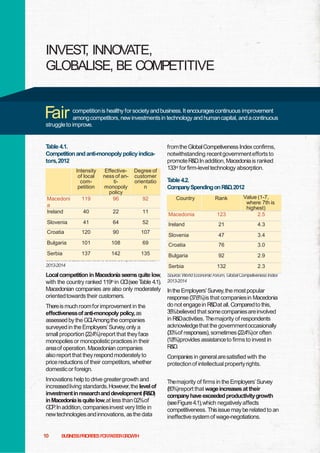
competition is healthy for society and business. It encourages continuous improvement
amongcompetitors, new investments in technology and human capital, and a continuous
struggle to improve.

T
able 4.1.
Competition and anti-monopoly policy indicators,2012
Intensity
of local
competition
Macedoni
a
Ireland

119

Effectiveness of antimonopoly
policy
96

Degree of
customer
orientatio
n

40

22

11

Slovenia

41

64

52

Croatia

120

90

107

Bulgaria

101

108

69

Serbia

137

142

135

92

Source:World Economic F
orum, GlobalCompetiveness Index
2013-2014

Local competition in Macedonia seems quite low,
with the country ranked 119th in G I(see T
C
able 4.1).
Macedonian companies are also only moderately
oriented towards their customers.
Thereis much room for improvement in the
effectivenessof anti-monopoly policy, as
assessed by the GCI.Among the companies
surveyed in the Employers‟ Survey,only a
small proportion (22.4%)report that they face
monopolies or monopolistic practices in their
areaof operation. Macedonian companies
also report that they respond moderately to
price reductions of their competitors, whether
domestic or foreign.
Innovations help to drive greater growth and
increased living standards. However,the level of
investmentin researchand development (R&D)
in Macedonia isquite low,at less than 0.2%of
G P addition, companiesinvest very little in
D .In
new technologies and innovations, as the data

10

BUSINESSPRIORITIESFO A TE R W H
RF S RG O T

fromthe GlobalCompetiveness Index confirms,
notwithstanding recent government efforts to
promoteR&D.In addition, Macedonia is ranked
133rd for firm-level technology absorption.
T
able 4.2.
CompanySpending on R&D,2012
Country

Rank

Value (1-7,
where 7th is
highest)
2.5

Macedonia

123

Ireland

21

4.3

Slovenia

47

3.4

Croatia

76

3.0

Bulgaria

92

2.9

Serbia

132

2.3

Source:World Economic F
orum, GlobalCompetiveness Index
2013-2014

In the Employers‟ Survey,the most popular
response (37.6%)is that companiesin Macedonia
do not engagein R Dat all. Comparedto this,
&
36%believed that some companiesareinvolved
in R Dactivities. Themajority of respondents
&
acknowledgethat the government occasionally
(30%of responses), sometimes (22.4%)or often
(1.8%)provides assistanceto firms to invest in
R&D.
Companies in general aresatisfied with the
protection of intellectual property rights.
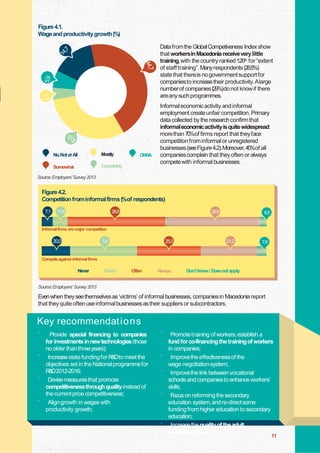
Themajority of firms in the Employers‟ Survey
(80%)report that wageincreases at their
company have exceeded productivitygrowth
(seeFigure 4.1),which negatively affects
competitiveness. This issue may be related to an
ineffective system of wage-negotiations.
Figure 4.1.
Wage and productivity growth (%)
Data fromthe GlobalCompetiveness Index show
that workersin Macedonia receivevery little
training,with the country ranked126th for “extent
of staff training”. Many respondents (26.5%)
state that thereis no government support for
companiesto increase their productivity.Alarge
number of companies(29%)do not know if there
areany such programmes.

No,Not at All

Mostly

Somewhat

Completely

DK/NA

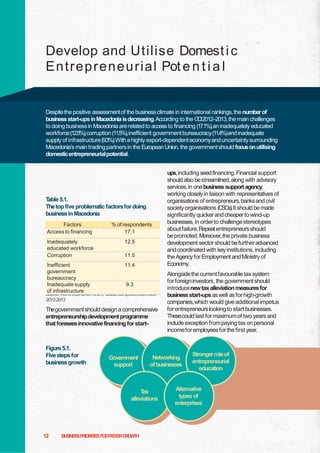
Informal economicactivity and informal
employment create unfair competition. Primary
data collected by the research confirm that
informaleconomicactivityisquite widespread:
morethan 70%of firms report that they face
competition from informal or unregistered
businesses(seeFigure 4.2).Moreover,40%of all
companiescomplain that they often or always
compete with informal businesses.

Source:Employers‟ Survey 2013

Figure 4.2.
Competition frominformal firms (
%of respondents)
7,1

11,8

38,8

35,9

6,5

Informal firms are major competition

20,0

5,9

25,3

21,2

7,6

Competeagainst informal firms

Never

Rarely

Often

Always

Don`tknow / Doesnot apply

Source:Employers‟ Survey 2013

Even when they see themselvesas „victims‟ of informal businesses, companiesin Macedonia report
that they quite often use informal businesses as their suppliers or subcontractors.

Key recommendat i o n s
`

Provide special financing to companies
for investments in new technologies (those
no older than threeyears);
` Increase state funding for R Dto meet the
&
objectives set in the National programmefor
R D2012-2016;
&
` Devise measuresthat promote
competitivenessthrough quality instead of
the current price competitiveness;
` Align growth in wages with
productivity growth;

`

`
`

`

`

Promote training of workers; establish a
fund for co-financing the training of workers
in companies;
Improvethe effectivenessof the
wage negotiation system;
Improvethe link between vocational
schools and companiesto enhance workers‟
skills;
F
ocus on reforming the secondary
education system,and re-direct some
funding from higher education to secondary
education;
Increase the quality of the adult
education system.

11
Develop and Utilise Domest i c
E n t re p re n e u ria l Pot e n t i a l

Despite the positive assessmentof the business climate in international rankings, the number of
business start-ups in Macedonia isdecreasing.According to the G I2012–2013, the main challenges
C
to doing business in Macedonia arerelated to access to financing (17.1%),an inadequately educated
workforce(12.5%),corruption (11.5%),inefficient government bureaucracy(11.4%)and inadequate
supply of infrastructure(9.3%).With a highly export-dependent economyand uncertainty surrounding
Macedonia‟s main trading partners in the European Union, the government should focusonutilising
domesticentrepreneurialpotential.

T
able 5.1.
The top five problematic factorsfor doing
business in Macedonia
Factors
Access to financing

% of respondents
17.1

Inadequately
educated workforce
Corruption

12.5

Inefficient
government
bureaucracy
Inadequate supply
of infrastructure

11.4

11.5

9.3

Source:World Economic F
orum, GlobalCompetiveness Index
2012-2013

Thegovernment should design a comprehensive
entrepreneurshipdevelopment programme
that foreseesinnovative financing for start-

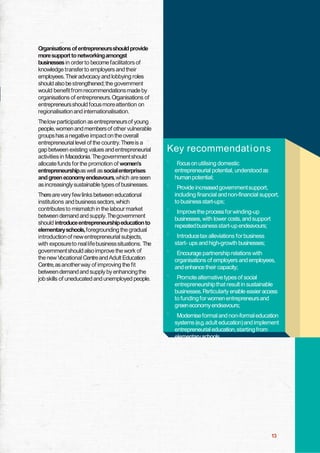
Figure 5.1.
Five steps for
business growth

Government
support

BUSINESSPRIORITIESFO A TE R W H
RF S RG O T

Alongsidethe current favourable tax system
for foreign investors, the government should
introducenew tax alleviation measuresfor
business start-ups as well as for high-growth
companies,which would give additional impetus
for entrepreneurs looking to start businesses.
Thesecould last for maximum of two years and
include exception frompaying tax on personal
incomefor employees for the first year.

Networking
of businesses

T
ax
alleviations

12

ups,including seed financing. Financial support
should also be streamlined, along with advisory
services,in one business support
agency,working closely in liaison with
representatives of organisations of
entrepreneurs,banksand civil society
organisations (CSOs).It should be made
significantly quicker and cheaper to wind-up
businesses, in order to challenge stereotypes
about failure.Repeat entrepreneursshould
be promoted. Moreover,the private business
development sector should be further advanced
and coordinated with key institutions, including
the Agency for Employment and Ministry of
Economy.

Strongerroleof
entrepreneurial
education

Alternative
types of
enterprises
Organisations of entrepreneursshould provide
moresupport to networkingamongst
businesses in order to become facilitators of
knowledge transfer to employers and their
employees.Their advocacy and lobbying roles
should also be strengthened; the government
would benefit from recommendations made by
organisations of entrepreneurs.Organisations of
entrepreneursshould focus moreattention on
regionalisation and internationalisation.
Thelow participation as entrepreneursof young
people, women and members of other vulnerable
groups has a negative impact on the overall
entrepreneurial level of the country.Thereis a
gap between existing values and entrepreneurial
activities in Macedonia. Thegovernment should
allocate funds for the promotion of women‟s
entrepreneurshipas well as socialenterprises
and green economyendeavours,which areseen
as increasingly sustainable types of businesses.
Therearevery few links between educational
institutions and business sectors,which
contributes to mismatch in the labour market
between demand and supply.Thegovernment
should introduceentrepreneurshipeducation to
elementaryschools,foregrounding the gradual
introduction of new entrepreneurial subjects,
with exposureto real lifebusiness situations. The
government should also improve the work of
the new V
ocational Centre and Adult Education
Centre,as another way of improving the fit
between demand and supply by enhancing the
job skills of uneducated and unemployed people.

Key recommendat i o n s
`

F
ocus on utilising domestic
entrepreneurial potential, understood as
human potential;

`

Provide increased government support,
including financial and non-financial support,
to business start-ups;

`

Improvethe process for winding-up
businesses, with lower costs, and support
repeatedbusiness start-up endeavours;

`

Introducetax alleviations for business
start- ups and high-growth businesses;

`

Encourage partnership relations with
organisations of employers and employees,
and enhance their capacity;

`

Promote alternative types of social
entrepreneurship that result in sustainable
businesses.P
articularly enable easier access
to funding for women entrepreneursand
greeneconomy endeavours;

`

Modernise formal and non-formal education
systems (e.g.adult education)and implement
entrepreneurial education,starting from
elementary schools.

13
Organizat i o n o f
Еmployers o f Macedonia
TheOrganization of Еmployersof Macedonia (ОЕМ)is the biggest leading organization
of employers in the whole country,established in 2004. Main goal of O Mis to
E
advocate the employers‟ interests, and the interest about the social partnership as
well, and to realize the development of rights and freedomsof the employers in the
economicand social sphere.Ourvision is Macedonia to becomethe most increasing
economy on the Balkantill 2017.
O Mfocuses on the social dialogue on each level: European level through the Joint
E
Consultative Committee (JCC),national level with the Economicand SocialCouncil
(ESC),bipartite level with the branch collective agreements and collective agreement
on a level of employer.
O Malso advocates the employers‟ interest s through its membersin the
E
management boards of the Employment Service Agencyof Macedonia, Pensionand
disability insurance fund of Macedonia, Council for higher education curriculums
accreditation, National Entrepreneurship and CompetitivenessCouncil, and last but
not least some other authorities of the institutions.
Moreover,together with the participation of O Min the Joint Consultative
E
Committee, part of European Economicand SocialCouncil (EESC),more information
about the accession of Macedonia to European Union (EU)are given to the
employers, through recommendations adoption to the government of Macedonia
and the E
Uinstitutions.
Theemployers of O M
E ,with its four members fromtotal 12,participate in the policy
creation from economic-social sphere in the Economicand SocialCouncil( S
E C)on
national level, in which the other two parties are representatives from the trade
unions and four representatives from the government.
O Mrepresents over 17employers‟ branch associations, including the small and
E
medium enterprises, as well as larger corporative enterprises in the country.
Therefore,O Msigned 10 collective agreementson branch level and general collective
E
agreement in the private sector which is mandatory for all of the employers of the
above mentioned sector.

14

BUSINESSPRIORITIESFO A TE R W H
RF S RG O T
Business Confederat i o n
o f Macedonia
Withthe formation of the Confederation of Employers in 2001as an association of citizensemployers we beganto write a new history of the freedom of association of employers in
Macedonia.
Thanksto the support of the International Labour Organization and employers members of
the International Organization of Employers and the European Organization of Employers (at
that time UNICE)now B S I E UR Ewe managed to agreewith the government
U NN SSE OP
of the Republic of Macedonia in 2005to register the organization as a legitimate social
partner of the Government,the trade unions, C O
S sand local governments in Macedonia.
Business Confederation of Macedonia as a non-profit, independent organization that
collaborates with partners representing the interests of its members and partner
organizations on the basis of decisions that arebased on democratic and transparent
ways of analysis, communicationand decision-makingin line with the Statute of the
Confederation.
T
oday B Mrepresent morethan 6,500companies through direct membership and through
C
collective membership organized in 13partner organizations with participation in the G Pof
D
the country with over 40%.Theemployees of the Business Confederation of Macedonia are
professionally trained, managed by nine members of the Management Board and 30
membersof the organization assembly.Themain office is in Skopjeand we have a regional
offices in Bitola, Prilep, T
etovo for better communications and services to the members in
order to represent their interests in the socio - economic policies, collective bargaining,
standardsand education in the national and international level. Thestrategy 2010-2015
of the organization is carried out based on previously set goals and objectives, but the
basic vision of the organization is that “Associatedemployers for competitive Macedonian
economy”.

Б З СКО Д Р ЦИЈАНАМА
И НИ
НФЕ Е А
КЕДОНИЈА
BUSINESSC N E E A
O F D R TIONO
FMA
CEDONIA

15
ORGANIZATION OFEMPLOYERSOFMACEDONIA
ul.Dimitrie Cupovski br.13, Skopje,
Republic of Macedonia,
telephone: ..389 2 3215085
e-mail: info@orm.org.mk
www.orm.org.mk

BUSINESS CONFEDERATION OFMACEDONIA
Vasil Gorgov 11,P.O.Box 880,
Skopje, Republic of Macedonia
TelJfax: +389 2 3224 762
e-mail: contact@bcm.mk
web-site: www.bcm.mk

Business priorities for faster development

  • 1.
  • 2.
    P r eface The Republicof Macedonia may beacountrywith a small market,but despite this constraint,by implementingarangeof measuresandpolicies, it canimprovethe competitivenessof its economy andbecomeacountrywheredoing businessis morecost-effectiveandlifeis better asaresult. Therearemultiple andcomplexfactorsthat affect competitiveness; thebusinessclimatecan be improvedandacompetitive Macedonianeconomy created only with the joint effort of all stakeholders, including the government, the businesssector and civil society. Inrecent years Macedonia hasmadesignificant progressin termsof improving its business climate, which hasbeenacknowledgedin studies commissioned by theWorldBank, theWorldEconomicF orum, the International Monetary Fundandthe InternationalLabour Organization(ILO).However,enhancingthe businessclimateisacontinuousprocessthat requiresregularimprovement andadvancement. T othat end, the Organizationof Employersof Macedonia andthe Business Confederation of Macedonia, with the support of the ILOandwith theprofessional assistanceof the Macedonian Centerfor International Cooperation and M-prospect, implementedresearchon thetheme of anImprovedBusiness Climatefor Sustainable Enterprises,aimed at identifying keyareasthat constrainthe businessclimatein Macedonia and proposingrecommendations for its improvement. Recommendationssuchasimproving the legal andregulatoryenvironment by increasingthe time available for consultationswith the business community,strengtheningthe roleof theEconomicSocial Council, andgiving alonger period for companies to adjust to newandamendedlabour regulations areall aspects that arecrucial to an efficient market economythat should serveasa creatorof newemployment, andagenerator of economic growth, improvedliving standardsand overall progress. companies andthoseyet to beestablished, and for both domestic investorsandforeigndirect investments.The merepassing of laws and amendments isnot sufficient to createamore stablebusinessenvironment; in thefuture,we need to work harder onthe implementationof laws, judicial reformsandthepreventionof corruption. The growth of Macedoniancompanies still depends onself-financingandbank loans. Thismeansthat highinterestrateshaveto beaddressed,andeasier accessto financialservices for small andmedium enterpriseshasto beprovided. The gapbetween the economy‟sdemands and thesupply of qualified labour is still anissue. Links between vocational schools andenterprisesneed to beimproved. Further,trainingand re-training should beencouraged for unemployed people, to improvetheir professional development and their accessto employment. Despitethe fact that Macedonia isoneof the countriesin theregion that offersthebest conditionsfor businessstart-ups,strongerfinancial support for theimplementationof theProgramme for theDevelopment of Entrepreneurship, CompetitivenessandInnovation for Small and MediumEnterprises is required. Webelieve that the recommendations made in this document will be of benefit to policy-makers, social partners,businessassociationsand civil society in their effortsto createabusinessclimatethat will improvethecompetitivenessandsuccessof domesticcompanies,both in domestic and foreign markets. Organization of Employersof Macedonia Business Confederation of Macedonia President Angel Dimitrov President Mile Boskov The ruleof law andsecureproperty rightsare essential for the creationof apredictable, stable andsafeenvironment, both for currentlyexisting 3
  • 3.
    COMPANIES DESERVE QUALITY REGULA TIONAND ITS FAIR IMPLEMENTATION Macedonia has achieved considerable progressin assessmentof the ease of doing business in the country,being ranked23rd out of 185economiesin 2012 by the World Bank‟s Doing Business (DB)report. However, the quality of the regulatoryenvironment iscomparativelylow,as assessed by the World Bank‟s RegulatoryQuality Index. Figure 1.1. General regulation as a constraint and burden to companies 36,5 T able 1.1. Rankingfor ease of doing business Country 95,9 Frequentlegislative changesare major issue 2011 22 23 Ireland 16 35 35 Bulgaria 64 66 Croatia 80 84 Serbia 95 86 95,3 15 Slovenia 37,1 2012 Macedonia Source:World Bank,Doing Business,databank According to the primary research data, Employers‟ Survey (2013),general regulation in Macedoniapresents a burden to companies:a large majority of respondents (over 80%)agree that conforming to general regulation takes much of their firm‟s time. Companies mainly complain about frequent legislative changes, and observethat regulations serve the purpose of filling state coffers. Frequentlegislative changesconstrain long-term planning 48,8 Rigorouspenalty provision 48,8 BUSINESSPRIORITIESFO A TE R W H RF S RG O T 91,2 Businesscommunity should participate in preparation of legislation 20,0 88,2 Timespentondealingwith regulation 29,4 Regulationsfor budgetrevenues Source:Employers‟ Survey 2013 4 92,4 81,1
  • 4.
    T able 1.2. The 5most burdensome aspects of the labour legislation Aswell as ease of the entry into the market, market efficiency depends on ease of exit. In Doing Business 2013,Macedonia is ranked 60th for ease of exit from the market,with the ranking having improved only recently.The most important reason for closing a business in Macedonia is non-profitability,followed by problems in getting finance. However, the primary research showed that the majority of companies(54.1%)have confidence in the bankruptcylegislation and its implementation. TheGlobalCompetitivenessIndex (GCI)ranks Macedonia in 94th position for labour market efficiency.This modest ranking is mainly due to the areas of “cooperation in labour-employer relations” and “redundancy costs”. TheEmployers‟ Survey has shown that, in general, firms have positive views on labour legislation. Companies areleast satisfied with the short timeperiod requiredfor adoption and application of new legislation. T able 1.2presentsthe five most important aspects of current labour legislation that are seen as mostly non-conducive to businesses. Key recommendat i o n s Improvethe quality of regulation,by increasingthe time available for consultations with the business community; ` Implement the „thinksmallfirst‟ approach at all levels of government and all stages of policy-making; ` Abolishnon-deductible expensesto help the profit law become profit-sensitive; Aspects of the labour legislation Termination of employment contract Official holidays % of firms respond- ing that the partic- ular aspect is major burden 13.2% Source: Employers‟ Survey 2013 In the period from2006 onwards, several tax reformswere implemented in Macedonia, which reducedthe overall tax burden (bothin terms of costs and administration) on Macedonian companies. International comparisons show that Macedonian companiespay relatively low taxes. Still, the majorityof surveyed companies (80%) agreethat the tax burden is amajor investment constraint.Theymainly complainabout the averagetime neededto comply with tax laws and the percentageof turnover takenby payroll taxes. In addition,morethan half of the respondents object that taxes areprofit-insensitive, meaning that they have to pay taxes regardlessof whether their firm is making profits or not. 11.1% Legislation on types of employment contracts Overtime work 10.0% Recruitment 7.9% Dismissals 7.9% 9.5% F most firms (45%)health and safety regulation or also presentsa financial burden. TheEmployers‟ Survey showed that morethan one third of companieshave never had an experiencewhere interferenceby inspectorates has negatively affectedtheir operations. Still, about 11%of firms complain that they often experiencesuch problems.Moreover,about 44%of respondents think that inspections by the State Labour Inspectorate arepolitically motivated (26.5%of respondents believe this is the case occasionally, while 17.1%state that this is often the case). ` ` ` ` ` ` Preparea detailed analysis of the impact of tax regulation on companiesdifferentiated bysize.This will show if adjustments are needed in the taxation system for micro and small firms; Implement a selective reduction of the rates of social contributions, or adjust the minimum base for payment of social contributions with the minimum wage; Establish a quickbankruptcy procedure; Givemoretime for companiesto comply with new or amended labour laws, with strong informative campaigns beforemajor legislative changes; F orm a committee within the EconomicSocial Council (E C S )that will continuously and randomly check files and reports of labour inspections and oversee if their workisfair or politically motivated,and publish their reports. 5
  • 5.
    STRONG RULE OF LAWTOUGH , FIGHT AGAINST CORRUPTION is however assessed as good in Macedonia, with the country ranked17th. In the Employers‟ Survey,Macedonian businesses show a moderate positive assessmentof the legal framework for protecting property rights and the state of the rule of law. However, most respondents believe that thereis not equal treatment for all companies. The rule of law and secure property rights create a more predictable, stable and safe environment in which companiescan be established and grow. WorldBankdata, presentedin T able2.1,showthat Macedonia ischaracterised by arelativelylowrule of law,at thebottom of theranking, comparedwith thecomparator countries, with the exceptionof Serbia. Figure 2.1. Threats to property rights T able 2.1. Rule of Law Index, 2011 48.4 Governan ce score (-2.5 to +2.5) -0.25 Ireland 95.8 1.76 Slovenia 83.6 1.07 Bulgaria 60.6 0.18 Croatia 51.6 -0.09 Serbia 46.5 -0.33 Country Percentil e rank (0-100) Macedonia Source:World Bank,GovernanceMatters In terms of the transparency of policy-making, Macedonia is ranked76th,as assessed in the World Economic F orum‟s GlobalCompetitive Index (GCI).In cases of disputes, companies in Macedonia generally have to spend many resources,including time, to settle a dispute; this is related to the inefficient legal framework. Secureproperty rights areimportant in any investment decision of companies,whether for start-ups or growing firms. Data fromthe C I G show that Macedonia does not provide a high security of property rights, the country being ranked84th.Thestrength of investor protection 6 Most respondents in the E S(81.4%)also share the view that propertyrights are protected and secure.Still, 39%of surveyed companies state that many firms have experienced some threat to their property rights. Alarge number of respondents (74.6%)agreewith the statement that threats to the integrity of property rights have made companiespostpone investment decisions(seeFigure 2.1). BUSINESSPRIORITIESFO A TE R W H RF S RG O T 4,7 No,nonehave Somehave Mosthave Allhave DK/NA Source:Employers‟ Survey 2013: Answers to the question “In your view, have many firms experienced recent threats to their property rights?” Note: D means “don‟t K know; NAmeans “does not apply”
  • 6.
    Corruption is athreat to society and the economy. Data fromTransparency International, presented in T able 2.2,show that Macedonia was ranked69th out of 176 countries in 2012 in terms of perceptions of the existence of corruption. Political parties and the judiciary areperceived as the most corrupt institutions in Macedonia. T able 2.2. Corruption Perception Index, 2012 Country Score Macedonia Rankin g 2012 69 43 Rankin g 2011 69 Ireland 25 69 19 Slovenia 37 61 35 Bulgaria 62 46 66 Croatia 75 41 86 Serbia 80 39 86 Source:Transparency International, Corruption Perceptions Index,2012 Key recommendat i o n s ` ` Note:Thescore runs from 0to 100,with a lower score indicating lesscorruption ` Figure 2.2. Level of corruption ` ` No,not at all Somehave Somewhat Institute regular reporting by each inspectionbodyon inspections performed, industries covered,regions,etc., with reports published on a website each quarter; Makeall public institutionscarryout analyses in thoseareasof their operation that havehigh potential to lead to corruption,andproposepreemptivemeasuresfor avoidingcorruption; Publisha PublicProcurement bulletin to provide the public with a comprehensive, organisedand structuredsourceof public procurement information; Introduce quarterly thematic sessions of the Economic Social Council focused on the fight against the greyeconomy; Strengthen internal and external financial control mechanisms in order to prevent or penalise misuse and fraud in the use of the public funds of state institutions. Primary data show that corruptionisone of the mainconstraints to Macedonian companies.Around 66.5%of surveyed companiesbelieve that corruption poses an obstacle to businesses, with 22.4%of respondents completely agreeingwith this statement. Mostly Source:Employers‟ Survey 2013 DK/NA Note:combining the „mostly‟ and „completely categories amounts to 66.5% 7
  • 7.
    Growt h Dependson Access t o E x t e r n a l Finance Afirm‟s growth is limited if it can only obtain finance internally or throughinformal networks. The full growth potential of firms, and the economicgrowth of a country as a whole, cannot be realised without adequate externalfinancing. Theperception of Macedonian companiesis that most firms (64.1%)rely on self-financing, and this affectsgrowthand employment.Most businesses do not consider that their financing is adequate for their needs, and believe that their ability to raise capital has an effect on production. Figure 3.1. Financingadequacy for firms (responses to the question: to what extent do you agree with the statement that “firm financing is adequate according your needs?”) Disagree SomewhatAgree Agree Completely agree DK/NA Self-financing results from both the preferences of businesses and the lack of access to external finance. than the reference countries. Figure 3.3. Companies‟ perceptions of the lack of external finance aresupported by such indicators as credit to private sector (asa percentageof GD ),where Macedonia is performing morepoorly P 250 200 150 100 50 0 Macedonia Ireland Source:World Bank,World Development Indicators 8 BUSINESSPRIORITIESFO A TE R W H RF S RG O T Slovenia Croatia Bulgaria Serbia
  • 8.
    T able 3.1. Financingpreferences Equity reserves (retained profit) New equity, own andfrom family, friends New equity, outside family and friends Short term loan What are What are yours yours financfinancing ing pref- erences preferencfor es for investments? working capital? 48.4 -0.25 95.8 1.07 60.6 0.18 Long term loan 51.6 -0.09 Don‟t know/ Does not apply Total 46.5 -0.33 46.5 42% 1.76 83.6 Figure 3.3. T three obstacles to access to credit op -0.33 16% 12% Bankask Interest rate too much too high information in order to approve a loan Banks are not willing to bear the risks Domesticcredit to the private sector ( %of GDP) F new businesses therearefew „business angels‟, limited availability of venturecapital and little practice or of making initial public offerings.Banksarea key sourceof external financing. Thepreference for selffinancing is perhaps related to the perception that financial products arenot adapted to the needs of companiesof different sizes, and particularly not to small and medium enterprises (SMEs).Policies, regulations and services to promote access to financial services for small and medium enterprises are insufficiently implemented. Themajority of businesses see accessto credit as a constraint (69.4%). Key recommendat i o n s ` ` ` Increase accessto finance for the private sector,which should include the National Bank of the Republic of Macedonia taking measuresto decrease the cost of credit, along with further availability of investment credits with government subsidiesfor interest rates; Promote furtherdevelopment of the financial sector,stimulating larger banks and possible specialisation, with the development of investment banking and new financial products; Implement government-led policy and regulatoryincentives to encourage financial institutions to lend to SMEs.The government should support banks focusing on SMEs; ` Offer finance training,advisory services and programmesto companymanagers; ` Develop affordable financial services for firms through public-private partnerships, covering different stages of development and different sizes of companies; ` Work both on the demand and supply sides of equity funding, e.g.by promoting business angels and venturecapital. Thefounding of the Public Innovation Fund is a positive step, and the Fund should be made operational as soon as possible. 9
  • 9.
    INVEST INNOVATE, GLOBALIS , E,BE COMPETITIVE F air competition is healthy for society and business. It encourages continuous improvement amongcompetitors, new investments in technology and human capital, and a continuous struggle to improve. T able 4.1. Competition and anti-monopoly policy indicators,2012 Intensity of local competition Macedoni a Ireland 119 Effectiveness of antimonopoly policy 96 Degree of customer orientatio n 40 22 11 Slovenia 41 64 52 Croatia 120 90 107 Bulgaria 101 108 69 Serbia 137 142 135 92 Source:World Economic F orum, GlobalCompetiveness Index 2013-2014 Local competition in Macedonia seems quite low, with the country ranked 119th in G I(see T C able 4.1). Macedonian companies are also only moderately oriented towards their customers. Thereis much room for improvement in the effectivenessof anti-monopoly policy, as assessed by the GCI.Among the companies surveyed in the Employers‟ Survey,only a small proportion (22.4%)report that they face monopolies or monopolistic practices in their areaof operation. Macedonian companies also report that they respond moderately to price reductions of their competitors, whether domestic or foreign. Innovations help to drive greater growth and increased living standards. However,the level of investmentin researchand development (R&D) in Macedonia isquite low,at less than 0.2%of G P addition, companiesinvest very little in D .In new technologies and innovations, as the data 10 BUSINESSPRIORITIESFO A TE R W H RF S RG O T fromthe GlobalCompetiveness Index confirms, notwithstanding recent government efforts to promoteR&D.In addition, Macedonia is ranked 133rd for firm-level technology absorption. T able 4.2. CompanySpending on R&D,2012 Country Rank Value (1-7, where 7th is highest) 2.5 Macedonia 123 Ireland 21 4.3 Slovenia 47 3.4 Croatia 76 3.0 Bulgaria 92 2.9 Serbia 132 2.3 Source:World Economic F orum, GlobalCompetiveness Index 2013-2014 In the Employers‟ Survey,the most popular response (37.6%)is that companiesin Macedonia do not engagein R Dat all. Comparedto this, & 36%believed that some companiesareinvolved in R Dactivities. Themajority of respondents & acknowledgethat the government occasionally (30%of responses), sometimes (22.4%)or often (1.8%)provides assistanceto firms to invest in R&D. Companies in general aresatisfied with the protection of intellectual property rights. Themajority of firms in the Employers‟ Survey (80%)report that wageincreases at their company have exceeded productivitygrowth (seeFigure 4.1),which negatively affects competitiveness. This issue may be related to an ineffective system of wage-negotiations.
  • 10.
    Figure 4.1. Wage andproductivity growth (%) Data fromthe GlobalCompetiveness Index show that workersin Macedonia receivevery little training,with the country ranked126th for “extent of staff training”. Many respondents (26.5%) state that thereis no government support for companiesto increase their productivity.Alarge number of companies(29%)do not know if there areany such programmes. No,Not at All Mostly Somewhat Completely DK/NA Informal economicactivity and informal employment create unfair competition. Primary data collected by the research confirm that informaleconomicactivityisquite widespread: morethan 70%of firms report that they face competition from informal or unregistered businesses(seeFigure 4.2).Moreover,40%of all companiescomplain that they often or always compete with informal businesses. Source:Employers‟ Survey 2013 Figure 4.2. Competition frominformal firms ( %of respondents) 7,1 11,8 38,8 35,9 6,5 Informal firms are major competition 20,0 5,9 25,3 21,2 7,6 Competeagainst informal firms Never Rarely Often Always Don`tknow / Doesnot apply Source:Employers‟ Survey 2013 Even when they see themselvesas „victims‟ of informal businesses, companiesin Macedonia report that they quite often use informal businesses as their suppliers or subcontractors. Key recommendat i o n s ` Provide special financing to companies for investments in new technologies (those no older than threeyears); ` Increase state funding for R Dto meet the & objectives set in the National programmefor R D2012-2016; & ` Devise measuresthat promote competitivenessthrough quality instead of the current price competitiveness; ` Align growth in wages with productivity growth; ` ` ` ` ` Promote training of workers; establish a fund for co-financing the training of workers in companies; Improvethe effectivenessof the wage negotiation system; Improvethe link between vocational schools and companiesto enhance workers‟ skills; F ocus on reforming the secondary education system,and re-direct some funding from higher education to secondary education; Increase the quality of the adult education system. 11
  • 11.
    Develop and UtiliseDomest i c E n t re p re n e u ria l Pot e n t i a l Despite the positive assessmentof the business climate in international rankings, the number of business start-ups in Macedonia isdecreasing.According to the G I2012–2013, the main challenges C to doing business in Macedonia arerelated to access to financing (17.1%),an inadequately educated workforce(12.5%),corruption (11.5%),inefficient government bureaucracy(11.4%)and inadequate supply of infrastructure(9.3%).With a highly export-dependent economyand uncertainty surrounding Macedonia‟s main trading partners in the European Union, the government should focusonutilising domesticentrepreneurialpotential. T able 5.1. The top five problematic factorsfor doing business in Macedonia Factors Access to financing % of respondents 17.1 Inadequately educated workforce Corruption 12.5 Inefficient government bureaucracy Inadequate supply of infrastructure 11.4 11.5 9.3 Source:World Economic F orum, GlobalCompetiveness Index 2012-2013 Thegovernment should design a comprehensive entrepreneurshipdevelopment programme that foreseesinnovative financing for start- Figure 5.1. Five steps for business growth Government support BUSINESSPRIORITIESFO A TE R W H RF S RG O T Alongsidethe current favourable tax system for foreign investors, the government should introducenew tax alleviation measuresfor business start-ups as well as for high-growth companies,which would give additional impetus for entrepreneurs looking to start businesses. Thesecould last for maximum of two years and include exception frompaying tax on personal incomefor employees for the first year. Networking of businesses T ax alleviations 12 ups,including seed financing. Financial support should also be streamlined, along with advisory services,in one business support agency,working closely in liaison with representatives of organisations of entrepreneurs,banksand civil society organisations (CSOs).It should be made significantly quicker and cheaper to wind-up businesses, in order to challenge stereotypes about failure.Repeat entrepreneursshould be promoted. Moreover,the private business development sector should be further advanced and coordinated with key institutions, including the Agency for Employment and Ministry of Economy. Strongerroleof entrepreneurial education Alternative types of enterprises
  • 12.
    Organisations of entrepreneursshouldprovide moresupport to networkingamongst businesses in order to become facilitators of knowledge transfer to employers and their employees.Their advocacy and lobbying roles should also be strengthened; the government would benefit from recommendations made by organisations of entrepreneurs.Organisations of entrepreneursshould focus moreattention on regionalisation and internationalisation. Thelow participation as entrepreneursof young people, women and members of other vulnerable groups has a negative impact on the overall entrepreneurial level of the country.Thereis a gap between existing values and entrepreneurial activities in Macedonia. Thegovernment should allocate funds for the promotion of women‟s entrepreneurshipas well as socialenterprises and green economyendeavours,which areseen as increasingly sustainable types of businesses. Therearevery few links between educational institutions and business sectors,which contributes to mismatch in the labour market between demand and supply.Thegovernment should introduceentrepreneurshipeducation to elementaryschools,foregrounding the gradual introduction of new entrepreneurial subjects, with exposureto real lifebusiness situations. The government should also improve the work of the new V ocational Centre and Adult Education Centre,as another way of improving the fit between demand and supply by enhancing the job skills of uneducated and unemployed people. Key recommendat i o n s ` F ocus on utilising domestic entrepreneurial potential, understood as human potential; ` Provide increased government support, including financial and non-financial support, to business start-ups; ` Improvethe process for winding-up businesses, with lower costs, and support repeatedbusiness start-up endeavours; ` Introducetax alleviations for business start- ups and high-growth businesses; ` Encourage partnership relations with organisations of employers and employees, and enhance their capacity; ` Promote alternative types of social entrepreneurship that result in sustainable businesses.P articularly enable easier access to funding for women entrepreneursand greeneconomy endeavours; ` Modernise formal and non-formal education systems (e.g.adult education)and implement entrepreneurial education,starting from elementary schools. 13
  • 13.
    Organizat i on o f Еmployers o f Macedonia TheOrganization of Еmployersof Macedonia (ОЕМ)is the biggest leading organization of employers in the whole country,established in 2004. Main goal of O Mis to E advocate the employers‟ interests, and the interest about the social partnership as well, and to realize the development of rights and freedomsof the employers in the economicand social sphere.Ourvision is Macedonia to becomethe most increasing economy on the Balkantill 2017. O Mfocuses on the social dialogue on each level: European level through the Joint E Consultative Committee (JCC),national level with the Economicand SocialCouncil (ESC),bipartite level with the branch collective agreements and collective agreement on a level of employer. O Malso advocates the employers‟ interest s through its membersin the E management boards of the Employment Service Agencyof Macedonia, Pensionand disability insurance fund of Macedonia, Council for higher education curriculums accreditation, National Entrepreneurship and CompetitivenessCouncil, and last but not least some other authorities of the institutions. Moreover,together with the participation of O Min the Joint Consultative E Committee, part of European Economicand SocialCouncil (EESC),more information about the accession of Macedonia to European Union (EU)are given to the employers, through recommendations adoption to the government of Macedonia and the E Uinstitutions. Theemployers of O M E ,with its four members fromtotal 12,participate in the policy creation from economic-social sphere in the Economicand SocialCouncil( S E C)on national level, in which the other two parties are representatives from the trade unions and four representatives from the government. O Mrepresents over 17employers‟ branch associations, including the small and E medium enterprises, as well as larger corporative enterprises in the country. Therefore,O Msigned 10 collective agreementson branch level and general collective E agreement in the private sector which is mandatory for all of the employers of the above mentioned sector. 14 BUSINESSPRIORITIESFO A TE R W H RF S RG O T
  • 14.
    Business Confederat io n o f Macedonia Withthe formation of the Confederation of Employers in 2001as an association of citizensemployers we beganto write a new history of the freedom of association of employers in Macedonia. Thanksto the support of the International Labour Organization and employers members of the International Organization of Employers and the European Organization of Employers (at that time UNICE)now B S I E UR Ewe managed to agreewith the government U NN SSE OP of the Republic of Macedonia in 2005to register the organization as a legitimate social partner of the Government,the trade unions, C O S sand local governments in Macedonia. Business Confederation of Macedonia as a non-profit, independent organization that collaborates with partners representing the interests of its members and partner organizations on the basis of decisions that arebased on democratic and transparent ways of analysis, communicationand decision-makingin line with the Statute of the Confederation. T oday B Mrepresent morethan 6,500companies through direct membership and through C collective membership organized in 13partner organizations with participation in the G Pof D the country with over 40%.Theemployees of the Business Confederation of Macedonia are professionally trained, managed by nine members of the Management Board and 30 membersof the organization assembly.Themain office is in Skopjeand we have a regional offices in Bitola, Prilep, T etovo for better communications and services to the members in order to represent their interests in the socio - economic policies, collective bargaining, standardsand education in the national and international level. Thestrategy 2010-2015 of the organization is carried out based on previously set goals and objectives, but the basic vision of the organization is that “Associatedemployers for competitive Macedonian economy”. Б З СКО Д Р ЦИЈАНАМА И НИ НФЕ Е А КЕДОНИЈА BUSINESSC N E E A O F D R TIONO FMA CEDONIA 15
  • 15.
    ORGANIZATION OFEMPLOYERSOFMACEDONIA ul.Dimitrie Cupovskibr.13, Skopje, Republic of Macedonia, telephone: ..389 2 3215085 e-mail: info@orm.org.mk www.orm.org.mk BUSINESS CONFEDERATION OFMACEDONIA Vasil Gorgov 11,P.O.Box 880, Skopje, Republic of Macedonia TelJfax: +389 2 3224 762 e-mail: contact@bcm.mk web-site: www.bcm.mk