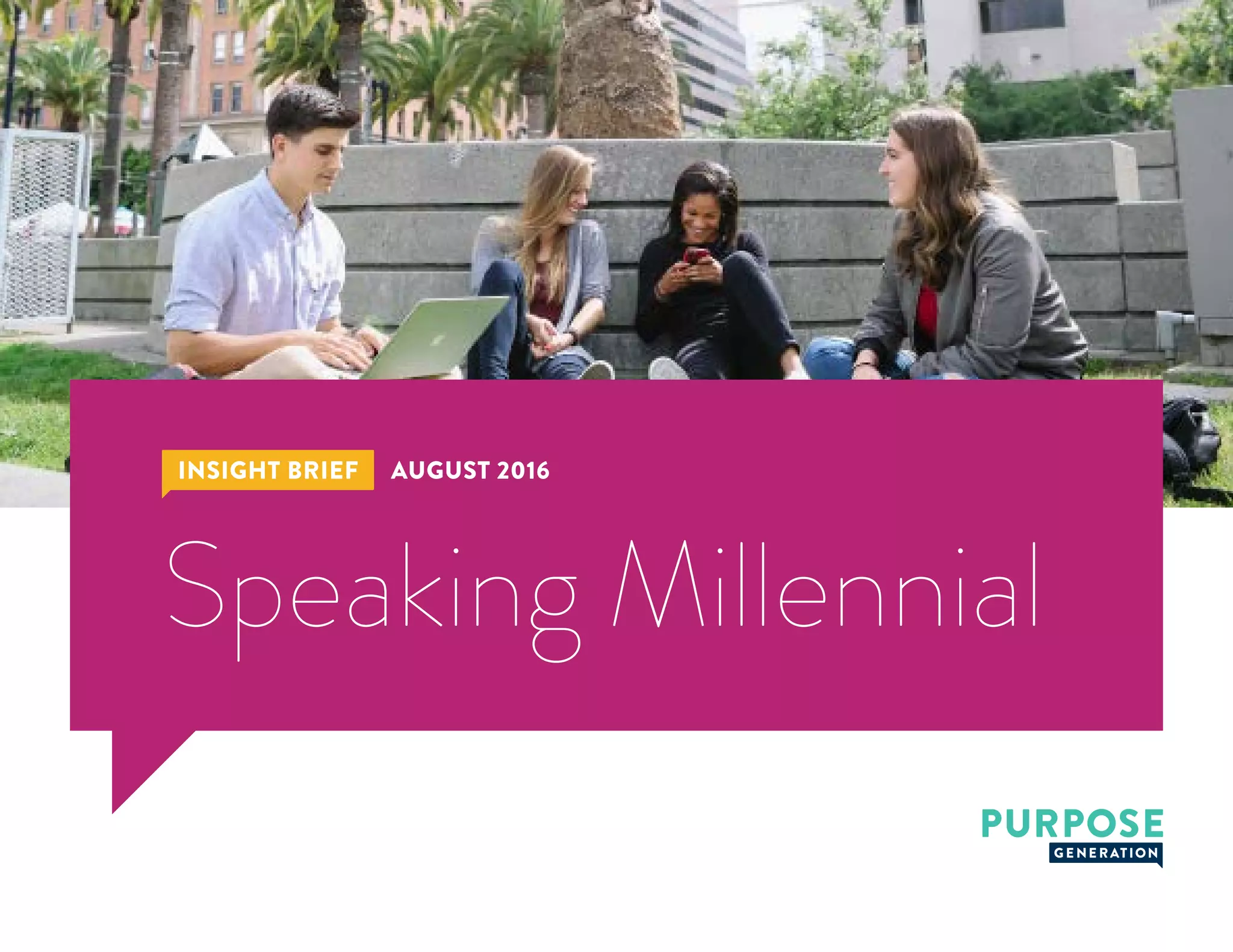
Speaking Millennial
INSIGHT BRIEF AUGUST 2016
TABLE OF
CONTENTS
Translation, Please?
Vocabulary Origins
Take A Walk On The Millennial Side
Say What?
Play By Their Rules
02
03
04
06
07
INSIGHT BRIEF Speaking Millennial ©2016 Purpose Generation 3
TRANSLATION, PLEASE?
One of the biggest causes of friction between millennials and other generations
- whether it be in the workplace, at home, or in line at the Apple store - can be
attributed to a breakdown in communication. While a millennial and a boomer may
be speaking the same language, their words can mean something entirely different
depending on whom they are speaking to.
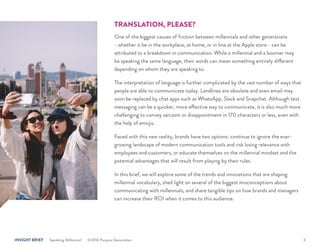
The interpretation of language is further complicated by the vast number of ways that
people are able to communicate today. Landlines are obsolete and even email may
soon be replaced by chat apps such as WhatsApp, Slack and Snapchat. Although text
messaging can be a quicker, more effective way to communicate, it is also much more
challenging to convey sarcasm or disappointment in 170 characters or less, even with
the help of emojis.
Faced with this new reality, brands have two options: continue to ignore the ever-
growing landscape of modern communication tools and risk losing relevance with
employees and customers, or educate themselves on the millennial mindset and the
potential advantages that will result from playing by their rules.
In this brief, we will explore some of the trends and innovations that are shaping
millennial vocabulary, shed light on several of the biggest misconceptions about
communicating with millennials, and share tangible tips on how brands and managers
can increase their ROI when it comes to this audience.
INSIGHT BRIEF Speaking Millennial ©2016 Purpose Generation 4
VOCABULARY ORIGINS
Millennial vocabulary was not created in a vacuum. It has been shaped by several important
developments over the past two decades:
The Internet
Millennials are the first generation of “digital natives.” While
the oldest millennials still remember using an encyclopedia to
write their first homework assignment, the majority of twenty-
somethings grew up with Internet Explorer and Google.
Information has become democratized and as a result, few
millennials prioritize memorizing historical dates and figures,
when they can simply Google it instead.
As a result… Millennials may use their iPhone during meetings to
look up the answer to a client’s request. A millennial will think he
or she is being helpful, while a Boomer or Gen X’er may think it
reflects a lack of manners.
Smartphones
More than 85% of millennials own a smartphone [Nielsen].
Whether they’re being used for looking up reviews of a nearby
restaurant, see what their friends are up to, or skim news
headlines, these handheld devices offer instant gratification,
24/7. Smartphone usage is widespread across all generations,
but millennials can’t seem to travel, eat, shop, or go on a date
without consulting a mobile app.
Social Networks
91% of American millennials have a Facebook account [Pew
Research Center]. Thanks to the proliferation of social
platforms, millennials are fluent in expressing themselves in 114
characters or less. Often, they abandon text altogether in favor
of images and emojis. In addition to brevity, their addiction to
social networks has also necessitated the need for building (and
maintaining) a “personal brand” online.
Reality TV
The candid drama of MTV’s The Real World, Laguna Beach,
The Apprentice, and the Kardashians may be partially to blame
for millennials’ “informal” communication style. While older
generations were raised on shows rooted in strong family values
like The Brady Bunch and The Waltons, millennials grew up
watching celebrities cheat, swear, and fight on national TV.
INSIGHT BRIEF Speaking Millennial ©2016 Purpose Generation 5
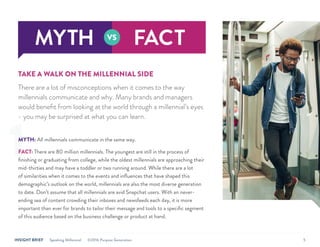
TAKE A WALK ON THE MILLENNIAL SIDE
There are a lot of misconceptions when it comes to the way
millennials communicate and why. Many brands and managers
would benefit from looking at the world through a millennial’s eyes
- you may be surprised at what you can learn.
MYTH: All millennials communicate in the same way.
FACT: There are 80 million millennials. The youngest are still in the process of
finishing or graduating from college, while the oldest millennials are approaching their
mid-thirties and may have a toddler or two running around. While there are a lot
of similarities when it comes to the events and influences that have shaped this
demographic’s outlook on the world, millennials are also the most diverse generation
to date. Don’t assume that all millennials are avid Snapchat users. With an never-
ending sea of content crowding their inboxes and newsfeeds each day, it is more
important than ever for brands to tailor their message and tools to a specific segment
of this audience based on the business challenge or product at hand.
1
INSIGHT BRIEF Speaking Millennial ©2016 Purpose Generation 6
MYTH: Millennials would always rather text.
FACT: Millennials may be more likely to respond to a text
than to pick up the phone, but it isn’t always out of laziness
(as the media may lead people to believe). Millennials have
become accustomed to instant gratification; they do not like
to prolong interactions longer than absolutely necessary.
Why spend hours on hold waiting for a customer service
representative to get back to you, when you can use the
instant chat function online? Why risk leaving a voicemail
for someone who may not check it when you can send a text
message that confirms receipt with a simple “Delivered”
notice? Contrary to popular belief, millennials place a lot
of value on “face time” when it comes to interpersonal
relationships. In fact, 51% of millennials prefer speaking to
colleagues in person at the office [Bentley University].
MYTH: Millennials aren’t interested in hearing other
opinions (unless it’s positive feedback about them).
FACT: Millennials like to overshare, whether it’s spilling their
deepest personal thoughts via Facebook status updates and
personal blogs, or giving unsolicited feedback to their boss
after working at a firm for less than a week. This isn’t all their
fault. Millennials grew up with parents who encouraged them
to speak up at the dinner table and “dream big” - behaviors
many boomers were not permitted to exhibit themselves
growing up. As a result of this coddling, millennials can be
more sensitive to negative commentary. Instead of assuming
that this is a reflection expressing their sense of entitlement,
however, try adjusting the way you give and receive feedback
when it comes to this audience. While Gen-X’ers respond
well to a direct management style, millennials prefer the
feedback sandwich (sandwiching criticism between two soft
layers of positive reinforcement).
2 3
INSIGHT BRIEF Speaking Millennial ©2016 Purpose Generation 7
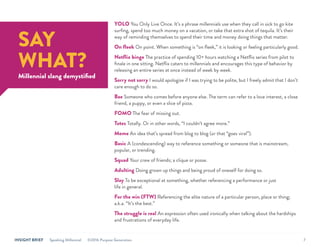
YOLO You Only Live Once. It’s a phrase millennials use when they call in sick to go kite
surfing, spend too much money on a vacation, or take that extra shot of tequila. It’s their
way of reminding themselves to spend their time and money doing things that matter.
On fleek On point. When something is “on fleek,” it is looking or feeling particularly good.
Netflix binge The practice of spending 10+ hours watching a Netflix series from pilot to
finale in one sitting. Netflix caters to millennials and encourages this type of behavior by
releasing an entire series at once instead of week by week.
Sorry not sorry I would apologize if I was trying to be polite, but I freely admit that I don’t
care enough to do so.
Bae Someone who comes before anyone else. The term can refer to a love interest, a close
friend, a puppy, or even a slice of pizza.
FOMO The fear of missing out.
Totes Totally. Or in other words, “I couldn’t agree more.”
Meme An idea that’s spread from blog to blog (or that “goes viral”).
Basic A (condescending) way to reference something or someone that is mainstream,
popular, or trending.
Squad Your crew of friends; a clique or posse.
Adulting Doing grown up things and being proud of oneself for doing so.
Slay To be exceptional at something, whether referencing a performance or just
life in general.
For the win (FTW) Referencing the elite nature of a particular person, place or thing;
a.k.a. “It’s the best.”
The struggle is real An expression often used ironically when talking about the hardships
and frustrations of everyday life.
SAY
WHAT?
Millennial slang demystified
INSIGHT BRIEF Speaking Millennial ©2016 Purpose Generation 8
PLAY BY THEIR RULES
Whether you’re a manager, marketer, or parent, here are some best practices on how to effectively
communicate with millennials and increase your ROI with this audience.
1. MAKE IT SHORT AND SWEET.
Why use a whole paragraph, when something can be
conveyed in 114 characters instead? With a short attention
span, millennials are easily distracted, so do yourself a favor
and don’t use more text than necessary.
A.	The Skimm: The Skimm has created a unique format
for their daily newsletter. They are able to translate
a longer newsworthy story into short, entertaining
paragraphs that provide millennials everything they
need to know to participate in office chats at the
water cooler or leave an impression at a friend’s
cocktail party.
A.	BuzzFeed: List posts are a great way to convey a lot
of information concisely, without losing your reader’s
attention.
2. MAKE IT RELEVANT.
Stay true to the old adage: quality over quantity. While it is
important to show up on millennial newsfeeds, it is far more
important that the content you publish there is valuable.
With the amount of information coming at them every day,
millennials are quick to pass over content that does not
resonate with their lifestyle.
A.	 Millennials are entering a life stage that involves
making a lot of big decisions. Publish content that
is relevant to them and become a trustworthy
source or partner in their decisionmaking process.
B.	 When managing millennials, focus on helping them
understand how their work or deliverables fit into
the bigger picture. Take the time to explain how
and why their projects or skill set is critical to the
success of the team or the company.
INSIGHT BRIEF Speaking Millennial ©2016 Purpose Generation 9
3. MAKE IT VISUAL.
Content with visuals gets 94% more views and visual posts
are shared 40x more frequently on social media [BufferApp].
Appeal to millennials’ visual learning style by exploring ways
to tell your story or convey a message with compelling images
instead of text.
A.	 Visualizing a process or information with
infographics or images is a great way to help
readers absorb the information. It also makes for
highly “shareable” content as it is 3x more likely to
be shared on social media [HubSpot].
B.	 Millennials are drawn to companies that have
an inspiring mission or purpose to rally around.
One way to drive engagement at the office is to
make this mission as visible as possible. Paint it
on the walls, make it the standard screensaver in
conference rooms, or give all employees custom
swag that features your mission statement. It will
act as a reminder of why they’re there and can be
a lot more inspiring and engaging than a textheavy
employee handbook.
4. MAKE IT ACTIONABLE.
Millennials want to get their hands dirty. Whenever possible,
try and include a Call To Action (CTA) when communicating
with this demographic to drive engagement.
A.	 Millennial media platforms such as RYOT and
Upworthy offer readers an immediate way to
engage with the content. Cause driven journalism
is particularly popular amongst this generation as it
makes it easy for them to have a meaningful impact
on the world.
B.	 Invite your audience to partake in the conversation
by using a campaign hashtag or building a microsite
around or Tumblr with user generated content.
INSIGHT BRIEF Speaking Millennial ©2016 Purpose Generation 10
SAN FRANCISCO
535 MISSION STREET,
SAN FRANCISCO, CA 94105
NEW YORK
54 WEST 40TH STREET,
NEW YORK, NY 10018
whatsgood@purposegeneration.com
www.purposegeneration.com
1.917.243.4777

Speaking Millennial

  • 1.
  • 2.
    TABLE OF CONTENTS Translation, Please? VocabularyOrigins Take A Walk On The Millennial Side Say What? Play By Their Rules 02 03 04 06 07
  • 3.
    INSIGHT BRIEF SpeakingMillennial ©2016 Purpose Generation 3 TRANSLATION, PLEASE? One of the biggest causes of friction between millennials and other generations - whether it be in the workplace, at home, or in line at the Apple store - can be attributed to a breakdown in communication. While a millennial and a boomer may be speaking the same language, their words can mean something entirely different depending on whom they are speaking to. The interpretation of language is further complicated by the vast number of ways that people are able to communicate today. Landlines are obsolete and even email may soon be replaced by chat apps such as WhatsApp, Slack and Snapchat. Although text messaging can be a quicker, more effective way to communicate, it is also much more challenging to convey sarcasm or disappointment in 170 characters or less, even with the help of emojis. Faced with this new reality, brands have two options: continue to ignore the ever- growing landscape of modern communication tools and risk losing relevance with employees and customers, or educate themselves on the millennial mindset and the potential advantages that will result from playing by their rules. In this brief, we will explore some of the trends and innovations that are shaping millennial vocabulary, shed light on several of the biggest misconceptions about communicating with millennials, and share tangible tips on how brands and managers can increase their ROI when it comes to this audience.
  • 4.
    INSIGHT BRIEF SpeakingMillennial ©2016 Purpose Generation 4 VOCABULARY ORIGINS Millennial vocabulary was not created in a vacuum. It has been shaped by several important developments over the past two decades: The Internet Millennials are the first generation of “digital natives.” While the oldest millennials still remember using an encyclopedia to write their first homework assignment, the majority of twenty- somethings grew up with Internet Explorer and Google. Information has become democratized and as a result, few millennials prioritize memorizing historical dates and figures, when they can simply Google it instead. As a result… Millennials may use their iPhone during meetings to look up the answer to a client’s request. A millennial will think he or she is being helpful, while a Boomer or Gen X’er may think it reflects a lack of manners. Smartphones More than 85% of millennials own a smartphone [Nielsen]. Whether they’re being used for looking up reviews of a nearby restaurant, see what their friends are up to, or skim news headlines, these handheld devices offer instant gratification, 24/7. Smartphone usage is widespread across all generations, but millennials can’t seem to travel, eat, shop, or go on a date without consulting a mobile app. Social Networks 91% of American millennials have a Facebook account [Pew Research Center]. Thanks to the proliferation of social platforms, millennials are fluent in expressing themselves in 114 characters or less. Often, they abandon text altogether in favor of images and emojis. In addition to brevity, their addiction to social networks has also necessitated the need for building (and maintaining) a “personal brand” online. Reality TV The candid drama of MTV’s The Real World, Laguna Beach, The Apprentice, and the Kardashians may be partially to blame for millennials’ “informal” communication style. While older generations were raised on shows rooted in strong family values like The Brady Bunch and The Waltons, millennials grew up watching celebrities cheat, swear, and fight on national TV.
  • 5.
    INSIGHT BRIEF SpeakingMillennial ©2016 Purpose Generation 5 TAKE A WALK ON THE MILLENNIAL SIDE There are a lot of misconceptions when it comes to the way millennials communicate and why. Many brands and managers would benefit from looking at the world through a millennial’s eyes - you may be surprised at what you can learn. MYTH: All millennials communicate in the same way. FACT: There are 80 million millennials. The youngest are still in the process of finishing or graduating from college, while the oldest millennials are approaching their mid-thirties and may have a toddler or two running around. While there are a lot of similarities when it comes to the events and influences that have shaped this demographic’s outlook on the world, millennials are also the most diverse generation to date. Don’t assume that all millennials are avid Snapchat users. With an never- ending sea of content crowding their inboxes and newsfeeds each day, it is more important than ever for brands to tailor their message and tools to a specific segment of this audience based on the business challenge or product at hand. 1
  • 6.
    INSIGHT BRIEF SpeakingMillennial ©2016 Purpose Generation 6 MYTH: Millennials would always rather text. FACT: Millennials may be more likely to respond to a text than to pick up the phone, but it isn’t always out of laziness (as the media may lead people to believe). Millennials have become accustomed to instant gratification; they do not like to prolong interactions longer than absolutely necessary. Why spend hours on hold waiting for a customer service representative to get back to you, when you can use the instant chat function online? Why risk leaving a voicemail for someone who may not check it when you can send a text message that confirms receipt with a simple “Delivered” notice? Contrary to popular belief, millennials place a lot of value on “face time” when it comes to interpersonal relationships. In fact, 51% of millennials prefer speaking to colleagues in person at the office [Bentley University]. MYTH: Millennials aren’t interested in hearing other opinions (unless it’s positive feedback about them). FACT: Millennials like to overshare, whether it’s spilling their deepest personal thoughts via Facebook status updates and personal blogs, or giving unsolicited feedback to their boss after working at a firm for less than a week. This isn’t all their fault. Millennials grew up with parents who encouraged them to speak up at the dinner table and “dream big” - behaviors many boomers were not permitted to exhibit themselves growing up. As a result of this coddling, millennials can be more sensitive to negative commentary. Instead of assuming that this is a reflection expressing their sense of entitlement, however, try adjusting the way you give and receive feedback when it comes to this audience. While Gen-X’ers respond well to a direct management style, millennials prefer the feedback sandwich (sandwiching criticism between two soft layers of positive reinforcement). 2 3
  • 7.
    INSIGHT BRIEF SpeakingMillennial ©2016 Purpose Generation 7 YOLO You Only Live Once. It’s a phrase millennials use when they call in sick to go kite surfing, spend too much money on a vacation, or take that extra shot of tequila. It’s their way of reminding themselves to spend their time and money doing things that matter. On fleek On point. When something is “on fleek,” it is looking or feeling particularly good. Netflix binge The practice of spending 10+ hours watching a Netflix series from pilot to finale in one sitting. Netflix caters to millennials and encourages this type of behavior by releasing an entire series at once instead of week by week. Sorry not sorry I would apologize if I was trying to be polite, but I freely admit that I don’t care enough to do so. Bae Someone who comes before anyone else. The term can refer to a love interest, a close friend, a puppy, or even a slice of pizza. FOMO The fear of missing out. Totes Totally. Or in other words, “I couldn’t agree more.” Meme An idea that’s spread from blog to blog (or that “goes viral”). Basic A (condescending) way to reference something or someone that is mainstream, popular, or trending. Squad Your crew of friends; a clique or posse. Adulting Doing grown up things and being proud of oneself for doing so. Slay To be exceptional at something, whether referencing a performance or just life in general. For the win (FTW) Referencing the elite nature of a particular person, place or thing; a.k.a. “It’s the best.” The struggle is real An expression often used ironically when talking about the hardships and frustrations of everyday life. SAY WHAT? Millennial slang demystified
  • 8.
    INSIGHT BRIEF SpeakingMillennial ©2016 Purpose Generation 8 PLAY BY THEIR RULES Whether you’re a manager, marketer, or parent, here are some best practices on how to effectively communicate with millennials and increase your ROI with this audience. 1. MAKE IT SHORT AND SWEET. Why use a whole paragraph, when something can be conveyed in 114 characters instead? With a short attention span, millennials are easily distracted, so do yourself a favor and don’t use more text than necessary. A. The Skimm: The Skimm has created a unique format for their daily newsletter. They are able to translate a longer newsworthy story into short, entertaining paragraphs that provide millennials everything they need to know to participate in office chats at the water cooler or leave an impression at a friend’s cocktail party. A. BuzzFeed: List posts are a great way to convey a lot of information concisely, without losing your reader’s attention. 2. MAKE IT RELEVANT. Stay true to the old adage: quality over quantity. While it is important to show up on millennial newsfeeds, it is far more important that the content you publish there is valuable. With the amount of information coming at them every day, millennials are quick to pass over content that does not resonate with their lifestyle. A. Millennials are entering a life stage that involves making a lot of big decisions. Publish content that is relevant to them and become a trustworthy source or partner in their decisionmaking process. B. When managing millennials, focus on helping them understand how their work or deliverables fit into the bigger picture. Take the time to explain how and why their projects or skill set is critical to the success of the team or the company.
  • 9.
    INSIGHT BRIEF SpeakingMillennial ©2016 Purpose Generation 9 3. MAKE IT VISUAL. Content with visuals gets 94% more views and visual posts are shared 40x more frequently on social media [BufferApp]. Appeal to millennials’ visual learning style by exploring ways to tell your story or convey a message with compelling images instead of text. A. Visualizing a process or information with infographics or images is a great way to help readers absorb the information. It also makes for highly “shareable” content as it is 3x more likely to be shared on social media [HubSpot]. B. Millennials are drawn to companies that have an inspiring mission or purpose to rally around. One way to drive engagement at the office is to make this mission as visible as possible. Paint it on the walls, make it the standard screensaver in conference rooms, or give all employees custom swag that features your mission statement. It will act as a reminder of why they’re there and can be a lot more inspiring and engaging than a textheavy employee handbook. 4. MAKE IT ACTIONABLE. Millennials want to get their hands dirty. Whenever possible, try and include a Call To Action (CTA) when communicating with this demographic to drive engagement. A. Millennial media platforms such as RYOT and Upworthy offer readers an immediate way to engage with the content. Cause driven journalism is particularly popular amongst this generation as it makes it easy for them to have a meaningful impact on the world. B. Invite your audience to partake in the conversation by using a campaign hashtag or building a microsite around or Tumblr with user generated content.
  • 10.
    INSIGHT BRIEF SpeakingMillennial ©2016 Purpose Generation 10 SAN FRANCISCO 535 MISSION STREET, SAN FRANCISCO, CA 94105 NEW YORK 54 WEST 40TH STREET, NEW YORK, NY 10018 whatsgood@purposegeneration.com www.purposegeneration.com 1.917.243.4777