I M A G E : D A Y D R E A M E R , 2 0 1 5 C O U R T E S Y O F M I C H A E L R E E D E R
S P E A K E A S Y
There has always been something that gets in the way of
our relationship with technology; the keyboard, the mouse,
the screen. We’re now ready for the most natural and
intuitive form of interaction—the voice. It’s time for humanity
and technology to Speak Easy.
Developments in speech recognition and natural language
processing (NLP) mean we can now talk to computers
in a way that was considered science fiction just a few
years ago.
According to Google, 20% of mobile searches on Android
are by voice. Amazon has created a new voice hardware
category and sold 11 million Echoes, and Google launched
its own equivalent, Home, in the UK in April this year.
The rise of a voice-activated world will allow us to get
closer and more intimate with technology. Voice interaction
will redefine not just how we live our lives, but the digital
advertising landscape and how brands reach consumers.
Now is the time for marketers to learn how to Speak Easy …
JEREMY POUNDER 	 ELIZABETH CHERIAN	
Futures Director 	 UK Director 	
Mindshare	 The Innovation Group	
	 J. Walter Thompson
Opening letter
A consumer trends
and insight report on
voice technology and
its impact on brands.
S P E A K E A S Y
Speak Easy is a trends and insight
report, carried out in equal partnership
between J. Walter Thompson Innovation
Group London and Mindshare Futures,
which explores voice technology and
its implications for brands. Our research
comprised several methodologies and
covered the period January 2017 to
March 2017.
NEUROSCIENCE EXPERIMENT
In partnership with Neuro-Insight, we
used Steady-State Topography (SST)
brain-imaging technology to measure
how the brain responds to voice
technology for a series of tasks versus
text or typing alternatives. 102 smartphone
users and Amazon shoppers between
the ages of 18 and 65 took part.
QUALITATIVE
Over 30 UK respondents took part in
a two-week self-ethnography project
capturing their own behaviors and
attitudes in a series of voice technology
tasks. We then ran two focus groups with
12 of these participants. A mixture of
Early Adopters and Early Majority voice
users were recruited.
About this report Contents
Voice Today	 1
The Future Voice Consumer	 19
Brand Futures	 29
Implications	40	
Thank Yous	 42
EXPERT INTERVIEWS
We conducted in-depth interviews with
experts across sectors including artificial
intelligence (AI), neuroscience, marketing,
sound design and radio.
QUANTITATIVE
We carried out a quantitative survey using
SONAR™, J. Walter Thompson’s proprietary
market research tool, surveying over 1,000
UK smartphone owners aged 18+ and 100
Amazon Echo owners.
SECONDARY RESEARCH
We carried out extensive desk
research that synthesizes international
cross-category case studies.
S P E A K E A S Y 1V O I C E T O D AY
Voice
Today
Resonantia by Jeff Louviere and Vanessa Brown
explores the relationship between photography and
music by visualizing 12 musical notes and converting
the photographs into audio.
S P E A K E A S Y 32 V O I C E T O D AY
We stand on the cusp of a fundamental
shift in how we relate to computers. Over
the past 50 years, we have been on a
journey that has simplified our modes of
interaction, from punch cards to keyboard,
mouse and then touch. Each step has
made engagement with technology
simpler and more natural, leading us to
perhaps the simplest and most natural
interaction mode of all—voice.
Voice is generating excitement because
it now works in a way that it did not just
a few years ago. Advances in speech
recognition (identifying the words
spoken and converting them to text)
and natural language processing or
NLP (understanding the intent behind
the words) have made voice a viable
consumer proposition. Speech recognition
error rates are now at human parity at
5%. We can expect further improvements
as machine learning benefits from both
continuing investment from the tech giants
and the datasets produced by widespread
consumer adoption. As a result, the virtual
assistant market is set to be worth more
than $3 billion by 2020.1
Voice has been given further impetus by
the ambitions of GAFA (Google, Amazon,
Facebook, Apple) to control their own
consumer platforms. Just as Google
bought Android so it would have some
control of mobile as a platform, so Amazon
developed Echo and Alexa to retain
influence over the development of voice
and its impact on search and shopping.
While development has thus far been
driven top down from Silicon Valley, if
we are truly about to enter the voice era,
then understanding consumer appetite
is critical.
What is voice
technology?
“There is a significant difference
between [speech recognition of]
95% and 99% accuracy … it’s the
difference between you hardly
using it and using it all the time
without thinking about it.”
Andrew Ng,
former chief scientist, Baidu2
.
“A smartphone is not a neutral platform in the way that the desktop
web browser (mostly) was—Apple and Google have control over
what is possible on the mobile internet in ways that Microsoft did
not over the desktop internet. This makes internet companies
nervous ... This is a significant driver behind the Kindle Fire, Alexa,
Facebook Messenger bots and all sorts of other projects.”
Benedict Evans, partner and mobile analyst,
Andreessen Horowitz3
1
Globe Newswire, “Intelligent Virtual Assistant Market Worth $3.07Bn by 2020,” December 17, 2015, http://bit.ly/2nCJLNR
2
Contagious, “Bedtime Story Sounds,” December 13, 2016, http://bit.ly/2mM1KgJ
3
Benedict Evans “Voice and the Uncanny Valley of AI,” ben-evans.com, March 9, 2017, http://bit.ly/2maeYU7
5S P E A K E A S Y4 V O I C E T O D AY
The current voice landscape is dominated
by tech giants:
AMAZON
The UK launch of Echo 1 , and the smaller
Dot 2 , at the end of September 2016
kickstarted consumer interest by creating
a new device category for voice. Powered
by voice assistant Alexa, Echo is estimated
to have sold more than 11 million units
globally and several hundred thousand
in the UK to date.4
Alexa hosts third-party
Skills, which function much like apps but
over a voice-user interface (VUI). They
can deliver entertainment and information,
execute an action, or enable control of
other devices. Alexa is also available to
hardware developers as Alexa Voice
Service to build into their own products
in an attempt to stimulate the market.
GOOGLE
Google launched Home 3 , its domestic
hardware equivalent to Echo, in the United
Kingdom in April 2017. Home allows third
parties to create Conversation Actions,
which are the equivalent of Amazon’s
Skills. It will be powered by Assistant, the
voice assistant that is currently baked into
the Pixel phone and the Allo messaging
platform. Over time we can expect it to be
built into all Android phones. Irrespective
of the assistant interface, voice capabilities
have been built into the Google search
and YouTube apps for some time now.
APPLE
Apple is a voice pioneer, having launched
Siri in 2011, but is increasingly seen as a
laggard. While it has integrated Siri into
wearables (the Apple Watch and AirPod),
its challenge is a comparative lack of
machine-learning capabilities and user
data to make a voice assistant intelligent.
Its strategic focus on data privacy and
security reflects this.
OTHER ASSISTANTS
Facebook’s assistant M is currently text-
based and focused on Messenger, but has
the user data and machine-learning skills
to make the evolution to voice. Samsung
launched its voice interface Bixby for the
Galaxy S8 in March 2017, with rumors
that it will integrate its acquisition Viv 4
(the AI built by Siri’s original developers),
and will look to build voice interfaces into
all its consumer products over the coming
years. Microsoft has developed Cortana 5 ,
which works across Windows platforms but
currently lacks a strong mobile platform
or smart speaker to achieve scale.
BEYOND ASSISTANTS
Going beyond assistance, we are
seeing manufacturers such as Mattel’s
Hello Barbie 6 or Ford building in voice
capability to enhance their products 7 .
Voice-activated customer service is also
becoming more commonplace. Starbucks
is currently trialing a “barista bot” which will
allow customers to place orders simply by
talking into their phone.
“We’re going to see
coalescing around a small
number of virtual assistants,
and it’ll just make good
business sense to fit within
that ecosystem.”
Duncan Anderson,
chief technology officer,
IBM Watson Europe
“Google search is good,
but I feel nervous about
leaving it to turn on
automatically when I say
‘OK Google’ because I get
nervous that it’s listening
to me all the time.”
JL, focus group participant
The Landscape
3 4
1
5 6 7
2
4
Ángel González, “Amazon Has Sold More Than 11 Million Echo Devices, Morgan Stanley Says,” Seattle Times, January 19,
2017, http://bit.ly/2nV4Oab
S P E A K E A S Y 76 V O I C E T O D AY
With limited data available from GAFA
(Google has stated that 20% of searches
on Android in the United States are by
voice,5
but has not released a comparable
statistic for the United Kingdom to date),
we conducted our own primary survey of
UK smartphone users to understand voice
usage behavior and attitudes.
CONSIDERABLE LEVELS OF VOICE
USAGE EXIST ALREADY.
37% of smartphone users use voice
technology of some kind at least once
a month and 18% use it at least weekly
(see Fig 1). There is a sizeable proportion,
23%, who say they have used it once or
twice, reflecting some of the teething
problems with voice technology, but only
12% say they would never use or consider
it. Among early adopters of the Amazon
Echo, 60% say “Alexa has become integral
to my daily routine.”
Who is using voice
and how often?
5
Jennifer Slegg, “20% of Google’s Mobile Search Queries Are Now Voice Queries,” The SEM Post, May 19, 2016, http://bit.ly/2n0oAli
Regularly
(at least once a week)
18
19
23
28
12
Occasionally
(at least once a month)
Only once or twice
Never
but would consider
Never used and
would not consider
Figure 1
Usage of voice technology
(% smartphone users)
Source: Speak Easy survey Feb 2017; n = 1002 UK
smartphone users Q: Would you ever consider using
voice technology?
Figure 2
Usage of voice technology by demographic
(% smartphone users)
Source: Speak Easy survey Feb 2017; n = 1002 UK
smartphone users Q: Would you ever consider using
voice technology?
All Men 18–34 HH
income
£50k+
37
43
50 48
A common motivation for using voice
is its novelty, with 45% of regular users
saying they do so because “it’s fun.”
This could be thanks to the proliferation
of Alexa Skills offering bad-taste jokes,
pick-up lines, animal facts and the like.
But as voice develops we expect the
novelty factor to recede.
“Voice is just how we interact with
society and the world.”
Joseph Evans, senior research analyst,
Enders Analysis
Currently the core reason for using voice
is efficiency. The top three drivers cited
in our study were “convenient,” “simple
to use,” and “faster than typing” (see Fig
3). In fact, humans can speak 150 words
per minute, so it’s more than three times
faster to shop using a microphone than
using apps.6
It’s no wonder that 76% of all
regular voice users7
say that “using voice
technology feels really natural now and I
don’t even think about it.”
When it works, voice technology allows
people to accomplish tasks quickly and
easily, thus streamlining their lives. Duncan
Anderson, chief technology officer of IBM
Watson Europe, explains, “It’s about being
super-helpful, super-efficient, not getting
in the way, building something that allows
me to get the job done with minimal fuss.”
Indeed, 76% of regular Alexa users agree
that “Alexa makes my life easier.”
87% of regular voice users agree
that “when voice technology works
properly, it really simplifies my life.”
But voice promises more than just
efficiency. As voice assistants become
more intelligent and sophisticated, they will
play an advisory role, acting as a “digital
butler” for everyday life management.
Why do people
use voice?
6
Mary Meeker, “Internet Trends 2016 – Code Conference”, KPCB, June 1, 2016, http://bit.ly/1otPLCi
7
Regular voice users are defined as people who use voice technology once a week or more often
Figure 3
Reasons for using voice
(% voice users)
Source: Speak Easy
survey Feb 2017;
n = 292 UK regular
voice users (at least
once per week)
Q: Which of the following
are reasons that you
use voice commands?
It’s convenient
It’s simple to use
It’s faster than typing
It’s fun
I don’t have to type
I can multitask
It’s the future
It’s cool
It makes me more efficient
There are fewer steps
It’s accurate
It’s customised to my
personal preferences
55
52
49
45
38
32
27
26
23
21
15
9
VOICE USERS SHOW STRONG
DEMOGRAPHIC SKEWS.
Current voice users are significantly more
likely to be young, male and affluent: 50%
of 18-34-year-olds, 43% of men and 48%
of people with a household income of
more than £50,000 use voice monthly or
more versus the population average of
37% (see Fig 2).
NO CLEAR DOMINANT VOICE
PLATFORM YET.
Google voice search and Siri have the
highest usage penetration, with 11% of
smartphone users using them at least
weekly. Alexa, launched in September
2016, is already not far behind, with 4%
of smartphone users using it weekly.
S P E A K E A S Y 98 V O I C E T O D AY
Voice usage is currently skewed towards
private spaces, particularly the home
where a large proportion of routine tasks,
highly suited to voice, take place—hence
the development of both Home and
Echo. But this also reflects the reluctance
users express about using voice in
public spaces. This may erode over time
as people become desensitized to the
experience of using voice in public.
Voice-responsive headphones such
as Apple’s AirPod 1 may also make
public voice interactions semi-private by
concealing the response from others.
The car is also likely to prove a natural
home for voice technology as it is a private
space where the benefits of hands-free
and multi-tasking are strong. A number of
manufacturers, including Volkswagen and
Hyundai, are already integrating Alexa into
their products.
We expect the home and car to be the
dominant locations for voice, with retail
and other public spaces to follow in time.
Where do people
use voice?
“I think voice control will be crucial
in cars of the future.”
Michael Hill, founder and managing director,
Radioplayer 2
2
1
S P E A K E A S Y 1 11 0 V O I C E T O D AY
TASKWARRIOR
Early voice usage centers on specific tasks
or commands. Aside from the novelty
factor of asking fun questions, the majority
of use is oriented towards queries with a
single, known outcome—play music, find
out the weather, give me directions (see
Fig 4). Connected home tasks such as
switching on lights have very low usage
levels with only 15% of regular users saying
they have ever used voice for this.
Over time we expect voice to be used for
more exploratory interactions, where users
are browsing or looking for inspiration,
such as researching holiday destinations.
The key to moving beyond task execution
towards providing suggestions or
inspiration will be the assistant’s contextual
intelligence and ability to refine queries
through back-and-forth questioning.
What are people
using it for?
EARLY DAYS FOR SHOPPING
Using voice to buy products is currently in
its infancy: only 18% of regular voice users
have bought a product purely using voice
“without looking on a website first.” Slightly
more (24%) have bought a product by
voice “having browsed for it elsewhere.”
In the case of Alexa, the lack of a screen
means that shopping tends to be focused
on repeat items, such as groceries, or low-
value items where the user is happy for
Amazon to choose the product. Amazon’s
limited penetration in grocery is a factor in
the low levels of shopping at this stage.
Consumers will also take time to get used
to voice as a shopping interface and
trust it to work more efficiently than the
touch or typing alternative. Nonetheless,
voice is likely to create countless new
opportunities as situations where you’d
normally be otherwise occupied—cooking,
knitting, children’s bathtime—become
potential shopping occasions.
“I don’t trust it that much and
I always log in on my phone
to check if the right item has
been ordered.”
AB, focus group and online community participant
INSPIRING NEW BEHAVIORS
As voice enables tasks to be performed
concurrently, we are starting to see
home users co-opt new behaviors into
their routines. For some, this is as simple
as requesting the news headlines
(“flash briefing,” as Alexa calls it) while
getting ready in the morning or dictating
shopping lists while surveying the contents
of the fridge.
“Normally while I try to muster the
energy to get out of bed, I get
Alexa to read me my flash briefing.
I don’t have a TV and don’t really
use newspapers, so being able to
lie there and slowly catch up on
the news in the morning is perfect
for me.”
Online respondent
Figure 4
Uses of voice technology (% regular voice users)
Source: Speak Easy survey Feb 2017; n = 292 UK
regular voice users (at least once per week) Q: Which of
the following tasks have you used voice services for?
Online search
Ask a fun question
Play music
Weather forecast
Ask for directions
Make a call
Set alarms
Check travel info
Check the time
Check news headlines
Listen to the radio
Dictate texts
Purchase a product having researched it first
Reorder a previously purchased product
Purchase a product without researching it first
Home management (e.g. turning lights on)
63
55
50
46
42
40
36
33
30
29
29
28
24
21
18
15
S P E A K E A S Y 1 31 2 V O I C E T O D AY
How is
voice used?
Voice usage can be split into two main
types. These are tasks carried out entirely
by voice, with both the question and
response delivered this way (for instance,
“Alexa, what’s the weather like today?”),
and tasks that are initiated by voice and
completed on a screen, typically a mobile
(such as a voice search for directions). As
voice assistants become more intelligent
we expect there to be more opportunity
for “100%” voice interactions. In future,
booking a restaurant could be achieved
through a series of back-and-forth
questions to refine the choice. An early
example of choice refinement comes via
the Johnnie Walker Skill for Alexa, which
poses questions about flavor preferences
and price to deliver the perfect whisky
recommendation for users.
The interplay between voice and screen
is likely to remain critical, however,
particularly for tasks that depend on
a display of visual information such as
fashion or travel research. We are starting
to see devices that blend voice and a
screen, such as Hello Egg 1 , a standalone
voice-enabled cooking assistant, and
Baidu’s Xiaoyu Zaijia 2 (meaning Little
Fish), which responds using a combination
of pictures, text and speech. There will
always be activities where voice plays
little or no part, at least for the foreseeable
future, such as buying the wedding gown
of your dreams.
2
1
S P E A K E A S Y 1 51 4 V O I C E T O D AY
What stops smartphone
users from using voice?
Lack of awareness is not a significant
barrier, with only 7% of those not using
voice citing the reason as “I wasn’t aware
of it.” Instead, smartphone users express
a reluctance to use voice in public due
to embarrassment, with 22% saying “I’d
feel stupid using it.” As with Bluetooth
headsets and mobile phones, we expect
self-consciousness to recede over time.
Nonetheless, some tasks (banking being a
prime example) will still demand discretion,
making them less likely to be carried out
through voice—22% say “I wouldn’t want
other people to overhear” as a reason for
not using voice.
“Perhaps as we use it more in
the home and the car, people will
start to get more used to it, and
the feeling-daft factor fades away
a bit.”
Duncan Anderson, chief technology officer,
IBM Watson Europe
A more significant barrier seems to be a
belief that voice offers no advantages over
the touch or typing equivalent, with 48%
of non-voice users saying they “don’t see
the point.” Some of the teething problems
with speech-recognition accuracy
and the precise language required by
some assistants to complete tasks are
contributing to this perception. Half of
regular Alexa users say “I have had to
change my behavior to incorporate
Alexa in my life.”
Finally, a substantial minority is concerned
by the privacy implications of having
“listening” devices in the home: 44% of
regular voice users say “I am worried about
companies listening to the conversations
I have with my voice assistant.” This
is already driving the development of
gadgets to foster privacy in open spaces,
such as United States-based startup
HushMe 1 , which is seeking crowdfunding
for what it dubs “the world’s first
voice mask.”
Yet, expressing concern is not the same
as taking evasive action. In our view,
the proportion of people that claim to
be concerned exceeds those prepared
to modify their behavior as a result.
Nonetheless, privacy is a key issue that
won’t go away. Developers of voice
interfaces will need to make it a priority.
“I personally find it quite convenient to always have
[Alexa] there listening—although that does throw up
some privacy issues for me, it’s something I am willing
to overlook.”
RB, focus group and online community participant
1
S P E A K E A S Y 1 71 6 V O I C E T O D AY
What do people
want from voice?
How can voice technology evolve to best
serve the needs of consumers?
INTEGRATED AND SEAMLESS
Users of voice are looking for greater
integration across platforms, devices
and contexts, picking up conversations
where they left off and building on prior
understanding. This is certainly Amazon’s
goal in licensing Alexa to third-party
hardware manufacturers.
“Web browsing isn’t going to
go away, apps aren’t going to go
away, … video on demand isn’t
going to go away, … but voice
interactions will be one channel.
A lot of this stuff will move to being
called up by voice.”
Joseph Evans, senior research analyst,
Enders Analysis
SMARTER SERVICE
Some users are underwhelmed by the
current sophistication of voice assistants
and feel as though the vision of voice
has been oversold. Cultural reference
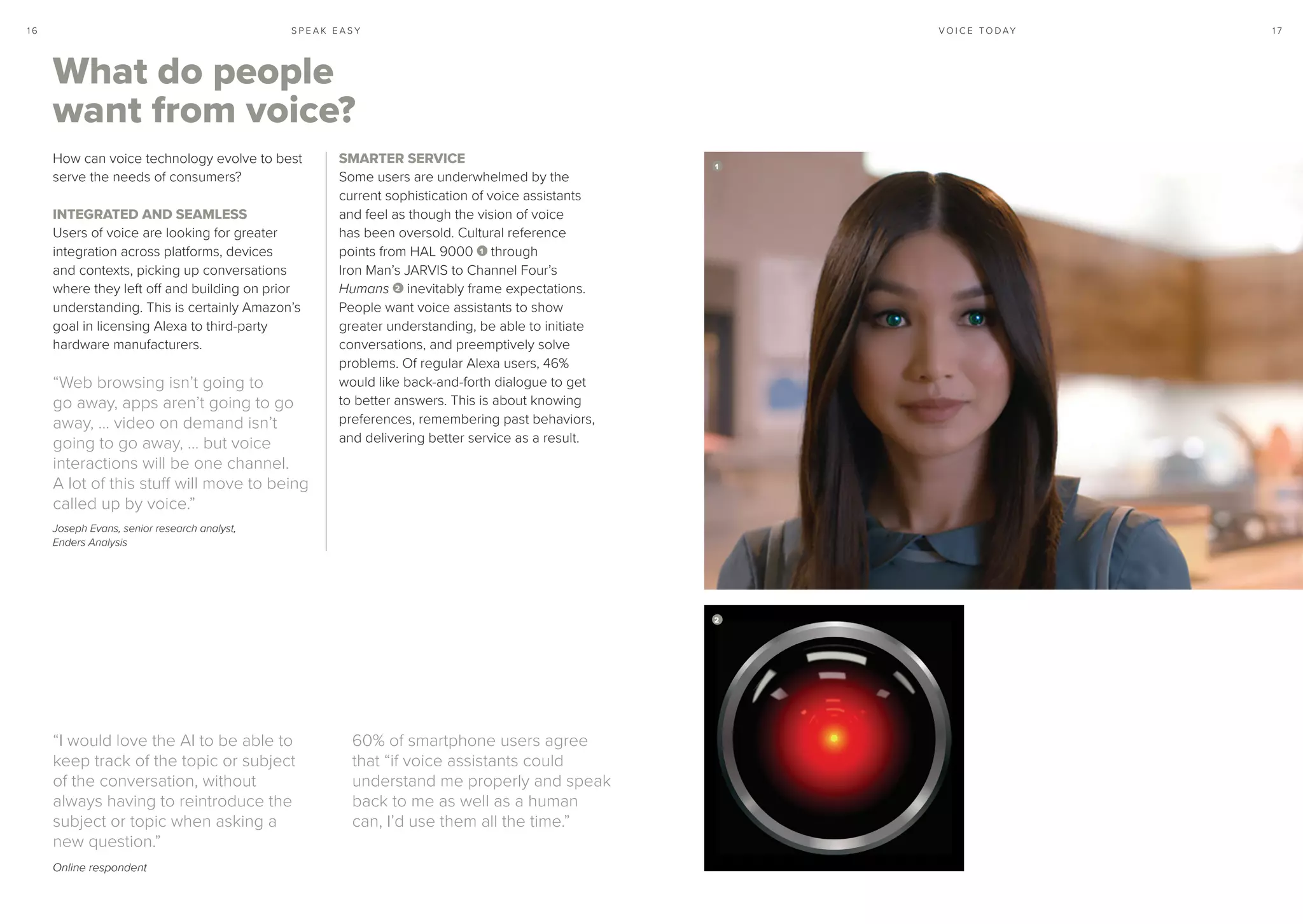
points from HAL 9000 1 through
Iron Man’s JARVIS to Channel Four’s
Humans 2 inevitably frame expectations.
People want voice assistants to show
greater understanding, be able to initiate
conversations, and preemptively solve
problems. Of regular Alexa users, 46%
would like back-and-forth dialogue to get
to better answers. This is about knowing
preferences, remembering past behaviors,
and delivering better service as a result.
“I would love the AI to be able to
keep track of the topic or subject
of the conversation, without
always having to reintroduce the
subject or topic when asking a
new question.”
Online respondent
60% of smartphone users agree
that “if voice assistants could
understand me properly and speak
back to me as well as a human
can, I’d use them all the time.”
1
2
S P E A K E A S Y 1 91 8 T H E F U T U R E V O I C E C O N S U M E R
The Future
Voice Consumer
As we look towards the future, a number of trends
will shape how consumers use and feel about voice.
Hypothetisches Gebilde by Alicja Kwade, 2016,
featured in 303 Gallery at Frieze London 2016.
2 1S P E A K E A S Y2 0 T H E F U T U R E V O I C E C O N S U M E R
Whole
interaction
Receiving
the answer
0.68
0.83
0.52
1.05
Voice Text
High mental
activity
Low mental
activity
Alexa
Correct Answer
Response
Text
;4#$'")^=)_'&4.)&/+484+()5&A,)06".)'"/"484.#)&)'",A-.,"))
I4#6)5".+&%)
&/+484+(
Z-0)5".+&%)
&/+484+(
!"#$%&'(J&#$"(K7-BC=<(-<#A.(0&1(23456(7(8(432(9:(-;*$<)="7&(#-&$-(
L$*B7(*%<B/B<.(;&*-#$&A(#-B7C(!!M(=&*A-&<-6(#7B<("I(;&*-#$&;&7<(B-($*AB*7-N(G=B%=(&O#*<&-(<"(-<$&7C<=("I(1$*B7($&-)"7-&6(
$&-)"7A&7<-(G&$&(*-+&A(<"(%*$$.("#<(*(-&$B&-("I(<*-+-(&B<=&$(-)&*+B7C(<"(P@&Q*("$(<.)B7C(B7<"(*7(BR*A
;4#$'")^=)_'&4.)&/+484+()5&A,)06".)'"/"484.#)&)'",A-.,"))
I4#6)5".+&%)
&/+484+(
Z-0)5".+&%)
&/+484+(
!"#$%&'(J&#$"(K7-BC=<(-<#A.(0&1(23456(7(8(432(9:(-;*$<)="7&(#-&$-(
L$*B7(*%<B/B<.(;&*-#$&A(#-B7C(!!M(=&*A-&<-6(#7B<("I(;&*-#$&;&7<(B-($*AB*7-N(G=B%=(&O#*<&-(<"(-<$&7C<=("I(1$*B7($&-)"7-&6(
$&-)"7A&7<-(G&$&(*-+&A(<"(%*$$.("#<(*(-&$B&-("I(<*-+-(&B<=&$(-)&*+B7C(<"(P@&Q*("$(<.)B7C(B7<"(*7(BR*A
;4#$'")^=)_'&4.)&/+484+()5&A,)06".)'"/"484.#)&)'",A-.,"))
I4#6)5".+&%)
&/+484+(
Z-0)5".+&%)
&/+484+(
!"#$%&'(J&#$"(K7-BC=<(-<#A.(0&1(23456(7(8(432(9:(-;*$<)="7&(#-&$-(
L$*B7(*%<B/B<.(;&*-#$&A(#-B7C(!!M(=&*A-&<-6(#7B<("I(;&*-#$&;&7<(B-($*AB*7-N(G=B%=(&O#*<&-(<"(-<$&7C<=("I(1$*B7($&-)"7-&6(
$&-)"7A&7<-(G&$&(*-+&A(<"(%*$$.("#<(*(-&$B&-("I(<*-+-(&B<=&$(-)&*+B7C(<"(P@&Q*("$(<.)B7C(B7<"(*7(BR*A
;4#$'")^=)_'&4.)&/+484+()5&A,)06".)'"/"484.#)&)'",A-.,"))
I4#6)5".+&%)
&/+484+(
Z-0)5".+&%)
&/+484+(
!"#$%&'(J&#$"(K7-BC=<(-<#A.(0&1(23456(7(8(432(9:(-;*$<)="7&(#-&$-(
L$*B7(*%<B/B<.(;&*-#$&A(#-B7C(!!M(=&*A-&<-6(#7B<("I(;&*-#$&;&7<(B-($*AB*7-N(G=B%=(&O#*<&-(<"(-<$&7C<=("I(1$*B7($&-)"7-&6(
$&-)"7A&7<-(G&$&(*-+&A(<"(%*$$.("#<(*(-&$B&-("I(<*-+-(&B<=&$(-)&*+B7C(<"(P@&Q*("$(<.)B7C(B7<"(*7(BR*A
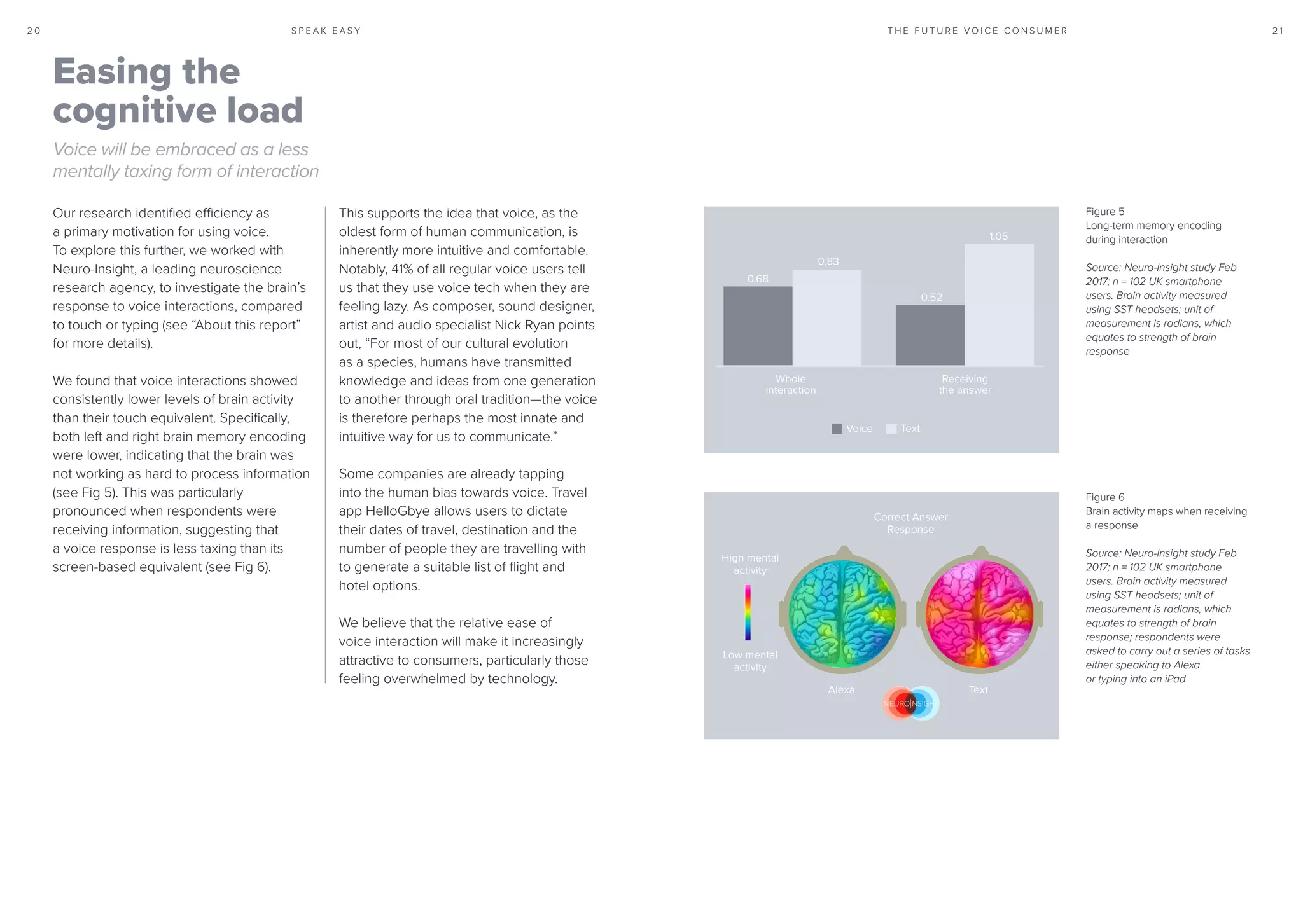
Figure 5
Long-term memory encoding
during interaction
Source: Neuro-Insight study Feb
2017; n = 102 UK smartphone
users. Brain activity measured
using SST headsets; unit of
measurement is radians, which
equates to strength of brain
response
Figure 6
Brain activity maps when receiving
a response
Source: Neuro-Insight study Feb
2017; n = 102 UK smartphone
users. Brain activity measured
using SST headsets; unit of
measurement is radians, which
equates to strength of brain
response; respondents were
asked to carry out a series of tasks
either speaking to Alexa
or typing into an iPad
This supports the idea that voice, as the
oldest form of human communication, is
inherently more intuitive and comfortable.
Notably, 41% of all regular voice users tell
us that they use voice tech when they are
feeling lazy. As composer, sound designer,
artist and audio specialist Nick Ryan points
out, “For most of our cultural evolution
as a species, humans have transmitted
knowledge and ideas from one generation
to another through oral tradition—the voice
is therefore perhaps the most innate and
intuitive way for us to communicate.”
Some companies are already tapping
into the human bias towards voice. Travel
app HelloGbye allows users to dictate
their dates of travel, destination and the
number of people they are travelling with
to generate a suitable list of flight and
hotel options.
We believe that the relative ease of
voice interaction will make it increasingly
attractive to consumers, particularly those
feeling overwhelmed by technology.
Our research identified efficiency as
a primary motivation for using voice.
To explore this further, we worked with
Neuro-Insight, a leading neuroscience
research agency, to investigate the brain’s
response to voice interactions, compared
to touch or typing (see “About this report”
for more details).
We found that voice interactions showed
consistently lower levels of brain activity
than their touch equivalent. Specifically,
both left and right brain memory encoding
were lower, indicating that the brain was
not working as hard to process information
(see Fig 5). This was particularly
pronounced when respondents were
receiving information, suggesting that
a voice response is less taxing than its
screen-based equivalent (see Fig 6).
Easing the
cognitive load
Voice will be embraced as a less
mentally taxing form of interaction
S P E A K E A S Y 2 32 2 T H E F U T U R E V O I C E C O N S U M E R
If voice will be embraced because it is
less cognitively draining, it is possible to
envisage how this bias towards the “path
of least resistance” will extend to our wider
decision making. If it becomes easier to
speak to a voice assistant than type a
search query, it may also prove easier to
follow the assistant’s proactive suggestions
than think through the alternatives. The
voice assistant may evolve to take on a
much more prominent decision-making
role, managing the user’s life proactively.
In effect it would become the “digital
butler” or “pocket concierge” helping us
at every turn.
Already, people depend on their virtual
assistants and other AI helpers to ease
the burdens of everyday life. For example,
we follow our satnavs when they suggest
alternative routes due to traffic. Lily, a
conversational personal stylist app, uses
AI to understand how a user views their
body and recommends clothes based on
these perceptions.
Almost a third of respondents are excited
about a future where their voice assistants
will anticipate what they need and take
actions or make suggestions.
58% of regular Alexa users agree
that “voice technology will make
humans smarter.”
For brands, the opportunity will come in
being selected for recommendation ahead
of their competitors by the digital butler,
a topic explored further in “Brand Futures”.
The Digital
Butler
Voice assistants will take on a more
proactive role in managing our lives
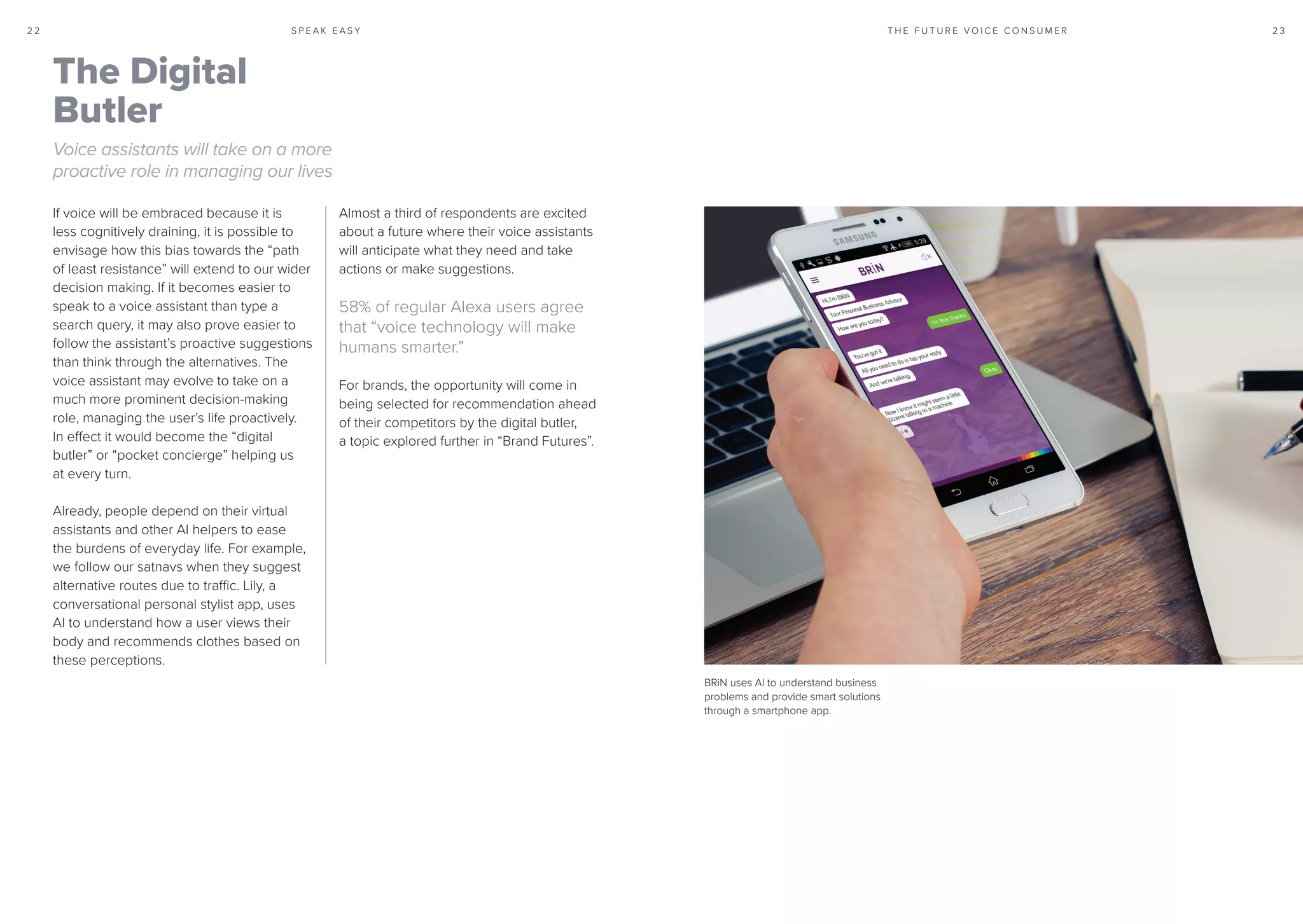
BRiN uses AI to understand business
problems and provide smart solutions
through a smartphone app.
S P E A K E A S Y 2 52 4 T H E F U T U R E V O I C E C O N S U M E R
Voice will enable people to interact more
directly with the world around them as their
eyes move away from their screens. This
presents brands with new opportunities to
engage people.
Over the coming years we can expect
voice technology to become increasingly
ubiquitous in the home. CNET estimates
that there were more than 30 significant
Alexa hardware integrations announced
at CES 2017 alone. Outside the home,
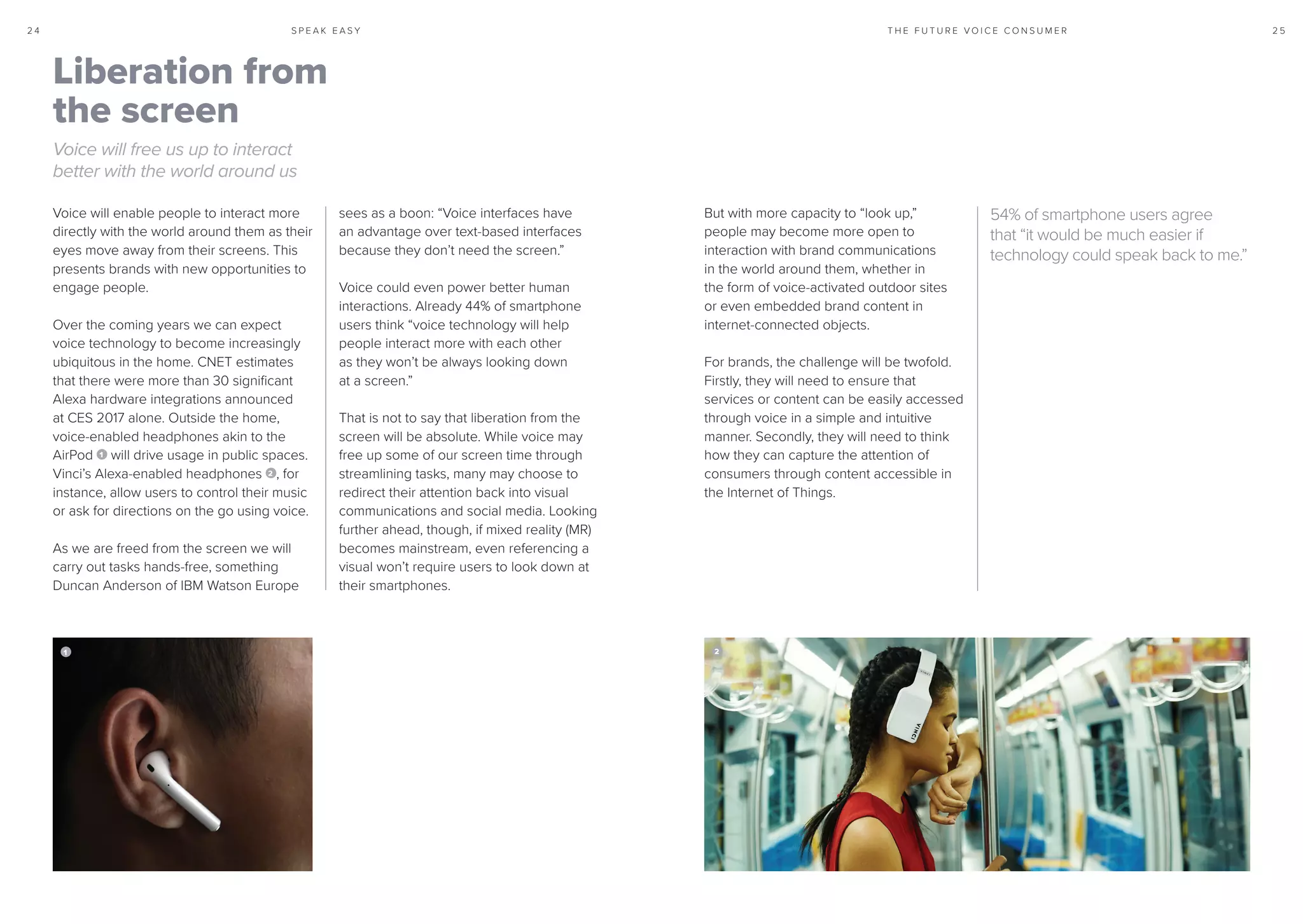
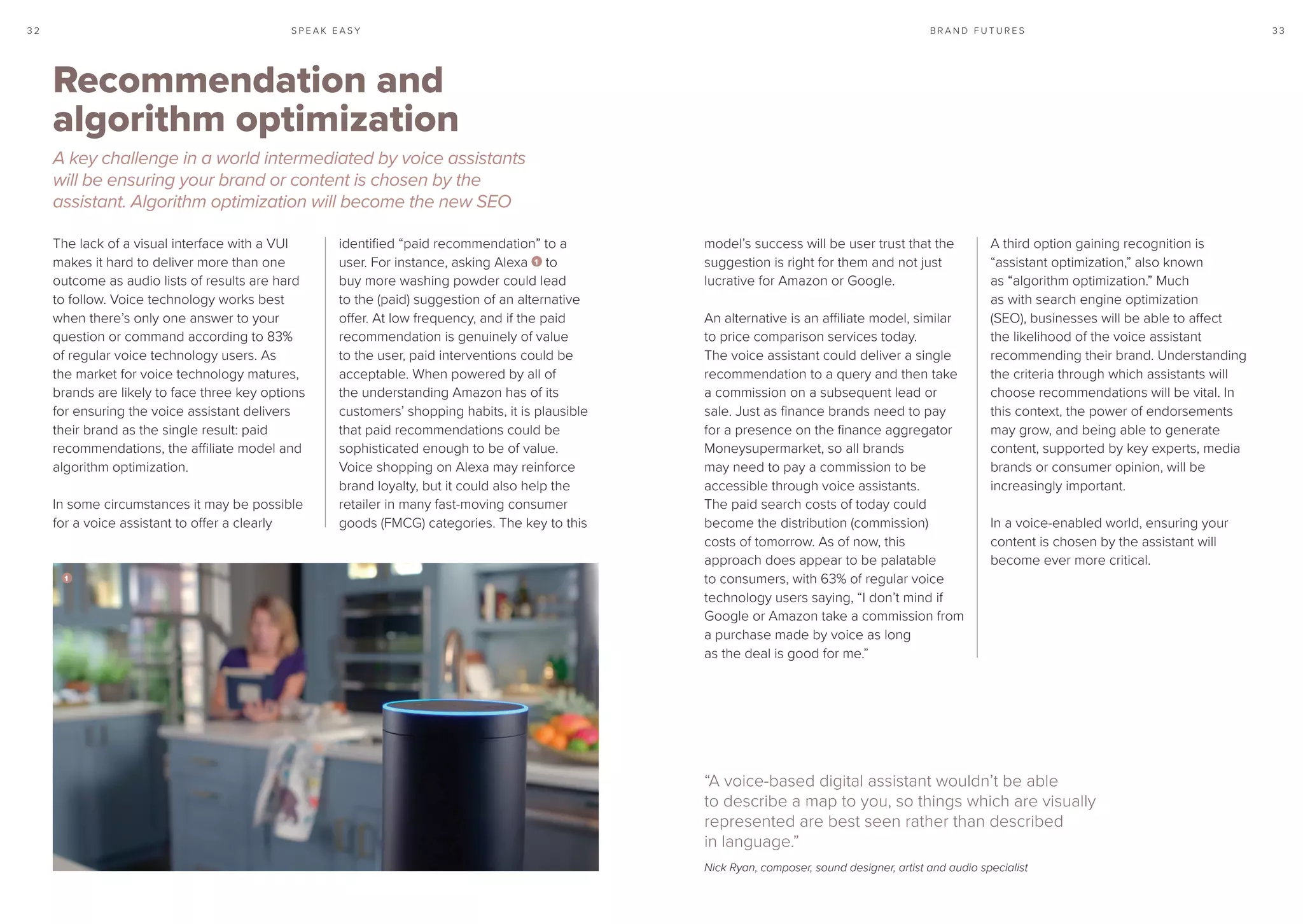
voice-enabled headphones akin to the
AirPod 1 will drive usage in public spaces.
Vinci’s Alexa-enabled headphones 2 , for
instance, allow users to control their music
or ask for directions on the go using voice.
As we are freed from the screen we will
carry out tasks hands-free, something
Duncan Anderson of IBM Watson Europe
sees as a boon: “Voice interfaces have
an advantage over text-based interfaces
because they don’t need the screen.”
Voice could even power better human
interactions. Already 44% of smartphone
users think “voice technology will help
people interact more with each other
as they won’t be always looking down
at a screen.”
That is not to say that liberation from the
screen will be absolute. While voice may
free up some of our screen time through
streamlining tasks, many may choose to
redirect their attention back into visual
communications and social media. Looking
further ahead, though, if mixed reality (MR)
becomes mainstream, even referencing a
visual won’t require users to look down at
their smartphones.
Liberation from
the screen
Voice will free us up to interact
better with the world around us
54% of smartphone users agree
that “it would be much easier if
technology could speak back to me.”
21
But with more capacity to “look up,”
people may become more open to
interaction with brand communications
in the world around them, whether in
the form of voice-activated outdoor sites
or even embedded brand content in
internet-connected objects.
For brands, the challenge will be twofold.
Firstly, they will need to ensure that
services or content can be easily accessed
through voice in a simple and intuitive
manner. Secondly, they will need to think
how they can capture the attention of
consumers through content accessible in
the Internet of Things.
S P E A K E A S Y 2 72 6 T H E F U T U R E V O I C E C O N S U M E R
Figure 7
Emotional response during interaction
Source: Neuro-Insight study Feb 2017; n = 102 UK
smartphone users. Brain activity measured using
SST headsets; unit of measurement is radians, which
equates to positivity of brain response
As advances in machine learning improve
voice assistants’ capabilities and users feel
better understood, we expect people to
grow closer to their assistants.
We can already see a consumer
appetite for voice assistants to be able
to understand them more fully—60% of
smartphone users agree that “if voice
assistants could understand me properly
and speak back to me as well as a human
can, I’d use them all the time.”
People want the assistant to know
their every preference and deliver an
experience that caters to their every whim.
As one of our respondents put it, “I’d like
voice technology to understand me on the
level that humans understand each other.”
Around a third (32%) of smartphone users
are excited about a future where “my voice
assistant will anticipate what I need and
take actions or make suggestions.”
For this relationship to flourish, trust is
a prerequisite. Providers need to earn
trust through a track record of successful
service before dependency can grow
and a deeper relationship can emerge.
They also need to alleviate users’ privacy
concerns and demonstrate responsibility
with personal data. For some, this level
of intimacy equates to an infringement of
privacy that is unacceptable. However,
we don’t believe that this will be enough
to dissuade the majority of consumers
from engaging. As one focus group
participant explained, “You can build trust
by, hopefully, making sure no one’s ripped
off while giving them access to do amazing
things.”
Once trust grows, emotional bonds
can grow, too. At present, emotional
attachment to our voice assistants is
limited. Our neuroscience experiments
found that the emotional response to
voice assistants is considerably lower than
for both a face-to-face human interaction
and a touch or text interface (see Fig 7).
This is likely to be a function of their
current rudimentary personalities and a
lack of familiarity.
Yet the emotional response to Alexa grew
during the course of our experiment as
people became more comfortable using it
(see Fig 8), pointing to the latent potential
for a closer relationship.
This is borne out further by some of
the early adopters of voice, for whom a
deeper emotional attachment is starting to
develop. Over a third (37%) of regular voice
technology users say that they love their
voice assistant so much that they wish it
were a real person. Even more astonishing
is that more than a quarter of regular voice
technology users say they have had a
sexual fantasy about their voice assistant.
“It is interesting, when something
acts naturally and human back to
you, how much we imbue it with
sentience, with human personality.”
Martin Reddy, cofounder and chief technology officer,
PullString
While extreme, this points to an
anthropomorphization of the voice
assistant that chimes with the 70% of
regular voice technology users who say
“I want to feel like I’m talking to a real
human when I talk to my voice assistant.”
Gatebox, a Japanese device akin to the
Echo, gives an indication of how this could
develop. It contains Hikari, a three-inch
holographic girl who can recognize the
user’s face and voice and is designed to
be a home companion.
For brands, the opportunity will be
navigating this ever-closer relationship
as voice assistants become increasingly
powerful gatekeepers to the consumer.
26% of regular voice tech users
say they have had a sexual fantasy
about their voice assistant.
Craving
intimacy
Voice users will look for deeper understanding
from their voice assistants and develop stronger
emotional connections
0.27
0.06
0.11
PersonAssistantAlexa
Figure 8
Emotional response by question
Source: Neuro-Insight study Feb 2017; n = 102 UK
smartphone users. Brain activity measured using
SST headsets; unit of measurement is radians, which
equates to positivity of brain response
0.17
0.09
0.26
-0.33
First question
All questions
S P E A K E A S Y 2 92 8 B R A N D F U T U R E S
Brand
Futures
As voice becomes an increasingly important mode of
interaction, what will it mean for brands? We’ve identified
five key themes that brands will need to consider if they
are to thrive in a voice-activated world.
Translation of Sound by Vaclav Mlynar, Kawther Alsaffar,
Kristian Knobloch and Ziyang Zhang, 2015, is a Royal
College of Art project which transforms the aural into
the visible.
S P E A K E A S Y 3 13 0 B R A N D F U T U R E S
Grappling with the
voice gatekeepers
Brands will need to reappraise relationships
with Google and Amazon as voice strengthens
their role as consumer gatekeepers
It seems unlikely that the interruptive
model of paid advertising will translate
easily to voice. Since a primary expectation
for using voice is a more streamlined
experience, the insertion of paid-for
ads directly into a conversation with
an assistant will jar, as Google recently
learned. Google Home users kicked up a
fuss when Google Assistant reported that
“Disney’s live-action Beauty and the Beast
opens today” after it delivered the time,
weather and travel update. Google quickly
removed the ad.
“I think the reality is that we’re just
not interested in advertising, it’s a
very different world. I don’t want to
talk to my device, then it giving me
an advert for five minutes—that’s
just never going to work.”
Duncan Anderson, chief technology officer, IBM
Watson Europe
Currently, in the Echo or Home
ecosystems, brands can create services
(Skills on Echo or Conversation Actions
on Home) which are activated by the user.
Amazon’s Alexa app displays new Skills
to download in much the same fashion
as a traditional app store, as well as
sending email updates promoting them.
While Skills and Conversation Actions
offer companies the opportunity to build
a branded experience over a VUI, their
future effectiveness is much in doubt for
two key reasons.
Firstly, in the short term the technology
is not able to deliver a unique voice
that’s also interactive. Other than opting
to include pre-recorded broadcasts,
brands have little scope to differentiate
themselves from either their competitors
or the virtual assistant itself. Martin Reddy,
cofounder and chief technology officer
of PullString, explains that “to do that
there’s a huge amount of work … There’s
a massive effort to build just the synthetic
voices of today, and those tend not to
have a lot of emotional range.” 	
Secondly, like Alexa herself, each Skill
requires users to invoke particular
commands to make it function properly,
which they find cumbersome. As one focus
group participant explained, “I found that
a lot with the Dot especially, you needed
to ask for things in a very formulaic way.
And there were really obvious things you
couldn’t get it to do unless you asked
in very specific way.” There is already a
challenge in discovering Skills within the
Alexa platform and a tendency for users
to abandon Skills in the same way many
mobile apps are forgotten over time.
There will be some Skills that stand out,
such as the Tide stain-removal one in the
United States, which allows users to get
cleaning tips for specific stains, or the
Uber Skill 1 , which allows users to order
and cancel rides or check on their status.
But most people don’t want a particularly
branded solution. Joseph Evans of Enders
Analysis predicts, “You’ll have a layer of
Skills by developers and they will present
themselves to the Alexa central level,
saying, ‘I can do X, I can do Y, I can do Z.’
And then when you have a user request,
Alexa will do some kind of machine
learning and say, ‘Okay, what they said
means that they want Y,’ right?”
With the interruptive ad model in question,
and Skills and Conversation Actions likely
to recede into the background of the
overall voice-assistant experience, brands
should consider the following opportunities
if they want a share in the more than $2
billion of sales that were forecast to be
driven by digital assistants in 2016 alone.8
“There’s a pretty good argument
… that the people who put these
devices in your home seek to own
the market because they own
the habit.”
Nir Eyal, bestselling author and lecturer
at Stanford University
8
Finbarr Toesland, “Voice Search and Chatbots Are Transforming Commerce”, Raconteur, September 8, 2016, http://bit.ly/2mIu4iT
1
S P E A K E A S Y 3 33 2 B R A N D F U T U R E S
The lack of a visual interface with a VUI
makes it hard to deliver more than one
outcome as audio lists of results are hard
to follow. Voice technology works best
when there’s only one answer to your
question or command according to 83%
of regular voice technology users. As
the market for voice technology matures,
brands are likely to face three key options
for ensuring the voice assistant delivers
their brand as the single result: paid
recommendations, the affiliate model and
algorithm optimization.
In some circumstances it may be possible
for a voice assistant to offer a clearly
identified “paid recommendation” to a
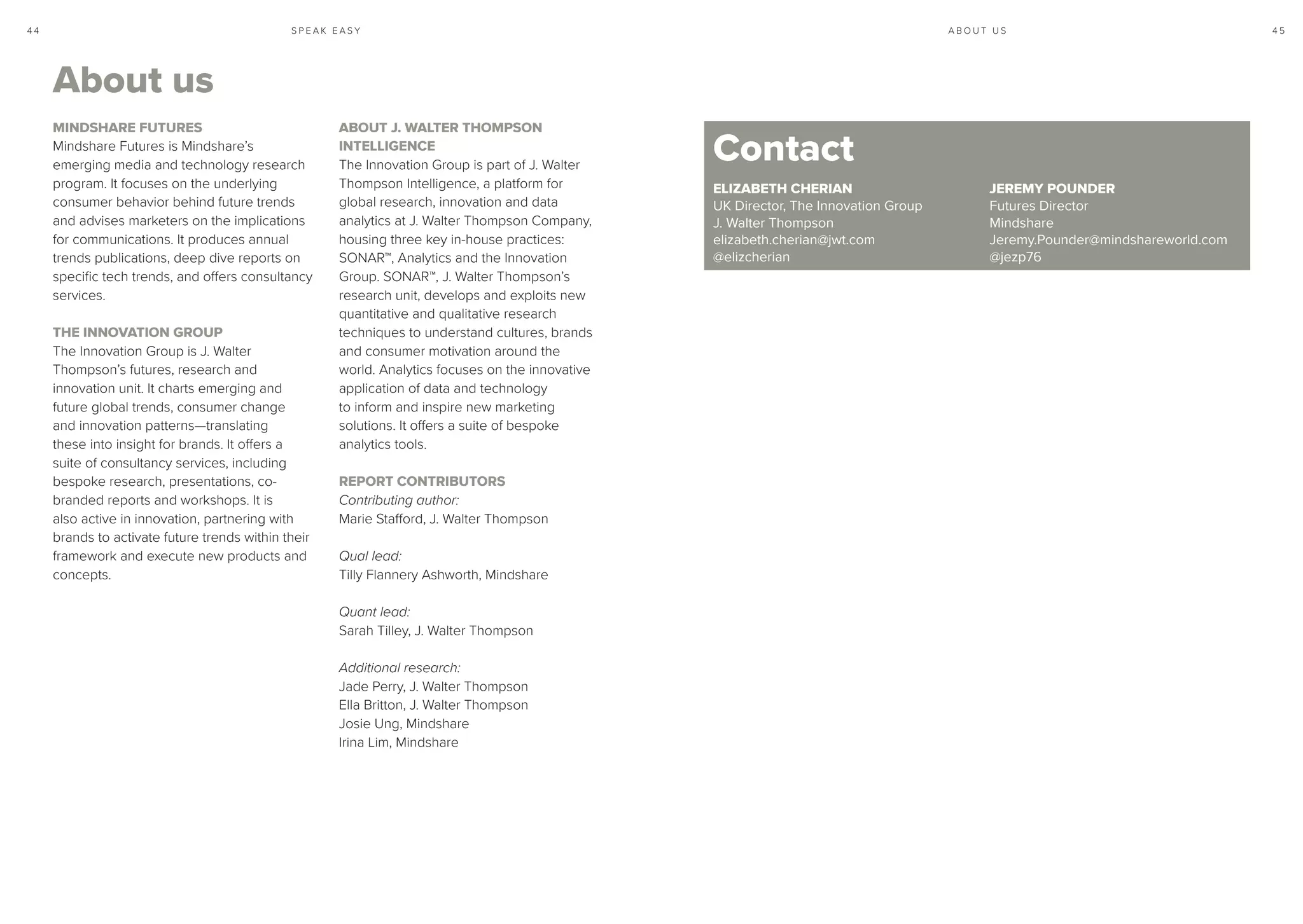
user. For instance, asking Alexa 1 to
buy more washing powder could lead
to the (paid) suggestion of an alternative
offer. At low frequency, and if the paid
recommendation is genuinely of value
to the user, paid interventions could be
acceptable. When powered by all of
the understanding Amazon has of its
customers’ shopping habits, it is plausible
that paid recommendations could be
sophisticated enough to be of value.
Voice shopping on Alexa may reinforce
brand loyalty, but it could also help the
retailer in many fast-moving consumer
goods (FMCG) categories. The key to this
model’s success will be user trust that the
suggestion is right for them and not just
lucrative for Amazon or Google.
An alternative is an affiliate model, similar
to price comparison services today.
The voice assistant could deliver a single
recommendation to a query and then take
a commission on a subsequent lead or
sale. Just as finance brands need to pay
for a presence on the finance aggregator
Moneysupermarket, so all brands
may need to pay a commission to be
accessible through voice assistants.
The paid search costs of today could
become the distribution (commission)
costs of tomorrow. As of now, this
approach does appear to be palatable
to consumers, with 63% of regular voice
technology users saying, “I don’t mind if
Google or Amazon take a commission from
a purchase made by voice as long
as the deal is good for me.”
A third option gaining recognition is
“assistant optimization,” also known
as “algorithm optimization.” Much
as with search engine optimization
(SEO), businesses will be able to affect
the likelihood of the voice assistant
recommending their brand. Understanding
the criteria through which assistants will
choose recommendations will be vital. In
this context, the power of endorsements
may grow, and being able to generate
content, supported by key experts, media
brands or consumer opinion, will be
increasingly important.
In a voice-enabled world, ensuring your
content is chosen by the assistant will
become ever more critical.
Recommendation and
algorithm optimization
A key challenge in a world intermediated by voice assistants
will be ensuring your brand or content is chosen by the
assistant. Algorithm optimization will become the new SEO
“A voice-based digital assistant wouldn’t be able
to describe a map to you, so things which are visually
represented are best seen rather than described
in language.”
Nick Ryan, composer, sound designer, artist and audio specialist
1
S P E A K E A S Y 3 53 4 B R A N D F U T U R E S
Voice technology is moving rapidly beyond
mobile phones and smart speakers.
Already Alexa has been built into dozens
of smart devices.9
A key pillar of Amazon’s
strategy is the licensing of Alexa Voice
Service to hardware manufacturers to help
drive the voice ecosystem.
There is also a growing appetite for voice
capabilities. General-purpose social robots
such as Olly 1 or Jibo are an alternative
to smart speakers. They behave more
like Rosie, the robot in popular cartoon
series The Jetsons, and attract a devoted
audience. Voice-activated products
such as the Hello Barbie doll and
Dreamhouse 2 or the kids’ digital
storybook The Snow Fox 3 offer a more
interactive and enriching experience than
their dumb equivalents. Meanwhile, the
number of commercial settings integrating
voice-activated services is growing.
In hospitality, there is Connie the robot
concierge at the Hilton McLean Hotel
in Virginia, while teams of robots at the
Henn-na hotel in Japan check in guests
and offer concierge services.
Brands need to think about how they can
make their own physical assets voice
enabled, whether that be through using
Alexa or their own voice technology. For
retailers, this could include embedding
voice assistants in display units or
changing rooms to help customers with a
focused set of needs. We found that 38%
of smartphone users already want “a voice
assistant that could communicate with the
store (e.g. to help you navigate while there
and help you find products more easily).”
Connected packaging also presents the
possibility of being able to talk directly
to physical products and access relevant
information or content. Almost half (49%)
of smartphone users agree with the
statement “I like the idea of being able
to ask my products questions about their
provenance.” At CES 2017, we saw the
launch of talking packaging in the form
of Cambridge Consultants’ AudioPack
concept for drugs and medical devices.
Media itself is increasingly likely to
become voice enabled. Already we are
seeing interactive audio or radio ads
that allow users to talk to the brand and
request further content or even purchase.
Instreamatic.AI is an all-in-one interactive
audio platform that allows advertisers to
create voice-enabled audio ads, which
companies as diverse as McDonald’s,
Jaguar, Sony and Starbucks have already
explored. As the TV becomes voice
enabled (Alexa is now built into the latest
Amazon Fire stick), people may also use
their voice assistant to interact with TV
advertisers. Sky has recently integrated
voice recognition into its remote. There
will also be opportunities to add voice
interactivity to one of the oldest media
of all, poster sites.
As brands make more of their touchpoints
voice enabled, they will start to amass
a voice dataset that will present
opportunities for voice analytics. What
can you learn about your customers from
their tone of voice and how they talk to
you? Can you apply sentiment analysis to
the voice recordings to understand how
customers feel?
What’s more, brands that build their own
voice-enabled products and content can
position themselves outside the voice
gatekeeper ecosystem and take a step
towards winning back control over how
they engage with their consumers.
“You have to be able to offer
people something which makes it
worth their while to actually interact
with you … and those who are able
to do that will actually do it well.”
Joseph Evans, senior research analyst,
Enders Analysis
Join the
Internet of Things
As voice capabilities spread to new
contexts, brands should consider adding
voice interactivity to their touchpoints
9
Leslie Hook, Richard Waters and Tim Bradshaw, “Amazon Pours Resources into Voice Assistant Alexa,” Financial Times, January 17, 2017, http://on.ft.com/2mZUFd1
1
2 3
S P E A K E A S Y 3 73 6 B R A N D F U T U R E S
“The question for brands should
be, if tomorrow you had a seamless
way to talk to your product … would
that save the customer steps?”
Nir Eyal, bestselling author and lecturer
at Stanford University
There are two routes a brand can take
when developing a chat experience.
One is to build a chatbot for a messaging
platform such as Facebook Messenger
or Kik. Users who are interacting with a
brand’s chatbot spend on average 32%
more time on Kik than those who don’t.10
Text-based messaging will continue to be
valued by consumers for its speed and
simplicity, but brands should be thinking
about the circumstances in which chatbots
could or should be voice-enabled. It is
possible to envisage successful text-
based chatbots, such as 1-800-Flowers 2
or Skyscanner, delivering an even more
flexible experience for customers by
adding voice capabilities.
In addition to chatting on a messaging
platform, people will increasingly expect
to carry on their conversations through
voice on a VUI. For example, someone
might arrange a delivery in Messenger one
day and want to check up on it via voice
through Alexa the next. Creating symbiotic
Skills or Conversation Actions could be
one way to address consumers’ desire for
a seamless and integrated experience.
The second route to consider is creating
a Skill or Conversation Action. When
contemplating this investment, brands
must first decide what the service will
accomplish. “Amazon made us boil
down our original ideas to the simplest
possible concept. Which is what you’ve
got to do when you’re designing for
voice,” says Michael Hill, founder and
managing director of Radioplayer,
about his experience of designing the
Radioplayer Skill.
The characteristics of some of the early
examples of successful Skills are rooted
in their simplicity and ability to offer real
value in a natural, straightforward way.
A user who activates the BMW Skill 1 can
ask Alexa about a scheduled trip, what
time to leave, and send the destination
to the vehicle. The Just Eat Skill allows
users to reorder their last takeaway with
one command, significantly reducing the
number of steps required to place an
order—something likely to appeal to the
close to one quarter of regular voice users
who cite fewer steps as one of the main
reasons for using voice technology.
Ultimately, enabling interaction with bots
through voice, regardless of location,
comes back to the core promise of
the technology—understanding the
needs of the user and delivering on that
need through a process that is simple
and intuitive.
Are you
being served?
Brands that develop truly useful content
have a great opportunity to engage in direct
communication with their consumers
10
BI Intelligence, “ Chatbots are thriving on the Kik chat app”, Business Insider UK, August 4, 2016, http://read.bi/2nCHdiH 11
James Titcomb, “Microsoft Build 2016: Windows 10, HoloLens and Xbox Updates Revealed,” The Telegraph, March 30, 2016, http://bit.ly/1qjCkbo
“Human language is the new user
interface, bots are the new apps.”
Satya Nadella, CEO, Microsoft11
1 2
S P E A K E A S Y 3 93 8 B R A N D F U T U R E S
Voice is a hugely significant opportunity for
brands. Our neuroscience research gives
early indication that speaking to a brand
delivers a deeper emotional connection
than interacting with it through type or
touch. When people asked a question
involving a brand name, their brain activity
showed a significantly stronger emotional
response compared to people typing
that same brand question (see Fig 9).
The act of saying a brand name appears
to strengthen the pre-existing emotional
associations to a greater degree than
typing it.
“People respond to sound with
profound depth emotionally
and physically, but they don’t
necessarily understand that what
they are being moved by is audio.”
Nick Ryan, composer, sound designer,
artist and audio specialist
This emphasizes the need for brands to
really craft the sound of their own voice,
as it shows that voice interactions can have
a deeper impact on brand perceptions.
While the voice assistant will act as a
critical gatekeeper for many purposes,
such as discovery, there will be instances
where consumers will expect to talk to
a brand directly, especially where they
already have a strong relationship with the
brand, such as in banking or grocery.
“Companies will now need to think
about the actual voice of their
brand … They have to think about
how their brand sounds, and the
words and language that their
brand uses when communicating
with customers … the personality
of their brand as it’s presented
to users.”
Martin Reddy, cofounder and chief technology officer,
PullString
In addition, consumers are already
looking for greater variety in voices. Just
under three quarters (72%) of regular
voice technology users say “I think
brands should have unique voices and
personalities for their apps/Skills and not
just use the assistant on my phone.”
Some of the early Skill pioneers have
started to use different voices to reflect
the service they offer. The BBC News Skill
broadcasts a pre-recorded presenter,
while the Grand Tour Skill uses the
prerecorded voices of Jeremy Clarkson et
al. In time, we will see the development of
increased personality, whether through the
use of more celebrity voices or the design
of a unique tone of voice, once the AI
capabilities allow the response to be truly
interactive.
62% of regular voice technology
users agree with the statement
“I like the idea of being able to give
my voice assistant a celebrity’s
voice.”
Our research has shown that people have
strong preconceived notions about what
a brand should sound like, so developing
the brand’s voice will be an increasingly
important strategic consideration. Hit the
right notes and you can be music to your
customers’ ears.
Find your
voice
Speaking directly to a brand appears to strengthen
emotional relationships. Brands have a great opportunity
to define their own voice
Voice Text
0.64
0.32
Figure 9
Emotional response for
branded questions*
Source: Neuro-Insight
study Feb 2017; n = 102
UK smartphone users.
Brain activity measured
using SST headsets;
unit of measurement is
radians, which equates
to positivity of brain
response
*Specific requests
for brands
S P E A K E A S Y S E C T I O N N A M E H E R E 4 14 0
Short-term
brand implications
Long-term
brand implications
What marketers can do to prepare for a
voice-activated world in the short term
What marketers can do to prepare
for a voice-activated world in the
medium to long term
1. Consider how voice
could genuinely augment
the touchpoints on your
consumer journey.
How could a voice interaction add
value to or remove friction from the
consumer experience?
2. Learn the rules of
engagement in conversational
commerce.
Build a chatbot and explore the type
of conversations you can start with
your customer.
3. Become a voice native
yourself.
Understand how relationships with
technology and brands change when
you can speak to them, and find out
what works and what doesn’t.
4. Experiment with
voice-user interfaces.
Test and learn through an Alexa Skill
or Google Conversation Actions trial.
Explore how you can provide utility to your
customers or drive new behaviors when
there’s no screen.
5. Use radio or interactive
audio ads to develop your
brand’s voice.
What do people want to hear when they
speak directly to your brand?
1. Dial up your privacy
credentials.
Review and develop your personal data
privacy policies. Position yourself as the
brand to trust.
2. Review whether your
search activity is prepared
for voice.
Does your keyword strategy capitalize
on the long tail of conversational
search terms?
3. See what you can learn
from how customers talk
about your brand.
Try using voice-analytics software to detect
how your customers really feel.
4. Re-evaluate your
PR efforts.
Getting your brands recommended
by respected journalists and other
thought leaders could be your best bet
to staying relevant in the era of voice
and the affiliate model.
5. Forge strategic
partnerships for voice
integration.
Work with retailers and service brands
to be the brand they recommend.
S P E A K E A S Y 4 34 2 T H A N K Y O U S
Thank Yous
The Innovation Group and Mindshare Futures
would like to thank the experts who generously
gave their time and shared their ideas with us
for this project.
We’d also like to call out the amazing talent that helped bring this report to life: Jane Barnes, Barneys
New York, Claire Bischer, Vanessa Brown, Noel Bussey, Zac Cole, Delta Sound, Johanna Doyle, Fondation
d’entreprise Hermès, Claire Gervat, Lucie Greene, Glenn Hatton, Hunger Magazine, Leif Johnson,
Aleksandra Kingo, Katie Knott, Hester Lacey, Jeff Louviere, Peter Lowey, James Lucking, Florence Lujani,
Philippe Medina, Mish Mane, Alan Masferrer, Rachel Moss, Guy Murphy, Vaclav Mlynar, Tom O’Donnell,
Maria Pavlopoulos, Lucas Peon, Rankin, James Ratnarajah, Michael Reeder, Bryan Riddle, David Roth,
Sophie Rhys Evans, Sennheiser, Daniel Thomas Smith, Jonathan Terry, Rhoneil Tiburcio, Igor Tolkachev,
Leaf Troup, Nick Tsolkas, Jordan Walker Shuttlewood, Lauren Wahed, Davey Williamson and Will Wright.
DUNCAN ANDERSON
Chief technology officer,
IBM Watson Europe
Duncan Anderson is the
European CTO for IBM
Watson, a role he has held
for the past three years.
In this role he leads the
European technical team
for one of the world’s
foremost AI/cognitive
computing efforts. He
works with customers
and technologists of all
types and backgrounds
to help bring the promise
of cognitive computing to
reality. Over the past 15
years, Duncan has held
a series of senior technical
leadership positions
within IBM.
MICHAEL HILL
Founder and managing director,
Radioplayer
Michael Hill is founder
and managing director of
Radioplayer, a partnership
between the BBC and
UK commercial radio.
He was previously at the
BBC where he ran several
national radio networks,
developed new digital
products and services,
led major strategic
transformation programs,
and managed creative and
journalistic teams.
HEATHER ANDREW
CEO,
Neuro-Insight UK
With a background
in marketing and
communication, Heather
Andrew has held marketing
director roles at Nestlé
and a television channel,
as well as working as a
consultant at PwC and
OxfordSM. She is CEO
of Neuro-Insight UK,
working alongside the
neuroscientists to run the
client-facing part of the
business.
MARTIN REDDY
Cofounder and chief technology
officer, PullString
Martin cofounded
PullString and manages
the company’s engineering
effort. He has published
more than 40 peer-
reviewed articles, authored
half a dozen patents, and
written two books. Martin
spent five years in the
Artificial Intelligence Center
at SRI International and six
years at Pixar, leading the
development of its internal
filmmaking software.
NIR EYAL
Bestselling author and lecturer
at Stanford University
Nir Eyal is the author
of the bestselling book
Hooked: How to Build
Habit-Forming Products
about the intersection of
psychology, technology
and business. He
runs Nirandfar.com,
has founded two tech
companies and taught
at the Stanford Graduate
School of Business and the
Hasso Plattner Institute of
Design at Stanford.
NICK RYAN
Composer, sound designer, artist
and audio specialist
Nick Ryan is a multi-award-
winning sound artist and
audio specialist. He is
widely recognized as a
leading thinker in relation
to the future of sound and
for creating unique and
highly conceptual audio
experiences that push the
boundaries of audio.
S P E A K E A S Y 4 54 4 A B O U T U S
About us
MINDSHARE FUTURES
Mindshare Futures is Mindshare’s
emerging media and technology research
program. It focuses on the underlying
consumer behavior behind future trends
and advises marketers on the implications
for communications. It produces annual
trends publications, deep dive reports on
specific tech trends, and offers consultancy
services.
THE INNOVATION GROUP
The Innovation Group is J. Walter
Thompson’s futures, research and
innovation unit. It charts emerging and
future global trends, consumer change
and innovation patterns—translating
these into insight for brands. It offers a
suite of consultancy services, including
bespoke research, presentations, co-
branded reports and workshops. It is
also active in innovation, partnering with
brands to activate future trends within their
framework and execute new products and
concepts.
ABOUT J. WALTER THOMPSON
INTELLIGENCE
The Innovation Group is part of J. Walter
Thompson Intelligence, a platform for
global research, innovation and data
analytics at J. Walter Thompson Company,
housing three key in-house practices:
SONAR™, Analytics and the Innovation
Group. SONAR™, J. Walter Thompson’s
research unit, develops and exploits new
quantitative and qualitative research
techniques to understand cultures, brands
and consumer motivation around the
world. Analytics focuses on the innovative
application of data and technology
to inform and inspire new marketing
solutions. It offers a suite of bespoke
analytics tools.
REPORT CONTRIBUTORS
Contributing author:
Marie Stafford, J. Walter Thompson
Qual lead:
Tilly Flannery Ashworth, Mindshare
Quant lead:
Sarah Tilley, J. Walter Thompson
Additional research:
Jade Perry, J. Walter Thompson
Ella Britton, J. Walter Thompson
Josie Ung, Mindshare
Irina Lim, Mindshare
Contact
ELIZABETH CHERIAN	 JEREMY POUNDER
UK Director, The Innovation Group	 Futures Director
J. Walter Thompson	 Mindshare
elizabeth.cherian@jwt.com	 Jeremy.Pounder@mindshareworld.com
@elizcherian	 @jezp76
#SpeakEasy2017

Speakeasy 04 2017

  • 1.
    I M AG E : D A Y D R E A M E R , 2 0 1 5 C O U R T E S Y O F M I C H A E L R E E D E R
  • 2.
    S P EA K E A S Y There has always been something that gets in the way of our relationship with technology; the keyboard, the mouse, the screen. We’re now ready for the most natural and intuitive form of interaction—the voice. It’s time for humanity and technology to Speak Easy. Developments in speech recognition and natural language processing (NLP) mean we can now talk to computers in a way that was considered science fiction just a few years ago. According to Google, 20% of mobile searches on Android are by voice. Amazon has created a new voice hardware category and sold 11 million Echoes, and Google launched its own equivalent, Home, in the UK in April this year. The rise of a voice-activated world will allow us to get closer and more intimate with technology. Voice interaction will redefine not just how we live our lives, but the digital advertising landscape and how brands reach consumers. Now is the time for marketers to learn how to Speak Easy … JEREMY POUNDER ELIZABETH CHERIAN Futures Director UK Director Mindshare The Innovation Group J. Walter Thompson Opening letter A consumer trends and insight report on voice technology and its impact on brands.
  • 3.
    S P EA K E A S Y Speak Easy is a trends and insight report, carried out in equal partnership between J. Walter Thompson Innovation Group London and Mindshare Futures, which explores voice technology and its implications for brands. Our research comprised several methodologies and covered the period January 2017 to March 2017. NEUROSCIENCE EXPERIMENT In partnership with Neuro-Insight, we used Steady-State Topography (SST) brain-imaging technology to measure how the brain responds to voice technology for a series of tasks versus text or typing alternatives. 102 smartphone users and Amazon shoppers between the ages of 18 and 65 took part. QUALITATIVE Over 30 UK respondents took part in a two-week self-ethnography project capturing their own behaviors and attitudes in a series of voice technology tasks. We then ran two focus groups with 12 of these participants. A mixture of Early Adopters and Early Majority voice users were recruited. About this report Contents Voice Today 1 The Future Voice Consumer 19 Brand Futures 29 Implications 40 Thank Yous 42 EXPERT INTERVIEWS We conducted in-depth interviews with experts across sectors including artificial intelligence (AI), neuroscience, marketing, sound design and radio. QUANTITATIVE We carried out a quantitative survey using SONAR™, J. Walter Thompson’s proprietary market research tool, surveying over 1,000 UK smartphone owners aged 18+ and 100 Amazon Echo owners. SECONDARY RESEARCH We carried out extensive desk research that synthesizes international cross-category case studies.
  • 4.
    S P EA K E A S Y 1V O I C E T O D AY Voice Today Resonantia by Jeff Louviere and Vanessa Brown explores the relationship between photography and music by visualizing 12 musical notes and converting the photographs into audio.
  • 5.
    S P EA K E A S Y 32 V O I C E T O D AY We stand on the cusp of a fundamental shift in how we relate to computers. Over the past 50 years, we have been on a journey that has simplified our modes of interaction, from punch cards to keyboard, mouse and then touch. Each step has made engagement with technology simpler and more natural, leading us to perhaps the simplest and most natural interaction mode of all—voice. Voice is generating excitement because it now works in a way that it did not just a few years ago. Advances in speech recognition (identifying the words spoken and converting them to text) and natural language processing or NLP (understanding the intent behind the words) have made voice a viable consumer proposition. Speech recognition error rates are now at human parity at 5%. We can expect further improvements as machine learning benefits from both continuing investment from the tech giants and the datasets produced by widespread consumer adoption. As a result, the virtual assistant market is set to be worth more than $3 billion by 2020.1 Voice has been given further impetus by the ambitions of GAFA (Google, Amazon, Facebook, Apple) to control their own consumer platforms. Just as Google bought Android so it would have some control of mobile as a platform, so Amazon developed Echo and Alexa to retain influence over the development of voice and its impact on search and shopping. While development has thus far been driven top down from Silicon Valley, if we are truly about to enter the voice era, then understanding consumer appetite is critical. What is voice technology? “There is a significant difference between [speech recognition of] 95% and 99% accuracy … it’s the difference between you hardly using it and using it all the time without thinking about it.” Andrew Ng, former chief scientist, Baidu2 . “A smartphone is not a neutral platform in the way that the desktop web browser (mostly) was—Apple and Google have control over what is possible on the mobile internet in ways that Microsoft did not over the desktop internet. This makes internet companies nervous ... This is a significant driver behind the Kindle Fire, Alexa, Facebook Messenger bots and all sorts of other projects.” Benedict Evans, partner and mobile analyst, Andreessen Horowitz3 1 Globe Newswire, “Intelligent Virtual Assistant Market Worth $3.07Bn by 2020,” December 17, 2015, http://bit.ly/2nCJLNR 2 Contagious, “Bedtime Story Sounds,” December 13, 2016, http://bit.ly/2mM1KgJ 3 Benedict Evans “Voice and the Uncanny Valley of AI,” ben-evans.com, March 9, 2017, http://bit.ly/2maeYU7
  • 6.
    5S P EA K E A S Y4 V O I C E T O D AY The current voice landscape is dominated by tech giants: AMAZON The UK launch of Echo 1 , and the smaller Dot 2 , at the end of September 2016 kickstarted consumer interest by creating a new device category for voice. Powered by voice assistant Alexa, Echo is estimated to have sold more than 11 million units globally and several hundred thousand in the UK to date.4 Alexa hosts third-party Skills, which function much like apps but over a voice-user interface (VUI). They can deliver entertainment and information, execute an action, or enable control of other devices. Alexa is also available to hardware developers as Alexa Voice Service to build into their own products in an attempt to stimulate the market. GOOGLE Google launched Home 3 , its domestic hardware equivalent to Echo, in the United Kingdom in April 2017. Home allows third parties to create Conversation Actions, which are the equivalent of Amazon’s Skills. It will be powered by Assistant, the voice assistant that is currently baked into the Pixel phone and the Allo messaging platform. Over time we can expect it to be built into all Android phones. Irrespective of the assistant interface, voice capabilities have been built into the Google search and YouTube apps for some time now. APPLE Apple is a voice pioneer, having launched Siri in 2011, but is increasingly seen as a laggard. While it has integrated Siri into wearables (the Apple Watch and AirPod), its challenge is a comparative lack of machine-learning capabilities and user data to make a voice assistant intelligent. Its strategic focus on data privacy and security reflects this. OTHER ASSISTANTS Facebook’s assistant M is currently text- based and focused on Messenger, but has the user data and machine-learning skills to make the evolution to voice. Samsung launched its voice interface Bixby for the Galaxy S8 in March 2017, with rumors that it will integrate its acquisition Viv 4 (the AI built by Siri’s original developers), and will look to build voice interfaces into all its consumer products over the coming years. Microsoft has developed Cortana 5 , which works across Windows platforms but currently lacks a strong mobile platform or smart speaker to achieve scale. BEYOND ASSISTANTS Going beyond assistance, we are seeing manufacturers such as Mattel’s Hello Barbie 6 or Ford building in voice capability to enhance their products 7 . Voice-activated customer service is also becoming more commonplace. Starbucks is currently trialing a “barista bot” which will allow customers to place orders simply by talking into their phone. “We’re going to see coalescing around a small number of virtual assistants, and it’ll just make good business sense to fit within that ecosystem.” Duncan Anderson, chief technology officer, IBM Watson Europe “Google search is good, but I feel nervous about leaving it to turn on automatically when I say ‘OK Google’ because I get nervous that it’s listening to me all the time.” JL, focus group participant The Landscape 3 4 1 5 6 7 2 4 Ángel González, “Amazon Has Sold More Than 11 Million Echo Devices, Morgan Stanley Says,” Seattle Times, January 19, 2017, http://bit.ly/2nV4Oab
  • 7.
    S P EA K E A S Y 76 V O I C E T O D AY With limited data available from GAFA (Google has stated that 20% of searches on Android in the United States are by voice,5 but has not released a comparable statistic for the United Kingdom to date), we conducted our own primary survey of UK smartphone users to understand voice usage behavior and attitudes. CONSIDERABLE LEVELS OF VOICE USAGE EXIST ALREADY. 37% of smartphone users use voice technology of some kind at least once a month and 18% use it at least weekly (see Fig 1). There is a sizeable proportion, 23%, who say they have used it once or twice, reflecting some of the teething problems with voice technology, but only 12% say they would never use or consider it. Among early adopters of the Amazon Echo, 60% say “Alexa has become integral to my daily routine.” Who is using voice and how often? 5 Jennifer Slegg, “20% of Google’s Mobile Search Queries Are Now Voice Queries,” The SEM Post, May 19, 2016, http://bit.ly/2n0oAli Regularly (at least once a week) 18 19 23 28 12 Occasionally (at least once a month) Only once or twice Never but would consider Never used and would not consider Figure 1 Usage of voice technology (% smartphone users) Source: Speak Easy survey Feb 2017; n = 1002 UK smartphone users Q: Would you ever consider using voice technology? Figure 2 Usage of voice technology by demographic (% smartphone users) Source: Speak Easy survey Feb 2017; n = 1002 UK smartphone users Q: Would you ever consider using voice technology? All Men 18–34 HH income £50k+ 37 43 50 48 A common motivation for using voice is its novelty, with 45% of regular users saying they do so because “it’s fun.” This could be thanks to the proliferation of Alexa Skills offering bad-taste jokes, pick-up lines, animal facts and the like. But as voice develops we expect the novelty factor to recede. “Voice is just how we interact with society and the world.” Joseph Evans, senior research analyst, Enders Analysis Currently the core reason for using voice is efficiency. The top three drivers cited in our study were “convenient,” “simple to use,” and “faster than typing” (see Fig 3). In fact, humans can speak 150 words per minute, so it’s more than three times faster to shop using a microphone than using apps.6 It’s no wonder that 76% of all regular voice users7 say that “using voice technology feels really natural now and I don’t even think about it.” When it works, voice technology allows people to accomplish tasks quickly and easily, thus streamlining their lives. Duncan Anderson, chief technology officer of IBM Watson Europe, explains, “It’s about being super-helpful, super-efficient, not getting in the way, building something that allows me to get the job done with minimal fuss.” Indeed, 76% of regular Alexa users agree that “Alexa makes my life easier.” 87% of regular voice users agree that “when voice technology works properly, it really simplifies my life.” But voice promises more than just efficiency. As voice assistants become more intelligent and sophisticated, they will play an advisory role, acting as a “digital butler” for everyday life management. Why do people use voice? 6 Mary Meeker, “Internet Trends 2016 – Code Conference”, KPCB, June 1, 2016, http://bit.ly/1otPLCi 7 Regular voice users are defined as people who use voice technology once a week or more often Figure 3 Reasons for using voice (% voice users) Source: Speak Easy survey Feb 2017; n = 292 UK regular voice users (at least once per week) Q: Which of the following are reasons that you use voice commands? It’s convenient It’s simple to use It’s faster than typing It’s fun I don’t have to type I can multitask It’s the future It’s cool It makes me more efficient There are fewer steps It’s accurate It’s customised to my personal preferences 55 52 49 45 38 32 27 26 23 21 15 9 VOICE USERS SHOW STRONG DEMOGRAPHIC SKEWS. Current voice users are significantly more likely to be young, male and affluent: 50% of 18-34-year-olds, 43% of men and 48% of people with a household income of more than £50,000 use voice monthly or more versus the population average of 37% (see Fig 2). NO CLEAR DOMINANT VOICE PLATFORM YET. Google voice search and Siri have the highest usage penetration, with 11% of smartphone users using them at least weekly. Alexa, launched in September 2016, is already not far behind, with 4% of smartphone users using it weekly.
  • 8.
    S P EA K E A S Y 98 V O I C E T O D AY Voice usage is currently skewed towards private spaces, particularly the home where a large proportion of routine tasks, highly suited to voice, take place—hence the development of both Home and Echo. But this also reflects the reluctance users express about using voice in public spaces. This may erode over time as people become desensitized to the experience of using voice in public. Voice-responsive headphones such as Apple’s AirPod 1 may also make public voice interactions semi-private by concealing the response from others. The car is also likely to prove a natural home for voice technology as it is a private space where the benefits of hands-free and multi-tasking are strong. A number of manufacturers, including Volkswagen and Hyundai, are already integrating Alexa into their products. We expect the home and car to be the dominant locations for voice, with retail and other public spaces to follow in time. Where do people use voice? “I think voice control will be crucial in cars of the future.” Michael Hill, founder and managing director, Radioplayer 2 2 1
  • 9.
    S P EA K E A S Y 1 11 0 V O I C E T O D AY TASKWARRIOR Early voice usage centers on specific tasks or commands. Aside from the novelty factor of asking fun questions, the majority of use is oriented towards queries with a single, known outcome—play music, find out the weather, give me directions (see Fig 4). Connected home tasks such as switching on lights have very low usage levels with only 15% of regular users saying they have ever used voice for this. Over time we expect voice to be used for more exploratory interactions, where users are browsing or looking for inspiration, such as researching holiday destinations. The key to moving beyond task execution towards providing suggestions or inspiration will be the assistant’s contextual intelligence and ability to refine queries through back-and-forth questioning. What are people using it for? EARLY DAYS FOR SHOPPING Using voice to buy products is currently in its infancy: only 18% of regular voice users have bought a product purely using voice “without looking on a website first.” Slightly more (24%) have bought a product by voice “having browsed for it elsewhere.” In the case of Alexa, the lack of a screen means that shopping tends to be focused on repeat items, such as groceries, or low- value items where the user is happy for Amazon to choose the product. Amazon’s limited penetration in grocery is a factor in the low levels of shopping at this stage. Consumers will also take time to get used to voice as a shopping interface and trust it to work more efficiently than the touch or typing alternative. Nonetheless, voice is likely to create countless new opportunities as situations where you’d normally be otherwise occupied—cooking, knitting, children’s bathtime—become potential shopping occasions. “I don’t trust it that much and I always log in on my phone to check if the right item has been ordered.” AB, focus group and online community participant INSPIRING NEW BEHAVIORS As voice enables tasks to be performed concurrently, we are starting to see home users co-opt new behaviors into their routines. For some, this is as simple as requesting the news headlines (“flash briefing,” as Alexa calls it) while getting ready in the morning or dictating shopping lists while surveying the contents of the fridge. “Normally while I try to muster the energy to get out of bed, I get Alexa to read me my flash briefing. I don’t have a TV and don’t really use newspapers, so being able to lie there and slowly catch up on the news in the morning is perfect for me.” Online respondent Figure 4 Uses of voice technology (% regular voice users) Source: Speak Easy survey Feb 2017; n = 292 UK regular voice users (at least once per week) Q: Which of the following tasks have you used voice services for? Online search Ask a fun question Play music Weather forecast Ask for directions Make a call Set alarms Check travel info Check the time Check news headlines Listen to the radio Dictate texts Purchase a product having researched it first Reorder a previously purchased product Purchase a product without researching it first Home management (e.g. turning lights on) 63 55 50 46 42 40 36 33 30 29 29 28 24 21 18 15
  • 10.
    S P EA K E A S Y 1 31 2 V O I C E T O D AY How is voice used? Voice usage can be split into two main types. These are tasks carried out entirely by voice, with both the question and response delivered this way (for instance, “Alexa, what’s the weather like today?”), and tasks that are initiated by voice and completed on a screen, typically a mobile (such as a voice search for directions). As voice assistants become more intelligent we expect there to be more opportunity for “100%” voice interactions. In future, booking a restaurant could be achieved through a series of back-and-forth questions to refine the choice. An early example of choice refinement comes via the Johnnie Walker Skill for Alexa, which poses questions about flavor preferences and price to deliver the perfect whisky recommendation for users. The interplay between voice and screen is likely to remain critical, however, particularly for tasks that depend on a display of visual information such as fashion or travel research. We are starting to see devices that blend voice and a screen, such as Hello Egg 1 , a standalone voice-enabled cooking assistant, and Baidu’s Xiaoyu Zaijia 2 (meaning Little Fish), which responds using a combination of pictures, text and speech. There will always be activities where voice plays little or no part, at least for the foreseeable future, such as buying the wedding gown of your dreams. 2 1
  • 11.
    S P EA K E A S Y 1 51 4 V O I C E T O D AY What stops smartphone users from using voice? Lack of awareness is not a significant barrier, with only 7% of those not using voice citing the reason as “I wasn’t aware of it.” Instead, smartphone users express a reluctance to use voice in public due to embarrassment, with 22% saying “I’d feel stupid using it.” As with Bluetooth headsets and mobile phones, we expect self-consciousness to recede over time. Nonetheless, some tasks (banking being a prime example) will still demand discretion, making them less likely to be carried out through voice—22% say “I wouldn’t want other people to overhear” as a reason for not using voice. “Perhaps as we use it more in the home and the car, people will start to get more used to it, and the feeling-daft factor fades away a bit.” Duncan Anderson, chief technology officer, IBM Watson Europe A more significant barrier seems to be a belief that voice offers no advantages over the touch or typing equivalent, with 48% of non-voice users saying they “don’t see the point.” Some of the teething problems with speech-recognition accuracy and the precise language required by some assistants to complete tasks are contributing to this perception. Half of regular Alexa users say “I have had to change my behavior to incorporate Alexa in my life.” Finally, a substantial minority is concerned by the privacy implications of having “listening” devices in the home: 44% of regular voice users say “I am worried about companies listening to the conversations I have with my voice assistant.” This is already driving the development of gadgets to foster privacy in open spaces, such as United States-based startup HushMe 1 , which is seeking crowdfunding for what it dubs “the world’s first voice mask.” Yet, expressing concern is not the same as taking evasive action. In our view, the proportion of people that claim to be concerned exceeds those prepared to modify their behavior as a result. Nonetheless, privacy is a key issue that won’t go away. Developers of voice interfaces will need to make it a priority. “I personally find it quite convenient to always have [Alexa] there listening—although that does throw up some privacy issues for me, it’s something I am willing to overlook.” RB, focus group and online community participant 1
  • 12.
    S P EA K E A S Y 1 71 6 V O I C E T O D AY What do people want from voice? How can voice technology evolve to best serve the needs of consumers? INTEGRATED AND SEAMLESS Users of voice are looking for greater integration across platforms, devices and contexts, picking up conversations where they left off and building on prior understanding. This is certainly Amazon’s goal in licensing Alexa to third-party hardware manufacturers. “Web browsing isn’t going to go away, apps aren’t going to go away, … video on demand isn’t going to go away, … but voice interactions will be one channel. A lot of this stuff will move to being called up by voice.” Joseph Evans, senior research analyst, Enders Analysis SMARTER SERVICE Some users are underwhelmed by the current sophistication of voice assistants and feel as though the vision of voice has been oversold. Cultural reference points from HAL 9000 1 through Iron Man’s JARVIS to Channel Four’s Humans 2 inevitably frame expectations. People want voice assistants to show greater understanding, be able to initiate conversations, and preemptively solve problems. Of regular Alexa users, 46% would like back-and-forth dialogue to get to better answers. This is about knowing preferences, remembering past behaviors, and delivering better service as a result. “I would love the AI to be able to keep track of the topic or subject of the conversation, without always having to reintroduce the subject or topic when asking a new question.” Online respondent 60% of smartphone users agree that “if voice assistants could understand me properly and speak back to me as well as a human can, I’d use them all the time.” 1 2
  • 13.
    S P EA K E A S Y 1 91 8 T H E F U T U R E V O I C E C O N S U M E R The Future Voice Consumer As we look towards the future, a number of trends will shape how consumers use and feel about voice. Hypothetisches Gebilde by Alicja Kwade, 2016, featured in 303 Gallery at Frieze London 2016.
  • 14.
    2 1S PE A K E A S Y2 0 T H E F U T U R E V O I C E C O N S U M E R Whole interaction Receiving the answer 0.68 0.83 0.52 1.05 Voice Text High mental activity Low mental activity Alexa Correct Answer Response Text ;4#$'")^=)_'&4.)&/+484+()5&A,)06".)'"/"484.#)&)'",A-.,")) I4#6)5".+&%) &/+484+( Z-0)5".+&%) &/+484+( !"#$%&'(J&#$"(K7-BC=<(-<#A.(0&1(23456(7(8(432(9:(-;*$<)="7&(#-&$-( L$*B7(*%<B/B<.(;&*-#$&A(#-B7C(!!M(=&*A-&<-6(#7B<("I(;&*-#$&;&7<(B-($*AB*7-N(G=B%=(&O#*<&-(<"(-<$&7C<=("I(1$*B7($&-)"7-&6( $&-)"7A&7<-(G&$&(*-+&A(<"(%*$$.("#<(*(-&$B&-("I(<*-+-(&B<=&$(-)&*+B7C(<"(P@&Q*("$(<.)B7C(B7<"(*7(BR*A ;4#$'")^=)_'&4.)&/+484+()5&A,)06".)'"/"484.#)&)'",A-.,")) I4#6)5".+&%) &/+484+( Z-0)5".+&%) &/+484+( !"#$%&'(J&#$"(K7-BC=<(-<#A.(0&1(23456(7(8(432(9:(-;*$<)="7&(#-&$-( L$*B7(*%<B/B<.(;&*-#$&A(#-B7C(!!M(=&*A-&<-6(#7B<("I(;&*-#$&;&7<(B-($*AB*7-N(G=B%=(&O#*<&-(<"(-<$&7C<=("I(1$*B7($&-)"7-&6( $&-)"7A&7<-(G&$&(*-+&A(<"(%*$$.("#<(*(-&$B&-("I(<*-+-(&B<=&$(-)&*+B7C(<"(P@&Q*("$(<.)B7C(B7<"(*7(BR*A ;4#$'")^=)_'&4.)&/+484+()5&A,)06".)'"/"484.#)&)'",A-.,")) I4#6)5".+&%) &/+484+( Z-0)5".+&%) &/+484+( !"#$%&'(J&#$"(K7-BC=<(-<#A.(0&1(23456(7(8(432(9:(-;*$<)="7&(#-&$-( L$*B7(*%<B/B<.(;&*-#$&A(#-B7C(!!M(=&*A-&<-6(#7B<("I(;&*-#$&;&7<(B-($*AB*7-N(G=B%=(&O#*<&-(<"(-<$&7C<=("I(1$*B7($&-)"7-&6( $&-)"7A&7<-(G&$&(*-+&A(<"(%*$$.("#<(*(-&$B&-("I(<*-+-(&B<=&$(-)&*+B7C(<"(P@&Q*("$(<.)B7C(B7<"(*7(BR*A ;4#$'")^=)_'&4.)&/+484+()5&A,)06".)'"/"484.#)&)'",A-.,")) I4#6)5".+&%) &/+484+( Z-0)5".+&%) &/+484+( !"#$%&'(J&#$"(K7-BC=<(-<#A.(0&1(23456(7(8(432(9:(-;*$<)="7&(#-&$-( L$*B7(*%<B/B<.(;&*-#$&A(#-B7C(!!M(=&*A-&<-6(#7B<("I(;&*-#$&;&7<(B-($*AB*7-N(G=B%=(&O#*<&-(<"(-<$&7C<=("I(1$*B7($&-)"7-&6( $&-)"7A&7<-(G&$&(*-+&A(<"(%*$$.("#<(*(-&$B&-("I(<*-+-(&B<=&$(-)&*+B7C(<"(P@&Q*("$(<.)B7C(B7<"(*7(BR*A Figure 5 Long-term memory encoding during interaction Source: Neuro-Insight study Feb 2017; n = 102 UK smartphone users. Brain activity measured using SST headsets; unit of measurement is radians, which equates to strength of brain response Figure 6 Brain activity maps when receiving a response Source: Neuro-Insight study Feb 2017; n = 102 UK smartphone users. Brain activity measured using SST headsets; unit of measurement is radians, which equates to strength of brain response; respondents were asked to carry out a series of tasks either speaking to Alexa or typing into an iPad This supports the idea that voice, as the oldest form of human communication, is inherently more intuitive and comfortable. Notably, 41% of all regular voice users tell us that they use voice tech when they are feeling lazy. As composer, sound designer, artist and audio specialist Nick Ryan points out, “For most of our cultural evolution as a species, humans have transmitted knowledge and ideas from one generation to another through oral tradition—the voice is therefore perhaps the most innate and intuitive way for us to communicate.” Some companies are already tapping into the human bias towards voice. Travel app HelloGbye allows users to dictate their dates of travel, destination and the number of people they are travelling with to generate a suitable list of flight and hotel options. We believe that the relative ease of voice interaction will make it increasingly attractive to consumers, particularly those feeling overwhelmed by technology. Our research identified efficiency as a primary motivation for using voice. To explore this further, we worked with Neuro-Insight, a leading neuroscience research agency, to investigate the brain’s response to voice interactions, compared to touch or typing (see “About this report” for more details). We found that voice interactions showed consistently lower levels of brain activity than their touch equivalent. Specifically, both left and right brain memory encoding were lower, indicating that the brain was not working as hard to process information (see Fig 5). This was particularly pronounced when respondents were receiving information, suggesting that a voice response is less taxing than its screen-based equivalent (see Fig 6). Easing the cognitive load Voice will be embraced as a less mentally taxing form of interaction
  • 15.
    S P EA K E A S Y 2 32 2 T H E F U T U R E V O I C E C O N S U M E R If voice will be embraced because it is less cognitively draining, it is possible to envisage how this bias towards the “path of least resistance” will extend to our wider decision making. If it becomes easier to speak to a voice assistant than type a search query, it may also prove easier to follow the assistant’s proactive suggestions than think through the alternatives. The voice assistant may evolve to take on a much more prominent decision-making role, managing the user’s life proactively. In effect it would become the “digital butler” or “pocket concierge” helping us at every turn. Already, people depend on their virtual assistants and other AI helpers to ease the burdens of everyday life. For example, we follow our satnavs when they suggest alternative routes due to traffic. Lily, a conversational personal stylist app, uses AI to understand how a user views their body and recommends clothes based on these perceptions. Almost a third of respondents are excited about a future where their voice assistants will anticipate what they need and take actions or make suggestions. 58% of regular Alexa users agree that “voice technology will make humans smarter.” For brands, the opportunity will come in being selected for recommendation ahead of their competitors by the digital butler, a topic explored further in “Brand Futures”. The Digital Butler Voice assistants will take on a more proactive role in managing our lives BRiN uses AI to understand business problems and provide smart solutions through a smartphone app.
  • 16.
    S P EA K E A S Y 2 52 4 T H E F U T U R E V O I C E C O N S U M E R Voice will enable people to interact more directly with the world around them as their eyes move away from their screens. This presents brands with new opportunities to engage people. Over the coming years we can expect voice technology to become increasingly ubiquitous in the home. CNET estimates that there were more than 30 significant Alexa hardware integrations announced at CES 2017 alone. Outside the home, voice-enabled headphones akin to the AirPod 1 will drive usage in public spaces. Vinci’s Alexa-enabled headphones 2 , for instance, allow users to control their music or ask for directions on the go using voice. As we are freed from the screen we will carry out tasks hands-free, something Duncan Anderson of IBM Watson Europe sees as a boon: “Voice interfaces have an advantage over text-based interfaces because they don’t need the screen.” Voice could even power better human interactions. Already 44% of smartphone users think “voice technology will help people interact more with each other as they won’t be always looking down at a screen.” That is not to say that liberation from the screen will be absolute. While voice may free up some of our screen time through streamlining tasks, many may choose to redirect their attention back into visual communications and social media. Looking further ahead, though, if mixed reality (MR) becomes mainstream, even referencing a visual won’t require users to look down at their smartphones. Liberation from the screen Voice will free us up to interact better with the world around us 54% of smartphone users agree that “it would be much easier if technology could speak back to me.” 21 But with more capacity to “look up,” people may become more open to interaction with brand communications in the world around them, whether in the form of voice-activated outdoor sites or even embedded brand content in internet-connected objects. For brands, the challenge will be twofold. Firstly, they will need to ensure that services or content can be easily accessed through voice in a simple and intuitive manner. Secondly, they will need to think how they can capture the attention of consumers through content accessible in the Internet of Things.
  • 17.
    S P EA K E A S Y 2 72 6 T H E F U T U R E V O I C E C O N S U M E R Figure 7 Emotional response during interaction Source: Neuro-Insight study Feb 2017; n = 102 UK smartphone users. Brain activity measured using SST headsets; unit of measurement is radians, which equates to positivity of brain response As advances in machine learning improve voice assistants’ capabilities and users feel better understood, we expect people to grow closer to their assistants. We can already see a consumer appetite for voice assistants to be able to understand them more fully—60% of smartphone users agree that “if voice assistants could understand me properly and speak back to me as well as a human can, I’d use them all the time.” People want the assistant to know their every preference and deliver an experience that caters to their every whim. As one of our respondents put it, “I’d like voice technology to understand me on the level that humans understand each other.” Around a third (32%) of smartphone users are excited about a future where “my voice assistant will anticipate what I need and take actions or make suggestions.” For this relationship to flourish, trust is a prerequisite. Providers need to earn trust through a track record of successful service before dependency can grow and a deeper relationship can emerge. They also need to alleviate users’ privacy concerns and demonstrate responsibility with personal data. For some, this level of intimacy equates to an infringement of privacy that is unacceptable. However, we don’t believe that this will be enough to dissuade the majority of consumers from engaging. As one focus group participant explained, “You can build trust by, hopefully, making sure no one’s ripped off while giving them access to do amazing things.” Once trust grows, emotional bonds can grow, too. At present, emotional attachment to our voice assistants is limited. Our neuroscience experiments found that the emotional response to voice assistants is considerably lower than for both a face-to-face human interaction and a touch or text interface (see Fig 7). This is likely to be a function of their current rudimentary personalities and a lack of familiarity. Yet the emotional response to Alexa grew during the course of our experiment as people became more comfortable using it (see Fig 8), pointing to the latent potential for a closer relationship. This is borne out further by some of the early adopters of voice, for whom a deeper emotional attachment is starting to develop. Over a third (37%) of regular voice technology users say that they love their voice assistant so much that they wish it were a real person. Even more astonishing is that more than a quarter of regular voice technology users say they have had a sexual fantasy about their voice assistant. “It is interesting, when something acts naturally and human back to you, how much we imbue it with sentience, with human personality.” Martin Reddy, cofounder and chief technology officer, PullString While extreme, this points to an anthropomorphization of the voice assistant that chimes with the 70% of regular voice technology users who say “I want to feel like I’m talking to a real human when I talk to my voice assistant.” Gatebox, a Japanese device akin to the Echo, gives an indication of how this could develop. It contains Hikari, a three-inch holographic girl who can recognize the user’s face and voice and is designed to be a home companion. For brands, the opportunity will be navigating this ever-closer relationship as voice assistants become increasingly powerful gatekeepers to the consumer. 26% of regular voice tech users say they have had a sexual fantasy about their voice assistant. Craving intimacy Voice users will look for deeper understanding from their voice assistants and develop stronger emotional connections 0.27 0.06 0.11 PersonAssistantAlexa Figure 8 Emotional response by question Source: Neuro-Insight study Feb 2017; n = 102 UK smartphone users. Brain activity measured using SST headsets; unit of measurement is radians, which equates to positivity of brain response 0.17 0.09 0.26 -0.33 First question All questions
  • 18.
    S P EA K E A S Y 2 92 8 B R A N D F U T U R E S Brand Futures As voice becomes an increasingly important mode of interaction, what will it mean for brands? We’ve identified five key themes that brands will need to consider if they are to thrive in a voice-activated world. Translation of Sound by Vaclav Mlynar, Kawther Alsaffar, Kristian Knobloch and Ziyang Zhang, 2015, is a Royal College of Art project which transforms the aural into the visible.
  • 19.
    S P EA K E A S Y 3 13 0 B R A N D F U T U R E S Grappling with the voice gatekeepers Brands will need to reappraise relationships with Google and Amazon as voice strengthens their role as consumer gatekeepers It seems unlikely that the interruptive model of paid advertising will translate easily to voice. Since a primary expectation for using voice is a more streamlined experience, the insertion of paid-for ads directly into a conversation with an assistant will jar, as Google recently learned. Google Home users kicked up a fuss when Google Assistant reported that “Disney’s live-action Beauty and the Beast opens today” after it delivered the time, weather and travel update. Google quickly removed the ad. “I think the reality is that we’re just not interested in advertising, it’s a very different world. I don’t want to talk to my device, then it giving me an advert for five minutes—that’s just never going to work.” Duncan Anderson, chief technology officer, IBM Watson Europe Currently, in the Echo or Home ecosystems, brands can create services (Skills on Echo or Conversation Actions on Home) which are activated by the user. Amazon’s Alexa app displays new Skills to download in much the same fashion as a traditional app store, as well as sending email updates promoting them. While Skills and Conversation Actions offer companies the opportunity to build a branded experience over a VUI, their future effectiveness is much in doubt for two key reasons. Firstly, in the short term the technology is not able to deliver a unique voice that’s also interactive. Other than opting to include pre-recorded broadcasts, brands have little scope to differentiate themselves from either their competitors or the virtual assistant itself. Martin Reddy, cofounder and chief technology officer of PullString, explains that “to do that there’s a huge amount of work … There’s a massive effort to build just the synthetic voices of today, and those tend not to have a lot of emotional range.” Secondly, like Alexa herself, each Skill requires users to invoke particular commands to make it function properly, which they find cumbersome. As one focus group participant explained, “I found that a lot with the Dot especially, you needed to ask for things in a very formulaic way. And there were really obvious things you couldn’t get it to do unless you asked in very specific way.” There is already a challenge in discovering Skills within the Alexa platform and a tendency for users to abandon Skills in the same way many mobile apps are forgotten over time. There will be some Skills that stand out, such as the Tide stain-removal one in the United States, which allows users to get cleaning tips for specific stains, or the Uber Skill 1 , which allows users to order and cancel rides or check on their status. But most people don’t want a particularly branded solution. Joseph Evans of Enders Analysis predicts, “You’ll have a layer of Skills by developers and they will present themselves to the Alexa central level, saying, ‘I can do X, I can do Y, I can do Z.’ And then when you have a user request, Alexa will do some kind of machine learning and say, ‘Okay, what they said means that they want Y,’ right?” With the interruptive ad model in question, and Skills and Conversation Actions likely to recede into the background of the overall voice-assistant experience, brands should consider the following opportunities if they want a share in the more than $2 billion of sales that were forecast to be driven by digital assistants in 2016 alone.8 “There’s a pretty good argument … that the people who put these devices in your home seek to own the market because they own the habit.” Nir Eyal, bestselling author and lecturer at Stanford University 8 Finbarr Toesland, “Voice Search and Chatbots Are Transforming Commerce”, Raconteur, September 8, 2016, http://bit.ly/2mIu4iT 1
  • 20.
    S P EA K E A S Y 3 33 2 B R A N D F U T U R E S The lack of a visual interface with a VUI makes it hard to deliver more than one outcome as audio lists of results are hard to follow. Voice technology works best when there’s only one answer to your question or command according to 83% of regular voice technology users. As the market for voice technology matures, brands are likely to face three key options for ensuring the voice assistant delivers their brand as the single result: paid recommendations, the affiliate model and algorithm optimization. In some circumstances it may be possible for a voice assistant to offer a clearly identified “paid recommendation” to a user. For instance, asking Alexa 1 to buy more washing powder could lead to the (paid) suggestion of an alternative offer. At low frequency, and if the paid recommendation is genuinely of value to the user, paid interventions could be acceptable. When powered by all of the understanding Amazon has of its customers’ shopping habits, it is plausible that paid recommendations could be sophisticated enough to be of value. Voice shopping on Alexa may reinforce brand loyalty, but it could also help the retailer in many fast-moving consumer goods (FMCG) categories. The key to this model’s success will be user trust that the suggestion is right for them and not just lucrative for Amazon or Google. An alternative is an affiliate model, similar to price comparison services today. The voice assistant could deliver a single recommendation to a query and then take a commission on a subsequent lead or sale. Just as finance brands need to pay for a presence on the finance aggregator Moneysupermarket, so all brands may need to pay a commission to be accessible through voice assistants. The paid search costs of today could become the distribution (commission) costs of tomorrow. As of now, this approach does appear to be palatable to consumers, with 63% of regular voice technology users saying, “I don’t mind if Google or Amazon take a commission from a purchase made by voice as long as the deal is good for me.” A third option gaining recognition is “assistant optimization,” also known as “algorithm optimization.” Much as with search engine optimization (SEO), businesses will be able to affect the likelihood of the voice assistant recommending their brand. Understanding the criteria through which assistants will choose recommendations will be vital. In this context, the power of endorsements may grow, and being able to generate content, supported by key experts, media brands or consumer opinion, will be increasingly important. In a voice-enabled world, ensuring your content is chosen by the assistant will become ever more critical. Recommendation and algorithm optimization A key challenge in a world intermediated by voice assistants will be ensuring your brand or content is chosen by the assistant. Algorithm optimization will become the new SEO “A voice-based digital assistant wouldn’t be able to describe a map to you, so things which are visually represented are best seen rather than described in language.” Nick Ryan, composer, sound designer, artist and audio specialist 1
  • 21.
    S P EA K E A S Y 3 53 4 B R A N D F U T U R E S Voice technology is moving rapidly beyond mobile phones and smart speakers. Already Alexa has been built into dozens of smart devices.9 A key pillar of Amazon’s strategy is the licensing of Alexa Voice Service to hardware manufacturers to help drive the voice ecosystem. There is also a growing appetite for voice capabilities. General-purpose social robots such as Olly 1 or Jibo are an alternative to smart speakers. They behave more like Rosie, the robot in popular cartoon series The Jetsons, and attract a devoted audience. Voice-activated products such as the Hello Barbie doll and Dreamhouse 2 or the kids’ digital storybook The Snow Fox 3 offer a more interactive and enriching experience than their dumb equivalents. Meanwhile, the number of commercial settings integrating voice-activated services is growing. In hospitality, there is Connie the robot concierge at the Hilton McLean Hotel in Virginia, while teams of robots at the Henn-na hotel in Japan check in guests and offer concierge services. Brands need to think about how they can make their own physical assets voice enabled, whether that be through using Alexa or their own voice technology. For retailers, this could include embedding voice assistants in display units or changing rooms to help customers with a focused set of needs. We found that 38% of smartphone users already want “a voice assistant that could communicate with the store (e.g. to help you navigate while there and help you find products more easily).” Connected packaging also presents the possibility of being able to talk directly to physical products and access relevant information or content. Almost half (49%) of smartphone users agree with the statement “I like the idea of being able to ask my products questions about their provenance.” At CES 2017, we saw the launch of talking packaging in the form of Cambridge Consultants’ AudioPack concept for drugs and medical devices. Media itself is increasingly likely to become voice enabled. Already we are seeing interactive audio or radio ads that allow users to talk to the brand and request further content or even purchase. Instreamatic.AI is an all-in-one interactive audio platform that allows advertisers to create voice-enabled audio ads, which companies as diverse as McDonald’s, Jaguar, Sony and Starbucks have already explored. As the TV becomes voice enabled (Alexa is now built into the latest Amazon Fire stick), people may also use their voice assistant to interact with TV advertisers. Sky has recently integrated voice recognition into its remote. There will also be opportunities to add voice interactivity to one of the oldest media of all, poster sites. As brands make more of their touchpoints voice enabled, they will start to amass a voice dataset that will present opportunities for voice analytics. What can you learn about your customers from their tone of voice and how they talk to you? Can you apply sentiment analysis to the voice recordings to understand how customers feel? What’s more, brands that build their own voice-enabled products and content can position themselves outside the voice gatekeeper ecosystem and take a step towards winning back control over how they engage with their consumers. “You have to be able to offer people something which makes it worth their while to actually interact with you … and those who are able to do that will actually do it well.” Joseph Evans, senior research analyst, Enders Analysis Join the Internet of Things As voice capabilities spread to new contexts, brands should consider adding voice interactivity to their touchpoints 9 Leslie Hook, Richard Waters and Tim Bradshaw, “Amazon Pours Resources into Voice Assistant Alexa,” Financial Times, January 17, 2017, http://on.ft.com/2mZUFd1 1 2 3
  • 22.
    S P EA K E A S Y 3 73 6 B R A N D F U T U R E S “The question for brands should be, if tomorrow you had a seamless way to talk to your product … would that save the customer steps?” Nir Eyal, bestselling author and lecturer at Stanford University There are two routes a brand can take when developing a chat experience. One is to build a chatbot for a messaging platform such as Facebook Messenger or Kik. Users who are interacting with a brand’s chatbot spend on average 32% more time on Kik than those who don’t.10 Text-based messaging will continue to be valued by consumers for its speed and simplicity, but brands should be thinking about the circumstances in which chatbots could or should be voice-enabled. It is possible to envisage successful text- based chatbots, such as 1-800-Flowers 2 or Skyscanner, delivering an even more flexible experience for customers by adding voice capabilities. In addition to chatting on a messaging platform, people will increasingly expect to carry on their conversations through voice on a VUI. For example, someone might arrange a delivery in Messenger one day and want to check up on it via voice through Alexa the next. Creating symbiotic Skills or Conversation Actions could be one way to address consumers’ desire for a seamless and integrated experience. The second route to consider is creating a Skill or Conversation Action. When contemplating this investment, brands must first decide what the service will accomplish. “Amazon made us boil down our original ideas to the simplest possible concept. Which is what you’ve got to do when you’re designing for voice,” says Michael Hill, founder and managing director of Radioplayer, about his experience of designing the Radioplayer Skill. The characteristics of some of the early examples of successful Skills are rooted in their simplicity and ability to offer real value in a natural, straightforward way. A user who activates the BMW Skill 1 can ask Alexa about a scheduled trip, what time to leave, and send the destination to the vehicle. The Just Eat Skill allows users to reorder their last takeaway with one command, significantly reducing the number of steps required to place an order—something likely to appeal to the close to one quarter of regular voice users who cite fewer steps as one of the main reasons for using voice technology. Ultimately, enabling interaction with bots through voice, regardless of location, comes back to the core promise of the technology—understanding the needs of the user and delivering on that need through a process that is simple and intuitive. Are you being served? Brands that develop truly useful content have a great opportunity to engage in direct communication with their consumers 10 BI Intelligence, “ Chatbots are thriving on the Kik chat app”, Business Insider UK, August 4, 2016, http://read.bi/2nCHdiH 11 James Titcomb, “Microsoft Build 2016: Windows 10, HoloLens and Xbox Updates Revealed,” The Telegraph, March 30, 2016, http://bit.ly/1qjCkbo “Human language is the new user interface, bots are the new apps.” Satya Nadella, CEO, Microsoft11 1 2
  • 23.
    S P EA K E A S Y 3 93 8 B R A N D F U T U R E S Voice is a hugely significant opportunity for brands. Our neuroscience research gives early indication that speaking to a brand delivers a deeper emotional connection than interacting with it through type or touch. When people asked a question involving a brand name, their brain activity showed a significantly stronger emotional response compared to people typing that same brand question (see Fig 9). The act of saying a brand name appears to strengthen the pre-existing emotional associations to a greater degree than typing it. “People respond to sound with profound depth emotionally and physically, but they don’t necessarily understand that what they are being moved by is audio.” Nick Ryan, composer, sound designer, artist and audio specialist This emphasizes the need for brands to really craft the sound of their own voice, as it shows that voice interactions can have a deeper impact on brand perceptions. While the voice assistant will act as a critical gatekeeper for many purposes, such as discovery, there will be instances where consumers will expect to talk to a brand directly, especially where they already have a strong relationship with the brand, such as in banking or grocery. “Companies will now need to think about the actual voice of their brand … They have to think about how their brand sounds, and the words and language that their brand uses when communicating with customers … the personality of their brand as it’s presented to users.” Martin Reddy, cofounder and chief technology officer, PullString In addition, consumers are already looking for greater variety in voices. Just under three quarters (72%) of regular voice technology users say “I think brands should have unique voices and personalities for their apps/Skills and not just use the assistant on my phone.” Some of the early Skill pioneers have started to use different voices to reflect the service they offer. The BBC News Skill broadcasts a pre-recorded presenter, while the Grand Tour Skill uses the prerecorded voices of Jeremy Clarkson et al. In time, we will see the development of increased personality, whether through the use of more celebrity voices or the design of a unique tone of voice, once the AI capabilities allow the response to be truly interactive. 62% of regular voice technology users agree with the statement “I like the idea of being able to give my voice assistant a celebrity’s voice.” Our research has shown that people have strong preconceived notions about what a brand should sound like, so developing the brand’s voice will be an increasingly important strategic consideration. Hit the right notes and you can be music to your customers’ ears. Find your voice Speaking directly to a brand appears to strengthen emotional relationships. Brands have a great opportunity to define their own voice Voice Text 0.64 0.32 Figure 9 Emotional response for branded questions* Source: Neuro-Insight study Feb 2017; n = 102 UK smartphone users. Brain activity measured using SST headsets; unit of measurement is radians, which equates to positivity of brain response *Specific requests for brands
  • 24.
    S P EA K E A S Y S E C T I O N N A M E H E R E 4 14 0 Short-term brand implications Long-term brand implications What marketers can do to prepare for a voice-activated world in the short term What marketers can do to prepare for a voice-activated world in the medium to long term 1. Consider how voice could genuinely augment the touchpoints on your consumer journey. How could a voice interaction add value to or remove friction from the consumer experience? 2. Learn the rules of engagement in conversational commerce. Build a chatbot and explore the type of conversations you can start with your customer. 3. Become a voice native yourself. Understand how relationships with technology and brands change when you can speak to them, and find out what works and what doesn’t. 4. Experiment with voice-user interfaces. Test and learn through an Alexa Skill or Google Conversation Actions trial. Explore how you can provide utility to your customers or drive new behaviors when there’s no screen. 5. Use radio or interactive audio ads to develop your brand’s voice. What do people want to hear when they speak directly to your brand? 1. Dial up your privacy credentials. Review and develop your personal data privacy policies. Position yourself as the brand to trust. 2. Review whether your search activity is prepared for voice. Does your keyword strategy capitalize on the long tail of conversational search terms? 3. See what you can learn from how customers talk about your brand. Try using voice-analytics software to detect how your customers really feel. 4. Re-evaluate your PR efforts. Getting your brands recommended by respected journalists and other thought leaders could be your best bet to staying relevant in the era of voice and the affiliate model. 5. Forge strategic partnerships for voice integration. Work with retailers and service brands to be the brand they recommend.
  • 25.
    S P EA K E A S Y 4 34 2 T H A N K Y O U S Thank Yous The Innovation Group and Mindshare Futures would like to thank the experts who generously gave their time and shared their ideas with us for this project. We’d also like to call out the amazing talent that helped bring this report to life: Jane Barnes, Barneys New York, Claire Bischer, Vanessa Brown, Noel Bussey, Zac Cole, Delta Sound, Johanna Doyle, Fondation d’entreprise Hermès, Claire Gervat, Lucie Greene, Glenn Hatton, Hunger Magazine, Leif Johnson, Aleksandra Kingo, Katie Knott, Hester Lacey, Jeff Louviere, Peter Lowey, James Lucking, Florence Lujani, Philippe Medina, Mish Mane, Alan Masferrer, Rachel Moss, Guy Murphy, Vaclav Mlynar, Tom O’Donnell, Maria Pavlopoulos, Lucas Peon, Rankin, James Ratnarajah, Michael Reeder, Bryan Riddle, David Roth, Sophie Rhys Evans, Sennheiser, Daniel Thomas Smith, Jonathan Terry, Rhoneil Tiburcio, Igor Tolkachev, Leaf Troup, Nick Tsolkas, Jordan Walker Shuttlewood, Lauren Wahed, Davey Williamson and Will Wright. DUNCAN ANDERSON Chief technology officer, IBM Watson Europe Duncan Anderson is the European CTO for IBM Watson, a role he has held for the past three years. In this role he leads the European technical team for one of the world’s foremost AI/cognitive computing efforts. He works with customers and technologists of all types and backgrounds to help bring the promise of cognitive computing to reality. Over the past 15 years, Duncan has held a series of senior technical leadership positions within IBM. MICHAEL HILL Founder and managing director, Radioplayer Michael Hill is founder and managing director of Radioplayer, a partnership between the BBC and UK commercial radio. He was previously at the BBC where he ran several national radio networks, developed new digital products and services, led major strategic transformation programs, and managed creative and journalistic teams. HEATHER ANDREW CEO, Neuro-Insight UK With a background in marketing and communication, Heather Andrew has held marketing director roles at Nestlé and a television channel, as well as working as a consultant at PwC and OxfordSM. She is CEO of Neuro-Insight UK, working alongside the neuroscientists to run the client-facing part of the business. MARTIN REDDY Cofounder and chief technology officer, PullString Martin cofounded PullString and manages the company’s engineering effort. He has published more than 40 peer- reviewed articles, authored half a dozen patents, and written two books. Martin spent five years in the Artificial Intelligence Center at SRI International and six years at Pixar, leading the development of its internal filmmaking software. NIR EYAL Bestselling author and lecturer at Stanford University Nir Eyal is the author of the bestselling book Hooked: How to Build Habit-Forming Products about the intersection of psychology, technology and business. He runs Nirandfar.com, has founded two tech companies and taught at the Stanford Graduate School of Business and the Hasso Plattner Institute of Design at Stanford. NICK RYAN Composer, sound designer, artist and audio specialist Nick Ryan is a multi-award- winning sound artist and audio specialist. He is widely recognized as a leading thinker in relation to the future of sound and for creating unique and highly conceptual audio experiences that push the boundaries of audio.
  • 26.
    S P EA K E A S Y 4 54 4 A B O U T U S About us MINDSHARE FUTURES Mindshare Futures is Mindshare’s emerging media and technology research program. It focuses on the underlying consumer behavior behind future trends and advises marketers on the implications for communications. It produces annual trends publications, deep dive reports on specific tech trends, and offers consultancy services. THE INNOVATION GROUP The Innovation Group is J. Walter Thompson’s futures, research and innovation unit. It charts emerging and future global trends, consumer change and innovation patterns—translating these into insight for brands. It offers a suite of consultancy services, including bespoke research, presentations, co- branded reports and workshops. It is also active in innovation, partnering with brands to activate future trends within their framework and execute new products and concepts. ABOUT J. WALTER THOMPSON INTELLIGENCE The Innovation Group is part of J. Walter Thompson Intelligence, a platform for global research, innovation and data analytics at J. Walter Thompson Company, housing three key in-house practices: SONAR™, Analytics and the Innovation Group. SONAR™, J. Walter Thompson’s research unit, develops and exploits new quantitative and qualitative research techniques to understand cultures, brands and consumer motivation around the world. Analytics focuses on the innovative application of data and technology to inform and inspire new marketing solutions. It offers a suite of bespoke analytics tools. REPORT CONTRIBUTORS Contributing author: Marie Stafford, J. Walter Thompson Qual lead: Tilly Flannery Ashworth, Mindshare Quant lead: Sarah Tilley, J. Walter Thompson Additional research: Jade Perry, J. Walter Thompson Ella Britton, J. Walter Thompson Josie Ung, Mindshare Irina Lim, Mindshare Contact ELIZABETH CHERIAN JEREMY POUNDER UK Director, The Innovation Group Futures Director J. Walter Thompson Mindshare elizabeth.cherian@jwt.com Jeremy.Pounder@mindshareworld.com @elizcherian @jezp76
  • 27.