on the implementation of the Convention on the 
Elimination of All Forms of Discrimination against 
Women in Spain 
6611tthh sseessssiioonn ooff tthhee CCEEDDAAWW CCoommmmiitttteeee--UUnniitteedd NNaattiioonnss 
http://cedawsombraesp.wordpress.com/ 
0
The present report is the result of an intensive and enriching work carried out between February 2013 and April 2014 by a 
diverse set of women’s organizations, development cooperation NGOs, and other civil society organizations, under the 
umbrella of the CEDAW Shadow Platform, for the purpose of participating in the review process that will be undertaken by the 
CEDAW Committee at its 61th session. 
1 
The following organizations are Signatories to this shadow report: 
(267 organizations up to September 15th 2014) 
1 Abierto Hasta el Amanecer, Sociedad Cooperativa 
2 Abogadas para la Igualdad 
3 ACSUR Las Segovias – Catalunya 
4 ACSUR Las Segovias (Estatal) 
5 ACSURAS 
6 ADAVAS Salamanca 
7 ADAVAS, Asociación de Ayuda a Víctimas de Agresiones Sexuales y 
Violencia Doméstica – León 
8 ADAVASYMT, Asociación de Asistencia a víctimas de Agresiones 
sexuales y malos tratos 
9 ADIBS, Associació de Dones de les Illes Balears pera la Salut 
10 ADONA’t 
11 AEDIDH Asociación Española para el Derecho Internacional de los 
Derechos Humanos 
12 AFAEMME Association of Organizations of Mediterranean 
Bussineswomen 
13 AIDERGC Mujeres Rurales de Gran Canaria 
14 AIETI Asociación de Investigación y Especialización sobre Temas 
Iberoamericanos 
15 ALAS, Asociación de Mujeres por la Literatura y las Artes 
16 Alia. Asociación por la Igualdad de Oportunidades entre Mujeres y 
Varones 
17 Alianza por la Solidaridad 
18 AMASOL (Asociación de Madres Solteras) 
19 AMECO (Asociación Española de Mujeres Profesionales de los 
Medios de Comunicación) 
20 AMG Asociación de Mujeres de Guatemala 
21 AMPLIA, Asociación Profesional Agentes de Igualdad de 
Oportunidades entre Mujeres y Hombres – Comunidad de Madrid 
22 Antígona. Grupo de investigación en género y sociedad. Barcelona 
23 APAIONA Nabale, Asociación Profesional de AIO de Navarra 
24 Asamblea de Cooperación por la Paz 
25 Asamblea Feminista de Madrid 
26 ASIGE Asociación de Agentes de Igualdad de Granada 
27 Asociació Feminista de Catalunya 
28 Asociación Africanista Manuel Iradier, AAMI 
29 Asociación Alanna 
30 Asociación Almeriense de Intervención Social y Mediación para la 
Gestión de Conflictos “INTER-ACCIONA” 
31 Asociación Andaluza de Mujeres por los Derechos Humanos, Trenza 
32 Asociación Andrea - Lunes Lilas 
33 Asociación BOREA 
34 Asociación Centro de Formación "Escola de Ciutadanía en Femení 
María Moliner" 
35 Asociación Colectivo ALAIZ 
36 Asociación Contramarea. Tenerife 
37 Asociacion custodia en Positivo 
38 Asociación de clínicas acreditadas para la IVE 
39 Asociación de Emigrantes Filipinos en el País Vasco 'Pagkakaisa' 
40 Asociación de Empresas de Inserción de Andalucía, EIDA 
41 Asociación de Mujeres AREMOGA. Tenerife 
42 Asociación de Mujeres Berrueza 
43 Asociación de Mujeres de Cantabria "La Amazuela" 
44 Asociación de Mujeres Entre Culturas 
45 Asociación de Mujeres Gara 
46 Asociación de Mujeres Gitanas Alboreá 
47 Asociación de Mujeres Hypatia 
48 Asociación de Mujeres La Rondilla 
49 Asociación de Mujeres Latinoamericanas Amalgama 
50 Asociación de Mujeres Nerea 
51 Asociación de Mujeres Nosotras Mismas Chamberí 
52 Asociación de Mujeres para la Ayuda y Formación, Arafmu 
53 Asociación de Mujeres para la Salud Nielda 
54 Asociación de Mujeres por un Envejecimiento Saludable AMES 
55 Asociación de Mujeres Puntos Subversivos 
56 Asociación de Mujeres Rosa Chacel. Valladolid 
57 Asociación de Mujeres San Fernando de Henares 
58 Asociación de Vecinos ‘Los Olivos’ de Molina de Segura 
59 Asociación de Vecinos de Fenazar 
60 Asociación Derechos Humanos de las Mujeres y Desarrollo 
61 Asociación Discapacidad sin Distancia 
62 Asociación Emagüeskume 
63 Asociación Feminista de Asturias 
64 Asociación Galega contra o Maltrato a Menores (AGAMME) 
65 Asociación Igualdad de Género Universitaria (AIGU) Málaga 
66 Asociación Intercultural Kolore Guztiak 
67 Asociación Juvenil Lamias Mujeres Jóvenes de Navarra – 
Nakarroako Emakume Gazteak 
68 Asociación La Xana, Escuela por la Salud y la Igualdad. Asturias 
69 Asociación Leonesa Simone de Beauvoir 
70 Asociación Matiz Educación en Valores 
71 Asociación Mujeres AMANECER 
72 Asociación Mujeres Con Voz 
73 Asociación Mujeres Jóvenes de Aragón por la Igualdad 
74 Asociación Mujeres Jóvenes de Gran Canaria “Ágora Violeta” 
75 Asociación Mujeres Jóvenes de la Región de Murcia – 8 de 
marzo 
76 Asociación Mujeres Jóvenes Extremadura 
77 Asociación mujeres Montserrat Roig de San Fernando de 
Henares 
78 Asociación Mujeres Opañel 
79 Asociación Mujeres por la Paz 
80 Asociación Mujeres Progresistas Bercianas 
81 Asociación Navarra de Fibromialgia y Fatiga Crónica, FRIDA 
82 Asociación Nos Mesmas 
83 Asociación Nosotras en el Mundo 
84 Asociación Nuevas Ideas de Benavente 
85 Asociación para el desarrollo Integral de las Mujeres Mercedes 
Machado. Tenerife 
86 Asociación para la defensa de la Imagen Pública de la Mujer 
(ADIPM) Málaga 
87 Asociación para la defensa de la Mujer “La Rueda” Burgos 
88 Asociación para la Igualdad On:Giz Elkartea 
89 Asociación para la integración laboral de la mujer “Caminar” 
90 Asociación para la Protección e Integración de la Mujer – PRIM 
91 Asociación por los derechos Humanos en Afganistán (ASDHA)
2 
92 Asociación Por ti Mujer 
93 Asociación Pro Mujer Eraldatzen 
94 Asociación Profesional de Agentes para la Igualdad de Granada 
95 Asociación Prometeo – Hombres por la Igualdad 
96 Asociación Rumiñahui Hispano-Ecuatoriana 
97 Asociación Rural de Mujeres Tiemar. Lanzarote 
98 Asociación SARE 
99 Asociación Schams 
100 Asociación Solidaria Andaluza de Desarrollo (ASAD) 
101 Asociación Valmujertierra 
102 Associació de Planificació Familiar de Catalunya i Balears 
103 Associació Naixença. Mallorca 
104 BENILDE 
105 Biblioteca de Mujeres - IPES 
106 Ca la Dona. Barcelona 
107 CAONGD (Coordinadora Andaluza de Organizaciones No 
Gubernamentales para el Desarrollo) 
108 Casa de Colombia en España 
109 Católicas Por el derecho decidir, CDD-ESPAÑA 
110 CEIPAZ, Centro de Educación e Investigación para la Paz 
111 Centro de Asistencia a Víctimas de Agresiones Sexuales, CAVAS 
112 Centro de Estudios e Investigación sobre Mujeres (CEIM) 
113 CERES Confederación de Mujeres del Mundo Rural 
114 Clásicas y Modernas, Asociación para la Igualdad de Género en la 
Cultura 
115 CMC InCom-UABarcelona 
116 Col·lectiu de Dones de Llevant 
117 Col·lectiu de Dones de Montcada 
118 Colaboratorias 
119 Colectiva Feminista IMPACIENTES 
120 Colectivo D.Genera 
121 Colectivo de Mujeres contra la violencia de Toro (Zamora) 
122 Colectivo DoceMiradas 
123 Colectivo Feminista Las Tejedoras 
124 Colectivo Feminista Trece Rosas, Salamanca 
125 Colectivo GENER-ANDO 
126 Colectivo Hetaira 
127 Colectivo Independiente de Mujeres de Granada 
128 Colectivo Mujeres Malaka 
129 Colectivo Urbanas. Pamplona 
130 Colegio Oficial de Educadoras y Educadores de Navarra 
131 Colegio profesional de educadoras y educadores sociales de Castilla 
y León 
132 Colexio de Educadoras e Educadores Sociais de Galicia (Ceesg) 
133 COMFIN (Coordinadora de Organizaciones de Mujeres y/o 
Feministas por la Igualdad en Navarra) 
134 Comisión Española de Ayuda al Refugiado-CEAR 
135 Comisión para la Investigación de los Malos Tratos a Mujeres 
136 COMPI (Coordinadora de Organizaciones de Mujeres para la 
Participación y la Igualdad) 
137 Comunidad Raíz Zubia A.C. 
138 CONGDE Coordinadora ONGs para el Desarrollo de España 
139 Consejo de la Juventud de Andalucía 
140 Consejo de la Juventud de España 
141 Consejo de la Juventud de Navarra – Nafarroako Gazteriaren 
Kontseilua CJN-NGK 
142 Consejo Local de Igualdad de Xirivella 
143 Conseyu de Mocedá de Xixón 
144 Conseyu de Mocedá de Xixón (Federación de Asociaciones 
Juveniles de Gijón) 
145 COOPERACCIÓ 
146 Coordinadora Cultural de San Jorge/Sanduzelai 
147 Coordinadora de ONGD de Navarra 
148 Coordinadora Española para el Lobby Europeo de Mujeres 
(CELEM) 
149 CORMIN. Comité de Representantes de Personas con 
Discapacidad de Navarra 
150 Creación Positiva 
151 CRECUL. Comité Reivindicativo y cultural de lesbianas. Comité 
de culturas lesbianas 
152 Dona Balafià Associació 
153 Dones de Llevant. Mallorca 
154 Dones Juristes 
155 Dret a Decidir Mallorca 
156 Entrepueblos-Entrepobles-Entrepobos-Herriarte 
157 Equidad & Igualdad 
158 FADEMUR –Federación de Asociaciones de Mujeres Rurales 
159 FCONG (Federació Catalana d´ONGs) 
160 Federació Catalana d’ONG per la Pau els Drets Humans i 
Desenvolupament 
161 Federació de Dones de Catalunya per la Igualtat 
162 Federación de Asociaciones de Madres Solteras FAMS 
163 Federación de Asociaciones de Matronas de España (FAME) – 
hasta aquí las firmas hasta el 15 de mayo 
164 Federación de Asociaciones de Mujeres Arena y Laurisilva 
165 Federación de Asociaciones de Mujeres de la Comunidad de 
Madrid 
166 Federación de Asociaciones de Mujeres María Laffitte. Sevilla 
167 Federación de Asociaciones de Mujeres Separadas y 
Divorciadas 
168 Federación de Asociaciones de Mujeres Sol Rural 
169 Federación de Asociaciones por la Igualdad de Género 
Guadalhorce Equilibra 
170 Federación de Entidades por el Codesarrollo y la Cooperación 
Internacional 
171 Federación de Mujeres del Poniente por la Igualdad. Almería 
172 Federación de Planificación Familiar Estatal 
173 Federación Estatal de Asociaciones Profesionales de Agentes de 
Igualdad de Oportunidades, FEPAIO 
174 Federación Estatal de Familias Monoparentales 
175 Federación Estatal de Lesbianas, Gais, Transexuales y Bisexuales 
(FELGTB) 
176 Federación Feminista Gloria Arenas 
177 Federación Mujeres Jóvenes 
178 Federación Mujeres Progresistas de Navarra 
179 Federación Provincial de Asociaciones de Mujeres ÁGORA-Málaga 
180 Foro Feminista de Castilla y León 
181 Fórum de Política Feminista 
182 Fórum de Política Feminista de Granada 
183 Forum de Política Feminista de Málaga 
184 Fórum Feminista María de Maeztu 
185 Fundación ANAFE 
186 Fundación Calala –Fondo de Mujeres 
187 Fundación de Familias Monoparentales Isadora Duncan 
188 Fundación Economistas sin Fronteras
189 Fundación Internacional Baltasar Garzón (FIBGAR) 
190 Fundación Isonomia – Universitat Jaume I 
191 Fundación Mujeres 
192 Fundación Mundubat 
193 Fundación para la Convivencia Aspacia 
194 Gazte Kanpusa 
195 Grup de recerca d’Educació i Ciutadania (UIB) 
196 Grup de recerca d’Estudis de Gènere (UIB) 
197 Grupo de hombres Gizonenea 
198 Grupo de Investigación de Estudios de Género de la Universidad de 
3 
las Islas Baleares 
199 Harresiak Apurtuz. Coordinadora de ONG de Euskadi de Apoyo a 
Inmigrantes 
200 Haurralde Fundazioa 
201 ICID, Iniciativas de Cooperación Internacional para el desarrollo 
202 INCIDE, Inclusión, Ciudadanía, Diversidad y Educación 
203 IOCOVA- Asociación Profesional Agentes de Igualdad Comunidad 
Valenciana 
204 LiLiTH Lucha Internacional por la Liberación de la Igualdad 
205 Lobby de Dones de Mallorca 
206 Lobby de Dones. Illes Balears 
207 LSD Lesbianas Sin Duda 
208 Lunes Lilas 
209 MAEVE, Asociación contra la Violencia de Género 
210 Malen Etxea, Asociación de Mujeres Inmigrantes 
211 Médicos del Mundo 
212 Médicos del Mundo Navarra 
213 Metges del Món. Illes Balears 
214 Mujeres Convboca 
215 Mujeres de Paz en el Mundo (España) 
216 Mujeres en Zona de Conflicto 
217 Mujeres Jóvenes de Asturias MUJOAS 
218 Mujeres Jóvenes de Euskadi Lilith Euskadiko Emakumen Gazteak 
219 Mujeres Solidaridad y Cooperación 
220 Mujeres Supervivientes desde el Sur Construyendo la Igualdad 
221 Mujeres y Teología de Sevilla 
222 MujeresNet.info 
223 MUJOCA Mujeres Jóvenes Cantabria 
224 Mulheres Nacionalistas Galegas 
225 Otro Tiempo / Feminicidio.net 
226 Paz y Desarrollo 
227 Peña Sanduzelai 
228 Plataforma 2015 y más 
229 Plataforma Avilés Decide 
230 Plataforma Catalana de Suport al Lobby Europeu de Dones 
231 Plataforma Catalana pel Dret a No ser Prostituïdes 
232 Plataforma de Inmigrantes de Getxo, Getxoko Etorkinak 
233 Plataforma de lucha contra los malos tratos a mujeres Violencia Cero 
234 Plataforma de Mujeres en la Diversidad de la Comunidad de Madrid 
235 Plataforma de Mujeres por la Igualdad de Cáceres 
236 Plataforma Dret a Decidir Mallorca 
237 Plataforma española de WIDE+ (WIDE+E) 
238 Plataforma Feminista del Ateneo de Madrid 
239 Plataforma Nosaltres Decidim País Valencià 
240 PPIINA, Plataforma por Permisos Iguales e Intransferibles de 
Nacimiento y Adopción 
241 Prodiversa – Progreso y Diversidad 
242 Raíces y Alas. Género, Derechos Humanos; Democracia y Buen Vivir 
243 Red AMINVI 
244 Red Cántabra contral Tráfico de Personas y la Explotación 
Sexual 
245 Red de Migración, Género y Desarrollo 
246 Red de Mujeres Latinoamericanas y del Caribe en España 
247 Red de Resistencia y Respuesta contra las Violencias Machistas 
248 Red Europea de Mujeres Periodistas 
249 Red Feminista de Derecho Constitucional 
250 Red Feminista Región de Murcia 
251 Rede de Mulleres Veciñais Contra os Malos Tratos 
252 Religiosas Adoratrices 
253 Saray. Asociación Navarra de Cáncer de Mama 
254 Secretaria de la Dona de Comisiones Obreras de Catalunya 
255 Secretaría de la Mujer del Partido Regionalista de Cantabria 
256 Servicio Doméstico Activo (SEDOAC) 
257 Setas Feministas. Sevilla 
258 SETEM Hego Haizea 
259 Tamaia, viure sense violencia 
260 Tertulia Feminista Alternativas Insólitas 
261 Tertulia Feminista Les Comadres 
262 Themis. Asociación de Mujeres Juristas. 
263 Unión de Asociaciones Familiares – UNAF 
264 Universidad Popular de Sanduzelai – Sanduzelaiko Unibertsitate 
Herrikoia 
265 Women's Link Worldwide 
266 XAIKI Emakume Taldea 
267 XATEBA – Asociación para la Igualdad y contra la Violencia de 
Género
0 
TTAABBLLEE OOFF CCOONNTTEENNTTSS 
aarrttiiccllee 22:: oobblliiggaattiioonn ttoo eelliimmiinnaattee ddiissccrriimmiinnaattiioonn aaggaaiinnsstt wwoommeenn// aarrttiiccllee 33:: aaddvvaanncceemmeenntt ooff wwoommeenn aanndd gguuaarraanntteeeedd eexxeerrcciissee ooff hhuummaann rriigghhttss // 
GGRR 1122,, GGRR 1199,, GGRR 2288 
11.. PPEERRSSIISSTTEENNCCEE OOFF GGEENNDDEERR DDIISSCCRRIIMMIINNAATTIIOONN AANNDD LLAACCKK OOFF MMEEAANNSS TTOO AADDDDRREESSSS AALLLL FFOORRMMSS OOFF VVIIOOLLEENNCCEE AAGGAAIINNSSTT WWOOMMEENN ((VVAAWW)) 
11..11 LLACK OF STRUCTURES TO ADDRESS ALL FORMS OF VAW// REDUCTION AND REGIONAL IMBALANCE OF COMPREHENSIVE SERVICES 
11..22 LLACK OF SPECIAL MEASURES TO PREVENT DISCRIMINATION OF GROUPS OF WOMEN PARTICULARLY EXPOSED AND UNPROTECTED 
11..33 IINSUFFICIENT MONITORING AND EVALUATION OF LAWS AND PUBLIC POLICIES 
22.. BBAACCKKLLAASSHH AANNDD BBRREEAACCHH OOFF CCOOMMMMIITTMMEENNTTSS OONN IINNTTEERRNNAATTIIOONNAALL DDEEVVEELLOOPPMMEENNTT CCOOOOPPEERRAATTIIOONN AANNDD GGEENNDDEERR PPOOLLIICCIIEESS 
22..11 IIMPLEMENTATION OF A ““GGENDER BBLIND”” MODEL OF COOPERATION AND BREACH OF NATIONAL AND INTERNATIONAL COMMITMENTS 
22..22 DDECREASE OF COOPERATION RESOURCES AND DISMANTLING OF GENDER MECHANISMS AND TOOLS 
22..33 BBREAKDOWN OF ORGANIZATIONAL AND INSTITUTIONAL STRUCTURES((DECENTRALIZED COOPERATION AND SOCIAL FABRIC)) 
aarrttiiccllee 55:: sstteerreeoottyyppeedd rroolleess aanndd pprreejjuuddiicceess // GGRR 33,, GGRR 1122 
33.. FFAAIILLUURREE TTOO AADDOOPPTT MMEEAASSUURREESS TTOO MMOODDIIFFYY CCUULLTTUURRAALL PPAATTTTEERRNNSS TTOO BBRREEAAKK DDOOWWNN SSTTEERREEOOTTYYPPEESS IINN EEDDUUCCAATTIIOONN AANNDD CCUULLTTUURREE 
33..11 SSHORTCOMINGS IN THE CURRICULAR REVIEW AND REMOVAL OF GENDER EQUALITY IN CLASSROOMS 
33..22 NNEGLECT OF SPECIFIC NEEDS OF THE ROMA MINORITY 
33..33 LLIMITED AND STEREOTYPED PRESENCE OF WOMEN IN THE MEDIA WITHOUT PENALTY BY THE COMPETENT BODIES 
44.. PPEERRSSIISSTTEENNCCEE OOFF DDIISSCCRRIIMMIINNAATTOORRYY SSTTEERREEOOTTYYPPEESS TTHHAATT HHIINNDDEERR AACCCCEESSSS AANNDD PPRROOCCUURREEMMEENNTT OOFF JJUUSSTTIICCEE IINN VVAAWW CCAASSEESS 
44..11 SSERIOUS DEFICIENCIES IN THE PREVENTION OF VAW,, AS WELL AS IN THE TRAINING OF LEGAL AND JUDICIAL STAFF 
44..22 IIMPLEMENTATION OF THE PARENTAL ALIENATION SYNDROME ((PPAASS)) AS AN EXAMPLE OF THE USE OF STEREOTYPES IN THE JUDICIARY 
aarrttiiccllee 66:: pprroossttiittuuttiioonn aanndd ttrraaffffiicckkiinngg 
55 LLAACCKK OOFF AA CCOOMMPPRREEHHEENNSSIIVVEE AANNDD CCOOHHEERREENNTT AAPPPPRROOAACCHH TTOO CCOOMMBBAATT TTRRAAFFFFIICCKKIINNGG IINN WWOOMMEENN AANNDD GGIIRRLLSS ((LLEEGGIISSLLAATTIIOONN,, MMEEAASSUURREESS AANNDD 
TTRREEAATTMMEENNTT)) 
55..11 IINSUFFICIENT LEGISLATIVE PROGRESS,, BREACH OF UNDERTAKINGS AND ADOPTION OF CONFLICTING MEASURES BETWEEN ADMINISTRATIONS 
55..22 LLACK OF GENDER PERSPECTIVE,, AND MIGRATION AND STATE SECURITY APPROACH OF TRAFFICKING 
AArrttiiccllee 77:: ppoolliittiiccaall aanndd ppuubblliicc lliiffee // aarrttiiccllee 88:: iinntteerrnnaattiioonnaall rreepprreesseennttaattiioonn // aarrttiiccllee 99:: nnaattiioonnaalliittyy // GGRR 2233 
66.. DDIISSCCRRIIMMIINNAATTIIOONN IINN TTHHEE EEXXEERRCCIISSEE OOFF PPOOLLIITTIICCAALL RRIIGGHHTTSS AANNDD SSTTEEPP BBAACCKKWWAARRDDSS IINN EEQQUUAALLIITTYY PPOOLLIICCIIEESS 
66..11 SSTAGNATION WITH REGARD TO THE RIGHT OF WOMEN TO BE VOTED,, AND LACK OF MEASURES TO PROMOTE THE RIGHT OF FOREIGN CITIZEN WOMEN TO VOTE 
66..22 CCUTBACKS IN EQUALITY POLICIES AND DISCRIMINATION IN THE DEVELOPMENT AND IMPLEMENTATION OF POLICIES 
77.. DDIIFFFFIICCUULLTTIIEESS IINN AACCCCEESSSSIINNGG OOFFFFIICCIIAALL CCHHAANNNNEELLSS FFOORR PPAARRTTIICCIIPPAATTIIOONN AANNDD LLAACCKK OOFF AAWWAARREENNEESSSS OOFF TTHHEE IINNFFOORRMMAALL CCHHAANNNNEELLSS 
77..11 LLACK OF EFFECTIVE CHANNELS OF PARTICIPATION ((SHORTCOMINGS IN THE STATE AND REGIONAL PARTICIPATION COUNCILS)) 
77..22 SSTRONG DELEGITIMIZATION OF THE INSTITUTIONS AND POPULAR RESPONSE 
88.. SSHHOORRTTCCOOMMIINNGGSS IINN TTHHEE IINNTTEERRNNAATTIIOONNAALL RREEPPRREESSEENNTTAATTIIOONN,, AANNDD TTHHEE PPRROOCCEESSSSEESS OOFF NNAATTIIOONNAALLIIZZAATTIIOONN 
88..11 CCLOSURE OF UUNN WWOMEN SSPAIN 
88..22 RRESTRICTION CASES OF THE RIGHT TO ACQUIRE,, CHANGE OR RETAIN NATIONALITY AND TO TRANSMIT NATIONALITY TO THEIR CHILDREN 
aarrttiiccllee 1100:: eennssuurree wwoommeenn eeqquuaall rriigghhttss wwiitthh mmeenn iinn tthhee ffiieelldd ooff eedduuccaattiioonn 
99.. RREEDDUUCCTTIIOONN OOFF TTHHEE RRIIGGHHTT TTOO EEDDUUCCAATTIIOONN,, NNOONN--DDEEVVEELLOOPPMMEENNTT OOFF EEQQUUAALLIITTYY LLEEGGIISSLLAATTIIOONN,, AANNDD CCOONNTTRRAADDIICCTTIIOONNSS IINN TTHHEE NNEEWW EEDDUUCCAATTIIOONN AACCTT 
((LLOOMMCCEE)) 
99..11.. RREDUCTION OF THE RIGHT TO EDUCATION 
99..22.. LLIMITATIONS AND RESTRICTIONS TO EDUCATION 
aarrttiiccllee 1111:: eelliimmiinnaattiioonn ooff tthhee ddiissccrriimmiinnaattiioonn iinn tthhee ffiieelldd ooff eemmppllooyymmeenntt aanndd eeccoonnoommiicc rriigghhttss 
1100.. LLAABBOOUURR RREEFFOORRMMSS AANNDD AANNTTII--CCRRIISSIISS MMEEAASSUURREESS AARREE GGEENNDDEERR BBLLIINNDD,, AANNDD AARREE CCOONNTTRRAARRYY TTOO TTHHEE PPRRIINNCCIIPPLLEE OOFF EEQQUUAALLIITTYY 
1100..11.. WWOMEN BEAR THE MAJOR BRUNT OF JOB PRECARIOUSNESS 
1100..22.. LLABOUR REFORMS AND MEASURES THAT DEEPEN INEQUALITY IN RELATION TO WOMEN´S ECONOMIC RIGHTS 
1100..33.. AANTI--CRISIS MEASURES INCREASE SEXUAL DIVISION OF LABOUR,, PREVENT MEN´S CO--RESPONSIBILITY AND KEEP PUBLIC INSTITUTIONS AWAY FROM THEIR 
COMMITMENT 
aarrttiiccllee 1122:: hheeaalltthh,, sseexxuuaall aanndd rreepprroodduuccttiivvee rriigghhttss 
1111.. SSEERRIIOOUUSS VVIIOOLLAATTIIOONNSS OOFF TTHHEE RRIIGGHHTT TTOO HHEEAALLTTHH AANNDD OOPPEENN TTHHRREEAATTSS TTOO TTHHEE EEXXEERRCCIISSEE OOFF SSEEXXUUAALL AANNDD RREEPPRROODDUUCCTTIIVVEE RRIIGGHHTTSS ((SSRRHHRR)) 
1111..11.. IINEQUALITIES IN THE ACCESS TO HEALTH SERVICES AS A RESULT OF REFORMS IN THE NATIONAL HEALTH SYSTEM ((NNHHSS)) 
1111..22 UUNDER--DEVELOPMENT OF THE CURRENT LEGAL FRAMEWORK ON SSRRHHRR // THREATS TO THEIR FUTURE DEVELOPMENT 
aarrttiiccllee 1133:: ddiissccrriimmiinnaattiioonn iinn ootthheerr aarreeaass ooff eeccoonnoommiicc aanndd ssoocciiaall lliiffee 
1122.. NNOO MMEEAASSUURREESS AARREE YYEETT IINN PPLLAACCEE TTOO CCOOMMBBAATT DDIISSCCRRIIMMIINNAATTIIOONN IINN OOTTHHEERR AARREEAASS OOFF EECCOONNOOMMIICC AANNDD SSOOCCIIAALL LLIIFFEE 
1122..11.. TTHE LACK OF A GENDER PERSPECTIVE IN RELATION TO AIDS AND CUTS IS PARTICULARLY HARMFUL TO SINGLE PARENT FAMILIES”” ((SSPPFF)) 
1122..22.. WWOMEN HAVE GREATER DIFFICULTIES TO OBTAIN CREDITS,, AND MORTGAGES HAVE A GENDER BIAS 
1122..33.. TTHERE REMAINS INSUFFICIENT RECOGNITION AND VISIBILITY OF THE ROLE OF WOMEN IN SPORTS,, CULTURE AND SOCIAL PARTICIPATION 
aarrttiiccllee 1144:: rruurraall wwoommeenn 
1133.. RRUURRAALLIITTYY RREENNDDEERRSS IINNVVIISSIIBBLLEE TTHHEE WWOORRKK PPEERRFFOORRMMEEDD BBYY WWOOMMEENN,, AANNDD PPRREEVVEENNTTSS TTHHEEMM FFRROOMM UUSSIINNGG TTHHEEIIRR RRIIGGHHTTSS 
aarrttiiccllee 1155:: eeqquuaalliittyy bbeeffoorree tthhee llaaww aanndd eeqquuaall ttrreeaattmmeenntt iinn lleeggaall pprroocceeeeddiinnggss 
1144.. LLAACCKK OOFF DDUUEE DDIILLIIGGEENNCCEE TTOO IINNVVEESSTTIIGGAATTEE CCRRIIMMIINNAALL CCOOMMPPLLAAIINNTTSS
aabbbbrreevviiaattiioonnss 
1 
A.A 
OA 2/2009, of 11 December, to reform OA 4/2000, of 11 January, on the Rights and Liberties of Foreigners in Spain and their Social 
Integration (Aliens Act) 
AA.CC/AC Autonomous Communities 
CC Constitutional Court 
DA Act 39/2006 of 14 December on the Promotion of Personal Autonomy and Care of Dependent Persons (Dependency Act) 
DAC Development Assistance Committee 
DL Decree-Law 
DNGO Development non-governmental organizations 
EA Organic Act 3/2007 of 22 March on effective Equality between women and men (Equality Act) 
ECC Equality Commission of the Congress 
ECJ European Court of Justice 
EE.AA Equality Agents 
EE.PP/EP Equality Plan/s (Companies and organizations) 
EU European Union 
FUNPRODE Fund for the promotion of development 
GCJ General Council of the Judiciary 
GE Gender Equality 
GV Gender Violence 
HH.RR Human Rights 
LFS Labour Force Survey. Conducttes by Realizada por el NSI (National Statistical Institute) 
LMF Lone-Mother Families 
LR Labour reform /Labour reforms 
MAAFN Ministry of Agriculture, Food and Nature 
NHS National Health System 
NSI National Statistical Institute 
OA Organic Act 
OAIES Organic Act 8/2013 of 9 December on the Improvement of Educational Standards 
OAGV Organic Act 1/2004 of 24 December on Integrated Protection Measures against Gender Violence 
OASRRVTP Organic Act 2/2010 of 3 March on Sexual and Reproductive Health and Voluntary Termination of Pregnancy 
ODA Official Development Assistance 
ONGD Non-governmental organization for development cooperation 
PAS Parental Alienation Syndrome 
PL Paternity Leave 
RD Royal Decree 
SADC Spanish Agency for Development Cooperation 
SC Supreme Court 
SHR Sexual and reproductive health 
SPF Single-Parent Families 
SRHR Sexual and Reproductive Health and Rights 
SS Social Security 
SWR Statute of Worker’s Rights (Superior rule of law for employed workers) 
VAWC Violence Against Women Courts 
VTP Voluntary Termination of Pregnancy 
VAW Violence against women 
WI Women´s Institute
aarrttiiccllee 22:: oobblliiggaattiioonn ttoo eelliimmiinnaattee ddiissccrriimmiinnaattiioonn aaggaaiinnsstt wwoommeenn// aarrttiiccllee 33:: aaddvvaanncceemmeenntt ooff wwoommeenn aanndd gguuaarraanntteeeedd eexxeerrcciissee ooff hhuummaann rriigghhttss // 
2 
GGRR 1122,, GGRR 1199,, GGRR 2288 
11.. PPEERRSSIISSTTEENNCCEE OOFF GGEENNDDEERR DDIISSCCRRIIMMIINNAATTIIOONN AANNDD LLAACCKK OOFF MMEEAANNSS TTOO AADDDDRREESSSS AALLLL FFOORRMMSS OOFF VVIIOOLLEENNCCEE AAGGAAIINNSSTT WWOOMMEENN ((VVAAWW)) 
11..11 LLAACCKK OOFF SSTTRRUUCCTTUURREESS TTOO AADDDDRREESSSS AALLLL FFOORRMMSS OOFF VVAAWW //RREEDDUUCCTTIIOONN AANNDD RREEGGIIOONNAALL IIMMBBAALLAANNCCEE OOFF CCOOMMPPRREEHHEENNSSIIVVEE SSEERRVVIICCEESS.. Since the 
adoption of the Organic Act 1/2004, of 24 December, on Integrated Protection Measures against Gender Violence (OAGV), the 
Spanish State has only considered gender violence (GV) the one exercised against women by their present or former spouse or 
partner. For this reason, other forms of violence against women, such as sexual violence, feminicides not perpetrated by 
partners, or harmful practices (female genital mutilation, forced marriage) are being neglected. As regards sexual violence that 
is not perpetrated by present or former partners (assault, harassment, abuse and rape), and according to data provided by the 
Ministry of Interior1, there has been an increase in the number of these criminal offences, despite which there are no laws, 
public polices or action plans to address it.2 
This means that, firstly, there is a lack of official figures on the prevalence and magnitude of those offences, and an absence of 
preventive measures against this form of GV. At the same time, there is an insufficient and unequal distribution of resources 
to provide care for the victims. Accordingly, just 9 of the 17 Spanish Autonomous Communities (AA.CC) have available 
resources for sexual violence victims.3 Moreover, the Spanish State breaches the Council of Europe Recommendation owing to 
the lack of crisis centers for victims of sexual violence. Lastly, there is also a lack of expertise within the criminal justice system 
on sexual violence, which hinders access and procurement of justice, even in those cases where the victims are girls. 
4 
With regard to the comprehensive care for GV victims, and since the beginning of the crisis, in particular from 2011, the 
services included are endangered due to the fact that there is no act or political commitment to ensure minimum standards of 
availability, accessibility and quality. The AA.CC have the competences regarding these services, and the lack of inter-territorial 
coordination threats the network of resources related to the information, care and recovery of the victims within the Spanish 
State5. More specifically, since 2011 there has been a drop in the quantity and quality of the services. As an example, in 
December 2011, 9 out of 10 care centers for victims of criminal offences were closed in the A.C of Baleares, a service which 
existed since 1989, and essential for GV victims; in June 2012, the shelter for women facing particular difficulties was closed in 
Málaga (Andalucía); and at the close of this report, the women´s center of Ciudad Real (Castilla la Mancha) is in danger of 
disappearing, after 30 years opened. At the same time, the cutbacks on these public services are more prevalent in the rural 
areas, where many services, such as the information centers for women (Castilla la Mancha) or the information centers in 
small towns of Baleares are being removed. 
The quality of the services has perceptibly declined between 2011 and 2014. In many regions, human resources have been cut 
and the hours of care to the victims have been reduced by half, overcrowding the services. Furthermore, in Madrid the 
procurement of these services is done through a public competitive examination whose terms of reference consider the price 
as the sole award criterion6, jeopardizing the quality of the services. In Cataluña, in 2012, there has been a pay cut of 15% and 
a reduction of the working time for those workers who are not civil servants, which has severely affected essential services for 
victims of GV. 
11..22 LLAACCKK OOFF SSPPEECCIIAALL MMEEAASSUURREESS TTOO PPRREEVVEENNTT DDIISSCCRRIIMMIINNAATTIIOONN OOFF GGRROOUUPPSS OOFF WWOOMMEENN PPAARRTTIICCUULLAARRLLYY EEXXPPOOSSEEDD AANNDD UUNNPPRROOTTEECCTTEEDD.. The 
public administration does not comply with the requirement of due diligence in relation to certain groups of women, such as 
migrants7, Roma women and women with disabilities, due to the fact that there is no acknowledgement of the accumulation of 
various risk factors that happen in violent situations, and the existence of extra hurdles to have access to services and 
resources. 
Contrary to the recommendation of the CEDAW Committee in its last report of Spain, no researches have been developed and 
data has not yet been collected on the specific needs of Roma women facing GV8, even though the obstacles remain, as 
illustrated in the feminicide of ML Jiménez in February 2014. NGOs working with Roma women in suburb settlements of 
Madrid highlight the serious added obstacles that these women face to escape from violence9. 
1 Crime rate 2013. Ministry of Interior. State Secretariat for Security. http://ep00.epimg.net/descargables/2014/01/29/399c3f951bc5004b31fac17a009b18b0.pdf 
2 See Note 1. 
3 See Note 2. 
4 See Note 3. 
5International Amnesty. (Spain) Submission to the UN Committee on Economic, Social and Cultural Rights, 48th session, May 2012. /Concluding Observations 
of the Committee on Economic, Social and Cultural Rights 48ºth session, 30 April to 18 May 2012. Doc. ONU: E/C.12/ESP/C0/5 
6 See Note 4. 
7 See Annex i.a ( Olga case). 
8 See Annex i.b ( María and Tamara cases) 
9 See Note 5.
The OAGV also states the right to information for women with disabilities and for women who do not speak the official 
language. Nevertheless, the availability of interpreters is insufficient and imbalanced, and there are no quality guarantees of 
the professional practice.10 
With regard to migrant women, and in accordance with the Aliens Act11, the initiation of administrative expulsion proceedings 
when filing a complaint of GV in police stations still remains12.This fact has been a source of concern for the international 
human rights treaty monitoring mechanisms.13 
11..33 IINNSSUUFFFFIICCIIEENNTT MMOONNIITTOORRIINNGG AANNDD EEVVAALLUUAATTIIOONN OOFF LLAAWWSS AANNDD PPUUBBLLIICC PPOOLLIICCIIEESS.. December 2014 marks the 10th anniversary of the 
OAGV, yet the impact of its measures has not been carefully assessed, and there has been no participation of survivors and 
women’s organizations. In 2008 the government submitted a report14 that, despite its name, included a list of implemented 
measures but did not carry out an impact assessment. In the same way, in 2009, a parliamentary subcommittee was created to 
analyze the implementation of the legislation with the participation of experts and women´s organizations but did not use any 
type of impact assessment methodology with survivors. 
After almost 10 years since the launch of the Violence Against Women Courts (VAWC) included in the OAGV, data published by 
the State Observatory against Domestic and Gender Violence of the General Council of the Judiciary (CGJ) alerts about 
disturbing trends, such as the increase in the number of women that drop their lawsuit after filing the complaint, and the 
strong growth of both GV complaints, which are dismissed by judges, and protective orders, which are denied by them.15 
Notwithstanding these data, the work of those courts has not been publicly and transparently evaluated with the participation 
of the survivors and women’s organizations. 
22.. BBAACCKKLLAASSHH AANNDD BBRREEAACCHH OOFF CCOOMMMMIITTMMEENNTTSS OONN IINNTTEERRNNAATTIIOONNAALL DDEEVVEELLOOPPMMEENNTT CCOOOOPPEERRAATTIIOONN AANNDD GGEENNDDEERR PPOOLLIICCIIEESS 
The development policies pursued by the former government was greatly welcomed on an international level, as it was 
considered a State policy guided by a multidimensional approach to development, with an approach also to human rights and 
gender equality (GE), aligned with Act 23/1998 of International Cooperation. In addition, it was accompanied by the 
development of a coherent institutional framework and a boost for Gender Planning16, together with an increase of resources 
and a commitment to multilateral cooperation17. However, in recent years profound changes have taken place which impede 
the implementation of the commitments undertaken in relation to cooperation and gender. In practice, this has resulted in 
serious breaches. The changes are linked to three different fields within the cooperation model and the resources deployed. 
22..11 IIMMPPLLEEMMEENNTTAATTIIOONN OOFF AA ““GGEENNDDEERR BBLLIINNDD”” MMOODDEELL OOFF CCOOOOPPEERRAATTIIOONN AANNDD BBRREEAACCHH OOFF NNAATTIIOONNAALL AANNDD IINNTTEERRNNAATTIIOONNAALL CCOOMMMMIITTMMEENNTTSS.. The 
IV Master Plan of Spanish Cooperation 2013-2016 focuses on the internationalization of Spanish companies linked to the 
initiative “Brand Spain”18, as potential elements of the Spanish economic recovery. These policies are gender blinded; they 
promote a utilitarian approach of women19 and hence, generate gender inequalities. The need for companies to ensure respect 
for human rights, particularly women’s human rights, is barely mentioned. 
Within this context, there is a poor compliance, a lack of efficiency, and a paralysis of the present regulatory and programmatic 
framework. This is the case of the National Plan of Action to comply with Resolution 1325, the Action Plan on Women and 
Peace-Building, and the Sectoral Plan of Action on Gender and Development. In addition, there is a breach of the undertaking, 
made in the III Director Plan 2009-2012, which planned to devote 15% of the Official Development Assistance (ODA), to gender 
programs (9%) and to sexual and reproductive health (SRH) (6%). 
22..22 DDEECCRREEAASSEE OOFF CCOOOOPPEERRAATTIIOONN RREESSOOUURRCCEESS AANNDD DDIISSMMAANNTTLLIINNGG OOFF GGEENNDDEERR MMEECCHHAANNIISSMMSS AANNDD TTOOOOLLSS.. The cuts have a particular impact 
on key programs20 in order to achieve GE. For example, while in 2008 the Spanish ODA allocated 3,14% of its resources to SRH, 
and 2,10% to equality institutions, in 2011 it was reduced to 2,08% y 0,90%, respectively21.. On the contrary, the Fund for the 
10 Amnesty International-Spanish Section: More risks and less protection. Migrant women in Spain facing GV, 25.11.2007 and Project SOS-VICS 2012-2015): 
http://www.usal.es/webusal/files/FOLLETO%20SOSVICS%20_ES.pdf 
11 OA 2/2009, of 11 December, to reform OA 4/2000, of 11 January, on the Rights and Liberties of Foreigners in Spain and their Social Integration. 
12 See Note 6. 
13 Concluding Observations of CERD on the Spanish State periodic report 18º-20º, 10.11.2011. ONU Doc: CERD/C/ESP/CO/18-20. 
14 Evaluation of the implementation of OAGV. Report after three years, Ministry of Equality, Government of Spain, 2008. 
15 GCJ (2012): Statistical judicial data on the implementation of OAGV. Summary of seven years (July 2005/ June 2012). 
16 Sector Strategic Document on Gender in the Development of Spanish Cooperation (2007): master tool to fulfil the two fold priorities of gender approach 
(horizontal and sectoral) defined in II y III Director Plans. 
17 Until becoming the first contributor of UNIFEM. 
18 “In the current economic crisis, the Brand must prioritize the economic terms, contributing to the recovery of growth and employment.” 
http://marcaespana.es/es/quienes-somos/que-es-marca-espana.php 
19In the aforesaid document it is stated that “the integration of the most impoverished sectors, especially women, in activities which generate income and 
wealth will be highly encouraged” (p. 22). 
20 The DAC places Spain at the bottom of Europe with 0,15% in 2012, the same levels as in the eighties. This loss relies on the economic crisis, even though 
countries in a similar situation have made more modest cuts. 
21 The main expression of the loss of strategic interest in international organizations devoted to promote GE is the closure at the end of 2012 of the ONU 
Women’s office in Madrid. 
3
Promotion of Development (FUNPRODE) is the instrument that had the fastest growing in resources. It was set up in 2010, and 
in 2013 it was reformed by transferring its management from the Ministry of Foreign Affairs and Cooperation to the Ministry of 
Economy and Competitiveness. In 2013 about 70% of the ODA targeted loans and credits, breaching the recommendations of 
the Development Assistance Committee (DAC)22. 
Furthermore, the 2012 reform of the Statute of the SADC entailed renaming the Directorate of Sectoral, Gender and Non- 
Governmental Organizations Cooperation as Directorate of Multilateral, Horizontal and Financial Cooperation. As well, the 
Department of Sectoral and Gender Cooperation was renamed as Department of Sectoral Cooperation; focal points and 
gender areas have been removed from many Technical Cooperation Offices (OTC). 
22..33 BBRREEAAKKDDOOWWNN OOFF OORRGGAANNIIZZAATTIIOONNAALL AANNDD IINNSSTTIITTUUTTIIOONNAALL SSTTRRUUCCTTUURREESS ((DDEECCEENNTTRRAALLIIZZEEDD CCOOOOPPEERRAATTIIOONN AANNDD SSOOCCIIAALL FFAABBRRIICC)).. Decentralized 
cooperation, clear feature of the Spanish cooperation model, is at serious risk of disappearing because of two main reasons: 
budgetary cuts and the questioning of local competences. On the cuts side, there has been a 40% fall since 2008, which was 
the year of maximum contribution. Thus, the AA.CC allocated in 2011 a 0,13% of the Budget to ODA, the lowest percentage of 
the last decade. 
With regard to social fabric, some studies estimate that between 20% and 30% of NGOs have disappeared23. According to data 
drawn from a survey conducted by the Spanish Coordinator of DNGOs24, 96% of the DNGO members have suffered the 
reduction of their public funding, with the consequent closure of projects and the obligation to leave the countries. This entails 
both an economic suffocation of Spanish DNGO and a negative impact on partners from the South, who have mentioned 
pressures to focus on “small businesses including women and men, and avoiding tackling unequal power relations between 
them”25. 
aarrttiiccllee 55:: sstteerreeoottyyppeedd rroolleess aanndd pprreejjuuddiicceess // aarrttiiccllee 1155 eeqquuaalliittyy bbeeffoorree llaaww // GGRR 33,, GGRR 1122// 
33.. FFAAIILLUURREE TTOO AADDOOPPTT MMEEAASSUURREESS TTOO MMOODDIIFFYY CCUULLTTUURRAALL PPAATTTTEERRNNSS TTOO BBRREEAAKK DDOOWWNN SSTTEERREEOOTTYYPPEESS IINN EEDDUUCCAATTIIOONN AANNDD CCUULLTTUURREE 
33..11 SSHHOORRTTCCOOMMIINNGGSS IINN TTHHEE CCUURRRRIICCUULLAARR RREEVVIIEEWW AANNDD RREEMMOOVVAALL OOFF GGEE IINN CCLLAASSSSRROOOOMMSS.. Text books and curricula content have not been 
reviewed, in clear breach of Observation 18 of the 2009 report and of article 24 of the EA, persisting the invisibility of women 
in all fields of knowledge26. Examples such as women scientists or women in history, are only mentioned in a 7,5% of all school 
contents. The exclusion of women from the cultural tradition is exacerbated in the case of women from minority communities. 
Moreover, this lack of representation and visibility is also linked to the stereotyped choices of professional and vocational 
studies27. 
As regards the OAIES,28 it does not include in the preamble a direct mention to the promotion of GE and to the prevention of 
GV, although it amends article 1.1 to include the prevention of GV as one of the purposes of the Act. In fact, it removes the 
subject “Education for citizenship”, the only one that included contents to promote equality. At the same time it does not 
include a specific subject to eradicate gender stereotypes and to promote GE, as it neither stipulates measures to amend 
curricula contents and textbooks. The alternative subject, named “Social and civil values” in primary education and “Ethical 
values” in secondary education, is optional; therefore students can choose between this subject and catholic religion, which 
means that those who study religion will not have access to the first option..29 
33..22 NNEEGGLLEECCTT OOFF SSPPEECCIIFFIICC NNEEEEDDSS OOFF TTHHEE RROOMMAA MMIINNOORRIITTYY.. Observations included in the 2009 Shadow Report, referred to Roma 
Population, have not been adequately addressed. In most cases it has involved a mere statement of intent that has not been 
put into effect. 
33..33 LLIIMMIITTEEDD AANNDD SSTTEERREEOOTTYYPPEEDD PPRREESSEENNCCEE OOFF WWOOMMEENN IINN TTHHEE MMEEDDIIAA WWIITTHHOOUUTT PPEENNAALLTTYY BBYY TTHHEE CCOOMMPPEETTEENNTT BBOODDIIEESS.. As recent studies on 
economic information show, there are fewer women than men in the media.30 One of the most important findings is that there 
is a widespread imbalance and a hierarchy where men play a leading role in relation to the economic information, and in 
22 Spain has been “invited” in several occasions to improve the quality and the purpose of the conditions in relation to tied aids. In accordance with the DAC 
report of 2012 (Untying Aid Report), Spain still tied a 30% of its bilateral ODA and only a 64.8% of its bilateral cooperation was untied. This trend has increased 
with the FUNPRODE. 
23 Social Institute ESADE (2012) quoted in Rodríguez Blanco, Elena; et al: “Innovating for social change. Turning ideas into action”. ESADE. June 2012. 
24 Survey send to 86 DNGOs and 17 Autonomous Coordinators who collected data between 2012 and July 2013. 
25 “Impacts on the dismantling of Spanish cooperation in women’s organizations: feminist perspectives form here and there”. Study carried out by CooperAcció 
and La Corriente on the case of Nicaragua, 2013. 
26 www.revistaeducacion.mec.es/doi/363_188.pdf 
27Even though in 2012 the percentage of women enrolled represented 54% compared to 46% of men enrolled, we can see a significant imbalance in the 
choices of studies. Figures for 2009 show that an 82,2% of women choose the educational field and a 27,7% fields such as engineering, manufacturing and 
construction. 
28 Organic Act 8/2013 of 9 December on the Improvement of Educational Standards (OAIES). 
29 Any alternative choice to religion is unlawful from a constitutional point of view in so far as the right to receive a religious training for some individuals 
should not impose alternative obligations for everyone else. 
30 “Representation and treatment of women and gender in economic information” developed in Cataluña in 2012. 
4
general in relation to other types of information. Similarly, and from the point of view of sports media, priority is given to 
sports performed by men over the ones performed by women.31 
Advertising and content Observatories still do not penalize sexist cases. In this respect, the State continues not to take any 
action on announcements for sexual contacts (prostitution), which economically benefits the major national newspapers, and 
where cases of trafficking in women may be hidden. In the same way, insufficient measures are being taken to address the 
hyper-sexualization of the bodies of girls in children´s fashion advertisements, and to address the negative image projected 
towards Roma women and other minorities.32 
44.. PPEERRSSIISSTTEENNCCEE OOFF DDIISSCCRRIIMMIINNAATTOORRYY SSTTEERREEOOTTYYPPEESS TTHHAATT HHIINNDDEERR AACCCCEESSSS AANNDD PPRROOCCUURREEMMEENNTT OOFF JJUUSSTTIICCEE IINN VVAAWW CCAASSEESS 
44..11 SSEERRIIOOUUSS DDEEFFIICCIIEENNCCIIEESS IINN TTHHEE PPRREEVVEENNTTIIOONN OOFF VVAAWW,, AASS WWEELLLL AASS IINN TTHHEE TTRRAAIINNIINNGG OOFF LLEEGGAALL AANNDD JJUUDDIICCIIAALL SSTTAAFFFF.. Awareness-raising 
campaigns on prevention of GV are insufficient and in general focus on the importance of the complaint made by women 
suffering violence, without regard to the obstacles they face in legal proceedings, stemmed in many cases from gender 
stereotypes. On the other hand, the budget allocated for the prevention of GV is lower than that allocated for far lower priority 
fields. For example, in 2012 the investment in army recruitment campaigns doubled the one in GV prevention. 
The Committee’s recommendation, included in the 2009 report, on the need to improve training to raise awareness on all 
forms of VAW has still not been fulfilled; that is why diligence remains dependent to a considerable extent on the personal 
interest and sensitivity of each professional. 
Public prosecutors who perform their job in the GV Sections are not required to do a compulsory specialized training. In the 
case of the judiciary, it is only in 2010 when the first compulsory training for judges working in VAW courts takes place.33 
Judges who have accessed before that date have not been required to do a specialized training or to have specific merits. The 
training of these professionals is currently undertaken with an on-line course. 
The specialized training for lawyers is also far from adequate, although it is offered both on-line and face-to face. Contents on 
the causes and consequences of GV and the gender stereotypes underlying are not covered in depth. For example, in a survey 
conducted by the General Council of Spanish Lawyers, one of the issues that most concern lawyers were alleged false 
complaints of women in GV cases, the lack of presumption of men’s innocence, and the alleged vulnerability of men facing GV 
complaints. 
44.2 IIMMPPLLEEMMEENNTTAATTIIOONN OOFF TTHHEE PPAARREENNTTAALL AALLIIEENNAATTIIOONN SSYYNNDDRROOMMEE ((PPAASS)) AASS AANN EEXXAAMMPPLLEE OOFF TTHHEE UUSSEE OOFF SSTTEERREEOOTTYYPPEESS IINN TTHHEE JJUUDDIICCIIAARRYY.. The 
implementation of this “syndrome” by several courts34 illustrates the presence of stereotypes within the justice system and its 
impact on discrimination against women in matters related to children custody. The most serious consequence of this 
implementation is the lack of a prompt an effective investigation of alleged sexual abuse of children and the lack of protection 
mechanisms for them. Underlying this syndrome, which disproportionally affects women, is the stereotype of the manipulative 
and vengeful woman who, in order to obtain benefits from the separation/divorce or to harm her partner, alienates her own 
children against their father. Instead of contextualizing the children’s attitude towards their violent father as an effect of the 
violence suffered by their mothers, the rejection is seen as a further symptom that supports the prejudice of the “bickering 
couple” and the “manipulative mother”, forcing children to have more contact with their father, even against their will. In 
some cases they are even forced to live with their fathers. 
Even though the GCJ has rejected the legal use of PAS,35 this argument is still being implemented by certain courts in such a 
way that fathers, some of whom have even faced alleged children sexual abuse complaints, are granted custody of their 
children without conducting comprehensive and thorough investigations. As reported by Save the Children, in some of these 
cases women are denied visiting arrangements to see their children36. Furthermore, article 15 of CEDAW is also being 
infringed. Equality between women and men before the law is not ensured in so far as there is a presumption of men´s 
innocence as opposed to the presumption of women’s guilt. 
5 
aarrttiiccllee 66:: pprroossttiittuuttiioonn aanndd ttrraaffffiicckkiinngg 
55.. LLAACCKK OOFF AA CCOOMMPPRREEHHEENNSSIIVVEE AANNDD CCOOHHEERREENNTT AAPPPPRROOAACCHH TTOO CCOOMMBBAATT TTRRAAFFFFIICCKKIINNGG IINN WWOOMMEENN AANNDD GGIIRRLLSS ((LLEEGGIISSLLAATTIIOONN,, MMEEAASSUURREESS 
AANNDD TTRREEAATTMMEENNTT)) 
31 The case of the Spanish basketball team of women quoted by the press is a recent example. http://www.publico.es/468164/las-chicas-de-oro-invisibles 
32 See the controversy caused by the TV show “Word of Roma” issued by Channel Four, which has been reported by the majority of the Spanish Roma 
institutions. This show portrays women in an absolutely degrading and stereotyped way. 
33 
GCJ (2013): Activity report of the Observatory on domestic and gender violence of the GCJ undertaken between October 2008 and September 2013. 
34 See note 7. 
35 
GCJ (2013): Guidelines on criteria to judicially address GV. 
36 
See Note 8.
55..11 IINNSSUUFFFFIICCIIEENNTT LLEEGGIISSLLAATTIIVVEE PPRROOGGRREESSSS,, BBRREEAACCHH OOFF UUNNDDEERRTTAAKKIINNGGSS AANNDD AADDOOPPTTIIOONN OOFF CCOONNFFLLIICCTTIINNGG MMEEAASSUURREESS BBEETTWWEEEENN 
AADDMMIINNIISSTTRRAATTIIOONNSS.. Legislative progress and political measures undertaken between 2008 and 201337 have been clearly 
insufficient and they contradict other regulatory and legislative measures from the local and autonomous level. That is to say, 
the ratification of international treaties and the approval of general plans co-exist with local and autonomous measures which 
are developed outside the framework of international commitments. For example, punishment local regulations and legislation 
focusing on the regulation of prostitution in closed environments to prevent it from happening in open spaces have been 
passed. Most of these regulations impose sanctions to both men demanding for prostitution services, and women in 
prostitution. These are the only measures that have been adopted in the local and autonomous level to combat trafficking in 
women for the purpose of sexual exploitation. This type of sanction measure 38 poses serious harms to women in prostitution 
and for victims of trafficking for the purpose of sexual exploitation if they are not backed up with comprehensive actions in all 
the fields involved. Moreover, this measures are not only insufficient to protect victims but also ineffective to investigate and 
prosecute human trafficking and pimping crime offences, and to discourage the demand for sexual services39. 
A clear symptom of the legislative gap is the fact that Spain has not yet passed a comprehensive act against human trafficking, 
nor has the State transposed the European Directive 2011/36/UE on preventing and combating trafficking in human beings 
and protecting its victims. 
Today, at the time at which the current report is being drawn up, an amendment of the Criminal Code (OA 10/1005, of 23 
November) is pending. The aim is to reform article 188 to limit the cases where pimps can be criminally punished. This 
amendment might encourage local owners, and in any case it does not protect those women who are in prostitution. It is 
noteworthy that the draft of the OA on Protection of Public Safety proposed by the current Ministry of Interior aims to 
criminalize the supply of and demand for prostitution in public. This clearly harms women in prostitution and victims of human 
trafficking since it criminalizes women and leaves them even more unprotected. 
Finally, the reform of universal justice substantially limits the investigation and prosecution of international crimes related to 
human rights violations, as in the case of human trafficking. 
55..22 LLAACCKK OOFF GGEENNDDEERR PPEERRSSPPEECCTTIIVVEE,, AANNDD MMIIGGRRAATTIIOONN AANNDD SSTTAATTEE SSEECCUURRIITTYY AAPPPPRROOAACCHH OOFF TTRRAAFFFFIICCKKIINNGG.. In general, the state’s action does 
not introduce a gender and human rights approach, and does not take measures to prevent re-victimization of women and 
girls victims of trafficking, focusing mainly on a migration and state security approach. In this sense, there is no comprehensive 
approach to combat trafficking in women and girls including actions at all levels, and taking into account the particular 
characteristics of each form of trafficking. Moreover, there is no specific recognition of an official status of victim of trafficking 
(access to social, health, labour, comprehensive protection, justice and reparation rights), nor a comprehensive and adequate 
protection of women and girls who are trafficked. In fact, the existing protection depends on both filing a complaint and on 
the cooperation within the police and judicial investigation, compromising adequate assistance, especially since the right to 
free legal aid has not yet been ensured. 
There is hardly any implementation of “the international principle of non-refoulement”. Even though the Asylum Act 
expressly recognizes this right in cases of gender-based persecution, asylum and other forms of humanitarian protection are 
not being implemented by the State, except in specific cases. 
On the other side, as regards to girls, since there are no appropriate tools to identify trafficking victims, it is also not possible to 
determine their age. This is a breach of the international obligations undertaken by Spain in relation to girls trafficked for 
sexual exploitation. Both the legal vacuum and the social ignorance of this crime lead to wrongful approaches from the 
perspective of illegal immigration and juvenile delinquency. There is no approach on the especial protection of children. 
In the case of resources to assist victims, the I Comprehensive Plan of 2012, envisaged the establishment of a fund, which 
would be endowed with assets seized from traffickers networks, and that would be devoted to repair the harm and to protect 
and assist the victims. This fund has not yet been set up. In this sense, direct care for women in prostitution and for victims of 
trafficking is done by women, religious and humanitarian associations and organizations, with few local and regional resources 
dedicated to the care and protection of women victims of trafficking for sexual exploitation. 
37 Ratification of the Council of Europe’s European Convention / Approval of the I Comprehensive Plan to combat trafficking in persons for sexual exploitation 
which was in force until the end of 2012 / Amendment of the Criminal Code and the Aliens Act to introduce the crime of trafficking (article 177 bis of the 
Criminal Code) and the possibility to have a reflection period of one month (article 59 bis of the Aliens Act) /Implementation of the III Plan to combat sexual 
exploitation of children and adolescents, in force between 2010 and 2013. 
38 Hetaira does not agree with measures that punish or penalize clients, since fines also negatively affect the working conditions and lives of women in 
prostitution. [GRETA report 2013; Global Commission on HIV and the Law, July 2012]. 
39 See Note 9 on Hetaira’s position on measures regarding demand for prostitution. 
6
aarrttiiccllee 77:: ppoolliittiiccaall aanndd ppuubblliicc lliiffee // aarrttiiccllee 88:: iinntteerrnnaattiioonnaall rreepprreesseennttaattiioonn // aarrttiiccllee 99:: nnaattiioonnaalliittyy // GGRR 2233 
66.. DDIISSCCRRIIMMIINNAATTIIOONN IINN TTHHEE EEXXEERRCCIISSEE OOFF PPOOLLIITTIICCAALL RRIIGGHHTTSS,, AANNDD SSTTEEPP BBAACCKKWWAARRDDSS IINN EEQQUUAALLIITTYY PPOOLLIICCIIEESS 
66..11 SSTTAAGGNNAATTIIOONN WWIITTHH RREEGGAARRDD TTOO TTHHEE RRIIGGHHTT OOFF WWOOMMEENN TTOO BBEE VVOOTTEEDD,, AANNDD LLAACCKK OOFF MMEEAASSUURREESS TTOO PPRROOMMOOTTEE TTHHEE RRIIGGHHTT OOFF FFOORREEIIGGNN CCIITTIIZZEENN 
WWOOMMAANN TTOO VVOOTTEE.. The right to be voted grew in 2007 and stagnated in 2011, getting closer to one third rather than to parity, 
both in the Parliament and in the local communities. The EA calls for the inclusion of 2 or 3 women in each tranche consisting 
of 5 candidates to the European Parliament, the Lower Chamber (House of Deputies), the Municipalities (except those with 
less than 3.000 inhabitants, which we denounce), Councils and Island Councils. This Act overcame an unconstitutional appeal 
brought by the Popular Party (Judgment 12/2008 of the Constitutional Court). 
This legal requirement increased in 2007 from 25,5% women councilors in the municipalities (out of 66.115 councilors) to 
30,5%, and in 2011 to 34,9%. This does not affect the percentage of women mayors: 15,2% in 2007, 16,8% in 2011. Sex-disaggregated 
data published by the Ministry of Interior40 are hard to find, exclude small municipalities and interpret parity as 
a 40% of women. With regard to Parliament and Governments, trends in participation have been low overall. Thus, it dropped 
slightly in the House of Deputies between 2008 a 2011: from 36,3 to 36,0%, raising a little in the Senate, even though it has 
open lists (28,2 al 33,3%). As regards the Council of Ministers, the proportion of women has dramatically dropped from 50% to 
31%. 
In the autonomous parliaments the presence of women slightly grew, between 2008 and 2013, from 41,7 to 43,4% due to the 
increase from 43 to 67% in Castilla y León. Those regional electoral acts which are more strict, such as Andalucía, Baleares, 
Castilla-La Mancha (zipper lists) and País Vasco, make their parliaments the directly elected institutions that are closer to parity 
(47,5%). 
Instead, the regional acts with recommendations or incentives have dropped the presence of women. Article 60 of the regional 
Act of Canarias 1/2010 has entailed a drop, between 2007 and 2011, from 41,2 to 36,9 %. Declaratory article 2 of the regional 
Act of Navarra 33/2002 results in the second worst outcome (34%) and is still going down. Lastly, the economic incentives of 
the regional Act of Valencia 9/2003 have dropped the presence from 45 to 40%. 
As regards the right to vote of foreign citizen women, they are 48,5% of all foreign voters (European and non-European). In 
that sense, it is important to highlight that official data regarding voters is not disaggregated by sex, which makes it more 
difficult to remove obstacles and to promote this electoral right, taking also into account that it is likely that foreign citizen 
women are exercising it in a disadvantageous way (especially non-Europeans), given unequal distribution of information, 
educational level, stereotypes, care tasks, economic dependency and opinion. 
66..22 CCUUTTBBAACCKKSS IINN EEQQUUAALLIITTYY PPOOLLIICCIIEESS AANNDD DDIISSCCRRIIMMIINNAATTIIOONN IINN TTHHEE DDEEVVEELLOOPPMMEENNTT AANNDD IIMMPPLLEEMMEENNTTAATTIIOONN OOFF PPOOLLIICCIIEESS.. Cutbacks are a fact in 
the Central Government policies, as well as in the AA.CC, while some equality bodies, such as the Equality Commission of the 
GCJ, remain in precarious conditions. 
In the central State, policies and equality bodies have been cut up to 50%. The central State institution for equality has lost its 
status: from Ministry of Equality (2008-2011) to Directorate General in 2012, and during more than a half of its mandate (from 
January 2012 to March 2014) this body has operated without a Strategic Equality Plan, even though it is required by article 17 
of the EA and by the measure 203 of the Beijing Platform for Action. 
The cuts of 49% in the State Budget allocated for Equality (232B program) and of 23% in GV (232C program), are assumed 
uncritically in the official reports on Gender Impact 2009-2014. 
The amendment, in March 2014, of such a relevant body as the GCJ has entailed the maintenance of the Equality Commission, 
set up, in 2007, but at the same time it has been separated from the GV Observatory, depriving both of remuneration. 
7 
40 http://www.infoelectoral.mir.es/
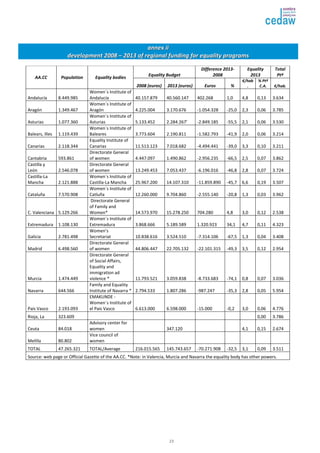
The AA.CC have cut, on average, 32% of their equality policies41. This results in the reduction and disappearance of programs 
and tools. Thus, la Rioja has no equality program or body. In Valencia the increase of 4,8% masks the integration of both family 
and women policies. Only Andalucía (1%) and País Vasco (-0,2%) have recognizable budgets for equality policies. 
In Murcia, Decree 17/2010 cuts 74% of the expenditure on gender equality (the general Budget dropped 12,2%), abolished the 
Women’s Institute (WI), disaggregated competences related to equality and GV and eliminated agreements with municipalities 
to hire equality agents (EE.AA), who have been dismissed in 2011. Moreover, the Equality Commission of the regional 
Parliament does not meet, and the participation of women in the regional government has dropped from 23% to 11%. After 
Murcia, the AA.CC with higher rates of cuts are Galicia (67%), Cantabria (66%) and Asturias (55%). 
Castilla y León reduced 44% of its Budget for equality. This region took competences away from municipalities related to 
Equality Plans (EE.PP), EE.AA, women´s associations (except for “Mother Network, anti-abortion), women in the rural area and 
training to unemployed women. In 2012 the counselling center for GV (opened two years before) was closed, as well as 18 
offices of the Women Employment Network. 
In Andalucía the “gender architecture” has maintained bodies, tools and the assessment reports on gender impact linked to its 
budget, published since 2005 with a high technical and political level (although it only disaggregates by sex 50% of data and it is 
has not a participatory approach). From 2009 to 2013 it has been set up the Andalusian Council of Women´s Participation and 
the GV Observatory, and the report on Gender Impact has also been extended. 
In Navarra, Regional Decree 75/2012 transforms the equality body into the “Family and Equality Institute”, drops the budget by 
63,85% and reinforces the traditional identification of women with family, care and welfare-orientated policies. Since 2010 
there are no EE.PP and no gender impact reports; although the Plan on Persons with Disabilities 2010-2013 envisages 4 actions 
related to GE, only a study, which has not been published or implemented, has been done. 
Madrid has no EP since 2005 and despite the GV Act 5/2005, it has only adopted a plan to implement the Act between 2005 a 
2008 and has abolished by Act 9/2010 the Regional Observatory on GV. 
In Baleares, the 42% cut of the Budget devoted to the Balear Women´s Institute has involved: reduction of the morning hours 
offered by the Information Centre for Women, preventing access to legal information for students and women workers in rural 
areas; and also the closure of 9 out of 10 offices to assist victims of crimes (90% of female users) and Infosex (youth sexual and 
emotional information). As well, the Equality Directorate of the Island Council of Mallorca and two EE.AA of Palma have been 
removed. 
In Canarias, transfers to the island councils have continued in relation to the network to support GV victims. Nevertheless, 
from 2009 to 2013 the line of the Budget for the prevention of violence, other actions for equality, and the promotion of the 
feminist association network, has been reduced by more than a half. 
In the regional governments, the participation of women has dropped between 2008 and 2013 from 39,7% to 34,2%. 
Paradoxically, in the four governments headed by women this participation decreased: Madrid (25%), Aragón (67%), Castilla-La 
Mancha (29%) and Navarra (40%). Only Cantabria, Asturias (62% women), País Vasco and Melilla increased the participation. 
In the local administration, article 28 of the new Local Act 27/2013 has removed the gender equality competences at the 
local level. The deletion of the provision by which since 1984 municipalities had councils and EE.PP is in contravention of: 
article 9.2 of the Constitution, the European Charter for Equality of women and men in the local life (CMRE 2006), and item 14 
of the Concluding Observations of the CEDAW Committee to Spain (CEDAW/C/ESP/6). They can only perform actions to 
promote women if the obtain delegation and funding from the regional level. 
77.. DDIIFFFFIICCUULLTTIIEESS IINN AACCCCEESSSSIINNGG OOFFFFIICCIIAALL CCHHAANNNNEELLSS OOFF PPAARRTTIICCIIPPAATTIIOONN AANNDD LLAACCKK OOFF AAWWAARREENNEESSSS OOFF TTHHEE IINNFFOORRMMAALL CCHHAANNNNEELLSS 
77..11 LLAACCKK OOFF EEFFFFEECCTTIIVVEE CCHHAANNNNEELLSS FFOORR PPAARRTTIICCIIPPAATTIIOONN ((SSHHOORRTTCCOOMMIINNGGSS IINN TTHHEE SSTTAATTEE AANNDD RREEGGIIOONNAALL PPAARRTTIICCIIPPAATTIIOONN CCOOUUNNCCIILLSS)).. In 2009, the 
Participation Council of Women42 was set up and still there are no effective mechanisms for the participation of women’s NGO 
because of three reasons. Firstly, because it has no autonomy, since the president and 13 members of the Government 
determine the call, the operations and the issues to be discussed, without taking into account the 20 members of the women´s 
NGOs. Secondly, it has no social or political impact, not even in the EP or in the governmental report to the CEDAW Committee 
2013. Lastly, it is a body that is not representative of the women’s associations, due to the fact that is limited, in a competitive 
and exclusive way, to 20 of the 3.000 existing associations; and it does not disseminate information. 
41 See Annex ii: developments, between 2008 and 2013, in the financing of equality programs in the AA.CC. 
42 RD 1791/2009. 
8
At the regional level, participation councils of women have been set up in Andalucía and Extremadura, but those in Madrid and 
Cantabria, formed by NGO's, have been removed. At the local level, the lack of equality competences will clearly impact the 
creation of participation channels. 
The National Council of Women of Cataluña has limited in 2013 the participation of organizations and territorial areas, and has 
established greater verticality. The Migrated Council restricts plurality and representativeness, requiring rigid channels and 
groups with legal entity. 
In Navarra, the line on transfers to women’s associations included in the 2013 budget has been deleted, despite the Regional 
Act 33/2002 and the Parliament’s resolution at the request of the NGO’s Coordinator of women’s COMFIN. It has taken a year, 
until March 2013, to comply with the Regional Decree 22/2012, which establishes the Equality Council of Navarra. 
Madrid, after eliminating in 2011 subsidies to women´s networks, removed the Women’s Council by Act 9/2010, whose Budget 
accounted for 0,001% of the regional Budget and which involved 200 women’s associations. 
Paradoxically, in Canarias, Equality Act 1/2010 has removed the Equality Commission, without setting up, at least until 
February 2014, the GE Council of Canarias that should replace the previous. In the island councils and municipalities there is a 
backlash in the participation councils, significant in the capital cities of Sta. Cruz de Tenerife y Las Palmas. 
77..22.. SSTTRROONNGG DDEELLEEGGIITTIIMMIIZZAATTIIOONN OOFF TTHHEE IINNSSTTIITTUUTTIIOONNSS AANNDD PPOOPPUULLAARR RREESSPPOONNSSEE.. The neoliberal management of the crisis increases the 
social and gender inequality, and produces a strong de-legitimization of political representation: the refusal to vote increased 
between 2008 and 2011 from 26 to 33%, and the Indicator of Political Trust conducted by the Center of Sociological 
Investigations dropped, between 2008 to 2013, from 49% to 25%. Against this situation there has been a strong social 
response, including general strikes from 2010 to 2013 and an unprecedented number of demonstrations. Since 2011, the 15M 
Movement, also called “indignants”, has brought onto the streets a new generation; new approaches to politics; and new 
forms of participatory democracy, including Feminisms 15M. The Purple Tied and an important part of the feminist movement 
participate in street protests, in partnership with other movements, against cuts and unemployment, its gender impact, and 
the dismantling of policies promoting equality between women and men. 
88.. SSHHOORRTTCCOOMMIINNGGSS IINN TTHHEE IINNTTEERRNNAATTIIOONNAALL RREEPPRREESSEENNTTAATTIIOONN,, AANNDD TTHHEE PPRROOCCEESSSSEESS OOFF NNAATTIIOONNAALLIIZZAATTIIOONN 
88..11 CCLLOOSSUURREE OOFF UUNN WWOOMMEENN SSPPAAIINN. The removal in 2013 of the office of UN Women in Spain hinders participation, both 
governmental and non-governmental, in UN processes, such as the assessment of the MDG43 and its development post-2015. 
88..22 RREESSTTRRIICCTTIIOONN CCAASSEESS OOFF TTHHEE RRIIGGHHTT TTOO AACCQQUUIIRREE,, CCHHAANNGGEE OORR RREETTAAIINN NNAATTIIOONNAALLIITTYY AANNDD TTOO TTRRAANNSSMMIITT TTHHEEIIRR NNAATTIIOONNAALLIITTYY TTOO TTHHEEIIRR 
CCHHIILLDDRREENN.. In May 2013, 24 women’s NGOs opposed the refusal of the Aliens Office of Santa Cruz de Tenerife to give residence 
and work permits in cases of family ties to foreign mothers who had the custody of their minor children of Spanish nationality, 
requiring them, subject to deportation, to have enough resources and comprehensive health insurance, which is contrary to 
judgments of the Court of Justice of the European Union, such as Grand Chamber 08.03 2011 and 23.02.10. 
aarrttiiccllee 1100:: eennssuurree wwoommeenn eeqquuaall rriigghhttss wwiitthh mmeenn iinn tthhee ffiieelldd ooff eedduuccaattiioonn 
99.. RREEDDUUCCTTIIOONN OOFF TTHHEE RRIIGGHHTT TTOO EEDDUUCCAATTIIOONN,, NNOONN--DDEEVVEELLOOPPMMEENNTT OOFF EEQQUUAALLIITTYY LLEEGGIISSLLAATTIIOONN,, AANNDD CCOONNTTRRAADDIICCTTIIOONNSS IINN TTHHEE 
9 
NNEEWW EEDDUUCCAATTIIOONN AACCTT 
There is a failure to meet commitments, such as broadening early childhood education, and to take into consideration the 
needs and particular circumstances of the most vulnerable groups of women. On the contrary, there are significant cuts in 
formal and informal education and a new Education Act, Organic Act 8/2013 of 9 December on the Improvement of Educational 
Standards (OAIS), has been passed that allows segregation of girls and boys in schools, and that is “anti-equality”. 
99..11 RREEDDUUCCTTIIOONN OOFF TTHHEE RRIIGGHHTT TTOO EEDDUUCCAATTIIOONN.. 
EEdduuccaattiioonn ffrroomm 00 ttoo 33 yyeeaarrss hhaass nnoott bbeeeenn bbrrooaaddeenneedd aass pprroommiisseedd.. Everything stated in the 2009 Shadow Report remains in 
force. There is no progress in the OAIS regarding the improvement of the implementation of this educational level. This 
situation is exacerbated in rural areas. 
The 2008 Educa3 Plan envisaged the creation in 4 years of 300.000 school places for children 0-3 years to meet de demand of 
schooling and the conciliation of families. Between 2008 and 2011, 400 million euros were invested, and until 2010, 70.000 
school places were created. In 2012, there are 3 places available for every 10 kids under 3, taking into account both public and 
private school. 
43 Millenium Development Goals.
The Popular Party promised to broaden early childhood education during this term44. Nevertheless, the Educa3 Plan is not 
renewed in 2012 and the cooperation agreements signed with the concerned AA.CC has not been implemented in most of the 
cases, extending the deadline until 2014. The momentum given to education between 0-3 years has been halted.45 
AAAA..CCCC ccuuttss jjeeooppaarrddiizzee tthhee rriigghhtt ooff wwoommeenn aanndd ggiirrllss ttoo eedduuccaattiioonn aass wweellll aass ttoo ssppeecciiaalliizzeedd ttrraaiinniinngg iinn ggeennddeerr eeqquuaalliittyy.. 
The overall project of the Department of Education, Culture and Universities of Baleares has decreased by 17,3% compared to 
2010. Similarly, the budget allocated for school meals, transport and support for families has dropped by 74,4% between 2009 
and 2013. 
In 2013, the government of Madrid cut, by more than 50 million euros, the Budget of universities, and also rose taxes by 20% to 
the 189.000 university students, which added to the rise in 2012 entails an increase in the average cost of tuition in the last two 
years by 65,6%. 
In Navarra, the reduction of 99,95% of the agreements with universities can put at serious risk of disappearing the Expert 
Course on Gender of the Public University, which is the only specific and specialized training in the region on that matter. 
TThhee ffeemmiinniizzaattiioonn ooff ppoovveerrttyy hhiinnddeerrss eeqquuaall aacccceessss ttoo ttrraaiinniinngg.. The reduction in economic aids to study hampers the access 
of the most disadvantaged to quality education, compounding the difficulties of women’s access to higher education, given the 
current feminization of poverty. 
Roma women and girls suffer more discrimination in access to compulsory education: distribution of centers depending on the 
neighborhoods, poor quality, lack of appropriate curricula adaption, lack of teachers trained in diversity, promotion by age and 
not for reaching minimal learning standards, and lack of materials compared with the rest of the students. 
In the case of a high percentage of Roma women, the minimum requirements to access scholarships are out of reach and the 
access to non-regulated training throughout their lives as an alternative tool of empowerment and emancipation is not 
standardized. Nor are there prospects for reducing the rate of female school dropouts due to the economic cutbacks46. 
Furthermore, there is a very reduced presence of young Roma girls in the compulsory secondary school. 
99..22.. LLIIMMIITTAATTIIOONNSS AANNDD RREESSTTRRIICCTTIIOONNSS TTOO EEDDUUCCAATTIIOONN.. 
NNoo sstteeppss hhaavvee bbeeeenn ttaakkeenn ttoo eelliimmiinnaattee ggeennddeerr bbiiaass iinn aaccaaddeemmiicc cchhooiicceess.. Everything noted in the 2009 shadow report in 
relation to vocational training is in force47. As regards the percentage of women in college, the gender bias remains. Women 
make up about 60% of individuals studying Arts and Humanities and 70% in Health Science, but those in Engineering and 
Architecture do not reach 30%. 48. 
TThhee OOAAIIEESS pprroommootteess sseexx sseeggrreeggaattiioonn iinn sscchhoooollss iiggnnoorriinngg UUNN ccoonnvveennttiioonnss,, aanndd uusseess aa sseexxiisstt llaanngguuaaggee.. Observation 18 of 
the 2009 Report, which recommends the implementation of specific programs within the educational system and teacher 
training on equality, has been breached. 
With regard to teacher training, there is a big difference between AA.CC. In many cases no initial or ongoing programs have 
been implemented. In Andalucía, one of the teachers has to be in charge of co-education, but is not required to have gender 
training. This subject is treated as a secondary issue compared with languages or new technologies. In Cataluña, the 
development, approval and submission to the Parliament of the Plan for Gender Equality in education is pending.49 
In the 2009 shadow report it was already reported the existence of subsidized centers segregated by sex. The OAIES warrants 
that it is not discriminatory to segregate by sex.50 Evidence show that schools segregating by sex have public funding51. 
As regards other agents of socialization (arts. 5 y 10), it has not yet been sufficiently fulfilled the use of non-sexist language in 
the administrative field and its promotion in the social, cultural and artistic area, according to the EA52. The wording of the 
OAIES is sexist. 
44 “We will encourage the broadening of education from 0 to 3 years to meet the need for reconciling family and work”, stated the electoral program of the PP. 
45 See note 10. 
46 The Government anticipates that between 2010 and 2015 the weight of public investment in education will drop from 4,9% to 3,9% of GDP. “Stability 
Program 2012-2015 and national reform program 2012” http://ep00.epimg.net/descargables/2012/04/30/68b95f4d30124fb7d482f00d8b8b77f0.pdf . 
47 There is a 95,4% of women doing vocational training in areas related to personal image, and a 90,9 % in sociocultural and community services. 
48 According to the latest university statistics published by the NSI, women accounted for 69,74% of persons enrolled in the first hear of Medicine in public 
universities during 2007/08. At the opposite end are careers such as Computer System Engineering, with only 11% of women, Industrial Engineering (14,98%) or 
Civil Navy (14,32%). 
49 See note 11. 
50 Following the UNESCO declaration of 1960, and ignoring subsequent conventions adopted by the UN and Judgments of the Supreme Court of 2012: 
Administrative Chamber, 23 and 24th July, on the removal of subsidies to schools that segregated by sex in Cantabria and Andalucía. 
51 Nelva and Monteagudo in Murcia (even without legal coverage until the approval of the OAIES), or Miravalles-Redin and Irabia schools in Navarra. 
52 Article 14.11 of the EA. 
10
AAffffeeccttiivvee--sseexxuuaall eedduuccaattiioonn iinn sscchhoooollss iiss qquueessttiioonneedd. The planned repeal of Act 2/201053 entails the elimination of affective-sexual 
education of the educative system, breaching and ignoring GR 24 and 21. 
Observation 26 of the 2009 report, urged the Government to adopt measures to raise awareness about affordable 
contraceptive methods, to facilitate access to them, and to promote comprehensive sexual education. Nevertheless, there is no 
implementation of OASRRVTP54 and instead there is a draft act that planes to repeal it. In practice, those in charge of non-regulated 
education in the affective-sexual field (in line with the CEDAW provisions: contraceptive methods, VTP, etc…) are not 
being funded, while organizations opposed to those articles and recommendations are.55 
aarrttiiccllee 1111:: eelliimmiinnaattiioonn ooff tthhee ddiissccrriimmiinnaattiioonn iinn tthhee ffiieelldd ooff eemmppllooyymmeenntt aanndd eeccoonnoommiicc rriigghhttss // GGRR 2266 
1100.. LLAABBOOUURR RREEFFOORRMMSS AANNDD AANNTTII--CCRRIISSIISS MMEEAASSUURREESS AARREE GGEENNDDEERR BBLLIINNDD AANNDD AARREE CCOONNTTRRAARRYY TTOO TTHHEE PPRRIINNCCIIPPLLEE OOFF EEQQUUAALLIITTYY 
Employment and equality policies in Spain are based on the apparent better performance of female employment against the 
crisis. This analysis hides that there has been a “downward equality”, arising from an unprecedented deterioration of the 
labour market. The imposed labour reforms (LR)56 are directly affecting inequality (worsening the life and working conditions of 
8 millions of women with employment and 2,4 millions of unemployed women), by facilitating and making cheaper dismissals, 
and by empowering employers, making control procedures more flexible and deregulating the legal system. 
A year after the LR of March 2012, there are 308.000 less employed women and 282.300 more unemployed. The female 
employment rate does not reach 39% (10 points less than men); they represent 46,7% of the unemployed and 44,5% of people 
that receive unemployment benefits. 
1100..11 WWOOMMEENN BBEEAARR TTHHEE MMAAJJOORR BBRRUUNNTT OOFF JJOOBB PPRREECCAARRIIOOUUSSNNEESSSS 
HHiigghheerr uunneemmppllooyymmeenntt aanndd tteemmppoorraalliittyy. According to a Labour Force Survey, between 2008 and 2013, 939.300 female 
employments and 2.683.600 male employments have been lost, reducing the difference between female and male 
unemployment rates (27,02% and 25,79% respectively). Female unemployment doubles in that period, from 13,04% to 
27,02%, due to the loss of employment in the service sector, including public sector: education, health, assistance and care 
services, where 87% of women are employed. 
The percentage of women employed in 2013 (38,89%) is still lower than the one of men employed in more than 10 points. 
Women work under worse conditions than men: women represent 72,5% of those working part-time and a 43% of those with 
permanent contracts, according to LFS (II T 2013). Horizontal and vertical segregation is maintained or deepened. In 2008 there 
were 19,5% executive women; in January 2013, 10,3%. The growth of women self-employment by 1,2% in 2013 is extremely 
doubtful; they can be false self-employed57. (See Annex iii.a). 
TThhee wwaaggee ggaapp iiss ccoonnssoolliiddaatteedd aanndd ssttrreennggtthheenneedd58. During the crisis the gap has increased by 1%. In 2010 the wage gap 
stood at 22,55%, percentage that rise to 27,56% if bonus are taken into consideration. In Spain, to reach the salary of a man 
with no education (18.110,06 €), a women must have a vocational training degree (17.013,92 €) or a university degree 
(19.001,54 €). In percentages, the wage gap is more than twice in the private sector (28,25%) tan in the public sector (12,34%). 
As regards AA.CC, the gap ranges 12 points between each other. The gap in Navarra is the highest (26,15%),followed by Aragon 
and Asturias, about 25%. Extremadura, Baleares and Canarias have the lowest gap (14,00%, 14,66% and 16,13% respectively). 
GGeennddeerr iinneeqquuaalliittiieess iinn bbootthh tthhee ffaammiillyy aanndd llaabboouurr ffiieelldd hhaavvee nnoott bbeeeenn mmooddiiffiieedd. The feminization of care tasks is higher in 
Spain than in the EU average. In 201059 Spain was the 4th country with higher proportion of women outside the labor market 
for family care reasons (after Luxemburg, Malta y Cyprus). Women spend 4,29 hours each day doing household and family 
chores, while men spend 2,32 hours, a gap that has been reduced in more than half an hour in the last 7 years60. For every 26 
women who combine part-time jobs with taking care of family members, only one man does. 
SSoommee ggrroouuppss ooff wwoommeenn aarree eessppeecciiaallllyy vvuullnneerraabbllee61 
53 OASRRVTP, currently in force. 
54 Chap. III, art. 9: The education system will cover health and sexual and reproductive health education as part of the comprehensive development of human 
personality and the training in values, including a holistic approach… 
55 In Canarias, the affective and sexual education Plan in force in schools between 1985 and 2008 and the care Plan for youth sexuality launched in 2000, were 
both removed in 2008. In relation to Madrid, see: http://www.reyesmontiel.net/la-red-de-madres/ 
56 See Note 12. 
57 According to the Union of Professionals and Self-Employed, registrations are done because of outsourcing of businesses (for example in education); the self-employed 
who work for only one company have increased to 265.000 and is the group that grows at a faster rate, 11%. El País, (Business section) Sunday, 
9.04.2014. 
58 Report on wage inequalities. February 2013. UGT. 
59 Report on the monitoring of the Beijing Platform for Action +15. 
60 Survey on employment and time. NSI 2009-2010. Published in 2011 http://www.ine.es/prensa/np669.pdf). 
61 See Annex iii.b for more data on these groups. 
11
• YYoouunngg wwoommeenn aarree mmoorree pprreeccaarriioouuss aanndd ddeeppeennddeenntt. The unemployment rate for women under 25 increases since 2008, 
reaching 54,96% in the first quarter of 2013. It also persists an unequal distribution of household chores62: 40% of women do 
them, compared to 19% of men. Since 2008, the percentage of dependents and the risk of exclusion and poverty increases. 
• IImmmmiiggrraannttss aanndd ddoommeessttiicc wwoorrkkeerrss//hhoouusseemmaaiiddss:: llaabboouurr ““oouuttssiiddeerrss””.. 95% of the 750.000 persons employed are women, and 
60% are immigrants (nearly 3 out of 4, 72%, work taking care of people and they are the majority amongst domestic workers 
and people who work in dependent services). The unemployment rate of immigrants was 36,6% in June 2013 (10 points 
more than Spanish women). 
Foreign domestic workers have been excluded from the portfolio of services for “basic activities of daily life” of the DA, and 
in relation to the SWR, they are maintained under a special scheme with the new regulation. Moreover, the Government has 
rejected the parliamentary proposal of Convention number 189 on decent work for domestic workers. 
• WWoommeenn wwiitthh ffuunnccttiioonnaall ddiivveerrssiittyy:: iinnssuuffffiicciieenntt iinnffoorrmmaattiioonn aanndd ggrreeaatteerr iinneeqquuaalliittyy.. They double the percentage of part-time 
employment (27,7% vs al 13,7) compared to the average of women; and compared to their male colleagues, they have fewer 
benefits. 
• RRoommaa wwoommeenn:: iiggnnoorraannccee aanndd mmiissiinnffoorrmmaattiioonn. The specific features of this group (traditions and labour activities that are in 
many cases in the periphery of the formal economy, among others) hinder their knowledge with traditional investigation 
tools and there is virtually no specific study. 
• LLoonnee mmootthheerrss:: hhiigghheerr uunneemmppllooyymmeenntt,, lloowweerr ddeevveellooppmmeenntt aanndd pprroommoottiioonn ooppppoorrttuunniittiieess.. Most of them are women with 
elementary education (35,5%); the unemployment rate is 40%. Of the 60% of lone mothers who work, 14% refer to 
“individual days” job. More than a half (55%) are long-term unemployed, followed by 28% of women who have been 
unemployed for 1 to 6 months; 10,3% of them have been unemployed less than a month. 
1100..22.. LLAABBOOUURR RREEFFOORRMMSS AANNDD MMEEAASSUURREESS TTHHAATT DDEEEEPPEENN IINNEEQQUUAALLIITTYY IINN RREELLAATTIIOONN TTOO WWOOMMEENN´SS EECCOONNOOMMIICC RRIIGGHHTTSS 
SSiinnccee tthhee bbeeggiinnnniinngg ooff tthhee ccrriissiiss tthhee mmeeaassuurreess ttaakkeenn hhaavvee hhaadd aa nneeggaattiivvee iimmppaacctt oonn wwoommeenn’’ss eemmppllooyymmeenntt.. The first 
“anti-crisis measures” (August 08-February 09), were aimed at male-dominated sectors, even though the female 
unemployment is higher: about 2/3 of the State Fund for Local Investment, which is devoted to generate employment, focused 
on the construction sector in which only 7% of women are involved.63 . 
The freezing of the minimum wage64 in 2012 (the first time in 45 years) and the postponement of the improvement of the 
widow’s/widower’s pension (44,5% of widows vs 12,2% of widowers) affects more negatively. It should also be stated the 
negative gender impact of outsourcing a large proportion of public services at different levels of administration. 
FFlleexxiibbiilliittyy aanndd pprreeccaarriioouussnneessss:: cchhaannggiinngg wwoorrkkiinngg ddaayyss aanndd ppaarrtt--ttiimmee ccoonnttrraaccttss tthhaatt wwoorrsseenn ssoocciiaall aanndd wwoorrkkiinngg 
ccoonnddiittiioonnss.. RD 3/2012 allows employers to modify more easily the working day and to require overtime even in part-time 
jobs, hindering the work-life balance, which has a greater impact on women worker’s since they usually assume the family 
responsibilities. The elasticity and flexibility of schedules reduce its compatibility with other activities, without offsetting low 
wages and contribution gaps. 
Hiring part-time limits the retirement right. The European Court of Justice (ECJ)65 ruled that the Spanish legislation 
discriminates part-time-workers in their retirement pensions. Consequently, the Constitutional Court66 declared 
"unconstitutional and void " the system to calculate67 the contribution periods in part-time contracts when the collection of a 
contributory pension is claimed, since it requires most of the part-time workers (80% women) to have non-contributory 
pensions, with a smaller amount. 
EElliimmiinnaattiioonn ooff aaffffiirrmmaattiivvee aaccttiioonnss ffoorr wwoommeenn ttoo eenntteerr aanndd rreemmaaiinn iinn tthhee llaabboouurr mmaarrkkeett. The Government removed in 
2012 the subsidies for social security contributions68 to self-employed women who return to their work after the maternity 
62 Survey 2012, INJUVE. 
63 Gálvez Muño, L. and Torres López J (2010). Women and men in the great recession. Unequal: women and men in the financial crisis. Icaria Ed. 
64 
According to 2010 Wage Structure Survey, 15,5% of women have a minimum salary compared to 5,9% of men. 
65 ECJ, Judgment of 22.11.2012, regarding the Council D79/7/CEE of 19.12.1978 on the implementation of the principle of equal treatment. The European 
justice considers that "it applies a difference in treatment by requiring a contributory period proportionally higher for part-time workers, who are mostly 
women”. 
66 CC, Judgment 117/2013, of 20th May. 
67 In Additional Provision 7 of the Social Security Act (version 2003-2006) the contributory days were calculated dividing the number of working hours by 1.825. 
The 2007 reform divided it by 1,5, but it is still discriminatory and contrary to D89/7/CEE. For unemployment the real daily basis is already being applied. 
68 Self-employed women who returned to work in a period not exceeding two years could have a subsidy of 100% of the social security contributions for a 
period of 12 months. 
12
leave. They also eliminate in the last LR subsidies for women who return to work after childbirth or child care leave69. These 
measures are framed within a context where the power of employers to change schedules and shifts has greatly expanded, 
and where the protection against invalid actions (prohibition) in cases of pregnant women or workers with reduction of the 
working hours for legal guardianship is not applied in cases of dismissals for objective reasons, which are the most common in 
crisis situations. 
DDeeccrreeaassee iinn ccoovveerraaggee ooff ssoocciiaall bbeenneeffiittss:: uunneemmppllooyymmeenntt iiss rreedduucceedd aanndd tthhee rreettiirreemmeenntt aaggee iiss eexxtteennddeedd. Unemployment 
coverage is cut from the sixth month (from 60% to 50%), the subsidy for people under 52 is limited and the one for people over 
45 is removed. This has an impact on care, mainly undertaken by women. 
The retirement age increases gradually from 65 to 67 years. As well, pensions have been frozen and the period to calculate 
contributions has been extended, which obviously particularly affects women70, who due to their broader involvement in 
informal economy, their most frequent interruption of work life, the consequent gaps in contribution and their lower wages, 
will have more difficulties to have access to contributory pensions with decent incomes. 
CCoolllleeccttiivvee bbaarrggaaiinniinngg aanndd ssppeecciiffiicc mmeecchhaanniissmmss ttoo pprroommoottee eeqquuaall ooppppoorrttuunniittiieess,, eennvviissaaggeedd iinn tthhee EEAA,, aarree wweeaakkeenneedd. 
The LR is weakening collective bargaining, so that enterprise agreements impose on sectorial collective agreements. EE.PP71 
may well be unilaterally modified by the enterprise on the grounds of organization. It is expected that the measures envisaged 
in the plan will be made ineffective. 
In this context, the requirement of EE.PP for small and medium enterprises (SMEs) is not extended72, nor have they launched 
tools to know the number, results and impact of the plans. Castilla-León73 states difficulties to implement plans in the region; 
Andalucía74, reports that the registration of plans is not compulsory. At the same time, subsidies to enterprises for boosting 
EE.PP are not increased, as provided by IM in the last years, or are even reduced. This is the case of Navarra, whose Budget 
drops from 140.000 € in 2009 to 133.763 € in 2012 and it is suspended in 2013. 
1100..33.. AANNTTII--CCRRIISSIISS MMEEAASSUURREESS IINNCCRREEAASSEE SSEEXXUUAALL DDIIVVIISSIIOONN OOFF LLAABBOOUURR,, PPRREEVVEENNTT MMEENN´SS CCOO--RREESSPPOONNSSIIBBIILLIITTYY AANNDD KKEEEEPP PPUUBBLLIICC IINNSSTTIITTUUTTIIOONNSS 
AAWWAAYY FFRROOMM TTHHEEIIRR CCOOMMMMIITTMMEENNTTSS 
DDeeppeennddeenntt pprrootteeccttiioonn iiss nnoott uunniivveerrssaall aanndd tthhee nnuummbbeerr ooff bbeenneeffiicciiaarriieess hhaass bbeeeenn rreedduucceedd:: the DA incorporates in the 
public agenda the need to assist, in the performance of essential everyday activities, 2.3 million people who had been cared by 
families in 81% of the cases (women in 85% of the cases: mothers, partners, daughters and sisters), by domestic workers in 
13% (95% women, 60% immigrants); and by social services in only a 6% of the cases. 
In July 2012, the DA is amended, derogating it de facto. The protection coverage is not universalized and the number of 
beneficiaries has been reduced due to the deep cuts; in 2013 there are reductions in funding, one third of recipients who have 
a moderate degree of dependency are excluded from the benefits of the Act, and the right to social security to family 
caregivers is removed. The assessment of dependency by the Administration is a bottleneck for the access to this right, 
generating huge differences between AA.CC both in processing applications and in budget availability. (See Annex iii.c) 
TThhee iimmpplleemmeennttaattiioonn ooff tthhee ffoouurr--mmoonntthh ppaarreennttaall lleeaavvee ((PPLL)) hhaass bbeeeenn ddeellaayyeedd ffoorr tthhrreeee ccoonnsseeccuuttiivvee yyeeaarrss,, aanndd tthhee 
ccoonncciilliiaattiioonn rriigghhtt iinncclluuddeedd iinn tthhee SSWWRR hhaass bbeeeenn aammeennddeedd.. The EA envisages the non-transferable thirteen-days PL (100% of 
salary), plus the two existing days. During 2012 it has been enjoyed by 82% of the eligible fathers, despite unemployment. The 
EL also pretends to reach the target of the 4 weeks PL after 6 years in force75. Currently, this leave is suspended and has not 
been implemented76. 
The Congress unanimously adopted in October 2012 a non-legislative motion to urge the Government to equate77 the PL with 
the ML (16 weeks), so that leaves are equal, non-transferable and 100% paid to involve men in care tasks. 
69 RD 30/2005 and Act 43/2006 on measures to improve and increase employment included annual aids of 850 €/year during 4 years for unemployed women 
and victims of GV; and 1.200 €/year during for 4 years to hire women after the maternity leave, or after 5 years of inactivity due to a child care leave. They 
have been removed, without compensation in other areas. 
70 According to 2013 data, women have access to pensions of 61% compared to men. In 2010, 31.6% of retired women had contributed to the social security 
for a period of 35 years or more, compared to 81% of men: from 54 years to retirement, 2/3 of men and 80% of women leave the job and face processes of 
unemployment/inactivity. More women than men face inactivity and many of them will not be entitled to have a contributory pension. 
71 Envisaged in arts. 45 to 49 of the EA. 
72 The EA of Canarias requires EP for enterprises with less than 250 workers. 
73 With an economic fabric composed of small, medium and family enterprises, in 2013 three EE.PP have been signed. 
74 In Andalucía, 522 enterprises are required to implement the EP. 76 of them have registered it in the Labour Relation Council of Andalucía, a 14.5% (constant 
figure since 2011). The registration of EE.PP is not compulsory, unlike collective agreements. That is way there may be other EE.PP signed but not registered. 
75 
Act 9/2009 of June 2012 to extend the duration of PL in cases of birth, adoption and fostering meets that goal. 
76 It was suspended until 2012 and then one more year. The House of Representatives unanimously passed in March a document urging the Government not 
to delay the extension of the PL beyond 1.1.2013, but it was also suspended during 2013. 
77 Nevertheless, the Plan on Equal Opportunities 2014-16 does not even refer to the PL. 
13
RD 3/2012 has extended the age of the children to request the reduction of the working hours for legal guardianship (from 8 to 
12 years), while the right to choose shifts and schedules has been cut. Since 2007 courts had developed a broad case-law78 that 
allowed parents to choose shift, schedule and days of work to balance family and working life. This has been severed with the 
new wording of art. 37 WSR, which requires that the schedule must be within the respective daily and rotative shift. As well, it 
amends the breastfeeding leave which can only be used by one of the parents, even though it could be shared before. All of 
that deprives of any content the right to conciliation. 
TThhee ccoonncceennttrraattiioonn ooff sscchhoooollss sscchheedduulleess,, tthhee rreemmoovvaall ooff sscchhooooll ccaanntteeeennss aanndd tthhee rreedduuccttiioonn ooff sscchhoollaarrsshhiippss,, iinnccrreeaassee 
ddoommeessttiicc wwoorrkk aanndd hhiinnddeerr ccoonncciilliiaattiioonn.. The closure of canteens and/or the reduction of scholarships entails that children 
have to eat lunch at home or to take lunch to school. The increase of domestic work and the impact on labour availability are 
obvious. There are exceptions like Andalucía and Canarias, where the crisis has affected more strongly so, in order to ensure 
proper nutrition for kids, the institutions have promoted the opening of canteens, extending the service to school breakfast. 
14 
aarrttiiccllee 1122:: hheeaalltthh,, sseexxuuaall aanndd rreepprroodduuccttiivvee rriigghhttss 
1111.. SSEERRIIOOUUSS VVIIOOLLAATTIIOONNSS OOFF TTHHEE RRIIGGHHTT TTOO HHEEAALLTTHH AANNDD OOPPEENN TTHHRREEAATTSS TTOO TTHHEE EEXXEERRCCIISSEE OOFF SSEEXXUUAALL AANNDD RREEPPRROODDUUCCTTIIVVEE RRIIGGHHTTSS 
((SSRRHHRR)) 
1111..11.. IINNEEQQUUAALLIITTIIEESS IINN TTHHEE AACCCCEESSSS TTOO HHEEAALLTTHH SSEERRVVIICCEESS AASS AA RREESSUULLTT OOFF RREEFFOORRMMSS IINN TTHHEE NNAATTIIOONNAALL HHEEAALLTTHH SSYYSSTTEEMM ((NNHHSS)).. Measures 
taken during 2012, using the legislative formula of Decree-Law79, have changed the main characteristics of health care 
provided by the National Health System (NHS), affecting all citizens and especially women. Thus, access to the NHS changes 
from universality to assurance80 and the conditions of insured and beneficiary are regulated.81 These changes have a clear 
impact on inequality in the access to the right to health82. Moreover, there is a lack of implementation of a gender perspective 
in the system’s management, since the regional health plans do not include specific measures to reduce gender inequality. 
MMiiggrraanntt wwoommeenn aanndd vviiccttiimmss ooff GGVV aanndd ttrraaffffiicckkiinngg aarree ppaarrttiiccuullaarrllyy aaffffeecctteedd.. In the case of migrant women, the measures 
adopted have resulted in the withdrawal of 873.000 health cards in total (The Ministry of Health does not disaggregate this 
figure by sex). This is a direct consequence of the crisis, since they no longer have documentation due to unexpected 
irregularities. The Decree only ensures “urgent care” and there is an arbitrary implementation of this standard in the regions. 
Also, there are many cases of GV and trafficking which are identified through primary care, eliminating the main source of 
detection when women face irregular administrative situations. Shortcomings have also been found in the implementation of 
the protocol on Female Genital Mutilation. 
EEllddeerrllyy wwoommeenn,, eessppeecciiaallllyy iinn rruurraall aarreeaass,, ppaarrttiiccuullaarrllyy ssuuffffeerr tthhee eeffffeeccttss ooff tthhee mmeeaassuurreess ttaakkeenn.. Copayment is required for 
certain health benefits, such as medicines, which mainly affects elderly women who have a high incidence of chronic diseases 
requiring treatment. This situation is aggravated in rural areas where the presence of ageing women is higher, added to which 
is the lack of income of their own due to the fact that they have shared work on the family farming business without 
contributing to the social security system in the last years, essential for retirement pensions. The gender labour gap is 32,1% in 
the 50-65 years section. 
Older women are also affected by the lack of funding of medicines for the so-called minor symptoms, such as anti-inflammatory 
medication given the higher prevalence of chronic disorders in these ages. Some benefits, which particularly 
affect rural women, are defined as additional or ancillary, such as ambulance transportation. 
DDrruugg--ddeeppeennddeenntt wwoommeenn ssuuffffeerr eexxttrreemmee ssoocciiaall eexxcclluussiioonn dduuee ttoo ddiiffffiiccuullttiieess iinn aacccceessssiinngg ssppeecciiaalliizzeedd sseerrvviicceess. A high 
percentage of them suffer violence from their partners and yet they cannot access shelter services, the regulation of which is 
regional. Also, the establishment of admission conditions is discretionary. In most of the cases, women with severe mental 
illnesses, HIV or drug addictions are excluded83. 
DDrraassttiicc rreedduuccttiioonn ooff HHIIVV pprreevveennttiioonn pprrooggrraammss ffoorr wwoommeenn.. In 2012 HIV prevention reached 14.863.000€, while the Budget 
of the National Aids Plan was 1.514.547 €, 90% less. The epidemic has a strong sexually transmitted nature. In women, 
78 Especially in the CC Judgment of 14.03.2011, in the appeal 9145/09. In the same way, the SC Judgment of 11/12/2001 (RJ 2002, 2025) and previously in 
Judgment of 29/09/98 and 18/04/05. 
79 These measures have been implemented without comprehensive gender impact reports, taking into account only the economic level and with no political, or 
trade union consensus, not even with the health personnel. 
80 Royal Decree Act 16/2012, of 20 April, “Urgent Measures to ensure the sustainability of the National Health System and to improve the quality and safety of 
its benefits”. 
81 Royal Decree-Act 1192/2012, of 3 August. 
82 There are also data that would allow to state that one of the consequences of the economic and social crisis is the shorten life expectancy of women, which 
was 85.16 years in 2011, and 85.13 in 2012. Spain has gone from the fourth position in life expectancy in 2011 to the 6th place in 2012 out of a total of 180 
countries. Source: www.datosmacro.com.14. February 2014. 
83 Union of Associations and Institutions to assist drug addicts: “Research on Intervention in Drug Addiction and GV in Care Networks”. Available in: 
http://www.unad.org/upload/26/LIBRO_UNAD_MALOS_TRATOS_CORREGIDO_pdf)
heterosexual, transmissions accounts for 83% of the new diagnoses (2011) and 50% of these diagnoses affected migrant 
women.84. Programs for women have become subsidiaries. 
RReedduuccttiioonn ooff mmeennttaall hheeaalltthh sseerrvviicceess aanndd oovveerr--mmeeddiiccaalliizzaattiioonn ooff mmeennttaall hheeaalltthh aanndd wwoommeenn``ss ddiissccoommffoorrtt, with excessive 
consumption of tranquilizers, relaxants and sleeping pills: 21% of women compared to 11,6% of men.85 
1111..22 UUNNDDEERR--DDEEVVEELLOOPPMMEENNTT OOFF TTHHEE CCUURRRREENNTT LLEEGGAALL FFRRAAMMEEWWOORRKK OONN SSRRHHRR // TTHHRREEAATTSS TTOO TTHHEEIIRR FFUUTTUURREE DDEEVVEELLOOPPMMEENNTT. Even though the 
current OASRRVTP86, passed in 2010, represents a significant step forward, it still does not ensure all SRHR. 
TThhee NNHHSS hhaass nnoott cclleeaarrllyy aanndd ssuuffffiicciieennttllyy iinnccoorrppoorraatteedd eedduuccaattiioonn oonn sseexxuuaall aanndd rreepprroodduuccttiivvee hheeaalltthh ((SSRRHH)):: The 
implementation of the National Strategy on SRH is close to nil with regard to health and sexual education, given the fact that it 
focuses exclusively on normal deliveries. According to a barometer carried out by the EU on the access of women to free 
choice of modern contraceptives, Spain failed in relation to sexual education, public awareness and empowerment of 
women87. 
OOnnllyy ssoommee hhoorrmmoonnaall ccoonnttrraacceeppttiivveess aarree ppuubblliiccllyy ffuunnddeedd:: Since 2013, 8 of the latest generation contraceptives have been 
withdrawn, affecting 1 million women. The morning after pill is not funded in 6 AA.CC.88 
AAcccceessss ttoo aassssiisstteedd hhuummaann rreepprroodduuccttiioonn tteecchhnniiqquueess ddiissccrriimmiinnaatteess ffeemmaallee ccoouupplleess aanndd ffaavvoorrss yyoouunngg wwoommeenn,, eevveenn 
tthhoouugghh tthhee aavveerraaggee aaggee ttoo hhaavvee tthhee ffiirrsstt cchhiilldd iiss 3311 yyeeaarrss:: It favors heterosexual couples and people under 35 years; if they 
are not married, the genetic biological mother is left without maternity recognition in the couple context. 
MMeeddiiccaalliizzaattiioonn ooff cchhiillddbbiirrtthh rreemmaaiinnss.. IInn SSppaaiinn,, oonnee iinn ffoouurr bbiirrtthhss aarree ppeerrffoorrmmeedd bbyy cceessaarreeaann sseeccttiioonn:: the rate represents 
36,8% of cesarean sections in private hospitals and 21,8% in public hospitals. Only in el País Vasco the rate is 14,24% in the 
public health system. Regional inequality is one of the most significant facts. 
TTaaiilloorreedd mmeeddiiccaall pprroocceedduurreess ffoorr wwoommeenn wwiitthh ddiissaabbiilliittiieess aarree nnoott pprroovviiddeedd,, such as stretchers, gynecological examination 
rooms and mammograms. 
TThhee AAcctt hhaass mmaannyy wweeaakknneesssseess aanndd lliimmiittaattiioonnss wwiitthh rreeggaarrdd ttoo VVoolluunnttaarryy TTeerrmmiinnaattiioonn ooff PPrreeggnnaannccyy ((VVTTPP)):: 
•• VVTTPP iiss ssttiillll iinncclluuddeedd iinn tthhee CCrriimmiinnaall CCooddee:: Although penalties are reduced, infringements of the Act are still considered crime 
offences, remaining fines for women and health personnel, and new criminal offences are created linked to mere 
administrative irregularities.. 
• TThheerree iiss aann iinnccrreeaassee ooff tthhee mmeeddiiccaall rreeppoorrttss rreeqquuiirreedd dduurriinngg tthhee ffiirrsstt 2222 wweeeekkss,, and the free choice of women in the first 14 
weeks is limited. 
• TThhee iinnddiivviidduuaall aauuttoonnoommyy ooff yyoouunngg wwoommeenn aaggeedd 1166--1177 ttoo hhaavvee aann aabboorrttiioonn iiss nnoott rreeccooggnniizzeedd,, unless they claim serious 
conflicts with their fathers, mothers or legal guardians. 
• IInneeqquuiittaabbllee ddiissttrriibbuuttiioonn ooff ffaacciilliittiieess iinn eevveerryy AAAA..CCCC aanndd//oorr pprroovviinncceess ffoorr VVTTPP bbeettwweeeenn 1144 aanndd 2222 wweeeekkss:: In Aragón, 
Extremadura, Castilla la Mancha, Castilla y León VTP is only performed in private facilities. In some provinces where there are 
no VTP facilities, women have to go to other provinces or AA.CC; there are also managerial conflicts. Moreover, in some 
cases there are only facilities to perform the VTP until the 14th week. In Andalucía no VTP are performed in public centers. 
Every woman who goes to a public facility is referred to subsidized private centers. Only 2,62% of the VTP were performed in 
the public health system in 2011 and 6,49 % in 2012. Performance of VTP in the public network is left to conscientious 
objection of health care personnel89. 
• TThhee ffiinnaanncciinngg ooff tthhiiss sseerrvviiccee ssttiillll rreessttss wwiitthh wwoommeenn tthheemmsseellvveess:: Some AA.CC have agreements with private health care 
institutions to refer women. However, according to a 2010 research by Centro Clínico, 54% of women had paid for the VTP. 
• CCoommppuullssoorryy iinnffoorrmmaattiioonn ggiivveenn ttoo wwoommeenn iiss bbiiaasseedd:: In some AA. CC (Madrid, Castilla León), it is orientated to force maternity 
and adoption, including “anti-choice information”, as in the case of Mother Network. 
TThhee ddrraafftt AAcctt oonn VVTTPP,, iinnttrroodduucceedd iinn DDeecceemmbbeerr 22001133,, ppllaacceess SSppaaiinn aatt tthhee bboottttoomm ooff EEuurrooppee,, ccaauussiinngg aa sseerriioouuss tthhrreeaatt ttoo SSRRHHRR 
ooff wwoommeenn:: This draft, called “OA for the protection of unborn children and the rights of pregnant women” eliminates the right 
to abortion as it is drawn up in the current time limit Act, keeping voluntary abortions in the Criminal Code and increasing 
penalties for professionals. The main issues linked to the draft act (widely contested) are the following: 
84 Epidemiological monitoring of HIV in Spain. June 2012. Health Institute Carlos III-Ministry of Economy and Competitiveness. 
85 Source: National Health Survey 2011. 
86 OA 2/2010. 
87 “Eldiario.es” 26-09-2013. 
88 Source: The Spanish Federation of Family Planning. 
89 As an example, on 23 January 2014 the public hospital La Paz, one of the biggest in Madrid, denied a therapeutic abortion to a pregnant woman who was at 
imminent risk of sepsis. Source: Federation of women’s associations of Madrid. EL País: February 4, 2014. 
15
•• IInnttrroodduuccttiioonn ooff sseevveerraall ccllaauusseess//vveerryy rreessttrriiccttiivvee aassssuummppttiioonnss wwiitthh aa ssttrroonngg ssuubbjjeeccttiivvee aapppprrooaacchh ttoo aauutthhoorriizzee tthhee 
ppeerrffoorrmmaannccee ooff aabboorrttiioonn:: The assumptions are: significant and lasting impairment to the physical and mental health of the 
mother; risk for her life; and rape. In the first case, the time limit is 22 weeks; it is also needed two reports by doctors 
specialized in the field of the illness, who have to be different to the doctor that performs the abortion and from different 
facilities; after the report women have to be verbally informed by a collaborator of the public system on alternatives to VTP 
and is later imposed to her 7 days of reflection before she gives her consent. In the case of rape, women must file a 
complaint in the first 12 weeks of pregnancy. 
•• PPrroohhiibbiittiioonn ooff aabboorrttiioonn iinn ccaasseess ooff ffeettaall aabbnnoorrmmaalliittyy uunnlleessss iitt iiss ““iinnccoommppaattiibbllee wwiitthh lliiffee””. It sets several requirements that 
significantly hamper the process. 
16 
•• MMaannddaattoorryy iinnvvoollvveemmeenntt ooff lleeggaall gguuaarrddiiaannss in the case of minors. 
aarrttiiccllee 1133:: ddiissccrriimmiinnaattiioonn iinn ootthheerr aarreeaass ooff eeccoonnoommiicc aanndd ssoocciiaall lliiffee 
1122.. NNOO MMEEAASSUURREESS AARREE YYEETT IINN PPLLAACCEE TTOO CCOOMMBBAATT DDIISSCCRRIIMMIINNAATTIIOONN IINN OOTTHHEERR AARREEAASS OOFF EECCOONNOOMMIICC AANNDD SSOOCCIIAALL LLIIFFEE 
No positive actions are envisaged to help those families whose head of the household is a woman, despite the fact that they 
face worse living conditions. Similarly, there are no actions to promote access to credit, despite sharp differences between 
women and men. Women’s participation in cultural and social life of our society is still characterized by their secondary or 
subordinated role. 
1122..11.. TTHHEE LLAACCKK OOFF GGEENNDDEERR PPEERRSSPPEECCTTIIVVEE IINN RREELLAATTIIOONN TTOO AAIIDDSS AANNDD CCUUTTSS IISS PPAARRTTIICCUULLAARRLLYY HHAARRMMFFUULL TTOO SSIINNGGLLEE PPAARREENNTT FFAAMMIILLIIEESS”” ((SSPPFF)) 
Almost 9 out of ten SPF90 are headed by the mother (88,6%). The dismantling of public policies particularly affects them 
because they are the sole providers of their family. They face poverty and exclusion (45% of children in lone mother families 
(LMF) are now at risk of poverty91). 33% of the SPF are beneficiaries of the minimum income allowance, of which 90% are LMF. 
The law does not recognize the existence of “the mother with no shared responsibility”92. They are fiscally discriminated93: 
two-parent families are entitled to a deduction for each child of 3.400 €, while LMF are only entitled to 2.150 €. They cannot 
add to the 16 weeks maternity leave, the two weeks granted to fathers; they have more difficulties to access canteen grants 
(calculating income division negatively affects them). Malnutrition in children has increased by 30%. 
1122..22.. WWOOMMEENN HHAAVVEE GGRREEAATTEERR DDIIFFFFIICCUULLTTIIEESS TTOO OOBBTTAAIINN CCRREEDDIITTSS,, AANNDD MMOORRTTGGAAGGEESS HHAAVVEE GGEENNDDEERR BBIIAASS.. Loans granted to women as first 
holders account for 4% while in 2% of the cases they are sole holders. 95% of the current accounts have men as first holders. 
The reasons are well known: women have lower incomes, less access to property and consequently higher risk premiums, and 
requirement of more guarantees. In short, a vicious circle that hinders access to credit and its ability to generate wealth and to 
deal with debts.94 
In 2007, house ownership accounted for 50% of incomes (only 13% of the population lives in rental housing). Marriage entails a 
“project of common mortgage” that surpasses the will to live together and determines the custody of the children. However, 
not all households are equal and not every person inside the families is the same. The entry of women to the labour market is 
often subordinated to the reality of the family unit and her salary is generally significantly lower. Nevertheless, the Supreme 
Court95 requires in every case of divorce that the spouses pay the pending mortgage equally. 
1122..33.. TTHHEERREE RREEMMAAIINNSS IINNSSUUFFFFIICCIIEENNTT RREECCOOGGNNIITTIIOONN AANNDD VVIISSIIBBIILLIITTYY OOFF TTHHEE RROOLLEE OOFF WWOOMMEENN IINN SSPPOORRTTSS,, CCUULLTTUURREE AANNDD SSOOCCIIAALL PPAARRTTIICCIIPPAATTIIOONN.. 
The bodies in charge of sports are made up mainly of men, 90% approximately.96 The professional women’s leagues have less 
prestige and less labour rights. Media coverage of women’s sport is non-existing or very insufficient. There is discrimination in 
the boost of access and practice of sport. Women athletes are not adequately represented in the contents of physical education 
in schools. 
In the cultural area, representation of women in leadership positions is very low97. Cervantes price has been awarded to 3 
women, (8% of the total). In the academic field, there are currently 11 rectors in the 77 universities98. 36,4% of the teaching 
90 There are approximately 548.600 single families in Spain. Women’s Institute. 
91 According to a recent research of Save the Children. 
92 The Equality Commission of the Congress rejected last September a proposal to identify as large, single families with two dependent children and also those 
families with two parents and to kids, when one of the parents has a disability. 
93 ACT 35/2006 on personal income tax. 
94 Gálvez Muñoz, L. y Torres López J (2010) Women and men in the great recession. Unequal: women and men in the financial crisis. Icaria Ed. 
95 Judgment 28/03/2011. Resolution number 188/2011. 
96 In the 30 Presidencies of the Olympic Federations there is only one woman, that is to say 3%. 
97 The 2012 MAV report on exhibitions in art centers (1999 -2009) states that there were 200 women artists out of 973 individual exhibitions (93 Spanish). In its 
9th report on lectures in art centers and foundations, MAW confirms that 33,5 % of lecturers were women compared to 63% of men. In 3,5% of the cases there 
were no references to the sex. (See report in the web). 
98 Conference of Rectors of Spanish Universities.
and research staff are women,99 and only 15% of the chairs belong to them.100 From 2010 to 2013, the percentage of women 
members of the different Academies increased by 1,1%, breaching the EA.101 The Royal Academy of Exact Sciences, Physic and 
Natural Science had 47 members in 2013, only three of whom were women. Among the five members that have joined this 
Academy since 2010, there is only 1 woman. Act 14/2011, of 1 June, on Science, Technology and Innovation, which envisages 
the implementation of gender perspective, is not being enforced.102 
17 
aarrttiiccllee 1144:: rruurraall wwoommeenn 
1133.. RRUURRAALLIITTYY RREENNDDEERRSS IINNVVIISSIIBBLLEE TTHHEE WWOORRKK PPEERRFFOORRMMEEDD BBYY WWOOMMEENN,, AANNDD PPRREEVVEENNTTSS TTHHEEMM FFRROOMM UUSSIINNGG TTHHEEIIRR RRIIGGHHTTSS 
Only 26% of the working population is constituted by women. 40% of them are business women, mostly without paid staff and 
operating in less than 40 units. 57% of the women who are operating managers have more than 55 years. The gender 
employment gap is exacerbated in the nursing period (35-49 years). Jobs undertaken by women are made invisible, hidden as 
“family support” both in family businesses, farms and other businesses. Many women professionals are not recognized and do 
not contribute to the social security system and consequently are not entitled to employment rights (sick leave, retirement). 
However, nearly 1.000 women apply to work in the agricultural sector103. 
JJooiinntt oowwnneerrsshhiipp iiss nnoott pprroommootteedd oorr ddeevveellooppeedd.. Act 35/2011104 on joint ownership of farms is having little impact. It was 
passed with great difficulty, and although its regulation was also passed and a register was set up (RETICOM) in every AA.CC, it 
has not been adequately developed. By July 2013, there were 50 joint ownerships registered 105. In Andalucía or Madrid, 
people who were interested in exercising this right have not been answered on how to register106. 
In June 2013 a public consultation was scheduled to evaluate and answer queries by the legal services of the Ministry. In March 
2014, this consultation had not yet taken place. Moreover, this Act states that the Central Government shall establish aids and 
incentives107 that have not been implemented. 
TThhee ggeennddeerr ppeerrssppeeccttiivvee iiss nnoott aapppplliieedd ttoo ppllaannss,, aanndd bbuuddggeettss aarree ccuutt.. Although since 2010 there are: a “diagnosis”, practical 
tools108, a Plan to promote Equality between Women and Men in the Rural Area, and an Strategic Plan for Gender Equality in 
the Sustainable Development of the Rural Environment (2011-2014), measures taken to promote equality have not been 
accompanied by indicators to measure previously the impact and afterwards the results. The only positive action has been the 
increase in the score for women who take up jobs in farms. On the other hand, there is no specific subprogram of women in 
the National Plan on Rural Development 2007-2013. 
The funding “Promotion of women in rural areas”, to give dynamism, educate, and promote gender equality in rural 
environment, has been reduced from 475.000 € in 2012 to 200.000 € in 2013. And the prize “Innovation of women” is left in 
2013 as a mere recognition without budget, while in 2012, 25.000 € were granted. 
aarrttiiccllee 1155:: eeqquuaalliittyy bbeeffoorree tthhee llaaww aanndd eeqquuaall ttrreeaattmmeenntt iinn lleeggaall pprroocceeeeddiinnggss 
1144.. LLAACCKK OOFF DDUUEE DDIILLIIGGEENNCCEE TTOO IINNVVEESSTTIIGGAATTEE CCRRIIMMIINNAALL CCOOMMPPLLAAIINNTTSS.. 
Gender stereotypes associated with violence perpetrated against women and girls still persist in traditionally conservatives 
fields, such as the judiciary and the military, whose most serious consequence is the lack of prevention, protection and 
investigation of the criminal offence, breaching the principle of due diligence. This fact has been reported and stated by 
women and human rights organizations (HH.RR)109. Although the responsibility for the investigation on GV rests with courts, it 
is disturbing that if victims do not provide the necessary evidences to minimally establish the facts, the case is dismissed with 
little ex officio investigation. 110 
99 Data from the Ministry of Education (university year 2007/08). 
100 http://www.rtve.es/noticias/dia-internacional-mujer/universidad/ (8th July 2013). 
101 Art. 26.2 states that bodies and structures of the cultural public administrations shall develop actions and initiatives to promote the role of women in 
culture and to combat structural and/or diffuse discrimination, as well as to promote active policies for the creation and production of artistic and intellectual 
work done by women. 
102 The Act includes a number of innovative measures to bring our legislation on science, technology and innovation at the forefront. 
103 Data provided by the Confederation of Women in the Rural Area (CWRA). 
104 Aimed at the regulation of such ownership to promote and foster an authentic and effective equality of rural women, through the legal and economic 
recognition of their participation in the agricultural activity. 
105 According to data provided by CWRA. 
106 The MAAFN informed that the formal aspects of the registration in the Tax Agency are solved and places the responsibility of the burocratic hurdles with 
the regional governments. 
107 It remains the previous one, which consists of a funding of 30 % of the contribution to the social security during 5 years for women under 50 years. 
108 
Action Protocol between the Ministry of Health, Social Services and Equality and the MAAMA to develop equality policies, signed 7th May 2010, to promote 
equal opportunities policies between men and women in rural areas. 
109 See Annex iv.a. The case of Zaida Cantero in the army. 
110 See Annex iv.b. The cases of Ángela and Amparo.
Temporary dismissals have increased between 2005 and 2012 by 158%111. In 2012, courts have shelved more than 50% of the 
opened cases. On the contrary, criminal complaints have dropped since 2008. Moreover, there has been an increase of the 
“counter complaints” of men facing criminal charges for GV against their victims as a strategy of impunity. This leads to the fact 
that in recent years hundreds of women are being tried and convicted112 to similar criminal penalties as their aggressors, 
resulting in an important source of “re- victimization”113. Three women murdered in 2010 had been sued by their murderers114. 
111I GCJ (2012): Statistical judicial data in accordance with the OCGV. 
112 According to reports of the GCJ and data of GVC, between 2011 and 2012, 651 women were sentenced due to criminal complaints filed by their partners or 
ex partners, who had also faced criminal charges. 
113 
18 
See Note 13. 
114 
GCJ (2011): Report on GV and domestic violence cases committed by partner or ex-partner and resulting in death, 2011.
19 
nnootteess 
nnoottee 11:: The National Strategy to eradicate violence against women 2013-2016 approved by the Spanish Government focuses 
on the response to gender violence committed by partners or ex-partners and includes the adoption of a comprehensive tool 
against trafficking in women and girls for sexual exploitation. Nevertheless, as regards to sexual violence it envisages only 
dispersed measures. 
nnoottee 22:: AA.CC with care centers for victims of sexual violence: Andalucía, Madrid, Extremadura, Aragón, Asturias, Cantabria, 
Castilla y León, Cataluña y Valencia. 
nnoottee 33:: See Save the Children: Spanish justice addressing child sexual abuse within the family in early childhood. Case study in 
line with international and European human rights standards; and the case of Ana in Amnesty International (Spanish Section): 
What specialized justice? Seven years after the comprehensive law against gender violence: obstacles to access and 
procurement of justice, and protection, 2012. 
nnoottee 44:: Schedule of specific administrative clauses that has to govern the service contract called “Legal guidance service for 
women of Madrid”, and which is awarded under an open procedure by price criteria. File number. 101/2013. Point 7. Award 
procedure, p.22. 
nnoottee 55:: The organizations endorsing this report have had access to the document Report on gender violence in Cañada Real 
Galiana, 2013 drawn up by Red Cross. This report documents more than 20 cases of Roma women (Spanish and Romanian) 
victims of gender violence (physical, psychological and sexual), which highlights serious difficulties to access care services, 
particularly for those women who live in “unpaved areas”. Only a minority of all the women that have been identified in this 
report have managed to escape from violence. Most of them still live with their abuser in a climate of discrimination, 
prejudices and impunity. 
nnoottaa 66:: See case of Caren (Ecuatorian women who reported the violence that she suffered and was expelled in 2012, 
although she had a judicial protection order in force), in Amnesty International (Spanish Section): What specialized justice? 
Seven years after the comprehensive law against gender violence: obstacles to access and procurement of justice, and 
protection, 2012. 
nnoottee 77:: The PAS was described in 1985 by a north American professor Richard Gardner, according to who, in the context of a 
separation or a divorce, one parents alienates the children against the other in the context of a custody dispute. Despite 
repeated attempts, the SAP has not been admitted by the WHO, nor has it been accepted in the DSM III and the DSM-IV 
(Diagnostic and statistical manual of mental disorders of the American Psychiatric Association). Neither the Spanish 
Association of Neuropsychiatry has admitted it as a syndrome and has shown concern about the impact that its use may have 
in terms of lack of protection for children. 
nnoottee 88:: Save the Children (2013): Spanish justice addressing child sexual abuse within the family in early childhood. Case study 
in line with International and European human rights standards. 
nnoottee 99:: Hetaira disagrees with any measure to discourage the demand for sexual services. This group works from the 
perspective of educating the client and promoting respect and good treatment towards sex workers. They consider that 
measures to discourage demand involve considering prostitution a taboo, hiding it, stigmatizing women and fostering 
clandestinely, placing women in situations of greater vulnerability. 
nnoottee 1100:: In Madrid, fees increase up to 175% in the 2012-13 school year for education from 0 to 6 years, raising the price of 
public schools (between 176 € and 416 €/month) over private, causing a drop in the demand and the closure of more than 30 
classrooms. On the contrary, Andalucía has made a great effort to maintain school canteens and discounts off public prices 
for families with lower incomes: in the last 5 years it increased from 1.173 centers for education from 0 to 3 years (Publics: 
578 and Privates: 595) in the 2008/9 school year to 1.955 center (Publics 695; Subsidized 893; Privates: 367) en 2012/13. 
Nevertheless, the needs are not fully met in this region. 
In Cataluña, cuts in education have led to a reduction of the public grant per student in the first stage of early education, and 
to an increase of the ratio children/class. 
http://www10.gencat.cat/gencat/AppJava/es/actualitat2/2010/00601acordsdegoverndel1dejunyde2010.jsp, 
http://escolesbressolindignades.wordpress.com/manifest/ y http://barcelona.cup.cat/noticia/lescola-pública-catalana-en-perill
nnoottee 1111:: In the transitional provisions of the Education Act of Cataluña 12/2009, the Government is urged to comply with the 
provisions regarding the adoption and development of a Gender Plan for the education system. A time limit of two years, 
that has already expired, was set. (http://www.xtec.cat/web/projectes/coeducacio/documents ). 
The Education Act of Cataluña envisages in Art.2 m) coeducation and the promotion of real and effective equality between 
women and men. However, in Cataluña the promotion of coeducation has not progressed in recent years, becoming a school 
project and not a cross-cutting issue of the educational projects of the Education Department itself, and the Coeducation 
Project has been removed from the Department’s organizational structure. 
http://portaldogc.gencat.cat/utilsEADOP/PDF/5422/950599.pdf. 
http://www.gencat.cat/acordsdegovern/20100907/20100907_AG.pdf 
http://www20.gencat.cat/portal/site/icdones/menuitem. 
nnoottee 1122:: The following is a list of the employment reforms mentioned throughout this title, of which the most important are 
those of 2012 y 2013. 
• Royal Decree-Law 16/2013, of 20 December, on measures to promote stable contracts and to improve the employability of 
workers. 
• Royal Decree-Law 3/2012, of 10 February, on urgent measures to reform the labour market. 
• Act 35/2010, of 17 September, urgent measures to reform the labour market. 
• Royal Decree-Law 2/2009, of 6 March, on urgent measures for the maintenance and promotion of employment and the 
protection of the unemployed 
nnoottee 1133:: Theses processes of re-victimization are collected and analyzed in Amnesty International (Spanish Section): What 
specialized justice? Seven years after the comprehensive law against gender violence: obstacles to access and procurement of 
justice, and protection, 2012. Needs, obstacles and best practices in the pathways to escape from gender based violence from 
the experiences of women in rural areas of Araba, 2011. 
20
21 
aannnneexx ii 
ggeennddeerr vviioolleennccee ccaasseess // ddiissccrriimmiinnaattiioonn aaggaaiinnsstt vvuullnneerraabbllee ggrroouuppss ooff wwoommeenn 
aannnneexx ii..aa:: OOllggaa ccaassee.. DDiissccrriimmiinnaattiioonn aaggaaiinnsstt vvuullnneerraabbllee ggrroouuppss:: IImmmmiiggrraanntt wwoommeenn 
Olga is a 53-years-old Russian woman who came to Spain in 2007 to turn her life around after suffering years of gender 
violence perpetrated by her husband, having widowed 17 years ago. At present, she has two daughters of 30 and 28 years and 
two grandsons living in her country. 
She arrived in Spain through contact with an acquaintance and worked the first months as a domestic worker with little wage 
and with hardly any rest days. Years later she found a job as kitchen assistant in a city in southern Spain on the promise of the 
regularization for her residence status. However, after two years employed in an irregular situation, working 10 hours a day for 
300 euros per month, with no rest days, and upon checking that the commitment to regularize her migration status was not 
going to be fulfilled, she went to the police to report her case. The police officers, far from protecting her, initiated an 
expulsion proceeding and seized her passport, providing her a photocopy of it. Due to the fact that she had not the original 
document, she could not renew her passport, which expired in 2012. Following the above mentioned proceeding, Olga has an 
expulsion order since July 2010. 
In 2010 Olga moved to Galicia where she found a job as full time (24 hours a day) nursemaid of a man with a severe neuronal 
disorder, for 750 or 800 euros per month, having her employer promised an employment contract and the regularization of her 
migration status. The promise was never fulfilled, and Olga barely received a wage. For this reason, she had to combine her job 
with other activities within the informal economy and for months she depended on the help of her partner, a Spanish man that 
also supported her financially. 
One night in March 2013, when Olga was returning home alone, she was attacked by two hooded men who, at gunpoint, 
forced her to climb a nearby hill, and threatening to kill her if she did not remove her clothes, beat her, threw her to the 
ground and introduced in her vagina vegetables, while they directed a torch into her eyes. After the attack, the two men fled 
and Olga remained at the hill, naked, dazed and blinded by the torch. She found her mobile phone feeling the ground and 
called her partner, who called an ambulance and the police. 
Olga came to the hospital by ambulance where she was attended by the emergency and psychiatric services, who submitted a 
medical report to the court reporting the rape. In the hospital, Olga herself made a lengthy statement to the Guardia Civil (law 
enforcement body) responsible for investigating the case, through which she reported the sexual assault. Despite these facts, 
the court that heard the case never called Olga to testify and shelved the case without examining any evidence. The 
Prosecutor’s office agreed with the termination of the two proceedings and supported the judicial decision. 
Two weeks after the attack, the officers of the Guardia Civil who took her statement at the hospital went to look for Olga, took 
her to the Guardia Civil station and did not notify her that she was under arrest. After taking her pictures and fingerprints, they 
told her that they believed that she had lied about the rape to get “the papers” and that she was being held accused of 
“simulation of a crime”. 
Olga was taken to a night court, still with the physical signs of the attack in her face (as had been certified in the injury report), 
despite which the judge interrogated her as a detainee, while the prosecutor made no comment. She was released pending 
trial. 
The next day, while Olga was in a bar with her partner, she was arrested by two national police officers due to her irregular 
administrative situation. Once again, the officers took her pictures and fingerprints, and frisked her. That night she slept in the 
police dungeon. 
The next morning, the same court that had shelved her rape case, order her confinement in the Immigration Detention Center 
(IDC) of Madrid to later expel her to Russia. The prosecutor agreed with the judicial decision. 
Olga remained confined 48 days in the IDC, a period that was of great suffering for her and that she managed to withstand 
with high doses of tranquilizers prescribed by the doctor of the IDC. In May 2013, she was released because her passport had 
expired and the Russian authorities did not allow her return. 
In July 2013 Olga applied for the renewal of her passport to solve her migration status by getting married with a Spanish 
citizen. But only 5 months after the confinement, on 3 December 2013, the Guardia Civil re-arrested her to expel her within 24 
hours. Olga remained isolated in the dungeons of the city where she lived while awaiting deportation and she was only granted 
a few minutes to say goodbye to her partner. 
That same day, thanks to the Foundation “Fundación para la Convivencia Aspacia”, who send all the information on the case, 
the Ombudswoman decides to mediate with the immigration authorities of the Spanish Government. The expulsion was 
prevented.
At the time of writing this shadow report in April 2014, Olga is still accused of “simulating a criminal offence”. The expulsion 
order is still in force. Olga must go every week to the police station where she was arrested and does not know when she will 
be release of this obligation. She is still undocumented and no public institutions, judicial body or law enforcement agency has 
initiated a procedure to investigate the sexual assault that she suffered on March2013. 
aannnneexx ii..bb:: MMaarrííaa aanndd TTaammaarraa ccaasseess.. DDiissccrriimmiinnaattiioonn aaggaaiinnsstt vvuullnneerraabbllee ggrroouuppss:: RRoommaa wwoommeenn 
MMaarrííaa is a 56 years old gipsy woman and has 12 children. She works in the informal sector as street vendor and cleaner and 
receives a welfare support. 
She has been living with her husband for 40 years, during which she has experienced physical (assaults, beatings…) and 
psychological violence. She lives in “Sector 6” of the Cañada Real Galiana (Madrid), which is, in the informal settlement where 
it belongs, the farthest from the nearest urban centers. Her home is 12 kilometers from the social service center to which she 
is entitled to go to ask for help when she suffers gender violence. Once, after a very serious assault, María had to walk three 
hours to get to the referral service to ask for help. 
In recent years she has attended several times the Victims Assistance Service of Madrid. After one of the most serious attacks, 
which occurred in 2012, she entered a shelter for victims. The rules of the shelter did not allow her to face her care 
responsibilities, which included seeing her under aged children and her granddaughters, who she fostered. For this reason, she 
decided to return home despite she compromised her own safety. After another assault, she returned to the shelter for six 
months. However, when she found out that her husband was starting a relationship with a cousin, she left aside the social 
support and returned with the aggressor. 
TTaammaarraa is a 49 years olds gipsy woman and has 7 children. She does not carry out paid work. She lives in “Sector 6” of La 
Cañada Real Galiana (Madrid). For years she has suffered physical and psychological violence by her husband and her elder 
children. Tamara was identified by the associations of the area because she went to a self-support group organized near her 
home. 
After a very serious assault, Tamara went badly injured to the support group, stating that “she would be killed”. The educator 
responsible for this group took her from the settlement to the main road in her own vehicle. There she was picked up by her 
mother’s side of the family who took her to the hospital, where an injury report was performed. Tamara did not report the 
assault. 
In response to that assault, Tamara’s family decided the separation of the couple: the sons would stay with their father and the 
daughters with her. This involved separating two twins (boy and girl of 10 years), which discourages her form separating. For 
this reason she returned back home, where the risk of suffering serious aggressions still persists. 
22
23 
aannnneexx iiii 
ddeevveellooppmmeenntt 22000088 –– 22001133 ooff rreeggiioonnaall ffuunnddiinngg ffoorr eeqquuaalliittyy pprrooggrraammss 
AA.CC Population Equality bodies 
Equality Budget 
Difference 2013- 
2008 
Equality 
2013 
Total 
Ptº 
2008 (euros) 2013 (euros) Euros % 
€/hab 
. 
% Ptº 
C.A. €/hab. 
Andalucía 8.449.985 
Women´s Institute of 
Andalucía 40.157.879 40.560.147 402.268 1,0 4,8 0,13 3.634 
Aragón 1.349.467 
Women´s Institute of 
Aragón 4.225.004 3.170.676 -1.054.328 -25,0 2,3 0,06 3.785 
Asturias 1.077.360 
Women´s Institute of 
Asturias 5.133.452 2.284.267’ -2.849.185 -55,5 2,1 0,06 3.530 
Balears, Illes 1.119.439 
Women´s Institute of 
Baleares 3.773.604 2.190.811 -1.582.793 -41,9 2,0 0,06 3.214 
Canarias 2.118.344 
Equality Institute of 
Canarias 11.513.123 7.018.682 -4.494.441 -39,0 3,3 0,10 3.211 
Cantabria 593.861 
Directorate General 
of women 4.447.097 1.490.862 -2.956.235 -66,5 2,5 0,07 3.862 
Castilla y 
León 2.546.078 
Directorate General 
of women 13.249.453 7.053.437 -6.196.016 -46,8 2,8 0,07 3.724 
Castilla-La 
Mancha 2.121.888 
Women´s Institute of 
Castilla-La Mancha 25.967.200 14.107.310 -11.859.890 -45,7 6,6 0,19 3.507 
Cataluña 7.570.908 
Women´s Institute of 
Catluña 12.260.000 9.704.860 -2.555.140 -20,8 1,3 0,03 3.962 
C. Valenciana 5.129.266 
Directorate General 
of Family and 
Women* 14.573.970 15.278.250 704.280 4,8 3,0 0,12 2.538 
Extremadura 1.108.130 
Women´s Institute of 
Extremadura 3.868.666 5.189.589 1.320.923 34,1 4,7 0,11 4.323 
Galicia 2.781.498 
Women’s 
Secretariat 10.838.616 3.524.510 -7.314.106 -67,5 1,3 0,04 3.408 
Madrid 6.498.560 
Directorate General 
of women 44.806.447 22.705.132 -22.101.315 -49,3 3,5 0,12 2.954 
Murcia 1.474.449 
Directorate General 
of Social Affairs, 
Equality and 
immigration ad 
violence * 11.793.521 3.059.838 -8.733.683 -74,1 0,8 0,07 3.036 
Navarra 644.566 
Family and EquaIity 
Institute of Navarra * 2.794.533 1.807.286 -987.247 -35,3 2,8 0,05 5.954 
País Vasco 2.193.093 
EMAKUNDE - 
Women´s Institute of 
el País Vasco 6.613.000 6.598.000 -15.000 -0,2 3,0 0,06 4.776 
Rioja, La 323.609 0,00 3.786 
Ceuta 84.018 
Advisory center for 
women 347.120 4,1 0,15 2.674 
Melilla 80.802 
Vice council of 
women 
TOTAL 47.265.321 TOTAL/Average 216.015.565 145.743.657 -70.271.908 -32,5 3,1 0,09 3.511 
Source: web page or Official Gazette of the AA.CC. *Note: in Valencia, Murcia and Navarra the equality body has other powers.
aannnneexx iiiiii· 
DDaattaa oonn ““wwoommeenn bbeeaarr tthhee mmaajjoorr bbrruunntt ooff jjoobb pprreeccaarriioouussnneessss”” 
aannnneexx iiiiii..aa:: GGrreeaatteerr uunneemmppllooyymmeenntt aanndd tteemmppoorraarryy wwoorrkk 
Data from AA.CC move in this direction. According to data provided by the LFS, in almost all of the AA.CC, female 
unemployment is higher than male unemployment. Nevertheless, in Canarias where female unemployment is above the 
national average of the country by more than 5 points (32,01%), the percentage is lower than the male unemployment in this 
region (34,17%), -even though in 2008 theirs was higher than men in more than 5 points-. Andalucía has the highest female 
unemployment rate, 38,05%, and El País Vasco the lowest, 15,76%. Baleares, Cataluña and Madrid, are below the average: 
22,15%, 21,8% y 22,95%, respectively. 
As regards employment, the rates are exactly the opposite. The male employment rate is always higher than female’s, despite 
having fallen more sharply in this period 2008-2013. In Baleares, the female rate is 10 points lower; in Cataluña is more than 8 
points; in Canarias nearly 7; and in Andalucía more than 12. 
In the case of Castilla-León, the percentages of women with part-time jobs accounts for 80,64% of the total; in the case of 
Madrid, women bear the major brunt of job precariousness, intensified by the LR, having 75% of the temporary employments, 
and also part-time. In Andalucía women have 71,9% of the part-time jobs. 
aannnneexx iiiiii..bb:: PPaarrttiiccuullaarrllyy vvuullnneerraabbllee ggrroouuppss 
YYoouunngg wwoommeenn aarree mmoorree pprreeccaarriioouuss aanndd ddeeppeennddeenntt. The unemployment rate for those under 25 accounts for 54% in the 3rd 
Trimester 2013 (the 2nd highest rate in the EU), although the increase is sharper in the case of men because they leave earlier 
schools to work in the construction industry and women start with higher rates despite they have higher qualifications. 
Temporarity is their hallmark. In 2008 it was 60%, going down in the following years due to the strong precarious job shedding: 
temporality jobs accounted for 80% of the jobs lost by young people (mainly men). 
In 2012, the percentage of independent young men was 23,8% compared to young woman (15,6%). It should also be 
highlighted the increase in the percentage of young people who are at risk of social exclusion and poverty, which goes from 
22,7% (in 2005) to 32,7% (in 2011). Foreign women are more vulnerable. 
IImmmmiiggrraannttss aanndd ddoommeessttiicc wwoorrkkeerrss:: llaabboouurr ““oouuttssiiddeerrss””. RD 1620/2011, of 14 November, on the special employment 
relationship of domestic work, and RD 1596/11, of 4 November, on protective action replace RD 1424/1985, of 1 August, in 
force more than 25 years. 
This new regulation requires a written contract, the legal minimum wage in cash, gives the right to accrual of half of the special 
payments and to certain labour rights, such as minimum breaks of 8 hours between working days and 36 continuous hours on 
weekends, holidays and the right to compensation if the family moves out of the region. However, it does not include other 
rights such as unemployment pensions or coverage, under the same conditions as the rest of the workers, of illness (temporary 
inability to work is paid from the 29th day instead of from the 3rd and there is no regulation of work leaves due to accidents) or 
retirement. This is despite the recommendation of the European Commission, of 21 March 2013, through the proposal for a 
Council Decision, urging Member States to do so. 
The new regulation requires employers to pay social security contributions of their workers when they work less than 60 hours 
a week, producing ambivalent effects. Many women employees have been forced by their employers to bear the costs of those 
contributions or to be in an irregular administrative situation, worsening their working conditions. The difficulties to control 
these situations (the Labour Inspectorate needs a court order or the employer’s authorization to inspect the situation in the 
workplace, a house). There is a lack of collective agreements to regulate and develop this job and the misinformation about the 
rights they are entitled to, puts workers in a common situation of inequality and vulnerability. But, on the other side, it has 
increased the number of registrations to the SS from 182.695 people in December 2011 (10,5% foreigners) to 423.668 in March 
2013, according to data provided by the Ministry of Employment and SS and the NSI. At the same time, while in relation to 
health and social services, the registration dropped from March 2012 to March a 4,27%, reaching a reduction of 12,06%, in the 
special system for domestic workers it increased a 37,81%. 
A new RD Act 19/2012 requires, once again, that from April 2013 those domestic workers who work less than 60 hours per 
week and have an employer should deal with the management and payment of the contribution to SS, which has substantially 
slowed down the increase of registration in the first semester of 2013 and has produced a slight drop in the second semester 
of the year of more than 3.000 people, according to official data. 
WWoommeenn wwiitthh ffuunnccttiioonnaall ddiivveerrssiittyy:: iinnssuuffffiicciieenntt iinnffoorrmmaattiioonn aanndd ggrreeaatteerr iinneeqquuaalliittyy.. Even though there is official statistical 
information since 2010 (574.200 women and 687.700 men with a degree equal to or greater than 33%) and, consolidated in 
24
2012, only the basic data is disaggregated by sex (activity, employment, unemployment), but it does not intersect with other 
variables, which prevents an adequate knowledge. 
They suffer a greater inequality compared to every other woman. They also double the percentage of part-time employment, 
which entails fewer wages and fewer maternity, unemployment, illness, incapacity and retirement coverage’s. Women with 
functional diversity have less protection measures than men: the percentage of women protected in the SS system in case of 
disabilities is 19,6% compared to men (29,6%). The same occurs with specific disability contracts: 18,7% compared to 32,0 
respectively. Similarly, the incapacity and dependency benefit lies respectively in a ratio of 43,3% compared to 50,7%, and 
15,9% compared to 17,1%. 
RRoommaa wwoommeenn:: ppoooorr aawwaarreenneessss.. Studies undertaken in 2005 at the Navarra University by Arantza Fernández Espiñeira on the 
situation of the Roma population in relation to employment, shed light on some issues. She finds that the activity rate (42,5%) 
is similar to that of non-Roma women (41,4%), showing a slightly unemployment rate of 16,3% compared to 14,4%. 
The conditions of access to the labour market in relation to men are significantly worse. Data indicates that two out of three 
men enter the labour market with a contract, whereas in the case of women is less than 1 out of two (el 47,85%). In so far as 
crisis has a bigger impact on the less skilled population and on the weakest sectors of activity, where gipsy people are located, 
it is reasonable to think that their situation has been dramatically aggravated. 
LLoonnee mmootthheerrss:: hhiigghheerr uunneemmppllooyymmeenntt,, lleessss ddeevveellooppmmeenntt aanndd pprroommoottiioonn ooppppoorrttuunniittiieess.. Beside the statistical data included, the 
II Report of the Adecco Foundation on women with no shared family responsibilities based on a survey of 800 women who 
head single-parent families, states that: 80% of women who head single-parent families say that they feel labour 
discrimination. 62,5% think that their opportunities to enter the labour market or to pass a selection process are constrained 
by the fact that they are lone mothers. 57,1% of the women surveyed highlighted the lack of conciliation policies within 
companies to let them balance work and childcare. Moreover, 28,6% of them say that they fell discrimination in their 
professional development due to the fact that they do not have the same promotion opportunities as the others. 
aannnneexx iiiiii..cc:: DDaattaa oonn tthhee ddiissmmaannttlliinngg ooff tthhee DDeeppeennddeenntt AAcctt //ccaassee iinnffoorrmmaattiioonn 
Public expenditure on dependency doubled from 2003 to 2010 (from 0,32% to 0,64% of GDP: 6.767 million euros), but it does 
not reach the planned financing of 3% of GDP. 165.000 jobs were created out of the 600.000 planned, and 760.000 people are 
being taken care of, out of the 2.3 million planned. Half of the benefits are paid to the family caregiver, normally a woman, 
perpetuating the sexist division of care, according to the evaluation report submitted five years after by the Council of 
Ministers, on 4th November 2011. 
In December 2012, there were 1.639.990 requests of care in the public system (3,48 % of the population). Cuts have also 
discouraged dependent people and their families to seek for help. The monthly average of requests has dropped from 34.812 
in 2010 to 2.478 in 2012. In July 2012 there were in Spain 179.829 women caregivers registered in the SS and in June 2013, 
19.054. 
While the legal general term to substantiate an application to the General Administration is 3 months, the assessment of the 
dependent situation, which entitles to the aids, takes 30 months, and has not dropped. In 2011 there has been an average of 
107.022 people (assessment/months), and at the end of 2012 they were 101.429, despite the average of applications has 
plummeted. 
The Associations of Directors and Managers of Social Services, in its 10th monitoring report (January 2013), warns about 
regional inequality (the percentage of the beneficiary population is over 2% in Castilla y León, Cataluña, País Vasco y Andalucía, 
and less than 1% in Canarias, Comunidad Valenciana y Extremadura) and also states that in the last months of 2012 the 
replacement rate of beneficiaries is not yet maintained, budgetary cuts are carried out based on deaths, the deadlines to 
receive care are extended (2 years and a half) and benefits (15%) and budget (850 million euros annually) are cut. 
A case warns about the consequences: On 9 November 2012 police officers found two women dead at their home in Astorga 
(León), Marta Pajarón, 82 years old, and her daughter María del Mar Viñolo, 40 years old, intellectually disabled, blind and 
recognized as dependent. The mother had died of natural causes at least four days ago and being the sole caretaker of her 
daughter she died of starvation. 
25
aannnneexx iivv· 
ccaasseess ooff iinneeqquuaalliittyy bbeeffoorree tthhee llaaww aanndd llaacckk ooff dduuee ddiilliiggeennccee 
aanneexxoo iivv..aa:: ZZaaiiddaa CCaanntteerroo ccaassee .. SStteerreeoottyyppeess iinn tthhee aarrmmyy aanndd ddiissccrriimmiinnaattiioonn ffoorr rreeppoorrttiinngg sseexxuuaall hhaarraassssmmeenntt 
Zaida Cantero, Captain of the Army, was victim of sexual harassment by her immediate superior. After reporting the facts, the 
Central Military Tribunal sentenced the military to 2 years and 10 months imprisonment, convicted for crime of “abuse of 
authority” and “degrading treatment” towards a captain who was under his direct command. The judgment confirmed that the 
Colonel acted with “utter disregard for the feminine condition of the victim” and that his actions (touching, advances, etc.) 
were “a clear infringement of her sexual freedom”. This conviction was upheld by the Supreme Court, in a judgment delivered 
on March 8, 2012. 
However, the Ministry of Defense, far from supporting the claim of the military and seeking to shed light on the facts, required 
her to undergo an extraordinarily Personal Qualification Report (professional assessment that is crucial for job promotion of 
militaries) few months after overcoming the ordinary one. As a result, her grades went from outstanding to very low. Her 
superiors denied her request for summer holidays and also refused her request to postpone the course to be promoted to 
commander. That is why it was understood that she had not undergone the course and therefor she failed it. 
Zaida reported those incidents by official channels, without success, and also reported to her superiors that, according to the 
judgment of the Central Military Tribunal, “they perfectly knew” the sexual harassment by the Coronel and that with their 
passivity they allowed the humiliation acts and degradations she suffered to continue”. Her complaint was dismissed. 
On March 8, 2013, Women’s Day, when Zaida Cantero was still off work because of the harassment and the subsequent 
retaliation she had suffered, a military togado court of Madrid initiated criminal proceedings against her for an alleged crime of 
disloyalty, punished in the Criminal Military Code by up to six years of imprisonment. On march 24, 2014, the case was filed. 
Zaida’s military career, which until the compliant was brilliant, has been undermined since then. On the contrary, the 
lieutenant coronel sentenced for sexual harassment was promoted to the rank of colonel after the Judgment of the Supreme 
Court. In Spain there are dozens of complaint of sexual harassment in the Army. Nevertheless no disciplinary actions have been 
taken by the Ministry of Defense for this type of behavior. 
aannnneexx iivv..bb:: AAnnggeellaa aanndd AAmmppaarroo ccaasseess.. GGeennddeerr sstteerreeoottyyppeess aanndd oobbssttaacclleess ttoo aacccceessss aanndd pprrooccuurreemmeenntt ooff jjuussttiiccee.. 
The two following cases are presented as examples of the gap between the protection of women’s rights envisaged in 
legislation and their effective implementation. Particularly, they are cases in which the use of gender stereotypes by Spanish 
courts has hindered the access and procurement of justice for two women, causing irreparable damages to her two daughters. 
The Spanish State breached the principle of due diligence and did not ensure prompt and effective prevention, protection and 
investigation of the GV suffered by mothers and daughters, in violation of articles 2, 5, 15 and 16 of CEDAW. 
ÁÁnnggeellaa: The case of Angela refers to the lack of protection provided by the authorities when she reported the violence she 
suffered by her ex-partner, and also the lack of protection for her daughter Andrea, who was never considered by the 
authorities as a victim of that violence. 
The events date back to the period between 1996, when Ángela married the abuser, and 2003, when he killed their daughter 
and committed suicide taking advantage of an unsupervised visit. 
Ángela tried to protect her daughter from the contact with the abuser requesting supervised visits by Social Services. At the 
beginning, visits were supervised but afterwards the civil court prioritized the right of the abuser father to have a normal 
relationship with his daughter and ruled an unsupervised visitation. The abuser used his daughter as a way to continue 
exercising violence against Ángela, situation that the judicial authorities underestimated despite she filed about 30 complaints. 
After the death of the girl, Ángela sought justice before the Spanish Courts and initiated and administrative proceeding 
invoking the pecuniary responsibility of the State for the negligence of the judicial system. Given the lack of response, Ángela 
decided to go to the CEDAW Committee with Women’s Link Worldwide and sued the State for the infringements of its 
international obligations under the Convention. Ángela’s communication alleges violation of articles 2 (general obligations of 
the state in relation to discrimination against women), 5 (stereotypes) and 16 (equality in marriage and in family relations) of 
CEDAW. 
Ángela states in her communication that the Spanish authorities violated article 2 of CEDAW by failing to act with due 
diligence, with every means at their disposal and without delay, to prevent, investigate, prosecute and punish the violence 
exercised by the abuser against her and her daughter, which resulted in the murder of the girl. Moreover, she alleges that 
Spain violated article 2 of CEDAW when, after the death of Andrea, the Spanish courts did not provide an effective judicial 
response and an adequate redress for the damage suffered because of the negligence of the State. 
26
In addition, Ángela argues that the use of negative gender stereotypes by the Spanish authorities to respond to the violence 
that she and her daughter were suffering as well as to determine the right of the abuser to the visiting arrangements violates 
article 5.a of CEDAW. The biased attitude of the authorities and courts became evident due to the inability of all the agents 
that were part of the alleged protection system to assess the seriousness of the violence suffered by Ángela and Andrea. 
None of the relevant authorities correctly assessed the situation and the consequences it would have for a girl to live in a 
violent environment and how that meant that she was also a victim of the violence. On the contrary, the authorities 
responsible for the protection of Ángela endorsed the stereotype that any father, even an abuser, has to enjoy his visiting 
rights without taking into account the rights of the girl. Thus, the State breached its duty of due diligence in relation to article 
5, which envisages the elimination of social and cultural patterns of discrimination. This failure resulted in the murder of 
Andrea. 
Finally, Ángela argues that the State failed to fulfill its obligation of due diligence in order to protect her rights under article 16 
of CEDAW, since it did not provide any solution after repeatedly reporting the infringement of her right to equality in relation 
to the economic support that her daughter should have received from the abuser. 
AAmmppaarroo:: The case of Amparo and her daughter Raquel (not her real name) illustrates the consequences of applying the so 
called PAS. Although it was never judicially determined, Amparo separated from her husband after suffering GV. The girl’s 
custody was granted to Amparo and visitation was established for her father. 
One day, when the child was not yet four years old, and after visiting her father, she got home with her underwear stained 
with a colored liquid that could be blood, so her mother took her to a public hospital. The hospital reported the situation 
following the suspicion of sexual abuses. However, the court did not issue an interim measures to protect her (the father’s 
visitation continued), it took six months to initiate the investigation, and the forensic examination of the girl was done one year 
after filing the criminal complaint. The expert’s examination showed that the parental behavior seemed to be intended to 
harm the mother and acknowledged the existence of an abuse to the child. 
In the light of this report, the investigating judge issued a protection order and suspended the father’s rights to visitation. 
Immediately after, a different court heard the case and the father took advantage of the situation by appealing the protection 
measure. Four months after issuing the order, it was overturned by the new court without hearing the girl or the mother, and 
without gathering any evidence. The judge granted weekly visitation to the father supervised at a Family Meeting Point. 
Despite the negative report of the prosecutor, the family court extended the visitation including overnight stays. After one of 
the first overnight visits, the girl, who was seven years old, felt pain and redness in her genital area. The mother took her to the 
hospital where the girl, once again, told the doctors the sexual abuses that she had suffered. The hospital submitted a medical 
report on “suspicion of sexual abuse” and the mother decided to appear in court as a private party, requesting a protection 
order for the girl, which was denied by the judge. 
Fifteen months after the criminal complaint, the girl went through an exam which was done by the psych-social team attached 
to the court. A psychologist, who is not a member of any official college of psychologists in Spain, and who has several 
malpractices claims, did a report lacking professionalism. It is precisely for this reason that Amparo submitted a claim to the 
Official College of Psychologist of Madrid, which initiated a disciplinary proceeding that, four months later, concluded that 
there had been a serious misconduct for the violation of several provisions of the Psychologist’s Code of Ethics, imposing a 
penalty of three months suspension for the entitlement to carry out her professional activity. 
One year and four months after the complaint, and without gathering any evidence, the court shelved the case. The judge 
stated that there were “clear signs of maternal manipulation” and used the data of the previous dismissals as an indicator of 
lack of truthfulness. The judicial decision ordered to initiate a criminal proceeding against the mother for false complaint”. 
At the same time, the father requested and gained custody of the girl, and the court denied the mother the right to visitation 
for three months. A few weeks after the ruling, officials wearing civilian clothing, went to the girl’s school and took her by force 
without notice. The mother has been more than 4 months without being able to see her child. At present, the judge has 
granted her visitation, which does not include overnight, and that only allows her to see her daughter once a week for two 
hours at a Family Meeting Point supervised by a social worker. 
Recently, the legal representation of Amparo has requested the reopening of the proceeding on sexual abuses to Raquel and 
the grant of her custody to Amparo. 
27

Spanish shadowreport september23rd

  • 1.
    on the implementationof the Convention on the Elimination of All Forms of Discrimination against Women in Spain 6611tthh sseessssiioonn ooff tthhee CCEEDDAAWW CCoommmmiitttteeee--UUnniitteedd NNaattiioonnss http://cedawsombraesp.wordpress.com/ 0
  • 2.
    The present reportis the result of an intensive and enriching work carried out between February 2013 and April 2014 by a diverse set of women’s organizations, development cooperation NGOs, and other civil society organizations, under the umbrella of the CEDAW Shadow Platform, for the purpose of participating in the review process that will be undertaken by the CEDAW Committee at its 61th session. 1 The following organizations are Signatories to this shadow report: (267 organizations up to September 15th 2014) 1 Abierto Hasta el Amanecer, Sociedad Cooperativa 2 Abogadas para la Igualdad 3 ACSUR Las Segovias – Catalunya 4 ACSUR Las Segovias (Estatal) 5 ACSURAS 6 ADAVAS Salamanca 7 ADAVAS, Asociación de Ayuda a Víctimas de Agresiones Sexuales y Violencia Doméstica – León 8 ADAVASYMT, Asociación de Asistencia a víctimas de Agresiones sexuales y malos tratos 9 ADIBS, Associació de Dones de les Illes Balears pera la Salut 10 ADONA’t 11 AEDIDH Asociación Española para el Derecho Internacional de los Derechos Humanos 12 AFAEMME Association of Organizations of Mediterranean Bussineswomen 13 AIDERGC Mujeres Rurales de Gran Canaria 14 AIETI Asociación de Investigación y Especialización sobre Temas Iberoamericanos 15 ALAS, Asociación de Mujeres por la Literatura y las Artes 16 Alia. Asociación por la Igualdad de Oportunidades entre Mujeres y Varones 17 Alianza por la Solidaridad 18 AMASOL (Asociación de Madres Solteras) 19 AMECO (Asociación Española de Mujeres Profesionales de los Medios de Comunicación) 20 AMG Asociación de Mujeres de Guatemala 21 AMPLIA, Asociación Profesional Agentes de Igualdad de Oportunidades entre Mujeres y Hombres – Comunidad de Madrid 22 Antígona. Grupo de investigación en género y sociedad. Barcelona 23 APAIONA Nabale, Asociación Profesional de AIO de Navarra 24 Asamblea de Cooperación por la Paz 25 Asamblea Feminista de Madrid 26 ASIGE Asociación de Agentes de Igualdad de Granada 27 Asociació Feminista de Catalunya 28 Asociación Africanista Manuel Iradier, AAMI 29 Asociación Alanna 30 Asociación Almeriense de Intervención Social y Mediación para la Gestión de Conflictos “INTER-ACCIONA” 31 Asociación Andaluza de Mujeres por los Derechos Humanos, Trenza 32 Asociación Andrea - Lunes Lilas 33 Asociación BOREA 34 Asociación Centro de Formación "Escola de Ciutadanía en Femení María Moliner" 35 Asociación Colectivo ALAIZ 36 Asociación Contramarea. Tenerife 37 Asociacion custodia en Positivo 38 Asociación de clínicas acreditadas para la IVE 39 Asociación de Emigrantes Filipinos en el País Vasco 'Pagkakaisa' 40 Asociación de Empresas de Inserción de Andalucía, EIDA 41 Asociación de Mujeres AREMOGA. Tenerife 42 Asociación de Mujeres Berrueza 43 Asociación de Mujeres de Cantabria "La Amazuela" 44 Asociación de Mujeres Entre Culturas 45 Asociación de Mujeres Gara 46 Asociación de Mujeres Gitanas Alboreá 47 Asociación de Mujeres Hypatia 48 Asociación de Mujeres La Rondilla 49 Asociación de Mujeres Latinoamericanas Amalgama 50 Asociación de Mujeres Nerea 51 Asociación de Mujeres Nosotras Mismas Chamberí 52 Asociación de Mujeres para la Ayuda y Formación, Arafmu 53 Asociación de Mujeres para la Salud Nielda 54 Asociación de Mujeres por un Envejecimiento Saludable AMES 55 Asociación de Mujeres Puntos Subversivos 56 Asociación de Mujeres Rosa Chacel. Valladolid 57 Asociación de Mujeres San Fernando de Henares 58 Asociación de Vecinos ‘Los Olivos’ de Molina de Segura 59 Asociación de Vecinos de Fenazar 60 Asociación Derechos Humanos de las Mujeres y Desarrollo 61 Asociación Discapacidad sin Distancia 62 Asociación Emagüeskume 63 Asociación Feminista de Asturias 64 Asociación Galega contra o Maltrato a Menores (AGAMME) 65 Asociación Igualdad de Género Universitaria (AIGU) Málaga 66 Asociación Intercultural Kolore Guztiak 67 Asociación Juvenil Lamias Mujeres Jóvenes de Navarra – Nakarroako Emakume Gazteak 68 Asociación La Xana, Escuela por la Salud y la Igualdad. Asturias 69 Asociación Leonesa Simone de Beauvoir 70 Asociación Matiz Educación en Valores 71 Asociación Mujeres AMANECER 72 Asociación Mujeres Con Voz 73 Asociación Mujeres Jóvenes de Aragón por la Igualdad 74 Asociación Mujeres Jóvenes de Gran Canaria “Ágora Violeta” 75 Asociación Mujeres Jóvenes de la Región de Murcia – 8 de marzo 76 Asociación Mujeres Jóvenes Extremadura 77 Asociación mujeres Montserrat Roig de San Fernando de Henares 78 Asociación Mujeres Opañel 79 Asociación Mujeres por la Paz 80 Asociación Mujeres Progresistas Bercianas 81 Asociación Navarra de Fibromialgia y Fatiga Crónica, FRIDA 82 Asociación Nos Mesmas 83 Asociación Nosotras en el Mundo 84 Asociación Nuevas Ideas de Benavente 85 Asociación para el desarrollo Integral de las Mujeres Mercedes Machado. Tenerife 86 Asociación para la defensa de la Imagen Pública de la Mujer (ADIPM) Málaga 87 Asociación para la defensa de la Mujer “La Rueda” Burgos 88 Asociación para la Igualdad On:Giz Elkartea 89 Asociación para la integración laboral de la mujer “Caminar” 90 Asociación para la Protección e Integración de la Mujer – PRIM 91 Asociación por los derechos Humanos en Afganistán (ASDHA)
  • 3.
    2 92 AsociaciónPor ti Mujer 93 Asociación Pro Mujer Eraldatzen 94 Asociación Profesional de Agentes para la Igualdad de Granada 95 Asociación Prometeo – Hombres por la Igualdad 96 Asociación Rumiñahui Hispano-Ecuatoriana 97 Asociación Rural de Mujeres Tiemar. Lanzarote 98 Asociación SARE 99 Asociación Schams 100 Asociación Solidaria Andaluza de Desarrollo (ASAD) 101 Asociación Valmujertierra 102 Associació de Planificació Familiar de Catalunya i Balears 103 Associació Naixença. Mallorca 104 BENILDE 105 Biblioteca de Mujeres - IPES 106 Ca la Dona. Barcelona 107 CAONGD (Coordinadora Andaluza de Organizaciones No Gubernamentales para el Desarrollo) 108 Casa de Colombia en España 109 Católicas Por el derecho decidir, CDD-ESPAÑA 110 CEIPAZ, Centro de Educación e Investigación para la Paz 111 Centro de Asistencia a Víctimas de Agresiones Sexuales, CAVAS 112 Centro de Estudios e Investigación sobre Mujeres (CEIM) 113 CERES Confederación de Mujeres del Mundo Rural 114 Clásicas y Modernas, Asociación para la Igualdad de Género en la Cultura 115 CMC InCom-UABarcelona 116 Col·lectiu de Dones de Llevant 117 Col·lectiu de Dones de Montcada 118 Colaboratorias 119 Colectiva Feminista IMPACIENTES 120 Colectivo D.Genera 121 Colectivo de Mujeres contra la violencia de Toro (Zamora) 122 Colectivo DoceMiradas 123 Colectivo Feminista Las Tejedoras 124 Colectivo Feminista Trece Rosas, Salamanca 125 Colectivo GENER-ANDO 126 Colectivo Hetaira 127 Colectivo Independiente de Mujeres de Granada 128 Colectivo Mujeres Malaka 129 Colectivo Urbanas. Pamplona 130 Colegio Oficial de Educadoras y Educadores de Navarra 131 Colegio profesional de educadoras y educadores sociales de Castilla y León 132 Colexio de Educadoras e Educadores Sociais de Galicia (Ceesg) 133 COMFIN (Coordinadora de Organizaciones de Mujeres y/o Feministas por la Igualdad en Navarra) 134 Comisión Española de Ayuda al Refugiado-CEAR 135 Comisión para la Investigación de los Malos Tratos a Mujeres 136 COMPI (Coordinadora de Organizaciones de Mujeres para la Participación y la Igualdad) 137 Comunidad Raíz Zubia A.C. 138 CONGDE Coordinadora ONGs para el Desarrollo de España 139 Consejo de la Juventud de Andalucía 140 Consejo de la Juventud de España 141 Consejo de la Juventud de Navarra – Nafarroako Gazteriaren Kontseilua CJN-NGK 142 Consejo Local de Igualdad de Xirivella 143 Conseyu de Mocedá de Xixón 144 Conseyu de Mocedá de Xixón (Federación de Asociaciones Juveniles de Gijón) 145 COOPERACCIÓ 146 Coordinadora Cultural de San Jorge/Sanduzelai 147 Coordinadora de ONGD de Navarra 148 Coordinadora Española para el Lobby Europeo de Mujeres (CELEM) 149 CORMIN. Comité de Representantes de Personas con Discapacidad de Navarra 150 Creación Positiva 151 CRECUL. Comité Reivindicativo y cultural de lesbianas. Comité de culturas lesbianas 152 Dona Balafià Associació 153 Dones de Llevant. Mallorca 154 Dones Juristes 155 Dret a Decidir Mallorca 156 Entrepueblos-Entrepobles-Entrepobos-Herriarte 157 Equidad & Igualdad 158 FADEMUR –Federación de Asociaciones de Mujeres Rurales 159 FCONG (Federació Catalana d´ONGs) 160 Federació Catalana d’ONG per la Pau els Drets Humans i Desenvolupament 161 Federació de Dones de Catalunya per la Igualtat 162 Federación de Asociaciones de Madres Solteras FAMS 163 Federación de Asociaciones de Matronas de España (FAME) – hasta aquí las firmas hasta el 15 de mayo 164 Federación de Asociaciones de Mujeres Arena y Laurisilva 165 Federación de Asociaciones de Mujeres de la Comunidad de Madrid 166 Federación de Asociaciones de Mujeres María Laffitte. Sevilla 167 Federación de Asociaciones de Mujeres Separadas y Divorciadas 168 Federación de Asociaciones de Mujeres Sol Rural 169 Federación de Asociaciones por la Igualdad de Género Guadalhorce Equilibra 170 Federación de Entidades por el Codesarrollo y la Cooperación Internacional 171 Federación de Mujeres del Poniente por la Igualdad. Almería 172 Federación de Planificación Familiar Estatal 173 Federación Estatal de Asociaciones Profesionales de Agentes de Igualdad de Oportunidades, FEPAIO 174 Federación Estatal de Familias Monoparentales 175 Federación Estatal de Lesbianas, Gais, Transexuales y Bisexuales (FELGTB) 176 Federación Feminista Gloria Arenas 177 Federación Mujeres Jóvenes 178 Federación Mujeres Progresistas de Navarra 179 Federación Provincial de Asociaciones de Mujeres ÁGORA-Málaga 180 Foro Feminista de Castilla y León 181 Fórum de Política Feminista 182 Fórum de Política Feminista de Granada 183 Forum de Política Feminista de Málaga 184 Fórum Feminista María de Maeztu 185 Fundación ANAFE 186 Fundación Calala –Fondo de Mujeres 187 Fundación de Familias Monoparentales Isadora Duncan 188 Fundación Economistas sin Fronteras
  • 4.
    189 Fundación InternacionalBaltasar Garzón (FIBGAR) 190 Fundación Isonomia – Universitat Jaume I 191 Fundación Mujeres 192 Fundación Mundubat 193 Fundación para la Convivencia Aspacia 194 Gazte Kanpusa 195 Grup de recerca d’Educació i Ciutadania (UIB) 196 Grup de recerca d’Estudis de Gènere (UIB) 197 Grupo de hombres Gizonenea 198 Grupo de Investigación de Estudios de Género de la Universidad de 3 las Islas Baleares 199 Harresiak Apurtuz. Coordinadora de ONG de Euskadi de Apoyo a Inmigrantes 200 Haurralde Fundazioa 201 ICID, Iniciativas de Cooperación Internacional para el desarrollo 202 INCIDE, Inclusión, Ciudadanía, Diversidad y Educación 203 IOCOVA- Asociación Profesional Agentes de Igualdad Comunidad Valenciana 204 LiLiTH Lucha Internacional por la Liberación de la Igualdad 205 Lobby de Dones de Mallorca 206 Lobby de Dones. Illes Balears 207 LSD Lesbianas Sin Duda 208 Lunes Lilas 209 MAEVE, Asociación contra la Violencia de Género 210 Malen Etxea, Asociación de Mujeres Inmigrantes 211 Médicos del Mundo 212 Médicos del Mundo Navarra 213 Metges del Món. Illes Balears 214 Mujeres Convboca 215 Mujeres de Paz en el Mundo (España) 216 Mujeres en Zona de Conflicto 217 Mujeres Jóvenes de Asturias MUJOAS 218 Mujeres Jóvenes de Euskadi Lilith Euskadiko Emakumen Gazteak 219 Mujeres Solidaridad y Cooperación 220 Mujeres Supervivientes desde el Sur Construyendo la Igualdad 221 Mujeres y Teología de Sevilla 222 MujeresNet.info 223 MUJOCA Mujeres Jóvenes Cantabria 224 Mulheres Nacionalistas Galegas 225 Otro Tiempo / Feminicidio.net 226 Paz y Desarrollo 227 Peña Sanduzelai 228 Plataforma 2015 y más 229 Plataforma Avilés Decide 230 Plataforma Catalana de Suport al Lobby Europeu de Dones 231 Plataforma Catalana pel Dret a No ser Prostituïdes 232 Plataforma de Inmigrantes de Getxo, Getxoko Etorkinak 233 Plataforma de lucha contra los malos tratos a mujeres Violencia Cero 234 Plataforma de Mujeres en la Diversidad de la Comunidad de Madrid 235 Plataforma de Mujeres por la Igualdad de Cáceres 236 Plataforma Dret a Decidir Mallorca 237 Plataforma española de WIDE+ (WIDE+E) 238 Plataforma Feminista del Ateneo de Madrid 239 Plataforma Nosaltres Decidim País Valencià 240 PPIINA, Plataforma por Permisos Iguales e Intransferibles de Nacimiento y Adopción 241 Prodiversa – Progreso y Diversidad 242 Raíces y Alas. Género, Derechos Humanos; Democracia y Buen Vivir 243 Red AMINVI 244 Red Cántabra contral Tráfico de Personas y la Explotación Sexual 245 Red de Migración, Género y Desarrollo 246 Red de Mujeres Latinoamericanas y del Caribe en España 247 Red de Resistencia y Respuesta contra las Violencias Machistas 248 Red Europea de Mujeres Periodistas 249 Red Feminista de Derecho Constitucional 250 Red Feminista Región de Murcia 251 Rede de Mulleres Veciñais Contra os Malos Tratos 252 Religiosas Adoratrices 253 Saray. Asociación Navarra de Cáncer de Mama 254 Secretaria de la Dona de Comisiones Obreras de Catalunya 255 Secretaría de la Mujer del Partido Regionalista de Cantabria 256 Servicio Doméstico Activo (SEDOAC) 257 Setas Feministas. Sevilla 258 SETEM Hego Haizea 259 Tamaia, viure sense violencia 260 Tertulia Feminista Alternativas Insólitas 261 Tertulia Feminista Les Comadres 262 Themis. Asociación de Mujeres Juristas. 263 Unión de Asociaciones Familiares – UNAF 264 Universidad Popular de Sanduzelai – Sanduzelaiko Unibertsitate Herrikoia 265 Women's Link Worldwide 266 XAIKI Emakume Taldea 267 XATEBA – Asociación para la Igualdad y contra la Violencia de Género
  • 5.
    0 TTAABBLLEE OOFFCCOONNTTEENNTTSS aarrttiiccllee 22:: oobblliiggaattiioonn ttoo eelliimmiinnaattee ddiissccrriimmiinnaattiioonn aaggaaiinnsstt wwoommeenn// aarrttiiccllee 33:: aaddvvaanncceemmeenntt ooff wwoommeenn aanndd gguuaarraanntteeeedd eexxeerrcciissee ooff hhuummaann rriigghhttss // GGRR 1122,, GGRR 1199,, GGRR 2288 11.. PPEERRSSIISSTTEENNCCEE OOFF GGEENNDDEERR DDIISSCCRRIIMMIINNAATTIIOONN AANNDD LLAACCKK OOFF MMEEAANNSS TTOO AADDDDRREESSSS AALLLL FFOORRMMSS OOFF VVIIOOLLEENNCCEE AAGGAAIINNSSTT WWOOMMEENN ((VVAAWW)) 11..11 LLACK OF STRUCTURES TO ADDRESS ALL FORMS OF VAW// REDUCTION AND REGIONAL IMBALANCE OF COMPREHENSIVE SERVICES 11..22 LLACK OF SPECIAL MEASURES TO PREVENT DISCRIMINATION OF GROUPS OF WOMEN PARTICULARLY EXPOSED AND UNPROTECTED 11..33 IINSUFFICIENT MONITORING AND EVALUATION OF LAWS AND PUBLIC POLICIES 22.. BBAACCKKLLAASSHH AANNDD BBRREEAACCHH OOFF CCOOMMMMIITTMMEENNTTSS OONN IINNTTEERRNNAATTIIOONNAALL DDEEVVEELLOOPPMMEENNTT CCOOOOPPEERRAATTIIOONN AANNDD GGEENNDDEERR PPOOLLIICCIIEESS 22..11 IIMPLEMENTATION OF A ““GGENDER BBLIND”” MODEL OF COOPERATION AND BREACH OF NATIONAL AND INTERNATIONAL COMMITMENTS 22..22 DDECREASE OF COOPERATION RESOURCES AND DISMANTLING OF GENDER MECHANISMS AND TOOLS 22..33 BBREAKDOWN OF ORGANIZATIONAL AND INSTITUTIONAL STRUCTURES((DECENTRALIZED COOPERATION AND SOCIAL FABRIC)) aarrttiiccllee 55:: sstteerreeoottyyppeedd rroolleess aanndd pprreejjuuddiicceess // GGRR 33,, GGRR 1122 33.. FFAAIILLUURREE TTOO AADDOOPPTT MMEEAASSUURREESS TTOO MMOODDIIFFYY CCUULLTTUURRAALL PPAATTTTEERRNNSS TTOO BBRREEAAKK DDOOWWNN SSTTEERREEOOTTYYPPEESS IINN EEDDUUCCAATTIIOONN AANNDD CCUULLTTUURREE 33..11 SSHORTCOMINGS IN THE CURRICULAR REVIEW AND REMOVAL OF GENDER EQUALITY IN CLASSROOMS 33..22 NNEGLECT OF SPECIFIC NEEDS OF THE ROMA MINORITY 33..33 LLIMITED AND STEREOTYPED PRESENCE OF WOMEN IN THE MEDIA WITHOUT PENALTY BY THE COMPETENT BODIES 44.. PPEERRSSIISSTTEENNCCEE OOFF DDIISSCCRRIIMMIINNAATTOORRYY SSTTEERREEOOTTYYPPEESS TTHHAATT HHIINNDDEERR AACCCCEESSSS AANNDD PPRROOCCUURREEMMEENNTT OOFF JJUUSSTTIICCEE IINN VVAAWW CCAASSEESS 44..11 SSERIOUS DEFICIENCIES IN THE PREVENTION OF VAW,, AS WELL AS IN THE TRAINING OF LEGAL AND JUDICIAL STAFF 44..22 IIMPLEMENTATION OF THE PARENTAL ALIENATION SYNDROME ((PPAASS)) AS AN EXAMPLE OF THE USE OF STEREOTYPES IN THE JUDICIARY aarrttiiccllee 66:: pprroossttiittuuttiioonn aanndd ttrraaffffiicckkiinngg 55 LLAACCKK OOFF AA CCOOMMPPRREEHHEENNSSIIVVEE AANNDD CCOOHHEERREENNTT AAPPPPRROOAACCHH TTOO CCOOMMBBAATT TTRRAAFFFFIICCKKIINNGG IINN WWOOMMEENN AANNDD GGIIRRLLSS ((LLEEGGIISSLLAATTIIOONN,, MMEEAASSUURREESS AANNDD TTRREEAATTMMEENNTT)) 55..11 IINSUFFICIENT LEGISLATIVE PROGRESS,, BREACH OF UNDERTAKINGS AND ADOPTION OF CONFLICTING MEASURES BETWEEN ADMINISTRATIONS 55..22 LLACK OF GENDER PERSPECTIVE,, AND MIGRATION AND STATE SECURITY APPROACH OF TRAFFICKING AArrttiiccllee 77:: ppoolliittiiccaall aanndd ppuubblliicc lliiffee // aarrttiiccllee 88:: iinntteerrnnaattiioonnaall rreepprreesseennttaattiioonn // aarrttiiccllee 99:: nnaattiioonnaalliittyy // GGRR 2233 66.. DDIISSCCRRIIMMIINNAATTIIOONN IINN TTHHEE EEXXEERRCCIISSEE OOFF PPOOLLIITTIICCAALL RRIIGGHHTTSS AANNDD SSTTEEPP BBAACCKKWWAARRDDSS IINN EEQQUUAALLIITTYY PPOOLLIICCIIEESS 66..11 SSTAGNATION WITH REGARD TO THE RIGHT OF WOMEN TO BE VOTED,, AND LACK OF MEASURES TO PROMOTE THE RIGHT OF FOREIGN CITIZEN WOMEN TO VOTE 66..22 CCUTBACKS IN EQUALITY POLICIES AND DISCRIMINATION IN THE DEVELOPMENT AND IMPLEMENTATION OF POLICIES 77.. DDIIFFFFIICCUULLTTIIEESS IINN AACCCCEESSSSIINNGG OOFFFFIICCIIAALL CCHHAANNNNEELLSS FFOORR PPAARRTTIICCIIPPAATTIIOONN AANNDD LLAACCKK OOFF AAWWAARREENNEESSSS OOFF TTHHEE IINNFFOORRMMAALL CCHHAANNNNEELLSS 77..11 LLACK OF EFFECTIVE CHANNELS OF PARTICIPATION ((SHORTCOMINGS IN THE STATE AND REGIONAL PARTICIPATION COUNCILS)) 77..22 SSTRONG DELEGITIMIZATION OF THE INSTITUTIONS AND POPULAR RESPONSE 88.. SSHHOORRTTCCOOMMIINNGGSS IINN TTHHEE IINNTTEERRNNAATTIIOONNAALL RREEPPRREESSEENNTTAATTIIOONN,, AANNDD TTHHEE PPRROOCCEESSSSEESS OOFF NNAATTIIOONNAALLIIZZAATTIIOONN 88..11 CCLOSURE OF UUNN WWOMEN SSPAIN 88..22 RRESTRICTION CASES OF THE RIGHT TO ACQUIRE,, CHANGE OR RETAIN NATIONALITY AND TO TRANSMIT NATIONALITY TO THEIR CHILDREN aarrttiiccllee 1100:: eennssuurree wwoommeenn eeqquuaall rriigghhttss wwiitthh mmeenn iinn tthhee ffiieelldd ooff eedduuccaattiioonn 99.. RREEDDUUCCTTIIOONN OOFF TTHHEE RRIIGGHHTT TTOO EEDDUUCCAATTIIOONN,, NNOONN--DDEEVVEELLOOPPMMEENNTT OOFF EEQQUUAALLIITTYY LLEEGGIISSLLAATTIIOONN,, AANNDD CCOONNTTRRAADDIICCTTIIOONNSS IINN TTHHEE NNEEWW EEDDUUCCAATTIIOONN AACCTT ((LLOOMMCCEE)) 99..11.. RREDUCTION OF THE RIGHT TO EDUCATION 99..22.. LLIMITATIONS AND RESTRICTIONS TO EDUCATION aarrttiiccllee 1111:: eelliimmiinnaattiioonn ooff tthhee ddiissccrriimmiinnaattiioonn iinn tthhee ffiieelldd ooff eemmppllooyymmeenntt aanndd eeccoonnoommiicc rriigghhttss 1100.. LLAABBOOUURR RREEFFOORRMMSS AANNDD AANNTTII--CCRRIISSIISS MMEEAASSUURREESS AARREE GGEENNDDEERR BBLLIINNDD,, AANNDD AARREE CCOONNTTRRAARRYY TTOO TTHHEE PPRRIINNCCIIPPLLEE OOFF EEQQUUAALLIITTYY 1100..11.. WWOMEN BEAR THE MAJOR BRUNT OF JOB PRECARIOUSNESS 1100..22.. LLABOUR REFORMS AND MEASURES THAT DEEPEN INEQUALITY IN RELATION TO WOMEN´S ECONOMIC RIGHTS 1100..33.. AANTI--CRISIS MEASURES INCREASE SEXUAL DIVISION OF LABOUR,, PREVENT MEN´S CO--RESPONSIBILITY AND KEEP PUBLIC INSTITUTIONS AWAY FROM THEIR COMMITMENT aarrttiiccllee 1122:: hheeaalltthh,, sseexxuuaall aanndd rreepprroodduuccttiivvee rriigghhttss 1111.. SSEERRIIOOUUSS VVIIOOLLAATTIIOONNSS OOFF TTHHEE RRIIGGHHTT TTOO HHEEAALLTTHH AANNDD OOPPEENN TTHHRREEAATTSS TTOO TTHHEE EEXXEERRCCIISSEE OOFF SSEEXXUUAALL AANNDD RREEPPRROODDUUCCTTIIVVEE RRIIGGHHTTSS ((SSRRHHRR)) 1111..11.. IINEQUALITIES IN THE ACCESS TO HEALTH SERVICES AS A RESULT OF REFORMS IN THE NATIONAL HEALTH SYSTEM ((NNHHSS)) 1111..22 UUNDER--DEVELOPMENT OF THE CURRENT LEGAL FRAMEWORK ON SSRRHHRR // THREATS TO THEIR FUTURE DEVELOPMENT aarrttiiccllee 1133:: ddiissccrriimmiinnaattiioonn iinn ootthheerr aarreeaass ooff eeccoonnoommiicc aanndd ssoocciiaall lliiffee 1122.. NNOO MMEEAASSUURREESS AARREE YYEETT IINN PPLLAACCEE TTOO CCOOMMBBAATT DDIISSCCRRIIMMIINNAATTIIOONN IINN OOTTHHEERR AARREEAASS OOFF EECCOONNOOMMIICC AANNDD SSOOCCIIAALL LLIIFFEE 1122..11.. TTHE LACK OF A GENDER PERSPECTIVE IN RELATION TO AIDS AND CUTS IS PARTICULARLY HARMFUL TO SINGLE PARENT FAMILIES”” ((SSPPFF)) 1122..22.. WWOMEN HAVE GREATER DIFFICULTIES TO OBTAIN CREDITS,, AND MORTGAGES HAVE A GENDER BIAS 1122..33.. TTHERE REMAINS INSUFFICIENT RECOGNITION AND VISIBILITY OF THE ROLE OF WOMEN IN SPORTS,, CULTURE AND SOCIAL PARTICIPATION aarrttiiccllee 1144:: rruurraall wwoommeenn 1133.. RRUURRAALLIITTYY RREENNDDEERRSS IINNVVIISSIIBBLLEE TTHHEE WWOORRKK PPEERRFFOORRMMEEDD BBYY WWOOMMEENN,, AANNDD PPRREEVVEENNTTSS TTHHEEMM FFRROOMM UUSSIINNGG TTHHEEIIRR RRIIGGHHTTSS aarrttiiccllee 1155:: eeqquuaalliittyy bbeeffoorree tthhee llaaww aanndd eeqquuaall ttrreeaattmmeenntt iinn lleeggaall pprroocceeeeddiinnggss 1144.. LLAACCKK OOFF DDUUEE DDIILLIIGGEENNCCEE TTOO IINNVVEESSTTIIGGAATTEE CCRRIIMMIINNAALL CCOOMMPPLLAAIINNTTSS
  • 6.
    aabbbbrreevviiaattiioonnss 1 A.A OA 2/2009, of 11 December, to reform OA 4/2000, of 11 January, on the Rights and Liberties of Foreigners in Spain and their Social Integration (Aliens Act) AA.CC/AC Autonomous Communities CC Constitutional Court DA Act 39/2006 of 14 December on the Promotion of Personal Autonomy and Care of Dependent Persons (Dependency Act) DAC Development Assistance Committee DL Decree-Law DNGO Development non-governmental organizations EA Organic Act 3/2007 of 22 March on effective Equality between women and men (Equality Act) ECC Equality Commission of the Congress ECJ European Court of Justice EE.AA Equality Agents EE.PP/EP Equality Plan/s (Companies and organizations) EU European Union FUNPRODE Fund for the promotion of development GCJ General Council of the Judiciary GE Gender Equality GV Gender Violence HH.RR Human Rights LFS Labour Force Survey. Conducttes by Realizada por el NSI (National Statistical Institute) LMF Lone-Mother Families LR Labour reform /Labour reforms MAAFN Ministry of Agriculture, Food and Nature NHS National Health System NSI National Statistical Institute OA Organic Act OAIES Organic Act 8/2013 of 9 December on the Improvement of Educational Standards OAGV Organic Act 1/2004 of 24 December on Integrated Protection Measures against Gender Violence OASRRVTP Organic Act 2/2010 of 3 March on Sexual and Reproductive Health and Voluntary Termination of Pregnancy ODA Official Development Assistance ONGD Non-governmental organization for development cooperation PAS Parental Alienation Syndrome PL Paternity Leave RD Royal Decree SADC Spanish Agency for Development Cooperation SC Supreme Court SHR Sexual and reproductive health SPF Single-Parent Families SRHR Sexual and Reproductive Health and Rights SS Social Security SWR Statute of Worker’s Rights (Superior rule of law for employed workers) VAWC Violence Against Women Courts VTP Voluntary Termination of Pregnancy VAW Violence against women WI Women´s Institute
  • 7.
    aarrttiiccllee 22:: oobblliiggaattiioonnttoo eelliimmiinnaattee ddiissccrriimmiinnaattiioonn aaggaaiinnsstt wwoommeenn// aarrttiiccllee 33:: aaddvvaanncceemmeenntt ooff wwoommeenn aanndd gguuaarraanntteeeedd eexxeerrcciissee ooff hhuummaann rriigghhttss // 2 GGRR 1122,, GGRR 1199,, GGRR 2288 11.. PPEERRSSIISSTTEENNCCEE OOFF GGEENNDDEERR DDIISSCCRRIIMMIINNAATTIIOONN AANNDD LLAACCKK OOFF MMEEAANNSS TTOO AADDDDRREESSSS AALLLL FFOORRMMSS OOFF VVIIOOLLEENNCCEE AAGGAAIINNSSTT WWOOMMEENN ((VVAAWW)) 11..11 LLAACCKK OOFF SSTTRRUUCCTTUURREESS TTOO AADDDDRREESSSS AALLLL FFOORRMMSS OOFF VVAAWW //RREEDDUUCCTTIIOONN AANNDD RREEGGIIOONNAALL IIMMBBAALLAANNCCEE OOFF CCOOMMPPRREEHHEENNSSIIVVEE SSEERRVVIICCEESS.. Since the adoption of the Organic Act 1/2004, of 24 December, on Integrated Protection Measures against Gender Violence (OAGV), the Spanish State has only considered gender violence (GV) the one exercised against women by their present or former spouse or partner. For this reason, other forms of violence against women, such as sexual violence, feminicides not perpetrated by partners, or harmful practices (female genital mutilation, forced marriage) are being neglected. As regards sexual violence that is not perpetrated by present or former partners (assault, harassment, abuse and rape), and according to data provided by the Ministry of Interior1, there has been an increase in the number of these criminal offences, despite which there are no laws, public polices or action plans to address it.2 This means that, firstly, there is a lack of official figures on the prevalence and magnitude of those offences, and an absence of preventive measures against this form of GV. At the same time, there is an insufficient and unequal distribution of resources to provide care for the victims. Accordingly, just 9 of the 17 Spanish Autonomous Communities (AA.CC) have available resources for sexual violence victims.3 Moreover, the Spanish State breaches the Council of Europe Recommendation owing to the lack of crisis centers for victims of sexual violence. Lastly, there is also a lack of expertise within the criminal justice system on sexual violence, which hinders access and procurement of justice, even in those cases where the victims are girls. 4 With regard to the comprehensive care for GV victims, and since the beginning of the crisis, in particular from 2011, the services included are endangered due to the fact that there is no act or political commitment to ensure minimum standards of availability, accessibility and quality. The AA.CC have the competences regarding these services, and the lack of inter-territorial coordination threats the network of resources related to the information, care and recovery of the victims within the Spanish State5. More specifically, since 2011 there has been a drop in the quantity and quality of the services. As an example, in December 2011, 9 out of 10 care centers for victims of criminal offences were closed in the A.C of Baleares, a service which existed since 1989, and essential for GV victims; in June 2012, the shelter for women facing particular difficulties was closed in Málaga (Andalucía); and at the close of this report, the women´s center of Ciudad Real (Castilla la Mancha) is in danger of disappearing, after 30 years opened. At the same time, the cutbacks on these public services are more prevalent in the rural areas, where many services, such as the information centers for women (Castilla la Mancha) or the information centers in small towns of Baleares are being removed. The quality of the services has perceptibly declined between 2011 and 2014. In many regions, human resources have been cut and the hours of care to the victims have been reduced by half, overcrowding the services. Furthermore, in Madrid the procurement of these services is done through a public competitive examination whose terms of reference consider the price as the sole award criterion6, jeopardizing the quality of the services. In Cataluña, in 2012, there has been a pay cut of 15% and a reduction of the working time for those workers who are not civil servants, which has severely affected essential services for victims of GV. 11..22 LLAACCKK OOFF SSPPEECCIIAALL MMEEAASSUURREESS TTOO PPRREEVVEENNTT DDIISSCCRRIIMMIINNAATTIIOONN OOFF GGRROOUUPPSS OOFF WWOOMMEENN PPAARRTTIICCUULLAARRLLYY EEXXPPOOSSEEDD AANNDD UUNNPPRROOTTEECCTTEEDD.. The public administration does not comply with the requirement of due diligence in relation to certain groups of women, such as migrants7, Roma women and women with disabilities, due to the fact that there is no acknowledgement of the accumulation of various risk factors that happen in violent situations, and the existence of extra hurdles to have access to services and resources. Contrary to the recommendation of the CEDAW Committee in its last report of Spain, no researches have been developed and data has not yet been collected on the specific needs of Roma women facing GV8, even though the obstacles remain, as illustrated in the feminicide of ML Jiménez in February 2014. NGOs working with Roma women in suburb settlements of Madrid highlight the serious added obstacles that these women face to escape from violence9. 1 Crime rate 2013. Ministry of Interior. State Secretariat for Security. http://ep00.epimg.net/descargables/2014/01/29/399c3f951bc5004b31fac17a009b18b0.pdf 2 See Note 1. 3 See Note 2. 4 See Note 3. 5International Amnesty. (Spain) Submission to the UN Committee on Economic, Social and Cultural Rights, 48th session, May 2012. /Concluding Observations of the Committee on Economic, Social and Cultural Rights 48ºth session, 30 April to 18 May 2012. Doc. ONU: E/C.12/ESP/C0/5 6 See Note 4. 7 See Annex i.a ( Olga case). 8 See Annex i.b ( María and Tamara cases) 9 See Note 5.
  • 8.
    The OAGV alsostates the right to information for women with disabilities and for women who do not speak the official language. Nevertheless, the availability of interpreters is insufficient and imbalanced, and there are no quality guarantees of the professional practice.10 With regard to migrant women, and in accordance with the Aliens Act11, the initiation of administrative expulsion proceedings when filing a complaint of GV in police stations still remains12.This fact has been a source of concern for the international human rights treaty monitoring mechanisms.13 11..33 IINNSSUUFFFFIICCIIEENNTT MMOONNIITTOORRIINNGG AANNDD EEVVAALLUUAATTIIOONN OOFF LLAAWWSS AANNDD PPUUBBLLIICC PPOOLLIICCIIEESS.. December 2014 marks the 10th anniversary of the OAGV, yet the impact of its measures has not been carefully assessed, and there has been no participation of survivors and women’s organizations. In 2008 the government submitted a report14 that, despite its name, included a list of implemented measures but did not carry out an impact assessment. In the same way, in 2009, a parliamentary subcommittee was created to analyze the implementation of the legislation with the participation of experts and women´s organizations but did not use any type of impact assessment methodology with survivors. After almost 10 years since the launch of the Violence Against Women Courts (VAWC) included in the OAGV, data published by the State Observatory against Domestic and Gender Violence of the General Council of the Judiciary (CGJ) alerts about disturbing trends, such as the increase in the number of women that drop their lawsuit after filing the complaint, and the strong growth of both GV complaints, which are dismissed by judges, and protective orders, which are denied by them.15 Notwithstanding these data, the work of those courts has not been publicly and transparently evaluated with the participation of the survivors and women’s organizations. 22.. BBAACCKKLLAASSHH AANNDD BBRREEAACCHH OOFF CCOOMMMMIITTMMEENNTTSS OONN IINNTTEERRNNAATTIIOONNAALL DDEEVVEELLOOPPMMEENNTT CCOOOOPPEERRAATTIIOONN AANNDD GGEENNDDEERR PPOOLLIICCIIEESS The development policies pursued by the former government was greatly welcomed on an international level, as it was considered a State policy guided by a multidimensional approach to development, with an approach also to human rights and gender equality (GE), aligned with Act 23/1998 of International Cooperation. In addition, it was accompanied by the development of a coherent institutional framework and a boost for Gender Planning16, together with an increase of resources and a commitment to multilateral cooperation17. However, in recent years profound changes have taken place which impede the implementation of the commitments undertaken in relation to cooperation and gender. In practice, this has resulted in serious breaches. The changes are linked to three different fields within the cooperation model and the resources deployed. 22..11 IIMMPPLLEEMMEENNTTAATTIIOONN OOFF AA ““GGEENNDDEERR BBLLIINNDD”” MMOODDEELL OOFF CCOOOOPPEERRAATTIIOONN AANNDD BBRREEAACCHH OOFF NNAATTIIOONNAALL AANNDD IINNTTEERRNNAATTIIOONNAALL CCOOMMMMIITTMMEENNTTSS.. The IV Master Plan of Spanish Cooperation 2013-2016 focuses on the internationalization of Spanish companies linked to the initiative “Brand Spain”18, as potential elements of the Spanish economic recovery. These policies are gender blinded; they promote a utilitarian approach of women19 and hence, generate gender inequalities. The need for companies to ensure respect for human rights, particularly women’s human rights, is barely mentioned. Within this context, there is a poor compliance, a lack of efficiency, and a paralysis of the present regulatory and programmatic framework. This is the case of the National Plan of Action to comply with Resolution 1325, the Action Plan on Women and Peace-Building, and the Sectoral Plan of Action on Gender and Development. In addition, there is a breach of the undertaking, made in the III Director Plan 2009-2012, which planned to devote 15% of the Official Development Assistance (ODA), to gender programs (9%) and to sexual and reproductive health (SRH) (6%). 22..22 DDEECCRREEAASSEE OOFF CCOOOOPPEERRAATTIIOONN RREESSOOUURRCCEESS AANNDD DDIISSMMAANNTTLLIINNGG OOFF GGEENNDDEERR MMEECCHHAANNIISSMMSS AANNDD TTOOOOLLSS.. The cuts have a particular impact on key programs20 in order to achieve GE. For example, while in 2008 the Spanish ODA allocated 3,14% of its resources to SRH, and 2,10% to equality institutions, in 2011 it was reduced to 2,08% y 0,90%, respectively21.. On the contrary, the Fund for the 10 Amnesty International-Spanish Section: More risks and less protection. Migrant women in Spain facing GV, 25.11.2007 and Project SOS-VICS 2012-2015): http://www.usal.es/webusal/files/FOLLETO%20SOSVICS%20_ES.pdf 11 OA 2/2009, of 11 December, to reform OA 4/2000, of 11 January, on the Rights and Liberties of Foreigners in Spain and their Social Integration. 12 See Note 6. 13 Concluding Observations of CERD on the Spanish State periodic report 18º-20º, 10.11.2011. ONU Doc: CERD/C/ESP/CO/18-20. 14 Evaluation of the implementation of OAGV. Report after three years, Ministry of Equality, Government of Spain, 2008. 15 GCJ (2012): Statistical judicial data on the implementation of OAGV. Summary of seven years (July 2005/ June 2012). 16 Sector Strategic Document on Gender in the Development of Spanish Cooperation (2007): master tool to fulfil the two fold priorities of gender approach (horizontal and sectoral) defined in II y III Director Plans. 17 Until becoming the first contributor of UNIFEM. 18 “In the current economic crisis, the Brand must prioritize the economic terms, contributing to the recovery of growth and employment.” http://marcaespana.es/es/quienes-somos/que-es-marca-espana.php 19In the aforesaid document it is stated that “the integration of the most impoverished sectors, especially women, in activities which generate income and wealth will be highly encouraged” (p. 22). 20 The DAC places Spain at the bottom of Europe with 0,15% in 2012, the same levels as in the eighties. This loss relies on the economic crisis, even though countries in a similar situation have made more modest cuts. 21 The main expression of the loss of strategic interest in international organizations devoted to promote GE is the closure at the end of 2012 of the ONU Women’s office in Madrid. 3
  • 9.
    Promotion of Development(FUNPRODE) is the instrument that had the fastest growing in resources. It was set up in 2010, and in 2013 it was reformed by transferring its management from the Ministry of Foreign Affairs and Cooperation to the Ministry of Economy and Competitiveness. In 2013 about 70% of the ODA targeted loans and credits, breaching the recommendations of the Development Assistance Committee (DAC)22. Furthermore, the 2012 reform of the Statute of the SADC entailed renaming the Directorate of Sectoral, Gender and Non- Governmental Organizations Cooperation as Directorate of Multilateral, Horizontal and Financial Cooperation. As well, the Department of Sectoral and Gender Cooperation was renamed as Department of Sectoral Cooperation; focal points and gender areas have been removed from many Technical Cooperation Offices (OTC). 22..33 BBRREEAAKKDDOOWWNN OOFF OORRGGAANNIIZZAATTIIOONNAALL AANNDD IINNSSTTIITTUUTTIIOONNAALL SSTTRRUUCCTTUURREESS ((DDEECCEENNTTRRAALLIIZZEEDD CCOOOOPPEERRAATTIIOONN AANNDD SSOOCCIIAALL FFAABBRRIICC)).. Decentralized cooperation, clear feature of the Spanish cooperation model, is at serious risk of disappearing because of two main reasons: budgetary cuts and the questioning of local competences. On the cuts side, there has been a 40% fall since 2008, which was the year of maximum contribution. Thus, the AA.CC allocated in 2011 a 0,13% of the Budget to ODA, the lowest percentage of the last decade. With regard to social fabric, some studies estimate that between 20% and 30% of NGOs have disappeared23. According to data drawn from a survey conducted by the Spanish Coordinator of DNGOs24, 96% of the DNGO members have suffered the reduction of their public funding, with the consequent closure of projects and the obligation to leave the countries. This entails both an economic suffocation of Spanish DNGO and a negative impact on partners from the South, who have mentioned pressures to focus on “small businesses including women and men, and avoiding tackling unequal power relations between them”25. aarrttiiccllee 55:: sstteerreeoottyyppeedd rroolleess aanndd pprreejjuuddiicceess // aarrttiiccllee 1155 eeqquuaalliittyy bbeeffoorree llaaww // GGRR 33,, GGRR 1122// 33.. FFAAIILLUURREE TTOO AADDOOPPTT MMEEAASSUURREESS TTOO MMOODDIIFFYY CCUULLTTUURRAALL PPAATTTTEERRNNSS TTOO BBRREEAAKK DDOOWWNN SSTTEERREEOOTTYYPPEESS IINN EEDDUUCCAATTIIOONN AANNDD CCUULLTTUURREE 33..11 SSHHOORRTTCCOOMMIINNGGSS IINN TTHHEE CCUURRRRIICCUULLAARR RREEVVIIEEWW AANNDD RREEMMOOVVAALL OOFF GGEE IINN CCLLAASSSSRROOOOMMSS.. Text books and curricula content have not been reviewed, in clear breach of Observation 18 of the 2009 report and of article 24 of the EA, persisting the invisibility of women in all fields of knowledge26. Examples such as women scientists or women in history, are only mentioned in a 7,5% of all school contents. The exclusion of women from the cultural tradition is exacerbated in the case of women from minority communities. Moreover, this lack of representation and visibility is also linked to the stereotyped choices of professional and vocational studies27. As regards the OAIES,28 it does not include in the preamble a direct mention to the promotion of GE and to the prevention of GV, although it amends article 1.1 to include the prevention of GV as one of the purposes of the Act. In fact, it removes the subject “Education for citizenship”, the only one that included contents to promote equality. At the same time it does not include a specific subject to eradicate gender stereotypes and to promote GE, as it neither stipulates measures to amend curricula contents and textbooks. The alternative subject, named “Social and civil values” in primary education and “Ethical values” in secondary education, is optional; therefore students can choose between this subject and catholic religion, which means that those who study religion will not have access to the first option..29 33..22 NNEEGGLLEECCTT OOFF SSPPEECCIIFFIICC NNEEEEDDSS OOFF TTHHEE RROOMMAA MMIINNOORRIITTYY.. Observations included in the 2009 Shadow Report, referred to Roma Population, have not been adequately addressed. In most cases it has involved a mere statement of intent that has not been put into effect. 33..33 LLIIMMIITTEEDD AANNDD SSTTEERREEOOTTYYPPEEDD PPRREESSEENNCCEE OOFF WWOOMMEENN IINN TTHHEE MMEEDDIIAA WWIITTHHOOUUTT PPEENNAALLTTYY BBYY TTHHEE CCOOMMPPEETTEENNTT BBOODDIIEESS.. As recent studies on economic information show, there are fewer women than men in the media.30 One of the most important findings is that there is a widespread imbalance and a hierarchy where men play a leading role in relation to the economic information, and in 22 Spain has been “invited” in several occasions to improve the quality and the purpose of the conditions in relation to tied aids. In accordance with the DAC report of 2012 (Untying Aid Report), Spain still tied a 30% of its bilateral ODA and only a 64.8% of its bilateral cooperation was untied. This trend has increased with the FUNPRODE. 23 Social Institute ESADE (2012) quoted in Rodríguez Blanco, Elena; et al: “Innovating for social change. Turning ideas into action”. ESADE. June 2012. 24 Survey send to 86 DNGOs and 17 Autonomous Coordinators who collected data between 2012 and July 2013. 25 “Impacts on the dismantling of Spanish cooperation in women’s organizations: feminist perspectives form here and there”. Study carried out by CooperAcció and La Corriente on the case of Nicaragua, 2013. 26 www.revistaeducacion.mec.es/doi/363_188.pdf 27Even though in 2012 the percentage of women enrolled represented 54% compared to 46% of men enrolled, we can see a significant imbalance in the choices of studies. Figures for 2009 show that an 82,2% of women choose the educational field and a 27,7% fields such as engineering, manufacturing and construction. 28 Organic Act 8/2013 of 9 December on the Improvement of Educational Standards (OAIES). 29 Any alternative choice to religion is unlawful from a constitutional point of view in so far as the right to receive a religious training for some individuals should not impose alternative obligations for everyone else. 30 “Representation and treatment of women and gender in economic information” developed in Cataluña in 2012. 4
  • 10.
    general in relationto other types of information. Similarly, and from the point of view of sports media, priority is given to sports performed by men over the ones performed by women.31 Advertising and content Observatories still do not penalize sexist cases. In this respect, the State continues not to take any action on announcements for sexual contacts (prostitution), which economically benefits the major national newspapers, and where cases of trafficking in women may be hidden. In the same way, insufficient measures are being taken to address the hyper-sexualization of the bodies of girls in children´s fashion advertisements, and to address the negative image projected towards Roma women and other minorities.32 44.. PPEERRSSIISSTTEENNCCEE OOFF DDIISSCCRRIIMMIINNAATTOORRYY SSTTEERREEOOTTYYPPEESS TTHHAATT HHIINNDDEERR AACCCCEESSSS AANNDD PPRROOCCUURREEMMEENNTT OOFF JJUUSSTTIICCEE IINN VVAAWW CCAASSEESS 44..11 SSEERRIIOOUUSS DDEEFFIICCIIEENNCCIIEESS IINN TTHHEE PPRREEVVEENNTTIIOONN OOFF VVAAWW,, AASS WWEELLLL AASS IINN TTHHEE TTRRAAIINNIINNGG OOFF LLEEGGAALL AANNDD JJUUDDIICCIIAALL SSTTAAFFFF.. Awareness-raising campaigns on prevention of GV are insufficient and in general focus on the importance of the complaint made by women suffering violence, without regard to the obstacles they face in legal proceedings, stemmed in many cases from gender stereotypes. On the other hand, the budget allocated for the prevention of GV is lower than that allocated for far lower priority fields. For example, in 2012 the investment in army recruitment campaigns doubled the one in GV prevention. The Committee’s recommendation, included in the 2009 report, on the need to improve training to raise awareness on all forms of VAW has still not been fulfilled; that is why diligence remains dependent to a considerable extent on the personal interest and sensitivity of each professional. Public prosecutors who perform their job in the GV Sections are not required to do a compulsory specialized training. In the case of the judiciary, it is only in 2010 when the first compulsory training for judges working in VAW courts takes place.33 Judges who have accessed before that date have not been required to do a specialized training or to have specific merits. The training of these professionals is currently undertaken with an on-line course. The specialized training for lawyers is also far from adequate, although it is offered both on-line and face-to face. Contents on the causes and consequences of GV and the gender stereotypes underlying are not covered in depth. For example, in a survey conducted by the General Council of Spanish Lawyers, one of the issues that most concern lawyers were alleged false complaints of women in GV cases, the lack of presumption of men’s innocence, and the alleged vulnerability of men facing GV complaints. 44.2 IIMMPPLLEEMMEENNTTAATTIIOONN OOFF TTHHEE PPAARREENNTTAALL AALLIIEENNAATTIIOONN SSYYNNDDRROOMMEE ((PPAASS)) AASS AANN EEXXAAMMPPLLEE OOFF TTHHEE UUSSEE OOFF SSTTEERREEOOTTYYPPEESS IINN TTHHEE JJUUDDIICCIIAARRYY.. The implementation of this “syndrome” by several courts34 illustrates the presence of stereotypes within the justice system and its impact on discrimination against women in matters related to children custody. The most serious consequence of this implementation is the lack of a prompt an effective investigation of alleged sexual abuse of children and the lack of protection mechanisms for them. Underlying this syndrome, which disproportionally affects women, is the stereotype of the manipulative and vengeful woman who, in order to obtain benefits from the separation/divorce or to harm her partner, alienates her own children against their father. Instead of contextualizing the children’s attitude towards their violent father as an effect of the violence suffered by their mothers, the rejection is seen as a further symptom that supports the prejudice of the “bickering couple” and the “manipulative mother”, forcing children to have more contact with their father, even against their will. In some cases they are even forced to live with their fathers. Even though the GCJ has rejected the legal use of PAS,35 this argument is still being implemented by certain courts in such a way that fathers, some of whom have even faced alleged children sexual abuse complaints, are granted custody of their children without conducting comprehensive and thorough investigations. As reported by Save the Children, in some of these cases women are denied visiting arrangements to see their children36. Furthermore, article 15 of CEDAW is also being infringed. Equality between women and men before the law is not ensured in so far as there is a presumption of men´s innocence as opposed to the presumption of women’s guilt. 5 aarrttiiccllee 66:: pprroossttiittuuttiioonn aanndd ttrraaffffiicckkiinngg 55.. LLAACCKK OOFF AA CCOOMMPPRREEHHEENNSSIIVVEE AANNDD CCOOHHEERREENNTT AAPPPPRROOAACCHH TTOO CCOOMMBBAATT TTRRAAFFFFIICCKKIINNGG IINN WWOOMMEENN AANNDD GGIIRRLLSS ((LLEEGGIISSLLAATTIIOONN,, MMEEAASSUURREESS AANNDD TTRREEAATTMMEENNTT)) 31 The case of the Spanish basketball team of women quoted by the press is a recent example. http://www.publico.es/468164/las-chicas-de-oro-invisibles 32 See the controversy caused by the TV show “Word of Roma” issued by Channel Four, which has been reported by the majority of the Spanish Roma institutions. This show portrays women in an absolutely degrading and stereotyped way. 33 GCJ (2013): Activity report of the Observatory on domestic and gender violence of the GCJ undertaken between October 2008 and September 2013. 34 See note 7. 35 GCJ (2013): Guidelines on criteria to judicially address GV. 36 See Note 8.
  • 11.
    55..11 IINNSSUUFFFFIICCIIEENNTT LLEEGGIISSLLAATTIIVVEEPPRROOGGRREESSSS,, BBRREEAACCHH OOFF UUNNDDEERRTTAAKKIINNGGSS AANNDD AADDOOPPTTIIOONN OOFF CCOONNFFLLIICCTTIINNGG MMEEAASSUURREESS BBEETTWWEEEENN AADDMMIINNIISSTTRRAATTIIOONNSS.. Legislative progress and political measures undertaken between 2008 and 201337 have been clearly insufficient and they contradict other regulatory and legislative measures from the local and autonomous level. That is to say, the ratification of international treaties and the approval of general plans co-exist with local and autonomous measures which are developed outside the framework of international commitments. For example, punishment local regulations and legislation focusing on the regulation of prostitution in closed environments to prevent it from happening in open spaces have been passed. Most of these regulations impose sanctions to both men demanding for prostitution services, and women in prostitution. These are the only measures that have been adopted in the local and autonomous level to combat trafficking in women for the purpose of sexual exploitation. This type of sanction measure 38 poses serious harms to women in prostitution and for victims of trafficking for the purpose of sexual exploitation if they are not backed up with comprehensive actions in all the fields involved. Moreover, this measures are not only insufficient to protect victims but also ineffective to investigate and prosecute human trafficking and pimping crime offences, and to discourage the demand for sexual services39. A clear symptom of the legislative gap is the fact that Spain has not yet passed a comprehensive act against human trafficking, nor has the State transposed the European Directive 2011/36/UE on preventing and combating trafficking in human beings and protecting its victims. Today, at the time at which the current report is being drawn up, an amendment of the Criminal Code (OA 10/1005, of 23 November) is pending. The aim is to reform article 188 to limit the cases where pimps can be criminally punished. This amendment might encourage local owners, and in any case it does not protect those women who are in prostitution. It is noteworthy that the draft of the OA on Protection of Public Safety proposed by the current Ministry of Interior aims to criminalize the supply of and demand for prostitution in public. This clearly harms women in prostitution and victims of human trafficking since it criminalizes women and leaves them even more unprotected. Finally, the reform of universal justice substantially limits the investigation and prosecution of international crimes related to human rights violations, as in the case of human trafficking. 55..22 LLAACCKK OOFF GGEENNDDEERR PPEERRSSPPEECCTTIIVVEE,, AANNDD MMIIGGRRAATTIIOONN AANNDD SSTTAATTEE SSEECCUURRIITTYY AAPPPPRROOAACCHH OOFF TTRRAAFFFFIICCKKIINNGG.. In general, the state’s action does not introduce a gender and human rights approach, and does not take measures to prevent re-victimization of women and girls victims of trafficking, focusing mainly on a migration and state security approach. In this sense, there is no comprehensive approach to combat trafficking in women and girls including actions at all levels, and taking into account the particular characteristics of each form of trafficking. Moreover, there is no specific recognition of an official status of victim of trafficking (access to social, health, labour, comprehensive protection, justice and reparation rights), nor a comprehensive and adequate protection of women and girls who are trafficked. In fact, the existing protection depends on both filing a complaint and on the cooperation within the police and judicial investigation, compromising adequate assistance, especially since the right to free legal aid has not yet been ensured. There is hardly any implementation of “the international principle of non-refoulement”. Even though the Asylum Act expressly recognizes this right in cases of gender-based persecution, asylum and other forms of humanitarian protection are not being implemented by the State, except in specific cases. On the other side, as regards to girls, since there are no appropriate tools to identify trafficking victims, it is also not possible to determine their age. This is a breach of the international obligations undertaken by Spain in relation to girls trafficked for sexual exploitation. Both the legal vacuum and the social ignorance of this crime lead to wrongful approaches from the perspective of illegal immigration and juvenile delinquency. There is no approach on the especial protection of children. In the case of resources to assist victims, the I Comprehensive Plan of 2012, envisaged the establishment of a fund, which would be endowed with assets seized from traffickers networks, and that would be devoted to repair the harm and to protect and assist the victims. This fund has not yet been set up. In this sense, direct care for women in prostitution and for victims of trafficking is done by women, religious and humanitarian associations and organizations, with few local and regional resources dedicated to the care and protection of women victims of trafficking for sexual exploitation. 37 Ratification of the Council of Europe’s European Convention / Approval of the I Comprehensive Plan to combat trafficking in persons for sexual exploitation which was in force until the end of 2012 / Amendment of the Criminal Code and the Aliens Act to introduce the crime of trafficking (article 177 bis of the Criminal Code) and the possibility to have a reflection period of one month (article 59 bis of the Aliens Act) /Implementation of the III Plan to combat sexual exploitation of children and adolescents, in force between 2010 and 2013. 38 Hetaira does not agree with measures that punish or penalize clients, since fines also negatively affect the working conditions and lives of women in prostitution. [GRETA report 2013; Global Commission on HIV and the Law, July 2012]. 39 See Note 9 on Hetaira’s position on measures regarding demand for prostitution. 6
  • 12.
    aarrttiiccllee 77:: ppoolliittiiccaallaanndd ppuubblliicc lliiffee // aarrttiiccllee 88:: iinntteerrnnaattiioonnaall rreepprreesseennttaattiioonn // aarrttiiccllee 99:: nnaattiioonnaalliittyy // GGRR 2233 66.. DDIISSCCRRIIMMIINNAATTIIOONN IINN TTHHEE EEXXEERRCCIISSEE OOFF PPOOLLIITTIICCAALL RRIIGGHHTTSS,, AANNDD SSTTEEPP BBAACCKKWWAARRDDSS IINN EEQQUUAALLIITTYY PPOOLLIICCIIEESS 66..11 SSTTAAGGNNAATTIIOONN WWIITTHH RREEGGAARRDD TTOO TTHHEE RRIIGGHHTT OOFF WWOOMMEENN TTOO BBEE VVOOTTEEDD,, AANNDD LLAACCKK OOFF MMEEAASSUURREESS TTOO PPRROOMMOOTTEE TTHHEE RRIIGGHHTT OOFF FFOORREEIIGGNN CCIITTIIZZEENN WWOOMMAANN TTOO VVOOTTEE.. The right to be voted grew in 2007 and stagnated in 2011, getting closer to one third rather than to parity, both in the Parliament and in the local communities. The EA calls for the inclusion of 2 or 3 women in each tranche consisting of 5 candidates to the European Parliament, the Lower Chamber (House of Deputies), the Municipalities (except those with less than 3.000 inhabitants, which we denounce), Councils and Island Councils. This Act overcame an unconstitutional appeal brought by the Popular Party (Judgment 12/2008 of the Constitutional Court). This legal requirement increased in 2007 from 25,5% women councilors in the municipalities (out of 66.115 councilors) to 30,5%, and in 2011 to 34,9%. This does not affect the percentage of women mayors: 15,2% in 2007, 16,8% in 2011. Sex-disaggregated data published by the Ministry of Interior40 are hard to find, exclude small municipalities and interpret parity as a 40% of women. With regard to Parliament and Governments, trends in participation have been low overall. Thus, it dropped slightly in the House of Deputies between 2008 a 2011: from 36,3 to 36,0%, raising a little in the Senate, even though it has open lists (28,2 al 33,3%). As regards the Council of Ministers, the proportion of women has dramatically dropped from 50% to 31%. In the autonomous parliaments the presence of women slightly grew, between 2008 and 2013, from 41,7 to 43,4% due to the increase from 43 to 67% in Castilla y León. Those regional electoral acts which are more strict, such as Andalucía, Baleares, Castilla-La Mancha (zipper lists) and País Vasco, make their parliaments the directly elected institutions that are closer to parity (47,5%). Instead, the regional acts with recommendations or incentives have dropped the presence of women. Article 60 of the regional Act of Canarias 1/2010 has entailed a drop, between 2007 and 2011, from 41,2 to 36,9 %. Declaratory article 2 of the regional Act of Navarra 33/2002 results in the second worst outcome (34%) and is still going down. Lastly, the economic incentives of the regional Act of Valencia 9/2003 have dropped the presence from 45 to 40%. As regards the right to vote of foreign citizen women, they are 48,5% of all foreign voters (European and non-European). In that sense, it is important to highlight that official data regarding voters is not disaggregated by sex, which makes it more difficult to remove obstacles and to promote this electoral right, taking also into account that it is likely that foreign citizen women are exercising it in a disadvantageous way (especially non-Europeans), given unequal distribution of information, educational level, stereotypes, care tasks, economic dependency and opinion. 66..22 CCUUTTBBAACCKKSS IINN EEQQUUAALLIITTYY PPOOLLIICCIIEESS AANNDD DDIISSCCRRIIMMIINNAATTIIOONN IINN TTHHEE DDEEVVEELLOOPPMMEENNTT AANNDD IIMMPPLLEEMMEENNTTAATTIIOONN OOFF PPOOLLIICCIIEESS.. Cutbacks are a fact in the Central Government policies, as well as in the AA.CC, while some equality bodies, such as the Equality Commission of the GCJ, remain in precarious conditions. In the central State, policies and equality bodies have been cut up to 50%. The central State institution for equality has lost its status: from Ministry of Equality (2008-2011) to Directorate General in 2012, and during more than a half of its mandate (from January 2012 to March 2014) this body has operated without a Strategic Equality Plan, even though it is required by article 17 of the EA and by the measure 203 of the Beijing Platform for Action. The cuts of 49% in the State Budget allocated for Equality (232B program) and of 23% in GV (232C program), are assumed uncritically in the official reports on Gender Impact 2009-2014. The amendment, in March 2014, of such a relevant body as the GCJ has entailed the maintenance of the Equality Commission, set up, in 2007, but at the same time it has been separated from the GV Observatory, depriving both of remuneration. 7 40 http://www.infoelectoral.mir.es/
  • 13.
    The AA.CC havecut, on average, 32% of their equality policies41. This results in the reduction and disappearance of programs and tools. Thus, la Rioja has no equality program or body. In Valencia the increase of 4,8% masks the integration of both family and women policies. Only Andalucía (1%) and País Vasco (-0,2%) have recognizable budgets for equality policies. In Murcia, Decree 17/2010 cuts 74% of the expenditure on gender equality (the general Budget dropped 12,2%), abolished the Women’s Institute (WI), disaggregated competences related to equality and GV and eliminated agreements with municipalities to hire equality agents (EE.AA), who have been dismissed in 2011. Moreover, the Equality Commission of the regional Parliament does not meet, and the participation of women in the regional government has dropped from 23% to 11%. After Murcia, the AA.CC with higher rates of cuts are Galicia (67%), Cantabria (66%) and Asturias (55%). Castilla y León reduced 44% of its Budget for equality. This region took competences away from municipalities related to Equality Plans (EE.PP), EE.AA, women´s associations (except for “Mother Network, anti-abortion), women in the rural area and training to unemployed women. In 2012 the counselling center for GV (opened two years before) was closed, as well as 18 offices of the Women Employment Network. In Andalucía the “gender architecture” has maintained bodies, tools and the assessment reports on gender impact linked to its budget, published since 2005 with a high technical and political level (although it only disaggregates by sex 50% of data and it is has not a participatory approach). From 2009 to 2013 it has been set up the Andalusian Council of Women´s Participation and the GV Observatory, and the report on Gender Impact has also been extended. In Navarra, Regional Decree 75/2012 transforms the equality body into the “Family and Equality Institute”, drops the budget by 63,85% and reinforces the traditional identification of women with family, care and welfare-orientated policies. Since 2010 there are no EE.PP and no gender impact reports; although the Plan on Persons with Disabilities 2010-2013 envisages 4 actions related to GE, only a study, which has not been published or implemented, has been done. Madrid has no EP since 2005 and despite the GV Act 5/2005, it has only adopted a plan to implement the Act between 2005 a 2008 and has abolished by Act 9/2010 the Regional Observatory on GV. In Baleares, the 42% cut of the Budget devoted to the Balear Women´s Institute has involved: reduction of the morning hours offered by the Information Centre for Women, preventing access to legal information for students and women workers in rural areas; and also the closure of 9 out of 10 offices to assist victims of crimes (90% of female users) and Infosex (youth sexual and emotional information). As well, the Equality Directorate of the Island Council of Mallorca and two EE.AA of Palma have been removed. In Canarias, transfers to the island councils have continued in relation to the network to support GV victims. Nevertheless, from 2009 to 2013 the line of the Budget for the prevention of violence, other actions for equality, and the promotion of the feminist association network, has been reduced by more than a half. In the regional governments, the participation of women has dropped between 2008 and 2013 from 39,7% to 34,2%. Paradoxically, in the four governments headed by women this participation decreased: Madrid (25%), Aragón (67%), Castilla-La Mancha (29%) and Navarra (40%). Only Cantabria, Asturias (62% women), País Vasco and Melilla increased the participation. In the local administration, article 28 of the new Local Act 27/2013 has removed the gender equality competences at the local level. The deletion of the provision by which since 1984 municipalities had councils and EE.PP is in contravention of: article 9.2 of the Constitution, the European Charter for Equality of women and men in the local life (CMRE 2006), and item 14 of the Concluding Observations of the CEDAW Committee to Spain (CEDAW/C/ESP/6). They can only perform actions to promote women if the obtain delegation and funding from the regional level. 77.. DDIIFFFFIICCUULLTTIIEESS IINN AACCCCEESSSSIINNGG OOFFFFIICCIIAALL CCHHAANNNNEELLSS OOFF PPAARRTTIICCIIPPAATTIIOONN AANNDD LLAACCKK OOFF AAWWAARREENNEESSSS OOFF TTHHEE IINNFFOORRMMAALL CCHHAANNNNEELLSS 77..11 LLAACCKK OOFF EEFFFFEECCTTIIVVEE CCHHAANNNNEELLSS FFOORR PPAARRTTIICCIIPPAATTIIOONN ((SSHHOORRTTCCOOMMIINNGGSS IINN TTHHEE SSTTAATTEE AANNDD RREEGGIIOONNAALL PPAARRTTIICCIIPPAATTIIOONN CCOOUUNNCCIILLSS)).. In 2009, the Participation Council of Women42 was set up and still there are no effective mechanisms for the participation of women’s NGO because of three reasons. Firstly, because it has no autonomy, since the president and 13 members of the Government determine the call, the operations and the issues to be discussed, without taking into account the 20 members of the women´s NGOs. Secondly, it has no social or political impact, not even in the EP or in the governmental report to the CEDAW Committee 2013. Lastly, it is a body that is not representative of the women’s associations, due to the fact that is limited, in a competitive and exclusive way, to 20 of the 3.000 existing associations; and it does not disseminate information. 41 See Annex ii: developments, between 2008 and 2013, in the financing of equality programs in the AA.CC. 42 RD 1791/2009. 8
  • 14.
    At the regionallevel, participation councils of women have been set up in Andalucía and Extremadura, but those in Madrid and Cantabria, formed by NGO's, have been removed. At the local level, the lack of equality competences will clearly impact the creation of participation channels. The National Council of Women of Cataluña has limited in 2013 the participation of organizations and territorial areas, and has established greater verticality. The Migrated Council restricts plurality and representativeness, requiring rigid channels and groups with legal entity. In Navarra, the line on transfers to women’s associations included in the 2013 budget has been deleted, despite the Regional Act 33/2002 and the Parliament’s resolution at the request of the NGO’s Coordinator of women’s COMFIN. It has taken a year, until March 2013, to comply with the Regional Decree 22/2012, which establishes the Equality Council of Navarra. Madrid, after eliminating in 2011 subsidies to women´s networks, removed the Women’s Council by Act 9/2010, whose Budget accounted for 0,001% of the regional Budget and which involved 200 women’s associations. Paradoxically, in Canarias, Equality Act 1/2010 has removed the Equality Commission, without setting up, at least until February 2014, the GE Council of Canarias that should replace the previous. In the island councils and municipalities there is a backlash in the participation councils, significant in the capital cities of Sta. Cruz de Tenerife y Las Palmas. 77..22.. SSTTRROONNGG DDEELLEEGGIITTIIMMIIZZAATTIIOONN OOFF TTHHEE IINNSSTTIITTUUTTIIOONNSS AANNDD PPOOPPUULLAARR RREESSPPOONNSSEE.. The neoliberal management of the crisis increases the social and gender inequality, and produces a strong de-legitimization of political representation: the refusal to vote increased between 2008 and 2011 from 26 to 33%, and the Indicator of Political Trust conducted by the Center of Sociological Investigations dropped, between 2008 to 2013, from 49% to 25%. Against this situation there has been a strong social response, including general strikes from 2010 to 2013 and an unprecedented number of demonstrations. Since 2011, the 15M Movement, also called “indignants”, has brought onto the streets a new generation; new approaches to politics; and new forms of participatory democracy, including Feminisms 15M. The Purple Tied and an important part of the feminist movement participate in street protests, in partnership with other movements, against cuts and unemployment, its gender impact, and the dismantling of policies promoting equality between women and men. 88.. SSHHOORRTTCCOOMMIINNGGSS IINN TTHHEE IINNTTEERRNNAATTIIOONNAALL RREEPPRREESSEENNTTAATTIIOONN,, AANNDD TTHHEE PPRROOCCEESSSSEESS OOFF NNAATTIIOONNAALLIIZZAATTIIOONN 88..11 CCLLOOSSUURREE OOFF UUNN WWOOMMEENN SSPPAAIINN. The removal in 2013 of the office of UN Women in Spain hinders participation, both governmental and non-governmental, in UN processes, such as the assessment of the MDG43 and its development post-2015. 88..22 RREESSTTRRIICCTTIIOONN CCAASSEESS OOFF TTHHEE RRIIGGHHTT TTOO AACCQQUUIIRREE,, CCHHAANNGGEE OORR RREETTAAIINN NNAATTIIOONNAALLIITTYY AANNDD TTOO TTRRAANNSSMMIITT TTHHEEIIRR NNAATTIIOONNAALLIITTYY TTOO TTHHEEIIRR CCHHIILLDDRREENN.. In May 2013, 24 women’s NGOs opposed the refusal of the Aliens Office of Santa Cruz de Tenerife to give residence and work permits in cases of family ties to foreign mothers who had the custody of their minor children of Spanish nationality, requiring them, subject to deportation, to have enough resources and comprehensive health insurance, which is contrary to judgments of the Court of Justice of the European Union, such as Grand Chamber 08.03 2011 and 23.02.10. aarrttiiccllee 1100:: eennssuurree wwoommeenn eeqquuaall rriigghhttss wwiitthh mmeenn iinn tthhee ffiieelldd ooff eedduuccaattiioonn 99.. RREEDDUUCCTTIIOONN OOFF TTHHEE RRIIGGHHTT TTOO EEDDUUCCAATTIIOONN,, NNOONN--DDEEVVEELLOOPPMMEENNTT OOFF EEQQUUAALLIITTYY LLEEGGIISSLLAATTIIOONN,, AANNDD CCOONNTTRRAADDIICCTTIIOONNSS IINN TTHHEE 9 NNEEWW EEDDUUCCAATTIIOONN AACCTT There is a failure to meet commitments, such as broadening early childhood education, and to take into consideration the needs and particular circumstances of the most vulnerable groups of women. On the contrary, there are significant cuts in formal and informal education and a new Education Act, Organic Act 8/2013 of 9 December on the Improvement of Educational Standards (OAIS), has been passed that allows segregation of girls and boys in schools, and that is “anti-equality”. 99..11 RREEDDUUCCTTIIOONN OOFF TTHHEE RRIIGGHHTT TTOO EEDDUUCCAATTIIOONN.. EEdduuccaattiioonn ffrroomm 00 ttoo 33 yyeeaarrss hhaass nnoott bbeeeenn bbrrooaaddeenneedd aass pprroommiisseedd.. Everything stated in the 2009 Shadow Report remains in force. There is no progress in the OAIS regarding the improvement of the implementation of this educational level. This situation is exacerbated in rural areas. The 2008 Educa3 Plan envisaged the creation in 4 years of 300.000 school places for children 0-3 years to meet de demand of schooling and the conciliation of families. Between 2008 and 2011, 400 million euros were invested, and until 2010, 70.000 school places were created. In 2012, there are 3 places available for every 10 kids under 3, taking into account both public and private school. 43 Millenium Development Goals.
  • 15.
    The Popular Partypromised to broaden early childhood education during this term44. Nevertheless, the Educa3 Plan is not renewed in 2012 and the cooperation agreements signed with the concerned AA.CC has not been implemented in most of the cases, extending the deadline until 2014. The momentum given to education between 0-3 years has been halted.45 AAAA..CCCC ccuuttss jjeeooppaarrddiizzee tthhee rriigghhtt ooff wwoommeenn aanndd ggiirrllss ttoo eedduuccaattiioonn aass wweellll aass ttoo ssppeecciiaalliizzeedd ttrraaiinniinngg iinn ggeennddeerr eeqquuaalliittyy.. The overall project of the Department of Education, Culture and Universities of Baleares has decreased by 17,3% compared to 2010. Similarly, the budget allocated for school meals, transport and support for families has dropped by 74,4% between 2009 and 2013. In 2013, the government of Madrid cut, by more than 50 million euros, the Budget of universities, and also rose taxes by 20% to the 189.000 university students, which added to the rise in 2012 entails an increase in the average cost of tuition in the last two years by 65,6%. In Navarra, the reduction of 99,95% of the agreements with universities can put at serious risk of disappearing the Expert Course on Gender of the Public University, which is the only specific and specialized training in the region on that matter. TThhee ffeemmiinniizzaattiioonn ooff ppoovveerrttyy hhiinnddeerrss eeqquuaall aacccceessss ttoo ttrraaiinniinngg.. The reduction in economic aids to study hampers the access of the most disadvantaged to quality education, compounding the difficulties of women’s access to higher education, given the current feminization of poverty. Roma women and girls suffer more discrimination in access to compulsory education: distribution of centers depending on the neighborhoods, poor quality, lack of appropriate curricula adaption, lack of teachers trained in diversity, promotion by age and not for reaching minimal learning standards, and lack of materials compared with the rest of the students. In the case of a high percentage of Roma women, the minimum requirements to access scholarships are out of reach and the access to non-regulated training throughout their lives as an alternative tool of empowerment and emancipation is not standardized. Nor are there prospects for reducing the rate of female school dropouts due to the economic cutbacks46. Furthermore, there is a very reduced presence of young Roma girls in the compulsory secondary school. 99..22.. LLIIMMIITTAATTIIOONNSS AANNDD RREESSTTRRIICCTTIIOONNSS TTOO EEDDUUCCAATTIIOONN.. NNoo sstteeppss hhaavvee bbeeeenn ttaakkeenn ttoo eelliimmiinnaattee ggeennddeerr bbiiaass iinn aaccaaddeemmiicc cchhooiicceess.. Everything noted in the 2009 shadow report in relation to vocational training is in force47. As regards the percentage of women in college, the gender bias remains. Women make up about 60% of individuals studying Arts and Humanities and 70% in Health Science, but those in Engineering and Architecture do not reach 30%. 48. TThhee OOAAIIEESS pprroommootteess sseexx sseeggrreeggaattiioonn iinn sscchhoooollss iiggnnoorriinngg UUNN ccoonnvveennttiioonnss,, aanndd uusseess aa sseexxiisstt llaanngguuaaggee.. Observation 18 of the 2009 Report, which recommends the implementation of specific programs within the educational system and teacher training on equality, has been breached. With regard to teacher training, there is a big difference between AA.CC. In many cases no initial or ongoing programs have been implemented. In Andalucía, one of the teachers has to be in charge of co-education, but is not required to have gender training. This subject is treated as a secondary issue compared with languages or new technologies. In Cataluña, the development, approval and submission to the Parliament of the Plan for Gender Equality in education is pending.49 In the 2009 shadow report it was already reported the existence of subsidized centers segregated by sex. The OAIES warrants that it is not discriminatory to segregate by sex.50 Evidence show that schools segregating by sex have public funding51. As regards other agents of socialization (arts. 5 y 10), it has not yet been sufficiently fulfilled the use of non-sexist language in the administrative field and its promotion in the social, cultural and artistic area, according to the EA52. The wording of the OAIES is sexist. 44 “We will encourage the broadening of education from 0 to 3 years to meet the need for reconciling family and work”, stated the electoral program of the PP. 45 See note 10. 46 The Government anticipates that between 2010 and 2015 the weight of public investment in education will drop from 4,9% to 3,9% of GDP. “Stability Program 2012-2015 and national reform program 2012” http://ep00.epimg.net/descargables/2012/04/30/68b95f4d30124fb7d482f00d8b8b77f0.pdf . 47 There is a 95,4% of women doing vocational training in areas related to personal image, and a 90,9 % in sociocultural and community services. 48 According to the latest university statistics published by the NSI, women accounted for 69,74% of persons enrolled in the first hear of Medicine in public universities during 2007/08. At the opposite end are careers such as Computer System Engineering, with only 11% of women, Industrial Engineering (14,98%) or Civil Navy (14,32%). 49 See note 11. 50 Following the UNESCO declaration of 1960, and ignoring subsequent conventions adopted by the UN and Judgments of the Supreme Court of 2012: Administrative Chamber, 23 and 24th July, on the removal of subsidies to schools that segregated by sex in Cantabria and Andalucía. 51 Nelva and Monteagudo in Murcia (even without legal coverage until the approval of the OAIES), or Miravalles-Redin and Irabia schools in Navarra. 52 Article 14.11 of the EA. 10
  • 16.
    AAffffeeccttiivvee--sseexxuuaall eedduuccaattiioonn iinnsscchhoooollss iiss qquueessttiioonneedd. The planned repeal of Act 2/201053 entails the elimination of affective-sexual education of the educative system, breaching and ignoring GR 24 and 21. Observation 26 of the 2009 report, urged the Government to adopt measures to raise awareness about affordable contraceptive methods, to facilitate access to them, and to promote comprehensive sexual education. Nevertheless, there is no implementation of OASRRVTP54 and instead there is a draft act that planes to repeal it. In practice, those in charge of non-regulated education in the affective-sexual field (in line with the CEDAW provisions: contraceptive methods, VTP, etc…) are not being funded, while organizations opposed to those articles and recommendations are.55 aarrttiiccllee 1111:: eelliimmiinnaattiioonn ooff tthhee ddiissccrriimmiinnaattiioonn iinn tthhee ffiieelldd ooff eemmppllooyymmeenntt aanndd eeccoonnoommiicc rriigghhttss // GGRR 2266 1100.. LLAABBOOUURR RREEFFOORRMMSS AANNDD AANNTTII--CCRRIISSIISS MMEEAASSUURREESS AARREE GGEENNDDEERR BBLLIINNDD AANNDD AARREE CCOONNTTRRAARRYY TTOO TTHHEE PPRRIINNCCIIPPLLEE OOFF EEQQUUAALLIITTYY Employment and equality policies in Spain are based on the apparent better performance of female employment against the crisis. This analysis hides that there has been a “downward equality”, arising from an unprecedented deterioration of the labour market. The imposed labour reforms (LR)56 are directly affecting inequality (worsening the life and working conditions of 8 millions of women with employment and 2,4 millions of unemployed women), by facilitating and making cheaper dismissals, and by empowering employers, making control procedures more flexible and deregulating the legal system. A year after the LR of March 2012, there are 308.000 less employed women and 282.300 more unemployed. The female employment rate does not reach 39% (10 points less than men); they represent 46,7% of the unemployed and 44,5% of people that receive unemployment benefits. 1100..11 WWOOMMEENN BBEEAARR TTHHEE MMAAJJOORR BBRRUUNNTT OOFF JJOOBB PPRREECCAARRIIOOUUSSNNEESSSS HHiigghheerr uunneemmppllooyymmeenntt aanndd tteemmppoorraalliittyy. According to a Labour Force Survey, between 2008 and 2013, 939.300 female employments and 2.683.600 male employments have been lost, reducing the difference between female and male unemployment rates (27,02% and 25,79% respectively). Female unemployment doubles in that period, from 13,04% to 27,02%, due to the loss of employment in the service sector, including public sector: education, health, assistance and care services, where 87% of women are employed. The percentage of women employed in 2013 (38,89%) is still lower than the one of men employed in more than 10 points. Women work under worse conditions than men: women represent 72,5% of those working part-time and a 43% of those with permanent contracts, according to LFS (II T 2013). Horizontal and vertical segregation is maintained or deepened. In 2008 there were 19,5% executive women; in January 2013, 10,3%. The growth of women self-employment by 1,2% in 2013 is extremely doubtful; they can be false self-employed57. (See Annex iii.a). TThhee wwaaggee ggaapp iiss ccoonnssoolliiddaatteedd aanndd ssttrreennggtthheenneedd58. During the crisis the gap has increased by 1%. In 2010 the wage gap stood at 22,55%, percentage that rise to 27,56% if bonus are taken into consideration. In Spain, to reach the salary of a man with no education (18.110,06 €), a women must have a vocational training degree (17.013,92 €) or a university degree (19.001,54 €). In percentages, the wage gap is more than twice in the private sector (28,25%) tan in the public sector (12,34%). As regards AA.CC, the gap ranges 12 points between each other. The gap in Navarra is the highest (26,15%),followed by Aragon and Asturias, about 25%. Extremadura, Baleares and Canarias have the lowest gap (14,00%, 14,66% and 16,13% respectively). GGeennddeerr iinneeqquuaalliittiieess iinn bbootthh tthhee ffaammiillyy aanndd llaabboouurr ffiieelldd hhaavvee nnoott bbeeeenn mmooddiiffiieedd. The feminization of care tasks is higher in Spain than in the EU average. In 201059 Spain was the 4th country with higher proportion of women outside the labor market for family care reasons (after Luxemburg, Malta y Cyprus). Women spend 4,29 hours each day doing household and family chores, while men spend 2,32 hours, a gap that has been reduced in more than half an hour in the last 7 years60. For every 26 women who combine part-time jobs with taking care of family members, only one man does. SSoommee ggrroouuppss ooff wwoommeenn aarree eessppeecciiaallllyy vvuullnneerraabbllee61 53 OASRRVTP, currently in force. 54 Chap. III, art. 9: The education system will cover health and sexual and reproductive health education as part of the comprehensive development of human personality and the training in values, including a holistic approach… 55 In Canarias, the affective and sexual education Plan in force in schools between 1985 and 2008 and the care Plan for youth sexuality launched in 2000, were both removed in 2008. In relation to Madrid, see: http://www.reyesmontiel.net/la-red-de-madres/ 56 See Note 12. 57 According to the Union of Professionals and Self-Employed, registrations are done because of outsourcing of businesses (for example in education); the self-employed who work for only one company have increased to 265.000 and is the group that grows at a faster rate, 11%. El País, (Business section) Sunday, 9.04.2014. 58 Report on wage inequalities. February 2013. UGT. 59 Report on the monitoring of the Beijing Platform for Action +15. 60 Survey on employment and time. NSI 2009-2010. Published in 2011 http://www.ine.es/prensa/np669.pdf). 61 See Annex iii.b for more data on these groups. 11
  • 17.
    • YYoouunngg wwoommeennaarree mmoorree pprreeccaarriioouuss aanndd ddeeppeennddeenntt. The unemployment rate for women under 25 increases since 2008, reaching 54,96% in the first quarter of 2013. It also persists an unequal distribution of household chores62: 40% of women do them, compared to 19% of men. Since 2008, the percentage of dependents and the risk of exclusion and poverty increases. • IImmmmiiggrraannttss aanndd ddoommeessttiicc wwoorrkkeerrss//hhoouusseemmaaiiddss:: llaabboouurr ““oouuttssiiddeerrss””.. 95% of the 750.000 persons employed are women, and 60% are immigrants (nearly 3 out of 4, 72%, work taking care of people and they are the majority amongst domestic workers and people who work in dependent services). The unemployment rate of immigrants was 36,6% in June 2013 (10 points more than Spanish women). Foreign domestic workers have been excluded from the portfolio of services for “basic activities of daily life” of the DA, and in relation to the SWR, they are maintained under a special scheme with the new regulation. Moreover, the Government has rejected the parliamentary proposal of Convention number 189 on decent work for domestic workers. • WWoommeenn wwiitthh ffuunnccttiioonnaall ddiivveerrssiittyy:: iinnssuuffffiicciieenntt iinnffoorrmmaattiioonn aanndd ggrreeaatteerr iinneeqquuaalliittyy.. They double the percentage of part-time employment (27,7% vs al 13,7) compared to the average of women; and compared to their male colleagues, they have fewer benefits. • RRoommaa wwoommeenn:: iiggnnoorraannccee aanndd mmiissiinnffoorrmmaattiioonn. The specific features of this group (traditions and labour activities that are in many cases in the periphery of the formal economy, among others) hinder their knowledge with traditional investigation tools and there is virtually no specific study. • LLoonnee mmootthheerrss:: hhiigghheerr uunneemmppllooyymmeenntt,, lloowweerr ddeevveellooppmmeenntt aanndd pprroommoottiioonn ooppppoorrttuunniittiieess.. Most of them are women with elementary education (35,5%); the unemployment rate is 40%. Of the 60% of lone mothers who work, 14% refer to “individual days” job. More than a half (55%) are long-term unemployed, followed by 28% of women who have been unemployed for 1 to 6 months; 10,3% of them have been unemployed less than a month. 1100..22.. LLAABBOOUURR RREEFFOORRMMSS AANNDD MMEEAASSUURREESS TTHHAATT DDEEEEPPEENN IINNEEQQUUAALLIITTYY IINN RREELLAATTIIOONN TTOO WWOOMMEENN´SS EECCOONNOOMMIICC RRIIGGHHTTSS SSiinnccee tthhee bbeeggiinnnniinngg ooff tthhee ccrriissiiss tthhee mmeeaassuurreess ttaakkeenn hhaavvee hhaadd aa nneeggaattiivvee iimmppaacctt oonn wwoommeenn’’ss eemmppllooyymmeenntt.. The first “anti-crisis measures” (August 08-February 09), were aimed at male-dominated sectors, even though the female unemployment is higher: about 2/3 of the State Fund for Local Investment, which is devoted to generate employment, focused on the construction sector in which only 7% of women are involved.63 . The freezing of the minimum wage64 in 2012 (the first time in 45 years) and the postponement of the improvement of the widow’s/widower’s pension (44,5% of widows vs 12,2% of widowers) affects more negatively. It should also be stated the negative gender impact of outsourcing a large proportion of public services at different levels of administration. FFlleexxiibbiilliittyy aanndd pprreeccaarriioouussnneessss:: cchhaannggiinngg wwoorrkkiinngg ddaayyss aanndd ppaarrtt--ttiimmee ccoonnttrraaccttss tthhaatt wwoorrsseenn ssoocciiaall aanndd wwoorrkkiinngg ccoonnddiittiioonnss.. RD 3/2012 allows employers to modify more easily the working day and to require overtime even in part-time jobs, hindering the work-life balance, which has a greater impact on women worker’s since they usually assume the family responsibilities. The elasticity and flexibility of schedules reduce its compatibility with other activities, without offsetting low wages and contribution gaps. Hiring part-time limits the retirement right. The European Court of Justice (ECJ)65 ruled that the Spanish legislation discriminates part-time-workers in their retirement pensions. Consequently, the Constitutional Court66 declared "unconstitutional and void " the system to calculate67 the contribution periods in part-time contracts when the collection of a contributory pension is claimed, since it requires most of the part-time workers (80% women) to have non-contributory pensions, with a smaller amount. EElliimmiinnaattiioonn ooff aaffffiirrmmaattiivvee aaccttiioonnss ffoorr wwoommeenn ttoo eenntteerr aanndd rreemmaaiinn iinn tthhee llaabboouurr mmaarrkkeett. The Government removed in 2012 the subsidies for social security contributions68 to self-employed women who return to their work after the maternity 62 Survey 2012, INJUVE. 63 Gálvez Muño, L. and Torres López J (2010). Women and men in the great recession. Unequal: women and men in the financial crisis. Icaria Ed. 64 According to 2010 Wage Structure Survey, 15,5% of women have a minimum salary compared to 5,9% of men. 65 ECJ, Judgment of 22.11.2012, regarding the Council D79/7/CEE of 19.12.1978 on the implementation of the principle of equal treatment. The European justice considers that "it applies a difference in treatment by requiring a contributory period proportionally higher for part-time workers, who are mostly women”. 66 CC, Judgment 117/2013, of 20th May. 67 In Additional Provision 7 of the Social Security Act (version 2003-2006) the contributory days were calculated dividing the number of working hours by 1.825. The 2007 reform divided it by 1,5, but it is still discriminatory and contrary to D89/7/CEE. For unemployment the real daily basis is already being applied. 68 Self-employed women who returned to work in a period not exceeding two years could have a subsidy of 100% of the social security contributions for a period of 12 months. 12
  • 18.
    leave. They alsoeliminate in the last LR subsidies for women who return to work after childbirth or child care leave69. These measures are framed within a context where the power of employers to change schedules and shifts has greatly expanded, and where the protection against invalid actions (prohibition) in cases of pregnant women or workers with reduction of the working hours for legal guardianship is not applied in cases of dismissals for objective reasons, which are the most common in crisis situations. DDeeccrreeaassee iinn ccoovveerraaggee ooff ssoocciiaall bbeenneeffiittss:: uunneemmppllooyymmeenntt iiss rreedduucceedd aanndd tthhee rreettiirreemmeenntt aaggee iiss eexxtteennddeedd. Unemployment coverage is cut from the sixth month (from 60% to 50%), the subsidy for people under 52 is limited and the one for people over 45 is removed. This has an impact on care, mainly undertaken by women. The retirement age increases gradually from 65 to 67 years. As well, pensions have been frozen and the period to calculate contributions has been extended, which obviously particularly affects women70, who due to their broader involvement in informal economy, their most frequent interruption of work life, the consequent gaps in contribution and their lower wages, will have more difficulties to have access to contributory pensions with decent incomes. CCoolllleeccttiivvee bbaarrggaaiinniinngg aanndd ssppeecciiffiicc mmeecchhaanniissmmss ttoo pprroommoottee eeqquuaall ooppppoorrttuunniittiieess,, eennvviissaaggeedd iinn tthhee EEAA,, aarree wweeaakkeenneedd. The LR is weakening collective bargaining, so that enterprise agreements impose on sectorial collective agreements. EE.PP71 may well be unilaterally modified by the enterprise on the grounds of organization. It is expected that the measures envisaged in the plan will be made ineffective. In this context, the requirement of EE.PP for small and medium enterprises (SMEs) is not extended72, nor have they launched tools to know the number, results and impact of the plans. Castilla-León73 states difficulties to implement plans in the region; Andalucía74, reports that the registration of plans is not compulsory. At the same time, subsidies to enterprises for boosting EE.PP are not increased, as provided by IM in the last years, or are even reduced. This is the case of Navarra, whose Budget drops from 140.000 € in 2009 to 133.763 € in 2012 and it is suspended in 2013. 1100..33.. AANNTTII--CCRRIISSIISS MMEEAASSUURREESS IINNCCRREEAASSEE SSEEXXUUAALL DDIIVVIISSIIOONN OOFF LLAABBOOUURR,, PPRREEVVEENNTT MMEENN´SS CCOO--RREESSPPOONNSSIIBBIILLIITTYY AANNDD KKEEEEPP PPUUBBLLIICC IINNSSTTIITTUUTTIIOONNSS AAWWAAYY FFRROOMM TTHHEEIIRR CCOOMMMMIITTMMEENNTTSS DDeeppeennddeenntt pprrootteeccttiioonn iiss nnoott uunniivveerrssaall aanndd tthhee nnuummbbeerr ooff bbeenneeffiicciiaarriieess hhaass bbeeeenn rreedduucceedd:: the DA incorporates in the public agenda the need to assist, in the performance of essential everyday activities, 2.3 million people who had been cared by families in 81% of the cases (women in 85% of the cases: mothers, partners, daughters and sisters), by domestic workers in 13% (95% women, 60% immigrants); and by social services in only a 6% of the cases. In July 2012, the DA is amended, derogating it de facto. The protection coverage is not universalized and the number of beneficiaries has been reduced due to the deep cuts; in 2013 there are reductions in funding, one third of recipients who have a moderate degree of dependency are excluded from the benefits of the Act, and the right to social security to family caregivers is removed. The assessment of dependency by the Administration is a bottleneck for the access to this right, generating huge differences between AA.CC both in processing applications and in budget availability. (See Annex iii.c) TThhee iimmpplleemmeennttaattiioonn ooff tthhee ffoouurr--mmoonntthh ppaarreennttaall lleeaavvee ((PPLL)) hhaass bbeeeenn ddeellaayyeedd ffoorr tthhrreeee ccoonnsseeccuuttiivvee yyeeaarrss,, aanndd tthhee ccoonncciilliiaattiioonn rriigghhtt iinncclluuddeedd iinn tthhee SSWWRR hhaass bbeeeenn aammeennddeedd.. The EA envisages the non-transferable thirteen-days PL (100% of salary), plus the two existing days. During 2012 it has been enjoyed by 82% of the eligible fathers, despite unemployment. The EL also pretends to reach the target of the 4 weeks PL after 6 years in force75. Currently, this leave is suspended and has not been implemented76. The Congress unanimously adopted in October 2012 a non-legislative motion to urge the Government to equate77 the PL with the ML (16 weeks), so that leaves are equal, non-transferable and 100% paid to involve men in care tasks. 69 RD 30/2005 and Act 43/2006 on measures to improve and increase employment included annual aids of 850 €/year during 4 years for unemployed women and victims of GV; and 1.200 €/year during for 4 years to hire women after the maternity leave, or after 5 years of inactivity due to a child care leave. They have been removed, without compensation in other areas. 70 According to 2013 data, women have access to pensions of 61% compared to men. In 2010, 31.6% of retired women had contributed to the social security for a period of 35 years or more, compared to 81% of men: from 54 years to retirement, 2/3 of men and 80% of women leave the job and face processes of unemployment/inactivity. More women than men face inactivity and many of them will not be entitled to have a contributory pension. 71 Envisaged in arts. 45 to 49 of the EA. 72 The EA of Canarias requires EP for enterprises with less than 250 workers. 73 With an economic fabric composed of small, medium and family enterprises, in 2013 three EE.PP have been signed. 74 In Andalucía, 522 enterprises are required to implement the EP. 76 of them have registered it in the Labour Relation Council of Andalucía, a 14.5% (constant figure since 2011). The registration of EE.PP is not compulsory, unlike collective agreements. That is way there may be other EE.PP signed but not registered. 75 Act 9/2009 of June 2012 to extend the duration of PL in cases of birth, adoption and fostering meets that goal. 76 It was suspended until 2012 and then one more year. The House of Representatives unanimously passed in March a document urging the Government not to delay the extension of the PL beyond 1.1.2013, but it was also suspended during 2013. 77 Nevertheless, the Plan on Equal Opportunities 2014-16 does not even refer to the PL. 13
  • 19.
    RD 3/2012 hasextended the age of the children to request the reduction of the working hours for legal guardianship (from 8 to 12 years), while the right to choose shifts and schedules has been cut. Since 2007 courts had developed a broad case-law78 that allowed parents to choose shift, schedule and days of work to balance family and working life. This has been severed with the new wording of art. 37 WSR, which requires that the schedule must be within the respective daily and rotative shift. As well, it amends the breastfeeding leave which can only be used by one of the parents, even though it could be shared before. All of that deprives of any content the right to conciliation. TThhee ccoonncceennttrraattiioonn ooff sscchhoooollss sscchheedduulleess,, tthhee rreemmoovvaall ooff sscchhooooll ccaanntteeeennss aanndd tthhee rreedduuccttiioonn ooff sscchhoollaarrsshhiippss,, iinnccrreeaassee ddoommeessttiicc wwoorrkk aanndd hhiinnddeerr ccoonncciilliiaattiioonn.. The closure of canteens and/or the reduction of scholarships entails that children have to eat lunch at home or to take lunch to school. The increase of domestic work and the impact on labour availability are obvious. There are exceptions like Andalucía and Canarias, where the crisis has affected more strongly so, in order to ensure proper nutrition for kids, the institutions have promoted the opening of canteens, extending the service to school breakfast. 14 aarrttiiccllee 1122:: hheeaalltthh,, sseexxuuaall aanndd rreepprroodduuccttiivvee rriigghhttss 1111.. SSEERRIIOOUUSS VVIIOOLLAATTIIOONNSS OOFF TTHHEE RRIIGGHHTT TTOO HHEEAALLTTHH AANNDD OOPPEENN TTHHRREEAATTSS TTOO TTHHEE EEXXEERRCCIISSEE OOFF SSEEXXUUAALL AANNDD RREEPPRROODDUUCCTTIIVVEE RRIIGGHHTTSS ((SSRRHHRR)) 1111..11.. IINNEEQQUUAALLIITTIIEESS IINN TTHHEE AACCCCEESSSS TTOO HHEEAALLTTHH SSEERRVVIICCEESS AASS AA RREESSUULLTT OOFF RREEFFOORRMMSS IINN TTHHEE NNAATTIIOONNAALL HHEEAALLTTHH SSYYSSTTEEMM ((NNHHSS)).. Measures taken during 2012, using the legislative formula of Decree-Law79, have changed the main characteristics of health care provided by the National Health System (NHS), affecting all citizens and especially women. Thus, access to the NHS changes from universality to assurance80 and the conditions of insured and beneficiary are regulated.81 These changes have a clear impact on inequality in the access to the right to health82. Moreover, there is a lack of implementation of a gender perspective in the system’s management, since the regional health plans do not include specific measures to reduce gender inequality. MMiiggrraanntt wwoommeenn aanndd vviiccttiimmss ooff GGVV aanndd ttrraaffffiicckkiinngg aarree ppaarrttiiccuullaarrllyy aaffffeecctteedd.. In the case of migrant women, the measures adopted have resulted in the withdrawal of 873.000 health cards in total (The Ministry of Health does not disaggregate this figure by sex). This is a direct consequence of the crisis, since they no longer have documentation due to unexpected irregularities. The Decree only ensures “urgent care” and there is an arbitrary implementation of this standard in the regions. Also, there are many cases of GV and trafficking which are identified through primary care, eliminating the main source of detection when women face irregular administrative situations. Shortcomings have also been found in the implementation of the protocol on Female Genital Mutilation. EEllddeerrllyy wwoommeenn,, eessppeecciiaallllyy iinn rruurraall aarreeaass,, ppaarrttiiccuullaarrllyy ssuuffffeerr tthhee eeffffeeccttss ooff tthhee mmeeaassuurreess ttaakkeenn.. Copayment is required for certain health benefits, such as medicines, which mainly affects elderly women who have a high incidence of chronic diseases requiring treatment. This situation is aggravated in rural areas where the presence of ageing women is higher, added to which is the lack of income of their own due to the fact that they have shared work on the family farming business without contributing to the social security system in the last years, essential for retirement pensions. The gender labour gap is 32,1% in the 50-65 years section. Older women are also affected by the lack of funding of medicines for the so-called minor symptoms, such as anti-inflammatory medication given the higher prevalence of chronic disorders in these ages. Some benefits, which particularly affect rural women, are defined as additional or ancillary, such as ambulance transportation. DDrruugg--ddeeppeennddeenntt wwoommeenn ssuuffffeerr eexxttrreemmee ssoocciiaall eexxcclluussiioonn dduuee ttoo ddiiffffiiccuullttiieess iinn aacccceessssiinngg ssppeecciiaalliizzeedd sseerrvviicceess. A high percentage of them suffer violence from their partners and yet they cannot access shelter services, the regulation of which is regional. Also, the establishment of admission conditions is discretionary. In most of the cases, women with severe mental illnesses, HIV or drug addictions are excluded83. DDrraassttiicc rreedduuccttiioonn ooff HHIIVV pprreevveennttiioonn pprrooggrraammss ffoorr wwoommeenn.. In 2012 HIV prevention reached 14.863.000€, while the Budget of the National Aids Plan was 1.514.547 €, 90% less. The epidemic has a strong sexually transmitted nature. In women, 78 Especially in the CC Judgment of 14.03.2011, in the appeal 9145/09. In the same way, the SC Judgment of 11/12/2001 (RJ 2002, 2025) and previously in Judgment of 29/09/98 and 18/04/05. 79 These measures have been implemented without comprehensive gender impact reports, taking into account only the economic level and with no political, or trade union consensus, not even with the health personnel. 80 Royal Decree Act 16/2012, of 20 April, “Urgent Measures to ensure the sustainability of the National Health System and to improve the quality and safety of its benefits”. 81 Royal Decree-Act 1192/2012, of 3 August. 82 There are also data that would allow to state that one of the consequences of the economic and social crisis is the shorten life expectancy of women, which was 85.16 years in 2011, and 85.13 in 2012. Spain has gone from the fourth position in life expectancy in 2011 to the 6th place in 2012 out of a total of 180 countries. Source: www.datosmacro.com.14. February 2014. 83 Union of Associations and Institutions to assist drug addicts: “Research on Intervention in Drug Addiction and GV in Care Networks”. Available in: http://www.unad.org/upload/26/LIBRO_UNAD_MALOS_TRATOS_CORREGIDO_pdf)
  • 20.
    heterosexual, transmissions accountsfor 83% of the new diagnoses (2011) and 50% of these diagnoses affected migrant women.84. Programs for women have become subsidiaries. RReedduuccttiioonn ooff mmeennttaall hheeaalltthh sseerrvviicceess aanndd oovveerr--mmeeddiiccaalliizzaattiioonn ooff mmeennttaall hheeaalltthh aanndd wwoommeenn``ss ddiissccoommffoorrtt, with excessive consumption of tranquilizers, relaxants and sleeping pills: 21% of women compared to 11,6% of men.85 1111..22 UUNNDDEERR--DDEEVVEELLOOPPMMEENNTT OOFF TTHHEE CCUURRRREENNTT LLEEGGAALL FFRRAAMMEEWWOORRKK OONN SSRRHHRR // TTHHRREEAATTSS TTOO TTHHEEIIRR FFUUTTUURREE DDEEVVEELLOOPPMMEENNTT. Even though the current OASRRVTP86, passed in 2010, represents a significant step forward, it still does not ensure all SRHR. TThhee NNHHSS hhaass nnoott cclleeaarrllyy aanndd ssuuffffiicciieennttllyy iinnccoorrppoorraatteedd eedduuccaattiioonn oonn sseexxuuaall aanndd rreepprroodduuccttiivvee hheeaalltthh ((SSRRHH)):: The implementation of the National Strategy on SRH is close to nil with regard to health and sexual education, given the fact that it focuses exclusively on normal deliveries. According to a barometer carried out by the EU on the access of women to free choice of modern contraceptives, Spain failed in relation to sexual education, public awareness and empowerment of women87. OOnnllyy ssoommee hhoorrmmoonnaall ccoonnttrraacceeppttiivveess aarree ppuubblliiccllyy ffuunnddeedd:: Since 2013, 8 of the latest generation contraceptives have been withdrawn, affecting 1 million women. The morning after pill is not funded in 6 AA.CC.88 AAcccceessss ttoo aassssiisstteedd hhuummaann rreepprroodduuccttiioonn tteecchhnniiqquueess ddiissccrriimmiinnaatteess ffeemmaallee ccoouupplleess aanndd ffaavvoorrss yyoouunngg wwoommeenn,, eevveenn tthhoouugghh tthhee aavveerraaggee aaggee ttoo hhaavvee tthhee ffiirrsstt cchhiilldd iiss 3311 yyeeaarrss:: It favors heterosexual couples and people under 35 years; if they are not married, the genetic biological mother is left without maternity recognition in the couple context. MMeeddiiccaalliizzaattiioonn ooff cchhiillddbbiirrtthh rreemmaaiinnss.. IInn SSppaaiinn,, oonnee iinn ffoouurr bbiirrtthhss aarree ppeerrffoorrmmeedd bbyy cceessaarreeaann sseeccttiioonn:: the rate represents 36,8% of cesarean sections in private hospitals and 21,8% in public hospitals. Only in el País Vasco the rate is 14,24% in the public health system. Regional inequality is one of the most significant facts. TTaaiilloorreedd mmeeddiiccaall pprroocceedduurreess ffoorr wwoommeenn wwiitthh ddiissaabbiilliittiieess aarree nnoott pprroovviiddeedd,, such as stretchers, gynecological examination rooms and mammograms. TThhee AAcctt hhaass mmaannyy wweeaakknneesssseess aanndd lliimmiittaattiioonnss wwiitthh rreeggaarrdd ttoo VVoolluunnttaarryy TTeerrmmiinnaattiioonn ooff PPrreeggnnaannccyy ((VVTTPP)):: •• VVTTPP iiss ssttiillll iinncclluuddeedd iinn tthhee CCrriimmiinnaall CCooddee:: Although penalties are reduced, infringements of the Act are still considered crime offences, remaining fines for women and health personnel, and new criminal offences are created linked to mere administrative irregularities.. • TThheerree iiss aann iinnccrreeaassee ooff tthhee mmeeddiiccaall rreeppoorrttss rreeqquuiirreedd dduurriinngg tthhee ffiirrsstt 2222 wweeeekkss,, and the free choice of women in the first 14 weeks is limited. • TThhee iinnddiivviidduuaall aauuttoonnoommyy ooff yyoouunngg wwoommeenn aaggeedd 1166--1177 ttoo hhaavvee aann aabboorrttiioonn iiss nnoott rreeccooggnniizzeedd,, unless they claim serious conflicts with their fathers, mothers or legal guardians. • IInneeqquuiittaabbllee ddiissttrriibbuuttiioonn ooff ffaacciilliittiieess iinn eevveerryy AAAA..CCCC aanndd//oorr pprroovviinncceess ffoorr VVTTPP bbeettwweeeenn 1144 aanndd 2222 wweeeekkss:: In Aragón, Extremadura, Castilla la Mancha, Castilla y León VTP is only performed in private facilities. In some provinces where there are no VTP facilities, women have to go to other provinces or AA.CC; there are also managerial conflicts. Moreover, in some cases there are only facilities to perform the VTP until the 14th week. In Andalucía no VTP are performed in public centers. Every woman who goes to a public facility is referred to subsidized private centers. Only 2,62% of the VTP were performed in the public health system in 2011 and 6,49 % in 2012. Performance of VTP in the public network is left to conscientious objection of health care personnel89. • TThhee ffiinnaanncciinngg ooff tthhiiss sseerrvviiccee ssttiillll rreessttss wwiitthh wwoommeenn tthheemmsseellvveess:: Some AA.CC have agreements with private health care institutions to refer women. However, according to a 2010 research by Centro Clínico, 54% of women had paid for the VTP. • CCoommppuullssoorryy iinnffoorrmmaattiioonn ggiivveenn ttoo wwoommeenn iiss bbiiaasseedd:: In some AA. CC (Madrid, Castilla León), it is orientated to force maternity and adoption, including “anti-choice information”, as in the case of Mother Network. TThhee ddrraafftt AAcctt oonn VVTTPP,, iinnttrroodduucceedd iinn DDeecceemmbbeerr 22001133,, ppllaacceess SSppaaiinn aatt tthhee bboottttoomm ooff EEuurrooppee,, ccaauussiinngg aa sseerriioouuss tthhrreeaatt ttoo SSRRHHRR ooff wwoommeenn:: This draft, called “OA for the protection of unborn children and the rights of pregnant women” eliminates the right to abortion as it is drawn up in the current time limit Act, keeping voluntary abortions in the Criminal Code and increasing penalties for professionals. The main issues linked to the draft act (widely contested) are the following: 84 Epidemiological monitoring of HIV in Spain. June 2012. Health Institute Carlos III-Ministry of Economy and Competitiveness. 85 Source: National Health Survey 2011. 86 OA 2/2010. 87 “Eldiario.es” 26-09-2013. 88 Source: The Spanish Federation of Family Planning. 89 As an example, on 23 January 2014 the public hospital La Paz, one of the biggest in Madrid, denied a therapeutic abortion to a pregnant woman who was at imminent risk of sepsis. Source: Federation of women’s associations of Madrid. EL País: February 4, 2014. 15
  • 21.
    •• IInnttrroodduuccttiioonn ooffsseevveerraall ccllaauusseess//vveerryy rreessttrriiccttiivvee aassssuummppttiioonnss wwiitthh aa ssttrroonngg ssuubbjjeeccttiivvee aapppprrooaacchh ttoo aauutthhoorriizzee tthhee ppeerrffoorrmmaannccee ooff aabboorrttiioonn:: The assumptions are: significant and lasting impairment to the physical and mental health of the mother; risk for her life; and rape. In the first case, the time limit is 22 weeks; it is also needed two reports by doctors specialized in the field of the illness, who have to be different to the doctor that performs the abortion and from different facilities; after the report women have to be verbally informed by a collaborator of the public system on alternatives to VTP and is later imposed to her 7 days of reflection before she gives her consent. In the case of rape, women must file a complaint in the first 12 weeks of pregnancy. •• PPrroohhiibbiittiioonn ooff aabboorrttiioonn iinn ccaasseess ooff ffeettaall aabbnnoorrmmaalliittyy uunnlleessss iitt iiss ““iinnccoommppaattiibbllee wwiitthh lliiffee””. It sets several requirements that significantly hamper the process. 16 •• MMaannddaattoorryy iinnvvoollvveemmeenntt ooff lleeggaall gguuaarrddiiaannss in the case of minors. aarrttiiccllee 1133:: ddiissccrriimmiinnaattiioonn iinn ootthheerr aarreeaass ooff eeccoonnoommiicc aanndd ssoocciiaall lliiffee 1122.. NNOO MMEEAASSUURREESS AARREE YYEETT IINN PPLLAACCEE TTOO CCOOMMBBAATT DDIISSCCRRIIMMIINNAATTIIOONN IINN OOTTHHEERR AARREEAASS OOFF EECCOONNOOMMIICC AANNDD SSOOCCIIAALL LLIIFFEE No positive actions are envisaged to help those families whose head of the household is a woman, despite the fact that they face worse living conditions. Similarly, there are no actions to promote access to credit, despite sharp differences between women and men. Women’s participation in cultural and social life of our society is still characterized by their secondary or subordinated role. 1122..11.. TTHHEE LLAACCKK OOFF GGEENNDDEERR PPEERRSSPPEECCTTIIVVEE IINN RREELLAATTIIOONN TTOO AAIIDDSS AANNDD CCUUTTSS IISS PPAARRTTIICCUULLAARRLLYY HHAARRMMFFUULL TTOO SSIINNGGLLEE PPAARREENNTT FFAAMMIILLIIEESS”” ((SSPPFF)) Almost 9 out of ten SPF90 are headed by the mother (88,6%). The dismantling of public policies particularly affects them because they are the sole providers of their family. They face poverty and exclusion (45% of children in lone mother families (LMF) are now at risk of poverty91). 33% of the SPF are beneficiaries of the minimum income allowance, of which 90% are LMF. The law does not recognize the existence of “the mother with no shared responsibility”92. They are fiscally discriminated93: two-parent families are entitled to a deduction for each child of 3.400 €, while LMF are only entitled to 2.150 €. They cannot add to the 16 weeks maternity leave, the two weeks granted to fathers; they have more difficulties to access canteen grants (calculating income division negatively affects them). Malnutrition in children has increased by 30%. 1122..22.. WWOOMMEENN HHAAVVEE GGRREEAATTEERR DDIIFFFFIICCUULLTTIIEESS TTOO OOBBTTAAIINN CCRREEDDIITTSS,, AANNDD MMOORRTTGGAAGGEESS HHAAVVEE GGEENNDDEERR BBIIAASS.. Loans granted to women as first holders account for 4% while in 2% of the cases they are sole holders. 95% of the current accounts have men as first holders. The reasons are well known: women have lower incomes, less access to property and consequently higher risk premiums, and requirement of more guarantees. In short, a vicious circle that hinders access to credit and its ability to generate wealth and to deal with debts.94 In 2007, house ownership accounted for 50% of incomes (only 13% of the population lives in rental housing). Marriage entails a “project of common mortgage” that surpasses the will to live together and determines the custody of the children. However, not all households are equal and not every person inside the families is the same. The entry of women to the labour market is often subordinated to the reality of the family unit and her salary is generally significantly lower. Nevertheless, the Supreme Court95 requires in every case of divorce that the spouses pay the pending mortgage equally. 1122..33.. TTHHEERREE RREEMMAAIINNSS IINNSSUUFFFFIICCIIEENNTT RREECCOOGGNNIITTIIOONN AANNDD VVIISSIIBBIILLIITTYY OOFF TTHHEE RROOLLEE OOFF WWOOMMEENN IINN SSPPOORRTTSS,, CCUULLTTUURREE AANNDD SSOOCCIIAALL PPAARRTTIICCIIPPAATTIIOONN.. The bodies in charge of sports are made up mainly of men, 90% approximately.96 The professional women’s leagues have less prestige and less labour rights. Media coverage of women’s sport is non-existing or very insufficient. There is discrimination in the boost of access and practice of sport. Women athletes are not adequately represented in the contents of physical education in schools. In the cultural area, representation of women in leadership positions is very low97. Cervantes price has been awarded to 3 women, (8% of the total). In the academic field, there are currently 11 rectors in the 77 universities98. 36,4% of the teaching 90 There are approximately 548.600 single families in Spain. Women’s Institute. 91 According to a recent research of Save the Children. 92 The Equality Commission of the Congress rejected last September a proposal to identify as large, single families with two dependent children and also those families with two parents and to kids, when one of the parents has a disability. 93 ACT 35/2006 on personal income tax. 94 Gálvez Muñoz, L. y Torres López J (2010) Women and men in the great recession. Unequal: women and men in the financial crisis. Icaria Ed. 95 Judgment 28/03/2011. Resolution number 188/2011. 96 In the 30 Presidencies of the Olympic Federations there is only one woman, that is to say 3%. 97 The 2012 MAV report on exhibitions in art centers (1999 -2009) states that there were 200 women artists out of 973 individual exhibitions (93 Spanish). In its 9th report on lectures in art centers and foundations, MAW confirms that 33,5 % of lecturers were women compared to 63% of men. In 3,5% of the cases there were no references to the sex. (See report in the web). 98 Conference of Rectors of Spanish Universities.
  • 22.
    and research staffare women,99 and only 15% of the chairs belong to them.100 From 2010 to 2013, the percentage of women members of the different Academies increased by 1,1%, breaching the EA.101 The Royal Academy of Exact Sciences, Physic and Natural Science had 47 members in 2013, only three of whom were women. Among the five members that have joined this Academy since 2010, there is only 1 woman. Act 14/2011, of 1 June, on Science, Technology and Innovation, which envisages the implementation of gender perspective, is not being enforced.102 17 aarrttiiccllee 1144:: rruurraall wwoommeenn 1133.. RRUURRAALLIITTYY RREENNDDEERRSS IINNVVIISSIIBBLLEE TTHHEE WWOORRKK PPEERRFFOORRMMEEDD BBYY WWOOMMEENN,, AANNDD PPRREEVVEENNTTSS TTHHEEMM FFRROOMM UUSSIINNGG TTHHEEIIRR RRIIGGHHTTSS Only 26% of the working population is constituted by women. 40% of them are business women, mostly without paid staff and operating in less than 40 units. 57% of the women who are operating managers have more than 55 years. The gender employment gap is exacerbated in the nursing period (35-49 years). Jobs undertaken by women are made invisible, hidden as “family support” both in family businesses, farms and other businesses. Many women professionals are not recognized and do not contribute to the social security system and consequently are not entitled to employment rights (sick leave, retirement). However, nearly 1.000 women apply to work in the agricultural sector103. JJooiinntt oowwnneerrsshhiipp iiss nnoott pprroommootteedd oorr ddeevveellooppeedd.. Act 35/2011104 on joint ownership of farms is having little impact. It was passed with great difficulty, and although its regulation was also passed and a register was set up (RETICOM) in every AA.CC, it has not been adequately developed. By July 2013, there were 50 joint ownerships registered 105. In Andalucía or Madrid, people who were interested in exercising this right have not been answered on how to register106. In June 2013 a public consultation was scheduled to evaluate and answer queries by the legal services of the Ministry. In March 2014, this consultation had not yet taken place. Moreover, this Act states that the Central Government shall establish aids and incentives107 that have not been implemented. TThhee ggeennddeerr ppeerrssppeeccttiivvee iiss nnoott aapppplliieedd ttoo ppllaannss,, aanndd bbuuddggeettss aarree ccuutt.. Although since 2010 there are: a “diagnosis”, practical tools108, a Plan to promote Equality between Women and Men in the Rural Area, and an Strategic Plan for Gender Equality in the Sustainable Development of the Rural Environment (2011-2014), measures taken to promote equality have not been accompanied by indicators to measure previously the impact and afterwards the results. The only positive action has been the increase in the score for women who take up jobs in farms. On the other hand, there is no specific subprogram of women in the National Plan on Rural Development 2007-2013. The funding “Promotion of women in rural areas”, to give dynamism, educate, and promote gender equality in rural environment, has been reduced from 475.000 € in 2012 to 200.000 € in 2013. And the prize “Innovation of women” is left in 2013 as a mere recognition without budget, while in 2012, 25.000 € were granted. aarrttiiccllee 1155:: eeqquuaalliittyy bbeeffoorree tthhee llaaww aanndd eeqquuaall ttrreeaattmmeenntt iinn lleeggaall pprroocceeeeddiinnggss 1144.. LLAACCKK OOFF DDUUEE DDIILLIIGGEENNCCEE TTOO IINNVVEESSTTIIGGAATTEE CCRRIIMMIINNAALL CCOOMMPPLLAAIINNTTSS.. Gender stereotypes associated with violence perpetrated against women and girls still persist in traditionally conservatives fields, such as the judiciary and the military, whose most serious consequence is the lack of prevention, protection and investigation of the criminal offence, breaching the principle of due diligence. This fact has been reported and stated by women and human rights organizations (HH.RR)109. Although the responsibility for the investigation on GV rests with courts, it is disturbing that if victims do not provide the necessary evidences to minimally establish the facts, the case is dismissed with little ex officio investigation. 110 99 Data from the Ministry of Education (university year 2007/08). 100 http://www.rtve.es/noticias/dia-internacional-mujer/universidad/ (8th July 2013). 101 Art. 26.2 states that bodies and structures of the cultural public administrations shall develop actions and initiatives to promote the role of women in culture and to combat structural and/or diffuse discrimination, as well as to promote active policies for the creation and production of artistic and intellectual work done by women. 102 The Act includes a number of innovative measures to bring our legislation on science, technology and innovation at the forefront. 103 Data provided by the Confederation of Women in the Rural Area (CWRA). 104 Aimed at the regulation of such ownership to promote and foster an authentic and effective equality of rural women, through the legal and economic recognition of their participation in the agricultural activity. 105 According to data provided by CWRA. 106 The MAAFN informed that the formal aspects of the registration in the Tax Agency are solved and places the responsibility of the burocratic hurdles with the regional governments. 107 It remains the previous one, which consists of a funding of 30 % of the contribution to the social security during 5 years for women under 50 years. 108 Action Protocol between the Ministry of Health, Social Services and Equality and the MAAMA to develop equality policies, signed 7th May 2010, to promote equal opportunities policies between men and women in rural areas. 109 See Annex iv.a. The case of Zaida Cantero in the army. 110 See Annex iv.b. The cases of Ángela and Amparo.
  • 23.
    Temporary dismissals haveincreased between 2005 and 2012 by 158%111. In 2012, courts have shelved more than 50% of the opened cases. On the contrary, criminal complaints have dropped since 2008. Moreover, there has been an increase of the “counter complaints” of men facing criminal charges for GV against their victims as a strategy of impunity. This leads to the fact that in recent years hundreds of women are being tried and convicted112 to similar criminal penalties as their aggressors, resulting in an important source of “re- victimization”113. Three women murdered in 2010 had been sued by their murderers114. 111I GCJ (2012): Statistical judicial data in accordance with the OCGV. 112 According to reports of the GCJ and data of GVC, between 2011 and 2012, 651 women were sentenced due to criminal complaints filed by their partners or ex partners, who had also faced criminal charges. 113 18 See Note 13. 114 GCJ (2011): Report on GV and domestic violence cases committed by partner or ex-partner and resulting in death, 2011.
  • 24.
    19 nnootteess nnoottee11:: The National Strategy to eradicate violence against women 2013-2016 approved by the Spanish Government focuses on the response to gender violence committed by partners or ex-partners and includes the adoption of a comprehensive tool against trafficking in women and girls for sexual exploitation. Nevertheless, as regards to sexual violence it envisages only dispersed measures. nnoottee 22:: AA.CC with care centers for victims of sexual violence: Andalucía, Madrid, Extremadura, Aragón, Asturias, Cantabria, Castilla y León, Cataluña y Valencia. nnoottee 33:: See Save the Children: Spanish justice addressing child sexual abuse within the family in early childhood. Case study in line with international and European human rights standards; and the case of Ana in Amnesty International (Spanish Section): What specialized justice? Seven years after the comprehensive law against gender violence: obstacles to access and procurement of justice, and protection, 2012. nnoottee 44:: Schedule of specific administrative clauses that has to govern the service contract called “Legal guidance service for women of Madrid”, and which is awarded under an open procedure by price criteria. File number. 101/2013. Point 7. Award procedure, p.22. nnoottee 55:: The organizations endorsing this report have had access to the document Report on gender violence in Cañada Real Galiana, 2013 drawn up by Red Cross. This report documents more than 20 cases of Roma women (Spanish and Romanian) victims of gender violence (physical, psychological and sexual), which highlights serious difficulties to access care services, particularly for those women who live in “unpaved areas”. Only a minority of all the women that have been identified in this report have managed to escape from violence. Most of them still live with their abuser in a climate of discrimination, prejudices and impunity. nnoottaa 66:: See case of Caren (Ecuatorian women who reported the violence that she suffered and was expelled in 2012, although she had a judicial protection order in force), in Amnesty International (Spanish Section): What specialized justice? Seven years after the comprehensive law against gender violence: obstacles to access and procurement of justice, and protection, 2012. nnoottee 77:: The PAS was described in 1985 by a north American professor Richard Gardner, according to who, in the context of a separation or a divorce, one parents alienates the children against the other in the context of a custody dispute. Despite repeated attempts, the SAP has not been admitted by the WHO, nor has it been accepted in the DSM III and the DSM-IV (Diagnostic and statistical manual of mental disorders of the American Psychiatric Association). Neither the Spanish Association of Neuropsychiatry has admitted it as a syndrome and has shown concern about the impact that its use may have in terms of lack of protection for children. nnoottee 88:: Save the Children (2013): Spanish justice addressing child sexual abuse within the family in early childhood. Case study in line with International and European human rights standards. nnoottee 99:: Hetaira disagrees with any measure to discourage the demand for sexual services. This group works from the perspective of educating the client and promoting respect and good treatment towards sex workers. They consider that measures to discourage demand involve considering prostitution a taboo, hiding it, stigmatizing women and fostering clandestinely, placing women in situations of greater vulnerability. nnoottee 1100:: In Madrid, fees increase up to 175% in the 2012-13 school year for education from 0 to 6 years, raising the price of public schools (between 176 € and 416 €/month) over private, causing a drop in the demand and the closure of more than 30 classrooms. On the contrary, Andalucía has made a great effort to maintain school canteens and discounts off public prices for families with lower incomes: in the last 5 years it increased from 1.173 centers for education from 0 to 3 years (Publics: 578 and Privates: 595) in the 2008/9 school year to 1.955 center (Publics 695; Subsidized 893; Privates: 367) en 2012/13. Nevertheless, the needs are not fully met in this region. In Cataluña, cuts in education have led to a reduction of the public grant per student in the first stage of early education, and to an increase of the ratio children/class. http://www10.gencat.cat/gencat/AppJava/es/actualitat2/2010/00601acordsdegoverndel1dejunyde2010.jsp, http://escolesbressolindignades.wordpress.com/manifest/ y http://barcelona.cup.cat/noticia/lescola-pública-catalana-en-perill
  • 25.
    nnoottee 1111:: Inthe transitional provisions of the Education Act of Cataluña 12/2009, the Government is urged to comply with the provisions regarding the adoption and development of a Gender Plan for the education system. A time limit of two years, that has already expired, was set. (http://www.xtec.cat/web/projectes/coeducacio/documents ). The Education Act of Cataluña envisages in Art.2 m) coeducation and the promotion of real and effective equality between women and men. However, in Cataluña the promotion of coeducation has not progressed in recent years, becoming a school project and not a cross-cutting issue of the educational projects of the Education Department itself, and the Coeducation Project has been removed from the Department’s organizational structure. http://portaldogc.gencat.cat/utilsEADOP/PDF/5422/950599.pdf. http://www.gencat.cat/acordsdegovern/20100907/20100907_AG.pdf http://www20.gencat.cat/portal/site/icdones/menuitem. nnoottee 1122:: The following is a list of the employment reforms mentioned throughout this title, of which the most important are those of 2012 y 2013. • Royal Decree-Law 16/2013, of 20 December, on measures to promote stable contracts and to improve the employability of workers. • Royal Decree-Law 3/2012, of 10 February, on urgent measures to reform the labour market. • Act 35/2010, of 17 September, urgent measures to reform the labour market. • Royal Decree-Law 2/2009, of 6 March, on urgent measures for the maintenance and promotion of employment and the protection of the unemployed nnoottee 1133:: Theses processes of re-victimization are collected and analyzed in Amnesty International (Spanish Section): What specialized justice? Seven years after the comprehensive law against gender violence: obstacles to access and procurement of justice, and protection, 2012. Needs, obstacles and best practices in the pathways to escape from gender based violence from the experiences of women in rural areas of Araba, 2011. 20
  • 26.
    21 aannnneexx ii ggeennddeerr vviioolleennccee ccaasseess // ddiissccrriimmiinnaattiioonn aaggaaiinnsstt vvuullnneerraabbllee ggrroouuppss ooff wwoommeenn aannnneexx ii..aa:: OOllggaa ccaassee.. DDiissccrriimmiinnaattiioonn aaggaaiinnsstt vvuullnneerraabbllee ggrroouuppss:: IImmmmiiggrraanntt wwoommeenn Olga is a 53-years-old Russian woman who came to Spain in 2007 to turn her life around after suffering years of gender violence perpetrated by her husband, having widowed 17 years ago. At present, she has two daughters of 30 and 28 years and two grandsons living in her country. She arrived in Spain through contact with an acquaintance and worked the first months as a domestic worker with little wage and with hardly any rest days. Years later she found a job as kitchen assistant in a city in southern Spain on the promise of the regularization for her residence status. However, after two years employed in an irregular situation, working 10 hours a day for 300 euros per month, with no rest days, and upon checking that the commitment to regularize her migration status was not going to be fulfilled, she went to the police to report her case. The police officers, far from protecting her, initiated an expulsion proceeding and seized her passport, providing her a photocopy of it. Due to the fact that she had not the original document, she could not renew her passport, which expired in 2012. Following the above mentioned proceeding, Olga has an expulsion order since July 2010. In 2010 Olga moved to Galicia where she found a job as full time (24 hours a day) nursemaid of a man with a severe neuronal disorder, for 750 or 800 euros per month, having her employer promised an employment contract and the regularization of her migration status. The promise was never fulfilled, and Olga barely received a wage. For this reason, she had to combine her job with other activities within the informal economy and for months she depended on the help of her partner, a Spanish man that also supported her financially. One night in March 2013, when Olga was returning home alone, she was attacked by two hooded men who, at gunpoint, forced her to climb a nearby hill, and threatening to kill her if she did not remove her clothes, beat her, threw her to the ground and introduced in her vagina vegetables, while they directed a torch into her eyes. After the attack, the two men fled and Olga remained at the hill, naked, dazed and blinded by the torch. She found her mobile phone feeling the ground and called her partner, who called an ambulance and the police. Olga came to the hospital by ambulance where she was attended by the emergency and psychiatric services, who submitted a medical report to the court reporting the rape. In the hospital, Olga herself made a lengthy statement to the Guardia Civil (law enforcement body) responsible for investigating the case, through which she reported the sexual assault. Despite these facts, the court that heard the case never called Olga to testify and shelved the case without examining any evidence. The Prosecutor’s office agreed with the termination of the two proceedings and supported the judicial decision. Two weeks after the attack, the officers of the Guardia Civil who took her statement at the hospital went to look for Olga, took her to the Guardia Civil station and did not notify her that she was under arrest. After taking her pictures and fingerprints, they told her that they believed that she had lied about the rape to get “the papers” and that she was being held accused of “simulation of a crime”. Olga was taken to a night court, still with the physical signs of the attack in her face (as had been certified in the injury report), despite which the judge interrogated her as a detainee, while the prosecutor made no comment. She was released pending trial. The next day, while Olga was in a bar with her partner, she was arrested by two national police officers due to her irregular administrative situation. Once again, the officers took her pictures and fingerprints, and frisked her. That night she slept in the police dungeon. The next morning, the same court that had shelved her rape case, order her confinement in the Immigration Detention Center (IDC) of Madrid to later expel her to Russia. The prosecutor agreed with the judicial decision. Olga remained confined 48 days in the IDC, a period that was of great suffering for her and that she managed to withstand with high doses of tranquilizers prescribed by the doctor of the IDC. In May 2013, she was released because her passport had expired and the Russian authorities did not allow her return. In July 2013 Olga applied for the renewal of her passport to solve her migration status by getting married with a Spanish citizen. But only 5 months after the confinement, on 3 December 2013, the Guardia Civil re-arrested her to expel her within 24 hours. Olga remained isolated in the dungeons of the city where she lived while awaiting deportation and she was only granted a few minutes to say goodbye to her partner. That same day, thanks to the Foundation “Fundación para la Convivencia Aspacia”, who send all the information on the case, the Ombudswoman decides to mediate with the immigration authorities of the Spanish Government. The expulsion was prevented.
  • 27.
    At the timeof writing this shadow report in April 2014, Olga is still accused of “simulating a criminal offence”. The expulsion order is still in force. Olga must go every week to the police station where she was arrested and does not know when she will be release of this obligation. She is still undocumented and no public institutions, judicial body or law enforcement agency has initiated a procedure to investigate the sexual assault that she suffered on March2013. aannnneexx ii..bb:: MMaarrííaa aanndd TTaammaarraa ccaasseess.. DDiissccrriimmiinnaattiioonn aaggaaiinnsstt vvuullnneerraabbllee ggrroouuppss:: RRoommaa wwoommeenn MMaarrííaa is a 56 years old gipsy woman and has 12 children. She works in the informal sector as street vendor and cleaner and receives a welfare support. She has been living with her husband for 40 years, during which she has experienced physical (assaults, beatings…) and psychological violence. She lives in “Sector 6” of the Cañada Real Galiana (Madrid), which is, in the informal settlement where it belongs, the farthest from the nearest urban centers. Her home is 12 kilometers from the social service center to which she is entitled to go to ask for help when she suffers gender violence. Once, after a very serious assault, María had to walk three hours to get to the referral service to ask for help. In recent years she has attended several times the Victims Assistance Service of Madrid. After one of the most serious attacks, which occurred in 2012, she entered a shelter for victims. The rules of the shelter did not allow her to face her care responsibilities, which included seeing her under aged children and her granddaughters, who she fostered. For this reason, she decided to return home despite she compromised her own safety. After another assault, she returned to the shelter for six months. However, when she found out that her husband was starting a relationship with a cousin, she left aside the social support and returned with the aggressor. TTaammaarraa is a 49 years olds gipsy woman and has 7 children. She does not carry out paid work. She lives in “Sector 6” of La Cañada Real Galiana (Madrid). For years she has suffered physical and psychological violence by her husband and her elder children. Tamara was identified by the associations of the area because she went to a self-support group organized near her home. After a very serious assault, Tamara went badly injured to the support group, stating that “she would be killed”. The educator responsible for this group took her from the settlement to the main road in her own vehicle. There she was picked up by her mother’s side of the family who took her to the hospital, where an injury report was performed. Tamara did not report the assault. In response to that assault, Tamara’s family decided the separation of the couple: the sons would stay with their father and the daughters with her. This involved separating two twins (boy and girl of 10 years), which discourages her form separating. For this reason she returned back home, where the risk of suffering serious aggressions still persists. 22
  • 28.
    23 aannnneexx iiii ddeevveellooppmmeenntt 22000088 –– 22001133 ooff rreeggiioonnaall ffuunnddiinngg ffoorr eeqquuaalliittyy pprrooggrraammss AA.CC Population Equality bodies Equality Budget Difference 2013- 2008 Equality 2013 Total Ptº 2008 (euros) 2013 (euros) Euros % €/hab . % Ptº C.A. €/hab. Andalucía 8.449.985 Women´s Institute of Andalucía 40.157.879 40.560.147 402.268 1,0 4,8 0,13 3.634 Aragón 1.349.467 Women´s Institute of Aragón 4.225.004 3.170.676 -1.054.328 -25,0 2,3 0,06 3.785 Asturias 1.077.360 Women´s Institute of Asturias 5.133.452 2.284.267’ -2.849.185 -55,5 2,1 0,06 3.530 Balears, Illes 1.119.439 Women´s Institute of Baleares 3.773.604 2.190.811 -1.582.793 -41,9 2,0 0,06 3.214 Canarias 2.118.344 Equality Institute of Canarias 11.513.123 7.018.682 -4.494.441 -39,0 3,3 0,10 3.211 Cantabria 593.861 Directorate General of women 4.447.097 1.490.862 -2.956.235 -66,5 2,5 0,07 3.862 Castilla y León 2.546.078 Directorate General of women 13.249.453 7.053.437 -6.196.016 -46,8 2,8 0,07 3.724 Castilla-La Mancha 2.121.888 Women´s Institute of Castilla-La Mancha 25.967.200 14.107.310 -11.859.890 -45,7 6,6 0,19 3.507 Cataluña 7.570.908 Women´s Institute of Catluña 12.260.000 9.704.860 -2.555.140 -20,8 1,3 0,03 3.962 C. Valenciana 5.129.266 Directorate General of Family and Women* 14.573.970 15.278.250 704.280 4,8 3,0 0,12 2.538 Extremadura 1.108.130 Women´s Institute of Extremadura 3.868.666 5.189.589 1.320.923 34,1 4,7 0,11 4.323 Galicia 2.781.498 Women’s Secretariat 10.838.616 3.524.510 -7.314.106 -67,5 1,3 0,04 3.408 Madrid 6.498.560 Directorate General of women 44.806.447 22.705.132 -22.101.315 -49,3 3,5 0,12 2.954 Murcia 1.474.449 Directorate General of Social Affairs, Equality and immigration ad violence * 11.793.521 3.059.838 -8.733.683 -74,1 0,8 0,07 3.036 Navarra 644.566 Family and EquaIity Institute of Navarra * 2.794.533 1.807.286 -987.247 -35,3 2,8 0,05 5.954 País Vasco 2.193.093 EMAKUNDE - Women´s Institute of el País Vasco 6.613.000 6.598.000 -15.000 -0,2 3,0 0,06 4.776 Rioja, La 323.609 0,00 3.786 Ceuta 84.018 Advisory center for women 347.120 4,1 0,15 2.674 Melilla 80.802 Vice council of women TOTAL 47.265.321 TOTAL/Average 216.015.565 145.743.657 -70.271.908 -32,5 3,1 0,09 3.511 Source: web page or Official Gazette of the AA.CC. *Note: in Valencia, Murcia and Navarra the equality body has other powers.
  • 29.
    aannnneexx iiiiii· DDaattaaoonn ““wwoommeenn bbeeaarr tthhee mmaajjoorr bbrruunntt ooff jjoobb pprreeccaarriioouussnneessss”” aannnneexx iiiiii..aa:: GGrreeaatteerr uunneemmppllooyymmeenntt aanndd tteemmppoorraarryy wwoorrkk Data from AA.CC move in this direction. According to data provided by the LFS, in almost all of the AA.CC, female unemployment is higher than male unemployment. Nevertheless, in Canarias where female unemployment is above the national average of the country by more than 5 points (32,01%), the percentage is lower than the male unemployment in this region (34,17%), -even though in 2008 theirs was higher than men in more than 5 points-. Andalucía has the highest female unemployment rate, 38,05%, and El País Vasco the lowest, 15,76%. Baleares, Cataluña and Madrid, are below the average: 22,15%, 21,8% y 22,95%, respectively. As regards employment, the rates are exactly the opposite. The male employment rate is always higher than female’s, despite having fallen more sharply in this period 2008-2013. In Baleares, the female rate is 10 points lower; in Cataluña is more than 8 points; in Canarias nearly 7; and in Andalucía more than 12. In the case of Castilla-León, the percentages of women with part-time jobs accounts for 80,64% of the total; in the case of Madrid, women bear the major brunt of job precariousness, intensified by the LR, having 75% of the temporary employments, and also part-time. In Andalucía women have 71,9% of the part-time jobs. aannnneexx iiiiii..bb:: PPaarrttiiccuullaarrllyy vvuullnneerraabbllee ggrroouuppss YYoouunngg wwoommeenn aarree mmoorree pprreeccaarriioouuss aanndd ddeeppeennddeenntt. The unemployment rate for those under 25 accounts for 54% in the 3rd Trimester 2013 (the 2nd highest rate in the EU), although the increase is sharper in the case of men because they leave earlier schools to work in the construction industry and women start with higher rates despite they have higher qualifications. Temporarity is their hallmark. In 2008 it was 60%, going down in the following years due to the strong precarious job shedding: temporality jobs accounted for 80% of the jobs lost by young people (mainly men). In 2012, the percentage of independent young men was 23,8% compared to young woman (15,6%). It should also be highlighted the increase in the percentage of young people who are at risk of social exclusion and poverty, which goes from 22,7% (in 2005) to 32,7% (in 2011). Foreign women are more vulnerable. IImmmmiiggrraannttss aanndd ddoommeessttiicc wwoorrkkeerrss:: llaabboouurr ““oouuttssiiddeerrss””. RD 1620/2011, of 14 November, on the special employment relationship of domestic work, and RD 1596/11, of 4 November, on protective action replace RD 1424/1985, of 1 August, in force more than 25 years. This new regulation requires a written contract, the legal minimum wage in cash, gives the right to accrual of half of the special payments and to certain labour rights, such as minimum breaks of 8 hours between working days and 36 continuous hours on weekends, holidays and the right to compensation if the family moves out of the region. However, it does not include other rights such as unemployment pensions or coverage, under the same conditions as the rest of the workers, of illness (temporary inability to work is paid from the 29th day instead of from the 3rd and there is no regulation of work leaves due to accidents) or retirement. This is despite the recommendation of the European Commission, of 21 March 2013, through the proposal for a Council Decision, urging Member States to do so. The new regulation requires employers to pay social security contributions of their workers when they work less than 60 hours a week, producing ambivalent effects. Many women employees have been forced by their employers to bear the costs of those contributions or to be in an irregular administrative situation, worsening their working conditions. The difficulties to control these situations (the Labour Inspectorate needs a court order or the employer’s authorization to inspect the situation in the workplace, a house). There is a lack of collective agreements to regulate and develop this job and the misinformation about the rights they are entitled to, puts workers in a common situation of inequality and vulnerability. But, on the other side, it has increased the number of registrations to the SS from 182.695 people in December 2011 (10,5% foreigners) to 423.668 in March 2013, according to data provided by the Ministry of Employment and SS and the NSI. At the same time, while in relation to health and social services, the registration dropped from March 2012 to March a 4,27%, reaching a reduction of 12,06%, in the special system for domestic workers it increased a 37,81%. A new RD Act 19/2012 requires, once again, that from April 2013 those domestic workers who work less than 60 hours per week and have an employer should deal with the management and payment of the contribution to SS, which has substantially slowed down the increase of registration in the first semester of 2013 and has produced a slight drop in the second semester of the year of more than 3.000 people, according to official data. WWoommeenn wwiitthh ffuunnccttiioonnaall ddiivveerrssiittyy:: iinnssuuffffiicciieenntt iinnffoorrmmaattiioonn aanndd ggrreeaatteerr iinneeqquuaalliittyy.. Even though there is official statistical information since 2010 (574.200 women and 687.700 men with a degree equal to or greater than 33%) and, consolidated in 24
  • 30.
    2012, only thebasic data is disaggregated by sex (activity, employment, unemployment), but it does not intersect with other variables, which prevents an adequate knowledge. They suffer a greater inequality compared to every other woman. They also double the percentage of part-time employment, which entails fewer wages and fewer maternity, unemployment, illness, incapacity and retirement coverage’s. Women with functional diversity have less protection measures than men: the percentage of women protected in the SS system in case of disabilities is 19,6% compared to men (29,6%). The same occurs with specific disability contracts: 18,7% compared to 32,0 respectively. Similarly, the incapacity and dependency benefit lies respectively in a ratio of 43,3% compared to 50,7%, and 15,9% compared to 17,1%. RRoommaa wwoommeenn:: ppoooorr aawwaarreenneessss.. Studies undertaken in 2005 at the Navarra University by Arantza Fernández Espiñeira on the situation of the Roma population in relation to employment, shed light on some issues. She finds that the activity rate (42,5%) is similar to that of non-Roma women (41,4%), showing a slightly unemployment rate of 16,3% compared to 14,4%. The conditions of access to the labour market in relation to men are significantly worse. Data indicates that two out of three men enter the labour market with a contract, whereas in the case of women is less than 1 out of two (el 47,85%). In so far as crisis has a bigger impact on the less skilled population and on the weakest sectors of activity, where gipsy people are located, it is reasonable to think that their situation has been dramatically aggravated. LLoonnee mmootthheerrss:: hhiigghheerr uunneemmppllooyymmeenntt,, lleessss ddeevveellooppmmeenntt aanndd pprroommoottiioonn ooppppoorrttuunniittiieess.. Beside the statistical data included, the II Report of the Adecco Foundation on women with no shared family responsibilities based on a survey of 800 women who head single-parent families, states that: 80% of women who head single-parent families say that they feel labour discrimination. 62,5% think that their opportunities to enter the labour market or to pass a selection process are constrained by the fact that they are lone mothers. 57,1% of the women surveyed highlighted the lack of conciliation policies within companies to let them balance work and childcare. Moreover, 28,6% of them say that they fell discrimination in their professional development due to the fact that they do not have the same promotion opportunities as the others. aannnneexx iiiiii..cc:: DDaattaa oonn tthhee ddiissmmaannttlliinngg ooff tthhee DDeeppeennddeenntt AAcctt //ccaassee iinnffoorrmmaattiioonn Public expenditure on dependency doubled from 2003 to 2010 (from 0,32% to 0,64% of GDP: 6.767 million euros), but it does not reach the planned financing of 3% of GDP. 165.000 jobs were created out of the 600.000 planned, and 760.000 people are being taken care of, out of the 2.3 million planned. Half of the benefits are paid to the family caregiver, normally a woman, perpetuating the sexist division of care, according to the evaluation report submitted five years after by the Council of Ministers, on 4th November 2011. In December 2012, there were 1.639.990 requests of care in the public system (3,48 % of the population). Cuts have also discouraged dependent people and their families to seek for help. The monthly average of requests has dropped from 34.812 in 2010 to 2.478 in 2012. In July 2012 there were in Spain 179.829 women caregivers registered in the SS and in June 2013, 19.054. While the legal general term to substantiate an application to the General Administration is 3 months, the assessment of the dependent situation, which entitles to the aids, takes 30 months, and has not dropped. In 2011 there has been an average of 107.022 people (assessment/months), and at the end of 2012 they were 101.429, despite the average of applications has plummeted. The Associations of Directors and Managers of Social Services, in its 10th monitoring report (January 2013), warns about regional inequality (the percentage of the beneficiary population is over 2% in Castilla y León, Cataluña, País Vasco y Andalucía, and less than 1% in Canarias, Comunidad Valenciana y Extremadura) and also states that in the last months of 2012 the replacement rate of beneficiaries is not yet maintained, budgetary cuts are carried out based on deaths, the deadlines to receive care are extended (2 years and a half) and benefits (15%) and budget (850 million euros annually) are cut. A case warns about the consequences: On 9 November 2012 police officers found two women dead at their home in Astorga (León), Marta Pajarón, 82 years old, and her daughter María del Mar Viñolo, 40 years old, intellectually disabled, blind and recognized as dependent. The mother had died of natural causes at least four days ago and being the sole caretaker of her daughter she died of starvation. 25
  • 31.
    aannnneexx iivv· ccaasseessooff iinneeqquuaalliittyy bbeeffoorree tthhee llaaww aanndd llaacckk ooff dduuee ddiilliiggeennccee aanneexxoo iivv..aa:: ZZaaiiddaa CCaanntteerroo ccaassee .. SStteerreeoottyyppeess iinn tthhee aarrmmyy aanndd ddiissccrriimmiinnaattiioonn ffoorr rreeppoorrttiinngg sseexxuuaall hhaarraassssmmeenntt Zaida Cantero, Captain of the Army, was victim of sexual harassment by her immediate superior. After reporting the facts, the Central Military Tribunal sentenced the military to 2 years and 10 months imprisonment, convicted for crime of “abuse of authority” and “degrading treatment” towards a captain who was under his direct command. The judgment confirmed that the Colonel acted with “utter disregard for the feminine condition of the victim” and that his actions (touching, advances, etc.) were “a clear infringement of her sexual freedom”. This conviction was upheld by the Supreme Court, in a judgment delivered on March 8, 2012. However, the Ministry of Defense, far from supporting the claim of the military and seeking to shed light on the facts, required her to undergo an extraordinarily Personal Qualification Report (professional assessment that is crucial for job promotion of militaries) few months after overcoming the ordinary one. As a result, her grades went from outstanding to very low. Her superiors denied her request for summer holidays and also refused her request to postpone the course to be promoted to commander. That is why it was understood that she had not undergone the course and therefor she failed it. Zaida reported those incidents by official channels, without success, and also reported to her superiors that, according to the judgment of the Central Military Tribunal, “they perfectly knew” the sexual harassment by the Coronel and that with their passivity they allowed the humiliation acts and degradations she suffered to continue”. Her complaint was dismissed. On March 8, 2013, Women’s Day, when Zaida Cantero was still off work because of the harassment and the subsequent retaliation she had suffered, a military togado court of Madrid initiated criminal proceedings against her for an alleged crime of disloyalty, punished in the Criminal Military Code by up to six years of imprisonment. On march 24, 2014, the case was filed. Zaida’s military career, which until the compliant was brilliant, has been undermined since then. On the contrary, the lieutenant coronel sentenced for sexual harassment was promoted to the rank of colonel after the Judgment of the Supreme Court. In Spain there are dozens of complaint of sexual harassment in the Army. Nevertheless no disciplinary actions have been taken by the Ministry of Defense for this type of behavior. aannnneexx iivv..bb:: AAnnggeellaa aanndd AAmmppaarroo ccaasseess.. GGeennddeerr sstteerreeoottyyppeess aanndd oobbssttaacclleess ttoo aacccceessss aanndd pprrooccuurreemmeenntt ooff jjuussttiiccee.. The two following cases are presented as examples of the gap between the protection of women’s rights envisaged in legislation and their effective implementation. Particularly, they are cases in which the use of gender stereotypes by Spanish courts has hindered the access and procurement of justice for two women, causing irreparable damages to her two daughters. The Spanish State breached the principle of due diligence and did not ensure prompt and effective prevention, protection and investigation of the GV suffered by mothers and daughters, in violation of articles 2, 5, 15 and 16 of CEDAW. ÁÁnnggeellaa: The case of Angela refers to the lack of protection provided by the authorities when she reported the violence she suffered by her ex-partner, and also the lack of protection for her daughter Andrea, who was never considered by the authorities as a victim of that violence. The events date back to the period between 1996, when Ángela married the abuser, and 2003, when he killed their daughter and committed suicide taking advantage of an unsupervised visit. Ángela tried to protect her daughter from the contact with the abuser requesting supervised visits by Social Services. At the beginning, visits were supervised but afterwards the civil court prioritized the right of the abuser father to have a normal relationship with his daughter and ruled an unsupervised visitation. The abuser used his daughter as a way to continue exercising violence against Ángela, situation that the judicial authorities underestimated despite she filed about 30 complaints. After the death of the girl, Ángela sought justice before the Spanish Courts and initiated and administrative proceeding invoking the pecuniary responsibility of the State for the negligence of the judicial system. Given the lack of response, Ángela decided to go to the CEDAW Committee with Women’s Link Worldwide and sued the State for the infringements of its international obligations under the Convention. Ángela’s communication alleges violation of articles 2 (general obligations of the state in relation to discrimination against women), 5 (stereotypes) and 16 (equality in marriage and in family relations) of CEDAW. Ángela states in her communication that the Spanish authorities violated article 2 of CEDAW by failing to act with due diligence, with every means at their disposal and without delay, to prevent, investigate, prosecute and punish the violence exercised by the abuser against her and her daughter, which resulted in the murder of the girl. Moreover, she alleges that Spain violated article 2 of CEDAW when, after the death of Andrea, the Spanish courts did not provide an effective judicial response and an adequate redress for the damage suffered because of the negligence of the State. 26
  • 32.
    In addition, Ángelaargues that the use of negative gender stereotypes by the Spanish authorities to respond to the violence that she and her daughter were suffering as well as to determine the right of the abuser to the visiting arrangements violates article 5.a of CEDAW. The biased attitude of the authorities and courts became evident due to the inability of all the agents that were part of the alleged protection system to assess the seriousness of the violence suffered by Ángela and Andrea. None of the relevant authorities correctly assessed the situation and the consequences it would have for a girl to live in a violent environment and how that meant that she was also a victim of the violence. On the contrary, the authorities responsible for the protection of Ángela endorsed the stereotype that any father, even an abuser, has to enjoy his visiting rights without taking into account the rights of the girl. Thus, the State breached its duty of due diligence in relation to article 5, which envisages the elimination of social and cultural patterns of discrimination. This failure resulted in the murder of Andrea. Finally, Ángela argues that the State failed to fulfill its obligation of due diligence in order to protect her rights under article 16 of CEDAW, since it did not provide any solution after repeatedly reporting the infringement of her right to equality in relation to the economic support that her daughter should have received from the abuser. AAmmppaarroo:: The case of Amparo and her daughter Raquel (not her real name) illustrates the consequences of applying the so called PAS. Although it was never judicially determined, Amparo separated from her husband after suffering GV. The girl’s custody was granted to Amparo and visitation was established for her father. One day, when the child was not yet four years old, and after visiting her father, she got home with her underwear stained with a colored liquid that could be blood, so her mother took her to a public hospital. The hospital reported the situation following the suspicion of sexual abuses. However, the court did not issue an interim measures to protect her (the father’s visitation continued), it took six months to initiate the investigation, and the forensic examination of the girl was done one year after filing the criminal complaint. The expert’s examination showed that the parental behavior seemed to be intended to harm the mother and acknowledged the existence of an abuse to the child. In the light of this report, the investigating judge issued a protection order and suspended the father’s rights to visitation. Immediately after, a different court heard the case and the father took advantage of the situation by appealing the protection measure. Four months after issuing the order, it was overturned by the new court without hearing the girl or the mother, and without gathering any evidence. The judge granted weekly visitation to the father supervised at a Family Meeting Point. Despite the negative report of the prosecutor, the family court extended the visitation including overnight stays. After one of the first overnight visits, the girl, who was seven years old, felt pain and redness in her genital area. The mother took her to the hospital where the girl, once again, told the doctors the sexual abuses that she had suffered. The hospital submitted a medical report on “suspicion of sexual abuse” and the mother decided to appear in court as a private party, requesting a protection order for the girl, which was denied by the judge. Fifteen months after the criminal complaint, the girl went through an exam which was done by the psych-social team attached to the court. A psychologist, who is not a member of any official college of psychologists in Spain, and who has several malpractices claims, did a report lacking professionalism. It is precisely for this reason that Amparo submitted a claim to the Official College of Psychologist of Madrid, which initiated a disciplinary proceeding that, four months later, concluded that there had been a serious misconduct for the violation of several provisions of the Psychologist’s Code of Ethics, imposing a penalty of three months suspension for the entitlement to carry out her professional activity. One year and four months after the complaint, and without gathering any evidence, the court shelved the case. The judge stated that there were “clear signs of maternal manipulation” and used the data of the previous dismissals as an indicator of lack of truthfulness. The judicial decision ordered to initiate a criminal proceeding against the mother for false complaint”. At the same time, the father requested and gained custody of the girl, and the court denied the mother the right to visitation for three months. A few weeks after the ruling, officials wearing civilian clothing, went to the girl’s school and took her by force without notice. The mother has been more than 4 months without being able to see her child. At present, the judge has granted her visitation, which does not include overnight, and that only allows her to see her daughter once a week for two hours at a Family Meeting Point supervised by a social worker. Recently, the legal representation of Amparo has requested the reopening of the proceeding on sexual abuses to Raquel and the grant of her custody to Amparo. 27