Spain
The Sunny Country
General information:
•
Country’s name: Spain (España).

•

Capital: Madrid (3.2 million)

•

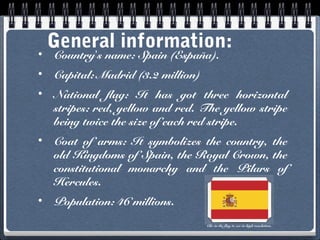
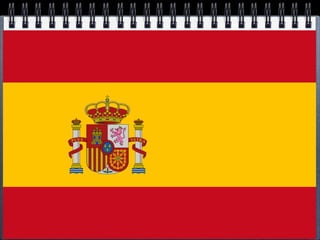
National flag: It has got three horizontal
stripes: red, yellow and red. The yellow stripe
being twice the size of each red stripe.

•

Coat of arms: It symbolizes the country, the
old Kingdoms of Spain, the Royal Crown, the
constitutional monarchy and the Pilars of
Hercules.

•

Population: 46 millions.
Clic in the flag to see in high resolution.
Location:
•

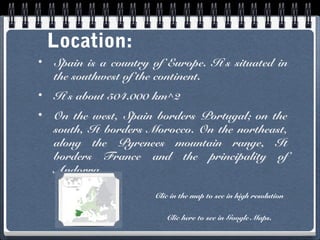
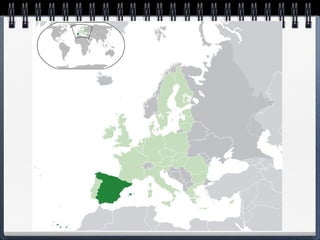
Spain is a country of Europe. It’s situated in
the southwest of the continent.

•

It’s about 504.000 km^2

•

On the west, Spain borders Portugal; on the
south, It borders Morocco. On the northeast,
along the Pyrenees mountain range, It
borders France and the principality of
Andorra.
Clic in the map to see in high resolution
Clic here to see in Google Maps.
Location:
•

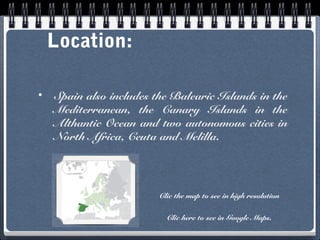
Spain also includes the Balearic Islands in the
Mediterranean, the Canary Islands in the
Althantic Ocean and two autonomous cities in
North Africa, Ceuta and Melilla.

Clic the map to see in high resolution
Clic here to see in Google Maps.
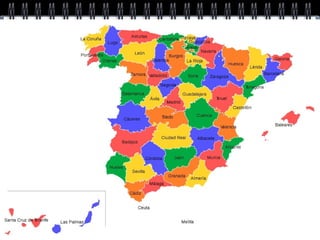
Administrative divisions:
•

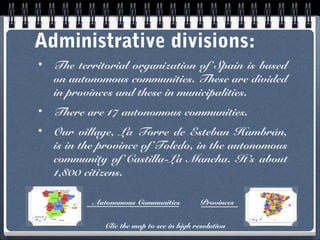
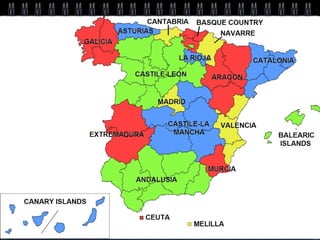
The territorial organization of Spain is based
on autonomous communities. These are divided
in provinces and these in municipalities.

•

There are 17 autonomous communities.

•

Our village, La Torre de Esteban Hambrán,
is in the province of Toledo, in the autonomous
community of Castilla-La Mancha. It’s about
1,800 citizens.
Autonomous Communities

Provinces

Clic the map to see in high resolution
Language:
•

Spanish is spoken all over the country and so is
the only language with official status
nationwide.

•

But there are three regional languages that
have been declared co-official:

1.- Basque in the Basque Country and Navarre.
2.- Catalan in Catalonia, Valencian and Balearic
Island.
3.- Galician in Galicia.
Religion:
•

There is no an official religion in Spain. The
country is a secular state.

•

In Schools, students have religion as an
optional subject.

•

The 73%
Catholic.

•

The 20% as Atheist or non-religious.

•

The 7% practice other religions.

of

Spaniards

self-identify

as
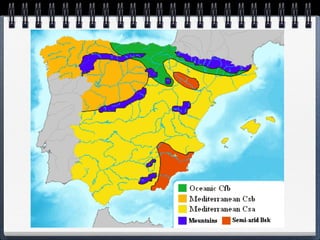
Climate:
•

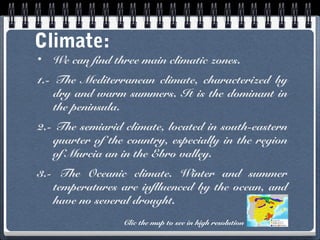
We can find three main climatic zones.

1.- The Mediterranean climate, characterized by
dry and warm summers. It is the dominant in
the peninsula.
2.- The semiarid climate, located in south-eastern
quarter of the country, especially in the region
of Murcia an in the Ebro valley.
3.- The Oceanic climate. Winter and summer
temperatures are inflluenced by the ocean, and
have no several drought.
Clic the map to see in high resolution
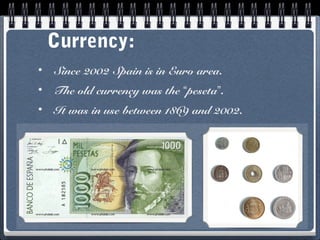
Currency:
•

Since 2002 Spain is in Euro area.

•

The old currency was the “peseta”.

•

It was in use between 1869 and 2002.
Historic events:
•

Year 711. Moorish Muslim armies from North
Africa invaded the iberian peninsula.

•

In 1492. The catholic kings, Isabel I and
Fernando II, end the reconquest of Spain.

•

That year Cristopher Columbus discovered the
New World (America).

•

In 1807 Napoleon occupied Spanish fortresses
and the 2nd of May of 1808 begin the War of
Independence.
Historic events:
•

Between 1936 and 1939 were the Spanish
Civil War. In 1939 Fascist forces win the war
and his leader, General Francisco Franco
emerged victorious with the support of Nazi
Germany and Fascist Italy.

•

With Franco’s death in November 1975, Juan
Carlos assumed the position of King os Spain
and the democracy arrives.

•

In 1978 It was approved the new Spanish
Constitution.
•

Nobel Prize Winners:

Santiago Ramón y Cajal. 1906, in medicine, for his work on
the structure of the nervous system.

•

Severo Ochoa. 1959, in medicine, for his work on the
synthesis of RNA.

•

Vicente Aleixandre. 1977, in literature. He was part of the
Generation of ‘27.

•

Juan Ramón Jiménez. 1956, in literature, for his
contribution to the modern poetry.

•

Camilo José Cela. 1989, in literature, for a rich and intense
prose.

•

José de Echegaray. 1904, in literature, making him the first
Spaniards to win the prize.

•

Jacinto Benavente. 1922, in literature.
The End
Spain - The sunny country

Spain - The sunny country

  • 1.
  • 2.
    General information: • Country’s name:Spain (España). • Capital: Madrid (3.2 million) • National flag: It has got three horizontal stripes: red, yellow and red. The yellow stripe being twice the size of each red stripe. • Coat of arms: It symbolizes the country, the old Kingdoms of Spain, the Royal Crown, the constitutional monarchy and the Pilars of Hercules. • Population: 46 millions. Clic in the flag to see in high resolution.
  • 3.
    Location: • Spain is acountry of Europe. It’s situated in the southwest of the continent. • It’s about 504.000 km^2 • On the west, Spain borders Portugal; on the south, It borders Morocco. On the northeast, along the Pyrenees mountain range, It borders France and the principality of Andorra. Clic in the map to see in high resolution Clic here to see in Google Maps.
  • 4.
    Location: • Spain also includesthe Balearic Islands in the Mediterranean, the Canary Islands in the Althantic Ocean and two autonomous cities in North Africa, Ceuta and Melilla. Clic the map to see in high resolution Clic here to see in Google Maps.
  • 5.
    Administrative divisions: • The territorialorganization of Spain is based on autonomous communities. These are divided in provinces and these in municipalities. • There are 17 autonomous communities. • Our village, La Torre de Esteban Hambrán, is in the province of Toledo, in the autonomous community of Castilla-La Mancha. It’s about 1,800 citizens. Autonomous Communities Provinces Clic the map to see in high resolution
  • 6.
    Language: • Spanish is spokenall over the country and so is the only language with official status nationwide. • But there are three regional languages that have been declared co-official: 1.- Basque in the Basque Country and Navarre. 2.- Catalan in Catalonia, Valencian and Balearic Island. 3.- Galician in Galicia.
  • 7.
    Religion: • There is noan official religion in Spain. The country is a secular state. • In Schools, students have religion as an optional subject. • The 73% Catholic. • The 20% as Atheist or non-religious. • The 7% practice other religions. of Spaniards self-identify as
  • 8.
    Climate: • We can findthree main climatic zones. 1.- The Mediterranean climate, characterized by dry and warm summers. It is the dominant in the peninsula. 2.- The semiarid climate, located in south-eastern quarter of the country, especially in the region of Murcia an in the Ebro valley. 3.- The Oceanic climate. Winter and summer temperatures are inflluenced by the ocean, and have no several drought. Clic the map to see in high resolution
  • 9.
    Currency: • Since 2002 Spainis in Euro area. • The old currency was the “peseta”. • It was in use between 1869 and 2002.
  • 10.
    Historic events: • Year 711.Moorish Muslim armies from North Africa invaded the iberian peninsula. • In 1492. The catholic kings, Isabel I and Fernando II, end the reconquest of Spain. • That year Cristopher Columbus discovered the New World (America). • In 1807 Napoleon occupied Spanish fortresses and the 2nd of May of 1808 begin the War of Independence.
  • 11.
    Historic events: • Between 1936and 1939 were the Spanish Civil War. In 1939 Fascist forces win the war and his leader, General Francisco Franco emerged victorious with the support of Nazi Germany and Fascist Italy. • With Franco’s death in November 1975, Juan Carlos assumed the position of King os Spain and the democracy arrives. • In 1978 It was approved the new Spanish Constitution.
  • 12.
    • Nobel Prize Winners: SantiagoRamón y Cajal. 1906, in medicine, for his work on the structure of the nervous system. • Severo Ochoa. 1959, in medicine, for his work on the synthesis of RNA. • Vicente Aleixandre. 1977, in literature. He was part of the Generation of ‘27. • Juan Ramón Jiménez. 1956, in literature, for his contribution to the modern poetry. • Camilo José Cela. 1989, in literature, for a rich and intense prose. • José de Echegaray. 1904, in literature, making him the first Spaniards to win the prize. • Jacinto Benavente. 1922, in literature.
  • 13.