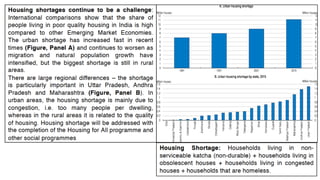
• Housing statistics is subdivided into statistics on the size and composition of housing resources, statistics
on the use of housing, and statistics on the housing conditions of the population.
• The housing conditions of the population must be studied to determine the need for housing and to regulate its
use.
• Housing is studied in three ways—through quantitative description, qualitative description, and an
analysis of the economic conditions of housing use.
• The quantitative description of housing conditions is expressed in occupancy density (per capita living or
total space), the average number of inhabitants per room, and the coefficient of family occupancy.
• The qualitative description of housing conditions is given in terms of municipal conveniences and sanitary
hygienic conditions, including air ventilation, the temperature and humidity conditions of premises, and
natural lighting.
• The economic conditions of housing use are expressed as a comparison of all expenditures related to
housing use with family income.
• The basic organizational principle is the use of operational records (inventory data, standardized
bookkeeping). In addition, special studies are conducted from time to time, both one-time surveys
encompassing the country’s socialized housing resources and housing censuses covering only personally
owned housing in cities, urban worker’s settlements, and resort communities. Sample surveys make it
possible to investigate such processes in the housing system as the industrialization of repair work, the
mechanization of labor-intensive jobs, and the relationship between wear and use. Such surveys also reveal
resources for lowering the cost of housing maintenance and the relationships between housing
conditions and demographic trends.
• Housing is regarded as an ‘engine of economic growth’ and can give a big push to the economy
through its strong ‘backward’ and ‘forward’ linkages with about 250 ancillary industries. As per an
IIM Ahmedabad Study (July 2000), housing investment has inter-industry linkages and investment in
housing/construction sector has strong linkages.
SPECIAL INITIATIVES
Affordable Rental Housing Complexes (ARHCs): In line with the Government’s vision of Atma Nirbhar Bharat, MoHUA
has initiated a scheme “Affordable Rental Housing Complexes (ARHCs) for providing ease of living to people from
EWS/LIG categories including labours, urban poor (street vendor, rickshaw puller, other service providers etc.),
industrial workers, educational/ health institutions, hospitality sector, Long term tourists, students or any other
category as deemed fit by the States/UTs.
Investment under ARHCs is expected to create new jobs. The urban migrant/ poor will get better and decent living
environment through creation of ARHCs near their workplaces. Industries too will be benefitted through sustained supply of
human resource resulting in improved productivity and workmanship for eventual economic gain.
Extension of Credit Linked Subsidy Scheme (CLSS) for Middle Income Group (MIG): CLSS for MIG, which was
included with effect from 1st January 2017, has been extended till 31st March 2021. The Mission has provided subsidy of
Rs. 7,000 Crore (approx.) to nearly 3.3 Lakh beneficiaries and mobilized an investment of Rs. 75,000 Crore (approx.) for last
3 years.
Extension of CLSS for MIG shall benefit 2.5 Lakh Middle income families, mobilizing an investment of Rs. 70,000 crores
in FY 2020-21 having a cascading positive impetus to many allied industries like cement, steel, glass, metal etc apart from
boost to heavy material transport and job opportunity to skilled and unskilled workforce in urban areas.
A significant milestone - PMAY(U) houses cross 1 Crore mark: PMAY(U), one of the largest affordable housing
programmes in the world achieved yet another milestone of 1 Crore houses in December 2019. So far, 1.05 crore houses have
been sanctioned and 65 Lakh have been grounded for construction. Employment for more than 1.65 Cr persons has been
generated through forward and backward linkages. Around 370 Lakh metric tonne cement and 84 Lakh metric tonne steel
has been consumed for the construction of houses. The investment has also impacted on livelihood, transport sector, skill
development, landscape development sector etc.
LIGHT HOUSE PROJECTS (LHPS) UNDER GHTC INDIA: GHTC ushered in a paradigm shift in the construction technology to
transform the eco-system of housing construction through Light House Projects (LHP) in India. These model housing projects are being
implemented in 6 States viz: Gujarat, Jharkhand,
Madhya Pradesh, Tamil Nadu, Tripura and Uttar Pradesh to demonstrate the innovative technology and deliver houses more
expeditiously compared to conventional constructions.
ANGIKAAR- A CAMPAIGN FOR CHANGE MANAGEMENT: Hon’ble Prime Minister had envisioned to provide basic services to all
houses constructed under PMAY(U) and address issues that arise from life transformation after moving into a pucca house. Aligning to this,
ANGIKAAR- a campaign for change management was implemented across States/UTs in around 4,427 cities (from 2nd Oct’19 to 26th
Jan’20). The campaign aimed to create awareness on best practices of water & energy conservation, sanitation and waste management,
through behaviour change and convergence by conducting need assessment and door to door awareness. Around 15 Lakh households have
been covered from Beneficiary Led Construction (BLC), Affordable Housing in Partnership (AHP), In-situ Slum Redevelopment (ISSR)
verticals by 18,347 ANGIKAAR Resource Persons in States/UTs and 5 Lakh EWS/LIG beneficiaries were reached out to for Financial
Literacy on various financial products and services available from the formal financial sector.
HOUSING INCENTIVES FOR REAL ESTATE SECTOR: Additional Deduction of Rs. 1.5 lakh on Home Loan Interest for home loans
availed from 1st April, 2019 upto 31st March, 2020 on affordable houses. Increase in size limit of Affordable Housing Unit from 30 to 60m2
in Metro and from 60 to 90m2 in non metro cities.
To give relief to homebuyers of stalled projects, a Special Window for Affordable and Mid-Income Housing Fund (SWAMIH)
Investment Fund has been established for projects that are net-worth positive and registered under RERA.
EXISTING HOUSING STATISTICS
NUMBER OF HOUSES AND HOUSEHOLDS: Total houses Total
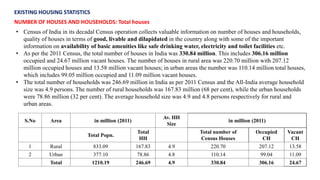
• Census of India in its decadal Census operation collects valuable information on number of houses and households,
quality of houses in terms of good, livable and dilapidated in the country along with some of the important
information on availability of basic amenities like safe drinking water, electricity and toilet facilities etc.
• As per the 2011 Census, the total number of houses in India was 330.84 million. This includes 306.16 million
occupied and 24.67 million vacant houses. The number of houses in rural area was 220.70 million with 207.12
million occupied houses and 13.58 million vacant houses; in urban areas the number was 110.14 million total houses,
which includes 99.05 million occupied and 11.09 million vacant houses.
• The total number of households was 246.69 million in India as per 2011 Census and the All-India average household
size was 4.9 persons. The number of rural households was 167.83 million (68 per cent), while the urban households
were 78.86 million (32 per cent). The average household size was 4.9 and 4.8 persons respectively for rural and
urban areas.
S.No Area in million (2011)
Av. HH
Size
in million (2011)
Total Popn.
Total
HH
Total number of
Census Houses
Occupied
CH
Vacant
CH
1 Rural 833.09 167.83 4.9 220.70 207.12 13.58
2 Urban 377.10 78.86 4.8 110.14 99.04 11.09
Total 1210.19 246.69 4.9 330.84 306.16 24.67
Area
Total Occupied
Census Houses
Distribution of Occupied Census Houses-2011 (In million)
Residence
Residence-cum
Other Use
Total Residence
cum Other Use
All other Non
Residential Uses
Rural 207.12 159.93 6.23 166.16 40.96
Urban 99.04 76.13 2.35 78.48 20.56
Total 306.16 236.66 8.58 244.64 61.52
TOTAL OCCUPIED HOUSES BY TYPE OF USE (Table-3, of Census, 2011)
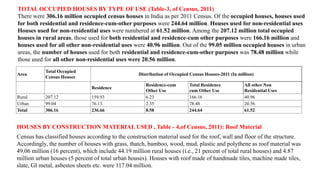
There were 306.16 million occupied census houses in India as per 2011 Census. Of the occupied houses, houses used
for both residential and residence-cum-other purposes were 244.64 million. Houses used for non-residential uses
Houses used for non-residential uses were numbered at 61.52 million. Among the 207.12 million total occupied
houses in rural areas, those used for both residential and residence-cum other purposes were 166.16 million and
houses used for all other non-residential uses were 40.96 million. Out of the 99.05 million occupied houses in urban
areas, the number of houses used for both residential and residence-cum-other purposes was 78.48 million while
those used for all other non-residential uses were 20.56 million.
HOUSES BY CONSTRUCTION MATERIAL USED , Table - 4,of Census, 2011): Roof Material
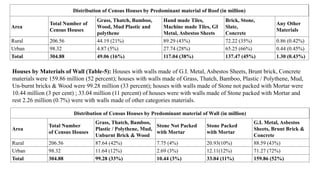
Census has classified houses according to the construction material used for the roof, wall and floor of the structure.
Accordingly, the number of houses with grass, thatch, bamboo, wood, mud, plastic and polythene as roof material was
49.06 million (16 percent), which include 44.19 million rural houses (i.e., 21 percent of total rural houses) and 4.87
million urban houses (5 percent of total urban houses). Houses with roof made of handmade tiles, machine made tiles,
slate, GI metal, asbestos sheets etc. were 117.04 million.
Distribution of Census Houses by Predominant material of Roof (in million)
Area
Total Number of
Census Houses
Grass, Thatch, Bamboo,
Wood, Mud Plastic and
polythene
Hand made Tiles,
Machine made Tiles, GI
Metal, Asbestos Sheets
Brick, Stone,
Slate,
Concrete
Any Other
Materials
Rural 206.56 44.19 (21%) 89.29 (43%) 72.22 (35%) 0.86 (0.42%)
Urban 98.32 4.87 (5%) 27.74 (28%) 65.25 (66%) 0.44 (0.45%)
Total 304.88 49.06 (16%) 117.04 (38%) 137.47 (45%) 1.30 (0.43%)
Distribution of Census Houses by Predominant material of Wall (in million)
Area
Total Number
of Census Houses
Grass, Thatch, Bamboo,
Plastic / Polythene, Mud,
Unburnt Brick & Wood
Stone Not Packed
with Mortar
Stone Packed
with Mortar
G.I. Metal, Asbestos
Sheets, Brunt Brick &
Concrete
Rural 206.56 87.64 (42%) 7.75 (4%) 20.93(10%) 88.59 (43%)
Urban 98.32 11.64 (12%) 2.69 (3%) 12.11(12%) 71.27 (72%)
Total 304.88 99.28 (33%) 10.44 (3%) 33.04 (11%) 159.86 (52%)
Houses by Materials of Wall (Table-5): Houses with walls made of G.I. Metal, Asbestos Sheets, Brunt brick, Concrete
materials were 159.86 million (52 percent); houses with walls made of Grass, Thatch, Bamboo, Plastic / Polythene, Mud,
Un-burnt bricks & Wood were 99.28 million (33 percent); houses with walls made of Stone not packed with Mortar were
10.44 million (3 per cent) ; 33.04 million (11 percent) of houses were with walls made of Stone packed with Mortar and
rest 2.26 million (0.7%) were with walls made of other categories materials.
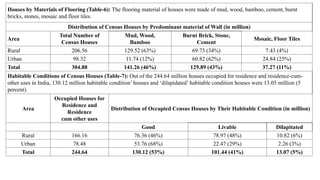
Houses by Materials of Flooring (Table-6): The flooring material of houses were made of mud, wood, bamboo, cement, burnt
bricks, stones, mosaic and floor tiles.
Distribution of Census Houses by Predominant material of Wall (in million)
Area
Total Number of
Census Houses
Mud, Wood,
Bamboo
Burnt Brick, Stone,
Cement
Mosaic, Floor Tiles
Rural 206.56 129.52 (63%) 69.73 (34%) 7.43 (4%)
Urban 98.32 11.74 (12%) 60.82 (62%) 24.84 (25%)
Total 304.88 141.26 (46%) 129.89 (43%) 37.27 (11%)
Habitable Conditions of Census Houses (Table-7): Out of the 244.64 million houses occupied for residence and residence-cum-
other uses in India, 130.12 million habitable condition’ houses and ‘dilapidated’ habitable condition houses were 13.05 million (5
percent).
Area
Occupied Houses for
Residence and
Residence
cum other uses
Distribution of Occupied Census Houses by Their Habitable Condition (in million)
Good Livable Dilapitated
Rural 166.16 76.36 (46%) 78.97 (48%) 10.82 (6%)
Urban 78.48 53.76 (68%) 22.47 (29%) 2.26 (3%)
Total 244.64 130.12 (53%) 101.44 (41%) 13.07 (5%)
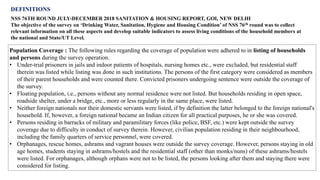
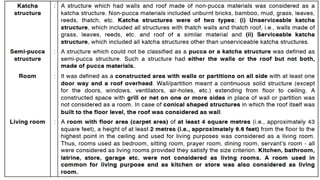
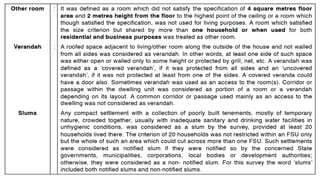
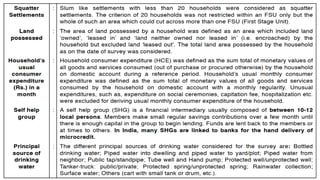
DEFINITIONS
NSS 76TH ROUND JULY-DECEMBER 2018 SANITATION & HOUSING REPORT, GOI, NEW DELHI
The objective of the survey on ‘Drinking Water, Sanitation, Hygiene and Housing Condition’ of NSS 76th round was to collect
relevant information on all these aspects and develop suitable indicators to assess living conditions of the household members at
the national and State/UT Level.
Population Coverage : The following rules regarding the coverage of population were adhered to in listing of households
and persons during the survey operation.
• Under-trial prisoners in jails and indoor patients of hospitals, nursing homes etc., were excluded, but residential staff
therein was listed while listing was done in such institutions. The persons of the first category were considered as members
of their parent households and were counted there. Convicted prisoners undergoing sentence were outside the coverage of
the survey.
• Floating population, i.e., persons without any normal residence were not listed. But households residing in open space,
roadside shelter, under a bridge, etc., more or less regularly in the same place, were listed.
• Neither foreign nationals nor their domestic servants were listed, if by definition the latter belonged to the foreign national's
household. If, however, a foreign national became an Indian citizen for all practical purposes, he or she was covered.
• Persons residing in barracks of military and paramilitary forces (like police, BSF, etc.) were kept outside the survey
coverage due to difficulty in conduct of survey therein. However, civilian population residing in their neighbourhood,
including the family quarters of service personnel, were covered.
• Orphanages, rescue homes, ashrams and vagrant houses were outside the survey coverage. However, persons staying in old
age homes, students staying in ashrams/hostels and the residential staff (other than monks/nuns) of these ashrams/hostels
were listed. For orphanages, although orphans were not to be listed, the persons looking after them and staying there were
considered for listing.
Housing statistics.pdf

Housing statistics.pdf

  • 1.
    • Housing statisticsis subdivided into statistics on the size and composition of housing resources, statistics on the use of housing, and statistics on the housing conditions of the population. • The housing conditions of the population must be studied to determine the need for housing and to regulate its use. • Housing is studied in three ways—through quantitative description, qualitative description, and an analysis of the economic conditions of housing use. • The quantitative description of housing conditions is expressed in occupancy density (per capita living or total space), the average number of inhabitants per room, and the coefficient of family occupancy. • The qualitative description of housing conditions is given in terms of municipal conveniences and sanitary hygienic conditions, including air ventilation, the temperature and humidity conditions of premises, and natural lighting.
  • 2.
    • The economicconditions of housing use are expressed as a comparison of all expenditures related to housing use with family income. • The basic organizational principle is the use of operational records (inventory data, standardized bookkeeping). In addition, special studies are conducted from time to time, both one-time surveys encompassing the country’s socialized housing resources and housing censuses covering only personally owned housing in cities, urban worker’s settlements, and resort communities. Sample surveys make it possible to investigate such processes in the housing system as the industrialization of repair work, the mechanization of labor-intensive jobs, and the relationship between wear and use. Such surveys also reveal resources for lowering the cost of housing maintenance and the relationships between housing conditions and demographic trends. • Housing is regarded as an ‘engine of economic growth’ and can give a big push to the economy through its strong ‘backward’ and ‘forward’ linkages with about 250 ancillary industries. As per an IIM Ahmedabad Study (July 2000), housing investment has inter-industry linkages and investment in housing/construction sector has strong linkages.
  • 3.
    SPECIAL INITIATIVES Affordable RentalHousing Complexes (ARHCs): In line with the Government’s vision of Atma Nirbhar Bharat, MoHUA has initiated a scheme “Affordable Rental Housing Complexes (ARHCs) for providing ease of living to people from EWS/LIG categories including labours, urban poor (street vendor, rickshaw puller, other service providers etc.), industrial workers, educational/ health institutions, hospitality sector, Long term tourists, students or any other category as deemed fit by the States/UTs. Investment under ARHCs is expected to create new jobs. The urban migrant/ poor will get better and decent living environment through creation of ARHCs near their workplaces. Industries too will be benefitted through sustained supply of human resource resulting in improved productivity and workmanship for eventual economic gain. Extension of Credit Linked Subsidy Scheme (CLSS) for Middle Income Group (MIG): CLSS for MIG, which was included with effect from 1st January 2017, has been extended till 31st March 2021. The Mission has provided subsidy of Rs. 7,000 Crore (approx.) to nearly 3.3 Lakh beneficiaries and mobilized an investment of Rs. 75,000 Crore (approx.) for last 3 years. Extension of CLSS for MIG shall benefit 2.5 Lakh Middle income families, mobilizing an investment of Rs. 70,000 crores in FY 2020-21 having a cascading positive impetus to many allied industries like cement, steel, glass, metal etc apart from boost to heavy material transport and job opportunity to skilled and unskilled workforce in urban areas. A significant milestone - PMAY(U) houses cross 1 Crore mark: PMAY(U), one of the largest affordable housing programmes in the world achieved yet another milestone of 1 Crore houses in December 2019. So far, 1.05 crore houses have been sanctioned and 65 Lakh have been grounded for construction. Employment for more than 1.65 Cr persons has been generated through forward and backward linkages. Around 370 Lakh metric tonne cement and 84 Lakh metric tonne steel has been consumed for the construction of houses. The investment has also impacted on livelihood, transport sector, skill development, landscape development sector etc.
  • 4.
    LIGHT HOUSE PROJECTS(LHPS) UNDER GHTC INDIA: GHTC ushered in a paradigm shift in the construction technology to transform the eco-system of housing construction through Light House Projects (LHP) in India. These model housing projects are being implemented in 6 States viz: Gujarat, Jharkhand, Madhya Pradesh, Tamil Nadu, Tripura and Uttar Pradesh to demonstrate the innovative technology and deliver houses more expeditiously compared to conventional constructions. ANGIKAAR- A CAMPAIGN FOR CHANGE MANAGEMENT: Hon’ble Prime Minister had envisioned to provide basic services to all houses constructed under PMAY(U) and address issues that arise from life transformation after moving into a pucca house. Aligning to this, ANGIKAAR- a campaign for change management was implemented across States/UTs in around 4,427 cities (from 2nd Oct’19 to 26th Jan’20). The campaign aimed to create awareness on best practices of water & energy conservation, sanitation and waste management, through behaviour change and convergence by conducting need assessment and door to door awareness. Around 15 Lakh households have been covered from Beneficiary Led Construction (BLC), Affordable Housing in Partnership (AHP), In-situ Slum Redevelopment (ISSR) verticals by 18,347 ANGIKAAR Resource Persons in States/UTs and 5 Lakh EWS/LIG beneficiaries were reached out to for Financial Literacy on various financial products and services available from the formal financial sector. HOUSING INCENTIVES FOR REAL ESTATE SECTOR: Additional Deduction of Rs. 1.5 lakh on Home Loan Interest for home loans availed from 1st April, 2019 upto 31st March, 2020 on affordable houses. Increase in size limit of Affordable Housing Unit from 30 to 60m2 in Metro and from 60 to 90m2 in non metro cities. To give relief to homebuyers of stalled projects, a Special Window for Affordable and Mid-Income Housing Fund (SWAMIH) Investment Fund has been established for projects that are net-worth positive and registered under RERA.
  • 5.
    EXISTING HOUSING STATISTICS NUMBEROF HOUSES AND HOUSEHOLDS: Total houses Total • Census of India in its decadal Census operation collects valuable information on number of houses and households, quality of houses in terms of good, livable and dilapidated in the country along with some of the important information on availability of basic amenities like safe drinking water, electricity and toilet facilities etc. • As per the 2011 Census, the total number of houses in India was 330.84 million. This includes 306.16 million occupied and 24.67 million vacant houses. The number of houses in rural area was 220.70 million with 207.12 million occupied houses and 13.58 million vacant houses; in urban areas the number was 110.14 million total houses, which includes 99.05 million occupied and 11.09 million vacant houses. • The total number of households was 246.69 million in India as per 2011 Census and the All-India average household size was 4.9 persons. The number of rural households was 167.83 million (68 per cent), while the urban households were 78.86 million (32 per cent). The average household size was 4.9 and 4.8 persons respectively for rural and urban areas. S.No Area in million (2011) Av. HH Size in million (2011) Total Popn. Total HH Total number of Census Houses Occupied CH Vacant CH 1 Rural 833.09 167.83 4.9 220.70 207.12 13.58 2 Urban 377.10 78.86 4.8 110.14 99.04 11.09 Total 1210.19 246.69 4.9 330.84 306.16 24.67
  • 6.
    Area Total Occupied Census Houses Distributionof Occupied Census Houses-2011 (In million) Residence Residence-cum Other Use Total Residence cum Other Use All other Non Residential Uses Rural 207.12 159.93 6.23 166.16 40.96 Urban 99.04 76.13 2.35 78.48 20.56 Total 306.16 236.66 8.58 244.64 61.52 TOTAL OCCUPIED HOUSES BY TYPE OF USE (Table-3, of Census, 2011) There were 306.16 million occupied census houses in India as per 2011 Census. Of the occupied houses, houses used for both residential and residence-cum-other purposes were 244.64 million. Houses used for non-residential uses Houses used for non-residential uses were numbered at 61.52 million. Among the 207.12 million total occupied houses in rural areas, those used for both residential and residence-cum other purposes were 166.16 million and houses used for all other non-residential uses were 40.96 million. Out of the 99.05 million occupied houses in urban areas, the number of houses used for both residential and residence-cum-other purposes was 78.48 million while those used for all other non-residential uses were 20.56 million. HOUSES BY CONSTRUCTION MATERIAL USED , Table - 4,of Census, 2011): Roof Material Census has classified houses according to the construction material used for the roof, wall and floor of the structure. Accordingly, the number of houses with grass, thatch, bamboo, wood, mud, plastic and polythene as roof material was 49.06 million (16 percent), which include 44.19 million rural houses (i.e., 21 percent of total rural houses) and 4.87 million urban houses (5 percent of total urban houses). Houses with roof made of handmade tiles, machine made tiles, slate, GI metal, asbestos sheets etc. were 117.04 million.
  • 7.
    Distribution of CensusHouses by Predominant material of Roof (in million) Area Total Number of Census Houses Grass, Thatch, Bamboo, Wood, Mud Plastic and polythene Hand made Tiles, Machine made Tiles, GI Metal, Asbestos Sheets Brick, Stone, Slate, Concrete Any Other Materials Rural 206.56 44.19 (21%) 89.29 (43%) 72.22 (35%) 0.86 (0.42%) Urban 98.32 4.87 (5%) 27.74 (28%) 65.25 (66%) 0.44 (0.45%) Total 304.88 49.06 (16%) 117.04 (38%) 137.47 (45%) 1.30 (0.43%) Distribution of Census Houses by Predominant material of Wall (in million) Area Total Number of Census Houses Grass, Thatch, Bamboo, Plastic / Polythene, Mud, Unburnt Brick & Wood Stone Not Packed with Mortar Stone Packed with Mortar G.I. Metal, Asbestos Sheets, Brunt Brick & Concrete Rural 206.56 87.64 (42%) 7.75 (4%) 20.93(10%) 88.59 (43%) Urban 98.32 11.64 (12%) 2.69 (3%) 12.11(12%) 71.27 (72%) Total 304.88 99.28 (33%) 10.44 (3%) 33.04 (11%) 159.86 (52%) Houses by Materials of Wall (Table-5): Houses with walls made of G.I. Metal, Asbestos Sheets, Brunt brick, Concrete materials were 159.86 million (52 percent); houses with walls made of Grass, Thatch, Bamboo, Plastic / Polythene, Mud, Un-burnt bricks & Wood were 99.28 million (33 percent); houses with walls made of Stone not packed with Mortar were 10.44 million (3 per cent) ; 33.04 million (11 percent) of houses were with walls made of Stone packed with Mortar and rest 2.26 million (0.7%) were with walls made of other categories materials.
  • 8.
    Houses by Materialsof Flooring (Table-6): The flooring material of houses were made of mud, wood, bamboo, cement, burnt bricks, stones, mosaic and floor tiles. Distribution of Census Houses by Predominant material of Wall (in million) Area Total Number of Census Houses Mud, Wood, Bamboo Burnt Brick, Stone, Cement Mosaic, Floor Tiles Rural 206.56 129.52 (63%) 69.73 (34%) 7.43 (4%) Urban 98.32 11.74 (12%) 60.82 (62%) 24.84 (25%) Total 304.88 141.26 (46%) 129.89 (43%) 37.27 (11%) Habitable Conditions of Census Houses (Table-7): Out of the 244.64 million houses occupied for residence and residence-cum- other uses in India, 130.12 million habitable condition’ houses and ‘dilapidated’ habitable condition houses were 13.05 million (5 percent). Area Occupied Houses for Residence and Residence cum other uses Distribution of Occupied Census Houses by Their Habitable Condition (in million) Good Livable Dilapitated Rural 166.16 76.36 (46%) 78.97 (48%) 10.82 (6%) Urban 78.48 53.76 (68%) 22.47 (29%) 2.26 (3%) Total 244.64 130.12 (53%) 101.44 (41%) 13.07 (5%)
  • 9.
    DEFINITIONS NSS 76TH ROUNDJULY-DECEMBER 2018 SANITATION & HOUSING REPORT, GOI, NEW DELHI The objective of the survey on ‘Drinking Water, Sanitation, Hygiene and Housing Condition’ of NSS 76th round was to collect relevant information on all these aspects and develop suitable indicators to assess living conditions of the household members at the national and State/UT Level. Population Coverage : The following rules regarding the coverage of population were adhered to in listing of households and persons during the survey operation. • Under-trial prisoners in jails and indoor patients of hospitals, nursing homes etc., were excluded, but residential staff therein was listed while listing was done in such institutions. The persons of the first category were considered as members of their parent households and were counted there. Convicted prisoners undergoing sentence were outside the coverage of the survey. • Floating population, i.e., persons without any normal residence were not listed. But households residing in open space, roadside shelter, under a bridge, etc., more or less regularly in the same place, were listed. • Neither foreign nationals nor their domestic servants were listed, if by definition the latter belonged to the foreign national's household. If, however, a foreign national became an Indian citizen for all practical purposes, he or she was covered. • Persons residing in barracks of military and paramilitary forces (like police, BSF, etc.) were kept outside the survey coverage due to difficulty in conduct of survey therein. However, civilian population residing in their neighbourhood, including the family quarters of service personnel, were covered. • Orphanages, rescue homes, ashrams and vagrant houses were outside the survey coverage. However, persons staying in old age homes, students staying in ashrams/hostels and the residential staff (other than monks/nuns) of these ashrams/hostels were listed. For orphanages, although orphans were not to be listed, the persons looking after them and staying there were considered for listing.