Leture1
Dr Safaa Ghoneim
Cairo University
Faculty Of Urban & Regional Planning
Planning Of Environmentally Special Regions
‫تخطيط‬‫األقاليم‬‫الخاصة‬ ‫البيئية‬
Code 3682
Agenda
Lecture 1 2
Planning of environmentally Special Regions
 Focus On the Course Title /the scope of this course
 Natural Ecosystems: step1 to understand an ecosystem
 Course outlines
Dr Safaa Ghoneim
Planning Of
Environmentally
Special Regions
Focus On Course Title
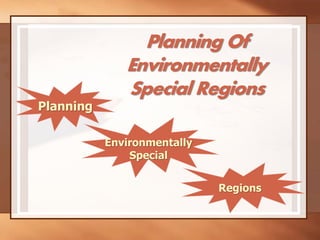
Planning
Environmentally
Special
Regions
Planning Of
Environmentally
Special Regions
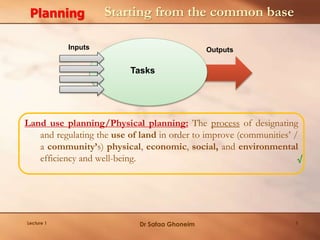
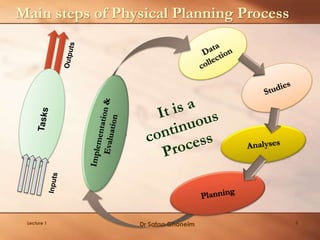
Land use planning/Physical planning: The process of designating
and regulating the use of land in order to improve (communities’ /
a community’s) physical, economic, social, and environmental
efficiency and well-being. √
Starting from the common base
Inputs Outputs
Tasks
Planning
Lecture 1 Dr Safaa Ghoneim 5
Main steps of Physical Planning Process
Lecture 1 Dr Safaa Ghoneim 6
7Lecture 1
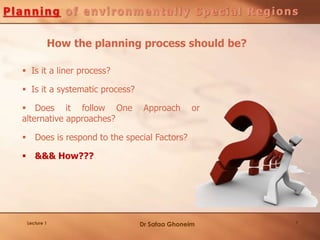
 Is it a liner process?
 Is it a systematic process?
 Does it follow One Approach or
alternative approaches?
 Does is respond to the special Factors?
 &&& How???
How the planning process should be?
Dr Safaa Ghoneim
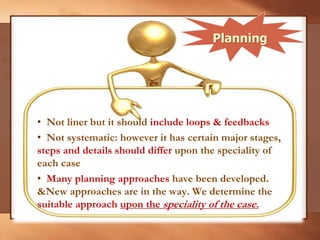
• Not liner but it should include loops & feedbacks
• Not systematic: however it has certain major stages,
steps and details should differ upon the speciality of
each case
• Many planning approaches have been developed.
&New approaches are in the way. We determine the
suitable approach upon the speciality of the case.
Planning
Does is respond to the special Factors?
Special factors ???
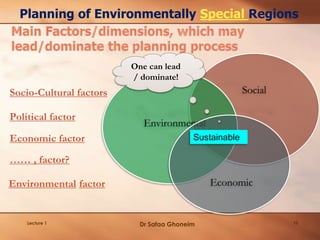
Socio-Cultural factors
Lecture 1 10
Planning of Environmentally Special Regions
Political factor
Economic factor
Environmental factor
…… , factor?
Social
Environmental
Economic
Sustainable
One can lead
/ dominate!
Dr Safaa Ghoneim
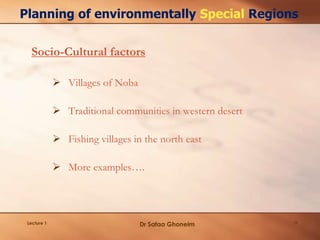
Socio-Cultural factors
Lecture 1 11
Planning of environmentally Special Regions
 Villages of Noba
 Traditional communities in western desert
 Fishing villages in the north east
 More examples….
Dr Safaa Ghoneim
Lecture 1 12
Planning of Environmentally Special Regions
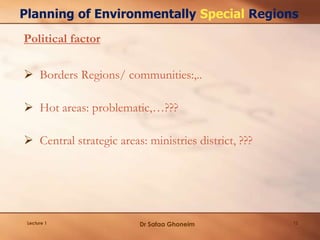
Political factor
 Borders Regions/ communities:,..
 Hot areas: problematic,…???
 Central strategic areas: ministries district, ???
Dr Safaa Ghoneim
Lecture 1 13
Planning of environmentally Special Regions
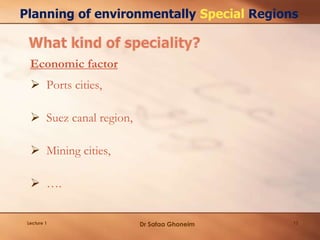
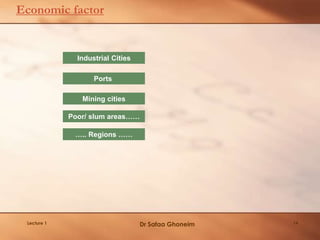
Economic factor
 Ports cities,
 Suez canal region,
 Mining cities,
 ….
Dr Safaa Ghoneim
Industrial Cities
Economic factor
Ports
Mining cities
Poor/ slum areas……
….. Regions ……
Lecture 1 Dr Safaa Ghoneim 14
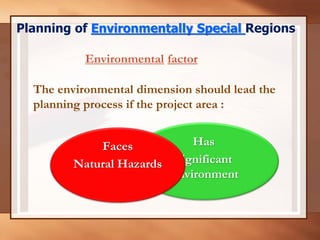
The environmental dimension should lead the
planning process if the project area :
Has
Significant
Environment
Planning of Environmentally Special Regions
Environmental factor
Faces
Natural Hazards
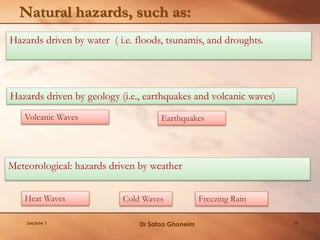
Hazards driven by water ( i.e. floods, tsunamis, and droughts.
Natural hazards, such as:
Hazards driven by geology (i.e., earthquakes and volcanic waves)
EarthquakesVolcanic Waves
Meteorological: hazards driven by weather
Heat Waves Cold Waves Freezing Rain
Lecture 1 Dr Safaa Ghoneim 16
Faces
Natural Hazards
The environmental dimension should lead the
planning process if the project area :
Has
Significant
Environment
Planning of Environmentally Special Regions
Environmental factor
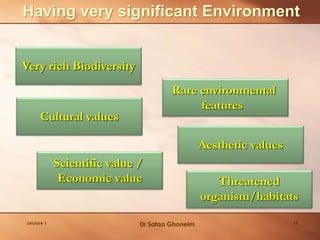
Having very significant Environment
Very rich Biodiversity
Rare environmental
features
Threatened
organism/habitats
Aesthetic values
Cultural values
Scientific value /
Economic value
Lecture 1 Dr Safaa Ghoneim 18
19Lecture 1
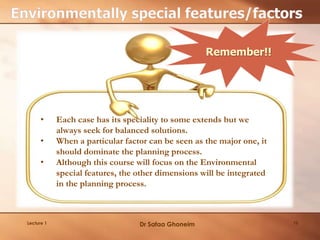
• Each case has its speciality to some extends but we
always seek for balanced solutions.
• When a particular factor can be seen as the major one, it
should dominate the planning process.
• Although this course will focus on the Environmental
special features, the other dimensions will be integrated
in the planning process.
Remember!!
Dr Safaa Ghoneim
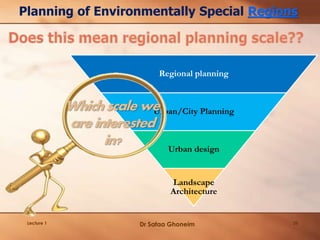
Regional planning
Urban/City Planning
Urban design
Landscape
Architecture
Which scale we
are interested
in?
Planning of Environmentally Special Regions
Lecture 1 Dr Safaa Ghoneim 20
Lecture 1 21
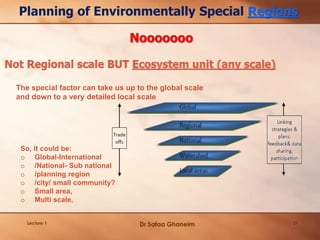
So, it could be:
o Global-International
o /National- Sub national
o /planning region
o /city/ small community?
o Small area,
o Multi scale,
Planning of Environmentally Special Regions
The special factor can take us up to the global scale
and down to a very detailed local scale
Dr Safaa Ghoneim
22Lecture 1
• Here we focus on the ecosystem as a natural unit.
• The special feature can take us up to the global
scale and down to a very detailed local scale.
• The special features can be Significant Env or
Hazards
• Our Aim ……
Dr Safaa Ghoneim
Step1: to understand
an ecosystem
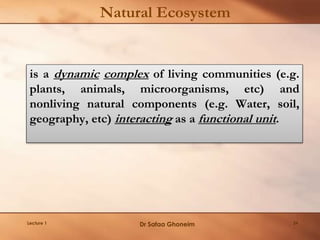
Natural Ecosystem
is a dynamic complex of living communities (e.g.
plants, animals, microorganisms, etc) and
nonliving natural components (e.g. Water, soil,
geography, etc) interacting as a functional unit.
Lecture 1 Dr Safaa Ghoneim 24
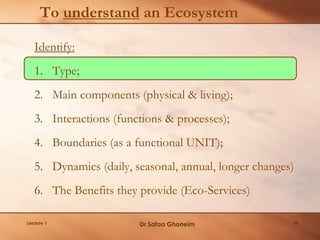
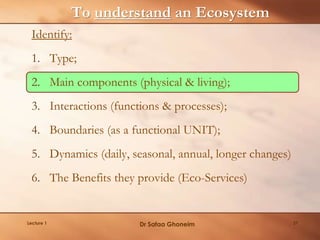
To understand an Ecosystem
Identify:
1. Type;
2. Main components (physical & living);
3. Interactions (functions & processes);
4. Boundaries (as a functional UNIT);
5. Dynamics (daily, seasonal, annual, longer changes)
6. The Benefits they provide (Eco-Services)
Lecture 1 Dr Safaa Ghoneim 25
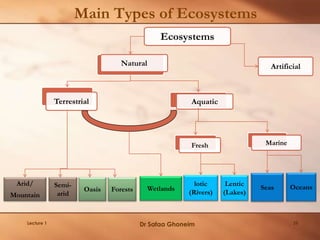
Main Types of Ecosystems
Natural
Arid/
Mountain
Semi-
arid
Oasis Forests
Aquatic
lotic
(Rivers)
Lentic
(Lakes)
SeasWetlands Oceans
Artificial
Terrestrial
Fresh Marine
Ecosystems
Lecture 1 Dr Safaa Ghoneim 26
To understand an Ecosystem
Identify:
1. Type;
2. Main components (physical & living);
3. Interactions (functions & processes);
4. Boundaries (as a functional UNIT);
5. Dynamics (daily, seasonal, annual, longer changes)
6. The Benefits they provide (Eco-Services)
Lecture 1 Dr Safaa Ghoneim 27
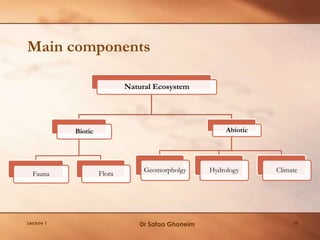
Main components
Natural Ecosystem
Biotic
Fauna Flora
Abiotic
Geomorpholgy Hydrology Climate
Lecture 1 Dr Safaa Ghoneim 28
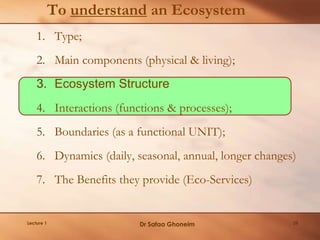
To understand an Ecosystem
1. Type;
2. Main components (physical & living);
3. Ecosystem Structure
4. Interactions (functions & processes);
5. Boundaries (as a functional UNIT);
6. Dynamics (daily, seasonal, annual, longer changes)
7. The Benefits they provide (Eco-Services)
Lecture 1 Dr Safaa Ghoneim 29
Vertical & Horizontal distribution of ecosystem
components
(e.g., vegetation ht., distribution of plant biomass above and
below ground, etc.)
Ecosystem Structure
Function = Chain of processes that are conducted or evaluated at the
ecosystem scale.
Ecosystem Functions
Lecture 1 Dr Safaa Ghoneim 30
To understand an Ecosystem
1. Type;
2. Main components (physical & living);
3. Ecosystem Structure
4. Interactions (functions & processes);
5. Boundaries (as a functional UNIT);
6. Dynamics (daily, seasonal, annual, longer changes)
7. The Benefits they provide (Eco-Services)
Lecture 1 Dr Safaa Ghoneim 31
How do we decide where to draw the lines around an
ecosystem?
Boundaries of Ecosystem (as a functional UNIT);
Natural Boundaries:
Ecosystems sometimes are bounded by
naturally delineated borders (crop field, lake);
appropriate questions include whole-lake
trophic dynamics and energy fluxes (e.g.,
Lindeman 1942)
Lecture 1 Dr Safaa Ghoneim 32
To understand an Ecosystem
1. Type;
2. Main components (physical & living);
3. Ecosystem Structure
4. Interactions (functions & processes);
5. Boundaries (as a functional UNIT);
6. Dynamics (daily, seasonal, annual, longer changes)
7. The Benefits they provide (Eco-Services)
Lecture 1 Dr Safaa Ghoneim 33
Time Scale in Ecosystem Ecology
• Rapid: over the day/ days/ weeks, e.g. wetlands
• Seasonal: e.g. forest, desert grassland
• Successional: 3 months after fire, 300 years after
fire
• Species migration/invasions: 1 to thousands of
years
Lecture 1 Dr Safaa Ghoneim 34
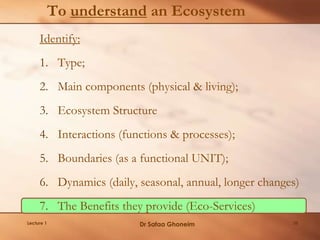
To understand an Ecosystem
Identify:
1. Type;
2. Main components (physical & living);
3. Ecosystem Structure
4. Interactions (functions & processes);
5. Boundaries (as a functional UNIT);
6. Dynamics (daily, seasonal, annual, longer changes)
7. The Benefits they provide (Eco-Services)
Lecture 1 Dr Safaa Ghoneim 35
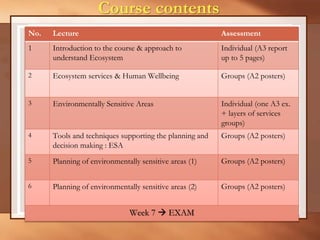
No. Lecture Assessment
1 Introduction to the course & approach to
understand Ecosystem
Individual (A3 report
up to 5 pages)
2 Ecosystem services & Human Wellbeing Groups (A2 posters)
3 Environmentally Sensitive Areas Individual (one A3 ex.
+ layers of services
groups)
4 Tools and techniques supporting the planning and
decision making : ESA
Groups (A2 posters)
5 Planning of environmentally sensitive areas (1) Groups (A2 posters)
6 Planning of environmentally sensitive areas (2) Groups (A2 posters)
Week 7  EXAM
Course contents
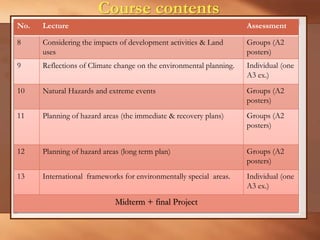
Course contents
No. Lecture Assessment
8 Considering the impacts of development activities & Land
uses
Groups (A2
posters)
9 Reflections of Climate change on the environmental planning. Individual (one
A3 ex.)
10 Natural Hazards and extreme events Groups (A2
posters)
11 Planning of hazard areas (the immediate & recovery plans) Groups (A2
posters)
12 Planning of hazard areas (long term plan) Groups (A2
posters)
13 International frameworks for environmentally special areas. Individual (one
A3 ex.)
Midterm + final Project
Dr Safaa Ghoneim38 Lecture 1
Lecture 1 39
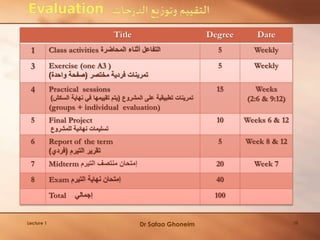
Title Degree Date
1 Class activities ‫المحاضرة‬ ‫أثناء‬ ‫التفاعل‬ 5 Weekly
3 Exercise (one A3 )
‫مختصر‬ ‫فردية‬ ‫تمرينات‬(‫واحدة‬ ‫صفحة‬)
5 Weekly
4 Practical sessions
‫المشروع‬ ‫على‬ ‫تطبيقية‬ ‫تمرينات‬(‫السكش‬ ‫نهاية‬ ‫في‬ ‫تقييمها‬ ‫يتم‬)
(groups + individual evaluation)
15 Weeks
(2:6 & 9:12)
5 Final Project
‫تسليمات‬‫للمشروع‬ ‫نهائية‬
10 Weeks 6 & 12
6 Report of the term
‫تقرير‬‫التيرم‬(‫فردي‬)
5 Week 8 & 12
7 Midterm ‫التيرم‬ ‫منتصف‬ ‫إمتحان‬ 20 Week 7
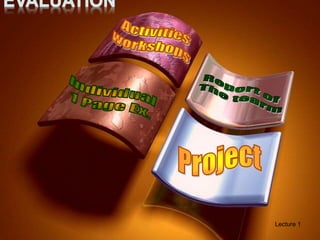
8 Exam ‫التيرم‬ ‫نهاية‬ ‫إمتحان‬ 40
Total ‫إجمالي‬ 100
Dr Safaa Ghoneim
Lecture 1 40
Tasks
‫مهام‬
Start
‫التوقيت‬
Duration (H)
‫بالساعة‬ ‫المدة‬
1 Lecture
‫المحاضرة‬
Saturdays 11:00 am
‫السبت‬: 11 ‫صباحا‬
‫ساعتين‬
2 Practical session
‫العملي‬ ‫التطبيق‬
Saturdays 1:00 pm
‫السبت‬:‫الواحدة‬
‫تقريبا‬ ‫ساعتين‬
3 Academic supervision
‫األكاديمي‬ ‫اإلرشاد‬
Wednesday 1:00
‫االربعاء‬:‫الواحدة‬‫ظهرا‬
‫ساعتين‬
Dr Safaa Ghoneim
Dr Safaa Ghoneim 41Lecture 1

Planning in Environmentally Special Regions- intro

  • 1.
    Leture1 Dr Safaa Ghoneim CairoUniversity Faculty Of Urban & Regional Planning Planning Of Environmentally Special Regions ‫تخطيط‬‫األقاليم‬‫الخاصة‬ ‫البيئية‬ Code 3682
  • 2.
    Agenda Lecture 1 2 Planningof environmentally Special Regions  Focus On the Course Title /the scope of this course  Natural Ecosystems: step1 to understand an ecosystem  Course outlines Dr Safaa Ghoneim
  • 3.
  • 4.
  • 5.
    Land use planning/Physicalplanning: The process of designating and regulating the use of land in order to improve (communities’ / a community’s) physical, economic, social, and environmental efficiency and well-being. √ Starting from the common base Inputs Outputs Tasks Planning Lecture 1 Dr Safaa Ghoneim 5
  • 6.
    Main steps ofPhysical Planning Process Lecture 1 Dr Safaa Ghoneim 6
  • 7.
    7Lecture 1  Isit a liner process?  Is it a systematic process?  Does it follow One Approach or alternative approaches?  Does is respond to the special Factors?  &&& How??? How the planning process should be? Dr Safaa Ghoneim
  • 8.
    • Not linerbut it should include loops & feedbacks • Not systematic: however it has certain major stages, steps and details should differ upon the speciality of each case • Many planning approaches have been developed. &New approaches are in the way. We determine the suitable approach upon the speciality of the case. Planning
  • 9.
    Does is respondto the special Factors? Special factors ???
  • 10.
    Socio-Cultural factors Lecture 110 Planning of Environmentally Special Regions Political factor Economic factor Environmental factor …… , factor? Social Environmental Economic Sustainable One can lead / dominate! Dr Safaa Ghoneim
  • 11.
    Socio-Cultural factors Lecture 111 Planning of environmentally Special Regions  Villages of Noba  Traditional communities in western desert  Fishing villages in the north east  More examples…. Dr Safaa Ghoneim
  • 12.
    Lecture 1 12 Planningof Environmentally Special Regions Political factor  Borders Regions/ communities:,..  Hot areas: problematic,…???  Central strategic areas: ministries district, ??? Dr Safaa Ghoneim
  • 13.
    Lecture 1 13 Planningof environmentally Special Regions Economic factor  Ports cities,  Suez canal region,  Mining cities,  …. Dr Safaa Ghoneim
  • 14.
    Industrial Cities Economic factor Ports Miningcities Poor/ slum areas…… ….. Regions …… Lecture 1 Dr Safaa Ghoneim 14
  • 15.
    The environmental dimensionshould lead the planning process if the project area : Has Significant Environment Planning of Environmentally Special Regions Environmental factor Faces Natural Hazards
  • 16.
    Hazards driven bywater ( i.e. floods, tsunamis, and droughts. Natural hazards, such as: Hazards driven by geology (i.e., earthquakes and volcanic waves) EarthquakesVolcanic Waves Meteorological: hazards driven by weather Heat Waves Cold Waves Freezing Rain Lecture 1 Dr Safaa Ghoneim 16
  • 17.
    Faces Natural Hazards The environmentaldimension should lead the planning process if the project area : Has Significant Environment Planning of Environmentally Special Regions Environmental factor
  • 18.
    Having very significantEnvironment Very rich Biodiversity Rare environmental features Threatened organism/habitats Aesthetic values Cultural values Scientific value / Economic value Lecture 1 Dr Safaa Ghoneim 18
  • 19.
    19Lecture 1 • Eachcase has its speciality to some extends but we always seek for balanced solutions. • When a particular factor can be seen as the major one, it should dominate the planning process. • Although this course will focus on the Environmental special features, the other dimensions will be integrated in the planning process. Remember!! Dr Safaa Ghoneim
  • 20.
    Regional planning Urban/City Planning Urbandesign Landscape Architecture Which scale we are interested in? Planning of Environmentally Special Regions Lecture 1 Dr Safaa Ghoneim 20
  • 21.
    Lecture 1 21 So,it could be: o Global-International o /National- Sub national o /planning region o /city/ small community? o Small area, o Multi scale, Planning of Environmentally Special Regions The special factor can take us up to the global scale and down to a very detailed local scale Dr Safaa Ghoneim
  • 22.
    22Lecture 1 • Herewe focus on the ecosystem as a natural unit. • The special feature can take us up to the global scale and down to a very detailed local scale. • The special features can be Significant Env or Hazards • Our Aim …… Dr Safaa Ghoneim
  • 23.
  • 24.
    Natural Ecosystem is adynamic complex of living communities (e.g. plants, animals, microorganisms, etc) and nonliving natural components (e.g. Water, soil, geography, etc) interacting as a functional unit. Lecture 1 Dr Safaa Ghoneim 24
  • 25.
    To understand anEcosystem Identify: 1. Type; 2. Main components (physical & living); 3. Interactions (functions & processes); 4. Boundaries (as a functional UNIT); 5. Dynamics (daily, seasonal, annual, longer changes) 6. The Benefits they provide (Eco-Services) Lecture 1 Dr Safaa Ghoneim 25
  • 26.
    Main Types ofEcosystems Natural Arid/ Mountain Semi- arid Oasis Forests Aquatic lotic (Rivers) Lentic (Lakes) SeasWetlands Oceans Artificial Terrestrial Fresh Marine Ecosystems Lecture 1 Dr Safaa Ghoneim 26
  • 27.
    To understand anEcosystem Identify: 1. Type; 2. Main components (physical & living); 3. Interactions (functions & processes); 4. Boundaries (as a functional UNIT); 5. Dynamics (daily, seasonal, annual, longer changes) 6. The Benefits they provide (Eco-Services) Lecture 1 Dr Safaa Ghoneim 27
  • 28.
    Main components Natural Ecosystem Biotic FaunaFlora Abiotic Geomorpholgy Hydrology Climate Lecture 1 Dr Safaa Ghoneim 28
  • 29.
    To understand anEcosystem 1. Type; 2. Main components (physical & living); 3. Ecosystem Structure 4. Interactions (functions & processes); 5. Boundaries (as a functional UNIT); 6. Dynamics (daily, seasonal, annual, longer changes) 7. The Benefits they provide (Eco-Services) Lecture 1 Dr Safaa Ghoneim 29
  • 30.
    Vertical & Horizontaldistribution of ecosystem components (e.g., vegetation ht., distribution of plant biomass above and below ground, etc.) Ecosystem Structure Function = Chain of processes that are conducted or evaluated at the ecosystem scale. Ecosystem Functions Lecture 1 Dr Safaa Ghoneim 30
  • 31.
    To understand anEcosystem 1. Type; 2. Main components (physical & living); 3. Ecosystem Structure 4. Interactions (functions & processes); 5. Boundaries (as a functional UNIT); 6. Dynamics (daily, seasonal, annual, longer changes) 7. The Benefits they provide (Eco-Services) Lecture 1 Dr Safaa Ghoneim 31
  • 32.
    How do wedecide where to draw the lines around an ecosystem? Boundaries of Ecosystem (as a functional UNIT); Natural Boundaries: Ecosystems sometimes are bounded by naturally delineated borders (crop field, lake); appropriate questions include whole-lake trophic dynamics and energy fluxes (e.g., Lindeman 1942) Lecture 1 Dr Safaa Ghoneim 32
  • 33.
    To understand anEcosystem 1. Type; 2. Main components (physical & living); 3. Ecosystem Structure 4. Interactions (functions & processes); 5. Boundaries (as a functional UNIT); 6. Dynamics (daily, seasonal, annual, longer changes) 7. The Benefits they provide (Eco-Services) Lecture 1 Dr Safaa Ghoneim 33
  • 34.
    Time Scale inEcosystem Ecology • Rapid: over the day/ days/ weeks, e.g. wetlands • Seasonal: e.g. forest, desert grassland • Successional: 3 months after fire, 300 years after fire • Species migration/invasions: 1 to thousands of years Lecture 1 Dr Safaa Ghoneim 34
  • 35.
    To understand anEcosystem Identify: 1. Type; 2. Main components (physical & living); 3. Ecosystem Structure 4. Interactions (functions & processes); 5. Boundaries (as a functional UNIT); 6. Dynamics (daily, seasonal, annual, longer changes) 7. The Benefits they provide (Eco-Services) Lecture 1 Dr Safaa Ghoneim 35
  • 36.
    No. Lecture Assessment 1Introduction to the course & approach to understand Ecosystem Individual (A3 report up to 5 pages) 2 Ecosystem services & Human Wellbeing Groups (A2 posters) 3 Environmentally Sensitive Areas Individual (one A3 ex. + layers of services groups) 4 Tools and techniques supporting the planning and decision making : ESA Groups (A2 posters) 5 Planning of environmentally sensitive areas (1) Groups (A2 posters) 6 Planning of environmentally sensitive areas (2) Groups (A2 posters) Week 7  EXAM Course contents
  • 37.
    Course contents No. LectureAssessment 8 Considering the impacts of development activities & Land uses Groups (A2 posters) 9 Reflections of Climate change on the environmental planning. Individual (one A3 ex.) 10 Natural Hazards and extreme events Groups (A2 posters) 11 Planning of hazard areas (the immediate & recovery plans) Groups (A2 posters) 12 Planning of hazard areas (long term plan) Groups (A2 posters) 13 International frameworks for environmentally special areas. Individual (one A3 ex.) Midterm + final Project
  • 38.
  • 39.
    Lecture 1 39 TitleDegree Date 1 Class activities ‫المحاضرة‬ ‫أثناء‬ ‫التفاعل‬ 5 Weekly 3 Exercise (one A3 ) ‫مختصر‬ ‫فردية‬ ‫تمرينات‬(‫واحدة‬ ‫صفحة‬) 5 Weekly 4 Practical sessions ‫المشروع‬ ‫على‬ ‫تطبيقية‬ ‫تمرينات‬(‫السكش‬ ‫نهاية‬ ‫في‬ ‫تقييمها‬ ‫يتم‬) (groups + individual evaluation) 15 Weeks (2:6 & 9:12) 5 Final Project ‫تسليمات‬‫للمشروع‬ ‫نهائية‬ 10 Weeks 6 & 12 6 Report of the term ‫تقرير‬‫التيرم‬(‫فردي‬) 5 Week 8 & 12 7 Midterm ‫التيرم‬ ‫منتصف‬ ‫إمتحان‬ 20 Week 7 8 Exam ‫التيرم‬ ‫نهاية‬ ‫إمتحان‬ 40 Total ‫إجمالي‬ 100 Dr Safaa Ghoneim
  • 40.
    Lecture 1 40 Tasks ‫مهام‬ Start ‫التوقيت‬ Duration(H) ‫بالساعة‬ ‫المدة‬ 1 Lecture ‫المحاضرة‬ Saturdays 11:00 am ‫السبت‬: 11 ‫صباحا‬ ‫ساعتين‬ 2 Practical session ‫العملي‬ ‫التطبيق‬ Saturdays 1:00 pm ‫السبت‬:‫الواحدة‬ ‫تقريبا‬ ‫ساعتين‬ 3 Academic supervision ‫األكاديمي‬ ‫اإلرشاد‬ Wednesday 1:00 ‫االربعاء‬:‫الواحدة‬‫ظهرا‬ ‫ساعتين‬ Dr Safaa Ghoneim
  • 41.
    Dr Safaa Ghoneim41Lecture 1