Topic : Lesson 1: PREPARE
STOCKS, SAUCES AND SOUPS
Quarter 3
Rosemarie M. Elchico
PRAYER
Ama namin, kami po ay nagpapasalamat sa binigay mong
panibagong araw upang kami ay matuto. Patawad Ama sa
aming mga kasalanan. Nawa’y gabayan niyo po kami sa
aming pang araw araw na gawain. Hangad po namin ang
kaligtas ng lahat. Itinataas po namin lahat sayo Diyos Amang
makapangyarihan sa lahat .AMEN
ATTENDANCE
Type your name and section in the chat box.
ACTIVITY
Arrange Me !
Direction: Arrange the jumbled letters.
link: https://wordwall.net/resource/27899968
Sub Topic: LO2 Prepare Soups
Required for Menu Item
Rosemarie M. Elchico
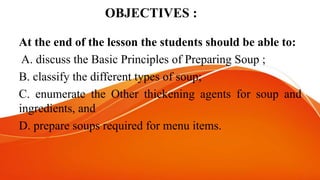
OBJECTIVES :
At the end of the lesson the students should be able to:
A. discuss the Basic Principles of Preparing Soup ;
B. classify the different types of soup;
C. enumerate the Other thickening agents for soup and
ingredients, and
D. prepare soups required for menu items.
Prepare Soups Required for Menu Item
What is SOUP ?
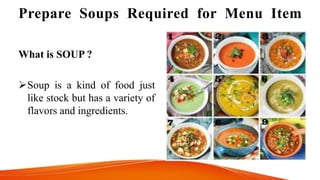
Soup is a kind of food just
like stock but has a variety of
flavors and ingredients.
Prepare Soups Required for Menu Item
What is SOUP ?
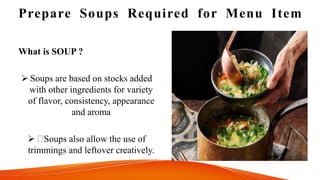
 Soups are based on stocks added
with other ingredients for variety
of flavor, consistency, appearance
and aroma
 Soups also allow the use of
trimmings and leftover creatively.
Prepare Soups Required for Menu Item
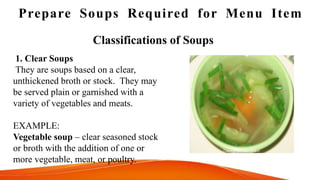
1. Clear Soups
They are soups based on a clear,
unthickened broth or stock. They may
be served plain or garnished with a
variety of vegetables and meats.
EXAMPLE:
Vegetable soup – clear seasoned stock
or broth with the addition of one or
more vegetable, meat, or poultry.
Classifications of Soups
Prepare Soups Required for Menu Item
Classifications of Soups
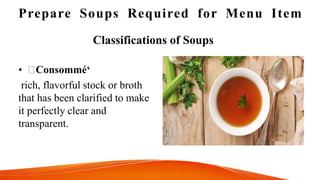
• Consommé‘
rich, flavorful stock or broth
that has been clarified to make
it perfectly clear and
transparent.
Prepare Soups Required for Menu Item
Classifications of Soups
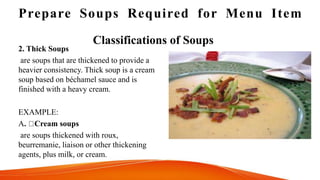
2. Thick Soups
are soups that are thickened to provide a
heavier consistency. Thick soup is a cream
soup based on béchamel sauce and is
finished with a heavy cream.
EXAMPLE:
A. Cream soups
are soups thickened with roux,
beurremanie, liaison or other thickening
agents, plus milk, or cream.
Prepare Soups Required for Menu Item
Classifications of Soups
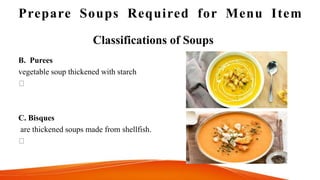
B. Purees
vegetable soup thickened with starch
C. Bisques
are thickened soups made from shellfish.
Prepare Soups Required for Menu Item
Classifications of Soups
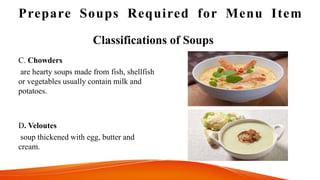
C. Chowders
are hearty soups made from fish, shellfish
or vegetables usually contain milk and
potatoes.
D. Veloutes
soup thickened with egg, butter and
cream.
Prepare Soups Required for Menu Item
Classifications of Soups
3. Other types of soup
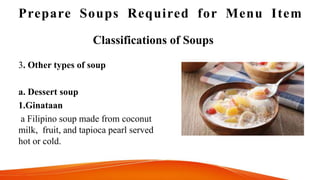
a. Dessert soup
1.Ginataan
a Filipino soup made from coconut
milk, fruit, and tapioca pearl served
hot or cold.
Prepare Soups Required for Menu Item
Classifications of Soups
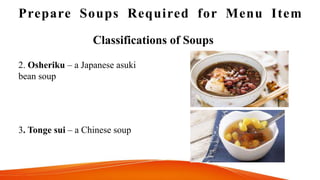
2. Osheriku – a Japanese asuki
bean soup
3. Tonge sui – a Chinese soup
Prepare Soups Required for Menu Item
Classifications of Soups
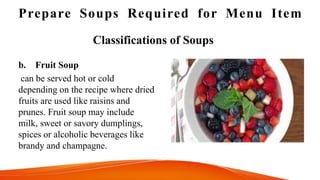
b. Fruit Soup
can be served hot or cold
depending on the recipe where dried
fruits are used like raisins and
prunes. Fruit soup may include
milk, sweet or savory dumplings,
spices or alcoholic beverages like
brandy and champagne.
Prepare Soups Required for Menu Item
Classifications of Soups
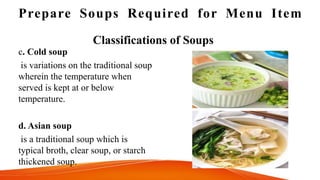
c. Cold soup
is variations on the traditional soup
wherein the temperature when
served is kept at or below
temperature.
d. Asian soup
is a traditional soup which is
typical broth, clear soup, or starch
thickened soup.
Prepare Soups Required for Menu Item
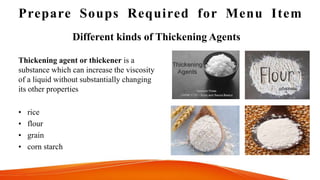
Thickening agent or thickener is a
substance which can increase the viscosity
of a liquid without substantially changing
its other properties
• rice
• flour
• grain
• corn starch
Different kinds of Thickening Agents
Prepare Soups Required for Menu Item
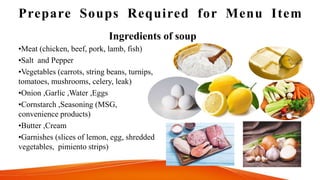
•Meat (chicken, beef, pork, lamb, fish)
•Salt and Pepper
•Vegetables (carrots, string beans, turnips,
tomatoes, mushrooms, celery, leak)
•Onion ,Garlic ,Water ,Eggs
•Cornstarch ,Seasoning (MSG,
convenience products)
•Butter ,Cream
•Garnishes (slices of lemon, egg, shredded
vegetables, pimiento strips)
Ingredients of soup
Prepare Soups Required for Menu Item
1stPrinciple. Starting with Cold Water
Why cold water? Most protein, vitamins and minerals dissolve in
cold water. Part of the flavor comes from these components. Using
hot water would lessen the flavor and nutritive content of stock
2ndPrinciple. Cutting vegetable to appropriate size for the type of
stock.
The size of cut helps the maximum flavor to be extracted.
Example 1: A fish stock only simmer for a half hour (30 minutes) so
the cut should be julienne.
Basic Principles of Preparing Soup
Prepare Soups Required for Menu Item
3rd Principle. Select your protein based. Beef, Chicken, Pork and Fish
All bones are washed, roasted or blanched. Roasted for brown sauce and
blanched for white stock.
4th Principle. Simmering
Gentle extractions aid in flavor and nutrition. Boiling causes cloudiness
through agitation of the ingredients.
5th Principle. Skimming
Keep the stock clear. The scum on top of stocks contains impurities
Basic Principles of Preparing Soup
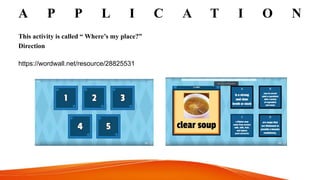
A P P L I C A T I O N
This activity is called “ Where’s my place?”
Direction
https://wordwall.net/resource/28825531
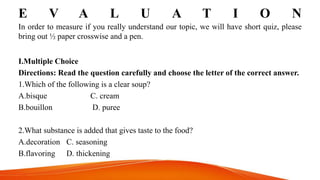
E V A L U A T I O N
In order to measure if you really understand our topic, we will have short quiz, please
bring out ½ paper crosswise and a pen.
I.Multiple Choice
Directions: Read the question carefully and choose the letter of the correct answer.
1.Which of the following is a clear soup?
A.bisque C. cream
B.bouillon D. puree
2.What substance is added that gives taste to the food?
A.decoration C. seasoning
B.flavoring D. thickening
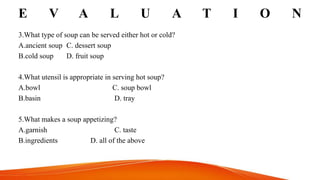
E V A L U A T I O N
3.What type of soup can be served either hot or cold?
A.ancient soup C. dessert soup
B.cold soup D. fruit soup
4.What utensil is appropriate in serving hot soup?
A.bowl C. soup bowl
B.basin D. tray
5.What makes a soup appetizing?
A.garnish C. taste
B.ingredients D. all of the above
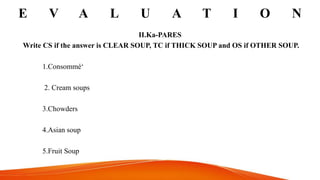
E V A L U A T I O N
II.Ka-PARES
Write CS if the answer is CLEAR SOUP, TC if THICK SOUP and OS if OTHER SOUP.
1.Consommé‘
2. Cream soups
3.Chowders
4.Asian soup
5.Fruit Soup
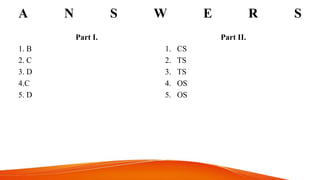
A N S W E R S
Part I.
1. B
2. C
3. D
4.C
5. D
Part II.
1. CS
2. TS
3. TS
4. OS
5. OS
Thank You and Godbless !!

SOUPS DEMO PPT.pptx

  • 2.
    Topic : Lesson1: PREPARE STOCKS, SAUCES AND SOUPS Quarter 3 Rosemarie M. Elchico
  • 3.
    PRAYER Ama namin, kamipo ay nagpapasalamat sa binigay mong panibagong araw upang kami ay matuto. Patawad Ama sa aming mga kasalanan. Nawa’y gabayan niyo po kami sa aming pang araw araw na gawain. Hangad po namin ang kaligtas ng lahat. Itinataas po namin lahat sayo Diyos Amang makapangyarihan sa lahat .AMEN
  • 4.
    ATTENDANCE Type your nameand section in the chat box.
  • 6.
    ACTIVITY Arrange Me ! Direction:Arrange the jumbled letters. link: https://wordwall.net/resource/27899968
  • 7.
    Sub Topic: LO2Prepare Soups Required for Menu Item Rosemarie M. Elchico
  • 8.
    OBJECTIVES : At theend of the lesson the students should be able to: A. discuss the Basic Principles of Preparing Soup ; B. classify the different types of soup; C. enumerate the Other thickening agents for soup and ingredients, and D. prepare soups required for menu items.
  • 9.
    Prepare Soups Requiredfor Menu Item What is SOUP ? Soup is a kind of food just like stock but has a variety of flavors and ingredients.
  • 10.
    Prepare Soups Requiredfor Menu Item What is SOUP ?  Soups are based on stocks added with other ingredients for variety of flavor, consistency, appearance and aroma  Soups also allow the use of trimmings and leftover creatively.
  • 11.
    Prepare Soups Requiredfor Menu Item 1. Clear Soups They are soups based on a clear, unthickened broth or stock. They may be served plain or garnished with a variety of vegetables and meats. EXAMPLE: Vegetable soup – clear seasoned stock or broth with the addition of one or more vegetable, meat, or poultry. Classifications of Soups
  • 12.
    Prepare Soups Requiredfor Menu Item Classifications of Soups • Consommé‘ rich, flavorful stock or broth that has been clarified to make it perfectly clear and transparent.
  • 13.
    Prepare Soups Requiredfor Menu Item Classifications of Soups 2. Thick Soups are soups that are thickened to provide a heavier consistency. Thick soup is a cream soup based on béchamel sauce and is finished with a heavy cream. EXAMPLE: A. Cream soups are soups thickened with roux, beurremanie, liaison or other thickening agents, plus milk, or cream.
  • 14.
    Prepare Soups Requiredfor Menu Item Classifications of Soups B. Purees vegetable soup thickened with starch C. Bisques are thickened soups made from shellfish.
  • 15.
    Prepare Soups Requiredfor Menu Item Classifications of Soups C. Chowders are hearty soups made from fish, shellfish or vegetables usually contain milk and potatoes. D. Veloutes soup thickened with egg, butter and cream.
  • 16.
    Prepare Soups Requiredfor Menu Item Classifications of Soups 3. Other types of soup a. Dessert soup 1.Ginataan a Filipino soup made from coconut milk, fruit, and tapioca pearl served hot or cold.
  • 17.
    Prepare Soups Requiredfor Menu Item Classifications of Soups 2. Osheriku – a Japanese asuki bean soup 3. Tonge sui – a Chinese soup
  • 18.
    Prepare Soups Requiredfor Menu Item Classifications of Soups b. Fruit Soup can be served hot or cold depending on the recipe where dried fruits are used like raisins and prunes. Fruit soup may include milk, sweet or savory dumplings, spices or alcoholic beverages like brandy and champagne.
  • 19.
    Prepare Soups Requiredfor Menu Item Classifications of Soups c. Cold soup is variations on the traditional soup wherein the temperature when served is kept at or below temperature. d. Asian soup is a traditional soup which is typical broth, clear soup, or starch thickened soup.
  • 20.
    Prepare Soups Requiredfor Menu Item Thickening agent or thickener is a substance which can increase the viscosity of a liquid without substantially changing its other properties • rice • flour • grain • corn starch Different kinds of Thickening Agents
  • 21.
    Prepare Soups Requiredfor Menu Item •Meat (chicken, beef, pork, lamb, fish) •Salt and Pepper •Vegetables (carrots, string beans, turnips, tomatoes, mushrooms, celery, leak) •Onion ,Garlic ,Water ,Eggs •Cornstarch ,Seasoning (MSG, convenience products) •Butter ,Cream •Garnishes (slices of lemon, egg, shredded vegetables, pimiento strips) Ingredients of soup
  • 22.
    Prepare Soups Requiredfor Menu Item 1stPrinciple. Starting with Cold Water Why cold water? Most protein, vitamins and minerals dissolve in cold water. Part of the flavor comes from these components. Using hot water would lessen the flavor and nutritive content of stock 2ndPrinciple. Cutting vegetable to appropriate size for the type of stock. The size of cut helps the maximum flavor to be extracted. Example 1: A fish stock only simmer for a half hour (30 minutes) so the cut should be julienne. Basic Principles of Preparing Soup
  • 23.
    Prepare Soups Requiredfor Menu Item 3rd Principle. Select your protein based. Beef, Chicken, Pork and Fish All bones are washed, roasted or blanched. Roasted for brown sauce and blanched for white stock. 4th Principle. Simmering Gentle extractions aid in flavor and nutrition. Boiling causes cloudiness through agitation of the ingredients. 5th Principle. Skimming Keep the stock clear. The scum on top of stocks contains impurities Basic Principles of Preparing Soup
  • 24.
    A P PL I C A T I O N This activity is called “ Where’s my place?” Direction https://wordwall.net/resource/28825531
  • 25.
    E V AL U A T I O N In order to measure if you really understand our topic, we will have short quiz, please bring out ½ paper crosswise and a pen. I.Multiple Choice Directions: Read the question carefully and choose the letter of the correct answer. 1.Which of the following is a clear soup? A.bisque C. cream B.bouillon D. puree 2.What substance is added that gives taste to the food? A.decoration C. seasoning B.flavoring D. thickening
  • 26.
    E V AL U A T I O N 3.What type of soup can be served either hot or cold? A.ancient soup C. dessert soup B.cold soup D. fruit soup 4.What utensil is appropriate in serving hot soup? A.bowl C. soup bowl B.basin D. tray 5.What makes a soup appetizing? A.garnish C. taste B.ingredients D. all of the above
  • 27.
    E V AL U A T I O N II.Ka-PARES Write CS if the answer is CLEAR SOUP, TC if THICK SOUP and OS if OTHER SOUP. 1.Consommé‘ 2. Cream soups 3.Chowders 4.Asian soup 5.Fruit Soup
  • 28.
    A N SW E R S Part I. 1. B 2. C 3. D 4.C 5. D Part II. 1. CS 2. TS 3. TS 4. OS 5. OS
  • 29.
    Thank You andGodbless !!