Francesca Gregory
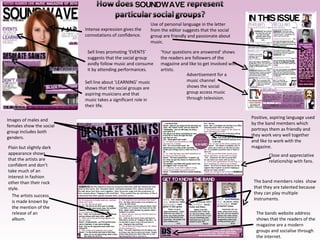
Images of males and females show the social group includes both genders. Intense expression gives the connotations of confidence. Sell lines promoting ‘EVENTS’ suggests that the social group avidly follow music and consume it by attending performances. Sell line about ‘LEARNING’ music shows that the social groups are aspiring musicians and that music takes a significant role in their life. Advertisement for a music channel shows the social group access music through television. ‘ Your questions are answered’ shows the readers are followers of the magazine and like to get involved with artists.  Use of personal language in the letter from the editor suggests that the social group are friendly and passionate about music. The bands website address shows that the readers of the magazine are a modern groups and socialise through the internet. Positive, aspiring language used by the band members which portrays them as friendly and they work very well together  and like to work with the magazine.  The band members roles  show that they are talented because they can play multiple instruments. The artists success is made known by the mention of the release of an album. Close and appreciative relationship with fans. Plain but slightly dark appearance shows that the artists are confident and don’t take much of an interest in fashion other than their rock style.
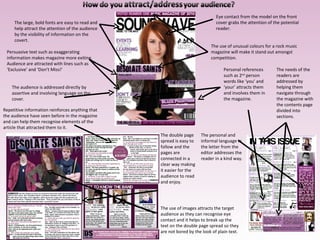
The large, bold fonts are easy to read and help attract the attention of the audience by the visibility of information on the covert. The use of unusual colours for a rock music magazine will make it stand out amongst competition. Personal references such as 2 nd  person words like ‘you’ and ‘your’ attracts them and involves them in the magazine. The needs of the readers are addressed by helping them navigate through the magazine with the contents page divided into sections. Eye contact from the model on the front cover grabs the attention of the potential reader. Persuasive text such as exaggerating information makes magazine more exiting. Audience are attracted with lines such as ‘Exclusive’ and ‘Don’t Miss!’ The audience is addressed directly by assertive and involving language on the cover. The personal and informal language in the letter from the editor addresses the reader in a kind way. The use of images attracts the target audience as they can recognise eye contact and it helps to break up the text on the double page spread so they are not bored by the look of plain text. The double page spread is easy to follow and the pages are connected in a clear way making it easier for the audience to read and enjoy. Repetitive information reinforces anything that the audience have seen before in the magazine and can help them recognise elements of the article that attracted them to it.
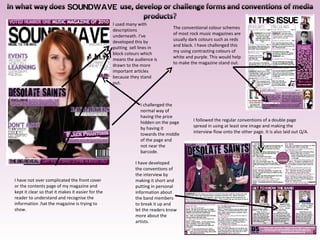
I used many with descriptions underneath. I’ve developed this by putting  sell lines in block colours which means the audience is drawn to the more important articles because they stand out. The conventional colour schemes of most rock music magazines are usually dark colours such as reds and black. I have challenged this my using contrasting colours of white and purple. This would help to make the magazine stand out. I followed the regular conventions of a double page spread in using at least one image and making the interview flow onto the other page. It is also laid out Q/A. I have developed the conventions of the interview by making it short and putting in personal information about the band members to break it up and let the readers know more about the artists. I challenged the normal way of having the price hidden on the page by having it towards the middle of the page and not near the barcode. I have not over complicated the front cover or the contents page of my magazine and kept it clear so that it makes it easier for the reader to understand and recognise the information .hat the magazine is trying to show.
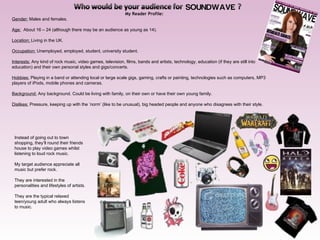
My Reader Profile: Gender:  Males and females.   Age:   About 16 – 24 (although there may be an audience as young as 14). Location:  Living in the UK.   Occupation:  Unemployed, employed, student, university student.   Interests:  Any kind of rock music, video games, television, films, bands and artists, technology, education (if they are still into education) and their own personal styles and gigs/concerts.   Hobbies:  Playing in a band or attending local or large scale gigs, gaming, crafts or painting, technologies such as computers, MP3 players of iPods, mobile phones and cameras.   Background:  Any background. Could be living with family, on their own or have their own young family.   Dislikes:  Pressure, keeping up with the ’norm’ (like to be unusual), big headed people and anyone who disagrees with their style.   Instead of going out to town shopping, they’ll round their friends house to play video games whilst listening to loud rock music.  My target audience appreciate all music but prefer rock. They are interested in the personalities and lifestyles of artists.  They are the typical relaxed teen/young adult who always listens to music.
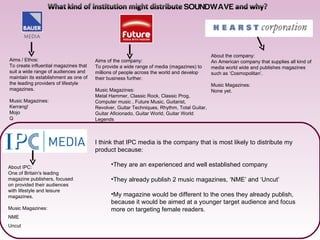
Aims / Ethos: To create influential magazines that suit a wide range of audiences and maintain its establishment as one of the leading providers of lifestyle magazines.  Music Magazines: Kerrang!  Mojo Q Aims of the company: To provide a wide range of media (magazines) to millions of people across the world and develop their business further. Music Magazines: Metal Hammer, Classic Rock, Classic Prog, Computer music , Future Music, Guitarist, Revolver, Guitar Techniques, Rhythm, Total Guitar, Guitar Aficionado, Guitar World, Guitar World Legends About the company: An American company that supplies all kind of media world wide and publishes magazines such as ‘Cosmopolitan’.  Music Magazines: None yet. About IPC: One of Britain's leading magazine publishers, focused on provided their audiences with lifestyle and leisure magazines. Music Magazines: NME Uncut I think that IPC media is the company that is most likely to distribute my product because: They are an experienced and well established company They already publish 2 music magazines, ‘NME’ and ‘Uncut’ My magazine would be different to the ones they already publish, because it would be aimed at a younger target audience and focus more on targeting female readers.
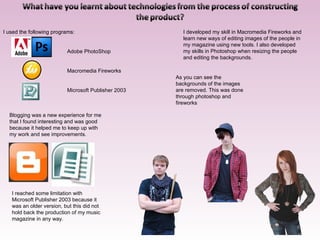
I used the following programs: Adobe PhotoShop Macromedia Fireworks Microsoft Publisher 2003 I developed my skill in Macromedia Fireworks and learn new ways of editing images of the people in my magazine using new tools. I also developed my skills in Photoshop when resizing the people and editing the backgrounds. Blogging was a new experience for me that I found interesting and was good because it helped me to keep up with my work and see improvements. I reached some limitation with Microsoft Publisher 2003 because it was an older version, but this did not hold back the production of my music magazine in any way. As you can see the backgrounds of the images are removed. This was done through photoshop and fireworks
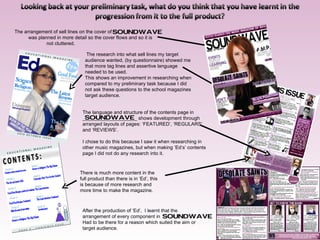
The arrangement of sell lines on the cover of was planned in more detail so the cover flows and so it is  not cluttered. The language and structure of the contents page in  ____________________ shows development through arranged layouts of pages: ‘FEATURED’, ‘REGULARS’ and ‘REVIEWS’. I chose to do this because I saw it when researching in other music magazines, but when making ‘Ed’s’ contents page I did not do any research into it. The research into what sell lines my target audience wanted, (by questionnaire) showed me that more tag lines and assertive language needed to be used. This shows an improvement in researching when compared to my preliminary task because I did not ask these questions to the school magazines target audience. There is much more content in the full product than there is in ‘Ed’, this is because of more research and more time to make the magazine. After the production of ‘Ed’,  I learnt that the arrangement of every component in  Had to be there for a reason which suited the aim or target audience.

SOUNDWAVE Evaluation Presentation

  • 1.
  • 2.
    Images of malesand females show the social group includes both genders. Intense expression gives the connotations of confidence. Sell lines promoting ‘EVENTS’ suggests that the social group avidly follow music and consume it by attending performances. Sell line about ‘LEARNING’ music shows that the social groups are aspiring musicians and that music takes a significant role in their life. Advertisement for a music channel shows the social group access music through television. ‘ Your questions are answered’ shows the readers are followers of the magazine and like to get involved with artists. Use of personal language in the letter from the editor suggests that the social group are friendly and passionate about music. The bands website address shows that the readers of the magazine are a modern groups and socialise through the internet. Positive, aspiring language used by the band members which portrays them as friendly and they work very well together and like to work with the magazine. The band members roles show that they are talented because they can play multiple instruments. The artists success is made known by the mention of the release of an album. Close and appreciative relationship with fans. Plain but slightly dark appearance shows that the artists are confident and don’t take much of an interest in fashion other than their rock style.
  • 3.
    The large, boldfonts are easy to read and help attract the attention of the audience by the visibility of information on the covert. The use of unusual colours for a rock music magazine will make it stand out amongst competition. Personal references such as 2 nd person words like ‘you’ and ‘your’ attracts them and involves them in the magazine. The needs of the readers are addressed by helping them navigate through the magazine with the contents page divided into sections. Eye contact from the model on the front cover grabs the attention of the potential reader. Persuasive text such as exaggerating information makes magazine more exiting. Audience are attracted with lines such as ‘Exclusive’ and ‘Don’t Miss!’ The audience is addressed directly by assertive and involving language on the cover. The personal and informal language in the letter from the editor addresses the reader in a kind way. The use of images attracts the target audience as they can recognise eye contact and it helps to break up the text on the double page spread so they are not bored by the look of plain text. The double page spread is easy to follow and the pages are connected in a clear way making it easier for the audience to read and enjoy. Repetitive information reinforces anything that the audience have seen before in the magazine and can help them recognise elements of the article that attracted them to it.
  • 4.
    I used manywith descriptions underneath. I’ve developed this by putting sell lines in block colours which means the audience is drawn to the more important articles because they stand out. The conventional colour schemes of most rock music magazines are usually dark colours such as reds and black. I have challenged this my using contrasting colours of white and purple. This would help to make the magazine stand out. I followed the regular conventions of a double page spread in using at least one image and making the interview flow onto the other page. It is also laid out Q/A. I have developed the conventions of the interview by making it short and putting in personal information about the band members to break it up and let the readers know more about the artists. I challenged the normal way of having the price hidden on the page by having it towards the middle of the page and not near the barcode. I have not over complicated the front cover or the contents page of my magazine and kept it clear so that it makes it easier for the reader to understand and recognise the information .hat the magazine is trying to show.
  • 5.
    My Reader Profile:Gender: Males and females.   Age: About 16 – 24 (although there may be an audience as young as 14). Location: Living in the UK.   Occupation: Unemployed, employed, student, university student.   Interests: Any kind of rock music, video games, television, films, bands and artists, technology, education (if they are still into education) and their own personal styles and gigs/concerts.   Hobbies: Playing in a band or attending local or large scale gigs, gaming, crafts or painting, technologies such as computers, MP3 players of iPods, mobile phones and cameras.   Background: Any background. Could be living with family, on their own or have their own young family.   Dislikes: Pressure, keeping up with the ’norm’ (like to be unusual), big headed people and anyone who disagrees with their style.   Instead of going out to town shopping, they’ll round their friends house to play video games whilst listening to loud rock music. My target audience appreciate all music but prefer rock. They are interested in the personalities and lifestyles of artists. They are the typical relaxed teen/young adult who always listens to music.
  • 6.
    Aims / Ethos:To create influential magazines that suit a wide range of audiences and maintain its establishment as one of the leading providers of lifestyle magazines. Music Magazines: Kerrang! Mojo Q Aims of the company: To provide a wide range of media (magazines) to millions of people across the world and develop their business further. Music Magazines: Metal Hammer, Classic Rock, Classic Prog, Computer music , Future Music, Guitarist, Revolver, Guitar Techniques, Rhythm, Total Guitar, Guitar Aficionado, Guitar World, Guitar World Legends About the company: An American company that supplies all kind of media world wide and publishes magazines such as ‘Cosmopolitan’. Music Magazines: None yet. About IPC: One of Britain's leading magazine publishers, focused on provided their audiences with lifestyle and leisure magazines. Music Magazines: NME Uncut I think that IPC media is the company that is most likely to distribute my product because: They are an experienced and well established company They already publish 2 music magazines, ‘NME’ and ‘Uncut’ My magazine would be different to the ones they already publish, because it would be aimed at a younger target audience and focus more on targeting female readers.
  • 7.
    I used thefollowing programs: Adobe PhotoShop Macromedia Fireworks Microsoft Publisher 2003 I developed my skill in Macromedia Fireworks and learn new ways of editing images of the people in my magazine using new tools. I also developed my skills in Photoshop when resizing the people and editing the backgrounds. Blogging was a new experience for me that I found interesting and was good because it helped me to keep up with my work and see improvements. I reached some limitation with Microsoft Publisher 2003 because it was an older version, but this did not hold back the production of my music magazine in any way. As you can see the backgrounds of the images are removed. This was done through photoshop and fireworks
  • 8.
    The arrangement ofsell lines on the cover of was planned in more detail so the cover flows and so it is not cluttered. The language and structure of the contents page in ____________________ shows development through arranged layouts of pages: ‘FEATURED’, ‘REGULARS’ and ‘REVIEWS’. I chose to do this because I saw it when researching in other music magazines, but when making ‘Ed’s’ contents page I did not do any research into it. The research into what sell lines my target audience wanted, (by questionnaire) showed me that more tag lines and assertive language needed to be used. This shows an improvement in researching when compared to my preliminary task because I did not ask these questions to the school magazines target audience. There is much more content in the full product than there is in ‘Ed’, this is because of more research and more time to make the magazine. After the production of ‘Ed’, I learnt that the arrangement of every component in Had to be there for a reason which suited the aim or target audience.

Editor's Notes

  • #3 The social group that I aimed to represent through my magazine were confident teenagers passionate about music. I have shown this through various ways, such as the appearance of the people in the magazine, being the same age of the group and showing their confidence through their expressions, The ideas and values of the group are shown through the language used in the presentation. E.g. on my contents page, the readers are shown to be involved in the magazine and their artists by an article about what the readers have to say. The mannerisms or personality of the group are represented through the relaxed, informal use of language in both the interview and editors letter. This personal way of speaking gives connotations of friendliness and that they are good people. This can be reinforced when the ‘Desolate Saints’ say that they admire their fans. In the interview of the band, the social group is represented at intelligent or talented in terms of music because most members of the featured band can read music and play multiple instruments. The fact that they met in college (shown by an answer in the interview) also suggests that the social group are educated people who enjoy school and have ambition to do well because of taking further education. The groups ambition is also expressed by their plans for the future and how they express that they want to do well and win awards for their music. The social group is shown to consume music through the internet and television, which is shown on the contents page and double page spread because the band have a website and the contents page has an advert for a new music television channel.
  • #4 The front cover of a magazine is the most important way to attract an audience because it is the first part of the magazine they will see, even before purchase. Some techniques used on the front cover of the music magazine include eye contact from the large picture of the artist on the cover, which helps to grab the attention of the reader and draw them in. Other techniques such as bold, outlined text and colours help to attract the audience visually. The text on the front cover (and also in the contents page) help to address the target audience by involving them in the magazine and addressing them directly using words such as ‘you’ and ‘your’. Another way to help address the audience is displayed on the cover as the phrase ‘DON’T MISS!’ which includes capital letters and an exclamation mark to draw attention and excite or alert the reader. The personal and informal language like in the letter from the editor helps to involve the reader because it is as if they are reading a letter to them, instead of just information. The conversation between the interviews host and the band on the double page spread article acts as a conversation which is much easier to read and more involving, attracting the audience by making things easier to manage. The contents page addresses the needs of the audience because it shows them all articles and what pages that they can be found on. It also meets the need further by sorting them into sections, ‘Featured’, ‘Regular’ and ‘ Reviews’.
  • #5 I have not challenged the conventions of the sell lines by using many with descriptions underneath. However, I have developed this by putting some of the sell lines in block colours which means the audience is drawn to the more important articles because they stand out.
  • #6 My Reader Profile: Age: I am targeting at anyone from the age of about 16 – 22 (although the magazine may gain some audiences a few yeas younger or older). Location: It is for people living in the UK.   Occupation: The reader audience could be unemployed, still living at home with their parents, have a job or go to university; it doesn’t matter so much to the magazine along as they are young rock music lovers.   Interests: Music, video games, television, films, bands and artists, the latest information on what music is available, anything to do with technology, slightly interested in education (if they are still into education) and their own personal styles and gigs or concerts.   Hobbies: Playing in a band or attending local or large scale gigs, gaming, crafts or painting, anything to do with technology.   Background: Anyone from any kind of background who can afford a magazine, it could be an intelligent, rebelling female who is in her late teens living with their parents in a large house or a 20 year old man who lives in a studio flat above a shop who never got on well at school. Gender: There is no gender preference for this magazine. It is targeted at both males and females.     Dislikes: Anything ‘usual’, people putting pressure on them, arrogant or posh people, seafood, old people, small annoying children and anyone who disagrees with their taste in music or the way that they dress.   My target audience are the kind of people who instead of going out to town shopping will pile round their mates house to play video games whilst listening to loud rock music or watch tv or a film together. They appreciate all kinds of music but prefer rock and have a keen interest in the personalities and lifestyles of artists and bands. They’re that kind of person in their late teens who is chilled, open and always plugged into a booming set of earphones.
  • #8 In the construction of my music magazine I used the following programs. Microsoft Publisher, Adobe Photoshop and Macromedia Fireworks. I had already used these programs before but the one I knew least about was Macromedia Fireworks. I used Photoshop and Fireworks for editing my pictures but I had hardly used fireworks and it was the most available program on the computers that I was using so it has broadened my knowledge of the program. I already knew about cameras and owned my own digital slr that I used to take the pictures of my magazine, so I did not gain much experience from taking photographs. The main things that I learn was developing new skills in Firework and Photoshop such as air brushing people and making the girl on my cover look slimmer than in the original picture using different tools than what I am used to in the programs. This helped me to work much quicker and with more ease. I had never blogged before, but I found it helpful and fun to keep on track with my work. Updating it and sharing progress with people such as my classmates proved helful in showing what I had done so far and gave me a chance to look back and reflect on any developments that could be made. One limitation that I reached was that the school only provided Microsoft Publisher 2003 in the rooms that I used computers, and I would have preferred to use one of the newer versions available, 2007.
  • #9 During the process of making my school magazine and the music magazine, I felt that I have learn lot’s of different things, such as the amount of research required for a successful production of a magazine and the fact that every tiny detail matters and has to be related to the connotations and regulation of the magazine. After making the school magazine and receiving feedback, I learnt that everything that is included in soundwave has to have a relevant reason for being there that can be related to the target audience or purpose of the magazine. Time management and photography were not much different when comparing the making of both magazine, but the structure and layout of them significantly changed. As well as there being more content in the full production, the arrangement of sell lines and information on the cover was planned in much more detail to ensure that the appearance of the cover flows more and there is not more information cluttering the cover than there needs to be. The research into what sell lines my target audience wanted, (which was done by asking them through a questionnaire) showed me that more tag lines and assertive language needed to be used. This shows an improvement in researching when compared to my preliminary task because I did not ask these questions to the school magazines target audience. The language and structure of the contents page in soundwave shows that there was development in arranging the layouts of pages into sections such as ‘featured’ ‘regulars’ and ‘reviews’. This was done through looking at and comparing other music magazines to see what they had, whereas in the mock up of the school magazines contents page, no research was put into what the readers would want and how they would like it to be displayed. Even though I didn’t create a double page spread article for my preliminary task, I found that I made improvements when creating the article on the Desolate Saints in soundwave, through looking at the language used by other journalists and artists being interviewed in other magazines.