New regulator lists UKCS 'priority actions' |
Tap Oil ownership under siege by Northern Gulf Petroleum
03/02/2015
Anders Andreasen
Jacob Gram Iskov Eriksen
Carsten Stegelmann
Hasse Lynggaard
Ramboll Oil & Gas
Esbjerg, Denmark
Settle-out calculations in natural gas systems need to be sufficiently rigorous accurately
to predict settle-out under various operating conditions without being so conservative
as to increase costs.
This article proposes a particular rigorous calculation usable as an alternative to a
process simulator. The varied contributions of many subvolumes to the final settle-out
calculation complicate the process and can produce inaccuracies during use of a non-
rigorous method. The simple method, however, is easy to implement and requires no
thermodynamic package or calculation tool.
The simple method proposed in this article is also preferable to both Tn and Tm
methods due to its greater simplicity. The proposed simple method may be applied with
only minor calculation inaccuracy when:
• Based on an evaluation of settle-out calculations for installed equipment, the
inaccuracy created by use of one of the simpler methods presented is in the range ±2%
and the highest pressure in any of the subvolumes before settle-out is less than 150
barg.
• Parameter variation studies show that keeping the maximum pressure less than 100
bar or three times the lowest system pressure, whichever is the lowest, and at the
same time keeping the molecular weight less than 26 kg/kmol should limit calculation
inaccuracy to a maximum ±2% at temperature.
Looking for past issues? Click here.
Home » More General Interest » Method improves high-pressure settle-out calculations
Method improves high-pressure
settle-out calculations
SUBSCRIBE
CURRENT ISSUE
PAST ISSUES
UNCONVENTIONAL
HOME
GENERAL INTEREST
EXPLORATION &
DEVELOPMENT
DRILLING & PRODUCTION
REFINING & PROCESSING
PIPELINES &
TRANSPORTATION
OGJ RESOURCES
Page 1 of 13Method improves high-pressure settle-out calculations - Oil & Gas Journal
19.06.2015http://www.ogj.com/articles/print/volume-113/issue-3/transportation/method-improve...
Relative calculation inaccuracy should of course be compared with actual settle-out
pressure. The simple method also generally seems to overvalue settle-out pressure at
high pressure, which is conservative and safe but may lead to over-design if used in
extreme cases.
We recommend that liquid content be excluded in the calculation to prevent an
undervaluation of the settle-out pressure. The liquid should be considered an inert
spectator not exchanging mass or energy with the gas. The volume occupied by the
liquid should be subtracted from the system volume.
Settle-out calculations
Settle-out calculations represent an important step in several key engineering activities,
both in initial design and when updating operating conditions, alarm levels, and during
design modification projects, especially for compressor loops. Settle-out calculations
help:
• Decide upon design pressure of the low-pressure part of the settle-out system.
• Determine starting pressure and temperature for blow-down calculations.
• Calculate compressor restart conditions after a compressor trip.
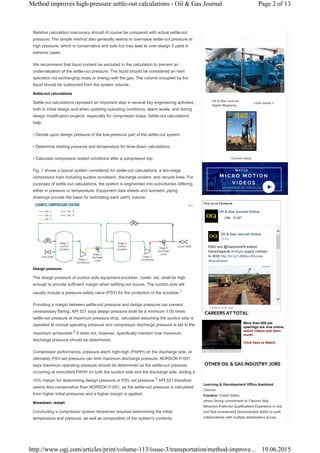
Fig. 1 shows a typical system considered for settle-out calculations; a two-stage
compressor train including suction scrubbers, discharge coolers, and recycle lines. For
purposes of settle-out calculations, the system is segmented into subvolumes differing
either in pressure or temperature. Equipment data sheets and isometric piping
drawings provide the basis for estimating each part's volume.
Design pressure
The design pressure of suction side equipment-scrubber, cooler, etc.-shall be high
enough to provide sufficient margin when settling-out occurs. The suction side will
usually include a pressure safety valve (PSV) for fire protection of the scrubber.1
Providing a margin between settle-out pressure and design pressure can prevent
unnecessary flaring. API 521 says design pressure shall be a minimum 1.05 times
settle-out pressure at maximum pressure drop, calculated assuming the suction side is
operated at normal operating pressure and compressor discharge pressure is set to the
maximum achievable.2
It does not, however, specifically mention how maximum
discharge pressure should be determined.
Compressor performance, pressure alarm high-high (PAHH) on the discharge side, or
ultimately PSV-set pressure can limit maximum discharge pressure. NORSOK P-001
says maximum operating pressure should be determined as the settle-out pressure
occurring at coincident PAHH on both the suction side and the discharge side, adding a
10% margin for determining design pressure or PSV set pressure.3
API 521 therefore
seems less conservative than NORSOK P-001, as the settle-out pressure is calculated
from higher initial pressures and a higher margin is applied.
Blowdown, restart
Conducting a compressor system blowdown requires determining the initial
temperature and pressure, as well as composition of the system's contents.
Learning & Development Office Assistant
Chevron
Country: United States
others.Strong commitment to Chevron Way
Behaviors.Preferred Qualifications:Experience in and
and field environment.Demonstrated ability to work
collaboratively with multiple stakeholders across...
Oil & Gas Journal
Digital Magazine
Look Inside >
Current Issue


Find us on Facebook
Oil & Gas Journal Online
33,387
Facebook social plugin
LikeLike
Oil & Gas Journal Online
KMG and @GazpromEN extend
Karachaganak natgas# supply contract
to 2038 http://bit.ly/1J6jBau Russia#
Kazakhstan#
10 hrs
More than 600 job
openings are now online,
watch videos and learn
more!
Click Here to Watch
CAREERS AT TOTAL
OTHER OIL & GAS INDUSTRY JOBS
Page 2 of 13Method improves high-pressure settle-out calculations - Oil & Gas Journal
19.06.2015http://www.ogj.com/articles/print/volume-113/issue-3/transportation/method-improve...
Temperature and pressure are defined as the settle-out pressure and temperature.4
Blowdown calculations, however, can be performed for a number of scenarios. Cold
blowdown simulations check for low temperatures, below the material design
temperature, which can cause brittle fractures.5
Fire cases are simulated where
ruptures due to high temperature, which can weaken the material, are a risk.6 7
For the
former we perform settle-out calculations from normal operating conditions and for the
latter settle-out calculations from coincident PAHH trips.
The settle-out pressure calculation is also of interest in estimating the required torque
in case of a compressor trip and a subsequent fast restart without intermediate
depressurization-blowdown.8 9
The higher the settle-out pressure the higher the
required torque. Restart torque is key information in appropriately specifying the
compressor driver.
Rigorous method
A key characteristic of the settle-out process is that it occurs at constant volume.
Assuming pressure equalization between subvolumes occurs quickly enough for heat
transfer to be negligible allows reduction of the first law of thermodynamics to
ΔU=Q+W=0, where ΔU is the change in internal energy, Q is heat, and W is work. The
thermodynamic problem to be solved, therefore, has a constant volume and constant
internal energy: a UV-problem.
The solution method proposed in this article is based on a constant-temperature and
constant-pressure flash calculation employing the Peng-Robinson equation of state
(EoS). Calculation of density and real gas corrections to all thermodynamic properties
(U, H, and S) are based on the EoS.
The solution procedure is to calculate the internal energy of all subvolumes, Vi, and
from these find the total internal energy, Utot, at the starting conditions for each
subvolume, Ti and Pi. The content in all subvolumes is added. An initial estimate of the
settle-out pressure is made with a simple method. Internal energy and fluid volume of
the total mass is calculated at the initial guess for T and P. Subsequently changing
pressure and temperature values ensures ΔV and ΔU are zero. The pressure and
temperature that satisfy a constant volume and a constant internal energy are the
settle-out pressure and temperature.
Search More Job Listings >>
Page 3 of 13Method improves high-pressure settle-out calculations - Oil & Gas Journal
19.06.2015http://www.ogj.com/articles/print/volume-113/issue-3/transportation/method-improve...
Simple method
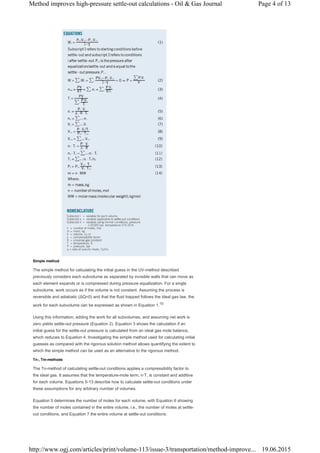
The simple method for calculating the initial guess in the UV-method described
previously considers each subvolume as separated by invisible walls that can move as
each element expands or is compressed during pressure equalization. For a single
subvolume, work occurs as if the volume is not constant. Assuming the process is
reversible and adiabatic (ΔQ=0) and that the fluid trapped follows the ideal gas law, the
work for each subvolume can be expressed as shown in Equation 1.10
Using this information, adding the work for all subvolumes, and assuming net work is
zero yields settle-out pressure (Equation 2). Equation 3 shows the calculation if an
initial guess for the settle-out pressure is calculated from an ideal gas mole balance,
which reduces to Equation 4. Investigating the simple method used for calculating initial
guesses as compared with the rigorous solution method allows quantifying the extent to
which the simple method can be used as an alternative to the rigorous method.
Tn-, Tm-methods
The Tn-method of calculating settle-out conditions applies a compressibility factor to
the ideal gas. It assumes that the temperature-mole term, n∙T, is constant and additive
for each volume. Equations 5-13 describe how to calculate settle-out conditions under
these assumptions for any arbitrary number of volumes.
Equation 5 determines the number of moles for each volume, with Equation 6 showing
the number of moles contained in the entire volume, i.e., the number of moles at settle-
out conditions, and Equation 7 the entire volume at settle-out conditions.
Page 4 of 13Method improves high-pressure settle-out calculations - Oil & Gas Journal
19.06.2015http://www.ogj.com/articles/print/volume-113/issue-3/transportation/method-improve...
The normal volume of each volume-segment is calculated with normal conditions
(Equation 8); Pi,n=1.01325 bar and Ti,n=273.15 K., with Equation 9 determining normal
volume for settle-out conditions. Simply applying the ideal gas equation including the
compressibility factor then yields temperature-mole term for each volume (Equation
10).
Under the assumptions made for this simple approach, the temperature-mole term for
the settle-out conditions will be the total sum of each temperature-mole term (Equation
11). Equation 12 estimates the subsequent settle-out temperature. Applying the
concept of volume under normal conditions, as previously determined, yields estimated
settle-out pressure (Equation 13).
The Tn method of calculating settle-out conditions did not include the molar masses of
each individual volume. This omission, however, is negligible when molar masses are
more or less equal. The Tm method incorporates molar mass by using a temperature-
mass term, replacing the previously used temperature-mole term.
Equation 14 provides the relationship between the number of moles, molar mass, and
mass. Similar equations and assumptions as presented for the Tn-method can
determine settle-out conditions with the Tm method by applying the temperature-mass
term, m∙T.
Results
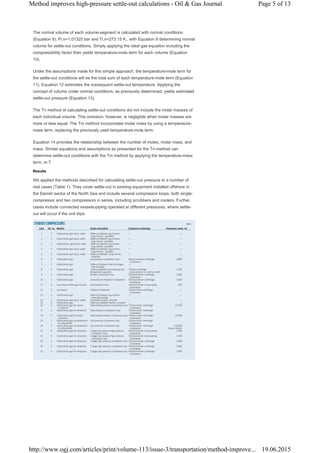
We applied the methods described for calculating settle-out pressure to a number of
real cases (Table 1). They cover settle-out in existing equipment installed offshore in
the Danish sector of the North Sea and include several compressor loops, both single-
compressor and two compressors in series, including scrubbers and coolers. Further
cases include connected vessels-piping operated at different pressures, where settle-
out will occur if the unit trips.
Page 5 of 13Method improves high-pressure settle-out calculations - Oil & Gas Journal
19.06.2015http://www.ogj.com/articles/print/volume-113/issue-3/transportation/method-improve...
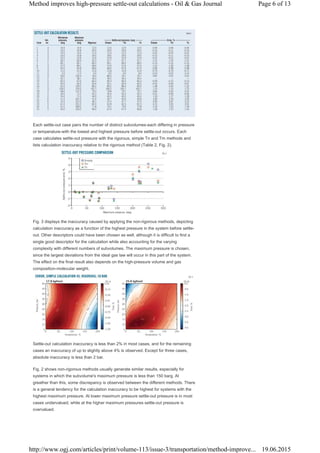
Each settle-out case pairs the number of distinct subvolumes-each differing in pressure
or temperature-with the lowest and highest pressure before settle-out occurs. Each
case calculates settle-out pressure with the rigorous, simple Tn and Tm methods and
lists calculation inaccuracy relative to the rigorous method (Table 2, Fig. 2).
Fig. 3 displays the inaccuracy caused by applying the non-rigorous methods, depicting
calculation inaccuracy as a function of the highest pressure in the system before settle-
out. Other descriptors could have been chosen as well, although it is difficult to find a
single good descriptor for the calculation while also accounting for the varying
complexity with different numbers of subvolumes. The maximum pressure is chosen,
since the largest deviations from the ideal gas law will occur in this part of the system.
The effect on the final result also depends on the high-pressure volume and gas
composition-molecular weight.
Settle-out calculation inaccuracy is less than 2% in most cases, and for the remaining
cases an inaccuracy of up to slightly above 4% is observed. Except for three cases,
absolute inaccuracy is less than 2 bar.
Fig. 2 shows non-rigorous methods usually generate similar results, especially for
systems in which the subvolume's maximum pressure is less than 150 barg. At
greather than this, some discrepancy is observed between the different methods. There
is a general tendency for the calculation inaccuracy to be highest for systems with the
highest maximum pressure. At lower maximum pressure settle-out pressure is in most
cases undervalued, while at the higher maximum pressures settle-out pressure is
overvalued.
Page 6 of 13Method improves high-pressure settle-out calculations - Oil & Gas Journal
19.06.2015http://www.ogj.com/articles/print/volume-113/issue-3/transportation/method-improve...
Parameter variation
We studied the suitability of the simple method for settle-out calculations by performing
a number of parameter variation studies investigating the effects of pressure,
temperature, and molecular weight on the calculation inaccuracy for settling-out
between two equal volumes. Calculation inaccuracy is estimated by comparison with
the rigorous method.
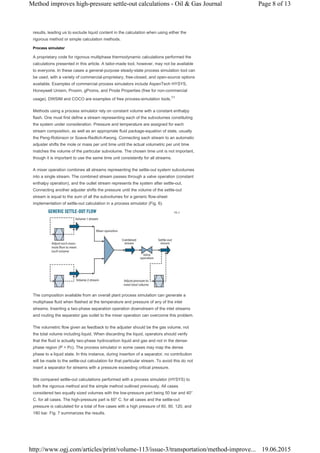
Fig. 3 shows the effect of pressure and temperature for two different gas molecular
weights as well as the general trend that the largest inaccuracy is found at high
pressure differences when the temperature difference is small and at high temperature
differences when the pressure difference is small. A diagonal from the lower left to the
upper right of Fig. 3 has relatively low inaccuracy, with increasing molecular weight
generally seeming to increase the inaccuracy in settling-out pressure estimated by the
simple method.
Considering settling-out between one volume fixed at 50 bar and the other varied up to
200 bar extends the analysis to higher pressures. Fig. 4 shows the results for two
different molecular weights, illustrating the inaccuracy in the simple method changing
from being generally less than zero at lower pressure (~80-100 barg, depending on the
molecular weight) to being positive at higher pressure. Where the undervaluation of the
simple method is relatively moderate at lower pressure (Fig. 4), the overvaluation at
higher pressure becomes more severe and increasing molecular weight again amplifies
any inaccuracies.
Testing confirmed the effect of increasing molecular weight on the calculation
inaccuracy (Fig. 5): increased molecular weight leads to increased calculation
inaccuracy when using the simple method.
Handling liquid content
When performing settle-out calculations for compressor systems, the process engineer
must handle liquid content in the system in terms of calculation. Including liquid in the
calculations, however, will generate a lower settle-out pressure, regardless of whether
the rigorous or simple calculation method is used. Handling liquid complicates the
calculation by requiring more input (a liquid phase) and creates less conservative
Page 7 of 13Method improves high-pressure settle-out calculations - Oil & Gas Journal
19.06.2015http://www.ogj.com/articles/print/volume-113/issue-3/transportation/method-improve...
results, leading us to exclude liquid content in the calculation when using either the
rigorous method or simple calculation methods.
Process simulator
A proprietary code for rigorous multiphase thermodynamic calculations performed the
calculations presented in this article. A tailor-made tool, however, may not be available
to everyone. In these cases a general-purpose steady-state process simulation tool can
be used, with a variety of commercial-proprietary, free-closed, and open-source options
available. Examples of commercial process simulators include AspenTech HYSYS,
Honeywell Unisim, Prosim, gProms, and Prode Properties (free for non-commercial
usage). DWSIM and COCO are examples of free process-simulation tools.11
Methods using a process simulator rely on constant volume with a constant enthalpy
flash. One must first define a stream representing each of the subvolumes constituting
the system under consideration. Pressure and temperature are assigned for each
stream composition, as well as an appropriate fluid package-equation of state, usually
the Peng-Robinson or Soave-Redlich-Kwong. Connecting each stream to an automatic
adjuster shifts the mole or mass per unit time until the actual volumetric per unit time
matches the volume of the particular subvolume. The chosen time unit is not important,
though it is important to use the same time unit consistently for all streams.
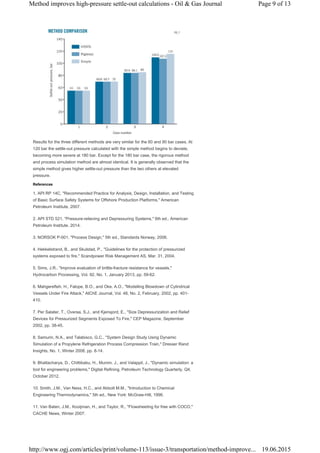
A mixer operation combines all streams representing the settle-out system subvolumes
into a single stream. The combined stream passes through a valve operation (constant
enthalpy operation), and the outlet stream represents the system after settle-out.
Connecting another adjuster shifts the pressure until the volume of the settle-out
stream is equal to the sum of all the subvolumes for a generic flow-sheet
implementation of settle-out calculation in a process simulator (Fig. 6).
The composition available from an overall plant process simulation can generate a
multiphase fluid when flashed at the temperature and pressure of any of the inlet
streams. Inserting a two-phase separation operation downstream of the inlet streams
and routing the separator gas outlet to the mixer operation can overcome this problem.
The volumetric flow given as feedback to the adjuster should be the gas volume, not
the total volume including liquid. When discarding the liquid, operators should verify
that the fluid is actually two-phase hydrocarbon liquid and gas and not in the dense-
phase region (P > Pc). The process simulator in some cases may map the dense
phase to a liquid state. In this instance, during insertion of a separator, no contribution
will be made to the settle-out calculation for that particular stream. To avoid this do not
insert a separator for streams with a pressure exceeding critical pressure.
We compared settle-out calculations performed with a process simulator (HYSYS) to
both the rigorous method and the simple method outlined previously. All cases
considered two equally sized volumes with the low-pressure part being 50 bar and 40°
C. for all cases. The high-pressure part is 60° C. for all cases and the settle-out
pressure is calculated for a total of five cases with a high pressure of 60, 90, 120, and
180 bar. Fig. 7 summarizes the results.
Page 8 of 13Method improves high-pressure settle-out calculations - Oil & Gas Journal
19.06.2015http://www.ogj.com/articles/print/volume-113/issue-3/transportation/method-improve...
Results for the three different methods are very similar for the 60 and 90 bar cases. At
120 bar the settle-out pressure calculated with the simple method begins to deviate,
becoming more severe at 180 bar. Except for the 180 bar case, the rigorous method
and process simulation method are almost identical. It is generally observed that the
simple method gives higher settle-out pressure than the two others at elevated
pressure.
References
1. API RP 14C, "Recommended Practice for Analysis, Design, Installation, and Testing
of Basic Surface Safety Systems for Offshore Production Platforms," American
Petroleum Institute, 2007.
2. API STD 521, "Pressure-relieving and Depressuring Systems," 6th ed., American
Petroleum Institute, 2014.
3. NORSOK P-001, "Process Design," 5th ed., Standards Norway, 2006.
4. Hekkelstrand, B., and Skulstad, P., "Guidelines for the protection of pressurized
systems exposed to fire," Scandpower Risk Management AS, Mar. 31, 2004.
5. Sims, J.R., "Improve evaluation of brittle-fracture resistance for vessels,"
Hydrocarbon Processing, Vol. 92, No. 1, January 2013, pp. 59-62.
6. Mahgerefteh, H., Falope, B.O., and Oke, A.O., "Modelling Blowdown of Cylindrical
Vessels Under Fire Attack," AIChE Journal, Vol. 48, No. 2, February, 2002, pp. 401-
410.
7. Per Salater, T., Overaa, S.J., and Kjensjord, E., "Size Depressurization and Relief
Devices for Pressurized Segments Exposed To Fire," CEP Magazine, September
2002, pp. 38-45.
8. Samurin, N.A., and Talabisco, G.C., "System Design Study Using Dynamic
Simulation of a Propylene Refrigeration Process Compression Train," Dresser Rand
Insights, No. 1, Winter 2008, pp. 8-14.
9. Bhattacharya, D., Chittibabu, H., Mumm, J., and Valappil, J., "Dynamic simulation: a
tool for engineering problems," Digital Refining, Petroleum Technology Quarterly, Q4,
October 2012.
10. Smith, J.M., Van Ness, H.C., and Abbott M.M., "Introduction to Chemical
Engineering Thermodynamics," 5th ed., New York: McGraw-Hill, 1996.
11. Van Baten, J.M., Kooijman, H., and Taylor, R., "Flowsheeting for free with COCO,"
CACHE News, Winter 2007.
Page 9 of 13Method improves high-pressure settle-out calculations - Oil & Gas Journal
19.06.2015http://www.ogj.com/articles/print/volume-113/issue-3/transportation/method-improve...
New regulator lists UKCS 'priority actions' |
Tap Oil ownership under siege by Northern Gulf Petroleum
Speaker suggests how Russian regime change might occur
03/09/2015 They follow a warning reported here 2 weeks ago from Alexander J. Motyl,
professor of political science at Rutgers University-Newark, that military...
Watching Government: Why call-ups are continuing
03/09/2015 Western Energy Alliance members were fully aware that more significant federal
onshore oil and gas policies are being developed in the nation's cap...
Low crude prices pressure Latin American producers, CSIS forum told
03/09/2015 Depressed crude oil prices are putting new pressure on Latin American
producing countries to improve terms if they expect to attract outside invest...
Shell moves to business-as-usual plan for strike-impacted refineries
03/09/2015 As the United Steelworkers union (USW) strike enters its fifth week, Royal Dutch
Shell PLC, which serves as lead company for National Oil Bargainin...
Report notes strong Saudi fiscal 'buffers'
03/09/2015 Saudi Arabia has fiscal buffers enabling it to cover projected deficits while oil
prices are low for at least 4 years and perhaps more than 8 years...
The authors
Anders Andreasen (anra@ramboll.com) is chief consultant within process
engineering in the department of offshore field development and studies at
Ramboll Oil & Gas, Esbjerg, Denmark. He has also served as senior
research engineer at MAN Diesel & Turbo working with large two-stroke
diesel engine combustion optimization and emission reduction technologies. He holds
an MS in chemical engineering from Aalborg University, Esbjerg, and a PhD from the
Technical University of Denmark, Lyngby, also in chemical engineering. He is a
member of the Society of Petroleum Engineers.
Jacob Gram Iskov Eriksen (jgie@ramboll.com) is a student intern at
Ramboll. He holds a BS in energy engineering with specialization in thermal
processes and is pursuing his MS in process engineering and combustion
technology at Aalborg University, Esbjerg.
Carsten Stegelmann (cts@ramboll.com) is chief consultant within process
and technical safety engineering in the department of technical safety at
Ramboll. He holds an MS and a PhD in chemical engineering, both from
Aalborg University, Esbjerg, and is a certified functional safety expert
(CFSE).
Hasse Lynggaard (hsl@ramboll.com) is chief consultant within process and
technical safety engineering in the department of technical safety at
Ramboll. He holds an MS and a PhD in chemical engineering, both from
Aalborg University.
More Oil & Gas Journal Current Issue Articles
More Oil & Gas Journal Archives Issue Articles
RELATED ARTICLES
Page 10 of 13Method improves high-pressure settle-out calculations - Oil & Gas Journal
19.06.2015http://www.ogj.com/articles/print/volume-113/issue-3/transportation/method-improve...
OGJ Newsletter
03/09/2015 International news for oil and gas professionals
More pragmatism urged for developing Eastern Mediterranean gas
03/09/2015 Eastern Mediterranean nations should abandon inflated expectations and adopt
more realistic approaches to developing their natural gas resources, s...
Encana trims additional $700 million from 2015 capital budget
03/06/2015 Encana Corp. is reducing its previously reported capital investment for 2015 by
$700 million to $2-2.2 billion "to maintain a solid balance sh...
Brynhild output restarting offshore Norway
03/06/2015 Production from Brynhild oil field in the southern part of the Norwegian North Sea is
restarting after having been shut down by equipment problems ...
Sponsored by
Sponsored by
Sponsored by
Sponsored by
Sponsored by
Sponsored by
Sponsored by
Sponsored by
Three Tips to Improve Safety in the Oil Field
Working oil fields will always be tough work with inherent risks. There’s no getting around that.
Ther...
Telogis, Inc.
Pipeline Integrity: Best Practices to Prevent, Detect, and Mitigate Commodity
Releases
Commodity releases can have catastrophic consequences, so ensuring pipeline integrity is crucial
for p...
Schneider Electric
AVEVA’s Digital Asset Approach - Defining a new era of collaboration in capital
projects and asset operations
There is constant, intensive change in the capital projects and asset life cycle management. New
chall...
AVEVA Inc
Transforming the Oil and Gas Industry with EPPM
With budgets in the billions, timelines spanning years, and life cycles extending over decades, oil
an...
ORACLE
Asset Decommissioning in Oil & Gas: Transforming Business
Asset intensive organizations like Oil and Gas have their own industry specific challenges when it
com...
ORACLE
Squeezing the Green: How to Cut Petroleum Downstream Costs and Optimize
Processing Efficiencies with Enterprise Project Portfolio Management Solutions
As the downstream petroleum industry grapples with change in every sector and at every level,
includin...
ORACLE
7 Steps to Improve Oil & Gas Asset Decommissioning
Global competition and volatile markets are creating a challenging business climate for project
based ...
ORACLE
The impact of aging infrastructure in process manufacturing industries
Process manufacturing companies in the oil and gas, utilities, chemicals and natural resource
industri...
ORACLE
More Articles >>
WHITE PAPERS
More White Papers >>
Page 11 of 13Method improves high-pressure settle-out calculations - Oil & Gas Journal
19.06.2015http://www.ogj.com/articles/print/volume-113/issue-3/transportation/method-improve...
OGJ's Midyear Forecast 2015
When Fri, Jul 10, 2015
This webcast is to be presented by OGJ Editor Bob Tippee and Senior Economic Editor Conglin Xu.
They will summarize the Midyear Forecast projections in key categories, note important changes from
January’s forecasts, and examine reasons for the adjustments.
Predictive Analytics in your digital oilfield - Optimize Production Yield and Reduce
Operational Costs
When Tue, Jul 7, 2015
Putting predictive analytics to work in your oilfield can help you anticipate failures, plan and schedule
work in advance, eliminate emergency work and catastrophic failures, and at the same time you can
optimize working capital and improve resource utilization. When you apply analytic capabilities to
critical production assets it is possible to reduce non-productive time and increase your yield.
Learn how IBM's analytics capabilities can be applied to critical production assets with the goal of
reducing non-productive time, increasing yield and reducing operations costs.
On Demand
Cognitive Solutions for Upstream Oil and Gas
Fri, Jun 12, 2015
The oil & gas sector is under pressure on all sides. Reserves are limited and it’s becoming
increasingly expensive to find and extract new resources. Margins are already being squeezed in an
industry where one wrong decision can cost millions. Analyzing data used in energy exploration can
save millions of dollars as we develop ways to predict where and how to extract the world’s massive
energy reserves.
This session with IBM Subject Matter Experts will discuss how IBM Cognitive Solutions contribute to
the oil and gas industry using predictive analytics and cognitive computing, as well as real time
streaming for exploration and drilling.
The Alternative Fuel Movement: Four Need-to-Know Excise Tax Complexities
Thu, Jun 4, 2015
Discussion on how to approach, and ultimately embrace, the alternative fuel market by pulling back
the veil on excise tax complexities. Taxes may be an aggravating part of daily operations, but their
accuracy is crucial in your path towards business success.
Prev 1 2 3 4 5 Next
AVAILABLE WEBCASTS
Page 12 of 13Method improves high-pressure settle-out calculations - Oil & Gas Journal
19.06.2015http://www.ogj.com/articles/print/volume-113/issue-3/transportation/method-improve...
Stay Connected
1455 West Loop South
Houston, Texas 77027
(713) 621-9720
Copyright © 2013: PennWell Corporation
All Rights Reserved.
Home
General Interest
Exploration & Development
Drilling & Production
Processing
Transportation
Unconventional
GIS Data & Maps
RSS
Events
Training
Market Connection
White Papers
Webcasts
PennEnergy Jobs
Equipment
Research
OTC
Advertise
Newsletter Subscription
Book Store
Privacy Policy
Terms & Conditions
Contact Us
Magazine Subscription
Mobile
About Us
PennWell
View All Pennwell Websites
View All Pennwell Events
Site Map
Webmaster
Page 13 of 13Method improves high-pressure settle-out calculations - Oil & Gas Journal
19.06.2015http://www.ogj.com/articles/print/volume-113/issue-3/transportation/method-improve...

Sop calculation method

  • 1.
    New regulator listsUKCS 'priority actions' | Tap Oil ownership under siege by Northern Gulf Petroleum 03/02/2015 Anders Andreasen Jacob Gram Iskov Eriksen Carsten Stegelmann Hasse Lynggaard Ramboll Oil & Gas Esbjerg, Denmark Settle-out calculations in natural gas systems need to be sufficiently rigorous accurately to predict settle-out under various operating conditions without being so conservative as to increase costs. This article proposes a particular rigorous calculation usable as an alternative to a process simulator. The varied contributions of many subvolumes to the final settle-out calculation complicate the process and can produce inaccuracies during use of a non- rigorous method. The simple method, however, is easy to implement and requires no thermodynamic package or calculation tool. The simple method proposed in this article is also preferable to both Tn and Tm methods due to its greater simplicity. The proposed simple method may be applied with only minor calculation inaccuracy when: • Based on an evaluation of settle-out calculations for installed equipment, the inaccuracy created by use of one of the simpler methods presented is in the range ±2% and the highest pressure in any of the subvolumes before settle-out is less than 150 barg. • Parameter variation studies show that keeping the maximum pressure less than 100 bar or three times the lowest system pressure, whichever is the lowest, and at the same time keeping the molecular weight less than 26 kg/kmol should limit calculation inaccuracy to a maximum ±2% at temperature. Looking for past issues? Click here. Home » More General Interest » Method improves high-pressure settle-out calculations Method improves high-pressure settle-out calculations SUBSCRIBE CURRENT ISSUE PAST ISSUES UNCONVENTIONAL HOME GENERAL INTEREST EXPLORATION & DEVELOPMENT DRILLING & PRODUCTION REFINING & PROCESSING PIPELINES & TRANSPORTATION OGJ RESOURCES Page 1 of 13Method improves high-pressure settle-out calculations - Oil & Gas Journal 19.06.2015http://www.ogj.com/articles/print/volume-113/issue-3/transportation/method-improve...
  • 2.
    Relative calculation inaccuracyshould of course be compared with actual settle-out pressure. The simple method also generally seems to overvalue settle-out pressure at high pressure, which is conservative and safe but may lead to over-design if used in extreme cases. We recommend that liquid content be excluded in the calculation to prevent an undervaluation of the settle-out pressure. The liquid should be considered an inert spectator not exchanging mass or energy with the gas. The volume occupied by the liquid should be subtracted from the system volume. Settle-out calculations Settle-out calculations represent an important step in several key engineering activities, both in initial design and when updating operating conditions, alarm levels, and during design modification projects, especially for compressor loops. Settle-out calculations help: • Decide upon design pressure of the low-pressure part of the settle-out system. • Determine starting pressure and temperature for blow-down calculations. • Calculate compressor restart conditions after a compressor trip. Fig. 1 shows a typical system considered for settle-out calculations; a two-stage compressor train including suction scrubbers, discharge coolers, and recycle lines. For purposes of settle-out calculations, the system is segmented into subvolumes differing either in pressure or temperature. Equipment data sheets and isometric piping drawings provide the basis for estimating each part's volume. Design pressure The design pressure of suction side equipment-scrubber, cooler, etc.-shall be high enough to provide sufficient margin when settling-out occurs. The suction side will usually include a pressure safety valve (PSV) for fire protection of the scrubber.1 Providing a margin between settle-out pressure and design pressure can prevent unnecessary flaring. API 521 says design pressure shall be a minimum 1.05 times settle-out pressure at maximum pressure drop, calculated assuming the suction side is operated at normal operating pressure and compressor discharge pressure is set to the maximum achievable.2 It does not, however, specifically mention how maximum discharge pressure should be determined. Compressor performance, pressure alarm high-high (PAHH) on the discharge side, or ultimately PSV-set pressure can limit maximum discharge pressure. NORSOK P-001 says maximum operating pressure should be determined as the settle-out pressure occurring at coincident PAHH on both the suction side and the discharge side, adding a 10% margin for determining design pressure or PSV set pressure.3 API 521 therefore seems less conservative than NORSOK P-001, as the settle-out pressure is calculated from higher initial pressures and a higher margin is applied. Blowdown, restart Conducting a compressor system blowdown requires determining the initial temperature and pressure, as well as composition of the system's contents. Learning & Development Office Assistant Chevron Country: United States others.Strong commitment to Chevron Way Behaviors.Preferred Qualifications:Experience in and and field environment.Demonstrated ability to work collaboratively with multiple stakeholders across... Oil & Gas Journal Digital Magazine Look Inside > Current Issue   Find us on Facebook Oil & Gas Journal Online 33,387 Facebook social plugin LikeLike Oil & Gas Journal Online KMG and @GazpromEN extend Karachaganak natgas# supply contract to 2038 http://bit.ly/1J6jBau Russia# Kazakhstan# 10 hrs More than 600 job openings are now online, watch videos and learn more! Click Here to Watch CAREERS AT TOTAL OTHER OIL & GAS INDUSTRY JOBS Page 2 of 13Method improves high-pressure settle-out calculations - Oil & Gas Journal 19.06.2015http://www.ogj.com/articles/print/volume-113/issue-3/transportation/method-improve...
  • 3.
    Temperature and pressureare defined as the settle-out pressure and temperature.4 Blowdown calculations, however, can be performed for a number of scenarios. Cold blowdown simulations check for low temperatures, below the material design temperature, which can cause brittle fractures.5 Fire cases are simulated where ruptures due to high temperature, which can weaken the material, are a risk.6 7 For the former we perform settle-out calculations from normal operating conditions and for the latter settle-out calculations from coincident PAHH trips. The settle-out pressure calculation is also of interest in estimating the required torque in case of a compressor trip and a subsequent fast restart without intermediate depressurization-blowdown.8 9 The higher the settle-out pressure the higher the required torque. Restart torque is key information in appropriately specifying the compressor driver. Rigorous method A key characteristic of the settle-out process is that it occurs at constant volume. Assuming pressure equalization between subvolumes occurs quickly enough for heat transfer to be negligible allows reduction of the first law of thermodynamics to ΔU=Q+W=0, where ΔU is the change in internal energy, Q is heat, and W is work. The thermodynamic problem to be solved, therefore, has a constant volume and constant internal energy: a UV-problem. The solution method proposed in this article is based on a constant-temperature and constant-pressure flash calculation employing the Peng-Robinson equation of state (EoS). Calculation of density and real gas corrections to all thermodynamic properties (U, H, and S) are based on the EoS. The solution procedure is to calculate the internal energy of all subvolumes, Vi, and from these find the total internal energy, Utot, at the starting conditions for each subvolume, Ti and Pi. The content in all subvolumes is added. An initial estimate of the settle-out pressure is made with a simple method. Internal energy and fluid volume of the total mass is calculated at the initial guess for T and P. Subsequently changing pressure and temperature values ensures ΔV and ΔU are zero. The pressure and temperature that satisfy a constant volume and a constant internal energy are the settle-out pressure and temperature. Search More Job Listings >> Page 3 of 13Method improves high-pressure settle-out calculations - Oil & Gas Journal 19.06.2015http://www.ogj.com/articles/print/volume-113/issue-3/transportation/method-improve...
  • 4.
    Simple method The simplemethod for calculating the initial guess in the UV-method described previously considers each subvolume as separated by invisible walls that can move as each element expands or is compressed during pressure equalization. For a single subvolume, work occurs as if the volume is not constant. Assuming the process is reversible and adiabatic (ΔQ=0) and that the fluid trapped follows the ideal gas law, the work for each subvolume can be expressed as shown in Equation 1.10 Using this information, adding the work for all subvolumes, and assuming net work is zero yields settle-out pressure (Equation 2). Equation 3 shows the calculation if an initial guess for the settle-out pressure is calculated from an ideal gas mole balance, which reduces to Equation 4. Investigating the simple method used for calculating initial guesses as compared with the rigorous solution method allows quantifying the extent to which the simple method can be used as an alternative to the rigorous method. Tn-, Tm-methods The Tn-method of calculating settle-out conditions applies a compressibility factor to the ideal gas. It assumes that the temperature-mole term, n∙T, is constant and additive for each volume. Equations 5-13 describe how to calculate settle-out conditions under these assumptions for any arbitrary number of volumes. Equation 5 determines the number of moles for each volume, with Equation 6 showing the number of moles contained in the entire volume, i.e., the number of moles at settle- out conditions, and Equation 7 the entire volume at settle-out conditions. Page 4 of 13Method improves high-pressure settle-out calculations - Oil & Gas Journal 19.06.2015http://www.ogj.com/articles/print/volume-113/issue-3/transportation/method-improve...
  • 5.
    The normal volumeof each volume-segment is calculated with normal conditions (Equation 8); Pi,n=1.01325 bar and Ti,n=273.15 K., with Equation 9 determining normal volume for settle-out conditions. Simply applying the ideal gas equation including the compressibility factor then yields temperature-mole term for each volume (Equation 10). Under the assumptions made for this simple approach, the temperature-mole term for the settle-out conditions will be the total sum of each temperature-mole term (Equation 11). Equation 12 estimates the subsequent settle-out temperature. Applying the concept of volume under normal conditions, as previously determined, yields estimated settle-out pressure (Equation 13). The Tn method of calculating settle-out conditions did not include the molar masses of each individual volume. This omission, however, is negligible when molar masses are more or less equal. The Tm method incorporates molar mass by using a temperature- mass term, replacing the previously used temperature-mole term. Equation 14 provides the relationship between the number of moles, molar mass, and mass. Similar equations and assumptions as presented for the Tn-method can determine settle-out conditions with the Tm method by applying the temperature-mass term, m∙T. Results We applied the methods described for calculating settle-out pressure to a number of real cases (Table 1). They cover settle-out in existing equipment installed offshore in the Danish sector of the North Sea and include several compressor loops, both single- compressor and two compressors in series, including scrubbers and coolers. Further cases include connected vessels-piping operated at different pressures, where settle- out will occur if the unit trips. Page 5 of 13Method improves high-pressure settle-out calculations - Oil & Gas Journal 19.06.2015http://www.ogj.com/articles/print/volume-113/issue-3/transportation/method-improve...
  • 6.
    Each settle-out casepairs the number of distinct subvolumes-each differing in pressure or temperature-with the lowest and highest pressure before settle-out occurs. Each case calculates settle-out pressure with the rigorous, simple Tn and Tm methods and lists calculation inaccuracy relative to the rigorous method (Table 2, Fig. 2). Fig. 3 displays the inaccuracy caused by applying the non-rigorous methods, depicting calculation inaccuracy as a function of the highest pressure in the system before settle- out. Other descriptors could have been chosen as well, although it is difficult to find a single good descriptor for the calculation while also accounting for the varying complexity with different numbers of subvolumes. The maximum pressure is chosen, since the largest deviations from the ideal gas law will occur in this part of the system. The effect on the final result also depends on the high-pressure volume and gas composition-molecular weight. Settle-out calculation inaccuracy is less than 2% in most cases, and for the remaining cases an inaccuracy of up to slightly above 4% is observed. Except for three cases, absolute inaccuracy is less than 2 bar. Fig. 2 shows non-rigorous methods usually generate similar results, especially for systems in which the subvolume's maximum pressure is less than 150 barg. At greather than this, some discrepancy is observed between the different methods. There is a general tendency for the calculation inaccuracy to be highest for systems with the highest maximum pressure. At lower maximum pressure settle-out pressure is in most cases undervalued, while at the higher maximum pressures settle-out pressure is overvalued. Page 6 of 13Method improves high-pressure settle-out calculations - Oil & Gas Journal 19.06.2015http://www.ogj.com/articles/print/volume-113/issue-3/transportation/method-improve...
  • 7.
    Parameter variation We studiedthe suitability of the simple method for settle-out calculations by performing a number of parameter variation studies investigating the effects of pressure, temperature, and molecular weight on the calculation inaccuracy for settling-out between two equal volumes. Calculation inaccuracy is estimated by comparison with the rigorous method. Fig. 3 shows the effect of pressure and temperature for two different gas molecular weights as well as the general trend that the largest inaccuracy is found at high pressure differences when the temperature difference is small and at high temperature differences when the pressure difference is small. A diagonal from the lower left to the upper right of Fig. 3 has relatively low inaccuracy, with increasing molecular weight generally seeming to increase the inaccuracy in settling-out pressure estimated by the simple method. Considering settling-out between one volume fixed at 50 bar and the other varied up to 200 bar extends the analysis to higher pressures. Fig. 4 shows the results for two different molecular weights, illustrating the inaccuracy in the simple method changing from being generally less than zero at lower pressure (~80-100 barg, depending on the molecular weight) to being positive at higher pressure. Where the undervaluation of the simple method is relatively moderate at lower pressure (Fig. 4), the overvaluation at higher pressure becomes more severe and increasing molecular weight again amplifies any inaccuracies. Testing confirmed the effect of increasing molecular weight on the calculation inaccuracy (Fig. 5): increased molecular weight leads to increased calculation inaccuracy when using the simple method. Handling liquid content When performing settle-out calculations for compressor systems, the process engineer must handle liquid content in the system in terms of calculation. Including liquid in the calculations, however, will generate a lower settle-out pressure, regardless of whether the rigorous or simple calculation method is used. Handling liquid complicates the calculation by requiring more input (a liquid phase) and creates less conservative Page 7 of 13Method improves high-pressure settle-out calculations - Oil & Gas Journal 19.06.2015http://www.ogj.com/articles/print/volume-113/issue-3/transportation/method-improve...
  • 8.
    results, leading usto exclude liquid content in the calculation when using either the rigorous method or simple calculation methods. Process simulator A proprietary code for rigorous multiphase thermodynamic calculations performed the calculations presented in this article. A tailor-made tool, however, may not be available to everyone. In these cases a general-purpose steady-state process simulation tool can be used, with a variety of commercial-proprietary, free-closed, and open-source options available. Examples of commercial process simulators include AspenTech HYSYS, Honeywell Unisim, Prosim, gProms, and Prode Properties (free for non-commercial usage). DWSIM and COCO are examples of free process-simulation tools.11 Methods using a process simulator rely on constant volume with a constant enthalpy flash. One must first define a stream representing each of the subvolumes constituting the system under consideration. Pressure and temperature are assigned for each stream composition, as well as an appropriate fluid package-equation of state, usually the Peng-Robinson or Soave-Redlich-Kwong. Connecting each stream to an automatic adjuster shifts the mole or mass per unit time until the actual volumetric per unit time matches the volume of the particular subvolume. The chosen time unit is not important, though it is important to use the same time unit consistently for all streams. A mixer operation combines all streams representing the settle-out system subvolumes into a single stream. The combined stream passes through a valve operation (constant enthalpy operation), and the outlet stream represents the system after settle-out. Connecting another adjuster shifts the pressure until the volume of the settle-out stream is equal to the sum of all the subvolumes for a generic flow-sheet implementation of settle-out calculation in a process simulator (Fig. 6). The composition available from an overall plant process simulation can generate a multiphase fluid when flashed at the temperature and pressure of any of the inlet streams. Inserting a two-phase separation operation downstream of the inlet streams and routing the separator gas outlet to the mixer operation can overcome this problem. The volumetric flow given as feedback to the adjuster should be the gas volume, not the total volume including liquid. When discarding the liquid, operators should verify that the fluid is actually two-phase hydrocarbon liquid and gas and not in the dense- phase region (P > Pc). The process simulator in some cases may map the dense phase to a liquid state. In this instance, during insertion of a separator, no contribution will be made to the settle-out calculation for that particular stream. To avoid this do not insert a separator for streams with a pressure exceeding critical pressure. We compared settle-out calculations performed with a process simulator (HYSYS) to both the rigorous method and the simple method outlined previously. All cases considered two equally sized volumes with the low-pressure part being 50 bar and 40° C. for all cases. The high-pressure part is 60° C. for all cases and the settle-out pressure is calculated for a total of five cases with a high pressure of 60, 90, 120, and 180 bar. Fig. 7 summarizes the results. Page 8 of 13Method improves high-pressure settle-out calculations - Oil & Gas Journal 19.06.2015http://www.ogj.com/articles/print/volume-113/issue-3/transportation/method-improve...
  • 9.
    Results for thethree different methods are very similar for the 60 and 90 bar cases. At 120 bar the settle-out pressure calculated with the simple method begins to deviate, becoming more severe at 180 bar. Except for the 180 bar case, the rigorous method and process simulation method are almost identical. It is generally observed that the simple method gives higher settle-out pressure than the two others at elevated pressure. References 1. API RP 14C, "Recommended Practice for Analysis, Design, Installation, and Testing of Basic Surface Safety Systems for Offshore Production Platforms," American Petroleum Institute, 2007. 2. API STD 521, "Pressure-relieving and Depressuring Systems," 6th ed., American Petroleum Institute, 2014. 3. NORSOK P-001, "Process Design," 5th ed., Standards Norway, 2006. 4. Hekkelstrand, B., and Skulstad, P., "Guidelines for the protection of pressurized systems exposed to fire," Scandpower Risk Management AS, Mar. 31, 2004. 5. Sims, J.R., "Improve evaluation of brittle-fracture resistance for vessels," Hydrocarbon Processing, Vol. 92, No. 1, January 2013, pp. 59-62. 6. Mahgerefteh, H., Falope, B.O., and Oke, A.O., "Modelling Blowdown of Cylindrical Vessels Under Fire Attack," AIChE Journal, Vol. 48, No. 2, February, 2002, pp. 401- 410. 7. Per Salater, T., Overaa, S.J., and Kjensjord, E., "Size Depressurization and Relief Devices for Pressurized Segments Exposed To Fire," CEP Magazine, September 2002, pp. 38-45. 8. Samurin, N.A., and Talabisco, G.C., "System Design Study Using Dynamic Simulation of a Propylene Refrigeration Process Compression Train," Dresser Rand Insights, No. 1, Winter 2008, pp. 8-14. 9. Bhattacharya, D., Chittibabu, H., Mumm, J., and Valappil, J., "Dynamic simulation: a tool for engineering problems," Digital Refining, Petroleum Technology Quarterly, Q4, October 2012. 10. Smith, J.M., Van Ness, H.C., and Abbott M.M., "Introduction to Chemical Engineering Thermodynamics," 5th ed., New York: McGraw-Hill, 1996. 11. Van Baten, J.M., Kooijman, H., and Taylor, R., "Flowsheeting for free with COCO," CACHE News, Winter 2007. Page 9 of 13Method improves high-pressure settle-out calculations - Oil & Gas Journal 19.06.2015http://www.ogj.com/articles/print/volume-113/issue-3/transportation/method-improve...
  • 10.
    New regulator listsUKCS 'priority actions' | Tap Oil ownership under siege by Northern Gulf Petroleum Speaker suggests how Russian regime change might occur 03/09/2015 They follow a warning reported here 2 weeks ago from Alexander J. Motyl, professor of political science at Rutgers University-Newark, that military... Watching Government: Why call-ups are continuing 03/09/2015 Western Energy Alliance members were fully aware that more significant federal onshore oil and gas policies are being developed in the nation's cap... Low crude prices pressure Latin American producers, CSIS forum told 03/09/2015 Depressed crude oil prices are putting new pressure on Latin American producing countries to improve terms if they expect to attract outside invest... Shell moves to business-as-usual plan for strike-impacted refineries 03/09/2015 As the United Steelworkers union (USW) strike enters its fifth week, Royal Dutch Shell PLC, which serves as lead company for National Oil Bargainin... Report notes strong Saudi fiscal 'buffers' 03/09/2015 Saudi Arabia has fiscal buffers enabling it to cover projected deficits while oil prices are low for at least 4 years and perhaps more than 8 years... The authors Anders Andreasen (anra@ramboll.com) is chief consultant within process engineering in the department of offshore field development and studies at Ramboll Oil & Gas, Esbjerg, Denmark. He has also served as senior research engineer at MAN Diesel & Turbo working with large two-stroke diesel engine combustion optimization and emission reduction technologies. He holds an MS in chemical engineering from Aalborg University, Esbjerg, and a PhD from the Technical University of Denmark, Lyngby, also in chemical engineering. He is a member of the Society of Petroleum Engineers. Jacob Gram Iskov Eriksen (jgie@ramboll.com) is a student intern at Ramboll. He holds a BS in energy engineering with specialization in thermal processes and is pursuing his MS in process engineering and combustion technology at Aalborg University, Esbjerg. Carsten Stegelmann (cts@ramboll.com) is chief consultant within process and technical safety engineering in the department of technical safety at Ramboll. He holds an MS and a PhD in chemical engineering, both from Aalborg University, Esbjerg, and is a certified functional safety expert (CFSE). Hasse Lynggaard (hsl@ramboll.com) is chief consultant within process and technical safety engineering in the department of technical safety at Ramboll. He holds an MS and a PhD in chemical engineering, both from Aalborg University. More Oil & Gas Journal Current Issue Articles More Oil & Gas Journal Archives Issue Articles RELATED ARTICLES Page 10 of 13Method improves high-pressure settle-out calculations - Oil & Gas Journal 19.06.2015http://www.ogj.com/articles/print/volume-113/issue-3/transportation/method-improve...
  • 11.
    OGJ Newsletter 03/09/2015 Internationalnews for oil and gas professionals More pragmatism urged for developing Eastern Mediterranean gas 03/09/2015 Eastern Mediterranean nations should abandon inflated expectations and adopt more realistic approaches to developing their natural gas resources, s... Encana trims additional $700 million from 2015 capital budget 03/06/2015 Encana Corp. is reducing its previously reported capital investment for 2015 by $700 million to $2-2.2 billion "to maintain a solid balance sh... Brynhild output restarting offshore Norway 03/06/2015 Production from Brynhild oil field in the southern part of the Norwegian North Sea is restarting after having been shut down by equipment problems ... Sponsored by Sponsored by Sponsored by Sponsored by Sponsored by Sponsored by Sponsored by Sponsored by Three Tips to Improve Safety in the Oil Field Working oil fields will always be tough work with inherent risks. There’s no getting around that. Ther... Telogis, Inc. Pipeline Integrity: Best Practices to Prevent, Detect, and Mitigate Commodity Releases Commodity releases can have catastrophic consequences, so ensuring pipeline integrity is crucial for p... Schneider Electric AVEVA’s Digital Asset Approach - Defining a new era of collaboration in capital projects and asset operations There is constant, intensive change in the capital projects and asset life cycle management. New chall... AVEVA Inc Transforming the Oil and Gas Industry with EPPM With budgets in the billions, timelines spanning years, and life cycles extending over decades, oil an... ORACLE Asset Decommissioning in Oil & Gas: Transforming Business Asset intensive organizations like Oil and Gas have their own industry specific challenges when it com... ORACLE Squeezing the Green: How to Cut Petroleum Downstream Costs and Optimize Processing Efficiencies with Enterprise Project Portfolio Management Solutions As the downstream petroleum industry grapples with change in every sector and at every level, includin... ORACLE 7 Steps to Improve Oil & Gas Asset Decommissioning Global competition and volatile markets are creating a challenging business climate for project based ... ORACLE The impact of aging infrastructure in process manufacturing industries Process manufacturing companies in the oil and gas, utilities, chemicals and natural resource industri... ORACLE More Articles >> WHITE PAPERS More White Papers >> Page 11 of 13Method improves high-pressure settle-out calculations - Oil & Gas Journal 19.06.2015http://www.ogj.com/articles/print/volume-113/issue-3/transportation/method-improve...
  • 12.
    OGJ's Midyear Forecast2015 When Fri, Jul 10, 2015 This webcast is to be presented by OGJ Editor Bob Tippee and Senior Economic Editor Conglin Xu. They will summarize the Midyear Forecast projections in key categories, note important changes from January’s forecasts, and examine reasons for the adjustments. Predictive Analytics in your digital oilfield - Optimize Production Yield and Reduce Operational Costs When Tue, Jul 7, 2015 Putting predictive analytics to work in your oilfield can help you anticipate failures, plan and schedule work in advance, eliminate emergency work and catastrophic failures, and at the same time you can optimize working capital and improve resource utilization. When you apply analytic capabilities to critical production assets it is possible to reduce non-productive time and increase your yield. Learn how IBM's analytics capabilities can be applied to critical production assets with the goal of reducing non-productive time, increasing yield and reducing operations costs. On Demand Cognitive Solutions for Upstream Oil and Gas Fri, Jun 12, 2015 The oil & gas sector is under pressure on all sides. Reserves are limited and it’s becoming increasingly expensive to find and extract new resources. Margins are already being squeezed in an industry where one wrong decision can cost millions. Analyzing data used in energy exploration can save millions of dollars as we develop ways to predict where and how to extract the world’s massive energy reserves. This session with IBM Subject Matter Experts will discuss how IBM Cognitive Solutions contribute to the oil and gas industry using predictive analytics and cognitive computing, as well as real time streaming for exploration and drilling. The Alternative Fuel Movement: Four Need-to-Know Excise Tax Complexities Thu, Jun 4, 2015 Discussion on how to approach, and ultimately embrace, the alternative fuel market by pulling back the veil on excise tax complexities. Taxes may be an aggravating part of daily operations, but their accuracy is crucial in your path towards business success. Prev 1 2 3 4 5 Next AVAILABLE WEBCASTS Page 12 of 13Method improves high-pressure settle-out calculations - Oil & Gas Journal 19.06.2015http://www.ogj.com/articles/print/volume-113/issue-3/transportation/method-improve...
  • 13.
    Stay Connected 1455 WestLoop South Houston, Texas 77027 (713) 621-9720 Copyright © 2013: PennWell Corporation All Rights Reserved. Home General Interest Exploration & Development Drilling & Production Processing Transportation Unconventional GIS Data & Maps RSS Events Training Market Connection White Papers Webcasts PennEnergy Jobs Equipment Research OTC Advertise Newsletter Subscription Book Store Privacy Policy Terms & Conditions Contact Us Magazine Subscription Mobile About Us PennWell View All Pennwell Websites View All Pennwell Events Site Map Webmaster Page 13 of 13Method improves high-pressure settle-out calculations - Oil & Gas Journal 19.06.2015http://www.ogj.com/articles/print/volume-113/issue-3/transportation/method-improve...