SonicWALL TZ 150
Getting Started Guide
SonicWALL TZ 150 Security Appliance
          Getting Started Guide
The SonicWALL® TZ 150 is a total security platform delivering true
layered security by integrating gateway anti-virus, intrusion
prevention and content filtering capabilities for small networks in an
easy-to-use, low cost platform.
When combined with the SonicWALL Gateway Anti-Virus,
Anti-Spyware and Intrusion Prevention Service subscription, the
SonicWALL TZ 150 delivers real-time network security protection
against viruses, worms, Trojans, spyware programs, peer-to-peer
and instant messaging applications, and other malicious code.
This Getting Started Guide provides instructions for basic installation
and configuration of the SonicWALL TZ 150. After you complete this
guide, up to 10 computers on your Local Area Network (LAN) will
have secure Internet access.
Note: For complete documentation, refer to the SonicOS Standard
Administrator’s Guide on the SonicWALL Resource CD or at:
<http://www.sonicwall.com/us/support.html>.

Before You Begin
Check Package Contents
•    One SonicWALL TZ 150 security appliance
•    One SonicWALL TZ 150 Getting Started Guide
•    One SonicOS Standard Release Notes
•    One Ethernet cable
•    One 12V, 1.66A power supply
•    One SonicWALL Resource CD, which contains product
     documentation and software utilities.
        Any Items Missing?
        If any items are missing from your package, contact:
        SonicWALL Support
        Web: <http://www.sonicwall.com/us/support.html>
        E-mail: customer_service@sonicwall.com
                                   SonicWALL TZ 150 Getting Started Guide Page 1
SonicWALL TZ 150 Configuration Steps
     1   Collect Required Information on page 3
     2   Applying Power to the SonicWALL TZ 150 on page 4
     3   Connecting the SonicWALL TZ 150 on page 4
     4   Accessing the Management Interface on page 6
     5   Using the SonicWALL Setup Wizard on page 8
     6   Registering Your SonicWALL TZ 150 on page 16
     7   Activating SonicWALL Security Services on page 21
     8   Connecting Computers to Your Appliance on page 25
     9   Mounting the SonicWALL TZ 150 on page 28
What You Need to Begin
•   A computer to use as a management station for initial configuration
    of the SonicWALL TZ 150
•   An Internet connection
•   A Web browser for accessing the SonicWALL TZ 150’s Web-based
    management interface. The Web browser must support Java and
    HTTP uploads. Internet Explorer 6.0 or higher, Netscape Navigator
    9.0 or higher, or Firefox 2.0 or higher are recommended.


Page 2
1     Collect Required Information
Internet Service Provider (ISP) Information
Collect the following information about your Internet service:


                         You
  If you connect
                       probably                 Please record
        via
                         use

 Cable modem,          DHCP        You do not need to provide any Internet
 DSL with a router                 connection information.

 Home DSL              PPPoE       User Name:
                                   Password:
                                   Note: Your ISP may require your user
                                   name in the format: name@ISP.com

 T1,                   Static IP   IP Address:
 Static broadband,                 Subnet Mask:
                                   Default Gateway
 Cable or DSL
                                   (Router Address):
 with a static IP
                                   Primary DNS:
                                   Secondary DNS (optional):

 Dial in to a server   PPTP        Server Address:
                                   User Name:
                                   Password:

Note: If you are not using one of the network configurations above,
refer to the SonicOS Standard Administrator’s Guide.

Other Information
SonicWALL Management Interface default username and password:
   User Name: admin
   Password:  password
                                    SonicWALL TZ 150 Getting Started Guide Page 3
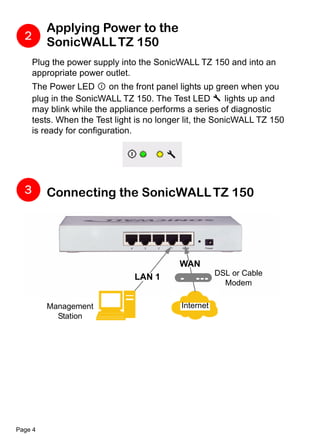
Applying Power to the
  2
         SonicWALL TZ 150
      Plug the power supply into the SonicWALL TZ 150 and into an
      appropriate power outlet.
      The Power LED        on the front panel lights up green when you
      plug in the SonicWALL TZ 150. The Test LED          lights up and
      may blink while the appliance performs a series of diagnostic
      tests. When the Test light is no longer lit, the SonicWALL TZ 150
      is ready for configuration.


  3      Connecting the SonicWALL TZ 150


                                            WAN
                                                       DSL or Cable
                                LAN 1
                                                         Modem

         Management                         Internet
           Station


Page 4
Connecting the Ethernet Cables
1. Connect one end of an Ethernet cable to your Internet
   connection, such as a DSL modem or cable modem.
   This cable may already be connected between your computer
   and your modem. If so, disconnect it from your computer, and
   leave it connected to the internet.
2. Connect the other end of the cable to the WAN port on the back
   of your SonicWALL TZ 150.
   The WAN LEDs on the front panel light up indicating an active
   connection.


3. Connect one end of an Ethernet cable to the computer you are
   using to manage the SonicWALL TZ 150.
4. Connect the other end of the cable to port # 1 on the back of your
   SonicWALL TZ 150.
   The port # 1 LEDs on the front panel light up indicating an active
   connection.


                                  SonicWALL TZ 150 Getting Started Guide Page 5
4      Accessing the Management Interface
To access the Web-based management interface of the
SonicWALL TZ 150:
1. On the computer you have connected to port # 1, Start your Web
    browser.
    Alert: Turn off pop-up blocking software before accessing the
    SonicWALL management interface.
    Your Web browser must support Java and HTTP uploads.
    Internet Explorer 5.0 or higher or Netscape Navigator 4.7 or
    higher are recommended.
2. Enter http://192.168.168.168 in the Location or Address field.


3. The SonicWALL Setup Wizard launches and guides you
   through the configuration and setup of your SonicWALL TZ 150.


Page 6
If the SonicWALL Setup Wizard Does Not Appear
  If you cannot connect to the SonicWALL TZ 150 or the Setup
  Wizard does not display, verify the following configurations:
  • Did you correctly enter the SonicWALL TZ 150 management
       IP address in your Web browser?
  • Is your computer running pop-up blocking software?
  • Are the Local Area Connection settings on your computer set
       to obtain an IP address dynamically (DHCP)? see Step 7,
       Connecting Computers to Your Appliance on page 25 for
       instructions on changing your Local Area Connection
       settings.
  • Do you have the Ethernet cable connected to your computer
       and to the LAN 1 port on your SonicWALL TZ 150?
  • Some browsers may not launch the Setup Wizard
       automatically. In this case, log into SonicWALL TZ 150 using
       “Admin” as the user name and “password” as the password.
       After you log in, click the Wizards button on the
       System > Status page. Select Setup to begin configuring
       your SonicWALL TZ 150.


                                SonicWALL TZ 150 Getting Started Guide Page 7
5        Using the SonicWALL Setup Wizard
The SonicWALL Setup Wizard provides user-guided instructions for
configuring your SonicWALL TZ 150.
Note: Make sure you have any required ISP information to complete
the configuration before using the Setup Wizard. See the list of
required information in Step 1, Collect Required Information on
page 3.
Tip: If you do not know what type of Internet connection you have,
contact your ISP. In addition, the SonicWALL Setup Wizard will
attempt to detect your connection settings. You will see what is
automatically selected in Step 3, WAN Network Mode
Configuring the SonicWALL TZ 150
Welcome - Click Next to begin.
1. Change Password - Change the administrative password. This
   is the password for the admin account.

         Old Password        Should be populated with the default
                             password, password.

         New Password        Enter your new password.

         Confirm             Re-enter your new password.

                                                                       !
      Note: Keep your new password in a safe place. If you lose your
      password, you will have to reset the SonicWALL security
      appliance to factory settings and lose your configuration. For
      instructions on resetting your SonicWALL security appliance,
      refer to the SonicOS Standard Administrator’s Guide.
      Click Next.


Page 8
2. Change Time Zone - Change the Time Zone setting to your
   local time zone.

     Time Zone                Select the time zone for your location from
                              the list.

     Automatically            Check this setting if you live in an area
     adjust clock for         that observes Daylight Saving Time.
     daylight saving time

   Note: It is important that you set the time zone correctly before
   you register your SonicWALL TZ 150.
   Click Next.
3. WAN Network Mode - The Setup Wizard automatically detects
   most networking modes. If it does not detect a networking mode,
   you may have a static IP address.
   See Procedure 1, Collect Required Information on page 3.
   Select the correct type of network connection for your network.

     Static IP                Select Static IP if you want to give the
                              SonicWALL TZ 150 a specific, unchang-
                              ing IP address.

     DHCP                     Select DHCP if your ISP assigns your
                              computer a dynamic IP address. DHCP is
                              commonly used with cable modems.

     PPPoE                    Select PPPoE if your ISP requires a user-
                              name and password to establish a con-
                              nection and assign a dynamic address.
                              PPPoE is commonly used with DSL.

     PPTP                     Select PPTP if you dial into a specific
                              server and log into a VPN to establish a
                              connection.

    Click on the yellow link for a networking type to see a definition.
    Click Next.


                                    SonicWALL TZ 150 Getting Started Guide Page 9
4. WAN Network Mode - The second WAN network mode screen
   configures your WAN settings for the selection you made in the
   previous screen.
    Static IP
    The Setup Wizard screen should display:
    WAN Network Mode: NAT Enabled (Static IP)

      SonicWALL WAN IP       Enter a single, static IP address. This
      Address                must be in the address range assigned to
                             you by your ISP.

      WAN Subnet Mask        Enter the subnet mask for your network,
                             provided by your ISP. For example,
                             255.255.255.0.

      Gateway (Router)       Enter the IP address of your Internet
      Address                gateway, provided by your ISP.

      DNS Server Address     Enter the IP address of the DNS server for
                             your network, provided by your ISP.

      DNS Server Address     You can enter a secondary, back-up DNS
      #2 (optional)          server to use if the first one fails.

    Click Next.
    DHCP
    The Setup Wizard screen should display:
    WAN Network Mode: NAT with DHCP Client
    If you selected DHCP, you do not need to enter any WAN
    networking settings. The network settings are provisioned
    automatically from a DHCP server.
    Click Next.


Page 10
PPPoE
The Setup Wizard screen should display:
WAN Network Mode - NAT with PPPoE Client

 Obtain an IP Address    Select this if your ISP assigns you a
 Automatically           dynamic IP address.

 Use the following       Select this if your ISP has assigned you a
 IP Address              static IP address, and enter the address.

 PPPoE User Name         Enter the user name for your Internet
                         account. Your ISP may require you to
                         enter your username in e-mail address
                         format, including “@” and the domain
                         name, for example,
                         joe.user@sonicwall.com.

 PPPoE Password          Enter the password for your Internet
                         account.

 Inactivity Disconnect   Check this box if you want the
 (minutes)               SonicWALL TZ 150 to disconnect from the
                         Internet if there is no traffic for the number
                         of minutes you enter.

Click Next.


                              SonicWALL TZ 150 Getting Started Guide Page 11
PPTP
    The Setup Wizard screen should display:
    WAN Network Mode - NAT with PPTP Client

      PPTP Server IP         Enter the address of the PPTP server.
      Address

      PPTP User Name         Enter your network user name.

      PPTP Password          Enter your network password.

      Obtain an IP Address   Select this if the server assigns you a
      Automatically          dynamic IP address.

      Use the following      Check this if you have been given a static
      IP Address             IP address, and fill in the following three
                             fields.

      SonicWALL WAN          Enter the static IP address for your con-
      IP Address             nection.

      WAN Subnet Mask        Enter the subnet mask for your connec-
                             tion.

      Gateway (Router)       Enter the address of your Internet Gate-
      Address                way.

    Click Next.


Page 12
5. LAN Settings - The LAN Settings screen configures your LAN
   interface.

    SonicWALL LAN           Accept the default IP address or enter a
    IP Address              new IP address of the LAN interface.
                            Record the address:

    LAN Subnet Mask         Accept the default, or enter a subnet mask
                            for your LAN.

    Enable Windows          Leave this option checked if you plan to
    Networking Support      have more than one Windows computer
                            on your network. Windows Networking
                            has no effect on computers with other
                            operating systems.

   By default, your SonicWALL TZ 150 is configured with a LAN
   network IP address, 192.168.168.168, and subnet mask,
   255.255.255.0, which will work well for most installations. In most
   cases, leave the default LAN IP address and subnet mask
   unchanged.

   Note: The LAN IP address is the address you will use to access
   the SonicWALL TZ 150 management interface.
   Click Next.


                                 SonicWALL TZ 150 Getting Started Guide Page 13
6. LAN DHCP Settings - The LAN DHCP Settings screen allows
   you to select whether or not to use the DHCP server in the
   SonicWALL TZ 150 to automatically distribute IP addressing
   information to computers and other network devices on your
   LAN.

      Enable DHCP Server     Leave this checkbox checked to use the
      on LAN                 DHCP server in the SonicWALL TZ 150
                             security appliance.
                             Do not select this option if you already
                             have a DHCP server on your network, or if
                             you want to require your network clients to
                             have static IP addresses.

      LAN Address Range      If you enabled the DHCP Server, enter a
                             range of IP addresses in the same subnet
                             as the LAN IP address, or leave the
                             default range unchanged. The default
                             DHCP range will work for most installa-
                             tions.

    Click Next.
7. SonicWALL Configuration Summary - Displays your network
   configuration information. Confirm that the settings displayed
   match the information you collected in Procedure 1: Collect
   Required Information on page 3.
    Click Apply to apply your settings to the SonicWALL security
    appliance. If you click Cancel, no settings will be applied to the
    SonicWALL security appliance.


Page 14
The Storing SonicWALL Configuration screen displays during
    this process.


    Setup Wizard Complete - Your SonicWALL TZ 150 is now
    successfully configured for LAN and Internet access.
    Click Restart to complete the configuration process. The
    SonicWALL security appliance will reboot, which will take
    approximately one minute. When the Test LED is no longer lit, the
    SonicWALL security appliance is ready for network traffic.
Test your connection
After the SonicWALL TZ 150 reboots, open a Web browser, and go to
<http://www.sonicwall.com>
• If you can view the SonicWALL home page, you have configured
    everything correctly.
• If you cannot view the SonicWALL home page try a second URL.
• If you still cannot view a Web page, return to step 4, Accessing
    the Management Interface on page 6, log in as “admin” with your
    administrative password, and click on the Wizards button in the
    top right corner of the management interface to restart the wizard.


                                  SonicWALL TZ 150 Getting Started Guide Page 15
6       Registering Your SonicWALL TZ 150
Once you’ve established your Internet connection, it is recommended
you register your SonicWALL security appliance at
mySonicWALL.com. Registering your SonicWALL security appliance
provides the following benefits:
• Try a FREE 30-day trial of SonicWALL SonicWALL's
    Gateway Anti-Virus, Anti-Spyware and Intrusion Prevention
    Service, Content Filtering Service, and Enforced Client: Anti-
    Virus/Anti-Spyware
• Activate SonicWALL security services
• Access SonicOS firmware updates
• Get SonicWALL technical support
Alert: The Time Zone and DNS settings on your SonicWALL TZ 150
must be set correctly before registering your security appliance. See
Step 5, Using the SonicWALL Setup Wizard on page 8 for
instructions on setting the Time Zone and DNS settings.
Before You Register
You need a mySonicWALL.com account to register the
SonicWALL TZ 150. You can create a new mySonicWALL.com
account directly from the SonicWALL management interface.
Alert: Make sure the DNS and Time settings on your
SonicWALL TZ 150 are correct when you register the device.
Configure Time settings in the System > Time page. Configure DNS
settings in the Edit Interface window from the Network > Interfaces
page.
Note: mySonicWALL.com registration information is not sold or
shared with any other company.


Page 16
Creating a mySonicWALL.com Account
Creating a mySonicWALL.com account is fast, simple, and FREE.
Simply complete an online registration form in the SonicWALL TZ 150
management interface.
If you already have a mysonicWALL.com account, go to Registering
Your SonicWALL TZ 150 on page 19 to register your appliance.
1. If you are not logged into the SonicWALL TZ 150 management
     interface log in with the username admin and the administrative
     password you set in the Setup Wizard.
2. If the System > Status page is not displaying in the management
     interface, click System in the left-navigation menu, and then click
     Status.


3. On the System > Status page, in the Security Services section,
   click the Register link in Your SonicWALL is not registered.
   Click here to Register your SonicWALL.


                                   SonicWALL TZ 150 Getting Started Guide Page 17
4. In the mySonicWALL.com Login page, click the here link in “If
   you do not have a mySonicWALL account, please click here
   to create one.” The mySonicWALL.com account form is
   displayed.


5. In the MySonicWall Account page, enter in your information in
   the Account Information, Personal Information and
   Preferences fields. All fields marked with an asterisk (*) are
   required fields.
   Note: Remember your username and password to access your
   mySonicWALL.com account.
6. Click Submit after completing the MySonicWALL Account form.
7. When the mySonicWALL.com server has finished processing
   your account, you will see a page saying that your account has
   been created. Click Continue.
Congratulations. Your mySonicWALL.com account is activated.
Now you need to log into mySonicWALL.com to register your
SonicWALL TZ 150.


Page 18
Registering Your SonicWALL TZ 150
1. If you are not logged into the SonicWALL TZ 150 management
   interface, log in with the username admin and the administrative
   password you set in the Setup Wizard.
2. If the System > Status page is not displaying in the management
   interface, click System in the left-navigation menu, and then click
   Status.


3. On the System > Status page, in the Security Services section,
   click the Register link. The mySonicWALL.com Login page is
   displayed.


4. Enter your mySonicWALL.com account username and password
   in the User Name and Password fields, then click Submit.
5. The next several pages inform you about SonicWALL’s Security
   Services. Click Continue on each page.
6. At the top of the Product Survey page, enter a “friendly name”
   for your SonicWALL security appliance in the Friendly Name
   field. The friendly name allows you to easily identify your
   SonicWALL security appliance in your mySonicWALL.com
   account.
7. Please complete the Product Survey. SonicWALL uses this
   information to further tailor services to fit your needs.


                                  SonicWALL TZ 150 Getting Started Guide Page 19
Note: SonicWALL Product Survey information is not sold or shared
with any other company.
8. Click Submit.
9. When the mySonicWALL.com server has finished processing
    your registration, you will see a page informing you that your
    SonicWALL TZ 150 appliance is registered. Click Continue, and
    the System > Licenses page is displayed showing the available
    security services. You can activate the services from this page
    now or at any time in the future.
Congratulations
Your SonicWALL TZ 150 is now fully operational.
You can continue with this Getting Started Guide to:
• Activate SonicWALL Security Services.
• Set up computers on your network
• Mount your SonicWALL TZ 150 on a wall or to any vertical
   surface


Page 20
Activating SonicWALL Security
  7
        Services
When you register your SonicWALL TZ 150, you are eligible for a
Free Trial of the SonicWALL Security Services:
• Gateway Anti-Virus, Anti-Spyware and Intrusion Prevention
    Service - Provides real-time protection for all hosts behind your
    SonicWALL from viruses, spyware, worms and application-layer
    attacks using deep packet inspection to detect and prevent
    malicious content before it can reach hosts on your network
• Enforced Client: Anti-Virus/Anti-Spyware - protects hosts on
    your network from viruses by enforcing the use of client-based
    Anti Virus software
• Premium Content Filtering Service - Enhances productivity by
    limiting access to objectionable Web content
At the end of your free trial period, the services will automatically
expire unless you purchase a subscription from your reseller or at
<https://www.mySonicWALL.com>.

Activate the SonicWALL Security Services
If your SonicWALL management interface is displaying the
Manage Services Online table on the System > Licenses page,
skip to Step 5.
1. Log in to your SonicWALL management interface.
2. In the left-navigation menu, click System and then Licenses.
3. Near the bottom of the System > Licenses page, under Manage
     Security Services Online, click the link: For Free Trials, Click
     Here.
4. Log in with your mySonicWALL.com account name and
     password, if prompted.
5. In the Manage Services Online table, click Try in the Free Trial
     column for Gateway Anti-Virus.


                                   SonicWALL TZ 150 Getting Started Guide Page 21
6. In the SonicWALL Gateway Anti-Virus page, click Continue.
   Your Gateway Anti-Virus, Anti-Spyware, and Intrusion Prevention
   Service free trial is now activated.
7. In the Manage Services Online table, click Try in the Free Trial
   column for Enforced Client: Anti-Virus/Anti-Spyware and for
   CFS Premium Service to activate the
   Complete Anti-Virus and Content Filtering Service (CFS) free
   trials.
Your SonicWALL Security Service free trials are now activated. You
must now enable each service on your SonicWALL security
appliance. Use the following instructions to configure each service
with its default values. For complete configuration instructions, see
the administrative guides available on your SonicWALL Resource CD
and on the Web at:
 <http://www.sonicwall.com/us/support.html>.

Enabling Premium Content Filtering Service
1. Select the Security Services > Content Filter page in the
   SonicWALL
   management interface.
2. Select the LAN checkbox to apply the filter to all computers on
   your LAN interface.


3. Click Configure, select the categories to block in the URL List
   tab, and click OK.
4. Click         in the top-right corner of the page.


Page 22
Enabling Enforced Client: Anti-Virus/Anti-Spyware
Service
1. Select the Security Services > Enforced Client: Anti-Virus/
   Anti-Spyware page in the SonicWALL management interface.
2. Select the Enable Anti-Virus checkbox.


3. Click        in the top-right corner of the page.
Users on your network will be prompted to download the SonicWALL
Anti-Virus client.

Enabling Intrusion Prevention Service
1. Select the Security Services > Intrusion Prevention page in
   the SonicWALL management interface.
2. In the IPS Global Settings section, click the Enable IPS on
   Interface checkbox,
   and check the WAN and LAN interface check boxes.


3. In the Signature Groups table, select Prevent All for High
   Priority attacks.
4. Click        in the top-right corner of the page.
Enabling Gateway Anti-Virus Service
1. Select the Security Services > Gateway Anti-Virus page in the
   SonicWALL management interface.
2. In the Gateway Anti-Virus Global Settings section, click the
   Enable Gateway Anti-Virus on Interface checkbox, and check
   the WAN and LAN interface boxes.


3. Click        in the top-right corner of the page.


                                 SonicWALL TZ 150 Getting Started Guide Page 23
Enabling Anti-Spyware Service
1. Select the Security Services > Anti-Spyware page in the
   SonicWALL management interface.
2. In the Gateway Anti-Spyware Global Settings section, click the
   Enable Anti-Spyware checkbox.
3. Select which interfaces you want to apply Anti-Spyware service
   on, You can select any combination of WAN, LAN, and OPT.
4. For best protection from spyware, select the Prevent All
   checkbox for High, Medium, and Low danger levels. This will
   block all spyware that can be detected.


5. Click        in the top-right corner of the page.


Page 24
Connecting Computers to Your Appli-
  8
       ance
You can attach up to ten computers to your SonicWALL TZ 150.


                          LAN 3       LAN 1         WAN
                  LAN 4           LAN 2                         Internet

            Hub


                               SonicWALL TZ 150 Getting Started Guide Page 25
Configuring Computers for Your Network with DHCP
If you enabled the DHCP Server in the Setup Wizard, each computer
on your network must be configured to obtain its IP address
dynamically. The following steps provide instruction on changing the
Local Area Connection settings for several versions of Windows.
Note: If you are not using DHCP, refer to the SonicOS Standard
Administrator’s Guide.

Configuring DHCP IP Addressing
Complete the following section based on your operating system in order to
configure your management computer to obtain an IP address automatically
(using DHCP addressing):

Windows Vista
1. From the Start menu, right-click Network and select Properties.
2. In the Tasks menu, click Manage network connections, the
   Network Connections windows displays.
3. Right-click on your Local Area Connection and select
   Properties.
4. In the list, double-click Internet Protocol Version 4 (TCP/IP).
5. Select Obtain an IP address automatically and Obtain a DNS
   address automatically.
6. Click OK, and then click OK again for the settings to take effect.
Windows XP
1. From the Start menu, highlight Connect To and then select
   Show All Connections.
2. Right-click on your Local Area Connection and select
   Properties.
3. In the list, double-click Internet Protocol (TCP/IP).
4. Select Obtain an IP address automatically and Obtain a DNS
   address automatically.
5. Click OK, and then click OK again for the settings to take effect.


Page 26
Windows 2000
1. From your Windows Start menu, select Settings.
2. Open Network and Dial-up Connections.
3. Click Properties.
4. Highlight Internet Protocol (TCP/IP) and click Properties.
5. Select Obtain an IP address automatically and Obtain a DNS
   address automatically.
6. Click OK for the settings to take effect.


                              SonicWALL TZ 150 Getting Started Guide Page 27
Mounting the SonicWALL TZ 150
You can mount your SonicWALL TZ 150 on a wall or any vertical
surface. Use the template on the next page as a guide for placing the
mounting screws.
1. Using the template on the next page, attach two screws to the
    surface where you want to mount the security appliance.
    The mounting screws should have a head between 3/16” and
    1/4” in diameter.
    The mounting screws should stick approximately 1/8” out from
    the surface.
2. Slide the slots in the back of the SonicWALL TZ 150 over the
    heads of the mounting screws and then slide the security
    appliance down to secure it in place.


Page 28
SonicWALL TZ 150 Mounting Template
     Align front
     corner here


     Attach mounting screw here


Considerations for Mounting the SonicWALL TZ 150
• Mount in a location away from direct sunlight and sources of heat.
   A maximum ambient temperature of 104º F (40º C) is
   recommended.
• Route cables away from power lines, fluorescent lighting fixtures,
   and sources of noise such as radios, transmitters, and broadband
   amplifiers
• Ensure that no water or excessive moisture can enter the unit.
• Allow unrestricted airflow around the unit and through the vents
   on the side of the unit. A minimum of 1 inch (25.44mm) clearance
   is recommended.


     Attach mounting screw here


                                 SonicWALL TZ 150 Getting Started Guide Page 29
Glossary of Networking Terms
•   Default Gateway - A device on an internetwork that forwards
    packets to another network.
•   DHCP - Dynamic Host Configuration Protocol allocates IP
    addresses to computers on the network automatically without
    assigning a computer a static (fixed) IP address.
•   DNS - A Domain Name System is a hierarchical naming system
    that resolves a domain name with its associated IP address. A
    DNS server looks up the name of a computer and finds the
    corresponding IP address. This allows users to access hosts
    using friendly text-based names instead of IP addresses. These
    names are called fully qualified domain names (FQDN).
•   IP Address - An Internet Protocol Address is a thirty-two bit
    number that identifies a computer or other resource on the
    Internet or on any TCP/IP network. The number is usually
    expressed as four numbers from 0 to 255 separated by periods,
    for example, 172.16.31.254.
•   LAN - A Local Area Network is typically a group of computers
    located at a single location, and is commonly based on the
    Ethernet architecture.
•   NAT - Network Address Translation is an internet standard that
    allows your local network to use private IP addresses, which are
    not recognized on the Internet. The IP address used for the router
    is the only routable IP address. The computers behind the NAT
    can access the Internet through the router, but Internet users
    cannot access the computers behind the router.
•   Packet - A unit of information transmitted over the internet or
    within any TCP/IP network. Packets have a header, which
    contains information about the source, destination, and protocol
    to be used for the data, and a body, which contains the data being
    transmitted.
•   PPPoE - The Point to Point Protocol over Ethernet supports the
    transmission of network packets over an analog phone line.
•   Private IP Address - An IP address for a resource in your
    network that is not known or published outside the zone (for
    example LAN) where it is located.

Page 30
•   Public IP Address - An IP address for a resource in your
    network that is published outside your network to the WAN.
•   Router - A device that routes data between networks through IP
    address information in the header of the IP packet. A router
    forwards packets to other routers until the packets reach their
    destination. The Internet is the largest example of a routed
    network.
•   Subnet - A portion of a network. Each subnet within a network
    shares a common network address and is uniquely identified by a
    subnetwork number.
•   Subnet Mask - A 32-bit number used to separate the network
    and host sections of an IP address. A subnet mask subdivides an
    IP network into smaller pieces. An example of a subnet mask
    might be 255.255.255.248 for subnet with only eight IP
    addresses.
•   TCP/IP - Transmission Control Protocol/Internet Protocol is the
    basic communication protocol of the Internet. It supports sending
    information in packets, and identifies each device with a unique
    numeric IP address.
•   VPN - A Virtual Private Network is a virtual network that encrypts
    data and sends it privately over the Internet to protect sensitive
    information.
•   WAN - A Wide Area Network is a geographically distributed
    network composed of multiple networks joined into a single large
    network. The Internet is a global WAN.


                                 SonicWALL TZ 150 Getting Started Guide Page 31
SonicWALL TZ 150 Security Appliance
Regulatory Statement and Safety Instructions

 Regulatory Model/Type              Product Name

 APL15-054,                         TZ 150

Note: Detailed regulatory information can be found in the electronic
file, “SonicWALL_TZ_150_Regulatory_Statement.pdf,” located on the
SonicWALL Resource CD provided with the unit or on the
SonicWALL Web site: <http://www.sonicwall.com>.
Cable Connections
All Models
    All Ethernet and RS232 (Console) cables are designed for intra-
    building connection to other equipment. Do not connect these
    ports directly to communication wiring or other wiring that exits
    the building where the SonicWALL is located.
Power Supply Information Models APL15-03B
If you need to order a power supply for your SonicWALL TZ 150,
please contact SonicWALL Technical Support at 408-752-7819 for a
replacement. This product should only be used with a UL listed power
supply marked “Class 2” or “LPS”, with an output rated 12 VDC,
minimum 1.66 A.
Considerations for Mounting the APL15-03B
See the SonicWALL TZ 150 Mounting Template on page 29.


Page 32
Copyright Notice
© 2007 SonicWALL, Inc.
All rights reserved.

Under the copyright laws, this manual or the software described
within, cannot be copied, in whole or part, without the written consent
of the manufacturer, except in the normal use of the software to make
a backup copy. The same proprietary and copyright notices must be
affixed to any permitted copies as were affixed to the original. This
exception does not allow copies to be made for others, whether or not
sold, but all of the material purchased (with all backup copies) can be
sold, given, or loaned to another person. Under the law, copying
includes translating into another language or format.
Specifications and descriptions subject to change without notice.

Trademarks
SonicWALL is a registered trademark of SonicWALL, Inc.
Microsoft Windows 98, Windows Vista, Windows 2000, Windows XP,
Windows Server 2003, Internet Explorer, and Active Directory are
trademarks or registered trademarks of Microsoft Corporation.
Netscape is a registered trademark of Netscape Communications
Corporation in the U.S. and other countries. Netscape Navigator and
Netscape Communicator are also trademarks of Netscape
Communications Corporation and may be registered outside the U.S.
Adobe, Acrobat, and Acrobat Reader are either registered
trademarks or trademarks of Adobe Systems Incorporated in the U.S.
and/or other countries.
Firefox is a trademark of the Mozilla Foundation.
Other product and company names mentioned herein may be
trademarks and/or registered trademarks of their respective
companies and are the sole property of their respective
manufacturers.


                                  SonicWALL TZ 150 Getting Started Guide Page 33
Notes


Page 34
Notes


 SonicWALL TZ 150 Getting Started Guide Page 35
SonicWALL, Inc.
  1143 Borregas Avenue                          T: +1 408.745.9600                       www.sonicwall.com
  Sunnyvale, CA 94089-1306                      F: +1 408.745.9300

  © 2004 SonicWALL, Inc. SonicWALL is a registered trademark of SonicWALL, Inc. Other product and company names mentioned herein may be
  trademarks and/or registered trademarks of their respective companies. Specifications and descriptions subject to change without notice.


P/ N 232- 000870- 01
Rev A 11/07

Sonic wall tz_150_getting_started_guide

  • 1.
  • 2.
    SonicWALL TZ 150Security Appliance Getting Started Guide The SonicWALL® TZ 150 is a total security platform delivering true layered security by integrating gateway anti-virus, intrusion prevention and content filtering capabilities for small networks in an easy-to-use, low cost platform. When combined with the SonicWALL Gateway Anti-Virus, Anti-Spyware and Intrusion Prevention Service subscription, the SonicWALL TZ 150 delivers real-time network security protection against viruses, worms, Trojans, spyware programs, peer-to-peer and instant messaging applications, and other malicious code. This Getting Started Guide provides instructions for basic installation and configuration of the SonicWALL TZ 150. After you complete this guide, up to 10 computers on your Local Area Network (LAN) will have secure Internet access. Note: For complete documentation, refer to the SonicOS Standard Administrator’s Guide on the SonicWALL Resource CD or at: <http://www.sonicwall.com/us/support.html>. Before You Begin Check Package Contents • One SonicWALL TZ 150 security appliance • One SonicWALL TZ 150 Getting Started Guide • One SonicOS Standard Release Notes • One Ethernet cable • One 12V, 1.66A power supply • One SonicWALL Resource CD, which contains product documentation and software utilities. Any Items Missing? If any items are missing from your package, contact: SonicWALL Support Web: <http://www.sonicwall.com/us/support.html> E-mail: customer_service@sonicwall.com SonicWALL TZ 150 Getting Started Guide Page 1
  • 3.
    SonicWALL TZ 150Configuration Steps 1 Collect Required Information on page 3 2 Applying Power to the SonicWALL TZ 150 on page 4 3 Connecting the SonicWALL TZ 150 on page 4 4 Accessing the Management Interface on page 6 5 Using the SonicWALL Setup Wizard on page 8 6 Registering Your SonicWALL TZ 150 on page 16 7 Activating SonicWALL Security Services on page 21 8 Connecting Computers to Your Appliance on page 25 9 Mounting the SonicWALL TZ 150 on page 28 What You Need to Begin • A computer to use as a management station for initial configuration of the SonicWALL TZ 150 • An Internet connection • A Web browser for accessing the SonicWALL TZ 150’s Web-based management interface. The Web browser must support Java and HTTP uploads. Internet Explorer 6.0 or higher, Netscape Navigator 9.0 or higher, or Firefox 2.0 or higher are recommended. Page 2
  • 4.
    1 Collect Required Information Internet Service Provider (ISP) Information Collect the following information about your Internet service: You If you connect probably Please record via use Cable modem, DHCP You do not need to provide any Internet DSL with a router connection information. Home DSL PPPoE User Name: Password: Note: Your ISP may require your user name in the format: name@ISP.com T1, Static IP IP Address: Static broadband, Subnet Mask: Default Gateway Cable or DSL (Router Address): with a static IP Primary DNS: Secondary DNS (optional): Dial in to a server PPTP Server Address: User Name: Password: Note: If you are not using one of the network configurations above, refer to the SonicOS Standard Administrator’s Guide. Other Information SonicWALL Management Interface default username and password: User Name: admin Password: password SonicWALL TZ 150 Getting Started Guide Page 3
  • 5.
    Applying Power tothe 2 SonicWALL TZ 150 Plug the power supply into the SonicWALL TZ 150 and into an appropriate power outlet. The Power LED on the front panel lights up green when you plug in the SonicWALL TZ 150. The Test LED lights up and may blink while the appliance performs a series of diagnostic tests. When the Test light is no longer lit, the SonicWALL TZ 150 is ready for configuration. 3 Connecting the SonicWALL TZ 150 WAN DSL or Cable LAN 1 Modem Management Internet Station Page 4
  • 6.
    Connecting the EthernetCables 1. Connect one end of an Ethernet cable to your Internet connection, such as a DSL modem or cable modem. This cable may already be connected between your computer and your modem. If so, disconnect it from your computer, and leave it connected to the internet. 2. Connect the other end of the cable to the WAN port on the back of your SonicWALL TZ 150. The WAN LEDs on the front panel light up indicating an active connection. 3. Connect one end of an Ethernet cable to the computer you are using to manage the SonicWALL TZ 150. 4. Connect the other end of the cable to port # 1 on the back of your SonicWALL TZ 150. The port # 1 LEDs on the front panel light up indicating an active connection. SonicWALL TZ 150 Getting Started Guide Page 5
  • 7.
    4 Accessing the Management Interface To access the Web-based management interface of the SonicWALL TZ 150: 1. On the computer you have connected to port # 1, Start your Web browser. Alert: Turn off pop-up blocking software before accessing the SonicWALL management interface. Your Web browser must support Java and HTTP uploads. Internet Explorer 5.0 or higher or Netscape Navigator 4.7 or higher are recommended. 2. Enter http://192.168.168.168 in the Location or Address field. 3. The SonicWALL Setup Wizard launches and guides you through the configuration and setup of your SonicWALL TZ 150. Page 6
  • 8.
    If the SonicWALLSetup Wizard Does Not Appear If you cannot connect to the SonicWALL TZ 150 or the Setup Wizard does not display, verify the following configurations: • Did you correctly enter the SonicWALL TZ 150 management IP address in your Web browser? • Is your computer running pop-up blocking software? • Are the Local Area Connection settings on your computer set to obtain an IP address dynamically (DHCP)? see Step 7, Connecting Computers to Your Appliance on page 25 for instructions on changing your Local Area Connection settings. • Do you have the Ethernet cable connected to your computer and to the LAN 1 port on your SonicWALL TZ 150? • Some browsers may not launch the Setup Wizard automatically. In this case, log into SonicWALL TZ 150 using “Admin” as the user name and “password” as the password. After you log in, click the Wizards button on the System > Status page. Select Setup to begin configuring your SonicWALL TZ 150. SonicWALL TZ 150 Getting Started Guide Page 7
  • 9.
    5 Using the SonicWALL Setup Wizard The SonicWALL Setup Wizard provides user-guided instructions for configuring your SonicWALL TZ 150. Note: Make sure you have any required ISP information to complete the configuration before using the Setup Wizard. See the list of required information in Step 1, Collect Required Information on page 3. Tip: If you do not know what type of Internet connection you have, contact your ISP. In addition, the SonicWALL Setup Wizard will attempt to detect your connection settings. You will see what is automatically selected in Step 3, WAN Network Mode Configuring the SonicWALL TZ 150 Welcome - Click Next to begin. 1. Change Password - Change the administrative password. This is the password for the admin account. Old Password Should be populated with the default password, password. New Password Enter your new password. Confirm Re-enter your new password. ! Note: Keep your new password in a safe place. If you lose your password, you will have to reset the SonicWALL security appliance to factory settings and lose your configuration. For instructions on resetting your SonicWALL security appliance, refer to the SonicOS Standard Administrator’s Guide. Click Next. Page 8
  • 10.
    2. Change TimeZone - Change the Time Zone setting to your local time zone. Time Zone Select the time zone for your location from the list. Automatically Check this setting if you live in an area adjust clock for that observes Daylight Saving Time. daylight saving time Note: It is important that you set the time zone correctly before you register your SonicWALL TZ 150. Click Next. 3. WAN Network Mode - The Setup Wizard automatically detects most networking modes. If it does not detect a networking mode, you may have a static IP address. See Procedure 1, Collect Required Information on page 3. Select the correct type of network connection for your network. Static IP Select Static IP if you want to give the SonicWALL TZ 150 a specific, unchang- ing IP address. DHCP Select DHCP if your ISP assigns your computer a dynamic IP address. DHCP is commonly used with cable modems. PPPoE Select PPPoE if your ISP requires a user- name and password to establish a con- nection and assign a dynamic address. PPPoE is commonly used with DSL. PPTP Select PPTP if you dial into a specific server and log into a VPN to establish a connection. Click on the yellow link for a networking type to see a definition. Click Next. SonicWALL TZ 150 Getting Started Guide Page 9
  • 11.
    4. WAN NetworkMode - The second WAN network mode screen configures your WAN settings for the selection you made in the previous screen. Static IP The Setup Wizard screen should display: WAN Network Mode: NAT Enabled (Static IP) SonicWALL WAN IP Enter a single, static IP address. This Address must be in the address range assigned to you by your ISP. WAN Subnet Mask Enter the subnet mask for your network, provided by your ISP. For example, 255.255.255.0. Gateway (Router) Enter the IP address of your Internet Address gateway, provided by your ISP. DNS Server Address Enter the IP address of the DNS server for your network, provided by your ISP. DNS Server Address You can enter a secondary, back-up DNS #2 (optional) server to use if the first one fails. Click Next. DHCP The Setup Wizard screen should display: WAN Network Mode: NAT with DHCP Client If you selected DHCP, you do not need to enter any WAN networking settings. The network settings are provisioned automatically from a DHCP server. Click Next. Page 10
  • 12.
    PPPoE The Setup Wizardscreen should display: WAN Network Mode - NAT with PPPoE Client Obtain an IP Address Select this if your ISP assigns you a Automatically dynamic IP address. Use the following Select this if your ISP has assigned you a IP Address static IP address, and enter the address. PPPoE User Name Enter the user name for your Internet account. Your ISP may require you to enter your username in e-mail address format, including “@” and the domain name, for example, joe.user@sonicwall.com. PPPoE Password Enter the password for your Internet account. Inactivity Disconnect Check this box if you want the (minutes) SonicWALL TZ 150 to disconnect from the Internet if there is no traffic for the number of minutes you enter. Click Next. SonicWALL TZ 150 Getting Started Guide Page 11
  • 13.
    PPTP The Setup Wizard screen should display: WAN Network Mode - NAT with PPTP Client PPTP Server IP Enter the address of the PPTP server. Address PPTP User Name Enter your network user name. PPTP Password Enter your network password. Obtain an IP Address Select this if the server assigns you a Automatically dynamic IP address. Use the following Check this if you have been given a static IP Address IP address, and fill in the following three fields. SonicWALL WAN Enter the static IP address for your con- IP Address nection. WAN Subnet Mask Enter the subnet mask for your connec- tion. Gateway (Router) Enter the address of your Internet Gate- Address way. Click Next. Page 12
  • 14.
    5. LAN Settings- The LAN Settings screen configures your LAN interface. SonicWALL LAN Accept the default IP address or enter a IP Address new IP address of the LAN interface. Record the address: LAN Subnet Mask Accept the default, or enter a subnet mask for your LAN. Enable Windows Leave this option checked if you plan to Networking Support have more than one Windows computer on your network. Windows Networking has no effect on computers with other operating systems. By default, your SonicWALL TZ 150 is configured with a LAN network IP address, 192.168.168.168, and subnet mask, 255.255.255.0, which will work well for most installations. In most cases, leave the default LAN IP address and subnet mask unchanged. Note: The LAN IP address is the address you will use to access the SonicWALL TZ 150 management interface. Click Next. SonicWALL TZ 150 Getting Started Guide Page 13
  • 15.
    6. LAN DHCPSettings - The LAN DHCP Settings screen allows you to select whether or not to use the DHCP server in the SonicWALL TZ 150 to automatically distribute IP addressing information to computers and other network devices on your LAN. Enable DHCP Server Leave this checkbox checked to use the on LAN DHCP server in the SonicWALL TZ 150 security appliance. Do not select this option if you already have a DHCP server on your network, or if you want to require your network clients to have static IP addresses. LAN Address Range If you enabled the DHCP Server, enter a range of IP addresses in the same subnet as the LAN IP address, or leave the default range unchanged. The default DHCP range will work for most installa- tions. Click Next. 7. SonicWALL Configuration Summary - Displays your network configuration information. Confirm that the settings displayed match the information you collected in Procedure 1: Collect Required Information on page 3. Click Apply to apply your settings to the SonicWALL security appliance. If you click Cancel, no settings will be applied to the SonicWALL security appliance. Page 14
  • 16.
    The Storing SonicWALLConfiguration screen displays during this process. Setup Wizard Complete - Your SonicWALL TZ 150 is now successfully configured for LAN and Internet access. Click Restart to complete the configuration process. The SonicWALL security appliance will reboot, which will take approximately one minute. When the Test LED is no longer lit, the SonicWALL security appliance is ready for network traffic. Test your connection After the SonicWALL TZ 150 reboots, open a Web browser, and go to <http://www.sonicwall.com> • If you can view the SonicWALL home page, you have configured everything correctly. • If you cannot view the SonicWALL home page try a second URL. • If you still cannot view a Web page, return to step 4, Accessing the Management Interface on page 6, log in as “admin” with your administrative password, and click on the Wizards button in the top right corner of the management interface to restart the wizard. SonicWALL TZ 150 Getting Started Guide Page 15
  • 17.
    6 Registering Your SonicWALL TZ 150 Once you’ve established your Internet connection, it is recommended you register your SonicWALL security appliance at mySonicWALL.com. Registering your SonicWALL security appliance provides the following benefits: • Try a FREE 30-day trial of SonicWALL SonicWALL's Gateway Anti-Virus, Anti-Spyware and Intrusion Prevention Service, Content Filtering Service, and Enforced Client: Anti- Virus/Anti-Spyware • Activate SonicWALL security services • Access SonicOS firmware updates • Get SonicWALL technical support Alert: The Time Zone and DNS settings on your SonicWALL TZ 150 must be set correctly before registering your security appliance. See Step 5, Using the SonicWALL Setup Wizard on page 8 for instructions on setting the Time Zone and DNS settings. Before You Register You need a mySonicWALL.com account to register the SonicWALL TZ 150. You can create a new mySonicWALL.com account directly from the SonicWALL management interface. Alert: Make sure the DNS and Time settings on your SonicWALL TZ 150 are correct when you register the device. Configure Time settings in the System > Time page. Configure DNS settings in the Edit Interface window from the Network > Interfaces page. Note: mySonicWALL.com registration information is not sold or shared with any other company. Page 16
  • 18.
    Creating a mySonicWALL.comAccount Creating a mySonicWALL.com account is fast, simple, and FREE. Simply complete an online registration form in the SonicWALL TZ 150 management interface. If you already have a mysonicWALL.com account, go to Registering Your SonicWALL TZ 150 on page 19 to register your appliance. 1. If you are not logged into the SonicWALL TZ 150 management interface log in with the username admin and the administrative password you set in the Setup Wizard. 2. If the System > Status page is not displaying in the management interface, click System in the left-navigation menu, and then click Status. 3. On the System > Status page, in the Security Services section, click the Register link in Your SonicWALL is not registered. Click here to Register your SonicWALL. SonicWALL TZ 150 Getting Started Guide Page 17
  • 19.
    4. In themySonicWALL.com Login page, click the here link in “If you do not have a mySonicWALL account, please click here to create one.” The mySonicWALL.com account form is displayed. 5. In the MySonicWall Account page, enter in your information in the Account Information, Personal Information and Preferences fields. All fields marked with an asterisk (*) are required fields. Note: Remember your username and password to access your mySonicWALL.com account. 6. Click Submit after completing the MySonicWALL Account form. 7. When the mySonicWALL.com server has finished processing your account, you will see a page saying that your account has been created. Click Continue. Congratulations. Your mySonicWALL.com account is activated. Now you need to log into mySonicWALL.com to register your SonicWALL TZ 150. Page 18
  • 20.
    Registering Your SonicWALLTZ 150 1. If you are not logged into the SonicWALL TZ 150 management interface, log in with the username admin and the administrative password you set in the Setup Wizard. 2. If the System > Status page is not displaying in the management interface, click System in the left-navigation menu, and then click Status. 3. On the System > Status page, in the Security Services section, click the Register link. The mySonicWALL.com Login page is displayed. 4. Enter your mySonicWALL.com account username and password in the User Name and Password fields, then click Submit. 5. The next several pages inform you about SonicWALL’s Security Services. Click Continue on each page. 6. At the top of the Product Survey page, enter a “friendly name” for your SonicWALL security appliance in the Friendly Name field. The friendly name allows you to easily identify your SonicWALL security appliance in your mySonicWALL.com account. 7. Please complete the Product Survey. SonicWALL uses this information to further tailor services to fit your needs. SonicWALL TZ 150 Getting Started Guide Page 19
  • 21.
    Note: SonicWALL ProductSurvey information is not sold or shared with any other company. 8. Click Submit. 9. When the mySonicWALL.com server has finished processing your registration, you will see a page informing you that your SonicWALL TZ 150 appliance is registered. Click Continue, and the System > Licenses page is displayed showing the available security services. You can activate the services from this page now or at any time in the future. Congratulations Your SonicWALL TZ 150 is now fully operational. You can continue with this Getting Started Guide to: • Activate SonicWALL Security Services. • Set up computers on your network • Mount your SonicWALL TZ 150 on a wall or to any vertical surface Page 20
  • 22.
    Activating SonicWALL Security 7 Services When you register your SonicWALL TZ 150, you are eligible for a Free Trial of the SonicWALL Security Services: • Gateway Anti-Virus, Anti-Spyware and Intrusion Prevention Service - Provides real-time protection for all hosts behind your SonicWALL from viruses, spyware, worms and application-layer attacks using deep packet inspection to detect and prevent malicious content before it can reach hosts on your network • Enforced Client: Anti-Virus/Anti-Spyware - protects hosts on your network from viruses by enforcing the use of client-based Anti Virus software • Premium Content Filtering Service - Enhances productivity by limiting access to objectionable Web content At the end of your free trial period, the services will automatically expire unless you purchase a subscription from your reseller or at <https://www.mySonicWALL.com>. Activate the SonicWALL Security Services If your SonicWALL management interface is displaying the Manage Services Online table on the System > Licenses page, skip to Step 5. 1. Log in to your SonicWALL management interface. 2. In the left-navigation menu, click System and then Licenses. 3. Near the bottom of the System > Licenses page, under Manage Security Services Online, click the link: For Free Trials, Click Here. 4. Log in with your mySonicWALL.com account name and password, if prompted. 5. In the Manage Services Online table, click Try in the Free Trial column for Gateway Anti-Virus. SonicWALL TZ 150 Getting Started Guide Page 21
  • 23.
    6. In theSonicWALL Gateway Anti-Virus page, click Continue. Your Gateway Anti-Virus, Anti-Spyware, and Intrusion Prevention Service free trial is now activated. 7. In the Manage Services Online table, click Try in the Free Trial column for Enforced Client: Anti-Virus/Anti-Spyware and for CFS Premium Service to activate the Complete Anti-Virus and Content Filtering Service (CFS) free trials. Your SonicWALL Security Service free trials are now activated. You must now enable each service on your SonicWALL security appliance. Use the following instructions to configure each service with its default values. For complete configuration instructions, see the administrative guides available on your SonicWALL Resource CD and on the Web at: <http://www.sonicwall.com/us/support.html>. Enabling Premium Content Filtering Service 1. Select the Security Services > Content Filter page in the SonicWALL management interface. 2. Select the LAN checkbox to apply the filter to all computers on your LAN interface. 3. Click Configure, select the categories to block in the URL List tab, and click OK. 4. Click in the top-right corner of the page. Page 22
  • 24.
    Enabling Enforced Client:Anti-Virus/Anti-Spyware Service 1. Select the Security Services > Enforced Client: Anti-Virus/ Anti-Spyware page in the SonicWALL management interface. 2. Select the Enable Anti-Virus checkbox. 3. Click in the top-right corner of the page. Users on your network will be prompted to download the SonicWALL Anti-Virus client. Enabling Intrusion Prevention Service 1. Select the Security Services > Intrusion Prevention page in the SonicWALL management interface. 2. In the IPS Global Settings section, click the Enable IPS on Interface checkbox, and check the WAN and LAN interface check boxes. 3. In the Signature Groups table, select Prevent All for High Priority attacks. 4. Click in the top-right corner of the page. Enabling Gateway Anti-Virus Service 1. Select the Security Services > Gateway Anti-Virus page in the SonicWALL management interface. 2. In the Gateway Anti-Virus Global Settings section, click the Enable Gateway Anti-Virus on Interface checkbox, and check the WAN and LAN interface boxes. 3. Click in the top-right corner of the page. SonicWALL TZ 150 Getting Started Guide Page 23
  • 25.
    Enabling Anti-Spyware Service 1.Select the Security Services > Anti-Spyware page in the SonicWALL management interface. 2. In the Gateway Anti-Spyware Global Settings section, click the Enable Anti-Spyware checkbox. 3. Select which interfaces you want to apply Anti-Spyware service on, You can select any combination of WAN, LAN, and OPT. 4. For best protection from spyware, select the Prevent All checkbox for High, Medium, and Low danger levels. This will block all spyware that can be detected. 5. Click in the top-right corner of the page. Page 24
  • 26.
    Connecting Computers toYour Appli- 8 ance You can attach up to ten computers to your SonicWALL TZ 150. LAN 3 LAN 1 WAN LAN 4 LAN 2 Internet Hub SonicWALL TZ 150 Getting Started Guide Page 25
  • 27.
    Configuring Computers forYour Network with DHCP If you enabled the DHCP Server in the Setup Wizard, each computer on your network must be configured to obtain its IP address dynamically. The following steps provide instruction on changing the Local Area Connection settings for several versions of Windows. Note: If you are not using DHCP, refer to the SonicOS Standard Administrator’s Guide. Configuring DHCP IP Addressing Complete the following section based on your operating system in order to configure your management computer to obtain an IP address automatically (using DHCP addressing): Windows Vista 1. From the Start menu, right-click Network and select Properties. 2. In the Tasks menu, click Manage network connections, the Network Connections windows displays. 3. Right-click on your Local Area Connection and select Properties. 4. In the list, double-click Internet Protocol Version 4 (TCP/IP). 5. Select Obtain an IP address automatically and Obtain a DNS address automatically. 6. Click OK, and then click OK again for the settings to take effect. Windows XP 1. From the Start menu, highlight Connect To and then select Show All Connections. 2. Right-click on your Local Area Connection and select Properties. 3. In the list, double-click Internet Protocol (TCP/IP). 4. Select Obtain an IP address automatically and Obtain a DNS address automatically. 5. Click OK, and then click OK again for the settings to take effect. Page 26
  • 28.
    Windows 2000 1. Fromyour Windows Start menu, select Settings. 2. Open Network and Dial-up Connections. 3. Click Properties. 4. Highlight Internet Protocol (TCP/IP) and click Properties. 5. Select Obtain an IP address automatically and Obtain a DNS address automatically. 6. Click OK for the settings to take effect. SonicWALL TZ 150 Getting Started Guide Page 27
  • 29.
    Mounting the SonicWALLTZ 150 You can mount your SonicWALL TZ 150 on a wall or any vertical surface. Use the template on the next page as a guide for placing the mounting screws. 1. Using the template on the next page, attach two screws to the surface where you want to mount the security appliance. The mounting screws should have a head between 3/16” and 1/4” in diameter. The mounting screws should stick approximately 1/8” out from the surface. 2. Slide the slots in the back of the SonicWALL TZ 150 over the heads of the mounting screws and then slide the security appliance down to secure it in place. Page 28
  • 30.
    SonicWALL TZ 150Mounting Template Align front corner here Attach mounting screw here Considerations for Mounting the SonicWALL TZ 150 • Mount in a location away from direct sunlight and sources of heat. A maximum ambient temperature of 104º F (40º C) is recommended. • Route cables away from power lines, fluorescent lighting fixtures, and sources of noise such as radios, transmitters, and broadband amplifiers • Ensure that no water or excessive moisture can enter the unit. • Allow unrestricted airflow around the unit and through the vents on the side of the unit. A minimum of 1 inch (25.44mm) clearance is recommended. Attach mounting screw here SonicWALL TZ 150 Getting Started Guide Page 29
  • 31.
    Glossary of NetworkingTerms • Default Gateway - A device on an internetwork that forwards packets to another network. • DHCP - Dynamic Host Configuration Protocol allocates IP addresses to computers on the network automatically without assigning a computer a static (fixed) IP address. • DNS - A Domain Name System is a hierarchical naming system that resolves a domain name with its associated IP address. A DNS server looks up the name of a computer and finds the corresponding IP address. This allows users to access hosts using friendly text-based names instead of IP addresses. These names are called fully qualified domain names (FQDN). • IP Address - An Internet Protocol Address is a thirty-two bit number that identifies a computer or other resource on the Internet or on any TCP/IP network. The number is usually expressed as four numbers from 0 to 255 separated by periods, for example, 172.16.31.254. • LAN - A Local Area Network is typically a group of computers located at a single location, and is commonly based on the Ethernet architecture. • NAT - Network Address Translation is an internet standard that allows your local network to use private IP addresses, which are not recognized on the Internet. The IP address used for the router is the only routable IP address. The computers behind the NAT can access the Internet through the router, but Internet users cannot access the computers behind the router. • Packet - A unit of information transmitted over the internet or within any TCP/IP network. Packets have a header, which contains information about the source, destination, and protocol to be used for the data, and a body, which contains the data being transmitted. • PPPoE - The Point to Point Protocol over Ethernet supports the transmission of network packets over an analog phone line. • Private IP Address - An IP address for a resource in your network that is not known or published outside the zone (for example LAN) where it is located. Page 30
  • 32.
    Public IP Address - An IP address for a resource in your network that is published outside your network to the WAN. • Router - A device that routes data between networks through IP address information in the header of the IP packet. A router forwards packets to other routers until the packets reach their destination. The Internet is the largest example of a routed network. • Subnet - A portion of a network. Each subnet within a network shares a common network address and is uniquely identified by a subnetwork number. • Subnet Mask - A 32-bit number used to separate the network and host sections of an IP address. A subnet mask subdivides an IP network into smaller pieces. An example of a subnet mask might be 255.255.255.248 for subnet with only eight IP addresses. • TCP/IP - Transmission Control Protocol/Internet Protocol is the basic communication protocol of the Internet. It supports sending information in packets, and identifies each device with a unique numeric IP address. • VPN - A Virtual Private Network is a virtual network that encrypts data and sends it privately over the Internet to protect sensitive information. • WAN - A Wide Area Network is a geographically distributed network composed of multiple networks joined into a single large network. The Internet is a global WAN. SonicWALL TZ 150 Getting Started Guide Page 31
  • 33.
    SonicWALL TZ 150Security Appliance Regulatory Statement and Safety Instructions Regulatory Model/Type Product Name APL15-054, TZ 150 Note: Detailed regulatory information can be found in the electronic file, “SonicWALL_TZ_150_Regulatory_Statement.pdf,” located on the SonicWALL Resource CD provided with the unit or on the SonicWALL Web site: <http://www.sonicwall.com>. Cable Connections All Models All Ethernet and RS232 (Console) cables are designed for intra- building connection to other equipment. Do not connect these ports directly to communication wiring or other wiring that exits the building where the SonicWALL is located. Power Supply Information Models APL15-03B If you need to order a power supply for your SonicWALL TZ 150, please contact SonicWALL Technical Support at 408-752-7819 for a replacement. This product should only be used with a UL listed power supply marked “Class 2” or “LPS”, with an output rated 12 VDC, minimum 1.66 A. Considerations for Mounting the APL15-03B See the SonicWALL TZ 150 Mounting Template on page 29. Page 32
  • 34.
    Copyright Notice © 2007SonicWALL, Inc. All rights reserved. Under the copyright laws, this manual or the software described within, cannot be copied, in whole or part, without the written consent of the manufacturer, except in the normal use of the software to make a backup copy. The same proprietary and copyright notices must be affixed to any permitted copies as were affixed to the original. This exception does not allow copies to be made for others, whether or not sold, but all of the material purchased (with all backup copies) can be sold, given, or loaned to another person. Under the law, copying includes translating into another language or format. Specifications and descriptions subject to change without notice. Trademarks SonicWALL is a registered trademark of SonicWALL, Inc. Microsoft Windows 98, Windows Vista, Windows 2000, Windows XP, Windows Server 2003, Internet Explorer, and Active Directory are trademarks or registered trademarks of Microsoft Corporation. Netscape is a registered trademark of Netscape Communications Corporation in the U.S. and other countries. Netscape Navigator and Netscape Communicator are also trademarks of Netscape Communications Corporation and may be registered outside the U.S. Adobe, Acrobat, and Acrobat Reader are either registered trademarks or trademarks of Adobe Systems Incorporated in the U.S. and/or other countries. Firefox is a trademark of the Mozilla Foundation. Other product and company names mentioned herein may be trademarks and/or registered trademarks of their respective companies and are the sole property of their respective manufacturers. SonicWALL TZ 150 Getting Started Guide Page 33
  • 35.
  • 36.
    Notes SonicWALL TZ150 Getting Started Guide Page 35
  • 37.
    SonicWALL, Inc. 1143 Borregas Avenue T: +1 408.745.9600 www.sonicwall.com Sunnyvale, CA 94089-1306 F: +1 408.745.9300 © 2004 SonicWALL, Inc. SonicWALL is a registered trademark of SonicWALL, Inc. Other product and company names mentioned herein may be trademarks and/or registered trademarks of their respective companies. Specifications and descriptions subject to change without notice. P/ N 232- 000870- 01 Rev A 11/07