CHAPTER- ONE
Introduction to heat & mass transfer
ADDIS ABABA SCIENCE AND TECHNOLOGY UNIVERSITY
COLLEGE OF ELECTRICAL AND MECHANICAL ENGINEERING
MECHANICAL ENGINEERING DEPARTMENT
Heat Transfer (MEng4103 )
Lecture notes prepared by Bonsa R.
CHAPTER- ONE
INTRODUCTORY CONCEPTS
• From the study of thermodynamics, you have learned that energy can be
transferred by :
– interactions of a system with its surroundings. These interactions are called work
and heat.
• However, thermodynamics deals with:
– the end states of the process during which an interaction occurs and
– provides no information concerning the nature of the interaction or the time
rate at which it occurs.
• The objective of this chapter is:
– to extend thermodynamic analysis through the study of the modes of heat
transfer and through the development of relations to calculate heat transfer
rates.
2
Cont…
• What is heat transfer?
• How is heat transferred?
• Why is it important?
3
1.1 What and How?
• Heat transfer (or heat) is thermal energy in transit due to a spatial
temperature difference.
• Whenever a temperature difference exists in a medium or
between media, heat transfer must occur.
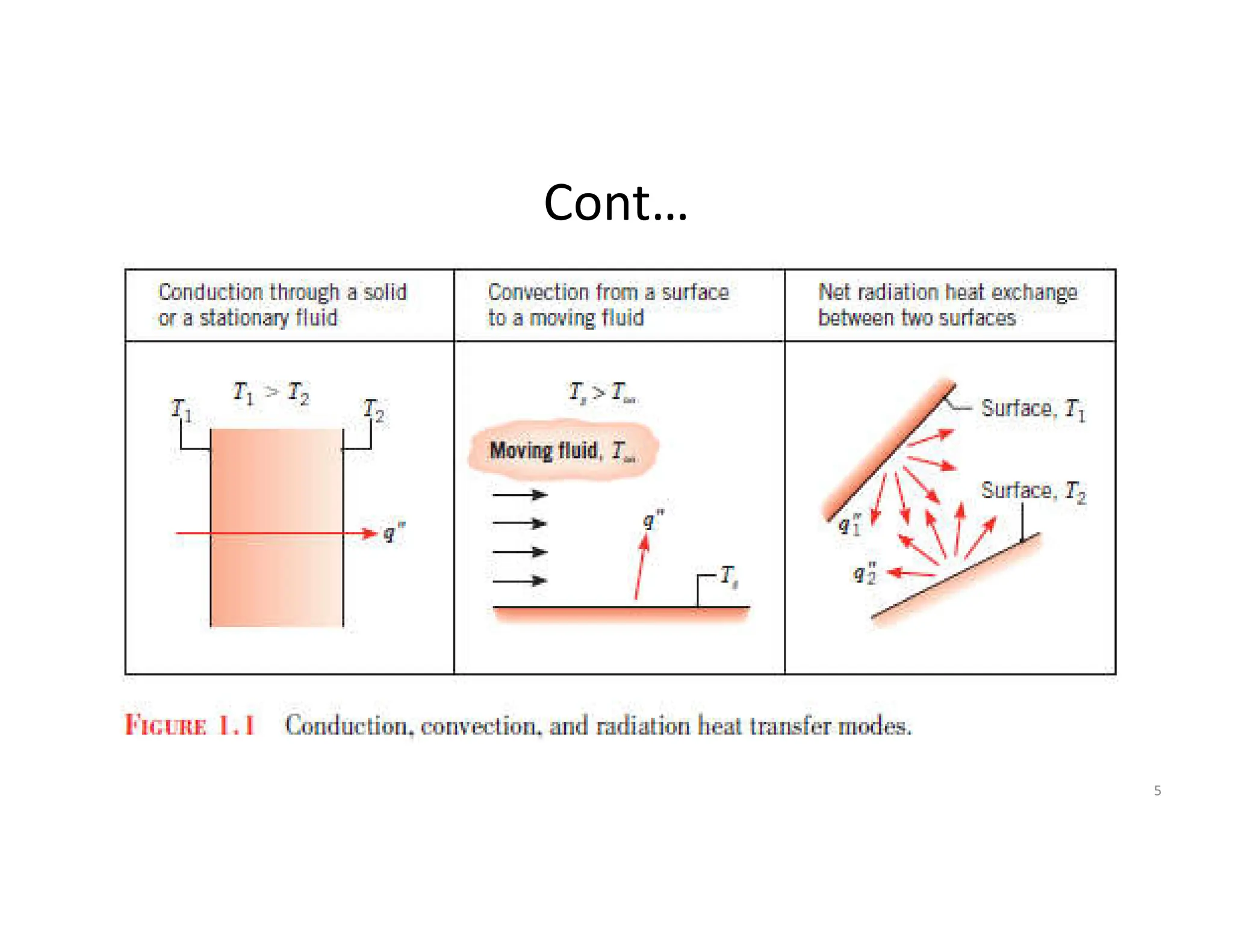
• As shown in Figure 1.1, we refer to different types of heat transfer
processes as modes.
4
Cont…
5
6
Cont…
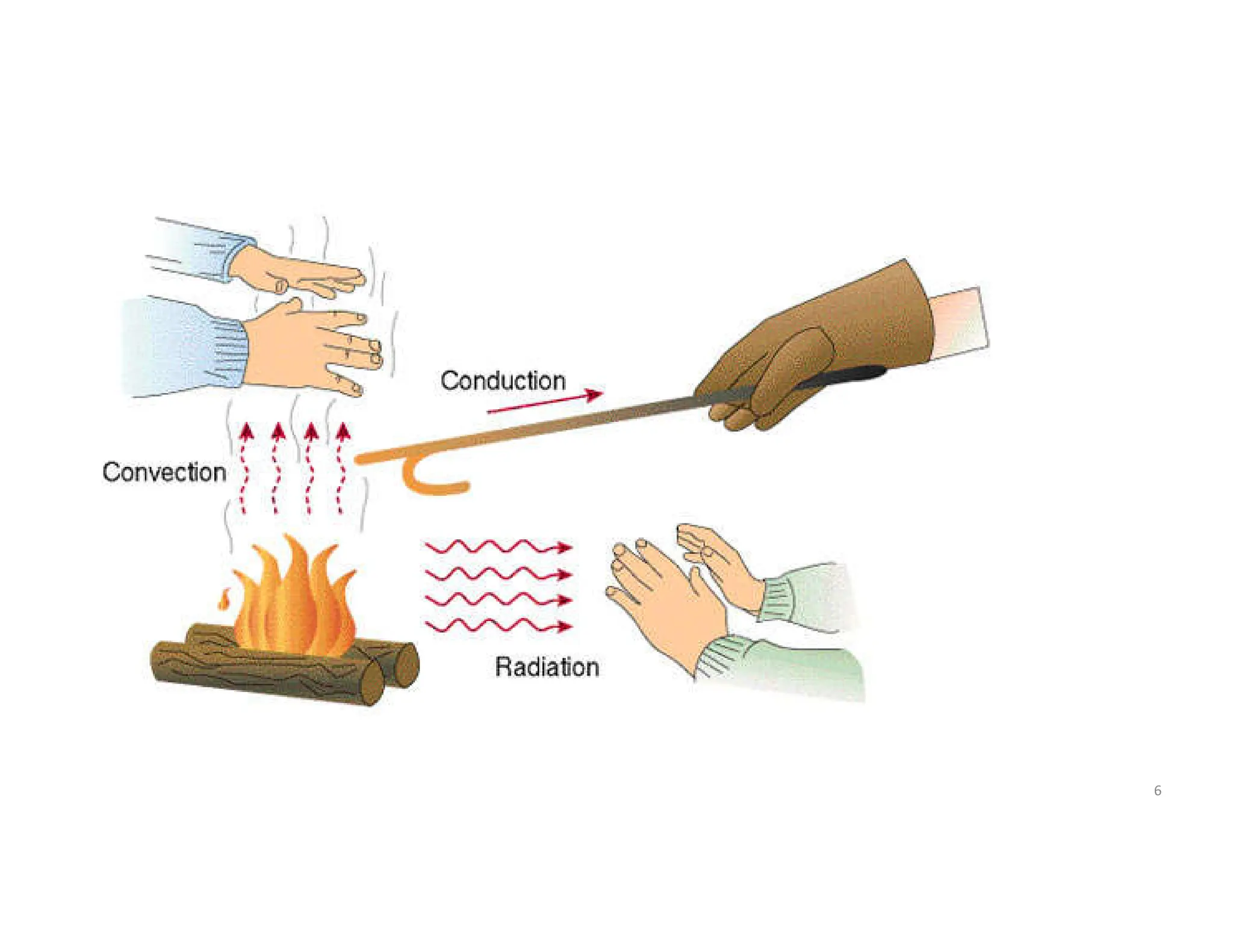
• When a temperature gradient exists in a stationary medium, which may
be a solid or a fluid, we use the term conduction to refer to the heat
transfer that will occur across the medium.
• In contrast, the term convection refers to heat transfer that will occur
between a surface and a moving fluid when they are at different
temperatures.
• The third mode of heat transfer is termed thermal radiation. All surfaces
of finite temperature emit energy in the form of electromagnetic waves.
• Hence, in the absence of an intervening medium, there is net heat
transfer by radiation between two surfaces at different temperatures.
7
1.2 Physical Origins and Rate Equations
1.2.1 Conduction
• At mention of the word conduction, we should immediately
conjure up concepts of atomic and molecular activity because
processes at these levels sustain this mode of heat transfer.
• Conduction may be viewed as the transfer of energy from the
more energetic to the less energetic particles of a substance due to
interactions between the particles.
8
Cont…
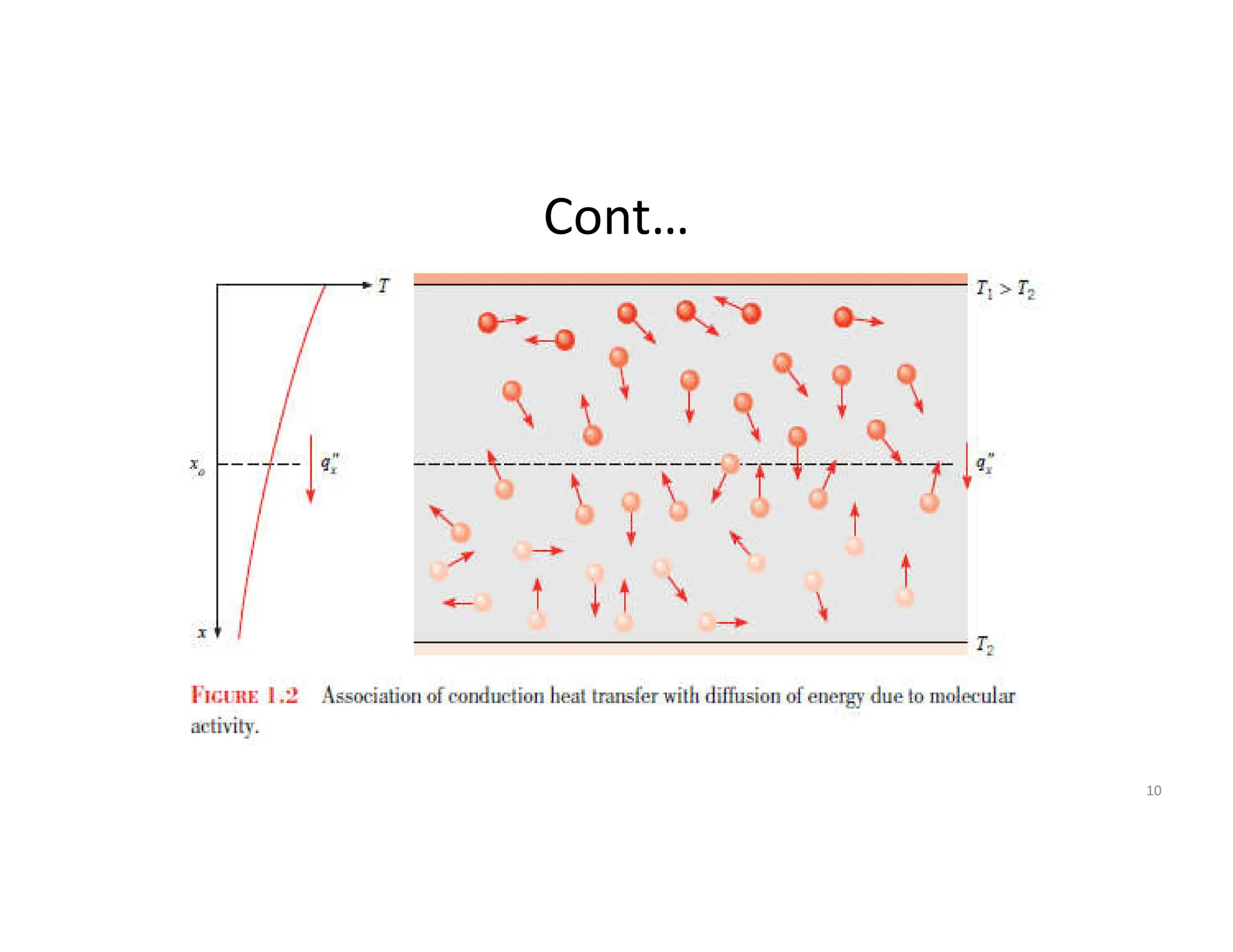
• Higher temperatures are associated with higher molecular energies.
• When neighboring molecules collide, as they are constantly doing, a
transfer of energy from the more energetic to the less energetic
molecules must occur.
• So, in the presence of a temperature gradient, energy transfer by
conduction must then occur in the direction of decreasing
temperature.
• This would be true even in the absence of collisions, as is evident
from Figure 1.2.
9
Cont…
10
Cont…
• Examples of conduction heat transfer are legion.
– The exposed end of a metal spoon suddenly immersed in a cup of hot
coffee is eventually warmed due to the conduction of energy through
the spoon.
– On a winter day, there is significant energy loss from a heated room to
the outside air. This loss is principally due to conduction heat transfer
through the wall that separates the room air from the outside air.
11
Equation for conduction heat transfer
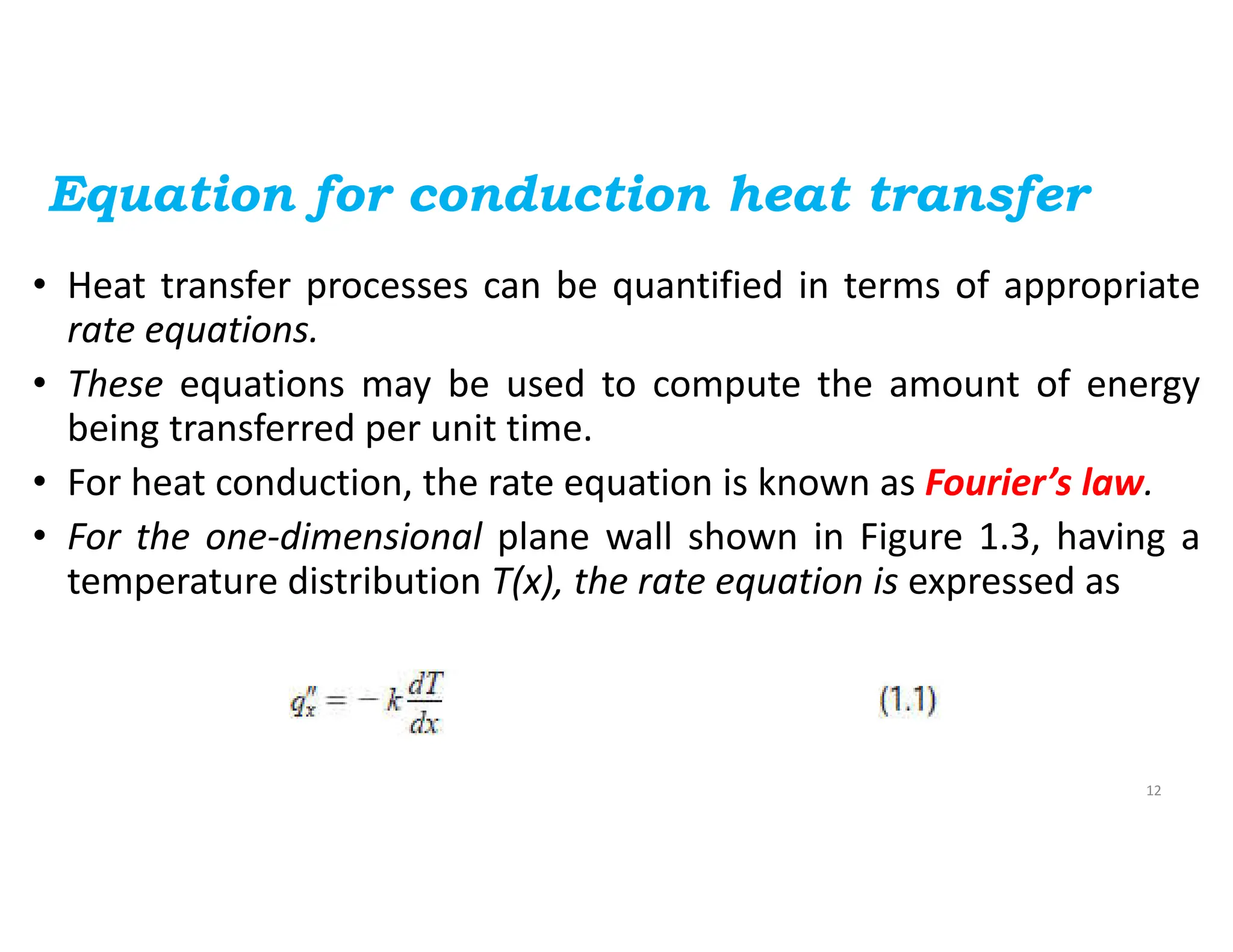
• Heat transfer processes can be quantified in terms of appropriate
rate equations.
• These equations may be used to compute the amount of energy
being transferred per unit time.
• For heat conduction, the rate equation is known as Fourier’s law.
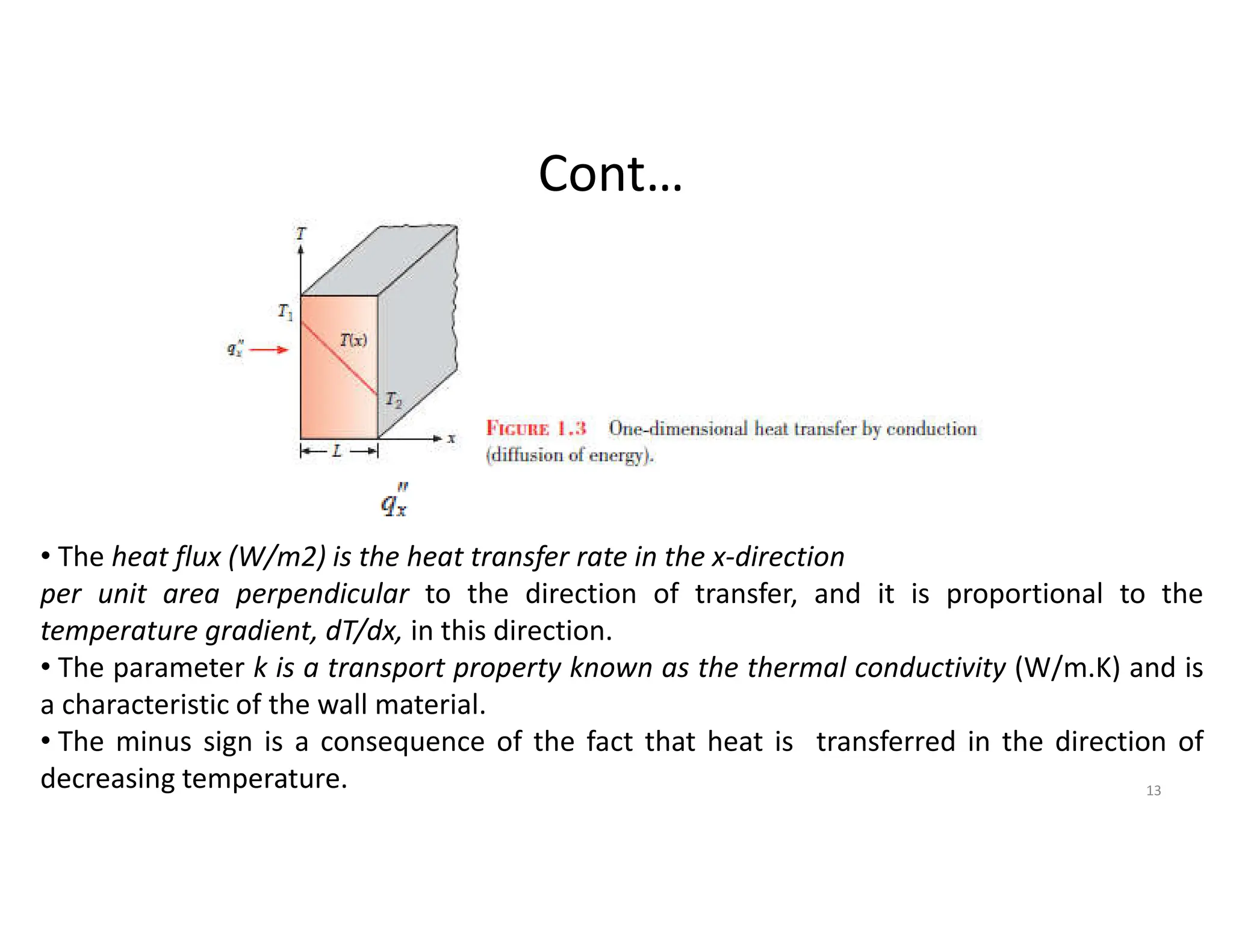
• For the one-dimensional plane wall shown in Figure 1.3, having a
temperature distribution T(x), the rate equation is expressed as
12
Cont…
• The heat flux (W/m2) is the heat transfer rate in the x-direction
per unit area perpendicular to the direction of transfer, and it is proportional to the
temperature gradient, dT/dx, in this direction.
• The parameter k is a transport property known as the thermal conductivity (W/m.K) and is
a characteristic of the wall material.
• The minus sign is a consequence of the fact that heat is transferred in the direction of
decreasing temperature. 13
Cont…
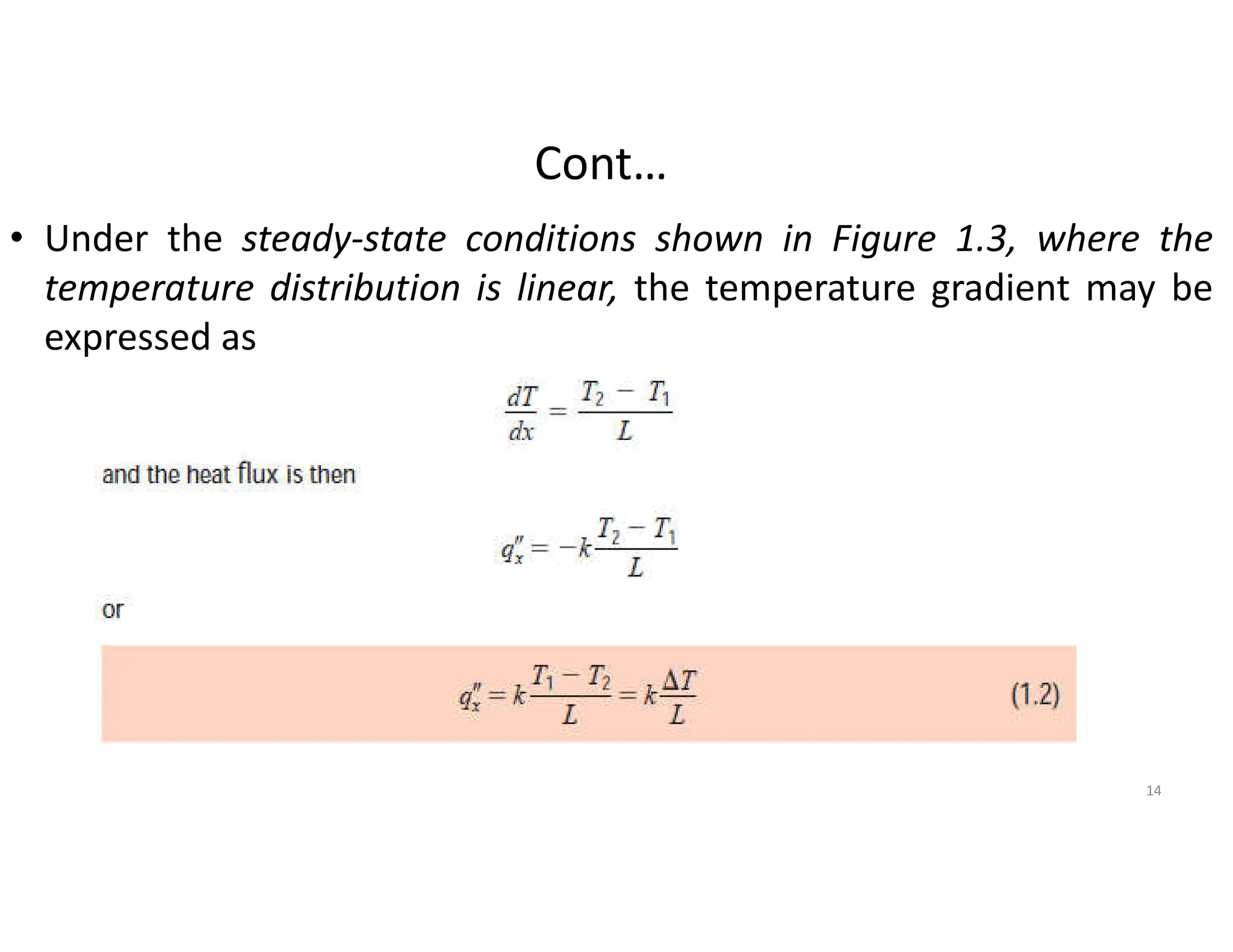
• Under the steady-state conditions shown in Figure 1.3, where the
temperature distribution is linear, the temperature gradient may be
expressed as
14
Cont…
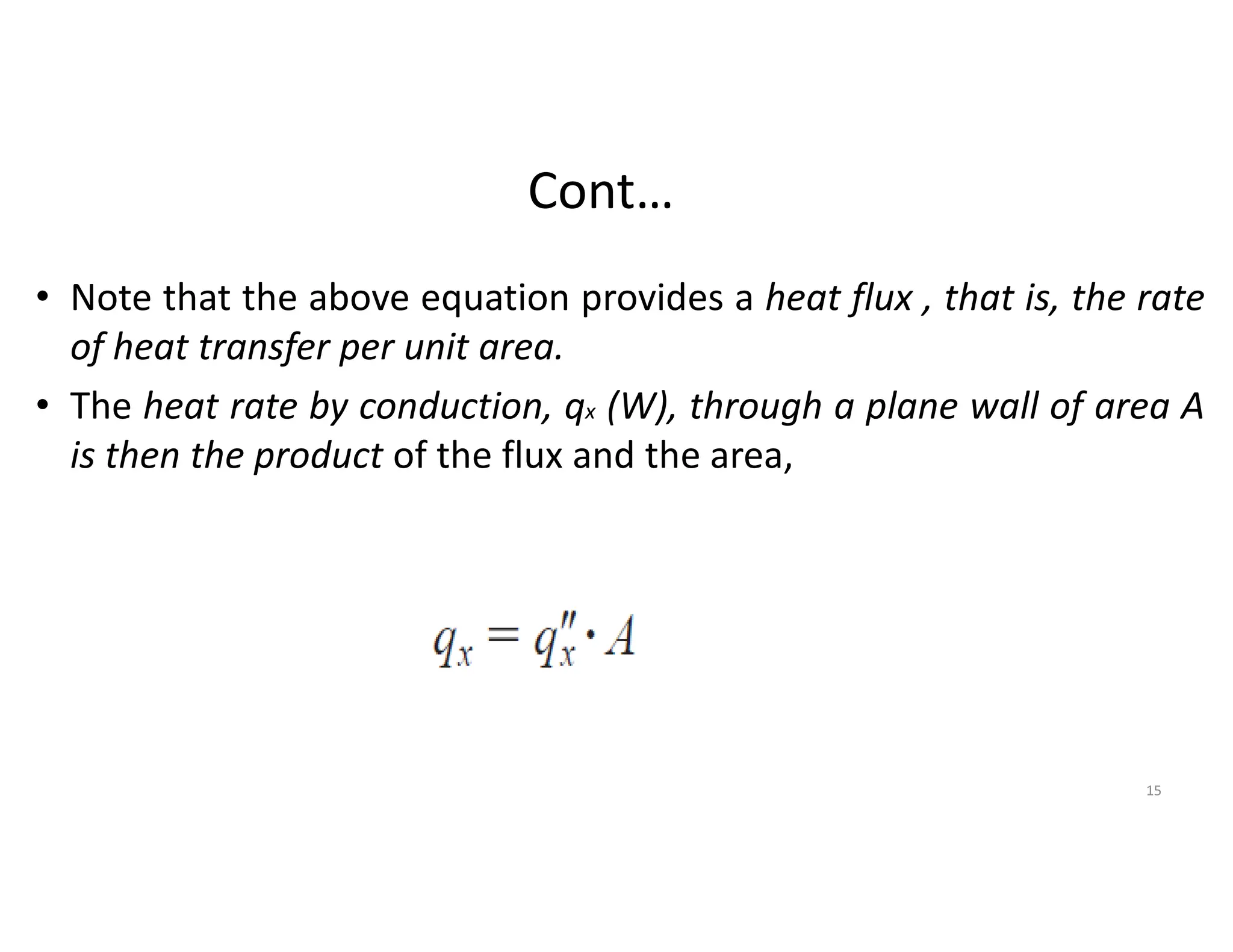
• Note that the above equation provides a heat flux , that is, the rate
of heat transfer per unit area.
• The heat rate by conduction, qx (W), through a plane wall of area A
is then the product of the flux and the area,
15
Thermal Conductivity
• The thermal conductivity of a material is a measure of the ability of
the material to conduct heat. A high value for thermal conductivity
indicates that the material is a good heat conductor, and a low value
indicates that the material is a poor heat conductor or insulator
• For example, k = 0.608 W/m · °C for water and k = 80.2 W/m · °C for
iron at room temperature, which indicates that iron conducts heat
more than 100 times faster than water can. Thus we say that water is
a poor heat conductor relative to iron, although water is an excellent
medium to store thermal energy
16
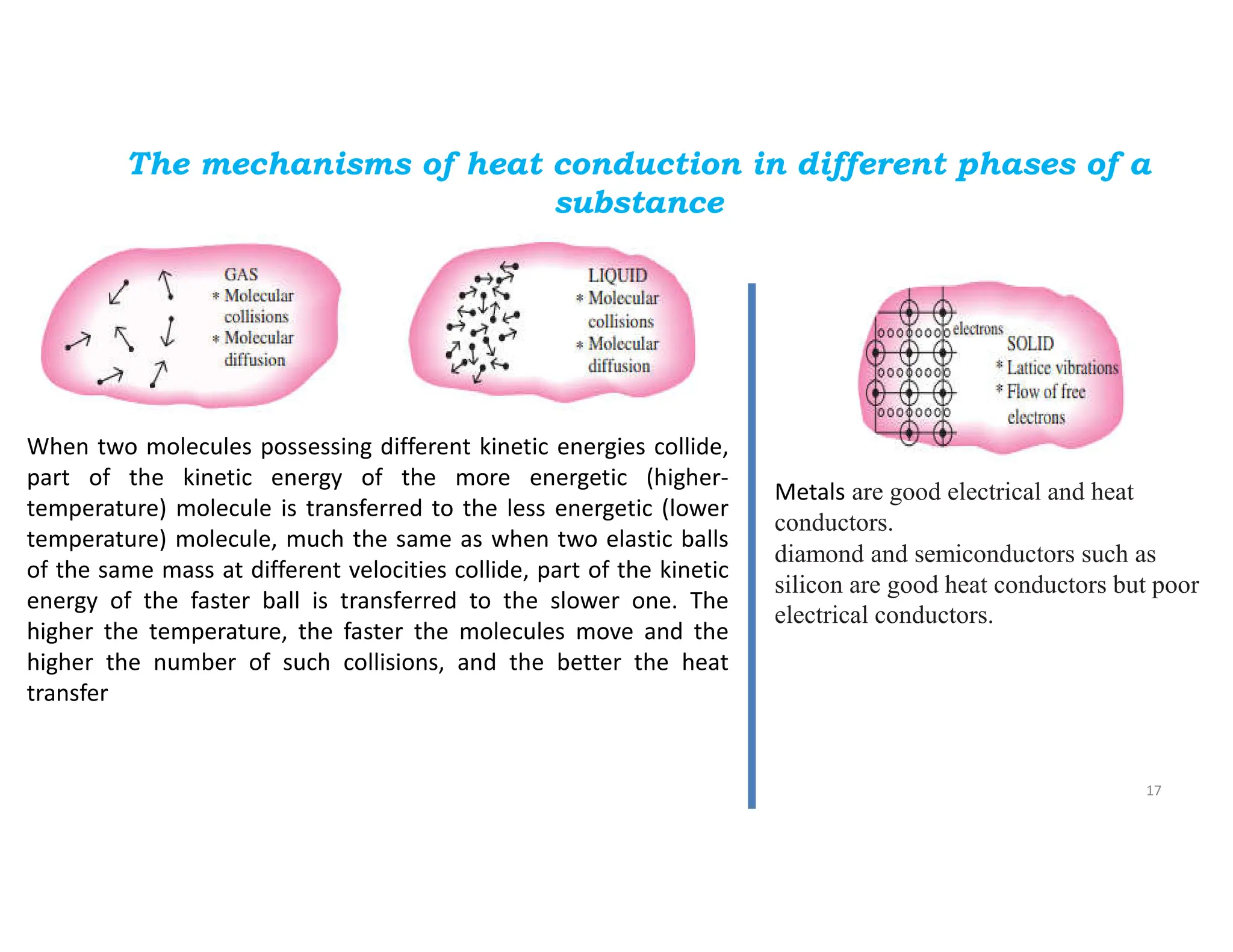
The mechanisms of heat conduction in different phases of a
substance
17
Metals are good electrical and heat
conductors.
diamond and semiconductors such as
silicon are good heat conductors but poor
electrical conductors.
When two molecules possessing different kinetic energies collide,
part of the kinetic energy of the more energetic (higher-
temperature) molecule is transferred to the less energetic (lower
temperature) molecule, much the same as when two elastic balls
of the same mass at different velocities collide, part of the kinetic
energy of the faster ball is transferred to the slower one. The
higher the temperature, the faster the molecules move and the
higher the number of such collisions, and the better the heat
transfer
EXAMPLE 1.1
The wall of an industrial furnace is constructed from 0.15m thick
fireclay brick having a thermal conductivity of 1.7 W/mK.
Measurements made during steady-state operation reveal
temperatures of 1400 and 1150 K at the inner and outer surfaces,
respectively. What is the rate of heat loss through a wall that is 0.5 m
x 1.2 m on a side?
18
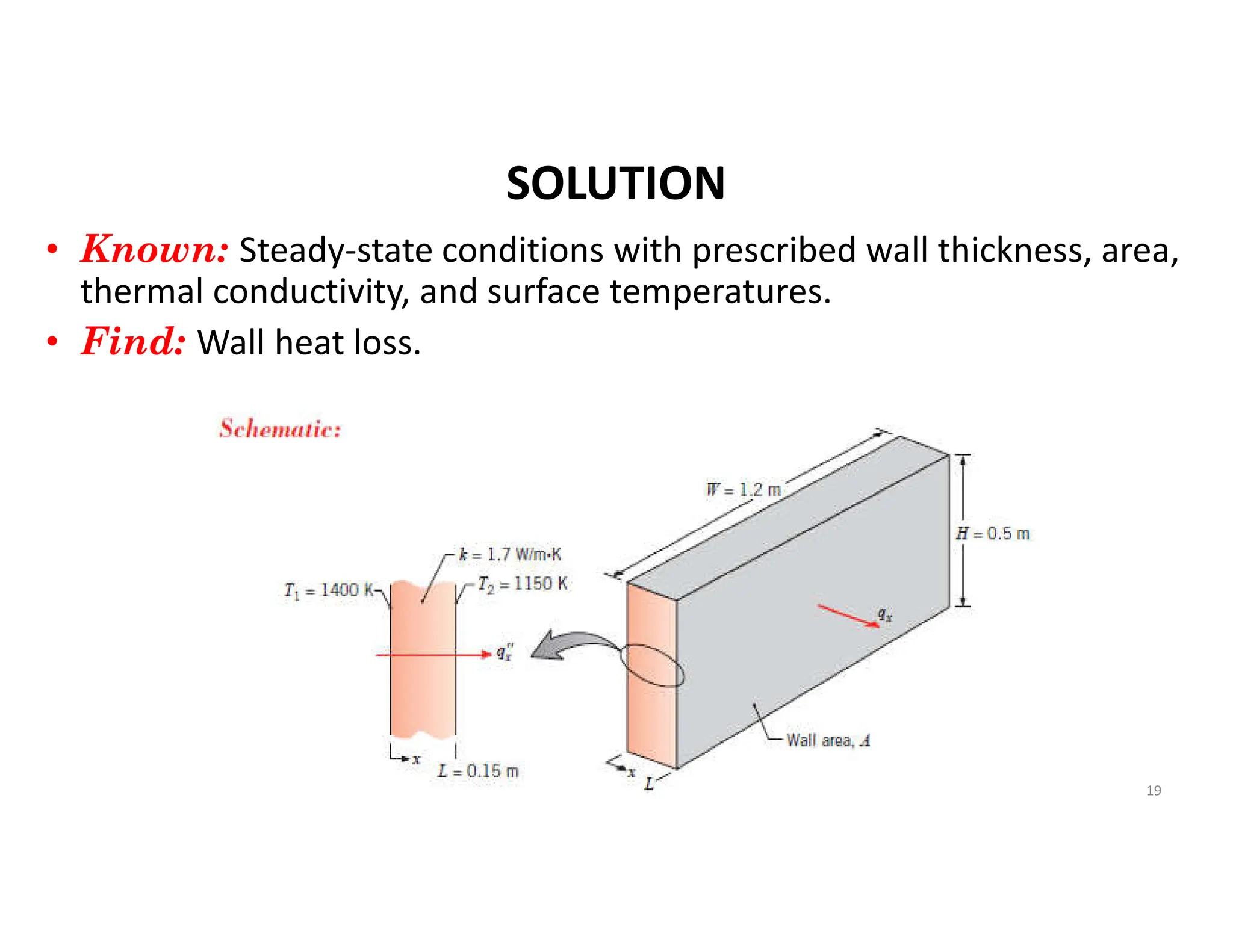
SOLUTION
• Known: Steady-state conditions with prescribed wall thickness, area,
thermal conductivity, and surface temperatures.
• Find: Wall heat loss.
19
Cont…
• Assumptions:
1. Steady-state conditions.
2. One-dimensional conduction through the wall.
3. Constant thermal conductivity.
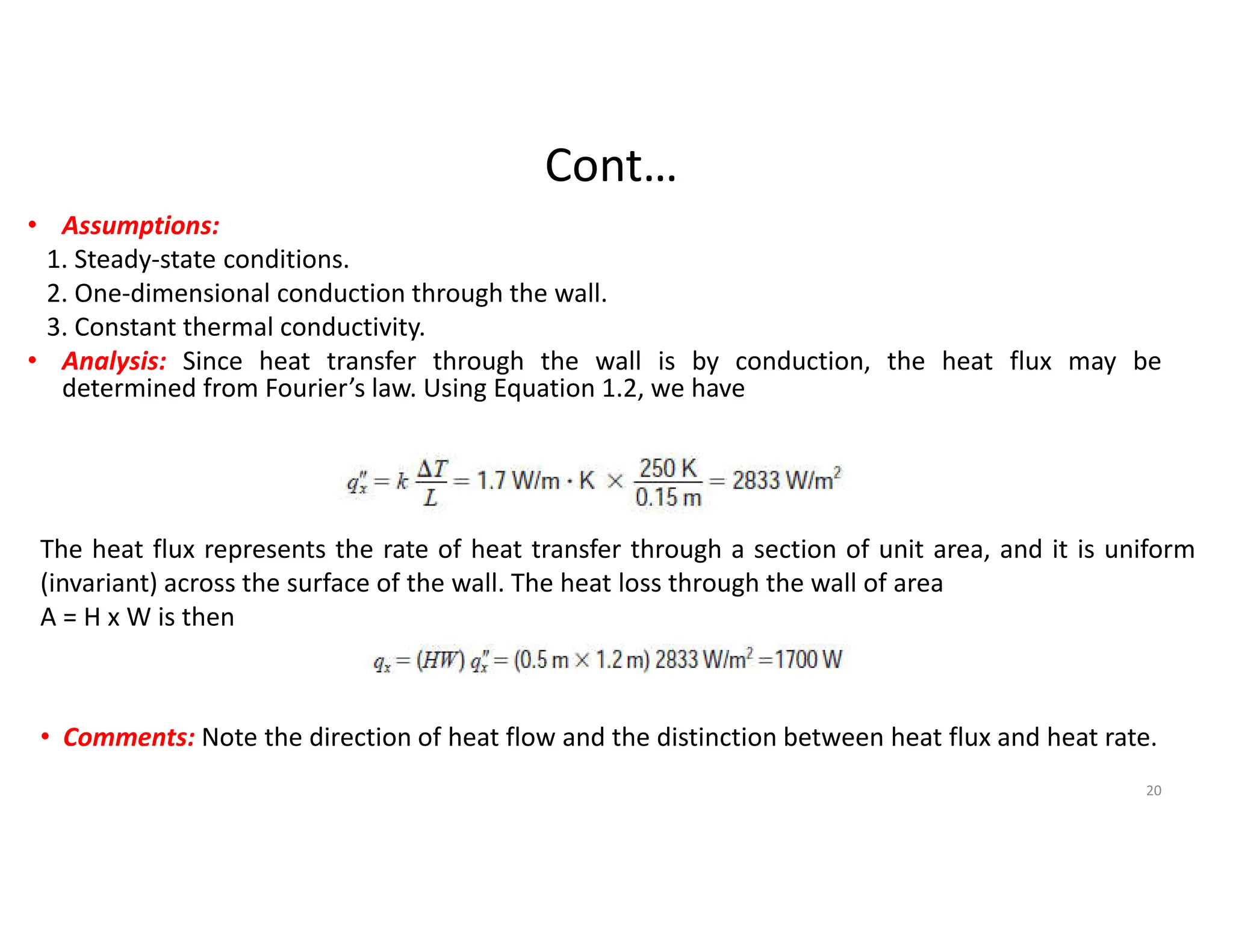
• Analysis: Since heat transfer through the wall is by conduction, the heat flux may be
determined from Fourier’s law. Using Equation 1.2, we have
The heat flux represents the rate of heat transfer through a section of unit area, and it is uniform
(invariant) across the surface of the wall. The heat loss through the wall of area
A = H x W is then
• Comments: Note the direction of heat flow and the distinction between heat flux and heat rate.
20
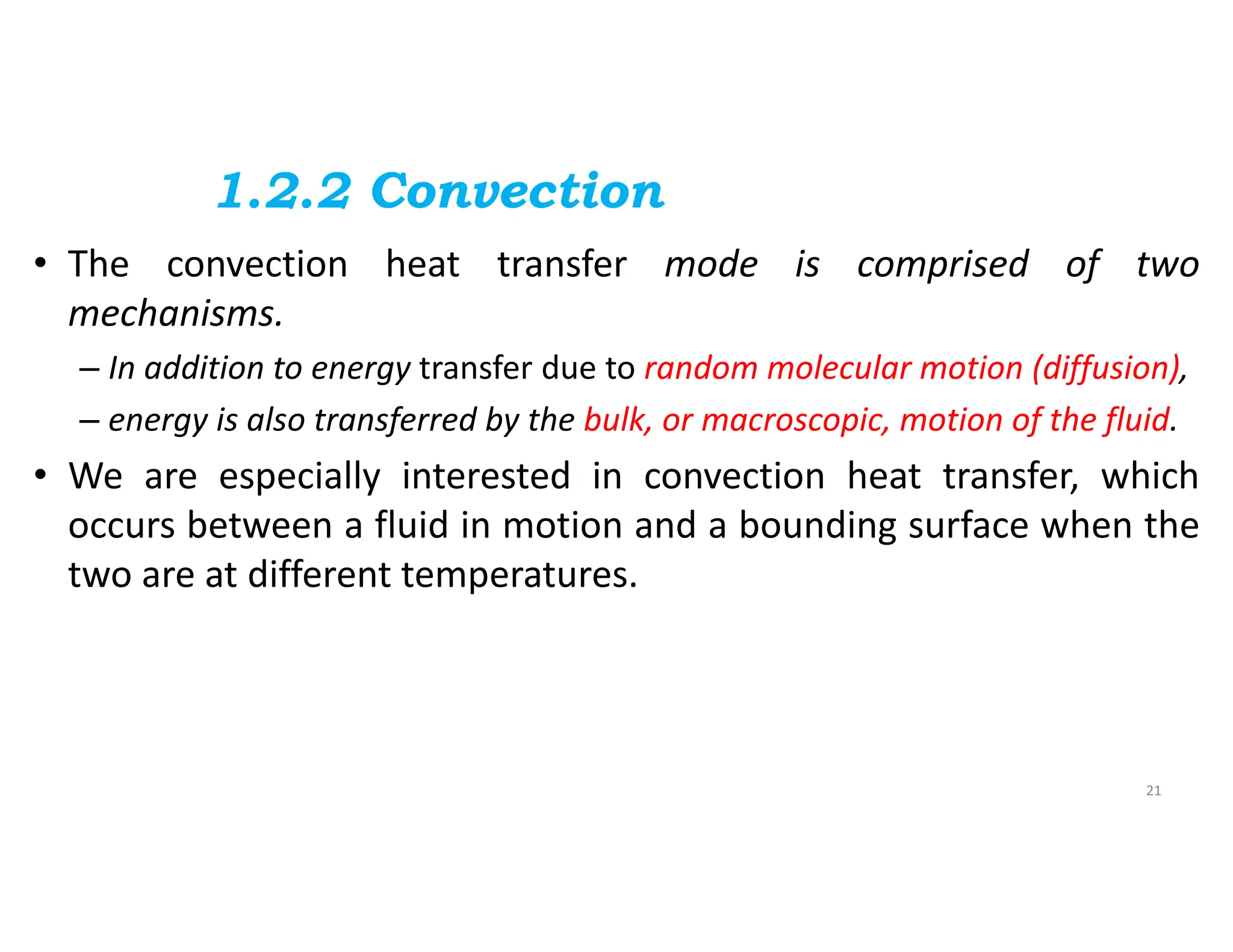
1.2.2 Convection
• The convection heat transfer mode is comprised of two
mechanisms.
– In addition to energy transfer due to random molecular motion (diffusion),
– energy is also transferred by the bulk, or macroscopic, motion of the fluid.
• We are especially interested in convection heat transfer, which
occurs between a fluid in motion and a bounding surface when the
two are at different temperatures.
21
Cont…
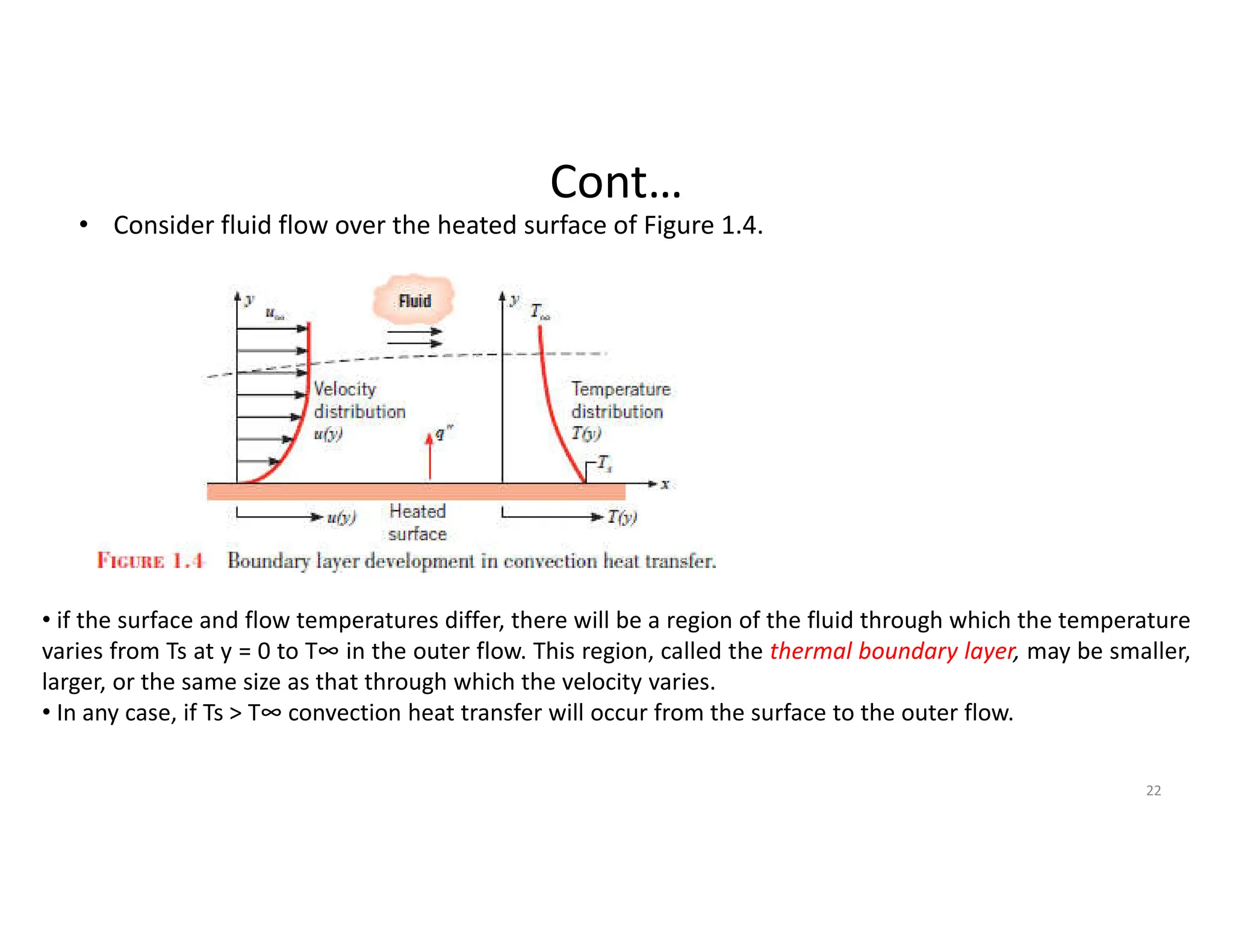
• Consider fluid flow over the heated surface of Figure 1.4.
• if the surface and flow temperatures differ, there will be a region of the fluid through which the temperature
varies from Ts at y = 0 to T∞ in the outer flow. This region, called the thermal boundary layer, may be smaller,
larger, or the same size as that through which the velocity varies.
• In any case, if Ts > T∞ convection heat transfer will occur from the surface to the outer flow.
22
Cont…
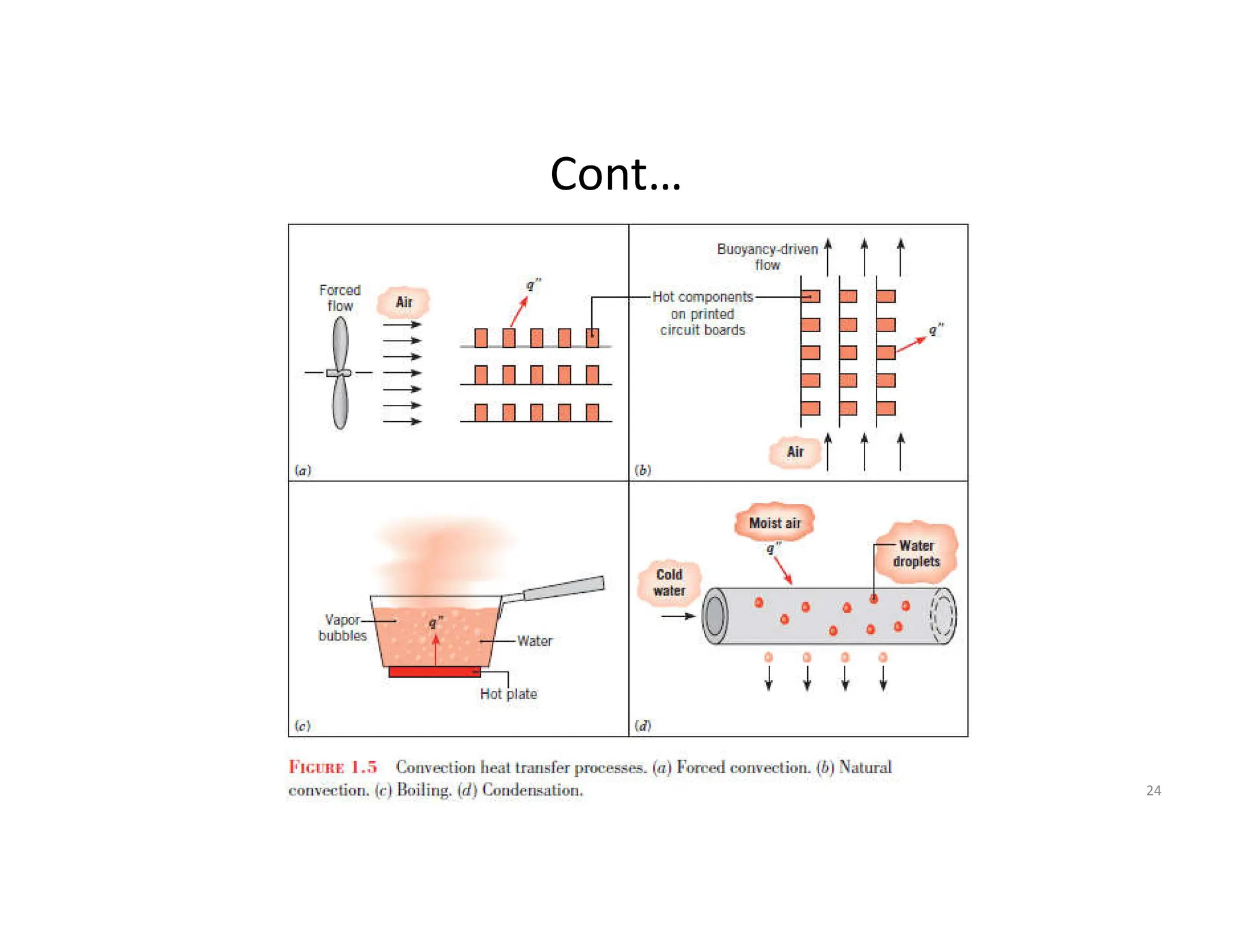
• Convection heat transfer may be classified according to the nature of the flow.
– forced convection
– free (or natural) convection
• Forced convection when the flow is caused by external means, such as by a fan, a pump, or
atmospheric winds.
– As an example, consider the use of a fan to provide forced convection air cooling of hot
electrical components on a stack of printed circuit boards (Figure 1.5a).
• Free (or natural) convection when the flow is induced by buoyancy forces, which are due to density
differences caused by temperature variations in the fluid.
– An example is the free convection heat transfer that occurs from hot components on a vertical
array of circuit boards in air (Figure 1.5b).
23
Cont…
24
Cont…
• Two special cases of convection with phase change are boiling and
condensation.
• For example, convection heat transfer results from fluid motion
induced by vapor bubbles generated at the bottom of a pan of
boiling water (Figure 1.5c) or by the condensation of water vapor on
the outer surface of a cold water pipe (Figure 1.5d).
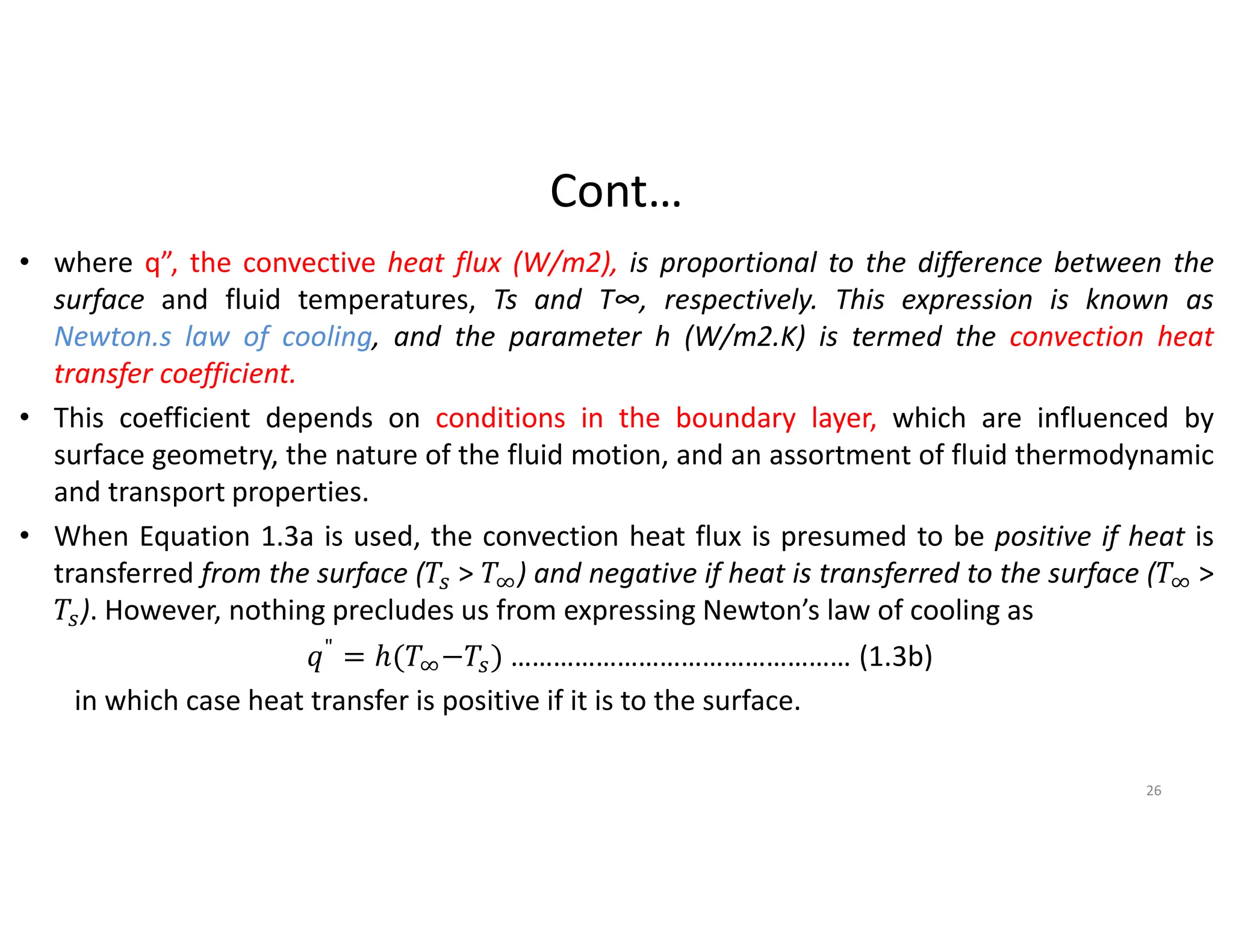
Regardless of the nature of the convection heat transfer process,
the appropriate rate equation is of the form
"
= ℎ( − ) ………………………… (1.3a)
25
Cont…
• where q”, the convective heat flux (W/m2), is proportional to the difference between the
surface and fluid temperatures, Ts and T∞, respectively. This expression is known as
Newton.s law of cooling, and the parameter h (W/m2.K) is termed the convection heat
transfer coefficient.
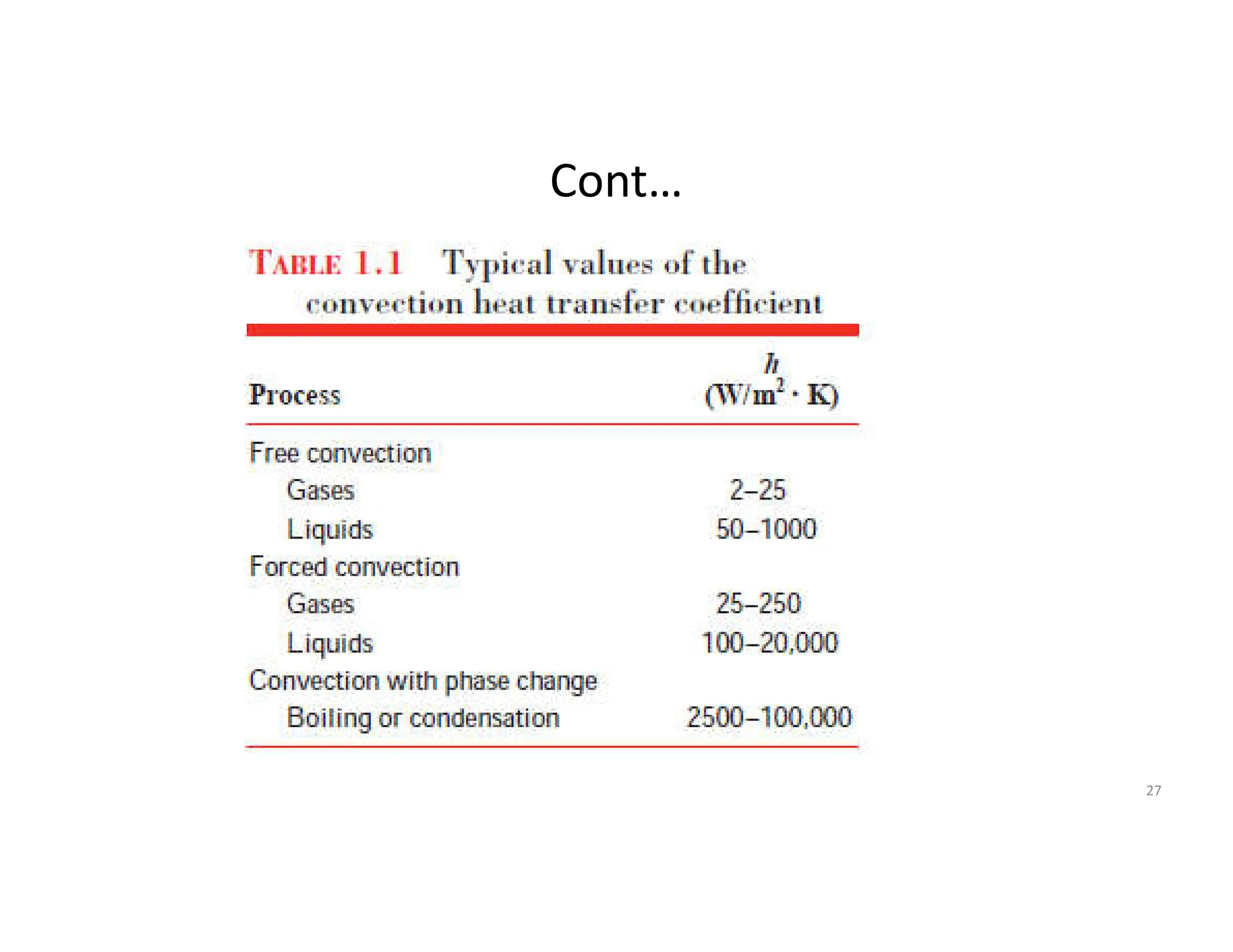
• This coefficient depends on conditions in the boundary layer, which are influenced by
surface geometry, the nature of the fluid motion, and an assortment of fluid thermodynamic
and transport properties.
• When Equation 1.3a is used, the convection heat flux is presumed to be positive if heat is
transferred from the surface ( > ) and negative if heat is transferred to the surface ( >
). However, nothing precludes us from expressing Newton’s law of cooling as
" = ℎ( − ) ………………………………………… (1.3b)
in which case heat transfer is positive if it is to the surface.
26
Cont…
27
1.2.3 Radiation
• Thermal radiation is energy emitted by matter that is at a nonzero
temperature.
• Although we will focus on radiation from solid surfaces, emission
may also occur from liquids and gases.
• The energy of the radiation field is transported by electromagnetic
waves (or alternatively, photons).
• While the transfer of energy by conduction or convection requires
the presence of a material medium, radiation does not.
• In fact, radiation transfer occurs most efficiently in a vacuum.
28
Cont…
• Consider radiation transfer processes for the surface of Figure 1.6a. Radiation
that is emitted by the surface originates from the thermal energy of matter
bounded by the surface, and the rate at which energy is released per unit area
(W/m2) is termed the surface emissive power, E.
• There is an upper limit to the emissive power, which is prescribed by the Stefan-
Boltzmann law
where Ts is the absolute temperature (K) of the surface and σ is the Stefan-Boltzmann
constant .
Such a surface is called an ideal radiator or blackbody.
29
Cont…
30
Cont…
• The heat flux emitted by a real surface is less than that of a
blackbody at the same temperature and is given by
• where ԑ is a radiative property of the surface termed the
emissivity. With values in the range 0 < ԑ < 1 , this property
provides a measure of how efficiently a surface emits energy
relative to a blackbody.
• It depends strongly on the surface material and finish, and
representative values are provided in Appendix A.
31
Cont…
• Radiation may also be incident on a surface from its surroundings.
• The radiation may originate from a special source, such as the sun,
or from other surfaces to which the surface of interest is exposed.
• Irrespective of the source(s), we designate the rate at which all
such radiation is incident on a unit area of the surface as the
irradiation G (Figure 1.6a).
32
Cont…
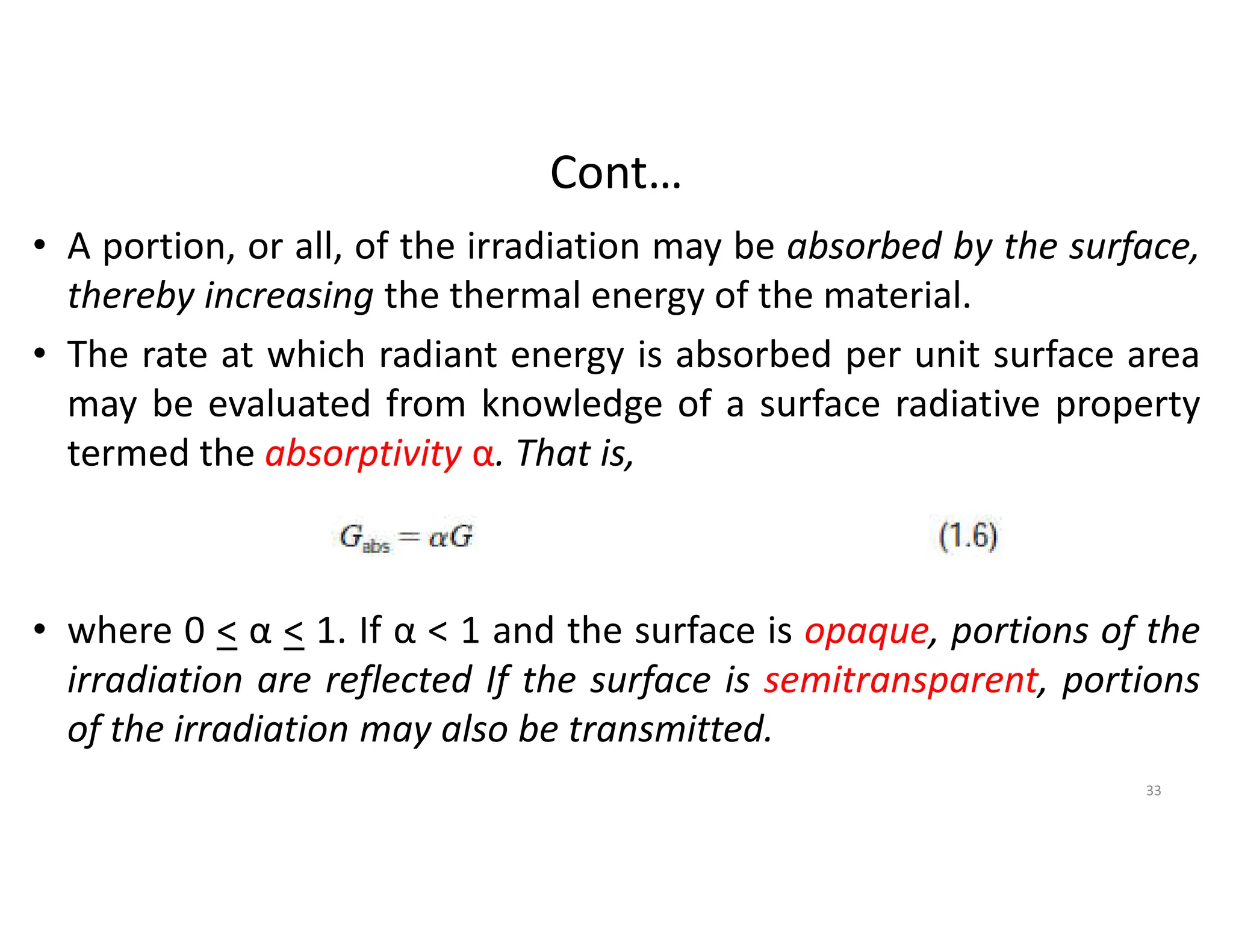
• A portion, or all, of the irradiation may be absorbed by the surface,
thereby increasing the thermal energy of the material.
• The rate at which radiant energy is absorbed per unit surface area
may be evaluated from knowledge of a surface radiative property
termed the absorptivity α. That is,
• where 0 < α < 1. If α < 1 and the surface is opaque, portions of the
irradiation are reflected If the surface is semitransparent, portions
of the irradiation may also be transmitted.
33
Cont…
• However, whereas absorbed and emitted radiation increase and
reduce, respectively, the thermal energy of matter, reflected and
transmitted radiation have no effect on this energy.
• Note that the value of α depends on the nature of the irradiation, as
well as on the surface itself.
• For example, the absorptivity of a surface to solar radiation may
differ from its absorptivity to radiation emitted by the walls of a
furnace.
34
Cont…
• In many engineering problems (a notable exception being
problems involving solar radiation or radiation from other very
high temperature sources), liquids can be considered opaque to
radiation heat transfer, and gases can be considered transparent
to it.
• Solids can be opaque (as is the case for metals) or
semitransparent (as is the case for thin sheets of some polymers
and some semiconducting materials).
35
Cont…
• A special case that occurs frequently involves radiation exchange between a small surface at Ts
and a much larger, isothermal surface that completely surrounds the smaller one (Figure 1.6b).
• The surroundings could, for example, be the walls of a room or a furnace whose temperature
Tsur differs from that of an enclosed surface(Tsur ≠ Ts) .
• For such a condition, the irradiation may be approximated by emission from a blackbody at
Tsur, in which case G = σT4
sur .
• If the surface is assumed to be one for which α = ԑ (a gray surface), the net rate of radiation
heat transfer from the surface, expressed per unit area of the surface, is
• This expression provides the difference between thermal energy that is released due to
radiation emission and that gained due to radiation absorption.
36
Cont…
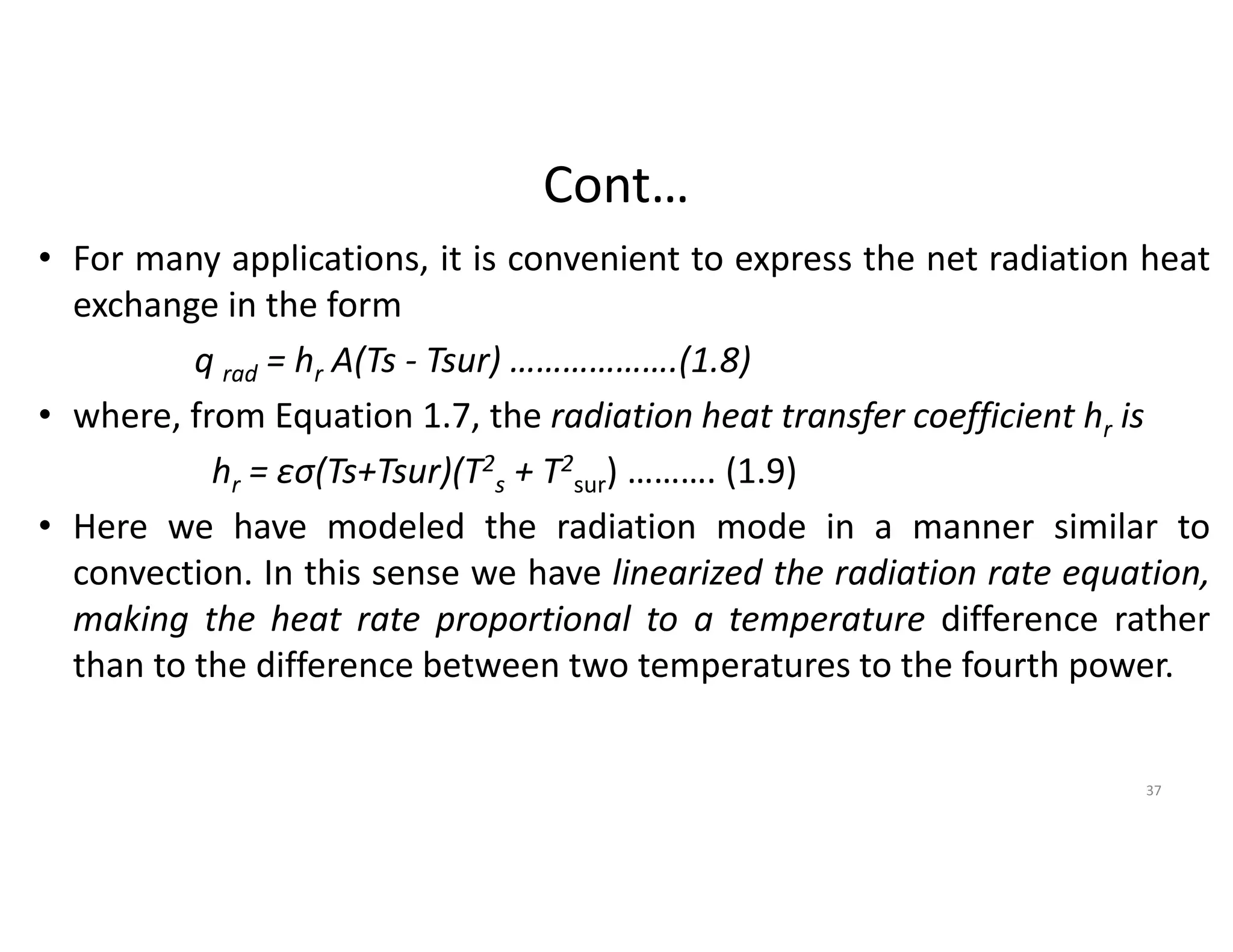
• For many applications, it is convenient to express the net radiation heat
exchange in the form
q rad = hr A(Ts - Tsur) ……………….(1.8)
• where, from Equation 1.7, the radiation heat transfer coefficient hr is
hr = ԑσ(Ts+Tsur)(T2
s + T2
sur) ………. (1.9)
• Here we have modeled the radiation mode in a manner similar to
convection. In this sense we have linearized the radiation rate equation,
making the heat rate proportional to a temperature difference rather
than to the difference between two temperatures to the fourth power.
37
Cont…
• Note, however, that hr depends strongly on temperature, whereas the
temperature dependence of the convection heat transfer coefficient h
is generally weak.
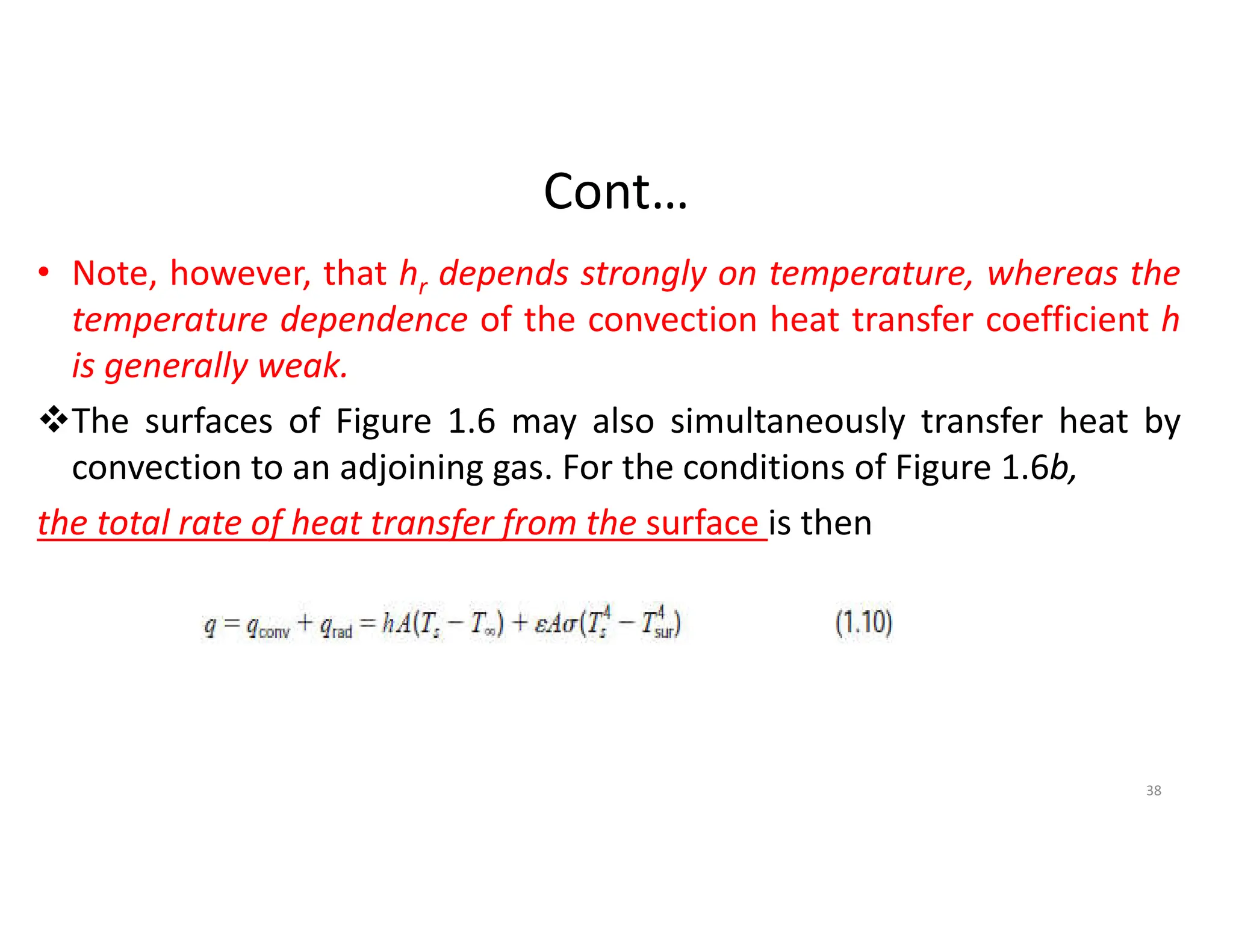
The surfaces of Figure 1.6 may also simultaneously transfer heat by
convection to an adjoining gas. For the conditions of Figure 1.6b,
the total rate of heat transfer from the surface is then
38
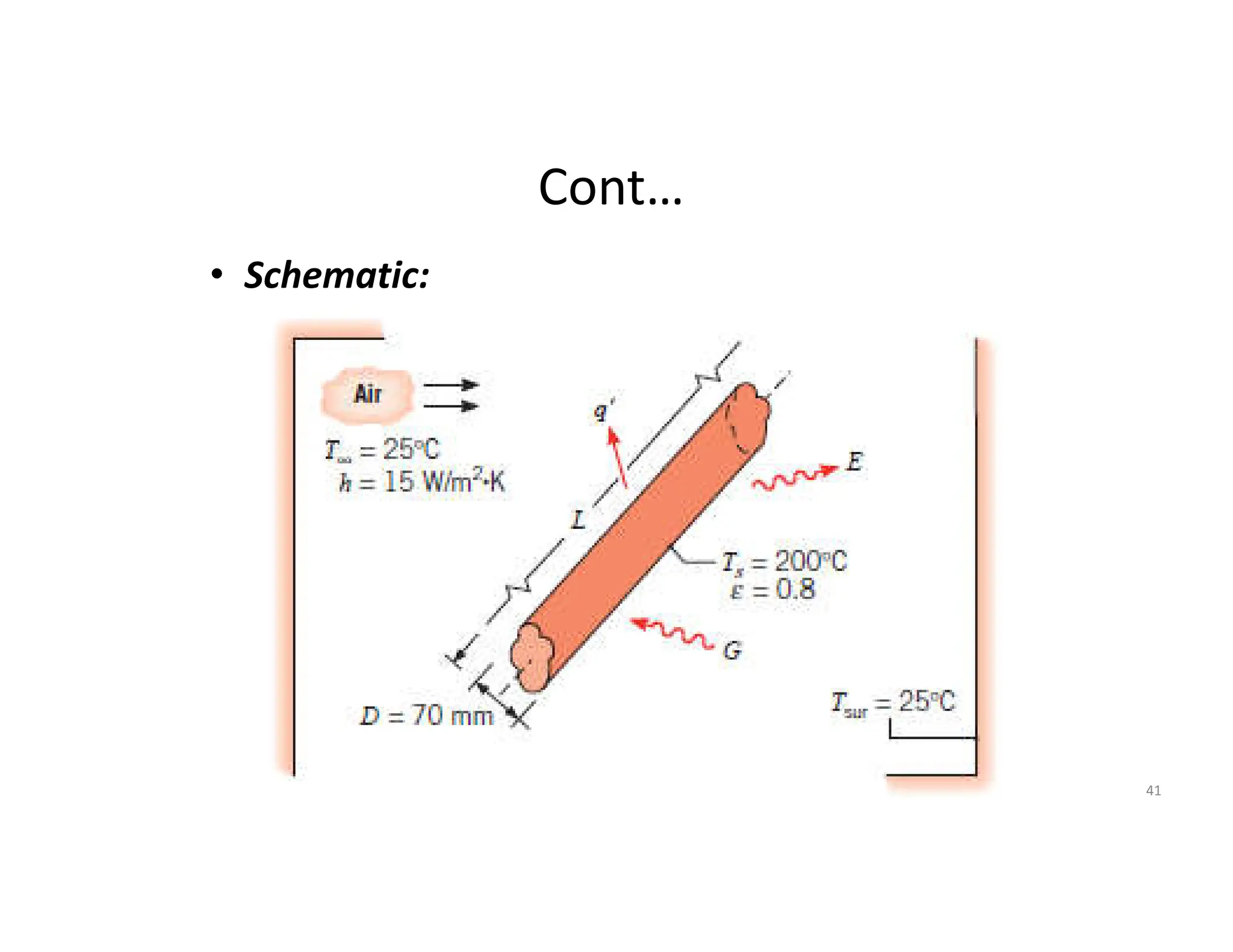
EXAMPLE 1.2
An uninsulated steam pipe passes through a room in which the air
and walls are at 25oC. The outside diameter of the pipe is 70 mm,
and its surface temperature and emissivity are 200oC and 0.8,
respectively.
What are the surface emissive power and irradiation? If the
coefficient associated with free convection heat transfer from the
surface to the air is 15 W/m2.K, what is the rate of heat loss from
the surface per unit length of pipe?
39
SOLUTION
• Known: Uninsulated pipe of prescribed diameter, emissivity, and
surface temperature in a room with fixed wall and air
temperatures.
• Find:
1. Surface emissive power and irradiation.
2. Pipe heat loss per unit length, q’.
40
Cont…
• Schematic:
41
Cont…
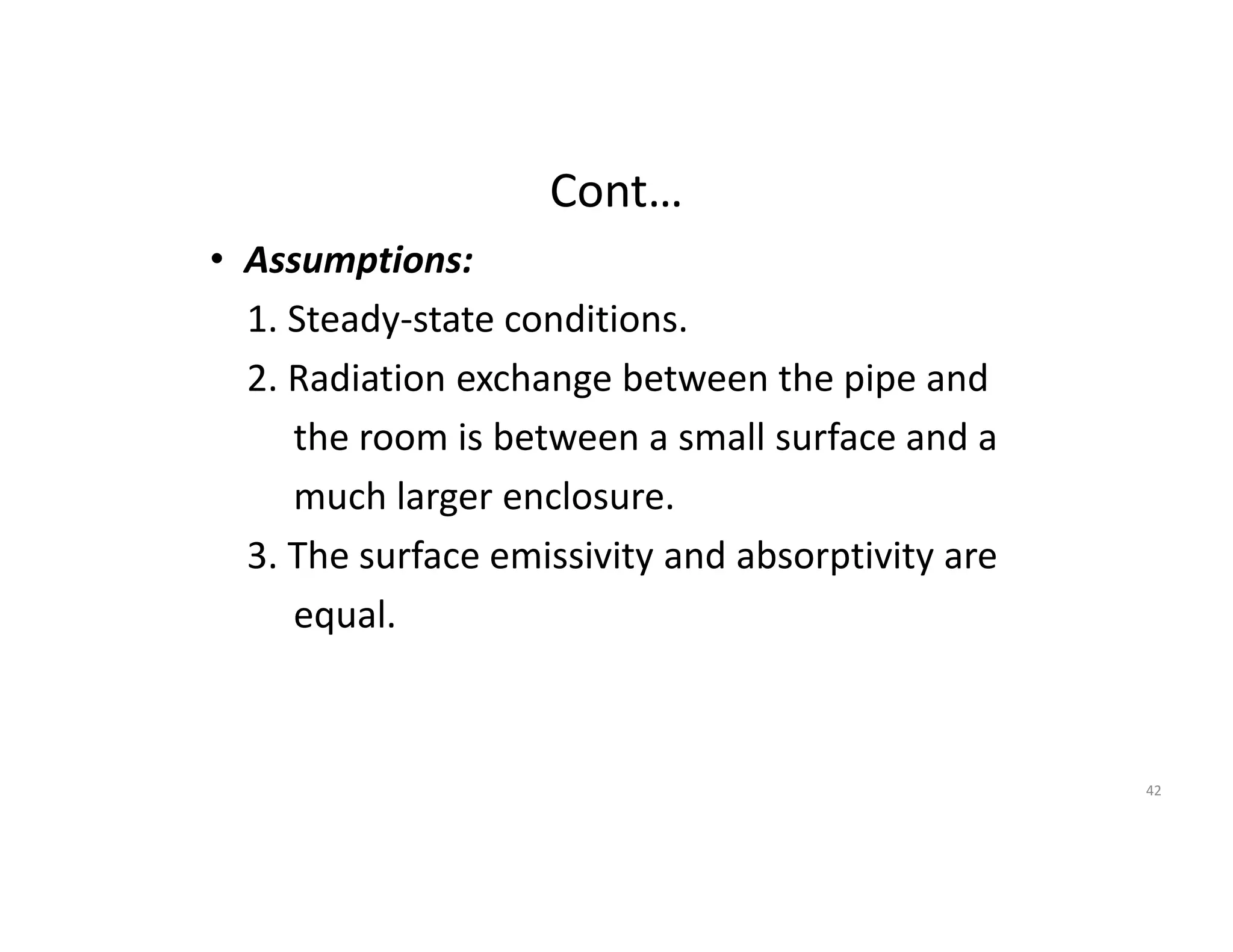
• Assumptions:
1. Steady-state conditions.
2. Radiation exchange between the pipe and
the room is between a small surface and a
much larger enclosure.
3. The surface emissivity and absorptivity are
equal.
42
Cont…
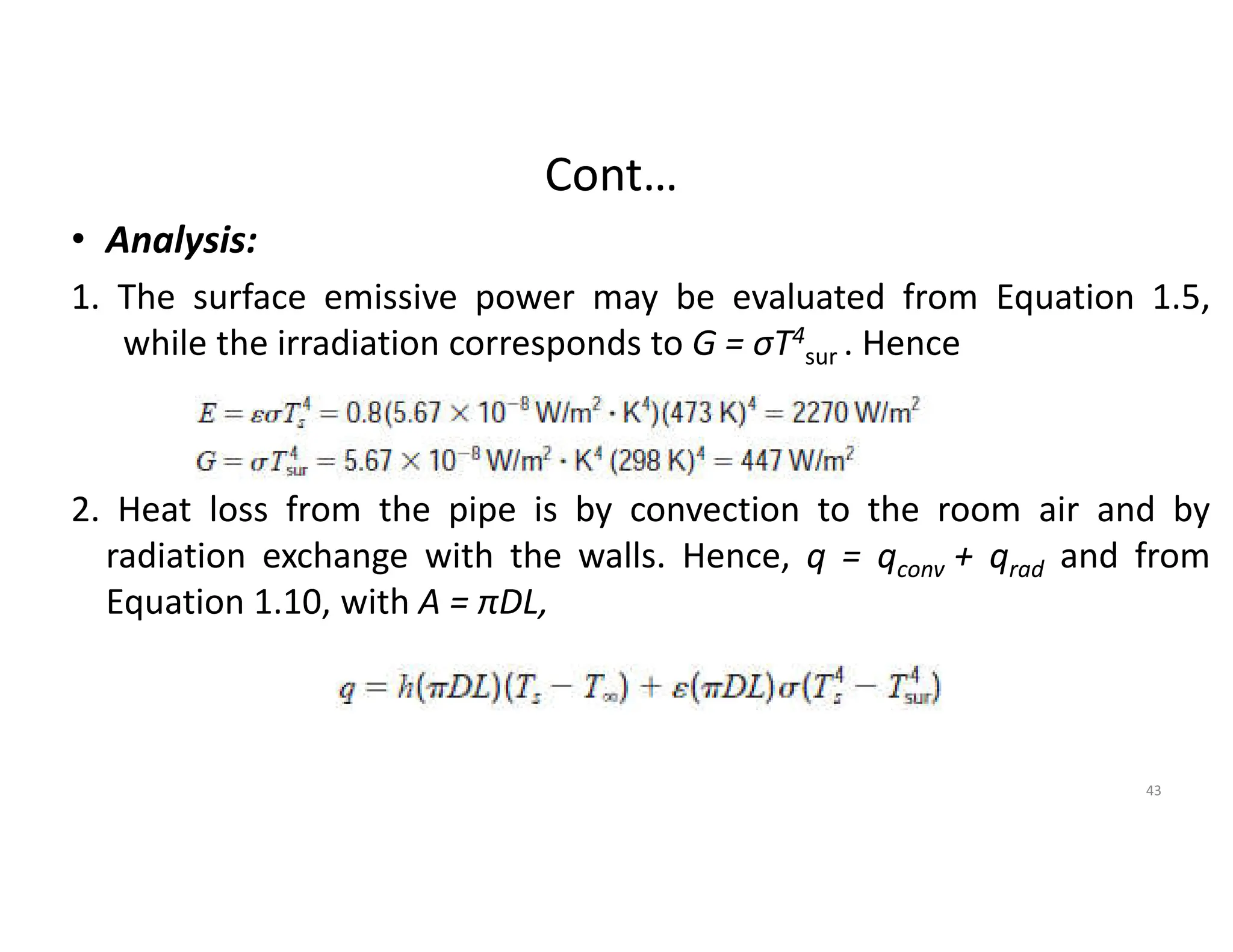
• Analysis:
1. The surface emissive power may be evaluated from Equation 1.5,
while the irradiation corresponds to G = σT4
sur . Hence
2. Heat loss from the pipe is by convection to the room air and by
radiation exchange with the walls. Hence, q = qconv + qrad and from
Equation 1.10, with A = πDL,
43
Cont…
 The heat loss per unit length of pipe is then
• Comments:
1. Note that temperature may be expressed in units of oC or K when evaluating
the temperature difference for a convection (or conduction) heat transfer
rate.
 However, temperature must be expressed in kelvins (K) when evaluating a
radiation transfer rate.
44
Cont…
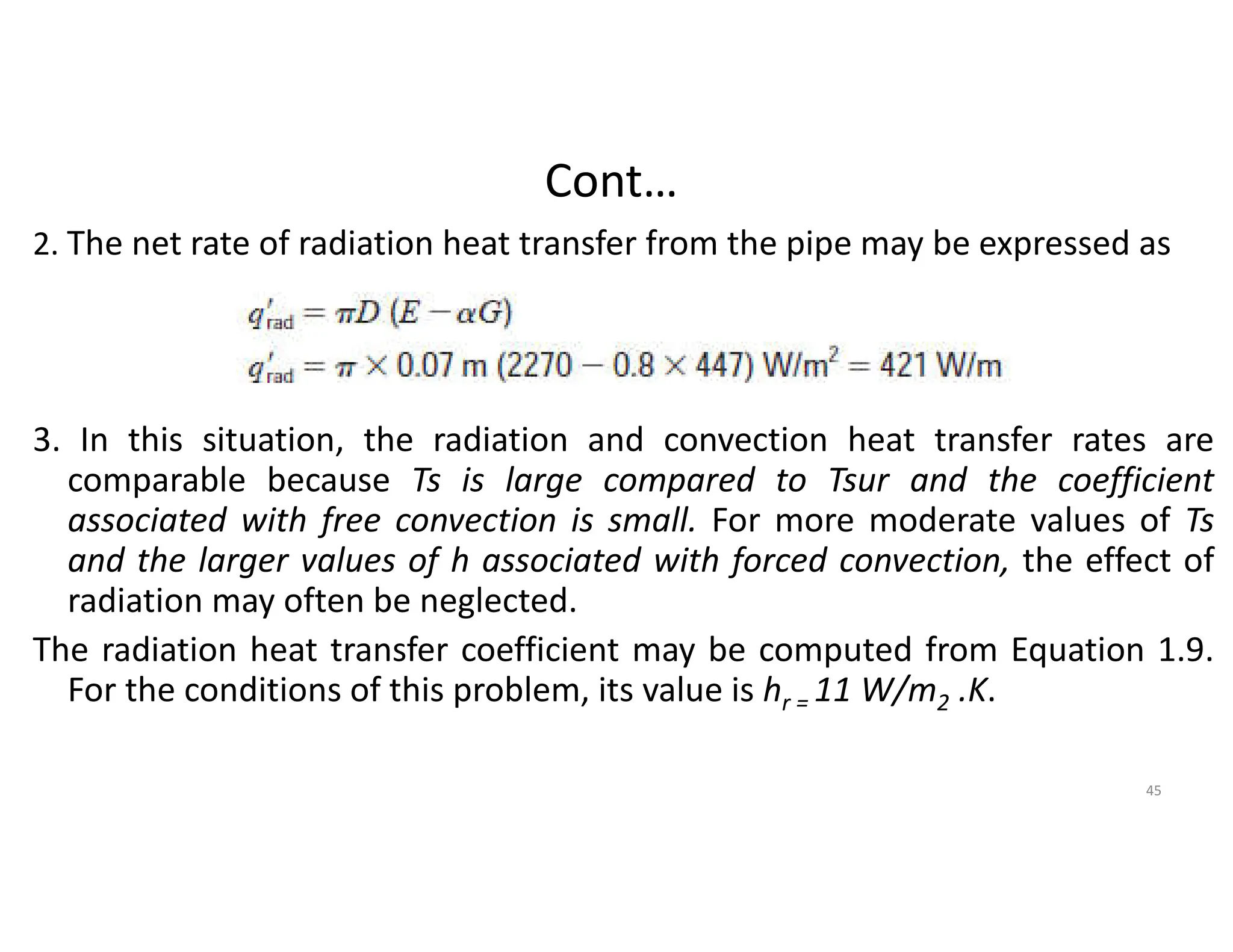
2. The net rate of radiation heat transfer from the pipe may be expressed as
3. In this situation, the radiation and convection heat transfer rates are
comparable because Ts is large compared to Tsur and the coefficient
associated with free convection is small. For more moderate values of Ts
and the larger values of h associated with forced convection, the effect of
radiation may often be neglected.
The radiation heat transfer coefficient may be computed from Equation 1.9.
For the conditions of this problem, its value is hr = 11 W/m2 .K.
45
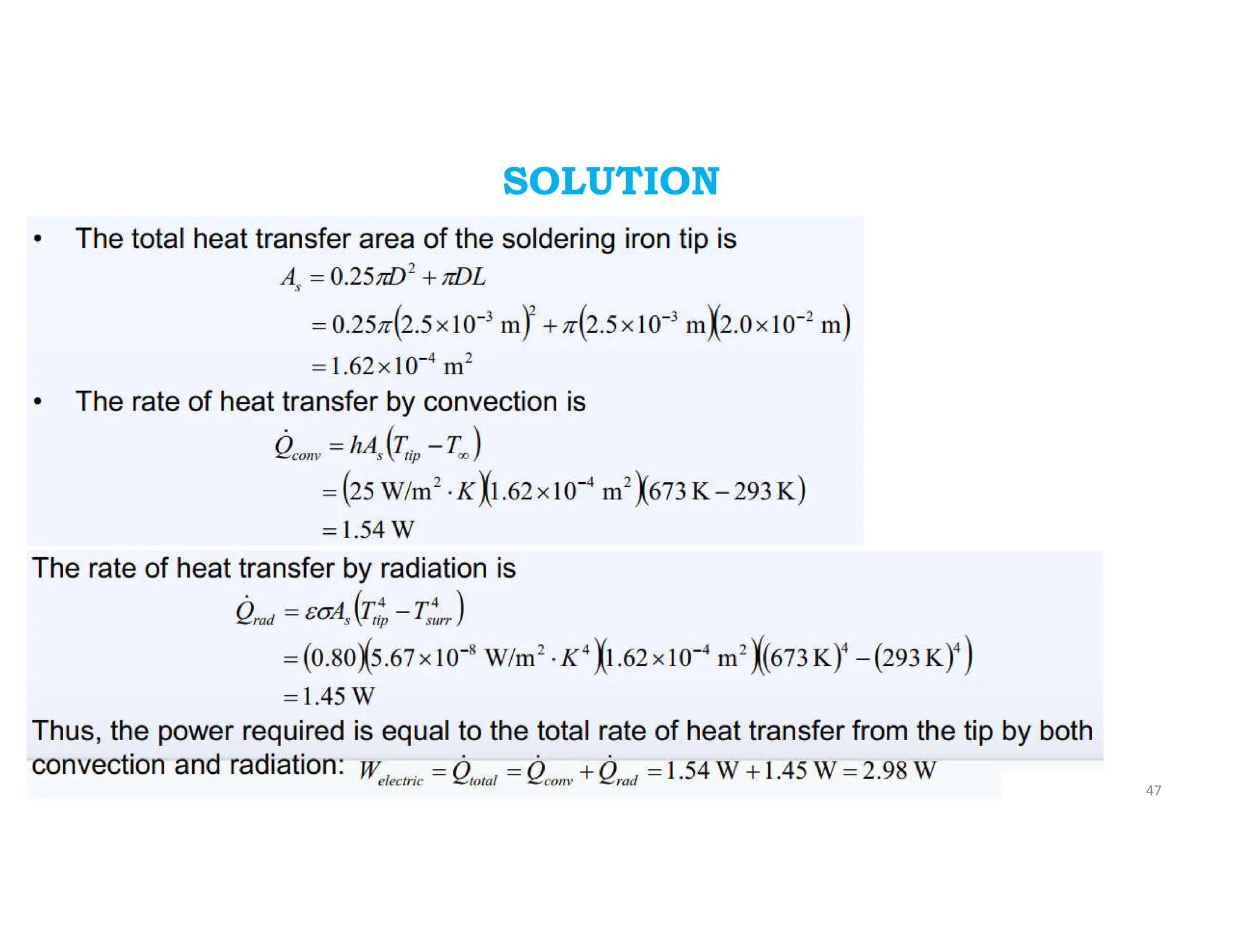
• A soldering iron has a cylindrical tip of 2.5 mm in diameter and 20
mm in length. With age and usage, the tip has oxidized and has
an emissivity of 0.80. Assuming that the average convection heat
transfer coefficient over the soldering iron tip is 25 W/m2.K, and
the surrounding air temperature is 20oC, determine the power
required to maintain the tip at 400oC.
46
EXAMPLE 1.3
47
SOLUTION
1.2.4 The Thermal Resistance Concept
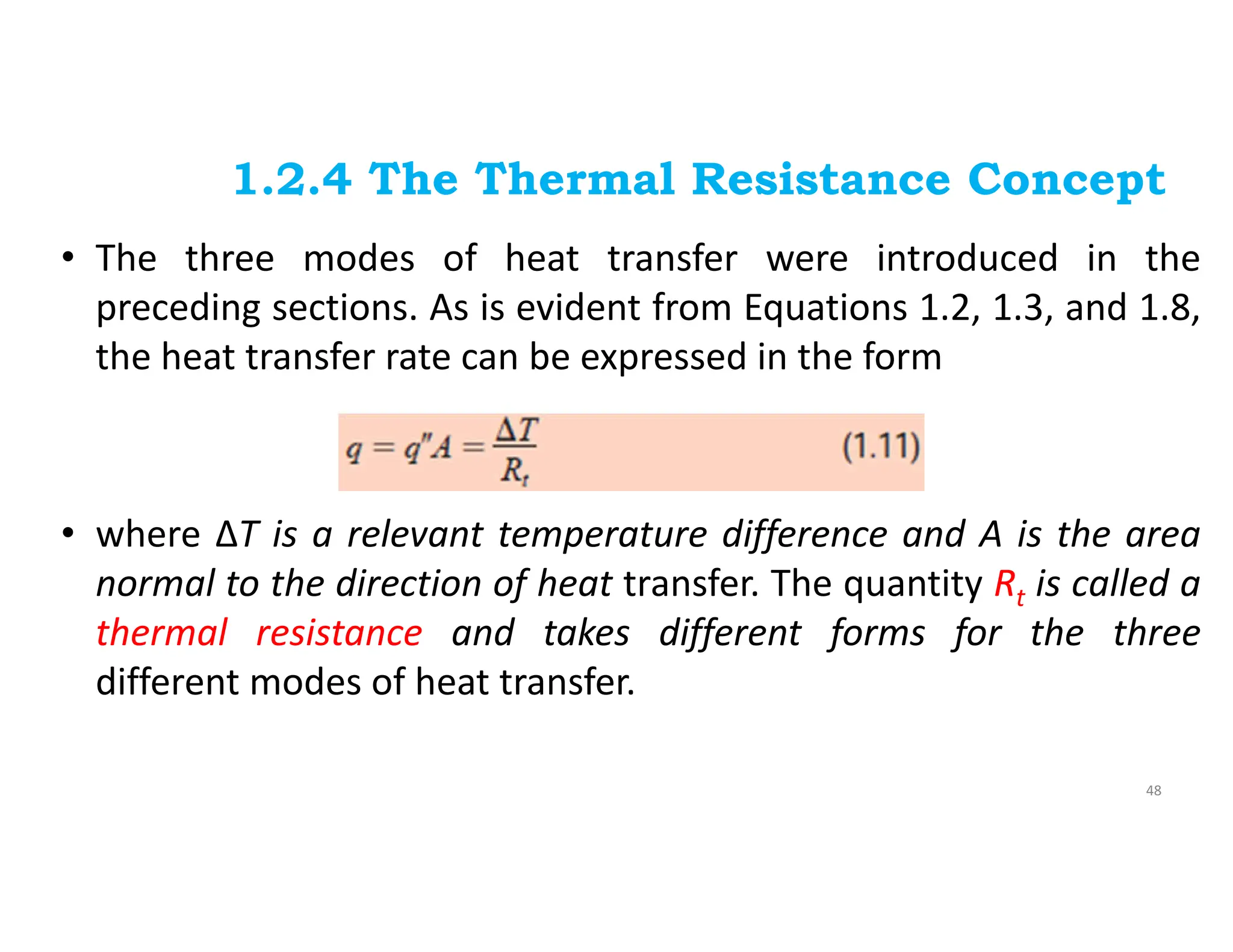
• The three modes of heat transfer were introduced in the
preceding sections. As is evident from Equations 1.2, 1.3, and 1.8,
the heat transfer rate can be expressed in the form
• where ∆T is a relevant temperature difference and A is the area
normal to the direction of heat transfer. The quantity Rt is called a
thermal resistance and takes different forms for the three
different modes of heat transfer.
48
Cont…
• For example, Equation 1.2 may be multiplied by the area A and rewritten
as
qx = ∆T/Rt,c ,
where:
Rt,c = L /kA is a thermal resistance associated with
conduction, having the units K/W.
• The thermal resistance concept will be considered in detail in Chapter 2
and will be seen to have great utility in solving complex heat transfer
problems.
49
Reading Assignment
• Relationship to Thermodynamics
• Diffusion mass transfer
50

CHAPTER -ONE.pdf

  • 1.
    CHAPTER- ONE Introduction toheat & mass transfer ADDIS ABABA SCIENCE AND TECHNOLOGY UNIVERSITY COLLEGE OF ELECTRICAL AND MECHANICAL ENGINEERING MECHANICAL ENGINEERING DEPARTMENT Heat Transfer (MEng4103 ) Lecture notes prepared by Bonsa R.
  • 2.
    CHAPTER- ONE INTRODUCTORY CONCEPTS •From the study of thermodynamics, you have learned that energy can be transferred by : – interactions of a system with its surroundings. These interactions are called work and heat. • However, thermodynamics deals with: – the end states of the process during which an interaction occurs and – provides no information concerning the nature of the interaction or the time rate at which it occurs. • The objective of this chapter is: – to extend thermodynamic analysis through the study of the modes of heat transfer and through the development of relations to calculate heat transfer rates. 2
  • 3.
    Cont… • What isheat transfer? • How is heat transferred? • Why is it important? 3
  • 4.
    1.1 What andHow? • Heat transfer (or heat) is thermal energy in transit due to a spatial temperature difference. • Whenever a temperature difference exists in a medium or between media, heat transfer must occur. • As shown in Figure 1.1, we refer to different types of heat transfer processes as modes. 4
  • 5.
  • 6.
  • 7.
    Cont… • When atemperature gradient exists in a stationary medium, which may be a solid or a fluid, we use the term conduction to refer to the heat transfer that will occur across the medium. • In contrast, the term convection refers to heat transfer that will occur between a surface and a moving fluid when they are at different temperatures. • The third mode of heat transfer is termed thermal radiation. All surfaces of finite temperature emit energy in the form of electromagnetic waves. • Hence, in the absence of an intervening medium, there is net heat transfer by radiation between two surfaces at different temperatures. 7
  • 8.
    1.2 Physical Originsand Rate Equations 1.2.1 Conduction • At mention of the word conduction, we should immediately conjure up concepts of atomic and molecular activity because processes at these levels sustain this mode of heat transfer. • Conduction may be viewed as the transfer of energy from the more energetic to the less energetic particles of a substance due to interactions between the particles. 8
  • 9.
    Cont… • Higher temperaturesare associated with higher molecular energies. • When neighboring molecules collide, as they are constantly doing, a transfer of energy from the more energetic to the less energetic molecules must occur. • So, in the presence of a temperature gradient, energy transfer by conduction must then occur in the direction of decreasing temperature. • This would be true even in the absence of collisions, as is evident from Figure 1.2. 9
  • 10.
  • 11.
    Cont… • Examples ofconduction heat transfer are legion. – The exposed end of a metal spoon suddenly immersed in a cup of hot coffee is eventually warmed due to the conduction of energy through the spoon. – On a winter day, there is significant energy loss from a heated room to the outside air. This loss is principally due to conduction heat transfer through the wall that separates the room air from the outside air. 11
  • 12.
    Equation for conductionheat transfer • Heat transfer processes can be quantified in terms of appropriate rate equations. • These equations may be used to compute the amount of energy being transferred per unit time. • For heat conduction, the rate equation is known as Fourier’s law. • For the one-dimensional plane wall shown in Figure 1.3, having a temperature distribution T(x), the rate equation is expressed as 12
  • 13.
    Cont… • The heatflux (W/m2) is the heat transfer rate in the x-direction per unit area perpendicular to the direction of transfer, and it is proportional to the temperature gradient, dT/dx, in this direction. • The parameter k is a transport property known as the thermal conductivity (W/m.K) and is a characteristic of the wall material. • The minus sign is a consequence of the fact that heat is transferred in the direction of decreasing temperature. 13
  • 14.
    Cont… • Under thesteady-state conditions shown in Figure 1.3, where the temperature distribution is linear, the temperature gradient may be expressed as 14
  • 15.
    Cont… • Note thatthe above equation provides a heat flux , that is, the rate of heat transfer per unit area. • The heat rate by conduction, qx (W), through a plane wall of area A is then the product of the flux and the area, 15
  • 16.
    Thermal Conductivity • Thethermal conductivity of a material is a measure of the ability of the material to conduct heat. A high value for thermal conductivity indicates that the material is a good heat conductor, and a low value indicates that the material is a poor heat conductor or insulator • For example, k = 0.608 W/m · °C for water and k = 80.2 W/m · °C for iron at room temperature, which indicates that iron conducts heat more than 100 times faster than water can. Thus we say that water is a poor heat conductor relative to iron, although water is an excellent medium to store thermal energy 16
  • 17.
    The mechanisms ofheat conduction in different phases of a substance 17 Metals are good electrical and heat conductors. diamond and semiconductors such as silicon are good heat conductors but poor electrical conductors. When two molecules possessing different kinetic energies collide, part of the kinetic energy of the more energetic (higher- temperature) molecule is transferred to the less energetic (lower temperature) molecule, much the same as when two elastic balls of the same mass at different velocities collide, part of the kinetic energy of the faster ball is transferred to the slower one. The higher the temperature, the faster the molecules move and the higher the number of such collisions, and the better the heat transfer
  • 18.
    EXAMPLE 1.1 The wallof an industrial furnace is constructed from 0.15m thick fireclay brick having a thermal conductivity of 1.7 W/mK. Measurements made during steady-state operation reveal temperatures of 1400 and 1150 K at the inner and outer surfaces, respectively. What is the rate of heat loss through a wall that is 0.5 m x 1.2 m on a side? 18
  • 19.
    SOLUTION • Known: Steady-stateconditions with prescribed wall thickness, area, thermal conductivity, and surface temperatures. • Find: Wall heat loss. 19
  • 20.
    Cont… • Assumptions: 1. Steady-stateconditions. 2. One-dimensional conduction through the wall. 3. Constant thermal conductivity. • Analysis: Since heat transfer through the wall is by conduction, the heat flux may be determined from Fourier’s law. Using Equation 1.2, we have The heat flux represents the rate of heat transfer through a section of unit area, and it is uniform (invariant) across the surface of the wall. The heat loss through the wall of area A = H x W is then • Comments: Note the direction of heat flow and the distinction between heat flux and heat rate. 20
  • 21.
    1.2.2 Convection • Theconvection heat transfer mode is comprised of two mechanisms. – In addition to energy transfer due to random molecular motion (diffusion), – energy is also transferred by the bulk, or macroscopic, motion of the fluid. • We are especially interested in convection heat transfer, which occurs between a fluid in motion and a bounding surface when the two are at different temperatures. 21
  • 22.
    Cont… • Consider fluidflow over the heated surface of Figure 1.4. • if the surface and flow temperatures differ, there will be a region of the fluid through which the temperature varies from Ts at y = 0 to T∞ in the outer flow. This region, called the thermal boundary layer, may be smaller, larger, or the same size as that through which the velocity varies. • In any case, if Ts > T∞ convection heat transfer will occur from the surface to the outer flow. 22
  • 23.
    Cont… • Convection heattransfer may be classified according to the nature of the flow. – forced convection – free (or natural) convection • Forced convection when the flow is caused by external means, such as by a fan, a pump, or atmospheric winds. – As an example, consider the use of a fan to provide forced convection air cooling of hot electrical components on a stack of printed circuit boards (Figure 1.5a). • Free (or natural) convection when the flow is induced by buoyancy forces, which are due to density differences caused by temperature variations in the fluid. – An example is the free convection heat transfer that occurs from hot components on a vertical array of circuit boards in air (Figure 1.5b). 23
  • 24.
  • 25.
    Cont… • Two specialcases of convection with phase change are boiling and condensation. • For example, convection heat transfer results from fluid motion induced by vapor bubbles generated at the bottom of a pan of boiling water (Figure 1.5c) or by the condensation of water vapor on the outer surface of a cold water pipe (Figure 1.5d). Regardless of the nature of the convection heat transfer process, the appropriate rate equation is of the form " = ℎ( − ) ………………………… (1.3a) 25
  • 26.
    Cont… • where q”,the convective heat flux (W/m2), is proportional to the difference between the surface and fluid temperatures, Ts and T∞, respectively. This expression is known as Newton.s law of cooling, and the parameter h (W/m2.K) is termed the convection heat transfer coefficient. • This coefficient depends on conditions in the boundary layer, which are influenced by surface geometry, the nature of the fluid motion, and an assortment of fluid thermodynamic and transport properties. • When Equation 1.3a is used, the convection heat flux is presumed to be positive if heat is transferred from the surface ( > ) and negative if heat is transferred to the surface ( > ). However, nothing precludes us from expressing Newton’s law of cooling as " = ℎ( − ) ………………………………………… (1.3b) in which case heat transfer is positive if it is to the surface. 26
  • 27.
  • 28.
    1.2.3 Radiation • Thermalradiation is energy emitted by matter that is at a nonzero temperature. • Although we will focus on radiation from solid surfaces, emission may also occur from liquids and gases. • The energy of the radiation field is transported by electromagnetic waves (or alternatively, photons). • While the transfer of energy by conduction or convection requires the presence of a material medium, radiation does not. • In fact, radiation transfer occurs most efficiently in a vacuum. 28
  • 29.
    Cont… • Consider radiationtransfer processes for the surface of Figure 1.6a. Radiation that is emitted by the surface originates from the thermal energy of matter bounded by the surface, and the rate at which energy is released per unit area (W/m2) is termed the surface emissive power, E. • There is an upper limit to the emissive power, which is prescribed by the Stefan- Boltzmann law where Ts is the absolute temperature (K) of the surface and σ is the Stefan-Boltzmann constant . Such a surface is called an ideal radiator or blackbody. 29
  • 30.
  • 31.
    Cont… • The heatflux emitted by a real surface is less than that of a blackbody at the same temperature and is given by • where ԑ is a radiative property of the surface termed the emissivity. With values in the range 0 < ԑ < 1 , this property provides a measure of how efficiently a surface emits energy relative to a blackbody. • It depends strongly on the surface material and finish, and representative values are provided in Appendix A. 31
  • 32.
    Cont… • Radiation mayalso be incident on a surface from its surroundings. • The radiation may originate from a special source, such as the sun, or from other surfaces to which the surface of interest is exposed. • Irrespective of the source(s), we designate the rate at which all such radiation is incident on a unit area of the surface as the irradiation G (Figure 1.6a). 32
  • 33.
    Cont… • A portion,or all, of the irradiation may be absorbed by the surface, thereby increasing the thermal energy of the material. • The rate at which radiant energy is absorbed per unit surface area may be evaluated from knowledge of a surface radiative property termed the absorptivity α. That is, • where 0 < α < 1. If α < 1 and the surface is opaque, portions of the irradiation are reflected If the surface is semitransparent, portions of the irradiation may also be transmitted. 33
  • 34.
    Cont… • However, whereasabsorbed and emitted radiation increase and reduce, respectively, the thermal energy of matter, reflected and transmitted radiation have no effect on this energy. • Note that the value of α depends on the nature of the irradiation, as well as on the surface itself. • For example, the absorptivity of a surface to solar radiation may differ from its absorptivity to radiation emitted by the walls of a furnace. 34
  • 35.
    Cont… • In manyengineering problems (a notable exception being problems involving solar radiation or radiation from other very high temperature sources), liquids can be considered opaque to radiation heat transfer, and gases can be considered transparent to it. • Solids can be opaque (as is the case for metals) or semitransparent (as is the case for thin sheets of some polymers and some semiconducting materials). 35
  • 36.
    Cont… • A specialcase that occurs frequently involves radiation exchange between a small surface at Ts and a much larger, isothermal surface that completely surrounds the smaller one (Figure 1.6b). • The surroundings could, for example, be the walls of a room or a furnace whose temperature Tsur differs from that of an enclosed surface(Tsur ≠ Ts) . • For such a condition, the irradiation may be approximated by emission from a blackbody at Tsur, in which case G = σT4 sur . • If the surface is assumed to be one for which α = ԑ (a gray surface), the net rate of radiation heat transfer from the surface, expressed per unit area of the surface, is • This expression provides the difference between thermal energy that is released due to radiation emission and that gained due to radiation absorption. 36
  • 37.
    Cont… • For manyapplications, it is convenient to express the net radiation heat exchange in the form q rad = hr A(Ts - Tsur) ……………….(1.8) • where, from Equation 1.7, the radiation heat transfer coefficient hr is hr = ԑσ(Ts+Tsur)(T2 s + T2 sur) ………. (1.9) • Here we have modeled the radiation mode in a manner similar to convection. In this sense we have linearized the radiation rate equation, making the heat rate proportional to a temperature difference rather than to the difference between two temperatures to the fourth power. 37
  • 38.
    Cont… • Note, however,that hr depends strongly on temperature, whereas the temperature dependence of the convection heat transfer coefficient h is generally weak. The surfaces of Figure 1.6 may also simultaneously transfer heat by convection to an adjoining gas. For the conditions of Figure 1.6b, the total rate of heat transfer from the surface is then 38
  • 39.
    EXAMPLE 1.2 An uninsulatedsteam pipe passes through a room in which the air and walls are at 25oC. The outside diameter of the pipe is 70 mm, and its surface temperature and emissivity are 200oC and 0.8, respectively. What are the surface emissive power and irradiation? If the coefficient associated with free convection heat transfer from the surface to the air is 15 W/m2.K, what is the rate of heat loss from the surface per unit length of pipe? 39
  • 40.
    SOLUTION • Known: Uninsulatedpipe of prescribed diameter, emissivity, and surface temperature in a room with fixed wall and air temperatures. • Find: 1. Surface emissive power and irradiation. 2. Pipe heat loss per unit length, q’. 40
  • 41.
  • 42.
    Cont… • Assumptions: 1. Steady-stateconditions. 2. Radiation exchange between the pipe and the room is between a small surface and a much larger enclosure. 3. The surface emissivity and absorptivity are equal. 42
  • 43.
    Cont… • Analysis: 1. Thesurface emissive power may be evaluated from Equation 1.5, while the irradiation corresponds to G = σT4 sur . Hence 2. Heat loss from the pipe is by convection to the room air and by radiation exchange with the walls. Hence, q = qconv + qrad and from Equation 1.10, with A = πDL, 43
  • 44.
    Cont…  The heatloss per unit length of pipe is then • Comments: 1. Note that temperature may be expressed in units of oC or K when evaluating the temperature difference for a convection (or conduction) heat transfer rate.  However, temperature must be expressed in kelvins (K) when evaluating a radiation transfer rate. 44
  • 45.
    Cont… 2. The netrate of radiation heat transfer from the pipe may be expressed as 3. In this situation, the radiation and convection heat transfer rates are comparable because Ts is large compared to Tsur and the coefficient associated with free convection is small. For more moderate values of Ts and the larger values of h associated with forced convection, the effect of radiation may often be neglected. The radiation heat transfer coefficient may be computed from Equation 1.9. For the conditions of this problem, its value is hr = 11 W/m2 .K. 45
  • 46.
    • A solderingiron has a cylindrical tip of 2.5 mm in diameter and 20 mm in length. With age and usage, the tip has oxidized and has an emissivity of 0.80. Assuming that the average convection heat transfer coefficient over the soldering iron tip is 25 W/m2.K, and the surrounding air temperature is 20oC, determine the power required to maintain the tip at 400oC. 46 EXAMPLE 1.3
  • 47.
  • 48.
    1.2.4 The ThermalResistance Concept • The three modes of heat transfer were introduced in the preceding sections. As is evident from Equations 1.2, 1.3, and 1.8, the heat transfer rate can be expressed in the form • where ∆T is a relevant temperature difference and A is the area normal to the direction of heat transfer. The quantity Rt is called a thermal resistance and takes different forms for the three different modes of heat transfer. 48
  • 49.
    Cont… • For example,Equation 1.2 may be multiplied by the area A and rewritten as qx = ∆T/Rt,c , where: Rt,c = L /kA is a thermal resistance associated with conduction, having the units K/W. • The thermal resistance concept will be considered in detail in Chapter 2 and will be seen to have great utility in solving complex heat transfer problems. 49
  • 50.
    Reading Assignment • Relationshipto Thermodynamics • Diffusion mass transfer 50