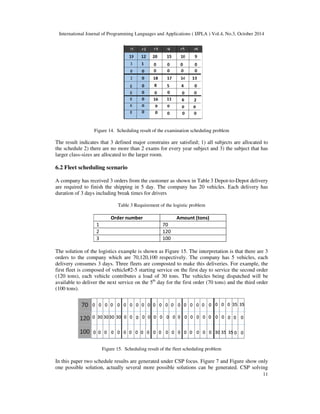
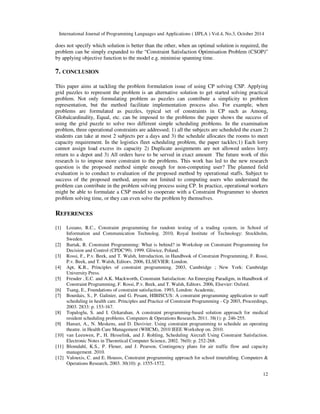
International Journal of Programming Languages and Applications ( IJPLA ) Vol.4, No.3, October 2014 
SOLVING SCHEDULING PROBLEMS AS THE PUZZLE 
GAMES USING CONSTRAINT PROGRAMMING 
Noppon Choosri 
SMART Research Centre, College of Arts Media and Technology, 
Chiang Mai University, Chiang Mai, Thailand 
ABSTRACT 
Constraint programming (CP) is one of the most effective techniques for solving practical operational 
problems. The outstanding feature of the method is a set of constraints affecting a solution of a problem 
can be imposed without a need to explicitly defining a linear relation among variables, i.e. an equation. 
Nevertheless, the challenge of paramount importance in using this technique is how to present the 
operational problem in a solvable Constraint Satisfaction Problem (CSP) model. The problem modelling is 
problem independent and could be an exhaustive task at the beginning stage of problem solving, 
particularly when the problem is a real-world practical problem. This paper investigates the application of 
a simple grid puzzle game when a player attempts to solve practical scheduling problems. The examination 
scheduling and logistic fleet scheduling are presented as operational games. The game‘s rules are set up 
based on the operational practice. CP is then applied to solve the defined puzzle and the results show the 
success of the proposed method. The benefit of using a grid puzzle as the model is that the method can 
amplify the simplicity of CP in solving practical problems. 
KEYWORDS 
Constraint Programming; Constraint Satisfaction Problem; Examination scheduling; fleet scheduling; grid 
puzzle 
1. INTRODUCTION 
Constraint Programming (CP) is a programming paradigm used for modelling and solving 
problems with a discrete set of solutions[1]. The idea of the CP is to solve problems by stating a 
set of constraints (i.e. conditions, properties or requirements) of the problems and finding a 
solution satisfying all the constraints using a constraint solve[2,3]. The main advantage of the CP 
approach is the declarative ability of the constraints which makes it suitable for solving 
complicated real-life problems. In order to solve the problem using CP, a model is required and it 
is typical to define the problem as Constraint Satisfaction Problem (CSP). CSP is defined by a 
sequence of variables.A finite sequence of variables Y := y1, . . ., yk where k > 0, with respective 
domains D1, . . .,Dk . A finite set C of constraints are used to limit the domain for each 
variable[4].There is another problem called Constraint Satisfaction Optimisation Problem (CSOP) 
which can be seen as an ‘upgrade’ of CSP in the sense that solutions are not only feasible but also 
achieve optimality of an integrated cost function[5]. Formalism of CSP is defined in[6]. 
Typically, to solve practical operational problems using CP, ones are only required to model the 
problems and using CP solvers to solve the problems. There are several available CP solvers for 
both CSP and CSOP including: Choco, Ilog, ECLiPSe®, Gecode, Comet, CHIP, and Jsolve. 
Problem modelling is one of the key steps of using CP to solve problems successfully. This paper 
DOI : 10.5121/ijpla.2014.4301 1
International Journal of Programming Languages and Applications ( IJPLA ) Vol.4, No.3, October 2014 
will focus on a grid puzzle-game as inspiration to model and solve the problems. The rest of the 
paper is organised as follows; Section 2 discusses the current CP applications, Section 3 provides 
a background of typical grid puzzle game, Section 4 demonstrates the using of grid puzzle to 
model a scheduling problems, Section 5 discusses the CP implementation, Section 6 discussed the 
results of the paper and, Section 7 is the conclusion. 
2 
2. CP APPLICATIONS 
CP has been applied to solve several applications successfully. In healthcare, CP is used to assign 
shifts to medical staffs. Several rules can be imposed to solve the problem and create the realistic 
schedule including; assignments meet the demand for every shift, staff availability status, and the 
fairness of the generated schedule for every assigned staff[7]. Further requirements to schedule 
working time for medical residents are addressed in [8]. The requirements that make this 
scheduling different from the typical medical staff come from the fact that a resident is not only 
the medical staff, he or she is also a student in training i.e. the schedule have to provide a good 
balance between education and medical service activities. CP is also used for scheduling facilities 
in healthcare such as an operation theatre[9]. At airports, [10] investigates the use of CP to 
schedule aircraft departure to avoid traffic congestion, while [11] focuses the study on generating 
a contingency plan to handle unexpected failures affecting a regular traffic schedules. At 
academic institutes, manual timetabling can be a very time-consuming task, [12] presents CP 
based school timetabling to minimise idle hours between the daily teaching responsibilities of all 
teachers. [13] develops an examination timetabling to tackle important constrains such as 
schedule clashing, room capacity, and avoiding an allocation of two difficult subjects in 
consecutive time slot. 
3. GRID PUZZLES 
Grid Puzzles are board games contained within an NxM lattice where players are usually required 
to locate symbols or number to meet the objective of the game. There have been several studies 
using CP to solve grid puzzle games. Akari, Kakuro, Nurikabe have been studied[14]. Akuro is a 
game that provides clues for a number of tokens, which the game called ‘lights’, for certain grid, 
players are asked to locate tokens such that all conditions are satisfied. Kakuro requires players 
to fill a numbers to grids to generate sums to meet vertical and horizontal clues. Another classical 
puzzle game problem that is usually mentioned in CP literature is the N-queen problem. In this 
problem, one is asked to place N queens on the N× N chess board, where N  3, so that they do 
not attack each other. Better known puzzle games are Crosswords and Sudoku, and 
MineSweeper. Crosswords are games in which one is required to fill pre-defined vocabulary into 
the NxN grids in a way that none of the words are used more than once. Sudoku is usually played 
on 9 x 9 grids with some grids having pre-defined values. The game‘s rule involves giving a 
value assignment so that all rows and column as well as sub-regions 3 x3 grid are pairwise 
different. Finally, Minesweeper is one of the most popular ‘time-killer’ computer games which 
has the objective to determine the ‘mine’ on a grid where the game might provide hints for a 
number of mines in the grids. The example of the Grid puzzle games are shown as Figure 1.
International Journal of Programming Languages and Applications ( IJPLA ) Vol.4, No.3, October 2014 
3 
Figure 1. Typical grid puzzle games and their solutions [14-17] 
4. CP FOR SCHEDULING PROBLEM 
The mechanism of tackling CSP using CP typically relies on the domain reduction process. To 
solve a problem, a set of constraints related to the problem needs to be identified and later on 
applied to a problem. Some of the constraints are associated with each other to formulate a 
constraint network. Each constraint applied to the model is usually associated with finite domain 
variables. Solving the problem is a process of reducing the domain of each variable until there are 
no conflicted domains remaining. So, constraint programmers will need to understand the 
variables, domain and constrains of the problem. Particularly they need to have a comprehensive 
understanding of the relationship among associated constraints and variables. This can be 
exhaustive task when solving complicated practical problems. Figure 2 visualises an abstraction 
of a constraint network and variable network of CP as describe above. 
Figure 2. CP problem solving 
Grid puzzles representations, i.e. using 2 Dimension (2D), NxM , lattice to represent 
finite values/states of variables,which can be applied to model many practical problems. With 
that, the relationship between variables can be visualised. Rules of the games can be set up to 
reflect businesses rules, and typical constraints can be applied to the model just as what shown in 
solving general puzzle games. This paper demonstrates the use of grid puzzles for solving
International Journal of Programming Languages and Applications ( IJPLA ) Vol.4, No.3, October 2014 
scheduling problems in two application; 1) examination scheduling and logistics fleet scheduling 
which are outlined as follows: 
4 
4.1 Examination scheduling problem 
The problem is mainly concerned with assignment of subjects for exam into given time slot 
during examination period. The generated result shall be able to indicate the day of the week the 
exam is allocated together with the room assigned. The assumption of this problem is that this 
schedule is for a package registration system in which student in the same year will study the 
same subjects. The problem is concerned with practical constraints such as certain subjects 
requiring larger room and every student cannot take exams in more than 2 subjects in a day. 
Solving this problem manually, i.e. using human decision making, is highly time-consuming and 
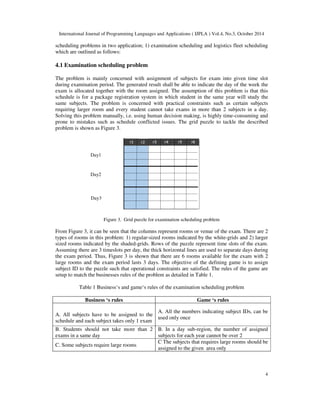
prone to mistakes such as schedule conflicted issues. The grid puzzle to tackle the described 
problem is shown as Figure 3. 
Figure 3. Grid puzzle for examination scheduling problem 
From Figure 3, it can be seen that the columns represent rooms or venue of the exam. There are 2 
types of rooms in this problem: 1) regular-sized rooms indicated by the white-grids and 2) larger 
sized rooms indicated by the shaded-grids. Rows of the puzzle represent time slots of the exam. 
Assuming there are 3 timeslots per day, the thick horizontal lines are used to separate days during 
the exam period. Thus, Figure 3 is shown that there are 6 rooms available for the exam with 2 
large rooms and the exam period lasts 3 days. The objective of the defining game is to assign 
subject ID to the puzzle such that operational constraints are satisfied. The rules of the game are 
setup to match the businesses rules of the problem as detailed in Table 1. 
Table 1 Business‘s and game‘s rules of the examination scheduling problem 
Business ‘s rules Game ‘s rules 
A. All subjects have to be assigned to the 
schedule and each subject takes only 1 exam 
A. All the numbers indicating subject IDs, can be 
used only once 
B. Students should not take more than 2 
exams in a same day 
B. In a day sub-region, the number of assigned 
subjects for each year cannot be over 2 
C. Some subjects require large rooms 
C The subjects that requires large rooms should be 
assigned to the given area only 
Day1 
Day2 
Day3
International Journal of Programming Languages and Applications ( IJPLA ) Vol.4, No.3, October 2014 
5 
4.2 Logistic fleet scheduling problem 
In this problem, fleets of lorry are required to deliver orders of product to customers. Loads can 
be split in the given time window to finish delivery, also lorry are required to travel together as a 
fleet. This problem is a typical transport problem for grain suppliers in logistics. In addition, this 
class of the problem is defined as a truckload problem in which each lorry makes a door-to-door 
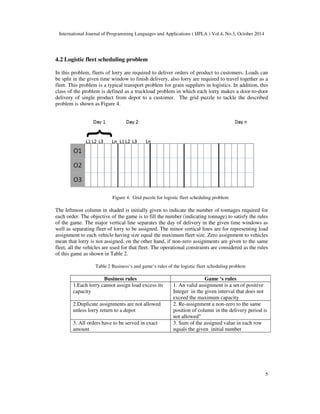
delivery of single product from depot to a customer. The grid puzzle to tackle the described 
problem is shown as Figure 4. 
Figure 4. Grid puzzle for logistic fleet scheduling problem 
 
The leftmost column in shaded is initially given to indicate the number of tonnages required for 
each order. The objective of the game is to fill the number (indicating tonnage) to satisfy the rules 
of the game. The major vertical line separates the day of delivery in the given time windows as 
well as separating fleet of lorry to be assigned. The minor vertical lines are for representing load 
assignment to each vehicle having size equal the maximum fleet size. Zero assignment to vehicles 
mean that lorry is not assigned, on the other hand, if non-zero assignments are given to the same 
fleet, all the vehicles are used for that fleet. The operational constraints are considered as the rules 
of this game as shown in Table 2. 
 
Table 2 Business‘s and game‘s rules of the logistic fleet scheduling problem 
Business rules Game ‘s rules 
1.Each lorry cannot assign load excess its 
capacity 
1. An valid assignment is a set of positive 
Integer in the given interval that does not 
exceed the maximum capacity 
2.Duplicate assignments are not allowed 
unless lorry return to a depot 
2. Re-assignment a non-zero to the same 
position of column in the delivery period is 
not allowed” 
3. All orders have to be served in exact 
amount 
3. Sum of the assigned value in each row 
equals the given initial number
International Journal of Programming Languages and Applications ( IJPLA ) Vol.4, No.3, October 2014 
6 
5. IMPLEMENTATION 
The problems are implemented by using Choco, a Java based CP library. The constraints for 
examination scheduling and logistic fleet scheduling problems declared in Section 4 as the rules 
of the games can be solved by CP as follows: 
5.1 Examination scheduling problem 
Implementation details for the examination scheduling are discussed as follows: 
5.1.1 “All the numbers indicating subject IDs, can be used only once” 
Global constraint is a category of constraints that are defined for solving practical problems 
where association between variables are not limited to ‘local’ consideration[18]. Global 
constraints are well documented to define 423 constraints in[19]. Globalcardinality is a global 
constraints used to tackle this requirement. The constraint enable limiting the lower bound and 
upper bound together with the number of times that those values can be used. Imposing the 
Globalcardinality constraint to satisfy this rule in Choco is as the following simplified statement. 
Impose globalCardinality(S,[0,20],all the number in the range except 0 is only assigned 1 time) 
The representation for this constraint is depicted in Figure 5. In this application, each variable 
Subject ID (S) = {1, 2, 3, 4…20) represents a sequence of continuous subject ID. A dummy 
value 0 is required to indicate that there is no assignment given to that timeslot. Therefore, the 
domain of this variable, i.e. for 20 subjects, is ranged from [0, 20]. The global cardinality is 
enforced every S, except 0, appearing only once 
Figure 5. Problem modelling to tackle constraint 5.1.1 
5.1.2 “In a day sub-region, the number of assigned subjects for each year cannot be over 2” 
The model of the year of subject is similar the Subject ID as shown in Figure 6. There are four 
year of students from 1 to 4. However, similar to the previous constraint, a dummy value (0) is 
required to indicate a ‘no-assignment’. The domain for this variable is therefore ranged from [0, 
4].
International Journal of Programming Languages and Applications ( IJPLA ) Vol.4, No.3, October 2014 
7 
Figure 6. Problem modelling to tackle constraint 5.1.2 
Due to the fact that rows in the puzzle indicate time slot of the exam, Globalcardinality is used to 
control the number of the domain 1-4 appearing at most twice in each day region. The algorithm 
for tackling this rules of the defined puzzle is shown in Figure 7. 
	
 
Impose GlobalCardinality(Year, [0,4],all the number in the range except 0 is only 
assigned 2 time)
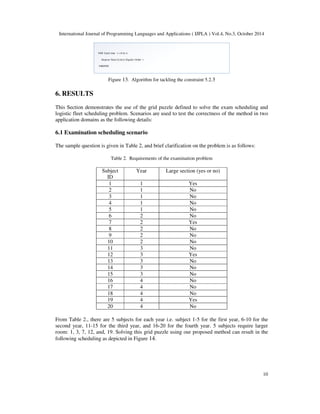
Figure 7. Algorithm for tackling the constraint 5.1.2 
5.1.3 “The subjects that requires large-rooms should be assigned to the defined areas only” 
Two larger rooms are defined for the first two columns as shown in Figure 8. Assignments to this 
area are limited to the subject that required. The subjects that require larger room have to be 
defined in a problem statement, and this value will never be assigned outside that area. 
 
 
Figure 8. Problem modelling to tackle constraint 5.1.3 
To implement this constraint in Choco, the constraint ‘among’ is applied to limit a subject ID 
assignment bounded in a predefined list of large rooms. This constraint is only applied to the 
shaded area of the puzzle. So a constraint is defined within a nested loop. The algorithm is 
depicted as Figure 9.
International Journal of Programming Languages and Applications ( IJPLA ) Vol.4, No.3, October 2014 
8
!
#$%%'
(
Figure 9. Algorithm for tackling the constraint 5.1.3 
5.1.4 “Associating IDs to other attributes” 
Being that a grid puzzle is 2 Dimension (2D), the limitation in problem modelling is an unknown 
variable that can be solved one at a time. In practice, there are multiple variables to consider in 
one problem. For example, the example problem involved with Subject ID and year of the 
subject. Modelling the problem using a grid puzzle requires to solve the problem separately. The 
internal constraint beside the explicit constraints of the problem is required to associate with other 
solving variables. This can be done by imposing constraints to associate variables. In CP, 
compatibility between variable can be enforced by declaring a feasible pair i.e. between subject 
ID and the year variable. This will enable interpretation of which subject is belong to. The 
algorithm for binding 2 variables is indicated as Figure 10. 


 !

)
#$%%'*%%'
+(
Figure 10. Algorithm for tackling the constraint 5.1.4 
5.2 Logistic fleet scheduling 
In the examination scheduling example, unknown variables, i.e. student ID and year, are initially 
solved independently and imposing the feasible pair to combine the result. This example 
demonstrates a game that locates all variables into the puzzle as depicted in Figure 
4.Implementation details for the fleet scheduling problem is discussed as follows 
5.2.1 “A valid assignment is a set of positive Integer in the given set” 
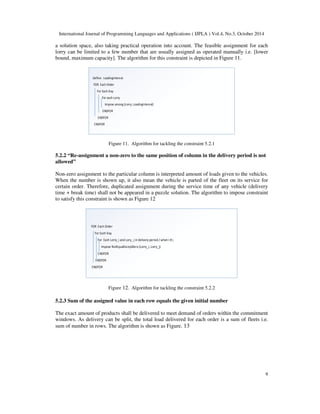
The feasible assignments to lorry are assignments that do not excess capacities of vehicles which 
are the assignments should be a number in the set of [0, maximum capacity]. However, to reduce

Solving Scheduling Problems as the Puzzle Games Using Constraint Programming

  • 1.
    International Journal ofProgramming Languages and Applications ( IJPLA ) Vol.4, No.3, October 2014 SOLVING SCHEDULING PROBLEMS AS THE PUZZLE GAMES USING CONSTRAINT PROGRAMMING Noppon Choosri SMART Research Centre, College of Arts Media and Technology, Chiang Mai University, Chiang Mai, Thailand ABSTRACT Constraint programming (CP) is one of the most effective techniques for solving practical operational problems. The outstanding feature of the method is a set of constraints affecting a solution of a problem can be imposed without a need to explicitly defining a linear relation among variables, i.e. an equation. Nevertheless, the challenge of paramount importance in using this technique is how to present the operational problem in a solvable Constraint Satisfaction Problem (CSP) model. The problem modelling is problem independent and could be an exhaustive task at the beginning stage of problem solving, particularly when the problem is a real-world practical problem. This paper investigates the application of a simple grid puzzle game when a player attempts to solve practical scheduling problems. The examination scheduling and logistic fleet scheduling are presented as operational games. The game‘s rules are set up based on the operational practice. CP is then applied to solve the defined puzzle and the results show the success of the proposed method. The benefit of using a grid puzzle as the model is that the method can amplify the simplicity of CP in solving practical problems. KEYWORDS Constraint Programming; Constraint Satisfaction Problem; Examination scheduling; fleet scheduling; grid puzzle 1. INTRODUCTION Constraint Programming (CP) is a programming paradigm used for modelling and solving problems with a discrete set of solutions[1]. The idea of the CP is to solve problems by stating a set of constraints (i.e. conditions, properties or requirements) of the problems and finding a solution satisfying all the constraints using a constraint solve[2,3]. The main advantage of the CP approach is the declarative ability of the constraints which makes it suitable for solving complicated real-life problems. In order to solve the problem using CP, a model is required and it is typical to define the problem as Constraint Satisfaction Problem (CSP). CSP is defined by a sequence of variables.A finite sequence of variables Y := y1, . . ., yk where k > 0, with respective domains D1, . . .,Dk . A finite set C of constraints are used to limit the domain for each variable[4].There is another problem called Constraint Satisfaction Optimisation Problem (CSOP) which can be seen as an ‘upgrade’ of CSP in the sense that solutions are not only feasible but also achieve optimality of an integrated cost function[5]. Formalism of CSP is defined in[6]. Typically, to solve practical operational problems using CP, ones are only required to model the problems and using CP solvers to solve the problems. There are several available CP solvers for both CSP and CSOP including: Choco, Ilog, ECLiPSe®, Gecode, Comet, CHIP, and Jsolve. Problem modelling is one of the key steps of using CP to solve problems successfully. This paper DOI : 10.5121/ijpla.2014.4301 1
  • 2.
    International Journal ofProgramming Languages and Applications ( IJPLA ) Vol.4, No.3, October 2014 will focus on a grid puzzle-game as inspiration to model and solve the problems. The rest of the paper is organised as follows; Section 2 discusses the current CP applications, Section 3 provides a background of typical grid puzzle game, Section 4 demonstrates the using of grid puzzle to model a scheduling problems, Section 5 discusses the CP implementation, Section 6 discussed the results of the paper and, Section 7 is the conclusion. 2 2. CP APPLICATIONS CP has been applied to solve several applications successfully. In healthcare, CP is used to assign shifts to medical staffs. Several rules can be imposed to solve the problem and create the realistic schedule including; assignments meet the demand for every shift, staff availability status, and the fairness of the generated schedule for every assigned staff[7]. Further requirements to schedule working time for medical residents are addressed in [8]. The requirements that make this scheduling different from the typical medical staff come from the fact that a resident is not only the medical staff, he or she is also a student in training i.e. the schedule have to provide a good balance between education and medical service activities. CP is also used for scheduling facilities in healthcare such as an operation theatre[9]. At airports, [10] investigates the use of CP to schedule aircraft departure to avoid traffic congestion, while [11] focuses the study on generating a contingency plan to handle unexpected failures affecting a regular traffic schedules. At academic institutes, manual timetabling can be a very time-consuming task, [12] presents CP based school timetabling to minimise idle hours between the daily teaching responsibilities of all teachers. [13] develops an examination timetabling to tackle important constrains such as schedule clashing, room capacity, and avoiding an allocation of two difficult subjects in consecutive time slot. 3. GRID PUZZLES Grid Puzzles are board games contained within an NxM lattice where players are usually required to locate symbols or number to meet the objective of the game. There have been several studies using CP to solve grid puzzle games. Akari, Kakuro, Nurikabe have been studied[14]. Akuro is a game that provides clues for a number of tokens, which the game called ‘lights’, for certain grid, players are asked to locate tokens such that all conditions are satisfied. Kakuro requires players to fill a numbers to grids to generate sums to meet vertical and horizontal clues. Another classical puzzle game problem that is usually mentioned in CP literature is the N-queen problem. In this problem, one is asked to place N queens on the N× N chess board, where N 3, so that they do not attack each other. Better known puzzle games are Crosswords and Sudoku, and MineSweeper. Crosswords are games in which one is required to fill pre-defined vocabulary into the NxN grids in a way that none of the words are used more than once. Sudoku is usually played on 9 x 9 grids with some grids having pre-defined values. The game‘s rule involves giving a value assignment so that all rows and column as well as sub-regions 3 x3 grid are pairwise different. Finally, Minesweeper is one of the most popular ‘time-killer’ computer games which has the objective to determine the ‘mine’ on a grid where the game might provide hints for a number of mines in the grids. The example of the Grid puzzle games are shown as Figure 1.
  • 3.
    International Journal ofProgramming Languages and Applications ( IJPLA ) Vol.4, No.3, October 2014 3 Figure 1. Typical grid puzzle games and their solutions [14-17] 4. CP FOR SCHEDULING PROBLEM The mechanism of tackling CSP using CP typically relies on the domain reduction process. To solve a problem, a set of constraints related to the problem needs to be identified and later on applied to a problem. Some of the constraints are associated with each other to formulate a constraint network. Each constraint applied to the model is usually associated with finite domain variables. Solving the problem is a process of reducing the domain of each variable until there are no conflicted domains remaining. So, constraint programmers will need to understand the variables, domain and constrains of the problem. Particularly they need to have a comprehensive understanding of the relationship among associated constraints and variables. This can be exhaustive task when solving complicated practical problems. Figure 2 visualises an abstraction of a constraint network and variable network of CP as describe above. Figure 2. CP problem solving Grid puzzles representations, i.e. using 2 Dimension (2D), NxM , lattice to represent finite values/states of variables,which can be applied to model many practical problems. With that, the relationship between variables can be visualised. Rules of the games can be set up to reflect businesses rules, and typical constraints can be applied to the model just as what shown in solving general puzzle games. This paper demonstrates the use of grid puzzles for solving
  • 4.
    International Journal ofProgramming Languages and Applications ( IJPLA ) Vol.4, No.3, October 2014 scheduling problems in two application; 1) examination scheduling and logistics fleet scheduling which are outlined as follows: 4 4.1 Examination scheduling problem The problem is mainly concerned with assignment of subjects for exam into given time slot during examination period. The generated result shall be able to indicate the day of the week the exam is allocated together with the room assigned. The assumption of this problem is that this schedule is for a package registration system in which student in the same year will study the same subjects. The problem is concerned with practical constraints such as certain subjects requiring larger room and every student cannot take exams in more than 2 subjects in a day. Solving this problem manually, i.e. using human decision making, is highly time-consuming and prone to mistakes such as schedule conflicted issues. The grid puzzle to tackle the described problem is shown as Figure 3. Figure 3. Grid puzzle for examination scheduling problem From Figure 3, it can be seen that the columns represent rooms or venue of the exam. There are 2 types of rooms in this problem: 1) regular-sized rooms indicated by the white-grids and 2) larger sized rooms indicated by the shaded-grids. Rows of the puzzle represent time slots of the exam. Assuming there are 3 timeslots per day, the thick horizontal lines are used to separate days during the exam period. Thus, Figure 3 is shown that there are 6 rooms available for the exam with 2 large rooms and the exam period lasts 3 days. The objective of the defining game is to assign subject ID to the puzzle such that operational constraints are satisfied. The rules of the game are setup to match the businesses rules of the problem as detailed in Table 1. Table 1 Business‘s and game‘s rules of the examination scheduling problem Business ‘s rules Game ‘s rules A. All subjects have to be assigned to the schedule and each subject takes only 1 exam A. All the numbers indicating subject IDs, can be used only once B. Students should not take more than 2 exams in a same day B. In a day sub-region, the number of assigned subjects for each year cannot be over 2 C. Some subjects require large rooms C The subjects that requires large rooms should be assigned to the given area only Day1 Day2 Day3
  • 5.
    International Journal ofProgramming Languages and Applications ( IJPLA ) Vol.4, No.3, October 2014 5 4.2 Logistic fleet scheduling problem In this problem, fleets of lorry are required to deliver orders of product to customers. Loads can be split in the given time window to finish delivery, also lorry are required to travel together as a fleet. This problem is a typical transport problem for grain suppliers in logistics. In addition, this class of the problem is defined as a truckload problem in which each lorry makes a door-to-door delivery of single product from depot to a customer. The grid puzzle to tackle the described problem is shown as Figure 4. Figure 4. Grid puzzle for logistic fleet scheduling problem The leftmost column in shaded is initially given to indicate the number of tonnages required for each order. The objective of the game is to fill the number (indicating tonnage) to satisfy the rules of the game. The major vertical line separates the day of delivery in the given time windows as well as separating fleet of lorry to be assigned. The minor vertical lines are for representing load assignment to each vehicle having size equal the maximum fleet size. Zero assignment to vehicles mean that lorry is not assigned, on the other hand, if non-zero assignments are given to the same fleet, all the vehicles are used for that fleet. The operational constraints are considered as the rules of this game as shown in Table 2. Table 2 Business‘s and game‘s rules of the logistic fleet scheduling problem Business rules Game ‘s rules 1.Each lorry cannot assign load excess its capacity 1. An valid assignment is a set of positive Integer in the given interval that does not exceed the maximum capacity 2.Duplicate assignments are not allowed unless lorry return to a depot 2. Re-assignment a non-zero to the same position of column in the delivery period is not allowed” 3. All orders have to be served in exact amount 3. Sum of the assigned value in each row equals the given initial number
  • 6.
    International Journal ofProgramming Languages and Applications ( IJPLA ) Vol.4, No.3, October 2014 6 5. IMPLEMENTATION The problems are implemented by using Choco, a Java based CP library. The constraints for examination scheduling and logistic fleet scheduling problems declared in Section 4 as the rules of the games can be solved by CP as follows: 5.1 Examination scheduling problem Implementation details for the examination scheduling are discussed as follows: 5.1.1 “All the numbers indicating subject IDs, can be used only once” Global constraint is a category of constraints that are defined for solving practical problems where association between variables are not limited to ‘local’ consideration[18]. Global constraints are well documented to define 423 constraints in[19]. Globalcardinality is a global constraints used to tackle this requirement. The constraint enable limiting the lower bound and upper bound together with the number of times that those values can be used. Imposing the Globalcardinality constraint to satisfy this rule in Choco is as the following simplified statement. Impose globalCardinality(S,[0,20],all the number in the range except 0 is only assigned 1 time) The representation for this constraint is depicted in Figure 5. In this application, each variable Subject ID (S) = {1, 2, 3, 4…20) represents a sequence of continuous subject ID. A dummy value 0 is required to indicate that there is no assignment given to that timeslot. Therefore, the domain of this variable, i.e. for 20 subjects, is ranged from [0, 20]. The global cardinality is enforced every S, except 0, appearing only once Figure 5. Problem modelling to tackle constraint 5.1.1 5.1.2 “In a day sub-region, the number of assigned subjects for each year cannot be over 2” The model of the year of subject is similar the Subject ID as shown in Figure 6. There are four year of students from 1 to 4. However, similar to the previous constraint, a dummy value (0) is required to indicate a ‘no-assignment’. The domain for this variable is therefore ranged from [0, 4].
  • 7.
    International Journal ofProgramming Languages and Applications ( IJPLA ) Vol.4, No.3, October 2014 7 Figure 6. Problem modelling to tackle constraint 5.1.2 Due to the fact that rows in the puzzle indicate time slot of the exam, Globalcardinality is used to control the number of the domain 1-4 appearing at most twice in each day region. The algorithm for tackling this rules of the defined puzzle is shown in Figure 7. Impose GlobalCardinality(Year, [0,4],all the number in the range except 0 is only assigned 2 time)
  • 8.
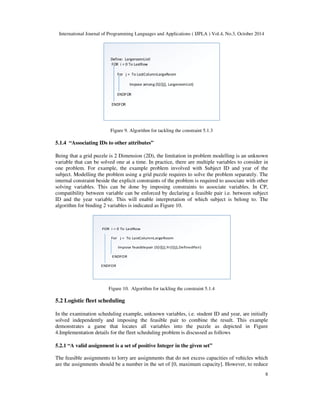
    Figure 7. Algorithmfor tackling the constraint 5.1.2 5.1.3 “The subjects that requires large-rooms should be assigned to the defined areas only” Two larger rooms are defined for the first two columns as shown in Figure 8. Assignments to this area are limited to the subject that required. The subjects that require larger room have to be defined in a problem statement, and this value will never be assigned outside that area. Figure 8. Problem modelling to tackle constraint 5.1.3 To implement this constraint in Choco, the constraint ‘among’ is applied to limit a subject ID assignment bounded in a predefined list of large rooms. This constraint is only applied to the shaded area of the puzzle. So a constraint is defined within a nested loop. The algorithm is depicted as Figure 9.
  • 9.
    International Journal ofProgramming Languages and Applications ( IJPLA ) Vol.4, No.3, October 2014 8
  • 10.
  • 11.
    Figure 9. Algorithmfor tackling the constraint 5.1.3 5.1.4 “Associating IDs to other attributes” Being that a grid puzzle is 2 Dimension (2D), the limitation in problem modelling is an unknown variable that can be solved one at a time. In practice, there are multiple variables to consider in one problem. For example, the example problem involved with Subject ID and year of the subject. Modelling the problem using a grid puzzle requires to solve the problem separately. The internal constraint beside the explicit constraints of the problem is required to associate with other solving variables. This can be done by imposing constraints to associate variables. In CP, compatibility between variable can be enforced by declaring a feasible pair i.e. between subject ID and the year variable. This will enable interpretation of which subject is belong to. The algorithm for binding 2 variables is indicated as Figure 10. ! ) #$%%'*%%'
  • 12.
  • 13.
    Figure 10. Algorithmfor tackling the constraint 5.1.4 5.2 Logistic fleet scheduling In the examination scheduling example, unknown variables, i.e. student ID and year, are initially solved independently and imposing the feasible pair to combine the result. This example demonstrates a game that locates all variables into the puzzle as depicted in Figure 4.Implementation details for the fleet scheduling problem is discussed as follows 5.2.1 “A valid assignment is a set of positive Integer in the given set” The feasible assignments to lorry are assignments that do not excess capacities of vehicles which are the assignments should be a number in the set of [0, maximum capacity]. However, to reduce