PRESENTED TO: SIR ALI RAZA
SUBJECT:EXPLORING QUANTITATIVE SKILLS(MATHS1126)
PRESENTED BY:GROUP 2
QUADRATIC EQUATION IN ONE VARIABLE
&
PRACTICAL SNERIO INVOLVING EXPRESSIONS
GROUP PARTICIPANTS:
RABIA SANI, MEHAK FATIMA
KISHAAF MAQBOOL, AREESHA RAZA
MAIN POINTS TO DISCUSS
What is quadratic equation in one variable?​
How it differs from linear equation?​
Forms of quadratic equation ( standard & pure).​
Solution of quadratic equation​
Types of solution​
Practical snerio involving expressions
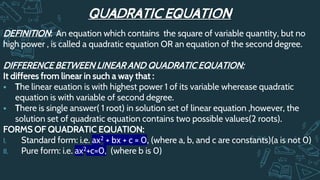
QUADRATIC EQUATION
DEFINITION: An equation which contains the square of variable quantity, but no
high power , is called a quadratic equation OR an equation of the second degree.
DIFFERENCE BETWEEN LINEAR AND QUADRATIC EQUATION:
It differes from linear in such a way that :
 The linear euation is with highest power 1 of its variable wherease quadratic
equation is with variable of second degree.
 There is single answer( 1 root) in solution set of linear equation ,however, the
solution set of quadratic equation contains two possible values(2 roots).
FORMS OF QUADRATIC EQUATION:
I. Standard form: i.e. ax2 + bx + c = 0, (where a, b, and c are constants)(a is not 0)
II. Pure form: i.e. ax2+c=0, (where b is 0)
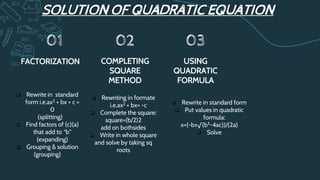
SOLUTION OF QUADRATIC EQUATION
 Rewrite in standard
form i.e.ax2 + bx + c =
0
(splitting)
 Find factors of (c)(a)
that add to “b”
(expanding)
 Grouping & solution
(grouping)
FACTORIZATION
 Rewriting in formate
i.e.ax2 + bx= -c
 Complete the square:
square=(b/2)2
add on bothsides
 Write in whole square
and solve by taking sq
roots
COMPLETING
SQUARE
METHOD
 Rewrite in standard form
 Put values in quadratic
formula:
x=(-b±√(b²-4ac))/(2a)
 Solve
USING
QUADRATIC
FORMULA
01 02 03
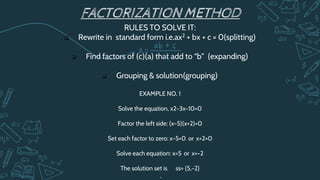
FACTORIZATION METHOD
RULES TO SOLVE IT:
 Rewrite in standard form i.e.ax2 + bx + c = 0(splitting)
 Find factors of (c)(a) that add to “b” (expanding)
 Grouping & solution(grouping)
EXAMPLE NO. 1
Solve the equation, x2−3x−10=0
Factor the left side: (x−5)(x+2)=0
Set each factor to zero: x−5=0 or x+2=0
Solve each equation: x=5 or x=−2
The solution set is ss= {5,−2}
.
COMPLETING SQUARE METHOD
○ RULES TO SOLVE:
○ Rewriting in formate i.e.ax2 + bx= -c
○ Complete the square:
○ square=(b/2)2
○ add on bothsides
○ Write in whole squareand solve by taking sq roots
○ EXAMPLE no.2 x2 + 4x – 5 = 0
b = 4, c = -5
(x + b/2)2 = -(c – b2/4)
So, [x + (4/2)]2 = -[-5 – (42/4)]
(x + 2)2 = 5 + 4
⇒ (x + 2)2 = 9
⇒ (x + 2) = ±√9
⇒ (x + 2) = ± 3
⇒ x + 2 = 3, x + 2 = -3
⇒ x = 1 , -5
ss={1, -5}
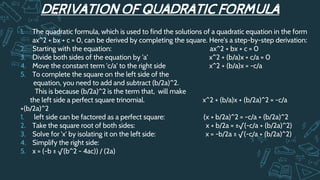
DERIVATION OF QUADRATIC FORMULA
1. The quadratic formula, which is used to find the solutions of a quadratic equation in the form
ax^2 + bx + c = 0, can be derived by completing the square. Here's a step-by-step derivation:
2. Starting with the equation: ax^2 + bx + c = 0
3. Divide both sides of the equation by 'a' x^2 + (b/a)x + c/a = 0
4. Move the constant term 'c/a' to the right side x^2 + (b/a)x = -c/a
5. To complete the square on the left side of the
equation, you need to add and subtract (b/2a)^2.
This is because (b/2a)^2 is the term that, will make
the left side a perfect square trinomial. x^2 + (b/a)x + (b/2a)^2 = -c/a
+(b/2a)^2
1. left side can be factored as a perfect square: (x + b/2a)^2 = -c/a + (b/2a)^2
2. Take the square root of both sides: x + b/2a = ±√(-c/a + (b/2a)^2)
3. Solve for 'x' by isolating it on the left side: x = -b/2a ± √(-c/a + (b/2a)^2)
4. Simplify the right side:
5. x = (-b ± √(b^2 - 4ac)) / (2a)
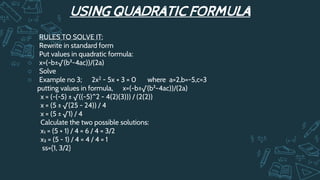
USING QUADRATIC FORMULA
○ RULES TO SOLVE IT:
○ Rewrite in standard form
○ Put values in quadratic formula:
○ x=(-b±√(b²-4ac))/(2a)
○ Solve
○ Example no 3; 2x2 - 5x + 3 = 0 where a=2,b=-5,c=3
putting values in formula, x=(-b±√(b²-4ac))/(2a)
x = (-(-5) ± √((-5)^2 - 4(2)(3))) / (2(2))
x = (5 ± √(25 - 24)) / 4
x = (5 ± √1) / 4
Calculate the two possible solutions:
x₁ = (5 + 1) / 4 = 6 / 4 = 3/2
x₂ = (5 - 1) / 4 = 4 / 4 = 1
ss={1, 3/2}
PRACTICAL SNERIO
INVOLVING
EXPRESSIONS
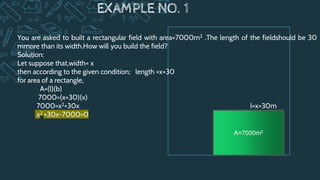
EXAMPLE NO. 1
You are asked to built a rectangular field with area=7000m2 .The length of the fieldshould be 30
mmore than its width.How will you build the field?
Solution:
Let suppose that,width= x
then according to the given condition; length =x+30
for area of a rectangle,
A=(l)(b)
7000=(x+30)(x)
7000=x2+30x l=x+30m
x2 +30x-7000=0
A=7000m2
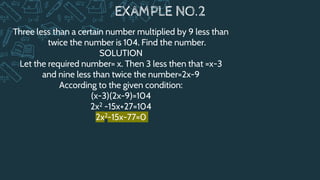
Three less than a certain number multiplied by 9 less than
twice the number is 104. Find the number.
SOLUTION
Let the required number= x. Then 3 less then that =x-3
and nine less than twice the number=2x-9
According to the given condition:
(x-3)(2x-9)=104
2x2 -15x+27=104
2x2-15x-77=0
EXAMPLE NO.2
The length of a base and the corresponding height of a triangle are (x+3) and (2x-5)
respectively.given the area of the triangle is 20cm2 .Find the value of x.
We are given that; Area=20cm2 Base=x+3 Height=2x-5
as Area of a triangle =1/2(b)(h)
putting values we get:
20=1/2(x+3)(2x-5)=(2x2-5x+6x-15)/2
20=2x2+x-15/2
20 X 2=2x2+x-15
0=2x2+x-40-15
2x2+x-25=0
b=x+3
EXAMPLE NO.3
h=(2x-5)
Solution of all math equations and square method

Solution of all math equations and square method

  • 1.
    PRESENTED TO: SIRALI RAZA SUBJECT:EXPLORING QUANTITATIVE SKILLS(MATHS1126) PRESENTED BY:GROUP 2 QUADRATIC EQUATION IN ONE VARIABLE & PRACTICAL SNERIO INVOLVING EXPRESSIONS GROUP PARTICIPANTS: RABIA SANI, MEHAK FATIMA KISHAAF MAQBOOL, AREESHA RAZA
  • 2.
    MAIN POINTS TODISCUSS What is quadratic equation in one variable?​ How it differs from linear equation?​ Forms of quadratic equation ( standard & pure).​ Solution of quadratic equation​ Types of solution​ Practical snerio involving expressions
  • 3.
    QUADRATIC EQUATION DEFINITION: Anequation which contains the square of variable quantity, but no high power , is called a quadratic equation OR an equation of the second degree. DIFFERENCE BETWEEN LINEAR AND QUADRATIC EQUATION: It differes from linear in such a way that :  The linear euation is with highest power 1 of its variable wherease quadratic equation is with variable of second degree.  There is single answer( 1 root) in solution set of linear equation ,however, the solution set of quadratic equation contains two possible values(2 roots). FORMS OF QUADRATIC EQUATION: I. Standard form: i.e. ax2 + bx + c = 0, (where a, b, and c are constants)(a is not 0) II. Pure form: i.e. ax2+c=0, (where b is 0)
  • 4.
    SOLUTION OF QUADRATICEQUATION  Rewrite in standard form i.e.ax2 + bx + c = 0 (splitting)  Find factors of (c)(a) that add to “b” (expanding)  Grouping & solution (grouping) FACTORIZATION  Rewriting in formate i.e.ax2 + bx= -c  Complete the square: square=(b/2)2 add on bothsides  Write in whole square and solve by taking sq roots COMPLETING SQUARE METHOD  Rewrite in standard form  Put values in quadratic formula: x=(-b±√(b²-4ac))/(2a)  Solve USING QUADRATIC FORMULA 01 02 03
  • 5.
    FACTORIZATION METHOD RULES TOSOLVE IT:  Rewrite in standard form i.e.ax2 + bx + c = 0(splitting)  Find factors of (c)(a) that add to “b” (expanding)  Grouping & solution(grouping) EXAMPLE NO. 1 Solve the equation, x2−3x−10=0 Factor the left side: (x−5)(x+2)=0 Set each factor to zero: x−5=0 or x+2=0 Solve each equation: x=5 or x=−2 The solution set is ss= {5,−2} .
  • 6.
    COMPLETING SQUARE METHOD ○RULES TO SOLVE: ○ Rewriting in formate i.e.ax2 + bx= -c ○ Complete the square: ○ square=(b/2)2 ○ add on bothsides ○ Write in whole squareand solve by taking sq roots ○ EXAMPLE no.2 x2 + 4x – 5 = 0 b = 4, c = -5 (x + b/2)2 = -(c – b2/4) So, [x + (4/2)]2 = -[-5 – (42/4)] (x + 2)2 = 5 + 4 ⇒ (x + 2)2 = 9 ⇒ (x + 2) = ±√9 ⇒ (x + 2) = ± 3 ⇒ x + 2 = 3, x + 2 = -3 ⇒ x = 1 , -5 ss={1, -5}
  • 7.
    DERIVATION OF QUADRATICFORMULA 1. The quadratic formula, which is used to find the solutions of a quadratic equation in the form ax^2 + bx + c = 0, can be derived by completing the square. Here's a step-by-step derivation: 2. Starting with the equation: ax^2 + bx + c = 0 3. Divide both sides of the equation by 'a' x^2 + (b/a)x + c/a = 0 4. Move the constant term 'c/a' to the right side x^2 + (b/a)x = -c/a 5. To complete the square on the left side of the equation, you need to add and subtract (b/2a)^2. This is because (b/2a)^2 is the term that, will make the left side a perfect square trinomial. x^2 + (b/a)x + (b/2a)^2 = -c/a +(b/2a)^2 1. left side can be factored as a perfect square: (x + b/2a)^2 = -c/a + (b/2a)^2 2. Take the square root of both sides: x + b/2a = ±√(-c/a + (b/2a)^2) 3. Solve for 'x' by isolating it on the left side: x = -b/2a ± √(-c/a + (b/2a)^2) 4. Simplify the right side: 5. x = (-b ± √(b^2 - 4ac)) / (2a)
  • 8.
    USING QUADRATIC FORMULA ○RULES TO SOLVE IT: ○ Rewrite in standard form ○ Put values in quadratic formula: ○ x=(-b±√(b²-4ac))/(2a) ○ Solve ○ Example no 3; 2x2 - 5x + 3 = 0 where a=2,b=-5,c=3 putting values in formula, x=(-b±√(b²-4ac))/(2a) x = (-(-5) ± √((-5)^2 - 4(2)(3))) / (2(2)) x = (5 ± √(25 - 24)) / 4 x = (5 ± √1) / 4 Calculate the two possible solutions: x₁ = (5 + 1) / 4 = 6 / 4 = 3/2 x₂ = (5 - 1) / 4 = 4 / 4 = 1 ss={1, 3/2}
  • 9.
  • 10.
    EXAMPLE NO. 1 Youare asked to built a rectangular field with area=7000m2 .The length of the fieldshould be 30 mmore than its width.How will you build the field? Solution: Let suppose that,width= x then according to the given condition; length =x+30 for area of a rectangle, A=(l)(b) 7000=(x+30)(x) 7000=x2+30x l=x+30m x2 +30x-7000=0 A=7000m2
  • 11.
    Three less thana certain number multiplied by 9 less than twice the number is 104. Find the number. SOLUTION Let the required number= x. Then 3 less then that =x-3 and nine less than twice the number=2x-9 According to the given condition: (x-3)(2x-9)=104 2x2 -15x+27=104 2x2-15x-77=0 EXAMPLE NO.2
  • 12.
    The length ofa base and the corresponding height of a triangle are (x+3) and (2x-5) respectively.given the area of the triangle is 20cm2 .Find the value of x. We are given that; Area=20cm2 Base=x+3 Height=2x-5 as Area of a triangle =1/2(b)(h) putting values we get: 20=1/2(x+3)(2x-5)=(2x2-5x+6x-15)/2 20=2x2+x-15/2 20 X 2=2x2+x-15 0=2x2+x-40-15 2x2+x-25=0 b=x+3 EXAMPLE NO.3 h=(2x-5)