Presentation on Solid-Waste
Management
Mid-Term Assignment, Semester II
2021-2022
Paper: GID 203 Remote Sensing and GIS
Applications
Presented by-
Sroyona De
Roll No. 21925SC036
PGD RS & GIS
Banaras Hindu University
WASTE
 Waste (or wastes) are unwanted or unusable materials. Waste is any substance which is
discarded after primary use, or is worthless, defective and of no use.
 Types of waste:
Solid waste
Liquid waste
Gaseous waste
Animal Products
Biodegradable waste
Solid Waste
 Solid waste is the unwanted or useless solid materials
generated from human activities in residential, industrial
or commercial areas. It may be categorised in three way-
According to its:
• origin (domestic, industrial, commercial, construction or
institutional)
• contents (organic material, glass, metal, plastic paper etc)
• hazard potential (toxic, non-toxin, flammable, radioactive,
infectious etc).
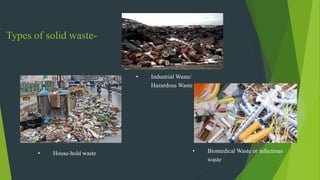
Types of solid waste-
• Industrial Waste/
Hazardous Waste
• Biomedical Waste or infectious
waste
• House-hold waste
Household Waste
 With rising urbanization and change
in life style and food habits, the
amount of municipal solid waste has
been rapidly changing.
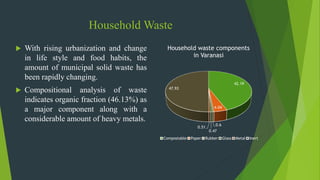
 Compositional analysis of waste
indicates organic fraction (46.13%) as
a major component along with a
considerable amount of heavy metals.
42.19
4.04
0.6
0.47
0.51
47.93
Household waste components
in Varanasi
Compostable Paper Rubber Glass Metal Inert
Hazardous Waste
 Hazardous waste
could be highly
toxic to humans,
animals and plants.
 In the industrial
sector major
hazardous waste
generators are
pesticide, dye and
rubber goods
industry.
2,485,317
999,566
964,811
679,860
620,952
587,554
409,761
362,114
317,091
311,042
232,199
200,606
172,438
131,412
122,167
52,391
34,907
28,569
27,725
21,818
7,6304,6312,6832,1251,7221,212 276 60 29 20
0
500,000
1,000,000
1,500,000
2,000,000
2,500,000
3,000,000
Hazardous waste generated in 2020
Biomedical Waste
 It is produced during
the diagnosis,
treatment or
immunisation of
human beings or
animals, or in research
activities pertaining
thereto, or in the
production or testing
of biologicals.
Effects of poor waste management
 Littered Surroundings
Due to improper waste disposal systems, particularly by municipal waste management teams, wastes
heap up and become a menace.
 Impact on Human Health
Improper waste disposal can affect the health of the population living nearby the polluted area or
landfills..
 Disease-causing Pests
This type of dumping of waste materials forces biodegradable materials to rot and decompose under
improper, unhygienic and uncontrolled conditions.
 Environmental Problems
Solid wastes from industries are a source of toxic metals, hazardous wastes, and chemicals.
 Soil and Groundwater Pollution
Toxic materials and chemicals may seep into the soil and pollute the groundwater.
 Emission of Toxic Gases
When hazardous wastes like pesticides, batteries containing lead, mercury or zinc, cleaning solvents,
radioactive materials, e-waste and plastics mixed up with paper and other non-toxic scraps are burned
they produce dioxins, furans, polychlorinated biphenyls, and other gases.
Methods of Management
 Sanitary Landfill
Garbage is basically spread out in thin layers, compressed and covered
with soil or plastic foam.
Modern landfills are designed in such a way that the bottom of the
landfill is covered with an impervious liner, which is usually made of
several layers of thick plastic and sand. This liner protects
the groundwater from being contaminated because of leaching or
percolation.
 Incineration
This method involves the burning of solid wastes at high temperatures
until the wastes are turned into ashes.
The good thing about this method is the fact that it reduces the volume
of waste up to 20 or 30% of the original volume.
 Recovery and Recycling
Recycling or recovery of resources is the process of taking useful
but discarded items for the next use. Plastic bags, tins, glass and
containers are often recycled automatically since, in many
situations, they are likely to be scarce commodities.
 Composting
Due to a lack of adequate space for landfills, biodegradable yard
waste is allowed to decompose in a medium designed for the
purpose. Only biodegradable waste materials are used in
composting.
 Pyrolysis
This is a method of solid waste management whereby solid wastes
are chemically decomposed by heat without the presence of oxygen.
It usually occurs under pressure and at temperatures of up to 430
degrees Celsius.
Conclusion
 It is clear that improper waste management practices
have a significant impact on the natural environment
and sustainable development in the study area. Thus,
awareness about SWM impact on sound environmental
development or/and sustainable development in
seemingly low. Therefore, it is important that the SWM
should be developed from the primary level. Waste
storage and primary disposal are the dominant means of
managing waste.
References
 https://www.conserve-energy-future.com/sources-effects-methods-of-solid-waste-
management.php
 https://www.researchgate.net/publication/339398877_An_insight_to_municipal_solid_
waste_management_of_Varanasi_city_India_and_appraisal_of_vermicomposting_as_it
s_efficient_management_approach
 https://www.academia.edu/37374523/Solid_Waste_Management_pptx
 https://byjus.com/biology/solid-waste-management/
THANK YOU

Solid Waste Management.pptx

  • 1.
    Presentation on Solid-Waste Management Mid-TermAssignment, Semester II 2021-2022 Paper: GID 203 Remote Sensing and GIS Applications Presented by- Sroyona De Roll No. 21925SC036 PGD RS & GIS Banaras Hindu University
  • 2.
    WASTE  Waste (orwastes) are unwanted or unusable materials. Waste is any substance which is discarded after primary use, or is worthless, defective and of no use.  Types of waste: Solid waste Liquid waste Gaseous waste Animal Products Biodegradable waste
  • 3.
    Solid Waste  Solidwaste is the unwanted or useless solid materials generated from human activities in residential, industrial or commercial areas. It may be categorised in three way- According to its: • origin (domestic, industrial, commercial, construction or institutional) • contents (organic material, glass, metal, plastic paper etc) • hazard potential (toxic, non-toxin, flammable, radioactive, infectious etc).
  • 4.
    Types of solidwaste- • Industrial Waste/ Hazardous Waste • Biomedical Waste or infectious waste • House-hold waste
  • 5.
    Household Waste  Withrising urbanization and change in life style and food habits, the amount of municipal solid waste has been rapidly changing.  Compositional analysis of waste indicates organic fraction (46.13%) as a major component along with a considerable amount of heavy metals. 42.19 4.04 0.6 0.47 0.51 47.93 Household waste components in Varanasi Compostable Paper Rubber Glass Metal Inert
  • 6.
    Hazardous Waste  Hazardouswaste could be highly toxic to humans, animals and plants.  In the industrial sector major hazardous waste generators are pesticide, dye and rubber goods industry. 2,485,317 999,566 964,811 679,860 620,952 587,554 409,761 362,114 317,091 311,042 232,199 200,606 172,438 131,412 122,167 52,391 34,907 28,569 27,725 21,818 7,6304,6312,6832,1251,7221,212 276 60 29 20 0 500,000 1,000,000 1,500,000 2,000,000 2,500,000 3,000,000 Hazardous waste generated in 2020
  • 7.
    Biomedical Waste  Itis produced during the diagnosis, treatment or immunisation of human beings or animals, or in research activities pertaining thereto, or in the production or testing of biologicals.
  • 8.
    Effects of poorwaste management  Littered Surroundings Due to improper waste disposal systems, particularly by municipal waste management teams, wastes heap up and become a menace.  Impact on Human Health Improper waste disposal can affect the health of the population living nearby the polluted area or landfills..  Disease-causing Pests This type of dumping of waste materials forces biodegradable materials to rot and decompose under improper, unhygienic and uncontrolled conditions.  Environmental Problems Solid wastes from industries are a source of toxic metals, hazardous wastes, and chemicals.  Soil and Groundwater Pollution Toxic materials and chemicals may seep into the soil and pollute the groundwater.  Emission of Toxic Gases When hazardous wastes like pesticides, batteries containing lead, mercury or zinc, cleaning solvents, radioactive materials, e-waste and plastics mixed up with paper and other non-toxic scraps are burned they produce dioxins, furans, polychlorinated biphenyls, and other gases.
  • 9.
    Methods of Management Sanitary Landfill Garbage is basically spread out in thin layers, compressed and covered with soil or plastic foam. Modern landfills are designed in such a way that the bottom of the landfill is covered with an impervious liner, which is usually made of several layers of thick plastic and sand. This liner protects the groundwater from being contaminated because of leaching or percolation.  Incineration This method involves the burning of solid wastes at high temperatures until the wastes are turned into ashes. The good thing about this method is the fact that it reduces the volume of waste up to 20 or 30% of the original volume.
  • 10.
     Recovery andRecycling Recycling or recovery of resources is the process of taking useful but discarded items for the next use. Plastic bags, tins, glass and containers are often recycled automatically since, in many situations, they are likely to be scarce commodities.  Composting Due to a lack of adequate space for landfills, biodegradable yard waste is allowed to decompose in a medium designed for the purpose. Only biodegradable waste materials are used in composting.  Pyrolysis This is a method of solid waste management whereby solid wastes are chemically decomposed by heat without the presence of oxygen. It usually occurs under pressure and at temperatures of up to 430 degrees Celsius.
  • 11.
    Conclusion  It isclear that improper waste management practices have a significant impact on the natural environment and sustainable development in the study area. Thus, awareness about SWM impact on sound environmental development or/and sustainable development in seemingly low. Therefore, it is important that the SWM should be developed from the primary level. Waste storage and primary disposal are the dominant means of managing waste.
  • 12.
  • 13.