Solar Thermal
B59ES Energy Studies
1
Overview
1. What is solar thermal energy conversion
2. Heat
1. Flat plate collector
2. Evacuated tube collector
3. Power
1. Parabolic trough collector
2. Linear Fresnel reflector
3. Fresnel tower
4. Parabolic dish
5. Storage
4. Installed systems
2
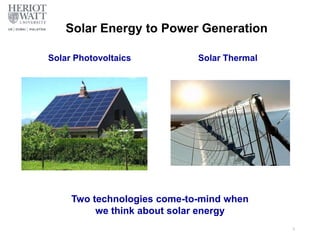
Solar Energy to Power Generation
Solar Photovoltaics Solar Thermal
Two technologies come-to-mind when
we think about solar energy
3
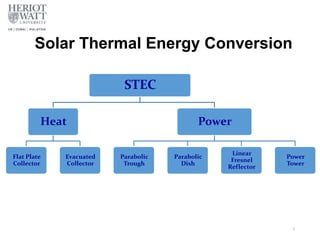
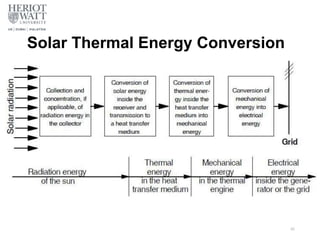
Solar Thermal Energy Conversion
STEC
Heat
Flat Plate
Collector
Evacuated
Collector
Power
Parabolic
Trough
Parabolic
Dish
Linear
Fresnel
Reflector
Power
Tower
4
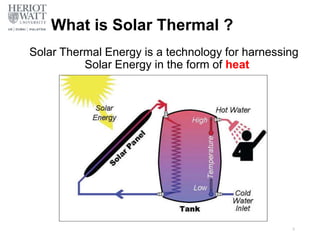
What is Solar Thermal ?
Solar Thermal Energy is a technology for harnessing
Solar Energy in the form of heat
5
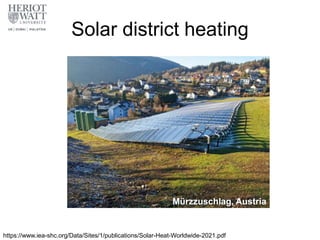
Mürzzuschlag, Austria
https://www.iea-shc.org/Data/Sites/1/publications/Solar-Heat-Worldwide-2021.pdf
Solar district heating
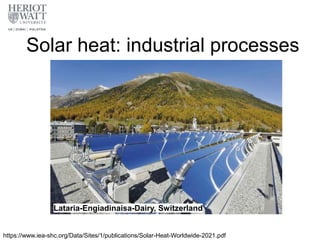
Solar heat: industrial processes
Lataria-Engiadinaisa-Dairy, Switzerland
https://www.iea-shc.org/Data/Sites/1/publications/Solar-Heat-Worldwide-2021.pdf
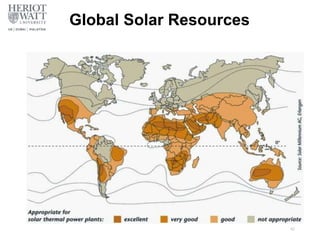
Global Solar Resources
• 3,850,000 Exajoule (EJ) of solar
energy received by Earth per
year
• Worldwide primary energy
consumptions ~500 EJ
• 6 hours of Solar Energy at
deserts could meet annual
global energy requirement
8
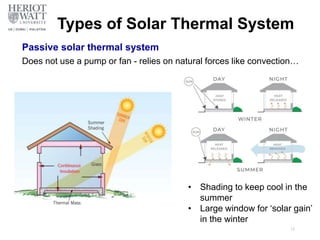
Types of Solar Thermal System
Passive solar thermal system
Does not use a pump or fan - relies on natural forces like convection…
• Shading to keep cool in the
summer
• Large window for ‘solar gain’
in the winter
12
Types of Solar Thermal System
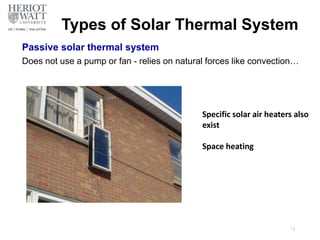
Passive solar thermal system
Does not use a pump or fan - relies on natural forces like convection…
Specific solar air heaters also
exist
Space heating
13
Types of Solar Thermal System
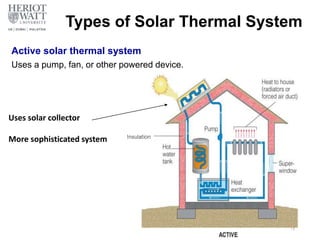
Active solar thermal system
Uses a pump, fan, or other powered device.
Uses solar collector
More sophisticated system Insulation
14
Overview
1. What is solar thermal energy conversion
2. Heat
1. Flat plate collector
2. Evacuated tube collector
3. Power
1. Parabolic trough collector
2. Linear Fresnel reflector
3. Fresnel tower
4. Parabolic dish
5. Storage
4. Installed systems
15
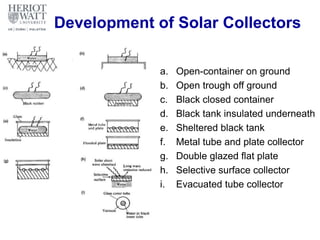
Development of Solar Collectors
a. Open-container on ground
b. Open trough off ground
c. Black closed container
d. Black tank insulated underneath
e. Sheltered black tank
f. Metal tube and plate collector
g. Double glazed flat plate
h. Selective surface collector
i. Evacuated tube collector
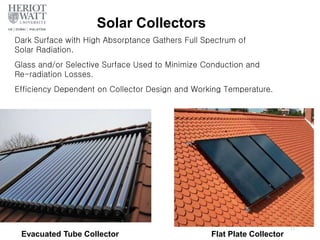
Solar Collectors
Flat Plate Collector
Evacuated Tube Collector
17
Dark Surface with High Absorptance Gathers Full Spectrum of
Solar Radiation.
Glass and/or Selective Surface Used to Minimize Conduction and
Re-radiation Losses.
Efficiency Dependent on Collector Design and Working Temperature.
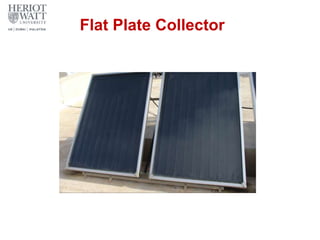
Flat Plate Collector
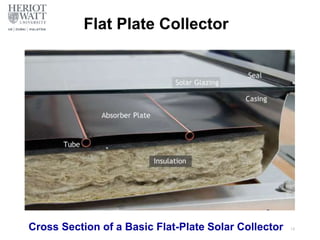
Cross Section of a Basic Flat-Plate Solar Collector 19
Flat Plate Collector
Absorber plate Glass cover
Pipe
Collector box
Insulation
Cross Section of a Basic Flat-Plate Solar Collector
Radiation
20
Efficiency of Solar Collectors
Rate of heat loss:
UL collector overall heat loss coefficient [W/m/K]
A area, m²
TC collector average temperature [°C]
Ta ambient temperature [°C]
21
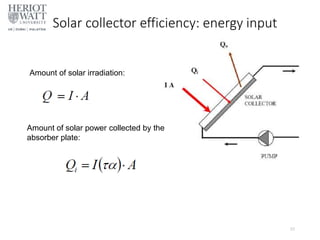
Amount of solar irradiation:
Amount of solar power collected by the
absorber plate:
22
Solar collector efficiency: energy input
Solar collector efficiency
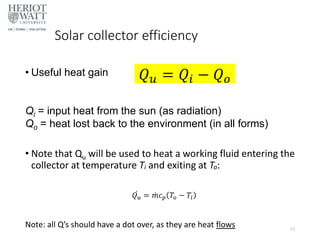
• Useful heat gain
Qi = input heat from the sun (as radiation)
Qo = heat lost back to the environment (in all forms)
• Note that Qu will be used to heat a working fluid entering the
collector at temperature Ti and exiting at To:
Note: all Q’s should have a dot over, as they are heat flows 23
𝑄𝑢 = 𝑄𝑖 − 𝑄𝑜
𝑄𝑢 = 𝑚𝑐𝑝 𝑇𝑜 − 𝑇𝑖
Solar collector efficiency: heat removed
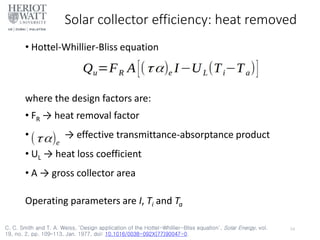
• Hottel-Whillier-Bliss equation
where the design factors are:
• FR → heat removal factor
• → effective transmittance-absorptance product
• UL → heat loss coefficient
• A → gross collector area
Operating parameters are I, Ti and Ta
24
C. C. Smith and T. A. Weiss, ‘Design application of the Hottel-Whillier-Bliss equation’, Solar Energy, vol.
19, no. 2, pp. 109–113, Jan. 1977, doi: 10.1016/0038-092X(77)90047-0.
Solar collector efficiency
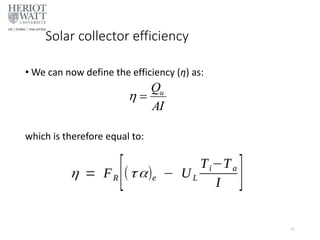
• We can now define the efficiency (η) as:
which is therefore equal to:
25
Notes on solar collector efficiency
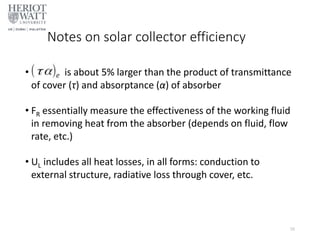
• is about 5% larger than the product of transmittance
of cover (τ) and absorptance (α) of absorber
• FR essentially measure the effectiveness of the working fluid
in removing heat from the absorber (depends on fluid, flow
rate, etc.)
• UL includes all heat losses, in all forms: conduction to
external structure, radiative loss through cover, etc.
26
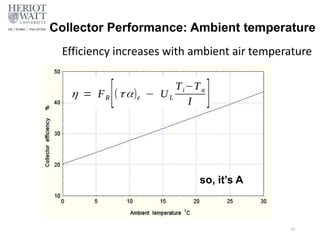
Collector Performance: Ambient temperature
Efficiency increases with ambient air temperature
28
so, it’s A
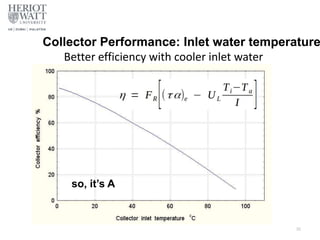
Collector Performance: Inlet water temperature
30
Better efficiency with cooler inlet water
so, it’s A
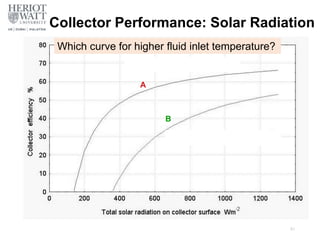
Collector Performance: Solar Radiation
31
Which curve for higher fluid inlet temperature?
A
B
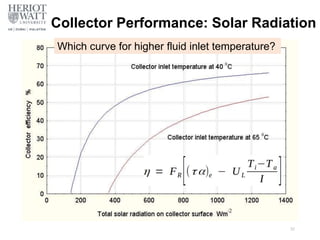
Collector Performance: Solar Radiation
32
Which curve for higher fluid inlet temperature?
33
Solar Collectors
Evacuated Tube Collector
Solid metal surface gets
hot and the liquid (alcohol/
water) absorbs heat
Turns into vapour
Rises up heat pipe to cold
surface and condenses
back into liquid –
releasing latent heat
Utilises high heat transfer
coefficient for condensation
so gives excellent thermal
conductivity through the
tube
34
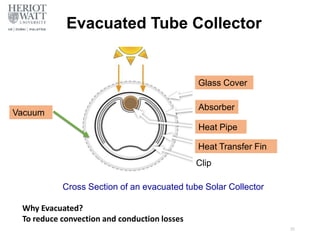
Why Evacuated?
To reduce convection and conduction losses
Evacuated Tube Collector
Cross Section of an evacuated tube Solar Collector
35
Vacuum
Absorber
Heat Pipe
Glass Cover
Clip
Heat Transfer Fin
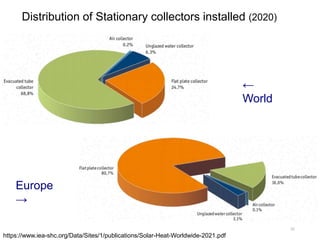
Distribution of Stationary collectors installed (2020)
36
https://www.iea-shc.org/Data/Sites/1/publications/Solar-Heat-Worldwide-2021.pdf
←
World
Europe
→
Distribution of solar thermal by
application type
Source: Solar Heat World wide Report , IEA, 2015
37
Overview
1. What is solar thermal energy conversion
2. Heat
1. Flat plate collector
2. Evacuated tube collector
3. Power
1. Parabolic trough collector
2. Linear Fresnel reflector
3. Fresnel tower
4. Parabolic dish
5. Storage
4. Installed systems
38
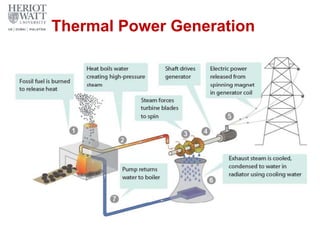
Thermal Power Generation
Solar Thermal Energy Conversion
40
Solar Thermal Power Plant
Heat Exchanger
Turbine
Generator
Storage
system
Thermo-oil circulation pipes
Solarfield
Global Solar Resources
42
Concentrated Solar Power (CSP)
Uses large area of mirrors or lenses to focus the sunlight to
smaller absorber
Concentrate sunlight: 50-3000x concentration
Track sun position: daily/seasonally
Store Heat Energy
Covert Heat to Power: Turbine and Stirling Engines
43
Solar Thermal Power Plant
https://www.youtube.com/watch?v=rO5rUqeCFY4
After watching the video, try to sketch the heat flow of a
solar thermal power plant to produce electricity by
including
- Solar field/Receiver
- Hot and Cold fluid
- Heat Exchanger
- steam and water
- Turbine/Generator
44
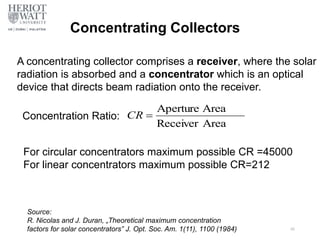
Concentrating Collectors
A concentrating collector comprises a receiver, where the solar
radiation is absorbed and a concentrator which is an optical
device that directs beam radiation onto the receiver.
Concentration Ratio:
For circular concentrators maximum possible CR =45000
For linear concentrators maximum possible CR=212
Source:
R. Nicolas and J. Duran, „Theoretical maximum concentration
factors for solar concentrators” J. Opt. Soc. Am. 1(11), 1100 (1984) 46
Area
Receiver
Area
Aperture

CR
Different Concentrator Geometry
(a) Tubular absorbers with diffuse back reflector (b) tubular absorber with
specular cusp reflectors (c) plane receiver with plane reflectors (d) parabolic
reflector (e) Fresnel reflector (f) array of heliostats with central receiver
47
Focus: Line/Point?
Line
Point
48
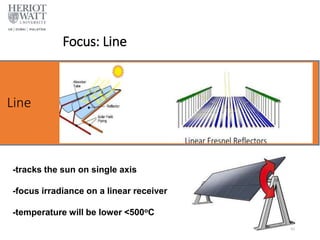
Focus: Line
Line
-tracks the sun on single axis
-focus irradiance on a linear receiver
-temperature will be lower <500oC
49
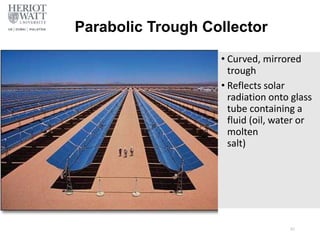
Parabolic Trough Collector
• Curved, mirrored
trough
• Reflects solar
radiation onto glass
tube containing a
fluid (oil, water or
molten
salt)
50
Linear Fresnel Reflector
• An array of flat,
long, narrow
mirrors at slightly
different angles
• Light reflected to a
single line receiver,
as opposed to
multiple for trough
collector
51
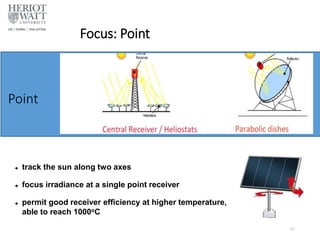
Focus: Point
Point
 track the sun along two axes
 focus irradiance at a single point receiver
 permit good receiver efficiency at higher temperature,
able to reach 1000oC
52
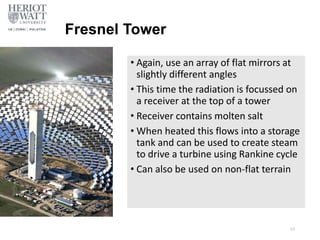
Fresnel Tower
• Again, use an array of flat mirrors at
slightly different angles
• This time the radiation is focussed on
a receiver at the top of a tower
• Receiver contains molten salt
• When heated this flows into a storage
tank and can be used to create steam
to drive a turbine using Rankine cycle
• Can also be used on non-flat terrain
53
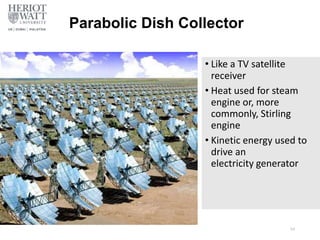
Parabolic Dish Collector
• Like a TV satellite
receiver
• Heat used for steam
engine or, more
commonly, Stirling
engine
• Kinetic energy used to
drive an
electricity generator
54
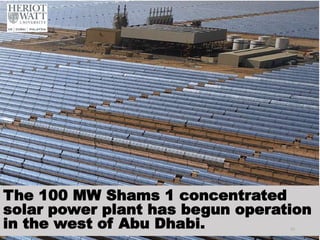
The 100 MW Shams 1 concentrated
solar power plant has begun operation
in the west of Abu Dhabi. 55
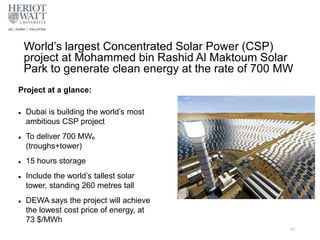
World’s largest Concentrated Solar Power (CSP)
project at Mohammed bin Rashid Al Maktoum Solar
Park to generate clean energy at the rate of 700 MW
56
Project at a glance:
 Dubai is building the world’s most
ambitious CSP project
 To deliver 700 MWe
(troughs+tower)
 15 hours storage
 Include the world’s tallest solar
tower, standing 260 metres tall
 DEWA says the project will achieve
the lowest cost price of energy, at
73 $/MWh
Case Study: Andasol, Spain
 Area:
 Site: 3×200 ha = 6 km²
 Collectors: 0.51 km²
 Solar irradiance: 2,200 kWh/m2/yr
 Nominal: 3×50MW
 Energy generation: 3×165 GWh/yr
 Capacity factor ~38%
 Conversion efficiency ~4% (radiation on ALL the facility)
 £500M total cost, 25yr lifetime
 Electricity costs 20p/kWh (UK price cap 2023: 67p/kWh*)
* https://www.ofgem.gov.uk/publications/latest-energy-price-cap-announced-ofgem
Case Study:
Crescent Dune
• Bloomberg: "A $1 Billion Solar
Plant Was Obsolete Before
It Ever Went Online"
• ten thousand mirrors form a
spiral almost 2 miles wide
(Nevada – USA)
• designed to generate enough
power night and day to supply
a population of 100,000
• its energy costs about $135/MWh, compared with less than
$30/MWh today at a new Nevada photovoltaic solar farm
[BloombergNEF]
https://www.bloomberg.com/news/articles/2020-01-06/a-1-billion-solar-plant-was-obsolete-before-it-ever-went-online
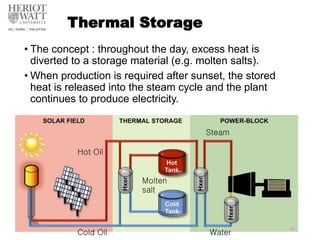
Thermal Storage
• The concept : throughout the day, excess heat is
diverted to a storage material (e.g. molten salts).
• When production is required after sunset, the stored
heat is released into the steam cycle and the plant
continues to produce electricity.
Hot Oil
Molten
salt
Cold Oil
Steam
Water
59
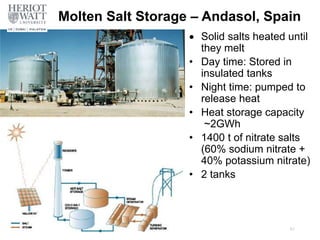
Molten Salt Storage – Andasol, Spain
 Solid salts heated until
they melt
• Day time: Stored in
insulated tanks
• Night time: pumped to
release heat
• Heat storage capacity
~2GWh
• 1400 t of nitrate salts
(60% sodium nitrate +
40% potassium nitrate)
• 2 tanks
61
Molten Salt Storage – Andasol, Spain
Conventional steam turbine
Collector field Molten salt storage
H2O
NaNO3-KNO3
Syn. Oil
62
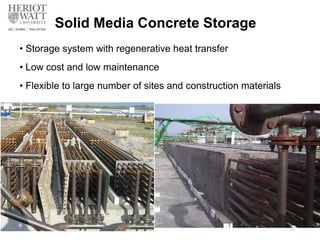
Solid Media Concrete Storage
• Storage system with regenerative heat transfer
• Low cost and low maintenance
• Flexible to large number of sites and construction materials
63
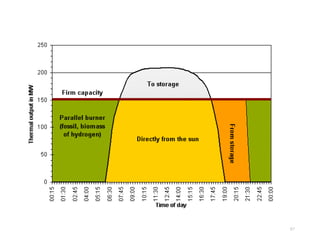
Back-up and hybridisation
 Back up: for when the solar resource is low and to
guarantee an alternative thermal source (compensate
night thermal losses, prevent freezing and assure a faster
start-up in the early morning).
 Full hybrids: constant use of fuel (usually a fossil fuel) or
another source of heat together with solar energy.
 the Shams-1 (100 MW) in the United Arab Emirates combines
hybridisation and backup, using natural gas and two separate
burners. The plant burns natural gas continuously during sunshine
hours to raise the steam temperature (from 380°C to 540°C) for
optimal turbine operation.
67
Summary
1. What is solar thermal energy conversion
2. Heat
1. Flat plate collector
2. Evacuated tube collector
3. Power
1. Parabolic trough collector
2. Linear Fresnel reflector
3. Fresnel tower
4. Parabolic dish
5. Storage
4. Installed systems
68
Solar Thermal in power generation for cleaner

Solar Thermal in power generation for cleaner

  • 1.
  • 2.
    Overview 1. What issolar thermal energy conversion 2. Heat 1. Flat plate collector 2. Evacuated tube collector 3. Power 1. Parabolic trough collector 2. Linear Fresnel reflector 3. Fresnel tower 4. Parabolic dish 5. Storage 4. Installed systems 2
  • 3.
    Solar Energy toPower Generation Solar Photovoltaics Solar Thermal Two technologies come-to-mind when we think about solar energy 3
  • 4.
    Solar Thermal EnergyConversion STEC Heat Flat Plate Collector Evacuated Collector Power Parabolic Trough Parabolic Dish Linear Fresnel Reflector Power Tower 4
  • 5.
    What is SolarThermal ? Solar Thermal Energy is a technology for harnessing Solar Energy in the form of heat 5
  • 6.
  • 7.
    Solar heat: industrialprocesses Lataria-Engiadinaisa-Dairy, Switzerland https://www.iea-shc.org/Data/Sites/1/publications/Solar-Heat-Worldwide-2021.pdf
  • 8.
    Global Solar Resources •3,850,000 Exajoule (EJ) of solar energy received by Earth per year • Worldwide primary energy consumptions ~500 EJ • 6 hours of Solar Energy at deserts could meet annual global energy requirement 8
  • 9.
    Types of SolarThermal System Passive solar thermal system Does not use a pump or fan - relies on natural forces like convection… • Shading to keep cool in the summer • Large window for ‘solar gain’ in the winter 12
  • 10.
    Types of SolarThermal System Passive solar thermal system Does not use a pump or fan - relies on natural forces like convection… Specific solar air heaters also exist Space heating 13
  • 11.
    Types of SolarThermal System Active solar thermal system Uses a pump, fan, or other powered device. Uses solar collector More sophisticated system Insulation 14
  • 12.
    Overview 1. What issolar thermal energy conversion 2. Heat 1. Flat plate collector 2. Evacuated tube collector 3. Power 1. Parabolic trough collector 2. Linear Fresnel reflector 3. Fresnel tower 4. Parabolic dish 5. Storage 4. Installed systems 15
  • 13.
    Development of SolarCollectors a. Open-container on ground b. Open trough off ground c. Black closed container d. Black tank insulated underneath e. Sheltered black tank f. Metal tube and plate collector g. Double glazed flat plate h. Selective surface collector i. Evacuated tube collector
  • 14.
    Solar Collectors Flat PlateCollector Evacuated Tube Collector 17 Dark Surface with High Absorptance Gathers Full Spectrum of Solar Radiation. Glass and/or Selective Surface Used to Minimize Conduction and Re-radiation Losses. Efficiency Dependent on Collector Design and Working Temperature.
  • 15.
  • 16.
    Flat Plate Collector CrossSection of a Basic Flat-Plate Solar Collector 19
  • 17.
    Flat Plate Collector Absorberplate Glass cover Pipe Collector box Insulation Cross Section of a Basic Flat-Plate Solar Collector Radiation 20
  • 18.
    Efficiency of SolarCollectors Rate of heat loss: UL collector overall heat loss coefficient [W/m/K] A area, m² TC collector average temperature [°C] Ta ambient temperature [°C] 21
  • 19.
    Amount of solarirradiation: Amount of solar power collected by the absorber plate: 22 Solar collector efficiency: energy input
  • 20.
    Solar collector efficiency •Useful heat gain Qi = input heat from the sun (as radiation) Qo = heat lost back to the environment (in all forms) • Note that Qu will be used to heat a working fluid entering the collector at temperature Ti and exiting at To: Note: all Q’s should have a dot over, as they are heat flows 23 𝑄𝑢 = 𝑄𝑖 − 𝑄𝑜 𝑄𝑢 = 𝑚𝑐𝑝 𝑇𝑜 − 𝑇𝑖
  • 21.
    Solar collector efficiency:heat removed • Hottel-Whillier-Bliss equation where the design factors are: • FR → heat removal factor • → effective transmittance-absorptance product • UL → heat loss coefficient • A → gross collector area Operating parameters are I, Ti and Ta 24 C. C. Smith and T. A. Weiss, ‘Design application of the Hottel-Whillier-Bliss equation’, Solar Energy, vol. 19, no. 2, pp. 109–113, Jan. 1977, doi: 10.1016/0038-092X(77)90047-0.
  • 22.
    Solar collector efficiency •We can now define the efficiency (η) as: which is therefore equal to: 25
  • 23.
    Notes on solarcollector efficiency • is about 5% larger than the product of transmittance of cover (τ) and absorptance (α) of absorber • FR essentially measure the effectiveness of the working fluid in removing heat from the absorber (depends on fluid, flow rate, etc.) • UL includes all heat losses, in all forms: conduction to external structure, radiative loss through cover, etc. 26
  • 24.
    Collector Performance: Ambienttemperature Efficiency increases with ambient air temperature 28 so, it’s A
  • 25.
    Collector Performance: Inletwater temperature 30 Better efficiency with cooler inlet water so, it’s A
  • 26.
    Collector Performance: SolarRadiation 31 Which curve for higher fluid inlet temperature? A B
  • 27.
    Collector Performance: SolarRadiation 32 Which curve for higher fluid inlet temperature?
  • 28.
  • 29.
    Solid metal surfacegets hot and the liquid (alcohol/ water) absorbs heat Turns into vapour Rises up heat pipe to cold surface and condenses back into liquid – releasing latent heat Utilises high heat transfer coefficient for condensation so gives excellent thermal conductivity through the tube 34
  • 30.
    Why Evacuated? To reduceconvection and conduction losses Evacuated Tube Collector Cross Section of an evacuated tube Solar Collector 35 Vacuum Absorber Heat Pipe Glass Cover Clip Heat Transfer Fin
  • 31.
    Distribution of Stationarycollectors installed (2020) 36 https://www.iea-shc.org/Data/Sites/1/publications/Solar-Heat-Worldwide-2021.pdf ← World Europe →
  • 32.
    Distribution of solarthermal by application type Source: Solar Heat World wide Report , IEA, 2015 37
  • 33.
    Overview 1. What issolar thermal energy conversion 2. Heat 1. Flat plate collector 2. Evacuated tube collector 3. Power 1. Parabolic trough collector 2. Linear Fresnel reflector 3. Fresnel tower 4. Parabolic dish 5. Storage 4. Installed systems 38
  • 34.
  • 35.
    Solar Thermal EnergyConversion 40
  • 36.
    Solar Thermal PowerPlant Heat Exchanger Turbine Generator Storage system Thermo-oil circulation pipes Solarfield
  • 37.
  • 38.
    Concentrated Solar Power(CSP) Uses large area of mirrors or lenses to focus the sunlight to smaller absorber Concentrate sunlight: 50-3000x concentration Track sun position: daily/seasonally Store Heat Energy Covert Heat to Power: Turbine and Stirling Engines 43
  • 39.
    Solar Thermal PowerPlant https://www.youtube.com/watch?v=rO5rUqeCFY4 After watching the video, try to sketch the heat flow of a solar thermal power plant to produce electricity by including - Solar field/Receiver - Hot and Cold fluid - Heat Exchanger - steam and water - Turbine/Generator 44
  • 40.
    Concentrating Collectors A concentratingcollector comprises a receiver, where the solar radiation is absorbed and a concentrator which is an optical device that directs beam radiation onto the receiver. Concentration Ratio: For circular concentrators maximum possible CR =45000 For linear concentrators maximum possible CR=212 Source: R. Nicolas and J. Duran, „Theoretical maximum concentration factors for solar concentrators” J. Opt. Soc. Am. 1(11), 1100 (1984) 46 Area Receiver Area Aperture  CR
  • 41.
    Different Concentrator Geometry (a)Tubular absorbers with diffuse back reflector (b) tubular absorber with specular cusp reflectors (c) plane receiver with plane reflectors (d) parabolic reflector (e) Fresnel reflector (f) array of heliostats with central receiver 47
  • 42.
  • 43.
    Focus: Line Line -tracks thesun on single axis -focus irradiance on a linear receiver -temperature will be lower <500oC 49
  • 44.
    Parabolic Trough Collector •Curved, mirrored trough • Reflects solar radiation onto glass tube containing a fluid (oil, water or molten salt) 50
  • 45.
    Linear Fresnel Reflector •An array of flat, long, narrow mirrors at slightly different angles • Light reflected to a single line receiver, as opposed to multiple for trough collector 51
  • 46.
    Focus: Point Point  trackthe sun along two axes  focus irradiance at a single point receiver  permit good receiver efficiency at higher temperature, able to reach 1000oC 52
  • 47.
    Fresnel Tower • Again,use an array of flat mirrors at slightly different angles • This time the radiation is focussed on a receiver at the top of a tower • Receiver contains molten salt • When heated this flows into a storage tank and can be used to create steam to drive a turbine using Rankine cycle • Can also be used on non-flat terrain 53
  • 48.
    Parabolic Dish Collector •Like a TV satellite receiver • Heat used for steam engine or, more commonly, Stirling engine • Kinetic energy used to drive an electricity generator 54
  • 49.
    The 100 MWShams 1 concentrated solar power plant has begun operation in the west of Abu Dhabi. 55
  • 50.
    World’s largest ConcentratedSolar Power (CSP) project at Mohammed bin Rashid Al Maktoum Solar Park to generate clean energy at the rate of 700 MW 56 Project at a glance:  Dubai is building the world’s most ambitious CSP project  To deliver 700 MWe (troughs+tower)  15 hours storage  Include the world’s tallest solar tower, standing 260 metres tall  DEWA says the project will achieve the lowest cost price of energy, at 73 $/MWh
  • 51.
    Case Study: Andasol,Spain  Area:  Site: 3×200 ha = 6 km²  Collectors: 0.51 km²  Solar irradiance: 2,200 kWh/m2/yr  Nominal: 3×50MW  Energy generation: 3×165 GWh/yr  Capacity factor ~38%  Conversion efficiency ~4% (radiation on ALL the facility)  £500M total cost, 25yr lifetime  Electricity costs 20p/kWh (UK price cap 2023: 67p/kWh*) * https://www.ofgem.gov.uk/publications/latest-energy-price-cap-announced-ofgem
  • 52.
    Case Study: Crescent Dune •Bloomberg: "A $1 Billion Solar Plant Was Obsolete Before It Ever Went Online" • ten thousand mirrors form a spiral almost 2 miles wide (Nevada – USA) • designed to generate enough power night and day to supply a population of 100,000 • its energy costs about $135/MWh, compared with less than $30/MWh today at a new Nevada photovoltaic solar farm [BloombergNEF] https://www.bloomberg.com/news/articles/2020-01-06/a-1-billion-solar-plant-was-obsolete-before-it-ever-went-online
  • 53.
    Thermal Storage • Theconcept : throughout the day, excess heat is diverted to a storage material (e.g. molten salts). • When production is required after sunset, the stored heat is released into the steam cycle and the plant continues to produce electricity. Hot Oil Molten salt Cold Oil Steam Water 59
  • 54.
    Molten Salt Storage– Andasol, Spain  Solid salts heated until they melt • Day time: Stored in insulated tanks • Night time: pumped to release heat • Heat storage capacity ~2GWh • 1400 t of nitrate salts (60% sodium nitrate + 40% potassium nitrate) • 2 tanks 61
  • 55.
    Molten Salt Storage– Andasol, Spain Conventional steam turbine Collector field Molten salt storage H2O NaNO3-KNO3 Syn. Oil 62
  • 56.
    Solid Media ConcreteStorage • Storage system with regenerative heat transfer • Low cost and low maintenance • Flexible to large number of sites and construction materials 63
  • 57.
    Back-up and hybridisation Back up: for when the solar resource is low and to guarantee an alternative thermal source (compensate night thermal losses, prevent freezing and assure a faster start-up in the early morning).  Full hybrids: constant use of fuel (usually a fossil fuel) or another source of heat together with solar energy.  the Shams-1 (100 MW) in the United Arab Emirates combines hybridisation and backup, using natural gas and two separate burners. The plant burns natural gas continuously during sunshine hours to raise the steam temperature (from 380°C to 540°C) for optimal turbine operation.
  • 58.
  • 59.
    Summary 1. What issolar thermal energy conversion 2. Heat 1. Flat plate collector 2. Evacuated tube collector 3. Power 1. Parabolic trough collector 2. Linear Fresnel reflector 3. Fresnel tower 4. Parabolic dish 5. Storage 4. Installed systems 68