Asteroids are small solar system bodies that are not comets, especially
those of the inner Solar System. They have also been called planetoids,
especially the larger ones. These terms have historically been applied to
any astronomical object orbiting the Sun that did not show the disk of a
planet and was not observed to have the characteristics of an active
comet, but as small objects in the outer solar system were discovered,
their volatile-based surfaces were found to more closely resemble comets,
and so were often distinguished from traditional asteroids. Thus the
term asteroid has come increasingly to refer specifically to the small
bodies of the inner solar system out to the orbit of Jupiter, which are
usually rocky or metallic. They are grouped with the outer bodies—
centaurs, Neptune trolians, and trans-neptunian objects—as minor planets,
which is the term preferred in astronomical circles. This article will
restrict the use of the term "asteroid" to the minor planets of the inner
Solar System.
A comet is an icy small solar system body that, when close enough to the
Sun, displays a visible coma (a thin, fuzzy, temporary atmosphere) and
sometimes also a tail. These phenomena are both due to the effects
of solar radiation and the solar wind upon the nucleus. Comet nuclei range
from a few hundred meters to tens of kilometres across and are composed
of loose collections of ice, dust, and small rocky particles. Comets have
been observed since ancient times. Comets have a wide range of orbital
periods, ranging from a few years to hundreds of thousands of years.
Short-period comets originate in the Kuiper belt, or its
associated scattered disc, which lie beyond the orbit of Neptune. Longerperiod comets are thought to originate in the Oort cloud, a hypothesized
spherical cloud of icy bodies in the outer Solar System. Long-period
comets plunge towards the Sun from the Oort cloud because gravitational
perturbations caused by either the massive outer planets of the Solar
System (Jupiter, Saturn, Uranus, and Neptune), or passing stars.
Rare hyperbolic comets pass once through the inner solar system before
being thrown out into interstellar along hyperbolic trajectories.
Exocomets, comets beyond our solar system, have also been detected and
may be common in the Milky Way Galaxy.
1. What are asteroids also called ?
2. How are asteroids?
3. From where do short period comets originate?
4. What is the Oort cloud?
5. What do we otherwise refer to meteors as?
6. From where do Meteors become visible?
7. What does the term Bolide refer to ?
8. What are falls?
9. What is the official designation of the “Halley’s Comet”?
10.When did the “Halley’s Comet” appear last and when will it appear next?
1.
1.
2.
2.
3.
3.
4.
4.

5.
5.
6.
6.
7.
7.

Planetoids.
Planetoids
Asteroids are usually Rocky or metallic. metallic
Asteroids are generally rocky or
Short-period comets originate in the Kuiper belt, or itsbelt, or its
Short-period comets originate in the Kuiper associated scattered
disc, which liescattered disc, of Neptune. beyond the orbit of Neptune.
associated beyond the orbit which lie
Longer-periodis a hypothesized to originate in the Oorticy bodies in the outer
Oort cloud comets are thought spherical cloud of cloud, a hypothesized
spherical cloud of icy bodies in the outer Solar System.
Solar System.
Shooting Stars.
Shooting stars
Meteors becomevisible at about 75 75120120 kms from the Earth’s surface.
They become visible at about to – kilometers above the Earth.
The term Bolide refers to anyto any extraterrestial bodythat hits or doesn't
The term Bolide refers extraterrestial body or a meteor that collides with
hit the earth’s surface exceptionally bright meteor regardless of whether it
the earth or to an

ultimately impacts the earth.
8. Meteorites that are recovered after being observed as they transited
the atmosphere or impacted the Earth are called falls.
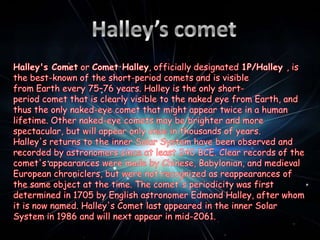
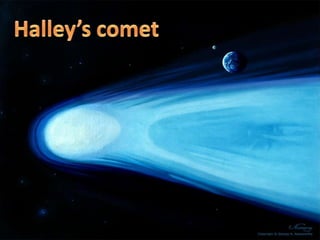
9. The official designation of Halley’s comet is 1P/Halley.
10.Halley's Comet last appeared in the inner Solar System in 1986 and will
next appear in mid-2061.
R.Rajesh

Sachin
Krishna

Ritesh

Roshan

Rohan

Solar system and it's Contents

  • 2.
    Asteroids are smallsolar system bodies that are not comets, especially those of the inner Solar System. They have also been called planetoids, especially the larger ones. These terms have historically been applied to any astronomical object orbiting the Sun that did not show the disk of a planet and was not observed to have the characteristics of an active comet, but as small objects in the outer solar system were discovered, their volatile-based surfaces were found to more closely resemble comets, and so were often distinguished from traditional asteroids. Thus the term asteroid has come increasingly to refer specifically to the small bodies of the inner solar system out to the orbit of Jupiter, which are usually rocky or metallic. They are grouped with the outer bodies— centaurs, Neptune trolians, and trans-neptunian objects—as minor planets, which is the term preferred in astronomical circles. This article will restrict the use of the term "asteroid" to the minor planets of the inner Solar System.
  • 3.
    A comet isan icy small solar system body that, when close enough to the Sun, displays a visible coma (a thin, fuzzy, temporary atmosphere) and sometimes also a tail. These phenomena are both due to the effects of solar radiation and the solar wind upon the nucleus. Comet nuclei range from a few hundred meters to tens of kilometres across and are composed of loose collections of ice, dust, and small rocky particles. Comets have been observed since ancient times. Comets have a wide range of orbital periods, ranging from a few years to hundreds of thousands of years. Short-period comets originate in the Kuiper belt, or its associated scattered disc, which lie beyond the orbit of Neptune. Longerperiod comets are thought to originate in the Oort cloud, a hypothesized spherical cloud of icy bodies in the outer Solar System. Long-period comets plunge towards the Sun from the Oort cloud because gravitational perturbations caused by either the massive outer planets of the Solar System (Jupiter, Saturn, Uranus, and Neptune), or passing stars. Rare hyperbolic comets pass once through the inner solar system before being thrown out into interstellar along hyperbolic trajectories. Exocomets, comets beyond our solar system, have also been detected and may be common in the Milky Way Galaxy.
  • 9.
    1. What areasteroids also called ? 2. How are asteroids? 3. From where do short period comets originate? 4. What is the Oort cloud? 5. What do we otherwise refer to meteors as? 6. From where do Meteors become visible? 7. What does the term Bolide refer to ? 8. What are falls? 9. What is the official designation of the “Halley’s Comet”? 10.When did the “Halley’s Comet” appear last and when will it appear next?
  • 10.
    1. 1. 2. 2. 3. 3. 4. 4. 5. 5. 6. 6. 7. 7. Planetoids. Planetoids Asteroids are usuallyRocky or metallic. metallic Asteroids are generally rocky or Short-period comets originate in the Kuiper belt, or itsbelt, or its Short-period comets originate in the Kuiper associated scattered disc, which liescattered disc, of Neptune. beyond the orbit of Neptune. associated beyond the orbit which lie Longer-periodis a hypothesized to originate in the Oorticy bodies in the outer Oort cloud comets are thought spherical cloud of cloud, a hypothesized spherical cloud of icy bodies in the outer Solar System. Solar System. Shooting Stars. Shooting stars Meteors becomevisible at about 75 75120120 kms from the Earth’s surface. They become visible at about to – kilometers above the Earth. The term Bolide refers to anyto any extraterrestial bodythat hits or doesn't The term Bolide refers extraterrestial body or a meteor that collides with hit the earth’s surface exceptionally bright meteor regardless of whether it the earth or to an ultimately impacts the earth. 8. Meteorites that are recovered after being observed as they transited the atmosphere or impacted the Earth are called falls. 9. The official designation of Halley’s comet is 1P/Halley. 10.Halley's Comet last appeared in the inner Solar System in 1986 and will next appear in mid-2061.
  • 11.