





The National Solar Mission is a major
initiative of the Government of India and
State Governments to promote ecologically
sustainable growth while addressing India’s
energy security challenge. It will also
constitute a major contribution by India to
the global effort to meet the challenges of
climate change.
The objective of the National Solar Mission is to establish
India as a global leader in solar energy, by creating the policy
conditions for its diffusion across the country as quickly as
possible. The Mission will adopt a 3-phase approach, spanning the
remaining period of the 11th Plan and first year of the 12th Plan
(up to 2012-13) as Phase 1, the remaining 4 years of the 12th
Plan (2013-17) as Phase 2 and the 13th Plan (2017-22) as Phase
3. At the end of each plan, and mid-term during the 12th and 13th
Plans, there will be an evaluation of progress, review of capacity
and targets for subsequent phases, based on emerging cost and
technology trends, both domestic and global. The aim would be to
protect Government from subsidy exposure in case expected cost
reduction does not materialize or is more rapid than expected.
    To create an enabling policy framework for the deployment of 20,000 MW
     of solar power by 2022.
     To ramp up capacity of grid-connected solar power generation to 1000 MW
    within three years – by 2013; an additional 3000 MW by 2017 through the
    mandatory use of the renewable purchase obligation by utilities backed with a
    preferential tariff. This capacity can be more than doubled – reaching
    10,000MW installed power by 2017 or more, based on the enhanced and
    enabled international finance and technology transfer. The ambitious target
    for 2022 of 20,000 MW or more, will be dependent on the ‘learning’ of the first
    two phases, which if successful, could lead to conditions of grid-competitive
    solar power. The transition could be appropriately up scaled, based on
     availability of international finance and technology.
    To create favourable conditions for solar manufacturing capability, particularly
     solar thermal for indigenous production and market leadership.
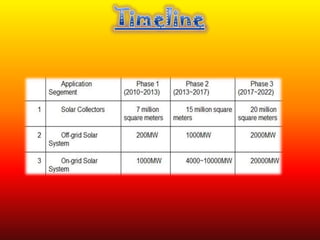
    To promote programmes for off grid applications, reaching 1000 MW by 2017
     and 2000 MW by 2022 .
    To achieve 15 million sq. meters solar thermal collector area by 2017 and 20
     million by 2022.
    To deploy 20 million solar lighting systems for rural areas by 2022.
The NAPCC aims to promote the development and use of solar energy for power generation and
    other uses with the ultimate objective of making solar competitive with fossil-based energy options.
    The plan includes:
 Specific goals for increasing use of solar thermal technologies in urban areas, industry,
  and commercial establishments;
 A goal of increasing production of photovoltaics to 1000 MW/year; and
 A goal of deploying at least 1000 MW of solar thermal power generation.
  Other objectives include the establishment of a solar research center, increased
  international collaboration on technology development, strengthening of domestic
  manufacturing capacity, and increased government funding and international support.
Cost :
   Solar is currently high on absolute costs compared to other
  sources of power such as coal. The objective of the Solar
  Mission is to create conditions, through rapid scale-up of
  capacity and technological innovation to drive down costs
  towards grid parity. The Mission anticipates achieving grid parity
  by 2022 and parity with coal-based thermal power by 2030, but
  recognizes that this cost trajectory will depend upon the scale of
  global deployment and technology development and transfer.
  The cost projections vary – from 22% for every doubling of
  capacity to a reduction of only 60% with global employment
  increasing 16 times the current level.
Scalability:
    India is endowed with vast solar energy potential. About 5,000 trillion
   kWh per year energy is incident over India’s land area with most parts
   receiving 4-7 kWh per sq. m per day. Hence both technology routes for
   conversion of solar radiation into heat and electricity, namely, solar
   thermal and solar photovoltaic, can effectively be harnessed providing
   huge scalability for solar in India. Solar also provides the ability to
   generate power on a distributed basis and enables rapid capacity
   addition with short lead times. Off-grid decentralized and low-
   temperature applications will be advantageous from a rural
   electrification perspective and meeting other energy needs for power
   and heating and cooling in both rural and urban areas.
Environmental impact:
   Solar energy is environmentally friendly as it has zero
  emissions while generating electricity or heat.
The first phase will announce the broad policy frame work to achieve
the objectives of the National Solar Mission by 2022. The policy
announcement will create the necessary environment to attract
industry and project developers to invest in research, domestic
manufacturing and development of solar power generation and thus
create the critical mass for a domestic solar industry. The Mission will
work closely with State Governments, Regulators, Power utilities and
Local Self Government bodies to ensure that the activities and policy
framework being laid out can be implemented effectively. Since some
State Governments have already announced initiatives on solar, the
Mission will draw up a suitable transition framework to enable an
early and aggressive start-up.
The key driver for promoting solar power would be
through a Renewable Purchase Obligation (RPO)
mandated for power utilities, with a specific solar
component. This will drive utility scale power
generation, whether solar PV or solar thermal. The
Solar Purchase Obligation will be gradually increased
while the tariff fixed for Solar power purchase will
decline over time.
The Mission in its first two phases will promote solar heating systems, which are
already using proven technology and are commercially viable. The Mission is
setting an ambitious target for ensuring that applications, domestic and industrial,
below 80 °C are solarised. The key strategy of the Mission will be to make necessary
policy changes to meet this objective

 Firstly, make solar heaters mandatory, through building byelaws and
incorporation in the National Building Code,
 Secondly, ensure the introduction of effective mechanisms for certification and
rating of manufacturers of solar thermal applications,
 Thirdly, facilitate measurement and promotion of these individual devices
through local agencies and power utilities, and
 Fourthly, support the upgrading of technologies and manufacturing capacities
through soft loans, to achieve higher efficiencies and further cost reduction.
The fund requirements for the Mission would
 be met from the following sources or
 combinations:
 Budgetary support for the activities under the
  National Solar Mission established under the
  MNRE;
 International Funds under the UNFCCC
 framework, which would enable upscaling of
 Mission targets.
Presented by :
                          Group- 1
                     William Wordsworth


                         Members

Roll no.                                  Names

    01                              Abhishek
    09                              Satyam
    17                              Ashish Anand
    25                              Skand Deep
    33                              Shubham
    41                              Arunima
Solar mission

Solar mission

  • 3.
    The National SolarMission is a major initiative of the Government of India and State Governments to promote ecologically sustainable growth while addressing India’s energy security challenge. It will also constitute a major contribution by India to the global effort to meet the challenges of climate change.
  • 4.
    The objective ofthe National Solar Mission is to establish India as a global leader in solar energy, by creating the policy conditions for its diffusion across the country as quickly as possible. The Mission will adopt a 3-phase approach, spanning the remaining period of the 11th Plan and first year of the 12th Plan (up to 2012-13) as Phase 1, the remaining 4 years of the 12th Plan (2013-17) as Phase 2 and the 13th Plan (2017-22) as Phase 3. At the end of each plan, and mid-term during the 12th and 13th Plans, there will be an evaluation of progress, review of capacity and targets for subsequent phases, based on emerging cost and technology trends, both domestic and global. The aim would be to protect Government from subsidy exposure in case expected cost reduction does not materialize or is more rapid than expected.
  • 5.
    To create an enabling policy framework for the deployment of 20,000 MW of solar power by 2022.  To ramp up capacity of grid-connected solar power generation to 1000 MW within three years – by 2013; an additional 3000 MW by 2017 through the mandatory use of the renewable purchase obligation by utilities backed with a preferential tariff. This capacity can be more than doubled – reaching 10,000MW installed power by 2017 or more, based on the enhanced and enabled international finance and technology transfer. The ambitious target for 2022 of 20,000 MW or more, will be dependent on the ‘learning’ of the first two phases, which if successful, could lead to conditions of grid-competitive solar power. The transition could be appropriately up scaled, based on availability of international finance and technology.  To create favourable conditions for solar manufacturing capability, particularly solar thermal for indigenous production and market leadership.  To promote programmes for off grid applications, reaching 1000 MW by 2017 and 2000 MW by 2022 .  To achieve 15 million sq. meters solar thermal collector area by 2017 and 20 million by 2022.  To deploy 20 million solar lighting systems for rural areas by 2022.
  • 6.
    The NAPCC aimsto promote the development and use of solar energy for power generation and other uses with the ultimate objective of making solar competitive with fossil-based energy options. The plan includes:  Specific goals for increasing use of solar thermal technologies in urban areas, industry, and commercial establishments;  A goal of increasing production of photovoltaics to 1000 MW/year; and  A goal of deploying at least 1000 MW of solar thermal power generation. Other objectives include the establishment of a solar research center, increased international collaboration on technology development, strengthening of domestic manufacturing capacity, and increased government funding and international support.
  • 8.
    Cost : Solar is currently high on absolute costs compared to other sources of power such as coal. The objective of the Solar Mission is to create conditions, through rapid scale-up of capacity and technological innovation to drive down costs towards grid parity. The Mission anticipates achieving grid parity by 2022 and parity with coal-based thermal power by 2030, but recognizes that this cost trajectory will depend upon the scale of global deployment and technology development and transfer. The cost projections vary – from 22% for every doubling of capacity to a reduction of only 60% with global employment increasing 16 times the current level.
  • 9.
    Scalability: India is endowed with vast solar energy potential. About 5,000 trillion kWh per year energy is incident over India’s land area with most parts receiving 4-7 kWh per sq. m per day. Hence both technology routes for conversion of solar radiation into heat and electricity, namely, solar thermal and solar photovoltaic, can effectively be harnessed providing huge scalability for solar in India. Solar also provides the ability to generate power on a distributed basis and enables rapid capacity addition with short lead times. Off-grid decentralized and low- temperature applications will be advantageous from a rural electrification perspective and meeting other energy needs for power and heating and cooling in both rural and urban areas.
  • 10.
    Environmental impact: Solar energy is environmentally friendly as it has zero emissions while generating electricity or heat.
  • 11.
    The first phasewill announce the broad policy frame work to achieve the objectives of the National Solar Mission by 2022. The policy announcement will create the necessary environment to attract industry and project developers to invest in research, domestic manufacturing and development of solar power generation and thus create the critical mass for a domestic solar industry. The Mission will work closely with State Governments, Regulators, Power utilities and Local Self Government bodies to ensure that the activities and policy framework being laid out can be implemented effectively. Since some State Governments have already announced initiatives on solar, the Mission will draw up a suitable transition framework to enable an early and aggressive start-up.
  • 12.
    The key driverfor promoting solar power would be through a Renewable Purchase Obligation (RPO) mandated for power utilities, with a specific solar component. This will drive utility scale power generation, whether solar PV or solar thermal. The Solar Purchase Obligation will be gradually increased while the tariff fixed for Solar power purchase will decline over time.
  • 13.
    The Mission inits first two phases will promote solar heating systems, which are already using proven technology and are commercially viable. The Mission is setting an ambitious target for ensuring that applications, domestic and industrial, below 80 °C are solarised. The key strategy of the Mission will be to make necessary policy changes to meet this objective  Firstly, make solar heaters mandatory, through building byelaws and incorporation in the National Building Code,  Secondly, ensure the introduction of effective mechanisms for certification and rating of manufacturers of solar thermal applications,  Thirdly, facilitate measurement and promotion of these individual devices through local agencies and power utilities, and  Fourthly, support the upgrading of technologies and manufacturing capacities through soft loans, to achieve higher efficiencies and further cost reduction.
  • 14.
    The fund requirementsfor the Mission would be met from the following sources or combinations:  Budgetary support for the activities under the National Solar Mission established under the MNRE;  International Funds under the UNFCCC framework, which would enable upscaling of Mission targets.
  • 16.
    Presented by : Group- 1 William Wordsworth Members Roll no. Names  01 Abhishek  09 Satyam  17 Ashish Anand  25 Skand Deep  33 Shubham  41 Arunima