PRESENTATION
OF
SOLARCELL
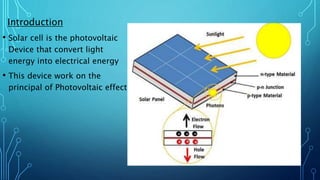
Introduction
• Solar cell is the photovoltaic
Device that convert light
energy into electrical energy
• This device work on the
principal of Photovoltaic effect
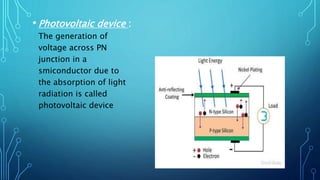
• Photovoltaic device :
The generation of
voltage across PN
junction in a
smiconductor due to
the absorption of light
radiation is called
photovoltaic device
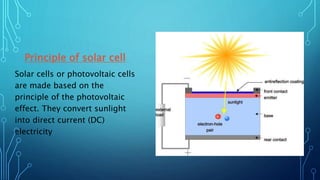
Principle of solar cell
Solar cells or photovoltaic cells
are made based on the
principle of the photovoltaic
effect. They convert sunlight
into direct current (DC)
electricity
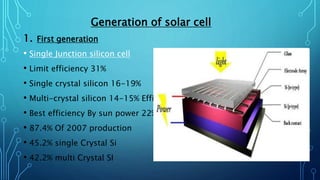
Construction of solar cell
• Construction of Solar Cell. Mainly Solar cell is constructed using
the crystalline Silicon that consists of a n-type semiconductor.
• This is the first or upper layer also known as emitter layer.
• The second layer is p-type semiconductor layer known as base
layer.
• The surface is coated with anti-reflection to avoid the loss of
incident light energy due to reflection
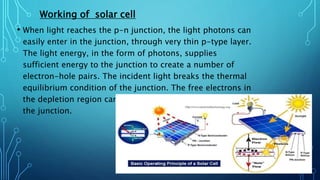
Working of solar cell
• When light reaches the p-n junction, the light photons can
easily enter in the junction, through very thin p-type layer.
The light energy, in the form of photons, supplies
sufficient energy to the junction to create a number of
electron-hole pairs. The incident light breaks the thermal
equilibrium condition of the junction. The free electrons in
the depletion region can quickly come to the n-type side of
the junction.
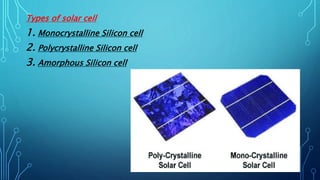
Types of solar cell
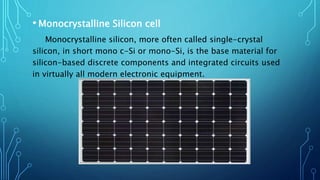
1. Monocrystalline Silicon cell
2. Polycrystalline Silicon cell
3. Amorphous Silicon cell
• Monocrystalline Silicon cell
Monocrystalline silicon, more often called single-crystal
silicon, in short mono c-Si or mono-Si, is the base material for
silicon-based discrete components and integrated circuits used
in virtually all modern electronic equipment.
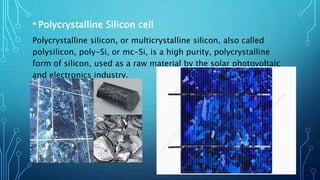
• Polycrystalline Silicon cell
Polycrystalline silicon, or multicrystalline silicon, also called
polysilicon, poly-Si, or mc-Si, is a high purity, polycrystalline
form of silicon, used as a raw material by the solar photovoltaic
and electronics industry.
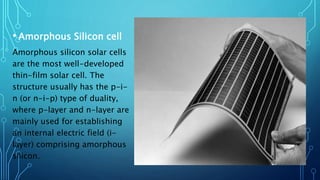
• Amorphous Silicon cell
Amorphous silicon solar cells
are the most well-developed
thin-film solar cell. The
structure usually has the p-i-
n (or n-i-p) type of duality,
where p-layer and n-layer are
mainly used for establishing
an internal electric field (i-
layer) comprising amorphous
silicon.
Generation of solar cell
1. First generation
• Single Junction silicon cell
• Limit efficiency 31%
• Single crystal silicon 16-19%
• Multi-crystal silicon 14-15% Efficiency
• Best efficiency By sun power 22%
• 87.4% Of 2007 production
• 45.2% single Crystal Si
• 42.2% multi Crystal SI
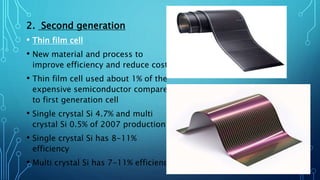
2. Second generation
• Thin film cell
• New material and process to
improve efficiency and reduce cost
• Thin film cell used about 1% of the
expensive semiconductor compare
to first generation cell
• Single crystal Si 4.7% and multi
crystal Si 0.5% of 2007 production
• Single crystal Si has 8-11%
efficiency
• Multi crystal Si has 7-11% efficiency
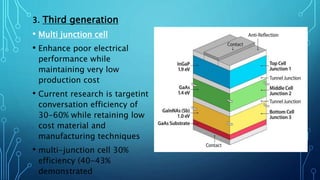
3. Third generation
• Multi junction cell
• Enhance poor electrical
performance while
maintaining very low
production cost
• Current research is targetint
conversation efficiency of
30-60% while retaining low
cost material and
manufacturing techniques
• multi-junction cell 30%
efficiency (40-43%
demonstrated
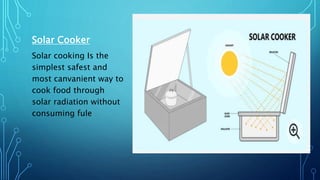
Solar Cooker
Solar cooking Is the
simplest safest and
most canvanient way to
cook food through
solar radiation without
consuming fule
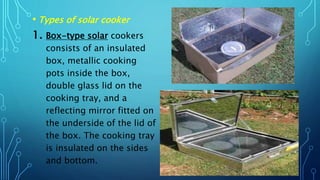
• Types of solar cooker
1. Box-type solar cookers
consists of an insulated
box, metallic cooking
pots inside the box,
double glass lid on the
cooking tray, and a
reflecting mirror fitted on
the underside of the lid of
the box. The cooking tray
is insulated on the sides
and bottom.
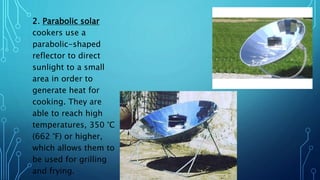
2. Parabolic solar
cookers use a
parabolic-shaped
reflector to direct
sunlight to a small
area in order to
generate heat for
cooking. They are
able to reach high
temperatures, 350 °C
(662 °F) or higher,
which allows them to
be used for grilling
and frying.
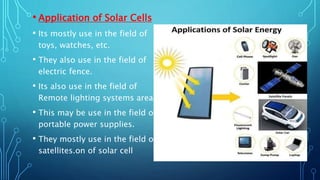
• Application of Solar Cells
• Its mostly use in the field of
toys, watches, etc.
• They also use in the field of
electric fence.
• Its also use in the field of
Remote lighting systems area.
• This may be use in the field of
portable power supplies.
• They mostly use in the field of
satellites.on of solar cell
• Advantage of solar
cell
• Renewable Energy
• Economy-friendly Energy
• Environmentally Friendly
Energy
• Innovative Energy
• Long Term Energy
• Infinite Energy
• There are no fule cost
• Disadvantaged of
solar cell
• High Investment
• Interior Needs
• Seasonal Energy
• Solar Cells on Your
Accommodation
Thank you

Solar cell

  • 1.
  • 2.
    Introduction • Solar cellis the photovoltaic Device that convert light energy into electrical energy • This device work on the principal of Photovoltaic effect
  • 3.
    • Photovoltaic device: The generation of voltage across PN junction in a smiconductor due to the absorption of light radiation is called photovoltaic device
  • 4.
    Principle of solarcell Solar cells or photovoltaic cells are made based on the principle of the photovoltaic effect. They convert sunlight into direct current (DC) electricity
  • 5.
    Construction of solarcell • Construction of Solar Cell. Mainly Solar cell is constructed using the crystalline Silicon that consists of a n-type semiconductor. • This is the first or upper layer also known as emitter layer. • The second layer is p-type semiconductor layer known as base layer. • The surface is coated with anti-reflection to avoid the loss of incident light energy due to reflection
  • 6.
    Working of solarcell • When light reaches the p-n junction, the light photons can easily enter in the junction, through very thin p-type layer. The light energy, in the form of photons, supplies sufficient energy to the junction to create a number of electron-hole pairs. The incident light breaks the thermal equilibrium condition of the junction. The free electrons in the depletion region can quickly come to the n-type side of the junction.
  • 7.
    Types of solarcell 1. Monocrystalline Silicon cell 2. Polycrystalline Silicon cell 3. Amorphous Silicon cell
  • 8.
    • Monocrystalline Siliconcell Monocrystalline silicon, more often called single-crystal silicon, in short mono c-Si or mono-Si, is the base material for silicon-based discrete components and integrated circuits used in virtually all modern electronic equipment.
  • 9.
    • Polycrystalline Siliconcell Polycrystalline silicon, or multicrystalline silicon, also called polysilicon, poly-Si, or mc-Si, is a high purity, polycrystalline form of silicon, used as a raw material by the solar photovoltaic and electronics industry.
  • 10.
    • Amorphous Siliconcell Amorphous silicon solar cells are the most well-developed thin-film solar cell. The structure usually has the p-i- n (or n-i-p) type of duality, where p-layer and n-layer are mainly used for establishing an internal electric field (i- layer) comprising amorphous silicon.
  • 11.
    Generation of solarcell 1. First generation • Single Junction silicon cell • Limit efficiency 31% • Single crystal silicon 16-19% • Multi-crystal silicon 14-15% Efficiency • Best efficiency By sun power 22% • 87.4% Of 2007 production • 45.2% single Crystal Si • 42.2% multi Crystal SI
  • 12.
    2. Second generation •Thin film cell • New material and process to improve efficiency and reduce cost • Thin film cell used about 1% of the expensive semiconductor compare to first generation cell • Single crystal Si 4.7% and multi crystal Si 0.5% of 2007 production • Single crystal Si has 8-11% efficiency • Multi crystal Si has 7-11% efficiency
  • 13.
    3. Third generation •Multi junction cell • Enhance poor electrical performance while maintaining very low production cost • Current research is targetint conversation efficiency of 30-60% while retaining low cost material and manufacturing techniques • multi-junction cell 30% efficiency (40-43% demonstrated
  • 14.
    Solar Cooker Solar cookingIs the simplest safest and most canvanient way to cook food through solar radiation without consuming fule
  • 15.
    • Types ofsolar cooker 1. Box-type solar cookers consists of an insulated box, metallic cooking pots inside the box, double glass lid on the cooking tray, and a reflecting mirror fitted on the underside of the lid of the box. The cooking tray is insulated on the sides and bottom.
  • 16.
    2. Parabolic solar cookersuse a parabolic-shaped reflector to direct sunlight to a small area in order to generate heat for cooking. They are able to reach high temperatures, 350 °C (662 °F) or higher, which allows them to be used for grilling and frying.
  • 17.
    • Application ofSolar Cells • Its mostly use in the field of toys, watches, etc. • They also use in the field of electric fence. • Its also use in the field of Remote lighting systems area. • This may be use in the field of portable power supplies. • They mostly use in the field of satellites.on of solar cell
  • 18.
    • Advantage ofsolar cell • Renewable Energy • Economy-friendly Energy • Environmentally Friendly Energy • Innovative Energy • Long Term Energy • Infinite Energy • There are no fule cost
  • 19.
    • Disadvantaged of solarcell • High Investment • Interior Needs • Seasonal Energy • Solar Cells on Your Accommodation
  • 20.