Duncan ffirs.tex V2 - 06/20/2014 7:09 P.M. Page ii
Duncan ffirs.tex V2 - 06/20/2014 7:09 P.M. Page i
Soil Strength and Slope Stability
Duncan ffirs.tex V2 - 06/20/2014 7:09 P.M. Page ii
Duncan ffirs.tex V2 - 06/20/2014 7:09 P.M. Page iii
Soil Strength and Slope
Stability
Second Edition
J. Michael Duncan
Stephen G. Wright
Thomas L. Brandon
Duncan ffirs.tex V2 - 06/20/2014 7:09 P.M. Page iv
Cover image: Michael Duncan
Cover design: Wiley
This book is printed on acid-free paper.
Copyright © 2014 by John Wiley & Sons, Inc. All rights reserved
Published by John Wiley & Sons, Inc., Hoboken, New Jersey
Published simultaneously in Canada
No part of this publication may be reproduced, stored in a retrieval system, or transmitted in any form or by any means, electronic, mechanical, photocopying,
recording, scanning, or otherwise, except as permitted under Section 107 or 108 of the 1976 United States Copyright Act, without either the prior written
permission of the Publisher, or authorization through payment of the appropriate per-copy fee to the Copyright Clearance Center, 222 Rosewood Drive,
Danvers, MA 01923, (978) 750-8400, fax (978) 646-8600, or on the web at www.copyright.com. Requests to the Publisher for permission should be
addressed to the Permissions Department, John Wiley & Sons, Inc., 111 River Street, Hoboken, NJ 07030, (201) 748-6011, fax (201) 748-6008, or online at
www.wiley.com/go/permissions.
Limit of Liability/Disclaimer of Warranty: While the publisher and author have used their best efforts in preparing this book, they make no representations or
warranties with the respect to the accuracy or completeness of the contents of this book and specifically disclaim any implied warranties of merchantability or
fitness for a particular purpose. No warranty may be created or extended by sales representatives or written sales materials. The advice and strategies
contained herein may not be suitable for your situation. You should consult with a professional where appropriate. Neither the publisher nor the author shall
be liable for damages arising herefrom.
For general information about our other products and services, please contact our Customer Care Department within the United States at (800) 762-2974,
outside the United States at (317) 572-3993 or fax (317) 572-4002.
Wiley publishes in a variety of print and electronic formats and by print-on-demand. Some material included with standard print versions of this book may
not be included in e-books or in print-on-demand. If this book refers to media such as a CD or DVD that is not included in the version you purchased, you
may download this material at http://booksupport.wiley.com. For more information about Wiley products, visit www.wiley.com.
Library of Congress Cataloging-in-Publication Data
Duncan, J. M. (James Michael)
Soil strength and slope stability / J. Michael Duncan, Stephen G. Wright, Thomas L. Brandon.
pages cm
Includes bibliographical references and index.
ISBN 978-1-118-65165-0 (cloth); ISBN 978-1-118-91795-4 (ebk); ISBN 978-1-118-91796-1 (ebk)
1. Slopes (Soil mechanics) I. Wright, Stephen G. (Stephen Gailord), 1943- II. Brandon, Thomas L. III. Title.
TA710.D868 2014
624.1′51363— dc23
2014004730
Printed in the United States of America
10 9 8 7 6 5 4 3 2 1
Duncan ftoc.tex V2 - 06/25/2014 7:38 P.M. Page v
CONTENTS
Foreword ix
Preface xi
CHAPTER 1 INTRODUCTION 1
Summary 3
CHAPTER 2 EXAMPLES AND CAUSES OF SLOPE FAILURES 5
2.1 Introduction 5
2.2 Examples of Slope Failure 5
2.3 The Olmsted Landslide 11
2.4 Panama Canal Landslides 12
2.5 The Rio Mantaro Landslide 12
2.6 Kettleman Hills Landfill Failure 13
2.7 Causes of Slope Failure 13
2.8 Summary 17
CHAPTER 3 SOIL MECHANICS PRINCIPLES 19
3.1 Introduction 19
3.2 Total and Effective Stresses 20
3.3 Drained and Undrained Shear Strengths 21
3.4 Basic Requirements for Slope Stability Analyses 26
CHAPTER 4 STABILITY CONDITIONS FOR ANALYSIS 31
4.1 Introduction 31
4.2 End-of-Construction Stability 31
4.3 Long-Term Stability 32
4.4 Rapid (Sudden) Drawdown 32
4.5 Earthquake 33
4.6 Partial Consolidation and Staged Construction 33
4.7 Other Loading Conditions 34
4.8 Analysis Cases for Earth and Rockfill Dams 34
v
Duncan ftoc.tex V2 - 06/25/2014 7:38 P.M. Page vi
vi CONTENTS
CHAPTER 5 SHEAR STRENGTH 37
5.1 Introduction 37
5.2 Behavior of Granular Materials—Sand, Gravel, and Rockfill 37
5.3 Silts 52
5.4 Clays 57
5.5 Municipal Solid Waste 78
CHAPTER 6 MECHANICS OF LIMIT EQUILIBRIUM PROCEDURES 81
6.1 Definition of the Factor of Safety 81
6.2 Equilibrium Conditions 82
6.3 Single Free-Body Procedures 82
6.4 Procedures of Slices: General 87
6.5 Procedures of Slices: Circular Slip Surfaces 87
6.6 Procedures of Slices: Noncircular Slip Surfaces 94
6.7 Procedures of Slices: Assumptions, Equilibrium Equations,
and Unknowns 105
6.8 Procedures of Slices: Representation of Interslice Forces (Side Forces) 105
6.9 Computations with Anisotropic Shear Strengths 112
6.10 Computations with Curved Strength Envelopes 112
6.11 Finite Element Analysis of Slopes 112
6.12 Alternative Definitions of the Factor of Safety 113
6.13 Pore Water Pressure Representation 116
CHAPTER 7 METHODS OF ANALYZING SLOPE STABILITY 125
7.1 Simple Methods of Analysis 125
7.2 Slope Stability Charts 126
7.3 Spreadsheet Software 128
7.4 Finite Element Analyses of Slope Stability 129
7.5 Computer Programs for Limit Equilibrium Analyses 130
7.6 Verification of Results of Analyses 132
7.7 Examples for Verification of Stability Computations 134
CHAPTER 8 REINFORCED SLOPES AND EMBANKMENTS 159
8.1 Limit Equilibrium Analyses with Reinforcing Forces 159
8.2 Factors of Safety for Reinforcing Forces and Soil Strengths 159
8.3 Types of Reinforcement 160
8.4 Reinforcement Forces 161
8.5 Allowable Reinforcement Forces and Factors of Safety 162
8.6 Orientation of Reinforcement Forces 163
8.7 Reinforced Slopes on Firm Foundations 164
8.8 Embankments on Weak Foundations 164
CHAPTER 9 ANALYSES FOR RAPID DRAWDOWN 169
9.1 Drawdown during and at the End of Construction 169
9.2 Drawdown for Long-Term Conditions 169
9.3 Partial Drainage 177
9.4 Shear-Induced Pore Pressure Changes 177
Duncan ftoc.tex V2 - 06/25/2014 7:38 P.M. Page vii
CONTENTS vii
CHAPTER 10 SEISMIC SLOPE STABILITY 179
10.1 Analysis Procedures 179
10.2 Pseudostatic Screening Analyses 182
10.3 Determining Peak Accelerations 184
10.4 Shear Strength for Pseudostatic Analyses 184
10.5 Postearthquake Stability Analyses 188
CHAPTER 11 ANALYSES OF EMBANKMENTS WITH PARTIAL CONSOLIDATION
OF WEAK FOUNDATIONS 193
11.1 Consolidation During Construction 193
11.2 Analyses of Stability with Partial Consolidation 194
11.3 Observed Behavior of an Embankment Constructed in Stages 195
11.4 Discussion 197
CHAPTER 12 ANALYSES TO BACK-CALCULATE STRENGTHS 201
12.1 Back-Calculating Average Shear Strength 201
12.2 Back-Calculating Shear Strength Parameters Based on Slip Surface
Geometry 203
12.3 Examples of Back-Analyses of Failed Slopes 205
12.4 Practical Problems and Limitation of Back-Analyses 213
12.5 Other Uncertainties 214
CHAPTER 13 FACTORS OF SAFETY AND RELIABILITY 215
13.1 Definitions of Factor of Safety 215
13.2 Factor of Safety Criteria 216
13.3 Reliability and Probability of Failure 217
13.4 Standard Deviations and Coefficients of Variation 217
13.5 Estimating Reliability and Probability of Failure 220
CHAPTER 14 IMPORTANT DETAILS OF STABILITY ANALYSES 227
14.1 Location of Critical Slip Surfaces 227
14.2 Examination of Noncritical Slip Surfaces 233
14.3 Tension in the Active Zone 234
14.4 Inappropriate Forces in the Passive Zone 238
14.5 Other Details 241
14.6 Verification of Calculations 245
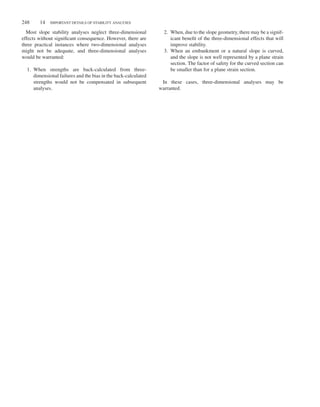
14.7 Three-Dimensional Effects 246
CHAPTER 15 PRESENTING RESULTS OF STABILITY EVALUATIONS 249
15.1 Site Characterization and Representation 249
15.2 Soil Property Evaluation 249
15.3 Pore Water Pressures 250
15.4 Special Features 250
15.5 Calculation Procedure 250
15.6 Analysis Summary Figure 250
15.7 Parametric Studies 254
15.8 Detailed Input Data 257
15.9 Table Of Contents 257
Duncan ftoc.tex V2 - 06/25/2014 7:38 P.M. Page viii
viii CONTENTS
CHAPTER 16 SLOPE STABILIZATION AND REPAIR 259
16.1 Use of Back-Analysis 259
16.2 Factors Governing Selection of Method of Stabilization 259
16.3 Drainage 260
16.4 Excavations and Buttress Fills 263
16.5 Retaining Structures 264
16.6 Reinforcing Piles and Drilled Shafts 267
16.7 Injection Methods 269
16.8 Vegetation 269
16.9 Thermal Treatment 270
16.10 Bridging 270
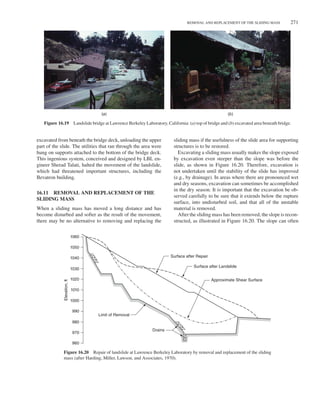
16.11 Removal and Replacement of the Sliding Mass 271
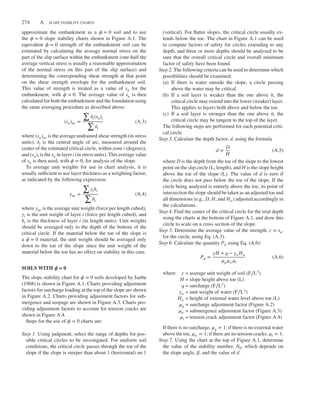
APPENDIX A SLOPE STABILITY CHARTS 273
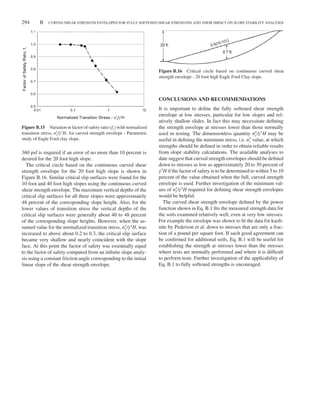
APPENDIX B CURVED SHEAR STRENGTH ENVELOPES FOR FULLY SOFTENED SHEAR
STRENGTHS AND THEIR IMPACT ON SLOPE STABILITY ANALYSES 289
REFERENCES 295
INDEX 309
Duncan fbetw.tex V1 - 06/20/2014 7:06 P.M. Page˜ix
FOREWORD
Slope stability is arguably the most complex and challenging
of all the subdisciplines of geotechnical engineering, and is
often the least understood. In the first edition of this book, the
authors captured the essence of this subject in an authorita-
tive, comprehensive, and informative manner. Since publica-
tion in 2005, the first edition has come into widespread use in
the profession and has virtually become a classic in the slope
stability literature. The authors have certainly done no less
in this second edition. Eleven of the 16 chapters have been
significantly expanded and/or supplemented with new mate-
rial. Moreover, the new materials are highly focused on the
latest knowledge, experience, and practices that have been
developed since the first edition. These new insights will ren-
der this second edition a highly relevant and useful volume
for practitioners, academics, and students for years to come.
While all the valuable new additions to the book are
too voluminous to address in detail here, there are several
items in the writer’s opinion that are particularly rele-
vant. In Chapter 2, case histories have been added of the
New Orleans “I-Wall” failures during Hurricane Katrina,
from which much valuable information was obtained.
Chapter 3 includes a new discussion of the effective stress
envelope for unsaturated soils. Chapter 5 on shear strength
has been significantly expanded with new concepts on
curvature of strength envelopes and recent correlations of
shear strength with various field tests and index properties.
In the nine years since publication of the first edition, our
understanding of soil strength and its application to slope
stability analysis has made significant strides, especially
related to fully softened strengths of highly plastic clays.
Chapter 5 also includes a detailed discussion of this
topic including laboratory testing methods, representation
of curved strength envelopes with piecewise linear and
power-curve techniques, and application of fully softened
strength in slope stability analyses. Chapter 6 includes a
presentation on the finite element strength reduction method
for calculating the factor of safety of slopes and an update on
determination of pore pressures by finite element methods.
Chapter 7 includes new finite element solutions to the
verification problems and a new verification problem using
a curved strength envelope. Chapter 8 on reinforced slopes
has been updated to include current FHWA (2009) methods
for MSE walls. Chapters 9 and 10 contain updated material
on rapid drawdown and seismic slope stability analyses.
While this is but a brief discussion of a few of the many
new portions of the book, it illustrates the breadth of new
valuable material in the second edition.
In keeping with the first edition, the authors have main-
tained a format beginning with elemental principles that
university students can quickly comprehend and moving
in a smooth and logical manner to the highly advanced
material for even the most experienced user. It is the writer’s
opinion that the pristine covers of the new second edition
publication will soon become ragged and worn in tribute to
the widespread relevance and usefulness of this book.
Dr. Garry H. Gregory, Ph.D., P. E., D.GE
Board of Governors of the Geo-Institute
Chair of the Embankments, Dams, and Slopes
Committee of the Geo-Institute
ix
Duncan fbetw.tex V1 - 06/20/2014 7:06 P.M. Page˜x
Duncan fpref.tex V2 - 07/15/2014 11:53 A.M. Page˜xi
PREFACE
In the nine years since the appearance of the first edition
of Soil Strength and Slope Stability there have been signif-
icant developments in measurement of soil strength in the
laboratory and the field, advances in methods of stability
analysis, and development of new techniques for slope stabi-
lization. In situ testing, particularly cone penetration testing,
has improved the efficiency of soil exploration and evalua-
tion of soil strength through the use of correlations. Chapter
5, on shear strength of soil and municipal solid waste, is
greatly expanded in this edition, providing discussions of
the behavior of rockfill, gravel, sand, silt, and clay, as well
as compilations of data and typical values of their strengths.
This edition also draws together more lessons that have been
learned from recent slope failures, such as the failures of
I-walls in New Orleans during Hurricane Katrina, and de-
layed failures that resulted from gradual softening of clays
over long periods of time. The purpose of this book is to de-
scribe the current state of knowledge on soil strength and
slope stability in a form that makes it easily accessible to
geotechnical graduate students and professionals.
Development of this book would not have been possible
without the assistance of many colleagues, whose contri-
butions to our understanding we gratefully acknowledge.
Foremost among these is Professor Harry Seed, who taught
all of us and was the inspiration for our lifelong inter-
est in soil strength and slope stability. We are also grate-
ful for the opportunity to work with Nilmar Janbu, who
during his sabbatical at Berkeley in 1969 taught us many
valuable lessons regarding analysis of slope stability and
the shear strength of soils. Our university colleagues Jim
Mitchell, Roy Olson, Clarence Chan, Ken Lee, Peter Dunlop,
Guy LeFebvre, Fred Kulhawy, Suphon Chirapuntu, Tarciso
Celestino, Dean Marachi, Ed Becker, Kai Wong, Norman
Jones, Poul Lade, Pat Lucia, Tim D’Orazio, Jey Jeyapalan,
Sam Bryant, Ed Kavazanjian, Erik Loehr, Loraine Fleming,
Bak Kong Low, Bob Gilbert, Garry Gregory, Vern Schaefer,
Tim Stark, Binod Tiwari, Mohamad Kayyal, Marius DeWet,
Clark Morrison, Ellen Rathje, George Filz, Mike Pockoski,
Jaco Esterhuizen, Matthew Sleep, and Daniel VandenBerge
have also contributed greatly to our understanding of soil
strength and stability. Our experiences working with pro-
fessional colleagues Al Buchignani, Laurits Bjerrum, Jim
Sherard, Tom Leps, Norbert Morgenstern, George Sowers,
Robert Schuster, Ed Luttrell, Larry Franks, Steve Collins,
Dave Hammer, Larry Cooley, John Wolosick, Noah Vroman,
Luis Alfaro, Max DePuy and his group at the Panama Canal
Authority, and Fernando Bolinaga have helped us to see
the useful relationships among teaching, research, and pro-
fessional practice. Special thanks go to Alex Reeb, Chris
Meehan, Bernardo Castellanos, Daniel VandenBerge, and
Beena Ajmera for their invaluable assistance with figures,
references, proofing, and indexing. Finally, we express our
deepest appreciation and love to our wives—Ann, Ouida,
and Aida—for their support, understanding, and constant en-
couragement throughout our careers and during the countless
hours we have spent working on this book.
xi
Duncan fpref.tex V2 - 07/15/2014 11:53 A.M. Page˜xii
Duncan flast.tex V2 - 07/15/2014 7:46 A.M. Page i
Soil Strength and Slope Stability
Duncan flast.tex V2 - 07/15/2014 7:46 A.M. Page ii
CHAPTER 1
Introduction
Evaluating the stability of slopes in soil is an important, inter-
esting, and challenging aspect of civil engineering. Concerns
with slope stability have driven some of the most important
advances in our understanding of the complex behavior of
soils. Extensive engineering and research studies performed
over the past 80 years provide a sound set of soil mechanics
principles with which to attack practical problems of slope
stability.
Over the past decades, experiences with the behavior of
slopes, and often with their failure, have led to development
of improved understanding of the changes in soil properties
that can occur over time, recognition of the requirements
and the limitations of laboratory and in situ testing for
evaluating soil strengths, development of new and more
effective types of instrumentation to observe the behavior
of slopes, improved understanding of the principles of soil
mechanics that connect soil behavior to slope stability,
improved analytical procedures augmented by extensive
examination of the mechanics of slope stability analyses,
detailed comparisons with field behavior, and use of comput-
ers to perform thorough analyses. Through these advances,
the art of slope stability evaluation has entered a more
mature phase. Experience and judgment, which continue to
be of prime importance, are combined with a more complete
understanding of soil behavior and rational methods of
analysis to improve the level of confidence that is achievable
through systematic observation, testing, and analysis.
In spite of the advances that have been made, evaluat-
ing the stability of slopes remains a challenge. Even when
geology and soil conditions have been evaluated in keeping
with the standards of good practice, and stability has been
evaluated using procedures that have been effective in previ-
ous projects, it is possible that surprises are in store. As an
example, consider the case of the Waco Dam embankment
and the lessons learned from that experience.
In October 1961, the construction of Waco Dam was inter-
rupted by the occurrence of a slide along a 1500-ft section
of the embankment resting on the Pepper shale formation,
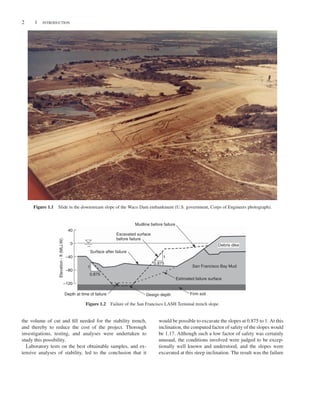
a heavily overconsolidated, stiff-fissured clay. A photograph
of the 85-ft-high embankment section, taken shortly after the
slide occurred, is shown in Figure 1.1. In the slide region,
the Pepper shale had been geologically uplifted to the sur-
face and was bounded laterally by two faults crossing the axis
of the embankment. The slide was confined to the length of
the embankment founded on Pepper shale, and no significant
movements were observed beyond the fault boundaries.
The section of the embankment involved in the slide
was degraded to a height of approximately 40 ft, and an
extensive investigation was carried out by the U.S. Army
Corps of Engineers to determine the cause of the failure and
to develop a method for repairing the slide. The investigation
showed that the slide extended for several hundred feet
downstream from the embankment, within the Pepper shale
foundation. A surprising finding of the studies conducted
after the failure was the highly anisotropic nature of the
Pepper shale, which contained pervasive horizontal slicken-
sided fissures spaced about 1
8
in. apart. The strength along
horizontal planes was found to be only about 40% as large
as the strength measured in conventional tests on vertical
specimens. Although conventional testing and analysis
indicated that the embankment would be stable throughout
construction, analyses performed using the lower strengths
on horizontal planes produced results that were in agreement
with the observed failure (Wright and Duncan, 1972).
This experience shows that the conventional practice of
testing only vertical samples can be misleading, particularly
for stiff fissured clays with a single dominant fissure orienta-
tion. With the lesson of the Waco Dam experience in mind,
geotechnical engineers are better prepared to avoid similar
pitfalls.
The procedures we use to measure soil strengths and to
evaluate the stability of slopes are for the most part ra-
tional and may appear to be rooted solidly in engineering
science. The fact that they have a profound empirical basis
is illustrated by the failure of an underwater slope in San
Francisco Bay.
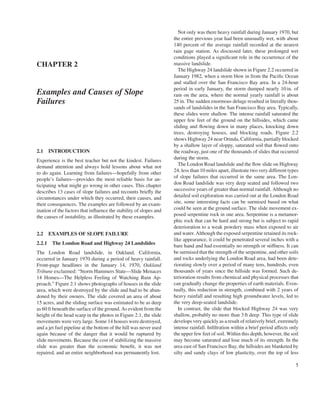
In August 1970, during construction of a new shipping
terminal at the Port of San Francisco, a 250-ft long portion
of an underwater slope about 90-ft high failed, with the soil
on one side sliding into the trench, as shown in Figure 1.2.
The failure took place entirely within the San Francisco Bay
Mud, a much-studied highly plastic marine clay.
Considerable experience in the San Francisco Bay area had
led to the widely followed practice of excavating underwater
slopes in Bay Mud at an inclination of 1 (horizontal) to
1 (vertical). At this new shipping terminal, however, it was
desired to make the slopes steeper, if possible, to reduce
1
2 1 INTRODUCTION
Figure 1.1 Slide in the downstream slope of the Waco Dam embankment (U.S. government, Corps of Engineers photograph).
Debris dike
San Francisco Bay Mud
Estimated failure surface
Firm soil
Design depth
Depth at time of failure
–120
–80
1
1
0.875
0.875
Mudline before failure
Excavated surface
before failure
Surface after failure
–40
Elevation
-
ft
(MLLW)
0
40
Figure 1.2 Failure of the San Francisco LASH Terminal trench slope.
the volume of cut and fill needed for the stability trench,
and thereby to reduce the cost of the project. Thorough
investigations, testing, and analyses were undertaken to
study this possibility.
Laboratory tests on the best obtainable samples, and ex-
tensive analyses of stability, led to the conclusion that it
would be possible to excavate the slopes at 0.875 to 1. At this
inclination, the computed factor of safety of the slopes would
be 1.17. Although such a low factor of safety was certainly
unusual, the conditions involved were judged to be excep-
tionally well known and understood, and the slopes were
excavated at this steep inclination. The result was the failure
INTRODUCTION 3
depicted in Figure 1.2. An investigation after the failure led
to the conclusion that the strength of the Bay Mud that could
be mobilized in the field over a period of several weeks was
lower than the strength measured in laboratory tests in which
the Bay Mud was loaded to failure in a few minutes, and that
the cause of the difference was creep strength loss (Duncan
and Buchignani, 1973).
The lesson to be derived from this experience is that our
methods may not be as scientifically well founded as they
sometimes appear. If we alter our conventional methods by
“improving” one aspect, such as the quality of samples used
to measure the undrained strength of Bay Mud, we do not
necessarily achieve a more accurate result. In the case of
excavated slopes in Bay Mud, conventional sample quality
and conventional test procedures, combined with conven-
tional values of factor of safety, had been successful many
times. When the procedures were changed by “refining”
the sampling and strength testing procedures, the result was
higher values of undrained shear strength than would have
been measured if conventional procedures had been used.
When, in addition, the value of the safety factor was reduced,
the result was a decision to use an excessively steep slope,
which failed. Altering conventional practice and reducing the
factor of safety led to the use of a procedure that was not
supported by experience.
SUMMARY
The broader messages from these and similar cases are clear:
1. We learn our most important lessons from experience,
often from experience involving failures. The state of the
art is advanced through these failures and the lessons they
teach. As a result, the methods we use depend strongly on
experience. In spite of the fact that our methods may have a
logical background in mechanics and our understanding of
the behavior of soils and rocks, it is important to remember
that these methods are semiempirical. We depend as much
on the fact that the methods have worked in the past as we do
on their logical basis. We cannot count on improving these
methods by altering only one part of the process that we use.
2. We should not expect that we have no more lessons to
learn. As conditions arise that are different from the condi-
tions on which our experience is based, even in ways that
may at first seem subtle, we may find that our semiempirical
methods are inadequate and need to be changed or expanded.
The slide in Waco Dam served clear notice that conventional
methods were not sufficient for evaluating the shear strength
of Pepper shale and the stability of embankments founded
on it. The lesson learned from that experience is now part of
the state of the art, but it would be imprudent to think that
the current state of knowledge is complete. We need to keep
abreast of advances in the state of the art as they develop,
and practice our profession with humility, in recognition that
the next lesson to be learned may be lurking in tomorrow’s
project.
The objective of this book is to draw together some of the
lessons that have been learned about measuring soil strengths
and performing analyses of stability into a consistent, clear,
and convenient reference for students and practicing
engineers.
Advances in the state of the art and the state of prac-
tice have continued since publication of the first edition of
this book. Notable are the lessons earned as a result of sta-
bility failures caused by Hurricane Katrina, improved tech-
niques for in situ measurement of soil properties, advances
in the understanding of when and where fully softened shear
strength should be used for design, advances in techniques
for pseudostatic seismic stability analyses, better understand-
ing of the long-term behavior of reinforced slopes, and many
other developments detailed in this edition.
CHAPTER 2
Examples and Causes of Slope
Failures
2.1 INTRODUCTION
Experience is the best teacher but not the kindest. Failures
demand attention and always hold lessons about what not
to do again. Learning from failures—hopefully from other
people’s failures—provides the most reliable basis for an-
ticipating what might go wrong in other cases. This chapter
describes 13 cases of slope failures and recounts briefly the
circumstances under which they occurred, their causes, and
their consequences. The examples are followed by an exam-
ination of the factors that influence the stability of slopes and
the causes of instability, as illustrated by these examples.
2.2 EXAMPLES OF SLOPE FAILURE
2.2.1 The London Road and Highway 24 Landslides
The London Road landslide, in Oakland, California,
occurred in January 1970 during a period of heavy rainfall.
Front-page headlines in the January 14, 1970, Oakland
Tribune exclaimed: “Storm Hammers State—Slide Menaces
14 Homes—The Helpless Feeling of Watching Ruin Ap-
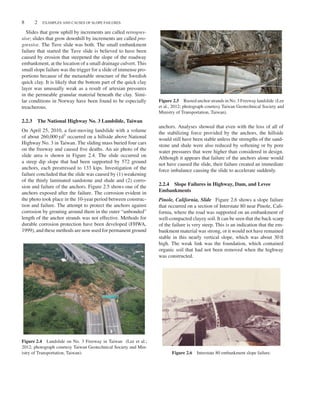
proach.” Figure 2.1 shows photographs of houses in the slide
area, which were destroyed by the slide and had to be aban-
doned by their owners. The slide covered an area of about
15 acres, and the sliding surface was estimated to be as deep
as 60 ft beneath the surface of the ground. As evident from the
height of the head scarp in the photos in Figure 2.1, the slide
movements were very large. Some 14 houses were destroyed,
and a jet fuel pipeline at the bottom of the hill was never used
again because of the danger that it would be ruptured by
slide movements. Because the cost of stabilizing the massive
slide was greater than the economic benefit, it was not
repaired, and an entire neighborhood was permanently lost.
Not only was there heavy rainfall during January 1970, but
the entire previous year had been unusually wet, with about
140 percent of the average rainfall recorded at the nearest
rain gage station. As discussed later, these prolonged wet
conditions played a significant role in the occurrence of the
massive landslide.
The Highway 24 landslide shown in Figure 2.2 occurred in
January 1982, when a storm blew in from the Pacific Ocean
and stalled over the San Francisco Bay area. In a 24-hour
period in early January, the storm dumped nearly 10 in. of
rain on the area, where the normal yearly rainfall is about
25 in. The sudden enormous deluge resulted in literally thou-
sands of landslides in the San Francisco Bay area. Typically,
these slides were shallow. The intense rainfall saturated the
upper few feet of the ground on the hillsides, which came
sliding and flowing down in many places, knocking down
trees, destroying houses, and blocking roads. Figure 2.2
shows Highway 24 near Orinda, California, partially blocked
by a shallow layer of sloppy, saturated soil that flowed onto
the roadway, just one of the thousands of slides that occurred
during the storm.
The London Road landslide and the flow slide on Highway
24, less than 10 miles apart, illustrate two very different types
of slope failures that occurred in the same area. The Lon-
don Road landslide was very deep seated and followed two
successive years of greater than normal rainfall. Although no
detailed soil exploration was carried out at the London Road
site, some interesting facts can be surmised based on what
could be seen at the ground surface. The slide movement ex-
posed serpentine rock in one area. Serpentine is a metamor-
phic rock that can be hard and strong but is subject to rapid
deterioration to a weak powdery mass when exposed to air
and water. Although the exposed serpentine retained its rock-
like appearance, it could be penetrated several inches with a
bare hand and had essentially no strength or stiffness. It can
be surmised that the strength of the serpentine, and other soils
and rocks underlying the London Road area, had been dete-
riorating slowly over a period of many tens, hundreds, even
thousands of years since the hillside was formed. Such de-
terioration results from chemical and physical processes that
can gradually change the properties of earth materials. Even-
tually, this reduction in strength, combined with 2 years of
heavy rainfall and resulting high groundwater levels, led to
the very deep-seated landslide.
In contrast, the slide that blocked Highway 24 was very
shallow, probably no more than 3 ft deep. This type of slide
develops very quickly as a result of relatively brief, extremely
intense rainfall. Infiltration within a brief period affects only
the upper few feet of soil. Within this depth, however, the soil
may become saturated and lose much of its strength. In the
area east of San Francisco Bay, the hillsides are blanketed by
silty and sandy clays of low plasticity, over the top of less
5
6 2 EXAMPLES AND CAUSES OF SLOPE FAILURES
Figure 2.1 London Road landslide, Oakland, California (J. M. Duncan photos).
Figure 2.2 Flow slide on Highway 24 near Orinda, California (J. M. Duncan photo).
weathered and stronger rock. The thickness of the soil cover
ranges from 0 to 15 ft. The soil has formed from the under-
lying rocks and has reached its present condition through
processes of weathering, erosion, shallow sliding, and de-
position further downhill. When dry, the soils that blanket
the hillsides are stiff and strong, and the slopes they form
are stable. During intense rains, however, water infiltrates
the ground rapidly, because the ground contains many cracks
that provide secondary permeabilty. Although the processes
leading to this type of slide are still the subject of research
study, it is clear that conditions can change very quickly, and
that the transition from stable ground to a fluid mass in rapid
motion can take place within minutes. The high velocities
with which these slides sometimes move makes them very
dangerous, and many lives have been lost when they flowed
down and crushed houses without warning.
The London Road and the Highway 24 slides illustrate a
relationship between rainfall and landslides that has been ob-
served in many places: Long periods of higher-than-average
rainfall cause deep-seated, slow-moving landslides, with
shear surfaces that can extend tens of feet below the ground
surface. One or 2 days of very intense rainfall, in contrast,
tend to cause shallow landslides involving only a few feet of
soil, which move with high velocity once they are in motion.
EXAMPLES OF SLOPE FAILURE 7
2.2.2 The Landslide at Tuve, Sweden
In December 1977, a large landslide occurred on a gentle
hillside in the town of Tuve, Sweden, a suburb north of
Göteborg. A photograph and three cross sections through
the slide are shown in Figure 2.3. The soil at the site was
a layer of “quick clay” overlying a thin layer of permeable
granular material on top of rock. The slide covered an area
of 40 acres, destroyed about 50 houses, and took 11 lives.
Quick clays, of the type involved in this slide, are noted for
their great sensitivity and extremely brittle behavior. When
they fail, they lose practically all shear strength and flow like
a viscous liquid.
The slide is believed to have started as a small slope fail-
ure in the side of a road embankment. The small slide left
the slope it slid away from unstable, and a slightly larger
failure of that slope took place. The process was repeated,
as the slide grew in the uphill direction, covering a larger
and larger area. Houses in the area were undermined by the
retrogressing slides and cruised downhill on the weakened
slippery clay, crashing into other houses. As soil and houses
from the failed area moved downhill, the soil in the area into
which they moved was loaded and disturbed, and it began to
fail also. The slide thus grew uphill and downhill from the
original small slope failure in the middle.
Slide Length ≈ 850 m
1–2m Desiccated Silty Clay
Creek
Culvert
Gray Silty Clay
Sensitivity, S = 15-20
Sensitivity = 15–20
Granular Material
Granular Material
Granular Material
Bedrock
Bedrock
Bedrock
A
A
C
B
B
C
A
A
Section A-A
Section B-B
Section C-C
Road
Embankment
Slide
0 50 m
60 m
40
20
0
40 m
20
0
–20
Scale
Gray Silty Clay, S = 15–20
Gray Silty Clay, S = 35–40
Slide
Figure 2.3 Landslide in quick clay near Tuve, Sweden (J. M. Duncan photo and drawing).
8 2 EXAMPLES AND CAUSES OF SLOPE FAILURES
Slides that grow uphill by increments are called retrogres-
sive; slides that grow downhill by increments are called pro-
gressive. The Tuve slide was both. The small embankment
failure that started the Tuve slide is believed to have been
caused by erosion that steepened the slope of the roadway
embankment, at the location of a small drainage culvert. This
small slope failure was the trigger for a slide of immense pro-
portions because of the metastable structure of the Swedish
quick clay. It is likely that the bottom part of the quick clay
layer was unusually weak as a result of artesian pressures
in the permeable granular material beneath the clay. Simi-
lar conditions in Norway have been found to be especially
treacherous.
2.2.3 The National Highway No. 3 Landslide, Taiwan
On April 25, 2010, a fast-moving landslide with a volume
of about 260,000 yd3 occurred on a hillside above National
Highway No. 3 in Taiwan. The sliding mass buried four cars
on the freeway and caused five deaths. An air photo of the
slide area is shown in Figure 2.4. The slide occurred on
a steep dip slope that had been supported by 572 ground
anchors, each prestressed to 133 kips. Investigation of the
failure concluded that the slide was caused by (1) weakening
of the thinly laminated sandstone and shale and (2) corro-
sion and failure of the anchors. Figure 2.5 shows one of the
anchors exposed after the failure. The corrosion evident in
the photo took place in the 10-year period between construc-
tion and failure. The attempt to protect the anchors against
corrosion by grouting around them in the outer “unbonded”
length of the anchor strands was not effective. Methods for
durable corrosion protection have been developed (FHWA,
1999), and these methods are now used for permanent ground
Figure 2.4 Landslide on No. 3 Freeway in Taiwan (Lee et al.;
2012; photograph courtesy Taiwan Geotechnical Society and Min-
istry of Transportation, Taiwan).
Figure 2.5 Rusted anchor strands in No. 3 Freeway landslide (Lee
et al., 2012; photograph courtesy Taiwan Geotechnical Society and
Ministry of Transportation, Taiwan).
anchors. Analyses showed that even with the loss of all of
the stabilizing force provided by the anchors, the hillside
would still have been stable unless the strengths of the sand-
stone and shale were also reduced by softening or by pore
water pressures that were higher than considered in design.
Although it appears that failure of the anchors alone would
not have caused the slide, their failure created an immediate
force imbalance causing the slide to accelerate suddenly.
2.2.4 Slope Failures in Highway, Dam, and Levee
Embankments
Pinole, California, Slide Figure 2.6 shows a slope failure
that occurred on a section of Interstate 80 near Pinole, Cali-
fornia, where the road was supported on an embankment of
well-compacted clayey soil. It can be seen that the back scarp
of the failure is very steep. This is an indication that the em-
bankment material was strong, or it would not have remained
stable in this nearly vertical slope, which was about 30 ft
high. The weak link was the foundation, which contained
organic soil that had not been removed when the highway
was constructed.
Figure 2.6 Interstate 80 embankment slope failure.
EXAMPLES OF SLOPE FAILURE 9
The natural ground sloped upward away from the left
side, as seen in the photograph in Figure 2.6, and downward
away from the right side. During rains, water tended
to pond against the embankment because there was no
underdrainage, and water seeped from left to right through
the foundation of the embankment. The slide occurred after
a period of heavy rain in the winter of 1969.
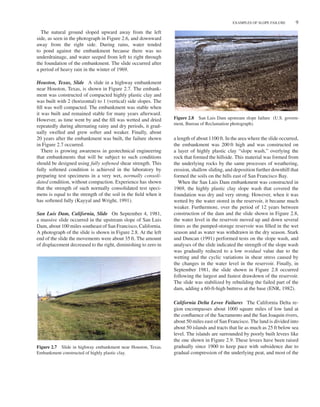
Houston, Texas, Slide A slide in a highway embankment
near Houston, Texas, is shown in Figure 2.7. The embank-
ment was constructed of compacted highly plastic clay and
was built with 2 (horizontal) to 1 (vertical) side slopes. The
fill was well compacted. The embankment was stable when
it was built and remained stable for many years afterward.
However, as time went by and the fill was wetted and dried
repeatedly during alternating rainy and dry periods, it grad-
ually swelled and grew softer and weaker. Finally, about
20 years after the embankment was built, the failure shown
in Figure 2.7 occurred.
There is growing awareness in geotechnical engineering
that embankments that will be subject to such conditions
should be designed using fully softened shear strength. This
fully softened condition is achieved in the laboratory by
preparing test specimens in a very wet, normally consoli-
dated condition, without compaction. Experience has shown
that the strength of such normally consolidated test speci-
mens is equal to the strength of the soil in the field when it
has softened fully (Kayyal and Wright, 1991).
San Luis Dam, California, Slide On September 4, 1981,
a massive slide occurred in the upstream slope of San Luis
Dam, about 100 miles southeast of San Francisco, California.
A photograph of the slide is shown in Figure 2.8. At the left
end of the slide the movements were about 35 ft. The amount
of displacement decreased to the right, diminishing to zero in
Figure 2.7 Slide in highway embankment near Houston, Texas.
Embankment constructed of highly plastic clay.
Figure 2.8 San Luis Dam upstream slope failure (U.S. govern-
ment, Bureau of Reclamation photograph).
a length of about 1100 ft. In the area where the slide occurred,
the embankment was 200 ft high and was constructed on
a layer of highly plastic clay “slope wash,” overlying the
rock that formed the hillside. This material was formed from
the underlying rocks by the same processes of weathering,
erosion, shallow sliding, and deposition further downhill that
formed the soils on the hills east of San Francisco Bay.
When the San Luis Dam embankment was constructed in
1969, the highly plastic clay slope wash that covered the
foundation was dry and very strong. However, when it was
wetted by the water stored in the reservoir, it became much
weaker. Furthermore, over the period of 12 years between
construction of the dam and the slide shown in Figure 2.8,
the water level in the reservoir moved up and down several
times as the pumped-storage reservoir was filled in the wet
season and as water was withdrawn in the dry season. Stark
and Duncan (1991) performed tests on the slope wash, and
analyses of the slide indicated the strength of the slope wash
was gradually reduced to a low residual value due to the
wetting and the cyclic variations in shear stress caused by
the changes in the water level in the reservoir. Finally, in
September 1981, the slide shown in Figure 2.8 occurred
following the largest and fastest drawdown of the reservoir.
The slide was stabilized by rebuilding the failed part of the
dam, adding a 60-ft-high buttress at the base (ENR, 1982).
California Delta Levee Failures The California Delta re-
gion encompasses about 1000 square miles of low land at
the confluence of the Sacramento and the San Joaquin rivers,
about 50 miles east of San Francisco. The land is divided into
about 50 islands and tracts that lie as much as 25 ft below sea
level. The islands are surrounded by poorly built levees like
the one shown in Figure 2.9. These levees have been raised
gradually since 1900 to keep pace with subsidence due to
gradual compression of the underlying peat, and most of the
10 2 EXAMPLES AND CAUSES OF SLOPE FAILURES
–60
20 ft
Scale
Sand
Fibrous Peat
Piezometric Level in Sand
Mixed Fill - Sand, Silt, Clay and
Peat
Peat
Mixed Fill - Sand, Silt, Clay and
Peat
High
Low
River
Levels Ditch
Peaty Silt and Clay
–50
–40
–30
Elevation
(ft)
MSL
Datum
–20
–10
0
+10
+20
Figure 2.9 Typical levee conditions in the California Delta (after Duncan and Houston, 1983).
construction has been done without engineering guidance.
As a result of the low quality of construction, many failures
have occurred, approximately one per year since 1900.
Before 1950, failures often resulted from overtopping
where the levees were not built high enough. Since 1950,
failures due to underseepage erosion and instability have
been more common. Because many sections of the levees
contain peat, which is lighter than mineral soil, the levees
have low weight and low resistance to the horizontal thrust
from the water in the river. Many failures have occurred
at times of high river level by horizontal sliding of a levee
across its foundation. An eyewitness reported that when a
failure occurred, a section of levee about 300 feet long was
carried into the island on the crest of the flood wave, the
river pouring in behind and completely flooding the island.
In order to reclaim flooded islands, the levee break has to
be repaired with new fill material, and the water has to be
pumped out of the island, a process that can take months.
New Orleans “I-wall” Failures Hurricane Katrina made
landfall in New Orleans in the early morning hours of
August 29, 2005. The record storm surge from Katrina
caused numerous failures of the New Orleans flood protec-
tion system. Considerable flooding was caused by the failure
of I-walls on the banks of the 17th Street and London Avenue
outfall canals and on the Inner Harbor Navigation Channel.
The I-wall flood protection systems were concrete-capped
steel sheet piles driven through the crests of compacted clay
levees. A cross section of the 17th Street I-wall is shown in
Figure 2.10.
At the time of Hurricane Katrina, the outfall canals were
connected directly to Lake Ponchartrain. Water was pumped
from the extensive subsurface drainage system into the out-
fall canals with the expectation that the water would drain
into the lake. During the hurricane, the pumps stopped when
power was lost, and the I-walls failed in several locations
as the water levels in the canals rose against the walls.
The details of the Hurricane Katrina–related failures are re-
ported in detail by IPET (2007). An important factor in the
failure of the I-walls was determined to be the development
of a gap between the sheet pile and canal-side embankment.
As the water level in the canal rose above the embankment,
the I-wall deflected toward the land side, and a gap formed
between the sheet pile wall and the soil into which it had
17th Street Canal
Station 10+00 Canal Water Elevation +10 ft NAVD 88
0 20 40 60 80 100 120
Horizontal Distance (ft)
Sand
Lacustrine Clay
Marsh
140 160 180 200 220
–60
–50
–40
–30
–20
–10
–60
–50
Elevation
(ft)
NAVD88
–40
–30
–20
–10
0
10
Levee Fill
Figure 2.10 Cross section of I-wall at the 17 Street Canal failure area, New Orleans, Louisiana.
THE OLMSTED LANDSLIDE 11
1
2
3
Water
Water surface
Sheet pile wall
Sand
Resultant of water pressures down to
bottom of gap
Resultant of water pressures from bottom
of gap to bottom of wall
Resultant of effective earth pressures from
bottom of gap to bottom of wall
1
2
3
Foundation clay
Levee fill
Figure 2.11 Forces acting on an I-wall after a gap is formed between the sheet pile and the levee embankment.
been driven. Water filled the gap, and the water pressure
destabilized the walls (Brandon et al., 2008; Duncan et al.,
2008). A schematic illustrating this phenomenon is shown in
Figure 2.11. The presence of a gap had not been considered
in the design of the I-walls but is now considered in analysis
of existing I-walls and the design of new I-walls (U.S. Army
Corps of Engineers, 2011).
2.3 THE OLMSTED LANDSLIDE
The Olmsted Locks and Dam were built on the Ohio River,
about 50 miles above the confluence of the Ohio with the
Mississippi. To satisfy navigational requirements, the project
had to be built at a location where there was a massive active
landslide on the Illinois (north) bank of the river. The slide
extended for about 3300 ft along the river bank. Evidence of
instability on the Illinois shore at Olmsted was discovered
in 1987 during the foundation investigation for the proposed
locks and dam. The extent of the unstable ground was
mapped on the basis of slide scarps, cracks, leaning trees,
and hummocky terrain. The difference in elevation from the
toe of the slide to the scarp shown in Figure 2.12 is about
70 ft. Slope inclinometers were installed to determine the
location of the shear surface, and piezometers were installed
to determine groundwater pressures (Filz et al., 1988).
In late May and early June of 1988, a drop of 7 ft in the
river level took place over a period of 10 days. During this
same period the groundwater levels within the slope dropped
1 to 3 ft. When the river level dropped, the slide moved, and
near-vertical scarps about 3 ft high developed at the head
650
200
250
Elevation
(ft)
300
350
Scarp
Failure plane
Alluvium
Alluvium
McNairy I formation
700 750 800 850 900
Distance (ft)
Piezometer levels
Piezometer sensing element location
Piezometer break
Estimated phreatic surface in the Mcnairy I
River level
950 1000 1050
Colluvium
Figure 2.12 Lower bank landslide at Olmsted locks and dam site
on the Ohio River.
of the slide. The location of the sliding surface in the 1988
movement was determined based on data from 12 slope in-
clinometers, and the elevations of crimping in the riser tubes
of 5 standpipe piezometers.
It was found that the shear surface was located within
the McNairy I formation, which consists of interbedded
layers of clay, silt, and sand. The thicknesses of these layers
vary from fractions of an inch to as much as a foot. The
interbedded nature of the McNairy I formation makes de-
termination of shear strengths very difficult. First, the shear
strength varies with the direction of the shear plane, being
much higher when the shear plane crosses silt and sand lay-
ers than when it passes entirely through clay. Second, it is
12 2 EXAMPLES AND CAUSES OF SLOPE FAILURES
difficult to obtain representative undisturbed samples for lab-
oratory testing because some of the layers are so thin. How-
ever, because the conditions at the time of sliding were well
defined, it was possible to determine the shearing resistance
of the McNairy I by back-analysis. The strength was esti-
mated, slope stability analyses were performed, the estimated
strengths were adjusted, and the analyses were repeated until
the calculated factor of safety was equal to 1.0. The strengths
back-calculated from the observed failure were used in sub-
sequent analyses to design flatter slopes and buttresses that
ensured long-term stability of the slope.
2.4 PANAMA CANAL LANDSLIDES
The Panama Canal has been plagued by slope failures ever
since the beginning of construction by the French 130 years
ago (McCullough, 1999). To achieve even marginal stabil-
ity, it was necessary to excavate much gentler slopes than
anticipated when the first optimistic estimates of the volume
of excavation were made. Unfortunately, the clay shales in
which most of the slopes were cut are subject to serious de-
terioration over time, and many slopes that stood when first
excavated failed later.
Construction of the canal was completed in 1914, but slope
failures continued for many years. In October 1986 a large
landslide occurred on the Cucaracha reach of the canal,
where the slopes had failed many times before. The 1986
landslide, shown in Figure 2.13, closed the canal for 12 hours
and impeded traffic until December 1986, when the slide
mass was cleared from the navigation channel by dredging.
For some years preceding the 1986 Cucaracha slide, the
budget devoted to landslide problems in the canal had grad-
ually decreased because no large slides had occurred. The
1986 slide engendered renewed appreciation of the important
effect that landslides could have on the canal, and the Panama
Figure 2.13 The 1986 Cucaracha landslide at the Panama Canal
(photograph courtesy of the Panama Canal Authority).
Canal Commission (now the Panama Canal Authority) im-
mediately devoted more resources to detection and control
of landslides. The Canal Commission increased the size of
the geotechnical engineering staff and instituted a Landslide
Control Program to reduce the hazard that landslides pose
to the operation of the canal. The Landslide Control Pro-
gram included investigation of the causes of the Cucaracha
slide and measures to stabilize it, a program of precise and
essentially continuous measurements of surface movements
on slopes, systematic inspections of slopes for indications of
instability, improvement of surface drainage, installation of
horizontal drains for subsurface drainage, and excavation to
flatten and unload slopes. This approach, which treats land-
slides along the canal as a hazard that requires continuing
attention and active management, has been highly successful.
2.5 THE RIO MANTARO LANDSLIDE
On April 25, 1974, one of the largest landslides in recorded
history occurred on a slope in the valley of the Rio Mon-
taro in Peru (Lee and Duncan, 1975). A photograph of
the landslide is shown in Figure 2.14, and a cross section
through the slope is shown in Figure 2.15. As may be seen in
Figure 2.15, the slope on which the landslide occurred was
about 3.7 miles long and 1.2 miles high. It was approximately
the same height and steepness as the south rim of the Grand
Canyon in Arizona, also shown in Figure 2.15. The volume
of earth involved in the slide was about 2 billion cubic yards.
Figure 2.14 Rio Mantaro landslide in Peru, 1974 (photograph
courtesy of U.S. National Academy of Science).
CAUSES OF SLOPE FAILURE 13
(a)
(b)
7000 2000
1500
1000
4500
4000
3500
3000
2500
2000
Elevation
(m)
Elevation
(m)
South Rim
Bright Angel-Garden Creek Trail
Grand Canyon, Arizona
18,400 ft = 3.5 mi
22,000 ft = 4.2 mi
4300
ft
6100
ft
Mantaro River Slide, Peru
Mayunmarcha
Elev.
6800 ft
Elev.
2500 ft
Elev.
7900 ft
Elev.
14,000 ft
5000
Elevation
(ft)
3000
14,000
12,000
Elevation
(ft)
10,000
8000
0
0
2000 4000
Scale: Both sites
6000 ft
Colorado
River
Rio
Mantaro
Figure 2.15 Comparison of cross sections: (a) Grand Canyon, Arizona and (b) Mantaro River landslide.
It was estimated that the sliding mass achieved a velocity
of 120 miles per hour as it moved down the slope. When
it slammed into the opposite side of the valley, it splashed
up to a height of 600 ft above the bottom of the valley and
then slumped back to form a landslide dam about 550 ft high.
The impact as the sliding mass hit the opposite valley wall
was recorded at a seismographic station 30 miles away as an
event comparable to a Magnitude 4 earthquake.
Prior to the slide a town of about 450 inhabitants,
Mayunmarca, was situated on the slope where the landslide
occurred. After the landslide no trace was found of the town
or its inhabitants.
2.6 KETTLEMAN HILLS LANDFILL FAILURE
On March 19, 1988, a slide occurred in a 90-ft-high slope
of a hazardous-waste landfill at Kettleman Hills, California
(Mitchell et al., 1990; Seed et al., 1990). The failure involved
about 580,000 yd3 of solid waste (Golder Associates, 1991).
A plan view and cross section through the fill are shown
in Figure 2.16. The failure occurred by sliding on inter-
faces within the composite liner beneath the waste. The liner
included three geomembranes, six geotextiles, three layers
of granular fill, and two layers of compacted clay. Mitchell
et al. (1990) found that some of the interfaces within the
liner system had interface friction angles as low as 8 degrees.
The lowest friction angles were found for interfaces between
high-density polyethylene (HDPE) geomembranes and geo-
textiles, between geomembranes and geonets, and between
geomembranes and compacted clay that had become satu-
rated after compaction. Seed et al. (1990) showed that fac-
tors of safety calculated for the conditions at failure were
near 1.0 if the effect of wetting of the lower, nearly flat, por-
tion of the liner was taken into account and if consideration
was given to three-dimensional effects. One particularly in-
teresting aspect of the failure is that the maximum section
(C1–C2 in Figure 2.16) did not have the lowest factor of
safety. A shallower section near the top of Figure 2.16 had
a considerably smaller factor of safety (Seed et al., 1990).
2.7 CAUSES OF SLOPE FAILURE
It is important to understand the agents of instability in
slopes for two reasons. First, for purposes of designing
and constructing new slopes, it is important to be able to
anticipate the changes in the properties of the soil within
14 2 EXAMPLES AND CAUSES OF SLOPE FAILURES
0 50 100
ft
0 50
850
800
750
700
(b)
100
20°Rotation
24°
Liner system
2% grade
Waste fill
ft
Elev.
850
800
750
700
Elev.
Fill boundary
C2
C1
Top
of
slope
Toe
of
slope
Waste fill
Leachate
sump.
(a)
Access road
Top of slope
N
Figure 2.16 Kettleman Hills, California, landfill slope failure (a) surface topogra-
phy, March 15, 1988; and (b) cross section C1–C2 (after Mitchell et al., 1990).
the slope that may occur over time and the various loading
and seepage conditions to which the slope will be subjected
over the course of its life. Second, for purposes of repairing
failed slopes, it is important to understand the essential
elements of the situation that led to its failure, so that
repetition of the failure can be avoided. Experience is the
best teacher—from experiences with failures of slopes come
the important lessons regarding what steps are necessary to
design, construct, and repair slopes so that they will remain
stable and safe.
In discussing the various causes of slope failures, it is
useful to begin by considering the fundamental requirement
for stability of slopes. This is that the shear strength of
the soil must be greater than the shear stress required for
equilibrium. Given this basic requirement, it follows that
the most fundamental cause of instability is that, for some
reason, the shear strength of the soil is less than the shear
stress required for equilibrium. This condition can be reached
in two ways:
• Through a decrease in the shear strength of the soil
• Through an increase in the shear stress required for
equilibrium
The slope failures discussed in Chapter 1 and in this chapter
include examples of both of these causes of instability.
CAUSES OF SLOPE FAILURE 15
2.7.1 Decrease in Shear Strength
Several different processes can lead to reduction in the shear
strengths of soils. Experience has shown that the following
processes are of particular importance with regard to slope
stability:
1. Increased pore pressure (reduced effective stress).
Rise in groundwater levels and more adverse seep-
age, often as the result of unusually heavy rainfall, are
the most frequent reasons for increased pore pressures
and associated decrease in effective stresses within
slopes. All types of soils are affected. The length of
time required for the pore pressures to change depends
on the permeability (or hydraulic conductivity) of
the soil. In soils with high permeability, changes in
groundwater conditions can occur rapidly, and in soils
with low permeability, changes are slow. Although the
matrix permeability of clayey soils is usually very low,
clay masses can have surprisingly high “secondary
permeability” due to cracks, fissures, and lenses of
more permeable materials. As a result, pore pressures
within clay deposits sometimes change with surpris-
ing rapidity.
2. Cracking. Slope failures are frequently preceded by
development of cracks through the soil near the crest
of the slope. These cracks develop as a result of ten-
sion in the soil at the ground surface that exceeds the
tensile strength of the soil. Cracks are only possible
in soils that have some tensile strength. Quite clearly,
once the soil is cracked, all strength on the plane of
the crack is lost.
3. Swelling (increase in void ratio). Clays, especially
highly plastic and heavily overconsolidated clays, are
subject to swell when in contact with water. Low
confining pressures and long periods of access to
water promote swell. It has generally not been pos-
sible to achieve the same amount of swell in lab-
oratory tests as occurs in the field. Kayyal (1991)
studied highway embankments near Houston, Texas,
constructed of highly plastic compacted clays, which
failed 10 to 20 years after construction as a result of
cracking, swelling, and strength loss. Similar shal-
low slides in highly plastic clays have occurred in
many areas where there are pronounced wet and dry
seasons.
Skempton (1964) showed three cases of slides in
the overconsolidated London Clay where zones of
higher water content extended for about an inch on
either side of the shear surfaces, indicating that the
shear stresses within the developing rupture zone
led to localized dilation and strength loss within the
heavily overconsolidated clay.
4. Development of slickensides. Slickensided surfaces
develop in clays, especially highly plastic clays, as a
result of shear on distinct planes of slip. As shear dis-
placements occur on a distinct plane, platelike clay
particles tend to be realigned parallel to the plane of
slip. The result is a smooth surface called a slickenside
that exhibits a dull luster, comparable in appearance to
the lustrous surface of a new bar of soap. The clay sep-
arates readily across these surfaces, and they can be
found by breaking hand samples in tension or by pick-
ing at the walls of trenches. Slickensided surfaces are
weaker than the surrounding clay where particles are
randomly oriented. The friction angle on slickensided
surfaces is called the residual friction angle, meaning
as low as it can get. In highly plastic clays this may be
only 5 or 6 degrees, compared with peak friction an-
gles of 20 or 30 degrees in the same clay. Slickensides
develop most readily in soils that consist predomi-
nantly of small plate-shaped clay particles. Significant
silt or sand content inhibits formation of slickensides.
In some deposits randomly oriented slickensides de-
velop as a result of tectonic movements. These have
less significance for slope stability than a single set of
slickensides with an adverse orientation.
5. Decomposition of clayey rock fills. Clay shales and
claystones excavated for use as fill may break into
pieces of temporarily sound rock that can be com-
pacted into a seemingly stable rock fill. Over time,
however, as the fill is wetted by infiltration or by
groundwater seepage, the pieces of rock may slake
and revert to chunks of disaggregated clay particles.
As the clay swells into the open voids within the fill,
it can lose a great deal of its strength, and the fill can
become unstable.
6. Creep under sustained loads. Clays, especially
highly plastic clays, deform continuously when
subjected to sustained loading. Clays may eventually
fail under sustained loads, even at shear stresses
that are significantly smaller than the short-term
strength. Creep is exacerbated by cyclic variations
in conditions, such as freeze–thaw and wet–dry.
When the cyclically varying conditions are at their
adverse extremes, movements occur in the downhill
direction. These movements are permanent—they are
not recovered when conditions are less adverse. The
long-term result is ratcheting downslope movement
that gradually increases from year to year, and this
may eventually result in sliding on a continuous
failure plane.
7. Leaching. Leaching involves changes in the chemical
composition of pore water as water seeps through the
voids of a soil. Leaching of salt from the pore water
16 2 EXAMPLES AND CAUSES OF SLOPE FAILURES
of marine clays contributes to the development of
“quick” clays, which have virtually no strength when
disturbed.
8. Strain softening. Brittle soils are subject to strain
softening. After the peak of the stress–strain curve
has been reached, the shearing resistances of brit-
tle soils decrease with further strain. This type of
stress–strain behavior makes progressive failure pos-
sible, and makes it impossible to count on mobilizing
the peak strength simultaneously at all points around
a potential shear surface.
9. Weathering. Rocks and indurated soils are subject to
strength loss as a result of weathering, which involves
various physical, chemical, and biological processes
(Mitchell, 1993). Physical processes break the strong
soil or rock into smaller pieces, and the chemical
and biological processes change it into material with
fundamentally different properties. Weaker soils are
also subject to weathering effects but may become
stronger, rather than weaker, as a result (Mitchell,
1993).
10. Cyclic loading. Under the influence of cyclic loads,
bonds between soil particles may be broken, and pore
pressures may increase. The soils most subject to loss
of strength due to cyclic loads are loose soils and
soils with particles that are weakly bonded into loose
structures. Saturated loose sands may “liquefy” under
cyclic loading, lose virtually all strength, and flow like
a liquid.
Water plays a role in many of the processes that reduce
strength, and, as discussed in the following section, water is
also involved in many types of loads on slopes that increase
shear stresses. It is not surprising, therefore, that virtually
every slope failure involves the destabilizing effects of water
in some way, and often in more than one way.
Another factor involved in most slope failures is the pres-
ence of soils that contain clay minerals. The behavior of
clayey soils is much more complicated than the behavior of
gravels, sands, and nonplastic silts, which consist of chem-
ically inert particles. The mechanical behavior of clays is
affected by the physicochemical interaction between clay
particles, the water that fills the voids between the particles,
and the ions in the water. The larger the content of clay min-
erals, and the more “active” the clay mineral, the greater is its
potential for swelling, creep, strain softening, and changes in
behavior due to physicochemical effects. The percentage of
clay in a soil and the “activity” of the clay minerals are re-
flected qualitatively by the value of the Plasticity Index (PI).
For that reason the PI affords a useful first indication of the
potential for problems that a clayey soil poses: the higher the
PI, the greater the potential for problems. See Mitchell and
Soga (2005) for a thorough discussion of the physicochemi-
cal behavior of clays.
It is safe to say that, except for the effects of water and
clayey soils, slope failures would be extremely rare. The truth
of this statement is illustrated by the slopes on the surface
of the moon, where there is neither water nor clay. In that
environment slopes remain stable for eons, failing only under
the influence of violent meteor impacts. On Earth, however,
both water and clays are common, and slope failures occur
frequently, sometimes with little or no warning.
2.7.2 Increase in Shear Stress
Even if the strength of the soil does not change, slopes can
fail if the loads on them change, resulting in increased shear
stresses within the soil. Mechanisms through which shear
stresses can increase include:
1. Loads at the top of the slope. If the ground at the top of
a slope is loaded, the shear stress required for equilib-
rium of the slope will increase. Common occurrences
that load the ground are placement of fill and construc-
tion of buildings supported on shallow foundations.
To avoid significantly increasing the shear stresses in
the slope, such loads should be kept away from the crest
of the slope. An acceptable distance can be determined
by slope stability analysis.
2. Water pressure in cracks at the top of the slope.
If cracks at the top of a slope are filled with water (or
partially filled), the hydrostatic water pressure in the
cracks loads the soil within the slope, increasing shear
stresses and destabilizing the slope. If the cracks remain
filled with water long enough for seepage toward the
slope face to develop, the pore pressures in the soil
increase, leading to an even worse condition.
3. Increase in soil weight due to increased water
content. Infiltration and seepage into the soil within
a slope can increase the water content of the soil,
thereby increasing its weight. This increase in weight
is appreciable, especially in combination with the
other effects that accompany increased water content.
4. Excavation at the bottom of the slope. Excavation
that makes a slope steeper or higher will increase the
shear stresses in the soil within the slope and reduce
stability. Similarly, erosion of soil by a stream at the
base of a slope has the same effect.
5. Drop in water level at the base of a slope. Exter-
nal water pressure acting on the face of a slope pro-
vides a stabilizing effect. (This is perhaps the only
good thing that water can do to a slope.) If the water
level drops, the stabilizing influence is reduced, and the
shear stresses within the soil increase. When this occurs
SUMMARY 17
rapidly, and the pore pressures within the slope do not
decrease in concert with the drop in outside water level,
the slope is made less stable. This condition, called
rapid drawdown or sudden drawdown, is an important
design condition for the upstream slopes of dams and
for other slopes that are partially submerged.
6. Earthquake shaking. Earthquakes subject slopes to
horizontal and vertical accelerations that result in cyclic
variations in stresses within the slope, increasing them
above their static values for brief periods, typically
seconds or fractions of a second. Even if the shaking
causes no change in the strength of the soil, the stability
of the slope is reduced for those brief instants when the
dynamic forces act in adverse directions. If the cyclic
loading causes reduction in soil strength, the effects are
even more severe.
2.8 SUMMARY
When a slope fails, it is usually not possible to pinpoint a
single cause that acted alone and resulted in instability. For
example, water influences the stability of slopes in so many
ways that it is frequently impossible to isolate one effect of
water and identify it as the single cause of failure. Similarly,
the behavior of clayey soils is complex, and it might not be
possible to determine in some particular instance whether
softening, progressive failure, or a combination of the two
was responsible for failure of a slope. Sowers (1979) ex-
pressed the difficulties in attempting to isolate the cause of
failure in these words:
In most cases, several causes exist simultaneously; therefore,
attempting to decide which one finally produced failure is not
only difficult but also technically incorrect. Often the final factor
is nothing more than a trigger that sets a body of earth in motion
that was already on the verge of failure. Calling the final factor
the cause is like calling the match that lit the fuse that detonated
the dynamite that destroyed the building the cause of the disaster.
The fact that it is so difficult to isolate a single cause of fail-
ure highlights the importance of considering and evaluating
all potential causes of failure in order to be able to develop
effective methods of repairing and stabilizing slopes that have
failed. Likewise, in designing and constructing new slopes,
it is important to attempt to anticipate all of the changes in
properties and conditions that may affect a slope during its
life and to be sure that the slope is designed and constructed
so that it will remain stable in spite of these changes.
CHAPTER 3
Soil Mechanics Principles
3.1 INTRODUCTION
In order for slope stability analyses to be useful, they must
represent the correct problem, correctly formulated. This
requires (1) mastery of the principles of soil mechanics,
(2) knowledge of geology and site conditions, and (3) knowl-
edge of the properties of the soils at the site. This chapter
deals with the principles of soil mechanics that are needed
to understand and to formulate analyses of slope stability
problems correctly.
3.1.1 Drained and Undrained Conditions
The concepts of drained and undrained conditions are of
fundamental importance in the mechanical behavior of soils,
and it is worthwhile to review these concepts at the beginning
of this examination of soil mechanics principles.
The lay definitions of drained and undrained (drained =
dry or emptied, undrained = not dry or not emptied) do not
describe the way these words are used in soil mechanics.
The definitions used in soil mechanics are related to the ease
and speed with which water can move in or out of soil,
in comparison with the length of time involved in loading
or unloading the soil. The crux of the issue is whether or not
changes in load cause changes in the water pressure in the
voids or pores within the soil. This pressure is called pore
water pressure or simply pore pressure.
Drained is the condition under which water is able to flow
into or out of a mass of soil as rapidly as the soil is loaded or
unloaded. Under drained conditions changes in load do not
cause changes in pore pressure within the soil. Alternatively,
a soil can reach a drained condition over time after loading,
as changes in pore pressures caused by loading dissipate.
Describing a soil as being drained should not be interpreted as
saying that the soil is dry. A completely saturated soil can be
drained, although its voids are completely filled with water.
Undrained is the condition under which there is no flow
of water into or out of a mass of soil in response to load
changes. Under undrained conditions, changes in load cause
changes in the pore pressure because the water is unable to
move in or out of the soil as rapidly as the soil is loaded
or unloaded. Undrained conditions may persist for days or
weeks or months, depending on the properties of the soil and
the size of the soil mass. Over time after load changes have
stopped, a mass of soil will transition from an undrained to
a drained condition as pore pressures that are caused by the
loading dissipate.
An example that illustrates these conditions is shown in
Figure 3.1, which shows a clay test specimen in a direct
shear test apparatus. The permeability of the clay is low,
and its compressibility is high. When the normal load P and
the shear load T are increased, there is a tendency for the
volume of the clay to decrease. This decrease in volume
of the clay would take place entirely by reduction of the
volume of the voids because the clay particles themselves are
virtually incompressible. However, in order for the volume of
the voids in the clay to decrease, water would have to run out
of the clay because water is also virtually incompressible.
If the loads P and T were increased quickly, say in one
second, the clay specimen would be in an undrained state
for some period of time. Within the period of one second
involved in increasing P and T, there would not be enough
time for any significant amount of water to flow out of the
clay. It is true that even in a period of one second there
would be some small amount of flow, but this would be
insignificant. For all practical purposes the clay would be
undrained immediately after the loads were changed.
If the loads P and T were held constant for a longer period,
say one day, the state of the clay specimen would change
from undrained to drained. This is because, within a period
of one day, there would be sufficient time for water to flow
out of the clay. Within this time the volume of the voids
would decrease and come essentially to equilibrium. It is
true that equilibrium would be approached asymptotically,
and strictly speaking equilibrium would only be approached
closely but never be reached. However, for all practical
Normal load P
Metal plate
Porous stone
Shear box
h = height of
water above
shear plane
Clay test specimen
Shear plane
Shear load T
Figure 3.1 Direct shear test apparatus.
19
20 3 SOIL MECHANICS PRINCIPLES
purposes the clay would be drained after the loads were held
constant for one day.
It is clear from this example that the difference between
undrained and drained, as these words are used in soil
mechanics, is time. Every mass of soil has characteristics
that determine how long is required for transition from an
undrained to a drained condition. A practical measure of
this time is t99, the time required to achieve 99 percent of the
equilibrium volume change, which we will consider to be
equilibrium for practical purposes. Using Terzaghi’s theory
of one-dimensional consolidation, we can estimate the value
of t99:
t99 = 4
D2
cv
(3.1)
where t99 is the time required for 99 percent of the equilib-
rium volume change, D is the greatest distance that water
must travel to flow out of the soil mass (length), and cv is
the soil’s coefficient of consolidation (length squared per unit
of time). For the test specimen in Figure 3.1, D would be
half the specimen thickness, about 1.0 cm, and cv would be
about 2 cm2 per hour (19 ft2 per year). Using these numbers
we would estimate that t99 would be 2.0 hours. One second
after the new loads were applied, the test specimen would
be undrained. After 2 hours, or any longer time, the test
specimen would be drained.
Parenthetically, it should be noted that the use of the direct
shear test as an example of drained and undrained condi-
tions is not meant to indicate that the direct shear apparatus is
suitable for both drained and undrained shear tests on soils.
Direct shear tests are suitable for drained shear tests on soils,
but not for undrained tests. Drained direct shear tests are per-
formed using thin specimens so that D is small, and using
a slow rate of shearing so that the specimen is essentially
drained throughout the test. Direct shear tests are not good
for undrained tests because the only way to prevent drainage
is to apply the loads very quickly, which can result in higher
measured strength due to strain rate effects. Triaxial tests are
better suited to undrained testing because drainage can be
prevented completely by sealing the test specimens in im-
permeable membranes. Undrained triaxial tests can therefore
be performed slowly enough to eliminate undesirable rate
effects and still be undrained.
Recapitulation
• The difference between undrained and drained con-
ditions is time.
• Undrained signifies a condition where changes in
loads occur more rapidly than water can flow into
or out of the soil. The pore water pressures increase
or decrease in response to the changes in loads.
• Drained signifies a condition where changes in load
are slow enough or remain in place long enough,
so that water is able to flow in or out of the soil,
permitting the soil to reach a state of equilibrium
with regard to water flow. The pore pressures in the
drained condition are controlled by the hydraulic
boundary conditions and are unaffected by the
changes in loads.
3.2 TOTAL AND EFFECTIVE STRESSES
Stress is defined as force per unit area. Total stress is the sum
of all forces, including those transmitted through interparti-
cle contacts and those transmitted through water pressures,
divided by the total area. Total area includes both the area of
voids and the area of solids.
Effective stress represents the forces that are transmitted
through particle contacts. It is equal to the total stress minus
the water pressure. The total normal stress on the potential
shear plane in the test specimen in Figure 3.1 is equal to
𝜎 =
W + P
A
(3.2)
where 𝜎 is the total stress (force per unit of area), W is the
weight of the upper half of the specimen, porous stone, metal
plate, and the steel ball through which the load is applied, P is
applied normal load (F), and A is the total area (L2). For a
typical direct shear apparatus, with a 0.0103 m2 shear box,
W would be about 12.4 N.
Before any load is applied to the specimen (when P = 0),
the normal stress on the horizontal plane is
𝜎0 =
12.4 N
0.0103 m2
= 1.2 kPa (3.3)
The effective stress is equal to the total stress minus the
water pressure. Consider the condition before any load is ap-
plied to the specimen (when P = 0): If the specimen has had
enough time to come to a drained condition, the water pres-
sure would be hydrostatic, and its value would be governed
by the depth of water in the reservoir around the shear box.
For a typical direct shear apparatus the depth of water (h
in Figure 3.1) would be about 0.051 m. The corresponding
hydrostatic water pressure at the level of the horizontal plane
would be
u0 = 𝛾wh = (9.81 kN∕m3
)(0.051 m) = 0.5 kPa (3.4)
where u0 is the initial water pressure in the specimen, 𝛾w is
the unit weight of water = 9.81 kN/m3, and h is the height of
water above the horizontal plane = 0.051 m.
With 𝜎 = 1.2 kPa, and u0 = 0.5 kPa, the effective stress is
equal to 0.7 kPa:
𝜎′
0 = 𝜎0 − u0 = 1.2 kPa − 0.5 kPa = 0.7 kPa (3.5)
where 𝜎′
0
= initial effective stress. If a load P = 200 N is
applied to the specimen, the change in normal stress would be
Δ𝜎 =
200 N
0.0103 m2
= 19.4 kPa (3.6)
DRAINED AND UNDRAINED SHEAR STRENGTHS 21
and the total stress after the load is applied would be
𝜎 = 𝜎0 + Δ𝜎 = 1.2 kPa + 19.4 kPa = 20.6 kPa (3.7)
The values of total stress are defined without reference to
how much of the force might be carried by contacts between
particles and how much is transmitted through water pres-
sure. Total stress is the same for the undrained and the drained
condition. The value of total stress depends only on equilib-
rium; it is equal to the total of all normal forces divided by
the total area.
When the load P is applied rapidly and the specimen is
undrained, the pore pressure changes. The specimen is con-
fined within the shear box and cannot deform. The clay is
saturated (the voids are filled with water), so the volume of
the specimen cannot change until water flows out. In this con-
dition, the added load is carried entirely by increased water
pressure. The soil skeleton (the framework or assemblage
of particles in contact with one another) does not change
shape, does not change volume, and carries none of the new
applied load.
Under these conditions the increase in water pressure is
equal to the change in total stress:
Δu = Δ𝜎 = 19.4 kPa (3.8)
where Δu is the increase in water pressure due to the change
in load in the undrained condition. The water pressure after
the load is applied is equal to the initial water pressure, plus
this change in pressure:
u = u0 + Δu = 0.5 kPa + 19.4 kPa = 19.9 kPa (3.9)
The effective stress is equal to the total stress [Eq. (3.7)]
minus the water pressure [Eq. (3.9)]:
𝜎′
= 20.6 kPa − 19.9 kPa = 0.7 kPa (3.10)
Because the increase in water pressure caused by the 200-N
load is equal to the increase in total stress, the effective stress
does not change.
The effective stress after the load is applied [Eq. (3.10)]
is the same as the effective stress before the load is applied
[Eq. (3.5)]. This is because the specimen is undrained. Water
does not have time to drain as the load is quickly applied, so
there is no volume change in the saturated specimen. As a
result the soil skeleton does not strain. The load carried by
the soil skeleton, which is measured by the value of effective
stress, does not change.
If the load is maintained over a period of time, drainage
will occur, and eventually the specimen will be drained. The
drained condition is achieved when there is no difference be-
tween the water pressures inside the specimen (the pore pres-
sure) and the water pressure outside, governed by the water
level in the reservoir around the direct shear apparatus. This
condition will be achieved (for practical purposes) in about
2 hours and will persist until the load is changed again.
After 2 hours, the specimen will have achieved 99 percent
equilibrium, the volume change will be essentially complete,
and the pore pressure on the horizontal plane will be equal to
the hydrostatic head at that level, u = 0.5 kPa.
In this drained condition, the effective stress is
𝜎′
= 20.6 kPa − 0.5 kPa = 20.1 kPa (3.11)
and all of the 200-N load is carried by the soil skeleton.
Recapitulation
• Total stress is the sum of all forces, including those
transmitted through particle contacts, and those
transmitted through water pressures, divided by
total area.
• Effective stress is equal to the total stress minus the
water pressure. It is the force transmitted through
particle contacts, divided by total area.
3.3 DRAINED AND UNDRAINED SHEAR
STRENGTHS
Shear strength is defined as the maximum value of shear
stress that the soil can withstand. The shear stress on the hor-
izontal plane in the direct shear test specimen in Figure 3.1
is equal to the shear force divided by the area:
𝜏 =
T
A
(3.12)
The shear strength of soils is controlled by effective stress,
no matter whether failure occurs under drained or undrained
conditions. The relationship between shear strength and
effective stress can be represented by a Mohr–Coulomb
strength envelope, as shown in Figure 3.2. The relation-
ship between s or 𝜏 and 𝜎′ shown in Figure 3.2 can be
expressed as
s = c′
+ 𝜎′
ff tan 𝜙′
(3.13)
where s is the shear strength, c′ is the effective stress cohe-
sion, 𝜎′
ff
is the effective stress on the failure plane at fail-
ure, and 𝜙′ is the effective stress angle of internal friction.
Effective stress envelopes may be curved to some degree.
This curvature, most important at low pressures, is discussed
in Chapters 5 and 6.
3.3.1 Sources of Shear Strength
If a shear load T is applied to the test specimen shown in
Figure 3.1, the top of the shear box will move to the left
relative to the bottom of the box. If the shear load is large
enough, the clay will fail by shearing on the horizontal plane,
and the displacement would be very large. Failure would
be accompanied by development of a rupture zone or break
through the soil, along the horizontal plane.
22 3 SOIL MECHANICS PRINCIPLES
For pressures > preconsolidation
pressure, envelope extends back
through origin (c′ = 0)
High preconsolidation
pressure
Shear
stress,
τ
Shear
stress,
τ
Effective stress, σ′
(b)
(a)
Low preconsolidation
pressure
Envelopes are slightly
curved, more so at
higher density
Dense
Loose
ϕ′oc
ϕ′dense
ϕ′loose
ϕ′NC
c2
c1
ϕ′oc
Figure 3.2 Effective stress shear strength envelopes: (a) for clay
and (b) for sands, gravels, and rockfill.
As the upper half of the specimen moved to the left with
respect to the lower half and the strength of the soil is
mobilized, the particles within the rupture zone would be
displaced from their original positions relative to adjacent
particles. Any interparticle bonds would be broken, some in-
dividual particles may be broken, particles would rotate and
be reoriented into new positions, and particles would slide
across their contacts with neighboring particles. These move-
ments of the particles would be resisted by the strength of any
interparticle bonds, by frictional resistance to sliding, and by
resistance to particle displacement and reorientation due to
interference between particles as they are displaced. These
types of resistance are the sources of shear strength in soils.
The two most important factors governing the strengths
of soils are the magnitude of the interparticle contact forces
and the density of the soil. Larger interparticle contact forces
(larger values of effective stress) and higher densities result
in higher strengths.
As 𝜏 increases, the shear displacement (Δx) between the
top and the bottom of the shear box would increase, as shown
in Figure 3.3. This shear displacement results from shear
strains in the rupture zone. The shear displacements in direct
Figure 3.3 Shear stress–shear displacement curves for direct
shear test.
shear tests can be measured easily, but shear strains cannot
be determined because the thickness of the shear zone is not
known. While the direct shear test can be used to measure the
shear strengths of soils, it provides only qualitative informa-
tion about stress–strain behavior. It is possible to determine
whether soils are ductile (shear resistance remains high after
failure) or brittle (shear resistance decreases after failure).
3.3.2 Drained Strength
Drained strength is the strength of the soil when it is loaded
slowly enough so that there are no excess pore pressures
induced by applied loads. In the field, drained conditions re-
sult when loads are applied to a mass of soil slowly, or where
the loads persist for a long enough time so that the soil can
drain and reach equilibrium with respect to water pressures.
In the laboratory, drained conditions are achieved by loading
test specimens slowly, so that excess pore pressures do not
develop as the soil is loaded.
Imagine that the direct shear test specimen shown in
Figure 3.1 reached a drained condition under the vertical
load of 200 N and was then loaded to failure by increasing
T slowly so that excess pore pressures did not develop.
As shown by Eq. (3.11), the effective normal stress on the
horizontal plane at equilibrium under the 200-N load would
be equal to 20.1 kPa, and it would remain constant as the
clay was sheared slowly.
The relationship between the shear strength of the specimen
and the effective normal stress 𝜎′ is given by Eq. (3.13).
If the clay is normally consolidated, c′ will be equal to zero.
The value of 𝜙′ would probably be between 25 and 35 degrees
for normally consolidated sandy or silty clay. As an example,
suppose that 𝜙′ is equal to 30 degrees. The drained strength
DRAINED AND UNDRAINED SHEAR STRENGTHS 23
of the normally consolidated clay would be
s = c′
+ 𝜎′
ff tan 𝜙′
= 0 + (20.1)(0.58) = 11.6 kPa (3.14)
where c′ is 0 and tan 𝜙′ is tan 30∘ = 0.58.
3.3.3 Volume Changes During Drained Shear
Whether a soil tends to compress or expand (dilate) when
sheared depends on its density and the effective stress that
confines it. In dense soils the particles are packed tightly
together, and tight packing results in a great deal of inter-
ference between particles when they move relative to one
another. In very dense soils, particles cannot move relative
to each other unless they ride up over each other, which
causes dilation.
Higher effective stresses tend to prevent dilation because
work is required to cause the soil to expand against the ef-
fective confining pressure. If the effective confining pressure
is high enough, the soil will not dilate. Instead, as shearing
takes place, individual particles will be broken.
In soils with low densities the soil particles are farther
apart on average, in a loose assemblage. As a loose soil
is sheared, particles tend to move into the gaps between
adjacent particles, and the volume of the soil decreases.
The lower the density and the higher the effective stress,
the more likely the soil is to compress when sheared. Con-
versely, the higher the density and the lower the confining
pressure, the more likely the soil is to dilate. In clays, den-
sity is governed primarily by the highest effective stress to
which the clay has been subjected in the past.
A normally consolidated soil is one that has not been sub-
jected to an effective stress higher than the present effective
stress, and its density is the lowest possible for any given
effective stress. As a result, normally consolidated clays tend
to compress when sheared.
An overconsolidated clay is one that has been subjected to
higher effective stress previously, and thus has a higher den-
sity than a normally consolidated soil at the same effective
stress. As a result, overconsolidated soils compress less when
sheared than do normally consolidated soils, or, if the previ-
ous maximum effective stress, the preconsolidation pressure,
was high enough, the clay will dilate during shear.
3.3.4 Pore Pressure Changes During Undrained Shear
The tendency of normally consolidated and lightly overcon-
solidated saturated clays to compress when sheared results
in increased pore pressures when shear stresses increase
under undrained conditions because the volume of saturated
soil can only change if drainage occurs. For the same reason,
the tendency of heavily overconsolidated soils to dilate
when sheared results in negative changes in pore pressures
when shear stresses increase under undrained conditions.
Thus, when clays are sheared under undrained conditions,
the effective stress within the soil changes during shear.
The effective stress decreases in normally consolidated
and lightly overconsolidated soils and increases in heavily
overconsolidated soils.
3.3.5 Undrained Strength
Undrained strength is the strength of the soil when loaded to
failure under undrained conditions. In the field, undrained
conditions result when loads are applied faster than the
soil can drain. In the laboratory, undrained conditions are
achieved either by loading test specimens so rapidly that they
cannot drain or by sealing them in impermeable membranes.
(As noted previously, it is preferable to control drainage
through the use of impermeable membranes, rather than very
high rates of loading, to avoid undesirable high strain rates
that are not representative of field conditions.)
Imagine that the direct shear test specimen shown in
Figure 3.1 reached a drained condition under the load of
200 N and was then loaded to failure by increasing T rapidly
enough to prevent any drainage. As shown by Eq. (3.11),
the effective stress on the horizontal plane at equilibrium
under the 200-N load, before the shear load was increased,
would be 20.1 kPa. The pore pressure before the shear load
was increased would be 0.5 kPa, as shown by Eq. (3.4).
As the shear load T was applied without allowing time for
drainage, the pore water pressure would increase because the
clay is normally consolidated under the 20.1 kPa effective
stress.
As the shear load T is increased, the pore pressure within
a specimen of a typical normally consolidated clay under
these conditions would increase by about 12 kPa, and the
effective normal stress on the failure plane at failure (𝜎′
ff
)
would decrease by the same amount. The effective stress on
the failure plane at failure would thus be equal to 20.1 kPa
minus 12 kPa, or about 8 kPa. The undrained shear strength
of the clay would thus be about 4.6 kPa:
s = c′
+ 𝜎′
tan 𝜙′
= 0 + (8.0)(0.58) = 4.6 kPa (3.15)
Figure 3.4 shows the effective normal stress and shear
stress on the horizontal failure plane for both drained and
undrained failure of the direct shear test specimen. The shear
stress at failure is the shear strength. For the drained case,
the effective normal stress on the failure plane is constant
since there are no excess pore pressures, and the shear stress
increases until failure occurs. For the undrained case, an
increase in pore pressure results in a decrease in the effective
stress on the failure plane, and a lower shear strength results.
As is typical for normally consolidated clays, the undrained
strength is lower than the drained strength. This is due to
the fact that the pore water pressure increases and the ef-
fective stress decreases during undrained shear of normally
24 3 SOIL MECHANICS PRINCIPLES
0
0
5
10
15 Effective stress envelope
c′ = 0
ϕ′ = 30°
5 10 15 20 25
Effective stress, σ′ (kPa)
Shear
stress,
τ
(kPa)
ϕ′ = 30°
Drained Strength
s = 11.5 Kpa
Drained stress
path
Initial stress
σ′ = 20 kPa
τ = 0
Undrained
Stress path
Undrained Strength
su = 4.6 kPa
Figure 3.4 Normal effective stress and shear stress on direct shear
test failure plane.
consolidated clays. For very heavily overconsolidated clays,
the reverse is true: The undrained strength is greater than the
drained strength because pore pressure decreases and effec-
tive stress increases during shear.
3.3.6 Strength Envelopes
Strength envelopes for soils are developed by performing
strength tests using a range of pressures and plotting the
results on a Mohr stress diagram, as shown in Figure 3.5.
Both effective stress and total stress strength envelopes can
be developed. The strength envelopes shown in Figure 3.5
are representative of the results of tests on undisturbed spec-
imens of clay, all trimmed from the same undisturbed sample,
and therefore all having the same preconsolidation pressure.
The effective stress envelope represents the fundamental be-
havior of the clay because the strength of the clay is con-
trolled by effective stress and density under both drained and
undrained conditions. The total stress envelope reflects the
pore pressures that develop during undrained shear, as well
as the fundamental behavior in terms of effective stresses.
Effective Stress Strength Envelope—Saturated Clay Ef-
fective stress strength envelopes for clays consist of two
Strength measured in undrained strength test
Strength measured in drained strength test
Effective normal stress or total normal stress, σʹ or σ
Total stress – undrained strength, su = c, ϕu = 0
Effective stress –
drained strength, s = cʹ + σʹ tan ϕʹ
Shear
stress,
τ
s
u
=
c
cʹ
ϕʹ
Figure 3.5 Drained and undrained strength envelopes for satu-
rated clay.
parts, as shown in Figure 3.2a. At high stresses, the clay is
normally consolidated, and the high-pressure part of the en-
velope extends back through the origin. At low stresses, the
clay is overconsolidated. The strength envelope in this range
of pressures does not extend through the origin.
The values of the effective stress shear strength parameters
c′ and 𝜙′ thus depend on whether the clay is normally consol-
idated or overconsolidated, as well as the basic properties of
the clay such as the type of clay mineral and the void ratio.
If the clay is tested in a range of pressures where it is nor-
mally consolidated, c′ is equal to zero, and 𝜙′ is constant. If
the clay is tested in a range of pressures where it is overcon-
solidated, c′ is greater than zero, and 𝜙′ is smaller than the
normally consolidated value. Because the values of c′ and 𝜙′
that characterize the strength of the clay are dependent on
the magnitude of the stresses in relation to the preconsoli-
dation pressure, it is necessary to choose pressures for lab
tests that are consistent with the effective stresses on the slip
surfaces in the stability analyses. These pressures should be
estimated before ordering laboratory tests. Also, when sta-
bility analyses are performed, it should be confirmed that the
effective stresses on the critical slip surface are consistent
with the effective confining pressures used in the laboratory
tests. A useful rule of thumb is that the effective normal stress
on the failure plane is about 1.5 times the value of 𝜎′
3
at the
same point.
Effective Stress Strength Envelope—Partly Saturated Clay
The behavior of partially saturated clays has been the subject
of a considerable amount of research. Several different theo-
ries have been developed regarding effective stress concepts
for partly saturated clays (Bishop et al., 1960; Fredlund et al.,
1978; Vanapalli et al., 1996; Lu and Likos, 2004). These
theories treat pore water pressure (uw) and pore air pres-
sure (ua) as separate variables for purposes of determining
shear strength. These theories provide methods for including
a component of shear strength resulting from negative pore
pressures.
A relationship for characterizing the shear strengths of
partially saturated clays was developed by Fredlund et al.
(1978). This relationship was formulated in the same gen-
eral format as the Mohr–Coulomb equation, as shown in
Eq. (3.16):
s = c′
+ (𝜎 − ua) tan 𝜙′
+ (ua − uw) tan 𝜙b
(3.16)
This equation uses an additional strength parameter, 𝜙b,
defined as the “matric suction friction angle,” to charac-
terize the shear strength of partly saturated soils. The use
of this strength relationship results in a strength surface
as opposed to a strength envelope as described for satu-
rated clays. An example of this strength surface is shown in
Figure 3.6.
DRAINED AND UNDRAINED SHEAR STRENGTHS 25
Net Normal Stress (σ – ua)
The equation of the shaded shear strength surface is
τ = cʹ + (σ – ua) tan ϕʹ + (ua – uw) tan ϕb
τ = cʹ + (ua – uw) tan ϕb
τ = cʹ + (σ – ua) tan ϕʹ
Shear
Stress
(τ)
ϕb
ua
- uw
=
matric suction
cʹ
ϕʹ
Figure 3.6 Effective stress shear strength surface for partially saturated soil (after Lu and Likos, 2004).
Although many commercial slope stability programs con-
tain provisions to use strength formations for partially sat-
urated soils, this is not always done. The extra term in
Eq. (3.16), (ua − uw)tan 𝜙b, represents an extra component
of strength due to matric suction. It is conservative to ignore
this, and it is therefore often not included in analyses of sta-
bility in partly saturated clay slopes.
Total Stress Strength Envelope—Saturated Clay The total
stress envelope for saturated clay is horizontal, representing
that the shear strength is constant and independent of the
magnitude of the total stress used in the test. This behavior
is characterized by these relationships:
c = su (3.17a)
𝜙u = 0 (3.17b)
where c is the total stress cohesion intercept, su is the
undrained shear strength, and 𝜙u is the total stress friction
angle.
The strength envelope for a series of undrained tests on
saturated clay is shown in Figure 3.5. The shear strength is
the same for all values of total normal stress because the clay
is saturated and undrained. Increasing or decreasing the total
normal stress only results in a change in pore pressure that is
equal in magnitude to the change in normal stress. Changes
in the total normal stress do not result in changes in the
density of the soil since the soil is saturated and undrained,
and the pore fluid (water) is virtually incompressible. Thus
the effective stress is constant and the density is constant,
and therefore the strength is constant because strength is
controlled by effective stress and density.
Although strength is fundamentally controlled by effective
stress, it is more convenient for some purposes to use the
total stress envelope shown in Figure 3.5 and the correspond-
ing total stress parameters. Use of effective and total stress
parameters in stability analyses is discussed in a later section
of this chapter.
Total Stress Strength Envelope—Partly Saturated Clay If
the clay was only partly saturated, the total stress undrained
strength envelope would not be horizontal. Instead it would
be inclined and shaped as shown in Figure 3.7. As the total
normal stress increases, the strength also increases, due to the
fact that changes in total stress do not cause equal increases in
pore pressure. As the total stress applied to a partly saturated
specimen is increased, both the pore pressures and the effec-
tive stress increase. The increase in the total normal stress can
cause an increase in density. This occurs because, with both
water and air in the voids of the soil, the pore fluid (the mix-
ture of water and air) is not incompressible, and only part of
the added total stress is carried by the pore fluid. The balance
is carried by the soil skeleton, which results in an increase in
effective stress.
26 3 SOIL MECHANICS PRINCIPLES
Figure 3.7 Undrained strength envelope for partly saturated clay.
How much of a change in total stress is borne by change in
pore pressure, and how much by change in effective stress,
depends on the degree of saturation of the clay. At de-
grees of saturation in the range of 70 percent and lower, the
change in pore pressure is negligible, and virtually all of
the change in total stress is reflected in change in effective
stress. At degrees of saturation approaching 100 percent, the
opposite is true: Virtually all of the change in total stress is re-
flected in change in pore pressure, and the change in effective
stress is negligible.
This behavior is responsible for the curvature of the total
stress envelope in Figure 3.7: The degree of saturation in-
creases as the total confining pressure increases. Therefore,
at low values of total stress, where the degree of saturation
is lower, the envelope is steeper because changes in effective
stress are a larger portion of changes in total stress. At high
values of total stress, where degree of saturation is higher,
the envelope is flatter because changes in effective stress are
a smaller portion of changes in total stress.
Recapitultion
• Shear strength is defined as the maximum shear
stress that the soil can withstand.
• The shear strength of soil is controlled by effec-
tive stresses, no matter whether failure occurs under
drained or undrained conditions.
• Drained strength is the strength corresponding to
failure with no change in effective stress on the
failure plane.
• Undrained strength is the strength corresponding to
failure with no change in water content.
• Effective stress strength envelopes represent funda-
mental behavior because strength is controlled by
effective stress and density.
• Special theories are available to assess the strength
of partially saturated clays.
• Total stress strength envelopes reflect the pore pres-
sures that develop during undrained shear, as well as
fundamental behavior in terms of effective stress.
• Total stress strength envelopes for saturated clays
are horizontal, corresponding to c = su, 𝜙u = 0. To-
tal stress envelopes for partly saturated clays are not
horizontal, and 𝜙u is greater than zero.
3.4 BASIC REQUIREMENTS FOR SLOPE
STABILITY ANALYSES
Whether slope stability analyses are performed for drained
conditions or undrained conditions, the most basic require-
ment is that equilibrium must be satisfied in terms of total
stresses. All body forces (weights) and all external loads,
including those due to water pressures acting on external
boundaries, must be included in the analysis. These anal-
yses provide two useful results: (1) the total normal stress
on the shear surface and (2) the shear stress required for
equilibrium.
The factor of safety for the shear surface is the ratio of the
shear strength of the soil divided by the shear stress required
for equilibrium. The normal stresses along the slip surface
are needed to evaluate the shear strength: Except for soils
with 𝜙 = 0, the shear strength depends on the normal stress
on the potential plane of failure.
In effective stress analyses, the pore pressures along
the shear surface are subtracted from the total stresses to
determine effective normal stresses, which are used to eval-
uate shear strengths. Therefore, in order to perform effective
stress analyses, it is necessary to know (or to estimate)
the pore pressures at every point along the shear surface.
These pore pressures can be evaluated with relatively good
accuracy for drained conditions, where their values are
determined by hydrostatic or steady seepage boundary con-
ditions. Pore pressures can seldom be evaluated accurately
for undrained conditions, where the values of pore pressure
are determined by the response of the soil to external loads
and transient hydraulic boundary conditions.
In total stress analyses, pore pressures are not subtracted
from the total stresses because shear strengths are related to
total stresses. Therefore, it is not necessary to evaluate and
subtract pore pressures to perform total stress analyses. Total
stress analyses are applicable only to undrained conditions.
The basic premise of total stress analyses is this: The pore
pressures due to undrained loading are determined by the
behavior of the soil. For a given value of total stress on the
potential failure plane, there is a unique value of pore pres-
sure, and therefore a unique value of effective stress. Thus,
while it is true that shear strength is controlled by effec-
tive stress, it is possible for the undrained condition to relate
shear strength to total normal stress because effective stress
and total stress are uniquely related for undrained loading
conditions.
BASIC REQUIREMENTS FOR SLOPE STABILITY ANALYSES 27
Clearly, this line of reasoning does not apply to drained
conditions, where pore pressures are controlled by hydraulic
boundary conditions rather than the response of the soil to
external loads. Therefore, total stress analyses are not appli-
cable to drained conditions.
3.4.1 Analyses of Drained Conditions
Drained conditions are those where changes in load are slow
enough, or where they persist long enough, so that the soil
reaches a state of equilibrium, and there are no excess pore
pressures caused by the loads. In drained conditions pore
pressures are controlled by the hydraulic boundary condi-
tions. The water within the soil may be static, or it may be
seeping steadily, with no change in the seepage over time,
and no increase or decrease in the amount of water within
the soil.
If these conditions prevail in all of the soils at a site, or if the
conditions at a site can reasonably be approximated by these
conditions, a drained analysis is appropriate. An analysis of
drained conditions is performed using:
• Total unit weights
• Effective stress shear strength parameters
• Pore pressures determined from hydrostatic water levels
or steady seepage analyses
3.4.2 Analyses of Undrained Conditions
Undrained conditions are those where changes in loads occur
more rapidly than water can flow into or out of the soil. The
pore pressures are controlled by the behavior of the soil in
response to changes in external loads.
If these conditions prevail in all of the soils at a site, or
if the conditions at a site can reasonably be approximated
by these conditions, an undrained analysis is appropriate. An
undrained analysis is performed using:
• Total unit weights
• Total stress shear strength parameters
Can strengths related to total stresses and strengths related
to effective stresses be used in the same analysis? Consider
a case where a sand or gravel embankment is constructed
on a clay foundation. Because sand and gravel drain so
quickly, we would anticipate no excess pore pressures in
the embankment, and we would characterize the strength of
the embankment using an effective stress strength envelope,
s = 𝜎′ tan 𝜙′. Because clay drains so slowly, we would an-
ticipate no significant amount of drainage during a normal
construction period, and we would characterize the strength
of the foundation using a total stress envelope, su = c, 𝜙 = 0.
The analysis would be performed using total unit weights
for both zones. In the embankment, pore pressures would
be subtracted from the computed total stresses to determine
the effective stresses required for strength evaluation. In the
foundation, pore pressures would not be subtracted because
the clay strength is being related to total stress.
There is no reason that an effective stress strength criterion
cannot be used for one zone while a total stress strength
criterion is used for another zone. The basic requirement is
that equilibrium be satisfied in terms of total stresses, and
this would be done. So the answer to the question is yes.
Strengths related to total stresses and strengths related to
effective stresses can be used in the same analysis.
3.4.3 How Long Does Drainage Take?
As discussed earlier, the difference between undrained and
drained conditions is time. The drainage characteristics of the
soil mass, and its size, determine how long will be required
for transition from an undrained to a drained condition. As
shown by Eq. (3.18),
t99 = 4
D2
cv
(3.18)
where t99 is the time required to reach 99 percent of drainage
equilibrium, D is the length of drainage path, and cv is the
coefficient of consolidation.
Values of cv for clays vary from about 1.0 cm2 per hour
(10 ft2 per year) to about 100 times this value. Values of cv
for silts are on the order of 100 times the values for clays,
and values of cv for sands are on the order of 100 times the
values for silts, and higher. These typical values can be used
to develop some rough ideas of the lengths of time required
to achieve drained conditions in soils in the field.
Drainage path lengths are related to layer thicknesses. They
are half the layer thickness for layers that are bounded on
both sides by more permeable soils, and they are equal to the
layer thickness for layers that are drained on only one side.
Lenses or layers of silt or sand within clay layers can provide
internal drainage, reducing the drainage path length to half of
the thickness between internal drainage layers.
Values of t99 calculated using Eq. (3.18) are shown in
Figure 3.8. For most practical conditions, many years or
tens of years are required to reach drainage equilibrium in
clay layers, and it is usually necessary to consider undrained
conditions in clays. On the other hand, sand and gravel layers
almost always reach drainage equilibrium quickly, and only
drained conditions need be considered for these materials.
Silts fall in between sands and clays, and it is often difficult
to anticipate whether silt layers are better approximated as
drained or undrained. When there is doubt whether a layer
will be drained or undrained, the answer is to analyze both
conditions, in order to cover the range of possibilities.
3.4.4 Short-Term Analyses
Short term refers to conditions during or following
construction—the time immediately following the change in
28 3 SOIL MECHANICS PRINCIPLES
10,000
Years
1,000
100
10 100
10
100
10
t99
1
100
10
1
1
0.3 1.0 3.0
Drainage path length, m
10 30
2 4 10
Drainage path length, ft
20 40 100
1
Months
Days
Hours
1
CV
= 1 cm
= 1 cm
2 /hr = 10 ft
/hr = 10 ft2 /yr
/yr
CV
= 1 cm
2 /hr = 10 ft2 /yr
CV
= 100 cm
= 100 cm
2 /hr = 1000 ft
/hr = 1000 ft2 /yr
/yr
Clays
Clays
CV
= 100 cm
2 /hr = 1000 ft2 /yr
Clays
CV
= 10,000 cm
= 10,000 cm
2 /hr = 100,000 ft
/hr = 100,000 ft2 /yr
/yr
Silts
Silts
CV
= 10,000 cm
2 /hr = 100,000 ft2 /yr
Silts
Sands and Gravels
Sands and Gravels
Sands and Gravels
Figure 3.8 Time required for drainage of soil deposits (t99 based on Terzaghi’s theory
of consolidation).
load. For example, if constructing a sand embankment on a
clay foundation takes two months, the short-term condition
for the embankment would be the end of construction,
or two months. Within this period of time, it would be a
reasonable approximation that no drainage would occur in
the clay foundation, while the sand embankment would be
fully drained.
For this condition, it would be logical to treat the embank-
ment as drained and the foundation as undrained. As noted
earlier, there is no problem or inconsistency with performing
a single analysis in which the embankment is considered to
be drained and is treated in terms of effective stresses, and
the foundation is considered to be undrained and is treated in
terms of total stresses.
As discussed earlier, equilibrium in terms of total stresses
must be satisfied for both total and effective stress analyses.
The only differences between total and effective stress analy-
ses relate to the strength parameters that are used and whether
pore pressures are specified. In the case of the short-term
analysis of the sand embankment on the clay foundation, the
strength of the sand would be characterized in terms of effec-
tive stresses (by a value of 𝜙′ for the sand), and the strength
of the clay would be characterized in terms of total stresses
(by values of su = c varying with depth, with 𝜙u = 0 for a
saturated clay).
Pore pressures would be specified for the sand if the water
table was above the top of the clay or if there was seepage
through the embankment, but pore pressures would not be
specified for the clay. There would, of course, be pore pres-
sures in the clay. However, because the strength of the clay is
related to total stress in the total stress analysis, it would be
unnecessary to specify these pore pressures. Because many
computer programs subtract pore pressures when they are
specified, specifying pore pressures for soils that are being
treated as undrained results in errors if 𝜙 is greater than zero.
Therefore, for soils that are treated in terms of total stresses,
pore pressures should be set equal to zero, even though, in
fact, they are not equal to zero. (In the particular case of
𝜙 = 0, no error will result if pore pressures are not specified
as zero because strengths are independent of normal stress,
and misevaluating normal stress does not result in strengths
that are wrongly characterized.)
External water pressures acting on the surface of the foun-
dation or the embankment would be specified for both ma-
terials because external water pressures are a component of
total stress, and they must be included in order to satisfy
equilibrium in terms of total stress.
3.4.5 Long-Term Analyses
After a period of time, the clay foundation would reach a
drained condition, and the analysis for this condition would
be performed as discussed earlier in Section 3.4.1 because
long-term and drained conditions carry exactly the same
meaning. Both of these terms refer to the condition where
drainage equilibrium has been reached, and there are no
excess pore pressures due to external loads.
For the long-term condition, both the sand embankment
and the clay foundation would be characterized in terms
of effective stresses. Pore pressures, determined from
BASIC REQUIREMENTS FOR SLOPE STABILITY ANALYSES 29
hydrostatic water levels or steady seepage analyses, would
be specified for both materials. External water pressures on
the surface of the foundation or the embankment would be
specified for both materials because, as always, these must
be included in order to satisfy equilibrium in terms of total
stress.
3.4.6 Progressive Failure
One of the fundamental assumptions of limit equilibrium
analyses is that the strength of the soil can be mobilized
over a wide range of strains, as shown by the curve la-
beled “ductile” in Figure 3.3. This implicit assumption arises
from the fact that limit equilibrium analyses provide no
information regarding deformations or strains.
Progressive failure is a strong possibility in the case of
excavated slopes in overconsolidated clays and shales, par-
ticularly stiff-fissured clays and shales. These materials have
brittle stress–strain characteristics, and they contain high hor-
izontal stresses, often higher than the vertical stress. When a
slope is excavated in stiff-fissured clay or shale, the excavated
slope rebounds horizontally, as shown in Figure 3.9. Finite
element studies by Duncan and Dunlop (1969) and Dunlop
and Duncan (1970) showed that shear stresses are very high
at the toe of the slope, and there is a tendency for failure to
begin at the toe and progress back beneath the crest, as shown
in Figure 3.9.
Immediately after excavation of the slope (at time t1), the
stresses at point A might just have reached the peak of the
stress–displacement curve, and the stresses at points B and C
would be lower. With time, the slope would continue to re-
bound into the cut, due to delayed response to the unloading
from the excavation, and possibly also due to swelling of the
clay as its water content increases following the reduction
in stress. At a later time (t2), therefore, the displacements at
A, B, and C would all be larger, as shown in Figure 3.9. The
shear stress at point A would decrease as it moved beyond the
peak, and the shear stresses at points B and C would increase.
At some later time (t3), the displacement at point B would
be large enough so that the shear stress there would decline
below the peak. Through this process, progressively, failure
would spread around the slip surface, without ever mobiliz-
ing the peak shear strength simultaneously at all points along
the slip surface.
Because progressive failure can occur for soils with brit-
tle stress–strain characteristics, peak strengths should not be
used for these soils in limit equilibrium analyses; using peak
strengths for brittle soils can lead to inaccurate and uncon-
servative assessment of stability. As discussed in Chapter 5,
experience with slopes in overconsolidated clays, particu-
larly fissured clays, shows that fully softened strengths are
appropriate for these materials in cases where slickensides
have not developed, and residual strengths are appropriate in
conditions where slickensides have developed.
Recapitulation
• Equilibrium must be satisfied in terms of total stress
for all slope stability analyses.
• In effective stress analyses, pore pressures are sub-
tracted from total stresses to evaluate the effective
stresses on the shear surface.
• In total stress analyses, pore pressures are not sub-
tracted. Shear strengths are related to total stresses.
• The basic premise of total stress analyses is that
there is a unique relationship between total stress
Excavated slope
Potential slip surface
A
A
A
A
Displacement, ∆x
Time t1 Time t2 Time t3
Shear
stress,
τ
B
B
B
B
C
C
C
C
Rebound
Displacement, ∆x
Shear
stress,
τ
Displacement, ∆x
Shear
stress,
τ
Overconsolidated clay
Figure 3.9 Mechanism of progressive failure on an excavated slope in overconsoli-
dated clay.
30 3 SOIL MECHANICS PRINCIPLES
and effective stress. This is true only for undrained
loading conditions.
• Total stress analyses are not applicable to drained
conditions.
• The time required for drainage of soil layers varies
from minutes for sands and gravels to tens or hun-
dreds of years for clays.
• In short-term conditions, soils that drain slowly may
be best characterized as undrained, while soils that
drain more quickly are best characterized as drained.
Analyses of such conditions can be performed by
using effective stress strength parameters for the
drained soils, and total stress strength parameters for
the undrained soils.
• When effective stress strength parameters are used,
pore pressures determined from hydraulic boundary
conditions are specified. When total stress strength
parameters are used, no pore pressures are specified.
• An implicit assumption of limit equilibrium anal-
yses is that the soils exhibit ductile stress–strain
behavior. Peak strengths should not be used for ma-
terials, such as stiff-fissured clays and shales, which
have brittle stress–strain characteristics, because
progressive failure can occur in these materials.
Using peak strengths can result in inaccurate and
unconservative evaluations of stability for these
materials.
Duncan c04.tex V2 - 06/24/2014 3:55 P.M. Page˜31
CHAPTER 4
Stability Conditions for Analysis
4.1 INTRODUCTION
Variations of the loads acting on slopes, and variations of
shear strengths with time, result in changes in the factors of
safety of slopes. As a consequence, it is often necessary to
perform stability analyses corresponding to several different
conditions reflecting different stages in the life of a slope. As
conditions change, the factor of safety against slope instabil-
ity may increase or decrease.
When an embankment is constructed on a clay founda-
tion, the embankment load causes the pore pressures in the
foundation clay to increase. Over a period of time these ex-
cess pore pressures will dissipate, and the pore pressures will
return eventually to values governed by the groundwater con-
ditions. As the excess pore pressures dissipate, the effective
stresses in the foundation clay increase, the strength of the
clay will increase, and the factor of safety of the embankment
will also increase. Figure 4.1 illustrates these relationships.
If, as shown in Figure 4.1, the embankment height stays con-
stant and there is no external loading, a critical condition
occurs at the end of construction.
When a slope in clay is created by excavation, the pore
pressures in the clay decrease in response to the removal
of the excavated material. Over time the reductions in pore
pressures dissipate, and the pore pressures return eventually
to values governed by the groundwater conditions. As the
pore pressures increase, the effective stresses in the clay
around the excavation decrease, and the factor of safety of
the slope decreases with time as shown in Figure 4.2. The
two curves labeled A = 1 and A = 0 represent high and low
values of change in pore pressure due to excavation. If the
depth of excavation is constant and there are no external
loads, the factor of safety decreases continually, and the
minimum value is reached when the pore pressures reach
equilibrium with the groundwater seepage conditions. In this
case, therefore, the long-term condition is more critical than
the end-of-construction condition.
In the case of a natural slope, not altered by either fill
placement or excavation, there is no end-of-construction con-
dition. The critical condition for a natural slope corresponds
to whatever combination of seepage and external loading re-
sults in the lowest factor of safety. The higher the phreatic
surface within the slope, and the more severe the external
loading condition, the lower is the factor of safety.
In the case of an embankment dam, several different factors
affect stability. Positive pore pressures may develop during
construction of clay embankments, particularly if the ma-
terial is compacted on the wet side of optimum. The same
is true of clay cores in zoned embankments. Over time,
when water is impounded and seepage develops through the
embankment, the pore pressures may increase or decrease as
they come to equilibrium with the long-term seepage condi-
tions in the dam. Reservoir levels may vary with time during
operation of the dam. A rapid drop in reservoir level may cre-
ate a critical loading condition on the upstream slope. A rise
from normal pool level to maximum pool level may result in
a new state of seepage through the embankment and a more
severe stability condition on the downstream slope.
Earthquakes subject slopes to cyclic variations in load over
a period of seconds or minutes that can cause instability
or permanent deformations of the slope, depending on the
severity of the shaking and its effect on the strength of the
soil. As noted in Chapter 2, loose sands may liquefy and lose
almost all shearing resistance as a result of cyclic loading.
Other, more resistant soils, may deform during shaking but
remain stable.
4.2 END-OF-CONSTRUCTION STABILITY
Slope stability during and at the end of construction is
analyzed using either drained or undrained strengths, de-
pending on the permeability of the soil. Many fine-grained
soils are sufficiently impermeable that little drainage occurs
during construction. This is particularly true for clays. For
these fine-grained soils undrained shear strengths are used,
and the shear strength is characterized using total stresses.
For soils that drain freely, drained strengths are used in
stability analyses. Drained shear strengths are expressed in
terms of their relationships to effective stresses, and pore
water pressures are defined based on water table level or
seepage conditions. Undrained strengths for some soils
and drained strengths for others can be used in the same
analysis.
For many embankment slopes the most critical condition is
the end of construction. In some cases, however, there may
31
Duncan c04.tex V2 - 06/24/2014 3:55 P.M. Page˜32
32 4 STABILITY CONDITIONS FOR ANALYSIS
Ground water
level
P
Height of fill
τ
Average shear stress τ on a given surface through P
Time
Time
Time
Pore pressure equilibrium
Pore pressure dissipation
Factor
of
safety
Rapid construction
ϕu = 0 method applicable here
Pore pressure
0
0
u
Due to groundwater level
Factor of safety against foundation failure (cʹ, ϕʹ method)
Figure 4.1 Variations with time of shear stress, pore pressure, and factor of
safety for an embankment on saturated clay (after Bishop and Bjerrum, 1960).
be intermediate conditions during construction that are more
critical. In some fill placement operations, including some
waste fills, the fill may be placed with a slope geometry such
that the stability conditions during construction are more
adverse than at the end of construction. As discussed later,
if an embankment is constructed in stages, and significant
consolidation occurs between stages, each construction stage
should be analyzed.
4.3 LONG-TERM STABILITY
Over time after construction the soil in slopes may either
swell (with increase in water content) or consolidate (with
decrease in water content). Long-term stability analyses are
performed to reflect the conditions after these changes have
occurred. Shear strengths are expressed in terms of effec-
tive stresses, and the pore water pressures are estimated
from the most adverse groundwater and seepage conditions
anticipated during the life of the slope. Seepage analyses
can be performed using either graphical techniques (flow
nets) or numerical analyses (finite element, finite difference),
depending on the complexity of the cross section.
4.4 RAPID (SUDDEN) DRAWDOWN
Rapid or sudden drawdown is caused by a lowering of the
water level adjacent to a slope, at a rate so fast that the
soil does not have sufficient time to drain significantly.
Undrained shear strengths are assumed to apply for all but
the coarsest free-draining materials (k > 10−1 cm/sec). If
drawdown occurs during or immediately after construction,
the undrained shear strength used in the drawdown analysis
is the same as the undrained shear strength that applies to
the end-of-construction condition. If drawdown occurs after
steady seepage conditions have developed, the undrained
strengths used in the drawdown analysis are different from
those used in the end-of-construction analyses and are
determined by the effective stresses during steady seepage.
For soils that expand when wetted, the undrained shear
strength will be lower if drawdown occurs after a period
Duncan c04.tex V2 - 06/24/2014 3:55 P.M. Page˜33
PARTIAL CONSOLIDATION AND STAGED CONSTRUCTION 33
Original ground-
water level
Final groundwater level
End of excavation pore pressure A = 1
End of excavation pore pressure A = 0
Original groundwater level
Final groundwater level
ϕu = 0 method applicable here
Factor of safety (cʹ, ϕʹ method)
Time
Time
A = 1
A = 0
A = 0
A = 1
Initial piezometric level
Final piezometric level
Equipotential line
Pore
pressure,
u
Pore pressure equilibrium
Pore pressure redistribution
Factor
of
safety,
F
Rapid construction
Figure 4.2 Variations with time of pore pressure and factor of safety during and after
excavation of a slope in clay (after Bishop and Bjerrum, 1960).
of time following construction than if it occurs immedi-
ately after construction. Rapid drawdown is discussed in
Chapter 9.
4.5 EARTHQUAKE
Earthquakes affect the stability of slopes in two ways, as
discussed in Chapter 2. First, the acceleration produced by
the seismic ground motion during an earthquake subjects the
soil to cyclically varying forces. Second, the cyclic strains
induced by the earthquake loads may result in a decrease in
the shear strength of the soil.
If the strength of the soil is reduced less than 15 percent
by cyclic loading, pseudostatic analyses of the earthquake
loading can be used. In pseudostatic analyses, the effect of
the earthquake is represented crudely by applying a static
horizontal force to the potential sliding mass. This type
of analysis, which is discussed in Chapter 10, provides a
semiempirical means of determining whether deformations
due to an earthquake will be acceptably small.
If the strength of the soil is reduced more than 15 percent
as a result of cyclic loading, dynamic analyses are needed
to estimate the deformations that would result from earth-
quakes. Some engineers perform this type of analysis for
all slopes, even if the strength reduction due to earthquake
loading is less than 15 percent. These more complex analyses
are highly specialized and are beyond the scope of this book.
In addition to analyses to estimate the potential for
earthquake-induced deformation, analyses are also needed
to evaluate postearthquake stability. Strengths for these
analyses are discussed in Chapter 5, and analysis procedures
are discussed in Chapter 10.
4.6 PARTIAL CONSOLIDATION AND STAGED
CONSTRUCTION
In cases where a clay foundation is so weak that it is unable to
support the loads imposed by an embankment of the planned
final height, the stability of the embankment can be improved
by placing only a portion of the planned fill, and allowing
Duncan c04.tex V2 - 06/24/2014 3:55 P.M. Page˜34
34 4 STABILITY CONDITIONS FOR ANALYSIS
the foundation clay to consolidate and gain strength before
additional fill is placed. In these cases consolidation analy-
ses are needed to estimate the increase in effective stresses
due to consolidation of the foundation under the weight of
the fill. The calculated values of effective stress are used to
estimate the undrained shear strengths for use in total stress
(undrained strength) analyses or are used directly in effective
stress analyses. Procedures for analyses of staged construc-
tions are discussed in Chapter 11.
4.7 OTHER LOADING CONDITIONS
The five loading conditions described above are those most
frequently considered for earth slopes and flood protection
structures. There are, however, other loading conditions that
may occur and should be considered. One applies to a special
loading condition on I-walls. Others involve surcharge loads
at the top of a slope and partial submergence of a slope.
4.7.1 Rapid Flood Loading
Rapid flood loading was determined to be responsible for the
failure of many of the I-walls in the New Orleans flood pro-
tection system during Hurricane Katrina in 2005 (Duncan
et al., 2008). This condition is related to the rapid drawdown
condition in that the strength of the soil depends on the effec-
tive consolidation stresses prior to the changes in load. This
loading case is important for I-walls in levees. Rapid flood
loading has not been found to be as critical for conventional
levees and earth dams that do not have embedded I-walls.
4.7.2 Surcharge Loading
Loads may be imposed on slopes as a result of either con-
struction activities or operational conditions. The loads may
be short term, such as passage of a heavy vehicle, or per-
manent, such as construction of a building. Depending on
whether the load is temporary or permanent, and whether the
soil drains quickly or slowly, undrained or drained strengths
may be appropriate. If the surcharge loading occurs shortly
after construction, the undrained strengths would be the same
as those used for the end-of-construction stability. However,
if the load is imposed after some time following construction,
and the soil has had time to drain (either consolidate or ex-
pand), the undrained strengths would be different and would
be estimated using the same procedures as used for staged
construction.
In many cases slopes will have a sufficiently high factor
of safety that the effect of small surcharge loads is insignifi-
cant. Often the loads imposed by vehicles and buildings are
negligible compared to the weight of the soil in the slope.
For example, a typical one-story building will exert loads of
about the same magnitude as an additional one foot of soil. If
it is unclear whether a surcharge load will have a significant
effect on stability, the condition should be analyzed.
4.7.3 Partial Submergence and Intermediate Water
Levels
For the upstream slopes of dams and other slopes where
the level of an adjacent body of water has an influence on
stability, the lowest water level usually produces the most
adverse condition. In the case of slopes that contain zones
of materials with varying strength characteristics, the factor
of safety of the upstream slope may be smaller with a water
level at some elevation between the top and the toe of the
slope. The most critical water level for these conditions must
be determined by repeated trials.
4.8 ANALYSIS CASES FOR EARTH
AND ROCKFILL DAMS
The U.S. Army Corps of Engineers (2003) provides guidance
for stability analyses to be conducted on earth and rock-
fill dams in Engineering Manual EM 1110-2-1902, Slope
Stability. Some of the loading conditions described above are
applied to the upstream slope, some to the downstream slope,
and some to both. These analysis cases are listed in Table 4.1.
Table 4.1 Analysis Cases for Earth and Rockfill Dams
Analysis Case Slope
End of construction (including
staged construction)
Upstream and
downstream
Long term (steady seepage,
maximum storage pool, spillway
crest or top of gates)
Downstream
Maximum surcharge pool Downstream
Rapid drawdown Upstream
Earthquake loading Upstream and
downstream
After U.S. Army Corps of Engineers, EM 1110-2-1902 (2003).
Recapitulation
• End-of-construction stability is analyzed using
drained or undrained strengths, depending on the
permeability of the soil.
• Long-term stability analyses, which reflect condi-
tions after swelling and consolidation are complete,
are analyzed using drained strengths and pore water
Duncan c04.tex V2 - 06/24/2014 3:55 P.M. Page˜35
ANALYSIS CASES FOR EARTH AND ROCKFILL DAMS 35
pressures corresponding to steady seepage condi-
tions.
• Sudden drawdown removes the stabilizing effect of
external water pressures and subjects the slope to
increased shear stress. Either drained or undrained
strengths are used, depending on the permeability
of the soil.
• Earthquakes subject slopes to cyclically varying
stresses and may cause reduction in the shear
strength of the soil as a result of cyclic loading.
Shear strengths measured in cyclic loading tests
are appropriate for analyses of stability during
earthquakes.
• Stability analyses for staged construction of em-
bankments require consolidation analyses to esti-
mate the increase in effective stresses that results
from partial consolidation of the foundation.
Duncan c04.tex V2 - 06/24/2014 3:55 P.M. Page˜36
CHAPTER 5
Shear Strength
5.1 INTRODUCTION
A key step in analysis of soil slope stability is measuring or
estimating the strengths of the soils. Meaningful analyses can
only be performed if the shear strengths used are appropriate
for the soils and for the particular conditions analyzed. Much
has been learned about the shear strength of soils within the
past 70 years, often from surprising and unpleasant experi-
ences with the stability of slopes, and many useful research
studies of soil strength have been performed. The amount of
information that has been amassed on soil strengths is very
large. The following discussion focuses on the principles that
govern soil strength, the issues that are of the greatest im-
portance in evaluating strength, and strength correlations that
have been found useful in practice. The purpose is to provide
information that will establish a framework and a point of
beginning for detailed studies of the shear strengths of soils
at particular sites.
5.2 BEHAVIOR OF GRANULAR
MATERIALS—SAND, GRAVEL, AND ROCKFILL
The strength characteristics of all types of granular mate-
rials (sands, gravels, and rockfills) are similar in many re-
spects. Because the permeabilities of these materials are
high, they are usually fully drained in the field, as discussed
in Chapter 3. They are cohesionless: The particles do not ad-
here to one another, and their effective stress shear strength
envelopes pass through the origin of the Mohr stress diagram.
The shear strength of these materials can be characterized
by the equation:
s = 𝜎′
tan 𝜙′
(5.1)
where s is the shear strength, 𝜎′ is the effective normal
stress on the failure plane, and 𝜙′ is the effective stress an-
gle of internal friction. Evaluating the drained strengths of
these materials involves measuring or estimating appropriate
values of 𝜙′.
The most important factors governing values of 𝜙′ for gran-
ular soils are density, grain size distribution, strain boundary
conditions, and the factors that control the amount of parti-
cle breakage during shear, such as the confining pressure, the
types of mineral, and the sizes and shapes of particles.
5.2.1 Effects of Confining Pressure
The Mohr–Coulomb strength envelopes of soils exhibit vary-
ing degrees of curvature. Several different methods can be
used to account for this curvature. For granular soils, the
use of a secant friction angle has been found to be useful
in practice.
Mohr’s circles of stress at failure for four triaxial tests on
the Oroville Dam shell material are shown in Figure 5.1.
Because this material is cohesionless, the Mohr–Coulomb
strength envelope passes through the origin of stresses, and
the relationship between strength and effective stress on the
failure plane can be expressed by Eq. (5.1).
A secant value of 𝜙′ can be determined for each of the
four triaxial tests. The secant value of 𝜙′ corresponds to the
inclination of a line through the origin passing tangent to
the circle of stress at failure for the particular test, as shown
in Figure 5.1. The dashed line in Figure 5.1 is the secant
strength envelope for the test with the highest confining pres-
sure. The secant value of 𝜙′ for an individual test is calculated
using Eq. (5.2):
𝜙′
= 2
⎡
⎢
⎢
⎣
⎛
⎜
⎜
⎝
tan−1
√
√
√
√
𝜎′
1f
𝜎′
3f
⎞
⎟
⎟
⎠
− 45∘
⎤
⎥
⎥
⎦
(5.2)
where 𝜎′
1f
and 𝜎′
3f
are the major and minor principal stresses
at failure.
Secant values of 𝜙′ for the tests on Oroville Dam shell
material shown in Figure 5.1 are listed in Table 5.1, and the
envelope for 𝜎′
3
= 650 Psi is shown in Figure 5.1.
The curvature of the envelope and the decrease in the secant
value of 𝜙′ as the confining pressure increases are due to in-
creased particle breakage as the confining pressure increases.
At higher pressures the interparticle contact forces are larger.
The greater these forces, the more likely it is that parti-
cles will be broken during shear, rather than remaining in-
tact and sliding or rolling over neighboring particles as the
material is loaded. When particles break instead of rolling
or sliding, it is because breaking requires less energy, and,
because the mechanism of deformation is changing as the
pressures increase, the shearing resistance does not increase
in exact proportion to the confining pressure. Even though
the Oroville Dam shell material consists of hard amphibo-
lite particles, there is significant particle breakage at higher
pressures.
37
38 5 SHEAR STRENGTH
0
0 500 1000 1500 2000 2500
Effective normal stress, σ′ (psi)
3000
38.2 degrees = secant ϕ′
for σ3′ = 650 psi = 4480 kPa
Curved strength envelope
500
1000
Shear
stress,
τ
(psi)
1500 Oroville Dam shell
Initial void ratio = 0.22
Max. particle size = 6 in.
Specimen dia. = 36 in.
1 psi = 6.9 kPa
Figure 5.1 Mohr’s circles of shear stress at failure and failure envelope for triaxial tests
on Oroville Dam shell material.
Table 5.1 Stresses at Failure and Secant Values of 𝝓′
for Oroville Dam Shell Material
Test 𝜎′
3
(psi) 𝜎′
1
(psi) 𝜙′(deg)
1 30 193 46.8
2 140 754 43.4
3 420 1914 39.8
4 650 2770 38.2
Source: Data from Marachi et al. (1969).
As a result of particle breakage effects, strength envelopes
for granular materials are curved. The strength envelope
passes through the origin of the shear stress–normal stress di-
agram, and the secant value of 𝜙′ decreases as the confining
pressure increases. Secant values of 𝜙′ for soils with curved
envelopes can be characterized using two parameters, 𝜙0 and
Δ𝜙, as shown by Eq. (5.3):
𝜙′
= 𝜙0 − Δ𝜙log10
(
𝜎′
3
pa
)
(5.3)
where 𝜙′ is the secant effective stress angle of internal fric-
tion, 𝜙0 is the value of 𝜙′ for 𝜎′
3
equal to one atmosphere,
Δ𝜙 is the reduction in 𝜙′ for a 10-fold increase in confining
pressure, 𝜎′
3
is the confining pressure, and pa is atmospheric
pressure. This relationship between 𝜙′ and 𝜎′
3
is shown in
Figure 5.2a. The variation of 𝜙′ with 𝜎′
3
for tests performed
on the Oroville Dam shell material is shown in Figure 5.2b.
5.2.2 Effects of Density
Density has an important effect on the strengths of granular
materials. For granular soils, it is common to use relative
density, Dr, to quantify the condition of the soil relative to the
loosest and densest possible states. A relative density value of
Figure 5.2 Effect of confining pressure on 𝜙′
: (a) relationship
between 𝜙′
and 𝜎′
3
; and (b) variation of 𝜙′
with 𝜎′
3
for Oroville Dam
shell. Data from Marachi et al. (1969).
BEHAVIOR OF GRANULAR MATERIALS—SAND, GRAVEL, AND ROCKFILL 39
0 percent corresponds to the minimum possible unit weight
(𝛾d-min). A relative density value of 100 percent corre-
sponds to the maximum possible unit weight (𝛾d-max). The
equation for relative density in terms of unit weight is shown
as Eq. (5.4):
Dr =
𝛾d−max
𝛾d
⋅
[
𝛾d − 𝛾d−min
𝛾d−max − 𝛾d−min
]
⋅ 100% (5.4)
Values of 𝜙′ increase with density. The value of 𝜙0
increases by about 10 degrees as the density varies from
the loosest to the densest state. Values of Δ𝜙 also in-
crease as density increases, ranging from about 3 degrees
for loose materials to about 7 degrees for dense materials.
An example is shown in Figure 5.3, for Sacramento River
sand, a uniformly graded fine sand composed predominantly
of feldspar and quartz particles. At a confining pressure of
1 atm, 𝜙0 increases from 35 degrees for Dr = 38 percent
to 44 degrees for Dr = 100 percent. The value of Δ𝜙 in-
creases from 2.5 degrees for Dr = 38 percent to 7 degrees for
Dr = 100 percent.
5.2.3 Effects of Gradation
All other things being equal, values of 𝜙′ are higher for
well-graded granular soils like the Oroville Dam shell mate-
rial (Figures 5.1 and 5.2) than for uniformly graded soils like
Sacramento River sand (Figure 5.3). In well-graded soils,
smaller particles fill gaps between larger particles, and as a
result it is possible to form a more dense packing that offers
greater resistance to shear. Well-graded materials are subject
to segregation of particle sizes during fill placement and may
form fills that are stratified, with alternating coarser and finer
layers unless care is taken to ensure that segregation does not
occur during fill placement.
30
0.1 1 10 0
0 100
Effective normal stress on failure plane (kPa)
200 300 400
100
Shear
stress
on
failure
plane
at
failure,
τ
(kPa)
Max. particle size = No. 50 sieve
Specimen diam. = 35.6 mm
200
300
Dr = 100%
ϕ0 = 44 degrees
∆ϕ = 7 degrees
Dr = 38%
ϕ0 = 35.2 degrees
∆ϕ = 2.5 degrees
Sacramento River Sand
D r
=
100%
Dr
= 38%
35
40
Angle
of
internal
friction,
ϕ′
45
Effective confining pressure
Atmospheric pressure pa
log scale
– –
σ3′
(a) (b)
Figure 5.3 Effect of density on strength of Sacremento River sand: (a) variations of 𝜙′
with 𝜎′
3
and (b) strength envelopes.
Data from Lee and Seed (1967).
5.2.4 Plane Strain Effects
Most laboratory strength tests are performed using triax-
ial equipment, where a circular cylindrical test specimen is
loaded axially and deforms with radial symmetry. In con-
trast, the deformations for many field conditions are close to
plane strain. In plane strain, all displacements are parallel to
one plane. In the field, this is usually a vertical plane. Strains
and displacements perpendicular to this plane are zero. For
example, in a long embankment, symmetry requires that all
displacements be in vertical planes perpendicular to the lon-
gitudinal axis of the embankment.
The value of 𝜙′ for plane strain conditions (𝜙′
ps) is higher
than the value for triaxial conditions (𝜙′
t). Becker et al. (1972)
found that the value of 𝜙′
ps was 1 to 6 degrees larger than the
value of 𝜙′
t for the same material at the same density, tested
at the same confining pressure. The difference was greatest
for dense materials tested at low pressures. For confining
pressures less than 100 psi, they found that 𝜙′
ps was 3 to 6
degrees larger than 𝜙′
t.
Although there may be a significant difference between
values of 𝜙′ measured in triaxial tests and the values most
appropriate for field conditions close to plane strain, this dif-
ference is usually ignored. It is conservative to ignore the
difference and use triaxial values of 𝜙′ for plane strain con-
ditions. This conventional practice provides an intrinsic addi-
tional safety margin for situations where the strain boundary
conditions are close to plane strain.
5.2.5 Triaxial Tests on Granular Materials
Minimum Specimen Size For design of major struc-
tures such as dams, triaxial tests performed on specimens
compacted to the anticipated field density are frequently
40 5 SHEAR STRENGTH
Table 5.2 Large-Diameter Triaxial Devices Used in
Geotechnical Engineering Practice for Granular Soils
Specimen
Diameter
(in.)
Maximum
Particle
Size (in.) Source or Availability
2.8 0.5 Widely available
4 0.67 Commonly available
6 1 Commercially available in a few
laboratories
12 2 Rare, but commercially available
15 2.5 South Atlantic Division, Corps
of Engineers
16 2.7 Univ. of Alberta, Edmonton
18 3.0 WES, Corps of Engineers
19 3.2 Technische Universität
Braunschweig, Germany
36 6.0 UC Berkeley Rockfill Test
Facility
39.5 6.6 Universidad de Chile
44 7.5 CFE—Mexico
used to determine values of 𝜙′ for design. The diameter
of the triaxial test specimens should be at least six times
the size of the largest soil particle, which can present
problems for testing materials that contain large particles.
The largest triaxial test specimens that can be tested in most
soil mechanics laboratories is 4 in. As shown in Table 5.2
larger triaxial test equipment becomes increasingly rare as
specimen diameter increases. Not all of the devices listed in
Table 5.2 are currently operational.
Modeling Grain Size Curves and Scalping When soils
with particles larger than one-sixth of the triaxial specimen
diameter are tested, particles that are too large must be re-
moved. Becker et al. (1972) prepared test specimens with
modeled or parallel grain size curves. The grain size curves
for the modeled materials were parallel to the grain size curve
for the original material, as shown in Figure 5.4a. It was
found that the strengths of the “modeled” materials were
essentially the same as the strengths of the original materi-
als, provided the test specimens were prepared at the same
relative density.
Becker et al. (1972) found that removing large particles
changed the maximum and minimum void ratios of the ma-
terial, and as a result, the same relative density was not the
same void ratio for the original and the modeled materials,
as shown in Figure 5.5 for modeled Oroville Dam materials.
Both the maximum and minimum densities increased with
increasing maximum particle size.
The grain size modeling technique used by Becker et al.
(1972) can be difficult to use for practical purposes. When
a significant quantity of coarse material has to be removed,
there may not be enough fine material available to develop
the model grain size curve. A very large bulk sample of the
parent material is required to form even a modest number
of triaxial test specimens of the model material. In addition,
a significant amount of material processing is required to
separate a large bulk sample into the various size fractions.
An easier technique is scalping, where the large sizes that
are removed are not replaced with smaller sizes. A scalped
gradation is shown in Figure 5.4a.
The data in Figure 5.4b, from tests by Zeller and Wulliman
(1957), show that the value of 𝜙′ for scalped test specimens
is essentially the same as for the original material, provided
1000
0
20
40
Percent
Finer
60
80
100
12 in.
Boulder Cobble
Gravel
Coarse Fine Fine
Fines
Silt Clay
Crs.
Sand
Medium
3 in. 3/4 in. 10 40 200 Sieve sizes
Scalped (3/4 in. max)
Modeled (3/4 in. max)
Original
6 in. max
No.4
100 10 1 0.1
Grain size, mm
(a) (b)
0.01 0.001 0
30
35
40
Friction
angle,
ϕ′
(degrees)
45
50
55
Dmax = 10 mm
Dmax = 30 mm
Dmax = 100 mm
20 40 60 80 100
Relative Density, (percent)
0.002
Figure 5.4 Modeling and scalping grain size curves and friction angles for scalped material: (a) grain size curves for original,
modeled, and scalped cobblely sandy gravel and (b) friction angles for scalped specimens of Goschenalp Dam rockfill. Data from
Zeller and Wullimann (1957).
BEHAVIOR OF GRANULAR MATERIALS—SAND, GRAVEL, AND ROCKFILL 41
100
0.1 0.2 0.5 1.0 2.0 5.0
Maximum Particle Size, inches
10.0
110
120
Dry
Density,
Ib
per
cu
ft.
130
140
150
160
Maximum Density
Maximum Density
Maximum Density
Minimum Density
Minimum Density
Minimum Density
Figure 5.5 Maximum and minimum densities measured for Oroville Dam material for modeled
gradations (Becker et al., 1972).
that all specimens are prepared at the same relative density.
Again, the same relative density will not be the same void
ratio for the original and the scalped materials.
5.2.6 Field Control of Fill Density
When cohesionless materials are used to construct fills, it
is normal to specify either the minimum acceptable density
or the method of compaction. Angles of internal friction for
sands, gravels, and rockfills are strongly affected by density,
and specifying the minimum acceptable density of a fill, or
specifying the method of compaction, provides an effective
means of ensuring that the fill will have the desired strength.
This is called field control of the fill.
Using relative density to characterize the densities of lab-
oratory test specimens does not imply that it is desirable to
use relative density for field control of density during con-
struction. Controlling the density of granular fills in the field
using relative density has been found to be problematic be-
cause gradation and particle size inevitably vary somewhat
from one location to another in a large fill. Although such
variations may have no significant effect on fill strength, they
affect maximum and minimum densities enough to make
it difficult to evaluate relative density. Specifications based
on method of compaction, or on relative compaction (RC =
𝛾d∕𝛾d max), are better suited for field control, even though rel-
ative density may be used in connection with laboratory tests.
5.2.7 Strength Correlations for Granular Materials
It is often necessary or desirable to estimate the friction
angles of granular materials based on correlations with grain
size and density or the results of in situ tests. There are a
number of reasons this may be true:
• For natural deposits, it is not possible to obtain undis-
turbed samples of cohesionless granular materials, ex-
cept by exotic procedures such as freezing and coring
the ground, and it is thus necessary to use correlations
with in situ tests, such as the standard penetration test
(SPT), the cone penetration test (CPT), or the Marchetti
dilatometer test (DMT) to estimate the friction angle.
• For compacted granular soils, the grain sizes of the
soils may be too large to be accommodated by available
triaxial testing equipment.
• Even when laboratory triaxial tests are performed, it is
desirable to use correlations based on grain size, den-
sity, and confining pressures as a check on the experi-
mental results.
Correlations Based on Grain Size, Density and Confining
Pressure Leps (1970) and later Woodward-Clyde (1995)
compiled test data for gravels and rockfill materials for use
in design of rockfill dams. Figure 5.6 contains data from 226
tests (109 from Leps and 117 added by Woodward-Clyde).
This figure shows a clear tendency for the value of 𝜙′ to de-
crease with increasing confining pressure. It also shows that
friction angles for these materials are quite high, especially at
low confining pressures. The scatter in the data is due largely
to differences in the gradations and densities of the material
tested, which have significant effects on the strength of gran-
ular materials. Unfortunately, these important properties are
not known for the tests summarized in Figure 5.6.
42 5 SHEAR STRENGTH
0.01
0.0
10.0
20.0
30.0
Friction
angle,
ϕ′
(degrees)
40.0
50.0
60.0
70.0
0.10
Normal stress on failure plane divided by atmospheric pressure (σ′N/pa), dimensionless
1.00 10.00 100.00
ϕ′ = 48.5 degrees - 7 log (σ′N/pa)
Figure 5.6 Variation of friction angle with normal stress for rockfill materials. Data from Leps (1970) and Woodward-Clyde
(1995).
The effects of density and gradation have been evaluated
through analysis of the results of a study of the strengths
of sands, gravels, and rockfill materials performed at the
University of California Rockfill Test Facility (Marachi et al.,
1969; Becker et al. 1972). Table 5.3 summarizes the ranges
of gradations, relative densities, and confining pressures in
these tests, 125 in all. The results of these tests provide a
basis for establishing the effects of density, gradation, and
confining pressure on friction angle.
Table 5.4 shows a correlation equation developed from
these data and the values of the parameters for gravels and
cobbles, for well-graded sands, and for uniformly graded
sands.
The form of the equation shown in Table 5.4 is based on
these tendencies, which are apparent in the data:
• Friction angles for gravels and cobbles are larger than
those for sands, and friction angles for well-graded
sands are larger than those for uniform sands. This is
reflected in the values of the parameter A, which vary
from 44 degrees for gravel and cobbles to 39 degrees
for well-graded sand and 34 degrees for uniform sand.
Table 5.3 Triaxial Tests on Sand, Gravel, and Rockfill with Controlled Values of Gradation, Density and
Confining Pressure
Soil Type
Percent
Passing the No. 4
Sieve
Coefficient
of Uniformity,
Cu
Number
of Triaxial
Tests
Range of
Relative
Density, Dr (%)
Range of
Cell Pressure,
𝜎cell (psi)
Gravel and cobbles >50 >4 69 50–100 5.6–650
Sand <50 >6 26 0–100 29.8–650
Sand <50 <6 30 27–100 4.2–571
Source: After Marachi et al. (1969) and Becker et al. (1972).
BEHAVIOR OF GRANULAR MATERIALS—SAND, GRAVEL, AND ROCKFILL 43
Table 5.4 Correlation between Fiction Angle, Gradation Characteristics, Relative Density, and Confining Pressure
for Sands, Gravels, and Rockfills
𝝓′
= A + B(Dr) −
[
C + D
(
Dr
)]
log10
(
𝝈′
N
pa
)
Parameter Values in Degrees
A B C D
Standard Deviation
(deg)
Gravel and cobbles with Cu > 4 44 10 7 2 3.1
Sand with Cu > 6 39 10 3 2 3.2
Sand with Cu < 6 34 10 3 2 3.2
• Friction angles increase as density increases. This is re-
flected in the value of the parameter B, which indicates
that 𝜙′ increases by 10 degrees as Dr varies from 0 to
100 percent.
• Friction angles decrease logarithmically with increas-
ing normal pressure. This is reflected by the values of
C, which indicates a larger effect for gravel and cobbles
than for sand, and D, which has the same small effect
for all the materials.
By accounting for the effects of density and gradation,
the standard deviation of the correlation is reduced from 4.5
degrees for the trend line shown in Figure 5.6 to slightly over
3 degrees for the correlation equation shown in Table 5.4. The
remaining scatter in the data is due to variables that are not
reflected in the correlation, such as particle strength, particle
shape, and surface roughness. Although these factors are not
readily quantifiable, they cause appreciable variations in the
measured values of 𝜙′.
The value of the normal stress, 𝜎′
N
, in the equation shown
in Figure 5.6 is related to 𝜎′
3
by the following equation:
𝜎′
N
𝜎′
3
=
cos2𝜙
1 − sin 𝜙
= 2sin2
(
45 +
𝜙′
2
)
(5.5)
Values of 𝜎′
N
∕𝜎′
3
vary with 𝜙′ as follows:
𝜙′
(deg)
𝜎′
N
𝜎′
3
30 1.50
40 1.64
50 1.77
60 1.87
This relationship facilitates relating laboratory conditions,
where 𝜎′
3
is known, to field conditions and slope stability
analyses, where 𝜎′
N
is known.
In slope stability analyses, the value of 𝜎′
N
can be deter-
mined from examination of the values of normal stress on the
bases of slices. The effective normal stress should be used
for this purpose. The value of 𝜎′
N
varies from slice to slice
around a slip surface. This variation can be accommodated
in a number of ways:
1. Use an estimated average value of 𝜎′
N
in the correlation
equation.
2. Use the maximum value of 𝜎′
N
in the correlation
equation. This results in the lowest value of 𝜙 around
the slip surface and is therefore conservative.
3. Use a slope stability computer program that is able to
represent variation of shear strength with normal stress.
This involves the least approximation.
Comparisons of Correlations with Test Data The follow-
ing comparisons of measured and estimated values of 𝜙′
illustrate the use of the correlation equation for gravel and
uniformly graded sand:
1. VDOT 21B gravel [tests by Duncan et al. (2007)].
With 43 percent passing the No. 4 sieve, Cu = 64 to
95, Dr = 75 percent, 𝜎′
N
= 20 psi.
𝜙estimated = 44 + (10)(0.75)
−
[
7 + (2) (0.75) log
35
14.7
]
degrees
𝜙estimated = 44degrees
𝜙measured = 45degrees
2. Uniformly graded silica sand [tests by Duncan and
Chang (1970)].
With 100 percent passing the No. 4 sieve, Cu < 6,
Dr = 75 percent, 𝜎′
N
= 4.5 atm.
𝜙estimated = 34 + (10)(0.90)
−
[
3 + (2) (0.90) log
4.5
1.0
]
degrees
𝜙estimated = 39degrees
𝜙measured = 37degrees
44 5 SHEAR STRENGTH
Table 5.5 Probabilities of Overestimating Friction
Angle as a Function of Standard Deviations
Probability Actual Value of 𝜙 Could Be
Smaller Than the Value Estimated
Using Table 5.4
Number of
Standard
Deviations
below Value
Estimated
Using
Table 5.4.
Normal
Distribution
(%)
Lognormal
Distribution
(%)
0 50 50
1 16 16
2 2 2
3 0.1 0.1
Significance of Standard Deviation. The differences
between measured values of 𝜙′ and values computed using
the equation in Table 5.4 are approximated reasonably well
by either normal or lognormal distributions. Either of these
distributions can be used to estimate the reliability of values
of 𝜙′ estimated using the equation. The possibility that the
value of 𝜙 could be overestimated by the correlation equation
can be judged based on the relationships shown in Table 5.5.
Thus, for the VDOT 21B gravel considered in the example
above, the likelihood that the friction angle might be less
than 41 degrees (44 degrees minus one standard deviation)
is 16 percent. For the well-graded silica sand considered in
the second example, the likelihood that the friction angle
might be less than 36 degrees (39 degrees minus one standard
deviation) is also 16 percent.
The often-used “two-thirds rule” for evaluating strength
test results (choosing the design value such that two-thirds
of the measured values are higher and one-third are lower)
corresponds to a value about one-half of a standard deviation
below the average, which, for these estimates of friction
angles for granular materials, is about 1.5 degrees below
the average estimated value. Probability theory indicates that
there is a 31 percent chance that the actual strength will be
lower than a design value selected using the two-thirds rule.
Correlations Based on Standard Penetration Tests The
standard penetration test is a commonly used in situ test in
geotechnical engineering practice. The test is performed by
Split Tube
Ball Check
Shoe
Hardened
Figure 5.7 Cross section of split-spoon sampler (Acker, 1974).Cross section of splitCross section of
split
driving a standard split-spoon or split-barrel sampler [2-in.
OD (outer diameter) and 1.375-in. ID (inner diameter)] into
the soil at the bottom of a borehole a distance of 18 in.,
using a drop hammer weighing 140 lb, falling 30 in. A cross
section of a split-spoon sampler is shown in Figure 5.7. The
number of blows required to drive the sampler the final 12 in.
(from 6 in. penetration to 18 in. penetration) is the SPT blow
count, N.
For use in estimating soil properties based on SPTs, blow
counts are usually standardized in two ways:
1. Various hammer systems involve different amounts of
energy loss and, therefore, deliver different amounts of
energy to the sampler. Blow counts are usually adjusted
to a standard 60 percent of the theoretical energy of the
140-lb hammer falling 30 in. This adjusted blow count
is called N60.
2. Blow counts increase with overburden pressure, even
though the relative density may be the same. For this
reason blow counts are sometimes adjusted to a stan-
dard overburden pressure of 1.0 atm or 1.0 ton per
square foot (tsf). This adjusted blow count is called
N1,60.
Further details regarding SPTs can be found in McGregor
and Duncan (1998) and ASTM D1586 (2011).
Friction angles for granular soils can be estimated using
the SPT in two different ways. First, the relative density
of the granular deposit can be estimated based on the SPT
blow count. The resulting relative density can then be used in
correlations of the type described in the previous section. As
an example, Figure 5.8 can be used to estimate in situ relative
density based on SPT blow count. This relative density can
be used in conjunction with grain size information measured
using the disturbed sample obtained with the split-spoon
sampler during the SPT, to estimate 𝜙0 and Δ𝜙 using the
correlation shown in Table 5.4.
Many other correlations are available to estimate relative
density based on SPT blow count. A summary of these cor-
relations is given in Table 5.6. These correlations take into
account the vertical effective stress at the depth of the blow
count measurement. This is important because relative den-
sity varies with both blow count and vertical pressure, as
shown in Figure 5.8.
45
Table 5.6 Table Correlations of Relative Density to SPT N Values
Soil Type Relative Density (Dr) Parameters and Units Reference
Normally
consolidated
sands
Dr =
√
N
1.7(10 + 𝜎′
v)
(See note)
𝜎′
v = effective vertical stress in psi Gibbs and Holtz
(1957)
Normally
consolidated
silica sands
Dr =
√
N
0.234𝜎′
v + 16
(See note)
N = SPT blow count in blows/ft
𝜎′
v = effective vertical stress in kPa
Meyerhof (1956)
Coarse sands
Dr =
√
N
0.773𝜎′
v + 22
for 𝜎′
v < 75 kPa
Dr =
√
N
0.193𝜎′
v + 66
for 𝜎′
v ≥ 75 kPa (See note)
𝜎′
v = effective vertical stress in kPa Peck and Bazaraa
(1969)
Ottawa Sand
Dr = 8.6 − 0.83
√
N + 10.4 − 3.2(OCR) − 0.24(𝜎′
v)
0.0045
(See note)
𝜎′
v = effective vertical stress in psi
OCR = overconsolidation ratio
Marcuson and
Bieganousky
(1977)
Normally
consolidated
sands
Dr =
√
N60
a ⋅ 𝜎′
v + b
Cf =
1 + K0
1 + 2K0−nc
𝜎′
v = effective vertical stress in kPa
N60 = blow count corrected to 60% of the
maximum theoretical energy
a = 0.3 (mean value)
b = 30 (mean value)
If sand is overconsolidated, increase b by a
factor of Cf .
K0 = ratio of effective horizontal stress to
vertical stress for overconsolidated sand
K0−nc = ratio of effective horizontal to
vertical stress for the normally
consolidated sand ≈ 1 − sin 𝜙.
Skempton (1986)
Note: As originally proposed, this correlation used the uncorrected SPT blow count, N. However, hammers delivering 60 percent of the theoretical energy have been the
most commonly used hammers for SPTs, and it seems likely that the data on which the correlation was based was obtained primarily from tests with such hammers. It is
recommended to use N60 with this correlation.
Source: After McGregor and Duncan (1998).
46 5 SHEAR STRENGTH
0
15
40
50
60
70
80
85
90
100 = Dr
3.0
2.5
2.0
Vertical
effective
stress,
σ′
vo
(kgf/cm
2
)
1.5
1.0
0.5
0
10 20 30 40 50
Standard penetration blow count, N
60 70 80
Figure 5.8 Relationship among SPT blow count, overburden pres-
sure, and relative density for sands. As originally proposed, this
correlation used uncorrected blow count, N. However, hammers de-
livering 60 percent of the theoretical energy have been the most com-
monly used hammers, and it seems likely that the SPTs on which the
correlation is based were performed with such hammers. It is, there-
fore, recommended that corrected blow counts N60 be used with
this correlation (after Gibbs and Holtz, 1957; U.S. Dept. of Interior,
1974).
Various correlations are available to estimate values of fric-
tion angle based on relative density. Figure 5.9 shows the
values of 𝜙′ for sands of different gradations and particle
shapes. The values of 𝜙′ in Figure 5.9 correspond to con-
fining pressures of about 1 atm. Figure 5.10 provides values
of friction angle for different types of granular soils, from
gravels to fine sands, as a function of relative density.
Other correlations are available that relate the value of fric-
tion angle directly to the SPT blow count. Table 5.7 shows
several different formulas that have been proposed by vari-
ous authorities. Figure 5.11 shows an empirical correlation
relating friction angle to the SPT blow count, with the blow
count being normalized to a vertical pressure of 1.0 tsf for
a hammer providing 60 percent of the maximum theoretical
energy.
The inside diameter of the split-spoon sampler used for
the SPT is 1.375 in. If SPTs are conducted in soil deposits
with coarse gravel or larger size particles, the measured blow
40
30
34
38
Friction
angle,
ϕ′
(degrees)
42
46
50
50 60 70 80
Fine, rounded, uniform
Coarse, angular, well graded
Fine, rounded, uniform
Coarse, angular, well graded
Relative density, Dr (percent)
90 100 110
Figure 5.9 Correlation between friction angle and relative density
for sands (after Schmertmann, 1975; Lunne and Kleven, 1982).
0
28
30
32
34
36
38
40
42
Peak
angle
of
internal
friction
(degrees)
Uniform Gravel
Uniform
Coarse Sand
Uniform
Medium
Sand
Uniform
Fine
Sand
Well-Graded Medium
Sand
W
ell-Graded Fine Sand
Well-Graded Gravel-Sand-Silt
44
46
10 20 30 40 50 60 70 80
Relative Density (percent)
90 100
Figure 5.10 Friction angle as a function of relative density for
granular soils (after Decourt, 1990).
count will be too high because these large particles tend to
plug the split spoon, and estimated values of friction angle
and relative density will be too high as a result.
Correlations Based on Cone Penetration Tests Results
from cone penetration tests (CPTs) can be used to estimate
friction angles of sands in much the same manner as the SPT
is used (Robertson and Robertson, 2007). A photograph of
two cone penetrometers is shown in Figure 5.12. The CPT
has several advantages over the SPT. CPT data is collected
fairly continuously over depth, with data collected normally
every 0.5 cm to 1.0 cm (0.2 in to 0.4 in.). For the SPT, only
one value, the blow count, is obtained, at intervals from
BEHAVIOR OF GRANULAR MATERIALS—SAND, GRAVEL, AND ROCKFILL 47
Table 5.7 Proposed Correlations for Friction Angle as a Function of SPT Blow Count for Different Granular Soil
Types
Soil Type 𝜙 (deg) Reference
Angular and well-graded soil
particles
𝜙 =
√
12N + 25 (See note) Dunham (1954)
Round and well-graded or angular
and uniformaly graded soil
particles
𝜙 =
√
12N + 20 (See note) Dunham (1954)
Round and uniformly graded soil
particles
𝜙 =
√
12N + 15 (See note) Dunham (1954)
Sandy 𝜙 =
√
12N + 15 (See note) Ohsaki et al. (1959)
Granular 𝜙 = 20 + 3.5
√
N (See note) Muromachi et al. (1974)
Sandy 𝜙 =
√
15N + 15 ≤ 45 for N > 5 (See note) Japan Road Association (1990)
Sandy 𝜙 =
√
12N1 + 20
N1 = N normalized to 1 tsf of overburden pressure
using the Liao and Whitman (1986) equation: It
is recommended to use N1,60 with this
correlation.
Hatanaka and Uchida (1996)
Note: As originally proposed, this correlation used the uncorrected SPT blow count, N. However, hammers delivering 60 percent of the
theoretical energy have been the most commonly used hammers for SPTs, and it seems likely that the data on which the correlation was based
was obtained primarily from tests with such hammers. It is recommended to use N60 with this correlation.
25
0 10 20 30 40
Normalized Standard Penetration Blow Count,
N1,60 (blows/ft)
50 60
30
35
Angle
of
Internal
Friction,
ϕ′
(degrees)
40
45
50
Coarse Sands
Fine Sands
Figure 5.11 Range of friction angles for fine to coarse sands as a
function of SPT blow count (after Terzaghi et al.,1996).
46 cm (18 in.) to 5 ft. Because of the continuous nature of
CPT data, it is easier to discern thin layers that might be
missed with the SPT. As a general rule, CPTs can be con-
ducted much faster than SPTs for the same depth of hole.
However, cone penetrometers are generally more expensive
and fragile than split-spoon samplers, and cone insertion rigs
can be very expensive. The SPT has the important advantage
of providing a soil sample (representative but disturbed) that
can be examined and classified.
Cone tip resistance (qc) or tip resistance corrected for pore
pressure effects (qt) can be used to estimate friction angles
for sand. Alternatively, CPT data can be used to estimate
the relative density of a sand deposit, and the friction angle
can be estimated based on relative density, as previously
described for SPT results. The cone tip resistance can also be
converted to an equivalent SPT blow count, and the friction
angle can be estimated using the blow count correlations
described previously.
CPTs are usually only conducted in soil deposits having
grain sizes smaller than coarse sand size. Cone penetrometers
can be damaged if tests are conducted in soils containing
gravel-size or larger particles.
CPT Correlation with Friction Angle Values of friction
angle for granular soils can be estimated directly based on
values of cone tip resistance. As is the case for correlations
with SPT blow count, the CPT correlation depends on both
depth and tip resistance. Figure 5.13 shows a widely used
correlation developed by Robertson and Campanella (1983),
which was developed for deposits of uncemented silica sand.
This correlation, in equation form, and another proposed by
Kulhawy and Mayne (1990) are given in Table 5.8.
48 5 SHEAR STRENGTH
Figure 5.12 Cone penetrometers: 15 cm2
cone on the left and
10 cm2
cone on the right.
0
30° 32° 34° 36° 38° 40°
42°
44°
46°
ϕ′ = 48°
4.0
3.5
3.0
2.5
Vertical
Effective
Stress,
σ′
v
(kgf/cm
2
)
2.0
1.5
1.0
0.5
0.0
100 200 300
Cone Tip Resistance, qc (kgf/cm2
)
400 500
Figure 5.13 Correlation of friction angle with CPT tip resistance
as a function of vertical effective stress (after Robertson and Cam-
panella, 1983). Copyright 2008 Canadian Science Publishing. Re-
produced with permission.
CPT Correlations to Relative Density Many of the corre-
lations developed for CPTs are based on results from labora-
tory tests conducted in calibration chambers with uniformly
Table 5.8 Correlations of Friction Angle with CPT Tip
Resistance for Granular Soils
Equation Reference
𝜙′ = arctan
[
1
2.68
[
log
(
qc
𝜎′
v
)]
+ 0.29
]
Robertson and
Campanella
(1983)
𝜙′ = 17.6 + 11 log
(
qc
√
𝜎′
v
)
Kulhawy and
Mayne (1990)
log = logarithm to base 10.
Note: qc and 𝜎′
v values are in tons per square foot (tsf), atmospheres,
or kg/cm2
.
Table 5.9 Correlations of Relative Density to CPT Tip
Resistance
Equation Reference
Dr = 100
⎡
⎢
⎢
⎢
⎣
(
qc∕
√
𝜎′
v
)
305
⎤
⎥
⎥
⎥
⎦
1∕2 Kulhawy and
Mayne (1990)
Dr = −1.292 + 0.268 ln
(
qc∕
√
𝜎′
v
)
Jamiolkowski
et al. (1985)
Dr =
1
2.41
ln
(
qc∕
√
𝜎′
v
15.7
)
Baldi et al. (1986)
Dr =
100
2.91
ln
(
qc
61𝜎′ 0.71
v
)
Lunne and
Christofferson
(1983)
Dr = 100
[
0.268 ln
(
qc∕
√
𝜎′
v
)
− 0.675
]
Jamiolkowski
et al. (2001)
ln = natural logarithm.
Note: qc and 𝜎′
v values are in tons per square foot (tsf), atmospheres,
or kg/cm2
.
graded sands. Examples of correlations that are used in prac-
tice to estimate relative density are given in Table 5.9. Since
natural deposits of sand are often nonuniform, may contain
fines, and have undergone varying degrees of aging, these
correlations should be considered approximate.
CPT Correlations with SPT Blow Count Many engineers
have been more comfortable with converting CPT results to
equivalent SPT blow count and then using the blow count in
correlations for which they have experience and confidence.
The data in Figure 5.14 can be used to convert CPT tip
resistance to an equivalent value of N60. The measured value
of qc (in atmospheres, or tons/ft2, or kg/cm2) is divided by
the value of C to find the equivalent N60. Other methods to
BEHAVIOR OF GRANULAR MATERIALS—SAND, GRAVEL, AND ROCKFILL 49
0.001
0
2
4
6
8
10
Clay Clayey silts Sandy silt
Silty sand Sand & silty clay & silt
N60 = (qc/pa)/C
0.01
Mean particle size D50 (mm)
C
=
(q
c
/p
a
)/N
60
0.1 1
Figure 5.14 Factor used to convert qc values (in atmospheres) to
N60 (after Robertson and Robertson, 2007).
convert from qc to N60 can be found in Robertson et al. (1986)
and Jefferies and Davies (1993).
Correlations Based on Marchetti Dilatometer Tests The
Marchetti dilatometer test (DMT) has been used in geotech-
nical engineering practice since the 1980s. This test has
been standardized in ASTM D6635 (2007). The dilatome-
ter test involves pushing or driving the device to a specified
testing depth and measuring the pressure required to dis-
place a diaphragm on its face horizontally against the soil.
A photograph of the DMT is shown in Figure 5.15. The cor-
rected pressure required to cause initial movement of the
diaphragm, termed the liftoff pressure, is called p0. The cor-
rected pressure to displace the diaphragm 1.1 mm is called
p1. The force required to push the device to the testing depth
is sometimes measured as well. This is normally measured
at the ground surface using an electronic load cell at the
joint where the drill rod attaches to the insertion rig, or in
some cases below ground, at the point where the dilatometer
attaches to the drill rod.
Tests are performed incrementally, advancing the dilato-
meter 10 or 20 cm, stopping, and expanding the diaphragm.
Unlike CPT tests, DMT tests can be performed using a
conventional drill rig to insert the device, and test data is
recorded by hand. The dilatometer is more rugged than the
cone in some respects, but the diaphragm can be damaged
when the device is used in hard soils or soils with coarse sand
or gravel-size particles.
Correlations are available for estimating the relative den-
sity and the effective stress friction angle of a granular soil
deposit. These correlations normally depend on calculating
the horizontal stress index, KD, which is defined by the fol-
lowing equation:
KD =
p0 − u0
𝜎′
v
(5.6)
Figure 5.15 Photograph of Marchetti dilatometer (Photograph
courtesy of Silvano Marchetti).
where u0 and 𝜎′
v are the pore pressure and vertical effective
stress at the test depth.
Relative density can be estimated using the relationship
shown in Figure 5.16. This correlation was developed us-
ing the results of calibration chamber tests on freshly formed
samples of uniform sands. Applying this correlation to nat-
ural sand deposits that are aged, nonuniform, or cemented
may result in overestimating the in situ relative density.
According to Marchetti et al. (2001), lower bound values
of friction angle can be calculated using Eq. (5.7). They
suggest that friction angles calculated from this equation can
be expected to be lower than the actual friction angle by 2 to
4 degrees.
𝜙′
= 28∘ + 14.6∘ log KD − 2.1∘ log2
KD (5.7)
An alternative correlation used for DMT data reduction
is described by Schnaid (2009). In this method the friction
angle is determined based on the at-rest earth pressure
coefficient, K0, and the dilatometer tip resistance, qd.
50 5 SHEAR STRENGTH
0
0
2
4
6
8 Calibration Chamber Results
K0 values approximately equal to 0.45
10
10 40 60
Relative Density (percent)
Horizontal
Stress
Index,
K
d
80 100
Figure 5.16 Correlation of relative density with horizontal stress
index for DMT (data from Marchetti et al., 2001).
Determination of the dilatometer tip resistance requires
accounting for the friction developed on the drill rod and
the dilatometer body. It is often difficult to determine qd
accurately. If a CPT is conducted adjacent to the dilatometer
sounding, qc at the DMT test depth can be used in the cor-
relation. The value of the at-rest earth pressure coefficient,
K0, is calculated using the horizontal stress index, KD, from
the following equation:
K0 = 0.376 + 0.095 KD −
0.005 qd
𝜎′
v
or
K0 = 0.376 + 0.095 KD −
0.005 qc
𝜎′
v
(5.8)
.2
10
20
30
50
100
200
q
d
/σ′
v0
300
500
1000
.3 .5 1
24
26
28
30
32
34
36
38
K0 = KP
K0 = KA
K0 =1-sinΦ
40
42
44
𝜙 = 46°
2
K0
3 5 8
Figure 5.17 Chart used to determine drained friction angle from
DMT (Marchetti et al., 2001).
Based on the value of qd∕𝜎′
v or qc∕𝜎′
v and K0, the friction
angle can be estimated using Figure 5.17. The dashed lines
in the figure show values of K0, ranging from the active
earth pressure coefficient, Ka, to the passive earth pressure
coefficient, Kp.
The databases used for developing correlations for the SPT
and CPT are considerably larger than for the DMT, and the
friction angles from the DMT should be considered more
approximate.
Correlations Based on Becker Penetration Tests The SPT,
CPT, and DMT are not well suited for use in soil deposits
that contain gravel-sized or larger particles. Difficulties range
from misleading test results to costly damage of the in situ
test device. The Becker penetration test (BPT), also called the
Becker hammer test, allows testing of gravel-size and coarser
deposits.
The BPT involves using a double-acting diesel pile-driving
hammer to drive a double-walled open or plugged steel cas-
ing into the ground, and determining a corrected number of
blows/foot to drive the 6.6-in.-diameter casing. BPT results
can be interpreted using the method described by Harder
and Seed (1986) or the one described by Sy and Campanella
(1994). The result of either of these interpretation methods is
an equivalent SPT blow count that can be used in correlations
previously described in this chapter. The BPT is most often
used to determine the liquefaction susceptibility of sand and
gravel layers as opposed to determining friction angles for
stability analyses.
Many issues have been identified with the BPT (U.S.
Department of Interior, 2001; Sy and Campanella 1994),
with an important one being that the diesel hammer provides
inconsistent energy to the drill string. There is also a con-
cern with applying SPT correlations, initially developed for
sands, to soils with gravel and larger size particles.
5.2.8 Typical Values of 𝝓′
for Sands, Gravels, and
Rockfills
Table 5.10 contains values of laboratory-measured friction
angles for a variety of granular soils compacted to different
densities. Although this table should not be used in lieu of
laboratory or field measurement of the friction angle for en-
gineering projects, it provides a useful framework for judging
the reasonableness of test results.
It is worth noting that there is only one entry in the table
showing a value of 𝜙0 less than 34 degrees (Silica sand at
Dr = 38 percent). Although it is possible for a granular soil
to have a friction angle less than 34 degrees at high pressures,
it would be uncommon under normal ranges of pressures for
sands or gravels to have values of friction angle lower than 34
degrees. This should be taken into account when estimating
values of friction angle to be used in practice.
51
Table 5.10 Results of Triaxial Tests on Sands, Gravels, and Cobbles
Material USCS D60 D30 D10
Grain
Shape
Dry
Density
(pcf)
Dr
(w%)
RC%
D698
Stress
Range
𝜎3 (ksf)
c′
(ksf)
𝜙0
(deg)
Δ𝜙
(deg) a b
VDOT 21 (limestone and granite) GW 7.5 2 0.1 Angular 139 91 0.9–4.3 53 12 1.491 0.804
Pinzandapan gravel GW 21 2.7 0.3 Subrounded 132.1 65 0.8–51 51 9 1.341 0.858
Netzahn Dam rockfill GW 47 7.5 0.9 Subangular 118.9 70 3.8–51 50 10 1.307 0.841
Infiernillo Dam rockfill GW 93 42 17 Angular 105.7 50 0.8–34 46 9 1.119 0.858
Mica Dam rockfill GW 79 24 4 Subangular 123.7 95 10.2–51 44 9 1.062 0.849
VDOT 21B (limestone and granite) GW 7.5 2 0.1 Angular 126 69 0.63–44 44 10 1.049 0.843
Rawallen Dam sandy gravel GP 10 3 0.6 Rounded 135 100 3.6–22 58 10 1.755 0.840
Oroville Dam rockfill GP 18 4.8 0.4 Rounded 148 100 18–90 53 8 1.426 0.875
Basalt rockfill GP 19 3.6 1 Angular 133.8 95 10.2–51 52 10 1.405 0.842
Oroville Dam gravel GP 13.2 4.6 0.4 Rounded 152 100 4.6–57 50 7 1.268 0.889
Round Bute Dam basalt rock GP 15 12 6 Angular 99 99 4.0–28 51 14 1.411 0.774
VDOT 57 (limestone and phyllite) GP 18 13 10 Subangular 106–115 62–95 0.6–4.4 48 11 1.224 0.825
Mica Dam sandy gravel GP 22 1.2 0.2 Subangular — 50 14.4–65 41 3 0.892 0.952
Crushed Olivine basalt SW 4.1 1.8 0.60 Angular 125.4 100 4.4–94 55 10 1.563 0.842
Pyramid Dam shell SW 4.1 1.8 0.60 Angular 111.6 100 4.4–94 53 9 1.440 0.859
Crushed Venatio sandstone SW 0.2 0.07 0.03 Angular 117.5 93 4.4–57 43 4 0.964 0.937
Pumicieous sand (w = 18%) SP 0.85 0.41 0.24 Angular 84.2 77 4.0–28 48 10 1.216 0.841
Monterey No. 0 sand SP 0.43 0.37 0.29 Rounded 105.3 98 0.6–24 45 3 1.025 0.954
Monterey No. 0 sand SP 0.43 0.37 0.29 Rounded 92 27 0.6–2.4 35 0 0.700 1.000
Glacial outwash sand SP 0.8 0.4 0.10 Subrounded 112.3 80 2.0–82 44 4 0.998 0.938
Port Allen lock sand SP 0.2 0.17 0.12 Rounded 105.1 98 1.8–7.8 44 3 0.989 0.954
Port Allen lock sand SP 0.2 0.17 0.12 Rounded 100 73 1.8–7.8 40 1 0.846 0.985
Silica sand SP 0.27 0.2 0.16 Rounded 107.4 100 2.0–10.2 37 0 0.754 1.000
Silica sand SP 0.27 0.2 0.16 Rounded 100.2 38 2.0–10.2 30 0 0.577 1.000
Pumicieous sand (w = 25%) SP 1 0.5 0.24 Angular 76.9 71 4.0–28 36 12 0.832 0.764
Sacramento River sand SP 0.22 0.17 0.15 Rounded 103.9 100 2.0–82 45 7 1.063 0.889
Sacramento River sand SP 0.22 0.17 0.15 Rounded 97.8 78 2.0–82 41 5 0.907 0.919
Sacramento River sand SP 0.22 0.17 0.15 Rounded 94 60 2.0–82 37 3 0.772 0.951
Sacramento River sand SP 0.22 0.17 0.15 Rounded 89.5 38 2.0–82 35 2 0.711 0.967
Silty gravelly sand (NP) SM 1.15 0.28 0.05 Subrounded 124.5 opt-1 94 12.0–20.0 0 41 0 0.869 1.000
Silty sand (LL = 21, Pl = 4) SM 0.62 0.16 0.03 Subrounded 116.7 opt 95 12.0–20.0 0 37 0 0.754 1.000
Silty clayey sand (LL = 21, Pl = 4) SM-SC 0.34 0.03 0.002 N/A 134 opt 99 7.2–65 0 34
Silty clayey sand (LL = 21, Pl = 4) SM-SC 0.34 0.03 0.002 N/A 131 opt-2 96 7.2–65 1.7 34
Silty clayey sand (LL = 21, Pl = 4) SM-SC 0.34 0.03 0.002 N/A 128.2 opt-2 94 7.2–65 0.8 34
USCS Unified Soil Classification System
D60 Grain size in millimetres. 60 is the percent finer than the value of D
Grain shape predominant grain shape
Dry density Density when oven dry. pcf is pounds per cubic ft
Dr Relative density
Stress range 𝜎3 Lowest and highest values of 𝜎3 used in tests
𝜙0 Friction angle at 1.0 atmosphere confining pressure
Δ𝜙 Reduction in 𝜙 for 10-fold increase in 𝜎3
a and b Coefficients in a power function representation of the strength envelope s = apa
(
𝜎N
pa
)b
where 𝜎N = normal stress on failure plane and pa = atmospheric pressure
52 5 SHEAR STRENGTH
Recapitulation
• The drained shear strengths of sands, gravels, and
rockfill materials can be expressed as s = 𝜎′ tan 𝜙′.
• Values of 𝜙′ for these materials are controlled by
density, gradation, and confining pressure. Particle
shape, particle strength, and particle surface rough-
ness also influence friction angles, but these factors
are difficult to measure and their effects are hard to
quantify.
• The variation of 𝜙′ with confining pressure can be
represented by
𝜙′
= 𝜙0 − Δ𝜙 log10
(
𝜎′
N
pa
)
where 𝜎′
N
is the normal pressure on the failure plane,
and pa is the atmospheric pressure.
• When large particles are removed to prepare speci-
mens for laboratory tests, the test specimens should
be prepared at the same relative density as the orig-
inal material, not the same void ratio.
• Values of 𝜙′ for granular materials can be estimated
based on grain size distribution, relative density, and
confining pressure.
• Values of 𝜙′ for granular materials can also be esti-
mated based on results of standard penetration tests,
cone penetration tests, dilatometer tests, or Becker
hammer tests.
5.3 SILTS
5.3.1 Behavior of Silts
The shear strengths of silts in terms of effective stress can be
expressed by the Mohr–Coulomb strength criterion as
s = c′
+ 𝜎′
tan 𝜙′
(5.9)
where s is the shear strength, c′ is the effective stress cohe-
sion intercept, and 𝜙′ is the effective stress angle of internal
friction.
The behavior of silts has not been studied as extensively
and is not as well understood as the behavior of granular
materials or clays. While the strengths of silts are governed
by the same principles as the strengths of other soils, the
range of their behavior is wide, and sufficient data is not
available to anticipate or estimate their properties with the
same degree of reliability as is possible in the case of granular
soils or clays.
Silts encompass a broad range of behavior, from behav-
ior that is very similar to the behavior of fine sands at one
extreme to behavior that is essentially the same as the be-
havior of clays at the other extreme. It is useful to consider
silts in two distinct categories: nonplastic silts, which behave
more like fine sands, and plastic silts, which behave more
like clays.
Nonplastic silts, like the silt of which Otter Brook Dam
was constructed, behave similarly to fine sands. Nonplastic
silts, however, have some unique characteristics, such as
lower permeability, that influence their behavior and deserve
special consideration.
An example of highly plastic silt is San Francisco Bay
Mud, which has a Liquid Limit near 90, a Plasticity Index
near 45, and classifies as MH (an “elastic” silt) by the Unified
Soil Classification System. San Francisco Bay Mud behaves,
for all practical purposes, like a normally consolidated clay.
The strength characteristics of clays discussed later in this
chapter are applicable to materials such as San Francisco
Bay Mud.
5.3.2 In Situ Testing of Low-Plasticity Silts
Cone penetration tests, vane shear tests, and dilatometer tests
can often be used to determine the undrained shear strength
of plastic silts and clays. However, these tests are much less
reliable in nonplastic and low-plasticity silts. In situ test re-
sults are assumed to reflect drained properties in sands and
undrained properties in clays. Since silts have permeabil-
ity values between those of sands and clays, it is difficult
to assess if in situ tests in silts are measuring drained be-
havior, undrained behavior, or behavior in between drained
and undrained. In addition, most of the correlations used in
practice were developed for either sands or clays, and these
correlations have not proven to be useful for nonplastic and
low-plasticity silts (Senneset et al., 1982; Konrad et al., 1984;
Lunne et al., 1997).
5.3.3 Effects of Sample Disturbance
Disturbance during sampling is a serious problem in low-
plasticity silts. Although these materials are not highly sensi-
tive by the conventional measure of sensitivity (sensitivity =
undisturbed strength/remolded strength), they are very easily
disturbed. In a study of a silt from the Alaskan arctic (Flem-
ing and Duncan, 1990), it was found that disturbance reduced
the undrained strengths measured in unconsolidated–
undrained tests by as much as 40 percent, and increased the
undrained strengths measured in consolidated–undrained
(CU) tests by as much as 40 percent. Although silts can usu-
ally be sampled using the same techniques as used for clays,
the quality of samples should not be expected to be as good.
5.3.4 Dilative Tendencies of Low-Plasticity Silts
Unlike clays, low-plasticity silts almost always tend to
dilate when sheared, even when they are normally con-
solidated. This behavior results in characteristic stress–
strain, pore pressure–strain, and stress path curves in
SILTS 53
250
150
Deviator
Stress
(psi)
50
0
0 1 2 3 4
Axial Strain (%)
(a)
5 6 7 8 9
200
100
Undisturbed Yazoo Silt
Normally Consolidated
σ3ʹcon = 50 psi
30
10
Developed
Pore
Pressure
(psi)
–10
–20
0 1 2 3 4
Axial Strain (%)
(b)
5 6 7 8 9
20
0
0 20 40 60 80
pʹ = (σʹ1 + σʹ3)/2 (psi)
q
=
(σʹ
1
+
σʹ
3
)/2
(psi)
(c)
100 120 140 160 180 200
0
20
40
60
80
100
120
Kf
line α =
32 degrees
Figure 5.18 (a) Plots of stress–strain, (b) pore pressure– strain, and (c) stress path mea-
sured for undisturbed CU triaxial specimen of Yazoo silt.
54 5 SHEAR STRENGTH
consolidated–undrained triaxial tests. Figure 5.18 shows
examples of these three curves for silt from the Yazoo River
Valley tested at a high consolidation stress (𝜎′
3con
= 50 psi).
The deviator stress–strain curve (Figure 5.18a) shows two
quasi-linear portions. Pore pressures (Figure 5.18b) first
increase during shear, and then decrease for the duration of
the test. For the data shown, the pore pressure falls below the
initial pore pressure (back pressure) at an axial strain of only
4.6 percent. From this point onward, the test specimen is
losing saturation as bubbles form in the pore water, and the
pore pressure values measured are unlikely to be valid. Due
to the decreasing pore pressures and resulting increasing
effective stress, the stress path moves upward along the Kf
line, as shown in Figure 5.18c.
5.3.5 Effects of Cavitation During Strength Tests
In undrained tests on nonplastic or low-plasticity silt, pore
pressures decrease as a result of the tendency to dilate,
and pore pressures can become negative. When pore pres-
sures are negative, dissolved air or gas may come out of
solution, forming bubbles within test specimens that greatly
0
–20
0
20
40
60
Pore
water
pressure
(psi)
A
B
C
80
100
5 10 15 20
Axial strain (percent)
25 30
0
0
20
40
60
80
Deviator
stress
(psi)
A
B
C
100
CU tests
σ′3con = 10 psi
120
5 10 15 20
Axial strain (percent)
25 30
Figure 5.19 Effect of cavitation on undrained strength of recon-
stituted Yazoo silt (after Rose (1994)).
affect their behavior. Figure 5.19, from a study by Rose
(1994), shows stress–strain and pore pressure–strain curves
for consolidated–undrained triaxial tests on low-plasticity
silt using different values of back pressure. As the specimens
were loaded, they tended to dilate, and the pore pressures
decreased. As the pore pressures decreased, the effective con-
fining pressures increased. The effective stresses stopped in-
creasing when cavitation occurred because from that point
on the volume of the specimens increased as the cavitation
bubbles expanded. The value of the maximum deviator stress
for each sample was influenced by the initial pore pressure
(the back pressure, equal to the pore pressure at zero strain),
which determined how much negative change in pore pres-
sure took place before cavitation occurred. The higher the
back pressure, the greater was the undrained strength. These
effects can be noted in Figure 5.19.
5.3.6 Rate of Drainage of Silt Deposits
Values of cv for low-plasticity silts are often in the range from
100 cm2 per hour to 10,000 cm2 per hour (1000 ft2 per year
to 100,000 ft2 per year). With values of cv in this range, it
is often difficult to determine whether a silt deposit will be
drained or undrained under field loading conditions, and in
many cases it is prudent to consider both possibilities.
5.3.7 Unconsolidated–Undrained Triaxial Tests on
Low-Plasticity Silts
For a saturated soil, the shear strength measured in
unconsolidated–undrained (UU) tests does not vary with
confining pressure, and the total stress strength envelope is
horizontal, with su = c, 𝜙u = 0. However, nonplastic silts
often exhibit undrained friction angles considerably greater
than zero (Bishop and Eldin, 1950; Nash, 1953; Penman,
1953). Golder and Skempton (1948) explained that this
behavior results from the dilatant properties of silt, which
causes cavitation and loss of saturation during testing.
Attempts to use UU triaxial tests to characterize silts of-
ten produce strength results showing considerable scatter be-
cause cavitation may occur in some tests and not in others
(Torrey, 1982; Arel and Önalp, 2012). It is not recommended
to use UU triaxial tests to determine strength parameters for
nonplastic silts.
5.3.8 Consolidated–Undrained Triaxial Tests
on Low-Plasticity Silts
Consolidated–undrained tests can be used to determine the
undrained shear strength of silt, yet these tests pose a sepa-
rate group of problems. As discussed previously, the dilative
nature of these soils causes a decrease in pore pressure
during shear. When the absolute pore pressure in the test
specimen falls below the back pressure, desaturation of the
SILTS 55
Table 5.11 CU Test Failure Criteria for LMVD Silt Stress Path
Failure Criterion Strain (%) su(psi) su∕𝜎′
1 con
𝜙′ (deg)
Peak pore pressure, umax 0.9 7.2 0.48 29.1
Reaching the Kf line 3.5 15.4 1.02 35.3
Δu = 0 or A = 0 4.7 20.9 1.39 35.3
Peak principal stress ratio, (𝜎′
1
∕𝜎′
3
)max 7.0 30.8 2.06 35.8
Limiting strain 10.0 45.4 3.03 35.5
Peak deviator stress, (𝜎1 − 𝜎3)max 15.0 69.7 4.65 34.7
0
0
20
40
60
80
20 40 60 80 100 120
p′ = (σ′1 + σ′3)/2 (psi)
q
=
(σ
1
–
σ
3
)/2
(psi)
140
σ3′con = 15 psi
Remolded LMVD Silt
Maximum deviator stress
Maximum principal stress ratio
Maximum pore pressure
A = 0 (∆u = 0)
On Kf line
10% axial strain
Kf
line α = 30 degrees
Figure 5.20 Failure criteria for ICU triaxial tests on low-plasticity silt.
test specimen can occur. To prevent this from occurring,
a back pressure in excess of that required to obtain saturation
(B = 1) should be used in CU triaxial tests on low-plasticity
and nonplastic silts.
The dilative behavior of low-plasticity silt also increases
the importance of the failure criterion used when determining
undrained strength parameters. Widely divergent values of
strengths for silt are found depending on the failure criterion
that is used to interpret test results.
Six different failure criteria that have been used to interpret
the results of CU triaxial tests on dilative silts are listed in
Table 5.11 and are shown in Figure 5.20. The pros and cons
of these criteria are:
• Peak pore pressure occurs at very small strain and leads
to very low undrained strength.
• Reaching the Kf line is subject to variation because the
stress path approaches the Kf line asymptotically, and
the point of intersection is therefore subject to quite
wide variation.
• The point where Δu = 0 is readily determined and is the
last point in the test where cavitation is sure not to affect
the test results. This is the point where the pore pressure
parameters A and ̄
A are equal to zero.
• Peak principal stress ratio is subject to wide variation in
strain and strength because, in this phase of the test, the
principal stress ratio is very nearly constant.
• Using a value of strain, such as 10 percent, as the failure
criterion allows for various and undetermined amounts
of cavitation before failure and is therefore undesirable.
• Using peak deviator stress as the failure criterion is
impractical. Depending on the test pressures and test
equipment, the deviator stress may increase throughout
the test, never reaching a peak value determined by the
strength of the specimen.
The results of CU triaxial tests on dilative, low-plasticity
silts often exhibit significant scatter. The use of the A = 0
failure criterion, which is the same as Δu = 0 criterion, re-
duces the scatter and aids in interpretation of the undrained
shear strength (Torrey, 1982). As noted above, this failure
criterion also has the benefit that it does not rely on nega-
tive pore pressures as a component of the undrained shear
strength.
56 5 SHEAR STRENGTH
The isotropically consolidated–undrained (ICU) triaxial
test is known to result in greater undrained strengths for a
given vertical consolidation stress than other laboratory test
methods (Ladd and Foott, 1974). Results from anisotrop-
ically consolidated–undrained (ACU) triaxial tests or K0
consolidated–undrained triaxial tests (CK0U-TC) or direct
simple shear (DSS) tests provide lower undrained shear
strengths for low-plasticity silts. Unfortunately, there are
no well-documented case histories comparing laboratory
undrained strengths for dilative silts with back-calculated
values that can be used to judge which of these tests is most
appropriate for use in design. It is therefore important to ap-
proach evaluation of the undrained strengths of these mate-
rials cautiously.
5.3.9 Effective Stress Strength Envelopes
Low-plasticity and nonplastic silts can be sampled using
techniques that have been developed for clays, although the
quality of the samples is not as good. Disturbance during
sampling is a problem for all silts, and care to minimize
disturbance effects is important, especially for samples used
to measure undrained strengths. Sample disturbance has a
much smaller effect on measured values of effective stress
friction angle (𝜙′) than it has on undrained strength.
Effective stress failure envelopes for silts can be deter-
mined readily using consolidated–undrained triaxial tests
with pore pressure measurements, using test specimens
trimmed from “undisturbed” samples. Due to the dilative na-
ture of low-plasticity silts, the choice of the failure criterion
does not have a great influence on the determination of the
effective stress friction angle. As can be seen from the stress
path shown in Figure 5.20 along with friction angles given in
Table 5.11, all failure criteria, except for the maximum pore
pressure criterion, define very nearly the same value of 𝜙′.
Drainage may occur so slowly in triaxial tests that perform-
ing consolidated–drained (CD) triaxial tests may be impracti-
cal as a means for measuring drained strengths. Drainage oc-
curs more rapidly in direct shear tests, which can also be used
for determination of effective stress friction angles for silts.
5.3.10 Strengths of Compacted Silts
Laboratory test programs for silts to be used as fills can be
conducted following the principles that have been established
for testing clays. Silts are moisture sensitive, and compaction
characteristics are similar to those for clays. Densities can
be controlled effectively using relative compaction (RC =
𝛾d∕𝛾d max). Undrained strengths of both plastic and nonplastic
silts at the as-compacted condition are strongly influenced by
water content.
Nonplastic silts have been used successfully as cores for
dams and for other fills. Their behavior during compaction
is sensitive to water content, and they become rubbery when
compacted close to saturation. In this condition they deform
elastically under wheel loads, without failure and without
further increase in density. Highly plastic silts, like San Fran-
cisco Bay Mud, have also been used as fills, but it is difficult
to adjust the moisture contents of highly plastic materials
to achieve the water content and the degree of compaction
needed for a high-quality fill.
5.3.11 Undrained Strength Ratios for Silts
Correlations are not available for making reliable estimates
of the undrained strengths of silts because values of su∕𝜎′
1con
measured for different silts vary widely. A few examples
are shown in Table 5.12. Some of the variations among the
values in Table 5.12 may be due to the use of different failure
criteria.
Values of the undrained strength ratio for normally consoli-
dated dilative silts, assuming that the change in pore pressure
at failure (Δu) is equal to zero (in effect using the A = 0 fail-
ure criterion), can be estimated for ICU, ACU, and DSS tests
using the following equations. For ICU tests, the undrained
strength ratio can be expressed as
su
𝜎′
1con
=
sin 𝜙′
1 − sin 𝜙′
(5.10)
For ACU tests consolidated to K0 conditions, and assuming
that K0 = 1 − sin 𝜙′, the undrained strength ratio can be
expressed as
su
𝜎′
1 con
= sin 𝜙′
(5.11)
For DSS tests, also consolidated to K0 conditions, the
undrained strength ratio can be expressed as
su
𝜎′
1 con
= sin 𝜙′
−
1
2
sin2
𝜙′
(5.12)
As an example, if 𝜙′ = 37 degrees and K0 is assumed to be
equal to 1 − sin 𝜙′, then the undrained strength ratios can be
calculated (Table 5.13).
The values in Table 5.13 can be useful for evaluating labo-
ratory test results. If laboratory values are in excess of those
listed, there is a potential that negative pore pressures are be-
ing relied upon for undrained shear strength.
Additional studies are needed to develop more refined
methods of classifying silts and correlations that can be used
to make reliable estimates of undrained strengths. Until more
information is available, properties of silts should be based
on conservative estimates, or conservative interpretations of
the results of laboratory tests on the specific material.
5.3.12 Typical Values of 𝜙′ for Silts
Low-plasticity and nonplastic silts normally have higher
effective stress friction angles than do high-plasticity silts
CLAYS 57
Table 5.12 Values of su∕𝝈′
1c
for Normally Consolidated Silts
Testa kb su∕𝜎′
1c
Reference
UU NA 0.18 Alaskan Silt Jamiolkowski et al. (1985)
UU NA 0.20–0.40 LMVD silt (remolded) Brandon et al. (2006)
UU NA 0.25–0.30 Alaskan silt (remolded) Fleming and Duncan (1990)
UU NA 0.20–0.40 Yazoo silt (undisturbed) Brandon et al. (2006)
UU NA 0.43 Yazoo silt (remolded) Brandon et al. (2006)
ICU 1.0 0.25 Alaskan silt Jamiolkowski et al. (1985)
ICU 1.0 0.30 Alaskan silt Jamiolkowski et al. (1985)
ICU 1.0 0.30–0.65 Alaskan silt Wang and Vivatrat (1982)
ICU 1.0 0.57 Miss. River silt (remolded) Wang and Luna (2012)
ICU 1.0 0.85–1.0 Alaskan silt (remolded) Fleming and Duncan (1990)
ICU 1.0 1.33 Collinsville silt (remolded) Izadi (2006)
ICU 1.0 1.58 Yazoo silt (undisturbed) Brandon et al. (2006)
ACU 0.59 0.26 Alaskan silt Jamiolkowski et al. (1985)
ACU 0.84 0.32 Alaskan silt Jamiolkowski et al. (1985)
ACU 0.59 0.39 Alaskan silt Jamiolkowski et al. (1985)
ACU 0.50 0.75 Alaskan silt (remolded) Fleming and Duncan (1990)
a
UU, unconsolidated–undrained triaxial; ICU, isotropically consolidated–undrained triaxial; ACU, anisotropically consolidated–undrained
triaxial.
b
k = 𝜎′
3c
∕𝜎′
1c
during consolidation.
Table 5.13 Undrained Strength Ratios for 𝝓′ = 37
degrees and 𝚫uf = 0
Test
Undrained Strength
Ratio (su∕𝜎′
1con
)
ICU triaxial 1.50
ACU triaxial (CK0U-TC) 0.60
DSS 0.42
and clays. Effective stress friction angles measured for undis-
turbed and remolded test specimens of low-plasticity silt are
shown in Table 5.14.
Recapitulation
• The behavior of silts has not been studied as exten-
sively and is not as well understood as the behavior
of granular materials and clays.
• Silts encompass a broad range of behavior, from fine
sands to clays. It is useful to consider silts in two
categories: nonplastic silts, which behave more like
fine sands, and plastic silts, which behave like clays.
• It is often difficult to determine whether silts will
be drained or undrained under field loading condi-
tions. In many cases it is prudent to consider both
possibilities.
• In situ tests do not provide useful information on the
shear strength of low-plasticity and nonplastic silts.
• Low-plasticity silts are very easily disturbed during
sampling, and disturbance affects their behavior in
laboratory tests.
• Cavitation may occur during tests on low-plasticity
silts, resulting in formation of bubbles within test
specimens that greatly affect their behavior.
• Correlations are not available for making reliable
estimates of the undrained strengths of silts.
• Laboratory test programs for silts to be used as fills
can be conducted following the principles that have
been established for testing clays.
5.4 CLAYS
Through their complex interactions with water, clays are
responsible for a large percentage of problems with slope
stability. The strength properties of clays are complex
and subject to changes over time through consolidation,
swelling, weathering, development of slickensides, and
creep. Undrained strengths of clays are important for
short-term loading conditions, and drained strengths are
important for long-term conditions.
The shear strength of clays in terms of effective stress can
be expressed by the Mohr–Coulomb strength criterion as
s = c′
+ 𝜎′
tan 𝜙′
(5.13)
where s is the shear strength, c′ the effective stress cohesion
intercept, and 𝜙′ the effective stress angle of internal friction.
58 5 SHEAR STRENGTH
Table 5.14 Effective Stress Friction Angles Measured for Silts with Drained and Undrained Triaxial Tests
Test 𝜙′ c′
Type (deg) (lb/ft2) Soil Reference
ICU 33–36 0 Miss. River Valley silt (remolded) Wang and Luna (2012)
ICU 36 0 Yazoo silt (remolded) Brandon et al. (2006)
ICU 37 0 Alaskan silt (remolded) Fleming (1985)
ICU 39 0 Yazoo silt (undisturbed) Brandon et al. (2006)
ICU 39 0 LMVD silt (undisturbed) Brandon et al. (2006)
ICU 41 100 Adapazari silt (remolded) Arel and Önalp (2012)
ACU 40 0 NC Alaskan silt (remolded) Fleming (1985)
CD 36–45 0 Braehead silt (remolded) Penman (1953)
CD 38 50 Adapazari silt (remolded) Arel and Önalp (2012)
The shear strength of clays in terms of total stress can be
expressed as
s = c + 𝜎 tan 𝜙 (5.14)
where c and 𝜙 are the total stress cohesion intercept and the
total stress friction angle.
For saturated clays, 𝜙 is equal to zero, and the undrained
strength can be expressed as
s = su = c (5.15a)
𝜙 = 𝜙u = 0 (5.15b)
where su is the undrained shear strength, independent of total
normal stress, and 𝜙u is the total stress friction angle.
5.4.1 Factors Affecting Clay Strength
Low undrained strengths of normally consolidated and mod-
erately overconsolidated clays cause frequent problems with
the stability of embankments constructed on them. Accu-
rate evaluation of undrained strength, which is essential
for accurate evaluation of stability, is difficult because so
many factors influence the results of laboratory and in situ
tests for clays. These factors are discussed in the following
paragraphs.
Disturbance Disturbance of “undisturbed” clay samples
tends to increase the pore pressure, thus reducing the effec-
tive stress after sampling (Ladd and Lambe, 1963). This can
cause a reduction in the undrained shear strength measured
in UU tests in the laboratory. Strengths measured using UU
tests may be considerably lower than the undrained strength
in situ unless the samples are of high quality. Two proce-
dures have been developed to mitigate disturbance effects in
CU tests on clays (Jamiolkowski et al., 1985):
1. The recompression technique, described by Bjerrum
(1973), involves consolidating specimens in the
laboratory to the same pressures to which they were
consolidated in the field. This replaces the field
effective stresses with the same effective stresses
in the laboratory and squeezes out extra water that
the sample may have absorbed as it was sampled,
trimmed, and set up in the triaxial cell. This method
is used extensively in Norway to evaluate undrained
strengths of the sensitive marine clays found there.
2. The SHANSEP (Stress History and Normalized Soil
Engineering Properties) technique, described by Ladd
and Foott (1974) and Ladd and DeGroot (2003), in-
volves consolidating samples to effective stresses that
are higher than the in situ stresses and interpreting the
measured strengths in terms of the undrained strength
ratio, su∕𝜎′
v. Variations of su∕𝜎′
v with an overconsoli-
dation ratio (OCR) for six clays, determined from this
type of testing, are shown in Figure 5.21. Data of the
type shown in Figure 5.21, together with knowledge of
the variations of 𝜎′
v and OCR with depth, can be used to
estimate undrained strengths for deposits of normally
consolidated and moderately overconsolidated clays.
As indicated by Jamiolkowski et al. (1985), both the re-
compression and the SHANSEP techniques have limitations.
The recompression technique is preferable whenever block
samples (with very little disturbance) are available. It may
lead to undrained strengths that are too low if the clay has
a delicate structure that is subject to disturbance as a result
of even very small strains (these are called structured clays),
and it may lead to undrained strengths that are too high if the
clay is less sensitive because reconsolidation results in void
ratios in the laboratory that are lower than those in the field.
The SHANSEP technique is applicable only to clays without
sensitive structure, for which undrained strength increases in
direct proportion to the consolidation pressure. It requires de-
tailed knowledge of past and present in situ stress conditions
because the undrained strength profile is constructed using
data such as those shown in Figure 5.21, based on knowledge
of 𝜎′
v and OCR.
CLAYS 59
1
0
0.2
0.4
0.6
0.8
1.0
Undrained
strength
ratio,
s
u
/σ
v
′
1.2
1.4
1.6
1.8 Soil
no.
LL
(%)
65 34
1
65 41
2
95 75
3
71 41
4
41 21
5
65 39 clay
silt
35 12
6
PI
(%)
2 4 6 8 10
5
6
4
3
2
1 Maine Organic
Clay
Bangkok Clay
Atchafalaya
Clay
AGS CH Clay
Boston Blue
Clay
Conn. Valley
Varved Clay
(clay and silt
layers)
Overconsolidation ratio (OCR)
Figure 5.21 Variation of su∕𝜎′
v with OCR for clays, measured in
ACU direct simple shear tests (after Ladd et al., 1977).
Anisotropy The undrained strength of clays is anisotropic;
that is, it varies with the orientation of the failure plane.
Anisotropy in clays is due to two effects: inherent anisotropy
and stress system-induced anisotropy.
Inherent anisotropy in intact clays results from the fact that
plate-shaped clay particles tend to become oriented perpen-
dicular to the major principal strain direction during consol-
idation, which results in direction-dependent stiffness and
strength. Inherent anisotropy in stiff-fissured clays also re-
sults from the fact that fissures are planes of weakness.
Stress system-induced anisotropy is due to the fact that the
magnitudes of the stresses during consolidation vary depend-
ing on the orientation of the planes on which they act, and
the magnitudes of the pore pressures induced by undrained
loading vary with the orientation of the changes in stress.
The combined result of inherent and stress-induced
anisotropy is that the undrained strength of clay varies with
the orientation of the principal stress at failure and with
the orientation of the failure plane. Figure 5.22a shows
orientations of principal stresses and failure planes around a
shear surface. Near the top of the shear surface, sometimes
called the active zone, the major principal stress at failure is
vertical, and the shear surface is oriented about 60 degrees
from horizontal. In the middle part of the shear surface,
where the shear surface is horizontal, the major principal
stress at failure is oriented about 30 degrees from horizontal.
Bearpaw shale, s = 3300 kPa 2.0
Vertical
β = 90°
Horizontal
β = 0° Inclined
β = 30°
(a)
(b)
σ1f
σ1f
σ1f
1.0
0
90
60
30
β = Angle between specimen axis
and horizontal (degrees)
0
0
s
vertical
s
for
β
=
90°
=
1.0
2.0
s
s
Pepper shale, s = 125 kPa
Atchafalaya clay, s = 28 kPa
S.F. Bay Mud, s = 19 kPa
30°
Figure 5.22 Stress orientation at failure and undrained strength
anisotropy of clays and shales: (a) stress orientations at failure and
(b) anisotropy of clays and shales—UU triaxial tests.
At the toe of the slope, sometimes called the passive zone,
the major principal stress at failure is horizontal, and the
shear surface is inclined about 30 degrees past horizontal.
As a result of these differences in orientation, the undrained
strength ratio (su∕𝜎′
v) varies from point to point around
the shear surface. Variations of undrained strengths with
orientation of the applied stress in the laboratory are shown
in Figure 5.22b for two normally consolidated clays and two
heavily overconsolidated clay shales.
Ideally, laboratory tests to measure the undrained strength
of clay would be performed on completely undisturbed plane
strain test specimens, tested under UU conditions or consoli-
dated and sheared with stress orientations that simulate those
in the field. However, equipment that can apply and reorient
stresses to simulate these effects is highly complex and has
been used only for research purposes. For practical applica-
tions, tests must be performed with equipment that is easier
to use, even though it may not replicate all the various aspects
of the field conditions.
Triaxial compression (TC) tests, often used to simulate
conditions at the top of the slip surface, have been found
to result in strengths that are 5 to 10 percent lower than
vertical compression plane strain tests. Triaxial extension
(TE) tests, often used to simulate conditions at the bottom
60 5 SHEAR STRENGTH
of the slip surface, have been found to result in strengths
that are significantly less (at least 20 percent less) than
strengths measured in horizontal compression plane strain
tests. Direct simple shear (DSS) tests, often used to simulate
the condition in the central portion of the shear surface,
underestimate the undrained shear strength on the horizontal
plane. As a result of these biases, the practice of using TC,
TE, and DSS tests to measure the undrained strengths of
normally consolidated clays likely results in strengths that
are lower than the strengths that would be measured in
ideally oriented plane strain tests.
Strain Rate Laboratory tests involve higher rates of strain
than are typical for most field conditions. UU test specimens
are loaded to failure in 10 to 20 minutes, and the shearing
portion of CU tests is usually less than 24 hours. Field vane
shear tests are conducted in 15 minutes or less. Loading in
the field, on the other hand, typically involves a period of
weeks or months. The difference in these loading times is on
the order of 1000. Slower loading results in lower undrained
shear strengths of saturated clays. As shown in Figure 5.23,
the strength of San Francisco Bay Mud decreases by about
30 percent as the time to failure increases from 10 minutes
to 1 week. It appears that there is little or no further decrease
in undrained strength for longer times to failure.
The time to failure of a laboratory soil specimen or an
in situ soil deposit is inversely proportional to the strain
rate. Kulhawy and Mayne (1990) analyzed laboratory data
for 26 clays and found that the undrained shear strength in-
creases about 10 percent for a 10-fold increase in strain rate.
Figure 5.24 shows undrained shear strength normalized to a
strain rate of 1 percent/hour plotted against strain rate. There
is an approximate log-linear relationship between strain rate
and undrained shear strength.
In conventional practice, laboratory tests are not corrected
for strain rate effects or disturbance effects. Because high
strain rates increase strengths measured in UU tests and dis-
turbance reduces them, these effects tend to cancel each other
when UU laboratory tests are used to evaluate undrained
strengths of natural deposits of clay.
5.4.2 Methods of Evaluating Undrained Strengths
of Intact Clays
The undrained shear strength of clay can be measured using
a variety of laboratory tests and in situ tests. In addition,
numerous correlations are available to estimate the undrained
shear strength, or the undrained strength ratio, of normally
consolidated and overconsolidated saturated clays.
In many cases, the goal of the strength evaluation effort is
to obtain an understanding of the variation of shear strength
versus depth in a natural clay deposit. An idealized example
is shown in Figure 5.25 for a clay deposit that is overconsol-
idated in the upper part and normally consolidated at depth.
The laboratory or in situ test program should provide enough
data so that the engineer can draw a generalized empirical
relationship of the strength variation with depth to be incor-
porated into a stability analysis. Alternatively, correlations
or other means can be used to establish the variation of shear
strength with depth.
Laboratory Measurement of Undrained Shear Strength A
critical element of laboratory measurement of shear strength
is the quality of the test specimen. Samples used to measure
strengths of natural deposits of clay should be as nearly
undisturbed as possible. Hvorslev (1949) has detailed the
requirements for good sampling, which include (1) use of
thin-walled tube samplers (wall area no more than about
10 percent of sample area), (2) a piston inside the tube to
minimize strains in the clay as the sample tube is inserted,
(3) sealing samples after retrieval to prevent change in water
content, and (4) transportation and storage procedures that
protect the samples from shock, vibration, and excessive
temperature changes. Block samples, carefully trimmed and
sealed in moisture-proof material, are the best possible types
of sample. The consequence of poor sampling is scattered
10
0
200
400
600
800
0 0
20
40
60
Percent
of
short-term
strength
Compressive
strength,
(σ
1
-σ
3
)
f
(psf)
Compressive
strength,
(σ
1
-σ
3
)
f
(kN/m
2
)
80
100
10
20
30
40
50 100
Creep test (entire load applied at once)
Strength test (load applied in increments)
1 hour 1 day 1 week
500 1000
Time to failure (minutes)
5000 10,000
Figure 5.23 Strength loss due to sustained loading.
CLAYS 61
0
10–3
10–2
10–1
1
St. Jean Vianney Leda
26 clays
Drammen
Fukakusa
Haney
Mexico City
Kawasaki M-30
Kawasaki M-15
Kawasaki M-10
Boston Blue
Weald
Grundite
Sodium Illite
Khor-AI-Zubair
(49)
(50)
(50)
(50)
(48)
(48)
(48)
(48)
(51)
(52)
(52)
(53)
(54)
(55)
(56)
(57)
(58)
(59)
(60)
(60)
(60)
(61)
(62)
(63)
(64)
(54)
Grande Baleine
Olga
Broadback
Belfast
Lyndhurst
Mastemyr
Winnipeg
Bangkok
Bangpli
Rangsit
Vicksburg
Atchafalaya
101
102
103
104
105
0.5
s
1.0
(n = 209, r2
= 0.802, SD = 0.068
= 1.00 + 0.10 log
1.5
Strain Rate, ϵ (%/hr)
·
s
for
ϵ
=
1%/hr
·
ϵ
·
s
s at 1%
Figure 5.24 Normalized undrained shear strength as a function of strain rate for laboratory
strength tests of clay (Kulhawy and Mayne, 1990).
Undrained Shear
Strength
Saturated Clay
Sand
Depth
Figure 5.25 Idealized distribution of undrained strength with
depth.
and possibly misleading data. One test on a good sample is
better than 10 tests on poor samples.
A variety of laboratory tests can be used to measure the
undrained shear strength of cohesive soils. The tests are listed
in Table 5.15, in approximate order of increasing cost, along
with the ASTM specification number where standards have
been established. The characteristics of these test are dis-
cussed in the following sections, and their applicability to
determining undrained shear strength is addressed.
Table 5.15 Laboratory Tests for Undrained Strength
Determination of Saturated Clays
Test ASTM Specification
Unconfined compression (UC) test D2166
Unconsolidated–undrained (UU
or Q) triaxial test
D2850
Laboratory miniature vane shear
test
D4648
Consolidated–undrained (CU)
triaxial test
D4767
Direct simple shear (DSS) test D6528
K0 Consolidated undrained (CK0U)
triaxial test
No standard
Unconfined Compression Test (ASTM D2166, 2013) The
unconfined compression test (UCT) is one of the oldest
of laboratory soil strength tests. It has been used in U.S.
geotechnical engineering practice for over 70 years to deter-
mine undrained shear strengths for design, but it has long
been recognized to be better suited as a classification test
than a strength test (U.S., Army Corps of Engineers, 1947).
The test is often conducted using a specimen trimmed from
a larger tube sample (the preferred method), but the ASTM
standards allow the test to be performed on untrimmed spec-
imens extruded from the sampling tube without trimming.
62 5 SHEAR STRENGTH
Of the laboratory test methods listed in Table 5.15, UCTs
normally give the lowest undrained shear strength because
they are the most influenced by sample disturbance and as
a result are the least reliable. The UC test can be performed
very quickly and the specimen is usually brought to failure
within 5 to 15 minutes. The undrained shear strength is nor-
mally taken to be one-half of the maximum deviator stress.
Only one test specimen is necessary to obtain one value of su.
Unconsolidated–Undrained Triaxial Test(ASTM D2850,
2007) Development of the unconsolidated–undrained
(UU or Q) triaxial test procedure is often attributed to A.
Casagrande. The UU test is also referred to as the “Q-test”
(quick test). Historically, it has been the most popular
triaxial test and has been the main laboratory method
of determining undrained shear strength in geotechnical
engineering practice. It has long been recognized that the
results of UU tests are influenced by disturbance (Ladd and
Lambe, 1963), and this disturbance can reduce the measured
value of shear strength.
It is preferred to trim test specimens out of larger “undis-
turbed” samples to lessen the effect of disturbance (Lunne
et al., 2006), but the ASTM specifications allow test spec-
imens to be extruded from the sampling tube, cut to length,
and tested without further trimming. When using UU triaxial
tests to determine undrained shear strength, there is a bene-
fit to using larger diameter sampling tubes. If 5-in.-diameter
Shelby tubes are used, then four 1.4-in.-diameter triaxial
specimens can be trimmed from the same depth, thus reduc-
ing variability in the test specimens and improving results,
as illustrated in Figure 5.26. If 1.4-in.-diameter triaxial spec-
imens are trimmed from 2.8-in.-diameter Shelby tubes (the
most common tube size in U.S. geotechnical engineering
1.4 in. ϕ × 3 in. triaxial
specimens
5 in. 3 in.
1.5 to 2 ft
Figure 5.26 Illustration of test specimen positions with 5 and
2.8-in. Shelby tube samples.
practice), then four test specimens span a depth interval of
1.5 to 2.0 ft, and there is more natural variability among test
specimens.
As stated earlier, UU triaxial tests have been found to
provide poor results in silts of low plasticity. This is due
to disturbance and cavitation during testing. UU tests also
have limited applicability in very soft clays (su < 250 psf).
It is difficult to trim a test specimen, place it in a triaxial
cell, and place a membrane on the specimen without
causing considerable disturbance to such weak specimens.
It likewise is difficult to obtain accurate measurements
of sample dimensions when a sample is very soft and
deformable.
The usual strain rate for UU tests is 1 percent per minute,
and failure often occurs in 10 minutes or less. The sam-
ple is sealed in one or two latex membranes between two
solid end platens. Condoms are often used as membranes
for 1.4-in.-diameter test specimens. As required by ASTM
specifications, the triaxial cell is filled with water. The cell
pressure is the minor principal stress (𝜎3). The sample is
sheared by applying a deviator stress using a piston that ex-
tends through a low-friction guide and seal at the top of the
cell, and the deviator force is usually measured outside of the
triaxial cell.
The undrained shear strength of the soil at the sample
depth is determined by conducting three or four tests on
specimens cut from the same sample, each tested using a
different cell pressure. Each test specimen results in one
Mohr’s circle of stress at failure. For saturated soils, the
appropriate strength envelope is a horizontal line, and the
corresponding shear strength parameters are su = c, 𝜙u = 0.
Figure 5.27 illustrates perfect test results, with all four
Mohr’s circles exactly the same size. In cases where there is
variation from one test to another, an appropriate horizontal
failure envelope should be drawn using judgment.
Figure 5.27 shows use of UU triaxial tests for determina-
tion of the variation of undrained strength with depth. The
figure shows tube samples taken from two different depths.
For each depth, three UU tests and one UC test were per-
formed. This resulted in one value of undrained strength for
each depth.
Some engineers specify “one-point UU tests.” These are
conventional UU triaxial tests, with only one test at each
depth. The reasoning is that if a 𝜙 = 0 envelope is expected,
then only one test is needed to determine the shear strength
at any depth. The cell pressure usually chosen for a one-point
UU test is the vertical total stress at the depth from which the
sample was taken. This test can be considered to be only a
little more reliable than an unconfined compression test and
certainly less reliable than a conventional three-point UU test
series. If one-point UU tests are conducted on a project, the
shear strength distribution plots should indicate that these are
CLAYS 63
Clay
Undrained Shear Strength
z1
su1
su2
z2
Sand
su2
su1
Figure 5.27 Schematic of application of the UU triaxial test to determined undrained strength
profile.
50
0 500 1000 1500
Q Tests
USR = 0.27 in clay
USR = 0.4 in peat
CPT (Nc = 20)
Vane (Bjerrum’s μ)
Undrained Shear Strength (psf)
2000
40
30
Depth
(ft)
20
10
0
Figure 5.28 Undrained shear strengths measured using UU triaxial tests, vane shear
tests, and cone penetration tests for a soft clay site in New Orleans, LA.
one-point tests instead of shear strengths determined with
conventional three-point tests.
UCT and UU tests tend to provide conservative (low) val-
ues of undrained shear strength. An example is shown in
Figure 5.28. These data are from a soft clay site in New
Orleans, Louisiana. Comparing the results of several differ-
ent types of tests is an effective method of quality control.
The results of vane shear tests, cone penetration tests, and
a line labeled USR is Undrained Strength Ratio (these are
discussed subsequently) are shown with the UU (Q) test re-
sults in Figure 5.28. As can be seen from the figure, the
results from the vane shear tests and the cone penetration
tests are in good agreement with each other and with the USR
line, but the UU strengths are considerably lower. This is a
strong indication that the UU strengths are not a good mea-
sure of strength at this site as a result of sample disturbance.
64 5 SHEAR STRENGTH
For this site, laboratory miniature vane shear tests (discussed
subsequently) would have been a better choice for laboratory
strength test measurements.
Laboratory Miniature Vane Shear Test (ASTM D4648,
2013) Laboratory miniature vane shear tests are very well
suited to measuring the undrained strengths of very soft sat-
urated clays. It is the only test method that can provide re-
liable results for soils having shear strengths less than 250
psf. This test has long been popular in off-shore geotechni-
cal engineering practice but has not been as widely used in
conventional on-shore practice. A photograph of a miniature
vane apparatus is shown in Figure 5.29.
Vanes are available with height to diameter ratios of 1:1 and
2:1 and diameters ranging from 0.5 to 1.0 in. The vane tests
can be performed on tube samples that have been cut into
smaller lengths. Multiple tests can be quickly performed on
a single tube sample. Of all the laboratory shear strength tests
listed in Table 5.15, the miniature vane shear is the simplest
and easiest to perform. Miniature vane equipment can be ob-
tained with either electronic load cells or calibrated springs
to measure the applied torque. The calibrated spring appara-
tus, shown in Figure 5.29, is more common in geotechnical
engineering practice.
Figure 5.29 Miniature vane shear apparatuses showing set of cal-
ibrated torque springs.
The test is performed by inserting the vane into the test
specimen to a minimum depth equal to twice the height of the
vane. The torque head is rotated at 60 to 90 degrees/minute.
When the torque spring is used, the rotation of the vane is
smaller than the rotation of the torque head. The undrained
shear strength is calculated based on the maximum mea-
sured torque. Ideally, failure should occur in about 3 min-
utes. ASTM D4648 (2013) requires that the undrained shear
strength determined from the laboratory miniature vane be
corrected for anisotropy and strain rate effects in the same
manner as for field vane shear tests. These corrections are
discussed in greater detail in the section discussing the field
vane shear test.
Consolidated–Undrained (CU) Triaxial Test (ASTM
D4767, 2011) Development of the consolidated–undrained
(CU) triaxial test is also attributed to A. Casagrande. The test
was originally called a “consolidated quick” test, and pore
pressures were not measured. Since the sample is isotrop-
ically consolidated, this test is often referred to as an
ICU (isotropically consolidated–undrained) triaxial test to
indicate that the specimens are consolidated isotropically,
with equal stress in all directions.
When they are performed manually, CU triaxial tests usu-
ally take from 2 to 7 days to perform, depending on the type
of soil being tested and the consolidation stress conditions.
The saturation, consolidation, and shear phases of the test
are automated by modern test equipment, shortening the time
required compared to manual testing.
Geotechnical laboratories have sometimes reported the re-
sults of CU tests in the form of total stress circles as shown in
Figure 5.30. A line drawn tangent to these circles was called
the total stress envelope, with total stress cohesion (cCU) and
total stress friction angle (𝜙CU). This method of interpreting
CU tests is flawed (Duncan and Wong, 1983). The circles are
not valid Mohr’s circles of stress at any stage of the test. The
stress at the left side of the circle is the effective stress during
consolidation (the pore pressure at this stage has been sub-
tracted), and the diameter of the circle is the deviator stress at
failure (a different stage of the test). The line drawn tangent
to these circles is thus not a valid strength envelope. There is
no logical way to relate this “envelope” to field conditions.
A better method of strength interpretation for CU tests is
shown in Figure 5.31. The undrained shear strength mea-
sured in each test (one-half the deviator stress at failure) is
plotted against the consolidation pressure (𝜎′
3 con
= 𝜎′
1 con
)
for that test. The line drawn through these points repre-
sents the variation of undrained strength with major princi-
pal effective stress during consolidation. To determine the
undrained strength at any depth, the effective consolidation
pressure at that depth is evaluated, and the relationship rep-
resented by the line in Figure 5.31 is used to determine the
undrained strength at that depth.
CLAYS 65
Normal Stress
σ3′con1
σ3′con2
σ3′con1
+ σd1
σ3′con2
+ σd2
ϕcu
Shear
Stress
Circle 1 Circle 2
ccu
Figure 5.30 Erroneous method of displaying ICU triaxial test results using “total stress”
Mohr’s circles.
Normal Stress
σ3′con1
σ3′con2
σ3′con1
+ σd1
σ3′con2
+ σd2
Undrained
Shear
Strength
Circle 1
su1
su2
Circle 2
Figure 5.31 Interpretation of undrained shear strength from ICU triaxial tests.
CU triaxial tests tend to give higher values of undrained
shear strength than the other laboratory test methods listed in
Table 5.15, and these strengths may be unconservative due to
the effects of anisotropy, stress reorientation, and strain rate.
Undrained strengths measured in CU tests require adjustment
for these effects to be appropriate for use in design.
Selection of the appropriate consolidation pressure is
important when specifying CU triaxial tests. As noted
previously, a common approach is to consolidate the test
specimen to the vertical in situ effective stress. This is called
the Bjerrum recompression technique. Using this procedure,
it is possible to test only one specimen to evaluate the
undrained shear strength at a given depth. This is illustrated
in Figure 5.32. The figure shows test specimens taken from
two different depths, with the specimen being isotropically
consolidated (the stresses are equal in all directions) to
the in situ vertical effective stress. The undrained shear
strength (su) is defined as one-half of the deviator stress at
failure, and this provides one point per test specimen on the
undrained shear strength profile.
An alternative approach is to use the SHANSEP proce-
dure (Ladd and Foott, 1974). In this method, test specimens
are consolidated to stresses in excess of the in situ precon-
solidation pressure, and rebounded to the desired value of
the overconsolidation ratio (OCR). This method requires that
the undrained shear strength is proportional to consolidation
pressure, which is not true for all clays. The preconsolidation
pressure profile must be known. The SHANSEP method will
be discussed in greater detail later in this chapter.
Direct Simple Shear Test (ASTM D6528, 2007) The di-
rect simple shear test (DSS) was first introduced about 60
years ago (Kjellman, 1951) but has been used less than the
other tests discussed here. The test is usually performed in
two phases—consolidation followed by undrained loading to
failure. In its earliest version, the test specimen was encased
in a wire-reinforced cylindrical membrane to prevent lateral
expansion during consolidation and shear. In current prac-
tice, the sample is sealed in a conventional latex membrane,
with stacked metal rings to prevent lateral expansion.
66 5 SHEAR STRENGTH
Clay
Undrained Shear Strength
z1
su1
su2
z2
Sand
su2
su1
σ3′con = σ′v @z2
σ3′con = σ′v @z1
Figure 5.32 Use of ICU triaxial tests in determination of the undrained strength profile.
The ASTM specification for the DSS test is actually for
conducting a drained test performed at constant volume. The
constant volume condition is equivalent to an undrained load-
ing condition for a saturated material. The change in ver-
tical normal stress applied to the specimen that is required
to maintain constant specimen height is equal to the change
in pore pressure that would occur during an undrained test.
With no lateral expansion, constant height = constant vol-
ume. Thus the test measures undrained (constant volume)
strength and pore pressure change during loading. The speci-
men has free access to water during consolidation and during
shear. Back pressure is not used to achieve saturation.
Conducting the test requires about the same technical
prowess as conducting an incremental stress consolidation
test, with a little more effort required for specimen setup. The
test is essentially an incremental stress consolidation test,
with the specimen being sheared after consolidation at the
last stress increment. About 7 to 14 days are required for the
test, depending on the consolidation characteristics of the soil
and the magnitude of the final consolidation stress.
The approach for selection of the consolidation stress is
similar to that described for the ICU triaxial test. If the Bjer-
rum recompression technique is used, the sample is consol-
idated incrementally up the in situ vertical effective stress,
and then the specimen is sheared. If the SHANSEP proce-
dure is used, the consolidation loading/unloading sequence
of stress changes is followed before shearing.
Figure 5.33 shows how the DSS test can be used to de-
termine points on the undrained strength profile. For the
example shown, the test specimens are consolidated to the in
situ vertical effective stress at the sample depth, and the
undrained shear strength is measured (the Bjerrum recom-
pression technique). Alternatively, the DSS test is sometimes
used to determine the undrained strength ratio (su∕𝜎′
v) for the
soil, and this is used to calculate the undrained strength pro-
file, assuming the same soil properties throughout the depth
of the deposit. This is discussed below where the SHANSEP
procedure is described.
The value of undrained shear strength determined from
the DSS test is often greater than that obtained from UU
triaxial tests and less than that obtained from CU triaxial
tests. Bjerrum (1972) found that DSS results agreed well
with those obtained from field vane shear tests that were cor-
rected for anisotropy and strain rate effects. Ladd and Foott
(1974) indicated that this test provides a reasonable average
value of undrained shear strength to balance the effects of
stress-induced anisotropy, and thus provides a suitable value
of undrained shear strength for clays.
K𝟎 Consolidated–Undrained (CK𝟎U) Triaxial Test
CK0U triaxial compression and extension tests have been
used in geotechnical practice and research for many years,
but an ASTM standard for this test has not been devel-
oped. Because of the difficulty involved in consolidating
specimens for these tests, these tests are best performed
using automated triaxial test equipment. The automated
systems apply the anisotropic consolidation stresses using
a consolidation phase during which the volume of pore
fluid withdrawn from the test specimen is equal to the
axial displacement multiplied by the specimen area, thus
ensuring one-dimensional strain during consolidation. The
consolidation portion of the test usually takes much longer
CLAYS 67
Shear Strain, γ
Shear
Stress,
τ
xy
Shear
Stress,
τ
xy
Clay
Undrained Shear Strength
z1
su1
su2
z2
Sand
su2
su1
σ′v con = σv′ @z2
σ′v con = σ′v @z1
Figure 5.33 Schematic showing how the DSS test can be used to determine points on an undrained
shear strength profile.
than the consolidation phase of an ICU triaxial test, and it
normally takes 7 to 14 days to perform a CK0U triaxial test
from start to finish.
If the Bjerrum recompression technique is used, the test
specimen is consolidated to the in situ vertical effective
stress. If the SHANSEP procedure is used, an appropriate
recompression/rebound path is followed.
Undrained shear strengths determined from CK0U triax-
ial compression tests are often nearly the same as for the
conventional ICU triaxial test for the same vertical effective
consolidation stress. The undrained shear strengths measured
in these tests are thus higher than those for other laboratory
test methods and are unconservative for many applications.
In Situ Measurement of Undrained Shear Strength A
wide variety of in situ tests have been used to determine the
undrained strength of cohesive soils, but the best suited for
saturated clays and silts are the vane shear test (VST) and the
cone penetration test (CPT). Many engineers have reported
success in determining undrained shear strengths with pres-
suremeter tests, dilatometer tests, and others; but the VST
and CPT are the most commonly used tests for this purpose
in U.S. geotechnical engineering practice.
Field Vane Shear Test (ASTM D2573, 2008) The vane
shear test, in the authors’ opinion, is the best field test
to determine the undrained strength of saturated cohesive
soils with undrained shear strengths less than about 2000
psf. Modern vane equipment is available from a variety of
vendors that uses electronic load cells for measuring torque,
and automated data acquisitions systems that record torque,
rotation rate, and other test parameters.
ASTM D2573 (2008) requires that the raw vane test results
must be corrected to account for strain rate and anisotropy
effects. ASTM suggests using the corrections by Bjerrum
(1972), Chandler (1988), or Aas et al. (1986). Each of these
corrections requires knowledge of the Plasticity Index (PI).
Bjerrum’s correction factor (Figure 5.34) was devel-
oped by comparing field vane strengths with strengths
back-calculated from slope failures. The data that form
0 20 40 60
Plasticity Index (PI) (percent)
0.4
0.6
0.8
1.0
Correction
factor,
μ
1.2
1.4
80 100
su = μsvane
Bjerrum (1972)
120
Figure 5.34 Variation of vane shear correction factor and Plastic-
ity Index (after Ladd et al., 1977).
68 5 SHEAR STRENGTH
Figure 5.35 Direct-push vane shear apparatus with electronic drive unit. Photo courtesy of
Ingenjorsfirman Geotech AB, Sweden.
the basis for these corrections are rather widely scattered,
and vane strengths should not be viewed as precise, even
after correction. Nevertheless, the vane shear test avoids
many of the problems involved in sampling and laboratory
testing and has been found to be a useful tool for measuring
the undrained strengths of normally consolidated and
moderately overconsolidated clays.
Many of the newer vane shear devices are inserted to
the test depth by direct push and do not require a bore-
hole. A modern electronic vane shear apparatus is shown in
Figure 5.35. It is good practice to locate vane tests next to
boreholes so that the soil can be examined and classified.
Cone Penetration Test (ASTM D5778, 2012) Lunne et al.
(1997) described three methods of calculating undrained
shear strength of clay using CPT test data. These are called
the Nc method, the Nk method, and the Nkt method. All are
based on the theory of tip bearing capacity for a single pile,
like the one shown in Figure 5.36. The tip bearing capacity
for a pile in clay (qult) can be expressed as
qult = cNc + D𝛾 = cNc + 𝜎v (5.16)
where
c = cohesion = su = undrained shear strength for 𝜙 = 0
strength interpretation
Nc = bearing capacity factor
D = depth to tip of pile
Saturated Clay
Unit weight = γ
su = c (ϕ = 0)
qult = ultimate tip resistance
D
Figure 5.36 Cross section of a single pile founded in saturated
clay.
𝛾 = total unit weight
𝜎v = total vertical stress = D𝛾
Nc Method In the Nc method, the undrained shear strength
is directly correlated to the tip resistance by the equation
su =
qc
Nc
(5.17)
CLAYS 69
where qc is the cone tip resistance and Nc is the empirical
bearing capacity (cone) factor.
This method is essentially a direct application of the bear-
ing capacity equation with the “depth term” (D𝛾) omitted.
When this method is used, the bearing capacity factor Nc
should be determined through correlation with some other
test procedure, such as the UU triaxial test (ASTM D2850,
2007), laboratory miniature vane shear test (ASTM D4648,
2013), or the field vane shear test (ASTM D2573, 2008), in-
stead of using a theoretical value.
Since the Nc method does not include the depth term as
do the other two methods, the accuracy of this method di-
minishes with depths greater than about 50 ft. For depths in
excess of 50 ft, the Nk or Nkt methods provide better results.
Nk Method The Nk method is similar to the Nc method,
but the vertical stress or depth term of the bearing capacity
equation is taken into account. Undrained shear strength is
calculated by the following equation:
su =
qc − 𝜎v
Nc
(5.18)
where Nk is the empirical bearing capacity (cone) factor.
Nkt Method The Nkt method is identical to the Nk method,
except that qt, the tip resistance corrected for pore pres-
sure effects, is used instead of qc. Owing to the design of
cone penetrometers, which incorporate pore pressure mea-
surement (piezocones), the tip resistance is affected by the
local pore pressure. The pore pressure acts on the face of the
cone, but it also acts in the opposite direction on the shoulder
of the cone. The ratio of the face area to the shoulder area is
termed the net area ratio, a. As a result of this effect, the
measured tip resistance qc is lower than the corrected tip re-
sistance qt.
The corrected tip resistance qt is calculated using the fol-
lowing equation:
qt = qc + u(1 – a) (5.19)
where qt is the corrected tip resistance and u is the pore water
pressure measured behind the cone tip, often termed the u2
position.
For modern cones with net area ratios equal to 0.8 or
greater, there is not a large difference between the Nk and
Nkt methods.
Comparison of CPT Strength Interpretation Methods Each
of these methods requires correlation to a “correct” value
of undrained shear strength, such as that determined with a
field vane shear test apparatus. As an example, the undrained
shear strength values shown for the CPT in Figure 5.37 were
determined using an Nc value of 20, which was chosen to co-
incide with the vane shear results. Based on this agreement,
the same value of Nc can be applied to other CPT results in
this clay deposit.
For penetration depths less than about 50 ft, all three of the
methods described above should provide satisfactory results,
provided that the correct value of Nc, Nk, or Nkt is used.
Figure 5.37 shows that cone interpretations using Nc = 20,
Nk = 14.5, and Nkt = 17.5 result in similar undrained shear
strengths for the specific New Orleans soft clay site. Above
a depth of 10 ft, the marsh deposit at this site contained
0
35
30
25
20
Depth
(ft)
15
10
5
500 1000
Undrained Shear Strength (psf)
1500
CPT (Nc = 20)
CPT (Nk = 14.5)
CPT (Nkt = 12)
Vane (Bjerrum’s μ)
0
2000
Figure 5.37 Undrained shear strengths from VSTs and CPTs using different methods
of shear strength interpretation for a soft clay site in New Orleans.
70 5 SHEAR STRENGTH
much fibrous organic material that caused large fluctuations
in measured tip resistance.
Dilatometer Tests (ASTM D6635, 2001) Values of
undrained shear strength for clays can be estimated using the
results of a dilatometer on clays by a variety of techniques.
The original method was developed by Marchetti (1980)
and is based on the horizontal stress index, KD, discussed
above. The undrained strength ratio can be calculated from
the following empirical equation:
su
𝜎′
v
= 0.22(0.5KD)1.25
(5.20)
This equation assumes that the undrained strength ratio
(su∕𝜎′
v) of the soil for normally consolidated conditions is
equal to 0.22 and that the horizontal stress index is an indica-
tor of the OCR of the soil. The accuracy of the method can be
improved by determining a site-specific undrained strength
ratio for normally consolidated conditions using other field
or laboratory tests and substituting the value into the equation
(Kamei and Iwasaki, 1995).
Schmertmann (cited in Lutenegger, 2006) presented an
alternative method, also using the horizontal stress index,
based on cavity expansion theory in the form:
su
𝜎′
v
=
KD
8
(5.21)
Other methods of estimating the undrained shear strength
based on dilatometer test (DMT) results can be found in
Kamei and Iwasaki (1995) and Lutenegger (2006).
Standard Penetration Tests (ASTM D1586, 2011)
Undrained strengths can be estimated very crudely based
on the results of standard penetration tests (SPT). Figure
5.38, which shows the variation of su∕N with Plasticity
Index, can be used to estimate undrained strength based on
SPT blow count. In Figure 5.38 the value of su is expressed
in kgf/cm2 (1.0 kgf/cm2 is equal to 98 kPa or 1.0 ton/ft2).
The standard penetration test is not a sensitive indicator
of the undrained strength of clays, and it is not surprising
that there is considerable scatter in the correlation shown in
Figure 5.38.
5.4.3 Comparison of Laboratory and Field Methods
for Undrained Strength Assessment
The methods discussed above do not all result in the same
values of undrained strength. Figure 5.39 shows a general-
ization of the relationships among them for a normally con-
solidated clay deposit. The strength increases with depth, and
this trend is evident in all of the tests.
The strength distribution is bounded at the low end by tri-
axial extension and by triaxial compression at the upper end.
0
0
10
1 kgf/cm2
= 98 kPa = 2050 Ib/ft2
=0.97 atm
20 30 40 50 60
Plasticity Index (PI) (%)
70
0.1
0.09
0.08
0.07
0.06
0.05
s
u
/N,
(kgf/cm
2
)
0.04
0.03
0.02
0.01
Figure 5.38 Variation of the ratio of undrained shear strength (su)
divided by SPT blow count (N) with Plasticity Index for clay (after
Terzaghi et al., 1996).
Sand
Depth
Undrained Shear
Strength
ICU and
CK
°
U-TC
UU
DSS, VST
& MV
Normally
Consolidated
Clay
CK
°
U-TE
Figure 5.39 Typical variations of undrained strength with depth
for a normally consolidated clay deposit using various methods of
measuring undrained strength.
Results from UU (or Q) triaxial tests fall in an intermediate
zone, owing to the variable effects of disturbance and scatter.
The DSS tests would be expected to be close to the Q tests.
The laboratory miniature vane and field vane shear tests are
also likely to plot near the DSS and Q test results.
The CPT results cannot be shown uniquely on this plot
because they are usually adjusted using the results of one of
the other tests. Ideally, the CPT would be correlated to the
VST and should plot in the same area.
CLAYS 71
0
80
70
60
50
40
30
Depth
(ft)
20
Q Tests (Firm 1)
Q Tests (Firm 2)
Proposed Design Strength Line
Field Vane (Bjerrum’s μ)
CPT (Nkt = 18)
UC Tests (Firm 1)
10
0
500 1000 1500 2000 2500
Undrained Shear Strength (psf)
3000
Figure 5.40 Undrained shear strength determined by Q, UCT, VST, and CPT for a
New Orleans site.
The results of various methods of undrained strength deter-
mination for a site in New Orleans are shown in Figure 5.40.
For this site, Q tests, UCTs, and field vane shear tests, were in
good agreement. The CPT test results were calibrated using
the vane shear test results and agree closely with them as a
result. It can be seen that the CPT results show some large ex-
cursions from the general trend of strength with depth. This
occurs because the clay is overlain by a marsh deposit that
includes fibrous material, and, at depth, the deposit contains
thin layers or lenses of granular material—nonplastic silt or
fine sand—which increase the cone penetration resistance
locally. It is unlikely that these thin layers would have any
effect on slope stability, and they are usually ignored.
5.4.4 Use of Correlations for Estimating Undrained
Shear Strength
Many correlations are available to estimate the undrained
shear strength or undrained strength ratio of saturated clays.
One of the earliest was proposed by Skempton (1957), re-
lating the undrained strength ratio of normally consolidated
clays to the Plasticity Index. This correlation, which was
developed primarily using field vane shear tests and uncon-
fined compression tests, is shown in Figure 5.41. The figure
precedes development of Bjerrum’s vane shear correction
and for that reason probably overestimates the values of the
undrained strength ratio for large values of Plasticity Index.
Because the undrained strength of saturated clays increases
with increasing preconsolidation stress, characterizing the
strengths of these materials in a way that includes the effect
of preconsolidation pressure is very useful. Mesri (1989)
found an approximately linear relationship between the
strength and preconsolidation pressure for clays, which he
expressed as
su = 0.22𝜎′
p (5.22)
with 𝜎′
p is the preconsolidation pressure or maximum past ef-
fective stress. The constant 0.22 is a generalized undrained
strength ratio for clay soils in an overconsolidated condition.
Since the OCR is equal to the ratio of preconsolidation pres-
sure to vertical effective stress, Mesri’s equation can be also
be written as
su
𝜎′
v
= 0.22 (OCR) (5.23)
Jamiliokowski et al. (1985) presented an equation in a
similar format, but with the OCR raised to an exponent of
0.8 and the undrained strength ratio for the soil in a normally
consolidated condition estimated to be 0.23. This equation,
shown below, seems to provide greater accuracy for higher
values of OCR than Mesri’s equation. This equation is often
called the SHANSEP equation:
su
𝜎′
v
= 0.23 (OCR)0.8
(5.24)
72 5 SHEAR STRENGTH
0.0
0 20 40 60 80 100
Plasticity Index
su/σ′v = 0.11 + 0.037 PI
120 140
0.2
0.4
s
u
/σ′
v
0.6
0.8
Gosport
Grangemouth
Fens
Koping
Waterview NZ
Horton
Tilbury
Rio
Drammen
1.0
Figure 5.41 Skempton’s (1957) correlation of undrained strength ratio with Plasticity Index (after
Skempton, 1957).
This equation can be written in the generalized form:
su
𝜎′
v
= S (OCR)m
(5.25)
where S is the undrained strength ratio for the soil in the
normally consolidated condition, and m is an empirical ex-
ponent. Both S and m can be varied to fit laboratory test data
for a particular site.
Use of SHANSEP for Undrained Strength Determination
In some respects, the SHANSEP procedure can be viewed
as a method to develop a site-specific correlation relat-
ing undrained strength to the overconsolidation ratio. It ad-
dresses the effects of disturbance, stress-induced anisotropy,
and strain rate.
In order for the SHANSEP procedure to provide meaning-
ful results, a number of conditions are necessary. First, it is
necessary to know in detail the preconsolidation stress profile
of the clay layer. Second, the SHANSEP procedure depends
on the assumption that the soil will exhibit normalized behav-
ior. This means that, for the case of a normally consolidated
soil, the undrained strength ratio (su∕𝜎′
v) should be the same
if the sample is consolidated to 1.5𝜎′
v or 2.0𝜎′
v, assuming that
the test specimen is on the virgin compression curve at 𝜎′
v in
the ground, and at 1.5𝜎′
v and⋅ 2.0𝜎′
v in the laboratory.
Clays that are sensitive or highly structured do not nor-
malize. Ladd and DeGroot (2003) state that the SHANSEP
method will underestimate the undrained strength ratio for
structured normally consolidated clays by 15 to 25 percent.
It should also be noted that the SHANSEP procedure is in-
tended to be applied to “fairly regular deposits for which a
well-defined stress history can be obtained.” Ladd and Foott
(1974) state that “if a random deposit is encountered, the
method is useless.”
Sample Disturbance The SHANSEP method addresses
sample disturbance by reconsolidating the laboratory test
specimen to higher stresses than in situ but to the same value
of the OCR. The SHANSEP method was not intended to
determine the shear strength at a point, per se, as does an
unconfined compression test. Rather, it is intended to deter-
mine the variation of the undrained strength ratio of the clay
with the OCR, which can be applied to the entire clay de-
posit based on the stress history profile. An idealized plot of
the consolidation process used in the SHANSEP procedure
is shown in Figure 5.42a for a normally consolidated soil and
Figure 5.42b for an overconsolidated soil.
If the SHANSEP procedure is to be used, it is important
that the soil “normalizes.” In the original SHANSEP pa-
per by Ladd and Foott (1974), the decision as to whether
or not a clay normalizes, and therefore is or is not suitable
for the SHANSEP procedure, was to be evaluated through
a qualitative assessment by the engineer. The procedure
described by Coatsworth (1985) is preferable. Coatsworth
(1985) suggested that a convenient method of examining if
a soil normalizes, as well as of gauging the degree of dis-
turbance, is to plot the undrained strength ratio versus the
ratio of the laboratory consolidation stress to the precon-
solidation pressure. Ratios of consolidation stress to pre-
consolidation pressure of 1.5, 2.5, and 4.0 can be used.
Figure 5.43 shows hypothetical example plots for different
combinations of disturbance and normalization that can be
expected.
CLAYS 73
After sampling
and trimming
After sampling
and trimming
In situ conditions
In situ conditions
After reconsolidation
Stress
(a) (b)
σʹv σʹlab σʹv σʹlab σpʹ
Stress
Void
Ratio
Void
Ratio
After reconsolidation
and rebound
Cc Cc
Figure 5.42 Idealized plot showing the path taken by (a) normally consolidated and (b) overconsolidated
laboratory test specimens from field conditions to the end of laboratory consolidation using the SHANSEP
procedure.
No disturbance - perfect normalization
2.5 4.0 1.5
1.5
su
σʹcon
2.5 4.0 1.5 2.5 4.0
High disturbance - good normalization High disturbance - poor normalization
su
σʹcon
σʹcon
σʹp
σʹcon
σʹp
σʹcon
σʹp
su
σʹcon
Figure 5.43 Hypothetical plots of undrained strength ratio versus stress ratio to determine degree of disturbance and
normalization.
The first plot shows a soil that exhibits no effect of distur-
bance and perfect normalized behavior. The same undrained
strength ratio is obtained for all consolidation stresses. The
second plot shows a soil that has significant disturbance, but
the sample exhibits normalized behavior as the effect of dis-
turbance has been removed with the use of higher consolida-
tion stresses. It is possible to estimate the undrained strength
ratio for a case like this where there is little to no disturbance.
The third plot shows a sample that exhibits both high distur-
bance and poor normalization. In such cases it is not possible
to estimate an appropriate value of undrained strength ratio.
5.4.5 Typical Peak Effective Stress Friction Angles for
Intact Clays
Tests to measure peak effective stress strength parameters (c′
and 𝜙′) of clays include consolidated–drained direct shear
tests (ASTM D3080, 2011) and consolidated–undrained
triaxial tests (ASTM D4767, 2011). The laboratory tests
should be performed on undisturbed test specimens.
Consolidated–drained triaxial tests (ASTM D7181, 2011)
can also be used to measure drained strength parameters,
but these tests often take a very long time, owing to the low
permeability of clay, and thus are usually not practically
useful.
Typical values of 𝜙′ for normally consolidated clays are
given in Table 5.16. Strength envelopes for normally consol-
idated clays go through the origin of stresses, and c′ = 0 for
these materials.
If the clay exhibits inherent anisotropy, as is often the
case with lacustrine and riverine deposits, then triaxial tests
and direct shear tests may provide different drained friction
angles. If the soil deposit has horizontal layering, then lower
friction angles may be measured using direct shear tests
where the failure plane is horizontal, than in triaxial tests,
where the shear plane is inclined. Figure 5.44 shows results
from CU triaxial tests and CD direct shear tests conducted
74 5 SHEAR STRENGTH
Table 5.16 Typical Values of Peak Friction Angle (𝝓′)
for Normally Consolidated Claysa
Plasticity Index 𝜙′ (deg)
10 33 ± 5
20 31 ± 5
30 29 ± 5
40 27 ± 5
60 24 ± 5
80 22 ± 5
a
c′
= 0 for these materials.
Source: Data from Bjerrum and Simons (1960).
on normally consolidated clays from southeast Louisiana. It
is clear that the triaxial test produced higher friction angles
than the direct shear test.
5.4.6 Stiff-Fissured Clays
Heavily overconsolidated clays are usually stiff, and they
usually contain fissures. The term stiff-fissured clays is often
used to describe them. Terzaghi (1936) pointed out what has
since been confirmed by many others—the strengths that can
be mobilized in stiff-fissured clays in the field are less than
the strength of the same material measured in the laboratory.
Skempton (1964, 1970, 1977, 1985), Bjerrum (1967), and
others have shown that this discrepancy is due to swelling
and softening that occurs in the field over long periods of
time but does not occur in the laboratory within the period
of time used to perform laboratory strength tests. A related
factor is that fissures, which have an important effect on the
strength of the clay in the field, are not properly represented
in laboratory samples unless the test specimens are large
enough to include a representative number of fissures. Unless
the specimen size is several times the average fissure spacing,
both drained and undrained strengths measured in laboratory
tests will be too high.
Peak, Fully Softened, and Residual Strengths of Stiff-
Fissured Clays Skempton (1964, 1970, 1977, 1985)
investigated a number of slope failures in the stiff-fissured
London Clay and developed procedures for evaluating the
drained strengths of stiff-fissured clays that have now been
widely accepted. Figure 5.45 shows stress–displacement
curves and strength envelopes for drained direct shear tests
on stiff-fissured clays. The undisturbed peak strength is
the strength of undisturbed test specimens from the field.
The magnitude of the cohesion intercept (c′) depends on
the size of the test specimens. Generally, the larger the test
specimens, the smaller the value of c′. As displacement
continues beyond the peak, reached at Δx = 0.1 to 0.25 in.,
the shearing resistance decreases. At displacements of 10 in.
or so, the shearing resistance decreases to a residual value.
In clays without coarse particles, the decline to residual
strength is accompanied by formation of a slickensided
surface along the shear plane.
If the same clay is remolded, mixed with enough water to
raise its water content to the Liquid Limit, consolidated in
the shear box, and then tested, its peak strength will be lower
than the undisturbed peak. The strength after remolding and
reconsolidating is shown by the NC (normally consolidated)
stress–displacement curve and shear strength envelope. The
peak is less pronounced, and the NC strength envelope passes
through the origin, with c′ equal to zero. As shearing dis-
placement increases, the shearing resistance decreases to the
same residual value as in the test on the undisturbed test
specimen. The displacement required to reach the residual
shearing resistance is again about 10 in.
0
10
15
20
25
Effective
Stress
Friction
Angle
(deg)
30
35
40
20 40 60 80 100
CD Direct Shear
CU Triaxial
Plasticity Index (%)
120
Figure 5.44 Friction angles determined using CU triaxial and CD direct shear tests
on southeast Louisiana alluvial clays.
CLAYS 75
OC peak
OC peak
(a) (b)
Fully softened
(NC) peak
Fully softened (NC) peak
Residual
Residual
0.1 in. 10 in.
Shear Displacement, ∆x
Effective normal stress, σ′
Shear
stress,
τ
Shear
stress,
τ
τ
∆x
Figure 5.45 Drained shear strength of stiff-fissured clay.
Studies by Terzaghi (1936), Henkel (1957), Skempton
(1964), Bjerrum (1967), and others have shown that fac-
tors of safety calculated using undisturbed peak strengths for
slopes in stiff-fissured clays are larger than unity for slopes
that have failed. It is clear, therefore, that laboratory tests on
undisturbed test specimens of stiff-fissured clays do not re-
sult in strengths that can be used to evaluate the stability of
slopes in the field.
Skempton (1970) suggested that this discrepancy is due to
the fact that more swelling and softening occur in the field
than in the laboratory. He showed that the NC peak strength,
also called the fully softened strength, corresponds well to
strengths back-calculated from first-time slides, slides that
occur where there is no preexisting slickensided failure sur-
face. Skempton also showed that once a failure has occurred
and a continuous slickensided failure surface has developed,
only the residual shear strength is available to resist sliding.
Tests to measure fully softened and residual drained strengths
of stiff clays can be performed using any representative sam-
ple, disturbed or undisturbed, because they are performed on
remolded test specimens.
Direct shear tests have been used to measure fully softened
and residual strengths. They are more suitable for measuring
fully softened strengths because the displacement required
to mobilize the fully softened peak strength is small, usu-
ally about 0.1 to 0.25 in. Direct shear tests are not so suit-
able for measuring residual strengths because it is necessary
to displace the top of the shear box back and forth to ac-
cumulate sufficient displacement to develop a slickensided
surface on the shear plane and reduce the shear strength to
its residual value. Ring shear tests (Stark and Eid, 1993;
Bromhead, 1979) are preferable for measuring residual shear
strengths because unlimited shear displacement is possible
through continuous rotation. Ring shear tests have also been
used to measure fully softened shear strengths. An ASTM
standard (D7608, 2010) is available to provide guidance
for using this apparatus for measuring fully softened shear
strength.
Figures 5.46 and 5.47 show correlations of fully softened
friction angle and residual friction angle with Liquid Limit,
clay size fraction, and effective normal stress. These corre-
lations were developed by Stark and Hussain (2013). Both
fully softened and residual friction angles are fundamen-
tal soil properties, and the correlations shown in Figures
5.45 and 5.46 have little scatter. Effective normal stress is
a factor because the fully softened and residual strength en-
velopes are curved, as are the strength envelopes for granular
materials. It is thus necessary to represent these strengths
using nonlinear relationships between shear strength and
normal stress, or to select values of 𝜙′ that are appro-
priate for the range of effective stresses in the conditions
analyzed.
Undrained Strengths of Stiff-Fissured Clays The
undrained strength of stiff-fissured clays is also affected
by fissures. Peterson et al. (1957) and Wright and Duncan
(1972) showed that the undrained strengths of stiff-fissured
clays and shales decreased as test specimen size increased.
Small specimens are likely to be intact, with few or no
fissures, and therefore stronger than a representative mass
of the fissured clay. Heavily overconsolidated stiff-fissured
clays and shales are also highly anisotropic. As shown in
Figure 5.22, the strengths of inclined specimens of Pepper
shale and Bearpaw shale, where failure occurs on horizontal
planes, are only 30 to 40 percent of the strengths of vertical
specimens.
76 5 SHEAR STRENGTH
50 kPa
σʹn CF
100 kPa ≤ 20%
CF ≤ 20%
25% ≤ CF ≤ 45%
400 kPa
50 kPa
100 kPa 25–45%
400 kPa
50 kPa
100 kPa ≥ 50%
CF ≥ 50%
400 kPa
0
4
8
12
16
20
24
28
32
36
0 40 80 120 160 200 240 280 320
Liquid Limit, LL (%)
Drained
Fully
Softened
Secant
Friction
Angle,
ϕ’
fs
(degres)
Figure 5.46 Correlation among Liquid Limit, clay size fraction, and fully softened friction
angle (Stark and Hussain, 2013). Reproduced with permission from the American Society of
Civil Engineers.
0
4
8
12
16
20
24
28
32
36
0 40 80 120 160 200 240 280 320
50 kPa
σʹn CF
100 kPa
≤ 20%
CF ≤ 20%
25% ≤ CF ≤ 45%
400 kPa
700 kPa
50 kPa
100 kPa 25–45%
400 kPa
700 kPa
50 kPa
100 kPa
≥ 50%
CF ≥ 50%
400 kPa
700 kPa
Liquid Limit, LL (%)
Drained
Residual
Secant
Friction
Angle,
ϕ’
r
(degres)
Figure 5.47 Correlation among Liquid Limit, clay size fraction, and residual fric-
tion angle (Stark and Hussain, 2013). Reproduced with permission from the American
Society of Civil Engineers.
5.4.7 Compacted Clays
Compacted clays are used often to construct embankment
dams, highway embankments, and fills to support buildings.
When compacted well, at suitable water content, clay fills
have high strength. Clays are more difficult to compact than
are cohesionless fills. It is necessary to maintain their mois-
ture contents during compaction within a narrow range to
achieve good compaction, and more equipment passes are
needed to produce high-quality fills. High pore pressures
can develop in fills that are compacted wet of optimum, and
stability during construction can be a problem in wet fills.
CLAYS 77
Long-term stability can also be a problem, particularly with
highly plastic clays, which are subject to swell and strength
loss over time. It is necessary to consider both short- and
long-term stability of compacted fill slopes in clay.
Compacted clays are partially saturated soils since oc-
cluded air bubbles are not removed by the compaction pro-
cess. As discussed in Chapter 3, alternative theories have
been developed that address the calculation of effective stress
and the determination of shear strengths for partially sat-
urated soil. Although these theories are incorporated into
many commercial slope stability programs, their use is not
common in conventional engineering practice. The equip-
ment needed to determine the necessary strength parameters
is not found in many commercial laboratories and the test
procedures have not been well standardized. The procedures
considered here for compacted clay, and other partially sat-
urated soils, are accepted in conventional geotechnical en-
gineering practice and do not incorporate partially saturated
soil mechanics.
Drained Strengths of Compacted Clays Values of c′ and
𝜙′ for compacted clays can be measured using the same lab-
oratory methods as used for intact clays (CD direct shear
and CU triaxial with pore pressure measurement). However,
conducting triaxial tests on compacted clays is more demand-
ing because compacted clays, especially when compacted
dry of optimum, can undergo considerable swell during back
pressure saturation. Care is needed to prevent large volume
changes prior to applying the final consolidation stress. In
addition, CU triaxial test specimens must be fully saturated
at the time of shear for accurate pore pressure measurement,
and this often requires very high back pressures.
If either direct shear or triaxial tests are properly con-
ducted, the values determined from either type of test are the
same for practical purposes. The effective stress strength pa-
rameters for compacted clays, measured using samples that
have been saturated before testing, are not strongly affected
by compaction water content.
Table 5.17 lists typical values of c′ and 𝜙′ for cohesive
soils compacted to RC = 100 percent of the standard Proctor
maximum dry density. As the value of RC decreases below
100 percent, values of 𝜙′ remain about the same, and the
value of c′ decreases. For RC = 90 percent, values of c′ are
about half the values shown in Table 5.17.
Compacted highly plastic clays can undergo very signif-
icant cracking and softening in arid climates. Wright and
his colleagues examined shallow slope failures in embank-
ments constructed of Paris and Beaumont Clays in Texas
(Staufer and Wright, 1984; Green and Wright, 1986; Rogers
and Wright, 1986; Kayyal and Wright, 1991). Laboratory
tests on specimens subjected to cycles of drying and wetting
to simulate climate cycles showed that the drained strength
Table 5.17 Typical Peak Drained Strengths for
Compacted Cohesive Soils
Unified
Classification
Symbol
Relative
compaction,
RCa (%)
Effective
Stress
Cohesion,
c′ (lb/ft2)
Effective
Stress Friction
Angle,
𝜙′ (deg)
SM-SC 100 300 33
SC 100 250 31
ML 100 200 32
CL-ML 100 450 32
CL 100 300 28
MH 100 450 23
CH 100 250 19
a
RC, relative compaction by USBR standard method, same energy
as the standard Proctor (ASTM D698) compaction test.
Source: After U.S. Department of the Interior (1973).
of these clays was reduced to the fully softened strength after
many cycles. The fully softened strengths of the highly plas-
tic clays compared well with strengths determined from back
analysis of the observed failures, assuming that the piezomet-
ric surface was located at the surface of the slope.
Undrained Strengths of Compacted Clays Values of
c and 𝜙 (total stress shear strength parameters) for the
as-compacted condition can be determined by performing
UU triaxial tests on specimens compacted in the laboratory.
Undrained strength envelopes for compacted, partially
saturated clays are curved, as discussed in Chapter 3.
Over a given range of stresses, however, a curved strength
envelope can be approximated by a straight line and can
be characterized in terms of c and 𝜙. When this is done, it
is especially important that the range of pressures used in
the tests correspond to the range of pressures in the field
conditions being evaluated. Alternatively, if the computer
program used accommodates nonlinear strength envelopes,
the strength test data can be represented directly.
Values of total stress c and 𝜙 for compacted clays vary
with compaction water content and density. An example is
shown in Figure 5.48 for compacted Pittsburg sandy clay.
The range of confining pressures used in these tests was
1.0 to 6.0 tons/ft2. The value of c, the total stress cohesion
intercept from UU tests, increases with dry density but is
not much affected by compaction water content. The value
of 𝜙, the total stress friction angle, decreases as compaction
water content increases but is not so strongly affected by dry
density.
If compacted clays are allowed to age prior to testing,
they become stronger, apparently due to thixotropic effects.
Therefore, undrained strengths measured using freshly
compacted laboratory test specimens provide a conservative
78 5 SHEAR STRENGTH
100
110
120
105
115
125
Dry
density
(pcf)
6 8 10
30
25
15
5
10
12 14
Water content (%)
16 18 20 22 24
100
110
120
105
115
125
Values of c and ϕ from UU triaxial tests with confining
pressures ranging from 1.0 tsf to 6.0 tsf.
6 8 10
1.0
3.0
12 14 16 18 20 22 24
2.0
1.5
S
=
100%
Contours of c in tsf
(1 tsf = 95.8 kPa)
LL=35
PI=19
Contours of ϕ in
degrees
S
=
100%
LL=35
PI=19 20
Figure 5.48 Strength parameters for compacted Pittsburg sandy
clay tested under UU test conditions (after Kulhawy et al., 1969).
estimate of the strength of the fill a few weeks or months
after compaction.
Recapitulation
• The shear strength of clays in terms of effective
stress can be expressed by the Mohr–Coulomb
strength criterion as s = c′ + 𝜎′ tan 𝜙′.
• The shear strength of clays in terms of total stress
can be expressed as s = c + 𝜎 tan 𝜙.
• For saturated clays, 𝜙 is zero, and the undrained
strength can be expressed as s = su = c, 𝜙 = 𝜙u
= 0.
• Samples used to measure undrained strengths of
normally consolidated and moderately overcon-
solidated clay should be as nearly undisturbed as
possible.
• The strengths that can be mobilized in stiff-fissured
clays in the field are less than the strength of the
same material measured in the laboratory using
undisturbed test specimens.
• The normally consolidated peak strength, also
called the fully softened strength, corresponds to
strengths back-calculated from first-time slides in
stiff-fissured clays.
• Once a failure has occurred and a continuous
slickensided failure surface has developed, only the
residual shear strength is available to resist sliding.
• Tests to measure fully softened and residual
drained strengths of stiff clays can be performed on
remolded test specimens.
• Ring shear tests are preferable for measuring resid-
ual shear strengths because unlimited shear dis-
placement is possible through continuous rotation.
• Values of c′ and 𝜙′ for compacted clays can
be measured using consolidated–undrained tri-
axial tests with pore pressure measurements or
consolidated–drained direct shear tests.
• Undrained strengths of compacted clays vary with
compaction water content and density and can be
measured using UU triaxial tests performed on spec-
imens at their as-compacted water contents and den-
sities.
5.5 MUNICIPAL SOLID WASTE
Waste materials have strengths comparable to the strengths
of soils. Strengths of waste materials vary depending on the
amounts of soil and sludge in the waste, as compared to
the amounts of plastic and other materials that tend to inter-
lock and provide tensile strength (Eid et al., 2000). Larger
amounts of materials that interlock increase the strength
of the waste. Although solid waste tends to decompose or
degrade with time, Kavazanjian (2001) indicates that the
strength after degradation is similar to the strength before
degradation.
Kavazanjian et al. (1995) used laboratory test data and
back analysis of stable slopes to develop the lower-bound
strength envelope for municipal solid waste (MSW) shown
in Figure 5.49. The envelope is horizontal with a constant
strength c = 24 kPa, 𝜙 = 0 at normal pressures less than
37 kPa. At pressures greater than 37 kPa, the envelope is in-
clined at 𝜙 = 33 degrees, with c = 0.
Eid et al. (2000) used results of large-scale direct shear tests
(300 to 1500 mm shear boxes) and back analysis of failed
250
150
50
0
0 50 100 200
Normal Stress (kPa)
Shear
Stress
(kPa)
300
150
24 kPa = 500 psf
Data from seven landfills
250 350
200
100
33°
Figure 5.49 Shear strength envelope for municipal solid waste
based on large-scale direct shear tests and back analysis of stable
slopes (after Kavazanjian et al., 1995).
MUNICIPAL SOLID WASTE 79
Open points - 300 to 1500 mm
direct shear tests
Solid points - back analysis of
failed slopes
350
250
150
50
0
0 50 100 200
Normal Stress (kPa)
Shear
Strength
(kPa)
300
35°
Average
400
150 250 350
300
200
100
Figure 5.50 Range of shear strength envelopes for municipal solid
waste based on large-scale direct shear tests and back analysis of
failed slopes (after Eid et al., 2000).
slopes in waste to develop the range of strength envelopes
show in Figure 5.50. All three envelopes (lower bound, av-
erage, and upper bound) are inclined at 𝜙 = 35 degrees.
The average envelope shown in Figure 5.48 corresponds
to c = 25 kPa, and the lowest of the envelopes corresponds
to c = 0.
Based on review of published information on MSW, Bray
et al. (2008, 2009) concluded that fibrous materials tend to
become oriented with their long dimensions horizontal or
subhorizontal. The strength of the waste is smaller when the
failure plane is horizontal (parallel to the fibrous materials),
than when the failure plane cuts across the fibrous materials.
As a result, strengths measured in direct shear tests, where
the failure plane is horizontal, are smaller than strengths
measured in triaxial tests, where failure planes are oriented
at about 60 degrees to horizontal.
Bray et al. (2008, 2009) also found that failure envelopes
for MSW are curved to some degree, and that friction angles
decreased with increasing pressure. They concluded that a
reasonable mean estimate of the shear strength of MSW for
use in preliminary stability evaluations can be expressed as
s = c + 𝜎n tan
[
𝜙0 − Δ𝜙 log10
(
𝜎n
pa
)]
(5.26)
where
s = shear strength in the same units as 𝜎n
c = cohesion intercept = 15 kPa
𝜎n = normal stress on failure plane
𝜙0 = 36 degrees = friction angle for 𝜎n = 1.0 atm
Δ𝜙 = 5 degrees = reduction in friction angle for 10-fold
increase in 𝜎n
pa = atmospheric pressure = 101 kPa
Equation (5.26) applies to shear planes parallel to the fi-
brous material orientation, where the shear strength is lowest.
Duncan c06.tex V3 - 07/21/2014 4:38 P.M. Page˜81
CHAPTER 6
Mechanics of Limit Equilibrium
Procedures
Once appropriate shear strength properties, pore water pres-
sures, slope geometry, and other soil and slope properties
are established, slope stability calculations need to be per-
formed to ensure that the resisting forces are sufficiently
greater than the forces tending to cause a slope to fail. Calcu-
lations usually consist of computing a factor of safety using
one of several limit equilibrium procedures of analysis. All
of these procedures of analysis employ the same definition
of the factor of safety and compute the factor of safety using
the equations of static equilibrium.
6.1 DEFINITION OF THE FACTOR OF SAFETY
The factor of safety, F, is defined with respect to the shear
strength of the soil as
F =
s
𝜏
(6.1)
where s is the available shear strength and 𝜏 is the equilibrium
shear stress. The equilibrium shear stress is the shear stress
required to maintain a just-stable slope and from Eq. (6.1)
may be expressed as
𝜏 =
s
F
(6.2)
The equilibrium shear stress is equal to the available shear
strength divided (factored) by the factor of safety. The fac-
tor of safety represents the factor by which the shear strength
must be divided so that the reduced strength is just in equi-
librium with the shear stress (𝜏) (i.e., the slope is in a state
of just-stable limiting equilibrium). The procedures used to
perform such computations are known as limit equilibrium
procedures.
The shear strength can be expressed by the Mohr–Coulomb
equation. If the shear strength is expressed in terms of total
stresses, Eq. (6.2) is written as
𝜏 =
c + 𝜎 tan 𝜙
F
(6.3)
or
𝜏 =
c
F
+
𝜎 tan 𝜙
F
(6.4)
where c and 𝜙 are the cohesion and friction angle for the
soil, respectively, and 𝜎 is the total normal stress on the shear
plane. The same values for the factor of safety are applied to
cohesion and friction in this equation. Equation (6.4) can also
be written as
𝜏 = cd + 𝜎 tan 𝜙d (6.5)
where
cd =
c
F
(6.6)
tan 𝜙d =
tan 𝜙
F
(6.7)
The quantities cd and 𝜙d represent the developed (or mobi-
lized) cohesion and friction angle, respectively.
If the shear strength is expressed in terms of effective
stresses (e.g., drained shear strengths are being used), the
only change from the above is that Eq. (6.3) is written in
terms of effective stresses as
𝜏 =
c′ + (𝜎 − u) tan 𝜙′
F
(6.8)
where c′ and 𝜙′ represent the shear strength parameters in
terms of effective stresses, and u is the pore water pressure.
To calculate the factor of safety, a slip surface is assumed
and one or more equations of static equilibrium are used to
calculate the stresses and factor of safety for each surface
assumed. The term slip surface is used here to refer to an
assumed surface along which sliding or rupture might occur.
However, it is the intent of slope stability calculations that
sliding and rupture not occur along such surfaces if the slope
is designed adequately.
The factor of safety is assumed to be the same at all points
along the slip surface. Thus, the value represents an average
or overall value for the assumed slip surface. If failure were
to occur, the shear stress would be equal to the shear strength
at all points along the failure surface, and the assumption that
the factor of safety is constant would be valid. If, instead, the
slope is stable, the factor of safety probably varies along the
slip surface (e.g., Wright et al., 1973). However, this should
not be of significant consequence as long as the overall factor
of safety is suitably greater than 1.0 and the assumed shear
strengths can be mobilized along the entire slip surface.
A number of slip surfaces must be assumed to find the slip
surface that produces a minimum factor of safety. The surface
with the minimum factor of safety is termed the critical
slip surface. Such a critical surface and the correspond-
ing minimum factor of safety represent the most likely
81
Duncan c06.tex V3 - 07/21/2014 4:38 P.M. Page˜82
82 6 MECHANICS OF LIMIT EQUILIBRIUM PROCEDURES
sliding surface. Although the slip surface with the minimum
factor of safety may not represent a failure mechanism with
a significant consequence, the minimum factor of safety is
unique for a given problem and should be calculated as part
of any analysis of stability. Other slip surfaces with higher
factors of safety than the minimum may also be of interest
as discussed in Chapter 13.
Recapitulation
• The factor of safety is defined with respect to shear
strength.
• The same factor of safety is applied to both cohesion
(c, c′) and friction (tan 𝜙, tan 𝜙′).
• The factor of safety is computed for an assumed slip
surface.
• The factor of safety is assumed to be constant along
the slip surface.
• A number of different slip surfaces must be assumed
and the factor of safety computed for each in order
to determine a critical slip surface with a minimum
factor of safety.
6.2 EQUILIBRIUM CONDITIONS
Two different approaches are used to satisfy static equi-
librium in the limit equilibrium analysis procedures. Some
procedures consider equilibrium for the entire mass of soil
bounded beneath by an assumed slip surface and above by
the surface of the slope. In these procedures, equilibrium
equations are written and solved for a single free body. The
Infinite Slope procedure and the Swedish slip circle method
are examples of such single-free-body procedures. In other
procedures the soil mass is divided into a number of vertical
or horizontal slices, and equilibrium equations are written
and solved for each slice. These procedures, termed proce-
dures of slices, include such methods as the Ordinary Method
of Slices, the Simplified Bishop procedure, and Spencer’s
procedure.
Three static equilibrium conditions are available: (1) equi-
librium of forces in the vertical direction, (2) equilibrium of
forces in the horizontal direction, and (3) equilibrium of mo-
ments about any point. The limit equilibrium procedures all
use at least some static equilibrium equations to compute
the factor of safety. Some procedures use and satisfy all of
the equilibrium equations, others use and satisfy only some.
The Ordinary Method of Slices and Simplified Bishop pro-
cedure satisfy only some of the equilibrium requirements. In
contrast, Spencer’s procedure and the Morgenstern and Price
procedure satisfy all the requirements for static equilibrium.
Regardless of whether equilibrium is considered for a sin-
gle free body or a series of individual slices making up the
total free body, there are more unknowns (forces, locations
of forces, factor of safety, etc.) than the number of equilib-
rium equations; the problem of computing a factor of safety
is statically indeterminate. Therefore, assumptions must be
made to achieve a balance of equations and unknowns.
Different procedures make different assumptions to satisfy
static equilibrium. Two procedures may even satisfy the same
equilibrium conditions but make different assumptions and
therefore produce different values for the factor of safety.
A number of limit equilibrium procedures are described in
more detail in the following sections. Each procedure dif-
fers from the others in one or more of the ways described
above. The different procedures may or may not divide the
soil mass into slices, may satisfy different equilibrium con-
ditions, and/or may make different assumptions to obtain a
statically determinate solution. The procedures discussed in
this chapter were selected because each has a particular ad-
vantage or usefulness depending on the slope geometry, the
soil strength, and the purpose of the analysis.
Recapitulation
• Equilibrium may be considered either for a single
free body or for individual vertical or horizontal
slices.
• Depending on the analysis procedure, all conditions
of static equilibrium may or may not be satisfied.
• Assumptions must be made to obtain a statically
determinate solution for the factor of safety.
• Different procedures make different assumptions,
even when they may satisfy the same equilibrium
equations.
6.3 SINGLE FREE-BODY PROCEDURES
The infinite slope, Logarithmic Spiral, and Swedish Cir-
cle methods all consider equilibrium for a single free body.
These procedures are relatively simple to use and useful
within their range of applicability.
6.3.1 Infinite Slope Procedure
As implied by its name, in the Infinite Slope procedure the
slope is assumed to be infinite in extent, and sliding is as-
sumed to occur along a plane parallel to the face of the slope
(Taylor, 1948). Because the slope is infinite, the stresses will
be the same on any two planes that are perpendicular to the
slope, such as the planes A − A′ and B − B′ in Figure 6.1.
Equilibrium equations are derived by considering a rectan-
gular block like the one shown in Figure 6.1. For an infinite
slope, the forces on the two ends of the block will be identical
in magnitude, opposite in direction, and collinear. Thus, the
Duncan c06.tex V3 - 07/21/2014 4:38 P.M. Page˜83
SINGLE FREE-BODY PROCEDURES 83
A W
S
N
Aʹ
Bʹ
z
B
β
ℓ
Figure 6.1 Infinite slope and plane slip surface.
forces on the ends of the block exactly balance each other and
can be ignored in the equilibrium equations. Summing forces
in directions perpendicular and parallel to the slip plane gives
the following expressions for the shear force, S, and normal
force, N, on the plane:
S = W sin 𝛽 (6.9)
N = W cos 𝛽 (6.10)
where 𝛽 is the angle of inclination of the slope and slip
plane, measured from the horizontal, and W is the weight
of the block. For a block of unit thickness in the direction
perpendicular to the plane of the cross section in Figure 6.1,
the weight is expressed as
W = 𝛾𝓁z cos 𝛽 (6.11)
where 𝛾 is the total unit weight of the soil, 𝓁 is the distance
between the two ends of the block, measured parallel to
the slope, and z is the depth of the shear plane, measured
vertically. Substituting Eq. (6.11) into Eqs. (6.9) and (6.10)
gives
S = 𝛾𝓁z cos 𝛽 sin 𝛽 (6.12)
N = 𝛾𝓁z cos2
𝛽 (6.13)
The shear and normal stresses on the shear plane are constant
for an infinite slope and are obtained by dividing Eqs. (6.12)
and (6.13) by the area of the plane (𝓁 ⋅ 1) to give
𝜏 = 𝛾z cos 𝛽 sin 𝛽 (6.14)
𝜎 = 𝛾z cos2
𝛽 (6.15)
Substituting these expressions for the stresses into Eq. (6.3)
for the factor of safety for total stresses gives
F =
c + 𝛾z cos2𝛽 tan 𝜙
𝛾z cos 𝛽 sin 𝛽
(6.16)
For effective stresses, the equation for the factor of safety
becomes
F =
c′ + (𝛾z cos2𝛽 − u) tan 𝜙′
𝛾z cos 𝛽 sin 𝛽
(6.17)
z
β
γ
c, ϕ
or
cʹ, ϕʹ, u
Total Stresses: s = c + 𝜎 tan 𝜙
Subaerial (not submerged) slopes:
F =
c
𝛾 z
2
sin(2𝛽)
+ [cot 𝛽] tan 𝜙
Submerged slopes (𝜙 = 0 only):
F =
c
(𝛾 − 𝛾w)z
2
sin(2𝛽)
Effective Stresses: s = c′ + 𝜎′ tan 𝜙′
General case (subaerial slope):
F =
c′
𝛾z
2
sin(2𝛽)
+
[
cot 𝛽 −
u
𝛾z
(cot 𝛽 + tan 𝛽)
]
tan 𝜙′
Submerged slopes—no flow:
F =
c′
(𝛾 − 𝛾w)z
2
sin(2𝛽)
+ [cot 𝛽] tan 𝜙′
Subaerial slope—seepage parallel to slope face:
F =
c′
𝛾z
2
sin(2𝛽)
+
[
cot 𝛽 −
𝛾w
𝛾
(cot 𝛽)
]
tan 𝜙′
Subaerial slope—horizontal seepage:
F =
c′
𝛾z
2
sin(2𝛽)
+
[
cot 𝛽 −
𝛾w
𝛾
(cot 𝛽 + tan 𝛽)
]
tan 𝜙′
Subaerial slope—pore water pressures defined by a con-
stant value of ru = u
𝛾z
:
F =
c′
𝛾z
2
sin(2𝛽)
+ [cot 𝛽 − ru(cot 𝛽 + tan 𝛽)] tan 𝜙′
Figure 6.2 Equations for computing the factor of safety for an
infinite slope.
Equations for computing the factor of safety for an infinite
slope are summarized in Figure 6.2 for both total stress and
effective stress analyses and a variety of water and seepage
conditions.
For a cohesionless (c = 0, c′ = 0) soil, the factor of safety
calculated by an infinite slope analysis is independent of the
depth, z, of the slip surface. For total stresses (or effective
stresses with zero pore water pressure) the equation for the
factor of safety becomes
F =
tan 𝜙
tan 𝛽
(6.18)
Duncan c06.tex V3 - 07/21/2014 4:38 P.M. Page˜84
84 6 MECHANICS OF LIMIT EQUILIBRIUM PROCEDURES
Similarly for effective stresses, if the pore water pressures
are proportional to the depth of the slip plane, the factor of
safety is expressed by
F = [cot 𝛽 − ru(cot 𝛽 + tan 𝛽)] tan 𝜙′
(6.19)
where ru is the pore water pressure coefficient suggested by
Bishop and Morgenstern (1960). The value of ru is defined
as
ru =
u
𝛾z
(6.20)
Because the factor of safety for a cohesionless slope is inde-
pendent of the depth of the slip surface, a slip surface that
is only infinitesimally deep has the same factor of safety
as that for deeper surfaces. Thus the infinite slope analy-
sis procedure is the appropriate procedure for any slope in
cohesionless soil.1
The infinite slope analysis is also applicable to slopes in
cohesive soils provided that a firmer stratum parallel to the
face of the slope limits the depth of the failure surface. If such
a stratum exists at a depth that is small compared to the
lateral extent of the slope, an infinite slope analysis provides
a suitable approximation for stability calculations.
The infinite slope equations were derived by consider-
ing equilibrium of forces in two mutually perpendicular
directions and thus satisfy all force equilibrium require-
ments. Moment equilibrium was not considered explicitly.
However, the forces on the two ends of the block are collinear
and the normal force acts at the center of the block. Thus,
moment equilibrium is satisfied, and the Infinite Slope pro-
cedure can be considered to satisfy all the requirements for
static equilibrium.
Recapitulation
• For a cohesionless slope, the factor of safety is in-
dependent of the depth of the slip surface, and thus
an infinite slope analysis is appropriate (exceptions
occur for curved Mohr failure envelopes).
• For cohesive soils, the infinite slope analysis proce-
dure may provide a suitable approximation provided
that the slip surface is parallel to the slope and lim-
ited to a depth that is small compared to the lateral
dimensions of the slope.
• The infinite slope analysis procedure fully satisfies
static equilibrium.
1An exception to this for soils with curved Mohr failure envelopes that pass
through the origin. Although there is no strength at zero normal stress, and
thus the soil might be termed cohesionless, the factor of safety depends on
the depth of slide and the infinite slope analysis may not be appropriate. Also
see the example of the Oroville Dam presented in Chapter 7.
6.3.2 Logarithmic Spiral Procedure
In the Logarithmic Spiral procedure, the slip surface is as-
sumed to be a Logarithmic Spiral, as shown in Figure 6.3
(Frohlich, 1953). A center point, an initial radius, r0, and a
value of 𝜙d define the spiral. The radius of the spiral varies
with the angle of rotation, 𝜃, about the center of the spiral
according to the expression
r = r0e𝜃 tan 𝜙d (6.21)
where 𝜙d is the developed friction angle. The value of 𝜙d
depends on the friction angle of the soil and the factor of
safety, as shown by Eq. (6.7). The stresses along the slip
surface consist of the normal stress (𝜎) and the shear stress
(𝜏). For total stress analyses, the shear stress can be expressed
in terms of the normal stress, the shear strength parameters
(c and 𝜙), and the factor of safety. From Eq. (6.4),
𝜏 =
c
F
+ 𝜎
tan 𝜙
F
(6.22)
or in terms of developed shear strengths,
𝜏 = cd + 𝜎 tan 𝜙d (6.23)
A log spiral has the properties that the radius extended
from the center of the spiral to a point on the slip surface
intersects the slip surface at an angle, 𝜙d, to the normal
(Figure 6.3). Because of this property, the resultant forces
produced by the normal stress (𝜎) and the frictional por-
tion of the shear stress (𝜎 tan 𝜙d) act along a line through
the center of the spiral and produce no net moment about
the center of the spiral. The only forces on the slip surface
that produce moments about the center of the spiral are those
due to the developed cohesion. An equilibrium equation
may be written by summing moments about the center of
the spiral, which involves the factor of safety as the only
Center point
r0
r = r0 eθ tan ϕ
d
θ
ϕd
τ
σ
Figure 6.3 Slope and Logarithmic Spiral slip surface (after
Frohlich, 1953).
Duncan c06.tex V3 - 07/21/2014 4:38 P.M. Page˜85
SINGLE FREE-BODY PROCEDURES 85
unknown. This equation may be used to compute the factor
of safety.
In the Logarithmic Spiral procedure a statically determi-
nant solution is achieved by assuming a particular shape
(Logarithmic Spiral) for the slip surface. By assuming a
Logarithmic Spiral, no additional assumptions are required.
Force equilibrium is not considered explicitly in the Loga-
rithmic Spiral procedure. However, there are an infinite num-
ber of combinations of normal and shear stresses along the
slip surface that will satisfy force equilibrium. All of these
combinations of shear and normal stress will yield the same
value for the factor of safety. Thus, the Logarithmic Spiral
implicitly satisfies complete static equilibrium. The Loga-
rithmic Spiral and Infinite Slope procedures are the only two
limit equilibrium procedures that satisfy complete equilib-
rium by assuming a specific shape for the slip surface.
Because the Logarithmic Spiral procedure fully satisfies
static equilibrium, it is accurate in terms of mechanics.
Also, for homogeneous slopes, a Logarithmic Spiral appears
to approximate the shape of the most critical potential slid-
ing surface reasonably well. Thus from a theoretical point of
view, the logarithmic spiral procedure is the best limit equi-
librium procedure for analyses of homogeneous slopes.
For cohesionless (c, c′ = 0) slopes the critical Logarithmic
Spiral that produces the minimum factor of safety has an
infinite radius and the spiral coincides with the face of the
slope (Figure 6.4). In this case the Logarithmic Spiral and
Infinite Slope procedures produce identical values for the
minimum factor of safety.
The Logarithmic Spiral equations are relatively complex
and awkward for hand calculations because of the assumed
shape of the slip surface. However, the Logarithmic Spiral
procedure is computationally efficient and well suited for
implementation in computer calculations. The procedure is
useful for performing the computations required to produce
slope stability charts, and once such charts have been de-
veloped, there is little need for using the detailed Logarith-
mic Spiral equations (Wright, 1969; Leshchinsky and Volk,
1985; Leshchinsky and San, 1994). The Logarithmic Spi-
ral procedure has also received recent interest and attention
for use in software to analyze reinforced slopes, particularly
for design software that must perform many repetitive cal-
culations to find a suitable arrangement for reinforcement
(Leshchinsky, 1997).
Recapitulation
• The Logarithmic Spiral procedure achieves a stati-
cally determinate solution by assuming a Logarith-
mic Spiral shape for the slip surface [Eq. (6.21)].
• The Logarithmic Spiral procedure explicitly sat-
isfies moment equilibrium and implicitly satisfies
force equilibrium. Because equilibrium is fully
Critical slip surface
r ≈ ∞
ϕd = β
ϕd = β
β
Figure 6.4 Critical Logarithmic Spiral slip surface for a cohesion-
less slope.
satisfied, the procedure is accurate with regard to
mechanics.
• The Logarithmic Spiral procedure is theoretically
the best procedure for analysis for homogeneous
slopes. The effort involved in applying it can be re-
duced by use of dimensionless slope stability charts
(Leshchinsky and Volk, 1985; Leshchinsky and San,
1994).
• The Logarithmic Spiral procedure is used in several
computer programs for design of reinforced slopes
using geogrids, soil nails, and so on.
6.3.3 Swedish Circle (𝝓 = 𝟎) Method
In the Swedish Circle method the slip surface is assumed to
be a circular arc and moments are summed about the center
of the circle to calculate a factor of safety. Some form of
the method was apparently first used by Petterson in about
1916 (Petterson, 1955), but the method seems to have first
been formalized for 𝜙 = 0 by Fellenius in 1922 (Fellenius,
1922; Skempton, 1948). The friction angle is assumed to be
zero, and thus the shear strength is assumed to be due to
“cohesion” only. For this reason, the Swedish Circle method
is also called the 𝜙 = 0 method.
The Swedish Circle or 𝜙 = 0 method is actually a special
case of the Logarithmic Spiral procedure: When 𝜙 = 0, a
Duncan c06.tex V3 - 07/21/2014 4:38 P.M. Page˜86
86 6 MECHANICS OF LIMIT EQUILIBRIUM PROCEDURES
Logarithmic Spiral becomes a circle. However, the equilib-
rium equations for a circle are much simpler than those for a
more general Logarithmic Spiral, and thus the Swedish Cir-
cle method is generally considered to be a separate method.
The Swedish Circle method also seems to have preceded the
development of the Logarithmic Spiral method for slope sta-
bility analysis.
Referring to the slope and circular slip surface shown in
Figure 6.5, the driving (overturning) moment tending to pro-
duce rotation of the soil about the center of the circle is
given by
Md = Wa (6.24)
where W is the weight of the soil mass above the circular slip
surface and a is the horizontal distance between the center of
the circle and the center of gravity of the soil mass; a is the
moment arm. The resisting moment is provided by the shear
stresses (𝜏) acting along the circular arc. For a unit thickness
of the cross section shown in Figure 6.5, the resisting moment
is given by
Mr = 𝜏𝓁r (6.25)
where 𝓁 is the length of the circular arc and r is the radius.
For equilibrium, the resisting and overturning moments must
balance. Thus,
Wa = 𝜏𝓁r (6.26)
The shear stress in this equation can be expressed in terms
of the shear strength and factor of safety using Eq. (6.1).
Introducing Eq. (6.1) and replacing the shear strength by the
cohesion c yields
Wa =
c𝓁r
F
(6.27)
or, after rearranging,
F =
c𝓁r
Wa
(6.28)
a
r
W τ
ℓ
Figure 6.5 Slope and slip surface for the Swedish Circle, or 𝜙 = 0,
procedure.
Equation (6.28) is used to compute the factor of safety by the
Swedish Circle method.
The term c𝓁r in the numerator of Eq. (6.28) represents the
available resisting moment; the term Wa in the denominator
represents the driving moment. Therefore, the factor of safety
in this case is equal to the available resisting moment, Mr,
divided by the driving moment, Md:
F =
available resisting moment
actual driving moment
(6.29)
The Swedish Circle method can be derived by starting with
Eq. (6.29) as the definition of the factor of safety, and this
approach is sometimes used. There are also other definitions
that have been suggested for the factor of safety, and these are
discussed later in Section 6.12. However, the authors prefer
to begin with the definition of the factor of safety in terms of
shear strength given by Eq. (6.1) rather than Eq. (6.29).
Because the Swedish Circle method is a special case of the
Logarithmic Spiral method, it also satisfies complete static
equilibrium. Both the Logarithmic Spiral and 𝜙 = 0 methods
use only the equilibrium equation for summation of moments
about the center point of the slip surface, but all conditions of
static equilibrium are implicitly satisfied. The 𝜙 = 0 method
achieves a statically determinate solution by assuming that
𝜙 is equal to zero, and the slip surface is a circular arc.
No assumptions are made about the unknown forces that
contribute to equilibrium.
Equation (6.28) was derived for a constant value of cohe-
sion, but the equation is easily extended to cases where the
cohesion varies. If c varies, the circular slip surface is subdi-
vided into an appropriate number of segments of length, Δ𝓁i,
each with a corresponding average strength, ci (Figure 6.6).
The expression for the resisting moment becomes
Mr =
∑
(ci Δ𝓁ir)
F
(6.30)
r
ci
∆ℓi
Figure 6.6 Circular slip surface subdivided into segments when
the undrained shear strength varies.
Duncan c06.tex V3 - 07/21/2014 4:38 P.M. Page˜87
PROCEDURES OF SLICES: CIRCULAR SLIP SURFACES 87
where the summation is performed for the segments along
the slip surface. The equation for the factor of safety is then
F =
r
∑
(ci Δ𝓁i)
Wa
(6.31)
The term Wa in Eqs. (6.28) and (6.31) represents the driv-
ing moment due to the weight of the soil. To compute the mo-
ment arm, a, it is necessary to compute the center of gravity
of the soil mass above the slip surface, which is cumbersome
due to the often odd shape of the soil mass. The procedures
of slices provide a more convenient way to calculate the driv-
ing moment, and for a circular slip surface the procedures of
slices produce the same value for the factor of safety as the
Swedish Circle method.
Recapitulation
• The Swedish Circle (or 𝜙 = 0) method explicitly
satisfies moment equilibrium and implicitly satisfies
force equilibrium.
• The Swedish Circle (or 𝜙 = 0) method is an accurate
method of slope stability analysis for both homo-
geneous and inhomogeneous slopes in 𝜙 = 0 soils,
provided that the slip surface can be approximated
by a circle.
6.4 PROCEDURES OF SLICES: GENERAL
In the procedures covered in following sections, the soil mass
above the slip surface is subdivided into a number of vertical
slices, hence the name “procedures of slices.” The actual
number of slices used depends on the slope geometry and
soil profile and is discussed in more detail in Chapter 14.
Some procedures of slices assume a circular slip surface
while others assume an arbitrarily shaped (noncircular) slip
surface. Procedures that assume a circular slip surface con-
sider equilibrium of moments about the center of the circle
for the entire free body composed of all slices. In contrast,
the procedures that assume noncircular slip surfaces usually
consider equilibrium in terms of the individual slices. It is
appropriate to consider the procedures for circular and non-
circular slip surfaces separately.
6.5 PROCEDURES OF SLICES: CIRCULAR SLIP
SURFACES
Procedures based on a circular slip surface consider equilib-
rium of moments about the center of the circle. Referring to
the slope and circular slip surface shown in Figure 6.7, the
overturning moment can be expressed as
Md =
∑
Wiai (6.32)
r
ai
Wi
Si
αi
αi
Figure 6.7 Circular slip surface with overlying soil mass subdi-
vided into vertical slices.
where Wi is the weight of the ith slice and ai is the horizon-
tal distance between the center of the circle and the center of
the slice. Distances toward the crest of the slope, to the right
of the center shown in Figure 6.7, are positive. Distances to-
ward the toe of the slope, to the left of the center, are negative.
Although theoretically the moment arm, ai, is measured from
the center of the circle to the center of gravity of the slice, a
sufficient number of slices is generally used so that the dif-
ferences between the center (midwidth) and center of gravity
of the slice are negligible. In most cases ai is measured from
the center of the circle to the center (midwidth) of the slice.
The moment arm, ai, in Eq. (6.32) can be expressed in
terms of the radius of the circle and the inclination of the
bottom of the respective slice. Although the base of the slice
is curved, the base can be approximated as a straight line,
as suggested in Figure 6.7, with negligible loss in accuracy.
The inclination of the base of the slice is represented by the
angle, 𝛼i, measured between the base of the slice and the hor-
izontal. Positive values are indicated in Figure 6.7. The angle
between a line extended from the center of the circle to the
center of the base of the slice and a vertical line is also equal
to the angle, 𝛼i (Figure 6.7). Thus, the moment arm (ai) can
be expressed by
ai = r sin 𝛼i (6.33)
and the driving moment becomes
Md = r
∑
Wi sin 𝛼i (6.34)
The radius in Eq. (6.34) has been moved outside the summa-
tion because the radius is constant for a circle.
The resisting moment is provided by the shear stresses
(𝜏) on the base of each slice. The normal stress (𝜎) on the
base of each slice acts through the center of the circle, and
thus produces no moment. The total resisting moment for all
slices is
Mr =
∑
rSi = r
∑
Si (6.35)
Duncan c06.tex V3 - 07/21/2014 4:38 P.M. Page˜88
88 6 MECHANICS OF LIMIT EQUILIBRIUM PROCEDURES
where Si is the shear force on the base of the ith slice
and the summation is performed for all slices. The shear
force is the product of the shear stress, 𝜏i, and the area of
the base of the slice, which for a slice of unit thickness is
Δ𝓁i ⋅ 1. Thus,
Mr = r
∑
𝜏i Δ𝓁i (6.36)
The shear stress can be expressed in terms of the shear
strength and the factor of safety by Eq. (6.1) to give
Mr = r
∑ si Δ𝓁i
F
(6.37)
where si is the strength of the soil at the base of slice i.
Equating the resisting moment [Eq. (6.37)] and the driving
moment [Eq. (6.34)] and rearranging, the following equation
can be written for the factor of safety:
F =
∑
si Δ𝓁i
∑
Wi sin 𝛼i
(6.38)
The radius has been canceled from both the numerator and
denominator of this equation. However, the equation is still
valid only for a circular slip surface.
At this point the subscript i will be dropped from use with
the understanding that the quantities inside the summation
are the values for an individual slice and that the summations
are performed for all slices. Thus, Eq. (6.38) is written as
F =
∑
s Δ𝓁
∑
W sin 𝛼
(6.39)
For total stresses the shear strength is expressed by
s = c + 𝜎 tan 𝜙 (6.40)
Substituting this into Eq. (6.39), gives
F =
∑
(c + 𝜎 tan 𝜙)Δ𝓁
∑
W sin 𝛼
(6.41)
Equation (6.41) represents the static equilibrium equation
for moments about the center of a circle. If 𝜙 is equal to zero,
Eq. (6.41) becomes
F =
∑
c Δ𝓁
∑
W sin 𝛼
(6.42)
which can be solved for a factor of safety. Equations (6.42)
and (6.31), derived earlier for the Swedish Circle (𝜙 = 0)
method, both satisfy moment equilibrium about the center
of a circle and make no assumptions other than that 𝜙 = 0
and that the slip surface is a circle. Therefore, both equations
produce the same value for the factor of safety. The only
difference is that Eq. (6.31) considers the entire free body as
a single mass, and Eq. (6.42) considers the mass subdivided
into slices. Equation (6.42) is more convenient to use than
Eq. (6.31) because it avoids the need to locate the center of
gravity of what may be an odd-shaped soil mass above the
slip surface.
If the friction angle is not equal to zero, Eq. (6.41) re-
quires that the normal stress on the base of each slice be
known. The problem of determining the normal stress is stat-
ically indeterminate and requires that additional assumptions
be made in order to compute the factor of safety. The Ordi-
nary Method of Slices and the Simplified Bishop procedures
described in the next two sections make two different sets of
assumptions to obtain the normal stress on the base of the
slices and, subsequently, the factor of safety.
6.5.1 Ordinary Method of Slices
The Ordinary Method of Slices is a procedure of slices that
neglects the forces on the sides of the slices. The Ordinary
Method of Slices has also been referred to as the “Swedish
Method of Slices” and the “Fellenius method.” This method
should not, however, be confused with the U.S. Army Corps
of Engineers’ Modified Swedish method, which is described
later. Similarly, the method should not be confused with
other methods of slices that Fellenius developed, includ-
ing a method of slices that fully satisfies static equilibrium
(Fellenius, 1936).
Referring to the slice shown in Figure 6.8 and resolving
forces perpendicular to the base of the slice, the normal force
for the Ordinary Method of Slices can be expressed as
N = W cos 𝛼 (6.43)
The normal force expressed by Eq. (6.43) is the same as the
normal force that would exist if the resultant force of the
forces on the sides of the slice acted in a direction parallel
to the base of the slice (Bishop, 1955). However, it is im-
possible for this to occur and all forces on the slices to be in
equilibrium unless the interslice forces are zero.
Neglect
forces
here
Neglect
forces
here
W
S
N
Figure 6.8 Slice with forces considered in the Ordinary Method
of Slices.
Duncan c06.tex V3 - 07/21/2014 4:38 P.M. Page˜89
PROCEDURES OF SLICES: CIRCULAR SLIP SURFACES 89
The normal stress on the base of a slice is obtained by
dividing the normal force by the area of the base of the slice
(1 ⋅ Δ𝓁) to give
𝜎 =
W cos 𝛼
Δ𝓁
(6.44)
Substituting this expression for the normal force into
Eq. (6.41), derived above for the factor of safety from
moment equilibrium, gives the following equation for the
factor of safety:
F =
∑
(c Δ𝓁 + W cos 𝛼 tan 𝜙)
∑
W sin 𝛼
(6.45)
Equation (6.45) is the equation for the factor of safety by
the Ordinary Method of Slices when the shear strength is
expressed in terms of total stresses.
When the shear strength is expressed in terms of effective
stresses, the equation for the factor of safety from moment
equilibrium is
F =
∑
(c′
+ 𝜎′
tan 𝜙′
) Δ𝓁
∑
W sin 𝛼
(6.46)
where 𝜎′ is the effective normal stress, 𝜎 − u. From
Eq. (6.44) for the total normal stress, the effective normal
stress can be expressed as
𝜎′
=
W cos 𝛼
Δ𝓁
− u (6.47)
where u is the pore water pressure on the slip surface.
Substituting this expression for the effective normal stress
[Eq. (6.47)] into the equation for the factor of safety (6.46)
and rearranging gives
F =
∑
[c′
Δ𝓁 + (W cos 𝛼 − u Δ𝓁) tan 𝜙′
]
∑
W sin 𝛼
(6.48)
Equation (6.48) represents an expression for the factor of
safety by the Ordinary Method of Slices for effective stresses.
However, the assumption involved in this equation [𝜎′ =
(W cos 𝛼∕Δ𝓁) − u] can lead to unrealistically low, even neg-
ative, values for the effective stresses on the slip surface. This
can be demonstrated as follows: Let the weight of the slice
be expressed as
W = 𝛾hb (6.49)
where h is the height of the slice at the centerline and b is
the width of the slice (Figure 6.9). The width of the slice is
related to the length of the base of the slice, Δ𝓁, as
b = Δ𝓁 cos 𝛼 (6.50)
Thus, Eq. (6.49) can be written as
W = 𝛾h Δ𝓁 cos 𝛼 (6.51)
b
h
∆ℓ
Figure 6.9 Dimensions for an individual slice.
Substituting this expression for the weight of the slice into
Eq. (6.48) and rearranging gives
F =
∑
[c′
Δ𝓁 + (𝛾h cos2
𝛼 − u)Δ𝓁 tan 𝜙′
]
∑
W sin 𝛼
(6.52)
The expression in parentheses, 𝛾h cos2𝛼 − u, represents the
effective normal stress, 𝜎′, on the base of the slice. Therefore,
we can also write
𝜎′
𝛾h
= cos2
𝛼 −
u
𝛾h
(6.53)
where the ratio 𝜎′∕𝛾h is the ratio of effective normal stress to
total overburden pressure, and u∕𝛾h is the ratio of pore water
pressure to total overburden pressure. Let’s now suppose that
the pore water pressure is equal to one-third the overburden
pressure (i.e., u∕𝛾h = 1
3
). Further suppose that the slip sur-
face is inclined upward at an angle, 𝛼, of 60 degrees from the
horizontal. Then, from Eq. (6.53),
𝜎′
𝛾h
= cos2
(60∘) −
1
3
= −0.08 (6.54)
which indicates that the effective normal stress is negative!
Values of effective stress calculated using Eq. (6.52) will be
negative when the pore water pressures become larger and
the slip surface becomes steeper (𝛼 becomes large). The neg-
ative values occur because the forces on the sides of the slice
are ignored in the Ordinary Method of Slices and there is
nothing to counteract the pore water pressure.
By first expressing the weight of the slice in terms of an
“effective weight” and then resolving forces perpendicular
to the base of the slice, a better expression for the factor of
safety can be obtained for the Ordinary Method of Slices
(Turnbull and Hvorslev, 1967). The effective slice weight,
W′, is given by
W′
= W − ub (6.55)
The term ub represents the vertical uplift force due to the pore
water pressure on the bottom of the slice. Resolving forces
Duncan c06.tex V3 - 07/21/2014 4:38 P.M. Page˜90
90 6 MECHANICS OF LIMIT EQUILIBRIUM PROCEDURES
due to the effective stresses in a direction perpendicular to
the base of the slice gives the effective normal force, N′,
N′
= W′
cos 𝛼 (6.56)
or from Eqs. (6.50) and (6.55),
N′
= W cos 𝛼 − u Δ𝓁 cos2
𝛼 (6.57)
The effective normal stress, 𝜎′, is obtained by dividing this
force by the area of the base of the slice, which gives
𝜎′
=
W cos 𝛼
Δ𝓁
− cos2
𝛼 (6.58)
Finally, introducing Eq. (6.58) for the effective normal stress
into Eq. (6.46) for the factor of safety derived from moment
equilibrium gives
F =
∑
[c′
Δ𝓁 + (W cos 𝛼 − u Δ𝓁 cos2
𝛼) tan 𝜙′
]
∑
W sin 𝛼
(6.59)
This alternative expression for the factor of safety by the
Ordinary Method of Slices does not result in negative effec-
tive stresses on the slip surface as long as the pore water
pressures are less than the total vertical overburden pres-
sure, a condition that must clearly exist for any reasonably
stable slope.
Recapitulation
• The Ordinary Method of Slices assumes a circular
slip surface and sums moments about the center of
the circle. The method only satisfies moment equi-
librium.
• For 𝜙 = 0, the Ordinary Method of Slices gives ex-
actly the same value for the factor of safety as does
the Swedish Circle method.
• The Ordinary Method of Slices permits the factor
of safety to be calculated directly. All of the other
procedures of slices described subsequently require
an iterative solution for the factor of safety. Thus,
the method is convenient for hand calculations.
• The Ordinary Method of Slices is less accurate than
are other procedures of slices. The accuracy is less
for effective stress analyses and decreases as the
pore water pressures become larger.
• Accuracy of the Ordinary Method of Slices can be
improved by using Eq. (6.59) rather than Eq. (6.48)
for effective stress analyses.
6.5.2 Simplified Bishop Procedure
In the Simplified Bishop procedure the forces on the sides of
the slice are assumed to be horizontal (i.e., there are no shear
stresses between slices). Forces are summed in the vertical
direction to satisfy equilibrium in this direction and to obtain
an expression for the normal stress on the base of each slice.
Referring to the slice shown in Figure 6.10 and resolving
forces in the vertical direction, the following equilibrium
equation can be written for forces in the vertical direction:
N cos 𝛼 + S sin 𝛼 − W = 0 (6.60)
Forces are considered positive when they act upward. The
shear force in Eq. (6.60) is related to the shear stress by
S = 𝜏 Δ𝓁 (6.61)
or in terms of the shear strength and factor of safety
[Eq. (6.2)], we can write
S =
s Δ𝓁
F
(6.62)
For shear strengths expressed in terms of effective stresses
with the Mohr–Coulomb strength equation, we can write
S =
1
F
[c′
Δ𝓁 + (N − u Δ𝓁) tan 𝜙′
] (6.63)
Combining Eqs. (6.60) and (6.63) and solving for the normal
force, N, we obtain
N =
W − (1∕F)(c′ Δ𝓁 − u Δ𝓁 tan 𝜙′) sin 𝛼
cos 𝛼 + (sin 𝛼 tan 𝜙′)∕F
(6.64)
and the effective normal stress on the base of the slice is given
by
𝜎′
=
N
Δ𝓁
− u (6.65)
Combining Eqs. (6.64) and (6.65) and introducing them into
the equation for equilibrium of moments about the center of
a circle for effective stresses [Eq. (6.46)], we can write, after
rearranging terms,
F =
∑
[
c′ Δ𝓁 cos 𝛼 + (W − u Δ𝓁 cos 𝛼) tan 𝜙′
cos 𝛼 + (sin 𝛼 tan 𝜙′)∕F
]
∑
W sin 𝛼
(6.66)
W
S
N
Ei
Ei + 1
Figure 6.10 Slice with forces for the Simplified Bishop
procedure.
Duncan c06.tex V3 - 07/21/2014 4:38 P.M. Page˜91
PROCEDURES OF SLICES: CIRCULAR SLIP SURFACES 91
Equation (6.66) is the equation for the factor of safety for the
Simplified Bishop procedure.
Equation (6.66) was derived with the shear strength ex-
pressed in terms of effective stresses. The only difference
between total and effective stresses that is made in deriv-
ing any equation for the factor of safety is in whether the
shear strength is expressed in terms of total stresses or effec-
tive stresses [e.g., Eq. (6.3) vs. Eq. (6.8)]. An equation for
the factor of safety based on total stresses can be obtained
from the equation for effective stresses by replacing the ef-
fective stress shear strength parameters (c′ and 𝜙′) by their
total stress equivalents (c and 𝜙) and setting the pore water
pressure term (u) to zero. Thus, the equation for the factor
of safety in terms of total stresses for the Simplified Bishop
procedure is
F =
∑
[
c Δ𝓁 cos 𝛼 + W tan 𝜙
cos 𝛼 + (sin 𝛼 tan 𝜙) ∕F
]
∑
W sin 𝛼
(6.67)
In many problems, the shear strength for one layer will be
expressed in terms of total stresses (e.g., strengths from UU
triaxial tests for a clay layer) and for another layer in terms of
effective stresses (e.g., strengths from CD or CU triaxial tests
for a sand or gravel layer). Thus, the terms being summed in
the numerator of Eq. (6.66) or (6.67) will contain a mixture
of effective stresses and total stresses, depending on the ap-
plicable drainage conditions along the slip surface (base of
each slice).
For saturated soils and undrained loading, the shear
strength may be characterized using total stresses with
𝜙 = 0. In this case, Eq. (6.67) reduces further to
F =
∑
c Δ𝓁
∑
W sin 𝛼
(6.68)
Equation (6.68) is identical to Eq. (6.42) derived for the
Ordinary Method of Slices. In this case (𝜙 = 0) the Logarith-
mic Spiral, Swedish Circle, Ordinary Method of Slices, and
Simplified Bishop procedures all give the same value for the
factor of safety. In fact, any procedure that satisfies equilib-
rium of moments about the center of a circular slip surface
will give the same value for the factor of safety for 𝜙 = 0
conditions.
Although the Simplified Bishop procedure does not sat-
isfy complete static equilibrium, the procedure gives rela-
tively accurate values for the factor of safety. Bishop (1955)
showed that the procedure gives improved results over the
Ordinary Method of Slices, especially when analyses are be-
ing performed using effective stresses and the pore water
pressure are relatively high. Also, good agreement has been
shown between the factors of safety calculated by the Sim-
plified Bishop procedure and limit equilibrium procedures
that fully satisfy static equilibrium (Bishop, 1955; Fredlund
and Krahn, 1977; Duncan and Wright, 1980). Wright et al.
(1973) have shown that the factor of safety calculated by the
Simplified Bishop procedure agrees favorably (within about
5 percent) with the factor of safety calculated using stresses
computed independently using finite element procedures.
The primary practical limitation of the Simplified Bishop
procedure is that it is restricted to circular slip surfaces.
Recapitulation
• The Simplified Bishop procedure assumes a circular
slip surface and horizontal forces between slices.
Moment equilibrium about the center of the circle
and force equilibrium in the vertical direction for
each slice are satisfied.
• For 𝜙 = 0, the Simplified Bishop procedure gives
the identical value for the factor of safety as the
Swedish Circle and Ordinary Method of Slices pro-
cedures because all these procedures satisfy moment
equilibrium about the center of a circle and that
produces a unique value for the factor of safety.
• The Simplified Bishop procedure is more accurate
(from the point of view of mechanics) than the Ordi-
nary Method of Slices, especially for effective stress
analyses with high pore water pressures.
6.5.3 Inclusion of Additional Known Forces
The equations for the factor of safety derived above for
the Ordinary Method of Slices and Simplified Bishop
procedures are based on the assumption that the only driving
forces are due to the weight of the soil mass, and the only
resisting forces are those due to the shear strength of the soil.
Frequently, additional driving and resisting forces act on
slopes. Slopes that have water adjacent to them or support
traffic or stockpiled materials are subjected to additional
loads from those sources. Also, the pseudostatic analyses for
seismic loading discussed in Chapter 10 involve additional
horizontal body forces representing earthquake loading.
Finally, stability computations for reinforced slopes include
additional forces representing the reinforcement. All these
forces are known forces, that is, they are prescribed as part
of the definition of the problem and must be included in the
equilibrium equations to compute the factor of safety. How-
ever, because the additional forces are known, they can be
included in the equilibrium equations without requiring any
additional assumptions to achieve a statically determinate
solution. The inclusion of additional forces is shown below
using the Simplified Bishop procedure for illustration.
Consider first the equation of overall moment equilibrium
about the center of a circle. With only forces due to the weight
Duncan c06.tex V3 - 07/21/2014 4:38 P.M. Page˜92
92 6 MECHANICS OF LIMIT EQUILIBRIUM PROCEDURES
and shear strength of the soil, equilibrium is expressed by
r
∑ si Δ𝓁i
F
− r
∑
Wi sin 𝛼i = 0 (6.69)
where counterclockwise (resisting) moments are considered
positive and clockwise (overturning) moments are consid-
ered negative. If there are also seismic forces, kWi, and forces
due to soil reinforcement, Ti (Figure 6.11), the equilibrium
equation might be written as
r
∑ si Δ𝓁i
F
− r
∑
Wi sin 𝛼i −
∑
kWidi+
∑
Tihi = 0
(6.70)
where k is the seismic coefficient, di the vertical distance
between the center of the circle and the center of gravity
of the slice, Ti represents the force in the reinforcement
where the reinforcement crosses the slip surface, and hi is the
moment arm of the reinforcement force about the center of
the circle. The summation Σ kWidi is performed for all slices,
while the summation Σ Tihi applies only to slices where the
reinforcement intersects the slip surface. The reinforcement
shown in Figure 6.11 is horizontal, and thus the moment
arm is simply the vertical distance between the reinforcement
and the center of the circle. This, however, may not always
be the case. For example, in Figure 6.12 a slice is shown
where the reinforcement force is inclined at an angle, 𝜓, from
the horizontal.
Because the forces represented by the last two summa-
tions in Eq. (6.70) involve only known quantities, it is con-
venient to replace these summations by a single term, Mn,
that represents the net moment due to the known forces.
The known forces may include seismic forces, reinforcement
forces, and in the case of the slice shown in Figure 6.12, an
additional moment due to a force, P, on the top of the slice.
Equation (6.70) is then written as
r
∑ si Δ𝓁i
F
− r
∑
Wi sin 𝛼i + Mn = 0 (6.71)
Positive values for Mn represent a net counterclockwise mo-
ment; negative values represent a net clockwise moment.
di
hi
Wi
Ti
kWi
Figure 6.11 Slope with known seismic and reinforcement forces.
P
kW
W
N
T
S
β
α
ψ
Figure 6.12 Individual slice with additional known forces.
The equation for the factor of safety that satisfies moment
equilibrium then becomes
F =
∑
si Δ𝓁i
∑
Wi sin 𝛼i − Mn∕r
(6.72)
If the shear strength, s, is expressed in terms of effective
stresses, and the subscripts i are now dropped with the un-
derstanding that the terms inside each summation apply to
an individual slice, Eq. (6.72) can be written as
F =
∑ [
c′
+ (𝜎 − u) tan 𝜙′
]
Δ𝓁
∑
W sin 𝛼 − Mn∕r
(6.73)
To determine the normal stress, 𝜎 (= N∕Δ𝓁) in Eq. (6.73),
the equation for equilibrium of forces in the vertical di-
rection is used again. Suppose that the slice contains the
known forces shown in Figure 6.12. The known forces in
this instance consist of a seismic force, kW, a force, P,
due to water loads on the surface of the slope, and force,
T, due to reinforcement intersecting the base of the slice.
The force P acts perpendicular to the top of the slice,
and the reinforcement force is inclined at an angle, 𝜓,
from the horizontal. Summation of forces in the vertical
direction gives
N cos 𝛼 + S sin 𝛼 − W − P cos 𝛽 + T sin 𝜓 = 0 (6.74)
where 𝛽 is the inclination of the top of the slice and 𝜓 repre-
sents the inclination of the reinforcement from the horizontal.
Equation (6.74) is based on the Simplified Bishop proce-
dure assumption that there are no shear forces on the sides of
the slice (i.e., the interslice forces are horizontal). Note that
Duncan c06.tex V3 - 07/21/2014 4:38 P.M. Page˜93
PROCEDURES OF SLICES: CIRCULAR SLIP SURFACES 93
because the seismic force is assumed to be horizontal, it is
not involved in the equation for equilibrium in the vertical
direction; however, if there were a seismic force component
in the vertical direction, the vertical component would appear
in Eq. (6.74). It is again convenient to combine the contribu-
tion of the known forces into a single quantity, represented
in this case by a vertical force, Fv, which includes the ver-
tical components of all of the known forces except the slice
weight,2 that is,
Fv = −P cos 𝛽 + T sin 𝜓 (6.75)
Positive forces are assumed to act upward; negative forces act
downward. The summation of forces in the vertical direction
then becomes
N cos 𝛼 + S sin 𝛼 − W + Fv = 0 (6.76)
Introducing the Mohr–Coulomb strength equation, which
includes the definition of the factor of safety [Eq. (6.63)], into
Eq. (6.76) and then solving for the normal force, N, gives
N =
W − Fv − (1∕F)(c′ Δ𝓁 − u Δ𝓁 tan 𝜙′) sin 𝛼
cos 𝛼 + (sin 𝛼 tan 𝜙′)∕F
(6.77)
Combining Eq. (6.77) for the normal force with Eq. (6.73)
for the factor of safety then gives
F =
∑
[
c′ Δ𝓁 cos 𝛼 +
(
W − Fv − uΔ𝓁 cos 𝛼
)
tan 𝜙′
cos 𝛼 + (sin 𝛼 tan 𝜙′)∕F
]
∑
W sin 𝛼 − Mn∕r
(6.78)
The term Mn represents the net moment due to all known
forces except the weight, including moments produced by the
seismic forces (kW), external loads (P), and reinforcement
(T) on the slice in Figure 6.12.
Equation (6.78) is the equation for the factor of safety
by the Simplified Bishop procedure extended to include ad-
ditional known forces such as those due to seismic loads,
reinforcement, and external water pressures. However, be-
cause only vertical and not horizontal force equilibrium
is considered, the method neglects any contribution to the
normal stresses on the slip surface from horizontal forces,
such as a seismic force and horizontal reinforcement forces.
Horizontal forces are included in Eq. (6.78) only indirectly
through their contribution to the moment, Mn. Consequently,
care should be exercised if the Simplified Bishop proce-
dure is used where there are significant horizontal forces
that contribute to stability. However, it has been the writ-
ers’ experience that even when there are significant horizon-
tal forces, the Simplified Bishop procedure produces results
2The weight, W, could also be included in the force, Fv, but for now the
weight will be kept separate to make these equations more easily compared
with those derived previously with no known forces except the slice weight.
comparable to those obtained by procedures that satisfy all
conditions of equilibrium.
The Simplified Bishop procedure is often used for analysis
of reinforced slopes. If the reinforcement is horizontal, the
reinforcement contributes in the equation of moment equi-
librium but does not contribute in the equation for equilib-
rium of forces in the vertical direction. Thus, the effect of
the reinforcement can be neglected in the equation of vertical
force equilibrium [Eq. (6.74)]. However, if the reinforcement
is inclined, the reinforcement contributes to both moment
equilibrium and vertical force equilibrium. Some engineers
have ignored the contribution of inclined reinforcement in the
equation of vertical force equilibrium [Eq. (6.74)], while oth-
ers have included its effect. Consequently, different results
have been obtained depending on whether or not the con-
tribution of vertical reinforcement forces is included in the
equation of vertical force equilibrium (Wright and Duncan,
1991). It is recommended that the contribution always be
included, as suggested by Eq. (6.74), and when reviewing
the work of others, it should be determined whether or not
the force has been included.
Equations similar to those presented above for the Sim-
plified Bishop procedure can be derived using the Ordinary
Method of Slices. However, because of its relative inaccu-
racy, the Ordinary Method of Slices is generally not used
for analyses of more complex conditions, such as those
involving seismic loading or reinforcement. Therefore, the
appropriate equations for additional known loads with the
Ordinary Method of Slices are not presented here.
6.5.4 Complete Bishop procedure
Bishop (1955) originally presented two different procedures
for slope stability analysis. One procedure is the “simpli-
fied” procedure described above; the other procedure con-
sidered all of the unknown forces acting on a slice and
made sufficient assumptions to fully satisfy static equilib-
rium. The second procedure is often referred to as the Com-
plete Bishop procedure. For the complete procedure, Bishop
outlined what steps and assumptions would be necessary to
fully satisfy static equilibrium; however, no specific assump-
tions or details were stated. In fact, Bishop’s second proce-
dure was similar to a procedure that Fellenius (1936) had
described earlier. Neither of these procedures consists of a
well-defined set of assumptions and steps such as those of
the other procedures described in this chapter. Because nei-
ther the Complete Bishop procedure nor Fellenius’s rigorous
method has been described completely, these methods are
not considered further. Since the pioneering contributions of
Bishop and Fellenius, several procedures have been devel-
oped that set forth a distinct set of assumptions and steps for
satisfying all conditions of static equilibrium. These newer
procedures are discussed later in this chapter.
Duncan c06.tex V3 - 07/21/2014 4:38 P.M. Page˜94
94 6 MECHANICS OF LIMIT EQUILIBRIUM PROCEDURES
6.6 PROCEDURES OF SLICES: NONCIRCULAR
SLIP SURFACES
Up to this point, all of the procedures of slices as well as
the single-free-body procedures that have been discussed
are based on relatively simple shapes for the slip surface:
a plane, a Logarithmic Spiral, or a circle. Many times the
slip surface is more complex, often following zones or lay-
ers of relatively weak soil or weak interfaces between soil
and other materials, such as geosynthetics. In such cases it is
necessary to compute stability using more complex shapes
for the slip surface. Several procedures have been devel-
oped for analyses of more complex, noncircular slip surfaces.
These procedures are all procedures of slices. Some of the
procedures consider all of the conditions of static equilib-
rium; others consider only some of them. Several procedures
are based on satisfying only the requirements of force equi-
librium. These are known as force equilibrium procedures.
Most of the other procedures for analysis with noncircu-
lar slip surfaces consider all of the requirements for static
equilibrium and are referred to as complete equilibrium pro-
cedures. The force equilibrium and complete equilibrium
procedures are discussed separately below.
6.6.1 Force Equilibrium (Only) Procedures
Force equilibrium procedures satisfy only the conditions of
force equilibrium and ignore moment equilibrium. These
procedures use the equations for equilibrium of forces in two
mutually perpendicular directions to compute the factor of
safety, the forces on the base of each slice, and the resultant
interslice forces. Usually, forces are resolved either vertically
and horizontally or parallel and perpendicular to the base of
the slice. To obtain a solution that is statically determinate
(equal number of equations and unknowns), the inclinations
of the forces between each slice are assumed. Once the in-
clination of the force is assumed, the factor of safety can
be calculated.
Interslice Force Assumptions Various authors have sug-
gested different assumptions for interslice force inclinations
to be used in force equilibrium procedures. Three of the most
recognized assumptions are summarized in Table 6.1 along
with the names commonly associated with them.
Of the three assumptions shown in Table 6.1, the one
suggested by Lowe and Karafiath (1959), that the interslice
forces act at the average of the inclination of the slope and
slip surface, seems to produce the best results. Factors of
safety calculated using Lowe and Karafiath’s procedure are
generally in closest agreement with the factors of safety
calculated using procedures that satisfy all conditions of
equilibrium.
The Simplified Janbu procedure is based on the assump-
tion that the interslice forces are horizontal. This assumption
Table 6.1 Interslice Force Assumptions Used in Force
Equilibrium Procedures
Procedure/Assumption Description
Lowe and Karafiath (1959) The interslice forces are
assumed to be inclined at
the average slope of the
ground surface and slip
surface. The inclination
varies from slice to slice,
depending on where the
slice boundaries are
located.
Simplified Janbu (Janbu
et al., 1956; Janbu, 1973)
The side forces are
horizontal; there is no
shear stress between slices.
Correction factors are used
to adjust (increase) the
factor of safety to more
reasonable values.
U.S. Army Corps of
Engineers’ Modified
Swedish method
(U.S. Army Corps of
Engineers, 1970).
The side forces are parallel to
the average embankment
slope. Although not clearly
stated in their 1970
manual, the Corps of
Engineers has established
that the interslice force
inclination will be the same
for all slices.a
a
During the development of the UTEXAS2 and UTEXAS3 slope
stability software, the U.S. Army Corps of Engineers’ Computer
Aided Geotechnical Engineering Committee made the decision
that in the Modified Swedish procedure, all side forces would be
assumed to be parallel.
almost always produces factors of safety that are smaller
than those obtained by more rigorous procedures that satisfy
all conditions of equilibrium. To account for this, Janbu et al.
(1956) proposed the correction factors shown in Figure 6.13.
These correction factors are based on a number of slope
stability computations using both the simplified procedure
with horizontal interslice forces and the more rigorous
Generalized Procedure of Slices (GPS) described later.
The correction factors are only approximate, being based on
analyses of 30 to 40 cases; however, the correction factors
seem to provide an improved value for the factor of safety
for many slopes.3 Caution should be used in evaluating
analyses that are reported using the Simplified Janbu proce-
dure. Some analyses and computer programs automatically
apply the correction factor to the computed factor of safety,
3Janbu (1973) indicates that the correction factors are based on a compre-
hensive investigation of some 40 different soil profiles.
Duncan c06.tex V3 - 07/21/2014 4:38 P.M. Page˜95
PROCEDURES OF SLICES: NONCIRCULAR SLIP SURFACES 95
Ratio, d/L
Factor,
f
0
0
1.00
1.10
1.20
0.1 0.2
F = f0
·F0
F0 = Factor of safety from force equilibrium
solution with horizontal interslice forces
0.3
c = 0
c > 0, ϕ > 0
ϕ = 0
0.4
L
d
Figure 6.13 Correction factors for Janbu’s simplified procedure of
slices.
while others do not. If a computer program applies the
Janbu correction, the program may be using the equation
form of the correction suggested by Abramson et al.
(2002). This equation is inaccurate and should not be used.
Whenever results are reported for the Simplified Janbu
procedure, it should be determined whether the correction
factor has been applied and the source of the correction, as
the correction can have a noticeable effect on the results.
The U.S. Army Corps of Engineers’ Modified Swedish
procedure is based on the assumption that the interslice
forces act at the “average inclination of the embankment
slope” (U.S. Army Corps of Engineers, 1970). This can be
interpreted in at least three different ways, as illustrated in
Figure 6.14. As shown in the figure, the interslice force
inclinations may be interpreted either as being the same for
every slice (Figure 6.14a and 6.14b) or differing from slice
to slice (Figure 6.14c). To the writers’ knowledge all three
interpretations that are shown in Figure 6.14 have been used.
However, currently the standard practice is to assume that the
interslice forces all have the same inclination. Regardless of
the interpretation, any of the three assumptions illustrated in
Figure 6.14 can lead to factors of safety that are larger than
those obtained by more rigorous procedures of analysis that
All interslice forces
parallel to this line
(a)
All interslice forces
parallel to this line
(b)
Interslice force here
is parallel to average
slope here
(c)
Figure 6.14 Candidate interpretations of the U.S. Army Corps
of Engineers’ assumption for the interslice force inclinations in
the Modified Swedish procedure—average inclinations of the em-
bankment slope: (a) interpretation 1, (b) interpretation 2, and
(c) interpretation 3.
satisfy moment equilibrium, and thus the factors of safety
are unconservative. Accordingly, some engineers elect to as-
sume flatter angles for the interslice forces than those sug-
gested by the U.S. Army Corps of Engineers (1970).4 If in
the extreme the interslice forces are assumed to be horizon-
tal, the Modified Swedish procedure becomes identical to the
Simplified Janbu procedure (without the correction factor),
and the procedure then probably underestimates the factor
of safety. As with the Simplified Janbu procedure, it is rec-
ommended that the details of the interslice force assumptions
be determined whenever reviewing the results of calculations
performed by others using the Modified Swedish procedure.
One of the principal limitations of force equilibrium pro-
cedures is that the procedures are sensitive to what is as-
sumed for the interslice force inclination. To illustrate this
sensitivity, calculations were performed for the short-term
4In discussions with various Corps of Engineers’ personnel, the writers
have learned that flatter angles have been used at engineers’ discretion in
recognition of the fact that steeper angles may lead to too high a value for
the factor of safety.
Duncan c06.tex V3 - 07/21/2014 4:38 P.M. Page˜96
96 6 MECHANICS OF LIMIT EQUILIBRIUM PROCEDURES
0
1.2
1.4
1.6
Factor
of
Safety,
F
1.8
40
20
7.5 psf/ft
1
0
0 400
Undrained Shear
Strength (psf)
Depth
(ft)
800
20 ft 1
2.5
Saturated clay, γ =124 pcf
5 10 15
Interslice Force Inclination (degrees)
(b)
(a)
20 25
Spencer’s procedure
(θ = 6.11°)
Figure 6.15 Influence of interslice force inclination on the computed factor of safety
for force equilibrium with parallel interslice forces.
stability of the homogeneous slope in saturated clay shown in
Figure 6.15a. The undrained shear strength is 400 psf at the
elevation of the crest of the slope and increases linearly with
depth below the crest at the rate of 7.5 psf per foot of depth.
Stability calculations were performed using force equilib-
rium procedures with parallel interslice forces (i.e., all in-
terslice forces had the same inclination). The interslice force
inclination was varied from horizontal to 21.8 degrees. An in-
clination of 21.8 degrees represents interslice forces parallel
to the slope face—the Corps of Engineers’ Modified Swedish
assumption. For each interslice force inclination assumed,
the minimum factor of safety was computed using circular
slip surfaces for simplicity. The factors of safety computed
are plotted in Figure 6.15b versus the assumed interslice
force inclination. The values range from 1.38 to 1.74, a dif-
ference of approximately 25 percent. As discussed earlier,
there is a unique value for the factor of safety calculated
from moment equilibrium that satisfies complete static equi-
librium for circular slip surfaces when 𝜙 = 0. The factor of
safety for moment equilibrium is 1.50. The factors of safety
computed from the force equilibrium solutions where the
interslice force inclinations were varied range from approx-
imately 8 percent less (Simplified Janbu without correction
factor) to 16 percent greater (Corps of Engineers Modified
Swedish procedure) than the value satisfying all conditions
of static equilibrium. These differences are for the relatively
simple slope and problem chosen for illustration. Even larger
differences should be anticipated for other slopes and soil
properties.
The factor of safety is plotted against the interslice force
inclination in Figure 6.15b. The factor of safety computed
by Spencer’s procedure, which is described later in this
Duncan c06.tex V3 - 07/21/2014 4:38 P.M. Page˜97
PROCEDURES OF SLICES: NONCIRCULAR SLIP SURFACES 97
chapter, is also plotted in Figure 6.15b. Spencer’s procedure
assumes that the interslice forces are parallel but solves for
the interslice force inclination that satisfies both force and
moment equilibrium. For this problem the minimum factor of
safety by Spencer’s procedure is 1.50 and the corresponding
interslice force inclination is 6.11 degrees.
Solution Procedure: General All of the force equilibrium
procedures require that trial-and-error methods be used to
solve the equilibrium equations and calculate the factor of
safety. Calculations using force equilibrium procedures have
been performed for many years, and the procedures were first
used long before electronic calculators and computers were
readily available. Thus, originally the equilibrium equations
were “solved” using trial-and-error graphical methods rather
than numerical methods. The graphical methods consisted
of constructing force polygons (vector diagrams) repeatedly
until the assumed factor of safety satisfied equilibrium (i.e.,
the force polygons “closed”). Such graphical procedures
are now seldom used and, instead, have been replaced by
hand calculators, spreadsheets, or more sophisticated soft-
ware programs. However, the graphical methods provide a
useful insight into the force equilibrium procedures and the
results that are obtained. In some instances, construction of
the force equilibrium polygons is helpful in understanding
the forces acting to stabilize or destabilize a slope and can
even provide insight into numerical problems that may de-
velop. Graphical methods are also helpful in explaining the
force equilibrium procedures.
Graphical Solutions A graphical solution for the factor of
safety is begun by assuming a trial value for the factor of
safety. Once a trial value is assumed, the equilibrium require-
ments for the first slice are used to determine the magnitudes
of the unknown normal force on the base of the slice and the
interslice force between the first and second slices. It is con-
venient to illustrate this procedure with the example shown
in Figures 6.16, 6.17, and 6.18. The equilibrium force poly-
gon for the first slice is shown in Figure 6.16. The forces on
the first slice include:
1. The weight for the slice (W1).
2. A force (u Δ𝓁) representing the effect of the pore water
pressure on the base of the slice, which is considered
separately from the effective normal force.
3. A force (R′) representing the resultant due to the effec-
tive normal force (N′) and the component of the shear
force due to friction (N′ tan 𝜙′
d
). The resulting force
acts at an angle of 𝜙′
d
from a line perpendicular to the
base of the slice. Because the factor of safety has been
assumed, 𝜙′
d
is defined.
4. A force due to the mobilized cohesion (c′
d
Δ𝓁).
5. A interslice force (Z2) on the right side of the slice
acting at an inclination, 𝜃. The value of 𝜃 is assumed
before starting a solution.
All of the information about the forces is known except
for the magnitudes of the resulting forces R′ on the slip
surface and Z2 on the vertical slice boundary. The directions
of both of these forces are known. From the force polygon
the magnitudes of R′ and Z2 are then determined by the
requirement that the force polygon must close if the slice is
in equilibrium.
For the second slice (Figure 6.17), an undrained shear
strength expressed in terms of total stresses is used. Because
the soil is saturated, 𝜙 is zero. Thus, while effective stresses
were used for the first slice, total stresses are used for the
second slice. The forces on the second slice include:
1. The weight for the slice (W2).
2. A force due to the mobilized cohesion (cd Δ𝓁). Again,
because a factor of safety has been assumed, cd can be
calculated.
3. A force, R, representing the resulting force due to the
normal force, N, and the component of shear strength
due to friction. However, because 𝜙 = 0, the resultant
force, R, is the same as the normal force, N.
4. The interslice forces (Z2 and Z3) on the left and right
sides of the slice, respectively.
Again the only two unknown quantities are the magnitudes
of the force, N, on the base of the slice and the force, Z3, on
the right side of the slice. Thus, the magnitude of R and Z3
can be determined.
The steps above are repeated, constructing equilibrium
force polygons slice by slice until the last slice is reached.
For the last slice, only the value of the resulting force, R,
is unknown because there is no interslice force on the right
of this slice. A value for this force (R) may or may not be
found that closes the force polygon. As shown in Figure 6.18,
the force polygon can be made to close only by introduc-
ing an additional force. The magnitude of the additional
force required to close the force polygon will depend on
the direction assumed. If all interslice forces are parallel,
the additional force is generally assumed to have the same
inclination as the interslice forces. If the inclination of the
interslice forces varies from slice to slice, the imbalanced
force is often assumed to be horizontal. In Figure 6.18, the
additional force is assumed to be horizontal and is repre-
sented as Zimbalance. The horizontal force indicates that the
factor of safety that was assumed at the outset was not cor-
rect. The force Zimbalance provides a measure of the error in
the assumed factor of safety. In the case of a slope facing to
the left, like the one shown in Figure 6.18, if the imbalanced
Duncan c06.tex V3 - 07/21/2014 4:38 P.M. Page˜98
98 6 MECHANICS OF LIMIT EQUILIBRIUM PROCEDURES
1 2
Weak seam, ϕ = 0
W
W
Z1 = 0
u ∆ℓ
u ∆ℓ
Z2
Z2
θ1
3
4
5
6
cʹ, ϕʹ, u
cʹ, ϕʹ, u
Nʹ tan ϕʹd
cʹd ∆ℓ
cʹd ∆ℓ
ϕʹd
Rʹ
Rʹ
Nʹ
Figure 6.16 Force equilibrium polygon (vector diagram) of forces acting on the first
slice for a force equilibrium solution by the graphical method.
force acts to the left, it indicates that an additional force (one
pushing the potential slide mass downslope) is needed to pro-
duce the factor of safety that was assumed. Because such a
force does not actually exist, the value that was assumed for
the factor of safety must have been too low, and a larger value
of F should be assumed for the next trial.
In the graphical procedure, values for the factor of safety
are assumed repeatedly and the equilibrium force polygons
are drawn. This process is repeated until closure of the force
polygons is achieved with negligible force imbalance (i.e.,
with Zimbalance ≈ 0).
Although today, while graphical procedures have largely
been abandoned in favor of electronic means of calculation,
the graphical procedures provide useful insight into the
forces contributing to slope stability. The relative magni-
tudes of forces, like those due to cohesion and friction, for
example, provide insight into the relative importance of
each. Even though force polygons may no longer be used as
the means of solving for the factor of safety, they provide a
useful means for examining a solution graphically.
Analytical Solutions Today, most analyses performed
using force equilibrium procedures are carried out by per-
forming calculations using a spreadsheet or other computer
programs. In these cases, the equilibrium equations are
written as algebraic expressions. Consider the slice shown
Duncan c06.tex V3 - 07/21/2014 4:38 P.M. Page˜99
PROCEDURES OF SLICES: NONCIRCULAR SLIP SURFACES 99
1 2 3
Z3
cd ∆ℓ
cʹd ∆ℓ
R(= N)
Z2
Z2
Z3
W
W
R
4
5
6
θ2
θ3
Figure 6.17 Force equilibrium polygon (vector diagram) of forces
acting on the second slice for a force equilibrium solution by the
graphical method.
in Figure 6.19. Summation of forces in the vertical direction
for an individual slice produces the following equilibrium
equation:
Fv + Zi sin 𝜃i − Zi+1 sin 𝜃i+1 + N cos 𝛼 + S sin 𝛼 = 0
(6.79)
where Zi and 𝜃i represent the respective magnitudes and
inclinations of the interslice force at the left of the slice, Zi+1
and 𝜃i+1 represent the corresponding values at the right of
the slice, and Fv represents the sum of all known forces in
the vertical direction, including the weight of the slice. In the
absence of any surface loads and reinforcement forces, Fv
is equal to −W. Forces are considered positive when they
act upward. Summation of forces in the horizontal direction
yields the following, second equation of force equilibrium:
Fh + Zi cos 𝜃i − Zi+1 cos 𝜃i+1 − N sin 𝛼 + S cos 𝛼 = 0
(6.80)
The quantity Fh represents the net sum of all known forces
acting on the slice in the horizontal direction; forces acting
to the right are considered positive. If there are no seismic
forces, external loads, or reinforcement forces, the force, Fh,
will be zero. For seismic loading alone, Fh = −kW.
Equations (6.79) and (6.80) can be combined with the
Mohr–Coulomb equation for the shear force [Eq. (6.63)] to
eliminate the shear and normal forces (S and N) and obtain
the following equation for the interslice force, Zi+l, on the
right side of a slice:
Zi+1 =
Fv sin 𝛼 + Fh cos 𝛼 + Zi cos(𝛼 − 𝜃)
− [Fv cos 𝛼 − Fh sin 𝛼 + u Δ𝓁
+Zi sin (𝛼 − 𝜃)](tan 𝜙′∕F) + c′ Δ𝓁∕F
cos(𝛼 − 𝜃i+1) + [sin(𝛼 − 𝜃i+1) tan 𝜙′]∕F
(6.81)
By first assuming a trial value for the factor of safety,
Eq. (6.81) is used to calculate the interslice force, Zi+l, on
the right of the first slice where Zi = 0. Proceeding to the
next slice, where Zi is equal to the value of Zi+1 calculated
for the previous slice, the interslice force on the right of the
second slice is calculated. This process is repeated slice by
slice for the rest of the slices from left to right until a force on
the right of the last slice is calculated. If the force, Zi+1, on
the right of the last slice is essentially zero, the assumed fac-
tor of safety is correct because there is no “right side” on the
last slice, which is triangular. If the force is not zero, a new
trial value is assumed for the factor of safety, and the pro-
cess is repeated until the force on the right of the last slice is
acceptably small.
Janbu’s Generalized Procedure of Slices At this point it
is appropriate to return to the procedure known as Janbu’s
Generalized Procedure of Slices (GPS) (Janbu, 1954a, 1973).
There has been some debate as to whether this procedure
satisfies all conditions of equilibrium or only force equilib-
rium. In the GPS procedure, the vertical components of the
interslice forces are assumed based on a numerical approxi-
mation of the following differential equation for equilibrium
of moments for a slice of infinitesimal width5:
X = −E tan 𝜃t + ht
dE
dX
(6.82)
The quantities X and E represent the vertical and horizontal
components, respectively, of the interslice forces. The quan-
tity ht represents the height of the line of thrust above the
slip surface. The line of thrust is the imaginary line drawn
through the points where the interslice forces, E (or Z), act
(Figure 6.20). The term 𝜃t is an angle, measured from the hor-
izontal, that represents the slope of the line of thrust. In the
GPS procedure the location of the line of thrust is assumed
by the user. The derivative dE∕dX in Eq. (6.82) is approxi-
mated numerically in the GPS procedure, and Eq. (6.82) is
5Additional terms appear in this equation when there are external forces and
other known forces acting on the slice. These additional terms are omitted
here for simplicity.
Duncan c06.tex V3 - 07/21/2014 4:38 P.M. Page˜100
100 6 MECHANICS OF LIMIT EQUILIBRIUM PROCEDURES
Figure 6.18 Force equilibrium polygon (vector diagram) of forces acting
on the last slice for a force equilibrium solution by the graphical method.
θi
θi+1
Zi
Zi+1
Fv
S
N
Fh
Figure 6.19 Slice with forces for force equilibrium procedures.
written in difference form as
X = −E tan 𝜃t + ht
Ei+1 − Ei−1
Xi+1 − Xi−1
(6.83)
Equation (6.83) is based on considerations of moment
equilibrium. However, Eq. (6.83) does not satisfy moment
Line of thrust
Figure 6.20 The line of thrust: the locations of the interslice forces
on slice boundaries.
equilibrium rigorously in this discrete form; only Eq. (6.82)
satisfies moment equilibrium rigorously. The other proce-
dures of slices that are considered later in this chapter satisfy
complete equilibrium rigorously for a discrete set of slices.
Thus, they are considered complete equilibrium procedures,
whereas the GPS procedure is not.
The factor of safety is computed in the GPS procedure by
performing successive force equilibrium solutions similar to
Duncan c06.tex V3 - 07/21/2014 4:38 P.M. Page˜101
PROCEDURES OF SLICES: NONCIRCULAR SLIP SURFACES 101
those described in previous sections. Initially, the interslice
forces are assumed to be horizontal and the unknown factor
of safety and horizontal interslice forces, E, are calculated.
Using this initial set of interslice forces, E, new interslice
shear forces, X, are calculated from Eq. (6.83) and the force
equilibrium solution is repeated. This process is repeated,
each time making a revised estimate of the vertical compo-
nent (X) of the interslice force and calculating the unknown
factor of safety and horizontal interslice forces, until the so-
lution converges (i.e., until there is not a significant change in
the factor of safety). The GPS procedure frequently produces
a factor of safety that is nearly identical to values calculated
by procedures that satisfy all conditions of static equilib-
rium. However, the procedure does not always produce a
stable numerical solution that converges within an acceptably
small error.
The GPS procedure satisfies moment equilibrium in only
an approximate way [Eq. (6.83) rather than Eq. (6.82)]. It can
be argued that once the approximate solution is obtained,
a solution can be forced to satisfy moment equilibrium by
summing moments for each slice individually and calculat-
ing a location for the normal force (N) on the base of the
slice, which will then satisfy moment equilibrium rigorously.
This, however, can be done with any of the force equilib-
rium procedures described in this chapter; but by summing
moments only after a factor of safety is calculated, there is
no influence of moment equilibrium on the computed fac-
tor of safety. Summing moments to compute the location of
the normal force on the base of slices does not appear to be
particularly useful.
6.6.2 Procedures That Satisfy All Conditions
of Equilibrium
Several different procedures of slices satisfy all conditions
of static equilibrium. Each of these procedures makes differ-
ent assumptions to achieve a statically determinate solution.
Several of these procedures are described here.
Spencer’s Procedure Spencer’s (1967) procedure is based
on the assumption that the interslice forces are parallel (i.e.,
all interslice forces have the same inclination).6 The spe-
cific inclination of the interslice forces is computed as one
of the unknowns in the solution of the equilibrium equations.
Spencer’s procedure also assumes that the normal force (N)
acts at the center of the base of each slice. This assumption
has negligible influence on the computed values for the un-
knowns provided that a reasonably large number of slices is
used. Virtually all calculations with Spencer’s procedure are
6Spencer (1967) also described a more general method that allowed for
nonparallel side forces. However, most computer programs implement only
parallel side forces.
=
Q
Zi
Zi+1
θ
θ
θ
Figure 6.21 Interslice forces and resultant when interslice forces
are parallel.
performed by computer and a sufficiently large number of
slices is easily attained.7
Spencer originally presented his procedure for circular slip
surfaces, but the procedure is readily extended to noncircu-
lar slip surfaces. Noncircular slip surfaces are assumed here.
In Spencer’s procedure, two equilibrium equations are solved
first. The equations represent overall force and moment equi-
librium for the entire soil mass, consisting of all slices.8 The
two equilibrium equations are solved for the unknown factor
of safety, F, and interslice force inclination, 𝜃.
The equation for force equilibrium can be written as
∑
Qi = 0 (6.84)
where Qi is the resultant of the interslice forces, Zi and Zi+1,
on the left and right, respectively, of the slice (Figure 6.21).
That is,
Qi = Zi − Zi+1 (6.85)
Because the interslice forces are assumed to be parallel, Qi,
Zi, and Zi+1 have the same direction, and Qi is simply the
difference between the interslice forces on the left and right
of the slice.
For moment equilibrium, moments can be summed about
any arbitrary point. Taking moments about the origin (x =
0, y = 0) of a Cartesian coordinate system, the equation for
moment equilibrium is expressed as
∑
Q(xb sin 𝜃 − yQ cos 𝜃) = 0 (6.86)
where xb is the horizontal coordinate of the center of the base
of the slice and yQ is the vertical coordinate of the point on
the line of action of the force, Q, directly above the center
of the base of the slice (Figure 6.22). The coordinate yQ can
be expressed in terms of the y coordinate of the point on the
center of the base of the slice (yb) by
yQ = yb +
M0
Q cos 𝜃
(6.87)
where M0 is the moment produced by any known forces
about the center of the base of the slice. In the absence of
forces due to seismic loads, loads on the surface of the slope,
7The number of slices used is discussed further in Chapter 14 and is not a
matter of importance here.
8The equations for overall force equilibrium in the horizontal and vertical
directions reduce to a single equation when interslice forces are parallel.
Thus, there is only one force equilibrium equation considered at this stage.
Duncan c06.tex V3 - 07/21/2014 4:38 P.M. Page˜102
102 6 MECHANICS OF LIMIT EQUILIBRIUM PROCEDURES
y
yb
xb y
yQ
Q
Figure 6.22 Coordinates for noncircular slip surface used in
Spencer’s procedure.
and any internal forces due to reinforcement, the moment M0
is zero and yQ = yb.9 Each of the quantities in the summation
shown in Eq. (6.86) represents the value for an individual
slice. The subscript i has been omitted for simplicity and will
be omitted in subsequent discussion with the understanding
that the quantities Q, xb, yb, and so on, represent values for
individual slices.
The expression for Q in the equilibrium equations
[(6.84) and (6.86)] is obtained from the equations of force
Fv
Fh
Q
S
N
θ
α
Figure 6.23 Slice with all known and unknown forces for
Spencer’s procedure. Fh = sum of all known forces in the horizontal
direction, and Fy = sum of all known forces in the vertical direction.
9The forces W, S, and N all act through a common point at the center of
the base of the slice, and thus Q must also act through this point unless there
are additional forces on the slice. In Spencer’s (1967) original derivation M0
was zero, and thus yQ = yb.
equilibrium for individual slices (Figure 6.23). Summing
forces in directions perpendicular and parallel to the base of
the slice gives the following two equilibrium equations:
N + Fv cos 𝛼 − Fh sin 𝛼 − Q sin(𝛼 − 𝜃) = 0 (6.88)
S + Fv sin 𝛼 + Fh cos 𝛼 + Q cos(𝛼 − 𝜃) = 0 (6.89)
The quantities Fh and Fv represent all known horizontal and
vertical forces on the slice, including the weight of the slice,
seismic loads, forces due to distributed and concentrated
surface loads, and reinforcement forces. Combining these
two force equilibrium equations [(6.88) and (6.89)] with the
Mohr–Coulomb equation for the shear force, S [Eq. (6.63)]
and solving for Q gives
Q =
−Fv sin 𝛼 − Fh cos 𝛼 − (c′ Δ𝓁∕F)
+(Fv cos 𝛼 − Fh sin 𝛼 + u Δ𝓁)(tan 𝜙′∕F)
cos(𝛼 − 𝜃) + [sin (𝛼 − 𝜃) tan 𝜙′∕F]
(6.90)
Equations (6.87) for yQ and (6.90) for Q can be substituted
into the equilibrium equations [(6.84) and (6.86)] to give two
equations with two unknowns: the factor of safety, F, and the
interslice force inclination, 𝜃. Trial-and-error procedures are
used to solve Eqs. (6.84) and (6.86) for F and 𝜃. Values of
F and 𝜃 are assumed repeatedly until these two equations
are satisfied within acceptable levels of convergence (force
and moment imbalance).10 Once the factor of safety and
interslice force inclination are computed, the equations of
force and moment equilibrium for the individual slices can
be used to calculate the values of the normal force (N) on the
base of the slice, the individual interslice force resultants (Z)
between slices, and the location (yt) of the interslice forces
on the vertical boundary between the slices.
Morgenstern and Price’s Procedure The Morgenstern and
Price (1965) procedure assumes that the shear forces between
slices are related to the normal forces as
X = 𝜆f(x)E (6.91)
where X and E are the vertical and horizontal forces between
slices, 𝜆 is an unknown scale factor that is evaluated together
with the other unknowns, and f(x) is an assumed function
that has prescribed values at each slice boundary. In the Mor-
genstern and Price procedure, the location of the normal
force on the base of the slice is also explicitly or implicitly
assumed. In the original formulation of the Morgenstern and
Price procedure, stresses were integrated across each slice as-
suming that f(x) varied linearly across the slice (Morgenstern
and Price, 1967). This implicitly fixed the distribution of the
10The selection of the error threshold can be important in the final value
of factor of safety calculated. This will be discussed in greater detail in
Chapter 14.
Duncan c06.tex V3 - 07/21/2014 4:38 P.M. Page˜103
PROCEDURES OF SLICES: NONCIRCULAR SLIP SURFACES 103
normal stresses, including the location of the normal force
on the base of the slice. In more recent implementations of
the Morgenstern and Price procedure, discrete values of f (x)
have been used, and the location of the normal force has been
assumed. Typically, the normal force is assumed to act at the
midpoint of the base of the slice or at a point on the base of
the slice that is directly below the center of gravity.
The unknowns that are solved for in the Morgenstern and
Price procedure are the factor of safety (F), the scaling pa-
rameter (𝜆), the normal forces on the base of the slice (N),
the horizontal interslice force (E), and the location of the
interslice forces (line of thrust). The vertical component of
the interslice force, X, is known [defined by Eq. (6.91)]; that
is, once the unknowns are calculated using the equilibrium
equations, the vertical component of the interslice forces can
be calculated from the independent equation (6.91).
Morgenstern and Price’s procedure is similar to Spencer’s
procedure. The only difference in terms of unknowns is that
Spencer’s procedure as implemented in most computer pro-
grams involves a single unknown interslice force inclina-
tion, whereas Morgenstern and Price’s procedure involves
an assumed pattern of side force inclinations and a single
unknown scale parameter, 𝜆. If the function f(x) is assumed
to be constant in Morgenstern and Price’s procedure, it pro-
duces results essentially identical to those achieved with us-
ing Spencer’s procedure.11 The major difference between
the two procedures is that Morgenstern and Price’s proce-
dure provides added flexibility in the assumptions for the
interslice force inclinations. The added flexibility allows the
assumption regarding the interslice forces to be changed.
Factors Influencing Choice of f(x) SLOPE/W and SLIDE
both offer a variety of f(x) selections including constant
(same as Spencer’s method), trapezoid (varies linearly from
11There may be subtle differences in the two procedures in this case because
of slightly different locations assumed for the normal forces on the base of
the slice. However, these differences are negligible for all practical purposes.
left to right), half-sine (zero left and right, high in the mid-
dle), clipped sine (nonzero values left and right, higher in
the middle), and user-defined function (any desired variation,
specified point by point). The half-sine is the default in both
SLOPE/W and SLIDE, and for this reason is probably used
more than the other options.
Consideration of the directions of shear stresses on vertical
planes in active and passive earth pressures suggests that
the values of f(x) shown in Figure 6.24 are the most log-
ical. These can be used in either SLOPE/W or SLIDE by
choosing the user-defined function option, and specifying
f(x) = −1 at the left and f(x) = +1 at the right. Plus and mi-
nus 1 are arbitrary choices that result in f (x) = 0 half-way
between. Other choices result in f(x) = 0 left or right of
center. Again, however, the choice of f(x) has little influ-
ence on the calculated factor of safety and is therefore usually
not important.
Chen and Morgenstern’s Procedure The Chen and
Morgenstern (1983) procedure represents a refinement of
the Morgenstern and Price procedure that is able to account
better for the stresses at the ends of a slip surface. Chen and
Morgenstern suggested that at the ends of the slip surface,
the interslice forces must become parallel to the slope. This
is achieved by using the following relationship between the
shear (X) and horizontal (E) forces on the side of the slice:
X = [𝜆f (x) + f0(x)]E (6.92)
where f(x) and f0(x) are two separate functions that define the
distribution of the interslice force inclinations. The function
f(x) is zero at each end of the slip surface, and the function
f0(x) is equal to the tangent of the slope inclination at each
end of the slip surface. The variations of both f(x) and f0(x)
between the two ends of the slip surface are assumed by
the user.
Sarma’s procedure Sarma’s (1973) procedure is different
from all the other procedures discussed in this chapter
Passive zone f(x) < 0
Neutral zone f(x) = 0
Active zone f(x) > 0
Figure 6.24 Values of f(x) based on earth pressure considerations.
Duncan c06.tex V3 - 07/21/2014 4:38 P.M. Page˜104
104 6 MECHANICS OF LIMIT EQUILIBRIUM PROCEDURES
because it considers the seismic coefficient (k) to be un-
known, and the factor of safety is considered to be known.
A value for the factor of safety is assumed, and the value
of the seismic coefficient required to produce this factor of
safety is computed. Usually, the factor of safety is assumed
to be 1.0 and the seismic coefficient that is then calculated
represents the seismic coefficient required to cause sliding,
referred to in Chapter 10 as the seismic yield coefficient. In
Sarma’s procedure the shear force between slices is related
to the available shear force on the slice boundary, Sv, by the
relationship
X = 𝜆f(x)Sv (6.93)
where 𝜆 is an unknown scaling parameter, and f (x) is an
assumed function with prescribed values at each vertical
slice boundary. The available shear force, Sv, depends on the
shear strength parameters (c, c′ and 𝜙, 𝜙′) for the soil along
the slice boundary and for frictional materials (𝜙, 𝜙′ > 0)
on the normal (horizontal) interslice force, E. For effective
stress analyses the shear force also depends on the pore water
pressure on the slice boundary.
Sarma’s procedure was developed for evaluations of seis-
mic stability and offers advantage over other procedures for
this purpose. In Sarma’s procedure the seismic coefficient
and other unknowns can be calculated directly; no itera-
tive, trial-and-error procedure is required to calculate the
unknowns. Sarma’s procedure can also be used to calculate
a factor of safety by repeatedly assuming different values
for the factor of safety and calculating the seismic coeffi-
cient. The process is repeated until the value assumed for the
seismic coefficient matches the value for which the factor
of safety is desired. For slopes with no seismic loads the
target seismic coefficient is zero. However, to compute a
factor of safety, Sarma’s procedure requires trial and error
and thus offers no advantage over other complete equilibrium
procedures.
The function, f(x), and scaling parameter, 𝜆, in Sarma’s
procedure are similar, but not identical, to the correspond-
ing quantities in the Morgenstern and Price (1965) and the
Chen and Morgenstern (1983) procedures. Depending on the
assumption for f(x) in these procedures, different inclina-
tions will be found for the interslice forces. Depending on
the range of assumed f (x) patterns, there will probably be
some overlap among solutions by the three (Morgenstern and
Price’s, Chen and Morgenstern’s, and Sarma’s) procedures.
Except for small differences in the values for f(x) and 𝜆,
the three procedures should produce similar results for either
the seismic coefficient required to produce a given factor of
safety or the factor of safety corresponding to a given seismic
coefficient. Sarma’s procedure is easier to use to calculate a
seismic coefficient for a prescribed factor of safety. On the
other hand, the Morgenstern and Price procedure involves an
assumption for the interslice forces that is much simpler and
easier to use.
Sarma’s procedure requires that the available shear force,
Sv, along vertical slice boundaries be determined. For com-
plex slopes with several materials and complex distributions
of pore water pressure, Sarma’s procedure becomes rela-
tively complex. For frictional materials (𝜙, 𝜙′ > 0), addi-
tional assumptions must then be made about what fractions
of the total normal force (E) between slices is distributed to
each different material along the slice boundary. If the shear
strength is represented by effective stresses, the distribution
of pore water pressures along the slice boundary must also
be considered. This makes the procedure excessively com-
plex for many practical problems and difficult to implement
in computer software. The major utility of Sarma’s procedure
seems to be for hand calculations for slopes with relatively
simple geometries.
Discussion All of the complete equilibrium procedures of
slices have been shown to give very similar values for the fac-
tor of safety (Fredlund and Krahn, 1977; Duncan and Wright,
1980). Thus, no procedure that satisfies all conditions of
equilibrium is more accurate than another. Spencer’s proce-
dure is the simplest of the procedures that satisfy all condi-
tions of equilibrium, while Sarma’s procedure is simplest for
calculating the seismic yield coefficient.
Morgenstern and Price’s and Chen and Morgenstern’s pro-
cedures are the most flexible of the procedures that satisfy
all conditions of equilibrium and may be useful for cases
where interslice forces might have a significant effect on sta-
bility. In most cases interslice force inclinations have little
effect on the factor of safety computed, provided that all con-
ditions of equilibrium are satisfied. When all conditions of
equilibrium are satisfied, the writers are aware of few cases
where the assumptions regarding interslice forces have a no-
ticeable effect on either the computed factor of safety or
the numerical stability of a solution. Two cases where the
assumptions regarding interslice force inclinations can be
important are:
1. When the slip surface is forced to change direction
abruptly, due to the geometry and properties of the
slope cross section (Figure 6.25a)
2. For slopes with significant forces due to reinforce-
ment or external loads whose directions are very dif-
ferent from the usual direction of the interslice forces
(Figure 6.25b and c)
In these two cases, procedures that will allow the interslice
force assumptions to be varied are useful in establishing
the amount of uncertainty and probable ranges in the factor
of safety.
Duncan c06.tex V3 - 07/21/2014 4:38 P.M. Page˜105
PROCEDURES OF SLICES: REPRESENTATION OF INTERSLICE FORCES (SIDE FORCES) 105
(a)
(b)
(c)
Liner system
High-capacity
anchor
Slip surface
Waste
Figure 6.25 Slope and slip surface conditions where the assump-
tions pertaining to the interslice forces may have a significant
effect on the results of slope stability computations by complete
equilibrium procedures.
6.7 PROCEDURES OF SLICES: ASSUMPTIONS,
EQUILIBRIUM EQUATIONS, AND UNKNOWNS
As noted at the beginning of this chapter, all of the limit
equilibrium procedures employ the equations of static equi-
librium to compute a factor of safety. Assumptions are
required to make the problem statically determinate and to
obtain balance between the number of equations and the
number of unknowns that are evaluated. Table 6.2 lists the
various procedures discussed in this chapter along with
the assumptions that are made, the equilibrium equations
that are satisfied, and the unknowns. In each case there are
an equal number of equations and unknowns.
Thirteen different procedures of limit equilibrium analysis
have been discussed in this chapter. In general, the proce-
dures that satisfy complete static equilibrium are the most
accurate and preferred. However, there are instances where
simpler, though less accurate procedures are useful. All of
the procedures examined in this chapter are summarized in
Table 6.3 along with the range of conditions for which they
are useful.
6.8 PROCEDURES OF SLICES: REPRESENTATION
OF INTERSLICE FORCES (SIDE FORCES)
Up to this point the interslice forces have been assumed to
represent all of the forces transmitted across a slice bound-
ary, including the forces due to effective stresses in the
soil, pressures in the pore water, and forces in any internal
soil reinforcing. The interslice forces have been represented
either in terms of their vertical and horizontal components
(X and E) or the resultant force and its inclination (Z and 𝜃).
No distinction has been made between the various compo-
nents that make up the total force on an interslice boundary.
However, because some of the forces, such as the force due
to water pressures, may be known, it is possible to separate
the forces into various components, which are then treated
independently.
6.8.1 Soil and Water Forces
For unreinforced slopes, the interslice forces represent the
forces due to effective stresses and pore water pressures.
These forces can be represented separately as an effective
force in the soil and a force in the water. Possible representa-
tions of the interslice forces are illustrated in Figure 6.26.
When the forces are represented as total forces, as they
have been in previous sections of the chapter, the shear and
normal components, X and E, respectively, are treated as
unknowns and their values are either assumed or calculated
from the equilibrium equations (Figure 6.26b). If, instead, the
forces are represented by the forces due to effective stresses
(E′ and X) plus the force due to water pressure (U), the water
pressures are known for effective stress analyses, and the ef-
fective force components are treated as either unknowns that
are calculated or they are assumed (Figure 6.26c). In either
representation there are two forces that must be calculated or
assumed on each slice boundary: E and X or E′ and X.
Fundamentally, it seems logical to represent the in-
terslice forces by the known component due to water
pressures and the unknown components due to effective
stresses (Figure 6.26c). If the water pressures along an
interslice boundary are simply hydrostatic, as suggested in
Figure 6.27a, it is relatively easy to calculate the force due
to water pressure and include it in stability computations.
However, if the water pressures vary in a more complex
manner, perhaps with distinctly different pressure regimes
in different strata, as suggested in Figure 6.27b, it can
be difficult to compute the force due to water pressures
and its location. For complex groundwater conditions and
subsurface soil profiles it is impractical to compute the
forces due to water pressures on each interslice boundary.
Even though it may be possible to compute the force due
to water pressures, the added effort complicates the logic
and coding of computer programs that are used to perform
Duncan c06.tex V3 - 07/21/2014 4:38 P.M. Page˜106
106 6 MECHANICS OF LIMIT EQUILIBRIUM PROCEDURES
Table 6.2 Assumptions, Equilibrium Conditions, and Unknowns in Limit Equilibrium Procedures
Procedure Assumptions Equilibrium Equations Satisfied Unknows Solved for
Infinite Slope A slope of infinite extent;
slip surface parallel to
slope face.
1 Σ Forces perpendicular
to slope
1 Σ Forces parallel to slope
2 Total equations
(Moment equilibrium is
implicitly satisfied)
1 Factor of safety (F)
1 Normal force on shear
surface (N)
2 Total unknowns
Logarithmic Spiral The slip surface is a
Logarithmic Spiral.
1 Σ Moments about center
of spiral
1 Total equations
(Force equilibrium is
implicitly satisfied)
1 Factor of safety (F)
1 Total unknown
Swedish Circle (𝜙 = 0) The slip surface is circular;
the friction angle is zero.
1 Σ Moments about center
of circle
1 Total equations
(Force equilibrium is
implicitly satisfied)
1 Factor of safety (F)
1 Total unknown
Ordinary Method of Slices
(also known as
Fellenius’s Method; or
Swedish Method of
Slices)
The slip surface is circular;
the forces on the sides of
the slices are neglected.
1 Σ Moments about center
of circle
1 Total equations
1 Factor of safety (F)
1 Total unknown
Simplified Bishop The slip surface is circular;
the forces on the sides of
the slices are horizontal
(i.e., there is no shear
force between slices).
1 Σ Moments about center
of circle
n Σ Forces in the vertical
direction.
n + 1 Total equations
1 Factor of safety (F)
n Normal force on the
base of slices (N)
n + 1 Total unknowns
Force Equilibrium (Lowe
and Karafiath, Simplified
Janbu, Corps of
Engineer’s Modified
Swedish, Janbu’s GPS
procedure)
The inclinations of the
interslice forces are
assumed; assumptions
vary with procedure.
n Σ Forces in the
horizontal direction
n Σ Forces in the vertical
direction
2n Total equations
1 Factor of safety (F)
n Normal force on the
base of slices (N)
n − 1 Resultant
interslice forces (Z)
2n Total unknowns
Duncan c06.tex V3 - 07/21/2014 4:38 P.M. Page˜107
PROCEDURES OF SLICES: REPRESENTATION OF INTERSLICE FORCES (SIDE FORCES) 107
Table 6.2 (continued)
Procedure Assumptions Equilibrium Equations Satisfied Unknows Solved for
Spencer Interslice forces are
parallel, (i.e., all have the
same inclination). The
position of the normal
force (N) on the base of
the slice is assumed,
usually at the center of
the base.
n Σ Moments about any
selected point
n Σ Forces in the
horizontal direction
n Σ Forces the vertical
direction
3n Total equations
1 Factor of safety(F)
1 Interslice force
inclination (𝜃)
n Normal force on the
base of slices (N)
n − 1 Resultant interslice
forces (Z)
n − 1 Locations of side
forces (line of thrust)
3n Total unknowns
Morgenstern and Price Interslice shear force is
related to interslice
normal force by
X = 𝜆f (x)E; the position
of the normal force (N)
on the base of the slice is
assumed, usually at the
center of the base.
n Σ Moments about any
selected point
n Σ Forces in the
horizontal direction
n Σ Forces in the vertical
direction
3n Total equations
1 Factor of safety (F)
1 Interslice force
inclination “scaling”
factor (𝜆)
n Normal force on the
base of slices (N)
n − 1 Horizontal interslice
forces (E)
n − 1 Location of
interslice forces
(line of thrust)
3n Total unknowns
Chen and Morgenstern Interslice shear force is
related to interslice
normal force by
X = [λf(x) + f0(x)]E; the
position of the normal
force (N) on the base of
the slice is assumed,
usually at the center of
the base.
n Σ Moments about any
selected point
n Σ Forces in the
horizontal direction
n Σ Forces in the vertical
direction
3n Total equations
1 Factor of safety (F)
1 Interslice force
inclination “scaling”
factor (𝜆)
n Normal force on the
base of slices (N)
n − 1 Horizontal
interslice forces (E)
n − 1 Location of
interslice forces
(line of thrust)
3n Total unknowns
(continued overleaf)
Duncan c06.tex V3 - 07/21/2014 4:38 P.M. Page˜108
108 6 MECHANICS OF LIMIT EQUILIBRIUM PROCEDURES
Table 6.2 (continued)
Procedure Assumptions Equilibrium Equations Satisfied Unknows Solved for
Sarma Interslice shear force is
related to the available
interslice shear force,
Sv, by X = 𝜆f(x)Sv;
interslice shear strength
depends on shear
strength parameters, pore
water pressures, and the
horizontal component of
interslice force; the
position of the normal
force (N) on the base of
the slice is assumed,
usually at the center of
the base.
n Σ Moments about any
selected point
n Σ Forces in the
horizontal direction
n Σ Forces in the vertical
direction
3n Total equations
1 Seismic coefficient (k)
[or factor of safety
(F) if trial and error
is used]
1 Interslice force scaling
factor (𝜆)
n Normal force on the
base of slices (N)
n Normal force on the
base of slices (N)
n − 1 Horizontal
interslice forces (E)
n − 1 Location of
forces (line of thrust)
3n Total unknowns
Table 6.3 Summary of Procedures for Limit Equilibrium Slope Stability Analysis and Their Usefulness
Procedure Use
Infinite Slope Homogeneous cohesionless slopes and slopes where the stratigraphy restricts the slip surface to
shallow depths and parallel to the slope face. Very accurate where applicable.
Logarithmic Spiral Applicable to homogeneous slopes. Accurate. Potentially useful for developing slope stability charts
and used in some software for design of reinforced slopes.
Swedish Circle; 𝜙 = 0
method
Applicable to slopes where 𝜙 = 0 (i.e., undrained analyses of slopes in saturated clays). Relatively
thick zones of weaker materials where the slip surface can be approximated by a circle.
Ordinary Method of
Slices
Applicable to nonhomogeneous slopes and c − 𝜙 soils where slip surface can be approximated by a
circle. Very convenient for hand calculations. Inaccurate for effective stress analyses with high
pore water pressures. Has been applied to noncircular surfaces in some commercial software but is
inappropriate and inaccurate for noncircular slip surfaces.
Simplified Bishop
procedure
Applicable to nonhomogeneous slopes and c − 𝜙 soils where slip surface can be approximated by a
circle. More accurate than Ordinary Method of Slices, especially for analyses with high pore water
pressures. Calculations feasible by hand or spreadsheet. Has been applied to noncircular surfaces
in some commercial software but is inappropriate and inaccurate for noncircular slip surfaces.
Force Equilibrium
procedures (Lowe
and Karafiath’s side
force assumption
recommended)
Applicable to virtually all slope geometries and soil profiles. The only procedures suitable for hand
calculations with noncircular slip surfaces. Less accurate than complete equilibrium procedures
and results are sensitive to assumed inclinations for interslice forces.
Spencer’s procedure. An accurate procedure applicable to virtually all slope geometries and soil profiles. The simplest
complete equilibrium procedure.
Morgenstern and
Price’s procedure
An accurate procedure applicable to virtually all slope geometries and soil profiles. Rigorous,
well-established complete equilibrium procedure.
Chen and
Morgenstern’s
procedure
Essentially an updated Morgenstern and Price procedure. A rigorous and accurate procedure
applicable to any shape of slip surface and slope geometry. Side forces forced to be parallel to
ground surface at the ends of the slip surface
Sarma’s procedure An accurate procedure applicable to virtually all slope geometries and soil profiles. A convenient
complete equilibrium procedure for computing the seismic coefficient required to produce a given
factor of safety. Side force assumptions are difficult to implement for any but simple slopes.
Duncan c06.tex V3 - 07/21/2014 4:38 P.M. Page˜109
PROCEDURES OF SLICES: REPRESENTATION OF INTERSLICE FORCES (SIDE FORCES) 109
(a)
(b) (c)
Xi Xi+1
Ei
Ei+1
Xi
Ui Eʹi
Eʹi+1
Xi+1
Ui+1
Figure 6.26 (a) Slope and slice, (b) representations of interslice
forces as total forces, and (c) representation of interslice forces as
effective forces and water pressure forces.
such computations. For these practical reasons most slope
stability formulations and computations are based on repre-
senting the interslice forces as total forces that include the
force due to both the effective stress and the water pressures
in the soil.
For procedures of slices that satisfy all conditions of
static equilibrium, it makes very little difference whether
the unknown interslice forces include the water pressure
(a) (b)
U (?)
h = ?
U
hw/3
hw
Figure 6.27 Pore water pressure distributions on interslice boundaries: (a) simple hydrostatic pressures and (b)
complex groundwater and pore water pressure conditions.
60 ft
30 ft
Case 2
Case 1
cʹ = 100 psf, ϕʹ = 20°,
γ = 128 pcf
30 ft 1
2.5
Figure 6.28 Submerged slope analyzed with total and effective
stress representations of the interslice forces.
force or the water pressure force is considered as a known
force separately from the unknown force due to effective
stress. The submerged slope shown in Figure 6.28 can be
used to illustrate this. The factor of safety for this slope
was calculated two different ways using Spencer’s proce-
dure. In the first case the factor of safety was calculated with
the interslice forces representing the total forces between
slices. In the second case the water pressures on the side
of the slice were computed and treated independent of the
unknown interslice forces due to the effective stresses. Com-
putations were performed for two different heights of water
above the top of the slope: 30 and 60 ft. Computations were
performed using both Spencer’s procedure and the Corps of
Engineers’ Modified Swedish force equilibrium procedure.
For the Modified Swedish procedure the interslice forces
Duncan c06.tex V3 - 07/21/2014 4:38 P.M. Page˜110
110 6 MECHANICS OF LIMIT EQUILIBRIUM PROCEDURES
Table 6.4 Summary of Calculations for Slope Using Total Interslice Forces and Effective Interslice Forces with Water
Pressuresa
30 ft of Water above Slope Crest 60 ft of Water above Slope Crest
Procedure of Analysis Total Forces
Effective Forces
and Water Forces Total Forces
Effective Forces
and Water Forces
Spencer’s F = 1.60 F = 1.60 F = 1.60 F = 1.60
𝜃 = 1.7∘ 𝜃 = 17.2∘ 𝜃 = 1.1∘ 𝜃 = 17.2∘
Corps of Engineers’ Modified Swedish F = 2.38 F = 1.62 F = 2.60 F = 1.62
𝜃 = 21.8∘ 𝜃 = 21.8∘ 𝜃 = 21.8∘ 𝜃 = 21.8∘
a
𝜃 = inclination of interslice forces.
(total or effective) were assumed to be parallel to the slope
face (i.e., they were inclined at an angle of 21.8 degrees from
the horizontal). The factors of safety calculated for each case
by both procedures are summarized in Table 6.4. The incli-
nations, 𝜃, of the interslice forces are also shown in Table 6.4.
For Spencer’s procedure it can be seen that the factors of
safety calculated with total and effective interslice forces are
almost identical. It can also be seen that the calculated incli-
nation of the interslice forces is smaller when the interslice
forces represent the total force (soil + water) rather than the
effective force (soil only). The force due to water always acts
horizontally, and it is therefore logical that the total force due
to soil and water should be inclined at a flatter angle than the
force due to effective stresses alone.
The factors of safety shown in Table 6.4 for the Modified
Swedish procedure are very different for the case in which
the interslice forces were represented using total or effec-
tive forces. Representation of the forces as effective forces
with the water pressures treated separately produced fac-
tors of safety in close agreement with those calculated by
Spencer’s procedure, while representation of the interslice
forces as total forces resulted in factors of safety that were
from 47 to 60 percent higher. Representation of the interslice
forces as total forces with the same inclination as the effec-
tive forces meant that the total forces were inclined more
steeply than when the effective and water pressure forces
were considered separately. As shown earlier, the steeper the
inclination of the interslice forces, generally the higher the
factor of safety (e.g., Figure 6.15). The results presented in
Table 6.4 suggest that it would be better to express the inter-
slice forces in terms of effective forces and forces due to wa-
ter pressures separately. However, as discussed earlier, this
is difficult and impractical for complex slopes. If a method
of analysis that satisfies all conditions of equilibrium is used,
it is unnecessary.
6.8.2 Soil–Water and Reinforcement Forces
For slopes like the one shown in Figure 6.29a, with rein-
forcement such as geogrids, geotextiles, piles, soil nails, and
tieback anchors, the interslice forces include both the forces
in the soil and water, as well as the forces transmitted across
the interslice boundaries through the reinforcing elements.
This allows additional choices pertaining to the represen-
tation of the interslice forces. One possibility is to let the
interslice forces represent the forces both in the soil and in
the reinforcing (Figure 6.29b); another possibility is to sepa-
rate the interslice forces due to the reinforcement from the
forces due to the soil and water (Figure 6.29c). If the in-
terslice forces represent all the forces between the slices,
the total interslice forces (X and E, or Z and 𝜃) are consid-
ered unknown. Once the interslice forces are calculated, the
amount of force carried by just the soil and the water can be
determined by subtracting the known forces due to the re-
inforcement from the total interslice forces. If, on the other
hand, the reinforcement forces are considered separately
from the forces due to the soil and the water, the reinforce-
ment forces are determined first and treated as known inter-
slice forces and the remaining (soil + water) interslice forces
are treated as unknown forces. For hand calculations it is usu-
ally easiest (requires fewer calculations) to let the interslice
forces represent all the force, soil + water + reinforcement,
together as one set of forces. However, for calculations using
a computer program (in which case the number of calcula-
tions is unimportant), it is probably more appropriate to treat
the forces in the reinforcement separately from the forces due
to the soil and water.
To analyze the stability of a reinforced slope, it is necessary
to define the forces for any point along the reinforcement and
to be able to compute the force wherever the reinforcement
crosses an interslice boundary. The same procedure can also
be used to calculate the force at an interslice boundary and at
the slip surface. Unlike calculating the water pressure force
on an interslice boundary, it is relatively easy to compute the
reinforcement force on an interslice boundary. Thus, it is also
relatively easy to consider the reinforcement force separately
from the remaining interslice forces. Also, the reinforcement
forces may act in directions that are very different from
the interslice forces in the soil and water. By treating the
Duncan c06.tex V3 - 07/21/2014 4:38 P.M. Page˜111
PROCEDURES OF SLICES: REPRESENTATION OF INTERSLICE FORCES (SIDE FORCES) 111
(a)
(b) (c)
zi
zi+1
zi, zi+1 = total interslice force zi, zi+1 = interslice force in soil & water
Ti, Ti+1 = force in reinforcement
zi
Ti
zi+1
Ti+1
Figure 6.29 Alternative representations of interslice forces for a slope with internal
reinforcing elements: (a) slope with internal reinforcing elements, (b) reinforcement
and soil + water forces combined, and (c) reinforcement and soil + water forces
considered separately.
reinforcement forces separately from the forces due to the
soil and water, more rational assumptions can be made about
the inclinations of the interslice forces.
Separation of the reinforcement force from the force due
to the soil and water at the interslice boundaries also pro-
duces a more realistic set of internal forces and usually a
more stable numerical solution to the equilibrium equations.
If the reinforcement forces are applied where the reinforce-
ment intersects the slip surface and each interslice boundary
(Figure 6.30a), the forces that are applied to each slice will
be more realistic. For example, for a slice like the one shown
in Figure 6.30b, the actual force exerted on the slice by the re-
inforcement will be equal to the difference between the force
where the reinforcing element enters the slice at the left inter-
slice boundary and exits the slice (slip surface) at the bottom.
The net reinforcement force, Ti+1 − Ti, on the slice in this
case may be quite small. In contrast, if only the reinforce-
ment force, Ti+1, acting on the base of the slice is applied
to the slice, the applied reinforcement force could be quite
large. For equilibrium to be satisfied with the reinforcement
force applied only to the base of the slice, the unknown in-
terslice force on the left of the slice might need to be much
larger than the unknown interslice force on the right of the
slice, and the inclination of the interslice forces on the left
and right of the slice might be very different. Such abrupt
changes in the magnitude and inclination of the interslice
forces can lead to numerical problems in the solution of the
equilibrium equations.
The reason for separating the interslice forces due to rein-
forcement from those in the soil can be further seen by con-
sidering a slice such as the one shown in Figure 6.30c where
the reinforcing element passes entirely across the slice, inter-
secting both vertical boundaries. The actual force exerted on
the slice by the reinforcement will be the force that is trans-
ferred by shear (load transfer) between the reinforcing ele-
ment and the soil as the reinforcing element passes through
the slice. This force is properly represented as the difference
between the forces in the reinforcing element at the two sides
of the slice (i.e., Ti+1 − Ti,). If the reinforcement forces on
each side of the slice (Ti and Ti+1) are computed and applied
Duncan c06.tex V3 - 07/21/2014 4:38 P.M. Page˜112
112 6 MECHANICS OF LIMIT EQUILIBRIUM PROCEDURES
1
2
(a)
(b) (c)
Ti
Ti+1
Ti
Ti+1
3
4
3
4
5
Figure 6.30 Reinforcement forces acting on individual slices:
(a) slope with internal reinforcing elements, (b) reinforcement
forces for slice 4, and (c) reinforcement forces for slice 3.
as known forces, separately from the unknown interslice
forces in the soil, the slice will be assured of receiving the
proper contribution of the reinforcement.
6.9 COMPUTATIONS WITH ANISOTROPIC
SHEAR STRENGTHS
Earlier, the shear strength has been expressed by appropriate
values of cohesion (c, c′) and friction angle (𝜙, 𝜙′). If the
shear strengths are anisotropic, the values of cohesion and
friction angle depend on the orientation of the failure plane.
To perform stability computations when the strengths vary
with the failure plane orientation, it is simply necessary to
assign appropriate values of cohesion and friction to each
slice based on the inclination of the bottom of the slice
(slip surface). Once the strengths are assigned, computations
proceed in the normal manner.
6.10 COMPUTATIONS WITH CURVED
STRENGTH ENVELOPES
The equations presented previously assume that the shear
strength will be represented by a linear Mohr–Coulomb
strength envelope. However, strength envelopes for granular
materials and some other soils are curved.12 Curved strength
envelopes can be represented in two fairly simple ways: by a
series of points representing pairs of values of normal stress
and shear strength or by a power function.
12The influence of curved strength envelopes on the location of the failure
surface is addressed in Appendix B.
The most straightforward way to represent a nonlinear
strength envelope is to use a series of points that define
the variation of shear strength with normal stress. This
type of piecewise linear failure envelope is available in
SLOPE/W, SLIDE, UTEXAS4, and other slope stability
computer programs.
A more elegant means of representing a curved strength
envelope is to use a power function of the form suggested by
De Mello (1977),
s = apa
(
𝜎′
N
pa
)b
(6.94)
where s is the shear strength, a and b are dimensionless
strength parameters, and pa is atmospheric pressure in the
same units as used for the stresses. By introducing atmo-
spheric pressure as indicated, the soil strength parameters a
and b are both dimensionless. The same values of a and b can
be used with any system of units. This type of power func-
tion failure envelope is available in some commercial slope
stability computer programs.
Power functions such as the one represented by Eq. (6.94)
have also been used by Charles and Watts (1980), Charles
and Soares (1984), Atkinson and Farrar (1985), Collins et al.
(1988), Crabb and Atkinson (1988), Maksimovic (1989),
Perry (1994), and Lade (2010).
The shear strength envelope represented by Eq. (6.94) is
curved and passes through the origin on a Mohr diagram,
as shown in Figure 6.31. Values of the parameters a and
b can be determined as follows: Dividing both sides of
Eq. (6.94) by pa, and taking the logarithm of both sides leads
to Eq. (6.95):
log10
(
s
pa
)
= log10 a + b log10
(
𝜎′
N
pa
)
(6.95)
by plotting the log10(s∕pa) against log10(𝜎′
N
∕pa), values of a
and b can be determined as shown in Figure 6.32.
Approximate values of the parameters a and b can be esti-
mated using the following equations:
a ≈ tan 𝜙0 (6.96a)
b ≈ 1 + log10
[
tan
(
𝜙0 − Δ𝜙
)
tan 𝜙0
]
(6.96b)
where 𝜙0 and Δ𝜙 are the friction angle at a confining pressure
of one atmosphere, and the decrease in friction angle for a
10-fold increase in confining pressure, discussed previously.
These methods are illustrated in Chapter 7, Example 5.
6.11 FINITE ELEMENT ANALYSIS OF SLOPES
The finite element method has become a popular tool to as-
sess the stability of slopes. The most common implementa-
tion of the finite element method for this purpose has been
Duncan c06.tex V3 - 07/21/2014 4:38 P.M. Page˜113
ALTERNATIVE DEFINITIONS OF THE FACTOR OF SAFETY 113
Shear
Strength,
s
Effective normal stress, σʹN
s = shear strength
s = apa
σʹN
σʹN = effective normal stress
pa
pa = atmospheric pressure
a and b are strength parameters
b
Figure 6.31 Power function shear strength envelope.
–2 –1 0
log10
1
+1
b
log10(a)
b = slope of line
a = s/pa where σʹN /pa = 1
+2
σʹN
pa
σNʹ
pa
log10 = log10 a + b log10
s
pa
log
10
s
p
a
Figure 6.32 Procedure for determining values of the shear
strength parameters a and b from the results of a series of strength
tests.
the strength reduction procedure. While the finite element
method is similar in many respects to limit equilibrium pro-
cedures in that equations for equilibrium are satistied, the dif-
ferences in the procedures are significant enough to discuss
the finite element method separately in Chapter 7.
6.12 ALTERNATIVE DEFINITIONS OF THE
FACTOR OF SAFETY
Up to this point, the factor of safety has been defined with
respect to the shear strength of the soil. This definition is the
one generally used for slope stability analyses, and this def-
inition [Eq. (6.1)] is recommended and used throughout the
book unless otherwise noted. However, other definitions for
the factor of safety have sometimes been used. These usually
B = 8 ft
q = 10,000 psf
c = 0, ϕ = 37°, γ = 132 pcf
Figure 6.33 Footing problem used to illustrate differences
between factors of safety applied to load and to soil shear strength.
lead to different values for the factor of safety. Two such
definitions for the factor of safety are discussed below.
6.12.1 Factor of Safety for Load
One definition of the factor of safety is with respect to load.
The case where the factor of safety is usually defined with
respect to load is bearing capacity. The factor of safety for
bearing capacity defined in terms of load is
F =
load required to cause failure
actual applied load
(6.97)
To illustrate the difference between this definition of the
factor of safety and the factor of safety defined with respect
to shear strength, consider the footing shown in Figure 6.33.
The footing is 8 ft wide, rests on cohesionless soil,
and exerts a bearing pressure of 10,000 psf on the soil.
The ultimate bearing pressure, qult, required to cause failure
in the soil beneath the footing is expressed as
qult =
1
2
𝛾BN𝛾 (6.98)
where N𝛾 is a bearing capacity factor, which depends only
on the angle of internal friction, 𝜙. For a friction angle of
Duncan c06.tex V3 - 07/21/2014 4:38 P.M. Page˜114
114 6 MECHANICS OF LIMIT EQUILIBRIUM PROCEDURES
37 degrees the value of N𝛾 is 53 and the ultimate bearing
capacity is then
qult =
1
2
𝛾BN𝛾 =
1
2
(132)(8)(53) = 27,984 ≈ 28,000 lb
(6.99)
Thus, the factor of safety for load is
F =
28,000
10,000
= 2.80 (6.100)
Equation (6.99) defines the factor of safety in terms of load.
If, instead, we consider some fraction of the shear strength
being developed such that
tan 𝜙d =
tan 𝜙
F
(6.101)
where F is the factor of safety with respect to shear strength
and 𝜙d is the developed friction angle, we can write
qequil =
1
2
𝛾BN𝛾-developed (6.102)
where qequil is the equilibrium bearing pressure and
N𝛾-developed is the value of N𝛾 based on the developed friction
angle, 𝜙d. If we let the applied bearing pressure of 10,000
psf shown in Figure 6.33 be the equilibrium pressure, we
can find the value of the factor of safety with respect to shear
strength (and 𝜙d) that satisfies equilibrium [Eq. (6.101)].
This was done by trial and error, assuming a factor of
safety with respect to shear strength and computing the
corresponding equilibrium bearing pressure. The results
are summarized in Table 6.5. It can be seen that a factor
of safety of 1.25 applied to the shear strength produces
equilibrium of the footing under the applied load of 10,000
psf. This value (1.25) for the factor of safety applied to shear
strength is considerably less than the value of 2.80 applied
to load, which was calculated earlier [Eq. (6.100)]. Factors
of safety that are applied to load for bearing capacity are
thus not comparable with the factors of safety applied to
shear strength, as used for slope stability analyses.
The factor of safety with respect to shear strength is closer
to 1.0 than the factor of safety with respect to load; how-
ever, the magnitude of the difference varies significantly
depending on the value of 𝜙. Consider, for example, the slope
shown in Figure 6.34. Factors of safety were calculated for
the three different sets of shear strength parameters shown
Table 6.5 Summary of Computed Equilibrium
Bearing Pressures for Various Factors of Safety on
Shear Strength
Assumed F 𝜙d (deg) N𝛾-developed qequil (psf)
1.00 37.0 53 28,000
1.25 31.1 19 10,000
1.50 26.7 9 4,800
in this figure. The values of the shear strength parameters
were selected so that the factor of safety with respect to shear
strength [Eq. (6.1)] was approximately 1.5. For each slope,
the factors of safety, both with respect to shear strength and
with respect to load, were calculated. The factor of safety
with respect to load was calculated by multiplying the unit
weight of the soil by a factor of safety until the slope was
in just-stable equilibrium with the shear strength fully de-
veloped. The factors of safety for shear strength and load
are summarized for the three slopes in Table 6.6. For the
first set of shear strengths (𝜙 = 0) the factors of safety for
shear strength and load are identical. This will always be
the case when 𝜙 = 0, for slope stability as well as for bear-
ing capacity problems such as the footing shown previously.
For the second set of shear strength parameters, the factor of
safety with respect to load was approximately 11, whereas
the factor of safety for shear strength was approximately 1.5.
This represents a difference of over 700 percent. Finally,
for the third set of shear strength parameters, 𝜙 = 36.9 de-
grees and c = 0, the factor of safety with respect to shear
strength was 1.5, whereas the factor of safety with respect
to load is infinite (i.e., no matter how large the weight of
the soil, the shear strength always remains greater than the
shear stress). In summary, the factors of safety for shear
strength and for load can vary from being the same for 𝜙 = 0,
to being very different for large values of 𝜙, and the two
values are not comparable. Because the soil shear strength
is one of the most important unknowns in a slope stability
analysis—certainly it presents greater uncertainty than the
unit weight of soil in almost all instances—it seems logical
to apply the factor of safety to shear strength.
6.12.2 Factor of Safety for Moments
Another definition that has been suggested for the factor of
safety is one based on moments. In this case the factor of
safety is defined as the ratio of the available resisting moment
divided by the actual driving moment:
F =
available resisting moment
actual driving moment
=
Mr
Md
(6.103)
Table 6.6 Summary of Computed Factors of Safety
Applied to Shear Strength and Applied to Load for
Example Slope and Three Sets of Soil Properties
Factors of Safety Applied to
Property Set Shear Strength Load
1 (𝜙 = 0) 1.50 1.50
2 (c > 0, 𝜙 > 0) 1.50 11.00
3 (c = 0) 1.50 Infinite
Duncan c06.tex V3 - 07/21/2014 4:38 P.M. Page˜115
ALTERNATIVE DEFINITIONS OF THE FACTOR OF SAFETY 115
2
50 ft
1
Property
Set
1
2 285
0 36.9
23.7
0 115
128
125
1065
3
c
(psf)
γ
(pcf)
ϕ
(degrees)
Figure 6.34 Slope and soil properties used to compute factors of
safety applied to shear strength and applied to load.
This can be rearranged and written as
Md −
Mr
F
= 0 (6.104)
Equation (6.104) is an equilibrium equation that expresses
a balance between the driving moment and a developed re-
sisting moment that is equal to the total available resisting
moment factored by the factor of safety. If the resisting mo-
ment is due entirely to the shear strength of the soil, the factor
of safety defined in terms of the resisting moment is the same
as the factor of safety defined earlier with respect to shear
strength.
If instead of a simple slope, where all resistance is from the
shear strength of the soil, there are additional forces due to re-
inforcement, the two definitions of factor of safety [Eqs. (6.1)
and (6.103)] can be quite different. Also, the definition of
the factor of safety as a ratio of moments can be ambiguous.
To illustrate this, consider the slope and circular slip surface
shown in Figure 6.35. This slope has a single layer of re-
inforcement. Let the moment taken about the center of the
circle due to the reinforcement be designated as Mt. Let the
corresponding moments due to the available shear strength
be designated as Ms, and the moment due to the weight of
soil be designated as Md. We can now define a factor of safety
with respect to resisting and driving moments. If we choose
to add the moment due to the reinforcement to the resisting
moment due to the shear strength of the soil, we can write
F =
Ms + Mt
Md
(6.105)
Alternatively, we can choose to subtract the restoring
moment due to the reinforcement from the driving moment
due to the soil weight and write
F =
Ms
Md − Mt
(6.106)
a
r
dT
W
Md = W a
Ms = r s ℓ
Mt = T dT
T
s
ℓ
Figure 6.35 Simple reinforced slope with driving and resisting
moments.
Equations (6.105) and (6.106) both represent legitimate
definitions for the factor of safety defined as a ratio of
moments; however, the two definitions give different val-
ues for the factor of safety. Equations (6.105) and (6.106)
are more easily interpreted if we rewrite them as follows:
For Eq. (6.105) we can write
Md =
Ms
F
+
Mt
F
(6.107)
and for Eq. (6.106) we can write
Md =
Ms
F
+ Mt (6.108)
Both of these equations can be interpreted as equilibrium
equations. The first equation, where the contribution of the
reinforcement was added to the resisting moment, states that
the driving moment is balanced by moments due to the fac-
tored shear strength and the factored reinforcement forces,
where factored values are reduced by a factor of safety, F.
Thus, the factor of safety in Eq. (6.107) is applied equally
to the reinforcement forces and the shear strength. The sec-
ond of the two equilibrium equations [Eq. (6.108)], where
the reinforcement contribution was used to reduce the driv-
ing moments, states that the driving moment is in equilibrium
with the full reinforcement force, plus the factored resistance
due to the shear strength of the soil. In this case the factor of
safety is applied only to the soil shear strength.
To illustrate the differences in values computed for the
factors of safety of reinforced slopes depending on how
the factor of safety is defined, consider the slope shown in
Figure 6.36. This slope has a single layer of reinforcement
and 𝜙 = 0. The factor of safety for the unreinforced slope
Duncan c06.tex V3 - 07/21/2014 4:38 P.M. Page˜116
116 6 MECHANICS OF LIMIT EQUILIBRIUM PROCEDURES
Case Factor of Safety
Factor of Safety applied to shear strength
only.
Factor of Safety applied to reinforcement
force only.
Factor of Safety applied to both shear
strength and reinforcement force.
1.51
4.82
1.32
0.5
Saturated clay
c = 350 psf, ϕ = 0, γ = 98 pcf
T = 9000 Ib/ft
10 ft
20 ft
1
Figure 6.36 Reinforced slope with computed factors of safety defined (applied)
in three different ways.
is 0.91, thus indicating that the reinforcement is necessary
to make the slope stable. Factors of safety were computed
by applying the factor of safety to shear strength only
[Eq. (6.108)] and to both shear strength and reinforcement
force equally [Eq. (6.107)]. A third factor of safety was
computed by applying the factor of safety to only the rein-
forcement force (i.e., the shear strength was assumed to be
fully mobilized and the reinforcement force was reduced by
the factor of safety). The three different values for the factor
of safety shown in Figure 6.36 range from approximately
1.3 to 4.8, a range of over threefold. Clearly, the manner
in which the factor of safety is defined will affect the
computed value.
Although any of the foregoing definitions for factor of
safety could be used to compute a factor of safety, only
Eq. (6.108) is consistent with the definition of factor of
safety generally used for slope stability analyses through-
out this book. Instead of defining and computing a factor
of safety that is applied equally to the reinforcement forces
and soil strength [Eq. (6.107)] or to only the reinforcement
force, it seems more appropriate first to apply a suitable fac-
tor of safety to the reinforcement forces before any slope
stability computations begin and then compute a separate
factor of safety with respect to the shear strength of the soil.
This approach is recommended and is discussed further in
Chapter 8.
6.13 PORE WATER PRESSURE
REPRESENTATION
Whenever the shear strength of one or more materials is
expressed in terms of effective stresses, the pore water
pressures must be determined and represented in the slope
stability analysis. Several methods are available for doing
this, depending on the seepage and groundwater conditions
and the degree of rigor required. The various methods are
described and discussed in this section.
6.13.1 Flow Net Solutions
When steady-state seepage conditions exist in a slope, a
graphical flow net solution can be used to determine the pore
water pressures. For most slopes, this requires determining
the location of a line of seepage representing the uppermost
flow line and then constructing families of curves represent-
ing flow and equipotential lines in the region of saturated
flow, below the line of seepage (Casagrande, 1937). Once a
correct flow net has been constructed, pore water pressures
can be calculated at any point desired. Pore water pressures
are usually assumed to be zero above the line of seepage.
Constructing flow nets is an excellent means of develop-
ing understanding of and intuition about seepage of water
through soil masses. Although flow nets provide an accurate
representation of pore water pressures, they are difficult
Duncan c06.tex V3 - 07/21/2014 4:38 P.M. Page˜117
PORE WATER PRESSURE REPRESENTATION 117
to use in slope stability computations. For each slice of
each trial slip surface, pore water pressures must be calcu-
lated. This generally requires some interpolation between the
equipotential lines in the flow net to determine the pore wa-
ter pressures at the base of each slice. If done manually, the
task is very time consuming. It is also difficult to use a flow
net in computer calculations. To do so, the pore water pres-
sures must first be computed from the flow net at selected
points. Usually, points corresponding to the intersections of
the flow lines and equipotential lines are used. Once the pres-
sures are computed, which must be done manually, the dig-
itized values of pressure need to be entered into a computer
program. In the computer program, it is necessary to inter-
polate the values of pressure that were input to determine
pore water pressures at the center of the base of each slice.
Although the interpolation process can be automated, much
as it is when using pore water pressures calculated from finite
element analyses, a substantial effort is still required. Also,
for complex slopes it is impractical to construct a flow net
by hand.
6.13.2 Numerical Solutions
Today, most analyses of seepage and groundwater flow, for
any but the simplest conditions, are conducted using finite
difference or finite element numerical solutions. Because
of the great flexibility that it provides, most such analyses
are done using the finite element method. Results of such
analyses consist of values of pore water pressure at each
of the nodal points in the finite element mesh. Some slope
stability programs (e.g., SLIDE) have finite element seepage
analysis routines integrated within the software package.
Most of the earlier and even some of today’s finite element
modeling schemes model only the region of saturated flow,
below the line of seepage. Essentially, these schemes mimic
what is done with flow net solutions by establishing a line
of seepage and assuming no flow above the line of seepage.
Various schemes have been used to determine the location
of the line of seepage, including adjusting the geometry of
the finite mesh and truncating the finite element mesh at the
point where it intersects the line of seepage (zero pressure
line). With these schemes pore water pressure are calculated
only in the region of saturated flow, where the pore water
pressures are positive. Pore water pressures are assumed to
be zero above the line of seepage.
Most current finite element modeling schemes model the
entire cross section of a slope, including the region where
the pore water pressures are negative and the soil may be
unsaturated. These schemes employ finite elements every-
where there is soil, and the hydraulic conductivity is adjusted
to reflect the pore water pressures and degree of saturation.
Both positive and negative values of pore water pressure are
calculated. However, for slope stability analyses the pore
water pressures are usually assumed to be zero in the region
where negative pressures (matric suction values) have been
calculated.
Regardless of the finite element scheme used, the results
of a finite element analysis consist of the value of pore water
pressure at each nodal point. These values must then be used
along with a suitable interpolation scheme to calculate the
pore water pressures at the center of the base of individual
slices along a slip surface.
6.13.3 Interpolation Schemes
Several interpolation schemes have been used to calculate the
pore water pressures along the slip surface from the results
of finite element analyses. In addition, these interpolation
schemes can also be used to interpolate spatial shear strength
data and other types of data used in slope stability analyses.
Several of these schemes are described below.
Three- and Four-Point Interpolation One of the earliest
schemes used to interpolate pore water pressures from grid-
ded data for slope stability calculations was based on a three-
or four-point interpolation function (Wright, 1974; Chugh,
1981). In this scheme the three or four points where pore wa-
ter pressures were defined (e.g., nodal points) that are closest
to the point where pore water pressures are to be calculated
are located. If four points are used, the pore water pressures
are then interpolated using an equation of the form
u = a1 + a2x + a3y + a4xy (6.109)
where x and y are coordinates and a1, a2, a3, and a4 are four
coefficients that are evaluated using the coordinates and
pore water pressures at the four interpolation points (nodal
points). Once the coefficients are determined, Eq. (6.109)
is used to compute the pore water pressure at the point on
the slip surface. If three points are used for interpolation, the
form of the equation is
u = a1 + a2x + a3y (6.110)
but otherwise, the procedure is the same as for four points.
This three- or four-point interpolation scheme has problems
that sometimes lead to erroneous values, especially when
pore water pressures are interpolated (actually, extrapolated)
outside the perimeter of the region formed by the three or four
interpolation points. Some improvement was achieved in this
scheme through an “averaging” scheme proposed by Chugh
(1981); however, the scheme still can lead to erroneous val-
ues, especially when three or more of the interpolation points
lie along a nearly straight line.
Spline Interpolation Two-dimensional interpolation sche-
mes based on spline surfaces are more rigorous and over-
come some of the limitations of the three- and four-point
Duncan c06.tex V3 - 07/21/2014 4:38 P.M. Page˜118
118 6 MECHANICS OF LIMIT EQUILIBRIUM PROCEDURES
schemes described above. In the spline interpolation
schemes, a much larger number of points is used to interpo-
late the pore water pressures at any given point (Geo-Slope,
2013; RocScience, 2010). Also, a much larger system of
equations must be solved for the interpolation coefficients.
The procedures work well but can be relatively time
consuming in terms of computational effort and computer
memory requirements. These schemes may also result in
values being extrapolated outside the actual range of the
interpolation point data (i.e., the pore water pressures may
exceed or be less than the respective highest and lowest
values at points used for interpolation).
Finite Element Shape Functions Another scheme that
should be quite accurate, but has not been widely used,
employs the same shape functions that are used for the finite
element formulation to interpolate pore water pressures once
the finite element solution is completed. This scheme has
been used by the writers as well as by Geo-Slope (2010).
The scheme closely integrates the finite element solution
with the subsequent interpolation of pore water pressures
and thus should not introduce errors resulting from the
interpolation scheme. With this scheme, the element that
contains the point where pore water pressures are to be
interpolated is found first. The pore water pressures are then
calculated using the values of the head at the adjoining nodal
points and the finite element shape (interpolation) functions.
This scheme is relatively complex computationally, but more
important, the scheme is only well suited for interpolation
of pore water pressures when the pore water pressures have
been computed using the finite element method. The scheme
requires more close integration of the finite element and
slope stability analyses than most other schemes.
Triangulated Irregular Network Scheme One of the best
interpolation schemes is based on use of a triangulated
irregular network (TIN) for interpolation (Wright, 2002).
The TIN consists of a set of triangles whose vertices coin-
cide with the points where pore water pressures are defined
and that cover without overlapping the entire region where
pore water pressures are defined. A convenient scheme for
creating the triangles is the Delaunay triangulation scheme
(Figure 6.37). In this scheme the triangles are created such
that no interpolation point lies within the circumcircle of
any triangle (Lee and Schachter, 1980; Watson and Philip,
1984). A circumcircle is the circle passing through the three
vertices of a triangle and contains the three vertices, but
there are no points inside the circle.13 Robust algorithms
exist for creating a Delaunay triangulation for any series of
discrete points.
Once a Delaunay triangulation is created, pore water pres-
sures at any point are interpolated using a two-step process.
13It is possible for more than three points to lie on a circumcircle (e.g.,
if four points form a rectangle); however, no point will ever lie inside the
circumcircles in a Delaunay triangulation.
Figure 6.37 Delaunay triangulation of a series of interpolation points (e.g., nodal points) with accompanying circumcircles.
Duncan c06.tex V3 - 07/21/2014 4:38 P.M. Page˜119
PORE WATER PRESSURE REPRESENTATION 119
First, the triangle that contains the point where pressures
are to be interpolated is located. Then, the pore water pres-
sures are interpolated linearly from the values of pore water
pressure at the three vertices of the enclosing triangle. The
interpolation equation is of the form of Eq. (6.110), but the
interpolation point never lies outside the perimeter of the tri-
angle formed by the three points used for interpolation. Also,
by using the Delaunay triangulation scheme, it is usually
possible to avoid having the three points used for interpo-
lation being located on essentially a straight line. One of
the most important advantages of the TIN-based scheme is
that algorithms exist for very quickly locating the appro-
priate triangle that contains the point where pressures are
to be interpolated, and, thus, the points to be used for in-
terpolation are located quickly (Lee and Schachter, 1980;
Mirante and Weingarten, 1982; Jones, 1990). In contrast, the
three- and four-point schemes described earlier, as well as
schemes using the finite element shape functions, may in-
volve a significant amount of time being spent on locating
the appropriate points or finite element that are to be used
for the interpolation. The TIN-based scheme also has the ad-
vantage of using a very simple linear interpolation function
[Eq. (6.110)] that requires very little computational time and
computer memory for storage.
Another advantage of the TIN-based interpolation scheme
is that it is applicable to interpolation using any type of irreg-
ularly gridded data, not just the results from finite element
analyses. For example, there may be cases where some pore
water pressures are recorded in piezometers or by ground-
water observations. These measured data may then be sup-
plemented by additional data points based on judgment and
interpretation to provide a grid of values. Such values can
then easily be used to compute values of pore water pressure
at other points using the TIN-based interpolation scheme.
Once any of these procedures is implemented in computer
codes, they can also be used for other forms of interpola-
tion required in slope stability computations. For example,
they are useful for interpolating values of undrained shear
strength when the undrained shear strengths vary both verti-
cally and horizontally. Conditions where such variation of
undrained shear strength occurs include mine tailings dis-
posal structures and clay foundations beneath embankments.
6.13.4 Phreatic Surface
Establishing variations of pore water pressure in two di-
mensions can be complex and time consuming. Considering
that groundwater and seepage conditions are often not well
known, approximations may be justified. In these cases, it
may be appropriate to use pore water pressures based on
the position of the phreatic surface. The phreatic surface is
the line of zero pressure (atmospheric pressure) at the upper
boundary of the seepage region.
Pore water pressure is equal to the product of the pressure
head at the point in question, hp, and the unit weight of
water, 𝛾w:
u = hp𝛾w (6.111)
If the phreatic surface is a straight line and the equipotential
lines are also straight lines (Figure 6.38a), perpendicular
to the phreatic surface, the pressure head is related to the
vertical distance, zp, below the phreatic surface by
hp = zp cos2
𝛽 (6.112)
where 𝛽 is the slope of the phreatic surface. If, instead, the
phreatic surface and equipotential lines are curved as shown
in Figure 6.38b, the pore water pressure can be expressed by
the following inequalities:
zp𝛾w cos2
𝛽′
< u < zp𝛾w cos2
𝛽′′
(6.113)
where 𝛽′ is the slope of the phreatic surface at the point where
the equipotential line intersects the phreatic surface, and 𝛽′′
is the slope of the phreatic surface directly above the point
of interest. In this case (𝛽′′ < 𝛽′), and it is conservative to
express the pore water pressure as
u = zp𝛾w cos2
𝛽′′
(6.114)
(a)
(b)
βʺ
βʹ
Phreatic surface
Equipotential (h = constant) line
P
zp
β
β
Phreatic surface
Equipotential (h = constant) line
hp
P
zp
z
p
c
o
s
β
Figure 6.38 (a) Linear and (b) curved phreatic surfaces used to
approximate pore water pressures.
Duncan c06.tex V3 - 07/21/2014 4:38 P.M. Page˜120
120 6 MECHANICS OF LIMIT EQUILIBRIUM PROCEDURES
where again 𝛽′′ is the slope of the phreatic surface directly
above the point of interest.
Several computer programs use Eq. (6.114) or a similar
form to approximate the pore water pressures from a phreatic
surface. This seems to provide a reasonable approximation
for many cases, but as shown later, the approximation can
also lead to unconservative results depending on seepage
conditions.
6.13.5 Piezometric Line
A piezometric line can also be used to estimate pore pressures
within a seepage region. With a piezometric line, the pore
water pressure is equal to the depth below the piezometric
line multiplied by the unit weight of water. Thus,
u = zp𝛾w (6.115)
where zp is the depth below the piezometric line. If the depth
below the phreatic surface is used in Eq. (6.112) rather than
the depth below the piezometric line, the calculated value of
pore water is usually slightly conservative (high). However,
the difference between the two representations of pore water
pressure is usually small because the slope (𝛽) is usually
small, and it is reasonable in most cases to use the position of
the phreatic surface as an approximation of the position of the
piezometric line. It should be recognized that both represent
approximations that may or may not be valid, depending on
the particular seepage conditions in a slope.
6.13.6 Examples
To illustrate differences in the various representations
of pore water pressure described above, analyses of two
examples are presented. For each of these examples a
finite element steady-state seepage analysis was performed
first using the GMS/SEEP2D software (EMRL, 2001) to
calculate the pore water pressures. The seepage analyses
were performed by modeling the entire soil cross section
shown for each example and using appropriate values of
saturated or unsaturated hydraulic conductivity depending
on the pore water pressures. Pore water pressures calculated
from the finite element seepage analyses were then used to
interpolate pore water pressures along the slip surface for
each trail slip surface and slice. These pore water pressures
were interpolated using the TIN-based interpolation scheme
described earlier. A phreatic surface was also established
by locating the line (contour) corresponding to zero pore
water pressure. Pore water pressures were calculated from
the phreatic surface using Eq. (6.114). Finally, a piezometric
line was defined from the line of zero pressure (i.e., the
phreatic surface and piezometric line were the same). Pore
water pressures were calculated from the piezometric line
using Eq. (6.115).
Factors of safety were calculated for both examples using
the pore water pressure representations described above. For
each slope and representation of pore water pressure the
critical circle with the minimum factor of safety was found.
Example 1 The slope for the first example is shown in
Figure 6.39. The slope and foundation are homogeneous and
composed of the same soil. Total heads, expressed relative
to a datum at the bottom of the foundation, are 75 ft at the
right side of the cross section and 40 ft at the ground surface
beyond the toe of the slope. The slope face is assumed to be
a free discharge surface, and it is assumed that no infiltration
occurs along the slope face or behind the crest of the slope.
The contour of zero pressure determined from the finite
element seepage analysis is shown in Figure 6.40. In the finite
element analysis, pore water pressures were negative above
and positive below this line. In the subsequent slope stability
analyses, the zero pressure line was used to represent both
the piezometric line and the phreatic surface.
Factors of safety calculated for each of the three represen-
tations of pore water pressure are summarized in Table 6.7.
The three values shown for the different representations of
pore water pressures are all extremely close; small differ-
ences in the third decimal place are not shown. All three
representations resulted in factors of safety equal to 1.14 to
1.15. In this case the phreatic surface approximation resulted
in a slightly higher factor of safety because of a slight upward
component of flow beyond the toe of the slope, which caused
120 ft 240 ft
c = 200 psf, ϕ = 20°
γ = 125 pcf
75
ft
h = 75 ft
h = 40 ft
Impermeable
Impermeable
2
1
40
ft
40
ft
Figure 6.39 Homogeneous slope used to illustrate different schemes for representing pore water pressures in slope stability
analyses.
Duncan c06.tex V3 - 07/21/2014 4:38 P.M. Page˜121
PORE WATER PRESSURE REPRESENTATION 121
75
ft
Zero pressure line
Figure 6.40 Zero-pressure line (contour) determined using finite element analysis, used to represent the phreatic surface and the
piezometric line for a homogeneous slope.
Table 6.7 Summary of Computed Factors of Safety for
Three Different Representations of Pore Water
Pressure: Homogeneous Slope and Foundation
Pore Water Pressure Representation Factor of Safety
Finite element analysis with pore
pressures interpolated from nodal
points values using triangle-based
interpolation scheme
1.14
Phreatic surface approximation 1.15
Piezometric line approximation 1.14
the phreatic surface and Eq. (6.114) to underestimate pore
water pressures slightly.
Example 2 The slope for the second example consists of the
earth embankment dam resting on a layered soil foundation
shown in Figure 6.41. Soil properties are shown in the table
within the figure.
The foundation consists of a layer of low permeability un-
derlain by a layer of sand. A significant amount of underseep-
age occurs through the more permeable sand layer at depth
and produces upward flow beneath the downstream portion
of the dam. The zero-pressure line determined from the finite
element analyses is shown in Figure 6.42. This line was used
as a phreatic surface and piezometric line for the slope sta-
bility analyses.
Although the minimum factor of safety for this slope oc-
curs for very shallow circles (sloughs) near the toe of the
slope, deeper slip surfaces are likely to be of interest as well.
Therefore, the overall minimum factor of safety (shallow cir-
cles) and the minimum factor of safety for circles tangent to
elevation 197 (bottom of clay) were both calculated. The fac-
tors of safety are summarized in Table 6.8. Factors of safety
calculated by both the phreatic surface and piezometric line
representations of pore water pressures were essentially the
same because of the relatively flat zero-pressure surface.
However, both the piezometric line and phreatic surface rep-
resentations of pore water pressures resulted in factors of
Material
Outer shell
Clay core
Foundation clay
Foundation sand
EI. 302
EI. 317
3
1 1 3
1
2 2
Core
Clay
Sand
0 100 200
Scale (ft)
Shell Shell
1
EI. 227
EI. 197
EI. 182
k (ft/min)
1 x 10⁻²
1 x 10⁻⁶
1 x 10⁻⁵
1 x 10⁻³
cʹ (psf)
0
100
0
0
ϕʹ (degrees)
34
26
24
32
Unit wt. (pcf)
125
122
123
127
Figure 6.41 Embankment dam on layered foundation used to illustrate different schemes for representing pore water pressures in
slope stability analyses.
Duncan c06.tex V3 - 07/21/2014 4:38 P.M. Page˜122
122 6 MECHANICS OF LIMIT EQUILIBRIUM PROCEDURES
0 100 200
Zero pressure line
Scale (ft)
Figure 6.42 Zero-pressure line (contour) determined using finite element analysis, used to represent the phreatic surface and the
piezometric line for an embankment dam.
Table 6.8 Summary of Computed Factors of Safety for
Three Different Representations of Pore Water
Pressure: Embankment Dam on Layered Soil
Foundation
Minimum Factors of Safety
Pore Water Pressure
Representation
Overall
Critical
Circle
Critical Circle
Tangent to
Elev. 197
Finite element analysis with
pore pressures interpolated
from nodal points values
using triangle-based
interpolation scheme
1.11 1.37
Phreatic surface
approximation
1.32 1.57
Piezometric line
approximation
1.30 1.57
safety that ranged from 14 to 19 percent greater than the fac-
tors of safety calculated from the finite element solution and
interpolation. These relatively large differences are due to the
upward flow of water through the clay foundation, which is
not represented well by either a phreatic surface or a single
piezometric line.
The results of the stability calculations for this second
example can be improved by using more than one piezo-
metric line. To illustrate this, a second piezometric line was
established based on the pore water pressures at the bottom
of the foundation clay layer (top of sand layer). The sec-
ond piezometric line, which is shown in Figure 6.43, better
represents the pore water pressures in the sand and lower
part of the clay. An additional set of slope stability calcu-
lations was performed using piezometric line number 2 to
define the pore water pressures in the bottom half of the
clay layer, and piezometric line number 1 was used to define
the pore water pressures in the upper half of the founda-
tion clay as well as in the embankment. Calculations were
performed for circles tangent to elevation 197, which is the
bottom of the clay layer. The factor of safety computed using
the two piezometric lines was 1.36, which is almost identi-
cal to the value (1.37) that was obtained when the pore water
pressures were evaluated by interpolation of the values from
the finite element analysis. Thus, the use of multiple—in
this case, two—piezometric lines can improve the solution
obtained using piezometric lines, although the very close
agreement between the results with two piezometric lines and
0 100 200
Piezometric line no. 1
(zero-pressure line)
Piezometric line no. 2
Scale (ft)
Figure 6.43 Two piezometric lines used to represent the pore water pressures for an embankment dam.
Duncan c06.tex V3 - 07/21/2014 4:38 P.M. Page˜123
PORE WATER PRESSURE REPRESENTATION 123
interpolation may be somewhat fortuitous. Also, it is not al-
ways as easy to establish appropriate piezometric lines when
multiple lines are to be used.
6.13.7 Summary
When flow is predominately horizontal (when the equipo-
tential lines are close to vertical), either phreatic surfaces or
piezometric lines can be used to approximate the pore water
pressures relatively well, with an error of only a few percent
at most. There appears to be little difference between these
two representations of pore water pressure (phreatic surface
and piezometric line).
For cases where the flow is not predominately horizontal,
neither a phreatic surface nor a single piezometric line repre-
sents pore water pressures well; both may result in errors on
the unsafe side. It is better to use an appropriate seepage anal-
ysis and interpolate pore water pressures. Currently, several
finite element software programs are available for seepage
analyses. Use of pore water pressures from a finite element
analysis requires some effort to interpolate pore water pres-
sures from nodal point values to points along a slip sur-
face (base of slices), but robust and efficient interpolation
schemes are available.
Duncan c06.tex V3 - 07/21/2014 4:38 P.M. Page˜124
CHAPTER 7
Methods of Analyzing Slope
Stability
Methods for analyzing stability of slopes include simple
equations, charts, spreadsheet software, and slope stability
computer programs. In many cases more than one method
can be used to evaluate the stability for a particular slope.
For example, simple equations or charts may be used to make
a preliminary estimate of slope stability, and later, a com-
puter program may be used for detailed analyses. Also, if a
computer program is used, another computer program, slope
stability charts, or a spreadsheet should be used to verify re-
sults. The various methods used to compute a factor of safety
are presented in this chapter.
7.1 SIMPLE METHODS OF ANALYSIS
The simplest methods of analysis employ a single simple
algebraic equation to compute the factor of safety. Solving
these equations requires at most a hand calculator. Simple
equations exist for computing the stability of a vertical slope
in purely cohesive soil, of an embankment on a much weaker,
deep foundation, and of an infinite slope. Some of these
methods, such as the method for computing the stability of
an infinite slope, may provide a rigorous solution, whereas
others, such as the equations used to estimate the stability
of a vertical slope, represent some degree of approximation.
Several simple methods are described below.
7.1.1 Vertical Slope in Cohesive Soil
For a vertical slope in cohesive soil a simple expression for
the factor of safety is obtained based on a planar slip surface
like the one shown in Figure 7.1. The average shear stress, 𝜏,
along the slip plane is expressed as
𝜏 =
W sin 𝛼
𝓁
=
W sin 𝛼
H∕ sin 𝛼
=
Wsin2
𝛼
H
(7.1)
W
H
α
τ
ℓ
Figure 7.1 Vertical slope and plane slip surface.
where 𝛼 is the inclination of the slip plane, H is the slope
height, and W is the weight of the soil mass. The weight, W,
is expressed as
W =
1
2
𝛾H2
tan 𝛼
(7.2)
which when substituted into Eq. (7.2) and rearranged gives
𝜏 = 1
2
𝛾H sin 𝛼 cos 𝛼 (7.3)
For a cohesive soil (𝜙 = 0) the factor of safety is expressed
as
F =
c
𝜏
=
2c
𝛾H sin 𝛼 cos 𝛼
(7.4)
To find the minimum factor of safety, the inclination of the
slip plane is varied. The minimum factor of safety is found
for 𝛼 = 45 degrees. Substituting this value for 𝛼 into Eq. (7.4)
gives
F =
4c
𝛾H
(7.5)
Circular slip surfaces give a slightly lower value for the factor
of safety, F = 3.83c∕𝛾H.
Equation (7.5) can also be rearranged to calculate the crit-
ical height (Hcritical) of a vertical slope (i.e., the height of a
slope that has a factor of safety of unity). The critical height
of a vertical slope in cohesive soil is
Hcritical =
4c
𝛾
(7.6)
7.1.2 Bearing Capacity Equations
The equations used to calculate the bearing capacity of foun-
dations can also be used to estimate the stability of embank-
ments on deep deposits of saturated clay. For a saturated clay
and undrained loading (𝜙 = 0), the ultimate bearing capacity,
qult, based on a circular slip surface is1
qult = 5.53c (7.7)
Equating the ultimate bearing capacity to the load, q = 𝛾H,
produced by an embankment of height, H, gives
𝛾H = 5.53c (7.8)
1Prandtl’s rigorous solution gives qult = 5.14c.
125
126 7 METHODS OF ANALYZING SLOPE STABILITY
where 𝛾 is the unit weight of the soil in the embankment;
𝛾H represents the maximum vertical stress produced by the
embankment. Equation (7.8) is an equilibrium equation cor-
responding to ultimate conditions, that is, with the shear
strength of the soil fully mobilized. If, instead, only some
fraction of the shear strength is developed, that is, the factor
of safety is greater than unity, a factor of safety can be intro-
duced into the equilibrium equation (7.8) and we can write
𝛾H = 5.53
c
F
(7.9)
In this equation F is the factor of safety with respect to the
shear strength of the foundation, and the term c∕F represents
the mobilizes cohesion, cd. Equation (7.9) can be rearranged
to give
F = 5.53
c
𝛾H
(7.10)
Equation (7.10) can be used to estimate the factor of safety
against a deep-seated failure of an embankment on soft clay.
Equation (7.10) gives a conservative estimate of the factor
of safety of an embankment because it ignores the strength of
the embankment and the depth of the foundation in compar-
ison with the embankment width. Alternative bearing capac-
ity equations that are applicable to reinforced embankments
on thin clay foundations are presented in Chapter 8.
7.1.3 Infinite Slope
In Chapter 6, the equations for an infinite slope were pre-
sented. For these equations to be applicable, the depth of
the slip surface must be small compared to the lateral ex-
tent of the slope. However, in the case of cohesionless soils,
the factor of safety does not depend on the depth of the slip
surface. It is possible for a slip surface to form at a small
enough depth that the requirements for an infinite slope are
met, regardless of the lateral extent of the slope. Therefore, an
infinite slope analysis is rigorous and valid for cohesionless
slopes. The infinite slope analysis procedure is also applica-
ble to cases where there is a stronger layer of soil parallel
to the slope at shallow depth, for example, where a layer
of relatively weak weathered soil is underlain by stronger,
unweathered material.
The general equation for the factor of safety for an infinite
slope with the shear strength expressed in terms of total
stresses is
F = cot 𝛽 tan 𝜙 + (cot 𝛽 + tan 𝛽)
c
𝛾z
(7.11)
where z is the vertical depth of the slip surface below the
face of the slope. For shear strengths expressed by effective
stresses the equation for the factor of safety can be written as
F =
[
cot 𝛽 −
u
𝛾z
(cot 𝛽 + tan 𝛽)
]
tan 𝜙′
+ (cot 𝛽 + tan 𝛽)
c′
𝛾z
(7.12)
where u is the pore water pressure at the depth of the slip
surface.
For effective stress analyses, Eq. (7.12) can also be written
as
F = [cot 𝛽 − ru(cot 𝛽 + tan 𝛽)] tan 𝜙′
+ (cot 𝛽 + tan 𝛽)
c′
𝛾z
(7.13)
where ru is the pore pressure ratio defined by Bishop and
Morgenstern (1960) as
ru =
u
𝛾z
(7.14)
Values of ru can be determined for specific seepage condi-
tions. For example, for seepage parallel to the slope, the pore
pressure ratio, ru, is given by
ru =
𝛾w
𝛾
hw
z
cos2
𝛽 (7.15)
where hw is the height of the free water surface vertically
above the slip surface (Figure 7.2a). If seepage exits the slope
face at an angle (Figure 7.2b), the value of ru is given by
ru =
𝛾w
𝛾
1
1 + tan 𝛽 tan 𝜃
(7.16)
where 𝜃 is the angle between the direction of seepage (flow
lines) and horizontal. For the special case of horizontal seep-
age (𝜃 = 0), the expression for ru reduces to
ru =
𝛾w
𝛾
(7.17)
Recapitulation
• Simple equations can be used to compute the factor
of safety for several slope and shear strength con-
ditions, including a vertical slope in cohesive soil,
an embankment on a deep deposit of saturated clay,
and an infinite slope.
• Depending on the particular slope conditions and
equations used, the accuracy ranges from excellent,
(e.g., for a homogeneous slope in cohesionless soil)
to relatively imprecise (e.g., for bearing capacity of
an embankment on saturated clay).
7.2 SLOPE STABILITY CHARTS
The stability of homogeneous slopes can be analyzed us-
ing slope stability charts as described in Chapter 6. Fellenius
(1936) was one of the first to recognize that factors of safety
could be expressed by charts. His work was followed by the
work of Taylor (1937) and Janbu (1954b). Since the pioneer-
ing work of these authors, numerous others have developed
charts for slope stability. The charts developed by Janbu are
SLOPE STABILITY CHARTS 127
z
hw
β
β θ
(a)
(b)
Figure 7.2 Infinite slope with seepage: (a) parallel to slope face and (b) exiting
the slope face.
some of the most useful for many conditions, and these are
described in further detail in Appendix A. The charts cover
a range in slope and soil conditions and they are quite easy
to use. In addition, the charts provide the minimum factor
of safety and eliminate the need to search for a critical slip
surface.
Stability charts rely on dimensionless relationships be-
tween the factor of safety and other parameters that describe
the slope geometry, soil shear strengths, and pore water pres-
sures. For example, the infinite slope equation for effective
stresses presented earlier [Eq. (7.13)] can be written as
F = [1 − ru(1 + tan2
𝛽)]
tan 𝜙′
tan 𝛽
+ (1 + tan2
𝛽)
c′
𝛾z
(7.18)
or
F = A
tan 𝜙′
tan 𝛽
+ B
c′
𝛾z
(7.19)
where
A = 1 − ru(1 + tan2
𝛽) (7.20)
B = 1 + tan2
𝛽 (7.21)
A and B are dimensionless parameters (stability numbers)
that depend only on the slope angle, and in the case of A,
the dimensionless pore water pressure coefficient, ru. Simple
charts for A and B as functions of the slope angle and pore
water pressure coefficient, ru, are presented in Appendix A.
For purely cohesive (𝜙 = 0) soils and homogeneous slopes,
the factor of safety can be expressed as
F = N0
c
𝛾H
(7.22)
where N0 is a stability number that depends on the slope
angle, and in the case of slopes flatter than about 1:1, on
the depth of the foundation below the slope. For vertical
slopes the value of N0 according to the Swedish slip circle
method is 3.83. This value (3.83) is slightly less than the
value of 4 shown in Eq. (7.5) based on a plane slip surface.
In general, circular slip surfaces give a lower factor of safety
than a plane, especially for flat slopes. Therefore, circles are
generally used for analysis of most slopes in cohesive soils.
A complete set of charts for cohesive slopes of various incli-
nations and foundation depths is presented in Appendix A.
Procedures are also presented for using average shear
strengths with the charts when the shear strength varies.
For slopes with both cohesion and friction, additional
dimensionless parameters are introduced. Janbu (1954b)
showed that the factor of safety could be expressed as
F = Ncf
c′
𝛾H
(7.23)
where Ncf is a dimensionless stability number. The stabil-
ity number depends on the slope angle, 𝛽, the pore water
pressures, u, and the dimensionless parameter 𝜆c𝜙, which is
defined as
𝜆c𝜙 =
𝛾H tan 𝜙′
c′
(7.24)
Stability charts employing 𝜆c𝜙 and Eq. (7.23) to calculate the
factor of safety are presented in Appendix A. These charts
can be used for soils with cohesion and friction as well
as a variety of pore water pressure and external surcharge
conditions.
128 7 METHODS OF ANALYZING SLOPE STABILITY
Although all slope stability charts are based on the assump-
tion of constant shear strength (c, c′ and 𝜙, 𝜙′ are constant)
or else a simple variation in undrained shear strength (e.g., c
varies linearly with depth), the charts can be used for many
cases where the shear strength varies. Procedures for using
the charts for cases where the shear strength varies are de-
scribed in Appendix A. Examples for using the charts are
also presented in Appendix A.
Recapitulation
• Slope stability charts exist for computing the factor
of safety for a variety of slopes and soil conditions.
7.3 SPREADSHEET SOFTWARE
Detailed computations for the procedures of slices can be
performed in tabular form using a table where each row
represents a particular slice and each column represents the
variables and terms in the equations presented in Chapter 6.
For example, for the case where 𝜙 = 0 and the slip surface is
a circle, the factor of safety is expressed as
F =
∑
c Δ𝓁
∑
W sin 𝛼
(7.25)
A simple table for computing the factor of safety using
Eq. (7.25) is shown in Figure 7.3.
α
γ1
γ1 α Δℓ(2)
c Δℓ
γ2 γ3
γ2
γ3
Δℓ
h1
h1 W(1)
h2 h3
b
b
1
(1)
W = b × (h1γ1 + h2γ2 + h3γ3)
(2)
Δℓ = b / cos α
cΔℓ
2
3
4
5
6
7
8
9
10
Summation:
c W sin α
Slice
No.
h2
h3
Σ
W sin α
Σ
F =
Figure 7.3 Sample table for manual calculations using the Swedish Circle (𝜙 = 0) procedure.
FINITE ELEMENT ANALYSES OF SLOPE STABILITY 129
Slice
No.
1
b W
h1 cʹ u W cos α W sin α
W sin α
W
cos
α
-
u
Δℓ
cos
2
α
(W
cos
α
-
u
Δℓ
cos
2
α)tanϕʹ
u Δℓ cʹ Δℓ
ϕʹ
h2
γ1 h3
γ2 Δℓ α
γ3
2
3
4
5
6
7
8
9
10
Note: 1. W = b × (h1γ1 + h2γ2 + h3γ3)
2. Δℓ = b / cos α
Σ
Σ (W cos α – u Δℓ cos2
α) tan ϕʹ + cʹ Δℓ
F =
Summation:
Figure 7.4 Sample table for manual calculations using the Ordinary Method of Slices and effective stresses.
For the Ordinary Method of Slices with the shear strength
expressed in terms of effective stresses, the preferred
equation for computing the factor of safety is
F =
∑ [
c′Δ𝓁 +
(
W cos 𝛼 − uΔ𝓁 cos2𝛼
)
tan 𝜙′
]
∑
W sin 𝛼
(7.26)
A table for computing the factor of safety using this form
of the Ordinary Method of Slices equation is shown in
Figure 7.4.
Tables such as the ones shown in Figures 7.3 and 7.4 are
readily represented and implemented in computer spread-
sheet software. More sophisticated spreadsheets have been
developed for computing the factor of safety using proce-
dures of slices such as the Simplified Bishop, force equi-
librium, and even Chen and Morgenstern’s procedures (Low
et al., 1998, 2007; Low, 2003; Low and Tang, 2007; Low and
Duncan, 2013).
The number of different computer spreadsheets that have
been developed and used to compute factors of safety is
undoubtedly very large. This attests to the usefulness of
spreadsheets for slope stability analyses but at the same time
presents several important problems: First, because such a
large number of different spreadsheets are used and because
each spreadsheet is often used only once or twice, it is dif-
ficult to validate the correctness of spreadsheets. Also, be-
cause one person may write a spreadsheet, use it for some
computations, and then discard the spreadsheet, results are
sometimes poorly archived and difficult to interpret or to un-
derstand later. Electronic copies of the spreadsheet may have
been discarded. Hard copies of numerical tabulations from
the spreadsheet may have been saved, but unless the under-
lying equations, formulas, and logic that were used to create
the numerical values are also clearly documented, it may be
difficult to resolve inconsistencies or check for errors.
Recapitulation
• Spreadsheets provide a useful way of performing
calculations by the procedures of slices.
• Spreadsheet calculations can be difficult to check
and archive.
7.4 FINITE ELEMENT ANALYSES OF SLOPE
STABILITY
The finite element method has found increasing use in
geotechnical engineering practice over the past 50 years.
It was first used to solve problems of heat flow and water flow
in soils and later was applied to determination of stresses and
deformations in excavated slopes and embankments. More
recently, it has been used to calculate the factor of safety
defined in the same way as that used in limit equilibrium
130 7 METHODS OF ANALYZING SLOPE STABILITY
analysis (Griffiths and Lane, 1999). Commercial programs
that perform this type of analysis include PLAXIS (Plaxis
bv, Delft, The Netherlands), Phase2 (RocScience, Toronto,
Ontario, Canada), and SIGMA/W (Geo-Slope, Calgary,
Alberta, Canada).
In order to use the finite element method to determine
stresses and displacements in excavated slopes and embank-
ments, nonlinear stress–strain relationships must be used to
obtain realistic results (Duncan, 1996b). Even though the
modern computer programs used to perform such analyses
have advanced user interfaces and data presentation methods,
a considerable amount of skill and experience is required to
obtain valid results. The initial stress conditions, the ability
to accommodate the construction sequence, and the selection
of the nonlinear soil model are all important factors in de-
termining realistic stresses, strains, and displacements. Con-
siderable experience and skill is required to develop realistic
analytical models and to interpret the results.
It is considerably easier to use the finite element method
to compute the factor of safety of a slope. Griffiths and Lane
(1999) showed that the finite element method can be used
as an alternative to limit equilibrium analysis to evaluate the
stability of slopes without requiring a skill set that is far ad-
vanced from that required for conventional limit equilibrium
analysis. The same general input parameters needed for limit
equilibrium analyses are sufficient for using finite element
analysis to evaluate slope stability.
Griffiths and Lane (1999) identify the following as being
advantages of the finite element analysis over conventional
limit equilibrium analysis:
1. It is not necessary to divide the domain into vertical
slices.
2. Since there are no slices, no assumptions are required
for side forces between slices.
3. The FEM determines the locations of failure zones by
calculation of stresses, without the search for a crit-
ical slip surface that is required in limit equilibrium
analyses.
When used for slope stability analysis, complex soil
stress–strain models are not required. For the method
described by Griffiths and Lane (1999), the soil is treated as
an elastic-perfectly plastic (elastoplastic) material adhering
to Mohr–Coulomb failure criteria. Only six soil parameters
are required for conducting the analysis:
c = cohesion
𝜙 = friction angle
𝛾 = unit weight
𝜓 = dilation angle
E = Young’s modulus
𝜈 = Poisson’s ratio
Griffiths and Lane (1999) examined the sensitivity of the
results to the values of the input parameters, and concluded
that assuming 𝜓 = 0, E = 105 kPa, and 𝜈 = 0.3, if more ac-
curate values are not available, should provide reasonable re-
sults. The remaining required parameters—c, 𝜙, and 𝛾—are
the same as needed for conventional limit equilibrium anal-
ysis.
To determine the factor of safety using the FEM, repeated
analyses are performed, each time reducing the strength of
the soil by a slightly greater factor, until an unstable condi-
tion results. This unstable condition is evidenced by failure of
the solution to converge. The term strength reduction factor
(SRF) is used rather than factor of safety, F, although SRF
and F are the same in principal. Like the factor of safety,
the strength reduction factor is the factor by which the shear
strength must be divided so that the reduced strength is in
barely stable equilibrium with the shear stresses. Griffiths
and Lane (1999) proposed that the unstable condition be
considered to be when the value of E𝛿max∕𝛾H2 (where 𝛿max
is the maximum calculated nodal displacement) rapidly in-
creases and the solution does not converge in 1000 iter-
ations. Phase2
uses the maximum displacement measured
at any point within the model as an indicator of runaway
displacements indicating nonconvergence.
This definition of failure, which was once characterized
by the tongue-in-cheek statement that “a ‘nonsolution’ is
the ‘solution,’” has been a source of criticism of the SRF
analysis (Krahn, 2006). Other criticisms include the lack of
complex models used for soil shear strength that are found
in many limit equilibrium programs, and the difficulty of
incorporating features such as tension cracks and reinforce-
ment in the stability model. Nevertheless, the finite element
method affords an independent approach to evaluating slope
stability that can be useful when used in conjunction with
limit equilibrium analyses, or when it is difficult to locate
the critical slip surface, as in three-dimensional problems
(Duncan, 2013).
7.5 COMPUTER PROGRAMS FOR LIMIT
EQUILIBRIUM ANALYSES
For sophisticated analyses and complex slope, soil, and load-
ing conditions, limit equilibrium computer programs are
generally used to perform the computations. Computer pro-
grams are available that can handle a wide variety of slope
geometry, soil stratigraphy, soil shear strength, pore water
pressure conditions, external loads, and internal soil rein-
forcement. Most programs also have capabilities for auto-
matically searching for the most critical slip surface with the
lowest factor of safety and can handle slip surfaces of both
circular and noncircular shapes. Most programs also have
graphics capabilities for displaying the input data and the
results of the slope stability computations.
COMPUTER PROGRAMS FOR LIMIT EQUILIBRIUM ANALYSES 131
7.5.1 Types of Computer Programs
Two types of computer programs are available for limit
equilibrium slope stability analyses—analysis programs and
design programs: The first type allows the user to specify
as input data the slope geometry, soil properties, pore water
pressure conditions, external loads, and soil reinforcement,
and computes a factor of safety for the prescribed conditions.
These programs are referred to as analysis programs. They
represent the more general type of slope stability computer
program and are almost always based on one or more of the
procedures of slices.
The second type of computer program is the design pro-
gram. These programs are intended to determine what slope
conditions are required to provide one or more factors of
safety that the user specifies. Many of the computer programs
used for reinforced slopes and other types of reinforced soil
structures such as soil nailed walls are of this type. These pro-
grams allow the user to specify as input data general in-
formation about the slope geometry, such as slope height
and external loads, along with the soil properties. The pro-
grams may also use input on candidate reinforcement mate-
rials such as either the tensile strength of the reinforcement
or even a particular manufacturer’s product number along
with required factors of safety for various modes of failure.
The computer programs then determine what type and extent
of reinforcement are required to produce suitable factors of
safety. The design programs may be based on either proce-
dures of slices or single-free-body procedures. For example,
the Logarithmic Spiral procedure has been used in several
computer programs for both geogrid and soil nail design
(Leshchinsky, 1997; Byrne, 2003). The Logarithmic Spiral
procedure is very well suited for such applications where
only one soil type may be considered in the cross section.
Design programs are especially useful for design of rein-
forced slopes using a specific type of reinforcement (e.g., ge-
ogrids or soil nails) and can eliminate much manual trial and
error. However, the design programs are usually restricted in
the range of conditions that can be handled, and they often
make simplifying assumptions about potential failure mech-
anisms. Most analysis programs can handle a wider range of
slope and soil conditions.
7.5.2 Automatic Searches for Critical Slip Surface
Almost all computer programs employ one or more schemes
for searching for a critical slip surface with the minimum
factor of safety. Searches can be performed using both circu-
lar and noncircular slip surfaces. Usually, different schemes
are used depending on the shape (circular vs. noncircular)
of slip surface used. Many different search schemes have
been used, and it is beyond the scope of this chapter to dis-
cuss these in detail. Nevertheless, several recommendations
and guidelines can be offered for searching for a critical
slip surface:
1. Start with circles. It is almost always preferable to be-
gin searching for a critical slip surface using circles.
Very robust schemes exist for searching with circles,
and it is possible to examine a large number of pos-
sible locations for a slip surface with relatively little
effort on the part of the user.
2. Let stratigraphy guide the search. For both circular
and noncircular slip surfaces, the stratigraphy often
suggests where the critical slip surface will be located.
In particular, if a relatively weak zone exists, the crit-
ical slip surface is likely to pass through it. Similarly,
if the weak zone is relatively thin and linear, the slip
surface may follow the weak layer and is more likely
to be noncircular than circular.
3. Try multiple starting locations. Almost all automatic
searches begin with a slip surface that the user spec-
ifies in some way. Multiple starting locations should
be tried to determine if one location leads to a lower
factor of safety than another.
4. Be aware of multiple minima. Many search schemes
are essentially optimization schemes that seek to find
a single slip surface with the lowest factor of safety.
However, there may be more than one “local” mini-
mum and the search scheme may not necessarily find
the local minimum that produces the lowest factor
of safety overall. This is one of the reasons why it
is important to use multiple starting locations for the
search.
5. Vary the search constraints and other parameters.
Most search schemes require one or more parameters
that control how the search is performed. For example,
some of the parameters that may be specified include:
• The incremental distances that the slip surface is
moved during the search
• The maximum depth for the slip surface
• The maximum lateral extent of the slip surface or
search
• The minimum depth or weight of soil mass above
the slip surface
• The maximum steepness of the slip surface where
it exits the slope
• The lowest coordinate allowed for the center of a
circle (e.g., to prevent inversion of the circle)
Input data should be varied to determine how these
parameters affect the outcome of the search and the
minimum factor of safety.
For complex slopes, more effort is usually necessary to
verify that the most critical slip surface is found than is
132 7 METHODS OF ANALYZING SLOPE STABILITY
needed to verify that the factor of safety for a given slip
surface has been computed correctly.
7.5.3 Restricting the Critical Slip Surfaces of Interest
In general, all areas of a slope should be searched to find
the critical slip surface with the minimum factor of safety.
However, in some cases it may be desirable to search only a
certain area of the slope by restricting the location of trial
slip surfaces. There are two common cases where this is
appropriate. One is where there are insignificant modes of
failure that lead to low factors of safety, but the consequences
of failure are small. The other is where the slope geometry is
such that a circle with a given center point and radius does
not define a unique slip surface and slide mass.
Insignificant Modes of Failure For cohesionless slopes it
has been shown that the critical slip surface is a very shal-
low plane, essentially coincident with the face of the slope.
However, the consequences of a slide where only a thin layer
of soil is involved may be very low and of little significance.
This is particularly the case for some mine tailings disposal
dams. In such cases it is desirable to investigate only slip sur-
faces that have some minimum size and extent. This can be
done in several ways, depending on the particular computer
program being used:
• The slip surfaces investigated can be required to have a
minimum depth.
• The slip surfaces investigated can be forced to pass
through a specific point at some depth below the surface
of the slope.
• The soil mass above the slip surface can be required to
have a minimum weight.
• An artificially high shear strength, typically expressed
by a high value of cohesion, can be assigned to a zone
of soil near the face of the slope so that shallow slip sur-
faces are prevented. In doing so, care must be exercised
to ensure that slip surfaces are not unduly restricted
from exiting in the toe area of the slope.
Ambiguities in Slip Surface Location In some cases it is
possible to have a circle where more than one segment of the
circle intersects the slope (Figure 7.5). In such cases there is
not just a single soil mass above the slip surface, but rather
there are multiple, disassociated soil masses, probably with
different factors of safety. To avoid ambiguities in this case,
it is necessary to be able to designate that only a particular
portion of the slope is to be analyzed.
Recapitulation
• Computer programs can be categorized as analysis
programs and design programs. Design programs
?
?
?
?
?
Figure 7.5 Cases where the slide mass defined by a circular slip
surface is ambiguous.
are useful for design of simple reinforced slopes,
while analysis programs generally can handle a
much wider range of slope and soil conditions.
• Searches to locate a critical slip surface with the
minimum factor of safety should begin with circles.
• Multiple searches with different starting points and
different values for the other parameters that affect
the search should be performed to ensure that the
most critical slip surface is found.
• In some case it is appropriate to restrict the region
where a search is conducted; however, care must be
taken to ensure that an important slip surface is not
overlooked.
7.6 VERIFICATION OF RESULTS OF ANALYSES
Most slope stability analyses are performed using general-
purpose slope stability computer programs. These computer
programs offer a large number of features and may involve
tens of thousands, and sometimes millions, of lines of com-
puter code with many possible paths through the logic, de-
pending on the problem being solved. Forester and Morrison
(1994) point out the difficulty of checking even simple com-
puter programs with multiple combinations of paths through
the software. Consider, for example, a comprehensive com-
puter program for slope stability analysis that contains the
VERIFICATION OF RESULTS OF ANALYSES 133
Table 7.1 Possible Options and Features for a Comprehensive Slope Stability Computer Program
Soil profile lines—stratigraphy
Soil shear strength c–𝜙 soil—total stresses
c′–𝜙′ soil—effective stresses
Curved Mohr failure envelope—total stresses
Curved Mohr failure envelope—effective stresses
Undrained shear strength varies with depth
Undrained shear strength varies with elevation
Undrained shear strength defined by contour lines or interpolation
Shear strength defined by a c∕p ratio
Anisotropic strength variation—undrained strength and total stresses
Anisotropic strength variation—drained strength and effective stresses
Consolidated–undrained shear strength (e.g., for rapid drawdown—linear strength envelopes)
Consolidated–undrained shear strength (e.g., for rapid drawdown—curved strength envelopes)
Structural materials (e.g., steel, concrete, timber)
Pore water pressure Constant pore water pressure
Constant pore pressure coefficient, ru
Piezometric line
Phreatic surface
Calculated pore pressures from finite element analysis
Imported (x, y, u) spatial pore pressure data
Interpolated values of pore water pressure coefficient, ru
Slope Geometry Left vs. right face of slope analyzed
Distributed surface loads
Line loads
Reinforcement Geotextiles
Geogrids
Soil nails
Tieback anchors
Piles
Piers
Slip surface(s) Individual circle
Individual noncircular slip surface
Systematic search with circles
Random search with circles
Systematic search with noncircular slip surfaces
Random search with noncircular slip surfaces
Procedure of analysis Simplified Bishop procedure
Morgenstern and Price procedure
Ordinary Method of Slices procedure
Spencer’s procedure
Corps of Engineers’ Modified Swedish procedure
Simplified Janbu procedure
Corrected Janbu procedure
Chen and Morgenstern’s procedure
134 7 METHODS OF ANALYZING SLOPE STABILITY
features listed in Table 7.1. Most of the more sophisticated
computer programs contain at least the number of options or
features listed in this table. Although some programs will not
contain all of the options listed, they may contain others not
listed in the table. A total of 44 different features and options
is listed in Table 7.1. If we consider just 2 different possi-
bilities for the input values for each option or feature, there
will be a total of over 1 × 10¹³
(= 244) possible combinations
and paths through the software. If we could create, run, and
verify problems to test each possible combination at the rate
of one test problem every 10 minutes, over 20 million years
would be required to test all possible combinations, working
24 hours a day, 7 days a week. Clearly, it is not possible to
test sophisticated computer programs for all possible combi-
nations of data or even a reasonably small fraction, say 1 of
1000, of the possible combinations. Consequently, there is a
significant possibility that any computer program being used
has not been tested for the precise combination of paths in-
volved in a particular problem. Regardless of how slope sta-
bility computations are performed, some independent check
should be made on the results.
The following sections of this chapter contain eight de-
tailed examples that can be used as check problems. These
examples illustrate the various methods described in the
previous chapters, through application to practical problems.
Recapitulation
• Because of the large number of possible paths
through most computer programs, it is likely that
most programs have not been tested for the precise
combination of paths involved in any particular
analysis.
• Some independent check should be made on the
results of slope stability calculations, regardless of
how the calculations are performed.
7.7 EXAMPLES FOR VERIFICATION
OF STABILITY COMPUTATIONS
Slope stability analyses of eight example problems are de-
scribed and discussed in this section. These examples were
selected with two purposes in mind: First, to illustrate various
methods for computing the factors of safety that have been
discussed in the preceding sections of this chapter. Second,
to illustrate several important details and features of slope
stability analyses. For example, one problem addresses the
use of submerged unit weights versus total unit weights and
phreatic surfaces. Several other problems illustrate the differ-
ences among various procedures of slices. These and other
examples illustrate the importance of locating the critical
slip surface accurately. Most of the examples are presented
in sufficient detail that they can be used as benchmarks for
verifying results of calculations using other means (e.g., with
other computer programs).
The characteristics of the eight examples are summarized
in Table 7.2. Each example is described briefly and the
methods of calculation (simple equations, charts, spread-
sheets, and computer programs) are indicated. All examples
were analyzed with three limit equilibrium slope stability
computer programs: UTEXAS4 (Wright, 1999), SLOPE/W
(Geo-Slope, 2013), and SLIDE (RocScience, 2010).
Strength reduction analyses were performed using the finite
element program Phase2
from RocScience (2011) for all
except Example 5. Phase2
does not have an option for the
curved strength envelopes used in Example 5. The eight
cases summarized in Table 7.2 provide a useful collection of
problems for verifying computer programs and methods of
representing problems in analyses.
7.7.1 Example 1: Unbraced Vertical Cut in Clay
Tschebotarioff (1973) described the failure of a vertical exca-
vated slope that was made for a two-story basement in varved
clay. The excavation was made without bracing to a depth of
22 ft on one side and 31.5 ft on the other side. The average
unconfined compressive strength of the clay from an inves-
tigation nearby was reported to be 1.05 tons/ft2 (tsf) and the
unit weight of the clay was 120 lb/ft3 (pcf). Factors of safety
were calculated for the deeper of the two cuts (Figure 7.6) us-
ing the equation for a vertical slope with a planar slip surface
and using the slope stability charts presented in Appendix A.
Calculations were also performed using the limit equilibrium
computer programs (UTEXAS4, SLIDE, and SLOPE/W) us-
ing the Simplified Bishop procedure, and using the finite
element strength reduction method, with Phase2
.
For an undrained shear strength, su of 1050 psf (= qu∕2),
the factor of safety for a plane slip surface is calculated as
F =
4c
𝛾H
=
(4)(1050)
(120)(31.5)
= 1.11 (7.27)
Using Janbu’s charts for 𝜙 = 0 presented in Appendix A, the
factor of safety is calculated as
F = N0
c
𝛾H
= (3.83)
1050
(120)(31.5)
= 1.06 (7.28)
Calculations with circular slip surfaces using the limit equi-
librium analysis computer programs employing the Simpli-
fied Bishop procedure resulted in a factor of safety of 1.06.
The critical failure circle is shown in Figure 7.7. The coor-
dinates of the center of the critical circle are x = 5 ft and
y = 70 ft, with R = 83 ft, for the coordinate system shown
in Figure 7.6.
The chart calculations result in the same factor of safety
as the computer programs. The analyses with circular slip
surface result in a slightly lower factor of safety than the
analysis using a planar slip surface. Finite element strength
135
Table 7.2 Summary of Example Problems for Verification of Slope Stability Analyses
Limit Eq. Program SRF Program
No. Description or Long Term Equations Charts Spreadsheets UTEXAS SLOPE/W SLIDE Phase2 Comments
Short Term (S) Simple
1 Unbraced vertical cut in
saturated clay (after
Tschebotarioff, 1973)
S ✓ ✓ ✓ ✓ ✓ ✓ Includes effects of tension crack
2 LASH terminal: submerged
slope excavated in
saturated, nearly normally
consolidated clay
S ✓ ✓ ✓ ✓ ✓ Use of total unit weights and
pore water pressures vs.
submerged unit weights
3 Bradwell slip—excavated
slope in stiff-fissured clay
S ✓ ✓ ✓ ✓ ✓ Application of Janbu correction
factor in Simplified Janbu
procedure. Slope may fail
even though the computed
factor of safety is high if the
strength is not evaluated
correctly
4 Hypothetical example of
cohesionless slope (c′ = 0)
on saturated clay (𝜙 = 0)
foundation
S ✓ ✓ ✓ ✓ ✓ ✓ Application of Janbu correction
factor in Simplified Janbu
procedure. Relatively large
differences in F by various
procedures.
5 Oroville Dam—high rockfill
dam
L ✓ ✓ ✓ ✓ Stability computation with a
curved Mohr shear strength
envelope.
6 James Bay
dike—embankments
constructed on soft clay
foundation
S ✓ ✓ ✓ ✓ ✓ Importance of locating the
critical slip surface accurately.
7 Homogeneous earth dam with
steady-state seepage
L ✓ ✓ ✓ ✓ ✓ Effects of the method used to
represent pore water pressures
(by flow net. piezometric line,
phreatic surface). Illustrated
effects of pore pressure in
Ordinary Method of Slices.
8 Zoned (or clay core) earth
dam with steady-state
seepage
L ✓ ✓ ✓ ✓ ✓ Effects of the method used to
represent pore water pressures
(by flow net, piezometric line,
phreatic surface).
136 7 METHODS OF ANALYZING SLOPE STABILITY
31.5 ft
Varved Clay
Unit Weight = 120 pcf
su = 1050 psf
(‒100, 31.5) (‒40, 31.5)
(‒40, 0)
(0, 0)
Figure 7.6 Tschebotarioff’s (1973) vertical cut slope in saturated
clay—Example 1.
reduction procedure resulted in a lower factor of safety,
F = 0.96. Figure 7.8 shows the shear strain contours for the
SRF analysis, which indicate a failure surface that is very
similar to that obtained with the limit equilibrium programs.
Although the foregoing calculations, aside from the SRF
analysis, are in close agreement, they may not correctly re-
flect the true factor of safety of the slope. Terzaghi (1943)
pointed out that the upper part of the soil adjacent to a ver-
tical slope is in tension. If the soil cannot withstand tension,
cracks will form and the factor of safety will be reduced.
Terzaghi showed that if one conservatively estimates that a
crack will form to a depth equal to one-half the slope height,
31.5 ft
4.5 ft
Tension
Compression
Figure 7.7 Unbraced vertical cut in clay described by Tschebotarioff (1973).
The critical slip circle determined by UTEXAS4 is shown, indicating compressive
and tensile forces at the base of the slices.
Figure 7.8 Shear strain contours for SRF analysis of Example 1.
the equation for the factor of safety (assuming a planar slip
surface) becomes
F = 2.67
c
𝛾H
(7.29)
Thus, for the slope described above,
F =
(2.67)(1050)
(120)(31.5)
= 0.74 (7.30)
which would clearly indicate that the slope was not stable.
A computed factor of safety less than 1.0 for this case seems
reasonable because the slope failed. Another important con-
sideration is that the unconfined compression tests that were
EXAMPLES FOR VERIFICATION OF STABILITY COMPUTATIONS 137
used to measure the shear strength would be expected to
underestimate strength as a result of sample disturbance.
In the analyses with the computer programs, tension was
observed on the bottoms of several of the slices near the up-
per part of the slope. Subsequently, a series of slope stability
calculations were performed in which vertical tension cracks
were introduced, beginning with a crack depth of 1 ft, and
successively increasing the crack depth in 1 ft increments
until there was no longer tension at the base of the slice.
Figure 7.7 shows the normal stress on the base of the slices
for the critical slip surface for the case with no tension crack.
For this figure, the normal stress acting on the slip surface
was calculated using Spencer’s procedure since it is known
to provide a more accurate normal stress than the Simpli-
fied Bishop procedure. A zone of tension at the base of the
slices existed to a depth of about 4.5 ft. The assumed crack
depths and corresponding factors of safety are summarized
in Table 7.3. If we take the factor of safety as being the value
where the tensile stresses are first eliminated, we would con-
clude that the factor of safety is less than 1 (between 0.96
and 0.99).
For this example the stability calculations support the be-
havior observed quite well. However, the closeness of the
factor of safety to unity may be due in part to compensating
errors caused by factors that were not considered. The shear
strengths used were based on unconfined compression tests,
which often underestimate the shear strength. Thus, it is
likely that the undrained shear strength of the clay was ac-
tually greater than what was assumed. At the same time,
because the slope was excavated, the unloading due to ex-
cavation would cause the soil to swell gradually and lose
strength with time. Also, it is possible that vertical cracks
may have opened to substantial depths. It is possible to imag-
ine that the undrained strength measured in more appropriate
UU tests would have been considerably higher than the shear
strength used, while losses of strength due to swell and the
development of deep tension cracks could have reduced the
stability by a substantial amount. These offsetting factors
could have affected the stability of the slope significantly,
Table 7.3 Variation in the Factor of Safety on the Slip
Surface with the Assumed Depth of Tension Crack
Assumed
Crack Depth
(ft) UTEXAS4 SLOPE/W SLIDE Phase2
0 1.06 1.06 1.06 0.96
1 1.04 1.03 1.04
2 1.01 1.01 1.02
3 0.99 0.98 0.99
4 0.96 0.96 0.96
and it can be seen that the failure may have taken place
under conditions quite different from those considered in the
stability calculations.
Recapitulation
• Slope stability charts, computer programs, and the
simple equation for stability of a vertical cut based
on plane slip surfaces all gave nearly the same values
for the factor of safety.
• Planar slip surfaces, compared to circles, give simi-
lar but slightly higher values for the factor of safety
of a vertical slope.
• Tensile stresses may develop behind the crest of
steep slopes in clay and may lead to cracking that
will substantially reduce the stability of the slope.
• Close agreement between computed and actual fac-
tors of safety may be fortuitous and a result of mul-
tiple large errors that compensate.
7.7.2 Example 2: Underwater Slope in Soft Clay
Duncan and Buchignani (1973) described the failure of a
slope excavated underwater in San Francisco Bay. The slope
was part of a temporary excavation and was designed with
an unusually low factor of safety to minimize construction
costs. During construction, a portion of the excavated slope
failed. A drawing of the slope cross section is shown in
Figure 7.9. The undrained shear strength profile is presented
in Figure 7.10. The original design factor of safety based
on undrained shear strengths was reported by Duncan and
Buchignani to be 1.17.
In 2003, revised slope stability calculations were per-
formed by the writers, using UTEXAS4 with Spencer’s
procedure. The minimum factor of safety calculated also was
1.17. The slope was later reanalyzed using the limit equilib-
rium programs UTEXAS4, SLOPE/W, and SLIDE. Two po-
tential failure surfaces were determined, and these are shown
in Figure 7.11 along with the calculated factors of safety.
The F = 1.17 failure surface that does not intersect the de-
bris dike is more realistic because the Bay Mud beneath the
debris dike would have consolidated somewhat under the
weight of the dike, but this was not taken into account in
the analysis. Also, the critical circle on the water side (with
F = 1.17) more closely matches the shape and position of
the observed failure surface. An SRF analysis was also con-
ducted using the program Phase2
. A factor of safety of 1.03
was determined for this analysis, with a mechanism as shown
in Figure 7.12. The calculated zone of high shear strain ap-
pears to be strongly influenced by the lower-than-realistic
strength beneath the dike that was assumed in the analyses.
138 7 METHODS OF ANALYZING SLOPE STABILITY
0.875
Elevation
(ft)
(MLLW)
Firm soil
(0, ‒39) (26.8, ‒39)
(256.2, ‒17) (375.1, ‒17)
(390.7 ‒34.1) (420.1, ‒33.2)
(425.4, ‒26.7) (500.5, ‒25.9)
(500.5, ‒123)
(500.5, 21.22)
(427.2, 20.5)
(99.6, ‒117) (168.7, ‒117)
1
0
40
‒40
‒80
‒120
0.875
Debris dike
San Francisco Bay mud
1
Figure 7.9 Underwater slope in San Francisco Bay Mud described by Duncan and Buchignani (1973) and Duncan (2000).
0
0
‒20
‒40
‒60
‒80
‒100
400
Undrained Shear Strength (psf)
Depth
Below
Mudline
(ft)
800 1200
Figure 7.10 Undrained shear strength profile for underwater slope
in San Francisco Bay Mud (after Duncan, 2000).
The undrained shear strength for the Bay Mud beyond the
debris dike increases linearly with depth; therefore, Hunter
and Schuster’s (1968) slope stability charts described in
Appendix A can also be used to compute the factor of safety.
The factor of safety computed using these charts is 1.18.
The slope stability calculations described above were
performed using submerged (buoyant) unit weights of the
soils below elevation zero to account for submergence.
Submerged unit weights are convenient when the computa-
tions are being performed with either slope stability charts
or by hand using a spreadsheet. Submerged unit weights
can be used for this example because there were no seepage
forces (no flow of water). However, in general, when
using computer programs it is preferable to use total unit
weights and external water pressures. UTEXAS4 computer
calculations were repeated using total unit weights and
distributed loads on the surface of the slope to represent the
water pressures. The factor of safety was again found to be
1.17. This not only confirms what is expected but provides
a useful check on the calculations of the weights of slices
(for the limit equilibrium programs) and the forces due to
external distributed loads calculated by all of the computer
programs.
A simple and useful check of any computer program is
to perform separate sets of slope stability calculations for
a submerged slope (with no flow) using (1) submerged unit
weights and (2) total unit weights with external water pres-
sures. If the computer program is working properly and being
used properly, it should give the same result for both sets of
calculations.2
Although the calculations presented above confirm the fac-
tor of safety calculated by Duncan and Buchignani (1973)
and indicate that the slope would be expected to be sta-
ble, a portion of the slope failed, as noted earlier. Duncan
and Buchignani (1973) showed that the effects of sustained
2This may not be true with force equilibrium procedures with inclined
interslice forces. Similar results may not be obtained with submerged unit
weights and total unit weights plus water pressures when the interslice
forces are total forces, due to both earth and water pressures, as described in
Chapter 6. In this case the differences in factors of safety calculated using
submerged unit weights and total unit weights plus water pressures may be
large.
EXAMPLES FOR VERIFICATION OF STABILITY COMPUTATIONS 139
Debris Dike
F = 1.13
F = 1.17
SF Bay Mud
Figure 7.11 Critical circular failure surfaces.
1
Figure 7.12 Contours of shear strain for Example 2 determined with SRF analysis.
loading (creep) under undrained conditions were probably
sufficient to reduce the shear strength and cause the fail-
ure. Reliability analyses by Duncan (2000) showed that the
probability of failure was almost 20 percent. Subsequent
probabilistic analyses by Low and Duncan (2013) indicated
probabilities of failure could vary from 10 to 40 percent, de-
pending on the shear strength interpretation and details of
the analyses.
Because this slope was only temporary, it was appropri-
ate to compute the stability using undrained shear strengths.
However, if the slope was permanent, much lower drained
shear strengths would apply. As the soil swells due to un-
loading by excavation, the shear strength would gradually be
reduced. Eventually, the fully drained shear strength would
become applicable. Representative values of the drained
(effective stress) shear strength parameters for San Francisco
Bay Mud are c′ = 0, 𝜙′ = 34.5 degrees (Duncan and Seed,
1966b). For a fully submerged slope and c′ = 0, the factor
of safety can be calculated using the equation for an infinite
slope as
F =
tan 𝜙′
tan 𝛽
=
tan 34.5∘
1∕0.875
= 0.60 (7.31)
Clearly, this factor of safety (0.60) is much less than the
factor of safety (1.17) based on undrained shear strengths,
indicating that a substantial reduction in factor of safety
would have occurred over time if the excavated trench had
not been filled with sand.
Recapitulation
• Identical values for the factor of safety were ob-
tained using limit equilibrium computer programs
and a slope stability chart.
• Either submerged unit weights, or total unit weights
and water pressures, may be used to compute the
stability of a submerged slope when there is no flow.
• Even though the calculated factor of safety was
greater than unity (1.17), the slope failed due to
creep strength loss.
• For an excavated slope, the short-term factor of
safety based on undrained conditions may be much
higher than the long-term factor of safety based on
drained conditions.
7.7.3 Example 3: Excavated Slope
in Stiff-Fissured Clay
Skempton and LaRochelle (1965) described a deep excava-
tion in the London Clay at Bradwell. A cross section of the
excavation for reactor 1 is shown in Figure 7.13. The exca-
vation is 48.5 ft deep. The lower 28 ft of the excavation is in
London Clay and is inclined at 0.5H:1V. The London Clay is
overlain by 9 ft of marsh clay where the excavation slope was
inclined at 1:1 (45 degrees). Approximately 11.5 ft of clay
140 7 METHODS OF ANALYZING SLOPE STABILITY
+17.5 ft
12 ft Original ground level
6 ft
+6 ft
28 ft
48.5 ft
‒3 ft
‒31 ft
‒27 ft
Clay Fill
Marsh Clay
Brown
London Clay
Blue
London Clay
(‒100, 17.5) (0, 17.5)
(23.5, 6)
(32.5, ‒3)
(38.5, ‒3)
(50.5, ‒27)
(52.5, ‒31) (200, ‒31)
(11.5, 6)
1:1
1:1
1
/
2
:
1
Figure 7.13 Cross section of excavated slope for reactor 1 at Bradwell (after Skempton and LaRochelle, 1965).
from the excavation was placed at the top of the excavation,
over the marsh clay. The clay fill was also inclined at 1 : 1.
Short-term stability analyses were performed for the slope
using undrained shear strengths, with 𝜙 = 0 for all of the
materials. The marsh clay was reported to have an average
undrained shear strength of 300 psf and a total unit weight
of 105 pcf. The clay fill was assumed to crack to the full
depth of the fill (11.5 ft), and thus its strength was ignored.
Skempton and LaRochelle (1965) reported a total unit weight
of 110 pcf for the fill. The undrained shear strength profile
for the London Clay is shown in Figure 7.14. The undrained
shear strength increases at a decreasing rate with depth.
A representative unit weight for the London Clay at the site
is 120 pcf.
Stability computations were performed for this example
using limit equilibrium computer programs and several
different methods. The critical failure surface, as deter-
mined with SLOPE/W and Spencer’s method, is shown in
Figure 7.15.
The resulting factors of safety are summarized in Table 7.4.
The values for the factor of safety are as would be expected:
Spencer’s procedure and the Simplified Bishop procedure
give identical values because they both satisfy moment equi-
librium and 𝜙 is equal to zero; there is only one value for
the factor of safety that will satisfy moment equilibrium for
a circular slip surface with 𝜙 = 0. The Corps of Engineers’
Modified Swedish procedure, a force equilibrium procedure,
overestimates the factor of safety compared to procedures
that satisfy all conditions of equilibrium, as is commonly
the case. The Simplified Janbu procedure (force equilib-
rium with horizontal interslice forces) without Janbu et al.’s
(1956) correction factor, underestimates the factor of safety,
as is also typically the case. The correction factors, f0, for the
Simplified Janbu procedure was calculated from Figure 6.13.
For 𝜙 = 0 and a depth-to-length ratio for the critical circle of
0.13, the resulting correction factor is 1.08 and the corrected
factor of safety is 1.76 (= 1.08 × 1.63).
0
0 1000 2000
Undrained Shear Strength (lb/ft2
)
3000 4000
10
20
30
Depth
Below
Original
Ground
Surface
(ft)
40
50
Borehole samples Block samples
Figure 7.14 Undrained shear strength profile for reactor 1 exca-
vation slope at Bradwell (after Skempton and LaRochelle, 1965).
The factor of safety was also calculated manually using
a spreadsheet program based on the Ordinary Method of
Slices. Because 𝜙 is zero for this problem and the Ordinary
Method of Slices satisfies moment equilibrium, the Ordinary
Method of Slices gives the same value for the factor of safety
as Spencer’s and the Simplified Bishop procedures. As a
result, there is no need to use a more complex procedure
than the Ordinary Method of Slices for this case or any other
EXAMPLES FOR VERIFICATION OF STABILITY COMPUTATIONS 141
30
20
10
0
Vertical
Distance
(ft)
‒10
‒20
‒30
‒40
‒50
‒60
30
20
10
0
‒10
‒20
‒30
‒40
‒50
‒60
‒80 ‒60 ‒40 ‒20 0
Blue London Clay
Brown London Clay
Marsh Clay
Clay Fill
20
Horizontal Distance (ft)
40 60 80 100 120 140
‒80 ‒60 ‒40 ‒20 0 20 40
F = 1.76
R = 151.27 ft
X = 81.25 ft, Y = 117.6 ft
60 80 100 120 140
Figure 7.15 Critical failure surface for Bradwell reactor 1 determined using SLOPE/W
and Spencer’s procedure.
Table 7.4 Summary of Factors of Safety for
Short-Term Slope Stability of the Bradwell Slip:
An Excavated Slope in Stiff-Fissured Clay
Factor of Safety
Procedure UTEXAS4 SLOPE/W SLIDE Phase2
Spencer 1.76 1.76 1.76 —
Simplified Bishop 1.76 1.76 1.76 —
Corps of Engineers’
Modified Swedish
1.80 N/A N/A —
Simplified
Janbu—no
correction
1.63 1.63 1.63 —
Simplified
Janbu—corrected
1.76 1.76 1.76 —
Strength reduction
factor
— — — 1.79
where circles are being analyzed and 𝜙 = 0. The calculations
for the Ordinary Method of Slices are shown in Figure 7.16.
The factor of safety is 1.76, which is the same as the value
for Spencer’s and the Simplified Bishop procedures.
Although the factor of safety calculated for this slope is
almost 1.8, the slope failed approximately 5 days after ex-
cavation was completed. Skempton and LaRochelle (1965)
discuss the probable causes of failure. These include over-
estimates of the shear strength due to testing of samples of
small size, strength losses due to sustained loading (creep)
in the field, and the presence of fissures. Skempton and
LaRochelle concluded that the opening of fissures and a low
residual strength along the fissures were probable causes of
failure of the slope, even though the factor of safety com-
puted based on undrained shear strengths was relatively high.
Analyses were also conducted using the SRF method with
Phase2
. Since the clay fill was assumed to have zero strength,
it was replaced in the SRF analysis by a distributed load.
Contours of shear strain determined from the SRF analysis
are shown in Figure 7.17. The value of the SRF when the
calculations became unstable was 1.79, essentially the same
as the factor of safety calculated using limit equilibrium
analyses.
Recapitulation
• Spencer’s, the Simplified Bishop, and the Ordinary
Method of Slices procedures all gave the same value
for the factor of safety for circular slip surfaces be-
cause 𝜙 = 0, and all these procedures satisfy mo-
ment equilibrium.
• The computer solutions and the manual solution for
the Ordinary Method of Slices using a spreadsheet
gave the same value for the factor of safety.
• The Corps of Engineers’ Modified Swedish proce-
dure overestimated the factor of safety for this case
by a small amount (2 percent).
• The Simplified Janbu procedure without the cor-
rection factor applied underestimated the factor of
safety by about 7 percent.
• The corrected factor of safety by the Simplified
Janbu procedure agrees with the value of the fac-
tor of safety calculated using methods that satisfy
moment equilibrium.
• The strength reduction factor (SRF) finite element
analysis gave a factor of safety equal to 1.79 and
showed a zone of shear strain concentration in rea-
sonable agreement with the critical circle from the
limit equilibrium analyses.
• Although the calculated factor of safety for
short-term stability was considerably greater
142 7 METHODS OF ANALYZING SLOPE STABILITY
Slice
No. b
(ft)
W
(Ib) (deg)
(ft) (ft)
(pcf) (pcf)
hfill hmarsh
(ft) (ft) (psf)
hclay
γfill
(pcf)
γclay
γmarsh
c Δℓ
c
Δℓ
α
W sin α
1
2
3
4
5
6
7
8
11.5
11.5
5.8
-
-
-
-
-
105
105
105
105
105
135,525
76,835
-
-
-
110
110
110
-
-
-
-
-
4.5
9.0
9.0
9.0
4.5
-
-
-
10.8
9.1
11.5
12.0
9.0
6.0
5.5
8.5
18,748
23,637
31,665
34,466
26,857
16,862
13,002
7,645
-
120
120
120
120
120
120
120
14.1
11.1
13.3
13.3
9.7
6.3
5.7
8.7
300
1069
1585
1968
2222
2349
2429
2503
12,008
13,602
16,082
14,873
9,636
5,284
3,590
1,759
76,835
4,215
11,908
21,157
26,183
21,461
14,841
13,900
21,861
135,525
Summations:
39.8
35.1
30.5
25.6
21.3
18.3
16.0
13.3
-
3.2
9.8
16.1
20.7
23.4
19.1
7.5
F = = 1.76
Figure 7.16 Manual calculations by the Ordinary Method of Slices for short-term stability of the slope at
Bradwell.
Marsh Clay
Brown London Clay
Blue London Clay
‒50 ‒40 ‒30 ‒20 ‒10 0 10 20 30 40 50 60 70 80
‒60
‒40
‒30
‒20
‒10
10
0
Figure 7.17 Contours of shear strain determined from SRF analysis for Bradwell reactor 1 determined using Phase2
.
than 1, the slope failed approximately 5 days
after excavation, due to several factors, discussed
above, that led to lower shear strength in the field
than in the laboratory. No matter what method of
analysis is used, if the shear strength does not reflect
field conditions, the calculated factor of safety is
meaningless.
7.7.4 Example 4: Cohesionless Slope on Saturated
Clay Foundation
The fourth example is for a hypothetical embankment
constructed of cohesionless granular material resting on a
saturated clay (𝜙 = 0) foundation, as shown in Figure 7.18.
The embankment is assumed to drain completely during
construction, and thus its strength will not change over
time. The clay in the foundation is expected to consolidate
EXAMPLES FOR VERIFICATION OF STABILITY COMPUTATIONS 143
100 ft
100 ft
Critical circle -
Spencer’s
procedure
50 ft
r = 174 ft
(‒600, 0)
(‒600, ‒50) (100,‒50)
(‒300, 100)
(‒100, 124)
(‒200, 100)
(‒500, 0) (100, 0)
(0, 0)
1 1
2 Sand:
Saturated clay: su = 2500 psf (ϕ = 0)
γ = 140 pcf
c = 0
ϕ = 40°
γ = 40 pcf
2
Figure 7.18 Cohesionless fill slope on saturated clay foundation.
with time and its strength is expected to increase with time.
Therefore, the critical period (lowest factor of safety) for the
embankment is immediately after construction. Although
some amount of drainage and consolidation may occur while
the embankment is being constructed, it is conservative to
ignore this factor, and to use undrained strengths from UU
tests performed on undisturbed samples of the foundation
clay taken before construction.
Soil shear strength and unit weight properties are shown in
Figure 7.18. Drained (effective stress) shear strength parame-
ters are shown for the sand embankment, and undrained shear
strengths are shown for the clay foundation. Stability com-
putations were performed using limit equilibrium computer
programs and several procedures of slices.
The minimum factors of safety for various procedures
are summarized in Table 7.5, and the critical slip surface
by Spencer’s procedure using UTEXAS4 is shown in
Figure 7.18. Contours of shear strain for the SRF analysis
are shown in Figure 7.19 for comparison. Since the cross
section is symmetrical, the SRF analysis indicates that
failure can occur in either direction. The SRF analysis gave
a factor of safety equal to 1.19, essentially the same as the
limit equilibrium analyses.
As expected, the Simplified Bishop procedure gives a value
for the factor of safety that is very close to the one calcu-
lated by Spencer’s procedure. The Simplified Janbu proce-
dure without the correction factor applied gives a factor of
safety that is approximately 10 percent lower, but the cor-
rected value (1.16) agrees closely with the values by the
Simplified Bishop and Spencer’s procedures. The factor of
safety determined using the SRF approach agreed well with
the results from Spencer’s procedure for all programs.
The factor of safety was also computed using the Ordinary
Method of Slices with a spreadsheet program for the critical
circle found by Spencer’s procedure. The computations are
shown in Figure 7.20. The computed factor of safety is 1.08,
approximately 10 percent less than the value calculated using
Spencer’s procedure. Differences of this order (10 percent)
are typical for cases like this because, with 𝜙 > 0, shear
Table 7.5 Summary of Slope Stability Analyses for a
Cohesionless Embankment Supported by a Saturated
Clay Foundation
Factor of Safety
Procedure UTEXAS4 SLOPE/W SLIDE Phase2
Spencer 1.19 1.20 1.20 —
Simplified Bishop 1.22 1.22 1.23 —
Simplified
Janbu—no
correction
1.07 1.07 1.08 —
Simplified
Janbu—with
correction, f0
1.16a 1.16a 1.17 —
Strength reduction
factor
— — — 1.19
a
Correction based on Figure 6.13 for d∕L = 0.34; f0 = 1.09.
strength varies with normal stress, and the normal stresses
on the bases of slices from the Ordinary Method of Slices
are too low.
As an additional, approximate check on the calculations,
the bearing capacity equation [Eq. (7.10)] was used to calcu-
late a factor of safety. This gave
F = 5.53
2500
(140)(100)
= 0.99 (7.32)
The bearing capacity factor in Eq. (5.32) is based on a foun-
dation of unlimited depth and is conservative for this case
where the failure mechanism is affected by the limited depth
of clay in the foundation. Although the bearing capacity so-
lution represented by Eq. (7.32) underestimates the stabil-
ity of the embankment in this example, it provides a simple
and convenient way of preliminary screening for potential
problems. In general, if the factor of safety for bearing ca-
pacity is near or below 1.0, the factor of safety is likely to be
marginal and additional, more detailed analyses are probably
warranted.
144 7 METHODS OF ANALYZING SLOPE STABILITY
Figure 7.19 Contours of shear strain for SRF analysis of Example 4.
Slice
No.
1
2
3
4
5
6
7
8
9
10
11
140
140
140
140
140
140
140
140
140
140
140
28706
148726
273040
343995
572546
597628
382166
456562
290072
87202
30754
125
125
125
125
125
125
125
125
125
125
125
74.5
61.6
49.6
39.3
28.1
15.3
4.4
‒6.4
‒19.3
‒29.8
‒38.9
40
40
35
29
40
40
27
40
40
25
32
40
40
40
0
0
0
0
0
0
0
0
214181 + 682612
831211
5432
59285
148464
0
0
0
0
0
0
0
0
214181
summation:
0
0
0
73301
99788
99796
68427
99781
99789
62405
79325
7666
70653
176932
266206
504909
576542
381040
453677
273752
75702
23931
682612
27664
130872
207956
217869
269954
157348
29322
‒51247
‒95926
‒43283
‒19317
831211
0
0
0
2500
2500
2500
2500
2500
2500
2500
2500
0.0
0.0
0.0
9.3
28.0
42.6
49.0
47.8
38.9
26.1
10.0
19.2
56.0
86.8
100.0
91.2
72.8
56.3
39.6
20.3
5.4
0.0
10.7
19.0
22.5
22.7
35.2
38.5
27.3
39.7
37.7
21.7
24.7
b
(ft) (ft) (ft)
(pcf) (pcf)
hfill hclay
γfill γclay W
(lb)
c
(psf)
ϕ
(deg)
Δℓ cʹ Δℓ
α W cos α W sin α
(W
cos
α)
tan
ϕʹ
W sin α
Σ
Σ (W cos α) tan ϕ + cΔℓ
F = = 1.08
=
Figure 7.20 Manual calculations for stability of cohesionless fill slope on saturated clay founda-
tion using the Ordinary Method of Slices and the critical circular slip surface found using Spencer’s
procedure.
Recapitulation
• Spencer’s procedure and the Simplified Bishop pro-
cedure give nearly the same value for the factor of
safety.
• The Simplified Janbu procedure without the cor-
rection factor applied underestimates the factor of
safety, but the value is improved by applying the cor-
rection.
• The Ordinary Method of Slices underestimates the
factor of safety but provides an approximate means
of checking the computer solutions.
• The simple equation for bearing capacity on a satu-
rated clay foundation gives a conservative estimate
of stability but is useful as a screening tool.
7.7.5 Example 5: Oroville Dam—Analysis
with a Curved Strength Envelope
Due to the great height of Oroville Dam (778 ft) and the large
variation in the pressures from the top to the bottom of the
embankment, the curvature of the Mohr failure envelope is
particularly important. A cross section through the highest
part of the embankment is shown in Figure 7.21. The shell
and transition zone are composed of amphibolite rockfill. As
for most granular materials, the Mohr strength envelope is
curved, as discussed in Chapter 5.
Curved Strength Envelope In the analyses described here,
the shear strength was characterized by values of secant
friction angle 𝜙′ = tan−1(𝜏∕𝜎′). As discussed in Chapter 5,
the value of the secant friction angle varies with pressure and
EXAMPLES FOR VERIFICATION OF STABILITY COMPUTATIONS 145
Elevation
(ft)
100
300
500
700
900
1100
0 400 800
2.75:1
2.6:1
1.1:1
0
.
9
:
1
0
.
5
:
1
0
.2
:1
2.2:1
2.0:1
1200 1600 2000
Distance (ft)
2400 2800 3200 3600
Core Shell
Amphibolite Gravel
Mass Concrete
Transition
Sandy Silty Gravel
El. 900 Crest El. 922
Figure 7.21 Oroville Dam maximum section.
can be related to the minor principal stress, 𝜎′
3
by
𝜙′
= 𝜙0 − Δ𝜙 log10
(
𝜎′
3
pa
)
(7.33)
where 𝜙0 is the friction angle for a confining pressure (𝜎′
3
)
of 1 atm, Δ𝜙 is the reduction in friction angle per log-cycle
(10-fold) increase in confining pressure, and pa is atmo-
spheric pressure. This procedure was used to character-
ize the strengths of the shell and transition materials. The
shear strength of the core was characterized by a bilinear
c − 𝜙 envelope. The strength parameters are summarized
in Table 7.6.
Slope stability computations. Two methods were used to
represent the strengths of the Oroville Dam materials.
In one analysis, the strengths of all three zones (shell,
transition, and core) were represented by piecewise-linear
strength envelopes. In a second analysis, the strengths of
the shell and the transition materials were represented us-
ing power functions to represent the nonlinear strength en-
velopes, and the core was represented by a bilinear strength
envelope.
Analysis using piecewise-linear failure envelopes for all
zones. The points used to represent the strength envelope
of the shell are shown in Table 7.7. The steps involved in
calculating these points are: (1) select values of 𝜎3 covering
the desired range of stresses, (2) calculate a value of 𝜙′
for each value of 𝜎3 using Eq. (7.33), (3) calculate the
corresponding value of 𝜎′
N
using Eq. (5.5), and (4) calculate
values of 𝜏 = 𝜎′
N
tan 𝜙.
Table 7.6 Strength Parameters for Oroville Dam
Zone Strength Parameters
𝛾
(pcf) Reference
Shell 𝜙0 = 50∘ Δ𝜙 = 7∘ 150 Chapter 5
Transition 𝜙0 = 53∘ Δ𝜙 = 8∘ 150 Duncan et al.
(1989)
Core For 𝜎N < 44, 560 psf,
c = 2640 psf, 𝜙 = 25∘
For 𝜎N > 44, 560 psf,
c = 20, 300 psf, 𝜙 = 4∘
150 Duncan et al.
(1989)
Table 7.7 Values of 𝛔N and 𝛕 on the Piecewise-Linear
Strength Envelope for the Oroville Dam Shell
𝜎3 (psf) 𝜙 (deg) 𝜎′
N
(psf) 𝜏 (psf)
0 — 0 0
100 59.3 186 313
200 57.2 368 570
400 55.1 728 1,042
800 53.0 1,439 1,906
1,600 50.8 2,841 3,489
3,200 48.7 5,606 6,390
6,400 46.6 11,053 11,702
12,800 44.5 21,776 21,420
25,600 42.4 42,869 39,174
51,200 40.3 84,325 71,548
102,400 38.2 165,734 130,450
146 7 METHODS OF ANALYZING SLOPE STABILITY
The same procedure was used to calculate points to
represent the strength envelope for the transition zone,
with 𝜙0 = 53 degrees, Δ𝜙 = 8 degrees. The strength of
the core was represented by a bilinear strength envelope,
with c = 2640 psf, 𝜙 = 25 degrees for 𝜎N < 44,560 psf, and
c = 20,300 psf, 𝜙 = 4 degrees for 𝜎N > 44,560 psf.
The critical circle is shown in Figure 7.22. The same fac-
tor of safety (F = 2.16) was determined using UTEXAS,
SLOPE/W, and SLIDE. It was not possible to conduct an
SRF analysis using Phase2
for this example because Phase2
does not have an option for piecewise-linear Mohr strength
envelopes.
One way of checking the computer solution is to calculate
the factor of safety with spreadsheet calculations using a
procedure of slices such as the Ordinary Method of Slices
or Simplified Bishop procedure. The friction angle can be
varied for each slice depending on the normal stress, 𝜎′
N
. This
is easiest to do with the Ordinary Method of Slices because
the normal stress can be calculated independently of the shear
strength using the following equation:
𝜎′
N =
W cos 𝛼 − u Δ𝓁cos2𝛼
Δ𝓁
(7.34)
With the Simplified Bishop procedure, the normal stress de-
pends on the friction angle (i.e., the normal stress is part of
the solution for the unknowns). Therefore, the normal stress
must first be estimated to compute the friction angle, and then
trial and error can be used until the estimated and calculated
values are in reasonable agreement. To estimate the friction
angle initially for the Simplified Bishop procedure, the nor-
mal stress on the base of each slice can be estimated from
the vertical overburden pressure or from the normal stresses
calculated in an Ordinary Method of Slices analysis.
Because the critical slip surface for the downstream
slope was relatively shallow for this case, the infinite slope
procedure was used to check the results of the computer
solution. To do this the average normal stress was calcu-
lated for the critical slip surface found from the computer
solution. The average normal stress was calculated using
the equation
𝜎′
av =
∑
𝜎i Δ𝓁i
∑
Δ𝓁i
(7.35)
where the summations were performed for all slices. The
average normal stress calculated for the critical slip surface
was 12,175 psf. From the nonlinear Mohr failure envelope
in Table 7.7, the corresponding shear stress, 𝜏, is 12,900 psf,
and the equivalent secant friction angle is 46.7 degrees. The
factor of safety based on an infinite slope is then
F =
tan 𝜙′
tan 𝛽
=
tan 46.7∘
1∕2.0
= 2.12 (7.36)
This value (2.12) from the infinite slope analysis is within
2 percent of the value of 2.16 obtained from the computer
solution with circular slip surfaces.
As discussed in Chapter 6, an alternative method for ac-
commodating a curved envelope in slope stability analysis
is to fit the equation for a power function to the 𝜏 − 𝜎′ data,
such as the data shown in Table 7.7. The power function can
be written in the form
𝜏 = apa
(
𝜎′
N
pa
)b
(7.37)
where a and b are soil strength parameters and pa is atmo-
spheric pressure in the same units as used for the stresses.
The data in Table 7.7 are plotted in Figure 7.23, and the power
function with a = 1.289 and b = 0.906 is plotted along with
the data. The power function accurately models the nonlinear
envelope. The cross section for the Oroville Dam was mod-
eled in SLIDE using the power function envelope option, and
Elevation
(ft)
100
300
500
700
900
1100
1200 1600
0
.2
:1
0
.
5
:
1
0
.
9
:
1
2.2:1
2.0:1
2000
Distance (ft)
2400 2800 3200 3600
Crest El. 922
F = 2.16
R = 2726 ft
X = 3974 ft, y = 2863 ft
Figure 7.22 Critical circular slip surface for downstream slope of Oroville Dam.
EXAMPLES FOR VERIFICATION OF STABILITY COMPUTATIONS 147
5000
15000
25000
35000
10000
20000
30000
40000
Effective Normal Stress (psf)
Oroville Dam Shell
Nonlinear envelope data points
τ = 1.289pa (σʹN /pa)0.906
Shear
Stress
(psf)
20000 30000 40000
15000 25000 35000
10000
5000
0
0
Figure 7.23 Nonlinear strength data for Oroville Dam shell material and power function
representation of envelope.
a factor of safety of 2.16 was calculated, which is the same
value as calculated using the piecewise linear approach.
Recapitulation
• When the friction angle depends on confining stress,
the friction angle is expressed conveniently by a se-
cant angle, which is a function of confining pressure,
𝜎3. This requires additional steps to determine an
equivalent nonlinear Mohr failure envelope for slope
stability analyses.
• For shallow slides in cohesionless soils, stability
computations can be checked with infinite slope
analyses, even when the Mohr failure envelope is
nonlinear. When the Mohr failure envelope is non-
linear, the average normal stress on the slip surface
from a computer solution can be used to determine
a secant friction angle for the infinite slope analysis.
• A power function representation of the shear
strength envelope can be an effective way to
accommodate a nonlinear failure envelope.
7.7.6 Example 6: James Bay Dike
The James Bay hydroelectric project involved the design of
dikes that were to be constructed on soft and sensitive clays
(Christian et al., 1994, Duncan et al., 2003). A typical cross
section of one of the planned dikes is shown in Figure 7.24.
Soil properties for the materials in the dike and its foundation
are summarized in the figure.
The minimum factor of safety calculated using circular
slip surfaces is 1.45. The same value was obtained for
UTEXAS4, SLOPE/W, and SLIDE. This value (F = 1.45)
was also found by Christian et al. (1994) in their original
design analyses. The location of the critical circle is shown
in Figure 7.25.
Duncan et al. (2003) showed that considerably lower fac-
tors of safety were calculated if analyses were performed
using noncircular slip surfaces.
Results from analyses performed using SLIDE and
SLOPE/W, with a type of noncircular slip surface called a
composite surface, are shown in Figure 7.26. The composite
surfaces consist of a circular slip surface that is cropped
where the circle intersects a stiff layer. In the James Bay
148 7 METHODS OF ANALYZING SLOPE STABILITY
12 m
1
Till (very strong)
3
1
3
6 m
6 m
56.3 m
4 m
8 m
6.5 m
(‒200,12) (‒92.3,12)
(‒74.3,6) (‒18,6)
(100,0)
(100,‒4)
(100,‒12)
(100,‒18.5)
(0,0)
(‒200,0)
(‒200,‒4)
(‒200,‒12)
(‒200,‒18.5)
Fill: ϕ = 30°, γ = 20 KN/m3
Clay “crust”: su = 41 kN/m2
, ϕ = 0, γ = 20 kN/m3
Marine clay: su = 34.5 kN/m2
, ϕ = 0, γ = 18.8 kN/m3
Lacustrine clay: su = 31.2 kN/m2
, ϕ = 0, γ = 20.3 kN/m3
Figure 7.24 Cross section of James Bay dike (Example 6).
Critical circle, F = 1.45
Till (very strong)
Lacustrine clay
Marine clay
Clay “crust”
Fill
Figure 7.25 Critical circular slip surface for James Bay dike determined using Spencer’s procedure.
Marine Clay
Clay Crust
Center (‒46,55)
Radius = 83 m
Till
Fill
Lacustrine Clay
1.17
Figure 7.26 Composite failure surface for James Bay dike determined using SLIDE.
EXAMPLES FOR VERIFICATION OF STABILITY COMPUTATIONS 149
cross section, the stiff layer is the till layer at the base
of the section. The critical composite failure surface is
shown in Figure 7.26. The minimum factor of safety
determined for composite surfaces was 1.17, considerably
lower than the value of 1.45 determined using circular slip
surfaces.
Analyses were also performed using an automatic search
to find the most critical noncircular slip surface with no re-
strictions. UTEXAS4, SLOPE/W, and SLIDE use iterative
procedures to shift the coordinates of the points along a non-
circular surface to determine the minimum factor of safety.
The most critical noncircular slip surface found with SLIDE
using this option is shown in Figure 7.27. The corresponding
minimum factor of safety is 1.16, about 1 percent lower than
that calculated using the composite slip surfaces of the type
shown in Figure 7.26. The same value of factor of safety was
calculated using the noncircular search routines in SLOPE/W
and UTEXAS4.
Analyses were also performed using the finite element
strength reduction (SRF) method with Phase2
. As discussed
previously, one of the advantages of the strength reduction
method is that it is not necessary to locate a critical failure
surface. The critical rupture zone is found automatically
through the process of calculating the stresses within
the section.
Contours of shear strain from an SRF analysis performed
using Phase2
are shown in Figure 7.28. The failure zone that
is evident in these contours closely approximates the shape of
the critical noncircular surface determined using limit equi-
librium analyses. However, the calculated factor of safety
(1.26) is about 9 percent higher than the minimum factor
of safety calculated using limit equilibrium. This difference
indicates that SRF analyses should not be used alone as a
method of slope stability analysis.
To verify the results of the limit equilibrium analyses,
additional computations were performed using a force equi-
librium analysis with a spreadsheet. For this analysis, the in-
terslice forces were assumed to be parallel, and the interslice
force inclination was assumed to be 2.7 degrees, the inclina-
tion determined using Spencer’s procedure. The spreadsheet
computations are shown in Figure 7.29. The computed fac-
tor of safety was 1.17, verifying the value calculated using
Spencer’s procedure, as should be the case.
In their paper describing the design of the James Bay dikes,
Christian et al. (1994) discussed the effects of variations and
uncertainties in shear strength on the computed factors of
Marine Clay
Clay Crust
Till
F = 1.16
Fill
Lacustrine Clay
Figure 7.27 Noncircular failure surface determined for James Bay dike determined using SLIDE.
‒120
‒20
0
20
‒100 ‒80 ‒60 ‒40 ‒20 0 20
Marine Clay
Clay Crust
Fill
Lacustrine Clay
SRF = 1.26
Figure 7.28 Contours of shear strain determined using SRF finite element analysis.
150 7 METHODS OF ANALYZING SLOPE STABILITY
c
Δℓ
α
F1 = 1.0
Zi + 1 Zi + 1
Zi + 1 = Zi +
nα = cos (α – θ) +
F
Zi + 1
F2 = 1.2 F3 = 1.4
Slice
No.
b
Slice
No.
W u
nα nα nα
h1 h2 h3 h4 W
γ1 γ2 γ3 γ4
1
2
3
4
5
6
7
8
9
10
11
7.7
4.7
10.2
11.2
12.1
28.2
28.2
11.9
9.9
9.3
4.2
1
2
3
4
5
6
7
8
9
10
11
30
0
0
0
0
0
0
0
0
0
0
0
0
0
0
0
0
0
0
0
0
0
0.0
41.0
34.5
31.5
31.5
31.5
31.5
31.5
31.5
34.5
41
14.3
6.2
12.9
12.9
12.1
28.2
28.2
11.9
11.9
12.3
5.8
57.2
40.3
38.2
30.2
0.0
0.0
0.0
0.0
‒33.1
‒40.6
‒43.7
624
1475
4137
7139
6866
6232
5597
5329
2934
1224
811
554
1366
3962
6909
6591
5851
5111
4798
2348
569
114
0.972
0.791
0.814
0.887
0.999
0.999
0.999
0.999
0.811
0.728
0.690
1000
‒1000
0
1.0 1.2
Trial Factor of Safety
Force
Imbalance,
Z
i
+
1
F = 1.17
1.4
0.916
0.791
0.814
0.887
0.999
0.999
0.999
0.999
0.811
0.728
0.690
1.050
0.791
0.814
0.887
0.999
0.999
0.999
0.999
0.811
0.728
0.690
466
1225
3730
6601
6218
5331
4453
4068
1541
‒336
‒847
‒289
‒253
‒446
‒406
‒382
‒887
‒887
‒375
‒374
‒424
‒238
779
854
2485
2952
0
0
0
0
‒1675
‒942
‒116
926
1319
4019
5868
6333
13572
13572
5270
3064
1446
168
6.0
12.0
12.0
11.5
8.0
6.0
6.0
4.0
0.6
-
-
20
20
20
20
20
20
20
20
20
20
20
20
20
20
20
20
20
20
20
20
20
20
926
1319
4019
5868
6333
13572
13572
5270
3064
1446
168
Computation of slice weights
Computation of factor of
safety
20.3
20.3
20.3
20.3
20.3
20.3
20.3
20.3
20.3
20.3
20.3
-
-
-
3.2
6.5
6.5
6.5
6.5
3.2
-
-
18.8
18.8
18.8
18.8
18.8
18.8
18.8
18.8
18.8
18.8
18.8
-
-
4.0
8.0
8.0
8.0
8.0
8.0
8.0
4.0
-
-
2.0
4.0
4.0
4.0
4.0
4.0
4.0
4.0
4.0
2.0
W
sin
α
–
c
Δℓ
–(W
cos
α
–
u
Δℓ
)
tan
ϕʹ
– c Δℓ + (W cos α – u Δℓ) tan ϕʹ
sin(α – θ) tan ϕʹ
F
nα
ϕ
(W sin α –
Figure 7.29 Spreadsheet calculations for James Bay dike using force equilibrium procedure.
EXAMPLES FOR VERIFICATION OF STABILITY COMPUTATIONS 151
safety. They showed that the variation in shear strength could
have an important effect on the evaluation of stability. The
results presented in the preceding paragraphs show that the
effect of using noncircular slip surfaces is also very signifi-
cant, highlighting the importance of locating the critical slip
surface accurately.
Recapitulation
• Noncircular slip surfaces may give significantly
lower factors of safety than circles.
• The critical circle provides a good starting point for
searching for the critical noncircular slip surface.
• SRF analysis has the benefit that the rupture zone
is found through the process of calculating the
stresses.
• A force equilibrium analysis using a spreadsheet
with the interslice force inclination from Spencer’s
procedure provides a good method for checking a
computer solution and is applicable to circular and
noncircular slip surfaces.
7.7.7 Example 7: Homogeneous Earth Dam
with Steady-State Seepage
A homogeneous earth embankment resting on a relatively
impervious foundation is illustrated in Figure 7.30. The em-
bankment impounds water on the left side, and steady-state
seepage is assumed to have developed. Stability computa-
tions were performed for this embankment to evaluate the
long-term stability of the downstream slope. The drained ef-
fective stress shear strength parameters shown on the cross
section were used in the analyses.
Pore Water Pressures A finite element seepage analysis
was performed for the embankment to calculate pore water
pressures. For the UTEXAS4 analysis, the GMS/SEEP2D
software was used for this purpose (Tracy, 1991; EMRL,
2001). SLIDE has a built-in finite element seepage module.
For the SLOPE/W analysis, the companion finite element
seepage program SEEP/W was used. Pore pressures within
the soil mass are determined using different interpolation
schemes provided in the slope stability software.
Pore pressures for steady-state seepage analyses can also
be defined by specifying the x and y coordinates of a phreatic
surface. The finite element seepage analyses were also used
to determine the position of the phreatic surface, which is
plotted on the cross section in Figure 7.31. The coordinates
are given in the table. All finite element computer seepage
programs provided approximately the same location of the
phreatic surface. The phreatic surface was assumed to be the
same as the line of zero pore water pressure determined from
the seepage analysis. Experience with a number of finite ele-
ment seepage analyses where both saturated and unsaturated
flow has been modeled has shown that the contour of zero
pore water pressure corresponds very closely to the classi-
cal line of seepage or top flow line, which was described
by Casagrande (1937) for saturated flow. This is also the
phreatic surface.
The terminology used for defining the internal water pres-
sure was not consistent for the different programs. SLIDE
defines the water surface as a “piezometric line” or “water
table.” These differ in that the “water table” automatically
provides boundary water pressures while the “piezometric
line” does not. For either of these water surfaces, pore pres-
sures can be calculated by using the vertical distance to
the phreatic surface, or by modifying the vertical distance
depending on the slope of the phreatic surface (𝛽) as de-
scribed in Chapter 6. This feature is called the “Hu correc-
tion” in SLIDE. SLOPE/W defines the water surface as the
“piezometric line.” The program can automatically consider
the slope of the phreatic surface, and calls this feature the
“phreatic correction.” UTEXAS4 allows the user to specify
a “piezometric line,” but it does not automatically apply the
phreatic surface adjustment.
For the slope stability computations in this example, pore
water pressures were determined in three ways. First, they
were calculated based on the interpolated nodal pore pres-
sures determined from the steady-state finite element anal-
ysis. Second, they were calculated based on the vertical
40 ft
15 ft
48 ft
(0,0)
1
2.5 1
2.5
ksat = 10‒5
ft/min; kunsat ≈ 0.001 ksat
cʹ = 100 psf, ϕʹ =30°, γ = 100 pcf
(255,0)
(100,40)
(120,48) (135,48)
Figure 7.30 Cross section for homogeneous embankment with steady-state seepage.
152 7 METHODS OF ANALYZING SLOPE STABILITY
(0,0) (255,0)
(120,48) (135,48)
(100,40)
Coordinates of Phreatic Surface
X
ft
140.2
145.1
150.5
155.7
160.0
165.1
170.6
175.4
180.3
184.7
X
ft
190.5
195.4
200.5
205.5
209.9
216.7
220.4
226.0
240.5
255.0
Y
ft
40.0
40.0
39.0
38.0
37.2
36.3
35.5
34.6
33.8
33.0
Y
ft
32.3
31.4
30.6
29.7
28.9
28.0
26.9
25.9
25.0
24.0
Y
ft
22.7
21.6
20.4
19.0
17.8
15.3
13.8
11.6
5.8
0.0
X
ft
0.0
100.0
102.3
106.0
110.1
115.0
119.6
125.9
130.8
135.3
Figure 7.31 Zero-pressure line (contour) used as phreatic surface for homogeneous embankment.
distance to the phreatic surface using no adjustment for the
slope of surface. And third, the adjustment for the slope of the
phreatic surface, automatically calculated by the computer
programs, was used. SRF analyses were conducted using
Phase2
, with pore pressures calculated from the internal finite
element seepage engine and also from a specified phreatic
surface, but this program does not allow a phreatic surface
slope adjustment.
Although the pore water pressures are negative in the up-
permost part of the flow region, above the phreatic surface,
negative pore water pressures were neglected in all of the
slope stability calculations. Negative pore water pressures
probably would exist and would contribute slightly to sta-
bility, but their effect would be small for this problem, and it
seems reasonable to neglect them. Only when negative pore
water pressures can be sustained throughout the life of the
slope should they be counted on for stability. Sustainable
negative pore water pressures seem unlikely for most slopes.
Stability Analyses Slope stability calculations were first
performed using each of the three representations of pore wa-
ter pressure discussed above. Spencer’s procedure was used
for all of the calculations. In each case an automatic search
was conducted to locate the most critical circle for each rep-
resentation of pore water pressures. The critical circle deter-
mined using SLIDE is shown in Figure 7.32. Also shown on
the figure is the finite element mesh used to determine the
pore pressures. The minimum factors of safety determined
for all computer programs are summarized in Table 7.8.
All three limit equilibrium programs gave very nearly
the same factors of safety. Treating the zero-pressure line
as a piezometric line, with no phreatic surface adjustment
Table 7.8 Summary of Factors of Safety from Slope
Stability Computations for Homogeneous Embankment
Subjected to Steady-State Seepage (Spencer’s Procedure
and Circular Clip Surfaces)
Pore Pressure
Representation UTEXAS SLIDE SLOPEW PHASE2
Finite Element
Analysis
1.19 1.19 1.19 1.11
Piezometric line 1.16 1.16 1.16 1.07
Piezometric line with
phreatic surface
adjustment
1.24 1.22 1.22 N/A
resulted in factors of safety that were about 3 percent lower
than factors of safety calculated using pore pressures interpo-
lated point by point from the finite element results. Applying
a phreatic surface adjustment resulted in factors of safety
that were about 3 or 4 percent higher than factors of safety
calculated with interpolated pore pressures.
The SRF analyses resulted in factors of safety that were
about 8 percent less than those from the limit equilibrium
analyses. This may be due to the fact that the SRF analyses
were for noncircular surfaces, which normally produce a
lower factor of safety. Contours of shear strain determined
from the SRF analysis are shown in Figure 7.33.
A manual solution using a computer spreadsheet program
and the Ordinary Method of Slices was performed as verifica-
tion of the computer solutions. Calculations were performed
using both the preferred and alternative methods of handling
pore water pressures in the Ordinary Method of Slices that
EXAMPLES FOR VERIFICATION OF STABILITY COMPUTATIONS 153
10 20 30
‒20
‒30
0
10
20
30
40
50
60
70
80
90
100
110
40 50 60 70 80 90 100 110 120 130 140 150 160 170 180 190 200 210 220 230 240 250
1.187
Figure 7.32 Critical failure surface determined using SLIDE and Spencer’s procedure for Example 7 for pore pressures determined
using the finite element method.
Figure 7.33 Contours of shear strain determined using an SRF analysis combined with a finite
element seepage analysis for Example 7.
were discussed in Chapter 6. For both sets of calculations
the pore water pressures were calculated using the piezomet-
ric line.
The calculations for the Ordinary Method of Slices are
presented in Figures 7.34 and 7.35 for the preferred and al-
ternative methods, respectively. Using the preferred method
of handling pore water pressures, the calculated factor of
safety was 1.19 (Figure 7.34). This value is identical to the
value calculated using the finite element seepage solution and
slightly higher than the value determined using the piezo-
metric line with Spencer’s procedure. The original method
of handling pore water pressures in the Ordinary Method
of Slices resulted in a lower factor of safety of 1.08, which
is approximately 10 percent lower than the other solutions.
This is consistent with what was shown in Chapter 6 for the
Ordinary Method of Slices and illustrates why the method
illustrated in Figure 7.34 is preferred.
The final set of calculations was performed using the charts
in Appendix A. These are summarized in Figure 7.36. The
factor of safety from the chart solution is 1.08. This value
is slightly lower than the values from the more accurate
computer solutions. The lower value from the chart solution
probably reflects approximations regarding seepage and pore
water pressures. Nevertheless, the chart solution confirms the
validity of the other more accurate solutions for this example
and is conservative.
154 7 METHODS OF ANALYZING SLOPE STABILITY
W sin α
Σ
Σ (W cos α – u Δℓ cos2
α) tan ϕʹ + cΔℓ
W
cos
α
–
u
Δℓ
cos
2
α
u
Δℓ
cos
2
α
(W
cos
α
–
u
Δℓ
cos
2
α)
tan
ϕʹ
F =
Slice
No.
1
2
3
4
5
6
7
8
9
11.0
14.4
8.6
8.4
5.5
7.7
11.9
11.5
12.4
100
100
100
100
100
100
100
100
100
30
30
30
30
30
30
30
30
30
0.0
3.4
8.2
10.6
11.9
12.1
10.8
7.7
2.9
0
213
515
663
745
756
673
482
181
0
1818
3160
4462
3488
5253
7669
5529
2225
1096
1443
858
843
545
767
1186
1153
1235
9126
1780
6772
5264
5107
2966
3418
3106
732
‒315
28832
922
3643
2994
3297
2205
3097
4440
3201
1287
25087
Summation:
1597
6310
5185
5711
3819
5364
7691
5545
2230
1597
8128
8345
10174
7307
10617
15360
11073
4455
48.1
39.8
32.2
26.7
22.1
17.8
11.4
3.8
‒4.0
2392
10580
9866
11383
7886
11153
15671
11098
4466
125
125
125
125
125
125
125
125
125
2.6
7.6
10.9
12.1
12.5
12.2
10.8
7.7
2.9
7.3
11.1
7.3
7.5
5.1
7.3
11.6
11.5
12.3
W sin α
cʹ Δℓ
Δℓ
b
(ft)
W
(lb)
(ft) (pcf)
hsoil γsoil
(deg) (psf) (psf)
cʹ
α
(deg)
h
piezometric
(1)
u(2)
ϕʹ
W
cos
α
25087 + 9126
28832
= 1.19
=
(2) u = γw × hpiezometric
(1)
hpiezometric = depth below piezometric line to slip surface.
Figure 7.34 Manual calculations for stability of embankment with steady-state seepage using the
Ordinary Method of Slices (the preferred method of representing pore water pressures).
W sin α
Σ
Σ (W cos α – u Δℓ) tan ϕʹ + c Δℓ
W
cos
α
–
u
Δℓ
u
Δℓ
(W
cos
α
–
u
Δℓ)
tan
ϕʹ
F =
Slice
No.
1
2
3
4
5
6
7
8
9
11.0
14.4
8.6
8.4
5.5
7.7
11.9
11.5
12.4
100
100
100
100
100
100
100
100
100
30
30
30
30
30
30
30
30
30
0.0
3.4
8.2
10.6
11.9
12.1
10.8
7.7
2.9
0
213
515
663
745
756
673
482
181
0
3080
4417
5587
4062
5798
7983
5553
2236
1096
1443
858
843
545
767
1186
1153
1235
9126
1780
6772
5264
5107
2966
3418
3106
732
‒315
28832
922
2915
2268
2648
1873
2782
4259
3187
1281
22136
Summation:
1597
5048
3928
4587
3245
4819
7377
5521
2219
1597
8128
8345
10174
7307
10617
15360
11073
4455
48.1
39.8
32.2
26.7
22.1
17.8
11.4
3.8
‒4.0
2392
10580
9866
11383
7886
11153
15671
11098
4466
125
125
125
125
125
125
125
125
125
2.6
7.6
10.9
12.1
12.5
12.2
10.8
7.7
2.9
7.3
11.1
7.3
7.5
5.1
7.3
11.6
11.5
12.3
W sin α
cʹ Δℓ
Δℓ
b
(ft)
W
(lb)
(ft) (pcf)
hsoil γsoil
(deg) (psf) (psf)
cʹ
α
(deg)
h
piezometric
(1)
u(2)
ϕʹ
W
cos
α
22136 + 9126
28832
= 1.08
=
(2) u = γw × hpiezometric
(1)
hpiezometric = depth below piezometric line to slip surface.
Figure 7.35 Manual calculations for stability of embankment with steady-state seepage using the
Ordinary Method of Slices (a poor method of representing pore water pressures).
EXAMPLES FOR VERIFICATION OF STABILITY COMPUTATIONS 155
33.1 ft
STEP 1: Calculation of Pd:
β = arctan (1/2.5) = 21.8˚
γ = 100 pcf
μq = μw = μt = 1.0
μqμwμt
γH + q – γwHw
H = 48 ft
q = 0
Hw = 0
Pd =
(100)(48)
(1)(1)(1)
Pd = = 4800 psf
STEP 3: Calculation of λcϕ:
ϕˊ = 30˚
cˊ = 100 psf
c
Pe tan ϕʹ
(2600) tan(30)
100
λcϕ = = 15
STEP 2: Calculation of Pe:
Hc = 33.1 ft (see figure above)
Hc/H = (33.1)/(48) = 0.69
μqμʹw
γH + q – γwHʹw
H w/H = 0.76 (from Fig. A-6)
μ w = 0.97 (from Fig. A-3)
H w = (0.76)(48) = 36.5 ft.
Pe =
(100)(48) – (62.4)(36.5)
(1.0)(0.97)
Pe = = 2600 psf
λcϕ =
STEP 4: Determination of Ncf:
Ncf = 52 (from Fig. A-5; cot β = 2.5,
λcϕ = 15)
c
Pd
100
4800
STEP 5: Computation of F:
F = Ncf = 52 = 1.08
Figure 7.36 Calculations for stability of homogeneous embankment with steady-state seepage
using Janbu’s slope stability charts.
Recapitulation
• The zero-pressure line from finite element seepage
analysis can be used to define a piezometric line
and/or a phreatic surface.
• Factors of safety calculated treating the zero-
pressure line as a piezometric line were about 3 per-
cent lower than those calculated with interpolated
pressures. Applying a phreatic surface correction
resulted in factors of safety that were 3 or 4 percent
higher than those calculated with interpolated pore
pressures.
• The terminology used for specifying water surfaces
can vary with different computer programs.
• The form of the Ordinary Method of Slices recom-
mended for effective stress analyses in Chapter 6
produces much better agreement with complete
equilibrium procedures than the original form.
7.7.8 Example 8: Earth Dam with Thick
Core—Steady-State Seepage
A series of stability computations similar to those for the
preceding example was performed for the earth dam shown in
Figure 7.37. Soil properties for the core and shell of the dam
are shown in the figure. The primary purposes of this example
were to illustrate by means of additional computations the
differences among various methods for representing pore
water pressures in slope stability analyses and to present
results of a spreadsheet solution using the Simplified Bishop
procedure for effective stress analyses.
Pore water pressures were calculated from the three finite
element seepage analysis programs (SEEP2D, SLIDE, and
SEEP/W). As was the case for Example 7, there was good
agreement on the position of the phreatic surface for all
of the different programs. Slope stability computations
were performed for the three representations of pore
water pressure using UTEXAS, SLIDE, and SLOPE/W
156 7 METHODS OF ANALYZING SLOPE STABILITY
El. 127
(–1240.50,127) (–946.75,127)
(–645.25,328)
(–723.5,315)
(–660.25,338) (–580.25,338)
(–595.25,328)
(–293.75,127) (0,127)
El. 338
El. 328
Shell Shell
Core
50 ft
80 ft
2.75
1.5
1
1
2.75
1.5
1
1
El. 315
Shell
Core 0 20
0 38
120
140
1 × 10
–5
1 × 10
–3
Zone
Material Properties
cˊ (psf) γ (pcf)
ϕˊ(deg) k (ft/min)
Figure 7.37 Cross section and soil properties for earth dam with thick clay core.
with Spencer’s procedure with circular slip surfaces.
Results of these calculations are summarized in Table 7.9.
The critical failure surface determined using SLOPE/W
with pore pressures calculated using SEEP/W is shown
in Figure 7.38.
The relationships among the factors of safety shown in
this table are very similar to those shown for the homoge-
neous dam in the preceding example, but the differences are
smaller. All three representations in this case produce very
similar values for the factor of safety.
SRF analyses were conducted using interpolated pore pres-
sures and using pore pressures based on a piezometric sur-
face. The factors of safety determined from the SRF analysis
were about 8 percent lower than those determined from the
limit equilibrium analyses. This difference may be due to
the difference in circular failure surfaces used in the limit
Table 7.9 Factor of Safety Values Determined Using
Limit Equilibrium and SRF Computer Programs for
Pore Pressures Determined in Three Ways
Pore Pressure
Calculation Method UTEXAS SLIDE SLOPEW PHASE2
Finite Element
Analysis
1.69 1.70 1.67 1.57
Piezometric line 1.67 1.69 1.67 1.56
Piezometric line
adjusted
1.70 1.70 1.69 —
equilibrium analyses and the noncircular rupture zones from
the SRF analyses which are shown in Figure 7.39.
Additional computations were performed using the Simpli-
fied Bishop procedure and the piezometric line to represent
–1,300
440
400
360
320
Shell
Core
F = 1.67
X = –225.3 ft, Y = 748.9 ft
R = 621.88 ft
Distance (ft)
280
240
200
160
Elevation
(ft)
120
80
440
400
360
320
280
240
200
160
120
80
–1,200 –1,100 –1,000 –900 –800 –600
–700 –500 –400 –300 –200 –100 –0 100
–1,300 –1,200 –1,100 –1,000 –900 –800 –600
–700 –500 –400 –300 –200 –100 0 100
Shell
Figure 7.38 Critical circle determined using SLOPE/W for pore pressure calculated using SEEP/W.
EXAMPLES FOR VERIFICATION OF STABILITY COMPUTATIONS 157
Shell
Shell
Core
Figure 7.39 Contours of shear strain determined from SRF analysis for Example 8. The pore pressures were determined from a finite
element seepage analysis.
W 1.8
1.6
1.8
1.6
Trial F
Solution:
F = 1.61
Calculated
F
1.4
1.4
(lb)
W
(lb)
α
(deg)
W
sin
α
b
(ft)
1
2
3
4
5
6
7
8
9
10
1
2
3
4
5
6
7
8
9
10
36659
215174
683527
894190
1406585
1648280
315386
1055716
867907
98993
43.2
40.2
35.0
28.7
21.7
13.1
7.7
3.4
–4.8
–11.7
(a)
(b)
(c)
20.0
35.2
65.0
62.5
89.9
105.7
21.2
81.8
114.7
49.8
13.1
20.8
10.0
29.5
52.5
82.2
101.4
92.2
54.1
14.2
140
140
140
140
140
140
140
140
140
140
120
120
120
120
120
120
120
120
120
120
36659
215174
683527
894190
1406585
1648280
315386
1055716
867907
98993
0.0
26.6
76.0
84.9
69.1
34.2
5.6
0.0
0.0
0.0
Slice
No.
Slice
No.
Trial F = 1.4 Trial F = 1.6 Trial F = 1.8
h
shell
(ft)
h
core
(ft)
(1) hpiezometric = depth below piezometric line to slip surface.
h
piezometric
(1)
u
(2)
(psf)
F1 = = 1.603
(2) u = γw × hpiezometric.
γ
shell
(ft)
γ
core
(pcf)
25.110
138831
391572
429214
519784
374514
42435
62854
–72569
–20099
0
0
0
0
0
0
0
0
0
0
38
20
20
20
20
20
20
38
38
38
0.0
23.2
38.3
55.3
59.9
34.2
11.5
12.9
7.2
0.0
0
1450
2392
3449
3741
2131
719
805
452
0
28641
59724
192187
247055
389600
517970
109240
773349
637567
77342
1.11
0.93
0.97
1.00
1.03
1.03
1.03
1.03
0.95
0.87
Sum:
Sum: Sum: Sum:
3033119
3033119
1891646
1891646 3049608 3062944
28641
59724
192187
247055
389600
517970
109240
773349
671239
77342
1.06
0.91
0.95
0.99
1.01
1.03
1.02
1.03
0.96
0.88
26942
65575
202309
250447
384494
505074
106939
752799
667142
87886
1.03
0.89
0.94
0.97
1.00
1.02
1.02
1.02
0.96
0.89
27918
666770
205441
253565
388071
507919
107296
755174
663990
86799
F = F
Σ mα
m
α
m
α
m
α
mα = cos α +
ΣW sin α
cʹb + (W – ub) tan ϕʹ
cʹb
+
(W
–
ub)
tan
ϕʹ
[c
ʹ
b
+
(W
–
ub)
tan
ϕʹ]
÷
m
α
[c
ʹ
b
+
(W
–
ub)
tan
ϕʹ]
÷
m
α
[c
ʹ
b
+
(W
–
ub)
tan
ϕʹ]
÷
m
α
ϕʹ
(deg)
cʹ
(psf)
F2 = = 1.612
3049608
1891646
F3 = = 1.619
3062944
1891646
sin α tan ϕʹ
Figure 7.40 Manual calculations for stability of clay core dam with steady-state seepage using
the Simplified Bishop procedure: (a) calculation of slice weights, (b) calculations for factor of
safety, and (c) summary of trial-and-error solution for F.
158 7 METHODS OF ANALYZING SLOPE STABILITY
pore water pressures. The factor of safety calculated by the
Simplified Bishop procedure was 1.61, which is approxi-
mately 4 percent less than the corresponding value (1.67)
by Spencer’s procedure. One of the purposes of calculat-
ing the factor of safety by the Simplified Bishop procedure
was to be able to compare the value from the computer solu-
tion with a manual solution using a spreadsheet. Results of
the spreadsheet solution for the critical circle found with the
Simplified Bishop procedure are summarized in Figure 7.40.
The factor of safety calculated by the spreadsheet solu-
tion (1.61) is the same as the value calculated with the
computer program.
Recapitulation
• Conclusions similar to those reached for the homo-
geneous dam can be drawn regarding the represen-
tations of pore water pressures: All three represen-
tations of pore water pressure produced similar re-
sults, with the piezometric line assumption resulting
in the lowest factors of safety.
• The Simplified Bishop procedure provides an excel-
lent check of a computer solution for effective stress
analyses with circular slip surfaces.
CHAPTER 8
Reinforced Slopes
and Embankments
Reinforcement can be used to improve the stability of slopes
and embankments, making it possible to construct slopes and
embankments steeper and higher than would otherwise be
possible. Reinforcement has been used in four distinct types
of applications:
1. Reinforced soil slopes (RSS). Multiple layers of re-
inforcement are installed within fill slopes at vertical
spacings that are calculated during design. The rein-
forcement is used to increase the factor of safety for
slip surfaces that cut through the reinforcement, mak-
ing it possible to construct slopes steeper than would
be possible without reinforcement.
2. Reinforced embankments on weak foundations. Re-
inforcement at the bottom of an embankment on a
weak foundation can increase the factor of safety for
slip surfaces passing through the embankment, making
it possible to construct the embankment higher than
would be possible without reinforcement.
3. Mechanically stabilized earth walls (MSEW) and
modular block retaining walls (MBRW). Several
different proprietary systems have been developed for
MSEWs and MBRWs, which are used as alternatives
to conventional retaining walls. Although proprietary
design methods were used in the past, most are
designed using the National Concrete Masonry Asso-
ciation’s SR Wall or the specialty computer program
MSEW (2000) commissioned by the Federal Highway
Administration (FHWA).
4. Anchored walls. Vertical soldier pile walls or slurry
trench concrete walls can be “tied back” or anchored at
one or more levels to provide support for excavations or
fills. Anchored walls have been used in both temporary
and permanent applications. The methods described in
this chapter can be used to evaluate many elements of
the stability of anchored walls.
8.1 LIMIT EQUILIBRIUM ANALYSES
WITH REINFORCING FORCES
Reinforced slopes can be analyzed using the procedures de-
scribed in Chapter 6 by including the reinforcement forces
in the analyses as known forces. Zornberg et al. (1998a,b)
have shown through centrifuge tests that limit equilibrium
analyses provide valid indications of factor of safety and fail-
ure mechanisms for reinforced slopes. Their analyses, which
agreed well with the results of their tests, were performed
using peak values of 𝜙′.
The amount of force required to achieve a target value
of factor of safety can be determined using repeated trials,
varying the magnitude of the force until the factor of safety
computed is the one desired. Some computer programs
can perform this operation automatically—the input is
the desired factor of safety, and the output is the required
reinforcement force. This type of program is better adapted
to design of reinforced slopes since there is no need for
repeated analyses. However, there are many practical issues
that should also be considered in the design of a MSE slope.
An optimal design may require the use of different strength
geogrids or geotextiles within the slope. It is often difficult
to keep the different strength materials separate in the field,
and the design may not be easy to correctly implement. Ad-
ditionally, an optimal design may require variable spacing
between the reinforcing elements, with the elements being
more closely spaced toward the bottom of the slope or wall.
Maintaining this variable spacing may increase the chance
for installation errors and may decrease the contractor’s
production rate.
8.2 FACTORS OF SAFETY FOR REINFORCING
FORCES AND SOIL STRENGTHS
Two methods have been used for limit equilibrium analyses
of reinforced slopes.
• Method A. The reinforcement forces used in the analysis
are allowable forces and are not divided by the factor
of safety calculated during the slope stability analysis.
Only the soil strength is divided by the factor of safety
calculated in the slope stability analysis.
• Method B. The reinforcement forces used in the analysis
are ultimate forces and are divided by the factor of
safety calculated in the slope stability analysis. Both the
reinforcing force and the soil strength are divided by the
factor of safety calculated in the slope stability analysis.
159
160 8 REINFORCED SLOPES AND EMBANKMENTS
Method A is preferable because the soil strength and the
reinforcement forces have different sources of uncertainty,
and they therefore involve different amounts of uncertainty.
Factoring them separately makes it possible to reflect these
differences. Method A is also the preferred method according
to the FWHA (2009).
When a computer program is used to analyze reinforced
slopes, it is essential to understand which of these methods
is being used within the program, so that the appropriate
measure of reinforcing force (allowable force or ultimate
force) can be specified in the input for the analysis.
If the documentation of a computer program does not spec-
ify whether the reinforcement force should be allowable or
ultimate, this can be deduced from the equations employed
to compute the factor of safety.
8.2.1 Method A Equations
If the factor of safety for circular slip surfaces is defined by
an equation of the form
F =
soil resisting moment
overturning moment − reinforcement moment
(8.1)
or, more generally, if the factor of safety is defined by an
equation of the form
F =
shear strength
shear stress required for equilibrium
−reinforcement resistance
(8.2)
the program uses method A, and the reinforcement forces
specified in the input should be allowable forces, denoted
here as Pall.
8.2.2 Method B Equations
If the factor of safety for circular slip surfaces is defined by
an equation of the form
F =
soil resisting moment + reinforcement moment
overturning moment
(8.3)
or, more generally, by an equation of the form
F =
shear strength + reinforcement resistance
shear stress required for equilibrium
(8.4)
the program uses method B, and the reinforcement forces
specified in the input should be the unfactored long-term load
capacity of the reinforcement, denoted here as Plim.
If it is not clear which method is used by a computer pro-
gram, this can be determined by analyzing the reinforced
slope problem shown in Figure 8.1. This slope is 20 ft high
and is inclined at 2.0 vertical on 1.0 horizontal. The soil
within the slope is uniform; with 𝛾 = 100 pcf, 𝜙 = 0, and c =
500 psf. There is a firm layer beneath the toe. A reinforc-
ing force of 10,000 lb/ft acts horizontally at midheight, 10 ft
A
Critical circles
c = 500 psf, ϕ = 0
γ = 100 pcf
10 ft
20
ft
Firm layer
1
2
Reinforcement
force = 10,000 Ib/ft
B
Figure 8.1 Check problem for determining whether a computer
program is using method A or method B for analysis of reinforced
slopes.
above the toe of the slope. Results for two analyses are shown
in Figure 8.1. For consistency with the reported results,
the analysis should be performed using Bishop’s Simplified
method, and the failure circles should be tangent to the top
of the firm layer. The critical circles, located as shown in
Figure 8.1, exit slightly above the toe of the slope.
The method used by any computer program can be deter-
mined based on the computed factor of safety:
• If the program computes F = 2.19, the program uses
method A. Allowable reinforcement forces should be
used with the program.
• If the program computes F = 1.72, the program uses
method B. Ultimate reinforcement forces should be
used with the program.
Slight deviations from F = 2.19 or F = 1.72 can be
expected, depending on the number of slices used by the
program, and the method used to locate the critical circle. The
differences should be no more than 1 or 2 percent, however.
8.3 TYPES OF REINFORCEMENT
The principal types of reinforcing materials that have been
used for slopes and embankments are geotextiles, geogrids,
steel strips, geosynthetic strips, and steel grids. Geotextiles
are manufactured by weaving polymeric fibers into a fab-
ric or by matting the fibers together to form a continuous
nonwoven fabric. Woven geotextiles are stiffer and stronger
than nonwoven geotextiles and more useful for reinforced
slope applications. Geogrids used in slope and wall ap-
plications are manufactured by extruding, punching, heat-
ing, and stretching sheets of high-density polyethylene to
form a high-strength grid. Geogrids can also be woven or
REINFORCEMENT FORCES 161
knitted from polyester fibers. Galvanized or epoxy-coated
steel strips have been used for slope reinforcement. The strips
usually have raised ribs to increase their pullout resistance.
Polyester yarns can be coextruded with polyethylene sheaths
to create geosynthetic strips. Welded mild steel mats or grids
have also been used for reinforcing slopes and embankments.
Key sources of information about geosynthetic reinforcing
for slopes are the book by Koerner (2012), which contains a
great deal of information on the fundamental characteristics
and properties of polymers, geotextiles, and geogrids, and
the FHWA (2009) publication, which covers a wide range of
subjects related to geotextiles, geogrids, steel strips, and steel
grids, and their use in reinforced walls and slopes.
8.4 REINFORCEMENT FORCES
The long-term capacity of reinforcement, denoted here as
TLTDS, depends on the following factors:
• Tensile strength. For steel, the tensile strength is the
yield strength. For geotextiles, the tensile strength is
normally measured using short-term wide-width tensile
tests (ASTM D4594, 2009). Geogrids are often tensile
tested using the single rib or multirib methods described
in ASTM D6637 (2011).
• Creep characteristics. Steel does not creep appreciably,
but geosynthetic materials do. The tensile loads used
for design of geotextile- and geogrid-reinforced walls
must be reduced to values lower than those measured in
short-term tensile tests, to stresses that are low enough
so that little or no creep deformation will occur over the
design life of the structure.
• Installation damage. Geogrids and geotextiles are sub-
ject to damage during installation that results in holes
and tears. Polyvinylchloride (PVC) or another func-
tionally equivalent polymeric materials are used to coat
polyethylene terephthalate (PET) geogrids to increase
the resistance to installation damage. Geotextiles used
as reinforcement are not coated. In both cases, instal-
lation damage testing should be performed to quan-
tify the potential for damage. Steel reinforcement is
not typically susceptible to damage during installation.
However, if the steel has an epoxy or PVC coating for
corrosion protection, the coating may be adversely af-
fected. For this reason, steel reinforcement is usually
galvanized.
• Durability. The mechanical properties of geosynthetics
are subject to deterioration during service as a result
of attack by chemical and biological agents. Steel is
subject to corrosion.
• Pullout resistance. Near the ends of the reinforcement,
capacity is limited by the resistance to pullout, or slip
between the reinforcement and the soil within which it
is embedded.
• Reinforcement stiffness and tolerable strain within the
slope. To be useful for slope reinforcement, the reinforc-
ing material must have stiffness as well as strength. A
very strong but easily extensible rubber band would not
provide effective reinforcement because it would have
to stretch so much to mobilize its tensile capacity that it
would not be able to limit the deformation of the slope.
Values of TLTDS, the long-term capacity of reinforcing
materials, must satisfy the following criteria:
1. TLTDS ≤ capacity determined by short-term tensile
strength, creep, installation damage, and deterioration
of properties over time.
2. TLTDS ≤ capacity determined by pullout resistance.
Methods of applying these requirements to geosynthetics
and steel reinforcing are described in the following sections.
8.4.1 Criterion 1: Creep, Installation Damage,
and Deterioration in Properties over Time
Geotextiles and Geogrids The effects of creep, installation
damage, and long-term deterioration on geosynthetic mate-
rials can be evaluated using the expression
TLTDS =
Tult
(RFCR)(RFID)(RFD)
(8.5)
where TLTDS is the long-term design strength (F/L); Tult is
the short-term ultimate strength, measured in a wide-strip
tension test or a rib tensile test (F/L); RFCR is the strength
reduction factor to allow for creep under long-term load;
RFID is the strength reduction factor to allow for installation
damage; and RFD is the strength reduction factor to allow
for deterioration in service. Values of RFCR, RFID, and RFD
recommended by the FHWA are given in Table 8.1. The units
of TLTDS and Tult are force per unit length of reinforced slope.
Steel Reinforcement Steel reinforcing does not creep
appreciably and is not subject to significant installation
damage. Epoxy and PVC coatings are subject to installation
damage, but galvanized coating is not. The effects of
long-term deterioration of steel due to corrosion can be
evaluated using the expression
TLTDS ≤ Ac fy (8.6)
where TLTDS is the allowable long-term reinforcement
design strength (F/L); Ac is the cross-sectional area of
reinforcement after corrosion, calculated by reducing the
metal thickness by the loss expected during the life of the
installation [Ac is the area per unit length of slope (L2∕L)];
162 8 REINFORCED SLOPES AND EMBANKMENTS
Table 8.1 Reduction Factors for Tensile Strengths of
Geotextiles and Geogrids for Use in Eq. (8.5)
Reduction for: Factor Polymer Range of Values
Creep RFCR Polyester 1.4–2.5
Polypropylene 4.0–5.0
High-density
polyethylene
2.6–5.0
Installation
damage
RFID Any polymer 1.2–3.0a
Deterioration
in service
RFD Any polymer 1.1–2.0
a
Geotextiles weighing less than 270 g∕m2
are subject to greater
damage during installation and should not be used for reinforce-
ment. The specific value used depends on soil gradation and
reinforcement type.
Source: FHWA (2001).
Table 8.2 Corrosion Rates for Steel Reinforcement in
Mildly Corrosive Backfill
Material
Corroding
Period
of Time
Corrosion Rate
(μm∕yr)
Corrosion ratea
(in./yr)
Zinc First 2 years 15 5.8 × 10⁻⁴
Zinc Thereafter 4 1.6 × 10⁻⁴
Carbon steel Thereafter 12 4.7 × 10⁻⁴
a
These corrosion rates are applicable for steel reinforcement in
backfill with these electrochemical properties: Resistivity greater
than 3000 Ω ⋅ cm, pH between 5 and 10, chlorides less than
100 ppm, sulfates less than 200 ppm, organic content less than 1%,
and less than 15% fines.
Source: After FHWA (2009).
and fy is the yield strength of steel (F∕L2). Corrosion rates
for steel in mildly corrosive backfill materials are given in
Table 8.2. The corrosion rates given in this table are for soils
with less than 15 percent passing the No. 200 mesh sieve.
Many RSSs use backfills containing a higher percentage of
soil passing the No. 200 sieve, and this makes estimating
accurate corrosion rates difficult.
8.4.2 Criterion 2: Pullout Resistance
To develop tensile capacity, reinforcement must be restrained
sufficiently by friction and passive resistance in the soil. The
maximum possible resistance (Tpo) is proportional to the
effective overburden pressure. Tpo begins from zero at the end
of the reinforcement, where the embedded length is zero and
increases with distance from the end, as shown in Figure 8.2.
The slope of the curve representing the variation of Tpo with
distance can be expressed as
dTpo
dL
= 2𝛾z𝛼F∗
(8.7)
Table 8.3 Pullout Resistance Factors 𝜶 and F∗
for Use
in Eq. (8.7)
Pullout
Resistance Factora
Type of
Reinforcement
Resistance
Factor Value
𝛼 Geotextiles 0.6
Geogrids 0.8
Steel strips and steel grids 1.0
F∗ Geotextiles 0.67 tan𝜙
Geogrids 0.8 tan𝜙
Steel strips and steel grids 1.0 tan𝜙
a
Higher values of F∗
generally apply at depths shallower than 6 m.
Larger values of both 𝛼 and F∗
may be applicable and can be used
if they are supported by tests performed on the specific soil and
reinforcing material.
Source: FHWA (2009).
where Tpo is the pullout resistance (F/L); L is the length of
embedment, or distance from the end of the reinforcement
(L); 𝛾 is the unit weight of fill above the reinforcement
(F∕L3); z is the depth of fill above the reinforcement (L); 𝛼
is the scale correction factor (dimensionless); and F∗ is the
pullout resistance factor (dimensionless).
Default values of 𝛼 and F∗ recommended by the FHWA
(2009) are listed in Table 8.3. These values are conservative
estimates. Larger values may be applicable and can be used
if they are supported by tests performed on the specific soil
and reinforcing material.
Equation (8.7) gives the slope of the pullout resistance
curve at any location. If the thickness of fill above the
reinforcement is constant, the slope of the pullout curve
is constant, and the pullout resistance can be expressed
as
Tpo = 2𝛾z𝛼F∗
Le (8.8)
where Le is the distance from the end of the reinforcement or
length of embedment (L).
If the overburden pressure increases with distance from the
end of the reinforcement, as it does beneath the slope on the
left in Figure 8.2, the slope of the Tpo curve also increases
with distance, and the pullout resistance diagram is a curve.
In this case the pullout resistance can be expressed as
Tpo = 𝛾 tan 𝛽 𝛼F∗
(Le)2
(8.9)
where 𝛽 is the slope angle in degrees, as shown in
Figure 8.2.
8.5 ALLOWABLE REINFORCEMENT FORCES
AND FACTORS OF SAFETY
The preceding section is concerned with the long-term capac-
ity of reinforcement (TLTDS). These values of TLTDS reflect
ORIENTATION OF REINFORCEMENT FORCES 163
σv = γz = overburden pressure
(b)
(c)
Slope varies
Reinf.
Force
Slope constant
Tlim
Tpo
Tpo
(d)
Tlim from diagram above
FR
Tall =
Tall
Reinforcement
(a)
z
β
Figure 8.2 Variation of TLTDS and Tall with distance along reinforcement.
consideration of long-term loading, installation damage, de-
terioration in properties over time, pullout resistance, and
tolerable strains, but they do not include a factor of safety.
The allowable load assigned to reinforcing materials
should include a factor of safety, as indicated by
Tall =
TLTDS
FR
(8.10)
where Tall is the allowable long-term reinforcement force
(F/L) and FR is the factor of safety for reinforcement force.
The value of FR should reflect (1) the degree of uncertainty
involved in estimating the value of TLTDS, (2) the degree
of uncertainty involved in estimating the load that the rein-
forcement must carry, and (3) the consequences of failure.
Recommended values of FR are given in Table 8.4.
Table 8.4 Recommended Values of FR
Consequences
of Failure
Uncertainties in
TLTDS and Load
in Reinforcement
Appropriate
Value of
FR
Minimal Small 1.3
Minimal Large 1.5
Great Small 2.0
8.6 ORIENTATION OF REINFORCEMENT
FORCES
Various orientations of reinforcement forces have been
suggested (Schmertmann et al., 1987; Leshchinsky and
164 8 REINFORCED SLOPES AND EMBANKMENTS
Boedeker, 1989; FHWA, 2009; Koerner, 2012). The ex-
tremes are (1) reinforcement forces that are aligned with the
original orientation of the reinforcement and (2) reinforce-
ment forces that are parallel to the slip surface. The latter
assumption, which results in larger factors of safety, has
been justified by the concept that the reinforcement will be
realigned where the slip surface crosses the reinforcement.
This is more likely if the reinforcement is very flexible. The
assumption that the orientation of the reinforcement force
is the same as the orientation of the reinforcement is more
conservative is supported by the findings of Zornberg et al.
(1998a) and is the more logical, reliable choice. This is the
approach recommended here.
8.7 REINFORCED SLOPES ON FIRM
FOUNDATIONS
Reinforcement in embankments can be used to construct
slopes steeper than would be possible without reinforcing.
In the past, several layers of reinforcing were used, spaced
more closely near the base of the slope and farther apart
near the top, as shown in Figure 8.3. Secondary shorter
lengths of lower-strength reinforcement, between the pri-
mary reinforcement layers, can be used to improve surficial
stability (FHWA, 2009). In current design procedures, an
emphasis has been placed on constructability, and more uni-
form vertical spacing and reinforcement lengths have been
recommended.
The stability of reinforced slopes can be evaluated using
the procedures outlined in Chapter 6. An example is shown
in Figure 8.3. It can be seen that the factor of safety varies
slightly with the shape of the slip surface, from F = 1.43
for the most critical two-part wedge slip surface to F = 1.33
for the most critical noncircular slip surface, a difference of
about 7 percent. The most critical circle gives a factor of
safety F = 1.40, which is sufficiently accurate for practical
purposes.
An example of a reinforced fill slope resting on a much
stronger rock foundation is shown in Figure 8.4. The slope
and soil properties are shown on the figure. The soil in the
slope is assumed to drain freely, and thus long-term stabil-
ity computations were performed using shear strengths ex-
pressed in terms of effective stresses. The slope contains six
layers of reinforcement, beginning at the bottom of the slope
and spaced 4 ft apart vertically. Each reinforcement layer
is 20 ft long, with a tensile force of 800 lb per lineal foot,
decreasing linearly to zero over the final 4 ft of embedded
length.
Slope stability analyses were performed using SLIDE with
circular slip surfaces and Spencer’s procedure. Both the
method A and method B procedures of applying the fac-
tor of safety to the reinforcement were used. The minimum
Critical circle
F = 1.40
(a)
(b)
(c)
F = 1.43
F = 1.33
F = 1.37
Figure 8.3 Limit equilibrium analyses of a reinforced slope using
circular, wedge, and smooth noncircular slip surfaces: (a) critical
circular slip surface, (b) critical two-part wedge, and (c) critical
noncircular slip surfaces (after Wright and Duncan, 1991).
factor of safety calculated was 1.62 for method A and 1.46
for method B.
8.8 EMBANKMENTS ON WEAK FOUNDATIONS
Reinforcement near the base of an embankment can be
used to improve stability with regard to spreading of the
embankment and with regard to shear failure through the em-
bankment and foundation. With reinforcement at the bottom
of the embankment, the slopes can be made as steep as for an
embankment constructed on a firm foundation. The volume
of the embankment and the total load it imposes on the
foundation can be reduced and its height can be increased.
Reinforced embankments have been used at a number of
sites where weak foundations posed difficult stability
problems, including Almere in the Netherlands (Rowe and
Soderman, 1985); Mohicanville Dike 2 in Ohio (Duncan
et al., 1988; Franks et al., 1988, 1991); St. Alban in Canada
(Busbridge et al., 1985; Schaefer and Duncan, 1986, 1987);
EMBANKMENTS ON WEAK FOUNDATIONS 165
800
400
0
0 4 8 12 16 20
Distance along reinforcement, ft
(a)
Tensile
Force,
Ib
Method B
Method A
4 ft
24 ft
γ = 130 pcf
cʹ = 0
ϕʹ = 37°
4 ft
4 ft
4 ft
4 ft
Rock
1.25
1
(b)
Figure 8.4 Reinforced slope on a rock foundation: (a) distribution of longitudinal forces along each
reinforcing element and (b) slope and reinforcement geometry with soil properties.
Hubrey Road in Ontario, Canada (Rowe and Mylleville,
1996); and Sackville, New Brunswick, Canada (Rowe et al.,
1996).
Modes of Failure Potential modes of failure of reinforced
embankments on weak foundations have been discussed by
Haliburton et al. (1978) and by Bonaparte and Christo-
pher (1987). Two possible modes of failure are shown in
Figure 8.5.
(a)
(b)
Tension
Cracks
Failure
suface
Reinforcement
Reinforcement
Figure 8.5 Potential modes of failure of reinforced embankments:
(a) block sliding outward along reinforcement with slumping of the
crest and (b) foundation failure with rotational sliding through the
embankment and foundation (after Haliburton et al., 1978).
Figure 8.5a shows the embankment sliding across the top
of the reinforcing. This mode of failure is most likely if the
interface friction angle between the embankment and the
reinforcement is low, as it may be with geotextile reinforce-
ment. A wedge analysis can be used to assess the safety of
the embankment with regard to this mode of failure.
Figure 8.5b shows a shear surface cutting into the foun-
dation. This mode of failure can occur if the reinforcement
ruptures or pulls out. Safety with regard to this mode of fail-
ure can be evaluated using circular, wedge, or noncircular
slip surfaces, including reinforcement forces in the analysis.
Even if an embankment is stable internally, it may still be
subject to bearing capacity failure, as shown in Figure 8.6.
This mode of failure can be analyzed using bearing capacity
theory. If the foundation thickness (T) is small compared
to the width of the equivalent uniform embankment load
(B), the value of the bearing capacity factor Nc increases, as
shown in the tabulated values in Figure 8.6 and the factor of
safety with respect to bearing capacity failure also increases.
Therefore, the thinner the weak foundation (the smaller is T),
the less likely is this bearing capacity mode of failure.
Case History Mohicanville Dike No. 2 is a rim dike on the
Mohicanville Reservoir in Wayne County, Ohio (Duncan
et al., 1988; Franks et al., 1988, 1991). Constructed on a weak
peat and clay foundation, the dike failed during construction,
166 8 REINFORCED SLOPES AND EMBANKMENTS
B
H
T
Equivalent uniform load
Internally stable
reinforced embankment
Weak foundation
Saturated clay
su = c, ϕu = 0
Firm layer
F =
qult
q
qult = cNc (F/L2)
c = average undrained strength of foundation (F/L2)
γ = total unit weight of embankment fill (F/L3)
H = embankment height (L)
Ratio B/T
≤ 1.4
2.0
3.0
5.0
10.0
20.0
Value of Nc (NAVFAC, 1986)
5.1
6.0
7.0
10.0
17.0
30.0
q = γH (F/L2)
Figure 8.6 Bearing capacity mode of failure of a strong or
strongly reinforced embankment on a weak foundation.
and for many years the crest was 22 ft below its design
elevation. A cross section through the dike is shown in
Figure 8.7.
After evaluation of a number of alternatives for raising the
dike to its design height, it was concluded that construction
of a reinforced embankment afforded the best combination
of cost and reliability. Limit equilibrium analyses and finite
element analyses were performed to determine the reinforc-
ing force required for stability of the embankment. It was
found that to achieve a factor of safety F = 1.3, a reinforcing
force of 30,000 lb/ft was required. The results of equilibrium
analyses are shown in Figure 8.8.
A heavy steel mesh was selected for reinforcement. This
mesh has No. 3 mild steel bars spaced 2 in. apart perpendic-
ular to the axis of the dike, welded into a mesh with No. 2
bars spaced 6 in. apart parallel to the axis of the dike. This
mesh provided a cross-sectional area of about 1 in.2 of steel
per foot of embankment length and a yield force (Tlim) equal
to 48,000 lb/ft. This provides a factor of safety on reinforce-
ment capacity, FR = Tlim∕Tall = 48, 000∕30, 000 = 1.6.
The steel mesh was rolled up after fabrication into rolls
containing strips 8 ft wide and 320 ft long. The steel yielded
in bending, deformed plastically as it was rolled up, and
stayed rolled up without restraint. The rolled strips of mesh
were transported on trucks and were unrolled at the project
site using the same equipment as that used to roll up the
mesh in the fabricating plant. Each strip was cut into two
160-ft-long pieces that reached across the full width of the
embankment, from upstream to downstream. The strips were
dragged into position on the embankment using a front-end
loader and a bulldozer. They were laid on a one-foot-thick
layer of clean sand and were covered by about a foot of sand.
880
150 100 50
Distance from Centerline, ft
0 50 100
900
920
940
Elevation,
ft
960
980
1000
Slurry Trench Seepage Cutoff Steel Mat
3
ϕ = 30°, c = 180 psf
Peat
Peat
Foundation Clay
su = 1000 psf
su = 400 psf
su = 160 psf
su = 600 psf
su = 800 psf
250 psf
250 psf 360 psf 500 psf 360 psf
New
Embankment
1
Figure 8.7 Cross section through Mohicanville Dike 2 (after Collins et al., 1982).
EMBANKMENTS ON WEAK FOUNDATIONS 167
0
0
10
20
30
40
10 20 30 40
Reinforcement force required for
F = 1.3 at end of construction, with
top of dike at EI. 983 ft
Distance from Centerline, ft
Reinforcement
Force,
kips/ft
50 60 70 80
Figure 8.8 Required reinforcement force for Mohicanville Dike 2 (after Fowler
et al., 1983).
The reinforcing mat was placed at elevation 960 ft, approx-
imately 4 ft above the original ground elevation. In most ar-
eas, about 6 to 8 ft of old embankment fill was excavated
to reach elevation 960 ft. In one 100-ft-long section of the
embankment, where the foundation soils were thought to be
exceptionally weak, a second layer of reinforcing was placed
at elevation 961 ft.
The steel mat was not galvanized or otherwise protected
against corrosion. Although the steel reinforcement will
probably corrode in time, it is needed only for the first few
years of the embankment’s life. After the foundation gains
strength through consolidation, the reinforcement will no
longer be required for stability.
The embankment was designed using limit equilib-
rium analyses and finite element analyses that modeled
consolidation of the foundation soils as well as interaction
between the embankment and the steel reinforcing. The
embankment was instrumented to measure reinforcement
80
0
8
16
24
32
40
40 0
Computed and measured
values for July 31, 1985
Measured
Upstream
Station 6+55
Downstream
Computed using
finite element
analyses
Distance from Centerline, ft
Reinforcement
Force,
kips/ft
40 80
Figure 8.9 Reinforcement force distribution about the centerline for Station 6 + 55 (after Duncan
et al., 1988).
168 8 REINFORCED SLOPES AND EMBANKMENTS
forces, settlements, horizontal movements, and pore pres-
sures. Computed and measured reinforcement forces at the
end of construction are shown in Figure 8.9. It can be seen
that the calculated values agree quite well with the measured
values. It is worthwhile to note that the finite element analy-
ses were performed before the embankment was constructed,
and the results shown in Figure 8.9 therefore constitute a true
prediction of performance, not an after-the-fact matching of
analytical results and field measurements.
This case history indicates that both limit equilibrium
analyses and finite element analyses can be used to design
reinforced embankments on weak foundations and to an-
ticipate their performance. In most cases limit equilibrium
analyses can be used as the sole design tool. However, in
precedent-setting cases, as Mohicanville Dike No. 2 was in
the 1980s, it is prudent to perform more thorough analyses
using the finite element method.
Recapitulation
• Reinforcement can be used to improve the stabil-
ity of slopes and embankments, making it possible
to construct slopes and embankments steeper and
higher than would otherwise be possible.
• Reinforced slopes and embankments can be ana-
lyzed using the procedures described in Chapter 6 by
including the reinforcement forces as known forces
in the analyses. The amount of force required to
achieve a target value of factor of safety can be
determined using repeated trials.
• Two methods have been used for limit equilibrium
analyses of reinforced slopes: method A, in which
allowable reinforcing forces are specified, and
method B, in which ultimate reinforcing forces
are specified. Method A is preferable because it
provides a means of applying different factors of
safety to soil strength and reinforcing force, which
have different sources of uncertainty and different
amounts of uncertainty associated with their values.
• The principal types of reinforcing materials that
have been used for slopes and embankments are
geotextiles, geogrids, geosynthetic strips, steel
strips, and steel grids.
• The long-term capacity of reinforcement, denoted
here as TLTDS, depends on tensile strength, creep
characteristics, installation damage, durability, and
pullout resistance.
• The allowable load assigned to reinforcing materi-
als should include a factor of safety, as indicated
by the expression Tall = TLTDS∕FR where Tall is the
allowable force, TLTDS is the capacity of the rein-
forcement to carry long-term loads, and FR is the re-
inforcement factor of safety. The value of FR should
reflect the level of uncertainty in the analyses and
the consequences of failure.
• Potential modes of failure of reinforced embank-
ments on weak foundations include sliding across
the top of the reinforcing, shear through the re-
inforcement and into the foundation, and bearing
capacity failure.
• The Mohicanville Dike No. 2 case history shows
that both limit equilibrium analyses and finite ele-
ment analyses can be used to design reinforced em-
bankments on weak foundations and to anticipate
their performance. Finite element analyses should
be performed for precedent-setting applications.
Duncan c09.tex V2 - 06/20/2014 3:12 P.M. Page˜169
CHAPTER 9
Analyses for Rapid Drawdown
Rapid drawdown takes place when the water level outside
a slope drops so quickly that impermeable soils within the
slope do not have sufficient time to drain. As the water level
drops, the stabilizing effect of the water outside the slope
is removed, and the shear stresses for equilibrium increase.
The shear stresses within the slope are resisted by undrained
strength in zones of low permeability and by drained strength
within zones of higher permeability. This is a severe loading
condition that can cause failure of slopes that are stable
before drawdown.
Whether a soil zone drains or not can be estimated by
calculating the value for the dimensionless time factor, T,
given by
T =
cv t
D2
(9.1)
where cv is the coefficient of consolidation, t is the time for
drawdown, and D is the drainage distance. Typical values of
cv for various soils are shown in Table 9.1. If the calculated
value of T is equal to 3 or more, the dissipation of pore water
pressures induced by the drawdown exceeds 98 percent, and
it is reasonable to treat the material as drained. Most soils
with coefficients of permeability of 10−4
cm∕s or more can
be assumed to drain under normal rates of drawdown, and
drained shear strengths can be used for these zones.
Rapid drawdown may occur at any time during the life of
a slope, including during construction if the slope is built in
water or water rises next to the slope during construction.
Therefore, it may be necessary to analyze rapid drawdown
for during- and end-of-construction stability as well as for
long-term conditions. The approaches and shear strengths
used for the two cases (during- and end-of-construction and
long term) are different and are described in the following
sections.
Table 9.1 Typical Values of the Coefficient of
Consolidation, cv
Type of Soil Values of cv (ft2∕day)
Coarse sand >10,000
Fine sand 100–10,000
Silty sand 10–1000
Silt 0.5–100
Compacted clay 0.05–5
Soft clay < 0.2
9.1 DRAWDOWN DURING AND AT THE END
OF CONSTRUCTION
If drawdown occurs during or immediately after construc-
tion, the appropriate shear strengths to be used in stability
computations are the same as those used when no draw-
down occurs. For soils that drain freely, the shear strengths
are expressed in terms of effective stresses and appropriate
pore water pressures are used. For soils that do not drain
freely, undrained shear strengths, determined from the results
of unconsolidated–undrained shear tests, are used. Stability
computations are performed using effective stresses for soils
that drain and total stresses for soils that do not drain.
9.2 DRAWDOWN FOR LONG-TERM CONDITIONS
If drawdown occurs long after construction, the soils within
the slope will have had time to come to equilibrium under a
new effective stress regime. The undrained shear strengths
of low-permeability soils during drawdown are governed
by the consolidation stresses in the equilibrium state before
drawdown. The drained shear strengths of high-permeability
soils are governed by the water pressures after drawdown.
Stability at the end of rapid drawdown has been analyzed in
two basically different ways: (1) using effective stress meth-
ods and (2) using total stress methods in which the undrained
shear strengths of low-permeability soils are related to ef-
fective consolidation pressures in the slope prior to draw-
down. Both methods treat free-draining materials in the same
way. The strengths of free-draining materials are expressed
in terms of effective stresses, and the pore water pressures
are estimated assuming either steady seepage or hydrostatic
conditions depending on the particular slope.
9.2.1 Effective Stress Methods
The advantage of effective stress analyses is that it is
relatively easy to evaluate the required shear strength para-
meters. The effective stress shear strength parameters for
169
Duncan c09.tex V2 - 06/20/2014 3:12 P.M. Page˜170
170 9 ANALYSES FOR RAPID DRAWDOWN
soils are readily determined by means of isotropically
consolidated–undrained (ICU) triaxial compression tests
with pore pressure measurements. This type of test is well
within the capability of most soil mechanics laboratories.
The disadvantage of effective stress analyses is that it is
difficult to estimate the pore water pressures that will ex-
ist within low-permeability soils during drawdown. The pore
pressure changes during drawdown depend on the changes in
stress that result from the changing water loads on the slope
and the undrained response of the soils within the slope to
these changes in load. While the changes in stress can be
estimated with reasonable accuracy, particularly at shallow
depths beneath the surface of the slope, the undrained re-
sponse of the soil is much harder to estimate. The changes
in pore pressure are considerably different for materials that
tend to dilate during shear and those that do not. Although in
principle it is possible to estimate these pore water pressures,
for example, by using Skempton’s pore water pressure coef-
ficients (Skempton, 1954), in practice this is difficult and the
results are uncertain.
Most effective stress analyses of stability during rapid
drawdown have used the assumptions regarding pore water
pressures that were suggested by Bishop (1954) and later
used by Morgenstern (1963). These assumptions have been
justified on the basis of the fact that they are conservative
in most cases. They have been found to result in reason-
able values of factor of safety for dams that suffered rapid
drawdown failures: Wong et al. (1983) found that the val-
ues of safety factor calculated using Morgenstern’s assump-
tion were F = 1.2 for Pilarcitos Dam and F = 1.0 for Walter
Bouldin Dam, both of which failed.
It seems likely that Bishop and Morgenstern’s assumptions
for pore water pressures during drawdown are more accurate
for soils that do not tend to dilate during shear than for those
that do tend to dilate. Thus, although these assumptions may
show reasonable correspondence with failures of slopes in
materials that are not densely compacted and that tend to con-
tract during shear, they are likely to be unduly conservative
for better-compacted materials that do tend to dilate during
shear. Use of effective stress analyses based on the Bishop
and Morgenstern assumptions would treat all fill materials
alike with respect to pore water pressures during drawdown,
regardless of how well they are compacted or how strongly
they might tend to dilate during shear.
Terzaghi and Peck (1967) suggested that pore water pres-
sures during drawdown in well-compacted silty sands could
be estimated using flow nets. Several investigators (Browzin,
1961; Brahma and Harr, 1963; Newlin and Rossier, 1967;
Desai and Sherman, 1971; Desai, 1972, 1977) used theoret-
ical methods to analyze the nonsteady flow conditions fol-
lowing drawdown. Like the Bishop and Morgenstern pore
pressure assumptions, these methods do not consider the
behavior of the soil with regard to dilatancy and are thus not
capable of representing the important factors that control the
pore water pressures during drawdown.
Svano and Nordal (1987) and Wright and Duncan (1987)
used procedures for estimating pore water pressures dur-
ing drawdown that reflect the influence of dilatancy on the
pore water pressure changes. Svano and Nordal (1987) used
two-stage stability analyses and iterated to achieve consis-
tency between the calculated factor of safety and the values
of the pore water pressures. Wright and Duncan (1987) used
finite element analyses to estimate the stress changes during
drawdown and Skempton’s pore pressure parameters to cal-
culate the pore water pressures. These studies indicate that it
is possible to estimate realistic pore water pressures for effec-
tive stress analyses, but it is more cumbersome and difficult
than using total stress analyses, as described in the following
sections.
Terzaghi and Peck (1967) summarized the problems
in estimating pore water pressures during drawdown in
these words:
[I]n order to determine the pore pressure conditions for the
drawdown state, all the following factors need to be known: The
location of the boundaries between materials with significantly
different properties; the permeability and consolidation charac-
teristics of each of these materials; and the anticipated maxi-
mum rate of drawdown. In addition, the pore pressures induced
by the changes in the shearing stresses themselves … need to be
taken into consideration. In engineering practice, few of these
factors can be reliably determined. The gaps in the available in-
formation must be filled by the most unfavorable assumptions
compatible with the known facts.
By using undrained strengths in low-permeability zones,
as described in the following sections, many of the prob-
lems associated with estimating pore water pressures for
effective stress analyses can be avoided, and the accuracy
of rapid drawdown stability analyses can be improved very
considerably.
9.2.2 Total Stress Methods
Total stress methods are based on undrained shear strengths
in low-permeability zones. The undrained shear strengths
are estimated based on the effective stresses that exist in
the slope prior to drawdown. Some zones within the slope
may consolidate with time following construction, and their
undrained strengths will increase. Portions of the same soils
at lower stresses (near the surface of the slope) may expand
following construction, and their undrained strengths will
decrease with time.
Several total stress analysis methods have been suggested
and used for sudden-drawdown analyses. These include
the U.S. Army Corps of Engineer’s (1970) method and
Duncan c09.tex V2 - 06/20/2014 3:12 P.M. Page˜171
DRAWDOWN FOR LONG-TERM CONDITIONS 171
Lowe and Karafiath’s (1959) method. Duncan et al. (1990)
reviewed both of these methods and suggested an alternative
three-stage analysis procedure that is described in the fol-
lowing paragraphs. The three-stage procedure combines the
best features of both the Corps of Engineers’ and Lowe and
Karafiath’s methods. Following along the lines of the Corps
of Engineers’ method, the three-stage procedure accounts for
the effect of drainage and the fact that the drained strength
may be less than the undrained strength. It differs from the
Corps of Engineers’ procedure in the way that the undrained
strength is evaluated and the way that the drained strength
is taken into account. Following Lowe and Karafiath’s sug-
gestion, the three-stage procedure accounts for the effects of
anisotropic consolidation, which can result in significantly
different undrained shear strength.
Each stage in the three-stage stability analysis procedure
involves a separate set of slope stability computations for
each trial slip surface. For free-draining materials, effective
stresses are used for all three stages, with different pore
water pressures based on water levels and seepage condi-
tions. The effective stress shear strength parameters are the
same for all three stages. For low-permeability zones effec-
tive stresses are used for the first stage, before drawdown, and
total stresses and undrained strengths are used for the sec-
ond stage, after drawdown. For the third stage, the drained or
undrained strength is used, whichever is lower, to be conser-
vative.
First-Stage Computations The first-stage stability compu-
tations are performed for conditions prior to drawdown. The
purpose of the computations is to estimate effective stresses
along the slip surface prior to drawdown. Effective stress
shear strength parameters are used with pore water pressures
based on estimated groundwater and seepage conditions.
Steady-state seepage is assumed. Although the first-stage
stability computations are performed in the same way that
long-term stability computations are performed, the purpose
is not to calculate the factor of safety; only the effective
stresses on the slip surface are of interest.
The first-stage stability computations are used to calculate
the shear stress and effective normal stress on the slip surface.
The effective normal stress (𝜎′) is computed for the base of
each slice from the total normal force (N) on the bottom of
each slice and the corresponding pore water pressure:
𝜎′
fc =
N
Δ𝓁
− u (9.2)
This normal stress represents the effective stress on a po-
tential failure plane that exists at the time of consolidation.
Accordingly, this normal stress and the corresponding shear
stress are designated with the subscript fc. The corresponding
shear stress is computed from the Mohr–Coulomb equation
ϕʹ
cʹ
ϕʹ
Effective Normal Stress, σʹ
Shear
Stress,
τ
σʹ3f σʹ1f
σʹ1f – σʹ3f
2
τff
Figure 9.1 Mohr’s circle for effective stresses at failure showing
the shear stress on the failure plane.
and the factor of safety using
𝜏fc =
1
F
(c′
+ 𝜎′
tan 𝜙′
) (9.3)
or, alternatively, the shear stress can be computed from the
shear force on the base of each slice from the relationship
𝜏fc =
S
Δ𝓁
(9.4)
where S is the shear force on the base of the slice. These con-
solidation stresses (𝜎′
fc
and 𝜏fc) are used to estimate undrained
shear strengths for the second-stage computations.
Second-Stage Computations In the second-stage compu-
tations, undrained shear strengths and total stress analysis
procedures are used for low-permeability zones. Undrained
shear strengths are estimated for the second stage, using the
stresses calculated from the first stage and shear strength
envelopes that relate the undrained shear strength to the effec-
tive consolidation pressure. The undrained shear strength is
expressed as the value of the shear stress on the failure plane
at failure, 𝜏ff (Figure 9.1). The subscript ff distinguishes this
value of shear stress from the value of shear stress at consol-
idation (𝜏fc). The shear stress on the failure plane at failure
is calculated from the principal stress difference, 𝜎1 − 𝜎3, at
failure and the friction angle, 𝜙′, using the relationship
𝜏ff =
𝜎1f − 𝜎3f
2
cos 𝜙′
(9.5)
The effective stress friction angle is the same one used for
the first-stage analysis where effective stress envelopes are
used for all soils. If the friction angle varies with effective
stress, the value of the friction angle for the applicable range
of effective stresses is used.
Undrained Shear Strength for Second Stage The
undrained shear strength, 𝜏ff, is plotted versus the effective
Duncan c09.tex V2 - 06/20/2014 3:12 P.M. Page˜172
172 9 ANALYSES FOR RAPID DRAWDOWN
ϕʹ
cʹ
d
Effective Normal Stress of the Failure
Plane after Consolidation, σʹfc
Shear
Stress
on
the
Failure
Plane
at
Failure,
τ
ff
Kc = 1
Kc = Kf
ψ
Figure 9.2 Shear strength envelopes used to define the undrained
shear strengths for the second stage of a three-stage analysis.
stress on the failure plane at consolidation, 𝜎′
fc
. Two shear
strength envelopes are plotted (Figure 9.2): One corre-
sponds to isotropic consolidation (Kc = 𝜎′
1c
∕𝜎′
3c
= 1), the
other corresponds to anisotropic consolidation with the
maximum effective principal stress ratio possible (i.e.,
Kc = Kfailure = Kf ).1 The Kc = 1 envelope is obtained from
consolidated–undrained triaxial shear tests with isotropic
consolidation. The effective stress on the failure plane during
consolidation, 𝜎′
fc
, for this envelope is the isotropic consol-
idation pressure, 𝜎′
3c
. The envelope for Kc = 1 is obtained
by plotting 𝜏ff calculated from Eq. (9.5) versus the effective
consolidation pressure, 𝜎′
3c
. The Kc = Kf envelope is the
same as the effective stress envelope used in the first-stage
stability computations, described above. The intercept and
slope of the strength envelope for Kc = Kf are the same as the
effective cohesion and friction angle, c′ and 𝜙′. This enve-
lope corresponds to the maximum effective principal stress
ratio possible, with the soil at failure during consolidation.
The slope and intercept of the strength envelope for Kc = 1
are related to the intercept and slope of the failure envelope
that is often referred to as the R or total stress envelope.
The R envelope is drawn on a Mohr diagram by plotting cir-
cles where 𝜎3 is the minor principal stress at consolidation
(𝜎′
3c
) and the principal stress difference (diameter of circle)
is equal to the principal stress difference at failure, 𝜎1f − 𝜎3f ,
as illustrated in Figure 9.3.2 The intercept and slope of the
failure envelopes drawn on such a diagram are designated cR
and 𝜙R. The intercepts and slopes for the 𝜏ff vs. 𝜎′
fc
envelope
1The stress ratio used in these figures (Kc = 𝜎′
1c
∕𝜎′
3c
), with 𝜎′
1
in the numer-
ator, differs from the more commonly used stress ratios Ka = 𝜎′
3
∕𝜎′
1c
and
K0 = 𝜎′
h
∕𝜎′
v. While Ka is always less than or equal to 1.0, and K0 is usually
less than 1.0, Kc is always greater than or equal to 1.0.
2Note: These are not actually Mohr’s circles because one stress (𝜎′
3c
) is at
consolidation while the other stress (𝜎1f − 𝜎3f ) is at failure.
ϕR
cR
(a)
σʹ3c
τ
σ1f – σ3f
σ
ϕR
ϕʹ
cR
(b)
τ
σ
Figure 9.3 Shear strength envelopes used to define the undrained
shear strengths for the second stage of three-stage analyses: (a) fail-
ure envelope tangent to circles and (b) failure envelope through
points representing stresses on the failure plane.
and the R envelope are similar but not equal. However, the in-
tercepts and slopes of the two envelopes can be related to one
another. If cR and 𝜙R are the respective intercept and slope
angle for the R envelope and the envelope is drawn tangent
to the circles on a Mohr diagram (Figure 9.3a), the intercept,
d, and slope, 𝜓, for the corresponding Kc = 1 envelope are
related as follows:
dKc=1 = cR
cos 𝜙R cos 𝜙′
1 − sin 𝜙R
(9.6)
𝜓Kc=1 = arctan
sin 𝜙R cos 𝜙′
1 − sin 𝜙R
(9.7)
The R envelope is sometimes drawn such that it passes
through points corresponding to stresses on the failure plane.
If the R envelope is drawn in this manner (Figure 9.3b), the
slope and intercept of the Kc = 1 envelope are computed
from
dKc=1 =
cR
1 + (sin 𝜙′ − 1) tan 𝜙R∕ cos 𝜙′
(9.8)
𝜓Kc=1 = arctan
tan 𝜙R
1 + (sin 𝜙′ − 1) tan 𝜙R∕ cos 𝜙′
(9.9)
Duncan c09.tex V2 - 06/20/2014 3:12 P.M. Page˜173
DRAWDOWN FOR LONG-TERM CONDITIONS 173
Variation of 𝛕ff with 𝛔′
fc
and Kc The undrained shear
strength envelopes shown in Figure 9.2, for Kc = 1 and
Kc = Kf , represent the extremes possible for the lowest and
highest possible values of Kc. Lowe and Karafiath (1959)
showed that for the same value of 𝜎′
fc
, the undrained strength
(𝜏ff) varies with the value of Kc. They recommended that
anisotropically consolidated undrained (ACU) triaxial tests
be performed to measure undrained shear strengths using
a range of Kc values to develop data that could be used
to evaluate undrained strengths for second-stage analyses.
This procedure results in accurate evaluation of undrained
strengths for the second-stage analyses but requires exten-
sive and difficult testing. The ACU test specimens must be
consolidated slowly to avoid failure during consolidation.
Wong et al. (1983) found that the difficult ACU tests
could be avoided by interpolating undrained strengths for
values of Kc between Kc = 1 and Kc = Kf instead of deter-
mining the strengths experimentally. They found that val-
ues of 𝜏ff calculated assuming that 𝜏ff varies linearly with
Kc were the very nearly same as values measured in ACU
tests. Using this method of interpolation, only isotropically
consolidated–undrained (ICU) tests with pore water pres-
sure measurements need be performed. Both of the envelopes
shown in Figure 9.2 can be determined from ICU tests, which
are much easier to perform than ACU tests.
Once the Kc = Kf and Kc = 1 envelopes shown in
Figure 9.2 have been determined, the undrained shear
strength for the second-stage computations is obtained
based on the effective normal stress on the slip surface, 𝜎′
fc
[Eq. (9.2)] and the estimated effective principal stress ratio
for consolidation, Kc. The effective principal stress ratio for
consolidation is estimated following the recommendations of
Lowe and Karafiath (1959). They suggested the assumption
that the orientation of the principal stresses at consolidation
is the same as the orientation of the principal stresses at
failure. This leads to the following equation for the effective
principal stress ratio:
K1 =
𝜎′
fc
+ 𝜏fc[(sin 𝜙′ + 1)∕ cos 𝜙′]
𝜎′
fc
+ 𝜏fc[(sin 𝜙′ − 1)∕ cos 𝜙′]
(9.10)
where K1 is the effective principal stress ratio for consolida-
tion corresponding to the stage 1 analyses and 𝜎′
fc
and 𝜏fc are
the effective normal stress and shear stress on the shear plane
at consolidation.
Values of the effective principal stress ratio can be cal-
culated from Eq. (9.10) using the shear stress and effective
normal stress calculated from Eqs. (9.2) and (9.3); the fric-
tion angle is the effective stress friction angle used in the
first-stage computations and in Eq. (9.5) to calculate 𝜏ff. Val-
ues of the undrained shear strength for the effective consoli-
dation pressure, 𝜎′
fc
, and a consolidation stress ratio Kc = K1,
are obtained from the two shear strength envelopes shown
in Figure 9.2. Linear interpolation between the values for
Kc = 1 and Kc = Kf to obtain the value corresponding to K1
can be expressed by
𝜏ff =
(Kf − K1)𝜏ff(Kc=1) + (K1 − 1)𝜏ff(Kc=Kf )
Kf − 1
(9.11)
where 𝜏ff(Kc=1) and 𝜏ff(Kc=Kf ) are the undrained shear
strengths from the two shear strength envelopes shown in
Figure 9.2. The undrained shear strengths are determined
from these two envelopes using the value of the effective
stress, 𝜎′
fc
, which was calculated from Eq. (9.2).
The effective principal stress ratio at failure shown in
Eq. (9.11) can be calculated from the effective stress shear
strength parameters. If there is no cohesion, the value for Kf
does not depend on the magnitude of the stress and is given
by
Kf = tan2
(
45 +
𝜙′
2
)
(9.12)
If the value of c′ is not zero, the value of Kf depends on the
effective stress on the slip surface and is given by
Kf =
(𝜎′ + c′ cos 𝜙′)(1 + sin 𝜙′)
(𝜎′ − c′ cos 𝜙′)(1 − sin 𝜙′)
(9.13)
where 𝜎′ is the effective stress on the slip surface after con-
solidation (and also at failure because Kc = Kf ).
If a significant effective cohesion (c′) exists, the effective
minor principal stress, 𝜎′
3
implicit in Eqs. (9.10) and (9.13)
may become negative (i.e., the terms in the denominator of
these equations become negative). When this occurs, the ef-
fective consolidation stress ratios become negative and are
nonsensical. The negative stress results from the fact that the
soil is assumed to have cohesion, and this implies a tensile
strength. The corresponding negative values for 𝜎′
3
are, how-
ever, not realistic. In cases where negative effective stresses
are calculated, the values are rejected and instead of interpo-
lating shear strengths using values of Kc, the shear strength is
taken to be the lower of the shear strengths from the Kc = 1
and Kc = Kf envelopes. Negative effective stresses can be de-
tected by calculating the effective minor principal stresses
after consolidation using Eqs. (9.14) and (9.15):
𝜎′
3c = 𝜎′
fc + 𝜏fc
sin 𝜙′ − 1
cos 𝜙′
(9.14)
𝜎′
3f = (𝜎′
fc − c′
cos 𝜙′
)
1 − sin 𝜙′
cos2𝜙′
(9.15)
Equation (9.14) is the effective minor principal stress corre-
sponding to the Kc = 1 envelope; Eq. (9.15) corresponds to
the Kc = Kf envelope. The values of 𝜎′
3c
and 𝜎′
3f
correspond
to the stresses in Eqs. (9.10) and (9.13), respectively. If either
value is negative (or zero), no interpolation is performed and
the lower of the Kc = 1 and Kc = Kf strengths is used for the
undrained shear strength in the second-stage stability com-
putations. After the undrained shear strength is determined
for each slice, a total stress analysis is performed using the
Duncan c09.tex V2 - 06/20/2014 3:12 P.M. Page˜174
174 9 ANALYSES FOR RAPID DRAWDOWN
undrained shear strengths and the external water loads after
drawdown.
The factor of safety calculated in the second-stage
analysis assumes that all of the low-permeability mate-
rials are undrained during rapid drawdown. Additional,
third-stage computations are performed to check if the
drained shear strength might be lower than the undrained
shear strength, and thus the factor of safety would be lower
if these low-permeability materials were drained rather than
undrained.
Third-Stage Computations For the third stage the
undrained shear strengths used for the second-stage com-
putations are compared with the drained strengths for each
point along the slip surface. The drained shear strengths
are estimated using the total normal stresses from the
second-stage analysis and pore water pressures correspond-
ing to the water level after drawdown. The total normal
stresses are calculated for each slice using
𝜎 =
N
Δl
(9.16)
where N is the total normal force on the base of the slice cal-
culated for the second stage and Δl is the length of the base of
the slice. The effective stress is the total normal stress minus
the applicable pore water pressure, u. The drained strength
that would exist is then calculated from the Mohr–Coulomb
equation,
s = c′
+ (𝜎 − u) tan 𝜙′
(9.17)
where u is the pore pressure corresponding to steady seepage
after drawdown. If at any point on the slip surface the drained
shear strength calculated using Eq. (9.17) is lower than the
undrained shear strength, an additional slope stability cal-
culation is performed. If, however, the estimated drained
strengths are all higher than the undrained shear strengths
used for the second-stage computations, no additional com-
putations are performed, and the factor of safety calculated
from the second-stage computations is the factor of safety for
rapid drawdown.
When a third set of stability computations is performed,
new shear strengths are assigned to the slices where the
drained shear strengths were estimated3 to be lower than
the undrained shear strengths. For these slices effective
stress shear strength parameters are assigned and appro-
priate pore water pressures are stipulated. If the estimated
3At the end of the second stage the drained shear strengths can only be esti-
mated because the normal stress that corresponds to drained shear strengths
depends to some extent on the drained strengths themselves. The drained
strengths calculated at the end of the second stage are based on total nor-
mal stresses that were calculated using undrained rather than drained shear
strengths. Thus, the drained strengths are considered to be “estimated” on
the basis of the second stage. However, the degree of approximation involved
in this estimate is very small.
drained strength for any slice is greater than the undrained
shear strength, the strength is not changed, and undrained
shear strength is used for the third stage. Thus, some
portions of the slip surface will have effective stress shear
strength parameters assigned and others will still have
undrained shear strengths. Once the appropriate drained or
undrained shear strength has been assigned for each slice,
the third-stage stability calculations are performed. The
factor of safety from the third-stage calculations represents
the factor of safety for rapid drawdown. If the third-stage
calculations are not required (i.e., undrained shear strengths
are less than drained shear strengths for low-permeability
materials everywhere along the slip surface), the factor of
safety from the second stage is the factor of safety for rapid
drawdown, as mentioned previously.
Example A simple example problem is described to il-
lustrate the three-stage analysis procedure described above.
To simplify the calculations and allow them to be performed
easily by hand, the example considers the rapid drawdown
stability of an infinite slope. The slope is 3 (horizontal) : 1
(vertical), as shown in Figure 9.4. At the point in the slope
where the stability calculations are performed, the slope
is assumed to be submerged beneath 100 ft of water be-
fore drawdown. Although a depth of water is assumed, the
100 ft water depth
before drawdown
3
5 ft
30 ft
1
Figure 9.4 Slope used for example calculations of stability due to
rapid drawdown using three-stage analysis procedure.
Duncan c09.tex V2 - 06/20/2014 3:12 P.M. Page˜175
DRAWDOWN FOR LONG-TERM CONDITIONS 175
0
0
2000
4000
40°
20°
6000 Kc = Kf Kc = 1
2000 4000 6000
σʹfc, psf
τ
ff
,
psf
8000 10000
Figure 9.5 Shear strength envelopes for example problem.
water depth has no effect on the final results as long as the
slope is fully submerged before drawdown. The total (satu-
rated) unit weight of the soil is 125 pcf. The effective stress
shear strength parameters are c′ = 0, 𝜙′ = 40 degrees. The
intercept and slope of the Kc = 1 undrained shear strength
envelope (d and 𝜓) are 2000 psf and 20 degrees. The shear
strength envelopes are shown in Figure 9.5.
Stability calculations are performed for two slip surfaces.
Both of the slip surfaces are planes parallel to the sur-
face of the slope; one is 5 ft deep, the other is 30 ft deep.
Total drawdown is assumed to occur (i.e., the water is as-
sumed to be fully removed from the face of the slope).
It is further assumed that after drainage has occurred, the
pore water pressures are zero. The calculations for each of
the three stages are described below, and key quantities are
summarized in Table 9.2.
First-Stage Analysis The total normal stress on the slip
surface is computed for a submerged infinite slope from the
equation
𝜎 = 𝛾zcos2
𝛽 + 𝛾w(hw + zsin2
𝛽) (9.18)
Thus, for the slip surface at a depth of 5 ft,
𝜎 = (125)(5)cos2
(18.4∘) + (62.4)[100 + (5)sin2
(18.4∘)]
= 6834 psf (9.19)
Similarly, for the slip surface at a depth of 30 ft, the total
normal stress is 9803 psf. The pore water pressure on the
slip plane is computed from
u = 𝛾w(z + hw) (9.20)
For the slip surface at a depth of 5 ft, the pore water pressure
is
u = (62.4)(5 + 100) = 6552 psf (9.21)
and, similarly, the pore water pressure at a depth of 30 ft
is u = 8112 psf. The effective normal stress is computed by
subtracting the pore water pressure from the total stress (i.e.,
𝜎′ = 𝜎 − u). Thus, for the slip surface at a depth of 5 ft the
effective stress is
𝜎′
= 6834 − 6552 = 282 psf (9.22)
Table 9.2 Summary of Stability Calculations for Rapid Drawdown of Example Slope
Quantity z = 5 ft z = 30 ft
Stage 1 Total normal stress on the failure plane, 𝜎fc 6834 psf 9803 psf
Pore water pressure, u 6552 psf 8112 psf
Effective normal stress on the failure plane (consolidation
pressure), 𝜎′
fc
282 psf 1691 psf
Shear stress on the failure plane after consolidation, 𝜏fc 94 psf 562 psf
Stage 2 Shear strength, 𝜏ff(Kc=1) 2103 psf 2615 psf
Shear strength, 𝜏ff(Kc=Kf ) 237 psf 1419 psf
Effective principal stress ratio for consolidation, K1 2.0 2.0
Undrained shear strength (interpolated), 𝜏ff 1585 psf 2283 psf
Shear stress (after drawdown), 𝜏 187 psf 1123 psf
Factor of safety (undrained strengths) 8.48 2.03
Stage 3 Total normal stress (after drawdown), 𝜎 563 psf 3376 psf
Pore water pressure (after drawdown and drainage) 0 0
Effective normal stress (after drawdown and drainage) 563 psf 3376 psf
Drained shear strength 472 psf 2833 psf
Final stage Governing strength after drawdown 472 psf (drained) 2283 psf (undrained)
Factor of safety after drawdown 2.52 (third stage) 2.03 (second stage)
Duncan c09.tex V2 - 06/20/2014 3:12 P.M. Page˜176
176 9 ANALYSES FOR RAPID DRAWDOWN
and for the slip surface at a depth of 30 ft, the effective normal
stress is 1691 psf (= 9803 − 8112). These represent the ef-
fective normal stresses after consolidation, 𝜎′
fc
. The effective
normal stresses can also be calculated directly using sub-
merged unit weights (𝛾′) and the following equation because
there is no flow:
𝜎′
= 𝛾′
z cos2
𝛽 (9.23)
The shear stress on the slip surfaces is calculated from
𝜏 = (𝛾 − 𝛾w)z sin 𝛽 cos 𝛽 (9.24)
For the slip surface at a depth of 5 ft, this gives
𝜏 = (125 − 62.4)(5) sin(18.4∘) cos(18.4∘) = 94 psf (9.25)
and, similarly, for the slip surface at a depth of 30 ft the shear
stress is 562 psf. These stresses represent the shear stresses,
𝜏fc, on the two potential slip surfaces after consolidation. The
consolidation stresses are summarized in Table 9.2.
Second-Stage Analysis For the second-stage analysis the
undrained shear strengths are determined based on 𝜎′
fc
and
𝜏fc. The undrained shear strengths for the Kc = 1 shear
strength envelope are computed using the equation
𝜏ff(Kc=1) = d + 𝜎′
fc tan 𝜓 (9.26)
For the slip surface at a depth of 5 ft, this gives
𝜏ff(Kc=1) = 2000 + (282) tan (20∘) = 2103 psf (9.27)
The corresponding value for the slip surface at a depth of 30 ft
is 𝜏ff(Kc=1) = 2615 psf. The shear strengths from the envelope
for Kc = Kf are computed from
𝜏ff(Kc=Kf ) = c′
+ 𝜎′
fc tan 𝜙′
(9.28)
For the slip plane at a depth of 5 ft, this gives
𝜏ff(Kc=Kf ) = 0 + (252) tan (40∘) = 237 psf (9.29)
Similarly, for the slip surface at 30 ft depth, 𝜏ff(Kc=Kf ) is
1419 psf.
The undrained shear strengths for the second-stage analysis
are interpolated using the effective principal stress ratios
and the undrained shear strength values determined above.
The effective principal stress ratios after consolidation are
calculated using the stresses from the first-stage analysis and
Eq. (9.10). For the slip surface at a depth of 5 ft,
K1 =
282 + 94{[sin(40∘) + 1]∕cos(40∘)}
282 + 94{[sin(40∘) − 1]∕cos(40∘)}
= 2.0 (9.30)
The effective principal stress ratio for consolidation for the
slip surface at a depth of 30 ft is also equal to 2.0.
The effective principal stress ratio at failure is calculated
from Eq. (9.12). The effective principal stress ratio at fail-
ure is 4.6 and is the same for both depths because c′ = 0.
Undrained shear strengths are determined using Eq. (9.11).
For the slip surfaces at depths of 5 and 30 ft, the shear
strengths are as follows:
𝜏ff =
⎧
⎪
⎪
⎪
⎨
⎪
⎪
⎪
⎩
(4.6 − 2.0) 2103 + (2.0 − 1)237
4.6 − 1
= 1585 psf
for 5-ft depth
(4.6 − 2.0)2615 + (2.0 − 1)1419
4.6 − 1
= 2283 psf
for 30-ft depth
(9.31)
(9.32)
The next step in the second-stage analysis is to calculate
the factor of safety after drawdown using the undrained shear
strengths. For the infinite slope and complete drawdown (no
water above slope), the shear stress is calculated from
𝜏 = 𝛾z sin 𝛽 cos 𝛽 (9.33)
For the slip surface at a depth of 5 ft, this gives
𝜏 = (125)(5) sin(18.4∘) cos(18.4∘) = 187 psf (9.34)
Similarly, for the slip surface at a depth of 30 ft the shear
stress is 1123 psf. The factors of safety for the slip surfaces
are calculated by dividing the undrained shear strength by the
shear stress. For the slip surfaces at depths of 5 and 30 ft, this
gives, respectively,
F =
⎧
⎪
⎨
⎪
⎩
1585
187
= 8.48 for 5-ft depth
2283
1123
= 2.03 for 30-ft depth
(9.35)
(9.36)
These values represent the factors of safety for undrained
conditions during drawdown.
Third-Stage Analysis The third-stage analysis is begun
by estimating the fully drained shear strengths of the soil
(assuming that all excess pore water pressures due to draw-
down have dissipated). For this example the water level is
assumed to be lowered to such a depth that there will be
no pore water pressures after drainage is complete. The to-
tal normal stress and effective stress are equal since the pore
water pressures are zero. The effective stress for drained con-
ditions after drawdown is computed from the equation
𝜎′
= 𝛾z cos2
𝛽 (9.37)
For the slip surface at a depth of 5 ft, this gives
𝜎′
= (125)(5) cos2
(18.4∘) = 563 (9.38)
The drained shear strength is then
𝜏drained = 0 + (563) tan(40∘) = 472 psf (9.39)
This value (472 psf) is much less than the value of undrained
shear strength (1585 psf) determined earlier. Therefore,
the factor of safety would be lower if drainage occurred.
Duncan c09.tex V2 - 06/20/2014 3:12 P.M. Page˜177
SHEAR-INDUCED PORE PRESSURE CHANGES 177
The shear stress was calculated above [Eq. (9.34)] to be 187
psf, and the factor of safety for the slip surface at a depth of
5 ft is, therefore,
F =
472
187
= 2.52 (9.40)
For the slip surface at a depth of 30 ft, the effective normal
stress after drainage is calculated as
𝜎′
= (125)(30) cos2
(18.4∘) = 3376 (9.41)
and the corresponding drained shear strength is
𝜏drained = 0 + (3376) tan(40∘) = 2833 (9.42)
This value of 2833 psf for the drained shear strength is
higher than the value of 2283 psf determined earlier for the
undrained shear strength. Thus, the undrained shear strength
controls, and the factor of safety is equal to the value of 2.02
that was calculated earlier [Eq. (9.36)].
The calculations for this example show that the drained
shear strength controls the stability after drawdown for the
shallow (5 ft) depth while the undrained shear strength con-
trols the stability for deeper (30 ft) depth. It is commonly
found that drained shear strength is smaller at shallower
depths, and undrained shear strength is smaller at deeper
depths. Generally, this pattern of drained and undrained shear
strengths controlling the stability is expected to happen.
For slip surfaces that encompass a range of depths, the con-
trolling shear strength may be the drained strength in some
parts and the undrained strength in others.
9.3 PARTIAL DRAINAGE
Partial drainage during drawdown may result in reduced pore
water pressures and improved stability. Theoretically, such
improvement in stability could be computed and taken into
account by effective stress stability analyses. The compu-
tations would be performed like effective stress analyses
for long-term stability except that pore water pressures for
drawdown would be considered. Although such an approach
seems logical, it is beyond the current state of practice and
probably beyond the present state of the art. The principal
difficulties lie in predicting the pore water pressures induced
by drawdown.
9.4 SHEAR-INDUCED PORE PRESSURE
CHANGES
Approaches based on construction of flow nets, and most nu-
merical solutions (finite difference, finite element), do not ac-
count for the very important changes in pore water pressures
that are induced by shear deformations. Well-compacted fills
are likely to tend to dilate during drawdown, reducing pore
pressures and increasing strength. Poorly compacted fills are
likely to tend to compress during drawdown, increasing pore
pressures and reducing strength. These effects are reflected in
total stress analyses of the type described above through the
very different undrained strengths used for well-compacted
and poorly compacted fill materials. Ignoring shear-induced
pore water pressures results in the use of the same pore pres-
sures and the same strengths for well-compacted and poorly
compacted fills and can result in very large inaccuracies in
rapid drawdown stability analyses. For a more complete dis-
cussion of procedures for estimating pore water pressures
due to rapid drawdown, see Wright and Duncan (1987).
Duncan c09.tex V2 - 06/20/2014 3:12 P.M. Page˜178
CHAPTER 10
Seismic Slope Stability
Earthquakes expose slopes to dynamic loads that can re-
duce the soil shear strength and cause instability. During
the past 40 years, significant advances have been made in
the understanding of earthquake ground motions, nonlin-
ear stress–strain properties of soils, strength losses due to
earthquake loading, and dynamic response analyses for earth
slopes. This progress has resulted in development of sophis-
ticated procedures for analyzing stability of slopes subjected
to earthquakes. At the same time, advances have been made
in the use of simpler procedures for screening analyses to
determine if more complex analyses are needed.
10.1 ANALYSIS PROCEDURES
10.1.1 Detailed, Comprehensive Analyses
Comprehensive analysis procedures are generally used
for any large embankment or any slope or embankment
where the consequences of failure are high or significant soil
strength losses are possible. Although the specific details and
steps of these procedures may vary, the general approach that
is used is as follows (Seed, 1979; Marcuson et al., 1990):
1. Determine the cross section of the slope and underlying
foundation that is to be analyzed.
2. Determine, with the aid of geologists and seismologists
working as a team, the anticipated acceleration–time
history for the slope. This should account for attenua-
tion of motion away from the causative fault and ampli-
fication of motion as waves propagate upward through
foundation soils overlying the bedrock. The accelera-
tions that are often used are the peak ground acceler-
ation (PGA), peak horizontal acceleration (PHA), and
maximum horizontal acceleration (MHA).
3. Determine the static and dynamic stress–strain prop-
erties of the natural soils and fill materials within and
beneath the slope.
4. Estimate the initial static stresses in the slope or em-
bankment prior to the earthquake. This may involve
the use of static finite element analyses in which the
sequence of construction is simulated or other simpler
methods.
5. Perform a dynamic finite element analysis to compute
the stresses and strains induced in the embankment by
the earthquake acceleration–time history.
6. Estimate the reductions in shear strength and increases
in pore water pressure that will result from the earth-
quake. The most sophisticated dynamic analyses may
include computations of reductions in strength as an
integral part of the dynamic analysis in step 5.
7. Compute the stability of the slope using conventional
limit equilibrium procedures with the reduced shear
strengths determined in step 6. This may require analy-
ses using both undrained and drained shear strengths to
determine which strengths are most critical.
8. If the analyses indicate that the slope will be stable after
the earthquake, compute the permanent displacements.
If strength losses due to cyclic loading are small, a
Newmark-type sliding block analysis may be used for
this purpose (Newmark, 1965). However, if strength
losses are significant, other methods should be used.
For example, Seed (1979) showed that pseudostatic
analysis procedures did not adequately reveal the
problems with large displacement for the Upper Van
Norman Dam, and Seed used the concept of a strain
potential to evaluate the displacements. Conceptually,
a complete nonlinear finite element analysis should
be able to calculate any permanent displacements
in a slope or dam; however, such analyses are very
complex, involve considerable uncertainties, and are
seldom performed in practice.
The details involved in evaluation of dynamic soil proper-
ties and performing the type of dynamic response analyses
outlined above are beyond the scope of this book. However,
simpler procedures, to determine if detailed analyses are
needed, are described in the following sections.
10.1.2 Pseudostatic Analyses
One of the earliest procedures for analysis of seismic stability
is the pseudostatic procedure in which the earthquake load-
ing is represented by a static force, equal to the soil weight
multiplied by a seismic coefficient, k or ks. The pseudo-
static force is used in a conventional limit equilibrium slope
179
180 10 SEISMIC SLOPE STABILITY
stability analysis. Most commercial slope stability programs
can accommodate the use of a seismic coefficient.
The seismic coefficient may be thought of loosely as an
acceleration (expressed as a fraction of the acceleration, g,
due to gravity) that is produced by the earthquake. However,
the pseudostatic force is treated as a static force and acts in
only one direction, whereas the earthquake accelerations act
for only a short time and change direction, tending at certain
instances in time to stabilize rather than destabilize the soil.
The term pseudostatic is a misnomer because the approach
is actually a static approach that is more correctly termed
pseudodynamic; however, the term pseudostatic has been
used for many years and is common in the geotechnical lit-
erature. The vertical components of the earthquake acceler-
ations are usually neglected in the pseudostatic method, and
the seismic coefficient usually represents a horizontal force.
Application of a seismic coefficient and pseudostatic
force in limit equilibrium slope stability analyses is rela-
tively straightforward from the perspective of mechanics:
The pseudostatic force is assumed to be a known force
that is included in the various equilibrium equations.
This is illustrated in Figure 10.1 for an infinite slope with
the shear strength expressed in terms of total stresses.
ℓ
β
W
z
T
kW
N
N
N = W cos β – kW sin β
Resolving forces perpendicular to slip plane:
(1)
(2)
(3)
(5)
(6)
(7)
(9)
(4)
T = W sin β + kW cos β
Resolving force parallel to slip plane:
N = γℓz cos2 β – kγℓz cos β sin β
T = γℓz cos β sin β + kγℓz cos2 β
τ = γz cos β sin β + kγz cos2 β
σ = — = γz cos2 β – kγz cos β sin β
=
=
=
c + (γz cos2 β – kγz cos β sin β) tan ϕ
γz cos β sin β + kγz cos2 β
c + σ tan ϕ
W = γℓz cos β
Substituting (3) into (1) and (2):
For the stresses on the slip plane:
Finally, for the factor of safety (total stresses):
Weight of sliding block:
τ τ
ℓ
s
F
Figure 10.1 Derivation of the equation for the factor of safety of
an infinite slope with a seismic force (kW)—total stress analyses.
Similar equations can be derived for effective stresses and
for other limit equilibrium procedures, including any of the
procedures of slices discussed in Chapter 6.
An issue that arises in pseudostatic analyses is the location
of the pseudostatic force. Terzaghi (1950) suggested that the
pseudostatic force should act through the center of gravity of
each slice or the entire sliding soil mass. This would be true
only if the accelerations were constant over the entire soil
mass, which they probably are not. Seed (1979) showed that
the location assumed for the seismic force can have a small
but noticeable effect on the computed factor of safety: For
the Sheffield Dam, changing the location of the pseudostatic
force from the centers of gravity to the bottoms of the slices
reduced the factor of safety from 1.32 to 1.21 for a seismic
coefficient of 0.1.
Dynamic analyses of the response of many dams to earth-
quakes (Makdisi and Seed, 1978) indicate that peak acceler-
ations increase (i.e., they are amplified) from the bottom to
the top of a dam. Thus, the location of the resultant seismic
force would be expected to be above the center of gravity
of the slice. In the case of circular slip surfaces, this would
reduce the moment about the center of the circle due to the
seismic forces, in comparison to applying the force at the
center of gravity of the slice, and the factor of safety would
be expected to increase. This reasoning is consistent with the
results of Seed (1979) for the Sheffield Dam, which showed
that the factor of safety decreased when the seismic force was
located below the center of gravity of the slice. Assuming
that the pseudostatic force acts through the center of grav-
ity of the slice is probably slightly conservative for most
dams. Thus, it appears that Terzaghi’s (1950) suggestion is
reasonable. For most pseudostatic analyses the pseudostatic
force is assumed to act through the center of gravity of each
slice. If a force equilibrium (only) procedure is used, the lo-
cation of the pseudostatic force has no effect on the factor of
safety computed.
For many years, seismic coefficients were estimated based
on empirical guidelines and codes. Typical values for seismic
coefficients used ranged from about 0.05 to about 0.25 (Seed,
1979; Hynes-Griffin and Franklin, 1984; Kavazanjian et al.,
1997). However, with the development of more sophisticated
analyses, particularly displacement analyses such as the slid-
ing block analyses described in the next section, correlations
can be made between the seismic coefficient, the expected
earthquake accelerations, and the probable displacements.
Most seismic coefficients used today are based on experience
and results from deformation analyses.
10.1.3 Sliding Block Analyses
Newmark (1965) first suggested a relatively simple deforma-
tion analysis based on a rigid sliding block. In this approach
the displacement of a mass of soil above a slip surface is
ANALYSIS PROCEDURES 181
a(t)
(a) (b)
a(t)
Figure 10.2 (a) Actual slope and (b) sliding block representation used to compute per-
manent soil displacements in a slope subjected to earthquake shaking.
modeled as a rigid block of soil sliding on a plane surface
(Figure 10.2). When the acceleration of the block exceeds a
yield acceleration, ay, the block begins to slip along the plane.
Any acceleration that exceeds the yield acceleration causes
the block to slip and imparts a velocity to the block relative to
the velocity of the underlying mass. The block continues to
move after the acceleration falls below the yield acceleration.
Movement continues until the velocity of the block relative
to the underlying mass goes to zero, as shown in Figure 10.3.
The block will slip again if the acceleration again exceeds the
yield acceleration. This stick-slip pattern of motion continues
until the accelerations fall below the yield acceleration and
the relative velocity drops to zero for the last time. To com-
pute displacements, the accelerations in excess of the yield
acceleration are integrated once to compute the velocities and
a second time to compute the displacements (Figure 10.3).
Given an acceleration–time history and yield acceleration,
the integration can be performed numerically. Movements in
the upslope direction are neglected (i.e., all displacements are
assumed to be “one way”). Details are beyond the scope of
this chapter but can be found in the literature (e.g., Jibson,
1993; Kramer, 1996; Kramer and Smith, 1997).
Limit equilibrium slope stability analyses are used to com-
pute the values of yield acceleration, ay, used in sliding block
analyses. The yield acceleration is usually expressed as a
seismic yield coefficient, ky = ay∕g. The seismic yield co-
efficient is the seismic coefficient that produces a factor of
safety of unity in a pseudostatic slope stability analysis.
The seismic yield coefficient used for the sliding block
computations as well as the mass of soil depend on the
particular slip surface assumed for the limit equilibrium slope
stability calculations. There are at least three candidate slip
surfaces that might be used to calculate the seismic yield
coefficient:
1. The slip surface that produces the minimum static
factor of safety. There is no reason to believe this
slip surface will produce the minimum seismic yield
coefficient or the most critical displacement conditions.
2. The slip surface that produces the minimum seismic
yield coefficient. This slip surface can become un-
realistically deep and lead to relatively low seismic
t
t
t
Acceleration
Velocity
Displacement
ayield
Figure 10.3 Double integration of acceleration–time history to
compute permanent displacements.
yield coefficients that are unrealistic for computing
displacements in sliding block analyses.
3. A slip surface that reflects the pattern of accelerations
within the soil mass. The average acceleration within
the soil mass as well as the mass itself will vary with the
extent of the assumed slip surface and will affect the
computed displacements
The third choice above—where the slip surface reflects
the pattern of accelerations within the slope—is clearly the
most appropriate and has been addressed by several authors.
Information regarding the variations of acceleration versus
depth can be found in FHWA (2011).
182 10 SEISMIC SLOPE STABILITY
Recapitulation
• Comprehensive analysis procedures exist and are
used to evaluate seismic stability for large embank-
ments and slopes where the consequences of fail-
ure are high or significant soil strength losses are
possible.
• Pseudostatic analysis procedures approximate the
earthquake loads as a static force and are less accu-
rate than other procedures but useful as a screening
tool.
• The pseudostatic seismic force is usually assumed
to act through the center of gravity of the soil mass,
and this assumption seems reasonable.
• Newmark-type sliding block analyses provide a sim-
ple way of estimating permanent displacements in a
slope caused by an earthquake.
10.2 PSEUDOSTATIC SCREENING ANALYSES
Pseudostatic analyses provide a useful way of screening
for potential seismic stability problems, especially when the
soils involved are not expected to lose a significant amount
of their strength due to the earthquake. Makdisi and Seed
(1977) found that for clayey soils, dry or partially saturated
cohesionless soils, or very dense saturated cohesionless soils,
80 percent of the static undrained strength represents an ap-
proximate threshold between large and small strains induced
by cyclic loading. Substantial permanent strains may be pro-
duced when these nonliquefiable soils are subjected to cyclic
loads near their full undrained strengths. Essentially elastic
behavior was observed when these same soils were subjected
to large numbers of cycles (> 100) at 80 percent of their
undrained strengths. Accordingly, Makdisi and Seed (1977)
and Seed (1979) recommended the use of 80 to 85 percent
of the static undrained strength as the dynamic yield strength
for nonliquefiable soils.
Use of pseudostatic analyses as screening analyses can be a
simple process. A suitable seismic coefficient is determined
based on an appropriate criterion and the factor of safety is
computed. The computed factor of safety provides an in-
dication of the possible magnitude of seismically induced
displacements. The newer methods more closely associate
the determination of the seismic coefficient with the type of
ground acceleration employed, the amount of tolerable dis-
placement, and the calculated factor of safety. This is shown
schematically in Figure 10.4. For a given value of maximum
horizontal acceleration (MHA), different combinations of
seismic coefficient and factor of safety can result in similar
values of displacement.
Peak Ground Acceleration (PGA)
Negligible permanent displacement
Seismic
Coefficient,
k
Factor of Safety
1.0
15 cm permanent displacement
1 m permanent displacement
Maximum Horizontal Acceleration (MHA)
(unconditional stability)
Figure 10.4 Relationship between factor of safety, seismic coef-
ficient, and anticipated displacement (after Kavanzanjian, 2013).
Criteria for selection of seismic coefficients and for
determining what are acceptable factors of safety have been
developed by Seed (1979), Hynes-Griffin and Franklin
(1984), Kavazanjian et al. (1997), Bray et al. (1998), Bray
and Travasarou (2009), and FHWA (2011) and by comparing
the results of pseudostatic analyses with field experience
and the results of deformation analyses.
Several methods for using pseudostatic analyses to
determine the need for more detailed studies are summa-
rized in Table 10.1. Each involves a combination of these
components:
1. A reference peak acceleration, aref. The reference
accelerations used have normally been the peak accel-
eration in bedrock beneath the slope or the peak ground
acceleration at the top of the slope. Peak bedrock ac-
celeration is easier to use because determining peak
acceleration at the top of the slope requires a dynamic
response analysis. In some newer methods, the elas-
tic spectral acceleration for 5 percent damping at a
specified period is used.
2. Acceleration multiplier. The seismic coefficient used
in the pseudostatic analysis is equal to aref∕g multi-
plied by an acceleration multiplier, a∕aref [k = (aref∕g)
(a∕aref)]. Values of acceleration multiplier ranging
from 0.17 to 0.75 have been recommended, as shown
in Table 10.1.
3. Shear strength reduction factor. Most authorities rec-
ommend using reduced shear strengths in pseudostatic
analyses. As shown in Table 10.1, the strength re-
duction most often recommended is 15 to 20 percent,
based on the static shear strength, following the find-
ings of Makdisi and Seed (1977). For landfills with
geosynthetic liners, Bray et al. (1998) recommended
using residual strengths because the strength of the
PSEUDOSTATIC SCREENING ANALYSES 183
Table 10.1 Suggested Methods for Performing Pseudostatic Screening Analyses
(2) (33) (4) (5)
(1)
Reference
Reference
Acceleration,
aref
Acceleration
Multipller,
a∕aref
Strength
Reduction
Factor
Minimum
Factor of
Safety
(6)
Tolerable
Displacement
Seed (1979) 0.75g
(
M ≈ 61
2
)
0.133 0.85 1.15 Approx. 1 m
Seed (1979) 0.75g
(
M ≈ 81
4
)
0.167 0.85 1.15 Approx. 1 m
Hynes-Griffin and
Franklin (1984)
PGArock(M ≤ 8.3) 0.5 0.8 1.0 1 m
Bray et al. (1998) PGArock 0.75 Recommend using
conservative (e.g.,
residual) strengths
1.0 0.30 m for landfill
covers; 0.15 m for
landfill base
sliding
Kavazanjian et al.
(1997)
PGAsoil 0.17 if PGA
accounts for
amplification
0.8a 1.0 1 m
Kavazanjian et al.
(1997)
PGAsoil 0.5 for free-field
PGA determined
0.8a 1.0 1 m
NCHRP 12-70
(2008) FHWA
(2011)
PGAsoil 0.2–0.5 (PGA
includes site
amplification
effects)
0.8 1.0 5 cm or less
Bray and Travasarou
(2009)
Spectral accel., Sa
(5% damped at
specified period)
Depends on slope
height and
displacement
1.0 Median or “best
estimate”
Varies Varies
a
For fully saturated or sensitive clays.
interface between the geosynthetics liner and the waste
is reached at small deformations that usually are ex-
ceeded during landfill construction.
4. Minimum factor of safety. The older methods of the
screening criteria summarized in Table 10.1 stipulate
a minimum acceptable factor of safety. The values are
either 1.0 or 1.15. In some of the newer methods, the
minimum factor of safety is dependent on the tolerable
displacement.
5. Tolerable permanent deformation. Each set of criteria
summarized in Table 10.1 carries with it the notion that
a certain amount of earthquake-induced deformation
is tolerable. The magnitudes of deformation judged to
be tolerable vary from 0.15 m in the case of landfill
base liners to 1.0 m for dams. The magnitude of the
deformation is a variable in some of the more recent
methods.
Each of the suggested methods outlined in Table 10.1 is
complete within itself and should be viewed in this way: If a
pseudostatic analysis using the specified reference accelera-
tion shown in column 2, the acceleration multiplier shown in
column 3, and the strength reduction factor shown in column
4 results in a factor of safety greater than or equal to the
value shown in column 5, this indicates that the permanent
displacements induced by the earthquake will not be larger
than those shown in column 6.
Although the methods summarized in Table 10.1 differ
with regard to details, they employ the same procedure
for screening conditions that would lead to development of
large permanent seismically induced displacements. It will
be noted that the methods that are more stringent with respect
to seismic coefficient use tighter criteria for displacements
that are considered tolerable.
The criteria by Hynes-Griffin and Franklin (1984) were
developed for earth dams and reflect results of extensive
analyses not reflected in Seed’s (1979) criteria. The crite-
ria by Bray et al. (1998) are applicable to landfills, and like
Hynes-Griffin and Franklin’s criteria, reflect the results of de-
formation analyses. The criteria developed by Hynes-Griffin
and Franklin and by Bray et al. are based on peak horizon-
tal bedrock acceleration, PHArock, and do not require site
response analyses. However, the newer methods, presented
in NCHRP 12-70 (2008), Bray and Travasarou (2009), and
184 10 SEISMIC SLOPE STABILITY
FHWA (2011), are considerably more complex than the other
methods and require careful study prior to implementation.
Recapitulation
• Several simple screening criteria have been devel-
oped for evaluating seismic stability using pseudo-
static analysis procedures.
• The screening criteria differ in the reference seismic
acceleration, acceleration multiplier, strength reduc-
tion factor, acceptable factor of safety, and tolerable
displacement criterion used.
• Newer screening methods take into account tolera-
ble displacement when arriving at a minimum factor
of safety.
10.3 DETERMINING PEAK ACCELERATIONS
Peak accelerations can be determined for highly seismic
areas, where extensive data from previous earthquakes has
been accumulated, using empirical attenuation relations.
For sites where less information is available, peak acceler-
ations can be estimated using the U.S. Geological Survey
Geohazards Internet website (http://geohazards.usgs.gov).
The website provides peak rock acceleration (PGArock)
based on latitude and longitude or ZIP code. Example
results are shown in Table 10.2.
10.4 SHEAR STRENGTH FOR PSEUDOSTATIC
ANALYSES
The shear strength appropriate for use in a pseudostatic anal-
ysis depends on whether the analysis is being performed for
short-term (end-of-construction) conditions or for a slope
that has been in existence for many years. Pseudostatic anal-
yses may need to be performed for both short- and long-term
conditions depending on the particular slope, as discussed
below.
Because seismic loading is of short duration, it is reason-
able to assume that except for some coarse gravels and cob-
bles, the soil will not drain appreciably during the period of
Table 10.2 Peak Rock Acceleration Results
ZIP
Code
PGArock with 10%
Probability of Excedence
in 50 years (500-year
return period)
PGArock with 2%
Probability of Excedence
in 50 years (2500-year
return period)
24060 0.037g 0.133g
78712 0.010g 0.030g
earthquake shaking. Thus, undrained shear strengths are used
for most pseudostatic analyses (with the exception noted later
of soils that tend to dilate when sheared and may lose strength
after the earthquake as they drain).
10.4.1 Earthquakes Immediately after Construction
Pseudostatic analyses for short-term stability are only appro-
priate for new slopes. Undrained shear strength can be eval-
uated using conventional unconsolidated–undrained testing
procedures and samples identical to the ones that would be
tested to determine the shear strength for static conditions.
The analyses are performed using shear strengths expressed
in terms of total stresses.
10.4.2 Earthquakes after the Slope Has Reached
Consolidated Equilibrium
All slopes that will be subjected to earthquakes should be
evaluated for long-term stability using values of undrained
shear strength that reflect the eventual long-term condi-
tions, including consolidation or swell after the slope is con-
structed. The manner in which the undrained shear strength
is determined for this condition depends on whether we are
dealing with an existing slope or a slope that is yet to be built.
Existing Slopes If a slope has reached consolidated equi-
librium, the shear strength can be determined by taking rep-
resentative samples of the soil and performing tests using
unconsolidated–undrained testing procedures. The stability
analysis is then performed much like a short-term stability
analysis, using shear strength parameters expressed in terms
of total stresses.
New Slopes For new slopes it is necessary to simulate
the effects of future consolidation and swell in the labora-
tory using consolidated–undrained testing procedures (Seed,
1966). The testing and analysis procedures are almost iden-
tical to those described in Chapter 9 for rapid drawdown:
Consolidated–undrained triaxial tests are used to measure
the undrained strength, The difference between a rapid draw-
down analysis and a pseudostatic analysis is that the loading
for rapid drawdown is due to lowering the water level adja-
cent to the slope, while the loading for an earthquake is due
to the seismic forces.
Once the appropriate shear strength envelopes are de-
termined from the results of consolidated–undrained tri-
axial tests, the slope stability computations are performed
using a two-stage analysis procedure nearly identical to
the procedures described in Chapter 9 for rapid drawdown.
A first-stage analysis is performed for conditions prior to
the earthquake (no seismic coefficient) to compute the con-
solidation stresses, 𝜎′
fc
and 𝜏fc. These stresses are then used
SHEAR STRENGTH FOR PSEUDOSTATIC ANALYSES 185
to estimate the undrained shear strength for seismic load-
ing using the same procedures as for rapid drawdown. The
undrained shear strength is used in the second-stage compu-
tations (with seismic coefficient) to compute the pseudostatic
factor of safety for the slope. For rapid drawdown, a third
stage of computations is performed to account for the possi-
bility of drainage during drawdown, but drainage during an
earthquake is much less likely, and thus a third stage of com-
putations is usually not necessary. However, drainage after
the earthquake could adversely affect stability and should be
considered as discussed in the final section of this chapter.
Simplified Procedure (R Envelope and Single-Stage
Analysis) Although the two-stage analysis procedure des-
cribed above is the proper way to perform a pseudostatic
analysis, analyses are sometimes performed using a simple
single-stage procedure. In the single-stage procedure the
R shear strength envelope is used. The R envelope, as it
is called in U.S. Army Corps of Engineers’ terminology,
is obtained by plotting results of consolidated–undrained
triaxial tests as shown in Figure 10.5. In this diagram, the
circles are plotted as follows: The minor principal stress
is the effective isotropic consolidation stress, 𝜎′
3c
, and the
diameter of the circle is the principal stress difference at
failure, 𝜎1f − 𝜎3f . Because the two stresses used to plot the
circles (𝜎′
3c
and 𝜎1f − 𝜎3f ) exist at different times during
a test, the circles are not Mohr circles–a Mohr’s circle
represents the state of stress at an instant in time (e.g., at
consolidation or at failure). Similarly, the R envelope drawn
on such a diagram is not actually a Mohr–Coulomb failure
envelope. However, the envelope that is drawn on such a
diagram is often quite similar to the corresponding 𝜏ff vs.
𝜎′
fc
envelope that is plotted from consolidated–undrained
tests described in Chapter 9. To illustrate the similarities
between the R and 𝜏ff vs. 𝜎′
fc
envelopes, the two envelopes
are plotted in Figure 10.6 for four different soils. The four
τ
cu, cR
ϕu, ϕR
σ3cʹ
σ1f – σ3f
σ
Figure 10.5 R (total stress) undrained shear strength envelope
plotted from consolidated–undrained triaxial compression tests.
soils and properties are summarized in Table 10.3. It can
be seen that the R envelope in each case plots below the
𝜏ff vs. 𝜎′
fc
envelope. There may be other cases where the R
envelope lies above the 𝜏ff vs. 𝜎′
fc
envelope.
In the simplified pseudostatic procedure, a single set of
computations is performed for each trial slip surface using
the appropriate seismic coefficient and the intercept and
slope (cR and 𝜙R) of the R envelope. In this simplified ap-
proach, it is important to use the proper pore water pressures:
The R envelope in this case is being used as an envelope
approximating the relationship between the undrained shear
strength (≈ 𝜏ff) and effective consolidation pressure (≈ 𝜎′
fc
).
Thus, pore water pressures equal to those during consoli-
dation (e.g., for steady-state seepage) should be used in the
computations.1
To illustrate the differences between the simple single-
stage procedure using the R envelope and the more rigor-
ous two-stage procedure described earlier, a pseudostatic
slope stability analysis was performed for the slope shown
in Figure 10.7. A seismic coefficient of 0.15 was used and
computations were performed for the slope with both dry
(zero pore water pressure) and fully submerged conditions
prior to earthquake loading. Computations were performed
using each of the four different sets of soil strength prop-
erties shown in Figure 10.6 and Table 10.3. Results of the
computations are summarized in Table 10.4 and plotted in
Figure 10.8. In all cases the factor of safety computed by the
simpler procedure is smaller than the factor of safety com-
puted by the more rigorous two-stage procedure. The fac-
tor of safety from the single-stage procedure varies between
about 80 and 90% of the value from the two-stage analysis.
10.4.3 Effects of Rapid Load Application
Pseudostatic analysis procedures are appropriate only for
cases involving soils that do not lose significant strength dur-
ing an earthquake. Several of the screening guidelines sum-
marized in Table 10.1 allow for moderate strength losses by
using a nominal strength reduction factor. However, even if
no such factor is used, strength losses of no more than 15
to 20 percent can probably be safely ignored in selecting
shear strength for pseudostatic analyses because of strain rate
effects. Most soils that are subjected to undrained loading at
the rates imposed by earthquakes will exhibit strengths that
are 20 to 50 percent higher than the shear strength measured
in conventional static loading tests where the time to failure
1Although the R envelope is called a total stress envelope in many texts
(Terzaghi and Peck, 1967; Peck et al., 1974; Wu, 1976; Sowers, 1979; Dunn
et al., 1980; Holtz and Kovacs, 1981; Lee et al., 1983; McCarty, 1993; Liu
and Evett, 2001; Abramson et al., 2002; Das, 2002), when the envelope is
used in pseudostatic slope stability computations, effective normal stresses
and appropriate pore water pressures must be used.
186 10 SEISMIC SLOPE STABILITY
0
100
200
Soil No. 1
Soil No. 3
0 100 200
R envelope
τff
vs. σfc
′ envelope
R envelope
τff. vs. σfc
′ envelope
300 400
τ,
psf
σ, psf
0
1000
2000
Soil No. 2
0 1000 2000 3000 5000
τ,
psf
σ, psf
4000
0
500
1000
0 500 1000 1500 2000
τ,
psf
σ, psf
R envelope
τff vs. σfc′ envelope
0
2000
4000
Soil No. 4
0 2000 4000 6000 10000
τ,
psf
σ, psf
8000
6000
R envelope
τff vs. σfc′ envelope
Figure 10.6 Comparison of 𝜏ff-𝜎′
fc
shear strength envelopes with R (total stress) envelopes for undrained shear.
Table 10.3 Summary of Soil Properties Used in Comparison of R and 𝝉ff versus 𝝈′
fc
Strength Envelopes
Soil No. Description and Reference Index Properties c′ (psf) 𝜙′ (deg) cR (psf) 𝜙R (deg) da (psf) 𝜓b (deg)
1 Sandy clay (CL) material
from Pilarcitos Dam;
envelope for low
(0–10 psi) confining
pressures. (Wong et al.,
1983)
Percent minus No. 200:
60–70
Liquid Limit: 45
Plasticity Index: 23
0 45 60 23 64 24.4
2 Brown sandy clay from
dam site in Rio Blanco,
Colorado (Wong et al.,
1983)
Percent minus No. 200: 25
Liquid Limit: 34
Plasticity Index: 12
200 31 700 15 782 16.7
3 Same as soil 1 except
envelope fit to 0–100 psi
range in confining
pressure (Wong et al.,
1983)
Percent minus No. 200:
60–70
Liquid Limit: 45
Plasticity Index: 23
0 34 300 15.5 327 16.8
4 Hirfanli Dam fill material
(Lowe and Karafiath,
1960)
Percent minus No. 200: 82
Liquid Limit: 32.4
Plasticity Index: 13
0 35 1400 22.5 1716 26.9
a
Intercept of 𝜏ff vs. 𝜎′
fc
envelope can be calculated knowing c′
, 𝜙′
, cR, and 𝜙R.
b
Slope of 𝜏ff vs. 𝜎′
fc
envelope can be calculated knowing c′
, 𝜙′
, cR, and 𝜙R.
SHEAR STRENGTH FOR PSEUDOSTATIC ANALYSES 187
Case II, Submerged slope
30 ft γ = 135 pcf
Case I, u = 0
Figure 10.7 Slope used to compare simple, single-stage and rigorous, two-stage
pseudostatic analyses.
Table 10.4 Summary of Pseudostatic Safety Factors
Computed Using Simple Single-Stage and Rigorous
Two-Stage Procedures
Case I: Dry Slope Case II: Submerged Slope
Soil
Single-Stage
Analysis
Two-Stage
Analysis
Single-Stage
Analysis
Two-Stage
Analysis
1 0.95 1.06 0.83 0.95
2 1.56 1.77 1.59 1.79
3 1.07 1.19 1.10 1.21
4 2.76 3.42 2.83 3.49
is several minutes or longer. Soils typically show an increase
in undrained shear strength of 5 to 25 percent per 10-fold
increase in strain rate (decrease in time to failure). Consid-
ering earthquake loading with a period of 1 second, the time
to increase the load from zero to the peak would be approxi-
mately 0.25 second. If a static test is performed with a time to
failure of 10 minutes (600 seconds), and the shear strength of
the soil increases 10 percent per 10-fold decrease in the time
to failure, the effect of strain rate on the strength during an
earthquake would be expected to be about 34 percent higher:
10% × log10
600
0.25
= 34%
Such increases in strength due to load rate effects will off-
set a 15 to 20 percent reduction in strength due to cyclic
loading. Thus, there is some basis for not reducing the shear
strength used in pseudostatic analyses, provided, of course,
that the analysis is only being used for cases where signif-
icant (more than 15 to 20 percent) strength losses are not
anticipated.
Recapitulation
• Unconsolidated–undrained tests performed on
undisturbed or laboratory-compacted specimens
can be used to determine the shear strength for
Case 1 Dry Slope
4
3
2
1
0
0 1 2
F, Two Stage
3 4
F,
One
Stage
Case 2 Submerged Slope
Figure 10.8 Comparison of factors of safety by simplified
single-stage pseudostatic and more rigorous two-stage pseudostatic
analyses.
pseudostatic analyses of existing slopes or new
slopes at the end of construction.
• To determine the shear strength for new slopes
after the slope has reached consolidated equi-
librium, shear strengths are determined using
consolidated–undrained testing procedures and
analyses are performed as two-stage analyses
using procedures similar to those used for rapid
drawdown.
• A simplified single-stage analysis procedure using
the R strength envelope appears in many cases to
produce conservative estimates for the pseudostatic
factor of safety after the slope has reached consoli-
dated equilibrium.
188 10 SEISMIC SLOPE STABILITY
• Reductions in strength of up to 20 percent caused
by cyclic loading during an earthquake are probably
offset by the effects of a higher loading rate during
an earthquake compared to normal loading rates in
static tests.
10.5 POSTEARTHQUAKE STABILITY ANALYSES
Following an earthquake, the stability of a slope may be
diminished because cyclic loading has reduced the shear
strength of the soil. The reductions in shear strength are
generally treated differently depending on whether or not
liquefaction occurs. Stability following an earthquake can be
evaluated using a three-step process.
10.5.1 Step 1. Determine Whether or Not Liquefaction
Will Occur
The first step in evaluating strength losses is to determine
if the soil will liquefy. The procedures for doing this are
semiempirical, based on results of field tests and case histo-
ries, mostly for horizontal ground. According to Youd et al.
(2001) four different field tests are suitable for measuring
soil resistance to liquefaction: (1) cone penetration tests,
(2) standard penetration tests, (3) shear-wave velocity mea-
surements, and (4) for gravelly sites, the Becker penetration
test. Various correlations have been developed that relate the
resistance or stiffness characteristics of the soil measured
in these tests to the cyclic shear stresses required to cause
liquefaction. The cyclic shear stresses required to cause liq-
uefaction are generally expressed as a normalized ratio of
cyclic shear stress to effective vertical consolidation pres-
sure, 𝜏cyclic∕𝜎′
vo, known as the cyclic resistance ratio (CRR).
Based on one or more of the field tests described above, an
estimate is made of the cyclic resistance ratio using appropri-
ate correlations. The cyclic resistance is then compared with
the seismically induced seismic stress ratio or cyclic stress
ratio (CSR) to determine if liquefaction will occur.
10.5.2 Step 2. Estimate Reduced Undrained Shear
Strengths
If the soil is expected to liquefy, values of the undrained
residual shear strengths, sr, are measured or estimated.2
Measurement of this strength is described by Poulos et al.
(1985) and requires considerable skill in both soil sampling
and laboratory testing. The current state of practice relies on
correlations with the results of in situ tests.
2Undrained residual shear strength, which is sometimes called the
undrained steady-state shear strength, should be distinguished from resid-
ual shear strength, used to describe the long-term “drained” shear strength
of soils that have previously experienced large static shear strains.
The undrained residual shear strength is often normalized
by dividing by the in situ vertical effective stress in the
same manner as done for static undrained shear strength.
This is sometimes called the liquefied strength ratio. Olson
and Johnson (2008) have developed correlations of the lique-
fied strength ratio with SPT and CPT results based on back
analysis of failures, and these are presented in Figure 10.9a
and b.
Although a soil may not liquefy during an earthquake,
it is possible that pore water pressures will increase in the
soil and the shear strength may be reduced. Marcuson et al.
(1990) suggest that in this case the pore water pressures
due to the earthquake can be related to the factor of safety
against liquefaction, defined as the cyclic shear stress di-
vided by the cyclic shear stress required to cause liquefaction
(based on estimates of the cyclic resistance ratio described
earlier). Marcuson et al. (1990) present the curves shown in
Figure 10.10 for estimating the residual excess pore water
pressures. However, care must be exercised in using such
curves and defining pore water pressures that will be used in
an effective stress representation of shear strength. It is possi-
ble that the shear strength corresponding to an effective stress
analysis will actually be greater than the original undrained
shear strength of the soil because the pore water pressures
that are estimated as residual values may not be as large as
the pore water pressures when the soil is sheared to fail-
ure with no drainage. Accordingly, it is recommended that
if pore water pressures are estimated and used in an effec-
tive stress analysis, a check be made to ensure that the shear
strength does not exceed the undrained shear strength before
the earthquake.
As an alternative to the effective stress approach suggested
by Marcuson et al. (1990) for soils that lose some strength
but do not liquefy during an earthquake, reduced values of
undrained shear strength can be used. Reduced undrained
shear strengths can be estimated by performing laboratory
tests in which specimens are consolidated to stresses compa-
rable to those expected in the field before the earthquake, sub-
jected to loads simulating the earthquake, and finally, sheared
to failure in a static load test.
10.5.3 Step 3. Compute Slope Stability
Once the postearthquake shear strengths have been deter-
mined, a conventional static slope stability analysis is per-
formed. For some soils and slope geometries, the undrained
shear strength after seismic loading may represent the min-
imum shear strength, and the shear strength will gradually
increase with time after the earthquake. For these soils and
slopes, the slope stability computations can be performed
using undrained shear strengths that reflect the effects of
cyclic loading as discussed in the two preceding sections.
However, for other soils, especially those that dilate when
POSTEARTHQUAKE STABILITY ANALYSES 189
0.4
0.3
0.2
Liquefied
strength
ratio,
s
u
(liq)/σʹ
vo
and
mobilized
strength
ratio,
s
u
(mob)/σʹ
vo
Liquefied
strength
ratio,
s
u
(liq)/σʹ
vo
and
mobilized
strength
ratio,
s
u
(mob)/σʹ
vo
0.1
0
0 4 8 12
Normalized SPT blow count, (N1)60
16 20
0.4
0.3
0.2
0.1
0
0 2 4 6 8
Normalized CPT tip resistance, qc1 (MPa)
10 12 14
24
Mobilized strength ratio back-calculated from lateral spread
su(liq)/σʹvo estimated from flow failure with measured, converted, or estimated SPT
su(liq)/σʹvo back-calculated from flow failure with estimated SPT
su(liq)/σʹvo back-calculated from flow failure with converted SPT from measured CPT
su(liq)/σʹvo back-calculated from flow failure with measured SPT
Mobilized strength ratio back-calculated from lateral spread
su(liq)/σʹvo estimated from flow failure with measured, converted, or estimated CPT
su(liq)/σʹvo back-calculated from flow failure with estimated CPT
su(liq)/σʹvo back-calculated from flow failure with converted CPT from measured SPT
su(liq)/σʹvo back-calculated from flow failure with measured CPT
(a)
(b)
Figure 10.9 Liquefied strength ratio correlations with (a) SPT and (b) CPT results (Olson
and Johnson, 2008).
0.0
1.0 1.2 1.4 1.6 1.8
Factor of Safety Against Liquefaction
2.0
Gravel (Evans, 1987; Hynes, 1988)
Sand (Tokimatsu and Yoshimi, 1983)
2.2 2.4 2.6
0.2
0.4
Residual
Excess
Pore
Pressure
Ratio,
r
u
0.6
0.8
1.0
Figure 10.10 Typical residual excess pore water pressure ratios as a function of the factor of
safety against liquefaction for sand and gravel (after Marcuson et al., 1990).
190 10 SEISMIC SLOPE STABILITY
sheared, the shear strength may decrease with time after
the earthquake as the soil drains and water migrates from
zones of high pore water pressure to zones of lower pres-
sure. This was illustrated by Seed (1979) for the lower San
Fernando Dam and is shown here as Figures 10.11 and 10.12.
The factor of safety computed using undrained strengths im-
mediately after the earthquake (Figure 10.11) was 1.4, while
the factor of safety accounting for partial drainage and redis-
tribution of pore water pressure (Figure 10.12) was only 0.8.
In cases where some combination of undrained and drained
(or partially drained) shear strengths control the stability, it
seems appropriate to perform stability analyses that use the
lower of the drained and undrained shear strengths, as is
done for rapid drawdown. Procedures similar to the multi-
stage analysis procedures described in Chapter 9 can be used
for this purpose. Specifically, the procedures suggested for
the analysis of stability following an earthquake involve the
following two analysis stages for each trial slip surface:
• Stage 1. Stability computations are performed using
undrained shear strengths that reflect the effects
of cyclic loading for low-permeability materials3;
effective stresses and drained shear strengths are used
for high-permeability soils.
• Stage 2. Based on the total normal stress that is com-
puted from the first-stage stability analysis and the pore
water pressures that will exist after complete drainage
(full dissipation of excess pore water pressure), the fully
drained shear strength is estimated. This is done slice by
slice along the slip surface in all low-permeability soils.
If the drained shear strength is less than the undrained
shear strength, the drained shear strength is assigned
to the slice; otherwise, the undrained shear strength is
assumed to be applicable. Stability computations are
then repeated. The computations will involve a mix
along the slip surface of total stresses (where undrained
3If an effective stress approach, such as the one suggested by Marcuson
et al. (1990), where excess pore water pressures are used to represent the
postearthquake strengths, effective stress shear strength parameters and ex-
cess pore water pressures are used in lieu of undrained shear strengths for
the first-stage analysis.
1160
Sand Sand
Clay
Core
ru
= 1
0 psf
3
3
0
0
p
s
f
3600 psf
F ≈ 1.4
1120
1080
Elevation
(ft)
1040
1000
960
+
Figure 10.11 Stability of lower San Fernando Dam immediately after earthquake
(after Seed, 1979).
1160
Sand Sand
Clay
Core
ru
= 1
0 psf
2600 psf
2000
860
2300 psf
F ≈ 0.8
1120
1080
Elevation
(ft)
1040
1000
960
+
Figure 10.12 Stability of lower San Fernando Dam after partial drainage and
redistribution of pore water pressures following the earthquake (after Seed, 1979).
POSTEARTHQUAKE STABILITY ANALYSES 191
strengths are used) and effective stresses (where drained
strengths are used). The factor of safety computed from
the second-stage analysis is the factor of safety after the
earthquake.
Recapitulation
• To determine if the slope is sufficiently stable af-
ter the earthquake, static slope stability analyses
should be performed using reduced undrained shear
strengths that reflect the earthquake load effects.
• For soils that may lose strength as they drain af-
ter the earthquake, a two-stage analysis can be per-
formed using the lower of the drained and undrained
shear strength along each slip surface.
CHAPTER 11
Analyses of Embankments with
Partial Consolidation of Weak
Foundations
Clay foundations are sometimes too weak to support the
entire load of an embankment. Methods of improving
stability in these cases include constructing the embankment
in stages, allowing time for partial consolidation between
stages, constructing the embankment continuously but
slowly to allow time for partial consolidation, and using
wick drains or sand drains to accelerate the rate of drainage
and pore pressure dissipation. As the foundation clay con-
solidates, its strength increases and stability is improved.
Figure 11.1 shows a stress path (shear stress and effective
normal stress on a potential failure plane) for an element
of soil in the foundation of an embankment constructed in
stages. The most critical periods (the periods when the factor
of safety is lowest) are those corresponding to the end of
placement of a new portion of the embankment, when the
stresses are closest to the failure envelope. The factor of
safety increases as consolidation occurs, and the stress point
moves away from the failure envelope. After a period of
consolidation, it is possible to increase the height of the
embankment safely.
The benefits of consolidation during construction are illus-
trated clearly by studies of two test embankments constructed
in Poland (Wolski et al., 1988, 1989). The engineers who
performed the studies summarized their findings as follows
(Wolski et al., 1989): “[I]t was shown that by constructing
the fill in stages, it was possible to safely construct a fill
twice as thick as the original shear strength in the ground
would have permitted. After another two years of consolida-
tion even this load could be doubled to an 8 m thick fill before
failure occurred.”
When it is impractical to construct an embankment slowly
or to construct it in stages to achieve partial consolidation
during construction, wick drains or sand drains can be used
to accelerate the rate of consolidation. In any of these cases
where consolidation during construction is essential to the
stability of the embankment, consolidation and stability anal-
yses are needed to determine the amount of consolidation, the
factor of safety, and the allowable rate of fill placement.
11.1 CONSOLIDATION DURING CONSTRUCTION
Although it is frequently assumed that there is no consol-
idation or dissipation of excess pore water pressure during
construction of embankments on weak clays, this may not
be a good approximation if construction proceeds slowly.
The rate of consolidation of clays in the field is frequently fast
enough so that a significant amount of dissipation of excess
pore water pressure will occur during construction. As shown
in Figure 11.2, undrained conditions would correspond to
point 2a, whereas partial dissipation during construction
Stage II
A
3 1 - initial
Effective stress, σʹ
Shear
strength,
τ
Strength envelope for foundation clay
2 - end of Stage I
4 - end of Stage II
3 - after pause
Stresses on potential
shear plane at A
4
2
1
K0 line
Potential shear plane
Weak clay foundation
Embankment Stage I
Figure 11.1 Stress changes during staged construction.
Shear
stress,
τ
Strength envelope for foundation clay
2a 2b
1
2c
K0 line
Effective stress, σʹ
1 - initial
2a - no dissipation
2c - full dissipation
2b - partial dissipation
Figure 11.2 Effect of pore pressure dissipation during embank-
ment construction.
193
194 11 ANALYSES OF EMBANKMENTS WITH PARTIAL CONSOLIDATION OF WEAK FOUNDATIONS
would correspond to point 2b or 2c, which would have
higher factors of safety. If some dissipation does occur, sta-
bility analyses performed assuming completely undrained
conditions at the end of construction (point 2a) will under-
estimate the factor of safety. Assuming no drainage during
construction may lead to a perceived need for staged or slow
construction, or for wick drains to accelerate the rate of
consolidation, when in fact neither would be needed.
An example of such a case is the embankment of La
Esperanza Dam in Ecuador. A portion of the dam was built on
an ancient incised valley that contained recent alluvium, in-
cluding as much as 50 ft of weak, compressible clay. Stability
analyses showed that if the clay was undrained, the embank-
ment would be unstable. Settlement calculations indicated
that the settlement of the 150-ft-high embankment would be
approximately 5 ft. Measurements of the settlement of an in-
strumented test fill showed that the actual rate of settlement
was much faster than the rate calculated using the results of
laboratory consolidation tests. The actual rate of consolida-
tion was about 12 times as fast as calculations had indicated
they would be. Based on this finding it was concluded that
it would be possible to construct the dam without excavating
the foundation clay, without restricting the rate of construc-
tion of the embankment, and without installing sand drains
to accelerate consolidation of the clay. As a result it was pos-
sible to reduce the time required for construction of the dam
from 4 years to 3. The dam was completed successfully in
September 1995.
The lesson to be learned from this experience is that in cir-
cumstances where the factor of safety calculated assuming
undrained conditions is lower than acceptable, the amount of
consolidation and dissipation of excess pore water pressures
during construction should be evaluated. It may be found
that it is unnecessary to use slow construction, staged con-
struction, or drains to accelerate consolidation because suffi-
cient dissipation of excess pore pressures will occur without
these measures so that the factor of safety will be acceptable
throughout and after construction.
11.2 ANALYSES OF STABILITY WITH PARTIAL
CONSOLIDATION
Idealized variations of embankment height, excess pore
water pressure, and factor of safety with time during staged
construction are shown in Figure 11.3. The most critical
times are those, like points 2 and 4, that correspond to
the end of a period of rapid fill placement. These are the
conditions for which stability must be evaluated to ensure an
adequate factor of safety throughout and after construction.
As shown in Figure 11.3, the factor of safety increases with
time after fill placement stops.
The mechanisms through which stability is improved by
partial consolidation—dissipation of excess pore pressures
H
Embankment
Embankment
Height,
H
Excess
Pore
Pressure
Δu
Weak Clay Foundation
Settlement
Settlement
Time
Time
2
3
F = 1.0
4
1 Partial Dissipation
No Dissipation
Factor
of
Safety
Time
Figure 11.3 Variations of embankment height, excess pore pres-
sure, and factor of safety with time.
and strength increasing as effective stress increases—are
founded on well-established principles of soil mechanics.
However, specific methods for applying these principles to
evaluation of stability with partial consolidation have not
been well established, and there is disagreement in the pro-
fession regarding whether it is preferable to use effective
stress analyses or total stress analyses to evaluate stability
for such cases (Ladd, 1991).
11.2.1 Effective Stress Approach
If stability is evaluated using the effective stress approach,
the analyses are performed as follows:
1. Conduct drained strength tests, or consolidated–
undrained tests with pore pressure measurements,
OBSERVED BEHAVIOR OF AN EMBANKMENT CONSTRUCTED IN STAGES 195
to determine the effective stress shear strength para-
meters (c′ and 𝜙′) for the foundation clay. Perform
either drained or undrained tests to determine strength
parameters for the fill. If sufficient experience already
exists with the soils, it may be possible to estimate the
values of the needed properties.
2. Estimate the variations of excess pore water pressures
with depth and laterally in the foundation for a condi-
tion of no drainage. These pore water pressures would
correspond to the “no dissipation” line in Figure 11.3.
3. Perform consolidation analyses to determine how
much excess pore water pressure dissipation will occur
during construction. The results of these analyses
would correspond to the “partial dissipation” line in
Figure 11.3.
4. Perform stability analyses for stages such as points 2
and 4 in Figure 11.3, when the factor of safety would
be lowest.
The primary advantage of the effective stress approach is
that stability can be checked during construction by mea-
suring the pore water pressures and performing additional
stability analyses using the measured pore pressures.
11.2.2 Total Stress Approach
If stability is evaluated using the total stress (or undrained
strength) approach, the analyses are performed using
undrained shear strengths, expressed in terms of total
stresses. For saturated soils the undrained shear strength
is represented in the analyses by c = su, with 𝜙 = 0.
The analyses are performed as follows:
1. Conduct laboratory tests to determine the variation of
su with effective stress (𝜎′) and overconsolidation ratio
(OCR) for the foundation clay. Perform either drained
or undrained tests to determine strength parameters for
the fill. If sufficient experience already exists with the
soils, it may be possible to estimate the values of the
needed properties.
2. Determine the variation of preconsolidation pressure,
pp (also called maximum past pressure, 𝜎v max),
with depth in the foundation from the results of
laboratory consolidation tests, in situ tests, or past
experience.
3. Estimate the excess pore water pressures in the foun-
dation for a condition of no drainage, and perform
consolidation analyses to determine how much excess
pore water pressure dissipation will occur during con-
struction, as for effective stress analyses. Compute the
variation of effective stress (𝜎′) and OCR with depth
and laterally for each stage at which stability will
be evaluated. Use these to estimate the variation of
undrained strength with depth and laterally beneath the
embankment.
4. Perform stability analyses for stages such as points 2
and 4 in Figure 11.3 when the factor of safety would be
lowest.
The primary advantage cited for the total stress approach
is that if failure occurred, it would be undrained. Thus,
using undrained strength is more appropriate because it
corresponds more closely to the behavior being evaluated.
11.3 OBSERVED BEHAVIOR OF AN
EMBANKMENT CONSTRUCTED IN STAGES
The studies performed by Wolski et al. (1988, 1989) are
uniquely valuable because they are so well documented and
because the embankment they studied was eventually loaded
to failure. The reports of these studies do not provide infor-
mation about the effectiveness of undrained pore pressure
estimates or consolidation analyses because the foundation
pore pressures were measured rather than calculated. Even
so, the studies are very instructive because of the wealth
of detail they contain and the clarity with which the results
are presented.
The earlier investigation (Wolski et al., 1988) included
studies of two embankments constructed in stages, one with
wick drains and the other without. The later investigation
(Wolski et al., 1989) involved increasing the height of the
embankment without wick drains until failure occurred.
The embankments were constructed at a site in Poland
where the subsoil contained a layer of peat about 3 m thick,
underlain by a layer of weak calcareous soil about 4.5 m
thick. The calcareous layer was underlain by sand. Measure-
ments included the consolidation characteristics of the peat
and calcareous soil, drained and undrained shear strengths,
pore water pressures in the foundation, and horizontal and
vertical movements of the embankments.
Undrained strengths (corrected vane shear strengths) in the
foundation at three different times during construction are
shown in Figure 11.4. It can be seen that the increase in
strength with time was very significant, especially near the
top of the peat layer and the bottom of the calcareous soil,
where consolidation advanced most rapidly. In the center
of the calcareous soil, where consolidation was slowest, the
undrained strength was found to be relatively low. Although
the vane shear strengths required correction for use in eval-
uating stability, they provided a useful means for effective
evaluation of strength increase due to consolidation.
Stage 1 of the embankment (1.2 m high) was built in
November 1983. Stage 2 (which increased the height to
2.5 m) was added in April 1984. Stage 3 (which brought
the height to 3.9 m) was completed in June 1985. In July
196 11 ANALYSES OF EMBANKMENTS WITH PARTIAL CONSOLIDATION OF WEAK FOUNDATIONS
Peat
Sand
>10 kPa
>15 kPa
>15 kPa
>10 kPa Calc. Soil
Peat
Sand
>20 kPa
>20 kPa
>15 kPa Calc. Soil
Peat
Sand
Calc. Soil
(a)
(b)
(c)
Figure 11.4 Corrected vane strengths in the foundation of a test embankment con-
structed in stages: (a) end of stage 1 (April, 1984), (b) end of stage 2 (May, 1985), and
(c) end of stage 3 (July 1987). (After Wolski et al., 1989).
1987 the height of the embankment was increased to 8 m
in a period of 7 days, whereupon the embankment failed.
Failure occurred in the middle of the night when there
was no construction activity. The measurements made at
the end of the previous day had given no sign that failure
was imminent.
The shape of the failure zone was estimated based on sur-
face observations and field vane shear tests to locate zones
in the foundation where the undrained strength had been
reduced by remolding that accompanied the large displace-
ments at failure. The shape of the failure zone inferred from
these measurements is shown in Figure 11.5. It can be noted
that there is a steep “active” zone beneath the center of
the embankment, a nearly horizontal section where failure
followed the least consolidated and weakest part of the cal-
careous soil and a gently inclined passive zone where the fail-
ure extended upward toward the ground surface. These three
zones fit well into the active, direct simple shear and passive
failure surface orientations described by Ladd (1991).
Factors of safety for the embankment were calculated for
several stages during construction. Of greatest interest are
those calculated for the conditions at the time of failure,
which are shown in Table 11.1. Ideally, the factors of safety
calculated would be 1.0 for conditions at failure. Within the
range of accuracy of the calculations, this is true for both the
total and effective stress analyses.
By the time the embankment reached its final height of
8 m, it was shaped like a truncated pyramid, much narrower
at the top than at the base. As a result, the two-dimensional
analyses represented the conditions at the maximum section
but had to be adjusted to achieve a result that was represen-
tative of the average conditions for the entire embankment.
These adjustments could be approximated for the undrained
case only. Even so, two conclusions are clear from the re-
sults: (1) The effective stress and total stress factors of safety
are very nearly equal at the failure condition. No significance
can be attached to the small difference between the calcu-
lated values of Ft and Fe. (2) With reasonable allowance for
DISCUSSION 197
Figure 11.5 Estimated failure zone in a test embankment constructed in stages (after
Wolski et al., 1989).
Table 11.1 Factors of Safety for an Embankment
Constructed in Stagesa
Ft (total
stress)
Fe (effective
stress)
Two-dimensional factor of
safety
0.85 0.89
Estimated increase due to
three-dimensional effects
12–18% Not calculated
Estimated three-dimensional
factor of safety
0.95–1.00 Not calculated
a
Both Ft and Fe were calculated using Janbu’s (1973) General-
ized Procedure of Slices. Fe was calculated using measured pore
pressures.
Source: Wolski et al. (1989). Reproduced with permission from the
Swedish Geotechnical Institute.
three-dimensional effects, the factor of safety calculated for
the total stress analysis is unity. There is no reason to be-
lieve that the same would not be true for the effective stress
analysis as well.
11.4 DISCUSSION
As noted earlier, methods for analysis of staged construction
have not been well established, and there is still disagreement
concerning whether effective stress analyses or total stress
analyses are preferable. The writers believe that this state of
affairs is due to the fact that there are not a sufficient num-
ber of well-documented case histories of staged construction
failures against which to gage the effectiveness of the meth-
ods that have been proposed. Some excellent case studies
have been performed, notably by Wolski et al. (1988, 1989)
and Bromwell and Carrier (1983), but none of these provides
information regarding the accuracy of stability evaluations
based on consolidation analyses to estimate pore pressures
for conditions of partial consolidation.
To the writers’ knowledge, only the load test performed
by Wolski et al. (1989) was continued to failure. The tailings
dam studied by Bromwell and Carrier (1983) did not fail, and
the one-dimensional consolidation analyses they performed
(only vertical flow) did not match measured pore pressures,
probably because there was significant horizontal flow dur-
ing consolidation.
Ladd’s exhaustive study (Ladd, 1991) shows how complex,
how difficult, and how fraught with uncertainty analyses of
staged construction can be. More case studies are needed to
advance the state of the art in this area. Until the results of
such studies are available, it seems prudent to use both total
and effective stress analyses in tandem and to bear in mind
the difficult aspects of this class of problems.
11.4.1 Difficulties in Estimating Pore Pressures
A considerable part of the uncertainty in both the effective
stress approach and the total stress approach stems from the
difficulties in estimating the excess pore pressures due to
embankment loading and from the difficulties in estimating
their rates of dissipation. The uncertainties in these processes
can best be appreciated by considering some of the details of
such analyses.
Estimating these pore water pressures requires performing
three types of analyses: (1) a stress distribution analysis to
calculate the increase in total stress in the clay due to con-
struction of the embankment; (2) an analysis to estimate the
values of excess pore water pressure that would result from
these changes in total stress with no drainage (these pore wa-
ter pressure changes should reflect the effects of changes in
shear stress as well as changes in mean normal stress); and
(3) a consolidation analysis to calculate the remaining excess
pore water pressures after a period of dissipation. These re-
maining excess pore water pressures are added to the initial
(before construction) pore pressures to determine the total
pore water pressures remaining after dissipation.
Estimating the distribution of pore water pressure that
results from undrained loading requires considerable effort
and is difficult to do accurately. The most straightforward
way of estimating these stress changes is by using elastic
theory, but elastic theory may result in stresses at some lo-
cations that exceed the strength of the clay and would have
198 11 ANALYSES OF EMBANKMENTS WITH PARTIAL CONSOLIDATION OF WEAK FOUNDATIONS
to be adjusted to values that are consistent with the strength.
Alternatively, it would be necessary to perform more sophis-
ticated stress analyses that provide stresses compatible with
the strength characteristics of the clay.
The pore pressures that result from the increases in total
stress at each point in the foundation depend on (1) the
properties of the clay, (2) the OCR, and (3) the magnitude
of the stress increase, particularly how close to failure the
clay is loaded. The value of the OCR and the magnitude of
the changes in total stress vary from point to point through
the foundation.
Skempton (1954) expressed the change in pore water pres-
sure due to changes in total stress in the form
Δu = B Δ𝜎3 + A(Δ𝜎1 − Δ𝜎3) (12.1)
where Δu is the change in pore water pressure caused by
changes in total stress Δ𝜎1 and Δ𝜎3, and B and A are Skemp-
ton’s pore pressure parameters.
If the clay is saturated, the value of B is equal to unity.
The value of A, however, depends on the properties of the
clay, the OCR at the location where the pore water pressure
is being calculated, and how close the stresses at the point are
to the failure envelope. As a result, the value of A is difficult
to estimate accurately.
11.4.2 Difficulties in Consolidation Analyses
To determine the distribution of pore water pressures after a
period of consolidation, it is necessary to perform a consol-
idation analysis using the undrained condition as the initial
condition. Variations in the values of coefficient of consolida-
tion, compressibility, preconsolidation pressure, and change
in stress with depth can have a significant effect on the rate
of consolidation. In most cases consolidation occurs more
rapidly in the field than would be expected based on conven-
tional settlement calculations (Duncan, 1993). To take these
factors into account, consolidation analyses should be per-
formed using numerical techniques rather than conventional
chart solutions.
Due to lateral flow, pore water pressures may increase in
areas of initially low excess pore water pressures (beneath the
toe of the embankment) while they are decreasing in other
areas (beneath the center of the embankment). To include
this effect, it would be necessary to perform two-dimensional
consolidation analyses that take horizontal as well as vertical
flow into account. Such analyses are possible, but difficult,
and are not yet done routinely in practice.
If wick drains or sand drains are used to accelerate the
rate of consolidation, suitable analyses are needed to estimate
the rate of consolidation with radial flow to the drains. The
book by Holtz et al. (1991) is a valuable resource that covers
both the theoretical and practical aspects of designing wick
drain systems. Hansbo (1981) has developed the most widely
used theory for analysis of consolidation with wick drains.
The theory includes the effects of smear due to disturbance
when the wicks are installed and the effects of the finite flow
capacity of the wicks.
With or without drains to accelerate the rate of dissipa-
tion, predicting pore water pressures for staged construction
analyses is a difficult task. It is clear from the preceding dis-
cussion that making these estimates requires extensive effort
and is susceptible to considerable inaccuracy.
11.4.3 Difficulties in Estimating Undrained Shear
Strengths
Ladd (1991) has shown that undrained shear strengths of
clays depend on several factors:
• The magnitude of the effective consolidation pres-
sure, p′
• The value of the overconsolidation ratio (OCR)
• The ratio of the effective principal stresses during con-
solidation, Kc = 𝜎′
1
∕𝜎′
3
• The amount of reorientation of the principal stresses
during loading
• The orientation of the failure plane
Accounting for each of these effects is difficult. Ladd rec-
ommends employing simplifying assumptions that result in
conservative estimates of undrained shear strength. He as-
sumes that p′ is equal to the vertical effective stress, that
the Kc ratio is equal to 1∕K0, and that the amount of stress
reorientation and the orientation of the failure plane are
uniquely related. The amount of conservatism involved in
these simplifications is difficult to estimate.
As discussed in Chapter 5, two approaches may be used to
determine the consolidation stresses for laboratory test spec-
imens used to evaluate undrained strengths. Bjerrum (1973)
recommended use of what is termed the recompression pro-
cedure, wherein test specimens are consolidated in the labo-
ratory to their estimated in situ stresses, to overcome some
of the effects of disturbance. Ladd and Foott (1974) and
Ladd et al. (1977) advocate use of the SHANSEP proce-
dure, wherein test specimens are consolidated to pressures
higher than the in situ stresses and shear strengths are char-
acterized in terms of ratios of undrained strength divided by
effective vertical stress during consolidation, su∕𝜎′
vc. There is
fairly general agreement that the recompression procedure is
preferable for sensitive and highly structured clays, and that
SHANSEP is more suitable for young clays that are not very
sensitive and that have no significant bonds or structures that
are subject to damage by large strains during consolidation.
In addition, if SHANSEP is used, it needs to be established
(not just assumed) that su∕𝜎′
vc is a suitable parameter for
characterizing the strength of the clay in question (i.e., that
DISCUSSION 199
undrained strength divided by consolidation pressure is a
constant for the clay).
11.4.4 Intrinsic Difference in Effective Stress and Total
Stress Factors of Safety
Effective stress and total stress factors of safety are intrinsi-
cally different because they use different measures of shear
strength, as illustrated in Figure 3.4. The effective stress fac-
tor of safety (Fe) is equal to the shear stress required for
equilibrium divided into the shear strength of the soil if the
soil fails with no change in the effective stress on the failure
plane. The total stress factor of safety (Ft) is equal to the shear
stress required for equilibrium divided into the shear strength
of the soil if the soil fails with no drainage (no change in wa-
ter content). For saturated soils this corresponds to failure
with no change in void ratio. In general, the values of Fe and
Ft are not the same. For normally consolidated clays that gen-
erate positive pore pressures due to changes in shear stress,
as shown in Figure 3.4, Fe is greater than Ft. At failure, both
Fe and Ft are equal to unity, but for stable conditions, Fe is
not equal to Ft.
11.4.5 Instrumentation for Staged Construction
Because the results of analyses of stability during staged con-
struction are so uncertain, it is appropriate to use the obser-
vational method (Peck, 1969) to supplement the results of
analyses. Two types of instrumentation are especially useful
for this purpose.
Piezometers can be used to measure pore water pressures
at key points in the foundation, and comparisons of the
measured and calculated pore water pressures provide an
effective means of determining if the calculated values are
high, low, or accurate. Effective stress stability analyses can
be performed using the measured pore water pressures to
check on stability during construction.
Inclinometers (slope indicators) and settlement plates can
be used to measure horizontal movements in the foundation
beneath the toe of the fill and settlements under the center
of the embankment. Tavenas et al. (1979) have developed
criteria that can be used to interpret whether the movements
observed are due to consolidation of the foundation clay or
whether they indicate impending instability.
11.4.6 Need for Additional Case Histories
As mentioned previously, because there are not enough
published case histories of failures of embankments during
staged construction, and none that include consolidation
analyses, it is difficult to judge the accuracy of the methods
of analysis that have been proposed. The studies conducted
by Wolski et al. (1988, 1989) are extremely valuable.
The instrumentation and testing that they used provide a
model of what is desirable in such studies, and much can
be learned from review of their results. However, more such
studies, including both consolidation and stability analyses,
will be needed to determine whether any of the analysis
methods that have been proposed are accurate and reliable.
CHAPTER 12
Analyses to Back-Calculate
Strengths
When a slope fails by sliding, it can provide a useful source
of information on the conditions in the slope at the time of the
failure as well as an opportunity to validate stability analysis
methods. Because the slope has failed, the factor of safety
is considered to be unity (1.0) at the time of failure. Using
this knowledge and an appropriate method of analysis, it is
possible to develop a model of the slope at the time that
it failed. The model consists of the unit weights and shear
strength properties of the soil, groundwater, and pore water
pressure conditions and the method of analysis, including
failure mechanisms. Such a model can help in understand-
ing the failure better and be used as a basis for analysis of
remedial measures. The process of determining the condi-
tions and establishing a suitable model of the slope from a
failure is termed back-analysis or back-calculation.
12.1 BACK-CALCULATING AVERAGE SHEAR
STRENGTH
The simplest back-analysis is one where an average shear
strength is calculated from the known slope geometry and
soil unit weights. This is accomplished by assuming a fric-
tion angle of zero and calculating a value of cohesion that
will produce a factor of safety of 1. This practice of cal-
culating an average strength expressed as a cohesion can,
however, lead to erroneous representations of shear strength
and potentially unfavorable consequences (Cooper, 1984).
For example, consider the natural slope shown in Figure 12.1
and suppose that the slope has failed. We can begin by assum-
ing a value of cohesion and calculating a factor of safety.
If we assume a cohesion of 500 psf, the calculated factor
40 ft
40 ft
1
2
Figure 12.1 Homogeneous natural slope that has failed.
of safety is 0.59. The developed cohesion, cd, can then be
calculated as
cd =
c
F
=
500
0.59
= 850 psf (12.1)
The cohesion developed is the cohesion required for a fac-
tor of safety of 1.0. Thus, the back-calculated shear strength
is 850 psf. Now, suppose that one remedial measure being
considered is to decrease the height of the slope to 30 ft
(Figure 12.2). If the slope height is reduced to 30 ft and
the cohesion is 850 psf, the new factor of safety is 1.31.
Because the shear strength has been calculated from an ac-
tual slide, much of the uncertainty normally associated with
the measurement of shear strength is eliminated. Thus, a fac-
tor of safety of 1.31 may be more than adequate, and based
on this analysis we might choose to reduce the slope height
to 30 ft as the repair measure.
In the foregoing case we were able to back-calculate an
average shear strength expressed as a cohesion, c, with
𝜙 = 0. Little more can be done if all that we know about
the slope is that it failed. However, often there is more in-
formation that can be used to obtain a better estimate of the
shear strength and other conditions in the slope at the time of
failure. Suppose that the slope described above failed many
years after the slope was formed. If this is the case, we would
analyze the stability using drained shear strengths and ef-
fective stresses; we would not consider the friction angle
to be zero unless the slope had failed soon after construc-
tion. Let’s suppose further that from experience with clays
like the clay in this slope, we know that the friction angle
is about 22 degrees and that there is a small cohesion, c′.
Finally, let’s suppose that we have found from observations
that a piezometric line such as the one shown in Figure 12.3
approximates the seepage conditions in the slope at the time
30 ft
40 ft
1
2
Figure 12.2 Homogeneous slope with reduced height.
201
202 12 ANALYSES TO BACK-CALCULATE STRENGTHS
Piezometric line
0 40
Scale, ft
80
Figure 12.3 Piezometric line for homogeneous slope.
of failure. We can then back-calculate a value for the ef-
fective cohesion (c′) that will produce a factor of safety of
1.0. The procedure for back-calculating the cohesion in this
case is slightly different from what was done above. Sev-
eral values of cohesion need to be assumed. With a fric-
tion angle of 22 degrees and the piezometric line shown in
Figure 12.3, the factor of safety is calculated for each as-
sumed value of cohesion. The results of such calculations
are summarized in Figure 12.4. It can be seen that a cohe-
sion of approximately 155 psf produces a factor of safety of
1.0. Using the shear strength parameters (c′ = 155 psf, 𝜙′ =
22 degrees) determined by back-analysis, we can again cal-
culate the stability of the slope with the height reduced from
40 to 30 ft. The factor of safety with the height reduced
to 30 ft is 1.04. This factor of safety (1.04) is substantially
less than the factor of safety (1.31) determined for the slope
1.2
1.0
0.8
Factor
of
Safety
0.6
0.4
0.2
0.0
100 150
155 psf
Assumed Cohesion, cʹ (psf)
200
Figure 12.4 Variation in factor of safety with the assumed value
for the cohesion (c′
) for simple homogeneous slope and foundation.
𝜙′
= 22 degrees.
when the shear strength was back-calculated as a cohesion
with 𝜙 = 0.
Next, suppose that for the slope described above, another
alternative remedial measure is to lower the water level
to the elevation of the toe of the slope. If we apply the
first set of shear strengths that were back-calculated (c =
850 psf, 𝜙 = 0), we will conclude that lowering the water
level has no effect on the factor of safety because the fric-
tion angle is zero, and thus the shear strength does not
depend on either the total or the effective normal stress.
However, if we use the effective stress shear strength param-
eters (c′ = 155 psf, 𝜙′ = 22 degrees) that were determined
by the second back-analysis, the factor of safety is increased
to 1.38 by lowering the water table, which would indicate
that lowering the groundwater level would be an acceptable
remedial measure.
The results of the back-analyses and the analyses of
remedial alternatives described above are summarized in
Table 12.1. It can be seen that very different conclusions
would be reached regarding the effectiveness of remedial
measures, depending on how the shear strength is character-
ized and what information is used for back-analysis. For the
natural slope that failed a number of years after formation,
back-calculation of an average shear strength expressed
as cohesion led to an overestimate of the effectiveness
of reducing the slope height and an underestimate of the
effectiveness of lowering the water level.
By using back-analysis, it is only possible to back-calculate
a single shear strength parameter. In the first case summa-
rized in Table 12.1, 𝜙 was assumed to be zero and an average
shear strength, expressed as a cohesion, was back-calculated.
In the second case knowledge that the friction angle was
approximately 22 degree and the approximate location of
a piezometric line were used to back-calculate an effective
cohesion, c′. In both cases, cohesion was back-calculated
while the friction angle (𝜙, 𝜙′) was either assumed or known
from other information. It would also be possible to assume
that the cohesion (c, c′) was zero and to back-calculate a
friction angle. By assuming the value of the friction angle,
Table 12.1 Summary of Back-Analyses and Analyses
of Remedial Measures for Homogeneous Slope
Factor of Safety for
Remedial Measure
Shear Strength
Parameters from
Back-Analysis
Decrease Slope
Height to
30 ft
Lower Water
Level to
Toe of Slope
c = 850 psf, 𝜙 = 0 1.31 1.00
c′ = 155 psf, 𝜙′ = 22∘ 1.04 1.38
BACK-CALCULATING SHEAR STRENGTH PARAMETERS BASED ON SLIP SURFACE GEOMETRY 203
the cohesion required for F = 1.0 can be calculated, or by
assuming the value of the cohesion intercept, the friction
angle required for F = 1.0 can be calculated. However, only
one unknown shear strength parameter can be calculated
using back-analysis.
Recapitulation
• Only one strength parameter (c, c′ or 𝜙, 𝜙′) can be
calculated by back-analysis.
• Back-calculation of an average shear strength
expressed as a cohesion, c (𝜙 = 0) can produce
misleading results when a slope has failed under
long-term drained conditions.
12.2 BACK-CALCULATING SHEAR STRENGTH
PARAMETERS BASED ON SLIP SURFACE
GEOMETRY
Although for any given slope there are an infinite number
of pairs of values for cohesion (c, c′) and friction angle
(𝜙, 𝜙′) that will produce a factor of safety of 1, each such
pair of values will also produce a different location for the
critical slip surface. This is illustrated for a simple slope
in Figure 12.5. Three sets of shear strength parameters and
corresponding critical circles are shown. Each set of shear
strength parameters produces a factor of safety of 1, but the
critical slip surface is different. For a simple homogeneous
slope such as the one shown in Figure 12.5, the depth of the
slip surface is related to the dimensionless parameter, 𝜆c𝜙,
defined as
𝜆c𝜙 =
𝛾H tan 𝜙
c
(12.2)
where H is the slope height and c and 𝜙 represent the appro-
priate total stress or effective stress shear strength parame-
ters. Values of 𝜆c𝜙 are shown along with the shear strength
parameters in Figure 12.5. As 𝜆c𝜙 increases, the depth of the
slip surface decreases. When 𝜆c𝜙 is zero, the slip surface is
deep, and when 𝜆c𝜙 is infinite (c, c′ = 0), the slip surface is
shallow—essentially a shallow infinite slope failure. Because
λ cϕ
= 100
λ cϕ
= 10
λcϕ
= 1
2
30 ft
1
10
100
317
95
14.1
5.6
16.4
23.6
1
λcϕ ϕ (deg)
c (psf)
Figure 12.5 Critical circles for three different sets of shear
strength parameters giving a factor of safety of 1.
each pair of shear strength parameters (c − 𝜙 or c′ − 𝜙′) cor-
responds to a unique slip surface, the location of the slip
surface, along with the knowledge that the slope has failed
(i.e., F = 1), can be used to back-calculate values for two
shear strength parameters (c − 𝜙 or c′ − 𝜙′).
To illustrate how the location of the slip surface can be
used to back-calculate both cohesion and friction, consider
the slope illustrated in Figure 12.6. This is a highway em-
bankment constructed in Houston, Texas, of highly plastic
clay, known locally as Beaumont Clay. A slide developed
in the embankment approximately 17 years after the em-
bankment was built. The estimated location of the slip
surface is shown in Figure 12.6. Because the failure oc-
curred many years after construction, drained shear strengths
were assumed and slope stability analyses were performed
to calculate shear strength parameters in terms of effec-
tive stresses. The pore water pressure was assumed to be
zero for these particular analyses. The following steps were
19 ft
2.6
1
≈ 3.5 ft
Figure 12.6 Slide in compacted high-PI clay fill.
204 12 ANALYSES TO BACK-CALCULATE STRENGTHS
performed to back-calculate the shear strength parameters
and slip surface location:
1. Several pairs of values of cohesion and friction an-
gle (c′ and 𝜙′) were assumed. The pairs of values
were chosen such that they represented a range in the
dimensionless parameter 𝜆c𝜙, but the values did not
necessarily produce a factor of safety of 1.
2. The critical circles and corresponding minimum factors
of safety were calculated for each pair of values of the
strength parameters.
3. Values of the developed shear strength parameters (c′
d
and 𝜙′
d
) were calculated for each pair of strength
parameters from the following equations using the
assumed cohesion and friction angle and the computed
factor of safety:
c′
d =
c′
F
(12.3)
𝜙′
d = arctan
tan 𝜙′
F
(12.4)
The developed cohesion and friction angle represent
back-calculated values required to produce a factor of
safety of 1.
4. The depth of the critical slip surface for each pair of
values of strength parameters was calculated.
5. The back-calculated cohesion and friction angle from
step 3 were plotted versus the depth of the slip surface,
calculated in step 4 (Figure 12.7).
6. The cohesion and friction angle corresponding to the
observed slide depth (3.5 ft) were determined from the
plotted results.
These steps show that a cohesion of 5 psf and a friction
angle of 19.5 degrees produce a factor of safety of 1 with
a slide depth of 3.5 ft. These values seem reasonable for
the effective stress shear strength parameters for a highly
plastic clay.
Calculations like the ones described above can be simpli-
fied by the use of dimensionless stability charts that allow
the cohesion and friction angle to be back-calculated di-
rectly. Such charts are based on dimensionless parameters
similar to those described for the stability charts used to com-
pute factors of safety, which are described in Appendix A.
Abrams and Wright (1972) and Stauffer and Wright (1984)
have developed charts for this purpose. Stauffer and Wright
used these charts and back-calculated shear strength param-
eters from a number of slides in embankments constructed
of high-PI clays. These analyses were useful in establish-
ing that the effective cohesion values were small for the
embankments examined.
Duncan and Stark (1992) also back-calculated shear
strength parameters using procedures similar to those
0
0 2 4 6
Depth of Slip Surface (ft)
Cohesion,
cˊ
(psf)
8 10
10
5 psf
20
30
40
10
0 2 4 6
Depth of Slip Surface (ft)
Friction
Angle,
ϕˊ,
(deg)
8 10
19.5˚
15
20
25
Figure 12.7 Variation in values for cohesion (c′
) and friction angle
(𝜙′
) that produce a factor of safety of 1 with the depth of the slip
surface.
described above. They back-calculated values for the
Northolt Slip and found that the friction angles that were
back-calculated exceed values determined in laboratory
tests. They concluded that the procedure was not completely
reliable, possibly because of the effects of progressive
failure in the slope. Poor agreement may also have been
caused by heterogeneity in the slope, which is common in
natural slopes. Duncan and Stark also showed that the factor
of safety changes only slightly with changes in the position
of the slip surface, and thus the position of the slip surface is
likely to be influenced to a significant degree by the normal
variations in shear strength that occur in a slope.
Back-calculation of cohesion and friction angles by match-
ing the computed critical slip surface with the observed
location of the actual slip surface has met with only lim-
ited success and should be used cautiously. In many cases
greater success is obtained by using other information, such
as correlations between Atterberg limits and friction angles,
EXAMPLES OF BACK-ANALYSES OF FAILED SLOPES 205
to estimate one of the shear strength parameters and then
to back-calculate the other. Several additional examples of
back-analyses to determine slope conditions at the time of
failure are presented in the next section.
Recapitulation
• Each combination of cohesion and friction angle
that produces a factor of safety of 1.0 produces a
unique location for the critical slip surface. Accord-
ingly, the location of the slip surface can be used to
calculate values for both cohesion (c, c′) and fric-
tion angle (𝜙, 𝜙′).
• Use of the location of the slip surface to
back-calculate both cohesion and friction has
had mixed success and does not seem to work when
there is significant progressive failure or distinct
layering and inhomogeneities in the slope.
12.3 EXAMPLES OF BACK-ANALYSES
OF FAILED SLOPES
The results of slope stability analyses depend on a number of
variables, including:
1. Unit weight of the soil
2. Loading conditions (i.e., whether the loading is
undrained or drained)
3. Shear strength parameters, including whether the soil
is anisotropic or the Mohr failure envelope is linear or
nonlinear
4. Variability in the undrained shear strength or the shear
strength parameters laterally and vertically
5. Seepage conditions and pore water pressures
6. Subsurface stratigraphy, including the presence of
thin layers of soil with contrasting hydraulic or shear
strength properties
7. Shape of the slip surface
8. Method of analysis, including the assumptions made in
the limit equilibrium procedure used
Some amount of uncertainty will exist in each of the fore-
going variables, and the outcome of any analysis will reflect
this uncertainty. If we seek to determine a shear strength
parameter (c, c′, 𝜙, or 𝜙′) by back-analysis, the value will
reflect the uncertainty in all of the other variables that were
used in the analysis. The degree of uncertainty in the shear
strength parameter will be no less than the degree of un-
certainty in all of the other variables that affect the stabil-
ity analysis. In fact, the back-analysis should actually be
conceived as a back-analysis to determine all of the vari-
ables that are applicable to the failure, rather than only shear
strength. To reduce the uncertainty in this determination,
it is important to utilize all the information that is known
or can be estimated by other means prior to performing the
back-analysis. The back-analysis will then serve to establish
reasonable values for all the variables.
Several examples are presented in this section to illus-
trate how available information is used in conjunction with
back-analyses to establish a complete “model” of the slope
at the time of failure. Some of these examples are of ac-
tual slopes or patterned after actual slopes and some are
hypothetical.
12.3.1 Example 1: Hypothetical Embankment
on Saturated Clay Foundation
The first example is of the cohesionless embankment (fill)
slope resting on a deep deposit of saturated clay shown in
Figure 12.8. The embankment has failed during construc-
tion, due to the underlying weak clay foundation. From
knowledge of the fill material we can estimate that the fric-
tion angle for the embankment is 35 degrees and the fill
has a unit weight of 125 pcf. We can calculate the aver-
age undrained shear strength of the foundation by vary-
ing the assumed shear strength and calculating the factor
of safety. From the results of such calculations it is deter-
mined that the average undrained shear strength is approx-
imately 137 psf. Now, instead, suppose that we know from
past experience with the soils in the area of the slope that
the clay is slightly overconsolidated and that the undrained
Fill (sand): γ = 125 pcf, ϕ = 35˚
Saturated clay
30 ft
6 ft 1
2
Figure 12.8 Embankment on soft clay foundation.
206 12 ANALYSES TO BACK-CALCULATE STRENGTHS
30
20
10
0
0 200
Undrained shear strength, psf
Depth
below
original
ground
surface,
ft 400
10 psf/ft
Figure 12.9 Undrained shear strength profiles from back-analysis
of embankment on soft clay.
shear strength increases approximately linearly with depth at
the rate of 10 psf per foot of depth. We can calculate a value
for the undrained shear strength at the ground surface, as-
suming that the shear strength increases at the rate of about
10 psf per foot of depth below the surface. Doing so, we
find that if the shear strength is approximately 78 psf at the
ground surface and increases at the rate of 10 psf per foot of
depth, the factor of safety will be 1.0. The two shear strength
representations described above are plotted in Figure 12.9.
Both of these representations give a factor of safety of 1.0.
However, the locations of the corresponding critical slip sur-
faces are very different as shown in Figure 12.10. In addition,
if we use the two shear strength representations to evaluate
the effectiveness of reducing the slope height, we will reach
different conclusions. Suppose, for example, that we want
to increase the factor of safety to 1.5. Decreasing the slope
height to 4 ft with the constant shear strength of 137 psf for
the foundation is sufficient to achieve a factor of safety of 1.5.
However, if the shear strength increases linearly with depth
as represented by the second shear strength profile, the fac-
tor of safety is only increased to 1.3 by reducing the slope
height to 4 ft. A factor of safety of 1.3 may very well be ad-
equate for this embankment if the shear strength has been
established from back-analysis, but if a factor of safety of 1.5
is necessary, the slope height must be reduced to something
less than 4 ft.
For this example slope, knowledge of the shear strength
of the embankment soil and how the shear strength varied
with depth was used to establish a representation of shear
strength. With the knowledge of the shear strength of the
embankment, it was possible to calculate the shear strength
of the foundation. Further, with knowledge of how the shear
strength increased with depth, it was possible to establish a
better representation of strength than was obtained when only
an average (constant) shear strength was calculated. Without
such information a greater amount of uncertainty would exist
in the shear strengths determined by back-analysis.
Fill (sand)
Constant strength
Linear increase in
strength with depth
Saturated
clay
Figure 12.10 Critical circles from back-analysis of embankment on soft clay assuming constant undrained shear strength and
linear increase in undrained shear strength with depth for foundation.
EXAMPLES OF BACK-ANALYSES OF FAILED SLOPES 207
12.3.2 Example 2: Natural Slope in Shale
The second example is of a natural slope located in the
western United States. The soil profile consists of approxi-
mately 40 ft of weathered shale overlying unweathered shale
(Figure 12.11). Substantial movement of the weathered shale
was observed. The movement was believed to be taking place
by slippage along the bottom of the weathered shale zone.
Based on the movements that had already taken place, as well
as experience with similar slopes in weathered shale, resid-
ual shear strengths were believed to be applicable. From the
results of laboratory tests on the shale and correlations pre-
sented by Stark and Eid (1994), a residual friction angle (𝜙′
r)
of 12 degrees was estimated for the shale. In this case the
shear strength parameters were believed to be relatively well
known and the largest uncertainty was in the pore water pres-
sure conditions in the slope. Therefore, a primary goal of the
back-analysis was to estimate the seepage conditions in the
slope that would be required to produce a factor of safety of
1. Because of the large lateral extent of the slope movements,
infinite slope analysis procedures were used. Assuming a
residual friction angle of 12 degrees (c′ = 0), it was found
that a piezometric surface at a depth of approximately 12 ft
below the ground surface would produce a factor of safety
of 1. The actual water conditions in the slope varied widely
over the large area of the slope, but groundwater observations
in several borings were consistent with the back-calculated
water level.
This slope was stabilized successfully and movement was
halted by installation of a number of horizontal drains that
lowered the water level. Lowering the water level 10 ft, from
approximately 12 ft below the surface to approximately 22 ft
below the surface, produced a factor of safety of 1.2. An in-
crease from F = 1.0 to F = 1.2 was judged sufficient to sta-
bilize the slope. In this case the back-analysis was used to
confirm the residual shear strength values and determine the
pore water pressure conditions at the time of failure. The re-
sulting conditions then provided a basis for assessing the
effectiveness of stabilizing the slope with horizontal drains.
12.3.3 Example 3: Victor Braunig Dam Embankment
The third example is of an earth dam. This example is
patterned after the slide that occurred in the Victor Brau-
nig Dam in San Antonio, Texas (Reuss and Schattenberg,
1972). Except for some minor adjustments in the geome-
try to simplify the problem, conditions are very similar to
those of the actual dam. Information on the geometry and
shear strength properties was taken from Reuss and Schatten-
berg (1972). The cross section used for the present analyses
is shown in Figure 12.12. The slide that occurred passed
through the embankment and nearly horizontally along a
≈ 1500 ft
8˚
≈ 12 ft (back-calculated)
Weathered shale (γ = 130 pcf - est.)
40 ft
Unweathered shale
Slip surface
NOT TO SCALE - Vertical Exaggeration
Figure 12.11 Natural slope in weathered shale.
Sand
Sand
Scale, ft
Clay seam
Blanket drain
Natural overburden
0 50 100
Figure 12.12 Cross section of dam on foundation with weak clay laver.
208 12 ANALYSES TO BACK-CALCULATE STRENGTHS
clay layer near the top of the foundation. The slide occurred
approximately 5 years after the dam was built. Due to lay-
ers and lenses of sand in the foundation of the dam, it was
assumed that steady-state seepage was established in the
foundation. Steady-state seepage was also assumed to have
developed in the embankment, although the seepage condi-
tions in the embankment did not have a major effect on the
computed stability.
Analyses by Reuss and Schattenberg (1972) indicated that
low residual shear strengths in the foundation contributed
to the failure of the dam. Peak and residual shear strengths
were measured for both the embankment soil and the clay
in the foundation. Shear strength parameters from these tests
are summarized in Table 12.2. A piezometric line represent-
ing the pore water pressures in the embankment is shown in
Figure 12.13. Pore water pressures in the foundation, par-
ticularly beneath the downstream half of the dam where the
slide occurred, were assumed to be controlled by sand layers
and lenses in the foundation. The sand layers and lenses were
connected to the reservoir in the vicinity of the upstream toe
Table 12.2 Shear Strength Parameters for Victor
Braunig Dam Embankment and Foundation Clay Layer
Peak Strengths Residual strengths
Description c′ (psf) 𝜙′ (deg) c′
r (psf) 𝜙′
r (deg)
Embankment 400 22 200 22
Foundation clay 500 18 100 9
Source: Reuss and Schattenberg (1972).
of the dam. A simple linear piezometric surface that varied
from the level of the reservoir at the upstream toe of the dam
to the elevation of the ground surface at the downstream toe
of the dam was assumed for the pore water pressures in the
foundation (Figure 12.14). Factors of safety were calculated
using both peak and residual shear strengths. With peak shear
strengths the factor of safety was 1.78, while with residual
shear strengths the factor of safety was 0.99. These calcu-
lations indicate that residual shear strengths probably devel-
oped in the foundation of the dam and contributed to the slide
that occurred.
A significant source of uncertainty in the analyses
described above was the pore water pressures in the foun-
dation of the dam. Limited measurements of pore water
pressures in the foundation were available, and these were in
general agreement with the assumed piezometric levels cho-
sen for the analyses. However, to determine if there might
have been higher pore water pressures, and thus that peak,
rather than residual, shear strengths controlled the stability at
the time of failure, additional analyses were performed using
higher pore water pressures in the foundation of the dam.
Two different piezometric lines chosen for these analyses are
illustrated in Figure 12.15. Pore water pressures from these
piezometric lines approach the overburden pressure in some
areas of the downstream slope, and thus the piezometric
lines are considered to represent an extreme upper bound
condition. Stability calculations were performed using peak
shear strengths and the two piezometric lines. Factors of
safety for both piezometric lines were about 1.6 (range 1.56
to 1.58). Thus, it seems unlikely that peak shear strengths
Piezometric line
Scale, ft
0 50 100
Figure 12.13 Piezometric line assumed for embankment of dam.
Piezometric line
Scale, ft
0 50 100
Figure 12.14 Piezometric line assumed for foundation of dam.
EXAMPLES OF BACK-ANALYSES OF FAILED SLOPES 209
Piezometric line no. 1
Piezometric line no. 2
Scale, ft
0 50 100
Figure 12.15 Alternative piezometric lines assumed for foundation of dam with peak shear strengths.
were applicable to this failure, and it was concluded that the
earlier analysis with residual shear strengths was appropriate
for the conditions at failure.
The slide in the Victor Braunig Dam was stabilized suc-
cessfully with a berm at the downstream toe. Analyses with
a berm, residual shear strengths, and the piezometric lines
shown in Figures 12.13 and 12.14 showed that the factor
of safety was approximately 2.0 with the stabilizing berm
in place.
12.3.4 Example 4: High-PI Clay Embankment in Texas
The failure of a highly plastic clay embankment was de-
scribed earlier and illustrated in Figure 12.6. Back-analyses
to calculate shear strength parameters that matched the lo-
cation of the observed slip surface were shown to give c′ =
5 psf, 𝜙′ = 19.5 degrees. After these analyses had been per-
formed, consolidated–undrained triaxial shear tests with pore
water pressure measurements were performed to measure the
effective stress strength envelope for the clay. The failure
envelope determined from these tests is slightly curved and
is shown in Figure 12.16. Also shown in this figure is the fail-
ure envelope that was back-calculated earlier from the slide
geometry. The failure envelope that was back-calculated is
substantially below the failure envelope that was measured
in the laboratory tests. One possible explanation for the dif-
ferences between the measured and back-calculated failure
envelopes is that the pore water pressures were assumed to be
zero for the back-calculated envelope. To determine if higher
pore water pressures might explain the discrepancies, addi-
tional stability analyses were performed using the measured
failure envelope and higher pore water pressures. For these
analyses a piezometric line coincident with the slope face
was assumed. This corresponds to horizontal seepage in the
entire slope and represents substantial pore water pressures in
0
0
500
1000
1500
Back-calculated
Measured
2000
500
Shear
Stress,
τ
(psf)
Effective Normal Stress, σˊ (psf)
1000 1500 2000 2500
Figure 12.16 Measured failure envelope and failure envelope determined by
back-analysis using the critical slip surface location.
210 12 ANALYSES TO BACK-CALCULATE STRENGTHS
the slope. The factor of safety using this piezometric line and
the measured shear strength envelope shown in Figure 12.16
was approximately 2.0. Thus, it seems highly unlikely that
the discrepancy between the measured and back-calculated
shear strengths was due to the assumption of zero pore water
pressures used in the back-analyses.
Because of the discrepancies between the back-analyses
and the laboratory measurements of shear strength, addi-
tional laboratory tests were undertaken. These additional
tests on the fill material from the embankment showed that
significant softening of the soil occurred when it was sub-
jected to repeated wetting and drying that ultimately led to
a lower, “fully softened” shear strength. The strength enve-
lope for the fully softened clay is shown in Figure 12.17. The
failure envelopes for peak strength as well as the failure en-
velope back-calculated earlier are also shown in this figure.
The fully softened strength can be seen to be significantly less
than the peak strength; however, the fully softened strength is
still much higher than the strength that was back-calculated
assuming zero pore water pressure, indicating that the pore
water pressures were higher than zero.
To determine if pore water pressures could in fact ex-
plain the discrepancies between the fully softened and back-
calculated shear strength envelopes, additional analyses were
performed using the fully softened strength envelope and
assuming various pore water pressure conditions. Pore water
pressures represented by a piezometric line coincident with
the slope face were found to produce a factor of safety of
approximately 1.0 with the fully softened strength. Based on
these analyses, it thus appears that the fully softened shear
strengths are applicable and that relatively high pore water
pressures were developed in the embankment. The slide
in the embankment occurred following a period of wet
weather and significant rainfall. It is likely that high pore
water pressures developed in the slope at least temporarily.
Thus, the back-analyses combined with laboratory testing
to measure the fully softened shear strength of the soil were
used to establish the probable conditions in the slope when
failure occurred. The earlier back-analyses in which the
pore water pressures were assumed to be zero and the shear
strength parameters were calculated to match the depth of
the assumed slip surface were useful in establishing that the
shear strengths were relatively low, less than the measured
peak shear strengths. However, the initial back-analyses did
not fully explain the conditions at failure. Only after further
laboratory testing and use of the results from the laboratory
tests in back-analyses to determine the pore water pressures
were the conditions in the slope better understood.
12.3.5 Example 5: Kettleman Hills Landfill Failure
The Kettleman Hills landfill failure has been discussed by
Mitchell et al. (1990), Seed et al. (1990), Byrne et al. (1992),
Stark and Poeppel (1994), and Filz et al. (2001). One issue
that has emerged from the studies by various investigators
is whether peak or residual shear strengths were developed
0
0
500
1000
1500
2000
500
Shear
Stress,
τ
(psf)
Effective Normal Stress, σˊ (psf)
1000 1500 2000 2500
Back-calculated - zero pore water pressure
Measured - peak
Measured - “fully softened”
Figure 12.17 Measured fully softened and peak failure envelopes and failure enve-
lope determined by back-analysis using the critical slip surface location.
EXAMPLES OF BACK-ANALYSES OF FAILED SLOPES 211
in the liner system along the base of the waste fill. Gilbert
et al. (1996b) reanalyzed this failure using probabilistic
methods. Rather than calculate a single value for the fac-
tor of safety based on assumed conditions, they consid-
ered the probability of failure. Their analyses accounted
for the uncertainties in shear strength due to variability in
measured peak and residual shear strengths, as well as the
uncertainty associated with the method of analysis, includ-
ing the effect of interslice force assumptions and potential
three-dimensional effects. For their analyses, Gilbert et al.
(1996b) expressed the strength relative to peak and residual
values, by a mobilized strength factor, Rs, defined as
Rs =
s − sav.r
sav.p − sav.r
(12.5)
where s is the shear strength, sav.r is the mean residual shear
strength, and sav.p is the mean peak shear strength. Envelopes
for both the peak and residual shear strengths were assumed
to possess random variability, and a normal distribution was
assumed; values from the mean failure envelopes were used
to compute Rs. If the residual shear strength is developed, Rs
is zero, and if the peak strength is developed, the value of Rs
is 1.
Gilbert et al. (1996b) performed analyses for the cross
section shown in Figure 12.18 and calculated the probability
of failure as a function of the value for the factor Rs. Their
results are summarized in Figure 12.19. The most probable
value of Rs is 0.44, indicating that the shear strength de-
veloped at failure was approximately halfway between the
peak (Rs = 1) and residual (Rs = 0) values. Previous stud-
ies by Byrne et al. (1992) and Stark and Poeppel (1994)
had concluded that peak shear strengths were developed
along the base of the landfill, while another study by Gilbert
et al. (1996a) concluded that residual shear strengths were
developed. The subsequent analyses by Gilbert et al. (1996b)
indicate that the probabilities of peak and residual shear
strengths being developed are approximately equal. How-
ever, the analyses also indicate that probably neither peak
nor residual shear strengths, but rather some intermediate
values of shear strengths, were developed. The analyses
indicated that a progressive failure probably took place, and
this is supported by detailed finite element analyses by Filz
et al. (2001).
These back-analyses of the Kettleman Hills landfill using
probabilistic methods were helpful in understanding the fail-
ure that occurred and what shear strengths were developed
at the time of failure. The analyses show that for design of
similar waste impoundments, it is appropriate to use residual
shear strengths.
12.3.6 Example 6: Development of the Grading Plan
for the Tangguh, Indonesia LNG Plant Site
The development of the grading plan for a liquefied natural
gas (LNG) plant at Tangguh, Indonesia, was based on back-
analysis. Soil samples were obtained using thick-walled split
spoons and were representative but disturbed. These samples
could not be used for strength tests, so the strength parame-
ters and groundwater conditions used in development of the
grading plan were based on strength correlations with index
tests on the soil, and back-analyses of 24 slopes within the
area. Seven of the slopes contained visible relic landslides.
The other 17 did not.
An excellent engineering geology report and map, by
Baynes (2005a, 2005b), had been prepared to guide devel-
opment of the site, which was blanketed by CL and CH
clays formed by weathering and softening of the Steenkool
formation. The report showed relic landslides at seven
locations at the site. None appeared to be moving at the time
of the mapping, but the report cautioned that the relic slides
could be reactivated if the slopes were oversteepened by
grading during site development.
The tropical region of Tangguh is subject to intense rainfall,
and project specifications set a design rainfall intensity of
5.0 in. per hour. However, it was not clear how this rainfall
intensity could be related to the position of the phreatic
Waste
Liner System
Scale, ft
0 100 200
Figure 12.18 Prefailure cross section of Kettleman Hills landfill (Gilbert et al., 1996b). Reproduced
with permission from ASCE.
212 12 ANALYSES TO BACK-CALCULATE STRENGTHS
0.0
0.0
0.05
0.10
0.15
0.20
0.25
0.0
0.05
0.06
0.08
0.12
0.11
0.14
0.12
0.11
0.08
0.06
0.04
0.02
0.01 0.0 0.0
0 0.13 0.25 0.38
Mobilized Strength Factor, Rs
Probability
0.50 0.63 0.75 0.88 1.00
Figure 12.19 Probabilities of failure for various relative amounts
of mobilized peak and residual shear strengths in Kettleman Hills
landfill liner (Gilbert et al., 1996b). Reproduced with permission
from ASCE.
surface within the slopes, which was the factor that would
affect slope stability.
At the outset of the project, it was clear that these important
questions needed to be addressed:
1. What soil shear strengths should be used for design?
Atterberg limits, grain size distributions, water con-
tents, and densities were available, but measured
strengths were not.
2. What seepage conditions should be considered in de-
sign? As noted above, rainfall intensity criteria had
been set in project specifications, but there was no sim-
ple means to relate the rainfall intensity to seepage
conditions within the slopes.
3. What factors of safety should be used to establish a
sufficient margin of safety for the slopes? This aspect
of the project was not regulated by a governmental
authority, and factors of safety were not addressed in
the project specifications.
Laboratory tests on disturbed but representative samples
of the softened Steenkool indicated the following average
results:
• Liquid Limit, LL = 52
• Percent smaller than 0.002 mm = clay fraction = CF =
29
• Moist unit weight, 𝛾m = 18.2 kN∕m3
These data were used, together with correlations developed
by Stark and Eid (1997) to estimate that the fully softened
friction angle for the Steenkool clays was 28 degrees. With
a fully softened friction angle 𝜙′
fs
= 28 degrees and moist
unit weight 𝛾m = 18.2 kN∕m3, the factors of safety calcu-
lated for slopes with relic landslides varied from 1.36 to 2.62,
indicating that this strength and was consistent with the ob-
servation that none of the slopes was moving at the time of
the site investigation.
Trial-and-error back-analyses of the 24 slopes showed that
a consistent computational model would be afforded by
following elements:
1. Moist unit weight = 𝛾m = 18.2 kN∕m3
2. c′ = 0
3. 𝜙′ = 28 degrees
4. Water table coincident with the ground surface
Factors of safety calculated using this model ranged from
0.72 to 1.07, with an average value of 0.96. It was concluded
on this basis that the computational model was somewhat
conservative. It was used for design of all of the slopes at
the site.
The remaining issue was what factor of safety should be
used for design. Because the computational model was con-
sistent with the most severe conditions that the site had ex-
perienced over a very long period of time, it was concluded
that it would not be necessary to apply a factor of safety to
further reduce the strengths, and the slopes were designed to
achieve a factor of safety of 1.0 with the piezometric surface
at the ground surface.
12.3.7 Summary
In each of the examples presented above, some information
about the shear strength parameters or pore water pressure
conditions was available to guide the back-analyses. This in-
formation, along with the knowledge that the factor of safety
was 1.0, was used to arrive at a complete set of conditions
that were believed to be representative of those in the slope
at the time of failure. In four of the six examples, the pore
water pressures at failure were uncertain, and some infor-
mation was available about the shear strength parameters.
Back-analyses were used to establish the pore water pres-
sures as well as to confirm the values of the shear strength
parameters.
In each of the cases shown in Table 12.3, there was at least
some uncertainty in several variables, and the back-analyses
served to establish a reasonable set of conditions at the
time of failure. Also, by performing the analyses with the
same limit equilibrium procedures used subsequently to
analyze remedial measures, the validity of the computational
procedure was established along with the soil and slope
properties. This validation gave increased confidence in
the analyses that were performed to evaluate remedial
measures.
PRACTICAL PROBLEMS AND LIMITATION OF BACK-ANALYSES 213
Table 12.3 Summary of Examples of Back-Analyses
and Results
Example Conditions Defined by
Back-Analysis
Hypothetical
embankment on
a saturated clay
foundation
Back-analyses established the
undrained shear strength at the
ground surface using estimated
rates of strength increase with
depth.
Natural slope in shale Back-analyses confirmed residual
shear strengths and established a
piezometric level in agreement
with groundwater observations.
Victor Braunig Dam
embankment
Back-analyses showed that residual
shear strengths were developed
and established piezometric
levels used later for evaluation of
remedial measures.
High-PI clay
embankment
in Texas
Initial back-analyses showed that
negligible cohesion intercept
existed. Further analyses
supported by laboratory data
showed that shear strengths were
reduced from peak to fully
softened and that relatively high
pore water pressures must have
existed at the time of failure.
Kettleman Hills
landfill
Probabilistic analyses were used to
establish that the shear strength
developed at failure was
somewhere between peak and
residual values and suggested
that progressive failure occurred.
Tangguh LNG plant
site grading plan
Back-analyses of the natural slopes
were used to develop a
computational model for design
of the regraded slopes.
12.4 PRACTICAL PROBLEMS AND LIMITATION
OF BACK-ANALYSES
Back-analyses can provide a useful insight into the condi-
tions in a slope at the time of failure. However, several lim-
itations and factors can complicate such analyses. These are
discussed below.
12.4.1 Progressive Failure
A fundamental assumption in all limit equilibrium slope
stability analyses is that the shear strength is mobilized
simultaneously along the entire slip surface. If a single set
of shear strength parameters (i.e., a single value for c and 𝜙)
is assumed, while in reality the values vary as a result of pro-
gressive failure, the back-calculated values represent only an
“average” of the shear strength parameters that were mobi-
lized on the failure surface; the average may not represent the
actual shear strength parameters at any point on the failure
surface. This is very likely to be the case where progressive
failure occurs.
If progressive failure occurs, the back-calculated shear
strengths are likely to be inappropriate for redesign. For
most slopes where progressive failure occurs, the movements
are likely to be large enough that once the slide movement
has ceased, the strengths are reduced to residual values, and
residual values should be used for redesign even though
higher values may be determined by back-analysis. The use
of average values calculated from the initial slide geometry
may be unconservative.
12.4.2 Decreasing Strengths with Time
In most cases back-analyses are performed for either
short-term conditions with undrained shear strengths or for
long-term conditions with effective stress shear strength
parameters and steady-state seepage or groundwater levels.
The corresponding back-analyses assuming the appropriate
one of these conditions, however, may not result in the
most critical value of shear strength. For example, consider
an excavated slope in clay that fails during construction.
Ordinarily, undrained conditions would be assumed and
used to back-calculate shear strengths for such a slope.
The undrained shear strength calculated from such analyses
would reflect the shear strength when the failure occurred.
If the slope was excavated very recently, or if it fails dur-
ing construction, the soil is probably undergoing swelling
(expansion) and the shear strength and stability will continue
to decrease after failure occurs. For redesign, a strength
significantly lower than the one determined by back-analysis
may be appropriate.
Even when slopes fail a number of years after construction,
the strength that is calculated only represents the strength at
the time of failure, and the strength might still be decreasing
further. For back-analysis of slopes that fail a number
of years after they are built, the pore water pressures are
often assumed based on an estimated groundwater level,
and if seepage occurs, the seepage is assumed to have
reached a steady-state condition. This is probably the case
with early investigations of a number of slopes in London
Clay. Skempton (1964) first suggested that many slopes
that failed in London Clay failed at different times after
construction because progressive failure was occurring and
the strength (effective stress shear strength parameters) was
decreasing with time. Although Skempton did not clearly
indicate what pore water pressure conditions were assumed
214 12 ANALYSES TO BACK-CALCULATE STRENGTHS
for his analyses, it appears that steady-state seepage was
assumed and that groundwater levels were assumed to
have reached steady-state equilibrium levels. Vaughan and
Walbancke (1973) later measured pore water pressures
in slopes in London Clay and showed that the pore water
pressures increased gradually over many years. This led to
the realization that a significant portion of the time-related
delay in failure may have been due to changes in pore water
pressure; progressive failure over time may actually have
played only a small role in the failures.
12.4.3 Complex Shear Strength Patterns
Back-calculation of shear strength in most cases consists
of back-calculating one quantity (c or 𝜙) to represent the
unknown shear strength of the soil. In reality the shear
strength is generally more complex and knowledge of the
shear strength is helpful in establishing what should be
back-calculated. For example, for the hypothetical Example
1, the undrained shear strength was known to increase with
depth, and when this was taken into account, very different
results were obtained compared to what was found when the
shear strength was assumed to be constant.
In addition to the shear strength varying with depth, there
are other forms of shear strength variations that may af-
fect and complicate the back-calculation of shear strength.
One such case is where the shear strength varies with the ori-
entation of the failure plane (i.e., where the shear strength is
anisotropic); another case is where the shear strength varies
nonlinearly with the normal stress (i.e., where the strength
envelope is curved). In both these cases, back-calculation of
a single c or 𝜙 value may lead to significant errors that vary
with the location of the slip surface. If the slip surface that
was used for the back-analysis is very different in its orienta-
tion or depth from the critical slip surface for the redesigned
slope, the back-calculated shear strengths may not be appli-
cable and may not reflect the proper shear strength for other
than the original slip surface.
In back-calculating shear strengths, it is important to have
the proper model for the shear strength. Laboratory data or
estimates of shear strength based on correlations between
shear strength and index properties can be useful in es-
timating shear strength parameters. It is also essential to
know whether the shear strength should be represented by
undrained shear strength parameters and total stresses or by
drained shear strengths and effective stresses. Similarly, it is
important to know if:
1. The soil is likely to be anisotropic, and anisotropy will
play a significant role in the location of the failure
surface.
2. The shear strength envelope is curved such that c and
𝜙 are stress dependent.
3. The undrained shear strength (su = c, 𝜙 = 0) can be
considered to be constant or if it varies significantly
with depth.
As noted previously, it is also important to judge whether
the appropriate shear strength to be calculated is the
undrained shear strength or the drained shear strength, and
if the shear strength may decrease after failure.
12.5 OTHER UNCERTAINTIES
Slope stability analyses can involve numerous uncertainties,
and some of the uncertainties can be difficult to quantify.
One of the benefits of back-analyses is that many of the same
errors exist for both the back-analysis and the redesign. Thus,
there are compensating effects, and the net result of the er-
rors is diminished or removed entirely. This needs to be kept
in mind when the results from back-analysis are compared
with data obtained by other means. For example, results
of laboratory tests may not compare favorably with results
of back-analysis if there are significant three-dimensional
effects that were not considered in the slope stability
analyses. However, if the slope is to be redesigned using
two-dimensional analyses and, again, three-dimensional
effects are neglected, the back-calculated values may be
the more appropriate values. Caution must be exercised,
however, because neglect of three-dimensional effects will
cause back-calculated shear strengths to be too high, and
if comparable three-dimensional effects do not exist for the
slope redesign, the results may be on the unsafe side.
Recapitulation
• Back-calculated shear strengths must be used cau-
tiously if progressive failure has occurred.
• Laboratory data and experience can provide useful
information to guide the back-calculation of shear
strengths. Even when laboratory data are not avail-
able, it is possible to make reasonable estimates of
the friction angle, 𝜙′, based on index properties.
• If the shear strengths are decreasing significantly at
the time of failure due either to changes in pore wa-
ter pressure or softening of the soil structure, the
back-calculated shear strengths may not be appro-
priate for use in designing remedial measures.
• It is important to assume the appropriate model
to back-calculate the shear strength parameters.
Curved Mohr failure envelopes and anisotropy
may influence the validity of back-calculated shear
strengths.
CHAPTER 13
Factors of Safety and Reliability
Factors of safety provide a quantitative indication of slope
stability. A value of F = 1.0 indicates that a slope is on
the boundary between stability and instability; the factors
tending to make the slope stable are in balance with those
tending to make the slope unstable. A calculated value of F
less than 1.0 indicates that a slope would be unstable under
the conditions contemplated, and a value of F greater than
1.0 indicates that a slope would be stable.
If we could compute factors of safety with absolute preci-
sion, a value of F = 1.1 or even 1.01 would be acceptable.
However, because the quantities involved in computing
factors of safety are always uncertain to some degree,
computed values of F are never absolutely precise. We
need larger factors of safety to be sure (or sure enough)
that a slope will be stable. How large the factor of safety
should be is determined by experience, by the degree of
uncertainty that we think is involved in calculating F, and
by the consequences that would ensue if the slope failed.
The reliability of a slope (R) is an alternative measure of
stability that considers explicitly the uncertainties involved in
stability analyses. The reliability of a slope is the computed
probability that a slope will not fail and is 1.0 minus the
probability of failure:
R = 1 − Pf (13.1)
where Pf is the probability of failure and R is the reliability or
probability of no failure. A method for computing Pf is de-
scribed later in this chapter. Factors of safety are more widely
used than R or Pf to characterize slope stability. Although
R and Pf are equally logical measures of stability, there is
less experience with their use, and therefore less guidance
regarding acceptable values.
Another consideration regarding use of reliability and
probability of failure is that it is sometimes easier to explain
the concepts of reliability or probability of failure to people
who do not have technical backgrounds and experience.
However, some find it disturbing that a slope has a proba-
bility of failure that is not zero, and may not be comfortable
hearing that there is some chance that a slope might fail.
Factors of safety and reliability complement each other,
and each has its own advantages and disadvantages. Knowing
the values of both factor of safety and probability of failure
is more useful than knowing either one alone.
13.1 DEFINITIONS OF FACTOR OF SAFETY
The most widely used and most generally useful definition
of factor of safety for slope stability is
F =
shear strength of the soil
shear stress required for equilibrium
(13.2)
Uncertainty about shear strength is often the largest
uncertainty involved in slope stability analyses, and for
this reason it is logical that the factor of safety—called by
George Sowers the factor of ignorance—should be related
directly to shear strength. One way of judging whether a
value of F provides a sufficient margin of safety is by con-
sidering the question: What is the lowest conceivable value
of shear strength? A value of F = 1.5 for a slope indicates
that the slope should be stable even if the shear strength was
33 percent lower than anticipated (if all the other factors
were the same as anticipated). When shear strength is
represented in terms of c and 𝜙, or c′ and 𝜙′, the same value
of F is applied to both of these components of shear strength.
It can be said that this definition of factor of safety
computed using limit equilibrium procedures is based on the
assumption that F is the same for every point along the slip
surface. This calls into question whether such analyses are
reasonable, because it can be shown, for example by finite
element analyses, that the factor of safety for every point on
a slip surface is not the same, and it therefore appears that
an underlying assumption of limit equilibrium analysis is
unfounded. However, despite the fact that the local factor
of safety may be more or less than the value of F calculated
by conventional limit equilibrium methods, the average
value calculated by these methods is a valid and very useful
measure of stability. The factor of safety determined from
conventional limit equilibrium analyses is the answer to the
question: By what factor could the shear strength of the soil
be reduced before the slope would fail? This is a significant
question, and the value of F calculated as described above is
the most generally useful measure of stability that has been
devised.
13.1.1 Alternative Definitions of F
Other definitions of F have sometimes been used for slope
stability. For analyses using circular slip surfaces, the factor
215
216 13 FACTORS OF SAFETY AND RELIABILITY
of safety is sometimes defined as the ratio of resisting mo-
ment divided by overturning moment. Because the resisting
moment is proportional to shear strength, and the shear stress
required for equilibrium of a mass bounded by a circular slip
surface is proportional to the overturning moment, the factor
of safety defined as the ratio of resisting to overturning mo-
ment is the same as the factor of safety defined by Eq. (13.2).
In times past, different factors of safety were sometimes
applied to cohesion and friction. However, this is seldom
done anymore. The strength parameters c and 𝜙, or c′ and
𝜙′, are empirical coefficients in equations that relate shear
strength to normal stress or to effective normal stress. There
is no clear reason to factor them differently, and the greater
complexity that results if this is done seems not to be justified
by additional insight or improved basis for judging the state
of stability.
Reinforcing and anchoring elements within a slope impose
stabilizing forces that, like the soil strength, should be fac-
tored to include a margin of safety reflecting the fact that
there is uncertainty in their magnitudes. The issues causing
uncertainties in reinforcing and anchoring forces are not the
same as the issues leading to uncertainties in soil strength,
and it is therefore logical to apply different factors of safety
to reinforcement and soil strength. This can be achieved by
prefactoring reinforcement and anchor forces and including
them in stability analyses as known forces that are not fac-
tored further in the course of the analysis.
13.2 FACTOR OF SAFETY CRITERIA
13.2.1 Importance of Uncertainties and Consequences
of Failure
The value of the factor of safety used in any given case should
be commensurate with the uncertainties involved in its cal-
culation and the consequences that would ensue from failure.
The greater the degree of uncertainty about the shear strength
and other conditions, and the greater the consequences of
failure, the larger should be the required factor of safety.
Table 13.1 shows values of F based on this concept.
13.2.2 Corps of Engineers’ Criteria for Factors
of Safety
The values of factor of safety listed in Table 13.2 are from
the U.S. Army Corps of Engineers’ slope stability manual.
They are intended for application to slopes of embankment
dams, other embankments, excavations, and natural slopes
where conditions are well understood and where the proper-
ties of the soils have been studied thoroughly. They represent
conventional, prudent practice for these types of slopes and
conditions, where the consequences of failure may be signif-
icant, as they nearly always are for dams.
Table 13.1 Recommended Minimum Values of Factor
of Safety
Uncertainty of Analysis
Conditions
Smalla Largeb
Cost and Consequence
of Slope Failure
Cost of repair comparable to
incremental cost to construct
more conservatively designed
slope
1.25 1.5
Cost of repair much greater than
incremental cost to construct
more conservatively designed
slope
1.5 2.0 or greater
a
The uncertainty regarding analysis conditions is smallest when the
geologic setting is well understood, the soil conditions are uniform,
and thorough investigations provide a consistent, complete, and
logical picture of conditions at the site.
b
The uncertainty regarding analysis conditions is largest when the
geologic setting is complex and poorly understood, soil conditions
vary sharply from one location to another, and investigations do not
provide a consistent and reliable picture of conditions at the site.
Table 13.2 Factor of Safety Criteria from U.S. Army
Corps of Engineers’ Slope Stability Manual
Required Factors
of Safetya
Types of Slopes
For
End of
Constructionb
For
Long-Term
Steady
Seepage
For
Rapid
Drawdownc
Slopes of dams,
levees, and
dikes, and other
embankment
and excavation
slopes
1.3 1.5 1.0–1.2
a
For slopes where either sliding or large deformations have oc-
curred, and back analyses have been performed to establish design
shear strengths, lower factors of safety may be used. In such cases
probabilistic analyses may be useful in supporting the use of lower
factors of safety for design. Lower factors of safety may also be
justified when the consequences of failure are small.
b
Temporary excavated slopes are sometimes designed only for
short-term stability, with knowledge that long-term stability would
be inadequate. Special care, and possibly higher factors of safety,
should be used in such cases.
c
F = 1.0 applies to drawdown from maximum surcharge pool, for
conditions where these water levels are unlikely to persist for
long enough to establish steady seepage. F = 1.2 applies to max-
imum storage pool level, likely to persist for long periods prior
to drawdown. For slopes in pumped storage projects, where rapid
drawdown is a normal operating condition, higher factors of safety
(e.g., 1.3 to 1.4) should be used.
STANDARD DEVIATIONS AND COEFFICIENTS OF VARIATION 217
Recommended values of factor of safety, like those in
Table 13.2, are based on experience, which is logical. It
would not be logical, however, to apply the same values of
factor of safety to conditions that involve widely varying de-
grees of uncertainty. It is therefore significant that the factors
of safety in Table 13.2 are intended for Corps of Engineers’
projects, where methods of exploration, testing, and analy-
sis are consistent from one project to another and the degree
of uncertainty regarding these factors does not vary widely.
For other situations, where practices and circumstances dif-
fer, the values of F in Table 13.2 may not be appropriate.
13.3 RELIABILITY AND PROBABILITY
OF FAILURE
Reliability calculations provide a means of evaluating the
combined effects of uncertainties and a means of distinguish-
ing between conditions where uncertainties are particularly
high or low. Despite the fact that it has potential value, relia-
bility theory has not been used much in routine geotechnical
practice because it involves terms and concepts that are not
familiar to many geotechnical engineers, and because it is
commonly perceived that using reliability theory would re-
quire more data, time, and effort than are available in most
circumstances.
Harr (1987) defines reliability as follows: “Reliability is
the probability of an object (item or system) performing
its required function adequately for a specified period of
time under stated conditions.” As it applies in the present
context, the reliability of a slope can be defined as follows:
The reliability of a slope is the probability that the slope will
remain stable under specified design conditions. The design
conditions include, for example, the end-of-construction
condition, the long-term steady seepage condition, rapid
drawdown, and earthquakes of a specified magnitude.
The design life of a slope and the time over which it is
expected to remain stable are usually not stated explicitly but
are generally thought of as a long time, probably beyond the
lifetime of anyone alive today. The element of time may be
considered more explicitly when design conditions involve
earthquakes with a specified return period, or other loads
whose occurrence can be stated in probabilistic terms.
Christian et al. (1994), Tang et al. (1999), Duncan (2000),
and others have described examples of the application of reli-
ability to slope stability. Reliability analysis can be applied in
simple ways, without more data, time, or effort than are com-
monly available. Working with the same quantity and types
of data, and the same types of engineering judgments that are
used in conventional stability analyses, it is possible to make
approximate but useful evaluations of probability of failure
and reliability.
The results of simple reliability analyses are neither more
accurate nor less accurate than factors of safety calculated
using the same types of data, judgments, and approximations.
Although neither deterministic nor reliability analyses are
precise, they both have value, and each enhances the value of
the other. The simple types of reliability analyses described
in this chapter require only modest extra effort compared to
that required to calculate factors of safety, but they can add
considerable value to the results of slope stability analyses.
13.4 STANDARD DEVIATIONS
AND COEFFICIENTS OF VARIATION
If several tests are performed to measure a soil property,
it will usually be found that there is scatter in the values
measured. For example, consider the undrained strengths
of San Francisco Bay Mud measured at a site on Hamilton
Air Force Base in Marin County, California, that are shown
in Table 13.3. There is no discernible systematic variation
in the measured values of shear strength between 10 and
20 ft depth at the site. The differences among the values in
Table 13.3 are due to natural variations in the strength of
the Bay Mud in situ, and varying amounts of disturbance
of the test specimens. Standard deviation can be used to
characterize such scatter. The greater the scatter, the larger
the standard deviation.
13.4.1 Statistical Estimates
If a sufficient number of measurements have been made, the
standard deviation can be computed using the formula
𝜎 =
√
√
√
√ 1
N − 1
N
∑
1
(x − xav)2
(13.3)
where 𝜎 is the standard deviation, N is the number of mea-
surements, x is a value of the measured variable, and xav is
the average value of x. Standard deviation has the same units
as the measured variable.
The average of the 20 measured values of su in Table 13.3 is
0.22 tsf (tons∕ft2
). The standard deviation, computed using
Eq. (13.3), is
𝜎su
=
√
√
√
√ 1
19
20
∑
1
(su − su,av)2
= 0.033 tsf (13.4)
where su is the undrained shear strength and su,av is the
average undrained shear strength = 0.22 tsf. The coefficient
of variation is the standard deviation divided by the expected
value of a variable, which for practical purposes can be taken
as the average:
COV =
𝜎
average value
(13.5)
where COV is the coefficient of variation, usually expressed
in percent. Thus the coefficient of variation of the measured
218 13 FACTORS OF SAFETY AND RELIABILITY
Table 13.3 Undrained Shear Strength Values for San
Francisco Bay Mud at Hamilton Air Force Base in
Marin County, Californiaa
Depth (ft) Test su (tons∕ft2
)
10.5 UU 0.25
UC 0.22
11.5 UU 0.23
UC 0.25
14.0 UU 0.20
UC 0.22
14.5 UU 0.15
UC 0.18
16.0 UU 0.19
UC 0.20
UU 0.23
UC 0.25
16.5 UU 0.15
UC 0.18
17.0 UU 0.23
UC 0.26
17.5 UU 0.24
UC 0.25
19.5 UU 0.24
UC 0.21
a
Values measured in unconfined compression (UC) and unconsoli-
dated–undrained (UU) triaxial compression tests.
strengths in Table 13.3 is
COVsu
=
0.033
0.22
= 15% (13.6)
where COVsu
is the coefficient of variation of the undrained
strength data in Table 13.3.
The coefficient of variation is a convenient measure of scat-
ter in data, or uncertainty in the value of the variable, because
it is dimensionless. If all of the strength values in Table 13.3
were twice as large as those shown, the standard deviation of
the values would be twice as large, but the coefficient of vari-
ation would be the same. The tests summarized in Table 13.3
were performed on high-quality test specimens using care-
fully controlled procedures, and the Bay Mud at the Hamilton
site is very uniform. The value of COVsu
= 15 percent for
these data is about as small as could ever be expected for the
undrained strength of clay. Harr (1987) suggested that a rep-
resentative value of COV for the undrained strength of clay
is 40 percent.
13.4.2 Estimates Based on Published Values
Frequently in geotechnical engineering, the values of soil
properties are estimated based on correlations or on meager
data plus judgment, and it is not possible to use Eq. (13.3)
Table 13.4 Coefficients of Variation for Geotechnical
Properties and in Situ Tests
Property or in Situ Test COV (%) References
Unit weight (𝛾) 3–7 Harr (1987), Kulhawy
(1992)
Buoyant unit weight
(𝛾b)
0–10 Lacasse and Nadim
(1997), Duncan
(2000)
Effective stress friction
angle (𝜙′)
2–13 Harr (1987), Kulhawy
(1992), Duncan
(2000)
Undrained shear
strength (su)
13–40 Kulhawy (1992), Harr
(1987), Lacasse and
Nadim (1997)
Undrained strength
ratio (su∕𝜎′
v)
5–15 Lacasse and Nadim
(1997), Duncan
(2000)
Standard penetration
test blow count (N)
15–45 Harr (1987), Kulhawy
(1992)
Electric cone
penetration test (qc)
5–15 Kulhawy (1992)
Mechanical cone
penetration test (qc)
15–37 Harr (1987), Kulhawy
(1992)
Dilatometer test tip
resistance (qD)
5–15 Kulhawy (1992)
Vane shear test
undrained strength
(sv)
10–20 Kulhawy (1992)
to calculate the standard deviation. Because standard devi-
ations or coefficients of variation are needed for reliability
analyses, it is essential that their values can be estimated us-
ing experience and judgment when there is insufficient data
to calculate them. Values of COV for various soil properties
and in situ tests are shown in Table 13.4. These values may be
of some use in estimating COVs for reliability analyses, but
the values cover wide ranges, and Table 13.4 provides only
rough estimates of COV.
13.4.3 The 3𝝈 Rule
This rule of thumb, described by Dai and Wang (1992),
uses the fact that 99.73 percent of all values of a normally
distributed variable fall within plus or minus three standard
deviations of the average. Therefore, if HCV is the highest
conceivable value of the parameter and LCV is the lowest
conceivable value of the parameter, these are approximately
three standard deviations above and below the average value.
The 3𝜎 rule can be used to estimate a value of standard de-
viation by first estimating the highest and lowest conceivable
STANDARD DEVIATIONS AND COEFFICIENTS OF VARIATION 219
values of the parameter, and then dividing the difference be-
tween them by 6:
𝜎 =
HCV − LCV
6
(13.7)
where HCV is the highest conceivable value of the parameter
and LCV is the lowest conceivable value of the parameter.
Consider, for example, how the 3𝜎 rule would be used to
estimate a coefficient of variation for a friction angle for
sand that is estimated based on a correlation with standard
penetration test blow count: For a value of N60 = 20, the
most likely value (MLV) of 𝜙′ might be estimated to be
35 degrees. However, correlations of soil properties with
blow count are not precise, and the value of 𝜙′ for a particular
sand with an SPT blow count of 20 might be higher or lower
than 35 degrees. Suppose that the HCV was estimated to be
45 degrees, and the LCV was estimated to be 25 degrees.
Then, using Eq. (13.7), the COV would be estimated to be
𝜎′
𝜙 =
45∘ − 25∘
6
= 3.3∘ (13.8)
and the coefficient of variation = 3.3 degrees∕35 degrees =
0.09 = 9 percent.
Studies have shown that there is a natural tendency to es-
timate a range of values between HCV and LCV that is too
small. One such study, described by Folayan et al. (1970),
involved asking a number of geotechnical engineers to esti-
mate the average value and the possible range of values of
C𝜖c = Cc∕(1 + e) for San Francisco Bay Mud, with which
they all had experience. The data collected in this exercise
are summarized below:
Average value of
Cc
1 + e
estimate by experienced
engineers = 0.29
Average value of
Cc
1 + e
from 45 laboratory tests = 0.34
Average COV of
Cc
1 + e
estimate by experienced
engineers = 8%
Average COV of
Cc
1 + e
from 45 laboratory tests = 18%
The experienced engineers were able to estimate the value
of Cc∕(1 + e) for Bay Mud within about 15 percent, but they
underestimated the COV of Cc∕(1 + e) by about 55 percent.
Christian and Baecher (2001) showed that people (ex-
perienced engineers included) tend to be overconfident
about their ability to estimate values, and therefore estimate
possible ranges of values that are narrower than the actual
range. If the range between the HCV and the LCV is too
small, values of coefficient of variation estimated using the
3𝜎 rule will also be too small, introducing an unconservative
bias in reliability analyses.
13.4.4 The N𝝈 Rule
Judgmental estimates of coefficient of variation or standard
deviation can be improved by recognizing that estimated
values of LCV and HCV are unlikely to be sufficiently high
and low to encompass ±3𝜎.
The N𝜎 rule (Foye et al., 2006) provides a means of tak-
ing into account the fact that an engineer’s experience and
available information usually encompass considerably less
than 99.73 percent of all possible values. The N𝜎 rule is
expressed as
𝜎 =
HCV − LCV
N𝜎
(13.9)
where N𝜎 is a number, smaller than 6, that reflects the fact
that estimates of LCV and HCV cannot be expected to span
±3𝜎. While there is no “one-size-fits-all” value of N𝜎, a value
of N𝜎 = 4 seems appropriate for many conditions based on
the following reasoning.
Christian and Baecher (2001) showed that the expected
range of values in a sample containing 20 values is 3.7 times
the standard deviation, and the expected range of values in
a sample of 30 is 4.1 times the standard deviation. This
information can be used to improve the accuracy of estimated
values of standard deviation by modifying the 3𝜎 rule. If the
experience of the person making the estimate encompasses
sample sizes in the range of 20 to 30 values, a better estimate
of standard deviation would be made by dividing the range
between HCV and LCV by 4 rather than 6:
𝜎 =
HCV − LCV
4
(13.10)
If Eq. (13.10) is used to estimate the coefficient of variation
of 𝜙′ in the previous example, the estimated value of 𝜎 is
𝜎 =
45∘ − 25∘
4
= 5∘ (13.11)
and the coefficient of variation is 5 degrees∕35 degrees =
0.14 = 14 percent.
The N𝜎 rule uses the simple normal distribution as a basis
for estimating that a range of two standard deviations corre-
sponds to a sample size of 20 or 30. However, this would also
be the case for some other distributions (Harr, 1987), and the
N𝜎 rule is not tied rigidly to any particular probability distri-
bution.
13.4.5 The Graphical N𝝈 Rule
The N𝜎 rule can be extended to situations where the parame-
ter of interest, such as strength, varies with depth or pressure.
Examples are shown in Figures 13.1 and 13.2, which illus-
trate the following procedure with N𝜎 = 4.
1. Draw a straight line or a curve through the data that
represents the most likely average variation of the parameter
with depth or pressure.
220 13 FACTORS OF SAFETY AND RELIABILITY
H
C
V
A
V
E
L
C
V
AVE‒σ AVE+σ
‒120
‒100
‒80
‒60
‒40
‒20
0 1.0
Graphical 2σ Rule
Undrained shear strength
versus depth for San Francisco
Bay Mud.
Undrained shear strength, su (ksf)
Elevation,
ft
(MLLW)
1.8
Figure 13.1 Development of average plus one standard deviation
and average minus one standard deviation variations of su with depth
using the 2𝜎 rule.
0
0
20
40
60
80
20 40 60 80
Effective normal stress, psi
Shear
stress,
psi
100 120
Highest
Average + σ
Average – σ
Lowest
Average
140 160
Graphical 2σ Rule --
Strength envelope for Los Vaqueros claystone test fill
Figure 13.2 Development of average plus one standard deviation
and average minus one standard deviation strength envelopes using
the 2𝜎 rule.
2. Draw straight lines or curves that represent the highest
and lowest conceivable bounds on the data. These should be
wide enough to include all valid data and an allowance for
the fact that the natural tendency is to estimate such bounds
too narrowly, as discussed previously. Note that some points
in Figure 13.1 are outside the estimated highest and lowest
values conceivable because these data points are believed to
be unreasonably low due to disturbance.
3. Draw straight lines or curves that represent the average
plus one standard deviation and the average minus one stan-
dard deviation halfway between the average and the lowest
and highest conceivable lines. These lines are drawn halfway
between the average and the LCV and HCV lines because
N𝜎 = 4.
The use of this procedure to establish average ±1𝜎 varia-
tions of undrained strength with depth in San Francisco Bay
Mud is shown in Figure 13.1. This same concept is useful
in characterizing the uncertainty in shear strength envelopes
for soils. In this case the quantity (shear strength) varies with
normal stress rather than depth, but the procedure is the same.
Strength envelopes are drawn that represent the average and
the highest and lowest conceivable bounds on the data, as
shown in Figure 13.2. Then the average + 𝜎 and average − 𝜎
envelopes are drawn halfway between the average envelope
and the highest and lowest conceivable bounds.
These average + 𝜎 and average − 𝜎 envelopes are useful in
calculating probability of failure by the Taylor series method,
as explained subsequently.
Using the graphical N𝜎 rule to establish average + 𝜎 and
average − 𝜎 strength envelopes is preferable to using sepa-
rate standard deviations for the strength parameters c and 𝜙.
Strength parameters (c and 𝜙) are useful empirical coeffi-
cients that characterize the variation of shear strength with
normal stress, but they are not of fundamental significance
or interest by themselves. The important variable is shear
strength, and the graphical N𝜎 rule provides a straightfor-
ward means for characterizing the uncertainty in the shear
strength envelope.
13.5 ESTIMATING RELIABILITY
AND PROBABILITY OF FAILURE
Reliability and probability of failure can be estimated using
the following methods, which are described in detail by Sleep
and Duncan (2014):
• The Taylor series method
• The point estimate method
• The Hasofer–Lind method
• The @Risk© computer program
Of these, the Taylor series method is the easiest to apply.
13.5.1 The Taylor Series Method
The steps involved in the Taylor series method are:
1. Estimate the standard deviations of the quantities
involved in analyzing the stability of the slope: the
shear strengths of the soils, the unit weights of the soils,
and the piezometric levels.
2. Use the Taylor series numerical method (Wolff, 1994;
U.S. Army Corps of Engineers, 1998; Sleep and
Duncan, 2014) to estimate the standard deviation and
the coefficient of variation of the factor of safety, using
ESTIMATING RELIABILITY AND PROBABILITY OF FAILURE 221
these formulas:
𝜎F =
√
(
ΔF1
2
)2
+
(
ΔF2
2
)2
+ · · · +
(
ΔFN
2
)2
(13.12)
COVF =
𝜎F
FMLV
(13.13)
where ΔF1 = (F+
1
− F−
1
); F+
1
is the factor of safety of the
slope calculated with the value of the first parameter in-
creased by one standard deviation above its most likely value;
and F−
1
is the factor of safety calculated with the value of the
first parameter reduced by one standard deviation below its
most likely value. Values of F+
1
and F−
1
can be calculated very
conveniently using strength diagrams of the types shown in
Figures 13.1 and 13.2.
In calculating F+
1
and F−
1
, the values of all of the other
variables are kept at their most likely values. The values of
ΔF2, ΔF3, … , ΔFN are calculated by varying the values of
the other variables by plus and minus one standard deviation
from their most likely values. FMLV in Eq. (13.13) is the most
likely value of factor of safety, computed using most likely
values for all the parameters.
Substituting the values of ΔF1, ΔF2, … , ΔFN into Eq.
(13.12), the value of the standard deviation of the factor of
safety (𝜎F) is computed, and the coefficient of variation of
the factor of safety (COVF) is computed using Eq. (13.13).
13.5.2 Computing Probability of Failure Using
the Taylor Series Method
With both FMLV and COVF known, the probability of fail-
ure (Pf ) can be determined using Table 13.5, 13.6, or 13.7.
Pf can also be computed using the reliability indexes and
Figure 13.3, as explained below.
In order to compute probability of failure based on values
of F and COVF, it is necessary to assume a distribution for
the factor of safety.
Table 13.5 is based on the assumption that the distribution
of the factor of safety is normal, and Table 13.6 is based on
the assumption that the distribution of the factor of safety
is lognormal. There is some justification for either of these
assumptions, but there is no way of determining in any par-
ticular case which of these is the better assumption. Since the
distribution is uncertain, it seems reasonable to compute Pf
using both assumptions, and to view the difference between
the values as a measure of uncertainty in Pf .
For some combinations of FMLV and COVF, the value of Pf
based on a normal distribution is larger, and for other com-
binations, the value of Pf based on a lognormal distribution
is larger. Combinations of FMLV and COVF for which the
normal distributions results in larger values of Pf are shown
shaded in Table 13.7.
1E-005
0.0001
0.001
0 0.5 1 1.5 2
Reliability Index, β or βLN
3 4
2.5 3.5
0.01
Probability
of
Failure
0.1
1
Figure 13.3 Variation of Pf with 𝛽.
While the distribution of the factor of safety has to be
assumed to compute probability of failure with the Taylor
series method and the point estimate method, that is not
necessary with the Hasofer–Lind method and the computer
program @Risk©. Instead, in those approaches, the distribu-
tions of the variables are assumed.
13.5.3 Reliability Index
The reliability index (𝛽) is an alternative measure of safety,
or reliability, which is uniquely related to the probability
of failure. The value of 𝛽 indicates the number of standard
deviations between F = 1.0 (failure) and FMLV.
For normal distribution of the factors of safety, 𝛽 is defined
by the equation
𝛽Normal =
FMLV − 1.0
𝜎F
(13.14)
where 𝛽Normal is the reliability index for normally distributed
factor of safety, FMLV is the factor of safety based on the most
likely values of the variables, and 𝜎F is the standard deviation
of the factor of safety.
For lognormally distributed factors of safety, 𝛽 is defined
by this equation:
𝛽LN =
ln
(
FMLV∕
√
1 + COV2
F
)
√
ln
(
1 + COV2
F
)
(13.15)
where 𝛽LN is the lognormal reliability index, FMLV the most
likely value of factor of safety, and COVF is the coefficient
of variation of factor of safety.
222 13 FACTORS OF SAFETY AND RELIABILITY
Table 13.5 Probabilities That Factor of Safety Is Smaller Than 1.0, Based on a Normal Distribution of Factor
of Safety
Coefficient of Variation of Factor of Safety (COVF)
FMLV
a 2% 4% 6% 8% 10% 12% 14% 16% 20% 25% 30% 40% 50% 60% 80%
1.05 0.9% 11.7% 21.4% 27.6% 31.7% 34.6% 36.7% 38.3% 40.6% 42.4% 43.7% 45.3% 46.2% 46.8% 47.6%
1.10 0.0% 1.2% 6.5% 12.8% 18.2% 22.4% 25.8% 28.5% 32.5% 35.8% 38.1% 41.0% 42.8% 44.0% 45.5%
1.15 0.0% 0.1% 1.5% 5.2% 9.6% 13.9% 17.6% 20.7% 25.7% 30.1% 33.2% 37.2% 39.7% 41.4% 43.5%
1.16 0.0% 0.0% 1.1% 4.2% 8.4% 12.5% 16.2% 19.4% 24.5% 29.1% 32.3% 36.5% 39.1% 40.9% 43.2%
1.18 0.0% 0.0% 0.6% 2.8% 6.4% 10.2% 13.8% 17.0% 22.3% 27.1% 30.6% 35.1% 38.0% 40.0% 42.4%
1.20 0.0% 0.0% 0.3% 1.9% 4.8% 8.2% 11.7% 14.9% 20.2% 25.2% 28.9% 33.8% 36.9% 39.1% 41.7%
1.25 0.0% 0.0% 0.0% 0.6% 2.3% 4.8% 7.7% 10.6% 15.9% 21.2% 25.2% 30.9% 34.5% 36.9% 40.1%
1.30 0.0% 0.0% 0.0% 0.2% 1.1% 2.7% 5.0% 7.5% 12.4% 17.8% 22.1% 28.2% 32.2% 35.0% 38.6%
1.35 0.0% 0.0% 0.0% 0.1% 0.5% 1.5% 3.2% 5.3% 9.7% 15.0% 19.4% 25.8% 30.2% 33.3% 37.3%
1.40 0.0% 0.0% 0.0% 0.0% 0.2% 0.9% 2.1% 3.7% 7.7% 12.7% 17.0% 23.8% 28.4% 31.7% 36.0%
1.50 0.0% 0.0% 0.0% 0.0% 0.0% 0.3% 0.9% 1.9% 4.8% 9.1% 13.3% 20.2% 25.2% 28.9% 33.8%
1.60 0.0% 0.0% 0.0% 0.0% 0.0% 0.1% 0.4% 1.0% 3.0% 6.7% 10.6% 17.4% 22.7% 26.6% 32.0%
1.70 0.0% 0.0% 0.0% 0.0% 0.0% 0.0% 0.2% 0.5% 2.0% 5.0% 8.5% 15.2% 20.5% 24.6% 30.3%
1.80 0.0% 0.0% 0.0% 0.0% 0.0% 0.0% 0.1% 0.3% 1.3% 3.8% 6.9% 13.3% 18.7% 22.9% 28.9%
1.90 0.0% 0.0% 0.0% 0.0% 0.0% 0.0% 0.0% 0.2% 0.9% 2.9% 5.7% 11.8% 17.2% 21.5% 27.7%
2.00 0.0% 0.0% 0.0% 0.0% 0.0% 0.0% 0.0% 0.1% 0.6% 2.3% 4.8% 10.6% 15.9% 20.2% 26.6%
2.20 0.0% 0.0% 0.0% 0.0% 0.0% 0.0% 0.0% 0.0% 0.3% 1.5% 3.5% 8.6% 13.8% 18.2% 24.8%
2.40 0.0% 0.0% 0.0% 0.0% 0.0% 0.0% 0.0% 0.0% 0.2% 1.0% 2.6% 7.2% 12.2% 16.5% 23.3%
2.60 0.0% 0.0% 0.0% 0.0% 0.0% 0.0% 0.0% 0.0% 0.1% 0.7% 2.0% 6.2% 10.9% 15.3% 22.1%
2.80 0.0% 0.0% 0.0% 0.0% 0.0% 0.0% 0.0% 0.0% 0.1% 0.5% 1.6% 5.4% 9.9% 14.2% 21.1%
3.00 0.0% 0.0% 0.0% 0.0% 0.0% 0.0% 0.0% 0.0% 0.0% 0.4% 1.3% 4.8% 9.1% 13.3% 20.2%
a
FMLV = factor of safety computed using most likely values of parameters.
Table 13.6 Probabilities That Factor of Safety Is Smaller Than 1.0, Based on a Lognormal Distribution of Factor
of Safety
Coefficient of Variation of Factor of Safety (COVF)
FMLV
a 2% 4% 6% 8% 10% 12% 14% 16% 20% 25% 30% 40% 50% 60% 80%
1.05 0.8% 12% 22% 28% 33% 36% 39% 41% 44% 47% 49% 53% 55% 58% 61%
1.10 0.00% 0.9% 6% 12% 18% 23% 27% 30% 35% 40% 43% 48% 51% 54% 59%
1.15 0.00% 0.03% 1.1% 4% 9% 13% 18% 21% 27% 33% 37% 43% 48% 51% 56%
1.16 0.00% 0.01% 0.7% 3% 8% 12% 16% 20% 26% 32% 36% 42% 47% 50% 56%
1.18 0.00% 0.00% 0.3% 2% 5% 9% 13% 17% 23% 29% 34% 41% 45% 49% 55%
1.20 0.00% 0.00% 0.13% 1.2% 4% 7% 11% 14% 21% 27% 32% 39% 44% 48% 54%
1.25 0.00% 0.00% 0.01% 0.3% 1.4% 4% 6% 9% 15% 22% 27% 35% 41% 45% 51%
1.30 0.00% 0.00% 0.00% 0.06% 0.5% 1.6% 3% 6% 11% 17% 23% 31% 37% 42% 49%
1.35 0.00% 0.00% 0.00% 0.01% 0.2% 0.7% 1.9% 4% 8% 14% 19% 28% 34% 40% 47%
1.40 0.00% 0.00% 0.00% 0.00% 0.04% 0.3% 1.0% 2% 5% 11% 16% 25% 32% 37% 45%
1.50 0.00% 0.00% 0.00% 0.00% 0.00% 0.04% 0.2% 0.7% 3% 6% 11% 19% 27% 32% 41%
1.60 0.00% 0.00% 0.00% 0.00% 0.00% 0.01% 0.05% 0.2% 1.1% 4% 7% 15% 22% 28% 38%
1.70 0.00% 0.00% 0.00% 0.00% 0.00% 0.00% 0.01% 0.06% 0.5% 2% 5% 12% 19% 25% 34%
1.80 0.00% 0.00% 0.00% 0.00% 0.00% 0.00% 0.00% 0.01% 0.2% 1.2% 3% 9% 16% 22% 31%
1.90 0.00% 0.00% 0.00% 0.00% 0.00% 0.00% 0.00% 0.00% 0.08% 0.65% 2% 7% 13% 19% 29%
2.00 0.00% 0.00% 0.00% 0.00% 0.00% 0.00% 0.00% 0.00% 0.03% 0.36% 1.3% 5% 11% 17% 26%
2.20 0.00% 0.00% 0.00% 0.00% 0.00% 0.00% 0.00% 0.00% 0.01% 0.10% 0.56% 3% 8% 13% 22%
2.40 0.00% 0.00% 0.00% 0.00% 0.00% 0.00% 0.00% 0.00% 0.00% 0.03% 0.23% 1.9% 5% 10% 19%
2.60 0.00% 0.00% 0.00% 0.00% 0.00% 0.00% 0.00% 0.00% 0.00% 0.01% 0.09% 1.1% 4% 7% 16%
2.80 0.00% 0.00% 0.00% 0.00% 0.00% 0.00% 0.00% 0.00% 0.00% 0.00% 0.04% 0.66% 3% 6% 13%
3.00 0.00% 0.00% 0.00% 0.00% 0.00% 0.00% 0.00% 0.00% 0.00% 0.00% 0.02% 0.39% 1.8% 4% 11%
a
FMLV = factor of safety computed using most likely values of parameters.
ESTIMATING RELIABILITY AND PROBABILITY OF FAILURE 223
Table 13.7 Probabilities That Factor of Safety Is Smaller Than 1.0, Based on Normal Distribution of Factor of Safetya
Coefficient of Variation of Factor of Safety (COVF)
FMLV
b 2% 4% 6% 8% 10% 12% 14% 16% 20% 25% 30% 40% 50% 60% 80%
1.05 0.9% 11.7% 21.4% 27.6% 31.7% 34.6% 36.7% 38.3% 40.6% 42.4% 43.7% 45.3% 46.2% 46.8% 47.6%
1.10 0.0% 1.2% 6.5% 12.8% 18.2% 22.4% 25.8% 28.5% 32.5% 35.8% 38.1% 41.0% 42.8% 44.0% 45.5%
1.15 0.0% 0.1% 1.5% 5.2% 9.6% 13.9% 17.6% 20.7% 25.7% 30.1% 33.2% 37.2% 39.7% 41.4% 43.5%
1.16 0.0% 0.0% 1.1% 4.2% 8.4% 12.5% 16.2% 19.4% 24.5% 29.1% 32.3% 36.5% 39.1% 40.9% 43.2%
1.18 0.0% 0.0% 0.6% 2.8% 6.4% 10.2% 13.8% 17.0% 22.3% 27.1% 30.6% 35.1% 38.0% 40.0% 42.4%
1.20 0.0% 0.0% 0.3% 1.9% 4.8% 8.2% 11.7% 14.9% 20.2% 25.2% 28.9% 33.8% 36.9% 39.1% 41.7%
1.25 0.0% 0.0% 0.0% 0.6% 2.3% 4.8% 7.7% 10.6% 15.9% 21.2% 25.2% 30.9% 34.5% 36.9% 40.1%
1.30 0.0% 0.0% 0.0% 0.2% 1.1% 2.7% 5.0% 7.5% 12.4% 17.8% 22.1% 28.2% 32.2% 35.0% 38.6%
1.35 0.0% 0.0% 0.0% 0.1% 0.5% 1.5% 3.2% 5.3% 9.7% 15.0% 19.4% 25.8% 30.2% 33.3% 37.3%
1.40 0.0% 0.0% 0.0% 0.0% 0.2% 0.9% 2.1% 3.7% 7.7% 12.7% 17.0% 23.8% 28.4% 31.7% 36.0%
1.50 0.0% 0.0% 0.0% 0.0% 0.0% 0.3% 0.9% 1.9% 4.8% 9.1% 13.3% 20.2% 25.2% 28.9% 33.8%
1.60 0.0% 0.0% 0.0% 0.0% 0.0% 0.1% 0.4% 1.0% 3.0% 6.7% 10.6% 17.4% 22.7% 26.6% 32.0%
1.70 0.0% 0.0% 0.0% 0.0% 0.0% 0.0% 0.2% 0.5% 2.0% 5.0% 8.5% 15.2% 20.5% 24.6% 30.3%
1.80 0.0% 0.0% 0.0% 0.0% 0.0% 0.0% 0.1% 0.3% 1.3% 3.8% 6.9% 13.3% 18.7% 22.9% 28.9%
1.90 0.0% 0.0% 0.0% 0.0% 0.0% 0.0% 0.0% 0.2% 0.9% 2.9% 5.7% 11.8% 17.2% 21.5% 27.7%
2.00 0.0% 0.0% 0.0% 0.0% 0.0% 0.0% 0.0% 0.1% 0.6% 2.3% 4.8% 10.6% 15.9% 20.2% 26.6%
2.20 0.0% 0.0% 0.0% 0.0% 0.0% 0.0% 0.0% 0.0% 0.3% 1.5% 3.5% 8.6% 13.8% 18.2% 24.8%
2.40 0.0% 0.0% 0.0% 0.0% 0.0% 0.0% 0.0% 0.0% 0.2% 1.0% 2.6% 7.2% 12.2% 16.5% 23.3%
2.60 0.0% 0.0% 0.0% 0.0% 0.0% 0.0% 0.0% 0.0% 0.1% 0.7% 2.0% 6.2% 10.9% 15.3% 22.1%
2.80 0.0% 0.0% 0.0% 0.0% 0.0% 0.0% 0.0% 0.0% 0.1% 0.5% 1.6% 5.4% 9.9% 14.2% 21.1%
3.00 0.0% 0.0% 0.0% 0.0% 0.0% 0.0% 0.0% 0.0% 0.0% 0.4% 1.3% 4.8% 9.1% 13.3% 20.2%
a
The shaded areas show combinations of COV and FMLV for which the Pf from the normal distribution is higher than the Pf from the lognormal
distribution.
b
FMLV = factor of safety computed using most likely values of parameters.
As shown in Figure 13.3, 𝛽 and probability of failure are
uniquely related. This same relationship applies to both nor-
mal and lognormal distribution of factor of safety.
13.5.4 Interpretation of Probability of Failure
The event whose probability is described as “failure” is not
necessarily catastrophic. In the case of shallow sloughing on
the surface of a slope, for example, failure very likely would
not be catastrophic. If the slope could be repaired easily
and there were no serious secondary consequences, shallow
sloughing would be a routine maintenance issue. However, a
slope failure that would be very expensive to repair, or that
would have the potential for delaying an important project,
or that would involve threat to life, would be much more
serious, possibly catastrophic. Although the term probability
of failure would be used in both of these cases, it is important
to recognize the different nature of the consequences.
In recognition of this important distinction between catas-
trophic failure and less significant performance problems, the
Corps of Engineers uses the term probability of unsatisfac-
tory performance (U.S. Army Corps of Engineers, 1998).
Whatever terminology is used, it is important to keep in mind
the real consequences of the event analyzed and not to be
blinded by the word failure where the term probability of
failure is used.
13.5.5 Judging Acceptability of Probabilities
of Failure
There is no universally appropriate criterion for, or accept-
able value of, probability of failure. Experience indicates that
slopes designed in accord with conventional practice often
have a probability of failure in the neighborhood of 1 percent,
but like factor of safety, the appropriate value of Pf should
depend on the consequences of failure.
One important advantage of probability of failure is the
possibility of judging an acceptable level of risk based on
the potential cost of failure. Suppose, for example, that two
alternative designs for the slopes on a project are analyzed,
with these results:
• Case A. Steep slopes, construction and land costs =
$100,000, Pf = 0.1.
• Case B. Flatter slopes, construction and land costs =
$400,000, Pf = 0.01.
224 13 FACTORS OF SAFETY AND RELIABILITY
Suppose further that the consequences of failure are esti-
mated to be the same in either case, $5, 000, 000, consider-
ing primary and secondary consequences of failure. In case
A, the total cost of construction, land, and probable cost
of failure is $100, 000 + (0.1)($5, 000, 000) = $600, 000. In
case B, the total cost is $400, 000 + (0.01)(5, 000, 000) =
$450, 000. Considering the likely cost of failure and the prob-
ability that it may occur, as well as construction and land
costs, case B is predicted to have a lower total cost.
Even without cost analysis, Pf can provide a better basis
for judging what is an acceptable risk than does factor of
safety. Many people find that comparing 1 chance in 10 with
1 chance in 100 provides a more understandable basis for
decision than does comparing a factor of safety of 1.3 with a
factor of safety of 1.5. The process of examining probabilities
of failure brings to the attention of all involved in a project
the fact that the probability of failure is never zero, and helps
to forestall unrealistic expectations on the part of managers
who may feel that any factor of safety larger than 1.0 is a
guarantee of absolute security.
13.5.6 Example
In August 1970, a trench about 100 ft deep was excavated
underwater in San Francisco Bay. The trench was to be filled
with sand to stabilize the adjacent inland area and reduce
seismic deformations at a new “lighter aboard ship” (LASH)
terminal. The trench slopes were made steeper than was the
normal practice in order to reduce the volume of excavation
and the volume of fill. As shown in Figure 13.4, the slopes
were excavated at an inclination of 0.875 horizontal to 1.0
vertical.
On August 20, after a section of the trench about 500 ft
long had been excavated, the dredge operator found that the
clamshell bucket could not be lowered to the depth from
which mud had been excavated only hours before. Using the
side-scanning sonar with which the dredge was equipped,
four cross sections made within 2 hours showed that a fail-
ure had occurred that involved a 250-ft-long section of the
trench. The cross section is shown in Figure 13.4. Later,
a second failure occurred, involving an additional 200 ft of
length along the trench. The rest of the 2000-ft-long trench
remained stable for about 4 months, at which time the trench
was backfilled with sand. Additional details regarding the
failure can be found in Duncan and Buchignani (1973).
Figure 13.1 shows the variation of undrained strength of
the Bay Mud at the site, and the average, average + 𝜎, and
average − 𝜎 lines based on the 2𝜎 rule discussed above. The
average buoyant unit weight of the Bay Mud was 38 pcf and
the standard deviation was 3.3 pcf, based on measurements
made on undisturbed samples.
Factors of safety calculated using average values of
strength and unit weight (FMLV) and using average + 𝜎 and
average − 𝜎 values are shown in Table 13.8.1 The ΔF value
for variation in Bay Mud strength is 0.31, and the ΔF value
for unit weight variation is 0.20. The ΔF due to strength
variation is always significant, but it is unusual for the ΔF
due to unit weight variation to be as large as it is in this case.
Its magnitude in this case is due to the fact that the buoyant
unit weight is so low, only 38 pcf. Therefore, the variation
by ±3.3 pcf has a significant effect.
The standard deviation and coefficient of variation of the
factor of safety are calculated using Eqs. (13.11) and (13.12):
𝜎F =
√
(
0.44
2
)2
+
(
0.20
2
)2
= 0.33 (13.16)
COVF =
0.33
1.17
= 28% (13.17)
The normal and lognormal probabilities of failure cor-
responding to these values of FMLV and COVF were
1In the first edition of this book, this same example was examined using the
3𝜎 rule to estimate the standard deviation of the undrained strength.
0.875
0.875
Firm soil
Design depth
Surface after failure
Depth at time of failure
Elevation,
ft
(MLLW)
0
‒40
40
‒80
‒120
Mudline before failure
Excavated surface
before failure
San Francisco Bay mud
Estimated failure surface
1
1
Debris dike
Figure 13.4 Underwater slope failure in San Francisco Bay.
ESTIMATING RELIABILITY AND PROBABILITY OF FAILURE 225
Table 13.8 Reliability Analysis for 0.875 Horizontal
on 1.0 Vertical Underwater Slope in San Francisco Bay
Mud
Variable Values F ΔF
Undrained shear
strength
Average line in
Figure 13.1
FMLV = 1.17 —
Buoyant unit
weight
Average unit
weight = 38 pcf
Undrained shear
strength
Average + 𝜎 line in
Figure 13.1
F+ = 1.39 0.44
Average − 𝜎 line in
Figure 13.1
F− = 0.95
Buoyant unit
weight
Average + 𝜎
= 41.3 pcf
F+ = 1.08 0.20
Average − 𝜎
= 34.7 pcf
F− = 1.28
determined by interpolation in Tables 13.5 and 13.6. The
values are PfN = 30 percent and PfLN = 33 percent.
In retrospect, it seems very likely that knowing that the
computed probability of failure was as high as 30 percent
might have changed the decision to make the trench slopes
so steep.
The cost of excavating the mud that slid into the trench,
plus the cost of extra sand backfill, was approximately the
same as the savings resulting from the use of steeper slopes.
Given the fact that the expected savings were not realized,
the fact that the failure caused great alarm among all con-
cerned, and the fact that the confidence of the owner was
diminished as a result of the failure, it is clear that using a
0.875 (horizontal) on 1 (vertical) slope was not a good idea.
Further analyses have been made to determine what the
probability of failure would have been if the inboard slope
had been excavated less steeply. Two additional cases have
been analyzed, as summarized in Table 13.9. The analyses
were performed using the chart developed by Hunter and
Schuster (1968) for shear strength increasing linearly with
depth, which is given in Appendix A. The factors of safety
for the less-steep alternatives A and B are in keeping with
the factor of safety criteria of the Corps of Engineers, sum-
marized in Table 13.2.
A parametric study such as the one summarized in
Table 13.9 provides a basis for decision making and for
enhanced communication among the members of the design
team and the client. The study could be extended through
estimates of the costs of construction for the three cases and
estimates of the potential cost of failure. This would provide
a basis for the design team and client to decide how much
risk should be accepted. This type of evaluation was not
made in 1970 because only factors of safety were computed
to guide the design.
Recapitulation
• Uncertainty about shear strength is usually the
largest uncertainty involved in slope stability
analyses.
• The most widely used and most generally useful
definition of factor of safety for slope stability is
F =
shear strength of the soil
shear stress required for equilibrium
• The value of the factor of safety used in any given
case should be commensurate with the uncertainties
involved in its calculation and the consequences of
failure.
• Reliability calculations provide a means of evalu-
ating the combined effects of uncertainties and a
means of distinguishing between conditions where
uncertainties are particularly high or low.
• Standard deviation is a quantitative measure of the
scatter of a variable. The greater the scatter, the
larger the standard deviation. The coefficient of vari-
ation is the standard deviation divided by the ex-
pected value of the variable.
• The 2𝜎 rule can be used to estimate a value of stan-
dard deviation by first estimating the highest and
lowest conceivable values of the parameter and then
dividing the difference between them by 4.
Table 13.9 Summary of Analyses of LASH Terminal Trench Slope
Case Slope (H on V) FMLV COVa
F (%) PfN(%) PfLN(%) Trench Volumeb (yd3)
As constructed 0.875 on 1.0 1.17 28 30 33 860,000
Less-steep A 1.25 on 1.0 1.3 28 20 20 1,000,000
Less-steep B 1.6 on 1.0 1.5 28 15 8 1,130,000
a
The value of COVF is the same for all cases because COVs of strength and unit weight are the same for all cases.
b
For the as-constructed case, an additional 100,000 yd3
of slumped material had to be excavated after the failure.
226 13 FACTORS OF SAFETY AND RELIABILITY
• Reliability and probability of failure can be deter-
mined once the factor of safety (FMLV) and the co-
efficient of variation of the factor of safety (COVF)
have been determined, using the Taylor series nu-
merical method, and assuming that the factor of
safety is either normally or lognormally distributed.
• The event whose probability is described by
the probability of failure is not necessarily a
catastrophic failure. It is important to recognize the
nature of the consequences of the event and not to
be blinded by the word failure.
• The principal advantage of probability of failure,
in contrast with factor of safety, is the possibility
of judging acceptable level of risk based on the
estimated cost and consequences of failure.
Duncan c14.tex V2 - 06/20/2014 4:11 P.M. Page˜227
CHAPTER 14
Important Details of Stability
Analyses
The reliability of slope stability computations depends on
the validity of the soil properties, the slope and subsurface
geometry, and the pore water pressures used in the analyses.
The reliability of the results is also dependent on several
other aspects of the computation procedures. These include:
• Method of searching for the critical slip surface and
verifying that the most critical slip surface has been
located
• Detection and elimination of tensile forces between
slices at the top of the slip surface
• Detection and elimination of unreasonably large com-
pressive or tensile forces between slices at the toe of
the slip surface
• Evaluation of possible three-dimensional effects
These and several other aspects of slope stability computa-
tions are discussed in this chapter.
14.1 LOCATION OF CRITICAL SLIP SURFACES
For simple slopes it is possible to estimate the location of
the critical slip surface relatively well. For example, for
a homogeneous slope composed of dry cohesionless soil
with a constant friction angle (linear strength envelope), the
critical slip surface is a plane coincident with the face of the
slope; the factor of safety is given by the equation for an
infinite slope: F = tan 𝜙′∕ tan 𝛽. For most other cases the
critical slip surface must be determined by trial and error.
Even for a homogeneous slope composed of cohesionless
soil, the critical slip surface has to be located by trial and
error if the Mohr failure envelope is curved or if hydraulic
gradients vary near the face of the slope.
14.1.1 Circular Slip Surfaces
Locating a critical circle requires a systematic search in
which the center point of the circle and its radius are varied.
Details of search methods vary from one computer program
to another. It is important to understand the method used, and
to be able to control the search, to ensure that the search is
thorough.
Most of the schemes used in computer programs to locate
critical circles require that an initial estimate be made of the
location of the critical. The initial estimate is usually based
on an estimate of the location of the center point and the
radius of the critical circle. Depending on the search scheme
employed, either a specific circle for starting the search or the
extent of a grid of center points over which the search will
be conducted is specified. Usually, the radius is estimated and
designated by specifying one of the following:
• The depth of a line to which the circles are tangent
• A point through which circles pass
• The radius of circles
Depending on the specific search scheme used, a single value
of radius or a range in radii will be specified. The following
guidelines can be used to estimate the location of a critical
circle for initiating a search.
Center Point Location A likely center point for a critical
circle can be estimated from what is known about the critical
circles for the cases of simple, homogeneous slopes in purely
frictional soil (c, c′ = 0) and purely cohesive (𝜙 = 0) soil.
For a cohesionless slope the critical slip surface is a plane
coincident with the face of the slope. If a search is performed
with circles, the critical circle is very shallow and has a
very large radius, and the critical circle approximates a plane
parallel to the slope surface. The center of the critical circle
is located along a line passing through the midpoint of the
slope, perpendicular to the face of the slope (Figure 14.1a).
For a purely cohesive slope with no variation of strength
with depth, the critical circle passes as deep as possible
through the slope. In this case the center of the critical circle
lies along a vertical line passing through the midpoint of the
slope, as shown in Figure 14.1b.1
In both cases (c = 0 and 𝜙 = 0) the centers of the critical
circles lie on a line passing through the midpoint of the slope
that is inclined at an angle, 𝜙d, from vertical (Figure 14.2),
where 𝜙d is the “mobilized” friction angle (i.e., tan 𝜙d =
tan 𝜙∕F). Based on this knowledge, an estimate of the center
of the critical circle can be made by drawing a line from
the midpoint of the slope inclined at an angle, 𝜙d, from
1This is true only for slopes flatter than 53 degrees, but covers many of the
cases of practical interest.
227
Duncan c14.tex V2 - 06/20/2014 4:11 P.M. Page˜228
228 14 IMPORTANT DETAILS OF STABILITY ANALYSES
To critical “circle” center point
Critical circle center point
Vertical line
< 53°
Slope
midpoint
∞
Slope midpoint
Critical “circle”
(infinite radius)
(a)
(b)
Figure 14.1 Locations of center points for critical circles in (a) purely cohesion-
less (c, c′
= 0) and (b) purely cohesive (𝜙 = 0) slopes.
vertical (see O–P in Figure 14.2). An estimated value of
𝜙d is sufficient for this purpose. A good starting point for
searching for the critical circle is a point along the line (O–P)
at a distance equal to one or two times the slope height above
the crest of the slope (see point C in Figure 14.2). Also, a
starting center in the region between a vertical line and a line
drawn perpendicular to the midpoint of the slope (the shaded
area in Figure 14.2) would be a reasonable starting center.
Radius (Depth of Circles) When a search is conducted to
locate a critical slip surface, it is important to explore circles
that pass through all of the different materials in the cross
section. If the shear strength of a given stratum is character-
ized by c = constant, 𝜙 = 0, the critical circle will usually,
but not always, pass to the bottom of the layer. Circles should
be analyzed that pass to the bottom of each stratum that has
a constant shear strength. Also, it is usually more effective to
start with deep circles and search upward rather than search-
ing downward. By starting the search with circles that are
deep, the trial circles should intersect most layers in the cross
section, and the circles will be more likely to migrate into the
layers that produce the lower factors of safety. Another useful
strategy is to search for the critical circle that passes through
the toe of the slope and to examine other types of circles (dif-
ferent radii and tangent depths), using the critical toe circle
as the beginning circle.
Increments for Center Point Coordinates and Radius
Most computer programs that employ search schemes using
circles vary the coordinates of the center point systemati-
cally and the radius in increments until a minimum factor
of safety is found. It is important that the increments used
to vary the center point coordinates and the radius are small
enough so that important features in the cross section are
detected by the search. This requires that the increments be
no greater than some fraction of the thickness of the thinnest
layer in the cross section. A distance no larger than one-half
to one-fourth of the thickness is effective. Search increments
from one-tenth (0.1) to one-hundredth (0.01) of the slope
Duncan c14.tex V2 - 06/20/2014 4:11 P.M. Page˜229
LOCATION OF CRITICAL SLIP SURFACES 229
Probable locus of
critical circle center
points.
P
C
1H – 2H
H
O
ϕd
Suggested starting
center point for
searching.
Vertical
Midpoint of slope
Perpendicular to
face of slope
Figure 14.2 Estimation of starting center point to search for critical circles.
height are suitable if there are no thinner layers in the cross
section. With the computational speed of current computers
a search increment of 1 percent of the slope height (0.01H)
can be used with little concern for the computation time
required.
Multiple Minima In some cases more than one “local min-
imum factor of safety” may be found. That is, if the circle
is moved slightly in any direction away from the local mini-
mum, the factor of safety will increase, but another minimum
may be found at another location. As an illustration, con-
sider the three simple, purely cohesive (𝜙 = 0) slopes shown
in Figure 14.3. The slopes shown in this figure are identical
except for the thickness of the foundation layer. The slope
shown in Figure 14.3a is underlain by a 30-ft-thick founda-
tion. The two circles shown in this figure both represent local
minima, with factors of safety of 1.124 for the shallow circle
and 1.135 for the deep circle. The shallower circle through
the toe of the slope is slightly more critical and thus repre-
sents the overall minimum factor of safety. The slope shown
in Figure 14.3b has a slightly deeper foundation, 46.5 ft deep.
This slope also has two circles that produce locally minimum
factors of safety, but both circles have the same factor of
safety (1.124). The third slope, shown in Figure 14.3c, has
the deepest foundation, 60 ft deep. There are again two local
minima for this slope, with the shallow circle producing a
factor of safety of 1.124 and the deeper circle having a factor
of safety of 1.119. In this case the deeper circle represents the
more critical of the two local minima. This example shows
that with relatively small changes in the depth of the foun-
dation there may be quite different locations for the critical
circle, and in some cases there may even be two different
critical circles that have the same minimum factor of safety.
Another example of a slope with two local minima for the
factor of safety is shown in Figure 14.4. For the cohesionless
embankment there is a local minimum factor of safety corre-
sponding to a shallow, infinite slope mechanism. The factor
of safety for this shallow slip surface is 1.44. Another local
minimum occurs for a deeper circle passing to the bottom of
the clay foundation. The factor of safety for the deeper circle
is 1.40 and is the overall minimum factor of safety for this
slope. In cases like the ones illustrated in Figures 14.3 and
14.4, it is important to conduct multiple searches to explore
both deep and shallow slip surfaces.
When searches for the critical circle are done manually, it
is straightforward to explore all regions of the cross section.
However, when searches are done using computer programs
in which the search is conducted automatically, care is re-
quired to ensure that all feasible regions of the slope and
foundation have been explored, and that the critical circle has
Duncan c14.tex V2 - 06/20/2014 4:11 P.M. Page˜230
230 14 IMPORTANT DETAILS OF STABILITY ANALYSES
30 ft
(a)
(b)
(c)
su = 1000 psf
(ϕ = 0)
γ = 100 pcf
1
0.9
50 ft
F1 = 1.124 F2 = 1.135 > F1
46.5 ft
F1 = 1.124
F2 = 1.124 = F1
60 ft
F1 = 1.124
F2 = 1.119 < F1
Figure 14.3 Local critical circles with similar or the same factor of safety.
20 ft
15 ft
Deep circle
F = 1.40
Infinite slope
F = 1.44
2.5
1
ϕ = 30°, cʹ = 0
γ = 120 pcf
su = 450 psf (ϕ = 0)
γ = 120 pcf
Figure 14.4 Slope with two local critical slip surfaces and minimum factors of safety.
Duncan c14.tex V2 - 06/20/2014 4:11 P.M. Page˜231
LOCATION OF CRITICAL SLIP SURFACES 231
been found. Most computer programs with automatic search
routines permit the starting point for the search to be des-
ignated as input data. Therefore, it is possible to perform a
number of independent searches by using different starting
locations. It is good practice to perform several searches us-
ing different starting locations to ensure that all regions of
the cross section are explored and that the most critical slip
surface is found.
One scheme for locating a critical circle is to vary the radius
for each trial center point until a critical radius, correspond-
ing to the minimum factor of safety for the center point, is
found. When the radii are varied for a given center point, mul-
tiple local minima may be found. For example, Figure 14.5
shows the variation in factor of safety with the radius (depth)
of a circle whose center point is the center of the most
critical circle overall. It can be seen that there are several
local minima for the factor of safety for the designated center
point. It is important in such cases to vary the radius between
wide limits and in relatively small increments to capture this
behavior and to ensure that the minimum factor of safety is
found. An appropriate scheme for doing this is to select the
minimum and maximum radius (or tangent line elevation)
of interest, along with a suitable increment for varying
the radius. The increment used to vary the radius should
not exceed one-half to one-fourth of the thickness of the
thinnest layer.
Although varying the radius to find a critical ra-
dius for each trial center point is relatively inefficient
computationally—many more circles may be analyzed than
perhaps are necessary—the scheme can provide useful in-
formation. This scheme is particularly useful when contours
are to be drawn to show how the factor of safety varies
with the location of the center point. The most meaningful
contours that can be drawn for a series of selected center
points are those for factors of safety corresponding to the
critical radius (minimum factor of safety) for each point.
14.1.2 Noncircular Shear Surfaces
Critical noncircular slip surfaces are much more difficult to
locate because they involve more variables than do circles.
Circles are described by three values: the x and y coordi-
nates of the center and the radius. Noncircular slip surfaces
are described by two values (x and y) for each point on the
slip surface. Depending on the number of points required to
characterize the noncircular slip surface, the number of vari-
ables in the search can be very large. Two basically different
approaches have been used to vary the positions of noncir-
cular slip surfaces and find the one with the minimum factor
of safety.
One approach for finding the critical noncircular slip sur-
face employs a systematic shifting of points on the slip
surface, with an appropriate minimization or optimization
scheme. Implementations of this method vary from sophis-
ticated schemes employing linear programming methods
to much simpler, direct numerical techniques (e.g., Baker,
1980; Celestino and Duncan, 1981; Arai and Tagyo, 1985;
Nguyen, 1985; Li and White, 1987; Chen and Shao, 1988).
The second approach for finding a critical noncircular
slip surface employs a random process to select trial slip
surfaces. This scheme generally proceeds until a specified
number of slip surfaces have been explored (e.g., Boutrop
and Lovell, 1980; Siegel et al., 1981). A random number
generator is used to establish the location of the random slip
surfaces.
A good estimate for the starting location of the critical
noncircular slip surface is the location of the critical circular
slip surface. Locating the critical circle and then using several
(4 to 10) points along it to define an initial trial noncircular
slip surface works well in many cases. The locations of the
initial points are varied in accordance with whatever search
scheme is being used to find a more critical noncircular slip
surface. Additional points can be added to the noncircular
su = 950 psf, γ = 110 pcf
su = 600 psf, γ = 103 pcf
su = 500 psf, γ = 98 pcf
15 ft
50 ft
2.5
Center of critical circle
Note: All circles have the same critical center
(the center of the overall most critical circle).
Factor of Safety
0
20
1.0 2.0 3.0
+
1
10 ft
20 ft
10 ft
5 ft
ϕʹ = 35°, γ = 120 pcf
ϕʹ = 32°, γ = 122 pcf
ϕʹ = 37°, γ = 131 pcf
Depth
in
Foundation,
ft
40
60
0
Figure 14.5 Variation of the factor of safety with depth (radius) of circles for an embankment on a stratified soil
foundation.
Duncan c14.tex V2 - 06/20/2014 4:11 P.M. Page˜232
232 14 IMPORTANT DETAILS OF STABILITY ANALYSES
slip surface as the search progresses. This scheme works
well in most cases, particularly where there are not very thin,
weaker zones of soil. Alternatively, if distinctly weaker zones
exist, a slip surface passing through the weaker zones may be
selected as an initial guess.
When a particularly thin, weak layer is likely to control
stability, it is usually better to start with a noncircular slip
surface that has a portion of its length following along the
weak layer. Such a surface may enter or exit the slope through
stronger overlying material. When it does, the inclination
of the slip surface at the crest and at the toe of the slope
should be chosen to conform to the inclinations of active and
passive shear planes, respectively. Active and passive zones
are discussed later in this chapter. Near the crest of the slope
the slip surface will usually be chosen to enter at an angle of
45 to 65 degrees from horizontal. Near the toe of the slope
the slip surface should be chosen to exit at an angle of 25 to
45 degrees from horizontal.
As with circles, it is important with noncircular slip sur-
faces to choose several starting locations for the slip surface
and perform searches beginning with each. The initial slip
surfaces should pass through the various zones of soil that
are expected to influence stability. It is also important that
sufficiently small increments be used to vary the position of
points on the slip surface so that the effects of thin layers
are evaluated accurately. Increments no greater than one-half
the thickness of the thinnest significant stratum and as small
as 1 percent of the slope height (0.01 H) are appropriate.
It should also be considered that more than one local min-
imum may exist.
14.1.3 Importance of Cross-Section Details
In embankment dams with complex cross sections, there may
be numerous zones of different materials that result in sev-
eral local minimum factors of safety. It is important that each
potential slip surface and mechanism of sliding be explored.
It is also important to model the cross section in as much de-
tail as possible because these details may have an effect on
stability. For example, the slope protection (riprap) and asso-
ciated filters on the upstream face of an earth dam can have a
large effect on the stability and safety against shallow sliding
due to drawdown. Omission of the shallow layers of slope
protection in the geometry used for an analysis of sudden
drawdown may result in the factor of safety being signifi-
cantly underestimated, leading to unnecessary conservatism
in design of the cross section.
To illustrate the importance of cross-section details,
consider the embankment dam shown in Figure 14.6. The
embankment is to be designed for a rapid drawdown of
19 ft, and the slope stability computations were performed
using the U.S. Army Corps of Engineers (1970) procedure.
Analyses were performed with and without the riprap and
filter zones included in the cross section. When the filter and
riprap were excluded, the material was assumed to be the
same as the embankment material. Factors of safety are sum-
marized in Figure 14.6. The factor of safety with the riprap
and filter zones included in the analyses was 1.09. The factor
of safety dropped to 0.84 when the riprap was excluded—a
decrease in factor of safety of approximately 23 percent.
Considering that the U.S. Army Corps of Engineers (1970)
recommended factor of safety for this case is 1.0, the effect
Rock riprap
Filter
Before drawdown - El. 264 El. 265
El. 200
0 25
Scale
50
After drawdown - El. 245
Filter and riprap included in analyses
No filter and riprap - homogeneous
embankment
1.09
0.84
Description Factor of Safety
Figure 14.6 Effect of including riprap and filter zones on computed factor of safety for rapid drawdown.
Duncan c14.tex V2 - 06/20/2014 4:11 P.M. Page˜233
EXAMINATION OF NONCRITICAL SLIP SURFACES 233
of omitting the riprap and filters from the analysis was to
change the factor of safety from acceptable to unacceptable.
Recapitulation
• An initial estimate of the critical circle can be made
from what is known about the critical circles for
homogeneous slopes (Figure 14.2).
• Searches should be conducted beginning at several
starting points to fully explore the soil profile and
detect multiple minimums.
• Searches are usually more successful when the
search is started deep rather than shallow.
• Increments of distance used to move the center and
change the radius of circles in a search should not
exceed one-half the thickness of the thinnest stratum
of interest. Increments are typically chosen to be
0.01 to 0.1 times the slope height. The speed of
current computers allows use of small increments
with no significant penalty in computation time.
• An initial estimate for the critical noncircular slip
surfaces can be made starting from the critical circle
or by examining the slope cross section to identify
layers of weakness.
• The smallest increments used to move the points
when searching with noncircular slip surfaces
should not exceed one-half the thickness of the
thinnest stratum of interest or 0.01 to 0.1 times the
slope height.
• Cross section details may influence the position of
the critical slip surface and should be included in
the geometry used for slope stability analyses.
14.2 EXAMINATION OF NONCRITICAL SLIP
SURFACES
In some cases the slip surface with the minimum factor of
safety may not be the slip surface of greatest interest. For
example, the minimum factor of safety for the embankment
shown in Figure 14.7 is 1.15. This factor of safety corre-
sponds to an infinite slope failure in the cohesionless fill.
Also shown in Figure 14.7 is a deep circle that has a factor
of safety of 1.21, which is higher than the factor of safety for
the shallower, infinite slope slip surface. However, if sliding
occurred along the deep circle, it would have a far more se-
vere consequence than slope raveling on the shallow infinite
slope surface. Raveling of material down the slope might, at
the most, represent a maintenance problem. In contrast, fail-
ure along the deeper surface might require reconstruction of
the embankment. Consequently, the deeper surface and the
associated factor of safety of 1.21 would be considered un-
acceptable, while a factor of safety of 1.15 for the shallower,
critical slip surface might be acceptable.
More than one mechanism of failure and associated fac-
tor of safety must sometimes be examined for design. It is
good practice to examine several. A good example of cases
where noncritical slip surfaces need to be studied is older
mine tailings disposal dams. Many older tailing dams con-
sist predominately of cohesionless materials where the criti-
cal slip surface is a shallow “skin” slide. The consequences
of shallow sliding may be minor, but deeper sliding must
be avoided. To address this concern, stability computations
can be performed using slip surfaces that extend to vari-
ous depths. The variation of the factor of safety with the
assumed depth of slide is then examined and a judgment
is made regarding the depth of sliding that can be toler-
ated. Minimum factor of safety requirements are established
for slip surfaces that extend deeper than the tolerable limit.
To investigate deeper slip surfaces that do not necessarily
represent minimum factors of safety, several techniques can
be used to define the slip surfaces that will be analyzed.
Three techniques for doing this are illustrated in Figure 14.8.
They consist of:
1. Forcing trial slip surfaces to be tangent to a line
that is parallel to and below the surface of the slope
(Figure 14.8a)
15 ft
19 ft
Deep circle
F = 1.21
Infinite slope
F = 1.15
2
1
ϕʹ = 30°, cʹ = 0
γ = 124 pcf
su = 500 psf (ϕ = 0)
γ = 98 pcf
Figure 14.7 Slope with shallow critical slip surface and deeper, locally critical circle.
Duncan c14.tex V2 - 06/20/2014 4:11 P.M. Page˜234
234 14 IMPORTANT DETAILS OF STABILITY ANALYSES
All circles are tangent to this line
(a)
(b)
(c)
W1
W1, W2, W3 ≥ Wminimum
W2
W3
All circles pass through this point
Figure 14.8 Artificial constraints imposed to examine noncritical
slip surfaces of interest: (a) all circles tangent to a line, (b) all circles
pass through a fixed point, and (c) all circles have minimum weight.
2. Forcing trial slip surfaces to pass through a designated
point that is located at some depth below the surface
(Figure 14.8b)
3. Requiring that the soil mass above the slip surface have
some minimum weight (Figure 14.8c)
Many computer programs provide capabilities for limiting
the extent of a search for a critical slip surface in one or more
of the ways described above.
Earth dams represent another case where there are slip sur-
faces other than the critical slip surface that are of interest.
Stability analyses must be performed for both the upstream
and downstream slopes of dams. One slope (upstream or
downstream) typically has a lower factor of safety than the
other. In searching for a critical circle on one face of the dam,
it is possible that the search will “hop” to the other face and
abandon searching further for the critical slip surface beneath
the slope face of interest. If this occurs, it is necessary to em-
ploy some means to restrict the search to a specific slope face.
Some computer programs automatically restrict the search to
the slope face where the search was started; other programs
may require that additional constraints be used.
Recapitulation
• The slip surface with the minimum factor of safety
is not always the one of greatest interest.
• It is often desirable to examine slip surfaces and fac-
tors of safety that are not minima, especially when
the consequences of other mechanisms of failure are
significant.
14.3 TENSION IN THE ACTIVE ZONE
When there are cohesive soils in the upper portion of a slope,
slope stability calculations usually will reveal tension at the
interfaces between some of the slices as well as on the bottom
of some of the slices. The existence of tension may be of
concern for two reasons:
1. Most soils do not have significant tensile strength and
thus cannot withstand tension. As a result, calculated
tensile stresses are unrealistic and inappropriate.
2. When significant tension develops, it can cause numer-
ical problems in the slope stability calculations.
For both reasons it is desirable to eliminate the tensile forces
from the analyses.
14.3.1 Rankine Active Earth Pressures
The tension at the top of the slope that occurs in slope
stability analyses is analogous to the tensile stresses that are
computed from Rankine active earth pressure theory applied
to cohesive soils. In fact, the mechanisms that produce
tension in slope stability analyses and active earth pressure
calculations are the same. For total stresses the Rankine
active earth pressure beneath a horizontal ground surface,
𝜎h, is given by
𝜎h = 𝛾z tan2
(
45 −
𝜙
2
)
− 2c tan
(
45 −
𝜙
2
)
(14.1)
where z is the depth below the ground surface (Figure 14.9).
At the ground surface, where z = 0, the horizontal stress is
𝜎h = −2c tan
(
45 −
𝜙
2
)
(14.2)
which indicates that stresses are negative (tensile) if c is
greater than zero. Negative stresses extend to a depth, zt,
given by
zt =
2c
𝛾 tan(45 − 𝜙∕2)
(14.3)
The active earth pressures increase linearly from the negative
value given by Eq. (14.2) to zero at the depth, zt. Below the
depth zt the active earth pressures are positive and continue
to increase linearly with depth.
Rankine’s theory for active earth pressures and the limit
equilibrium slope stability analysis procedures described in
Chapter 6 are similar for soil near the crest of a slope.
Both employ equations of static equilibrium to compute the
Duncan c14.tex V2 - 06/20/2014 4:11 P.M. Page˜235
TENSION IN THE ACTIVE ZONE 235
–2c tan
–2c tan
Horizontal stress, σh
45 –
2
ϕ
σh = γ z tan2
45 –
2
ϕ
45 –
2
ϕ
zt
0
depth,
z
(‒)
(+)
Figure 14.9 Active Rankine horizontal earth pressures beneath a horizontal ground
surface.
stresses on vertical planes. In the case of slope stability anal-
yses the interslice forces represent the stresses on vertical
planes.
There are some differences between Rankine earth pres-
sures and limit equilibrium slope analysis procedures. For
Rankine earth pressures the forces on vertical planes are
parallel to the ground surface; while for limit equilibrium
slope stability analyses, various assumptions are made
for the direction of forces, depending on the particular
procedure used. Also, for Rankine earth pressures the shear
strength is assumed to be fully developed (F = 1), while
for slope stability the shear strength is generally not fully
developed (i.e., F > 1).
Despite the differences between slope stability and earth
pressure calculations, the fundamental cause of tension is the
same: Tension is due to some or all of the shear strength of
a cohesive soil being mobilized. As shown in Figure 14.10,
if a Mohr–Coulomb failure envelope with cohesion is as-
sumed, tensile strength is implied. The Mohr circle shown
in Figure 14.10 has a major principal stress that is posi-
tive while the minor principal stress is negative. Although
cohesion may be appropriate for describing the position of a
failure envelope for positive normal stresses (𝜎, 𝜎′ > 0), the
same envelope is generally not appropriate for negative (ten-
sile) normal stresses. More realistic results are achieved if the
implied tensile strength is ignored.
Tension can appear in the results of limit equilibrium slope
stability computations in three different ways:
1. The interslice forces become negative.
2. The total or effective normal forces on the bases of
slices become negative.
3. The line of thrust moves outside the slice.
Theoretically, at the point where the compressive and ten-
sile stresses on an interslice boundary are equal, the line of
thrust is located an infinite distance away from the slope
(Figure 14.11).
Duncan c14.tex V2 - 06/20/2014 4:11 P.M. Page˜236
236 14 IMPORTANT DETAILS OF STABILITY ANALYSES
Normal Stress, σ
Shear
Stress,
τ
0
Tension
c
σ3 σ1
ϕ
Figure 14.10 Mohr’s circle with tensile stresses for a cohesive
soil.
Tension may appear in one or more of the three ways listed
above. For the Simplified Bishop procedure, interslice forces
are not computed, and thus tension appears only in the form
of negative normal forces on the bottom of slices. For force
equilibrium procedures such as the Modified Swedish and
Simplified Janbu procedures, the interslice forces are com-
puted but not their locations. Thus, in these procedures ten-
sion may appear in the form of negative interslice forces
and negative normal forces on the base of slices. Finally,
for procedures such as Spencer’s that consider complete
equilibrium, tension may appear in any of the three ways
listed above.
14.3.2 Eliminating Tension
Two techniques can be used to eliminate the effects of tension
from the results of slope stability calculations:
1. A tension crack can be used in the slope stability prob-
lem description.
2. The Mohr failure envelope can be adjusted so that there
is no shear strength when the normal stress becomes
negative.
Tension Crack A tension crack is introduced into slope
stability calculations by terminating the slip surface at the
edge of a slice at an appropriate depth below the ground
surface (Figure 14.12). The depth of the tension crack can be
estimated from Eq. (14.3) using the developed shear strength
parameters cd and 𝜙d. The estimated depth for the vertical
crack is given by
dcrack =
2cd
𝛾 tan
(
45 − 𝜙d∕2
) (14.4)
Although cd and 𝜙d depend on the factor of safety (cd =
c∕F and tan 𝜙d = tan 𝜙∕F), values can usually be estimated
with sufficient accuracy for calculating the depth of crack
before the factor of safety has been evaluated. If necessary,
the values for cd and 𝜙d can be adjusted and the calculations
repeated with a revised crack depth once an initial factor of
safety is calculated with the estimated crack depth.
In general, when a crack is introduced, the crack should
not extend beyond the depth of tension. If the crack depth is
Line of Thrust
Finite moment;
Zero net force
Figure 14.11 Lateral compressive and tensile stresses on an interslice boundary that produce a
line of thrust at infinity.
Duncan c14.tex V2 - 06/20/2014 4:11 P.M. Page˜237
TENSION IN THE ACTIVE ZONE 237
dcrack
Figure 14.12 Slope and slip surface with a tension crack to eliminate tensile
stresses.
overestimated, compressive forces will be eliminated and the
factor of safety will be overestimated. In many cases a ten-
sion crack has only a minor effect on the computed factor of
safety. However, one reason for introducing a tension crack
is to eliminate numerical stability problems and inappropri-
ate negative stresses. Thus, even though a tension crack may
not have a large effect on the computed factor of safety, it is
good practice to introduce a crack when there are cohesive
soils in the upper portion of the slope.
Another way to determine the appropriate depth of a ten-
sion crack is to perform a series of stability computations
varying the depth of the crack. The results of an example
are shown in Figure 14.13. The analyses show that the factor
of safety first decreases as the crack depth is increased and
tension is eliminated and then increases as the crack depth
is further increased and compressive stresses are eliminated
as well. This method cannot be used if the tension crack is
filled with water because, due to the water pressure, the force
on the wall of the tension crack is always compressive, and
the deeper the crack, the lower the factor of safety. With a
water-filled tension crack, the crack depth should be set at
dcrack = 2cd∕𝛾 tan(45 − 𝜙d∕2).
12 ft
3
1
15 ft
c = 600 psf, ϕ = 5°
γ = 115 pcf
su = 300 psf
γ = 100 pcf
0 3 6
Depth of Crack, ft
9 12
1.5
1.4
Factor
of
Safety
1.3
1.6
Figure 14.13 Variation in factor of safety with the assumed depth of crack.
Duncan c14.tex V2 - 06/20/2014 4:11 P.M. Page˜238
238 14 IMPORTANT DETAILS OF STABILITY ANALYSES
Zero Tensile Strength Envelope Instead of introducing a
tension crack, the shear strength envelope can be adjusted
so that the shear strength is zero when there is tension. This
can be accomplished using a nonlinear Mohr strength en-
velope like either of the ones shown by the heavy lines in
Figure 14.14. Trial-and-error procedures are then required to
determine the appropriate shear strength because the shear
strength depends on the normal stress. If the strength enve-
lope has abrupt changes in slope, numerical instability and
convergence problems can occur in the analyses. That is, the
shear strength may oscillate between zero and some finite
value of shear strength on successive iterations. Thus, al-
though use of a nonlinear failure envelope may be logical,
it may result in numerical problems. Use of a tension crack,
as described earlier, is a more practical method of eliminating
tension.
14.3.3 Replacing Cracked Embankments
by Surface Loads
In some cases, as, for example, a well-compacted clay em-
bankment on a weak foundation, the crack depth calculated
from Eq. (14.4) may exceed the height of the embankment.
If a crack depth equal to the height of the embankment
is assumed, the embankment strength plays no role in the
computed factor of safety. The factor of safety calculated
with a tension crack extending through the full height of
the embankment is identical to the factor of safety that is
calculated assuming a vertical surcharge, represented by a
pressure distribution like the one shown in Figure 14.15a.
Normal Stress, σ
Shear
Stress,
τ
c
ϕ
Normal Stress, σ
Shear
Stress,
τ
c
ϕ
Figure 14.14 Nonlinear Mohr failure envelopes (heavy lines)
used to prevent tension in cohesive soils.
When an embankment is treated as a vertical surcharge,
the shear strength of the embankment has no effect on the
computed factor of safety. This, however, is not equivalent
to the case where an embankment is assumed to have no, or
very little, shear strength. If an embankment or fill has neg-
ligible strength, there will be a significant horizontal thrust
that is not represented by a vertical surcharge (see Pf in
Figure 14.15b). It is appropriate in the latter instances to
model the fill as a low-strength material by assigning small
or zero values for the shear strength parameters (c and 𝜙). If
the embankment is assigned a small or zero shear strength,
the appropriate lateral thrust will be reflected in the limit
equilibrium calculations.
Recapitulation
• Tension can cause numerical stability problems in
the solution for the factor of safety.
• Tension can imply tensile strength that does not exist
and will result in a calculated factor of safety that is
too high.
• Introducing a tension crack can eliminate the ad-
verse effects of tension.
• The depth for a tension crack can be estimated from
simple equations derived from earth pressure theory.
• Neglecting the strength of an embankment by intro-
ducing a tension crack or treating the embankment
as a vertical surcharge is appropriate when the em-
bankment is very strong but is not correct when the
embankment is very weak.
14.4 INAPPROPRIATE FORCES IN THE PASSIVE
ZONE
In the preceding section, problems that can develop at the top
of the slope were discussed. Other problems can develop near
the toe of the slope. As with the problems near the crest of the
slope, earth pressure theories are helpful in understanding the
stresses and problems that can develop near the toe of a slope.
The region near the toe corresponds to a zone of passive earth
pressures. Problems in the form of very large compressive or
even tensile stresses can develop near the toe of the slope.
14.4.1 Cause of Problems
Problems develop near the toe of a slope when the direction
of the resultant force, R, on the base of the last slice is very
close to the direction of the interslice force, Z. In this case the
resultant force on the base of the slice and the interslice force
can become either very large or negative. This is illustrated
in Figure 14.16. (It is assumed in this case that the soil
Duncan c14.tex V2 - 06/20/2014 4:11 P.M. Page˜239
INAPPROPRIATE FORCES IN THE PASSIVE ZONE 239
(b)
(a)
Pf
Figure 14.15 Load representations for embankments where the shear strength is
neglected: (a) vertical surcharge and (b) lateral thrust produced by weak fill.
α = ‒55°
ϕd = 25°
θ = 10°
R
Z
W
Figure 14.16 Force directions leading to infinitely large values of
the forces at the toe of the slip surface.
is cohesionless.) The resultant force (R) due to the normal
stress and the mobilized shear strength acts at the angle,
𝜙d, from a line perpendicular to the base of the slice. The
slice shown in Figure 14.16 has a base slope angle (𝛼) of
−55 degrees and the mobilized friction angle is 25 degrees.
If the interslice force inclination is 10 degrees, the interslice
force and the resultant force on the base of the slice both
act in the same direction. There is no force perpendicular to
these two forces (R and Z) to balance the weight of the slice.
Consequently, mathematically, the interslice force and the
force on the base of the slice become infinite. This condition
is reflected in the value of the following term that appears
in the denominator of the equations for the interslice force
resultant, Q, presented in Chapter 6 for Spencer’s procedure:
cos (𝛼 − 𝜃) +
sin (𝛼 − 𝜃) tan 𝜙′
F
(14.5)
This quantity appears in the denominator of one of the terms
for the interslice force resultant (Q). Substituting values, 𝛼 =
−55 degrees, tan 𝜙′∕F = tan 𝜙d = tan 25 degrees, and 𝜃 =
10 degrees into Eq. (14.5) produces a value of zero. As a re-
sult, the equations used to compute the factor of safety by
Spencer’s procedure contain zero in the denominator for one
or more slices, and the forces Q and R become infinite. Whit-
man and Bailey (1967) noted that a similar problem occurs
in the Simplified Bishop procedure when the following term,
designated as m𝛼, becomes small:
m𝛼 = cos 𝛼 +
sin 𝛼 tan 𝜙′
F
(14.6)
This term is identical to the term in Eq. (14.5) from Spencer’s
procedure when the interslice force inclination (𝜃) is set
to zero, as is done in the Simplified Bishop procedure.
Duncan c14.tex V2 - 06/20/2014 4:11 P.M. Page˜240
240 14 IMPORTANT DETAILS OF STABILITY ANALYSES
The problem that is illustrated in Figure 14.16 and shown by
Eqs. (14.5) and (14.6) exists with all limit equilibrium proce-
dures of slices except the Ordinary Method of Slices, which
ignores the forces on vertical slice boundaries.
14.4.2 Eliminating the Problem
When the conditions described in the preceding paragraph
occur, any of the following may happen:
1. The trial-and-error solution for the factor of safety may
not converge—the solution may “blow up.”
2. Forces may become extremely large and produce very
high shear strengths in frictional materials.
3. Forces may become negative (tensile).
Mathematically, negative stresses in frictional materials
will produce negative shear strengths! If this occurs, the fac-
tor of safety may be much smaller than reasonable. In this
case, if an automatic search is being performed to locate a
critical slip surface, the search may suddenly pursue an un-
realistic minimum as a solution. The solution may be correct
from a mathematical perspective, being a valid root to the
simultaneous equations and representing a minimum value
for F; however, such a solution is clearly not realistic phys-
ically and should be rejected. Whitman and Bailey (1967)
suggested that when the Simplified Bishop procedure is be-
ing used and the value of m𝛼 expressed by Eq. (14.6) becomes
less than 0.2, alternative solutions should be explored.
The problem of negative stresses near the toe of the slip
surface can be eliminated in at least four different ways.
These are described below.
Change the Slip Surface Inclination Large or negative
forces at the toe of the slip surface occur because the inclina-
tion of the interslice force and slip surface are different from
those corresponding to critical conditions. In other words, the
inclinations of the interslice force and slip surface are signif-
icantly different from the inclinations corresponding to the
minimum passive earth pressure. The relationship between
the slip surface inclination and the interslice force inclination
for minimum passive earth pressures has been presented
by Jumikis (1962) and is illustrated in Figure 14.17. If the
assumption pertaining to the inclinations of the interslice
forces in a solution is reasonable, as it usually is, the most
realistic remedy for inappropriate forces in the passive zone
is to change the inclination of the slip surface near the toe of
the slope. The inclination of the slip surface that should be
used for a given interslice force inclination, and developed
shear strength (𝜙d) can be estimated from Figure 14.17.
If the analysis is being performed using circular slip
surfaces, this remedy cannot be used because the overall
geometry of the circle determines the orientation of the toe
10
Interslice Force Inclination, θ (deg)
Slip
Surface
Inclination,
α
(deg)
20 30 40
‒10 0
0
10
20
30
40
50
60
70
80
ϕ
d
=
1
0
°
ϕ
d
=
2
0
°
ϕ
d =
30°
ϕ
d =
40°
ϕ
d = 50°
ϕ
d
=
2
5
°
ϕ
d =
35°
ϕ
d =
45°
ϕ
d
=
1
5
°
Figure 14.17 Combinations of slip surface inclination and inter-
slice (earth pressure) force inclination for minimum passive earth
pressures.
of the slip surface. In such cases one of the three remaining
alternatives described below may be adopted.
Compute Strength Independently Ladd (personal commu-
nication) has suggested one alternative remedy for tension
in the passive zone. He suggested that the shear strength
in the passive zone can be estimated independent of the
slope stability calculations based on the stresses calculated
using Rankine passive earth pressure theory. If the overlying
ground surface is horizontal and the soil is cohesionless, the
vertical and horizontal stresses, 𝜎h and 𝜎v, respectively, are
principal stresses that can be calculated as follows:
𝜎v = 𝜎3 = 𝛾z (14.7)
𝜎h = 𝜎1 = 𝛾 z tan2
(
45 +
𝜙′
2
)
(14.8)
Duncan c14.tex V2 - 06/20/2014 4:11 P.M. Page˜241
OTHER DETAILS 241
The corresponding shear strength on the slip surface is then
determined from the following:
𝜏ff =
𝜎1 − 𝜎3
2
cos 𝜙′
=
1
2
𝛾z
[
tan2
(
45 +
𝜙′
2
)
− 1
]
(14.9)
where 𝜏ff is the shear stress on the failure plane at failure.
The shear strength, s = 𝜏ff, can be calculated from
Eq. (14.9) and entered into the slope stability calculations as
a cohesion (s = c = 𝜏ff) that increases linearly with depth,
together with 𝜙 = 0. This approach is simple and seems to
work reasonably well. If the zone where the problem occurs
does not have a major impact on the stability of the slope,
Ladd’s simple approach is adequate.
Use the Ordinary Method of Slices Very large or negative
normal stresses at the toe of the slope do not occur in the
Ordinary Method of Slices. The normal force on the base
of the slice varies from a value equal to the weight of the
slice (when the base is horizontal) to zero (when the base of
the slice is vertical). Thus, if problems occur in the passive
zone with other limit equilibrium procedures, the Ordinary
Method of Slices can be used.
Change the Side Force Inclination The final remedy for
eliminating tension near the toe of the slip surface is to
change the inclination of the interslice forces in the area
where the problem occurs. Figure 14.17 can be used to deter-
mine an appropriate interslice force inclination that is con-
sistent with the slip surface inclination in the passive shear
zone. Depending on the developed friction angle (𝜙d) and
slip surface inclination (𝛼), an appropriate interslice force
inclination (𝜃) can be determined from Figure 14.17. The in-
clination can be used directly as the assumed interslice force
inclination in force equilibrium slope stability calculations.
However, this can only be done with force equilibrium pro-
cedures. The interslice force inclination cannot be changed
directly in other limit equilibrium procedures, although the
inclination can be changed indirectly in the Morgenstern
and Price and Chen and Morgenstern procedures through the
assumed values for f(x) and g(x).
Discussion Slope stability calculations in which critical
noncircular slip surfaces have been located show that the
critical slip surface exits the toe of the slope at angles very
similar to what would be expected based on passive earth
pressure theory (i.e., the inclinations agree well with those
shown in Figure 14.17). Thus, it is generally sufficient to
initiate a search with a reasonable starting angle (45 degrees
or less, depending on the shear strength properties of the
soil), and the critical slip surface is then usually found
without problems. It is also helpful to place constraints on
the inclination of the slip surface in an automatic search for
a noncircular slip surface to avoid very steep slip surfaces
being considered at the toe of the slope. Many computer
programs that search for critical noncircular slip surfaces
contain provisions for limiting the steepness of the slip
surfaces where they exit the slope.
Use of the appropriate passive inclination for the slip sur-
face appears to be the most realistic solution to problems
at the toe of the slope and probably conforms most closely
with conditions in the field. The only instances where one
of the other techniques described needs to be employed is
when circular slip surfaces are being used. In these cases the
second and third options—calculation of the strength inde-
pendently, and using the Ordinary Method of Slices—usually
work well.
Recapitulation
• Very large positive or negative forces may develop
on the sides and bottom of slices when the slip sur-
face is steep near the toe of the slope, and the forces
act in directions that are significantly different from
the directions corresponding to minimum passive
earth pressures.
• The problem of inappropriate stresses at the toe of
the slip surface is best remedied by changing the
inclination of the slip surface so that it corresponds
more closely to the inclination of the shear plane for
passive earth pressures.
• The problem of inappropriate stresses at the toe
of a slope may also be remedied by (1) estimat-
ing shear strength directly based on Rankine pas-
sive earth pressure theory, (2) using the Ordinary
Method of Slices, or (3) changing the interslice force
inclination.
14.5 OTHER DETAILS
Additional details that affect the results of slope stability
calculations include the number of slices into which the soil
mass is divided and the tolerances used to define convergence
in the iterative procedures for calculating factors of safety.
14.5.1 Iteration Tolerances and Convergence
All procedures except the infinite slope and the Ordinary
Method of Slices procedures require an iterative (trial-and-
error) process to calculate the factor of safety for a given slip
surface. The iterative process requires one or more conver-
gence criteria to define when a sufficiently accurate solution
for the factor of safety has been found. Convergence crite-
ria can be specified in terms of maximum allowable changes
in the calculated values of factor of safety on successive
iterations, or limits on the magnitude of allowable force and
Duncan c14.tex V2 - 06/20/2014 4:11 P.M. Page˜242
242 14 IMPORTANT DETAILS OF STABILITY ANALYSES
moment imbalance, or on a combination of these criteria.
The tolerances for convergence may be embedded in the soft-
ware or they may be included as part of the input data. In
either case, awareness of the criteria and the possible conse-
quences is important.
When a search is being conducted to locate a critical slip
surface, the convergence criteria for the factor of safety
must be smaller than the changes in factor of safety between
adjacent slip surfaces analyzed in the search process. If the
convergence criteria produce factors of safety that are less
precise than the changes that occur when the slip surface is
moved small distances, the search can result in false minima
for the factor of safety.
Criteria that require force and moment equilibrium to be
satisfied to within 100 lb and 100 ft-lb usually work well.
However, for very shallow slides these limits should be re-
duced. Slip surfaces for very shallow slides that approximate
infinite slope failures sometimes involve less than 100 lb of
total weight, and a precision of 100 lb force imbalance is
not adequate. In contrast, massive slides may require larger
than usual equilibrium tolerances. For example, Gucma
and Kehle (1978) describe slope stability analyses for a
massive landslide in the Bearpaw Mountains of Montana.
The longitudinal extent of the slide from the crest to the toe
of the slide mass was in excess of 10 km, and the depth of the
slip surface may have approached 1 km. For analyses of the
slide it was necessary to use as acceptable force imbalance
values that were several orders of magnitude greater than
the usual 100 lb.
An additional level of iteration is required to calculate the
factor of safety when the strength envelope is curved rather
than linear. In such cases the shear strength parameters
(c, c′ and 𝜙, 𝜙′) vary with the normal stress, but the normal
stress can only be determined once the shear strength
parameters are known. Only the infinite slope and Ordinary
Method of Slices procedures permit the normal stress to be
calculated independently of the shear strength parameters.
Any of the other limit equilibrium procedures require
trial-and-error solutions when curved (nonlinear) strength
envelopes are used. In the trial-and-error procedures, the
shear strength is estimated, the factor of safety and normal
stresses are calculated, new strengths are calculated, and the
process is repeated until the assumed and calculated shear
strengths agree with sufficient accuracy. Some tolerance
must either be built into or entered as input into any computer
program that performs such calculations. If the tolerances
are too large, they can result in inaccurate solutions or false
local minima for the factor of safety.
14.5.2 Number of Slices
All of the procedures of slices involve subdividing the soil
above the slip surface into slices. The number of slices used
depends on several factors, including the complexity of the
soil profile, whether the calculations are performed by hand
or by a computer program, and accuracy requirements.
Required Slices Most slopes have several points where it is
either convenient or necessary to place slice boundaries. For
example, boundaries are usually placed wherever there is a
break in the slope profile (points b and f in Figure 14.18),
wherever a stratum outcrops on the slope surface (point
c in Figure 14.18), or wherever the slip surface crosses a
boundary between two different strata (points a, d, and e in
Figure 14.18). By placing slice boundaries at such points, the
base of each slice will be in only one material, and the soil
strata will be continuous across each slice. Slice boundaries
may also be placed where there is a change in the slope of a
piezometric surface, where the slip surface crosses either the
water table or piezometric line, and where there is an abrupt
change in distributed load on the surface of the slope.
For circular slip surfaces, once the required slice bound-
aries are established, additional slices are added to achieve
a more precise approximation of the curved slip surface by
straight-line segments (the bases of the slices). Additional
slices may also be appropriate to account better for variations
a
b
c
f
d
e
Figure 14.18 Locations where slice boundaries are required.
Duncan c14.tex V2 - 06/20/2014 4:11 P.M. Page˜243
OTHER DETAILS 243
in shear strength or pore water pressure along a slip surface.
Also, the number of slices used depends on whether the cal-
culations are being performed by hand or by computer.
Hand Calculations When calculations are done by hand,
the achievable level of accuracy is on the order of 1 per-
cent. The number of slices needed to be consistent with this
accuracy is usually no more than 8 to 12. Once the required
number of slices is set, a few additional slices may be added
to make the slices more uniform in size. For complex geome-
tries with a variety of piezometric surfaces and distributed
loads, as many as 30 to 50 slices are sometimes required to
capture all of the details in the cross section. This number
(30 to 50), however, is exceptional. It would be unusual to
use hand calculations for such a problem except to verify a
computer solution.
Computer Calculations When calculations are performed
using a computer, rather than by hand, many more slices are
used. Very little time is required to perform the calculations
with a computer, even when 50 or more slices are used.
For circles, the effect of the number of slices on the factor
of safety is best related to the angle, 𝜃s, subtended by radii
drawn to each side of the base of each slice (Figure 14.19).
θs
Figure 14.19 Subtended angle, 𝜃s, used to characterize the size of
slices.
It has been found that the accuracy of a solution is related
more to the angle, 𝜃s, than to the number of slices (Wright,
1969). To illustrate the effect of the subtended angle and
number of slices, slope stability computations were per-
formed for the two slopes shown in Figure 14.20. For the
slope shown in the lower part of Figure 14.20, two different
representations of undrained shear strength were used for the
foundation, and separate computations were performed for
(a)
(b)
40 ft
2
Piezometric line
cʹ = 600 psf, ϕʹ = 25°, γ =125 pcf
cʹ = 0, ϕʹ = 30°, γ = 132 pcf
1
20 ft
cʹ = 0, ϕʹ = 36°, γ = 123 pcf 10 ft 0
0
10
20
30
200 400 600
Profile I
Profile II
800
I
II
1
2
30 ft
Depth,
ft
su, see graph at right
γ = 97 pcf
su, psf
Figure 14.20 Slopes used to illustrate the effect of subdivision into slices:
(a) example slope 1 and (b) example slope 2.
Duncan c14.tex V2 - 06/20/2014 4:11 P.M. Page˜244
244 14 IMPORTANT DETAILS OF STABILITY ANALYSES
Table 14.1 Variations in Factors of Safety with
the Subtended Angle Used for Subdivision of the Soil
Mass into Slicesa
Factor of Safety
Subtended
Angle (deg)
Example
Slope 1
Example Slope 2–
Strength Profile I
Example Slope 2–
Strength Profile II
1 1.528 1.276 1.328
3 1.529 1.276 1.328
(0.1) (0.0) (0.0)
5 1.530 1.277 1.329
(0.1) (0.1) (0.1)
10 1.535 1.279 1.332
(0.5) (0.2) (0.3)
20 1.542 1.291 1.331
(0.9) (1.2) (0.2)
30 1.542 1.323 1.314
(0.9) (3.7) (−1.1)
40 1.542 1.323 1.295
(0.9) (3.7) (−2.5)
a
Numbers in parentheses represent the percent increase (+) or
decrease (−) in factor of safety compared to the factor of safety
when the soil mass is subdivided into slices using a subtended angle
of 1 degrees.
each. The subtended angle used to generate slices was var-
ied from 1 to 40 degrees. Results for the three different slope
shear strength combinations are summarized in Table 14.1.
Several conclusions can be drawn from these results:
• Factors of safety are essentially the same (maximum
difference 0.1 percent) using 1 and 3 degrees as the
maximum subtended angle for subdivision into slices.
• The factor of safety tends to increase very slightly (less
than 1 percent) as the subtended angle is increased from
3 to 15 degrees.
• For very large subtended angles (more than 15 degrees)
the factor of safety may either increase or decrease, de-
pending on the particular slope geometry and variation
in soil properties.
It is very likely that the factor of safety could vary differ-
ently with the number of slices, depending on the particular
algorithms employed to compute the slide weights, length of
slip surface, and the center of gravity and moment arms for
slices. However, it seems unlikely that there will be any sig-
nificant differences or errors if the slices are subdivided using
a subtended angle of 3 degrees or less.
Based on the discussion above, the most appropriate way
to set the number of slices is to set an upper limit for the sub-
tended angle, 𝜃s. A value of 3 degrees works well for this
purpose, and 3 degrees typically results in from 30 to 60
slices, assuming total subtended angles for the slip surface
Δℓ
Δℓ
Figure 14.21 Subdivision for slices with a noncircular slip surface
so that the bases of slices are of approximately constant length.
of 90 to 180 degrees. For deep slip surfaces with large to-
tal subtended angles, 50 or more slices may be required
for a subtended angle of 3 degrees. On the other hand, for
very shallow slip surfaces that approximate the infinite slope
mechanism, very few slices are required to achieve the same
degree of accuracy. The number of slices will also depend
on the complexity of the slope geometry and the number of
interslice boundaries required.
In some cases where circles are very shallow, a maximum
subtended angle of 3 degrees may produce only one slice.
This causes the base of the slice (slip surface) to coincide
with the surface of the slope, and the slice has zero area.
When this occurs, an arbitrary minimum number of slices
can be used. The number of slices is not important—as few
as two or three slices will suffice. In these cases it is more
appropriate to subdivide the slip surface into slices using a
prescribed arc length rather than a prescribed subtended an-
gle. The arc length can be chosen so that any slip surface that
is of sufficient length to be of interest will be divided into 5
to 10 slices. For example, if slip surfaces with lengths of 10 ft
or more are judged to be of interest, a maximum arc length of
2 ft could be used for subdividing the slip surface into slices.
The number of slices used to represent noncircular slip sur-
faces has an effect on the computed factor of safety, but the
criterion for the number of slices cannot be represented by
a subtended angle. Instead, a minimum number of slices is
usually chosen; usually, 30 or more slices work well. Simi-
larly to circles, the best results are obtained by subdividing
the soil mass such that the lengths of the base of slices, Δ𝓁,
are approximately equal, rather than using slices with equal
widths, Δx. Use of a constant base length along the slip sur-
face produces more slices at the more steeply inclined ends
of the slip surface and fewer where the slip surface is flatter
(Figure 14.21).
Recapitulation
• Convergence criteria that are too coarse can result
in false minima and an incorrect location for the
critical slip surface.
Duncan c14.tex V2 - 06/20/2014 4:11 P.M. Page˜245
VERIFICATION OF CALCULATIONS 245
• Convergence criteria for force and moment imbal-
ance should be scaled to the size of the slope. Tol-
erances of 100 lb∕ft and 100 ft-lb∕ft are suitable for
most slopes.
• The number of slices does not have a large effect on
the computed factor of safety, provided that details
of the slope and subsurface stratigraphy are repre-
sented.
• For hand calculations only a small number of slices
(8 to 12) is required.
• For computer solutions with circular slip surfaces,
the number of slices is usually chosen by selecting
a maximum subtended angle, 𝜃s, of 3 degrees per
slice.
• For computer solutions with noncircular slip sur-
faces, 30 or more slices are used. Slices are sub-
divided to produce approximately equal lengths for
the base of the slices along the slip surface.
14.6 VERIFICATION OF CALCULATIONS
Any set of slope stability calculations should be checked by
some independent means. Numerous examples of how analy-
ses can be checked have already been presented in Chapter 7.
Also, Duncan (1992) summarized several ways in which
the results of slope stability calculations can be checked,
including:
1. Experience (what has happened in the past and what is
reasonable)
2. By performing extra analyses to confirm the method
used by comparison with known results
3. By performing extra analyses to be sure that changes in
input causes changes in results that are reasonable
4. By comparing key results with computations performed
using another computer program, slope stability charts,
spreadsheet, or detailed hand calculations
Many slope stability calculations are performed with
a computer program that uses a complete equilibrium
procedure of slices. Most of these procedures (Spencer,
Morgenstern and Price, Chen and Morgenstern, etc.) are
too complex for calculation by hand. In this case suitable
manual checks of the calculations can be made using force
equilibrium procedures, assuming that the interslice forces
are inclined at the angle(s) obtained from the computer
solution. Suitable spreadsheets for this purpose and example
calculations are presented in Chapter 7.
Published benchmark problems also provide a useful way
for checking the validity of computer codes, and although
benchmarks do not verify the solution for the particular prob-
lem of interest, they can lend confidence that the computer
software is working properly and that the user understands
the input data. Several compilations of benchmark problems
have been developed and published for this purpose (e.g.,
Donald and Giam, 1989; Edris and Wright, 1987; U.S. Army
Corps of Engineers, 2003; RocScience, 2013).
In addition to benchmark problems there are several
ways that simple problems can be developed to verify that
computer codes are working properly. Most of these simple
problems are based on the fact that it is possible to model the
same problem in more than one way. Examples of several
simple test problems are listed below and illustrated in
Figures 14.22 and 14.23:
1. Computation of the factor of safety for a submerged
slope under drained conditions:
(a) Using total unit weights, external loads represent-
ing the external water pressures, and internal pore
water pressures
(b) Using submerged unit weights with no pore water
pressure or external water loads
This is illustrated in Figure 14.22a. Both approaches
should give the same factor of safety.2
2. Computation of the factor of safety with the same slope
facing to the left and to the right (Figure 14.22b). The
factor of safety should not depend on the direction that
the slope faces.
3. Computation of the factor of safety for a partially or
fully submerged slope, treating the water as:
(a) An externally applied pressure on the surface of the
slope
(b) A “soil” with no strength (c = 0, 𝜙 = 0) and having
the unit weight of water
This is illustrated in Figure 14.22c.
4. Computation of the factor of safety for a slope with very
long internal reinforcement (geogrid, tieback) applying
the reinforcement loads as:
(a) External loads on the slope
(b) As internal loads at the slip surface
This is illustrated in Figure 14.23a. Although intu-
itively the location where the force is applied might be
expected to have an effect, the location does not have
an appreciable effect on the computed factor of safety,
provided that the slip surface does not pass behind the
reinforcement and the force does not vary along the
length of the reinforcement.
5. Computation of the bearing capacity of a uniformly
loaded strip footing on a horizontal, infinitely deep,
2See also the discussion in Chapter 6 of water pressures and how they are
handled. Large differences between the two ways of representing water
pressures may occur if force equilibrium procedures are used. See also
Example 2 in Chapter 7.
Duncan c14.tex V2 - 06/20/2014 4:11 P.M. Page˜246
246 14 IMPORTANT DETAILS OF STABILITY ANALYSES
“Soil”
c = 0, ϕ = 0
γ = γw
z
u = γwz u = 0
cʹ, ϕʹ, γ
cʹ, ϕʹ, γʹ = γ – γw
(a)
(b)
(c)
Figure 14.22 Equivalent representations for selected slope problems: (a) simple sub-
merged slope, no flow; (b) left- and right-facing slope; and (c) partially submerged slope.
purely cohesive foundation (Figure 14.23b). For circu-
lar slip surfaces and a bearing pressure equal to 5.53
times the shear strength (Figure 14.23c) of the soil, a
factor of safety of unity should be calculated.
6. Computation of the seismic stability of a slope using:
(a) A seismic coefficient, k
(b) No seismic coefficient, but the slope is steepened
by rotating the entire slope geometry through an
angle, 𝜃, where the tangent of 𝜃 is the seismic
coefficient (i.e., k = tan 𝜃) and the unit weight is
increased by multiplying the actual unit weight by
√
1 + k2
This is illustrated in Figure 14.23c. In both solutions
the magnitude and direction of the forces will be the
same and should produce the same factor of safety.
Additional test problems can also be created using slope
stability charts like the ones presented in Appendix A.
14.7 THREE-DIMENSIONAL EFFECTS
All the analysis procedures discussed in Chapter 6 assume
that the slope is infinitely long in the direction perpendicular
to the plane of interest; failure is assumed to occur simultane-
ously along the entire length of the slope. A two-dimensional
(plane strain) cross section is examined, and equilibrium is
considered in just two directions. On the other hand, most
slope failures are finite, and most failure surfaces are three
dimensional, often being bowl shaped.
Many three-dimensional failures occur because soil prop-
erties and pore water pressures vary along the length of the
slope (i.e., subsurface conditions and soil properties are not
uniform). Generally, there are insufficient data to describe the
variation in properties along the length of a slope in enough
detail to perform more rigorous analyses that account for spa-
tial variations.
Three-dimensional slope failures may also occur due to
the three-dimensional geometry of the slope. Several anal-
ysis methods have been developed to address the effects of
three-dimensional geometry. Comparisons have been made
between results of two- and three-dimensional analyses. In
comparing results of three-dimensional slope stability analy-
sis with those from two-dimensional analyses, it is important
that the cross section used for the two-dimensional analyses
be stipulated. Two-dimensional analyses are generally per-
formed either for the maximum cross section or for the cross
section that gives the lowest factor of safety. The maximum
cross section is the cross section where the slope is highest
or where the maximum amount of soil is involved in poten-
tial sliding. The maximum cross section for a dam is usually
near the center of the valley (Figure 14.24a); the maximum
Duncan c14.tex V2 - 06/20/2014 4:11 P.M. Page˜247
THREE-DIMENSIONAL EFFECTS 247
(a)
F = 1.0
p = 5.53 c
s = c (ϕ = 0)
β + θk, θk = arctan(k)
kW 1+k2
(b)
(c)
β γ
γeq = γ
Figure 14.23 Equivalent representations for selected slope prob-
lems: (a) reinforced slope, (b) bearing capacity on saturated clay,
and (c) pseudostatic analyses.
(a)
(b)
Figure 14.24 Typical “maximum” cross sections used for the
two-dimensional analysis of three-dimensional geometries: (a)
earth dam and (b) waste fill.
cross section for a waste fill may be perpendicular to an ex-
posed face of the fill, approximately midway between two
opposing, lateral side slopes (Figure 14.24b). However, the
maximum cross section does not always produce the mini-
mum factor of safety. This was clearly demonstrated by Seed
et al. (1990) for the analyses of a slide that occurred at the
Kettleman Hills landfill. Factors of safety calculated for the
maximum sections were 1.10 to 1.35, while factors of safety
for smaller sections near the side slopes were as low as 0.85.
Conclusions drawn regarding differences between two- and
three-dimensional analyses will thus depend on whether the
two-dimensional analyses are performed for the maximum
cross section or for the cross section with the minimum factor
of safety. Very different conclusions may be drawn regard-
ing differences depending on which two-dimensional cross
section is used for comparison.
Most of the general-purpose three-dimensional slope sta-
bility analysis procedures are based on a method of columns.
The methods of columns are the three-dimensional equiv-
alent of the two-dimensional procedures of slices. In the
method of columns the soil mass is subdivided into a number
of vertical columns, each with an approximately square cross
section in plan view. A considerable number of assumptions
must be made to achieve a statically determinate solution
with the method of columns. Several procedures employ
simplifying approaches comparable to the Ordinary Method
of Slices, rather than fully satisfying the six equations3 of
static equilibrium. The effects of these assumptions may be
as large as the three-dimensional effects themselves. Thus, a
considerable amount of uncertainty exists in the results from
many of the three-dimensional procedures, and the proce-
dures should be used cautiously, especially when they are
being used as a basis for acceptance when two-dimensional
analyses might indicate unacceptably low factors of
safety.
Hutchinson and Sarma (1985) and Leshchinsky and Baker
(1986) pointed out that for cohesionless soils two- and
three-dimensional analyses should give the same factor of
safety because the critical slip surface is a plane coincident
with the surface of the slope. Unless there is significant
cohesion or the geometry and soil strengths are such that
the failure surface is deep, the difference between two- and
three-dimensional analyses is likely to be small.
Azzouz et al. (1981) and Leshchinsky and Huang (1992)
both noted that when shear strengths are back-calculated
using two-dimensional analyses for three-dimensional con-
ditions, the shear strengths will be too high. This error is com-
pensated, however, if the shear strengths are subsequently
used in two-dimensional analyses of similar conditions.
3Three equations for force equilibrium and three equations for equilibrium
of moments about three axes.
Duncan c14.tex V2 - 06/20/2014 4:11 P.M. Page˜248
248 14 IMPORTANT DETAILS OF STABILITY ANALYSES
Most slope stability analyses neglect three-dimensional
effects without significant consequence. However, there are
three practical instances where two-dimensional analyses
might not be adequate, and three-dimensional analyses
would be warranted:
1. When strengths are back-calculated from three-
dimensional failures and the bias in the back-calculated
strengths would not be compensated in subsequent
analyses.
2. When, due to the slope geometry, there may be a signif-
icant benefit of the three-dimensional effects that will
improve stability.
3. When an embankment or a natural slope is curved,
and the slope is not well represented by a plane strain
section. The factor of safety for the curved section can
be smaller than for a plane strain section.
In these cases, three-dimensional analyses may be
warranted.
CHAPTER 15
Presenting Results of Stability
Evaluations
Clear and comprehensive presentations of results of slope
stability evaluations are important for several reasons:
1. Results need to be checked, reviewing input and
validating the accuracy of results, as described in
Chapter 14.
2. Results need to be presented clearly to the client or
other persons for whom the evaluations were made.
3. Responsibility for engineering is sometimes trans-
ferred to another engineer within the organization
or to an entirely different organization. The person
assuming responsibility needs a clear understanding
of what has been done and the basis for decisions that
have been made.
4. Engineers often need to “revisit” their work many years
later or resume work after delays cause it to be put
aside. Clear documentation of the work that has already
been done is important.
The level and form of documentation may vary depending
on the progress of the job. In general, some form of writ-
ten documentation should be prepared and maintained at all
stages of the job so that if the job is stopped or delayed pre-
maturely, work can be resumed later and prior work can be
understood. The primary emphasis of this chapter is on the
presentation of results of slope stability evaluations once they
have been completed. However, many of the components
of this final documentation should be prepared as the work
progresses.
15.1 SITE CHARACTERIZATION
AND REPRESENTATION
Any presentation should designate the location of the site
and slope being evaluated. As a minimum the presentation
should contain sufficient information so that the site can
be located and visited by the person reviewing the work.
Presentation of the site location may vary from a simple
written description of the site location to elaborate site maps,
plan sheets, and photographs showing the location in detail.
Where such plans and drawings are presented, they may
also include topographic contours and identification of po-
tentially important features. For example, the site plan may
identify nearby reservoirs, rivers, streams, areas of extensive
fill work or excavation, structures, and transportation and
other infrastructure elements (roads, pipelines, electricity
and telecommunication transmission lines, etc.).
An appropriate description of the geologic setting is essen-
tial. Geologic details often play a major role in slope stability
and thus geologic information is very important. The extent
to which such information is included as a specific part of a
stability evaluation as compared to part of the geotechnical
engineering for the overall project will vary, of course, and
this may or may not be an integral part of the presentation of
the slope stability evaluation.
One or more cross sections should be prepared to show
the geometry of the slope and foundation area that are being
evaluated. Where field investigations have been performed
using exploratory borings, test pits, and nonintrusive geo-
physical methods, soil profile cross sections or an equivalent
graphical representation of the subsurface (fence diagrams,
three-dimensional solid and surface models, etc.) should be
prepared.
A cross-section drawing should be prepared showing all
the details that are considered important for the stability
analyses, but the cross section may exclude extraneous and
minor features if they are known to be unimportant. The
cross section should be drawn to scale. Most modern com-
puter slope stability programs have the ability to import and
export common computer-aided design (CAD) program file
formats. This allows an additional element of quality control
to ensure that the same geometry is used in the cross-section
drawings and in the computer analysis.
15.2 SOIL PROPERTY EVALUATION
The basis for the soil properties used in a stability evaluation
should be described and appropriate laboratory test data
249
250 15 PRESENTING RESULTS OF STABILITY EVALUATIONS
should be presented. If properties are estimated based on
experience, or using correlations with other soil properties
or from data from similar sites, this should be described and
explained. Results of laboratory tests should be summarized
to include index properties, water content, and unit weights.
For compacted soils, suitable summaries of compaction
moisture–density data should be included. A summary
of shear strength properties is particularly important and
should include both the original data and the shear strength
envelopes used for analyses (i.e., Mohr–Coulomb diagrams,
𝜏ff vs. 𝜎′
fc
diagrams, etc.).
The principal laboratory data that are used in slope stability
analyses are the unit weights and shear strength envelopes.
If many more extensive laboratory data are available, the
information can be presented separately from the stability
analyses in other sections, chapters, or separate reports. Only
the summary of shear strength and unit weight informa-
tion need be presented with the stability evaluation in such
cases.
15.3 PORE WATER PRESSURES
For effective stress analyses the basis for pore water pres-
sures should be described. If pore water pressures are based
on measurements of groundwater levels in bore holes or
with piezometers, the measured data should be described and
summarized in appropriate figures or tables. If seepage anal-
yses are performed to compute the pore water pressures, the
method of analysis, including computer software that was
used should be described. Also, for such analyses the soil
properties and boundary conditions as well as any assump-
tions used in the analyses should be described. Soil proper-
ties should include the hydraulic conductivities. Appropriate
flow nets or contours of pore water pressure, total head, or
pressure head should be presented to summarize the results
of the analyses.
15.4 SPECIAL FEATURES
Slopes sometimes have special features of their makeup and
construction that should be included in the presentation of
results. For example, for reinforced slopes the type of rein-
forcement (nails, geogrid, geotextile, tieback anchors, piles,
etc.) is important and should be indicated. In the case of
reinforcement, the basis for determining the forces in the re-
inforcement should be described, including what factors of
safety were applied to the reinforcement forces. Important
details of any nonsoil materials such as geosynthetics and
the interfaces between soil and nonsoil materials or between
different types of nonsoil materials (e.g., geomembranes and
geotextiles) should also be included in the report.
For compacted clay fills, the compaction procedures and
construction quality control are important in determining
the shear strength values. In some cases, the construc-
tion sequence will determine the geometries that must
be considered and may dictate consideration of special
stages in construction that need attention, due either to the
shear strengths that will exist at that time or the geometric
configuration of the slope. Important details of construction
should be addressed in the report.
Operational details can also be important and need to be
included in a report. For example, the operating procedures
for a dam or reservoir will control the amount of drawdown
and thus have a direct bearing on stability. Temporary con-
struction or stockpiling of materials or other heavy items near
the crest of a slope will influence its stability and should be
duly noted and accounted for in the stability evaluation. Also,
for seismic areas the characteristics of the design earthquake
should be described.
15.5 CALCULATION PROCEDURE
Presentations of slope stability analyses should clearly iden-
tify the procedures used to perform the stability calculations.
When computer software is used, the software version and
references to documentation (manuals) should be specified;
software without manuals or documentation should not be
used. Inclusion of detailed computer output is usually un-
necessary if related documentation is presented as described
elsewhere in this chapter. If computer output is included,
it should be organized in appendixes and clearly labeled.
Excessive computer output makes review of results harder,
not easier.
If spreadsheets are included as part of a presentation of re-
sults, a complete description of the content of items (rows,
columns) in the spreadsheet should be included. An example
for this type of documentation is the spreadsheet for the Sim-
plified Bishop procedure shown in Figure 15.1. Table 15.1
contains a description of the contents of the columns in this
spreadsheet, including the equations used for computation of
the contents of each column, except where the information is
self-explanatory.
15.6 ANALYSIS SUMMARY FIGURE
Modern computer slope stability programs have considerable
versatility in preparing drawings summarizing the results of
the analyses. Considerable time and skill is required to be-
come adept at all of the presentation features programmed
into current software, and these features should be used judi-
ciously to describe the analysis conditions and results clearly
and completely.
Results of stability calculations for each condition (e.g.,
end of construction, long term, sudden drawdown) should be
presented in separate figures showing, at least, the slope and
ANALYSIS SUMMARY FIGURE 251
1
1 2 3 4 5 6 7 8 9 10 11 12 13 14 15 16
2
3
4
5
6
7
8
9
10
20.0
35.2
65.0
62.5
89.9
105.7
21.2
81.8
114.7
49.8
13.1
20.8
10.0
29.5
52.5
82.2
101.4
92.2
54.1
14.2
140
140
140
140
140
140
140
140
140
140
120
120
120
120
120
120
120
120
120
120
36659
215174
683527
894190
1406585
1648280
315386
1055716
867907
98993
43.2
40.2
35.0
28.7
21.7
13.1
7.7
3.4
–4.8
–11.7
25110
138831
391572
429214
519784
374514
42435
62854
–72569
–20099
1891646 3050560
1.613
0
0
0
0
0
0
0
0
0
0
38
20
20
20
20
20
20
38
38
38
0.0
23.2
38.3
55.3
59.9
34.2
11.5
12.9
7.2
0.0
0
1450
2392
3449
3741
2131
719
805
452
0
28641
59724
192187
247055
389600
517970
109240
773349
637567
77342
1.06
0.91
0.95
0.99
1.01
1.03
1.02
1.03
0.96
0.88
27011
65660
202533
250670
384751
505280
106965
752971
666912
87806
0.0
26.6
76.0
84.9
69.1
34.2
5.6
0.0
0.0
0.0
Trial F = 1.613
b cʹ
W u
hshell hcore
γshell γcore
Note: Trial F adjusted repeatedly until computed value, Fʹ, and trial value are the same.
Slice
No.
α W sin α hpiez
Σ
cʹb
+
(W
–ub)
tan
ϕʹ
cʹb
+
(W
–ub)
tan
ϕʹ
Ÿ
m
α
mα
ϕʹ
= Σ =
Fʹ =
Figure 15.1 Sample spreadsheet for Simplified Bishop Procedure.
Table 15.1 Sample Description of Contents of Spreadsheet Presented in Figure 15.1
Column no. Description
1 Slice number
2 Horizontal width of slice
3 Height of portion of slice in the shell material; measured at midpoint of slice, hshell
4 Total unit weight of shell material, 𝛾shell
5 Height of portion of slice in the core material; measured at midpoint of slice, hcore
6 Total unit weight of core material, 𝛾core
7 Weight of slice, W = b(𝛾shellhshell + 𝛾corehcore)
8 Inclination of the bottom of the slice, 𝛼, in degrees measured from the horizontal [positive when the bottom of
the slice is inclined in the same direction as the slope face (e.g., near the crest of the slope); negative when
the base of the slice is inclined in the direction opposite that of the slope face (e.g., near the toe of the slope)]
9 Product of slice weight and sine of the angle, 𝛼
10 Cohesion value for soil at bottom of slice
11 Friction angle for soil at bottom of slice
12 Height of pieizometric line (hpiez) above the center of the base of the slice
13 Pore water pressure at the center of the bottom of the slice, u = 𝛾waterhpiez
14 Intermediate term used to compute numerator in equation for factor of safety: c′b + (W − ub) tan 𝜙′
15 Value of the quantity m𝛼 for trial factor of safety; trial factor of safety is shown above column
15 (m𝛼 = cos 𝛼 + sin 𝛼 tan 𝜙′∕F)
16 Column 14 divided by column 15, representing terms in the numerator of the expression for factor of safety;
column 16 summed for all slices and divided by the summation of column 9 to compute a new factor of
safety, F′
252 15 PRESENTING RESULTS OF STABILITY EVALUATIONS
subsurface geometry. Each figure should also show the slip
surface that gave the minimum factor of safety. An example
is shown in Figure 15.2, which was prepared using SLIDE for
an I-wall in New Orleans. The single arc is the critical circle,
which in this case has a factor of safety of 1.0. For circular
failure surfaces, it can also be informative to show a range
of circles with factors of safety greater than the minimum.
Figure 15.2 shows the range of circles with factors of safety
from 1.00 to 1.05. This type of plot is useful to show a zone
of failure as opposed to a single failure surface.
SLOPE/W can also show the failure circles for a range of
factor of safety values, which is called within SLOPE/W a
safety map. Failure surfaces having approximately the same
factor of safety values are grouped together in bands. Shown
in Figure 15.3 is a safety map plotted for Example 5 in
Chapter 7 (Oroville Dam). The single slip surface is the
critical surface determined from the analysis.
The summary figures need not include all of the details
shown for the cross section described earlier in Section 15.1
but should include sufficient detail that the location of impor-
tant features relative to the critical slip surface can be readily
seen. For example, in an embankment dam, the various zones
of pervious and impervious soils should be shown on each
cross section. For embankments and excavated slopes in nat-
ural soils, the locations of various strata should be delineated.
The summary figure for each stability condition should also
include information showing what set of shear strength prop-
erties were used and, for effective stress analyses, what pore
IHNC, New Orleans
F = 1.00
Center: 368.2 ft, 25.7 ft
Radius: 52.0 ft
Interdistributary Clay
Horizontal Distance (ft)
Elevation
(ft)
Marsh 2
Marsh 1
280
–40
–35
–30
–25
–20
–15
–10
–5
0
5
10
15
20
25
30
35
40
285 290 295 300 305 310 315 320 325 330 335 340 345 350 355 360 365 370 380
375 385 390 395 400 405 410 415 420 430
425 435
Levee Fill
1.00 < F < 1.05
Figure 15.2 Cross section showing the critical failure surface and the zone containing other failure surfaces with factors of safety from 1.00
to 1.05, produced using SLIDE.
F = 2.16
F = 2.16 to 2.21
F = 2.21 to 2.26
Figure 15.3 Cross section showing the safety map produced by SLOPE/W for Oroville Dam.
ANALYSIS SUMMARY FIGURE 253
water pressure conditions were used in the analyses. For sim-
ple soil and slope conditions the shear strength properties
may be shown directly on the figure, at applicable locations
in the cross section (Figure 15.4) or in a separate table in-
cluded on the figure (Figure 15.5). For more complex shear
strength conditions, a separate table with references between
the table and drawing of the slope may be needed. If a sep-
arate table is used, the material properties and the zones to
which they apply should be identified clearly. It is usually
appropriate in this case to number the materials as well as to
use descriptive terms (e.g., 1, silty sand; 2, clay foundation;
3, slope protection; 4, filters) (Figure 15.6 and Table 15.2).
If anisotropic shear strengths or nonlinear Mohr failure
envelopes are used in the stability calculations, additional
figures should be prepared to show the shear strength. For
anisotropic shear strengths the variation in shear strength
with the orientation of the failure plane (slip surface) should
be shown (Figure 15.7). For nonlinear strength envelopes
the envelope should be shown on a separate diagram
(Figure 15.8).
For reinforced slopes the reinforcement pattern assumed
for the analyses should be shown on an appropriate figure
(Figure 15.9). The reinforcement can either be shown on the
main figure used to summarize the analysis, or if the rein-
forcement is relatively complex, a separate figure may be
preferable. The figure should clearly show the spacing of
the reinforcement and its length. Appropriate information
should also be given for the force in the reinforcement. This
may consist of information ranging from a simple note on
the drawing to indicate that all reinforcement was assumed
to carry a certain, constant force, or a table showing the
specific forces in each layer of reinforcement. If the force
varies along the length of the reinforcement, appropriate in-
formation on the variation should be shown either graphi-
cally (Figure 15.10) or in tabular form. Caution should be
exercised in using computer software that automatically as-
signs forces to reinforcement based on other information
(e.g., manufacturers’ names or product numbers); the values
of the forces that are assigned and eventually used in the sta-
bility analysis should be given clearly.
c = 0
ϕ = 40˚
γ = 140 pcf
γ = 140 pcf
100 ft
100 ft
2
Sand:
Saturated clay: su = 2500 psf (ϕ = 0)
1
2
1
50 ft
Figure 15.4 Slope with soil properties shown on the cross section.
4
4
2
1
Mat’l Description
Unit Wt.
(pcf)
cʹ
(psf)
ϕʹ
(deg)
2
3
4
Foundation overburden
Core (clay)
Transition
Shell (gravel)
134
130
135
140
0
200
0
0
35
29
32
37
Rock
1 1
3
3
Figure 15.5 Presentation of slope with soil properties in a table.
254 15 PRESENTING RESULTS OF STABILITY EVALUATIONS
Sand filter/drain (9)
Riprap filter (10)
Riprap (11)
Clay “cap” (12)
Gravel shell (7)
Silty clay (5)
Bentonitic layer (3)
Silty sand (4)
Shale (2)
Bedrock (1)
Gravel shell (7)
Clay
core (8)
Sandy clay overburden (6) Sandy clay overburden (6)
Figure 15.6 Slope with material property identification numbers and accompanying Table 15.2 with soil
properties.
Table 15.2 Soil Properties for Slope Shown in Figure 15.6
Mat’I Description Unit Weight (pcf) Cohesion, c′ (psf) Friction Angle, 𝜙′ (deg)
1 Bedrock 150 10,000 0
2 Shale (foundation) 133 100 21
3 Bentonitic layer (foundation) 127 0 12
4 Silty sand (foundation) 124 0 29
5 Silty clay (foundation) 131 100 26
6 Sandy clay overburden 125 0 32
7 Gravel shell 142 0 38
8 Clay core 135 250 24
9 Sand filter/drain 125 0 35
10 Riprap filter 125 0 33
11 Riprap 130 0 36
12 Clay cap on crest 125 1000 0
A summary of results of stability calculations for more than
one stability condition on a single figure is not desirable.
Similarly, summary on one figure of results of parametric
studies in which more than one variable was changed (see the
next section) should be avoided.
When analyses are performed using slope stability charts,
the summary figure should include the critical slip sur-
face if it can be determined from the chart. The summary
figure or accompanying text should designate what charts
were used and other relevant information, including ap-
propriate summary calculations. Several examples of sum-
mary calculations with slope stability charts are presented in
Appendix A.
15.7 PARAMETRIC STUDIES
Parametric studies are useful to examine the effect of vari-
ous assumptions about important quantities, especially when
there is significant uncertainty about the values. Parametric
studies are usually performed by varying the shear strengths,
pore water pressures, surface or seismic loads, and slope and
subsurface geometry and computing the factor of safety for
each set of assumed values. When parametric studies are per-
formed, only one quantity at a time should be varied. For
example, the shear strength of a particular stratum might
be varied, or different reservoir levels and seepage patterns
might be assumed.
PARAMETRIC STUDIES 255
0
‒90 ‒60 ‒30
3500
3400
3000
2400
2000
1850
1800
1900
2100
2400
2800
3300
3500
2000
1000
3000
4000
Inclination of failure plane, α (deg)
α(‒)
α(+)
0 30 60 90
‒90
‒75
‒60
‒45
‒30
‒15
0
15
30
45
60
75
90
α (deg) su (psf)
Undrained
shear
strength,
s
u
(psf)
Figure 15.7 Presentation of the variation of undrained shear strength with failure plane
orientation for a soil that is anisotropic.
0
0
0
500
5000
5000
5000
2000
10000
10000
10000
Effective normal stress, σʹ (psf)
3000
20000
20000
4000
15000
15000
3600
σʹ (psf) τʹ (psf)
Shear
stress,
τ
(psf)
Figure 15.8 Presentation of nonlinear Mohr failure envelope.
256 15 PRESENTING RESULTS OF STABILITY EVALUATIONS
38 ft
0 10
Scale, ft
Note: All reinforcement has 1000 lb/linear ft longitudinal (tensile) force.
11 layers @ 1.33 ft spacing
29.2 ft length
4 layers @ 2.67 ft spacing
26.5 ft length
2 layers @ 6.0 ft spacing
23.9 ft length
20
1
1
cʹ = 0, ϕʹ = 32°
γ = 120 pcf
Figure 15.9 Presentation of reinforcement layout.
25 ft
50 ft
20 ft
0
10
20
Tensile
force
kip/ft
Bedrock
250 psf/ft surcharge
Fill
Stiff clay
30˚
15 kip/ft
Figure 15.10 Presentation of reinforcement (tie-back anchor) with longitudinal force distribution.
TABLE OF CONTENTS 257
cz = 0
(constant strength)
cz = 15 psf/ft
su = 300 + cz x z;
z = depth, cz varies;
γ = 100 pcf
Rate of increase in
undrained shear
strength, cz, psf/ft
Rate of increase in undrained
shear strength, cz, psf/ft
Undrained strength, su, psf
0
(constant strength)
5
10
15
Factor
of
Safety
0.75
0.90
Factor
of
Safety
1.03
1.13
2.5
1
0
0 5 10 15
0
0
10
Depth,
ft
20
300 600 900
1
2
cʹ = 0, ϕʹ = 35°
γ = 125 pcf
20 ft
20 ft
Figure 15.11 Presentation of results for parametric study in which the rate of increase in undrained shear strength
(cz) for the foundation was varied.
When several quantities are varied in parametric studies,
separate figures should be presented for each quantity that is
varied. For example, a figure might be prepared to show how
the factor of safety varies with the shear strength of a partic-
ular stratum (Figure 15.11). The figure might show the cross
section and, on the same figure, a diagram or table show-
ing how the factor of safety varies with the shear strength. If
the critical slip surfaces vary significantly as the value of a
quantity is varied, selected individual critical slip surfaces or
surfaces representing the extremes might be illustrated. How-
ever, there is no need to show critical slip surfaces for each
value of each quantity that is varied if there is little effect on
the location of the critical slip surface.
15.8 DETAILED INPUT DATA
If it is known that someone else will perform additional anal-
yses, and a significant amount of input data (coordinate or
pore water pressure data) will be needed, it is helpful to pro-
vide such data in tabular form to reduce the amount of ef-
fort that will be required later. If such data are included in
a presentation, they should be neatly organized in appropri-
ate appendixes and clearly labeled and described. Electronic
versions of the data on removable storage media may also be
provided.
15.9 TABLE OF CONTENTS
A sample table of contents for presentation of a stability eval-
uation is shown in Table 15.3. Details will vary from slope
to slope, but most of the items shown should be contained in
any presentation of results.
Table 15.3 Sample Table of Contents for Presentation
of Results of Stability Analyses
Introduction
Description of site
Location
Geology
Soil properties
Laboratory testing program (or basis for selection)
Unit weights
Shear strengths
Undrained shear strengths
Drained shear strengths
Groundwater, seepage, and pore water pressure conditions
Special features
Slope reinforcing
Nonsoil materials and interfaces
Construction procedures
Stability evaluation procedures
Computer software
Slope stability charts
Empirical correlations and experience with slopes in area
Summary of results
End-of-construction stability
Long-term stability
Stability for rapid drawdown
Seismic (earthquake stability)
Discussion and recommendation
CHAPTER 16
Slope Stabilization and Repair
The causes and the nature of a slope failure should be
understood before embarking on corrective action. Does the
failure involve only the soil above the toe of the slope, or does
it extend into the foundation? Was the failure caused by an
excessively thick fill on a weak foundation; by an excessively
steep slope; by a rise in the groundwater level; by blockage of
seepage paths; by erosion at the toe; by loss of soil strength
over time due to swelling, creep, and weathering?
When investigating what caused a slope failure, it is well
to remember that there may be more than a single cause,
as noted by Sowers (1979): “In most cases, several ‘causes’
exist simultaneously; therefore, attempting to decide which
one finally produced failure is not only difficult but also tech-
nically incorrect. Often the final factor is nothing more than a
trigger that sets a body of earth in motion that was already on
the verge of failure. Calling the final factor the cause is like
calling the match that lit the fuse that detonated the dynamite
that destroyed the building the cause of the disaster.”
Thorough geological study and detailed exploration are the
first steps to investigate slope failures. Topographic surveys
and measurements on surface markers help to define the
area affected and the magnitudes of vertical and horizontal
movements. The location of the shear zone can often be
determined using test borings, accessible borings, trenches,
or slope indicators. Piezometers and observation wells can
be used to determine groundwater levels within the slope.
16.1 USE OF BACK-ANALYSIS
As discussed in Chapter 12, back-analysis can be used to de-
termine what shear strength would correspond to a factor of
safety equal to 1.0 for the conditions at the time of failure.
The shear strength determined through back-analysis pro-
vides a highly reliable basis for evaluating the factor of safety
of the slope after stabilization. Back-analysis not only pro-
vides shear strengths that are consistent with the slope failure
but results in a complete analytical model (soil stratigraphy,
soil unit weights, seepage conditions, etc.) that is consistent
with the failure. Such an analytical model, based on the ex-
perience gained through the failure, is more reliable than an
analytical model based on the results of laboratory tests and
idealized estimates of groundwater conditions. When soil
strengths and other conditions have been assessed through
back-analysis, it is justified to use lower-than-conventional
factors of safety for the stabilized slope.
16.2 FACTORS GOVERNING SELECTION
OF METHOD OF STABILIZATION
Many methods have been used to stabilize slopes, each of
them found to be appropriate for a particular set of condi-
tions. In choosing among the methods that are technically
feasible, the following factors need to be considered:
1. What is the purpose of stabilizing the slope? Is it
only to prevent further large movements, or is it to
restore the capacity of the moving ground to provide
firm support for structures or pavements? It is more
difficult to restore the load-carrying capacity of the
ground than merely to stop movements, particularly
when the ground has already been disrupted by large
movements.
2. How much time is available? Is it essential that the
repair be accomplished quickly: for example, to open
a blocked highway, railroad, or canal, or is time a less
critical element? If time is of the essence, expeditious
methods that can be undertaken without delay are the
only ones appropriate. If time is not so critical, it may
be possible to fine-tune the fix through thorough study
and to devise a less expensive solution for the problem.
If it is possible to wait until the dry season before
undertaking permanent repair, it may be feasible to
use methods, such as excavation of the sliding mass
and reconstruction of the slope, that make the slope
temporarily steeper.
3. How accessible is the site, and what types of construc-
tion equipment can be mobilized there? If the site is
reachable only by small roads, or by water, or if steep
terrain rules out the use of heavy equipment, consider-
ations of access may limit the methods of stabilization
that can be used.
4. What would be the cost of the repair? If the costs
exceed the benefits, can less expensive methods be
used? Unless political factors dictate otherwise, it is
illogical to stabilize a slope when the costs exceed the
benefits.
259
260 16 SLOPE STABILIZATION AND REPAIR
16.3 DRAINAGE
Drainage is by far the most frequently used means of stabi-
lizing slopes. Slope failures are very often precipitated by a
rise in the groundwater level and increased pore pressures.
Therefore, lowering groundwater levels and reducing pore
pressures is a logical means of improving stability. In addi-
tion, improving drainage is often less expensive than other
methods of stabilization, and a large volume of ground
can frequently be stabilized at relatively low cost. As a
result, drainage is an often-used method, either alone or in
conjunction with other methods.
Drainage improves slope stability in two important ways:
(1) It reduces pore pressures within the soil, thereby increas-
ing effective stress and shear strength; and (2) it reduces the
driving forces of water pressures in cracks, thereby reducing
the shear stress required for equilibrium. Once a system of
drainage has been established, it must be maintained to keep
it functional. Erosion may disrupt surface drains and ditches,
and underground drains may become clogged by siltation or
bacterial growth. Siltation can be minimized by construct-
ing drains of materials that satisfy filter criteria, and bacterial
clogging can be removed by flushing with chemical agents,
such as bleach.
16.3.1 Surface Drainage
Preventing water from ponding on the ground surface, and
directing surface flow away from the slide area, will help to
reduce groundwater levels and pore pressures within the slide
mass. Means to improve surface drainage include:
1. Establishing lined or paved ditches and swales to con-
vey water away from the site
2. Grading to eliminate low spots where water can pond
3. Minimizing infiltration—in the short term by covering
the ground with plastic, in the long term through the
use of vegetation or paving
Covering the ground with plastic has some drawbacks.
Once an area is covered, it is no longer visible, making
observation of the condition of the slope and movement of the
ground impossible. Undulations in the surface of the plastic
tend to collect water; and because individual sheets of plastic
are not sealed to each other, water can reach the ground at
points of overlap between the sheets. Vegetation increases
resistance to erosion by surface runoff and stabilizes the top
foot or two of soil at the surface of the slope. In the long term,
evapotranspiration helps to lower the groundwater level.
Paving the surface of a slope promotes runoff and impedes
infiltration, but it also impedes evaporation and may actually
cause water to collect beneath the paved surface. Saleh and
Wright (1997), who studied highly plastic clay embankments
in Texas, found that paving the slopes helped to reduce the
frequency of slides by minimizing the seasonal wetting and
drying that can result in gradual degradation in the shear
strengths of these clays.
16.3.2 Horizontal Drains
Horizontal drains, sometime called Hydrauger drains, after
the type of drill first used to install them, are perforated pipes
inserted in drilled holes in a slope to provide underground
drainage. Lee (2013) has compiled a comprehensive review
of the use of horizontal drains for slope stabilization over
the past 70 years, as well as the current state of practice for
design. As shown in Figure 16.1, “horizontal” drains usually
slope upward into the slope, to permit groundwater to drain
by gravity. They are usually 100 to 300 ft long, although
longer drains have been used. The drain pipes are commonly
perforated or slotted PVC pipe, although steel pipe was used
for early applications. The drains are installed by drilling
into the slope using a hollow-stem auger or sacrificial drill
bit, as shown in Figure 16.2, inserting the drain pipe, and
withdrawing the auger, leaving the drain in place. The hole
is allowed to collapse around the drain pipe. There is no filter
between the pipe and the soil.
Horizontal drains are usually installed from points of con-
venient access for the drill rig, often fanning out as shown in
Figure 16.3 to achieve broad coverage of the area. It is com-
monly found that some drains are very productive and others
are nonproductive, but it is very difficult to predict in advance
which drains will produce significant flow. Flows usually de-
cline with time after installation and then fluctuate seasonally
through wet and dry periods. Rahardjo et al. (2003) found
that horizontal drains are most effective when placed low in
the slope, provided that the slope does not contain distinct
layers of high permeability above the drains.
16.3.3 Drain Wells and Stone Columns
Where soil strata of varying permeability are oriented hor-
izontally, horizontal drains do not provide the most effec-
tive means of intercepting seepage. Vertical drains, which
Perforated or slotted PVC
pipe inserted in drilled hole
100 to 300 ft
Figure 16.1 Horizontal drains.
DRAINAGE 261
Figure 16.2 Drilling horizontal drains in the right abutment of La Esperanza Dam in Ecuador.
cross the layers, are more effective. An example is shown in
Figure 16.4. Two-foot-diameter holes were drilled in a line
along the crest of the slope and were filled with drain rock
that satisfied filter criteria for the intercepted soils. The wells
were tapped by drilling from the base of the slope to provide
drainage by gravity. Vertical wells can be drained using deep
pumps, but the requirement for continual power and pump
maintenance makes this a less desirable alternative.
Drain wells can be designed using gravity well flow the-
ory (U.S. Army Corps of Engineers, 1986). Between the
wells, the phreatic surface rises above the level at the wells,
as shown in Figure 16.5. The effective average is about
two-thirds of the way up from the head in the drain well to the
maximum head between wells. The maximum head between
wells decreases as the spacing between wells decreases.
Stone columns provide drainage in much the same way
as drain wells, provided that they have a low-level outlet
for the water they collect. Because the material in stone
columns is compacted as it is placed in the drilled holes, they
have the further beneficial effect of increasing the strength
of the surrounding soil by densification and increase in
lateral stress.
16.3.4 Wellpoints and Deep Wells
Wellpoints are small-diameter vacuum wells that are driven
or jetted into place. Vacuum is applied to the tops of the
wellpoints through a header—a horizontal pipe that applies
vacuum to suck water up the wellpoints. They work best in
clean sand and less well in fine-grained soils. Because the
water is drawn up the riser pipe by vacuum, their maximum
effectiveness is limited to 20 to 25 ft (Mansur and Kaufman,
1962; Sowers, 1979).
Multistage systems can be used to drain deeper exca-
vations. Figure 16.6a shows a 200-ft-deep excavation in
Australia (Anon., 1981) that was dewatered using 8 well-
point stages and 10 deep wells. Figure 16.6b shows the slope
failures that occurred in the sides of the excavation when
pumping from the wellpoints was stopped.
Deep wells use submerged pumps to push water to the top
of the well and are not limited to a lift of 20 to 25 ft, like
suction wells. Each well has its own pump and operates inde-
pendently. The wells are usually 12 to 24 in. in diameter and
have filters surrounding a perforated casing. Like wellpoints,
they must be operated continuously to remain effective.
262 16 SLOPE STABILIZATION AND REPAIR
N
orth
Highway 24
(a) (b)
Temporary access road
Limit of slide
Horizontal drains
Orinda Slide
95 horizontal drains
Total length = 10,000 ft
Initial flow = 200,000 gpd
After initial flow:
Dry season 7,000 gpd
Wet season 85,000 gpd
Scale
100 ft
Figure 16.3 Orinda, California, landslide: (a) access roads for excavation and drain installation and (b) horizontal drains.
24-in. drain well
Earth backfill
Screen 12-in. steel pipe
Figure 16.4 Drain wells used to stabilize four landslides near Seattle (after Palmer et al., 1950).
EXCAVATIONS AND BUTTRESS FILLS 263
Drain wells
After drawdown
Before drawdown
Figure 16.5 Water level between drain wells.
16.3.5 Trench Drains
Trench drains are excavated trenches filled with drain rock
that satisfies filter criteria for the surrounding soil, as shown
in Figure 16.7. They are sloped to drain by gravity and may
contain a pipe to increase flow capacity. Where pipes are
used, manholes are usually provided at intervals for inspec-
tion and maintenance. The maximum depth that a trench
drain can extend below the ground surface is governed by
the requirement that the sides of the trench must remain sta-
ble without support until they are backfilled with drain rock.
16.3.6 Drainage Galleries
Where drainage is needed deep within a hillside, a drainage
gallery (tunnel) can be used. As shown in Figure 16.8,
drains can be drilled outward from the tunnel, extending the
drainage through the slope. This technique was used to sta-
bilize the hillside below the Getty Museum in Los Angeles,
where improved stability was needed, but environmental
considerations made it impossible to flatten the slopes or
to construct access roads for the purpose of installing hor-
izontal drains. A deep drainage gallery, with drilled drain
holes fanning out from it, was used to stabilize a landslide
at the Clyde Power Project in New Zealand (Gillon et al.,
1992). At La Esperanza Dam in Ecuador, drainage galleries
were tunneled into the abutments, and vertical drains were
drilled upward through the roof to drain a permeable layer of
brecciated shale (Duncan et al., 1994).
16.3.7 Finger or Counterfort Drains
Trench drains excavated perpendicular to a slope, as shown
in Figure 16.9, are called finger drains. Excavating trenches
perpendicular to the slope, as shown in Figure 16.9, does not
affect the stability of the slope as much as would excavation
of a trench drain excavated parallel to the slope. The trench
drain that connects the finger drains can be excavated and
backfilled in short sections to avoid compromising stability
of the slope.
16.4 EXCAVATIONS AND BUTTRESS FILLS
A slope can be made more stable by excavation to reduce its
height or make it less steep. Flattening a slope or reducing its
height as shown in Figure 16.10 reduces the shear stresses
along potential sliding surfaces and increases the factor of
safety. Any type of excavation results in a reduction of the
useful area at the crest of the slope. Improving stability by
excavation requires (1) that an area at the top of the slope can
be sacrificed to improve stability, (2) that the site is accessible
to construction equipment, and (3) that an area is available for
disposal of the excavated material.
Buttress fills are of two types. A buttress of high-strength
well-compacted material (see Figure 16.11) provides
strength and weight, both of which improve stability.
A berm of uncompacted material at the bottom of a slope,
(a) (b)
Figure 16.6 (a) Aerial view of Bowman’s trial pit during excavation and dewatering and (b) view of Bowman’s trial pit after dewatering
was stopped.
264 16 SLOPE STABILIZATION AND REPAIR
Figure 16.7 Trench drain at Lawrence Berkeley Laboratory.
Drainage gallery
Drain holes drilled from
drainage gallery
Figure 16.8 Drainage gallery.
sometimes called a gravity berm, provides weight and
reduces the shear stresses in the slope, even if it consists of
weak and compressible soil. The effectiveness of either type
of berm is improved if it is placed on a layer of free-draining
material that allows drainage of water from the soil beneath.
An example involving both excavation and buttressing is
shown in Figure 16.12. Balancing the volume of cut and
Figure 16.9 Finger drains.
Excavate top
Excavate bench
Flatten slope
Figure 16.10 Slope repair by excavation.
fill makes it unnecessary to dispose of material offsite or
to import soil for buttress construction. Even soil that has
been involved in sliding can be improved and made suitable
for berm construction by compaction to high density near
optimum water content.
16.5 RETAINING STRUCTURES
Retaining structures can be used to improve slope stability
by applying stabilizing forces to slopes, thereby reducing the
shear stresses on potential slip surfaces.
16.5.1 Prestressed Anchors and Anchored Walls
Prestressed anchors and anchored walls have the advan-
tage that they do not require slope movement before they
impose restraining forces. Although anchors can be used
without a vertical wall, they do require bearing pads to
distribute their loads to the surface of the slope. Figure 16.13
RETAINING STRUCTURES 265
Figure 16.11 Structural buttress for slope stabilization in Portland, Oregon (after Squier and Versteeg, 1971).
Diverted
River
Diverted
road
Fill area
Waste material
Bedrock
0 50 100
Superficial deposits
Finished profile
Cut areas
Water table
Meters
Former waste fill profile
Figure 16.12 Slope stabilization by cut and fill (after Jones, 1991).
shows an anchored wall constructed to stabilize the Price’s
Fork landslide, near Blacksburg, Virginia. Soldier piles were
driven through the fill at the head of the slide, just behind
the slide scarp, and were anchored into rock. After the soil
in front of the wall was excavated and wood lagging was
fitted between the flanges of the soldier piles, a reinforced
concrete footing was constructed in front of the soldier piles,
with steel reinforcing bars grouted into rock to restrain the
bottoms of the piles, as shown in Figure 16.14. A concrete
panel wall was hung in front of the soldier piles to improve
the appearance and protect the wood lagging from vandalism.
Figure 16.15 shows anchors used to stabilize a landslide
above Tablachaca Dam on the Rio Mantaro River in Peru
(Millet et al., 1992). The slide is on the mountainside above
a power plant that provides 40 percent of the electrical power
for Peru. Back-analysis of the slide was performed to as-
sess the shearing resistance of the rock and to provide a
means for computing the increase in the factor of safety
that could be achieved through the use of anchors. Because
the maximum increase in the factor of safety that could
be achieved with anchors was less than desired, a drainage
Figure 16.13 Price’s Fork wall.
tunnel and a berm at the toe of the slope were used to improve
stability further.
The improvement in stability afforded by anchors and an-
chored walls can be evaluated using conventional limit equi-
librium slope stability analyses, with the force applied by
266 16 SLOPE STABILIZATION AND REPAIR
Guardrail
Shoulder Roadway
#57 stone
Precast panels Silty clay and clayey silt
Soldier piles
Lagging boards
Top of rock
Bonded length
Unbonded length
Unbonded length
Footing to retain
toes of soldier piles
Finished grade
Grouted bars
0 10 ft
Figure 16.14 Cross section through Price’s Fork wall.
Ground Surface
Ancient
Sliding
Surfaces Estimated
Base of
Landslide
Tunnel S-250
Tunnel S-200 E
Anchors
Sediments
El 2695 m
Buttress
Active Sliding
Surfaces (Typ)
2950
2850
2750
2650
2900
2800
2700
2600
150 250 350 450 550 650
200 300 400
DISTANCE (m)
ELEVATION
(m)
500 600
Figure 16.15 Tablachaca slide stabilization.
REINFORCING PILES AND DRILLED SHAFTS 267
the anchors included in the analysis as a force of known
magnitude and direction, acting at a known location on the
slope. The anchor force should be a working load (i.e., the ul-
timate anchor capacity divided by a suitable factor of safety).
The factor of safety for the anchor forces should reflect the
uncertainties involved in evaluating the anchor capacity and
the consequences of anchor failure.
16.5.2 Gravity Walls, MSE Walls,
and Soil Nailed Walls
Conventional gravity retaining walls, mechanically stabi-
lized earth (MSE) walls, and soil nailed walls, which are not
prestressed, must move before they can develop resistance to
stabilize a landslide. Such walls can be designed using the
following three steps:
1. Using conventional limit equilibrium slope stability
analyses, determine the force required at the location
of the wall to stabilize the slope (i.e., to raise the factor
of safety of the slope to the desired value). These anal-
yses can be performed using any method in which an
external force of specified location, direction, and mag-
nitude can be included. The analyses are performed
using repeated trials. The magnitude of the force is var-
ied until the desired factor of safety is achieved. Each
of the analyses with a new trial force should search for
the location of the critical slip surface. This critical slip
surface is not the same as the critical surface with no
stabilizing force but is often close to that surface.
The magnitude of the stabilizing force can be de-
termined with acceptable accuracy using a force equi-
librium analysis, with the directions of the side forces
between slices assumed to be the average of the slope
inclination and the failure surface inclination, or using
a method that satisfies all conditions of equilibrium.
The position of the stabilizing force can reasonably be
assumed to be about 0.4H above the bottom of the wall,
where H is the height measured from the bottom of the
wall to the surface of the slope.
2. Using conventional retaining wall design procedures,
determine the external dimensions of the retaining wall,
MSE wall, or soil nailed wall required for global wall
stability, with the force determined in step 1 applied
to the wall. The considerations for external stability
of the wall include sliding, overturning, bearing ca-
pacity, position of the resultant force on the base, and
deep-seated sliding (failure through the foundation be-
neath the wall).
3. Using conventional design procedures, evaluate the
requirements for internal strength. For gravity walls,
these include the shear and moment capacity of the
footing and stem. For MSE walls, these include the
length of reinforcement, strength of reinforcement, and
spacing of reinforcement. For soil nailed walls, these
include nail capacity, nail length, and nail spacing.
16.6 REINFORCING PILES
AND DRILLED SHAFTS
Piles or drilled shafts that extend through a sliding mass,
into more stable soil beneath, can be used to improve slope
stability (Parra, 2007; Pradel et al., 2010; Howe, 2010; Liang
and Yamin, 2010; Gregory, 2011). Construction of drilled
shafts has a smaller adverse effect on slope stability than
does driving piles, and drilled shafts are often preferred for
this reason. The piles or drilled shafts are installed in one
or more lines parallel to the crest of the slope, to provide
resistance to down-slope movement. The shafts in each row
should be spaced closely enough so that the soil cannot flow
between them, rendering them ineffective in stopping slope
movements. The usual center-to-center spacing is two to four
diameters. Poulos (1995) found that the optimum location of
stabilizing shafts is near the center of the potential sliding
mass, as opposed to the head or the toe of the slope.
Like retaining walls that are not restrained by prestressed
anchors, piles and drilled shafts require movement of the
sliding mass before they develop stabilizing forces. The mag-
nitude of the stabilizing force increases as the movement
increases, up to the point where the structural capacity of
the shafts is reached, or the maximum passive earth pres-
sure is mobilized against the uphill side of the part of the
shafts that extend above the sliding surface. The structural
capacity of the drilled shafts is controlled by moment rather
than shear, and Poulos (1995) indicated that a smaller num-
ber of large-diameter drilled shafts results in more effective
stabilization than a larger number of small-diameter shafts.
The shafts should extend deep enough so that potential slip
surfaces passing beneath the shafts have adequate factors
of safety.
As in the case of retaining walls, the force required to sta-
bilize the slope can be calculated using any method of slope
stability analysis in which an external force of specified mag-
nitude can be included. The magnitude of the required force
is determined using repeated trials, varying the magnitude of
the force until the desired factor of safety is achieved. Each of
the analyses with a new trial force should search for the lo-
cation of the critical slip surface. This critical slip surface is
not the same as the critical surface with no stabilizing force
but is often close to that surface.
Methods of evaluating the shear forces and moments
in the piles have been proposed by Reese et al. (1992),
Poulos (1995), Shmuelyan (1996), Hassiotis et al. (1997),
Yamagami et al. (2000), and Reese and Van Impe (2010).
Poulos (1995) used boundary element analyses to compute
268 16 SLOPE STABILIZATION AND REPAIR
the forces that drilled shafts would apply to the soil above
the sliding plane and also the interaction between the shafts
and the stable ground beneath the sliding plane, based on
assumed patterns and magnitudes of soil movement.
Reese et al. (1992) and Reese and Van Impe (2010) have
described methods for evaluating the shear forces and bend-
ing moments in piles used to stabilize slopes. These methods
use p–y concepts to estimate the stabilizing forces that the
piles can exert on the slope, and the shear forces and bending
moments in the piles. These procedures can be implemented
through the following steps:
1. Estimate the relative movements between the portion
of the piles that will extend above the slip surface and
the surrounding ground. These estimated movements
should be based on the amount of slope movement
after pile installation that is considered tolerable, and
the estimated amount that the piles will deflect when
loaded.
2. Select a trial diameter and center-to-center spacing
between piles.
3. Using p–y curves and estimated relative movements
between the soil and the section of the pile project-
ing above the slip surface, determine the value of
p at each point along the projecting portion of the
pile. An example of such a distribution is shown in
Figure 16.16b. The quantity p is the soil reaction used
in laterally loaded pile analyses and has units of force
per unit length, the length being measured along the
length of the pile.
4. Calculate the area under the p diagram, denoted
here as P.
5. Calculate the corresponding stabilizing force per unit
length of slope:
Pslope (force per unit length) =
P (force)
S (length)
(16.1)
where Pslope is the stabilizing force per unit length
of slope, P is the force on one pile, and S is the
center-to-center pile spacing, measured parallel to the
crest of the slope. If Pslope computed from Eq. (16.1)
is less than the force required to achieve the desired
factor of safety for the slope, increase the pile diam-
eter or reduce the pile spacing, and repeat steps 3
through 5. If Pslope is larger than the force required to
achieve the desired factor of safety, reduce the pile di-
ameter or increase the pile spacing, and repeat steps 3
through 5. When pile spacing and diameter have been
found that will provide the desired stabilizing force,
proceed to step 6.
6. Determine the shear force and bending moment on
the part of the pile embedded below the slip surface.
Design Principles
(a)
(c)
(d)
(b)
p = unit resistance
P = resultant
The distribution of p is
determined by the
estimated relative
movement and p-y
resistance.
Critical slip
surface (with P)
Portion of
pile above
slip surface
Portion of
pile below
slip surface
Soil above slip surface imposes
force P on pile, at distance Y
above slip surface
Portion of pile below slip surface
is subjected to shear load P and
moment load M = PY
The moving soil imposes a force P on the
portion of each pile above the slip surface, at a
distance Y above the slip surface. The
distance Y is determined by the distribution of
unit resistance.
P
Y
P
M = P Y
P Y
M
P
Figure 16.16 (a) Design principles for stabilizing a slope with piles, (b) unit resistance p and
resultant Ppile, (c) portion of pile above slip surface, and (d) portion of pile below slip surface.
VEGETATION 269
The shear force is equal to P. The moment is equal to
(P)(Y), where Y is the distance from the slip surface to
P, as shown in Figure 16.16a.
7. Compute the distributions of shear and bending mo-
ment in the part of the pile below the slip surface when
subjected to a shear force = P and a moment = PY.
The maximum moment in the lower part of the pile gov-
erns the required moment capacity of the pile. The pile
should be capable of carrying this moment with a suit-
able factor of safety against brittle failure or formation
of a plastic hinge.
8. Select a pile type, or drilled shaft reinforcing, that is
capable of carrying the shear forces and bending mo-
ments calculated in step 7. If the moments are too
large for the pile, repeat from step 2 with a larger pile
diameter and larger spacing between piles.
The key step in this process is the first one: estimating the
relative movement between the soil and the part of the pile
that projects above the slip surface. A safe assumption, with
respect to the loads on the piles, is to assume that the relative
movement will be large enough to mobilize the maximum
value of p (usually denoted as pult) along the full length
of the part of the pile that projects above the slip surface.
However, this extreme loading is unlikely if the pile extends
for a large distance above the slip surface because the flexural
deformations of long piles will cause them to deform with the
surrounding ground.
The stabilizing force Pslope is entered in the slope stability
analysis as a known force and is not further reduced during
the slope stability analysis. This corresponds to the procedure
called method A in Chapter 8.
16.7 INJECTION METHODS
Injection methods are attractive because they can be imple-
mented at relatively low cost. Their drawback is that it is
difficult to quantify the beneficial effects. In addition, when
fluids are injected, the short-term effect may be to make the
slope less stable. The beneficial effects may be achieved only
later, when the injected material has hardened or has reacted
with the soil to alter its properties.
16.7.1 Lime Piles and Lime Slurry Piles
Lime piles are drilled holes filled with lime. Lime slurry
piles are drilled holes filled with a slurry of lime and water.
Rogers and Glendinning (1993, 1994, 1997) reviewed the use
of lime piles and lime slurry piles to stabilize slopes, and
the mechanisms through which they improve soil strength
and stability. Handy and Williams (1967) described the use
of quicklime placed in drilled holes to stabilize a landslide
in Des Moines, Iowa. Six-inch-diameter holes were drilled
through a compacted silty clay fill, down to the surface of
the underlying shale, where the fill was sliding on the top of
the shale. About 50 lb of quicklime was placed in each hole,
filling the bottom 3 ft. Water was then added to hydrate the
lime, and the holes were backfilled to the surface with soil.
Holes were drilled 5 ft apart, stabilizing an area 200 by 125 ft
using about 20 tons of quicklime. Physical and chemical tests
on the treated soil showed that the lime was reacting with
and strengthening the silty clay fill. Movement of the slide
essentially stopped within 3 months after treatment, while
movements continued in adjacent untreated areas.
16.7.2 Cement Grout
Stabilizing landslides by injecting cement grout has been
used extensively on both American (Smith and Peck, 1955)
and British railroads (Purbrick and Ayres, 1956; Ayres, 1959,
1961, 1985). Typical practice involves driving grout points
about 5 ft apart in rows parallel to the track, the rows be-
ing about 15 ft apart. The tips of the grout points are driven
about 3 ft below the estimated depth of the rupture surface,
and about 50 ft3 of grout is injected through each point. Quite
high grouting pressures are used for the shallow depths in-
volved: For grouting only 15 ft beneath the surface, a grout-
ing pressure of 75 psi might be used for injection of the first
10 ft3
, subsequently dropping to 20 psi.
One of the most intriguing aspects of the method is that it
is used to stabilize landslides in clay. Cement cannot pene-
trate the voids of clays because the particles are too large,
and the grout pressures cannot cause compaction if the clay
is saturated, as it often is. Nevertheless, the method is effec-
tive. Trenches excavated into the treated area show how the
method works. Figure 16.17 shows a cross section revealed in
one such trench. The grout did not penetrate the voids of the
clay or the fissures in the clay but did penetrate the voids of
the coarser fill called ash, which has gravel-sized particles.
Within the clay, the grout penetrated along the rupture sur-
face, lifting the mass above, and a solid mass of neat cement
concrete was formed along the slip surface when it hardened.
16.8 VEGETATION
Vegetation on slopes provides protection against erosion and
shallow sliding (Gray and Leiser, 1982; Wu et al., 1994).
Roots reinforce or bind the soil and provide cohesion that
improves stability against shallow sliding. In addition, plant
roots are believed to reduce pore pressures within slopes by
intercepting rainfall (reducing infiltration) and by evapotran-
spiration (Wu et al., 1994). Gray and Sotir (1992) found that
living woody plant material (brush), embedded in horizontal
layers at the surface of slopes, provided some reinforcement
immediately, and more as the plants began to grow and put
out new roots. Gray and Sotir (1995) suggested that these
270 16 SLOPE STABILIZATION AND REPAIR
20 ft
Grout
Clay
Ash Fill (ashes and clinkers)
Concrete Formed where Cement Grout
Penetrated Ash Fill
Figure 16.17 Stabilization of landslide at Fenny Compton, England, by injection
of neat cement grout (after Purbrick and Ayres, 1956).
brush layers also improve stability by intercepting water
flowing within the slope and diverting it to the surface, reduc-
ing pore pressures in the process. Use of vegetation in com-
bination with mechanical reinforcement such as geogrids is
called biotechnical stabilization (Gray and Sotir, 1992).
16.9 THERMAL TREATMENT
Thermal treatment has not been widely used to stabilize land-
slides. One of the few examples, described by Hill (1934), is
illustrated in Figure 16.18. The lower part of the slip surface
passed through a horizontal clay seam slightly above the toe
of the slope. Drainage tunnels driven through the clay, paral-
lel to the crest of the slope, were ineffective because the per-
meability of the clay was so low that no water drained into the
tunnels. To dry out the clay, a gas furnace was constructed,
and heated air was blown through a network of intercon-
nected tunnels and drill holes, as shown in Figure 16.18.
Hill (1934) indicated that the capitalized cost of operating
the heating system in perpetuity would be less than the cost
of a restraining structure large enough to stabilize the slide.
Other examples of thermal treatment have been described
by Beles and Stanculescu (1958). Landslides in a cut slope, a
natural slope, and an embankment were stabilized by drilling
down past the slide plane and burning gas in the holes to heat
and harden the surrounding soil.
16.10 BRIDGING
A landslide on the Lawrence Berkeley Laboratory (LBL)
grounds in California was stabilized using the novel but ef-
fective method of building a reinforced concrete bridge on
the ground surface near the head of the landslide, and ex-
cavating soil from beneath it to unload the slide, as shown
in Figure 16.19. The bridge was supported on drilled shafts
that were installed before the bridge deck was cast. After the
drilled shafts had been constructed and the bridge deck had
been cast on the ground surface, about 5000 tons of soil was
Pacific
Ocean Coast
Highway
50 ft
Tunnels for Circulating
Heated Air
Clay Stratum
10-in. Drilled Hole
After Landslide
Before Landslide
Figure 16.18 Stabilization of landslide near Santa Monica, California, by drying clay stratum
(after Hill, 1934).
REMOVAL AND REPLACEMENT OF THE SLIDING MASS 271
(a) (b)
Figure 16.19 Landslide bridge at Lawrence Berkeley Laboratory, California: (a) top of bridge and (b) excavated area beneath bridge.
excavated from beneath the bridge deck, unloading the upper
part of the slide. The utilities that ran through the area were
hung on supports attached to the bottom of the bridge deck.
This ingenious system, conceived and designed by LBL en-
gineer Sherad Talati, halted the movement of the landslide,
which had threatened important structures, including the
Bevatron building.
16.11 REMOVAL AND REPLACEMENT OF THE
SLIDING MASS
When a sliding mass has moved a long distance and has
become disturbed and softer as the result of the movement,
there may be no alternative to removing and replacing the
sliding mass if the usefulness of the slide area for supporting
structures is to be restored.
Excavating a sliding mass usually makes the slope exposed
by excavation even steeper than the slope was before the
slide, as shown in Figure 16.20. Therefore, excavation is
not undertaken until the stability of the slide has improved
(e.g., by drainage). In areas where there are pronounced wet
and dry seasons, excavation can sometimes be accomplished
in the dry season. It is important that the excavation be ob-
served carefully to be sure that it extends below the rupture
surface, into undisturbed soil, and that all of the unstable
material is removed.
After the sliding mass has been removed, the slope is recon-
structed, as illustrated in Figure 16.20. The slope can often
Limit of Removal
Drains
Surface after Repair
Surface after Landslide
Approximate Shear Surface
960
970
980
990
1000
1010
1020
1030
1040
1050
1060
Elevation,
ft
Figure 16.20 Repair of landslide at Lawrence Berkeley Laboratory by removal and replacement of the sliding
mass (after Harding, Miller, Lawson, and Associates, 1970).
272 16 SLOPE STABILIZATION AND REPAIR
be rebuilt using the soil that has been removed, installing
drains behind and beneath the compacted fill as it is replaced.
Good drainage and well-compacted soil are the keys to im-
proved stability. The process requires an area to store the
excavated material temporarily, since it must be removed be-
fore reconstruction of the slope can begin. In some cases,
where the slide volume is small, the excavated material is
wasted, and the slope is reconstructed of free-draining mate-
rial that requires little or no compaction.
A landslide at the Lawrence Berkeley Laboratory in
California was stabilized by removal and replacement,
as shown in Figure 16.20. The excavation extended well be-
low the rupture surface, and benches were cut into the stable
soils beneath. The material removed was compacted back
into place, and drains were constructed behind the fill as it
was placed. Horizontal drains, a trench drain, and a drain well
were installed as temporary stabilization measures before the
sliding mass was excavated. They intercepted considerable
quantities of groundwater at the time they were installed,
and continued to flow at a rate of 11,000 gallons per day for
some time after the repair was completed (Kimball, 1971).
The cost of this type of repair can be quite large, espe-
cially for deep slides. Removal and replacement of a sliding
mass 27 ft deep, at a combined cost of $10 per cubic yard
for excavation and replacement, would be $10 per square
foot, or more than $400,000 per acre. The method is very
reliable, however, and can restore full usefulness to the
area stabilized.
Recapitulation
• The causes and the nature of a slope failure should
be understood before corrective action is under-
taken.
• Back-analysis of a slope failure provides a highly
reliable basis for designing stabilizing measures and
for evaluating the factor of safety after stabilization.
• Drainage is by far the most frequently used means
of stabilizing slopes. It can be used alone or in
combination with other methods and often provides
effective stabilization at relatively low cost.
• Drainage improves slope stability in two ways:
(1) It reduces pore pressures within the soil, thereby
increasing effective stress and shear strength; and
(2) it reduces the driving forces of water pressures
in cracks.
• Flattening a slope reduces the shear stresses along
potential sliding surfaces, increasing the factor of
safety.
• Prestressed anchors and anchored walls do not re-
quire slope movement before they impose restrain-
ing forces.
• Conventional gravity retaining walls, mechanically
stabilized earth (MSE) walls, and soil nailed walls,
which are not prestressed, must move before they
can develop resistance to stabilize a landslide.
• Piles or drilled shafts that extend through a slid-
ing mass, into more stable soil beneath, can be used
to improve slope stability. A combination of limit
equilibrium slope stability analyses and p–y analy-
ses can be used to design piles or drilled shafts to
achieve the desired increase in factor of safety of
the slope.
• Slopes have been stabilized using lime piles, grout-
ing with cement, vegetation, thermal treatment,
and construction of a reinforced concrete bridge on
the ground surface, followed by excavation of soil
from beneath the bridge to unload the head of a
landslide.
• When a sliding mass has been disturbed signifi-
cantly as the result of slope movement, and the slide
area must support structures or pavements, it may be
necessary to excavate and replace the entire sliding
mass. Excavation and replacement, with good com-
paction and drains beneath the fill, provide a very
reliable means of restoring full usefulness to a slide
area. The cost of the method is large when the sur-
face of sliding is deep beneath the ground.
Duncan bapp01.tex V2 - 06/24/2014 4:03 P.M. Page˜273
APPENDIX A
Slope Stability Charts
USE AND APPLICABILITY OF CHARTS FOR
ANALYSIS OF SLOPE STABILITY
Slope stability charts provide a means for rapid analysis of
slope stability. They can be used for preliminary analyses and
for checking detailed analyses. They are especially useful
for making comparisons between design alternatives because
they provide answers so quickly. The accuracy of slope sta-
bility charts is usually as good as the accuracy with which
shear strengths can be evaluated.
In this appendix, chart solutions are presented for four
types of slopes:
1. Slopes in soils with 𝜙 = 0 and uniform strength
throughout the depth of the soil layer
2. Slopes in soils with 𝜙 > 0 and c > 0 and uniform
strength throughout the depth of the soil layer
3. Infinite slopes in soils with 𝜙 > 0 and c = 0 and soils
with 𝜙 > 0 and c > 0
4. Slopes in soils with 𝜙 = 0 and strength increasing lin-
early with depth
Using approximations in slope geometry and carefully se-
lected soil properties, these chart solutions can be applied to
a wide range of nonhomogeneous slopes.
This appendix contains the following charts:
• Figure A.1: Slope stability charts for 𝜙 = 0 soils
• Figure A.2: Surcharge adjustment factors for 𝜙 = 0 and
𝜙 > 0 soils
• Figure A.3: Submergence and seepage adjustment fac-
tors for 𝜙 = 0 and 𝜙 > 0 soils
• Figure A.4: Tension crack adjustment factors for 𝜙 = 0
and 𝜙 > 0 soils
• Figure A.5: Slope stability charts for 𝜙 > 0 soils
• Figure A.6: Steady seepage adjustment factor for 𝜙 > 0
soils
• Figure A.7: Slope stability charts for infinite slopes
• Figure A.8: Slope stability charts for 𝜙 = 0 soils, with
strength increasing with depth
AVERAGING SLOPE INCLINATIONS, UNIT
WEIGHTS, AND SHEAR STRENGTHS
For simplicity, charts are developed for simple homogeneous
soil conditions. To apply charts to nonhomogeneous con-
ditions, it is necessary to approximate the real conditions
with an equivalent homogeneous slope. The most effective
method of developing a simple slope profile for chart analy-
sis is to begin with a cross section of the slope drawn to scale.
On this cross section, using judgment, draw a geometrically
simple slope that approximates the real slope as closely as
possible.
To average the shear strengths for chart analysis, it is useful
to know the location of the critical slip surface, at least ap-
proximately. The charts contained in the following sections
provide a means of estimating the position of the critical cir-
cle. Average strength values are calculated by drawing the
critical circle determined from the charts on the slope. Then
the central angle of arc subtended within each layer or zone of
soil is measured with a protractor. The central angles are used
as weighting factors to calculate weighted-average strength
parameters, cav and 𝜙av:
cav =
∑
𝛿ici
∑
𝛿i
(A.1)
𝜙av =
∑
𝛿i𝜙i
∑
𝛿i
(A.2)
where cav = average cohesion (stress units)
𝜙av = average angle of internal friction (degrees)
𝛿i = central angle of arc, measured around the
center of the estimated critical circle, within
zone i (degrees)
ci = cohesion in zone i (stress units)
𝜙i = angle of internal friction in zone i (degrees)
One condition in which it is preferable not to use these
averaging procedures is the case in which an embankment
overlies a weak foundation of saturated clay, with 𝜙 = 0.
Using Eqs. (A.1) and (A.2) to develop average values of c
and 𝜙 in such a case would lead to a small value of 𝜙av
(perhaps 2 to 5 degrees). With 𝜙av > 0, it would be necessary
to use the chart shown in Figure A.5, which is based entirely
on circles that pass through the toe of the slope. With weak
𝜙 = 0 foundation soils, the critical circle usually goes below
the toe into the foundation. In these cases it is better to
273
Duncan bapp01.tex V2 - 06/24/2014 4:03 P.M. Page˜274
274 A SLOPE STABILITY CHARTS
approximate the embankment as a 𝜙 = 0 soil and to use
the 𝜙 = 0 slope stability charts shown in Figure A.1. The
equivalent 𝜙 = 0 strength of the embankment soil can be
estimated by calculating the average normal stress on the
part of the slip surface within the embankment (one-half the
average vertical stress is usually a reasonable approximation
of the normal stress on this part of the slip surface) and
determining the corresponding shear strength at that point
on the shear strength envelope for the embankment soil.
This value of strength is treated as a value of su for the
embankment, with 𝜙 = 0. The average value of su is then
calculated for both the embankment and the foundation using
the same averaging procedure as described above:
(su)av =
∑
𝛿i(su)i
∑
𝛿i
(A.3)
where (su)av is the average undrained shear strength (in stress
units), 𝛿i is the central angle of arc, measured around the
center of the estimated critical circle, within zone i (degrees),
and (su)i is the su in layer i (in stress units). This average value
of su is then used, with 𝜙 = 0, for analysis of the slope.
To average unit weights for use in chart analysis, it is
usually sufficient to use layer thickness as a weighting factor,
as indicated by the following expression:
𝛾av =
∑
𝛾ihi
∑
hi
(A.4)
where 𝛾av is the average unit weight (force per length cubed),
𝛾i is the unit weight of layer i (force per length cubed), and
hi is the thickness of layer i (in length units). Unit weights
should be averaged only to the depth of the bottom of the
critical circle. If the material below the toe of the slope is
a 𝜙 = 0 material, the unit weight should be averaged only
down to the toe of the slope since the unit weight of the
material below the toe has no effect on stability in this case.
SOILS WITH 𝝓 = 0
The slope stability chart for 𝜙 = 0 soils developed by Janbu
(1968) is shown in Figure A.1. Charts providing adjustment
factors for surcharge loading at the top of the slope are shown
in Figure A.2. Charts providing adjustment factors for sub-
mergence and seepage are shown in Figure A.3. Charts pro-
viding adjustment factors to account for tension cracks are
shown in Figure A.4.
Steps for the use of 𝜙 = 0 charts are:
Step 1. Using judgment, select the range of depths for pos-
sible critical circles to be investigated. For uniform soil
conditions, the critical circle passes through the toe of the
slope if the slope is steeper than about 1 (horizontal) on 1
(vertical). For flatter slopes, the critical circle usually ex-
tends below the toe. The chart in Figure A.1 can be used
to compute factors of safety for circles extending to any
depth, and three or more depths should be analyzed to be
sure that the overall critical circle and overall minimum
factor of safety have been found.
Step 2. The following criteria can be used to determine which
possibilities should be examined:
(a) If there is water outside the slope, a circle passing
above the water may be critical.
(b) If a soil layer is weaker than the one above it, the
critical circle may extend into the lower (weaker) layer.
This applies to layers both above and below the toe.
(c) If a soil layer is stronger than the one above it, the
critical circle may be tangent to the top of the layer.
The following steps are performed for each potential criti-
cal circle.
Step 3. Calculate the depth factor, d, using the formula
d =
D
H
(A.5)
where D is the depth from the toe of the slope to the lowest
point on the slip circle (L; length), and H is the slope height
above the toe of the slope (L). The value of d is zero if
the circle does not pass below the toe of the slope. If the
circle being analyzed is entirely above the toe, its point of
intersection the slope should be taken as an adjusted toe and
all dimensions (e.g., D, H, and Hw) adjusted accordingly in
the calculations.
Step 4. Find the center of the critical circle for the trial depth
using the charts at the bottom of Figure A.1, and draw this
circle to scale on a cross section of the slope.
Step 5. Determine the average value of the strength, c = su,
for the circle, using Eq. (A.3).
Step 6. Calculate the quantity Pd using Eq. (A.6):
Pd =
𝛾H + q − 𝛾wHw
𝜇q𝜇w𝜇t
(A.6)
where 𝛾 = average unit weight of soil (F∕L3)
H = slope height above toe (L)
q = surcharge (F∕L2)
𝛾w = unit weight of water (F∕L3)
Hw = height of external water level above toe (L)
𝜇q = surcharge adjustment factor (Figure A.2)
𝜇w = submergence adjustment factor (Figure A.3)
𝜇t = tension crack adjustment factor (Figure A.4)
If there is no surcharge, 𝜇q = 1; if there is no external water
above the toe, 𝜇w = 1; if there are no tension cracks, 𝜇t = 1.
Step 7. Using the chart at the top of Figure A.1, determine
the value of the stability number, N0, which depends on
the slope angle, 𝛽, and the value of d.
Duncan bapp01.tex V2 - 06/24/2014 4:03 P.M. Page˜275
SOILS WITH 𝜙 = 0 275
Figure A.1 Slope stability charts for 𝜙 = 0 soils (after Janbu, 1968).
Duncan bapp01.tex V2 - 06/24/2014 4:03 P.M. Page˜276
276 A SLOPE STABILITY CHARTS
Step 8. Calculate the factor of safety, F:
F =
N0c
Pd
(A.7)
where N0 is the stability number and c is the average shear
strength = (su)av (F∕L2).
The example problems in Figures A.9 and A.10 illustrate
the use of these methods. Note that both problems involve
the same slope, and that the only difference between the two
problems is the depth of the circle analyzed.
SOILS WITH 𝝓 > 0
The slope stability chart for 𝜙 > 0 soils, developed by Janbu
(1968), is shown in Figure A.5. Adjustment factors for sur-
charge are shown in Figure A.2. Adjustment factors for sub-
mergence and seepage are shown in Figure A.3. Adjustment
factors for tension cracks are shown in Figure A.4. The sta-
bility chart in Figure A.5 may be used for analyses in terms of
effective stresses. The chart may also be used for total stress
analysis for slopes in soils with 𝜙 > 0.
Steps for the use of 𝜙 > 0 charts are:
Step 1. Estimate the location of the critical circle. For most
conditions of slopes in uniform soils with 𝜙 > 0, the criti-
cal circle passes through the toe of the slope. The stability
numbers given in Figure A.5 were developed by analyzing
toe circles. When c = 0, the critical mechanism is shallow
sliding, which can be analyzed as the infinite slope failure
mechanism. The stability chart shown in Figure A.7 can
be used in this case. If there is water outside the slope, the
critical circle may pass above the water.
If conditions are not homogeneous, a circle passing
above or below the toe may be more critical than the toe cir-
cle. The following criteria can be used to determine which
possibilities should be examined:
(a) If there is water outside the slope, a circle passing
above the water may be critical.
(b) If a soil layer is weaker than the one above it, the
critical circle may be tangent to the base of the lower
(weaker) layer. This applies to layers both above and
below the toe.
(c) If a soil layer is stronger than the one above it, the
critical circle may be tangent to the base of either layer,
and both possibilities should be examined. This applies
to layers both above and below the toe.
The charts in Figure A.5 can be used for nonuniform
conditions provided that the values of c and 𝜙 used in the
calculation represent average values for the circle consid-
ered. The following steps are performed for each circle.
Step 2. Calculate Pd:
Pd =
𝛾H + q − 𝛾wHw
𝜇q𝜇w𝜇t
(A.8)
1.0
0.9
Factor
μ
q
0.8
0 0.1 0.2 0.3
Ratio q/γH
0.4 0.5
30°
60°
β = 0
Surcharge, q
b:1
β
Toe circle
Surcharge, q
b:1
β
Slope circle
D
H
Surcharge, q
b:1
β
Deep circle
d = D/H
90°
Toe and
Slope circles
1.0
0.9
Factor
μ
q
0.8
0 0.1 0.2 0.3
Ratio q/γH
0.4 0.5
1.0
0.5
0
Deep circles
d = ∞
Figure A.2 Surcharge adjustment factors for 𝜙 = 0 and 𝜙 > 0 soils (after Janbu, 1968).
Duncan bapp01.tex V2 - 06/24/2014 4:03 P.M. Page˜277
SOILS WITH 𝜙 > 0 277
1.0
0.9
Factors
μ
w
and
μ′
w
Ratios Hw/H and H′w/H
0.8
0 0.5 1.0
β = 0
90°
Toe and
Slope circles
60°
30°
1.0
0.9
Factors
μ
w
and
μ′
w
Ratios Hw/H and H′w/H
0.8
0 0.5
μw = submergence factor, depends on Hw
μ′w = seepage factor, depends on H′w
1.0
0
Deep circles
0.5
1.0
b:1
β
Slope circle
D
H
H′w
Hw
H′w
Hw
b:1
β
Deep circle
d = D/H
b:1
β
Toe circle
H′w
Hw
d = ∞
Figure A.3 Submergence and seepage adjustment factors for 𝜙 = 0 and 𝜙 > 0 soils (after Janbu,
1968).
where 𝛾 = average unit weight of soil (F∕L3)
H = slope height above toe (L)
q = surcharge (F∕L2)
𝛾w = unit weight of water (F∕L3)
Hw = height of external water level above toe (L)
𝜇q = surcharge reduction factor (Figure A.2)
𝜇w = submergence reduction factor (Figure A.3)
𝜇t = tension crack reduction factor (Figure A.4)
If there is no surcharge, 𝜇q = 1; if there is no external
water above the toe, 𝜇w = 1; and if there are no tension
cracks, 𝜇t = 1.
If the circle being studied passes above the toe of the
slope, the point where the circle intersects the slope face
should be taken as the toe of the slope for the calculation
of H and Hw.
Step 3. Calculate Pe:
Pe =
𝛾H + q − 𝛾wH′
w
𝜇q𝜇′
w
(A.9)
where H′
w is the height of water within the slope (L) and
𝜇′
w is the seepage correction factor (Figure A.3). The other
factors are as defined previously.
Also, H′
w is the average level of the piezometric surface
within the slope. For steady seepage conditions this is
related to the position of the phreatic surface beneath the
crest of the slope as shown in Figure A.6. If the circle
being studied passes above the toe of the slope, H′
w is
measured relative to the adjusted toe. If there is no seepage,
𝜇′
w = 1, and if there is no surcharge, 𝜇q = 1. In a total stress
analysis, internal pore water pressure is not considered, so
H′
w = 0 and 𝜇′
w = 1 in the formula for Pe.
Step 4. Calculate the dimensionless parameter, 𝜆c𝜙:
𝜆c𝜙 =
Pe tan 𝜙
c
(A.10)
where 𝜙 is the average value of 𝜙 and c is the average value
of c (F∕L2). For c = 0, 𝜆c𝜙 is infinite. Use the charts for
infinite slopes in this case.
Steps 4 and 5 are iterative steps. On the first iteration,
average values of tan 𝜙 and c are estimated using judgment
rather than averaging.
Step 5. Using the chart at the top of Figure A.5, determine
the center coordinates of the circle being investigated. Plot
the critical circle on a scaled cross section of the slope
and calculate the weighted-average values of 𝜙 and c using
Eqs. (A.1) and (A.2).
Duncan bapp01.tex V2 - 06/24/2014 4:03 P.M. Page˜278
278 A SLOPE STABILITY CHARTS
1.0
0.9
0.8
0.7
Factor
μ
t
0.6
0.5
0 0.1 0.2 0.3
Ratio Ht/H
0.4 0.5
β = 0
b:1
β
Slope circle
90°
60°
30°
No water in crack
Toe and
slope circles
No water in
crack
1.0
0.9
0.8
0.7
Factor
μ
t
0.6
0.5
0 0.1 0.2 0.3 0.4 0.5
β = 0
Crack filled with water
Toe and
slope circles
Crack filled
with water
1.0
0.9
0.8
0.7
Factor
μ
t
0.6
0.5
0 0.1 0.2 0.3 0.4 0.5
0.5
No water in crack
Deep circles
No water in
crack
d = ∞
1.0
0
Ht
b:1
β
Toe circle
Ht
b:1
β
Ht
Deep circle
d = D/H
D
H
90°
60°
30°
1.0
0.9
0.8
0.7
Factor
μ
t
0.6
0.5
0 0.1 0.2 0.3 0.4 0.5
Crack filled with water
Deep circles
Crack filled
with water
d = ∞
Ratio Ht/H
Ratio Ht/H
Ratio Ht/H
0.5
1.0
0
Figure A.4 Tension crack adjustment factors for 𝜙 = 0 and 𝜙 > 0 soils (after Janbu,
1968).
Return to step 4 with these average values of the shear
strength parameters and repeat this iterative process until
the value of 𝜆c𝜙 becomes constant. One iteration is usually
sufficient.
Step 6. Using the chart at the left side of Figure A.5, deter-
mine the value of the stability number Ncf , which depends
on the slope angle, 𝛽, and the value of 𝜆c𝜙.
Step 7. Calculate the factor of safety:
F = Ncf
c
Pd
(A.11)
The example problems in Figures A.11 and A.12 illustrate
the use of these methods for total stress and effective stress
analyses.
INFINITE SLOPE CHARTS
Two types of conditions can be analyzed using the charts
shown in Figure A.7:
1. Slopes in cohesionless materials, where the critical fail-
ure mechanism is shallow sliding or surface raveling.
Duncan bapp01.tex V2 - 06/24/2014 4:03 P.M. Page˜279
INFINITE SLOPE CHARTS 279
1
0
–1.0
0
1.0
20
10
2.0
3.0
1 2 3 4 5
0 1 2
0
1
2
4
6
8
10
15
20
30
50
100
3 4 5
2
4
6
8
10
20
Stability
number
N
cf
Slope ratio b = cot β
F = Ncf
c
Pd
Slope ratio b
Stability numbers and center coordinates for
circles passing through the toe of the slope.
Values
of
λ
cϕ
λcϕ = 100
λcϕ = 0
Unit
coordinates
x
0
and
y
0
x0
y0
40
60
80
100
200
300
5
2
0 10
5
2
20
100
X0 = x0H
Y0 = y0H
λcϕ =
Pe tan ϕ
c
γH + q – γwHw
μq μw μt
Pd =
γH + q – γwHʹw
μq μʹw
Pe =
Figure A.5 Slope stability charts for 𝜙 > 0 soils (after Janbu, 1968).
1.0
0.9
0.8
0.7
0.6
0.5
0.4
0.3
0.2
0.1
0
0 0.1 0.2 0.3 0.4 0.5 0.6 0.7 0.8 0.9 1.0
H′w
H′
w
/H
H
H
Hc
Hc measured beneath crest of slope
Enter with Hc/H, determine H′
w/H from curve
Hc/H
Figure A.6 Steady seepage adjustment factor for 𝜙 > 0 soils (after Duncan et al.,
1987).
Duncan bapp01.tex V2 - 06/24/2014 4:03 P.M. Page˜280
280 A SLOPE STABILITY CHARTS
β
H
γ = total unit weight of soil
γw = unit weight of water
ru = pore pressure ratio - u/γH
u = pore pressure at depth H
Steps:
1. Determine ru from measured pore
pressure or formulas at right.
2. Determine A and B from charts
below.
3. Calculate F = A
c′ = cohesion intercept
ϕ′ = friction angle
Surface of
seepage
Seepage parallel to slope
β
β
T
X
β
θ
0
0.0
0.2
0.4
0.6
Parameter
A
0.8
1.0
1 2 3
Slope ratio b = cot β
ru = 0
4 5 6 0
0
2
4
6
Parameter
B
8
10
1 2 3
Slope ratio b = cot β
4 5 6
0.1
0.2
0.3
0.4
0.5
0.6
tanϕʹ
+ B
tanβ
cʹ
γH
X
T
ru =
γw
γ
cos2
β
Seepage emerging from slope
ru =
γw
γ
1
1 + tan β tan θ
Figure A.7 Slope stability charts for infinite slopes (after Duncan et al., 1987).
Duncan bapp01.tex V2 - 06/24/2014 4:03 P.M. Page˜281
SOILS WITH 𝜙 = 0 AND STRENGTH INCREASING WITH DEPTH 281
2. Slopes in residual soils, where a relatively thin layer of
soil overlies firmer soil or rock, and the critical failure
mechanism is sliding along a plane parallel to the slope,
at the top of the firm layer.
Steps for use of charts for effective stress analyses are:
Step 1. Determine the pore pressure ratio, ru, which is defined
by
ru =
u
𝛾H
(A.12)
where u is the pore pressure (F∕L2), 𝛾 is the total unit
weight of soil (F∕L3), and H is the depth corresponding
to pore pressure, u (L).
For an existing slope, the pore pressure can be de-
termined from field measurements using piezometers in-
stalled at the depth of sliding or estimated for the most
adverse anticipated seepage condition. For seepage paral-
lel to the slope, which is a condition frequently used for
design, the value of ru can be calculated using the formula
ru =
X
T
𝛾w
𝛾
cos2
𝛽 (A.13)
where X = distance from the depth of sliding to the
surface of seepage, measured normal to the
surface of the slope (L)
T = distance from the depth of sliding to the
surface of the slope, measured normal to the
surface of the slope (L)
𝛾w = unit weight of water (F∕L3)
𝛾 = total unit weight of soil (F∕L3)
𝛽 = slope angle
For seepage emerging from the slope, which is more
critical than seepage parallel to the slope, the value of ru
can be calculated using the formula
ru =
𝛾w
𝛾
1
1 + tan 𝛽 tan 𝜃
(A.14)
where 𝜃 is the angle of seepage measured from the horizon-
tal direction. The other factors are as defined previously.
Submerged slopes, with no excess pore pressures, can be
analyzed using 𝛾 = 𝛾b (buoyant unit weight) and ru = 0.
Step 2. Determine the values of the dimensionless parameters
A and B from the charts at the bottom of Figure A.7.
Step 3. Calculate the factor of safety:
F = A
tan 𝜙′
tan 𝛽
+ B
c′
𝛾H
(A.15)
where 𝜙′ is the angle of internal friction in terms of effec-
tive stress, c′ is the cohesion intercept in terms of effective
stress (F∕L2), 𝛽 is the slope angle, H is the depth of sliding
mass measured vertically (L), and the other factors are as
defined previously.
Steps for use of charts for total stress analyses are:
Step 1. Determine the value of B from the chart in the lower
right corner of Figure A.7.
Step 2. Calculate the factor of safety:
F =
tan 𝜙
tan 𝛽
+ B
c
𝛾H
(A.16)
where 𝜙 is the angle of internal friction in terms of total
stress and c is the cohesion intercept in terms of total stress
(F∕L2). The other factors are as defined previously.
The example in Figure A.13 illustrates use of the infinite
slope stability charts.
SOILS WITH 𝝓 = 0 AND STRENGTH INCREASING
WITH DEPTH
The chart for slopes in soils with 𝜙 = 0 and strength increas-
ing with depth is shown in Figure A.8. Steps for use of the
chart are:
Step 1. Select the linear variation of strength with depth
that best fits the measured strength data. As shown in
Figure A.8, extrapolate this straight line upward to deter-
mine H0, the height at which the straight line intersects
zero.
Step 2. Calculate M = H0∕H, where H is the slope height.
Step 3. Determine the dimensionless stability number, N,
from the chart in the lower right corner of Figure A.8.
Step 4. Determine the value of cb, the strength at the elevation
of the bottom (the toe) of the slope.
Step 5. Calculate the factor of safety:
F = N
cb
𝛾(H + H0)
(A.17)
where 𝛾total is the total unit weight of soil for slopes
above water, 𝛾buoyant is the buoyant unit weight for sub-
merged slopes, and 𝛾 is the weighted-average unit weight
for partly submerged slopes. The example shown in
Figure A.14 illustrates use of the stability chart shown in
Figure A.8.
Duncan bapp01.tex V2 - 06/24/2014 4:03 P.M. Page˜282
282 A SLOPE STABILITY CHARTS
1.75
34
32
30
28
26
24
22
20
18
16
14 M
= 2.00
Shallow
failure
D
e
e
p
f
a
il
u
r
e
1.50
1.25
1.00
0.75
0.50
0.25
0.00
12
Stability
number,
N
10
8
6
4
2
0
90 60 30
β (degrees)
0
H
H0
c = undrained shear strength
Steps
1. Extrapolate strength profile upward to determine value
of H0, where strength profile intersects zero.
2. Calculate M = H0/H.
3. Determine stability number from chart below.
4. Determine cb = strength at elevation of toe of slope.
5. Calculate
User γ = γbuoyant for submerged slope
User γ = γtotal for no water outside slope
User average γ for partly submerged slope
F = N
cb
β
ϕ = 0
cb
γ(H+H0)
1.75
Figure A.8 Slope stability charts for 𝜙 = 0 soils, with strength increasing with
depth (after Hunter and Schuster, 1968).
EXAMPLES
Example A.1. Figure A.9 shows a slope in 𝜙 = 0 soil. There
are three layers, each with different strength. There is water
outside the slope. Two circles were analyzed for this slope:
shallow circle tangent to elevation −8 ft and a deep circle
tangent to elevation −20 ft.
The shallower circle, tangent to elevation −8 ft, is analyzed
first. For this circle,
d =
D
H
=
0
24
= 0
Hw
H
=
8
24
= 0.33
Using the charts at the bottom of Figure A.1, with 𝛽 =
50 degrees and d = 0:
x0 = 0.35 and y0 = 1.4
X0 = (H)(x0) = (24)(0.35) = 8.4 ft
Y0 = (H)(y0) = (24)(1.4) = 33.6 ft
Plot the critical circle on the slope. The circle is shown in
Figure A.9.
Duncan bapp01.tex V2 - 06/24/2014 4:03 P.M. Page˜283
EXAMPLES 283
0
‒10
+10
+20
‒20
β = 50°
γ = 120 pcf
cu = 600 psf
δ2 = 62°
δ1 = 22°
Hw = 8 ft
Elevation
(ft)
12 ft
γ = 100 pcf
cu = 400 psf
12 ft
γ = 105 pcf
cu = 500 psf
12 ft
Figure A.9 Circle tangent to elevation −8 ft for cohesive soil with 𝜙 = 0.
Measure the central angles of arc in each layer using a pro-
tractor. Calculate the weighted-average strength parameter
cav using Eq. (A.1):
cav =
∑
𝛿ici
∑
𝛿i
=
(22)(600) + (62)(400)
22 + 62
= 452 psf
From Figure A.3, with 𝛽 = 50 degrees and Hw∕H = 0.33,
find 𝜇w = 0.93.
Use layer thickness to average the unit weights. Unit
weights are averaged only to the bottom of the critical circle:
𝛾av =
∑
𝛾ihi
∑
hi
=
(120)(12) + (100)(12)
12 + 12
= 110
Calculate the driving force term Pd as follows:
Pd =
𝛾H + q − 𝛾wHw
𝜇q𝜇w𝜇t
=
(110)(24) + 0 − (62.4)(8)
(1)(0.93)(1)
= 2302
From Figure A.1, with d = 0 and 𝛽 = 50 degrees, find
N0 = 5.8.
Calculate the factor of safety using Eq. (A.7):
F =
N0c
Pd
=
(5.8)(452)
2302
= 1.14
Example A.2. Figure A.10 shows the same slope as in
Figure A.9. The deeper circle, tangent to elevation −20 ft,
is analyzed as follows. For this circle,
d =
D
H
=
12
24
= 0.5
Hw
H
=
8
24
= 0.33
Using the charts at the bottom of Figure A.1, with 𝛽 =
50 degrees and d = 0.5:
x0 = 0.35 and y0 = 1.5
X0 = (H)(x0) = (24)(0.35) = 8.4 ft
Y0 = (H)(y0) = (24)(1.5) = 36 ft
Plot the critical circle on the slope as shown in Figure A.10.
0
‒10
+10
+20
‒20
β = 50°
δ3 = 84°
Hw = 8 ft
Elevation
(ft)
12 ft
12 ft
γ = 105 pcf
cu = 500 psf 12 ft
δ2 = 17°
δ1 = 16°
γ = 120 pcf
cu = 600 psf
γ = 100 pcf
cu = 400 psf
Figure A.10 Circle tangent to elevation −20 ft for cohesive soil with 𝜙 = 0.
Duncan bapp01.tex V2 - 06/24/2014 4:03 P.M. Page˜284
284 A SLOPE STABILITY CHARTS
Measure the central angles of arc in each layer using a pro-
tractor. Calculate the weighted-average strength parameter
cav using Eq. (A.1):
cav =
∑
𝛿ici
∑
𝛿i
=
(16)(600) + (17)(400) + (84)(500)
16 + 17 + 84
= 499 psf
From Figure A.3, with d = 0.5 and Hw∕H = 0.33, 𝜇w =
0.95. Use layer thickness to average the unit weights. Since
the material below the toe of the slope is a 𝜙 = 0 material,
the unit weight is averaged only down to the toe of the slope.
The unit weight below the toe has no influence on stability if
𝜙 = 0:
𝛾av =
∑
𝛾ihi
∑
hi
=
(120)(12) + (100)(12)
12 + 12
= 110
Calculate the driving force term Pd as follows:
Pd =
𝛾H + q − 𝛾wHw
𝜇q𝜇w𝜇t
=
(110)(24) + 0 − (62.4)(8)
(1)(0.95)(1)
= 2253
From Figure A.1, with d = 0.5 and 𝛽 = 50 degrees, N0 =
5.6. Calculate the factor of safety using Eq. (A.7):
F =
N0c
Pd
=
(5.6)(499)
2253
= 1.24
This circle is less critical than the circle tangent to elevation
−8 ft analyzed previously.
Example A.3. Figure A.11 shows a slope in soils with both
c and 𝜙. There are three layers, each with different strength.
There is no water outside the slope. The factor of safety for
a toe circle is calculated as follows.
Use the layer thickness to average the unit weights. Unit
weights are averaged down to the toe of the slope since the
unit weight of the material below the toe has little effect on
stability:
𝛾av =
∑
𝛾ihi
∑
hi
=
(115)(20) + (110)(20)
20 + 20
= 112.5 pcf
Since there is no surcharge, 𝜇q = 1; since there is no external
water above the toe, 𝜇w = 1; since there is no seepage, 𝜇′
w =
1; since there are no tension cracks, 𝜇t = 1. Calculate the
driving force term:
Pd =
𝛾H + q − 𝛾wHw
𝜇q𝜇w𝜇t
=
(112.5)(40)
(1)(1)(1)
= 4500 psf
Calculate Pe as follows:
Pe =
𝛾H + q − 𝛾wH′
w
𝜇q𝜇′
w
=
(112.5)(40)
(1)(1)
= 4500 psf
Estimate cav = 700 psf and 𝜙av = 7 degrees, and calculate
𝜆c𝜙 as follows:
𝜆c𝜙 =
Pe tan 𝜙
c
=
(4500)(0.122)
700
= 0.8
From Figure A.5, with b = 1.5 and 𝜆c𝜙 = 0.8:
x0 = 0.6 and y0 = 1.5
X0 = (H)(x0) = (40)(0.6) = 24 ft
Y0 = (H)(y0) = (40)(1.5) = 60 ft
Plot the critical circle on the given slope, as shown in
Figure A.11.
0
1.5
1
+20
+40
‒20
γm = 115 pcf
ϕu = 8°
cu = 800 psf
γm = 110 pcf
ϕu = 6°
cu = 600 psf
γm = 120 pcf
ϕu = 0
cu = 800 psf
δ2 = 31°
δ3 = 44°
δ1 = 20°
Elevation
(ft)
20 ft
20 ft
20 ft
Figure A.11 Total stress analysis of a toe circle in soils with both c and 𝜙.
Duncan bapp01.tex V2 - 06/24/2014 4:03 P.M. Page˜285
EXAMPLES 285
Calculate cav, tan 𝜙av, and 𝜆c𝜙 as follows:
cav =
∑
𝛿ici
∑
𝛿i
=
(20)(800) + (31)(600) + (44)(800)
20 + 31 + 44
= 735 psf
tan 𝜙av =
∑
𝛿i tan 𝜙i
∑
𝛿i
=
(20)(tan 8∘) + (31)(tan 6∘) + (44)(tan 0∘)
20 + 31 + 44
= 0.064
𝜆c𝜙 =
Pe tan 𝜙
c
=
(4500)(0.064)
735
= 0.4
From Figure A.5, with b = 1.5 and 𝜆c𝜙 = 0.4:
x0 = 0.65 and y0 = 1.45
X0 = (H)(x0) = (40)(0.65) = 26 ft
Y0 = (H)(y0) = (40)(1.45) = 58 ft
This circle is close to the previous iteration, so keep 𝜆c𝜙 =
0.4 and cav = 735 psf. From Figure A.5, with b = 1.5 and
𝜆c𝜙 = 0.4, Ncf = 6.0. Calculate the factor of safety:
F = Ncf
c
Pd
= 6.0
(
735
4500
)
= 1.0
According to this calculation, the slope is on the verge of
instability.
Example A.4. Figure A.12 shows the same slope as shown
in Figure A.11. Effective stress strength parameters are
shown in the figure, and the analysis is performed using
effective stresses. There is water outside the slope and
seepage within the slope.
Use layer thickness to average the unit weights. Unit
weights are averaged only down to the toe of the slope:
𝛾av =
∑
𝛾ihi
∑
hi
=
(115)(20) + (115)(20)
20 + 20
= 115
For this slope,
Hw
H
=
10
40
= 0.25
H′
w
H
=
30
40
= 0.75
Since there is no surcharge, 𝜇q = 1. Using Figure A.3 for toe
circles, with Hw∕H = 0.25 and 𝛽 = 33.7 degrees, find 𝜇w =
0.96. Using Figure A.3 for toe circles, with H′
w∕H = 0.75 and
𝛽 = 33.7 degrees, find 𝜇′
w = 0.95. Since there are no tension
cracks, 𝜇t = 1. Calculate the driving force term:
Pd =
𝛾H + q − 𝛾wHw
𝜇q𝜇w𝜇t
=
(115)(40) + 0 − (62.4)(10)
(1)(0.96)(1)
= 4141 psf
0
1.5
1
+20
+40
‒20
Hw = 10 ft
Elevation
(ft)
20 ft
20 ft
20 ft
γm = 115 pcf
ϕʹ = 35°
cʹ = 100 psf
γm = 115 pcf
ϕʹ = 30°
cʹ = 150 psf
γm = 120 pcf
ϕʹ = 10°
cʹ = 700 psf
δ1 = 19°
δ2 = 42°
Hʹw = 30 ft
Figure A.12 Effective stress analysis of a toe circle in soils with both c′
and 𝜙′
.
Duncan bapp01.tex V2 - 06/24/2014 4:03 P.M. Page˜286
286 A SLOPE STABILITY CHARTS
Calculate Pe:
Pe =
𝛾H + q − 𝛾wH′
w
𝜇q𝜇′
w
=
(115)(40) + 0 − (62.4)(30)
(1)(0.96)
= 2870 psf
Estimate cav = 120 psf and 𝜙av = 33 degrees:
𝜆c𝜙 =
Pe tan 𝜙
c
=
(2870)(0.64)
120
= 15.3
From Figure A.5, with b = 1.5 and 𝜆c𝜙 = 15.3:
x0 = 0 and y0 = 1.9
X0 = (H)(x0) = (40)(0) = 0 ft
Y0 = (H)(y0) = (40)(1.9) = 76 ft
Plot the critical circle on the given slope as shown in
Figure A.12. Calculate cav, tan 𝜙av, and 𝜆c𝜙 as follows:
cav =
∑
𝛿ici
∑
𝛿i
=
(19)(100) + (42)(150)
19 + 42
= 134 psf
tan 𝜙av =
∑
𝛿i tan 𝜙i
∑
𝛿i
=
(19)(tan 35∘) + (42)(tan 30∘)
19 + 42
= 0.62
𝜆c𝜙 =
(2870)(0.62)
134
= 13.3
From Figure A.5, with b = 1.5 and 𝜆c𝜙 = 13.3:
x0 = 0.02 and y0 = 1.85
X0 = (H)(x0) = (40)(0.02) = 0.8 ft
Y0 = (H)(y0) = (40)(1.85) = 74 ft
This circle is close to the previous iteration, so keep 𝜆c𝜙 =
13.3 and cav = 134 psf. From Figure A.5, with b = 1.5 and
𝜆c𝜙 = 13.3, Ncf = 35. Calculate the factor of safety:
F = Ncf
c
Pd
= 35
(
134
4141
)
= 1.13
with F = 1.13, the slope would be very close to failure.
Example A.5. Figure A.13 shows a slope where a rela-
tively thin layer of soil overlies firm soil. The critical failure
mechanism for this example is sliding along a plane paral-
lel to the slope, at the top of the firm layer. This slope can
be analyzed using the infinite slope stability chart shown in
Figure A.7. Calculate the factor of safety for seepage paral-
lel to the slope and for horizontal seepage emerging from the
slope.
For seepage parallel to the slope:
X = 8 ft and T = 11.3 ft
ru =
X
T
𝛾w
𝛾
cos2
𝛽 =
8
11.3
(
62.4
120
)
(0.94)2
= 0.325
From Figure A.7, with ru = 0.325 and cot 𝛽 = 2.75, A = 0.62
and B = 3.1. Calculate the factor of safety:
F = A
tan 𝜙′
tan 𝛽
+ B
c′
𝛾H
= 0.62
(
0.577
0.364
)
+ 3.1
[
300
(120) (12)
]
= 0.98 + 0.65 = 1.63
For horizontal seepage emerging from slope, 𝜃 = 0 degree:
ru =
𝛾w
𝛾
1
1 + tan 𝛽 tan 𝜃
=
62.4
120
[
1
1 + (0.364) (0)
]
= 0.52
From Figure A.7, with ru = 0.52 and cot 𝛽 = 2.75, A = 0.41
and B = 3.1. Calculate the factor of safety:
F = A
tan 𝜙′
tan 𝛽
+ B
c′
𝛾H
= 0.41
(
0.577
0.364
)
+ 3.1
[
300
(120) (12)
]
= 0.65 + 0.65 = 1.30
Note that the factor of safety for seepage emerging from the
slope is smaller than the factor of safety for seepage parallel
to the slope.
Example A.6. Figure A.14 shows a submerged clay slope
with 𝜙 = 0 and strength increasing linearly with depth.
Surface of seepage
Seepage parallel to slope
γ = 120 pcf
cʹ = 300 psf
ϕʹ = 30°
tan ϕʹ = 0.577
β = 20°
tan β = 0.364
cot β = 2.75
11.3 ft 8 ft
12 ft
20°
Figure A.13 Infinite slope analysis.
Duncan bapp01.tex V2 - 06/24/2014 4:03 P.M. Page˜287
EXAMPLES 287
45°
Submerged
slope
1
0
cu
1
H0 = 15 ft
H = 100 ft
1150 psf
γ = 100 pcf
γb = 37.6 pcf
150 psf
Figure A.14 𝜙 = 0, and strength increasing with depth.
The factor of safety is calculated using the slope stability
chart shown in Figure A.8. Extrapolating the strength profile
up to zero gives H0 = 15 ft. Calculate M as follows:
M =
H0
H
=
15
100
= 0.15
From Figure A.8, with M = 0.15 and 𝛽 = 45 degrees, N =
5.1. From the soil strength profile, cb = 1150 psf. Calculate
the factor of safety:
F = N
cb
𝛾(H + H0)
= 5.1
[
1150
(37.6) (115)
]
= 1.36
Duncan bapp01.tex V2 - 06/24/2014 4:03 P.M. Page˜288
Duncan bapp02.tex V2 - 06/25/2014 10:39 P.M. Page˜289
APPENDIX B
Curved Shear Strength Envelopes
for Fully Softened Shear Strengths
and Their Impact on Slope Stability
Analyses
Note: The following was first published as an appendix
written by Stephen G. Wright in “Report of the Workshop on
Shear Strength for Stability of Slopes in Highly Plastic Clay,”
Report No. 67 of the Virginia Tech Center for Geotechnical
Practice and Research in December 2011.
INTRODUCTION
A considerable amount of data shows that the fully softened
shear strength envelopes for highly plastic clays are curved
and pass through the origin on a Mohr diagram (Figure B.1).
In the following sections evidence of this curvature is
presented, an appropriate equation for describing a curved
shear strength envelope is discussed, and the impact of the
curved envelope on the results of slope stability calculations
are shown. Finally, conclusions and some recommendations
are given.
MEASURED STRENGTH ENVELOPES
Fully-softened shear strengths have been measured using at
least four different test devices: triaxial shear, direct shear,
ring shear and tilt table. In addition fully softened strengths
have been measured on remolded normally consolidated
soils as well as on compacted soil samples that have been
subjected to repeated cycles of wetting and drying. Regard-
less of the type of device or specimens used, all have shown
strength envelopes that are curved. This is illustrated by the
several examples presented below.
Data from triaxial compression tests performed on
specimens of Beaumont clay are presented on a Modified
Figure B.1 Curved effective stress Mohr strength envelope.
Figure B.2 Modified Mohr-Coulomb diagram for fully softened
shear strength of Beaumont clay (data from Kayyal and Wright,
1991).
Mohr Coulomb diagram in Figure B.21. Data are shown
for both compacted specimens that have been subjected to
repeated cycles of wetting and drying and specimens that
were prepared by normal consolidation from a slurry. Both
types of specimens show similar fully softened strength
envelopes and, thus, the data for both types of specimens are
combined in this figure. The envelope drawn in this figure is
based on a best fit to the combined data for the two types of
specimens. A distinct curvature can be seen in the envelope.
Pederson et al. (2003) ran tilt table tests on normally
consolidated specimens of kaolinite. The tilt table allowed
1The shear strength envelope plotted in Figure B.2 is directly related to a
nonlinear strength envelope on a Mohr diagram. The corresponding strength
envelope on a Mohr (𝜎′−𝜏) diagram is also curved and can be computed
from the envelope in Figure B.2, but is not shown here. The diagram shown
in Figure B.2 is more convenient for plotting strength envelopes from triaxial
tests because it allows strength values to be plotted as single points for each
test, rather than as circles on a Mohr diagram.
289
Duncan bapp02.tex V2 - 06/25/2014 10:39 P.M. Page˜290
290 B CURVED SHEAR STRENGTH ENVELOPES FOR FULLY SOFTENED SHEAR STRENGTHS AND THEIR IMPACT ON SLOPE STABILITY ANALYSES
tests to be performed at very low normal stresses—Pederson
et al. performed tests at normal stresses ranging from 1 Pa
(0.02 psf) to approximately 2400 Pa (50 psf). The data from
these tests are plotted on a conventional Mohr diagram in
Figure B.3. It can again be seen that the strength envelope
drawn through the data from these tests is curved. This is
illustrated further by the secant friction angles (Figure B.4)
which are plotted as a function of the effective normal stress
in Figure B.5 (Note the log scale for stress).
Stark et al. (2005) have used ring shear tests to mea-
sure fully softened shear strength envelopes. Results of their
tests also showed that the fully softened strength envelope is
curved. They developed a correlation that reflects this curva-
ture by relating the secant friction angle to the Liquid Limit,
clay fraction and effective normal stress. As an example
of their correlation consider a soil with a clay fraction of
64 percent and a liquid limit of 88. These are values deter-
mined by Aguettant (2006) for Eagle Ford clay from Central
Texas. Stark et al.’s correlation gives the values in Table B.1
for this soil.
Figure B.3 Conventional Mohr-Coulomb diagram for shear
strength of normally consolidated kaolinite measured in tilt table
tests (data from Pederson et al. 2003).
Figure B.4 Secant friction angle representation for curved Mohr
strength envelope.
Figure B.5 Variation in secant friction angles with effective nor-
mal stress for normally consolidated kaolinite measured in tilt table
tests (data from Pederson et al. 2003).
Table B.1 Fully Softened Strength Envelope for Eagle
Ford Clay Based on Stark et al. (2005) Correlation
𝜎′ (kPa) 𝜏 (kPa) 𝜙′
secant (kPa)
50 24 25.3
100 40 21.8
400 137 18.9
Figure B.6 Mohr strength diagram for shear strengths for Eagle
Ford clay based on Stark et al. (2005) correlation.
The values in Table B.1 are used to plot the Mohr diagram
in Figure B.6. Also shown in this figure is a continuous
curved strength envelope to approximate the values from the
correlation.
EQUATIONS FOR STRENGTH ENVELOPE
All of the strength envelopes shown in the previous section
are based on a power function of the following form, which
Duncan bapp02.tex V2 - 06/25/2014 10:39 P.M. Page˜291
IMPACT ON SLOPE STABILITY 291
has been suggested by Lade (2010):
𝜏 = a ⋅ pa
(
𝜎′
pa
)b
(B.1)
where a and b are soil “strength” parameters and pa is
atmospheric pressure in the same units as used for the
stresses. By introducing atmospheric pressure, the soil
strength parameters a and b both become dimensionless.
Power functions like the one suggested by Eq. B.1 are not
new for describing shear strengths. Atkinson and Farrar
(1985), Charles and Soares (1984), Charles and Watts
(1980), Collins, et al. (1988), Crabb and Atkinson (1988),
de Mello (1977), Maksimovic (1989), and Perry (1994) have
all suggested some form of a power function for describing
nonlinear shear strength envelopes.
Although, it does not appear that any of the prior work
has led to wide adoption in geotechnical engineering prac-
tice of equations like Eq. B.1, such equations are attrac-
tive when fitting strength envelopes to laboratory test data
and then subsequently employing the results in slope stabil-
ity analyses. Such equations are convenient for interpolating
to stresses between the measured values and, in particular,
for low stresses which may assume significance when com-
puting slope stability for shallow slides (see next section).
The agreement of Eq. B.1 with data at stresses much less
than 1 psf up through higher stresses has already been shown
for the kaolinite tested by Pederson et al. in Figures B.3
and B.5.
The primary difficulty imposed by using Eq. B.1 to de-
scribe a shear strength envelope occurs when the equation
is being fit to data from triaxial tests, like those shown in
Figure B.2. Equation B.1 relates the shear strength to the
effective normal stress on the failure plane, which is the
form of relationship required for slope stability computa-
tions, i.e. in slope stability calculations the shear strength is
assumed to be a function of the normal stress on the potential
failure surface. In the case of triaxial tests the shear strength,
𝜏, is generally taken to be the shear stress on the failure plane
at failure, 𝜏ff. This is related to the principal stresses by,
𝜏ff =
(𝜎1 − 𝜎3)
2
cos 𝜙′
(B.2)
where 𝜙′ is the friction angle in terms of effective stresses.
The corresponding normal stress (𝜎) is the normal stress on
the failure plane at failure (𝜎′
ff
) which is given by,
𝜎′
ff =
(𝜎′
1
+ 𝜎′
3
)
2
−
(𝜎′
1
− 𝜎′
3
)
2
sin 𝜙′
(B.3)
In order to calculate the stresses 𝜏ff and 𝜎′
ff
, the friction
angle must be known. In the present work the friction an-
gle, 𝜙′, has been taken to be the slope (tangent) of the shear
strength envelope. However, this friction angle can only be
determined once the strength envelope, defined by Eq. B.1,
has been fit to the data2. Accordingly an iterative proce-
dure has been used to determine the stresses 𝜏ff and 𝜎′
ff
for
fitting the strength envelope: A friction angle is assumed,
the stresses 𝜏ff and 𝜎′
ff
are calculated, and Eq. B.1 is fit to
the calculated stresses. Once the envelope has been fit, new
friction angles are computed for each test from the corre-
sponding slope of the strength envelope. The friction an-
gles determined vary with the effective normal stress, 𝜎′,
because of the curvature of the strength envelope. The new
friction angles are then used and the process is repeated until
convergence on a solution is found.
The iterative process described above has been used for fit-
ting all of the strength envelopes shown with triaxial data in
this appendix. Once the envelope defined by Eq. B.1 is de-
termined the envelope can be drawn on any type of diagram,
such as the Modified Mohr Coulomb diagram in Figure B.2.
This involves again much the same type of iterative pro-
cess described to fit the envelope originally. However, for
slope stability computations the relationship between 𝜎′ and
𝜏 is used directly, without the necessity of determining an
equivalent friction angle (𝜙′) as described above.
IMPACT ON SLOPE STABILITY
Characterization of the shear strength envelope, particularly
at low normal stresses is important when considering shallow
slides and low slopes. To illustrate the importance of the
strength envelope two series of slope stability computations
were performed. The first series was performed for a slope
near Paris, Texas constructed of compacted “Paris” clay.
The second series of analyses was performed for a group of
hypothetical slopes in Eagle Ford clay.
Series 1 Analyses—Paris, Texas Slope
The first series of analyses was performed for the 3(H):1(V)
slope shown in Figure B.7. The slope is 20 feet high and the
clay has a total unit weight of 107 pcf. A piezometric surface
coincident with the top surface of the slope and ground was
2Alternatively the friction angle could be taken as the secant friction angle
which can be calculated directly from the data for each individual test.
Such an alternate approach probably deserves further examination.
Figure B.7 Paris clay slope used for analysis (based on Kayyal
and Wright 1991).
Duncan bapp02.tex V2 - 06/25/2014 10:39 P.M. Page˜292
292 B CURVED SHEAR STRENGTH ENVELOPES FOR FULLY SOFTENED SHEAR STRENGTHS AND THEIR IMPACT ON SLOPE STABILITY ANALYSES
assumed. This is consistent with what has been found by
back-analysis for a number of high PI clay slopes that have
experienced slides in Texas.
Laboratory tests on soil from the slope revealed the
strength envelope shown in Figure B.8. This envelope is
represented by the power function equation (Eqn. B.1) with
the approximate parameters: a = 0.62, b = 0.84. For the
slope stability computations the complete envelope shown in
Figure B.8 was used as well as envelopes that were obtained
by transitioning the curved envelope to a linear envelope
at selected minimum, “transition” stresses, 𝜎′
t . Below the
transition stress a linear envelope through the origin was
assumed as illustrated in Figure B.9. Various values of
the minimum (transition) stress ranging from 100 psf to
1000 psf were assumed and factors of safety were computed
using each of the resulting envelopes. In each case the factor
of safety was computed for the most critical (lowest factor
of safety) circle, which varied depending on the particular
Figure B.8 Modified Mohr-Coulomb diagram for fully softened
shear strength of Paris clay soil (data from Kayyal and Wright 1991).
Figure B.9 Modified (transitioned) nonlinear shear strength
envelope used in analyses.
strength envelope being used. The variation in the factor
of safety with the assumed transition stress is illustrated in
Figure B.10.
The impact of the transition stress on the factor of safety
is expected to depend in part on the value of the transition
stress relative to the nominal stresses in the slope and along
the slip surface. Accordingly it was decided to normalize the
values of the transition stress, 𝜎′
t , by dividing them by the
product of the slope height and the submerged unit weight
of soil, 𝛾′H. The submerged unit weight of soil was used
because of the high piezometric level assumed for this slope.
The computed factors of safety were also normalized by
dividing the factor of safety by the value of the factor of
safety calculated when the continuous curved strength shear
envelope was used. Thus, a resulting factor of safety ratio, fr,
was computed as:
fr =
FModified envelope
FContinuous curved
(B.4)
The normalized factor of safety ratio, fr, is plotted versus
the normalized transition stress in Figure B.11.
The results presented in Figure B.11 show the impor-
tance of defining the shear strength envelope at low stresses.
For example to achieve a factor of safety that is within
5 percent of the value corresponding to the continuous curved
shear strength envelope, the curved envelope must extend to
stresses as low as about 18 percent (0.18) of 𝛾′H, or 160 psf in
the case of the particular slope analyzed. Similarly to obtain
a factor of safety that is within 10 percent of the value from
the complete, the curved envelope must extend to stresses of
approximately 22 percent of 𝛾′H (200 psf).
While the factor of safety varied depending on the transi-
tion stress the location of the critical slip surface also varied.
Figure B.10 Variation in factor of safety with transition stress, 𝜎′
t ,
for curved strength envelope - Paris clay slope.
Duncan bapp02.tex V2 - 06/25/2014 10:39 P.M. Page˜293
IMPACT ON SLOPE STABILITY 293
Figure B.11 Variation in factor of safety ratio (fr) with normalized
transition stress, 𝜎′
t /𝛾′
H, for curved strength envelope - Paris clay
slope.
The critical circle (lowest factor of safety) obtained using
the continuous curved shear strength envelope is shown in
Figure B.12. The critical circle found when a transition stress
of 100 psf was assumed is also quite similar to the one shown
in Figure B.12. However, for assumed transition stresses of
150 psf and above, the critical slip surface was essentially the
same as for an infinite slope in cohesionless soil, i.e. the criti-
cal slip surface was almost planar and nearly coincident with
the face of the slope. In effect the slip surface was like that
for a cohesionless soil with a constant friction angle. Only
the initial linear portion of the shear strength envelope in-
fluenced the stability. The factor of safety was the same as
the value calculated from an infinite slope analysis using the
initial linear slope of the shear strength envelope.
Series 2 Analyses—Hypothetical Eagle Ford Clay Slope
The second series of analyses was performed for a set of hy-
pothetical 3.5(H):1(V) slopes ranging in height from 10 feet
to 40 feet (Figure B.13). The slopes were assumed to be con-
structed of compacted Eagle Ford clay from Central Texas
with a unit weight of 120 pcf. As with the slope analyzed
Figure B.12 Critical circle based on continuous curved shear
strength envelope - Paris clay slope.
Figure B.13 Hypothetical Eagle Ford clay slopes used for
parametric study.
earlier the piezometric line was assumed to be at the slope
and ground surface.
The fully softened strength properties used for the Eagle
Ford clay are based on triaxial tests performed on specimens
that had been subjected to repeated cycles of wetting and
drying. These data were presented by Aguettant (2006), and
yielded the strength envelope shown in Figure B.14.
Factors of safety were calculated for each of the slopes
using the continuous curved shear strength envelope shown
in Figure B.14 as well as envelopes that had been “transi-
tioned” at various stresses as illustrated earlier in Figure B.9.
Transition stresses of 100, 200, 500, and 1000 psf were as-
sumed. Factors of safety were again normalized by dividing
them by the factor of safety corresponding to the continu-
ous curved strength envelope to obtain the factor of safety
ratio, fr. These values were then plotted versus the logarithm
of the normalized transition stress, 𝜎′
t /𝛾′H, and are shown in
Figure B.15.
The results presented in Figure B.15 show that a minimum
transition stress corresponding to about 25 percent of 𝛾′H is
required in order to obtain no more than 5 percent error due to
linear approximation of the curved shear strength envelope.
Thus, a minimum stress of approximately 290 psf is required
for a 20 foot high slope. Similarly a minimum stress of about
Figure B.14 Fully-softened strength envelope for Eagle Ford clay
(data from Aguettant 2006).
Duncan bapp02.tex V2 - 06/25/2014 10:39 P.M. Page˜294
294 B CURVED SHEAR STRENGTH ENVELOPES FOR FULLY SOFTENED SHEAR STRENGTHS AND THEIR IMPACT ON SLOPE STABILITY ANALYSES
Figure B.15 Variation in factor of safety ratio (fr) with normalized
transition stress, 𝜎′
t /𝛾′
H, for curved strength envelope - Parametric
study of Eagle Ford clay slope.
360 psf is required if an error of no more than 10 percent is
desired for the 20 foot high slope.
The critical circle based on the continuous curved shear
strength envelope for the 20 foot high slope is shown in
Figure B.16. Similar critical slip surfaces were found for the
10 foot and 40 foot high slopes using the continuous curved
shear strength envelope. The maximum vertical depths of the
critical slip surfaces for all three slopes were approximately
48 percent of the corresponding slope height. Also, for the
lower values of transition stress the vertical depths of the
critical slip surfaces were generally about 40 to 48 percent
of the corresponding slope heights. However, when the as-
sumed value for the normalized transition stress, 𝜎′
t /𝛾′H, was
increased to above about 0.2 to 0.3, the critical slip surface
became very shallow and nearly coincident with the slope
face. At this point the factor of safety was essentially equal
to the factor of safety computed from an infinite slope analy-
sis using a constant friction angle corresponding to the initial
linear slope of the shear strength envelope.
Figure B.16 Critical circle based on continuous curved shear
strength envelope - 20 foot high Eagle Ford Clay slope.
CONCLUSIONS AND RECOMMENDATIONS
It is important to define the fully softened shear strength
envelope at low stresses, particular for low slopes and rel-
atively shallow slides. In fact this may necessitate defining
the strength envelope at stresses lower than those normally
used in testing. The dimensionless quantity 𝜎′
t /𝛾′H may be
useful in defining the minimum stress, i.e. 𝜎′
t value, at which
strengths should be defined in order to obtain reliable results
from slope stability calculations. The available analyses to
date suggest that curved strength envelopes should be defined
down to stresses as low as approximately 20 to 30 percent of
𝛾′H if the factor of safety is to be determined to within 5 to 10
percent of the value obtained when the full, curved strength
envelope is used. Further investigation of the minimum val-
ues of 𝜎′
t /𝛾′H required for defining shear strength envelopes
would be helpful.
The curved shear strength envelope defined by the power
function shown in Eq. B.1 fits the measured strength data for
the soils examined relatively well, even at very low stresses.
For example the envelope was shown to fit the data for kaoli-
nite by Pederson et al. down to stresses that are only a frac-
tion of a pound per square foot. If such good agreement can
be confirmed for additional soils, Eq. B.1 will be useful for
establishing the strength at stresses lower than the stresses
where tests are normally performed and where it is difficult
to perform tests. Further investigation of the applicability of
Eq. B.1 to fully softened strengths is encouraged.
Duncan b01.tex V3 - 07/16/2014 2:31 P.M. Page˜295
REFERENCES
Aas, G., Lacasse, S., Lunne, T., and Hoeg, K. (1986). Use of
in situ tests for foundation design on clay, in Use of In Situ
Tests in Geotechnical Engineering, S. P. Clemence, Ed., GSP 6,
American Society of Civil Engineers, New York, pp. 1–30.
Abrams, T. G., and Wright, S. G. (1972). A Survey of Earth
Slope Failures and Remedial Measures in Texas, Research Report
161-1, Center for Highway Research, The University of Texas at
Austin, December.
Abramson, L. W., Lee, T. S., Sharma, S., and Boyce, G. M. (2002).
Slope Stability and Stabilization Methods, 2nd ed., Wiley,
Hoboken, NJ.
Acker, W. L., III (1974). Basic Procedures for Soil Sampling and
Core Drilling, Acker Drill Co, Scranton, PA.
Aguettant, J. E. (2006). “The fully softened shear strength of high
plasticity clays,” Thesis submitted in partial fulfillment of the re-
quirements for Master of Science in Engineering, The University
of Texas at Austin.
Al-Hussaini, M., and Perry, E. B. (1978). Analysis of rubber mem-
brane strip reinforced earth wall, Proceedings of the Symposium
on Soil Reinforcing and Stabilizing Techniques, 59–72.
Anon. (1981). 18 million litres a day! That’s the massive de-
watering task involving Hanson Sykes for this trial coal pit,
in The Earthmover and Civil Contractor, Peter Attwater,
Australia.
Arai, K., and Tagyo, K. (1985). Determination of noncircular slip
surface giving the minimum factor of safety in slope stability
analysis, Soils and Foundations, 25(1), 43–51.
Arel, E., and Önalp, A. (2012). Geotechnical properties of Ada-
pazari silt, Bulletin of Engineering Geology and the Environment,
November 2012, 71(4), 709–720.
ASTM Standard D1557-12 (2012). Standard Test Methods for
Laboratory Compaction Characteristics of Soil Using Modified
Effort (56,000 ft-lbf/ft3
(2,700 kN-m/m3
)), ASTM International,
West Conshohocken, PA.
ASTM Standard D1586-11 (2011). ASTM D1586-11 Standard Test
Method for Standard Penetration Test (SPT) and Split-Barrel
Sampling of Soils, ASTM International, West Conshohocken,
PA.
ASTM Standard D2166-13 (2013). Standard Test Method for Un-
confined Compressive Strength of Cohesive Soil, ASTM Inter-
national, West Conshohocken, PA.
ASTM Standard D2573-08 (2008). Standard Test Method for Field
Vane Shear Test in Cohesive Soil, ASTM International, West
Conshohocken, PA.
ASTM Standard D2850-07 (2007). Standard Test Method for
Unconsolidated-Undrained Triaxial Compression Test on
Cohesive Soils, ASTM International, West Conshohocken, PA.
ASTM Standard D3080-11 (2011). Standard Test Method for Direct
Shear Test of Soils under Consolidated Drained Conditions,
ASTM International, West Conshohocken, PA.
ASTM Standard D4594-09 (2009). Standard Test Method for
Effects of Temperature on Stability of Geotextiles, ASTM
International, West Conshohocken, PA.
ASTM Standard D4648-13 (2013). Standard Test Method for Lab-
oratory Miniature Vane Shear Test for Saturated Fine-Grained
Clayey Soil, ASTM International, West Conshohocken, PA.
ASTM Standard D4767-11 (2011). Standard Test Method for Con-
solidated Undrained Triaxial Compression Test for Cohesive
Soils, ASTM International, West Conshohocken, PA.
ASTM Standard D5778-12 (2012). Standard Test Method for Elec-
tronic Friction Cone and Piezocone Penetration Testing of Soils,
ASTM International, West Conshohocken, PA.
ASTM Standard D6528-07 (2007). Standard Test Method for Con-
solidated Undrained Direct Simple Shear Testing of Cohesive
Soils, ASTM International, West Conshohocken, PA.
ASTM Standard D6635-07 (2007). Standard Test Method for Per-
forming the Flat Plate Dilatometer, ASTM International, West
Conshohocken, PA.
ASTM Standard D6637-11 (2011) Standard Test Method for Deter-
mining Tensile Properties of Geogrids by the Single or Multi-Rib
Tensile Method, ASTM International, West Conshohocken, PA.
ASTM Standard D698-12 (2012). Standard Test Methods for
Laboratory Compaction Characteristics of Soil Using Standard
Effort (12 400 ft-lbf/ft3
(600 kN-m/m3
)), ASTM International,
West Conshohocken, PA.
ASTM Standard D7181-11 (2011). Method for Consoli-
dated Drained Triaxial Compression Test for Soils, ASTM
International, West Conshohocken, PA.
ASTM Standard D7608-10 (2010). Standard Test Method for Tor-
sional Ring Shear Test to Determine Drained Fully Softened
Shear Strength and Nonlinear Strength Envelope of Cohesive
Soils (Using Normally Consolidated Specimen) for Slopes with
No Preexisting Shear Surfaces, ASTM International, West Con-
shohocken, PA.
Atkinson, J. H., and Farrar, D. M. (1985). Stress path tests to mea-
sure soil strength parameters for shallow landslips, Proceedings
of the Eleventh International Conference on Soil Mechanics and
Foundation Engineering, San Francisco, Vol. 2, pp. 983–986.
295
Duncan b01.tex V3 - 07/16/2014 2:31 P.M. Page˜296
296 REFERENCES
Ausilio, E., Conte, E., and Dente, G. (2000). Seismic stability
analysis of reinforced slopes, Soil Dynamics and Earthquake
Engineering, 19, 159–172.
Ausilio, E., Conte, E., and Dente, G. (2001). Stability analysis of
slopes reinforced with piles, Computers and Geotechnics, 28,
591–611.
Ayres, D. J. (1959). Grouting and the civil engineer, Transaction of
the Society of Engineers, 114–124.
Ayres, D. J. (1961). The treatment of unstable slopes and rail-
way track formations, Journal of the Society of Engineers, 52,
111–138.
Ayres, D. J. (1985). Stabilization of slips in cohesive soils by grout-
ing, Failures in Earthworks, Thomas, Telford, London.
Azzouz, A. S., Baligh, M. M., and Ladd, C. C. (1981). Three-
dimensional stability analysis of four embankment failures,
Proceedings of the Tenth International Conference on Soil
Mechanics and Foundation Engineering, Stockholm, June,
Vol. 3, pp. 343–346.
Baker, R. (1980). Determination of the critical slip surface in slope
stability computations, International Journal for Numerical and
Analytical Methods in Geomechanics, 4(4), 333–359.
Baldi, G., Bellotti, R., Ghionna, V., Jamiolkowski, M., and
Pasqualini, E. (1986). Interpretation of CPTs and CPTUs;
2nd part: drained penetration of sands, Proceedings of the 4th
International Geotechnical Seminar, Singapore.
Baynes, F. (2005a). Report of site studies between 28 January and
11 February 2005, Report to British Petroleum.
Baynes, F. (2005b). Report of earthworks related to geological
conditions. Report to British Petroleum.
Becker, E., Chan, C. K., and Seed, H. B. (1972). Strength and De-
formation Characteristics of Rockfill Materials in Plane Strain
and Triaxial Compression Tests, Report No. TE-72-3, Dept. of
Civil Engineering, University of California, Berkeley.
Beles, A. A., and Stanculescu, I. I. (1958). Thermal treatments as a
means of improving the stability of earth masses, Géotechnique,
8, 156–165.
Bishop, A. W. (1954). The use of pore pressure coefficients in prac-
tice, Géotechnique, Institution of Civil Engineers, Great Britain,
4(4), 148–152.
Bishop, A. W. (1955). The use of slip circle in the stability analysis
of earth slopes, Géotechnique, 5(1), 7–17.
Bishop, A. W., and Bjerrum, L. (1960). The relevance of the triaxial
test to the solution of stability problems, Proceedings of the
ASCE Research Conference of Shear Strength of Cohesive Soils,
Boulder, CO, pp. 437–501.
Bishop, A. W., and Eldin, G. (1950). Undrained triaxial tests on
saturated sands and their significance in the general theory of
shear strength. Géotechnique, 2, 13–32.
Bishop, A. W., and Morgenstern, N. (1960). Stability coefficients
for earth slopes, Géotechnique, Institution of Civil Engineers,
Great Britain, 10(4), 129–150.
Bishop, A. W., Alpan, I., Blight, G. E., and Donald, I. B. (1960).
Factors controlling the shear strength of partly saturated cohesive
soils, Proceedings of the ASCE Research Conference of Shear
Strength of Cohesive Soils, Boulder, CO, pp. 503–532.
Bjerrum, L. (1967). Progressive failure in slopes of overconsoli-
dated plastic clay and clay shales. Journal of the Soil Mechanics
and Foundation Division, 93(SM5), 1–49.
Bjerrum, L. (1972). Embankments on soft ground, Proceedings
of Specialty Conference, Performance of Earth and Earth-
Supported Structures, American Society of Civil Engineers,
New York, Vol. II, pp. 1–54.
Bjerrum, L. (1973). Problems of soil mechanics and construction
on soft clays, Proceedings of 8th International Conference on
Soil Mechanics and Foundation Engineering, Moscow, Vol. 3,
pp. 11–159.
Bjerrum, L., and Simons, N. E. (1960). Comparison of shear
strength characteristics of normally consolidated clays, Proceed-
ings of the Research Conference on Shear Strength of Cohesive
Soils, ASCE, Boulder, CO, pp. 711–726.
Blacklock, J. R., and Wright, P. J. (1986). Injection stabilization
of failed highway embankments, 65th Annual Meeting of the
Transportation Research Board, Washington DC.
Bonaparte, R., and Christopher, B. R. (1987). Design and construc-
tion of reinforced embankments over weak foundations, Trans-
portation Research Record, 1153, 26–39.
Bouazzack, A., and Kavazanjian, E. (2001). Construction on
old landfills, Environmental Geotechnics: Proceedings of
2nd Australia and New Zealand Conference on Environmental
Geotechnics-Geoenvironment, Australian Geomechanics Society
(Newcastle Chapter), pp. 467–482.
Boutrup, E., and Lovell, C. W. (1980). Searching techniques in
slope stability analysis, Engineering Geology, 16(1), 51–61.
Brahma, S. P., and Harr, M. E. (1963). Transient development of
the free surface in a homogeneous earth dam, Géotechnique,
Institution of Civil Engineers, Great Britain, 12(4), 183–302.
Brandl, H. (1981). Stabilization of slippage-prone slopes by lime
piles, Proceedings of the 8th International Conference on Soil
Mechanics and Foundation Engineering, pp. 738–740.
Brandon, T. (2013). Advances in shear strength measurement,
assessment, and use for slope stability analysis, Geo-Congress
2013, pp. 2317–2337.
Brandon, T. L., Ed. (2001). Foundations and Ground Improvement.
ASCE Geotechnical Special Publication 113, Reston, VA.
Brandon, T. L., Duncan, J. M., and Huffman, J. T. (1990). Classifi-
cation and Engineering Behavior of Silt. Final Report to the U.S.
Army Corps of Engineers, Lower Mississippi Valley Division.
Brandon, T., Rose, A., and Duncan, J. (2006). Drained and
undrained strength interpretation for low-plasticity silts, Journal
of Geotechnical and Geoenvironmental Engineering, 132(2),
250–257.
Brandon, T., Wright, S., and Duncan, J. (2008). Analysis of the
stability of I-walls with gaps between the I-wall and the levee
fill, Journal of Geotechnical and Geoenvironmental Engineer-
ing, 134, SPECIAL ISSUE: Performance of Geo-Systems during
Hurricane Katrina, 692–700.
Bray, J., and Travasarou, T. (2009). Pseudostatic coefficient for
use in simplified seismic slope stability evaluation, Journal
of Geotechnical and Geoenvironmental Engineering, 135(9),
1336–1340.
Bray, J. D., Rathje, E. M., Augello, A. J., and Merry, S. M. (1998).
Simplified seismic design procedure for geosynthetic-lined,
solid-waste landfills, Geosynthetics International, 5(1–2),
203–235.
Bray, J. D., Zekkos, D., and Merry, S. M. (2008). Shear strength of
municipal solid waste, Proceedings of the International Sympo-
sium on Waste Mechanics, ASCE, pp. 44–75.
Bray, J. D., Zekkos, D., Kavazanjian, E., Athanasopoulos, G. A.,
and Riemer, M. F. (2009). Shear strength of municipal solid
waste, Journal of Geotechnical and Geoenvironmental Engineer-
ing, 135(6), 709–722.
Bromhead, E. N. (1979). A simple ring shear apparatus, Ground
Engineering, 12(5), 40–44.
Bromhead, E. N. (1992). The Stability of Slopes, (2nd ed.) Blackie
Academic, London.
Duncan b01.tex V3 - 07/16/2014 2:31 P.M. Page˜297
REFERENCES 297
Bromwell, L. G., and Carrier, W. D. I. (1979). Consolidation of
fine-grained mining wastes, Proceedings of 6th Pan-American
Conference on Soil Mechanics and Foundation Engineering,
Vol. 1, Lima, Peru, pp. 293–304.
Bromwell, L. G., and Carrier, W. D. I. (1983). Reclamation alterna-
tives for phosphatic clay disposal areas. Symposium on Surface
Mining, Hydrology, Sedimentology and Reclamation, University
of Kentucky, Lexington, pp. 371–376.
Browzin, B. S. (1961). Non-steady flow in homogeneous earth
dams after rapid drawdown, Proceedings of the Fifth Interna-
tional Conference on Soil Mechanics and Foundation Engineer-
ing, Paris, Vol. 2, pp. 551–554.
Busbridge, J. R., Chan, P., Milligan, V., La Rochelle, P., and
Lefebvre, L. D. (1985). Draft report on “The effect of geogrid
reinforcement on the stability of embankments on a soft sensi-
tive Champlain clay deposit,” Prepared for the Transportation
Development Center, Montreal, Quebec, by Golder Associates
and Laval University.
Byrne, J. (2003). Personal communication.
Byrne, R. J., Kendall, J., and Brown, S. (1992). Cause and mecha-
nism of failure, Kettlemen Hills Landfill B-19, Unit IA, Proceed-
ings ASCE Specialty Conference on Performance and Stability of
Slopes and Embankments—II, Vol. 2, pp. 1188–1215.
Carter, M., and Bentley, S. P. (1985). The geometry of slip surfaces
beneath landslides: Predictions from surface measurements,
Canadian Geotechnical Journal, 22(2), 234–238.
Casagrande, A. (1937). Seepage through dams, Journal of the New
England Water Works Association, 51(2), June [reprinted in Con-
tributions to Soil Mechanics 1925–1940, Boston Society of Civil
Engineers, Boston, 1940, pp. 295–336.]
Celestino, T. B., and Duncan, J. M. (1981). Simplified search for
noncircular slip surfaces, Proceedings of the Tenth International
Conference on Soil Mechanics and Foundation Engineering,
Stockholm, Vol. 3, June, pp. 391–394.
Chandler, R. J. (1977). Back analysis techniques for slope stabiliza-
tion works: A case record, Géotechnique, 27(4), 479–495.
Chandler, R. J. (1988). The in-situ measurement of the undrained
shear strength of clays using the field vane, Vane Shear Strength
Testing in Soils: Field & Lab Studies, STP 1014, ASTM, West
Conshohocken, PA, pp. 13–44.
Chandler, R. J. (1991). Slope stability engineering: Developments
and applications. Proceedings of the International Conference
on Slope Stability, Isle of Wight, England, Thomas Telford,
London.
Chang, C. Y., and Duncan, J. M. (1970). Analysis of soil movements
around a deep excavation, Journal of the Soil Mechanics and
Foundation Division, 96(SM5), 1655–1681.
Charles, J. A., and Soares, M. M. (1984). Stability of compacted
rockfill slopes, Géotechnique, 34(1), 61–70.
Charles, J. A., and Watts, K. S. (1980). The influence of confining
pressure on the shear strength of compacted rockfill, Géotech-
nique, 30(4), 353–397.
Chen, L. T., and Poulos, H. G. (1997). Piles subjected to lateral
soil movements, Journal of Geotechnical and Geoenvironmental
Engineering, 123(9), 802–811.
Chen, Z.-Y., and Morgenstern, N. R. (1983). Extensions to the
generalized method of slices for stability analysis, Canadian
Geotechnical Journal, 20(1), 104–119.
Chen, Z.-Y., and Shao, C. M. (1988). Evaluation of minimum
factor of safety in slope stability analysis, Canadian Geotech-
nical Journal, 25(4), 735–748.
Chirapuntu, S., and Duncan, J. M. (1975). The Role of Fill Strength
in the Stability of Embankments on Soft Clay Foundations,
Geotechnical Engineering Report No. TE 75-3, University of
California, Berkeley.
Chirapuntu, S., and Duncan, J. M. (1977). Cracking and progressive
failure of embankments on soft clay foundations, Proceedings of
the International Symposium on Soft Clay, Bangkok, Thailand,
pp. 453–470.
Chopra, A. K. (1967). Earthquake response of earth dams, Jour-
nal of the Soil Mechanics and Foundations Division, 93(SM2),
65–81.
Christian, J. T. (1996). Reliability methods for stability of existing
slopes, Uncertainty in the Geologic Environment: From Theory
to Practice, Proceedings of Uncertainty ’96, ASCE Geotechnical
special publication No. 58, Madison, WI, pp. 409–418.
Christian, J. T., and Alfredo, U. (1998). Probabilistic evaluation of
earthquake-induced slope failure, Journal of Geotechnical and
Geoenvironmental Engineering, 1140–1143.
Christian, J. T., and Baecher, G. B. (2001). Discussion on “Factors
of safety and reliability in geotechnical engineering by J. M.
Duncan,” Journal of Geotechnical and Geoenvironmental Engi-
neering, 127(8), 700–702.
Christian, J. T., Ladd, C. C., and Baecher, G. B. (1994). Reliabil-
ity applied to slope stability analysis, Journal of Geotechnical
Engineering, 120(12), 2180–2207.
Chugh, A. K. (1981). Pore water pressures in natural slopes, Inter-
national Journal for Numerical Methods in Geomechanics, 5(4),
449–454.
Chugh, A. K. (1982). Procedure for design of restraining structures
for slope stabilization problems, Geotechnical Engineering, 13,
223–234.
Coatsworth, A. M. (1985). A rational approach to consolidated
undrained triaxial testing, Proceedings for the 20th Regional
Meeting, Engineering Group, Guildford, U.K., Geological Soci-
ety, Vol. 1.
Collins, I. F., Gunn, C. I. M., Pender, M. J., and Wang Y. (1988).
Slope stability analysis for materials with a nonlinear failure
envelope, International Journal for Numerical and Analytical
Methods in Geomechanics, 12(5), 533–550.
Collins, S. A., Rogers, W., and Sowers, G. F. (1982). Report of
Embankment Reanalysis—Mohicanville Dikes, Report to the
Huntington District, U.S. Army Corps of Engineers, Hunt-
ington, West Virginia, by Law Engineering Testing Company,
July.
Cooper, M. R. (1984). The application of back-analysis to the
design of remedial works for failed slopes, Proceedings, Fourth
International Symposium on Landslides, Toronto, Vol. 2,
pp. 387–392.
Crabb, G. I., and Atkinson, J. H. (1988). Determination of soil
strength parameters for the analysis of highway slope failures,
Slope Stability Engineering—Developments and Applications,
Proceedings of the International Conference on Slope, Stability,
Institute of Civil Engineers.
Cruden, D. M. (1986). The geometry of slip surfaces beneath
landslides: Predictions from surface measurements: Discussion,
Canadian Geotechnical Journal, 23(1), 94.
Dai, S. H., and Wang, M. O. (1992). Reliability Analysis in Engi-
neering Applications, Van Nostrand Reinhold, New York.
Das, B. M. (2002). Principles of Geotechnical Engineering, 5th ed.,
Brooks/Cole, Pacific Grove, CA.
Decourt, L. (1990). The standard penetration test: state of the art
report, NGI Publication No. 179, Oslo, Norway.
De Mello, V. F. B. (1977). Reflections on design decisions of prac-
tical significance to embankment dams, Géotechnique, 27(3),
281—354.
Duncan b01.tex V3 - 07/16/2014 2:31 P.M. Page˜298
298 REFERENCES
Desai, C. S. (1972). Seepage analysis of earth banks under Draw-
down, Journal of the Soil Mechanics and Foundations Division,
98(SM11), 1143–1162.
Desai, C. S. (1977). Drawdown analysis of slopes by numeri-
cal method, Journal of the Geotechnical Engineering Division,
103(GT7), 667–676.
Desai, C. S., and Sherman, W. S. (1971). Unconfined transient
seepage in sloping banks, Journal of the Soil Mechanics and
Foundations Division, 97(SM2), 357–373.
Donald, I., and Giam, P. (1989). Soil Slope Stability Programs
Review, ACADS Publication No. U255, The Association of
Computer Aided Design, Melbourne.
Duncan, J. M. (1970). Strength and Stress-Strain Characteristics
of Atchafalaya Levee Foundation Soils, Office of Research Ser-
vices, Report No. TE 70-1, University of California, Berkeley.
Duncan, J. M. (1971). Prevention and correction of landslides,
Proceedings of the Sixth Annual Nevada Street and Highway
Conference, Nevada.
Duncan, J. M. (1972). Finite element analyses of stresses and move-
ments in dams, excavations, and slopes. State-of-the-Art Report,
Symposium on Applications of the Finite Element Method in
Geotechnical Engineering, U.S. Army Engineers Waterways Ex-
periment Station, Vicksburg, MS, pp. 267–324.
Duncan, J. M. (1974). Finite element analyses of slopes and ex-
cavations, State-of-the-Art Report, Proceedings, First Brazilian
Seminar on the Application of the Finite Element Method in Soil
Mechanics, COPPE, Rio de Janeiro, Brazil, pp. 195–208.
Duncan, J. M. (1986). Methods of analyzing the stability of natural
slopes, Notes for a lecture at the 17th Annual Ohio River Valley
Soil Seminar, Louisville, KY.
Duncan, J. M. (1988). Prediction, design and performance in
geotechnical engineering, Keynote Paper for the Fifth Australia–
New Zealand Conference on Geomechanics, Sydney, Australia.
Duncan, J. M. (1992). State-of-the-art static stability and de-
formation analysis, Stability and Performance of Slopes and
Embankments-II, ASCE, Geotechnical Special Publication
No. 31, ASCE, Reston, VA, pp. 222–266.
Duncan, J. M. (1993). Limitations of conventional analysis of
consolidation settlement, Journal of Geotechnical Engineering,
119(9), 1333–1359.
Duncan, J. M. (1996a). Landslides: Investigation and Mitigation,
Transportation Research Board, National Research Council,
National Academy Press, Washington, DC, pp. 337–371.
Duncan, J. M. (1996b). State of the art: Limit equilibrium and finite
element analysis of slopes, Journal of Geotechnical Engineering,
122(7), 577–596.
Duncan, J. M. (1997). Geotechnical solutions to construction prob-
lems at La Esperanza dam, Proceedings of the Central Pennsyl-
vania Conference on Excellence in Geotechnical Engineering.
Duncan, J. M. (1999). The use of back analysis to reduce slope
failure risk, Civil Engineering Practice, Journal of the Boston
Society of Civil Engineers, 14(1), 75–91.
Duncan, J. M. (2000). Factors of safety and reliability in geotechni-
cal engineering, Journal of Geotechnical and Geoenvironmental
Engineering, 126(4), 307–316.
Duncan, J. M. (2001). Closure to discussion on “Factors of safety
and reliability in geotechnical engineering by J. M. Duncan,”
Journal of Geotechnical and Geoenvironmental Engineering,
127(8), 717–721.
Duncan, J. M. (2013). Slope stability then and now, Proceedings of
the ASCE GeoCongress 2013, San Diego, pp. 2191–2210.
Duncan, J. M., and Buchignani, A. L. (1973). Failure of underwater
slope in San Francisco Bay, Journal of the Soil Mechanics and
Foundation Division, 99(SM9), 687–703.
Duncan, J. M., and Chang, C. Y. (1970). Nonlinear analysis of stress
and strain in soils, Journal of the Soil Mechanics and Foundation
Division, 96(SM5), 1629–1653.
Duncan, J. M., and Dunlop, P. (1969). Slopes in stiff-fissured clays
and shales, Journal of the Soil Mechanics and Foundation Divi-
sion, 95(SM2), 467–492.
Duncan, J. M., and Houston, W. N. (1983). Estimating failure
probabilities for California levees, Journal of Geotechnical En-
gineering, 109(2), 260–268.
Duncan, J. M., and Schaefer V. R. (1988). Finite element consol-
idation analysis of embankments, Computers and Geotechnics,
Special Issue on Embankment Dams.
Duncan, J. M., and Seed, H. B. (1965). The Effect of Anisotropy
and Reorientation of Principal Stresses on the Shear Strength of
Saturated Clay, Office of Research Services, Report No. TE 65-3,
University of California, Berkeley.
Duncan, J. M., and Seed, H. B. (1966a). Anisotropy and stress reori-
entation in clay, Journal of the Soil Mechanics and Foundation
Division, 92(SM5), 21–50.
Duncan, J. M., and Seed, H. B. (1966b). Strength variation along
failure surfaces in clay, Journal of the Soil Mechanics and Foun-
dation Division, 92(SM6), 81–104.
Duncan, J. M., and Stark, T. D. (1989). The causes of the 1981 slide
in San Luis dam, The Henry M. Shaw Lecture, Department of
Civil Engineering, North Carolina State University, Raleigh, NC.
Duncan, J. M., and Stark, T. D. (1992). Soil strengths from back
analysis of slope failures, Stability and Performance of Slopes
and Embankments-II, Geotechnical special publication No. 31,
Berkeley, California, pp. 890–904.
Duncan, J. M., and Wong, K. S. (1983). Use and mis-use of the
consolidated-undrained triaxial test for analysis of slope stability
during rapid drawdown, Paper Prepared for 25th Anniversary
Conference on Soil Mechanics, Venezuela.
Duncan, J. M., and Wong, K. S. (1999). SAGE User’s Guide, Vol. II,
Soil Properties Manual, Report of the Center for Geotechnical
Practice and Research, Virginia Tech, Blacksburg, VA.
Duncan, J. M., and Wright, S. G. (1980). The accuracy of
equilibrium methods of slope stability analysis, Engineering
Geology (also, Proceedings of the International Symposium on
Landslides, New Delhi, India, June, 1980), 16(1), 5–17.
Duncan, J. M., Bolinaga, F., and Morrison, C. S. (1994). Analysis
and treatment of landslides on the abutments of La Esperanza
dam, Proceedings of the First Pan-American Symposium on
Landslides, Guayaquil, Ecuador, pp. 319–330.
Duncan, J. M., Brandon, T. L., Jian, W., Smith, G., Park, Y.,
Griffith, T., Corton, K. and Ryan, E. (2007). Densities and Fric-
tion Angles of Granular Materials with Standard Gradations 21B
and #57, Center for Geotechnical Practice and Research, No. 45,
Virginia Tech, Blacksburg, VA.
Duncan, J., Brandon, T., Wright, S., and Vroman, N. (2008). Stabil-
ity of I-walls in New Orleans during Hurricane Katrina, Journal
of Geotechnical and Geoenvironmental Engineering, 134, SPE-
CIAL ISSUE: Performance of Geo-Systems during Hurricane
Katrina, 681–691.
Duncan, J. M., Buchignani, A. L., and De Wet, M. (1987). Engi-
neering Manual for Slope Stability Studies, The Charles E. Via,
Jr., Department of Civil Engineering, Virginia Polytechnic Insti-
tute and State University, Blacksburg, VA.
Duncan, J. M., Byrne, P., Wong, K. S., and Mabry, P. (1978).
Strength, Stress-Strain and Bulk Modulus Parameters for Finite
Element Analyses of Stresses and Movements in Soil Masses,
Report No. UCB/GT/78-02, University of California, Berkeley.
Duncan, J. M., Byrne, P., Wong, K. S., and Mabry, P. (1980).
Strength, Stress-Strain and Bulk Modulus Parameters for Finite
Duncan b01.tex V3 - 07/16/2014 2:31 P.M. Page˜299
REFERENCES 299
Element Analyses of Stresses and Movements in Soil Masses,
Geotechnical Engineering Report No. UCB/GT/80-01, Univer-
sity of California, Berkeley.
Duncan, J. M., Evans, L. T., Jr., and Ooi, P. S. K. (1994). Lateral load
analysis of single piles and drilled shafts, Journal of Geotechnical
Engineering, 120(5), 1018–1033.
Duncan, J. M., Horz, R. C., and Yang, T. L. (1989). Shear Strength
Correlations for Geotechnical Engineering, The Charles E. Via,
Jr. Department of Civil Engineering, Virginia Polytechnic Insti-
tute and State University, Blacksburg, VA.
Duncan, J. M., Lefebvre, G., and Lade, P. V. (1980). The Landslide
at Tuve, near Goteborg, Sweden, on November 30, 1977, National
Academy Press, Washington, D.C
Duncan, J. M., Low, B. K., and Schaefer V. R. (1985). STABGM:
A Computer Program for Slope Stability Analysis of Reinforced
Embankments and Slopes, Geotechnical Engineering Report, De-
partment of Civil Engineering, Virginia Polytechnic Institute and
State University, Blacksburg, VA.
Duncan, J. M., Low, B. K., Schaefer, V. R., and Bentler, D. J. (1998).
STABGM 2.0—A computer program for slope stability analysis
of reinforced and unreinforced embankments and slopes, Depart-
ment of Civil Engineering, Virginia Tech, Blacksburg, April.
Duncan, J. M., Navin, M., and Patterson, K. (1999). Manual for
Geotechnical Engineering Reliability Calculations, Report of a
Study Sponsored by the Virginia Tech Center for Geotechnical
Practice and Research, Virginia Polytechnic Institute and State
University, Blacksburg, VA.
Duncan, M. J., Navin, M., and Wolff, T. F. (2003). Discussion
of Probabilistic Slope Stability for Practice, by H. El-Ramly,
N. R. Morgenstern, and D. M. Cruden, Canadian Geotechnical
Journal, 39, 665–683.
Duncan, J. M., Schaefer V. R., Franks L. W., and Collins S. A.
(1988). Design and performance of a reinforced embankment
for Mohicanville Dike No. 2 in Ohio, Transportation Research
Record, No. 1153.
Duncan, J. M., Wright, S. G., and Wong, K. S. (1990). Slope sta-
bility during rapid drawdown, Proceedings of the H. Bolton Seed
Memorial Symposium, May, Vol. 2, pp. 253–272.
Dunham, J. W. (1954). Pile foundations for buildings, Proc.
ASCE Journal Soil Mechanics and Foundation Division, 80(1),
385-1–385-21.
Dunlop, P., and Duncan, J. M. (1970). Development of failure
around excavated slopes, Journal of the Soil Mechanics and
Foundation Division, 96(SM2), 471–493.
Dunlop, P., Duncan, J. M., and Seed, H. B. (1968). Finite
element analyses of slopes in soil, Report to the U.S. Army
Corps of Engineers, Waterways Experiment Station, Report
No. TE 68-3.
Dunn, I. S., Anderson, L. R., and Kiefer, F. W. (1980). Fundamen-
tals of Geotechnical Analysis, Wiley, New York.
Edris, E. V., Jr., and S. G. Wright (1987). User’s Guide: UTEXAS2
Slope Stability Package, Vol. 1, User’s Manual, Instruction
Report GL-87-1, Geotechnical Laboratory, Department of the
Army, Waterways Experiment Station, U.S. Army Corps of
Engineers, Vicksburg, August.
Eid, H. T., Stark, T. D., Evans, W. D., and Sherry, P. E. (2000).
Municipal solid waste slope failure: Waste and foundation soil
properties, Journal of Geotechnical and Geoenvironmental
Engineering, 126(5), 391–407.
Elias, V., and Christopher, B. R. (1997). Mechanically Stabilized
Earth Walls and Reinforced Soil Slopes, Design and Construction
Guidelines, Report No. FHWA-SA-96-071, FHWA Demonstra-
tion Project 82. U.S. Department of Transportation, Washington,
DC.
EMRL (2001). GMS 3.1 Online User Guide, Environmental Model-
ing Research Laboratory, Brigham Young University, Provo, UT.
ENR (1982). Fast fix: San Luis Dam up and filling, Engineering
News Record, 208(13), 26–28.
Evans, M. (1987). Undrained Cyclic Triaxial Testing of Gravels—
The Effects of Membrane Compliance, Ph.D. Dissertation, Uni-
versity of California, Berkeley, California.
Fellenius, W. (1922). Staten Jarnjvagars Geoteknniska Commis-
sion, Stockholm, Sweden.
Fellenius, W. (1936). Calculation of the stability of earth dams,
Transactions of the 2nd Congress on Large Dams, International
Commission on Large Dams of the World Power Conference,
Vol. 4, pp. 445–462.
FHWA (1999). Manual for Design and Construction of Soil Nail
Walls, FHWA-SA-96-069R, Federal Highway Administration,
Washington, DC.
FHWA (2001). Mechanically Stabilized Earth Walls and Rein-
forced Soil Slopes: Design and Construction Guidelines, FHWA–
NHI–00–043, Federal Highway Administration, Washington,
DC.
FHWA (2009). Design and Construction of Mechanically Stabi-
lized Earth Walls and Reinforced Soil Slopes, Vol. 1 and 2,
FHWA-NHI-10-024 and FHWA-NHI-10-025, Federal Highway
Administration, Washington, DC.
FHWA (2011). LRFD Seismic Analysis and Design of Transporta-
tion Geotechnical Features and Structural Foundations, Geotech-
nical Engineering Circular No. 3, Report No. FHWANHI-
11-032, Federal Highway Administration, Washington, DC.
Filz, G. M., Brandon, T. L., and Duncan, J. M. (1992). Back Anal-
ysis of Olmsted Landslide Using Anisotropic Strengths, Trans-
portation Research Record No. 1343, National Academy Press,
Washington, DC, pp. 72–78.
Filz, G. M., Esterhuizen, J. J. B., and Duncan, J. M. (2001). Progres-
sive failure of lined waste impoundments, Journal of Geotechni-
cal, and Geoenvironmental Engineering, 127(10), 841–848.
Fleming, L. N. (1985). The strength and deformation characteris-
tics of Alaskan offshore silts, Ph.D. Dissertation, University of
California, Berkeley.
Fleming, L. N., and Duncan, J. M. (1990). Stress-deformation char-
acteristics of Alaskan silt, Journal of Geotechnical Engineering,
116(3), 377–393.
Folayan, J. I., Hoeg, K., and Benjamin, J. R. (1970). Decision theory
applied to settlement prediction, Journal of the Soil Mechanics
and Foundation Division, 96(4), 1127–1141.
Forester, T., and Morrison, P. (1994). Computer Ethics—
Cautionary Tales and Ethical Dilemmas in Computing, 2nd ed.,
MIT Press, Cambridge, MA.
Fowler, J., Leach, R. E., Peters, J. F., and Horz, R. C. (1983). Mohi-
canville reinforced dike No. 2—design memorandum. Geotech-
nical Laboratory, U. S. Army Waterways Experiment Station,
Vicksburg, MS, September.
Foye, K. C., Salgado, R., and Scott, B. (2006). Assessment of
variable uncertainties for reliability-based design of foundations,
Journal of Geotechnical and Geoenvironmental Engineering,
132(9).
Franks, L. W., Duncan, J. M., and Collins S. A. (1991). Design
and construction of Mohicanville dike No. 2, Proceedings of the
Eleventh Annual U. S. Committee on Large Dams Lecture Series,
Use of Geosynthetics in Dams, White Plains, NY.
Franks, L. W., Duncan, J. M., Collins, S. A., Fowler, J., Peters,
J. F., and Schaefer V. R. (1988). Use of reinforcement at Mo-
hicanville dike No. 2, Proceedings of the Second International
Conference on Case Histories in Geotechnical Engineering,
St. Louis, MO.
Duncan b01.tex V3 - 07/16/2014 2:31 P.M. Page˜300
300 REFERENCES
Fredlund, D. G., and Krahn, J. (1977). Comparison of slope stabil-
ity methods of analysis, Canadian Geotechnical Journal, 14(3),
429–439.
Fredlund, D. G., Morgenstern, N. R., and Widger, R. A. (1978).
Shear strength of unsaturated soils, Canadian Geotechnical Jour-
nal, 31, 521–532.
Frohlich, O. K. (1953). The factor of safety with respect to sliding
of a mass of soil along the arc of a logarithmic spiral, Proceedings
of the Third International Conference on Soil Mechanics and
Foundation Engineering, Vol. 2, Switzerland, pp. 230–233.
Fukuoka, M. (1977). The effects of horizontal loads on piles
due to landslides, Proceedings of 10th Special Session, 9th
International Conference on Soil Mechanics and Foundation
Engineering, pp. 27–42.
Geo-Slope (2010). Stability Modeling with SLOPE/W 2007
Version—An Engineering Methodology, 4th ed., GEO-SLOPE
International, Calgary, Alberta, Canada.
Geo-Slope (2013). Stability Modeling with SLOPE/W—An En-
gineering Methodology, GEO-SLOPE International, Calgary,
Alberta, Canada.
Gibbs, H. J., and Holtz, W. G. (1957). Research on determining the
density of sands by spoon penetration testing, Proc. 4th Int. Conf.
Soil Mech. Fund. Eng., London, Vol. I.
Gilbert, R. B., Long, J. H., and Moses, B. E. (1996a). Analytical
model of progressive slope failure in waste containment systems,
International Journal for Numerical and Analytical Methods in
Geomechanics, 20(1), 35–56.
Gilbert, R. B., Wright, S. G., and Liedtke, E. (1996b). Uncertainty
in back analysis of slopes, Uncertainty in the Geologic Environ-
ment: From Theory to Practice, Geotechnical Special Publication
No. 58, ASCE, Reston, VA, Vol. 1, pp. 494–517.
Gilbert, R. B., Wright, S. G., and Liedtke, E. (1998). Uncertainty
in back analysis of slopes: Kettleman Hills case history, Journal
of Geotechnical and Geoenvironmental Engineering, 124(12),
1167–1176.
Gillon, M. D., Graham, C. J., and Grocott, G. G. (1992). Low level
drainage works at the Brewery Creek slide, in Proceedings of the
6th International Symposium on Landslides, Christchurch, D. H.
Bell, ed., A. A. Balkema, Rotterdam. Vol. 1, pp. 715–720.
Glendinning, S. (1995). Deep stabilization of slopes using lime
piles, Loughborough University, UK, Ph.D Thesis.
Golder Associates (1991). Cause and Mechanism of the March,
1988 Failure in Landfill B-19, Phase IA Kettleman Hill Facility,
Kettleman City, California, report to Chemical Waste Manage-
ment, prepared by Golder Associates, Inc. Redmond, WA.
Golder, H. Q., and Skempton, A. W. (1948). The angle of shearing
resistance in cohesive soils for tests at constant water content,
Proc., 2nd Int. Conf. on Soil Mechanics and Foundation Engi-
neering, Vol. 1, Rotterdam, The Netherlands, pp. 185–192.
Gray, D., and Sotir, R. (1992). Biotechnical stabilization of cut
and fill slopes, Stability and Performance of Slopes and Embank-
ments, II, Geotechnical Special Publication 31.
Gray, D., and Sotir, R. (1995). Biotechnical Stabilization of Steep-
ened Slopes, Transportation Research Record 1474, Transpor-
tation Research Board, National Research Council, National
Academy Press, Washington, DC.
Gray, D. H., and Leiser, A. T. (1982). Biotechnical Slope Protection
and Erosion Control, Van Nostrand Reinhold, New York.
Green, R., and Wright, S. G. (1986). Factors Affecting the Long
Term Strength of Compacted Beaumont Clay, Center for Trans-
portation Research, University of Texas at Austin.
Gregory, G. H. (2011). Stabilization of deep slope failure with
drilled shafts: Lake Ridge Parkway Station 248; Grand Prairie,
TX, Proceedings of the Geo-Frontiers 2011: Advances in
Geotechnical Engineering, pp. 3696–3705.
Griffiths, D. V., and Lane, P. A. (1999). Slope stability analysis by
finite elements, Géotechnique 49(3), 387–403.
Gucma, P. R., and Kehle, R. O. (1978). Bearpaw Mountains rock-
slide, Montana, U.S.A., in Rockslides and Avalanches, Vol. 1,
Natural Phenomena, Barry Voight, Ed., Elsevier Scientific, Am-
sterdam, pp. 393–421.
Haliburton, T. A., Anglin, C. C., and Lawmaster, J. D. (1978).
Selection of geotechnical fabrics for embankment reinforcement,
U.S. Army Engineer District, Mobile, Alabama, Contract No.
DACW01-78-C-0055.
Handy, R. L., and Williams, N. W. (1967). Chemical stabilization
of an active landslide, Civil Engineering, 37(8), 62–65.
Hansbo, S. (1981). Consolidation of fine-grained soils by pre-
fabricated drains, Proceedings of 10th International Confer-
ence on Soil Mechanics and Foundation Engineering, Vol. 3,
pp. 677–682.
Harder, L. F., Jr., and Seed, H. B. (1986). Determination of pene-
tration resistance for coarse-grained soils using the Becker ham-
mer drill, Earthquake Engineering Research Center, University
of California, Berkeley, Report UCB/EERC-86/06.
Harding, Miller, Lawson Associates (1970). Engineering Report to
the Lawrence Berkeley Laboratory on Landslide Repair.
Harr, M. E. (1987). Reliability-Based Design in Civil Engineering.
McGraw-Hill, New York.
Hassiotis, S., Chameau, J. L., and Gunaratne, M. (1997). Design
method for stabilization of slopes with piles, Journal of Geotech-
nical and Geoenvironmental Engineering, 123(4), 314–323.
Hatanaka, M., and Uchida, A. (1996). Empirical correlation be-
tween penetration resistance and internal friction angle of sandy
soils. Soils and Foundations, 36(4), 1–9.
Henkel, D. J. (1957). Investigation of two long-term failures in
London clay slopes at Wood Green, in Proceedings of 4th In-
ternational Conference on Soil Mechanics and Foundation Engi-
neering, Vol. 2, Butterworth Scientific, London, pp. 315–320.
Hill, R. A. (1934). Clay stratum dried out to prevent landslips, Civil
Engineering, 4, 403–407.
Holtz, R. D., and Kovacs, W. D. (1981). An Introduction to Geotech-
nical Engineering, Prentice-Hall, Englewood Cliffs, NJ.
Holtz, R. D., Jamiolkowski, M. B., Lancellotta, R., and Pedroni, R.
(1991). Prefabricated Vertical Drains: Design and Performance,
Butterworth Heinemann, Oxford, UK.
Hong, W. P., and Han, J. G. (1996). The behavior of stabilizing
piles installed in slopes, Proceedings of the 7th International
Symposium on Landslides, Rotterdam, pp. 1709–1714.
Hong, W. P., Han, J. G., and Nam, J. M. (1997). Stability of a
cut slope reinforced by stabilizing piles, Proceedings of Interna-
tional Conference on Soil Mechanics and Foundation Engineer-
ing, pp. 1319–1322.
Howe, W. K. (2010). Micropiles for slope stabilization, Proceed-
ings of the GeoTrends: The Progress of Geological and Geotech-
nical Engineering in Colorado at the Cusp of a New Decade,
pp. 78–90.
Hull, T. S., and Poulos, H. G. (1999). Design method for stabiliza-
tion of slopes with piles (discussion), Journal of Geotechnical
and Geoenvironmental Engineering, 125(10), 911–913.
Hull, T. S., Lee, C. Y., and Poulos, H. G. (1991). Mechanics of pile
reinforcement for unstable slopes, Rep. No. 636, School of Civil
and Mining Engineering, University of Sydney, Australia.
Hunter, J. H., and Schuster, R. L. (1968). Stability of simple
cuttings in normally consolidated clays, Géotechnique, 18(3),
372–378.
Duncan b01.tex V3 - 07/16/2014 2:31 P.M. Page˜301
REFERENCES 301
Hutchinson, J. N., and Sarma, S. K. (1985). Discussion of
“Three-dimensional limit equilibrium analysis of slopes by R. H.
Chen and J. L. Chameau,” Géotechnique, 35(2), 215–216.
Hvorslev, M. J. (1949). Subsurface Exploration and Sampling of
Soils for Civil Engineering Purposes, U.S. Army Corps of Engi-
neers, U.S. Waterways Experiment Station, Vicksburg, MS.
Hynes, M. E. (1988). Pore Pressure Generation Characteristics
of Gravel under Undrained Cyclic Loading, Ph.D. Dissertation,
University of California, Berkeley, California.
Hynes-Griffin, M. E., and Franklin, A. G. (1984). Rationalizing the
seismic coefficient method, Final Report, Miscellaneous Paper
GL-84-13, Department of the Army, U.S. Army Corps of Engi-
neers, Waterways Experiment Station, Vicksburg, MS.
Idriss, I. M., and Duncan, J. M. (1988). Earthquake analysis of
embankments, in Advanced Dam Engineering, R. J. Jansen, Ed.,
Van Nostrand Reinhold, New York, pp. 239–255.
Idriss, I. M., and Seed, H. B. (1967). Response of earth banks dur-
ing earthquakes, Journal of the Soil Mechanics and Foundation
Division, 93(SM3), 61–82.
Ingenjorsfirman Geotech AB, Sweden (2013). Personal communi-
cation.
Ingold, T. S. (1982). Reinforced Earth, Thomas Telford, London.
IPET (2007). Performance evaluation of the New Orleans and
southeast Louisiana hurricane protection system, Final Report of
the Interagency Performance Evaluation Task Force, U. S. Army
Corps of Engineers.
Ito, T., and Matsui, T. (1975). Methods to estimate lateral force
acting on stabilizing piles, Soils and Foundations, 15(4), 43–60.
Ito, T., Matsui, T., and Hong, W. P. (1981). Design method for
stabilizing piles against landslide-one row of piles, Soils and
Foundations, 21(1), 21–37.
Izadi, A. (2006). Static behavior of silts, M.S. thesis, Univ. of
Missouri-Rolla, Rolla, MO.
Jamiolkowski, M., Ladd, C. C., Germaine, J. T., and Lancellotta, R.
(1985). New developments in field and laboratory testing of soils,
Proceedings of 11th International Conference on Soil Mechanics
and Foundation Engineering, Vol. 1, San Francisco, pp. 57–153.
Jamiolkowski, M., LoPresti, D. C. F., and Manassero, M. (2001).
Evaluation of Relative Density and Shear Strength of Sands from
Cone Penetration Test and Flat Dilatometer Test, Soil Behavior
and Soft Ground Construction (GSP 119), American Society of
Civil Engineers, Reston, Va. 2001, pp. 201–238.
Janbu, N. (1954a). Application of composite slip surface for stabil-
ity analysis, Proceedings, European Conference on Stability of
Earth Slopes, Stockholm, Vol. 3, pp. 43–49.
Janbu, N. (1954b). Stability Analysis of Slopes with Dimensionless
Parameters, Harvard Soil Mechanics Series No. 46, Harvard
University Press, Cambridge, MA.
Janbu, N. (1973). Slope stability computations, Embankment-Dam
Engineering—Casagrande Volume, Wiley, New York, pp. 47–86.
Janbu, N., Bjerrum, L., and Kjærnsli, B. (1956). Veiledning ved
Løsning av Fundamenteringsoppgaver (Soil Mechanics Applied
to some Engineering Problems), Publication 16, Norwegian
Geotechnical Institute, Oslo.
Japan Road Association (1990). Specifications for Highway
Bridges, Part IV. Tokyo, Japan.
Jefferies, M. G., and Davies, M. P., (1993). Use of CPTu to estimate
equivalent SPT N60, ASTM Geotechnical Testing Journal, 16(4),
458–468.
Jewel, R. A. (1990). Strength and deformation in reinforced soil
design, Proceedings of 4th International Conference on Geotex-
tiles, Geomembranes and Related Products, The Hague, Nether-
lands, pp. 913–946.
Jewel, R. A. (1996). Soil reinforcement with geotextiles, CIRIA
Special Publication, 123, 45–46.
Jibson, R. W. (1993). Predicting earthquake induced landslide
displacements using Newmark’s sliding block analysis, Trans-
portation Research Record 1411, Transportation Research
Board, National Research Council, Washington, DC, pp. 9–17.
Jones, D. B. (1991). Slope stabilization experience in South Wales,
UK, Slope Stability Engineering, Thomas Telford, London.
Jones, N. L. (1990). Solid modeling of earth masses for applications
in geotechnical engineering, Ph.D. Dissertation, The University
of Texas, Austin.
Jumikis, A. R. (1962). Active and passive earth pressure coefficient
tables, Engineering Research Publication No. 43, College of En-
gineering, Bureau of Engineering Research, Rutgers, The State
University, New Brunswick, NJ.
Kamei, T., and Iwasaki, K. (1995). Evaluation of undrained strength
of cohesive soils using a flat dilatometer, Soils and Foundations,
Japanese Society of Soil Mechanics and Foundation Engineering,
35(2), 111–116.
Kavazanjian, E., Jr. (1999). Seismic design of solid waste con-
tainment facilities, Proceedings of 8th Canadian Conference on
Earthquake Engineering, pp. 51–68.
Kavazanjian, E., Jr. (2001). Mechanical properties of municipal
solid waste, Proceedings of Sardinia 2001: 8th International
Waste Management and Landfilling Symposium, Cagliari
(Sardinia), Italy, pp. 415–424.
Kavazanjian, E., Jr. (2013). Webinar notes for “The Seismic Coef-
ficient Method for Slope Stability Analysis and Retaining Wall
Design,” ASCE.
Kavazanjian, E., Jr., and Matasovic, N. (1995). Seismic analysis of
solid waste landfills, Geoenvironment 2000, ASCE Geotechnical
Special Publication No. 46, pp. 1066–1080.
Kavazanjian, E., Jr., Matasovic, N., Bonaparte, R., and Schmert-
mann, G. R. (1995). Evaluation of MSW properties for seis-
mic analysis, Geoenvironment 2000, ASCE Geotechnical Special
Publication No. 46, pp. 1126–1141.
Kavazanjian, E., Jr., Matasovic, N., Hadj-Hamou, T., and Saba-
tini, P. J. (1997). Geotechnical Engineering Circular #3, Design
Guidance: Geotechnical Earthquake Engineering for Highways,
Vol. 1, Design Principles, Publication No. FHWA-SA-97-076,
Federal Highway Administration, U.S. Dept. of Transportation,
Washington, DC.
Kayyal, M. K. (1991). Investigation of long-term strength properties
of Paris and Beaumont clays in earth embankments, M.S. Thesis,
University of Texas, Austin.
Kayyal, M. K., and Wright, S. G. (1991). Investigation of
Long-Term Strength Properties of Paris and Beaumont Clays
in Earth Embankments, Center for Transportation Research,
University of Texas at Austin, Austin, pp. 134.
Kimball, G. H. (1971). Personal communication.
Kjellman W. (1951). Testing the shear strength of clay in Sweden,
Géotechnique, 2(3), 225–235.
Koerner, R. M. (2012). Designing with Geosynthetics, 6th ed., Xlib-
ris, Corp.
Konrad, J. M., Bozozuk, M., and Law, K. T. (1984). Study of in
situ test methods in deltaic silt, Proc., 11th Int. Conf. on Soil
Mechanics and Foundation Engineering, 2, 879–886.
Krahn, J. (2006). Why I don’t like the strength-reduction approach
for stability analysis, GEO-SLOPE Direct Contact Newsletter,
GEO-SLOPE, Int. Calgary, Alberta, Canada.
Kramer, S. L. (1996). Geotechnical Earthquake Engineering, Pren-
tice Hall, Engelwood Cliffs, NJ.
Duncan b01.tex V3 - 07/16/2014 2:31 P.M. Page˜302
302 REFERENCES
Kramer, S. L., and Smith, M. W. (1997). Modified Newmark
model for seismic displacements of compliant slopes, Jour-
nal of Geotechnical and Geoenvironmental Engineering, 123(7),
635–644.
Kulhawy, F. H. (1992). On the Evaluation of Soil Properties,
Geotechnical Special Publication 31, ASCE, Reston, VA,
pp. 95–115.
Kulhawy, F. H., and Duncan, J. M. (1970). Nonlinear Finite
Element Analysis of Stresses and Movements in Oroville Dam,
Report TE-70-2, Geotechnical Engineering, Department of Civil
Engineering, University of California, Berkeley, CA.
Kulhawy, F. H., and Duncan, J. M. (1972). “Stresses and move-
ments in Oroville dam,” Journal of the Soil Mechanics and Foun-
dation Division, 98(SM7), 653–665.
Kulhawy, F. H., and Mayne, P. W. (1990). Manual on Estimating
Soil Properties for Foundation Design, EPRI EL-6800, Electric
Power Research Institute, Palo Alto, CA.
Kulhawy, F. H., Duncan, J. M., and Seed, H. B. (1969). Finite
Element Analyses of Stresses and Movements in Embankments
During Construction, Office of Research Services, Report No.
TE 69-4, University of California.
Lacasse, S., and Nadim, F. (1997). Uncertainties in Characterizing
Soil Properties, Publication No. 21, Norwegian Geotechnical
Institute, Oslo, Norway, pp. 49–75.
Ladd, C. C. (1991). Stability evaluation during staged construction,
Journal of Geotechnical Engineering, 117, 540–615.
Ladd, C. C., and DeGroot, D. J. (2003). Recommended practice for
soft ground site characterization, The Arthur Casagrande Lec-
ture, Proc. of the 12th Panamerican Conf. on Soil Mechanics and
Geotechnical Engineering, Boston, MA, pp. 3–57.
Ladd, C. C., and Foott, R. (1974). New design procedure for stabil-
ity of soft clays, Journal of Geotechnical Engineering, 100(GT7),
763–786.
Ladd, C. C., and Lambe, T. W. (1963). The strength of undis-
turbed clay determined from undrained tests, Laboratory Shear
Testing of Soils, ASTM Special Technical Publication No. 361,
pp. 342–371.
Ladd, R. S., Dobry, R., Dutko, P., Yokel, F. Y., and Chung, R. M.
(1989). Pore-water pressure buildup in clean sands because of
cyclic straining, Geotechnical Testing Journal, 12(1), 77–86.
Ladd, C. C., Foott, R., Ishihara, K., Schlosser, F., and Poulos,
H. G. (1977). Stress-deformation and strength characteristics,
Proceedings of 9th International Conference on Soil Mechanics
and Foundation Engineering, Tokyo, pp. 421–494.
Lade, P. V. (2010). The mechanics of surficial failure in soil slopes,
Engineering Geology, 114, 57–64.
Lee, C. Y., Hull, T. S., and Poulos, H. G. (1995). Simplified pile-
slope stability analysis, Computers and Geotechnics, 17, 1–16.
Lee, D. T., and Schachter, B. J. (1980). Two algorithms for
Constructing a Delaunay triangulation, International Journal of
Computer and Information Sciences, 9(3), 219–242.
Lee, I. K., White, W., and Ingles, O. G. (1983). Geotechnical Engi-
neering, Pitman, Boston.
Lee, K. L., and Duncan, J. M. (1975). Landslide of April 25, 1974
on the Mantaro River, Peru, Report of Inspection Submitted to
the Committee on Natural Disasters, NRC, National Academy of
Sciences, Washington, DC.
Lee, K. L., and Seed, H. B. (1967). Drained strength characteristics
of sands, Journal of the Soil Mechanics and Foundations Divi-
sion, 93(SM6).
Lee, T. S. (2013). Horizontal drains—state of practice: The past
seven decades in the US, Proceedings of the Geo-Congress
2013: Stability and Performance of Slopes and Embankments III,
pp. 1766–1780.
Lee, W. F., Liao, H. J., Chang, M. H., Wang, C. W., Chi, S. Y.,
and Lin C. C. (2012). Failure analysis of a highway dip slope
slide, Journal of Performance of Constructed Facilities, 27,
116–131.
Lefebvre, G., and Duncan, J. M. (1973). Finite Element Analyses
of Traverse Cracking in Low Embankment Dams, Geotechnical
Engineering Report TE 73-3, University of California, Berkeley,
CA.
Leps, T. M. (1970). Review of the shearing strength of rockfill, Jour-
nal of the Soil Mechanics and Foundations Division, 96(SM4),
1159–1170.
Leshchinsky, D. (1997). Design Procedure for Geosynthetic
Reinforced Steep Slopes, Technical Report REMR-GT-23,
U. S. Army Corps of Engineers, Waterways Experiment Station,
Vicksburg, MS, January.
Leshchinsky, D. (1999). Stability of geosynthetic reinforced steep
slopes, in Slope Stability Engineering, Yagi, Yamagami, and
Jiang, Eds., IS-Shikoku, Japan, pp. 49–66.
Leshchinsky, D. (2001). Design dilemma: Use peak or residual
strength of soil, Geotextiles and Geomembranes, 19, 111–125.
Leshchinsky, D., and Baker, R. (1986). Three-dimensional slope
stability: End effects, Soils and Foundations, 26(4), 98–110.
Leshchinsky, D., and Boedeker, R. H. (1989). Geosynthetic re-
inforced soil structures, Journal of Geotechnical Engineering,
115(10), 1459–1478.
Leshchinsky, D., and Huang, C. C. (1992). Generalized
three-dimensional slope-stability analysis, Journal of Geotech-
nical Engineering, 18(11), 1748–1764.
Leshchinsky, D., and San, K. (1994). Pseudostatic seismic stability
of slopes: Design charts, Journal of Geotechnical Engineering,
120(9) 1514–1532.
Leshchinsky, D., and Volk, J. C. (1985). Stability Charts for
Geotextile-Reinforced Walls, Transportation Research Record
1031, Transportation Research Board, National Research
Council, National Academy Press, Washington, DC, pp. 5–16.
Leshchinsky, D., Ling, H. I., and Hanks, G. (1995). Unified design
approach to geosynthetics reinforced slopes and segmental walls,
Geosynthetics International, 2(4), 845–881.
Li, K. S., and White, W. (1987). Rapid evaluation of the critical
slip surface in slope stability problems, International Journal
for Numerical and Analytical Methods in Geomechanics, Wiley,
11(5), 449–473.
Liang, R. Y., and Yamin, M. M. (2010). Design of drilled shafts
for slope stabilization, Proceedings of the GeoFlorida 2010:
Advances in Analysis, Modeling & Design, pp. 1827–1836.
Liu, C., and Evett, J. B. (2001). Soils and Foundations, 5th ed.,
Prentice Hall, Columbus, OH.
Low, B. K. (2003). Practical probabilistic slope stability analysis,
Proceedings, Soil and Rock America 2003, Cambridge, MA, June
22–26, Glückauf, Essen, Vol. 2, pp. 2777–2784.
Low, B. K. (2008). Practical reliability approach using
spreadsheet, in Reliability-Based Design in Geotechnical
Engineering-Computations and Applications, K. K. Phoon, Ed.,
Taylor and Francis, London, pp. 134–168.
Low, B. K., and Duncan, J. M. (1985). Analysis of the Behavior
of Reinforced Embankments on Weak Foundations, Geotechnical
Engineering Report, Department of Civil Engineering, Virginia
Polytechnic Institute and State University, Blacksburg, VA.
Low, B. K., and Duncan, J. M., (2013). Testing bias and parametric
uncertainty in analyses of a slope failure in San Francisco Bay
mud, Proceeding of the ASCE Geo-Congress, San Diego.
Low, B. K., and Tang, W. H. (2004). Reliability analysis using
object-oriented constrained optimization, Structural Safety, El-
sevier Science Ltd., Amsterdam, Vol. 26, No. 1. 69–89.
Duncan b01.tex V3 - 07/16/2014 2:31 P.M. Page˜303
REFERENCES 303
Low, B. K., Gilbert, R. B., and Wright, S. G. (1998). Slope re-
liability analysis using generalized method of slices, Journal
of Geotechnical, and Geoenvironmental Engineering, 124(4),
350–362.
Low, B. K., Lacasse, S., and Nadim, F. (2007). Slope reliability
analysis accounting for spatial variation, Georisk: Assessment
and Management of Risk for Engineered Systems and Geohaz-
ards, 1(4), 177–189.
Low, B. K., and Tang, W. H. (2007). Efficient spreadsheet algorithm
for firstorder reliability method, Journal Engineering Mechanics,
133(12), 1378–1387.
Lowe, J., and Karafiath, L. (1959). Stability of earth dams upon
drawdown, Proceedings, First PanAmerican Conference on Soil
Mechanics and Foundation Engineering, Mexico City, Vol. 2,
pp. 537–552.
Lowe, J., III, and Karafiath, L. (1960). Effect of anisotropic con-
solidation on the undrained shear strength of compacted clays,
Research Conference on Shear Strength of Cohesive Soils, Boul-
der, Colorado, ASCE, pp. 837–858.
Lu, N., and Likos, W. (2004). Unsaturated Soil Mechanics, Wiley,
Hoboken, NJ.
Lunne, T., and Christofferson, H. P. (1983). Interpretation of cone
penetration data for offshore sands, Proc 15th OTC, Houston,
pp. 181–192.
Lunne, T., and Kleven, A. (1982). Role of CPT in North Sea
Foundation Engineering, Norwegian Geotechnical Institute
Publication #139.
Lunne, T., Berre, T., Andersen, K. H., Strandvik, S., and Sjursen,
M. (2006). Effects of sample disturbance and consolidation pro-
cedures on measured shear strength of soft marine Norwegian
clays, Canadian Geotechnical Journal, 43, 726–750.
Lunne, T., Robertson, P. K., and Powell, J. (1997). Cone Pene-
tration Testing in Geotechnical Practice, Spoon Press. London,
UK.
Lutenegger, A. (2006). Cavity expansion model to estimate
undrained shear strength in soft clay from dilatometer, Proc.,
2nd Int. Conf. on the Flat Dilatometer.
Makdisi, F. I., and Seed, H. B. (1977). A Simplified Procedure
for Estimating Earthquake-Induced Deformation in Dams and
Embankments, Report UCB/EERC-77/19, Earthquake Engi-
neering Research Center, University of California, Berkeley,
CA.
Makdisi, F. I., and Seed, H. B. (1978). A simplified procedure
for estimating dam and embankment earthquake-induced de-
formations, Journal of the Geotechnical Engineering Division,
104(GT7), 849–867.
Maksimovic, M. (1989). Nonlinear failure envelopes for soils. Jour-
nal of Geotechnical Engineering, 115(4), 581–586.
Mansur, C. I., and Kaufman, R. I. (1962). Dewatering, in Founda-
tion Engineering, G. A. Leonards, Ed., McGraw-Hill Civil Engi-
neering Series, McGraw-Hill, New York, Chapter 3.
Marachi, N. D., Chan, C. K., Seed, H. B., and Duncan, J. M. (1969).
Strength and deformation characteristics of rockfill materials.
Office of Research Services, Report No. TE 69-5, University of
California, Berkeley.
Marchetti, S. (1980). In situ tests by flat eilatometer, Journal of the
Geotechnical Engineering Division, 106(GT3), 299–321.
Marchetti, S. (2013). Commercial website: http://www.marchetti-
dmt.it.
Marchetti, S., Monaco, P., Totani, G., and Calabrese, M. (2001). The
flat dilatometer test (DMT) in soil investigations, A Report by the
ISSMGE Committee TC16. Proc. IN SITU 2001, International
Conference on in Situ Measurement of Soil Properties, Bali,
Indonesia, May.
Marcuson, W. F., Ill, and Bieganousky, W. A. (1977). Laboratory
standard penetration tests on fine sands, Journal of Geotechnical
Engineering, 103(6), 565–588.
Marcuson, W. F., Hynes, M. E., and Franklin, A. G. (1990). Eval-
uation and use of residual strength in seismic safety analysis
of embankments, Earthquake Spectra, Earthquake Engineering
Research Institute, 6(3), 529–572.
Matasovic, N., and Kavazanjian, E., Jr. (1998). Cyclic character-
ization of oil landfill solid waste, Journal of Geotechnical and
Geoenvironmental Engineering, 124(3), 197–210.
Maugeri, M., and Motta, E. (1992). Stresses on piles used to stabi-
lize landslides, Proceedings of 6th International Symposium on
Landslides, Christchurch, pp. 785–790.
McCarty, D. F. (1993). Essentials of Soil Mechanics and Foun-
dations: Basic Geotechnics, 4th ed., Prentice Hall, Englewood
Cliffs, NJ.
McCullough, D. (1999). Path between the Seas: The Creation of
the Panama Canal 1870–1914. Touchstone Books. ISBN-13:
9780743201377
McGregor, J. A., and Duncan, J. M. (1998). Performance and use of
the standard penetration test in geotechnical engineering practice,
Center for Geotechnical Practice and Research, The Charles E.
Via, Jr., Department of Civil and Environmental Engineering,
Virginia Tech.
Mesri, G. (1989). A reevaluation of Su(mob) = 0.22𝜎’
p using labora-
tory shear tests, Canadian Geotechnical Journal, 26, 162–164.
Meyerhof, G. G. (1956). Penetration tests and bearing capacity of
piles, Journal of the Soil Mechanics and Foundation Division,
82(SM1), 886-1 to 866-19.
Meyerhof, G. G. (1976). Bearing capacity and settlement of pile
foundations, Journal of Geotechnical Engineering, 102(GT3),
195–228.
Millet, R. A., Lawton, G. M., Repetto, P. C., and Garga, V. K.
(1992). Stabilization of Tablachaca Dam landslide, Stability and
Performance of Slopes and Enbankments-II, Vol. 2, ASCE Spe-
cial Technical Publication No. 31, pp. 1365–1381.
Mirante, A., and Weingarten, N. (1982). The radial sweep algorithm
for constructing triangulated irregular networks, IEEE Computer
Graphics and Applications Magazine, Institute of Electrical and
Electronics Engineers, May, pp. 11–21.
Mitchell, J. K. (1993). Fundamentals of Soil Behavior, 2nd ed.,
Wiley, New York.
Mitchell, J. K., and Soga, K. (2005). Fundamentals of Soil Behav-
ior, 3rd ed., Wiley, Hoboken, NJ.
Mitchell, J. K., Seed, R. B., and Seed, H. B. (1990). Kettleman Hills
Waste Landfill slope failure. I: Liner system properties, Journal
of Geotechnical Engineering, 116(4), 647–668.
Morgenstern, N. R. (1963). Stability charts for earth slopes during
rapid drawdown, Géotechnique, 13(2), June 121–131.
Morgenstern, N. R., and V. E. Price (1965). The analysis of the sta-
bility of general slip surfaces, Géotechnique, 15(1), Mar., 79–93.
Morgenstern, N. R., and Price, V. E. (1967). A numerical method
for solving the equations of stability of general slip surfaces,
Computer Journal, 9(4), February, 388–393.
MSEW (2000). Adama Engineering, Inc, Newark, DE.
Muromachi, T., Oguro, I., and Miyashita, T. (1974). Penetration
testing in Japan, Proc. European Symposium on Penetration Test-
ing, Stockholm, Vol. 1, pp. 193–200.
Nash, K. L. (1953). The shearing resistance of a fine closely graded
sand. Proc., 3rd Int. Conf. on Soil Mechanics and Foundation
Engineering, 1, Zurich, Switzerland, pp. 160–164.
NAVFAC (1986). Foundations and Earth Structures, Design Man-
ual 7.02, U.S. Naval Facilities Command, Alexandria, VA.
Duncan b01.tex V3 - 07/16/2014 2:31 P.M. Page˜304
304 REFERENCES
NCHRP 12-70 (2008). Seismic Analysis and Design of Retaining
Walls, Buried Structures, Slopes and Embankments, NCHRP Re-
port 611, Transportation Research Board, Washington, DC.
Newlin, C. W., and Rossier, S. C. (1967). Embankment drainage
after instantaneous drawdown, Journal of the Soil Mechanics and
Foundations Division, 93(SM6), Nov., 79–96.
Newmark, N. M. (1965). Effects of earthquakes on dams and em-
bankments, Géotechnique, 15(2), June, 139–160.
Nguyen, V. (1985). Determination of critical slope failure surfaces,
Journal of Geotechnical Engineering, 111(2), 238–250.
Oakland, M. W., and Chameau, J.-L. A. (1984). Finite element
analysis of drilled piers used for slope stabilization, in Laterally
Loaded Deep Foundations: Analysis and Performance, ASTM
STP 835, J. A. Langer, E. T. Mosley, and C. D. Thompson, Eds.,
ASTM, pp. 182–193.
Olson, S., and Johnson, C. (2008). Analyzing liquefaction-induced
lateral spreads using strength ratios, Journal of Geotechnical and
Geoenvirononmental Engineering, 134(8), 1035–1049.
Olson, S. M., and Stark, T. D. (2002). Liquefied strength ratio from
liquefaction flow failure case histories, Canadian Geotechnical
Journal, 39, 629–647.
Ooi, P. S. K., and Duncan, J. M. (1994). Lateral load analysis
of groups of piles and drilled shafts, Journal of Geotechnical
Engineering, 120(5), 1034–1050.
Palmer, L. A., Thompson, J. B., and Yeomans, C. M. (1950).
The control of a landslide by subsurface drainage, Proceed-
ings of the Highway Research Board, Vol. 30, Washington, DC,
pp. 503–508.
Parra, J. R., Caskey, J. M., Marx, E., and Dennis, N. (2007). Stabi-
lization of failing slopes using rammed aggregate pier reinforcing
elements, Soil Improvement GSP, 172, 1–10.
Peck, R. B. (1969). A man of judgment, Second R. P. Davis lecture
on the practice of engineering, West Virginia University Bulletin.
Peck, R. B., and Bazaraa, A. R. S. (1969). Discussion to “Settlement
of spread footings on sand,” Journal of Geotechnical Engineer-
ing, 95(3), 905–909.
Peck, R. B., Hanson, W. E., and Thornburn, T. H. (1974). Founda-
tion Engineering, 2nd ed., Wiley, New York.
Pedersen, R. C., Olson, R. E., and Rauch, A. F. (2003). “Shear
and interface strength of clay at very low effective stress,”
Geotechnical Testing Journal, March, 26(1), 71–78.
Penman, A. D. M. (1953). Shear characteristics of a saturated silt
measured in triaxial compression, Géotechnique, 3, 312–328.
Perry, J. (1994). A technique for defining non-linear shear strength
envelopes and their incorporation in a slope stability method
of analysis, Quarterly Journal of Engineering Geology, 27(3),
231–241.
Peterson, R., Iverson, N. L., and Rivard, P. J. (1957). Studies of
several dam failures clay foundations, in Proceedings of 4th In-
ternational Conference on Soil Mechanics and Foundation Engi-
neering, Vol. 2, Butterworths Scientific, Lond
Soil Strength and Slope Stability.pdf

Soil Strength and Slope Stability.pdf

  • 2.
    Duncan ffirs.tex V2- 06/20/2014 7:09 P.M. Page ii
  • 3.
    Duncan ffirs.tex V2- 06/20/2014 7:09 P.M. Page i Soil Strength and Slope Stability
  • 4.
    Duncan ffirs.tex V2- 06/20/2014 7:09 P.M. Page ii
  • 5.
    Duncan ffirs.tex V2- 06/20/2014 7:09 P.M. Page iii Soil Strength and Slope Stability Second Edition J. Michael Duncan Stephen G. Wright Thomas L. Brandon
  • 6.
    Duncan ffirs.tex V2- 06/20/2014 7:09 P.M. Page iv Cover image: Michael Duncan Cover design: Wiley This book is printed on acid-free paper. Copyright © 2014 by John Wiley & Sons, Inc. All rights reserved Published by John Wiley & Sons, Inc., Hoboken, New Jersey Published simultaneously in Canada No part of this publication may be reproduced, stored in a retrieval system, or transmitted in any form or by any means, electronic, mechanical, photocopying, recording, scanning, or otherwise, except as permitted under Section 107 or 108 of the 1976 United States Copyright Act, without either the prior written permission of the Publisher, or authorization through payment of the appropriate per-copy fee to the Copyright Clearance Center, 222 Rosewood Drive, Danvers, MA 01923, (978) 750-8400, fax (978) 646-8600, or on the web at www.copyright.com. Requests to the Publisher for permission should be addressed to the Permissions Department, John Wiley & Sons, Inc., 111 River Street, Hoboken, NJ 07030, (201) 748-6011, fax (201) 748-6008, or online at www.wiley.com/go/permissions. Limit of Liability/Disclaimer of Warranty: While the publisher and author have used their best efforts in preparing this book, they make no representations or warranties with the respect to the accuracy or completeness of the contents of this book and specifically disclaim any implied warranties of merchantability or fitness for a particular purpose. No warranty may be created or extended by sales representatives or written sales materials. The advice and strategies contained herein may not be suitable for your situation. You should consult with a professional where appropriate. Neither the publisher nor the author shall be liable for damages arising herefrom. For general information about our other products and services, please contact our Customer Care Department within the United States at (800) 762-2974, outside the United States at (317) 572-3993 or fax (317) 572-4002. Wiley publishes in a variety of print and electronic formats and by print-on-demand. Some material included with standard print versions of this book may not be included in e-books or in print-on-demand. If this book refers to media such as a CD or DVD that is not included in the version you purchased, you may download this material at http://booksupport.wiley.com. For more information about Wiley products, visit www.wiley.com. Library of Congress Cataloging-in-Publication Data Duncan, J. M. (James Michael) Soil strength and slope stability / J. Michael Duncan, Stephen G. Wright, Thomas L. Brandon. pages cm Includes bibliographical references and index. ISBN 978-1-118-65165-0 (cloth); ISBN 978-1-118-91795-4 (ebk); ISBN 978-1-118-91796-1 (ebk) 1. Slopes (Soil mechanics) I. Wright, Stephen G. (Stephen Gailord), 1943- II. Brandon, Thomas L. III. Title. TA710.D868 2014 624.1′51363— dc23 2014004730 Printed in the United States of America 10 9 8 7 6 5 4 3 2 1
  • 7.
    Duncan ftoc.tex V2- 06/25/2014 7:38 P.M. Page v CONTENTS Foreword ix Preface xi CHAPTER 1 INTRODUCTION 1 Summary 3 CHAPTER 2 EXAMPLES AND CAUSES OF SLOPE FAILURES 5 2.1 Introduction 5 2.2 Examples of Slope Failure 5 2.3 The Olmsted Landslide 11 2.4 Panama Canal Landslides 12 2.5 The Rio Mantaro Landslide 12 2.6 Kettleman Hills Landfill Failure 13 2.7 Causes of Slope Failure 13 2.8 Summary 17 CHAPTER 3 SOIL MECHANICS PRINCIPLES 19 3.1 Introduction 19 3.2 Total and Effective Stresses 20 3.3 Drained and Undrained Shear Strengths 21 3.4 Basic Requirements for Slope Stability Analyses 26 CHAPTER 4 STABILITY CONDITIONS FOR ANALYSIS 31 4.1 Introduction 31 4.2 End-of-Construction Stability 31 4.3 Long-Term Stability 32 4.4 Rapid (Sudden) Drawdown 32 4.5 Earthquake 33 4.6 Partial Consolidation and Staged Construction 33 4.7 Other Loading Conditions 34 4.8 Analysis Cases for Earth and Rockfill Dams 34 v
  • 8.
    Duncan ftoc.tex V2- 06/25/2014 7:38 P.M. Page vi vi CONTENTS CHAPTER 5 SHEAR STRENGTH 37 5.1 Introduction 37 5.2 Behavior of Granular Materials—Sand, Gravel, and Rockfill 37 5.3 Silts 52 5.4 Clays 57 5.5 Municipal Solid Waste 78 CHAPTER 6 MECHANICS OF LIMIT EQUILIBRIUM PROCEDURES 81 6.1 Definition of the Factor of Safety 81 6.2 Equilibrium Conditions 82 6.3 Single Free-Body Procedures 82 6.4 Procedures of Slices: General 87 6.5 Procedures of Slices: Circular Slip Surfaces 87 6.6 Procedures of Slices: Noncircular Slip Surfaces 94 6.7 Procedures of Slices: Assumptions, Equilibrium Equations, and Unknowns 105 6.8 Procedures of Slices: Representation of Interslice Forces (Side Forces) 105 6.9 Computations with Anisotropic Shear Strengths 112 6.10 Computations with Curved Strength Envelopes 112 6.11 Finite Element Analysis of Slopes 112 6.12 Alternative Definitions of the Factor of Safety 113 6.13 Pore Water Pressure Representation 116 CHAPTER 7 METHODS OF ANALYZING SLOPE STABILITY 125 7.1 Simple Methods of Analysis 125 7.2 Slope Stability Charts 126 7.3 Spreadsheet Software 128 7.4 Finite Element Analyses of Slope Stability 129 7.5 Computer Programs for Limit Equilibrium Analyses 130 7.6 Verification of Results of Analyses 132 7.7 Examples for Verification of Stability Computations 134 CHAPTER 8 REINFORCED SLOPES AND EMBANKMENTS 159 8.1 Limit Equilibrium Analyses with Reinforcing Forces 159 8.2 Factors of Safety for Reinforcing Forces and Soil Strengths 159 8.3 Types of Reinforcement 160 8.4 Reinforcement Forces 161 8.5 Allowable Reinforcement Forces and Factors of Safety 162 8.6 Orientation of Reinforcement Forces 163 8.7 Reinforced Slopes on Firm Foundations 164 8.8 Embankments on Weak Foundations 164 CHAPTER 9 ANALYSES FOR RAPID DRAWDOWN 169 9.1 Drawdown during and at the End of Construction 169 9.2 Drawdown for Long-Term Conditions 169 9.3 Partial Drainage 177 9.4 Shear-Induced Pore Pressure Changes 177
  • 9.
    Duncan ftoc.tex V2- 06/25/2014 7:38 P.M. Page vii CONTENTS vii CHAPTER 10 SEISMIC SLOPE STABILITY 179 10.1 Analysis Procedures 179 10.2 Pseudostatic Screening Analyses 182 10.3 Determining Peak Accelerations 184 10.4 Shear Strength for Pseudostatic Analyses 184 10.5 Postearthquake Stability Analyses 188 CHAPTER 11 ANALYSES OF EMBANKMENTS WITH PARTIAL CONSOLIDATION OF WEAK FOUNDATIONS 193 11.1 Consolidation During Construction 193 11.2 Analyses of Stability with Partial Consolidation 194 11.3 Observed Behavior of an Embankment Constructed in Stages 195 11.4 Discussion 197 CHAPTER 12 ANALYSES TO BACK-CALCULATE STRENGTHS 201 12.1 Back-Calculating Average Shear Strength 201 12.2 Back-Calculating Shear Strength Parameters Based on Slip Surface Geometry 203 12.3 Examples of Back-Analyses of Failed Slopes 205 12.4 Practical Problems and Limitation of Back-Analyses 213 12.5 Other Uncertainties 214 CHAPTER 13 FACTORS OF SAFETY AND RELIABILITY 215 13.1 Definitions of Factor of Safety 215 13.2 Factor of Safety Criteria 216 13.3 Reliability and Probability of Failure 217 13.4 Standard Deviations and Coefficients of Variation 217 13.5 Estimating Reliability and Probability of Failure 220 CHAPTER 14 IMPORTANT DETAILS OF STABILITY ANALYSES 227 14.1 Location of Critical Slip Surfaces 227 14.2 Examination of Noncritical Slip Surfaces 233 14.3 Tension in the Active Zone 234 14.4 Inappropriate Forces in the Passive Zone 238 14.5 Other Details 241 14.6 Verification of Calculations 245 14.7 Three-Dimensional Effects 246 CHAPTER 15 PRESENTING RESULTS OF STABILITY EVALUATIONS 249 15.1 Site Characterization and Representation 249 15.2 Soil Property Evaluation 249 15.3 Pore Water Pressures 250 15.4 Special Features 250 15.5 Calculation Procedure 250 15.6 Analysis Summary Figure 250 15.7 Parametric Studies 254 15.8 Detailed Input Data 257 15.9 Table Of Contents 257
  • 10.
    Duncan ftoc.tex V2- 06/25/2014 7:38 P.M. Page viii viii CONTENTS CHAPTER 16 SLOPE STABILIZATION AND REPAIR 259 16.1 Use of Back-Analysis 259 16.2 Factors Governing Selection of Method of Stabilization 259 16.3 Drainage 260 16.4 Excavations and Buttress Fills 263 16.5 Retaining Structures 264 16.6 Reinforcing Piles and Drilled Shafts 267 16.7 Injection Methods 269 16.8 Vegetation 269 16.9 Thermal Treatment 270 16.10 Bridging 270 16.11 Removal and Replacement of the Sliding Mass 271 APPENDIX A SLOPE STABILITY CHARTS 273 APPENDIX B CURVED SHEAR STRENGTH ENVELOPES FOR FULLY SOFTENED SHEAR STRENGTHS AND THEIR IMPACT ON SLOPE STABILITY ANALYSES 289 REFERENCES 295 INDEX 309
  • 11.
    Duncan fbetw.tex V1- 06/20/2014 7:06 P.M. Page˜ix FOREWORD Slope stability is arguably the most complex and challenging of all the subdisciplines of geotechnical engineering, and is often the least understood. In the first edition of this book, the authors captured the essence of this subject in an authorita- tive, comprehensive, and informative manner. Since publica- tion in 2005, the first edition has come into widespread use in the profession and has virtually become a classic in the slope stability literature. The authors have certainly done no less in this second edition. Eleven of the 16 chapters have been significantly expanded and/or supplemented with new mate- rial. Moreover, the new materials are highly focused on the latest knowledge, experience, and practices that have been developed since the first edition. These new insights will ren- der this second edition a highly relevant and useful volume for practitioners, academics, and students for years to come. While all the valuable new additions to the book are too voluminous to address in detail here, there are several items in the writer’s opinion that are particularly rele- vant. In Chapter 2, case histories have been added of the New Orleans “I-Wall” failures during Hurricane Katrina, from which much valuable information was obtained. Chapter 3 includes a new discussion of the effective stress envelope for unsaturated soils. Chapter 5 on shear strength has been significantly expanded with new concepts on curvature of strength envelopes and recent correlations of shear strength with various field tests and index properties. In the nine years since publication of the first edition, our understanding of soil strength and its application to slope stability analysis has made significant strides, especially related to fully softened strengths of highly plastic clays. Chapter 5 also includes a detailed discussion of this topic including laboratory testing methods, representation of curved strength envelopes with piecewise linear and power-curve techniques, and application of fully softened strength in slope stability analyses. Chapter 6 includes a presentation on the finite element strength reduction method for calculating the factor of safety of slopes and an update on determination of pore pressures by finite element methods. Chapter 7 includes new finite element solutions to the verification problems and a new verification problem using a curved strength envelope. Chapter 8 on reinforced slopes has been updated to include current FHWA (2009) methods for MSE walls. Chapters 9 and 10 contain updated material on rapid drawdown and seismic slope stability analyses. While this is but a brief discussion of a few of the many new portions of the book, it illustrates the breadth of new valuable material in the second edition. In keeping with the first edition, the authors have main- tained a format beginning with elemental principles that university students can quickly comprehend and moving in a smooth and logical manner to the highly advanced material for even the most experienced user. It is the writer’s opinion that the pristine covers of the new second edition publication will soon become ragged and worn in tribute to the widespread relevance and usefulness of this book. Dr. Garry H. Gregory, Ph.D., P. E., D.GE Board of Governors of the Geo-Institute Chair of the Embankments, Dams, and Slopes Committee of the Geo-Institute ix
  • 12.
    Duncan fbetw.tex V1- 06/20/2014 7:06 P.M. Page˜x
  • 13.
    Duncan fpref.tex V2- 07/15/2014 11:53 A.M. Page˜xi PREFACE In the nine years since the appearance of the first edition of Soil Strength and Slope Stability there have been signif- icant developments in measurement of soil strength in the laboratory and the field, advances in methods of stability analysis, and development of new techniques for slope stabi- lization. In situ testing, particularly cone penetration testing, has improved the efficiency of soil exploration and evalua- tion of soil strength through the use of correlations. Chapter 5, on shear strength of soil and municipal solid waste, is greatly expanded in this edition, providing discussions of the behavior of rockfill, gravel, sand, silt, and clay, as well as compilations of data and typical values of their strengths. This edition also draws together more lessons that have been learned from recent slope failures, such as the failures of I-walls in New Orleans during Hurricane Katrina, and de- layed failures that resulted from gradual softening of clays over long periods of time. The purpose of this book is to de- scribe the current state of knowledge on soil strength and slope stability in a form that makes it easily accessible to geotechnical graduate students and professionals. Development of this book would not have been possible without the assistance of many colleagues, whose contri- butions to our understanding we gratefully acknowledge. Foremost among these is Professor Harry Seed, who taught all of us and was the inspiration for our lifelong inter- est in soil strength and slope stability. We are also grate- ful for the opportunity to work with Nilmar Janbu, who during his sabbatical at Berkeley in 1969 taught us many valuable lessons regarding analysis of slope stability and the shear strength of soils. Our university colleagues Jim Mitchell, Roy Olson, Clarence Chan, Ken Lee, Peter Dunlop, Guy LeFebvre, Fred Kulhawy, Suphon Chirapuntu, Tarciso Celestino, Dean Marachi, Ed Becker, Kai Wong, Norman Jones, Poul Lade, Pat Lucia, Tim D’Orazio, Jey Jeyapalan, Sam Bryant, Ed Kavazanjian, Erik Loehr, Loraine Fleming, Bak Kong Low, Bob Gilbert, Garry Gregory, Vern Schaefer, Tim Stark, Binod Tiwari, Mohamad Kayyal, Marius DeWet, Clark Morrison, Ellen Rathje, George Filz, Mike Pockoski, Jaco Esterhuizen, Matthew Sleep, and Daniel VandenBerge have also contributed greatly to our understanding of soil strength and stability. Our experiences working with pro- fessional colleagues Al Buchignani, Laurits Bjerrum, Jim Sherard, Tom Leps, Norbert Morgenstern, George Sowers, Robert Schuster, Ed Luttrell, Larry Franks, Steve Collins, Dave Hammer, Larry Cooley, John Wolosick, Noah Vroman, Luis Alfaro, Max DePuy and his group at the Panama Canal Authority, and Fernando Bolinaga have helped us to see the useful relationships among teaching, research, and pro- fessional practice. Special thanks go to Alex Reeb, Chris Meehan, Bernardo Castellanos, Daniel VandenBerge, and Beena Ajmera for their invaluable assistance with figures, references, proofing, and indexing. Finally, we express our deepest appreciation and love to our wives—Ann, Ouida, and Aida—for their support, understanding, and constant en- couragement throughout our careers and during the countless hours we have spent working on this book. xi
  • 14.
    Duncan fpref.tex V2- 07/15/2014 11:53 A.M. Page˜xii
  • 15.
    Duncan flast.tex V2- 07/15/2014 7:46 A.M. Page i Soil Strength and Slope Stability
  • 16.
    Duncan flast.tex V2- 07/15/2014 7:46 A.M. Page ii
  • 17.
    CHAPTER 1 Introduction Evaluating thestability of slopes in soil is an important, inter- esting, and challenging aspect of civil engineering. Concerns with slope stability have driven some of the most important advances in our understanding of the complex behavior of soils. Extensive engineering and research studies performed over the past 80 years provide a sound set of soil mechanics principles with which to attack practical problems of slope stability. Over the past decades, experiences with the behavior of slopes, and often with their failure, have led to development of improved understanding of the changes in soil properties that can occur over time, recognition of the requirements and the limitations of laboratory and in situ testing for evaluating soil strengths, development of new and more effective types of instrumentation to observe the behavior of slopes, improved understanding of the principles of soil mechanics that connect soil behavior to slope stability, improved analytical procedures augmented by extensive examination of the mechanics of slope stability analyses, detailed comparisons with field behavior, and use of comput- ers to perform thorough analyses. Through these advances, the art of slope stability evaluation has entered a more mature phase. Experience and judgment, which continue to be of prime importance, are combined with a more complete understanding of soil behavior and rational methods of analysis to improve the level of confidence that is achievable through systematic observation, testing, and analysis. In spite of the advances that have been made, evaluat- ing the stability of slopes remains a challenge. Even when geology and soil conditions have been evaluated in keeping with the standards of good practice, and stability has been evaluated using procedures that have been effective in previ- ous projects, it is possible that surprises are in store. As an example, consider the case of the Waco Dam embankment and the lessons learned from that experience. In October 1961, the construction of Waco Dam was inter- rupted by the occurrence of a slide along a 1500-ft section of the embankment resting on the Pepper shale formation, a heavily overconsolidated, stiff-fissured clay. A photograph of the 85-ft-high embankment section, taken shortly after the slide occurred, is shown in Figure 1.1. In the slide region, the Pepper shale had been geologically uplifted to the sur- face and was bounded laterally by two faults crossing the axis of the embankment. The slide was confined to the length of the embankment founded on Pepper shale, and no significant movements were observed beyond the fault boundaries. The section of the embankment involved in the slide was degraded to a height of approximately 40 ft, and an extensive investigation was carried out by the U.S. Army Corps of Engineers to determine the cause of the failure and to develop a method for repairing the slide. The investigation showed that the slide extended for several hundred feet downstream from the embankment, within the Pepper shale foundation. A surprising finding of the studies conducted after the failure was the highly anisotropic nature of the Pepper shale, which contained pervasive horizontal slicken- sided fissures spaced about 1 8 in. apart. The strength along horizontal planes was found to be only about 40% as large as the strength measured in conventional tests on vertical specimens. Although conventional testing and analysis indicated that the embankment would be stable throughout construction, analyses performed using the lower strengths on horizontal planes produced results that were in agreement with the observed failure (Wright and Duncan, 1972). This experience shows that the conventional practice of testing only vertical samples can be misleading, particularly for stiff fissured clays with a single dominant fissure orienta- tion. With the lesson of the Waco Dam experience in mind, geotechnical engineers are better prepared to avoid similar pitfalls. The procedures we use to measure soil strengths and to evaluate the stability of slopes are for the most part ra- tional and may appear to be rooted solidly in engineering science. The fact that they have a profound empirical basis is illustrated by the failure of an underwater slope in San Francisco Bay. In August 1970, during construction of a new shipping terminal at the Port of San Francisco, a 250-ft long portion of an underwater slope about 90-ft high failed, with the soil on one side sliding into the trench, as shown in Figure 1.2. The failure took place entirely within the San Francisco Bay Mud, a much-studied highly plastic marine clay. Considerable experience in the San Francisco Bay area had led to the widely followed practice of excavating underwater slopes in Bay Mud at an inclination of 1 (horizontal) to 1 (vertical). At this new shipping terminal, however, it was desired to make the slopes steeper, if possible, to reduce 1
  • 18.
    2 1 INTRODUCTION Figure1.1 Slide in the downstream slope of the Waco Dam embankment (U.S. government, Corps of Engineers photograph). Debris dike San Francisco Bay Mud Estimated failure surface Firm soil Design depth Depth at time of failure –120 –80 1 1 0.875 0.875 Mudline before failure Excavated surface before failure Surface after failure –40 Elevation - ft (MLLW) 0 40 Figure 1.2 Failure of the San Francisco LASH Terminal trench slope. the volume of cut and fill needed for the stability trench, and thereby to reduce the cost of the project. Thorough investigations, testing, and analyses were undertaken to study this possibility. Laboratory tests on the best obtainable samples, and ex- tensive analyses of stability, led to the conclusion that it would be possible to excavate the slopes at 0.875 to 1. At this inclination, the computed factor of safety of the slopes would be 1.17. Although such a low factor of safety was certainly unusual, the conditions involved were judged to be excep- tionally well known and understood, and the slopes were excavated at this steep inclination. The result was the failure
  • 19.
    INTRODUCTION 3 depicted inFigure 1.2. An investigation after the failure led to the conclusion that the strength of the Bay Mud that could be mobilized in the field over a period of several weeks was lower than the strength measured in laboratory tests in which the Bay Mud was loaded to failure in a few minutes, and that the cause of the difference was creep strength loss (Duncan and Buchignani, 1973). The lesson to be derived from this experience is that our methods may not be as scientifically well founded as they sometimes appear. If we alter our conventional methods by “improving” one aspect, such as the quality of samples used to measure the undrained strength of Bay Mud, we do not necessarily achieve a more accurate result. In the case of excavated slopes in Bay Mud, conventional sample quality and conventional test procedures, combined with conven- tional values of factor of safety, had been successful many times. When the procedures were changed by “refining” the sampling and strength testing procedures, the result was higher values of undrained shear strength than would have been measured if conventional procedures had been used. When, in addition, the value of the safety factor was reduced, the result was a decision to use an excessively steep slope, which failed. Altering conventional practice and reducing the factor of safety led to the use of a procedure that was not supported by experience. SUMMARY The broader messages from these and similar cases are clear: 1. We learn our most important lessons from experience, often from experience involving failures. The state of the art is advanced through these failures and the lessons they teach. As a result, the methods we use depend strongly on experience. In spite of the fact that our methods may have a logical background in mechanics and our understanding of the behavior of soils and rocks, it is important to remember that these methods are semiempirical. We depend as much on the fact that the methods have worked in the past as we do on their logical basis. We cannot count on improving these methods by altering only one part of the process that we use. 2. We should not expect that we have no more lessons to learn. As conditions arise that are different from the condi- tions on which our experience is based, even in ways that may at first seem subtle, we may find that our semiempirical methods are inadequate and need to be changed or expanded. The slide in Waco Dam served clear notice that conventional methods were not sufficient for evaluating the shear strength of Pepper shale and the stability of embankments founded on it. The lesson learned from that experience is now part of the state of the art, but it would be imprudent to think that the current state of knowledge is complete. We need to keep abreast of advances in the state of the art as they develop, and practice our profession with humility, in recognition that the next lesson to be learned may be lurking in tomorrow’s project. The objective of this book is to draw together some of the lessons that have been learned about measuring soil strengths and performing analyses of stability into a consistent, clear, and convenient reference for students and practicing engineers. Advances in the state of the art and the state of prac- tice have continued since publication of the first edition of this book. Notable are the lessons earned as a result of sta- bility failures caused by Hurricane Katrina, improved tech- niques for in situ measurement of soil properties, advances in the understanding of when and where fully softened shear strength should be used for design, advances in techniques for pseudostatic seismic stability analyses, better understand- ing of the long-term behavior of reinforced slopes, and many other developments detailed in this edition.
  • 21.
    CHAPTER 2 Examples andCauses of Slope Failures 2.1 INTRODUCTION Experience is the best teacher but not the kindest. Failures demand attention and always hold lessons about what not to do again. Learning from failures—hopefully from other people’s failures—provides the most reliable basis for an- ticipating what might go wrong in other cases. This chapter describes 13 cases of slope failures and recounts briefly the circumstances under which they occurred, their causes, and their consequences. The examples are followed by an exam- ination of the factors that influence the stability of slopes and the causes of instability, as illustrated by these examples. 2.2 EXAMPLES OF SLOPE FAILURE 2.2.1 The London Road and Highway 24 Landslides The London Road landslide, in Oakland, California, occurred in January 1970 during a period of heavy rainfall. Front-page headlines in the January 14, 1970, Oakland Tribune exclaimed: “Storm Hammers State—Slide Menaces 14 Homes—The Helpless Feeling of Watching Ruin Ap- proach.” Figure 2.1 shows photographs of houses in the slide area, which were destroyed by the slide and had to be aban- doned by their owners. The slide covered an area of about 15 acres, and the sliding surface was estimated to be as deep as 60 ft beneath the surface of the ground. As evident from the height of the head scarp in the photos in Figure 2.1, the slide movements were very large. Some 14 houses were destroyed, and a jet fuel pipeline at the bottom of the hill was never used again because of the danger that it would be ruptured by slide movements. Because the cost of stabilizing the massive slide was greater than the economic benefit, it was not repaired, and an entire neighborhood was permanently lost. Not only was there heavy rainfall during January 1970, but the entire previous year had been unusually wet, with about 140 percent of the average rainfall recorded at the nearest rain gage station. As discussed later, these prolonged wet conditions played a significant role in the occurrence of the massive landslide. The Highway 24 landslide shown in Figure 2.2 occurred in January 1982, when a storm blew in from the Pacific Ocean and stalled over the San Francisco Bay area. In a 24-hour period in early January, the storm dumped nearly 10 in. of rain on the area, where the normal yearly rainfall is about 25 in. The sudden enormous deluge resulted in literally thou- sands of landslides in the San Francisco Bay area. Typically, these slides were shallow. The intense rainfall saturated the upper few feet of the ground on the hillsides, which came sliding and flowing down in many places, knocking down trees, destroying houses, and blocking roads. Figure 2.2 shows Highway 24 near Orinda, California, partially blocked by a shallow layer of sloppy, saturated soil that flowed onto the roadway, just one of the thousands of slides that occurred during the storm. The London Road landslide and the flow slide on Highway 24, less than 10 miles apart, illustrate two very different types of slope failures that occurred in the same area. The Lon- don Road landslide was very deep seated and followed two successive years of greater than normal rainfall. Although no detailed soil exploration was carried out at the London Road site, some interesting facts can be surmised based on what could be seen at the ground surface. The slide movement ex- posed serpentine rock in one area. Serpentine is a metamor- phic rock that can be hard and strong but is subject to rapid deterioration to a weak powdery mass when exposed to air and water. Although the exposed serpentine retained its rock- like appearance, it could be penetrated several inches with a bare hand and had essentially no strength or stiffness. It can be surmised that the strength of the serpentine, and other soils and rocks underlying the London Road area, had been dete- riorating slowly over a period of many tens, hundreds, even thousands of years since the hillside was formed. Such de- terioration results from chemical and physical processes that can gradually change the properties of earth materials. Even- tually, this reduction in strength, combined with 2 years of heavy rainfall and resulting high groundwater levels, led to the very deep-seated landslide. In contrast, the slide that blocked Highway 24 was very shallow, probably no more than 3 ft deep. This type of slide develops very quickly as a result of relatively brief, extremely intense rainfall. Infiltration within a brief period affects only the upper few feet of soil. Within this depth, however, the soil may become saturated and lose much of its strength. In the area east of San Francisco Bay, the hillsides are blanketed by silty and sandy clays of low plasticity, over the top of less 5
  • 22.
    6 2 EXAMPLESAND CAUSES OF SLOPE FAILURES Figure 2.1 London Road landslide, Oakland, California (J. M. Duncan photos). Figure 2.2 Flow slide on Highway 24 near Orinda, California (J. M. Duncan photo). weathered and stronger rock. The thickness of the soil cover ranges from 0 to 15 ft. The soil has formed from the under- lying rocks and has reached its present condition through processes of weathering, erosion, shallow sliding, and de- position further downhill. When dry, the soils that blanket the hillsides are stiff and strong, and the slopes they form are stable. During intense rains, however, water infiltrates the ground rapidly, because the ground contains many cracks that provide secondary permeabilty. Although the processes leading to this type of slide are still the subject of research study, it is clear that conditions can change very quickly, and that the transition from stable ground to a fluid mass in rapid motion can take place within minutes. The high velocities with which these slides sometimes move makes them very dangerous, and many lives have been lost when they flowed down and crushed houses without warning. The London Road and the Highway 24 slides illustrate a relationship between rainfall and landslides that has been ob- served in many places: Long periods of higher-than-average rainfall cause deep-seated, slow-moving landslides, with shear surfaces that can extend tens of feet below the ground surface. One or 2 days of very intense rainfall, in contrast, tend to cause shallow landslides involving only a few feet of soil, which move with high velocity once they are in motion.
  • 23.
    EXAMPLES OF SLOPEFAILURE 7 2.2.2 The Landslide at Tuve, Sweden In December 1977, a large landslide occurred on a gentle hillside in the town of Tuve, Sweden, a suburb north of Göteborg. A photograph and three cross sections through the slide are shown in Figure 2.3. The soil at the site was a layer of “quick clay” overlying a thin layer of permeable granular material on top of rock. The slide covered an area of 40 acres, destroyed about 50 houses, and took 11 lives. Quick clays, of the type involved in this slide, are noted for their great sensitivity and extremely brittle behavior. When they fail, they lose practically all shear strength and flow like a viscous liquid. The slide is believed to have started as a small slope fail- ure in the side of a road embankment. The small slide left the slope it slid away from unstable, and a slightly larger failure of that slope took place. The process was repeated, as the slide grew in the uphill direction, covering a larger and larger area. Houses in the area were undermined by the retrogressing slides and cruised downhill on the weakened slippery clay, crashing into other houses. As soil and houses from the failed area moved downhill, the soil in the area into which they moved was loaded and disturbed, and it began to fail also. The slide thus grew uphill and downhill from the original small slope failure in the middle. Slide Length ≈ 850 m 1–2m Desiccated Silty Clay 1–2m Desiccated Silty Clay 1–2m Desiccated Silty Clay Creek Culvert Gray Silty Clay Sensitivity, S = 15-20 Sensitivity = 15–20 Granular Material Granular Material Granular Material Bedrock Bedrock Bedrock A A C B B C A A Section A-A Section B-B Section C-C Road Embankment Slide 0 50 m 60 m 40 20 0 40 m 20 0 –20 Scale Gray Silty Clay, S = 15–20 Gray Silty Clay, S = 35–40 Slide Figure 2.3 Landslide in quick clay near Tuve, Sweden (J. M. Duncan photo and drawing).
  • 24.
    8 2 EXAMPLESAND CAUSES OF SLOPE FAILURES Slides that grow uphill by increments are called retrogres- sive; slides that grow downhill by increments are called pro- gressive. The Tuve slide was both. The small embankment failure that started the Tuve slide is believed to have been caused by erosion that steepened the slope of the roadway embankment, at the location of a small drainage culvert. This small slope failure was the trigger for a slide of immense pro- portions because of the metastable structure of the Swedish quick clay. It is likely that the bottom part of the quick clay layer was unusually weak as a result of artesian pressures in the permeable granular material beneath the clay. Simi- lar conditions in Norway have been found to be especially treacherous. 2.2.3 The National Highway No. 3 Landslide, Taiwan On April 25, 2010, a fast-moving landslide with a volume of about 260,000 yd3 occurred on a hillside above National Highway No. 3 in Taiwan. The sliding mass buried four cars on the freeway and caused five deaths. An air photo of the slide area is shown in Figure 2.4. The slide occurred on a steep dip slope that had been supported by 572 ground anchors, each prestressed to 133 kips. Investigation of the failure concluded that the slide was caused by (1) weakening of the thinly laminated sandstone and shale and (2) corro- sion and failure of the anchors. Figure 2.5 shows one of the anchors exposed after the failure. The corrosion evident in the photo took place in the 10-year period between construc- tion and failure. The attempt to protect the anchors against corrosion by grouting around them in the outer “unbonded” length of the anchor strands was not effective. Methods for durable corrosion protection have been developed (FHWA, 1999), and these methods are now used for permanent ground Figure 2.4 Landslide on No. 3 Freeway in Taiwan (Lee et al.; 2012; photograph courtesy Taiwan Geotechnical Society and Min- istry of Transportation, Taiwan). Figure 2.5 Rusted anchor strands in No. 3 Freeway landslide (Lee et al., 2012; photograph courtesy Taiwan Geotechnical Society and Ministry of Transportation, Taiwan). anchors. Analyses showed that even with the loss of all of the stabilizing force provided by the anchors, the hillside would still have been stable unless the strengths of the sand- stone and shale were also reduced by softening or by pore water pressures that were higher than considered in design. Although it appears that failure of the anchors alone would not have caused the slide, their failure created an immediate force imbalance causing the slide to accelerate suddenly. 2.2.4 Slope Failures in Highway, Dam, and Levee Embankments Pinole, California, Slide Figure 2.6 shows a slope failure that occurred on a section of Interstate 80 near Pinole, Cali- fornia, where the road was supported on an embankment of well-compacted clayey soil. It can be seen that the back scarp of the failure is very steep. This is an indication that the em- bankment material was strong, or it would not have remained stable in this nearly vertical slope, which was about 30 ft high. The weak link was the foundation, which contained organic soil that had not been removed when the highway was constructed. Figure 2.6 Interstate 80 embankment slope failure.
  • 25.
    EXAMPLES OF SLOPEFAILURE 9 The natural ground sloped upward away from the left side, as seen in the photograph in Figure 2.6, and downward away from the right side. During rains, water tended to pond against the embankment because there was no underdrainage, and water seeped from left to right through the foundation of the embankment. The slide occurred after a period of heavy rain in the winter of 1969. Houston, Texas, Slide A slide in a highway embankment near Houston, Texas, is shown in Figure 2.7. The embank- ment was constructed of compacted highly plastic clay and was built with 2 (horizontal) to 1 (vertical) side slopes. The fill was well compacted. The embankment was stable when it was built and remained stable for many years afterward. However, as time went by and the fill was wetted and dried repeatedly during alternating rainy and dry periods, it grad- ually swelled and grew softer and weaker. Finally, about 20 years after the embankment was built, the failure shown in Figure 2.7 occurred. There is growing awareness in geotechnical engineering that embankments that will be subject to such conditions should be designed using fully softened shear strength. This fully softened condition is achieved in the laboratory by preparing test specimens in a very wet, normally consoli- dated condition, without compaction. Experience has shown that the strength of such normally consolidated test speci- mens is equal to the strength of the soil in the field when it has softened fully (Kayyal and Wright, 1991). San Luis Dam, California, Slide On September 4, 1981, a massive slide occurred in the upstream slope of San Luis Dam, about 100 miles southeast of San Francisco, California. A photograph of the slide is shown in Figure 2.8. At the left end of the slide the movements were about 35 ft. The amount of displacement decreased to the right, diminishing to zero in Figure 2.7 Slide in highway embankment near Houston, Texas. Embankment constructed of highly plastic clay. Figure 2.8 San Luis Dam upstream slope failure (U.S. govern- ment, Bureau of Reclamation photograph). a length of about 1100 ft. In the area where the slide occurred, the embankment was 200 ft high and was constructed on a layer of highly plastic clay “slope wash,” overlying the rock that formed the hillside. This material was formed from the underlying rocks by the same processes of weathering, erosion, shallow sliding, and deposition further downhill that formed the soils on the hills east of San Francisco Bay. When the San Luis Dam embankment was constructed in 1969, the highly plastic clay slope wash that covered the foundation was dry and very strong. However, when it was wetted by the water stored in the reservoir, it became much weaker. Furthermore, over the period of 12 years between construction of the dam and the slide shown in Figure 2.8, the water level in the reservoir moved up and down several times as the pumped-storage reservoir was filled in the wet season and as water was withdrawn in the dry season. Stark and Duncan (1991) performed tests on the slope wash, and analyses of the slide indicated the strength of the slope wash was gradually reduced to a low residual value due to the wetting and the cyclic variations in shear stress caused by the changes in the water level in the reservoir. Finally, in September 1981, the slide shown in Figure 2.8 occurred following the largest and fastest drawdown of the reservoir. The slide was stabilized by rebuilding the failed part of the dam, adding a 60-ft-high buttress at the base (ENR, 1982). California Delta Levee Failures The California Delta re- gion encompasses about 1000 square miles of low land at the confluence of the Sacramento and the San Joaquin rivers, about 50 miles east of San Francisco. The land is divided into about 50 islands and tracts that lie as much as 25 ft below sea level. The islands are surrounded by poorly built levees like the one shown in Figure 2.9. These levees have been raised gradually since 1900 to keep pace with subsidence due to gradual compression of the underlying peat, and most of the
  • 26.
    10 2 EXAMPLESAND CAUSES OF SLOPE FAILURES –60 20 ft Scale Sand Fibrous Peat Piezometric Level in Sand Mixed Fill - Sand, Silt, Clay and Mixed Fill - Sand, Silt, Clay and Peat Peat Mixed Fill - Sand, Silt, Clay and Peat High Low River Levels Ditch Peaty Silt and Clay –50 –40 –30 Elevation (ft) MSL Datum –20 –10 0 +10 +20 Figure 2.9 Typical levee conditions in the California Delta (after Duncan and Houston, 1983). construction has been done without engineering guidance. As a result of the low quality of construction, many failures have occurred, approximately one per year since 1900. Before 1950, failures often resulted from overtopping where the levees were not built high enough. Since 1950, failures due to underseepage erosion and instability have been more common. Because many sections of the levees contain peat, which is lighter than mineral soil, the levees have low weight and low resistance to the horizontal thrust from the water in the river. Many failures have occurred at times of high river level by horizontal sliding of a levee across its foundation. An eyewitness reported that when a failure occurred, a section of levee about 300 feet long was carried into the island on the crest of the flood wave, the river pouring in behind and completely flooding the island. In order to reclaim flooded islands, the levee break has to be repaired with new fill material, and the water has to be pumped out of the island, a process that can take months. New Orleans “I-wall” Failures Hurricane Katrina made landfall in New Orleans in the early morning hours of August 29, 2005. The record storm surge from Katrina caused numerous failures of the New Orleans flood protec- tion system. Considerable flooding was caused by the failure of I-walls on the banks of the 17th Street and London Avenue outfall canals and on the Inner Harbor Navigation Channel. The I-wall flood protection systems were concrete-capped steel sheet piles driven through the crests of compacted clay levees. A cross section of the 17th Street I-wall is shown in Figure 2.10. At the time of Hurricane Katrina, the outfall canals were connected directly to Lake Ponchartrain. Water was pumped from the extensive subsurface drainage system into the out- fall canals with the expectation that the water would drain into the lake. During the hurricane, the pumps stopped when power was lost, and the I-walls failed in several locations as the water levels in the canals rose against the walls. The details of the Hurricane Katrina–related failures are re- ported in detail by IPET (2007). An important factor in the failure of the I-walls was determined to be the development of a gap between the sheet pile and canal-side embankment. As the water level in the canal rose above the embankment, the I-wall deflected toward the land side, and a gap formed between the sheet pile wall and the soil into which it had 17th Street Canal Station 10+00 Canal Water Elevation +10 ft NAVD 88 0 20 40 60 80 100 120 Horizontal Distance (ft) Sand Lacustrine Clay Marsh 140 160 180 200 220 –60 –50 –40 –30 –20 –10 –60 –50 Elevation (ft) NAVD88 –40 –30 –20 –10 0 10 Levee Fill Figure 2.10 Cross section of I-wall at the 17 Street Canal failure area, New Orleans, Louisiana.
  • 27.
    THE OLMSTED LANDSLIDE11 1 2 3 Water Water surface Sheet pile wall Sand Resultant of water pressures down to bottom of gap Resultant of water pressures from bottom of gap to bottom of wall Resultant of effective earth pressures from bottom of gap to bottom of wall 1 2 3 Foundation clay Levee fill Figure 2.11 Forces acting on an I-wall after a gap is formed between the sheet pile and the levee embankment. been driven. Water filled the gap, and the water pressure destabilized the walls (Brandon et al., 2008; Duncan et al., 2008). A schematic illustrating this phenomenon is shown in Figure 2.11. The presence of a gap had not been considered in the design of the I-walls but is now considered in analysis of existing I-walls and the design of new I-walls (U.S. Army Corps of Engineers, 2011). 2.3 THE OLMSTED LANDSLIDE The Olmsted Locks and Dam were built on the Ohio River, about 50 miles above the confluence of the Ohio with the Mississippi. To satisfy navigational requirements, the project had to be built at a location where there was a massive active landslide on the Illinois (north) bank of the river. The slide extended for about 3300 ft along the river bank. Evidence of instability on the Illinois shore at Olmsted was discovered in 1987 during the foundation investigation for the proposed locks and dam. The extent of the unstable ground was mapped on the basis of slide scarps, cracks, leaning trees, and hummocky terrain. The difference in elevation from the toe of the slide to the scarp shown in Figure 2.12 is about 70 ft. Slope inclinometers were installed to determine the location of the shear surface, and piezometers were installed to determine groundwater pressures (Filz et al., 1988). In late May and early June of 1988, a drop of 7 ft in the river level took place over a period of 10 days. During this same period the groundwater levels within the slope dropped 1 to 3 ft. When the river level dropped, the slide moved, and near-vertical scarps about 3 ft high developed at the head 650 200 250 Elevation (ft) 300 350 Scarp Failure plane Alluvium Alluvium McNairy I formation 700 750 800 850 900 Distance (ft) Piezometer levels Piezometer sensing element location Piezometer break Estimated phreatic surface in the Mcnairy I River level 950 1000 1050 Colluvium Figure 2.12 Lower bank landslide at Olmsted locks and dam site on the Ohio River. of the slide. The location of the sliding surface in the 1988 movement was determined based on data from 12 slope in- clinometers, and the elevations of crimping in the riser tubes of 5 standpipe piezometers. It was found that the shear surface was located within the McNairy I formation, which consists of interbedded layers of clay, silt, and sand. The thicknesses of these layers vary from fractions of an inch to as much as a foot. The interbedded nature of the McNairy I formation makes de- termination of shear strengths very difficult. First, the shear strength varies with the direction of the shear plane, being much higher when the shear plane crosses silt and sand lay- ers than when it passes entirely through clay. Second, it is
  • 28.
    12 2 EXAMPLESAND CAUSES OF SLOPE FAILURES difficult to obtain representative undisturbed samples for lab- oratory testing because some of the layers are so thin. How- ever, because the conditions at the time of sliding were well defined, it was possible to determine the shearing resistance of the McNairy I by back-analysis. The strength was esti- mated, slope stability analyses were performed, the estimated strengths were adjusted, and the analyses were repeated until the calculated factor of safety was equal to 1.0. The strengths back-calculated from the observed failure were used in sub- sequent analyses to design flatter slopes and buttresses that ensured long-term stability of the slope. 2.4 PANAMA CANAL LANDSLIDES The Panama Canal has been plagued by slope failures ever since the beginning of construction by the French 130 years ago (McCullough, 1999). To achieve even marginal stabil- ity, it was necessary to excavate much gentler slopes than anticipated when the first optimistic estimates of the volume of excavation were made. Unfortunately, the clay shales in which most of the slopes were cut are subject to serious de- terioration over time, and many slopes that stood when first excavated failed later. Construction of the canal was completed in 1914, but slope failures continued for many years. In October 1986 a large landslide occurred on the Cucaracha reach of the canal, where the slopes had failed many times before. The 1986 landslide, shown in Figure 2.13, closed the canal for 12 hours and impeded traffic until December 1986, when the slide mass was cleared from the navigation channel by dredging. For some years preceding the 1986 Cucaracha slide, the budget devoted to landslide problems in the canal had grad- ually decreased because no large slides had occurred. The 1986 slide engendered renewed appreciation of the important effect that landslides could have on the canal, and the Panama Figure 2.13 The 1986 Cucaracha landslide at the Panama Canal (photograph courtesy of the Panama Canal Authority). Canal Commission (now the Panama Canal Authority) im- mediately devoted more resources to detection and control of landslides. The Canal Commission increased the size of the geotechnical engineering staff and instituted a Landslide Control Program to reduce the hazard that landslides pose to the operation of the canal. The Landslide Control Pro- gram included investigation of the causes of the Cucaracha slide and measures to stabilize it, a program of precise and essentially continuous measurements of surface movements on slopes, systematic inspections of slopes for indications of instability, improvement of surface drainage, installation of horizontal drains for subsurface drainage, and excavation to flatten and unload slopes. This approach, which treats land- slides along the canal as a hazard that requires continuing attention and active management, has been highly successful. 2.5 THE RIO MANTARO LANDSLIDE On April 25, 1974, one of the largest landslides in recorded history occurred on a slope in the valley of the Rio Mon- taro in Peru (Lee and Duncan, 1975). A photograph of the landslide is shown in Figure 2.14, and a cross section through the slope is shown in Figure 2.15. As may be seen in Figure 2.15, the slope on which the landslide occurred was about 3.7 miles long and 1.2 miles high. It was approximately the same height and steepness as the south rim of the Grand Canyon in Arizona, also shown in Figure 2.15. The volume of earth involved in the slide was about 2 billion cubic yards. Figure 2.14 Rio Mantaro landslide in Peru, 1974 (photograph courtesy of U.S. National Academy of Science).
  • 29.
    CAUSES OF SLOPEFAILURE 13 (a) (b) 7000 2000 1500 1000 4500 4000 3500 3000 2500 2000 Elevation (m) Elevation (m) South Rim Bright Angel-Garden Creek Trail Grand Canyon, Arizona 18,400 ft = 3.5 mi 22,000 ft = 4.2 mi 4300 ft 6100 ft Mantaro River Slide, Peru Mayunmarcha Elev. 6800 ft Elev. 2500 ft Elev. 7900 ft Elev. 14,000 ft 5000 Elevation (ft) 3000 14,000 12,000 Elevation (ft) 10,000 8000 0 0 2000 4000 Scale: Both sites 6000 ft Colorado River Rio Mantaro Figure 2.15 Comparison of cross sections: (a) Grand Canyon, Arizona and (b) Mantaro River landslide. It was estimated that the sliding mass achieved a velocity of 120 miles per hour as it moved down the slope. When it slammed into the opposite side of the valley, it splashed up to a height of 600 ft above the bottom of the valley and then slumped back to form a landslide dam about 550 ft high. The impact as the sliding mass hit the opposite valley wall was recorded at a seismographic station 30 miles away as an event comparable to a Magnitude 4 earthquake. Prior to the slide a town of about 450 inhabitants, Mayunmarca, was situated on the slope where the landslide occurred. After the landslide no trace was found of the town or its inhabitants. 2.6 KETTLEMAN HILLS LANDFILL FAILURE On March 19, 1988, a slide occurred in a 90-ft-high slope of a hazardous-waste landfill at Kettleman Hills, California (Mitchell et al., 1990; Seed et al., 1990). The failure involved about 580,000 yd3 of solid waste (Golder Associates, 1991). A plan view and cross section through the fill are shown in Figure 2.16. The failure occurred by sliding on inter- faces within the composite liner beneath the waste. The liner included three geomembranes, six geotextiles, three layers of granular fill, and two layers of compacted clay. Mitchell et al. (1990) found that some of the interfaces within the liner system had interface friction angles as low as 8 degrees. The lowest friction angles were found for interfaces between high-density polyethylene (HDPE) geomembranes and geo- textiles, between geomembranes and geonets, and between geomembranes and compacted clay that had become satu- rated after compaction. Seed et al. (1990) showed that fac- tors of safety calculated for the conditions at failure were near 1.0 if the effect of wetting of the lower, nearly flat, por- tion of the liner was taken into account and if consideration was given to three-dimensional effects. One particularly in- teresting aspect of the failure is that the maximum section (C1–C2 in Figure 2.16) did not have the lowest factor of safety. A shallower section near the top of Figure 2.16 had a considerably smaller factor of safety (Seed et al., 1990). 2.7 CAUSES OF SLOPE FAILURE It is important to understand the agents of instability in slopes for two reasons. First, for purposes of designing and constructing new slopes, it is important to be able to anticipate the changes in the properties of the soil within
  • 30.
    14 2 EXAMPLESAND CAUSES OF SLOPE FAILURES 0 50 100 ft 0 50 850 800 750 700 (b) 100 20°Rotation 24° Liner system 2% grade Waste fill ft Elev. 850 800 750 700 Elev. Fill boundary C2 C1 Top of slope Toe of slope Waste fill Leachate sump. (a) Access road Top of slope N Figure 2.16 Kettleman Hills, California, landfill slope failure (a) surface topogra- phy, March 15, 1988; and (b) cross section C1–C2 (after Mitchell et al., 1990). the slope that may occur over time and the various loading and seepage conditions to which the slope will be subjected over the course of its life. Second, for purposes of repairing failed slopes, it is important to understand the essential elements of the situation that led to its failure, so that repetition of the failure can be avoided. Experience is the best teacher—from experiences with failures of slopes come the important lessons regarding what steps are necessary to design, construct, and repair slopes so that they will remain stable and safe. In discussing the various causes of slope failures, it is useful to begin by considering the fundamental requirement for stability of slopes. This is that the shear strength of the soil must be greater than the shear stress required for equilibrium. Given this basic requirement, it follows that the most fundamental cause of instability is that, for some reason, the shear strength of the soil is less than the shear stress required for equilibrium. This condition can be reached in two ways: • Through a decrease in the shear strength of the soil • Through an increase in the shear stress required for equilibrium The slope failures discussed in Chapter 1 and in this chapter include examples of both of these causes of instability.
  • 31.
    CAUSES OF SLOPEFAILURE 15 2.7.1 Decrease in Shear Strength Several different processes can lead to reduction in the shear strengths of soils. Experience has shown that the following processes are of particular importance with regard to slope stability: 1. Increased pore pressure (reduced effective stress). Rise in groundwater levels and more adverse seep- age, often as the result of unusually heavy rainfall, are the most frequent reasons for increased pore pressures and associated decrease in effective stresses within slopes. All types of soils are affected. The length of time required for the pore pressures to change depends on the permeability (or hydraulic conductivity) of the soil. In soils with high permeability, changes in groundwater conditions can occur rapidly, and in soils with low permeability, changes are slow. Although the matrix permeability of clayey soils is usually very low, clay masses can have surprisingly high “secondary permeability” due to cracks, fissures, and lenses of more permeable materials. As a result, pore pressures within clay deposits sometimes change with surpris- ing rapidity. 2. Cracking. Slope failures are frequently preceded by development of cracks through the soil near the crest of the slope. These cracks develop as a result of ten- sion in the soil at the ground surface that exceeds the tensile strength of the soil. Cracks are only possible in soils that have some tensile strength. Quite clearly, once the soil is cracked, all strength on the plane of the crack is lost. 3. Swelling (increase in void ratio). Clays, especially highly plastic and heavily overconsolidated clays, are subject to swell when in contact with water. Low confining pressures and long periods of access to water promote swell. It has generally not been pos- sible to achieve the same amount of swell in lab- oratory tests as occurs in the field. Kayyal (1991) studied highway embankments near Houston, Texas, constructed of highly plastic compacted clays, which failed 10 to 20 years after construction as a result of cracking, swelling, and strength loss. Similar shal- low slides in highly plastic clays have occurred in many areas where there are pronounced wet and dry seasons. Skempton (1964) showed three cases of slides in the overconsolidated London Clay where zones of higher water content extended for about an inch on either side of the shear surfaces, indicating that the shear stresses within the developing rupture zone led to localized dilation and strength loss within the heavily overconsolidated clay. 4. Development of slickensides. Slickensided surfaces develop in clays, especially highly plastic clays, as a result of shear on distinct planes of slip. As shear dis- placements occur on a distinct plane, platelike clay particles tend to be realigned parallel to the plane of slip. The result is a smooth surface called a slickenside that exhibits a dull luster, comparable in appearance to the lustrous surface of a new bar of soap. The clay sep- arates readily across these surfaces, and they can be found by breaking hand samples in tension or by pick- ing at the walls of trenches. Slickensided surfaces are weaker than the surrounding clay where particles are randomly oriented. The friction angle on slickensided surfaces is called the residual friction angle, meaning as low as it can get. In highly plastic clays this may be only 5 or 6 degrees, compared with peak friction an- gles of 20 or 30 degrees in the same clay. Slickensides develop most readily in soils that consist predomi- nantly of small plate-shaped clay particles. Significant silt or sand content inhibits formation of slickensides. In some deposits randomly oriented slickensides de- velop as a result of tectonic movements. These have less significance for slope stability than a single set of slickensides with an adverse orientation. 5. Decomposition of clayey rock fills. Clay shales and claystones excavated for use as fill may break into pieces of temporarily sound rock that can be com- pacted into a seemingly stable rock fill. Over time, however, as the fill is wetted by infiltration or by groundwater seepage, the pieces of rock may slake and revert to chunks of disaggregated clay particles. As the clay swells into the open voids within the fill, it can lose a great deal of its strength, and the fill can become unstable. 6. Creep under sustained loads. Clays, especially highly plastic clays, deform continuously when subjected to sustained loading. Clays may eventually fail under sustained loads, even at shear stresses that are significantly smaller than the short-term strength. Creep is exacerbated by cyclic variations in conditions, such as freeze–thaw and wet–dry. When the cyclically varying conditions are at their adverse extremes, movements occur in the downhill direction. These movements are permanent—they are not recovered when conditions are less adverse. The long-term result is ratcheting downslope movement that gradually increases from year to year, and this may eventually result in sliding on a continuous failure plane. 7. Leaching. Leaching involves changes in the chemical composition of pore water as water seeps through the voids of a soil. Leaching of salt from the pore water
  • 32.
    16 2 EXAMPLESAND CAUSES OF SLOPE FAILURES of marine clays contributes to the development of “quick” clays, which have virtually no strength when disturbed. 8. Strain softening. Brittle soils are subject to strain softening. After the peak of the stress–strain curve has been reached, the shearing resistances of brit- tle soils decrease with further strain. This type of stress–strain behavior makes progressive failure pos- sible, and makes it impossible to count on mobilizing the peak strength simultaneously at all points around a potential shear surface. 9. Weathering. Rocks and indurated soils are subject to strength loss as a result of weathering, which involves various physical, chemical, and biological processes (Mitchell, 1993). Physical processes break the strong soil or rock into smaller pieces, and the chemical and biological processes change it into material with fundamentally different properties. Weaker soils are also subject to weathering effects but may become stronger, rather than weaker, as a result (Mitchell, 1993). 10. Cyclic loading. Under the influence of cyclic loads, bonds between soil particles may be broken, and pore pressures may increase. The soils most subject to loss of strength due to cyclic loads are loose soils and soils with particles that are weakly bonded into loose structures. Saturated loose sands may “liquefy” under cyclic loading, lose virtually all strength, and flow like a liquid. Water plays a role in many of the processes that reduce strength, and, as discussed in the following section, water is also involved in many types of loads on slopes that increase shear stresses. It is not surprising, therefore, that virtually every slope failure involves the destabilizing effects of water in some way, and often in more than one way. Another factor involved in most slope failures is the pres- ence of soils that contain clay minerals. The behavior of clayey soils is much more complicated than the behavior of gravels, sands, and nonplastic silts, which consist of chem- ically inert particles. The mechanical behavior of clays is affected by the physicochemical interaction between clay particles, the water that fills the voids between the particles, and the ions in the water. The larger the content of clay min- erals, and the more “active” the clay mineral, the greater is its potential for swelling, creep, strain softening, and changes in behavior due to physicochemical effects. The percentage of clay in a soil and the “activity” of the clay minerals are re- flected qualitatively by the value of the Plasticity Index (PI). For that reason the PI affords a useful first indication of the potential for problems that a clayey soil poses: the higher the PI, the greater the potential for problems. See Mitchell and Soga (2005) for a thorough discussion of the physicochemi- cal behavior of clays. It is safe to say that, except for the effects of water and clayey soils, slope failures would be extremely rare. The truth of this statement is illustrated by the slopes on the surface of the moon, where there is neither water nor clay. In that environment slopes remain stable for eons, failing only under the influence of violent meteor impacts. On Earth, however, both water and clays are common, and slope failures occur frequently, sometimes with little or no warning. 2.7.2 Increase in Shear Stress Even if the strength of the soil does not change, slopes can fail if the loads on them change, resulting in increased shear stresses within the soil. Mechanisms through which shear stresses can increase include: 1. Loads at the top of the slope. If the ground at the top of a slope is loaded, the shear stress required for equilib- rium of the slope will increase. Common occurrences that load the ground are placement of fill and construc- tion of buildings supported on shallow foundations. To avoid significantly increasing the shear stresses in the slope, such loads should be kept away from the crest of the slope. An acceptable distance can be determined by slope stability analysis. 2. Water pressure in cracks at the top of the slope. If cracks at the top of a slope are filled with water (or partially filled), the hydrostatic water pressure in the cracks loads the soil within the slope, increasing shear stresses and destabilizing the slope. If the cracks remain filled with water long enough for seepage toward the slope face to develop, the pore pressures in the soil increase, leading to an even worse condition. 3. Increase in soil weight due to increased water content. Infiltration and seepage into the soil within a slope can increase the water content of the soil, thereby increasing its weight. This increase in weight is appreciable, especially in combination with the other effects that accompany increased water content. 4. Excavation at the bottom of the slope. Excavation that makes a slope steeper or higher will increase the shear stresses in the soil within the slope and reduce stability. Similarly, erosion of soil by a stream at the base of a slope has the same effect. 5. Drop in water level at the base of a slope. Exter- nal water pressure acting on the face of a slope pro- vides a stabilizing effect. (This is perhaps the only good thing that water can do to a slope.) If the water level drops, the stabilizing influence is reduced, and the shear stresses within the soil increase. When this occurs
  • 33.
    SUMMARY 17 rapidly, andthe pore pressures within the slope do not decrease in concert with the drop in outside water level, the slope is made less stable. This condition, called rapid drawdown or sudden drawdown, is an important design condition for the upstream slopes of dams and for other slopes that are partially submerged. 6. Earthquake shaking. Earthquakes subject slopes to horizontal and vertical accelerations that result in cyclic variations in stresses within the slope, increasing them above their static values for brief periods, typically seconds or fractions of a second. Even if the shaking causes no change in the strength of the soil, the stability of the slope is reduced for those brief instants when the dynamic forces act in adverse directions. If the cyclic loading causes reduction in soil strength, the effects are even more severe. 2.8 SUMMARY When a slope fails, it is usually not possible to pinpoint a single cause that acted alone and resulted in instability. For example, water influences the stability of slopes in so many ways that it is frequently impossible to isolate one effect of water and identify it as the single cause of failure. Similarly, the behavior of clayey soils is complex, and it might not be possible to determine in some particular instance whether softening, progressive failure, or a combination of the two was responsible for failure of a slope. Sowers (1979) ex- pressed the difficulties in attempting to isolate the cause of failure in these words: In most cases, several causes exist simultaneously; therefore, attempting to decide which one finally produced failure is not only difficult but also technically incorrect. Often the final factor is nothing more than a trigger that sets a body of earth in motion that was already on the verge of failure. Calling the final factor the cause is like calling the match that lit the fuse that detonated the dynamite that destroyed the building the cause of the disaster. The fact that it is so difficult to isolate a single cause of fail- ure highlights the importance of considering and evaluating all potential causes of failure in order to be able to develop effective methods of repairing and stabilizing slopes that have failed. Likewise, in designing and constructing new slopes, it is important to attempt to anticipate all of the changes in properties and conditions that may affect a slope during its life and to be sure that the slope is designed and constructed so that it will remain stable in spite of these changes.
  • 35.
    CHAPTER 3 Soil MechanicsPrinciples 3.1 INTRODUCTION In order for slope stability analyses to be useful, they must represent the correct problem, correctly formulated. This requires (1) mastery of the principles of soil mechanics, (2) knowledge of geology and site conditions, and (3) knowl- edge of the properties of the soils at the site. This chapter deals with the principles of soil mechanics that are needed to understand and to formulate analyses of slope stability problems correctly. 3.1.1 Drained and Undrained Conditions The concepts of drained and undrained conditions are of fundamental importance in the mechanical behavior of soils, and it is worthwhile to review these concepts at the beginning of this examination of soil mechanics principles. The lay definitions of drained and undrained (drained = dry or emptied, undrained = not dry or not emptied) do not describe the way these words are used in soil mechanics. The definitions used in soil mechanics are related to the ease and speed with which water can move in or out of soil, in comparison with the length of time involved in loading or unloading the soil. The crux of the issue is whether or not changes in load cause changes in the water pressure in the voids or pores within the soil. This pressure is called pore water pressure or simply pore pressure. Drained is the condition under which water is able to flow into or out of a mass of soil as rapidly as the soil is loaded or unloaded. Under drained conditions changes in load do not cause changes in pore pressure within the soil. Alternatively, a soil can reach a drained condition over time after loading, as changes in pore pressures caused by loading dissipate. Describing a soil as being drained should not be interpreted as saying that the soil is dry. A completely saturated soil can be drained, although its voids are completely filled with water. Undrained is the condition under which there is no flow of water into or out of a mass of soil in response to load changes. Under undrained conditions, changes in load cause changes in the pore pressure because the water is unable to move in or out of the soil as rapidly as the soil is loaded or unloaded. Undrained conditions may persist for days or weeks or months, depending on the properties of the soil and the size of the soil mass. Over time after load changes have stopped, a mass of soil will transition from an undrained to a drained condition as pore pressures that are caused by the loading dissipate. An example that illustrates these conditions is shown in Figure 3.1, which shows a clay test specimen in a direct shear test apparatus. The permeability of the clay is low, and its compressibility is high. When the normal load P and the shear load T are increased, there is a tendency for the volume of the clay to decrease. This decrease in volume of the clay would take place entirely by reduction of the volume of the voids because the clay particles themselves are virtually incompressible. However, in order for the volume of the voids in the clay to decrease, water would have to run out of the clay because water is also virtually incompressible. If the loads P and T were increased quickly, say in one second, the clay specimen would be in an undrained state for some period of time. Within the period of one second involved in increasing P and T, there would not be enough time for any significant amount of water to flow out of the clay. It is true that even in a period of one second there would be some small amount of flow, but this would be insignificant. For all practical purposes the clay would be undrained immediately after the loads were changed. If the loads P and T were held constant for a longer period, say one day, the state of the clay specimen would change from undrained to drained. This is because, within a period of one day, there would be sufficient time for water to flow out of the clay. Within this time the volume of the voids would decrease and come essentially to equilibrium. It is true that equilibrium would be approached asymptotically, and strictly speaking equilibrium would only be approached closely but never be reached. However, for all practical Normal load P Metal plate Porous stone Shear box h = height of water above shear plane Clay test specimen Shear plane Shear load T Figure 3.1 Direct shear test apparatus. 19
  • 36.
    20 3 SOILMECHANICS PRINCIPLES purposes the clay would be drained after the loads were held constant for one day. It is clear from this example that the difference between undrained and drained, as these words are used in soil mechanics, is time. Every mass of soil has characteristics that determine how long is required for transition from an undrained to a drained condition. A practical measure of this time is t99, the time required to achieve 99 percent of the equilibrium volume change, which we will consider to be equilibrium for practical purposes. Using Terzaghi’s theory of one-dimensional consolidation, we can estimate the value of t99: t99 = 4 D2 cv (3.1) where t99 is the time required for 99 percent of the equilib- rium volume change, D is the greatest distance that water must travel to flow out of the soil mass (length), and cv is the soil’s coefficient of consolidation (length squared per unit of time). For the test specimen in Figure 3.1, D would be half the specimen thickness, about 1.0 cm, and cv would be about 2 cm2 per hour (19 ft2 per year). Using these numbers we would estimate that t99 would be 2.0 hours. One second after the new loads were applied, the test specimen would be undrained. After 2 hours, or any longer time, the test specimen would be drained. Parenthetically, it should be noted that the use of the direct shear test as an example of drained and undrained condi- tions is not meant to indicate that the direct shear apparatus is suitable for both drained and undrained shear tests on soils. Direct shear tests are suitable for drained shear tests on soils, but not for undrained tests. Drained direct shear tests are per- formed using thin specimens so that D is small, and using a slow rate of shearing so that the specimen is essentially drained throughout the test. Direct shear tests are not good for undrained tests because the only way to prevent drainage is to apply the loads very quickly, which can result in higher measured strength due to strain rate effects. Triaxial tests are better suited to undrained testing because drainage can be prevented completely by sealing the test specimens in im- permeable membranes. Undrained triaxial tests can therefore be performed slowly enough to eliminate undesirable rate effects and still be undrained. Recapitulation • The difference between undrained and drained con- ditions is time. • Undrained signifies a condition where changes in loads occur more rapidly than water can flow into or out of the soil. The pore water pressures increase or decrease in response to the changes in loads. • Drained signifies a condition where changes in load are slow enough or remain in place long enough, so that water is able to flow in or out of the soil, permitting the soil to reach a state of equilibrium with regard to water flow. The pore pressures in the drained condition are controlled by the hydraulic boundary conditions and are unaffected by the changes in loads. 3.2 TOTAL AND EFFECTIVE STRESSES Stress is defined as force per unit area. Total stress is the sum of all forces, including those transmitted through interparti- cle contacts and those transmitted through water pressures, divided by the total area. Total area includes both the area of voids and the area of solids. Effective stress represents the forces that are transmitted through particle contacts. It is equal to the total stress minus the water pressure. The total normal stress on the potential shear plane in the test specimen in Figure 3.1 is equal to 𝜎 = W + P A (3.2) where 𝜎 is the total stress (force per unit of area), W is the weight of the upper half of the specimen, porous stone, metal plate, and the steel ball through which the load is applied, P is applied normal load (F), and A is the total area (L2). For a typical direct shear apparatus, with a 0.0103 m2 shear box, W would be about 12.4 N. Before any load is applied to the specimen (when P = 0), the normal stress on the horizontal plane is 𝜎0 = 12.4 N 0.0103 m2 = 1.2 kPa (3.3) The effective stress is equal to the total stress minus the water pressure. Consider the condition before any load is ap- plied to the specimen (when P = 0): If the specimen has had enough time to come to a drained condition, the water pres- sure would be hydrostatic, and its value would be governed by the depth of water in the reservoir around the shear box. For a typical direct shear apparatus the depth of water (h in Figure 3.1) would be about 0.051 m. The corresponding hydrostatic water pressure at the level of the horizontal plane would be u0 = 𝛾wh = (9.81 kN∕m3 )(0.051 m) = 0.5 kPa (3.4) where u0 is the initial water pressure in the specimen, 𝛾w is the unit weight of water = 9.81 kN/m3, and h is the height of water above the horizontal plane = 0.051 m. With 𝜎 = 1.2 kPa, and u0 = 0.5 kPa, the effective stress is equal to 0.7 kPa: 𝜎′ 0 = 𝜎0 − u0 = 1.2 kPa − 0.5 kPa = 0.7 kPa (3.5) where 𝜎′ 0 = initial effective stress. If a load P = 200 N is applied to the specimen, the change in normal stress would be Δ𝜎 = 200 N 0.0103 m2 = 19.4 kPa (3.6)
  • 37.
    DRAINED AND UNDRAINEDSHEAR STRENGTHS 21 and the total stress after the load is applied would be 𝜎 = 𝜎0 + Δ𝜎 = 1.2 kPa + 19.4 kPa = 20.6 kPa (3.7) The values of total stress are defined without reference to how much of the force might be carried by contacts between particles and how much is transmitted through water pres- sure. Total stress is the same for the undrained and the drained condition. The value of total stress depends only on equilib- rium; it is equal to the total of all normal forces divided by the total area. When the load P is applied rapidly and the specimen is undrained, the pore pressure changes. The specimen is con- fined within the shear box and cannot deform. The clay is saturated (the voids are filled with water), so the volume of the specimen cannot change until water flows out. In this con- dition, the added load is carried entirely by increased water pressure. The soil skeleton (the framework or assemblage of particles in contact with one another) does not change shape, does not change volume, and carries none of the new applied load. Under these conditions the increase in water pressure is equal to the change in total stress: Δu = Δ𝜎 = 19.4 kPa (3.8) where Δu is the increase in water pressure due to the change in load in the undrained condition. The water pressure after the load is applied is equal to the initial water pressure, plus this change in pressure: u = u0 + Δu = 0.5 kPa + 19.4 kPa = 19.9 kPa (3.9) The effective stress is equal to the total stress [Eq. (3.7)] minus the water pressure [Eq. (3.9)]: 𝜎′ = 20.6 kPa − 19.9 kPa = 0.7 kPa (3.10) Because the increase in water pressure caused by the 200-N load is equal to the increase in total stress, the effective stress does not change. The effective stress after the load is applied [Eq. (3.10)] is the same as the effective stress before the load is applied [Eq. (3.5)]. This is because the specimen is undrained. Water does not have time to drain as the load is quickly applied, so there is no volume change in the saturated specimen. As a result the soil skeleton does not strain. The load carried by the soil skeleton, which is measured by the value of effective stress, does not change. If the load is maintained over a period of time, drainage will occur, and eventually the specimen will be drained. The drained condition is achieved when there is no difference be- tween the water pressures inside the specimen (the pore pres- sure) and the water pressure outside, governed by the water level in the reservoir around the direct shear apparatus. This condition will be achieved (for practical purposes) in about 2 hours and will persist until the load is changed again. After 2 hours, the specimen will have achieved 99 percent equilibrium, the volume change will be essentially complete, and the pore pressure on the horizontal plane will be equal to the hydrostatic head at that level, u = 0.5 kPa. In this drained condition, the effective stress is 𝜎′ = 20.6 kPa − 0.5 kPa = 20.1 kPa (3.11) and all of the 200-N load is carried by the soil skeleton. Recapitulation • Total stress is the sum of all forces, including those transmitted through particle contacts, and those transmitted through water pressures, divided by total area. • Effective stress is equal to the total stress minus the water pressure. It is the force transmitted through particle contacts, divided by total area. 3.3 DRAINED AND UNDRAINED SHEAR STRENGTHS Shear strength is defined as the maximum value of shear stress that the soil can withstand. The shear stress on the hor- izontal plane in the direct shear test specimen in Figure 3.1 is equal to the shear force divided by the area: 𝜏 = T A (3.12) The shear strength of soils is controlled by effective stress, no matter whether failure occurs under drained or undrained conditions. The relationship between shear strength and effective stress can be represented by a Mohr–Coulomb strength envelope, as shown in Figure 3.2. The relation- ship between s or 𝜏 and 𝜎′ shown in Figure 3.2 can be expressed as s = c′ + 𝜎′ ff tan 𝜙′ (3.13) where s is the shear strength, c′ is the effective stress cohe- sion, 𝜎′ ff is the effective stress on the failure plane at fail- ure, and 𝜙′ is the effective stress angle of internal friction. Effective stress envelopes may be curved to some degree. This curvature, most important at low pressures, is discussed in Chapters 5 and 6. 3.3.1 Sources of Shear Strength If a shear load T is applied to the test specimen shown in Figure 3.1, the top of the shear box will move to the left relative to the bottom of the box. If the shear load is large enough, the clay will fail by shearing on the horizontal plane, and the displacement would be very large. Failure would be accompanied by development of a rupture zone or break through the soil, along the horizontal plane.
  • 38.
    22 3 SOILMECHANICS PRINCIPLES For pressures > preconsolidation pressure, envelope extends back through origin (c′ = 0) High preconsolidation pressure Shear stress, τ Shear stress, τ Effective stress, σ′ Effective stress, σ′ (b) (a) Low preconsolidation pressure Envelopes are slightly curved, more so at higher density Dense Loose ϕ′oc ϕ′dense ϕ′loose ϕ′NC c2 c1 ϕ′oc Figure 3.2 Effective stress shear strength envelopes: (a) for clay and (b) for sands, gravels, and rockfill. As the upper half of the specimen moved to the left with respect to the lower half and the strength of the soil is mobilized, the particles within the rupture zone would be displaced from their original positions relative to adjacent particles. Any interparticle bonds would be broken, some in- dividual particles may be broken, particles would rotate and be reoriented into new positions, and particles would slide across their contacts with neighboring particles. These move- ments of the particles would be resisted by the strength of any interparticle bonds, by frictional resistance to sliding, and by resistance to particle displacement and reorientation due to interference between particles as they are displaced. These types of resistance are the sources of shear strength in soils. The two most important factors governing the strengths of soils are the magnitude of the interparticle contact forces and the density of the soil. Larger interparticle contact forces (larger values of effective stress) and higher densities result in higher strengths. As 𝜏 increases, the shear displacement (Δx) between the top and the bottom of the shear box would increase, as shown in Figure 3.3. This shear displacement results from shear strains in the rupture zone. The shear displacements in direct Figure 3.3 Shear stress–shear displacement curves for direct shear test. shear tests can be measured easily, but shear strains cannot be determined because the thickness of the shear zone is not known. While the direct shear test can be used to measure the shear strengths of soils, it provides only qualitative informa- tion about stress–strain behavior. It is possible to determine whether soils are ductile (shear resistance remains high after failure) or brittle (shear resistance decreases after failure). 3.3.2 Drained Strength Drained strength is the strength of the soil when it is loaded slowly enough so that there are no excess pore pressures induced by applied loads. In the field, drained conditions re- sult when loads are applied to a mass of soil slowly, or where the loads persist for a long enough time so that the soil can drain and reach equilibrium with respect to water pressures. In the laboratory, drained conditions are achieved by loading test specimens slowly, so that excess pore pressures do not develop as the soil is loaded. Imagine that the direct shear test specimen shown in Figure 3.1 reached a drained condition under the vertical load of 200 N and was then loaded to failure by increasing T slowly so that excess pore pressures did not develop. As shown by Eq. (3.11), the effective normal stress on the horizontal plane at equilibrium under the 200-N load would be equal to 20.1 kPa, and it would remain constant as the clay was sheared slowly. The relationship between the shear strength of the specimen and the effective normal stress 𝜎′ is given by Eq. (3.13). If the clay is normally consolidated, c′ will be equal to zero. The value of 𝜙′ would probably be between 25 and 35 degrees for normally consolidated sandy or silty clay. As an example, suppose that 𝜙′ is equal to 30 degrees. The drained strength
  • 39.
    DRAINED AND UNDRAINEDSHEAR STRENGTHS 23 of the normally consolidated clay would be s = c′ + 𝜎′ ff tan 𝜙′ = 0 + (20.1)(0.58) = 11.6 kPa (3.14) where c′ is 0 and tan 𝜙′ is tan 30∘ = 0.58. 3.3.3 Volume Changes During Drained Shear Whether a soil tends to compress or expand (dilate) when sheared depends on its density and the effective stress that confines it. In dense soils the particles are packed tightly together, and tight packing results in a great deal of inter- ference between particles when they move relative to one another. In very dense soils, particles cannot move relative to each other unless they ride up over each other, which causes dilation. Higher effective stresses tend to prevent dilation because work is required to cause the soil to expand against the ef- fective confining pressure. If the effective confining pressure is high enough, the soil will not dilate. Instead, as shearing takes place, individual particles will be broken. In soils with low densities the soil particles are farther apart on average, in a loose assemblage. As a loose soil is sheared, particles tend to move into the gaps between adjacent particles, and the volume of the soil decreases. The lower the density and the higher the effective stress, the more likely the soil is to compress when sheared. Con- versely, the higher the density and the lower the confining pressure, the more likely the soil is to dilate. In clays, den- sity is governed primarily by the highest effective stress to which the clay has been subjected in the past. A normally consolidated soil is one that has not been sub- jected to an effective stress higher than the present effective stress, and its density is the lowest possible for any given effective stress. As a result, normally consolidated clays tend to compress when sheared. An overconsolidated clay is one that has been subjected to higher effective stress previously, and thus has a higher den- sity than a normally consolidated soil at the same effective stress. As a result, overconsolidated soils compress less when sheared than do normally consolidated soils, or, if the previ- ous maximum effective stress, the preconsolidation pressure, was high enough, the clay will dilate during shear. 3.3.4 Pore Pressure Changes During Undrained Shear The tendency of normally consolidated and lightly overcon- solidated saturated clays to compress when sheared results in increased pore pressures when shear stresses increase under undrained conditions because the volume of saturated soil can only change if drainage occurs. For the same reason, the tendency of heavily overconsolidated soils to dilate when sheared results in negative changes in pore pressures when shear stresses increase under undrained conditions. Thus, when clays are sheared under undrained conditions, the effective stress within the soil changes during shear. The effective stress decreases in normally consolidated and lightly overconsolidated soils and increases in heavily overconsolidated soils. 3.3.5 Undrained Strength Undrained strength is the strength of the soil when loaded to failure under undrained conditions. In the field, undrained conditions result when loads are applied faster than the soil can drain. In the laboratory, undrained conditions are achieved either by loading test specimens so rapidly that they cannot drain or by sealing them in impermeable membranes. (As noted previously, it is preferable to control drainage through the use of impermeable membranes, rather than very high rates of loading, to avoid undesirable high strain rates that are not representative of field conditions.) Imagine that the direct shear test specimen shown in Figure 3.1 reached a drained condition under the load of 200 N and was then loaded to failure by increasing T rapidly enough to prevent any drainage. As shown by Eq. (3.11), the effective stress on the horizontal plane at equilibrium under the 200-N load, before the shear load was increased, would be 20.1 kPa. The pore pressure before the shear load was increased would be 0.5 kPa, as shown by Eq. (3.4). As the shear load T was applied without allowing time for drainage, the pore water pressure would increase because the clay is normally consolidated under the 20.1 kPa effective stress. As the shear load T is increased, the pore pressure within a specimen of a typical normally consolidated clay under these conditions would increase by about 12 kPa, and the effective normal stress on the failure plane at failure (𝜎′ ff ) would decrease by the same amount. The effective stress on the failure plane at failure would thus be equal to 20.1 kPa minus 12 kPa, or about 8 kPa. The undrained shear strength of the clay would thus be about 4.6 kPa: s = c′ + 𝜎′ tan 𝜙′ = 0 + (8.0)(0.58) = 4.6 kPa (3.15) Figure 3.4 shows the effective normal stress and shear stress on the horizontal failure plane for both drained and undrained failure of the direct shear test specimen. The shear stress at failure is the shear strength. For the drained case, the effective normal stress on the failure plane is constant since there are no excess pore pressures, and the shear stress increases until failure occurs. For the undrained case, an increase in pore pressure results in a decrease in the effective stress on the failure plane, and a lower shear strength results. As is typical for normally consolidated clays, the undrained strength is lower than the drained strength. This is due to the fact that the pore water pressure increases and the ef- fective stress decreases during undrained shear of normally
  • 40.
    24 3 SOILMECHANICS PRINCIPLES 0 0 5 10 15 Effective stress envelope c′ = 0 ϕ′ = 30° 5 10 15 20 25 Effective stress, σ′ (kPa) Shear stress, τ (kPa) ϕ′ = 30° Drained Strength s = 11.5 Kpa Drained stress path Initial stress σ′ = 20 kPa τ = 0 Undrained Stress path Undrained Strength su = 4.6 kPa Figure 3.4 Normal effective stress and shear stress on direct shear test failure plane. consolidated clays. For very heavily overconsolidated clays, the reverse is true: The undrained strength is greater than the drained strength because pore pressure decreases and effec- tive stress increases during shear. 3.3.6 Strength Envelopes Strength envelopes for soils are developed by performing strength tests using a range of pressures and plotting the results on a Mohr stress diagram, as shown in Figure 3.5. Both effective stress and total stress strength envelopes can be developed. The strength envelopes shown in Figure 3.5 are representative of the results of tests on undisturbed spec- imens of clay, all trimmed from the same undisturbed sample, and therefore all having the same preconsolidation pressure. The effective stress envelope represents the fundamental be- havior of the clay because the strength of the clay is con- trolled by effective stress and density under both drained and undrained conditions. The total stress envelope reflects the pore pressures that develop during undrained shear, as well as the fundamental behavior in terms of effective stresses. Effective Stress Strength Envelope—Saturated Clay Ef- fective stress strength envelopes for clays consist of two Strength measured in undrained strength test Strength measured in drained strength test Effective normal stress or total normal stress, σʹ or σ Total stress – undrained strength, su = c, ϕu = 0 Effective stress – drained strength, s = cʹ + σʹ tan ϕʹ Shear stress, τ s u = c cʹ ϕʹ Figure 3.5 Drained and undrained strength envelopes for satu- rated clay. parts, as shown in Figure 3.2a. At high stresses, the clay is normally consolidated, and the high-pressure part of the en- velope extends back through the origin. At low stresses, the clay is overconsolidated. The strength envelope in this range of pressures does not extend through the origin. The values of the effective stress shear strength parameters c′ and 𝜙′ thus depend on whether the clay is normally consol- idated or overconsolidated, as well as the basic properties of the clay such as the type of clay mineral and the void ratio. If the clay is tested in a range of pressures where it is nor- mally consolidated, c′ is equal to zero, and 𝜙′ is constant. If the clay is tested in a range of pressures where it is overcon- solidated, c′ is greater than zero, and 𝜙′ is smaller than the normally consolidated value. Because the values of c′ and 𝜙′ that characterize the strength of the clay are dependent on the magnitude of the stresses in relation to the preconsoli- dation pressure, it is necessary to choose pressures for lab tests that are consistent with the effective stresses on the slip surfaces in the stability analyses. These pressures should be estimated before ordering laboratory tests. Also, when sta- bility analyses are performed, it should be confirmed that the effective stresses on the critical slip surface are consistent with the effective confining pressures used in the laboratory tests. A useful rule of thumb is that the effective normal stress on the failure plane is about 1.5 times the value of 𝜎′ 3 at the same point. Effective Stress Strength Envelope—Partly Saturated Clay The behavior of partially saturated clays has been the subject of a considerable amount of research. Several different theo- ries have been developed regarding effective stress concepts for partly saturated clays (Bishop et al., 1960; Fredlund et al., 1978; Vanapalli et al., 1996; Lu and Likos, 2004). These theories treat pore water pressure (uw) and pore air pres- sure (ua) as separate variables for purposes of determining shear strength. These theories provide methods for including a component of shear strength resulting from negative pore pressures. A relationship for characterizing the shear strengths of partially saturated clays was developed by Fredlund et al. (1978). This relationship was formulated in the same gen- eral format as the Mohr–Coulomb equation, as shown in Eq. (3.16): s = c′ + (𝜎 − ua) tan 𝜙′ + (ua − uw) tan 𝜙b (3.16) This equation uses an additional strength parameter, 𝜙b, defined as the “matric suction friction angle,” to charac- terize the shear strength of partly saturated soils. The use of this strength relationship results in a strength surface as opposed to a strength envelope as described for satu- rated clays. An example of this strength surface is shown in Figure 3.6.
  • 41.
    DRAINED AND UNDRAINEDSHEAR STRENGTHS 25 Net Normal Stress (σ – ua) The equation of the shaded shear strength surface is τ = cʹ + (σ – ua) tan ϕʹ + (ua – uw) tan ϕb τ = cʹ + (ua – uw) tan ϕb τ = cʹ + (σ – ua) tan ϕʹ Shear Stress (τ) ϕb ua - uw = matric suction cʹ ϕʹ Figure 3.6 Effective stress shear strength surface for partially saturated soil (after Lu and Likos, 2004). Although many commercial slope stability programs con- tain provisions to use strength formations for partially sat- urated soils, this is not always done. The extra term in Eq. (3.16), (ua − uw)tan 𝜙b, represents an extra component of strength due to matric suction. It is conservative to ignore this, and it is therefore often not included in analyses of sta- bility in partly saturated clay slopes. Total Stress Strength Envelope—Saturated Clay The total stress envelope for saturated clay is horizontal, representing that the shear strength is constant and independent of the magnitude of the total stress used in the test. This behavior is characterized by these relationships: c = su (3.17a) 𝜙u = 0 (3.17b) where c is the total stress cohesion intercept, su is the undrained shear strength, and 𝜙u is the total stress friction angle. The strength envelope for a series of undrained tests on saturated clay is shown in Figure 3.5. The shear strength is the same for all values of total normal stress because the clay is saturated and undrained. Increasing or decreasing the total normal stress only results in a change in pore pressure that is equal in magnitude to the change in normal stress. Changes in the total normal stress do not result in changes in the density of the soil since the soil is saturated and undrained, and the pore fluid (water) is virtually incompressible. Thus the effective stress is constant and the density is constant, and therefore the strength is constant because strength is controlled by effective stress and density. Although strength is fundamentally controlled by effective stress, it is more convenient for some purposes to use the total stress envelope shown in Figure 3.5 and the correspond- ing total stress parameters. Use of effective and total stress parameters in stability analyses is discussed in a later section of this chapter. Total Stress Strength Envelope—Partly Saturated Clay If the clay was only partly saturated, the total stress undrained strength envelope would not be horizontal. Instead it would be inclined and shaped as shown in Figure 3.7. As the total normal stress increases, the strength also increases, due to the fact that changes in total stress do not cause equal increases in pore pressure. As the total stress applied to a partly saturated specimen is increased, both the pore pressures and the effec- tive stress increase. The increase in the total normal stress can cause an increase in density. This occurs because, with both water and air in the voids of the soil, the pore fluid (the mix- ture of water and air) is not incompressible, and only part of the added total stress is carried by the pore fluid. The balance is carried by the soil skeleton, which results in an increase in effective stress.
  • 42.
    26 3 SOILMECHANICS PRINCIPLES Figure 3.7 Undrained strength envelope for partly saturated clay. How much of a change in total stress is borne by change in pore pressure, and how much by change in effective stress, depends on the degree of saturation of the clay. At de- grees of saturation in the range of 70 percent and lower, the change in pore pressure is negligible, and virtually all of the change in total stress is reflected in change in effective stress. At degrees of saturation approaching 100 percent, the opposite is true: Virtually all of the change in total stress is re- flected in change in pore pressure, and the change in effective stress is negligible. This behavior is responsible for the curvature of the total stress envelope in Figure 3.7: The degree of saturation in- creases as the total confining pressure increases. Therefore, at low values of total stress, where the degree of saturation is lower, the envelope is steeper because changes in effective stress are a larger portion of changes in total stress. At high values of total stress, where degree of saturation is higher, the envelope is flatter because changes in effective stress are a smaller portion of changes in total stress. Recapitultion • Shear strength is defined as the maximum shear stress that the soil can withstand. • The shear strength of soil is controlled by effec- tive stresses, no matter whether failure occurs under drained or undrained conditions. • Drained strength is the strength corresponding to failure with no change in effective stress on the failure plane. • Undrained strength is the strength corresponding to failure with no change in water content. • Effective stress strength envelopes represent funda- mental behavior because strength is controlled by effective stress and density. • Special theories are available to assess the strength of partially saturated clays. • Total stress strength envelopes reflect the pore pres- sures that develop during undrained shear, as well as fundamental behavior in terms of effective stress. • Total stress strength envelopes for saturated clays are horizontal, corresponding to c = su, 𝜙u = 0. To- tal stress envelopes for partly saturated clays are not horizontal, and 𝜙u is greater than zero. 3.4 BASIC REQUIREMENTS FOR SLOPE STABILITY ANALYSES Whether slope stability analyses are performed for drained conditions or undrained conditions, the most basic require- ment is that equilibrium must be satisfied in terms of total stresses. All body forces (weights) and all external loads, including those due to water pressures acting on external boundaries, must be included in the analysis. These anal- yses provide two useful results: (1) the total normal stress on the shear surface and (2) the shear stress required for equilibrium. The factor of safety for the shear surface is the ratio of the shear strength of the soil divided by the shear stress required for equilibrium. The normal stresses along the slip surface are needed to evaluate the shear strength: Except for soils with 𝜙 = 0, the shear strength depends on the normal stress on the potential plane of failure. In effective stress analyses, the pore pressures along the shear surface are subtracted from the total stresses to determine effective normal stresses, which are used to eval- uate shear strengths. Therefore, in order to perform effective stress analyses, it is necessary to know (or to estimate) the pore pressures at every point along the shear surface. These pore pressures can be evaluated with relatively good accuracy for drained conditions, where their values are determined by hydrostatic or steady seepage boundary con- ditions. Pore pressures can seldom be evaluated accurately for undrained conditions, where the values of pore pressure are determined by the response of the soil to external loads and transient hydraulic boundary conditions. In total stress analyses, pore pressures are not subtracted from the total stresses because shear strengths are related to total stresses. Therefore, it is not necessary to evaluate and subtract pore pressures to perform total stress analyses. Total stress analyses are applicable only to undrained conditions. The basic premise of total stress analyses is this: The pore pressures due to undrained loading are determined by the behavior of the soil. For a given value of total stress on the potential failure plane, there is a unique value of pore pres- sure, and therefore a unique value of effective stress. Thus, while it is true that shear strength is controlled by effec- tive stress, it is possible for the undrained condition to relate shear strength to total normal stress because effective stress and total stress are uniquely related for undrained loading conditions.
  • 43.
    BASIC REQUIREMENTS FORSLOPE STABILITY ANALYSES 27 Clearly, this line of reasoning does not apply to drained conditions, where pore pressures are controlled by hydraulic boundary conditions rather than the response of the soil to external loads. Therefore, total stress analyses are not appli- cable to drained conditions. 3.4.1 Analyses of Drained Conditions Drained conditions are those where changes in load are slow enough, or where they persist long enough, so that the soil reaches a state of equilibrium, and there are no excess pore pressures caused by the loads. In drained conditions pore pressures are controlled by the hydraulic boundary condi- tions. The water within the soil may be static, or it may be seeping steadily, with no change in the seepage over time, and no increase or decrease in the amount of water within the soil. If these conditions prevail in all of the soils at a site, or if the conditions at a site can reasonably be approximated by these conditions, a drained analysis is appropriate. An analysis of drained conditions is performed using: • Total unit weights • Effective stress shear strength parameters • Pore pressures determined from hydrostatic water levels or steady seepage analyses 3.4.2 Analyses of Undrained Conditions Undrained conditions are those where changes in loads occur more rapidly than water can flow into or out of the soil. The pore pressures are controlled by the behavior of the soil in response to changes in external loads. If these conditions prevail in all of the soils at a site, or if the conditions at a site can reasonably be approximated by these conditions, an undrained analysis is appropriate. An undrained analysis is performed using: • Total unit weights • Total stress shear strength parameters Can strengths related to total stresses and strengths related to effective stresses be used in the same analysis? Consider a case where a sand or gravel embankment is constructed on a clay foundation. Because sand and gravel drain so quickly, we would anticipate no excess pore pressures in the embankment, and we would characterize the strength of the embankment using an effective stress strength envelope, s = 𝜎′ tan 𝜙′. Because clay drains so slowly, we would an- ticipate no significant amount of drainage during a normal construction period, and we would characterize the strength of the foundation using a total stress envelope, su = c, 𝜙 = 0. The analysis would be performed using total unit weights for both zones. In the embankment, pore pressures would be subtracted from the computed total stresses to determine the effective stresses required for strength evaluation. In the foundation, pore pressures would not be subtracted because the clay strength is being related to total stress. There is no reason that an effective stress strength criterion cannot be used for one zone while a total stress strength criterion is used for another zone. The basic requirement is that equilibrium be satisfied in terms of total stresses, and this would be done. So the answer to the question is yes. Strengths related to total stresses and strengths related to effective stresses can be used in the same analysis. 3.4.3 How Long Does Drainage Take? As discussed earlier, the difference between undrained and drained conditions is time. The drainage characteristics of the soil mass, and its size, determine how long will be required for transition from an undrained to a drained condition. As shown by Eq. (3.18), t99 = 4 D2 cv (3.18) where t99 is the time required to reach 99 percent of drainage equilibrium, D is the length of drainage path, and cv is the coefficient of consolidation. Values of cv for clays vary from about 1.0 cm2 per hour (10 ft2 per year) to about 100 times this value. Values of cv for silts are on the order of 100 times the values for clays, and values of cv for sands are on the order of 100 times the values for silts, and higher. These typical values can be used to develop some rough ideas of the lengths of time required to achieve drained conditions in soils in the field. Drainage path lengths are related to layer thicknesses. They are half the layer thickness for layers that are bounded on both sides by more permeable soils, and they are equal to the layer thickness for layers that are drained on only one side. Lenses or layers of silt or sand within clay layers can provide internal drainage, reducing the drainage path length to half of the thickness between internal drainage layers. Values of t99 calculated using Eq. (3.18) are shown in Figure 3.8. For most practical conditions, many years or tens of years are required to reach drainage equilibrium in clay layers, and it is usually necessary to consider undrained conditions in clays. On the other hand, sand and gravel layers almost always reach drainage equilibrium quickly, and only drained conditions need be considered for these materials. Silts fall in between sands and clays, and it is often difficult to anticipate whether silt layers are better approximated as drained or undrained. When there is doubt whether a layer will be drained or undrained, the answer is to analyze both conditions, in order to cover the range of possibilities. 3.4.4 Short-Term Analyses Short term refers to conditions during or following construction—the time immediately following the change in
  • 44.
    28 3 SOILMECHANICS PRINCIPLES 10,000 Years 1,000 100 10 100 10 100 10 t99 1 100 10 1 1 0.3 1.0 3.0 Drainage path length, m 10 30 2 4 10 Drainage path length, ft 20 40 100 1 Months Days Hours 1 CV = 1 cm = 1 cm 2 /hr = 10 ft /hr = 10 ft2 /yr /yr CV = 1 cm 2 /hr = 10 ft2 /yr CV = 100 cm = 100 cm 2 /hr = 1000 ft /hr = 1000 ft2 /yr /yr Clays Clays CV = 100 cm 2 /hr = 1000 ft2 /yr Clays CV = 10,000 cm = 10,000 cm 2 /hr = 100,000 ft /hr = 100,000 ft2 /yr /yr Silts Silts CV = 10,000 cm 2 /hr = 100,000 ft2 /yr Silts Sands and Gravels Sands and Gravels Sands and Gravels Figure 3.8 Time required for drainage of soil deposits (t99 based on Terzaghi’s theory of consolidation). load. For example, if constructing a sand embankment on a clay foundation takes two months, the short-term condition for the embankment would be the end of construction, or two months. Within this period of time, it would be a reasonable approximation that no drainage would occur in the clay foundation, while the sand embankment would be fully drained. For this condition, it would be logical to treat the embank- ment as drained and the foundation as undrained. As noted earlier, there is no problem or inconsistency with performing a single analysis in which the embankment is considered to be drained and is treated in terms of effective stresses, and the foundation is considered to be undrained and is treated in terms of total stresses. As discussed earlier, equilibrium in terms of total stresses must be satisfied for both total and effective stress analyses. The only differences between total and effective stress analy- ses relate to the strength parameters that are used and whether pore pressures are specified. In the case of the short-term analysis of the sand embankment on the clay foundation, the strength of the sand would be characterized in terms of effec- tive stresses (by a value of 𝜙′ for the sand), and the strength of the clay would be characterized in terms of total stresses (by values of su = c varying with depth, with 𝜙u = 0 for a saturated clay). Pore pressures would be specified for the sand if the water table was above the top of the clay or if there was seepage through the embankment, but pore pressures would not be specified for the clay. There would, of course, be pore pres- sures in the clay. However, because the strength of the clay is related to total stress in the total stress analysis, it would be unnecessary to specify these pore pressures. Because many computer programs subtract pore pressures when they are specified, specifying pore pressures for soils that are being treated as undrained results in errors if 𝜙 is greater than zero. Therefore, for soils that are treated in terms of total stresses, pore pressures should be set equal to zero, even though, in fact, they are not equal to zero. (In the particular case of 𝜙 = 0, no error will result if pore pressures are not specified as zero because strengths are independent of normal stress, and misevaluating normal stress does not result in strengths that are wrongly characterized.) External water pressures acting on the surface of the foun- dation or the embankment would be specified for both ma- terials because external water pressures are a component of total stress, and they must be included in order to satisfy equilibrium in terms of total stress. 3.4.5 Long-Term Analyses After a period of time, the clay foundation would reach a drained condition, and the analysis for this condition would be performed as discussed earlier in Section 3.4.1 because long-term and drained conditions carry exactly the same meaning. Both of these terms refer to the condition where drainage equilibrium has been reached, and there are no excess pore pressures due to external loads. For the long-term condition, both the sand embankment and the clay foundation would be characterized in terms of effective stresses. Pore pressures, determined from
  • 45.
    BASIC REQUIREMENTS FORSLOPE STABILITY ANALYSES 29 hydrostatic water levels or steady seepage analyses, would be specified for both materials. External water pressures on the surface of the foundation or the embankment would be specified for both materials because, as always, these must be included in order to satisfy equilibrium in terms of total stress. 3.4.6 Progressive Failure One of the fundamental assumptions of limit equilibrium analyses is that the strength of the soil can be mobilized over a wide range of strains, as shown by the curve la- beled “ductile” in Figure 3.3. This implicit assumption arises from the fact that limit equilibrium analyses provide no information regarding deformations or strains. Progressive failure is a strong possibility in the case of excavated slopes in overconsolidated clays and shales, par- ticularly stiff-fissured clays and shales. These materials have brittle stress–strain characteristics, and they contain high hor- izontal stresses, often higher than the vertical stress. When a slope is excavated in stiff-fissured clay or shale, the excavated slope rebounds horizontally, as shown in Figure 3.9. Finite element studies by Duncan and Dunlop (1969) and Dunlop and Duncan (1970) showed that shear stresses are very high at the toe of the slope, and there is a tendency for failure to begin at the toe and progress back beneath the crest, as shown in Figure 3.9. Immediately after excavation of the slope (at time t1), the stresses at point A might just have reached the peak of the stress–displacement curve, and the stresses at points B and C would be lower. With time, the slope would continue to re- bound into the cut, due to delayed response to the unloading from the excavation, and possibly also due to swelling of the clay as its water content increases following the reduction in stress. At a later time (t2), therefore, the displacements at A, B, and C would all be larger, as shown in Figure 3.9. The shear stress at point A would decrease as it moved beyond the peak, and the shear stresses at points B and C would increase. At some later time (t3), the displacement at point B would be large enough so that the shear stress there would decline below the peak. Through this process, progressively, failure would spread around the slip surface, without ever mobiliz- ing the peak shear strength simultaneously at all points along the slip surface. Because progressive failure can occur for soils with brit- tle stress–strain characteristics, peak strengths should not be used for these soils in limit equilibrium analyses; using peak strengths for brittle soils can lead to inaccurate and uncon- servative assessment of stability. As discussed in Chapter 5, experience with slopes in overconsolidated clays, particu- larly fissured clays, shows that fully softened strengths are appropriate for these materials in cases where slickensides have not developed, and residual strengths are appropriate in conditions where slickensides have developed. Recapitulation • Equilibrium must be satisfied in terms of total stress for all slope stability analyses. • In effective stress analyses, pore pressures are sub- tracted from total stresses to evaluate the effective stresses on the shear surface. • In total stress analyses, pore pressures are not sub- tracted. Shear strengths are related to total stresses. • The basic premise of total stress analyses is that there is a unique relationship between total stress Excavated slope Potential slip surface A A A A Displacement, ∆x Time t1 Time t2 Time t3 Shear stress, τ B B B B C C C C Rebound Displacement, ∆x Shear stress, τ Displacement, ∆x Shear stress, τ Overconsolidated clay Figure 3.9 Mechanism of progressive failure on an excavated slope in overconsoli- dated clay.
  • 46.
    30 3 SOILMECHANICS PRINCIPLES and effective stress. This is true only for undrained loading conditions. • Total stress analyses are not applicable to drained conditions. • The time required for drainage of soil layers varies from minutes for sands and gravels to tens or hun- dreds of years for clays. • In short-term conditions, soils that drain slowly may be best characterized as undrained, while soils that drain more quickly are best characterized as drained. Analyses of such conditions can be performed by using effective stress strength parameters for the drained soils, and total stress strength parameters for the undrained soils. • When effective stress strength parameters are used, pore pressures determined from hydraulic boundary conditions are specified. When total stress strength parameters are used, no pore pressures are specified. • An implicit assumption of limit equilibrium anal- yses is that the soils exhibit ductile stress–strain behavior. Peak strengths should not be used for ma- terials, such as stiff-fissured clays and shales, which have brittle stress–strain characteristics, because progressive failure can occur in these materials. Using peak strengths can result in inaccurate and unconservative evaluations of stability for these materials.
  • 47.
    Duncan c04.tex V2- 06/24/2014 3:55 P.M. Page˜31 CHAPTER 4 Stability Conditions for Analysis 4.1 INTRODUCTION Variations of the loads acting on slopes, and variations of shear strengths with time, result in changes in the factors of safety of slopes. As a consequence, it is often necessary to perform stability analyses corresponding to several different conditions reflecting different stages in the life of a slope. As conditions change, the factor of safety against slope instabil- ity may increase or decrease. When an embankment is constructed on a clay founda- tion, the embankment load causes the pore pressures in the foundation clay to increase. Over a period of time these ex- cess pore pressures will dissipate, and the pore pressures will return eventually to values governed by the groundwater con- ditions. As the excess pore pressures dissipate, the effective stresses in the foundation clay increase, the strength of the clay will increase, and the factor of safety of the embankment will also increase. Figure 4.1 illustrates these relationships. If, as shown in Figure 4.1, the embankment height stays con- stant and there is no external loading, a critical condition occurs at the end of construction. When a slope in clay is created by excavation, the pore pressures in the clay decrease in response to the removal of the excavated material. Over time the reductions in pore pressures dissipate, and the pore pressures return eventually to values governed by the groundwater conditions. As the pore pressures increase, the effective stresses in the clay around the excavation decrease, and the factor of safety of the slope decreases with time as shown in Figure 4.2. The two curves labeled A = 1 and A = 0 represent high and low values of change in pore pressure due to excavation. If the depth of excavation is constant and there are no external loads, the factor of safety decreases continually, and the minimum value is reached when the pore pressures reach equilibrium with the groundwater seepage conditions. In this case, therefore, the long-term condition is more critical than the end-of-construction condition. In the case of a natural slope, not altered by either fill placement or excavation, there is no end-of-construction con- dition. The critical condition for a natural slope corresponds to whatever combination of seepage and external loading re- sults in the lowest factor of safety. The higher the phreatic surface within the slope, and the more severe the external loading condition, the lower is the factor of safety. In the case of an embankment dam, several different factors affect stability. Positive pore pressures may develop during construction of clay embankments, particularly if the ma- terial is compacted on the wet side of optimum. The same is true of clay cores in zoned embankments. Over time, when water is impounded and seepage develops through the embankment, the pore pressures may increase or decrease as they come to equilibrium with the long-term seepage condi- tions in the dam. Reservoir levels may vary with time during operation of the dam. A rapid drop in reservoir level may cre- ate a critical loading condition on the upstream slope. A rise from normal pool level to maximum pool level may result in a new state of seepage through the embankment and a more severe stability condition on the downstream slope. Earthquakes subject slopes to cyclic variations in load over a period of seconds or minutes that can cause instability or permanent deformations of the slope, depending on the severity of the shaking and its effect on the strength of the soil. As noted in Chapter 2, loose sands may liquefy and lose almost all shearing resistance as a result of cyclic loading. Other, more resistant soils, may deform during shaking but remain stable. 4.2 END-OF-CONSTRUCTION STABILITY Slope stability during and at the end of construction is analyzed using either drained or undrained strengths, de- pending on the permeability of the soil. Many fine-grained soils are sufficiently impermeable that little drainage occurs during construction. This is particularly true for clays. For these fine-grained soils undrained shear strengths are used, and the shear strength is characterized using total stresses. For soils that drain freely, drained strengths are used in stability analyses. Drained shear strengths are expressed in terms of their relationships to effective stresses, and pore water pressures are defined based on water table level or seepage conditions. Undrained strengths for some soils and drained strengths for others can be used in the same analysis. For many embankment slopes the most critical condition is the end of construction. In some cases, however, there may 31
  • 48.
    Duncan c04.tex V2- 06/24/2014 3:55 P.M. Page˜32 32 4 STABILITY CONDITIONS FOR ANALYSIS Ground water level P Height of fill τ Average shear stress τ on a given surface through P Time Time Time Pore pressure equilibrium Pore pressure dissipation Factor of safety Rapid construction ϕu = 0 method applicable here Pore pressure 0 0 u Due to groundwater level Factor of safety against foundation failure (cʹ, ϕʹ method) Figure 4.1 Variations with time of shear stress, pore pressure, and factor of safety for an embankment on saturated clay (after Bishop and Bjerrum, 1960). be intermediate conditions during construction that are more critical. In some fill placement operations, including some waste fills, the fill may be placed with a slope geometry such that the stability conditions during construction are more adverse than at the end of construction. As discussed later, if an embankment is constructed in stages, and significant consolidation occurs between stages, each construction stage should be analyzed. 4.3 LONG-TERM STABILITY Over time after construction the soil in slopes may either swell (with increase in water content) or consolidate (with decrease in water content). Long-term stability analyses are performed to reflect the conditions after these changes have occurred. Shear strengths are expressed in terms of effec- tive stresses, and the pore water pressures are estimated from the most adverse groundwater and seepage conditions anticipated during the life of the slope. Seepage analyses can be performed using either graphical techniques (flow nets) or numerical analyses (finite element, finite difference), depending on the complexity of the cross section. 4.4 RAPID (SUDDEN) DRAWDOWN Rapid or sudden drawdown is caused by a lowering of the water level adjacent to a slope, at a rate so fast that the soil does not have sufficient time to drain significantly. Undrained shear strengths are assumed to apply for all but the coarsest free-draining materials (k > 10−1 cm/sec). If drawdown occurs during or immediately after construction, the undrained shear strength used in the drawdown analysis is the same as the undrained shear strength that applies to the end-of-construction condition. If drawdown occurs after steady seepage conditions have developed, the undrained strengths used in the drawdown analysis are different from those used in the end-of-construction analyses and are determined by the effective stresses during steady seepage. For soils that expand when wetted, the undrained shear strength will be lower if drawdown occurs after a period
  • 49.
    Duncan c04.tex V2- 06/24/2014 3:55 P.M. Page˜33 PARTIAL CONSOLIDATION AND STAGED CONSTRUCTION 33 Original ground- water level Final groundwater level End of excavation pore pressure A = 1 End of excavation pore pressure A = 0 Original groundwater level Final groundwater level ϕu = 0 method applicable here Factor of safety (cʹ, ϕʹ method) Time Time A = 1 A = 0 A = 0 A = 1 Initial piezometric level Final piezometric level Equipotential line Pore pressure, u Pore pressure equilibrium Pore pressure redistribution Factor of safety, F Rapid construction Figure 4.2 Variations with time of pore pressure and factor of safety during and after excavation of a slope in clay (after Bishop and Bjerrum, 1960). of time following construction than if it occurs immedi- ately after construction. Rapid drawdown is discussed in Chapter 9. 4.5 EARTHQUAKE Earthquakes affect the stability of slopes in two ways, as discussed in Chapter 2. First, the acceleration produced by the seismic ground motion during an earthquake subjects the soil to cyclically varying forces. Second, the cyclic strains induced by the earthquake loads may result in a decrease in the shear strength of the soil. If the strength of the soil is reduced less than 15 percent by cyclic loading, pseudostatic analyses of the earthquake loading can be used. In pseudostatic analyses, the effect of the earthquake is represented crudely by applying a static horizontal force to the potential sliding mass. This type of analysis, which is discussed in Chapter 10, provides a semiempirical means of determining whether deformations due to an earthquake will be acceptably small. If the strength of the soil is reduced more than 15 percent as a result of cyclic loading, dynamic analyses are needed to estimate the deformations that would result from earth- quakes. Some engineers perform this type of analysis for all slopes, even if the strength reduction due to earthquake loading is less than 15 percent. These more complex analyses are highly specialized and are beyond the scope of this book. In addition to analyses to estimate the potential for earthquake-induced deformation, analyses are also needed to evaluate postearthquake stability. Strengths for these analyses are discussed in Chapter 5, and analysis procedures are discussed in Chapter 10. 4.6 PARTIAL CONSOLIDATION AND STAGED CONSTRUCTION In cases where a clay foundation is so weak that it is unable to support the loads imposed by an embankment of the planned final height, the stability of the embankment can be improved by placing only a portion of the planned fill, and allowing
  • 50.
    Duncan c04.tex V2- 06/24/2014 3:55 P.M. Page˜34 34 4 STABILITY CONDITIONS FOR ANALYSIS the foundation clay to consolidate and gain strength before additional fill is placed. In these cases consolidation analy- ses are needed to estimate the increase in effective stresses due to consolidation of the foundation under the weight of the fill. The calculated values of effective stress are used to estimate the undrained shear strengths for use in total stress (undrained strength) analyses or are used directly in effective stress analyses. Procedures for analyses of staged construc- tions are discussed in Chapter 11. 4.7 OTHER LOADING CONDITIONS The five loading conditions described above are those most frequently considered for earth slopes and flood protection structures. There are, however, other loading conditions that may occur and should be considered. One applies to a special loading condition on I-walls. Others involve surcharge loads at the top of a slope and partial submergence of a slope. 4.7.1 Rapid Flood Loading Rapid flood loading was determined to be responsible for the failure of many of the I-walls in the New Orleans flood pro- tection system during Hurricane Katrina in 2005 (Duncan et al., 2008). This condition is related to the rapid drawdown condition in that the strength of the soil depends on the effec- tive consolidation stresses prior to the changes in load. This loading case is important for I-walls in levees. Rapid flood loading has not been found to be as critical for conventional levees and earth dams that do not have embedded I-walls. 4.7.2 Surcharge Loading Loads may be imposed on slopes as a result of either con- struction activities or operational conditions. The loads may be short term, such as passage of a heavy vehicle, or per- manent, such as construction of a building. Depending on whether the load is temporary or permanent, and whether the soil drains quickly or slowly, undrained or drained strengths may be appropriate. If the surcharge loading occurs shortly after construction, the undrained strengths would be the same as those used for the end-of-construction stability. However, if the load is imposed after some time following construction, and the soil has had time to drain (either consolidate or ex- pand), the undrained strengths would be different and would be estimated using the same procedures as used for staged construction. In many cases slopes will have a sufficiently high factor of safety that the effect of small surcharge loads is insignifi- cant. Often the loads imposed by vehicles and buildings are negligible compared to the weight of the soil in the slope. For example, a typical one-story building will exert loads of about the same magnitude as an additional one foot of soil. If it is unclear whether a surcharge load will have a significant effect on stability, the condition should be analyzed. 4.7.3 Partial Submergence and Intermediate Water Levels For the upstream slopes of dams and other slopes where the level of an adjacent body of water has an influence on stability, the lowest water level usually produces the most adverse condition. In the case of slopes that contain zones of materials with varying strength characteristics, the factor of safety of the upstream slope may be smaller with a water level at some elevation between the top and the toe of the slope. The most critical water level for these conditions must be determined by repeated trials. 4.8 ANALYSIS CASES FOR EARTH AND ROCKFILL DAMS The U.S. Army Corps of Engineers (2003) provides guidance for stability analyses to be conducted on earth and rock- fill dams in Engineering Manual EM 1110-2-1902, Slope Stability. Some of the loading conditions described above are applied to the upstream slope, some to the downstream slope, and some to both. These analysis cases are listed in Table 4.1. Table 4.1 Analysis Cases for Earth and Rockfill Dams Analysis Case Slope End of construction (including staged construction) Upstream and downstream Long term (steady seepage, maximum storage pool, spillway crest or top of gates) Downstream Maximum surcharge pool Downstream Rapid drawdown Upstream Earthquake loading Upstream and downstream After U.S. Army Corps of Engineers, EM 1110-2-1902 (2003). Recapitulation • End-of-construction stability is analyzed using drained or undrained strengths, depending on the permeability of the soil. • Long-term stability analyses, which reflect condi- tions after swelling and consolidation are complete, are analyzed using drained strengths and pore water
  • 51.
    Duncan c04.tex V2- 06/24/2014 3:55 P.M. Page˜35 ANALYSIS CASES FOR EARTH AND ROCKFILL DAMS 35 pressures corresponding to steady seepage condi- tions. • Sudden drawdown removes the stabilizing effect of external water pressures and subjects the slope to increased shear stress. Either drained or undrained strengths are used, depending on the permeability of the soil. • Earthquakes subject slopes to cyclically varying stresses and may cause reduction in the shear strength of the soil as a result of cyclic loading. Shear strengths measured in cyclic loading tests are appropriate for analyses of stability during earthquakes. • Stability analyses for staged construction of em- bankments require consolidation analyses to esti- mate the increase in effective stresses that results from partial consolidation of the foundation.
  • 52.
    Duncan c04.tex V2- 06/24/2014 3:55 P.M. Page˜36
  • 53.
    CHAPTER 5 Shear Strength 5.1INTRODUCTION A key step in analysis of soil slope stability is measuring or estimating the strengths of the soils. Meaningful analyses can only be performed if the shear strengths used are appropriate for the soils and for the particular conditions analyzed. Much has been learned about the shear strength of soils within the past 70 years, often from surprising and unpleasant experi- ences with the stability of slopes, and many useful research studies of soil strength have been performed. The amount of information that has been amassed on soil strengths is very large. The following discussion focuses on the principles that govern soil strength, the issues that are of the greatest im- portance in evaluating strength, and strength correlations that have been found useful in practice. The purpose is to provide information that will establish a framework and a point of beginning for detailed studies of the shear strengths of soils at particular sites. 5.2 BEHAVIOR OF GRANULAR MATERIALS—SAND, GRAVEL, AND ROCKFILL The strength characteristics of all types of granular mate- rials (sands, gravels, and rockfills) are similar in many re- spects. Because the permeabilities of these materials are high, they are usually fully drained in the field, as discussed in Chapter 3. They are cohesionless: The particles do not ad- here to one another, and their effective stress shear strength envelopes pass through the origin of the Mohr stress diagram. The shear strength of these materials can be characterized by the equation: s = 𝜎′ tan 𝜙′ (5.1) where s is the shear strength, 𝜎′ is the effective normal stress on the failure plane, and 𝜙′ is the effective stress an- gle of internal friction. Evaluating the drained strengths of these materials involves measuring or estimating appropriate values of 𝜙′. The most important factors governing values of 𝜙′ for gran- ular soils are density, grain size distribution, strain boundary conditions, and the factors that control the amount of parti- cle breakage during shear, such as the confining pressure, the types of mineral, and the sizes and shapes of particles. 5.2.1 Effects of Confining Pressure The Mohr–Coulomb strength envelopes of soils exhibit vary- ing degrees of curvature. Several different methods can be used to account for this curvature. For granular soils, the use of a secant friction angle has been found to be useful in practice. Mohr’s circles of stress at failure for four triaxial tests on the Oroville Dam shell material are shown in Figure 5.1. Because this material is cohesionless, the Mohr–Coulomb strength envelope passes through the origin of stresses, and the relationship between strength and effective stress on the failure plane can be expressed by Eq. (5.1). A secant value of 𝜙′ can be determined for each of the four triaxial tests. The secant value of 𝜙′ corresponds to the inclination of a line through the origin passing tangent to the circle of stress at failure for the particular test, as shown in Figure 5.1. The dashed line in Figure 5.1 is the secant strength envelope for the test with the highest confining pres- sure. The secant value of 𝜙′ for an individual test is calculated using Eq. (5.2): 𝜙′ = 2 ⎡ ⎢ ⎢ ⎣ ⎛ ⎜ ⎜ ⎝ tan−1 √ √ √ √ 𝜎′ 1f 𝜎′ 3f ⎞ ⎟ ⎟ ⎠ − 45∘ ⎤ ⎥ ⎥ ⎦ (5.2) where 𝜎′ 1f and 𝜎′ 3f are the major and minor principal stresses at failure. Secant values of 𝜙′ for the tests on Oroville Dam shell material shown in Figure 5.1 are listed in Table 5.1, and the envelope for 𝜎′ 3 = 650 Psi is shown in Figure 5.1. The curvature of the envelope and the decrease in the secant value of 𝜙′ as the confining pressure increases are due to in- creased particle breakage as the confining pressure increases. At higher pressures the interparticle contact forces are larger. The greater these forces, the more likely it is that parti- cles will be broken during shear, rather than remaining in- tact and sliding or rolling over neighboring particles as the material is loaded. When particles break instead of rolling or sliding, it is because breaking requires less energy, and, because the mechanism of deformation is changing as the pressures increase, the shearing resistance does not increase in exact proportion to the confining pressure. Even though the Oroville Dam shell material consists of hard amphibo- lite particles, there is significant particle breakage at higher pressures. 37
  • 54.
    38 5 SHEARSTRENGTH 0 0 500 1000 1500 2000 2500 Effective normal stress, σ′ (psi) 3000 38.2 degrees = secant ϕ′ for σ3′ = 650 psi = 4480 kPa Curved strength envelope 500 1000 Shear stress, τ (psi) 1500 Oroville Dam shell Initial void ratio = 0.22 Max. particle size = 6 in. Specimen dia. = 36 in. 1 psi = 6.9 kPa Figure 5.1 Mohr’s circles of shear stress at failure and failure envelope for triaxial tests on Oroville Dam shell material. Table 5.1 Stresses at Failure and Secant Values of 𝝓′ for Oroville Dam Shell Material Test 𝜎′ 3 (psi) 𝜎′ 1 (psi) 𝜙′(deg) 1 30 193 46.8 2 140 754 43.4 3 420 1914 39.8 4 650 2770 38.2 Source: Data from Marachi et al. (1969). As a result of particle breakage effects, strength envelopes for granular materials are curved. The strength envelope passes through the origin of the shear stress–normal stress di- agram, and the secant value of 𝜙′ decreases as the confining pressure increases. Secant values of 𝜙′ for soils with curved envelopes can be characterized using two parameters, 𝜙0 and Δ𝜙, as shown by Eq. (5.3): 𝜙′ = 𝜙0 − Δ𝜙log10 ( 𝜎′ 3 pa ) (5.3) where 𝜙′ is the secant effective stress angle of internal fric- tion, 𝜙0 is the value of 𝜙′ for 𝜎′ 3 equal to one atmosphere, Δ𝜙 is the reduction in 𝜙′ for a 10-fold increase in confining pressure, 𝜎′ 3 is the confining pressure, and pa is atmospheric pressure. This relationship between 𝜙′ and 𝜎′ 3 is shown in Figure 5.2a. The variation of 𝜙′ with 𝜎′ 3 for tests performed on the Oroville Dam shell material is shown in Figure 5.2b. 5.2.2 Effects of Density Density has an important effect on the strengths of granular materials. For granular soils, it is common to use relative density, Dr, to quantify the condition of the soil relative to the loosest and densest possible states. A relative density value of Figure 5.2 Effect of confining pressure on 𝜙′ : (a) relationship between 𝜙′ and 𝜎′ 3 ; and (b) variation of 𝜙′ with 𝜎′ 3 for Oroville Dam shell. Data from Marachi et al. (1969).
  • 55.
    BEHAVIOR OF GRANULARMATERIALS—SAND, GRAVEL, AND ROCKFILL 39 0 percent corresponds to the minimum possible unit weight (𝛾d-min). A relative density value of 100 percent corre- sponds to the maximum possible unit weight (𝛾d-max). The equation for relative density in terms of unit weight is shown as Eq. (5.4): Dr = 𝛾d−max 𝛾d ⋅ [ 𝛾d − 𝛾d−min 𝛾d−max − 𝛾d−min ] ⋅ 100% (5.4) Values of 𝜙′ increase with density. The value of 𝜙0 increases by about 10 degrees as the density varies from the loosest to the densest state. Values of Δ𝜙 also in- crease as density increases, ranging from about 3 degrees for loose materials to about 7 degrees for dense materials. An example is shown in Figure 5.3, for Sacramento River sand, a uniformly graded fine sand composed predominantly of feldspar and quartz particles. At a confining pressure of 1 atm, 𝜙0 increases from 35 degrees for Dr = 38 percent to 44 degrees for Dr = 100 percent. The value of Δ𝜙 in- creases from 2.5 degrees for Dr = 38 percent to 7 degrees for Dr = 100 percent. 5.2.3 Effects of Gradation All other things being equal, values of 𝜙′ are higher for well-graded granular soils like the Oroville Dam shell mate- rial (Figures 5.1 and 5.2) than for uniformly graded soils like Sacramento River sand (Figure 5.3). In well-graded soils, smaller particles fill gaps between larger particles, and as a result it is possible to form a more dense packing that offers greater resistance to shear. Well-graded materials are subject to segregation of particle sizes during fill placement and may form fills that are stratified, with alternating coarser and finer layers unless care is taken to ensure that segregation does not occur during fill placement. 30 0.1 1 10 0 0 100 Effective normal stress on failure plane (kPa) 200 300 400 100 Shear stress on failure plane at failure, τ (kPa) Max. particle size = No. 50 sieve Specimen diam. = 35.6 mm 200 300 Dr = 100% ϕ0 = 44 degrees ∆ϕ = 7 degrees Dr = 38% ϕ0 = 35.2 degrees ∆ϕ = 2.5 degrees Sacramento River Sand Sacramento River Sand D r = 100% Dr = 38% 35 40 Angle of internal friction, ϕ′ 45 Effective confining pressure Atmospheric pressure pa log scale – – σ3′ (a) (b) Figure 5.3 Effect of density on strength of Sacremento River sand: (a) variations of 𝜙′ with 𝜎′ 3 and (b) strength envelopes. Data from Lee and Seed (1967). 5.2.4 Plane Strain Effects Most laboratory strength tests are performed using triax- ial equipment, where a circular cylindrical test specimen is loaded axially and deforms with radial symmetry. In con- trast, the deformations for many field conditions are close to plane strain. In plane strain, all displacements are parallel to one plane. In the field, this is usually a vertical plane. Strains and displacements perpendicular to this plane are zero. For example, in a long embankment, symmetry requires that all displacements be in vertical planes perpendicular to the lon- gitudinal axis of the embankment. The value of 𝜙′ for plane strain conditions (𝜙′ ps) is higher than the value for triaxial conditions (𝜙′ t). Becker et al. (1972) found that the value of 𝜙′ ps was 1 to 6 degrees larger than the value of 𝜙′ t for the same material at the same density, tested at the same confining pressure. The difference was greatest for dense materials tested at low pressures. For confining pressures less than 100 psi, they found that 𝜙′ ps was 3 to 6 degrees larger than 𝜙′ t. Although there may be a significant difference between values of 𝜙′ measured in triaxial tests and the values most appropriate for field conditions close to plane strain, this dif- ference is usually ignored. It is conservative to ignore the difference and use triaxial values of 𝜙′ for plane strain con- ditions. This conventional practice provides an intrinsic addi- tional safety margin for situations where the strain boundary conditions are close to plane strain. 5.2.5 Triaxial Tests on Granular Materials Minimum Specimen Size For design of major struc- tures such as dams, triaxial tests performed on specimens compacted to the anticipated field density are frequently
  • 56.
    40 5 SHEARSTRENGTH Table 5.2 Large-Diameter Triaxial Devices Used in Geotechnical Engineering Practice for Granular Soils Specimen Diameter (in.) Maximum Particle Size (in.) Source or Availability 2.8 0.5 Widely available 4 0.67 Commonly available 6 1 Commercially available in a few laboratories 12 2 Rare, but commercially available 15 2.5 South Atlantic Division, Corps of Engineers 16 2.7 Univ. of Alberta, Edmonton 18 3.0 WES, Corps of Engineers 19 3.2 Technische Universität Braunschweig, Germany 36 6.0 UC Berkeley Rockfill Test Facility 39.5 6.6 Universidad de Chile 44 7.5 CFE—Mexico used to determine values of 𝜙′ for design. The diameter of the triaxial test specimens should be at least six times the size of the largest soil particle, which can present problems for testing materials that contain large particles. The largest triaxial test specimens that can be tested in most soil mechanics laboratories is 4 in. As shown in Table 5.2 larger triaxial test equipment becomes increasingly rare as specimen diameter increases. Not all of the devices listed in Table 5.2 are currently operational. Modeling Grain Size Curves and Scalping When soils with particles larger than one-sixth of the triaxial specimen diameter are tested, particles that are too large must be re- moved. Becker et al. (1972) prepared test specimens with modeled or parallel grain size curves. The grain size curves for the modeled materials were parallel to the grain size curve for the original material, as shown in Figure 5.4a. It was found that the strengths of the “modeled” materials were essentially the same as the strengths of the original materi- als, provided the test specimens were prepared at the same relative density. Becker et al. (1972) found that removing large particles changed the maximum and minimum void ratios of the ma- terial, and as a result, the same relative density was not the same void ratio for the original and the modeled materials, as shown in Figure 5.5 for modeled Oroville Dam materials. Both the maximum and minimum densities increased with increasing maximum particle size. The grain size modeling technique used by Becker et al. (1972) can be difficult to use for practical purposes. When a significant quantity of coarse material has to be removed, there may not be enough fine material available to develop the model grain size curve. A very large bulk sample of the parent material is required to form even a modest number of triaxial test specimens of the model material. In addition, a significant amount of material processing is required to separate a large bulk sample into the various size fractions. An easier technique is scalping, where the large sizes that are removed are not replaced with smaller sizes. A scalped gradation is shown in Figure 5.4a. The data in Figure 5.4b, from tests by Zeller and Wulliman (1957), show that the value of 𝜙′ for scalped test specimens is essentially the same as for the original material, provided 1000 0 20 40 Percent Finer 60 80 100 12 in. Boulder Cobble Gravel Coarse Fine Fine Fines Silt Clay Crs. Sand Medium 3 in. 3/4 in. 10 40 200 Sieve sizes Scalped (3/4 in. max) Modeled (3/4 in. max) Original 6 in. max No.4 100 10 1 0.1 Grain size, mm (a) (b) 0.01 0.001 0 30 35 40 Friction angle, ϕ′ (degrees) 45 50 55 Dmax = 10 mm Dmax = 30 mm Dmax = 100 mm 20 40 60 80 100 Relative Density, (percent) 0.002 Figure 5.4 Modeling and scalping grain size curves and friction angles for scalped material: (a) grain size curves for original, modeled, and scalped cobblely sandy gravel and (b) friction angles for scalped specimens of Goschenalp Dam rockfill. Data from Zeller and Wullimann (1957).
  • 57.
    BEHAVIOR OF GRANULARMATERIALS—SAND, GRAVEL, AND ROCKFILL 41 100 0.1 0.2 0.5 1.0 2.0 5.0 Maximum Particle Size, inches 10.0 110 120 Dry Density, Ib per cu ft. 130 140 150 160 Maximum Density Maximum Density Maximum Density Minimum Density Minimum Density Minimum Density Figure 5.5 Maximum and minimum densities measured for Oroville Dam material for modeled gradations (Becker et al., 1972). that all specimens are prepared at the same relative density. Again, the same relative density will not be the same void ratio for the original and the scalped materials. 5.2.6 Field Control of Fill Density When cohesionless materials are used to construct fills, it is normal to specify either the minimum acceptable density or the method of compaction. Angles of internal friction for sands, gravels, and rockfills are strongly affected by density, and specifying the minimum acceptable density of a fill, or specifying the method of compaction, provides an effective means of ensuring that the fill will have the desired strength. This is called field control of the fill. Using relative density to characterize the densities of lab- oratory test specimens does not imply that it is desirable to use relative density for field control of density during con- struction. Controlling the density of granular fills in the field using relative density has been found to be problematic be- cause gradation and particle size inevitably vary somewhat from one location to another in a large fill. Although such variations may have no significant effect on fill strength, they affect maximum and minimum densities enough to make it difficult to evaluate relative density. Specifications based on method of compaction, or on relative compaction (RC = 𝛾d∕𝛾d max), are better suited for field control, even though rel- ative density may be used in connection with laboratory tests. 5.2.7 Strength Correlations for Granular Materials It is often necessary or desirable to estimate the friction angles of granular materials based on correlations with grain size and density or the results of in situ tests. There are a number of reasons this may be true: • For natural deposits, it is not possible to obtain undis- turbed samples of cohesionless granular materials, ex- cept by exotic procedures such as freezing and coring the ground, and it is thus necessary to use correlations with in situ tests, such as the standard penetration test (SPT), the cone penetration test (CPT), or the Marchetti dilatometer test (DMT) to estimate the friction angle. • For compacted granular soils, the grain sizes of the soils may be too large to be accommodated by available triaxial testing equipment. • Even when laboratory triaxial tests are performed, it is desirable to use correlations based on grain size, den- sity, and confining pressures as a check on the experi- mental results. Correlations Based on Grain Size, Density and Confining Pressure Leps (1970) and later Woodward-Clyde (1995) compiled test data for gravels and rockfill materials for use in design of rockfill dams. Figure 5.6 contains data from 226 tests (109 from Leps and 117 added by Woodward-Clyde). This figure shows a clear tendency for the value of 𝜙′ to de- crease with increasing confining pressure. It also shows that friction angles for these materials are quite high, especially at low confining pressures. The scatter in the data is due largely to differences in the gradations and densities of the material tested, which have significant effects on the strength of gran- ular materials. Unfortunately, these important properties are not known for the tests summarized in Figure 5.6.
  • 58.
    42 5 SHEARSTRENGTH 0.01 0.0 10.0 20.0 30.0 Friction angle, ϕ′ (degrees) 40.0 50.0 60.0 70.0 0.10 Normal stress on failure plane divided by atmospheric pressure (σ′N/pa), dimensionless 1.00 10.00 100.00 ϕ′ = 48.5 degrees - 7 log (σ′N/pa) Figure 5.6 Variation of friction angle with normal stress for rockfill materials. Data from Leps (1970) and Woodward-Clyde (1995). The effects of density and gradation have been evaluated through analysis of the results of a study of the strengths of sands, gravels, and rockfill materials performed at the University of California Rockfill Test Facility (Marachi et al., 1969; Becker et al. 1972). Table 5.3 summarizes the ranges of gradations, relative densities, and confining pressures in these tests, 125 in all. The results of these tests provide a basis for establishing the effects of density, gradation, and confining pressure on friction angle. Table 5.4 shows a correlation equation developed from these data and the values of the parameters for gravels and cobbles, for well-graded sands, and for uniformly graded sands. The form of the equation shown in Table 5.4 is based on these tendencies, which are apparent in the data: • Friction angles for gravels and cobbles are larger than those for sands, and friction angles for well-graded sands are larger than those for uniform sands. This is reflected in the values of the parameter A, which vary from 44 degrees for gravel and cobbles to 39 degrees for well-graded sand and 34 degrees for uniform sand. Table 5.3 Triaxial Tests on Sand, Gravel, and Rockfill with Controlled Values of Gradation, Density and Confining Pressure Soil Type Percent Passing the No. 4 Sieve Coefficient of Uniformity, Cu Number of Triaxial Tests Range of Relative Density, Dr (%) Range of Cell Pressure, 𝜎cell (psi) Gravel and cobbles >50 >4 69 50–100 5.6–650 Sand <50 >6 26 0–100 29.8–650 Sand <50 <6 30 27–100 4.2–571 Source: After Marachi et al. (1969) and Becker et al. (1972).
  • 59.
    BEHAVIOR OF GRANULARMATERIALS—SAND, GRAVEL, AND ROCKFILL 43 Table 5.4 Correlation between Fiction Angle, Gradation Characteristics, Relative Density, and Confining Pressure for Sands, Gravels, and Rockfills 𝝓′ = A + B(Dr) − [ C + D ( Dr )] log10 ( 𝝈′ N pa ) Parameter Values in Degrees A B C D Standard Deviation (deg) Gravel and cobbles with Cu > 4 44 10 7 2 3.1 Sand with Cu > 6 39 10 3 2 3.2 Sand with Cu < 6 34 10 3 2 3.2 • Friction angles increase as density increases. This is re- flected in the value of the parameter B, which indicates that 𝜙′ increases by 10 degrees as Dr varies from 0 to 100 percent. • Friction angles decrease logarithmically with increas- ing normal pressure. This is reflected by the values of C, which indicates a larger effect for gravel and cobbles than for sand, and D, which has the same small effect for all the materials. By accounting for the effects of density and gradation, the standard deviation of the correlation is reduced from 4.5 degrees for the trend line shown in Figure 5.6 to slightly over 3 degrees for the correlation equation shown in Table 5.4. The remaining scatter in the data is due to variables that are not reflected in the correlation, such as particle strength, particle shape, and surface roughness. Although these factors are not readily quantifiable, they cause appreciable variations in the measured values of 𝜙′. The value of the normal stress, 𝜎′ N , in the equation shown in Figure 5.6 is related to 𝜎′ 3 by the following equation: 𝜎′ N 𝜎′ 3 = cos2𝜙 1 − sin 𝜙 = 2sin2 ( 45 + 𝜙′ 2 ) (5.5) Values of 𝜎′ N ∕𝜎′ 3 vary with 𝜙′ as follows: 𝜙′ (deg) 𝜎′ N 𝜎′ 3 30 1.50 40 1.64 50 1.77 60 1.87 This relationship facilitates relating laboratory conditions, where 𝜎′ 3 is known, to field conditions and slope stability analyses, where 𝜎′ N is known. In slope stability analyses, the value of 𝜎′ N can be deter- mined from examination of the values of normal stress on the bases of slices. The effective normal stress should be used for this purpose. The value of 𝜎′ N varies from slice to slice around a slip surface. This variation can be accommodated in a number of ways: 1. Use an estimated average value of 𝜎′ N in the correlation equation. 2. Use the maximum value of 𝜎′ N in the correlation equation. This results in the lowest value of 𝜙 around the slip surface and is therefore conservative. 3. Use a slope stability computer program that is able to represent variation of shear strength with normal stress. This involves the least approximation. Comparisons of Correlations with Test Data The follow- ing comparisons of measured and estimated values of 𝜙′ illustrate the use of the correlation equation for gravel and uniformly graded sand: 1. VDOT 21B gravel [tests by Duncan et al. (2007)]. With 43 percent passing the No. 4 sieve, Cu = 64 to 95, Dr = 75 percent, 𝜎′ N = 20 psi. 𝜙estimated = 44 + (10)(0.75) − [ 7 + (2) (0.75) log 35 14.7 ] degrees 𝜙estimated = 44degrees 𝜙measured = 45degrees 2. Uniformly graded silica sand [tests by Duncan and Chang (1970)]. With 100 percent passing the No. 4 sieve, Cu < 6, Dr = 75 percent, 𝜎′ N = 4.5 atm. 𝜙estimated = 34 + (10)(0.90) − [ 3 + (2) (0.90) log 4.5 1.0 ] degrees 𝜙estimated = 39degrees 𝜙measured = 37degrees
  • 60.
    44 5 SHEARSTRENGTH Table 5.5 Probabilities of Overestimating Friction Angle as a Function of Standard Deviations Probability Actual Value of 𝜙 Could Be Smaller Than the Value Estimated Using Table 5.4 Number of Standard Deviations below Value Estimated Using Table 5.4. Normal Distribution (%) Lognormal Distribution (%) 0 50 50 1 16 16 2 2 2 3 0.1 0.1 Significance of Standard Deviation. The differences between measured values of 𝜙′ and values computed using the equation in Table 5.4 are approximated reasonably well by either normal or lognormal distributions. Either of these distributions can be used to estimate the reliability of values of 𝜙′ estimated using the equation. The possibility that the value of 𝜙 could be overestimated by the correlation equation can be judged based on the relationships shown in Table 5.5. Thus, for the VDOT 21B gravel considered in the example above, the likelihood that the friction angle might be less than 41 degrees (44 degrees minus one standard deviation) is 16 percent. For the well-graded silica sand considered in the second example, the likelihood that the friction angle might be less than 36 degrees (39 degrees minus one standard deviation) is also 16 percent. The often-used “two-thirds rule” for evaluating strength test results (choosing the design value such that two-thirds of the measured values are higher and one-third are lower) corresponds to a value about one-half of a standard deviation below the average, which, for these estimates of friction angles for granular materials, is about 1.5 degrees below the average estimated value. Probability theory indicates that there is a 31 percent chance that the actual strength will be lower than a design value selected using the two-thirds rule. Correlations Based on Standard Penetration Tests The standard penetration test is a commonly used in situ test in geotechnical engineering practice. The test is performed by Split Tube Ball Check Shoe Hardened Figure 5.7 Cross section of split-spoon sampler (Acker, 1974).Cross section of splitCross section of split driving a standard split-spoon or split-barrel sampler [2-in. OD (outer diameter) and 1.375-in. ID (inner diameter)] into the soil at the bottom of a borehole a distance of 18 in., using a drop hammer weighing 140 lb, falling 30 in. A cross section of a split-spoon sampler is shown in Figure 5.7. The number of blows required to drive the sampler the final 12 in. (from 6 in. penetration to 18 in. penetration) is the SPT blow count, N. For use in estimating soil properties based on SPTs, blow counts are usually standardized in two ways: 1. Various hammer systems involve different amounts of energy loss and, therefore, deliver different amounts of energy to the sampler. Blow counts are usually adjusted to a standard 60 percent of the theoretical energy of the 140-lb hammer falling 30 in. This adjusted blow count is called N60. 2. Blow counts increase with overburden pressure, even though the relative density may be the same. For this reason blow counts are sometimes adjusted to a stan- dard overburden pressure of 1.0 atm or 1.0 ton per square foot (tsf). This adjusted blow count is called N1,60. Further details regarding SPTs can be found in McGregor and Duncan (1998) and ASTM D1586 (2011). Friction angles for granular soils can be estimated using the SPT in two different ways. First, the relative density of the granular deposit can be estimated based on the SPT blow count. The resulting relative density can then be used in correlations of the type described in the previous section. As an example, Figure 5.8 can be used to estimate in situ relative density based on SPT blow count. This relative density can be used in conjunction with grain size information measured using the disturbed sample obtained with the split-spoon sampler during the SPT, to estimate 𝜙0 and Δ𝜙 using the correlation shown in Table 5.4. Many other correlations are available to estimate relative density based on SPT blow count. A summary of these cor- relations is given in Table 5.6. These correlations take into account the vertical effective stress at the depth of the blow count measurement. This is important because relative den- sity varies with both blow count and vertical pressure, as shown in Figure 5.8.
  • 61.
    45 Table 5.6 TableCorrelations of Relative Density to SPT N Values Soil Type Relative Density (Dr) Parameters and Units Reference Normally consolidated sands Dr = √ N 1.7(10 + 𝜎′ v) (See note) 𝜎′ v = effective vertical stress in psi Gibbs and Holtz (1957) Normally consolidated silica sands Dr = √ N 0.234𝜎′ v + 16 (See note) N = SPT blow count in blows/ft 𝜎′ v = effective vertical stress in kPa Meyerhof (1956) Coarse sands Dr = √ N 0.773𝜎′ v + 22 for 𝜎′ v < 75 kPa Dr = √ N 0.193𝜎′ v + 66 for 𝜎′ v ≥ 75 kPa (See note) 𝜎′ v = effective vertical stress in kPa Peck and Bazaraa (1969) Ottawa Sand Dr = 8.6 − 0.83 √ N + 10.4 − 3.2(OCR) − 0.24(𝜎′ v) 0.0045 (See note) 𝜎′ v = effective vertical stress in psi OCR = overconsolidation ratio Marcuson and Bieganousky (1977) Normally consolidated sands Dr = √ N60 a ⋅ 𝜎′ v + b Cf = 1 + K0 1 + 2K0−nc 𝜎′ v = effective vertical stress in kPa N60 = blow count corrected to 60% of the maximum theoretical energy a = 0.3 (mean value) b = 30 (mean value) If sand is overconsolidated, increase b by a factor of Cf . K0 = ratio of effective horizontal stress to vertical stress for overconsolidated sand K0−nc = ratio of effective horizontal to vertical stress for the normally consolidated sand ≈ 1 − sin 𝜙. Skempton (1986) Note: As originally proposed, this correlation used the uncorrected SPT blow count, N. However, hammers delivering 60 percent of the theoretical energy have been the most commonly used hammers for SPTs, and it seems likely that the data on which the correlation was based was obtained primarily from tests with such hammers. It is recommended to use N60 with this correlation. Source: After McGregor and Duncan (1998).
  • 62.
    46 5 SHEARSTRENGTH 0 15 40 50 60 70 80 85 90 100 = Dr 3.0 2.5 2.0 Vertical effective stress, σ′ vo (kgf/cm 2 ) 1.5 1.0 0.5 0 10 20 30 40 50 Standard penetration blow count, N 60 70 80 Figure 5.8 Relationship among SPT blow count, overburden pres- sure, and relative density for sands. As originally proposed, this correlation used uncorrected blow count, N. However, hammers de- livering 60 percent of the theoretical energy have been the most com- monly used hammers, and it seems likely that the SPTs on which the correlation is based were performed with such hammers. It is, there- fore, recommended that corrected blow counts N60 be used with this correlation (after Gibbs and Holtz, 1957; U.S. Dept. of Interior, 1974). Various correlations are available to estimate values of fric- tion angle based on relative density. Figure 5.9 shows the values of 𝜙′ for sands of different gradations and particle shapes. The values of 𝜙′ in Figure 5.9 correspond to con- fining pressures of about 1 atm. Figure 5.10 provides values of friction angle for different types of granular soils, from gravels to fine sands, as a function of relative density. Other correlations are available that relate the value of fric- tion angle directly to the SPT blow count. Table 5.7 shows several different formulas that have been proposed by vari- ous authorities. Figure 5.11 shows an empirical correlation relating friction angle to the SPT blow count, with the blow count being normalized to a vertical pressure of 1.0 tsf for a hammer providing 60 percent of the maximum theoretical energy. The inside diameter of the split-spoon sampler used for the SPT is 1.375 in. If SPTs are conducted in soil deposits with coarse gravel or larger size particles, the measured blow 40 30 34 38 Friction angle, ϕ′ (degrees) 42 46 50 50 60 70 80 Fine, rounded, uniform Fine, rounded, uniform Coarse, angular, well graded Coarse, angular, well graded Fine, rounded, uniform Coarse, angular, well graded Relative density, Dr (percent) 90 100 110 Figure 5.9 Correlation between friction angle and relative density for sands (after Schmertmann, 1975; Lunne and Kleven, 1982). 0 28 30 32 34 36 38 40 42 Peak angle of internal friction (degrees) Uniform Gravel Uniform Coarse Sand Uniform Medium Sand Uniform Fine Sand Well-Graded Medium Sand W ell-Graded Fine Sand Well-Graded Gravel-Sand-Silt 44 46 10 20 30 40 50 60 70 80 Relative Density (percent) 90 100 Figure 5.10 Friction angle as a function of relative density for granular soils (after Decourt, 1990). count will be too high because these large particles tend to plug the split spoon, and estimated values of friction angle and relative density will be too high as a result. Correlations Based on Cone Penetration Tests Results from cone penetration tests (CPTs) can be used to estimate friction angles of sands in much the same manner as the SPT is used (Robertson and Robertson, 2007). A photograph of two cone penetrometers is shown in Figure 5.12. The CPT has several advantages over the SPT. CPT data is collected fairly continuously over depth, with data collected normally every 0.5 cm to 1.0 cm (0.2 in to 0.4 in.). For the SPT, only one value, the blow count, is obtained, at intervals from
  • 63.
    BEHAVIOR OF GRANULARMATERIALS—SAND, GRAVEL, AND ROCKFILL 47 Table 5.7 Proposed Correlations for Friction Angle as a Function of SPT Blow Count for Different Granular Soil Types Soil Type 𝜙 (deg) Reference Angular and well-graded soil particles 𝜙 = √ 12N + 25 (See note) Dunham (1954) Round and well-graded or angular and uniformaly graded soil particles 𝜙 = √ 12N + 20 (See note) Dunham (1954) Round and uniformly graded soil particles 𝜙 = √ 12N + 15 (See note) Dunham (1954) Sandy 𝜙 = √ 12N + 15 (See note) Ohsaki et al. (1959) Granular 𝜙 = 20 + 3.5 √ N (See note) Muromachi et al. (1974) Sandy 𝜙 = √ 15N + 15 ≤ 45 for N > 5 (See note) Japan Road Association (1990) Sandy 𝜙 = √ 12N1 + 20 N1 = N normalized to 1 tsf of overburden pressure using the Liao and Whitman (1986) equation: It is recommended to use N1,60 with this correlation. Hatanaka and Uchida (1996) Note: As originally proposed, this correlation used the uncorrected SPT blow count, N. However, hammers delivering 60 percent of the theoretical energy have been the most commonly used hammers for SPTs, and it seems likely that the data on which the correlation was based was obtained primarily from tests with such hammers. It is recommended to use N60 with this correlation. 25 0 10 20 30 40 Normalized Standard Penetration Blow Count, N1,60 (blows/ft) 50 60 30 35 Angle of Internal Friction, ϕ′ (degrees) 40 45 50 Coarse Sands Fine Sands Figure 5.11 Range of friction angles for fine to coarse sands as a function of SPT blow count (after Terzaghi et al.,1996). 46 cm (18 in.) to 5 ft. Because of the continuous nature of CPT data, it is easier to discern thin layers that might be missed with the SPT. As a general rule, CPTs can be con- ducted much faster than SPTs for the same depth of hole. However, cone penetrometers are generally more expensive and fragile than split-spoon samplers, and cone insertion rigs can be very expensive. The SPT has the important advantage of providing a soil sample (representative but disturbed) that can be examined and classified. Cone tip resistance (qc) or tip resistance corrected for pore pressure effects (qt) can be used to estimate friction angles for sand. Alternatively, CPT data can be used to estimate the relative density of a sand deposit, and the friction angle can be estimated based on relative density, as previously described for SPT results. The cone tip resistance can also be converted to an equivalent SPT blow count, and the friction angle can be estimated using the blow count correlations described previously. CPTs are usually only conducted in soil deposits having grain sizes smaller than coarse sand size. Cone penetrometers can be damaged if tests are conducted in soils containing gravel-size or larger particles. CPT Correlation with Friction Angle Values of friction angle for granular soils can be estimated directly based on values of cone tip resistance. As is the case for correlations with SPT blow count, the CPT correlation depends on both depth and tip resistance. Figure 5.13 shows a widely used correlation developed by Robertson and Campanella (1983), which was developed for deposits of uncemented silica sand. This correlation, in equation form, and another proposed by Kulhawy and Mayne (1990) are given in Table 5.8.
  • 64.
    48 5 SHEARSTRENGTH Figure 5.12 Cone penetrometers: 15 cm2 cone on the left and 10 cm2 cone on the right. 0 30° 32° 34° 36° 38° 40° 42° 44° 46° ϕ′ = 48° 4.0 3.5 3.0 2.5 Vertical Effective Stress, σ′ v (kgf/cm 2 ) 2.0 1.5 1.0 0.5 0.0 100 200 300 Cone Tip Resistance, qc (kgf/cm2 ) 400 500 Figure 5.13 Correlation of friction angle with CPT tip resistance as a function of vertical effective stress (after Robertson and Cam- panella, 1983). Copyright 2008 Canadian Science Publishing. Re- produced with permission. CPT Correlations to Relative Density Many of the corre- lations developed for CPTs are based on results from labora- tory tests conducted in calibration chambers with uniformly Table 5.8 Correlations of Friction Angle with CPT Tip Resistance for Granular Soils Equation Reference 𝜙′ = arctan [ 1 2.68 [ log ( qc 𝜎′ v )] + 0.29 ] Robertson and Campanella (1983) 𝜙′ = 17.6 + 11 log ( qc √ 𝜎′ v ) Kulhawy and Mayne (1990) log = logarithm to base 10. Note: qc and 𝜎′ v values are in tons per square foot (tsf), atmospheres, or kg/cm2 . Table 5.9 Correlations of Relative Density to CPT Tip Resistance Equation Reference Dr = 100 ⎡ ⎢ ⎢ ⎢ ⎣ ( qc∕ √ 𝜎′ v ) 305 ⎤ ⎥ ⎥ ⎥ ⎦ 1∕2 Kulhawy and Mayne (1990) Dr = −1.292 + 0.268 ln ( qc∕ √ 𝜎′ v ) Jamiolkowski et al. (1985) Dr = 1 2.41 ln ( qc∕ √ 𝜎′ v 15.7 ) Baldi et al. (1986) Dr = 100 2.91 ln ( qc 61𝜎′ 0.71 v ) Lunne and Christofferson (1983) Dr = 100 [ 0.268 ln ( qc∕ √ 𝜎′ v ) − 0.675 ] Jamiolkowski et al. (2001) ln = natural logarithm. Note: qc and 𝜎′ v values are in tons per square foot (tsf), atmospheres, or kg/cm2 . graded sands. Examples of correlations that are used in prac- tice to estimate relative density are given in Table 5.9. Since natural deposits of sand are often nonuniform, may contain fines, and have undergone varying degrees of aging, these correlations should be considered approximate. CPT Correlations with SPT Blow Count Many engineers have been more comfortable with converting CPT results to equivalent SPT blow count and then using the blow count in correlations for which they have experience and confidence. The data in Figure 5.14 can be used to convert CPT tip resistance to an equivalent value of N60. The measured value of qc (in atmospheres, or tons/ft2, or kg/cm2) is divided by the value of C to find the equivalent N60. Other methods to
  • 65.
    BEHAVIOR OF GRANULARMATERIALS—SAND, GRAVEL, AND ROCKFILL 49 0.001 0 2 4 6 8 10 Clay Clayey silts Sandy silt Silty sand Sand & silty clay & silt N60 = (qc/pa)/C 0.01 Mean particle size D50 (mm) C = (q c /p a )/N 60 0.1 1 Figure 5.14 Factor used to convert qc values (in atmospheres) to N60 (after Robertson and Robertson, 2007). convert from qc to N60 can be found in Robertson et al. (1986) and Jefferies and Davies (1993). Correlations Based on Marchetti Dilatometer Tests The Marchetti dilatometer test (DMT) has been used in geotech- nical engineering practice since the 1980s. This test has been standardized in ASTM D6635 (2007). The dilatome- ter test involves pushing or driving the device to a specified testing depth and measuring the pressure required to dis- place a diaphragm on its face horizontally against the soil. A photograph of the DMT is shown in Figure 5.15. The cor- rected pressure required to cause initial movement of the diaphragm, termed the liftoff pressure, is called p0. The cor- rected pressure to displace the diaphragm 1.1 mm is called p1. The force required to push the device to the testing depth is sometimes measured as well. This is normally measured at the ground surface using an electronic load cell at the joint where the drill rod attaches to the insertion rig, or in some cases below ground, at the point where the dilatometer attaches to the drill rod. Tests are performed incrementally, advancing the dilato- meter 10 or 20 cm, stopping, and expanding the diaphragm. Unlike CPT tests, DMT tests can be performed using a conventional drill rig to insert the device, and test data is recorded by hand. The dilatometer is more rugged than the cone in some respects, but the diaphragm can be damaged when the device is used in hard soils or soils with coarse sand or gravel-size particles. Correlations are available for estimating the relative den- sity and the effective stress friction angle of a granular soil deposit. These correlations normally depend on calculating the horizontal stress index, KD, which is defined by the fol- lowing equation: KD = p0 − u0 𝜎′ v (5.6) Figure 5.15 Photograph of Marchetti dilatometer (Photograph courtesy of Silvano Marchetti). where u0 and 𝜎′ v are the pore pressure and vertical effective stress at the test depth. Relative density can be estimated using the relationship shown in Figure 5.16. This correlation was developed us- ing the results of calibration chamber tests on freshly formed samples of uniform sands. Applying this correlation to nat- ural sand deposits that are aged, nonuniform, or cemented may result in overestimating the in situ relative density. According to Marchetti et al. (2001), lower bound values of friction angle can be calculated using Eq. (5.7). They suggest that friction angles calculated from this equation can be expected to be lower than the actual friction angle by 2 to 4 degrees. 𝜙′ = 28∘ + 14.6∘ log KD − 2.1∘ log2 KD (5.7) An alternative correlation used for DMT data reduction is described by Schnaid (2009). In this method the friction angle is determined based on the at-rest earth pressure coefficient, K0, and the dilatometer tip resistance, qd.
  • 66.
    50 5 SHEARSTRENGTH 0 0 2 4 6 8 Calibration Chamber Results K0 values approximately equal to 0.45 10 10 40 60 Relative Density (percent) Horizontal Stress Index, K d 80 100 Figure 5.16 Correlation of relative density with horizontal stress index for DMT (data from Marchetti et al., 2001). Determination of the dilatometer tip resistance requires accounting for the friction developed on the drill rod and the dilatometer body. It is often difficult to determine qd accurately. If a CPT is conducted adjacent to the dilatometer sounding, qc at the DMT test depth can be used in the cor- relation. The value of the at-rest earth pressure coefficient, K0, is calculated using the horizontal stress index, KD, from the following equation: K0 = 0.376 + 0.095 KD − 0.005 qd 𝜎′ v or K0 = 0.376 + 0.095 KD − 0.005 qc 𝜎′ v (5.8) .2 10 20 30 50 100 200 q d /σ′ v0 300 500 1000 .3 .5 1 24 26 28 30 32 34 36 38 K0 = KP K0 = KA K0 =1-sinΦ 40 42 44 𝜙 = 46° 2 K0 3 5 8 Figure 5.17 Chart used to determine drained friction angle from DMT (Marchetti et al., 2001). Based on the value of qd∕𝜎′ v or qc∕𝜎′ v and K0, the friction angle can be estimated using Figure 5.17. The dashed lines in the figure show values of K0, ranging from the active earth pressure coefficient, Ka, to the passive earth pressure coefficient, Kp. The databases used for developing correlations for the SPT and CPT are considerably larger than for the DMT, and the friction angles from the DMT should be considered more approximate. Correlations Based on Becker Penetration Tests The SPT, CPT, and DMT are not well suited for use in soil deposits that contain gravel-sized or larger particles. Difficulties range from misleading test results to costly damage of the in situ test device. The Becker penetration test (BPT), also called the Becker hammer test, allows testing of gravel-size and coarser deposits. The BPT involves using a double-acting diesel pile-driving hammer to drive a double-walled open or plugged steel cas- ing into the ground, and determining a corrected number of blows/foot to drive the 6.6-in.-diameter casing. BPT results can be interpreted using the method described by Harder and Seed (1986) or the one described by Sy and Campanella (1994). The result of either of these interpretation methods is an equivalent SPT blow count that can be used in correlations previously described in this chapter. The BPT is most often used to determine the liquefaction susceptibility of sand and gravel layers as opposed to determining friction angles for stability analyses. Many issues have been identified with the BPT (U.S. Department of Interior, 2001; Sy and Campanella 1994), with an important one being that the diesel hammer provides inconsistent energy to the drill string. There is also a con- cern with applying SPT correlations, initially developed for sands, to soils with gravel and larger size particles. 5.2.8 Typical Values of 𝝓′ for Sands, Gravels, and Rockfills Table 5.10 contains values of laboratory-measured friction angles for a variety of granular soils compacted to different densities. Although this table should not be used in lieu of laboratory or field measurement of the friction angle for en- gineering projects, it provides a useful framework for judging the reasonableness of test results. It is worth noting that there is only one entry in the table showing a value of 𝜙0 less than 34 degrees (Silica sand at Dr = 38 percent). Although it is possible for a granular soil to have a friction angle less than 34 degrees at high pressures, it would be uncommon under normal ranges of pressures for sands or gravels to have values of friction angle lower than 34 degrees. This should be taken into account when estimating values of friction angle to be used in practice.
  • 67.
    51 Table 5.10 Resultsof Triaxial Tests on Sands, Gravels, and Cobbles Material USCS D60 D30 D10 Grain Shape Dry Density (pcf) Dr (w%) RC% D698 Stress Range 𝜎3 (ksf) c′ (ksf) 𝜙0 (deg) Δ𝜙 (deg) a b VDOT 21 (limestone and granite) GW 7.5 2 0.1 Angular 139 91 0.9–4.3 53 12 1.491 0.804 Pinzandapan gravel GW 21 2.7 0.3 Subrounded 132.1 65 0.8–51 51 9 1.341 0.858 Netzahn Dam rockfill GW 47 7.5 0.9 Subangular 118.9 70 3.8–51 50 10 1.307 0.841 Infiernillo Dam rockfill GW 93 42 17 Angular 105.7 50 0.8–34 46 9 1.119 0.858 Mica Dam rockfill GW 79 24 4 Subangular 123.7 95 10.2–51 44 9 1.062 0.849 VDOT 21B (limestone and granite) GW 7.5 2 0.1 Angular 126 69 0.63–44 44 10 1.049 0.843 Rawallen Dam sandy gravel GP 10 3 0.6 Rounded 135 100 3.6–22 58 10 1.755 0.840 Oroville Dam rockfill GP 18 4.8 0.4 Rounded 148 100 18–90 53 8 1.426 0.875 Basalt rockfill GP 19 3.6 1 Angular 133.8 95 10.2–51 52 10 1.405 0.842 Oroville Dam gravel GP 13.2 4.6 0.4 Rounded 152 100 4.6–57 50 7 1.268 0.889 Round Bute Dam basalt rock GP 15 12 6 Angular 99 99 4.0–28 51 14 1.411 0.774 VDOT 57 (limestone and phyllite) GP 18 13 10 Subangular 106–115 62–95 0.6–4.4 48 11 1.224 0.825 Mica Dam sandy gravel GP 22 1.2 0.2 Subangular — 50 14.4–65 41 3 0.892 0.952 Crushed Olivine basalt SW 4.1 1.8 0.60 Angular 125.4 100 4.4–94 55 10 1.563 0.842 Pyramid Dam shell SW 4.1 1.8 0.60 Angular 111.6 100 4.4–94 53 9 1.440 0.859 Crushed Venatio sandstone SW 0.2 0.07 0.03 Angular 117.5 93 4.4–57 43 4 0.964 0.937 Pumicieous sand (w = 18%) SP 0.85 0.41 0.24 Angular 84.2 77 4.0–28 48 10 1.216 0.841 Monterey No. 0 sand SP 0.43 0.37 0.29 Rounded 105.3 98 0.6–24 45 3 1.025 0.954 Monterey No. 0 sand SP 0.43 0.37 0.29 Rounded 92 27 0.6–2.4 35 0 0.700 1.000 Glacial outwash sand SP 0.8 0.4 0.10 Subrounded 112.3 80 2.0–82 44 4 0.998 0.938 Port Allen lock sand SP 0.2 0.17 0.12 Rounded 105.1 98 1.8–7.8 44 3 0.989 0.954 Port Allen lock sand SP 0.2 0.17 0.12 Rounded 100 73 1.8–7.8 40 1 0.846 0.985 Silica sand SP 0.27 0.2 0.16 Rounded 107.4 100 2.0–10.2 37 0 0.754 1.000 Silica sand SP 0.27 0.2 0.16 Rounded 100.2 38 2.0–10.2 30 0 0.577 1.000 Pumicieous sand (w = 25%) SP 1 0.5 0.24 Angular 76.9 71 4.0–28 36 12 0.832 0.764 Sacramento River sand SP 0.22 0.17 0.15 Rounded 103.9 100 2.0–82 45 7 1.063 0.889 Sacramento River sand SP 0.22 0.17 0.15 Rounded 97.8 78 2.0–82 41 5 0.907 0.919 Sacramento River sand SP 0.22 0.17 0.15 Rounded 94 60 2.0–82 37 3 0.772 0.951 Sacramento River sand SP 0.22 0.17 0.15 Rounded 89.5 38 2.0–82 35 2 0.711 0.967 Silty gravelly sand (NP) SM 1.15 0.28 0.05 Subrounded 124.5 opt-1 94 12.0–20.0 0 41 0 0.869 1.000 Silty sand (LL = 21, Pl = 4) SM 0.62 0.16 0.03 Subrounded 116.7 opt 95 12.0–20.0 0 37 0 0.754 1.000 Silty clayey sand (LL = 21, Pl = 4) SM-SC 0.34 0.03 0.002 N/A 134 opt 99 7.2–65 0 34 Silty clayey sand (LL = 21, Pl = 4) SM-SC 0.34 0.03 0.002 N/A 131 opt-2 96 7.2–65 1.7 34 Silty clayey sand (LL = 21, Pl = 4) SM-SC 0.34 0.03 0.002 N/A 128.2 opt-2 94 7.2–65 0.8 34 USCS Unified Soil Classification System D60 Grain size in millimetres. 60 is the percent finer than the value of D Grain shape predominant grain shape Dry density Density when oven dry. pcf is pounds per cubic ft Dr Relative density Stress range 𝜎3 Lowest and highest values of 𝜎3 used in tests 𝜙0 Friction angle at 1.0 atmosphere confining pressure Δ𝜙 Reduction in 𝜙 for 10-fold increase in 𝜎3 a and b Coefficients in a power function representation of the strength envelope s = apa ( 𝜎N pa )b where 𝜎N = normal stress on failure plane and pa = atmospheric pressure
  • 68.
    52 5 SHEARSTRENGTH Recapitulation • The drained shear strengths of sands, gravels, and rockfill materials can be expressed as s = 𝜎′ tan 𝜙′. • Values of 𝜙′ for these materials are controlled by density, gradation, and confining pressure. Particle shape, particle strength, and particle surface rough- ness also influence friction angles, but these factors are difficult to measure and their effects are hard to quantify. • The variation of 𝜙′ with confining pressure can be represented by 𝜙′ = 𝜙0 − Δ𝜙 log10 ( 𝜎′ N pa ) where 𝜎′ N is the normal pressure on the failure plane, and pa is the atmospheric pressure. • When large particles are removed to prepare speci- mens for laboratory tests, the test specimens should be prepared at the same relative density as the orig- inal material, not the same void ratio. • Values of 𝜙′ for granular materials can be estimated based on grain size distribution, relative density, and confining pressure. • Values of 𝜙′ for granular materials can also be esti- mated based on results of standard penetration tests, cone penetration tests, dilatometer tests, or Becker hammer tests. 5.3 SILTS 5.3.1 Behavior of Silts The shear strengths of silts in terms of effective stress can be expressed by the Mohr–Coulomb strength criterion as s = c′ + 𝜎′ tan 𝜙′ (5.9) where s is the shear strength, c′ is the effective stress cohe- sion intercept, and 𝜙′ is the effective stress angle of internal friction. The behavior of silts has not been studied as extensively and is not as well understood as the behavior of granular materials or clays. While the strengths of silts are governed by the same principles as the strengths of other soils, the range of their behavior is wide, and sufficient data is not available to anticipate or estimate their properties with the same degree of reliability as is possible in the case of granular soils or clays. Silts encompass a broad range of behavior, from behav- ior that is very similar to the behavior of fine sands at one extreme to behavior that is essentially the same as the be- havior of clays at the other extreme. It is useful to consider silts in two distinct categories: nonplastic silts, which behave more like fine sands, and plastic silts, which behave more like clays. Nonplastic silts, like the silt of which Otter Brook Dam was constructed, behave similarly to fine sands. Nonplastic silts, however, have some unique characteristics, such as lower permeability, that influence their behavior and deserve special consideration. An example of highly plastic silt is San Francisco Bay Mud, which has a Liquid Limit near 90, a Plasticity Index near 45, and classifies as MH (an “elastic” silt) by the Unified Soil Classification System. San Francisco Bay Mud behaves, for all practical purposes, like a normally consolidated clay. The strength characteristics of clays discussed later in this chapter are applicable to materials such as San Francisco Bay Mud. 5.3.2 In Situ Testing of Low-Plasticity Silts Cone penetration tests, vane shear tests, and dilatometer tests can often be used to determine the undrained shear strength of plastic silts and clays. However, these tests are much less reliable in nonplastic and low-plasticity silts. In situ test re- sults are assumed to reflect drained properties in sands and undrained properties in clays. Since silts have permeabil- ity values between those of sands and clays, it is difficult to assess if in situ tests in silts are measuring drained be- havior, undrained behavior, or behavior in between drained and undrained. In addition, most of the correlations used in practice were developed for either sands or clays, and these correlations have not proven to be useful for nonplastic and low-plasticity silts (Senneset et al., 1982; Konrad et al., 1984; Lunne et al., 1997). 5.3.3 Effects of Sample Disturbance Disturbance during sampling is a serious problem in low- plasticity silts. Although these materials are not highly sensi- tive by the conventional measure of sensitivity (sensitivity = undisturbed strength/remolded strength), they are very easily disturbed. In a study of a silt from the Alaskan arctic (Flem- ing and Duncan, 1990), it was found that disturbance reduced the undrained strengths measured in unconsolidated– undrained tests by as much as 40 percent, and increased the undrained strengths measured in consolidated–undrained (CU) tests by as much as 40 percent. Although silts can usu- ally be sampled using the same techniques as used for clays, the quality of samples should not be expected to be as good. 5.3.4 Dilative Tendencies of Low-Plasticity Silts Unlike clays, low-plasticity silts almost always tend to dilate when sheared, even when they are normally con- solidated. This behavior results in characteristic stress– strain, pore pressure–strain, and stress path curves in
  • 69.
    SILTS 53 250 150 Deviator Stress (psi) 50 0 0 12 3 4 Axial Strain (%) (a) 5 6 7 8 9 200 100 Undisturbed Yazoo Silt Normally Consolidated σ3ʹcon = 50 psi 30 10 Developed Pore Pressure (psi) –10 –20 0 1 2 3 4 Axial Strain (%) (b) 5 6 7 8 9 20 0 0 20 40 60 80 pʹ = (σʹ1 + σʹ3)/2 (psi) q = (σʹ 1 + σʹ 3 )/2 (psi) (c) 100 120 140 160 180 200 0 20 40 60 80 100 120 Kf line α = 32 degrees Figure 5.18 (a) Plots of stress–strain, (b) pore pressure– strain, and (c) stress path mea- sured for undisturbed CU triaxial specimen of Yazoo silt.
  • 70.
    54 5 SHEARSTRENGTH consolidated–undrained triaxial tests. Figure 5.18 shows examples of these three curves for silt from the Yazoo River Valley tested at a high consolidation stress (𝜎′ 3con = 50 psi). The deviator stress–strain curve (Figure 5.18a) shows two quasi-linear portions. Pore pressures (Figure 5.18b) first increase during shear, and then decrease for the duration of the test. For the data shown, the pore pressure falls below the initial pore pressure (back pressure) at an axial strain of only 4.6 percent. From this point onward, the test specimen is losing saturation as bubbles form in the pore water, and the pore pressure values measured are unlikely to be valid. Due to the decreasing pore pressures and resulting increasing effective stress, the stress path moves upward along the Kf line, as shown in Figure 5.18c. 5.3.5 Effects of Cavitation During Strength Tests In undrained tests on nonplastic or low-plasticity silt, pore pressures decrease as a result of the tendency to dilate, and pore pressures can become negative. When pore pres- sures are negative, dissolved air or gas may come out of solution, forming bubbles within test specimens that greatly 0 –20 0 20 40 60 Pore water pressure (psi) A B C 80 100 5 10 15 20 Axial strain (percent) 25 30 0 0 20 40 60 80 Deviator stress (psi) A B C 100 CU tests σ′3con = 10 psi 120 5 10 15 20 Axial strain (percent) 25 30 Figure 5.19 Effect of cavitation on undrained strength of recon- stituted Yazoo silt (after Rose (1994)). affect their behavior. Figure 5.19, from a study by Rose (1994), shows stress–strain and pore pressure–strain curves for consolidated–undrained triaxial tests on low-plasticity silt using different values of back pressure. As the specimens were loaded, they tended to dilate, and the pore pressures decreased. As the pore pressures decreased, the effective con- fining pressures increased. The effective stresses stopped in- creasing when cavitation occurred because from that point on the volume of the specimens increased as the cavitation bubbles expanded. The value of the maximum deviator stress for each sample was influenced by the initial pore pressure (the back pressure, equal to the pore pressure at zero strain), which determined how much negative change in pore pres- sure took place before cavitation occurred. The higher the back pressure, the greater was the undrained strength. These effects can be noted in Figure 5.19. 5.3.6 Rate of Drainage of Silt Deposits Values of cv for low-plasticity silts are often in the range from 100 cm2 per hour to 10,000 cm2 per hour (1000 ft2 per year to 100,000 ft2 per year). With values of cv in this range, it is often difficult to determine whether a silt deposit will be drained or undrained under field loading conditions, and in many cases it is prudent to consider both possibilities. 5.3.7 Unconsolidated–Undrained Triaxial Tests on Low-Plasticity Silts For a saturated soil, the shear strength measured in unconsolidated–undrained (UU) tests does not vary with confining pressure, and the total stress strength envelope is horizontal, with su = c, 𝜙u = 0. However, nonplastic silts often exhibit undrained friction angles considerably greater than zero (Bishop and Eldin, 1950; Nash, 1953; Penman, 1953). Golder and Skempton (1948) explained that this behavior results from the dilatant properties of silt, which causes cavitation and loss of saturation during testing. Attempts to use UU triaxial tests to characterize silts of- ten produce strength results showing considerable scatter be- cause cavitation may occur in some tests and not in others (Torrey, 1982; Arel and Önalp, 2012). It is not recommended to use UU triaxial tests to determine strength parameters for nonplastic silts. 5.3.8 Consolidated–Undrained Triaxial Tests on Low-Plasticity Silts Consolidated–undrained tests can be used to determine the undrained shear strength of silt, yet these tests pose a sepa- rate group of problems. As discussed previously, the dilative nature of these soils causes a decrease in pore pressure during shear. When the absolute pore pressure in the test specimen falls below the back pressure, desaturation of the
  • 71.
    SILTS 55 Table 5.11CU Test Failure Criteria for LMVD Silt Stress Path Failure Criterion Strain (%) su(psi) su∕𝜎′ 1 con 𝜙′ (deg) Peak pore pressure, umax 0.9 7.2 0.48 29.1 Reaching the Kf line 3.5 15.4 1.02 35.3 Δu = 0 or A = 0 4.7 20.9 1.39 35.3 Peak principal stress ratio, (𝜎′ 1 ∕𝜎′ 3 )max 7.0 30.8 2.06 35.8 Limiting strain 10.0 45.4 3.03 35.5 Peak deviator stress, (𝜎1 − 𝜎3)max 15.0 69.7 4.65 34.7 0 0 20 40 60 80 20 40 60 80 100 120 p′ = (σ′1 + σ′3)/2 (psi) q = (σ 1 – σ 3 )/2 (psi) 140 σ3′con = 15 psi Remolded LMVD Silt Maximum deviator stress Maximum principal stress ratio Maximum pore pressure A = 0 (∆u = 0) On Kf line 10% axial strain Kf line α = 30 degrees Figure 5.20 Failure criteria for ICU triaxial tests on low-plasticity silt. test specimen can occur. To prevent this from occurring, a back pressure in excess of that required to obtain saturation (B = 1) should be used in CU triaxial tests on low-plasticity and nonplastic silts. The dilative behavior of low-plasticity silt also increases the importance of the failure criterion used when determining undrained strength parameters. Widely divergent values of strengths for silt are found depending on the failure criterion that is used to interpret test results. Six different failure criteria that have been used to interpret the results of CU triaxial tests on dilative silts are listed in Table 5.11 and are shown in Figure 5.20. The pros and cons of these criteria are: • Peak pore pressure occurs at very small strain and leads to very low undrained strength. • Reaching the Kf line is subject to variation because the stress path approaches the Kf line asymptotically, and the point of intersection is therefore subject to quite wide variation. • The point where Δu = 0 is readily determined and is the last point in the test where cavitation is sure not to affect the test results. This is the point where the pore pressure parameters A and ̄ A are equal to zero. • Peak principal stress ratio is subject to wide variation in strain and strength because, in this phase of the test, the principal stress ratio is very nearly constant. • Using a value of strain, such as 10 percent, as the failure criterion allows for various and undetermined amounts of cavitation before failure and is therefore undesirable. • Using peak deviator stress as the failure criterion is impractical. Depending on the test pressures and test equipment, the deviator stress may increase throughout the test, never reaching a peak value determined by the strength of the specimen. The results of CU triaxial tests on dilative, low-plasticity silts often exhibit significant scatter. The use of the A = 0 failure criterion, which is the same as Δu = 0 criterion, re- duces the scatter and aids in interpretation of the undrained shear strength (Torrey, 1982). As noted above, this failure criterion also has the benefit that it does not rely on nega- tive pore pressures as a component of the undrained shear strength.
  • 72.
    56 5 SHEARSTRENGTH The isotropically consolidated–undrained (ICU) triaxial test is known to result in greater undrained strengths for a given vertical consolidation stress than other laboratory test methods (Ladd and Foott, 1974). Results from anisotrop- ically consolidated–undrained (ACU) triaxial tests or K0 consolidated–undrained triaxial tests (CK0U-TC) or direct simple shear (DSS) tests provide lower undrained shear strengths for low-plasticity silts. Unfortunately, there are no well-documented case histories comparing laboratory undrained strengths for dilative silts with back-calculated values that can be used to judge which of these tests is most appropriate for use in design. It is therefore important to ap- proach evaluation of the undrained strengths of these mate- rials cautiously. 5.3.9 Effective Stress Strength Envelopes Low-plasticity and nonplastic silts can be sampled using techniques that have been developed for clays, although the quality of the samples is not as good. Disturbance during sampling is a problem for all silts, and care to minimize disturbance effects is important, especially for samples used to measure undrained strengths. Sample disturbance has a much smaller effect on measured values of effective stress friction angle (𝜙′) than it has on undrained strength. Effective stress failure envelopes for silts can be deter- mined readily using consolidated–undrained triaxial tests with pore pressure measurements, using test specimens trimmed from “undisturbed” samples. Due to the dilative na- ture of low-plasticity silts, the choice of the failure criterion does not have a great influence on the determination of the effective stress friction angle. As can be seen from the stress path shown in Figure 5.20 along with friction angles given in Table 5.11, all failure criteria, except for the maximum pore pressure criterion, define very nearly the same value of 𝜙′. Drainage may occur so slowly in triaxial tests that perform- ing consolidated–drained (CD) triaxial tests may be impracti- cal as a means for measuring drained strengths. Drainage oc- curs more rapidly in direct shear tests, which can also be used for determination of effective stress friction angles for silts. 5.3.10 Strengths of Compacted Silts Laboratory test programs for silts to be used as fills can be conducted following the principles that have been established for testing clays. Silts are moisture sensitive, and compaction characteristics are similar to those for clays. Densities can be controlled effectively using relative compaction (RC = 𝛾d∕𝛾d max). Undrained strengths of both plastic and nonplastic silts at the as-compacted condition are strongly influenced by water content. Nonplastic silts have been used successfully as cores for dams and for other fills. Their behavior during compaction is sensitive to water content, and they become rubbery when compacted close to saturation. In this condition they deform elastically under wheel loads, without failure and without further increase in density. Highly plastic silts, like San Fran- cisco Bay Mud, have also been used as fills, but it is difficult to adjust the moisture contents of highly plastic materials to achieve the water content and the degree of compaction needed for a high-quality fill. 5.3.11 Undrained Strength Ratios for Silts Correlations are not available for making reliable estimates of the undrained strengths of silts because values of su∕𝜎′ 1con measured for different silts vary widely. A few examples are shown in Table 5.12. Some of the variations among the values in Table 5.12 may be due to the use of different failure criteria. Values of the undrained strength ratio for normally consoli- dated dilative silts, assuming that the change in pore pressure at failure (Δu) is equal to zero (in effect using the A = 0 fail- ure criterion), can be estimated for ICU, ACU, and DSS tests using the following equations. For ICU tests, the undrained strength ratio can be expressed as su 𝜎′ 1con = sin 𝜙′ 1 − sin 𝜙′ (5.10) For ACU tests consolidated to K0 conditions, and assuming that K0 = 1 − sin 𝜙′, the undrained strength ratio can be expressed as su 𝜎′ 1 con = sin 𝜙′ (5.11) For DSS tests, also consolidated to K0 conditions, the undrained strength ratio can be expressed as su 𝜎′ 1 con = sin 𝜙′ − 1 2 sin2 𝜙′ (5.12) As an example, if 𝜙′ = 37 degrees and K0 is assumed to be equal to 1 − sin 𝜙′, then the undrained strength ratios can be calculated (Table 5.13). The values in Table 5.13 can be useful for evaluating labo- ratory test results. If laboratory values are in excess of those listed, there is a potential that negative pore pressures are be- ing relied upon for undrained shear strength. Additional studies are needed to develop more refined methods of classifying silts and correlations that can be used to make reliable estimates of undrained strengths. Until more information is available, properties of silts should be based on conservative estimates, or conservative interpretations of the results of laboratory tests on the specific material. 5.3.12 Typical Values of 𝜙′ for Silts Low-plasticity and nonplastic silts normally have higher effective stress friction angles than do high-plasticity silts
  • 73.
    CLAYS 57 Table 5.12Values of su∕𝝈′ 1c for Normally Consolidated Silts Testa kb su∕𝜎′ 1c Reference UU NA 0.18 Alaskan Silt Jamiolkowski et al. (1985) UU NA 0.20–0.40 LMVD silt (remolded) Brandon et al. (2006) UU NA 0.25–0.30 Alaskan silt (remolded) Fleming and Duncan (1990) UU NA 0.20–0.40 Yazoo silt (undisturbed) Brandon et al. (2006) UU NA 0.43 Yazoo silt (remolded) Brandon et al. (2006) ICU 1.0 0.25 Alaskan silt Jamiolkowski et al. (1985) ICU 1.0 0.30 Alaskan silt Jamiolkowski et al. (1985) ICU 1.0 0.30–0.65 Alaskan silt Wang and Vivatrat (1982) ICU 1.0 0.57 Miss. River silt (remolded) Wang and Luna (2012) ICU 1.0 0.85–1.0 Alaskan silt (remolded) Fleming and Duncan (1990) ICU 1.0 1.33 Collinsville silt (remolded) Izadi (2006) ICU 1.0 1.58 Yazoo silt (undisturbed) Brandon et al. (2006) ACU 0.59 0.26 Alaskan silt Jamiolkowski et al. (1985) ACU 0.84 0.32 Alaskan silt Jamiolkowski et al. (1985) ACU 0.59 0.39 Alaskan silt Jamiolkowski et al. (1985) ACU 0.50 0.75 Alaskan silt (remolded) Fleming and Duncan (1990) a UU, unconsolidated–undrained triaxial; ICU, isotropically consolidated–undrained triaxial; ACU, anisotropically consolidated–undrained triaxial. b k = 𝜎′ 3c ∕𝜎′ 1c during consolidation. Table 5.13 Undrained Strength Ratios for 𝝓′ = 37 degrees and 𝚫uf = 0 Test Undrained Strength Ratio (su∕𝜎′ 1con ) ICU triaxial 1.50 ACU triaxial (CK0U-TC) 0.60 DSS 0.42 and clays. Effective stress friction angles measured for undis- turbed and remolded test specimens of low-plasticity silt are shown in Table 5.14. Recapitulation • The behavior of silts has not been studied as exten- sively and is not as well understood as the behavior of granular materials and clays. • Silts encompass a broad range of behavior, from fine sands to clays. It is useful to consider silts in two categories: nonplastic silts, which behave more like fine sands, and plastic silts, which behave like clays. • It is often difficult to determine whether silts will be drained or undrained under field loading condi- tions. In many cases it is prudent to consider both possibilities. • In situ tests do not provide useful information on the shear strength of low-plasticity and nonplastic silts. • Low-plasticity silts are very easily disturbed during sampling, and disturbance affects their behavior in laboratory tests. • Cavitation may occur during tests on low-plasticity silts, resulting in formation of bubbles within test specimens that greatly affect their behavior. • Correlations are not available for making reliable estimates of the undrained strengths of silts. • Laboratory test programs for silts to be used as fills can be conducted following the principles that have been established for testing clays. 5.4 CLAYS Through their complex interactions with water, clays are responsible for a large percentage of problems with slope stability. The strength properties of clays are complex and subject to changes over time through consolidation, swelling, weathering, development of slickensides, and creep. Undrained strengths of clays are important for short-term loading conditions, and drained strengths are important for long-term conditions. The shear strength of clays in terms of effective stress can be expressed by the Mohr–Coulomb strength criterion as s = c′ + 𝜎′ tan 𝜙′ (5.13) where s is the shear strength, c′ the effective stress cohesion intercept, and 𝜙′ the effective stress angle of internal friction.
  • 74.
    58 5 SHEARSTRENGTH Table 5.14 Effective Stress Friction Angles Measured for Silts with Drained and Undrained Triaxial Tests Test 𝜙′ c′ Type (deg) (lb/ft2) Soil Reference ICU 33–36 0 Miss. River Valley silt (remolded) Wang and Luna (2012) ICU 36 0 Yazoo silt (remolded) Brandon et al. (2006) ICU 37 0 Alaskan silt (remolded) Fleming (1985) ICU 39 0 Yazoo silt (undisturbed) Brandon et al. (2006) ICU 39 0 LMVD silt (undisturbed) Brandon et al. (2006) ICU 41 100 Adapazari silt (remolded) Arel and Önalp (2012) ACU 40 0 NC Alaskan silt (remolded) Fleming (1985) CD 36–45 0 Braehead silt (remolded) Penman (1953) CD 38 50 Adapazari silt (remolded) Arel and Önalp (2012) The shear strength of clays in terms of total stress can be expressed as s = c + 𝜎 tan 𝜙 (5.14) where c and 𝜙 are the total stress cohesion intercept and the total stress friction angle. For saturated clays, 𝜙 is equal to zero, and the undrained strength can be expressed as s = su = c (5.15a) 𝜙 = 𝜙u = 0 (5.15b) where su is the undrained shear strength, independent of total normal stress, and 𝜙u is the total stress friction angle. 5.4.1 Factors Affecting Clay Strength Low undrained strengths of normally consolidated and mod- erately overconsolidated clays cause frequent problems with the stability of embankments constructed on them. Accu- rate evaluation of undrained strength, which is essential for accurate evaluation of stability, is difficult because so many factors influence the results of laboratory and in situ tests for clays. These factors are discussed in the following paragraphs. Disturbance Disturbance of “undisturbed” clay samples tends to increase the pore pressure, thus reducing the effec- tive stress after sampling (Ladd and Lambe, 1963). This can cause a reduction in the undrained shear strength measured in UU tests in the laboratory. Strengths measured using UU tests may be considerably lower than the undrained strength in situ unless the samples are of high quality. Two proce- dures have been developed to mitigate disturbance effects in CU tests on clays (Jamiolkowski et al., 1985): 1. The recompression technique, described by Bjerrum (1973), involves consolidating specimens in the laboratory to the same pressures to which they were consolidated in the field. This replaces the field effective stresses with the same effective stresses in the laboratory and squeezes out extra water that the sample may have absorbed as it was sampled, trimmed, and set up in the triaxial cell. This method is used extensively in Norway to evaluate undrained strengths of the sensitive marine clays found there. 2. The SHANSEP (Stress History and Normalized Soil Engineering Properties) technique, described by Ladd and Foott (1974) and Ladd and DeGroot (2003), in- volves consolidating samples to effective stresses that are higher than the in situ stresses and interpreting the measured strengths in terms of the undrained strength ratio, su∕𝜎′ v. Variations of su∕𝜎′ v with an overconsoli- dation ratio (OCR) for six clays, determined from this type of testing, are shown in Figure 5.21. Data of the type shown in Figure 5.21, together with knowledge of the variations of 𝜎′ v and OCR with depth, can be used to estimate undrained strengths for deposits of normally consolidated and moderately overconsolidated clays. As indicated by Jamiolkowski et al. (1985), both the re- compression and the SHANSEP techniques have limitations. The recompression technique is preferable whenever block samples (with very little disturbance) are available. It may lead to undrained strengths that are too low if the clay has a delicate structure that is subject to disturbance as a result of even very small strains (these are called structured clays), and it may lead to undrained strengths that are too high if the clay is less sensitive because reconsolidation results in void ratios in the laboratory that are lower than those in the field. The SHANSEP technique is applicable only to clays without sensitive structure, for which undrained strength increases in direct proportion to the consolidation pressure. It requires de- tailed knowledge of past and present in situ stress conditions because the undrained strength profile is constructed using data such as those shown in Figure 5.21, based on knowledge of 𝜎′ v and OCR.
  • 75.
    CLAYS 59 1 0 0.2 0.4 0.6 0.8 1.0 Undrained strength ratio, s u /σ v ′ 1.2 1.4 1.6 1.8 Soil no. LL (%) 6534 1 65 41 2 95 75 3 71 41 4 41 21 5 65 39 clay silt 35 12 6 PI (%) 2 4 6 8 10 5 6 4 3 2 1 Maine Organic Clay Bangkok Clay Atchafalaya Clay AGS CH Clay Boston Blue Clay Conn. Valley Varved Clay (clay and silt layers) Overconsolidation ratio (OCR) Figure 5.21 Variation of su∕𝜎′ v with OCR for clays, measured in ACU direct simple shear tests (after Ladd et al., 1977). Anisotropy The undrained strength of clays is anisotropic; that is, it varies with the orientation of the failure plane. Anisotropy in clays is due to two effects: inherent anisotropy and stress system-induced anisotropy. Inherent anisotropy in intact clays results from the fact that plate-shaped clay particles tend to become oriented perpen- dicular to the major principal strain direction during consol- idation, which results in direction-dependent stiffness and strength. Inherent anisotropy in stiff-fissured clays also re- sults from the fact that fissures are planes of weakness. Stress system-induced anisotropy is due to the fact that the magnitudes of the stresses during consolidation vary depend- ing on the orientation of the planes on which they act, and the magnitudes of the pore pressures induced by undrained loading vary with the orientation of the changes in stress. The combined result of inherent and stress-induced anisotropy is that the undrained strength of clay varies with the orientation of the principal stress at failure and with the orientation of the failure plane. Figure 5.22a shows orientations of principal stresses and failure planes around a shear surface. Near the top of the shear surface, sometimes called the active zone, the major principal stress at failure is vertical, and the shear surface is oriented about 60 degrees from horizontal. In the middle part of the shear surface, where the shear surface is horizontal, the major principal stress at failure is oriented about 30 degrees from horizontal. Bearpaw shale, s = 3300 kPa 2.0 Vertical β = 90° Horizontal β = 0° Inclined β = 30° (a) (b) σ1f σ1f σ1f 1.0 0 90 60 30 β = Angle between specimen axis and horizontal (degrees) 0 0 s vertical s for β = 90° = 1.0 2.0 s s Pepper shale, s = 125 kPa Atchafalaya clay, s = 28 kPa S.F. Bay Mud, s = 19 kPa 30° Figure 5.22 Stress orientation at failure and undrained strength anisotropy of clays and shales: (a) stress orientations at failure and (b) anisotropy of clays and shales—UU triaxial tests. At the toe of the slope, sometimes called the passive zone, the major principal stress at failure is horizontal, and the shear surface is inclined about 30 degrees past horizontal. As a result of these differences in orientation, the undrained strength ratio (su∕𝜎′ v) varies from point to point around the shear surface. Variations of undrained strengths with orientation of the applied stress in the laboratory are shown in Figure 5.22b for two normally consolidated clays and two heavily overconsolidated clay shales. Ideally, laboratory tests to measure the undrained strength of clay would be performed on completely undisturbed plane strain test specimens, tested under UU conditions or consoli- dated and sheared with stress orientations that simulate those in the field. However, equipment that can apply and reorient stresses to simulate these effects is highly complex and has been used only for research purposes. For practical applica- tions, tests must be performed with equipment that is easier to use, even though it may not replicate all the various aspects of the field conditions. Triaxial compression (TC) tests, often used to simulate conditions at the top of the slip surface, have been found to result in strengths that are 5 to 10 percent lower than vertical compression plane strain tests. Triaxial extension (TE) tests, often used to simulate conditions at the bottom
  • 76.
    60 5 SHEARSTRENGTH of the slip surface, have been found to result in strengths that are significantly less (at least 20 percent less) than strengths measured in horizontal compression plane strain tests. Direct simple shear (DSS) tests, often used to simulate the condition in the central portion of the shear surface, underestimate the undrained shear strength on the horizontal plane. As a result of these biases, the practice of using TC, TE, and DSS tests to measure the undrained strengths of normally consolidated clays likely results in strengths that are lower than the strengths that would be measured in ideally oriented plane strain tests. Strain Rate Laboratory tests involve higher rates of strain than are typical for most field conditions. UU test specimens are loaded to failure in 10 to 20 minutes, and the shearing portion of CU tests is usually less than 24 hours. Field vane shear tests are conducted in 15 minutes or less. Loading in the field, on the other hand, typically involves a period of weeks or months. The difference in these loading times is on the order of 1000. Slower loading results in lower undrained shear strengths of saturated clays. As shown in Figure 5.23, the strength of San Francisco Bay Mud decreases by about 30 percent as the time to failure increases from 10 minutes to 1 week. It appears that there is little or no further decrease in undrained strength for longer times to failure. The time to failure of a laboratory soil specimen or an in situ soil deposit is inversely proportional to the strain rate. Kulhawy and Mayne (1990) analyzed laboratory data for 26 clays and found that the undrained shear strength in- creases about 10 percent for a 10-fold increase in strain rate. Figure 5.24 shows undrained shear strength normalized to a strain rate of 1 percent/hour plotted against strain rate. There is an approximate log-linear relationship between strain rate and undrained shear strength. In conventional practice, laboratory tests are not corrected for strain rate effects or disturbance effects. Because high strain rates increase strengths measured in UU tests and dis- turbance reduces them, these effects tend to cancel each other when UU laboratory tests are used to evaluate undrained strengths of natural deposits of clay. 5.4.2 Methods of Evaluating Undrained Strengths of Intact Clays The undrained shear strength of clay can be measured using a variety of laboratory tests and in situ tests. In addition, numerous correlations are available to estimate the undrained shear strength, or the undrained strength ratio, of normally consolidated and overconsolidated saturated clays. In many cases, the goal of the strength evaluation effort is to obtain an understanding of the variation of shear strength versus depth in a natural clay deposit. An idealized example is shown in Figure 5.25 for a clay deposit that is overconsol- idated in the upper part and normally consolidated at depth. The laboratory or in situ test program should provide enough data so that the engineer can draw a generalized empirical relationship of the strength variation with depth to be incor- porated into a stability analysis. Alternatively, correlations or other means can be used to establish the variation of shear strength with depth. Laboratory Measurement of Undrained Shear Strength A critical element of laboratory measurement of shear strength is the quality of the test specimen. Samples used to measure strengths of natural deposits of clay should be as nearly undisturbed as possible. Hvorslev (1949) has detailed the requirements for good sampling, which include (1) use of thin-walled tube samplers (wall area no more than about 10 percent of sample area), (2) a piston inside the tube to minimize strains in the clay as the sample tube is inserted, (3) sealing samples after retrieval to prevent change in water content, and (4) transportation and storage procedures that protect the samples from shock, vibration, and excessive temperature changes. Block samples, carefully trimmed and sealed in moisture-proof material, are the best possible types of sample. The consequence of poor sampling is scattered 10 0 200 400 600 800 0 0 20 40 60 Percent of short-term strength Compressive strength, (σ 1 -σ 3 ) f (psf) Compressive strength, (σ 1 -σ 3 ) f (kN/m 2 ) 80 100 10 20 30 40 50 100 Creep test (entire load applied at once) Strength test (load applied in increments) 1 hour 1 day 1 week 500 1000 Time to failure (minutes) 5000 10,000 Figure 5.23 Strength loss due to sustained loading.
  • 77.
    CLAYS 61 0 10–3 10–2 10–1 1 St. JeanVianney Leda 26 clays Drammen Fukakusa Haney Mexico City Kawasaki M-30 Kawasaki M-15 Kawasaki M-10 Boston Blue Weald Grundite Sodium Illite Khor-AI-Zubair (49) (50) (50) (50) (48) (48) (48) (48) (51) (52) (52) (53) (54) (55) (56) (57) (58) (59) (60) (60) (60) (61) (62) (63) (64) (54) Grande Baleine Olga Broadback Belfast Lyndhurst Mastemyr Winnipeg Bangkok Bangpli Rangsit Vicksburg Atchafalaya 101 102 103 104 105 0.5 s 1.0 (n = 209, r2 = 0.802, SD = 0.068 = 1.00 + 0.10 log 1.5 Strain Rate, ϵ (%/hr) · s for ϵ = 1%/hr · ϵ · s s at 1% Figure 5.24 Normalized undrained shear strength as a function of strain rate for laboratory strength tests of clay (Kulhawy and Mayne, 1990). Undrained Shear Strength Saturated Clay Sand Depth Figure 5.25 Idealized distribution of undrained strength with depth. and possibly misleading data. One test on a good sample is better than 10 tests on poor samples. A variety of laboratory tests can be used to measure the undrained shear strength of cohesive soils. The tests are listed in Table 5.15, in approximate order of increasing cost, along with the ASTM specification number where standards have been established. The characteristics of these test are dis- cussed in the following sections, and their applicability to determining undrained shear strength is addressed. Table 5.15 Laboratory Tests for Undrained Strength Determination of Saturated Clays Test ASTM Specification Unconfined compression (UC) test D2166 Unconsolidated–undrained (UU or Q) triaxial test D2850 Laboratory miniature vane shear test D4648 Consolidated–undrained (CU) triaxial test D4767 Direct simple shear (DSS) test D6528 K0 Consolidated undrained (CK0U) triaxial test No standard Unconfined Compression Test (ASTM D2166, 2013) The unconfined compression test (UCT) is one of the oldest of laboratory soil strength tests. It has been used in U.S. geotechnical engineering practice for over 70 years to deter- mine undrained shear strengths for design, but it has long been recognized to be better suited as a classification test than a strength test (U.S., Army Corps of Engineers, 1947). The test is often conducted using a specimen trimmed from a larger tube sample (the preferred method), but the ASTM standards allow the test to be performed on untrimmed spec- imens extruded from the sampling tube without trimming.
  • 78.
    62 5 SHEARSTRENGTH Of the laboratory test methods listed in Table 5.15, UCTs normally give the lowest undrained shear strength because they are the most influenced by sample disturbance and as a result are the least reliable. The UC test can be performed very quickly and the specimen is usually brought to failure within 5 to 15 minutes. The undrained shear strength is nor- mally taken to be one-half of the maximum deviator stress. Only one test specimen is necessary to obtain one value of su. Unconsolidated–Undrained Triaxial Test(ASTM D2850, 2007) Development of the unconsolidated–undrained (UU or Q) triaxial test procedure is often attributed to A. Casagrande. The UU test is also referred to as the “Q-test” (quick test). Historically, it has been the most popular triaxial test and has been the main laboratory method of determining undrained shear strength in geotechnical engineering practice. It has long been recognized that the results of UU tests are influenced by disturbance (Ladd and Lambe, 1963), and this disturbance can reduce the measured value of shear strength. It is preferred to trim test specimens out of larger “undis- turbed” samples to lessen the effect of disturbance (Lunne et al., 2006), but the ASTM specifications allow test spec- imens to be extruded from the sampling tube, cut to length, and tested without further trimming. When using UU triaxial tests to determine undrained shear strength, there is a bene- fit to using larger diameter sampling tubes. If 5-in.-diameter Shelby tubes are used, then four 1.4-in.-diameter triaxial specimens can be trimmed from the same depth, thus reduc- ing variability in the test specimens and improving results, as illustrated in Figure 5.26. If 1.4-in.-diameter triaxial spec- imens are trimmed from 2.8-in.-diameter Shelby tubes (the most common tube size in U.S. geotechnical engineering 1.4 in. ϕ × 3 in. triaxial specimens 5 in. 3 in. 1.5 to 2 ft Figure 5.26 Illustration of test specimen positions with 5 and 2.8-in. Shelby tube samples. practice), then four test specimens span a depth interval of 1.5 to 2.0 ft, and there is more natural variability among test specimens. As stated earlier, UU triaxial tests have been found to provide poor results in silts of low plasticity. This is due to disturbance and cavitation during testing. UU tests also have limited applicability in very soft clays (su < 250 psf). It is difficult to trim a test specimen, place it in a triaxial cell, and place a membrane on the specimen without causing considerable disturbance to such weak specimens. It likewise is difficult to obtain accurate measurements of sample dimensions when a sample is very soft and deformable. The usual strain rate for UU tests is 1 percent per minute, and failure often occurs in 10 minutes or less. The sam- ple is sealed in one or two latex membranes between two solid end platens. Condoms are often used as membranes for 1.4-in.-diameter test specimens. As required by ASTM specifications, the triaxial cell is filled with water. The cell pressure is the minor principal stress (𝜎3). The sample is sheared by applying a deviator stress using a piston that ex- tends through a low-friction guide and seal at the top of the cell, and the deviator force is usually measured outside of the triaxial cell. The undrained shear strength of the soil at the sample depth is determined by conducting three or four tests on specimens cut from the same sample, each tested using a different cell pressure. Each test specimen results in one Mohr’s circle of stress at failure. For saturated soils, the appropriate strength envelope is a horizontal line, and the corresponding shear strength parameters are su = c, 𝜙u = 0. Figure 5.27 illustrates perfect test results, with all four Mohr’s circles exactly the same size. In cases where there is variation from one test to another, an appropriate horizontal failure envelope should be drawn using judgment. Figure 5.27 shows use of UU triaxial tests for determina- tion of the variation of undrained strength with depth. The figure shows tube samples taken from two different depths. For each depth, three UU tests and one UC test were per- formed. This resulted in one value of undrained strength for each depth. Some engineers specify “one-point UU tests.” These are conventional UU triaxial tests, with only one test at each depth. The reasoning is that if a 𝜙 = 0 envelope is expected, then only one test is needed to determine the shear strength at any depth. The cell pressure usually chosen for a one-point UU test is the vertical total stress at the depth from which the sample was taken. This test can be considered to be only a little more reliable than an unconfined compression test and certainly less reliable than a conventional three-point UU test series. If one-point UU tests are conducted on a project, the shear strength distribution plots should indicate that these are
  • 79.
    CLAYS 63 Clay Undrained ShearStrength z1 su1 su2 z2 Sand su2 su1 Figure 5.27 Schematic of application of the UU triaxial test to determined undrained strength profile. 50 0 500 1000 1500 Q Tests USR = 0.27 in clay USR = 0.4 in peat CPT (Nc = 20) Vane (Bjerrum’s μ) Undrained Shear Strength (psf) 2000 40 30 Depth (ft) 20 10 0 Figure 5.28 Undrained shear strengths measured using UU triaxial tests, vane shear tests, and cone penetration tests for a soft clay site in New Orleans, LA. one-point tests instead of shear strengths determined with conventional three-point tests. UCT and UU tests tend to provide conservative (low) val- ues of undrained shear strength. An example is shown in Figure 5.28. These data are from a soft clay site in New Orleans, Louisiana. Comparing the results of several differ- ent types of tests is an effective method of quality control. The results of vane shear tests, cone penetration tests, and a line labeled USR is Undrained Strength Ratio (these are discussed subsequently) are shown with the UU (Q) test re- sults in Figure 5.28. As can be seen from the figure, the results from the vane shear tests and the cone penetration tests are in good agreement with each other and with the USR line, but the UU strengths are considerably lower. This is a strong indication that the UU strengths are not a good mea- sure of strength at this site as a result of sample disturbance.
  • 80.
    64 5 SHEARSTRENGTH For this site, laboratory miniature vane shear tests (discussed subsequently) would have been a better choice for laboratory strength test measurements. Laboratory Miniature Vane Shear Test (ASTM D4648, 2013) Laboratory miniature vane shear tests are very well suited to measuring the undrained strengths of very soft sat- urated clays. It is the only test method that can provide re- liable results for soils having shear strengths less than 250 psf. This test has long been popular in off-shore geotechni- cal engineering practice but has not been as widely used in conventional on-shore practice. A photograph of a miniature vane apparatus is shown in Figure 5.29. Vanes are available with height to diameter ratios of 1:1 and 2:1 and diameters ranging from 0.5 to 1.0 in. The vane tests can be performed on tube samples that have been cut into smaller lengths. Multiple tests can be quickly performed on a single tube sample. Of all the laboratory shear strength tests listed in Table 5.15, the miniature vane shear is the simplest and easiest to perform. Miniature vane equipment can be ob- tained with either electronic load cells or calibrated springs to measure the applied torque. The calibrated spring appara- tus, shown in Figure 5.29, is more common in geotechnical engineering practice. Figure 5.29 Miniature vane shear apparatuses showing set of cal- ibrated torque springs. The test is performed by inserting the vane into the test specimen to a minimum depth equal to twice the height of the vane. The torque head is rotated at 60 to 90 degrees/minute. When the torque spring is used, the rotation of the vane is smaller than the rotation of the torque head. The undrained shear strength is calculated based on the maximum mea- sured torque. Ideally, failure should occur in about 3 min- utes. ASTM D4648 (2013) requires that the undrained shear strength determined from the laboratory miniature vane be corrected for anisotropy and strain rate effects in the same manner as for field vane shear tests. These corrections are discussed in greater detail in the section discussing the field vane shear test. Consolidated–Undrained (CU) Triaxial Test (ASTM D4767, 2011) Development of the consolidated–undrained (CU) triaxial test is also attributed to A. Casagrande. The test was originally called a “consolidated quick” test, and pore pressures were not measured. Since the sample is isotrop- ically consolidated, this test is often referred to as an ICU (isotropically consolidated–undrained) triaxial test to indicate that the specimens are consolidated isotropically, with equal stress in all directions. When they are performed manually, CU triaxial tests usu- ally take from 2 to 7 days to perform, depending on the type of soil being tested and the consolidation stress conditions. The saturation, consolidation, and shear phases of the test are automated by modern test equipment, shortening the time required compared to manual testing. Geotechnical laboratories have sometimes reported the re- sults of CU tests in the form of total stress circles as shown in Figure 5.30. A line drawn tangent to these circles was called the total stress envelope, with total stress cohesion (cCU) and total stress friction angle (𝜙CU). This method of interpreting CU tests is flawed (Duncan and Wong, 1983). The circles are not valid Mohr’s circles of stress at any stage of the test. The stress at the left side of the circle is the effective stress during consolidation (the pore pressure at this stage has been sub- tracted), and the diameter of the circle is the deviator stress at failure (a different stage of the test). The line drawn tangent to these circles is thus not a valid strength envelope. There is no logical way to relate this “envelope” to field conditions. A better method of strength interpretation for CU tests is shown in Figure 5.31. The undrained shear strength mea- sured in each test (one-half the deviator stress at failure) is plotted against the consolidation pressure (𝜎′ 3 con = 𝜎′ 1 con ) for that test. The line drawn through these points repre- sents the variation of undrained strength with major princi- pal effective stress during consolidation. To determine the undrained strength at any depth, the effective consolidation pressure at that depth is evaluated, and the relationship rep- resented by the line in Figure 5.31 is used to determine the undrained strength at that depth.
  • 81.
    CLAYS 65 Normal Stress σ3′con1 σ3′con2 σ3′con1 +σd1 σ3′con2 + σd2 ϕcu Shear Stress Circle 1 Circle 2 ccu Figure 5.30 Erroneous method of displaying ICU triaxial test results using “total stress” Mohr’s circles. Normal Stress σ3′con1 σ3′con2 σ3′con1 + σd1 σ3′con2 + σd2 Undrained Shear Strength Circle 1 su1 su2 Circle 2 Figure 5.31 Interpretation of undrained shear strength from ICU triaxial tests. CU triaxial tests tend to give higher values of undrained shear strength than the other laboratory test methods listed in Table 5.15, and these strengths may be unconservative due to the effects of anisotropy, stress reorientation, and strain rate. Undrained strengths measured in CU tests require adjustment for these effects to be appropriate for use in design. Selection of the appropriate consolidation pressure is important when specifying CU triaxial tests. As noted previously, a common approach is to consolidate the test specimen to the vertical in situ effective stress. This is called the Bjerrum recompression technique. Using this procedure, it is possible to test only one specimen to evaluate the undrained shear strength at a given depth. This is illustrated in Figure 5.32. The figure shows test specimens taken from two different depths, with the specimen being isotropically consolidated (the stresses are equal in all directions) to the in situ vertical effective stress. The undrained shear strength (su) is defined as one-half of the deviator stress at failure, and this provides one point per test specimen on the undrained shear strength profile. An alternative approach is to use the SHANSEP proce- dure (Ladd and Foott, 1974). In this method, test specimens are consolidated to stresses in excess of the in situ precon- solidation pressure, and rebounded to the desired value of the overconsolidation ratio (OCR). This method requires that the undrained shear strength is proportional to consolidation pressure, which is not true for all clays. The preconsolidation pressure profile must be known. The SHANSEP method will be discussed in greater detail later in this chapter. Direct Simple Shear Test (ASTM D6528, 2007) The di- rect simple shear test (DSS) was first introduced about 60 years ago (Kjellman, 1951) but has been used less than the other tests discussed here. The test is usually performed in two phases—consolidation followed by undrained loading to failure. In its earliest version, the test specimen was encased in a wire-reinforced cylindrical membrane to prevent lateral expansion during consolidation and shear. In current prac- tice, the sample is sealed in a conventional latex membrane, with stacked metal rings to prevent lateral expansion.
  • 82.
    66 5 SHEARSTRENGTH Clay Undrained Shear Strength z1 su1 su2 z2 Sand su2 su1 σ3′con = σ′v @z2 σ3′con = σ′v @z1 Figure 5.32 Use of ICU triaxial tests in determination of the undrained strength profile. The ASTM specification for the DSS test is actually for conducting a drained test performed at constant volume. The constant volume condition is equivalent to an undrained load- ing condition for a saturated material. The change in ver- tical normal stress applied to the specimen that is required to maintain constant specimen height is equal to the change in pore pressure that would occur during an undrained test. With no lateral expansion, constant height = constant vol- ume. Thus the test measures undrained (constant volume) strength and pore pressure change during loading. The speci- men has free access to water during consolidation and during shear. Back pressure is not used to achieve saturation. Conducting the test requires about the same technical prowess as conducting an incremental stress consolidation test, with a little more effort required for specimen setup. The test is essentially an incremental stress consolidation test, with the specimen being sheared after consolidation at the last stress increment. About 7 to 14 days are required for the test, depending on the consolidation characteristics of the soil and the magnitude of the final consolidation stress. The approach for selection of the consolidation stress is similar to that described for the ICU triaxial test. If the Bjer- rum recompression technique is used, the sample is consol- idated incrementally up the in situ vertical effective stress, and then the specimen is sheared. If the SHANSEP proce- dure is used, the consolidation loading/unloading sequence of stress changes is followed before shearing. Figure 5.33 shows how the DSS test can be used to de- termine points on the undrained strength profile. For the example shown, the test specimens are consolidated to the in situ vertical effective stress at the sample depth, and the undrained shear strength is measured (the Bjerrum recom- pression technique). Alternatively, the DSS test is sometimes used to determine the undrained strength ratio (su∕𝜎′ v) for the soil, and this is used to calculate the undrained strength pro- file, assuming the same soil properties throughout the depth of the deposit. This is discussed below where the SHANSEP procedure is described. The value of undrained shear strength determined from the DSS test is often greater than that obtained from UU triaxial tests and less than that obtained from CU triaxial tests. Bjerrum (1972) found that DSS results agreed well with those obtained from field vane shear tests that were cor- rected for anisotropy and strain rate effects. Ladd and Foott (1974) indicated that this test provides a reasonable average value of undrained shear strength to balance the effects of stress-induced anisotropy, and thus provides a suitable value of undrained shear strength for clays. K𝟎 Consolidated–Undrained (CK𝟎U) Triaxial Test CK0U triaxial compression and extension tests have been used in geotechnical practice and research for many years, but an ASTM standard for this test has not been devel- oped. Because of the difficulty involved in consolidating specimens for these tests, these tests are best performed using automated triaxial test equipment. The automated systems apply the anisotropic consolidation stresses using a consolidation phase during which the volume of pore fluid withdrawn from the test specimen is equal to the axial displacement multiplied by the specimen area, thus ensuring one-dimensional strain during consolidation. The consolidation portion of the test usually takes much longer
  • 83.
    CLAYS 67 Shear Strain,γ Shear Stress, τ xy Shear Stress, τ xy Clay Undrained Shear Strength z1 su1 su2 z2 Sand su2 su1 σ′v con = σv′ @z2 σ′v con = σ′v @z1 Figure 5.33 Schematic showing how the DSS test can be used to determine points on an undrained shear strength profile. than the consolidation phase of an ICU triaxial test, and it normally takes 7 to 14 days to perform a CK0U triaxial test from start to finish. If the Bjerrum recompression technique is used, the test specimen is consolidated to the in situ vertical effective stress. If the SHANSEP procedure is used, an appropriate recompression/rebound path is followed. Undrained shear strengths determined from CK0U triax- ial compression tests are often nearly the same as for the conventional ICU triaxial test for the same vertical effective consolidation stress. The undrained shear strengths measured in these tests are thus higher than those for other laboratory test methods and are unconservative for many applications. In Situ Measurement of Undrained Shear Strength A wide variety of in situ tests have been used to determine the undrained strength of cohesive soils, but the best suited for saturated clays and silts are the vane shear test (VST) and the cone penetration test (CPT). Many engineers have reported success in determining undrained shear strengths with pres- suremeter tests, dilatometer tests, and others; but the VST and CPT are the most commonly used tests for this purpose in U.S. geotechnical engineering practice. Field Vane Shear Test (ASTM D2573, 2008) The vane shear test, in the authors’ opinion, is the best field test to determine the undrained strength of saturated cohesive soils with undrained shear strengths less than about 2000 psf. Modern vane equipment is available from a variety of vendors that uses electronic load cells for measuring torque, and automated data acquisitions systems that record torque, rotation rate, and other test parameters. ASTM D2573 (2008) requires that the raw vane test results must be corrected to account for strain rate and anisotropy effects. ASTM suggests using the corrections by Bjerrum (1972), Chandler (1988), or Aas et al. (1986). Each of these corrections requires knowledge of the Plasticity Index (PI). Bjerrum’s correction factor (Figure 5.34) was devel- oped by comparing field vane strengths with strengths back-calculated from slope failures. The data that form 0 20 40 60 Plasticity Index (PI) (percent) 0.4 0.6 0.8 1.0 Correction factor, μ 1.2 1.4 80 100 su = μsvane Bjerrum (1972) 120 Figure 5.34 Variation of vane shear correction factor and Plastic- ity Index (after Ladd et al., 1977).
  • 84.
    68 5 SHEARSTRENGTH Figure 5.35 Direct-push vane shear apparatus with electronic drive unit. Photo courtesy of Ingenjorsfirman Geotech AB, Sweden. the basis for these corrections are rather widely scattered, and vane strengths should not be viewed as precise, even after correction. Nevertheless, the vane shear test avoids many of the problems involved in sampling and laboratory testing and has been found to be a useful tool for measuring the undrained strengths of normally consolidated and moderately overconsolidated clays. Many of the newer vane shear devices are inserted to the test depth by direct push and do not require a bore- hole. A modern electronic vane shear apparatus is shown in Figure 5.35. It is good practice to locate vane tests next to boreholes so that the soil can be examined and classified. Cone Penetration Test (ASTM D5778, 2012) Lunne et al. (1997) described three methods of calculating undrained shear strength of clay using CPT test data. These are called the Nc method, the Nk method, and the Nkt method. All are based on the theory of tip bearing capacity for a single pile, like the one shown in Figure 5.36. The tip bearing capacity for a pile in clay (qult) can be expressed as qult = cNc + D𝛾 = cNc + 𝜎v (5.16) where c = cohesion = su = undrained shear strength for 𝜙 = 0 strength interpretation Nc = bearing capacity factor D = depth to tip of pile Saturated Clay Unit weight = γ su = c (ϕ = 0) qult = ultimate tip resistance D Figure 5.36 Cross section of a single pile founded in saturated clay. 𝛾 = total unit weight 𝜎v = total vertical stress = D𝛾 Nc Method In the Nc method, the undrained shear strength is directly correlated to the tip resistance by the equation su = qc Nc (5.17)
  • 85.
    CLAYS 69 where qcis the cone tip resistance and Nc is the empirical bearing capacity (cone) factor. This method is essentially a direct application of the bear- ing capacity equation with the “depth term” (D𝛾) omitted. When this method is used, the bearing capacity factor Nc should be determined through correlation with some other test procedure, such as the UU triaxial test (ASTM D2850, 2007), laboratory miniature vane shear test (ASTM D4648, 2013), or the field vane shear test (ASTM D2573, 2008), in- stead of using a theoretical value. Since the Nc method does not include the depth term as do the other two methods, the accuracy of this method di- minishes with depths greater than about 50 ft. For depths in excess of 50 ft, the Nk or Nkt methods provide better results. Nk Method The Nk method is similar to the Nc method, but the vertical stress or depth term of the bearing capacity equation is taken into account. Undrained shear strength is calculated by the following equation: su = qc − 𝜎v Nc (5.18) where Nk is the empirical bearing capacity (cone) factor. Nkt Method The Nkt method is identical to the Nk method, except that qt, the tip resistance corrected for pore pres- sure effects, is used instead of qc. Owing to the design of cone penetrometers, which incorporate pore pressure mea- surement (piezocones), the tip resistance is affected by the local pore pressure. The pore pressure acts on the face of the cone, but it also acts in the opposite direction on the shoulder of the cone. The ratio of the face area to the shoulder area is termed the net area ratio, a. As a result of this effect, the measured tip resistance qc is lower than the corrected tip re- sistance qt. The corrected tip resistance qt is calculated using the fol- lowing equation: qt = qc + u(1 – a) (5.19) where qt is the corrected tip resistance and u is the pore water pressure measured behind the cone tip, often termed the u2 position. For modern cones with net area ratios equal to 0.8 or greater, there is not a large difference between the Nk and Nkt methods. Comparison of CPT Strength Interpretation Methods Each of these methods requires correlation to a “correct” value of undrained shear strength, such as that determined with a field vane shear test apparatus. As an example, the undrained shear strength values shown for the CPT in Figure 5.37 were determined using an Nc value of 20, which was chosen to co- incide with the vane shear results. Based on this agreement, the same value of Nc can be applied to other CPT results in this clay deposit. For penetration depths less than about 50 ft, all three of the methods described above should provide satisfactory results, provided that the correct value of Nc, Nk, or Nkt is used. Figure 5.37 shows that cone interpretations using Nc = 20, Nk = 14.5, and Nkt = 17.5 result in similar undrained shear strengths for the specific New Orleans soft clay site. Above a depth of 10 ft, the marsh deposit at this site contained 0 35 30 25 20 Depth (ft) 15 10 5 500 1000 Undrained Shear Strength (psf) 1500 CPT (Nc = 20) CPT (Nk = 14.5) CPT (Nkt = 12) Vane (Bjerrum’s μ) 0 2000 Figure 5.37 Undrained shear strengths from VSTs and CPTs using different methods of shear strength interpretation for a soft clay site in New Orleans.
  • 86.
    70 5 SHEARSTRENGTH much fibrous organic material that caused large fluctuations in measured tip resistance. Dilatometer Tests (ASTM D6635, 2001) Values of undrained shear strength for clays can be estimated using the results of a dilatometer on clays by a variety of techniques. The original method was developed by Marchetti (1980) and is based on the horizontal stress index, KD, discussed above. The undrained strength ratio can be calculated from the following empirical equation: su 𝜎′ v = 0.22(0.5KD)1.25 (5.20) This equation assumes that the undrained strength ratio (su∕𝜎′ v) of the soil for normally consolidated conditions is equal to 0.22 and that the horizontal stress index is an indica- tor of the OCR of the soil. The accuracy of the method can be improved by determining a site-specific undrained strength ratio for normally consolidated conditions using other field or laboratory tests and substituting the value into the equation (Kamei and Iwasaki, 1995). Schmertmann (cited in Lutenegger, 2006) presented an alternative method, also using the horizontal stress index, based on cavity expansion theory in the form: su 𝜎′ v = KD 8 (5.21) Other methods of estimating the undrained shear strength based on dilatometer test (DMT) results can be found in Kamei and Iwasaki (1995) and Lutenegger (2006). Standard Penetration Tests (ASTM D1586, 2011) Undrained strengths can be estimated very crudely based on the results of standard penetration tests (SPT). Figure 5.38, which shows the variation of su∕N with Plasticity Index, can be used to estimate undrained strength based on SPT blow count. In Figure 5.38 the value of su is expressed in kgf/cm2 (1.0 kgf/cm2 is equal to 98 kPa or 1.0 ton/ft2). The standard penetration test is not a sensitive indicator of the undrained strength of clays, and it is not surprising that there is considerable scatter in the correlation shown in Figure 5.38. 5.4.3 Comparison of Laboratory and Field Methods for Undrained Strength Assessment The methods discussed above do not all result in the same values of undrained strength. Figure 5.39 shows a general- ization of the relationships among them for a normally con- solidated clay deposit. The strength increases with depth, and this trend is evident in all of the tests. The strength distribution is bounded at the low end by tri- axial extension and by triaxial compression at the upper end. 0 0 10 1 kgf/cm2 = 98 kPa = 2050 Ib/ft2 =0.97 atm 20 30 40 50 60 Plasticity Index (PI) (%) 70 0.1 0.09 0.08 0.07 0.06 0.05 s u /N, (kgf/cm 2 ) 0.04 0.03 0.02 0.01 Figure 5.38 Variation of the ratio of undrained shear strength (su) divided by SPT blow count (N) with Plasticity Index for clay (after Terzaghi et al., 1996). Sand Depth Undrained Shear Strength ICU and CK ° U-TC UU DSS, VST & MV Normally Consolidated Clay CK ° U-TE Figure 5.39 Typical variations of undrained strength with depth for a normally consolidated clay deposit using various methods of measuring undrained strength. Results from UU (or Q) triaxial tests fall in an intermediate zone, owing to the variable effects of disturbance and scatter. The DSS tests would be expected to be close to the Q tests. The laboratory miniature vane and field vane shear tests are also likely to plot near the DSS and Q test results. The CPT results cannot be shown uniquely on this plot because they are usually adjusted using the results of one of the other tests. Ideally, the CPT would be correlated to the VST and should plot in the same area.
  • 87.
    CLAYS 71 0 80 70 60 50 40 30 Depth (ft) 20 Q Tests(Firm 1) Q Tests (Firm 2) Proposed Design Strength Line Field Vane (Bjerrum’s μ) CPT (Nkt = 18) UC Tests (Firm 1) 10 0 500 1000 1500 2000 2500 Undrained Shear Strength (psf) 3000 Figure 5.40 Undrained shear strength determined by Q, UCT, VST, and CPT for a New Orleans site. The results of various methods of undrained strength deter- mination for a site in New Orleans are shown in Figure 5.40. For this site, Q tests, UCTs, and field vane shear tests, were in good agreement. The CPT test results were calibrated using the vane shear test results and agree closely with them as a result. It can be seen that the CPT results show some large ex- cursions from the general trend of strength with depth. This occurs because the clay is overlain by a marsh deposit that includes fibrous material, and, at depth, the deposit contains thin layers or lenses of granular material—nonplastic silt or fine sand—which increase the cone penetration resistance locally. It is unlikely that these thin layers would have any effect on slope stability, and they are usually ignored. 5.4.4 Use of Correlations for Estimating Undrained Shear Strength Many correlations are available to estimate the undrained shear strength or undrained strength ratio of saturated clays. One of the earliest was proposed by Skempton (1957), re- lating the undrained strength ratio of normally consolidated clays to the Plasticity Index. This correlation, which was developed primarily using field vane shear tests and uncon- fined compression tests, is shown in Figure 5.41. The figure precedes development of Bjerrum’s vane shear correction and for that reason probably overestimates the values of the undrained strength ratio for large values of Plasticity Index. Because the undrained strength of saturated clays increases with increasing preconsolidation stress, characterizing the strengths of these materials in a way that includes the effect of preconsolidation pressure is very useful. Mesri (1989) found an approximately linear relationship between the strength and preconsolidation pressure for clays, which he expressed as su = 0.22𝜎′ p (5.22) with 𝜎′ p is the preconsolidation pressure or maximum past ef- fective stress. The constant 0.22 is a generalized undrained strength ratio for clay soils in an overconsolidated condition. Since the OCR is equal to the ratio of preconsolidation pres- sure to vertical effective stress, Mesri’s equation can be also be written as su 𝜎′ v = 0.22 (OCR) (5.23) Jamiliokowski et al. (1985) presented an equation in a similar format, but with the OCR raised to an exponent of 0.8 and the undrained strength ratio for the soil in a normally consolidated condition estimated to be 0.23. This equation, shown below, seems to provide greater accuracy for higher values of OCR than Mesri’s equation. This equation is often called the SHANSEP equation: su 𝜎′ v = 0.23 (OCR)0.8 (5.24)
  • 88.
    72 5 SHEARSTRENGTH 0.0 0 20 40 60 80 100 Plasticity Index su/σ′v = 0.11 + 0.037 PI 120 140 0.2 0.4 s u /σ′ v 0.6 0.8 Gosport Grangemouth Fens Koping Waterview NZ Horton Tilbury Rio Drammen 1.0 Figure 5.41 Skempton’s (1957) correlation of undrained strength ratio with Plasticity Index (after Skempton, 1957). This equation can be written in the generalized form: su 𝜎′ v = S (OCR)m (5.25) where S is the undrained strength ratio for the soil in the normally consolidated condition, and m is an empirical ex- ponent. Both S and m can be varied to fit laboratory test data for a particular site. Use of SHANSEP for Undrained Strength Determination In some respects, the SHANSEP procedure can be viewed as a method to develop a site-specific correlation relat- ing undrained strength to the overconsolidation ratio. It ad- dresses the effects of disturbance, stress-induced anisotropy, and strain rate. In order for the SHANSEP procedure to provide meaning- ful results, a number of conditions are necessary. First, it is necessary to know in detail the preconsolidation stress profile of the clay layer. Second, the SHANSEP procedure depends on the assumption that the soil will exhibit normalized behav- ior. This means that, for the case of a normally consolidated soil, the undrained strength ratio (su∕𝜎′ v) should be the same if the sample is consolidated to 1.5𝜎′ v or 2.0𝜎′ v, assuming that the test specimen is on the virgin compression curve at 𝜎′ v in the ground, and at 1.5𝜎′ v and⋅ 2.0𝜎′ v in the laboratory. Clays that are sensitive or highly structured do not nor- malize. Ladd and DeGroot (2003) state that the SHANSEP method will underestimate the undrained strength ratio for structured normally consolidated clays by 15 to 25 percent. It should also be noted that the SHANSEP procedure is in- tended to be applied to “fairly regular deposits for which a well-defined stress history can be obtained.” Ladd and Foott (1974) state that “if a random deposit is encountered, the method is useless.” Sample Disturbance The SHANSEP method addresses sample disturbance by reconsolidating the laboratory test specimen to higher stresses than in situ but to the same value of the OCR. The SHANSEP method was not intended to determine the shear strength at a point, per se, as does an unconfined compression test. Rather, it is intended to deter- mine the variation of the undrained strength ratio of the clay with the OCR, which can be applied to the entire clay de- posit based on the stress history profile. An idealized plot of the consolidation process used in the SHANSEP procedure is shown in Figure 5.42a for a normally consolidated soil and Figure 5.42b for an overconsolidated soil. If the SHANSEP procedure is to be used, it is important that the soil “normalizes.” In the original SHANSEP pa- per by Ladd and Foott (1974), the decision as to whether or not a clay normalizes, and therefore is or is not suitable for the SHANSEP procedure, was to be evaluated through a qualitative assessment by the engineer. The procedure described by Coatsworth (1985) is preferable. Coatsworth (1985) suggested that a convenient method of examining if a soil normalizes, as well as of gauging the degree of dis- turbance, is to plot the undrained strength ratio versus the ratio of the laboratory consolidation stress to the precon- solidation pressure. Ratios of consolidation stress to pre- consolidation pressure of 1.5, 2.5, and 4.0 can be used. Figure 5.43 shows hypothetical example plots for different combinations of disturbance and normalization that can be expected.
  • 89.
    CLAYS 73 After sampling andtrimming After sampling and trimming In situ conditions In situ conditions After reconsolidation Stress (a) (b) σʹv σʹlab σʹv σʹlab σpʹ Stress Void Ratio Void Ratio After reconsolidation and rebound Cc Cc Figure 5.42 Idealized plot showing the path taken by (a) normally consolidated and (b) overconsolidated laboratory test specimens from field conditions to the end of laboratory consolidation using the SHANSEP procedure. No disturbance - perfect normalization 2.5 4.0 1.5 1.5 su σʹcon 2.5 4.0 1.5 2.5 4.0 High disturbance - good normalization High disturbance - poor normalization su σʹcon σʹcon σʹp σʹcon σʹp σʹcon σʹp su σʹcon Figure 5.43 Hypothetical plots of undrained strength ratio versus stress ratio to determine degree of disturbance and normalization. The first plot shows a soil that exhibits no effect of distur- bance and perfect normalized behavior. The same undrained strength ratio is obtained for all consolidation stresses. The second plot shows a soil that has significant disturbance, but the sample exhibits normalized behavior as the effect of dis- turbance has been removed with the use of higher consolida- tion stresses. It is possible to estimate the undrained strength ratio for a case like this where there is little to no disturbance. The third plot shows a sample that exhibits both high distur- bance and poor normalization. In such cases it is not possible to estimate an appropriate value of undrained strength ratio. 5.4.5 Typical Peak Effective Stress Friction Angles for Intact Clays Tests to measure peak effective stress strength parameters (c′ and 𝜙′) of clays include consolidated–drained direct shear tests (ASTM D3080, 2011) and consolidated–undrained triaxial tests (ASTM D4767, 2011). The laboratory tests should be performed on undisturbed test specimens. Consolidated–drained triaxial tests (ASTM D7181, 2011) can also be used to measure drained strength parameters, but these tests often take a very long time, owing to the low permeability of clay, and thus are usually not practically useful. Typical values of 𝜙′ for normally consolidated clays are given in Table 5.16. Strength envelopes for normally consol- idated clays go through the origin of stresses, and c′ = 0 for these materials. If the clay exhibits inherent anisotropy, as is often the case with lacustrine and riverine deposits, then triaxial tests and direct shear tests may provide different drained friction angles. If the soil deposit has horizontal layering, then lower friction angles may be measured using direct shear tests where the failure plane is horizontal, than in triaxial tests, where the shear plane is inclined. Figure 5.44 shows results from CU triaxial tests and CD direct shear tests conducted
  • 90.
    74 5 SHEARSTRENGTH Table 5.16 Typical Values of Peak Friction Angle (𝝓′) for Normally Consolidated Claysa Plasticity Index 𝜙′ (deg) 10 33 ± 5 20 31 ± 5 30 29 ± 5 40 27 ± 5 60 24 ± 5 80 22 ± 5 a c′ = 0 for these materials. Source: Data from Bjerrum and Simons (1960). on normally consolidated clays from southeast Louisiana. It is clear that the triaxial test produced higher friction angles than the direct shear test. 5.4.6 Stiff-Fissured Clays Heavily overconsolidated clays are usually stiff, and they usually contain fissures. The term stiff-fissured clays is often used to describe them. Terzaghi (1936) pointed out what has since been confirmed by many others—the strengths that can be mobilized in stiff-fissured clays in the field are less than the strength of the same material measured in the laboratory. Skempton (1964, 1970, 1977, 1985), Bjerrum (1967), and others have shown that this discrepancy is due to swelling and softening that occurs in the field over long periods of time but does not occur in the laboratory within the period of time used to perform laboratory strength tests. A related factor is that fissures, which have an important effect on the strength of the clay in the field, are not properly represented in laboratory samples unless the test specimens are large enough to include a representative number of fissures. Unless the specimen size is several times the average fissure spacing, both drained and undrained strengths measured in laboratory tests will be too high. Peak, Fully Softened, and Residual Strengths of Stiff- Fissured Clays Skempton (1964, 1970, 1977, 1985) investigated a number of slope failures in the stiff-fissured London Clay and developed procedures for evaluating the drained strengths of stiff-fissured clays that have now been widely accepted. Figure 5.45 shows stress–displacement curves and strength envelopes for drained direct shear tests on stiff-fissured clays. The undisturbed peak strength is the strength of undisturbed test specimens from the field. The magnitude of the cohesion intercept (c′) depends on the size of the test specimens. Generally, the larger the test specimens, the smaller the value of c′. As displacement continues beyond the peak, reached at Δx = 0.1 to 0.25 in., the shearing resistance decreases. At displacements of 10 in. or so, the shearing resistance decreases to a residual value. In clays without coarse particles, the decline to residual strength is accompanied by formation of a slickensided surface along the shear plane. If the same clay is remolded, mixed with enough water to raise its water content to the Liquid Limit, consolidated in the shear box, and then tested, its peak strength will be lower than the undisturbed peak. The strength after remolding and reconsolidating is shown by the NC (normally consolidated) stress–displacement curve and shear strength envelope. The peak is less pronounced, and the NC strength envelope passes through the origin, with c′ equal to zero. As shearing dis- placement increases, the shearing resistance decreases to the same residual value as in the test on the undisturbed test specimen. The displacement required to reach the residual shearing resistance is again about 10 in. 0 10 15 20 25 Effective Stress Friction Angle (deg) 30 35 40 20 40 60 80 100 CD Direct Shear CU Triaxial Plasticity Index (%) 120 Figure 5.44 Friction angles determined using CU triaxial and CD direct shear tests on southeast Louisiana alluvial clays.
  • 91.
    CLAYS 75 OC peak OCpeak (a) (b) Fully softened (NC) peak Fully softened (NC) peak Residual Residual 0.1 in. 10 in. Shear Displacement, ∆x Effective normal stress, σ′ Shear stress, τ Shear stress, τ τ ∆x Figure 5.45 Drained shear strength of stiff-fissured clay. Studies by Terzaghi (1936), Henkel (1957), Skempton (1964), Bjerrum (1967), and others have shown that fac- tors of safety calculated using undisturbed peak strengths for slopes in stiff-fissured clays are larger than unity for slopes that have failed. It is clear, therefore, that laboratory tests on undisturbed test specimens of stiff-fissured clays do not re- sult in strengths that can be used to evaluate the stability of slopes in the field. Skempton (1970) suggested that this discrepancy is due to the fact that more swelling and softening occur in the field than in the laboratory. He showed that the NC peak strength, also called the fully softened strength, corresponds well to strengths back-calculated from first-time slides, slides that occur where there is no preexisting slickensided failure sur- face. Skempton also showed that once a failure has occurred and a continuous slickensided failure surface has developed, only the residual shear strength is available to resist sliding. Tests to measure fully softened and residual drained strengths of stiff clays can be performed using any representative sam- ple, disturbed or undisturbed, because they are performed on remolded test specimens. Direct shear tests have been used to measure fully softened and residual strengths. They are more suitable for measuring fully softened strengths because the displacement required to mobilize the fully softened peak strength is small, usu- ally about 0.1 to 0.25 in. Direct shear tests are not so suit- able for measuring residual strengths because it is necessary to displace the top of the shear box back and forth to ac- cumulate sufficient displacement to develop a slickensided surface on the shear plane and reduce the shear strength to its residual value. Ring shear tests (Stark and Eid, 1993; Bromhead, 1979) are preferable for measuring residual shear strengths because unlimited shear displacement is possible through continuous rotation. Ring shear tests have also been used to measure fully softened shear strengths. An ASTM standard (D7608, 2010) is available to provide guidance for using this apparatus for measuring fully softened shear strength. Figures 5.46 and 5.47 show correlations of fully softened friction angle and residual friction angle with Liquid Limit, clay size fraction, and effective normal stress. These corre- lations were developed by Stark and Hussain (2013). Both fully softened and residual friction angles are fundamen- tal soil properties, and the correlations shown in Figures 5.45 and 5.46 have little scatter. Effective normal stress is a factor because the fully softened and residual strength en- velopes are curved, as are the strength envelopes for granular materials. It is thus necessary to represent these strengths using nonlinear relationships between shear strength and normal stress, or to select values of 𝜙′ that are appro- priate for the range of effective stresses in the conditions analyzed. Undrained Strengths of Stiff-Fissured Clays The undrained strength of stiff-fissured clays is also affected by fissures. Peterson et al. (1957) and Wright and Duncan (1972) showed that the undrained strengths of stiff-fissured clays and shales decreased as test specimen size increased. Small specimens are likely to be intact, with few or no fissures, and therefore stronger than a representative mass of the fissured clay. Heavily overconsolidated stiff-fissured clays and shales are also highly anisotropic. As shown in Figure 5.22, the strengths of inclined specimens of Pepper shale and Bearpaw shale, where failure occurs on horizontal planes, are only 30 to 40 percent of the strengths of vertical specimens.
  • 92.
    76 5 SHEARSTRENGTH 50 kPa σʹn CF 100 kPa ≤ 20% CF ≤ 20% 25% ≤ CF ≤ 45% 400 kPa 50 kPa 100 kPa 25–45% 400 kPa 50 kPa 100 kPa ≥ 50% CF ≥ 50% 400 kPa 0 4 8 12 16 20 24 28 32 36 0 40 80 120 160 200 240 280 320 Liquid Limit, LL (%) Drained Fully Softened Secant Friction Angle, ϕ’ fs (degres) Figure 5.46 Correlation among Liquid Limit, clay size fraction, and fully softened friction angle (Stark and Hussain, 2013). Reproduced with permission from the American Society of Civil Engineers. 0 4 8 12 16 20 24 28 32 36 0 40 80 120 160 200 240 280 320 50 kPa σʹn CF 100 kPa ≤ 20% CF ≤ 20% 25% ≤ CF ≤ 45% 400 kPa 700 kPa 50 kPa 100 kPa 25–45% 400 kPa 700 kPa 50 kPa 100 kPa ≥ 50% CF ≥ 50% 400 kPa 700 kPa Liquid Limit, LL (%) Drained Residual Secant Friction Angle, ϕ’ r (degres) Figure 5.47 Correlation among Liquid Limit, clay size fraction, and residual fric- tion angle (Stark and Hussain, 2013). Reproduced with permission from the American Society of Civil Engineers. 5.4.7 Compacted Clays Compacted clays are used often to construct embankment dams, highway embankments, and fills to support buildings. When compacted well, at suitable water content, clay fills have high strength. Clays are more difficult to compact than are cohesionless fills. It is necessary to maintain their mois- ture contents during compaction within a narrow range to achieve good compaction, and more equipment passes are needed to produce high-quality fills. High pore pressures can develop in fills that are compacted wet of optimum, and stability during construction can be a problem in wet fills.
  • 93.
    CLAYS 77 Long-term stabilitycan also be a problem, particularly with highly plastic clays, which are subject to swell and strength loss over time. It is necessary to consider both short- and long-term stability of compacted fill slopes in clay. Compacted clays are partially saturated soils since oc- cluded air bubbles are not removed by the compaction pro- cess. As discussed in Chapter 3, alternative theories have been developed that address the calculation of effective stress and the determination of shear strengths for partially sat- urated soil. Although these theories are incorporated into many commercial slope stability programs, their use is not common in conventional engineering practice. The equip- ment needed to determine the necessary strength parameters is not found in many commercial laboratories and the test procedures have not been well standardized. The procedures considered here for compacted clay, and other partially sat- urated soils, are accepted in conventional geotechnical en- gineering practice and do not incorporate partially saturated soil mechanics. Drained Strengths of Compacted Clays Values of c′ and 𝜙′ for compacted clays can be measured using the same lab- oratory methods as used for intact clays (CD direct shear and CU triaxial with pore pressure measurement). However, conducting triaxial tests on compacted clays is more demand- ing because compacted clays, especially when compacted dry of optimum, can undergo considerable swell during back pressure saturation. Care is needed to prevent large volume changes prior to applying the final consolidation stress. In addition, CU triaxial test specimens must be fully saturated at the time of shear for accurate pore pressure measurement, and this often requires very high back pressures. If either direct shear or triaxial tests are properly con- ducted, the values determined from either type of test are the same for practical purposes. The effective stress strength pa- rameters for compacted clays, measured using samples that have been saturated before testing, are not strongly affected by compaction water content. Table 5.17 lists typical values of c′ and 𝜙′ for cohesive soils compacted to RC = 100 percent of the standard Proctor maximum dry density. As the value of RC decreases below 100 percent, values of 𝜙′ remain about the same, and the value of c′ decreases. For RC = 90 percent, values of c′ are about half the values shown in Table 5.17. Compacted highly plastic clays can undergo very signif- icant cracking and softening in arid climates. Wright and his colleagues examined shallow slope failures in embank- ments constructed of Paris and Beaumont Clays in Texas (Staufer and Wright, 1984; Green and Wright, 1986; Rogers and Wright, 1986; Kayyal and Wright, 1991). Laboratory tests on specimens subjected to cycles of drying and wetting to simulate climate cycles showed that the drained strength Table 5.17 Typical Peak Drained Strengths for Compacted Cohesive Soils Unified Classification Symbol Relative compaction, RCa (%) Effective Stress Cohesion, c′ (lb/ft2) Effective Stress Friction Angle, 𝜙′ (deg) SM-SC 100 300 33 SC 100 250 31 ML 100 200 32 CL-ML 100 450 32 CL 100 300 28 MH 100 450 23 CH 100 250 19 a RC, relative compaction by USBR standard method, same energy as the standard Proctor (ASTM D698) compaction test. Source: After U.S. Department of the Interior (1973). of these clays was reduced to the fully softened strength after many cycles. The fully softened strengths of the highly plas- tic clays compared well with strengths determined from back analysis of the observed failures, assuming that the piezomet- ric surface was located at the surface of the slope. Undrained Strengths of Compacted Clays Values of c and 𝜙 (total stress shear strength parameters) for the as-compacted condition can be determined by performing UU triaxial tests on specimens compacted in the laboratory. Undrained strength envelopes for compacted, partially saturated clays are curved, as discussed in Chapter 3. Over a given range of stresses, however, a curved strength envelope can be approximated by a straight line and can be characterized in terms of c and 𝜙. When this is done, it is especially important that the range of pressures used in the tests correspond to the range of pressures in the field conditions being evaluated. Alternatively, if the computer program used accommodates nonlinear strength envelopes, the strength test data can be represented directly. Values of total stress c and 𝜙 for compacted clays vary with compaction water content and density. An example is shown in Figure 5.48 for compacted Pittsburg sandy clay. The range of confining pressures used in these tests was 1.0 to 6.0 tons/ft2. The value of c, the total stress cohesion intercept from UU tests, increases with dry density but is not much affected by compaction water content. The value of 𝜙, the total stress friction angle, decreases as compaction water content increases but is not so strongly affected by dry density. If compacted clays are allowed to age prior to testing, they become stronger, apparently due to thixotropic effects. Therefore, undrained strengths measured using freshly compacted laboratory test specimens provide a conservative
  • 94.
    78 5 SHEARSTRENGTH 100 110 120 105 115 125 Dry density (pcf) 6 8 10 30 25 15 5 10 12 14 Water content (%) 16 18 20 22 24 100 110 120 105 115 125 Values of c and ϕ from UU triaxial tests with confining pressures ranging from 1.0 tsf to 6.0 tsf. 6 8 10 1.0 3.0 12 14 16 18 20 22 24 2.0 1.5 S = 100% Contours of c in tsf (1 tsf = 95.8 kPa) LL=35 PI=19 Contours of ϕ in degrees S = 100% LL=35 PI=19 20 Figure 5.48 Strength parameters for compacted Pittsburg sandy clay tested under UU test conditions (after Kulhawy et al., 1969). estimate of the strength of the fill a few weeks or months after compaction. Recapitulation • The shear strength of clays in terms of effective stress can be expressed by the Mohr–Coulomb strength criterion as s = c′ + 𝜎′ tan 𝜙′. • The shear strength of clays in terms of total stress can be expressed as s = c + 𝜎 tan 𝜙. • For saturated clays, 𝜙 is zero, and the undrained strength can be expressed as s = su = c, 𝜙 = 𝜙u = 0. • Samples used to measure undrained strengths of normally consolidated and moderately overcon- solidated clay should be as nearly undisturbed as possible. • The strengths that can be mobilized in stiff-fissured clays in the field are less than the strength of the same material measured in the laboratory using undisturbed test specimens. • The normally consolidated peak strength, also called the fully softened strength, corresponds to strengths back-calculated from first-time slides in stiff-fissured clays. • Once a failure has occurred and a continuous slickensided failure surface has developed, only the residual shear strength is available to resist sliding. • Tests to measure fully softened and residual drained strengths of stiff clays can be performed on remolded test specimens. • Ring shear tests are preferable for measuring resid- ual shear strengths because unlimited shear dis- placement is possible through continuous rotation. • Values of c′ and 𝜙′ for compacted clays can be measured using consolidated–undrained tri- axial tests with pore pressure measurements or consolidated–drained direct shear tests. • Undrained strengths of compacted clays vary with compaction water content and density and can be measured using UU triaxial tests performed on spec- imens at their as-compacted water contents and den- sities. 5.5 MUNICIPAL SOLID WASTE Waste materials have strengths comparable to the strengths of soils. Strengths of waste materials vary depending on the amounts of soil and sludge in the waste, as compared to the amounts of plastic and other materials that tend to inter- lock and provide tensile strength (Eid et al., 2000). Larger amounts of materials that interlock increase the strength of the waste. Although solid waste tends to decompose or degrade with time, Kavazanjian (2001) indicates that the strength after degradation is similar to the strength before degradation. Kavazanjian et al. (1995) used laboratory test data and back analysis of stable slopes to develop the lower-bound strength envelope for municipal solid waste (MSW) shown in Figure 5.49. The envelope is horizontal with a constant strength c = 24 kPa, 𝜙 = 0 at normal pressures less than 37 kPa. At pressures greater than 37 kPa, the envelope is in- clined at 𝜙 = 33 degrees, with c = 0. Eid et al. (2000) used results of large-scale direct shear tests (300 to 1500 mm shear boxes) and back analysis of failed 250 150 50 0 0 50 100 200 Normal Stress (kPa) Shear Stress (kPa) 300 150 24 kPa = 500 psf Data from seven landfills 250 350 200 100 33° Figure 5.49 Shear strength envelope for municipal solid waste based on large-scale direct shear tests and back analysis of stable slopes (after Kavazanjian et al., 1995).
  • 95.
    MUNICIPAL SOLID WASTE79 Open points - 300 to 1500 mm direct shear tests Solid points - back analysis of failed slopes 350 250 150 50 0 0 50 100 200 Normal Stress (kPa) Shear Strength (kPa) 300 35° Average 400 150 250 350 300 200 100 Figure 5.50 Range of shear strength envelopes for municipal solid waste based on large-scale direct shear tests and back analysis of failed slopes (after Eid et al., 2000). slopes in waste to develop the range of strength envelopes show in Figure 5.50. All three envelopes (lower bound, av- erage, and upper bound) are inclined at 𝜙 = 35 degrees. The average envelope shown in Figure 5.48 corresponds to c = 25 kPa, and the lowest of the envelopes corresponds to c = 0. Based on review of published information on MSW, Bray et al. (2008, 2009) concluded that fibrous materials tend to become oriented with their long dimensions horizontal or subhorizontal. The strength of the waste is smaller when the failure plane is horizontal (parallel to the fibrous materials), than when the failure plane cuts across the fibrous materials. As a result, strengths measured in direct shear tests, where the failure plane is horizontal, are smaller than strengths measured in triaxial tests, where failure planes are oriented at about 60 degrees to horizontal. Bray et al. (2008, 2009) also found that failure envelopes for MSW are curved to some degree, and that friction angles decreased with increasing pressure. They concluded that a reasonable mean estimate of the shear strength of MSW for use in preliminary stability evaluations can be expressed as s = c + 𝜎n tan [ 𝜙0 − Δ𝜙 log10 ( 𝜎n pa )] (5.26) where s = shear strength in the same units as 𝜎n c = cohesion intercept = 15 kPa 𝜎n = normal stress on failure plane 𝜙0 = 36 degrees = friction angle for 𝜎n = 1.0 atm Δ𝜙 = 5 degrees = reduction in friction angle for 10-fold increase in 𝜎n pa = atmospheric pressure = 101 kPa Equation (5.26) applies to shear planes parallel to the fi- brous material orientation, where the shear strength is lowest.
  • 97.
    Duncan c06.tex V3- 07/21/2014 4:38 P.M. Page˜81 CHAPTER 6 Mechanics of Limit Equilibrium Procedures Once appropriate shear strength properties, pore water pres- sures, slope geometry, and other soil and slope properties are established, slope stability calculations need to be per- formed to ensure that the resisting forces are sufficiently greater than the forces tending to cause a slope to fail. Calcu- lations usually consist of computing a factor of safety using one of several limit equilibrium procedures of analysis. All of these procedures of analysis employ the same definition of the factor of safety and compute the factor of safety using the equations of static equilibrium. 6.1 DEFINITION OF THE FACTOR OF SAFETY The factor of safety, F, is defined with respect to the shear strength of the soil as F = s 𝜏 (6.1) where s is the available shear strength and 𝜏 is the equilibrium shear stress. The equilibrium shear stress is the shear stress required to maintain a just-stable slope and from Eq. (6.1) may be expressed as 𝜏 = s F (6.2) The equilibrium shear stress is equal to the available shear strength divided (factored) by the factor of safety. The fac- tor of safety represents the factor by which the shear strength must be divided so that the reduced strength is just in equi- librium with the shear stress (𝜏) (i.e., the slope is in a state of just-stable limiting equilibrium). The procedures used to perform such computations are known as limit equilibrium procedures. The shear strength can be expressed by the Mohr–Coulomb equation. If the shear strength is expressed in terms of total stresses, Eq. (6.2) is written as 𝜏 = c + 𝜎 tan 𝜙 F (6.3) or 𝜏 = c F + 𝜎 tan 𝜙 F (6.4) where c and 𝜙 are the cohesion and friction angle for the soil, respectively, and 𝜎 is the total normal stress on the shear plane. The same values for the factor of safety are applied to cohesion and friction in this equation. Equation (6.4) can also be written as 𝜏 = cd + 𝜎 tan 𝜙d (6.5) where cd = c F (6.6) tan 𝜙d = tan 𝜙 F (6.7) The quantities cd and 𝜙d represent the developed (or mobi- lized) cohesion and friction angle, respectively. If the shear strength is expressed in terms of effective stresses (e.g., drained shear strengths are being used), the only change from the above is that Eq. (6.3) is written in terms of effective stresses as 𝜏 = c′ + (𝜎 − u) tan 𝜙′ F (6.8) where c′ and 𝜙′ represent the shear strength parameters in terms of effective stresses, and u is the pore water pressure. To calculate the factor of safety, a slip surface is assumed and one or more equations of static equilibrium are used to calculate the stresses and factor of safety for each surface assumed. The term slip surface is used here to refer to an assumed surface along which sliding or rupture might occur. However, it is the intent of slope stability calculations that sliding and rupture not occur along such surfaces if the slope is designed adequately. The factor of safety is assumed to be the same at all points along the slip surface. Thus, the value represents an average or overall value for the assumed slip surface. If failure were to occur, the shear stress would be equal to the shear strength at all points along the failure surface, and the assumption that the factor of safety is constant would be valid. If, instead, the slope is stable, the factor of safety probably varies along the slip surface (e.g., Wright et al., 1973). However, this should not be of significant consequence as long as the overall factor of safety is suitably greater than 1.0 and the assumed shear strengths can be mobilized along the entire slip surface. A number of slip surfaces must be assumed to find the slip surface that produces a minimum factor of safety. The surface with the minimum factor of safety is termed the critical slip surface. Such a critical surface and the correspond- ing minimum factor of safety represent the most likely 81
  • 98.
    Duncan c06.tex V3- 07/21/2014 4:38 P.M. Page˜82 82 6 MECHANICS OF LIMIT EQUILIBRIUM PROCEDURES sliding surface. Although the slip surface with the minimum factor of safety may not represent a failure mechanism with a significant consequence, the minimum factor of safety is unique for a given problem and should be calculated as part of any analysis of stability. Other slip surfaces with higher factors of safety than the minimum may also be of interest as discussed in Chapter 13. Recapitulation • The factor of safety is defined with respect to shear strength. • The same factor of safety is applied to both cohesion (c, c′) and friction (tan 𝜙, tan 𝜙′). • The factor of safety is computed for an assumed slip surface. • The factor of safety is assumed to be constant along the slip surface. • A number of different slip surfaces must be assumed and the factor of safety computed for each in order to determine a critical slip surface with a minimum factor of safety. 6.2 EQUILIBRIUM CONDITIONS Two different approaches are used to satisfy static equi- librium in the limit equilibrium analysis procedures. Some procedures consider equilibrium for the entire mass of soil bounded beneath by an assumed slip surface and above by the surface of the slope. In these procedures, equilibrium equations are written and solved for a single free body. The Infinite Slope procedure and the Swedish slip circle method are examples of such single-free-body procedures. In other procedures the soil mass is divided into a number of vertical or horizontal slices, and equilibrium equations are written and solved for each slice. These procedures, termed proce- dures of slices, include such methods as the Ordinary Method of Slices, the Simplified Bishop procedure, and Spencer’s procedure. Three static equilibrium conditions are available: (1) equi- librium of forces in the vertical direction, (2) equilibrium of forces in the horizontal direction, and (3) equilibrium of mo- ments about any point. The limit equilibrium procedures all use at least some static equilibrium equations to compute the factor of safety. Some procedures use and satisfy all of the equilibrium equations, others use and satisfy only some. The Ordinary Method of Slices and Simplified Bishop pro- cedure satisfy only some of the equilibrium requirements. In contrast, Spencer’s procedure and the Morgenstern and Price procedure satisfy all the requirements for static equilibrium. Regardless of whether equilibrium is considered for a sin- gle free body or a series of individual slices making up the total free body, there are more unknowns (forces, locations of forces, factor of safety, etc.) than the number of equilib- rium equations; the problem of computing a factor of safety is statically indeterminate. Therefore, assumptions must be made to achieve a balance of equations and unknowns. Different procedures make different assumptions to satisfy static equilibrium. Two procedures may even satisfy the same equilibrium conditions but make different assumptions and therefore produce different values for the factor of safety. A number of limit equilibrium procedures are described in more detail in the following sections. Each procedure dif- fers from the others in one or more of the ways described above. The different procedures may or may not divide the soil mass into slices, may satisfy different equilibrium con- ditions, and/or may make different assumptions to obtain a statically determinate solution. The procedures discussed in this chapter were selected because each has a particular ad- vantage or usefulness depending on the slope geometry, the soil strength, and the purpose of the analysis. Recapitulation • Equilibrium may be considered either for a single free body or for individual vertical or horizontal slices. • Depending on the analysis procedure, all conditions of static equilibrium may or may not be satisfied. • Assumptions must be made to obtain a statically determinate solution for the factor of safety. • Different procedures make different assumptions, even when they may satisfy the same equilibrium equations. 6.3 SINGLE FREE-BODY PROCEDURES The infinite slope, Logarithmic Spiral, and Swedish Cir- cle methods all consider equilibrium for a single free body. These procedures are relatively simple to use and useful within their range of applicability. 6.3.1 Infinite Slope Procedure As implied by its name, in the Infinite Slope procedure the slope is assumed to be infinite in extent, and sliding is as- sumed to occur along a plane parallel to the face of the slope (Taylor, 1948). Because the slope is infinite, the stresses will be the same on any two planes that are perpendicular to the slope, such as the planes A − A′ and B − B′ in Figure 6.1. Equilibrium equations are derived by considering a rectan- gular block like the one shown in Figure 6.1. For an infinite slope, the forces on the two ends of the block will be identical in magnitude, opposite in direction, and collinear. Thus, the
  • 99.
    Duncan c06.tex V3- 07/21/2014 4:38 P.M. Page˜83 SINGLE FREE-BODY PROCEDURES 83 A W S N Aʹ Bʹ z B β ℓ Figure 6.1 Infinite slope and plane slip surface. forces on the ends of the block exactly balance each other and can be ignored in the equilibrium equations. Summing forces in directions perpendicular and parallel to the slip plane gives the following expressions for the shear force, S, and normal force, N, on the plane: S = W sin 𝛽 (6.9) N = W cos 𝛽 (6.10) where 𝛽 is the angle of inclination of the slope and slip plane, measured from the horizontal, and W is the weight of the block. For a block of unit thickness in the direction perpendicular to the plane of the cross section in Figure 6.1, the weight is expressed as W = 𝛾𝓁z cos 𝛽 (6.11) where 𝛾 is the total unit weight of the soil, 𝓁 is the distance between the two ends of the block, measured parallel to the slope, and z is the depth of the shear plane, measured vertically. Substituting Eq. (6.11) into Eqs. (6.9) and (6.10) gives S = 𝛾𝓁z cos 𝛽 sin 𝛽 (6.12) N = 𝛾𝓁z cos2 𝛽 (6.13) The shear and normal stresses on the shear plane are constant for an infinite slope and are obtained by dividing Eqs. (6.12) and (6.13) by the area of the plane (𝓁 ⋅ 1) to give 𝜏 = 𝛾z cos 𝛽 sin 𝛽 (6.14) 𝜎 = 𝛾z cos2 𝛽 (6.15) Substituting these expressions for the stresses into Eq. (6.3) for the factor of safety for total stresses gives F = c + 𝛾z cos2𝛽 tan 𝜙 𝛾z cos 𝛽 sin 𝛽 (6.16) For effective stresses, the equation for the factor of safety becomes F = c′ + (𝛾z cos2𝛽 − u) tan 𝜙′ 𝛾z cos 𝛽 sin 𝛽 (6.17) z β γ c, ϕ or cʹ, ϕʹ, u Total Stresses: s = c + 𝜎 tan 𝜙 Subaerial (not submerged) slopes: F = c 𝛾 z 2 sin(2𝛽) + [cot 𝛽] tan 𝜙 Submerged slopes (𝜙 = 0 only): F = c (𝛾 − 𝛾w)z 2 sin(2𝛽) Effective Stresses: s = c′ + 𝜎′ tan 𝜙′ General case (subaerial slope): F = c′ 𝛾z 2 sin(2𝛽) + [ cot 𝛽 − u 𝛾z (cot 𝛽 + tan 𝛽) ] tan 𝜙′ Submerged slopes—no flow: F = c′ (𝛾 − 𝛾w)z 2 sin(2𝛽) + [cot 𝛽] tan 𝜙′ Subaerial slope—seepage parallel to slope face: F = c′ 𝛾z 2 sin(2𝛽) + [ cot 𝛽 − 𝛾w 𝛾 (cot 𝛽) ] tan 𝜙′ Subaerial slope—horizontal seepage: F = c′ 𝛾z 2 sin(2𝛽) + [ cot 𝛽 − 𝛾w 𝛾 (cot 𝛽 + tan 𝛽) ] tan 𝜙′ Subaerial slope—pore water pressures defined by a con- stant value of ru = u 𝛾z : F = c′ 𝛾z 2 sin(2𝛽) + [cot 𝛽 − ru(cot 𝛽 + tan 𝛽)] tan 𝜙′ Figure 6.2 Equations for computing the factor of safety for an infinite slope. Equations for computing the factor of safety for an infinite slope are summarized in Figure 6.2 for both total stress and effective stress analyses and a variety of water and seepage conditions. For a cohesionless (c = 0, c′ = 0) soil, the factor of safety calculated by an infinite slope analysis is independent of the depth, z, of the slip surface. For total stresses (or effective stresses with zero pore water pressure) the equation for the factor of safety becomes F = tan 𝜙 tan 𝛽 (6.18)
  • 100.
    Duncan c06.tex V3- 07/21/2014 4:38 P.M. Page˜84 84 6 MECHANICS OF LIMIT EQUILIBRIUM PROCEDURES Similarly for effective stresses, if the pore water pressures are proportional to the depth of the slip plane, the factor of safety is expressed by F = [cot 𝛽 − ru(cot 𝛽 + tan 𝛽)] tan 𝜙′ (6.19) where ru is the pore water pressure coefficient suggested by Bishop and Morgenstern (1960). The value of ru is defined as ru = u 𝛾z (6.20) Because the factor of safety for a cohesionless slope is inde- pendent of the depth of the slip surface, a slip surface that is only infinitesimally deep has the same factor of safety as that for deeper surfaces. Thus the infinite slope analy- sis procedure is the appropriate procedure for any slope in cohesionless soil.1 The infinite slope analysis is also applicable to slopes in cohesive soils provided that a firmer stratum parallel to the face of the slope limits the depth of the failure surface. If such a stratum exists at a depth that is small compared to the lateral extent of the slope, an infinite slope analysis provides a suitable approximation for stability calculations. The infinite slope equations were derived by consider- ing equilibrium of forces in two mutually perpendicular directions and thus satisfy all force equilibrium require- ments. Moment equilibrium was not considered explicitly. However, the forces on the two ends of the block are collinear and the normal force acts at the center of the block. Thus, moment equilibrium is satisfied, and the Infinite Slope pro- cedure can be considered to satisfy all the requirements for static equilibrium. Recapitulation • For a cohesionless slope, the factor of safety is in- dependent of the depth of the slip surface, and thus an infinite slope analysis is appropriate (exceptions occur for curved Mohr failure envelopes). • For cohesive soils, the infinite slope analysis proce- dure may provide a suitable approximation provided that the slip surface is parallel to the slope and lim- ited to a depth that is small compared to the lateral dimensions of the slope. • The infinite slope analysis procedure fully satisfies static equilibrium. 1An exception to this for soils with curved Mohr failure envelopes that pass through the origin. Although there is no strength at zero normal stress, and thus the soil might be termed cohesionless, the factor of safety depends on the depth of slide and the infinite slope analysis may not be appropriate. Also see the example of the Oroville Dam presented in Chapter 7. 6.3.2 Logarithmic Spiral Procedure In the Logarithmic Spiral procedure, the slip surface is as- sumed to be a Logarithmic Spiral, as shown in Figure 6.3 (Frohlich, 1953). A center point, an initial radius, r0, and a value of 𝜙d define the spiral. The radius of the spiral varies with the angle of rotation, 𝜃, about the center of the spiral according to the expression r = r0e𝜃 tan 𝜙d (6.21) where 𝜙d is the developed friction angle. The value of 𝜙d depends on the friction angle of the soil and the factor of safety, as shown by Eq. (6.7). The stresses along the slip surface consist of the normal stress (𝜎) and the shear stress (𝜏). For total stress analyses, the shear stress can be expressed in terms of the normal stress, the shear strength parameters (c and 𝜙), and the factor of safety. From Eq. (6.4), 𝜏 = c F + 𝜎 tan 𝜙 F (6.22) or in terms of developed shear strengths, 𝜏 = cd + 𝜎 tan 𝜙d (6.23) A log spiral has the properties that the radius extended from the center of the spiral to a point on the slip surface intersects the slip surface at an angle, 𝜙d, to the normal (Figure 6.3). Because of this property, the resultant forces produced by the normal stress (𝜎) and the frictional por- tion of the shear stress (𝜎 tan 𝜙d) act along a line through the center of the spiral and produce no net moment about the center of the spiral. The only forces on the slip surface that produce moments about the center of the spiral are those due to the developed cohesion. An equilibrium equation may be written by summing moments about the center of the spiral, which involves the factor of safety as the only Center point r0 r = r0 eθ tan ϕ d θ ϕd τ σ Figure 6.3 Slope and Logarithmic Spiral slip surface (after Frohlich, 1953).
  • 101.
    Duncan c06.tex V3- 07/21/2014 4:38 P.M. Page˜85 SINGLE FREE-BODY PROCEDURES 85 unknown. This equation may be used to compute the factor of safety. In the Logarithmic Spiral procedure a statically determi- nant solution is achieved by assuming a particular shape (Logarithmic Spiral) for the slip surface. By assuming a Logarithmic Spiral, no additional assumptions are required. Force equilibrium is not considered explicitly in the Loga- rithmic Spiral procedure. However, there are an infinite num- ber of combinations of normal and shear stresses along the slip surface that will satisfy force equilibrium. All of these combinations of shear and normal stress will yield the same value for the factor of safety. Thus, the Logarithmic Spiral implicitly satisfies complete static equilibrium. The Loga- rithmic Spiral and Infinite Slope procedures are the only two limit equilibrium procedures that satisfy complete equilib- rium by assuming a specific shape for the slip surface. Because the Logarithmic Spiral procedure fully satisfies static equilibrium, it is accurate in terms of mechanics. Also, for homogeneous slopes, a Logarithmic Spiral appears to approximate the shape of the most critical potential slid- ing surface reasonably well. Thus from a theoretical point of view, the logarithmic spiral procedure is the best limit equi- librium procedure for analyses of homogeneous slopes. For cohesionless (c, c′ = 0) slopes the critical Logarithmic Spiral that produces the minimum factor of safety has an infinite radius and the spiral coincides with the face of the slope (Figure 6.4). In this case the Logarithmic Spiral and Infinite Slope procedures produce identical values for the minimum factor of safety. The Logarithmic Spiral equations are relatively complex and awkward for hand calculations because of the assumed shape of the slip surface. However, the Logarithmic Spiral procedure is computationally efficient and well suited for implementation in computer calculations. The procedure is useful for performing the computations required to produce slope stability charts, and once such charts have been de- veloped, there is little need for using the detailed Logarith- mic Spiral equations (Wright, 1969; Leshchinsky and Volk, 1985; Leshchinsky and San, 1994). The Logarithmic Spi- ral procedure has also received recent interest and attention for use in software to analyze reinforced slopes, particularly for design software that must perform many repetitive cal- culations to find a suitable arrangement for reinforcement (Leshchinsky, 1997). Recapitulation • The Logarithmic Spiral procedure achieves a stati- cally determinate solution by assuming a Logarith- mic Spiral shape for the slip surface [Eq. (6.21)]. • The Logarithmic Spiral procedure explicitly sat- isfies moment equilibrium and implicitly satisfies force equilibrium. Because equilibrium is fully Critical slip surface r ≈ ∞ ϕd = β ϕd = β β Figure 6.4 Critical Logarithmic Spiral slip surface for a cohesion- less slope. satisfied, the procedure is accurate with regard to mechanics. • The Logarithmic Spiral procedure is theoretically the best procedure for analysis for homogeneous slopes. The effort involved in applying it can be re- duced by use of dimensionless slope stability charts (Leshchinsky and Volk, 1985; Leshchinsky and San, 1994). • The Logarithmic Spiral procedure is used in several computer programs for design of reinforced slopes using geogrids, soil nails, and so on. 6.3.3 Swedish Circle (𝝓 = 𝟎) Method In the Swedish Circle method the slip surface is assumed to be a circular arc and moments are summed about the center of the circle to calculate a factor of safety. Some form of the method was apparently first used by Petterson in about 1916 (Petterson, 1955), but the method seems to have first been formalized for 𝜙 = 0 by Fellenius in 1922 (Fellenius, 1922; Skempton, 1948). The friction angle is assumed to be zero, and thus the shear strength is assumed to be due to “cohesion” only. For this reason, the Swedish Circle method is also called the 𝜙 = 0 method. The Swedish Circle or 𝜙 = 0 method is actually a special case of the Logarithmic Spiral procedure: When 𝜙 = 0, a
  • 102.
    Duncan c06.tex V3- 07/21/2014 4:38 P.M. Page˜86 86 6 MECHANICS OF LIMIT EQUILIBRIUM PROCEDURES Logarithmic Spiral becomes a circle. However, the equilib- rium equations for a circle are much simpler than those for a more general Logarithmic Spiral, and thus the Swedish Cir- cle method is generally considered to be a separate method. The Swedish Circle method also seems to have preceded the development of the Logarithmic Spiral method for slope sta- bility analysis. Referring to the slope and circular slip surface shown in Figure 6.5, the driving (overturning) moment tending to pro- duce rotation of the soil about the center of the circle is given by Md = Wa (6.24) where W is the weight of the soil mass above the circular slip surface and a is the horizontal distance between the center of the circle and the center of gravity of the soil mass; a is the moment arm. The resisting moment is provided by the shear stresses (𝜏) acting along the circular arc. For a unit thickness of the cross section shown in Figure 6.5, the resisting moment is given by Mr = 𝜏𝓁r (6.25) where 𝓁 is the length of the circular arc and r is the radius. For equilibrium, the resisting and overturning moments must balance. Thus, Wa = 𝜏𝓁r (6.26) The shear stress in this equation can be expressed in terms of the shear strength and factor of safety using Eq. (6.1). Introducing Eq. (6.1) and replacing the shear strength by the cohesion c yields Wa = c𝓁r F (6.27) or, after rearranging, F = c𝓁r Wa (6.28) a r W τ ℓ Figure 6.5 Slope and slip surface for the Swedish Circle, or 𝜙 = 0, procedure. Equation (6.28) is used to compute the factor of safety by the Swedish Circle method. The term c𝓁r in the numerator of Eq. (6.28) represents the available resisting moment; the term Wa in the denominator represents the driving moment. Therefore, the factor of safety in this case is equal to the available resisting moment, Mr, divided by the driving moment, Md: F = available resisting moment actual driving moment (6.29) The Swedish Circle method can be derived by starting with Eq. (6.29) as the definition of the factor of safety, and this approach is sometimes used. There are also other definitions that have been suggested for the factor of safety, and these are discussed later in Section 6.12. However, the authors prefer to begin with the definition of the factor of safety in terms of shear strength given by Eq. (6.1) rather than Eq. (6.29). Because the Swedish Circle method is a special case of the Logarithmic Spiral method, it also satisfies complete static equilibrium. Both the Logarithmic Spiral and 𝜙 = 0 methods use only the equilibrium equation for summation of moments about the center point of the slip surface, but all conditions of static equilibrium are implicitly satisfied. The 𝜙 = 0 method achieves a statically determinate solution by assuming that 𝜙 is equal to zero, and the slip surface is a circular arc. No assumptions are made about the unknown forces that contribute to equilibrium. Equation (6.28) was derived for a constant value of cohe- sion, but the equation is easily extended to cases where the cohesion varies. If c varies, the circular slip surface is subdi- vided into an appropriate number of segments of length, Δ𝓁i, each with a corresponding average strength, ci (Figure 6.6). The expression for the resisting moment becomes Mr = ∑ (ci Δ𝓁ir) F (6.30) r ci ∆ℓi Figure 6.6 Circular slip surface subdivided into segments when the undrained shear strength varies.
  • 103.
    Duncan c06.tex V3- 07/21/2014 4:38 P.M. Page˜87 PROCEDURES OF SLICES: CIRCULAR SLIP SURFACES 87 where the summation is performed for the segments along the slip surface. The equation for the factor of safety is then F = r ∑ (ci Δ𝓁i) Wa (6.31) The term Wa in Eqs. (6.28) and (6.31) represents the driv- ing moment due to the weight of the soil. To compute the mo- ment arm, a, it is necessary to compute the center of gravity of the soil mass above the slip surface, which is cumbersome due to the often odd shape of the soil mass. The procedures of slices provide a more convenient way to calculate the driv- ing moment, and for a circular slip surface the procedures of slices produce the same value for the factor of safety as the Swedish Circle method. Recapitulation • The Swedish Circle (or 𝜙 = 0) method explicitly satisfies moment equilibrium and implicitly satisfies force equilibrium. • The Swedish Circle (or 𝜙 = 0) method is an accurate method of slope stability analysis for both homo- geneous and inhomogeneous slopes in 𝜙 = 0 soils, provided that the slip surface can be approximated by a circle. 6.4 PROCEDURES OF SLICES: GENERAL In the procedures covered in following sections, the soil mass above the slip surface is subdivided into a number of vertical slices, hence the name “procedures of slices.” The actual number of slices used depends on the slope geometry and soil profile and is discussed in more detail in Chapter 14. Some procedures of slices assume a circular slip surface while others assume an arbitrarily shaped (noncircular) slip surface. Procedures that assume a circular slip surface con- sider equilibrium of moments about the center of the circle for the entire free body composed of all slices. In contrast, the procedures that assume noncircular slip surfaces usually consider equilibrium in terms of the individual slices. It is appropriate to consider the procedures for circular and non- circular slip surfaces separately. 6.5 PROCEDURES OF SLICES: CIRCULAR SLIP SURFACES Procedures based on a circular slip surface consider equilib- rium of moments about the center of the circle. Referring to the slope and circular slip surface shown in Figure 6.7, the overturning moment can be expressed as Md = ∑ Wiai (6.32) r ai Wi Si αi αi Figure 6.7 Circular slip surface with overlying soil mass subdi- vided into vertical slices. where Wi is the weight of the ith slice and ai is the horizon- tal distance between the center of the circle and the center of the slice. Distances toward the crest of the slope, to the right of the center shown in Figure 6.7, are positive. Distances to- ward the toe of the slope, to the left of the center, are negative. Although theoretically the moment arm, ai, is measured from the center of the circle to the center of gravity of the slice, a sufficient number of slices is generally used so that the dif- ferences between the center (midwidth) and center of gravity of the slice are negligible. In most cases ai is measured from the center of the circle to the center (midwidth) of the slice. The moment arm, ai, in Eq. (6.32) can be expressed in terms of the radius of the circle and the inclination of the bottom of the respective slice. Although the base of the slice is curved, the base can be approximated as a straight line, as suggested in Figure 6.7, with negligible loss in accuracy. The inclination of the base of the slice is represented by the angle, 𝛼i, measured between the base of the slice and the hor- izontal. Positive values are indicated in Figure 6.7. The angle between a line extended from the center of the circle to the center of the base of the slice and a vertical line is also equal to the angle, 𝛼i (Figure 6.7). Thus, the moment arm (ai) can be expressed by ai = r sin 𝛼i (6.33) and the driving moment becomes Md = r ∑ Wi sin 𝛼i (6.34) The radius in Eq. (6.34) has been moved outside the summa- tion because the radius is constant for a circle. The resisting moment is provided by the shear stresses (𝜏) on the base of each slice. The normal stress (𝜎) on the base of each slice acts through the center of the circle, and thus produces no moment. The total resisting moment for all slices is Mr = ∑ rSi = r ∑ Si (6.35)
  • 104.
    Duncan c06.tex V3- 07/21/2014 4:38 P.M. Page˜88 88 6 MECHANICS OF LIMIT EQUILIBRIUM PROCEDURES where Si is the shear force on the base of the ith slice and the summation is performed for all slices. The shear force is the product of the shear stress, 𝜏i, and the area of the base of the slice, which for a slice of unit thickness is Δ𝓁i ⋅ 1. Thus, Mr = r ∑ 𝜏i Δ𝓁i (6.36) The shear stress can be expressed in terms of the shear strength and the factor of safety by Eq. (6.1) to give Mr = r ∑ si Δ𝓁i F (6.37) where si is the strength of the soil at the base of slice i. Equating the resisting moment [Eq. (6.37)] and the driving moment [Eq. (6.34)] and rearranging, the following equation can be written for the factor of safety: F = ∑ si Δ𝓁i ∑ Wi sin 𝛼i (6.38) The radius has been canceled from both the numerator and denominator of this equation. However, the equation is still valid only for a circular slip surface. At this point the subscript i will be dropped from use with the understanding that the quantities inside the summation are the values for an individual slice and that the summations are performed for all slices. Thus, Eq. (6.38) is written as F = ∑ s Δ𝓁 ∑ W sin 𝛼 (6.39) For total stresses the shear strength is expressed by s = c + 𝜎 tan 𝜙 (6.40) Substituting this into Eq. (6.39), gives F = ∑ (c + 𝜎 tan 𝜙)Δ𝓁 ∑ W sin 𝛼 (6.41) Equation (6.41) represents the static equilibrium equation for moments about the center of a circle. If 𝜙 is equal to zero, Eq. (6.41) becomes F = ∑ c Δ𝓁 ∑ W sin 𝛼 (6.42) which can be solved for a factor of safety. Equations (6.42) and (6.31), derived earlier for the Swedish Circle (𝜙 = 0) method, both satisfy moment equilibrium about the center of a circle and make no assumptions other than that 𝜙 = 0 and that the slip surface is a circle. Therefore, both equations produce the same value for the factor of safety. The only difference is that Eq. (6.31) considers the entire free body as a single mass, and Eq. (6.42) considers the mass subdivided into slices. Equation (6.42) is more convenient to use than Eq. (6.31) because it avoids the need to locate the center of gravity of what may be an odd-shaped soil mass above the slip surface. If the friction angle is not equal to zero, Eq. (6.41) re- quires that the normal stress on the base of each slice be known. The problem of determining the normal stress is stat- ically indeterminate and requires that additional assumptions be made in order to compute the factor of safety. The Ordi- nary Method of Slices and the Simplified Bishop procedures described in the next two sections make two different sets of assumptions to obtain the normal stress on the base of the slices and, subsequently, the factor of safety. 6.5.1 Ordinary Method of Slices The Ordinary Method of Slices is a procedure of slices that neglects the forces on the sides of the slices. The Ordinary Method of Slices has also been referred to as the “Swedish Method of Slices” and the “Fellenius method.” This method should not, however, be confused with the U.S. Army Corps of Engineers’ Modified Swedish method, which is described later. Similarly, the method should not be confused with other methods of slices that Fellenius developed, includ- ing a method of slices that fully satisfies static equilibrium (Fellenius, 1936). Referring to the slice shown in Figure 6.8 and resolving forces perpendicular to the base of the slice, the normal force for the Ordinary Method of Slices can be expressed as N = W cos 𝛼 (6.43) The normal force expressed by Eq. (6.43) is the same as the normal force that would exist if the resultant force of the forces on the sides of the slice acted in a direction parallel to the base of the slice (Bishop, 1955). However, it is im- possible for this to occur and all forces on the slices to be in equilibrium unless the interslice forces are zero. Neglect forces here Neglect forces here W S N Figure 6.8 Slice with forces considered in the Ordinary Method of Slices.
  • 105.
    Duncan c06.tex V3- 07/21/2014 4:38 P.M. Page˜89 PROCEDURES OF SLICES: CIRCULAR SLIP SURFACES 89 The normal stress on the base of a slice is obtained by dividing the normal force by the area of the base of the slice (1 ⋅ Δ𝓁) to give 𝜎 = W cos 𝛼 Δ𝓁 (6.44) Substituting this expression for the normal force into Eq. (6.41), derived above for the factor of safety from moment equilibrium, gives the following equation for the factor of safety: F = ∑ (c Δ𝓁 + W cos 𝛼 tan 𝜙) ∑ W sin 𝛼 (6.45) Equation (6.45) is the equation for the factor of safety by the Ordinary Method of Slices when the shear strength is expressed in terms of total stresses. When the shear strength is expressed in terms of effective stresses, the equation for the factor of safety from moment equilibrium is F = ∑ (c′ + 𝜎′ tan 𝜙′ ) Δ𝓁 ∑ W sin 𝛼 (6.46) where 𝜎′ is the effective normal stress, 𝜎 − u. From Eq. (6.44) for the total normal stress, the effective normal stress can be expressed as 𝜎′ = W cos 𝛼 Δ𝓁 − u (6.47) where u is the pore water pressure on the slip surface. Substituting this expression for the effective normal stress [Eq. (6.47)] into the equation for the factor of safety (6.46) and rearranging gives F = ∑ [c′ Δ𝓁 + (W cos 𝛼 − u Δ𝓁) tan 𝜙′ ] ∑ W sin 𝛼 (6.48) Equation (6.48) represents an expression for the factor of safety by the Ordinary Method of Slices for effective stresses. However, the assumption involved in this equation [𝜎′ = (W cos 𝛼∕Δ𝓁) − u] can lead to unrealistically low, even neg- ative, values for the effective stresses on the slip surface. This can be demonstrated as follows: Let the weight of the slice be expressed as W = 𝛾hb (6.49) where h is the height of the slice at the centerline and b is the width of the slice (Figure 6.9). The width of the slice is related to the length of the base of the slice, Δ𝓁, as b = Δ𝓁 cos 𝛼 (6.50) Thus, Eq. (6.49) can be written as W = 𝛾h Δ𝓁 cos 𝛼 (6.51) b h ∆ℓ Figure 6.9 Dimensions for an individual slice. Substituting this expression for the weight of the slice into Eq. (6.48) and rearranging gives F = ∑ [c′ Δ𝓁 + (𝛾h cos2 𝛼 − u)Δ𝓁 tan 𝜙′ ] ∑ W sin 𝛼 (6.52) The expression in parentheses, 𝛾h cos2𝛼 − u, represents the effective normal stress, 𝜎′, on the base of the slice. Therefore, we can also write 𝜎′ 𝛾h = cos2 𝛼 − u 𝛾h (6.53) where the ratio 𝜎′∕𝛾h is the ratio of effective normal stress to total overburden pressure, and u∕𝛾h is the ratio of pore water pressure to total overburden pressure. Let’s now suppose that the pore water pressure is equal to one-third the overburden pressure (i.e., u∕𝛾h = 1 3 ). Further suppose that the slip sur- face is inclined upward at an angle, 𝛼, of 60 degrees from the horizontal. Then, from Eq. (6.53), 𝜎′ 𝛾h = cos2 (60∘) − 1 3 = −0.08 (6.54) which indicates that the effective normal stress is negative! Values of effective stress calculated using Eq. (6.52) will be negative when the pore water pressures become larger and the slip surface becomes steeper (𝛼 becomes large). The neg- ative values occur because the forces on the sides of the slice are ignored in the Ordinary Method of Slices and there is nothing to counteract the pore water pressure. By first expressing the weight of the slice in terms of an “effective weight” and then resolving forces perpendicular to the base of the slice, a better expression for the factor of safety can be obtained for the Ordinary Method of Slices (Turnbull and Hvorslev, 1967). The effective slice weight, W′, is given by W′ = W − ub (6.55) The term ub represents the vertical uplift force due to the pore water pressure on the bottom of the slice. Resolving forces
  • 106.
    Duncan c06.tex V3- 07/21/2014 4:38 P.M. Page˜90 90 6 MECHANICS OF LIMIT EQUILIBRIUM PROCEDURES due to the effective stresses in a direction perpendicular to the base of the slice gives the effective normal force, N′, N′ = W′ cos 𝛼 (6.56) or from Eqs. (6.50) and (6.55), N′ = W cos 𝛼 − u Δ𝓁 cos2 𝛼 (6.57) The effective normal stress, 𝜎′, is obtained by dividing this force by the area of the base of the slice, which gives 𝜎′ = W cos 𝛼 Δ𝓁 − cos2 𝛼 (6.58) Finally, introducing Eq. (6.58) for the effective normal stress into Eq. (6.46) for the factor of safety derived from moment equilibrium gives F = ∑ [c′ Δ𝓁 + (W cos 𝛼 − u Δ𝓁 cos2 𝛼) tan 𝜙′ ] ∑ W sin 𝛼 (6.59) This alternative expression for the factor of safety by the Ordinary Method of Slices does not result in negative effec- tive stresses on the slip surface as long as the pore water pressures are less than the total vertical overburden pres- sure, a condition that must clearly exist for any reasonably stable slope. Recapitulation • The Ordinary Method of Slices assumes a circular slip surface and sums moments about the center of the circle. The method only satisfies moment equi- librium. • For 𝜙 = 0, the Ordinary Method of Slices gives ex- actly the same value for the factor of safety as does the Swedish Circle method. • The Ordinary Method of Slices permits the factor of safety to be calculated directly. All of the other procedures of slices described subsequently require an iterative solution for the factor of safety. Thus, the method is convenient for hand calculations. • The Ordinary Method of Slices is less accurate than are other procedures of slices. The accuracy is less for effective stress analyses and decreases as the pore water pressures become larger. • Accuracy of the Ordinary Method of Slices can be improved by using Eq. (6.59) rather than Eq. (6.48) for effective stress analyses. 6.5.2 Simplified Bishop Procedure In the Simplified Bishop procedure the forces on the sides of the slice are assumed to be horizontal (i.e., there are no shear stresses between slices). Forces are summed in the vertical direction to satisfy equilibrium in this direction and to obtain an expression for the normal stress on the base of each slice. Referring to the slice shown in Figure 6.10 and resolving forces in the vertical direction, the following equilibrium equation can be written for forces in the vertical direction: N cos 𝛼 + S sin 𝛼 − W = 0 (6.60) Forces are considered positive when they act upward. The shear force in Eq. (6.60) is related to the shear stress by S = 𝜏 Δ𝓁 (6.61) or in terms of the shear strength and factor of safety [Eq. (6.2)], we can write S = s Δ𝓁 F (6.62) For shear strengths expressed in terms of effective stresses with the Mohr–Coulomb strength equation, we can write S = 1 F [c′ Δ𝓁 + (N − u Δ𝓁) tan 𝜙′ ] (6.63) Combining Eqs. (6.60) and (6.63) and solving for the normal force, N, we obtain N = W − (1∕F)(c′ Δ𝓁 − u Δ𝓁 tan 𝜙′) sin 𝛼 cos 𝛼 + (sin 𝛼 tan 𝜙′)∕F (6.64) and the effective normal stress on the base of the slice is given by 𝜎′ = N Δ𝓁 − u (6.65) Combining Eqs. (6.64) and (6.65) and introducing them into the equation for equilibrium of moments about the center of a circle for effective stresses [Eq. (6.46)], we can write, after rearranging terms, F = ∑ [ c′ Δ𝓁 cos 𝛼 + (W − u Δ𝓁 cos 𝛼) tan 𝜙′ cos 𝛼 + (sin 𝛼 tan 𝜙′)∕F ] ∑ W sin 𝛼 (6.66) W S N Ei Ei + 1 Figure 6.10 Slice with forces for the Simplified Bishop procedure.
  • 107.
    Duncan c06.tex V3- 07/21/2014 4:38 P.M. Page˜91 PROCEDURES OF SLICES: CIRCULAR SLIP SURFACES 91 Equation (6.66) is the equation for the factor of safety for the Simplified Bishop procedure. Equation (6.66) was derived with the shear strength ex- pressed in terms of effective stresses. The only difference between total and effective stresses that is made in deriv- ing any equation for the factor of safety is in whether the shear strength is expressed in terms of total stresses or effec- tive stresses [e.g., Eq. (6.3) vs. Eq. (6.8)]. An equation for the factor of safety based on total stresses can be obtained from the equation for effective stresses by replacing the ef- fective stress shear strength parameters (c′ and 𝜙′) by their total stress equivalents (c and 𝜙) and setting the pore water pressure term (u) to zero. Thus, the equation for the factor of safety in terms of total stresses for the Simplified Bishop procedure is F = ∑ [ c Δ𝓁 cos 𝛼 + W tan 𝜙 cos 𝛼 + (sin 𝛼 tan 𝜙) ∕F ] ∑ W sin 𝛼 (6.67) In many problems, the shear strength for one layer will be expressed in terms of total stresses (e.g., strengths from UU triaxial tests for a clay layer) and for another layer in terms of effective stresses (e.g., strengths from CD or CU triaxial tests for a sand or gravel layer). Thus, the terms being summed in the numerator of Eq. (6.66) or (6.67) will contain a mixture of effective stresses and total stresses, depending on the ap- plicable drainage conditions along the slip surface (base of each slice). For saturated soils and undrained loading, the shear strength may be characterized using total stresses with 𝜙 = 0. In this case, Eq. (6.67) reduces further to F = ∑ c Δ𝓁 ∑ W sin 𝛼 (6.68) Equation (6.68) is identical to Eq. (6.42) derived for the Ordinary Method of Slices. In this case (𝜙 = 0) the Logarith- mic Spiral, Swedish Circle, Ordinary Method of Slices, and Simplified Bishop procedures all give the same value for the factor of safety. In fact, any procedure that satisfies equilib- rium of moments about the center of a circular slip surface will give the same value for the factor of safety for 𝜙 = 0 conditions. Although the Simplified Bishop procedure does not sat- isfy complete static equilibrium, the procedure gives rela- tively accurate values for the factor of safety. Bishop (1955) showed that the procedure gives improved results over the Ordinary Method of Slices, especially when analyses are be- ing performed using effective stresses and the pore water pressure are relatively high. Also, good agreement has been shown between the factors of safety calculated by the Sim- plified Bishop procedure and limit equilibrium procedures that fully satisfy static equilibrium (Bishop, 1955; Fredlund and Krahn, 1977; Duncan and Wright, 1980). Wright et al. (1973) have shown that the factor of safety calculated by the Simplified Bishop procedure agrees favorably (within about 5 percent) with the factor of safety calculated using stresses computed independently using finite element procedures. The primary practical limitation of the Simplified Bishop procedure is that it is restricted to circular slip surfaces. Recapitulation • The Simplified Bishop procedure assumes a circular slip surface and horizontal forces between slices. Moment equilibrium about the center of the circle and force equilibrium in the vertical direction for each slice are satisfied. • For 𝜙 = 0, the Simplified Bishop procedure gives the identical value for the factor of safety as the Swedish Circle and Ordinary Method of Slices pro- cedures because all these procedures satisfy moment equilibrium about the center of a circle and that produces a unique value for the factor of safety. • The Simplified Bishop procedure is more accurate (from the point of view of mechanics) than the Ordi- nary Method of Slices, especially for effective stress analyses with high pore water pressures. 6.5.3 Inclusion of Additional Known Forces The equations for the factor of safety derived above for the Ordinary Method of Slices and Simplified Bishop procedures are based on the assumption that the only driving forces are due to the weight of the soil mass, and the only resisting forces are those due to the shear strength of the soil. Frequently, additional driving and resisting forces act on slopes. Slopes that have water adjacent to them or support traffic or stockpiled materials are subjected to additional loads from those sources. Also, the pseudostatic analyses for seismic loading discussed in Chapter 10 involve additional horizontal body forces representing earthquake loading. Finally, stability computations for reinforced slopes include additional forces representing the reinforcement. All these forces are known forces, that is, they are prescribed as part of the definition of the problem and must be included in the equilibrium equations to compute the factor of safety. How- ever, because the additional forces are known, they can be included in the equilibrium equations without requiring any additional assumptions to achieve a statically determinate solution. The inclusion of additional forces is shown below using the Simplified Bishop procedure for illustration. Consider first the equation of overall moment equilibrium about the center of a circle. With only forces due to the weight
  • 108.
    Duncan c06.tex V3- 07/21/2014 4:38 P.M. Page˜92 92 6 MECHANICS OF LIMIT EQUILIBRIUM PROCEDURES and shear strength of the soil, equilibrium is expressed by r ∑ si Δ𝓁i F − r ∑ Wi sin 𝛼i = 0 (6.69) where counterclockwise (resisting) moments are considered positive and clockwise (overturning) moments are consid- ered negative. If there are also seismic forces, kWi, and forces due to soil reinforcement, Ti (Figure 6.11), the equilibrium equation might be written as r ∑ si Δ𝓁i F − r ∑ Wi sin 𝛼i − ∑ kWidi+ ∑ Tihi = 0 (6.70) where k is the seismic coefficient, di the vertical distance between the center of the circle and the center of gravity of the slice, Ti represents the force in the reinforcement where the reinforcement crosses the slip surface, and hi is the moment arm of the reinforcement force about the center of the circle. The summation Σ kWidi is performed for all slices, while the summation Σ Tihi applies only to slices where the reinforcement intersects the slip surface. The reinforcement shown in Figure 6.11 is horizontal, and thus the moment arm is simply the vertical distance between the reinforcement and the center of the circle. This, however, may not always be the case. For example, in Figure 6.12 a slice is shown where the reinforcement force is inclined at an angle, 𝜓, from the horizontal. Because the forces represented by the last two summa- tions in Eq. (6.70) involve only known quantities, it is con- venient to replace these summations by a single term, Mn, that represents the net moment due to the known forces. The known forces may include seismic forces, reinforcement forces, and in the case of the slice shown in Figure 6.12, an additional moment due to a force, P, on the top of the slice. Equation (6.70) is then written as r ∑ si Δ𝓁i F − r ∑ Wi sin 𝛼i + Mn = 0 (6.71) Positive values for Mn represent a net counterclockwise mo- ment; negative values represent a net clockwise moment. di hi Wi Ti kWi Figure 6.11 Slope with known seismic and reinforcement forces. P kW W N T S β α ψ Figure 6.12 Individual slice with additional known forces. The equation for the factor of safety that satisfies moment equilibrium then becomes F = ∑ si Δ𝓁i ∑ Wi sin 𝛼i − Mn∕r (6.72) If the shear strength, s, is expressed in terms of effective stresses, and the subscripts i are now dropped with the un- derstanding that the terms inside each summation apply to an individual slice, Eq. (6.72) can be written as F = ∑ [ c′ + (𝜎 − u) tan 𝜙′ ] Δ𝓁 ∑ W sin 𝛼 − Mn∕r (6.73) To determine the normal stress, 𝜎 (= N∕Δ𝓁) in Eq. (6.73), the equation for equilibrium of forces in the vertical di- rection is used again. Suppose that the slice contains the known forces shown in Figure 6.12. The known forces in this instance consist of a seismic force, kW, a force, P, due to water loads on the surface of the slope, and force, T, due to reinforcement intersecting the base of the slice. The force P acts perpendicular to the top of the slice, and the reinforcement force is inclined at an angle, 𝜓, from the horizontal. Summation of forces in the vertical direction gives N cos 𝛼 + S sin 𝛼 − W − P cos 𝛽 + T sin 𝜓 = 0 (6.74) where 𝛽 is the inclination of the top of the slice and 𝜓 repre- sents the inclination of the reinforcement from the horizontal. Equation (6.74) is based on the Simplified Bishop proce- dure assumption that there are no shear forces on the sides of the slice (i.e., the interslice forces are horizontal). Note that
  • 109.
    Duncan c06.tex V3- 07/21/2014 4:38 P.M. Page˜93 PROCEDURES OF SLICES: CIRCULAR SLIP SURFACES 93 because the seismic force is assumed to be horizontal, it is not involved in the equation for equilibrium in the vertical direction; however, if there were a seismic force component in the vertical direction, the vertical component would appear in Eq. (6.74). It is again convenient to combine the contribu- tion of the known forces into a single quantity, represented in this case by a vertical force, Fv, which includes the ver- tical components of all of the known forces except the slice weight,2 that is, Fv = −P cos 𝛽 + T sin 𝜓 (6.75) Positive forces are assumed to act upward; negative forces act downward. The summation of forces in the vertical direction then becomes N cos 𝛼 + S sin 𝛼 − W + Fv = 0 (6.76) Introducing the Mohr–Coulomb strength equation, which includes the definition of the factor of safety [Eq. (6.63)], into Eq. (6.76) and then solving for the normal force, N, gives N = W − Fv − (1∕F)(c′ Δ𝓁 − u Δ𝓁 tan 𝜙′) sin 𝛼 cos 𝛼 + (sin 𝛼 tan 𝜙′)∕F (6.77) Combining Eq. (6.77) for the normal force with Eq. (6.73) for the factor of safety then gives F = ∑ [ c′ Δ𝓁 cos 𝛼 + ( W − Fv − uΔ𝓁 cos 𝛼 ) tan 𝜙′ cos 𝛼 + (sin 𝛼 tan 𝜙′)∕F ] ∑ W sin 𝛼 − Mn∕r (6.78) The term Mn represents the net moment due to all known forces except the weight, including moments produced by the seismic forces (kW), external loads (P), and reinforcement (T) on the slice in Figure 6.12. Equation (6.78) is the equation for the factor of safety by the Simplified Bishop procedure extended to include ad- ditional known forces such as those due to seismic loads, reinforcement, and external water pressures. However, be- cause only vertical and not horizontal force equilibrium is considered, the method neglects any contribution to the normal stresses on the slip surface from horizontal forces, such as a seismic force and horizontal reinforcement forces. Horizontal forces are included in Eq. (6.78) only indirectly through their contribution to the moment, Mn. Consequently, care should be exercised if the Simplified Bishop proce- dure is used where there are significant horizontal forces that contribute to stability. However, it has been the writ- ers’ experience that even when there are significant horizon- tal forces, the Simplified Bishop procedure produces results 2The weight, W, could also be included in the force, Fv, but for now the weight will be kept separate to make these equations more easily compared with those derived previously with no known forces except the slice weight. comparable to those obtained by procedures that satisfy all conditions of equilibrium. The Simplified Bishop procedure is often used for analysis of reinforced slopes. If the reinforcement is horizontal, the reinforcement contributes in the equation of moment equi- librium but does not contribute in the equation for equilib- rium of forces in the vertical direction. Thus, the effect of the reinforcement can be neglected in the equation of vertical force equilibrium [Eq. (6.74)]. However, if the reinforcement is inclined, the reinforcement contributes to both moment equilibrium and vertical force equilibrium. Some engineers have ignored the contribution of inclined reinforcement in the equation of vertical force equilibrium [Eq. (6.74)], while oth- ers have included its effect. Consequently, different results have been obtained depending on whether or not the con- tribution of vertical reinforcement forces is included in the equation of vertical force equilibrium (Wright and Duncan, 1991). It is recommended that the contribution always be included, as suggested by Eq. (6.74), and when reviewing the work of others, it should be determined whether or not the force has been included. Equations similar to those presented above for the Sim- plified Bishop procedure can be derived using the Ordinary Method of Slices. However, because of its relative inaccu- racy, the Ordinary Method of Slices is generally not used for analyses of more complex conditions, such as those involving seismic loading or reinforcement. Therefore, the appropriate equations for additional known loads with the Ordinary Method of Slices are not presented here. 6.5.4 Complete Bishop procedure Bishop (1955) originally presented two different procedures for slope stability analysis. One procedure is the “simpli- fied” procedure described above; the other procedure con- sidered all of the unknown forces acting on a slice and made sufficient assumptions to fully satisfy static equilib- rium. The second procedure is often referred to as the Com- plete Bishop procedure. For the complete procedure, Bishop outlined what steps and assumptions would be necessary to fully satisfy static equilibrium; however, no specific assump- tions or details were stated. In fact, Bishop’s second proce- dure was similar to a procedure that Fellenius (1936) had described earlier. Neither of these procedures consists of a well-defined set of assumptions and steps such as those of the other procedures described in this chapter. Because nei- ther the Complete Bishop procedure nor Fellenius’s rigorous method has been described completely, these methods are not considered further. Since the pioneering contributions of Bishop and Fellenius, several procedures have been devel- oped that set forth a distinct set of assumptions and steps for satisfying all conditions of static equilibrium. These newer procedures are discussed later in this chapter.
  • 110.
    Duncan c06.tex V3- 07/21/2014 4:38 P.M. Page˜94 94 6 MECHANICS OF LIMIT EQUILIBRIUM PROCEDURES 6.6 PROCEDURES OF SLICES: NONCIRCULAR SLIP SURFACES Up to this point, all of the procedures of slices as well as the single-free-body procedures that have been discussed are based on relatively simple shapes for the slip surface: a plane, a Logarithmic Spiral, or a circle. Many times the slip surface is more complex, often following zones or lay- ers of relatively weak soil or weak interfaces between soil and other materials, such as geosynthetics. In such cases it is necessary to compute stability using more complex shapes for the slip surface. Several procedures have been devel- oped for analyses of more complex, noncircular slip surfaces. These procedures are all procedures of slices. Some of the procedures consider all of the conditions of static equilib- rium; others consider only some of them. Several procedures are based on satisfying only the requirements of force equi- librium. These are known as force equilibrium procedures. Most of the other procedures for analysis with noncircu- lar slip surfaces consider all of the requirements for static equilibrium and are referred to as complete equilibrium pro- cedures. The force equilibrium and complete equilibrium procedures are discussed separately below. 6.6.1 Force Equilibrium (Only) Procedures Force equilibrium procedures satisfy only the conditions of force equilibrium and ignore moment equilibrium. These procedures use the equations for equilibrium of forces in two mutually perpendicular directions to compute the factor of safety, the forces on the base of each slice, and the resultant interslice forces. Usually, forces are resolved either vertically and horizontally or parallel and perpendicular to the base of the slice. To obtain a solution that is statically determinate (equal number of equations and unknowns), the inclinations of the forces between each slice are assumed. Once the in- clination of the force is assumed, the factor of safety can be calculated. Interslice Force Assumptions Various authors have sug- gested different assumptions for interslice force inclinations to be used in force equilibrium procedures. Three of the most recognized assumptions are summarized in Table 6.1 along with the names commonly associated with them. Of the three assumptions shown in Table 6.1, the one suggested by Lowe and Karafiath (1959), that the interslice forces act at the average of the inclination of the slope and slip surface, seems to produce the best results. Factors of safety calculated using Lowe and Karafiath’s procedure are generally in closest agreement with the factors of safety calculated using procedures that satisfy all conditions of equilibrium. The Simplified Janbu procedure is based on the assump- tion that the interslice forces are horizontal. This assumption Table 6.1 Interslice Force Assumptions Used in Force Equilibrium Procedures Procedure/Assumption Description Lowe and Karafiath (1959) The interslice forces are assumed to be inclined at the average slope of the ground surface and slip surface. The inclination varies from slice to slice, depending on where the slice boundaries are located. Simplified Janbu (Janbu et al., 1956; Janbu, 1973) The side forces are horizontal; there is no shear stress between slices. Correction factors are used to adjust (increase) the factor of safety to more reasonable values. U.S. Army Corps of Engineers’ Modified Swedish method (U.S. Army Corps of Engineers, 1970). The side forces are parallel to the average embankment slope. Although not clearly stated in their 1970 manual, the Corps of Engineers has established that the interslice force inclination will be the same for all slices.a a During the development of the UTEXAS2 and UTEXAS3 slope stability software, the U.S. Army Corps of Engineers’ Computer Aided Geotechnical Engineering Committee made the decision that in the Modified Swedish procedure, all side forces would be assumed to be parallel. almost always produces factors of safety that are smaller than those obtained by more rigorous procedures that satisfy all conditions of equilibrium. To account for this, Janbu et al. (1956) proposed the correction factors shown in Figure 6.13. These correction factors are based on a number of slope stability computations using both the simplified procedure with horizontal interslice forces and the more rigorous Generalized Procedure of Slices (GPS) described later. The correction factors are only approximate, being based on analyses of 30 to 40 cases; however, the correction factors seem to provide an improved value for the factor of safety for many slopes.3 Caution should be used in evaluating analyses that are reported using the Simplified Janbu proce- dure. Some analyses and computer programs automatically apply the correction factor to the computed factor of safety, 3Janbu (1973) indicates that the correction factors are based on a compre- hensive investigation of some 40 different soil profiles.
  • 111.
    Duncan c06.tex V3- 07/21/2014 4:38 P.M. Page˜95 PROCEDURES OF SLICES: NONCIRCULAR SLIP SURFACES 95 Ratio, d/L Factor, f 0 0 1.00 1.10 1.20 0.1 0.2 F = f0 ·F0 F0 = Factor of safety from force equilibrium solution with horizontal interslice forces 0.3 c = 0 c > 0, ϕ > 0 ϕ = 0 0.4 L d Figure 6.13 Correction factors for Janbu’s simplified procedure of slices. while others do not. If a computer program applies the Janbu correction, the program may be using the equation form of the correction suggested by Abramson et al. (2002). This equation is inaccurate and should not be used. Whenever results are reported for the Simplified Janbu procedure, it should be determined whether the correction factor has been applied and the source of the correction, as the correction can have a noticeable effect on the results. The U.S. Army Corps of Engineers’ Modified Swedish procedure is based on the assumption that the interslice forces act at the “average inclination of the embankment slope” (U.S. Army Corps of Engineers, 1970). This can be interpreted in at least three different ways, as illustrated in Figure 6.14. As shown in the figure, the interslice force inclinations may be interpreted either as being the same for every slice (Figure 6.14a and 6.14b) or differing from slice to slice (Figure 6.14c). To the writers’ knowledge all three interpretations that are shown in Figure 6.14 have been used. However, currently the standard practice is to assume that the interslice forces all have the same inclination. Regardless of the interpretation, any of the three assumptions illustrated in Figure 6.14 can lead to factors of safety that are larger than those obtained by more rigorous procedures of analysis that All interslice forces parallel to this line (a) All interslice forces parallel to this line (b) Interslice force here is parallel to average slope here (c) Figure 6.14 Candidate interpretations of the U.S. Army Corps of Engineers’ assumption for the interslice force inclinations in the Modified Swedish procedure—average inclinations of the em- bankment slope: (a) interpretation 1, (b) interpretation 2, and (c) interpretation 3. satisfy moment equilibrium, and thus the factors of safety are unconservative. Accordingly, some engineers elect to as- sume flatter angles for the interslice forces than those sug- gested by the U.S. Army Corps of Engineers (1970).4 If in the extreme the interslice forces are assumed to be horizon- tal, the Modified Swedish procedure becomes identical to the Simplified Janbu procedure (without the correction factor), and the procedure then probably underestimates the factor of safety. As with the Simplified Janbu procedure, it is rec- ommended that the details of the interslice force assumptions be determined whenever reviewing the results of calculations performed by others using the Modified Swedish procedure. One of the principal limitations of force equilibrium pro- cedures is that the procedures are sensitive to what is as- sumed for the interslice force inclination. To illustrate this sensitivity, calculations were performed for the short-term 4In discussions with various Corps of Engineers’ personnel, the writers have learned that flatter angles have been used at engineers’ discretion in recognition of the fact that steeper angles may lead to too high a value for the factor of safety.
  • 112.
    Duncan c06.tex V3- 07/21/2014 4:38 P.M. Page˜96 96 6 MECHANICS OF LIMIT EQUILIBRIUM PROCEDURES 0 1.2 1.4 1.6 Factor of Safety, F 1.8 40 20 7.5 psf/ft 1 0 0 400 Undrained Shear Strength (psf) Depth (ft) 800 20 ft 1 2.5 Saturated clay, γ =124 pcf 5 10 15 Interslice Force Inclination (degrees) (b) (a) 20 25 Spencer’s procedure (θ = 6.11°) Figure 6.15 Influence of interslice force inclination on the computed factor of safety for force equilibrium with parallel interslice forces. stability of the homogeneous slope in saturated clay shown in Figure 6.15a. The undrained shear strength is 400 psf at the elevation of the crest of the slope and increases linearly with depth below the crest at the rate of 7.5 psf per foot of depth. Stability calculations were performed using force equilib- rium procedures with parallel interslice forces (i.e., all in- terslice forces had the same inclination). The interslice force inclination was varied from horizontal to 21.8 degrees. An in- clination of 21.8 degrees represents interslice forces parallel to the slope face—the Corps of Engineers’ Modified Swedish assumption. For each interslice force inclination assumed, the minimum factor of safety was computed using circular slip surfaces for simplicity. The factors of safety computed are plotted in Figure 6.15b versus the assumed interslice force inclination. The values range from 1.38 to 1.74, a dif- ference of approximately 25 percent. As discussed earlier, there is a unique value for the factor of safety calculated from moment equilibrium that satisfies complete static equi- librium for circular slip surfaces when 𝜙 = 0. The factor of safety for moment equilibrium is 1.50. The factors of safety computed from the force equilibrium solutions where the interslice force inclinations were varied range from approx- imately 8 percent less (Simplified Janbu without correction factor) to 16 percent greater (Corps of Engineers Modified Swedish procedure) than the value satisfying all conditions of static equilibrium. These differences are for the relatively simple slope and problem chosen for illustration. Even larger differences should be anticipated for other slopes and soil properties. The factor of safety is plotted against the interslice force inclination in Figure 6.15b. The factor of safety computed by Spencer’s procedure, which is described later in this
  • 113.
    Duncan c06.tex V3- 07/21/2014 4:38 P.M. Page˜97 PROCEDURES OF SLICES: NONCIRCULAR SLIP SURFACES 97 chapter, is also plotted in Figure 6.15b. Spencer’s procedure assumes that the interslice forces are parallel but solves for the interslice force inclination that satisfies both force and moment equilibrium. For this problem the minimum factor of safety by Spencer’s procedure is 1.50 and the corresponding interslice force inclination is 6.11 degrees. Solution Procedure: General All of the force equilibrium procedures require that trial-and-error methods be used to solve the equilibrium equations and calculate the factor of safety. Calculations using force equilibrium procedures have been performed for many years, and the procedures were first used long before electronic calculators and computers were readily available. Thus, originally the equilibrium equations were “solved” using trial-and-error graphical methods rather than numerical methods. The graphical methods consisted of constructing force polygons (vector diagrams) repeatedly until the assumed factor of safety satisfied equilibrium (i.e., the force polygons “closed”). Such graphical procedures are now seldom used and, instead, have been replaced by hand calculators, spreadsheets, or more sophisticated soft- ware programs. However, the graphical methods provide a useful insight into the force equilibrium procedures and the results that are obtained. In some instances, construction of the force equilibrium polygons is helpful in understanding the forces acting to stabilize or destabilize a slope and can even provide insight into numerical problems that may de- velop. Graphical methods are also helpful in explaining the force equilibrium procedures. Graphical Solutions A graphical solution for the factor of safety is begun by assuming a trial value for the factor of safety. Once a trial value is assumed, the equilibrium require- ments for the first slice are used to determine the magnitudes of the unknown normal force on the base of the slice and the interslice force between the first and second slices. It is con- venient to illustrate this procedure with the example shown in Figures 6.16, 6.17, and 6.18. The equilibrium force poly- gon for the first slice is shown in Figure 6.16. The forces on the first slice include: 1. The weight for the slice (W1). 2. A force (u Δ𝓁) representing the effect of the pore water pressure on the base of the slice, which is considered separately from the effective normal force. 3. A force (R′) representing the resultant due to the effec- tive normal force (N′) and the component of the shear force due to friction (N′ tan 𝜙′ d ). The resulting force acts at an angle of 𝜙′ d from a line perpendicular to the base of the slice. Because the factor of safety has been assumed, 𝜙′ d is defined. 4. A force due to the mobilized cohesion (c′ d Δ𝓁). 5. A interslice force (Z2) on the right side of the slice acting at an inclination, 𝜃. The value of 𝜃 is assumed before starting a solution. All of the information about the forces is known except for the magnitudes of the resulting forces R′ on the slip surface and Z2 on the vertical slice boundary. The directions of both of these forces are known. From the force polygon the magnitudes of R′ and Z2 are then determined by the requirement that the force polygon must close if the slice is in equilibrium. For the second slice (Figure 6.17), an undrained shear strength expressed in terms of total stresses is used. Because the soil is saturated, 𝜙 is zero. Thus, while effective stresses were used for the first slice, total stresses are used for the second slice. The forces on the second slice include: 1. The weight for the slice (W2). 2. A force due to the mobilized cohesion (cd Δ𝓁). Again, because a factor of safety has been assumed, cd can be calculated. 3. A force, R, representing the resulting force due to the normal force, N, and the component of shear strength due to friction. However, because 𝜙 = 0, the resultant force, R, is the same as the normal force, N. 4. The interslice forces (Z2 and Z3) on the left and right sides of the slice, respectively. Again the only two unknown quantities are the magnitudes of the force, N, on the base of the slice and the force, Z3, on the right side of the slice. Thus, the magnitude of R and Z3 can be determined. The steps above are repeated, constructing equilibrium force polygons slice by slice until the last slice is reached. For the last slice, only the value of the resulting force, R, is unknown because there is no interslice force on the right of this slice. A value for this force (R) may or may not be found that closes the force polygon. As shown in Figure 6.18, the force polygon can be made to close only by introduc- ing an additional force. The magnitude of the additional force required to close the force polygon will depend on the direction assumed. If all interslice forces are parallel, the additional force is generally assumed to have the same inclination as the interslice forces. If the inclination of the interslice forces varies from slice to slice, the imbalanced force is often assumed to be horizontal. In Figure 6.18, the additional force is assumed to be horizontal and is repre- sented as Zimbalance. The horizontal force indicates that the factor of safety that was assumed at the outset was not cor- rect. The force Zimbalance provides a measure of the error in the assumed factor of safety. In the case of a slope facing to the left, like the one shown in Figure 6.18, if the imbalanced
  • 114.
    Duncan c06.tex V3- 07/21/2014 4:38 P.M. Page˜98 98 6 MECHANICS OF LIMIT EQUILIBRIUM PROCEDURES 1 2 Weak seam, ϕ = 0 W W Z1 = 0 u ∆ℓ u ∆ℓ Z2 Z2 θ1 3 4 5 6 cʹ, ϕʹ, u cʹ, ϕʹ, u Nʹ tan ϕʹd cʹd ∆ℓ cʹd ∆ℓ ϕʹd Rʹ Rʹ Nʹ Figure 6.16 Force equilibrium polygon (vector diagram) of forces acting on the first slice for a force equilibrium solution by the graphical method. force acts to the left, it indicates that an additional force (one pushing the potential slide mass downslope) is needed to pro- duce the factor of safety that was assumed. Because such a force does not actually exist, the value that was assumed for the factor of safety must have been too low, and a larger value of F should be assumed for the next trial. In the graphical procedure, values for the factor of safety are assumed repeatedly and the equilibrium force polygons are drawn. This process is repeated until closure of the force polygons is achieved with negligible force imbalance (i.e., with Zimbalance ≈ 0). Although today, while graphical procedures have largely been abandoned in favor of electronic means of calculation, the graphical procedures provide useful insight into the forces contributing to slope stability. The relative magni- tudes of forces, like those due to cohesion and friction, for example, provide insight into the relative importance of each. Even though force polygons may no longer be used as the means of solving for the factor of safety, they provide a useful means for examining a solution graphically. Analytical Solutions Today, most analyses performed using force equilibrium procedures are carried out by per- forming calculations using a spreadsheet or other computer programs. In these cases, the equilibrium equations are written as algebraic expressions. Consider the slice shown
  • 115.
    Duncan c06.tex V3- 07/21/2014 4:38 P.M. Page˜99 PROCEDURES OF SLICES: NONCIRCULAR SLIP SURFACES 99 1 2 3 Z3 cd ∆ℓ cʹd ∆ℓ R(= N) Z2 Z2 Z3 W W R 4 5 6 θ2 θ3 Figure 6.17 Force equilibrium polygon (vector diagram) of forces acting on the second slice for a force equilibrium solution by the graphical method. in Figure 6.19. Summation of forces in the vertical direction for an individual slice produces the following equilibrium equation: Fv + Zi sin 𝜃i − Zi+1 sin 𝜃i+1 + N cos 𝛼 + S sin 𝛼 = 0 (6.79) where Zi and 𝜃i represent the respective magnitudes and inclinations of the interslice force at the left of the slice, Zi+1 and 𝜃i+1 represent the corresponding values at the right of the slice, and Fv represents the sum of all known forces in the vertical direction, including the weight of the slice. In the absence of any surface loads and reinforcement forces, Fv is equal to −W. Forces are considered positive when they act upward. Summation of forces in the horizontal direction yields the following, second equation of force equilibrium: Fh + Zi cos 𝜃i − Zi+1 cos 𝜃i+1 − N sin 𝛼 + S cos 𝛼 = 0 (6.80) The quantity Fh represents the net sum of all known forces acting on the slice in the horizontal direction; forces acting to the right are considered positive. If there are no seismic forces, external loads, or reinforcement forces, the force, Fh, will be zero. For seismic loading alone, Fh = −kW. Equations (6.79) and (6.80) can be combined with the Mohr–Coulomb equation for the shear force [Eq. (6.63)] to eliminate the shear and normal forces (S and N) and obtain the following equation for the interslice force, Zi+l, on the right side of a slice: Zi+1 = Fv sin 𝛼 + Fh cos 𝛼 + Zi cos(𝛼 − 𝜃) − [Fv cos 𝛼 − Fh sin 𝛼 + u Δ𝓁 +Zi sin (𝛼 − 𝜃)](tan 𝜙′∕F) + c′ Δ𝓁∕F cos(𝛼 − 𝜃i+1) + [sin(𝛼 − 𝜃i+1) tan 𝜙′]∕F (6.81) By first assuming a trial value for the factor of safety, Eq. (6.81) is used to calculate the interslice force, Zi+l, on the right of the first slice where Zi = 0. Proceeding to the next slice, where Zi is equal to the value of Zi+1 calculated for the previous slice, the interslice force on the right of the second slice is calculated. This process is repeated slice by slice for the rest of the slices from left to right until a force on the right of the last slice is calculated. If the force, Zi+1, on the right of the last slice is essentially zero, the assumed fac- tor of safety is correct because there is no “right side” on the last slice, which is triangular. If the force is not zero, a new trial value is assumed for the factor of safety, and the pro- cess is repeated until the force on the right of the last slice is acceptably small. Janbu’s Generalized Procedure of Slices At this point it is appropriate to return to the procedure known as Janbu’s Generalized Procedure of Slices (GPS) (Janbu, 1954a, 1973). There has been some debate as to whether this procedure satisfies all conditions of equilibrium or only force equilib- rium. In the GPS procedure, the vertical components of the interslice forces are assumed based on a numerical approxi- mation of the following differential equation for equilibrium of moments for a slice of infinitesimal width5: X = −E tan 𝜃t + ht dE dX (6.82) The quantities X and E represent the vertical and horizontal components, respectively, of the interslice forces. The quan- tity ht represents the height of the line of thrust above the slip surface. The line of thrust is the imaginary line drawn through the points where the interslice forces, E (or Z), act (Figure 6.20). The term 𝜃t is an angle, measured from the hor- izontal, that represents the slope of the line of thrust. In the GPS procedure the location of the line of thrust is assumed by the user. The derivative dE∕dX in Eq. (6.82) is approxi- mated numerically in the GPS procedure, and Eq. (6.82) is 5Additional terms appear in this equation when there are external forces and other known forces acting on the slice. These additional terms are omitted here for simplicity.
  • 116.
    Duncan c06.tex V3- 07/21/2014 4:38 P.M. Page˜100 100 6 MECHANICS OF LIMIT EQUILIBRIUM PROCEDURES Figure 6.18 Force equilibrium polygon (vector diagram) of forces acting on the last slice for a force equilibrium solution by the graphical method. θi θi+1 Zi Zi+1 Fv S N Fh Figure 6.19 Slice with forces for force equilibrium procedures. written in difference form as X = −E tan 𝜃t + ht Ei+1 − Ei−1 Xi+1 − Xi−1 (6.83) Equation (6.83) is based on considerations of moment equilibrium. However, Eq. (6.83) does not satisfy moment Line of thrust Figure 6.20 The line of thrust: the locations of the interslice forces on slice boundaries. equilibrium rigorously in this discrete form; only Eq. (6.82) satisfies moment equilibrium rigorously. The other proce- dures of slices that are considered later in this chapter satisfy complete equilibrium rigorously for a discrete set of slices. Thus, they are considered complete equilibrium procedures, whereas the GPS procedure is not. The factor of safety is computed in the GPS procedure by performing successive force equilibrium solutions similar to
  • 117.
    Duncan c06.tex V3- 07/21/2014 4:38 P.M. Page˜101 PROCEDURES OF SLICES: NONCIRCULAR SLIP SURFACES 101 those described in previous sections. Initially, the interslice forces are assumed to be horizontal and the unknown factor of safety and horizontal interslice forces, E, are calculated. Using this initial set of interslice forces, E, new interslice shear forces, X, are calculated from Eq. (6.83) and the force equilibrium solution is repeated. This process is repeated, each time making a revised estimate of the vertical compo- nent (X) of the interslice force and calculating the unknown factor of safety and horizontal interslice forces, until the so- lution converges (i.e., until there is not a significant change in the factor of safety). The GPS procedure frequently produces a factor of safety that is nearly identical to values calculated by procedures that satisfy all conditions of static equilib- rium. However, the procedure does not always produce a stable numerical solution that converges within an acceptably small error. The GPS procedure satisfies moment equilibrium in only an approximate way [Eq. (6.83) rather than Eq. (6.82)]. It can be argued that once the approximate solution is obtained, a solution can be forced to satisfy moment equilibrium by summing moments for each slice individually and calculat- ing a location for the normal force (N) on the base of the slice, which will then satisfy moment equilibrium rigorously. This, however, can be done with any of the force equilib- rium procedures described in this chapter; but by summing moments only after a factor of safety is calculated, there is no influence of moment equilibrium on the computed fac- tor of safety. Summing moments to compute the location of the normal force on the base of slices does not appear to be particularly useful. 6.6.2 Procedures That Satisfy All Conditions of Equilibrium Several different procedures of slices satisfy all conditions of static equilibrium. Each of these procedures makes differ- ent assumptions to achieve a statically determinate solution. Several of these procedures are described here. Spencer’s Procedure Spencer’s (1967) procedure is based on the assumption that the interslice forces are parallel (i.e., all interslice forces have the same inclination).6 The spe- cific inclination of the interslice forces is computed as one of the unknowns in the solution of the equilibrium equations. Spencer’s procedure also assumes that the normal force (N) acts at the center of the base of each slice. This assumption has negligible influence on the computed values for the un- knowns provided that a reasonably large number of slices is used. Virtually all calculations with Spencer’s procedure are 6Spencer (1967) also described a more general method that allowed for nonparallel side forces. However, most computer programs implement only parallel side forces. = Q Zi Zi+1 θ θ θ Figure 6.21 Interslice forces and resultant when interslice forces are parallel. performed by computer and a sufficiently large number of slices is easily attained.7 Spencer originally presented his procedure for circular slip surfaces, but the procedure is readily extended to noncircu- lar slip surfaces. Noncircular slip surfaces are assumed here. In Spencer’s procedure, two equilibrium equations are solved first. The equations represent overall force and moment equi- librium for the entire soil mass, consisting of all slices.8 The two equilibrium equations are solved for the unknown factor of safety, F, and interslice force inclination, 𝜃. The equation for force equilibrium can be written as ∑ Qi = 0 (6.84) where Qi is the resultant of the interslice forces, Zi and Zi+1, on the left and right, respectively, of the slice (Figure 6.21). That is, Qi = Zi − Zi+1 (6.85) Because the interslice forces are assumed to be parallel, Qi, Zi, and Zi+1 have the same direction, and Qi is simply the difference between the interslice forces on the left and right of the slice. For moment equilibrium, moments can be summed about any arbitrary point. Taking moments about the origin (x = 0, y = 0) of a Cartesian coordinate system, the equation for moment equilibrium is expressed as ∑ Q(xb sin 𝜃 − yQ cos 𝜃) = 0 (6.86) where xb is the horizontal coordinate of the center of the base of the slice and yQ is the vertical coordinate of the point on the line of action of the force, Q, directly above the center of the base of the slice (Figure 6.22). The coordinate yQ can be expressed in terms of the y coordinate of the point on the center of the base of the slice (yb) by yQ = yb + M0 Q cos 𝜃 (6.87) where M0 is the moment produced by any known forces about the center of the base of the slice. In the absence of forces due to seismic loads, loads on the surface of the slope, 7The number of slices used is discussed further in Chapter 14 and is not a matter of importance here. 8The equations for overall force equilibrium in the horizontal and vertical directions reduce to a single equation when interslice forces are parallel. Thus, there is only one force equilibrium equation considered at this stage.
  • 118.
    Duncan c06.tex V3- 07/21/2014 4:38 P.M. Page˜102 102 6 MECHANICS OF LIMIT EQUILIBRIUM PROCEDURES y yb xb y yQ Q Figure 6.22 Coordinates for noncircular slip surface used in Spencer’s procedure. and any internal forces due to reinforcement, the moment M0 is zero and yQ = yb.9 Each of the quantities in the summation shown in Eq. (6.86) represents the value for an individual slice. The subscript i has been omitted for simplicity and will be omitted in subsequent discussion with the understanding that the quantities Q, xb, yb, and so on, represent values for individual slices. The expression for Q in the equilibrium equations [(6.84) and (6.86)] is obtained from the equations of force Fv Fh Q S N θ α Figure 6.23 Slice with all known and unknown forces for Spencer’s procedure. Fh = sum of all known forces in the horizontal direction, and Fy = sum of all known forces in the vertical direction. 9The forces W, S, and N all act through a common point at the center of the base of the slice, and thus Q must also act through this point unless there are additional forces on the slice. In Spencer’s (1967) original derivation M0 was zero, and thus yQ = yb. equilibrium for individual slices (Figure 6.23). Summing forces in directions perpendicular and parallel to the base of the slice gives the following two equilibrium equations: N + Fv cos 𝛼 − Fh sin 𝛼 − Q sin(𝛼 − 𝜃) = 0 (6.88) S + Fv sin 𝛼 + Fh cos 𝛼 + Q cos(𝛼 − 𝜃) = 0 (6.89) The quantities Fh and Fv represent all known horizontal and vertical forces on the slice, including the weight of the slice, seismic loads, forces due to distributed and concentrated surface loads, and reinforcement forces. Combining these two force equilibrium equations [(6.88) and (6.89)] with the Mohr–Coulomb equation for the shear force, S [Eq. (6.63)] and solving for Q gives Q = −Fv sin 𝛼 − Fh cos 𝛼 − (c′ Δ𝓁∕F) +(Fv cos 𝛼 − Fh sin 𝛼 + u Δ𝓁)(tan 𝜙′∕F) cos(𝛼 − 𝜃) + [sin (𝛼 − 𝜃) tan 𝜙′∕F] (6.90) Equations (6.87) for yQ and (6.90) for Q can be substituted into the equilibrium equations [(6.84) and (6.86)] to give two equations with two unknowns: the factor of safety, F, and the interslice force inclination, 𝜃. Trial-and-error procedures are used to solve Eqs. (6.84) and (6.86) for F and 𝜃. Values of F and 𝜃 are assumed repeatedly until these two equations are satisfied within acceptable levels of convergence (force and moment imbalance).10 Once the factor of safety and interslice force inclination are computed, the equations of force and moment equilibrium for the individual slices can be used to calculate the values of the normal force (N) on the base of the slice, the individual interslice force resultants (Z) between slices, and the location (yt) of the interslice forces on the vertical boundary between the slices. Morgenstern and Price’s Procedure The Morgenstern and Price (1965) procedure assumes that the shear forces between slices are related to the normal forces as X = 𝜆f(x)E (6.91) where X and E are the vertical and horizontal forces between slices, 𝜆 is an unknown scale factor that is evaluated together with the other unknowns, and f(x) is an assumed function that has prescribed values at each slice boundary. In the Mor- genstern and Price procedure, the location of the normal force on the base of the slice is also explicitly or implicitly assumed. In the original formulation of the Morgenstern and Price procedure, stresses were integrated across each slice as- suming that f(x) varied linearly across the slice (Morgenstern and Price, 1967). This implicitly fixed the distribution of the 10The selection of the error threshold can be important in the final value of factor of safety calculated. This will be discussed in greater detail in Chapter 14.
  • 119.
    Duncan c06.tex V3- 07/21/2014 4:38 P.M. Page˜103 PROCEDURES OF SLICES: NONCIRCULAR SLIP SURFACES 103 normal stresses, including the location of the normal force on the base of the slice. In more recent implementations of the Morgenstern and Price procedure, discrete values of f (x) have been used, and the location of the normal force has been assumed. Typically, the normal force is assumed to act at the midpoint of the base of the slice or at a point on the base of the slice that is directly below the center of gravity. The unknowns that are solved for in the Morgenstern and Price procedure are the factor of safety (F), the scaling pa- rameter (𝜆), the normal forces on the base of the slice (N), the horizontal interslice force (E), and the location of the interslice forces (line of thrust). The vertical component of the interslice force, X, is known [defined by Eq. (6.91)]; that is, once the unknowns are calculated using the equilibrium equations, the vertical component of the interslice forces can be calculated from the independent equation (6.91). Morgenstern and Price’s procedure is similar to Spencer’s procedure. The only difference in terms of unknowns is that Spencer’s procedure as implemented in most computer pro- grams involves a single unknown interslice force inclina- tion, whereas Morgenstern and Price’s procedure involves an assumed pattern of side force inclinations and a single unknown scale parameter, 𝜆. If the function f(x) is assumed to be constant in Morgenstern and Price’s procedure, it pro- duces results essentially identical to those achieved with us- ing Spencer’s procedure.11 The major difference between the two procedures is that Morgenstern and Price’s proce- dure provides added flexibility in the assumptions for the interslice force inclinations. The added flexibility allows the assumption regarding the interslice forces to be changed. Factors Influencing Choice of f(x) SLOPE/W and SLIDE both offer a variety of f(x) selections including constant (same as Spencer’s method), trapezoid (varies linearly from 11There may be subtle differences in the two procedures in this case because of slightly different locations assumed for the normal forces on the base of the slice. However, these differences are negligible for all practical purposes. left to right), half-sine (zero left and right, high in the mid- dle), clipped sine (nonzero values left and right, higher in the middle), and user-defined function (any desired variation, specified point by point). The half-sine is the default in both SLOPE/W and SLIDE, and for this reason is probably used more than the other options. Consideration of the directions of shear stresses on vertical planes in active and passive earth pressures suggests that the values of f(x) shown in Figure 6.24 are the most log- ical. These can be used in either SLOPE/W or SLIDE by choosing the user-defined function option, and specifying f(x) = −1 at the left and f(x) = +1 at the right. Plus and mi- nus 1 are arbitrary choices that result in f (x) = 0 half-way between. Other choices result in f(x) = 0 left or right of center. Again, however, the choice of f(x) has little influ- ence on the calculated factor of safety and is therefore usually not important. Chen and Morgenstern’s Procedure The Chen and Morgenstern (1983) procedure represents a refinement of the Morgenstern and Price procedure that is able to account better for the stresses at the ends of a slip surface. Chen and Morgenstern suggested that at the ends of the slip surface, the interslice forces must become parallel to the slope. This is achieved by using the following relationship between the shear (X) and horizontal (E) forces on the side of the slice: X = [𝜆f (x) + f0(x)]E (6.92) where f(x) and f0(x) are two separate functions that define the distribution of the interslice force inclinations. The function f(x) is zero at each end of the slip surface, and the function f0(x) is equal to the tangent of the slope inclination at each end of the slip surface. The variations of both f(x) and f0(x) between the two ends of the slip surface are assumed by the user. Sarma’s procedure Sarma’s (1973) procedure is different from all the other procedures discussed in this chapter Passive zone f(x) < 0 Neutral zone f(x) = 0 Active zone f(x) > 0 Figure 6.24 Values of f(x) based on earth pressure considerations.
  • 120.
    Duncan c06.tex V3- 07/21/2014 4:38 P.M. Page˜104 104 6 MECHANICS OF LIMIT EQUILIBRIUM PROCEDURES because it considers the seismic coefficient (k) to be un- known, and the factor of safety is considered to be known. A value for the factor of safety is assumed, and the value of the seismic coefficient required to produce this factor of safety is computed. Usually, the factor of safety is assumed to be 1.0 and the seismic coefficient that is then calculated represents the seismic coefficient required to cause sliding, referred to in Chapter 10 as the seismic yield coefficient. In Sarma’s procedure the shear force between slices is related to the available shear force on the slice boundary, Sv, by the relationship X = 𝜆f(x)Sv (6.93) where 𝜆 is an unknown scaling parameter, and f (x) is an assumed function with prescribed values at each vertical slice boundary. The available shear force, Sv, depends on the shear strength parameters (c, c′ and 𝜙, 𝜙′) for the soil along the slice boundary and for frictional materials (𝜙, 𝜙′ > 0) on the normal (horizontal) interslice force, E. For effective stress analyses the shear force also depends on the pore water pressure on the slice boundary. Sarma’s procedure was developed for evaluations of seis- mic stability and offers advantage over other procedures for this purpose. In Sarma’s procedure the seismic coefficient and other unknowns can be calculated directly; no itera- tive, trial-and-error procedure is required to calculate the unknowns. Sarma’s procedure can also be used to calculate a factor of safety by repeatedly assuming different values for the factor of safety and calculating the seismic coeffi- cient. The process is repeated until the value assumed for the seismic coefficient matches the value for which the factor of safety is desired. For slopes with no seismic loads the target seismic coefficient is zero. However, to compute a factor of safety, Sarma’s procedure requires trial and error and thus offers no advantage over other complete equilibrium procedures. The function, f(x), and scaling parameter, 𝜆, in Sarma’s procedure are similar, but not identical, to the correspond- ing quantities in the Morgenstern and Price (1965) and the Chen and Morgenstern (1983) procedures. Depending on the assumption for f(x) in these procedures, different inclina- tions will be found for the interslice forces. Depending on the range of assumed f (x) patterns, there will probably be some overlap among solutions by the three (Morgenstern and Price’s, Chen and Morgenstern’s, and Sarma’s) procedures. Except for small differences in the values for f(x) and 𝜆, the three procedures should produce similar results for either the seismic coefficient required to produce a given factor of safety or the factor of safety corresponding to a given seismic coefficient. Sarma’s procedure is easier to use to calculate a seismic coefficient for a prescribed factor of safety. On the other hand, the Morgenstern and Price procedure involves an assumption for the interslice forces that is much simpler and easier to use. Sarma’s procedure requires that the available shear force, Sv, along vertical slice boundaries be determined. For com- plex slopes with several materials and complex distributions of pore water pressure, Sarma’s procedure becomes rela- tively complex. For frictional materials (𝜙, 𝜙′ > 0), addi- tional assumptions must then be made about what fractions of the total normal force (E) between slices is distributed to each different material along the slice boundary. If the shear strength is represented by effective stresses, the distribution of pore water pressures along the slice boundary must also be considered. This makes the procedure excessively com- plex for many practical problems and difficult to implement in computer software. The major utility of Sarma’s procedure seems to be for hand calculations for slopes with relatively simple geometries. Discussion All of the complete equilibrium procedures of slices have been shown to give very similar values for the fac- tor of safety (Fredlund and Krahn, 1977; Duncan and Wright, 1980). Thus, no procedure that satisfies all conditions of equilibrium is more accurate than another. Spencer’s proce- dure is the simplest of the procedures that satisfy all condi- tions of equilibrium, while Sarma’s procedure is simplest for calculating the seismic yield coefficient. Morgenstern and Price’s and Chen and Morgenstern’s pro- cedures are the most flexible of the procedures that satisfy all conditions of equilibrium and may be useful for cases where interslice forces might have a significant effect on sta- bility. In most cases interslice force inclinations have little effect on the factor of safety computed, provided that all con- ditions of equilibrium are satisfied. When all conditions of equilibrium are satisfied, the writers are aware of few cases where the assumptions regarding interslice forces have a no- ticeable effect on either the computed factor of safety or the numerical stability of a solution. Two cases where the assumptions regarding interslice force inclinations can be important are: 1. When the slip surface is forced to change direction abruptly, due to the geometry and properties of the slope cross section (Figure 6.25a) 2. For slopes with significant forces due to reinforce- ment or external loads whose directions are very dif- ferent from the usual direction of the interslice forces (Figure 6.25b and c) In these two cases, procedures that will allow the interslice force assumptions to be varied are useful in establishing the amount of uncertainty and probable ranges in the factor of safety.
  • 121.
    Duncan c06.tex V3- 07/21/2014 4:38 P.M. Page˜105 PROCEDURES OF SLICES: REPRESENTATION OF INTERSLICE FORCES (SIDE FORCES) 105 (a) (b) (c) Liner system High-capacity anchor Slip surface Waste Figure 6.25 Slope and slip surface conditions where the assump- tions pertaining to the interslice forces may have a significant effect on the results of slope stability computations by complete equilibrium procedures. 6.7 PROCEDURES OF SLICES: ASSUMPTIONS, EQUILIBRIUM EQUATIONS, AND UNKNOWNS As noted at the beginning of this chapter, all of the limit equilibrium procedures employ the equations of static equi- librium to compute a factor of safety. Assumptions are required to make the problem statically determinate and to obtain balance between the number of equations and the number of unknowns that are evaluated. Table 6.2 lists the various procedures discussed in this chapter along with the assumptions that are made, the equilibrium equations that are satisfied, and the unknowns. In each case there are an equal number of equations and unknowns. Thirteen different procedures of limit equilibrium analysis have been discussed in this chapter. In general, the proce- dures that satisfy complete static equilibrium are the most accurate and preferred. However, there are instances where simpler, though less accurate procedures are useful. All of the procedures examined in this chapter are summarized in Table 6.3 along with the range of conditions for which they are useful. 6.8 PROCEDURES OF SLICES: REPRESENTATION OF INTERSLICE FORCES (SIDE FORCES) Up to this point the interslice forces have been assumed to represent all of the forces transmitted across a slice bound- ary, including the forces due to effective stresses in the soil, pressures in the pore water, and forces in any internal soil reinforcing. The interslice forces have been represented either in terms of their vertical and horizontal components (X and E) or the resultant force and its inclination (Z and 𝜃). No distinction has been made between the various compo- nents that make up the total force on an interslice boundary. However, because some of the forces, such as the force due to water pressures, may be known, it is possible to separate the forces into various components, which are then treated independently. 6.8.1 Soil and Water Forces For unreinforced slopes, the interslice forces represent the forces due to effective stresses and pore water pressures. These forces can be represented separately as an effective force in the soil and a force in the water. Possible representa- tions of the interslice forces are illustrated in Figure 6.26. When the forces are represented as total forces, as they have been in previous sections of the chapter, the shear and normal components, X and E, respectively, are treated as unknowns and their values are either assumed or calculated from the equilibrium equations (Figure 6.26b). If, instead, the forces are represented by the forces due to effective stresses (E′ and X) plus the force due to water pressure (U), the water pressures are known for effective stress analyses, and the ef- fective force components are treated as either unknowns that are calculated or they are assumed (Figure 6.26c). In either representation there are two forces that must be calculated or assumed on each slice boundary: E and X or E′ and X. Fundamentally, it seems logical to represent the in- terslice forces by the known component due to water pressures and the unknown components due to effective stresses (Figure 6.26c). If the water pressures along an interslice boundary are simply hydrostatic, as suggested in Figure 6.27a, it is relatively easy to calculate the force due to water pressure and include it in stability computations. However, if the water pressures vary in a more complex manner, perhaps with distinctly different pressure regimes in different strata, as suggested in Figure 6.27b, it can be difficult to compute the force due to water pressures and its location. For complex groundwater conditions and subsurface soil profiles it is impractical to compute the forces due to water pressures on each interslice boundary. Even though it may be possible to compute the force due to water pressures, the added effort complicates the logic and coding of computer programs that are used to perform
  • 122.
    Duncan c06.tex V3- 07/21/2014 4:38 P.M. Page˜106 106 6 MECHANICS OF LIMIT EQUILIBRIUM PROCEDURES Table 6.2 Assumptions, Equilibrium Conditions, and Unknowns in Limit Equilibrium Procedures Procedure Assumptions Equilibrium Equations Satisfied Unknows Solved for Infinite Slope A slope of infinite extent; slip surface parallel to slope face. 1 Σ Forces perpendicular to slope 1 Σ Forces parallel to slope 2 Total equations (Moment equilibrium is implicitly satisfied) 1 Factor of safety (F) 1 Normal force on shear surface (N) 2 Total unknowns Logarithmic Spiral The slip surface is a Logarithmic Spiral. 1 Σ Moments about center of spiral 1 Total equations (Force equilibrium is implicitly satisfied) 1 Factor of safety (F) 1 Total unknown Swedish Circle (𝜙 = 0) The slip surface is circular; the friction angle is zero. 1 Σ Moments about center of circle 1 Total equations (Force equilibrium is implicitly satisfied) 1 Factor of safety (F) 1 Total unknown Ordinary Method of Slices (also known as Fellenius’s Method; or Swedish Method of Slices) The slip surface is circular; the forces on the sides of the slices are neglected. 1 Σ Moments about center of circle 1 Total equations 1 Factor of safety (F) 1 Total unknown Simplified Bishop The slip surface is circular; the forces on the sides of the slices are horizontal (i.e., there is no shear force between slices). 1 Σ Moments about center of circle n Σ Forces in the vertical direction. n + 1 Total equations 1 Factor of safety (F) n Normal force on the base of slices (N) n + 1 Total unknowns Force Equilibrium (Lowe and Karafiath, Simplified Janbu, Corps of Engineer’s Modified Swedish, Janbu’s GPS procedure) The inclinations of the interslice forces are assumed; assumptions vary with procedure. n Σ Forces in the horizontal direction n Σ Forces in the vertical direction 2n Total equations 1 Factor of safety (F) n Normal force on the base of slices (N) n − 1 Resultant interslice forces (Z) 2n Total unknowns
  • 123.
    Duncan c06.tex V3- 07/21/2014 4:38 P.M. Page˜107 PROCEDURES OF SLICES: REPRESENTATION OF INTERSLICE FORCES (SIDE FORCES) 107 Table 6.2 (continued) Procedure Assumptions Equilibrium Equations Satisfied Unknows Solved for Spencer Interslice forces are parallel, (i.e., all have the same inclination). The position of the normal force (N) on the base of the slice is assumed, usually at the center of the base. n Σ Moments about any selected point n Σ Forces in the horizontal direction n Σ Forces the vertical direction 3n Total equations 1 Factor of safety(F) 1 Interslice force inclination (𝜃) n Normal force on the base of slices (N) n − 1 Resultant interslice forces (Z) n − 1 Locations of side forces (line of thrust) 3n Total unknowns Morgenstern and Price Interslice shear force is related to interslice normal force by X = 𝜆f (x)E; the position of the normal force (N) on the base of the slice is assumed, usually at the center of the base. n Σ Moments about any selected point n Σ Forces in the horizontal direction n Σ Forces in the vertical direction 3n Total equations 1 Factor of safety (F) 1 Interslice force inclination “scaling” factor (𝜆) n Normal force on the base of slices (N) n − 1 Horizontal interslice forces (E) n − 1 Location of interslice forces (line of thrust) 3n Total unknowns Chen and Morgenstern Interslice shear force is related to interslice normal force by X = [λf(x) + f0(x)]E; the position of the normal force (N) on the base of the slice is assumed, usually at the center of the base. n Σ Moments about any selected point n Σ Forces in the horizontal direction n Σ Forces in the vertical direction 3n Total equations 1 Factor of safety (F) 1 Interslice force inclination “scaling” factor (𝜆) n Normal force on the base of slices (N) n − 1 Horizontal interslice forces (E) n − 1 Location of interslice forces (line of thrust) 3n Total unknowns (continued overleaf)
  • 124.
    Duncan c06.tex V3- 07/21/2014 4:38 P.M. Page˜108 108 6 MECHANICS OF LIMIT EQUILIBRIUM PROCEDURES Table 6.2 (continued) Procedure Assumptions Equilibrium Equations Satisfied Unknows Solved for Sarma Interslice shear force is related to the available interslice shear force, Sv, by X = 𝜆f(x)Sv; interslice shear strength depends on shear strength parameters, pore water pressures, and the horizontal component of interslice force; the position of the normal force (N) on the base of the slice is assumed, usually at the center of the base. n Σ Moments about any selected point n Σ Forces in the horizontal direction n Σ Forces in the vertical direction 3n Total equations 1 Seismic coefficient (k) [or factor of safety (F) if trial and error is used] 1 Interslice force scaling factor (𝜆) n Normal force on the base of slices (N) n Normal force on the base of slices (N) n − 1 Horizontal interslice forces (E) n − 1 Location of forces (line of thrust) 3n Total unknowns Table 6.3 Summary of Procedures for Limit Equilibrium Slope Stability Analysis and Their Usefulness Procedure Use Infinite Slope Homogeneous cohesionless slopes and slopes where the stratigraphy restricts the slip surface to shallow depths and parallel to the slope face. Very accurate where applicable. Logarithmic Spiral Applicable to homogeneous slopes. Accurate. Potentially useful for developing slope stability charts and used in some software for design of reinforced slopes. Swedish Circle; 𝜙 = 0 method Applicable to slopes where 𝜙 = 0 (i.e., undrained analyses of slopes in saturated clays). Relatively thick zones of weaker materials where the slip surface can be approximated by a circle. Ordinary Method of Slices Applicable to nonhomogeneous slopes and c − 𝜙 soils where slip surface can be approximated by a circle. Very convenient for hand calculations. Inaccurate for effective stress analyses with high pore water pressures. Has been applied to noncircular surfaces in some commercial software but is inappropriate and inaccurate for noncircular slip surfaces. Simplified Bishop procedure Applicable to nonhomogeneous slopes and c − 𝜙 soils where slip surface can be approximated by a circle. More accurate than Ordinary Method of Slices, especially for analyses with high pore water pressures. Calculations feasible by hand or spreadsheet. Has been applied to noncircular surfaces in some commercial software but is inappropriate and inaccurate for noncircular slip surfaces. Force Equilibrium procedures (Lowe and Karafiath’s side force assumption recommended) Applicable to virtually all slope geometries and soil profiles. The only procedures suitable for hand calculations with noncircular slip surfaces. Less accurate than complete equilibrium procedures and results are sensitive to assumed inclinations for interslice forces. Spencer’s procedure. An accurate procedure applicable to virtually all slope geometries and soil profiles. The simplest complete equilibrium procedure. Morgenstern and Price’s procedure An accurate procedure applicable to virtually all slope geometries and soil profiles. Rigorous, well-established complete equilibrium procedure. Chen and Morgenstern’s procedure Essentially an updated Morgenstern and Price procedure. A rigorous and accurate procedure applicable to any shape of slip surface and slope geometry. Side forces forced to be parallel to ground surface at the ends of the slip surface Sarma’s procedure An accurate procedure applicable to virtually all slope geometries and soil profiles. A convenient complete equilibrium procedure for computing the seismic coefficient required to produce a given factor of safety. Side force assumptions are difficult to implement for any but simple slopes.
  • 125.
    Duncan c06.tex V3- 07/21/2014 4:38 P.M. Page˜109 PROCEDURES OF SLICES: REPRESENTATION OF INTERSLICE FORCES (SIDE FORCES) 109 (a) (b) (c) Xi Xi+1 Ei Ei+1 Xi Ui Eʹi Eʹi+1 Xi+1 Ui+1 Figure 6.26 (a) Slope and slice, (b) representations of interslice forces as total forces, and (c) representation of interslice forces as effective forces and water pressure forces. such computations. For these practical reasons most slope stability formulations and computations are based on repre- senting the interslice forces as total forces that include the force due to both the effective stress and the water pressures in the soil. For procedures of slices that satisfy all conditions of static equilibrium, it makes very little difference whether the unknown interslice forces include the water pressure (a) (b) U (?) h = ? U hw/3 hw Figure 6.27 Pore water pressure distributions on interslice boundaries: (a) simple hydrostatic pressures and (b) complex groundwater and pore water pressure conditions. 60 ft 30 ft Case 2 Case 1 cʹ = 100 psf, ϕʹ = 20°, γ = 128 pcf 30 ft 1 2.5 Figure 6.28 Submerged slope analyzed with total and effective stress representations of the interslice forces. force or the water pressure force is considered as a known force separately from the unknown force due to effective stress. The submerged slope shown in Figure 6.28 can be used to illustrate this. The factor of safety for this slope was calculated two different ways using Spencer’s proce- dure. In the first case the factor of safety was calculated with the interslice forces representing the total forces between slices. In the second case the water pressures on the side of the slice were computed and treated independent of the unknown interslice forces due to the effective stresses. Com- putations were performed for two different heights of water above the top of the slope: 30 and 60 ft. Computations were performed using both Spencer’s procedure and the Corps of Engineers’ Modified Swedish force equilibrium procedure. For the Modified Swedish procedure the interslice forces
  • 126.
    Duncan c06.tex V3- 07/21/2014 4:38 P.M. Page˜110 110 6 MECHANICS OF LIMIT EQUILIBRIUM PROCEDURES Table 6.4 Summary of Calculations for Slope Using Total Interslice Forces and Effective Interslice Forces with Water Pressuresa 30 ft of Water above Slope Crest 60 ft of Water above Slope Crest Procedure of Analysis Total Forces Effective Forces and Water Forces Total Forces Effective Forces and Water Forces Spencer’s F = 1.60 F = 1.60 F = 1.60 F = 1.60 𝜃 = 1.7∘ 𝜃 = 17.2∘ 𝜃 = 1.1∘ 𝜃 = 17.2∘ Corps of Engineers’ Modified Swedish F = 2.38 F = 1.62 F = 2.60 F = 1.62 𝜃 = 21.8∘ 𝜃 = 21.8∘ 𝜃 = 21.8∘ 𝜃 = 21.8∘ a 𝜃 = inclination of interslice forces. (total or effective) were assumed to be parallel to the slope face (i.e., they were inclined at an angle of 21.8 degrees from the horizontal). The factors of safety calculated for each case by both procedures are summarized in Table 6.4. The incli- nations, 𝜃, of the interslice forces are also shown in Table 6.4. For Spencer’s procedure it can be seen that the factors of safety calculated with total and effective interslice forces are almost identical. It can also be seen that the calculated incli- nation of the interslice forces is smaller when the interslice forces represent the total force (soil + water) rather than the effective force (soil only). The force due to water always acts horizontally, and it is therefore logical that the total force due to soil and water should be inclined at a flatter angle than the force due to effective stresses alone. The factors of safety shown in Table 6.4 for the Modified Swedish procedure are very different for the case in which the interslice forces were represented using total or effec- tive forces. Representation of the forces as effective forces with the water pressures treated separately produced fac- tors of safety in close agreement with those calculated by Spencer’s procedure, while representation of the interslice forces as total forces resulted in factors of safety that were from 47 to 60 percent higher. Representation of the interslice forces as total forces with the same inclination as the effec- tive forces meant that the total forces were inclined more steeply than when the effective and water pressure forces were considered separately. As shown earlier, the steeper the inclination of the interslice forces, generally the higher the factor of safety (e.g., Figure 6.15). The results presented in Table 6.4 suggest that it would be better to express the inter- slice forces in terms of effective forces and forces due to wa- ter pressures separately. However, as discussed earlier, this is difficult and impractical for complex slopes. If a method of analysis that satisfies all conditions of equilibrium is used, it is unnecessary. 6.8.2 Soil–Water and Reinforcement Forces For slopes like the one shown in Figure 6.29a, with rein- forcement such as geogrids, geotextiles, piles, soil nails, and tieback anchors, the interslice forces include both the forces in the soil and water, as well as the forces transmitted across the interslice boundaries through the reinforcing elements. This allows additional choices pertaining to the represen- tation of the interslice forces. One possibility is to let the interslice forces represent the forces both in the soil and in the reinforcing (Figure 6.29b); another possibility is to sepa- rate the interslice forces due to the reinforcement from the forces due to the soil and water (Figure 6.29c). If the in- terslice forces represent all the forces between the slices, the total interslice forces (X and E, or Z and 𝜃) are consid- ered unknown. Once the interslice forces are calculated, the amount of force carried by just the soil and the water can be determined by subtracting the known forces due to the re- inforcement from the total interslice forces. If, on the other hand, the reinforcement forces are considered separately from the forces due to the soil and the water, the reinforce- ment forces are determined first and treated as known inter- slice forces and the remaining (soil + water) interslice forces are treated as unknown forces. For hand calculations it is usu- ally easiest (requires fewer calculations) to let the interslice forces represent all the force, soil + water + reinforcement, together as one set of forces. However, for calculations using a computer program (in which case the number of calcula- tions is unimportant), it is probably more appropriate to treat the forces in the reinforcement separately from the forces due to the soil and water. To analyze the stability of a reinforced slope, it is necessary to define the forces for any point along the reinforcement and to be able to compute the force wherever the reinforcement crosses an interslice boundary. The same procedure can also be used to calculate the force at an interslice boundary and at the slip surface. Unlike calculating the water pressure force on an interslice boundary, it is relatively easy to compute the reinforcement force on an interslice boundary. Thus, it is also relatively easy to consider the reinforcement force separately from the remaining interslice forces. Also, the reinforcement forces may act in directions that are very different from the interslice forces in the soil and water. By treating the
  • 127.
    Duncan c06.tex V3- 07/21/2014 4:38 P.M. Page˜111 PROCEDURES OF SLICES: REPRESENTATION OF INTERSLICE FORCES (SIDE FORCES) 111 (a) (b) (c) zi zi+1 zi, zi+1 = total interslice force zi, zi+1 = interslice force in soil & water Ti, Ti+1 = force in reinforcement zi Ti zi+1 Ti+1 Figure 6.29 Alternative representations of interslice forces for a slope with internal reinforcing elements: (a) slope with internal reinforcing elements, (b) reinforcement and soil + water forces combined, and (c) reinforcement and soil + water forces considered separately. reinforcement forces separately from the forces due to the soil and water, more rational assumptions can be made about the inclinations of the interslice forces. Separation of the reinforcement force from the force due to the soil and water at the interslice boundaries also pro- duces a more realistic set of internal forces and usually a more stable numerical solution to the equilibrium equations. If the reinforcement forces are applied where the reinforce- ment intersects the slip surface and each interslice boundary (Figure 6.30a), the forces that are applied to each slice will be more realistic. For example, for a slice like the one shown in Figure 6.30b, the actual force exerted on the slice by the re- inforcement will be equal to the difference between the force where the reinforcing element enters the slice at the left inter- slice boundary and exits the slice (slip surface) at the bottom. The net reinforcement force, Ti+1 − Ti, on the slice in this case may be quite small. In contrast, if only the reinforce- ment force, Ti+1, acting on the base of the slice is applied to the slice, the applied reinforcement force could be quite large. For equilibrium to be satisfied with the reinforcement force applied only to the base of the slice, the unknown in- terslice force on the left of the slice might need to be much larger than the unknown interslice force on the right of the slice, and the inclination of the interslice forces on the left and right of the slice might be very different. Such abrupt changes in the magnitude and inclination of the interslice forces can lead to numerical problems in the solution of the equilibrium equations. The reason for separating the interslice forces due to rein- forcement from those in the soil can be further seen by con- sidering a slice such as the one shown in Figure 6.30c where the reinforcing element passes entirely across the slice, inter- secting both vertical boundaries. The actual force exerted on the slice by the reinforcement will be the force that is trans- ferred by shear (load transfer) between the reinforcing ele- ment and the soil as the reinforcing element passes through the slice. This force is properly represented as the difference between the forces in the reinforcing element at the two sides of the slice (i.e., Ti+1 − Ti,). If the reinforcement forces on each side of the slice (Ti and Ti+1) are computed and applied
  • 128.
    Duncan c06.tex V3- 07/21/2014 4:38 P.M. Page˜112 112 6 MECHANICS OF LIMIT EQUILIBRIUM PROCEDURES 1 2 (a) (b) (c) Ti Ti+1 Ti Ti+1 3 4 3 4 5 Figure 6.30 Reinforcement forces acting on individual slices: (a) slope with internal reinforcing elements, (b) reinforcement forces for slice 4, and (c) reinforcement forces for slice 3. as known forces, separately from the unknown interslice forces in the soil, the slice will be assured of receiving the proper contribution of the reinforcement. 6.9 COMPUTATIONS WITH ANISOTROPIC SHEAR STRENGTHS Earlier, the shear strength has been expressed by appropriate values of cohesion (c, c′) and friction angle (𝜙, 𝜙′). If the shear strengths are anisotropic, the values of cohesion and friction angle depend on the orientation of the failure plane. To perform stability computations when the strengths vary with the failure plane orientation, it is simply necessary to assign appropriate values of cohesion and friction to each slice based on the inclination of the bottom of the slice (slip surface). Once the strengths are assigned, computations proceed in the normal manner. 6.10 COMPUTATIONS WITH CURVED STRENGTH ENVELOPES The equations presented previously assume that the shear strength will be represented by a linear Mohr–Coulomb strength envelope. However, strength envelopes for granular materials and some other soils are curved.12 Curved strength envelopes can be represented in two fairly simple ways: by a series of points representing pairs of values of normal stress and shear strength or by a power function. 12The influence of curved strength envelopes on the location of the failure surface is addressed in Appendix B. The most straightforward way to represent a nonlinear strength envelope is to use a series of points that define the variation of shear strength with normal stress. This type of piecewise linear failure envelope is available in SLOPE/W, SLIDE, UTEXAS4, and other slope stability computer programs. A more elegant means of representing a curved strength envelope is to use a power function of the form suggested by De Mello (1977), s = apa ( 𝜎′ N pa )b (6.94) where s is the shear strength, a and b are dimensionless strength parameters, and pa is atmospheric pressure in the same units as used for the stresses. By introducing atmo- spheric pressure as indicated, the soil strength parameters a and b are both dimensionless. The same values of a and b can be used with any system of units. This type of power func- tion failure envelope is available in some commercial slope stability computer programs. Power functions such as the one represented by Eq. (6.94) have also been used by Charles and Watts (1980), Charles and Soares (1984), Atkinson and Farrar (1985), Collins et al. (1988), Crabb and Atkinson (1988), Maksimovic (1989), Perry (1994), and Lade (2010). The shear strength envelope represented by Eq. (6.94) is curved and passes through the origin on a Mohr diagram, as shown in Figure 6.31. Values of the parameters a and b can be determined as follows: Dividing both sides of Eq. (6.94) by pa, and taking the logarithm of both sides leads to Eq. (6.95): log10 ( s pa ) = log10 a + b log10 ( 𝜎′ N pa ) (6.95) by plotting the log10(s∕pa) against log10(𝜎′ N ∕pa), values of a and b can be determined as shown in Figure 6.32. Approximate values of the parameters a and b can be esti- mated using the following equations: a ≈ tan 𝜙0 (6.96a) b ≈ 1 + log10 [ tan ( 𝜙0 − Δ𝜙 ) tan 𝜙0 ] (6.96b) where 𝜙0 and Δ𝜙 are the friction angle at a confining pressure of one atmosphere, and the decrease in friction angle for a 10-fold increase in confining pressure, discussed previously. These methods are illustrated in Chapter 7, Example 5. 6.11 FINITE ELEMENT ANALYSIS OF SLOPES The finite element method has become a popular tool to as- sess the stability of slopes. The most common implementa- tion of the finite element method for this purpose has been
  • 129.
    Duncan c06.tex V3- 07/21/2014 4:38 P.M. Page˜113 ALTERNATIVE DEFINITIONS OF THE FACTOR OF SAFETY 113 Shear Strength, s Effective normal stress, σʹN s = shear strength s = apa σʹN σʹN = effective normal stress pa pa = atmospheric pressure a and b are strength parameters b Figure 6.31 Power function shear strength envelope. –2 –1 0 log10 1 +1 b log10(a) b = slope of line a = s/pa where σʹN /pa = 1 +2 σʹN pa σNʹ pa log10 = log10 a + b log10 s pa log 10 s p a Figure 6.32 Procedure for determining values of the shear strength parameters a and b from the results of a series of strength tests. the strength reduction procedure. While the finite element method is similar in many respects to limit equilibrium pro- cedures in that equations for equilibrium are satistied, the dif- ferences in the procedures are significant enough to discuss the finite element method separately in Chapter 7. 6.12 ALTERNATIVE DEFINITIONS OF THE FACTOR OF SAFETY Up to this point, the factor of safety has been defined with respect to the shear strength of the soil. This definition is the one generally used for slope stability analyses, and this def- inition [Eq. (6.1)] is recommended and used throughout the book unless otherwise noted. However, other definitions for the factor of safety have sometimes been used. These usually B = 8 ft q = 10,000 psf c = 0, ϕ = 37°, γ = 132 pcf Figure 6.33 Footing problem used to illustrate differences between factors of safety applied to load and to soil shear strength. lead to different values for the factor of safety. Two such definitions for the factor of safety are discussed below. 6.12.1 Factor of Safety for Load One definition of the factor of safety is with respect to load. The case where the factor of safety is usually defined with respect to load is bearing capacity. The factor of safety for bearing capacity defined in terms of load is F = load required to cause failure actual applied load (6.97) To illustrate the difference between this definition of the factor of safety and the factor of safety defined with respect to shear strength, consider the footing shown in Figure 6.33. The footing is 8 ft wide, rests on cohesionless soil, and exerts a bearing pressure of 10,000 psf on the soil. The ultimate bearing pressure, qult, required to cause failure in the soil beneath the footing is expressed as qult = 1 2 𝛾BN𝛾 (6.98) where N𝛾 is a bearing capacity factor, which depends only on the angle of internal friction, 𝜙. For a friction angle of
  • 130.
    Duncan c06.tex V3- 07/21/2014 4:38 P.M. Page˜114 114 6 MECHANICS OF LIMIT EQUILIBRIUM PROCEDURES 37 degrees the value of N𝛾 is 53 and the ultimate bearing capacity is then qult = 1 2 𝛾BN𝛾 = 1 2 (132)(8)(53) = 27,984 ≈ 28,000 lb (6.99) Thus, the factor of safety for load is F = 28,000 10,000 = 2.80 (6.100) Equation (6.99) defines the factor of safety in terms of load. If, instead, we consider some fraction of the shear strength being developed such that tan 𝜙d = tan 𝜙 F (6.101) where F is the factor of safety with respect to shear strength and 𝜙d is the developed friction angle, we can write qequil = 1 2 𝛾BN𝛾-developed (6.102) where qequil is the equilibrium bearing pressure and N𝛾-developed is the value of N𝛾 based on the developed friction angle, 𝜙d. If we let the applied bearing pressure of 10,000 psf shown in Figure 6.33 be the equilibrium pressure, we can find the value of the factor of safety with respect to shear strength (and 𝜙d) that satisfies equilibrium [Eq. (6.101)]. This was done by trial and error, assuming a factor of safety with respect to shear strength and computing the corresponding equilibrium bearing pressure. The results are summarized in Table 6.5. It can be seen that a factor of safety of 1.25 applied to the shear strength produces equilibrium of the footing under the applied load of 10,000 psf. This value (1.25) for the factor of safety applied to shear strength is considerably less than the value of 2.80 applied to load, which was calculated earlier [Eq. (6.100)]. Factors of safety that are applied to load for bearing capacity are thus not comparable with the factors of safety applied to shear strength, as used for slope stability analyses. The factor of safety with respect to shear strength is closer to 1.0 than the factor of safety with respect to load; how- ever, the magnitude of the difference varies significantly depending on the value of 𝜙. Consider, for example, the slope shown in Figure 6.34. Factors of safety were calculated for the three different sets of shear strength parameters shown Table 6.5 Summary of Computed Equilibrium Bearing Pressures for Various Factors of Safety on Shear Strength Assumed F 𝜙d (deg) N𝛾-developed qequil (psf) 1.00 37.0 53 28,000 1.25 31.1 19 10,000 1.50 26.7 9 4,800 in this figure. The values of the shear strength parameters were selected so that the factor of safety with respect to shear strength [Eq. (6.1)] was approximately 1.5. For each slope, the factors of safety, both with respect to shear strength and with respect to load, were calculated. The factor of safety with respect to load was calculated by multiplying the unit weight of the soil by a factor of safety until the slope was in just-stable equilibrium with the shear strength fully de- veloped. The factors of safety for shear strength and load are summarized for the three slopes in Table 6.6. For the first set of shear strengths (𝜙 = 0) the factors of safety for shear strength and load are identical. This will always be the case when 𝜙 = 0, for slope stability as well as for bear- ing capacity problems such as the footing shown previously. For the second set of shear strength parameters, the factor of safety with respect to load was approximately 11, whereas the factor of safety for shear strength was approximately 1.5. This represents a difference of over 700 percent. Finally, for the third set of shear strength parameters, 𝜙 = 36.9 de- grees and c = 0, the factor of safety with respect to shear strength was 1.5, whereas the factor of safety with respect to load is infinite (i.e., no matter how large the weight of the soil, the shear strength always remains greater than the shear stress). In summary, the factors of safety for shear strength and for load can vary from being the same for 𝜙 = 0, to being very different for large values of 𝜙, and the two values are not comparable. Because the soil shear strength is one of the most important unknowns in a slope stability analysis—certainly it presents greater uncertainty than the unit weight of soil in almost all instances—it seems logical to apply the factor of safety to shear strength. 6.12.2 Factor of Safety for Moments Another definition that has been suggested for the factor of safety is one based on moments. In this case the factor of safety is defined as the ratio of the available resisting moment divided by the actual driving moment: F = available resisting moment actual driving moment = Mr Md (6.103) Table 6.6 Summary of Computed Factors of Safety Applied to Shear Strength and Applied to Load for Example Slope and Three Sets of Soil Properties Factors of Safety Applied to Property Set Shear Strength Load 1 (𝜙 = 0) 1.50 1.50 2 (c > 0, 𝜙 > 0) 1.50 11.00 3 (c = 0) 1.50 Infinite
  • 131.
    Duncan c06.tex V3- 07/21/2014 4:38 P.M. Page˜115 ALTERNATIVE DEFINITIONS OF THE FACTOR OF SAFETY 115 2 50 ft 1 Property Set 1 2 285 0 36.9 23.7 0 115 128 125 1065 3 c (psf) γ (pcf) ϕ (degrees) Figure 6.34 Slope and soil properties used to compute factors of safety applied to shear strength and applied to load. This can be rearranged and written as Md − Mr F = 0 (6.104) Equation (6.104) is an equilibrium equation that expresses a balance between the driving moment and a developed re- sisting moment that is equal to the total available resisting moment factored by the factor of safety. If the resisting mo- ment is due entirely to the shear strength of the soil, the factor of safety defined in terms of the resisting moment is the same as the factor of safety defined earlier with respect to shear strength. If instead of a simple slope, where all resistance is from the shear strength of the soil, there are additional forces due to re- inforcement, the two definitions of factor of safety [Eqs. (6.1) and (6.103)] can be quite different. Also, the definition of the factor of safety as a ratio of moments can be ambiguous. To illustrate this, consider the slope and circular slip surface shown in Figure 6.35. This slope has a single layer of re- inforcement. Let the moment taken about the center of the circle due to the reinforcement be designated as Mt. Let the corresponding moments due to the available shear strength be designated as Ms, and the moment due to the weight of soil be designated as Md. We can now define a factor of safety with respect to resisting and driving moments. If we choose to add the moment due to the reinforcement to the resisting moment due to the shear strength of the soil, we can write F = Ms + Mt Md (6.105) Alternatively, we can choose to subtract the restoring moment due to the reinforcement from the driving moment due to the soil weight and write F = Ms Md − Mt (6.106) a r dT W Md = W a Ms = r s ℓ Mt = T dT T s ℓ Figure 6.35 Simple reinforced slope with driving and resisting moments. Equations (6.105) and (6.106) both represent legitimate definitions for the factor of safety defined as a ratio of moments; however, the two definitions give different val- ues for the factor of safety. Equations (6.105) and (6.106) are more easily interpreted if we rewrite them as follows: For Eq. (6.105) we can write Md = Ms F + Mt F (6.107) and for Eq. (6.106) we can write Md = Ms F + Mt (6.108) Both of these equations can be interpreted as equilibrium equations. The first equation, where the contribution of the reinforcement was added to the resisting moment, states that the driving moment is balanced by moments due to the fac- tored shear strength and the factored reinforcement forces, where factored values are reduced by a factor of safety, F. Thus, the factor of safety in Eq. (6.107) is applied equally to the reinforcement forces and the shear strength. The sec- ond of the two equilibrium equations [Eq. (6.108)], where the reinforcement contribution was used to reduce the driv- ing moments, states that the driving moment is in equilibrium with the full reinforcement force, plus the factored resistance due to the shear strength of the soil. In this case the factor of safety is applied only to the soil shear strength. To illustrate the differences in values computed for the factors of safety of reinforced slopes depending on how the factor of safety is defined, consider the slope shown in Figure 6.36. This slope has a single layer of reinforcement and 𝜙 = 0. The factor of safety for the unreinforced slope
  • 132.
    Duncan c06.tex V3- 07/21/2014 4:38 P.M. Page˜116 116 6 MECHANICS OF LIMIT EQUILIBRIUM PROCEDURES Case Factor of Safety Factor of Safety applied to shear strength only. Factor of Safety applied to reinforcement force only. Factor of Safety applied to both shear strength and reinforcement force. 1.51 4.82 1.32 0.5 Saturated clay c = 350 psf, ϕ = 0, γ = 98 pcf T = 9000 Ib/ft 10 ft 20 ft 1 Figure 6.36 Reinforced slope with computed factors of safety defined (applied) in three different ways. is 0.91, thus indicating that the reinforcement is necessary to make the slope stable. Factors of safety were computed by applying the factor of safety to shear strength only [Eq. (6.108)] and to both shear strength and reinforcement force equally [Eq. (6.107)]. A third factor of safety was computed by applying the factor of safety to only the rein- forcement force (i.e., the shear strength was assumed to be fully mobilized and the reinforcement force was reduced by the factor of safety). The three different values for the factor of safety shown in Figure 6.36 range from approximately 1.3 to 4.8, a range of over threefold. Clearly, the manner in which the factor of safety is defined will affect the computed value. Although any of the foregoing definitions for factor of safety could be used to compute a factor of safety, only Eq. (6.108) is consistent with the definition of factor of safety generally used for slope stability analyses through- out this book. Instead of defining and computing a factor of safety that is applied equally to the reinforcement forces and soil strength [Eq. (6.107)] or to only the reinforcement force, it seems more appropriate first to apply a suitable fac- tor of safety to the reinforcement forces before any slope stability computations begin and then compute a separate factor of safety with respect to the shear strength of the soil. This approach is recommended and is discussed further in Chapter 8. 6.13 PORE WATER PRESSURE REPRESENTATION Whenever the shear strength of one or more materials is expressed in terms of effective stresses, the pore water pressures must be determined and represented in the slope stability analysis. Several methods are available for doing this, depending on the seepage and groundwater conditions and the degree of rigor required. The various methods are described and discussed in this section. 6.13.1 Flow Net Solutions When steady-state seepage conditions exist in a slope, a graphical flow net solution can be used to determine the pore water pressures. For most slopes, this requires determining the location of a line of seepage representing the uppermost flow line and then constructing families of curves represent- ing flow and equipotential lines in the region of saturated flow, below the line of seepage (Casagrande, 1937). Once a correct flow net has been constructed, pore water pressures can be calculated at any point desired. Pore water pressures are usually assumed to be zero above the line of seepage. Constructing flow nets is an excellent means of develop- ing understanding of and intuition about seepage of water through soil masses. Although flow nets provide an accurate representation of pore water pressures, they are difficult
  • 133.
    Duncan c06.tex V3- 07/21/2014 4:38 P.M. Page˜117 PORE WATER PRESSURE REPRESENTATION 117 to use in slope stability computations. For each slice of each trial slip surface, pore water pressures must be calcu- lated. This generally requires some interpolation between the equipotential lines in the flow net to determine the pore wa- ter pressures at the base of each slice. If done manually, the task is very time consuming. It is also difficult to use a flow net in computer calculations. To do so, the pore water pres- sures must first be computed from the flow net at selected points. Usually, points corresponding to the intersections of the flow lines and equipotential lines are used. Once the pres- sures are computed, which must be done manually, the dig- itized values of pressure need to be entered into a computer program. In the computer program, it is necessary to inter- polate the values of pressure that were input to determine pore water pressures at the center of the base of each slice. Although the interpolation process can be automated, much as it is when using pore water pressures calculated from finite element analyses, a substantial effort is still required. Also, for complex slopes it is impractical to construct a flow net by hand. 6.13.2 Numerical Solutions Today, most analyses of seepage and groundwater flow, for any but the simplest conditions, are conducted using finite difference or finite element numerical solutions. Because of the great flexibility that it provides, most such analyses are done using the finite element method. Results of such analyses consist of values of pore water pressure at each of the nodal points in the finite element mesh. Some slope stability programs (e.g., SLIDE) have finite element seepage analysis routines integrated within the software package. Most of the earlier and even some of today’s finite element modeling schemes model only the region of saturated flow, below the line of seepage. Essentially, these schemes mimic what is done with flow net solutions by establishing a line of seepage and assuming no flow above the line of seepage. Various schemes have been used to determine the location of the line of seepage, including adjusting the geometry of the finite mesh and truncating the finite element mesh at the point where it intersects the line of seepage (zero pressure line). With these schemes pore water pressure are calculated only in the region of saturated flow, where the pore water pressures are positive. Pore water pressures are assumed to be zero above the line of seepage. Most current finite element modeling schemes model the entire cross section of a slope, including the region where the pore water pressures are negative and the soil may be unsaturated. These schemes employ finite elements every- where there is soil, and the hydraulic conductivity is adjusted to reflect the pore water pressures and degree of saturation. Both positive and negative values of pore water pressure are calculated. However, for slope stability analyses the pore water pressures are usually assumed to be zero in the region where negative pressures (matric suction values) have been calculated. Regardless of the finite element scheme used, the results of a finite element analysis consist of the value of pore water pressure at each nodal point. These values must then be used along with a suitable interpolation scheme to calculate the pore water pressures at the center of the base of individual slices along a slip surface. 6.13.3 Interpolation Schemes Several interpolation schemes have been used to calculate the pore water pressures along the slip surface from the results of finite element analyses. In addition, these interpolation schemes can also be used to interpolate spatial shear strength data and other types of data used in slope stability analyses. Several of these schemes are described below. Three- and Four-Point Interpolation One of the earliest schemes used to interpolate pore water pressures from grid- ded data for slope stability calculations was based on a three- or four-point interpolation function (Wright, 1974; Chugh, 1981). In this scheme the three or four points where pore wa- ter pressures were defined (e.g., nodal points) that are closest to the point where pore water pressures are to be calculated are located. If four points are used, the pore water pressures are then interpolated using an equation of the form u = a1 + a2x + a3y + a4xy (6.109) where x and y are coordinates and a1, a2, a3, and a4 are four coefficients that are evaluated using the coordinates and pore water pressures at the four interpolation points (nodal points). Once the coefficients are determined, Eq. (6.109) is used to compute the pore water pressure at the point on the slip surface. If three points are used for interpolation, the form of the equation is u = a1 + a2x + a3y (6.110) but otherwise, the procedure is the same as for four points. This three- or four-point interpolation scheme has problems that sometimes lead to erroneous values, especially when pore water pressures are interpolated (actually, extrapolated) outside the perimeter of the region formed by the three or four interpolation points. Some improvement was achieved in this scheme through an “averaging” scheme proposed by Chugh (1981); however, the scheme still can lead to erroneous val- ues, especially when three or more of the interpolation points lie along a nearly straight line. Spline Interpolation Two-dimensional interpolation sche- mes based on spline surfaces are more rigorous and over- come some of the limitations of the three- and four-point
  • 134.
    Duncan c06.tex V3- 07/21/2014 4:38 P.M. Page˜118 118 6 MECHANICS OF LIMIT EQUILIBRIUM PROCEDURES schemes described above. In the spline interpolation schemes, a much larger number of points is used to interpo- late the pore water pressures at any given point (Geo-Slope, 2013; RocScience, 2010). Also, a much larger system of equations must be solved for the interpolation coefficients. The procedures work well but can be relatively time consuming in terms of computational effort and computer memory requirements. These schemes may also result in values being extrapolated outside the actual range of the interpolation point data (i.e., the pore water pressures may exceed or be less than the respective highest and lowest values at points used for interpolation). Finite Element Shape Functions Another scheme that should be quite accurate, but has not been widely used, employs the same shape functions that are used for the finite element formulation to interpolate pore water pressures once the finite element solution is completed. This scheme has been used by the writers as well as by Geo-Slope (2010). The scheme closely integrates the finite element solution with the subsequent interpolation of pore water pressures and thus should not introduce errors resulting from the interpolation scheme. With this scheme, the element that contains the point where pore water pressures are to be interpolated is found first. The pore water pressures are then calculated using the values of the head at the adjoining nodal points and the finite element shape (interpolation) functions. This scheme is relatively complex computationally, but more important, the scheme is only well suited for interpolation of pore water pressures when the pore water pressures have been computed using the finite element method. The scheme requires more close integration of the finite element and slope stability analyses than most other schemes. Triangulated Irregular Network Scheme One of the best interpolation schemes is based on use of a triangulated irregular network (TIN) for interpolation (Wright, 2002). The TIN consists of a set of triangles whose vertices coin- cide with the points where pore water pressures are defined and that cover without overlapping the entire region where pore water pressures are defined. A convenient scheme for creating the triangles is the Delaunay triangulation scheme (Figure 6.37). In this scheme the triangles are created such that no interpolation point lies within the circumcircle of any triangle (Lee and Schachter, 1980; Watson and Philip, 1984). A circumcircle is the circle passing through the three vertices of a triangle and contains the three vertices, but there are no points inside the circle.13 Robust algorithms exist for creating a Delaunay triangulation for any series of discrete points. Once a Delaunay triangulation is created, pore water pres- sures at any point are interpolated using a two-step process. 13It is possible for more than three points to lie on a circumcircle (e.g., if four points form a rectangle); however, no point will ever lie inside the circumcircles in a Delaunay triangulation. Figure 6.37 Delaunay triangulation of a series of interpolation points (e.g., nodal points) with accompanying circumcircles.
  • 135.
    Duncan c06.tex V3- 07/21/2014 4:38 P.M. Page˜119 PORE WATER PRESSURE REPRESENTATION 119 First, the triangle that contains the point where pressures are to be interpolated is located. Then, the pore water pres- sures are interpolated linearly from the values of pore water pressure at the three vertices of the enclosing triangle. The interpolation equation is of the form of Eq. (6.110), but the interpolation point never lies outside the perimeter of the tri- angle formed by the three points used for interpolation. Also, by using the Delaunay triangulation scheme, it is usually possible to avoid having the three points used for interpo- lation being located on essentially a straight line. One of the most important advantages of the TIN-based scheme is that algorithms exist for very quickly locating the appro- priate triangle that contains the point where pressures are to be interpolated, and, thus, the points to be used for in- terpolation are located quickly (Lee and Schachter, 1980; Mirante and Weingarten, 1982; Jones, 1990). In contrast, the three- and four-point schemes described earlier, as well as schemes using the finite element shape functions, may in- volve a significant amount of time being spent on locating the appropriate points or finite element that are to be used for the interpolation. The TIN-based scheme also has the ad- vantage of using a very simple linear interpolation function [Eq. (6.110)] that requires very little computational time and computer memory for storage. Another advantage of the TIN-based interpolation scheme is that it is applicable to interpolation using any type of irreg- ularly gridded data, not just the results from finite element analyses. For example, there may be cases where some pore water pressures are recorded in piezometers or by ground- water observations. These measured data may then be sup- plemented by additional data points based on judgment and interpretation to provide a grid of values. Such values can then easily be used to compute values of pore water pressure at other points using the TIN-based interpolation scheme. Once any of these procedures is implemented in computer codes, they can also be used for other forms of interpola- tion required in slope stability computations. For example, they are useful for interpolating values of undrained shear strength when the undrained shear strengths vary both verti- cally and horizontally. Conditions where such variation of undrained shear strength occurs include mine tailings dis- posal structures and clay foundations beneath embankments. 6.13.4 Phreatic Surface Establishing variations of pore water pressure in two di- mensions can be complex and time consuming. Considering that groundwater and seepage conditions are often not well known, approximations may be justified. In these cases, it may be appropriate to use pore water pressures based on the position of the phreatic surface. The phreatic surface is the line of zero pressure (atmospheric pressure) at the upper boundary of the seepage region. Pore water pressure is equal to the product of the pressure head at the point in question, hp, and the unit weight of water, 𝛾w: u = hp𝛾w (6.111) If the phreatic surface is a straight line and the equipotential lines are also straight lines (Figure 6.38a), perpendicular to the phreatic surface, the pressure head is related to the vertical distance, zp, below the phreatic surface by hp = zp cos2 𝛽 (6.112) where 𝛽 is the slope of the phreatic surface. If, instead, the phreatic surface and equipotential lines are curved as shown in Figure 6.38b, the pore water pressure can be expressed by the following inequalities: zp𝛾w cos2 𝛽′ < u < zp𝛾w cos2 𝛽′′ (6.113) where 𝛽′ is the slope of the phreatic surface at the point where the equipotential line intersects the phreatic surface, and 𝛽′′ is the slope of the phreatic surface directly above the point of interest. In this case (𝛽′′ < 𝛽′), and it is conservative to express the pore water pressure as u = zp𝛾w cos2 𝛽′′ (6.114) (a) (b) βʺ βʹ Phreatic surface Equipotential (h = constant) line P zp β β Phreatic surface Equipotential (h = constant) line hp P zp z p c o s β Figure 6.38 (a) Linear and (b) curved phreatic surfaces used to approximate pore water pressures.
  • 136.
    Duncan c06.tex V3- 07/21/2014 4:38 P.M. Page˜120 120 6 MECHANICS OF LIMIT EQUILIBRIUM PROCEDURES where again 𝛽′′ is the slope of the phreatic surface directly above the point of interest. Several computer programs use Eq. (6.114) or a similar form to approximate the pore water pressures from a phreatic surface. This seems to provide a reasonable approximation for many cases, but as shown later, the approximation can also lead to unconservative results depending on seepage conditions. 6.13.5 Piezometric Line A piezometric line can also be used to estimate pore pressures within a seepage region. With a piezometric line, the pore water pressure is equal to the depth below the piezometric line multiplied by the unit weight of water. Thus, u = zp𝛾w (6.115) where zp is the depth below the piezometric line. If the depth below the phreatic surface is used in Eq. (6.112) rather than the depth below the piezometric line, the calculated value of pore water is usually slightly conservative (high). However, the difference between the two representations of pore water pressure is usually small because the slope (𝛽) is usually small, and it is reasonable in most cases to use the position of the phreatic surface as an approximation of the position of the piezometric line. It should be recognized that both represent approximations that may or may not be valid, depending on the particular seepage conditions in a slope. 6.13.6 Examples To illustrate differences in the various representations of pore water pressure described above, analyses of two examples are presented. For each of these examples a finite element steady-state seepage analysis was performed first using the GMS/SEEP2D software (EMRL, 2001) to calculate the pore water pressures. The seepage analyses were performed by modeling the entire soil cross section shown for each example and using appropriate values of saturated or unsaturated hydraulic conductivity depending on the pore water pressures. Pore water pressures calculated from the finite element seepage analyses were then used to interpolate pore water pressures along the slip surface for each trail slip surface and slice. These pore water pressures were interpolated using the TIN-based interpolation scheme described earlier. A phreatic surface was also established by locating the line (contour) corresponding to zero pore water pressure. Pore water pressures were calculated from the phreatic surface using Eq. (6.114). Finally, a piezometric line was defined from the line of zero pressure (i.e., the phreatic surface and piezometric line were the same). Pore water pressures were calculated from the piezometric line using Eq. (6.115). Factors of safety were calculated for both examples using the pore water pressure representations described above. For each slope and representation of pore water pressure the critical circle with the minimum factor of safety was found. Example 1 The slope for the first example is shown in Figure 6.39. The slope and foundation are homogeneous and composed of the same soil. Total heads, expressed relative to a datum at the bottom of the foundation, are 75 ft at the right side of the cross section and 40 ft at the ground surface beyond the toe of the slope. The slope face is assumed to be a free discharge surface, and it is assumed that no infiltration occurs along the slope face or behind the crest of the slope. The contour of zero pressure determined from the finite element seepage analysis is shown in Figure 6.40. In the finite element analysis, pore water pressures were negative above and positive below this line. In the subsequent slope stability analyses, the zero pressure line was used to represent both the piezometric line and the phreatic surface. Factors of safety calculated for each of the three represen- tations of pore water pressure are summarized in Table 6.7. The three values shown for the different representations of pore water pressures are all extremely close; small differ- ences in the third decimal place are not shown. All three representations resulted in factors of safety equal to 1.14 to 1.15. In this case the phreatic surface approximation resulted in a slightly higher factor of safety because of a slight upward component of flow beyond the toe of the slope, which caused 120 ft 240 ft c = 200 psf, ϕ = 20° γ = 125 pcf 75 ft h = 75 ft h = 40 ft Impermeable Impermeable 2 1 40 ft 40 ft Figure 6.39 Homogeneous slope used to illustrate different schemes for representing pore water pressures in slope stability analyses.
  • 137.
    Duncan c06.tex V3- 07/21/2014 4:38 P.M. Page˜121 PORE WATER PRESSURE REPRESENTATION 121 75 ft Zero pressure line Figure 6.40 Zero-pressure line (contour) determined using finite element analysis, used to represent the phreatic surface and the piezometric line for a homogeneous slope. Table 6.7 Summary of Computed Factors of Safety for Three Different Representations of Pore Water Pressure: Homogeneous Slope and Foundation Pore Water Pressure Representation Factor of Safety Finite element analysis with pore pressures interpolated from nodal points values using triangle-based interpolation scheme 1.14 Phreatic surface approximation 1.15 Piezometric line approximation 1.14 the phreatic surface and Eq. (6.114) to underestimate pore water pressures slightly. Example 2 The slope for the second example consists of the earth embankment dam resting on a layered soil foundation shown in Figure 6.41. Soil properties are shown in the table within the figure. The foundation consists of a layer of low permeability un- derlain by a layer of sand. A significant amount of underseep- age occurs through the more permeable sand layer at depth and produces upward flow beneath the downstream portion of the dam. The zero-pressure line determined from the finite element analyses is shown in Figure 6.42. This line was used as a phreatic surface and piezometric line for the slope sta- bility analyses. Although the minimum factor of safety for this slope oc- curs for very shallow circles (sloughs) near the toe of the slope, deeper slip surfaces are likely to be of interest as well. Therefore, the overall minimum factor of safety (shallow cir- cles) and the minimum factor of safety for circles tangent to elevation 197 (bottom of clay) were both calculated. The fac- tors of safety are summarized in Table 6.8. Factors of safety calculated by both the phreatic surface and piezometric line representations of pore water pressures were essentially the same because of the relatively flat zero-pressure surface. However, both the piezometric line and phreatic surface rep- resentations of pore water pressures resulted in factors of Material Outer shell Clay core Foundation clay Foundation sand EI. 302 EI. 317 3 1 1 3 1 2 2 Core Clay Sand 0 100 200 Scale (ft) Shell Shell 1 EI. 227 EI. 197 EI. 182 k (ft/min) 1 x 10⁻² 1 x 10⁻⁶ 1 x 10⁻⁵ 1 x 10⁻³ cʹ (psf) 0 100 0 0 ϕʹ (degrees) 34 26 24 32 Unit wt. (pcf) 125 122 123 127 Figure 6.41 Embankment dam on layered foundation used to illustrate different schemes for representing pore water pressures in slope stability analyses.
  • 138.
    Duncan c06.tex V3- 07/21/2014 4:38 P.M. Page˜122 122 6 MECHANICS OF LIMIT EQUILIBRIUM PROCEDURES 0 100 200 Zero pressure line Scale (ft) Figure 6.42 Zero-pressure line (contour) determined using finite element analysis, used to represent the phreatic surface and the piezometric line for an embankment dam. Table 6.8 Summary of Computed Factors of Safety for Three Different Representations of Pore Water Pressure: Embankment Dam on Layered Soil Foundation Minimum Factors of Safety Pore Water Pressure Representation Overall Critical Circle Critical Circle Tangent to Elev. 197 Finite element analysis with pore pressures interpolated from nodal points values using triangle-based interpolation scheme 1.11 1.37 Phreatic surface approximation 1.32 1.57 Piezometric line approximation 1.30 1.57 safety that ranged from 14 to 19 percent greater than the fac- tors of safety calculated from the finite element solution and interpolation. These relatively large differences are due to the upward flow of water through the clay foundation, which is not represented well by either a phreatic surface or a single piezometric line. The results of the stability calculations for this second example can be improved by using more than one piezo- metric line. To illustrate this, a second piezometric line was established based on the pore water pressures at the bottom of the foundation clay layer (top of sand layer). The sec- ond piezometric line, which is shown in Figure 6.43, better represents the pore water pressures in the sand and lower part of the clay. An additional set of slope stability calcu- lations was performed using piezometric line number 2 to define the pore water pressures in the bottom half of the clay layer, and piezometric line number 1 was used to define the pore water pressures in the upper half of the founda- tion clay as well as in the embankment. Calculations were performed for circles tangent to elevation 197, which is the bottom of the clay layer. The factor of safety computed using the two piezometric lines was 1.36, which is almost identi- cal to the value (1.37) that was obtained when the pore water pressures were evaluated by interpolation of the values from the finite element analysis. Thus, the use of multiple—in this case, two—piezometric lines can improve the solution obtained using piezometric lines, although the very close agreement between the results with two piezometric lines and 0 100 200 Piezometric line no. 1 (zero-pressure line) Piezometric line no. 2 Scale (ft) Figure 6.43 Two piezometric lines used to represent the pore water pressures for an embankment dam.
  • 139.
    Duncan c06.tex V3- 07/21/2014 4:38 P.M. Page˜123 PORE WATER PRESSURE REPRESENTATION 123 interpolation may be somewhat fortuitous. Also, it is not al- ways as easy to establish appropriate piezometric lines when multiple lines are to be used. 6.13.7 Summary When flow is predominately horizontal (when the equipo- tential lines are close to vertical), either phreatic surfaces or piezometric lines can be used to approximate the pore water pressures relatively well, with an error of only a few percent at most. There appears to be little difference between these two representations of pore water pressure (phreatic surface and piezometric line). For cases where the flow is not predominately horizontal, neither a phreatic surface nor a single piezometric line repre- sents pore water pressures well; both may result in errors on the unsafe side. It is better to use an appropriate seepage anal- ysis and interpolate pore water pressures. Currently, several finite element software programs are available for seepage analyses. Use of pore water pressures from a finite element analysis requires some effort to interpolate pore water pres- sures from nodal point values to points along a slip sur- face (base of slices), but robust and efficient interpolation schemes are available.
  • 140.
    Duncan c06.tex V3- 07/21/2014 4:38 P.M. Page˜124
  • 141.
    CHAPTER 7 Methods ofAnalyzing Slope Stability Methods for analyzing stability of slopes include simple equations, charts, spreadsheet software, and slope stability computer programs. In many cases more than one method can be used to evaluate the stability for a particular slope. For example, simple equations or charts may be used to make a preliminary estimate of slope stability, and later, a com- puter program may be used for detailed analyses. Also, if a computer program is used, another computer program, slope stability charts, or a spreadsheet should be used to verify re- sults. The various methods used to compute a factor of safety are presented in this chapter. 7.1 SIMPLE METHODS OF ANALYSIS The simplest methods of analysis employ a single simple algebraic equation to compute the factor of safety. Solving these equations requires at most a hand calculator. Simple equations exist for computing the stability of a vertical slope in purely cohesive soil, of an embankment on a much weaker, deep foundation, and of an infinite slope. Some of these methods, such as the method for computing the stability of an infinite slope, may provide a rigorous solution, whereas others, such as the equations used to estimate the stability of a vertical slope, represent some degree of approximation. Several simple methods are described below. 7.1.1 Vertical Slope in Cohesive Soil For a vertical slope in cohesive soil a simple expression for the factor of safety is obtained based on a planar slip surface like the one shown in Figure 7.1. The average shear stress, 𝜏, along the slip plane is expressed as 𝜏 = W sin 𝛼 𝓁 = W sin 𝛼 H∕ sin 𝛼 = Wsin2 𝛼 H (7.1) W H α τ ℓ Figure 7.1 Vertical slope and plane slip surface. where 𝛼 is the inclination of the slip plane, H is the slope height, and W is the weight of the soil mass. The weight, W, is expressed as W = 1 2 𝛾H2 tan 𝛼 (7.2) which when substituted into Eq. (7.2) and rearranged gives 𝜏 = 1 2 𝛾H sin 𝛼 cos 𝛼 (7.3) For a cohesive soil (𝜙 = 0) the factor of safety is expressed as F = c 𝜏 = 2c 𝛾H sin 𝛼 cos 𝛼 (7.4) To find the minimum factor of safety, the inclination of the slip plane is varied. The minimum factor of safety is found for 𝛼 = 45 degrees. Substituting this value for 𝛼 into Eq. (7.4) gives F = 4c 𝛾H (7.5) Circular slip surfaces give a slightly lower value for the factor of safety, F = 3.83c∕𝛾H. Equation (7.5) can also be rearranged to calculate the crit- ical height (Hcritical) of a vertical slope (i.e., the height of a slope that has a factor of safety of unity). The critical height of a vertical slope in cohesive soil is Hcritical = 4c 𝛾 (7.6) 7.1.2 Bearing Capacity Equations The equations used to calculate the bearing capacity of foun- dations can also be used to estimate the stability of embank- ments on deep deposits of saturated clay. For a saturated clay and undrained loading (𝜙 = 0), the ultimate bearing capacity, qult, based on a circular slip surface is1 qult = 5.53c (7.7) Equating the ultimate bearing capacity to the load, q = 𝛾H, produced by an embankment of height, H, gives 𝛾H = 5.53c (7.8) 1Prandtl’s rigorous solution gives qult = 5.14c. 125
  • 142.
    126 7 METHODSOF ANALYZING SLOPE STABILITY where 𝛾 is the unit weight of the soil in the embankment; 𝛾H represents the maximum vertical stress produced by the embankment. Equation (7.8) is an equilibrium equation cor- responding to ultimate conditions, that is, with the shear strength of the soil fully mobilized. If, instead, only some fraction of the shear strength is developed, that is, the factor of safety is greater than unity, a factor of safety can be intro- duced into the equilibrium equation (7.8) and we can write 𝛾H = 5.53 c F (7.9) In this equation F is the factor of safety with respect to the shear strength of the foundation, and the term c∕F represents the mobilizes cohesion, cd. Equation (7.9) can be rearranged to give F = 5.53 c 𝛾H (7.10) Equation (7.10) can be used to estimate the factor of safety against a deep-seated failure of an embankment on soft clay. Equation (7.10) gives a conservative estimate of the factor of safety of an embankment because it ignores the strength of the embankment and the depth of the foundation in compar- ison with the embankment width. Alternative bearing capac- ity equations that are applicable to reinforced embankments on thin clay foundations are presented in Chapter 8. 7.1.3 Infinite Slope In Chapter 6, the equations for an infinite slope were pre- sented. For these equations to be applicable, the depth of the slip surface must be small compared to the lateral ex- tent of the slope. However, in the case of cohesionless soils, the factor of safety does not depend on the depth of the slip surface. It is possible for a slip surface to form at a small enough depth that the requirements for an infinite slope are met, regardless of the lateral extent of the slope. Therefore, an infinite slope analysis is rigorous and valid for cohesionless slopes. The infinite slope analysis procedure is also applica- ble to cases where there is a stronger layer of soil parallel to the slope at shallow depth, for example, where a layer of relatively weak weathered soil is underlain by stronger, unweathered material. The general equation for the factor of safety for an infinite slope with the shear strength expressed in terms of total stresses is F = cot 𝛽 tan 𝜙 + (cot 𝛽 + tan 𝛽) c 𝛾z (7.11) where z is the vertical depth of the slip surface below the face of the slope. For shear strengths expressed by effective stresses the equation for the factor of safety can be written as F = [ cot 𝛽 − u 𝛾z (cot 𝛽 + tan 𝛽) ] tan 𝜙′ + (cot 𝛽 + tan 𝛽) c′ 𝛾z (7.12) where u is the pore water pressure at the depth of the slip surface. For effective stress analyses, Eq. (7.12) can also be written as F = [cot 𝛽 − ru(cot 𝛽 + tan 𝛽)] tan 𝜙′ + (cot 𝛽 + tan 𝛽) c′ 𝛾z (7.13) where ru is the pore pressure ratio defined by Bishop and Morgenstern (1960) as ru = u 𝛾z (7.14) Values of ru can be determined for specific seepage condi- tions. For example, for seepage parallel to the slope, the pore pressure ratio, ru, is given by ru = 𝛾w 𝛾 hw z cos2 𝛽 (7.15) where hw is the height of the free water surface vertically above the slip surface (Figure 7.2a). If seepage exits the slope face at an angle (Figure 7.2b), the value of ru is given by ru = 𝛾w 𝛾 1 1 + tan 𝛽 tan 𝜃 (7.16) where 𝜃 is the angle between the direction of seepage (flow lines) and horizontal. For the special case of horizontal seep- age (𝜃 = 0), the expression for ru reduces to ru = 𝛾w 𝛾 (7.17) Recapitulation • Simple equations can be used to compute the factor of safety for several slope and shear strength con- ditions, including a vertical slope in cohesive soil, an embankment on a deep deposit of saturated clay, and an infinite slope. • Depending on the particular slope conditions and equations used, the accuracy ranges from excellent, (e.g., for a homogeneous slope in cohesionless soil) to relatively imprecise (e.g., for bearing capacity of an embankment on saturated clay). 7.2 SLOPE STABILITY CHARTS The stability of homogeneous slopes can be analyzed us- ing slope stability charts as described in Chapter 6. Fellenius (1936) was one of the first to recognize that factors of safety could be expressed by charts. His work was followed by the work of Taylor (1937) and Janbu (1954b). Since the pioneer- ing work of these authors, numerous others have developed charts for slope stability. The charts developed by Janbu are
  • 143.
    SLOPE STABILITY CHARTS127 z hw β β θ (a) (b) Figure 7.2 Infinite slope with seepage: (a) parallel to slope face and (b) exiting the slope face. some of the most useful for many conditions, and these are described in further detail in Appendix A. The charts cover a range in slope and soil conditions and they are quite easy to use. In addition, the charts provide the minimum factor of safety and eliminate the need to search for a critical slip surface. Stability charts rely on dimensionless relationships be- tween the factor of safety and other parameters that describe the slope geometry, soil shear strengths, and pore water pres- sures. For example, the infinite slope equation for effective stresses presented earlier [Eq. (7.13)] can be written as F = [1 − ru(1 + tan2 𝛽)] tan 𝜙′ tan 𝛽 + (1 + tan2 𝛽) c′ 𝛾z (7.18) or F = A tan 𝜙′ tan 𝛽 + B c′ 𝛾z (7.19) where A = 1 − ru(1 + tan2 𝛽) (7.20) B = 1 + tan2 𝛽 (7.21) A and B are dimensionless parameters (stability numbers) that depend only on the slope angle, and in the case of A, the dimensionless pore water pressure coefficient, ru. Simple charts for A and B as functions of the slope angle and pore water pressure coefficient, ru, are presented in Appendix A. For purely cohesive (𝜙 = 0) soils and homogeneous slopes, the factor of safety can be expressed as F = N0 c 𝛾H (7.22) where N0 is a stability number that depends on the slope angle, and in the case of slopes flatter than about 1:1, on the depth of the foundation below the slope. For vertical slopes the value of N0 according to the Swedish slip circle method is 3.83. This value (3.83) is slightly less than the value of 4 shown in Eq. (7.5) based on a plane slip surface. In general, circular slip surfaces give a lower factor of safety than a plane, especially for flat slopes. Therefore, circles are generally used for analysis of most slopes in cohesive soils. A complete set of charts for cohesive slopes of various incli- nations and foundation depths is presented in Appendix A. Procedures are also presented for using average shear strengths with the charts when the shear strength varies. For slopes with both cohesion and friction, additional dimensionless parameters are introduced. Janbu (1954b) showed that the factor of safety could be expressed as F = Ncf c′ 𝛾H (7.23) where Ncf is a dimensionless stability number. The stabil- ity number depends on the slope angle, 𝛽, the pore water pressures, u, and the dimensionless parameter 𝜆c𝜙, which is defined as 𝜆c𝜙 = 𝛾H tan 𝜙′ c′ (7.24) Stability charts employing 𝜆c𝜙 and Eq. (7.23) to calculate the factor of safety are presented in Appendix A. These charts can be used for soils with cohesion and friction as well as a variety of pore water pressure and external surcharge conditions.
  • 144.
    128 7 METHODSOF ANALYZING SLOPE STABILITY Although all slope stability charts are based on the assump- tion of constant shear strength (c, c′ and 𝜙, 𝜙′ are constant) or else a simple variation in undrained shear strength (e.g., c varies linearly with depth), the charts can be used for many cases where the shear strength varies. Procedures for using the charts for cases where the shear strength varies are de- scribed in Appendix A. Examples for using the charts are also presented in Appendix A. Recapitulation • Slope stability charts exist for computing the factor of safety for a variety of slopes and soil conditions. 7.3 SPREADSHEET SOFTWARE Detailed computations for the procedures of slices can be performed in tabular form using a table where each row represents a particular slice and each column represents the variables and terms in the equations presented in Chapter 6. For example, for the case where 𝜙 = 0 and the slip surface is a circle, the factor of safety is expressed as F = ∑ c Δ𝓁 ∑ W sin 𝛼 (7.25) A simple table for computing the factor of safety using Eq. (7.25) is shown in Figure 7.3. α γ1 γ1 α Δℓ(2) c Δℓ γ2 γ3 γ2 γ3 Δℓ h1 h1 W(1) h2 h3 b b 1 (1) W = b × (h1γ1 + h2γ2 + h3γ3) (2) Δℓ = b / cos α cΔℓ 2 3 4 5 6 7 8 9 10 Summation: c W sin α Slice No. h2 h3 Σ W sin α Σ F = Figure 7.3 Sample table for manual calculations using the Swedish Circle (𝜙 = 0) procedure.
  • 145.
    FINITE ELEMENT ANALYSESOF SLOPE STABILITY 129 Slice No. 1 b W h1 cʹ u W cos α W sin α W sin α W cos α - u Δℓ cos 2 α (W cos α - u Δℓ cos 2 α)tanϕʹ u Δℓ cʹ Δℓ ϕʹ h2 γ1 h3 γ2 Δℓ α γ3 2 3 4 5 6 7 8 9 10 Note: 1. W = b × (h1γ1 + h2γ2 + h3γ3) 2. Δℓ = b / cos α Σ Σ (W cos α – u Δℓ cos2 α) tan ϕʹ + cʹ Δℓ F = Summation: Figure 7.4 Sample table for manual calculations using the Ordinary Method of Slices and effective stresses. For the Ordinary Method of Slices with the shear strength expressed in terms of effective stresses, the preferred equation for computing the factor of safety is F = ∑ [ c′Δ𝓁 + ( W cos 𝛼 − uΔ𝓁 cos2𝛼 ) tan 𝜙′ ] ∑ W sin 𝛼 (7.26) A table for computing the factor of safety using this form of the Ordinary Method of Slices equation is shown in Figure 7.4. Tables such as the ones shown in Figures 7.3 and 7.4 are readily represented and implemented in computer spread- sheet software. More sophisticated spreadsheets have been developed for computing the factor of safety using proce- dures of slices such as the Simplified Bishop, force equi- librium, and even Chen and Morgenstern’s procedures (Low et al., 1998, 2007; Low, 2003; Low and Tang, 2007; Low and Duncan, 2013). The number of different computer spreadsheets that have been developed and used to compute factors of safety is undoubtedly very large. This attests to the usefulness of spreadsheets for slope stability analyses but at the same time presents several important problems: First, because such a large number of different spreadsheets are used and because each spreadsheet is often used only once or twice, it is dif- ficult to validate the correctness of spreadsheets. Also, be- cause one person may write a spreadsheet, use it for some computations, and then discard the spreadsheet, results are sometimes poorly archived and difficult to interpret or to un- derstand later. Electronic copies of the spreadsheet may have been discarded. Hard copies of numerical tabulations from the spreadsheet may have been saved, but unless the under- lying equations, formulas, and logic that were used to create the numerical values are also clearly documented, it may be difficult to resolve inconsistencies or check for errors. Recapitulation • Spreadsheets provide a useful way of performing calculations by the procedures of slices. • Spreadsheet calculations can be difficult to check and archive. 7.4 FINITE ELEMENT ANALYSES OF SLOPE STABILITY The finite element method has found increasing use in geotechnical engineering practice over the past 50 years. It was first used to solve problems of heat flow and water flow in soils and later was applied to determination of stresses and deformations in excavated slopes and embankments. More recently, it has been used to calculate the factor of safety defined in the same way as that used in limit equilibrium
  • 146.
    130 7 METHODSOF ANALYZING SLOPE STABILITY analysis (Griffiths and Lane, 1999). Commercial programs that perform this type of analysis include PLAXIS (Plaxis bv, Delft, The Netherlands), Phase2 (RocScience, Toronto, Ontario, Canada), and SIGMA/W (Geo-Slope, Calgary, Alberta, Canada). In order to use the finite element method to determine stresses and displacements in excavated slopes and embank- ments, nonlinear stress–strain relationships must be used to obtain realistic results (Duncan, 1996b). Even though the modern computer programs used to perform such analyses have advanced user interfaces and data presentation methods, a considerable amount of skill and experience is required to obtain valid results. The initial stress conditions, the ability to accommodate the construction sequence, and the selection of the nonlinear soil model are all important factors in de- termining realistic stresses, strains, and displacements. Con- siderable experience and skill is required to develop realistic analytical models and to interpret the results. It is considerably easier to use the finite element method to compute the factor of safety of a slope. Griffiths and Lane (1999) showed that the finite element method can be used as an alternative to limit equilibrium analysis to evaluate the stability of slopes without requiring a skill set that is far ad- vanced from that required for conventional limit equilibrium analysis. The same general input parameters needed for limit equilibrium analyses are sufficient for using finite element analysis to evaluate slope stability. Griffiths and Lane (1999) identify the following as being advantages of the finite element analysis over conventional limit equilibrium analysis: 1. It is not necessary to divide the domain into vertical slices. 2. Since there are no slices, no assumptions are required for side forces between slices. 3. The FEM determines the locations of failure zones by calculation of stresses, without the search for a crit- ical slip surface that is required in limit equilibrium analyses. When used for slope stability analysis, complex soil stress–strain models are not required. For the method described by Griffiths and Lane (1999), the soil is treated as an elastic-perfectly plastic (elastoplastic) material adhering to Mohr–Coulomb failure criteria. Only six soil parameters are required for conducting the analysis: c = cohesion 𝜙 = friction angle 𝛾 = unit weight 𝜓 = dilation angle E = Young’s modulus 𝜈 = Poisson’s ratio Griffiths and Lane (1999) examined the sensitivity of the results to the values of the input parameters, and concluded that assuming 𝜓 = 0, E = 105 kPa, and 𝜈 = 0.3, if more ac- curate values are not available, should provide reasonable re- sults. The remaining required parameters—c, 𝜙, and 𝛾—are the same as needed for conventional limit equilibrium anal- ysis. To determine the factor of safety using the FEM, repeated analyses are performed, each time reducing the strength of the soil by a slightly greater factor, until an unstable condi- tion results. This unstable condition is evidenced by failure of the solution to converge. The term strength reduction factor (SRF) is used rather than factor of safety, F, although SRF and F are the same in principal. Like the factor of safety, the strength reduction factor is the factor by which the shear strength must be divided so that the reduced strength is in barely stable equilibrium with the shear stresses. Griffiths and Lane (1999) proposed that the unstable condition be considered to be when the value of E𝛿max∕𝛾H2 (where 𝛿max is the maximum calculated nodal displacement) rapidly in- creases and the solution does not converge in 1000 iter- ations. Phase2 uses the maximum displacement measured at any point within the model as an indicator of runaway displacements indicating nonconvergence. This definition of failure, which was once characterized by the tongue-in-cheek statement that “a ‘nonsolution’ is the ‘solution,’” has been a source of criticism of the SRF analysis (Krahn, 2006). Other criticisms include the lack of complex models used for soil shear strength that are found in many limit equilibrium programs, and the difficulty of incorporating features such as tension cracks and reinforce- ment in the stability model. Nevertheless, the finite element method affords an independent approach to evaluating slope stability that can be useful when used in conjunction with limit equilibrium analyses, or when it is difficult to locate the critical slip surface, as in three-dimensional problems (Duncan, 2013). 7.5 COMPUTER PROGRAMS FOR LIMIT EQUILIBRIUM ANALYSES For sophisticated analyses and complex slope, soil, and load- ing conditions, limit equilibrium computer programs are generally used to perform the computations. Computer pro- grams are available that can handle a wide variety of slope geometry, soil stratigraphy, soil shear strength, pore water pressure conditions, external loads, and internal soil rein- forcement. Most programs also have capabilities for auto- matically searching for the most critical slip surface with the lowest factor of safety and can handle slip surfaces of both circular and noncircular shapes. Most programs also have graphics capabilities for displaying the input data and the results of the slope stability computations.
  • 147.
    COMPUTER PROGRAMS FORLIMIT EQUILIBRIUM ANALYSES 131 7.5.1 Types of Computer Programs Two types of computer programs are available for limit equilibrium slope stability analyses—analysis programs and design programs: The first type allows the user to specify as input data the slope geometry, soil properties, pore water pressure conditions, external loads, and soil reinforcement, and computes a factor of safety for the prescribed conditions. These programs are referred to as analysis programs. They represent the more general type of slope stability computer program and are almost always based on one or more of the procedures of slices. The second type of computer program is the design pro- gram. These programs are intended to determine what slope conditions are required to provide one or more factors of safety that the user specifies. Many of the computer programs used for reinforced slopes and other types of reinforced soil structures such as soil nailed walls are of this type. These pro- grams allow the user to specify as input data general in- formation about the slope geometry, such as slope height and external loads, along with the soil properties. The pro- grams may also use input on candidate reinforcement mate- rials such as either the tensile strength of the reinforcement or even a particular manufacturer’s product number along with required factors of safety for various modes of failure. The computer programs then determine what type and extent of reinforcement are required to produce suitable factors of safety. The design programs may be based on either proce- dures of slices or single-free-body procedures. For example, the Logarithmic Spiral procedure has been used in several computer programs for both geogrid and soil nail design (Leshchinsky, 1997; Byrne, 2003). The Logarithmic Spiral procedure is very well suited for such applications where only one soil type may be considered in the cross section. Design programs are especially useful for design of rein- forced slopes using a specific type of reinforcement (e.g., ge- ogrids or soil nails) and can eliminate much manual trial and error. However, the design programs are usually restricted in the range of conditions that can be handled, and they often make simplifying assumptions about potential failure mech- anisms. Most analysis programs can handle a wider range of slope and soil conditions. 7.5.2 Automatic Searches for Critical Slip Surface Almost all computer programs employ one or more schemes for searching for a critical slip surface with the minimum factor of safety. Searches can be performed using both circu- lar and noncircular slip surfaces. Usually, different schemes are used depending on the shape (circular vs. noncircular) of slip surface used. Many different search schemes have been used, and it is beyond the scope of this chapter to dis- cuss these in detail. Nevertheless, several recommendations and guidelines can be offered for searching for a critical slip surface: 1. Start with circles. It is almost always preferable to be- gin searching for a critical slip surface using circles. Very robust schemes exist for searching with circles, and it is possible to examine a large number of pos- sible locations for a slip surface with relatively little effort on the part of the user. 2. Let stratigraphy guide the search. For both circular and noncircular slip surfaces, the stratigraphy often suggests where the critical slip surface will be located. In particular, if a relatively weak zone exists, the crit- ical slip surface is likely to pass through it. Similarly, if the weak zone is relatively thin and linear, the slip surface may follow the weak layer and is more likely to be noncircular than circular. 3. Try multiple starting locations. Almost all automatic searches begin with a slip surface that the user spec- ifies in some way. Multiple starting locations should be tried to determine if one location leads to a lower factor of safety than another. 4. Be aware of multiple minima. Many search schemes are essentially optimization schemes that seek to find a single slip surface with the lowest factor of safety. However, there may be more than one “local” mini- mum and the search scheme may not necessarily find the local minimum that produces the lowest factor of safety overall. This is one of the reasons why it is important to use multiple starting locations for the search. 5. Vary the search constraints and other parameters. Most search schemes require one or more parameters that control how the search is performed. For example, some of the parameters that may be specified include: • The incremental distances that the slip surface is moved during the search • The maximum depth for the slip surface • The maximum lateral extent of the slip surface or search • The minimum depth or weight of soil mass above the slip surface • The maximum steepness of the slip surface where it exits the slope • The lowest coordinate allowed for the center of a circle (e.g., to prevent inversion of the circle) Input data should be varied to determine how these parameters affect the outcome of the search and the minimum factor of safety. For complex slopes, more effort is usually necessary to verify that the most critical slip surface is found than is
  • 148.
    132 7 METHODSOF ANALYZING SLOPE STABILITY needed to verify that the factor of safety for a given slip surface has been computed correctly. 7.5.3 Restricting the Critical Slip Surfaces of Interest In general, all areas of a slope should be searched to find the critical slip surface with the minimum factor of safety. However, in some cases it may be desirable to search only a certain area of the slope by restricting the location of trial slip surfaces. There are two common cases where this is appropriate. One is where there are insignificant modes of failure that lead to low factors of safety, but the consequences of failure are small. The other is where the slope geometry is such that a circle with a given center point and radius does not define a unique slip surface and slide mass. Insignificant Modes of Failure For cohesionless slopes it has been shown that the critical slip surface is a very shal- low plane, essentially coincident with the face of the slope. However, the consequences of a slide where only a thin layer of soil is involved may be very low and of little significance. This is particularly the case for some mine tailings disposal dams. In such cases it is desirable to investigate only slip sur- faces that have some minimum size and extent. This can be done in several ways, depending on the particular computer program being used: • The slip surfaces investigated can be required to have a minimum depth. • The slip surfaces investigated can be forced to pass through a specific point at some depth below the surface of the slope. • The soil mass above the slip surface can be required to have a minimum weight. • An artificially high shear strength, typically expressed by a high value of cohesion, can be assigned to a zone of soil near the face of the slope so that shallow slip sur- faces are prevented. In doing so, care must be exercised to ensure that slip surfaces are not unduly restricted from exiting in the toe area of the slope. Ambiguities in Slip Surface Location In some cases it is possible to have a circle where more than one segment of the circle intersects the slope (Figure 7.5). In such cases there is not just a single soil mass above the slip surface, but rather there are multiple, disassociated soil masses, probably with different factors of safety. To avoid ambiguities in this case, it is necessary to be able to designate that only a particular portion of the slope is to be analyzed. Recapitulation • Computer programs can be categorized as analysis programs and design programs. Design programs ? ? ? ? ? Figure 7.5 Cases where the slide mass defined by a circular slip surface is ambiguous. are useful for design of simple reinforced slopes, while analysis programs generally can handle a much wider range of slope and soil conditions. • Searches to locate a critical slip surface with the minimum factor of safety should begin with circles. • Multiple searches with different starting points and different values for the other parameters that affect the search should be performed to ensure that the most critical slip surface is found. • In some case it is appropriate to restrict the region where a search is conducted; however, care must be taken to ensure that an important slip surface is not overlooked. 7.6 VERIFICATION OF RESULTS OF ANALYSES Most slope stability analyses are performed using general- purpose slope stability computer programs. These computer programs offer a large number of features and may involve tens of thousands, and sometimes millions, of lines of com- puter code with many possible paths through the logic, de- pending on the problem being solved. Forester and Morrison (1994) point out the difficulty of checking even simple com- puter programs with multiple combinations of paths through the software. Consider, for example, a comprehensive com- puter program for slope stability analysis that contains the
  • 149.
    VERIFICATION OF RESULTSOF ANALYSES 133 Table 7.1 Possible Options and Features for a Comprehensive Slope Stability Computer Program Soil profile lines—stratigraphy Soil shear strength c–𝜙 soil—total stresses c′–𝜙′ soil—effective stresses Curved Mohr failure envelope—total stresses Curved Mohr failure envelope—effective stresses Undrained shear strength varies with depth Undrained shear strength varies with elevation Undrained shear strength defined by contour lines or interpolation Shear strength defined by a c∕p ratio Anisotropic strength variation—undrained strength and total stresses Anisotropic strength variation—drained strength and effective stresses Consolidated–undrained shear strength (e.g., for rapid drawdown—linear strength envelopes) Consolidated–undrained shear strength (e.g., for rapid drawdown—curved strength envelopes) Structural materials (e.g., steel, concrete, timber) Pore water pressure Constant pore water pressure Constant pore pressure coefficient, ru Piezometric line Phreatic surface Calculated pore pressures from finite element analysis Imported (x, y, u) spatial pore pressure data Interpolated values of pore water pressure coefficient, ru Slope Geometry Left vs. right face of slope analyzed Distributed surface loads Line loads Reinforcement Geotextiles Geogrids Soil nails Tieback anchors Piles Piers Slip surface(s) Individual circle Individual noncircular slip surface Systematic search with circles Random search with circles Systematic search with noncircular slip surfaces Random search with noncircular slip surfaces Procedure of analysis Simplified Bishop procedure Morgenstern and Price procedure Ordinary Method of Slices procedure Spencer’s procedure Corps of Engineers’ Modified Swedish procedure Simplified Janbu procedure Corrected Janbu procedure Chen and Morgenstern’s procedure
  • 150.
    134 7 METHODSOF ANALYZING SLOPE STABILITY features listed in Table 7.1. Most of the more sophisticated computer programs contain at least the number of options or features listed in this table. Although some programs will not contain all of the options listed, they may contain others not listed in the table. A total of 44 different features and options is listed in Table 7.1. If we consider just 2 different possi- bilities for the input values for each option or feature, there will be a total of over 1 × 10¹³ (= 244) possible combinations and paths through the software. If we could create, run, and verify problems to test each possible combination at the rate of one test problem every 10 minutes, over 20 million years would be required to test all possible combinations, working 24 hours a day, 7 days a week. Clearly, it is not possible to test sophisticated computer programs for all possible combi- nations of data or even a reasonably small fraction, say 1 of 1000, of the possible combinations. Consequently, there is a significant possibility that any computer program being used has not been tested for the precise combination of paths in- volved in a particular problem. Regardless of how slope sta- bility computations are performed, some independent check should be made on the results. The following sections of this chapter contain eight de- tailed examples that can be used as check problems. These examples illustrate the various methods described in the previous chapters, through application to practical problems. Recapitulation • Because of the large number of possible paths through most computer programs, it is likely that most programs have not been tested for the precise combination of paths involved in any particular analysis. • Some independent check should be made on the results of slope stability calculations, regardless of how the calculations are performed. 7.7 EXAMPLES FOR VERIFICATION OF STABILITY COMPUTATIONS Slope stability analyses of eight example problems are de- scribed and discussed in this section. These examples were selected with two purposes in mind: First, to illustrate various methods for computing the factors of safety that have been discussed in the preceding sections of this chapter. Second, to illustrate several important details and features of slope stability analyses. For example, one problem addresses the use of submerged unit weights versus total unit weights and phreatic surfaces. Several other problems illustrate the differ- ences among various procedures of slices. These and other examples illustrate the importance of locating the critical slip surface accurately. Most of the examples are presented in sufficient detail that they can be used as benchmarks for verifying results of calculations using other means (e.g., with other computer programs). The characteristics of the eight examples are summarized in Table 7.2. Each example is described briefly and the methods of calculation (simple equations, charts, spread- sheets, and computer programs) are indicated. All examples were analyzed with three limit equilibrium slope stability computer programs: UTEXAS4 (Wright, 1999), SLOPE/W (Geo-Slope, 2013), and SLIDE (RocScience, 2010). Strength reduction analyses were performed using the finite element program Phase2 from RocScience (2011) for all except Example 5. Phase2 does not have an option for the curved strength envelopes used in Example 5. The eight cases summarized in Table 7.2 provide a useful collection of problems for verifying computer programs and methods of representing problems in analyses. 7.7.1 Example 1: Unbraced Vertical Cut in Clay Tschebotarioff (1973) described the failure of a vertical exca- vated slope that was made for a two-story basement in varved clay. The excavation was made without bracing to a depth of 22 ft on one side and 31.5 ft on the other side. The average unconfined compressive strength of the clay from an inves- tigation nearby was reported to be 1.05 tons/ft2 (tsf) and the unit weight of the clay was 120 lb/ft3 (pcf). Factors of safety were calculated for the deeper of the two cuts (Figure 7.6) us- ing the equation for a vertical slope with a planar slip surface and using the slope stability charts presented in Appendix A. Calculations were also performed using the limit equilibrium computer programs (UTEXAS4, SLIDE, and SLOPE/W) us- ing the Simplified Bishop procedure, and using the finite element strength reduction method, with Phase2 . For an undrained shear strength, su of 1050 psf (= qu∕2), the factor of safety for a plane slip surface is calculated as F = 4c 𝛾H = (4)(1050) (120)(31.5) = 1.11 (7.27) Using Janbu’s charts for 𝜙 = 0 presented in Appendix A, the factor of safety is calculated as F = N0 c 𝛾H = (3.83) 1050 (120)(31.5) = 1.06 (7.28) Calculations with circular slip surfaces using the limit equi- librium analysis computer programs employing the Simpli- fied Bishop procedure resulted in a factor of safety of 1.06. The critical failure circle is shown in Figure 7.7. The coor- dinates of the center of the critical circle are x = 5 ft and y = 70 ft, with R = 83 ft, for the coordinate system shown in Figure 7.6. The chart calculations result in the same factor of safety as the computer programs. The analyses with circular slip surface result in a slightly lower factor of safety than the analysis using a planar slip surface. Finite element strength
  • 151.
    135 Table 7.2 Summaryof Example Problems for Verification of Slope Stability Analyses Limit Eq. Program SRF Program No. Description or Long Term Equations Charts Spreadsheets UTEXAS SLOPE/W SLIDE Phase2 Comments Short Term (S) Simple 1 Unbraced vertical cut in saturated clay (after Tschebotarioff, 1973) S ✓ ✓ ✓ ✓ ✓ ✓ Includes effects of tension crack 2 LASH terminal: submerged slope excavated in saturated, nearly normally consolidated clay S ✓ ✓ ✓ ✓ ✓ Use of total unit weights and pore water pressures vs. submerged unit weights 3 Bradwell slip—excavated slope in stiff-fissured clay S ✓ ✓ ✓ ✓ ✓ Application of Janbu correction factor in Simplified Janbu procedure. Slope may fail even though the computed factor of safety is high if the strength is not evaluated correctly 4 Hypothetical example of cohesionless slope (c′ = 0) on saturated clay (𝜙 = 0) foundation S ✓ ✓ ✓ ✓ ✓ ✓ Application of Janbu correction factor in Simplified Janbu procedure. Relatively large differences in F by various procedures. 5 Oroville Dam—high rockfill dam L ✓ ✓ ✓ ✓ Stability computation with a curved Mohr shear strength envelope. 6 James Bay dike—embankments constructed on soft clay foundation S ✓ ✓ ✓ ✓ ✓ Importance of locating the critical slip surface accurately. 7 Homogeneous earth dam with steady-state seepage L ✓ ✓ ✓ ✓ ✓ Effects of the method used to represent pore water pressures (by flow net. piezometric line, phreatic surface). Illustrated effects of pore pressure in Ordinary Method of Slices. 8 Zoned (or clay core) earth dam with steady-state seepage L ✓ ✓ ✓ ✓ ✓ Effects of the method used to represent pore water pressures (by flow net, piezometric line, phreatic surface).
  • 152.
    136 7 METHODSOF ANALYZING SLOPE STABILITY 31.5 ft Varved Clay Unit Weight = 120 pcf su = 1050 psf (‒100, 31.5) (‒40, 31.5) (‒40, 0) (0, 0) Figure 7.6 Tschebotarioff’s (1973) vertical cut slope in saturated clay—Example 1. reduction procedure resulted in a lower factor of safety, F = 0.96. Figure 7.8 shows the shear strain contours for the SRF analysis, which indicate a failure surface that is very similar to that obtained with the limit equilibrium programs. Although the foregoing calculations, aside from the SRF analysis, are in close agreement, they may not correctly re- flect the true factor of safety of the slope. Terzaghi (1943) pointed out that the upper part of the soil adjacent to a ver- tical slope is in tension. If the soil cannot withstand tension, cracks will form and the factor of safety will be reduced. Terzaghi showed that if one conservatively estimates that a crack will form to a depth equal to one-half the slope height, 31.5 ft 4.5 ft Tension Compression Figure 7.7 Unbraced vertical cut in clay described by Tschebotarioff (1973). The critical slip circle determined by UTEXAS4 is shown, indicating compressive and tensile forces at the base of the slices. Figure 7.8 Shear strain contours for SRF analysis of Example 1. the equation for the factor of safety (assuming a planar slip surface) becomes F = 2.67 c 𝛾H (7.29) Thus, for the slope described above, F = (2.67)(1050) (120)(31.5) = 0.74 (7.30) which would clearly indicate that the slope was not stable. A computed factor of safety less than 1.0 for this case seems reasonable because the slope failed. Another important con- sideration is that the unconfined compression tests that were
  • 153.
    EXAMPLES FOR VERIFICATIONOF STABILITY COMPUTATIONS 137 used to measure the shear strength would be expected to underestimate strength as a result of sample disturbance. In the analyses with the computer programs, tension was observed on the bottoms of several of the slices near the up- per part of the slope. Subsequently, a series of slope stability calculations were performed in which vertical tension cracks were introduced, beginning with a crack depth of 1 ft, and successively increasing the crack depth in 1 ft increments until there was no longer tension at the base of the slice. Figure 7.7 shows the normal stress on the base of the slices for the critical slip surface for the case with no tension crack. For this figure, the normal stress acting on the slip surface was calculated using Spencer’s procedure since it is known to provide a more accurate normal stress than the Simpli- fied Bishop procedure. A zone of tension at the base of the slices existed to a depth of about 4.5 ft. The assumed crack depths and corresponding factors of safety are summarized in Table 7.3. If we take the factor of safety as being the value where the tensile stresses are first eliminated, we would con- clude that the factor of safety is less than 1 (between 0.96 and 0.99). For this example the stability calculations support the be- havior observed quite well. However, the closeness of the factor of safety to unity may be due in part to compensating errors caused by factors that were not considered. The shear strengths used were based on unconfined compression tests, which often underestimate the shear strength. Thus, it is likely that the undrained shear strength of the clay was ac- tually greater than what was assumed. At the same time, because the slope was excavated, the unloading due to ex- cavation would cause the soil to swell gradually and lose strength with time. Also, it is possible that vertical cracks may have opened to substantial depths. It is possible to imag- ine that the undrained strength measured in more appropriate UU tests would have been considerably higher than the shear strength used, while losses of strength due to swell and the development of deep tension cracks could have reduced the stability by a substantial amount. These offsetting factors could have affected the stability of the slope significantly, Table 7.3 Variation in the Factor of Safety on the Slip Surface with the Assumed Depth of Tension Crack Assumed Crack Depth (ft) UTEXAS4 SLOPE/W SLIDE Phase2 0 1.06 1.06 1.06 0.96 1 1.04 1.03 1.04 2 1.01 1.01 1.02 3 0.99 0.98 0.99 4 0.96 0.96 0.96 and it can be seen that the failure may have taken place under conditions quite different from those considered in the stability calculations. Recapitulation • Slope stability charts, computer programs, and the simple equation for stability of a vertical cut based on plane slip surfaces all gave nearly the same values for the factor of safety. • Planar slip surfaces, compared to circles, give simi- lar but slightly higher values for the factor of safety of a vertical slope. • Tensile stresses may develop behind the crest of steep slopes in clay and may lead to cracking that will substantially reduce the stability of the slope. • Close agreement between computed and actual fac- tors of safety may be fortuitous and a result of mul- tiple large errors that compensate. 7.7.2 Example 2: Underwater Slope in Soft Clay Duncan and Buchignani (1973) described the failure of a slope excavated underwater in San Francisco Bay. The slope was part of a temporary excavation and was designed with an unusually low factor of safety to minimize construction costs. During construction, a portion of the excavated slope failed. A drawing of the slope cross section is shown in Figure 7.9. The undrained shear strength profile is presented in Figure 7.10. The original design factor of safety based on undrained shear strengths was reported by Duncan and Buchignani to be 1.17. In 2003, revised slope stability calculations were per- formed by the writers, using UTEXAS4 with Spencer’s procedure. The minimum factor of safety calculated also was 1.17. The slope was later reanalyzed using the limit equilib- rium programs UTEXAS4, SLOPE/W, and SLIDE. Two po- tential failure surfaces were determined, and these are shown in Figure 7.11 along with the calculated factors of safety. The F = 1.17 failure surface that does not intersect the de- bris dike is more realistic because the Bay Mud beneath the debris dike would have consolidated somewhat under the weight of the dike, but this was not taken into account in the analysis. Also, the critical circle on the water side (with F = 1.17) more closely matches the shape and position of the observed failure surface. An SRF analysis was also con- ducted using the program Phase2 . A factor of safety of 1.03 was determined for this analysis, with a mechanism as shown in Figure 7.12. The calculated zone of high shear strain ap- pears to be strongly influenced by the lower-than-realistic strength beneath the dike that was assumed in the analyses.
  • 154.
    138 7 METHODSOF ANALYZING SLOPE STABILITY 0.875 Elevation (ft) (MLLW) Firm soil (0, ‒39) (26.8, ‒39) (256.2, ‒17) (375.1, ‒17) (390.7 ‒34.1) (420.1, ‒33.2) (425.4, ‒26.7) (500.5, ‒25.9) (500.5, ‒123) (500.5, 21.22) (427.2, 20.5) (99.6, ‒117) (168.7, ‒117) 1 0 40 ‒40 ‒80 ‒120 0.875 Debris dike San Francisco Bay mud 1 Figure 7.9 Underwater slope in San Francisco Bay Mud described by Duncan and Buchignani (1973) and Duncan (2000). 0 0 ‒20 ‒40 ‒60 ‒80 ‒100 400 Undrained Shear Strength (psf) Depth Below Mudline (ft) 800 1200 Figure 7.10 Undrained shear strength profile for underwater slope in San Francisco Bay Mud (after Duncan, 2000). The undrained shear strength for the Bay Mud beyond the debris dike increases linearly with depth; therefore, Hunter and Schuster’s (1968) slope stability charts described in Appendix A can also be used to compute the factor of safety. The factor of safety computed using these charts is 1.18. The slope stability calculations described above were performed using submerged (buoyant) unit weights of the soils below elevation zero to account for submergence. Submerged unit weights are convenient when the computa- tions are being performed with either slope stability charts or by hand using a spreadsheet. Submerged unit weights can be used for this example because there were no seepage forces (no flow of water). However, in general, when using computer programs it is preferable to use total unit weights and external water pressures. UTEXAS4 computer calculations were repeated using total unit weights and distributed loads on the surface of the slope to represent the water pressures. The factor of safety was again found to be 1.17. This not only confirms what is expected but provides a useful check on the calculations of the weights of slices (for the limit equilibrium programs) and the forces due to external distributed loads calculated by all of the computer programs. A simple and useful check of any computer program is to perform separate sets of slope stability calculations for a submerged slope (with no flow) using (1) submerged unit weights and (2) total unit weights with external water pres- sures. If the computer program is working properly and being used properly, it should give the same result for both sets of calculations.2 Although the calculations presented above confirm the fac- tor of safety calculated by Duncan and Buchignani (1973) and indicate that the slope would be expected to be sta- ble, a portion of the slope failed, as noted earlier. Duncan and Buchignani (1973) showed that the effects of sustained 2This may not be true with force equilibrium procedures with inclined interslice forces. Similar results may not be obtained with submerged unit weights and total unit weights plus water pressures when the interslice forces are total forces, due to both earth and water pressures, as described in Chapter 6. In this case the differences in factors of safety calculated using submerged unit weights and total unit weights plus water pressures may be large.
  • 155.
    EXAMPLES FOR VERIFICATIONOF STABILITY COMPUTATIONS 139 Debris Dike F = 1.13 F = 1.17 SF Bay Mud Figure 7.11 Critical circular failure surfaces. 1 Figure 7.12 Contours of shear strain for Example 2 determined with SRF analysis. loading (creep) under undrained conditions were probably sufficient to reduce the shear strength and cause the fail- ure. Reliability analyses by Duncan (2000) showed that the probability of failure was almost 20 percent. Subsequent probabilistic analyses by Low and Duncan (2013) indicated probabilities of failure could vary from 10 to 40 percent, de- pending on the shear strength interpretation and details of the analyses. Because this slope was only temporary, it was appropri- ate to compute the stability using undrained shear strengths. However, if the slope was permanent, much lower drained shear strengths would apply. As the soil swells due to un- loading by excavation, the shear strength would gradually be reduced. Eventually, the fully drained shear strength would become applicable. Representative values of the drained (effective stress) shear strength parameters for San Francisco Bay Mud are c′ = 0, 𝜙′ = 34.5 degrees (Duncan and Seed, 1966b). For a fully submerged slope and c′ = 0, the factor of safety can be calculated using the equation for an infinite slope as F = tan 𝜙′ tan 𝛽 = tan 34.5∘ 1∕0.875 = 0.60 (7.31) Clearly, this factor of safety (0.60) is much less than the factor of safety (1.17) based on undrained shear strengths, indicating that a substantial reduction in factor of safety would have occurred over time if the excavated trench had not been filled with sand. Recapitulation • Identical values for the factor of safety were ob- tained using limit equilibrium computer programs and a slope stability chart. • Either submerged unit weights, or total unit weights and water pressures, may be used to compute the stability of a submerged slope when there is no flow. • Even though the calculated factor of safety was greater than unity (1.17), the slope failed due to creep strength loss. • For an excavated slope, the short-term factor of safety based on undrained conditions may be much higher than the long-term factor of safety based on drained conditions. 7.7.3 Example 3: Excavated Slope in Stiff-Fissured Clay Skempton and LaRochelle (1965) described a deep excava- tion in the London Clay at Bradwell. A cross section of the excavation for reactor 1 is shown in Figure 7.13. The exca- vation is 48.5 ft deep. The lower 28 ft of the excavation is in London Clay and is inclined at 0.5H:1V. The London Clay is overlain by 9 ft of marsh clay where the excavation slope was inclined at 1:1 (45 degrees). Approximately 11.5 ft of clay
  • 156.
    140 7 METHODSOF ANALYZING SLOPE STABILITY +17.5 ft 12 ft Original ground level 6 ft +6 ft 28 ft 48.5 ft ‒3 ft ‒31 ft ‒27 ft Clay Fill Marsh Clay Brown London Clay Blue London Clay (‒100, 17.5) (0, 17.5) (23.5, 6) (32.5, ‒3) (38.5, ‒3) (50.5, ‒27) (52.5, ‒31) (200, ‒31) (11.5, 6) 1:1 1:1 1 / 2 : 1 Figure 7.13 Cross section of excavated slope for reactor 1 at Bradwell (after Skempton and LaRochelle, 1965). from the excavation was placed at the top of the excavation, over the marsh clay. The clay fill was also inclined at 1 : 1. Short-term stability analyses were performed for the slope using undrained shear strengths, with 𝜙 = 0 for all of the materials. The marsh clay was reported to have an average undrained shear strength of 300 psf and a total unit weight of 105 pcf. The clay fill was assumed to crack to the full depth of the fill (11.5 ft), and thus its strength was ignored. Skempton and LaRochelle (1965) reported a total unit weight of 110 pcf for the fill. The undrained shear strength profile for the London Clay is shown in Figure 7.14. The undrained shear strength increases at a decreasing rate with depth. A representative unit weight for the London Clay at the site is 120 pcf. Stability computations were performed for this example using limit equilibrium computer programs and several different methods. The critical failure surface, as deter- mined with SLOPE/W and Spencer’s method, is shown in Figure 7.15. The resulting factors of safety are summarized in Table 7.4. The values for the factor of safety are as would be expected: Spencer’s procedure and the Simplified Bishop procedure give identical values because they both satisfy moment equi- librium and 𝜙 is equal to zero; there is only one value for the factor of safety that will satisfy moment equilibrium for a circular slip surface with 𝜙 = 0. The Corps of Engineers’ Modified Swedish procedure, a force equilibrium procedure, overestimates the factor of safety compared to procedures that satisfy all conditions of equilibrium, as is commonly the case. The Simplified Janbu procedure (force equilib- rium with horizontal interslice forces) without Janbu et al.’s (1956) correction factor, underestimates the factor of safety, as is also typically the case. The correction factors, f0, for the Simplified Janbu procedure was calculated from Figure 6.13. For 𝜙 = 0 and a depth-to-length ratio for the critical circle of 0.13, the resulting correction factor is 1.08 and the corrected factor of safety is 1.76 (= 1.08 × 1.63). 0 0 1000 2000 Undrained Shear Strength (lb/ft2 ) 3000 4000 10 20 30 Depth Below Original Ground Surface (ft) 40 50 Borehole samples Block samples Figure 7.14 Undrained shear strength profile for reactor 1 exca- vation slope at Bradwell (after Skempton and LaRochelle, 1965). The factor of safety was also calculated manually using a spreadsheet program based on the Ordinary Method of Slices. Because 𝜙 is zero for this problem and the Ordinary Method of Slices satisfies moment equilibrium, the Ordinary Method of Slices gives the same value for the factor of safety as Spencer’s and the Simplified Bishop procedures. As a result, there is no need to use a more complex procedure than the Ordinary Method of Slices for this case or any other
  • 157.
    EXAMPLES FOR VERIFICATIONOF STABILITY COMPUTATIONS 141 30 20 10 0 Vertical Distance (ft) ‒10 ‒20 ‒30 ‒40 ‒50 ‒60 30 20 10 0 ‒10 ‒20 ‒30 ‒40 ‒50 ‒60 ‒80 ‒60 ‒40 ‒20 0 Blue London Clay Brown London Clay Marsh Clay Clay Fill 20 Horizontal Distance (ft) 40 60 80 100 120 140 ‒80 ‒60 ‒40 ‒20 0 20 40 F = 1.76 R = 151.27 ft X = 81.25 ft, Y = 117.6 ft 60 80 100 120 140 Figure 7.15 Critical failure surface for Bradwell reactor 1 determined using SLOPE/W and Spencer’s procedure. Table 7.4 Summary of Factors of Safety for Short-Term Slope Stability of the Bradwell Slip: An Excavated Slope in Stiff-Fissured Clay Factor of Safety Procedure UTEXAS4 SLOPE/W SLIDE Phase2 Spencer 1.76 1.76 1.76 — Simplified Bishop 1.76 1.76 1.76 — Corps of Engineers’ Modified Swedish 1.80 N/A N/A — Simplified Janbu—no correction 1.63 1.63 1.63 — Simplified Janbu—corrected 1.76 1.76 1.76 — Strength reduction factor — — — 1.79 where circles are being analyzed and 𝜙 = 0. The calculations for the Ordinary Method of Slices are shown in Figure 7.16. The factor of safety is 1.76, which is the same as the value for Spencer’s and the Simplified Bishop procedures. Although the factor of safety calculated for this slope is almost 1.8, the slope failed approximately 5 days after ex- cavation was completed. Skempton and LaRochelle (1965) discuss the probable causes of failure. These include over- estimates of the shear strength due to testing of samples of small size, strength losses due to sustained loading (creep) in the field, and the presence of fissures. Skempton and LaRochelle concluded that the opening of fissures and a low residual strength along the fissures were probable causes of failure of the slope, even though the factor of safety com- puted based on undrained shear strengths was relatively high. Analyses were also conducted using the SRF method with Phase2 . Since the clay fill was assumed to have zero strength, it was replaced in the SRF analysis by a distributed load. Contours of shear strain determined from the SRF analysis are shown in Figure 7.17. The value of the SRF when the calculations became unstable was 1.79, essentially the same as the factor of safety calculated using limit equilibrium analyses. Recapitulation • Spencer’s, the Simplified Bishop, and the Ordinary Method of Slices procedures all gave the same value for the factor of safety for circular slip surfaces be- cause 𝜙 = 0, and all these procedures satisfy mo- ment equilibrium. • The computer solutions and the manual solution for the Ordinary Method of Slices using a spreadsheet gave the same value for the factor of safety. • The Corps of Engineers’ Modified Swedish proce- dure overestimated the factor of safety for this case by a small amount (2 percent). • The Simplified Janbu procedure without the cor- rection factor applied underestimated the factor of safety by about 7 percent. • The corrected factor of safety by the Simplified Janbu procedure agrees with the value of the fac- tor of safety calculated using methods that satisfy moment equilibrium. • The strength reduction factor (SRF) finite element analysis gave a factor of safety equal to 1.79 and showed a zone of shear strain concentration in rea- sonable agreement with the critical circle from the limit equilibrium analyses. • Although the calculated factor of safety for short-term stability was considerably greater
  • 158.
    142 7 METHODSOF ANALYZING SLOPE STABILITY Slice No. b (ft) W (Ib) (deg) (ft) (ft) (pcf) (pcf) hfill hmarsh (ft) (ft) (psf) hclay γfill (pcf) γclay γmarsh c Δℓ c Δℓ α W sin α 1 2 3 4 5 6 7 8 11.5 11.5 5.8 - - - - - 105 105 105 105 105 135,525 76,835 - - - 110 110 110 - - - - - 4.5 9.0 9.0 9.0 4.5 - - - 10.8 9.1 11.5 12.0 9.0 6.0 5.5 8.5 18,748 23,637 31,665 34,466 26,857 16,862 13,002 7,645 - 120 120 120 120 120 120 120 14.1 11.1 13.3 13.3 9.7 6.3 5.7 8.7 300 1069 1585 1968 2222 2349 2429 2503 12,008 13,602 16,082 14,873 9,636 5,284 3,590 1,759 76,835 4,215 11,908 21,157 26,183 21,461 14,841 13,900 21,861 135,525 Summations: 39.8 35.1 30.5 25.6 21.3 18.3 16.0 13.3 - 3.2 9.8 16.1 20.7 23.4 19.1 7.5 F = = 1.76 Figure 7.16 Manual calculations by the Ordinary Method of Slices for short-term stability of the slope at Bradwell. Marsh Clay Brown London Clay Blue London Clay ‒50 ‒40 ‒30 ‒20 ‒10 0 10 20 30 40 50 60 70 80 ‒60 ‒40 ‒30 ‒20 ‒10 10 0 Figure 7.17 Contours of shear strain determined from SRF analysis for Bradwell reactor 1 determined using Phase2 . than 1, the slope failed approximately 5 days after excavation, due to several factors, discussed above, that led to lower shear strength in the field than in the laboratory. No matter what method of analysis is used, if the shear strength does not reflect field conditions, the calculated factor of safety is meaningless. 7.7.4 Example 4: Cohesionless Slope on Saturated Clay Foundation The fourth example is for a hypothetical embankment constructed of cohesionless granular material resting on a saturated clay (𝜙 = 0) foundation, as shown in Figure 7.18. The embankment is assumed to drain completely during construction, and thus its strength will not change over time. The clay in the foundation is expected to consolidate
  • 159.
    EXAMPLES FOR VERIFICATIONOF STABILITY COMPUTATIONS 143 100 ft 100 ft Critical circle - Spencer’s procedure 50 ft r = 174 ft (‒600, 0) (‒600, ‒50) (100,‒50) (‒300, 100) (‒100, 124) (‒200, 100) (‒500, 0) (100, 0) (0, 0) 1 1 2 Sand: Saturated clay: su = 2500 psf (ϕ = 0) γ = 140 pcf c = 0 ϕ = 40° γ = 40 pcf 2 Figure 7.18 Cohesionless fill slope on saturated clay foundation. with time and its strength is expected to increase with time. Therefore, the critical period (lowest factor of safety) for the embankment is immediately after construction. Although some amount of drainage and consolidation may occur while the embankment is being constructed, it is conservative to ignore this factor, and to use undrained strengths from UU tests performed on undisturbed samples of the foundation clay taken before construction. Soil shear strength and unit weight properties are shown in Figure 7.18. Drained (effective stress) shear strength parame- ters are shown for the sand embankment, and undrained shear strengths are shown for the clay foundation. Stability com- putations were performed using limit equilibrium computer programs and several procedures of slices. The minimum factors of safety for various procedures are summarized in Table 7.5, and the critical slip surface by Spencer’s procedure using UTEXAS4 is shown in Figure 7.18. Contours of shear strain for the SRF analysis are shown in Figure 7.19 for comparison. Since the cross section is symmetrical, the SRF analysis indicates that failure can occur in either direction. The SRF analysis gave a factor of safety equal to 1.19, essentially the same as the limit equilibrium analyses. As expected, the Simplified Bishop procedure gives a value for the factor of safety that is very close to the one calcu- lated by Spencer’s procedure. The Simplified Janbu proce- dure without the correction factor applied gives a factor of safety that is approximately 10 percent lower, but the cor- rected value (1.16) agrees closely with the values by the Simplified Bishop and Spencer’s procedures. The factor of safety determined using the SRF approach agreed well with the results from Spencer’s procedure for all programs. The factor of safety was also computed using the Ordinary Method of Slices with a spreadsheet program for the critical circle found by Spencer’s procedure. The computations are shown in Figure 7.20. The computed factor of safety is 1.08, approximately 10 percent less than the value calculated using Spencer’s procedure. Differences of this order (10 percent) are typical for cases like this because, with 𝜙 > 0, shear Table 7.5 Summary of Slope Stability Analyses for a Cohesionless Embankment Supported by a Saturated Clay Foundation Factor of Safety Procedure UTEXAS4 SLOPE/W SLIDE Phase2 Spencer 1.19 1.20 1.20 — Simplified Bishop 1.22 1.22 1.23 — Simplified Janbu—no correction 1.07 1.07 1.08 — Simplified Janbu—with correction, f0 1.16a 1.16a 1.17 — Strength reduction factor — — — 1.19 a Correction based on Figure 6.13 for d∕L = 0.34; f0 = 1.09. strength varies with normal stress, and the normal stresses on the bases of slices from the Ordinary Method of Slices are too low. As an additional, approximate check on the calculations, the bearing capacity equation [Eq. (7.10)] was used to calcu- late a factor of safety. This gave F = 5.53 2500 (140)(100) = 0.99 (7.32) The bearing capacity factor in Eq. (5.32) is based on a foun- dation of unlimited depth and is conservative for this case where the failure mechanism is affected by the limited depth of clay in the foundation. Although the bearing capacity so- lution represented by Eq. (7.32) underestimates the stabil- ity of the embankment in this example, it provides a simple and convenient way of preliminary screening for potential problems. In general, if the factor of safety for bearing ca- pacity is near or below 1.0, the factor of safety is likely to be marginal and additional, more detailed analyses are probably warranted.
  • 160.
    144 7 METHODSOF ANALYZING SLOPE STABILITY Figure 7.19 Contours of shear strain for SRF analysis of Example 4. Slice No. 1 2 3 4 5 6 7 8 9 10 11 140 140 140 140 140 140 140 140 140 140 140 28706 148726 273040 343995 572546 597628 382166 456562 290072 87202 30754 125 125 125 125 125 125 125 125 125 125 125 74.5 61.6 49.6 39.3 28.1 15.3 4.4 ‒6.4 ‒19.3 ‒29.8 ‒38.9 40 40 35 29 40 40 27 40 40 25 32 40 40 40 0 0 0 0 0 0 0 0 214181 + 682612 831211 5432 59285 148464 0 0 0 0 0 0 0 0 214181 summation: 0 0 0 73301 99788 99796 68427 99781 99789 62405 79325 7666 70653 176932 266206 504909 576542 381040 453677 273752 75702 23931 682612 27664 130872 207956 217869 269954 157348 29322 ‒51247 ‒95926 ‒43283 ‒19317 831211 0 0 0 2500 2500 2500 2500 2500 2500 2500 2500 0.0 0.0 0.0 9.3 28.0 42.6 49.0 47.8 38.9 26.1 10.0 19.2 56.0 86.8 100.0 91.2 72.8 56.3 39.6 20.3 5.4 0.0 10.7 19.0 22.5 22.7 35.2 38.5 27.3 39.7 37.7 21.7 24.7 b (ft) (ft) (ft) (pcf) (pcf) hfill hclay γfill γclay W (lb) c (psf) ϕ (deg) Δℓ cʹ Δℓ α W cos α W sin α (W cos α) tan ϕʹ W sin α Σ Σ (W cos α) tan ϕ + cΔℓ F = = 1.08 = Figure 7.20 Manual calculations for stability of cohesionless fill slope on saturated clay founda- tion using the Ordinary Method of Slices and the critical circular slip surface found using Spencer’s procedure. Recapitulation • Spencer’s procedure and the Simplified Bishop pro- cedure give nearly the same value for the factor of safety. • The Simplified Janbu procedure without the cor- rection factor applied underestimates the factor of safety, but the value is improved by applying the cor- rection. • The Ordinary Method of Slices underestimates the factor of safety but provides an approximate means of checking the computer solutions. • The simple equation for bearing capacity on a satu- rated clay foundation gives a conservative estimate of stability but is useful as a screening tool. 7.7.5 Example 5: Oroville Dam—Analysis with a Curved Strength Envelope Due to the great height of Oroville Dam (778 ft) and the large variation in the pressures from the top to the bottom of the embankment, the curvature of the Mohr failure envelope is particularly important. A cross section through the highest part of the embankment is shown in Figure 7.21. The shell and transition zone are composed of amphibolite rockfill. As for most granular materials, the Mohr strength envelope is curved, as discussed in Chapter 5. Curved Strength Envelope In the analyses described here, the shear strength was characterized by values of secant friction angle 𝜙′ = tan−1(𝜏∕𝜎′). As discussed in Chapter 5, the value of the secant friction angle varies with pressure and
  • 161.
    EXAMPLES FOR VERIFICATIONOF STABILITY COMPUTATIONS 145 Elevation (ft) 100 300 500 700 900 1100 0 400 800 2.75:1 2.6:1 1.1:1 0 . 9 : 1 0 . 5 : 1 0 .2 :1 2.2:1 2.0:1 1200 1600 2000 Distance (ft) 2400 2800 3200 3600 Core Shell Amphibolite Gravel Mass Concrete Transition Sandy Silty Gravel El. 900 Crest El. 922 Figure 7.21 Oroville Dam maximum section. can be related to the minor principal stress, 𝜎′ 3 by 𝜙′ = 𝜙0 − Δ𝜙 log10 ( 𝜎′ 3 pa ) (7.33) where 𝜙0 is the friction angle for a confining pressure (𝜎′ 3 ) of 1 atm, Δ𝜙 is the reduction in friction angle per log-cycle (10-fold) increase in confining pressure, and pa is atmo- spheric pressure. This procedure was used to character- ize the strengths of the shell and transition materials. The shear strength of the core was characterized by a bilinear c − 𝜙 envelope. The strength parameters are summarized in Table 7.6. Slope stability computations. Two methods were used to represent the strengths of the Oroville Dam materials. In one analysis, the strengths of all three zones (shell, transition, and core) were represented by piecewise-linear strength envelopes. In a second analysis, the strengths of the shell and the transition materials were represented us- ing power functions to represent the nonlinear strength en- velopes, and the core was represented by a bilinear strength envelope. Analysis using piecewise-linear failure envelopes for all zones. The points used to represent the strength envelope of the shell are shown in Table 7.7. The steps involved in calculating these points are: (1) select values of 𝜎3 covering the desired range of stresses, (2) calculate a value of 𝜙′ for each value of 𝜎3 using Eq. (7.33), (3) calculate the corresponding value of 𝜎′ N using Eq. (5.5), and (4) calculate values of 𝜏 = 𝜎′ N tan 𝜙. Table 7.6 Strength Parameters for Oroville Dam Zone Strength Parameters 𝛾 (pcf) Reference Shell 𝜙0 = 50∘ Δ𝜙 = 7∘ 150 Chapter 5 Transition 𝜙0 = 53∘ Δ𝜙 = 8∘ 150 Duncan et al. (1989) Core For 𝜎N < 44, 560 psf, c = 2640 psf, 𝜙 = 25∘ For 𝜎N > 44, 560 psf, c = 20, 300 psf, 𝜙 = 4∘ 150 Duncan et al. (1989) Table 7.7 Values of 𝛔N and 𝛕 on the Piecewise-Linear Strength Envelope for the Oroville Dam Shell 𝜎3 (psf) 𝜙 (deg) 𝜎′ N (psf) 𝜏 (psf) 0 — 0 0 100 59.3 186 313 200 57.2 368 570 400 55.1 728 1,042 800 53.0 1,439 1,906 1,600 50.8 2,841 3,489 3,200 48.7 5,606 6,390 6,400 46.6 11,053 11,702 12,800 44.5 21,776 21,420 25,600 42.4 42,869 39,174 51,200 40.3 84,325 71,548 102,400 38.2 165,734 130,450
  • 162.
    146 7 METHODSOF ANALYZING SLOPE STABILITY The same procedure was used to calculate points to represent the strength envelope for the transition zone, with 𝜙0 = 53 degrees, Δ𝜙 = 8 degrees. The strength of the core was represented by a bilinear strength envelope, with c = 2640 psf, 𝜙 = 25 degrees for 𝜎N < 44,560 psf, and c = 20,300 psf, 𝜙 = 4 degrees for 𝜎N > 44,560 psf. The critical circle is shown in Figure 7.22. The same fac- tor of safety (F = 2.16) was determined using UTEXAS, SLOPE/W, and SLIDE. It was not possible to conduct an SRF analysis using Phase2 for this example because Phase2 does not have an option for piecewise-linear Mohr strength envelopes. One way of checking the computer solution is to calculate the factor of safety with spreadsheet calculations using a procedure of slices such as the Ordinary Method of Slices or Simplified Bishop procedure. The friction angle can be varied for each slice depending on the normal stress, 𝜎′ N . This is easiest to do with the Ordinary Method of Slices because the normal stress can be calculated independently of the shear strength using the following equation: 𝜎′ N = W cos 𝛼 − u Δ𝓁cos2𝛼 Δ𝓁 (7.34) With the Simplified Bishop procedure, the normal stress de- pends on the friction angle (i.e., the normal stress is part of the solution for the unknowns). Therefore, the normal stress must first be estimated to compute the friction angle, and then trial and error can be used until the estimated and calculated values are in reasonable agreement. To estimate the friction angle initially for the Simplified Bishop procedure, the nor- mal stress on the base of each slice can be estimated from the vertical overburden pressure or from the normal stresses calculated in an Ordinary Method of Slices analysis. Because the critical slip surface for the downstream slope was relatively shallow for this case, the infinite slope procedure was used to check the results of the computer solution. To do this the average normal stress was calcu- lated for the critical slip surface found from the computer solution. The average normal stress was calculated using the equation 𝜎′ av = ∑ 𝜎i Δ𝓁i ∑ Δ𝓁i (7.35) where the summations were performed for all slices. The average normal stress calculated for the critical slip surface was 12,175 psf. From the nonlinear Mohr failure envelope in Table 7.7, the corresponding shear stress, 𝜏, is 12,900 psf, and the equivalent secant friction angle is 46.7 degrees. The factor of safety based on an infinite slope is then F = tan 𝜙′ tan 𝛽 = tan 46.7∘ 1∕2.0 = 2.12 (7.36) This value (2.12) from the infinite slope analysis is within 2 percent of the value of 2.16 obtained from the computer solution with circular slip surfaces. As discussed in Chapter 6, an alternative method for ac- commodating a curved envelope in slope stability analysis is to fit the equation for a power function to the 𝜏 − 𝜎′ data, such as the data shown in Table 7.7. The power function can be written in the form 𝜏 = apa ( 𝜎′ N pa )b (7.37) where a and b are soil strength parameters and pa is atmo- spheric pressure in the same units as used for the stresses. The data in Table 7.7 are plotted in Figure 7.23, and the power function with a = 1.289 and b = 0.906 is plotted along with the data. The power function accurately models the nonlinear envelope. The cross section for the Oroville Dam was mod- eled in SLIDE using the power function envelope option, and Elevation (ft) 100 300 500 700 900 1100 1200 1600 0 .2 :1 0 . 5 : 1 0 . 9 : 1 2.2:1 2.0:1 2000 Distance (ft) 2400 2800 3200 3600 Crest El. 922 F = 2.16 R = 2726 ft X = 3974 ft, y = 2863 ft Figure 7.22 Critical circular slip surface for downstream slope of Oroville Dam.
  • 163.
    EXAMPLES FOR VERIFICATIONOF STABILITY COMPUTATIONS 147 5000 15000 25000 35000 10000 20000 30000 40000 Effective Normal Stress (psf) Oroville Dam Shell Nonlinear envelope data points τ = 1.289pa (σʹN /pa)0.906 Shear Stress (psf) 20000 30000 40000 15000 25000 35000 10000 5000 0 0 Figure 7.23 Nonlinear strength data for Oroville Dam shell material and power function representation of envelope. a factor of safety of 2.16 was calculated, which is the same value as calculated using the piecewise linear approach. Recapitulation • When the friction angle depends on confining stress, the friction angle is expressed conveniently by a se- cant angle, which is a function of confining pressure, 𝜎3. This requires additional steps to determine an equivalent nonlinear Mohr failure envelope for slope stability analyses. • For shallow slides in cohesionless soils, stability computations can be checked with infinite slope analyses, even when the Mohr failure envelope is nonlinear. When the Mohr failure envelope is non- linear, the average normal stress on the slip surface from a computer solution can be used to determine a secant friction angle for the infinite slope analysis. • A power function representation of the shear strength envelope can be an effective way to accommodate a nonlinear failure envelope. 7.7.6 Example 6: James Bay Dike The James Bay hydroelectric project involved the design of dikes that were to be constructed on soft and sensitive clays (Christian et al., 1994, Duncan et al., 2003). A typical cross section of one of the planned dikes is shown in Figure 7.24. Soil properties for the materials in the dike and its foundation are summarized in the figure. The minimum factor of safety calculated using circular slip surfaces is 1.45. The same value was obtained for UTEXAS4, SLOPE/W, and SLIDE. This value (F = 1.45) was also found by Christian et al. (1994) in their original design analyses. The location of the critical circle is shown in Figure 7.25. Duncan et al. (2003) showed that considerably lower fac- tors of safety were calculated if analyses were performed using noncircular slip surfaces. Results from analyses performed using SLIDE and SLOPE/W, with a type of noncircular slip surface called a composite surface, are shown in Figure 7.26. The composite surfaces consist of a circular slip surface that is cropped where the circle intersects a stiff layer. In the James Bay
  • 164.
    148 7 METHODSOF ANALYZING SLOPE STABILITY 12 m 1 Till (very strong) 3 1 3 6 m 6 m 56.3 m 4 m 8 m 6.5 m (‒200,12) (‒92.3,12) (‒74.3,6) (‒18,6) (100,0) (100,‒4) (100,‒12) (100,‒18.5) (0,0) (‒200,0) (‒200,‒4) (‒200,‒12) (‒200,‒18.5) Fill: ϕ = 30°, γ = 20 KN/m3 Clay “crust”: su = 41 kN/m2 , ϕ = 0, γ = 20 kN/m3 Marine clay: su = 34.5 kN/m2 , ϕ = 0, γ = 18.8 kN/m3 Lacustrine clay: su = 31.2 kN/m2 , ϕ = 0, γ = 20.3 kN/m3 Figure 7.24 Cross section of James Bay dike (Example 6). Critical circle, F = 1.45 Till (very strong) Lacustrine clay Marine clay Clay “crust” Fill Figure 7.25 Critical circular slip surface for James Bay dike determined using Spencer’s procedure. Marine Clay Clay Crust Center (‒46,55) Radius = 83 m Till Fill Lacustrine Clay 1.17 Figure 7.26 Composite failure surface for James Bay dike determined using SLIDE.
  • 165.
    EXAMPLES FOR VERIFICATIONOF STABILITY COMPUTATIONS 149 cross section, the stiff layer is the till layer at the base of the section. The critical composite failure surface is shown in Figure 7.26. The minimum factor of safety determined for composite surfaces was 1.17, considerably lower than the value of 1.45 determined using circular slip surfaces. Analyses were also performed using an automatic search to find the most critical noncircular slip surface with no re- strictions. UTEXAS4, SLOPE/W, and SLIDE use iterative procedures to shift the coordinates of the points along a non- circular surface to determine the minimum factor of safety. The most critical noncircular slip surface found with SLIDE using this option is shown in Figure 7.27. The corresponding minimum factor of safety is 1.16, about 1 percent lower than that calculated using the composite slip surfaces of the type shown in Figure 7.26. The same value of factor of safety was calculated using the noncircular search routines in SLOPE/W and UTEXAS4. Analyses were also performed using the finite element strength reduction (SRF) method with Phase2 . As discussed previously, one of the advantages of the strength reduction method is that it is not necessary to locate a critical failure surface. The critical rupture zone is found automatically through the process of calculating the stresses within the section. Contours of shear strain from an SRF analysis performed using Phase2 are shown in Figure 7.28. The failure zone that is evident in these contours closely approximates the shape of the critical noncircular surface determined using limit equi- librium analyses. However, the calculated factor of safety (1.26) is about 9 percent higher than the minimum factor of safety calculated using limit equilibrium. This difference indicates that SRF analyses should not be used alone as a method of slope stability analysis. To verify the results of the limit equilibrium analyses, additional computations were performed using a force equi- librium analysis with a spreadsheet. For this analysis, the in- terslice forces were assumed to be parallel, and the interslice force inclination was assumed to be 2.7 degrees, the inclina- tion determined using Spencer’s procedure. The spreadsheet computations are shown in Figure 7.29. The computed fac- tor of safety was 1.17, verifying the value calculated using Spencer’s procedure, as should be the case. In their paper describing the design of the James Bay dikes, Christian et al. (1994) discussed the effects of variations and uncertainties in shear strength on the computed factors of Marine Clay Clay Crust Till F = 1.16 Fill Lacustrine Clay Figure 7.27 Noncircular failure surface determined for James Bay dike determined using SLIDE. ‒120 ‒20 0 20 ‒100 ‒80 ‒60 ‒40 ‒20 0 20 Marine Clay Clay Crust Fill Lacustrine Clay SRF = 1.26 Figure 7.28 Contours of shear strain determined using SRF finite element analysis.
  • 166.
    150 7 METHODSOF ANALYZING SLOPE STABILITY c Δℓ α F1 = 1.0 Zi + 1 Zi + 1 Zi + 1 = Zi + nα = cos (α – θ) + F Zi + 1 F2 = 1.2 F3 = 1.4 Slice No. b Slice No. W u nα nα nα h1 h2 h3 h4 W γ1 γ2 γ3 γ4 1 2 3 4 5 6 7 8 9 10 11 7.7 4.7 10.2 11.2 12.1 28.2 28.2 11.9 9.9 9.3 4.2 1 2 3 4 5 6 7 8 9 10 11 30 0 0 0 0 0 0 0 0 0 0 0 0 0 0 0 0 0 0 0 0 0 0.0 41.0 34.5 31.5 31.5 31.5 31.5 31.5 31.5 34.5 41 14.3 6.2 12.9 12.9 12.1 28.2 28.2 11.9 11.9 12.3 5.8 57.2 40.3 38.2 30.2 0.0 0.0 0.0 0.0 ‒33.1 ‒40.6 ‒43.7 624 1475 4137 7139 6866 6232 5597 5329 2934 1224 811 554 1366 3962 6909 6591 5851 5111 4798 2348 569 114 0.972 0.791 0.814 0.887 0.999 0.999 0.999 0.999 0.811 0.728 0.690 1000 ‒1000 0 1.0 1.2 Trial Factor of Safety Force Imbalance, Z i + 1 F = 1.17 1.4 0.916 0.791 0.814 0.887 0.999 0.999 0.999 0.999 0.811 0.728 0.690 1.050 0.791 0.814 0.887 0.999 0.999 0.999 0.999 0.811 0.728 0.690 466 1225 3730 6601 6218 5331 4453 4068 1541 ‒336 ‒847 ‒289 ‒253 ‒446 ‒406 ‒382 ‒887 ‒887 ‒375 ‒374 ‒424 ‒238 779 854 2485 2952 0 0 0 0 ‒1675 ‒942 ‒116 926 1319 4019 5868 6333 13572 13572 5270 3064 1446 168 6.0 12.0 12.0 11.5 8.0 6.0 6.0 4.0 0.6 - - 20 20 20 20 20 20 20 20 20 20 20 20 20 20 20 20 20 20 20 20 20 20 926 1319 4019 5868 6333 13572 13572 5270 3064 1446 168 Computation of slice weights Computation of factor of safety 20.3 20.3 20.3 20.3 20.3 20.3 20.3 20.3 20.3 20.3 20.3 - - - 3.2 6.5 6.5 6.5 6.5 3.2 - - 18.8 18.8 18.8 18.8 18.8 18.8 18.8 18.8 18.8 18.8 18.8 - - 4.0 8.0 8.0 8.0 8.0 8.0 8.0 4.0 - - 2.0 4.0 4.0 4.0 4.0 4.0 4.0 4.0 4.0 2.0 W sin α – c Δℓ –(W cos α – u Δℓ ) tan ϕʹ – c Δℓ + (W cos α – u Δℓ) tan ϕʹ sin(α – θ) tan ϕʹ F nα ϕ (W sin α – Figure 7.29 Spreadsheet calculations for James Bay dike using force equilibrium procedure.
  • 167.
    EXAMPLES FOR VERIFICATIONOF STABILITY COMPUTATIONS 151 safety. They showed that the variation in shear strength could have an important effect on the evaluation of stability. The results presented in the preceding paragraphs show that the effect of using noncircular slip surfaces is also very signifi- cant, highlighting the importance of locating the critical slip surface accurately. Recapitulation • Noncircular slip surfaces may give significantly lower factors of safety than circles. • The critical circle provides a good starting point for searching for the critical noncircular slip surface. • SRF analysis has the benefit that the rupture zone is found through the process of calculating the stresses. • A force equilibrium analysis using a spreadsheet with the interslice force inclination from Spencer’s procedure provides a good method for checking a computer solution and is applicable to circular and noncircular slip surfaces. 7.7.7 Example 7: Homogeneous Earth Dam with Steady-State Seepage A homogeneous earth embankment resting on a relatively impervious foundation is illustrated in Figure 7.30. The em- bankment impounds water on the left side, and steady-state seepage is assumed to have developed. Stability computa- tions were performed for this embankment to evaluate the long-term stability of the downstream slope. The drained ef- fective stress shear strength parameters shown on the cross section were used in the analyses. Pore Water Pressures A finite element seepage analysis was performed for the embankment to calculate pore water pressures. For the UTEXAS4 analysis, the GMS/SEEP2D software was used for this purpose (Tracy, 1991; EMRL, 2001). SLIDE has a built-in finite element seepage module. For the SLOPE/W analysis, the companion finite element seepage program SEEP/W was used. Pore pressures within the soil mass are determined using different interpolation schemes provided in the slope stability software. Pore pressures for steady-state seepage analyses can also be defined by specifying the x and y coordinates of a phreatic surface. The finite element seepage analyses were also used to determine the position of the phreatic surface, which is plotted on the cross section in Figure 7.31. The coordinates are given in the table. All finite element computer seepage programs provided approximately the same location of the phreatic surface. The phreatic surface was assumed to be the same as the line of zero pore water pressure determined from the seepage analysis. Experience with a number of finite ele- ment seepage analyses where both saturated and unsaturated flow has been modeled has shown that the contour of zero pore water pressure corresponds very closely to the classi- cal line of seepage or top flow line, which was described by Casagrande (1937) for saturated flow. This is also the phreatic surface. The terminology used for defining the internal water pres- sure was not consistent for the different programs. SLIDE defines the water surface as a “piezometric line” or “water table.” These differ in that the “water table” automatically provides boundary water pressures while the “piezometric line” does not. For either of these water surfaces, pore pres- sures can be calculated by using the vertical distance to the phreatic surface, or by modifying the vertical distance depending on the slope of the phreatic surface (𝛽) as de- scribed in Chapter 6. This feature is called the “Hu correc- tion” in SLIDE. SLOPE/W defines the water surface as the “piezometric line.” The program can automatically consider the slope of the phreatic surface, and calls this feature the “phreatic correction.” UTEXAS4 allows the user to specify a “piezometric line,” but it does not automatically apply the phreatic surface adjustment. For the slope stability computations in this example, pore water pressures were determined in three ways. First, they were calculated based on the interpolated nodal pore pres- sures determined from the steady-state finite element anal- ysis. Second, they were calculated based on the vertical 40 ft 15 ft 48 ft (0,0) 1 2.5 1 2.5 ksat = 10‒5 ft/min; kunsat ≈ 0.001 ksat cʹ = 100 psf, ϕʹ =30°, γ = 100 pcf (255,0) (100,40) (120,48) (135,48) Figure 7.30 Cross section for homogeneous embankment with steady-state seepage.
  • 168.
    152 7 METHODSOF ANALYZING SLOPE STABILITY (0,0) (255,0) (120,48) (135,48) (100,40) Coordinates of Phreatic Surface X ft 140.2 145.1 150.5 155.7 160.0 165.1 170.6 175.4 180.3 184.7 X ft 190.5 195.4 200.5 205.5 209.9 216.7 220.4 226.0 240.5 255.0 Y ft 40.0 40.0 39.0 38.0 37.2 36.3 35.5 34.6 33.8 33.0 Y ft 32.3 31.4 30.6 29.7 28.9 28.0 26.9 25.9 25.0 24.0 Y ft 22.7 21.6 20.4 19.0 17.8 15.3 13.8 11.6 5.8 0.0 X ft 0.0 100.0 102.3 106.0 110.1 115.0 119.6 125.9 130.8 135.3 Figure 7.31 Zero-pressure line (contour) used as phreatic surface for homogeneous embankment. distance to the phreatic surface using no adjustment for the slope of surface. And third, the adjustment for the slope of the phreatic surface, automatically calculated by the computer programs, was used. SRF analyses were conducted using Phase2 , with pore pressures calculated from the internal finite element seepage engine and also from a specified phreatic surface, but this program does not allow a phreatic surface slope adjustment. Although the pore water pressures are negative in the up- permost part of the flow region, above the phreatic surface, negative pore water pressures were neglected in all of the slope stability calculations. Negative pore water pressures probably would exist and would contribute slightly to sta- bility, but their effect would be small for this problem, and it seems reasonable to neglect them. Only when negative pore water pressures can be sustained throughout the life of the slope should they be counted on for stability. Sustainable negative pore water pressures seem unlikely for most slopes. Stability Analyses Slope stability calculations were first performed using each of the three representations of pore wa- ter pressure discussed above. Spencer’s procedure was used for all of the calculations. In each case an automatic search was conducted to locate the most critical circle for each rep- resentation of pore water pressures. The critical circle deter- mined using SLIDE is shown in Figure 7.32. Also shown on the figure is the finite element mesh used to determine the pore pressures. The minimum factors of safety determined for all computer programs are summarized in Table 7.8. All three limit equilibrium programs gave very nearly the same factors of safety. Treating the zero-pressure line as a piezometric line, with no phreatic surface adjustment Table 7.8 Summary of Factors of Safety from Slope Stability Computations for Homogeneous Embankment Subjected to Steady-State Seepage (Spencer’s Procedure and Circular Clip Surfaces) Pore Pressure Representation UTEXAS SLIDE SLOPEW PHASE2 Finite Element Analysis 1.19 1.19 1.19 1.11 Piezometric line 1.16 1.16 1.16 1.07 Piezometric line with phreatic surface adjustment 1.24 1.22 1.22 N/A resulted in factors of safety that were about 3 percent lower than factors of safety calculated using pore pressures interpo- lated point by point from the finite element results. Applying a phreatic surface adjustment resulted in factors of safety that were about 3 or 4 percent higher than factors of safety calculated with interpolated pore pressures. The SRF analyses resulted in factors of safety that were about 8 percent less than those from the limit equilibrium analyses. This may be due to the fact that the SRF analyses were for noncircular surfaces, which normally produce a lower factor of safety. Contours of shear strain determined from the SRF analysis are shown in Figure 7.33. A manual solution using a computer spreadsheet program and the Ordinary Method of Slices was performed as verifica- tion of the computer solutions. Calculations were performed using both the preferred and alternative methods of handling pore water pressures in the Ordinary Method of Slices that
  • 169.
    EXAMPLES FOR VERIFICATIONOF STABILITY COMPUTATIONS 153 10 20 30 ‒20 ‒30 0 10 20 30 40 50 60 70 80 90 100 110 40 50 60 70 80 90 100 110 120 130 140 150 160 170 180 190 200 210 220 230 240 250 1.187 Figure 7.32 Critical failure surface determined using SLIDE and Spencer’s procedure for Example 7 for pore pressures determined using the finite element method. Figure 7.33 Contours of shear strain determined using an SRF analysis combined with a finite element seepage analysis for Example 7. were discussed in Chapter 6. For both sets of calculations the pore water pressures were calculated using the piezomet- ric line. The calculations for the Ordinary Method of Slices are presented in Figures 7.34 and 7.35 for the preferred and al- ternative methods, respectively. Using the preferred method of handling pore water pressures, the calculated factor of safety was 1.19 (Figure 7.34). This value is identical to the value calculated using the finite element seepage solution and slightly higher than the value determined using the piezo- metric line with Spencer’s procedure. The original method of handling pore water pressures in the Ordinary Method of Slices resulted in a lower factor of safety of 1.08, which is approximately 10 percent lower than the other solutions. This is consistent with what was shown in Chapter 6 for the Ordinary Method of Slices and illustrates why the method illustrated in Figure 7.34 is preferred. The final set of calculations was performed using the charts in Appendix A. These are summarized in Figure 7.36. The factor of safety from the chart solution is 1.08. This value is slightly lower than the values from the more accurate computer solutions. The lower value from the chart solution probably reflects approximations regarding seepage and pore water pressures. Nevertheless, the chart solution confirms the validity of the other more accurate solutions for this example and is conservative.
  • 170.
    154 7 METHODSOF ANALYZING SLOPE STABILITY W sin α Σ Σ (W cos α – u Δℓ cos2 α) tan ϕʹ + cΔℓ W cos α – u Δℓ cos 2 α u Δℓ cos 2 α (W cos α – u Δℓ cos 2 α) tan ϕʹ F = Slice No. 1 2 3 4 5 6 7 8 9 11.0 14.4 8.6 8.4 5.5 7.7 11.9 11.5 12.4 100 100 100 100 100 100 100 100 100 30 30 30 30 30 30 30 30 30 0.0 3.4 8.2 10.6 11.9 12.1 10.8 7.7 2.9 0 213 515 663 745 756 673 482 181 0 1818 3160 4462 3488 5253 7669 5529 2225 1096 1443 858 843 545 767 1186 1153 1235 9126 1780 6772 5264 5107 2966 3418 3106 732 ‒315 28832 922 3643 2994 3297 2205 3097 4440 3201 1287 25087 Summation: 1597 6310 5185 5711 3819 5364 7691 5545 2230 1597 8128 8345 10174 7307 10617 15360 11073 4455 48.1 39.8 32.2 26.7 22.1 17.8 11.4 3.8 ‒4.0 2392 10580 9866 11383 7886 11153 15671 11098 4466 125 125 125 125 125 125 125 125 125 2.6 7.6 10.9 12.1 12.5 12.2 10.8 7.7 2.9 7.3 11.1 7.3 7.5 5.1 7.3 11.6 11.5 12.3 W sin α cʹ Δℓ Δℓ b (ft) W (lb) (ft) (pcf) hsoil γsoil (deg) (psf) (psf) cʹ α (deg) h piezometric (1) u(2) ϕʹ W cos α 25087 + 9126 28832 = 1.19 = (2) u = γw × hpiezometric (1) hpiezometric = depth below piezometric line to slip surface. Figure 7.34 Manual calculations for stability of embankment with steady-state seepage using the Ordinary Method of Slices (the preferred method of representing pore water pressures). W sin α Σ Σ (W cos α – u Δℓ) tan ϕʹ + c Δℓ W cos α – u Δℓ u Δℓ (W cos α – u Δℓ) tan ϕʹ F = Slice No. 1 2 3 4 5 6 7 8 9 11.0 14.4 8.6 8.4 5.5 7.7 11.9 11.5 12.4 100 100 100 100 100 100 100 100 100 30 30 30 30 30 30 30 30 30 0.0 3.4 8.2 10.6 11.9 12.1 10.8 7.7 2.9 0 213 515 663 745 756 673 482 181 0 3080 4417 5587 4062 5798 7983 5553 2236 1096 1443 858 843 545 767 1186 1153 1235 9126 1780 6772 5264 5107 2966 3418 3106 732 ‒315 28832 922 2915 2268 2648 1873 2782 4259 3187 1281 22136 Summation: 1597 5048 3928 4587 3245 4819 7377 5521 2219 1597 8128 8345 10174 7307 10617 15360 11073 4455 48.1 39.8 32.2 26.7 22.1 17.8 11.4 3.8 ‒4.0 2392 10580 9866 11383 7886 11153 15671 11098 4466 125 125 125 125 125 125 125 125 125 2.6 7.6 10.9 12.1 12.5 12.2 10.8 7.7 2.9 7.3 11.1 7.3 7.5 5.1 7.3 11.6 11.5 12.3 W sin α cʹ Δℓ Δℓ b (ft) W (lb) (ft) (pcf) hsoil γsoil (deg) (psf) (psf) cʹ α (deg) h piezometric (1) u(2) ϕʹ W cos α 22136 + 9126 28832 = 1.08 = (2) u = γw × hpiezometric (1) hpiezometric = depth below piezometric line to slip surface. Figure 7.35 Manual calculations for stability of embankment with steady-state seepage using the Ordinary Method of Slices (a poor method of representing pore water pressures).
  • 171.
    EXAMPLES FOR VERIFICATIONOF STABILITY COMPUTATIONS 155 33.1 ft STEP 1: Calculation of Pd: β = arctan (1/2.5) = 21.8˚ γ = 100 pcf μq = μw = μt = 1.0 μqμwμt γH + q – γwHw H = 48 ft q = 0 Hw = 0 Pd = (100)(48) (1)(1)(1) Pd = = 4800 psf STEP 3: Calculation of λcϕ: ϕˊ = 30˚ cˊ = 100 psf c Pe tan ϕʹ (2600) tan(30) 100 λcϕ = = 15 STEP 2: Calculation of Pe: Hc = 33.1 ft (see figure above) Hc/H = (33.1)/(48) = 0.69 μqμʹw γH + q – γwHʹw H w/H = 0.76 (from Fig. A-6) μ w = 0.97 (from Fig. A-3) H w = (0.76)(48) = 36.5 ft. Pe = (100)(48) – (62.4)(36.5) (1.0)(0.97) Pe = = 2600 psf λcϕ = STEP 4: Determination of Ncf: Ncf = 52 (from Fig. A-5; cot β = 2.5, λcϕ = 15) c Pd 100 4800 STEP 5: Computation of F: F = Ncf = 52 = 1.08 Figure 7.36 Calculations for stability of homogeneous embankment with steady-state seepage using Janbu’s slope stability charts. Recapitulation • The zero-pressure line from finite element seepage analysis can be used to define a piezometric line and/or a phreatic surface. • Factors of safety calculated treating the zero- pressure line as a piezometric line were about 3 per- cent lower than those calculated with interpolated pressures. Applying a phreatic surface correction resulted in factors of safety that were 3 or 4 percent higher than those calculated with interpolated pore pressures. • The terminology used for specifying water surfaces can vary with different computer programs. • The form of the Ordinary Method of Slices recom- mended for effective stress analyses in Chapter 6 produces much better agreement with complete equilibrium procedures than the original form. 7.7.8 Example 8: Earth Dam with Thick Core—Steady-State Seepage A series of stability computations similar to those for the preceding example was performed for the earth dam shown in Figure 7.37. Soil properties for the core and shell of the dam are shown in the figure. The primary purposes of this example were to illustrate by means of additional computations the differences among various methods for representing pore water pressures in slope stability analyses and to present results of a spreadsheet solution using the Simplified Bishop procedure for effective stress analyses. Pore water pressures were calculated from the three finite element seepage analysis programs (SEEP2D, SLIDE, and SEEP/W). As was the case for Example 7, there was good agreement on the position of the phreatic surface for all of the different programs. Slope stability computations were performed for the three representations of pore water pressure using UTEXAS, SLIDE, and SLOPE/W
  • 172.
    156 7 METHODSOF ANALYZING SLOPE STABILITY El. 127 (–1240.50,127) (–946.75,127) (–645.25,328) (–723.5,315) (–660.25,338) (–580.25,338) (–595.25,328) (–293.75,127) (0,127) El. 338 El. 328 Shell Shell Core 50 ft 80 ft 2.75 1.5 1 1 2.75 1.5 1 1 El. 315 Shell Core 0 20 0 38 120 140 1 × 10 –5 1 × 10 –3 Zone Material Properties cˊ (psf) γ (pcf) ϕˊ(deg) k (ft/min) Figure 7.37 Cross section and soil properties for earth dam with thick clay core. with Spencer’s procedure with circular slip surfaces. Results of these calculations are summarized in Table 7.9. The critical failure surface determined using SLOPE/W with pore pressures calculated using SEEP/W is shown in Figure 7.38. The relationships among the factors of safety shown in this table are very similar to those shown for the homoge- neous dam in the preceding example, but the differences are smaller. All three representations in this case produce very similar values for the factor of safety. SRF analyses were conducted using interpolated pore pres- sures and using pore pressures based on a piezometric sur- face. The factors of safety determined from the SRF analysis were about 8 percent lower than those determined from the limit equilibrium analyses. This difference may be due to the difference in circular failure surfaces used in the limit Table 7.9 Factor of Safety Values Determined Using Limit Equilibrium and SRF Computer Programs for Pore Pressures Determined in Three Ways Pore Pressure Calculation Method UTEXAS SLIDE SLOPEW PHASE2 Finite Element Analysis 1.69 1.70 1.67 1.57 Piezometric line 1.67 1.69 1.67 1.56 Piezometric line adjusted 1.70 1.70 1.69 — equilibrium analyses and the noncircular rupture zones from the SRF analyses which are shown in Figure 7.39. Additional computations were performed using the Simpli- fied Bishop procedure and the piezometric line to represent –1,300 440 400 360 320 Shell Core F = 1.67 X = –225.3 ft, Y = 748.9 ft R = 621.88 ft Distance (ft) 280 240 200 160 Elevation (ft) 120 80 440 400 360 320 280 240 200 160 120 80 –1,200 –1,100 –1,000 –900 –800 –600 –700 –500 –400 –300 –200 –100 –0 100 –1,300 –1,200 –1,100 –1,000 –900 –800 –600 –700 –500 –400 –300 –200 –100 0 100 Shell Figure 7.38 Critical circle determined using SLOPE/W for pore pressure calculated using SEEP/W.
  • 173.
    EXAMPLES FOR VERIFICATIONOF STABILITY COMPUTATIONS 157 Shell Shell Core Figure 7.39 Contours of shear strain determined from SRF analysis for Example 8. The pore pressures were determined from a finite element seepage analysis. W 1.8 1.6 1.8 1.6 Trial F Solution: F = 1.61 Calculated F 1.4 1.4 (lb) W (lb) α (deg) W sin α b (ft) 1 2 3 4 5 6 7 8 9 10 1 2 3 4 5 6 7 8 9 10 36659 215174 683527 894190 1406585 1648280 315386 1055716 867907 98993 43.2 40.2 35.0 28.7 21.7 13.1 7.7 3.4 –4.8 –11.7 (a) (b) (c) 20.0 35.2 65.0 62.5 89.9 105.7 21.2 81.8 114.7 49.8 13.1 20.8 10.0 29.5 52.5 82.2 101.4 92.2 54.1 14.2 140 140 140 140 140 140 140 140 140 140 120 120 120 120 120 120 120 120 120 120 36659 215174 683527 894190 1406585 1648280 315386 1055716 867907 98993 0.0 26.6 76.0 84.9 69.1 34.2 5.6 0.0 0.0 0.0 Slice No. Slice No. Trial F = 1.4 Trial F = 1.6 Trial F = 1.8 h shell (ft) h core (ft) (1) hpiezometric = depth below piezometric line to slip surface. h piezometric (1) u (2) (psf) F1 = = 1.603 (2) u = γw × hpiezometric. γ shell (ft) γ core (pcf) 25.110 138831 391572 429214 519784 374514 42435 62854 –72569 –20099 0 0 0 0 0 0 0 0 0 0 38 20 20 20 20 20 20 38 38 38 0.0 23.2 38.3 55.3 59.9 34.2 11.5 12.9 7.2 0.0 0 1450 2392 3449 3741 2131 719 805 452 0 28641 59724 192187 247055 389600 517970 109240 773349 637567 77342 1.11 0.93 0.97 1.00 1.03 1.03 1.03 1.03 0.95 0.87 Sum: Sum: Sum: Sum: 3033119 3033119 1891646 1891646 3049608 3062944 28641 59724 192187 247055 389600 517970 109240 773349 671239 77342 1.06 0.91 0.95 0.99 1.01 1.03 1.02 1.03 0.96 0.88 26942 65575 202309 250447 384494 505074 106939 752799 667142 87886 1.03 0.89 0.94 0.97 1.00 1.02 1.02 1.02 0.96 0.89 27918 666770 205441 253565 388071 507919 107296 755174 663990 86799 F = F Σ mα m α m α m α mα = cos α + ΣW sin α cʹb + (W – ub) tan ϕʹ cʹb + (W – ub) tan ϕʹ [c ʹ b + (W – ub) tan ϕʹ] ÷ m α [c ʹ b + (W – ub) tan ϕʹ] ÷ m α [c ʹ b + (W – ub) tan ϕʹ] ÷ m α ϕʹ (deg) cʹ (psf) F2 = = 1.612 3049608 1891646 F3 = = 1.619 3062944 1891646 sin α tan ϕʹ Figure 7.40 Manual calculations for stability of clay core dam with steady-state seepage using the Simplified Bishop procedure: (a) calculation of slice weights, (b) calculations for factor of safety, and (c) summary of trial-and-error solution for F.
  • 174.
    158 7 METHODSOF ANALYZING SLOPE STABILITY pore water pressures. The factor of safety calculated by the Simplified Bishop procedure was 1.61, which is approxi- mately 4 percent less than the corresponding value (1.67) by Spencer’s procedure. One of the purposes of calculat- ing the factor of safety by the Simplified Bishop procedure was to be able to compare the value from the computer solu- tion with a manual solution using a spreadsheet. Results of the spreadsheet solution for the critical circle found with the Simplified Bishop procedure are summarized in Figure 7.40. The factor of safety calculated by the spreadsheet solu- tion (1.61) is the same as the value calculated with the computer program. Recapitulation • Conclusions similar to those reached for the homo- geneous dam can be drawn regarding the represen- tations of pore water pressures: All three represen- tations of pore water pressure produced similar re- sults, with the piezometric line assumption resulting in the lowest factors of safety. • The Simplified Bishop procedure provides an excel- lent check of a computer solution for effective stress analyses with circular slip surfaces.
  • 175.
    CHAPTER 8 Reinforced Slopes andEmbankments Reinforcement can be used to improve the stability of slopes and embankments, making it possible to construct slopes and embankments steeper and higher than would otherwise be possible. Reinforcement has been used in four distinct types of applications: 1. Reinforced soil slopes (RSS). Multiple layers of re- inforcement are installed within fill slopes at vertical spacings that are calculated during design. The rein- forcement is used to increase the factor of safety for slip surfaces that cut through the reinforcement, mak- ing it possible to construct slopes steeper than would be possible without reinforcement. 2. Reinforced embankments on weak foundations. Re- inforcement at the bottom of an embankment on a weak foundation can increase the factor of safety for slip surfaces passing through the embankment, making it possible to construct the embankment higher than would be possible without reinforcement. 3. Mechanically stabilized earth walls (MSEW) and modular block retaining walls (MBRW). Several different proprietary systems have been developed for MSEWs and MBRWs, which are used as alternatives to conventional retaining walls. Although proprietary design methods were used in the past, most are designed using the National Concrete Masonry Asso- ciation’s SR Wall or the specialty computer program MSEW (2000) commissioned by the Federal Highway Administration (FHWA). 4. Anchored walls. Vertical soldier pile walls or slurry trench concrete walls can be “tied back” or anchored at one or more levels to provide support for excavations or fills. Anchored walls have been used in both temporary and permanent applications. The methods described in this chapter can be used to evaluate many elements of the stability of anchored walls. 8.1 LIMIT EQUILIBRIUM ANALYSES WITH REINFORCING FORCES Reinforced slopes can be analyzed using the procedures de- scribed in Chapter 6 by including the reinforcement forces in the analyses as known forces. Zornberg et al. (1998a,b) have shown through centrifuge tests that limit equilibrium analyses provide valid indications of factor of safety and fail- ure mechanisms for reinforced slopes. Their analyses, which agreed well with the results of their tests, were performed using peak values of 𝜙′. The amount of force required to achieve a target value of factor of safety can be determined using repeated trials, varying the magnitude of the force until the factor of safety computed is the one desired. Some computer programs can perform this operation automatically—the input is the desired factor of safety, and the output is the required reinforcement force. This type of program is better adapted to design of reinforced slopes since there is no need for repeated analyses. However, there are many practical issues that should also be considered in the design of a MSE slope. An optimal design may require the use of different strength geogrids or geotextiles within the slope. It is often difficult to keep the different strength materials separate in the field, and the design may not be easy to correctly implement. Ad- ditionally, an optimal design may require variable spacing between the reinforcing elements, with the elements being more closely spaced toward the bottom of the slope or wall. Maintaining this variable spacing may increase the chance for installation errors and may decrease the contractor’s production rate. 8.2 FACTORS OF SAFETY FOR REINFORCING FORCES AND SOIL STRENGTHS Two methods have been used for limit equilibrium analyses of reinforced slopes. • Method A. The reinforcement forces used in the analysis are allowable forces and are not divided by the factor of safety calculated during the slope stability analysis. Only the soil strength is divided by the factor of safety calculated in the slope stability analysis. • Method B. The reinforcement forces used in the analysis are ultimate forces and are divided by the factor of safety calculated in the slope stability analysis. Both the reinforcing force and the soil strength are divided by the factor of safety calculated in the slope stability analysis. 159
  • 176.
    160 8 REINFORCEDSLOPES AND EMBANKMENTS Method A is preferable because the soil strength and the reinforcement forces have different sources of uncertainty, and they therefore involve different amounts of uncertainty. Factoring them separately makes it possible to reflect these differences. Method A is also the preferred method according to the FWHA (2009). When a computer program is used to analyze reinforced slopes, it is essential to understand which of these methods is being used within the program, so that the appropriate measure of reinforcing force (allowable force or ultimate force) can be specified in the input for the analysis. If the documentation of a computer program does not spec- ify whether the reinforcement force should be allowable or ultimate, this can be deduced from the equations employed to compute the factor of safety. 8.2.1 Method A Equations If the factor of safety for circular slip surfaces is defined by an equation of the form F = soil resisting moment overturning moment − reinforcement moment (8.1) or, more generally, if the factor of safety is defined by an equation of the form F = shear strength shear stress required for equilibrium −reinforcement resistance (8.2) the program uses method A, and the reinforcement forces specified in the input should be allowable forces, denoted here as Pall. 8.2.2 Method B Equations If the factor of safety for circular slip surfaces is defined by an equation of the form F = soil resisting moment + reinforcement moment overturning moment (8.3) or, more generally, by an equation of the form F = shear strength + reinforcement resistance shear stress required for equilibrium (8.4) the program uses method B, and the reinforcement forces specified in the input should be the unfactored long-term load capacity of the reinforcement, denoted here as Plim. If it is not clear which method is used by a computer pro- gram, this can be determined by analyzing the reinforced slope problem shown in Figure 8.1. This slope is 20 ft high and is inclined at 2.0 vertical on 1.0 horizontal. The soil within the slope is uniform; with 𝛾 = 100 pcf, 𝜙 = 0, and c = 500 psf. There is a firm layer beneath the toe. A reinforc- ing force of 10,000 lb/ft acts horizontally at midheight, 10 ft A Critical circles c = 500 psf, ϕ = 0 γ = 100 pcf 10 ft 20 ft Firm layer 1 2 Reinforcement force = 10,000 Ib/ft B Figure 8.1 Check problem for determining whether a computer program is using method A or method B for analysis of reinforced slopes. above the toe of the slope. Results for two analyses are shown in Figure 8.1. For consistency with the reported results, the analysis should be performed using Bishop’s Simplified method, and the failure circles should be tangent to the top of the firm layer. The critical circles, located as shown in Figure 8.1, exit slightly above the toe of the slope. The method used by any computer program can be deter- mined based on the computed factor of safety: • If the program computes F = 2.19, the program uses method A. Allowable reinforcement forces should be used with the program. • If the program computes F = 1.72, the program uses method B. Ultimate reinforcement forces should be used with the program. Slight deviations from F = 2.19 or F = 1.72 can be expected, depending on the number of slices used by the program, and the method used to locate the critical circle. The differences should be no more than 1 or 2 percent, however. 8.3 TYPES OF REINFORCEMENT The principal types of reinforcing materials that have been used for slopes and embankments are geotextiles, geogrids, steel strips, geosynthetic strips, and steel grids. Geotextiles are manufactured by weaving polymeric fibers into a fab- ric or by matting the fibers together to form a continuous nonwoven fabric. Woven geotextiles are stiffer and stronger than nonwoven geotextiles and more useful for reinforced slope applications. Geogrids used in slope and wall ap- plications are manufactured by extruding, punching, heat- ing, and stretching sheets of high-density polyethylene to form a high-strength grid. Geogrids can also be woven or
  • 177.
    REINFORCEMENT FORCES 161 knittedfrom polyester fibers. Galvanized or epoxy-coated steel strips have been used for slope reinforcement. The strips usually have raised ribs to increase their pullout resistance. Polyester yarns can be coextruded with polyethylene sheaths to create geosynthetic strips. Welded mild steel mats or grids have also been used for reinforcing slopes and embankments. Key sources of information about geosynthetic reinforcing for slopes are the book by Koerner (2012), which contains a great deal of information on the fundamental characteristics and properties of polymers, geotextiles, and geogrids, and the FHWA (2009) publication, which covers a wide range of subjects related to geotextiles, geogrids, steel strips, and steel grids, and their use in reinforced walls and slopes. 8.4 REINFORCEMENT FORCES The long-term capacity of reinforcement, denoted here as TLTDS, depends on the following factors: • Tensile strength. For steel, the tensile strength is the yield strength. For geotextiles, the tensile strength is normally measured using short-term wide-width tensile tests (ASTM D4594, 2009). Geogrids are often tensile tested using the single rib or multirib methods described in ASTM D6637 (2011). • Creep characteristics. Steel does not creep appreciably, but geosynthetic materials do. The tensile loads used for design of geotextile- and geogrid-reinforced walls must be reduced to values lower than those measured in short-term tensile tests, to stresses that are low enough so that little or no creep deformation will occur over the design life of the structure. • Installation damage. Geogrids and geotextiles are sub- ject to damage during installation that results in holes and tears. Polyvinylchloride (PVC) or another func- tionally equivalent polymeric materials are used to coat polyethylene terephthalate (PET) geogrids to increase the resistance to installation damage. Geotextiles used as reinforcement are not coated. In both cases, instal- lation damage testing should be performed to quan- tify the potential for damage. Steel reinforcement is not typically susceptible to damage during installation. However, if the steel has an epoxy or PVC coating for corrosion protection, the coating may be adversely af- fected. For this reason, steel reinforcement is usually galvanized. • Durability. The mechanical properties of geosynthetics are subject to deterioration during service as a result of attack by chemical and biological agents. Steel is subject to corrosion. • Pullout resistance. Near the ends of the reinforcement, capacity is limited by the resistance to pullout, or slip between the reinforcement and the soil within which it is embedded. • Reinforcement stiffness and tolerable strain within the slope. To be useful for slope reinforcement, the reinforc- ing material must have stiffness as well as strength. A very strong but easily extensible rubber band would not provide effective reinforcement because it would have to stretch so much to mobilize its tensile capacity that it would not be able to limit the deformation of the slope. Values of TLTDS, the long-term capacity of reinforcing materials, must satisfy the following criteria: 1. TLTDS ≤ capacity determined by short-term tensile strength, creep, installation damage, and deterioration of properties over time. 2. TLTDS ≤ capacity determined by pullout resistance. Methods of applying these requirements to geosynthetics and steel reinforcing are described in the following sections. 8.4.1 Criterion 1: Creep, Installation Damage, and Deterioration in Properties over Time Geotextiles and Geogrids The effects of creep, installation damage, and long-term deterioration on geosynthetic mate- rials can be evaluated using the expression TLTDS = Tult (RFCR)(RFID)(RFD) (8.5) where TLTDS is the long-term design strength (F/L); Tult is the short-term ultimate strength, measured in a wide-strip tension test or a rib tensile test (F/L); RFCR is the strength reduction factor to allow for creep under long-term load; RFID is the strength reduction factor to allow for installation damage; and RFD is the strength reduction factor to allow for deterioration in service. Values of RFCR, RFID, and RFD recommended by the FHWA are given in Table 8.1. The units of TLTDS and Tult are force per unit length of reinforced slope. Steel Reinforcement Steel reinforcing does not creep appreciably and is not subject to significant installation damage. Epoxy and PVC coatings are subject to installation damage, but galvanized coating is not. The effects of long-term deterioration of steel due to corrosion can be evaluated using the expression TLTDS ≤ Ac fy (8.6) where TLTDS is the allowable long-term reinforcement design strength (F/L); Ac is the cross-sectional area of reinforcement after corrosion, calculated by reducing the metal thickness by the loss expected during the life of the installation [Ac is the area per unit length of slope (L2∕L)];
  • 178.
    162 8 REINFORCEDSLOPES AND EMBANKMENTS Table 8.1 Reduction Factors for Tensile Strengths of Geotextiles and Geogrids for Use in Eq. (8.5) Reduction for: Factor Polymer Range of Values Creep RFCR Polyester 1.4–2.5 Polypropylene 4.0–5.0 High-density polyethylene 2.6–5.0 Installation damage RFID Any polymer 1.2–3.0a Deterioration in service RFD Any polymer 1.1–2.0 a Geotextiles weighing less than 270 g∕m2 are subject to greater damage during installation and should not be used for reinforce- ment. The specific value used depends on soil gradation and reinforcement type. Source: FHWA (2001). Table 8.2 Corrosion Rates for Steel Reinforcement in Mildly Corrosive Backfill Material Corroding Period of Time Corrosion Rate (μm∕yr) Corrosion ratea (in./yr) Zinc First 2 years 15 5.8 × 10⁻⁴ Zinc Thereafter 4 1.6 × 10⁻⁴ Carbon steel Thereafter 12 4.7 × 10⁻⁴ a These corrosion rates are applicable for steel reinforcement in backfill with these electrochemical properties: Resistivity greater than 3000 Ω ⋅ cm, pH between 5 and 10, chlorides less than 100 ppm, sulfates less than 200 ppm, organic content less than 1%, and less than 15% fines. Source: After FHWA (2009). and fy is the yield strength of steel (F∕L2). Corrosion rates for steel in mildly corrosive backfill materials are given in Table 8.2. The corrosion rates given in this table are for soils with less than 15 percent passing the No. 200 mesh sieve. Many RSSs use backfills containing a higher percentage of soil passing the No. 200 sieve, and this makes estimating accurate corrosion rates difficult. 8.4.2 Criterion 2: Pullout Resistance To develop tensile capacity, reinforcement must be restrained sufficiently by friction and passive resistance in the soil. The maximum possible resistance (Tpo) is proportional to the effective overburden pressure. Tpo begins from zero at the end of the reinforcement, where the embedded length is zero and increases with distance from the end, as shown in Figure 8.2. The slope of the curve representing the variation of Tpo with distance can be expressed as dTpo dL = 2𝛾z𝛼F∗ (8.7) Table 8.3 Pullout Resistance Factors 𝜶 and F∗ for Use in Eq. (8.7) Pullout Resistance Factora Type of Reinforcement Resistance Factor Value 𝛼 Geotextiles 0.6 Geogrids 0.8 Steel strips and steel grids 1.0 F∗ Geotextiles 0.67 tan𝜙 Geogrids 0.8 tan𝜙 Steel strips and steel grids 1.0 tan𝜙 a Higher values of F∗ generally apply at depths shallower than 6 m. Larger values of both 𝛼 and F∗ may be applicable and can be used if they are supported by tests performed on the specific soil and reinforcing material. Source: FHWA (2009). where Tpo is the pullout resistance (F/L); L is the length of embedment, or distance from the end of the reinforcement (L); 𝛾 is the unit weight of fill above the reinforcement (F∕L3); z is the depth of fill above the reinforcement (L); 𝛼 is the scale correction factor (dimensionless); and F∗ is the pullout resistance factor (dimensionless). Default values of 𝛼 and F∗ recommended by the FHWA (2009) are listed in Table 8.3. These values are conservative estimates. Larger values may be applicable and can be used if they are supported by tests performed on the specific soil and reinforcing material. Equation (8.7) gives the slope of the pullout resistance curve at any location. If the thickness of fill above the reinforcement is constant, the slope of the pullout curve is constant, and the pullout resistance can be expressed as Tpo = 2𝛾z𝛼F∗ Le (8.8) where Le is the distance from the end of the reinforcement or length of embedment (L). If the overburden pressure increases with distance from the end of the reinforcement, as it does beneath the slope on the left in Figure 8.2, the slope of the Tpo curve also increases with distance, and the pullout resistance diagram is a curve. In this case the pullout resistance can be expressed as Tpo = 𝛾 tan 𝛽 𝛼F∗ (Le)2 (8.9) where 𝛽 is the slope angle in degrees, as shown in Figure 8.2. 8.5 ALLOWABLE REINFORCEMENT FORCES AND FACTORS OF SAFETY The preceding section is concerned with the long-term capac- ity of reinforcement (TLTDS). These values of TLTDS reflect
  • 179.
    ORIENTATION OF REINFORCEMENTFORCES 163 σv = γz = overburden pressure (b) (c) Slope varies Reinf. Force Slope constant Tlim Tpo Tpo (d) Tlim from diagram above FR Tall = Tall Reinforcement (a) z β Figure 8.2 Variation of TLTDS and Tall with distance along reinforcement. consideration of long-term loading, installation damage, de- terioration in properties over time, pullout resistance, and tolerable strains, but they do not include a factor of safety. The allowable load assigned to reinforcing materials should include a factor of safety, as indicated by Tall = TLTDS FR (8.10) where Tall is the allowable long-term reinforcement force (F/L) and FR is the factor of safety for reinforcement force. The value of FR should reflect (1) the degree of uncertainty involved in estimating the value of TLTDS, (2) the degree of uncertainty involved in estimating the load that the rein- forcement must carry, and (3) the consequences of failure. Recommended values of FR are given in Table 8.4. Table 8.4 Recommended Values of FR Consequences of Failure Uncertainties in TLTDS and Load in Reinforcement Appropriate Value of FR Minimal Small 1.3 Minimal Large 1.5 Great Small 2.0 8.6 ORIENTATION OF REINFORCEMENT FORCES Various orientations of reinforcement forces have been suggested (Schmertmann et al., 1987; Leshchinsky and
  • 180.
    164 8 REINFORCEDSLOPES AND EMBANKMENTS Boedeker, 1989; FHWA, 2009; Koerner, 2012). The ex- tremes are (1) reinforcement forces that are aligned with the original orientation of the reinforcement and (2) reinforce- ment forces that are parallel to the slip surface. The latter assumption, which results in larger factors of safety, has been justified by the concept that the reinforcement will be realigned where the slip surface crosses the reinforcement. This is more likely if the reinforcement is very flexible. The assumption that the orientation of the reinforcement force is the same as the orientation of the reinforcement is more conservative is supported by the findings of Zornberg et al. (1998a) and is the more logical, reliable choice. This is the approach recommended here. 8.7 REINFORCED SLOPES ON FIRM FOUNDATIONS Reinforcement in embankments can be used to construct slopes steeper than would be possible without reinforcing. In the past, several layers of reinforcing were used, spaced more closely near the base of the slope and farther apart near the top, as shown in Figure 8.3. Secondary shorter lengths of lower-strength reinforcement, between the pri- mary reinforcement layers, can be used to improve surficial stability (FHWA, 2009). In current design procedures, an emphasis has been placed on constructability, and more uni- form vertical spacing and reinforcement lengths have been recommended. The stability of reinforced slopes can be evaluated using the procedures outlined in Chapter 6. An example is shown in Figure 8.3. It can be seen that the factor of safety varies slightly with the shape of the slip surface, from F = 1.43 for the most critical two-part wedge slip surface to F = 1.33 for the most critical noncircular slip surface, a difference of about 7 percent. The most critical circle gives a factor of safety F = 1.40, which is sufficiently accurate for practical purposes. An example of a reinforced fill slope resting on a much stronger rock foundation is shown in Figure 8.4. The slope and soil properties are shown on the figure. The soil in the slope is assumed to drain freely, and thus long-term stabil- ity computations were performed using shear strengths ex- pressed in terms of effective stresses. The slope contains six layers of reinforcement, beginning at the bottom of the slope and spaced 4 ft apart vertically. Each reinforcement layer is 20 ft long, with a tensile force of 800 lb per lineal foot, decreasing linearly to zero over the final 4 ft of embedded length. Slope stability analyses were performed using SLIDE with circular slip surfaces and Spencer’s procedure. Both the method A and method B procedures of applying the fac- tor of safety to the reinforcement were used. The minimum Critical circle F = 1.40 (a) (b) (c) F = 1.43 F = 1.33 F = 1.37 Figure 8.3 Limit equilibrium analyses of a reinforced slope using circular, wedge, and smooth noncircular slip surfaces: (a) critical circular slip surface, (b) critical two-part wedge, and (c) critical noncircular slip surfaces (after Wright and Duncan, 1991). factor of safety calculated was 1.62 for method A and 1.46 for method B. 8.8 EMBANKMENTS ON WEAK FOUNDATIONS Reinforcement near the base of an embankment can be used to improve stability with regard to spreading of the embankment and with regard to shear failure through the em- bankment and foundation. With reinforcement at the bottom of the embankment, the slopes can be made as steep as for an embankment constructed on a firm foundation. The volume of the embankment and the total load it imposes on the foundation can be reduced and its height can be increased. Reinforced embankments have been used at a number of sites where weak foundations posed difficult stability problems, including Almere in the Netherlands (Rowe and Soderman, 1985); Mohicanville Dike 2 in Ohio (Duncan et al., 1988; Franks et al., 1988, 1991); St. Alban in Canada (Busbridge et al., 1985; Schaefer and Duncan, 1986, 1987);
  • 181.
    EMBANKMENTS ON WEAKFOUNDATIONS 165 800 400 0 0 4 8 12 16 20 Distance along reinforcement, ft (a) Tensile Force, Ib Method B Method A 4 ft 24 ft γ = 130 pcf cʹ = 0 ϕʹ = 37° 4 ft 4 ft 4 ft 4 ft Rock 1.25 1 (b) Figure 8.4 Reinforced slope on a rock foundation: (a) distribution of longitudinal forces along each reinforcing element and (b) slope and reinforcement geometry with soil properties. Hubrey Road in Ontario, Canada (Rowe and Mylleville, 1996); and Sackville, New Brunswick, Canada (Rowe et al., 1996). Modes of Failure Potential modes of failure of reinforced embankments on weak foundations have been discussed by Haliburton et al. (1978) and by Bonaparte and Christo- pher (1987). Two possible modes of failure are shown in Figure 8.5. (a) (b) Tension Cracks Failure suface Reinforcement Reinforcement Figure 8.5 Potential modes of failure of reinforced embankments: (a) block sliding outward along reinforcement with slumping of the crest and (b) foundation failure with rotational sliding through the embankment and foundation (after Haliburton et al., 1978). Figure 8.5a shows the embankment sliding across the top of the reinforcing. This mode of failure is most likely if the interface friction angle between the embankment and the reinforcement is low, as it may be with geotextile reinforce- ment. A wedge analysis can be used to assess the safety of the embankment with regard to this mode of failure. Figure 8.5b shows a shear surface cutting into the foun- dation. This mode of failure can occur if the reinforcement ruptures or pulls out. Safety with regard to this mode of fail- ure can be evaluated using circular, wedge, or noncircular slip surfaces, including reinforcement forces in the analysis. Even if an embankment is stable internally, it may still be subject to bearing capacity failure, as shown in Figure 8.6. This mode of failure can be analyzed using bearing capacity theory. If the foundation thickness (T) is small compared to the width of the equivalent uniform embankment load (B), the value of the bearing capacity factor Nc increases, as shown in the tabulated values in Figure 8.6 and the factor of safety with respect to bearing capacity failure also increases. Therefore, the thinner the weak foundation (the smaller is T), the less likely is this bearing capacity mode of failure. Case History Mohicanville Dike No. 2 is a rim dike on the Mohicanville Reservoir in Wayne County, Ohio (Duncan et al., 1988; Franks et al., 1988, 1991). Constructed on a weak peat and clay foundation, the dike failed during construction,
  • 182.
    166 8 REINFORCEDSLOPES AND EMBANKMENTS B H T Equivalent uniform load Internally stable reinforced embankment Weak foundation Saturated clay su = c, ϕu = 0 Firm layer F = qult q qult = cNc (F/L2) c = average undrained strength of foundation (F/L2) γ = total unit weight of embankment fill (F/L3) H = embankment height (L) Ratio B/T ≤ 1.4 2.0 3.0 5.0 10.0 20.0 Value of Nc (NAVFAC, 1986) 5.1 6.0 7.0 10.0 17.0 30.0 q = γH (F/L2) Figure 8.6 Bearing capacity mode of failure of a strong or strongly reinforced embankment on a weak foundation. and for many years the crest was 22 ft below its design elevation. A cross section through the dike is shown in Figure 8.7. After evaluation of a number of alternatives for raising the dike to its design height, it was concluded that construction of a reinforced embankment afforded the best combination of cost and reliability. Limit equilibrium analyses and finite element analyses were performed to determine the reinforc- ing force required for stability of the embankment. It was found that to achieve a factor of safety F = 1.3, a reinforcing force of 30,000 lb/ft was required. The results of equilibrium analyses are shown in Figure 8.8. A heavy steel mesh was selected for reinforcement. This mesh has No. 3 mild steel bars spaced 2 in. apart perpendic- ular to the axis of the dike, welded into a mesh with No. 2 bars spaced 6 in. apart parallel to the axis of the dike. This mesh provided a cross-sectional area of about 1 in.2 of steel per foot of embankment length and a yield force (Tlim) equal to 48,000 lb/ft. This provides a factor of safety on reinforce- ment capacity, FR = Tlim∕Tall = 48, 000∕30, 000 = 1.6. The steel mesh was rolled up after fabrication into rolls containing strips 8 ft wide and 320 ft long. The steel yielded in bending, deformed plastically as it was rolled up, and stayed rolled up without restraint. The rolled strips of mesh were transported on trucks and were unrolled at the project site using the same equipment as that used to roll up the mesh in the fabricating plant. Each strip was cut into two 160-ft-long pieces that reached across the full width of the embankment, from upstream to downstream. The strips were dragged into position on the embankment using a front-end loader and a bulldozer. They were laid on a one-foot-thick layer of clean sand and were covered by about a foot of sand. 880 150 100 50 Distance from Centerline, ft 0 50 100 900 920 940 Elevation, ft 960 980 1000 Slurry Trench Seepage Cutoff Steel Mat 3 ϕ = 30°, c = 180 psf Peat Peat Foundation Clay su = 1000 psf su = 400 psf su = 160 psf su = 600 psf su = 800 psf 250 psf 250 psf 360 psf 500 psf 360 psf New Embankment 1 Figure 8.7 Cross section through Mohicanville Dike 2 (after Collins et al., 1982).
  • 183.
    EMBANKMENTS ON WEAKFOUNDATIONS 167 0 0 10 20 30 40 10 20 30 40 Reinforcement force required for F = 1.3 at end of construction, with top of dike at EI. 983 ft Distance from Centerline, ft Reinforcement Force, kips/ft 50 60 70 80 Figure 8.8 Required reinforcement force for Mohicanville Dike 2 (after Fowler et al., 1983). The reinforcing mat was placed at elevation 960 ft, approx- imately 4 ft above the original ground elevation. In most ar- eas, about 6 to 8 ft of old embankment fill was excavated to reach elevation 960 ft. In one 100-ft-long section of the embankment, where the foundation soils were thought to be exceptionally weak, a second layer of reinforcing was placed at elevation 961 ft. The steel mat was not galvanized or otherwise protected against corrosion. Although the steel reinforcement will probably corrode in time, it is needed only for the first few years of the embankment’s life. After the foundation gains strength through consolidation, the reinforcement will no longer be required for stability. The embankment was designed using limit equilib- rium analyses and finite element analyses that modeled consolidation of the foundation soils as well as interaction between the embankment and the steel reinforcing. The embankment was instrumented to measure reinforcement 80 0 8 16 24 32 40 40 0 Computed and measured values for July 31, 1985 Measured Upstream Station 6+55 Downstream Computed using finite element analyses Distance from Centerline, ft Reinforcement Force, kips/ft 40 80 Figure 8.9 Reinforcement force distribution about the centerline for Station 6 + 55 (after Duncan et al., 1988).
  • 184.
    168 8 REINFORCEDSLOPES AND EMBANKMENTS forces, settlements, horizontal movements, and pore pres- sures. Computed and measured reinforcement forces at the end of construction are shown in Figure 8.9. It can be seen that the calculated values agree quite well with the measured values. It is worthwhile to note that the finite element analy- ses were performed before the embankment was constructed, and the results shown in Figure 8.9 therefore constitute a true prediction of performance, not an after-the-fact matching of analytical results and field measurements. This case history indicates that both limit equilibrium analyses and finite element analyses can be used to design reinforced embankments on weak foundations and to an- ticipate their performance. In most cases limit equilibrium analyses can be used as the sole design tool. However, in precedent-setting cases, as Mohicanville Dike No. 2 was in the 1980s, it is prudent to perform more thorough analyses using the finite element method. Recapitulation • Reinforcement can be used to improve the stabil- ity of slopes and embankments, making it possible to construct slopes and embankments steeper and higher than would otherwise be possible. • Reinforced slopes and embankments can be ana- lyzed using the procedures described in Chapter 6 by including the reinforcement forces as known forces in the analyses. The amount of force required to achieve a target value of factor of safety can be determined using repeated trials. • Two methods have been used for limit equilibrium analyses of reinforced slopes: method A, in which allowable reinforcing forces are specified, and method B, in which ultimate reinforcing forces are specified. Method A is preferable because it provides a means of applying different factors of safety to soil strength and reinforcing force, which have different sources of uncertainty and different amounts of uncertainty associated with their values. • The principal types of reinforcing materials that have been used for slopes and embankments are geotextiles, geogrids, geosynthetic strips, steel strips, and steel grids. • The long-term capacity of reinforcement, denoted here as TLTDS, depends on tensile strength, creep characteristics, installation damage, durability, and pullout resistance. • The allowable load assigned to reinforcing materi- als should include a factor of safety, as indicated by the expression Tall = TLTDS∕FR where Tall is the allowable force, TLTDS is the capacity of the rein- forcement to carry long-term loads, and FR is the re- inforcement factor of safety. The value of FR should reflect the level of uncertainty in the analyses and the consequences of failure. • Potential modes of failure of reinforced embank- ments on weak foundations include sliding across the top of the reinforcing, shear through the re- inforcement and into the foundation, and bearing capacity failure. • The Mohicanville Dike No. 2 case history shows that both limit equilibrium analyses and finite ele- ment analyses can be used to design reinforced em- bankments on weak foundations and to anticipate their performance. Finite element analyses should be performed for precedent-setting applications.
  • 185.
    Duncan c09.tex V2- 06/20/2014 3:12 P.M. Page˜169 CHAPTER 9 Analyses for Rapid Drawdown Rapid drawdown takes place when the water level outside a slope drops so quickly that impermeable soils within the slope do not have sufficient time to drain. As the water level drops, the stabilizing effect of the water outside the slope is removed, and the shear stresses for equilibrium increase. The shear stresses within the slope are resisted by undrained strength in zones of low permeability and by drained strength within zones of higher permeability. This is a severe loading condition that can cause failure of slopes that are stable before drawdown. Whether a soil zone drains or not can be estimated by calculating the value for the dimensionless time factor, T, given by T = cv t D2 (9.1) where cv is the coefficient of consolidation, t is the time for drawdown, and D is the drainage distance. Typical values of cv for various soils are shown in Table 9.1. If the calculated value of T is equal to 3 or more, the dissipation of pore water pressures induced by the drawdown exceeds 98 percent, and it is reasonable to treat the material as drained. Most soils with coefficients of permeability of 10−4 cm∕s or more can be assumed to drain under normal rates of drawdown, and drained shear strengths can be used for these zones. Rapid drawdown may occur at any time during the life of a slope, including during construction if the slope is built in water or water rises next to the slope during construction. Therefore, it may be necessary to analyze rapid drawdown for during- and end-of-construction stability as well as for long-term conditions. The approaches and shear strengths used for the two cases (during- and end-of-construction and long term) are different and are described in the following sections. Table 9.1 Typical Values of the Coefficient of Consolidation, cv Type of Soil Values of cv (ft2∕day) Coarse sand >10,000 Fine sand 100–10,000 Silty sand 10–1000 Silt 0.5–100 Compacted clay 0.05–5 Soft clay < 0.2 9.1 DRAWDOWN DURING AND AT THE END OF CONSTRUCTION If drawdown occurs during or immediately after construc- tion, the appropriate shear strengths to be used in stability computations are the same as those used when no draw- down occurs. For soils that drain freely, the shear strengths are expressed in terms of effective stresses and appropriate pore water pressures are used. For soils that do not drain freely, undrained shear strengths, determined from the results of unconsolidated–undrained shear tests, are used. Stability computations are performed using effective stresses for soils that drain and total stresses for soils that do not drain. 9.2 DRAWDOWN FOR LONG-TERM CONDITIONS If drawdown occurs long after construction, the soils within the slope will have had time to come to equilibrium under a new effective stress regime. The undrained shear strengths of low-permeability soils during drawdown are governed by the consolidation stresses in the equilibrium state before drawdown. The drained shear strengths of high-permeability soils are governed by the water pressures after drawdown. Stability at the end of rapid drawdown has been analyzed in two basically different ways: (1) using effective stress meth- ods and (2) using total stress methods in which the undrained shear strengths of low-permeability soils are related to ef- fective consolidation pressures in the slope prior to draw- down. Both methods treat free-draining materials in the same way. The strengths of free-draining materials are expressed in terms of effective stresses, and the pore water pressures are estimated assuming either steady seepage or hydrostatic conditions depending on the particular slope. 9.2.1 Effective Stress Methods The advantage of effective stress analyses is that it is relatively easy to evaluate the required shear strength para- meters. The effective stress shear strength parameters for 169
  • 186.
    Duncan c09.tex V2- 06/20/2014 3:12 P.M. Page˜170 170 9 ANALYSES FOR RAPID DRAWDOWN soils are readily determined by means of isotropically consolidated–undrained (ICU) triaxial compression tests with pore pressure measurements. This type of test is well within the capability of most soil mechanics laboratories. The disadvantage of effective stress analyses is that it is difficult to estimate the pore water pressures that will ex- ist within low-permeability soils during drawdown. The pore pressure changes during drawdown depend on the changes in stress that result from the changing water loads on the slope and the undrained response of the soils within the slope to these changes in load. While the changes in stress can be estimated with reasonable accuracy, particularly at shallow depths beneath the surface of the slope, the undrained re- sponse of the soil is much harder to estimate. The changes in pore pressure are considerably different for materials that tend to dilate during shear and those that do not. Although in principle it is possible to estimate these pore water pressures, for example, by using Skempton’s pore water pressure coef- ficients (Skempton, 1954), in practice this is difficult and the results are uncertain. Most effective stress analyses of stability during rapid drawdown have used the assumptions regarding pore water pressures that were suggested by Bishop (1954) and later used by Morgenstern (1963). These assumptions have been justified on the basis of the fact that they are conservative in most cases. They have been found to result in reason- able values of factor of safety for dams that suffered rapid drawdown failures: Wong et al. (1983) found that the val- ues of safety factor calculated using Morgenstern’s assump- tion were F = 1.2 for Pilarcitos Dam and F = 1.0 for Walter Bouldin Dam, both of which failed. It seems likely that Bishop and Morgenstern’s assumptions for pore water pressures during drawdown are more accurate for soils that do not tend to dilate during shear than for those that do tend to dilate. Thus, although these assumptions may show reasonable correspondence with failures of slopes in materials that are not densely compacted and that tend to con- tract during shear, they are likely to be unduly conservative for better-compacted materials that do tend to dilate during shear. Use of effective stress analyses based on the Bishop and Morgenstern assumptions would treat all fill materials alike with respect to pore water pressures during drawdown, regardless of how well they are compacted or how strongly they might tend to dilate during shear. Terzaghi and Peck (1967) suggested that pore water pres- sures during drawdown in well-compacted silty sands could be estimated using flow nets. Several investigators (Browzin, 1961; Brahma and Harr, 1963; Newlin and Rossier, 1967; Desai and Sherman, 1971; Desai, 1972, 1977) used theoret- ical methods to analyze the nonsteady flow conditions fol- lowing drawdown. Like the Bishop and Morgenstern pore pressure assumptions, these methods do not consider the behavior of the soil with regard to dilatancy and are thus not capable of representing the important factors that control the pore water pressures during drawdown. Svano and Nordal (1987) and Wright and Duncan (1987) used procedures for estimating pore water pressures dur- ing drawdown that reflect the influence of dilatancy on the pore water pressure changes. Svano and Nordal (1987) used two-stage stability analyses and iterated to achieve consis- tency between the calculated factor of safety and the values of the pore water pressures. Wright and Duncan (1987) used finite element analyses to estimate the stress changes during drawdown and Skempton’s pore pressure parameters to cal- culate the pore water pressures. These studies indicate that it is possible to estimate realistic pore water pressures for effec- tive stress analyses, but it is more cumbersome and difficult than using total stress analyses, as described in the following sections. Terzaghi and Peck (1967) summarized the problems in estimating pore water pressures during drawdown in these words: [I]n order to determine the pore pressure conditions for the drawdown state, all the following factors need to be known: The location of the boundaries between materials with significantly different properties; the permeability and consolidation charac- teristics of each of these materials; and the anticipated maxi- mum rate of drawdown. In addition, the pore pressures induced by the changes in the shearing stresses themselves … need to be taken into consideration. In engineering practice, few of these factors can be reliably determined. The gaps in the available in- formation must be filled by the most unfavorable assumptions compatible with the known facts. By using undrained strengths in low-permeability zones, as described in the following sections, many of the prob- lems associated with estimating pore water pressures for effective stress analyses can be avoided, and the accuracy of rapid drawdown stability analyses can be improved very considerably. 9.2.2 Total Stress Methods Total stress methods are based on undrained shear strengths in low-permeability zones. The undrained shear strengths are estimated based on the effective stresses that exist in the slope prior to drawdown. Some zones within the slope may consolidate with time following construction, and their undrained strengths will increase. Portions of the same soils at lower stresses (near the surface of the slope) may expand following construction, and their undrained strengths will decrease with time. Several total stress analysis methods have been suggested and used for sudden-drawdown analyses. These include the U.S. Army Corps of Engineer’s (1970) method and
  • 187.
    Duncan c09.tex V2- 06/20/2014 3:12 P.M. Page˜171 DRAWDOWN FOR LONG-TERM CONDITIONS 171 Lowe and Karafiath’s (1959) method. Duncan et al. (1990) reviewed both of these methods and suggested an alternative three-stage analysis procedure that is described in the fol- lowing paragraphs. The three-stage procedure combines the best features of both the Corps of Engineers’ and Lowe and Karafiath’s methods. Following along the lines of the Corps of Engineers’ method, the three-stage procedure accounts for the effect of drainage and the fact that the drained strength may be less than the undrained strength. It differs from the Corps of Engineers’ procedure in the way that the undrained strength is evaluated and the way that the drained strength is taken into account. Following Lowe and Karafiath’s sug- gestion, the three-stage procedure accounts for the effects of anisotropic consolidation, which can result in significantly different undrained shear strength. Each stage in the three-stage stability analysis procedure involves a separate set of slope stability computations for each trial slip surface. For free-draining materials, effective stresses are used for all three stages, with different pore water pressures based on water levels and seepage condi- tions. The effective stress shear strength parameters are the same for all three stages. For low-permeability zones effec- tive stresses are used for the first stage, before drawdown, and total stresses and undrained strengths are used for the sec- ond stage, after drawdown. For the third stage, the drained or undrained strength is used, whichever is lower, to be conser- vative. First-Stage Computations The first-stage stability compu- tations are performed for conditions prior to drawdown. The purpose of the computations is to estimate effective stresses along the slip surface prior to drawdown. Effective stress shear strength parameters are used with pore water pressures based on estimated groundwater and seepage conditions. Steady-state seepage is assumed. Although the first-stage stability computations are performed in the same way that long-term stability computations are performed, the purpose is not to calculate the factor of safety; only the effective stresses on the slip surface are of interest. The first-stage stability computations are used to calculate the shear stress and effective normal stress on the slip surface. The effective normal stress (𝜎′) is computed for the base of each slice from the total normal force (N) on the bottom of each slice and the corresponding pore water pressure: 𝜎′ fc = N Δ𝓁 − u (9.2) This normal stress represents the effective stress on a po- tential failure plane that exists at the time of consolidation. Accordingly, this normal stress and the corresponding shear stress are designated with the subscript fc. The corresponding shear stress is computed from the Mohr–Coulomb equation ϕʹ cʹ ϕʹ Effective Normal Stress, σʹ Shear Stress, τ σʹ3f σʹ1f σʹ1f – σʹ3f 2 τff Figure 9.1 Mohr’s circle for effective stresses at failure showing the shear stress on the failure plane. and the factor of safety using 𝜏fc = 1 F (c′ + 𝜎′ tan 𝜙′ ) (9.3) or, alternatively, the shear stress can be computed from the shear force on the base of each slice from the relationship 𝜏fc = S Δ𝓁 (9.4) where S is the shear force on the base of the slice. These con- solidation stresses (𝜎′ fc and 𝜏fc) are used to estimate undrained shear strengths for the second-stage computations. Second-Stage Computations In the second-stage compu- tations, undrained shear strengths and total stress analysis procedures are used for low-permeability zones. Undrained shear strengths are estimated for the second stage, using the stresses calculated from the first stage and shear strength envelopes that relate the undrained shear strength to the effec- tive consolidation pressure. The undrained shear strength is expressed as the value of the shear stress on the failure plane at failure, 𝜏ff (Figure 9.1). The subscript ff distinguishes this value of shear stress from the value of shear stress at consol- idation (𝜏fc). The shear stress on the failure plane at failure is calculated from the principal stress difference, 𝜎1 − 𝜎3, at failure and the friction angle, 𝜙′, using the relationship 𝜏ff = 𝜎1f − 𝜎3f 2 cos 𝜙′ (9.5) The effective stress friction angle is the same one used for the first-stage analysis where effective stress envelopes are used for all soils. If the friction angle varies with effective stress, the value of the friction angle for the applicable range of effective stresses is used. Undrained Shear Strength for Second Stage The undrained shear strength, 𝜏ff, is plotted versus the effective
  • 188.
    Duncan c09.tex V2- 06/20/2014 3:12 P.M. Page˜172 172 9 ANALYSES FOR RAPID DRAWDOWN ϕʹ cʹ d Effective Normal Stress of the Failure Plane after Consolidation, σʹfc Shear Stress on the Failure Plane at Failure, τ ff Kc = 1 Kc = Kf ψ Figure 9.2 Shear strength envelopes used to define the undrained shear strengths for the second stage of a three-stage analysis. stress on the failure plane at consolidation, 𝜎′ fc . Two shear strength envelopes are plotted (Figure 9.2): One corre- sponds to isotropic consolidation (Kc = 𝜎′ 1c ∕𝜎′ 3c = 1), the other corresponds to anisotropic consolidation with the maximum effective principal stress ratio possible (i.e., Kc = Kfailure = Kf ).1 The Kc = 1 envelope is obtained from consolidated–undrained triaxial shear tests with isotropic consolidation. The effective stress on the failure plane during consolidation, 𝜎′ fc , for this envelope is the isotropic consol- idation pressure, 𝜎′ 3c . The envelope for Kc = 1 is obtained by plotting 𝜏ff calculated from Eq. (9.5) versus the effective consolidation pressure, 𝜎′ 3c . The Kc = Kf envelope is the same as the effective stress envelope used in the first-stage stability computations, described above. The intercept and slope of the strength envelope for Kc = Kf are the same as the effective cohesion and friction angle, c′ and 𝜙′. This enve- lope corresponds to the maximum effective principal stress ratio possible, with the soil at failure during consolidation. The slope and intercept of the strength envelope for Kc = 1 are related to the intercept and slope of the failure envelope that is often referred to as the R or total stress envelope. The R envelope is drawn on a Mohr diagram by plotting cir- cles where 𝜎3 is the minor principal stress at consolidation (𝜎′ 3c ) and the principal stress difference (diameter of circle) is equal to the principal stress difference at failure, 𝜎1f − 𝜎3f , as illustrated in Figure 9.3.2 The intercept and slope of the failure envelopes drawn on such a diagram are designated cR and 𝜙R. The intercepts and slopes for the 𝜏ff vs. 𝜎′ fc envelope 1The stress ratio used in these figures (Kc = 𝜎′ 1c ∕𝜎′ 3c ), with 𝜎′ 1 in the numer- ator, differs from the more commonly used stress ratios Ka = 𝜎′ 3 ∕𝜎′ 1c and K0 = 𝜎′ h ∕𝜎′ v. While Ka is always less than or equal to 1.0, and K0 is usually less than 1.0, Kc is always greater than or equal to 1.0. 2Note: These are not actually Mohr’s circles because one stress (𝜎′ 3c ) is at consolidation while the other stress (𝜎1f − 𝜎3f ) is at failure. ϕR cR (a) σʹ3c τ σ1f – σ3f σ ϕR ϕʹ cR (b) τ σ Figure 9.3 Shear strength envelopes used to define the undrained shear strengths for the second stage of three-stage analyses: (a) fail- ure envelope tangent to circles and (b) failure envelope through points representing stresses on the failure plane. and the R envelope are similar but not equal. However, the in- tercepts and slopes of the two envelopes can be related to one another. If cR and 𝜙R are the respective intercept and slope angle for the R envelope and the envelope is drawn tangent to the circles on a Mohr diagram (Figure 9.3a), the intercept, d, and slope, 𝜓, for the corresponding Kc = 1 envelope are related as follows: dKc=1 = cR cos 𝜙R cos 𝜙′ 1 − sin 𝜙R (9.6) 𝜓Kc=1 = arctan sin 𝜙R cos 𝜙′ 1 − sin 𝜙R (9.7) The R envelope is sometimes drawn such that it passes through points corresponding to stresses on the failure plane. If the R envelope is drawn in this manner (Figure 9.3b), the slope and intercept of the Kc = 1 envelope are computed from dKc=1 = cR 1 + (sin 𝜙′ − 1) tan 𝜙R∕ cos 𝜙′ (9.8) 𝜓Kc=1 = arctan tan 𝜙R 1 + (sin 𝜙′ − 1) tan 𝜙R∕ cos 𝜙′ (9.9)
  • 189.
    Duncan c09.tex V2- 06/20/2014 3:12 P.M. Page˜173 DRAWDOWN FOR LONG-TERM CONDITIONS 173 Variation of 𝛕ff with 𝛔′ fc and Kc The undrained shear strength envelopes shown in Figure 9.2, for Kc = 1 and Kc = Kf , represent the extremes possible for the lowest and highest possible values of Kc. Lowe and Karafiath (1959) showed that for the same value of 𝜎′ fc , the undrained strength (𝜏ff) varies with the value of Kc. They recommended that anisotropically consolidated undrained (ACU) triaxial tests be performed to measure undrained shear strengths using a range of Kc values to develop data that could be used to evaluate undrained strengths for second-stage analyses. This procedure results in accurate evaluation of undrained strengths for the second-stage analyses but requires exten- sive and difficult testing. The ACU test specimens must be consolidated slowly to avoid failure during consolidation. Wong et al. (1983) found that the difficult ACU tests could be avoided by interpolating undrained strengths for values of Kc between Kc = 1 and Kc = Kf instead of deter- mining the strengths experimentally. They found that val- ues of 𝜏ff calculated assuming that 𝜏ff varies linearly with Kc were the very nearly same as values measured in ACU tests. Using this method of interpolation, only isotropically consolidated–undrained (ICU) tests with pore water pres- sure measurements need be performed. Both of the envelopes shown in Figure 9.2 can be determined from ICU tests, which are much easier to perform than ACU tests. Once the Kc = Kf and Kc = 1 envelopes shown in Figure 9.2 have been determined, the undrained shear strength for the second-stage computations is obtained based on the effective normal stress on the slip surface, 𝜎′ fc [Eq. (9.2)] and the estimated effective principal stress ratio for consolidation, Kc. The effective principal stress ratio for consolidation is estimated following the recommendations of Lowe and Karafiath (1959). They suggested the assumption that the orientation of the principal stresses at consolidation is the same as the orientation of the principal stresses at failure. This leads to the following equation for the effective principal stress ratio: K1 = 𝜎′ fc + 𝜏fc[(sin 𝜙′ + 1)∕ cos 𝜙′] 𝜎′ fc + 𝜏fc[(sin 𝜙′ − 1)∕ cos 𝜙′] (9.10) where K1 is the effective principal stress ratio for consolida- tion corresponding to the stage 1 analyses and 𝜎′ fc and 𝜏fc are the effective normal stress and shear stress on the shear plane at consolidation. Values of the effective principal stress ratio can be cal- culated from Eq. (9.10) using the shear stress and effective normal stress calculated from Eqs. (9.2) and (9.3); the fric- tion angle is the effective stress friction angle used in the first-stage computations and in Eq. (9.5) to calculate 𝜏ff. Val- ues of the undrained shear strength for the effective consoli- dation pressure, 𝜎′ fc , and a consolidation stress ratio Kc = K1, are obtained from the two shear strength envelopes shown in Figure 9.2. Linear interpolation between the values for Kc = 1 and Kc = Kf to obtain the value corresponding to K1 can be expressed by 𝜏ff = (Kf − K1)𝜏ff(Kc=1) + (K1 − 1)𝜏ff(Kc=Kf ) Kf − 1 (9.11) where 𝜏ff(Kc=1) and 𝜏ff(Kc=Kf ) are the undrained shear strengths from the two shear strength envelopes shown in Figure 9.2. The undrained shear strengths are determined from these two envelopes using the value of the effective stress, 𝜎′ fc , which was calculated from Eq. (9.2). The effective principal stress ratio at failure shown in Eq. (9.11) can be calculated from the effective stress shear strength parameters. If there is no cohesion, the value for Kf does not depend on the magnitude of the stress and is given by Kf = tan2 ( 45 + 𝜙′ 2 ) (9.12) If the value of c′ is not zero, the value of Kf depends on the effective stress on the slip surface and is given by Kf = (𝜎′ + c′ cos 𝜙′)(1 + sin 𝜙′) (𝜎′ − c′ cos 𝜙′)(1 − sin 𝜙′) (9.13) where 𝜎′ is the effective stress on the slip surface after con- solidation (and also at failure because Kc = Kf ). If a significant effective cohesion (c′) exists, the effective minor principal stress, 𝜎′ 3 implicit in Eqs. (9.10) and (9.13) may become negative (i.e., the terms in the denominator of these equations become negative). When this occurs, the ef- fective consolidation stress ratios become negative and are nonsensical. The negative stress results from the fact that the soil is assumed to have cohesion, and this implies a tensile strength. The corresponding negative values for 𝜎′ 3 are, how- ever, not realistic. In cases where negative effective stresses are calculated, the values are rejected and instead of interpo- lating shear strengths using values of Kc, the shear strength is taken to be the lower of the shear strengths from the Kc = 1 and Kc = Kf envelopes. Negative effective stresses can be de- tected by calculating the effective minor principal stresses after consolidation using Eqs. (9.14) and (9.15): 𝜎′ 3c = 𝜎′ fc + 𝜏fc sin 𝜙′ − 1 cos 𝜙′ (9.14) 𝜎′ 3f = (𝜎′ fc − c′ cos 𝜙′ ) 1 − sin 𝜙′ cos2𝜙′ (9.15) Equation (9.14) is the effective minor principal stress corre- sponding to the Kc = 1 envelope; Eq. (9.15) corresponds to the Kc = Kf envelope. The values of 𝜎′ 3c and 𝜎′ 3f correspond to the stresses in Eqs. (9.10) and (9.13), respectively. If either value is negative (or zero), no interpolation is performed and the lower of the Kc = 1 and Kc = Kf strengths is used for the undrained shear strength in the second-stage stability com- putations. After the undrained shear strength is determined for each slice, a total stress analysis is performed using the
  • 190.
    Duncan c09.tex V2- 06/20/2014 3:12 P.M. Page˜174 174 9 ANALYSES FOR RAPID DRAWDOWN undrained shear strengths and the external water loads after drawdown. The factor of safety calculated in the second-stage analysis assumes that all of the low-permeability mate- rials are undrained during rapid drawdown. Additional, third-stage computations are performed to check if the drained shear strength might be lower than the undrained shear strength, and thus the factor of safety would be lower if these low-permeability materials were drained rather than undrained. Third-Stage Computations For the third stage the undrained shear strengths used for the second-stage com- putations are compared with the drained strengths for each point along the slip surface. The drained shear strengths are estimated using the total normal stresses from the second-stage analysis and pore water pressures correspond- ing to the water level after drawdown. The total normal stresses are calculated for each slice using 𝜎 = N Δl (9.16) where N is the total normal force on the base of the slice cal- culated for the second stage and Δl is the length of the base of the slice. The effective stress is the total normal stress minus the applicable pore water pressure, u. The drained strength that would exist is then calculated from the Mohr–Coulomb equation, s = c′ + (𝜎 − u) tan 𝜙′ (9.17) where u is the pore pressure corresponding to steady seepage after drawdown. If at any point on the slip surface the drained shear strength calculated using Eq. (9.17) is lower than the undrained shear strength, an additional slope stability cal- culation is performed. If, however, the estimated drained strengths are all higher than the undrained shear strengths used for the second-stage computations, no additional com- putations are performed, and the factor of safety calculated from the second-stage computations is the factor of safety for rapid drawdown. When a third set of stability computations is performed, new shear strengths are assigned to the slices where the drained shear strengths were estimated3 to be lower than the undrained shear strengths. For these slices effective stress shear strength parameters are assigned and appro- priate pore water pressures are stipulated. If the estimated 3At the end of the second stage the drained shear strengths can only be esti- mated because the normal stress that corresponds to drained shear strengths depends to some extent on the drained strengths themselves. The drained strengths calculated at the end of the second stage are based on total nor- mal stresses that were calculated using undrained rather than drained shear strengths. Thus, the drained strengths are considered to be “estimated” on the basis of the second stage. However, the degree of approximation involved in this estimate is very small. drained strength for any slice is greater than the undrained shear strength, the strength is not changed, and undrained shear strength is used for the third stage. Thus, some portions of the slip surface will have effective stress shear strength parameters assigned and others will still have undrained shear strengths. Once the appropriate drained or undrained shear strength has been assigned for each slice, the third-stage stability calculations are performed. The factor of safety from the third-stage calculations represents the factor of safety for rapid drawdown. If the third-stage calculations are not required (i.e., undrained shear strengths are less than drained shear strengths for low-permeability materials everywhere along the slip surface), the factor of safety from the second stage is the factor of safety for rapid drawdown, as mentioned previously. Example A simple example problem is described to il- lustrate the three-stage analysis procedure described above. To simplify the calculations and allow them to be performed easily by hand, the example considers the rapid drawdown stability of an infinite slope. The slope is 3 (horizontal) : 1 (vertical), as shown in Figure 9.4. At the point in the slope where the stability calculations are performed, the slope is assumed to be submerged beneath 100 ft of water be- fore drawdown. Although a depth of water is assumed, the 100 ft water depth before drawdown 3 5 ft 30 ft 1 Figure 9.4 Slope used for example calculations of stability due to rapid drawdown using three-stage analysis procedure.
  • 191.
    Duncan c09.tex V2- 06/20/2014 3:12 P.M. Page˜175 DRAWDOWN FOR LONG-TERM CONDITIONS 175 0 0 2000 4000 40° 20° 6000 Kc = Kf Kc = 1 2000 4000 6000 σʹfc, psf τ ff , psf 8000 10000 Figure 9.5 Shear strength envelopes for example problem. water depth has no effect on the final results as long as the slope is fully submerged before drawdown. The total (satu- rated) unit weight of the soil is 125 pcf. The effective stress shear strength parameters are c′ = 0, 𝜙′ = 40 degrees. The intercept and slope of the Kc = 1 undrained shear strength envelope (d and 𝜓) are 2000 psf and 20 degrees. The shear strength envelopes are shown in Figure 9.5. Stability calculations are performed for two slip surfaces. Both of the slip surfaces are planes parallel to the sur- face of the slope; one is 5 ft deep, the other is 30 ft deep. Total drawdown is assumed to occur (i.e., the water is as- sumed to be fully removed from the face of the slope). It is further assumed that after drainage has occurred, the pore water pressures are zero. The calculations for each of the three stages are described below, and key quantities are summarized in Table 9.2. First-Stage Analysis The total normal stress on the slip surface is computed for a submerged infinite slope from the equation 𝜎 = 𝛾zcos2 𝛽 + 𝛾w(hw + zsin2 𝛽) (9.18) Thus, for the slip surface at a depth of 5 ft, 𝜎 = (125)(5)cos2 (18.4∘) + (62.4)[100 + (5)sin2 (18.4∘)] = 6834 psf (9.19) Similarly, for the slip surface at a depth of 30 ft, the total normal stress is 9803 psf. The pore water pressure on the slip plane is computed from u = 𝛾w(z + hw) (9.20) For the slip surface at a depth of 5 ft, the pore water pressure is u = (62.4)(5 + 100) = 6552 psf (9.21) and, similarly, the pore water pressure at a depth of 30 ft is u = 8112 psf. The effective normal stress is computed by subtracting the pore water pressure from the total stress (i.e., 𝜎′ = 𝜎 − u). Thus, for the slip surface at a depth of 5 ft the effective stress is 𝜎′ = 6834 − 6552 = 282 psf (9.22) Table 9.2 Summary of Stability Calculations for Rapid Drawdown of Example Slope Quantity z = 5 ft z = 30 ft Stage 1 Total normal stress on the failure plane, 𝜎fc 6834 psf 9803 psf Pore water pressure, u 6552 psf 8112 psf Effective normal stress on the failure plane (consolidation pressure), 𝜎′ fc 282 psf 1691 psf Shear stress on the failure plane after consolidation, 𝜏fc 94 psf 562 psf Stage 2 Shear strength, 𝜏ff(Kc=1) 2103 psf 2615 psf Shear strength, 𝜏ff(Kc=Kf ) 237 psf 1419 psf Effective principal stress ratio for consolidation, K1 2.0 2.0 Undrained shear strength (interpolated), 𝜏ff 1585 psf 2283 psf Shear stress (after drawdown), 𝜏 187 psf 1123 psf Factor of safety (undrained strengths) 8.48 2.03 Stage 3 Total normal stress (after drawdown), 𝜎 563 psf 3376 psf Pore water pressure (after drawdown and drainage) 0 0 Effective normal stress (after drawdown and drainage) 563 psf 3376 psf Drained shear strength 472 psf 2833 psf Final stage Governing strength after drawdown 472 psf (drained) 2283 psf (undrained) Factor of safety after drawdown 2.52 (third stage) 2.03 (second stage)
  • 192.
    Duncan c09.tex V2- 06/20/2014 3:12 P.M. Page˜176 176 9 ANALYSES FOR RAPID DRAWDOWN and for the slip surface at a depth of 30 ft, the effective normal stress is 1691 psf (= 9803 − 8112). These represent the ef- fective normal stresses after consolidation, 𝜎′ fc . The effective normal stresses can also be calculated directly using sub- merged unit weights (𝛾′) and the following equation because there is no flow: 𝜎′ = 𝛾′ z cos2 𝛽 (9.23) The shear stress on the slip surfaces is calculated from 𝜏 = (𝛾 − 𝛾w)z sin 𝛽 cos 𝛽 (9.24) For the slip surface at a depth of 5 ft, this gives 𝜏 = (125 − 62.4)(5) sin(18.4∘) cos(18.4∘) = 94 psf (9.25) and, similarly, for the slip surface at a depth of 30 ft the shear stress is 562 psf. These stresses represent the shear stresses, 𝜏fc, on the two potential slip surfaces after consolidation. The consolidation stresses are summarized in Table 9.2. Second-Stage Analysis For the second-stage analysis the undrained shear strengths are determined based on 𝜎′ fc and 𝜏fc. The undrained shear strengths for the Kc = 1 shear strength envelope are computed using the equation 𝜏ff(Kc=1) = d + 𝜎′ fc tan 𝜓 (9.26) For the slip surface at a depth of 5 ft, this gives 𝜏ff(Kc=1) = 2000 + (282) tan (20∘) = 2103 psf (9.27) The corresponding value for the slip surface at a depth of 30 ft is 𝜏ff(Kc=1) = 2615 psf. The shear strengths from the envelope for Kc = Kf are computed from 𝜏ff(Kc=Kf ) = c′ + 𝜎′ fc tan 𝜙′ (9.28) For the slip plane at a depth of 5 ft, this gives 𝜏ff(Kc=Kf ) = 0 + (252) tan (40∘) = 237 psf (9.29) Similarly, for the slip surface at 30 ft depth, 𝜏ff(Kc=Kf ) is 1419 psf. The undrained shear strengths for the second-stage analysis are interpolated using the effective principal stress ratios and the undrained shear strength values determined above. The effective principal stress ratios after consolidation are calculated using the stresses from the first-stage analysis and Eq. (9.10). For the slip surface at a depth of 5 ft, K1 = 282 + 94{[sin(40∘) + 1]∕cos(40∘)} 282 + 94{[sin(40∘) − 1]∕cos(40∘)} = 2.0 (9.30) The effective principal stress ratio for consolidation for the slip surface at a depth of 30 ft is also equal to 2.0. The effective principal stress ratio at failure is calculated from Eq. (9.12). The effective principal stress ratio at fail- ure is 4.6 and is the same for both depths because c′ = 0. Undrained shear strengths are determined using Eq. (9.11). For the slip surfaces at depths of 5 and 30 ft, the shear strengths are as follows: 𝜏ff = ⎧ ⎪ ⎪ ⎪ ⎨ ⎪ ⎪ ⎪ ⎩ (4.6 − 2.0) 2103 + (2.0 − 1)237 4.6 − 1 = 1585 psf for 5-ft depth (4.6 − 2.0)2615 + (2.0 − 1)1419 4.6 − 1 = 2283 psf for 30-ft depth (9.31) (9.32) The next step in the second-stage analysis is to calculate the factor of safety after drawdown using the undrained shear strengths. For the infinite slope and complete drawdown (no water above slope), the shear stress is calculated from 𝜏 = 𝛾z sin 𝛽 cos 𝛽 (9.33) For the slip surface at a depth of 5 ft, this gives 𝜏 = (125)(5) sin(18.4∘) cos(18.4∘) = 187 psf (9.34) Similarly, for the slip surface at a depth of 30 ft the shear stress is 1123 psf. The factors of safety for the slip surfaces are calculated by dividing the undrained shear strength by the shear stress. For the slip surfaces at depths of 5 and 30 ft, this gives, respectively, F = ⎧ ⎪ ⎨ ⎪ ⎩ 1585 187 = 8.48 for 5-ft depth 2283 1123 = 2.03 for 30-ft depth (9.35) (9.36) These values represent the factors of safety for undrained conditions during drawdown. Third-Stage Analysis The third-stage analysis is begun by estimating the fully drained shear strengths of the soil (assuming that all excess pore water pressures due to draw- down have dissipated). For this example the water level is assumed to be lowered to such a depth that there will be no pore water pressures after drainage is complete. The to- tal normal stress and effective stress are equal since the pore water pressures are zero. The effective stress for drained con- ditions after drawdown is computed from the equation 𝜎′ = 𝛾z cos2 𝛽 (9.37) For the slip surface at a depth of 5 ft, this gives 𝜎′ = (125)(5) cos2 (18.4∘) = 563 (9.38) The drained shear strength is then 𝜏drained = 0 + (563) tan(40∘) = 472 psf (9.39) This value (472 psf) is much less than the value of undrained shear strength (1585 psf) determined earlier. Therefore, the factor of safety would be lower if drainage occurred.
  • 193.
    Duncan c09.tex V2- 06/20/2014 3:12 P.M. Page˜177 SHEAR-INDUCED PORE PRESSURE CHANGES 177 The shear stress was calculated above [Eq. (9.34)] to be 187 psf, and the factor of safety for the slip surface at a depth of 5 ft is, therefore, F = 472 187 = 2.52 (9.40) For the slip surface at a depth of 30 ft, the effective normal stress after drainage is calculated as 𝜎′ = (125)(30) cos2 (18.4∘) = 3376 (9.41) and the corresponding drained shear strength is 𝜏drained = 0 + (3376) tan(40∘) = 2833 (9.42) This value of 2833 psf for the drained shear strength is higher than the value of 2283 psf determined earlier for the undrained shear strength. Thus, the undrained shear strength controls, and the factor of safety is equal to the value of 2.02 that was calculated earlier [Eq. (9.36)]. The calculations for this example show that the drained shear strength controls the stability after drawdown for the shallow (5 ft) depth while the undrained shear strength con- trols the stability for deeper (30 ft) depth. It is commonly found that drained shear strength is smaller at shallower depths, and undrained shear strength is smaller at deeper depths. Generally, this pattern of drained and undrained shear strengths controlling the stability is expected to happen. For slip surfaces that encompass a range of depths, the con- trolling shear strength may be the drained strength in some parts and the undrained strength in others. 9.3 PARTIAL DRAINAGE Partial drainage during drawdown may result in reduced pore water pressures and improved stability. Theoretically, such improvement in stability could be computed and taken into account by effective stress stability analyses. The compu- tations would be performed like effective stress analyses for long-term stability except that pore water pressures for drawdown would be considered. Although such an approach seems logical, it is beyond the current state of practice and probably beyond the present state of the art. The principal difficulties lie in predicting the pore water pressures induced by drawdown. 9.4 SHEAR-INDUCED PORE PRESSURE CHANGES Approaches based on construction of flow nets, and most nu- merical solutions (finite difference, finite element), do not ac- count for the very important changes in pore water pressures that are induced by shear deformations. Well-compacted fills are likely to tend to dilate during drawdown, reducing pore pressures and increasing strength. Poorly compacted fills are likely to tend to compress during drawdown, increasing pore pressures and reducing strength. These effects are reflected in total stress analyses of the type described above through the very different undrained strengths used for well-compacted and poorly compacted fill materials. Ignoring shear-induced pore water pressures results in the use of the same pore pres- sures and the same strengths for well-compacted and poorly compacted fills and can result in very large inaccuracies in rapid drawdown stability analyses. For a more complete dis- cussion of procedures for estimating pore water pressures due to rapid drawdown, see Wright and Duncan (1987).
  • 194.
    Duncan c09.tex V2- 06/20/2014 3:12 P.M. Page˜178
  • 195.
    CHAPTER 10 Seismic SlopeStability Earthquakes expose slopes to dynamic loads that can re- duce the soil shear strength and cause instability. During the past 40 years, significant advances have been made in the understanding of earthquake ground motions, nonlin- ear stress–strain properties of soils, strength losses due to earthquake loading, and dynamic response analyses for earth slopes. This progress has resulted in development of sophis- ticated procedures for analyzing stability of slopes subjected to earthquakes. At the same time, advances have been made in the use of simpler procedures for screening analyses to determine if more complex analyses are needed. 10.1 ANALYSIS PROCEDURES 10.1.1 Detailed, Comprehensive Analyses Comprehensive analysis procedures are generally used for any large embankment or any slope or embankment where the consequences of failure are high or significant soil strength losses are possible. Although the specific details and steps of these procedures may vary, the general approach that is used is as follows (Seed, 1979; Marcuson et al., 1990): 1. Determine the cross section of the slope and underlying foundation that is to be analyzed. 2. Determine, with the aid of geologists and seismologists working as a team, the anticipated acceleration–time history for the slope. This should account for attenua- tion of motion away from the causative fault and ampli- fication of motion as waves propagate upward through foundation soils overlying the bedrock. The accelera- tions that are often used are the peak ground acceler- ation (PGA), peak horizontal acceleration (PHA), and maximum horizontal acceleration (MHA). 3. Determine the static and dynamic stress–strain prop- erties of the natural soils and fill materials within and beneath the slope. 4. Estimate the initial static stresses in the slope or em- bankment prior to the earthquake. This may involve the use of static finite element analyses in which the sequence of construction is simulated or other simpler methods. 5. Perform a dynamic finite element analysis to compute the stresses and strains induced in the embankment by the earthquake acceleration–time history. 6. Estimate the reductions in shear strength and increases in pore water pressure that will result from the earth- quake. The most sophisticated dynamic analyses may include computations of reductions in strength as an integral part of the dynamic analysis in step 5. 7. Compute the stability of the slope using conventional limit equilibrium procedures with the reduced shear strengths determined in step 6. This may require analy- ses using both undrained and drained shear strengths to determine which strengths are most critical. 8. If the analyses indicate that the slope will be stable after the earthquake, compute the permanent displacements. If strength losses due to cyclic loading are small, a Newmark-type sliding block analysis may be used for this purpose (Newmark, 1965). However, if strength losses are significant, other methods should be used. For example, Seed (1979) showed that pseudostatic analysis procedures did not adequately reveal the problems with large displacement for the Upper Van Norman Dam, and Seed used the concept of a strain potential to evaluate the displacements. Conceptually, a complete nonlinear finite element analysis should be able to calculate any permanent displacements in a slope or dam; however, such analyses are very complex, involve considerable uncertainties, and are seldom performed in practice. The details involved in evaluation of dynamic soil proper- ties and performing the type of dynamic response analyses outlined above are beyond the scope of this book. However, simpler procedures, to determine if detailed analyses are needed, are described in the following sections. 10.1.2 Pseudostatic Analyses One of the earliest procedures for analysis of seismic stability is the pseudostatic procedure in which the earthquake load- ing is represented by a static force, equal to the soil weight multiplied by a seismic coefficient, k or ks. The pseudo- static force is used in a conventional limit equilibrium slope 179
  • 196.
    180 10 SEISMICSLOPE STABILITY stability analysis. Most commercial slope stability programs can accommodate the use of a seismic coefficient. The seismic coefficient may be thought of loosely as an acceleration (expressed as a fraction of the acceleration, g, due to gravity) that is produced by the earthquake. However, the pseudostatic force is treated as a static force and acts in only one direction, whereas the earthquake accelerations act for only a short time and change direction, tending at certain instances in time to stabilize rather than destabilize the soil. The term pseudostatic is a misnomer because the approach is actually a static approach that is more correctly termed pseudodynamic; however, the term pseudostatic has been used for many years and is common in the geotechnical lit- erature. The vertical components of the earthquake acceler- ations are usually neglected in the pseudostatic method, and the seismic coefficient usually represents a horizontal force. Application of a seismic coefficient and pseudostatic force in limit equilibrium slope stability analyses is rela- tively straightforward from the perspective of mechanics: The pseudostatic force is assumed to be a known force that is included in the various equilibrium equations. This is illustrated in Figure 10.1 for an infinite slope with the shear strength expressed in terms of total stresses. ℓ β W z T kW N N N = W cos β – kW sin β Resolving forces perpendicular to slip plane: (1) (2) (3) (5) (6) (7) (9) (4) T = W sin β + kW cos β Resolving force parallel to slip plane: N = γℓz cos2 β – kγℓz cos β sin β T = γℓz cos β sin β + kγℓz cos2 β τ = γz cos β sin β + kγz cos2 β σ = — = γz cos2 β – kγz cos β sin β = = = c + (γz cos2 β – kγz cos β sin β) tan ϕ γz cos β sin β + kγz cos2 β c + σ tan ϕ W = γℓz cos β Substituting (3) into (1) and (2): For the stresses on the slip plane: Finally, for the factor of safety (total stresses): Weight of sliding block: τ τ ℓ s F Figure 10.1 Derivation of the equation for the factor of safety of an infinite slope with a seismic force (kW)—total stress analyses. Similar equations can be derived for effective stresses and for other limit equilibrium procedures, including any of the procedures of slices discussed in Chapter 6. An issue that arises in pseudostatic analyses is the location of the pseudostatic force. Terzaghi (1950) suggested that the pseudostatic force should act through the center of gravity of each slice or the entire sliding soil mass. This would be true only if the accelerations were constant over the entire soil mass, which they probably are not. Seed (1979) showed that the location assumed for the seismic force can have a small but noticeable effect on the computed factor of safety: For the Sheffield Dam, changing the location of the pseudostatic force from the centers of gravity to the bottoms of the slices reduced the factor of safety from 1.32 to 1.21 for a seismic coefficient of 0.1. Dynamic analyses of the response of many dams to earth- quakes (Makdisi and Seed, 1978) indicate that peak acceler- ations increase (i.e., they are amplified) from the bottom to the top of a dam. Thus, the location of the resultant seismic force would be expected to be above the center of gravity of the slice. In the case of circular slip surfaces, this would reduce the moment about the center of the circle due to the seismic forces, in comparison to applying the force at the center of gravity of the slice, and the factor of safety would be expected to increase. This reasoning is consistent with the results of Seed (1979) for the Sheffield Dam, which showed that the factor of safety decreased when the seismic force was located below the center of gravity of the slice. Assuming that the pseudostatic force acts through the center of grav- ity of the slice is probably slightly conservative for most dams. Thus, it appears that Terzaghi’s (1950) suggestion is reasonable. For most pseudostatic analyses the pseudostatic force is assumed to act through the center of gravity of each slice. If a force equilibrium (only) procedure is used, the lo- cation of the pseudostatic force has no effect on the factor of safety computed. For many years, seismic coefficients were estimated based on empirical guidelines and codes. Typical values for seismic coefficients used ranged from about 0.05 to about 0.25 (Seed, 1979; Hynes-Griffin and Franklin, 1984; Kavazanjian et al., 1997). However, with the development of more sophisticated analyses, particularly displacement analyses such as the slid- ing block analyses described in the next section, correlations can be made between the seismic coefficient, the expected earthquake accelerations, and the probable displacements. Most seismic coefficients used today are based on experience and results from deformation analyses. 10.1.3 Sliding Block Analyses Newmark (1965) first suggested a relatively simple deforma- tion analysis based on a rigid sliding block. In this approach the displacement of a mass of soil above a slip surface is
  • 197.
    ANALYSIS PROCEDURES 181 a(t) (a)(b) a(t) Figure 10.2 (a) Actual slope and (b) sliding block representation used to compute per- manent soil displacements in a slope subjected to earthquake shaking. modeled as a rigid block of soil sliding on a plane surface (Figure 10.2). When the acceleration of the block exceeds a yield acceleration, ay, the block begins to slip along the plane. Any acceleration that exceeds the yield acceleration causes the block to slip and imparts a velocity to the block relative to the velocity of the underlying mass. The block continues to move after the acceleration falls below the yield acceleration. Movement continues until the velocity of the block relative to the underlying mass goes to zero, as shown in Figure 10.3. The block will slip again if the acceleration again exceeds the yield acceleration. This stick-slip pattern of motion continues until the accelerations fall below the yield acceleration and the relative velocity drops to zero for the last time. To com- pute displacements, the accelerations in excess of the yield acceleration are integrated once to compute the velocities and a second time to compute the displacements (Figure 10.3). Given an acceleration–time history and yield acceleration, the integration can be performed numerically. Movements in the upslope direction are neglected (i.e., all displacements are assumed to be “one way”). Details are beyond the scope of this chapter but can be found in the literature (e.g., Jibson, 1993; Kramer, 1996; Kramer and Smith, 1997). Limit equilibrium slope stability analyses are used to com- pute the values of yield acceleration, ay, used in sliding block analyses. The yield acceleration is usually expressed as a seismic yield coefficient, ky = ay∕g. The seismic yield co- efficient is the seismic coefficient that produces a factor of safety of unity in a pseudostatic slope stability analysis. The seismic yield coefficient used for the sliding block computations as well as the mass of soil depend on the particular slip surface assumed for the limit equilibrium slope stability calculations. There are at least three candidate slip surfaces that might be used to calculate the seismic yield coefficient: 1. The slip surface that produces the minimum static factor of safety. There is no reason to believe this slip surface will produce the minimum seismic yield coefficient or the most critical displacement conditions. 2. The slip surface that produces the minimum seismic yield coefficient. This slip surface can become un- realistically deep and lead to relatively low seismic t t t Acceleration Velocity Displacement ayield Figure 10.3 Double integration of acceleration–time history to compute permanent displacements. yield coefficients that are unrealistic for computing displacements in sliding block analyses. 3. A slip surface that reflects the pattern of accelerations within the soil mass. The average acceleration within the soil mass as well as the mass itself will vary with the extent of the assumed slip surface and will affect the computed displacements The third choice above—where the slip surface reflects the pattern of accelerations within the slope—is clearly the most appropriate and has been addressed by several authors. Information regarding the variations of acceleration versus depth can be found in FHWA (2011).
  • 198.
    182 10 SEISMICSLOPE STABILITY Recapitulation • Comprehensive analysis procedures exist and are used to evaluate seismic stability for large embank- ments and slopes where the consequences of fail- ure are high or significant soil strength losses are possible. • Pseudostatic analysis procedures approximate the earthquake loads as a static force and are less accu- rate than other procedures but useful as a screening tool. • The pseudostatic seismic force is usually assumed to act through the center of gravity of the soil mass, and this assumption seems reasonable. • Newmark-type sliding block analyses provide a sim- ple way of estimating permanent displacements in a slope caused by an earthquake. 10.2 PSEUDOSTATIC SCREENING ANALYSES Pseudostatic analyses provide a useful way of screening for potential seismic stability problems, especially when the soils involved are not expected to lose a significant amount of their strength due to the earthquake. Makdisi and Seed (1977) found that for clayey soils, dry or partially saturated cohesionless soils, or very dense saturated cohesionless soils, 80 percent of the static undrained strength represents an ap- proximate threshold between large and small strains induced by cyclic loading. Substantial permanent strains may be pro- duced when these nonliquefiable soils are subjected to cyclic loads near their full undrained strengths. Essentially elastic behavior was observed when these same soils were subjected to large numbers of cycles (> 100) at 80 percent of their undrained strengths. Accordingly, Makdisi and Seed (1977) and Seed (1979) recommended the use of 80 to 85 percent of the static undrained strength as the dynamic yield strength for nonliquefiable soils. Use of pseudostatic analyses as screening analyses can be a simple process. A suitable seismic coefficient is determined based on an appropriate criterion and the factor of safety is computed. The computed factor of safety provides an in- dication of the possible magnitude of seismically induced displacements. The newer methods more closely associate the determination of the seismic coefficient with the type of ground acceleration employed, the amount of tolerable dis- placement, and the calculated factor of safety. This is shown schematically in Figure 10.4. For a given value of maximum horizontal acceleration (MHA), different combinations of seismic coefficient and factor of safety can result in similar values of displacement. Peak Ground Acceleration (PGA) Negligible permanent displacement Seismic Coefficient, k Factor of Safety 1.0 15 cm permanent displacement 1 m permanent displacement Maximum Horizontal Acceleration (MHA) (unconditional stability) Figure 10.4 Relationship between factor of safety, seismic coef- ficient, and anticipated displacement (after Kavanzanjian, 2013). Criteria for selection of seismic coefficients and for determining what are acceptable factors of safety have been developed by Seed (1979), Hynes-Griffin and Franklin (1984), Kavazanjian et al. (1997), Bray et al. (1998), Bray and Travasarou (2009), and FHWA (2011) and by comparing the results of pseudostatic analyses with field experience and the results of deformation analyses. Several methods for using pseudostatic analyses to determine the need for more detailed studies are summa- rized in Table 10.1. Each involves a combination of these components: 1. A reference peak acceleration, aref. The reference accelerations used have normally been the peak accel- eration in bedrock beneath the slope or the peak ground acceleration at the top of the slope. Peak bedrock ac- celeration is easier to use because determining peak acceleration at the top of the slope requires a dynamic response analysis. In some newer methods, the elas- tic spectral acceleration for 5 percent damping at a specified period is used. 2. Acceleration multiplier. The seismic coefficient used in the pseudostatic analysis is equal to aref∕g multi- plied by an acceleration multiplier, a∕aref [k = (aref∕g) (a∕aref)]. Values of acceleration multiplier ranging from 0.17 to 0.75 have been recommended, as shown in Table 10.1. 3. Shear strength reduction factor. Most authorities rec- ommend using reduced shear strengths in pseudostatic analyses. As shown in Table 10.1, the strength re- duction most often recommended is 15 to 20 percent, based on the static shear strength, following the find- ings of Makdisi and Seed (1977). For landfills with geosynthetic liners, Bray et al. (1998) recommended using residual strengths because the strength of the
  • 199.
    PSEUDOSTATIC SCREENING ANALYSES183 Table 10.1 Suggested Methods for Performing Pseudostatic Screening Analyses (2) (33) (4) (5) (1) Reference Reference Acceleration, aref Acceleration Multipller, a∕aref Strength Reduction Factor Minimum Factor of Safety (6) Tolerable Displacement Seed (1979) 0.75g ( M ≈ 61 2 ) 0.133 0.85 1.15 Approx. 1 m Seed (1979) 0.75g ( M ≈ 81 4 ) 0.167 0.85 1.15 Approx. 1 m Hynes-Griffin and Franklin (1984) PGArock(M ≤ 8.3) 0.5 0.8 1.0 1 m Bray et al. (1998) PGArock 0.75 Recommend using conservative (e.g., residual) strengths 1.0 0.30 m for landfill covers; 0.15 m for landfill base sliding Kavazanjian et al. (1997) PGAsoil 0.17 if PGA accounts for amplification 0.8a 1.0 1 m Kavazanjian et al. (1997) PGAsoil 0.5 for free-field PGA determined 0.8a 1.0 1 m NCHRP 12-70 (2008) FHWA (2011) PGAsoil 0.2–0.5 (PGA includes site amplification effects) 0.8 1.0 5 cm or less Bray and Travasarou (2009) Spectral accel., Sa (5% damped at specified period) Depends on slope height and displacement 1.0 Median or “best estimate” Varies Varies a For fully saturated or sensitive clays. interface between the geosynthetics liner and the waste is reached at small deformations that usually are ex- ceeded during landfill construction. 4. Minimum factor of safety. The older methods of the screening criteria summarized in Table 10.1 stipulate a minimum acceptable factor of safety. The values are either 1.0 or 1.15. In some of the newer methods, the minimum factor of safety is dependent on the tolerable displacement. 5. Tolerable permanent deformation. Each set of criteria summarized in Table 10.1 carries with it the notion that a certain amount of earthquake-induced deformation is tolerable. The magnitudes of deformation judged to be tolerable vary from 0.15 m in the case of landfill base liners to 1.0 m for dams. The magnitude of the deformation is a variable in some of the more recent methods. Each of the suggested methods outlined in Table 10.1 is complete within itself and should be viewed in this way: If a pseudostatic analysis using the specified reference accelera- tion shown in column 2, the acceleration multiplier shown in column 3, and the strength reduction factor shown in column 4 results in a factor of safety greater than or equal to the value shown in column 5, this indicates that the permanent displacements induced by the earthquake will not be larger than those shown in column 6. Although the methods summarized in Table 10.1 differ with regard to details, they employ the same procedure for screening conditions that would lead to development of large permanent seismically induced displacements. It will be noted that the methods that are more stringent with respect to seismic coefficient use tighter criteria for displacements that are considered tolerable. The criteria by Hynes-Griffin and Franklin (1984) were developed for earth dams and reflect results of extensive analyses not reflected in Seed’s (1979) criteria. The crite- ria by Bray et al. (1998) are applicable to landfills, and like Hynes-Griffin and Franklin’s criteria, reflect the results of de- formation analyses. The criteria developed by Hynes-Griffin and Franklin and by Bray et al. are based on peak horizon- tal bedrock acceleration, PHArock, and do not require site response analyses. However, the newer methods, presented in NCHRP 12-70 (2008), Bray and Travasarou (2009), and
  • 200.
    184 10 SEISMICSLOPE STABILITY FHWA (2011), are considerably more complex than the other methods and require careful study prior to implementation. Recapitulation • Several simple screening criteria have been devel- oped for evaluating seismic stability using pseudo- static analysis procedures. • The screening criteria differ in the reference seismic acceleration, acceleration multiplier, strength reduc- tion factor, acceptable factor of safety, and tolerable displacement criterion used. • Newer screening methods take into account tolera- ble displacement when arriving at a minimum factor of safety. 10.3 DETERMINING PEAK ACCELERATIONS Peak accelerations can be determined for highly seismic areas, where extensive data from previous earthquakes has been accumulated, using empirical attenuation relations. For sites where less information is available, peak acceler- ations can be estimated using the U.S. Geological Survey Geohazards Internet website (http://geohazards.usgs.gov). The website provides peak rock acceleration (PGArock) based on latitude and longitude or ZIP code. Example results are shown in Table 10.2. 10.4 SHEAR STRENGTH FOR PSEUDOSTATIC ANALYSES The shear strength appropriate for use in a pseudostatic anal- ysis depends on whether the analysis is being performed for short-term (end-of-construction) conditions or for a slope that has been in existence for many years. Pseudostatic anal- yses may need to be performed for both short- and long-term conditions depending on the particular slope, as discussed below. Because seismic loading is of short duration, it is reason- able to assume that except for some coarse gravels and cob- bles, the soil will not drain appreciably during the period of Table 10.2 Peak Rock Acceleration Results ZIP Code PGArock with 10% Probability of Excedence in 50 years (500-year return period) PGArock with 2% Probability of Excedence in 50 years (2500-year return period) 24060 0.037g 0.133g 78712 0.010g 0.030g earthquake shaking. Thus, undrained shear strengths are used for most pseudostatic analyses (with the exception noted later of soils that tend to dilate when sheared and may lose strength after the earthquake as they drain). 10.4.1 Earthquakes Immediately after Construction Pseudostatic analyses for short-term stability are only appro- priate for new slopes. Undrained shear strength can be eval- uated using conventional unconsolidated–undrained testing procedures and samples identical to the ones that would be tested to determine the shear strength for static conditions. The analyses are performed using shear strengths expressed in terms of total stresses. 10.4.2 Earthquakes after the Slope Has Reached Consolidated Equilibrium All slopes that will be subjected to earthquakes should be evaluated for long-term stability using values of undrained shear strength that reflect the eventual long-term condi- tions, including consolidation or swell after the slope is con- structed. The manner in which the undrained shear strength is determined for this condition depends on whether we are dealing with an existing slope or a slope that is yet to be built. Existing Slopes If a slope has reached consolidated equi- librium, the shear strength can be determined by taking rep- resentative samples of the soil and performing tests using unconsolidated–undrained testing procedures. The stability analysis is then performed much like a short-term stability analysis, using shear strength parameters expressed in terms of total stresses. New Slopes For new slopes it is necessary to simulate the effects of future consolidation and swell in the labora- tory using consolidated–undrained testing procedures (Seed, 1966). The testing and analysis procedures are almost iden- tical to those described in Chapter 9 for rapid drawdown: Consolidated–undrained triaxial tests are used to measure the undrained strength, The difference between a rapid draw- down analysis and a pseudostatic analysis is that the loading for rapid drawdown is due to lowering the water level adja- cent to the slope, while the loading for an earthquake is due to the seismic forces. Once the appropriate shear strength envelopes are de- termined from the results of consolidated–undrained tri- axial tests, the slope stability computations are performed using a two-stage analysis procedure nearly identical to the procedures described in Chapter 9 for rapid drawdown. A first-stage analysis is performed for conditions prior to the earthquake (no seismic coefficient) to compute the con- solidation stresses, 𝜎′ fc and 𝜏fc. These stresses are then used
  • 201.
    SHEAR STRENGTH FORPSEUDOSTATIC ANALYSES 185 to estimate the undrained shear strength for seismic load- ing using the same procedures as for rapid drawdown. The undrained shear strength is used in the second-stage compu- tations (with seismic coefficient) to compute the pseudostatic factor of safety for the slope. For rapid drawdown, a third stage of computations is performed to account for the possi- bility of drainage during drawdown, but drainage during an earthquake is much less likely, and thus a third stage of com- putations is usually not necessary. However, drainage after the earthquake could adversely affect stability and should be considered as discussed in the final section of this chapter. Simplified Procedure (R Envelope and Single-Stage Analysis) Although the two-stage analysis procedure des- cribed above is the proper way to perform a pseudostatic analysis, analyses are sometimes performed using a simple single-stage procedure. In the single-stage procedure the R shear strength envelope is used. The R envelope, as it is called in U.S. Army Corps of Engineers’ terminology, is obtained by plotting results of consolidated–undrained triaxial tests as shown in Figure 10.5. In this diagram, the circles are plotted as follows: The minor principal stress is the effective isotropic consolidation stress, 𝜎′ 3c , and the diameter of the circle is the principal stress difference at failure, 𝜎1f − 𝜎3f . Because the two stresses used to plot the circles (𝜎′ 3c and 𝜎1f − 𝜎3f ) exist at different times during a test, the circles are not Mohr circles–a Mohr’s circle represents the state of stress at an instant in time (e.g., at consolidation or at failure). Similarly, the R envelope drawn on such a diagram is not actually a Mohr–Coulomb failure envelope. However, the envelope that is drawn on such a diagram is often quite similar to the corresponding 𝜏ff vs. 𝜎′ fc envelope that is plotted from consolidated–undrained tests described in Chapter 9. To illustrate the similarities between the R and 𝜏ff vs. 𝜎′ fc envelopes, the two envelopes are plotted in Figure 10.6 for four different soils. The four τ cu, cR ϕu, ϕR σ3cʹ σ1f – σ3f σ Figure 10.5 R (total stress) undrained shear strength envelope plotted from consolidated–undrained triaxial compression tests. soils and properties are summarized in Table 10.3. It can be seen that the R envelope in each case plots below the 𝜏ff vs. 𝜎′ fc envelope. There may be other cases where the R envelope lies above the 𝜏ff vs. 𝜎′ fc envelope. In the simplified pseudostatic procedure, a single set of computations is performed for each trial slip surface using the appropriate seismic coefficient and the intercept and slope (cR and 𝜙R) of the R envelope. In this simplified ap- proach, it is important to use the proper pore water pressures: The R envelope in this case is being used as an envelope approximating the relationship between the undrained shear strength (≈ 𝜏ff) and effective consolidation pressure (≈ 𝜎′ fc ). Thus, pore water pressures equal to those during consoli- dation (e.g., for steady-state seepage) should be used in the computations.1 To illustrate the differences between the simple single- stage procedure using the R envelope and the more rigor- ous two-stage procedure described earlier, a pseudostatic slope stability analysis was performed for the slope shown in Figure 10.7. A seismic coefficient of 0.15 was used and computations were performed for the slope with both dry (zero pore water pressure) and fully submerged conditions prior to earthquake loading. Computations were performed using each of the four different sets of soil strength prop- erties shown in Figure 10.6 and Table 10.3. Results of the computations are summarized in Table 10.4 and plotted in Figure 10.8. In all cases the factor of safety computed by the simpler procedure is smaller than the factor of safety com- puted by the more rigorous two-stage procedure. The fac- tor of safety from the single-stage procedure varies between about 80 and 90% of the value from the two-stage analysis. 10.4.3 Effects of Rapid Load Application Pseudostatic analysis procedures are appropriate only for cases involving soils that do not lose significant strength dur- ing an earthquake. Several of the screening guidelines sum- marized in Table 10.1 allow for moderate strength losses by using a nominal strength reduction factor. However, even if no such factor is used, strength losses of no more than 15 to 20 percent can probably be safely ignored in selecting shear strength for pseudostatic analyses because of strain rate effects. Most soils that are subjected to undrained loading at the rates imposed by earthquakes will exhibit strengths that are 20 to 50 percent higher than the shear strength measured in conventional static loading tests where the time to failure 1Although the R envelope is called a total stress envelope in many texts (Terzaghi and Peck, 1967; Peck et al., 1974; Wu, 1976; Sowers, 1979; Dunn et al., 1980; Holtz and Kovacs, 1981; Lee et al., 1983; McCarty, 1993; Liu and Evett, 2001; Abramson et al., 2002; Das, 2002), when the envelope is used in pseudostatic slope stability computations, effective normal stresses and appropriate pore water pressures must be used.
  • 202.
    186 10 SEISMICSLOPE STABILITY 0 100 200 Soil No. 1 Soil No. 3 0 100 200 R envelope τff vs. σfc ′ envelope R envelope τff. vs. σfc ′ envelope 300 400 τ, psf σ, psf 0 1000 2000 Soil No. 2 0 1000 2000 3000 5000 τ, psf σ, psf 4000 0 500 1000 0 500 1000 1500 2000 τ, psf σ, psf R envelope τff vs. σfc′ envelope 0 2000 4000 Soil No. 4 0 2000 4000 6000 10000 τ, psf σ, psf 8000 6000 R envelope τff vs. σfc′ envelope Figure 10.6 Comparison of 𝜏ff-𝜎′ fc shear strength envelopes with R (total stress) envelopes for undrained shear. Table 10.3 Summary of Soil Properties Used in Comparison of R and 𝝉ff versus 𝝈′ fc Strength Envelopes Soil No. Description and Reference Index Properties c′ (psf) 𝜙′ (deg) cR (psf) 𝜙R (deg) da (psf) 𝜓b (deg) 1 Sandy clay (CL) material from Pilarcitos Dam; envelope for low (0–10 psi) confining pressures. (Wong et al., 1983) Percent minus No. 200: 60–70 Liquid Limit: 45 Plasticity Index: 23 0 45 60 23 64 24.4 2 Brown sandy clay from dam site in Rio Blanco, Colorado (Wong et al., 1983) Percent minus No. 200: 25 Liquid Limit: 34 Plasticity Index: 12 200 31 700 15 782 16.7 3 Same as soil 1 except envelope fit to 0–100 psi range in confining pressure (Wong et al., 1983) Percent minus No. 200: 60–70 Liquid Limit: 45 Plasticity Index: 23 0 34 300 15.5 327 16.8 4 Hirfanli Dam fill material (Lowe and Karafiath, 1960) Percent minus No. 200: 82 Liquid Limit: 32.4 Plasticity Index: 13 0 35 1400 22.5 1716 26.9 a Intercept of 𝜏ff vs. 𝜎′ fc envelope can be calculated knowing c′ , 𝜙′ , cR, and 𝜙R. b Slope of 𝜏ff vs. 𝜎′ fc envelope can be calculated knowing c′ , 𝜙′ , cR, and 𝜙R.
  • 203.
    SHEAR STRENGTH FORPSEUDOSTATIC ANALYSES 187 Case II, Submerged slope 30 ft γ = 135 pcf Case I, u = 0 Figure 10.7 Slope used to compare simple, single-stage and rigorous, two-stage pseudostatic analyses. Table 10.4 Summary of Pseudostatic Safety Factors Computed Using Simple Single-Stage and Rigorous Two-Stage Procedures Case I: Dry Slope Case II: Submerged Slope Soil Single-Stage Analysis Two-Stage Analysis Single-Stage Analysis Two-Stage Analysis 1 0.95 1.06 0.83 0.95 2 1.56 1.77 1.59 1.79 3 1.07 1.19 1.10 1.21 4 2.76 3.42 2.83 3.49 is several minutes or longer. Soils typically show an increase in undrained shear strength of 5 to 25 percent per 10-fold increase in strain rate (decrease in time to failure). Consid- ering earthquake loading with a period of 1 second, the time to increase the load from zero to the peak would be approxi- mately 0.25 second. If a static test is performed with a time to failure of 10 minutes (600 seconds), and the shear strength of the soil increases 10 percent per 10-fold decrease in the time to failure, the effect of strain rate on the strength during an earthquake would be expected to be about 34 percent higher: 10% × log10 600 0.25 = 34% Such increases in strength due to load rate effects will off- set a 15 to 20 percent reduction in strength due to cyclic loading. Thus, there is some basis for not reducing the shear strength used in pseudostatic analyses, provided, of course, that the analysis is only being used for cases where signif- icant (more than 15 to 20 percent) strength losses are not anticipated. Recapitulation • Unconsolidated–undrained tests performed on undisturbed or laboratory-compacted specimens can be used to determine the shear strength for Case 1 Dry Slope 4 3 2 1 0 0 1 2 F, Two Stage 3 4 F, One Stage Case 2 Submerged Slope Figure 10.8 Comparison of factors of safety by simplified single-stage pseudostatic and more rigorous two-stage pseudostatic analyses. pseudostatic analyses of existing slopes or new slopes at the end of construction. • To determine the shear strength for new slopes after the slope has reached consolidated equi- librium, shear strengths are determined using consolidated–undrained testing procedures and analyses are performed as two-stage analyses using procedures similar to those used for rapid drawdown. • A simplified single-stage analysis procedure using the R strength envelope appears in many cases to produce conservative estimates for the pseudostatic factor of safety after the slope has reached consoli- dated equilibrium.
  • 204.
    188 10 SEISMICSLOPE STABILITY • Reductions in strength of up to 20 percent caused by cyclic loading during an earthquake are probably offset by the effects of a higher loading rate during an earthquake compared to normal loading rates in static tests. 10.5 POSTEARTHQUAKE STABILITY ANALYSES Following an earthquake, the stability of a slope may be diminished because cyclic loading has reduced the shear strength of the soil. The reductions in shear strength are generally treated differently depending on whether or not liquefaction occurs. Stability following an earthquake can be evaluated using a three-step process. 10.5.1 Step 1. Determine Whether or Not Liquefaction Will Occur The first step in evaluating strength losses is to determine if the soil will liquefy. The procedures for doing this are semiempirical, based on results of field tests and case histo- ries, mostly for horizontal ground. According to Youd et al. (2001) four different field tests are suitable for measuring soil resistance to liquefaction: (1) cone penetration tests, (2) standard penetration tests, (3) shear-wave velocity mea- surements, and (4) for gravelly sites, the Becker penetration test. Various correlations have been developed that relate the resistance or stiffness characteristics of the soil measured in these tests to the cyclic shear stresses required to cause liquefaction. The cyclic shear stresses required to cause liq- uefaction are generally expressed as a normalized ratio of cyclic shear stress to effective vertical consolidation pres- sure, 𝜏cyclic∕𝜎′ vo, known as the cyclic resistance ratio (CRR). Based on one or more of the field tests described above, an estimate is made of the cyclic resistance ratio using appropri- ate correlations. The cyclic resistance is then compared with the seismically induced seismic stress ratio or cyclic stress ratio (CSR) to determine if liquefaction will occur. 10.5.2 Step 2. Estimate Reduced Undrained Shear Strengths If the soil is expected to liquefy, values of the undrained residual shear strengths, sr, are measured or estimated.2 Measurement of this strength is described by Poulos et al. (1985) and requires considerable skill in both soil sampling and laboratory testing. The current state of practice relies on correlations with the results of in situ tests. 2Undrained residual shear strength, which is sometimes called the undrained steady-state shear strength, should be distinguished from resid- ual shear strength, used to describe the long-term “drained” shear strength of soils that have previously experienced large static shear strains. The undrained residual shear strength is often normalized by dividing by the in situ vertical effective stress in the same manner as done for static undrained shear strength. This is sometimes called the liquefied strength ratio. Olson and Johnson (2008) have developed correlations of the lique- fied strength ratio with SPT and CPT results based on back analysis of failures, and these are presented in Figure 10.9a and b. Although a soil may not liquefy during an earthquake, it is possible that pore water pressures will increase in the soil and the shear strength may be reduced. Marcuson et al. (1990) suggest that in this case the pore water pressures due to the earthquake can be related to the factor of safety against liquefaction, defined as the cyclic shear stress di- vided by the cyclic shear stress required to cause liquefaction (based on estimates of the cyclic resistance ratio described earlier). Marcuson et al. (1990) present the curves shown in Figure 10.10 for estimating the residual excess pore water pressures. However, care must be exercised in using such curves and defining pore water pressures that will be used in an effective stress representation of shear strength. It is possi- ble that the shear strength corresponding to an effective stress analysis will actually be greater than the original undrained shear strength of the soil because the pore water pressures that are estimated as residual values may not be as large as the pore water pressures when the soil is sheared to fail- ure with no drainage. Accordingly, it is recommended that if pore water pressures are estimated and used in an effec- tive stress analysis, a check be made to ensure that the shear strength does not exceed the undrained shear strength before the earthquake. As an alternative to the effective stress approach suggested by Marcuson et al. (1990) for soils that lose some strength but do not liquefy during an earthquake, reduced values of undrained shear strength can be used. Reduced undrained shear strengths can be estimated by performing laboratory tests in which specimens are consolidated to stresses compa- rable to those expected in the field before the earthquake, sub- jected to loads simulating the earthquake, and finally, sheared to failure in a static load test. 10.5.3 Step 3. Compute Slope Stability Once the postearthquake shear strengths have been deter- mined, a conventional static slope stability analysis is per- formed. For some soils and slope geometries, the undrained shear strength after seismic loading may represent the min- imum shear strength, and the shear strength will gradually increase with time after the earthquake. For these soils and slopes, the slope stability computations can be performed using undrained shear strengths that reflect the effects of cyclic loading as discussed in the two preceding sections. However, for other soils, especially those that dilate when
  • 205.
    POSTEARTHQUAKE STABILITY ANALYSES189 0.4 0.3 0.2 Liquefied strength ratio, s u (liq)/σʹ vo and mobilized strength ratio, s u (mob)/σʹ vo Liquefied strength ratio, s u (liq)/σʹ vo and mobilized strength ratio, s u (mob)/σʹ vo 0.1 0 0 4 8 12 Normalized SPT blow count, (N1)60 16 20 0.4 0.3 0.2 0.1 0 0 2 4 6 8 Normalized CPT tip resistance, qc1 (MPa) 10 12 14 24 Mobilized strength ratio back-calculated from lateral spread su(liq)/σʹvo estimated from flow failure with measured, converted, or estimated SPT su(liq)/σʹvo back-calculated from flow failure with estimated SPT su(liq)/σʹvo back-calculated from flow failure with converted SPT from measured CPT su(liq)/σʹvo back-calculated from flow failure with measured SPT Mobilized strength ratio back-calculated from lateral spread su(liq)/σʹvo estimated from flow failure with measured, converted, or estimated CPT su(liq)/σʹvo back-calculated from flow failure with estimated CPT su(liq)/σʹvo back-calculated from flow failure with converted CPT from measured SPT su(liq)/σʹvo back-calculated from flow failure with measured CPT (a) (b) Figure 10.9 Liquefied strength ratio correlations with (a) SPT and (b) CPT results (Olson and Johnson, 2008). 0.0 1.0 1.2 1.4 1.6 1.8 Factor of Safety Against Liquefaction 2.0 Gravel (Evans, 1987; Hynes, 1988) Sand (Tokimatsu and Yoshimi, 1983) 2.2 2.4 2.6 0.2 0.4 Residual Excess Pore Pressure Ratio, r u 0.6 0.8 1.0 Figure 10.10 Typical residual excess pore water pressure ratios as a function of the factor of safety against liquefaction for sand and gravel (after Marcuson et al., 1990).
  • 206.
    190 10 SEISMICSLOPE STABILITY sheared, the shear strength may decrease with time after the earthquake as the soil drains and water migrates from zones of high pore water pressure to zones of lower pres- sure. This was illustrated by Seed (1979) for the lower San Fernando Dam and is shown here as Figures 10.11 and 10.12. The factor of safety computed using undrained strengths im- mediately after the earthquake (Figure 10.11) was 1.4, while the factor of safety accounting for partial drainage and redis- tribution of pore water pressure (Figure 10.12) was only 0.8. In cases where some combination of undrained and drained (or partially drained) shear strengths control the stability, it seems appropriate to perform stability analyses that use the lower of the drained and undrained shear strengths, as is done for rapid drawdown. Procedures similar to the multi- stage analysis procedures described in Chapter 9 can be used for this purpose. Specifically, the procedures suggested for the analysis of stability following an earthquake involve the following two analysis stages for each trial slip surface: • Stage 1. Stability computations are performed using undrained shear strengths that reflect the effects of cyclic loading for low-permeability materials3; effective stresses and drained shear strengths are used for high-permeability soils. • Stage 2. Based on the total normal stress that is com- puted from the first-stage stability analysis and the pore water pressures that will exist after complete drainage (full dissipation of excess pore water pressure), the fully drained shear strength is estimated. This is done slice by slice along the slip surface in all low-permeability soils. If the drained shear strength is less than the undrained shear strength, the drained shear strength is assigned to the slice; otherwise, the undrained shear strength is assumed to be applicable. Stability computations are then repeated. The computations will involve a mix along the slip surface of total stresses (where undrained 3If an effective stress approach, such as the one suggested by Marcuson et al. (1990), where excess pore water pressures are used to represent the postearthquake strengths, effective stress shear strength parameters and ex- cess pore water pressures are used in lieu of undrained shear strengths for the first-stage analysis. 1160 Sand Sand Clay Core ru = 1 0 psf 3 3 0 0 p s f 3600 psf F ≈ 1.4 1120 1080 Elevation (ft) 1040 1000 960 + Figure 10.11 Stability of lower San Fernando Dam immediately after earthquake (after Seed, 1979). 1160 Sand Sand Clay Core ru = 1 0 psf 2600 psf 2000 860 2300 psf F ≈ 0.8 1120 1080 Elevation (ft) 1040 1000 960 + Figure 10.12 Stability of lower San Fernando Dam after partial drainage and redistribution of pore water pressures following the earthquake (after Seed, 1979).
  • 207.
    POSTEARTHQUAKE STABILITY ANALYSES191 strengths are used) and effective stresses (where drained strengths are used). The factor of safety computed from the second-stage analysis is the factor of safety after the earthquake. Recapitulation • To determine if the slope is sufficiently stable af- ter the earthquake, static slope stability analyses should be performed using reduced undrained shear strengths that reflect the earthquake load effects. • For soils that may lose strength as they drain af- ter the earthquake, a two-stage analysis can be per- formed using the lower of the drained and undrained shear strength along each slip surface.
  • 209.
    CHAPTER 11 Analyses ofEmbankments with Partial Consolidation of Weak Foundations Clay foundations are sometimes too weak to support the entire load of an embankment. Methods of improving stability in these cases include constructing the embankment in stages, allowing time for partial consolidation between stages, constructing the embankment continuously but slowly to allow time for partial consolidation, and using wick drains or sand drains to accelerate the rate of drainage and pore pressure dissipation. As the foundation clay con- solidates, its strength increases and stability is improved. Figure 11.1 shows a stress path (shear stress and effective normal stress on a potential failure plane) for an element of soil in the foundation of an embankment constructed in stages. The most critical periods (the periods when the factor of safety is lowest) are those corresponding to the end of placement of a new portion of the embankment, when the stresses are closest to the failure envelope. The factor of safety increases as consolidation occurs, and the stress point moves away from the failure envelope. After a period of consolidation, it is possible to increase the height of the embankment safely. The benefits of consolidation during construction are illus- trated clearly by studies of two test embankments constructed in Poland (Wolski et al., 1988, 1989). The engineers who performed the studies summarized their findings as follows (Wolski et al., 1989): “[I]t was shown that by constructing the fill in stages, it was possible to safely construct a fill twice as thick as the original shear strength in the ground would have permitted. After another two years of consolida- tion even this load could be doubled to an 8 m thick fill before failure occurred.” When it is impractical to construct an embankment slowly or to construct it in stages to achieve partial consolidation during construction, wick drains or sand drains can be used to accelerate the rate of consolidation. In any of these cases where consolidation during construction is essential to the stability of the embankment, consolidation and stability anal- yses are needed to determine the amount of consolidation, the factor of safety, and the allowable rate of fill placement. 11.1 CONSOLIDATION DURING CONSTRUCTION Although it is frequently assumed that there is no consol- idation or dissipation of excess pore water pressure during construction of embankments on weak clays, this may not be a good approximation if construction proceeds slowly. The rate of consolidation of clays in the field is frequently fast enough so that a significant amount of dissipation of excess pore water pressure will occur during construction. As shown in Figure 11.2, undrained conditions would correspond to point 2a, whereas partial dissipation during construction Stage II A 3 1 - initial Effective stress, σʹ Shear strength, τ Strength envelope for foundation clay 2 - end of Stage I 4 - end of Stage II 3 - after pause Stresses on potential shear plane at A 4 2 1 K0 line Potential shear plane Weak clay foundation Embankment Stage I Figure 11.1 Stress changes during staged construction. Shear stress, τ Strength envelope for foundation clay 2a 2b 1 2c K0 line Effective stress, σʹ 1 - initial 2a - no dissipation 2c - full dissipation 2b - partial dissipation Figure 11.2 Effect of pore pressure dissipation during embank- ment construction. 193
  • 210.
    194 11 ANALYSESOF EMBANKMENTS WITH PARTIAL CONSOLIDATION OF WEAK FOUNDATIONS would correspond to point 2b or 2c, which would have higher factors of safety. If some dissipation does occur, sta- bility analyses performed assuming completely undrained conditions at the end of construction (point 2a) will under- estimate the factor of safety. Assuming no drainage during construction may lead to a perceived need for staged or slow construction, or for wick drains to accelerate the rate of consolidation, when in fact neither would be needed. An example of such a case is the embankment of La Esperanza Dam in Ecuador. A portion of the dam was built on an ancient incised valley that contained recent alluvium, in- cluding as much as 50 ft of weak, compressible clay. Stability analyses showed that if the clay was undrained, the embank- ment would be unstable. Settlement calculations indicated that the settlement of the 150-ft-high embankment would be approximately 5 ft. Measurements of the settlement of an in- strumented test fill showed that the actual rate of settlement was much faster than the rate calculated using the results of laboratory consolidation tests. The actual rate of consolida- tion was about 12 times as fast as calculations had indicated they would be. Based on this finding it was concluded that it would be possible to construct the dam without excavating the foundation clay, without restricting the rate of construc- tion of the embankment, and without installing sand drains to accelerate consolidation of the clay. As a result it was pos- sible to reduce the time required for construction of the dam from 4 years to 3. The dam was completed successfully in September 1995. The lesson to be learned from this experience is that in cir- cumstances where the factor of safety calculated assuming undrained conditions is lower than acceptable, the amount of consolidation and dissipation of excess pore water pressures during construction should be evaluated. It may be found that it is unnecessary to use slow construction, staged con- struction, or drains to accelerate consolidation because suffi- cient dissipation of excess pore pressures will occur without these measures so that the factor of safety will be acceptable throughout and after construction. 11.2 ANALYSES OF STABILITY WITH PARTIAL CONSOLIDATION Idealized variations of embankment height, excess pore water pressure, and factor of safety with time during staged construction are shown in Figure 11.3. The most critical times are those, like points 2 and 4, that correspond to the end of a period of rapid fill placement. These are the conditions for which stability must be evaluated to ensure an adequate factor of safety throughout and after construction. As shown in Figure 11.3, the factor of safety increases with time after fill placement stops. The mechanisms through which stability is improved by partial consolidation—dissipation of excess pore pressures H Embankment Embankment Height, H Excess Pore Pressure Δu Weak Clay Foundation Settlement Settlement Time Time 2 3 F = 1.0 4 1 Partial Dissipation No Dissipation Factor of Safety Time Figure 11.3 Variations of embankment height, excess pore pres- sure, and factor of safety with time. and strength increasing as effective stress increases—are founded on well-established principles of soil mechanics. However, specific methods for applying these principles to evaluation of stability with partial consolidation have not been well established, and there is disagreement in the pro- fession regarding whether it is preferable to use effective stress analyses or total stress analyses to evaluate stability for such cases (Ladd, 1991). 11.2.1 Effective Stress Approach If stability is evaluated using the effective stress approach, the analyses are performed as follows: 1. Conduct drained strength tests, or consolidated– undrained tests with pore pressure measurements,
  • 211.
    OBSERVED BEHAVIOR OFAN EMBANKMENT CONSTRUCTED IN STAGES 195 to determine the effective stress shear strength para- meters (c′ and 𝜙′) for the foundation clay. Perform either drained or undrained tests to determine strength parameters for the fill. If sufficient experience already exists with the soils, it may be possible to estimate the values of the needed properties. 2. Estimate the variations of excess pore water pressures with depth and laterally in the foundation for a condi- tion of no drainage. These pore water pressures would correspond to the “no dissipation” line in Figure 11.3. 3. Perform consolidation analyses to determine how much excess pore water pressure dissipation will occur during construction. The results of these analyses would correspond to the “partial dissipation” line in Figure 11.3. 4. Perform stability analyses for stages such as points 2 and 4 in Figure 11.3, when the factor of safety would be lowest. The primary advantage of the effective stress approach is that stability can be checked during construction by mea- suring the pore water pressures and performing additional stability analyses using the measured pore pressures. 11.2.2 Total Stress Approach If stability is evaluated using the total stress (or undrained strength) approach, the analyses are performed using undrained shear strengths, expressed in terms of total stresses. For saturated soils the undrained shear strength is represented in the analyses by c = su, with 𝜙 = 0. The analyses are performed as follows: 1. Conduct laboratory tests to determine the variation of su with effective stress (𝜎′) and overconsolidation ratio (OCR) for the foundation clay. Perform either drained or undrained tests to determine strength parameters for the fill. If sufficient experience already exists with the soils, it may be possible to estimate the values of the needed properties. 2. Determine the variation of preconsolidation pressure, pp (also called maximum past pressure, 𝜎v max), with depth in the foundation from the results of laboratory consolidation tests, in situ tests, or past experience. 3. Estimate the excess pore water pressures in the foun- dation for a condition of no drainage, and perform consolidation analyses to determine how much excess pore water pressure dissipation will occur during con- struction, as for effective stress analyses. Compute the variation of effective stress (𝜎′) and OCR with depth and laterally for each stage at which stability will be evaluated. Use these to estimate the variation of undrained strength with depth and laterally beneath the embankment. 4. Perform stability analyses for stages such as points 2 and 4 in Figure 11.3 when the factor of safety would be lowest. The primary advantage cited for the total stress approach is that if failure occurred, it would be undrained. Thus, using undrained strength is more appropriate because it corresponds more closely to the behavior being evaluated. 11.3 OBSERVED BEHAVIOR OF AN EMBANKMENT CONSTRUCTED IN STAGES The studies performed by Wolski et al. (1988, 1989) are uniquely valuable because they are so well documented and because the embankment they studied was eventually loaded to failure. The reports of these studies do not provide infor- mation about the effectiveness of undrained pore pressure estimates or consolidation analyses because the foundation pore pressures were measured rather than calculated. Even so, the studies are very instructive because of the wealth of detail they contain and the clarity with which the results are presented. The earlier investigation (Wolski et al., 1988) included studies of two embankments constructed in stages, one with wick drains and the other without. The later investigation (Wolski et al., 1989) involved increasing the height of the embankment without wick drains until failure occurred. The embankments were constructed at a site in Poland where the subsoil contained a layer of peat about 3 m thick, underlain by a layer of weak calcareous soil about 4.5 m thick. The calcareous layer was underlain by sand. Measure- ments included the consolidation characteristics of the peat and calcareous soil, drained and undrained shear strengths, pore water pressures in the foundation, and horizontal and vertical movements of the embankments. Undrained strengths (corrected vane shear strengths) in the foundation at three different times during construction are shown in Figure 11.4. It can be seen that the increase in strength with time was very significant, especially near the top of the peat layer and the bottom of the calcareous soil, where consolidation advanced most rapidly. In the center of the calcareous soil, where consolidation was slowest, the undrained strength was found to be relatively low. Although the vane shear strengths required correction for use in eval- uating stability, they provided a useful means for effective evaluation of strength increase due to consolidation. Stage 1 of the embankment (1.2 m high) was built in November 1983. Stage 2 (which increased the height to 2.5 m) was added in April 1984. Stage 3 (which brought the height to 3.9 m) was completed in June 1985. In July
  • 212.
    196 11 ANALYSESOF EMBANKMENTS WITH PARTIAL CONSOLIDATION OF WEAK FOUNDATIONS Peat Sand >10 kPa >15 kPa >15 kPa >10 kPa Calc. Soil Peat Sand >20 kPa >20 kPa >15 kPa Calc. Soil Peat Sand Calc. Soil (a) (b) (c) Figure 11.4 Corrected vane strengths in the foundation of a test embankment con- structed in stages: (a) end of stage 1 (April, 1984), (b) end of stage 2 (May, 1985), and (c) end of stage 3 (July 1987). (After Wolski et al., 1989). 1987 the height of the embankment was increased to 8 m in a period of 7 days, whereupon the embankment failed. Failure occurred in the middle of the night when there was no construction activity. The measurements made at the end of the previous day had given no sign that failure was imminent. The shape of the failure zone was estimated based on sur- face observations and field vane shear tests to locate zones in the foundation where the undrained strength had been reduced by remolding that accompanied the large displace- ments at failure. The shape of the failure zone inferred from these measurements is shown in Figure 11.5. It can be noted that there is a steep “active” zone beneath the center of the embankment, a nearly horizontal section where failure followed the least consolidated and weakest part of the cal- careous soil and a gently inclined passive zone where the fail- ure extended upward toward the ground surface. These three zones fit well into the active, direct simple shear and passive failure surface orientations described by Ladd (1991). Factors of safety for the embankment were calculated for several stages during construction. Of greatest interest are those calculated for the conditions at the time of failure, which are shown in Table 11.1. Ideally, the factors of safety calculated would be 1.0 for conditions at failure. Within the range of accuracy of the calculations, this is true for both the total and effective stress analyses. By the time the embankment reached its final height of 8 m, it was shaped like a truncated pyramid, much narrower at the top than at the base. As a result, the two-dimensional analyses represented the conditions at the maximum section but had to be adjusted to achieve a result that was represen- tative of the average conditions for the entire embankment. These adjustments could be approximated for the undrained case only. Even so, two conclusions are clear from the re- sults: (1) The effective stress and total stress factors of safety are very nearly equal at the failure condition. No significance can be attached to the small difference between the calcu- lated values of Ft and Fe. (2) With reasonable allowance for
  • 213.
    DISCUSSION 197 Figure 11.5Estimated failure zone in a test embankment constructed in stages (after Wolski et al., 1989). Table 11.1 Factors of Safety for an Embankment Constructed in Stagesa Ft (total stress) Fe (effective stress) Two-dimensional factor of safety 0.85 0.89 Estimated increase due to three-dimensional effects 12–18% Not calculated Estimated three-dimensional factor of safety 0.95–1.00 Not calculated a Both Ft and Fe were calculated using Janbu’s (1973) General- ized Procedure of Slices. Fe was calculated using measured pore pressures. Source: Wolski et al. (1989). Reproduced with permission from the Swedish Geotechnical Institute. three-dimensional effects, the factor of safety calculated for the total stress analysis is unity. There is no reason to be- lieve that the same would not be true for the effective stress analysis as well. 11.4 DISCUSSION As noted earlier, methods for analysis of staged construction have not been well established, and there is still disagreement concerning whether effective stress analyses or total stress analyses are preferable. The writers believe that this state of affairs is due to the fact that there are not a sufficient num- ber of well-documented case histories of staged construction failures against which to gage the effectiveness of the meth- ods that have been proposed. Some excellent case studies have been performed, notably by Wolski et al. (1988, 1989) and Bromwell and Carrier (1983), but none of these provides information regarding the accuracy of stability evaluations based on consolidation analyses to estimate pore pressures for conditions of partial consolidation. To the writers’ knowledge, only the load test performed by Wolski et al. (1989) was continued to failure. The tailings dam studied by Bromwell and Carrier (1983) did not fail, and the one-dimensional consolidation analyses they performed (only vertical flow) did not match measured pore pressures, probably because there was significant horizontal flow dur- ing consolidation. Ladd’s exhaustive study (Ladd, 1991) shows how complex, how difficult, and how fraught with uncertainty analyses of staged construction can be. More case studies are needed to advance the state of the art in this area. Until the results of such studies are available, it seems prudent to use both total and effective stress analyses in tandem and to bear in mind the difficult aspects of this class of problems. 11.4.1 Difficulties in Estimating Pore Pressures A considerable part of the uncertainty in both the effective stress approach and the total stress approach stems from the difficulties in estimating the excess pore pressures due to embankment loading and from the difficulties in estimating their rates of dissipation. The uncertainties in these processes can best be appreciated by considering some of the details of such analyses. Estimating these pore water pressures requires performing three types of analyses: (1) a stress distribution analysis to calculate the increase in total stress in the clay due to con- struction of the embankment; (2) an analysis to estimate the values of excess pore water pressure that would result from these changes in total stress with no drainage (these pore wa- ter pressure changes should reflect the effects of changes in shear stress as well as changes in mean normal stress); and (3) a consolidation analysis to calculate the remaining excess pore water pressures after a period of dissipation. These re- maining excess pore water pressures are added to the initial (before construction) pore pressures to determine the total pore water pressures remaining after dissipation. Estimating the distribution of pore water pressure that results from undrained loading requires considerable effort and is difficult to do accurately. The most straightforward way of estimating these stress changes is by using elastic theory, but elastic theory may result in stresses at some lo- cations that exceed the strength of the clay and would have
  • 214.
    198 11 ANALYSESOF EMBANKMENTS WITH PARTIAL CONSOLIDATION OF WEAK FOUNDATIONS to be adjusted to values that are consistent with the strength. Alternatively, it would be necessary to perform more sophis- ticated stress analyses that provide stresses compatible with the strength characteristics of the clay. The pore pressures that result from the increases in total stress at each point in the foundation depend on (1) the properties of the clay, (2) the OCR, and (3) the magnitude of the stress increase, particularly how close to failure the clay is loaded. The value of the OCR and the magnitude of the changes in total stress vary from point to point through the foundation. Skempton (1954) expressed the change in pore water pres- sure due to changes in total stress in the form Δu = B Δ𝜎3 + A(Δ𝜎1 − Δ𝜎3) (12.1) where Δu is the change in pore water pressure caused by changes in total stress Δ𝜎1 and Δ𝜎3, and B and A are Skemp- ton’s pore pressure parameters. If the clay is saturated, the value of B is equal to unity. The value of A, however, depends on the properties of the clay, the OCR at the location where the pore water pressure is being calculated, and how close the stresses at the point are to the failure envelope. As a result, the value of A is difficult to estimate accurately. 11.4.2 Difficulties in Consolidation Analyses To determine the distribution of pore water pressures after a period of consolidation, it is necessary to perform a consol- idation analysis using the undrained condition as the initial condition. Variations in the values of coefficient of consolida- tion, compressibility, preconsolidation pressure, and change in stress with depth can have a significant effect on the rate of consolidation. In most cases consolidation occurs more rapidly in the field than would be expected based on conven- tional settlement calculations (Duncan, 1993). To take these factors into account, consolidation analyses should be per- formed using numerical techniques rather than conventional chart solutions. Due to lateral flow, pore water pressures may increase in areas of initially low excess pore water pressures (beneath the toe of the embankment) while they are decreasing in other areas (beneath the center of the embankment). To include this effect, it would be necessary to perform two-dimensional consolidation analyses that take horizontal as well as vertical flow into account. Such analyses are possible, but difficult, and are not yet done routinely in practice. If wick drains or sand drains are used to accelerate the rate of consolidation, suitable analyses are needed to estimate the rate of consolidation with radial flow to the drains. The book by Holtz et al. (1991) is a valuable resource that covers both the theoretical and practical aspects of designing wick drain systems. Hansbo (1981) has developed the most widely used theory for analysis of consolidation with wick drains. The theory includes the effects of smear due to disturbance when the wicks are installed and the effects of the finite flow capacity of the wicks. With or without drains to accelerate the rate of dissipa- tion, predicting pore water pressures for staged construction analyses is a difficult task. It is clear from the preceding dis- cussion that making these estimates requires extensive effort and is susceptible to considerable inaccuracy. 11.4.3 Difficulties in Estimating Undrained Shear Strengths Ladd (1991) has shown that undrained shear strengths of clays depend on several factors: • The magnitude of the effective consolidation pres- sure, p′ • The value of the overconsolidation ratio (OCR) • The ratio of the effective principal stresses during con- solidation, Kc = 𝜎′ 1 ∕𝜎′ 3 • The amount of reorientation of the principal stresses during loading • The orientation of the failure plane Accounting for each of these effects is difficult. Ladd rec- ommends employing simplifying assumptions that result in conservative estimates of undrained shear strength. He as- sumes that p′ is equal to the vertical effective stress, that the Kc ratio is equal to 1∕K0, and that the amount of stress reorientation and the orientation of the failure plane are uniquely related. The amount of conservatism involved in these simplifications is difficult to estimate. As discussed in Chapter 5, two approaches may be used to determine the consolidation stresses for laboratory test spec- imens used to evaluate undrained strengths. Bjerrum (1973) recommended use of what is termed the recompression pro- cedure, wherein test specimens are consolidated in the labo- ratory to their estimated in situ stresses, to overcome some of the effects of disturbance. Ladd and Foott (1974) and Ladd et al. (1977) advocate use of the SHANSEP proce- dure, wherein test specimens are consolidated to pressures higher than the in situ stresses and shear strengths are char- acterized in terms of ratios of undrained strength divided by effective vertical stress during consolidation, su∕𝜎′ vc. There is fairly general agreement that the recompression procedure is preferable for sensitive and highly structured clays, and that SHANSEP is more suitable for young clays that are not very sensitive and that have no significant bonds or structures that are subject to damage by large strains during consolidation. In addition, if SHANSEP is used, it needs to be established (not just assumed) that su∕𝜎′ vc is a suitable parameter for characterizing the strength of the clay in question (i.e., that
  • 215.
    DISCUSSION 199 undrained strengthdivided by consolidation pressure is a constant for the clay). 11.4.4 Intrinsic Difference in Effective Stress and Total Stress Factors of Safety Effective stress and total stress factors of safety are intrinsi- cally different because they use different measures of shear strength, as illustrated in Figure 3.4. The effective stress fac- tor of safety (Fe) is equal to the shear stress required for equilibrium divided into the shear strength of the soil if the soil fails with no change in the effective stress on the failure plane. The total stress factor of safety (Ft) is equal to the shear stress required for equilibrium divided into the shear strength of the soil if the soil fails with no drainage (no change in wa- ter content). For saturated soils this corresponds to failure with no change in void ratio. In general, the values of Fe and Ft are not the same. For normally consolidated clays that gen- erate positive pore pressures due to changes in shear stress, as shown in Figure 3.4, Fe is greater than Ft. At failure, both Fe and Ft are equal to unity, but for stable conditions, Fe is not equal to Ft. 11.4.5 Instrumentation for Staged Construction Because the results of analyses of stability during staged con- struction are so uncertain, it is appropriate to use the obser- vational method (Peck, 1969) to supplement the results of analyses. Two types of instrumentation are especially useful for this purpose. Piezometers can be used to measure pore water pressures at key points in the foundation, and comparisons of the measured and calculated pore water pressures provide an effective means of determining if the calculated values are high, low, or accurate. Effective stress stability analyses can be performed using the measured pore water pressures to check on stability during construction. Inclinometers (slope indicators) and settlement plates can be used to measure horizontal movements in the foundation beneath the toe of the fill and settlements under the center of the embankment. Tavenas et al. (1979) have developed criteria that can be used to interpret whether the movements observed are due to consolidation of the foundation clay or whether they indicate impending instability. 11.4.6 Need for Additional Case Histories As mentioned previously, because there are not enough published case histories of failures of embankments during staged construction, and none that include consolidation analyses, it is difficult to judge the accuracy of the methods of analysis that have been proposed. The studies conducted by Wolski et al. (1988, 1989) are extremely valuable. The instrumentation and testing that they used provide a model of what is desirable in such studies, and much can be learned from review of their results. However, more such studies, including both consolidation and stability analyses, will be needed to determine whether any of the analysis methods that have been proposed are accurate and reliable.
  • 217.
    CHAPTER 12 Analyses toBack-Calculate Strengths When a slope fails by sliding, it can provide a useful source of information on the conditions in the slope at the time of the failure as well as an opportunity to validate stability analysis methods. Because the slope has failed, the factor of safety is considered to be unity (1.0) at the time of failure. Using this knowledge and an appropriate method of analysis, it is possible to develop a model of the slope at the time that it failed. The model consists of the unit weights and shear strength properties of the soil, groundwater, and pore water pressure conditions and the method of analysis, including failure mechanisms. Such a model can help in understand- ing the failure better and be used as a basis for analysis of remedial measures. The process of determining the condi- tions and establishing a suitable model of the slope from a failure is termed back-analysis or back-calculation. 12.1 BACK-CALCULATING AVERAGE SHEAR STRENGTH The simplest back-analysis is one where an average shear strength is calculated from the known slope geometry and soil unit weights. This is accomplished by assuming a fric- tion angle of zero and calculating a value of cohesion that will produce a factor of safety of 1. This practice of cal- culating an average strength expressed as a cohesion can, however, lead to erroneous representations of shear strength and potentially unfavorable consequences (Cooper, 1984). For example, consider the natural slope shown in Figure 12.1 and suppose that the slope has failed. We can begin by assum- ing a value of cohesion and calculating a factor of safety. If we assume a cohesion of 500 psf, the calculated factor 40 ft 40 ft 1 2 Figure 12.1 Homogeneous natural slope that has failed. of safety is 0.59. The developed cohesion, cd, can then be calculated as cd = c F = 500 0.59 = 850 psf (12.1) The cohesion developed is the cohesion required for a fac- tor of safety of 1.0. Thus, the back-calculated shear strength is 850 psf. Now, suppose that one remedial measure being considered is to decrease the height of the slope to 30 ft (Figure 12.2). If the slope height is reduced to 30 ft and the cohesion is 850 psf, the new factor of safety is 1.31. Because the shear strength has been calculated from an ac- tual slide, much of the uncertainty normally associated with the measurement of shear strength is eliminated. Thus, a fac- tor of safety of 1.31 may be more than adequate, and based on this analysis we might choose to reduce the slope height to 30 ft as the repair measure. In the foregoing case we were able to back-calculate an average shear strength expressed as a cohesion, c, with 𝜙 = 0. Little more can be done if all that we know about the slope is that it failed. However, often there is more in- formation that can be used to obtain a better estimate of the shear strength and other conditions in the slope at the time of failure. Suppose that the slope described above failed many years after the slope was formed. If this is the case, we would analyze the stability using drained shear strengths and ef- fective stresses; we would not consider the friction angle to be zero unless the slope had failed soon after construc- tion. Let’s suppose further that from experience with clays like the clay in this slope, we know that the friction angle is about 22 degrees and that there is a small cohesion, c′. Finally, let’s suppose that we have found from observations that a piezometric line such as the one shown in Figure 12.3 approximates the seepage conditions in the slope at the time 30 ft 40 ft 1 2 Figure 12.2 Homogeneous slope with reduced height. 201
  • 218.
    202 12 ANALYSESTO BACK-CALCULATE STRENGTHS Piezometric line 0 40 Scale, ft 80 Figure 12.3 Piezometric line for homogeneous slope. of failure. We can then back-calculate a value for the ef- fective cohesion (c′) that will produce a factor of safety of 1.0. The procedure for back-calculating the cohesion in this case is slightly different from what was done above. Sev- eral values of cohesion need to be assumed. With a fric- tion angle of 22 degrees and the piezometric line shown in Figure 12.3, the factor of safety is calculated for each as- sumed value of cohesion. The results of such calculations are summarized in Figure 12.4. It can be seen that a cohe- sion of approximately 155 psf produces a factor of safety of 1.0. Using the shear strength parameters (c′ = 155 psf, 𝜙′ = 22 degrees) determined by back-analysis, we can again cal- culate the stability of the slope with the height reduced from 40 to 30 ft. The factor of safety with the height reduced to 30 ft is 1.04. This factor of safety (1.04) is substantially less than the factor of safety (1.31) determined for the slope 1.2 1.0 0.8 Factor of Safety 0.6 0.4 0.2 0.0 100 150 155 psf Assumed Cohesion, cʹ (psf) 200 Figure 12.4 Variation in factor of safety with the assumed value for the cohesion (c′ ) for simple homogeneous slope and foundation. 𝜙′ = 22 degrees. when the shear strength was back-calculated as a cohesion with 𝜙 = 0. Next, suppose that for the slope described above, another alternative remedial measure is to lower the water level to the elevation of the toe of the slope. If we apply the first set of shear strengths that were back-calculated (c = 850 psf, 𝜙 = 0), we will conclude that lowering the water level has no effect on the factor of safety because the fric- tion angle is zero, and thus the shear strength does not depend on either the total or the effective normal stress. However, if we use the effective stress shear strength param- eters (c′ = 155 psf, 𝜙′ = 22 degrees) that were determined by the second back-analysis, the factor of safety is increased to 1.38 by lowering the water table, which would indicate that lowering the groundwater level would be an acceptable remedial measure. The results of the back-analyses and the analyses of remedial alternatives described above are summarized in Table 12.1. It can be seen that very different conclusions would be reached regarding the effectiveness of remedial measures, depending on how the shear strength is character- ized and what information is used for back-analysis. For the natural slope that failed a number of years after formation, back-calculation of an average shear strength expressed as cohesion led to an overestimate of the effectiveness of reducing the slope height and an underestimate of the effectiveness of lowering the water level. By using back-analysis, it is only possible to back-calculate a single shear strength parameter. In the first case summa- rized in Table 12.1, 𝜙 was assumed to be zero and an average shear strength, expressed as a cohesion, was back-calculated. In the second case knowledge that the friction angle was approximately 22 degree and the approximate location of a piezometric line were used to back-calculate an effective cohesion, c′. In both cases, cohesion was back-calculated while the friction angle (𝜙, 𝜙′) was either assumed or known from other information. It would also be possible to assume that the cohesion (c, c′) was zero and to back-calculate a friction angle. By assuming the value of the friction angle, Table 12.1 Summary of Back-Analyses and Analyses of Remedial Measures for Homogeneous Slope Factor of Safety for Remedial Measure Shear Strength Parameters from Back-Analysis Decrease Slope Height to 30 ft Lower Water Level to Toe of Slope c = 850 psf, 𝜙 = 0 1.31 1.00 c′ = 155 psf, 𝜙′ = 22∘ 1.04 1.38
  • 219.
    BACK-CALCULATING SHEAR STRENGTHPARAMETERS BASED ON SLIP SURFACE GEOMETRY 203 the cohesion required for F = 1.0 can be calculated, or by assuming the value of the cohesion intercept, the friction angle required for F = 1.0 can be calculated. However, only one unknown shear strength parameter can be calculated using back-analysis. Recapitulation • Only one strength parameter (c, c′ or 𝜙, 𝜙′) can be calculated by back-analysis. • Back-calculation of an average shear strength expressed as a cohesion, c (𝜙 = 0) can produce misleading results when a slope has failed under long-term drained conditions. 12.2 BACK-CALCULATING SHEAR STRENGTH PARAMETERS BASED ON SLIP SURFACE GEOMETRY Although for any given slope there are an infinite number of pairs of values for cohesion (c, c′) and friction angle (𝜙, 𝜙′) that will produce a factor of safety of 1, each such pair of values will also produce a different location for the critical slip surface. This is illustrated for a simple slope in Figure 12.5. Three sets of shear strength parameters and corresponding critical circles are shown. Each set of shear strength parameters produces a factor of safety of 1, but the critical slip surface is different. For a simple homogeneous slope such as the one shown in Figure 12.5, the depth of the slip surface is related to the dimensionless parameter, 𝜆c𝜙, defined as 𝜆c𝜙 = 𝛾H tan 𝜙 c (12.2) where H is the slope height and c and 𝜙 represent the appro- priate total stress or effective stress shear strength parame- ters. Values of 𝜆c𝜙 are shown along with the shear strength parameters in Figure 12.5. As 𝜆c𝜙 increases, the depth of the slip surface decreases. When 𝜆c𝜙 is zero, the slip surface is deep, and when 𝜆c𝜙 is infinite (c, c′ = 0), the slip surface is shallow—essentially a shallow infinite slope failure. Because λ cϕ = 100 λ cϕ = 10 λcϕ = 1 2 30 ft 1 10 100 317 95 14.1 5.6 16.4 23.6 1 λcϕ ϕ (deg) c (psf) Figure 12.5 Critical circles for three different sets of shear strength parameters giving a factor of safety of 1. each pair of shear strength parameters (c − 𝜙 or c′ − 𝜙′) cor- responds to a unique slip surface, the location of the slip surface, along with the knowledge that the slope has failed (i.e., F = 1), can be used to back-calculate values for two shear strength parameters (c − 𝜙 or c′ − 𝜙′). To illustrate how the location of the slip surface can be used to back-calculate both cohesion and friction, consider the slope illustrated in Figure 12.6. This is a highway em- bankment constructed in Houston, Texas, of highly plastic clay, known locally as Beaumont Clay. A slide developed in the embankment approximately 17 years after the em- bankment was built. The estimated location of the slip surface is shown in Figure 12.6. Because the failure oc- curred many years after construction, drained shear strengths were assumed and slope stability analyses were performed to calculate shear strength parameters in terms of effec- tive stresses. The pore water pressure was assumed to be zero for these particular analyses. The following steps were 19 ft 2.6 1 ≈ 3.5 ft Figure 12.6 Slide in compacted high-PI clay fill.
  • 220.
    204 12 ANALYSESTO BACK-CALCULATE STRENGTHS performed to back-calculate the shear strength parameters and slip surface location: 1. Several pairs of values of cohesion and friction an- gle (c′ and 𝜙′) were assumed. The pairs of values were chosen such that they represented a range in the dimensionless parameter 𝜆c𝜙, but the values did not necessarily produce a factor of safety of 1. 2. The critical circles and corresponding minimum factors of safety were calculated for each pair of values of the strength parameters. 3. Values of the developed shear strength parameters (c′ d and 𝜙′ d ) were calculated for each pair of strength parameters from the following equations using the assumed cohesion and friction angle and the computed factor of safety: c′ d = c′ F (12.3) 𝜙′ d = arctan tan 𝜙′ F (12.4) The developed cohesion and friction angle represent back-calculated values required to produce a factor of safety of 1. 4. The depth of the critical slip surface for each pair of values of strength parameters was calculated. 5. The back-calculated cohesion and friction angle from step 3 were plotted versus the depth of the slip surface, calculated in step 4 (Figure 12.7). 6. The cohesion and friction angle corresponding to the observed slide depth (3.5 ft) were determined from the plotted results. These steps show that a cohesion of 5 psf and a friction angle of 19.5 degrees produce a factor of safety of 1 with a slide depth of 3.5 ft. These values seem reasonable for the effective stress shear strength parameters for a highly plastic clay. Calculations like the ones described above can be simpli- fied by the use of dimensionless stability charts that allow the cohesion and friction angle to be back-calculated di- rectly. Such charts are based on dimensionless parameters similar to those described for the stability charts used to com- pute factors of safety, which are described in Appendix A. Abrams and Wright (1972) and Stauffer and Wright (1984) have developed charts for this purpose. Stauffer and Wright used these charts and back-calculated shear strength param- eters from a number of slides in embankments constructed of high-PI clays. These analyses were useful in establish- ing that the effective cohesion values were small for the embankments examined. Duncan and Stark (1992) also back-calculated shear strength parameters using procedures similar to those 0 0 2 4 6 Depth of Slip Surface (ft) Cohesion, cˊ (psf) 8 10 10 5 psf 20 30 40 10 0 2 4 6 Depth of Slip Surface (ft) Friction Angle, ϕˊ, (deg) 8 10 19.5˚ 15 20 25 Figure 12.7 Variation in values for cohesion (c′ ) and friction angle (𝜙′ ) that produce a factor of safety of 1 with the depth of the slip surface. described above. They back-calculated values for the Northolt Slip and found that the friction angles that were back-calculated exceed values determined in laboratory tests. They concluded that the procedure was not completely reliable, possibly because of the effects of progressive failure in the slope. Poor agreement may also have been caused by heterogeneity in the slope, which is common in natural slopes. Duncan and Stark also showed that the factor of safety changes only slightly with changes in the position of the slip surface, and thus the position of the slip surface is likely to be influenced to a significant degree by the normal variations in shear strength that occur in a slope. Back-calculation of cohesion and friction angles by match- ing the computed critical slip surface with the observed location of the actual slip surface has met with only lim- ited success and should be used cautiously. In many cases greater success is obtained by using other information, such as correlations between Atterberg limits and friction angles,
  • 221.
    EXAMPLES OF BACK-ANALYSESOF FAILED SLOPES 205 to estimate one of the shear strength parameters and then to back-calculate the other. Several additional examples of back-analyses to determine slope conditions at the time of failure are presented in the next section. Recapitulation • Each combination of cohesion and friction angle that produces a factor of safety of 1.0 produces a unique location for the critical slip surface. Accord- ingly, the location of the slip surface can be used to calculate values for both cohesion (c, c′) and fric- tion angle (𝜙, 𝜙′). • Use of the location of the slip surface to back-calculate both cohesion and friction has had mixed success and does not seem to work when there is significant progressive failure or distinct layering and inhomogeneities in the slope. 12.3 EXAMPLES OF BACK-ANALYSES OF FAILED SLOPES The results of slope stability analyses depend on a number of variables, including: 1. Unit weight of the soil 2. Loading conditions (i.e., whether the loading is undrained or drained) 3. Shear strength parameters, including whether the soil is anisotropic or the Mohr failure envelope is linear or nonlinear 4. Variability in the undrained shear strength or the shear strength parameters laterally and vertically 5. Seepage conditions and pore water pressures 6. Subsurface stratigraphy, including the presence of thin layers of soil with contrasting hydraulic or shear strength properties 7. Shape of the slip surface 8. Method of analysis, including the assumptions made in the limit equilibrium procedure used Some amount of uncertainty will exist in each of the fore- going variables, and the outcome of any analysis will reflect this uncertainty. If we seek to determine a shear strength parameter (c, c′, 𝜙, or 𝜙′) by back-analysis, the value will reflect the uncertainty in all of the other variables that were used in the analysis. The degree of uncertainty in the shear strength parameter will be no less than the degree of un- certainty in all of the other variables that affect the stabil- ity analysis. In fact, the back-analysis should actually be conceived as a back-analysis to determine all of the vari- ables that are applicable to the failure, rather than only shear strength. To reduce the uncertainty in this determination, it is important to utilize all the information that is known or can be estimated by other means prior to performing the back-analysis. The back-analysis will then serve to establish reasonable values for all the variables. Several examples are presented in this section to illus- trate how available information is used in conjunction with back-analyses to establish a complete “model” of the slope at the time of failure. Some of these examples are of ac- tual slopes or patterned after actual slopes and some are hypothetical. 12.3.1 Example 1: Hypothetical Embankment on Saturated Clay Foundation The first example is of the cohesionless embankment (fill) slope resting on a deep deposit of saturated clay shown in Figure 12.8. The embankment has failed during construc- tion, due to the underlying weak clay foundation. From knowledge of the fill material we can estimate that the fric- tion angle for the embankment is 35 degrees and the fill has a unit weight of 125 pcf. We can calculate the aver- age undrained shear strength of the foundation by vary- ing the assumed shear strength and calculating the factor of safety. From the results of such calculations it is deter- mined that the average undrained shear strength is approx- imately 137 psf. Now, instead, suppose that we know from past experience with the soils in the area of the slope that the clay is slightly overconsolidated and that the undrained Fill (sand): γ = 125 pcf, ϕ = 35˚ Saturated clay 30 ft 6 ft 1 2 Figure 12.8 Embankment on soft clay foundation.
  • 222.
    206 12 ANALYSESTO BACK-CALCULATE STRENGTHS 30 20 10 0 0 200 Undrained shear strength, psf Depth below original ground surface, ft 400 10 psf/ft Figure 12.9 Undrained shear strength profiles from back-analysis of embankment on soft clay. shear strength increases approximately linearly with depth at the rate of 10 psf per foot of depth. We can calculate a value for the undrained shear strength at the ground surface, as- suming that the shear strength increases at the rate of about 10 psf per foot of depth below the surface. Doing so, we find that if the shear strength is approximately 78 psf at the ground surface and increases at the rate of 10 psf per foot of depth, the factor of safety will be 1.0. The two shear strength representations described above are plotted in Figure 12.9. Both of these representations give a factor of safety of 1.0. However, the locations of the corresponding critical slip sur- faces are very different as shown in Figure 12.10. In addition, if we use the two shear strength representations to evaluate the effectiveness of reducing the slope height, we will reach different conclusions. Suppose, for example, that we want to increase the factor of safety to 1.5. Decreasing the slope height to 4 ft with the constant shear strength of 137 psf for the foundation is sufficient to achieve a factor of safety of 1.5. However, if the shear strength increases linearly with depth as represented by the second shear strength profile, the fac- tor of safety is only increased to 1.3 by reducing the slope height to 4 ft. A factor of safety of 1.3 may very well be ad- equate for this embankment if the shear strength has been established from back-analysis, but if a factor of safety of 1.5 is necessary, the slope height must be reduced to something less than 4 ft. For this example slope, knowledge of the shear strength of the embankment soil and how the shear strength varied with depth was used to establish a representation of shear strength. With the knowledge of the shear strength of the embankment, it was possible to calculate the shear strength of the foundation. Further, with knowledge of how the shear strength increased with depth, it was possible to establish a better representation of strength than was obtained when only an average (constant) shear strength was calculated. Without such information a greater amount of uncertainty would exist in the shear strengths determined by back-analysis. Fill (sand) Constant strength Linear increase in strength with depth Saturated clay Figure 12.10 Critical circles from back-analysis of embankment on soft clay assuming constant undrained shear strength and linear increase in undrained shear strength with depth for foundation.
  • 223.
    EXAMPLES OF BACK-ANALYSESOF FAILED SLOPES 207 12.3.2 Example 2: Natural Slope in Shale The second example is of a natural slope located in the western United States. The soil profile consists of approxi- mately 40 ft of weathered shale overlying unweathered shale (Figure 12.11). Substantial movement of the weathered shale was observed. The movement was believed to be taking place by slippage along the bottom of the weathered shale zone. Based on the movements that had already taken place, as well as experience with similar slopes in weathered shale, resid- ual shear strengths were believed to be applicable. From the results of laboratory tests on the shale and correlations pre- sented by Stark and Eid (1994), a residual friction angle (𝜙′ r) of 12 degrees was estimated for the shale. In this case the shear strength parameters were believed to be relatively well known and the largest uncertainty was in the pore water pres- sure conditions in the slope. Therefore, a primary goal of the back-analysis was to estimate the seepage conditions in the slope that would be required to produce a factor of safety of 1. Because of the large lateral extent of the slope movements, infinite slope analysis procedures were used. Assuming a residual friction angle of 12 degrees (c′ = 0), it was found that a piezometric surface at a depth of approximately 12 ft below the ground surface would produce a factor of safety of 1. The actual water conditions in the slope varied widely over the large area of the slope, but groundwater observations in several borings were consistent with the back-calculated water level. This slope was stabilized successfully and movement was halted by installation of a number of horizontal drains that lowered the water level. Lowering the water level 10 ft, from approximately 12 ft below the surface to approximately 22 ft below the surface, produced a factor of safety of 1.2. An in- crease from F = 1.0 to F = 1.2 was judged sufficient to sta- bilize the slope. In this case the back-analysis was used to confirm the residual shear strength values and determine the pore water pressure conditions at the time of failure. The re- sulting conditions then provided a basis for assessing the effectiveness of stabilizing the slope with horizontal drains. 12.3.3 Example 3: Victor Braunig Dam Embankment The third example is of an earth dam. This example is patterned after the slide that occurred in the Victor Brau- nig Dam in San Antonio, Texas (Reuss and Schattenberg, 1972). Except for some minor adjustments in the geome- try to simplify the problem, conditions are very similar to those of the actual dam. Information on the geometry and shear strength properties was taken from Reuss and Schatten- berg (1972). The cross section used for the present analyses is shown in Figure 12.12. The slide that occurred passed through the embankment and nearly horizontally along a ≈ 1500 ft 8˚ ≈ 12 ft (back-calculated) Weathered shale (γ = 130 pcf - est.) 40 ft Unweathered shale Slip surface NOT TO SCALE - Vertical Exaggeration Figure 12.11 Natural slope in weathered shale. Sand Sand Scale, ft Clay seam Blanket drain Natural overburden 0 50 100 Figure 12.12 Cross section of dam on foundation with weak clay laver.
  • 224.
    208 12 ANALYSESTO BACK-CALCULATE STRENGTHS clay layer near the top of the foundation. The slide occurred approximately 5 years after the dam was built. Due to lay- ers and lenses of sand in the foundation of the dam, it was assumed that steady-state seepage was established in the foundation. Steady-state seepage was also assumed to have developed in the embankment, although the seepage condi- tions in the embankment did not have a major effect on the computed stability. Analyses by Reuss and Schattenberg (1972) indicated that low residual shear strengths in the foundation contributed to the failure of the dam. Peak and residual shear strengths were measured for both the embankment soil and the clay in the foundation. Shear strength parameters from these tests are summarized in Table 12.2. A piezometric line represent- ing the pore water pressures in the embankment is shown in Figure 12.13. Pore water pressures in the foundation, par- ticularly beneath the downstream half of the dam where the slide occurred, were assumed to be controlled by sand layers and lenses in the foundation. The sand layers and lenses were connected to the reservoir in the vicinity of the upstream toe Table 12.2 Shear Strength Parameters for Victor Braunig Dam Embankment and Foundation Clay Layer Peak Strengths Residual strengths Description c′ (psf) 𝜙′ (deg) c′ r (psf) 𝜙′ r (deg) Embankment 400 22 200 22 Foundation clay 500 18 100 9 Source: Reuss and Schattenberg (1972). of the dam. A simple linear piezometric surface that varied from the level of the reservoir at the upstream toe of the dam to the elevation of the ground surface at the downstream toe of the dam was assumed for the pore water pressures in the foundation (Figure 12.14). Factors of safety were calculated using both peak and residual shear strengths. With peak shear strengths the factor of safety was 1.78, while with residual shear strengths the factor of safety was 0.99. These calcu- lations indicate that residual shear strengths probably devel- oped in the foundation of the dam and contributed to the slide that occurred. A significant source of uncertainty in the analyses described above was the pore water pressures in the foun- dation of the dam. Limited measurements of pore water pressures in the foundation were available, and these were in general agreement with the assumed piezometric levels cho- sen for the analyses. However, to determine if there might have been higher pore water pressures, and thus that peak, rather than residual, shear strengths controlled the stability at the time of failure, additional analyses were performed using higher pore water pressures in the foundation of the dam. Two different piezometric lines chosen for these analyses are illustrated in Figure 12.15. Pore water pressures from these piezometric lines approach the overburden pressure in some areas of the downstream slope, and thus the piezometric lines are considered to represent an extreme upper bound condition. Stability calculations were performed using peak shear strengths and the two piezometric lines. Factors of safety for both piezometric lines were about 1.6 (range 1.56 to 1.58). Thus, it seems unlikely that peak shear strengths Piezometric line Scale, ft 0 50 100 Figure 12.13 Piezometric line assumed for embankment of dam. Piezometric line Scale, ft 0 50 100 Figure 12.14 Piezometric line assumed for foundation of dam.
  • 225.
    EXAMPLES OF BACK-ANALYSESOF FAILED SLOPES 209 Piezometric line no. 1 Piezometric line no. 2 Scale, ft 0 50 100 Figure 12.15 Alternative piezometric lines assumed for foundation of dam with peak shear strengths. were applicable to this failure, and it was concluded that the earlier analysis with residual shear strengths was appropriate for the conditions at failure. The slide in the Victor Braunig Dam was stabilized suc- cessfully with a berm at the downstream toe. Analyses with a berm, residual shear strengths, and the piezometric lines shown in Figures 12.13 and 12.14 showed that the factor of safety was approximately 2.0 with the stabilizing berm in place. 12.3.4 Example 4: High-PI Clay Embankment in Texas The failure of a highly plastic clay embankment was de- scribed earlier and illustrated in Figure 12.6. Back-analyses to calculate shear strength parameters that matched the lo- cation of the observed slip surface were shown to give c′ = 5 psf, 𝜙′ = 19.5 degrees. After these analyses had been per- formed, consolidated–undrained triaxial shear tests with pore water pressure measurements were performed to measure the effective stress strength envelope for the clay. The failure envelope determined from these tests is slightly curved and is shown in Figure 12.16. Also shown in this figure is the fail- ure envelope that was back-calculated earlier from the slide geometry. The failure envelope that was back-calculated is substantially below the failure envelope that was measured in the laboratory tests. One possible explanation for the dif- ferences between the measured and back-calculated failure envelopes is that the pore water pressures were assumed to be zero for the back-calculated envelope. To determine if higher pore water pressures might explain the discrepancies, addi- tional stability analyses were performed using the measured failure envelope and higher pore water pressures. For these analyses a piezometric line coincident with the slope face was assumed. This corresponds to horizontal seepage in the entire slope and represents substantial pore water pressures in 0 0 500 1000 1500 Back-calculated Measured 2000 500 Shear Stress, τ (psf) Effective Normal Stress, σˊ (psf) 1000 1500 2000 2500 Figure 12.16 Measured failure envelope and failure envelope determined by back-analysis using the critical slip surface location.
  • 226.
    210 12 ANALYSESTO BACK-CALCULATE STRENGTHS the slope. The factor of safety using this piezometric line and the measured shear strength envelope shown in Figure 12.16 was approximately 2.0. Thus, it seems highly unlikely that the discrepancy between the measured and back-calculated shear strengths was due to the assumption of zero pore water pressures used in the back-analyses. Because of the discrepancies between the back-analyses and the laboratory measurements of shear strength, addi- tional laboratory tests were undertaken. These additional tests on the fill material from the embankment showed that significant softening of the soil occurred when it was sub- jected to repeated wetting and drying that ultimately led to a lower, “fully softened” shear strength. The strength enve- lope for the fully softened clay is shown in Figure 12.17. The failure envelopes for peak strength as well as the failure en- velope back-calculated earlier are also shown in this figure. The fully softened strength can be seen to be significantly less than the peak strength; however, the fully softened strength is still much higher than the strength that was back-calculated assuming zero pore water pressure, indicating that the pore water pressures were higher than zero. To determine if pore water pressures could in fact ex- plain the discrepancies between the fully softened and back- calculated shear strength envelopes, additional analyses were performed using the fully softened strength envelope and assuming various pore water pressure conditions. Pore water pressures represented by a piezometric line coincident with the slope face were found to produce a factor of safety of approximately 1.0 with the fully softened strength. Based on these analyses, it thus appears that the fully softened shear strengths are applicable and that relatively high pore water pressures were developed in the embankment. The slide in the embankment occurred following a period of wet weather and significant rainfall. It is likely that high pore water pressures developed in the slope at least temporarily. Thus, the back-analyses combined with laboratory testing to measure the fully softened shear strength of the soil were used to establish the probable conditions in the slope when failure occurred. The earlier back-analyses in which the pore water pressures were assumed to be zero and the shear strength parameters were calculated to match the depth of the assumed slip surface were useful in establishing that the shear strengths were relatively low, less than the measured peak shear strengths. However, the initial back-analyses did not fully explain the conditions at failure. Only after further laboratory testing and use of the results from the laboratory tests in back-analyses to determine the pore water pressures were the conditions in the slope better understood. 12.3.5 Example 5: Kettleman Hills Landfill Failure The Kettleman Hills landfill failure has been discussed by Mitchell et al. (1990), Seed et al. (1990), Byrne et al. (1992), Stark and Poeppel (1994), and Filz et al. (2001). One issue that has emerged from the studies by various investigators is whether peak or residual shear strengths were developed 0 0 500 1000 1500 2000 500 Shear Stress, τ (psf) Effective Normal Stress, σˊ (psf) 1000 1500 2000 2500 Back-calculated - zero pore water pressure Measured - peak Measured - “fully softened” Figure 12.17 Measured fully softened and peak failure envelopes and failure enve- lope determined by back-analysis using the critical slip surface location.
  • 227.
    EXAMPLES OF BACK-ANALYSESOF FAILED SLOPES 211 in the liner system along the base of the waste fill. Gilbert et al. (1996b) reanalyzed this failure using probabilistic methods. Rather than calculate a single value for the fac- tor of safety based on assumed conditions, they consid- ered the probability of failure. Their analyses accounted for the uncertainties in shear strength due to variability in measured peak and residual shear strengths, as well as the uncertainty associated with the method of analysis, includ- ing the effect of interslice force assumptions and potential three-dimensional effects. For their analyses, Gilbert et al. (1996b) expressed the strength relative to peak and residual values, by a mobilized strength factor, Rs, defined as Rs = s − sav.r sav.p − sav.r (12.5) where s is the shear strength, sav.r is the mean residual shear strength, and sav.p is the mean peak shear strength. Envelopes for both the peak and residual shear strengths were assumed to possess random variability, and a normal distribution was assumed; values from the mean failure envelopes were used to compute Rs. If the residual shear strength is developed, Rs is zero, and if the peak strength is developed, the value of Rs is 1. Gilbert et al. (1996b) performed analyses for the cross section shown in Figure 12.18 and calculated the probability of failure as a function of the value for the factor Rs. Their results are summarized in Figure 12.19. The most probable value of Rs is 0.44, indicating that the shear strength de- veloped at failure was approximately halfway between the peak (Rs = 1) and residual (Rs = 0) values. Previous stud- ies by Byrne et al. (1992) and Stark and Poeppel (1994) had concluded that peak shear strengths were developed along the base of the landfill, while another study by Gilbert et al. (1996a) concluded that residual shear strengths were developed. The subsequent analyses by Gilbert et al. (1996b) indicate that the probabilities of peak and residual shear strengths being developed are approximately equal. How- ever, the analyses also indicate that probably neither peak nor residual shear strengths, but rather some intermediate values of shear strengths, were developed. The analyses indicated that a progressive failure probably took place, and this is supported by detailed finite element analyses by Filz et al. (2001). These back-analyses of the Kettleman Hills landfill using probabilistic methods were helpful in understanding the fail- ure that occurred and what shear strengths were developed at the time of failure. The analyses show that for design of similar waste impoundments, it is appropriate to use residual shear strengths. 12.3.6 Example 6: Development of the Grading Plan for the Tangguh, Indonesia LNG Plant Site The development of the grading plan for a liquefied natural gas (LNG) plant at Tangguh, Indonesia, was based on back- analysis. Soil samples were obtained using thick-walled split spoons and were representative but disturbed. These samples could not be used for strength tests, so the strength parame- ters and groundwater conditions used in development of the grading plan were based on strength correlations with index tests on the soil, and back-analyses of 24 slopes within the area. Seven of the slopes contained visible relic landslides. The other 17 did not. An excellent engineering geology report and map, by Baynes (2005a, 2005b), had been prepared to guide devel- opment of the site, which was blanketed by CL and CH clays formed by weathering and softening of the Steenkool formation. The report showed relic landslides at seven locations at the site. None appeared to be moving at the time of the mapping, but the report cautioned that the relic slides could be reactivated if the slopes were oversteepened by grading during site development. The tropical region of Tangguh is subject to intense rainfall, and project specifications set a design rainfall intensity of 5.0 in. per hour. However, it was not clear how this rainfall intensity could be related to the position of the phreatic Waste Liner System Scale, ft 0 100 200 Figure 12.18 Prefailure cross section of Kettleman Hills landfill (Gilbert et al., 1996b). Reproduced with permission from ASCE.
  • 228.
    212 12 ANALYSESTO BACK-CALCULATE STRENGTHS 0.0 0.0 0.05 0.10 0.15 0.20 0.25 0.0 0.05 0.06 0.08 0.12 0.11 0.14 0.12 0.11 0.08 0.06 0.04 0.02 0.01 0.0 0.0 0 0.13 0.25 0.38 Mobilized Strength Factor, Rs Probability 0.50 0.63 0.75 0.88 1.00 Figure 12.19 Probabilities of failure for various relative amounts of mobilized peak and residual shear strengths in Kettleman Hills landfill liner (Gilbert et al., 1996b). Reproduced with permission from ASCE. surface within the slopes, which was the factor that would affect slope stability. At the outset of the project, it was clear that these important questions needed to be addressed: 1. What soil shear strengths should be used for design? Atterberg limits, grain size distributions, water con- tents, and densities were available, but measured strengths were not. 2. What seepage conditions should be considered in de- sign? As noted above, rainfall intensity criteria had been set in project specifications, but there was no sim- ple means to relate the rainfall intensity to seepage conditions within the slopes. 3. What factors of safety should be used to establish a sufficient margin of safety for the slopes? This aspect of the project was not regulated by a governmental authority, and factors of safety were not addressed in the project specifications. Laboratory tests on disturbed but representative samples of the softened Steenkool indicated the following average results: • Liquid Limit, LL = 52 • Percent smaller than 0.002 mm = clay fraction = CF = 29 • Moist unit weight, 𝛾m = 18.2 kN∕m3 These data were used, together with correlations developed by Stark and Eid (1997) to estimate that the fully softened friction angle for the Steenkool clays was 28 degrees. With a fully softened friction angle 𝜙′ fs = 28 degrees and moist unit weight 𝛾m = 18.2 kN∕m3, the factors of safety calcu- lated for slopes with relic landslides varied from 1.36 to 2.62, indicating that this strength and was consistent with the ob- servation that none of the slopes was moving at the time of the site investigation. Trial-and-error back-analyses of the 24 slopes showed that a consistent computational model would be afforded by following elements: 1. Moist unit weight = 𝛾m = 18.2 kN∕m3 2. c′ = 0 3. 𝜙′ = 28 degrees 4. Water table coincident with the ground surface Factors of safety calculated using this model ranged from 0.72 to 1.07, with an average value of 0.96. It was concluded on this basis that the computational model was somewhat conservative. It was used for design of all of the slopes at the site. The remaining issue was what factor of safety should be used for design. Because the computational model was con- sistent with the most severe conditions that the site had ex- perienced over a very long period of time, it was concluded that it would not be necessary to apply a factor of safety to further reduce the strengths, and the slopes were designed to achieve a factor of safety of 1.0 with the piezometric surface at the ground surface. 12.3.7 Summary In each of the examples presented above, some information about the shear strength parameters or pore water pressure conditions was available to guide the back-analyses. This in- formation, along with the knowledge that the factor of safety was 1.0, was used to arrive at a complete set of conditions that were believed to be representative of those in the slope at the time of failure. In four of the six examples, the pore water pressures at failure were uncertain, and some infor- mation was available about the shear strength parameters. Back-analyses were used to establish the pore water pres- sures as well as to confirm the values of the shear strength parameters. In each of the cases shown in Table 12.3, there was at least some uncertainty in several variables, and the back-analyses served to establish a reasonable set of conditions at the time of failure. Also, by performing the analyses with the same limit equilibrium procedures used subsequently to analyze remedial measures, the validity of the computational procedure was established along with the soil and slope properties. This validation gave increased confidence in the analyses that were performed to evaluate remedial measures.
  • 229.
    PRACTICAL PROBLEMS ANDLIMITATION OF BACK-ANALYSES 213 Table 12.3 Summary of Examples of Back-Analyses and Results Example Conditions Defined by Back-Analysis Hypothetical embankment on a saturated clay foundation Back-analyses established the undrained shear strength at the ground surface using estimated rates of strength increase with depth. Natural slope in shale Back-analyses confirmed residual shear strengths and established a piezometric level in agreement with groundwater observations. Victor Braunig Dam embankment Back-analyses showed that residual shear strengths were developed and established piezometric levels used later for evaluation of remedial measures. High-PI clay embankment in Texas Initial back-analyses showed that negligible cohesion intercept existed. Further analyses supported by laboratory data showed that shear strengths were reduced from peak to fully softened and that relatively high pore water pressures must have existed at the time of failure. Kettleman Hills landfill Probabilistic analyses were used to establish that the shear strength developed at failure was somewhere between peak and residual values and suggested that progressive failure occurred. Tangguh LNG plant site grading plan Back-analyses of the natural slopes were used to develop a computational model for design of the regraded slopes. 12.4 PRACTICAL PROBLEMS AND LIMITATION OF BACK-ANALYSES Back-analyses can provide a useful insight into the condi- tions in a slope at the time of failure. However, several lim- itations and factors can complicate such analyses. These are discussed below. 12.4.1 Progressive Failure A fundamental assumption in all limit equilibrium slope stability analyses is that the shear strength is mobilized simultaneously along the entire slip surface. If a single set of shear strength parameters (i.e., a single value for c and 𝜙) is assumed, while in reality the values vary as a result of pro- gressive failure, the back-calculated values represent only an “average” of the shear strength parameters that were mobi- lized on the failure surface; the average may not represent the actual shear strength parameters at any point on the failure surface. This is very likely to be the case where progressive failure occurs. If progressive failure occurs, the back-calculated shear strengths are likely to be inappropriate for redesign. For most slopes where progressive failure occurs, the movements are likely to be large enough that once the slide movement has ceased, the strengths are reduced to residual values, and residual values should be used for redesign even though higher values may be determined by back-analysis. The use of average values calculated from the initial slide geometry may be unconservative. 12.4.2 Decreasing Strengths with Time In most cases back-analyses are performed for either short-term conditions with undrained shear strengths or for long-term conditions with effective stress shear strength parameters and steady-state seepage or groundwater levels. The corresponding back-analyses assuming the appropriate one of these conditions, however, may not result in the most critical value of shear strength. For example, consider an excavated slope in clay that fails during construction. Ordinarily, undrained conditions would be assumed and used to back-calculate shear strengths for such a slope. The undrained shear strength calculated from such analyses would reflect the shear strength when the failure occurred. If the slope was excavated very recently, or if it fails dur- ing construction, the soil is probably undergoing swelling (expansion) and the shear strength and stability will continue to decrease after failure occurs. For redesign, a strength significantly lower than the one determined by back-analysis may be appropriate. Even when slopes fail a number of years after construction, the strength that is calculated only represents the strength at the time of failure, and the strength might still be decreasing further. For back-analysis of slopes that fail a number of years after they are built, the pore water pressures are often assumed based on an estimated groundwater level, and if seepage occurs, the seepage is assumed to have reached a steady-state condition. This is probably the case with early investigations of a number of slopes in London Clay. Skempton (1964) first suggested that many slopes that failed in London Clay failed at different times after construction because progressive failure was occurring and the strength (effective stress shear strength parameters) was decreasing with time. Although Skempton did not clearly indicate what pore water pressure conditions were assumed
  • 230.
    214 12 ANALYSESTO BACK-CALCULATE STRENGTHS for his analyses, it appears that steady-state seepage was assumed and that groundwater levels were assumed to have reached steady-state equilibrium levels. Vaughan and Walbancke (1973) later measured pore water pressures in slopes in London Clay and showed that the pore water pressures increased gradually over many years. This led to the realization that a significant portion of the time-related delay in failure may have been due to changes in pore water pressure; progressive failure over time may actually have played only a small role in the failures. 12.4.3 Complex Shear Strength Patterns Back-calculation of shear strength in most cases consists of back-calculating one quantity (c or 𝜙) to represent the unknown shear strength of the soil. In reality the shear strength is generally more complex and knowledge of the shear strength is helpful in establishing what should be back-calculated. For example, for the hypothetical Example 1, the undrained shear strength was known to increase with depth, and when this was taken into account, very different results were obtained compared to what was found when the shear strength was assumed to be constant. In addition to the shear strength varying with depth, there are other forms of shear strength variations that may af- fect and complicate the back-calculation of shear strength. One such case is where the shear strength varies with the ori- entation of the failure plane (i.e., where the shear strength is anisotropic); another case is where the shear strength varies nonlinearly with the normal stress (i.e., where the strength envelope is curved). In both these cases, back-calculation of a single c or 𝜙 value may lead to significant errors that vary with the location of the slip surface. If the slip surface that was used for the back-analysis is very different in its orienta- tion or depth from the critical slip surface for the redesigned slope, the back-calculated shear strengths may not be appli- cable and may not reflect the proper shear strength for other than the original slip surface. In back-calculating shear strengths, it is important to have the proper model for the shear strength. Laboratory data or estimates of shear strength based on correlations between shear strength and index properties can be useful in es- timating shear strength parameters. It is also essential to know whether the shear strength should be represented by undrained shear strength parameters and total stresses or by drained shear strengths and effective stresses. Similarly, it is important to know if: 1. The soil is likely to be anisotropic, and anisotropy will play a significant role in the location of the failure surface. 2. The shear strength envelope is curved such that c and 𝜙 are stress dependent. 3. The undrained shear strength (su = c, 𝜙 = 0) can be considered to be constant or if it varies significantly with depth. As noted previously, it is also important to judge whether the appropriate shear strength to be calculated is the undrained shear strength or the drained shear strength, and if the shear strength may decrease after failure. 12.5 OTHER UNCERTAINTIES Slope stability analyses can involve numerous uncertainties, and some of the uncertainties can be difficult to quantify. One of the benefits of back-analyses is that many of the same errors exist for both the back-analysis and the redesign. Thus, there are compensating effects, and the net result of the er- rors is diminished or removed entirely. This needs to be kept in mind when the results from back-analysis are compared with data obtained by other means. For example, results of laboratory tests may not compare favorably with results of back-analysis if there are significant three-dimensional effects that were not considered in the slope stability analyses. However, if the slope is to be redesigned using two-dimensional analyses and, again, three-dimensional effects are neglected, the back-calculated values may be the more appropriate values. Caution must be exercised, however, because neglect of three-dimensional effects will cause back-calculated shear strengths to be too high, and if comparable three-dimensional effects do not exist for the slope redesign, the results may be on the unsafe side. Recapitulation • Back-calculated shear strengths must be used cau- tiously if progressive failure has occurred. • Laboratory data and experience can provide useful information to guide the back-calculation of shear strengths. Even when laboratory data are not avail- able, it is possible to make reasonable estimates of the friction angle, 𝜙′, based on index properties. • If the shear strengths are decreasing significantly at the time of failure due either to changes in pore wa- ter pressure or softening of the soil structure, the back-calculated shear strengths may not be appro- priate for use in designing remedial measures. • It is important to assume the appropriate model to back-calculate the shear strength parameters. Curved Mohr failure envelopes and anisotropy may influence the validity of back-calculated shear strengths.
  • 231.
    CHAPTER 13 Factors ofSafety and Reliability Factors of safety provide a quantitative indication of slope stability. A value of F = 1.0 indicates that a slope is on the boundary between stability and instability; the factors tending to make the slope stable are in balance with those tending to make the slope unstable. A calculated value of F less than 1.0 indicates that a slope would be unstable under the conditions contemplated, and a value of F greater than 1.0 indicates that a slope would be stable. If we could compute factors of safety with absolute preci- sion, a value of F = 1.1 or even 1.01 would be acceptable. However, because the quantities involved in computing factors of safety are always uncertain to some degree, computed values of F are never absolutely precise. We need larger factors of safety to be sure (or sure enough) that a slope will be stable. How large the factor of safety should be is determined by experience, by the degree of uncertainty that we think is involved in calculating F, and by the consequences that would ensue if the slope failed. The reliability of a slope (R) is an alternative measure of stability that considers explicitly the uncertainties involved in stability analyses. The reliability of a slope is the computed probability that a slope will not fail and is 1.0 minus the probability of failure: R = 1 − Pf (13.1) where Pf is the probability of failure and R is the reliability or probability of no failure. A method for computing Pf is de- scribed later in this chapter. Factors of safety are more widely used than R or Pf to characterize slope stability. Although R and Pf are equally logical measures of stability, there is less experience with their use, and therefore less guidance regarding acceptable values. Another consideration regarding use of reliability and probability of failure is that it is sometimes easier to explain the concepts of reliability or probability of failure to people who do not have technical backgrounds and experience. However, some find it disturbing that a slope has a proba- bility of failure that is not zero, and may not be comfortable hearing that there is some chance that a slope might fail. Factors of safety and reliability complement each other, and each has its own advantages and disadvantages. Knowing the values of both factor of safety and probability of failure is more useful than knowing either one alone. 13.1 DEFINITIONS OF FACTOR OF SAFETY The most widely used and most generally useful definition of factor of safety for slope stability is F = shear strength of the soil shear stress required for equilibrium (13.2) Uncertainty about shear strength is often the largest uncertainty involved in slope stability analyses, and for this reason it is logical that the factor of safety—called by George Sowers the factor of ignorance—should be related directly to shear strength. One way of judging whether a value of F provides a sufficient margin of safety is by con- sidering the question: What is the lowest conceivable value of shear strength? A value of F = 1.5 for a slope indicates that the slope should be stable even if the shear strength was 33 percent lower than anticipated (if all the other factors were the same as anticipated). When shear strength is represented in terms of c and 𝜙, or c′ and 𝜙′, the same value of F is applied to both of these components of shear strength. It can be said that this definition of factor of safety computed using limit equilibrium procedures is based on the assumption that F is the same for every point along the slip surface. This calls into question whether such analyses are reasonable, because it can be shown, for example by finite element analyses, that the factor of safety for every point on a slip surface is not the same, and it therefore appears that an underlying assumption of limit equilibrium analysis is unfounded. However, despite the fact that the local factor of safety may be more or less than the value of F calculated by conventional limit equilibrium methods, the average value calculated by these methods is a valid and very useful measure of stability. The factor of safety determined from conventional limit equilibrium analyses is the answer to the question: By what factor could the shear strength of the soil be reduced before the slope would fail? This is a significant question, and the value of F calculated as described above is the most generally useful measure of stability that has been devised. 13.1.1 Alternative Definitions of F Other definitions of F have sometimes been used for slope stability. For analyses using circular slip surfaces, the factor 215
  • 232.
    216 13 FACTORSOF SAFETY AND RELIABILITY of safety is sometimes defined as the ratio of resisting mo- ment divided by overturning moment. Because the resisting moment is proportional to shear strength, and the shear stress required for equilibrium of a mass bounded by a circular slip surface is proportional to the overturning moment, the factor of safety defined as the ratio of resisting to overturning mo- ment is the same as the factor of safety defined by Eq. (13.2). In times past, different factors of safety were sometimes applied to cohesion and friction. However, this is seldom done anymore. The strength parameters c and 𝜙, or c′ and 𝜙′, are empirical coefficients in equations that relate shear strength to normal stress or to effective normal stress. There is no clear reason to factor them differently, and the greater complexity that results if this is done seems not to be justified by additional insight or improved basis for judging the state of stability. Reinforcing and anchoring elements within a slope impose stabilizing forces that, like the soil strength, should be fac- tored to include a margin of safety reflecting the fact that there is uncertainty in their magnitudes. The issues causing uncertainties in reinforcing and anchoring forces are not the same as the issues leading to uncertainties in soil strength, and it is therefore logical to apply different factors of safety to reinforcement and soil strength. This can be achieved by prefactoring reinforcement and anchor forces and including them in stability analyses as known forces that are not fac- tored further in the course of the analysis. 13.2 FACTOR OF SAFETY CRITERIA 13.2.1 Importance of Uncertainties and Consequences of Failure The value of the factor of safety used in any given case should be commensurate with the uncertainties involved in its cal- culation and the consequences that would ensue from failure. The greater the degree of uncertainty about the shear strength and other conditions, and the greater the consequences of failure, the larger should be the required factor of safety. Table 13.1 shows values of F based on this concept. 13.2.2 Corps of Engineers’ Criteria for Factors of Safety The values of factor of safety listed in Table 13.2 are from the U.S. Army Corps of Engineers’ slope stability manual. They are intended for application to slopes of embankment dams, other embankments, excavations, and natural slopes where conditions are well understood and where the proper- ties of the soils have been studied thoroughly. They represent conventional, prudent practice for these types of slopes and conditions, where the consequences of failure may be signif- icant, as they nearly always are for dams. Table 13.1 Recommended Minimum Values of Factor of Safety Uncertainty of Analysis Conditions Smalla Largeb Cost and Consequence of Slope Failure Cost of repair comparable to incremental cost to construct more conservatively designed slope 1.25 1.5 Cost of repair much greater than incremental cost to construct more conservatively designed slope 1.5 2.0 or greater a The uncertainty regarding analysis conditions is smallest when the geologic setting is well understood, the soil conditions are uniform, and thorough investigations provide a consistent, complete, and logical picture of conditions at the site. b The uncertainty regarding analysis conditions is largest when the geologic setting is complex and poorly understood, soil conditions vary sharply from one location to another, and investigations do not provide a consistent and reliable picture of conditions at the site. Table 13.2 Factor of Safety Criteria from U.S. Army Corps of Engineers’ Slope Stability Manual Required Factors of Safetya Types of Slopes For End of Constructionb For Long-Term Steady Seepage For Rapid Drawdownc Slopes of dams, levees, and dikes, and other embankment and excavation slopes 1.3 1.5 1.0–1.2 a For slopes where either sliding or large deformations have oc- curred, and back analyses have been performed to establish design shear strengths, lower factors of safety may be used. In such cases probabilistic analyses may be useful in supporting the use of lower factors of safety for design. Lower factors of safety may also be justified when the consequences of failure are small. b Temporary excavated slopes are sometimes designed only for short-term stability, with knowledge that long-term stability would be inadequate. Special care, and possibly higher factors of safety, should be used in such cases. c F = 1.0 applies to drawdown from maximum surcharge pool, for conditions where these water levels are unlikely to persist for long enough to establish steady seepage. F = 1.2 applies to max- imum storage pool level, likely to persist for long periods prior to drawdown. For slopes in pumped storage projects, where rapid drawdown is a normal operating condition, higher factors of safety (e.g., 1.3 to 1.4) should be used.
  • 233.
    STANDARD DEVIATIONS ANDCOEFFICIENTS OF VARIATION 217 Recommended values of factor of safety, like those in Table 13.2, are based on experience, which is logical. It would not be logical, however, to apply the same values of factor of safety to conditions that involve widely varying de- grees of uncertainty. It is therefore significant that the factors of safety in Table 13.2 are intended for Corps of Engineers’ projects, where methods of exploration, testing, and analy- sis are consistent from one project to another and the degree of uncertainty regarding these factors does not vary widely. For other situations, where practices and circumstances dif- fer, the values of F in Table 13.2 may not be appropriate. 13.3 RELIABILITY AND PROBABILITY OF FAILURE Reliability calculations provide a means of evaluating the combined effects of uncertainties and a means of distinguish- ing between conditions where uncertainties are particularly high or low. Despite the fact that it has potential value, relia- bility theory has not been used much in routine geotechnical practice because it involves terms and concepts that are not familiar to many geotechnical engineers, and because it is commonly perceived that using reliability theory would re- quire more data, time, and effort than are available in most circumstances. Harr (1987) defines reliability as follows: “Reliability is the probability of an object (item or system) performing its required function adequately for a specified period of time under stated conditions.” As it applies in the present context, the reliability of a slope can be defined as follows: The reliability of a slope is the probability that the slope will remain stable under specified design conditions. The design conditions include, for example, the end-of-construction condition, the long-term steady seepage condition, rapid drawdown, and earthquakes of a specified magnitude. The design life of a slope and the time over which it is expected to remain stable are usually not stated explicitly but are generally thought of as a long time, probably beyond the lifetime of anyone alive today. The element of time may be considered more explicitly when design conditions involve earthquakes with a specified return period, or other loads whose occurrence can be stated in probabilistic terms. Christian et al. (1994), Tang et al. (1999), Duncan (2000), and others have described examples of the application of reli- ability to slope stability. Reliability analysis can be applied in simple ways, without more data, time, or effort than are com- monly available. Working with the same quantity and types of data, and the same types of engineering judgments that are used in conventional stability analyses, it is possible to make approximate but useful evaluations of probability of failure and reliability. The results of simple reliability analyses are neither more accurate nor less accurate than factors of safety calculated using the same types of data, judgments, and approximations. Although neither deterministic nor reliability analyses are precise, they both have value, and each enhances the value of the other. The simple types of reliability analyses described in this chapter require only modest extra effort compared to that required to calculate factors of safety, but they can add considerable value to the results of slope stability analyses. 13.4 STANDARD DEVIATIONS AND COEFFICIENTS OF VARIATION If several tests are performed to measure a soil property, it will usually be found that there is scatter in the values measured. For example, consider the undrained strengths of San Francisco Bay Mud measured at a site on Hamilton Air Force Base in Marin County, California, that are shown in Table 13.3. There is no discernible systematic variation in the measured values of shear strength between 10 and 20 ft depth at the site. The differences among the values in Table 13.3 are due to natural variations in the strength of the Bay Mud in situ, and varying amounts of disturbance of the test specimens. Standard deviation can be used to characterize such scatter. The greater the scatter, the larger the standard deviation. 13.4.1 Statistical Estimates If a sufficient number of measurements have been made, the standard deviation can be computed using the formula 𝜎 = √ √ √ √ 1 N − 1 N ∑ 1 (x − xav)2 (13.3) where 𝜎 is the standard deviation, N is the number of mea- surements, x is a value of the measured variable, and xav is the average value of x. Standard deviation has the same units as the measured variable. The average of the 20 measured values of su in Table 13.3 is 0.22 tsf (tons∕ft2 ). The standard deviation, computed using Eq. (13.3), is 𝜎su = √ √ √ √ 1 19 20 ∑ 1 (su − su,av)2 = 0.033 tsf (13.4) where su is the undrained shear strength and su,av is the average undrained shear strength = 0.22 tsf. The coefficient of variation is the standard deviation divided by the expected value of a variable, which for practical purposes can be taken as the average: COV = 𝜎 average value (13.5) where COV is the coefficient of variation, usually expressed in percent. Thus the coefficient of variation of the measured
  • 234.
    218 13 FACTORSOF SAFETY AND RELIABILITY Table 13.3 Undrained Shear Strength Values for San Francisco Bay Mud at Hamilton Air Force Base in Marin County, Californiaa Depth (ft) Test su (tons∕ft2 ) 10.5 UU 0.25 UC 0.22 11.5 UU 0.23 UC 0.25 14.0 UU 0.20 UC 0.22 14.5 UU 0.15 UC 0.18 16.0 UU 0.19 UC 0.20 UU 0.23 UC 0.25 16.5 UU 0.15 UC 0.18 17.0 UU 0.23 UC 0.26 17.5 UU 0.24 UC 0.25 19.5 UU 0.24 UC 0.21 a Values measured in unconfined compression (UC) and unconsoli- dated–undrained (UU) triaxial compression tests. strengths in Table 13.3 is COVsu = 0.033 0.22 = 15% (13.6) where COVsu is the coefficient of variation of the undrained strength data in Table 13.3. The coefficient of variation is a convenient measure of scat- ter in data, or uncertainty in the value of the variable, because it is dimensionless. If all of the strength values in Table 13.3 were twice as large as those shown, the standard deviation of the values would be twice as large, but the coefficient of vari- ation would be the same. The tests summarized in Table 13.3 were performed on high-quality test specimens using care- fully controlled procedures, and the Bay Mud at the Hamilton site is very uniform. The value of COVsu = 15 percent for these data is about as small as could ever be expected for the undrained strength of clay. Harr (1987) suggested that a rep- resentative value of COV for the undrained strength of clay is 40 percent. 13.4.2 Estimates Based on Published Values Frequently in geotechnical engineering, the values of soil properties are estimated based on correlations or on meager data plus judgment, and it is not possible to use Eq. (13.3) Table 13.4 Coefficients of Variation for Geotechnical Properties and in Situ Tests Property or in Situ Test COV (%) References Unit weight (𝛾) 3–7 Harr (1987), Kulhawy (1992) Buoyant unit weight (𝛾b) 0–10 Lacasse and Nadim (1997), Duncan (2000) Effective stress friction angle (𝜙′) 2–13 Harr (1987), Kulhawy (1992), Duncan (2000) Undrained shear strength (su) 13–40 Kulhawy (1992), Harr (1987), Lacasse and Nadim (1997) Undrained strength ratio (su∕𝜎′ v) 5–15 Lacasse and Nadim (1997), Duncan (2000) Standard penetration test blow count (N) 15–45 Harr (1987), Kulhawy (1992) Electric cone penetration test (qc) 5–15 Kulhawy (1992) Mechanical cone penetration test (qc) 15–37 Harr (1987), Kulhawy (1992) Dilatometer test tip resistance (qD) 5–15 Kulhawy (1992) Vane shear test undrained strength (sv) 10–20 Kulhawy (1992) to calculate the standard deviation. Because standard devi- ations or coefficients of variation are needed for reliability analyses, it is essential that their values can be estimated us- ing experience and judgment when there is insufficient data to calculate them. Values of COV for various soil properties and in situ tests are shown in Table 13.4. These values may be of some use in estimating COVs for reliability analyses, but the values cover wide ranges, and Table 13.4 provides only rough estimates of COV. 13.4.3 The 3𝝈 Rule This rule of thumb, described by Dai and Wang (1992), uses the fact that 99.73 percent of all values of a normally distributed variable fall within plus or minus three standard deviations of the average. Therefore, if HCV is the highest conceivable value of the parameter and LCV is the lowest conceivable value of the parameter, these are approximately three standard deviations above and below the average value. The 3𝜎 rule can be used to estimate a value of standard de- viation by first estimating the highest and lowest conceivable
  • 235.
    STANDARD DEVIATIONS ANDCOEFFICIENTS OF VARIATION 219 values of the parameter, and then dividing the difference be- tween them by 6: 𝜎 = HCV − LCV 6 (13.7) where HCV is the highest conceivable value of the parameter and LCV is the lowest conceivable value of the parameter. Consider, for example, how the 3𝜎 rule would be used to estimate a coefficient of variation for a friction angle for sand that is estimated based on a correlation with standard penetration test blow count: For a value of N60 = 20, the most likely value (MLV) of 𝜙′ might be estimated to be 35 degrees. However, correlations of soil properties with blow count are not precise, and the value of 𝜙′ for a particular sand with an SPT blow count of 20 might be higher or lower than 35 degrees. Suppose that the HCV was estimated to be 45 degrees, and the LCV was estimated to be 25 degrees. Then, using Eq. (13.7), the COV would be estimated to be 𝜎′ 𝜙 = 45∘ − 25∘ 6 = 3.3∘ (13.8) and the coefficient of variation = 3.3 degrees∕35 degrees = 0.09 = 9 percent. Studies have shown that there is a natural tendency to es- timate a range of values between HCV and LCV that is too small. One such study, described by Folayan et al. (1970), involved asking a number of geotechnical engineers to esti- mate the average value and the possible range of values of C𝜖c = Cc∕(1 + e) for San Francisco Bay Mud, with which they all had experience. The data collected in this exercise are summarized below: Average value of Cc 1 + e estimate by experienced engineers = 0.29 Average value of Cc 1 + e from 45 laboratory tests = 0.34 Average COV of Cc 1 + e estimate by experienced engineers = 8% Average COV of Cc 1 + e from 45 laboratory tests = 18% The experienced engineers were able to estimate the value of Cc∕(1 + e) for Bay Mud within about 15 percent, but they underestimated the COV of Cc∕(1 + e) by about 55 percent. Christian and Baecher (2001) showed that people (ex- perienced engineers included) tend to be overconfident about their ability to estimate values, and therefore estimate possible ranges of values that are narrower than the actual range. If the range between the HCV and the LCV is too small, values of coefficient of variation estimated using the 3𝜎 rule will also be too small, introducing an unconservative bias in reliability analyses. 13.4.4 The N𝝈 Rule Judgmental estimates of coefficient of variation or standard deviation can be improved by recognizing that estimated values of LCV and HCV are unlikely to be sufficiently high and low to encompass ±3𝜎. The N𝜎 rule (Foye et al., 2006) provides a means of tak- ing into account the fact that an engineer’s experience and available information usually encompass considerably less than 99.73 percent of all possible values. The N𝜎 rule is expressed as 𝜎 = HCV − LCV N𝜎 (13.9) where N𝜎 is a number, smaller than 6, that reflects the fact that estimates of LCV and HCV cannot be expected to span ±3𝜎. While there is no “one-size-fits-all” value of N𝜎, a value of N𝜎 = 4 seems appropriate for many conditions based on the following reasoning. Christian and Baecher (2001) showed that the expected range of values in a sample containing 20 values is 3.7 times the standard deviation, and the expected range of values in a sample of 30 is 4.1 times the standard deviation. This information can be used to improve the accuracy of estimated values of standard deviation by modifying the 3𝜎 rule. If the experience of the person making the estimate encompasses sample sizes in the range of 20 to 30 values, a better estimate of standard deviation would be made by dividing the range between HCV and LCV by 4 rather than 6: 𝜎 = HCV − LCV 4 (13.10) If Eq. (13.10) is used to estimate the coefficient of variation of 𝜙′ in the previous example, the estimated value of 𝜎 is 𝜎 = 45∘ − 25∘ 4 = 5∘ (13.11) and the coefficient of variation is 5 degrees∕35 degrees = 0.14 = 14 percent. The N𝜎 rule uses the simple normal distribution as a basis for estimating that a range of two standard deviations corre- sponds to a sample size of 20 or 30. However, this would also be the case for some other distributions (Harr, 1987), and the N𝜎 rule is not tied rigidly to any particular probability distri- bution. 13.4.5 The Graphical N𝝈 Rule The N𝜎 rule can be extended to situations where the parame- ter of interest, such as strength, varies with depth or pressure. Examples are shown in Figures 13.1 and 13.2, which illus- trate the following procedure with N𝜎 = 4. 1. Draw a straight line or a curve through the data that represents the most likely average variation of the parameter with depth or pressure.
  • 236.
    220 13 FACTORSOF SAFETY AND RELIABILITY H C V A V E L C V AVE‒σ AVE+σ ‒120 ‒100 ‒80 ‒60 ‒40 ‒20 0 1.0 Graphical 2σ Rule Undrained shear strength versus depth for San Francisco Bay Mud. Undrained shear strength, su (ksf) Elevation, ft (MLLW) 1.8 Figure 13.1 Development of average plus one standard deviation and average minus one standard deviation variations of su with depth using the 2𝜎 rule. 0 0 20 40 60 80 20 40 60 80 Effective normal stress, psi Shear stress, psi 100 120 Highest Average + σ Average – σ Lowest Average 140 160 Graphical 2σ Rule -- Strength envelope for Los Vaqueros claystone test fill Figure 13.2 Development of average plus one standard deviation and average minus one standard deviation strength envelopes using the 2𝜎 rule. 2. Draw straight lines or curves that represent the highest and lowest conceivable bounds on the data. These should be wide enough to include all valid data and an allowance for the fact that the natural tendency is to estimate such bounds too narrowly, as discussed previously. Note that some points in Figure 13.1 are outside the estimated highest and lowest values conceivable because these data points are believed to be unreasonably low due to disturbance. 3. Draw straight lines or curves that represent the average plus one standard deviation and the average minus one stan- dard deviation halfway between the average and the lowest and highest conceivable lines. These lines are drawn halfway between the average and the LCV and HCV lines because N𝜎 = 4. The use of this procedure to establish average ±1𝜎 varia- tions of undrained strength with depth in San Francisco Bay Mud is shown in Figure 13.1. This same concept is useful in characterizing the uncertainty in shear strength envelopes for soils. In this case the quantity (shear strength) varies with normal stress rather than depth, but the procedure is the same. Strength envelopes are drawn that represent the average and the highest and lowest conceivable bounds on the data, as shown in Figure 13.2. Then the average + 𝜎 and average − 𝜎 envelopes are drawn halfway between the average envelope and the highest and lowest conceivable bounds. These average + 𝜎 and average − 𝜎 envelopes are useful in calculating probability of failure by the Taylor series method, as explained subsequently. Using the graphical N𝜎 rule to establish average + 𝜎 and average − 𝜎 strength envelopes is preferable to using sepa- rate standard deviations for the strength parameters c and 𝜙. Strength parameters (c and 𝜙) are useful empirical coeffi- cients that characterize the variation of shear strength with normal stress, but they are not of fundamental significance or interest by themselves. The important variable is shear strength, and the graphical N𝜎 rule provides a straightfor- ward means for characterizing the uncertainty in the shear strength envelope. 13.5 ESTIMATING RELIABILITY AND PROBABILITY OF FAILURE Reliability and probability of failure can be estimated using the following methods, which are described in detail by Sleep and Duncan (2014): • The Taylor series method • The point estimate method • The Hasofer–Lind method • The @Risk© computer program Of these, the Taylor series method is the easiest to apply. 13.5.1 The Taylor Series Method The steps involved in the Taylor series method are: 1. Estimate the standard deviations of the quantities involved in analyzing the stability of the slope: the shear strengths of the soils, the unit weights of the soils, and the piezometric levels. 2. Use the Taylor series numerical method (Wolff, 1994; U.S. Army Corps of Engineers, 1998; Sleep and Duncan, 2014) to estimate the standard deviation and the coefficient of variation of the factor of safety, using
  • 237.
    ESTIMATING RELIABILITY ANDPROBABILITY OF FAILURE 221 these formulas: 𝜎F = √ ( ΔF1 2 )2 + ( ΔF2 2 )2 + · · · + ( ΔFN 2 )2 (13.12) COVF = 𝜎F FMLV (13.13) where ΔF1 = (F+ 1 − F− 1 ); F+ 1 is the factor of safety of the slope calculated with the value of the first parameter in- creased by one standard deviation above its most likely value; and F− 1 is the factor of safety calculated with the value of the first parameter reduced by one standard deviation below its most likely value. Values of F+ 1 and F− 1 can be calculated very conveniently using strength diagrams of the types shown in Figures 13.1 and 13.2. In calculating F+ 1 and F− 1 , the values of all of the other variables are kept at their most likely values. The values of ΔF2, ΔF3, … , ΔFN are calculated by varying the values of the other variables by plus and minus one standard deviation from their most likely values. FMLV in Eq. (13.13) is the most likely value of factor of safety, computed using most likely values for all the parameters. Substituting the values of ΔF1, ΔF2, … , ΔFN into Eq. (13.12), the value of the standard deviation of the factor of safety (𝜎F) is computed, and the coefficient of variation of the factor of safety (COVF) is computed using Eq. (13.13). 13.5.2 Computing Probability of Failure Using the Taylor Series Method With both FMLV and COVF known, the probability of fail- ure (Pf ) can be determined using Table 13.5, 13.6, or 13.7. Pf can also be computed using the reliability indexes and Figure 13.3, as explained below. In order to compute probability of failure based on values of F and COVF, it is necessary to assume a distribution for the factor of safety. Table 13.5 is based on the assumption that the distribution of the factor of safety is normal, and Table 13.6 is based on the assumption that the distribution of the factor of safety is lognormal. There is some justification for either of these assumptions, but there is no way of determining in any par- ticular case which of these is the better assumption. Since the distribution is uncertain, it seems reasonable to compute Pf using both assumptions, and to view the difference between the values as a measure of uncertainty in Pf . For some combinations of FMLV and COVF, the value of Pf based on a normal distribution is larger, and for other com- binations, the value of Pf based on a lognormal distribution is larger. Combinations of FMLV and COVF for which the normal distributions results in larger values of Pf are shown shaded in Table 13.7. 1E-005 0.0001 0.001 0 0.5 1 1.5 2 Reliability Index, β or βLN 3 4 2.5 3.5 0.01 Probability of Failure 0.1 1 Figure 13.3 Variation of Pf with 𝛽. While the distribution of the factor of safety has to be assumed to compute probability of failure with the Taylor series method and the point estimate method, that is not necessary with the Hasofer–Lind method and the computer program @Risk©. Instead, in those approaches, the distribu- tions of the variables are assumed. 13.5.3 Reliability Index The reliability index (𝛽) is an alternative measure of safety, or reliability, which is uniquely related to the probability of failure. The value of 𝛽 indicates the number of standard deviations between F = 1.0 (failure) and FMLV. For normal distribution of the factors of safety, 𝛽 is defined by the equation 𝛽Normal = FMLV − 1.0 𝜎F (13.14) where 𝛽Normal is the reliability index for normally distributed factor of safety, FMLV is the factor of safety based on the most likely values of the variables, and 𝜎F is the standard deviation of the factor of safety. For lognormally distributed factors of safety, 𝛽 is defined by this equation: 𝛽LN = ln ( FMLV∕ √ 1 + COV2 F ) √ ln ( 1 + COV2 F ) (13.15) where 𝛽LN is the lognormal reliability index, FMLV the most likely value of factor of safety, and COVF is the coefficient of variation of factor of safety.
  • 238.
    222 13 FACTORSOF SAFETY AND RELIABILITY Table 13.5 Probabilities That Factor of Safety Is Smaller Than 1.0, Based on a Normal Distribution of Factor of Safety Coefficient of Variation of Factor of Safety (COVF) FMLV a 2% 4% 6% 8% 10% 12% 14% 16% 20% 25% 30% 40% 50% 60% 80% 1.05 0.9% 11.7% 21.4% 27.6% 31.7% 34.6% 36.7% 38.3% 40.6% 42.4% 43.7% 45.3% 46.2% 46.8% 47.6% 1.10 0.0% 1.2% 6.5% 12.8% 18.2% 22.4% 25.8% 28.5% 32.5% 35.8% 38.1% 41.0% 42.8% 44.0% 45.5% 1.15 0.0% 0.1% 1.5% 5.2% 9.6% 13.9% 17.6% 20.7% 25.7% 30.1% 33.2% 37.2% 39.7% 41.4% 43.5% 1.16 0.0% 0.0% 1.1% 4.2% 8.4% 12.5% 16.2% 19.4% 24.5% 29.1% 32.3% 36.5% 39.1% 40.9% 43.2% 1.18 0.0% 0.0% 0.6% 2.8% 6.4% 10.2% 13.8% 17.0% 22.3% 27.1% 30.6% 35.1% 38.0% 40.0% 42.4% 1.20 0.0% 0.0% 0.3% 1.9% 4.8% 8.2% 11.7% 14.9% 20.2% 25.2% 28.9% 33.8% 36.9% 39.1% 41.7% 1.25 0.0% 0.0% 0.0% 0.6% 2.3% 4.8% 7.7% 10.6% 15.9% 21.2% 25.2% 30.9% 34.5% 36.9% 40.1% 1.30 0.0% 0.0% 0.0% 0.2% 1.1% 2.7% 5.0% 7.5% 12.4% 17.8% 22.1% 28.2% 32.2% 35.0% 38.6% 1.35 0.0% 0.0% 0.0% 0.1% 0.5% 1.5% 3.2% 5.3% 9.7% 15.0% 19.4% 25.8% 30.2% 33.3% 37.3% 1.40 0.0% 0.0% 0.0% 0.0% 0.2% 0.9% 2.1% 3.7% 7.7% 12.7% 17.0% 23.8% 28.4% 31.7% 36.0% 1.50 0.0% 0.0% 0.0% 0.0% 0.0% 0.3% 0.9% 1.9% 4.8% 9.1% 13.3% 20.2% 25.2% 28.9% 33.8% 1.60 0.0% 0.0% 0.0% 0.0% 0.0% 0.1% 0.4% 1.0% 3.0% 6.7% 10.6% 17.4% 22.7% 26.6% 32.0% 1.70 0.0% 0.0% 0.0% 0.0% 0.0% 0.0% 0.2% 0.5% 2.0% 5.0% 8.5% 15.2% 20.5% 24.6% 30.3% 1.80 0.0% 0.0% 0.0% 0.0% 0.0% 0.0% 0.1% 0.3% 1.3% 3.8% 6.9% 13.3% 18.7% 22.9% 28.9% 1.90 0.0% 0.0% 0.0% 0.0% 0.0% 0.0% 0.0% 0.2% 0.9% 2.9% 5.7% 11.8% 17.2% 21.5% 27.7% 2.00 0.0% 0.0% 0.0% 0.0% 0.0% 0.0% 0.0% 0.1% 0.6% 2.3% 4.8% 10.6% 15.9% 20.2% 26.6% 2.20 0.0% 0.0% 0.0% 0.0% 0.0% 0.0% 0.0% 0.0% 0.3% 1.5% 3.5% 8.6% 13.8% 18.2% 24.8% 2.40 0.0% 0.0% 0.0% 0.0% 0.0% 0.0% 0.0% 0.0% 0.2% 1.0% 2.6% 7.2% 12.2% 16.5% 23.3% 2.60 0.0% 0.0% 0.0% 0.0% 0.0% 0.0% 0.0% 0.0% 0.1% 0.7% 2.0% 6.2% 10.9% 15.3% 22.1% 2.80 0.0% 0.0% 0.0% 0.0% 0.0% 0.0% 0.0% 0.0% 0.1% 0.5% 1.6% 5.4% 9.9% 14.2% 21.1% 3.00 0.0% 0.0% 0.0% 0.0% 0.0% 0.0% 0.0% 0.0% 0.0% 0.4% 1.3% 4.8% 9.1% 13.3% 20.2% a FMLV = factor of safety computed using most likely values of parameters. Table 13.6 Probabilities That Factor of Safety Is Smaller Than 1.0, Based on a Lognormal Distribution of Factor of Safety Coefficient of Variation of Factor of Safety (COVF) FMLV a 2% 4% 6% 8% 10% 12% 14% 16% 20% 25% 30% 40% 50% 60% 80% 1.05 0.8% 12% 22% 28% 33% 36% 39% 41% 44% 47% 49% 53% 55% 58% 61% 1.10 0.00% 0.9% 6% 12% 18% 23% 27% 30% 35% 40% 43% 48% 51% 54% 59% 1.15 0.00% 0.03% 1.1% 4% 9% 13% 18% 21% 27% 33% 37% 43% 48% 51% 56% 1.16 0.00% 0.01% 0.7% 3% 8% 12% 16% 20% 26% 32% 36% 42% 47% 50% 56% 1.18 0.00% 0.00% 0.3% 2% 5% 9% 13% 17% 23% 29% 34% 41% 45% 49% 55% 1.20 0.00% 0.00% 0.13% 1.2% 4% 7% 11% 14% 21% 27% 32% 39% 44% 48% 54% 1.25 0.00% 0.00% 0.01% 0.3% 1.4% 4% 6% 9% 15% 22% 27% 35% 41% 45% 51% 1.30 0.00% 0.00% 0.00% 0.06% 0.5% 1.6% 3% 6% 11% 17% 23% 31% 37% 42% 49% 1.35 0.00% 0.00% 0.00% 0.01% 0.2% 0.7% 1.9% 4% 8% 14% 19% 28% 34% 40% 47% 1.40 0.00% 0.00% 0.00% 0.00% 0.04% 0.3% 1.0% 2% 5% 11% 16% 25% 32% 37% 45% 1.50 0.00% 0.00% 0.00% 0.00% 0.00% 0.04% 0.2% 0.7% 3% 6% 11% 19% 27% 32% 41% 1.60 0.00% 0.00% 0.00% 0.00% 0.00% 0.01% 0.05% 0.2% 1.1% 4% 7% 15% 22% 28% 38% 1.70 0.00% 0.00% 0.00% 0.00% 0.00% 0.00% 0.01% 0.06% 0.5% 2% 5% 12% 19% 25% 34% 1.80 0.00% 0.00% 0.00% 0.00% 0.00% 0.00% 0.00% 0.01% 0.2% 1.2% 3% 9% 16% 22% 31% 1.90 0.00% 0.00% 0.00% 0.00% 0.00% 0.00% 0.00% 0.00% 0.08% 0.65% 2% 7% 13% 19% 29% 2.00 0.00% 0.00% 0.00% 0.00% 0.00% 0.00% 0.00% 0.00% 0.03% 0.36% 1.3% 5% 11% 17% 26% 2.20 0.00% 0.00% 0.00% 0.00% 0.00% 0.00% 0.00% 0.00% 0.01% 0.10% 0.56% 3% 8% 13% 22% 2.40 0.00% 0.00% 0.00% 0.00% 0.00% 0.00% 0.00% 0.00% 0.00% 0.03% 0.23% 1.9% 5% 10% 19% 2.60 0.00% 0.00% 0.00% 0.00% 0.00% 0.00% 0.00% 0.00% 0.00% 0.01% 0.09% 1.1% 4% 7% 16% 2.80 0.00% 0.00% 0.00% 0.00% 0.00% 0.00% 0.00% 0.00% 0.00% 0.00% 0.04% 0.66% 3% 6% 13% 3.00 0.00% 0.00% 0.00% 0.00% 0.00% 0.00% 0.00% 0.00% 0.00% 0.00% 0.02% 0.39% 1.8% 4% 11% a FMLV = factor of safety computed using most likely values of parameters.
  • 239.
    ESTIMATING RELIABILITY ANDPROBABILITY OF FAILURE 223 Table 13.7 Probabilities That Factor of Safety Is Smaller Than 1.0, Based on Normal Distribution of Factor of Safetya Coefficient of Variation of Factor of Safety (COVF) FMLV b 2% 4% 6% 8% 10% 12% 14% 16% 20% 25% 30% 40% 50% 60% 80% 1.05 0.9% 11.7% 21.4% 27.6% 31.7% 34.6% 36.7% 38.3% 40.6% 42.4% 43.7% 45.3% 46.2% 46.8% 47.6% 1.10 0.0% 1.2% 6.5% 12.8% 18.2% 22.4% 25.8% 28.5% 32.5% 35.8% 38.1% 41.0% 42.8% 44.0% 45.5% 1.15 0.0% 0.1% 1.5% 5.2% 9.6% 13.9% 17.6% 20.7% 25.7% 30.1% 33.2% 37.2% 39.7% 41.4% 43.5% 1.16 0.0% 0.0% 1.1% 4.2% 8.4% 12.5% 16.2% 19.4% 24.5% 29.1% 32.3% 36.5% 39.1% 40.9% 43.2% 1.18 0.0% 0.0% 0.6% 2.8% 6.4% 10.2% 13.8% 17.0% 22.3% 27.1% 30.6% 35.1% 38.0% 40.0% 42.4% 1.20 0.0% 0.0% 0.3% 1.9% 4.8% 8.2% 11.7% 14.9% 20.2% 25.2% 28.9% 33.8% 36.9% 39.1% 41.7% 1.25 0.0% 0.0% 0.0% 0.6% 2.3% 4.8% 7.7% 10.6% 15.9% 21.2% 25.2% 30.9% 34.5% 36.9% 40.1% 1.30 0.0% 0.0% 0.0% 0.2% 1.1% 2.7% 5.0% 7.5% 12.4% 17.8% 22.1% 28.2% 32.2% 35.0% 38.6% 1.35 0.0% 0.0% 0.0% 0.1% 0.5% 1.5% 3.2% 5.3% 9.7% 15.0% 19.4% 25.8% 30.2% 33.3% 37.3% 1.40 0.0% 0.0% 0.0% 0.0% 0.2% 0.9% 2.1% 3.7% 7.7% 12.7% 17.0% 23.8% 28.4% 31.7% 36.0% 1.50 0.0% 0.0% 0.0% 0.0% 0.0% 0.3% 0.9% 1.9% 4.8% 9.1% 13.3% 20.2% 25.2% 28.9% 33.8% 1.60 0.0% 0.0% 0.0% 0.0% 0.0% 0.1% 0.4% 1.0% 3.0% 6.7% 10.6% 17.4% 22.7% 26.6% 32.0% 1.70 0.0% 0.0% 0.0% 0.0% 0.0% 0.0% 0.2% 0.5% 2.0% 5.0% 8.5% 15.2% 20.5% 24.6% 30.3% 1.80 0.0% 0.0% 0.0% 0.0% 0.0% 0.0% 0.1% 0.3% 1.3% 3.8% 6.9% 13.3% 18.7% 22.9% 28.9% 1.90 0.0% 0.0% 0.0% 0.0% 0.0% 0.0% 0.0% 0.2% 0.9% 2.9% 5.7% 11.8% 17.2% 21.5% 27.7% 2.00 0.0% 0.0% 0.0% 0.0% 0.0% 0.0% 0.0% 0.1% 0.6% 2.3% 4.8% 10.6% 15.9% 20.2% 26.6% 2.20 0.0% 0.0% 0.0% 0.0% 0.0% 0.0% 0.0% 0.0% 0.3% 1.5% 3.5% 8.6% 13.8% 18.2% 24.8% 2.40 0.0% 0.0% 0.0% 0.0% 0.0% 0.0% 0.0% 0.0% 0.2% 1.0% 2.6% 7.2% 12.2% 16.5% 23.3% 2.60 0.0% 0.0% 0.0% 0.0% 0.0% 0.0% 0.0% 0.0% 0.1% 0.7% 2.0% 6.2% 10.9% 15.3% 22.1% 2.80 0.0% 0.0% 0.0% 0.0% 0.0% 0.0% 0.0% 0.0% 0.1% 0.5% 1.6% 5.4% 9.9% 14.2% 21.1% 3.00 0.0% 0.0% 0.0% 0.0% 0.0% 0.0% 0.0% 0.0% 0.0% 0.4% 1.3% 4.8% 9.1% 13.3% 20.2% a The shaded areas show combinations of COV and FMLV for which the Pf from the normal distribution is higher than the Pf from the lognormal distribution. b FMLV = factor of safety computed using most likely values of parameters. As shown in Figure 13.3, 𝛽 and probability of failure are uniquely related. This same relationship applies to both nor- mal and lognormal distribution of factor of safety. 13.5.4 Interpretation of Probability of Failure The event whose probability is described as “failure” is not necessarily catastrophic. In the case of shallow sloughing on the surface of a slope, for example, failure very likely would not be catastrophic. If the slope could be repaired easily and there were no serious secondary consequences, shallow sloughing would be a routine maintenance issue. However, a slope failure that would be very expensive to repair, or that would have the potential for delaying an important project, or that would involve threat to life, would be much more serious, possibly catastrophic. Although the term probability of failure would be used in both of these cases, it is important to recognize the different nature of the consequences. In recognition of this important distinction between catas- trophic failure and less significant performance problems, the Corps of Engineers uses the term probability of unsatisfac- tory performance (U.S. Army Corps of Engineers, 1998). Whatever terminology is used, it is important to keep in mind the real consequences of the event analyzed and not to be blinded by the word failure where the term probability of failure is used. 13.5.5 Judging Acceptability of Probabilities of Failure There is no universally appropriate criterion for, or accept- able value of, probability of failure. Experience indicates that slopes designed in accord with conventional practice often have a probability of failure in the neighborhood of 1 percent, but like factor of safety, the appropriate value of Pf should depend on the consequences of failure. One important advantage of probability of failure is the possibility of judging an acceptable level of risk based on the potential cost of failure. Suppose, for example, that two alternative designs for the slopes on a project are analyzed, with these results: • Case A. Steep slopes, construction and land costs = $100,000, Pf = 0.1. • Case B. Flatter slopes, construction and land costs = $400,000, Pf = 0.01.
  • 240.
    224 13 FACTORSOF SAFETY AND RELIABILITY Suppose further that the consequences of failure are esti- mated to be the same in either case, $5, 000, 000, consider- ing primary and secondary consequences of failure. In case A, the total cost of construction, land, and probable cost of failure is $100, 000 + (0.1)($5, 000, 000) = $600, 000. In case B, the total cost is $400, 000 + (0.01)(5, 000, 000) = $450, 000. Considering the likely cost of failure and the prob- ability that it may occur, as well as construction and land costs, case B is predicted to have a lower total cost. Even without cost analysis, Pf can provide a better basis for judging what is an acceptable risk than does factor of safety. Many people find that comparing 1 chance in 10 with 1 chance in 100 provides a more understandable basis for decision than does comparing a factor of safety of 1.3 with a factor of safety of 1.5. The process of examining probabilities of failure brings to the attention of all involved in a project the fact that the probability of failure is never zero, and helps to forestall unrealistic expectations on the part of managers who may feel that any factor of safety larger than 1.0 is a guarantee of absolute security. 13.5.6 Example In August 1970, a trench about 100 ft deep was excavated underwater in San Francisco Bay. The trench was to be filled with sand to stabilize the adjacent inland area and reduce seismic deformations at a new “lighter aboard ship” (LASH) terminal. The trench slopes were made steeper than was the normal practice in order to reduce the volume of excavation and the volume of fill. As shown in Figure 13.4, the slopes were excavated at an inclination of 0.875 horizontal to 1.0 vertical. On August 20, after a section of the trench about 500 ft long had been excavated, the dredge operator found that the clamshell bucket could not be lowered to the depth from which mud had been excavated only hours before. Using the side-scanning sonar with which the dredge was equipped, four cross sections made within 2 hours showed that a fail- ure had occurred that involved a 250-ft-long section of the trench. The cross section is shown in Figure 13.4. Later, a second failure occurred, involving an additional 200 ft of length along the trench. The rest of the 2000-ft-long trench remained stable for about 4 months, at which time the trench was backfilled with sand. Additional details regarding the failure can be found in Duncan and Buchignani (1973). Figure 13.1 shows the variation of undrained strength of the Bay Mud at the site, and the average, average + 𝜎, and average − 𝜎 lines based on the 2𝜎 rule discussed above. The average buoyant unit weight of the Bay Mud was 38 pcf and the standard deviation was 3.3 pcf, based on measurements made on undisturbed samples. Factors of safety calculated using average values of strength and unit weight (FMLV) and using average + 𝜎 and average − 𝜎 values are shown in Table 13.8.1 The ΔF value for variation in Bay Mud strength is 0.31, and the ΔF value for unit weight variation is 0.20. The ΔF due to strength variation is always significant, but it is unusual for the ΔF due to unit weight variation to be as large as it is in this case. Its magnitude in this case is due to the fact that the buoyant unit weight is so low, only 38 pcf. Therefore, the variation by ±3.3 pcf has a significant effect. The standard deviation and coefficient of variation of the factor of safety are calculated using Eqs. (13.11) and (13.12): 𝜎F = √ ( 0.44 2 )2 + ( 0.20 2 )2 = 0.33 (13.16) COVF = 0.33 1.17 = 28% (13.17) The normal and lognormal probabilities of failure cor- responding to these values of FMLV and COVF were 1In the first edition of this book, this same example was examined using the 3𝜎 rule to estimate the standard deviation of the undrained strength. 0.875 0.875 Firm soil Design depth Surface after failure Depth at time of failure Elevation, ft (MLLW) 0 ‒40 40 ‒80 ‒120 Mudline before failure Excavated surface before failure San Francisco Bay mud Estimated failure surface 1 1 Debris dike Figure 13.4 Underwater slope failure in San Francisco Bay.
  • 241.
    ESTIMATING RELIABILITY ANDPROBABILITY OF FAILURE 225 Table 13.8 Reliability Analysis for 0.875 Horizontal on 1.0 Vertical Underwater Slope in San Francisco Bay Mud Variable Values F ΔF Undrained shear strength Average line in Figure 13.1 FMLV = 1.17 — Buoyant unit weight Average unit weight = 38 pcf Undrained shear strength Average + 𝜎 line in Figure 13.1 F+ = 1.39 0.44 Average − 𝜎 line in Figure 13.1 F− = 0.95 Buoyant unit weight Average + 𝜎 = 41.3 pcf F+ = 1.08 0.20 Average − 𝜎 = 34.7 pcf F− = 1.28 determined by interpolation in Tables 13.5 and 13.6. The values are PfN = 30 percent and PfLN = 33 percent. In retrospect, it seems very likely that knowing that the computed probability of failure was as high as 30 percent might have changed the decision to make the trench slopes so steep. The cost of excavating the mud that slid into the trench, plus the cost of extra sand backfill, was approximately the same as the savings resulting from the use of steeper slopes. Given the fact that the expected savings were not realized, the fact that the failure caused great alarm among all con- cerned, and the fact that the confidence of the owner was diminished as a result of the failure, it is clear that using a 0.875 (horizontal) on 1 (vertical) slope was not a good idea. Further analyses have been made to determine what the probability of failure would have been if the inboard slope had been excavated less steeply. Two additional cases have been analyzed, as summarized in Table 13.9. The analyses were performed using the chart developed by Hunter and Schuster (1968) for shear strength increasing linearly with depth, which is given in Appendix A. The factors of safety for the less-steep alternatives A and B are in keeping with the factor of safety criteria of the Corps of Engineers, sum- marized in Table 13.2. A parametric study such as the one summarized in Table 13.9 provides a basis for decision making and for enhanced communication among the members of the design team and the client. The study could be extended through estimates of the costs of construction for the three cases and estimates of the potential cost of failure. This would provide a basis for the design team and client to decide how much risk should be accepted. This type of evaluation was not made in 1970 because only factors of safety were computed to guide the design. Recapitulation • Uncertainty about shear strength is usually the largest uncertainty involved in slope stability analyses. • The most widely used and most generally useful definition of factor of safety for slope stability is F = shear strength of the soil shear stress required for equilibrium • The value of the factor of safety used in any given case should be commensurate with the uncertainties involved in its calculation and the consequences of failure. • Reliability calculations provide a means of evalu- ating the combined effects of uncertainties and a means of distinguishing between conditions where uncertainties are particularly high or low. • Standard deviation is a quantitative measure of the scatter of a variable. The greater the scatter, the larger the standard deviation. The coefficient of vari- ation is the standard deviation divided by the ex- pected value of the variable. • The 2𝜎 rule can be used to estimate a value of stan- dard deviation by first estimating the highest and lowest conceivable values of the parameter and then dividing the difference between them by 4. Table 13.9 Summary of Analyses of LASH Terminal Trench Slope Case Slope (H on V) FMLV COVa F (%) PfN(%) PfLN(%) Trench Volumeb (yd3) As constructed 0.875 on 1.0 1.17 28 30 33 860,000 Less-steep A 1.25 on 1.0 1.3 28 20 20 1,000,000 Less-steep B 1.6 on 1.0 1.5 28 15 8 1,130,000 a The value of COVF is the same for all cases because COVs of strength and unit weight are the same for all cases. b For the as-constructed case, an additional 100,000 yd3 of slumped material had to be excavated after the failure.
  • 242.
    226 13 FACTORSOF SAFETY AND RELIABILITY • Reliability and probability of failure can be deter- mined once the factor of safety (FMLV) and the co- efficient of variation of the factor of safety (COVF) have been determined, using the Taylor series nu- merical method, and assuming that the factor of safety is either normally or lognormally distributed. • The event whose probability is described by the probability of failure is not necessarily a catastrophic failure. It is important to recognize the nature of the consequences of the event and not to be blinded by the word failure. • The principal advantage of probability of failure, in contrast with factor of safety, is the possibility of judging acceptable level of risk based on the estimated cost and consequences of failure.
  • 243.
    Duncan c14.tex V2- 06/20/2014 4:11 P.M. Page˜227 CHAPTER 14 Important Details of Stability Analyses The reliability of slope stability computations depends on the validity of the soil properties, the slope and subsurface geometry, and the pore water pressures used in the analyses. The reliability of the results is also dependent on several other aspects of the computation procedures. These include: • Method of searching for the critical slip surface and verifying that the most critical slip surface has been located • Detection and elimination of tensile forces between slices at the top of the slip surface • Detection and elimination of unreasonably large com- pressive or tensile forces between slices at the toe of the slip surface • Evaluation of possible three-dimensional effects These and several other aspects of slope stability computa- tions are discussed in this chapter. 14.1 LOCATION OF CRITICAL SLIP SURFACES For simple slopes it is possible to estimate the location of the critical slip surface relatively well. For example, for a homogeneous slope composed of dry cohesionless soil with a constant friction angle (linear strength envelope), the critical slip surface is a plane coincident with the face of the slope; the factor of safety is given by the equation for an infinite slope: F = tan 𝜙′∕ tan 𝛽. For most other cases the critical slip surface must be determined by trial and error. Even for a homogeneous slope composed of cohesionless soil, the critical slip surface has to be located by trial and error if the Mohr failure envelope is curved or if hydraulic gradients vary near the face of the slope. 14.1.1 Circular Slip Surfaces Locating a critical circle requires a systematic search in which the center point of the circle and its radius are varied. Details of search methods vary from one computer program to another. It is important to understand the method used, and to be able to control the search, to ensure that the search is thorough. Most of the schemes used in computer programs to locate critical circles require that an initial estimate be made of the location of the critical. The initial estimate is usually based on an estimate of the location of the center point and the radius of the critical circle. Depending on the search scheme employed, either a specific circle for starting the search or the extent of a grid of center points over which the search will be conducted is specified. Usually, the radius is estimated and designated by specifying one of the following: • The depth of a line to which the circles are tangent • A point through which circles pass • The radius of circles Depending on the specific search scheme used, a single value of radius or a range in radii will be specified. The following guidelines can be used to estimate the location of a critical circle for initiating a search. Center Point Location A likely center point for a critical circle can be estimated from what is known about the critical circles for the cases of simple, homogeneous slopes in purely frictional soil (c, c′ = 0) and purely cohesive (𝜙 = 0) soil. For a cohesionless slope the critical slip surface is a plane coincident with the face of the slope. If a search is performed with circles, the critical circle is very shallow and has a very large radius, and the critical circle approximates a plane parallel to the slope surface. The center of the critical circle is located along a line passing through the midpoint of the slope, perpendicular to the face of the slope (Figure 14.1a). For a purely cohesive slope with no variation of strength with depth, the critical circle passes as deep as possible through the slope. In this case the center of the critical circle lies along a vertical line passing through the midpoint of the slope, as shown in Figure 14.1b.1 In both cases (c = 0 and 𝜙 = 0) the centers of the critical circles lie on a line passing through the midpoint of the slope that is inclined at an angle, 𝜙d, from vertical (Figure 14.2), where 𝜙d is the “mobilized” friction angle (i.e., tan 𝜙d = tan 𝜙∕F). Based on this knowledge, an estimate of the center of the critical circle can be made by drawing a line from the midpoint of the slope inclined at an angle, 𝜙d, from 1This is true only for slopes flatter than 53 degrees, but covers many of the cases of practical interest. 227
  • 244.
    Duncan c14.tex V2- 06/20/2014 4:11 P.M. Page˜228 228 14 IMPORTANT DETAILS OF STABILITY ANALYSES To critical “circle” center point Critical circle center point Vertical line < 53° Slope midpoint ∞ Slope midpoint Critical “circle” (infinite radius) (a) (b) Figure 14.1 Locations of center points for critical circles in (a) purely cohesion- less (c, c′ = 0) and (b) purely cohesive (𝜙 = 0) slopes. vertical (see O–P in Figure 14.2). An estimated value of 𝜙d is sufficient for this purpose. A good starting point for searching for the critical circle is a point along the line (O–P) at a distance equal to one or two times the slope height above the crest of the slope (see point C in Figure 14.2). Also, a starting center in the region between a vertical line and a line drawn perpendicular to the midpoint of the slope (the shaded area in Figure 14.2) would be a reasonable starting center. Radius (Depth of Circles) When a search is conducted to locate a critical slip surface, it is important to explore circles that pass through all of the different materials in the cross section. If the shear strength of a given stratum is character- ized by c = constant, 𝜙 = 0, the critical circle will usually, but not always, pass to the bottom of the layer. Circles should be analyzed that pass to the bottom of each stratum that has a constant shear strength. Also, it is usually more effective to start with deep circles and search upward rather than search- ing downward. By starting the search with circles that are deep, the trial circles should intersect most layers in the cross section, and the circles will be more likely to migrate into the layers that produce the lower factors of safety. Another useful strategy is to search for the critical circle that passes through the toe of the slope and to examine other types of circles (dif- ferent radii and tangent depths), using the critical toe circle as the beginning circle. Increments for Center Point Coordinates and Radius Most computer programs that employ search schemes using circles vary the coordinates of the center point systemati- cally and the radius in increments until a minimum factor of safety is found. It is important that the increments used to vary the center point coordinates and the radius are small enough so that important features in the cross section are detected by the search. This requires that the increments be no greater than some fraction of the thickness of the thinnest layer in the cross section. A distance no larger than one-half to one-fourth of the thickness is effective. Search increments from one-tenth (0.1) to one-hundredth (0.01) of the slope
  • 245.
    Duncan c14.tex V2- 06/20/2014 4:11 P.M. Page˜229 LOCATION OF CRITICAL SLIP SURFACES 229 Probable locus of critical circle center points. P C 1H – 2H H O ϕd Suggested starting center point for searching. Vertical Midpoint of slope Perpendicular to face of slope Figure 14.2 Estimation of starting center point to search for critical circles. height are suitable if there are no thinner layers in the cross section. With the computational speed of current computers a search increment of 1 percent of the slope height (0.01H) can be used with little concern for the computation time required. Multiple Minima In some cases more than one “local min- imum factor of safety” may be found. That is, if the circle is moved slightly in any direction away from the local mini- mum, the factor of safety will increase, but another minimum may be found at another location. As an illustration, con- sider the three simple, purely cohesive (𝜙 = 0) slopes shown in Figure 14.3. The slopes shown in this figure are identical except for the thickness of the foundation layer. The slope shown in Figure 14.3a is underlain by a 30-ft-thick founda- tion. The two circles shown in this figure both represent local minima, with factors of safety of 1.124 for the shallow circle and 1.135 for the deep circle. The shallower circle through the toe of the slope is slightly more critical and thus repre- sents the overall minimum factor of safety. The slope shown in Figure 14.3b has a slightly deeper foundation, 46.5 ft deep. This slope also has two circles that produce locally minimum factors of safety, but both circles have the same factor of safety (1.124). The third slope, shown in Figure 14.3c, has the deepest foundation, 60 ft deep. There are again two local minima for this slope, with the shallow circle producing a factor of safety of 1.124 and the deeper circle having a factor of safety of 1.119. In this case the deeper circle represents the more critical of the two local minima. This example shows that with relatively small changes in the depth of the foun- dation there may be quite different locations for the critical circle, and in some cases there may even be two different critical circles that have the same minimum factor of safety. Another example of a slope with two local minima for the factor of safety is shown in Figure 14.4. For the cohesionless embankment there is a local minimum factor of safety corre- sponding to a shallow, infinite slope mechanism. The factor of safety for this shallow slip surface is 1.44. Another local minimum occurs for a deeper circle passing to the bottom of the clay foundation. The factor of safety for the deeper circle is 1.40 and is the overall minimum factor of safety for this slope. In cases like the ones illustrated in Figures 14.3 and 14.4, it is important to conduct multiple searches to explore both deep and shallow slip surfaces. When searches for the critical circle are done manually, it is straightforward to explore all regions of the cross section. However, when searches are done using computer programs in which the search is conducted automatically, care is re- quired to ensure that all feasible regions of the slope and foundation have been explored, and that the critical circle has
  • 246.
    Duncan c14.tex V2- 06/20/2014 4:11 P.M. Page˜230 230 14 IMPORTANT DETAILS OF STABILITY ANALYSES 30 ft (a) (b) (c) su = 1000 psf (ϕ = 0) γ = 100 pcf 1 0.9 50 ft F1 = 1.124 F2 = 1.135 > F1 46.5 ft F1 = 1.124 F2 = 1.124 = F1 60 ft F1 = 1.124 F2 = 1.119 < F1 Figure 14.3 Local critical circles with similar or the same factor of safety. 20 ft 15 ft Deep circle F = 1.40 Infinite slope F = 1.44 2.5 1 ϕ = 30°, cʹ = 0 γ = 120 pcf su = 450 psf (ϕ = 0) γ = 120 pcf Figure 14.4 Slope with two local critical slip surfaces and minimum factors of safety.
  • 247.
    Duncan c14.tex V2- 06/20/2014 4:11 P.M. Page˜231 LOCATION OF CRITICAL SLIP SURFACES 231 been found. Most computer programs with automatic search routines permit the starting point for the search to be des- ignated as input data. Therefore, it is possible to perform a number of independent searches by using different starting locations. It is good practice to perform several searches us- ing different starting locations to ensure that all regions of the cross section are explored and that the most critical slip surface is found. One scheme for locating a critical circle is to vary the radius for each trial center point until a critical radius, correspond- ing to the minimum factor of safety for the center point, is found. When the radii are varied for a given center point, mul- tiple local minima may be found. For example, Figure 14.5 shows the variation in factor of safety with the radius (depth) of a circle whose center point is the center of the most critical circle overall. It can be seen that there are several local minima for the factor of safety for the designated center point. It is important in such cases to vary the radius between wide limits and in relatively small increments to capture this behavior and to ensure that the minimum factor of safety is found. An appropriate scheme for doing this is to select the minimum and maximum radius (or tangent line elevation) of interest, along with a suitable increment for varying the radius. The increment used to vary the radius should not exceed one-half to one-fourth of the thickness of the thinnest layer. Although varying the radius to find a critical ra- dius for each trial center point is relatively inefficient computationally—many more circles may be analyzed than perhaps are necessary—the scheme can provide useful in- formation. This scheme is particularly useful when contours are to be drawn to show how the factor of safety varies with the location of the center point. The most meaningful contours that can be drawn for a series of selected center points are those for factors of safety corresponding to the critical radius (minimum factor of safety) for each point. 14.1.2 Noncircular Shear Surfaces Critical noncircular slip surfaces are much more difficult to locate because they involve more variables than do circles. Circles are described by three values: the x and y coordi- nates of the center and the radius. Noncircular slip surfaces are described by two values (x and y) for each point on the slip surface. Depending on the number of points required to characterize the noncircular slip surface, the number of vari- ables in the search can be very large. Two basically different approaches have been used to vary the positions of noncir- cular slip surfaces and find the one with the minimum factor of safety. One approach for finding the critical noncircular slip sur- face employs a systematic shifting of points on the slip surface, with an appropriate minimization or optimization scheme. Implementations of this method vary from sophis- ticated schemes employing linear programming methods to much simpler, direct numerical techniques (e.g., Baker, 1980; Celestino and Duncan, 1981; Arai and Tagyo, 1985; Nguyen, 1985; Li and White, 1987; Chen and Shao, 1988). The second approach for finding a critical noncircular slip surface employs a random process to select trial slip surfaces. This scheme generally proceeds until a specified number of slip surfaces have been explored (e.g., Boutrop and Lovell, 1980; Siegel et al., 1981). A random number generator is used to establish the location of the random slip surfaces. A good estimate for the starting location of the critical noncircular slip surface is the location of the critical circular slip surface. Locating the critical circle and then using several (4 to 10) points along it to define an initial trial noncircular slip surface works well in many cases. The locations of the initial points are varied in accordance with whatever search scheme is being used to find a more critical noncircular slip surface. Additional points can be added to the noncircular su = 950 psf, γ = 110 pcf su = 600 psf, γ = 103 pcf su = 500 psf, γ = 98 pcf 15 ft 50 ft 2.5 Center of critical circle Note: All circles have the same critical center (the center of the overall most critical circle). Factor of Safety 0 20 1.0 2.0 3.0 + 1 10 ft 20 ft 10 ft 5 ft ϕʹ = 35°, γ = 120 pcf ϕʹ = 32°, γ = 122 pcf ϕʹ = 37°, γ = 131 pcf Depth in Foundation, ft 40 60 0 Figure 14.5 Variation of the factor of safety with depth (radius) of circles for an embankment on a stratified soil foundation.
  • 248.
    Duncan c14.tex V2- 06/20/2014 4:11 P.M. Page˜232 232 14 IMPORTANT DETAILS OF STABILITY ANALYSES slip surface as the search progresses. This scheme works well in most cases, particularly where there are not very thin, weaker zones of soil. Alternatively, if distinctly weaker zones exist, a slip surface passing through the weaker zones may be selected as an initial guess. When a particularly thin, weak layer is likely to control stability, it is usually better to start with a noncircular slip surface that has a portion of its length following along the weak layer. Such a surface may enter or exit the slope through stronger overlying material. When it does, the inclination of the slip surface at the crest and at the toe of the slope should be chosen to conform to the inclinations of active and passive shear planes, respectively. Active and passive zones are discussed later in this chapter. Near the crest of the slope the slip surface will usually be chosen to enter at an angle of 45 to 65 degrees from horizontal. Near the toe of the slope the slip surface should be chosen to exit at an angle of 25 to 45 degrees from horizontal. As with circles, it is important with noncircular slip sur- faces to choose several starting locations for the slip surface and perform searches beginning with each. The initial slip surfaces should pass through the various zones of soil that are expected to influence stability. It is also important that sufficiently small increments be used to vary the position of points on the slip surface so that the effects of thin layers are evaluated accurately. Increments no greater than one-half the thickness of the thinnest significant stratum and as small as 1 percent of the slope height (0.01 H) are appropriate. It should also be considered that more than one local min- imum may exist. 14.1.3 Importance of Cross-Section Details In embankment dams with complex cross sections, there may be numerous zones of different materials that result in sev- eral local minimum factors of safety. It is important that each potential slip surface and mechanism of sliding be explored. It is also important to model the cross section in as much de- tail as possible because these details may have an effect on stability. For example, the slope protection (riprap) and asso- ciated filters on the upstream face of an earth dam can have a large effect on the stability and safety against shallow sliding due to drawdown. Omission of the shallow layers of slope protection in the geometry used for an analysis of sudden drawdown may result in the factor of safety being signifi- cantly underestimated, leading to unnecessary conservatism in design of the cross section. To illustrate the importance of cross-section details, consider the embankment dam shown in Figure 14.6. The embankment is to be designed for a rapid drawdown of 19 ft, and the slope stability computations were performed using the U.S. Army Corps of Engineers (1970) procedure. Analyses were performed with and without the riprap and filter zones included in the cross section. When the filter and riprap were excluded, the material was assumed to be the same as the embankment material. Factors of safety are sum- marized in Figure 14.6. The factor of safety with the riprap and filter zones included in the analyses was 1.09. The factor of safety dropped to 0.84 when the riprap was excluded—a decrease in factor of safety of approximately 23 percent. Considering that the U.S. Army Corps of Engineers (1970) recommended factor of safety for this case is 1.0, the effect Rock riprap Filter Before drawdown - El. 264 El. 265 El. 200 0 25 Scale 50 After drawdown - El. 245 Filter and riprap included in analyses No filter and riprap - homogeneous embankment 1.09 0.84 Description Factor of Safety Figure 14.6 Effect of including riprap and filter zones on computed factor of safety for rapid drawdown.
  • 249.
    Duncan c14.tex V2- 06/20/2014 4:11 P.M. Page˜233 EXAMINATION OF NONCRITICAL SLIP SURFACES 233 of omitting the riprap and filters from the analysis was to change the factor of safety from acceptable to unacceptable. Recapitulation • An initial estimate of the critical circle can be made from what is known about the critical circles for homogeneous slopes (Figure 14.2). • Searches should be conducted beginning at several starting points to fully explore the soil profile and detect multiple minimums. • Searches are usually more successful when the search is started deep rather than shallow. • Increments of distance used to move the center and change the radius of circles in a search should not exceed one-half the thickness of the thinnest stratum of interest. Increments are typically chosen to be 0.01 to 0.1 times the slope height. The speed of current computers allows use of small increments with no significant penalty in computation time. • An initial estimate for the critical noncircular slip surfaces can be made starting from the critical circle or by examining the slope cross section to identify layers of weakness. • The smallest increments used to move the points when searching with noncircular slip surfaces should not exceed one-half the thickness of the thinnest stratum of interest or 0.01 to 0.1 times the slope height. • Cross section details may influence the position of the critical slip surface and should be included in the geometry used for slope stability analyses. 14.2 EXAMINATION OF NONCRITICAL SLIP SURFACES In some cases the slip surface with the minimum factor of safety may not be the slip surface of greatest interest. For example, the minimum factor of safety for the embankment shown in Figure 14.7 is 1.15. This factor of safety corre- sponds to an infinite slope failure in the cohesionless fill. Also shown in Figure 14.7 is a deep circle that has a factor of safety of 1.21, which is higher than the factor of safety for the shallower, infinite slope slip surface. However, if sliding occurred along the deep circle, it would have a far more se- vere consequence than slope raveling on the shallow infinite slope surface. Raveling of material down the slope might, at the most, represent a maintenance problem. In contrast, fail- ure along the deeper surface might require reconstruction of the embankment. Consequently, the deeper surface and the associated factor of safety of 1.21 would be considered un- acceptable, while a factor of safety of 1.15 for the shallower, critical slip surface might be acceptable. More than one mechanism of failure and associated fac- tor of safety must sometimes be examined for design. It is good practice to examine several. A good example of cases where noncritical slip surfaces need to be studied is older mine tailings disposal dams. Many older tailing dams con- sist predominately of cohesionless materials where the criti- cal slip surface is a shallow “skin” slide. The consequences of shallow sliding may be minor, but deeper sliding must be avoided. To address this concern, stability computations can be performed using slip surfaces that extend to vari- ous depths. The variation of the factor of safety with the assumed depth of slide is then examined and a judgment is made regarding the depth of sliding that can be toler- ated. Minimum factor of safety requirements are established for slip surfaces that extend deeper than the tolerable limit. To investigate deeper slip surfaces that do not necessarily represent minimum factors of safety, several techniques can be used to define the slip surfaces that will be analyzed. Three techniques for doing this are illustrated in Figure 14.8. They consist of: 1. Forcing trial slip surfaces to be tangent to a line that is parallel to and below the surface of the slope (Figure 14.8a) 15 ft 19 ft Deep circle F = 1.21 Infinite slope F = 1.15 2 1 ϕʹ = 30°, cʹ = 0 γ = 124 pcf su = 500 psf (ϕ = 0) γ = 98 pcf Figure 14.7 Slope with shallow critical slip surface and deeper, locally critical circle.
  • 250.
    Duncan c14.tex V2- 06/20/2014 4:11 P.M. Page˜234 234 14 IMPORTANT DETAILS OF STABILITY ANALYSES All circles are tangent to this line (a) (b) (c) W1 W1, W2, W3 ≥ Wminimum W2 W3 All circles pass through this point Figure 14.8 Artificial constraints imposed to examine noncritical slip surfaces of interest: (a) all circles tangent to a line, (b) all circles pass through a fixed point, and (c) all circles have minimum weight. 2. Forcing trial slip surfaces to pass through a designated point that is located at some depth below the surface (Figure 14.8b) 3. Requiring that the soil mass above the slip surface have some minimum weight (Figure 14.8c) Many computer programs provide capabilities for limiting the extent of a search for a critical slip surface in one or more of the ways described above. Earth dams represent another case where there are slip sur- faces other than the critical slip surface that are of interest. Stability analyses must be performed for both the upstream and downstream slopes of dams. One slope (upstream or downstream) typically has a lower factor of safety than the other. In searching for a critical circle on one face of the dam, it is possible that the search will “hop” to the other face and abandon searching further for the critical slip surface beneath the slope face of interest. If this occurs, it is necessary to em- ploy some means to restrict the search to a specific slope face. Some computer programs automatically restrict the search to the slope face where the search was started; other programs may require that additional constraints be used. Recapitulation • The slip surface with the minimum factor of safety is not always the one of greatest interest. • It is often desirable to examine slip surfaces and fac- tors of safety that are not minima, especially when the consequences of other mechanisms of failure are significant. 14.3 TENSION IN THE ACTIVE ZONE When there are cohesive soils in the upper portion of a slope, slope stability calculations usually will reveal tension at the interfaces between some of the slices as well as on the bottom of some of the slices. The existence of tension may be of concern for two reasons: 1. Most soils do not have significant tensile strength and thus cannot withstand tension. As a result, calculated tensile stresses are unrealistic and inappropriate. 2. When significant tension develops, it can cause numer- ical problems in the slope stability calculations. For both reasons it is desirable to eliminate the tensile forces from the analyses. 14.3.1 Rankine Active Earth Pressures The tension at the top of the slope that occurs in slope stability analyses is analogous to the tensile stresses that are computed from Rankine active earth pressure theory applied to cohesive soils. In fact, the mechanisms that produce tension in slope stability analyses and active earth pressure calculations are the same. For total stresses the Rankine active earth pressure beneath a horizontal ground surface, 𝜎h, is given by 𝜎h = 𝛾z tan2 ( 45 − 𝜙 2 ) − 2c tan ( 45 − 𝜙 2 ) (14.1) where z is the depth below the ground surface (Figure 14.9). At the ground surface, where z = 0, the horizontal stress is 𝜎h = −2c tan ( 45 − 𝜙 2 ) (14.2) which indicates that stresses are negative (tensile) if c is greater than zero. Negative stresses extend to a depth, zt, given by zt = 2c 𝛾 tan(45 − 𝜙∕2) (14.3) The active earth pressures increase linearly from the negative value given by Eq. (14.2) to zero at the depth, zt. Below the depth zt the active earth pressures are positive and continue to increase linearly with depth. Rankine’s theory for active earth pressures and the limit equilibrium slope stability analysis procedures described in Chapter 6 are similar for soil near the crest of a slope. Both employ equations of static equilibrium to compute the
  • 251.
    Duncan c14.tex V2- 06/20/2014 4:11 P.M. Page˜235 TENSION IN THE ACTIVE ZONE 235 –2c tan –2c tan Horizontal stress, σh 45 – 2 ϕ σh = γ z tan2 45 – 2 ϕ 45 – 2 ϕ zt 0 depth, z (‒) (+) Figure 14.9 Active Rankine horizontal earth pressures beneath a horizontal ground surface. stresses on vertical planes. In the case of slope stability anal- yses the interslice forces represent the stresses on vertical planes. There are some differences between Rankine earth pres- sures and limit equilibrium slope analysis procedures. For Rankine earth pressures the forces on vertical planes are parallel to the ground surface; while for limit equilibrium slope stability analyses, various assumptions are made for the direction of forces, depending on the particular procedure used. Also, for Rankine earth pressures the shear strength is assumed to be fully developed (F = 1), while for slope stability the shear strength is generally not fully developed (i.e., F > 1). Despite the differences between slope stability and earth pressure calculations, the fundamental cause of tension is the same: Tension is due to some or all of the shear strength of a cohesive soil being mobilized. As shown in Figure 14.10, if a Mohr–Coulomb failure envelope with cohesion is as- sumed, tensile strength is implied. The Mohr circle shown in Figure 14.10 has a major principal stress that is posi- tive while the minor principal stress is negative. Although cohesion may be appropriate for describing the position of a failure envelope for positive normal stresses (𝜎, 𝜎′ > 0), the same envelope is generally not appropriate for negative (ten- sile) normal stresses. More realistic results are achieved if the implied tensile strength is ignored. Tension can appear in the results of limit equilibrium slope stability computations in three different ways: 1. The interslice forces become negative. 2. The total or effective normal forces on the bases of slices become negative. 3. The line of thrust moves outside the slice. Theoretically, at the point where the compressive and ten- sile stresses on an interslice boundary are equal, the line of thrust is located an infinite distance away from the slope (Figure 14.11).
  • 252.
    Duncan c14.tex V2- 06/20/2014 4:11 P.M. Page˜236 236 14 IMPORTANT DETAILS OF STABILITY ANALYSES Normal Stress, σ Shear Stress, τ 0 Tension c σ3 σ1 ϕ Figure 14.10 Mohr’s circle with tensile stresses for a cohesive soil. Tension may appear in one or more of the three ways listed above. For the Simplified Bishop procedure, interslice forces are not computed, and thus tension appears only in the form of negative normal forces on the bottom of slices. For force equilibrium procedures such as the Modified Swedish and Simplified Janbu procedures, the interslice forces are com- puted but not their locations. Thus, in these procedures ten- sion may appear in the form of negative interslice forces and negative normal forces on the base of slices. Finally, for procedures such as Spencer’s that consider complete equilibrium, tension may appear in any of the three ways listed above. 14.3.2 Eliminating Tension Two techniques can be used to eliminate the effects of tension from the results of slope stability calculations: 1. A tension crack can be used in the slope stability prob- lem description. 2. The Mohr failure envelope can be adjusted so that there is no shear strength when the normal stress becomes negative. Tension Crack A tension crack is introduced into slope stability calculations by terminating the slip surface at the edge of a slice at an appropriate depth below the ground surface (Figure 14.12). The depth of the tension crack can be estimated from Eq. (14.3) using the developed shear strength parameters cd and 𝜙d. The estimated depth for the vertical crack is given by dcrack = 2cd 𝛾 tan ( 45 − 𝜙d∕2 ) (14.4) Although cd and 𝜙d depend on the factor of safety (cd = c∕F and tan 𝜙d = tan 𝜙∕F), values can usually be estimated with sufficient accuracy for calculating the depth of crack before the factor of safety has been evaluated. If necessary, the values for cd and 𝜙d can be adjusted and the calculations repeated with a revised crack depth once an initial factor of safety is calculated with the estimated crack depth. In general, when a crack is introduced, the crack should not extend beyond the depth of tension. If the crack depth is Line of Thrust Finite moment; Zero net force Figure 14.11 Lateral compressive and tensile stresses on an interslice boundary that produce a line of thrust at infinity.
  • 253.
    Duncan c14.tex V2- 06/20/2014 4:11 P.M. Page˜237 TENSION IN THE ACTIVE ZONE 237 dcrack Figure 14.12 Slope and slip surface with a tension crack to eliminate tensile stresses. overestimated, compressive forces will be eliminated and the factor of safety will be overestimated. In many cases a ten- sion crack has only a minor effect on the computed factor of safety. However, one reason for introducing a tension crack is to eliminate numerical stability problems and inappropri- ate negative stresses. Thus, even though a tension crack may not have a large effect on the computed factor of safety, it is good practice to introduce a crack when there are cohesive soils in the upper portion of the slope. Another way to determine the appropriate depth of a ten- sion crack is to perform a series of stability computations varying the depth of the crack. The results of an example are shown in Figure 14.13. The analyses show that the factor of safety first decreases as the crack depth is increased and tension is eliminated and then increases as the crack depth is further increased and compressive stresses are eliminated as well. This method cannot be used if the tension crack is filled with water because, due to the water pressure, the force on the wall of the tension crack is always compressive, and the deeper the crack, the lower the factor of safety. With a water-filled tension crack, the crack depth should be set at dcrack = 2cd∕𝛾 tan(45 − 𝜙d∕2). 12 ft 3 1 15 ft c = 600 psf, ϕ = 5° γ = 115 pcf su = 300 psf γ = 100 pcf 0 3 6 Depth of Crack, ft 9 12 1.5 1.4 Factor of Safety 1.3 1.6 Figure 14.13 Variation in factor of safety with the assumed depth of crack.
  • 254.
    Duncan c14.tex V2- 06/20/2014 4:11 P.M. Page˜238 238 14 IMPORTANT DETAILS OF STABILITY ANALYSES Zero Tensile Strength Envelope Instead of introducing a tension crack, the shear strength envelope can be adjusted so that the shear strength is zero when there is tension. This can be accomplished using a nonlinear Mohr strength en- velope like either of the ones shown by the heavy lines in Figure 14.14. Trial-and-error procedures are then required to determine the appropriate shear strength because the shear strength depends on the normal stress. If the strength enve- lope has abrupt changes in slope, numerical instability and convergence problems can occur in the analyses. That is, the shear strength may oscillate between zero and some finite value of shear strength on successive iterations. Thus, al- though use of a nonlinear failure envelope may be logical, it may result in numerical problems. Use of a tension crack, as described earlier, is a more practical method of eliminating tension. 14.3.3 Replacing Cracked Embankments by Surface Loads In some cases, as, for example, a well-compacted clay em- bankment on a weak foundation, the crack depth calculated from Eq. (14.4) may exceed the height of the embankment. If a crack depth equal to the height of the embankment is assumed, the embankment strength plays no role in the computed factor of safety. The factor of safety calculated with a tension crack extending through the full height of the embankment is identical to the factor of safety that is calculated assuming a vertical surcharge, represented by a pressure distribution like the one shown in Figure 14.15a. Normal Stress, σ Shear Stress, τ c ϕ Normal Stress, σ Shear Stress, τ c ϕ Figure 14.14 Nonlinear Mohr failure envelopes (heavy lines) used to prevent tension in cohesive soils. When an embankment is treated as a vertical surcharge, the shear strength of the embankment has no effect on the computed factor of safety. This, however, is not equivalent to the case where an embankment is assumed to have no, or very little, shear strength. If an embankment or fill has neg- ligible strength, there will be a significant horizontal thrust that is not represented by a vertical surcharge (see Pf in Figure 14.15b). It is appropriate in the latter instances to model the fill as a low-strength material by assigning small or zero values for the shear strength parameters (c and 𝜙). If the embankment is assigned a small or zero shear strength, the appropriate lateral thrust will be reflected in the limit equilibrium calculations. Recapitulation • Tension can cause numerical stability problems in the solution for the factor of safety. • Tension can imply tensile strength that does not exist and will result in a calculated factor of safety that is too high. • Introducing a tension crack can eliminate the ad- verse effects of tension. • The depth for a tension crack can be estimated from simple equations derived from earth pressure theory. • Neglecting the strength of an embankment by intro- ducing a tension crack or treating the embankment as a vertical surcharge is appropriate when the em- bankment is very strong but is not correct when the embankment is very weak. 14.4 INAPPROPRIATE FORCES IN THE PASSIVE ZONE In the preceding section, problems that can develop at the top of the slope were discussed. Other problems can develop near the toe of the slope. As with the problems near the crest of the slope, earth pressure theories are helpful in understanding the stresses and problems that can develop near the toe of a slope. The region near the toe corresponds to a zone of passive earth pressures. Problems in the form of very large compressive or even tensile stresses can develop near the toe of the slope. 14.4.1 Cause of Problems Problems develop near the toe of a slope when the direction of the resultant force, R, on the base of the last slice is very close to the direction of the interslice force, Z. In this case the resultant force on the base of the slice and the interslice force can become either very large or negative. This is illustrated in Figure 14.16. (It is assumed in this case that the soil
  • 255.
    Duncan c14.tex V2- 06/20/2014 4:11 P.M. Page˜239 INAPPROPRIATE FORCES IN THE PASSIVE ZONE 239 (b) (a) Pf Figure 14.15 Load representations for embankments where the shear strength is neglected: (a) vertical surcharge and (b) lateral thrust produced by weak fill. α = ‒55° ϕd = 25° θ = 10° R Z W Figure 14.16 Force directions leading to infinitely large values of the forces at the toe of the slip surface. is cohesionless.) The resultant force (R) due to the normal stress and the mobilized shear strength acts at the angle, 𝜙d, from a line perpendicular to the base of the slice. The slice shown in Figure 14.16 has a base slope angle (𝛼) of −55 degrees and the mobilized friction angle is 25 degrees. If the interslice force inclination is 10 degrees, the interslice force and the resultant force on the base of the slice both act in the same direction. There is no force perpendicular to these two forces (R and Z) to balance the weight of the slice. Consequently, mathematically, the interslice force and the force on the base of the slice become infinite. This condition is reflected in the value of the following term that appears in the denominator of the equations for the interslice force resultant, Q, presented in Chapter 6 for Spencer’s procedure: cos (𝛼 − 𝜃) + sin (𝛼 − 𝜃) tan 𝜙′ F (14.5) This quantity appears in the denominator of one of the terms for the interslice force resultant (Q). Substituting values, 𝛼 = −55 degrees, tan 𝜙′∕F = tan 𝜙d = tan 25 degrees, and 𝜃 = 10 degrees into Eq. (14.5) produces a value of zero. As a re- sult, the equations used to compute the factor of safety by Spencer’s procedure contain zero in the denominator for one or more slices, and the forces Q and R become infinite. Whit- man and Bailey (1967) noted that a similar problem occurs in the Simplified Bishop procedure when the following term, designated as m𝛼, becomes small: m𝛼 = cos 𝛼 + sin 𝛼 tan 𝜙′ F (14.6) This term is identical to the term in Eq. (14.5) from Spencer’s procedure when the interslice force inclination (𝜃) is set to zero, as is done in the Simplified Bishop procedure.
  • 256.
    Duncan c14.tex V2- 06/20/2014 4:11 P.M. Page˜240 240 14 IMPORTANT DETAILS OF STABILITY ANALYSES The problem that is illustrated in Figure 14.16 and shown by Eqs. (14.5) and (14.6) exists with all limit equilibrium proce- dures of slices except the Ordinary Method of Slices, which ignores the forces on vertical slice boundaries. 14.4.2 Eliminating the Problem When the conditions described in the preceding paragraph occur, any of the following may happen: 1. The trial-and-error solution for the factor of safety may not converge—the solution may “blow up.” 2. Forces may become extremely large and produce very high shear strengths in frictional materials. 3. Forces may become negative (tensile). Mathematically, negative stresses in frictional materials will produce negative shear strengths! If this occurs, the fac- tor of safety may be much smaller than reasonable. In this case, if an automatic search is being performed to locate a critical slip surface, the search may suddenly pursue an un- realistic minimum as a solution. The solution may be correct from a mathematical perspective, being a valid root to the simultaneous equations and representing a minimum value for F; however, such a solution is clearly not realistic phys- ically and should be rejected. Whitman and Bailey (1967) suggested that when the Simplified Bishop procedure is be- ing used and the value of m𝛼 expressed by Eq. (14.6) becomes less than 0.2, alternative solutions should be explored. The problem of negative stresses near the toe of the slip surface can be eliminated in at least four different ways. These are described below. Change the Slip Surface Inclination Large or negative forces at the toe of the slip surface occur because the inclina- tion of the interslice force and slip surface are different from those corresponding to critical conditions. In other words, the inclinations of the interslice force and slip surface are signif- icantly different from the inclinations corresponding to the minimum passive earth pressure. The relationship between the slip surface inclination and the interslice force inclination for minimum passive earth pressures has been presented by Jumikis (1962) and is illustrated in Figure 14.17. If the assumption pertaining to the inclinations of the interslice forces in a solution is reasonable, as it usually is, the most realistic remedy for inappropriate forces in the passive zone is to change the inclination of the slip surface near the toe of the slope. The inclination of the slip surface that should be used for a given interslice force inclination, and developed shear strength (𝜙d) can be estimated from Figure 14.17. If the analysis is being performed using circular slip surfaces, this remedy cannot be used because the overall geometry of the circle determines the orientation of the toe 10 Interslice Force Inclination, θ (deg) Slip Surface Inclination, α (deg) 20 30 40 ‒10 0 0 10 20 30 40 50 60 70 80 ϕ d = 1 0 ° ϕ d = 2 0 ° ϕ d = 30° ϕ d = 40° ϕ d = 50° ϕ d = 2 5 ° ϕ d = 35° ϕ d = 45° ϕ d = 1 5 ° Figure 14.17 Combinations of slip surface inclination and inter- slice (earth pressure) force inclination for minimum passive earth pressures. of the slip surface. In such cases one of the three remaining alternatives described below may be adopted. Compute Strength Independently Ladd (personal commu- nication) has suggested one alternative remedy for tension in the passive zone. He suggested that the shear strength in the passive zone can be estimated independent of the slope stability calculations based on the stresses calculated using Rankine passive earth pressure theory. If the overlying ground surface is horizontal and the soil is cohesionless, the vertical and horizontal stresses, 𝜎h and 𝜎v, respectively, are principal stresses that can be calculated as follows: 𝜎v = 𝜎3 = 𝛾z (14.7) 𝜎h = 𝜎1 = 𝛾 z tan2 ( 45 + 𝜙′ 2 ) (14.8)
  • 257.
    Duncan c14.tex V2- 06/20/2014 4:11 P.M. Page˜241 OTHER DETAILS 241 The corresponding shear strength on the slip surface is then determined from the following: 𝜏ff = 𝜎1 − 𝜎3 2 cos 𝜙′ = 1 2 𝛾z [ tan2 ( 45 + 𝜙′ 2 ) − 1 ] (14.9) where 𝜏ff is the shear stress on the failure plane at failure. The shear strength, s = 𝜏ff, can be calculated from Eq. (14.9) and entered into the slope stability calculations as a cohesion (s = c = 𝜏ff) that increases linearly with depth, together with 𝜙 = 0. This approach is simple and seems to work reasonably well. If the zone where the problem occurs does not have a major impact on the stability of the slope, Ladd’s simple approach is adequate. Use the Ordinary Method of Slices Very large or negative normal stresses at the toe of the slope do not occur in the Ordinary Method of Slices. The normal force on the base of the slice varies from a value equal to the weight of the slice (when the base is horizontal) to zero (when the base of the slice is vertical). Thus, if problems occur in the passive zone with other limit equilibrium procedures, the Ordinary Method of Slices can be used. Change the Side Force Inclination The final remedy for eliminating tension near the toe of the slip surface is to change the inclination of the interslice forces in the area where the problem occurs. Figure 14.17 can be used to deter- mine an appropriate interslice force inclination that is con- sistent with the slip surface inclination in the passive shear zone. Depending on the developed friction angle (𝜙d) and slip surface inclination (𝛼), an appropriate interslice force inclination (𝜃) can be determined from Figure 14.17. The in- clination can be used directly as the assumed interslice force inclination in force equilibrium slope stability calculations. However, this can only be done with force equilibrium pro- cedures. The interslice force inclination cannot be changed directly in other limit equilibrium procedures, although the inclination can be changed indirectly in the Morgenstern and Price and Chen and Morgenstern procedures through the assumed values for f(x) and g(x). Discussion Slope stability calculations in which critical noncircular slip surfaces have been located show that the critical slip surface exits the toe of the slope at angles very similar to what would be expected based on passive earth pressure theory (i.e., the inclinations agree well with those shown in Figure 14.17). Thus, it is generally sufficient to initiate a search with a reasonable starting angle (45 degrees or less, depending on the shear strength properties of the soil), and the critical slip surface is then usually found without problems. It is also helpful to place constraints on the inclination of the slip surface in an automatic search for a noncircular slip surface to avoid very steep slip surfaces being considered at the toe of the slope. Many computer programs that search for critical noncircular slip surfaces contain provisions for limiting the steepness of the slip surfaces where they exit the slope. Use of the appropriate passive inclination for the slip sur- face appears to be the most realistic solution to problems at the toe of the slope and probably conforms most closely with conditions in the field. The only instances where one of the other techniques described needs to be employed is when circular slip surfaces are being used. In these cases the second and third options—calculation of the strength inde- pendently, and using the Ordinary Method of Slices—usually work well. Recapitulation • Very large positive or negative forces may develop on the sides and bottom of slices when the slip sur- face is steep near the toe of the slope, and the forces act in directions that are significantly different from the directions corresponding to minimum passive earth pressures. • The problem of inappropriate stresses at the toe of the slip surface is best remedied by changing the inclination of the slip surface so that it corresponds more closely to the inclination of the shear plane for passive earth pressures. • The problem of inappropriate stresses at the toe of a slope may also be remedied by (1) estimat- ing shear strength directly based on Rankine pas- sive earth pressure theory, (2) using the Ordinary Method of Slices, or (3) changing the interslice force inclination. 14.5 OTHER DETAILS Additional details that affect the results of slope stability calculations include the number of slices into which the soil mass is divided and the tolerances used to define convergence in the iterative procedures for calculating factors of safety. 14.5.1 Iteration Tolerances and Convergence All procedures except the infinite slope and the Ordinary Method of Slices procedures require an iterative (trial-and- error) process to calculate the factor of safety for a given slip surface. The iterative process requires one or more conver- gence criteria to define when a sufficiently accurate solution for the factor of safety has been found. Convergence crite- ria can be specified in terms of maximum allowable changes in the calculated values of factor of safety on successive iterations, or limits on the magnitude of allowable force and
  • 258.
    Duncan c14.tex V2- 06/20/2014 4:11 P.M. Page˜242 242 14 IMPORTANT DETAILS OF STABILITY ANALYSES moment imbalance, or on a combination of these criteria. The tolerances for convergence may be embedded in the soft- ware or they may be included as part of the input data. In either case, awareness of the criteria and the possible conse- quences is important. When a search is being conducted to locate a critical slip surface, the convergence criteria for the factor of safety must be smaller than the changes in factor of safety between adjacent slip surfaces analyzed in the search process. If the convergence criteria produce factors of safety that are less precise than the changes that occur when the slip surface is moved small distances, the search can result in false minima for the factor of safety. Criteria that require force and moment equilibrium to be satisfied to within 100 lb and 100 ft-lb usually work well. However, for very shallow slides these limits should be re- duced. Slip surfaces for very shallow slides that approximate infinite slope failures sometimes involve less than 100 lb of total weight, and a precision of 100 lb force imbalance is not adequate. In contrast, massive slides may require larger than usual equilibrium tolerances. For example, Gucma and Kehle (1978) describe slope stability analyses for a massive landslide in the Bearpaw Mountains of Montana. The longitudinal extent of the slide from the crest to the toe of the slide mass was in excess of 10 km, and the depth of the slip surface may have approached 1 km. For analyses of the slide it was necessary to use as acceptable force imbalance values that were several orders of magnitude greater than the usual 100 lb. An additional level of iteration is required to calculate the factor of safety when the strength envelope is curved rather than linear. In such cases the shear strength parameters (c, c′ and 𝜙, 𝜙′) vary with the normal stress, but the normal stress can only be determined once the shear strength parameters are known. Only the infinite slope and Ordinary Method of Slices procedures permit the normal stress to be calculated independently of the shear strength parameters. Any of the other limit equilibrium procedures require trial-and-error solutions when curved (nonlinear) strength envelopes are used. In the trial-and-error procedures, the shear strength is estimated, the factor of safety and normal stresses are calculated, new strengths are calculated, and the process is repeated until the assumed and calculated shear strengths agree with sufficient accuracy. Some tolerance must either be built into or entered as input into any computer program that performs such calculations. If the tolerances are too large, they can result in inaccurate solutions or false local minima for the factor of safety. 14.5.2 Number of Slices All of the procedures of slices involve subdividing the soil above the slip surface into slices. The number of slices used depends on several factors, including the complexity of the soil profile, whether the calculations are performed by hand or by a computer program, and accuracy requirements. Required Slices Most slopes have several points where it is either convenient or necessary to place slice boundaries. For example, boundaries are usually placed wherever there is a break in the slope profile (points b and f in Figure 14.18), wherever a stratum outcrops on the slope surface (point c in Figure 14.18), or wherever the slip surface crosses a boundary between two different strata (points a, d, and e in Figure 14.18). By placing slice boundaries at such points, the base of each slice will be in only one material, and the soil strata will be continuous across each slice. Slice boundaries may also be placed where there is a change in the slope of a piezometric surface, where the slip surface crosses either the water table or piezometric line, and where there is an abrupt change in distributed load on the surface of the slope. For circular slip surfaces, once the required slice bound- aries are established, additional slices are added to achieve a more precise approximation of the curved slip surface by straight-line segments (the bases of the slices). Additional slices may also be appropriate to account better for variations a b c f d e Figure 14.18 Locations where slice boundaries are required.
  • 259.
    Duncan c14.tex V2- 06/20/2014 4:11 P.M. Page˜243 OTHER DETAILS 243 in shear strength or pore water pressure along a slip surface. Also, the number of slices used depends on whether the cal- culations are being performed by hand or by computer. Hand Calculations When calculations are done by hand, the achievable level of accuracy is on the order of 1 per- cent. The number of slices needed to be consistent with this accuracy is usually no more than 8 to 12. Once the required number of slices is set, a few additional slices may be added to make the slices more uniform in size. For complex geome- tries with a variety of piezometric surfaces and distributed loads, as many as 30 to 50 slices are sometimes required to capture all of the details in the cross section. This number (30 to 50), however, is exceptional. It would be unusual to use hand calculations for such a problem except to verify a computer solution. Computer Calculations When calculations are performed using a computer, rather than by hand, many more slices are used. Very little time is required to perform the calculations with a computer, even when 50 or more slices are used. For circles, the effect of the number of slices on the factor of safety is best related to the angle, 𝜃s, subtended by radii drawn to each side of the base of each slice (Figure 14.19). θs Figure 14.19 Subtended angle, 𝜃s, used to characterize the size of slices. It has been found that the accuracy of a solution is related more to the angle, 𝜃s, than to the number of slices (Wright, 1969). To illustrate the effect of the subtended angle and number of slices, slope stability computations were per- formed for the two slopes shown in Figure 14.20. For the slope shown in the lower part of Figure 14.20, two different representations of undrained shear strength were used for the foundation, and separate computations were performed for (a) (b) 40 ft 2 Piezometric line cʹ = 600 psf, ϕʹ = 25°, γ =125 pcf cʹ = 0, ϕʹ = 30°, γ = 132 pcf 1 20 ft cʹ = 0, ϕʹ = 36°, γ = 123 pcf 10 ft 0 0 10 20 30 200 400 600 Profile I Profile II 800 I II 1 2 30 ft Depth, ft su, see graph at right γ = 97 pcf su, psf Figure 14.20 Slopes used to illustrate the effect of subdivision into slices: (a) example slope 1 and (b) example slope 2.
  • 260.
    Duncan c14.tex V2- 06/20/2014 4:11 P.M. Page˜244 244 14 IMPORTANT DETAILS OF STABILITY ANALYSES Table 14.1 Variations in Factors of Safety with the Subtended Angle Used for Subdivision of the Soil Mass into Slicesa Factor of Safety Subtended Angle (deg) Example Slope 1 Example Slope 2– Strength Profile I Example Slope 2– Strength Profile II 1 1.528 1.276 1.328 3 1.529 1.276 1.328 (0.1) (0.0) (0.0) 5 1.530 1.277 1.329 (0.1) (0.1) (0.1) 10 1.535 1.279 1.332 (0.5) (0.2) (0.3) 20 1.542 1.291 1.331 (0.9) (1.2) (0.2) 30 1.542 1.323 1.314 (0.9) (3.7) (−1.1) 40 1.542 1.323 1.295 (0.9) (3.7) (−2.5) a Numbers in parentheses represent the percent increase (+) or decrease (−) in factor of safety compared to the factor of safety when the soil mass is subdivided into slices using a subtended angle of 1 degrees. each. The subtended angle used to generate slices was var- ied from 1 to 40 degrees. Results for the three different slope shear strength combinations are summarized in Table 14.1. Several conclusions can be drawn from these results: • Factors of safety are essentially the same (maximum difference 0.1 percent) using 1 and 3 degrees as the maximum subtended angle for subdivision into slices. • The factor of safety tends to increase very slightly (less than 1 percent) as the subtended angle is increased from 3 to 15 degrees. • For very large subtended angles (more than 15 degrees) the factor of safety may either increase or decrease, de- pending on the particular slope geometry and variation in soil properties. It is very likely that the factor of safety could vary differ- ently with the number of slices, depending on the particular algorithms employed to compute the slide weights, length of slip surface, and the center of gravity and moment arms for slices. However, it seems unlikely that there will be any sig- nificant differences or errors if the slices are subdivided using a subtended angle of 3 degrees or less. Based on the discussion above, the most appropriate way to set the number of slices is to set an upper limit for the sub- tended angle, 𝜃s. A value of 3 degrees works well for this purpose, and 3 degrees typically results in from 30 to 60 slices, assuming total subtended angles for the slip surface Δℓ Δℓ Figure 14.21 Subdivision for slices with a noncircular slip surface so that the bases of slices are of approximately constant length. of 90 to 180 degrees. For deep slip surfaces with large to- tal subtended angles, 50 or more slices may be required for a subtended angle of 3 degrees. On the other hand, for very shallow slip surfaces that approximate the infinite slope mechanism, very few slices are required to achieve the same degree of accuracy. The number of slices will also depend on the complexity of the slope geometry and the number of interslice boundaries required. In some cases where circles are very shallow, a maximum subtended angle of 3 degrees may produce only one slice. This causes the base of the slice (slip surface) to coincide with the surface of the slope, and the slice has zero area. When this occurs, an arbitrary minimum number of slices can be used. The number of slices is not important—as few as two or three slices will suffice. In these cases it is more appropriate to subdivide the slip surface into slices using a prescribed arc length rather than a prescribed subtended an- gle. The arc length can be chosen so that any slip surface that is of sufficient length to be of interest will be divided into 5 to 10 slices. For example, if slip surfaces with lengths of 10 ft or more are judged to be of interest, a maximum arc length of 2 ft could be used for subdividing the slip surface into slices. The number of slices used to represent noncircular slip sur- faces has an effect on the computed factor of safety, but the criterion for the number of slices cannot be represented by a subtended angle. Instead, a minimum number of slices is usually chosen; usually, 30 or more slices work well. Simi- larly to circles, the best results are obtained by subdividing the soil mass such that the lengths of the base of slices, Δ𝓁, are approximately equal, rather than using slices with equal widths, Δx. Use of a constant base length along the slip sur- face produces more slices at the more steeply inclined ends of the slip surface and fewer where the slip surface is flatter (Figure 14.21). Recapitulation • Convergence criteria that are too coarse can result in false minima and an incorrect location for the critical slip surface.
  • 261.
    Duncan c14.tex V2- 06/20/2014 4:11 P.M. Page˜245 VERIFICATION OF CALCULATIONS 245 • Convergence criteria for force and moment imbal- ance should be scaled to the size of the slope. Tol- erances of 100 lb∕ft and 100 ft-lb∕ft are suitable for most slopes. • The number of slices does not have a large effect on the computed factor of safety, provided that details of the slope and subsurface stratigraphy are repre- sented. • For hand calculations only a small number of slices (8 to 12) is required. • For computer solutions with circular slip surfaces, the number of slices is usually chosen by selecting a maximum subtended angle, 𝜃s, of 3 degrees per slice. • For computer solutions with noncircular slip sur- faces, 30 or more slices are used. Slices are sub- divided to produce approximately equal lengths for the base of the slices along the slip surface. 14.6 VERIFICATION OF CALCULATIONS Any set of slope stability calculations should be checked by some independent means. Numerous examples of how analy- ses can be checked have already been presented in Chapter 7. Also, Duncan (1992) summarized several ways in which the results of slope stability calculations can be checked, including: 1. Experience (what has happened in the past and what is reasonable) 2. By performing extra analyses to confirm the method used by comparison with known results 3. By performing extra analyses to be sure that changes in input causes changes in results that are reasonable 4. By comparing key results with computations performed using another computer program, slope stability charts, spreadsheet, or detailed hand calculations Many slope stability calculations are performed with a computer program that uses a complete equilibrium procedure of slices. Most of these procedures (Spencer, Morgenstern and Price, Chen and Morgenstern, etc.) are too complex for calculation by hand. In this case suitable manual checks of the calculations can be made using force equilibrium procedures, assuming that the interslice forces are inclined at the angle(s) obtained from the computer solution. Suitable spreadsheets for this purpose and example calculations are presented in Chapter 7. Published benchmark problems also provide a useful way for checking the validity of computer codes, and although benchmarks do not verify the solution for the particular prob- lem of interest, they can lend confidence that the computer software is working properly and that the user understands the input data. Several compilations of benchmark problems have been developed and published for this purpose (e.g., Donald and Giam, 1989; Edris and Wright, 1987; U.S. Army Corps of Engineers, 2003; RocScience, 2013). In addition to benchmark problems there are several ways that simple problems can be developed to verify that computer codes are working properly. Most of these simple problems are based on the fact that it is possible to model the same problem in more than one way. Examples of several simple test problems are listed below and illustrated in Figures 14.22 and 14.23: 1. Computation of the factor of safety for a submerged slope under drained conditions: (a) Using total unit weights, external loads represent- ing the external water pressures, and internal pore water pressures (b) Using submerged unit weights with no pore water pressure or external water loads This is illustrated in Figure 14.22a. Both approaches should give the same factor of safety.2 2. Computation of the factor of safety with the same slope facing to the left and to the right (Figure 14.22b). The factor of safety should not depend on the direction that the slope faces. 3. Computation of the factor of safety for a partially or fully submerged slope, treating the water as: (a) An externally applied pressure on the surface of the slope (b) A “soil” with no strength (c = 0, 𝜙 = 0) and having the unit weight of water This is illustrated in Figure 14.22c. 4. Computation of the factor of safety for a slope with very long internal reinforcement (geogrid, tieback) applying the reinforcement loads as: (a) External loads on the slope (b) As internal loads at the slip surface This is illustrated in Figure 14.23a. Although intu- itively the location where the force is applied might be expected to have an effect, the location does not have an appreciable effect on the computed factor of safety, provided that the slip surface does not pass behind the reinforcement and the force does not vary along the length of the reinforcement. 5. Computation of the bearing capacity of a uniformly loaded strip footing on a horizontal, infinitely deep, 2See also the discussion in Chapter 6 of water pressures and how they are handled. Large differences between the two ways of representing water pressures may occur if force equilibrium procedures are used. See also Example 2 in Chapter 7.
  • 262.
    Duncan c14.tex V2- 06/20/2014 4:11 P.M. Page˜246 246 14 IMPORTANT DETAILS OF STABILITY ANALYSES “Soil” c = 0, ϕ = 0 γ = γw z u = γwz u = 0 cʹ, ϕʹ, γ cʹ, ϕʹ, γʹ = γ – γw (a) (b) (c) Figure 14.22 Equivalent representations for selected slope problems: (a) simple sub- merged slope, no flow; (b) left- and right-facing slope; and (c) partially submerged slope. purely cohesive foundation (Figure 14.23b). For circu- lar slip surfaces and a bearing pressure equal to 5.53 times the shear strength (Figure 14.23c) of the soil, a factor of safety of unity should be calculated. 6. Computation of the seismic stability of a slope using: (a) A seismic coefficient, k (b) No seismic coefficient, but the slope is steepened by rotating the entire slope geometry through an angle, 𝜃, where the tangent of 𝜃 is the seismic coefficient (i.e., k = tan 𝜃) and the unit weight is increased by multiplying the actual unit weight by √ 1 + k2 This is illustrated in Figure 14.23c. In both solutions the magnitude and direction of the forces will be the same and should produce the same factor of safety. Additional test problems can also be created using slope stability charts like the ones presented in Appendix A. 14.7 THREE-DIMENSIONAL EFFECTS All the analysis procedures discussed in Chapter 6 assume that the slope is infinitely long in the direction perpendicular to the plane of interest; failure is assumed to occur simultane- ously along the entire length of the slope. A two-dimensional (plane strain) cross section is examined, and equilibrium is considered in just two directions. On the other hand, most slope failures are finite, and most failure surfaces are three dimensional, often being bowl shaped. Many three-dimensional failures occur because soil prop- erties and pore water pressures vary along the length of the slope (i.e., subsurface conditions and soil properties are not uniform). Generally, there are insufficient data to describe the variation in properties along the length of a slope in enough detail to perform more rigorous analyses that account for spa- tial variations. Three-dimensional slope failures may also occur due to the three-dimensional geometry of the slope. Several anal- ysis methods have been developed to address the effects of three-dimensional geometry. Comparisons have been made between results of two- and three-dimensional analyses. In comparing results of three-dimensional slope stability analy- sis with those from two-dimensional analyses, it is important that the cross section used for the two-dimensional analyses be stipulated. Two-dimensional analyses are generally per- formed either for the maximum cross section or for the cross section that gives the lowest factor of safety. The maximum cross section is the cross section where the slope is highest or where the maximum amount of soil is involved in poten- tial sliding. The maximum cross section for a dam is usually near the center of the valley (Figure 14.24a); the maximum
  • 263.
    Duncan c14.tex V2- 06/20/2014 4:11 P.M. Page˜247 THREE-DIMENSIONAL EFFECTS 247 (a) F = 1.0 p = 5.53 c s = c (ϕ = 0) β + θk, θk = arctan(k) kW 1+k2 (b) (c) β γ γeq = γ Figure 14.23 Equivalent representations for selected slope prob- lems: (a) reinforced slope, (b) bearing capacity on saturated clay, and (c) pseudostatic analyses. (a) (b) Figure 14.24 Typical “maximum” cross sections used for the two-dimensional analysis of three-dimensional geometries: (a) earth dam and (b) waste fill. cross section for a waste fill may be perpendicular to an ex- posed face of the fill, approximately midway between two opposing, lateral side slopes (Figure 14.24b). However, the maximum cross section does not always produce the mini- mum factor of safety. This was clearly demonstrated by Seed et al. (1990) for the analyses of a slide that occurred at the Kettleman Hills landfill. Factors of safety calculated for the maximum sections were 1.10 to 1.35, while factors of safety for smaller sections near the side slopes were as low as 0.85. Conclusions drawn regarding differences between two- and three-dimensional analyses will thus depend on whether the two-dimensional analyses are performed for the maximum cross section or for the cross section with the minimum factor of safety. Very different conclusions may be drawn regard- ing differences depending on which two-dimensional cross section is used for comparison. Most of the general-purpose three-dimensional slope sta- bility analysis procedures are based on a method of columns. The methods of columns are the three-dimensional equiv- alent of the two-dimensional procedures of slices. In the method of columns the soil mass is subdivided into a number of vertical columns, each with an approximately square cross section in plan view. A considerable number of assumptions must be made to achieve a statically determinate solution with the method of columns. Several procedures employ simplifying approaches comparable to the Ordinary Method of Slices, rather than fully satisfying the six equations3 of static equilibrium. The effects of these assumptions may be as large as the three-dimensional effects themselves. Thus, a considerable amount of uncertainty exists in the results from many of the three-dimensional procedures, and the proce- dures should be used cautiously, especially when they are being used as a basis for acceptance when two-dimensional analyses might indicate unacceptably low factors of safety. Hutchinson and Sarma (1985) and Leshchinsky and Baker (1986) pointed out that for cohesionless soils two- and three-dimensional analyses should give the same factor of safety because the critical slip surface is a plane coincident with the surface of the slope. Unless there is significant cohesion or the geometry and soil strengths are such that the failure surface is deep, the difference between two- and three-dimensional analyses is likely to be small. Azzouz et al. (1981) and Leshchinsky and Huang (1992) both noted that when shear strengths are back-calculated using two-dimensional analyses for three-dimensional con- ditions, the shear strengths will be too high. This error is com- pensated, however, if the shear strengths are subsequently used in two-dimensional analyses of similar conditions. 3Three equations for force equilibrium and three equations for equilibrium of moments about three axes.
  • 264.
    Duncan c14.tex V2- 06/20/2014 4:11 P.M. Page˜248 248 14 IMPORTANT DETAILS OF STABILITY ANALYSES Most slope stability analyses neglect three-dimensional effects without significant consequence. However, there are three practical instances where two-dimensional analyses might not be adequate, and three-dimensional analyses would be warranted: 1. When strengths are back-calculated from three- dimensional failures and the bias in the back-calculated strengths would not be compensated in subsequent analyses. 2. When, due to the slope geometry, there may be a signif- icant benefit of the three-dimensional effects that will improve stability. 3. When an embankment or a natural slope is curved, and the slope is not well represented by a plane strain section. The factor of safety for the curved section can be smaller than for a plane strain section. In these cases, three-dimensional analyses may be warranted.
  • 265.
    CHAPTER 15 Presenting Resultsof Stability Evaluations Clear and comprehensive presentations of results of slope stability evaluations are important for several reasons: 1. Results need to be checked, reviewing input and validating the accuracy of results, as described in Chapter 14. 2. Results need to be presented clearly to the client or other persons for whom the evaluations were made. 3. Responsibility for engineering is sometimes trans- ferred to another engineer within the organization or to an entirely different organization. The person assuming responsibility needs a clear understanding of what has been done and the basis for decisions that have been made. 4. Engineers often need to “revisit” their work many years later or resume work after delays cause it to be put aside. Clear documentation of the work that has already been done is important. The level and form of documentation may vary depending on the progress of the job. In general, some form of writ- ten documentation should be prepared and maintained at all stages of the job so that if the job is stopped or delayed pre- maturely, work can be resumed later and prior work can be understood. The primary emphasis of this chapter is on the presentation of results of slope stability evaluations once they have been completed. However, many of the components of this final documentation should be prepared as the work progresses. 15.1 SITE CHARACTERIZATION AND REPRESENTATION Any presentation should designate the location of the site and slope being evaluated. As a minimum the presentation should contain sufficient information so that the site can be located and visited by the person reviewing the work. Presentation of the site location may vary from a simple written description of the site location to elaborate site maps, plan sheets, and photographs showing the location in detail. Where such plans and drawings are presented, they may also include topographic contours and identification of po- tentially important features. For example, the site plan may identify nearby reservoirs, rivers, streams, areas of extensive fill work or excavation, structures, and transportation and other infrastructure elements (roads, pipelines, electricity and telecommunication transmission lines, etc.). An appropriate description of the geologic setting is essen- tial. Geologic details often play a major role in slope stability and thus geologic information is very important. The extent to which such information is included as a specific part of a stability evaluation as compared to part of the geotechnical engineering for the overall project will vary, of course, and this may or may not be an integral part of the presentation of the slope stability evaluation. One or more cross sections should be prepared to show the geometry of the slope and foundation area that are being evaluated. Where field investigations have been performed using exploratory borings, test pits, and nonintrusive geo- physical methods, soil profile cross sections or an equivalent graphical representation of the subsurface (fence diagrams, three-dimensional solid and surface models, etc.) should be prepared. A cross-section drawing should be prepared showing all the details that are considered important for the stability analyses, but the cross section may exclude extraneous and minor features if they are known to be unimportant. The cross section should be drawn to scale. Most modern com- puter slope stability programs have the ability to import and export common computer-aided design (CAD) program file formats. This allows an additional element of quality control to ensure that the same geometry is used in the cross-section drawings and in the computer analysis. 15.2 SOIL PROPERTY EVALUATION The basis for the soil properties used in a stability evaluation should be described and appropriate laboratory test data 249
  • 266.
    250 15 PRESENTINGRESULTS OF STABILITY EVALUATIONS should be presented. If properties are estimated based on experience, or using correlations with other soil properties or from data from similar sites, this should be described and explained. Results of laboratory tests should be summarized to include index properties, water content, and unit weights. For compacted soils, suitable summaries of compaction moisture–density data should be included. A summary of shear strength properties is particularly important and should include both the original data and the shear strength envelopes used for analyses (i.e., Mohr–Coulomb diagrams, 𝜏ff vs. 𝜎′ fc diagrams, etc.). The principal laboratory data that are used in slope stability analyses are the unit weights and shear strength envelopes. If many more extensive laboratory data are available, the information can be presented separately from the stability analyses in other sections, chapters, or separate reports. Only the summary of shear strength and unit weight informa- tion need be presented with the stability evaluation in such cases. 15.3 PORE WATER PRESSURES For effective stress analyses the basis for pore water pres- sures should be described. If pore water pressures are based on measurements of groundwater levels in bore holes or with piezometers, the measured data should be described and summarized in appropriate figures or tables. If seepage anal- yses are performed to compute the pore water pressures, the method of analysis, including computer software that was used should be described. Also, for such analyses the soil properties and boundary conditions as well as any assump- tions used in the analyses should be described. Soil proper- ties should include the hydraulic conductivities. Appropriate flow nets or contours of pore water pressure, total head, or pressure head should be presented to summarize the results of the analyses. 15.4 SPECIAL FEATURES Slopes sometimes have special features of their makeup and construction that should be included in the presentation of results. For example, for reinforced slopes the type of rein- forcement (nails, geogrid, geotextile, tieback anchors, piles, etc.) is important and should be indicated. In the case of reinforcement, the basis for determining the forces in the re- inforcement should be described, including what factors of safety were applied to the reinforcement forces. Important details of any nonsoil materials such as geosynthetics and the interfaces between soil and nonsoil materials or between different types of nonsoil materials (e.g., geomembranes and geotextiles) should also be included in the report. For compacted clay fills, the compaction procedures and construction quality control are important in determining the shear strength values. In some cases, the construc- tion sequence will determine the geometries that must be considered and may dictate consideration of special stages in construction that need attention, due either to the shear strengths that will exist at that time or the geometric configuration of the slope. Important details of construction should be addressed in the report. Operational details can also be important and need to be included in a report. For example, the operating procedures for a dam or reservoir will control the amount of drawdown and thus have a direct bearing on stability. Temporary con- struction or stockpiling of materials or other heavy items near the crest of a slope will influence its stability and should be duly noted and accounted for in the stability evaluation. Also, for seismic areas the characteristics of the design earthquake should be described. 15.5 CALCULATION PROCEDURE Presentations of slope stability analyses should clearly iden- tify the procedures used to perform the stability calculations. When computer software is used, the software version and references to documentation (manuals) should be specified; software without manuals or documentation should not be used. Inclusion of detailed computer output is usually un- necessary if related documentation is presented as described elsewhere in this chapter. If computer output is included, it should be organized in appendixes and clearly labeled. Excessive computer output makes review of results harder, not easier. If spreadsheets are included as part of a presentation of re- sults, a complete description of the content of items (rows, columns) in the spreadsheet should be included. An example for this type of documentation is the spreadsheet for the Sim- plified Bishop procedure shown in Figure 15.1. Table 15.1 contains a description of the contents of the columns in this spreadsheet, including the equations used for computation of the contents of each column, except where the information is self-explanatory. 15.6 ANALYSIS SUMMARY FIGURE Modern computer slope stability programs have considerable versatility in preparing drawings summarizing the results of the analyses. Considerable time and skill is required to be- come adept at all of the presentation features programmed into current software, and these features should be used judi- ciously to describe the analysis conditions and results clearly and completely. Results of stability calculations for each condition (e.g., end of construction, long term, sudden drawdown) should be presented in separate figures showing, at least, the slope and
  • 267.
    ANALYSIS SUMMARY FIGURE251 1 1 2 3 4 5 6 7 8 9 10 11 12 13 14 15 16 2 3 4 5 6 7 8 9 10 20.0 35.2 65.0 62.5 89.9 105.7 21.2 81.8 114.7 49.8 13.1 20.8 10.0 29.5 52.5 82.2 101.4 92.2 54.1 14.2 140 140 140 140 140 140 140 140 140 140 120 120 120 120 120 120 120 120 120 120 36659 215174 683527 894190 1406585 1648280 315386 1055716 867907 98993 43.2 40.2 35.0 28.7 21.7 13.1 7.7 3.4 –4.8 –11.7 25110 138831 391572 429214 519784 374514 42435 62854 –72569 –20099 1891646 3050560 1.613 0 0 0 0 0 0 0 0 0 0 38 20 20 20 20 20 20 38 38 38 0.0 23.2 38.3 55.3 59.9 34.2 11.5 12.9 7.2 0.0 0 1450 2392 3449 3741 2131 719 805 452 0 28641 59724 192187 247055 389600 517970 109240 773349 637567 77342 1.06 0.91 0.95 0.99 1.01 1.03 1.02 1.03 0.96 0.88 27011 65660 202533 250670 384751 505280 106965 752971 666912 87806 0.0 26.6 76.0 84.9 69.1 34.2 5.6 0.0 0.0 0.0 Trial F = 1.613 b cʹ W u hshell hcore γshell γcore Note: Trial F adjusted repeatedly until computed value, Fʹ, and trial value are the same. Slice No. α W sin α hpiez Σ cʹb + (W –ub) tan ϕʹ cʹb + (W –ub) tan ϕʹ Ÿ m α mα ϕʹ = Σ = Fʹ = Figure 15.1 Sample spreadsheet for Simplified Bishop Procedure. Table 15.1 Sample Description of Contents of Spreadsheet Presented in Figure 15.1 Column no. Description 1 Slice number 2 Horizontal width of slice 3 Height of portion of slice in the shell material; measured at midpoint of slice, hshell 4 Total unit weight of shell material, 𝛾shell 5 Height of portion of slice in the core material; measured at midpoint of slice, hcore 6 Total unit weight of core material, 𝛾core 7 Weight of slice, W = b(𝛾shellhshell + 𝛾corehcore) 8 Inclination of the bottom of the slice, 𝛼, in degrees measured from the horizontal [positive when the bottom of the slice is inclined in the same direction as the slope face (e.g., near the crest of the slope); negative when the base of the slice is inclined in the direction opposite that of the slope face (e.g., near the toe of the slope)] 9 Product of slice weight and sine of the angle, 𝛼 10 Cohesion value for soil at bottom of slice 11 Friction angle for soil at bottom of slice 12 Height of pieizometric line (hpiez) above the center of the base of the slice 13 Pore water pressure at the center of the bottom of the slice, u = 𝛾waterhpiez 14 Intermediate term used to compute numerator in equation for factor of safety: c′b + (W − ub) tan 𝜙′ 15 Value of the quantity m𝛼 for trial factor of safety; trial factor of safety is shown above column 15 (m𝛼 = cos 𝛼 + sin 𝛼 tan 𝜙′∕F) 16 Column 14 divided by column 15, representing terms in the numerator of the expression for factor of safety; column 16 summed for all slices and divided by the summation of column 9 to compute a new factor of safety, F′
  • 268.
    252 15 PRESENTINGRESULTS OF STABILITY EVALUATIONS subsurface geometry. Each figure should also show the slip surface that gave the minimum factor of safety. An example is shown in Figure 15.2, which was prepared using SLIDE for an I-wall in New Orleans. The single arc is the critical circle, which in this case has a factor of safety of 1.0. For circular failure surfaces, it can also be informative to show a range of circles with factors of safety greater than the minimum. Figure 15.2 shows the range of circles with factors of safety from 1.00 to 1.05. This type of plot is useful to show a zone of failure as opposed to a single failure surface. SLOPE/W can also show the failure circles for a range of factor of safety values, which is called within SLOPE/W a safety map. Failure surfaces having approximately the same factor of safety values are grouped together in bands. Shown in Figure 15.3 is a safety map plotted for Example 5 in Chapter 7 (Oroville Dam). The single slip surface is the critical surface determined from the analysis. The summary figures need not include all of the details shown for the cross section described earlier in Section 15.1 but should include sufficient detail that the location of impor- tant features relative to the critical slip surface can be readily seen. For example, in an embankment dam, the various zones of pervious and impervious soils should be shown on each cross section. For embankments and excavated slopes in nat- ural soils, the locations of various strata should be delineated. The summary figure for each stability condition should also include information showing what set of shear strength prop- erties were used and, for effective stress analyses, what pore IHNC, New Orleans F = 1.00 Center: 368.2 ft, 25.7 ft Radius: 52.0 ft Interdistributary Clay Horizontal Distance (ft) Elevation (ft) Marsh 2 Marsh 1 280 –40 –35 –30 –25 –20 –15 –10 –5 0 5 10 15 20 25 30 35 40 285 290 295 300 305 310 315 320 325 330 335 340 345 350 355 360 365 370 380 375 385 390 395 400 405 410 415 420 430 425 435 Levee Fill 1.00 < F < 1.05 Figure 15.2 Cross section showing the critical failure surface and the zone containing other failure surfaces with factors of safety from 1.00 to 1.05, produced using SLIDE. F = 2.16 F = 2.16 to 2.21 F = 2.21 to 2.26 Figure 15.3 Cross section showing the safety map produced by SLOPE/W for Oroville Dam.
  • 269.
    ANALYSIS SUMMARY FIGURE253 water pressure conditions were used in the analyses. For sim- ple soil and slope conditions the shear strength properties may be shown directly on the figure, at applicable locations in the cross section (Figure 15.4) or in a separate table in- cluded on the figure (Figure 15.5). For more complex shear strength conditions, a separate table with references between the table and drawing of the slope may be needed. If a sep- arate table is used, the material properties and the zones to which they apply should be identified clearly. It is usually appropriate in this case to number the materials as well as to use descriptive terms (e.g., 1, silty sand; 2, clay foundation; 3, slope protection; 4, filters) (Figure 15.6 and Table 15.2). If anisotropic shear strengths or nonlinear Mohr failure envelopes are used in the stability calculations, additional figures should be prepared to show the shear strength. For anisotropic shear strengths the variation in shear strength with the orientation of the failure plane (slip surface) should be shown (Figure 15.7). For nonlinear strength envelopes the envelope should be shown on a separate diagram (Figure 15.8). For reinforced slopes the reinforcement pattern assumed for the analyses should be shown on an appropriate figure (Figure 15.9). The reinforcement can either be shown on the main figure used to summarize the analysis, or if the rein- forcement is relatively complex, a separate figure may be preferable. The figure should clearly show the spacing of the reinforcement and its length. Appropriate information should also be given for the force in the reinforcement. This may consist of information ranging from a simple note on the drawing to indicate that all reinforcement was assumed to carry a certain, constant force, or a table showing the specific forces in each layer of reinforcement. If the force varies along the length of the reinforcement, appropriate in- formation on the variation should be shown either graphi- cally (Figure 15.10) or in tabular form. Caution should be exercised in using computer software that automatically as- signs forces to reinforcement based on other information (e.g., manufacturers’ names or product numbers); the values of the forces that are assigned and eventually used in the sta- bility analysis should be given clearly. c = 0 ϕ = 40˚ γ = 140 pcf γ = 140 pcf 100 ft 100 ft 2 Sand: Saturated clay: su = 2500 psf (ϕ = 0) 1 2 1 50 ft Figure 15.4 Slope with soil properties shown on the cross section. 4 4 2 1 Mat’l Description Unit Wt. (pcf) cʹ (psf) ϕʹ (deg) 2 3 4 Foundation overburden Core (clay) Transition Shell (gravel) 134 130 135 140 0 200 0 0 35 29 32 37 Rock 1 1 3 3 Figure 15.5 Presentation of slope with soil properties in a table.
  • 270.
    254 15 PRESENTINGRESULTS OF STABILITY EVALUATIONS Sand filter/drain (9) Sand filter/drain (9) Riprap filter (10) Riprap (11) Clay “cap” (12) Gravel shell (7) Silty clay (5) Bentonitic layer (3) Silty sand (4) Shale (2) Bedrock (1) Gravel shell (7) Clay core (8) Sandy clay overburden (6) Sandy clay overburden (6) Figure 15.6 Slope with material property identification numbers and accompanying Table 15.2 with soil properties. Table 15.2 Soil Properties for Slope Shown in Figure 15.6 Mat’I Description Unit Weight (pcf) Cohesion, c′ (psf) Friction Angle, 𝜙′ (deg) 1 Bedrock 150 10,000 0 2 Shale (foundation) 133 100 21 3 Bentonitic layer (foundation) 127 0 12 4 Silty sand (foundation) 124 0 29 5 Silty clay (foundation) 131 100 26 6 Sandy clay overburden 125 0 32 7 Gravel shell 142 0 38 8 Clay core 135 250 24 9 Sand filter/drain 125 0 35 10 Riprap filter 125 0 33 11 Riprap 130 0 36 12 Clay cap on crest 125 1000 0 A summary of results of stability calculations for more than one stability condition on a single figure is not desirable. Similarly, summary on one figure of results of parametric studies in which more than one variable was changed (see the next section) should be avoided. When analyses are performed using slope stability charts, the summary figure should include the critical slip sur- face if it can be determined from the chart. The summary figure or accompanying text should designate what charts were used and other relevant information, including ap- propriate summary calculations. Several examples of sum- mary calculations with slope stability charts are presented in Appendix A. 15.7 PARAMETRIC STUDIES Parametric studies are useful to examine the effect of vari- ous assumptions about important quantities, especially when there is significant uncertainty about the values. Parametric studies are usually performed by varying the shear strengths, pore water pressures, surface or seismic loads, and slope and subsurface geometry and computing the factor of safety for each set of assumed values. When parametric studies are per- formed, only one quantity at a time should be varied. For example, the shear strength of a particular stratum might be varied, or different reservoir levels and seepage patterns might be assumed.
  • 271.
    PARAMETRIC STUDIES 255 0 ‒90‒60 ‒30 3500 3400 3000 2400 2000 1850 1800 1900 2100 2400 2800 3300 3500 2000 1000 3000 4000 Inclination of failure plane, α (deg) α(‒) α(+) 0 30 60 90 ‒90 ‒75 ‒60 ‒45 ‒30 ‒15 0 15 30 45 60 75 90 α (deg) su (psf) Undrained shear strength, s u (psf) Figure 15.7 Presentation of the variation of undrained shear strength with failure plane orientation for a soil that is anisotropic. 0 0 0 500 5000 5000 5000 2000 10000 10000 10000 Effective normal stress, σʹ (psf) 3000 20000 20000 4000 15000 15000 3600 σʹ (psf) τʹ (psf) Shear stress, τ (psf) Figure 15.8 Presentation of nonlinear Mohr failure envelope.
  • 272.
    256 15 PRESENTINGRESULTS OF STABILITY EVALUATIONS 38 ft 0 10 Scale, ft Note: All reinforcement has 1000 lb/linear ft longitudinal (tensile) force. 11 layers @ 1.33 ft spacing 29.2 ft length 4 layers @ 2.67 ft spacing 26.5 ft length 2 layers @ 6.0 ft spacing 23.9 ft length 20 1 1 cʹ = 0, ϕʹ = 32° γ = 120 pcf Figure 15.9 Presentation of reinforcement layout. 25 ft 50 ft 20 ft 0 10 20 Tensile force kip/ft Bedrock 250 psf/ft surcharge Fill Stiff clay 30˚ 15 kip/ft Figure 15.10 Presentation of reinforcement (tie-back anchor) with longitudinal force distribution.
  • 273.
    TABLE OF CONTENTS257 cz = 0 (constant strength) cz = 15 psf/ft su = 300 + cz x z; z = depth, cz varies; γ = 100 pcf Rate of increase in undrained shear strength, cz, psf/ft Rate of increase in undrained shear strength, cz, psf/ft Undrained strength, su, psf 0 (constant strength) 5 10 15 Factor of Safety 0.75 0.90 Factor of Safety 1.03 1.13 2.5 1 0 0 5 10 15 0 0 10 Depth, ft 20 300 600 900 1 2 cʹ = 0, ϕʹ = 35° γ = 125 pcf 20 ft 20 ft Figure 15.11 Presentation of results for parametric study in which the rate of increase in undrained shear strength (cz) for the foundation was varied. When several quantities are varied in parametric studies, separate figures should be presented for each quantity that is varied. For example, a figure might be prepared to show how the factor of safety varies with the shear strength of a partic- ular stratum (Figure 15.11). The figure might show the cross section and, on the same figure, a diagram or table show- ing how the factor of safety varies with the shear strength. If the critical slip surfaces vary significantly as the value of a quantity is varied, selected individual critical slip surfaces or surfaces representing the extremes might be illustrated. How- ever, there is no need to show critical slip surfaces for each value of each quantity that is varied if there is little effect on the location of the critical slip surface. 15.8 DETAILED INPUT DATA If it is known that someone else will perform additional anal- yses, and a significant amount of input data (coordinate or pore water pressure data) will be needed, it is helpful to pro- vide such data in tabular form to reduce the amount of ef- fort that will be required later. If such data are included in a presentation, they should be neatly organized in appropri- ate appendixes and clearly labeled and described. Electronic versions of the data on removable storage media may also be provided. 15.9 TABLE OF CONTENTS A sample table of contents for presentation of a stability eval- uation is shown in Table 15.3. Details will vary from slope to slope, but most of the items shown should be contained in any presentation of results. Table 15.3 Sample Table of Contents for Presentation of Results of Stability Analyses Introduction Description of site Location Geology Soil properties Laboratory testing program (or basis for selection) Unit weights Shear strengths Undrained shear strengths Drained shear strengths Groundwater, seepage, and pore water pressure conditions Special features Slope reinforcing Nonsoil materials and interfaces Construction procedures Stability evaluation procedures Computer software Slope stability charts Empirical correlations and experience with slopes in area Summary of results End-of-construction stability Long-term stability Stability for rapid drawdown Seismic (earthquake stability) Discussion and recommendation
  • 275.
    CHAPTER 16 Slope Stabilizationand Repair The causes and the nature of a slope failure should be understood before embarking on corrective action. Does the failure involve only the soil above the toe of the slope, or does it extend into the foundation? Was the failure caused by an excessively thick fill on a weak foundation; by an excessively steep slope; by a rise in the groundwater level; by blockage of seepage paths; by erosion at the toe; by loss of soil strength over time due to swelling, creep, and weathering? When investigating what caused a slope failure, it is well to remember that there may be more than a single cause, as noted by Sowers (1979): “In most cases, several ‘causes’ exist simultaneously; therefore, attempting to decide which one finally produced failure is not only difficult but also tech- nically incorrect. Often the final factor is nothing more than a trigger that sets a body of earth in motion that was already on the verge of failure. Calling the final factor the cause is like calling the match that lit the fuse that detonated the dynamite that destroyed the building the cause of the disaster.” Thorough geological study and detailed exploration are the first steps to investigate slope failures. Topographic surveys and measurements on surface markers help to define the area affected and the magnitudes of vertical and horizontal movements. The location of the shear zone can often be determined using test borings, accessible borings, trenches, or slope indicators. Piezometers and observation wells can be used to determine groundwater levels within the slope. 16.1 USE OF BACK-ANALYSIS As discussed in Chapter 12, back-analysis can be used to de- termine what shear strength would correspond to a factor of safety equal to 1.0 for the conditions at the time of failure. The shear strength determined through back-analysis pro- vides a highly reliable basis for evaluating the factor of safety of the slope after stabilization. Back-analysis not only pro- vides shear strengths that are consistent with the slope failure but results in a complete analytical model (soil stratigraphy, soil unit weights, seepage conditions, etc.) that is consistent with the failure. Such an analytical model, based on the ex- perience gained through the failure, is more reliable than an analytical model based on the results of laboratory tests and idealized estimates of groundwater conditions. When soil strengths and other conditions have been assessed through back-analysis, it is justified to use lower-than-conventional factors of safety for the stabilized slope. 16.2 FACTORS GOVERNING SELECTION OF METHOD OF STABILIZATION Many methods have been used to stabilize slopes, each of them found to be appropriate for a particular set of condi- tions. In choosing among the methods that are technically feasible, the following factors need to be considered: 1. What is the purpose of stabilizing the slope? Is it only to prevent further large movements, or is it to restore the capacity of the moving ground to provide firm support for structures or pavements? It is more difficult to restore the load-carrying capacity of the ground than merely to stop movements, particularly when the ground has already been disrupted by large movements. 2. How much time is available? Is it essential that the repair be accomplished quickly: for example, to open a blocked highway, railroad, or canal, or is time a less critical element? If time is of the essence, expeditious methods that can be undertaken without delay are the only ones appropriate. If time is not so critical, it may be possible to fine-tune the fix through thorough study and to devise a less expensive solution for the problem. If it is possible to wait until the dry season before undertaking permanent repair, it may be feasible to use methods, such as excavation of the sliding mass and reconstruction of the slope, that make the slope temporarily steeper. 3. How accessible is the site, and what types of construc- tion equipment can be mobilized there? If the site is reachable only by small roads, or by water, or if steep terrain rules out the use of heavy equipment, consider- ations of access may limit the methods of stabilization that can be used. 4. What would be the cost of the repair? If the costs exceed the benefits, can less expensive methods be used? Unless political factors dictate otherwise, it is illogical to stabilize a slope when the costs exceed the benefits. 259
  • 276.
    260 16 SLOPESTABILIZATION AND REPAIR 16.3 DRAINAGE Drainage is by far the most frequently used means of stabi- lizing slopes. Slope failures are very often precipitated by a rise in the groundwater level and increased pore pressures. Therefore, lowering groundwater levels and reducing pore pressures is a logical means of improving stability. In addi- tion, improving drainage is often less expensive than other methods of stabilization, and a large volume of ground can frequently be stabilized at relatively low cost. As a result, drainage is an often-used method, either alone or in conjunction with other methods. Drainage improves slope stability in two important ways: (1) It reduces pore pressures within the soil, thereby increas- ing effective stress and shear strength; and (2) it reduces the driving forces of water pressures in cracks, thereby reducing the shear stress required for equilibrium. Once a system of drainage has been established, it must be maintained to keep it functional. Erosion may disrupt surface drains and ditches, and underground drains may become clogged by siltation or bacterial growth. Siltation can be minimized by construct- ing drains of materials that satisfy filter criteria, and bacterial clogging can be removed by flushing with chemical agents, such as bleach. 16.3.1 Surface Drainage Preventing water from ponding on the ground surface, and directing surface flow away from the slide area, will help to reduce groundwater levels and pore pressures within the slide mass. Means to improve surface drainage include: 1. Establishing lined or paved ditches and swales to con- vey water away from the site 2. Grading to eliminate low spots where water can pond 3. Minimizing infiltration—in the short term by covering the ground with plastic, in the long term through the use of vegetation or paving Covering the ground with plastic has some drawbacks. Once an area is covered, it is no longer visible, making observation of the condition of the slope and movement of the ground impossible. Undulations in the surface of the plastic tend to collect water; and because individual sheets of plastic are not sealed to each other, water can reach the ground at points of overlap between the sheets. Vegetation increases resistance to erosion by surface runoff and stabilizes the top foot or two of soil at the surface of the slope. In the long term, evapotranspiration helps to lower the groundwater level. Paving the surface of a slope promotes runoff and impedes infiltration, but it also impedes evaporation and may actually cause water to collect beneath the paved surface. Saleh and Wright (1997), who studied highly plastic clay embankments in Texas, found that paving the slopes helped to reduce the frequency of slides by minimizing the seasonal wetting and drying that can result in gradual degradation in the shear strengths of these clays. 16.3.2 Horizontal Drains Horizontal drains, sometime called Hydrauger drains, after the type of drill first used to install them, are perforated pipes inserted in drilled holes in a slope to provide underground drainage. Lee (2013) has compiled a comprehensive review of the use of horizontal drains for slope stabilization over the past 70 years, as well as the current state of practice for design. As shown in Figure 16.1, “horizontal” drains usually slope upward into the slope, to permit groundwater to drain by gravity. They are usually 100 to 300 ft long, although longer drains have been used. The drain pipes are commonly perforated or slotted PVC pipe, although steel pipe was used for early applications. The drains are installed by drilling into the slope using a hollow-stem auger or sacrificial drill bit, as shown in Figure 16.2, inserting the drain pipe, and withdrawing the auger, leaving the drain in place. The hole is allowed to collapse around the drain pipe. There is no filter between the pipe and the soil. Horizontal drains are usually installed from points of con- venient access for the drill rig, often fanning out as shown in Figure 16.3 to achieve broad coverage of the area. It is com- monly found that some drains are very productive and others are nonproductive, but it is very difficult to predict in advance which drains will produce significant flow. Flows usually de- cline with time after installation and then fluctuate seasonally through wet and dry periods. Rahardjo et al. (2003) found that horizontal drains are most effective when placed low in the slope, provided that the slope does not contain distinct layers of high permeability above the drains. 16.3.3 Drain Wells and Stone Columns Where soil strata of varying permeability are oriented hor- izontally, horizontal drains do not provide the most effec- tive means of intercepting seepage. Vertical drains, which Perforated or slotted PVC pipe inserted in drilled hole 100 to 300 ft Figure 16.1 Horizontal drains.
  • 277.
    DRAINAGE 261 Figure 16.2Drilling horizontal drains in the right abutment of La Esperanza Dam in Ecuador. cross the layers, are more effective. An example is shown in Figure 16.4. Two-foot-diameter holes were drilled in a line along the crest of the slope and were filled with drain rock that satisfied filter criteria for the intercepted soils. The wells were tapped by drilling from the base of the slope to provide drainage by gravity. Vertical wells can be drained using deep pumps, but the requirement for continual power and pump maintenance makes this a less desirable alternative. Drain wells can be designed using gravity well flow the- ory (U.S. Army Corps of Engineers, 1986). Between the wells, the phreatic surface rises above the level at the wells, as shown in Figure 16.5. The effective average is about two-thirds of the way up from the head in the drain well to the maximum head between wells. The maximum head between wells decreases as the spacing between wells decreases. Stone columns provide drainage in much the same way as drain wells, provided that they have a low-level outlet for the water they collect. Because the material in stone columns is compacted as it is placed in the drilled holes, they have the further beneficial effect of increasing the strength of the surrounding soil by densification and increase in lateral stress. 16.3.4 Wellpoints and Deep Wells Wellpoints are small-diameter vacuum wells that are driven or jetted into place. Vacuum is applied to the tops of the wellpoints through a header—a horizontal pipe that applies vacuum to suck water up the wellpoints. They work best in clean sand and less well in fine-grained soils. Because the water is drawn up the riser pipe by vacuum, their maximum effectiveness is limited to 20 to 25 ft (Mansur and Kaufman, 1962; Sowers, 1979). Multistage systems can be used to drain deeper exca- vations. Figure 16.6a shows a 200-ft-deep excavation in Australia (Anon., 1981) that was dewatered using 8 well- point stages and 10 deep wells. Figure 16.6b shows the slope failures that occurred in the sides of the excavation when pumping from the wellpoints was stopped. Deep wells use submerged pumps to push water to the top of the well and are not limited to a lift of 20 to 25 ft, like suction wells. Each well has its own pump and operates inde- pendently. The wells are usually 12 to 24 in. in diameter and have filters surrounding a perforated casing. Like wellpoints, they must be operated continuously to remain effective.
  • 278.
    262 16 SLOPESTABILIZATION AND REPAIR N orth Highway 24 (a) (b) Temporary access road Limit of slide Horizontal drains Orinda Slide 95 horizontal drains Total length = 10,000 ft Initial flow = 200,000 gpd After initial flow: Dry season 7,000 gpd Wet season 85,000 gpd Scale 100 ft Figure 16.3 Orinda, California, landslide: (a) access roads for excavation and drain installation and (b) horizontal drains. 24-in. drain well Earth backfill Screen 12-in. steel pipe Figure 16.4 Drain wells used to stabilize four landslides near Seattle (after Palmer et al., 1950).
  • 279.
    EXCAVATIONS AND BUTTRESSFILLS 263 Drain wells After drawdown Before drawdown Figure 16.5 Water level between drain wells. 16.3.5 Trench Drains Trench drains are excavated trenches filled with drain rock that satisfies filter criteria for the surrounding soil, as shown in Figure 16.7. They are sloped to drain by gravity and may contain a pipe to increase flow capacity. Where pipes are used, manholes are usually provided at intervals for inspec- tion and maintenance. The maximum depth that a trench drain can extend below the ground surface is governed by the requirement that the sides of the trench must remain sta- ble without support until they are backfilled with drain rock. 16.3.6 Drainage Galleries Where drainage is needed deep within a hillside, a drainage gallery (tunnel) can be used. As shown in Figure 16.8, drains can be drilled outward from the tunnel, extending the drainage through the slope. This technique was used to sta- bilize the hillside below the Getty Museum in Los Angeles, where improved stability was needed, but environmental considerations made it impossible to flatten the slopes or to construct access roads for the purpose of installing hor- izontal drains. A deep drainage gallery, with drilled drain holes fanning out from it, was used to stabilize a landslide at the Clyde Power Project in New Zealand (Gillon et al., 1992). At La Esperanza Dam in Ecuador, drainage galleries were tunneled into the abutments, and vertical drains were drilled upward through the roof to drain a permeable layer of brecciated shale (Duncan et al., 1994). 16.3.7 Finger or Counterfort Drains Trench drains excavated perpendicular to a slope, as shown in Figure 16.9, are called finger drains. Excavating trenches perpendicular to the slope, as shown in Figure 16.9, does not affect the stability of the slope as much as would excavation of a trench drain excavated parallel to the slope. The trench drain that connects the finger drains can be excavated and backfilled in short sections to avoid compromising stability of the slope. 16.4 EXCAVATIONS AND BUTTRESS FILLS A slope can be made more stable by excavation to reduce its height or make it less steep. Flattening a slope or reducing its height as shown in Figure 16.10 reduces the shear stresses along potential sliding surfaces and increases the factor of safety. Any type of excavation results in a reduction of the useful area at the crest of the slope. Improving stability by excavation requires (1) that an area at the top of the slope can be sacrificed to improve stability, (2) that the site is accessible to construction equipment, and (3) that an area is available for disposal of the excavated material. Buttress fills are of two types. A buttress of high-strength well-compacted material (see Figure 16.11) provides strength and weight, both of which improve stability. A berm of uncompacted material at the bottom of a slope, (a) (b) Figure 16.6 (a) Aerial view of Bowman’s trial pit during excavation and dewatering and (b) view of Bowman’s trial pit after dewatering was stopped.
  • 280.
    264 16 SLOPESTABILIZATION AND REPAIR Figure 16.7 Trench drain at Lawrence Berkeley Laboratory. Drainage gallery Drain holes drilled from drainage gallery Figure 16.8 Drainage gallery. sometimes called a gravity berm, provides weight and reduces the shear stresses in the slope, even if it consists of weak and compressible soil. The effectiveness of either type of berm is improved if it is placed on a layer of free-draining material that allows drainage of water from the soil beneath. An example involving both excavation and buttressing is shown in Figure 16.12. Balancing the volume of cut and Figure 16.9 Finger drains. Excavate top Excavate bench Flatten slope Figure 16.10 Slope repair by excavation. fill makes it unnecessary to dispose of material offsite or to import soil for buttress construction. Even soil that has been involved in sliding can be improved and made suitable for berm construction by compaction to high density near optimum water content. 16.5 RETAINING STRUCTURES Retaining structures can be used to improve slope stability by applying stabilizing forces to slopes, thereby reducing the shear stresses on potential slip surfaces. 16.5.1 Prestressed Anchors and Anchored Walls Prestressed anchors and anchored walls have the advan- tage that they do not require slope movement before they impose restraining forces. Although anchors can be used without a vertical wall, they do require bearing pads to distribute their loads to the surface of the slope. Figure 16.13
  • 281.
    RETAINING STRUCTURES 265 Figure16.11 Structural buttress for slope stabilization in Portland, Oregon (after Squier and Versteeg, 1971). Diverted River Diverted road Fill area Waste material Bedrock 0 50 100 Superficial deposits Finished profile Cut areas Water table Meters Former waste fill profile Figure 16.12 Slope stabilization by cut and fill (after Jones, 1991). shows an anchored wall constructed to stabilize the Price’s Fork landslide, near Blacksburg, Virginia. Soldier piles were driven through the fill at the head of the slide, just behind the slide scarp, and were anchored into rock. After the soil in front of the wall was excavated and wood lagging was fitted between the flanges of the soldier piles, a reinforced concrete footing was constructed in front of the soldier piles, with steel reinforcing bars grouted into rock to restrain the bottoms of the piles, as shown in Figure 16.14. A concrete panel wall was hung in front of the soldier piles to improve the appearance and protect the wood lagging from vandalism. Figure 16.15 shows anchors used to stabilize a landslide above Tablachaca Dam on the Rio Mantaro River in Peru (Millet et al., 1992). The slide is on the mountainside above a power plant that provides 40 percent of the electrical power for Peru. Back-analysis of the slide was performed to as- sess the shearing resistance of the rock and to provide a means for computing the increase in the factor of safety that could be achieved through the use of anchors. Because the maximum increase in the factor of safety that could be achieved with anchors was less than desired, a drainage Figure 16.13 Price’s Fork wall. tunnel and a berm at the toe of the slope were used to improve stability further. The improvement in stability afforded by anchors and an- chored walls can be evaluated using conventional limit equi- librium slope stability analyses, with the force applied by
  • 282.
    266 16 SLOPESTABILIZATION AND REPAIR Guardrail Shoulder Roadway #57 stone Precast panels Silty clay and clayey silt Soldier piles Lagging boards Top of rock Bonded length Unbonded length Unbonded length Footing to retain toes of soldier piles Finished grade Grouted bars 0 10 ft Figure 16.14 Cross section through Price’s Fork wall. Ground Surface Ancient Sliding Surfaces Estimated Base of Landslide Tunnel S-250 Tunnel S-200 E Anchors Sediments El 2695 m Buttress Active Sliding Surfaces (Typ) 2950 2850 2750 2650 2900 2800 2700 2600 150 250 350 450 550 650 200 300 400 DISTANCE (m) ELEVATION (m) 500 600 Figure 16.15 Tablachaca slide stabilization.
  • 283.
    REINFORCING PILES ANDDRILLED SHAFTS 267 the anchors included in the analysis as a force of known magnitude and direction, acting at a known location on the slope. The anchor force should be a working load (i.e., the ul- timate anchor capacity divided by a suitable factor of safety). The factor of safety for the anchor forces should reflect the uncertainties involved in evaluating the anchor capacity and the consequences of anchor failure. 16.5.2 Gravity Walls, MSE Walls, and Soil Nailed Walls Conventional gravity retaining walls, mechanically stabi- lized earth (MSE) walls, and soil nailed walls, which are not prestressed, must move before they can develop resistance to stabilize a landslide. Such walls can be designed using the following three steps: 1. Using conventional limit equilibrium slope stability analyses, determine the force required at the location of the wall to stabilize the slope (i.e., to raise the factor of safety of the slope to the desired value). These anal- yses can be performed using any method in which an external force of specified location, direction, and mag- nitude can be included. The analyses are performed using repeated trials. The magnitude of the force is var- ied until the desired factor of safety is achieved. Each of the analyses with a new trial force should search for the location of the critical slip surface. This critical slip surface is not the same as the critical surface with no stabilizing force but is often close to that surface. The magnitude of the stabilizing force can be de- termined with acceptable accuracy using a force equi- librium analysis, with the directions of the side forces between slices assumed to be the average of the slope inclination and the failure surface inclination, or using a method that satisfies all conditions of equilibrium. The position of the stabilizing force can reasonably be assumed to be about 0.4H above the bottom of the wall, where H is the height measured from the bottom of the wall to the surface of the slope. 2. Using conventional retaining wall design procedures, determine the external dimensions of the retaining wall, MSE wall, or soil nailed wall required for global wall stability, with the force determined in step 1 applied to the wall. The considerations for external stability of the wall include sliding, overturning, bearing ca- pacity, position of the resultant force on the base, and deep-seated sliding (failure through the foundation be- neath the wall). 3. Using conventional design procedures, evaluate the requirements for internal strength. For gravity walls, these include the shear and moment capacity of the footing and stem. For MSE walls, these include the length of reinforcement, strength of reinforcement, and spacing of reinforcement. For soil nailed walls, these include nail capacity, nail length, and nail spacing. 16.6 REINFORCING PILES AND DRILLED SHAFTS Piles or drilled shafts that extend through a sliding mass, into more stable soil beneath, can be used to improve slope stability (Parra, 2007; Pradel et al., 2010; Howe, 2010; Liang and Yamin, 2010; Gregory, 2011). Construction of drilled shafts has a smaller adverse effect on slope stability than does driving piles, and drilled shafts are often preferred for this reason. The piles or drilled shafts are installed in one or more lines parallel to the crest of the slope, to provide resistance to down-slope movement. The shafts in each row should be spaced closely enough so that the soil cannot flow between them, rendering them ineffective in stopping slope movements. The usual center-to-center spacing is two to four diameters. Poulos (1995) found that the optimum location of stabilizing shafts is near the center of the potential sliding mass, as opposed to the head or the toe of the slope. Like retaining walls that are not restrained by prestressed anchors, piles and drilled shafts require movement of the sliding mass before they develop stabilizing forces. The mag- nitude of the stabilizing force increases as the movement increases, up to the point where the structural capacity of the shafts is reached, or the maximum passive earth pres- sure is mobilized against the uphill side of the part of the shafts that extend above the sliding surface. The structural capacity of the drilled shafts is controlled by moment rather than shear, and Poulos (1995) indicated that a smaller num- ber of large-diameter drilled shafts results in more effective stabilization than a larger number of small-diameter shafts. The shafts should extend deep enough so that potential slip surfaces passing beneath the shafts have adequate factors of safety. As in the case of retaining walls, the force required to sta- bilize the slope can be calculated using any method of slope stability analysis in which an external force of specified mag- nitude can be included. The magnitude of the required force is determined using repeated trials, varying the magnitude of the force until the desired factor of safety is achieved. Each of the analyses with a new trial force should search for the lo- cation of the critical slip surface. This critical slip surface is not the same as the critical surface with no stabilizing force but is often close to that surface. Methods of evaluating the shear forces and moments in the piles have been proposed by Reese et al. (1992), Poulos (1995), Shmuelyan (1996), Hassiotis et al. (1997), Yamagami et al. (2000), and Reese and Van Impe (2010). Poulos (1995) used boundary element analyses to compute
  • 284.
    268 16 SLOPESTABILIZATION AND REPAIR the forces that drilled shafts would apply to the soil above the sliding plane and also the interaction between the shafts and the stable ground beneath the sliding plane, based on assumed patterns and magnitudes of soil movement. Reese et al. (1992) and Reese and Van Impe (2010) have described methods for evaluating the shear forces and bend- ing moments in piles used to stabilize slopes. These methods use p–y concepts to estimate the stabilizing forces that the piles can exert on the slope, and the shear forces and bending moments in the piles. These procedures can be implemented through the following steps: 1. Estimate the relative movements between the portion of the piles that will extend above the slip surface and the surrounding ground. These estimated movements should be based on the amount of slope movement after pile installation that is considered tolerable, and the estimated amount that the piles will deflect when loaded. 2. Select a trial diameter and center-to-center spacing between piles. 3. Using p–y curves and estimated relative movements between the soil and the section of the pile project- ing above the slip surface, determine the value of p at each point along the projecting portion of the pile. An example of such a distribution is shown in Figure 16.16b. The quantity p is the soil reaction used in laterally loaded pile analyses and has units of force per unit length, the length being measured along the length of the pile. 4. Calculate the area under the p diagram, denoted here as P. 5. Calculate the corresponding stabilizing force per unit length of slope: Pslope (force per unit length) = P (force) S (length) (16.1) where Pslope is the stabilizing force per unit length of slope, P is the force on one pile, and S is the center-to-center pile spacing, measured parallel to the crest of the slope. If Pslope computed from Eq. (16.1) is less than the force required to achieve the desired factor of safety for the slope, increase the pile diam- eter or reduce the pile spacing, and repeat steps 3 through 5. If Pslope is larger than the force required to achieve the desired factor of safety, reduce the pile di- ameter or increase the pile spacing, and repeat steps 3 through 5. When pile spacing and diameter have been found that will provide the desired stabilizing force, proceed to step 6. 6. Determine the shear force and bending moment on the part of the pile embedded below the slip surface. Design Principles (a) (c) (d) (b) p = unit resistance P = resultant The distribution of p is determined by the estimated relative movement and p-y resistance. Critical slip surface (with P) Portion of pile above slip surface Portion of pile below slip surface Soil above slip surface imposes force P on pile, at distance Y above slip surface Portion of pile below slip surface is subjected to shear load P and moment load M = PY The moving soil imposes a force P on the portion of each pile above the slip surface, at a distance Y above the slip surface. The distance Y is determined by the distribution of unit resistance. P Y P M = P Y P Y M P Figure 16.16 (a) Design principles for stabilizing a slope with piles, (b) unit resistance p and resultant Ppile, (c) portion of pile above slip surface, and (d) portion of pile below slip surface.
  • 285.
    VEGETATION 269 The shearforce is equal to P. The moment is equal to (P)(Y), where Y is the distance from the slip surface to P, as shown in Figure 16.16a. 7. Compute the distributions of shear and bending mo- ment in the part of the pile below the slip surface when subjected to a shear force = P and a moment = PY. The maximum moment in the lower part of the pile gov- erns the required moment capacity of the pile. The pile should be capable of carrying this moment with a suit- able factor of safety against brittle failure or formation of a plastic hinge. 8. Select a pile type, or drilled shaft reinforcing, that is capable of carrying the shear forces and bending mo- ments calculated in step 7. If the moments are too large for the pile, repeat from step 2 with a larger pile diameter and larger spacing between piles. The key step in this process is the first one: estimating the relative movement between the soil and the part of the pile that projects above the slip surface. A safe assumption, with respect to the loads on the piles, is to assume that the relative movement will be large enough to mobilize the maximum value of p (usually denoted as pult) along the full length of the part of the pile that projects above the slip surface. However, this extreme loading is unlikely if the pile extends for a large distance above the slip surface because the flexural deformations of long piles will cause them to deform with the surrounding ground. The stabilizing force Pslope is entered in the slope stability analysis as a known force and is not further reduced during the slope stability analysis. This corresponds to the procedure called method A in Chapter 8. 16.7 INJECTION METHODS Injection methods are attractive because they can be imple- mented at relatively low cost. Their drawback is that it is difficult to quantify the beneficial effects. In addition, when fluids are injected, the short-term effect may be to make the slope less stable. The beneficial effects may be achieved only later, when the injected material has hardened or has reacted with the soil to alter its properties. 16.7.1 Lime Piles and Lime Slurry Piles Lime piles are drilled holes filled with lime. Lime slurry piles are drilled holes filled with a slurry of lime and water. Rogers and Glendinning (1993, 1994, 1997) reviewed the use of lime piles and lime slurry piles to stabilize slopes, and the mechanisms through which they improve soil strength and stability. Handy and Williams (1967) described the use of quicklime placed in drilled holes to stabilize a landslide in Des Moines, Iowa. Six-inch-diameter holes were drilled through a compacted silty clay fill, down to the surface of the underlying shale, where the fill was sliding on the top of the shale. About 50 lb of quicklime was placed in each hole, filling the bottom 3 ft. Water was then added to hydrate the lime, and the holes were backfilled to the surface with soil. Holes were drilled 5 ft apart, stabilizing an area 200 by 125 ft using about 20 tons of quicklime. Physical and chemical tests on the treated soil showed that the lime was reacting with and strengthening the silty clay fill. Movement of the slide essentially stopped within 3 months after treatment, while movements continued in adjacent untreated areas. 16.7.2 Cement Grout Stabilizing landslides by injecting cement grout has been used extensively on both American (Smith and Peck, 1955) and British railroads (Purbrick and Ayres, 1956; Ayres, 1959, 1961, 1985). Typical practice involves driving grout points about 5 ft apart in rows parallel to the track, the rows be- ing about 15 ft apart. The tips of the grout points are driven about 3 ft below the estimated depth of the rupture surface, and about 50 ft3 of grout is injected through each point. Quite high grouting pressures are used for the shallow depths in- volved: For grouting only 15 ft beneath the surface, a grout- ing pressure of 75 psi might be used for injection of the first 10 ft3 , subsequently dropping to 20 psi. One of the most intriguing aspects of the method is that it is used to stabilize landslides in clay. Cement cannot pene- trate the voids of clays because the particles are too large, and the grout pressures cannot cause compaction if the clay is saturated, as it often is. Nevertheless, the method is effec- tive. Trenches excavated into the treated area show how the method works. Figure 16.17 shows a cross section revealed in one such trench. The grout did not penetrate the voids of the clay or the fissures in the clay but did penetrate the voids of the coarser fill called ash, which has gravel-sized particles. Within the clay, the grout penetrated along the rupture sur- face, lifting the mass above, and a solid mass of neat cement concrete was formed along the slip surface when it hardened. 16.8 VEGETATION Vegetation on slopes provides protection against erosion and shallow sliding (Gray and Leiser, 1982; Wu et al., 1994). Roots reinforce or bind the soil and provide cohesion that improves stability against shallow sliding. In addition, plant roots are believed to reduce pore pressures within slopes by intercepting rainfall (reducing infiltration) and by evapotran- spiration (Wu et al., 1994). Gray and Sotir (1992) found that living woody plant material (brush), embedded in horizontal layers at the surface of slopes, provided some reinforcement immediately, and more as the plants began to grow and put out new roots. Gray and Sotir (1995) suggested that these
  • 286.
    270 16 SLOPESTABILIZATION AND REPAIR 20 ft Grout Clay Ash Fill (ashes and clinkers) Concrete Formed where Cement Grout Penetrated Ash Fill Figure 16.17 Stabilization of landslide at Fenny Compton, England, by injection of neat cement grout (after Purbrick and Ayres, 1956). brush layers also improve stability by intercepting water flowing within the slope and diverting it to the surface, reduc- ing pore pressures in the process. Use of vegetation in com- bination with mechanical reinforcement such as geogrids is called biotechnical stabilization (Gray and Sotir, 1992). 16.9 THERMAL TREATMENT Thermal treatment has not been widely used to stabilize land- slides. One of the few examples, described by Hill (1934), is illustrated in Figure 16.18. The lower part of the slip surface passed through a horizontal clay seam slightly above the toe of the slope. Drainage tunnels driven through the clay, paral- lel to the crest of the slope, were ineffective because the per- meability of the clay was so low that no water drained into the tunnels. To dry out the clay, a gas furnace was constructed, and heated air was blown through a network of intercon- nected tunnels and drill holes, as shown in Figure 16.18. Hill (1934) indicated that the capitalized cost of operating the heating system in perpetuity would be less than the cost of a restraining structure large enough to stabilize the slide. Other examples of thermal treatment have been described by Beles and Stanculescu (1958). Landslides in a cut slope, a natural slope, and an embankment were stabilized by drilling down past the slide plane and burning gas in the holes to heat and harden the surrounding soil. 16.10 BRIDGING A landslide on the Lawrence Berkeley Laboratory (LBL) grounds in California was stabilized using the novel but ef- fective method of building a reinforced concrete bridge on the ground surface near the head of the landslide, and ex- cavating soil from beneath it to unload the slide, as shown in Figure 16.19. The bridge was supported on drilled shafts that were installed before the bridge deck was cast. After the drilled shafts had been constructed and the bridge deck had been cast on the ground surface, about 5000 tons of soil was Pacific Ocean Coast Highway 50 ft Tunnels for Circulating Heated Air Clay Stratum 10-in. Drilled Hole After Landslide Before Landslide Figure 16.18 Stabilization of landslide near Santa Monica, California, by drying clay stratum (after Hill, 1934).
  • 287.
    REMOVAL AND REPLACEMENTOF THE SLIDING MASS 271 (a) (b) Figure 16.19 Landslide bridge at Lawrence Berkeley Laboratory, California: (a) top of bridge and (b) excavated area beneath bridge. excavated from beneath the bridge deck, unloading the upper part of the slide. The utilities that ran through the area were hung on supports attached to the bottom of the bridge deck. This ingenious system, conceived and designed by LBL en- gineer Sherad Talati, halted the movement of the landslide, which had threatened important structures, including the Bevatron building. 16.11 REMOVAL AND REPLACEMENT OF THE SLIDING MASS When a sliding mass has moved a long distance and has become disturbed and softer as the result of the movement, there may be no alternative to removing and replacing the sliding mass if the usefulness of the slide area for supporting structures is to be restored. Excavating a sliding mass usually makes the slope exposed by excavation even steeper than the slope was before the slide, as shown in Figure 16.20. Therefore, excavation is not undertaken until the stability of the slide has improved (e.g., by drainage). In areas where there are pronounced wet and dry seasons, excavation can sometimes be accomplished in the dry season. It is important that the excavation be ob- served carefully to be sure that it extends below the rupture surface, into undisturbed soil, and that all of the unstable material is removed. After the sliding mass has been removed, the slope is recon- structed, as illustrated in Figure 16.20. The slope can often Limit of Removal Drains Surface after Repair Surface after Landslide Approximate Shear Surface 960 970 980 990 1000 1010 1020 1030 1040 1050 1060 Elevation, ft Figure 16.20 Repair of landslide at Lawrence Berkeley Laboratory by removal and replacement of the sliding mass (after Harding, Miller, Lawson, and Associates, 1970).
  • 288.
    272 16 SLOPESTABILIZATION AND REPAIR be rebuilt using the soil that has been removed, installing drains behind and beneath the compacted fill as it is replaced. Good drainage and well-compacted soil are the keys to im- proved stability. The process requires an area to store the excavated material temporarily, since it must be removed be- fore reconstruction of the slope can begin. In some cases, where the slide volume is small, the excavated material is wasted, and the slope is reconstructed of free-draining mate- rial that requires little or no compaction. A landslide at the Lawrence Berkeley Laboratory in California was stabilized by removal and replacement, as shown in Figure 16.20. The excavation extended well be- low the rupture surface, and benches were cut into the stable soils beneath. The material removed was compacted back into place, and drains were constructed behind the fill as it was placed. Horizontal drains, a trench drain, and a drain well were installed as temporary stabilization measures before the sliding mass was excavated. They intercepted considerable quantities of groundwater at the time they were installed, and continued to flow at a rate of 11,000 gallons per day for some time after the repair was completed (Kimball, 1971). The cost of this type of repair can be quite large, espe- cially for deep slides. Removal and replacement of a sliding mass 27 ft deep, at a combined cost of $10 per cubic yard for excavation and replacement, would be $10 per square foot, or more than $400,000 per acre. The method is very reliable, however, and can restore full usefulness to the area stabilized. Recapitulation • The causes and the nature of a slope failure should be understood before corrective action is under- taken. • Back-analysis of a slope failure provides a highly reliable basis for designing stabilizing measures and for evaluating the factor of safety after stabilization. • Drainage is by far the most frequently used means of stabilizing slopes. It can be used alone or in combination with other methods and often provides effective stabilization at relatively low cost. • Drainage improves slope stability in two ways: (1) It reduces pore pressures within the soil, thereby increasing effective stress and shear strength; and (2) it reduces the driving forces of water pressures in cracks. • Flattening a slope reduces the shear stresses along potential sliding surfaces, increasing the factor of safety. • Prestressed anchors and anchored walls do not re- quire slope movement before they impose restrain- ing forces. • Conventional gravity retaining walls, mechanically stabilized earth (MSE) walls, and soil nailed walls, which are not prestressed, must move before they can develop resistance to stabilize a landslide. • Piles or drilled shafts that extend through a slid- ing mass, into more stable soil beneath, can be used to improve slope stability. A combination of limit equilibrium slope stability analyses and p–y analy- ses can be used to design piles or drilled shafts to achieve the desired increase in factor of safety of the slope. • Slopes have been stabilized using lime piles, grout- ing with cement, vegetation, thermal treatment, and construction of a reinforced concrete bridge on the ground surface, followed by excavation of soil from beneath the bridge to unload the head of a landslide. • When a sliding mass has been disturbed signifi- cantly as the result of slope movement, and the slide area must support structures or pavements, it may be necessary to excavate and replace the entire sliding mass. Excavation and replacement, with good com- paction and drains beneath the fill, provide a very reliable means of restoring full usefulness to a slide area. The cost of the method is large when the sur- face of sliding is deep beneath the ground.
  • 289.
    Duncan bapp01.tex V2- 06/24/2014 4:03 P.M. Page˜273 APPENDIX A Slope Stability Charts USE AND APPLICABILITY OF CHARTS FOR ANALYSIS OF SLOPE STABILITY Slope stability charts provide a means for rapid analysis of slope stability. They can be used for preliminary analyses and for checking detailed analyses. They are especially useful for making comparisons between design alternatives because they provide answers so quickly. The accuracy of slope sta- bility charts is usually as good as the accuracy with which shear strengths can be evaluated. In this appendix, chart solutions are presented for four types of slopes: 1. Slopes in soils with 𝜙 = 0 and uniform strength throughout the depth of the soil layer 2. Slopes in soils with 𝜙 > 0 and c > 0 and uniform strength throughout the depth of the soil layer 3. Infinite slopes in soils with 𝜙 > 0 and c = 0 and soils with 𝜙 > 0 and c > 0 4. Slopes in soils with 𝜙 = 0 and strength increasing lin- early with depth Using approximations in slope geometry and carefully se- lected soil properties, these chart solutions can be applied to a wide range of nonhomogeneous slopes. This appendix contains the following charts: • Figure A.1: Slope stability charts for 𝜙 = 0 soils • Figure A.2: Surcharge adjustment factors for 𝜙 = 0 and 𝜙 > 0 soils • Figure A.3: Submergence and seepage adjustment fac- tors for 𝜙 = 0 and 𝜙 > 0 soils • Figure A.4: Tension crack adjustment factors for 𝜙 = 0 and 𝜙 > 0 soils • Figure A.5: Slope stability charts for 𝜙 > 0 soils • Figure A.6: Steady seepage adjustment factor for 𝜙 > 0 soils • Figure A.7: Slope stability charts for infinite slopes • Figure A.8: Slope stability charts for 𝜙 = 0 soils, with strength increasing with depth AVERAGING SLOPE INCLINATIONS, UNIT WEIGHTS, AND SHEAR STRENGTHS For simplicity, charts are developed for simple homogeneous soil conditions. To apply charts to nonhomogeneous con- ditions, it is necessary to approximate the real conditions with an equivalent homogeneous slope. The most effective method of developing a simple slope profile for chart analy- sis is to begin with a cross section of the slope drawn to scale. On this cross section, using judgment, draw a geometrically simple slope that approximates the real slope as closely as possible. To average the shear strengths for chart analysis, it is useful to know the location of the critical slip surface, at least ap- proximately. The charts contained in the following sections provide a means of estimating the position of the critical cir- cle. Average strength values are calculated by drawing the critical circle determined from the charts on the slope. Then the central angle of arc subtended within each layer or zone of soil is measured with a protractor. The central angles are used as weighting factors to calculate weighted-average strength parameters, cav and 𝜙av: cav = ∑ 𝛿ici ∑ 𝛿i (A.1) 𝜙av = ∑ 𝛿i𝜙i ∑ 𝛿i (A.2) where cav = average cohesion (stress units) 𝜙av = average angle of internal friction (degrees) 𝛿i = central angle of arc, measured around the center of the estimated critical circle, within zone i (degrees) ci = cohesion in zone i (stress units) 𝜙i = angle of internal friction in zone i (degrees) One condition in which it is preferable not to use these averaging procedures is the case in which an embankment overlies a weak foundation of saturated clay, with 𝜙 = 0. Using Eqs. (A.1) and (A.2) to develop average values of c and 𝜙 in such a case would lead to a small value of 𝜙av (perhaps 2 to 5 degrees). With 𝜙av > 0, it would be necessary to use the chart shown in Figure A.5, which is based entirely on circles that pass through the toe of the slope. With weak 𝜙 = 0 foundation soils, the critical circle usually goes below the toe into the foundation. In these cases it is better to 273
  • 290.
    Duncan bapp01.tex V2- 06/24/2014 4:03 P.M. Page˜274 274 A SLOPE STABILITY CHARTS approximate the embankment as a 𝜙 = 0 soil and to use the 𝜙 = 0 slope stability charts shown in Figure A.1. The equivalent 𝜙 = 0 strength of the embankment soil can be estimated by calculating the average normal stress on the part of the slip surface within the embankment (one-half the average vertical stress is usually a reasonable approximation of the normal stress on this part of the slip surface) and determining the corresponding shear strength at that point on the shear strength envelope for the embankment soil. This value of strength is treated as a value of su for the embankment, with 𝜙 = 0. The average value of su is then calculated for both the embankment and the foundation using the same averaging procedure as described above: (su)av = ∑ 𝛿i(su)i ∑ 𝛿i (A.3) where (su)av is the average undrained shear strength (in stress units), 𝛿i is the central angle of arc, measured around the center of the estimated critical circle, within zone i (degrees), and (su)i is the su in layer i (in stress units). This average value of su is then used, with 𝜙 = 0, for analysis of the slope. To average unit weights for use in chart analysis, it is usually sufficient to use layer thickness as a weighting factor, as indicated by the following expression: 𝛾av = ∑ 𝛾ihi ∑ hi (A.4) where 𝛾av is the average unit weight (force per length cubed), 𝛾i is the unit weight of layer i (force per length cubed), and hi is the thickness of layer i (in length units). Unit weights should be averaged only to the depth of the bottom of the critical circle. If the material below the toe of the slope is a 𝜙 = 0 material, the unit weight should be averaged only down to the toe of the slope since the unit weight of the material below the toe has no effect on stability in this case. SOILS WITH 𝝓 = 0 The slope stability chart for 𝜙 = 0 soils developed by Janbu (1968) is shown in Figure A.1. Charts providing adjustment factors for surcharge loading at the top of the slope are shown in Figure A.2. Charts providing adjustment factors for sub- mergence and seepage are shown in Figure A.3. Charts pro- viding adjustment factors to account for tension cracks are shown in Figure A.4. Steps for the use of 𝜙 = 0 charts are: Step 1. Using judgment, select the range of depths for pos- sible critical circles to be investigated. For uniform soil conditions, the critical circle passes through the toe of the slope if the slope is steeper than about 1 (horizontal) on 1 (vertical). For flatter slopes, the critical circle usually ex- tends below the toe. The chart in Figure A.1 can be used to compute factors of safety for circles extending to any depth, and three or more depths should be analyzed to be sure that the overall critical circle and overall minimum factor of safety have been found. Step 2. The following criteria can be used to determine which possibilities should be examined: (a) If there is water outside the slope, a circle passing above the water may be critical. (b) If a soil layer is weaker than the one above it, the critical circle may extend into the lower (weaker) layer. This applies to layers both above and below the toe. (c) If a soil layer is stronger than the one above it, the critical circle may be tangent to the top of the layer. The following steps are performed for each potential criti- cal circle. Step 3. Calculate the depth factor, d, using the formula d = D H (A.5) where D is the depth from the toe of the slope to the lowest point on the slip circle (L; length), and H is the slope height above the toe of the slope (L). The value of d is zero if the circle does not pass below the toe of the slope. If the circle being analyzed is entirely above the toe, its point of intersection the slope should be taken as an adjusted toe and all dimensions (e.g., D, H, and Hw) adjusted accordingly in the calculations. Step 4. Find the center of the critical circle for the trial depth using the charts at the bottom of Figure A.1, and draw this circle to scale on a cross section of the slope. Step 5. Determine the average value of the strength, c = su, for the circle, using Eq. (A.3). Step 6. Calculate the quantity Pd using Eq. (A.6): Pd = 𝛾H + q − 𝛾wHw 𝜇q𝜇w𝜇t (A.6) where 𝛾 = average unit weight of soil (F∕L3) H = slope height above toe (L) q = surcharge (F∕L2) 𝛾w = unit weight of water (F∕L3) Hw = height of external water level above toe (L) 𝜇q = surcharge adjustment factor (Figure A.2) 𝜇w = submergence adjustment factor (Figure A.3) 𝜇t = tension crack adjustment factor (Figure A.4) If there is no surcharge, 𝜇q = 1; if there is no external water above the toe, 𝜇w = 1; if there are no tension cracks, 𝜇t = 1. Step 7. Using the chart at the top of Figure A.1, determine the value of the stability number, N0, which depends on the slope angle, 𝛽, and the value of d.
  • 291.
    Duncan bapp01.tex V2- 06/24/2014 4:03 P.M. Page˜275 SOILS WITH 𝜙 = 0 275 Figure A.1 Slope stability charts for 𝜙 = 0 soils (after Janbu, 1968).
  • 292.
    Duncan bapp01.tex V2- 06/24/2014 4:03 P.M. Page˜276 276 A SLOPE STABILITY CHARTS Step 8. Calculate the factor of safety, F: F = N0c Pd (A.7) where N0 is the stability number and c is the average shear strength = (su)av (F∕L2). The example problems in Figures A.9 and A.10 illustrate the use of these methods. Note that both problems involve the same slope, and that the only difference between the two problems is the depth of the circle analyzed. SOILS WITH 𝝓 > 0 The slope stability chart for 𝜙 > 0 soils, developed by Janbu (1968), is shown in Figure A.5. Adjustment factors for sur- charge are shown in Figure A.2. Adjustment factors for sub- mergence and seepage are shown in Figure A.3. Adjustment factors for tension cracks are shown in Figure A.4. The sta- bility chart in Figure A.5 may be used for analyses in terms of effective stresses. The chart may also be used for total stress analysis for slopes in soils with 𝜙 > 0. Steps for the use of 𝜙 > 0 charts are: Step 1. Estimate the location of the critical circle. For most conditions of slopes in uniform soils with 𝜙 > 0, the criti- cal circle passes through the toe of the slope. The stability numbers given in Figure A.5 were developed by analyzing toe circles. When c = 0, the critical mechanism is shallow sliding, which can be analyzed as the infinite slope failure mechanism. The stability chart shown in Figure A.7 can be used in this case. If there is water outside the slope, the critical circle may pass above the water. If conditions are not homogeneous, a circle passing above or below the toe may be more critical than the toe cir- cle. The following criteria can be used to determine which possibilities should be examined: (a) If there is water outside the slope, a circle passing above the water may be critical. (b) If a soil layer is weaker than the one above it, the critical circle may be tangent to the base of the lower (weaker) layer. This applies to layers both above and below the toe. (c) If a soil layer is stronger than the one above it, the critical circle may be tangent to the base of either layer, and both possibilities should be examined. This applies to layers both above and below the toe. The charts in Figure A.5 can be used for nonuniform conditions provided that the values of c and 𝜙 used in the calculation represent average values for the circle consid- ered. The following steps are performed for each circle. Step 2. Calculate Pd: Pd = 𝛾H + q − 𝛾wHw 𝜇q𝜇w𝜇t (A.8) 1.0 0.9 Factor μ q 0.8 0 0.1 0.2 0.3 Ratio q/γH 0.4 0.5 30° 60° β = 0 Surcharge, q b:1 β Toe circle Surcharge, q b:1 β Slope circle D H Surcharge, q b:1 β Deep circle d = D/H 90° Toe and Slope circles 1.0 0.9 Factor μ q 0.8 0 0.1 0.2 0.3 Ratio q/γH 0.4 0.5 1.0 0.5 0 Deep circles d = ∞ Figure A.2 Surcharge adjustment factors for 𝜙 = 0 and 𝜙 > 0 soils (after Janbu, 1968).
  • 293.
    Duncan bapp01.tex V2- 06/24/2014 4:03 P.M. Page˜277 SOILS WITH 𝜙 > 0 277 1.0 0.9 Factors μ w and μ′ w Ratios Hw/H and H′w/H 0.8 0 0.5 1.0 β = 0 90° Toe and Slope circles 60° 30° 1.0 0.9 Factors μ w and μ′ w Ratios Hw/H and H′w/H 0.8 0 0.5 μw = submergence factor, depends on Hw μ′w = seepage factor, depends on H′w 1.0 0 Deep circles 0.5 1.0 b:1 β Slope circle D H H′w Hw H′w Hw b:1 β Deep circle d = D/H b:1 β Toe circle H′w Hw d = ∞ Figure A.3 Submergence and seepage adjustment factors for 𝜙 = 0 and 𝜙 > 0 soils (after Janbu, 1968). where 𝛾 = average unit weight of soil (F∕L3) H = slope height above toe (L) q = surcharge (F∕L2) 𝛾w = unit weight of water (F∕L3) Hw = height of external water level above toe (L) 𝜇q = surcharge reduction factor (Figure A.2) 𝜇w = submergence reduction factor (Figure A.3) 𝜇t = tension crack reduction factor (Figure A.4) If there is no surcharge, 𝜇q = 1; if there is no external water above the toe, 𝜇w = 1; and if there are no tension cracks, 𝜇t = 1. If the circle being studied passes above the toe of the slope, the point where the circle intersects the slope face should be taken as the toe of the slope for the calculation of H and Hw. Step 3. Calculate Pe: Pe = 𝛾H + q − 𝛾wH′ w 𝜇q𝜇′ w (A.9) where H′ w is the height of water within the slope (L) and 𝜇′ w is the seepage correction factor (Figure A.3). The other factors are as defined previously. Also, H′ w is the average level of the piezometric surface within the slope. For steady seepage conditions this is related to the position of the phreatic surface beneath the crest of the slope as shown in Figure A.6. If the circle being studied passes above the toe of the slope, H′ w is measured relative to the adjusted toe. If there is no seepage, 𝜇′ w = 1, and if there is no surcharge, 𝜇q = 1. In a total stress analysis, internal pore water pressure is not considered, so H′ w = 0 and 𝜇′ w = 1 in the formula for Pe. Step 4. Calculate the dimensionless parameter, 𝜆c𝜙: 𝜆c𝜙 = Pe tan 𝜙 c (A.10) where 𝜙 is the average value of 𝜙 and c is the average value of c (F∕L2). For c = 0, 𝜆c𝜙 is infinite. Use the charts for infinite slopes in this case. Steps 4 and 5 are iterative steps. On the first iteration, average values of tan 𝜙 and c are estimated using judgment rather than averaging. Step 5. Using the chart at the top of Figure A.5, determine the center coordinates of the circle being investigated. Plot the critical circle on a scaled cross section of the slope and calculate the weighted-average values of 𝜙 and c using Eqs. (A.1) and (A.2).
  • 294.
    Duncan bapp01.tex V2- 06/24/2014 4:03 P.M. Page˜278 278 A SLOPE STABILITY CHARTS 1.0 0.9 0.8 0.7 Factor μ t 0.6 0.5 0 0.1 0.2 0.3 Ratio Ht/H 0.4 0.5 β = 0 b:1 β Slope circle 90° 60° 30° No water in crack Toe and slope circles No water in crack 1.0 0.9 0.8 0.7 Factor μ t 0.6 0.5 0 0.1 0.2 0.3 0.4 0.5 β = 0 Crack filled with water Toe and slope circles Crack filled with water 1.0 0.9 0.8 0.7 Factor μ t 0.6 0.5 0 0.1 0.2 0.3 0.4 0.5 0.5 No water in crack Deep circles No water in crack d = ∞ 1.0 0 Ht b:1 β Toe circle Ht b:1 β Ht Deep circle d = D/H D H 90° 60° 30° 1.0 0.9 0.8 0.7 Factor μ t 0.6 0.5 0 0.1 0.2 0.3 0.4 0.5 Crack filled with water Deep circles Crack filled with water d = ∞ Ratio Ht/H Ratio Ht/H Ratio Ht/H 0.5 1.0 0 Figure A.4 Tension crack adjustment factors for 𝜙 = 0 and 𝜙 > 0 soils (after Janbu, 1968). Return to step 4 with these average values of the shear strength parameters and repeat this iterative process until the value of 𝜆c𝜙 becomes constant. One iteration is usually sufficient. Step 6. Using the chart at the left side of Figure A.5, deter- mine the value of the stability number Ncf , which depends on the slope angle, 𝛽, and the value of 𝜆c𝜙. Step 7. Calculate the factor of safety: F = Ncf c Pd (A.11) The example problems in Figures A.11 and A.12 illustrate the use of these methods for total stress and effective stress analyses. INFINITE SLOPE CHARTS Two types of conditions can be analyzed using the charts shown in Figure A.7: 1. Slopes in cohesionless materials, where the critical fail- ure mechanism is shallow sliding or surface raveling.
  • 295.
    Duncan bapp01.tex V2- 06/24/2014 4:03 P.M. Page˜279 INFINITE SLOPE CHARTS 279 1 0 –1.0 0 1.0 20 10 2.0 3.0 1 2 3 4 5 0 1 2 0 1 2 4 6 8 10 15 20 30 50 100 3 4 5 2 4 6 8 10 20 Stability number N cf Slope ratio b = cot β F = Ncf c Pd Slope ratio b Stability numbers and center coordinates for circles passing through the toe of the slope. Values of λ cϕ λcϕ = 100 λcϕ = 0 Unit coordinates x 0 and y 0 x0 y0 40 60 80 100 200 300 5 2 0 10 5 2 20 100 X0 = x0H Y0 = y0H λcϕ = Pe tan ϕ c γH + q – γwHw μq μw μt Pd = γH + q – γwHʹw μq μʹw Pe = Figure A.5 Slope stability charts for 𝜙 > 0 soils (after Janbu, 1968). 1.0 0.9 0.8 0.7 0.6 0.5 0.4 0.3 0.2 0.1 0 0 0.1 0.2 0.3 0.4 0.5 0.6 0.7 0.8 0.9 1.0 H′w H′ w /H H H Hc Hc measured beneath crest of slope Enter with Hc/H, determine H′ w/H from curve Hc/H Figure A.6 Steady seepage adjustment factor for 𝜙 > 0 soils (after Duncan et al., 1987).
  • 296.
    Duncan bapp01.tex V2- 06/24/2014 4:03 P.M. Page˜280 280 A SLOPE STABILITY CHARTS β H γ = total unit weight of soil γw = unit weight of water ru = pore pressure ratio - u/γH u = pore pressure at depth H Steps: 1. Determine ru from measured pore pressure or formulas at right. 2. Determine A and B from charts below. 3. Calculate F = A c′ = cohesion intercept ϕ′ = friction angle Surface of seepage Seepage parallel to slope β β T X β θ 0 0.0 0.2 0.4 0.6 Parameter A 0.8 1.0 1 2 3 Slope ratio b = cot β ru = 0 4 5 6 0 0 2 4 6 Parameter B 8 10 1 2 3 Slope ratio b = cot β 4 5 6 0.1 0.2 0.3 0.4 0.5 0.6 tanϕʹ + B tanβ cʹ γH X T ru = γw γ cos2 β Seepage emerging from slope ru = γw γ 1 1 + tan β tan θ Figure A.7 Slope stability charts for infinite slopes (after Duncan et al., 1987).
  • 297.
    Duncan bapp01.tex V2- 06/24/2014 4:03 P.M. Page˜281 SOILS WITH 𝜙 = 0 AND STRENGTH INCREASING WITH DEPTH 281 2. Slopes in residual soils, where a relatively thin layer of soil overlies firmer soil or rock, and the critical failure mechanism is sliding along a plane parallel to the slope, at the top of the firm layer. Steps for use of charts for effective stress analyses are: Step 1. Determine the pore pressure ratio, ru, which is defined by ru = u 𝛾H (A.12) where u is the pore pressure (F∕L2), 𝛾 is the total unit weight of soil (F∕L3), and H is the depth corresponding to pore pressure, u (L). For an existing slope, the pore pressure can be de- termined from field measurements using piezometers in- stalled at the depth of sliding or estimated for the most adverse anticipated seepage condition. For seepage paral- lel to the slope, which is a condition frequently used for design, the value of ru can be calculated using the formula ru = X T 𝛾w 𝛾 cos2 𝛽 (A.13) where X = distance from the depth of sliding to the surface of seepage, measured normal to the surface of the slope (L) T = distance from the depth of sliding to the surface of the slope, measured normal to the surface of the slope (L) 𝛾w = unit weight of water (F∕L3) 𝛾 = total unit weight of soil (F∕L3) 𝛽 = slope angle For seepage emerging from the slope, which is more critical than seepage parallel to the slope, the value of ru can be calculated using the formula ru = 𝛾w 𝛾 1 1 + tan 𝛽 tan 𝜃 (A.14) where 𝜃 is the angle of seepage measured from the horizon- tal direction. The other factors are as defined previously. Submerged slopes, with no excess pore pressures, can be analyzed using 𝛾 = 𝛾b (buoyant unit weight) and ru = 0. Step 2. Determine the values of the dimensionless parameters A and B from the charts at the bottom of Figure A.7. Step 3. Calculate the factor of safety: F = A tan 𝜙′ tan 𝛽 + B c′ 𝛾H (A.15) where 𝜙′ is the angle of internal friction in terms of effec- tive stress, c′ is the cohesion intercept in terms of effective stress (F∕L2), 𝛽 is the slope angle, H is the depth of sliding mass measured vertically (L), and the other factors are as defined previously. Steps for use of charts for total stress analyses are: Step 1. Determine the value of B from the chart in the lower right corner of Figure A.7. Step 2. Calculate the factor of safety: F = tan 𝜙 tan 𝛽 + B c 𝛾H (A.16) where 𝜙 is the angle of internal friction in terms of total stress and c is the cohesion intercept in terms of total stress (F∕L2). The other factors are as defined previously. The example in Figure A.13 illustrates use of the infinite slope stability charts. SOILS WITH 𝝓 = 0 AND STRENGTH INCREASING WITH DEPTH The chart for slopes in soils with 𝜙 = 0 and strength increas- ing with depth is shown in Figure A.8. Steps for use of the chart are: Step 1. Select the linear variation of strength with depth that best fits the measured strength data. As shown in Figure A.8, extrapolate this straight line upward to deter- mine H0, the height at which the straight line intersects zero. Step 2. Calculate M = H0∕H, where H is the slope height. Step 3. Determine the dimensionless stability number, N, from the chart in the lower right corner of Figure A.8. Step 4. Determine the value of cb, the strength at the elevation of the bottom (the toe) of the slope. Step 5. Calculate the factor of safety: F = N cb 𝛾(H + H0) (A.17) where 𝛾total is the total unit weight of soil for slopes above water, 𝛾buoyant is the buoyant unit weight for sub- merged slopes, and 𝛾 is the weighted-average unit weight for partly submerged slopes. The example shown in Figure A.14 illustrates use of the stability chart shown in Figure A.8.
  • 298.
    Duncan bapp01.tex V2- 06/24/2014 4:03 P.M. Page˜282 282 A SLOPE STABILITY CHARTS 1.75 34 32 30 28 26 24 22 20 18 16 14 M = 2.00 Shallow failure D e e p f a il u r e 1.50 1.25 1.00 0.75 0.50 0.25 0.00 12 Stability number, N 10 8 6 4 2 0 90 60 30 β (degrees) 0 H H0 c = undrained shear strength Steps 1. Extrapolate strength profile upward to determine value of H0, where strength profile intersects zero. 2. Calculate M = H0/H. 3. Determine stability number from chart below. 4. Determine cb = strength at elevation of toe of slope. 5. Calculate User γ = γbuoyant for submerged slope User γ = γtotal for no water outside slope User average γ for partly submerged slope F = N cb β ϕ = 0 cb γ(H+H0) 1.75 Figure A.8 Slope stability charts for 𝜙 = 0 soils, with strength increasing with depth (after Hunter and Schuster, 1968). EXAMPLES Example A.1. Figure A.9 shows a slope in 𝜙 = 0 soil. There are three layers, each with different strength. There is water outside the slope. Two circles were analyzed for this slope: shallow circle tangent to elevation −8 ft and a deep circle tangent to elevation −20 ft. The shallower circle, tangent to elevation −8 ft, is analyzed first. For this circle, d = D H = 0 24 = 0 Hw H = 8 24 = 0.33 Using the charts at the bottom of Figure A.1, with 𝛽 = 50 degrees and d = 0: x0 = 0.35 and y0 = 1.4 X0 = (H)(x0) = (24)(0.35) = 8.4 ft Y0 = (H)(y0) = (24)(1.4) = 33.6 ft Plot the critical circle on the slope. The circle is shown in Figure A.9.
  • 299.
    Duncan bapp01.tex V2- 06/24/2014 4:03 P.M. Page˜283 EXAMPLES 283 0 ‒10 +10 +20 ‒20 β = 50° γ = 120 pcf cu = 600 psf δ2 = 62° δ1 = 22° Hw = 8 ft Elevation (ft) 12 ft γ = 100 pcf cu = 400 psf 12 ft γ = 105 pcf cu = 500 psf 12 ft Figure A.9 Circle tangent to elevation −8 ft for cohesive soil with 𝜙 = 0. Measure the central angles of arc in each layer using a pro- tractor. Calculate the weighted-average strength parameter cav using Eq. (A.1): cav = ∑ 𝛿ici ∑ 𝛿i = (22)(600) + (62)(400) 22 + 62 = 452 psf From Figure A.3, with 𝛽 = 50 degrees and Hw∕H = 0.33, find 𝜇w = 0.93. Use layer thickness to average the unit weights. Unit weights are averaged only to the bottom of the critical circle: 𝛾av = ∑ 𝛾ihi ∑ hi = (120)(12) + (100)(12) 12 + 12 = 110 Calculate the driving force term Pd as follows: Pd = 𝛾H + q − 𝛾wHw 𝜇q𝜇w𝜇t = (110)(24) + 0 − (62.4)(8) (1)(0.93)(1) = 2302 From Figure A.1, with d = 0 and 𝛽 = 50 degrees, find N0 = 5.8. Calculate the factor of safety using Eq. (A.7): F = N0c Pd = (5.8)(452) 2302 = 1.14 Example A.2. Figure A.10 shows the same slope as in Figure A.9. The deeper circle, tangent to elevation −20 ft, is analyzed as follows. For this circle, d = D H = 12 24 = 0.5 Hw H = 8 24 = 0.33 Using the charts at the bottom of Figure A.1, with 𝛽 = 50 degrees and d = 0.5: x0 = 0.35 and y0 = 1.5 X0 = (H)(x0) = (24)(0.35) = 8.4 ft Y0 = (H)(y0) = (24)(1.5) = 36 ft Plot the critical circle on the slope as shown in Figure A.10. 0 ‒10 +10 +20 ‒20 β = 50° δ3 = 84° Hw = 8 ft Elevation (ft) 12 ft 12 ft γ = 105 pcf cu = 500 psf 12 ft δ2 = 17° δ1 = 16° γ = 120 pcf cu = 600 psf γ = 100 pcf cu = 400 psf Figure A.10 Circle tangent to elevation −20 ft for cohesive soil with 𝜙 = 0.
  • 300.
    Duncan bapp01.tex V2- 06/24/2014 4:03 P.M. Page˜284 284 A SLOPE STABILITY CHARTS Measure the central angles of arc in each layer using a pro- tractor. Calculate the weighted-average strength parameter cav using Eq. (A.1): cav = ∑ 𝛿ici ∑ 𝛿i = (16)(600) + (17)(400) + (84)(500) 16 + 17 + 84 = 499 psf From Figure A.3, with d = 0.5 and Hw∕H = 0.33, 𝜇w = 0.95. Use layer thickness to average the unit weights. Since the material below the toe of the slope is a 𝜙 = 0 material, the unit weight is averaged only down to the toe of the slope. The unit weight below the toe has no influence on stability if 𝜙 = 0: 𝛾av = ∑ 𝛾ihi ∑ hi = (120)(12) + (100)(12) 12 + 12 = 110 Calculate the driving force term Pd as follows: Pd = 𝛾H + q − 𝛾wHw 𝜇q𝜇w𝜇t = (110)(24) + 0 − (62.4)(8) (1)(0.95)(1) = 2253 From Figure A.1, with d = 0.5 and 𝛽 = 50 degrees, N0 = 5.6. Calculate the factor of safety using Eq. (A.7): F = N0c Pd = (5.6)(499) 2253 = 1.24 This circle is less critical than the circle tangent to elevation −8 ft analyzed previously. Example A.3. Figure A.11 shows a slope in soils with both c and 𝜙. There are three layers, each with different strength. There is no water outside the slope. The factor of safety for a toe circle is calculated as follows. Use the layer thickness to average the unit weights. Unit weights are averaged down to the toe of the slope since the unit weight of the material below the toe has little effect on stability: 𝛾av = ∑ 𝛾ihi ∑ hi = (115)(20) + (110)(20) 20 + 20 = 112.5 pcf Since there is no surcharge, 𝜇q = 1; since there is no external water above the toe, 𝜇w = 1; since there is no seepage, 𝜇′ w = 1; since there are no tension cracks, 𝜇t = 1. Calculate the driving force term: Pd = 𝛾H + q − 𝛾wHw 𝜇q𝜇w𝜇t = (112.5)(40) (1)(1)(1) = 4500 psf Calculate Pe as follows: Pe = 𝛾H + q − 𝛾wH′ w 𝜇q𝜇′ w = (112.5)(40) (1)(1) = 4500 psf Estimate cav = 700 psf and 𝜙av = 7 degrees, and calculate 𝜆c𝜙 as follows: 𝜆c𝜙 = Pe tan 𝜙 c = (4500)(0.122) 700 = 0.8 From Figure A.5, with b = 1.5 and 𝜆c𝜙 = 0.8: x0 = 0.6 and y0 = 1.5 X0 = (H)(x0) = (40)(0.6) = 24 ft Y0 = (H)(y0) = (40)(1.5) = 60 ft Plot the critical circle on the given slope, as shown in Figure A.11. 0 1.5 1 +20 +40 ‒20 γm = 115 pcf ϕu = 8° cu = 800 psf γm = 110 pcf ϕu = 6° cu = 600 psf γm = 120 pcf ϕu = 0 cu = 800 psf δ2 = 31° δ3 = 44° δ1 = 20° Elevation (ft) 20 ft 20 ft 20 ft Figure A.11 Total stress analysis of a toe circle in soils with both c and 𝜙.
  • 301.
    Duncan bapp01.tex V2- 06/24/2014 4:03 P.M. Page˜285 EXAMPLES 285 Calculate cav, tan 𝜙av, and 𝜆c𝜙 as follows: cav = ∑ 𝛿ici ∑ 𝛿i = (20)(800) + (31)(600) + (44)(800) 20 + 31 + 44 = 735 psf tan 𝜙av = ∑ 𝛿i tan 𝜙i ∑ 𝛿i = (20)(tan 8∘) + (31)(tan 6∘) + (44)(tan 0∘) 20 + 31 + 44 = 0.064 𝜆c𝜙 = Pe tan 𝜙 c = (4500)(0.064) 735 = 0.4 From Figure A.5, with b = 1.5 and 𝜆c𝜙 = 0.4: x0 = 0.65 and y0 = 1.45 X0 = (H)(x0) = (40)(0.65) = 26 ft Y0 = (H)(y0) = (40)(1.45) = 58 ft This circle is close to the previous iteration, so keep 𝜆c𝜙 = 0.4 and cav = 735 psf. From Figure A.5, with b = 1.5 and 𝜆c𝜙 = 0.4, Ncf = 6.0. Calculate the factor of safety: F = Ncf c Pd = 6.0 ( 735 4500 ) = 1.0 According to this calculation, the slope is on the verge of instability. Example A.4. Figure A.12 shows the same slope as shown in Figure A.11. Effective stress strength parameters are shown in the figure, and the analysis is performed using effective stresses. There is water outside the slope and seepage within the slope. Use layer thickness to average the unit weights. Unit weights are averaged only down to the toe of the slope: 𝛾av = ∑ 𝛾ihi ∑ hi = (115)(20) + (115)(20) 20 + 20 = 115 For this slope, Hw H = 10 40 = 0.25 H′ w H = 30 40 = 0.75 Since there is no surcharge, 𝜇q = 1. Using Figure A.3 for toe circles, with Hw∕H = 0.25 and 𝛽 = 33.7 degrees, find 𝜇w = 0.96. Using Figure A.3 for toe circles, with H′ w∕H = 0.75 and 𝛽 = 33.7 degrees, find 𝜇′ w = 0.95. Since there are no tension cracks, 𝜇t = 1. Calculate the driving force term: Pd = 𝛾H + q − 𝛾wHw 𝜇q𝜇w𝜇t = (115)(40) + 0 − (62.4)(10) (1)(0.96)(1) = 4141 psf 0 1.5 1 +20 +40 ‒20 Hw = 10 ft Elevation (ft) 20 ft 20 ft 20 ft γm = 115 pcf ϕʹ = 35° cʹ = 100 psf γm = 115 pcf ϕʹ = 30° cʹ = 150 psf γm = 120 pcf ϕʹ = 10° cʹ = 700 psf δ1 = 19° δ2 = 42° Hʹw = 30 ft Figure A.12 Effective stress analysis of a toe circle in soils with both c′ and 𝜙′ .
  • 302.
    Duncan bapp01.tex V2- 06/24/2014 4:03 P.M. Page˜286 286 A SLOPE STABILITY CHARTS Calculate Pe: Pe = 𝛾H + q − 𝛾wH′ w 𝜇q𝜇′ w = (115)(40) + 0 − (62.4)(30) (1)(0.96) = 2870 psf Estimate cav = 120 psf and 𝜙av = 33 degrees: 𝜆c𝜙 = Pe tan 𝜙 c = (2870)(0.64) 120 = 15.3 From Figure A.5, with b = 1.5 and 𝜆c𝜙 = 15.3: x0 = 0 and y0 = 1.9 X0 = (H)(x0) = (40)(0) = 0 ft Y0 = (H)(y0) = (40)(1.9) = 76 ft Plot the critical circle on the given slope as shown in Figure A.12. Calculate cav, tan 𝜙av, and 𝜆c𝜙 as follows: cav = ∑ 𝛿ici ∑ 𝛿i = (19)(100) + (42)(150) 19 + 42 = 134 psf tan 𝜙av = ∑ 𝛿i tan 𝜙i ∑ 𝛿i = (19)(tan 35∘) + (42)(tan 30∘) 19 + 42 = 0.62 𝜆c𝜙 = (2870)(0.62) 134 = 13.3 From Figure A.5, with b = 1.5 and 𝜆c𝜙 = 13.3: x0 = 0.02 and y0 = 1.85 X0 = (H)(x0) = (40)(0.02) = 0.8 ft Y0 = (H)(y0) = (40)(1.85) = 74 ft This circle is close to the previous iteration, so keep 𝜆c𝜙 = 13.3 and cav = 134 psf. From Figure A.5, with b = 1.5 and 𝜆c𝜙 = 13.3, Ncf = 35. Calculate the factor of safety: F = Ncf c Pd = 35 ( 134 4141 ) = 1.13 with F = 1.13, the slope would be very close to failure. Example A.5. Figure A.13 shows a slope where a rela- tively thin layer of soil overlies firm soil. The critical failure mechanism for this example is sliding along a plane paral- lel to the slope, at the top of the firm layer. This slope can be analyzed using the infinite slope stability chart shown in Figure A.7. Calculate the factor of safety for seepage paral- lel to the slope and for horizontal seepage emerging from the slope. For seepage parallel to the slope: X = 8 ft and T = 11.3 ft ru = X T 𝛾w 𝛾 cos2 𝛽 = 8 11.3 ( 62.4 120 ) (0.94)2 = 0.325 From Figure A.7, with ru = 0.325 and cot 𝛽 = 2.75, A = 0.62 and B = 3.1. Calculate the factor of safety: F = A tan 𝜙′ tan 𝛽 + B c′ 𝛾H = 0.62 ( 0.577 0.364 ) + 3.1 [ 300 (120) (12) ] = 0.98 + 0.65 = 1.63 For horizontal seepage emerging from slope, 𝜃 = 0 degree: ru = 𝛾w 𝛾 1 1 + tan 𝛽 tan 𝜃 = 62.4 120 [ 1 1 + (0.364) (0) ] = 0.52 From Figure A.7, with ru = 0.52 and cot 𝛽 = 2.75, A = 0.41 and B = 3.1. Calculate the factor of safety: F = A tan 𝜙′ tan 𝛽 + B c′ 𝛾H = 0.41 ( 0.577 0.364 ) + 3.1 [ 300 (120) (12) ] = 0.65 + 0.65 = 1.30 Note that the factor of safety for seepage emerging from the slope is smaller than the factor of safety for seepage parallel to the slope. Example A.6. Figure A.14 shows a submerged clay slope with 𝜙 = 0 and strength increasing linearly with depth. Surface of seepage Seepage parallel to slope γ = 120 pcf cʹ = 300 psf ϕʹ = 30° tan ϕʹ = 0.577 β = 20° tan β = 0.364 cot β = 2.75 11.3 ft 8 ft 12 ft 20° Figure A.13 Infinite slope analysis.
  • 303.
    Duncan bapp01.tex V2- 06/24/2014 4:03 P.M. Page˜287 EXAMPLES 287 45° Submerged slope 1 0 cu 1 H0 = 15 ft H = 100 ft 1150 psf γ = 100 pcf γb = 37.6 pcf 150 psf Figure A.14 𝜙 = 0, and strength increasing with depth. The factor of safety is calculated using the slope stability chart shown in Figure A.8. Extrapolating the strength profile up to zero gives H0 = 15 ft. Calculate M as follows: M = H0 H = 15 100 = 0.15 From Figure A.8, with M = 0.15 and 𝛽 = 45 degrees, N = 5.1. From the soil strength profile, cb = 1150 psf. Calculate the factor of safety: F = N cb 𝛾(H + H0) = 5.1 [ 1150 (37.6) (115) ] = 1.36
  • 304.
    Duncan bapp01.tex V2- 06/24/2014 4:03 P.M. Page˜288
  • 305.
    Duncan bapp02.tex V2- 06/25/2014 10:39 P.M. Page˜289 APPENDIX B Curved Shear Strength Envelopes for Fully Softened Shear Strengths and Their Impact on Slope Stability Analyses Note: The following was first published as an appendix written by Stephen G. Wright in “Report of the Workshop on Shear Strength for Stability of Slopes in Highly Plastic Clay,” Report No. 67 of the Virginia Tech Center for Geotechnical Practice and Research in December 2011. INTRODUCTION A considerable amount of data shows that the fully softened shear strength envelopes for highly plastic clays are curved and pass through the origin on a Mohr diagram (Figure B.1). In the following sections evidence of this curvature is presented, an appropriate equation for describing a curved shear strength envelope is discussed, and the impact of the curved envelope on the results of slope stability calculations are shown. Finally, conclusions and some recommendations are given. MEASURED STRENGTH ENVELOPES Fully-softened shear strengths have been measured using at least four different test devices: triaxial shear, direct shear, ring shear and tilt table. In addition fully softened strengths have been measured on remolded normally consolidated soils as well as on compacted soil samples that have been subjected to repeated cycles of wetting and drying. Regard- less of the type of device or specimens used, all have shown strength envelopes that are curved. This is illustrated by the several examples presented below. Data from triaxial compression tests performed on specimens of Beaumont clay are presented on a Modified Figure B.1 Curved effective stress Mohr strength envelope. Figure B.2 Modified Mohr-Coulomb diagram for fully softened shear strength of Beaumont clay (data from Kayyal and Wright, 1991). Mohr Coulomb diagram in Figure B.21. Data are shown for both compacted specimens that have been subjected to repeated cycles of wetting and drying and specimens that were prepared by normal consolidation from a slurry. Both types of specimens show similar fully softened strength envelopes and, thus, the data for both types of specimens are combined in this figure. The envelope drawn in this figure is based on a best fit to the combined data for the two types of specimens. A distinct curvature can be seen in the envelope. Pederson et al. (2003) ran tilt table tests on normally consolidated specimens of kaolinite. The tilt table allowed 1The shear strength envelope plotted in Figure B.2 is directly related to a nonlinear strength envelope on a Mohr diagram. The corresponding strength envelope on a Mohr (𝜎′−𝜏) diagram is also curved and can be computed from the envelope in Figure B.2, but is not shown here. The diagram shown in Figure B.2 is more convenient for plotting strength envelopes from triaxial tests because it allows strength values to be plotted as single points for each test, rather than as circles on a Mohr diagram. 289
  • 306.
    Duncan bapp02.tex V2- 06/25/2014 10:39 P.M. Page˜290 290 B CURVED SHEAR STRENGTH ENVELOPES FOR FULLY SOFTENED SHEAR STRENGTHS AND THEIR IMPACT ON SLOPE STABILITY ANALYSES tests to be performed at very low normal stresses—Pederson et al. performed tests at normal stresses ranging from 1 Pa (0.02 psf) to approximately 2400 Pa (50 psf). The data from these tests are plotted on a conventional Mohr diagram in Figure B.3. It can again be seen that the strength envelope drawn through the data from these tests is curved. This is illustrated further by the secant friction angles (Figure B.4) which are plotted as a function of the effective normal stress in Figure B.5 (Note the log scale for stress). Stark et al. (2005) have used ring shear tests to mea- sure fully softened shear strength envelopes. Results of their tests also showed that the fully softened strength envelope is curved. They developed a correlation that reflects this curva- ture by relating the secant friction angle to the Liquid Limit, clay fraction and effective normal stress. As an example of their correlation consider a soil with a clay fraction of 64 percent and a liquid limit of 88. These are values deter- mined by Aguettant (2006) for Eagle Ford clay from Central Texas. Stark et al.’s correlation gives the values in Table B.1 for this soil. Figure B.3 Conventional Mohr-Coulomb diagram for shear strength of normally consolidated kaolinite measured in tilt table tests (data from Pederson et al. 2003). Figure B.4 Secant friction angle representation for curved Mohr strength envelope. Figure B.5 Variation in secant friction angles with effective nor- mal stress for normally consolidated kaolinite measured in tilt table tests (data from Pederson et al. 2003). Table B.1 Fully Softened Strength Envelope for Eagle Ford Clay Based on Stark et al. (2005) Correlation 𝜎′ (kPa) 𝜏 (kPa) 𝜙′ secant (kPa) 50 24 25.3 100 40 21.8 400 137 18.9 Figure B.6 Mohr strength diagram for shear strengths for Eagle Ford clay based on Stark et al. (2005) correlation. The values in Table B.1 are used to plot the Mohr diagram in Figure B.6. Also shown in this figure is a continuous curved strength envelope to approximate the values from the correlation. EQUATIONS FOR STRENGTH ENVELOPE All of the strength envelopes shown in the previous section are based on a power function of the following form, which
  • 307.
    Duncan bapp02.tex V2- 06/25/2014 10:39 P.M. Page˜291 IMPACT ON SLOPE STABILITY 291 has been suggested by Lade (2010): 𝜏 = a ⋅ pa ( 𝜎′ pa )b (B.1) where a and b are soil “strength” parameters and pa is atmospheric pressure in the same units as used for the stresses. By introducing atmospheric pressure, the soil strength parameters a and b both become dimensionless. Power functions like the one suggested by Eq. B.1 are not new for describing shear strengths. Atkinson and Farrar (1985), Charles and Soares (1984), Charles and Watts (1980), Collins, et al. (1988), Crabb and Atkinson (1988), de Mello (1977), Maksimovic (1989), and Perry (1994) have all suggested some form of a power function for describing nonlinear shear strength envelopes. Although, it does not appear that any of the prior work has led to wide adoption in geotechnical engineering prac- tice of equations like Eq. B.1, such equations are attrac- tive when fitting strength envelopes to laboratory test data and then subsequently employing the results in slope stabil- ity analyses. Such equations are convenient for interpolating to stresses between the measured values and, in particular, for low stresses which may assume significance when com- puting slope stability for shallow slides (see next section). The agreement of Eq. B.1 with data at stresses much less than 1 psf up through higher stresses has already been shown for the kaolinite tested by Pederson et al. in Figures B.3 and B.5. The primary difficulty imposed by using Eq. B.1 to de- scribe a shear strength envelope occurs when the equation is being fit to data from triaxial tests, like those shown in Figure B.2. Equation B.1 relates the shear strength to the effective normal stress on the failure plane, which is the form of relationship required for slope stability computa- tions, i.e. in slope stability calculations the shear strength is assumed to be a function of the normal stress on the potential failure surface. In the case of triaxial tests the shear strength, 𝜏, is generally taken to be the shear stress on the failure plane at failure, 𝜏ff. This is related to the principal stresses by, 𝜏ff = (𝜎1 − 𝜎3) 2 cos 𝜙′ (B.2) where 𝜙′ is the friction angle in terms of effective stresses. The corresponding normal stress (𝜎) is the normal stress on the failure plane at failure (𝜎′ ff ) which is given by, 𝜎′ ff = (𝜎′ 1 + 𝜎′ 3 ) 2 − (𝜎′ 1 − 𝜎′ 3 ) 2 sin 𝜙′ (B.3) In order to calculate the stresses 𝜏ff and 𝜎′ ff , the friction angle must be known. In the present work the friction an- gle, 𝜙′, has been taken to be the slope (tangent) of the shear strength envelope. However, this friction angle can only be determined once the strength envelope, defined by Eq. B.1, has been fit to the data2. Accordingly an iterative proce- dure has been used to determine the stresses 𝜏ff and 𝜎′ ff for fitting the strength envelope: A friction angle is assumed, the stresses 𝜏ff and 𝜎′ ff are calculated, and Eq. B.1 is fit to the calculated stresses. Once the envelope has been fit, new friction angles are computed for each test from the corre- sponding slope of the strength envelope. The friction an- gles determined vary with the effective normal stress, 𝜎′, because of the curvature of the strength envelope. The new friction angles are then used and the process is repeated until convergence on a solution is found. The iterative process described above has been used for fit- ting all of the strength envelopes shown with triaxial data in this appendix. Once the envelope defined by Eq. B.1 is de- termined the envelope can be drawn on any type of diagram, such as the Modified Mohr Coulomb diagram in Figure B.2. This involves again much the same type of iterative pro- cess described to fit the envelope originally. However, for slope stability computations the relationship between 𝜎′ and 𝜏 is used directly, without the necessity of determining an equivalent friction angle (𝜙′) as described above. IMPACT ON SLOPE STABILITY Characterization of the shear strength envelope, particularly at low normal stresses is important when considering shallow slides and low slopes. To illustrate the importance of the strength envelope two series of slope stability computations were performed. The first series was performed for a slope near Paris, Texas constructed of compacted “Paris” clay. The second series of analyses was performed for a group of hypothetical slopes in Eagle Ford clay. Series 1 Analyses—Paris, Texas Slope The first series of analyses was performed for the 3(H):1(V) slope shown in Figure B.7. The slope is 20 feet high and the clay has a total unit weight of 107 pcf. A piezometric surface coincident with the top surface of the slope and ground was 2Alternatively the friction angle could be taken as the secant friction angle which can be calculated directly from the data for each individual test. Such an alternate approach probably deserves further examination. Figure B.7 Paris clay slope used for analysis (based on Kayyal and Wright 1991).
  • 308.
    Duncan bapp02.tex V2- 06/25/2014 10:39 P.M. Page˜292 292 B CURVED SHEAR STRENGTH ENVELOPES FOR FULLY SOFTENED SHEAR STRENGTHS AND THEIR IMPACT ON SLOPE STABILITY ANALYSES assumed. This is consistent with what has been found by back-analysis for a number of high PI clay slopes that have experienced slides in Texas. Laboratory tests on soil from the slope revealed the strength envelope shown in Figure B.8. This envelope is represented by the power function equation (Eqn. B.1) with the approximate parameters: a = 0.62, b = 0.84. For the slope stability computations the complete envelope shown in Figure B.8 was used as well as envelopes that were obtained by transitioning the curved envelope to a linear envelope at selected minimum, “transition” stresses, 𝜎′ t . Below the transition stress a linear envelope through the origin was assumed as illustrated in Figure B.9. Various values of the minimum (transition) stress ranging from 100 psf to 1000 psf were assumed and factors of safety were computed using each of the resulting envelopes. In each case the factor of safety was computed for the most critical (lowest factor of safety) circle, which varied depending on the particular Figure B.8 Modified Mohr-Coulomb diagram for fully softened shear strength of Paris clay soil (data from Kayyal and Wright 1991). Figure B.9 Modified (transitioned) nonlinear shear strength envelope used in analyses. strength envelope being used. The variation in the factor of safety with the assumed transition stress is illustrated in Figure B.10. The impact of the transition stress on the factor of safety is expected to depend in part on the value of the transition stress relative to the nominal stresses in the slope and along the slip surface. Accordingly it was decided to normalize the values of the transition stress, 𝜎′ t , by dividing them by the product of the slope height and the submerged unit weight of soil, 𝛾′H. The submerged unit weight of soil was used because of the high piezometric level assumed for this slope. The computed factors of safety were also normalized by dividing the factor of safety by the value of the factor of safety calculated when the continuous curved strength shear envelope was used. Thus, a resulting factor of safety ratio, fr, was computed as: fr = FModified envelope FContinuous curved (B.4) The normalized factor of safety ratio, fr, is plotted versus the normalized transition stress in Figure B.11. The results presented in Figure B.11 show the impor- tance of defining the shear strength envelope at low stresses. For example to achieve a factor of safety that is within 5 percent of the value corresponding to the continuous curved shear strength envelope, the curved envelope must extend to stresses as low as about 18 percent (0.18) of 𝛾′H, or 160 psf in the case of the particular slope analyzed. Similarly to obtain a factor of safety that is within 10 percent of the value from the complete, the curved envelope must extend to stresses of approximately 22 percent of 𝛾′H (200 psf). While the factor of safety varied depending on the transi- tion stress the location of the critical slip surface also varied. Figure B.10 Variation in factor of safety with transition stress, 𝜎′ t , for curved strength envelope - Paris clay slope.
  • 309.
    Duncan bapp02.tex V2- 06/25/2014 10:39 P.M. Page˜293 IMPACT ON SLOPE STABILITY 293 Figure B.11 Variation in factor of safety ratio (fr) with normalized transition stress, 𝜎′ t /𝛾′ H, for curved strength envelope - Paris clay slope. The critical circle (lowest factor of safety) obtained using the continuous curved shear strength envelope is shown in Figure B.12. The critical circle found when a transition stress of 100 psf was assumed is also quite similar to the one shown in Figure B.12. However, for assumed transition stresses of 150 psf and above, the critical slip surface was essentially the same as for an infinite slope in cohesionless soil, i.e. the criti- cal slip surface was almost planar and nearly coincident with the face of the slope. In effect the slip surface was like that for a cohesionless soil with a constant friction angle. Only the initial linear portion of the shear strength envelope in- fluenced the stability. The factor of safety was the same as the value calculated from an infinite slope analysis using the initial linear slope of the shear strength envelope. Series 2 Analyses—Hypothetical Eagle Ford Clay Slope The second series of analyses was performed for a set of hy- pothetical 3.5(H):1(V) slopes ranging in height from 10 feet to 40 feet (Figure B.13). The slopes were assumed to be con- structed of compacted Eagle Ford clay from Central Texas with a unit weight of 120 pcf. As with the slope analyzed Figure B.12 Critical circle based on continuous curved shear strength envelope - Paris clay slope. Figure B.13 Hypothetical Eagle Ford clay slopes used for parametric study. earlier the piezometric line was assumed to be at the slope and ground surface. The fully softened strength properties used for the Eagle Ford clay are based on triaxial tests performed on specimens that had been subjected to repeated cycles of wetting and drying. These data were presented by Aguettant (2006), and yielded the strength envelope shown in Figure B.14. Factors of safety were calculated for each of the slopes using the continuous curved shear strength envelope shown in Figure B.14 as well as envelopes that had been “transi- tioned” at various stresses as illustrated earlier in Figure B.9. Transition stresses of 100, 200, 500, and 1000 psf were as- sumed. Factors of safety were again normalized by dividing them by the factor of safety corresponding to the continu- ous curved strength envelope to obtain the factor of safety ratio, fr. These values were then plotted versus the logarithm of the normalized transition stress, 𝜎′ t /𝛾′H, and are shown in Figure B.15. The results presented in Figure B.15 show that a minimum transition stress corresponding to about 25 percent of 𝛾′H is required in order to obtain no more than 5 percent error due to linear approximation of the curved shear strength envelope. Thus, a minimum stress of approximately 290 psf is required for a 20 foot high slope. Similarly a minimum stress of about Figure B.14 Fully-softened strength envelope for Eagle Ford clay (data from Aguettant 2006).
  • 310.
    Duncan bapp02.tex V2- 06/25/2014 10:39 P.M. Page˜294 294 B CURVED SHEAR STRENGTH ENVELOPES FOR FULLY SOFTENED SHEAR STRENGTHS AND THEIR IMPACT ON SLOPE STABILITY ANALYSES Figure B.15 Variation in factor of safety ratio (fr) with normalized transition stress, 𝜎′ t /𝛾′ H, for curved strength envelope - Parametric study of Eagle Ford clay slope. 360 psf is required if an error of no more than 10 percent is desired for the 20 foot high slope. The critical circle based on the continuous curved shear strength envelope for the 20 foot high slope is shown in Figure B.16. Similar critical slip surfaces were found for the 10 foot and 40 foot high slopes using the continuous curved shear strength envelope. The maximum vertical depths of the critical slip surfaces for all three slopes were approximately 48 percent of the corresponding slope height. Also, for the lower values of transition stress the vertical depths of the critical slip surfaces were generally about 40 to 48 percent of the corresponding slope heights. However, when the as- sumed value for the normalized transition stress, 𝜎′ t /𝛾′H, was increased to above about 0.2 to 0.3, the critical slip surface became very shallow and nearly coincident with the slope face. At this point the factor of safety was essentially equal to the factor of safety computed from an infinite slope analy- sis using a constant friction angle corresponding to the initial linear slope of the shear strength envelope. Figure B.16 Critical circle based on continuous curved shear strength envelope - 20 foot high Eagle Ford Clay slope. CONCLUSIONS AND RECOMMENDATIONS It is important to define the fully softened shear strength envelope at low stresses, particular for low slopes and rel- atively shallow slides. In fact this may necessitate defining the strength envelope at stresses lower than those normally used in testing. The dimensionless quantity 𝜎′ t /𝛾′H may be useful in defining the minimum stress, i.e. 𝜎′ t value, at which strengths should be defined in order to obtain reliable results from slope stability calculations. The available analyses to date suggest that curved strength envelopes should be defined down to stresses as low as approximately 20 to 30 percent of 𝛾′H if the factor of safety is to be determined to within 5 to 10 percent of the value obtained when the full, curved strength envelope is used. Further investigation of the minimum val- ues of 𝜎′ t /𝛾′H required for defining shear strength envelopes would be helpful. The curved shear strength envelope defined by the power function shown in Eq. B.1 fits the measured strength data for the soils examined relatively well, even at very low stresses. For example the envelope was shown to fit the data for kaoli- nite by Pederson et al. down to stresses that are only a frac- tion of a pound per square foot. If such good agreement can be confirmed for additional soils, Eq. B.1 will be useful for establishing the strength at stresses lower than the stresses where tests are normally performed and where it is difficult to perform tests. Further investigation of the applicability of Eq. B.1 to fully softened strengths is encouraged.
  • 311.
    Duncan b01.tex V3- 07/16/2014 2:31 P.M. Page˜295 REFERENCES Aas, G., Lacasse, S., Lunne, T., and Hoeg, K. (1986). Use of in situ tests for foundation design on clay, in Use of In Situ Tests in Geotechnical Engineering, S. P. Clemence, Ed., GSP 6, American Society of Civil Engineers, New York, pp. 1–30. Abrams, T. G., and Wright, S. G. (1972). A Survey of Earth Slope Failures and Remedial Measures in Texas, Research Report 161-1, Center for Highway Research, The University of Texas at Austin, December. Abramson, L. W., Lee, T. S., Sharma, S., and Boyce, G. M. (2002). Slope Stability and Stabilization Methods, 2nd ed., Wiley, Hoboken, NJ. Acker, W. L., III (1974). Basic Procedures for Soil Sampling and Core Drilling, Acker Drill Co, Scranton, PA. Aguettant, J. E. (2006). “The fully softened shear strength of high plasticity clays,” Thesis submitted in partial fulfillment of the re- quirements for Master of Science in Engineering, The University of Texas at Austin. Al-Hussaini, M., and Perry, E. B. (1978). Analysis of rubber mem- brane strip reinforced earth wall, Proceedings of the Symposium on Soil Reinforcing and Stabilizing Techniques, 59–72. Anon. (1981). 18 million litres a day! That’s the massive de- watering task involving Hanson Sykes for this trial coal pit, in The Earthmover and Civil Contractor, Peter Attwater, Australia. Arai, K., and Tagyo, K. (1985). Determination of noncircular slip surface giving the minimum factor of safety in slope stability analysis, Soils and Foundations, 25(1), 43–51. Arel, E., and Önalp, A. (2012). Geotechnical properties of Ada- pazari silt, Bulletin of Engineering Geology and the Environment, November 2012, 71(4), 709–720. ASTM Standard D1557-12 (2012). Standard Test Methods for Laboratory Compaction Characteristics of Soil Using Modified Effort (56,000 ft-lbf/ft3 (2,700 kN-m/m3 )), ASTM International, West Conshohocken, PA. ASTM Standard D1586-11 (2011). ASTM D1586-11 Standard Test Method for Standard Penetration Test (SPT) and Split-Barrel Sampling of Soils, ASTM International, West Conshohocken, PA. ASTM Standard D2166-13 (2013). Standard Test Method for Un- confined Compressive Strength of Cohesive Soil, ASTM Inter- national, West Conshohocken, PA. ASTM Standard D2573-08 (2008). Standard Test Method for Field Vane Shear Test in Cohesive Soil, ASTM International, West Conshohocken, PA. ASTM Standard D2850-07 (2007). Standard Test Method for Unconsolidated-Undrained Triaxial Compression Test on Cohesive Soils, ASTM International, West Conshohocken, PA. ASTM Standard D3080-11 (2011). Standard Test Method for Direct Shear Test of Soils under Consolidated Drained Conditions, ASTM International, West Conshohocken, PA. ASTM Standard D4594-09 (2009). Standard Test Method for Effects of Temperature on Stability of Geotextiles, ASTM International, West Conshohocken, PA. ASTM Standard D4648-13 (2013). Standard Test Method for Lab- oratory Miniature Vane Shear Test for Saturated Fine-Grained Clayey Soil, ASTM International, West Conshohocken, PA. ASTM Standard D4767-11 (2011). Standard Test Method for Con- solidated Undrained Triaxial Compression Test for Cohesive Soils, ASTM International, West Conshohocken, PA. ASTM Standard D5778-12 (2012). Standard Test Method for Elec- tronic Friction Cone and Piezocone Penetration Testing of Soils, ASTM International, West Conshohocken, PA. ASTM Standard D6528-07 (2007). Standard Test Method for Con- solidated Undrained Direct Simple Shear Testing of Cohesive Soils, ASTM International, West Conshohocken, PA. ASTM Standard D6635-07 (2007). Standard Test Method for Per- forming the Flat Plate Dilatometer, ASTM International, West Conshohocken, PA. ASTM Standard D6637-11 (2011) Standard Test Method for Deter- mining Tensile Properties of Geogrids by the Single or Multi-Rib Tensile Method, ASTM International, West Conshohocken, PA. ASTM Standard D698-12 (2012). Standard Test Methods for Laboratory Compaction Characteristics of Soil Using Standard Effort (12 400 ft-lbf/ft3 (600 kN-m/m3 )), ASTM International, West Conshohocken, PA. ASTM Standard D7181-11 (2011). Method for Consoli- dated Drained Triaxial Compression Test for Soils, ASTM International, West Conshohocken, PA. ASTM Standard D7608-10 (2010). Standard Test Method for Tor- sional Ring Shear Test to Determine Drained Fully Softened Shear Strength and Nonlinear Strength Envelope of Cohesive Soils (Using Normally Consolidated Specimen) for Slopes with No Preexisting Shear Surfaces, ASTM International, West Con- shohocken, PA. Atkinson, J. H., and Farrar, D. M. (1985). Stress path tests to mea- sure soil strength parameters for shallow landslips, Proceedings of the Eleventh International Conference on Soil Mechanics and Foundation Engineering, San Francisco, Vol. 2, pp. 983–986. 295
  • 312.
    Duncan b01.tex V3- 07/16/2014 2:31 P.M. Page˜296 296 REFERENCES Ausilio, E., Conte, E., and Dente, G. (2000). Seismic stability analysis of reinforced slopes, Soil Dynamics and Earthquake Engineering, 19, 159–172. Ausilio, E., Conte, E., and Dente, G. (2001). Stability analysis of slopes reinforced with piles, Computers and Geotechnics, 28, 591–611. Ayres, D. J. (1959). Grouting and the civil engineer, Transaction of the Society of Engineers, 114–124. Ayres, D. J. (1961). The treatment of unstable slopes and rail- way track formations, Journal of the Society of Engineers, 52, 111–138. Ayres, D. J. (1985). Stabilization of slips in cohesive soils by grout- ing, Failures in Earthworks, Thomas, Telford, London. Azzouz, A. S., Baligh, M. M., and Ladd, C. C. (1981). Three- dimensional stability analysis of four embankment failures, Proceedings of the Tenth International Conference on Soil Mechanics and Foundation Engineering, Stockholm, June, Vol. 3, pp. 343–346. Baker, R. (1980). Determination of the critical slip surface in slope stability computations, International Journal for Numerical and Analytical Methods in Geomechanics, 4(4), 333–359. Baldi, G., Bellotti, R., Ghionna, V., Jamiolkowski, M., and Pasqualini, E. (1986). Interpretation of CPTs and CPTUs; 2nd part: drained penetration of sands, Proceedings of the 4th International Geotechnical Seminar, Singapore. Baynes, F. (2005a). Report of site studies between 28 January and 11 February 2005, Report to British Petroleum. Baynes, F. (2005b). Report of earthworks related to geological conditions. Report to British Petroleum. Becker, E., Chan, C. K., and Seed, H. B. (1972). Strength and De- formation Characteristics of Rockfill Materials in Plane Strain and Triaxial Compression Tests, Report No. TE-72-3, Dept. of Civil Engineering, University of California, Berkeley. Beles, A. A., and Stanculescu, I. I. (1958). Thermal treatments as a means of improving the stability of earth masses, Géotechnique, 8, 156–165. Bishop, A. W. (1954). The use of pore pressure coefficients in prac- tice, Géotechnique, Institution of Civil Engineers, Great Britain, 4(4), 148–152. Bishop, A. W. (1955). The use of slip circle in the stability analysis of earth slopes, Géotechnique, 5(1), 7–17. Bishop, A. W., and Bjerrum, L. (1960). The relevance of the triaxial test to the solution of stability problems, Proceedings of the ASCE Research Conference of Shear Strength of Cohesive Soils, Boulder, CO, pp. 437–501. Bishop, A. W., and Eldin, G. (1950). Undrained triaxial tests on saturated sands and their significance in the general theory of shear strength. Géotechnique, 2, 13–32. Bishop, A. W., and Morgenstern, N. (1960). Stability coefficients for earth slopes, Géotechnique, Institution of Civil Engineers, Great Britain, 10(4), 129–150. Bishop, A. W., Alpan, I., Blight, G. E., and Donald, I. B. (1960). Factors controlling the shear strength of partly saturated cohesive soils, Proceedings of the ASCE Research Conference of Shear Strength of Cohesive Soils, Boulder, CO, pp. 503–532. Bjerrum, L. (1967). Progressive failure in slopes of overconsoli- dated plastic clay and clay shales. Journal of the Soil Mechanics and Foundation Division, 93(SM5), 1–49. Bjerrum, L. (1972). Embankments on soft ground, Proceedings of Specialty Conference, Performance of Earth and Earth- Supported Structures, American Society of Civil Engineers, New York, Vol. II, pp. 1–54. Bjerrum, L. (1973). Problems of soil mechanics and construction on soft clays, Proceedings of 8th International Conference on Soil Mechanics and Foundation Engineering, Moscow, Vol. 3, pp. 11–159. Bjerrum, L., and Simons, N. E. (1960). Comparison of shear strength characteristics of normally consolidated clays, Proceed- ings of the Research Conference on Shear Strength of Cohesive Soils, ASCE, Boulder, CO, pp. 711–726. Blacklock, J. R., and Wright, P. J. (1986). Injection stabilization of failed highway embankments, 65th Annual Meeting of the Transportation Research Board, Washington DC. Bonaparte, R., and Christopher, B. R. (1987). Design and construc- tion of reinforced embankments over weak foundations, Trans- portation Research Record, 1153, 26–39. Bouazzack, A., and Kavazanjian, E. (2001). Construction on old landfills, Environmental Geotechnics: Proceedings of 2nd Australia and New Zealand Conference on Environmental Geotechnics-Geoenvironment, Australian Geomechanics Society (Newcastle Chapter), pp. 467–482. Boutrup, E., and Lovell, C. W. (1980). Searching techniques in slope stability analysis, Engineering Geology, 16(1), 51–61. Brahma, S. P., and Harr, M. E. (1963). Transient development of the free surface in a homogeneous earth dam, Géotechnique, Institution of Civil Engineers, Great Britain, 12(4), 183–302. Brandl, H. (1981). Stabilization of slippage-prone slopes by lime piles, Proceedings of the 8th International Conference on Soil Mechanics and Foundation Engineering, pp. 738–740. Brandon, T. (2013). Advances in shear strength measurement, assessment, and use for slope stability analysis, Geo-Congress 2013, pp. 2317–2337. Brandon, T. L., Ed. (2001). Foundations and Ground Improvement. ASCE Geotechnical Special Publication 113, Reston, VA. Brandon, T. L., Duncan, J. M., and Huffman, J. T. (1990). Classifi- cation and Engineering Behavior of Silt. Final Report to the U.S. Army Corps of Engineers, Lower Mississippi Valley Division. Brandon, T., Rose, A., and Duncan, J. (2006). Drained and undrained strength interpretation for low-plasticity silts, Journal of Geotechnical and Geoenvironmental Engineering, 132(2), 250–257. Brandon, T., Wright, S., and Duncan, J. (2008). Analysis of the stability of I-walls with gaps between the I-wall and the levee fill, Journal of Geotechnical and Geoenvironmental Engineer- ing, 134, SPECIAL ISSUE: Performance of Geo-Systems during Hurricane Katrina, 692–700. Bray, J., and Travasarou, T. (2009). Pseudostatic coefficient for use in simplified seismic slope stability evaluation, Journal of Geotechnical and Geoenvironmental Engineering, 135(9), 1336–1340. Bray, J. D., Rathje, E. M., Augello, A. J., and Merry, S. M. (1998). Simplified seismic design procedure for geosynthetic-lined, solid-waste landfills, Geosynthetics International, 5(1–2), 203–235. Bray, J. D., Zekkos, D., and Merry, S. M. (2008). Shear strength of municipal solid waste, Proceedings of the International Sympo- sium on Waste Mechanics, ASCE, pp. 44–75. Bray, J. D., Zekkos, D., Kavazanjian, E., Athanasopoulos, G. A., and Riemer, M. F. (2009). Shear strength of municipal solid waste, Journal of Geotechnical and Geoenvironmental Engineer- ing, 135(6), 709–722. Bromhead, E. N. (1979). A simple ring shear apparatus, Ground Engineering, 12(5), 40–44. Bromhead, E. N. (1992). The Stability of Slopes, (2nd ed.) Blackie Academic, London.
  • 313.
    Duncan b01.tex V3- 07/16/2014 2:31 P.M. Page˜297 REFERENCES 297 Bromwell, L. G., and Carrier, W. D. I. (1979). Consolidation of fine-grained mining wastes, Proceedings of 6th Pan-American Conference on Soil Mechanics and Foundation Engineering, Vol. 1, Lima, Peru, pp. 293–304. Bromwell, L. G., and Carrier, W. D. I. (1983). Reclamation alterna- tives for phosphatic clay disposal areas. Symposium on Surface Mining, Hydrology, Sedimentology and Reclamation, University of Kentucky, Lexington, pp. 371–376. Browzin, B. S. (1961). Non-steady flow in homogeneous earth dams after rapid drawdown, Proceedings of the Fifth Interna- tional Conference on Soil Mechanics and Foundation Engineer- ing, Paris, Vol. 2, pp. 551–554. Busbridge, J. R., Chan, P., Milligan, V., La Rochelle, P., and Lefebvre, L. D. (1985). Draft report on “The effect of geogrid reinforcement on the stability of embankments on a soft sensi- tive Champlain clay deposit,” Prepared for the Transportation Development Center, Montreal, Quebec, by Golder Associates and Laval University. Byrne, J. (2003). Personal communication. Byrne, R. J., Kendall, J., and Brown, S. (1992). Cause and mecha- nism of failure, Kettlemen Hills Landfill B-19, Unit IA, Proceed- ings ASCE Specialty Conference on Performance and Stability of Slopes and Embankments—II, Vol. 2, pp. 1188–1215. Carter, M., and Bentley, S. P. (1985). The geometry of slip surfaces beneath landslides: Predictions from surface measurements, Canadian Geotechnical Journal, 22(2), 234–238. Casagrande, A. (1937). Seepage through dams, Journal of the New England Water Works Association, 51(2), June [reprinted in Con- tributions to Soil Mechanics 1925–1940, Boston Society of Civil Engineers, Boston, 1940, pp. 295–336.] Celestino, T. B., and Duncan, J. M. (1981). Simplified search for noncircular slip surfaces, Proceedings of the Tenth International Conference on Soil Mechanics and Foundation Engineering, Stockholm, Vol. 3, June, pp. 391–394. Chandler, R. J. (1977). Back analysis techniques for slope stabiliza- tion works: A case record, Géotechnique, 27(4), 479–495. Chandler, R. J. (1988). The in-situ measurement of the undrained shear strength of clays using the field vane, Vane Shear Strength Testing in Soils: Field & Lab Studies, STP 1014, ASTM, West Conshohocken, PA, pp. 13–44. Chandler, R. J. (1991). Slope stability engineering: Developments and applications. Proceedings of the International Conference on Slope Stability, Isle of Wight, England, Thomas Telford, London. Chang, C. Y., and Duncan, J. M. (1970). Analysis of soil movements around a deep excavation, Journal of the Soil Mechanics and Foundation Division, 96(SM5), 1655–1681. Charles, J. A., and Soares, M. M. (1984). Stability of compacted rockfill slopes, Géotechnique, 34(1), 61–70. Charles, J. A., and Watts, K. S. (1980). The influence of confining pressure on the shear strength of compacted rockfill, Géotech- nique, 30(4), 353–397. Chen, L. T., and Poulos, H. G. (1997). Piles subjected to lateral soil movements, Journal of Geotechnical and Geoenvironmental Engineering, 123(9), 802–811. Chen, Z.-Y., and Morgenstern, N. R. (1983). Extensions to the generalized method of slices for stability analysis, Canadian Geotechnical Journal, 20(1), 104–119. Chen, Z.-Y., and Shao, C. M. (1988). Evaluation of minimum factor of safety in slope stability analysis, Canadian Geotech- nical Journal, 25(4), 735–748. Chirapuntu, S., and Duncan, J. M. (1975). The Role of Fill Strength in the Stability of Embankments on Soft Clay Foundations, Geotechnical Engineering Report No. TE 75-3, University of California, Berkeley. Chirapuntu, S., and Duncan, J. M. (1977). Cracking and progressive failure of embankments on soft clay foundations, Proceedings of the International Symposium on Soft Clay, Bangkok, Thailand, pp. 453–470. Chopra, A. K. (1967). Earthquake response of earth dams, Jour- nal of the Soil Mechanics and Foundations Division, 93(SM2), 65–81. Christian, J. T. (1996). Reliability methods for stability of existing slopes, Uncertainty in the Geologic Environment: From Theory to Practice, Proceedings of Uncertainty ’96, ASCE Geotechnical special publication No. 58, Madison, WI, pp. 409–418. Christian, J. T., and Alfredo, U. (1998). Probabilistic evaluation of earthquake-induced slope failure, Journal of Geotechnical and Geoenvironmental Engineering, 1140–1143. Christian, J. T., and Baecher, G. B. (2001). Discussion on “Factors of safety and reliability in geotechnical engineering by J. M. Duncan,” Journal of Geotechnical and Geoenvironmental Engi- neering, 127(8), 700–702. Christian, J. T., Ladd, C. C., and Baecher, G. B. (1994). Reliabil- ity applied to slope stability analysis, Journal of Geotechnical Engineering, 120(12), 2180–2207. Chugh, A. K. (1981). Pore water pressures in natural slopes, Inter- national Journal for Numerical Methods in Geomechanics, 5(4), 449–454. Chugh, A. K. (1982). Procedure for design of restraining structures for slope stabilization problems, Geotechnical Engineering, 13, 223–234. Coatsworth, A. M. (1985). A rational approach to consolidated undrained triaxial testing, Proceedings for the 20th Regional Meeting, Engineering Group, Guildford, U.K., Geological Soci- ety, Vol. 1. Collins, I. F., Gunn, C. I. M., Pender, M. J., and Wang Y. (1988). Slope stability analysis for materials with a nonlinear failure envelope, International Journal for Numerical and Analytical Methods in Geomechanics, 12(5), 533–550. Collins, S. A., Rogers, W., and Sowers, G. F. (1982). Report of Embankment Reanalysis—Mohicanville Dikes, Report to the Huntington District, U.S. Army Corps of Engineers, Hunt- ington, West Virginia, by Law Engineering Testing Company, July. Cooper, M. R. (1984). The application of back-analysis to the design of remedial works for failed slopes, Proceedings, Fourth International Symposium on Landslides, Toronto, Vol. 2, pp. 387–392. Crabb, G. I., and Atkinson, J. H. (1988). Determination of soil strength parameters for the analysis of highway slope failures, Slope Stability Engineering—Developments and Applications, Proceedings of the International Conference on Slope, Stability, Institute of Civil Engineers. Cruden, D. M. (1986). The geometry of slip surfaces beneath landslides: Predictions from surface measurements: Discussion, Canadian Geotechnical Journal, 23(1), 94. Dai, S. H., and Wang, M. O. (1992). Reliability Analysis in Engi- neering Applications, Van Nostrand Reinhold, New York. Das, B. M. (2002). Principles of Geotechnical Engineering, 5th ed., Brooks/Cole, Pacific Grove, CA. Decourt, L. (1990). The standard penetration test: state of the art report, NGI Publication No. 179, Oslo, Norway. De Mello, V. F. B. (1977). Reflections on design decisions of prac- tical significance to embankment dams, Géotechnique, 27(3), 281—354.
  • 314.
    Duncan b01.tex V3- 07/16/2014 2:31 P.M. Page˜298 298 REFERENCES Desai, C. S. (1972). Seepage analysis of earth banks under Draw- down, Journal of the Soil Mechanics and Foundations Division, 98(SM11), 1143–1162. Desai, C. S. (1977). Drawdown analysis of slopes by numeri- cal method, Journal of the Geotechnical Engineering Division, 103(GT7), 667–676. Desai, C. S., and Sherman, W. S. (1971). Unconfined transient seepage in sloping banks, Journal of the Soil Mechanics and Foundations Division, 97(SM2), 357–373. Donald, I., and Giam, P. (1989). Soil Slope Stability Programs Review, ACADS Publication No. U255, The Association of Computer Aided Design, Melbourne. Duncan, J. M. (1970). Strength and Stress-Strain Characteristics of Atchafalaya Levee Foundation Soils, Office of Research Ser- vices, Report No. TE 70-1, University of California, Berkeley. Duncan, J. M. (1971). Prevention and correction of landslides, Proceedings of the Sixth Annual Nevada Street and Highway Conference, Nevada. Duncan, J. M. (1972). Finite element analyses of stresses and move- ments in dams, excavations, and slopes. State-of-the-Art Report, Symposium on Applications of the Finite Element Method in Geotechnical Engineering, U.S. Army Engineers Waterways Ex- periment Station, Vicksburg, MS, pp. 267–324. Duncan, J. M. (1974). Finite element analyses of slopes and ex- cavations, State-of-the-Art Report, Proceedings, First Brazilian Seminar on the Application of the Finite Element Method in Soil Mechanics, COPPE, Rio de Janeiro, Brazil, pp. 195–208. Duncan, J. M. (1986). Methods of analyzing the stability of natural slopes, Notes for a lecture at the 17th Annual Ohio River Valley Soil Seminar, Louisville, KY. Duncan, J. M. (1988). Prediction, design and performance in geotechnical engineering, Keynote Paper for the Fifth Australia– New Zealand Conference on Geomechanics, Sydney, Australia. Duncan, J. M. (1992). State-of-the-art static stability and de- formation analysis, Stability and Performance of Slopes and Embankments-II, ASCE, Geotechnical Special Publication No. 31, ASCE, Reston, VA, pp. 222–266. Duncan, J. M. (1993). Limitations of conventional analysis of consolidation settlement, Journal of Geotechnical Engineering, 119(9), 1333–1359. Duncan, J. M. (1996a). Landslides: Investigation and Mitigation, Transportation Research Board, National Research Council, National Academy Press, Washington, DC, pp. 337–371. Duncan, J. M. (1996b). State of the art: Limit equilibrium and finite element analysis of slopes, Journal of Geotechnical Engineering, 122(7), 577–596. Duncan, J. M. (1997). Geotechnical solutions to construction prob- lems at La Esperanza dam, Proceedings of the Central Pennsyl- vania Conference on Excellence in Geotechnical Engineering. Duncan, J. M. (1999). The use of back analysis to reduce slope failure risk, Civil Engineering Practice, Journal of the Boston Society of Civil Engineers, 14(1), 75–91. Duncan, J. M. (2000). Factors of safety and reliability in geotechni- cal engineering, Journal of Geotechnical and Geoenvironmental Engineering, 126(4), 307–316. Duncan, J. M. (2001). Closure to discussion on “Factors of safety and reliability in geotechnical engineering by J. M. Duncan,” Journal of Geotechnical and Geoenvironmental Engineering, 127(8), 717–721. Duncan, J. M. (2013). Slope stability then and now, Proceedings of the ASCE GeoCongress 2013, San Diego, pp. 2191–2210. Duncan, J. M., and Buchignani, A. L. (1973). Failure of underwater slope in San Francisco Bay, Journal of the Soil Mechanics and Foundation Division, 99(SM9), 687–703. Duncan, J. M., and Chang, C. Y. (1970). Nonlinear analysis of stress and strain in soils, Journal of the Soil Mechanics and Foundation Division, 96(SM5), 1629–1653. Duncan, J. M., and Dunlop, P. (1969). Slopes in stiff-fissured clays and shales, Journal of the Soil Mechanics and Foundation Divi- sion, 95(SM2), 467–492. Duncan, J. M., and Houston, W. N. (1983). Estimating failure probabilities for California levees, Journal of Geotechnical En- gineering, 109(2), 260–268. Duncan, J. M., and Schaefer V. R. (1988). Finite element consol- idation analysis of embankments, Computers and Geotechnics, Special Issue on Embankment Dams. Duncan, J. M., and Seed, H. B. (1965). The Effect of Anisotropy and Reorientation of Principal Stresses on the Shear Strength of Saturated Clay, Office of Research Services, Report No. TE 65-3, University of California, Berkeley. Duncan, J. M., and Seed, H. B. (1966a). Anisotropy and stress reori- entation in clay, Journal of the Soil Mechanics and Foundation Division, 92(SM5), 21–50. Duncan, J. M., and Seed, H. B. (1966b). Strength variation along failure surfaces in clay, Journal of the Soil Mechanics and Foun- dation Division, 92(SM6), 81–104. Duncan, J. M., and Stark, T. D. (1989). The causes of the 1981 slide in San Luis dam, The Henry M. Shaw Lecture, Department of Civil Engineering, North Carolina State University, Raleigh, NC. Duncan, J. M., and Stark, T. D. (1992). Soil strengths from back analysis of slope failures, Stability and Performance of Slopes and Embankments-II, Geotechnical special publication No. 31, Berkeley, California, pp. 890–904. Duncan, J. M., and Wong, K. S. (1983). Use and mis-use of the consolidated-undrained triaxial test for analysis of slope stability during rapid drawdown, Paper Prepared for 25th Anniversary Conference on Soil Mechanics, Venezuela. Duncan, J. M., and Wong, K. S. (1999). SAGE User’s Guide, Vol. II, Soil Properties Manual, Report of the Center for Geotechnical Practice and Research, Virginia Tech, Blacksburg, VA. Duncan, J. M., and Wright, S. G. (1980). The accuracy of equilibrium methods of slope stability analysis, Engineering Geology (also, Proceedings of the International Symposium on Landslides, New Delhi, India, June, 1980), 16(1), 5–17. Duncan, J. M., Bolinaga, F., and Morrison, C. S. (1994). Analysis and treatment of landslides on the abutments of La Esperanza dam, Proceedings of the First Pan-American Symposium on Landslides, Guayaquil, Ecuador, pp. 319–330. Duncan, J. M., Brandon, T. L., Jian, W., Smith, G., Park, Y., Griffith, T., Corton, K. and Ryan, E. (2007). Densities and Fric- tion Angles of Granular Materials with Standard Gradations 21B and #57, Center for Geotechnical Practice and Research, No. 45, Virginia Tech, Blacksburg, VA. Duncan, J., Brandon, T., Wright, S., and Vroman, N. (2008). Stabil- ity of I-walls in New Orleans during Hurricane Katrina, Journal of Geotechnical and Geoenvironmental Engineering, 134, SPE- CIAL ISSUE: Performance of Geo-Systems during Hurricane Katrina, 681–691. Duncan, J. M., Buchignani, A. L., and De Wet, M. (1987). Engi- neering Manual for Slope Stability Studies, The Charles E. Via, Jr., Department of Civil Engineering, Virginia Polytechnic Insti- tute and State University, Blacksburg, VA. Duncan, J. M., Byrne, P., Wong, K. S., and Mabry, P. (1978). Strength, Stress-Strain and Bulk Modulus Parameters for Finite Element Analyses of Stresses and Movements in Soil Masses, Report No. UCB/GT/78-02, University of California, Berkeley. Duncan, J. M., Byrne, P., Wong, K. S., and Mabry, P. (1980). Strength, Stress-Strain and Bulk Modulus Parameters for Finite
  • 315.
    Duncan b01.tex V3- 07/16/2014 2:31 P.M. Page˜299 REFERENCES 299 Element Analyses of Stresses and Movements in Soil Masses, Geotechnical Engineering Report No. UCB/GT/80-01, Univer- sity of California, Berkeley. Duncan, J. M., Evans, L. T., Jr., and Ooi, P. S. K. (1994). Lateral load analysis of single piles and drilled shafts, Journal of Geotechnical Engineering, 120(5), 1018–1033. Duncan, J. M., Horz, R. C., and Yang, T. L. (1989). Shear Strength Correlations for Geotechnical Engineering, The Charles E. Via, Jr. Department of Civil Engineering, Virginia Polytechnic Insti- tute and State University, Blacksburg, VA. Duncan, J. M., Lefebvre, G., and Lade, P. V. (1980). The Landslide at Tuve, near Goteborg, Sweden, on November 30, 1977, National Academy Press, Washington, D.C Duncan, J. M., Low, B. K., and Schaefer V. R. (1985). STABGM: A Computer Program for Slope Stability Analysis of Reinforced Embankments and Slopes, Geotechnical Engineering Report, De- partment of Civil Engineering, Virginia Polytechnic Institute and State University, Blacksburg, VA. Duncan, J. M., Low, B. K., Schaefer, V. R., and Bentler, D. J. (1998). STABGM 2.0—A computer program for slope stability analysis of reinforced and unreinforced embankments and slopes, Depart- ment of Civil Engineering, Virginia Tech, Blacksburg, April. Duncan, J. M., Navin, M., and Patterson, K. (1999). Manual for Geotechnical Engineering Reliability Calculations, Report of a Study Sponsored by the Virginia Tech Center for Geotechnical Practice and Research, Virginia Polytechnic Institute and State University, Blacksburg, VA. Duncan, M. J., Navin, M., and Wolff, T. F. (2003). Discussion of Probabilistic Slope Stability for Practice, by H. El-Ramly, N. R. Morgenstern, and D. M. Cruden, Canadian Geotechnical Journal, 39, 665–683. Duncan, J. M., Schaefer V. R., Franks L. W., and Collins S. A. (1988). Design and performance of a reinforced embankment for Mohicanville Dike No. 2 in Ohio, Transportation Research Record, No. 1153. Duncan, J. M., Wright, S. G., and Wong, K. S. (1990). Slope sta- bility during rapid drawdown, Proceedings of the H. Bolton Seed Memorial Symposium, May, Vol. 2, pp. 253–272. Dunham, J. W. (1954). Pile foundations for buildings, Proc. ASCE Journal Soil Mechanics and Foundation Division, 80(1), 385-1–385-21. Dunlop, P., and Duncan, J. M. (1970). Development of failure around excavated slopes, Journal of the Soil Mechanics and Foundation Division, 96(SM2), 471–493. Dunlop, P., Duncan, J. M., and Seed, H. B. (1968). Finite element analyses of slopes in soil, Report to the U.S. Army Corps of Engineers, Waterways Experiment Station, Report No. TE 68-3. Dunn, I. S., Anderson, L. R., and Kiefer, F. W. (1980). Fundamen- tals of Geotechnical Analysis, Wiley, New York. Edris, E. V., Jr., and S. G. Wright (1987). User’s Guide: UTEXAS2 Slope Stability Package, Vol. 1, User’s Manual, Instruction Report GL-87-1, Geotechnical Laboratory, Department of the Army, Waterways Experiment Station, U.S. Army Corps of Engineers, Vicksburg, August. Eid, H. T., Stark, T. D., Evans, W. D., and Sherry, P. E. (2000). Municipal solid waste slope failure: Waste and foundation soil properties, Journal of Geotechnical and Geoenvironmental Engineering, 126(5), 391–407. Elias, V., and Christopher, B. R. (1997). Mechanically Stabilized Earth Walls and Reinforced Soil Slopes, Design and Construction Guidelines, Report No. FHWA-SA-96-071, FHWA Demonstra- tion Project 82. U.S. Department of Transportation, Washington, DC. EMRL (2001). GMS 3.1 Online User Guide, Environmental Model- ing Research Laboratory, Brigham Young University, Provo, UT. ENR (1982). Fast fix: San Luis Dam up and filling, Engineering News Record, 208(13), 26–28. Evans, M. (1987). Undrained Cyclic Triaxial Testing of Gravels— The Effects of Membrane Compliance, Ph.D. Dissertation, Uni- versity of California, Berkeley, California. Fellenius, W. (1922). Staten Jarnjvagars Geoteknniska Commis- sion, Stockholm, Sweden. Fellenius, W. (1936). Calculation of the stability of earth dams, Transactions of the 2nd Congress on Large Dams, International Commission on Large Dams of the World Power Conference, Vol. 4, pp. 445–462. FHWA (1999). Manual for Design and Construction of Soil Nail Walls, FHWA-SA-96-069R, Federal Highway Administration, Washington, DC. FHWA (2001). Mechanically Stabilized Earth Walls and Rein- forced Soil Slopes: Design and Construction Guidelines, FHWA– NHI–00–043, Federal Highway Administration, Washington, DC. FHWA (2009). Design and Construction of Mechanically Stabi- lized Earth Walls and Reinforced Soil Slopes, Vol. 1 and 2, FHWA-NHI-10-024 and FHWA-NHI-10-025, Federal Highway Administration, Washington, DC. FHWA (2011). LRFD Seismic Analysis and Design of Transporta- tion Geotechnical Features and Structural Foundations, Geotech- nical Engineering Circular No. 3, Report No. FHWANHI- 11-032, Federal Highway Administration, Washington, DC. Filz, G. M., Brandon, T. L., and Duncan, J. M. (1992). Back Anal- ysis of Olmsted Landslide Using Anisotropic Strengths, Trans- portation Research Record No. 1343, National Academy Press, Washington, DC, pp. 72–78. Filz, G. M., Esterhuizen, J. J. B., and Duncan, J. M. (2001). Progres- sive failure of lined waste impoundments, Journal of Geotechni- cal, and Geoenvironmental Engineering, 127(10), 841–848. Fleming, L. N. (1985). The strength and deformation characteris- tics of Alaskan offshore silts, Ph.D. Dissertation, University of California, Berkeley. Fleming, L. N., and Duncan, J. M. (1990). Stress-deformation char- acteristics of Alaskan silt, Journal of Geotechnical Engineering, 116(3), 377–393. Folayan, J. I., Hoeg, K., and Benjamin, J. R. (1970). Decision theory applied to settlement prediction, Journal of the Soil Mechanics and Foundation Division, 96(4), 1127–1141. Forester, T., and Morrison, P. (1994). Computer Ethics— Cautionary Tales and Ethical Dilemmas in Computing, 2nd ed., MIT Press, Cambridge, MA. Fowler, J., Leach, R. E., Peters, J. F., and Horz, R. C. (1983). Mohi- canville reinforced dike No. 2—design memorandum. Geotech- nical Laboratory, U. S. Army Waterways Experiment Station, Vicksburg, MS, September. Foye, K. C., Salgado, R., and Scott, B. (2006). Assessment of variable uncertainties for reliability-based design of foundations, Journal of Geotechnical and Geoenvironmental Engineering, 132(9). Franks, L. W., Duncan, J. M., and Collins S. A. (1991). Design and construction of Mohicanville dike No. 2, Proceedings of the Eleventh Annual U. S. Committee on Large Dams Lecture Series, Use of Geosynthetics in Dams, White Plains, NY. Franks, L. W., Duncan, J. M., Collins, S. A., Fowler, J., Peters, J. F., and Schaefer V. R. (1988). Use of reinforcement at Mo- hicanville dike No. 2, Proceedings of the Second International Conference on Case Histories in Geotechnical Engineering, St. Louis, MO.
  • 316.
    Duncan b01.tex V3- 07/16/2014 2:31 P.M. Page˜300 300 REFERENCES Fredlund, D. G., and Krahn, J. (1977). Comparison of slope stabil- ity methods of analysis, Canadian Geotechnical Journal, 14(3), 429–439. Fredlund, D. G., Morgenstern, N. R., and Widger, R. A. (1978). Shear strength of unsaturated soils, Canadian Geotechnical Jour- nal, 31, 521–532. Frohlich, O. K. (1953). The factor of safety with respect to sliding of a mass of soil along the arc of a logarithmic spiral, Proceedings of the Third International Conference on Soil Mechanics and Foundation Engineering, Vol. 2, Switzerland, pp. 230–233. Fukuoka, M. (1977). The effects of horizontal loads on piles due to landslides, Proceedings of 10th Special Session, 9th International Conference on Soil Mechanics and Foundation Engineering, pp. 27–42. Geo-Slope (2010). Stability Modeling with SLOPE/W 2007 Version—An Engineering Methodology, 4th ed., GEO-SLOPE International, Calgary, Alberta, Canada. Geo-Slope (2013). Stability Modeling with SLOPE/W—An En- gineering Methodology, GEO-SLOPE International, Calgary, Alberta, Canada. Gibbs, H. J., and Holtz, W. G. (1957). Research on determining the density of sands by spoon penetration testing, Proc. 4th Int. Conf. Soil Mech. Fund. Eng., London, Vol. I. Gilbert, R. B., Long, J. H., and Moses, B. E. (1996a). Analytical model of progressive slope failure in waste containment systems, International Journal for Numerical and Analytical Methods in Geomechanics, 20(1), 35–56. Gilbert, R. B., Wright, S. G., and Liedtke, E. (1996b). Uncertainty in back analysis of slopes, Uncertainty in the Geologic Environ- ment: From Theory to Practice, Geotechnical Special Publication No. 58, ASCE, Reston, VA, Vol. 1, pp. 494–517. Gilbert, R. B., Wright, S. G., and Liedtke, E. (1998). Uncertainty in back analysis of slopes: Kettleman Hills case history, Journal of Geotechnical and Geoenvironmental Engineering, 124(12), 1167–1176. Gillon, M. D., Graham, C. J., and Grocott, G. G. (1992). Low level drainage works at the Brewery Creek slide, in Proceedings of the 6th International Symposium on Landslides, Christchurch, D. H. Bell, ed., A. A. Balkema, Rotterdam. Vol. 1, pp. 715–720. Glendinning, S. (1995). Deep stabilization of slopes using lime piles, Loughborough University, UK, Ph.D Thesis. Golder Associates (1991). Cause and Mechanism of the March, 1988 Failure in Landfill B-19, Phase IA Kettleman Hill Facility, Kettleman City, California, report to Chemical Waste Manage- ment, prepared by Golder Associates, Inc. Redmond, WA. Golder, H. Q., and Skempton, A. W. (1948). The angle of shearing resistance in cohesive soils for tests at constant water content, Proc., 2nd Int. Conf. on Soil Mechanics and Foundation Engi- neering, Vol. 1, Rotterdam, The Netherlands, pp. 185–192. Gray, D., and Sotir, R. (1992). Biotechnical stabilization of cut and fill slopes, Stability and Performance of Slopes and Embank- ments, II, Geotechnical Special Publication 31. Gray, D., and Sotir, R. (1995). Biotechnical Stabilization of Steep- ened Slopes, Transportation Research Record 1474, Transpor- tation Research Board, National Research Council, National Academy Press, Washington, DC. Gray, D. H., and Leiser, A. T. (1982). Biotechnical Slope Protection and Erosion Control, Van Nostrand Reinhold, New York. Green, R., and Wright, S. G. (1986). Factors Affecting the Long Term Strength of Compacted Beaumont Clay, Center for Trans- portation Research, University of Texas at Austin. Gregory, G. H. (2011). Stabilization of deep slope failure with drilled shafts: Lake Ridge Parkway Station 248; Grand Prairie, TX, Proceedings of the Geo-Frontiers 2011: Advances in Geotechnical Engineering, pp. 3696–3705. Griffiths, D. V., and Lane, P. A. (1999). Slope stability analysis by finite elements, Géotechnique 49(3), 387–403. Gucma, P. R., and Kehle, R. O. (1978). Bearpaw Mountains rock- slide, Montana, U.S.A., in Rockslides and Avalanches, Vol. 1, Natural Phenomena, Barry Voight, Ed., Elsevier Scientific, Am- sterdam, pp. 393–421. Haliburton, T. A., Anglin, C. C., and Lawmaster, J. D. (1978). Selection of geotechnical fabrics for embankment reinforcement, U.S. Army Engineer District, Mobile, Alabama, Contract No. DACW01-78-C-0055. Handy, R. L., and Williams, N. W. (1967). Chemical stabilization of an active landslide, Civil Engineering, 37(8), 62–65. Hansbo, S. (1981). Consolidation of fine-grained soils by pre- fabricated drains, Proceedings of 10th International Confer- ence on Soil Mechanics and Foundation Engineering, Vol. 3, pp. 677–682. Harder, L. F., Jr., and Seed, H. B. (1986). Determination of pene- tration resistance for coarse-grained soils using the Becker ham- mer drill, Earthquake Engineering Research Center, University of California, Berkeley, Report UCB/EERC-86/06. Harding, Miller, Lawson Associates (1970). Engineering Report to the Lawrence Berkeley Laboratory on Landslide Repair. Harr, M. E. (1987). Reliability-Based Design in Civil Engineering. McGraw-Hill, New York. Hassiotis, S., Chameau, J. L., and Gunaratne, M. (1997). Design method for stabilization of slopes with piles, Journal of Geotech- nical and Geoenvironmental Engineering, 123(4), 314–323. Hatanaka, M., and Uchida, A. (1996). Empirical correlation be- tween penetration resistance and internal friction angle of sandy soils. Soils and Foundations, 36(4), 1–9. Henkel, D. J. (1957). Investigation of two long-term failures in London clay slopes at Wood Green, in Proceedings of 4th In- ternational Conference on Soil Mechanics and Foundation Engi- neering, Vol. 2, Butterworth Scientific, London, pp. 315–320. Hill, R. A. (1934). Clay stratum dried out to prevent landslips, Civil Engineering, 4, 403–407. Holtz, R. D., and Kovacs, W. D. (1981). An Introduction to Geotech- nical Engineering, Prentice-Hall, Englewood Cliffs, NJ. Holtz, R. D., Jamiolkowski, M. B., Lancellotta, R., and Pedroni, R. (1991). Prefabricated Vertical Drains: Design and Performance, Butterworth Heinemann, Oxford, UK. Hong, W. P., and Han, J. G. (1996). The behavior of stabilizing piles installed in slopes, Proceedings of the 7th International Symposium on Landslides, Rotterdam, pp. 1709–1714. Hong, W. P., Han, J. G., and Nam, J. M. (1997). Stability of a cut slope reinforced by stabilizing piles, Proceedings of Interna- tional Conference on Soil Mechanics and Foundation Engineer- ing, pp. 1319–1322. Howe, W. K. (2010). Micropiles for slope stabilization, Proceed- ings of the GeoTrends: The Progress of Geological and Geotech- nical Engineering in Colorado at the Cusp of a New Decade, pp. 78–90. Hull, T. S., and Poulos, H. G. (1999). Design method for stabiliza- tion of slopes with piles (discussion), Journal of Geotechnical and Geoenvironmental Engineering, 125(10), 911–913. Hull, T. S., Lee, C. Y., and Poulos, H. G. (1991). Mechanics of pile reinforcement for unstable slopes, Rep. No. 636, School of Civil and Mining Engineering, University of Sydney, Australia. Hunter, J. H., and Schuster, R. L. (1968). Stability of simple cuttings in normally consolidated clays, Géotechnique, 18(3), 372–378.
  • 317.
    Duncan b01.tex V3- 07/16/2014 2:31 P.M. Page˜301 REFERENCES 301 Hutchinson, J. N., and Sarma, S. K. (1985). Discussion of “Three-dimensional limit equilibrium analysis of slopes by R. H. Chen and J. L. Chameau,” Géotechnique, 35(2), 215–216. Hvorslev, M. J. (1949). Subsurface Exploration and Sampling of Soils for Civil Engineering Purposes, U.S. Army Corps of Engi- neers, U.S. Waterways Experiment Station, Vicksburg, MS. Hynes, M. E. (1988). Pore Pressure Generation Characteristics of Gravel under Undrained Cyclic Loading, Ph.D. Dissertation, University of California, Berkeley, California. Hynes-Griffin, M. E., and Franklin, A. G. (1984). Rationalizing the seismic coefficient method, Final Report, Miscellaneous Paper GL-84-13, Department of the Army, U.S. Army Corps of Engi- neers, Waterways Experiment Station, Vicksburg, MS. Idriss, I. M., and Duncan, J. M. (1988). Earthquake analysis of embankments, in Advanced Dam Engineering, R. J. Jansen, Ed., Van Nostrand Reinhold, New York, pp. 239–255. Idriss, I. M., and Seed, H. B. (1967). Response of earth banks dur- ing earthquakes, Journal of the Soil Mechanics and Foundation Division, 93(SM3), 61–82. Ingenjorsfirman Geotech AB, Sweden (2013). Personal communi- cation. Ingold, T. S. (1982). Reinforced Earth, Thomas Telford, London. IPET (2007). Performance evaluation of the New Orleans and southeast Louisiana hurricane protection system, Final Report of the Interagency Performance Evaluation Task Force, U. S. Army Corps of Engineers. Ito, T., and Matsui, T. (1975). Methods to estimate lateral force acting on stabilizing piles, Soils and Foundations, 15(4), 43–60. Ito, T., Matsui, T., and Hong, W. P. (1981). Design method for stabilizing piles against landslide-one row of piles, Soils and Foundations, 21(1), 21–37. Izadi, A. (2006). Static behavior of silts, M.S. thesis, Univ. of Missouri-Rolla, Rolla, MO. Jamiolkowski, M., Ladd, C. C., Germaine, J. T., and Lancellotta, R. (1985). New developments in field and laboratory testing of soils, Proceedings of 11th International Conference on Soil Mechanics and Foundation Engineering, Vol. 1, San Francisco, pp. 57–153. Jamiolkowski, M., LoPresti, D. C. F., and Manassero, M. (2001). Evaluation of Relative Density and Shear Strength of Sands from Cone Penetration Test and Flat Dilatometer Test, Soil Behavior and Soft Ground Construction (GSP 119), American Society of Civil Engineers, Reston, Va. 2001, pp. 201–238. Janbu, N. (1954a). Application of composite slip surface for stabil- ity analysis, Proceedings, European Conference on Stability of Earth Slopes, Stockholm, Vol. 3, pp. 43–49. Janbu, N. (1954b). Stability Analysis of Slopes with Dimensionless Parameters, Harvard Soil Mechanics Series No. 46, Harvard University Press, Cambridge, MA. Janbu, N. (1973). Slope stability computations, Embankment-Dam Engineering—Casagrande Volume, Wiley, New York, pp. 47–86. Janbu, N., Bjerrum, L., and Kjærnsli, B. (1956). Veiledning ved Løsning av Fundamenteringsoppgaver (Soil Mechanics Applied to some Engineering Problems), Publication 16, Norwegian Geotechnical Institute, Oslo. Japan Road Association (1990). Specifications for Highway Bridges, Part IV. Tokyo, Japan. Jefferies, M. G., and Davies, M. P., (1993). Use of CPTu to estimate equivalent SPT N60, ASTM Geotechnical Testing Journal, 16(4), 458–468. Jewel, R. A. (1990). Strength and deformation in reinforced soil design, Proceedings of 4th International Conference on Geotex- tiles, Geomembranes and Related Products, The Hague, Nether- lands, pp. 913–946. Jewel, R. A. (1996). Soil reinforcement with geotextiles, CIRIA Special Publication, 123, 45–46. Jibson, R. W. (1993). Predicting earthquake induced landslide displacements using Newmark’s sliding block analysis, Trans- portation Research Record 1411, Transportation Research Board, National Research Council, Washington, DC, pp. 9–17. Jones, D. B. (1991). Slope stabilization experience in South Wales, UK, Slope Stability Engineering, Thomas Telford, London. Jones, N. L. (1990). Solid modeling of earth masses for applications in geotechnical engineering, Ph.D. Dissertation, The University of Texas, Austin. Jumikis, A. R. (1962). Active and passive earth pressure coefficient tables, Engineering Research Publication No. 43, College of En- gineering, Bureau of Engineering Research, Rutgers, The State University, New Brunswick, NJ. Kamei, T., and Iwasaki, K. (1995). Evaluation of undrained strength of cohesive soils using a flat dilatometer, Soils and Foundations, Japanese Society of Soil Mechanics and Foundation Engineering, 35(2), 111–116. Kavazanjian, E., Jr. (1999). Seismic design of solid waste con- tainment facilities, Proceedings of 8th Canadian Conference on Earthquake Engineering, pp. 51–68. Kavazanjian, E., Jr. (2001). Mechanical properties of municipal solid waste, Proceedings of Sardinia 2001: 8th International Waste Management and Landfilling Symposium, Cagliari (Sardinia), Italy, pp. 415–424. Kavazanjian, E., Jr. (2013). Webinar notes for “The Seismic Coef- ficient Method for Slope Stability Analysis and Retaining Wall Design,” ASCE. Kavazanjian, E., Jr., and Matasovic, N. (1995). Seismic analysis of solid waste landfills, Geoenvironment 2000, ASCE Geotechnical Special Publication No. 46, pp. 1066–1080. Kavazanjian, E., Jr., Matasovic, N., Bonaparte, R., and Schmert- mann, G. R. (1995). Evaluation of MSW properties for seis- mic analysis, Geoenvironment 2000, ASCE Geotechnical Special Publication No. 46, pp. 1126–1141. Kavazanjian, E., Jr., Matasovic, N., Hadj-Hamou, T., and Saba- tini, P. J. (1997). Geotechnical Engineering Circular #3, Design Guidance: Geotechnical Earthquake Engineering for Highways, Vol. 1, Design Principles, Publication No. FHWA-SA-97-076, Federal Highway Administration, U.S. Dept. of Transportation, Washington, DC. Kayyal, M. K. (1991). Investigation of long-term strength properties of Paris and Beaumont clays in earth embankments, M.S. Thesis, University of Texas, Austin. Kayyal, M. K., and Wright, S. G. (1991). Investigation of Long-Term Strength Properties of Paris and Beaumont Clays in Earth Embankments, Center for Transportation Research, University of Texas at Austin, Austin, pp. 134. Kimball, G. H. (1971). Personal communication. Kjellman W. (1951). Testing the shear strength of clay in Sweden, Géotechnique, 2(3), 225–235. Koerner, R. M. (2012). Designing with Geosynthetics, 6th ed., Xlib- ris, Corp. Konrad, J. M., Bozozuk, M., and Law, K. T. (1984). Study of in situ test methods in deltaic silt, Proc., 11th Int. Conf. on Soil Mechanics and Foundation Engineering, 2, 879–886. Krahn, J. (2006). Why I don’t like the strength-reduction approach for stability analysis, GEO-SLOPE Direct Contact Newsletter, GEO-SLOPE, Int. Calgary, Alberta, Canada. Kramer, S. L. (1996). Geotechnical Earthquake Engineering, Pren- tice Hall, Engelwood Cliffs, NJ.
  • 318.
    Duncan b01.tex V3- 07/16/2014 2:31 P.M. Page˜302 302 REFERENCES Kramer, S. L., and Smith, M. W. (1997). Modified Newmark model for seismic displacements of compliant slopes, Jour- nal of Geotechnical and Geoenvironmental Engineering, 123(7), 635–644. Kulhawy, F. H. (1992). On the Evaluation of Soil Properties, Geotechnical Special Publication 31, ASCE, Reston, VA, pp. 95–115. Kulhawy, F. H., and Duncan, J. M. (1970). Nonlinear Finite Element Analysis of Stresses and Movements in Oroville Dam, Report TE-70-2, Geotechnical Engineering, Department of Civil Engineering, University of California, Berkeley, CA. Kulhawy, F. H., and Duncan, J. M. (1972). “Stresses and move- ments in Oroville dam,” Journal of the Soil Mechanics and Foun- dation Division, 98(SM7), 653–665. Kulhawy, F. H., and Mayne, P. W. (1990). Manual on Estimating Soil Properties for Foundation Design, EPRI EL-6800, Electric Power Research Institute, Palo Alto, CA. Kulhawy, F. H., Duncan, J. M., and Seed, H. B. (1969). Finite Element Analyses of Stresses and Movements in Embankments During Construction, Office of Research Services, Report No. TE 69-4, University of California. Lacasse, S., and Nadim, F. (1997). Uncertainties in Characterizing Soil Properties, Publication No. 21, Norwegian Geotechnical Institute, Oslo, Norway, pp. 49–75. Ladd, C. C. (1991). Stability evaluation during staged construction, Journal of Geotechnical Engineering, 117, 540–615. Ladd, C. C., and DeGroot, D. J. (2003). Recommended practice for soft ground site characterization, The Arthur Casagrande Lec- ture, Proc. of the 12th Panamerican Conf. on Soil Mechanics and Geotechnical Engineering, Boston, MA, pp. 3–57. Ladd, C. C., and Foott, R. (1974). New design procedure for stabil- ity of soft clays, Journal of Geotechnical Engineering, 100(GT7), 763–786. Ladd, C. C., and Lambe, T. W. (1963). The strength of undis- turbed clay determined from undrained tests, Laboratory Shear Testing of Soils, ASTM Special Technical Publication No. 361, pp. 342–371. Ladd, R. S., Dobry, R., Dutko, P., Yokel, F. Y., and Chung, R. M. (1989). Pore-water pressure buildup in clean sands because of cyclic straining, Geotechnical Testing Journal, 12(1), 77–86. Ladd, C. C., Foott, R., Ishihara, K., Schlosser, F., and Poulos, H. G. (1977). Stress-deformation and strength characteristics, Proceedings of 9th International Conference on Soil Mechanics and Foundation Engineering, Tokyo, pp. 421–494. Lade, P. V. (2010). The mechanics of surficial failure in soil slopes, Engineering Geology, 114, 57–64. Lee, C. Y., Hull, T. S., and Poulos, H. G. (1995). Simplified pile- slope stability analysis, Computers and Geotechnics, 17, 1–16. Lee, D. T., and Schachter, B. J. (1980). Two algorithms for Constructing a Delaunay triangulation, International Journal of Computer and Information Sciences, 9(3), 219–242. Lee, I. K., White, W., and Ingles, O. G. (1983). Geotechnical Engi- neering, Pitman, Boston. Lee, K. L., and Duncan, J. M. (1975). Landslide of April 25, 1974 on the Mantaro River, Peru, Report of Inspection Submitted to the Committee on Natural Disasters, NRC, National Academy of Sciences, Washington, DC. Lee, K. L., and Seed, H. B. (1967). Drained strength characteristics of sands, Journal of the Soil Mechanics and Foundations Divi- sion, 93(SM6). Lee, T. S. (2013). Horizontal drains—state of practice: The past seven decades in the US, Proceedings of the Geo-Congress 2013: Stability and Performance of Slopes and Embankments III, pp. 1766–1780. Lee, W. F., Liao, H. J., Chang, M. H., Wang, C. W., Chi, S. Y., and Lin C. C. (2012). Failure analysis of a highway dip slope slide, Journal of Performance of Constructed Facilities, 27, 116–131. Lefebvre, G., and Duncan, J. M. (1973). Finite Element Analyses of Traverse Cracking in Low Embankment Dams, Geotechnical Engineering Report TE 73-3, University of California, Berkeley, CA. Leps, T. M. (1970). Review of the shearing strength of rockfill, Jour- nal of the Soil Mechanics and Foundations Division, 96(SM4), 1159–1170. Leshchinsky, D. (1997). Design Procedure for Geosynthetic Reinforced Steep Slopes, Technical Report REMR-GT-23, U. S. Army Corps of Engineers, Waterways Experiment Station, Vicksburg, MS, January. Leshchinsky, D. (1999). Stability of geosynthetic reinforced steep slopes, in Slope Stability Engineering, Yagi, Yamagami, and Jiang, Eds., IS-Shikoku, Japan, pp. 49–66. Leshchinsky, D. (2001). Design dilemma: Use peak or residual strength of soil, Geotextiles and Geomembranes, 19, 111–125. Leshchinsky, D., and Baker, R. (1986). Three-dimensional slope stability: End effects, Soils and Foundations, 26(4), 98–110. Leshchinsky, D., and Boedeker, R. H. (1989). Geosynthetic re- inforced soil structures, Journal of Geotechnical Engineering, 115(10), 1459–1478. Leshchinsky, D., and Huang, C. C. (1992). Generalized three-dimensional slope-stability analysis, Journal of Geotech- nical Engineering, 18(11), 1748–1764. Leshchinsky, D., and San, K. (1994). Pseudostatic seismic stability of slopes: Design charts, Journal of Geotechnical Engineering, 120(9) 1514–1532. Leshchinsky, D., and Volk, J. C. (1985). Stability Charts for Geotextile-Reinforced Walls, Transportation Research Record 1031, Transportation Research Board, National Research Council, National Academy Press, Washington, DC, pp. 5–16. Leshchinsky, D., Ling, H. I., and Hanks, G. (1995). Unified design approach to geosynthetics reinforced slopes and segmental walls, Geosynthetics International, 2(4), 845–881. Li, K. S., and White, W. (1987). Rapid evaluation of the critical slip surface in slope stability problems, International Journal for Numerical and Analytical Methods in Geomechanics, Wiley, 11(5), 449–473. Liang, R. Y., and Yamin, M. M. (2010). Design of drilled shafts for slope stabilization, Proceedings of the GeoFlorida 2010: Advances in Analysis, Modeling & Design, pp. 1827–1836. Liu, C., and Evett, J. B. (2001). Soils and Foundations, 5th ed., Prentice Hall, Columbus, OH. Low, B. K. (2003). Practical probabilistic slope stability analysis, Proceedings, Soil and Rock America 2003, Cambridge, MA, June 22–26, Glückauf, Essen, Vol. 2, pp. 2777–2784. Low, B. K. (2008). Practical reliability approach using spreadsheet, in Reliability-Based Design in Geotechnical Engineering-Computations and Applications, K. K. Phoon, Ed., Taylor and Francis, London, pp. 134–168. Low, B. K., and Duncan, J. M. (1985). Analysis of the Behavior of Reinforced Embankments on Weak Foundations, Geotechnical Engineering Report, Department of Civil Engineering, Virginia Polytechnic Institute and State University, Blacksburg, VA. Low, B. K., and Duncan, J. M., (2013). Testing bias and parametric uncertainty in analyses of a slope failure in San Francisco Bay mud, Proceeding of the ASCE Geo-Congress, San Diego. Low, B. K., and Tang, W. H. (2004). Reliability analysis using object-oriented constrained optimization, Structural Safety, El- sevier Science Ltd., Amsterdam, Vol. 26, No. 1. 69–89.
  • 319.
    Duncan b01.tex V3- 07/16/2014 2:31 P.M. Page˜303 REFERENCES 303 Low, B. K., Gilbert, R. B., and Wright, S. G. (1998). Slope re- liability analysis using generalized method of slices, Journal of Geotechnical, and Geoenvironmental Engineering, 124(4), 350–362. Low, B. K., Lacasse, S., and Nadim, F. (2007). Slope reliability analysis accounting for spatial variation, Georisk: Assessment and Management of Risk for Engineered Systems and Geohaz- ards, 1(4), 177–189. Low, B. K., and Tang, W. H. (2007). Efficient spreadsheet algorithm for firstorder reliability method, Journal Engineering Mechanics, 133(12), 1378–1387. Lowe, J., and Karafiath, L. (1959). Stability of earth dams upon drawdown, Proceedings, First PanAmerican Conference on Soil Mechanics and Foundation Engineering, Mexico City, Vol. 2, pp. 537–552. Lowe, J., III, and Karafiath, L. (1960). Effect of anisotropic con- solidation on the undrained shear strength of compacted clays, Research Conference on Shear Strength of Cohesive Soils, Boul- der, Colorado, ASCE, pp. 837–858. Lu, N., and Likos, W. (2004). Unsaturated Soil Mechanics, Wiley, Hoboken, NJ. Lunne, T., and Christofferson, H. P. (1983). Interpretation of cone penetration data for offshore sands, Proc 15th OTC, Houston, pp. 181–192. Lunne, T., and Kleven, A. (1982). Role of CPT in North Sea Foundation Engineering, Norwegian Geotechnical Institute Publication #139. Lunne, T., Berre, T., Andersen, K. H., Strandvik, S., and Sjursen, M. (2006). Effects of sample disturbance and consolidation pro- cedures on measured shear strength of soft marine Norwegian clays, Canadian Geotechnical Journal, 43, 726–750. Lunne, T., Robertson, P. K., and Powell, J. (1997). Cone Pene- tration Testing in Geotechnical Practice, Spoon Press. London, UK. Lutenegger, A. (2006). Cavity expansion model to estimate undrained shear strength in soft clay from dilatometer, Proc., 2nd Int. Conf. on the Flat Dilatometer. Makdisi, F. I., and Seed, H. B. (1977). A Simplified Procedure for Estimating Earthquake-Induced Deformation in Dams and Embankments, Report UCB/EERC-77/19, Earthquake Engi- neering Research Center, University of California, Berkeley, CA. Makdisi, F. I., and Seed, H. B. (1978). A simplified procedure for estimating dam and embankment earthquake-induced de- formations, Journal of the Geotechnical Engineering Division, 104(GT7), 849–867. Maksimovic, M. (1989). Nonlinear failure envelopes for soils. Jour- nal of Geotechnical Engineering, 115(4), 581–586. Mansur, C. I., and Kaufman, R. I. (1962). Dewatering, in Founda- tion Engineering, G. A. Leonards, Ed., McGraw-Hill Civil Engi- neering Series, McGraw-Hill, New York, Chapter 3. Marachi, N. D., Chan, C. K., Seed, H. B., and Duncan, J. M. (1969). Strength and deformation characteristics of rockfill materials. Office of Research Services, Report No. TE 69-5, University of California, Berkeley. Marchetti, S. (1980). In situ tests by flat eilatometer, Journal of the Geotechnical Engineering Division, 106(GT3), 299–321. Marchetti, S. (2013). Commercial website: http://www.marchetti- dmt.it. Marchetti, S., Monaco, P., Totani, G., and Calabrese, M. (2001). The flat dilatometer test (DMT) in soil investigations, A Report by the ISSMGE Committee TC16. Proc. IN SITU 2001, International Conference on in Situ Measurement of Soil Properties, Bali, Indonesia, May. Marcuson, W. F., Ill, and Bieganousky, W. A. (1977). Laboratory standard penetration tests on fine sands, Journal of Geotechnical Engineering, 103(6), 565–588. Marcuson, W. F., Hynes, M. E., and Franklin, A. G. (1990). Eval- uation and use of residual strength in seismic safety analysis of embankments, Earthquake Spectra, Earthquake Engineering Research Institute, 6(3), 529–572. Matasovic, N., and Kavazanjian, E., Jr. (1998). Cyclic character- ization of oil landfill solid waste, Journal of Geotechnical and Geoenvironmental Engineering, 124(3), 197–210. Maugeri, M., and Motta, E. (1992). Stresses on piles used to stabi- lize landslides, Proceedings of 6th International Symposium on Landslides, Christchurch, pp. 785–790. McCarty, D. F. (1993). Essentials of Soil Mechanics and Foun- dations: Basic Geotechnics, 4th ed., Prentice Hall, Englewood Cliffs, NJ. McCullough, D. (1999). Path between the Seas: The Creation of the Panama Canal 1870–1914. Touchstone Books. ISBN-13: 9780743201377 McGregor, J. A., and Duncan, J. M. (1998). Performance and use of the standard penetration test in geotechnical engineering practice, Center for Geotechnical Practice and Research, The Charles E. Via, Jr., Department of Civil and Environmental Engineering, Virginia Tech. Mesri, G. (1989). A reevaluation of Su(mob) = 0.22𝜎’ p using labora- tory shear tests, Canadian Geotechnical Journal, 26, 162–164. Meyerhof, G. G. (1956). Penetration tests and bearing capacity of piles, Journal of the Soil Mechanics and Foundation Division, 82(SM1), 886-1 to 866-19. Meyerhof, G. G. (1976). Bearing capacity and settlement of pile foundations, Journal of Geotechnical Engineering, 102(GT3), 195–228. Millet, R. A., Lawton, G. M., Repetto, P. C., and Garga, V. K. (1992). Stabilization of Tablachaca Dam landslide, Stability and Performance of Slopes and Enbankments-II, Vol. 2, ASCE Spe- cial Technical Publication No. 31, pp. 1365–1381. Mirante, A., and Weingarten, N. (1982). The radial sweep algorithm for constructing triangulated irregular networks, IEEE Computer Graphics and Applications Magazine, Institute of Electrical and Electronics Engineers, May, pp. 11–21. Mitchell, J. K. (1993). Fundamentals of Soil Behavior, 2nd ed., Wiley, New York. Mitchell, J. K., and Soga, K. (2005). Fundamentals of Soil Behav- ior, 3rd ed., Wiley, Hoboken, NJ. Mitchell, J. K., Seed, R. B., and Seed, H. B. (1990). Kettleman Hills Waste Landfill slope failure. I: Liner system properties, Journal of Geotechnical Engineering, 116(4), 647–668. Morgenstern, N. R. (1963). Stability charts for earth slopes during rapid drawdown, Géotechnique, 13(2), June 121–131. Morgenstern, N. R., and V. E. Price (1965). The analysis of the sta- bility of general slip surfaces, Géotechnique, 15(1), Mar., 79–93. Morgenstern, N. R., and Price, V. E. (1967). A numerical method for solving the equations of stability of general slip surfaces, Computer Journal, 9(4), February, 388–393. MSEW (2000). Adama Engineering, Inc, Newark, DE. Muromachi, T., Oguro, I., and Miyashita, T. (1974). Penetration testing in Japan, Proc. European Symposium on Penetration Test- ing, Stockholm, Vol. 1, pp. 193–200. Nash, K. L. (1953). The shearing resistance of a fine closely graded sand. Proc., 3rd Int. Conf. on Soil Mechanics and Foundation Engineering, 1, Zurich, Switzerland, pp. 160–164. NAVFAC (1986). Foundations and Earth Structures, Design Man- ual 7.02, U.S. Naval Facilities Command, Alexandria, VA.
  • 320.
    Duncan b01.tex V3- 07/16/2014 2:31 P.M. Page˜304 304 REFERENCES NCHRP 12-70 (2008). Seismic Analysis and Design of Retaining Walls, Buried Structures, Slopes and Embankments, NCHRP Re- port 611, Transportation Research Board, Washington, DC. Newlin, C. W., and Rossier, S. C. (1967). Embankment drainage after instantaneous drawdown, Journal of the Soil Mechanics and Foundations Division, 93(SM6), Nov., 79–96. Newmark, N. M. (1965). Effects of earthquakes on dams and em- bankments, Géotechnique, 15(2), June, 139–160. Nguyen, V. (1985). Determination of critical slope failure surfaces, Journal of Geotechnical Engineering, 111(2), 238–250. Oakland, M. W., and Chameau, J.-L. A. (1984). Finite element analysis of drilled piers used for slope stabilization, in Laterally Loaded Deep Foundations: Analysis and Performance, ASTM STP 835, J. A. Langer, E. T. Mosley, and C. D. Thompson, Eds., ASTM, pp. 182–193. Olson, S., and Johnson, C. (2008). Analyzing liquefaction-induced lateral spreads using strength ratios, Journal of Geotechnical and Geoenvirononmental Engineering, 134(8), 1035–1049. Olson, S. M., and Stark, T. D. (2002). Liquefied strength ratio from liquefaction flow failure case histories, Canadian Geotechnical Journal, 39, 629–647. Ooi, P. S. K., and Duncan, J. M. (1994). Lateral load analysis of groups of piles and drilled shafts, Journal of Geotechnical Engineering, 120(5), 1034–1050. Palmer, L. A., Thompson, J. B., and Yeomans, C. M. (1950). The control of a landslide by subsurface drainage, Proceed- ings of the Highway Research Board, Vol. 30, Washington, DC, pp. 503–508. Parra, J. R., Caskey, J. M., Marx, E., and Dennis, N. (2007). Stabi- lization of failing slopes using rammed aggregate pier reinforcing elements, Soil Improvement GSP, 172, 1–10. Peck, R. B. (1969). A man of judgment, Second R. P. Davis lecture on the practice of engineering, West Virginia University Bulletin. Peck, R. B., and Bazaraa, A. R. S. (1969). Discussion to “Settlement of spread footings on sand,” Journal of Geotechnical Engineer- ing, 95(3), 905–909. Peck, R. B., Hanson, W. E., and Thornburn, T. H. (1974). Founda- tion Engineering, 2nd ed., Wiley, New York. Pedersen, R. C., Olson, R. E., and Rauch, A. F. (2003). “Shear and interface strength of clay at very low effective stress,” Geotechnical Testing Journal, March, 26(1), 71–78. Penman, A. D. M. (1953). Shear characteristics of a saturated silt measured in triaxial compression, Géotechnique, 3, 312–328. Perry, J. (1994). A technique for defining non-linear shear strength envelopes and their incorporation in a slope stability method of analysis, Quarterly Journal of Engineering Geology, 27(3), 231–241. Peterson, R., Iverson, N. L., and Rivard, P. J. (1957). Studies of several dam failures clay foundations, in Proceedings of 4th In- ternational Conference on Soil Mechanics and Foundation Engi- neering, Vol. 2, Butterworths Scientific, Lond