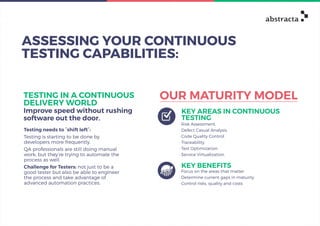
TESTING IN A CONTINUOUS
DELIVERY WORLD
Improve speed without rushing
software out the door.
Testing needs to ¨shift left¨:
Testing is starting to be done by
developers more frequently.
QA professionals are still doing manual
work, but they’re trying to automate the
process as well.
Challenge for Testers: not just to be a
good tester but also be able to engineer
the process and take advantage of
advanced automation practices.
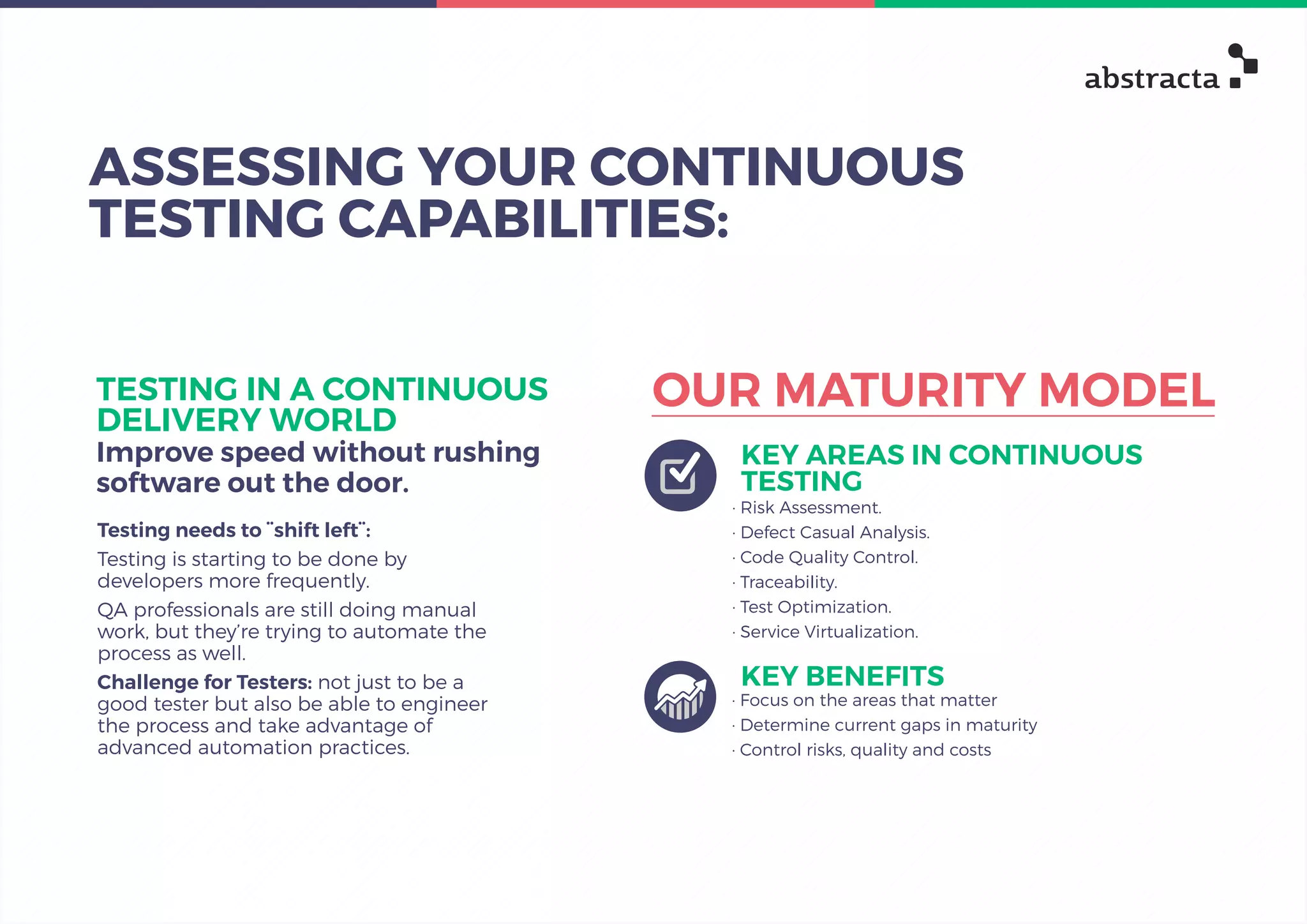
· Focus on the areas that matter
· Determine current gaps in maturity
· Control risks, quality and costs
KEY BENEFITS
· Risk Assessment.
· Defect Casual Analysis.
· Code Quality Control.
· Traceability.
· Test Optimization.
· Service Virtualization.
KEY AREAS IN CONTINUOUS
TESTING
abstracta www.abstracta.us | hello@abstracta.us
© Abstracta 2016
abstracta www.abstracta.us | hello@abstracta.us
© Abstracta 2016
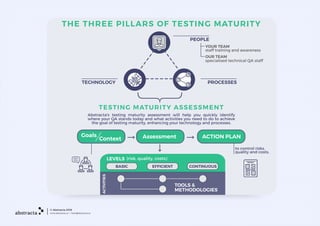
CONTROLLED RISKS
CONTROLLED QUALITY
CONTROLLED COSTS
EFFICIENT TESTING
REDUCED RISKS
OPTIMIZED QUALITY
OPTIMIZED COSTS
CONTINUOUS TESTING
AWARE OF RISKS
MEASURED QUALITY
MEASURED COSTS
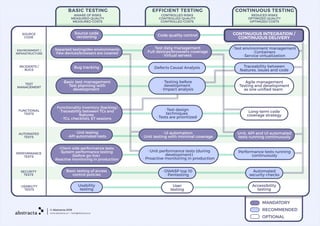
BASIC TESTING
· Separted testing/dev environments
· Few devices/browsers are covered
Source code
versioning
Bug tracking
· Basic test management
· Test planning with
development
· Functionality inventory (backlog)
· Traceability between TCs and
features
· TCs, checklists, ET sessions
· Unit testing
· API automated tests
· Client-side performance tests
· System performance testing
(before go-live)
· Reactive monitoring in production
Basic testing of access
control policies
Usability
testing
User
testing
Code quality control
· Test data management
· Full devices/browsers coverage
· Virtual servers
Defects Causal Analysis
· Testing before
development
· Impact analysis
· Test design
techniques
· Tests are prioritized
· UI automation
· Unit testing with minimal coverage
· Unit performance tests (during
development)
· Proactive monitoring in production
· OWASP top 10
· Pentesting
CONTINUOUS INTEGRATION /
CONTINUOUS DELIVERY
· Test environment management
· Containers
· Service virtualization
Traceability between
features, issues and code
· Agile management
· Testing and development
as one unified team
Long-term code
coverage strategy
Automated
security checks
Unit, API and UI automated
tests running continuously
Performance tests running
continuously
Accessibility
testing
SOURCE
CODE
ENVIRONMENT /
INFRASTRUCTURE
INCIDENTS /
BUGS
TEST
MANAGEMENT
FUNCTIONAL
TESTS
AUTOMATED
TESTS
PERFORMANCE
TESTS
USABILITY
TESTS
SECURITY
TESTS
MANDATORY
RECOMMENDED
OPTIONAL
abstracta www.abstracta.us | hello@abstracta.us
© Abstracta 2016
PAINSTOSOLVE
CONTINUOUS TESTINGEFFICIENT TESTINGBASIC TESTING
SOURCE
CODE
ENVIRONMENT /
INFRASTRUCTURE
INCIDENTS /
BUGS
TEST
MANAGEMENT
FUNCTIONAL
TESTS
AUTOMATED
TESTS
PERFORMANCE
TESTS
USABILITY
TESTS
SECURITY
TESTS
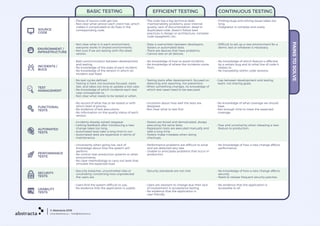
Pieces of source code get lost.
Not clear what version each client has, which
makes it complicated to do fixes in the
corresponding code.
The code has a big technical debt,
maintainability problems, poor internal
quality, lack of documentation, dead or
duplicated code, doesn't follow best
practices in design or architecture, complex
code (spaghetti), etc.
Finding bugs and solving issues takes too
long.
Integration is complex and costly.
Not clear what is in each environment,
everyone works in shared environments.
Not sure if we are testing with the latest
version.
Data is overwritten between developers,
testers or automated tests.
There are devices that have problems.
Cannot test on all devices.
Difficult to set up a new environment for a
demo, test or whatever is necessary.
Users find the system difficult to use.
No evidence that the application is usable.
Users are resistant to change due their lack
of involvement in acceptance testing.
No evidence that the application is
user-friendly.
No evidence that the application is
accessible to all.
Security breaches, uncontrolled risks or
uncertainty concerning how unprotected
the users are.
Security standards are not met. No knowledge of how a new change affects
security.
Need to release frequent security patches.
Uncertainty when going live, lack of
knowledge about how the system will
perform.
No control over production systems or other
environments.
No clear methodology to carry out tests that
simulate the expected load.
Performance problems are difficult to solve
and are detected very late.
Unable to anticipate problems that occur in
production.
No knowledge of how a new change affects
performance.
Incidents already solved reappear.
Getting feedback after introducing a new
change takes too long.
Automated tests take a long time to run.
Automated tests are expensive in terms of
maintenance.
Testers are bored and demotivated, always
executing the same tests.
Regression tests are executed manually and
take a long time.
Testers make mistakes when doing
checkups.
Fear and uncertainty when releasing a new
feature to production.
• Bad communication between development
and testing.
No knowledge of the state of each incident.
No knowledge of the version in which an
incident was fixed.
No knowledge of how to avoid incidents.
No knowledge of where the incidents come
from.
No knowledge of which feature is affected
by a certain bug and to what line of code it
relates to.
No traceability within code versions.
No test cycles defined.
Testing is hard, not business focused, starts
late, and takes too long to update a test case.
No knowledge of which incidents each test
case corresponds to.
Not clear what needs to be tested or when.
Testing starts after development, focused on
detecting and reporting, not prevention.
When something changes, no knowledge of
which test cases need to be executed.
Gap between development and testing
team, not sharing goals.
No record of what has to be tested or with
which level of priority.
No evidence of test executions.
No information on the quality status of each
version.
Uncertain about how well the tests are
designed.
Not clear what to test first.
No knowledge of what coverage we should
have.
Not enough time to meet the expected
coverage.
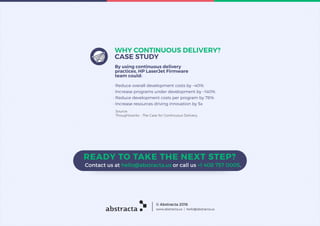
By using continuous delivery
practices, HP LaserJet Firmware
team could:
WHY CONTINUOUS DELIVERY?
CASE STUDY
· Reduce overall development costs by ~40%
· Increase programs under development by ~140%
· Reduce development costs per program by 78%
· Increase resources driving innovation by 5x
Source:
Thoughtworks - The Case for Continuous Delivery.
abstracta www.abstracta.us | hello@abstracta.us
© Abstracta 2016

Software Testing Maturity Model and Assessment by Abstracta

  • 1.
    TESTING IN ACONTINUOUS DELIVERY WORLD Improve speed without rushing software out the door. Testing needs to ¨shift left¨: Testing is starting to be done by developers more frequently. QA professionals are still doing manual work, but they’re trying to automate the process as well. Challenge for Testers: not just to be a good tester but also be able to engineer the process and take advantage of advanced automation practices. · Focus on the areas that matter · Determine current gaps in maturity · Control risks, quality and costs KEY BENEFITS · Risk Assessment. · Defect Casual Analysis. · Code Quality Control. · Traceability. · Test Optimization. · Service Virtualization. KEY AREAS IN CONTINUOUS TESTING
  • 2.
    abstracta www.abstracta.us |hello@abstracta.us © Abstracta 2016
  • 3.
    abstracta www.abstracta.us |hello@abstracta.us © Abstracta 2016 CONTROLLED RISKS CONTROLLED QUALITY CONTROLLED COSTS EFFICIENT TESTING REDUCED RISKS OPTIMIZED QUALITY OPTIMIZED COSTS CONTINUOUS TESTING AWARE OF RISKS MEASURED QUALITY MEASURED COSTS BASIC TESTING · Separted testing/dev environments · Few devices/browsers are covered Source code versioning Bug tracking · Basic test management · Test planning with development · Functionality inventory (backlog) · Traceability between TCs and features · TCs, checklists, ET sessions · Unit testing · API automated tests · Client-side performance tests · System performance testing (before go-live) · Reactive monitoring in production Basic testing of access control policies Usability testing User testing Code quality control · Test data management · Full devices/browsers coverage · Virtual servers Defects Causal Analysis · Testing before development · Impact analysis · Test design techniques · Tests are prioritized · UI automation · Unit testing with minimal coverage · Unit performance tests (during development) · Proactive monitoring in production · OWASP top 10 · Pentesting CONTINUOUS INTEGRATION / CONTINUOUS DELIVERY · Test environment management · Containers · Service virtualization Traceability between features, issues and code · Agile management · Testing and development as one unified team Long-term code coverage strategy Automated security checks Unit, API and UI automated tests running continuously Performance tests running continuously Accessibility testing SOURCE CODE ENVIRONMENT / INFRASTRUCTURE INCIDENTS / BUGS TEST MANAGEMENT FUNCTIONAL TESTS AUTOMATED TESTS PERFORMANCE TESTS USABILITY TESTS SECURITY TESTS MANDATORY RECOMMENDED OPTIONAL
  • 4.
    abstracta www.abstracta.us |hello@abstracta.us © Abstracta 2016 PAINSTOSOLVE CONTINUOUS TESTINGEFFICIENT TESTINGBASIC TESTING SOURCE CODE ENVIRONMENT / INFRASTRUCTURE INCIDENTS / BUGS TEST MANAGEMENT FUNCTIONAL TESTS AUTOMATED TESTS PERFORMANCE TESTS USABILITY TESTS SECURITY TESTS Pieces of source code get lost. Not clear what version each client has, which makes it complicated to do fixes in the corresponding code. The code has a big technical debt, maintainability problems, poor internal quality, lack of documentation, dead or duplicated code, doesn't follow best practices in design or architecture, complex code (spaghetti), etc. Finding bugs and solving issues takes too long. Integration is complex and costly. Not clear what is in each environment, everyone works in shared environments. Not sure if we are testing with the latest version. Data is overwritten between developers, testers or automated tests. There are devices that have problems. Cannot test on all devices. Difficult to set up a new environment for a demo, test or whatever is necessary. Users find the system difficult to use. No evidence that the application is usable. Users are resistant to change due their lack of involvement in acceptance testing. No evidence that the application is user-friendly. No evidence that the application is accessible to all. Security breaches, uncontrolled risks or uncertainty concerning how unprotected the users are. Security standards are not met. No knowledge of how a new change affects security. Need to release frequent security patches. Uncertainty when going live, lack of knowledge about how the system will perform. No control over production systems or other environments. No clear methodology to carry out tests that simulate the expected load. Performance problems are difficult to solve and are detected very late. Unable to anticipate problems that occur in production. No knowledge of how a new change affects performance. Incidents already solved reappear. Getting feedback after introducing a new change takes too long. Automated tests take a long time to run. Automated tests are expensive in terms of maintenance. Testers are bored and demotivated, always executing the same tests. Regression tests are executed manually and take a long time. Testers make mistakes when doing checkups. Fear and uncertainty when releasing a new feature to production. • Bad communication between development and testing. No knowledge of the state of each incident. No knowledge of the version in which an incident was fixed. No knowledge of how to avoid incidents. No knowledge of where the incidents come from. No knowledge of which feature is affected by a certain bug and to what line of code it relates to. No traceability within code versions. No test cycles defined. Testing is hard, not business focused, starts late, and takes too long to update a test case. No knowledge of which incidents each test case corresponds to. Not clear what needs to be tested or when. Testing starts after development, focused on detecting and reporting, not prevention. When something changes, no knowledge of which test cases need to be executed. Gap between development and testing team, not sharing goals. No record of what has to be tested or with which level of priority. No evidence of test executions. No information on the quality status of each version. Uncertain about how well the tests are designed. Not clear what to test first. No knowledge of what coverage we should have. Not enough time to meet the expected coverage.
  • 5.
    By using continuousdelivery practices, HP LaserJet Firmware team could: WHY CONTINUOUS DELIVERY? CASE STUDY · Reduce overall development costs by ~40% · Increase programs under development by ~140% · Reduce development costs per program by 78% · Increase resources driving innovation by 5x Source: Thoughtworks - The Case for Continuous Delivery. abstracta www.abstracta.us | hello@abstracta.us © Abstracta 2016