Software Testing
        (Part I)


A Brief Presentation By
     Disney E. Lai
Outline

●   Fundamentals of Testing
●   Testing in the Software Life Cycle
●   Discussion
Fundamentals of Testing


WHY IS TESTING NECESSARY?
Fundamentals of Testing

The Threats of Bugs
●   Damaged Reputation   ●   Pollution/Waste
●   High/Unpredictable   ●   Lost jobs
    maintenance cost     ●   Lost lives
●   Unexpected delays    ●   Lost rights
●   Lack of confidence   ●   Lost missions
●   Lawsuits             ●   Lost Wars
                                     and many more ....
Fundamentals of Testing

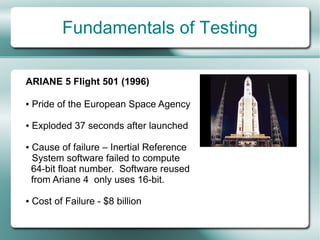
ARIANE 5 Flight 501 (1996)

●   Pride of the European Space Agency

●   Exploded 37 seconds after launched

●   Cause of failure – Inertial Reference
    System software failed to compute
    64-bit float number. Software reused
    from Ariane 4 only uses 16-bit.

●   Cost of Failure - $8 billion
Fundamentals of Testing

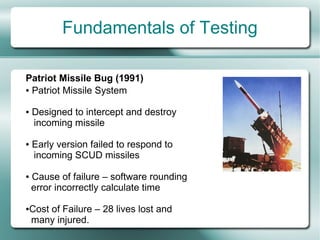
Patriot Missile Bug (1991)
● Patriot Missile System


●   Designed to intercept and destroy
    incoming missile

●   Early version failed to respond to
    incoming SCUD missiles

●   Cause of failure – software rounding
    error incorrectly calculate time

●   Cost of Failure – 28 lives lost and
    many injured.
Fundamentals of Testing

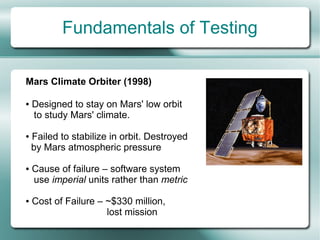
Mars Climate Orbiter (1998)

●   Designed to stay on Mars' low orbit
    to study Mars' climate.

●   Failed to stabilize in orbit. Destroyed
    by Mars atmospheric pressure

●   Cause of failure – software system
    use imperial units rather than metric

●   Cost of Failure – ~$330 million,
                      lost mission
Fundamentals of Testing

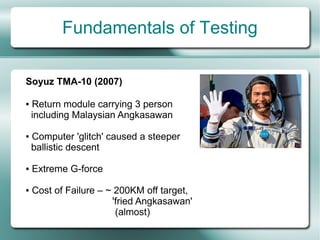
Soyuz TMA-10 (2007)

●   Return module carrying 3 person
    including Malaysian Angkasawan

●   Computer 'glitch' caused a steeper
    ballistic descent

●   Extreme G-force

●   Cost of Failure – ~ 200KM off target,
                       'fried Angkasawan'
                        (almost)
Fundamentals of Testing

Universiti Sains Malaysia (2009)

●   Online Application System

●   Misinformed all 8,173 prequalified
    applicants of successfull entry rather
    than only 3,599 applicants.

●   Caused frustration and anger.

●   Cost of Failure – ~ lost of reputation?
Fundamentals of Testing

City Bus Terminal First Day (2006)

●   RM4.5 Million City Bus Terminal
    Inanam

●   Computerised ticketing system failed to
    function due to computer glitch – Manua
    alternative

●   Caused frustration and anger.

●   Cost of Failure – ~ lost of reputation?
                       Lost service
Fundamentals of Testing

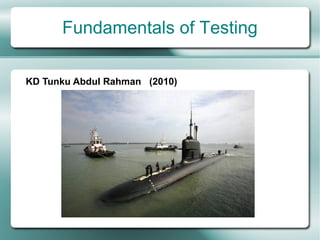
KD Tunku Abdul Rahman (2010)
Fundamentals of Testing


   BUG? WHAT BUG?
Fundamentals of Testing

Where Do Bugs Come From?

●
    People  Errors  Bugs (defects)  Failures
●   Requirements and design specifications

●   Code (Business Logic and UI)

●   Documentation (electronic and hard copy)

●
    Failures  People  Dissatisfaction with quality
Fundamentals of Testing

Where Do Bugs Come From?

●   Bugs Occur Due to....

    ●   Programmer, Analyst, and other individuals contributing
        (including tester!)

    ●   Complexity of code, infrastructure or problem

    ●   Changing and Meshing of Technologies

    ●   Time Pressure

    ●   Many system interactions
Fundamentals of Testing

Where Do Bugs Come From?

●   Failures Occur Due to bugs and....

    ●   Environmental conditions – dust, humidity...

    ●   Misuse (deliberate and accidental)
Fundamentals of Testing

What does 'QUALITY' means to you?

●   Fitness for use vs conformance to requirements.

●   TESTING AND QUALITY

●   Important Quality characteristics?                   OR

●   Testing, Quality Assurance and Quality Improvement
Fundamentals of Testing


   WHAT IS TESTING?
Fundamentals of Testing

Testing Objectives

●   Find bugs – information programmers need to fix important
    bugs

●   Increase Confidence Level – Quality

●   Prevent defects – early detection

●   Help management understand system quality

●   And so on....
Fundamentals of Testing


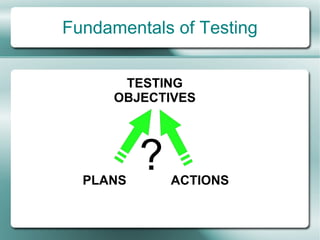
       TESTING
      OBJECTIVES


  PLANS
          ?   ACTIONS
Fundamentals of Testing

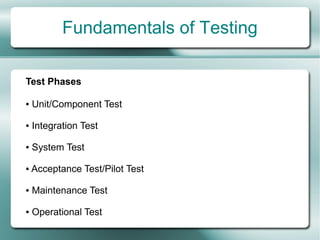
Test Phases

●   Unit/Component Test

●   Integration Test

●   System Test

●   Acceptance Test/Pilot Test

●   Maintenance Test

●   Operational Test
Fundamentals of Testing


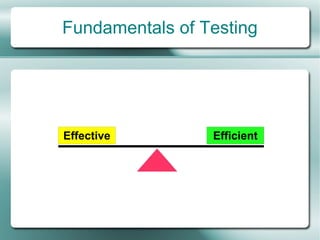
Effective        Efficient
Fundamentals of Testing

Testing Vs. Debugging

●   Testing - Find failures that caused by bugs

●   Debugging – Fix defect

    ●   Identifies root cause of a bug
    ●   Repairs the code
    ●   Checks that defects is fixed correctly

●   Different responsibilities:
    ● Testers Test

    ● Programmers Debug
Fundamentals of Testing


   TESTING PRINCIPLES
Fundamentals of Testing

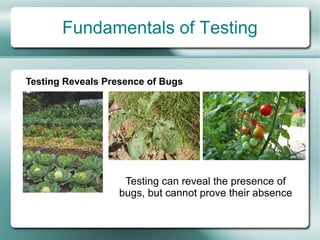
Testing Reveals Presence of Bugs


                    Testing can reveal the presence of
                   bugs, but cannot prove their absence
Fundamentals of Testing

Mission Impossible: Exhaustive Testing

Exhaustive testing (all combinations of inputs and
preconditions) is NOT possible

Exhaustive testing as a way to prove the software works is a
misexpectation

Bad Expectation create problem for test pro and teams
 ● Unachievable high demands on test group

 ● Perception of incompetence
Fundamentals of Testing

Benefit of Early QA and Testing
●   Cost of bug tends to increase as the project progresses....

Defect Clustering
●   Bugs tend to appear in clusters

Pesticide Paradox
● One technique alone is not effective to find defects
● Use new and different techniques to find defect
Fundamentals of Testing

Absence-of-Errors Fallacy
●   Finding and fixing many bug does not guarantee satisfaction

●   Successful projects balance – features, schedule, budget
    and quality
Fundamentals of Testing


FUNDAMENTAL TEST PROCESS
Fundamentals of Testing

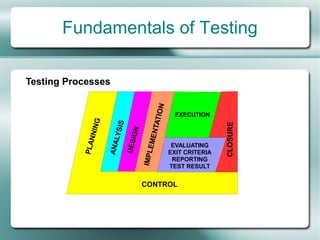
Testing Processes


                                                        I ON
                                                                 EXECUTION


                                                    NTAT
                  G


                             S


                                                                               CLOSURE
              NNIN


                         LYSI

                                     IGN

                                                EME
                                 DES
                      ANA
           PLA


                                                                EVALUATING
                                                               EXIT CRITERIA
                                           IMPL
                                                                REPORTING
                                                               TEST RESULT


                                           CONTROL
Fundamentals of Testing

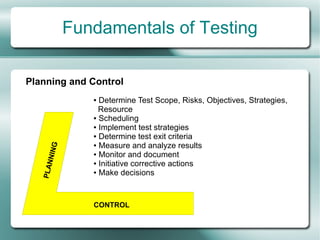
Planning and Control
              ● Determine Test Scope, Risks, Objectives, Strategies,
                Resource
              ● Scheduling

              ● Implement test strategies

              ● Determine test exit criteria

              ● Measure and analyze results
     ING


              ● Monitor and document
       N


              ● Initiative corrective actions
   PLAN


              ● Make decisions


              CONTROL
Fundamentals of Testing

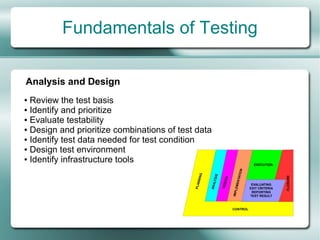
Analysis and Design
● Review the test basis
● Identify and prioritize

● Evaluate testability

● Design and prioritize combinations of test data

● Identify test data needed for test condition

● Design test environment

● Identify infrastructure tools
                                                                                          EXECUTION


                                                                                  ION
                                                   G


                                                               S


                                                                              NTAT


                                                                                                        CLOSURE
                                               NNIN


                                                          LYSI


                                                                     N IG


                                                                             EM E
                                                                   DES
                                                                                         EVALUATING


                                                       ANA
                                            PLA
                                                                                        EXIT CRITERIA


                                                                            IMPL
                                                                                         REPORTING
                                                                                        TEST RESULT


                                                                            CONTROL
Fundamentals of Testing

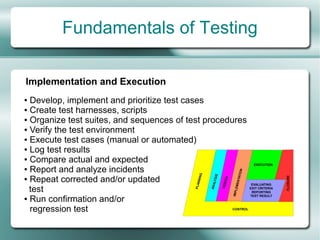
Implementation and Execution
● Develop, implement and prioritize test cases
● Create test harnesses, scripts

● Organize test suites, and sequences of test procedures

● Verify the test environment

● Execute test cases (manual or automated)

● Log test results

● Compare actual and expected
                                                                                        EXECUTION
● Report and analyze incidents


                                                                                ION
                                                 G
● Repeat corrected and/or updated


                                                             S


                                                                            NTAT


                                                                                                      CLOSURE
                                             NNIN


                                                        LYSI


                                                                   N IG


                                                                           EM E
                                                                 DES
                                                                                       EVALUATING


                                                     ANA
                                          PLA
  test                                                                                EXIT CRITERIA


                                                                          IMPL
                                                                                       REPORTING

● Run confirmation and/or
                                                                                      TEST RESULT


  regression test                                                         CONTROL
Fundamentals of Testing

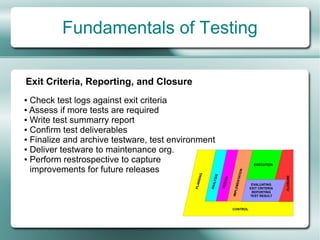
Exit Criteria, Reporting, and Closure
● Check test logs against exit criteria
● Assess if more tests are required

● Write test summarry report

● Confirm test deliverables

● Finalize and archive testware, test environment

● Deliver testware to maintenance org.

● Perform restrospective to capture
                                                                                         EXECUTION
  improvements for future releases


                                                                                 ION
                                                  G


                                                              S


                                                                             NTAT


                                                                                                       CLOSURE
                                              NNIN


                                                         LYSI


                                                                    N IG


                                                                            EM E
                                                                  DES
                                                                                        EVALUATING


                                                      ANA
                                           PLA
                                                                                       EXIT CRITERIA


                                                                           IMPL
                                                                                        REPORTING
                                                                                       TEST RESULT


                                                                           CONTROL
Fundamentals of Testing


 PSYCHOLOGY OF TESTING
Fundamentals of Testing


Good Tester Attributes
● Curiosity
● Professional Pessimism

● Critical Eye

● Attention to detail

● Good communication skills
Fundamentals of Testing


Defining Tester Skills
● Reading
● Writing

● Technology

● Project

● Testing skills
Fundamentals of Testing


Differing Mindsets
● Testing and Reviewing vs Development
● Developers – author bias
Fundamentals of Testing


Degrees of Independence
● Independent tester – effective at finding
  failures
● Levels of test independence
Fundamentals of Testing

● Clear Objectives
● Focus

● Constructor or Destructor?

● Bad News or Bad Guy?
Testing In The SW Life Cycle


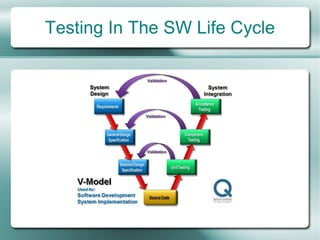
         ''V'' MODEL
Testing In The SW Life Cycle


         TEST TYPES
Testing In The SW Life Cycle


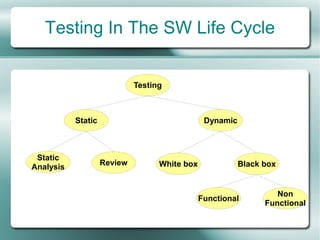
                             Testing


           Static                               Dynamic


 Static
                    Review         White box              Black box
Analysis


                                                                   Non
                                               Functional
                                                                Functional
Testing In The SW Life Cycle


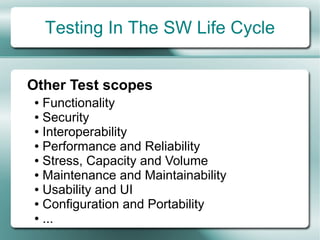
Other Test scopes
● Functionality
● Security

● Interoperability

● Performance and Reliability

● Stress, Capacity and Volume

● Maintenance and Maintainability

● Usability and UI

● Configuration and Portability

● ...
Testing In The SW Life Cycle

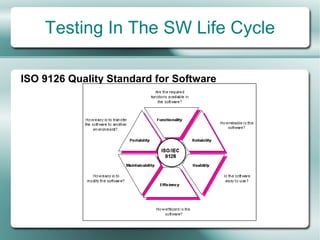
ISO 9126 Quality Standard for Software
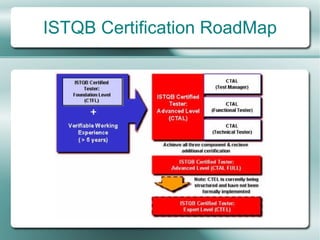
ISTQB Certification RoadMap
Discussion


          Q&A
Software Testing in JPKN

Software Testing

  • 1.
    Software Testing (Part I) A Brief Presentation By Disney E. Lai
  • 2.
    Outline ● Fundamentals of Testing ● Testing in the Software Life Cycle ● Discussion
  • 3.
    Fundamentals of Testing WHYIS TESTING NECESSARY?
  • 4.
    Fundamentals of Testing TheThreats of Bugs ● Damaged Reputation ● Pollution/Waste ● High/Unpredictable ● Lost jobs maintenance cost ● Lost lives ● Unexpected delays ● Lost rights ● Lack of confidence ● Lost missions ● Lawsuits ● Lost Wars and many more ....
  • 5.
    Fundamentals of Testing ARIANE5 Flight 501 (1996) ● Pride of the European Space Agency ● Exploded 37 seconds after launched ● Cause of failure – Inertial Reference System software failed to compute 64-bit float number. Software reused from Ariane 4 only uses 16-bit. ● Cost of Failure - $8 billion
  • 6.
    Fundamentals of Testing PatriotMissile Bug (1991) ● Patriot Missile System ● Designed to intercept and destroy incoming missile ● Early version failed to respond to incoming SCUD missiles ● Cause of failure – software rounding error incorrectly calculate time ● Cost of Failure – 28 lives lost and many injured.
  • 7.
    Fundamentals of Testing MarsClimate Orbiter (1998) ● Designed to stay on Mars' low orbit to study Mars' climate. ● Failed to stabilize in orbit. Destroyed by Mars atmospheric pressure ● Cause of failure – software system use imperial units rather than metric ● Cost of Failure – ~$330 million, lost mission
  • 8.
    Fundamentals of Testing SoyuzTMA-10 (2007) ● Return module carrying 3 person including Malaysian Angkasawan ● Computer 'glitch' caused a steeper ballistic descent ● Extreme G-force ● Cost of Failure – ~ 200KM off target, 'fried Angkasawan' (almost)
  • 9.
    Fundamentals of Testing UniversitiSains Malaysia (2009) ● Online Application System ● Misinformed all 8,173 prequalified applicants of successfull entry rather than only 3,599 applicants. ● Caused frustration and anger. ● Cost of Failure – ~ lost of reputation?
  • 10.
    Fundamentals of Testing CityBus Terminal First Day (2006) ● RM4.5 Million City Bus Terminal Inanam ● Computerised ticketing system failed to function due to computer glitch – Manua alternative ● Caused frustration and anger. ● Cost of Failure – ~ lost of reputation? Lost service
  • 11.
    Fundamentals of Testing KDTunku Abdul Rahman (2010)
  • 12.
  • 13.
    Fundamentals of Testing WhereDo Bugs Come From? ● People  Errors  Bugs (defects)  Failures ● Requirements and design specifications ● Code (Business Logic and UI) ● Documentation (electronic and hard copy) ● Failures  People  Dissatisfaction with quality
  • 14.
    Fundamentals of Testing WhereDo Bugs Come From? ● Bugs Occur Due to.... ● Programmer, Analyst, and other individuals contributing (including tester!) ● Complexity of code, infrastructure or problem ● Changing and Meshing of Technologies ● Time Pressure ● Many system interactions
  • 15.
    Fundamentals of Testing WhereDo Bugs Come From? ● Failures Occur Due to bugs and.... ● Environmental conditions – dust, humidity... ● Misuse (deliberate and accidental)
  • 16.
    Fundamentals of Testing Whatdoes 'QUALITY' means to you? ● Fitness for use vs conformance to requirements. ● TESTING AND QUALITY ● Important Quality characteristics? OR ● Testing, Quality Assurance and Quality Improvement
  • 17.
    Fundamentals of Testing WHAT IS TESTING?
  • 18.
    Fundamentals of Testing TestingObjectives ● Find bugs – information programmers need to fix important bugs ● Increase Confidence Level – Quality ● Prevent defects – early detection ● Help management understand system quality ● And so on....
  • 19.
    Fundamentals of Testing TESTING OBJECTIVES PLANS ? ACTIONS
  • 20.
    Fundamentals of Testing TestPhases ● Unit/Component Test ● Integration Test ● System Test ● Acceptance Test/Pilot Test ● Maintenance Test ● Operational Test
  • 21.
  • 22.
    Fundamentals of Testing TestingVs. Debugging ● Testing - Find failures that caused by bugs ● Debugging – Fix defect ● Identifies root cause of a bug ● Repairs the code ● Checks that defects is fixed correctly ● Different responsibilities: ● Testers Test ● Programmers Debug
  • 23.
    Fundamentals of Testing TESTING PRINCIPLES
  • 24.
    Fundamentals of Testing TestingReveals Presence of Bugs Testing can reveal the presence of bugs, but cannot prove their absence
  • 25.
    Fundamentals of Testing MissionImpossible: Exhaustive Testing Exhaustive testing (all combinations of inputs and preconditions) is NOT possible Exhaustive testing as a way to prove the software works is a misexpectation Bad Expectation create problem for test pro and teams ● Unachievable high demands on test group ● Perception of incompetence
  • 26.
    Fundamentals of Testing Benefitof Early QA and Testing ● Cost of bug tends to increase as the project progresses.... Defect Clustering ● Bugs tend to appear in clusters Pesticide Paradox ● One technique alone is not effective to find defects ● Use new and different techniques to find defect
  • 27.
    Fundamentals of Testing Absence-of-ErrorsFallacy ● Finding and fixing many bug does not guarantee satisfaction ● Successful projects balance – features, schedule, budget and quality
  • 28.
  • 29.
    Fundamentals of Testing TestingProcesses I ON EXECUTION NTAT G S CLOSURE NNIN LYSI IGN EME DES ANA PLA EVALUATING EXIT CRITERIA IMPL REPORTING TEST RESULT CONTROL
  • 30.
    Fundamentals of Testing Planningand Control ● Determine Test Scope, Risks, Objectives, Strategies, Resource ● Scheduling ● Implement test strategies ● Determine test exit criteria ● Measure and analyze results ING ● Monitor and document N ● Initiative corrective actions PLAN ● Make decisions CONTROL
  • 31.
    Fundamentals of Testing Analysisand Design ● Review the test basis ● Identify and prioritize ● Evaluate testability ● Design and prioritize combinations of test data ● Identify test data needed for test condition ● Design test environment ● Identify infrastructure tools EXECUTION ION G S NTAT CLOSURE NNIN LYSI N IG EM E DES EVALUATING ANA PLA EXIT CRITERIA IMPL REPORTING TEST RESULT CONTROL
  • 32.
    Fundamentals of Testing Implementationand Execution ● Develop, implement and prioritize test cases ● Create test harnesses, scripts ● Organize test suites, and sequences of test procedures ● Verify the test environment ● Execute test cases (manual or automated) ● Log test results ● Compare actual and expected EXECUTION ● Report and analyze incidents ION G ● Repeat corrected and/or updated S NTAT CLOSURE NNIN LYSI N IG EM E DES EVALUATING ANA PLA test EXIT CRITERIA IMPL REPORTING ● Run confirmation and/or TEST RESULT regression test CONTROL
  • 33.
    Fundamentals of Testing ExitCriteria, Reporting, and Closure ● Check test logs against exit criteria ● Assess if more tests are required ● Write test summarry report ● Confirm test deliverables ● Finalize and archive testware, test environment ● Deliver testware to maintenance org. ● Perform restrospective to capture EXECUTION improvements for future releases ION G S NTAT CLOSURE NNIN LYSI N IG EM E DES EVALUATING ANA PLA EXIT CRITERIA IMPL REPORTING TEST RESULT CONTROL
  • 34.
    Fundamentals of Testing PSYCHOLOGY OF TESTING
  • 35.
    Fundamentals of Testing GoodTester Attributes ● Curiosity ● Professional Pessimism ● Critical Eye ● Attention to detail ● Good communication skills
  • 36.
    Fundamentals of Testing DefiningTester Skills ● Reading ● Writing ● Technology ● Project ● Testing skills
  • 37.
    Fundamentals of Testing DifferingMindsets ● Testing and Reviewing vs Development ● Developers – author bias
  • 38.
    Fundamentals of Testing Degreesof Independence ● Independent tester – effective at finding failures ● Levels of test independence
  • 39.
    Fundamentals of Testing ●Clear Objectives ● Focus ● Constructor or Destructor? ● Bad News or Bad Guy?
  • 40.
    Testing In TheSW Life Cycle ''V'' MODEL
  • 41.
    Testing In TheSW Life Cycle
  • 42.
    Testing In TheSW Life Cycle TEST TYPES
  • 43.
    Testing In TheSW Life Cycle Testing Static Dynamic Static Review White box Black box Analysis Non Functional Functional
  • 44.
    Testing In TheSW Life Cycle Other Test scopes ● Functionality ● Security ● Interoperability ● Performance and Reliability ● Stress, Capacity and Volume ● Maintenance and Maintainability ● Usability and UI ● Configuration and Portability ● ...
  • 45.
    Testing In TheSW Life Cycle ISO 9126 Quality Standard for Software
  • 46.
  • 47.
    Discussion Q&A Software Testing in JPKN