Socio-technical Analysis and
Environmental Sustainability
Catherine Dwyer, PhD.
Pace University
New York
Abstract
 The past 100 years has seen a rapid increase in global
population, along with escalating consumption of finite
resources, such as clean water, energy, and raw
materials. The multiple forces of population growth and
rapid resource depletion have created a ‘wicked’ problem
that MUST be tackled. The term ‘wicked’ refers to
problems with complex interdependencies and multiple
conflicting elements. It is my argument that the socio-
technical approach to understanding complexity with
Information Systems can be applied to discovering and
evaluating efforts to support environmental sustainability.
SIGGreen Virtual workshop - Nov. 12th
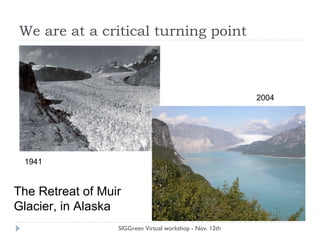
We are at a critical turning point
SIGGreen Virtual workshop - Nov. 12th
1941
2004
The Retreat of Muir
Glacier, in Alaska
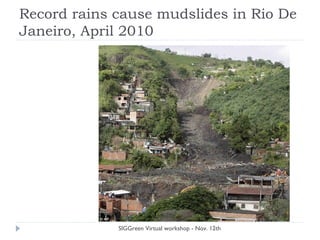
Record rains cause mudslides in Rio De
Janeiro, April 2010
SIGGreen Virtual workshop - Nov. 12th
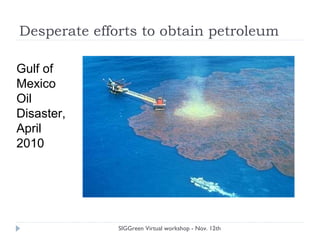
Desperate efforts to obtain petroleum
SIGGreen Virtual workshop - Nov. 12th
Gulf of
Mexico
Oil
Disaster,
April
2010
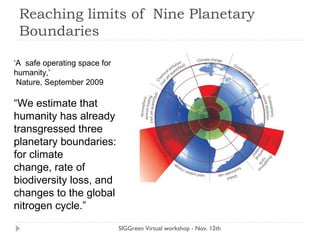
Reaching limits of Nine Planetary
Boundaries
SIGGreen Virtual workshop - Nov. 12th
‘A safe operating space for
humanity,’
Nature, September 2009
“We estimate that
humanity has already
transgressed three
planetary boundaries:
for climate
change, rate of
biodiversity loss, and
changes to the global
nitrogen cycle.”
How IS Can Impact Sustainability
 “We propose the IS community must
engage in the development of
environmentally sustainable business practices.
As IS researchers, educators, journal
editors, and association leaders, we need
to demonstrate how the transformative
power of IS can be leveraged to create an
ecologically sustainable society.”
 Watson, R. T., Boudreau, M.-C., & Chen, A. J. (2010). Information Systems
and Environmentally Sustainable Development: Energy Informatics and
New Directions for the IS Community. MIS Quarterly
SIGGreen Virtual workshop - Nov. 12th
The Synergy Between IS and
Sustainability
 The IS skill set ports over directly to Sustainability
 We (IS) analyze how systems actually work, not just how
they are designed
 Fundamental IS concepts are directly applicable to
sustainability issues, and provide ways to measure and
encourage workable solutions
 Sustainability requirements analysis
 Socio-technical systems
 Supply chain planet earth
 Interoperability
 Distributed systems
SIGGreen Virtual workshop - Nov. 12th
IS Concept: Interoperability
 A real virtue in any information system, it can be very
helpful if applied to energy consuming systems
 Make them interoperable so they can work with any
energy source – wind, solar, ethanol, etc.
 For example, Brazil is the leader in the use of flex-fuel,
this concept can be extended to many other kinds of
systems
SIGGreen Virtual workshop - Nov. 12th
IS and Brasil: Global Leaders for
Sustainability
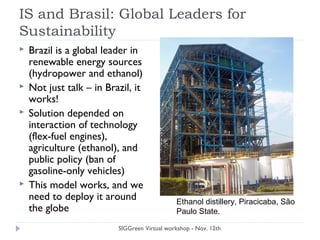
 Brazil is a global leader in
renewable energy sources
(hydropower and ethanol)
 Not just talk – in Brazil, it
works!
 Solution depended on
interaction of technology
(flex-fuel engines),
agriculture (ethanol), and
public policy (ban of
gasoline-only vehicles)
 This model works, and we
need to deploy it around
the globe
SIGGreen Virtual workshop - Nov. 12th
Ethanol distillery, Piracicaba, São
Paulo State.
IS Concept: Distributed versus
Centralized
 advantages and disadvantaged of distributed versus
centralized computing systems
 Advantage of distributed: more flexible, efficient, and
more responsive
 Advantage of centralized: better consistency, quality
assurance, and standardization
SIGGreen Virtual workshop - Nov. 12th
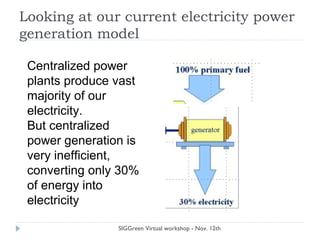
Looking at our current electricity power
generation model
SIGGreen Virtual workshop - Nov. 12th
Centralized power
plants produce vast
majority of our
electricity.
But centralized
power generation is
very inefficient,
converting only 30%
of energy into
electricity
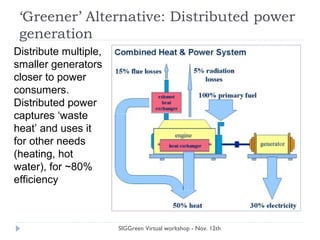
‘Greener’ Alternative: Distributed power
generation
SIGGreen Virtual workshop - Nov. 12th
Distribute multiple,
smaller generators
closer to power
consumers.
Distributed power
captures ‘waste
heat’ and uses it
for other needs
(heating, hot
water), for ~80%
efficiency
SIGGreen Virtual workshop - Nov. 12th
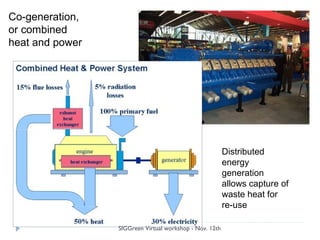
Co-generation,
or combined
heat and power
Distributed
energy
generation
allows capture of
waste heat for
re-use
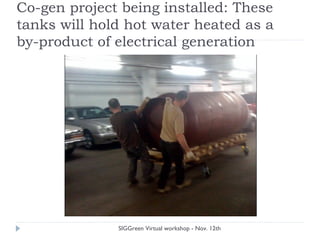
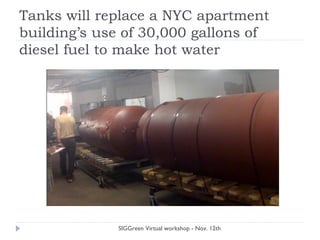
Co-gen project being installed: These
tanks will hold hot water heated as a
by-product of electrical generation
SIGGreen Virtual workshop - Nov. 12th
Tanks will replace a NYC apartment
building’s use of 30,000 gallons of
diesel fuel to make hot water
SIGGreen Virtual workshop - Nov. 12th
Critical themes for IS and Sustainability
 ‘Green IT’ – Minimize environmental impact of the data
center, and running technology in general
 ‘Green IS’ – sophisticated information systems that
monitor and optimize use of resources
 IS Educators – develop case studies, exercises, and
materials that give students a richer understanding of
intersection of energy policy, technical design, and
individual choices
 Green HCI (next slide)
SIGGreen Virtual workshop - Nov. 12th
‘Green HCI’
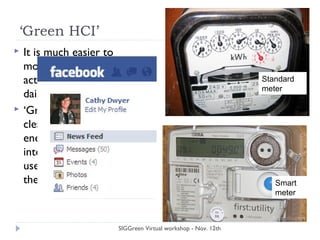
 It is much easier to
monitor Facebook
activity compared to
daily energy use
 ‘Green HCI’ – provide
clear and actionable
energy consumption
interfaces, that enable
users to minimize
their energy use
SIGGreen Virtual workshop - Nov. 12th
Standard
meter
Smart
meter
Meet me in St. Louis!
 The breadth of topics in our virtual workshop validate
the critical role IS can play in support of environmental
sustainability.
 We have the skills and the duty to work together to
improve sustainable practices
 Next up: Pre-ICIS SIGGreen Workshop Dec. 11th
SIGGreen Virtual workshop - Nov. 12th

Socio-technical Analysis and Environmental Sustainability

  • 1.
    Socio-technical Analysis and EnvironmentalSustainability Catherine Dwyer, PhD. Pace University New York
  • 2.
    Abstract  The past100 years has seen a rapid increase in global population, along with escalating consumption of finite resources, such as clean water, energy, and raw materials. The multiple forces of population growth and rapid resource depletion have created a ‘wicked’ problem that MUST be tackled. The term ‘wicked’ refers to problems with complex interdependencies and multiple conflicting elements. It is my argument that the socio- technical approach to understanding complexity with Information Systems can be applied to discovering and evaluating efforts to support environmental sustainability. SIGGreen Virtual workshop - Nov. 12th
  • 3.
    We are ata critical turning point SIGGreen Virtual workshop - Nov. 12th 1941 2004 The Retreat of Muir Glacier, in Alaska
  • 4.
    Record rains causemudslides in Rio De Janeiro, April 2010 SIGGreen Virtual workshop - Nov. 12th
  • 5.
    Desperate efforts toobtain petroleum SIGGreen Virtual workshop - Nov. 12th Gulf of Mexico Oil Disaster, April 2010
  • 6.
    Reaching limits ofNine Planetary Boundaries SIGGreen Virtual workshop - Nov. 12th ‘A safe operating space for humanity,’ Nature, September 2009 “We estimate that humanity has already transgressed three planetary boundaries: for climate change, rate of biodiversity loss, and changes to the global nitrogen cycle.”
  • 7.
    How IS CanImpact Sustainability  “We propose the IS community must engage in the development of environmentally sustainable business practices. As IS researchers, educators, journal editors, and association leaders, we need to demonstrate how the transformative power of IS can be leveraged to create an ecologically sustainable society.”  Watson, R. T., Boudreau, M.-C., & Chen, A. J. (2010). Information Systems and Environmentally Sustainable Development: Energy Informatics and New Directions for the IS Community. MIS Quarterly SIGGreen Virtual workshop - Nov. 12th
  • 8.
    The Synergy BetweenIS and Sustainability  The IS skill set ports over directly to Sustainability  We (IS) analyze how systems actually work, not just how they are designed  Fundamental IS concepts are directly applicable to sustainability issues, and provide ways to measure and encourage workable solutions  Sustainability requirements analysis  Socio-technical systems  Supply chain planet earth  Interoperability  Distributed systems SIGGreen Virtual workshop - Nov. 12th
  • 9.
    IS Concept: Interoperability A real virtue in any information system, it can be very helpful if applied to energy consuming systems  Make them interoperable so they can work with any energy source – wind, solar, ethanol, etc.  For example, Brazil is the leader in the use of flex-fuel, this concept can be extended to many other kinds of systems SIGGreen Virtual workshop - Nov. 12th
  • 10.
    IS and Brasil:Global Leaders for Sustainability  Brazil is a global leader in renewable energy sources (hydropower and ethanol)  Not just talk – in Brazil, it works!  Solution depended on interaction of technology (flex-fuel engines), agriculture (ethanol), and public policy (ban of gasoline-only vehicles)  This model works, and we need to deploy it around the globe SIGGreen Virtual workshop - Nov. 12th Ethanol distillery, Piracicaba, São Paulo State.
  • 11.
    IS Concept: Distributedversus Centralized  advantages and disadvantaged of distributed versus centralized computing systems  Advantage of distributed: more flexible, efficient, and more responsive  Advantage of centralized: better consistency, quality assurance, and standardization SIGGreen Virtual workshop - Nov. 12th
  • 12.
    Looking at ourcurrent electricity power generation model SIGGreen Virtual workshop - Nov. 12th Centralized power plants produce vast majority of our electricity. But centralized power generation is very inefficient, converting only 30% of energy into electricity
  • 13.
    ‘Greener’ Alternative: Distributedpower generation SIGGreen Virtual workshop - Nov. 12th Distribute multiple, smaller generators closer to power consumers. Distributed power captures ‘waste heat’ and uses it for other needs (heating, hot water), for ~80% efficiency
  • 14.
    SIGGreen Virtual workshop- Nov. 12th Co-generation, or combined heat and power Distributed energy generation allows capture of waste heat for re-use
  • 15.
    Co-gen project beinginstalled: These tanks will hold hot water heated as a by-product of electrical generation SIGGreen Virtual workshop - Nov. 12th
  • 16.
    Tanks will replacea NYC apartment building’s use of 30,000 gallons of diesel fuel to make hot water SIGGreen Virtual workshop - Nov. 12th
  • 17.
    Critical themes forIS and Sustainability  ‘Green IT’ – Minimize environmental impact of the data center, and running technology in general  ‘Green IS’ – sophisticated information systems that monitor and optimize use of resources  IS Educators – develop case studies, exercises, and materials that give students a richer understanding of intersection of energy policy, technical design, and individual choices  Green HCI (next slide) SIGGreen Virtual workshop - Nov. 12th
  • 18.
    ‘Green HCI’  Itis much easier to monitor Facebook activity compared to daily energy use  ‘Green HCI’ – provide clear and actionable energy consumption interfaces, that enable users to minimize their energy use SIGGreen Virtual workshop - Nov. 12th Standard meter Smart meter
  • 19.
    Meet me inSt. Louis!  The breadth of topics in our virtual workshop validate the critical role IS can play in support of environmental sustainability.  We have the skills and the duty to work together to improve sustainable practices  Next up: Pre-ICIS SIGGreen Workshop Dec. 11th SIGGreen Virtual workshop - Nov. 12th