Information Systems For Sustainable Development Lorenz M Hilty
Information Systems For Sustainable Development Lorenz M Hilty
Information Systems For Sustainable Development Lorenz M Hilty
Information Systems For Sustainable Development Lorenz M Hilty
Information Systems For Sustainable Development Lorenz M Hilty
1.
Information Systems ForSustainable Development
Lorenz M Hilty download
https://ebookbell.com/product/information-systems-for-
sustainable-development-lorenz-m-hilty-1079070
Explore and download more ebooks at ebookbell.com
2.
Here are somerecommended products that we believe you will be
interested in. You can click the link to download.
Information Systems And Technological Advances For Sustainable
Development Proceedings Of The Fifth International Conference Data2024
Mohamed Ben Ahmed
https://ebookbell.com/product/information-systems-and-technological-
advances-for-sustainable-development-proceedings-of-the-fifth-
international-conference-data2024-mohamed-ben-ahmed-155357256
Green Information And Communication Systems For A Sustainable Future
1st Edition Rajeev Tiwari Rajshree Srivastava Sandeep Kautish
https://ebookbell.com/product/green-information-and-communication-
systems-for-a-sustainable-future-1st-edition-rajeev-tiwari-rajshree-
srivastava-sandeep-kautish-36349386
Green Information And Communication Systems For A Sustainable Future
Rajshree Srivastava
https://ebookbell.com/product/green-information-and-communication-
systems-for-a-sustainable-future-rajshree-srivastava-37289872
Advanced Technologies For Sustainable Systems Selected Contributions
From The International Conference On Sustainable Vital Technologies In
Engineering And Informatics Bue Ace1 2016 79 November 2016 Cairo Egypt
1st Edition Yehia Baheieldin
https://ebookbell.com/product/advanced-technologies-for-sustainable-
systems-selected-contributions-from-the-international-conference-on-
sustainable-vital-technologies-in-engineering-and-informatics-bue-
ace1-2016-79-november-2016-cairo-egypt-1st-edition-yehia-
baheieldin-5675906
3.
Information Systems ForIntelligent Systems Proceedings Of Isbm 2022
Chakchai Soin
https://ebookbell.com/product/information-systems-for-intelligent-
systems-proceedings-of-isbm-2022-chakchai-soin-49192206
Information Systems For Healthcare Management Eighth Edition 8th
Edition Gerald Glandon Detlev H Smaltz Donna J Slovensky
https://ebookbell.com/product/information-systems-for-healthcare-
management-eighth-edition-8th-edition-gerald-glandon-detlev-h-smaltz-
donna-j-slovensky-51842574
Information Systems For Egovernment A Qualityofservice Perspective 1st
Edition Gianluigi Viscusi
https://ebookbell.com/product/information-systems-for-egovernment-a-
qualityofservice-perspective-1st-edition-gianluigi-viscusi-2014368
Information Systems For Indian Languages International Conference
Icisil 2011 Patiala India March 911 2011 Proceedings 1st Edition Manoj
K Sachan
https://ebookbell.com/product/information-systems-for-indian-
languages-international-conference-icisil-2011-patiala-india-
march-911-2011-proceedings-1st-edition-manoj-k-sachan-2191972
Information Systems For Managers Texts Cases 2e Piccoli Gabriele
https://ebookbell.com/product/information-systems-for-managers-texts-
cases-2e-piccoli-gabriele-3850508
Information Systems for
SustainableDevelopment
Table of Contents
Preface .............................................................................................................. vii
Section I: Environmental Performance and Eco-Efficiency
Chapter I. EPE According to ISO 14031: Concept, Experience,
and Revision Issues ......................................................................................... 1
Eberhard K. Seifert, Wuppertal Institute, Germany
Chapter II. Life Cycle Assessment Databases as Part of Sustainable
Development Strategies: The Example of Ecoinvent .............................. 15
Roland Hischier, Swiss Federal Laboratories for Materials Testing
& Research, Switzerland
Paul W. Gilgen, Swiss Federal Laboratories for Materials Testing
& Research, Switzerland
Chapter III. Ecoinvent Database: Quality Control and User Interfaces
for a Web-Based Life Cycle Assessment Database.................................. 25
Rolf Frischknecht, Centre for Life Cycle Inventories, Switzerland
Chapter IV. Organisation Models and Information Systems for
Production-Integrated Environmental Protection (OPUS) ...................... 39
Hans-Dietrich Haasis, Institute of Shipping Economics and Logistics,
Germany
Gunnar Jürgens, Continental Teves AG & Co. oHG, Germany
Torsten Kriwald, Institute of Shipping Economics and Logistics,
Germany
8.
Chapter V. Integrationof Material Flow Management Tools in
Workplace Environments.............................................................................. 47
Jan Hedemann, ifu Institut für Umweltinformatik Hamburg GmbH,
Germany
Andreas Möller, University of Lüneburg, Germany
Peter Müller-Beilschmidt, ifu Institut für Umweltinformatik Hamburg
GmbH, Germany
Dirk Rohdemann, SAP AG, Germany
Mario Schmidt, Fachhochschule Pforzheim, Germany
Bernd Schmitt, SAP AG, Germany
Chapter VI. Eco-Efficient Controlling of Material Flows with Flow
Cost Accounting: ERP-Based Solutions of the ECO Rapid Project ...... 62
Stefan Enzler, Institut für Management und Umwelt, Germany
Helmut Krcmar, Technische Universität München, Germany
Roland Pfennig, Green IT GmbH, Germany
Wolfgang Scheide, Green IT GmbH, Germany
Markus Strobel, Institut für Management und Umwelt, Germany
Chapter VII. Advanced Middleware for eScience Applied to
Environmental Integrated Systems ............................................................. 76
Catherine Houstis, Institute of Computer Science, FORTH, Greece
Spyros Lalis, Institute of Computer Science, FORTH, Greece
Emmanuel Vavalis, Institute of Computer Science, FORTH, Greece
Marios Pitikakis, Institute of Computer Science, FORTH, Greece
George V. Vasilakis, Institute of Computer Science, FORTH, Greece
Chapter VIII. Linking Economic Optimisation and Simulation Models
to Environmental Material Flow Networks for Ecoefficiency ................. 94
Bernd Page, University of Hamburg, Germany
Volker Wohlgemuth, University of Hamburg, Germany
Chapter IX. Virtual Networking without a Backpack? Resource
Consumption of Information Technologies .............................................. 109
Justus von Geibler, Wuppertal Institute, Germany
Michael Kuhndt, Wuppertal Institute, Germany
Volker Türk, Wuppertal Institute, Germany
9.
Section II: SupportingChange Toward Sustainability
Chapter X. A Social Context Model for Discussion Process
Analysis .......................................................................................................... 128
Aldo de Moor, Tilburg University, The Netherlands
Rolf Kleef, AIDEnvironment, The Netherlands
Chapter XI. E-Organization and the Sustainable Information Society ... 146
Uwe Schneidewind, University of Oldenburg, Germany
Chapter XII. Corporate Sustainability Reporting: A Case for the
Internet .......................................................................................................... 164
Ralf Isenmann, University of Kaiserslautern, Germany
Chapter XIII. Web Portals: A Tool for Environmental Management.... 213
Martin Kreeb, University of Hohenheim, Germany
Werner Schulz, University of Hohenheim, Germany
Christof Voßeler, University of Hohenheim, Germany
Helmut Krcmar, Technical University Munich, Germany
Annette Rudel, Technical University Berlin, Germany
Chapter XIV. From “Industrial Symbiosis” to “Sustainability
Networks” ..................................................................................................... 229
Alfred Posch, Karl-Franzens-University Graz, Austria
Chapter XV. Information Systems for Co-Operative Procurement of
Organic Food as a Basis for Decentralised Eco-Villages....................... 243
Stefan Naumann, University of Applied Sciences Trier, Germany
Chapter XVI. ORISS: A Web-Based Carpooling System ..................... 260
Simon Giesecke, RWTH Aachen University, Germany
Gerriet Reents, Carl von Ossietzky University, Germany
Chapter XVII. Citizen-Centered Environmental Information
Dissemination via Multiple Information Channels.................................. 277
Thomas Rose, FIT, Germany
Gertraud Peinel, FIT, Germany
Kostas Karatzas, IT Environmental Consultant, Greece
Per Henrik Johansen, Norgit AS, Norway
Jon Erik Lindberg, Norgit AS, Norway
10.
Chapter XVIII. AccessingPublic Sector Environmental Data and
Information: Development and Demonstration of a National Portal .... 291
Chris Jarvis, Environment Agency, UK
John Kupiec, Environment Agency, UK
Section III: Risk Management
Chapter XIX. The Integration of Safety, Environmental and Quality
Management Systems .................................................................................. 304
Werner Strauß, Kisters AG, Germany
Klaus-Dieter Herrmann, Kisters AG, Germany
Christoph Roenick, Kisters AG, Germany
Chapter XX. Support of Integrated Management Systems by the Use
of In-Plant Information, Management and Monitoring Systems........... 317
Stefan Bräker, Institute of Environmental Management Consultancy,
Germany
Chapter XXI. Remote Monitoring of Nuclear Power Plants in
Baden-Württemberg, Germany .................................................................. 333
Walter Hürster, T-Systems GEI GmbH, Germany
Klaus Bieber, T-Systems GEI GmbH, Germany
Bruno Klahn, T-Systems GEI GmbH, Germany
Reinhard Micheler, T-Systems GEI GmbH, Germany
Thomas Wilbois, T-Systems GEI GmbH, Germany
Roland Obrecht, Ministry of Environment & Transport, Stuttgart,
Germany
Fritz Schmidt, IKE, University of Stuttgart, Germany
Chapter XXII. Development of a Decision Support Tool for
Technological Risk Management with Remote Sensing and GIS ........ 342
Nektarios Chrysoulakis, Foundation for Research & Technology -
Hellas, Greece
Poulicos Prastacos, Foundation for Research & Technology - Hellas,
Greece
Constantinos Cartalis, University of Athens, Greece
About the Editors ......................................................................................... 354
About the Authors ........................................................................................ 356
Index ............................................................................................................... 374
11.
Preface
vii
Information and CommunicationTechnologies (ICT) bring about new opportu-
nities as well as new risks for the goal of sustainable development. This book
focuses mainly on the opportunities that show how information systems can
help society to approach sustainable development, that is, to reach a kind of
economic activity that is compatible over the long run with human and social
welfare, and with nature.
Even after the first UN World Summit on the Information Society in Geneva
2003, the relationship between issues of the global information society and of
sustainable development is not being discussed adequately. It seems that the
interdisciplinary and international research in this field is just beginning.
However, there have been large projects to develop information systems that
contribute to sustainable development in recent years, most of them on a na-
tional level in European countries. This book gives an overview of the back-
ground and the current state of these efforts in presenting the basic principles
of such information systems and giving practical examples.
Sustainable Development and the
Information Society
The most widely cited definition of sustainable development was given by the
World Commission on Environment and Development in 1987: In order to be
considered sustainable, a pattern of development has to ensure “that it meets
the needs of the present without compromising the ability of future generations
to meet their own needs” (WCED, 1987).
The world summits on environment and development in Rio de Janeiro in 1992
and in Johannesburg 2002 have shown that the goal of attaining sustainable
12.
development has becomea predominant issue in international environmental
and development policy. It is widely accepted that sustainability has an environ-
mental, a social and an economic dimension. A number of national and interna-
tional research programmes and activities have been set up in order to refine
the scientific basis for the sustainability concept.
But while these issues are being discussed, the world is rapidly changing under
the growing influence of ICT and globalization, which are mutually reinforcing
factors. This process, which is transforming our industrial society into an infor-
mation society, has the potential to substitute information and knowledge for
material products to some extent. But besides this so-called dematerialization,
the change process also entails a progressive globalization of the economy that
has thus far boosted goods production, freight volume and passenger transport.
Finally, the information society also means acceleration of innovation processes,
and thus an ever faster devaluation of the existing by the new, whether hard-
ware or software, technical products or human skills and knowledge.
The rate at which the information society is coming about is determined by
Moore’s Law, which says that the performance of ICT doubles about every 18
months. The result is that people can take advantage of more and more com-
puting power and data transfer without requiring more space, energy or cost,
thus giving rise to new services based on this technical infrastructure almost
daily, services which are penetrating more and more areas of our lives.
In this introduction, we want to classify the relationships that exist between the
goal of attaining sustainability and the transition to an information society.
Environmental Information Processing
Computer-based systems for processing environmental information have been
in use for more than three decades now. A broad range of applications is cov-
ered by these systems, including monitoring and control, information manage-
ment, data analysis, as well as planning and decision support. Some of these
systems comprise so-called “micro-macro linkages” between corporate and
regional or national information systems (Krcmar, 2000; Seifert, 2002). The
generic name for this type of system is Environmental Information System
(EIS) (Rautenstrauch & Patig, 2001).
Progress in informatics has made an invaluable contribution to our ability to
analyze the biological, chemical and physical processes taking place in the en-
vironment. Inversely, the complex nature of problems occurring in environmen-
tal contexts is a great challenge to informatics. From this process of mutual
stimulation, a special discipline has emerged known as Environmental
Informatics. It combines computer science topics such as database systems,
geographic information systems, modelling and simulation, knowledge based
viii
13.
systems and neuralnetworks, with respect to their application to environmental
problems (Avouris & Page, 1995).
The environmental informatics community maintains an international annual
conference series that started in 1986. The 15th conference in 2001 opened the
scope of environmental informatics to the broader perspective of ICT and sus-
tainable development (Hilty & Gilgen, 2001). The 2004 conference continues
this process in focusing on sharing information and technologies, in particular
between the global North and South (Susini & Minier, 2004).
The categories of applications described in the following sections show the
type of work being done in environmental informatics. Examples can be found
in this volume and in the proceedings of the regular environmental informatics
conferences.
Applications in the Public Sector
Computer applications for processing information related to the natural envi-
ronment have been under development in the public sector since the early days
of computing. For instance, simulation models were in use in water supply al-
ready in the 50s. Today, most developed countries operate environmental moni-
toring systems that regularly provide up-to-date information about the state of
the environment. One part of the data is gathered by fully automated telemetry
networks that are used to monitor air quality, water quality and radioactivity.
Telemetry means that automated sensor systems are placed in the medium
(e.g., air, water) and transmit data to a central control office, usually operated
by a municipal, regional or national environmental agency. Another part of en-
vironmental data is obtained by increasingly powerful remote sensing techniques
based on processing aerial or satellite images in combination with geographical
information.
EIS in the public sector fulfill at least the following three important functions:
Public awareness: Agencies in many countries are legally compelled to publish
data from environmental monitoring. When such data are published, the public
becomes more aware of the condition of public goods (such as the atmosphere
or recreation areas), which would otherwise not be the case because public
goods, having no price by definition, cannot create awareness by means of
price signals. Furthermore, publishing environmental data has other important
effects such as enabling citizens to judge for themselves the success or failure
of the government’s environmental policy.
Decision support: Environmental information is an indispensable basis for mak-
ing political decisions that have effects on the natural environment or inversely
are dependent on the condition of the environment. Decision support consists
not only of providing information about the status quo, but also about making
ix
14.
predictions (e.g., short-rangeforecasts on ozone-related summer smog) and in
considering the effects of various available alternatives (scenarios, what if ques-
tions). Informatics makes an important contribution to decision support by pro-
viding methods and tools for modelling and simulation.
Executing environmental policy: Environmental policy instruments can only be
implemented effectively when accurate and up-to-date information is provided
continuously. EIS aid in checking for violations of regulations (such as tracing
illegal emissions back to their source), help to monitor the success of measures
taken, and provide the information needed for immediate action in case of cri-
ses and disasters.
Applications in the Private Sector
EIS were used mostly in the public sector until a decade ago. However, re-
cently a market has come about for software systems that support environmen-
tal management in companies (Krcmar et al., 2000); these are known as Envi-
ronmental Management Information Systems (EMIS) (Hilty & Rautenstrauch,
1997). EMIS can be viewed as the ICT infrastructure of Environmental Man-
agement Systems (EMS). Most EMIS today fulfill the following functions:
Legal compliance: For one thing, EMIS help to comply with laws and regula-
tions by providing insight into complex legal frameworks (cf. Riekert & Kadric,
1997), for example on information retrieval networks for environmental regula-
tions. Secondly, the information systems aid top managers in discovering and
understanding developments in their own company relevant to environmen-
tal regulations. Examples of the second type of application are systems for
company-internal emissions monitoring and systems for modelling material flows.
Environmental reporting: EMIS also enable a company to fulfill its many re-
porting requirements to stakeholders (government agencies, banks, insurers,
suppliers and customers, employees, neighbours, and the general public) as re-
gards its environmental impact and risks. There has been a trend in recent
years to make environmental reporting software suitable for use on intranets to
share data among subsidiaries and employees, and to publish a subset of the
data to wider circles of interested stakeholders such as suppliers. Such HTML-
based solutions then can automatically sift out the subset of the data public
enough for publishing on the Internet. Applied properly, this efficiency could
give a further boost to reporting.
Eco-efficiency: EMIS help to improve ecological efficiency (or eco-efficiency
for short). In order to determine at which stage of the value-added chain eco-
efficiency can be improved, Life Cycle Assessments (LCAs) are done, which
investigate the life of a product or service “from cradle to grave” – starting
with extracting natural resources from the environment, running through all
x
15.
production and usephases and ending with disposal of the waste – and evalu-
ate its ecological impacts. Product life cycles, production processes and thus
whole companies can be viewed as material flow systems that can be opti-
mized for eco-efficiency. Such material flow management can be done on
different levels, from the most strategic to the most operative level, and may
include, for example:
• building up strategic corporate networks (especially recycling networks),
• using LCAs to rank product or process alternatives when making or buying
products or parts,
• “Design For the Environment” (DFE) with the goal of reducing the life-
cycle-wide material flows and environmental hazards caused by the future
product,
• real-time process control for minimizing emissions or increasing energy effi-
ciency.
Material Intensity and ICT
With regard to sustainability, a crucial aspect of ICT is how they could help to
reduce the material intensity of economic processes (including production,
consumption, and disposal, as well as the connecting logistical processes such
as transportation and storing). The goal of reducing material intensity has been
debated for about a decade under the heading “Factor X” discussion
(Weizsäcker et al., 1995). An important project on the role of ICT in “Factor X”
dematerialization was the Digital Europe project (Alakeson et al., 2003; Kuhndt
et al., 2003).
As is common in discussions on this topic, we use the term “material intensity”
in a very broad sense. It includes every transformation of mass or energy in-
volved in providing a product or service. The spread of information society
technologies affects the material intensity of an economy directly and indirectly,
classified as follows (see also Forum for the Future, 2002):
• directly through the production, use and disposal of the ICT hardware itself
(first order effects),
• indirectly by the impact of their application (second order effects) and by
the changes in structure and behavior that their application causes in the
long term (third order effects).
The first-order effects have been discussed widely in recent years under the
aspect of how ICT industry could change its products and services in order to
make them more environmentally compatible (Park & Roome, 2002).
xi
16.
According to awidely accepted scheme, the second-order effects of ICT can
be classified under the following three types:
• Substitution effects
• Optimization effects
• Induction effects
Let us demonstrate this scheme using paper consumption as an example. The
PC as the modern form of a typewriter and in particular the PC used as a
medium to access e-mail, WWW and other Internet services do in fact have
the potential to reduce paper consumption. Plenty of textual and graphical in-
formation can be received directly from the screen, which in fact is substituted
for paper in many cases. There is also an optimization effect, since for in-
stance many errors can now be corrected before a text or picture is printed for
the first time. However, as the reader may know from everyday experience,
the induction effect offsets the other effects by far, because today’s PC and
printer technology enables the user to print out hundreds of pages with just a
few mouse clicks. Therefore, all in all, ICT contributes to the same general
trend for paper that has been observed for the past 60 years.
The counter-intuitive trend that can be observed in paper consumption is an
example of the most typical third-order effect, known as the rebound effect.
This concept refers to a potential created by efficiency gains that is balanced
off or even overcompensated for by quantitative growth (Binswanger, 2001;
Radermacher, 1996). Every substitution or optimization effect achieved by ICT
creates new degrees of freedom which tend be used for quantitative growth.
This should be kept in mind in order not to promote purely technical solutions
for attaining sustainability, but rather to analyze the problems and possible solu-
tions to them from a broader, more comprehensive perspective.
A recent prospective study assessed potential first-, second- and third-order
effects of ICT on environmental sustainability by modelling three scenarios for
the European Union in the year 2020 (Hilty et al., 2004). This project was
carried out by the Institute for Futures Studies and Technology Assessment
(IZT), Berlin, the Forum for the Future, London, the International Institute for
Industrial Environmental Economics at Lund University (IIIEE) and EMPA,
St.Gallen.
Organization of Book
This book is organized in three parts, each of which consists of several chap-
ters which cover the topical spectrum ranging from theory to practice. Each
xii
17.
part starts withchapters devoted to background knowledge and basic prin-
ciples, and ends with chapters describing application examples.
Section I focuses on the “classical” approach to support the environmental
efficiency of companies, their production processes and products by systemati-
cally providing information on material and energy flows. This includes meth-
ods such as Life Cycle Assessment and other elements of environmental man-
agement that depend on the availability of accurate information.
Section II reports on approaches that explicitly address and support processes
of change towards sustainability, involving social processes such as mediated
discussion processes, institutional innovation, the creation of virtual communi-
ties, and new types of producer and consumer networks. All change processes
mentioned can be supported by information systems.
Section III, finally, shows how the safety and risk issue, which has been under-
estimated for some time in the sustainability discourse, can be integrated in
management systems, and how risk monitoring and management can be sup-
ported by information systems.
Chapter I opens the first part with an introduction into the ISO standardization
process for environmental performance evaluation. The ISO14000 series de-
fines basic principles of environmental management along whose lines many
environmental information systems have been built.
Chapter II describes how national strategies for sustainable development, inte-
grated product policies and product life cycle assessment are connected. These
strategies and policies largely depend on the availability of high-quality life cycle
inventory data.
Chapter III shows an example of providing such data by building a harmonized
life cycle inventory database with clearly defined data quality standards, using
the case of the Swiss national database “ecoinvent”.
Chapter IV reports on the research project OPUS, which provides solutions for
the organization of product development and production processes in and be-
tween companies. The goal is to support production-integrated environmental
protection.
Chapter V describes how a system supporting industrial ecology can be suc-
cessfully integrated in the workplace IT environment. The core idea is to pro-
vide the formerly missing link between material flow management and the work-
ing environment in companies.
Chapter VI presents a methodology with similar goals, but takes a different
approach. Here, existing business management software such as an enterprise
resource planning (ERP) system is used to match the requirements of consis-
tent material flow management, called flow cost accounting.
Chapter VII introduces a middleware system, developed in the ARION project,
to support the search and retrieval of scientific information. The system has
xiii
18.
been used forocean wave statistics as well as for the inter- and inner-organi-
zational workflow management in scientific organizations.
Chapter VIII shows how a software tool for modeling material flow networks
can be methodologically and technically linked to economic optimization and
simulation approaches. This approach has been applied to transport optimiza-
tion as well as discrete-event production and inventory simulation.
Chapter IX closes the first part by applying environmental information process-
ing to the ICT sector itself, in particular to the Internet. The impacts of this
technology on resource consumption and environmental pollution must be taken
into account to create a complete view of the effects of ICT in the context of
sustainable development.
Chapter X opens the second part by introducing a social context model for the
analysis of discussion processes. This model can be used to construct informa-
tion tools that enable more effective discussions.
Chapter XI explores the link between ICT and organizational and institutional
patterns, which are crucial for sustainable development. A normative frame-
work is proposed for judging the sustainability effects of organizational designs
and supports the creation of “e-organizations” contributing to sustainable de-
velopment.
Chapter XII gives an introduction to state-of-the-art corporate sustainability
reporting supported by the Internet. Companies are shown how to develop from
early environmental reporting stages towards the more comprehensive
sustainability reporting, while exploiting the Internet’s specific capabilities.
Chapter XIII describes the principles of “ecoradar,” a Web portal that creates
knowledge communities of small and medium-sized enterprises cooperating in
environmental management. The system provides the users with low-threshold
introductions to environmental management, lists of common mistakes to be
avoided, checklists and benchmarks for comparison with other enterprises.
Chapter XIV shows how recycling networks of industrial companies can evolve
to sustainability networks, and how this process can be supported by informa-
tion systems. As an example, the case of the sustainability network in the Eisenerz
region in Austria is described.
Chapters XV and XVI both show examples of how a change toward sustain-
able consumption can be organized by the use of Web-based information sys-
tems, the first one in the field of organic food, the second one in carpooling.
Chapters XVII and XVIII discuss examples of information systems that con-
tribute to environmental awareness by making environmental information avail-
able, in the first case by the dissemination of high-quality information via mul-
tiple channels, in the second case by creating a national portal for public sector
environmental information.
xiv
19.
Chapters XIX andXX open the last part of the book by describing how safety
and risk management can be integrated in other management and information
systems, including in-plant monitoring data in the second case.
Chapter XXI shows an example of a risk-oriented information system, provid-
ing remote monitoring of nuclear power plants.
Chapter XXII closes the third part by describing a GIS-based decision support
tool for technological risk management, which is able to process remote sens-
ing data.
References
Alakeson, V., Aldrich, T., Goodman, J., & Jorgensen, B. (2003). Making the
Net work: Sustainable development in a digital society. Xeris.
Avouris, N., & Page, B. (eds.) (1995). Environmental informatics – Method-
ology and applications of environmental information processing.
Dordrecht: Kluwer Academic Publishers.
Binswanger, M. (2001). Technological progress and sustainable development:
Different perspectives on the rebound effect. Technological progress and
sustainable development: What about the rebound effect? Ecological
Economics, 36(2001), 119-132.
Forum for the Future. (2002). The impact of ICT on sustainable development.
In A.M. Frankfurt (Ed.), EITO – European Information Technology
Observatory 2002 (pp. 250-283, 10th
ed.). European Observatory Inter-
est Grouping (EEIG).
Hilty, L., & Gilgen, P.W. (eds.). (2001). Sustainability in the information soci-
ety. Proceedings of the 15th International Symposium Informatics for
Environmental Protection, ETH Zürich, Marburg.
Hilty, L.M., & Rautenstrauch, C. (1997). Environmental information systems
for production and recycling. Keynote lecture at the 2nd International
Symposium on Environmental Software Systems (ISESS), Whistler
(Canada) (pp. 21-29). New York: Chapman & Hall.
Hilty, L.M., Wäger, P., Lehmann, M., Hischier, R., Ruddy, T., & Binswanger,
M. (2004). The future impact of ICT on environmental sustainability.
Fourth Interim Report. Refinement and Quantification. Report to the In-
stitute of Prospective Technological Studies (IPTS) of the European Com-
mission, Sevilla.
Krcmar, H. (2000). Informationssysteme für das Umweltmanagement. Das
Referenzmodell ECO-Integral. München and Wien: Oldenbourg Verlag.
xv
20.
Kuhndt, M., Geibler,J.V., Türk, V., Moll, S., Schallaböck, K.O., & Steger, S.
(2003). Digital Europe: Virtual dematerialisation: eBusiness and fac-
tor X. Report to the European Community. Wuppertal.
Park, J., & Roome, N. (2002). The ecology of the new economy – Sustain-
able transformation of global information, communications and elec-
tronics industries. Greenleaf Publishing.
Radermacher, F.J. (1996). Die Informationsgesellschaft: Langfristige Potentiale
für eine Nachhaltige Entwicklung und die Zukunft der Arbeit. Oracle Welt
– Die Globale Informationsgesellschaft als Chance, 3, 36-39.
Rautenstrauch, C., & Patig, S. (eds.) (2001). Environmental information sys-
tems in industry and public administration. Hershey, PA: Idea Group
Publishing.
Riekert, W.F., & Kadric, L. (1997). A hypertext-based information retrieval
network for environmental protection regulations. Proceedings of the 11th
Symposium on Environmental Informatics, Straßburg. Marburg: Me-
tropolis-Verlag.
Seifert, E.K. (2002). Zum Stand der Diskussion von micro-macro-linkages in
der NI-System-Entwicklung – Kompatibilitäten zwischen Unternehmens-
und Regionalberichterstattungen. In U.A. Wittel (Ed.), Nachhaltig
keitsindikatoren und Partizipation (pp. 67-84). Hamburg: Hamburg
University Press. http://www.hup.rrz.uni-hamburg.de.
Susini, A., & Minier, P. (2004). Sharing. Proceedings of the 19th Interna-
tional Symposium on Environmental Informatics, EnviroInfo 2004,
CERN, Geneva.
WCED – World Commission on Environment and Development. (1987). Our
common future. Oxford: Oxford University Press.
Weizsäcker von, E.U., Lovins, A.B., & Lovins, L.H. (1995). Factor four. Dou-
bling wealth, halving resource use. London: Earthscan.
xvi
21.
xvii
Acknowledgments
The editors wouldlike to acknowledge the support provided by Thomas Ruddy,
EMPA, who commented on many of the chapters and contributed to this book
by extensive discussions with authors and the editors. Therese Bracher and
Daniela Hofstetter at EMPA managed the whole process of collecting and ed-
iting the book chapters and solved the huge amount of small problems that
regularly occur in a large publication project.
Special thanks go to all the authors who provided their chapters early consider-
ing the long time it takes to assemble a book of this size. The reviewers pro-
vided substantially to the quality of this book by commenting on early drafts.
We also wish to thank the publishing team at Idea Group Inc. In particular to
Mehdi Khosrow-Pour, Amanda Phillips, Michele Rossi, Jennifer Sundstrom, and
Jan Travers, without whose support the book could not have been satisfactorily
completed.
Lorenz M. Hilty
Eberhard K. Seifert
René Treibert
St. Gallen and Wuppertal
January 2004
EPE According toISO 14031 1
Chapter I
EPEAccordingto
ISO14031:
Concept, Experience, and
Revision Issues
Eberhard K. Seifert, Wuppertal Institute, Germany
Abstract
ISO 14031 on “Environmental Performance Evaluation” (EPE) was released
in late 1999 and published in Germany by DIN in early 2000 also as DIN
EN ISO 14031 in two languages (German and English) as the last standard
of the original ISO-14000 family started in 1993 as a follow-up to the UN
world summit in Rio 1992. But even before 1999/2000 users had already
begun gathering experience with this new instrument for measuring
performance, which had proven the standard to be an effective instrument
especially for small-to-medium-sized enterprises (SMEs) both for continual
improvement processes in operative environmental protection and as a
basis for lean reporting to external stakeholders. Once again it was the
ecological pioneer KUNERT AG which became the first mover to practically
apply and test the standard with a view to improving it in view of the first
revision process of the standard planned for 2004.
24.
2 Seifert
Historical Development
“EnvironmentalPerformance Evaluation” (EPE) was one of the original five
main areas for a ISO 14000 series which had been set up by ISO Geneva in
connection with the Rio Summit in 1992 as a measure to “strengthen the role of
business” in the Agenda 21 process (Seifert 1998a, p. 27): A Subcommittee 4
(SC4) was set up to develop an EPE standard in 1993 in addition to standards for
environmental management systems, corresponding auditing procedures, prod-
uct labeling and Life Cycle Analysis (LCA). The USA got the chair and
secretary of SC 4 along with convenorship of one of the two working groups
(WG) on an “EPE of the management area”. A second WG convenorship on an
“EPE of the operational area” was given to Norway, which was especially active
in the time thereafter in important stations of the development of ISO 14031
(Seifert, 1998b).
Dividing the management of the standardization process into these two areas
indicates differences in the philosophy applied to the ISO process, which have
been referred to as the Anglo-Saxon versus the Rhine model (as discussed
further below), and comprises one of the reasons that the development of this
new standard took around six years, whereas the flagship of the whole series,
ISO 14001, took only half as long. The international drafters of this new standard
had to try a new approach to get to a first draft with official status. From 1993
to the beginning of 1996 drafting committees consisting of SC4 members needed
a total of four working drafts (WDs) before the SC head laid the foundation with
two other WDs it had come up with for the next stage consisting of two
subsequent committee drafts (up to the end of 1997), which attained preliminary
official status: an English version can be obtained from national standard
institutions and one can work with it. It took another two years for ISO 14031
to accomplish the next two main stages, that is, becoming a DIS (draft
international standard) and an FDIS (final DIS), and to obtain final approval and
publication – thus reflecting the pioneering task of this ISO subcommittee.
Philosophy and a Few Main Points on
ISO 14031
As mentioned above, ISO 14031 represents a significant change in philosophy
compared to the flagship 14000 series: Whereas the definition of environmental
performance in ISO 14001 primarily has to do with improving the environmental
management system, the consciously different definition of SC4 aims at the
25.
EPE According toISO 14031 3
“results of an organization’s management of its environmental aspects” – that is,
not at the environmental management system itself, but rather primarily at the
results of environmental management, at the real environmental performance of
an organization. Despite an application from SC4 to make the two definitions
compatible with one another, this difference has remained an apparent contra-
diction in the series of standards that has yet to be dealt with.
The 14031 standard was not initially planned to become a basis for certification
like that under ISO 14001, or objectives or limits to environmental performance.
Accordingly the text of this guideline does not have any prescriptive character,
and is kept in the tone of recommendations.
Furthermore, unlike the site orientation of EMAS I, a concept of organization
applies throughout the 14000 series which extends from trades and businesses
to organizations of all sizes, types and degrees of complexity, which intend to do
environmental management. In general EPE is characterized as a management
instrument “to provide management with reliable and verifiable information on an
ongoing basis to determine whether an organization’s environmental perfor-
mance is meeting the criteria set by the management of the organization”. Thus
the continual EPE is distinguished from periodic audits, the objective of which is
to represent conformity with defined requirements.
The definition of EPE is “a process to select indicators and to measure, analyze,
assess, report and communicate an organization’s environmental performance
against its environmental performance criteria” – with the main focus on the
organizational activities, products and services, over which the organization has
(the main) influence. However there is an appeal to take into account local,
regional, national and even global issues as well (see more on this below).
The explicit recommendation to systematically incorporate concerns of inter-
ested parties (stakeholders) and the inclusion of corresponding guidance in the
annex are also philosophical components to be emphasized in ISO 14031, as are
the complementary recommendations and guidances on reporting and commu-
nication.
The EPE process is structured analogously to the plan-do-check-act (PDCA)
scheme known from the ISO management series, in order to evoke a familiar “a-
ha” effect for the continual improvement processes in environmental manage-
ment as well.
In the end, after long consultations, some of which were controversial, the 14031
document was subdivided into a main body text and an extensive annex, which
despite its innocent sounding generic type contains essential details and recom-
mendations; examples are:
1. on interested stakeholders,
2. on selecting indicators,
26.
4 Seifert
3. onrecommendations for Management Performance Indicators (MPIs),
4. on recommendations for Operational Performance Indicators (OPIs),
5. on recommendations for Environmental Condition Indicators (ECIs).
The fact that one differentiates between MPIs and OPIs reflects the above-
mentioned philosophical difference between the Anglo-Saxon and Rhine ap-
proaches: whereas MPIs are environmental performance indicators that are
supposed to give information on the activities of management to improve the
environmental performance of an organization, OPIs provide information on the
environmental performance in the operative area of an organization. Some
delegates, mainly European ones, have regarded it as a success that OPIs are
based on a definite input-output table structure, thus providing the operative
processes with an explicit physical framework.
Environmental Condition Indicators and
Micro-Macro Linkages
In addition to the above two “shop-floor” types of indicators, ISO 14031 also
contains a type of indicator that was truly new to the whole ISO 14000 family,
namely “environmental condition indicators” (ECIs), that were the subject of
debates for a long time until they were recognized as a relevant innovation in an
environmental management standard. They are by definition “specific vari-
ables that represent information about the local, regional, national and
global condition of the environment.” The main body of ISO 14031 explains
that “the condition of the environment may change with time and/or in
particular cases. Although environmental condition indicators are not a
measure of environmental effects, changes in the environmental condition
indicators supply useful information regarding the relation between the
condition of the environment and the activities, products and services of an
organization” (p. 16). There follows a list of aspects that provide an organiza-
tion with the environmental framework to help with the following:
1. determination and management of its significant environmental aspects,
2. evaluation of appropriate environmental performance criteria,
3. selection of environmental performance indicators (MPIs and OPIs),
4. determination of a reference point on the basis of which changes can be
measured,
27.
EPE According toISO 14031 5
5. determination of environmental changes over time in connection with a
current environmental program,
6. investigation of possible relationships between the condition of the environ-
ment and the activities, products and services of an organization,
7. determination of a need for action.
The text goes on to the effect that “the development and use of environmental
performance indicators are usually task of local, regional, national or
international government offices, nongovernmental organizations or sci-
entific and research institutions than it is of an individual company.
Organizations, however, which determine a relationship between their
activities and the condition of the environment may determine their own
environmental condition indicators to help with their evaluation of envi-
ronmental performance in keeping with their possibilities, interests and
needs” (p. 17). There is a practical help box giving two examples intended to
illustrate the following sentence: “An organization which determines that a
specific environmental condition is being caused directly by its own activities,
products and services might like to select management performance indicators
and operative performance indicators which establish a connection between the
management activities and operative performance with changes in the environ-
mental condition” (p. 18, retranslated here into English).
Such links between “shop floor” indicators and environmental condition indica-
tors are also dealt with more generally in an earlier section of the standard at the
end of the section titled, “Selection of Indicators for Environmental Performance
Evaluation” and in the section preceding the remarks on selecting indicators:
“regional, national or global indicators referring to environmental perfor-
mance or sustainable development are being developed by government
offices, nongovernmental organizations and scientific research institu-
tions. When selecting indicators for the environmental performance evalu-
ation and data collection, organizations will wish to rely on indicators that
have already been developed by such institutions, and they should, when-
ever possible, make sure that their data are compatible with those supplied
by such institutions” (p. 14). These “micro-macro linkages” were an innovation
(introduced initially by the author in his capacity as INEM delegate at that time)
in international consultations of experts, coming from mainly corporate back-
grounds; they have been controversially discussed for a long time now as regards
both their feasibility and their purpose. We will surely need a greater range of
applications before the benefits of such a form of “linked” data generation and
presentation will become evident and be used.
28.
6 Seifert
ISO TR14032 and German EPE Pilot
Project with SMEs
Together with the IPU Munich, the author submitted a research project proposal
to apply ISO 14031 in SMEs to the Deutsche Bundesstiftung Umwelt (German
Federal Environment Foundation) in Osnabrück, in order to obtain practical
experience in applying environmental performance evaluation and general
experience with the CD version. At the same time SC4 had decided after long
debates to gather practical experience with environmental indicators and EPE
processes as regards a few controversial aspects in the standard draft. SC4
therefore set up a new working group 3, whose job it was to select practical
examples for Technical Report (TR) ISO 14032 to be submitted through national
delegations/standards institutes available anywhere in the world. Then those
examples that had been proposed were presented according to the ISO 104031
structure (in particular the “p-d-c-a” model); however it was not a requirement
that they be done based on the draft EPE standard. Only the above-mentioned
German pilot project with six SMEs was able to present explicit application
experience according to the draft standard in three of them. Therefore these
three SMEs were accepted for indicator identification in this ISO 14032 TR
together with one other German example from an earlier project on an “Indicator
Guideline” from the German Environment Protection Agency (EPA) project
(UBA, 1997). All in all, this TR contains 17 reports from 10 countries: four from
Germany, three from Argentina, two each from the USA and Denmark, and one
each from Malaysia, Japan, the Czech Republic, Norway, Sweden and England.
The organizational size of them ranges from the two small German companies
with 11 (the Schmidt Lumberyard from the EPA project) and 33 (the Haerle
Brewery from the EPE project) employees to the UK multinational ICI with
almost 70,000 employees. The USA submitted two examples of indicator
development on the regional level from the city of Seattle and Silicon Valley.
Only the three (preliminary) German EPE pilot project reports (Haerle, Hipp
Baby Food and Immenstadt Clinic) were based on an ISO cd 14031 application,
whereas the others had been done “only” on the basis of proprietary methods or,
in the case of the example with the German EPA’s example, were done
according to its indicator guideline developed earlier. That is one of the reasons
that the German mirror committee decided not to accompany the (English)
publication of TR 14032 with a German translation; these three preliminary
reports by the German SMEs still can only be read in the English TR, as there
has not yet been any overall (English) publication on three project findings (only
a final internal German report is available from the author). However, one of the
participating companies, the GEALAN Co., did published its environmental
report for the year 1999 including the ISO 14031 application and presented its
29.
EPE According toISO 14031 7
experience during a corresponding SC4 EPE workshop at the ISO annual
meeting in 2000 in Sweden (any presentations at SC4 workshops on ISO 14031
applications in 1999, 2000 and 2001 or at future workshops will be documented
on the ISO Web site, http://www.iso.org).
The main findings from the German EPE pilot project with six SMEs – the
Thermopal Co. (decorative tiles) and the Eberl Co. (printing and newspaper
printing) in addition to those named above – were encouraging especially for
SMEs, since all involved had been able to carry out the EPE process producing
some impressive benefits using only comparatively “lean” external consultant
support. The main findings on the issue of “what makes the standard interesting
for companies” can be summarized as follows:
1. the standard leaves considerable freedom for individual design and appli-
cation while providing a clear structure,
2. less important data can be put off for now,
3. orientation around the ecological issues placed on the company while at the
same time establishing who is being addressed by the report,
4. providing a “lean” way of getting involved in the establishment of a
systematic environmental management and reporting system,
5. focusing on information, data and indicators that are of prime importance,
6. controlling corporate flows with the aid of indicators has many advantages,
7. a way to compare a series of indicators over several years,
8. a transparent presentation of environmental performance,
9. environmental indicators can be integrated into other indicator systems,
10. reports can be produced with lean means and combined with other
management or annual reports.
KUNERT Tests: “Lean” Performance
Evaluation and Reporting
Some of the persons (including the author) involved in the SME applications
described above also closely cooperated with the KUNERT AG, which in the
year 1998 broke with its many years of worldwide respected tradition of issuing
environmental reports (for instance, in 1995 it was given an award by the UN for
the worldwide best report, the only English one ever): it then shifted from doing
reports over 60 pages long to a lean report, the world’s first environmental
performance report according to ISO 14031 – without any substantial loss of
30.
8 Seifert
information! Thishistorical break with previous reports that had been getting
longer and longer in the past in favour of lean ones, so exemplary for SMEs, was
then continued with the annual reports for 1999 and the 10th
anniversary year
2000 with environmental performance reports from KUNERT according to ISO
14031. With such continual improvements, this medium-sized enterprise demon-
strates its continual proactive approach to reporting internationally: KUNERT
restructured its third environmental performance report for the year 2000 into a
new “architecture,” which was designed together with the author and presented
by him at the ISO SC4 workshop on EPE applications in July 2001 (for a detailed
description of these three worldwide first “Environmental Performance Reports
according to ISO 14031” see the author’s contribution, 2002a).
One of its most essential innovations – in addition to various further improve-
ments in detail – was the restructuring of the indicator architecture: whereas the
ISO 14031 guideline seems to suggest a sequence of identifying indicators
leading from MPIs to OPIs and finally to ECIs, this 3rd
report gets right to the
environmental condition indicators at the Immenstadt site, the original site of
KUNERT AG, after the traditional input/output comparison, which it has been
doing continually for almost a full decade now (as the only one in the world). This
innovationentailsidentifyingindicatorsforfourmainareas:airquality,protective
forest, water quality and waste water quality. Let me also mention the company’s
close cooperation with the Local Agenda process in the city of Immenstadt,
which presented its first sustainability report under a charming title in the local
Swabian dialect. The KUNERT report “will in future incorporate the indicators
of the sustainability report of the City of Immenstadt into its own environmental
management as important environmental condition indicators” (p. 9, 2000).
The Kunert OPIs refer to these Immenstadt condition indicators as they are
determined for energy/emissions, water/waste water, dyes and chemical/prod-
ucts and waste, in order to be able to determine corresponding MPIs with a view
to monitoring and improving the entire environmental program and its objectives,
measures as well as deadlines and responsibility. If this process logic is
expanded, it would not only correspond to the same succession in the practical
examples that is given in the help boxes of ISO 14031 as quite logical, but also
would satisfy the requirements of Local Agenda processes to include more
“micro-macro linkages” in indicator development (as, for instance, has been
started in Immenstadt). Thus, the presentation by KUNERT in the ISO-EPE
workshop in 2001 was recognized with a lot of interest and was discussed further
for developing integration of ECI in an operative environmental performance
evaluation in the working group that followed during the EPE workshop.
KUNERT’s pioneer experiences demand more examples. Such examples could
come from the experiences of companies that are testing a new guideline from
the German EPA on “The Environmental Impacts of Companies,” and how such
data are gathered and evaluated in the framework of environmental management
31.
EPE According toISO 14031 9
(UBA, 1999). Or it could be activities of companies that have started an EPE
process, as in a northern German pilot project on implementation experience with
ISO 14031 in the dairy industry – not to mention here experiences in other
countries, including for example China, indicating that an international survey of
real applications is the desideratum upon which to base the forthcoming review
in 2004.
For the new links between the shop floor and condition indicators, the final results
of the German EPA research on companies’ environmental impacts on the
municipal or local level will be very interesting, where the environmental
information systems have only begun to be used, but have the potential to supply
plenty of material for ways to improve “micro-macro linkages” (Bartelmus &
Seifert, 2003; LDS, 2001; Seifert, 2002b).
Critique of Standard and Future Issues
in Performance Measurement
Implementation experience provides the best basis for “testing” the first global
environmental performance standard, and provides at the same time a starting
point for critique and future improvements of the standard and for farther
reaching issues such as sustainability performance evaluation and reporting.
ISO standards have to be reviewed at the latest after every five years – ISO
14001 for instance as issued in September of 1996 has been placed under review
and still can boast a dynamically growing number of worldwide certifications: by
the end of 2000 the annual ISO survey showed around 23,000 14001 certifica-
tions in a total of 98 countries. With ISO 9000, already 10 years older, quality
management certifications numbered around 409,000 certificates in 158 coun-
tries by the end of 2000. Japan has many more ISO 14000 certifications with its
5,500 than Great Britain with its 2,500; Sweden had 1370 and Germany “only”
1260, although one must take into account the fact that there is another
environmental management system practiced in Germany too that additionally
can be seen as a trove of experience with formal environmental management
systems and environmental reporting equivalent to the Japanese experiences,
namely EMAS (I and II) with its almost 3,000 additional environmental reports
(not to mention various environmental practices lacking formal certifications or
validations altogether).
According to ISO’s last published 12th
cycle, which ended in December 2002,
more than 611,000 quality or environmental management systems conforming to
ISO standards are being implemented by organizations large and small, in public
32.
10 Seifert
and privatesectors, in some 160 countries. Concerning ISO 14000 certification,
about 49,462 have been recorded in 118 countries (a growth of 12,697 against
2001).
Before criticizing the first EPE standard then, considering such figures, we
should hope that the still relatively unknown ISO 14031 with its explicit
performance orientation would come into broader use.
With regard to the performance requirements of EMAS I and II, for instance, it
may be beneficial (especially for SMEs) to have a preliminary EPE phase
without any certification or cost pressures, so that an efficient and systematic
entry into an performance indicator based environmental management system
might be had (as shown above in the German EPE project findings).
Furthermore, weaknesses in the standard itself that become apparent in practical
applications have to be identified and documented for a future revision; at least
two weaknesses of the standard are already known to SC4: the “assessment
gap” and the insufficient guidance on reporting and communication.
Anyone reading the mere 10 lines regarding “assessing information” (section
3.3.4, p. 20) would hardly guess that long debates were held in SC4 on this topic,
and even initiatives taken on the part of the Swedish delegation considering
setting up a separate work project on this topic. They were not pursued any
further due to tough resistance from a few delegations, and were ultimately
abandoned for ISO 14031 due to resistance from a few; however there are
starting points for the above mentioned testing in the collection of practical
examples in TR 14032 and elsewhere. One must concede, however, that it was
not possible to close the evident assessment gap in the final document version,
thus leaving an urgent item requiring decisions for future reviews. Perhaps
impulses would help us along further here, which have been presented in the
German debate by Stahlmann and Clausen (2000), as one of the two main points
of their treatment (although it was based on an earlier draft) of ISO 14031: “The
examples of management performance indicators cited are very quantification
oriented and drop off sharply from the status of evaluation provided by complex
environmental management systems; the product indicators used focus a lot on
material products, like those that are used in the legislation on recycling; they fail,
though, for instance, for the most part when used on groceries. … Established
methods of evaluating the quality of management systems such as those
preferred in EFQM (a process explained in the Stahlmann and Clausen book, the
Author) take a completely different approach” [288]). However well justified
complaints about the inappropriate quantification of qualities may be, the
consequences that both authors draw do not appear to apply to the standard at
all, when they summarize: “the same pattern can be found throughout. … things
are quantified everywhere and added up, the significance of which can differ
33.
EPE According toISO 14031 11
considerably” (ibid.). Such adding up, though, of apples and pears is by no means
an intention of the ISO 14031 standard and is not suggested anywhere.
Perhaps a basic misunderstanding is the reason for the second main point
criticized, that of the “excessively heavy orientation around material design
products” (p. 289). The critics do praise the inclusion of products in the indicator
system; the catalogue suggested in the standard (annex) however appears
confusing to them. “The strong orientation on (only, the Author) one product type
leaves a number of other product types without any treatment” (ibid.). In reality,
the missing “product nexus” criticized rightfully in the EPE standard (as was
acknowledged in SC4 itself) is not too strongly oriented around one type of
product; it is not developed at all! Instead, the production oriented, input-output
approach for organization/sites dominates, as all of ISO 14031 is counted as a
standard of this type rather than one taking the product-oriented approach as in
LCA and labeling (Schmincke & Seifert, 1998).
The text says in the introduction to ISO 14031 expressis verbis in reference to
its position within the ISO 14000 family: “Whereas the environmental perfor-
mance evaluation aims at the description of the environmental performance of
an organization, a life cycle assessment (LCA) is a process to evaluate the
environmental aspects and potential effects of product and service systems.
Further information on LCAs can be found in ISO 14040, ISO 14041, ISO 14042
and ISO 14043… Relevant information derived from these and other data
sources can support the implementation of the environmental performance
evaluation and other environmental management instruments” (p. 3).
Therefore the correct criticism might sooner be that product orientation is lacking
in ISO 14031 altogether than to say product orientation is “one-sided”. The ISO
SC4 responsible was conscious of this (temporary) deficit, referring to the other
product oriented standards, knowing full well that products and services may
have essential environmental impacts, as conceded right in the first sentence of
the introduction. Therefore it would be a justified and necessary ISO task in the
future to aim more towards the issues and problems involved with better
integration of these aspects, once all individual standards are available – as has
already been started with the integration of quality and environmental auditing
standards into the common standard ISO 19001.
The second above-mentioned deficit that SC4 recognizes in ISO 14031 referred
to reporting and communication of environmental performance evaluations. In
this case, however, initiatives came out of SC4, which led to a New Working Item
Proposal (NWIP) through a much respected reporting workshop at ISO’s annual
meeting in 2000 in Stockholm. This proposal was first developed by Sweden, and
then voted on internationally and positively after being brought into agreement
with a counterproposal from the USA. The ISO 2001 annual meeting started
work on a new and forthcoming ISO standard 14063, “Environmental Commu-
34.
12 Seifert
nications,” whichshould be concluded within a maximum of three years
(according to new ISO rules for standardization processes). The author is
involved in this ongoing work nationally as well as internationally and may be
contacted for further information.
A third topic that has hardly been dealt with, even in SC4, is an internationally
discussed area where there is a lot of German experience: inclusion of a
proactive environmental cost management standard in the ISO 14000 family
(Diffenhard et al., 1998), as included in the “future visions” paper of the ISO TC
207 task force, and approved by the TC plenary at the annual conference in 2003.
These and other examples of new work items (such as “ecological product
design” in the already released ISO 14062 or the forthcoming standards ISO
14063 on “communication” and 14064 on “climate change”) show that the
original 14000 series is not only subjected to periodic revision, but also that new
and future oriented topics might get included in the standard family. It will
therefore be very interesting to see whether and, if so, to what degree, a follow-
up task force to the one on ‘future visions’ set up expressly for this task at the
annual conference in 2003 under the title “strategic planning group” (SPG) will
promote new proposals that go beyond the original program of TC207. Such
topics may grow in importance, as integrating standard work (for instance, with
quality standards) and sustainability issues come up that go beyond environmen-
tal aspects. Then performance evaluation and reporting approaches that are
restricted to the environment might be, of course, too short-sighted, to whatever
degree they may have assimilated justified criticism. That cannot be applied as
criticism to ISO 14031, but does indicate that there are other initiatives outside
ISO TC 207 (some of them from NGOs), such as the Global Reporting Initiative
(GRI), pursuing quasi standardizations, in this case sustainability reporting, with
success. Thus there is a fruitful competition of ideas and initiatives, about which
a decision will yet be made as to which is the most sustainable form of
performance evaluation and reporting. ISO 14031, though – perhaps for the very
reason of its original appearance, which did deserve criticism, may well
represent an indispensable yardstick for theoretical/conceptional and practical
improvements of what sustainability oriented performance evaluation and cor-
responding eco-integrated information and reporting systems (Krcmar, 2000;
Treibert, 2001) in sustainable enterprises of the 21st
century (Seifert, 1999) can
achieve.
Anyway, the EU-Commission has only recently released a recommendation
concerning EMAS II (summer of 2003), calling for environmental performance
indicators in support of this performance oriented European scheme, referring
explicitly to the ISO 14031 EPE standard.
The recent call (January 2004) for an international vote on a revision process for
ISO 14031 shows the international interest in an improvement of this unique
35.
EPE According toISO 14031 13
global performance standard, which could benefit from some conceptional
discussions and based on some remarkable application experience gained with
it worldwide (illustrated here by German ones) since its release at the turn of
1999/2000.
References
Bartelmus, P, & Seifert, E.K. (eds.) (2003). Green accounting, A reader in the
international library of environmental economics and policy. Ashgate,
UK.
Diffenhard, V., Kreeb, M., Seifert, E., & Wucherer, C. (1998). Kostenwirkung
Betrieblicher Umweltschutzmassnahmen. In G. Winter (Ed.), Das
Umweltorientierte Unternehmen (6th ed., p. 129). Munich.
DIN EN ISO 14031. (2000). Umweltmanagement – Umweltleistungsbewertung.
Leitlinien. Berlin: Beuth Verlag.
ISO: ISO/TR 14032. (1999) Technical report – Environmental Management
– Examples of environmental performance evaluation (EPE) (first ed.).
ISO-Geneva.
Krcmar, H., Dold, G., Fischer, H., Strobel, M., & Seifert, E. (Eds.) (2000).
Informationssysteme für das Umweltmanagement. Das Referenzmodell
ECO-integral. München and Wien: Oldenbourg Verlag.
KUNERT AG. (2000). Umweltleistungsbericht nach der DIN EN ISO 14031.
Immenstadt (1998-2000).
LDS – Landesamt für Datenverarbeitung und Statistik NRW. (2001). StatistisAhe
analysen und Studien NRW. Tagungsband Workshop, Regionalisierung
der Umwelt-ökonomischen Gesamtrechnungen (2nd ed).
Schmincke, E., & Seifert, E.K. (1998). Bewertung von Umweltorientierten
Leistungen und Deren Norenkonzepte. In G. Winter (Ed.), Das
Umweltorientierte Unternehmen (6th ed., p. 455). Munich.
Seifert, E.K. (1998a). Nachhaltig Entwicklung und Agenda 21 –
Herausforderungen für Wissenschaft, Politik und Wirtschaft. In G. Winter
(Ed.), Das Umweltorientierte Unternehmen (6th ed., p. 21). Munich.
Seifert, E.K. (1998b). Kennzahlen zur Umweltleistungsbewertung – Der
Internationale ISO 14031-Standard im Kontext Einer Zukunftsfähigen
Umweltberichterstattung. In Seidel, Clausen & Seifert (Eds.),
Umweltkennzahlen (p. 71). Munich: Vahlen Verlag.
36.
14 Seifert
Seifert, E.K.(1999). Sustainable Enterprise – Wie Alles Anfing. In E.K. Seidel
(Ed.), Betriebliches Umweltmanagement im 21. Jahrhundert (p. 167).
Berlin: Springer Verlag.
Seifert, E.K. (2002a). Umweltberichterstattung und Umweltleistungsbewertung
bei der Kunert AG. UWF-Umweltwirtschaftsforum, 10(3), 64-70.
Seifert, E.K. (2002b). Zum stand der Diskussion von Micro-Macro-Linkages in
der NI-System-Entwicklung: Kompatibilitäten Zwischen Regional- und
Unternehmensberichterstattung. In S. Witteck (Eds.), Nachhaltig
keitsindikatoren und Partizipation (pp. 67-84). Hamburg: University
Press.
Stahlmann, V., & Clausen, J. (2000). Umweltleistung von Unternehmen. Von
der Öko-Effizienz zur Öko-Effektivität. Wiesbaden: Gabler Verlag.
Treibert, R.H. (ed.). (2001). Betriebliche Informationssysteme für Umwelt,
Qualität und Sicherheit. Marburg: Metropolis.
Umweltbundesamt. (1997). Leitfaden Betriebliche Umweltkennzahlen. Bonn.
Umweltbundesamt. (1999). Leitfaden Betriebliche Umweltauswirkungen –
Ihre Erfassung und Bewertung im Rahmen des Umweltmanagements.
Berlin.
37.
Life Cycle AssessmentDatabases 15
Chapter II
LifeCycleAssessment
Databasesas
Part of Sustainable
DevelopmentStrategies:
The Example of Ecoinvent
Roland Hischier, Swiss Federal Laboratories for Materials Testing &
Research, Switzerland
Paul W. Gilgen, Swiss Federal Laboratories for Materials Testing &
Research, Switzerland
Abstract
This article describes the importance of standardized, comprehensive and
up-to-date life cycle inventory (LCI) databases for implementing policies
that point towards sustainable development (SD). Taking present-day
Swiss politics as an example, this article shows the interrelations among SD,
an integrated product-policy (IPP) and a comprehensive LCI database. For
this reason, the Swiss government states in its report on SD that IPP is one
of the measures that will be put into practice as new instruments for fiscal
policy. As it is essential to be able to calculate real existing value-added
chains to arrive at a real application of the IPP concept, the creation of a
38.
16 Hischier andGilgen
Swiss competence centre for LCI data is one of the different measures
foreseen for the application of IPP. Therefore several LCA institutes within
the ETH domain of engineering institutions along with the Swiss Federal
Research Station of Agroecology and Agriculture and several Swiss offices/
agencies founded the Swiss Centre for Life-Cycle Inventories called
ecoinvent.
Introduction
One can discern several successive stages over the development of environmen-
tal politics. Environmental thinking had a heyday in the 1960s with the appear-
ance of the first ecological NGOs – regarded by industry mainly as people that
disturb their work, and thus people to be rejected for their ideas and convictions.
Therefore this epoch is nowadays looked back on as the age of “confrontation”.
In the ’70s, when the recession hit industry, ecological thinking was mainly seen
as a constraint that costs a lot, but returns a little, and therefore, in an ecological
sense as well as in economic history this period can be associated with
“recession”. This often unfounded impression of ecology as an additional cost
factor did not change until the end of the ’80s/the beginning of the ’90s – and
there especially at the summit in Rio in 1992, where the word “sustainability”
started to be used instead of “ecology”. This change in terminology reflected a
shift in industry from a stance of rejecting everything that detracts from the main
goal (i.e., earning money) to a broader, more cooperative form of politics, for
example, in relation to one’s neighbourhood, and one’s government at its various
levels (from the municipal up to the federal) and to NGOs.
Principles of Sustainable Development
Looking back in history shows that the principle of sustainable development is
much older than Rio ’92. Conceptually, it was developed in the early 18th
century, when population growth and industrialization had increased pressure on
the resource wood to an extent that threatened further supply. Hans Carl
Carlowitz claimed in 1713 in Sylvicultura Oeconomica that “(...) man mit dem
Holtz pfleglich umgehe, und wie eine sothane Conservation und Anbau des
Holtzes anzustellen, dass es eine continuirliche, beständige und
nachhaltende Nutzung gebe” (Carlowitz, 1713, quoted in Grober, 1999).
Actually, sustainable development has a much broader meaning, including and
39.
Life Cycle AssessmentDatabases 17
bringing into balance not only ecology, but also sociology and economics. In the
famous “Brundtland Report” (WCED 1987), sustainable development is de-
scribed as being a development that is able to meet the needs of the present
generation without resulting in restrictions that would keep future generations
from meeting their respective needs. In fact, this description shows the most
important aspect of the whole philosophy behind the expression “sustainable
development” – the inter-temporal contract between successive generations.
Such a lofty political goal should not go undocumented; it should be recorded at
a more realistic level – the level of the constitution. The Swiss population agreed
in 1999 on a completely revised and updated constitution – put into force on
January 1, 2000 – where right in Article 2 it is written that:
Article 2 Aims
1. The Swiss Confederation shall protect the liberty and rights of people and
safeguard the independence and security of the country.
2. It shall promote the common welfare, the sustainable development, the
internal cohesion and the cultural diversity of the country.
3. It shall seek to guarantee the greatest possible equality of opportunity.
4. It shall commit itself to supporting the long-term preservation of natural
resources and in favour of a just and peaceful international order. (Swiss
Constitution 1999, English edition, see www.admin.ch)
Further on in the new Swiss constitution, it is written in the part about
environment and spatial planning:
Article 73 Sustainable Development
The Confederation and the Cantons shall work to establish a
lasting equilibrium with nature, in particular enhancing both its
capacity to renew itself and the way it is used by man. (Swiss
Constitution 1999, English edition, see www.admin.ch)
Looking beyond Switzerland to neighbouring countries, one sees that the
principle of “sustainability” is anchored for example in the German constitution
(Art. 20), although not in such a central position as in the Swiss constitution.
In Switzerland, the government started to act within the principle of a sustainable
development culminating with the report of the Swiss government entitled “The
40.
18 Hischier andGilgen
Sustainable Development Strategy 2002” (Swiss Federal Council, 2002). The
guiding idea of this report is that the Swiss government recognized sustainable
development as a political field that deals entirely with guaranteeing future
development, and therefore takes on ecological, economic and social challenges,
and implements them in equal parts. Based on this, the main characteristics or
cornerstones of this strategy of the Swiss government can be summarized as
follows:
• An emphasis on an equilibrium among the three pillars of sustainable
development (economy, society, environment)
• A fundamentally wide-ranging strategy – not confined to just a few very
specific policy areas
• Practical and result-oriented measures, in the sense of a specific plan of
action
• The involvement of cantons, municipalities, civil society as well as the
private sector
In order to put theory into practice, the report referred to 22 different measures
in 10 different fields of application – these fields were: economic policy and
public services/financial policy/education, research and technology/social cohe-
sion/ health/environment and natural resources/spatial and settlement develop-
ment/mobility/development cooperation and the promotion of peace/methods
and instruments.
One of the most important instruments planned for in the total of 22 measures is
Measure #4 in the field of “financial policy”: the introduction of an integrated
product policy (IPP).
Principles of Integrated Product Policy
Toward the end of the 1980s/beginning of the ’90s, the OECD and other
organizations started to realize that the product had to be a central part of
environmental policy. But not until 1997 did integrated product policy (IPP)
appear as an expression used by the European commission. IPP stands for a
policy that deals in a comprehensive manner with products (both goods and
services). Thus, IPP takes into consideration the whole life cycle of a product
– planning, production, use and disposal – and integrates economic, social and
ecological aspects across the whole cycle. In Figure 1, the different elements of
an IPP are represented. To put it simply, IPP is the application of the principles
of sustainable development to a product-oriented policy.
41.
Life Cycle AssessmentDatabases 19
Since 1999, IPP has been recognized as an essential concept for the implemen-
tation of sustainable development, and in 2000 the Swiss EPA published a first
status report on the integration of IPP into Swiss policy.
Within the sustainable development strategy of the Swiss government, IPP is just
one of the instruments chosen to ensure that the principles of sustainability are
put into practice for goods and services, for example, by establishing a frame-
work based on the principles of sustainable development, the Swiss authorities
would like to guide the demand side (public and private) in the direction of goods
that meet high environmental, economic and social standards. This means that
products or services have to comply with such high standards throughout all
phases of their life – from their planning, to production and use, until their final
disposal. Therefore the principles of IPP have to be implemented into all stages
of policies related to products. Thus, criteria or instruments have to be developed
for all different areas that are relevant to the implementation of IPP that will
make measurement possible, representing all three dimensions of sustainability
and therefore will support such implementation.
In the present version of the technical documentation of the strategy paper
(IDARio, 2002), seven different measures are defined for successful implemen-
tation of IPP in Swiss policy:
1. Law on parliamentary business/administration internal rules – adding
ecological aspects to the already existing policies and rules.
Elements of an Integrated Product Policy (IPP)
product
planning
A
l
l
i
n
c
l
u
s
i
v
e
p
o
l
i
c
y
disposal
resources production utilization
Life assessment
Government / Administration (Rules)
Environmental policy; investment policy; economic and trade policy;
financial policy; agricultural policy; product stewardship and
standards; development policy; energy policy; traffic policy; etc.
SOCIETY (supply and demand)
producing industry; finance market; trade; consumers
A
l
l
i
n
c
l
u
s
i
v
e
p
o
l
i
c
y
Elements of an Integrated Product Policy (IPP)
product
planning
A
l
l
i
n
c
l
u
s
i
v
e
p
o
l
i
c
y
disposal
resources production utilization
Life assessment
Government / Administration (Rules)
Environmental policy; investment policy; economic and trade policy;
financial policy; agricultural policy; product stewardship and
standards; development policy; energy policy; traffic policy; etc.
SOCIETY (supply and demand)
producing industry; finance market; trade; consumers
A
l
l
i
n
c
l
u
s
i
v
e
p
o
l
i
c
y
Figure 1. Different elements of an integrated product policy IPP
Source: Gilgen, 2002
42.
20 Hischier andGilgen
2. Research – Further development of the methodological know-how as well
as the instruments for the development and the application of IPP.
Evaluation of already existing instruments.
3. Centre of Competence for Life Cycle Assessment – making available
ecological data of high quality for establishing quantitative life-cycle
analyses and respective assessments. Creation of basis for calculation of
external costs, grey energy or product LCA.
4. Public procurement – integration of ecological and social aspects into all
processes of public procurement by creating for example the legislative
basis and establishing adequate tools and instruments.
5. Agriculture – LCA of food production, in combination with economic data
and examination of the ecological and economic aspects of sustainability.
6. Product stewardship – establishing a system along with a catalogue of
measures concerning an extended stewardship of producers covering not
only production and disposal (extended producer responsibility) but also the
preliminary supply chain (supply chain responsibility).
7. Controlling – Development and introduction of a controlling system –
starting with recommendations concerning sustainable construction.
The importance of the above-mentioned Measure #4, “Public procurement
function,” for example can be represented by the annual expenses incurred by
the Swiss confederation, cantons and municipalities on the order of CHF 40,000
million – for CHF 12,000 million of which the confederation is responsible itself.
Thus, the potential for green procurement is really important. Examples of other
measures can be found as well – for example for Measure #2, “Research,” with
the “Augsburg Material declaration” (Strizker, 2002), which is just one example
of the inclusion of the principles of sustainable development by IPP.
In other words, this means that for a real application of IPP, it is essential to be
able to calculate completely and in a conclusive manner real existing (not just
typical) value-added chains by the use of complete and reliable data, all of which
have been subjected to quality control. Otherwise, it is not possible to create the
indispensable basis for a credible integrated product policy (IPP). Thus, Mea-
sure #3, “Centre of competence for life cycle assessment,” is really a crucial
factor within a successful start of the principle of IPP. And just such a centre
has been established in Switzerland in the form of the “Swiss Centre for Life
Cycle Inventories” chaired by EMPA.
43.
Life Cycle AssessmentDatabases 21
Swiss Centre for Life Cycle Inventories
and Its Database Ecoinvent
Toward the end of the 1990s, several LCA institutes in the ETH domain (the
Swiss Federal Institutes of Technology (ETH) Zürich and Lausanne, the Swiss
Federal Laboratories for Materials Testing and Research (EMPA) St. Gallen
and Dübendorf, the Paul Scherrer Institute (PSI) Villigen, and the Swiss Federal
Institute for Environmental Science and Technology (EAWAG)) as well as the
LCA Department of the Swiss Federal Research Station for Agroecology and
Agriculture (FAL) in Zürich agreed on a close cooperation. Together with the
Swiss Agency for the Environment, Forests and Landscape (SAEFL or BUWAL
in German), the Swiss Agency for Energy (BFE) and other agencies jointly
founded the Swiss Centre for Life Cycle Inventories. Its steering committee,
chaired by Dr. X. Edelmann, a member of the board of EMPA, launched the
ECOINVENT 2000 project, which aims to establish a harmonized, revised and
updated Swiss national LCI database – the database ecoinvent.
The database ecoinvent consists of average life cycle inventory data for a huge
number of materials, energy systems, transport systems, waste disposal systems,
and so forth. Due to the fact that most value-added chains do not stop at the
frontiers of a country, such a life cycle inventory database cannot be limited to
one’s own country – that is, the database ecoinvent will contain specific
electricity mixes for almost all European countries. Likewise, the world needs an
internationally accepted standard for databases, containing national and interna-
tional compatible database content in a uniform presentation.
Ecoinvent: Information System for the
LCA Community
But ecoinvent is much more than just a collection of life cycle inventory data for
the Swiss user of this instrument – it is actually a whole information system for
the LCA community. Thus, ecoinvent means also a clearly defined and compre-
hensive data exchange format for the exchange of LCI and LCA information
among different users or systems. This format has been established in XML
technology, making it platform independent and flexible for further development,
and so forth. The central database has an architecture allowing for very fast
calculation of several thousands of datasets by matrix inversion. And lastly, the
user does not need any special software – access to the database is through a
Web interface, and thus a simple Web browser is sufficient.
44.
22 Hischier andGilgen
Further information about the technology and content of this database can be
found in the next chapter of this book.
Similar Activities Abroad
Outside Switzerland as well, similar activities are going on. Therefore, bearing
in mind the great importance of IPP as one part of the plan to put the principle
of sustainable development into practice, the European commission proposed the
following in October 2002 (ENDS, 2002):
“The European Commission should propose a new framework
directive outlining minimum requirements for environmental prod-
uct (type III) declarations or EPDs, an extensive report ordered
by the EU executive has recommended. EPDs are product profiles
that use life cycle analysis to provide an environmental assess-
ment of individual goods. They offer an alternative to other forms
of ecolabelling in assisting green procurement practices.
The Commission should also support the creation of a “harmonised
European life cycle analysis database”. This would supply data
for product declarations, possibly joining up with the UN envi-
ronmental programme, which is already involved in this area. (…)
In addition, the EU executive could stimulate demand for EPDs by
including details of these in guidelines on European public
procurement.”
Tapping into its contacts outside Switzerland, the newly created Swiss Centre for
Life-Cycle Inventories is sharing the experience it has gained from the ecoinvent
2000 project with several national initiatives (e.g., in Germany or the United
States of America) as well as with international initiatives (e.g., the COST
Action 530, the UNEP-SETAC Life-Cycle Initiative, or the recent efforts of the
European Joint Research Centre in Ispra (Italy)). Furthermore, the Swiss Centre
for Life-Cycle Inventories is a project partner in several proposals of the 6th
Framework Programme of the European Commission. The goal of all these
activities is, first of all, to take part in the international harmonization efforts in
the area of life cycle assessment. Currently, the main weakness preventing
wider application of this instrument is the present state of the art – a state that
still contains several areas where no clear standard has yet been established
(e.g., data exchange format, dataset content, the impact assessment method,
etc.).
45.
Life Cycle AssessmentDatabases 23
Besides these more methodical efforts, several members of the Swiss Centre for
Life-Cycle Inventories are involved in ongoing/planned LCI data collection
projects of specific sectors or future technologies within a sector. These projects
will make updating and expansion of the data content of the ecoinvent database
possible in the future.
Conclusions
If our society is interested in making sustainable development more than a mere
theoretical concept, and it is to be applied in the form of an integrated product
policy (IPP) in political decisions, then all actors in this framework require
reliable facts and figures as the indispensable basis for their actions – because
the motto applies in this domain as well that “what is not measurable is not
manageable”. This means nothing else than what has been shown in Figure 2 –
life cycle inventories, IPP and sustainable development are interconnected from
the bottom up as well as from the top down.
Outofthisinfusiblelinkageofsustainabledevelopment,integratedproductpolicy
and life cycle inventories the high strategic relevance of the latter can be
deduced: Without life-cycle inventories there will be no sustainable develop-
ment.
sustainable
Development
Life Cycle Inventories
Product
Integrated
Policy
sustainable
Development
Life Cycle Inventories
Product
Integrated
Policy
Product
Integrated
Policy
Figure 2. Interrelations among sustainable development, integrated product
policy and life cycle inventories
46.
24 Hischier andGilgen
Acknowledgment
The authors would like to thank Thomas Ruddy from EMPA for proofreading this
chapter as well as Dr. Christoph Rentsch from BUWAL for his valuable support
in establishing this chapter.
References
ENDS (2002, October 10). Europe’s Environmental News Service, 1305. On-
line information system at: www.environmentdaily.com.
Gilgen, P.W. (2002, November 18-19). Ökoinventare und deren strategische
Bedeutung. Presentation at the workshop “Qualitätssicherung und
Nutzerorientiere Bereitstellung von Lebenszyklusdaten – Ergebnisse und
Perspektiven der BMBF-geförderten Vorstudie,” Forschungszentrum
Karlsruhe (Germany), (only in German).
Grober, U. (1999). Der Erfinder der Nachhaltigkeit. Die Zeit, 1999(48), 98
(only in German).
IDARio (Interdepartementaler Ausschuss Rio). (2002, December 18). Strategie
Nachhaltige Entwicklung 2002 – Technischer Teil: Massnahmenblätter.
Federal Office for Spatial Development (ARE), Bern (Switzerland). Online
version at: www.are.admin.ch (only in German).
Stritzker, B., & Reller, A. (eds.). (2002). The Augsburg materials declaration.
Retrieved March 19, 2003, from: http://www.amu-augsburg.de/matforum/
augsburg_materials_declaration.pdf.
Swiss Federal Council. (2002, March). Sustainable development strategy
2002. Federal Office for Spatial Development (ARE), Bern (Switzerland).
Online version at: www.are.admin.ch.
WCED (World Commission on Environment and Development). (1987). Our
common future. Oxford, UK: Oxford Press.
47.
Ecoinvent Database 25
ChapterIII
EcoinventDatabase:
QualityControl and
User Interfaces for a
Web-Based Life Cycle
Assessment Database
Rolf Frischknecht, Centre for Life Cycle Inventories, Switzerland
Abstract
In late 2000 the project ecoinvent 2000 was officially launched. Several
Swiss Federal Offices and research institutes of the ETH domain agreed on
a joint effort to harmonise and update life cycle inventory (LCI) data for
its use in life cycle assessment (LCA). Life cycle assessment is a technique
for assessing the environmental aspects and potential impacts associated
with a product or service from resource extraction, manufacturing and use
to final disposal.
Introduction
In order to accommodate LCI data a central database has been developed
building on past experiences with a large network-based LCI database built up
at ETH Zürich. The ecoinvent database comprises LCI data from the energy,
48.
26 Frischknecht
transport, buildingmaterials, wood, chemicals, paper and pulp, waste treatment
and agricultural sector. Furthermore, several actual and widespread impact
assessment methods such as the Danish EDIP 1998, the Dutch Eco-indicator 99
and the CML characterisation scheme 2001, the Swedish EPS 2000 or the Swiss
ecological scarcity 1997 are implemented.
Quality guidelines are established in order to ensure a coherent data acquisition
and reporting across the various institutes involved. Aspects that require a
harmonised procedure comprise the reporting of pollutants (e.g., heavy metals),
the modelling of electricity consumption, the system boundary definitions, the
reporting and quantification of data uncertainty, the treatment of transport
service requirements, the naming of processes and elementary flows and so
forth.
The content of the database is publicly available via the Internet
(www.ecoinvent.ch). Processes as well as impact assessment methods are
documented with the help of meta- information and flow data (unit process raw
data and LCI results). The structure of the data format takes pattern from the
ISO/TS 14048 data documentation format. The Web interface allows for an easy
as well as a sophisticated search for processes, elementary flows and impact
assessment methods. Meta-information and flow data can easily be downloaded
and imported into commercial LCA software. Data exchange between project
partner institutes and between the database and its clients is based on XML
technology.
Motivation and Problem Setting
Up to now, several public Life Cycle Assessment (LCA) databases exist in
Switzerland, partly covering the same economic sectors (Frischknecht et al.,
1994, 1996; Gaillard et al., 1997; Habersatter et al., 1996, 1998; Künniger &
Richter, 1995). However, life cycle inventory data for a particular material or
process available from the databases often do not coincide and therefore the
outcome of an LCA is (also) dependent on the institute working on it. Further-
more the efforts required to maintain and update comprehensive and high quality
LCA-databases are beyond the capacity of any individual institute.
At the same time, LCA gets more and more attention by industry and authorities
as one important tool for example, integrated product policy, technology assess-
ment or design for the environment (see Chapter IV). In parallel with this
increasing trend in LCA applications the demand for high-quality, reliable,
transparent and consistent LCA data increased as well. Only a few publicly
available LCI databases fulfil these criteria and most of them were published in
the ’90s.
49.
Ecoinvent Database 27
Goalof Ecoinvent 2000 Project
That is why LCA institutes in the ETH domain (Swiss federal Institutes of
Technology (ETH) Zürich and Lausanne, Swiss Federal Laboratories for
Materials Testing and Research (EMPA) St. Gallen and Dübendorf, Paul
Scherrer Institute (PSI) Villigen, and the Swiss Federal Institute for Environ-
mental Science and Technology (EAWAG)) as well as the LCA department of
the Swiss Federal Research Station for Agroecology and Agriculture (FAL) in
Zürich agreed on a close cooperation. Together with the Swiss Agency for the
Environment, Forests and Landscape (SAEFL or BUWAL), the Swiss Agency
for Energy (BFE) and other agencies and Swiss federal offices, they founded the
Swiss Centre for Life Cycle Inventories initiated by Prof. Dr. K. Hungerbühler,
ETH Zürich. Its steering committee, chaired by Dr. Xaver Edelmann, member
of the board of directors of EMPA, launched the project ecoinvent 2000, which
aims for a harmonised, revised and updated Swiss national LCI database. The
database will comprise LCI data from the energy, transport, building materials,
chemicals, paper and pulp, waste treatment and agricultural sectors. The tasks
are distributed according to the expert knowledge of the partners (Table 1).
Database content
Responsible
Institute
Partners
Energy Supply
- Fuels
- Heat production
- Electricity production
PSI ESU-services
Plastics
Paper and Board
Basic Chemicals
Detergents
Waste treatment services
EMPA SG
Doka Ökobilanzen,
Öko-science
Metals
Wood
Building materials
Basic chemicals
EMPA Dü
Transport services ETHZ UNS
Basic chemicals ETHZ ICB
Agricultural products and
processes
FAL / FAT
Table 1. Database content, responsible institutes and their partners in LCI
data compilation
50.
28 Frischknecht
A large,network-based database and efficient calculation routines are required
for handling, storage, calculation and presentation of data and are developed in
the course of the project. These components partly take pattern from preceding
work performed at ETH Zürich (Frischknecht & Kolm, 1995).
The Basic Structure of the Ecoinvent
Database System
The ecoinvent database system consists of the following components (Figure 1):
1. central database,
2. calculation routines,
3. editor,
4. administrationtool,
5. query tool,
6. data (exchange) format, and
7. local databases.
Ad 1. The central database contains life cycle inventory data on energy systems,
transport systems, waste treatment systems, chemicals, building materials,
and so forth, and life cycle impact assessment methods such as the Swiss
Ecological Scarcity 1997, Eco-indicator 99 or the CML characterisation
scheme 2001. The database is located on a server and accessible via the
Internet.
Ad 2. Data will be supplied by the partner institutes as non-terminated unit
processes. The computation of cumulative inventory results is performed
with powerful calculation routines related to the central database. Unit
process raw data as well as LCI results will include (cumulative) uncer-
tainty ranges.
Ad 3. The local administrators use the editor to create new datasets and to
change, complete or delete existing datasets. The editor administrates the
dataset names (via a direct link to the central database, where the index of
dataset names is placed), ensures the use of the actual list of names when
compiling new inventories and includes a unit converter. The editor acts as
the interface between the local administrator and the central database and
generates files in the ecoinvent data format (named EcoSpold, see below).
Ad 4. The administration tool supports the integration of datasets delivered by
the cooperating institutes into the central database. It helps to verify the
51.
Ecoinvent Database 29
completenessof datasets, calculates inventories and (normalised and
weighted) category indicator results and ensures the accessibility for
clients respecting the users’ rights.
Ad 5. The Query tool is used to interrogate the database and to download
datasets from the central database. It enables the search for individual
processes, for processes of a certain economic sector (e.g., transport or
energy sector) or for data from a certain institute. General information (so-
called meta-information) about the processes (technology, age, geographic
coverage, etc.) is accessible to everybody whereas the quantitative LCI
data are only accessible for registered ecoinvent members (clients).
Ad 6. The data exchange format lists all data fields that need to be completed
when data are imported into the central database. It has evolved from the
international SPOLD data exchange format (Weidema, 1999) and takes
pattern from the committee draft of the international technical specification
ISO/TS14048(InternationalOrganizationforStandardization(ISO),2001).
Some of the data fields are mandatory; that is, information must be
provided. Among other features, the data exchange format allows for
specifying upper and lower estimates (or the 95% standard deviation) as
well as the probability distribution (e.g., lognormal).
Ad 7. Commercially available LCA software such as Emis, Gabi, KCL-eco,
SimaPro, Regis, Team and Umberto are used as local databases. These
local databases are suited for an implementation and use of ecoinvent data
v1.0. The ecoinvent data (exchange) format is recommended for that
purpose.
Figure 1. Basic structure of ecoinvent 2000 database system
Central
Database
Calculation
routines
Editor
Administration
tool
Query tool
Central
Administrator
Local Administrator
Data consumer XY
Local
database
Central
Database
Calculation
routines
Editor
Administration
tool
Query tool
Central
Administrator
Local Administrator
Data consumer XY
Local
database
Local
database
52.
30 Frischknecht
In thenext two sections two aspects of the ecoinvent 2000 database system are
highlighted. One covers the quality guidelines for life cycle inventory analysis
performed within ecoinvent 2000. The other one describes certain aspects of the
Web interface (Query tool).
Quality Guidelines for Ecoinvent Data
Introduction
The creation of one central life cycle assessment database requires a high
degree of coordination and harmonisation. In the following section several
harmonisation issues are listed and described. Besides structural aspects and
naming conventions, content-related aspects have been discussed and unified.
This guarantees a maximum degree of consistency of process data available in
the database.
Structural Aspects and Naming Conventions
The inventory of a unit process is divided into its investment (including disman-
tling) and the operation phase. Thereby the entire investment necessary to run
for instance a fuel cell combined heat and power unit is evenly spread over the
expected lifetime production. For instance, “1 kWh electricity, at fuel” cell
requires a tiny share of “1 unit fuel cell, 1.5kWe
”.
Co-production processes such as the above-mentioned fuel cell, which delivers
electricity and heat, are stored as such in the database (i.e., before allocating
inputs and outputs to their co-products). In order to be able to attribute a certain
share of requirements and burdens to each of the co-products, allocation factors
are defined and stored additionally. This procedure allows for a flexible and easy
handling (and change, if necessary) of allocation factors.
Any process is defined by the four data fields “name,” “unit,” “location” and
whether it is an “infrastructure process” or not. For infrastructure processes, the
investment (and dismantling) requirements and emissions are reported, contrary
to the other processes where only operational requirements (including a demand
for a share of the infrastructure process) are reported. The process name is
created according to the following scheme (see also Table 2):
1. Name of the product/service; production process or processed product;
level of treatment
53.
Ecoinvent Database 31
2.Additional description (if available), separated by comma and in the
following fixed order: sum formula; site (or place of origin); company;
imports included or not, and so forth.
3. Level of value chain (e.g., “at plant,” “at regional storehouse”) or destina-
tion (especially for wastes, e.g., “to waste incineration,” “to landfill”).
For an unequivocal identification of elementary flows there are required slightly
different data fields, namely: name, unit, category and subcategory. The names
of elementary flows take pattern from the structure developed in the SETAC
working group on data quality and data availability (Hischier et al., 2001).
Category and subcategory are used to describe the compartment (air, water, soil
and resources) and its specification (e.g., for air: stratosphere, high population
density, low population density, protected area and unspecified). Additionally,
long-term emissions are distinguished for processes that are likely to emit during
several thousands of years (such as landfill sites, nuclear waste depositories and
overburdens at mining and milling sites).
Pollutants are reported only once and on the level of detail of the information
source. This avoids double counting and maintains the detailedness of informa-
tion. For instance, benzene, reported to be emitted to air in a highly populated area
is registered under “benzene, air, high population density” but not under
“hydrocarbons, aromatic,” nor under “NMVOC, non-methane volatile organic
compounds, unspecified origin,” nor under “VOC, volatile organic compounds,
unspecified origin”.
Name Location Unit
Infrastructure-
Process
heat, natural gas, at industrial furnace >100kW RER MJ no
gypsum, at plant CH kg no
electricity, low voltage, production UCTE, at grid UCTE kWh no
disposal, newspaper, 14.7% water, to municipal
incineration
CH kg no
transport, airplane, freight GLO tkm no
nuclear power plant, pressure water reactor
1000MW
DE unit yes
Table 2. Examples of process names used in ecoinvent data v1.0
54.
32 Frischknecht
Content-Related Aspects
Whilestructural aspects and naming rules are in many cases controllable by the
software, a consistent application of content-related rules is less straightfor-
ward. Nevertheless, clear rules are required in order to minimise differences
caused by individual, unsystematic choices of the LCI practitioners involved.
System boundaries are drawn based on expert knowledge and not based on fixed
rules such as mass or energy shares. If the emission of a pollutant must be
expected but no data are available, estimates are used in order to identify
whether or not this pollutant may be environmentally relevant.
Electricity is supplied on high, medium and low voltage with increasing losses and
investment requirements. Hence electricity demand of processes must be linked
to the correct (or most likely) voltage. The supply mix (as well as the export mix)
is calculated based on the domestic production plus the imports. In cases where
the electricity mix actually purchased deviates from the average supply mix of
a nation (or region), such specific mixes (or particular power plant technologies)
are used.
Standard transport distances are applied for materials such as steel, cement,
basic chemicals and so forth in case the exact distances are unknown. A similar
approach is chosen for waste treatment processes. If no particular information
is available, standard waste treatment processes defined per material are
applied. It is supposed that inert materials go to landfill, plastics and paper are
incinerated and metals are recycled.
Allocation is a ubiquitous issue that calls for a harmonised approach. A cutoff
approach is used for recycled materials and for by-products (outputs with no
economic value that are not sent to waste treatment but are used in other
processes). No burdens and no requirements of a preceding process chain and
of a process are allocated to the recycled materials and by-products, respec-
tively. On the other hand no benefits are granted for any subsequent use of
recycled material or by-product. No fixed prescriptions are made for joint
product allocation (co-products) except that system expansion (especially the
“avoided burden” concept) is not recommended.
Fossil and renewable carbon are distinguished for CO2
-, CH4
- and CO-
emissions. For renewable energy sources and materials an equal amount of CO2
is registered as a resource consumption according to the binding capacity of the
corresponding crops. Carbon that is emitted as CO is considered when calculat-
ing CO2
-emissions. On the other hand, CO will get a global warming potential
assuming its subsequent conversion to CO2
.
Uncertainty of flow data is quantified on the level of unit processes. If
uncertainty is not known (because not stated in the sources used or because not
With your permissionI would gladly commence recruiting in
these areas, and form a new battalion here. For the purpose of
enlisting the Palestine volunteers, it would require a recruiting
party to make a trip round the Jewish colonies to collect the
recruits. I have an ideal party for such a duty in my present
battalion, all speaking Hebrew, headed by an officer who knows
Palestine. With your approval I would send this party as soon as
possible on tour. Recruiting offices should also be opened in
Cairo and Alexandria, where I have promises of every support
from the Jewish communities of these cities.
In England the Adjutant-General allowed transfers of Jewish
Officers, N.C.O.'s and men. I hope you will be equally indulgent
to those who wish to join me from other units now under your
command.
I am strongly of the opinion that the training ground of the
Jewish Brigade should be in Judæa itself, firstly for its great
moral effect on the men; secondly, the climate of Cairo during
the training months of March and April will make it practically
impossible to do much satisfactory work here. I am convinced
that twice the results could be obtained in such a place as Jaffa,
or other suitable colony, while the health of the troops would
greatly benefit by the cooler climate. It would also enormously
stimulate recruiting in Palestine.
I know that the Home Government attach the greatest
importance to the moral effect of this Jewish Brigade on the
outer world of Jewry—not only in allied and neutral, but also in
enemy countries—and such full effect can only be obtained by
placing the Brigade in Palestine at the earliest possible moment.
There are some other points which I would like to bring to your
notice, but I will not add to the length of this letter by
mentioning them now.
I should, however, be very glad to see you, and discuss these
matters generally with you, and hope you will send instructions
57.
for me toreport at your headquarters at an early date.
Yours sincerely,
(Signed) J. H. Patterson.
I got a reply from Major-General Louis Jean Bols, the Chief of Staff,
asking me to come to G.H.Q., but at the same time informing me
that General Allenby was not in favour of my suggestions.
This was somewhat of a surprise to me, for at a time when men
were so badly needed, I thought that a Jewish legion, of say 25,000
men, would have been most acceptable on the Palestine front, and,
had General Allenby shown himself at all favourable to the idea of a
Jewish legion, it would at that time have been an easy task to have
obtained any number of men, from America and elsewhere, to fight
in Palestine.
Nothing daunted, however, I proceeded to G.H.Q., where I had an
interview with the Commander-in-Chief, who told me quite frankly
that he was not in sympathy with the War Office policy in sending
this Jewish Battalion to Palestine, and that he did not want any
further addition such as I suggested to his Forces.
At a subsequent interview which I had with his Chief of Staff, I
gathered that I need expect but little sympathy for my battalion, as
Major-General Louis Jean Bols told me quite plainly that he was not
favourably disposed towards Jewish aspirations.
This anti-Jewish policy of General Allenby and his Chief of Staff came
as a shock to me, for I knew that it was the settled intention of His
Majesty's Government to support these Jewish Battalions, and the
Jewish claim to Palestine, and I had been expecting quite a different
reception for my proposals from the E.E.F. authorities to that which
they received. I found, to my amazement, that the policy adopted by
the Staff towards this Jewish Battalion, and the Jewish problem
generally, ran counter to the declared policy of the Home
Government. Alas! it seemed that another Pharaoh had arisen who
knew not Joseph; and once again we would be expected to make
bricks without straw, and become hewers of wood and drawers of
58.
water. Instead ofthis new unit being helped and encouraged, we
were, on the contrary, throughout our service in the E.E.F., made to
feel that we were merely Ishmaelites, with every hand uplifted
against us.
I knew full well what our fate would be once the policy of G.H.Q. on
this question was known, and, as I will show later, the underlings of
the Staff did not fail to play up to the attitude of the higher
command. I hoped, however, that the battalion would do such good
work that we would eventually overcome all prejudice. We looked for
no favours, and only wanted to be treated as a battalion "all out" to
do its duty.
The Commander-in-Chief was of course aware by this time of the
Arab pretensions to Syria, and as his mind was, no doubt, wholly
centred on his own war theatre, he was naturally anxious to placate
the Arab at all costs. The Arab was at his door, giving him certain
assistance by harrying the Turks to the East of the Jordan, and the
fact that the Hedjaz Army was fighting on our side kept Bedouins
and other marauders from interfering with our lines of
communication—no small matter in Palestine and Syria. The
intrusion of the Jew was a disturbing factor to his policy, and was
therefore resented.
The local Military Authorities, however, seemed oblivious of the fact
that there was a much bigger question involved than that which
loomed so largely in their eyes on the Palestine horizon. There was
England's world policy to be considered, and her Statesmen had
already decided that it was very much in her interests to win over to
her side Jewish help and sympathy the world over. Let no one under-
estimate what that help meant to the Allies during the Great War.
The Jewish element, owing to the Balfour Declaration, came solidly
to our side in every land, and in America greatly helped to counter
the German propaganda which was fast gripping hold of the United
States. It was unfortunate that this far-sighted and wise policy of our
Imperial Statesmen was never grasped by their local agents in
Palestine.
59.
In the E.E.F.,so far as one on the spot could judge, but scant heed
was paid to any policy unless it bore on local affairs and coincided
with the point of view held by G.H.Q. and the satellites revolving
round it.
If only a little wise diplomacy had been employed, I am strongly of
the opinion that it would have been quite practicable for the local
authorities to have treated the Jewish problem fairly and on the lines
of the Balfour Declaration and, at the same time, have retained the
Arabs on our side. After all the Arabs were as much interested in the
downfall of the Turk as we were ourselves, and, to his honour be it
said, the Emir Feisal never showed himself hostile to Jewish
aspirations. On the contrary he expressed the utmost goodwill and
worked hand in hand with Dr. Weizmann for the common good of
both peoples.
The Jew and the Arab are necessary to each other in the Near East,
and if England wishes to retain her Empire it is vital to her interests
to keep friendly with both. I am afraid that at the moment we are at
a discount to the East of Suez. During the stress of war certain
promises were made to the Arabs which appear difficult to redeem,
mainly due to the policy of France in Syria. I admire France
immensely, and that is why I so much deplore her imperialistic aims
beyond the Lebanons. She is sowing a rich crop of troubles for
herself in these regions, and I am certain that ere long we shall see
her reaping a bitter harvest. I met a much travelled French officer in
Cairo, who had just relinquished an administrative post in Beyrout,
and he told me that, if his Government was wise, it would clear out
of Syria, where it would have nothing but trouble for generations to
come. "If only," he went on, "England would give us a bit of Africa
and take Syria instead, France would make a good bargain."
We, however, do not want Syria, but we do want to see a strong and
settled Arab state in these strictly Arab regions, and I sincerely hope
that our Statesmen will be wise enough, and energetic enough, to
bring about such a desirable consummation. If we permit the
Bolshevists and Turks to oust us from our friendship with the Jews
60.
and Arabs, andwith King Hussein and his son the Emir Feisal (now
the King of Irak), upon whom we have alternately blown hot and
cold, just as it pleased France to pipe the tune then we shall witness
the beginning of the end of our power and prestige in the Orient.
My trip to G.H.Q. was not quite in vain, for just before we left Egypt
sanction was given to enlist Palestinian volunteers. I sent to Judæa a
specially trained recruiting party, all fluent Hebrew speakers, under
the command of Lieutenant Lipsey, to report to Major James de
Rothschild of the 39th Battalion, who was the officer appointed to
supervise this work in Egypt and Palestine.
The response to Major de Rothschild's appeal was enthusiastic—in
fact his chief trouble was to keep out grey-beards and unfledged
youths, so eager were all to join up.
Lieutenant Lipsey had some difficulty in keeping his end up in
Jerusalem, where there were many anti-Zionists, but finally he
worsted his opponents and emerged triumphant with nearly 1,000
recruits.
The following is a translation of the Hebrew recruiting poster sent
throughout Palestine at this time:—
Hear, O Israel!
Hear! What does your heart prompt you to do?
Shall we not reclaim our heritage and establish its
possession
in the eyes of the world?
Hearken! What does your reason say to you?
The British are fighting here before our eyes, and shall
we remain in our houses until they return from
the
battle to give us our country which they have
redeemed
with their blood?
Hearken! What does your honour and conscience
61.
dictate?
Is it possiblefor us to accept from the hands of our
righteous redeemers such an offering of blood?
Shall not we too, together with them, offer our lives
for our country?
Hear, O Israel!
The blood of our heroic forefathers, the blood of the
British who fight for us this day, and the blood
of
the martyrs, cry unto us from this sacred
ground.
Enlist! Enlist!
Shoulder to shoulder, together with our saviours, to
the
battle let us go. And salvation is with the Lord.
Be Strong!
62.
CHAPTER VIII.
The Feastof the Passover.
At this time G.H.Q. was situated at a place called Bir Salem (the Well
of Peace), ten miles to the east of Jaffa, and as, after my interview, I
had the whole day before me, I borrowed a motor-car and paid a
flying visit to Jerusalem, some thirty miles away to the eastward. I
will not attempt to describe here what I felt as I approached the
Holy City, along the winding road which leads up to it through the
rocky Judæan mountains.
I entered the old walled city through the Jaffa Gate, and was soon
buried in its gloomy bazaars and labyrinthine passages, seeking out
the old historic spots which I had reverenced from the days of my
youth. I had but a few hours for my explorations, but they were
about the busiest hours I ever spent, and although I have paid many
visits to Jerusalem since that date I have not forgotten the glamour
thrown over me by my first visit to these sacred shrines and temples
of antiquity.
I left Jerusalem at three in the afternoon and was back in my camp
at Helmieh within twenty-four hours.
63.
JERUSALEM
The Battalion wasattached to the School of Instruction at Zeitoun
(close to Helmieh), which was an unfortunate arrangement, for our
requirements were not attended to, and we were often kept idle for
long periods owing to want of equipment, such as rifles, etc., to
enable the men to fire their musketry course. There was no excuse
for this, for there was plenty of equipment of all kinds in the
Ordnance Stores at Cairo. It was the fault of the vicious system of
having to get everything we wanted through the School of
Instruction, whose staff did not seem to think that our requirements
needed speeding up. It was not until Brigadier-General A. B.
Robertson assumed command of the school that matters were
mended, for this officer took a very friendly interest in us and did
everything in his power to help us along.
The Feast of the Passover was celebrated during our stay at
Helmieh. Thus history was repeating itself in the Land of Bondage in
a Jewish Military Camp, after a lapse of over 3,000 years from the
date of the original feast.
I had considerable trouble with the authorities in the matter of
providing unleavened bread. However, we surmounted all difficulties,
and had an exceedingly jovial first night, helped thereto by the
excellent Palestinian wine which we received from Mr. Gluskin, the
head of the celebrated wine press of Richon-le-Zion, near Jaffa. The
unleavened bread for the battalion, during the eight days of the
Feast, cost somewhat more than the ordinary ration would have
done, so I requested that the excess should be paid for out of Army
Funds. This was refused by the local command in Egypt, so I went
to the H.Q. Office, where I saw a Jewish Staff Officer, and told him I
had come to get this matter adjusted. He said that, as a matter of
fact, he had decided against us himself. I told him that I considered
his judgment unfair, because the battalion was a Jewish Battalion,
and the Army Council had already promised Kosher food whenever it
was possible to obtain it, and it would have been a deadly insult to
64.
have forced ordinarybread upon the men during Passover. I
therefore said that I would appeal against his decision to a higher
authority. He replied, "This will do you no good, for you will get the
same reply from G.H.Q." He was mistaken, for I found the Gentile,
on this particular occasion, more sympathetic than the Jew, and the
extra amount was paid by order of the Q.M.G., Sir Walter Campbell.
During our stay at this camp we were reviewed by H.R.H. the Duke
of Connaught, and, towards the end of May, by the Commander-in-
Chief, General Allenby. Both these officers expressed themselves as
pleased with the smart soldierly appearance and steadiness of the
men, the Duke of Connaught remarking that "the men all appeared
to be triers."
Towards the close of our training at Helmieh, and just as I was
beginning to congratulate myself that the battalion was shaping well
and would soon be fit for the front, I was staggered by the receipt of
a letter from G.H.Q. which aimed a deadly blow at our very
existence. It was nothing less than the proposal to break up the
battalion and allow the men to join Labour units! This was
undoubtedly a clever move on the part of the Staff to rid themselves
of the Jewish problem and, at the same time, bring the derision of
the world upon the Jew.
THE BATTALION ON PARADE
65.
TOMB OF RACHEL,NEAR BETHLEHEM
(See page 93)
It put me in a very difficult position, for I felt very keenly that, if the
battalion were disbanded and turned over to Labour units, it would
throw an indelible stigma on Jewry.
I felt that it was my duty to protect the battalion from the disgrace
that would attach to it if it could be said that the only Jewish unit
raised for war purposes had refused to fight—even for Palestine.
I therefore ordered a parade of the men by Companies, and got the
officers to point out to the men their sacred duty, and gave
instructions for any malcontents to be sent before me for a final
appeal. Only twelve men were found who wished to join a Labour
unit, and to these twelve (I thought the number appropriate, as it
was one for each tribe) I made a strong personal appeal, and after I
had pointed out, in the best language at my command, what a
stigma they were placing on the battalion, and on their fellow Jews
throughout the world, ten saw the error of their ways and cheerfully
said they wished to do their duty as soldiers, and continued serving
with the battalion, and I am glad to be able to place on record that
66.
these ten didvery well afterwards in the field, one of them making
the supreme sacrifice. Two only remained obdurate to all appeals,
and insisted on being posted to a Labour unit, and I think Jewry
should remember them to all time. Their names and numbers, and
the evil which they did, are recorded in the chronicles of the
battalion. They were turned out of the camp and drafted to a Labour
unit at a moment's notice, just as if they had been lepers.
Towards the end of April, 1918, we were delighted to welcome the
39th Battalion from England, under the command of Lieut.-Colonel
Margolin, D.S.O., and with them as M.O. I was glad to see Captain R.
Salaman. We gave the new arrivals a very hearty welcome, the band
of the 38th Battalion playing them into Camp amid great
enthusiasm.
There was much friendly rivalry between these Jewish Battalions,
and honours were about easy in our sporting competitions. We gave
one or two "At Homes," to which all Cairo seemed to flock, and I am
sure our good Cairene friends were favourably impressed with what
they saw of the Jewish Battalions at work and play.
Just about this time we were visited at Helmieh by Dr. Weizmann,
Mr. Joseph Cowen, and Mr. Aaronson. All three gave addresses to
the men. Mr. Aaronson moved his audience to fury by graphically
describing the torture which the Turks had inflicted on his aged
father and young sister in Palestine, because they had dared to help
England. Mr. Aaronson lived to see his home land freed from the
Turk, but soon afterwards lost his life in an aeroplane disaster while
crossing from England to France.
Dr. Weizmann has done much and suffered much since he addressed
us on that peaceful evening in the Egyptian desert. If he could have
foreseen everything I doubt if even his undaunted soul would have
faced unblenched all the trials and tribulations which have fallen to
his lot since he undertook the arduous task of leading his people
back to the Land of Israel. His task has been, if anything, more
difficult than was that of the great Lawgiver. The latter had only to
67.
surmount the obstinacyof one Pharaoh, while Dr. Weizmann had to
overcome that of thousands—not a few of them being Jews!
What a pity it was that the modern leader had not the power to
dispense a few of the plagues which Moses eventually found so
efficacious. It is a striking testimonial to the genius of Dr. Weizmann
that so much has already been accomplished towards the
Restoration; the fact that the Jewish people are now within sight of
their hearts' desire is, without doubt, mainly due to the patient,
persistent, and able diplomacy of this brilliant leader.
It must not be forgotten, however that he was at all times, and
often in the teeth of bitter opposition, given the ready help and
sympathy of Mr. Lloyd George and Sir Arthur Balfour.
68.
CHAPTER IX.
We SetOut for the Front.
By the end of May our training was completed and on the 5th June,
1918, we left Egypt for Palestine, getting a very hearty "send-off"
from Col. Margolin and the 39th Battalion.
Before we set out I had the gratification of receiving from General
Robertson the following letter:
Savoy Hotel,
Cairo,
4th June, 1918.
Dear Colonel Patterson,
On the eve of your departure for the front I desire to wish you
and the officers and men of the 38th Royal Fusiliers God-speed,
and success in the tasks which you may be called upon to
undertake in the future.
From what I have seen of your battalion I know it will uphold
the glorious traditions of the Regiment to which it has the
honour to belong, and its career will be watched with interest
and sympathy by its well-wishers in all parts of the world.
Personally I am proud to have been associated with the
battalion even for a short time.
Its well-known good behaviour must be a source of satisfaction
to you, because that will provide a sound foundation on which
to build a solid battle discipline, while the progress it made in
the training at Helmieh augurs well for its future efficiency.
Yours sincerely,
(Signed) A. B. Robertson.
69.
Lieut.-Col. J. H.Patterson, D.S.O.,
38th Battn., Royal Fusiliers, E.E.F.
The Battalion entrained smoothly and quickly at the railway siding
close to our camp and we were soon rolling onward to realize our
ideals and aspirations in the Promised Land.
Our Chaplain, who was a man of insight and vision, arranged that
our trumpets should sound, and that a short prayer should be said
by the troops as they entered, for the first time, the ancient land of
their Fathers.
All through the night, as we sped across the Sinai Desert seated in
our open trucks, we could see the funnel of the engine belching
forth a pillar of flame, and we were greatly reminded of the
wanderings of the forefathers of these men in this very Desert, who
in their night journeys were always guided by a pillar of fire. Nor did
the simile cease as dawn broke, for then the pillar of flame turned
into a cloud of smoke shot up into the still morning air.
Soon after sunrise we passed Gaza, the scene of Samson's exploits,
and saw, in the distance, the hill to the top of which he carried the
gates of the town. Gaza may be considered the bridgehead leading
into or out of Egypt. In Biblical times it was always a thorn in the
side of the Jews, and they were never able to capture it. It was,
however, captured from the Philistines on various occasions both by
the Egyptians on their expeditions into Syria and by the Syrians on
their expeditions into Egypt. No army could afford to leave it
untaken on their lines of communication. It will be remembered that
we ourselves made two costly failures here in our first attempts to
enter Palestine during the Great War. The third time of course we
succeeded, and with its fall the whole plain of Philistia was at our
mercy.
As we rolled onward historical places cropped up every few miles
and kept us spellbound with interest. Beersheba was away thirty
miles to the east, and we hoped in good time to see Dan; meanwhile
the Shephelah downs ran parallel to us, ending up with Mount Gezer
70.
where David wona victory over the Philistines. This hill was well
known to every invading force that has passed through Palestine,
and around its base gallant men of many nations have fallen.
In the distance, like a cobalt mist, loomed the mountains of Ephraim
and of Judæa, while the "utmost sea" occasionally shimmered on
our left.
About noon we steamed through a grove of olives into Ludd (the
ancient Lydda), where we detrained. It was one of the hottest days I
have ever experienced, and our march to Surafend, under a blazing
midday midsummer sun, loaded up as we were with full kit, was a
severe test of the endurance of the men.
CHOIR OF THE JEWISH REGIMENT
Almost as soon as we reached our bivouac at Surafend the Jewish
Colonists of Richon-le-Zion, Jaffa, Rechoboth and all the surrounding
colonies came out in their hundreds with flags and banners, on foot,
on horseback, and in chariots, to greet us, and show us how much
they thought of their brethren who had come all the way from
England to help them to redeem their country. Amongst the Zionists
from Jaffa and Richon-le-Zion were many scores of both men and
women who had already volunteered for service with the Army.
It was an inspiring sight to see how these young men and women
rode and managed their horses. No cowboy of the Western States of
71.
America could bemore expert. It is quite evident that a new and
free Jewish race is arising among the colonists of Palestine, for even
the small children of eight and nine years of age can ride and
manage horses with ease. We celebrated our first Sabbath in
Palestine at Surafend, where special prayers for the occasion were
recited, including one composed by the Haham Bashi of Egypt, Rabbi
Simeon.
Richon-le-Zion, besides sending its quota of young men and women
to greet us, sent us also three casks of choice Richon wine, which in
those thirsty days the battalion much appreciated.
We remained at Surafend for three days, and during our stay there,
were inspected in our bivouac by General Allenby, who again
expressed himself as well pleased with all he saw.
Major James de Rothschild came over from Jaffa, where he was then
doing recruiting duty, and gave us a God-speed as we left our
pleasant surroundings at Surafend for our journey to the Front.
We marched off at 3 o'clock on the afternoon of the 9th June, and
reached El Kubab at 8.15 the same evening. Personally I only went
half-way, for I was recalled to Cairo to preside at a General Court-
Martial assembled there for the trial of three Royal Air Force officers
who had been performing some unauthorised stunts. I rejoined the
Battalion at Umm Suffah, a few miles short of the Turkish lines.
While the 38th was at this place there was an air raid on our lines,
but no damage was done.
From El Kubab the Battalion went to Beit Nuba. They left on the
11th, and reached Harith the same day, where they came under the
orders of Brigadier-General E. M. Morris, a first-rate soldier
commanding the 10th Irish Division. They marched out of Harith at
5 p.m. on the 12th, and arrived at Umm Suffah at 10 p.m. the same
day.
We were now among the hills of Samaria and the transport was
much delayed on this march owing to the frightfully rough and stony
road. Several wheels got broken and, as a matter of fact, the
72.
transport, with thefood, etc., did not arrive until the early morning
of the 13th.
On the 13th June the Battalion was placed in Divisional Reserve. On
Saturday the 15th it first came under shell fire while we were
holding Divine Service. Shells exploded quite close to the men, but
no damage was done, and the battalion took its baptism of fire quite
cheerfully.
During the week that followed the Companies were posted to units
already in the line, to gain some knowledge of the country, and to
learn the nature of the duties to be carried out in the fighting zone.
Before we took our place in the line we were inspected by the
G.O.C. 10th Division, who, when the inspection was over, expressed
himself as very pleased with the general appearance and steadiness
of the men.
On the 27th June A, B, and C Companies were detailed to garrison
supporting points on the front occupied by the 31st Infantry Brigade,
to which we were now attached, and which was under the command
of Brigadier-General W. B. Emery, a genial gunner.
Battalion Headquarters and D Company moved up to the front on
the 30th June and took over the second line of supporting points,
from a place known as the Wadi Tiyur to the Wadi Belat, just to the
west of the main road running from Jerusalem to Nablus (the
ancient Shechem), where it cuts the Wadi Jib some twenty miles
north of the Holy City.
On the 3rd July the Battalion relieved 2/101 Grenadiers in the left
sector of the 31st Infantry Brigade front, the relief being commenced
after dark and completed by 10.15 p.m.
We found the piece of country we took over most interesting. We
occupied the summits of the hills facing the Turkish position, and
were responsible for some three or four miles of front.
Our right rested upon Jiljilia, a pretty hamlet of Samaria, and our left
upon Abwein, a strong, stone-built Arab village, nestling half-way
73.
down a steephillside, surrounded by fig and olive trees. Our line on
the hills between these two places twisted and turned about like a
snake, for of course we conformed to the nature of the ground. Our
frontage towards the enemy descended into the valley, some 200
feet below, in a series of rocky terraces, each having a drop of from
six to twenty feet. These terraces and hill slopes were dotted with
olive trees. A wadi, called the Wadi Gharib, ran through the narrow
valley which lay at the bottom, and then there was a very steep
ascent up the opposite side to the Turkish line.
Our front wire was actually a few hundred yards down over the crest
of the hill on the Turkish side, for from this position we had a better
field of fire.
When we took over this position from Lieut.-Colonel Strong, the O.C.
of the 2/101 Grenadiers, a considerable amount of work necessarily
remained to be done, building stone sangars, digging trenches,
making roadways, and generally improving the position in every
possible way.
Our line was divided into four sections, one company guarding each
part, Major Neill on the extreme right holding Jiljilia, and Captain
Brown with his Company in Abwein.
We at once assumed a vigorous offensive policy; our patrols were
pushed out every night down into the valley, and often up to the
Turkish wire on the opposite hills. During daylight only the
Observation Posts were manned along our front wire. A couple of
men in each vantage point, equipped with field glasses or
telescopes, and provided with a telephone, kept us informed of any
movement in the Turkish lines. As soon as darkness had fallen each
company marched its men over the crest of the hills and took up
position in the sangars and defence posts along the barbed wire
fence. All night long work and building, etc., went on, the
unfortunate men getting very little rest. Listening posts were
established well out beyond the wire, and strong patrols went down
the ledges looking for trouble in Turkish territory. Our aggressive
74.
policy thoroughly scaredthe Turks, so much so that they never once
attempted to come anywhere near our front.
Just as dawn was breaking, having made certain by means of patrols
and scouts that no Turks were in the neighbourhood, the troops
returned to their bivouacs behind the crest, leaving only the
Observation Posts on the watch.
I had a very good Intelligence Officer in Lieutenant Simon
Abrahams, who explored "no man's land" very methodically, and
who earned a high measure of praise from our Brigade Commander.
Abrahams would go out with a daring scout like Pte. Angel (who
afterwards won the M.C.) and sketch roads, routes, tracks, etc., right
under the very noses of the Turks, and so careful was he, and so
secretive, that his presence on the debatable ground was never even
suspected by the enemy.
It might be thought that when the men had finished their night's
vigil they would be allowed to rest, but instead of this, as soon as a
hasty breakfast had been swallowed, they immediately had to fix up
barbed wire entanglements, build stonework redoubts, gun
emplacements, make railways down the hills, or bury animals which
had died or been killed in somebody else's camp.
Anything and everything was demanded from the battalion, and
every call, no matter how distasteful, was responded to with
readiness, if not with cheerfulness. All the time we were holding this
bit of the Nablus front, from the Wadi Jib to the Wadi Gharib, the
men were constantly running about on arduous jobs and as busy as
bees.
About this time there was a rumour that we were soon to take the
offensive, and I was especially pleased when I got a confidential
communication from our Brigade Commander ordering me to
prepare a careful reconnaissance of the country to our left front,
where the surprise attack on the Turks was to be made. A good
track up to the enemy wire, concealed as much as possible from his
view, had to be found, the general idea being that once there we
75.
would make asweep to the right along the Turkish front opposed to
our lines. I detailed Captain T. B. Brown for this important task,
which he carried out admirably. A suitable route by which to return
with the expected prisoners and loot had also to be discovered and
sketched, and Lieutenant Simon Abrahams was in his element when
I selected him for this adventure.
The hope of coming to grips with the Turks buoyed us up
considerably, and the prospect of a battle in which we felt sure we
would do well helped us through the trying and weary round of daily
routine.
Our Brigadier was a soldier whom we all liked, but he had a mania
for putting up barbed-wire fences, and at last we erected so much
on our front that we caused a serious shortage of this material in the
E.E.F., and further wiring was prohibited.
On the 10th July our Transport was shelled. Luckily only one mule
was killed and one wounded.
We were heavily bombarded by guns of various calibres at 2.30 in
the morning on July 14th, but it was an absolute waste on the part
of the Turks, for not a single casualty of any kind was sustained.
On this day the Turks and Germans attacked in the Jordan Valley
and got severely mauled by the Anzac Mounted Division. We, too,
expected an attack, but soon after dawn the shelling ceased and the
situation became normal.
While the Battalion was holding the forward trenches I always made
a round of the posts every night to see that every one was on the
alert and that they knew what to do in case of attack.
I made the men place white stones along the wire so that they could
take aim on them in case of a Turkish assault in the dark, and
arranged bombing parties at various points; in fact, we were all
ready to give the enemy a very warm reception if he ever came our
way.
76.
Welcome to ourwebsite – the perfect destination for book lovers and
knowledge seekers. We believe that every book holds a new world,
offering opportunities for learning, discovery, and personal growth.
That’s why we are dedicated to bringing you a diverse collection of
books, ranging from classic literature and specialized publications to
self-development guides and children's books.
More than just a book-buying platform, we strive to be a bridge
connecting you with timeless cultural and intellectual values. With an
elegant, user-friendly interface and a smart search system, you can
quickly find the books that best suit your interests. Additionally,
our special promotions and home delivery services help you save time
and fully enjoy the joy of reading.
Join us on a journey of knowledge exploration, passion nurturing, and
personal growth every day!
ebookbell.com


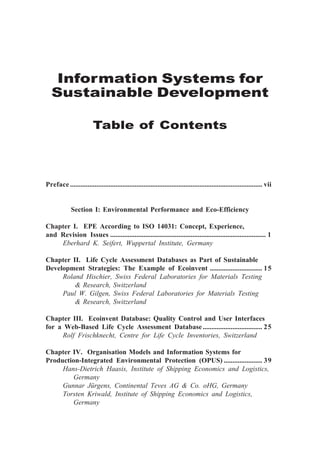
![10 Seifert
and private sectors, in some 160 countries. Concerning ISO 14000 certification,
about 49,462 have been recorded in 118 countries (a growth of 12,697 against
2001).
Before criticizing the first EPE standard then, considering such figures, we
should hope that the still relatively unknown ISO 14031 with its explicit
performance orientation would come into broader use.
With regard to the performance requirements of EMAS I and II, for instance, it
may be beneficial (especially for SMEs) to have a preliminary EPE phase
without any certification or cost pressures, so that an efficient and systematic
entry into an performance indicator based environmental management system
might be had (as shown above in the German EPE project findings).
Furthermore, weaknesses in the standard itself that become apparent in practical
applications have to be identified and documented for a future revision; at least
two weaknesses of the standard are already known to SC4: the “assessment
gap” and the insufficient guidance on reporting and communication.
Anyone reading the mere 10 lines regarding “assessing information” (section
3.3.4, p. 20) would hardly guess that long debates were held in SC4 on this topic,
and even initiatives taken on the part of the Swedish delegation considering
setting up a separate work project on this topic. They were not pursued any
further due to tough resistance from a few delegations, and were ultimately
abandoned for ISO 14031 due to resistance from a few; however there are
starting points for the above mentioned testing in the collection of practical
examples in TR 14032 and elsewhere. One must concede, however, that it was
not possible to close the evident assessment gap in the final document version,
thus leaving an urgent item requiring decisions for future reviews. Perhaps
impulses would help us along further here, which have been presented in the
German debate by Stahlmann and Clausen (2000), as one of the two main points
of their treatment (although it was based on an earlier draft) of ISO 14031: “The
examples of management performance indicators cited are very quantification
oriented and drop off sharply from the status of evaluation provided by complex
environmental management systems; the product indicators used focus a lot on
material products, like those that are used in the legislation on recycling; they fail,
though, for instance, for the most part when used on groceries. … Established
methods of evaluating the quality of management systems such as those
preferred in EFQM (a process explained in the Stahlmann and Clausen book, the
Author) take a completely different approach” [288]). However well justified
complaints about the inappropriate quantification of qualities may be, the
consequences that both authors draw do not appear to apply to the standard at
all, when they summarize: “the same pattern can be found throughout. … things
are quantified everywhere and added up, the significance of which can differ](https://image.slidesharecdn.com/539535-250701112346-8c0cc1be/85/Information-Systems-For-Sustainable-Development-Lorenz-M-Hilty-32-320.jpg)