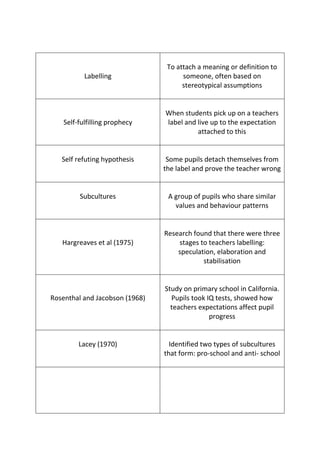
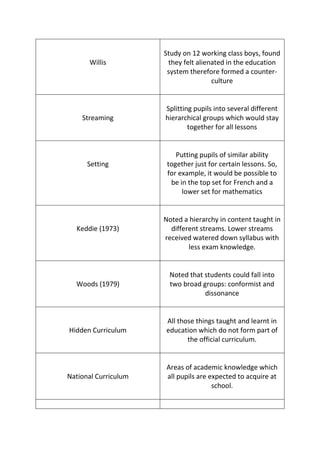
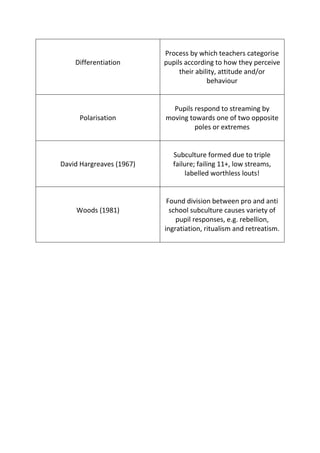
LabellingTo attach a meaning or definition to someone, often based on stereotypical assumptionsSelf-fulfilling prophecyWhen students pick up on a teachers label and live up to the expectation attached to thisSelf refuting hypothesisSome pupils detach themselves from the label and prove the teacher wrongSubculturesA group of pupils who share similar values and behaviour patternsHargreaves et al (1975)Research found that there were three stages to teachers labelling: speculation, elaboration and stabilisationRosenthal and Jacobson (1968)Study on primary school in California. Pupils took IQ tests, showed how teachers expectations affect pupil progressLacey (1970)Identified two types of subcultures that form: pro-school and anti- schoolWillisStudy on 12 working class boys, found they felt alienated in the education system therefore formed a counter-cultureStreamingSplitting pupils into several different hierarchical groups which would stay together for all lessonsSettingPutting pupils of similar ability together just for certain lessons. So, for example, it would be possible to be in the top set for French and a lower set for mathematicsKeddie (1973)Noted a hierarchy in content taught in different streams. Lower streams received watered down syllabus with less exam knowledge.Woods (1979)Noted that students could fall into two broad groups: conformist and dissonanceHidden CurriculumAll those things taught and learnt in education which do not form part of the official curriculum.National CurriculumAreas of academic knowledge which all pupils are expected to acquire at school.DifferentiationProcess by which teachers categorise pupils according to how they perceive their ability, attitude and/or behaviourPolarisationPupils respond to streaming by moving towards one of two opposite poles or extremesDavid Hargreaves (1967)Subculture formed due to triple failure; failing 11+, low streams, labelled worthless louts!Woods (1981)Found division between pro and anti school subculture causes variety of pupil responses, e.g. rebellion, ingratiation, ritualism and retreatism.<br />
SociologyExchange.co.uk Shared Resource

SociologyExchange.co.uk Shared Resource

  • 1.
    LabellingTo attach ameaning or definition to someone, often based on stereotypical assumptionsSelf-fulfilling prophecyWhen students pick up on a teachers label and live up to the expectation attached to thisSelf refuting hypothesisSome pupils detach themselves from the label and prove the teacher wrongSubculturesA group of pupils who share similar values and behaviour patternsHargreaves et al (1975)Research found that there were three stages to teachers labelling: speculation, elaboration and stabilisationRosenthal and Jacobson (1968)Study on primary school in California. Pupils took IQ tests, showed how teachers expectations affect pupil progressLacey (1970)Identified two types of subcultures that form: pro-school and anti- schoolWillisStudy on 12 working class boys, found they felt alienated in the education system therefore formed a counter-cultureStreamingSplitting pupils into several different hierarchical groups which would stay together for all lessonsSettingPutting pupils of similar ability together just for certain lessons. So, for example, it would be possible to be in the top set for French and a lower set for mathematicsKeddie (1973)Noted a hierarchy in content taught in different streams. Lower streams received watered down syllabus with less exam knowledge.Woods (1979)Noted that students could fall into two broad groups: conformist and dissonanceHidden CurriculumAll those things taught and learnt in education which do not form part of the official curriculum.National CurriculumAreas of academic knowledge which all pupils are expected to acquire at school.DifferentiationProcess by which teachers categorise pupils according to how they perceive their ability, attitude and/or behaviourPolarisationPupils respond to streaming by moving towards one of two opposite poles or extremesDavid Hargreaves (1967)Subculture formed due to triple failure; failing 11+, low streams, labelled worthless louts!Woods (1981)Found division between pro and anti school subculture causes variety of pupil responses, e.g. rebellion, ingratiation, ritualism and retreatism.<br />