Year 12 SOCIOLOGY SCHEME OF WORK
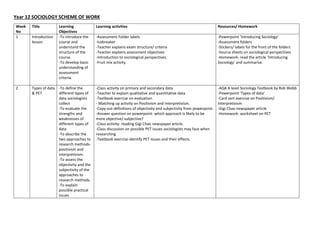
Week
No
Title Learning
Objectives
Learning activities Resources/ Homework
1 Introduction
lesson
-To introduce the
course and
understand the
structure of the
course.
-To develop basic
understanding of
assessment
criteria.
-Assessment Folder labels
-Icebreaker
-Teacher explains exam structure/ criteria
-Teacher explains assessment objectives
-Introduction to sociological perspectives.
-Fruit mix activity
-Powerpoint ‘Introducing Sociology’
-Assessment folders
-Stickers/ labels for the front of the folders
-Source sheets on sociological perspectives
-Homework- read the article ‘Introducing
Sociology’ and summarise.
2 Types of data
& PET
-To define the
different types of
data sociologists
collect
-To evaluate the
strengths and
weaknesses of
different types of
data
-To describe the
two approaches to
research methods-
positivism and
interpretivism.
-To assess the
objectivity and the
subjectivity of the
approaches to
research methods.
-To explain
possible practical
issues
-Class activity on primary and secondary data
-Teacher to explain qualitative and quantitative data
-Textbook exercise on evaluation
- Matching up activity on Positivism and Interpretivism.
-Copy out definitions of objectivity and subjectivity from powerpoint.
-Answer question on powerpoint- which approach is likely to be
more objective/ subjective?
-Class activity- reading Gigi Chao newspaper article.
-Class discussion on possible PET issues sociologists may face when
researching
-Textbook exercise-identify PET issues and their effects.
-AQA A level Sociology Textbook by Rob Webb
-Powerpoint ‘Types of data’
-Card sort exercise on Positivism/
Interpretivism
-Gigi Chao newspaper article
-Homework- worksheet on PET
-To explain
possible ethical
issues
-To explain
possible
theoretical issues
3 Observations -To outline the
stages involved in
participant
observation
-To evaluate the
strengths and
limitations of PO.
-To outline and
evaluate 3 other
types of
observations.
-Teacher explains Mark Kennedy story
-Watch youtube video on Mark Kennedy
-Textbook exercise- description of the three stages of participant
observation + evaluation.
-Teacher introduces definitions for other types of observations
-Evaluation of other types of observations.
-Essay question on observations
-AQA A level Sociology textbook by Rob Webb
-Powerpoint ‘Observations’
-Newspaper article on Mark Kennedy
-Video on Mark Kennedy
-Sourcesheet on structured observations.
4 Self- report
methods
-To explain 4 types
of self- report
methods
-To evaluate self-
report methods
-Class discussion- differences between observations and self- report
methods.
-Discuss Richard LaPiere’s study
-Discussion of advantages and disadvantages of questionnaires. Take
notes from textbook.
-Worksheet on interviews.
-Exam application- 20 mark essay question.
-AQA A level Sociology textbook by Rob Webb
-Powerpoint ‘Self report’
-Interviews worksheet
-Homework- 20 marker essay question on self-
report methods.
5 Exam skills -To identify and
explain the
differences
between the 3
assessment
objectives
-To apply
knowledge of
assessment
objectives to an
exam question
-Students note down definitions of assessment objectives from
PowerPoint
-Card sort activity
-Identifying assessment objectives in 20-mark essay question
-Answer exam question- highlight in answer AO1 part, AO2 part and
AO3 part.
-PowerPoint ‘Exam skills’
6 & 7 Experiments -To identify 3 types
of experiments
-Teacher explains different types of experiments
-Matching up exercise
-AQA A level Sociology textbook by Rob Webb
-Sociology textbook by Ken Browne
-To evaluate the
strengths and
limitations of
experimental
methods
-To identify and
evaluate 5
sampling
techniques
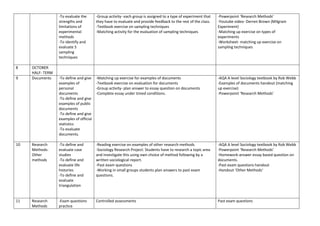
-Group activity- each group is assigned to a type of experiment that
they have to evaluate and provide feedback to the rest of the class.
-Textbook exercise on sampling techniques
-Matching activity for the evaluation of sampling techniques
-Powerpoint ‘Research Methods’
-Youtube video- Derren Brown (Milgram
Experiment)
-Matching up exercise on types of
experiments
-Worksheet- matching up exercise on
sampling techniques
8 OCTOBER
HALF- TERM
9 Documents -To define and give
examples of
personal
documents
-To define and give
examples of public
documents
-To define and give
examples of official
statistics
-To evaluate
documents.
-Matching up exercise for examples of documents
-Textbook exercise on evaluation for documents
-Group activity- plan answer to essay question on documents
-Complete essay under timed conditions.
-AQA A level Sociology textbook by Rob Webb
-Examples of documents handout (matching
up exercise)
-Powerpoint ‘Research Methods’
10 Research
Methods:
Other
methods
-To define and
evaluate case
studies
-To define and
evaluate life
histories
-To define and
evaluate
triangulation
-Reading exercise on examples of other research methods
-Sociology Research Project: Students have to research a topic area
and investigate this using own choice of method following by a
written sociological report.
-Past exam questions
-Working in small groups students plan answers to past exam
questions.
-AQA A level Sociology textbook by Rob Webb
-Powerpoint ‘Research Methods’
-Homework-answer essay based question on
documents.
-Past exam questions handout
-Handout ‘Other Methods’
11 Research
Methods
-Exam questions
practice
Controlled assessments Past exam questions
12 Education-
Educational
Policies
-To outline 3 types
of schools
introduced by the
tripartite system
-To evaluate the
tripartite system
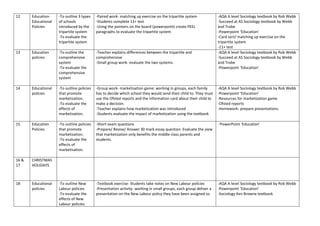
-Paired work- matching up exercise on the tripartite system
-Students complete 11+ test
-Using the pointers on the board (powerpoint) create PEEL
paragraphs to evaluate the tripartite system
-AQA A level Sociology textbook by Rob Webb
-Succeed at AS Sociology textbook by Webb
and Trobe
-Powerpoint ‘Education’
-Card sort/ matching up exercise on the
tripartite system
-11+ test
13 Education
policies
-To outline the
comprehensive
system
-To evaluate the
comprehensive
system
-Teacher explains differences between the tripartite and
comprehensive
-Small group work- evaluate the two systems.
-AQA A level Sociology textbook by Rob Webb
-Succeed at AS Sociology textbook by Webb
and Trobe
-Powerpoint ‘Education’
14 Educational
policies
-To outline policies
that promote
marketization.
-To evaluate the
effects of
marketisation.
-Group work- marketisation game: working in groups, each family
has to decide which school they would send their child to. They must
use the Ofsted reports and the information card about their child to
make a decision.
-Teacher explains how marketization was introduced
-Students evaluate the impact of marketization using the textbook
-AQA A level Sociology textbook by Rob Webb
-Powerpoint ‘Education’
-Resources for marketization game.
-Ofsted reports
-Homework- prepare presentations.
15 Education
Policies
-To outline policies
that promote
marketization.
-To evaluate the
effects of
marketisation.
-Short exam questions
-Prepare/ Revise/ Answer 30 mark essay question: Evaluate the view
that marketization only benefits the middle class parents and
students.
-‘PowerPoint ‘Education’
16 &
17
CHRISTMAS
HOLIDAYS
18 Educational
policies
-To outline New
Labour policies
-To evaluate the
effects of New
Labour policies.
-Textbook exercise- Students take notes on New Labour policies
-Presentation activity- working in small groups, each group deliver a
presentation on the New Labour policy they have been assigned to.
-AQA A level Sociology textbook by Rob Webb
-Powerpoint ‘Education’
-Sociology Ken Browne textbook
19 Educational
policies
-To outline
Coalition
government
policies
-To evaluate the
effects of Coalition
government
policies.
-Textbook exercise- Students take notes on the coalition government
policies
-Debate- For or against privatisation of education?
-AQA A level Sociology textbook by Rob Webb
-Powerpoint ‘Education’
-Sociology Ken Browne textbook
20 Role of
education
-To outline three
views of the
Functionalist
perspective.
-To evaluate the
Functionalist view.
-To outline the
differences and
similarities
between
Functionalism and
New Right.
-Teacher explains main concepts of Functionalism.
-Textbook exercise- whole class reading New Right view.
-Evaluation exercise outlined on Powerpoint.
-AQA A level Sociology textbook by Rob Webb
-Powerpoint ‘Education’
21 Role of
education
-To outline
Althusser’s view on
education
-To outline Bowles
and Gintis’ view.
-To evaluate the
Marxist view on
the role of
education.
-Paired work- card sort exercise.
-Teacher explains differences between Marxism and other
approaches.
-Textbook exercise- evaluation.
-AQA A level Sociology textbook by Rob Webb
-Powerpoint ‘Education’
-Fantastic Mr Fox short video
-Homework- essay question on Marxism.
22 Social class
differences
-To explain and
evaluate internal
explanations for
social class
differences in
education:
labelling,
-Paired work- match the examples in the card sort to internal or
external factors
-Powerpoint- whole class discussion and annotation of notes
generated in discussion
-Exam application questions
-AQA A level Sociology textbook by Rob Webb
-Powerpoint ‘Education’
-Card sort- Internal and External factors
streaming & class
identities
23 Social class
differences
-To explain and
evaluate internal
explanations for
social class
differences in
education:
labelling,
streaming & class
identities
-Powerpoint- whole class discussion and annotation of notes
generated in discussion
-Exam application questions
-AQA A level Sociology textbook by Rob Webb
-Powerpoint ‘Education’
24 FEBRUARY
HALF- TERM
25 Social class
differences
-To apply
knowledge of
social class
differences to
research methods
-Re-cap on the use of PERVERT for research method questions.
-Paired work- plan answer to exam question
-Complete exam question under timed conditions.
-AQA A level Sociology textbook by Rob Webb
-Exam application handout
-20 mark sample answer handout
26 Ethnic
Differences
-To explain and
evaluate internal
explanations for
ethnic differences:
labelling, pupil
responses &
critical race theory.
-Textbook exercise- internal explanations.
-Class activity- evaluation of internal explanations.
-AQA A level Sociology textbook by Rob Webb
-Powerpoint ‘Education’
-Homework- short exam questions on ethnic
differences
27 Ethnic
Differences
-To explain and
evaluate external
explanations for
ethnic differences:
cultural
deprivation &
material
deprivation.
-Class discussion- what external explanations can be provided for
ethnic differences?
-Textbook exercise
-Exam question
-AQA A level Sociology textbook by Rob Webb
-Powerpoint ‘Education’.
28 Ethnic
differences
-To apply
knowledge of
ethnic differences
to research
methods.
-Re-cap on the use of PERVERT for research method questions.
-Paired work- plan answer to exam question
-Complete exam question under timed conditions.
-AQA A level Sociology textbook by Rob Webb
-Exam application handout
-Homework- answer essay question on ethnic
differences
29 Gender
Differences
-To outline and
evaluate 3 internal
explanations for
gender differences:
role of coursework,
equal
opportunities
policies & role
models.
-Class discussion- why do girls achieve higher than boys?
-Teacher explanation through powerpoint presentation.
-Textbook exercise
-Complete exam question
-AQA A level Sociology textbook by Rob Webb
-Powerpoint ‘Education’
-Homework- essay question on gender
differences
30 Gender
Differences
-To explain and
evaluate three
external
explanations: early
socialisation,
impact of feminism
and boys’ literacy.
-Teacher explains differences between external and internal
explanations.
-Whole class reading exercise.
-Small group work- evaluate external explanations
-AQA A level Sociology textbook by Rob Webb
-Powerpoint ‘Education’
-Homework- essay question on gender
differences
31 &
32
EASTER
HOLIDAYS
33 Families and
Households:
Changing
family
patterns
-To understand the
changes in
patterns for family
life since 1800
-To explain and
evaluate the
reasons for why
there is an increase
in divorce
-To explain and
evaluate the
reasons for why
-Students complete the ‘Ideal Partner’ Worksheet to rate the
qualities/ characteristics they would like in an ideal partner
-Whole class discussion- why is there a decrease in marriage and an
increase in divorce?
-Note taking from textbook
-Whole class mindmap to summarise findings
- ‘My Ideal Marriage Partner’ Worksheet
-Powerpoint ‘Families and Households’
there is a decrease
in marriage
34 Theories of
the family
-To explain and
evaluate the
following views on
the family:
• Functionali
sm
• Marxism
• New Right
• Feminism
• Individuati
on thesis
• Personal
Life
perspectiv
e
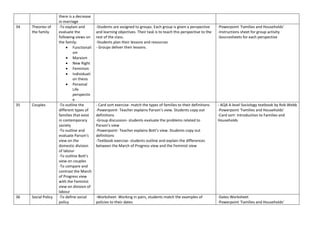
-Students are assigned to groups. Each group is given a perspective
and learning objectives. Their task is to teach this perspective to the
rest of the class.
-Students plan their lessons and resources
- Groups deliver their lessons.
-Powerpoint ‘Families and Households’
-Instructions sheet for group activity
-Sourcesheets for each perspective
35 Couples -To outline the
different types of
families that exist
in contemporary
society
-To outline and
evaluate Parson’s
view on the
domestic division
of labour
-To outline Bott’s
view on couples
-To compare and
contrast the March
of Progress view
with the Feminist
view on division of
labour
- Card sort exercise- match the types of families to their definitions
-Powerpoint- Teacher explains Parson’s view. Students copy out
definitions
-Group discussion- students evaluate the problems related to
Parson’s view
-Powerpoint- Teacher explains Bott’s view. Students copy out
definitions
-Textbook exercise- students outline and explain the differences
between the March of Progress view and the Feminist view
- AQA A level Sociology textbook by Rob Webb
-Powerpoint ‘Families and Households’
-Card sort- Introduction to Families and
Households
36 Social Policy -To define social
policy
-Worksheet- Working in pairs, students match the examples of
policies to their dates
-Dates Worksheet
-Powerpoint ‘Families and Households’
-To outline
examples of
policies introduced
by the New Labour
government and
the Coalition
government
-To explain and
evaluate
perspectives on
social policy
-Students discuss the impact of social policies on family life- whole
class discussion
-Note taking and summarising- students are presented with the
different perspectives and their views on social policy. The source of
information is then removed and students are then asked to
summarise what they understood
37 Childhood -To explain the
modern view of
childhood
-To explain the
historical view of
childhood
-To explain what is
meant by a toxic
childhood?
-When was your favourite toy when you were a child?
-Note taking from the textbook on the modern view and the
historical view of childhood
-Class discussion of the validity of the ‘toxic childhood’ view
-Read through the fat boy article- what does this suggest about
children in modern times?
-Powerpoint ‘ Families and Households’
-Fat Boy Article
38 MAY HALF-
TERM
39 Demography -To know the main
population trends
in the UK since
1900.
-Textbook exercise- why is there a decrease in birth rates
-Jelly Bean Game-Each student becomes a country. Working in
groups, each person takes a card from the shuffle box and have to
re-organise their population size depending on the instructions
written on the card. Following this, they have to complete worksheet
to explain the factors that affected their country’s birth rate, death
rate and migration rates.
-Powerpoint- students take notes on the effects of the ageing
population
- AQA A level Sociology textbook by Rob Webb
-Powerpoint ‘Families and Households’
-Sample answer to death rate essay question
-Jelly beans
-Jeans Beans Game instructions sheet
40 PRE-PUBLIC
EXAMINATIO
NS
41 Sociological
Theory:
-To explain and
evaluate Durkheim
-Teacher explains main Functionalist views.
-Booklet exercise
-Booklet- ‘Sociological Theory’
-Powerpoint ‘Sociological Theory’
Functionalis
m
and Parson’s view
on society.
-Homework- synoptic link exercise-
Functionalist view on the family and
education.
42 Sociological
Theory:
Marxism
-To explain and
evaluate three
Marxist views on
society.
-Booklet exercise
-Paired work- what are the implications of the Charlie Hebdo attacks
for the Marxist theory? Watch video and use sourcesheets.
-Powerpoint ‘Sociological Theory’
-Booklet- ‘Sociological Theory’
-Charlie Hebdo protests video
-Sourcesheets about Charlie Hebdo attacks
43 Sociological
Theory:
Feminism
To outline and
evaluate Feminist
views on society:
• Liberal
feminists
• Radical
feminists
• Marxist
feminists
• Dual
systems
feminism
• Black
feminism
• Post-
structuralis
t
-Booklet exercise -Booklet- ‘Sociological Theory’
-Powerpoint ‘Sociological Theory’
-Homework- answer essay question.
44 Action
Theories
-To outline the
social action
theory.
-To outline
symbolic
interactionism.
-To evaluate action
theories.
-Teacher explains the difference between action theories and
structuralist theories.
-Booklet exercise
-Booklet- ‘Sociological Theory’
-Powerpoint ‘Sociological Theory’
45 Students on
work
experience
SUMMER
HOLIDAYS
Year 13 SOCIOLOGY SCHEME OF WORK
Week
No
Title Lesson
Objectives
Lesson Activities Resources/ Homework
1 Introduction
to the course
-To
differentiate
between
crime &
deviance.
-To
understand
the exam
structure.
-To explain
Sheldon’s
theory and
Lombroso’s
theory.
-Snapshot mindmap activity to recap on topics from year 12.
-Discuss the difference between crime and deviance and discuss
questions on powerpoint
-Assessment Folder labels
-Teacher talks through the exam structure
-Teacher hands out checklist for crime and deviance
-Re-cap on the differences between the assessment objectives
-Introduction to crime and deviance- definitions of crime &
deviance- card sort activity (distinguish between murder &
manslaughter).
-Teacher explains Sheldon’s theory of crime and Lombroso’s theory
of crime
-Recap sociological perspectives
-‘First lesson into A2’ Powerpoint
-Course Checklist
-Crime and Deviance Powerpoint.
-Assessment folders
-Card sort/ matching up exercise for examples of
crime & deviance.
2 Theories of
crime:
Functionalis
m
-To outline
and evaluate
Durkheim’s
view on crime
and deviance.
-To outline
and evaluate
Merton’s view
on crime and
deviance.
-Read through handout for Durkheim.
-Complete evaluation sheet for Durkheim by re-arranging the
order of PEELs given.
-Read through handout for Merton
-Matching activity- match the picture to the correct category
(adaptation of strain)
-Complete evaluation for Merton- work in groups and rearrange
the order of each given PEEL.
-Reading handout Durkheim
-Crime and Deviance Powerpoint
-Evaluation sheets for Durkheim
-Evaluation cards for Merton
- Matching activity for Merton’s theory (adaptation
of strain)
-Homework- create a glossary sheet for
Functionalism.
3 Subcultural
theories
-To outline
and evaluate
subcultural
theories of
crime and
deviance.
-To explain the
similarities
and
-Read through handout for subcultural theories and summarise
understanding bullet points
-Evaluation of subcultural theories- group exercise.
-Exam application: Plan and answer 30-mark essay question on
subcultural theories: Assess the usefulness of subcultural theories
in explaining crime and deviance (30 marks)
-Crime & Deviance Powerpoint.
-Reading handout-Subcultural Theories
-Homework- essay question on functionalism and
subcultural theories.
differences
between
functionalism
and
subcultural
theories.
4 Labelling
theory
-To outline
and evaluate
the labelling
theory
-Group activity- using the sourcesheets explain the views held by
interactionists.
-Discussion of the implications of Jock Young’s study
-Individual work- start evaluation for the labelling theory.
-Complete evaluation for the labelling theory.
-Documentary on the mods and rockers.
-Exam application
-Sourcesheets for the labelling theory.
-Crime and Deviance Powerpoint.
-Evaluation handouts
5 Traditional
Marxism &
Neo Marxism
-To outline
Althusser’s
view on crime
and deviance.
-To explain the
processes
involved in law
making and in
the
enforcement
of law.
-To outline
Taylor et al’s
fully social
theory of
deviance
-To evaluate
the Marxist
approach to
crime and
deviance.
-Reading activity on law making and selective enforcement of law.
-Paired work-study sourcesheets on the Guiness affair
-Watch Ethan Couch video and discuss its relation to law making
and selective enforcement of law.
-Paired work- complete matching up exercise for the fully social
theory of deviance.
-Evaluation activity
-Paired work- worksheet- are Marxist ideas still relevant today?
-Card sort to differentiate between Marxism and
Neo-Marxism
-Guinness Affair activity/ handout
-Ethan Couch video
-Powerpoint ‘Crime and Deviance’
-Card sort for the fully social theory of deviance
-Worksheet- ‘Are Marxist ideas still relevant today?’
-Evaluation handout
6 Marxism -To explain the
differences
between
traditional and
neo Marxism
in the context
of 6 mark
exam
questions
-To evaluate
the usefulness
of Marxism in
explaining
crime and
deviance
-Students complete short answer exam questions
-Peer assessment and Self assessment
-30 mark essay question and answer presented for students to
mark using the markscheme
-Students write out their own answer to 30 mark question
-Crime and Deviance Powerpoint
-Sample answer to 30 mark question
-Peer/Self-assessment stickers
7 Right Realism
&
Left Realism
-To outline
and evaluate
right realist
explanations
for crime.
-To outline
and evaluate
left realist
explanation
for crime.
-Outline three causes of crime as outlined by Right Realism using
sourcesheets. Peer teaching.
-Evaluation activity
-Outline three causes of crime as outlined by Left Realism using
sourcesheets.
-Evaluation activity.
-Sourcesheets for Right Realist explanations of crime
-Evaluation handout for right realism
-Sourcesheets for the description of left realism
-Evaluation handout for left realism.
-Homework- differences between Left Realism and
Right Realism
8 OCTOBE
R
HALF-
TERM
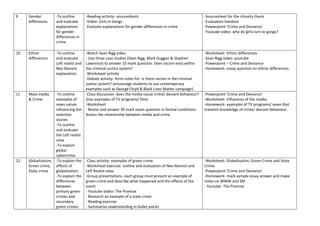
9 Gender
differences
-To outline
and evaluate
explanations
for gender
differences in
crime.
-Reading activity- sourcesheets
-Video: Girls in Gangs
-Evaluate explanations for gender differences in crime
-Sourcesheet for the chivalry thesis
-Evaluation handout
-Powerpoint-‘Crime and Deviance’
-Youtube video- why do girls turn to gangs?
10 Ethnic
differences
-To outline
and evaluate
Left realist and
Neo Marxist
explanation.
-Watch Sean Rigg video
- Use three case studies (Sean Rigg, Mark Duggan & Stephen
Lawrence) to answer 10 mark question: Does racism exist within
the criminal justice system?
-Worksheet activity
-Debate activity- form notes for: Is there racism in the criminal
justice system? (encourage students to use contemporary
examples such as George Floyd & Black Lives Matter campaign)
-Worksheet- Ethnic differences
-Sean Rigg video- youtube
-Powerpoint – Crime and Deviance
-Homework- essay question on ethnic differences.
11 Mass media
& Crime
-To outline
examples of
news values
influencing the
selection
stories
-To outline
and evaluate
the Left realist
view
-To explain
global
cybercrime.
-Class discussion- does the media cause crime/ deviant behaviour?
Give examples of TV programs/ films
-Worksheet
- Revise and answer 30 mark exam question in formal conditions:
Assess the relationship between media and crime
-Powerpoint ‘Crime and Deviance’
-Worksheet- Influences of the media.
-Homework- examples of TV programs/ news that
transmit knowledge of crime/ deviant behaviour.
12 Globalisation,
Green crime,
State crime.
-To explain the
effects of
globalisation.
-To explain the
differences
between
primary green
crimes and
secondary
green crimes
-Class activity- examples of green crime.
-Worksheet exercise- outline and evaluation of Neo Marxist and
Left Realist view.
-Group presentations- each group must present an example of
green crime and describe what happened and the effects of the
event
- Youtube Video- The Promise
- Research an example of a state crime
- Reading exercise
- Summarise understanding in bullet points
-Worksheet- Globalisation, Green Crime and State
Crime.
-Powerpoint ‘Crime and Deviance’
-Homework- mark sample essay answer and make
notes on WWW and EBI.
- Youtube- The Promise
-To explain the
different types
of state crime
- Exam application
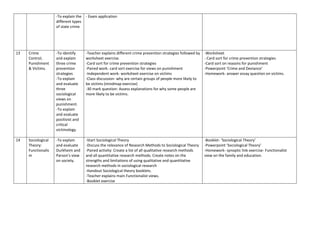
13 Crime
Control,
Punishment
& Victims.
-To identify
and explain
three crime
prevention
strategies
-To explain
and evaluate
three
sociological
views on
punishment.
-To explain
and evaluate
positivist and
critical
victimology.
-Teacher explains different crime prevention strategies followed by
worksheet exercise.
-Card sort for crime prevention strategies
-Paired work- card sort exercise for views on punishment
-Independent work- worksheet exercise on victims
-Class discussion- why are certain groups of people more likely to
be victims (mindmap exercise)
-30 mark question: Assess explanations for why some people are
more likely to be victims.
-Worksheet
- Card sort for crime prevention strategies
-Card sort on reasons for punishment
-Powerpoint ‘Crime and Deviance’
-Homework- answer essay question on victims.
14 Sociological
Theory:
Functionalis
m
-To explain
and evaluate
Durkheim and
Parson’s view
on society.
-Start Sociological Theory
-Discuss the relevance of Research Methods to Sociological Theory
-Paired activity: Create a list of all qualitative research methods
and all quantitative research methods. Create notes on the
strengths and limitations of using qualitative and quantitative
research methods in sociological research
-Handout Sociological theory booklets.
-Teacher explains main Functionalist views.
-Booklet exercise
-Booklet- ‘Sociological Theory’
-Powerpoint ‘Sociological Theory’
-Homework- synoptic link exercise- Functionalist
view on the family and education.
15 Sociological
Theory:
Marxism
-To explain
and evaluate
three Marxist
views on
society.
-Booklet exercise
-Paired work- what are the implications of the Charlie Hebdo
attacks for the Marxist theory? Watch video and use sourcesheets.
-Powerpoint ‘Sociological Theory’
-Booklet- ‘Sociological Theory’
-Charlie Hebdo protests video
-Sourcesheets about Charlie Hebdo attacks
16 &
17
XMAS
HOLIDAY
S
18 Sociological
Theory:
Feminism
Action
Theories
-To outline
and evaluate
Feminist views
on society:
• Liberal
femini
sts
• Radica
l
femini
sts
• Marxis
t
femini
sts
• Dual
syste
ms
femini
sm
• Black
femini
sm
-Booklet exercise
- Youtube video: Paula Williams
-Teacher explains the differences between structural theories and
action theories
- Assess the contribution of feminist theories to our understanding
of contemporary society (20 marks)
-Booklet- ‘Sociological Theory’
-Powerpoint ‘Sociological Theory’
-Homework- answer essay question.
• Post-
struct
uralist
-To outline the
social action
theory.
-To outline
symbolic
interactionism
.
-To evaluate
action
theories.
19 Globalisation,
Modernity,
Postmodernit
y
-To describe
the
characteristics
of modern
society
-To explain the
causes of
globalisation
-To discuss the
characteristics
of
postmodernity
-Class discussion- what are the effects of globalisation?
-Booklet activity
-Watch Youtube video on postmodernism and describe the effects.
- Assess the evolution from modernity to postmodernity (20
marks)
-Booklet- ‘Sociological Theory’
-Powerpoint ‘Sociological Theory’
-Youtube video on postmodernity
-Handout on Baudrillard- ‘Who killed Lucy Beale?’
-Homework- essay question on postmodernity.
20 Objectivity
and Values in
Sociology
-To outline
views for
critiques of
value freedom
-To outline
views for
supporters of
value freedom
-Powerpoint exercise- students rank set of celebrities and then
decide how objective they were being in their judgements.
-Students use their booklets to prepare notes for debate- Is
Sociological research value free?
-Booklet- ‘Sociological Theory’
-Powerpoint ‘Sociological Theory’
21 Sociology
and Science.
-To explain
why Sociology
-Students use their booklets to prepare notes for debate- is
Sociology a science?
-Booklet- ‘Sociological Theory’
-Powerpoint ‘Sociological Theory’
Sociology
and Social
Policy
is considered a
science
-To explain
why Sociology
is considered a
science.
-To discuss
sociological
views on social
policy:
-Booklet exercise
-Homework- answer essay question using notes
from the debate.
22 Media • Know
what
topics you
will be
studying
• Understan
d how you
will be
assessed
• To
understan
d features
of changes
in media
ownership
• Start final A2 topic- Media
• Worksheet activity- TV channels
• Students research Rupert Murdock and complete a factsheet
• Teacher explains the different patterns and trends in
concentration of media ownership (horizontal integration,
vertical integration, diversification, synergy). Students make
notes.
• Teacher explains – teacher outlines Doyles view of
concentration of ownership of the media → class discussion
• Exam application- Explain two recent trends in media
ownership (10)
-Powerpoint ‘Media’
-Worksheet ‘TV channels’
23 The Pluralist
theory.
The Marxist
theory
• To outline
the
pluralist
theory of
media
ownership
and
control
• To
evaluate
the
pluralist
• Class activity – students match keywords to definitions
• Teacher explains – teacher outlines the pluralist view → class
discussion
• Class activity – students conduct a content analysis to see if it
supports the Pluralist view
• Class activity – recall all the keywords/terms you can think of
for the Marxist theory
• Teacher explains – teacher outlines the Marxist Instrumentalist
theory
• Class activity – students decide whether statements are truths
or false consciousness → class discussion
-Powerpoint ‘Media’
-Pluralist theory handout
-Marxist theory handout
-Newspapers
critique of
the media
• To outline
the
Marxist
theory of
media
ownership
• To
evaluate
the
Marxist
theory of
media
ownership
• Class discussion – class discuss Miliband’s idea that media is
‘the opium of the people’
• Teachers explains – teacher outlines key terms
• Flipped Learning Activity – students watch clip on Silvio
Berlusconi and answer questions
24 FEBRUA
RY HALF-
TERM
25 The
Postmoderni
st Theory
• To
understan
d the
Postmoder
nist theory
of the
ownership
of Mass
Media
• Class activity – students sort statements according to the
theory they belong to → class discussion
• Teacher explains – teacher introduces the 3 characteristics of
postmodern society
• Class activity – students discuss these points and expand on
them
• Teacher explains – teacher outlines the characteristics and
students add to their notes
• Class activity – students write definitions to key terms in their
own words → class discussion
• Class discussion – students try and think of examples of how
individuals can impact on media content
• Class activity – students work in pairs to think of evaluation
points of the postmodern theory → class discussion
• Exam application: Outline and assess the vie that owners hold
power and control of the media (20 mark)
-Powerpoint ‘Media’
- Handout- The Postmodernist Theory
26 New Media,
Globalisation
& Popular
Culture
• To
consid
er the
link
betwe
en the
New
Media
,
Global
isation
and
Popula
r
Cultur
e
• Under
stand
the
differe
nt
interpr
etatio
ns of
the
role of
the
mass
media
in
globali
sation.
• Teacher explains – teacher outlines global village
• Reading exercise- differences between the neo-philiac view
and cultural pessimist view
• Class activity – students read McLuhan’s concept and
summarise in own words
• Teacher explains – teacher outlines consequences of
globalisation
• Class activity – students complete table giving examples →
class discussion
• Teacher explains - economic, political and cultural factors that
promote globalisation and students summarise
• Peer teaching – student work in small groups to create a lesson
on different types of globalisation
• Peer assessment – students teach lessons and check
understanding
-Powerpoint ‘Media’
-Handout -Globalisation and Popular Culture
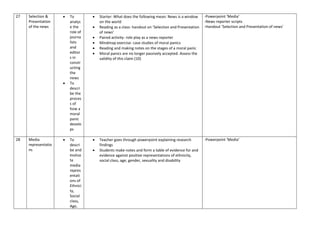
27 Selection &
Presentation
of the news
• To
analys
e the
role of
journa
lists
and
editor
s in
constr
ucting
the
news
• To
descri
be the
proces
s of
how a
moral
panic
develo
ps
• Starter: What does the following mean: News is a window
on the world
• Reading as a class- handout on ‘Selection and Presentation
of news’
• Paired activity- role play as a news reporter
• Mindmap exercise- case studies of moral panics
• Reading and making notes on the stages of a moral panic
• Moral panics are no longer passively accepted. Assess the
validity of this claim (10)
-Powerpoint ‘Media’
-News reporter scripts
-Handout ‘Selection and Presentation of news’
28 Media
representatio
ns
• To
descri
be and
evalua
te
media
repres
entati
ons of
Ethnici
ty,
Social
class,
Age,
• Teacher goes through powerpoint explaining research
findings
• Students make notes and form a table of evidence for and
evidence against positive representations of ethnicity,
social class, age, gender, sexuality and disability
-Powerpoint ‘Media’
Gende
r,
Sexual
ity &
Disabil
ity.
29 Media
audience
• To
disting
uish
betwe
en
passiv
e and
active
model
s of
audien
ces
• Follow handout- reading and completing evaluation notes
• Audiences are sophisticated in their understanding of the
news and are not passive in their acceptance of it. To what
extent does sociological arguments and research evidence
support this view (20 marks)
-Powerpoint ‘Media’
-Handout- Media Audiences
30 Revision -To revise
Media
-create revision notes on media using textbook
-20-mark exam question practice
-Past exam questions
31 &
32
EASTER
HOLIDAY
S
33 Revision -To revise
functionalism,
subcultural
theories and
Marxism as
approaches to
crime and
deviance
-As a class identify 5 features of each approach: functionalism,
subcultural and Marxism
-Individually, identify 4 criticisms of each approach. Make a note in
bullet point form.
-Exam questions practice
-Past exam questions
-A3 revision handouts
34 Revision -To revise
Sociological
theory
-As a class complete A3 revision handout
-Exam questions practice
-Past exam questions
-A3 revision handouts
35 Revision -To revise
Media
-As a class complete A3 revision handout
-Exam questions practice
-Past exam questions
-A3 revision handouts
36 Revision -To revise
Education
-As a class complete A3 revision handout
-Exam questions practice
-Past exam questions
-A3 revision handouts
37 Revision -To revise
Research
methods
-As a class complete A3 revision handout
-Exam questions practice
-Past exam questions
-A3 revision handouts
38 Revision -To revise
Families &
Households
-As a class complete A3 revision handout
-Exam questions practice
-Past exam questions
-A3 revision handouts
38 MAY
HALF
TERM
End of
Course

Sociology KS5

  • 1.
    Year 12 SOCIOLOGYSCHEME OF WORK Week No Title Learning Objectives Learning activities Resources/ Homework 1 Introduction lesson -To introduce the course and understand the structure of the course. -To develop basic understanding of assessment criteria. -Assessment Folder labels -Icebreaker -Teacher explains exam structure/ criteria -Teacher explains assessment objectives -Introduction to sociological perspectives. -Fruit mix activity -Powerpoint ‘Introducing Sociology’ -Assessment folders -Stickers/ labels for the front of the folders -Source sheets on sociological perspectives -Homework- read the article ‘Introducing Sociology’ and summarise. 2 Types of data & PET -To define the different types of data sociologists collect -To evaluate the strengths and weaknesses of different types of data -To describe the two approaches to research methods- positivism and interpretivism. -To assess the objectivity and the subjectivity of the approaches to research methods. -To explain possible practical issues -Class activity on primary and secondary data -Teacher to explain qualitative and quantitative data -Textbook exercise on evaluation - Matching up activity on Positivism and Interpretivism. -Copy out definitions of objectivity and subjectivity from powerpoint. -Answer question on powerpoint- which approach is likely to be more objective/ subjective? -Class activity- reading Gigi Chao newspaper article. -Class discussion on possible PET issues sociologists may face when researching -Textbook exercise-identify PET issues and their effects. -AQA A level Sociology Textbook by Rob Webb -Powerpoint ‘Types of data’ -Card sort exercise on Positivism/ Interpretivism -Gigi Chao newspaper article -Homework- worksheet on PET
  • 2.
    -To explain possible ethical issues -Toexplain possible theoretical issues 3 Observations -To outline the stages involved in participant observation -To evaluate the strengths and limitations of PO. -To outline and evaluate 3 other types of observations. -Teacher explains Mark Kennedy story -Watch youtube video on Mark Kennedy -Textbook exercise- description of the three stages of participant observation + evaluation. -Teacher introduces definitions for other types of observations -Evaluation of other types of observations. -Essay question on observations -AQA A level Sociology textbook by Rob Webb -Powerpoint ‘Observations’ -Newspaper article on Mark Kennedy -Video on Mark Kennedy -Sourcesheet on structured observations. 4 Self- report methods -To explain 4 types of self- report methods -To evaluate self- report methods -Class discussion- differences between observations and self- report methods. -Discuss Richard LaPiere’s study -Discussion of advantages and disadvantages of questionnaires. Take notes from textbook. -Worksheet on interviews. -Exam application- 20 mark essay question. -AQA A level Sociology textbook by Rob Webb -Powerpoint ‘Self report’ -Interviews worksheet -Homework- 20 marker essay question on self- report methods. 5 Exam skills -To identify and explain the differences between the 3 assessment objectives -To apply knowledge of assessment objectives to an exam question -Students note down definitions of assessment objectives from PowerPoint -Card sort activity -Identifying assessment objectives in 20-mark essay question -Answer exam question- highlight in answer AO1 part, AO2 part and AO3 part. -PowerPoint ‘Exam skills’ 6 & 7 Experiments -To identify 3 types of experiments -Teacher explains different types of experiments -Matching up exercise -AQA A level Sociology textbook by Rob Webb -Sociology textbook by Ken Browne
  • 3.
    -To evaluate the strengthsand limitations of experimental methods -To identify and evaluate 5 sampling techniques -Group activity- each group is assigned to a type of experiment that they have to evaluate and provide feedback to the rest of the class. -Textbook exercise on sampling techniques -Matching activity for the evaluation of sampling techniques -Powerpoint ‘Research Methods’ -Youtube video- Derren Brown (Milgram Experiment) -Matching up exercise on types of experiments -Worksheet- matching up exercise on sampling techniques 8 OCTOBER HALF- TERM 9 Documents -To define and give examples of personal documents -To define and give examples of public documents -To define and give examples of official statistics -To evaluate documents. -Matching up exercise for examples of documents -Textbook exercise on evaluation for documents -Group activity- plan answer to essay question on documents -Complete essay under timed conditions. -AQA A level Sociology textbook by Rob Webb -Examples of documents handout (matching up exercise) -Powerpoint ‘Research Methods’ 10 Research Methods: Other methods -To define and evaluate case studies -To define and evaluate life histories -To define and evaluate triangulation -Reading exercise on examples of other research methods -Sociology Research Project: Students have to research a topic area and investigate this using own choice of method following by a written sociological report. -Past exam questions -Working in small groups students plan answers to past exam questions. -AQA A level Sociology textbook by Rob Webb -Powerpoint ‘Research Methods’ -Homework-answer essay based question on documents. -Past exam questions handout -Handout ‘Other Methods’ 11 Research Methods -Exam questions practice Controlled assessments Past exam questions
  • 4.
    12 Education- Educational Policies -To outline3 types of schools introduced by the tripartite system -To evaluate the tripartite system -Paired work- matching up exercise on the tripartite system -Students complete 11+ test -Using the pointers on the board (powerpoint) create PEEL paragraphs to evaluate the tripartite system -AQA A level Sociology textbook by Rob Webb -Succeed at AS Sociology textbook by Webb and Trobe -Powerpoint ‘Education’ -Card sort/ matching up exercise on the tripartite system -11+ test 13 Education policies -To outline the comprehensive system -To evaluate the comprehensive system -Teacher explains differences between the tripartite and comprehensive -Small group work- evaluate the two systems. -AQA A level Sociology textbook by Rob Webb -Succeed at AS Sociology textbook by Webb and Trobe -Powerpoint ‘Education’ 14 Educational policies -To outline policies that promote marketization. -To evaluate the effects of marketisation. -Group work- marketisation game: working in groups, each family has to decide which school they would send their child to. They must use the Ofsted reports and the information card about their child to make a decision. -Teacher explains how marketization was introduced -Students evaluate the impact of marketization using the textbook -AQA A level Sociology textbook by Rob Webb -Powerpoint ‘Education’ -Resources for marketization game. -Ofsted reports -Homework- prepare presentations. 15 Education Policies -To outline policies that promote marketization. -To evaluate the effects of marketisation. -Short exam questions -Prepare/ Revise/ Answer 30 mark essay question: Evaluate the view that marketization only benefits the middle class parents and students. -‘PowerPoint ‘Education’ 16 & 17 CHRISTMAS HOLIDAYS 18 Educational policies -To outline New Labour policies -To evaluate the effects of New Labour policies. -Textbook exercise- Students take notes on New Labour policies -Presentation activity- working in small groups, each group deliver a presentation on the New Labour policy they have been assigned to. -AQA A level Sociology textbook by Rob Webb -Powerpoint ‘Education’ -Sociology Ken Browne textbook
  • 5.
    19 Educational policies -To outline Coalition government policies -Toevaluate the effects of Coalition government policies. -Textbook exercise- Students take notes on the coalition government policies -Debate- For or against privatisation of education? -AQA A level Sociology textbook by Rob Webb -Powerpoint ‘Education’ -Sociology Ken Browne textbook 20 Role of education -To outline three views of the Functionalist perspective. -To evaluate the Functionalist view. -To outline the differences and similarities between Functionalism and New Right. -Teacher explains main concepts of Functionalism. -Textbook exercise- whole class reading New Right view. -Evaluation exercise outlined on Powerpoint. -AQA A level Sociology textbook by Rob Webb -Powerpoint ‘Education’ 21 Role of education -To outline Althusser’s view on education -To outline Bowles and Gintis’ view. -To evaluate the Marxist view on the role of education. -Paired work- card sort exercise. -Teacher explains differences between Marxism and other approaches. -Textbook exercise- evaluation. -AQA A level Sociology textbook by Rob Webb -Powerpoint ‘Education’ -Fantastic Mr Fox short video -Homework- essay question on Marxism. 22 Social class differences -To explain and evaluate internal explanations for social class differences in education: labelling, -Paired work- match the examples in the card sort to internal or external factors -Powerpoint- whole class discussion and annotation of notes generated in discussion -Exam application questions -AQA A level Sociology textbook by Rob Webb -Powerpoint ‘Education’ -Card sort- Internal and External factors
  • 6.
    streaming & class identities 23Social class differences -To explain and evaluate internal explanations for social class differences in education: labelling, streaming & class identities -Powerpoint- whole class discussion and annotation of notes generated in discussion -Exam application questions -AQA A level Sociology textbook by Rob Webb -Powerpoint ‘Education’ 24 FEBRUARY HALF- TERM 25 Social class differences -To apply knowledge of social class differences to research methods -Re-cap on the use of PERVERT for research method questions. -Paired work- plan answer to exam question -Complete exam question under timed conditions. -AQA A level Sociology textbook by Rob Webb -Exam application handout -20 mark sample answer handout 26 Ethnic Differences -To explain and evaluate internal explanations for ethnic differences: labelling, pupil responses & critical race theory. -Textbook exercise- internal explanations. -Class activity- evaluation of internal explanations. -AQA A level Sociology textbook by Rob Webb -Powerpoint ‘Education’ -Homework- short exam questions on ethnic differences 27 Ethnic Differences -To explain and evaluate external explanations for ethnic differences: cultural deprivation & material deprivation. -Class discussion- what external explanations can be provided for ethnic differences? -Textbook exercise -Exam question -AQA A level Sociology textbook by Rob Webb -Powerpoint ‘Education’.
  • 7.
    28 Ethnic differences -To apply knowledgeof ethnic differences to research methods. -Re-cap on the use of PERVERT for research method questions. -Paired work- plan answer to exam question -Complete exam question under timed conditions. -AQA A level Sociology textbook by Rob Webb -Exam application handout -Homework- answer essay question on ethnic differences 29 Gender Differences -To outline and evaluate 3 internal explanations for gender differences: role of coursework, equal opportunities policies & role models. -Class discussion- why do girls achieve higher than boys? -Teacher explanation through powerpoint presentation. -Textbook exercise -Complete exam question -AQA A level Sociology textbook by Rob Webb -Powerpoint ‘Education’ -Homework- essay question on gender differences 30 Gender Differences -To explain and evaluate three external explanations: early socialisation, impact of feminism and boys’ literacy. -Teacher explains differences between external and internal explanations. -Whole class reading exercise. -Small group work- evaluate external explanations -AQA A level Sociology textbook by Rob Webb -Powerpoint ‘Education’ -Homework- essay question on gender differences 31 & 32 EASTER HOLIDAYS 33 Families and Households: Changing family patterns -To understand the changes in patterns for family life since 1800 -To explain and evaluate the reasons for why there is an increase in divorce -To explain and evaluate the reasons for why -Students complete the ‘Ideal Partner’ Worksheet to rate the qualities/ characteristics they would like in an ideal partner -Whole class discussion- why is there a decrease in marriage and an increase in divorce? -Note taking from textbook -Whole class mindmap to summarise findings - ‘My Ideal Marriage Partner’ Worksheet -Powerpoint ‘Families and Households’
  • 8.
    there is adecrease in marriage 34 Theories of the family -To explain and evaluate the following views on the family: • Functionali sm • Marxism • New Right • Feminism • Individuati on thesis • Personal Life perspectiv e -Students are assigned to groups. Each group is given a perspective and learning objectives. Their task is to teach this perspective to the rest of the class. -Students plan their lessons and resources - Groups deliver their lessons. -Powerpoint ‘Families and Households’ -Instructions sheet for group activity -Sourcesheets for each perspective 35 Couples -To outline the different types of families that exist in contemporary society -To outline and evaluate Parson’s view on the domestic division of labour -To outline Bott’s view on couples -To compare and contrast the March of Progress view with the Feminist view on division of labour - Card sort exercise- match the types of families to their definitions -Powerpoint- Teacher explains Parson’s view. Students copy out definitions -Group discussion- students evaluate the problems related to Parson’s view -Powerpoint- Teacher explains Bott’s view. Students copy out definitions -Textbook exercise- students outline and explain the differences between the March of Progress view and the Feminist view - AQA A level Sociology textbook by Rob Webb -Powerpoint ‘Families and Households’ -Card sort- Introduction to Families and Households 36 Social Policy -To define social policy -Worksheet- Working in pairs, students match the examples of policies to their dates -Dates Worksheet -Powerpoint ‘Families and Households’
  • 9.
    -To outline examples of policiesintroduced by the New Labour government and the Coalition government -To explain and evaluate perspectives on social policy -Students discuss the impact of social policies on family life- whole class discussion -Note taking and summarising- students are presented with the different perspectives and their views on social policy. The source of information is then removed and students are then asked to summarise what they understood 37 Childhood -To explain the modern view of childhood -To explain the historical view of childhood -To explain what is meant by a toxic childhood? -When was your favourite toy when you were a child? -Note taking from the textbook on the modern view and the historical view of childhood -Class discussion of the validity of the ‘toxic childhood’ view -Read through the fat boy article- what does this suggest about children in modern times? -Powerpoint ‘ Families and Households’ -Fat Boy Article 38 MAY HALF- TERM 39 Demography -To know the main population trends in the UK since 1900. -Textbook exercise- why is there a decrease in birth rates -Jelly Bean Game-Each student becomes a country. Working in groups, each person takes a card from the shuffle box and have to re-organise their population size depending on the instructions written on the card. Following this, they have to complete worksheet to explain the factors that affected their country’s birth rate, death rate and migration rates. -Powerpoint- students take notes on the effects of the ageing population - AQA A level Sociology textbook by Rob Webb -Powerpoint ‘Families and Households’ -Sample answer to death rate essay question -Jelly beans -Jeans Beans Game instructions sheet 40 PRE-PUBLIC EXAMINATIO NS 41 Sociological Theory: -To explain and evaluate Durkheim -Teacher explains main Functionalist views. -Booklet exercise -Booklet- ‘Sociological Theory’ -Powerpoint ‘Sociological Theory’
  • 10.
    Functionalis m and Parson’s view onsociety. -Homework- synoptic link exercise- Functionalist view on the family and education. 42 Sociological Theory: Marxism -To explain and evaluate three Marxist views on society. -Booklet exercise -Paired work- what are the implications of the Charlie Hebdo attacks for the Marxist theory? Watch video and use sourcesheets. -Powerpoint ‘Sociological Theory’ -Booklet- ‘Sociological Theory’ -Charlie Hebdo protests video -Sourcesheets about Charlie Hebdo attacks 43 Sociological Theory: Feminism To outline and evaluate Feminist views on society: • Liberal feminists • Radical feminists • Marxist feminists • Dual systems feminism • Black feminism • Post- structuralis t -Booklet exercise -Booklet- ‘Sociological Theory’ -Powerpoint ‘Sociological Theory’ -Homework- answer essay question. 44 Action Theories -To outline the social action theory. -To outline symbolic interactionism. -To evaluate action theories. -Teacher explains the difference between action theories and structuralist theories. -Booklet exercise -Booklet- ‘Sociological Theory’ -Powerpoint ‘Sociological Theory’ 45 Students on work experience SUMMER HOLIDAYS
  • 11.
    Year 13 SOCIOLOGYSCHEME OF WORK Week No Title Lesson Objectives Lesson Activities Resources/ Homework 1 Introduction to the course -To differentiate between crime & deviance. -To understand the exam structure. -To explain Sheldon’s theory and Lombroso’s theory. -Snapshot mindmap activity to recap on topics from year 12. -Discuss the difference between crime and deviance and discuss questions on powerpoint -Assessment Folder labels -Teacher talks through the exam structure -Teacher hands out checklist for crime and deviance -Re-cap on the differences between the assessment objectives -Introduction to crime and deviance- definitions of crime & deviance- card sort activity (distinguish between murder & manslaughter). -Teacher explains Sheldon’s theory of crime and Lombroso’s theory of crime -Recap sociological perspectives -‘First lesson into A2’ Powerpoint -Course Checklist -Crime and Deviance Powerpoint. -Assessment folders -Card sort/ matching up exercise for examples of crime & deviance. 2 Theories of crime: Functionalis m -To outline and evaluate Durkheim’s view on crime and deviance. -To outline and evaluate Merton’s view on crime and deviance. -Read through handout for Durkheim. -Complete evaluation sheet for Durkheim by re-arranging the order of PEELs given. -Read through handout for Merton -Matching activity- match the picture to the correct category (adaptation of strain) -Complete evaluation for Merton- work in groups and rearrange the order of each given PEEL. -Reading handout Durkheim -Crime and Deviance Powerpoint -Evaluation sheets for Durkheim -Evaluation cards for Merton - Matching activity for Merton’s theory (adaptation of strain) -Homework- create a glossary sheet for Functionalism. 3 Subcultural theories -To outline and evaluate subcultural theories of crime and deviance. -To explain the similarities and -Read through handout for subcultural theories and summarise understanding bullet points -Evaluation of subcultural theories- group exercise. -Exam application: Plan and answer 30-mark essay question on subcultural theories: Assess the usefulness of subcultural theories in explaining crime and deviance (30 marks) -Crime & Deviance Powerpoint. -Reading handout-Subcultural Theories -Homework- essay question on functionalism and subcultural theories.
  • 12.
    differences between functionalism and subcultural theories. 4 Labelling theory -To outline andevaluate the labelling theory -Group activity- using the sourcesheets explain the views held by interactionists. -Discussion of the implications of Jock Young’s study -Individual work- start evaluation for the labelling theory. -Complete evaluation for the labelling theory. -Documentary on the mods and rockers. -Exam application -Sourcesheets for the labelling theory. -Crime and Deviance Powerpoint. -Evaluation handouts 5 Traditional Marxism & Neo Marxism -To outline Althusser’s view on crime and deviance. -To explain the processes involved in law making and in the enforcement of law. -To outline Taylor et al’s fully social theory of deviance -To evaluate the Marxist approach to crime and deviance. -Reading activity on law making and selective enforcement of law. -Paired work-study sourcesheets on the Guiness affair -Watch Ethan Couch video and discuss its relation to law making and selective enforcement of law. -Paired work- complete matching up exercise for the fully social theory of deviance. -Evaluation activity -Paired work- worksheet- are Marxist ideas still relevant today? -Card sort to differentiate between Marxism and Neo-Marxism -Guinness Affair activity/ handout -Ethan Couch video -Powerpoint ‘Crime and Deviance’ -Card sort for the fully social theory of deviance -Worksheet- ‘Are Marxist ideas still relevant today?’ -Evaluation handout
  • 13.
    6 Marxism -Toexplain the differences between traditional and neo Marxism in the context of 6 mark exam questions -To evaluate the usefulness of Marxism in explaining crime and deviance -Students complete short answer exam questions -Peer assessment and Self assessment -30 mark essay question and answer presented for students to mark using the markscheme -Students write out their own answer to 30 mark question -Crime and Deviance Powerpoint -Sample answer to 30 mark question -Peer/Self-assessment stickers 7 Right Realism & Left Realism -To outline and evaluate right realist explanations for crime. -To outline and evaluate left realist explanation for crime. -Outline three causes of crime as outlined by Right Realism using sourcesheets. Peer teaching. -Evaluation activity -Outline three causes of crime as outlined by Left Realism using sourcesheets. -Evaluation activity. -Sourcesheets for Right Realist explanations of crime -Evaluation handout for right realism -Sourcesheets for the description of left realism -Evaluation handout for left realism. -Homework- differences between Left Realism and Right Realism 8 OCTOBE R HALF- TERM
  • 14.
    9 Gender differences -To outline andevaluate explanations for gender differences in crime. -Reading activity- sourcesheets -Video: Girls in Gangs -Evaluate explanations for gender differences in crime -Sourcesheet for the chivalry thesis -Evaluation handout -Powerpoint-‘Crime and Deviance’ -Youtube video- why do girls turn to gangs? 10 Ethnic differences -To outline and evaluate Left realist and Neo Marxist explanation. -Watch Sean Rigg video - Use three case studies (Sean Rigg, Mark Duggan & Stephen Lawrence) to answer 10 mark question: Does racism exist within the criminal justice system? -Worksheet activity -Debate activity- form notes for: Is there racism in the criminal justice system? (encourage students to use contemporary examples such as George Floyd & Black Lives Matter campaign) -Worksheet- Ethnic differences -Sean Rigg video- youtube -Powerpoint – Crime and Deviance -Homework- essay question on ethnic differences. 11 Mass media & Crime -To outline examples of news values influencing the selection stories -To outline and evaluate the Left realist view -To explain global cybercrime. -Class discussion- does the media cause crime/ deviant behaviour? Give examples of TV programs/ films -Worksheet - Revise and answer 30 mark exam question in formal conditions: Assess the relationship between media and crime -Powerpoint ‘Crime and Deviance’ -Worksheet- Influences of the media. -Homework- examples of TV programs/ news that transmit knowledge of crime/ deviant behaviour. 12 Globalisation, Green crime, State crime. -To explain the effects of globalisation. -To explain the differences between primary green crimes and secondary green crimes -Class activity- examples of green crime. -Worksheet exercise- outline and evaluation of Neo Marxist and Left Realist view. -Group presentations- each group must present an example of green crime and describe what happened and the effects of the event - Youtube Video- The Promise - Research an example of a state crime - Reading exercise - Summarise understanding in bullet points -Worksheet- Globalisation, Green Crime and State Crime. -Powerpoint ‘Crime and Deviance’ -Homework- mark sample essay answer and make notes on WWW and EBI. - Youtube- The Promise
  • 15.
    -To explain the differenttypes of state crime - Exam application 13 Crime Control, Punishment & Victims. -To identify and explain three crime prevention strategies -To explain and evaluate three sociological views on punishment. -To explain and evaluate positivist and critical victimology. -Teacher explains different crime prevention strategies followed by worksheet exercise. -Card sort for crime prevention strategies -Paired work- card sort exercise for views on punishment -Independent work- worksheet exercise on victims -Class discussion- why are certain groups of people more likely to be victims (mindmap exercise) -30 mark question: Assess explanations for why some people are more likely to be victims. -Worksheet - Card sort for crime prevention strategies -Card sort on reasons for punishment -Powerpoint ‘Crime and Deviance’ -Homework- answer essay question on victims. 14 Sociological Theory: Functionalis m -To explain and evaluate Durkheim and Parson’s view on society. -Start Sociological Theory -Discuss the relevance of Research Methods to Sociological Theory -Paired activity: Create a list of all qualitative research methods and all quantitative research methods. Create notes on the strengths and limitations of using qualitative and quantitative research methods in sociological research -Handout Sociological theory booklets. -Teacher explains main Functionalist views. -Booklet exercise -Booklet- ‘Sociological Theory’ -Powerpoint ‘Sociological Theory’ -Homework- synoptic link exercise- Functionalist view on the family and education.
  • 16.
    15 Sociological Theory: Marxism -To explain andevaluate three Marxist views on society. -Booklet exercise -Paired work- what are the implications of the Charlie Hebdo attacks for the Marxist theory? Watch video and use sourcesheets. -Powerpoint ‘Sociological Theory’ -Booklet- ‘Sociological Theory’ -Charlie Hebdo protests video -Sourcesheets about Charlie Hebdo attacks 16 & 17 XMAS HOLIDAY S 18 Sociological Theory: Feminism Action Theories -To outline and evaluate Feminist views on society: • Liberal femini sts • Radica l femini sts • Marxis t femini sts • Dual syste ms femini sm • Black femini sm -Booklet exercise - Youtube video: Paula Williams -Teacher explains the differences between structural theories and action theories - Assess the contribution of feminist theories to our understanding of contemporary society (20 marks) -Booklet- ‘Sociological Theory’ -Powerpoint ‘Sociological Theory’ -Homework- answer essay question.
  • 17.
    • Post- struct uralist -To outlinethe social action theory. -To outline symbolic interactionism . -To evaluate action theories. 19 Globalisation, Modernity, Postmodernit y -To describe the characteristics of modern society -To explain the causes of globalisation -To discuss the characteristics of postmodernity -Class discussion- what are the effects of globalisation? -Booklet activity -Watch Youtube video on postmodernism and describe the effects. - Assess the evolution from modernity to postmodernity (20 marks) -Booklet- ‘Sociological Theory’ -Powerpoint ‘Sociological Theory’ -Youtube video on postmodernity -Handout on Baudrillard- ‘Who killed Lucy Beale?’ -Homework- essay question on postmodernity. 20 Objectivity and Values in Sociology -To outline views for critiques of value freedom -To outline views for supporters of value freedom -Powerpoint exercise- students rank set of celebrities and then decide how objective they were being in their judgements. -Students use their booklets to prepare notes for debate- Is Sociological research value free? -Booklet- ‘Sociological Theory’ -Powerpoint ‘Sociological Theory’ 21 Sociology and Science. -To explain why Sociology -Students use their booklets to prepare notes for debate- is Sociology a science? -Booklet- ‘Sociological Theory’ -Powerpoint ‘Sociological Theory’
  • 18.
    Sociology and Social Policy is considereda science -To explain why Sociology is considered a science. -To discuss sociological views on social policy: -Booklet exercise -Homework- answer essay question using notes from the debate. 22 Media • Know what topics you will be studying • Understan d how you will be assessed • To understan d features of changes in media ownership • Start final A2 topic- Media • Worksheet activity- TV channels • Students research Rupert Murdock and complete a factsheet • Teacher explains the different patterns and trends in concentration of media ownership (horizontal integration, vertical integration, diversification, synergy). Students make notes. • Teacher explains – teacher outlines Doyles view of concentration of ownership of the media → class discussion • Exam application- Explain two recent trends in media ownership (10) -Powerpoint ‘Media’ -Worksheet ‘TV channels’ 23 The Pluralist theory. The Marxist theory • To outline the pluralist theory of media ownership and control • To evaluate the pluralist • Class activity – students match keywords to definitions • Teacher explains – teacher outlines the pluralist view → class discussion • Class activity – students conduct a content analysis to see if it supports the Pluralist view • Class activity – recall all the keywords/terms you can think of for the Marxist theory • Teacher explains – teacher outlines the Marxist Instrumentalist theory • Class activity – students decide whether statements are truths or false consciousness → class discussion -Powerpoint ‘Media’ -Pluralist theory handout -Marxist theory handout -Newspapers
  • 19.
    critique of the media •To outline the Marxist theory of media ownership • To evaluate the Marxist theory of media ownership • Class discussion – class discuss Miliband’s idea that media is ‘the opium of the people’ • Teachers explains – teacher outlines key terms • Flipped Learning Activity – students watch clip on Silvio Berlusconi and answer questions 24 FEBRUA RY HALF- TERM 25 The Postmoderni st Theory • To understan d the Postmoder nist theory of the ownership of Mass Media • Class activity – students sort statements according to the theory they belong to → class discussion • Teacher explains – teacher introduces the 3 characteristics of postmodern society • Class activity – students discuss these points and expand on them • Teacher explains – teacher outlines the characteristics and students add to their notes • Class activity – students write definitions to key terms in their own words → class discussion • Class discussion – students try and think of examples of how individuals can impact on media content • Class activity – students work in pairs to think of evaluation points of the postmodern theory → class discussion • Exam application: Outline and assess the vie that owners hold power and control of the media (20 mark) -Powerpoint ‘Media’ - Handout- The Postmodernist Theory
  • 20.
    26 New Media, Globalisation &Popular Culture • To consid er the link betwe en the New Media , Global isation and Popula r Cultur e • Under stand the differe nt interpr etatio ns of the role of the mass media in globali sation. • Teacher explains – teacher outlines global village • Reading exercise- differences between the neo-philiac view and cultural pessimist view • Class activity – students read McLuhan’s concept and summarise in own words • Teacher explains – teacher outlines consequences of globalisation • Class activity – students complete table giving examples → class discussion • Teacher explains - economic, political and cultural factors that promote globalisation and students summarise • Peer teaching – student work in small groups to create a lesson on different types of globalisation • Peer assessment – students teach lessons and check understanding -Powerpoint ‘Media’ -Handout -Globalisation and Popular Culture
  • 21.
    27 Selection & Presentation ofthe news • To analys e the role of journa lists and editor s in constr ucting the news • To descri be the proces s of how a moral panic develo ps • Starter: What does the following mean: News is a window on the world • Reading as a class- handout on ‘Selection and Presentation of news’ • Paired activity- role play as a news reporter • Mindmap exercise- case studies of moral panics • Reading and making notes on the stages of a moral panic • Moral panics are no longer passively accepted. Assess the validity of this claim (10) -Powerpoint ‘Media’ -News reporter scripts -Handout ‘Selection and Presentation of news’ 28 Media representatio ns • To descri be and evalua te media repres entati ons of Ethnici ty, Social class, Age, • Teacher goes through powerpoint explaining research findings • Students make notes and form a table of evidence for and evidence against positive representations of ethnicity, social class, age, gender, sexuality and disability -Powerpoint ‘Media’
  • 22.
    Gende r, Sexual ity & Disabil ity. 29 Media audience •To disting uish betwe en passiv e and active model s of audien ces • Follow handout- reading and completing evaluation notes • Audiences are sophisticated in their understanding of the news and are not passive in their acceptance of it. To what extent does sociological arguments and research evidence support this view (20 marks) -Powerpoint ‘Media’ -Handout- Media Audiences 30 Revision -To revise Media -create revision notes on media using textbook -20-mark exam question practice -Past exam questions 31 & 32 EASTER HOLIDAY S 33 Revision -To revise functionalism, subcultural theories and Marxism as approaches to crime and deviance -As a class identify 5 features of each approach: functionalism, subcultural and Marxism -Individually, identify 4 criticisms of each approach. Make a note in bullet point form. -Exam questions practice -Past exam questions -A3 revision handouts 34 Revision -To revise Sociological theory -As a class complete A3 revision handout -Exam questions practice -Past exam questions -A3 revision handouts
  • 23.
    35 Revision -Torevise Media -As a class complete A3 revision handout -Exam questions practice -Past exam questions -A3 revision handouts 36 Revision -To revise Education -As a class complete A3 revision handout -Exam questions practice -Past exam questions -A3 revision handouts 37 Revision -To revise Research methods -As a class complete A3 revision handout -Exam questions practice -Past exam questions -A3 revision handouts 38 Revision -To revise Families & Households -As a class complete A3 revision handout -Exam questions practice -Past exam questions -A3 revision handouts 38 MAY HALF TERM End of Course