z
Sociological
Theories on
Deviance
UCSP 8:00 – 2:40
z
Structural-Functionalist
Perspective
Conflict Perspective
Symbolic-Interactionist
Perspective
z
Structural-Functionalist Perspective
A. Merton’s Strain Theory
B. Durkheim’s Functionalist
Theory
z
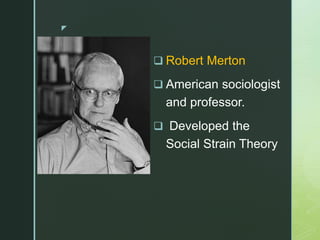
 Robert Merton
 American sociologist
and professor.
 Developed the
Social Strain Theory
z
Merton’s Strain Theory
Unequal Society can sometimes create
situations in which people experience
a strain between the goals they should be
working towards and the legitimate means
they have available to meet those goals.
z
Merton’s Strain Theory
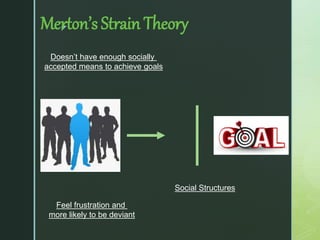
Doesn’t have enough socially
accepted means to achieve goals
Social Structures
Feel frustration and
more likely to be deviant
z
Merton’s Strain Theory
According to Merton, there are five
types of deviance based upon these
criteria:
A. Conformity
B. Innovation
C. Ritualism
D. Retreatism
E. Rebellion
z
Merton’s Strain Theory
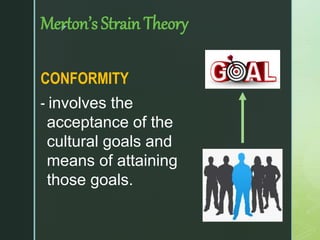
CONFORMITY
- involves the
acceptance of the
cultural goals and
means of attaining
those goals.
z
Merton’s Strain Theory
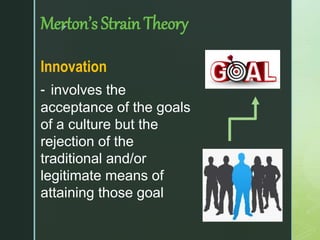
Innovation
- involves the
acceptance of the goals
of a culture but the
rejection of the
traditional and/or
legitimate means of
attaining those goal
z
Merton’s Strain Theory
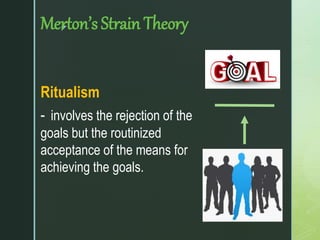
Ritualism
- involves the rejection of the
goals but the routinized
acceptance of the means for
achieving the goals.
z
Merton’s Strain Theory
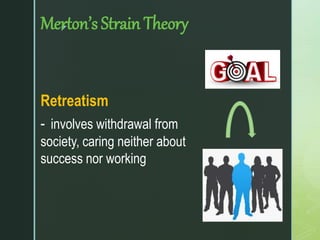
Retreatism
- involves withdrawal from
society, caring neither about
success nor working
z
Merton’s Strain Theory
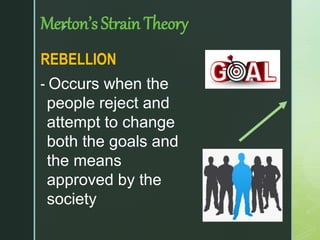
REBELLION
- Occurs when the
people reject and
attempt to change
both the goals and
the means
approved by the
society
z
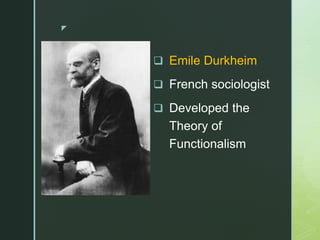
 Emile Durkheim
 French sociologist
 Developed the
Theory of
Functionalism
z
Durkheim’s Functionalist Theory
 Deviance can serve a number of
functions for society. He asserted
that there is nothing abnormal in
deviance.
z
Durkheim’s Functionalist Theory
Deviance affirms cultural values and
norms
 Responding to deviance clarifies
moral boundary
Responding to deviance promotes
social unity
Deviance encourages social change
z
CONLFICT PERSPECTIVE
Conflict theorists look into the role of
power and prestige in the criminal
justice system.
z
CONLFICT PERSPECTIVE
Main points of Conflict Perspective:
 Dominant classes control the definition of
deviance.
 Deviance results from inequality on the
society.
 Deviance from the dominant class goes
largely unpunished
z
Symbolic-Interactionist Perspective
A. Sutherland’s Differential
Association Theory
B. Reckless’ Control Theory
C. Labeling Theory
z
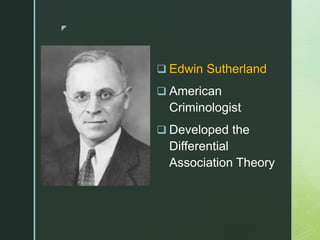
 Edwin Sutherland
 American
Criminologist
 Developed the
Differential
Association Theory
z
Sutherland’s Differential
Association Theory
 Suggest that deviance is
learned from another people.
z
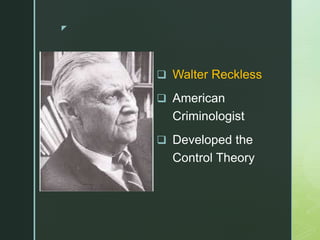
 Walter Reckless
 American
Criminologist
 Developed the
Control Theory
z
Reckless’ Control Theory
 Suggest that deviance is based
on the person’s control against
deviant tendencies.
z
Reckless’ Control Theory
 Inner control – includes controls
within a person such as
conscience and values
 Outer control – includes
controls outside a person such
as family, school, and others.
z
Labeling Theory
 It refers to the view that people
become deviant when labeled as
such and when they accept the
label as a personal identity.
z
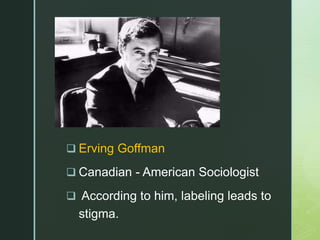
 Erving Goffman
 Canadian - American Sociologist
 According to him, labeling leads to
stigma.

Sociological Theories on Deviance.pptx

Editor's Notes

  • #2 Based on social context and social pressures. How things in the society influence deviant behaviors such as addictions, theft, violence, underage drinking
  • #6 Individuals reject the goals and means. Cannot attain legitimate goal through legitimate mean (dedication and hard work) People from lower socioeconomic classes were more likely to commit crimes.
  • #7 Social structures: family, law, economy and class
  • #9 Goal: Cellphone Socially Approved Means: Look for a part time job, Keep 20 pesos a day, control expenditures Conformity: accept the goal and do the socially accepted means
  • #10 So, turning instead to unconventional, illegitimate means. Using socially unapproved or unconventional means Innovation: Accept the goal but reject the means and do the ff: steal money, ask more than what is needed, do not give back the change
  • #11 Using the same means to achieve less elusive goals . (Dibale) Ritualism: Reject the goal and lower the target to school supplies since it is achievable within the socially approved means.
  • #12 Reject both goals and means, then find a way to escape it. Retreatism: Reject both the goal and the means, do samgyupsal, food trip
  • #13  Rebellion: Reject both the goal and the means. Create new goals and means.
  • #15 Like the body parts, own functions to survive. In social aspect, we have school, hospitals, etc.
  • #16 Major functions of deviance. Deviance is necessary part of a successful society.
  • #17 Address the issue of why legal system is inconsistent in term of providing justice for all. Inequality is the central to their analysis of crime and the criminal justice system – police, courts and prisons.
  • #18 Inequality in deviance: Poor gets jailed – wealthy gets away with their crimes.
  • #22 Deviance is learned behavior. People you interact and associate with teaches and enforces deviant behavior, You are more likely to be come deviant. Lets skip classes – deviant tendencies
  • #25 If the person lacks self control, he/she ends up committing deviant acts.
  • #27 Set of negative and unfair beliefs Once a person is identified as deviant, is extremely difficult to remove that label. Example, convicts may struggle to find employment after they are released from prison because of their criminal background.