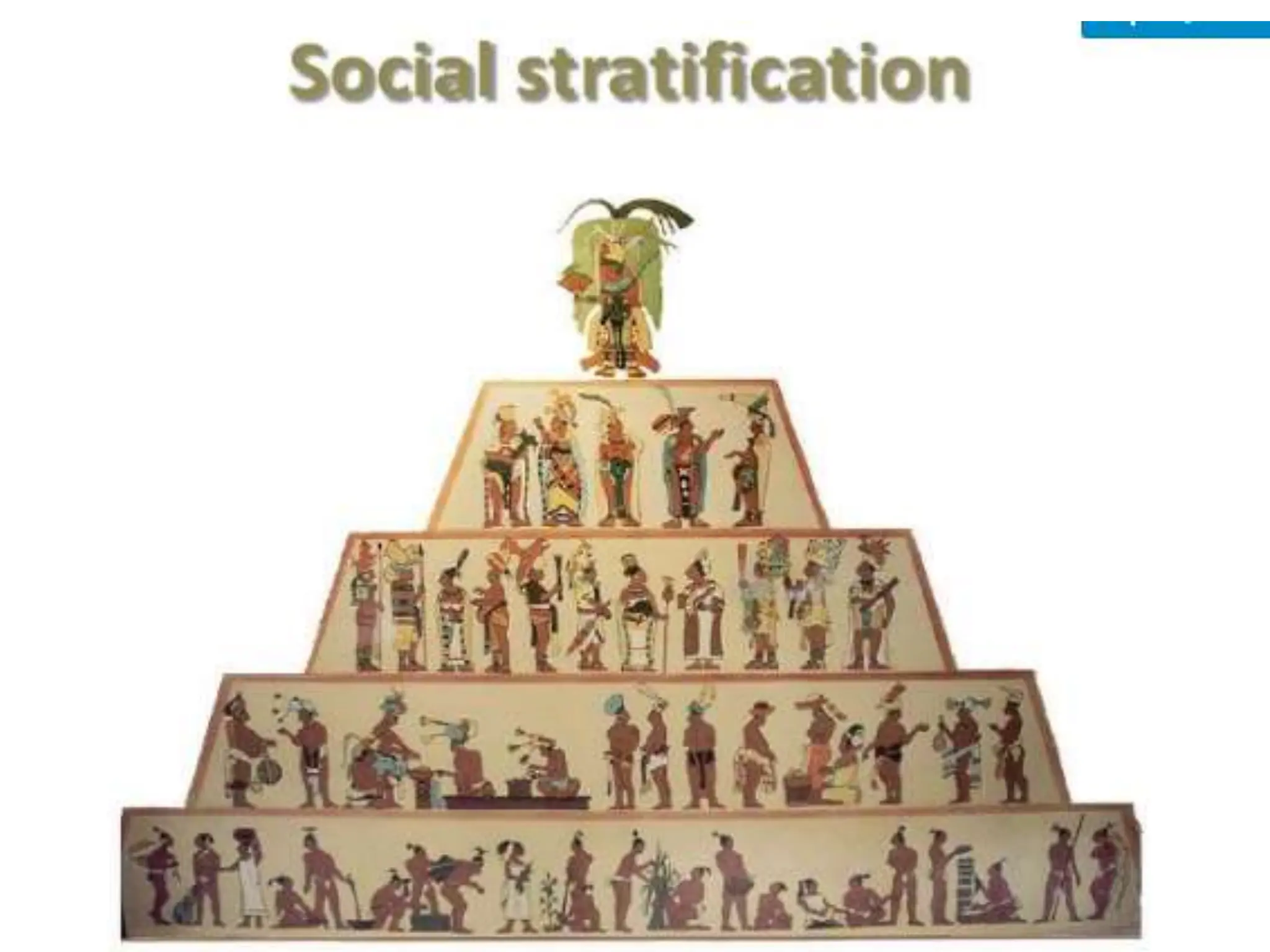
Social Stratification
• In all societies people differ from each other on the
basis of their age, gender and personal
characteristics.
• Human society is not homogeneous but
heterogeneous.
• Apart from the natural differences, human beings
are also differentiated according to socially approved
criteria.
Definition
• Sutherland and Maxwell ;
Social stratification is defined as a process of
differentiation that places some people higher than the
others.
Systems of stratification
• Social stratification occurs when a society has a
number of different “layers” of people within it who
have different statuses. In other words, social
stratification exists if there are different groups of
people who have different levels of such things as
power, prestige, and wealth. All societies have social
stratification. These are the different systems of
social stratification.
• The major systems of stratification are slavery,
estate systems, caste systems, and class systems.
Slavery
• Slavery is a system in which people
are bought and sold as property,
forced to work, or held in captivity
against their will.
• The most closed system is slavery, or
the ownership of people, which has
been quite common in human
history. Slavery is thought to have
begun 10,000 years ago, after
agricultural societies developed, as
people in these societies made
prisoners of war work on their
farms.
Continued--
• Many of the ancient lands of the Middle East,
including Babylonia, Egypt, and Persia, also owned
slaves, as did ancient China and India. Slavery
especially flourished in ancient Greece and Rome,
which used thousands of slaves for their trade
economies.
Continued--
• Today’s slaves include
(a) Men first taken as prisoners of war in ethnic
conflicts
(b) Girls and women captured in wartime or kidnapped
from their neighborhoods and used as prostitutes
(c) Children sold by their parents to become child
laborers
(d) Workers paying off debts that are abused and even
tortured and too terrified to leave.
Estate Systems
• Estate systems are characterized
by control of land and were
common in Europe and Asia during
the Middle Ages and into the
1800s. In these systems, two major
estates existed: the landed gentry
or nobility and the peasantry or
serfs. The landed gentry owned
huge expanses of land on which
serfs toiled.
Continued--
• The serfs had more freedom than slaves had but
typically lived in poverty and were subject to arbitrary
control by the nobility.
• Much of Asia, especially China and Japan, also had
estate systems. For centuries, China’s large population
lived as peasants in miserable conditions and frequently
engaged in peasant uprisings. These escalate starting in
the 1850s after the Chinese government raised taxes and
charged peasants higher rents for the land on which they
worked. After many more decades of political and
economic conflict, Communists took control of China in
1949.
Caste Systems
• In a caste system, people are born into
unequal groups based on their parents’
status and remain in these groups for the
rest of their lives.
• Caste systems are closed stratification
systems in which people can do little or
nothing to change their social standing.
A caste system is one in which people are
born into their social standing and will
remain in it their whole lives.
Continued--
• People are assigned occupations regardless of their
talents, interests, or potential. There are virtually no
opportunities to improve a person’s social position.
• India’s caste system is the most widely-known
example of a society that is stratified by caste.,
people were expected to work in the occupation of
their caste and to enter into marriage according to
their caste.
Class System
• A class system is based on both
social factors and individual
achievement. A class consists of a
set of people who share similar
status with regard to factors like
wealth, income, education, and
occupation. Unlike caste systems,
class systems are open. People are
free to gain a different level of
education or employment than
their parents.
Continued--
• This is, for the most part, what we have
today. People in our society are stratified based on
how much material wealth they have. We tend to
give more power and prestige to those who have
more money or more of other forms of wealth.
Dimensions of social
stratification
Different kind of scare resources is distributed
unequally in a society. We could rank the people on
the basis of how each kind of the scare resources is
distributed. According to the Max, there are three
major dimensions of the stratification they are as
follows
Political/Power Dimension
• When we talk about the political
dimension of the stratification of the
social inequality, we are mostly talking
about the unequal distribution of the
power. Power is the ability to affect
the action of others, even when others
resists. Power may be exercised in the
individuals, group or the societal level.
On the societal level, power means
the ability to make the decision in
which whole societies are affected.
Power can be defined as the ability to
get people to behave as we want to
behave them.
Economic Dimension
• The economic dimension of
stratification concern the money and
the things one can buy. It includes the
two key variable income and the
wealth, which are related but not the
same. Income refers to the amount of
money that the person or the family
receives over some defined period of
the time, usually a calendar year.
Wealth refers to the total value of
everything that a person or the family
owns; minus any debts owed.
Social prestige Dimension
The third dimension of the
stratification is social prestige,
sometimes referred to as status; this
dimension has to do with what
people think of you. If people think
highly of you and you are well
known, you have the high level of
status. If the people think poorly of
you, you have the low level of the
prestige. Prestige is the scare
resources.

Social Stratification (Abubakar) .pptx

  • 2.
    Social Stratification • Inall societies people differ from each other on the basis of their age, gender and personal characteristics. • Human society is not homogeneous but heterogeneous. • Apart from the natural differences, human beings are also differentiated according to socially approved criteria.
  • 3.
    Definition • Sutherland andMaxwell ; Social stratification is defined as a process of differentiation that places some people higher than the others.
  • 4.
    Systems of stratification •Social stratification occurs when a society has a number of different “layers” of people within it who have different statuses. In other words, social stratification exists if there are different groups of people who have different levels of such things as power, prestige, and wealth. All societies have social stratification. These are the different systems of social stratification. • The major systems of stratification are slavery, estate systems, caste systems, and class systems.
  • 5.
    Slavery • Slavery isa system in which people are bought and sold as property, forced to work, or held in captivity against their will. • The most closed system is slavery, or the ownership of people, which has been quite common in human history. Slavery is thought to have begun 10,000 years ago, after agricultural societies developed, as people in these societies made prisoners of war work on their farms.
  • 6.
    Continued-- • Many ofthe ancient lands of the Middle East, including Babylonia, Egypt, and Persia, also owned slaves, as did ancient China and India. Slavery especially flourished in ancient Greece and Rome, which used thousands of slaves for their trade economies.
  • 7.
    Continued-- • Today’s slavesinclude (a) Men first taken as prisoners of war in ethnic conflicts (b) Girls and women captured in wartime or kidnapped from their neighborhoods and used as prostitutes (c) Children sold by their parents to become child laborers (d) Workers paying off debts that are abused and even tortured and too terrified to leave.
  • 8.
    Estate Systems • Estatesystems are characterized by control of land and were common in Europe and Asia during the Middle Ages and into the 1800s. In these systems, two major estates existed: the landed gentry or nobility and the peasantry or serfs. The landed gentry owned huge expanses of land on which serfs toiled.
  • 9.
    Continued-- • The serfshad more freedom than slaves had but typically lived in poverty and were subject to arbitrary control by the nobility. • Much of Asia, especially China and Japan, also had estate systems. For centuries, China’s large population lived as peasants in miserable conditions and frequently engaged in peasant uprisings. These escalate starting in the 1850s after the Chinese government raised taxes and charged peasants higher rents for the land on which they worked. After many more decades of political and economic conflict, Communists took control of China in 1949.
  • 10.
    Caste Systems • Ina caste system, people are born into unequal groups based on their parents’ status and remain in these groups for the rest of their lives. • Caste systems are closed stratification systems in which people can do little or nothing to change their social standing. A caste system is one in which people are born into their social standing and will remain in it their whole lives.
  • 11.
    Continued-- • People areassigned occupations regardless of their talents, interests, or potential. There are virtually no opportunities to improve a person’s social position. • India’s caste system is the most widely-known example of a society that is stratified by caste., people were expected to work in the occupation of their caste and to enter into marriage according to their caste.
  • 12.
    Class System • Aclass system is based on both social factors and individual achievement. A class consists of a set of people who share similar status with regard to factors like wealth, income, education, and occupation. Unlike caste systems, class systems are open. People are free to gain a different level of education or employment than their parents.
  • 13.
    Continued-- • This is,for the most part, what we have today. People in our society are stratified based on how much material wealth they have. We tend to give more power and prestige to those who have more money or more of other forms of wealth.
  • 14.
    Dimensions of social stratification Differentkind of scare resources is distributed unequally in a society. We could rank the people on the basis of how each kind of the scare resources is distributed. According to the Max, there are three major dimensions of the stratification they are as follows
  • 15.
    Political/Power Dimension • Whenwe talk about the political dimension of the stratification of the social inequality, we are mostly talking about the unequal distribution of the power. Power is the ability to affect the action of others, even when others resists. Power may be exercised in the individuals, group or the societal level. On the societal level, power means the ability to make the decision in which whole societies are affected. Power can be defined as the ability to get people to behave as we want to behave them.
  • 16.
    Economic Dimension • Theeconomic dimension of stratification concern the money and the things one can buy. It includes the two key variable income and the wealth, which are related but not the same. Income refers to the amount of money that the person or the family receives over some defined period of the time, usually a calendar year. Wealth refers to the total value of everything that a person or the family owns; minus any debts owed.
  • 17.
    Social prestige Dimension Thethird dimension of the stratification is social prestige, sometimes referred to as status; this dimension has to do with what people think of you. If people think highly of you and you are well known, you have the high level of status. If the people think poorly of you, you have the low level of the prestige. Prestige is the scare resources.