Social Sciences and
Natural Sciences
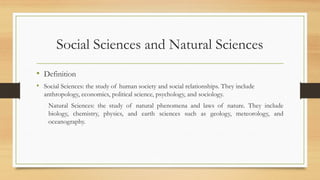
Social Sciences and Natural Sciences
• Definition
• Social Sciences: the study of human society and social relationships. They include
anthropology, economics, political science, psychology, and sociology.
Natural Sciences: the study of natural phenomena and laws of nature. They include
biology, chemistry, physics, and earth sciences such as geology, meteorology, and
oceanography.
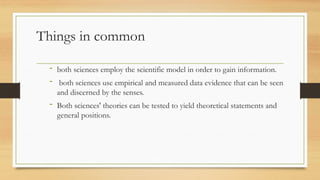
Things in common
- both sciences employ the scientific model in order to gain information.
- both sciences use empirical and measured data evidence that can be seen
and discerned by the senses.
- Both sciences' theories can be tested to yield theoretical statements and
general positions.
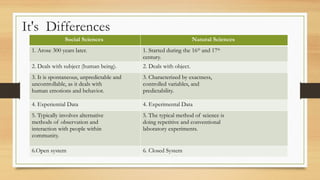
It's Differences
Social Sciences Natural Sciences
1. Arose 300 years later. 1. Started during the 16th
and 17th
century.
2. Deals with subject (human being). 2. Deals with object.
3. It is spontaneous, unpredictable and
uncontrollable, as it deals with
human emotions and behavior.
3. Characterized by exactness,
controlled variables, and
predictability.
4. Experiential Data 4. Experimental Data
5. Typically involves alternative
methods of observation and
interaction with people within
community.
5. The typical method of science is
doing repetitive and conventional
laboratory experiments.
6.Open system 6. Closed System

Social Sciences and Natural Sciences ppt

  • 1.
  • 2.
    Social Sciences andNatural Sciences • Definition • Social Sciences: the study of human society and social relationships. They include anthropology, economics, political science, psychology, and sociology. Natural Sciences: the study of natural phenomena and laws of nature. They include biology, chemistry, physics, and earth sciences such as geology, meteorology, and oceanography.
  • 3.
    Things in common -both sciences employ the scientific model in order to gain information. - both sciences use empirical and measured data evidence that can be seen and discerned by the senses. - Both sciences' theories can be tested to yield theoretical statements and general positions.
  • 4.
    It's Differences Social SciencesNatural Sciences 1. Arose 300 years later. 1. Started during the 16th and 17th century. 2. Deals with subject (human being). 2. Deals with object. 3. It is spontaneous, unpredictable and uncontrollable, as it deals with human emotions and behavior. 3. Characterized by exactness, controlled variables, and predictability. 4. Experiential Data 4. Experimental Data 5. Typically involves alternative methods of observation and interaction with people within community. 5. The typical method of science is doing repetitive and conventional laboratory experiments. 6.Open system 6. Closed System