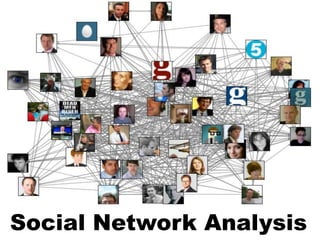
Social Network Analysis
Go back to the 1900s
You are the CEO of XYZ Company and have just
             hired a new employee?
Who is
               Bob?


What does he
 like to do?
2000’s
How would you do it today?
Social Networks
Analysis
What is it?
• Set of mathematical, graphical, and
  theoretical tools for modeling networks and
  the structures there in
• A lens for understanding the social world in a
  relational way
Social Network Analysis
Clichés
• “It’s not what you know; it’s who you know”
• “Business is built on relationships”
• “We’re living in a networked world”
Figures
Facebook:
• more than 800 million active users
• Average 130 friends
• 900 million objects of interaction
• More than 70 languages
Twitter:
• 1 billion tweets per week
• Average number of new accounts per day:
  460,000
Youtube:
• 48 hours of video are uploaded every minute
• Over 3 billion videos are viewed a day
What does this mean?
Social Network Analysis Presentation_Mishba

Social Network Analysis Presentation_Mishba

Editor's Notes

  • #5 You want to know more about this new potential employee.... so what do you do?
  • #10 A Social Network is a theoretical construct used to study relationships between individuals, groups, organizations or even entire societies.
  • #11 Detailed examination of the elements or structure of something, typically as a basis for discussion or interpretation.
  • #13 Nodes are the individual actors within the networks The network can also be used to measure social capital – the value that an individual gets from the social network.
  • #14 What is the shortest path between you and Justin Bieber or you and Kim K
  • #15 http://www.youtube.com/watch?v=Sv94hdhLei4
  • #17 More than 900 million objects that people interact with (pages, groups, events and community pages)
  • #19  A social network analysis examines the structure of social relationships in a group to uncover the informal connections between people. In a consulting setting, these relationships are often ones of communication, awareness, trust, and decision-making. As an approach to looking at these relationships, SNA has been around a long time.