*
Natalie Bradfield & Jon Yearwood
*
*Examine what is and is not content
strategy

*Examine key elements of content strategy
*Explore who does the work
*
*But first, what is “content”?
-What a user came to see, read, learn

*From a business standpoint, content is
-CRITICAL INFO.!
-A website, application, intranet
-Created to contain, deliver, &
communicate
*
*How to meet organizational and user goals
and needs simultaneously

*It guides plans for creating, delivering &
managing content

-How to use content
-Decisions about content
-Set goals to measure success of
content
http://www.youtube.com/watch?v=Kpv_l
xdKxCk
*
*May focus on actual creating and
formatting

-Editorial, structural & technical
aspects

*May be an enterprise-wide effort/ highlevel business strategy

-Make decisions to select and execute
certain content to a specific audience
*
*A series of educational articles
*A full-service, online knowledge base
*An employee blog post series
*A new tablet subscription service
*Social media
*(These are considered tactics)
*
*A strategy is an idea that sets the direction
for the future

*“Will this help us to where we’re going?”
*http://www.youtube.com/watch?v=F_fH5Z
-RJfc
*
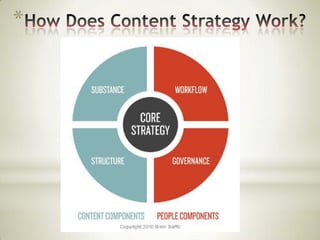
*“The Quad”
-An image the displays the critical
components of content strategy

*Components that affect whether or not

your content ends up usable and stable to
users and businesses
*
*
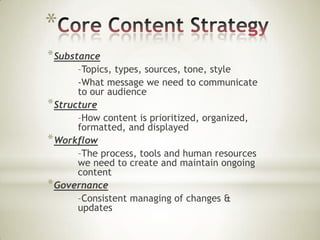
* Substance
–Topics, types, sources, tone, style
-What message we need to communicate
to our audience
* Structure
–How content is prioritized, organized,
formatted, and displayed
* Workflow
–The process, tools and human resources
we need to create and maintain ongoing
content
* Governance
–Consistent managing of changes &
updates
*
*For ideally large or complex
projects:

*Web writers & editors
*Information architects
*Database managers
*Subject matter experts
*
*Oversees content initiatives
*Examine and analyze factors that impact
content

*Gather, edit, and analyze existing content
*Updating existing content

*Grouping and tagging content
*Maintaining and governing content postlaunch
*
* Messaging & Branding
-The “story” behind the content: brand values

* Web Writing
-Writing useful, usable content intended for online
delivery

* Information Architect
* -The design of navigation systems to help people
find and manage info. More successfully

* Search Engine Optimization
-Increase potential relevance to specific key words
on web & site search engines

* Metadata Strategy
-(Data about data) Identify, organize, use & reuse
content to appeal to key audiences

* Content Management Strategy
-Capture, store, deliver & preserve an
organization’s content
*
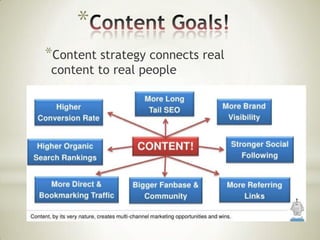
*Content strategy connects real
content to real people
*
Social media ch. 3

Social media ch. 3

  • 1.
  • 2.
    * *Examine what isand is not content strategy *Examine key elements of content strategy *Explore who does the work
  • 3.
    * *But first, whatis “content”? -What a user came to see, read, learn *From a business standpoint, content is -CRITICAL INFO.! -A website, application, intranet -Created to contain, deliver, & communicate
  • 4.
    * *How to meetorganizational and user goals and needs simultaneously *It guides plans for creating, delivering & managing content -How to use content -Decisions about content -Set goals to measure success of content http://www.youtube.com/watch?v=Kpv_l xdKxCk
  • 5.
    * *May focus onactual creating and formatting -Editorial, structural & technical aspects *May be an enterprise-wide effort/ highlevel business strategy -Make decisions to select and execute certain content to a specific audience
  • 6.
    * *A series ofeducational articles *A full-service, online knowledge base *An employee blog post series *A new tablet subscription service *Social media *(These are considered tactics)
  • 7.
    * *A strategy isan idea that sets the direction for the future *“Will this help us to where we’re going?” *http://www.youtube.com/watch?v=F_fH5Z -RJfc
  • 8.
    * *“The Quad” -An imagethe displays the critical components of content strategy *Components that affect whether or not your content ends up usable and stable to users and businesses
  • 9.
  • 10.
    * * Substance –Topics, types,sources, tone, style -What message we need to communicate to our audience * Structure –How content is prioritized, organized, formatted, and displayed * Workflow –The process, tools and human resources we need to create and maintain ongoing content * Governance –Consistent managing of changes & updates
  • 11.
    * *For ideally largeor complex projects: *Web writers & editors *Information architects *Database managers *Subject matter experts
  • 12.
    * *Oversees content initiatives *Examineand analyze factors that impact content *Gather, edit, and analyze existing content *Updating existing content *Grouping and tagging content *Maintaining and governing content postlaunch
  • 13.
    * * Messaging &Branding -The “story” behind the content: brand values * Web Writing -Writing useful, usable content intended for online delivery * Information Architect * -The design of navigation systems to help people find and manage info. More successfully * Search Engine Optimization -Increase potential relevance to specific key words on web & site search engines * Metadata Strategy -(Data about data) Identify, organize, use & reuse content to appeal to key audiences * Content Management Strategy -Capture, store, deliver & preserve an organization’s content
  • 14.
    * *Content strategy connectsreal content to real people
  • 15.