Social Media Assessment How do you start? Walter Adamson #  @g2m [email_address] Presented as part of Social Media Tools Week, November 2009
Contents How to start a Social Media Assessment Overview Rationale Process flow Where to start Approach Four Quadrant Methodology Avoiding the Traps Assessment Plan and Report Tools Paradigm Shift
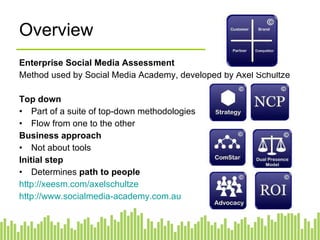
Overview Enterprise Social Media Assessment Method used by Social Media Academy, developed by Axel Schultze Top down Part of a suite of top-down methodologies Flow from one to the other Business approach Not about tools Initial step Determines  path to people http://xeesm.com/axelschultze   http://www.socialmedia-academy.com.au
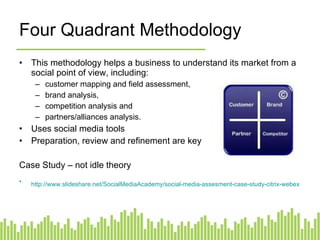
Four Quadrant Methodology This methodology helps a business to understand its market from a social point of view, including: customer mapping and field assessment, brand analysis, competition analysis and partners/alliances analysis.  Uses social media tools Preparation, review and refinement are key Case Study – not idle theory http://www.slideshare.net/SocialMediaAcademy/social-media-assesment-case-study-citrix-webex
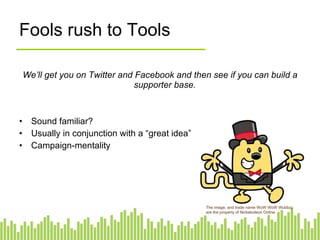
Fools rush to Tools We’ll get you on Twitter and Facebook and then see if you can build a supporter base.   Sound familiar? Usually in conjunction with a “great idea” Campaign-mentality The image, and trade name WoW WoW Wubbzy are the property of Nickelodeon Online.
Anybody home? By not researching the social media places and spaces: Right conversations with the wrong people Wrong conversations with the right people Conversations with an empty room Just because it is hip it doesn’t mean it fits you , Nicole Simon It’s more than just  LISTENING  it is knowing WHERE to listen!
Rationale for Assessment - why Media is an  arena  where  people  with  shared interest  and  enthusiasm   converge  around a  shared idea -  Helge Tennø “Post Digital Marketing 2009” You need to find the  right arenas Match  the shared interest with your own Understand how to  contribute Ideally, find the  actual people  who are most enthusiastic This is Social Media Assessment  – before thinking of tools.
The “As Is” of strategy The Assessment helps to understand the level of Social Engagement of the company/brands It’s about understanding the socio-economic landscape of: Customers Prospects Partners Competitors and our role, or potential role, in it. This is the “ As Is ” assessment of normal strategy assessment.
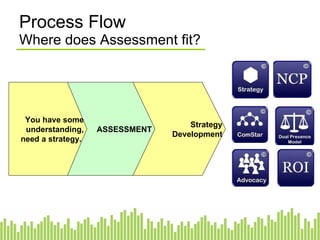
Process Flow  Where does Assessment fit? Strategy Development ASSESSMENT You have some understanding, need a strategy.
Process Flow  Where does Assessment fit? You understand enough about social media You have some kind of customer-oriented feedback, ideas You have some idea of resources and how it can be handled You need a strategy (however large or small) It’s at  this point  you need to do an Assessment Map the terrain Identify the places and spaces that matter Understand the real environment Then develop a strategy which is informed and practical and effective.
Where to start? Depending on client: B2B or B2C How mature in the market? How active with user base? Who do they follow? How widely are products/brands known? B2B could be a subset of landscape: Groups Majors Few others
B2C Open mind Tool important: efficient effective flexible able to find people
Scope Design to cost Not usually the way to make a big plan  and then cost it , although might be OK for very large client and project - “ cost to design ” Rather, use a reasonable fee, fit for purpose, and  plan the scope to match  – “ design to cost ” Scope variables: Balance of attention to the 4 quadrants Number of keywords and phrases Cost of analysis tool per unit/day etc Depth of blog analysis Depth and quality of tracking of influencers and social graph Size of company/brands etc - complexity Refine based on results, may need incremental extra investment
We are working in the context of the NCP model This is the key to success in social media for business: Networks Contribution Participation We can then set out to: measure, model and tune our social media activities. Reminder
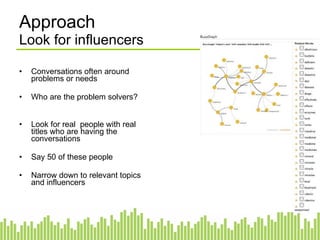
Approach Look for influencers Conversations  often around problems or needs Who are the problem solvers? Look for real  people with real titles who are having the conversations Say 50 of these people Narrow down to relevant topics and influencers
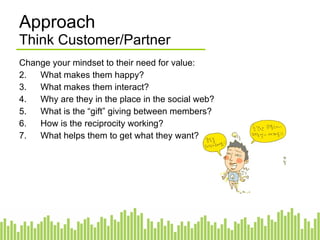
Change your mindset to their need for value: What makes them happy? What makes them interact? Why are they in the place in the social web? What is the “gift” giving between members? How is the reciprocity working? What helps them to get what they want? Approach Think Customer/Partner
Review the ecosystem of the challenge/need: sentiment positive/negative trends issues conversation threads But ultimately you are  looking for people: get a people list together around the topics they discuss Approach Look for challenges and topics
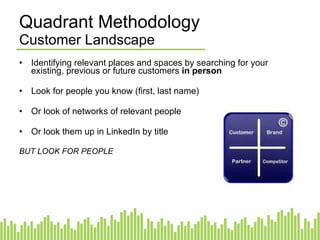
Quadrant Methodology Customer Landscape Identifying relevant places and spaces by searching for your existing, previous or future customers  in person Look for people you know (first, last name) Or look of networks of relevant people Or look them up in LinkedIn by title BUT LOOK FOR PEOPLE
Customer Landscape Example Let’s say Hungry Jack’s (Burger King in the US) Keywords, things customers will be discussing: hamburger(s) burger cheeseburger aussieburger brekky hash brown muffin fries onion rings nuggets WHO are they?
Customer Landscape Customer as People LOOKING FOR PEOPLE Identifying our customers’ challenges, topics excitement and frustrations the issues and sentiment – based on the people you find from the keywords you define. Identifying the influencers Creating a factual analysis Identifying opportunities and threats Make some initial suggestions
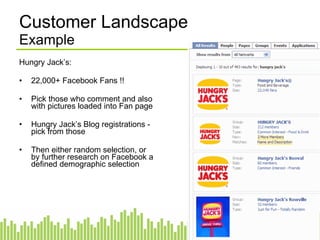
Customer Landscape Example Hungry Jack’s: 22,000+ Facebook Fans !! Pick those who comment and also with pictures loaded into Fan page Hungry Jack’s Blog registrations - pick from those Then either random selection, or by further research on Facebook a defined demographic selection
Quadrant Methodology Brand Assessment Identifying the places and spaces where the brand is discussed Brand reflection, sentiment around the brand and “brand team” Creating a factual analysis Identifying opportunities and threats SWOT Key individuals and key influencers re brand How is our brand and team being represented? Based on products or services  what are the specific conversations Make some initial suggestions Note:  brand side focuses on specific discussions about the brand  not about other products and issues
Brand Landscape Example Keywords (Hungry Jack’s) People Jack Cowan ( Founder of Hungry Jacks in Australia ) Marketing slogans and messages: hungry jacks burgers flame grilled burgers fast food hamburger Hungry Jack's brands and trade marks "burgers are better at Hungry Jack's" whopper whopper Jr bacon deluxe chicken tendercrisp Business and franchise hungry jack's franchise hamburger franchise
Partner Landscape Partner Assessment Identifying the places and spaces where the partners are present Identifying the partners topics and their  second degree ecosystem  (the partner’s customers). Those discussions and sentiments. Identifying the  key individuals  per partners and main influencers (teams and individuals) Creating a factual analysis Identifying opportunities and threats Some initial suggestions Tips:  partners have their own life, place yourselves in their value chain and risk/reward sales outlook   But partners are laggards in most industries (Drucker) - real estate devastated but most active in social media now, also travel agents  going through similar cycle.
Partner Landscape Example Hungry Jack’s Keywords to find partners and key people in the distribution chain Franchisees Locations: Sydney Airport, Toorak, Mornington, Flemington, etc etc Shopping Mall and Venue Owners/Operators Westfield, Centro, Macquarie, Telstra Dome Keywords fast food outlet hamburger store flame grilled fast food Burger King
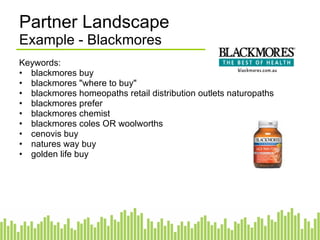
Partner Landscape Example - Blackmores Keywords: blackmores buy blackmores "where to buy" blackmores homeopaths retail distribution outlets naturopaths blackmores prefer blackmores chemist blackmores coles OR woolworths cenovis buy natures way buy golden life buy
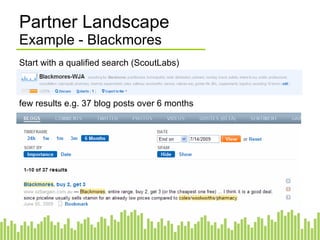
Partner Landscape Example - Blackmores Start with a qualified search (ScoutLabs) few results e.g. 37 blog posts over 6 months
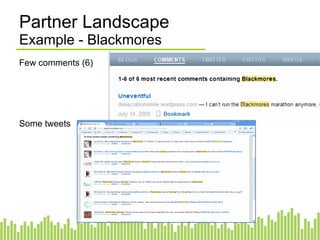
Partner Landscape Example - Blackmores Few comments (6) Some tweets
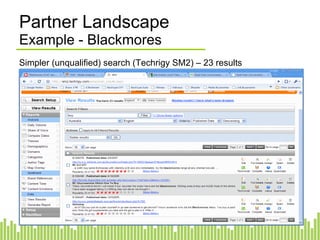
Partner Landscape Example - Blackmores Simpler (unqualified) search (Techrigy SM2) – 23 results
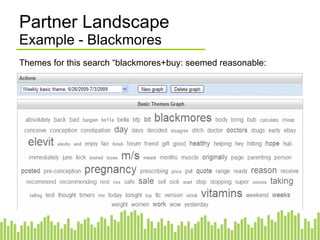
Partner Landscape Example - Blackmores Themes for this search “blackmores+buy: seemed reasonable:
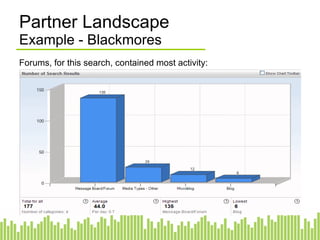
Partner Landscape Example - Blackmores Forums, for this search, contained most activity:
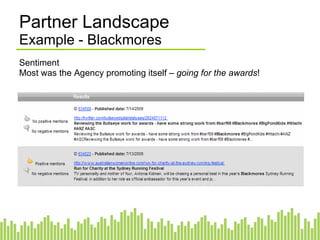
Partner Landscape Example - Blackmores Sentiment Most was the Agency promoting itself –  going for the awards !
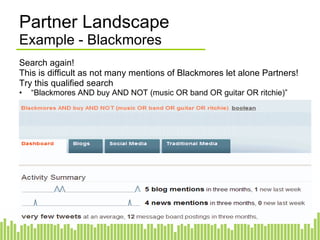
Partner Landscape Example - Blackmores Search again! This is difficult as not many mentions of Blackmores let alone Partners! Try this qualified search “ Blackmores AND buy AND NOT (music OR band OR guitar OR ritchie)”
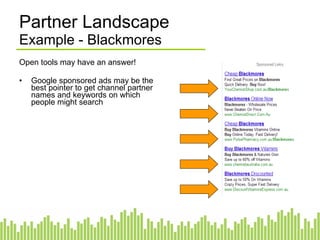
Partner Landscape Example - Blackmores Open tools may have an answer! Google sponsored ads may be the best pointer to get channel partner names and keywords on which people might search
Quadrant Methodology Competitor Assessment Identifying the places and spaces the competition is active Identifying the competitor’s partners activities Identifying the competitors customers activity, discussion and sentiments Identifying the influencer of the competitors teams and those of their partners Creating a factual analysis Identifying opportunities and threats Some initial suggestions Facts leading to a competitive threat analysis Note:  competition's customer is of most interest competitor's partners of most interest - who, company names, and who is promoter of this relationship
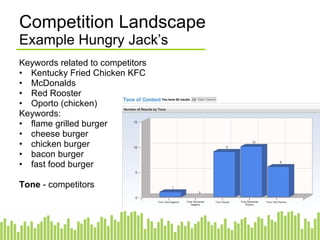
Competition Landscape Example Hungry Jack’s Keywords related to competitors Kentucky Fried Chicken KFC McDonalds Red Rooster Oporto (chicken) Keywords: flame grilled burger cheese burger chicken burger bacon burger fast food burger Tone  - competitors
Quadrant Methodology Summary You almost always find customer conversations Partners can be a challenge in a distributed model The example showed this difficulty Not to show the problems but to show that this may happen to you Thinking through new partner and distribution models is challenging Remember that the initial suggestions should relate to the NCP model: Networks Contribution Participation Solving this question How do we optimise the path to advocacy through N-C-P?
Contents -  you are here! How to start a Social Media Assessment Overview Rationale Process flow Where to start Approach Four Quadrant Methodology Avoiding the Traps  Assessment Plan and Report Tools Paradigm Shift
Avoiding the Traps Don’t get distracted by traffic counts – these are not conversations Traffic can be driven, conversations can’t Think AUDIENCE not traffic Be careful with search terms – think how people would discuss It’s not a numbers game Demographics not really relevant to social conversations We need to focus on conversations and the topics and who the people are and who are the influencers Explore the most influential spaces Make the results create a solution!
Summary The Assessment Plan Not the Assessment but the Plan AIM: to find the topical aspects of our ecosystem which are important to our business names + customer/company keywords which are relevant to you competitors preparation for search/tools customers/brands/partners/competitors why names and rationale and keywords find conversations around coffee shops etc "Peets" find influencers Name as many people and refer to as many facts as possible Prepare initial thoughts and suggestions
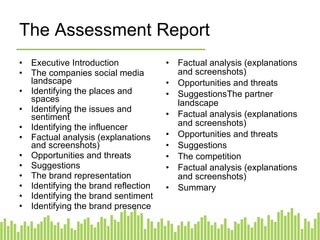
The Assessment Report Executive Introduction The companies social media landscape Identifying the places and spaces Identifying the issues and sentiment Identifying the influencer Factual analysis (explanations and screenshots) Opportunities and threats Suggestions The brand representation Identifying the brand reflection Identifying the brand sentiment Identifying the brand presence Factual analysis (explanations and screenshots) Opportunities and threats Suggestion The partner landscape Factual analysis (explanations and screenshots) Opportunities and threats Suggestions The competition Factual analysis (explanations and screenshots) Summary
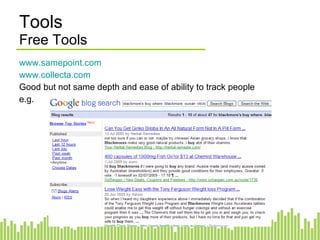
Tools Free Tools www.samepoint.com www.collecta.com   Good but not same ability to track people e.g.
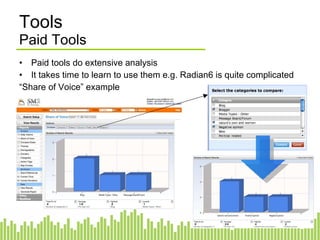
Tools Paid Tools Paid tools do extensive analysis It takes time to learn to use them e.g. Radian6 is quite complicated “ Share of Voice” example
Review Rationale - ROI Let’s recap, because Assessments are often skipped:  As Jacob Morgan said yesterday in his keynote on ROI The goal is not to “get” an ROI,  but to optimise your ROI by directing your spending to where you get the greatest return Assessment tells you where is the best place to build your house And , the orientation – the Feng Shui of social media
Paradigm Shift In the old model  we  introduced something new to our customer base NOW, this is  the other way around The customers are introducing us  to their way The assessment is the foundation sales, support, service, HR, product development The assessment gives us the answers as to how to do this better The instincts of the past are now overridden  by real input
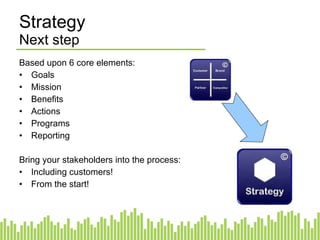
Strategy Next step Based upon 6 core elements: Goals Mission Benefits Actions Programs Reporting Bring your stakeholders into the process: Including customers! From the start!
Consulting Tip Kick Off – Proof of the Pudding For C-level and others who are skeptical about social media,  Assessment is great way to present factual evidence Free one hour discussion (collect keywords) and review to find what is being said and where This should get you a start as almost always you find surprises, often “bad” ones
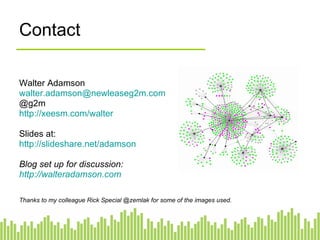
Contact Walter Adamson [email_address] @g2m http://xeesm.com/walter Slides at: http://slideshare.net/adamson   Blog set up for discussion: http://walteradamson.com   Thanks to my colleague Rick Special @zemlak for some of the images used.

Social Media Assessment - How to Get Started

  • 1.
    Social Media AssessmentHow do you start? Walter Adamson # @g2m [email_address] Presented as part of Social Media Tools Week, November 2009
  • 2.
    Contents How tostart a Social Media Assessment Overview Rationale Process flow Where to start Approach Four Quadrant Methodology Avoiding the Traps Assessment Plan and Report Tools Paradigm Shift
  • 3.
    Overview Enterprise SocialMedia Assessment Method used by Social Media Academy, developed by Axel Schultze Top down Part of a suite of top-down methodologies Flow from one to the other Business approach Not about tools Initial step Determines path to people http://xeesm.com/axelschultze http://www.socialmedia-academy.com.au
  • 4.
    Four Quadrant MethodologyThis methodology helps a business to understand its market from a social point of view, including: customer mapping and field assessment, brand analysis, competition analysis and partners/alliances analysis. Uses social media tools Preparation, review and refinement are key Case Study – not idle theory http://www.slideshare.net/SocialMediaAcademy/social-media-assesment-case-study-citrix-webex
  • 5.
    Fools rush toTools We’ll get you on Twitter and Facebook and then see if you can build a supporter base. Sound familiar? Usually in conjunction with a “great idea” Campaign-mentality The image, and trade name WoW WoW Wubbzy are the property of Nickelodeon Online.
  • 6.
    Anybody home? Bynot researching the social media places and spaces: Right conversations with the wrong people Wrong conversations with the right people Conversations with an empty room Just because it is hip it doesn’t mean it fits you , Nicole Simon It’s more than just LISTENING it is knowing WHERE to listen!
  • 7.
    Rationale for Assessment- why Media is an arena where people with shared interest and enthusiasm converge around a shared idea - Helge Tennø “Post Digital Marketing 2009” You need to find the right arenas Match the shared interest with your own Understand how to contribute Ideally, find the actual people who are most enthusiastic This is Social Media Assessment – before thinking of tools.
  • 8.
    The “As Is”of strategy The Assessment helps to understand the level of Social Engagement of the company/brands It’s about understanding the socio-economic landscape of: Customers Prospects Partners Competitors and our role, or potential role, in it. This is the “ As Is ” assessment of normal strategy assessment.
  • 9.
    Process Flow Where does Assessment fit? Strategy Development ASSESSMENT You have some understanding, need a strategy.
  • 10.
    Process Flow Where does Assessment fit? You understand enough about social media You have some kind of customer-oriented feedback, ideas You have some idea of resources and how it can be handled You need a strategy (however large or small) It’s at this point you need to do an Assessment Map the terrain Identify the places and spaces that matter Understand the real environment Then develop a strategy which is informed and practical and effective.
  • 11.
    Where to start?Depending on client: B2B or B2C How mature in the market? How active with user base? Who do they follow? How widely are products/brands known? B2B could be a subset of landscape: Groups Majors Few others
  • 12.
    B2C Open mindTool important: efficient effective flexible able to find people
  • 13.
    Scope Design tocost Not usually the way to make a big plan and then cost it , although might be OK for very large client and project - “ cost to design ” Rather, use a reasonable fee, fit for purpose, and plan the scope to match – “ design to cost ” Scope variables: Balance of attention to the 4 quadrants Number of keywords and phrases Cost of analysis tool per unit/day etc Depth of blog analysis Depth and quality of tracking of influencers and social graph Size of company/brands etc - complexity Refine based on results, may need incremental extra investment
  • 14.
    We are workingin the context of the NCP model This is the key to success in social media for business: Networks Contribution Participation We can then set out to: measure, model and tune our social media activities. Reminder
  • 15.
    Approach Look forinfluencers Conversations often around problems or needs Who are the problem solvers? Look for real people with real titles who are having the conversations Say 50 of these people Narrow down to relevant topics and influencers
  • 16.
    Change your mindsetto their need for value: What makes them happy? What makes them interact? Why are they in the place in the social web? What is the “gift” giving between members? How is the reciprocity working? What helps them to get what they want? Approach Think Customer/Partner
  • 17.
    Review the ecosystemof the challenge/need: sentiment positive/negative trends issues conversation threads But ultimately you are looking for people: get a people list together around the topics they discuss Approach Look for challenges and topics
  • 18.
    Quadrant Methodology CustomerLandscape Identifying relevant places and spaces by searching for your existing, previous or future customers in person Look for people you know (first, last name) Or look of networks of relevant people Or look them up in LinkedIn by title BUT LOOK FOR PEOPLE
  • 19.
    Customer Landscape ExampleLet’s say Hungry Jack’s (Burger King in the US) Keywords, things customers will be discussing: hamburger(s) burger cheeseburger aussieburger brekky hash brown muffin fries onion rings nuggets WHO are they?
  • 20.
    Customer Landscape Customeras People LOOKING FOR PEOPLE Identifying our customers’ challenges, topics excitement and frustrations the issues and sentiment – based on the people you find from the keywords you define. Identifying the influencers Creating a factual analysis Identifying opportunities and threats Make some initial suggestions
  • 21.
    Customer Landscape ExampleHungry Jack’s: 22,000+ Facebook Fans !! Pick those who comment and also with pictures loaded into Fan page Hungry Jack’s Blog registrations - pick from those Then either random selection, or by further research on Facebook a defined demographic selection
  • 22.
    Quadrant Methodology BrandAssessment Identifying the places and spaces where the brand is discussed Brand reflection, sentiment around the brand and “brand team” Creating a factual analysis Identifying opportunities and threats SWOT Key individuals and key influencers re brand How is our brand and team being represented? Based on products or services what are the specific conversations Make some initial suggestions Note: brand side focuses on specific discussions about the brand not about other products and issues
  • 23.
    Brand Landscape ExampleKeywords (Hungry Jack’s) People Jack Cowan ( Founder of Hungry Jacks in Australia ) Marketing slogans and messages: hungry jacks burgers flame grilled burgers fast food hamburger Hungry Jack's brands and trade marks "burgers are better at Hungry Jack's" whopper whopper Jr bacon deluxe chicken tendercrisp Business and franchise hungry jack's franchise hamburger franchise
  • 24.
    Partner Landscape PartnerAssessment Identifying the places and spaces where the partners are present Identifying the partners topics and their second degree ecosystem (the partner’s customers). Those discussions and sentiments. Identifying the key individuals per partners and main influencers (teams and individuals) Creating a factual analysis Identifying opportunities and threats Some initial suggestions Tips: partners have their own life, place yourselves in their value chain and risk/reward sales outlook But partners are laggards in most industries (Drucker) - real estate devastated but most active in social media now, also travel agents going through similar cycle.
  • 25.
    Partner Landscape ExampleHungry Jack’s Keywords to find partners and key people in the distribution chain Franchisees Locations: Sydney Airport, Toorak, Mornington, Flemington, etc etc Shopping Mall and Venue Owners/Operators Westfield, Centro, Macquarie, Telstra Dome Keywords fast food outlet hamburger store flame grilled fast food Burger King
  • 26.
    Partner Landscape Example- Blackmores Keywords: blackmores buy blackmores "where to buy" blackmores homeopaths retail distribution outlets naturopaths blackmores prefer blackmores chemist blackmores coles OR woolworths cenovis buy natures way buy golden life buy
  • 27.
    Partner Landscape Example- Blackmores Start with a qualified search (ScoutLabs) few results e.g. 37 blog posts over 6 months
  • 28.
    Partner Landscape Example- Blackmores Few comments (6) Some tweets
  • 29.
    Partner Landscape Example- Blackmores Simpler (unqualified) search (Techrigy SM2) – 23 results
  • 30.
    Partner Landscape Example- Blackmores Themes for this search “blackmores+buy: seemed reasonable:
  • 31.
    Partner Landscape Example- Blackmores Forums, for this search, contained most activity:
  • 32.
    Partner Landscape Example- Blackmores Sentiment Most was the Agency promoting itself – going for the awards !
  • 33.
    Partner Landscape Example- Blackmores Search again! This is difficult as not many mentions of Blackmores let alone Partners! Try this qualified search “ Blackmores AND buy AND NOT (music OR band OR guitar OR ritchie)”
  • 34.
    Partner Landscape Example- Blackmores Open tools may have an answer! Google sponsored ads may be the best pointer to get channel partner names and keywords on which people might search
  • 35.
    Quadrant Methodology CompetitorAssessment Identifying the places and spaces the competition is active Identifying the competitor’s partners activities Identifying the competitors customers activity, discussion and sentiments Identifying the influencer of the competitors teams and those of their partners Creating a factual analysis Identifying opportunities and threats Some initial suggestions Facts leading to a competitive threat analysis Note: competition's customer is of most interest competitor's partners of most interest - who, company names, and who is promoter of this relationship
  • 36.
    Competition Landscape ExampleHungry Jack’s Keywords related to competitors Kentucky Fried Chicken KFC McDonalds Red Rooster Oporto (chicken) Keywords: flame grilled burger cheese burger chicken burger bacon burger fast food burger Tone - competitors
  • 37.
    Quadrant Methodology SummaryYou almost always find customer conversations Partners can be a challenge in a distributed model The example showed this difficulty Not to show the problems but to show that this may happen to you Thinking through new partner and distribution models is challenging Remember that the initial suggestions should relate to the NCP model: Networks Contribution Participation Solving this question How do we optimise the path to advocacy through N-C-P?
  • 38.
    Contents - you are here! How to start a Social Media Assessment Overview Rationale Process flow Where to start Approach Four Quadrant Methodology Avoiding the Traps Assessment Plan and Report Tools Paradigm Shift
  • 39.
    Avoiding the TrapsDon’t get distracted by traffic counts – these are not conversations Traffic can be driven, conversations can’t Think AUDIENCE not traffic Be careful with search terms – think how people would discuss It’s not a numbers game Demographics not really relevant to social conversations We need to focus on conversations and the topics and who the people are and who are the influencers Explore the most influential spaces Make the results create a solution!
  • 40.
    Summary The AssessmentPlan Not the Assessment but the Plan AIM: to find the topical aspects of our ecosystem which are important to our business names + customer/company keywords which are relevant to you competitors preparation for search/tools customers/brands/partners/competitors why names and rationale and keywords find conversations around coffee shops etc "Peets" find influencers Name as many people and refer to as many facts as possible Prepare initial thoughts and suggestions
  • 41.
    The Assessment ReportExecutive Introduction The companies social media landscape Identifying the places and spaces Identifying the issues and sentiment Identifying the influencer Factual analysis (explanations and screenshots) Opportunities and threats Suggestions The brand representation Identifying the brand reflection Identifying the brand sentiment Identifying the brand presence Factual analysis (explanations and screenshots) Opportunities and threats Suggestion The partner landscape Factual analysis (explanations and screenshots) Opportunities and threats Suggestions The competition Factual analysis (explanations and screenshots) Summary
  • 42.
    Tools Free Toolswww.samepoint.com www.collecta.com Good but not same ability to track people e.g.
  • 43.
    Tools Paid ToolsPaid tools do extensive analysis It takes time to learn to use them e.g. Radian6 is quite complicated “ Share of Voice” example
  • 44.
    Review Rationale -ROI Let’s recap, because Assessments are often skipped: As Jacob Morgan said yesterday in his keynote on ROI The goal is not to “get” an ROI, but to optimise your ROI by directing your spending to where you get the greatest return Assessment tells you where is the best place to build your house And , the orientation – the Feng Shui of social media
  • 45.
    Paradigm Shift Inthe old model we introduced something new to our customer base NOW, this is the other way around The customers are introducing us to their way The assessment is the foundation sales, support, service, HR, product development The assessment gives us the answers as to how to do this better The instincts of the past are now overridden by real input
  • 46.
    Strategy Next stepBased upon 6 core elements: Goals Mission Benefits Actions Programs Reporting Bring your stakeholders into the process: Including customers! From the start!
  • 47.
    Consulting Tip KickOff – Proof of the Pudding For C-level and others who are skeptical about social media, Assessment is great way to present factual evidence Free one hour discussion (collect keywords) and review to find what is being said and where This should get you a start as almost always you find surprises, often “bad” ones
  • 48.
    Contact Walter Adamson[email_address] @g2m http://xeesm.com/walter Slides at: http://slideshare.net/adamson Blog set up for discussion: http://walteradamson.com Thanks to my colleague Rick Special @zemlak for some of the images used.