Social Media
1
Introduction
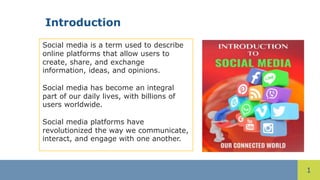
Social media is a term used to describe
online platforms that allow users to
create, share, and exchange
information, ideas, and opinions.
Social media has become an integral
part of our daily lives, with billions of
users worldwide.
Social media platforms have
revolutionized the way we communicate,
interact, and engage with one another.
2
Types of Social Media
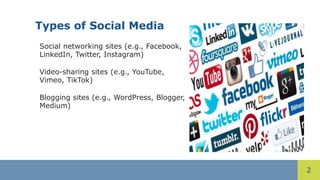
Social networking sites (e.g., Facebook,
LinkedIn, Twitter, Instagram)
Video-sharing sites (e.g., YouTube,
Vimeo, TikTok)
Blogging sites (e.g., WordPress, Blogger,
Medium)
3
Benefits of Social Media
Increased connectivity and
communication with friends, family,
and colleagues.
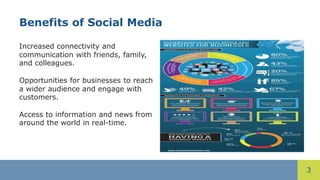
Opportunities for businesses to reach
a wider audience and engage with
customers.
Access to information and news from
around the world in real-time.
4
Risks of Social Media
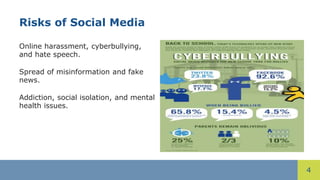
Online harassment, cyberbullying,
and hate speech.
Spread of misinformation and fake
news.
Addiction, social isolation, and mental
health issues.
5
Social Media and Privacy
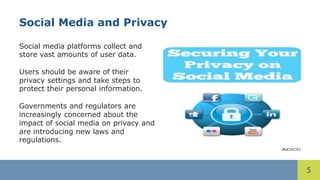
Social media platforms collect and
store vast amounts of user data.
Users should be aware of their
privacy settings and take steps to
protect their personal information.
Governments and regulators are
increasingly concerned about the
impact of social media on privacy and
are introducing new laws and
regulations.
6
Social Media and Politics
Social media has become a powerful
tool for political campaigns and
activism.
Social media platforms have been
criticized for their role in the spread
of propaganda and misinformation
during elections.
Governments and regulators are
increasingly concerned about the
impact of social media on democracy
and are introducing new laws and
regulations.
7
Social Media and Business
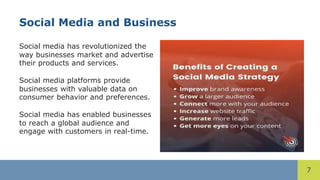
Social media has revolutionized the
way businesses market and advertise
their products and services.
Social media platforms provide
businesses with valuable data on
consumer behavior and preferences.
Social media has enabled businesses
to reach a global audience and
engage with customers in real-time.
8
Social Media and Education
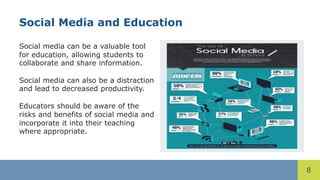
Social media can be a valuable tool
for education, allowing students to
collaborate and share information.
Social media can also be a distraction
and lead to decreased productivity.
Educators should be aware of the
risks and benefits of social media and
incorporate it into their teaching
where appropriate.
9
Social Media and the Future
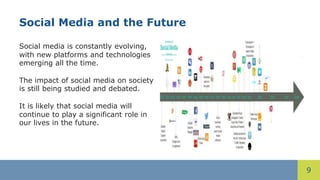
Social media is constantly evolving,
with new platforms and technologies
emerging all the time.
The impact of social media on society
is still being studied and debated.
It is likely that social media will
continue to play a significant role in
our lives in the future.
10
Conclusion
Social media has revolutionized the
way we communicate, interact, and
engage with one another.
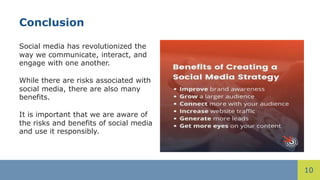
While there are risks associated with
social media, there are also many
benefits.
It is important that we are aware of
the risks and benefits of social media
and use it responsibly.