SOCIAL MEDIA
+
DEFINITION:
Social media refers to a wide range of digital platforms and technologies that
enable people to connect, share, and communicate with one another online. These
platforms provide users with a variety of tools and features, such as messaging,
posting, commenting, and sharing, which allow them to interact with others and
share content in real-time.
Impact of social media
Social media has had a profound impact on society in a number of ways, both
positive and negative. Here are some of the most notable impacts of social media:
Advantages of social media:
1.Improved communication.
2.Increased access to information.
3.Greater social connectivity.
4.Enhanced business opportunities.
Disadvantages of social media:
1.Cyberbullying and harassment.
2.Addiction and time-wasting.
3.Misinformation and fake news.
4.Privacy and security risks.
5.Negative impacts on mental health.
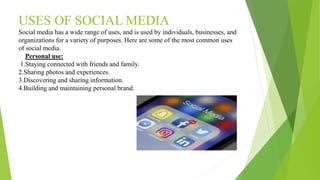
USES OF SOCIAL MEDIA
Social media has a wide range of uses, and is used by individuals, businesses, and
organizations for a variety of purposes. Here are some of the most common uses
of social media.
Personal use:
1.Staying connected with friends and family.
2.Sharing photos and experiences.
3.Discovering and sharing information.
4.Building and maintaining personal brand.
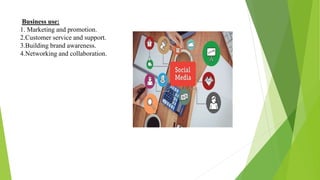
Business use:
1. Marketing and promotion.
2.Customer service and support.
3.Building brand awareness.
4.Networking and collaboration.
Social causes and activism
1.Raising awareness and advocacy.
2.Mobilizing communities.
3.Crowdfunding and fundraising.
Popular social media platforms
Face book: With over 2.8 billion monthly active users, Facebook is the largest
social media platform in the world.
Twitter: With over 1 billion monthly active users, Instagram is a photo and video
sharing platform that enables users to share their experiences, interests, and
stories.
Instagram: With over 1 billion monthly active users, Instagram is a photo and
video sharing platform that enables users to share their experiences, interests,
and stories.
TikTok: With over 689 million monthly active users, TikTok is a social media
platform that enables users to create and share short-form videos, often set to
music or other audio.
LinkedIn: With over 740 million members, LinkedIn is a professional networking
platform that enables users to create a professional profile, connect with
colleagues and peers, and find job opportunities.
Other popular social media platforms include Snapchat, Pinterest, Reddit, and
Tumblr. Each platform has its own unique features and audience, and businesses
and individuals often use multiple platforms to reach different audiences and
achieve different goals.
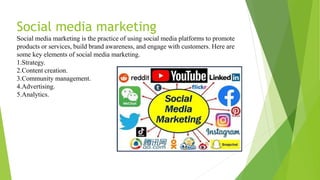
Social media marketing
Social media marketing is the practice of using social media platforms to promote
products or services, build brand awareness, and engage with customers. Here are
some key elements of social media marketing.
1.Strategy.
2.Content creation.
3.Community management.
4.Advertising.
5.Analytics.
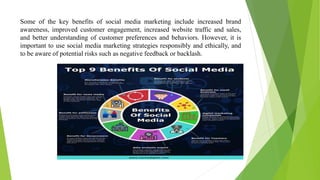
Some of the key benefits of social media marketing include increased brand
awareness, improved customer engagement, increased website traffic and sales,
and better understanding of customer preferences and behaviors. However, it is
important to use social media marketing strategies responsibly and ethically, and
to be aware of potential risks such as negative feedback or backlash.
Privacy and security issues
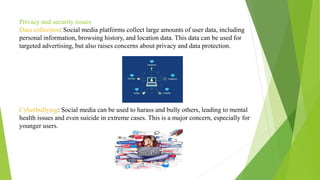
Data collection: Social media platforms collect large amounts of user data, including
personal information, browsing history, and location data. This data can be used for
targeted advertising, but also raises concerns about privacy and data protection.
Cyberbullying: Social media can be used to harass and bully others, leading to mental
health issues and even suicide in extreme cases. This is a major concern, especially for
younger users.
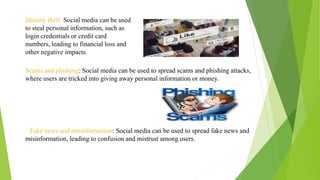
Identity theft: Social media can be used
to steal personal information, such as
login credentials or credit card
numbers, leading to financial loss and
other negative impacts.
Scams and phishing: Social media can be used to spread scams and phishing attacks,
where users are tricked into giving away personal information or money.
Fake news and misinformation: Social media can be used to spread fake news and
misinformation, leading to confusion and mistrust among users.
 To protect against these privacy and security issues, users can take the
following steps:
1.Use strong passwords and enable two-factor authentication to protect accounts from
unauthorized access.
2.Adjust privacy settings to control who can see personal information and content.
2.Be careful about what personal information is shared online.
3.Avoid clicking on suspicious links.
4.Verify information before sharing or believing it.
Future of social media
 Video content.
 Augmented Reality (AR) and Virtual Reality (VR).
 Social Commerce.
 Personalization.
 Privacy and Security.
CONCLUSION
Social media has had a significant impact on our personal and professional lives,
providing many benefits such as increased connectivity, information sharing, and
marketing opportunities. However, social media also presents challenges,
including privacy and security concerns, cyberbullying, and the spread of
misinformation

social media presentation.pptx

  • 1.
  • 2.
    DEFINITION: Social media refersto a wide range of digital platforms and technologies that enable people to connect, share, and communicate with one another online. These platforms provide users with a variety of tools and features, such as messaging, posting, commenting, and sharing, which allow them to interact with others and share content in real-time.
  • 3.
    Impact of socialmedia Social media has had a profound impact on society in a number of ways, both positive and negative. Here are some of the most notable impacts of social media: Advantages of social media: 1.Improved communication. 2.Increased access to information. 3.Greater social connectivity. 4.Enhanced business opportunities.
  • 4.
    Disadvantages of socialmedia: 1.Cyberbullying and harassment. 2.Addiction and time-wasting. 3.Misinformation and fake news. 4.Privacy and security risks. 5.Negative impacts on mental health.
  • 5.
    USES OF SOCIALMEDIA Social media has a wide range of uses, and is used by individuals, businesses, and organizations for a variety of purposes. Here are some of the most common uses of social media. Personal use: 1.Staying connected with friends and family. 2.Sharing photos and experiences. 3.Discovering and sharing information. 4.Building and maintaining personal brand.
  • 6.
    Business use: 1. Marketingand promotion. 2.Customer service and support. 3.Building brand awareness. 4.Networking and collaboration.
  • 7.
    Social causes andactivism 1.Raising awareness and advocacy. 2.Mobilizing communities. 3.Crowdfunding and fundraising.
  • 8.
    Popular social mediaplatforms Face book: With over 2.8 billion monthly active users, Facebook is the largest social media platform in the world. Twitter: With over 1 billion monthly active users, Instagram is a photo and video sharing platform that enables users to share their experiences, interests, and stories.
  • 9.
    Instagram: With over1 billion monthly active users, Instagram is a photo and video sharing platform that enables users to share their experiences, interests, and stories. TikTok: With over 689 million monthly active users, TikTok is a social media platform that enables users to create and share short-form videos, often set to music or other audio.
  • 10.
    LinkedIn: With over740 million members, LinkedIn is a professional networking platform that enables users to create a professional profile, connect with colleagues and peers, and find job opportunities. Other popular social media platforms include Snapchat, Pinterest, Reddit, and Tumblr. Each platform has its own unique features and audience, and businesses and individuals often use multiple platforms to reach different audiences and achieve different goals.
  • 11.
    Social media marketing Socialmedia marketing is the practice of using social media platforms to promote products or services, build brand awareness, and engage with customers. Here are some key elements of social media marketing. 1.Strategy. 2.Content creation. 3.Community management. 4.Advertising. 5.Analytics.
  • 12.
    Some of thekey benefits of social media marketing include increased brand awareness, improved customer engagement, increased website traffic and sales, and better understanding of customer preferences and behaviors. However, it is important to use social media marketing strategies responsibly and ethically, and to be aware of potential risks such as negative feedback or backlash.
  • 13.
    Privacy and securityissues Data collection: Social media platforms collect large amounts of user data, including personal information, browsing history, and location data. This data can be used for targeted advertising, but also raises concerns about privacy and data protection. Cyberbullying: Social media can be used to harass and bully others, leading to mental health issues and even suicide in extreme cases. This is a major concern, especially for younger users.
  • 14.
    Identity theft: Socialmedia can be used to steal personal information, such as login credentials or credit card numbers, leading to financial loss and other negative impacts. Scams and phishing: Social media can be used to spread scams and phishing attacks, where users are tricked into giving away personal information or money. Fake news and misinformation: Social media can be used to spread fake news and misinformation, leading to confusion and mistrust among users.
  • 15.
     To protectagainst these privacy and security issues, users can take the following steps: 1.Use strong passwords and enable two-factor authentication to protect accounts from unauthorized access. 2.Adjust privacy settings to control who can see personal information and content. 2.Be careful about what personal information is shared online. 3.Avoid clicking on suspicious links. 4.Verify information before sharing or believing it.
  • 16.
    Future of socialmedia  Video content.  Augmented Reality (AR) and Virtual Reality (VR).  Social Commerce.  Personalization.  Privacy and Security.
  • 17.
    CONCLUSION Social media hashad a significant impact on our personal and professional lives, providing many benefits such as increased connectivity, information sharing, and marketing opportunities. However, social media also presents challenges, including privacy and security concerns, cyberbullying, and the spread of misinformation