Downloaded 39 times
![maricarmen sierradmba / may 2012
Mapping The Larger System
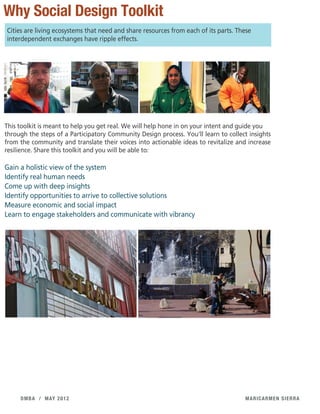
Cities are living ecosystems that need and share resources from each of its parts. These
interdependent exchanges have ripple effects.
Community design is a result of zoning
laws designed by legislators, low-
density buildings designed by develop-
ers, marketing strategies designed by
ad agencies, tax breaks designed by
economists, credit lines designed by
bankers, low-nutrient food designed
by hamburger chains. The interactions
between all these systems are compli-
cated and hard to understand, but
they are not the result of chance. So
there has to be ways to improve them.
“
“
If you are involved in community design, you need to have sensitivity to con-
text, relationships and consequences in order to understand how a community
can adapt to our changeable future.
Use the Stakeholder Pentad to make a map
of the larger system you live in to understand
what types of exchange you could foster. The
line represents a structure inherent in the
relationships between stakeholders that
enables them to be in harmony.
Move from point to point along the connect-
ing lines of the star. Always start with the
customer - the people who will receive your
service and then move to co-creator; the
range of people that will make your service
happen.
Then move to the third point; Earth - our
living source of energy and materials. From
Earth move to communities; the local people
and institutions that are affected by your
presence.
Finally move to the investors who supply the
financial capital needed for organizations to
evolve. Essentially look for new opportunities on
how to engage these stakeholders as partners
and collaborators in a mutually added-value kind
of relationship.
TARGET AUDIENCE
PENTAD DIAGRAM FOR STAKEHOLDER
ENGAGEMENT [APPENDIX 1]
CO-CREATORS
EARTH COMMUNITIES
INVESTORS
[APPENDIX 2- EXERCISE FOR A PENTAD]](https://image.slidesharecdn.com/socialdesigntoolkitv3-140807190904-phpapp02/85/Social-Design-toolkit-4-320.jpg)
![maricarmen sierradmba / may 2012
“Never doubt that a small group of
thoughtful committed citizens can
change the world., Indeed it is the
only thing that ever has.”
Margaret Mead
“
“
IDENTIFYING INTENT
Write down your intent and measure the projected impact from your efforts. In order to
deliver a service which truly satisfies the need of the community, it requires that you make
a constant assessment of your projected impact. You need to aspire for something that is
disruptive, but simple and real enough to be actionable.
Helps you to truly understand why you are doing this and how will you make
an effective impact. We recommend you start by doing a thorough assessment
of your real intent of change.
Before you set out on a journey to explore
your contribution to the system (city, commu-
nity or neighborhood), think why would you
like to do things differently as compared to
the existing programs. This could be based on
your own:
WHAT ARE YOU TRYING TO ACCOMPLISH:
Frame a simple mission statement. Reformu-
lating the traditional mission statement to
three simple components is the key. This will
be the overarching theme that will guide
your research and strategy development.
Values
Outcomes
Process
Level of Engagement
With Stakeholders
A TARGET POPULATION1
A VERB2
OUTCOME[IMPLIES SOMETHING TO MEASURE]3
EXAMPLE -Create job opportunities for San Francisco low income population.](https://image.slidesharecdn.com/socialdesigntoolkitv3-140807190904-phpapp02/85/Social-Design-toolkit-5-320.jpg)
![maricarmen sierradmba / may 2012
WHAT IS...
Two phases will mark your exploration:
Primary research is direct interaction with community members and may include street
intercepts, expert, individual or group interviews.
Secondary research investigates earlier sources, competition, uses government or public data
and real/ fictional analogies. Use what’s out there and build on the shoulders of giants!
Get an accurate up to date understanding of your community’s most desired
meaningful experience living in the area, as well as their biggest pain points.
Look at this list of universal human needs
[APPENDIX ] and follow these steps.
STEP 1
Craft your questionnaire to answer “What
are the essential experiences people want in
this community?”
STEP 2
You want to interview at least 15 people
and practice active listening skills. Go in pairs
and try to fit-in by dressing neutrally.
STEP 3
Record responses and photos if possible.
People aren’t accustomed to talk about their
deep needs and experiences so use the “ex-
perience cards” in the following page to help
them identify theirs. (see definitions in
Appendix 4). Appropriate visuals make it easy
for respondents to choose their desired feel-
ing for the area.
State your objective clearly, be easy to
talk to and listen with your heart. Once
you create trust, most people are happy
to talk about themselves. After talking
with one self-described ‘homeless
hermit’ for a few minutes, he felt our
honest passion and eventually per-
formed a 15 minute long mime of living
on the streets. Community, Beauty and
Security were the most meaningful
experiences residents are looking for.
And the combination of the three tend
towards Harmony, a vibrant and peace-
ful cohabitation. This insight inspired
every part of our design process.
CENTRAL MARKET EXAMPLE](https://image.slidesharecdn.com/socialdesigntoolkitv3-140807190904-phpapp02/85/Social-Design-toolkit-6-320.jpg)

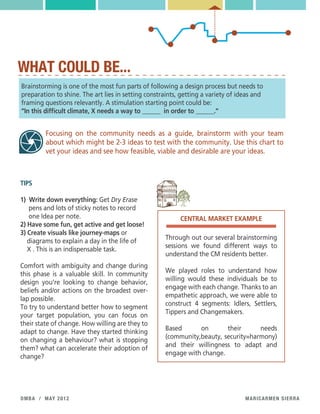
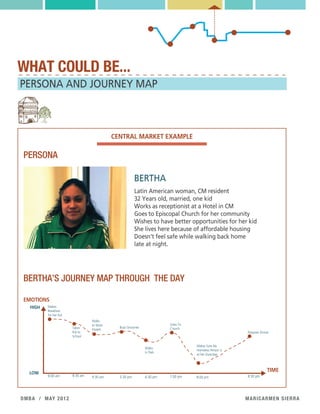

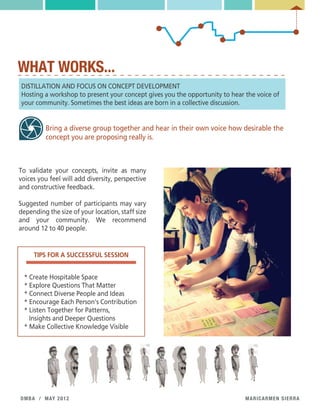


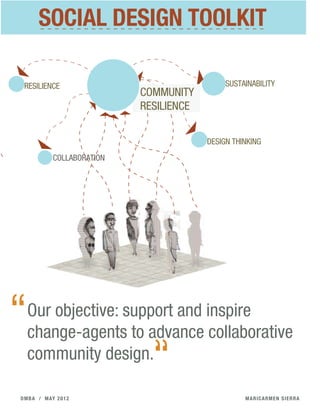
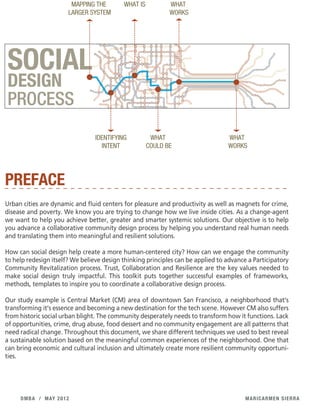
The document provides an overview of a social design toolkit that aims to support community change agents. The toolkit outlines a participatory community design process involving mapping the stakeholder system, identifying community needs through interviews, brainstorming potential solutions, prototyping concepts, and validating ideas through workshops. It uses the example of a neighborhood in San Francisco undergoing revitalization to illustrate how the design thinking principles and methods in the toolkit were applied to understand residents' desired experiences of community, beauty, and security and develop solutions to address issues like crime and lack of opportunities.


![ceramic-art-and-pottery [Autosaved].pptx](https://cdn.slidesharecdn.com/ss_thumbnails/ceramic-art-and-potteryautosaved-260113113456-35c55ddb-thumbnail.jpg?width=640&height=640&fit=bounds)


