H2020 and the SME Instrument
JIC
Brno, 18th May 2016
22
ABOUT US
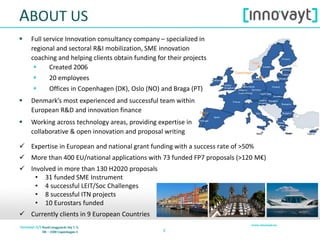
 Full service Innovation consultancy company – specialized in
regional and sectoral R&I mobilization, SME innovation
coaching and helping clients obtain funding for their projects
 Created 2006
 20 employees
 Offices in Copenhagen (DK), Oslo (NO) and Braga (PT)
 Denmark’s most experienced and successful team within
European R&D and innovation finance
 Working across technology areas, providing expertise in
collaborative & open innovation and proposal writing
 Expertise in European and national grant funding with a success rate of >50%
 More than 400 EU/national applications with 73 funded FP7 proposals (>120 M€)
 Involved in more than 130 H2020 proposals
• 31 funded SME Instrument
• 4 successful LEIT/Soc Challenges
• 8 successful ITN projects
• 10 Eurostars funded
 Currently clients in 9 European Countries
33
Need for this session
44
THE NEED FOR THIS SESSION
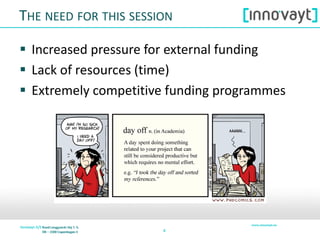
 Increased pressure for external funding
 Lack of resources (time)
 Extremely competitive funding programmes
The need for this session
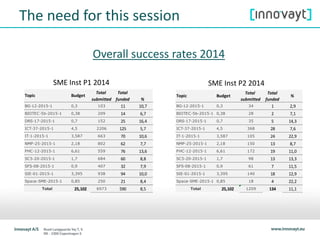
Total Total
submitted funded %
BG-12-2015-1 0,3 103 11 10,7
BIOTEC-5b-2015-1 0,38 209 14 6,7
DRS-17-2015-1 0,7 152 25 16,4
ICT-37-2015-1 4,5 2206 125 5,7
IT-1-2015-1 3,587 663 70 10,6
NMP-25-2015-1 2,18 802 62 7,7
PHC-12-2015-1 6,61 559 76 13,6
SC5-20-2015-1 1,7 684 60 8,8
SFS-08-2015-1 0,9 407 32 7,9
SIE-01-2015-1 3,395 938 94 10,0
Space-SME-2015-1 0,85 250 21 8,4
Total 25,102 6973 590 8,5
Topic Budget
SME Inst P1 2014
Total Total
submitted funded
BG-12-2015-1 0,3 34 1 2,9
BIOTEC-5b-2015-1 0,38 28 2 7,1
DRS-17-2015-1 0,7 35 5 14,3
ICT-37-2015-1 4,5 368 28 7,6
IT-1-2015-1 3,587 105 24 22,9
NMP-25-2015-1 2,18 150 13 8,7
PHC-12-2015-1 6,61 172 19 11,0
SC5-20-2015-1 1,7 98 13 13,3
SFS-08-2015-1 0,9 61 7 11,5
SIE-01-2015-1 3,395 140 18 12,9
Space-SME-2015-1 0,85 18 4 22,2
Total 25,102 1209 134 11,1
%Topic Budget
SME Inst P2 2014
Overall success rates 2014
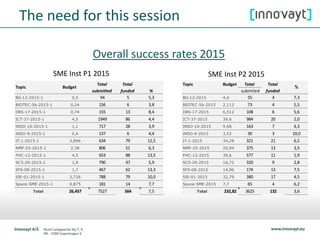
The need for this session
SME Inst P1 2015 SME Inst P2 2015
Total Total
submitted funded %
BG-12-2015-1 0,5 94 5 5,3
BIOTEC-5b-2015-1 0,24 156 6 3,8
DRS-17-2015-1 0,74 155 13 8,4
ICT-37-2015-1 4,5 1949 86 4,4
INSO-10-2015-1 1,1 717 28 3,9
INSO-9-2015-1 0,4 137 6 4,4
IT-1-2015-1 3,896 634 79 12,5
NMP-25-2015-1 2,38 806 51 6,3
PHC-12-2015-1 4,5 653 88 13,5
SC5-20-2015-1 1,9 790 47 5,9
SFS-08-2015-1 1,7 467 62 13,3
SIE-01-2015-1 3,726 788 79 10,0
Space-SME-2015-1 0,875 181 14 7,7
Total 26,457 7527 564 7,5
Topic Budget
Topic Budget Total Total
submited funded
BG-12-2015 4,4 55 4 7,3
BIOTEC-5b-2015 2,112 73 4 5,5
DRS-17-2015 6,512 108 6 5,6
ICT-37-2015 39,6 984 20 2,0
INSO-10-2015 9,68 163 7 4,3
INSO-9-2015 3,52 30 3 10,0
IT-1-2015 34,28 321 21 6,5
NMP-25-2015 20,94 375 13 3,5
PHC-12-2015 39,6 577 11 1,9
SC5-20-2015 16,72 320 9 2,8
SFS-08-2015 14,96 174 13 7,5
SIE-01-2015 32,79 380 17 4,5
Space-SME-2015 7,7 65 4 6,2
Total 232,82 3625 132 3,6
%
Overall success rates 2015
88
Workshop focus
99
PURPOSE AND GOALS
 Understanding the mindset behind H2020
 Planning of proposal development
 Formulating project ideas
 Sharpening arguments for Impact section
 Sharing examples of best practices
1010
SME Instrument positioning
1111
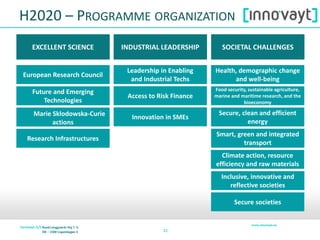
H2020 – PROGRAMME ORGANIZATION
Marie Sklodowska-Curie
actions
Research Infrastructures
Leadership in Enabling
and Industrial Techs
Health, demographic change
and well-being
Food security, sustainable agriculture,
marine and maritime research, and the
bioeconomy
Secure, clean and efficient
energy
Smart, green and integrated
transport
Climate action, resource
efficiency and raw materials
EXCELLENT SCIENCE INDUSTRIAL LEADERSHIP SOCIETAL CHALLENGES
Access to Risk Finance
Innovation in SMEs
Inclusive, innovative and
reflective societies
European Research Council
Future and Emerging
Technologies
Secure societies
1212
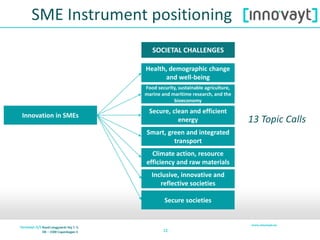
SME Instrument positioning
Health, demographic change
and well-being
Food security, sustainable agriculture,
marine and maritime research, and the
bioeconomy
Secure, clean and efficient
energy
Smart, green and integrated
transport
Climate action, resource
efficiency and raw materials
SOCIETAL CHALLENGES
Innovation in SMEs
Inclusive, innovative and
reflective societies
Secure societies
13 Topic Calls
1313
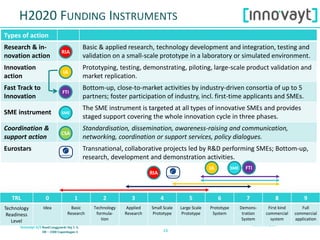
H2020 FUNDING INSTRUMENTS
Types of action
Research & in-
novation action
Basic & applied research, technology development and integration, testing and
validation on a small-scale prototype in a laboratory or simulated environment.
Innovation
action
Prototyping, testing, demonstrating, piloting, large-scale product validation and
market replication.
Fast Track to
Innovation
Bottom-up, close-to-market activities by industry-driven consortia of up to 5
partners; foster participation of industry, incl. first-time applicants and SMEs.
SME instrument
The SME instrument is targeted at all types of innovative SMEs and provides
staged support covering the whole innovation cycle in three phases.
Coordination &
support action
Standardisation, dissemination, awareness-raising and communication,
networking, coordination or support services, policy dialogues.
Eurostars Transnational, collaborative projects led by R&D performing SMEs; Bottom-up,
research, development and demonstration activities.
RIA
IA
CSA
SME
TRL 0 1 2 3 4 5 6 7 8 9
Technology
Readiness
Level
Idea Basic
Research
Technology
formula-
tion
Applied
Research
Small Scale
Prototype
Large Scale
Prototype
Prototype
System
Demons-
tration
System
First kind
commercial
system
Full
commercial
application
IA SME
RIA
FTI
FTI
1414
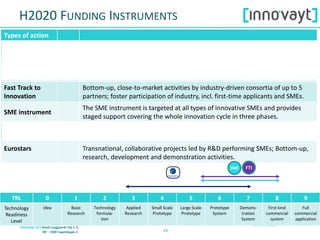
H2020 FUNDING INSTRUMENTS
IA
CSA
SME
TRL 0 1 2 3 4 5 6 7 8 9
Technology
Readiness
Level
Idea Basic
Research
Technology
formula-
tion
Applied
Research
Small Scale
Prototype
Large Scale
Prototype
Prototype
System
Demons-
tration
System
First kind
commercial
system
Full
commercial
application
RIA
FTI
Types of action
Research & in-
novation action
Basic & applied research, technology development and integration, testing and
validation on a small-scale prototype in a laboratory or simulated environment.
Innovation
action
Prototyping, testing, demonstrating, piloting, large-scale product validation and
market replication.
Fast Track to
Innovation
Bottom-up, close-to-market activities by industry-driven consortia of up to 5
partners; foster participation of industry, incl. first-time applicants and SMEs.
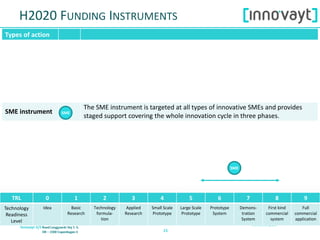
SME instrument
The SME instrument is targeted at all types of innovative SMEs and provides
staged support covering the whole innovation cycle in three phases.
Coordination &
support action
Standardisation, dissemination, awareness-raising and communication,
networking, coordination or support services, policy dialogues.
Eurostars Transnational, collaborative projects led by R&D performing SMEs; Bottom-up,
research, development and demonstration activities.
SME FTI
1515
Types of action
Research & in-
novation action
Basic & applied research, technology development and integration, testing and
validation on a small-scale prototype in a laboratory or simulated environment.
Innovation
action
Prototyping, testing, demonstrating, piloting, large-scale product validation and
market replication.
Fast Track to
Innovation
Bottom-up, close-to-market activities by industry-driven consortia of up to 5
partners; foster participation of industry, incl. first-time applicants and SMEs.
SME instrument
The SME instrument is targeted at all types of innovative SMEs and provides
staged support covering the whole innovation cycle in three phases.
Coordination &
support action
Standardisation, dissemination, awareness-raising and communication,
networking, coordination or support services, policy dialogues.
Eurostars Transnational, collaborative projects led by R&D performing SMEs; Bottom-up,
research, development and demonstration activities.
H2020 FUNDING INSTRUMENTS
IA
CSA
SME
TRL 0 1 2 3 4 5 6 7 8 9
Technology
Readiness
Level
Idea Basic
Research
Technology
formula-
tion
Applied
Research
Small Scale
Prototype
Large Scale
Prototype
Prototype
System
Demons-
tration
System
First kind
commercial
system
Full
commercial
application
RIA
FTI
SME
1616
Proposal preparation
& writing
1717
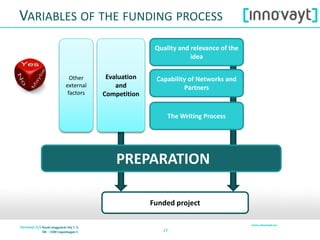
Funded project
VARIABLES OF THE FUNDING PROCESS
Quality and relevance of the
idea
The Writing Process
Capability of Networks and
Partners
Evaluation
and
Competition
Other
external
factors
PREPARATION
1818
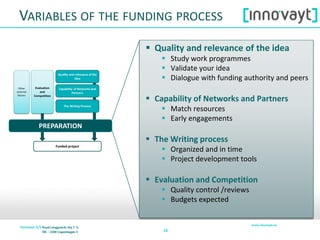
 Quality and relevance of the idea
 Study work programmes
 Validate your idea
 Dialogue with funding authority and peers
 Capability of Networks and Partners
 Match resources
 Early engagements
 The Writing process
 Organized and in time
 Project development tools
 Evaluation and Competition
 Quality control /reviews
 Budgets expected
VARIABLES OF THE FUNDING PROCESS
1919
PREPARATION
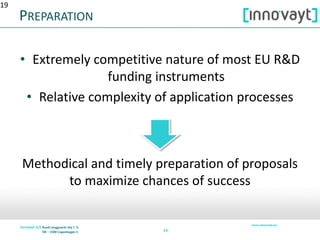
• Extremely competitive nature of most EU R&D
funding instruments
• Relative complexity of application processes
Methodical and timely preparation of proposals
to maximize chances of success
19
Overview of proposals
structure
H2020 – PROPOSALS STRUCTURE
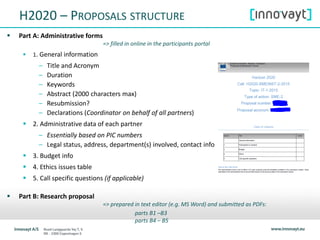
 Part A: Administrative forms
=> filled in online in the participants portal
 1. General information
– Title and Acronym
– Duration
– Keywords
– Abstract (2000 characters max)
– Resubmission?
– Declarations (Coordinator on behalf of all partners)
 2. Administrative data of each partner
– Essentially based on PIC numbers
– Legal status, address, department(s) involved, contact info
 3. Budget info
 4. Ethics issues table
 5. Call specific questions (if applicable)
 Part B: Research proposal
=> prepared in text editor (e.g. MS Word) and submitted as PDFs:
parts B1 –B3
parts B4 – B5
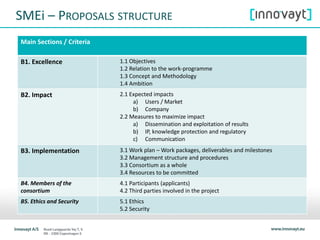
SMEi – PROPOSALS STRUCTURE
Main Sections / Criteria
B1. Excellence 1.1 Objectives
1.2 Relation to the work-programme
1.3 Concept and Methodology
1.4 Ambition
B2. Impact 2.1 Expected impacts
a) Users / Market
b) Company
2.2 Measures to maximize impact
a) Dissemination and exploitation of results
b) IP, knowledge protection and regulatory
c) Communication
B3. Implementation 3.1 Work plan – Work packages, deliverables and milestones
3.2 Management structure and procedures
3.3 Consortium as a whole
3.4 Resources to be committed
B4. Members of the
consortium
4.1 Participants (applicants)
4.2 Third parties involved in the project
B5. Ethics and Security 5.1 Ethics
5.2 Security
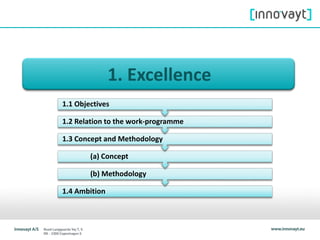
1. Excellence
1.4 Ambition
(b) Methodology
(a) Concept
1.3 Concept and Methodology
1.2 Relation to the work-programme
1.1 Objectives
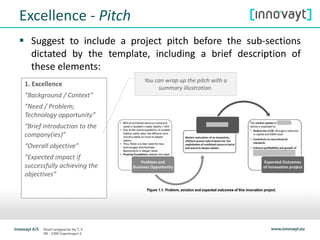
Excellence - Pitch
 Suggest to include a project pitch before the sub-sections
dictated by the template, including a brief description of
these elements:
1. Excellence
“Background / Context”
“Need / Problem;
Technology opportunity”
“Brief introduction to the
company(ies)”
“Overall objective”
“Expected impact if
successfully achieving the
objectives”
You can wrap up the pitch with a
summary illustration.
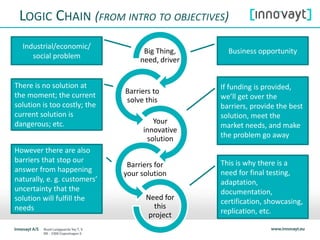
LOGIC CHAIN (FROM INTRO TO OBJECTIVES)
Big Thing,
need, driver
Barriers to
solve this
Your
innovative
solution
Barriers for
your solution
Need for
this
project
Industrial/economic/
social problem
Business opportunity
There is no solution at
the moment; the current
solution is too costly; the
current solution is
dangerous; etc.
If funding is provided,
we’ll get over the
barriers, provide the best
solution, meet the
market needs, and make
the problem go away
However there are also
barriers that stop our
answer from happening
naturally, e. g. customers’
uncertainty that the
solution will fulfill the
needs
This is why there is a
need for final testing,
adaptation,
documentation,
certification, showcasing,
replication, etc.
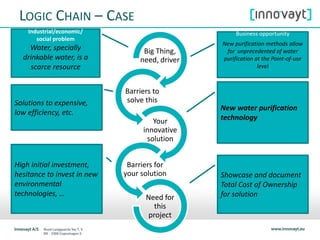
LOGIC CHAIN – CASE
Big Thing,
need, driver
Barriers to
solve this
Your
innovative
solution
Barriers for
your solution
Need for
this
project
Industrial/economic/
social problem
Water, specially
drinkable water, is a
scarce resource
Business opportunity
New purification methods allow
for unprecedented of water
purification at the Point-of-use
level
Solutions to expensive,
low efficiency, etc.
New water purification
technology
High initial investment,
hesitance to invest in new
environmental
technologies, …
Showcase and document
Total Cost of Ownership
for solution
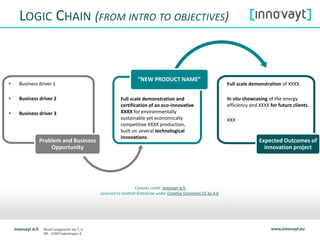
LOGIC CHAIN (FROM INTRO TO OBJECTIVES)
Content credit: Innovayt A/S
Licensed to Scottish Enterprise under Creative Commons CC by 4.0.
Problem and Business
Opportunity
“NEW PRODUCT NAME”
Expected Outcomes of
innovation project
• Business driver 1
• Business driver 2
• Business driver 3
Full scale demonstration and
certification of an eco-innovative
XXXX for environmentally
sustainable yet economically
competitive XXXX production,
built on several technological
innovations.
Full scale demonstration of XXXX.
In situ showcasing of the energy
efficiency and XXXX for future clients.
XXX
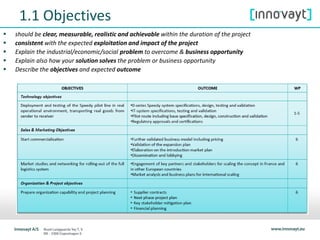
1.1 Objectives
 should be clear, measurable, realistic and achievable within the duration of the project
 consistent with the expected exploitation and impact of the project
 Explain the industrial/economic/social problem to overcome & business opportunity
 Explain also how your solution solves the problem or business opportunity
 Describe the objectives and expected outcome
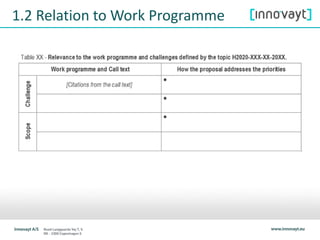
1.2 Relation to Work Programme
1.3 Concept and Methodology
(a) Concept
 current stage of development
 positioning of the business innovation project
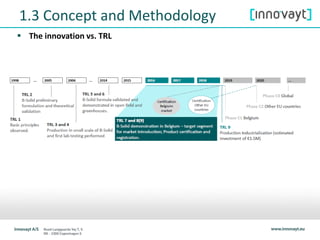
 The innovation vs. TRL
(b) Methodology
 explain the concept and the activities that you will implement
 how the concept and objectives for the project fit into the
overall plan
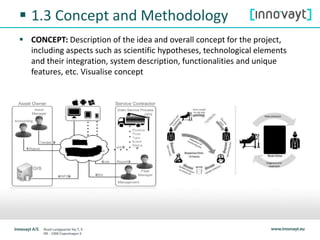
 1.3 Concept and Methodology
 CONCEPT: Description of the idea and overall concept for the project,
including aspects such as scientific hypotheses, technological elements
and their integration, system description, functionalities and unique
features, etc. Visualise concept
1.3 Concept and Methodology
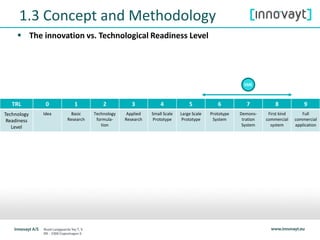
TRL 0 1 2 3 4 5 6 7 8 9
Technology
Readiness
Level
Idea Basic
Research
Technology
formula-
tion
Applied
Research
Small Scale
Prototype
Large Scale
Prototype
Prototype
System
Demons-
tration
System
First kind
commercial
system
Full
commercial
application
SME
 The innovation vs. Technological Readiness Level
1.3 Concept and Methodology
 The innovation vs. TRL
1.4 Ambition
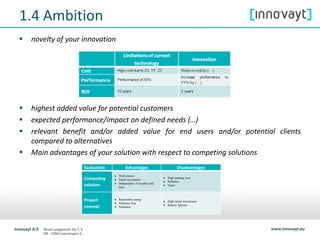
 novelty of your innovation
 highest added value for potential customers
 expected performance/impact on defined needs (…)
 relevant benefit and/or added value for end users and/or potential clients
compared to alternatives
 Main advantages of your solution with respect to competing solutions
Evaluation Advantages Disadvantages
Competing
solution
 Well known
 Small investment
 Independent of weather and
time
 High running cost
 Pollution
 Noise
Project
concept
 Renewable energy
 Pollution free
 Noiseless
 High initial investment
 Battery lifetime
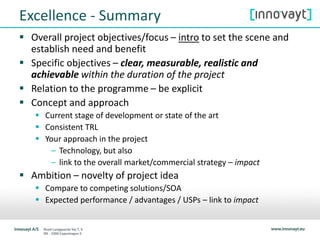
Excellence - Summary
 Overall project objectives/focus – intro to set the scene and
establish need and benefit
 Specific objectives – clear, measurable, realistic and
achievable within the duration of the project
 Relation to the programme – be explicit
 Concept and approach
 Current stage of development or state of the art
 Consistent TRL
 Your approach in the project
– Technology, but also
– link to the overall market/commercial strategy – impact
 Ambition – novelty of project idea
 Compare to competing solutions/SOA
 Expected performance / advantages / USPs – link to impact
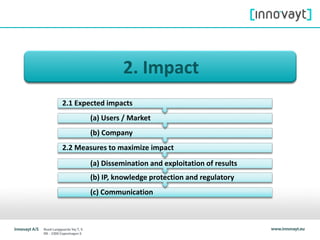
2. Impact
(c) Communication
(b) IP, knowledge protection and regulatory
(a) Dissemination and exploitation of results
2.2 Measures to maximize impact
(b) Company
(a) Users / Market
2.1 Expected impacts
Quantifying Impact
Visualising Impact
Quantifying Impact
 Benefits for the end-users
 Market size (market share, sales price (concrete and
realistic estimates)
 Business case (Projections of sales volume, turnover
an jobs created (at least 3-years horizon)
 Use to show market demand:
 Market representatives
– Test users/customers
– End users/Lead users
 Letter of interest
– Who (intro to customer)
– Why (the relevance of the innovation to the
customer)
– What (activities the customer will support)
Visualising Impact
 Visualising impact
 Key areas of the proposal
 Users
 Visualise Business context
 Value chain
 Value system
 Business model
 Route-to-market
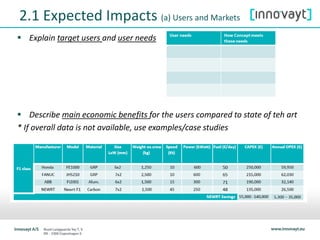
 Explain target users and user needs
 Describe main economic benefits for the users compared to state of teh art
* If overall data is not available, use examples/case studies
2.1 Expected Impacts (a) Users and Markets
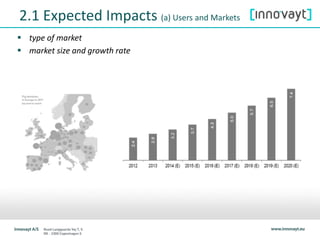
 type of market
 market size and growth rate
2.1 Expected Impacts (a) Users and Markets
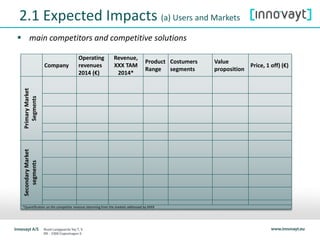
 main competitors and competitive solutions
2.1 Expected Impacts (a) Users and Markets
Company
Operating
revenues
2014 (€)
Revenue,
XXX TAM
2014*
Product
Range
Costumers
segments
Value
proposition
Price, 1 off) (€)
PrimaryMarket
Segments
SecondaryMarket
segments
*Quantification on the competitor revenue stemming from the markets addressed by XXXX
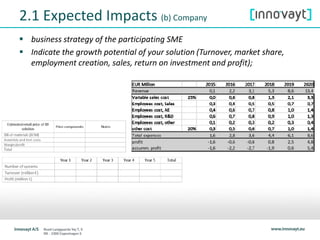
 business strategy of the participating SME
 Indicate the growth potential of your solution (Turnover, market share,
employment creation, sales, return on investment and profit);
2.1 Expected Impacts (b) Company
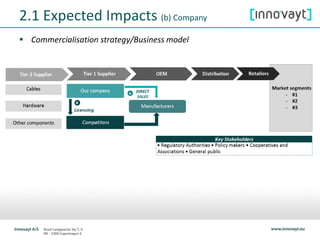
 Commercialisation strategy/Business model
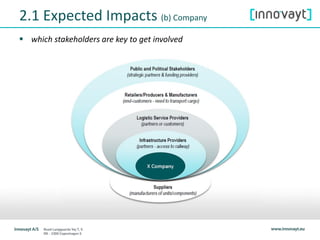
 which stakeholders are key to get involved
2.1 Expected Impacts (b) Company
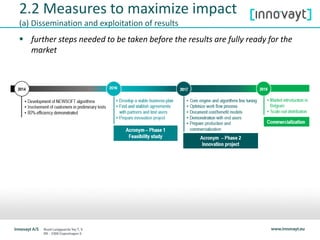
 further steps needed to be taken before the results are fully ready for the
market
2.2 Measures to maximize impact
(a) Dissemination and exploitation of results
 describe the key knowledge (IPR)
 freedom to operate
 knowledge management and protection
 regulatory and/or standard requirements to be fulfilled
 proposed communication measures for promoting the product
2.2 Measures to maximize impact
(b) Intellectual Property (…) and ( C) Comunication
2. Impact - Summary
 Strategy and Business plan
 Make (or envision) a structure / skeleton strategy and business plan
 Develop the parts needed to
– bulletproof business case
– ensure consistency
– underpin Impact section
 Visualise key areas of the proposal
 Visualise business context
 Value chain, Value system, Business model, Route-to-market
 Quantify impact (ROI table is a must)
3. Implementation
3.4 Resources to be committed
3.3 Consortium as a whole
3.2 Management structure and procedures
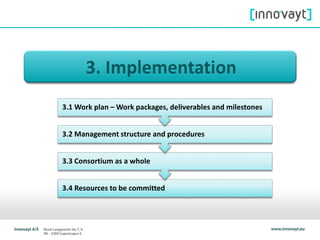
3.1 Work plan – Work packages, deliverables and milestones
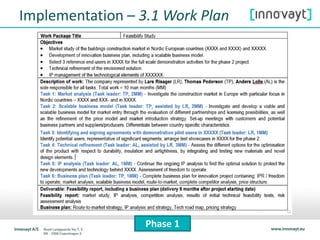
Implementation – 3.1 Work Plan
Phase 1
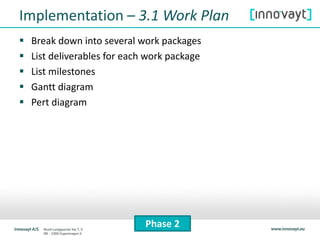
 Break down into several work packages
 List deliverables for each work package
 List milestones
 Gantt diagram
 Pert diagram
Phase 2
Implementation – 3.1 Work Plan
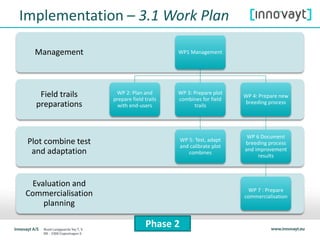
Evaluation and
Commercialisation
planning
Plot combine test
and adaptation
Field trails
preparations
Management WP1 Management
WP 2: Plan and
prepare field trails
with end-users
WP 3: Prepare plot
combines for field
trails
WP 5: Test, adapt
and calibrate plot
combines
WP 4: Prepare new
breeding process
WP 6 Document
breeding process
and improvement
results
WP 7 : Prepare
commercialisation
Implementation – 3.1 Work Plan
Phase 2
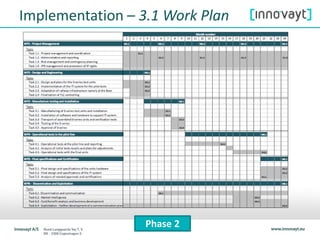
Implementation – 3.1 Work Plan
Phase 2
Implementation – 3.2 Management
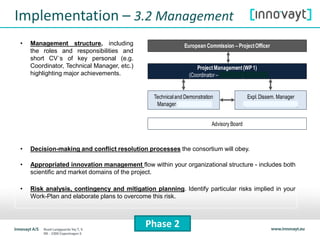
• Management structure, including
the roles and responsibilities and
short CV´s of key personal (e.g.
Coordinator, Technical Manager, etc.)
highlighting major achievements.
Phase 2
• Decision-making and conflict resolution processes the consortium will obey.
• Appropriated innovation management flow within your organizational structure - includes both
scientific and market domains of the project.
• Risk analysis, contingency and mitigation planning. Identify particular risks implied in your
Work-Plan and elaborate plans to overcome this risk.
Advisory Board
ProjectManagement(WP1)
(Coordinator – KasperE. Lyhne,SGL)
European Commission – ProjectOfficer
Technicaland Demonstration
Manager(PetrHron,PVF)
Expl.Dissem. Manager
(Heine Blach Jensen,SGL)
Phase 2
Implementation – 3.3 Consortium
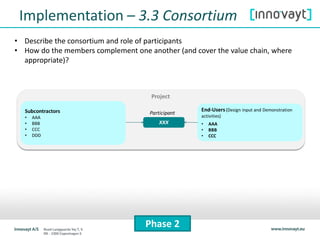
• Describe the consortium and role of participants
• How do the members complement one another (and cover the value chain, where
appropriate)?
Implementation – Summary
 Convince the evaluators that you can make
it…
 Technical and commercial competences
 Credible team and work plan
 External partners to bring competences that
the company does not have
 Realistic time frame
 Budget – argue cost, fail on over budgeting
4. Members of the consortium
 a description of the legal entity
 a curriculum vitae or description of the profile of the persons
 a list of up to 5 relevant publications, and/or products, services
 a list of up to 5 relevant previous projects or activities
 a description of any significant infrastructure and/or technical equipment
 a description of any third parties that are not represented as project partners
Partner Descriptions
End-users (letters of interest)
5. Ethics and Security
5.1 Ethics
 Ethics Self-assessment
5.2 Security
 activities or results raising security issues: (YES/NO)
 'EU-classified information' as background or results: (YES/NO)
Integrate all sections
Keys to success
- Novelty (validate before you start – freedom to operate)
- Match to topic
- Strongest partners (e.g end-users)
- Sell the idea on the first 2 pages
- Specific and not generic
- Good structure
Phase 1 to Phase 2
Why going to Phase 1?
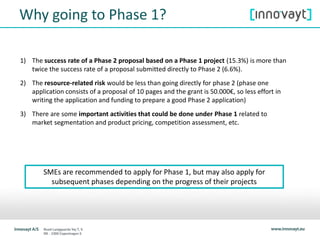
1) The success rate of a Phase 2 proposal based on a Phase 1 project (15.3%) is more than
twice the success rate of a proposal submitted directly to Phase 2 (6.6%).
2) The resource-related risk would be less than going directly for phase 2 (phase one
application consists of a proposal of 10 pages and the grant is 50.000€, so less effort in
writing the application and funding to prepare a good Phase 2 application)
3) There are some important activities that could be done under Phase 1 related to
market segmentation and product pricing, competition assessment, etc.
SMEs are recommended to apply for Phase 1, but may also apply for
subsequent phases depending on the progress of their projects
Timeline – Phase 1 to Phase 2
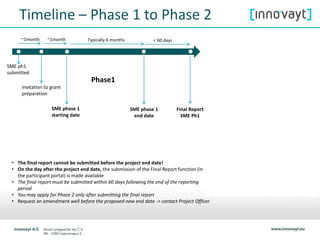
SME ph1
submitted
Invitation to grant
preparation
SME phase 1
starting date
• The final report cannot be submitted before the project end date!
• On the day after the project end date, the submission of the Final Report function (in
the participant portal) is made available
• The final report must be submitted within 60 days following the end of the reporting
period
• You may apply for Phase 2 only after submitting the final report
• Request an amendment well before the proposed new end date -> contact Project Officer
~1month ~1month Typically 6 months
SME phase 1
end date
SME phase 2
starting date
< 60 days
Final Report
SME Ph1
SME phase 2
submitted
2 months 1month
Phase1
Phase2
Invitation to grant
preparation
Timeline – Phase 1 to Phase 2
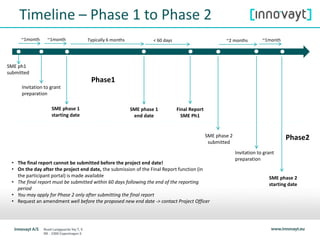
• The final report cannot be submitted before the project end date!
• On the day after the project end date, the submission of the Final Report function (in
the participant portal) is made available
• The final report must be submitted within 60 days following the end of the reporting
period
• You may apply for Phase 2 only after submitting the final report
• Request an amendment well before the proposed new end date -> contact Project Officer
SME ph1
submitted
Invitation to grant
preparation
SME phase 1
starting date
~1month ~1month Typically 6 months
SME phase 1
end date
SME phase 2
starting date
< 60 days
Final Report
SME Ph1
SME phase 2
submitted
~2 months ~1month
Phase1
Phase2
Invitation to grant
preparation
Conclusions
KEY TAKEAWAYS
SCOPE
 Innovation projects (but not necessarily rocket science…)
 Emphasis on market- and business-related aspects – Impact is key
(use strategic business plan logic)
 Focus on commercialization plan and ambition to grow business
 Demonstrate capacity to implement the project
WRITING
 Start early – it takes 100-400h to write a good proposal
 Be clear and to the point – avoid too much redundancies (modest repetitions)
 Guide the reader and build a narrative – clear structure, explanations, conclusions;
use figures/diagrams and tables
 Ensure consistency (between proposal parts/sub-sections)
 Quantify – avoid generic text
 Be ambitious (yet realistic) – e.g. you need an attractive business case with good ROI
 Convince evaluators to invest in your business (think like an evaluator…)
 Content is key, but form (structure/narrative/text quality) also matters…
Thank you for your attention

SME Instrument - innovayt

  • 1.
    H2020 and theSME Instrument JIC Brno, 18th May 2016
  • 2.
    22 ABOUT US  Fullservice Innovation consultancy company – specialized in regional and sectoral R&I mobilization, SME innovation coaching and helping clients obtain funding for their projects  Created 2006  20 employees  Offices in Copenhagen (DK), Oslo (NO) and Braga (PT)  Denmark’s most experienced and successful team within European R&D and innovation finance  Working across technology areas, providing expertise in collaborative & open innovation and proposal writing  Expertise in European and national grant funding with a success rate of >50%  More than 400 EU/national applications with 73 funded FP7 proposals (>120 M€)  Involved in more than 130 H2020 proposals • 31 funded SME Instrument • 4 successful LEIT/Soc Challenges • 8 successful ITN projects • 10 Eurostars funded  Currently clients in 9 European Countries
  • 3.
  • 4.
    44 THE NEED FORTHIS SESSION  Increased pressure for external funding  Lack of resources (time)  Extremely competitive funding programmes
  • 5.
    The need forthis session Total Total submitted funded % BG-12-2015-1 0,3 103 11 10,7 BIOTEC-5b-2015-1 0,38 209 14 6,7 DRS-17-2015-1 0,7 152 25 16,4 ICT-37-2015-1 4,5 2206 125 5,7 IT-1-2015-1 3,587 663 70 10,6 NMP-25-2015-1 2,18 802 62 7,7 PHC-12-2015-1 6,61 559 76 13,6 SC5-20-2015-1 1,7 684 60 8,8 SFS-08-2015-1 0,9 407 32 7,9 SIE-01-2015-1 3,395 938 94 10,0 Space-SME-2015-1 0,85 250 21 8,4 Total 25,102 6973 590 8,5 Topic Budget SME Inst P1 2014 Total Total submitted funded BG-12-2015-1 0,3 34 1 2,9 BIOTEC-5b-2015-1 0,38 28 2 7,1 DRS-17-2015-1 0,7 35 5 14,3 ICT-37-2015-1 4,5 368 28 7,6 IT-1-2015-1 3,587 105 24 22,9 NMP-25-2015-1 2,18 150 13 8,7 PHC-12-2015-1 6,61 172 19 11,0 SC5-20-2015-1 1,7 98 13 13,3 SFS-08-2015-1 0,9 61 7 11,5 SIE-01-2015-1 3,395 140 18 12,9 Space-SME-2015-1 0,85 18 4 22,2 Total 25,102 1209 134 11,1 %Topic Budget SME Inst P2 2014 Overall success rates 2014
  • 6.
    The need forthis session SME Inst P1 2015 SME Inst P2 2015 Total Total submitted funded % BG-12-2015-1 0,5 94 5 5,3 BIOTEC-5b-2015-1 0,24 156 6 3,8 DRS-17-2015-1 0,74 155 13 8,4 ICT-37-2015-1 4,5 1949 86 4,4 INSO-10-2015-1 1,1 717 28 3,9 INSO-9-2015-1 0,4 137 6 4,4 IT-1-2015-1 3,896 634 79 12,5 NMP-25-2015-1 2,38 806 51 6,3 PHC-12-2015-1 4,5 653 88 13,5 SC5-20-2015-1 1,9 790 47 5,9 SFS-08-2015-1 1,7 467 62 13,3 SIE-01-2015-1 3,726 788 79 10,0 Space-SME-2015-1 0,875 181 14 7,7 Total 26,457 7527 564 7,5 Topic Budget Topic Budget Total Total submited funded BG-12-2015 4,4 55 4 7,3 BIOTEC-5b-2015 2,112 73 4 5,5 DRS-17-2015 6,512 108 6 5,6 ICT-37-2015 39,6 984 20 2,0 INSO-10-2015 9,68 163 7 4,3 INSO-9-2015 3,52 30 3 10,0 IT-1-2015 34,28 321 21 6,5 NMP-25-2015 20,94 375 13 3,5 PHC-12-2015 39,6 577 11 1,9 SC5-20-2015 16,72 320 9 2,8 SFS-08-2015 14,96 174 13 7,5 SIE-01-2015 32,79 380 17 4,5 Space-SME-2015 7,7 65 4 6,2 Total 232,82 3625 132 3,6 % Overall success rates 2015
  • 8.
  • 9.
    99 PURPOSE AND GOALS Understanding the mindset behind H2020  Planning of proposal development  Formulating project ideas  Sharpening arguments for Impact section  Sharing examples of best practices
  • 10.
  • 11.
    1111 H2020 – PROGRAMMEORGANIZATION Marie Sklodowska-Curie actions Research Infrastructures Leadership in Enabling and Industrial Techs Health, demographic change and well-being Food security, sustainable agriculture, marine and maritime research, and the bioeconomy Secure, clean and efficient energy Smart, green and integrated transport Climate action, resource efficiency and raw materials EXCELLENT SCIENCE INDUSTRIAL LEADERSHIP SOCIETAL CHALLENGES Access to Risk Finance Innovation in SMEs Inclusive, innovative and reflective societies European Research Council Future and Emerging Technologies Secure societies
  • 12.
    1212 SME Instrument positioning Health,demographic change and well-being Food security, sustainable agriculture, marine and maritime research, and the bioeconomy Secure, clean and efficient energy Smart, green and integrated transport Climate action, resource efficiency and raw materials SOCIETAL CHALLENGES Innovation in SMEs Inclusive, innovative and reflective societies Secure societies 13 Topic Calls
  • 13.
    1313 H2020 FUNDING INSTRUMENTS Typesof action Research & in- novation action Basic & applied research, technology development and integration, testing and validation on a small-scale prototype in a laboratory or simulated environment. Innovation action Prototyping, testing, demonstrating, piloting, large-scale product validation and market replication. Fast Track to Innovation Bottom-up, close-to-market activities by industry-driven consortia of up to 5 partners; foster participation of industry, incl. first-time applicants and SMEs. SME instrument The SME instrument is targeted at all types of innovative SMEs and provides staged support covering the whole innovation cycle in three phases. Coordination & support action Standardisation, dissemination, awareness-raising and communication, networking, coordination or support services, policy dialogues. Eurostars Transnational, collaborative projects led by R&D performing SMEs; Bottom-up, research, development and demonstration activities. RIA IA CSA SME TRL 0 1 2 3 4 5 6 7 8 9 Technology Readiness Level Idea Basic Research Technology formula- tion Applied Research Small Scale Prototype Large Scale Prototype Prototype System Demons- tration System First kind commercial system Full commercial application IA SME RIA FTI FTI
  • 14.
    1414 H2020 FUNDING INSTRUMENTS IA CSA SME TRL0 1 2 3 4 5 6 7 8 9 Technology Readiness Level Idea Basic Research Technology formula- tion Applied Research Small Scale Prototype Large Scale Prototype Prototype System Demons- tration System First kind commercial system Full commercial application RIA FTI Types of action Research & in- novation action Basic & applied research, technology development and integration, testing and validation on a small-scale prototype in a laboratory or simulated environment. Innovation action Prototyping, testing, demonstrating, piloting, large-scale product validation and market replication. Fast Track to Innovation Bottom-up, close-to-market activities by industry-driven consortia of up to 5 partners; foster participation of industry, incl. first-time applicants and SMEs. SME instrument The SME instrument is targeted at all types of innovative SMEs and provides staged support covering the whole innovation cycle in three phases. Coordination & support action Standardisation, dissemination, awareness-raising and communication, networking, coordination or support services, policy dialogues. Eurostars Transnational, collaborative projects led by R&D performing SMEs; Bottom-up, research, development and demonstration activities. SME FTI
  • 15.
    1515 Types of action Research& in- novation action Basic & applied research, technology development and integration, testing and validation on a small-scale prototype in a laboratory or simulated environment. Innovation action Prototyping, testing, demonstrating, piloting, large-scale product validation and market replication. Fast Track to Innovation Bottom-up, close-to-market activities by industry-driven consortia of up to 5 partners; foster participation of industry, incl. first-time applicants and SMEs. SME instrument The SME instrument is targeted at all types of innovative SMEs and provides staged support covering the whole innovation cycle in three phases. Coordination & support action Standardisation, dissemination, awareness-raising and communication, networking, coordination or support services, policy dialogues. Eurostars Transnational, collaborative projects led by R&D performing SMEs; Bottom-up, research, development and demonstration activities. H2020 FUNDING INSTRUMENTS IA CSA SME TRL 0 1 2 3 4 5 6 7 8 9 Technology Readiness Level Idea Basic Research Technology formula- tion Applied Research Small Scale Prototype Large Scale Prototype Prototype System Demons- tration System First kind commercial system Full commercial application RIA FTI SME
  • 16.
  • 17.
    1717 Funded project VARIABLES OFTHE FUNDING PROCESS Quality and relevance of the idea The Writing Process Capability of Networks and Partners Evaluation and Competition Other external factors PREPARATION
  • 18.
    1818  Quality andrelevance of the idea  Study work programmes  Validate your idea  Dialogue with funding authority and peers  Capability of Networks and Partners  Match resources  Early engagements  The Writing process  Organized and in time  Project development tools  Evaluation and Competition  Quality control /reviews  Budgets expected VARIABLES OF THE FUNDING PROCESS
  • 19.
    1919 PREPARATION • Extremely competitivenature of most EU R&D funding instruments • Relative complexity of application processes Methodical and timely preparation of proposals to maximize chances of success 19
  • 20.
  • 21.
    H2020 – PROPOSALSSTRUCTURE  Part A: Administrative forms => filled in online in the participants portal  1. General information – Title and Acronym – Duration – Keywords – Abstract (2000 characters max) – Resubmission? – Declarations (Coordinator on behalf of all partners)  2. Administrative data of each partner – Essentially based on PIC numbers – Legal status, address, department(s) involved, contact info  3. Budget info  4. Ethics issues table  5. Call specific questions (if applicable)  Part B: Research proposal => prepared in text editor (e.g. MS Word) and submitted as PDFs: parts B1 –B3 parts B4 – B5
  • 22.
    SMEi – PROPOSALSSTRUCTURE Main Sections / Criteria B1. Excellence 1.1 Objectives 1.2 Relation to the work-programme 1.3 Concept and Methodology 1.4 Ambition B2. Impact 2.1 Expected impacts a) Users / Market b) Company 2.2 Measures to maximize impact a) Dissemination and exploitation of results b) IP, knowledge protection and regulatory c) Communication B3. Implementation 3.1 Work plan – Work packages, deliverables and milestones 3.2 Management structure and procedures 3.3 Consortium as a whole 3.4 Resources to be committed B4. Members of the consortium 4.1 Participants (applicants) 4.2 Third parties involved in the project B5. Ethics and Security 5.1 Ethics 5.2 Security
  • 23.
    1. Excellence 1.4 Ambition (b)Methodology (a) Concept 1.3 Concept and Methodology 1.2 Relation to the work-programme 1.1 Objectives
  • 24.
    Excellence - Pitch Suggest to include a project pitch before the sub-sections dictated by the template, including a brief description of these elements: 1. Excellence “Background / Context” “Need / Problem; Technology opportunity” “Brief introduction to the company(ies)” “Overall objective” “Expected impact if successfully achieving the objectives” You can wrap up the pitch with a summary illustration.
  • 25.
    LOGIC CHAIN (FROMINTRO TO OBJECTIVES) Big Thing, need, driver Barriers to solve this Your innovative solution Barriers for your solution Need for this project Industrial/economic/ social problem Business opportunity There is no solution at the moment; the current solution is too costly; the current solution is dangerous; etc. If funding is provided, we’ll get over the barriers, provide the best solution, meet the market needs, and make the problem go away However there are also barriers that stop our answer from happening naturally, e. g. customers’ uncertainty that the solution will fulfill the needs This is why there is a need for final testing, adaptation, documentation, certification, showcasing, replication, etc.
  • 26.
    LOGIC CHAIN –CASE Big Thing, need, driver Barriers to solve this Your innovative solution Barriers for your solution Need for this project Industrial/economic/ social problem Water, specially drinkable water, is a scarce resource Business opportunity New purification methods allow for unprecedented of water purification at the Point-of-use level Solutions to expensive, low efficiency, etc. New water purification technology High initial investment, hesitance to invest in new environmental technologies, … Showcase and document Total Cost of Ownership for solution
  • 27.
    LOGIC CHAIN (FROMINTRO TO OBJECTIVES) Content credit: Innovayt A/S Licensed to Scottish Enterprise under Creative Commons CC by 4.0. Problem and Business Opportunity “NEW PRODUCT NAME” Expected Outcomes of innovation project • Business driver 1 • Business driver 2 • Business driver 3 Full scale demonstration and certification of an eco-innovative XXXX for environmentally sustainable yet economically competitive XXXX production, built on several technological innovations. Full scale demonstration of XXXX. In situ showcasing of the energy efficiency and XXXX for future clients. XXX
  • 28.
    1.1 Objectives  shouldbe clear, measurable, realistic and achievable within the duration of the project  consistent with the expected exploitation and impact of the project  Explain the industrial/economic/social problem to overcome & business opportunity  Explain also how your solution solves the problem or business opportunity  Describe the objectives and expected outcome
  • 29.
    1.2 Relation toWork Programme
  • 30.
    1.3 Concept andMethodology (a) Concept  current stage of development  positioning of the business innovation project  The innovation vs. TRL (b) Methodology  explain the concept and the activities that you will implement  how the concept and objectives for the project fit into the overall plan
  • 31.
     1.3 Conceptand Methodology  CONCEPT: Description of the idea and overall concept for the project, including aspects such as scientific hypotheses, technological elements and their integration, system description, functionalities and unique features, etc. Visualise concept
  • 32.
    1.3 Concept andMethodology TRL 0 1 2 3 4 5 6 7 8 9 Technology Readiness Level Idea Basic Research Technology formula- tion Applied Research Small Scale Prototype Large Scale Prototype Prototype System Demons- tration System First kind commercial system Full commercial application SME  The innovation vs. Technological Readiness Level
  • 33.
    1.3 Concept andMethodology  The innovation vs. TRL
  • 34.
    1.4 Ambition  noveltyof your innovation  highest added value for potential customers  expected performance/impact on defined needs (…)  relevant benefit and/or added value for end users and/or potential clients compared to alternatives  Main advantages of your solution with respect to competing solutions Evaluation Advantages Disadvantages Competing solution  Well known  Small investment  Independent of weather and time  High running cost  Pollution  Noise Project concept  Renewable energy  Pollution free  Noiseless  High initial investment  Battery lifetime
  • 35.
    Excellence - Summary Overall project objectives/focus – intro to set the scene and establish need and benefit  Specific objectives – clear, measurable, realistic and achievable within the duration of the project  Relation to the programme – be explicit  Concept and approach  Current stage of development or state of the art  Consistent TRL  Your approach in the project – Technology, but also – link to the overall market/commercial strategy – impact  Ambition – novelty of project idea  Compare to competing solutions/SOA  Expected performance / advantages / USPs – link to impact
  • 36.
    2. Impact (c) Communication (b)IP, knowledge protection and regulatory (a) Dissemination and exploitation of results 2.2 Measures to maximize impact (b) Company (a) Users / Market 2.1 Expected impacts
  • 37.
  • 38.
    Quantifying Impact  Benefitsfor the end-users  Market size (market share, sales price (concrete and realistic estimates)  Business case (Projections of sales volume, turnover an jobs created (at least 3-years horizon)  Use to show market demand:  Market representatives – Test users/customers – End users/Lead users  Letter of interest – Who (intro to customer) – Why (the relevance of the innovation to the customer) – What (activities the customer will support)
  • 39.
    Visualising Impact  Visualisingimpact  Key areas of the proposal  Users  Visualise Business context  Value chain  Value system  Business model  Route-to-market
  • 40.
     Explain targetusers and user needs  Describe main economic benefits for the users compared to state of teh art * If overall data is not available, use examples/case studies 2.1 Expected Impacts (a) Users and Markets
  • 41.
     type ofmarket  market size and growth rate 2.1 Expected Impacts (a) Users and Markets
  • 42.
     main competitorsand competitive solutions 2.1 Expected Impacts (a) Users and Markets Company Operating revenues 2014 (€) Revenue, XXX TAM 2014* Product Range Costumers segments Value proposition Price, 1 off) (€) PrimaryMarket Segments SecondaryMarket segments *Quantification on the competitor revenue stemming from the markets addressed by XXXX
  • 43.
     business strategyof the participating SME  Indicate the growth potential of your solution (Turnover, market share, employment creation, sales, return on investment and profit); 2.1 Expected Impacts (b) Company
  • 44.
    2.1 Expected Impacts(b) Company  Commercialisation strategy/Business model
  • 45.
     which stakeholdersare key to get involved 2.1 Expected Impacts (b) Company
  • 46.
     further stepsneeded to be taken before the results are fully ready for the market 2.2 Measures to maximize impact (a) Dissemination and exploitation of results
  • 47.
     describe thekey knowledge (IPR)  freedom to operate  knowledge management and protection  regulatory and/or standard requirements to be fulfilled  proposed communication measures for promoting the product 2.2 Measures to maximize impact (b) Intellectual Property (…) and ( C) Comunication
  • 48.
    2. Impact -Summary  Strategy and Business plan  Make (or envision) a structure / skeleton strategy and business plan  Develop the parts needed to – bulletproof business case – ensure consistency – underpin Impact section  Visualise key areas of the proposal  Visualise business context  Value chain, Value system, Business model, Route-to-market  Quantify impact (ROI table is a must)
  • 49.
    3. Implementation 3.4 Resourcesto be committed 3.3 Consortium as a whole 3.2 Management structure and procedures 3.1 Work plan – Work packages, deliverables and milestones
  • 50.
    Implementation – 3.1Work Plan Phase 1
  • 51.
     Break downinto several work packages  List deliverables for each work package  List milestones  Gantt diagram  Pert diagram Phase 2 Implementation – 3.1 Work Plan
  • 52.
    Evaluation and Commercialisation planning Plot combinetest and adaptation Field trails preparations Management WP1 Management WP 2: Plan and prepare field trails with end-users WP 3: Prepare plot combines for field trails WP 5: Test, adapt and calibrate plot combines WP 4: Prepare new breeding process WP 6 Document breeding process and improvement results WP 7 : Prepare commercialisation Implementation – 3.1 Work Plan Phase 2
  • 53.
    Implementation – 3.1Work Plan Phase 2
  • 54.
    Implementation – 3.2Management • Management structure, including the roles and responsibilities and short CV´s of key personal (e.g. Coordinator, Technical Manager, etc.) highlighting major achievements. Phase 2 • Decision-making and conflict resolution processes the consortium will obey. • Appropriated innovation management flow within your organizational structure - includes both scientific and market domains of the project. • Risk analysis, contingency and mitigation planning. Identify particular risks implied in your Work-Plan and elaborate plans to overcome this risk. Advisory Board ProjectManagement(WP1) (Coordinator – KasperE. Lyhne,SGL) European Commission – ProjectOfficer Technicaland Demonstration Manager(PetrHron,PVF) Expl.Dissem. Manager (Heine Blach Jensen,SGL)
  • 55.
    Phase 2 Implementation –3.3 Consortium • Describe the consortium and role of participants • How do the members complement one another (and cover the value chain, where appropriate)?
  • 56.
    Implementation – Summary Convince the evaluators that you can make it…  Technical and commercial competences  Credible team and work plan  External partners to bring competences that the company does not have  Realistic time frame  Budget – argue cost, fail on over budgeting
  • 57.
    4. Members ofthe consortium
  • 58.
    4. Members ofthe consortium  a description of the legal entity  a curriculum vitae or description of the profile of the persons  a list of up to 5 relevant publications, and/or products, services  a list of up to 5 relevant previous projects or activities  a description of any significant infrastructure and/or technical equipment  a description of any third parties that are not represented as project partners Partner Descriptions End-users (letters of interest)
  • 59.
    5. Ethics andSecurity
  • 60.
    5. Ethics andSecurity 5.1 Ethics  Ethics Self-assessment 5.2 Security  activities or results raising security issues: (YES/NO)  'EU-classified information' as background or results: (YES/NO)
  • 61.
    Integrate all sections Keysto success - Novelty (validate before you start – freedom to operate) - Match to topic - Strongest partners (e.g end-users) - Sell the idea on the first 2 pages - Specific and not generic - Good structure
  • 62.
    Phase 1 toPhase 2
  • 63.
    Why going toPhase 1? 1) The success rate of a Phase 2 proposal based on a Phase 1 project (15.3%) is more than twice the success rate of a proposal submitted directly to Phase 2 (6.6%). 2) The resource-related risk would be less than going directly for phase 2 (phase one application consists of a proposal of 10 pages and the grant is 50.000€, so less effort in writing the application and funding to prepare a good Phase 2 application) 3) There are some important activities that could be done under Phase 1 related to market segmentation and product pricing, competition assessment, etc. SMEs are recommended to apply for Phase 1, but may also apply for subsequent phases depending on the progress of their projects
  • 64.
    Timeline – Phase1 to Phase 2 SME ph1 submitted Invitation to grant preparation SME phase 1 starting date • The final report cannot be submitted before the project end date! • On the day after the project end date, the submission of the Final Report function (in the participant portal) is made available • The final report must be submitted within 60 days following the end of the reporting period • You may apply for Phase 2 only after submitting the final report • Request an amendment well before the proposed new end date -> contact Project Officer ~1month ~1month Typically 6 months SME phase 1 end date SME phase 2 starting date < 60 days Final Report SME Ph1 SME phase 2 submitted 2 months 1month Phase1 Phase2 Invitation to grant preparation
  • 65.
    Timeline – Phase1 to Phase 2 • The final report cannot be submitted before the project end date! • On the day after the project end date, the submission of the Final Report function (in the participant portal) is made available • The final report must be submitted within 60 days following the end of the reporting period • You may apply for Phase 2 only after submitting the final report • Request an amendment well before the proposed new end date -> contact Project Officer SME ph1 submitted Invitation to grant preparation SME phase 1 starting date ~1month ~1month Typically 6 months SME phase 1 end date SME phase 2 starting date < 60 days Final Report SME Ph1 SME phase 2 submitted ~2 months ~1month Phase1 Phase2 Invitation to grant preparation
  • 66.
  • 67.
    KEY TAKEAWAYS SCOPE  Innovationprojects (but not necessarily rocket science…)  Emphasis on market- and business-related aspects – Impact is key (use strategic business plan logic)  Focus on commercialization plan and ambition to grow business  Demonstrate capacity to implement the project WRITING  Start early – it takes 100-400h to write a good proposal  Be clear and to the point – avoid too much redundancies (modest repetitions)  Guide the reader and build a narrative – clear structure, explanations, conclusions; use figures/diagrams and tables  Ensure consistency (between proposal parts/sub-sections)  Quantify – avoid generic text  Be ambitious (yet realistic) – e.g. you need an attractive business case with good ROI  Convince evaluators to invest in your business (think like an evaluator…)  Content is key, but form (structure/narrative/text quality) also matters…
  • 68.
    Thank you foryour attention