How SMEs can engage with
Horizon 2020
Dr Jane Watkins
UK National Contact Point for Horizon 2020 SMEs
Southampton 20th January 2016
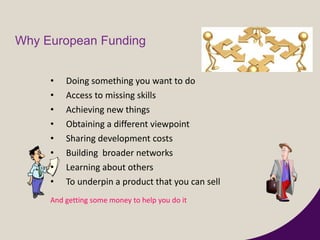
Why European Funding
And getting some money to help you do it
• Doing something you want to do
• Access to missing skills
• Achieving new things
• Obtaining a different viewpoint
• Sharing development costs
• Building broader networks
• Learning about others
• To underpin a product that you can sell
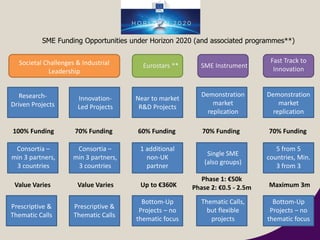
Research-
Driven Projects
Innovation-
Led Projects
Near to market
R&D Projects
Demonstration
market
replication
Consortia –
min 3 partners,
3 countries
1 additional
non-UK
partner
Single SME
(also groups)
Prescriptive &
Thematic Calls
Bottom-Up
Projects – no
thematic focus
Thematic Calls,
but flexible
projects
100% Funding 70% Funding 60% Funding 70% Funding
Value Varies Up to €360K
Phase 1: €50k
Phase 2: €0.5 - 2.5m
Societal Challenges & Industrial
Leadership
Eurostars **
SME Funding Opportunities under Horizon 2020 (and associated programmes**)
SME Instrument
Prescriptive &
Thematic Calls
Consortia –
min 3 partners,
3 countries
Value Varies
Fast Track to
Innovation
5 from 5
countries, Min.
3 from 3
Bottom-Up
Projects – no
thematic focus
Demonstration
market
replication
70% Funding
Maximum 3m
The SME Instrument
UK Performance
To date..
• 214 SMEs from 22 countries have been selected under Phase 2 of the SME
Instrument sharing more than €294 million, UK SMEs have been amongst
those to benefit the most from the programme to date – since its launch,
• 37 UK SMEs have between them secured over €63.5m of this funding
placing us in second place amongst Member States benefitting from the
programme.
What is an SME?
• To count as an SME, your organisation must be engaged in an
economic activity and must have:
– fewer than 250 employees; and
– an annual turnover of no more than €50 million and/or
– an annual balance sheet of no more than €43 million.
• Whether you count as an SME may depend on how you count
your workforce, turnover or balance sheet.
• For more details:
– http://ec.europa.eu/enterprise/policies/sme/files/sme_definition/
sme_user_guide_en.pdf
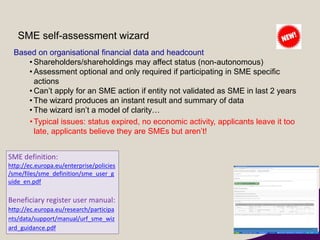
SME self-assessment wizard
Based on organisational financial data and headcount
• Shareholders/shareholdings may affect status (non-autonomous)
• Assessment optional and only required if participating in SME specific
actions
• Can’t apply for an SME action if entity not validated as SME in last 2 years
• The wizard produces an instant result and summary of data
• The wizard isn’t a model of clarity…
•Typical issues: status expired, no economic activity, applicants leave it too
late, applicants believe they are SMEs but aren’t!
SME definition:
http://ec.europa.eu/enterprise/policies
/sme/files/sme_definition/sme_user_g
uide_en.pdf
Beneficiary register user manual:
http://ec.europa.eu/research/participa
nts/data/support/manual/urf_sme_wiz
ard_guidance.pdf
Key Features of the SME Instrument
• Targeted at all types of innovative SMEs showing a strong ambition to
grow
• Only ‘for profit’ SMEs allowed to apply for funding
• Competitive, EU dimension - only the best ideas pass
• Market-oriented, close-to-market activities (TRL 6)
• Embedded in societal challenges and key enabling technologies
• Evaluators: market perspective
• Time to grant: 400 days in 2008 - > 150 days in 2014
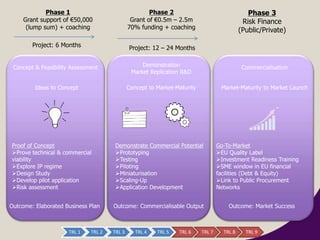
Phase 1
Grant support of €50,000
(lump sum) + coaching
Phase 2
Grant of €0.5m – 2.5m
70% funding + coaching
Phase 3
Risk Finance
(Public/Private)
Concept & Feasibility Assessment Demonstration
Market Replication R&D
Commercialisation
Concept to Market-Maturity Market-Maturity to Market Launch
Proof of Concept
Prove technical & commercial
viability
Explore IP regime
Design Study
Develop pilot application
Risk assessment
Demonstrate Commercial Potential
Prototyping
Testing
Piloting
Miniaturisation
Scaling-Up
Application Development
Go-To-Market
EU Quality Label
Investment Readiness Training
SME window in EU financial
facilities (Debt & Equity)
Link to Public Procurement
Networks
Project: 6 Months Project: 12 – 24 Months
Ideas to Concept
Outcome: Elaborated Business Plan Outcome: Commercialisable Output Outcome: Market Success
TRL 1 TRL 2 TRL 3 TRL 4 TRL 5 TRL 6 TRL 7 TRL 8 TRL 9
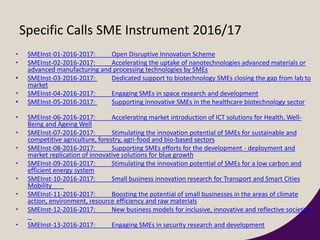
Specific Calls SME Instrument 2016/17
• SMEInst-01-2016-2017: Open Disruptive Innovation Scheme
• SMEInst-02-2016-2017: Accelerating the uptake of nanotechnologies advanced materials or
advanced manufacturing and processing technologies by SMEs
• SMEInst-03-2016-2017: Dedicated support to biotechnology SMEs closing the gap from lab to
market
• SMEInst-04-2016-2017: Engaging SMEs in space research and development
• SMEInst-05-2016-2017: Supporting innovative SMEs in the healthcare biotechnology sector
• SMEInst-06-2016-2017: Accelerating market introduction of ICT solutions for Health, Well-
Being and Ageing Well
• SMEInst-07-2016-2017: Stimulating the innovation potential of SMEs for sustainable and
competitive agriculture, forestry, agri-food and bio-based sectors
• SMEInst-08-2016-2017: Supporting SMEs efforts for the development - deployment and
market replication of innovative solutions for blue growth
• SMEInst-09-2016-2017: Stimulating the innovation potential of SMEs for a low carbon and
efficient energy system
• SMEInst-10-2016-2017: Small business innovation research for Transport and Smart Cities
Mobility
• SMEInst-11-2016-2017: Boosting the potential of small businesses in the areas of climate
action, environment, resource efficiency and raw materials
• SMEInst-12-2016-2017: New business models for inclusive, innovative and reflective societies
• SMEInst-13-2016-2017: Engaging SMEs in security research and development
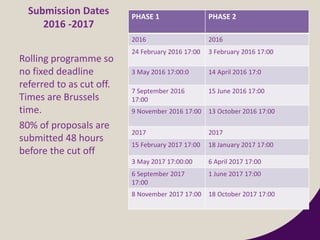
Submission Dates
2016 -2017
Rolling programme so
no fixed deadline
referred to as cut off.
Times are Brussels
time.
80% of proposals are
submitted 48 hours
before the cut off
PHASE 1 PHASE 2
2016 2016
24 February 2016 17:00 3 February 2016 17:00
3 May 2016 17:00:0 14 April 2016 17:0
7 September 2016
17:00
15 June 2016 17:00
9 November 2016 17:00 13 October 2016 17:00
2017 2017
15 February 2017 17:00 18 January 2017 17:00
3 May 2017 17:00:00 6 April 2017 17:00
6 September 2017
17:00
1 June 2017 17:00
8 November 2017 17:00 18 October 2017 17:00
Key message
• Focus on the business plan
• The evaluation panels are external experts in investment and
venture capital. As a result the evaluation process, is very
much simulating an investor decision.
• Money coming through the instrument can be seen as an
investment, the Commission does not expect a direct return.
The return on investment [is] more jobs, growth, turnover,
more tax
• Given this, proposals should be structured as a business plan
that is investor-ready.
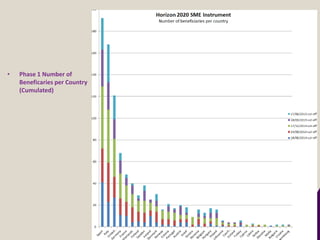
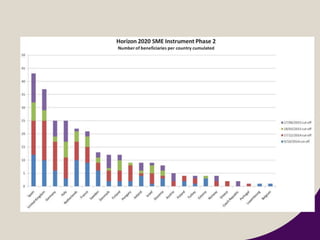
• Phase 1 Number of
Beneficaries per Country
(Cumulated)
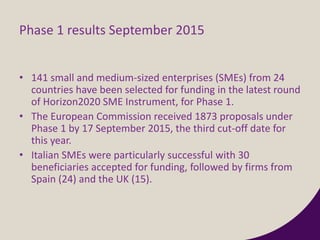
Phase 1 results September 2015
• 141 small and medium-sized enterprises (SMEs) from 24
countries have been selected for funding in the latest round
of Horizon2020 SME Instrument, for Phase 1.
• The European Commission received 1873 proposals under
Phase 1 by 17 September 2015, the third cut-off date for
this year.
• Italian SMEs were particularly successful with 30
beneficiaries accepted for funding, followed by firms from
Spain (24) and the UK (15).
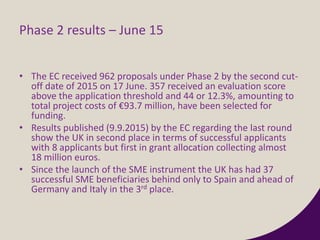
Phase 2 results – June 15
• The EC received 962 proposals under Phase 2 by the second cut-
off date of 2015 on 17 June. 357 received an evaluation score
above the application threshold and 44 or 12.3%, amounting to
total project costs of €93.7 million, have been selected for
funding.
• Results published (9.9.2015) by the EC regarding the last round
show the UK in second place in terms of successful applicants
with 8 applicants but first in grant allocation collecting almost
18 million euros.
• Since the launch of the SME instrument the UK has had 37
successful SME beneficiaries behind only to Spain and ahead of
Germany and Italy in the 3rd place.
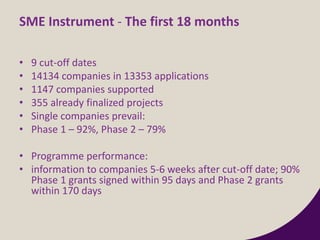
SME Instrument - The first 18 months
• 9 cut-off dates
• 14134 companies in 13353 applications
• 1147 companies supported
• 355 already finalized projects
• Single companies prevail:
• Phase 1 – 92%, Phase 2 – 79%
• Programme performance:
• information to companies 5-6 weeks after cut-off date; 90%
Phase 1 grants signed within 95 days and Phase 2 grants
within 170 days
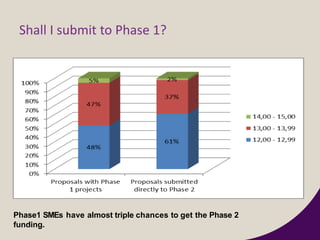
Shall I submit to Phase 1?
Phase1 SMEs have almost triple chances to get the Phase 2
funding.
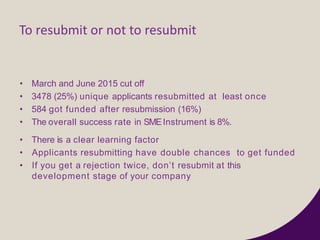
To resubmit or not to resubmit
• March and June 2015 cut off
• 3478 (25%) unique applicants resubmitted at least once
• 584 got funded after resubmission (16%)
• The overall success rate in SMEInstrument is 8%.
• There is a clear learning factor
• Applicants resubmitting have double chances to get funded
• If you get a rejection twice, don’t resubmit at this
development stage of your company
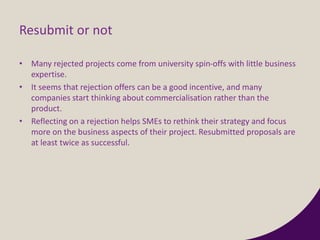
Resubmit or not
• Many rejected projects come from university spin-offs with little business
expertise.
• It seems that rejection offers can be a good incentive, and many
companies start thinking about commercialisation rather than the
product.
• Reflecting on a rejection helps SMEs to rethink their strategy and focus
more on the business aspects of their project. Resubmitted proposals are
at least twice as successful.
Learning from Experience
• Based on the previous proposals received, we have learned
that the success rate in Phase 1 projects tends to be higher in
those SMEs that have been established for 4 years or more -
in fact, 70% of funded projects proposals came from companies
that have been in the market for at least that amount of time.
• We have found that companies that have a staff of 6 or more
employees account to two thirds of all projects that were
funded up to now.
• It is important for your success to know where you are going,
to have a team that will help you get there, and know where
you will fit in the market.
Fast Track to Innovation Pilot
• Follows bottom-up logic (within SC and LEITs)
• One common call, permanently open, 3 cut-offs per year
• Time-to-grant 6 months
• Funds innovation actions (70%), grant up to €3 mn
• Allows consortia of min. 3, max. 5 members — mandatory
industry involvement
• Impact criterion has higher weighting in evaluations
• Budget: €200 mn for 2015/2016 (100 + 100) — ca. 100 projects
with average EU contribution of €2 mn
• Future of pilot (beyond 2016) only decided after full evaluation
Key Features
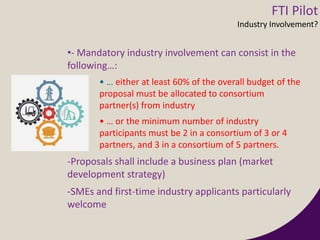
•- Mandatory industry involvement can consist in the
following…:
• … either at least 60% of the overall budget of the
proposal must be allocated to consortium
partner(s) from industry
• … or the minimum number of industry
participants must be 2 in a consortium of 3 or 4
partners, and 3 in a consortium of 5 partners.
-Proposals shall include a business plan (market
development strategy)
-SMEs and first-time industry applicants particularly
welcome
FTI Pilot
Industry Involvement?
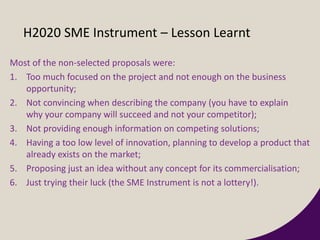
H2020 SME Instrument – Lesson Learnt
Most of the non-selected proposals were:
1. Too much focused on the project and not enough on the business
opportunity;
2. Not convincing when describing the company (you have to explain
why your company will succeed and not your competitor);
3. Not providing enough information on competing solutions;
4. Having a too low level of innovation, planning to develop a product that
already exists on the market;
5. Proposing just an idea without any concept for its commercialisation;
6. Just trying their luck (the SME Instrument is not a lottery!).
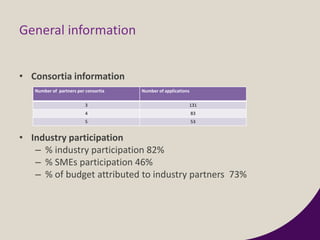
General information
• Consortia information
• Industry participation
– % industry participation 82%
– % SMEs participation 46%
– % of budget attributed to industry partners 73%
Number of partners per consortia Number of applications
3 131
4 83
5 53
Participant Portal:
Work
Programme:https://ec.europa.eu/research/p
articipants/portal/desktop/en/opportunities/
h2020/calls/h2020-smeinst-2016-
2017.html#c,topics=callIdentifier/t/H2020
SMEInst-2016-
2017/1/1/1&callStatus/t/Forthcoming/1/1/0
&callStatus/t/Open/1/1/0&callStatus/t/Close
d/1/1/0&+identifier/desc
Launch event: January 9, 2015 in Brussels
also webstreamed
https://scic.ec.europa.eu/streaming/index.p
hp?es=2&sessionno=2e9777b99786a3ef6e5
d786e2bc2e16f.
FTI Pilot
For Fast Track to
Innovation or the SME
Instrument contact Jane
Watkins
NCP-
SME@innovateuk.gov.uk
Practical Help
• Self evaluation form
– http://ec.europa.eu/research/participants/data/ref/h2020/call_ptef/ef/h2
020-call-ef-sme_en.pdf
• Submission is via Participant Portal
– http://ec.europa.eu/research/participants/portal/desktop/en/home.html
SMEI Video hints and tips
http://ec.europa.eu/easme/en/news/precious-tips-4-sme-instrument-
evaluators
 For Fast Track to Innovation or the SME Instrument
contact Jane Watkins NCP-SME@innovateuk.gov.uk

Horizon 2020 Seminar

  • 1.
    How SMEs canengage with Horizon 2020 Dr Jane Watkins UK National Contact Point for Horizon 2020 SMEs Southampton 20th January 2016
  • 2.
    Why European Funding Andgetting some money to help you do it • Doing something you want to do • Access to missing skills • Achieving new things • Obtaining a different viewpoint • Sharing development costs • Building broader networks • Learning about others • To underpin a product that you can sell
  • 3.
    Research- Driven Projects Innovation- Led Projects Nearto market R&D Projects Demonstration market replication Consortia – min 3 partners, 3 countries 1 additional non-UK partner Single SME (also groups) Prescriptive & Thematic Calls Bottom-Up Projects – no thematic focus Thematic Calls, but flexible projects 100% Funding 70% Funding 60% Funding 70% Funding Value Varies Up to €360K Phase 1: €50k Phase 2: €0.5 - 2.5m Societal Challenges & Industrial Leadership Eurostars ** SME Funding Opportunities under Horizon 2020 (and associated programmes**) SME Instrument Prescriptive & Thematic Calls Consortia – min 3 partners, 3 countries Value Varies Fast Track to Innovation 5 from 5 countries, Min. 3 from 3 Bottom-Up Projects – no thematic focus Demonstration market replication 70% Funding Maximum 3m
  • 4.
  • 5.
    UK Performance To date.. •214 SMEs from 22 countries have been selected under Phase 2 of the SME Instrument sharing more than €294 million, UK SMEs have been amongst those to benefit the most from the programme to date – since its launch, • 37 UK SMEs have between them secured over €63.5m of this funding placing us in second place amongst Member States benefitting from the programme.
  • 6.
    What is anSME? • To count as an SME, your organisation must be engaged in an economic activity and must have: – fewer than 250 employees; and – an annual turnover of no more than €50 million and/or – an annual balance sheet of no more than €43 million. • Whether you count as an SME may depend on how you count your workforce, turnover or balance sheet. • For more details: – http://ec.europa.eu/enterprise/policies/sme/files/sme_definition/ sme_user_guide_en.pdf
  • 7.
    SME self-assessment wizard Basedon organisational financial data and headcount • Shareholders/shareholdings may affect status (non-autonomous) • Assessment optional and only required if participating in SME specific actions • Can’t apply for an SME action if entity not validated as SME in last 2 years • The wizard produces an instant result and summary of data • The wizard isn’t a model of clarity… •Typical issues: status expired, no economic activity, applicants leave it too late, applicants believe they are SMEs but aren’t! SME definition: http://ec.europa.eu/enterprise/policies /sme/files/sme_definition/sme_user_g uide_en.pdf Beneficiary register user manual: http://ec.europa.eu/research/participa nts/data/support/manual/urf_sme_wiz ard_guidance.pdf
  • 8.
    Key Features ofthe SME Instrument • Targeted at all types of innovative SMEs showing a strong ambition to grow • Only ‘for profit’ SMEs allowed to apply for funding • Competitive, EU dimension - only the best ideas pass • Market-oriented, close-to-market activities (TRL 6) • Embedded in societal challenges and key enabling technologies • Evaluators: market perspective • Time to grant: 400 days in 2008 - > 150 days in 2014
  • 9.
    Phase 1 Grant supportof €50,000 (lump sum) + coaching Phase 2 Grant of €0.5m – 2.5m 70% funding + coaching Phase 3 Risk Finance (Public/Private) Concept & Feasibility Assessment Demonstration Market Replication R&D Commercialisation Concept to Market-Maturity Market-Maturity to Market Launch Proof of Concept Prove technical & commercial viability Explore IP regime Design Study Develop pilot application Risk assessment Demonstrate Commercial Potential Prototyping Testing Piloting Miniaturisation Scaling-Up Application Development Go-To-Market EU Quality Label Investment Readiness Training SME window in EU financial facilities (Debt & Equity) Link to Public Procurement Networks Project: 6 Months Project: 12 – 24 Months Ideas to Concept Outcome: Elaborated Business Plan Outcome: Commercialisable Output Outcome: Market Success TRL 1 TRL 2 TRL 3 TRL 4 TRL 5 TRL 6 TRL 7 TRL 8 TRL 9
  • 10.
    Specific Calls SMEInstrument 2016/17 • SMEInst-01-2016-2017: Open Disruptive Innovation Scheme • SMEInst-02-2016-2017: Accelerating the uptake of nanotechnologies advanced materials or advanced manufacturing and processing technologies by SMEs • SMEInst-03-2016-2017: Dedicated support to biotechnology SMEs closing the gap from lab to market • SMEInst-04-2016-2017: Engaging SMEs in space research and development • SMEInst-05-2016-2017: Supporting innovative SMEs in the healthcare biotechnology sector • SMEInst-06-2016-2017: Accelerating market introduction of ICT solutions for Health, Well- Being and Ageing Well • SMEInst-07-2016-2017: Stimulating the innovation potential of SMEs for sustainable and competitive agriculture, forestry, agri-food and bio-based sectors • SMEInst-08-2016-2017: Supporting SMEs efforts for the development - deployment and market replication of innovative solutions for blue growth • SMEInst-09-2016-2017: Stimulating the innovation potential of SMEs for a low carbon and efficient energy system • SMEInst-10-2016-2017: Small business innovation research for Transport and Smart Cities Mobility • SMEInst-11-2016-2017: Boosting the potential of small businesses in the areas of climate action, environment, resource efficiency and raw materials • SMEInst-12-2016-2017: New business models for inclusive, innovative and reflective societies • SMEInst-13-2016-2017: Engaging SMEs in security research and development
  • 11.
    Submission Dates 2016 -2017 Rollingprogramme so no fixed deadline referred to as cut off. Times are Brussels time. 80% of proposals are submitted 48 hours before the cut off PHASE 1 PHASE 2 2016 2016 24 February 2016 17:00 3 February 2016 17:00 3 May 2016 17:00:0 14 April 2016 17:0 7 September 2016 17:00 15 June 2016 17:00 9 November 2016 17:00 13 October 2016 17:00 2017 2017 15 February 2017 17:00 18 January 2017 17:00 3 May 2017 17:00:00 6 April 2017 17:00 6 September 2017 17:00 1 June 2017 17:00 8 November 2017 17:00 18 October 2017 17:00
  • 12.
    Key message • Focuson the business plan • The evaluation panels are external experts in investment and venture capital. As a result the evaluation process, is very much simulating an investor decision. • Money coming through the instrument can be seen as an investment, the Commission does not expect a direct return. The return on investment [is] more jobs, growth, turnover, more tax • Given this, proposals should be structured as a business plan that is investor-ready.
  • 13.
    • Phase 1Number of Beneficaries per Country (Cumulated)
  • 15.
    Phase 1 resultsSeptember 2015 • 141 small and medium-sized enterprises (SMEs) from 24 countries have been selected for funding in the latest round of Horizon2020 SME Instrument, for Phase 1. • The European Commission received 1873 proposals under Phase 1 by 17 September 2015, the third cut-off date for this year. • Italian SMEs were particularly successful with 30 beneficiaries accepted for funding, followed by firms from Spain (24) and the UK (15).
  • 16.
    Phase 2 results– June 15 • The EC received 962 proposals under Phase 2 by the second cut- off date of 2015 on 17 June. 357 received an evaluation score above the application threshold and 44 or 12.3%, amounting to total project costs of €93.7 million, have been selected for funding. • Results published (9.9.2015) by the EC regarding the last round show the UK in second place in terms of successful applicants with 8 applicants but first in grant allocation collecting almost 18 million euros. • Since the launch of the SME instrument the UK has had 37 successful SME beneficiaries behind only to Spain and ahead of Germany and Italy in the 3rd place.
  • 17.
    SME Instrument -The first 18 months • 9 cut-off dates • 14134 companies in 13353 applications • 1147 companies supported • 355 already finalized projects • Single companies prevail: • Phase 1 – 92%, Phase 2 – 79% • Programme performance: • information to companies 5-6 weeks after cut-off date; 90% Phase 1 grants signed within 95 days and Phase 2 grants within 170 days
  • 18.
    Shall I submitto Phase 1? Phase1 SMEs have almost triple chances to get the Phase 2 funding.
  • 19.
    To resubmit ornot to resubmit • March and June 2015 cut off • 3478 (25%) unique applicants resubmitted at least once • 584 got funded after resubmission (16%) • The overall success rate in SMEInstrument is 8%. • There is a clear learning factor • Applicants resubmitting have double chances to get funded • If you get a rejection twice, don’t resubmit at this development stage of your company
  • 20.
    Resubmit or not •Many rejected projects come from university spin-offs with little business expertise. • It seems that rejection offers can be a good incentive, and many companies start thinking about commercialisation rather than the product. • Reflecting on a rejection helps SMEs to rethink their strategy and focus more on the business aspects of their project. Resubmitted proposals are at least twice as successful.
  • 21.
    Learning from Experience •Based on the previous proposals received, we have learned that the success rate in Phase 1 projects tends to be higher in those SMEs that have been established for 4 years or more - in fact, 70% of funded projects proposals came from companies that have been in the market for at least that amount of time. • We have found that companies that have a staff of 6 or more employees account to two thirds of all projects that were funded up to now. • It is important for your success to know where you are going, to have a team that will help you get there, and know where you will fit in the market.
  • 22.
    Fast Track toInnovation Pilot
  • 23.
    • Follows bottom-uplogic (within SC and LEITs) • One common call, permanently open, 3 cut-offs per year • Time-to-grant 6 months • Funds innovation actions (70%), grant up to €3 mn • Allows consortia of min. 3, max. 5 members — mandatory industry involvement • Impact criterion has higher weighting in evaluations • Budget: €200 mn for 2015/2016 (100 + 100) — ca. 100 projects with average EU contribution of €2 mn • Future of pilot (beyond 2016) only decided after full evaluation Key Features
  • 24.
    •- Mandatory industryinvolvement can consist in the following…: • … either at least 60% of the overall budget of the proposal must be allocated to consortium partner(s) from industry • … or the minimum number of industry participants must be 2 in a consortium of 3 or 4 partners, and 3 in a consortium of 5 partners. -Proposals shall include a business plan (market development strategy) -SMEs and first-time industry applicants particularly welcome FTI Pilot Industry Involvement?
  • 25.
    H2020 SME Instrument– Lesson Learnt Most of the non-selected proposals were: 1. Too much focused on the project and not enough on the business opportunity; 2. Not convincing when describing the company (you have to explain why your company will succeed and not your competitor); 3. Not providing enough information on competing solutions; 4. Having a too low level of innovation, planning to develop a product that already exists on the market; 5. Proposing just an idea without any concept for its commercialisation; 6. Just trying their luck (the SME Instrument is not a lottery!).
  • 26.
    General information • Consortiainformation • Industry participation – % industry participation 82% – % SMEs participation 46% – % of budget attributed to industry partners 73% Number of partners per consortia Number of applications 3 131 4 83 5 53
  • 27.
    Participant Portal: Work Programme:https://ec.europa.eu/research/p articipants/portal/desktop/en/opportunities/ h2020/calls/h2020-smeinst-2016- 2017.html#c,topics=callIdentifier/t/H2020 SMEInst-2016- 2017/1/1/1&callStatus/t/Forthcoming/1/1/0 &callStatus/t/Open/1/1/0&callStatus/t/Close d/1/1/0&+identifier/desc Launch event:January 9, 2015 in Brussels also webstreamed https://scic.ec.europa.eu/streaming/index.p hp?es=2&sessionno=2e9777b99786a3ef6e5 d786e2bc2e16f. FTI Pilot For Fast Track to Innovation or the SME Instrument contact Jane Watkins NCP- SME@innovateuk.gov.uk
  • 28.
    Practical Help • Selfevaluation form – http://ec.europa.eu/research/participants/data/ref/h2020/call_ptef/ef/h2 020-call-ef-sme_en.pdf • Submission is via Participant Portal – http://ec.europa.eu/research/participants/portal/desktop/en/home.html SMEI Video hints and tips http://ec.europa.eu/easme/en/news/precious-tips-4-sme-instrument- evaluators  For Fast Track to Innovation or the SME Instrument contact Jane Watkins NCP-SME@innovateuk.gov.uk