THE
SmartWorking
        HANDBOOK

        How to reduce costs and improve business
        performance through new ways of working
        A practical guide


        supported by:
THE
Contents                                 SmartWorking
                                                    HANDBOOK


     Foreword                                                  2

1    The vision                                                3

2    Principles of Smart Working                               4

3    A new culture for 21st century working                    5

4    Flexible working options                                  6

5    New environments for new ways of working                  8

6    Technologies for Smart Working                            16

7    The human factor                                          21

8    Smart, sustainable and healthy                            25

9    The business case                                         28

10   Implementation                                            31

11   Moving forward into a Smarter world                       34

12   Further resources and information                         35
Foreword


F
     lexibility as a journal has been spreading the word about    The purpose of this guide is to promote an integrated,
     tthe benefits of flexible working since 1993. We have seen   interdisciplinary, comprehensive and strategic approach to
     fflexible working move from an interesting fringe idea to    Smart Working. Flexible working is linked in to changes in
the mainstream, even to the point where a ‘right to request’      working environments, working culture, technologies and
flexible work is enshrined in law in the UK.                      management techniques.

Now that the concept has moved into the mainstream, the           Smart Working is an integrated and above all practical
potential benefits are widely recognised. Widely recognised –     approach to realising the benefits, based on using sound
but less widely implemented. Or where implemented, often          metrics. The approach we recommend is one based on almost
in a partial or piecemeal fashion. The UK legislation even        20 years of practical experience and cutting edge research.
encourages a reactive approach, making decisions on flexible
working requests case by case. But that’s no way to build         The Smart Work Handbook is not long. But we trust it will
a strategy or to reap the benefits.                               provide for you an excellent starting point for taking an
                                                                  integrated approach to developing your Smart Working
We use the term ‘Smart Working’ to refer to the new ways of       strategy and programme.
working made possible by advances in technology and made
essential by economic, environmental and social pressures.        Andy Lake, Editor Flexibility.co.uk
                                                                  June 2011


2                                                                                                       www.flexibility.co.uk
THE
1    The vision                                                                               SmartWorking  HANDBOOK


The way we work is changing – but not fast enough. In the         What is holding us back? There are technological limitations
current challenging climate, most companies and public sector     that vary between organisations, the challenges of traditional
organisations are looking closely at what they do and how they    office culture, and paper-based processes. But Smart Working
do it. Now is the time to take steps not only to survive the      is about embarking on a journey, where the aim is to make
present crisis, but also to plan for the longer term. Becoming    continuous progress towards achieving these benefits.
more flexible and working smarter should be at the heart of
transforming and streamlining organisations.                      Our aspiration here is to provide the framework for new working
                                                                  practices that will enable all employing organisations to work
An end to wasteful practices                                      seamlessly across locations, and at times that are more
                                                                  advantageous to both customers and employees.
Wasteful practices are built into traditional ways of working:
• The average UK worker commutes for just under an hour           The workforce will be empowered by a new trust-based
  per day – equivalent to 4 years over a working life             working culture. They will have access to offices that are
• The average full-time employee is absent for 8 days per         designed for interaction with colleagues, partners and
  year, rising to 10 in the public sector                         customers. And they will work for employers that have become
• There are some 10 million office workers in the UK              more agile and in better shape to deliver their mission.
  occupying 110 million m2 of office space…
• …with average occupancy in a traditional office over the        Why ‘Smart Working’?
  working day at around 45%.
                                                                  Smart Working is a comprehensive and strategic approach
Our vision for transforming the way we work through Smart         to implementing:
Working focuses on achieving the following benefits:              • The range of flexible working options
• Increasing the effectiveness of our activities                  • Environments that enable the greatest flexibility
• Reducing the financial costs of running an organisation         • Technologies that support the practice and management
• Focusing our work on outcomes rather than processes               of flexible working
• Meeting the aspirations of staff for an improved work-life      • New forms of collaboration (e.g. in virtual teams) that reduce
  balance                                                           the need for physical meetings and travel
• Creating office environments that facilitate collaboration      • Culture change to enable greater organisational agility and
  and innovation                                                    innovation.
• Reducing the environmental footprint of our working             Underlying Smart Working is a commitment to modernise
  practices.                                                      working practices, by moving away from the ‘command and
                                                                  control’ assumptions of traditional factory-style working about
Work in the 21st century is about what you do, not where you do   where, when and how work should be done. It’s about doing
it. Strategic use of new technologies enables much of the work    more with less, working wherever, whenever and however is
we do to be carried out from many locations other than offices.   most appropriate to get the work done.


resources for new ways of working                                                                                              3
2    Principles of Smart Working


Smart Working is about taking a comprehensive and strategic      In traditional ways of working, flexibility is envisaged as an
approach to modernising working practices. It is based on the    exception to the normal way of working. Flexible working is
following principles:                                            something that is applied for, and granted as an exception from
• Work takes place at the most effective locations and at the    the ‘normal’ ways of working. Often it is considered a privilege
  most effective times                                           that can be granted or revoked.
• Flexibility becomes the norm rather than the exception
• Everyone is in principle considered eligible for flexible      Dealing with requests for flexible working on such an ad hoc
  working, without assumptions being made about people           or reactive basis can lack business focus and is inherently
  or roles                                                       un-strategic. Smart Working provides a strategic and business-
• Employees have more choice about where and when they           focused framework for flexible working.
  work, subject to business considerations
• Space is allocated to activities, not to individuals and not   The world of work is changing
  on the basis of seniority
• The costs of doing work are reduced                            • 3.7 million people – 12.8% of the workforce – now work mainly
• There is effective and appropriate use of technology             from home (Labour Force Survey, 2010)
• Managing performance focuses on results rather than            • 27% of the workforce now work part-time
  presence                                                       • 41% of all businesses are home-based
• Smart Working underpins and adds new dimensions to             • 60% of new businesses start up from home
  diversity and equality principles                              • 3 out of every 5 new jobs created are ‘atypical’ in some way –
• Employees have the opportunity to lead balanced and              i.e. not fixed hours, full-time permanent jobs
  healthy lives                                                  • Over 90% of employers say they offer some kind of flexible
• Work has less impact on the environment.                         working practices
                                                                 However, most organisations do not yet take a strategic or
In summary there are positive impacts from Smart Working         coordinated approach to this new world of work.
on the ‘Triple Bottom Line’ – benefits for the business, the     Figures from Office for National Statistics and Department for
individual, and for the environment.                             Business Surveys


4                                                                                                       www.flexibility.co.uk
THE
3    A new culture for 21st century working                                                     SmartWorking   HANDBOOK


Smart Working involves developing a new work culture.             It is important to recognise that developing a Smart Working
It is not about doing things in the old way with some new         culture and ensuring that the changes become embedded is
technologies and redesigned offices – it is about new ways of     a collective responsibility, not one that can be imposed from
working using new tools, new processes, and new approaches        above. However, strong leadership will be needed to ensure the
to management and teamwork. This requires different types of      changes are taken forward, and to galvanise teams to develop
behaviours and different expectations about how work is done.     the new culture and new ways of working.

A Smart Working culture consists of:                              What do staff want?
• Higher levels of collaborative working – between individuals,
  between teams, with external partners and with the wider        Staff surveys within companies consistently show that
  public                                                          employees want more choice. The choice to choose the best
• The pursuit of continuous service improvements, in particular   times and places to work.
  through the use of new technologies to increase efficiencies
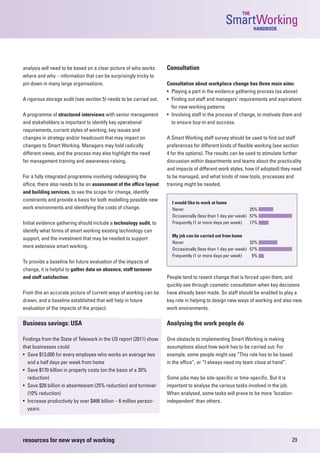
• A commitment to flexibility – being constantly open to new      The top 3 options that staff favour are:
  ways of working and delivering services, avoiding temptations   1. To vary start and finish times – without the rigidity of most
  to try to “freeze” Smart Working into a rigid or prescriptive      ‘flexitime’ schemes
  formula                                                         2. To work from home 1-2 days per week
• An emphasis on management by results rather than                3. To work a compressed working week
  management by presence                                          Trust is key to making these arrangements work for both
• An emphasis on working in shared spaces and with shared         employees and managers.
  resources, rather than with territorial or personalised ones    Source: staff surveys by HOP Associates and Flexibility.co.uk
• An emphasis on promoting higher levels of staff
  empowerment and autonomy, to maximise the benefits
  arising from the new working styles                             Practical Culture Change
• An emphasis on using new ways of working to assist
  employees achieve a better work-life balance                    Changing to a Smart Working culture is not carried out in
• A commitment to using new technologies and new ways of          isolation. It involves working with all staff throughout the
  working to reduce the environmental impact of workstyles,       programme of making changes to workplaces, technologies
  processes and delivery of services                              and processes.
• A commitment to using new technologies and new ways of
  working to recruit, retain and develop a more diverse and       It involves a combination of:
  inclusive workforce                                             • Establishing the expectations for the new work culture
• A culture of learning using the new technologies to help        • Supporting staff through the changes
  employees, wherever they are located, to develop their skills   • Agreeing protocols for new working practices
  and capabilities and move forward in their careers.             • Management and staff training through workshops and
                                                                     online learning.


resources for new ways of working                                                                                                    5
4    Flexible working options


Smart Working incorporates the full range of flexible working         • Jobshare: this is a particular form of part-time working, where
options. These broadly fall into two areas: flexible time and           two (or occasionally more) people share a full-time job
flexible place.                                                       • Career breaks: the option to have a career break or
                                                                        sabbatical to pursue professional or personal development.
Flexible time options are:
                                                                      Flexible place options are:
• Flexi-time: this typically operates with a ‘core hours’
  requirement, i.e. employees are expected to be working              • Working from home: When employees regularly work from
  between the defined core hours in the morning and afternoon.          home it is typically for 1-2 days per week. Some roles may be
  Staff surveys show that many employees feel the core hours            based at home full-time. More mobile staff may work using
  can be too rigid, and in practice these are often varied by           home as a base rather than, or as much as, using the office as
  agreement according to circumstances. The trend will be               a base. Most staff will probably have at least some tasks that
  away from defined core hours.                                         can effectively be carried out from home.
• Time off in lieu (TOIL): TOIL is a form of flexible hours working   • Mobile working: Employees who work in many places need
  that allows hours to be varied across days, by paying back            to be empowered and equipped to work when travelling, in
  extra hours worked on one day with time off on other days.            public settings, and touching down in offices as needed.
• Annualised hours: employees are contracted annually to              • Working from other offices: Smart Working involves working
  work a set number of hours, which can be worked flexibly              from the most effective location and reducing the need to
  over the 12 month period. This is useful for coping with peaks        travel. Staff may choose to work from other offices –offices
  and troughs in work , as well as for meeting personal                 belonging to the organisation, third party serviced offices or
  requirements.                                                         partner/client offices, as appropriate.
• Compressed working weeks: employees work their standard             • Working as virtual teams: to prevent relocation or frequent
  working hours in fewer days – e.g. one week’s hours worked            travel, staff work smarter as virtual teams, using online
  in four days, or two weeks’ worked in nine days. There is             communications and collaboration techniques.
  a range of patterns of varying complexity.                          • Sharing space in the office: Employees do not have a
• Term-time working: this enables staff who are parents to              permanent desk, but choose a work setting appropriate to the
  work around school terms and holidays.                                task in hand (see section 5), e.g. standard desk, touchdown
• Part-time working: staff are sometimes recruited on a part-           space, quiet zone, confidential room, project room
  time basis, while others seek to reduce their hours, with
  pro-rata reductions in pay and benefits. When this is done          In many cases, employees will blend different smart/flexible
  on a temporary basis, it is sometimes referred to as ‘V-Time’       working options, according to the need of the tasks in hand.
  (voluntary reduced hours). It is typically associated with          Enabling this involves a substantial move away from the idea
  parenting responsibilities, but surveys indicate this is an         that an individual applies for and is granted a single particular
  option of interest to older workers who are thinking in terms       alternative workstyle that is set in stone.
  of phased retirement.


6                                                                                                         www.flexibility.co.uk
THE
                                                                                                   SmartWorking  HANDBOOK


All the options are important in terms of equal opportunities
and diversity.

Choosing which styles of work are appropriate depends on:
• Analysing the tasks involved in the job role, in terms of how
  effectively they can be done at different times and in different
  locations
• The preferences of the employee and being able to meet their
  aspirations
• The potential of the smarter working choices to reduce the
  financial and environmental footprint of the organisation’s
  working practices
• Any impacts on teamwork that may arise.

The law on flexible working

Legislation in the UK gives the ‘right to request’ flexible working
to parents of children under 17 (or disabled children up to 18)
and carers of dependent adults. About one third of the
workforce are parents or carers.

Employers are not obliged to grant a request, but must give
sound business reasons if they refuse.

Employees may appeal if they feel a request has been
unreasonably refused.

The law requires employees to make a case showing that the            arrangements, it is important to have the flexibility to alter them
new work arrangements are workable and will not adversely             on occasion to meet service delivery needs or for essential
affect business.                                                      face-to-face meetings.

The UK government in 2010 is proposing to extend the right            It is then the responsibility of all employees to make flexible
to all workers.                                                       working work effectively to deliver both business and personal
                                                                      value.
Most large organisations now have policies to address the
needs of the law. But that is not the same as having a                All of the flexible working options have an impact on how space
comprehensive flexible working policy that enables them               is used. Flexible location options will mean that the base office
to address all employees equally.                                     will be used less, though it may be used somewhat more by
                                                                      visitors. Flexible time options mean that the office space will be
It is important to avoid as far as possible new working               used differently, with use spread out more across a longer
arrangements that inject new inflexibilities that could               period of time each working day.
compromise business efficiency. Examples of this would be
people saying they must always work at home on a certain day,         Managers need to think through how the changes in occupancy
or always taking the same day off as part of a compressed             affect the way the office is used. These changes are covered in
working week arrangement. While respecting flexible                   section 5 of the Handbook.


resources for new ways of working                                                                                                    7
5    New environments for new ways of working


Smart Working aims to create attractive and inspiring work          •   Spaces for confidential work and phone calls
environments that support the new work styles, increase the         •   Touch-down spaces for people working on the move
adaptability of space, and increase business performance.           •   Resource areas
A Smart Working approach to office design seeks to achieve          •   Special project areas
these benefits while at the same time achieving significant         •   Flexible multipurpose spaces.
savings and efficiency gains.
                                                                    Understanding space requirements
Smart working also enables a range of new working
environments beyond the traditional office.                         It is essential to have an evidence-based approach to
                                                                    understanding the amount of space needed in the office, and
Unlike traditional offices, which are based on having ranks of      the mix of different kinds of spaces. This should be based on:
personal standard desks, smart office environments should           • An accurate space audit, measuring how space is occupied
have a mix of desk types and meeting spaces where work                 across the working day over a number of days
activities can be carried out.                                      • An analysis of how, when and where work is carried out
                                                                    • An analysis of work processes and technology use, and how
How much is your office used?                                          changing these creates opportunities for change in the
                                                                       workplace
• A traditional office used 8 a.m. to 6 p.m. Monday to Friday       • A storage audit and an assessment of the scope for storage
  is used only 30% of the year                                         reduction
• Holidays account for 8% of an employee’s time                     • Consultation with staff to understand their working practices
• Typical occupancy is around 45%                                      and preferences
• Average office costs per head are around £6k.                     • Mapping of the relationships and interactions between
Time to do the maths on empty space!                                   departments and teams.

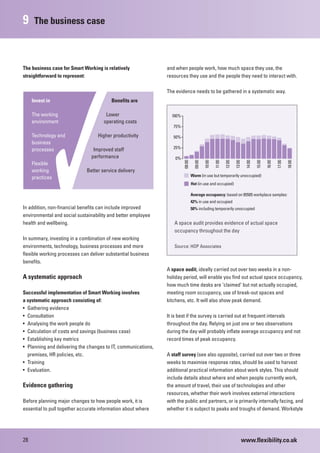
While one of the aims of Smart Working is to have offices           Space audits in offices with traditional working practices have
utilised more efficiently and to save costs by eliminating wasted   shown average desk occupancy levels of well under 50% over
space, it is also an aim to use under-occupied space to provide     the working day.
other desirable work spaces that are closely aligned to the
needs of modern flexible workers.                                   The main value of a space audit is that it will deliver objective
                                                                    figures in terms of how often desks are occupied, how often
As desk-based tasks can increasingly be carried out from            they are “claimed” but with no one at the desk, and how often
anywhere, the need in offices is less for ranks of workstations,    they are empty.
and more for:
• Flexible meeting spaces – small meeting rooms, breakout           Figures of less than 45% average occupancy are normal for
  spaces and café areas                                             professionals and managers in most “pre-smart” office
• Space for quiet and concentrated working                          environments. Average occupancy for admin and support staff


8                                                                                                       www.flexibility.co.uk
THE
                                                                                                   SmartWorking  HANDBOOK


rarely rises above 60%, despite what most managers would               Case study Islington Council
expect. Peaks may be around 60% for managers and
professionals and around 80% for administrative staff, but are         Islington Council have developed a comprehensive approach
rarely higher. Individual teams will show higher peaks, but these      to transformation through their SMART Working programme.
peaks do not occur at the same time: this is the main reason           Having a strong focus on doing more with less, the Council has
why staff often have a perception of higher occupancy.                 released 12 buildings and fitted out 13 others for Smart Working.

The end result is to provide indisputable data showing that            Team-based desk-sharing has become the norm, with no
space is not being used efficiently and that resources are being       personal offices. Desk-sharing ratio is 7.5 workstations per 10
wasted – vital for developing the business case for change.            staff, with 8.6 m2 per desk, equivalent to 6.6 m2 per employee.

Modern, more mobile working practices and current flexible             Remote working is encouraged, and supported with mobile
working options lead to a lower overall requirement for desk           technologies. Desktop PCs are being phased out, with laptops
space. Smart Working staff surveys (see section 9) will provide        supplied as standard.
evidence of enthusiasm on the part of staff for greater flexibility,
and for higher levels of trust to manage their own work styles.        The SMART Working programme at Islington has released
This will lead in time to further reductions in demand for desk        capital from disposal of buildings, and achieved annual property
space, and adaptations in the office to support more flexible          cost savings of 10%.
work styles.
                                                                       According to Paul Savage, Smart Programme Manager at
The evidence gathered from these analyses underpins the                Islington,
design of new office space. The number of desks will reduce,           “It’s been an interesting journey and we’ve learned a lot along
and more collaborative spaces will be introduced. The exact            the way. In an organisation like a Council, there is no one-size-
proportions will depend on the evidence gathered locally.              fits-all solution. So, while building up an integrated framework
                                                                       for delivery, the roll-out of Smart Working in each service has to
Sometimes organisations define a default or target ratio to be         take account of the particular needs of that service, and where
achieved, e.g. 8 desks for every 10 people, or 1 desk for every 2.     they are starting from.”
We do not advise this Procrustean approach, but one that is
based on real data and will vary from department to department.        Implementing smart working has been supported by a strong
                                                                       evidence-based approach – understanding the detailed space
Desk-sharing                                                           requirements for teams, their mobility needs, adjacencies
                                                                       between teams etc.
As the number of desks is reduced to align more closely with
actual occupancy, desk-sharing solutions will need to be               Staff have been involved throughout, being consulted on
introduced.                                                            workstyles and design options, and in developing team charters.

Smart Working does not envisage hot desking policies that              However, it is a key principle that while broadly defined team
move people all around the building from one day to the next,          “zones” can be useful, these cannot be exclusive spaces.
dividing people from their teams.                                      To increase occupancy levels and achieve the savings
                                                                       necessary to support new working styles, vacant desks must
Maintaining team cohesion and joint access to nearby                   be open to people from other teams to use, without their being
resources is important, and space sharing arrangements                 made to feel that they are intruders or that they are violating
agreed by colleagues in teams are more likely to work well.            someone else’s personal space.
The Smart Working development process encourages team
involvement in the design of new office environments.


resources for new ways of working                                                                                                    9
5    New environments for new ways of working continued


As well as sharing desks within a team zone, there needs to be       Desk-sharing and clear desk protocols
some ‘free address’ space for visitors, for staff touching down
briefly and who don’t need a larger desk, and for meeting peak       The following are suggested protocols that can be adopted or
demand.                                                              adapted to ensure that space-sharing works effectively:
                                                                     1. Use of space is determined on the basis of the activities
Any approach that allocates 1:1 desks to most of a team with a           being carried out.
couple of hot desks for people working more flexibly should be       2. While there are team priority zones allocated, this should be
avoided. ‘Hotdesking at the margins’ rarely works. It will also          seen as non-exclusive team-space, available also to other
not achieve the space savings necessary to introduce more                employees of the organisation as the need arises.
innovative working environments.                                     3. Non-team members working in specified team areas should
                                                                         be made to feel welcome. This will help to break down silos
As well as helping to clear the way for more collaborative               and encourage cross-team working.
space, desk sharing can help to break down barriers between          4. Staff should use the appropriate space for the activity –
teams, and help to end ‘silo working’.                                   e.g. informal meetings should not take place at desks but in
                                                                         break-out areas or meeting rooms.
Desk-sharing needs also to take into account the needs of staff      5. If your plans change, rethink your space requirements and
with disabilities for any specialist IT or ergonomic equipment.          move to a more appropriate work setting.
                                                                     6. Calls or discussions with private or confidential subject
                                                                         matter should be held in a workspace designed for privacy.
                                                                     7. Space is not to be allocated on the basis of seniority, habit or
                                                                         personal preference.
                                                                     8. Work-in-progress should not be stored on desks, but in team
                                                                         storage or project areas
                                                                     9. Personal items should be stored in lockers, and only located
                                                                         on desks during periods of active occupation
                                                                     10. If a desk or other work area is to be left unoccupied for more
                                                                         than 2 hours, the desk should be cleared for use by others.
                                                                     11. When a desk or other work area is vacated, it should left
                                                                         completely clear for use by other members of staff
                                                                     12. Teams are advised that exceptions to these protocols should
Open plan                                                                be few, and based on genuine need, e.g. reasonable
                                                                         adjustment for staff with disabilities, or a specialist function
Bearing in mind that there will be a range of other work settings,       that requires a particular location, e.g. receptionist or team
open plan should be the default setting for desk-based work.             administrator.
Wherever possible, private offices should be removed as they         13. Finally those employees who are allocated personal desks
are very wasteful of space and can hinder good collaborative             should still abide by the clear desk policy and expect others
working practices.                                                       to use their desks when they are absent.

Open plan does not mean having vast open spaces of desking.          Clear desk policy
Good design can create identifiable team areas for desk-
sharing, interspersed with other flexible work settings              Successful desk-sharing requires a clear desk policy. This
(confidential rooms, break-out spaces etc) for nearby teams          means that personal items – including ‘personal professional’
to use.                                                              items – must be cleared from desks when the desk is vacated.
                                                                     These items should be stored in personal lockers and team
With Smart Working, space is used according to need, rather          storage respectively.
than being allocated on the basis of status.


10                                                                                                        www.flexibility.co.uk
THE
                                                                                                  SmartWorking  HANDBOOK


Even those who work only in the office should be part of the          Case study British Council Guangzhou
clear desk policy, not only to allow all desks to be available for
use but also to maintain the quality of the working environment       The British Council in Guangzhou moved to their new office in
and a consistent storage and security discipline.                     January 2008. The new office is a flexible working environment
                                                                      and supports some 50 staff, including the Director, who share
There are different approaches to this, depending on local            38 desks.
circumstances. It is generally not good practice to allow
someone to book or lay claim to a desk for a whole day when           The project was driven by the belief that cultural relations is
during that day they may be gone for hours at a time. Typically       about working together by linking with staff outside the office
a threshold of two or two and a half hours is applied. That is,       in the South China region and the UK.
if the desk is to be left unoccupied for such a specified period,
then it must be cleared for someone else to use.                      Increasing staff creativity and innovation was a key aim, as
                                                                      well as the staff wishing to create a more sustainable office.

                                                                      The process for implementing flexible working involved
                                                                      launching a staff survey which revealed that work/life balance
                                                                      was a key issue, exploring the flexible working options with the
                                                                      staff, and resolving the difficulties relating to trust, contacts
                                                                      management and team work.

                                                                      The final design for the office included more casual and
                                                                      formal meeting spaces but fewer desks and no private offices.
                                                                      A generous provision of breakout areas encourages knowledge
                                                                      sharing between teams.

                                                                      A new telephone system was introduced to allow personal
                                                                      log-in on any phone and allow staff to direct their main phone
                                                                      number to their mobile or home telephone to ensure continuous
                                                                      communication, and remote access for home-working.
Booking systems
                                                                      The Guangzhou office has acted as the model for the offices
Offices may wish to consider space booking systems, both for          in Beijing and Chongqing.
desks and meeting rooms. Generally speaking, desk booking
systems are less necessary for smaller offices where teams            A location board system – e.g. magnetic or stick-pin – is a
can work out their own arrangements.                                  useful and simple-to-manage alternative, so that staff can find
                                                                      out where their colleagues are and where there are available
A key problem with space booking systems is that space is             seats.
frequently booked for longer than is needed, so measures need
to be taken to ensure that space is released when not needed,         When there is extensive desk-sharing and people are working
and cannot be ‘blocked out’ for long periods. Clear desk              in distributed teams, it can be useful to develop a ‘concierge’
thresholds should still apply.                                        role as part of a reception or administrative support function.
                                                                      The concierge manages the smooth working of the flexible
Planning for adequate ‘expansion space’ into touchdown                workplace, shared resources such as printers, space booking
positions and other alternative work settings is usually sufficient   and release processes, and keeping track of where and when
to meet situations of peak demand.                                    colleagues are working.


resources for new ways of working                                                                                                 11
5     New environments for new ways of working continued


De-cluttering offices and smarter storage                          Case study Ofsted

A key constraint on the introduction of smarter working is a       Ofsted is the UK inspectorate for standard in education and
dependency on paper documents and other physical resources.        social care. To accommodate a substantial expansion of its role
While there are some statutory obligations to retain paper         and large increase in staff, Ofsted took the bold decision to
documents, the reasons for using and generating paper are          become a primarily home-based organisation. With around
becoming less and less compelling in an age of electronic-         1500 home-based inspectors, it has the largest home-based
based working.                                                     workforce in the public sector. Team managers and area
                                                                   managers are also home based.
Typically in organisations where there are crowded, untidy and
inefficient offices, people complain of lack of space. But space   Great care is taken to ensure the proper set-up of
audits usually find they do not have high levels of desk           homeworking, with good ICT that includes:
occupancy: instead they are crowded with “stuff” that is           • Encrypted laptop and docking station
not rationally organised.                                          • Printer and shredder
                                                                   • Digital landline phone and a mobile phone or Blackberry
In most departments where paper-dependency is high, there          • Broadband connection.
are significant space savings that can be made by reducing
duplication, archiving, and moving to electronic-based working.    Homeworkers also receive an allowance of £700 for initial set-
                                                                   up of the home office with approved furniture, and an annual
In developing smarter working practices, there are essentially     allowance of £460 (of which £156 is the non-taxable element
three trajectories for reforming storage practices:                allowed in UK tax rules for heating and lighting).

                                                                   Though inspections are carried out by teams, much of the work
     Personal
                        U            Team
                                                                   is solitary. So a range of techniques are used both for carrying
     Physical
                        U            Electronic                    out remote teamwork and management, with training, coaching
     On office floor
                        U            Off floor / off site
                                                                   and mentoring, clear target setting and monitoring, plus monthly
                                                                   face-to-face team meetings and social events.

In a desk-sharing environment, there can be no personal            Increasingly, the use of paper processes is being replaced
shelves of storage allocated to individual desks, nor can there    by electronic ones. There is still some way to go in most
be permanent desk pedestals. Files and resources used for          organisations before we reach the Holy Grail of the ‘Paperless
professional work should be kept in team storage areas – this      Office’. All the same, it is important as an aspiration to move
is good practice anyway, reduces duplication and makes             towards.
resources easier for other people to find.
                                                                   The use of electronic processes is essential to smarter working,
Personal storage should be in lockers provided. One technique      and ‘untethers’ people from the office, enabling more effective
is to use boxes for transporting necessary items from locker to    working from other locations. It also enables a rethink and helps
desk and back. Mobile pedestals are another alternative.           to challenge assumptions about the location of work for those
                                                                   involved in process work. Many organisations, for example, now
                                                                   have home based call centre or data processing workers.

                                                                   As much storage as possible, if remaining in physical format,
                                                                   should be moved off the office floor. Office space is extremely
                                                                   expensive, and must be prioritised for human interaction, not
                                                                   storage.


12                                                                                                    www.flexibility.co.uk
THE
                                                                                               SmartWorking  HANDBOOK


The home office environment                                        Particular regulations to consider include:
                                                                   • Display screens
When people are working more than occasionally from home,          • Heating, lighting and ventilation
it is important that the home working environment is set up        • Workplace ergonomics
properly, with a desk and appropriate chair. A homeworking         • Electrics, cabling and trip hazards
policy will typically provide more details of the specification.   • Working time
                                                                   • Lifting and carrying equipment
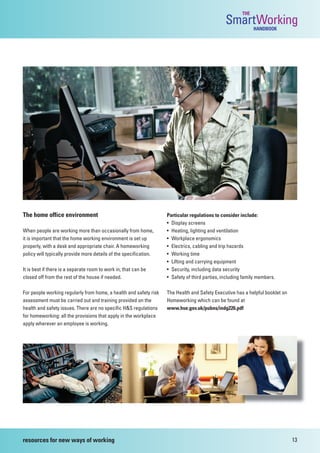
It is best if there is a separate room to work in, that can be     • Security, including data security
closed off from the rest of the house if needed.                   • Safety of third parties, including family members.

For people working regularly from home, a health and safety risk   The Health and Safety Executive has a helpful booklet on
assessment must be carried out and training provided on the        Homeworking which can be found at
health and safety issues. There are no specific H&S regulations    www.hse.gov.uk/pubns/indg226.pdf
for homeworking: all the provisions that apply in the workplace
apply wherever an employee is working.


resources for new ways of working                                                                                             13
5    New environments for new ways of working continued


In general, however, the evidence is that working from home          Working on the move
does not carry substantial additional risk, and where it reduces
travel it plays a part in reducing risk. Even so, it is necessary    If the office and home are becoming the two ‘official’ locations
for everyone to be aware of the regulations that need to be          for work, a growing proportion of work is being undertaken in
observed and how to optimise their remote work spaces                ‘third places’, for example:
ergonomically.                                                       • Other people’s offices: clients, suppliers, business partners,
                                                                        shared offices, etc.
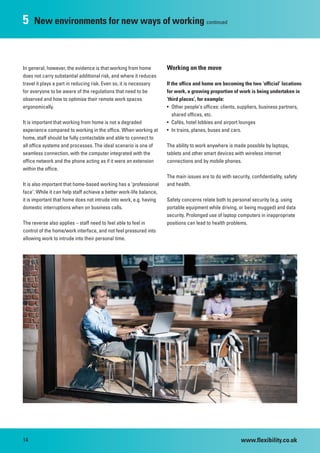
It is important that working from home is not a degraded             • Cafés, hotel lobbies and airport lounges
experience compared to working in the office. When working at        • In trains, planes, buses and cars.
home, staff should be fully contactable and able to connect to
all office systems and processes. The ideal scenario is one of       The ability to work anywhere is made possible by laptops,
seamless connection, with the computer integrated with the           tablets and other smart devices with wireless internet
office network and the phone acting as if it were an extension       connections and by mobile phones.
within the office.
                                                                     The main issues are to do with security, confidentiality, safety
It is also important that home-based working has a ‘professional     and health.
face’. While it can help staff achieve a better work-life balance,
it is important that home does not intrude into work, e.g. having    Safety concerns relate both to personal security (e.g. using
domestic interruptions when on business calls.                       portable equipment while driving, or being mugged) and data
                                                                     security. Prolonged use of laptop computers in inappropriate
The reverse also applies – staff need to feel able to feel in        positions can lead to health problems.
control of the home/work interface, and not feel pressured into
allowing work to intrude into their personal time.


14                                                                                                       www.flexibility.co.uk
THE
                                                                                                 SmartWorking  HANDBOOK


These kinds of issues are sometimes raised as reasons for
not working more flexibly. The key principle is the same as for
homeworking: the employer’s duty of care is the same wherever
employees are working, whether in the employer’s workplace,
at home, on the move or in some other ‘third place’.

This means that employees need to be properly equipped and
trained to work in these other places, and a mechanism needs
to be in place for periodic assessment of risk.

The aim has to be to enable rather than prohibit – that is to
enable staff to work safely wherever is the most effective and
efficient location to get the work done.

Third-party offices / Workhubs

Several third-party serviced office suppliers offer a range of
services to support Smart Working: short-term rentals, virtual
offices, touchdown, meeting rooms and so on. You only pay for       Implications for property strategy
what you use so overall costs can be lower than running your
own offices.                                                        Smart Working, it is clear, has very significant implications
                                                                    for an organisation’s property strategy.
There is also a growing number of local ‘Workhubs’ emerging
across the country. Their focus is on collaboration space and       As the nature of work changes and organisations use a wider
touchdown space for their members.                                  mix of physical and virtual spaces for doing business, real
                                                                    estate needs to become a flexible resource to be deployed
These work environments provide a professional ‘third space’        according to the changing requirements of the business.
between home and work, and have many advantages compared
to home or working in open public areas such as cafés. Their        In the short to medium term, the opportunity is there for
use can be integrated into a flexible approach to property and      organisations with an extensive property portfolio to reduce the
support the downsizing of corporate offices.                        amount of property they have and to consolidate on the best
                                                                    performing and most strategically located buildings.
Currently the evidence is that the smaller local workhubs are
used almost exclusively by smaller businesses and freelancers,      This may bring capital receipts, but most importantly reduce
while the larger providers with national and international          the running costs of the organisation. There will probably be
networks of flexible workspaces also attract employees from         changes to strategy in terms of escaping from longer leases
large organisations.                                                and greater use of third party offices.

This may indicate that larger organisations – especially public     The nature of property strategy will also change with Smart
sector ones who are in many areas the largest employer – are        Working. The development of a strategy that embraces Smart
missing opportunities to use viable local facilities. Using local   Working requires the integration of expertise in people, property
workhubs could reduce employees’ need to travel and increase        and technology into a single vision, so that the smart workplace
the opportunity to reduce central office requirements while         can continue to evolve as new opportunities for business
finding local bases closer to customers and clients.                improvement and cost savings arise.


resources for new ways of working                                                                                                   15
6    Technologies for Smart Working


Effective use of new technologies is key to smarter working         • Also consumer applications such as instant messaging,
practices. With the right technology choices, people can work         blogging, social networking, “wikis” and so on are being
just as well away from the office, using the internet and             adapted for the corporate environment.
wireless communications to work anywhere and at any time.
                                                                    Technology also has an important role to play in managing
User technologies                                                   Smart Working. For example online booking systems can help
                                                                    optimise the use of desks, meeting rooms and other valuable
The technology platform for smarter working is likely               resources and “self-service” HR systems streamline the
to include:                                                         management of flexible working arrangements.
• Laptop rather than desktop computers support greater
  mobility of work both within and away from the office; modern     Working at home for at least some of the time is now viable
  laptop computers are high-performing, secure, lightweight         and attractive for many people. Apart from a fast and reliable
  and offer good battery life; they can also be used safely and     corporate remote access solution, or fully web-enabled
  ergonomically.                                                    applications, all that is needed at home is a broadband
• Local area wireless networks (known as WiFi) in offices and       connection and either a corporate laptop or, where permitted,
  other locations (public areas, cafes, home, trains, etc.) allow   a home computer. Many organisations also allow a home
  people to work at places other than a conventional desk.          telephone to behave like an extension on the corporate phone
  In the office this can include touch-down spaces, breakout        network and those with VOIP (see opposite) connect over the
  areas and meeting rooms.                                          internet, either through a special handset or a “soft phone”
• Wide area wireless networks (e.g. using 3G “dongles” or           using a headset connected to a computer.
  mobile phones) allow people to work anywhere there is a
  high speed digital mobile phone signal.                           Technology strategy and choosing the right technologies for
• Modern corporate telephony uses VOIP (voice over IP) to           staff needs to be based on a rigorous assessment both of
  support full location-independent working, including staff        operational needs and the potential of individuals and teams
  working at home, overseas and while travelling; it can also       to move to more flexible working practices.
  reduce dramatically the cost of long distance calling.
• Online and video conferencing have been around for some
  time as an alternative to long distance travel. Top-end video
  meetings can now recreate better the feel of face-to-face
  meetings. Low-cost webcam solutions allow groups of people
  to use the internet to meet online from their homes and other
  locations. Conferencing solutions should ideally incorporate
  document sharing, white boards and live messaging.
• Mobile phones have become multi-function devices
  supporting e-mail, internet access, photos, video and
  navigation as well as telephony. It is becoming less necessary
  to carry a laptop computer to connect to the corporate
  network while travelling.
• Remote access technologies allow employees to access their
  corporate networks, including legacy applications, securely
  from home and on-the-move.
• Online collaboration and document management
  technologies let dispersed teams work together on “live”
  documents and handle the processes of archiving, version
  control and integration of paper documents.


16                                                                                                     www.flexibility.co.uk
THE
                                                                                               SmartWorking HANDBOOK


Technologies for teamwork over distance                            It can also integrate with business processes so that, for
                                                                   example, customer information can be called up or appropriate
One of the major concerns that people express about Smart          company experts can be flagged and brought into
Working is about maintaining the integrity of teams and            conversations if they are available.
preventing isolation and ‘atomisation’ of the workforce.
                                                                   Technology and the working environment
There are effective technologies for remote meetings using
web, audio and video conferencing techniques that are used         Technologies need to be appropriate to the working
extensively in leading organisations. These not only enhance       environment, and enable staff to work comfortably as well as
productivity, they also contribute to the bottom line through      productively.
business travel savings. Solutions chosen need to be flexible to
allow people to participate from any location as long as they      Using laptops for prolonged periods in an office or home office
have access to an internet connection. They must also be           environment requires the use of a laptop stand and/or additional
simple to set up, and make it easy to include additional           properly positioned screen, with possibly a separate keyboard
participants as needed.                                            and mouse.

While training events are often the kind of activities that        The acoustic environment needs also to be considered. In a
bring people together, effective training and learning is also     possibly noisy open-plan office there need to be alternative
increasingly possible with geographically dispersed                settings for dealing with calls. Wireless headsets that enable
participants and trainers using webinar technologies and           mobility, and/or noise cancellation capabilities may be important
e-learning solutions.                                              considerations.

Investment in these technologies incorporates the principles       Homegroup halves travel costs with online meetings
of Smart Working as well as delivering cost savings. Promoting
their use is also a key part of taking a practical approach to     Homegroup, one of the UK’s largest regional social landlords,
changing behaviours and achieving the necessary cultural           is using web conferencing technologies to help transform the
change.                                                            way they do business.

Unified communications (UC) are also becoming increasingly         The tools are enabling more than 4,000 employees to
important for virtual teamwork. UC integrates into a single user   communicate online across Homegroup’s 565 UK locations. This
interface services providing both real-time communication          is on target to halve their million pound travel expense budget,
(voice telephony, instant messaging, video conferencing) and       while increasing employee productivity and customer service.
non-real-time communication (voicemail, email SMS and fax).
It incorporates call control to route calls/messages according     Their adoption of the technologies is part of a company-wide
to the selected preference or status of users, plus speech         transformation programme to improve customer satisfaction,
recognition and text-to-speech software to convert messages        rationalise complex business processes and reduce company
from voice to text or vice versa.                                  expenditure.


resources for new ways of working                                                                                             17
6    Technologies for Smart Working continued


Cloud computing and virtualisation                                     An organisation does not need to embrace cloud computing and
                                                                       virtualisation before they can develop smarter working. But any
One of the most significant trends in corporate technology is          technology that helps people to work more effectively and
towards so-called “cloud computing”. The ‘cloud’ is basically          efficiently wherever they are needs to be considered.
the Internet, and cloud computing means that your organisation
in the future won’t need to host its own IT at all, but will be able   It is also important that organisations do not develop IT
to outsource it to a third-party provider. Software and                strategies for cloud computing in isolation from a wider
applications will be provided as a service rather than installed       approach to Smart Working. Through Smart Working the IT
on client computers.                                                   strategy can be linked to savings in property and travel, as well
                                                                       as potential increases in productivity.
Once this happens a computer in the office has no higher
capability or status than any laptop or other device attached to       Case study Lionbridge
the Internet. In one sense, even the staff in the office will be
‘remote workers’.                                                      Lionbridge saves costs and boosts productivity with Unified
                                                                       Communications.
For the remote worker, this means ‘remote access with bells
on’. Everything is accessed over the Internet, and there is no         Lionbridge is a global provider of translation and localisation
need for any permanent local storage or applications on any            services, employing 4,500 people in 26 countries, and working
device they may be using.                                              with 25,000 translation partners. Clear and easy to manage
                                                                       communications are central to their work.
The office may still be a good place to be based and to
collaborate with colleagues, but it will no longer be the only         In 2007, Lionbridge began to replace their traditional telephone
or even the best place to do most of our work.                         system with Microsoft Office Communicator Server for a Unified
                                                                       Communications (UC) environment, with Plantronics
Of course most organisations have made substantial                     speakerphones and headsets.
investments in their existing technologies and networks and
are not about to abandon these. And ‘cloud computing’ is an            Conference calls and video conferencing are essential tools
increasingly muddled term as vendors rebrand many of their             of the business. Previously Lionbridge was using an external
existing products to fit the current fashion.                          conferencing solution which on its own cost in excess of $1
                                                                       million per year. Now they have software-powered VoIP, web
A related trend in corporate IT is towards “desktop                    conferencing, presence with instant messaging, email and
virtualisation”. What this means is that, rather than running          voicemail at their fingertips.
their own programs, user computers run all their applications
through a server. Support and upgrade costs can be cut                 USB speakerphones are used to transform any workplace into
dramatically and flexible location working is supported                a conference room and provide 360o room coverage.
automatically.
                                                                       On average, there are between 75 and 100 conference calls
Recognising trends and the key role of technology should help          per day, with typically 20 to 30 happening at the same time,
shape decisions in the short and medium terms. ‘Future-                consisting of anywhere between 2 and 80 participants. It is
proofing’ technology investments has never been more                   estimated that each employee is involved in 20 to 30 hours of
important.                                                             conference calls per month. With the implementation of UC,
                                                                       Lionbridge estimates an overall reduction in communications
                                                                       costs of approximately $2 million in the first year.

                                                                       Source: Plantronics case study


18                                                                                                         www.flexibility.co.uk
THE
                                                                                               SmartWorking  HANDBOOK


Data security                                                      2. Move towards a new ‘cloud computing’, ‘software as a
                                                                      service’ or ‘online applications’ model designed from the
When the network stayed in the office, or only connected to           outset for use from anywhere and with built-in security.
other locations such as branch offices over secure leased lines,
data security was more straightforward. The only ways for data     In practice most organisations need to take the precautions
in or out were via floppy discs (remember those?) or e-mails and   listed above and put in place a strategy to migrate towards
required the conscious effort of an employee to force a security   a newer model.
breach.
                                                                   Whatever approach is taken it is vital that staff are made aware
The days when data can simply be contained physically are          of and trained in good information management and security
now long gone and the IT director is faced with a big challenge    practice.
– how to give employees all the flexibility they need to work
smartly while at the same time protecting corporate data assets.   Staying green

In broad terms there are two approaches:                           Smart Working also envisages a leaner and greener approach to
1. Make the remote access service as secure as possible,           our use of personal computers. Wherever possible, a principle of
   for example:                                                    non-duplication should be adopted when rolling out laptops and
   a. Prevent access away from the office to sensitive             equipping home offices. That is, situations should be avoided
      applications and data                                        where an individual has a desktop PC and an individually-
   b. Only allow access using corporate laptops with appropriate   assigned laptop or home PC paid for by the company.
      built-in security
   c. Prevent CDs and unencrypted flash memory drives from         Power consumption of IT equipment can also be a problem
      being used to save data                                      unless it is recognised and managed. Great steps have been
   d. Use a number of advanced user validation and                 taken in recent years to reduce power, for example through
      authentication methods                                       replacing CRTs with flat screens and reducing power
   e. Enforce on users a range of strict rules and sanctions.      consumption in standby mode. However IT has become


resources for new ways of working                                                                                                 19
6    Technologies for Smart Working continued


more demanding and power management in data centres and             Case study Lewis & Hickey
the proliferation of chargers for mobile phones and laptops have
become issues.                                                      The benefits of unified communications

Greening with IT                                                    Established in 1894, Lewis & Hickey are an internationally-
                                                                    known, architectural practice comprising architects, designers,
While making IT ‘greener’ is important and can be implemented       project, cost and safety managers, brand consultants, and 3D
through well-defined projects, much more significant is the         visualisers. They have offices located in London, Edinburgh,
potential for ‘greening with IT’ – that is, using IT for wider      Guildford, Manchester, Nottingham and Prague.
changes that can reduce energy and resource consumption.
                                                                    In a business where architects, project managers and engineers
Chapter 8 covers the sustainability agenda in more detail,          are predominantly ‘on the road’ anywhere in the UK or abroad,
including the role IT can play in reducing travel and the need      clear and concise communications are vital to the day-to-day
for offices.                                                        business process and success.

Wider involvement in technology decisions                           As a starting point, Lewis & Hickey implemented global, internet-
                                                                    based communications with Skype for Business, making it easier
Non-technical managers can shy away from dealing with               for staff and customers to communicate in a real-life office
technology issues, all too often not challenging the views of the   setting. Lewis & Hickey staff use different Skype features
IT department. This contrasts with office design and flexible       including conference calls, video calls, instant messaging and
working policies, where everyone seems happy to take a view         file transfer, and by switching their staff to Skype significantly
and fight their corner.                                             reduced call costs, as well as removing the need for ISDN video
                                                                    conferencing.
Technical jargon should not get in the way of good business
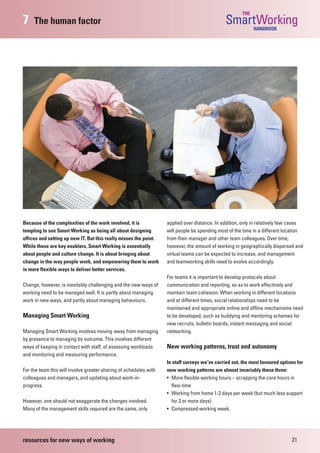
management and it is up to the IT people to communicate in          For integration of communications, employees use Plantronics
a way that non-technical people can understand.                     headsets that use multipoint technology allowing the headset
                                                                    to be shared between a mobile phone and PC. So a call can be
However, the key principles are that:                               taken from either at the touch of a button. So, with a Skype
1. Business need, in the context of Smart Working, needs to         equipped laptop, they can now take full advantage of WiFi hot-
   drive the strategy for IT and for the technology procurement     spots to take and make calls, wherever they are located, with all
   decisions both in the office and beyond                          the functionality they would depend on if they were in the office.
2. IT strategies need to be integrated with property and people
   strategies in order to maximise the business benefits.           Source: Plantronics case study


20                                                                                                      www.flexibility.co.uk
THE
7    The human factor                                                                          SmartWorking  HANDBOOK


Because of the complexities of the work involved, it is            applied over distance. In addition, only in relatively few cases
tempting to see Smart Working as being all about designing         will people be spending most of the time in a different location
offices and setting up new IT. But this really misses the point.   from their manager and other team colleagues. Over time,
While these are key enablers, Smart Working is essentially         however, the amount of working in geographically dispersed and
about people and culture change. It is about bringing about        virtual teams can be expected to increase, and management
change in the way people work, and empowering them to work         and teamworking skills need to evolve accordingly.
in more flexible ways to deliver better services.
                                                                   For teams it is important to develop protocols about
Change, however, is inevitably challenging and the new ways of     communication and reporting, so as to work effectively and
working need to be managed well. It is partly about managing       maintain team cohesion. When working in different locations
work in new ways, and partly about managing behaviours.            and at different times, social relationships need to be
                                                                   maintained and appropriate online and offline mechanisms need
Managing Smart Working                                             to be developed, such as buddying and mentoring schemes for
                                                                   new recruits, bulletin boards, instant messaging and social
Managing Smart Working involves moving away from managing          networking.
by presence to managing by outcome. This involves different
ways of keeping in contact with staff, of assessing workloads      New working patterns, trust and autonomy
and monitoring and measuring performance.
                                                                   In staff surveys we’ve carried out, the most favoured options for
For the team this will involve greater sharing of schedules with   new working patterns are almost invariably these three:
colleagues and managers, and updating about work-in-               • More flexible working hours – scrapping the core hours in
progress.                                                            flexi-time
                                                                   • Working from home 1-2 days per week (but much less support
However, one should not exaggerate the changes involved.             for 3 or more days)
Many of the management skills required are the same, only          • Compressed working week.


resources for new ways of working                                                                                             21
7    The human factor continued


One thing that these choices and opinions expressed in              Teamwork protocols
surveys show is that staff want more autonomy, and to be
trusted more to make their own choices about how to organise        It is important to have clear expectations about what is to be
their working lives.                                                done and about communications within the team.

For managers used to close supervision and managing by              Protocols should be established to cover:
presence, this is a challenge. It involves a new kind of dialogue   • A requirement to let others know where and when you
with staff, based on clarity of expectations and good                 are working
communications – and much more trust.                               • Clear reporting structures
                                                                    • Sharing of calendars and schedules
                                                                    • Rigorous use of electronic document management systems,
                                                                      to ensure work is easily accessible
                                                                    • Being flexible about flexible working – to ensure that no
                                                                      individual is disadvantaged by the choices of others, e.g. in
                                                                      providing office cover or attending evening meetings
                                                                    • Etiquette in online communications, and behaviour in virtual
                                                                      meetings
                                                                    • Signposting availability for phone contact or online discussion
                                                                    • Fairness in use of space when in the office.

                                                                    Just as with desk-sharing, there needs to be a degree of
                                                                    enforcement, at least in the initial stages, to bring about the
                                                                    changes in work culture required. But to a large extent teams
                                                                    should be able to do this themselves, and monitor their own
                                                                    team members’ adherence to the standards required.

                                                                    Rethinking meetings

                                                                    It is important also to rethink meetings. Routine sharing of
                                                                    information can be carried out through online processes:
                                                                    physical meetings should be reserved for important
                                                                    collaborative work involving activities such as training,
                                                                    brainstorming and decision-making.

                                                                    The benefits of flexible working can be undermined by insisting
                                                                    on being present in person for routine meetings. Wherever
                                                                    possible, meetings should be held using audio, video or web
                                                                    conferencing. In reaching decisions about holding meetings,
                                                                    attention should always be given to the cumulative effects of
It involves understanding that someone who is not in the office     meetings, and the need to reduce our need for office space and
at the same time is not out of touch or out of control. Using the   to reduce the need to travel.
new technologies effectively, and new management
techniques, managers can be more in touch with their team’s
work than ever before.


22                                                                                                      www.flexibility.co.uk
THE
                                                                                                  SmartWorking  HANDBOOK


Dealing with problems and issues                                       Case study Virtual meetings

Before adopting flexible working practices, people are                 Mott MacDonald is a £1 billion global management, engineering
sometimes worried about issues such as:                                and development consultancy, operating in sectors not always
• Being isolated                                                       closely associated with working flexibly.
• Loss of personal space in the office
• Difficulties with time management                                    Mott MacDonald delivers leading edge solutions for public
• Loss of team spirit or team effectiveness                            and private sector clients across 12 core business areas –
• Dealing with technology and getting appropriate levels               transport, power, buildings, water, environment, health,
  of support when working remotely                                     education, industry and communications, international
• Intrusion of work into home life                                     development, urban development and oil and gas. Operating
• 24/7 working                                                         in over 120 countries with dispersed project teams, face-to-
• Managing performance                                                 face project meetings can become a challenge.
• Loss of opportunities for career progression or training.
                                                                       The company has adopted GoToMeeting from Citrix as it
                                                                       makes it easy for business professionals to meet and present
                                                                       information online to anyone, anywhere in the World. This
                                                                       allows employees to share any application on your computer
                                                                       in real time and attendees can join meetings in seconds.

                                                                       Mott MacDonald has been using GoToMeeting since May 2007
                                                                       and now regularly there are over 400 hours of remote meeting
                                                                       sessions every month producing savings well in excess of the
                                                                       expenditure. It is now also used with clients saving them time
                                                                       and money as well.

                                                                       The key benefits are being able to:
The evidence from implementations of flexible/Smart Working            • Organise presentations, business planning meetings, and
is that many more problems are anticipated than actually arise           staff meetings regardless of where participants are located.
and that, once any initial problems are overcome, most people          • Provide online training or support.
appreciate the greater flexibility and autonomy that Smart             • Collaborate in real time – between employees and with
Working brings.                                                          customers
                                                                       • Reduce or eliminate unproductive travel time and costs
All the same, problems can occur. It is the responsibility of          • Reducing paper by working collaboratively on electronic
teams to look out for each other, and in particular for managers         documents, available anywhere.
of dispersed teams to spot problems and resolve them before
they become major issues. These may be teased out through              All organisations working in these areas – both public and
regular conversations, or clues may be spotted in terms of             private sector – can improve performance and make savings
performance.                                                           by making greater use of virtual tools and techniques.

If necessary, the manager and team member can agree an
alternative work style. It is about finding the right work style for
the individual, and about providing the appropriate support to
overcome the particular problem.


resources for new ways of working                                                                                                23
7    The human factor continued


Highly collaborative and dynamic teams                             Case study Online learning at Cable & Wireless

The aim in moving to Smart Working is to create the context in     International telecommunications provider Cable & Wireless
which teams can operate more dynamically, and have better          has been using webinars for online training since 2009. Training
physical and online spaces in which to interact. Though they       programmes have included Management Matters, a monthly
may no longer sit at adjacent desks, the new technologies and      management programme covering such issues as performance
team protocols should facilitate much more effective sharing       reviews and how to lead change programmes, and Perfect
of work, and enable team members to communicate more               Pitch, a weekly training session for the sales and commercial
effectively than before. Smart Working will also support more      teams on how to position aspects of the company’s product and
effective cross-team working.                                      service proposition.

Getting the policies right                                         “We were impressed with the scalability of the webinar
                                                                   solution,” confirms Mike Booth, learning technologies manager,
Existing contracts, policies and guidelines will almost            “as it was able to support up to 1,000 concurrent users, allowing
certainly need reviewing in the context of Smart Working,          us to greatly expand the range of training initiatives we could
for example:                                                       offer”.
• Contracts of employment may need to reflect more flexible
  working hours and locations                                      Internally, the company has recently introduced a series of
• Flexible working policies should address not only legal          monthly customer service webinars, entitled Obsessional about
  requirements but actively promote flexibility to address work-   our Customers and these will be followed by other initiatives
  life balance and business performance issues                     including support for the Cable & Wireless technical centre in
• Health and safety policies need to reflect the more diverse      Birmingham and staff personal development programmes.
  working environments
• Equality, diversity and inclusion policies can be stronger if    In addition, webinars have been developed for the first time to
  people can work more flexibly                                    include external customers so that they can be educated on the
• Recruitment policies need to encourage managers to offer         benefits and use of Cable & Wireless products and services.
  flexible work styles wherever practicable.
                                                                   Case study from Citrix Online


24                                                                                                    www.flexibility.co.uk
THE
8    Smart, sustainable and healthy                                                               SmartWorkingHANDBOOK


Environmental sustainability                                         The decisions we make on a daily basis about where we work,
                                                                     where we expect our colleagues to work, and the ways in
Most organisations are now taking initiatives to make their          which we communicate can increase or reduce our need for
office buildings more sustainable. These need to be                  travel, our energy consumption and consumption of physical
complemented by the development of more sustainable                  resources.
working practices.
                                                                     Saving carbon by eliminating journeys
The biggest component of the carbon footprint of work for most
organisations relates to travel, primarily in the commute journey.   A recent study by Oxford University's Transport Studies Unit
                                                                     evaluated the comparative impacts of teleworking versus
The carbon cost of work in the UK                                    office carbon impacts. This proposes a typical carbon cost of
                                                                     using a room for home-based telework as being 173kg CO2 per
• Every year UK workers clock up 80 billion car miles                year if one day per week, and 865kg per year if five days per
  commuting to work                                                  week (costs of heating and lighting a room plus equipment
• The typical carbon footprint of a workers in an office is          energy use).
  around 1.5 tonnes of CO2 per year
• Business travel accounts for around 70 trips per worker            This is about half the carbon per person of working in a modern
  per year, with an average distance of around 20 miles.             office and a quarter of the carbon cost of working in a poor-
  69% is by car.                                                     performing office. And there are further savings to be achieved
• Mobile workers using company cars clock up an average              in travel reduction. The following table shows miles, time and
  6000 miles per year.                                               CO2 saved per year by not driving to an office:

Source: Department for Transport and RAC Foundation                  Average savings from avoiding commuting

Greening the office and greening the home count for little if at       Annual savings    1.5 days per week    5 days per week
the end of the day we are still building and running too many
                                                                       Distance          1175 miles           3915 miles
offices and forcing employees into unnecessary journeys.
                                                                       CO2               365 kg               1187 kg
Becoming a sustainable organisation is not just about
engineering solutions and complying with new building                  Time              61 hours             203 hours
standards. It involves changing behaviours and assumptions
about how we work.                                                   Calculated on basis of 45 working weeks per year, and average
                                                                     UK commute distances.
Having the UK working population travel billions of miles each
year to spend time using computers and telephones – work that        Of course working from home is only one way of reducing
can be done from anywhere – is an intrinsically unsustainable        travel. Working a compressed working week – doing all one’s
thing to do.                                                         working hours for 5 days in 4 – has the same effect on the roads


resources for new ways of working                                                                                               25
8    Smart, sustainable and healthy continued


as working from home one day per week, though there may be         Unless this property rationalisation takes place, the risk is that
performance or customer service reasons why this is not            by keeping unused space in the office plus working from home
possible.                                                          and in other places, energy use will actually increase.
                                                                   This could entirely erode the savings made from reducing
Using online conferencing (audio, video, etc.) is already saving   the need to travel.
some organisations tens of thousands of business miles, saving
costs and increasing productivity as well as playing a role in     Savings can often be made by better office design and more
saving the planet.                                                 modern choice of furniture. It is tempting to save costs and
                                                                   appear to be environmentally friendly by reusing existing
Saving travel through virtual meetings                             furniture, cabling and fittings.

• Aviva UK calculated that the CO2 cost of a full meeting of the   But this can often be false economy, leading also to a kind
  executive committee is 6.4 tonnes. Telepresence is now           of falsely virtuous and drab greenwash in office redesign.
  replacing face-to-face meetings.                                 Recycling sounds good. But the effect may be to constrain the
  Source: CBI (2010) Tackling Congestion, Driving Growth           options for both space saving and improving work efficiency.
• At BT teleconferencing replaces 340,000 trips and 54,000         This is where the carbon return on investment needs to be
  tonnes of CO2 per year – 40kg of CO2 for each call that          considered alongside the financial returns.
  replaces a physical meeting
  Source: SUSTEL project                                           Making smart offices more sustainable

Taking a practical approach                                        Designing new offices or refurbishing existing ones also creates
                                                                   the opportunity to make the buildings work smarter, as well as
The figures we are quoting here on organisational savings are      their occupants.
based on measured studies, not wishful thinking.
                                                                   When offices are being used more intensively through higher
Organisations can take a practical approach to target setting      average occupancy, building services may need to be
for travel reduction, both for business travel and for staff       upgraded. This is a chance to upgrade to more environmentally
commuting. Targets can be of the form: ‘We will reduce our         friendly products and services and improve natural lighting.
travel for (specified kinds of) meetings by x% by this date’, or
‘we will reduce business travel in our department by x% per        With offices perhaps being used by some staff over longer
year over the next 5 years’.                                       hours, intelligent building systems should be used to shut down
                                                                   unoccupied areas.
Similar targets can also be set for reducing consumption
of other resources, such as paper. Bringing in electronic          Desk-sharing means that staff who work early or late can base
processes and centralised printing should be accompanied by        themselves in dedicated areas that remain up and running while
paper reduction targets. Such targets need to be reinforced        the rest of the building shuts down.
through cultural change programmes.

Reducing waste in office space

Realising the environmental savings when people move to
working smarter critically depends on reducing office
requirements, as per the guidance in Section 5.


26                                                                                                     www.flexibility.co.uk
THE
                                                                                                SmartWorking   HANDBOOK


Social sustainability                                              Alongside other initiatives to promote a healthy workplace,
                                                                   employers should promote flexible working practices that can
Working smarter can also bring benefits to society, by:            reduce absence and in particular reduce stress.
• Extending work opportunities into more remote areas and
  to disadvantaged groups                                          A significant proportion of absence from work is due to minor
• Enabling people with disabilities or caring responsibilities     ailments that make the thought of commuting and sitting in an
  to work in places or at times more suitable to them              office with colleagues unbearable – being able to work on
• Indirectly supporting local communities and services by          occasions from home can have a significant impact on ‘sick
  enabling people to work at or nearer to home                     leave’.
• Enabling people to dovetail volunteering activities with their
  work commitments.                                                Many people struggle to get to work when their children,
                                                                   disabled or elderly relatives are ill and need their attention.
Promoting these benefits                                           The UK flexible working legislation aims to reduce
                                                                   discrimination against carers.
Organisations can take practical action to promote these
benefits by making Smart Working central to their company          People are more productive and happier in offices that are tidy,
travel plans and their Corporate Social Responsibility             clean and well cared for. Air quality and lighting can have a
programmes.                                                        profound impact on mood and performance. In redesigning
                                                                   environments for smart working, the need to create healthy
Using Smart Working principles, managers and staff can help        workplaces needs to be taken into account.
to reduce both their own and the organisation’s environmental
footprints. Teams can set targets, for example, to reduce the      This can mean designing in areas for relaxation and recreation
number of miles they travel both for business purposes and         in offices. But it can also mean using local work centres that
commuting, the number of routine meetings and the amount           can encourage employees to walk or cycle when they need
of paper generated.                                                to access office facilities.

Healthy working                                                    Impacts on health and happiness are factors that can be
                                                                   measured, and should be included in consultation before smart
Full-time employees spend almost half of their waking hours        working and in evaluation after implementation.
working, travelling to and from work or thinking about work.
It therefore makes good business sense to take care of their       Fact box USA
health and fitness.
                                                                   In the USA, it has been calculated that if the 40% of employees
According to the recent report “Working for a Healthier            who could work from home did so for half the week, the
Tomorrow” the annual economic costs in the UK of sickness          country could:
absence and worklessness associated with working age ill-          • Reduce road travel by 91 billion miles/year
health are estimated to be over £100 billion. Around 175 million   • Reduce greenhouse gases by 51 million tons/year –
working days are lost each year, effectively adding around £650      the equivalent of the entire New York state workforce off
to the annual employment cost of each employee.                      the roads
                                                                   • Save 281 million barrels of oil a year ($28 billion/year at
On top of this, staff with poor health under-perform when they       $100/barrel) – the equivalent of 46% of the country’s Persian
are at work and this is often compounded by employers                Gulf imports
providing unhealthy working environments.
                                                                   Source: Telework Research Network (2010) Workshifting Benefits:
                                                                   The Bottom Line


resources for new ways of working                                                                                                    27
9     The business case


The business case for Smart Working is relatively              and when people work, how much space they use, the
straightforward to represent:                                  resources they use and the people they need to interact with.


                                                               The evidence needs to be gathered in a systematic way.
     Invest in                           Benefits are

     The working                      Lower                      100%
     environment                     operating costs
                                                                  75%

     Technology and                Higher productivity            50%
     business
     processes                   Improved staff                   25%

                                performance                        0%


                                                                        08:00

                                                                                  09:00

                                                                                          10:00

                                                                                                  11:00

                                                                                                          12:00

                                                                                                                  13:00

                                                                                                                            14:00

                                                                                                                                    15:00

                                                                                                                                            16:00

                                                                                                                                                    17:00

                                                                                                                                                            18:00
     Flexible
     working                 Better service delivery
     practices                                                                  Warm (in use but temporarily unoccupied)
                                                                                Hot (in use and occupied)

                                                                                Average occupancy: based on 85505 workplace samples:
                                                                                42% in use and occupied
In addition, non-financial benefits can include improved                        50% including temporarily unoccupied
environmental and social sustainability and better employee
health and wellbeing.                                             A space audit provides evidence of actual space
                                                                  occupancy throughout the day
In summary, investing in a combination of new working
environments, technology, business processes and more             Source: HOP Associates
flexible working processes can deliver substantial business
benefits.
                                                               A space audit, ideally carried out over two weeks in a non-
A systematic approach                                          holiday period, will enable you find out actual space occupancy,
                                                               how much time desks are ‘claimed’ but not actually occupied,
Successful implementation of Smart Working involves            meeting room occupancy, use of break-out spaces and
a systematic approach consisting of:                           kitchens, etc. It will also show peak demand.
• Gathering evidence
• Consultation                                                 It is best if the survey is carried out at frequent intervals
• Analysing the work people do                                 throughout the day. Relying on just one or two observations
• Calculation of costs and savings (business case)             during the day will probably inflate average occupancy and not
• Establishing key metrics                                     record times of peak occupancy.
• Planning and delivering the changes to IT, communications,
  premises, HR policies, etc.                                  A staff survey (see also opposite), carried out over two or three
• Training                                                     weeks to maximise response rates, should be used to harvest
• Evaluation.                                                  additional practical information about work styles. This should
                                                               include details about where and when people currently work,
Evidence gathering                                             the amount of travel, their use of technologies and other
                                                               resources, whether their work involves external interactions
Before planning major changes to how people work, it is        with the public and partners, or is primarily internally facing, and
essential to pull together accurate information about where    whether it is subject to peaks and troughs of demand. Workstyle


28                                                                                                                        www.flexibility.co.uk
THE
                                                                                                SmartWorking   HANDBOOK


analysis will need to be based on a clear picture of who works      Consultation
where and why – information that can be surprisingly tricky to
pin down in many large organisations.                               Consultation about workplace change has three main aims:
                                                                    • Playing a part in the evidence gathering process (as above)
A rigorous storage audit (see section 5) needs to be carried out.   • Finding out staff and managers’ requirements and aspirations
                                                                      for new working patterns
A programme of structured interviews with senior management         • Involving staff in the process of change, to motivate them and
and stakeholders is important to identify key operational             to ensure buy-in and success.
requirements, current styles of working, key issues and
changes in strategy and/or headcount that may impact on             A Smart Working staff survey should be used to find out staff
changes to Smart Working. Managers may hold radically               preferences for different kinds of flexible working (see section
different views, and the process may also highlight the need        4 for the options). The results can be used to stimulate further
for management training and awareness-raising.                      discussion within departments and teams about the practicality
                                                                    and impacts of different work styles, how (if adopted) they need
For a fully integrated programme involving redesigning the          to be managed, and what kinds of new tools, processes and
office, there also needs to be an assessment of the office layout   training might be needed.
and building services, to see the scope for change, identify
constraints and provide a basis for both modelling possible new
                                                                      I would like to work at home
work environments and identifying the costs of change.                Never                                   25%
                                                                      Occasionally (less than 1 day per week) 57%
Initial evidence gathering should include a technology audit, to      Frequently (1 or more days per week)    17%
identify what forms of smart working existing technology can
                                                                      My job can be carried out from home
support, and the investment that may be needed to support
                                                                      Never                                   32%
more extensive smart working.
                                                                      Occasionally (less than 1 day per week) 57%
                                                                      Frequently (1 or more days per week)     9%
To provide a baseline for future evaluation of the impacts of
change, it is helpful to gather data on absence, staff turnover
and staff satisfaction.                                             People tend to resent change that is forced upon them, and
                                                                    quickly see through cosmetic consultation when key decisions
From this an accurate picture of current ways of working can be     have already been made. So staff should be enabled to play a
drawn, and a baseline established that will help in future          key role in helping to design new ways of working and also new
evaluation of the impacts of the project.                           work environments.

Business savings: USA                                               Analysing the work people do

Findings from the State of Telework in the US report (2011) show    One obstacle to implementing Smart Working is making
that businesses could:                                              assumptions about how work has to be carried out. For
• Save $13,000 for every employee who works an average two          example, some people might say “This role has to be based
  and a half days per week from home                                in the office”, or “I always need my team close at hand”.
• Save $170 billion in property costs (on the basis of a 20%
  reduction)                                                        Some jobs may be site-specific or time-specific. But it is
• Save $28 billion in absenteeism (25% reduction) and turnover      important to analyse the various tasks involved in the job.
  (10% reduction)                                                   When analysed, some tasks will prove to be more ‘location-
• Increase productivity by over $466 billion – 6 million person-    independent’ than others.
  years


resources for new ways of working                                                                                              29
9    The business case continued


It is also important to analyse what is tethering tasks           Plantronics Changing Bricks, Bytes and Behaviours
unnecessarily to the office, and whether that can change in the
context of Smart Working. For example, is it over-reliance on     Plantronics has recently implemented a comprehensive and
paper processes, an excessive ‘meetings culture’, traditional     integrated smart working programme for its staff in the UK. This
management styles, or lack of remote access technologies?         has involved changes to ‘bricks, bytes and behaviour’ – that is,
If so, strategies can be developed to modernise the processes     to buildings, technologies and the way people work.
or cultures involved.
                                                                  Since 2005, Plantronics has reduced its property in the UK from
                                                                  three buildings to one, reducing floorspace from 42,000 square
                                                                  feet to 21,000. At its new HQ in Wootton Bassett, workers now
                                                                  have access to shared flexible spaces based around four kinds
                                                                  of work activity:
                                                                  • Concentration – space to go for quiet work including ‘monk’s
                                                                    cells’ and ‘acoustic pods’
                                                                  • Collaboration – meeting rooms and breakout areas;
                                                                    touchdown benches
                                                                  • Communication – vibrant areas likely to have constant noise,
Calculation of costs and savings                                    e.g. contact centre and touch-down space for sales staff
                                                                  • Contemplation – spaces designed for creativity, refuelling and
Data will be needed about the costs of running the office on        relaxation.
a per-workplace basis. If it can be shown that desk-sharing is
a viable option, the potential savings can then be calculated.    Meeting rooms are equipped with audio and video conferencing
                                                                  kit and wireless interactive whiteboards. Identical hardware in
The costs and environmental impacts of travel – both business     each room ensures consistency and ease of use.
travel and commute travel – should also be calculated.
                                                                  There is an enterprise wide unified communications solution.
Costings will also be needed for investment in new IT, any        There are no desk phones – IP telephony means that laptops and
alterations to premises, and for training.                        headsets are used instead, so people can work in any setting.

A cost/benefit analysis and a business plan can then be put       Staff undergo a suitability assessment for remote working, with
together, looking at the potential savings and the investment     online training for working in virtual and distributed teams and
required to achieve those savings through working smarter.        for working with shared spaces in the office.

Establishing key metrics                                          Managers are trained to become more adept at managing by
                                                                  output and in building high performing distributed teams.
Moving to Smart Working involves having a clear idea of the
benefits than are to be achieved. Working from the evidence       Plantronics has made a significant investment in high quality
gathered, targets should be set for (as appropriate):             facilities, technology and training to achieve this. In five years,
• Increased productivity                                          though, they will achieve return on investment through real
• Improved staff satisfaction                                     estate savings. Smart Working here is about developing an
• Office space reduction                                          increasingly productive workforce and working environment,
• Travel reduction – both business travel and commute travel      and cost savings into the bargain.
• Reduced absenteeism
• Improved staff retention
• Improved work-life balance.


30                                                                                                     www.flexibility.co.uk
THE
10      Implementation                                                                            SmartWorking  HANDBOOK


Planning and rolling out the changes                                  The following is a simple ‘timeline’ for implementing
                                                                      Smart Working:
It is vital that the move to Smart Working has strong support         1. Agree the vision
from the top. Without strong messages coming down, individual         2. Establish senior team to drive the change project forward
managers may resist or introduce compromises that will in the         3. Gather the evidence – desk occupancy, workstyles, travel,
end lead to the failure of the project. So the vision and the broad       productivity, staff preferences, technology use, customer
direction of the changes need to be clearly understood by                 locations and needs (etc)
everyone at the outset.                                               4. Consult staff
                                                                      5. Prepare the business case
The changes will involve close liaison between the Property,          6. Identify and address any health and safety and equal
Facilities, IT and HR functions, working with the management of           opportunity and diversity issues
the teams undergoing the transition. It will be necessary to form     7. Set targets and priorities
an inter-disciplinary project team to manage the project.             8. Plan any changes needed to the office space, working with
                                                                          the property and facilities team
A project plan will need to be developed detailing the costs,         9. Plan any changes to technology, working with IT team
timescale and risks.                                                  10. Run awareness raising and training sessions with managers
                                                                          and teams, working with the HR team
                                                                      11. Develop any specific local protocols for Smart Working
                                                                      12. Roll out the changes
                                                                      13. Continue culture change processes and training
                                                                      14. Evaluate
                                                                      15. Modify in the light of evaluation findings.

                                                                      The importance of top level support and enthusiasm

                                                                      In this Handbook we have stressed the importance of consult-
                                                                      ation and getting staff buy-in and enthusiasm. Implementations
                                                                      that are purely top-down and ignore staff aspirations and the
                                                                      importance of culture change will run into trouble.

                                                                      However, consultations through the Smart Work Network
                                                                      show that one of the biggest barriers to success is lack of
                                                                      engagement at the top level.


resources for new ways of working                                                                                                   31
10      Implementation continued


The Smart Working programme needs to have clear and               In the USA A lead from the top
dynamic support at CEO level. Without this projects can often
die the death of a thousand compromises as programme              President Obama calls himself the US ‘teleworker-in-chief’,
managers struggle against powerful interests who may resist       and supported calls for much greater flexibility in the
or seek to divert projects into their own pet schemes.            workplace. In 2010 he signed the Telework Enhancement
                                                                  Act, which requires all Federal Government Agencies to:
The vision has to be clearly endorsed and communicated.           • Establish telework policies
The message is ‘This will be done. We’ll consult on and adapt     • Decide the eligibility of all employees in agencies to telework
the detail, but the vision and principles are not in question’.   • Notify all employees of their eligibility
This empowers the programme managers to move ahead                • Set up interactive telework training programmes
confidently.                                                      • Appoint a senior official to be a Telework Managing Officer
                                                                  • Set annual targets for increasing the uptake of telework
There are also several well-known implementations where           • Report on telework progress, in terms of
director-level staff row back on their own working practices –    • Numbers of people who telework and how frequently
e.g. reintroducing personal offices for themselves or not         • Measure impacts on: emergency readiness, energy use,
allowing flexible work for staff working closely with them.         recruitment and retention, performance, productivity, and
‘Do as I say, not as I do’ is a message that will undermine the     employee attitudes.
success of Smart Working.                                         And the President recognises flexibility as an important issue
                                                                  for all businesses. In a speech in 2010 he said:
                                                                  “Workplace flexibility is an issue that affects the well-being of
                                                                  our families and the success of our businesses. It affects the
                                                                  strength of our economy – whether we’ll create the workplaces
                                                                  and jobs of the future we need to compete in today’s global
                                                                  economy”.


32                                                                                                   www.flexibility.co.uk
THE
                                                                                                SmartWorking   HANDBOOK


Can’t do it all at once?                                            Training and awareness-raising for teams should include:
                                                                    • Being clear about the type of workplace culture that it is
We strongly advocate a strategic and comprehensive approach           hoped to develop
to change. But we recognise that not all organisations are in a     • Understanding the benefits and goals
position to do this.                                                • Understanding roles and responsibilities
                                                                    • Developing skills and understanding in working more flexibly:
In circumstances where there is limited scope for investment in        – working with less direct supervision
new IT or refurbishment of premises, it should be remembered           – communicating with colleagues and partners
that much can be achieved in moving towards new ways of                – time management
working using existing technologies more effectively and               – monitoring and reporting arrangements
placing more of an initial emphasis on cultural change.                – health and safety in new working environments
                                                                    • Working in a ‘non-territorial’ environment – sharing space and
But it also needs to be remembered that under-utilised space,         resources
or unnecessary travel, constitute major ongoing costs. Savings      • Working with Smart Working technologies and understanding
not achieved can have a negative impact on the ability to deliver     the processes for having issues resolved.
front-line activities. The same goes for underachieving on the
productivity front by not moving to more effective working
practices.

Training and awareness-raising

Smart Working may fail to realise the full range of benefits if
managers and staff are not properly prepared for working in
new ways and for playing their part in developing a Smart
Working culture.

Training and awareness-raising for managers should include:         Evaluation
• Understanding the benefits of new ways of working
• Understanding the flexible working options available              To understand whether Smart Working has achieved the
• Understanding the linkages between new technologies and           benefits anticipated, an evaluation study should be carried out
  the possibilities for new working practices                       around 9-12 months after implementation.
• Understanding how to involve and motivate staff to implement
  Smart Working                                                     It is vital that baseline metrics have been established (as above)
• How to manage a dispersed workforce                               in order for the evaluation to be robust. The achievements can
• How to manage by results rather than presence                     then be evaluated against this baseline. Where necessary,
• New approaches to empowerment and trust                           further changes can be made where expected targets are not
• Performance issues                                                met, or where further consultation and feedback show that
• Equality and diversity issues                                     there are particular difficulties or issues.
• Dealing with communication issues
• Understanding the pitfalls and issues that may arise,             Smart Working will also continue to evolve, and involves
  and how to deal with these.                                       openness to future change. So the evaluation process has to
                                                                    take account of new possibilities for increasing flexibility and
                                                                    agility. It should take account of new technological possibilities
                                                                    and the changing context of the market in which the company
                                                                    operates.


resources for new ways of working                                                                                                33
11      Moving forward into a Smarter world


The approach put forward in this Handbook is to take an                 interactions between the different elements of the project
integrated approach to developing and managing Smart                    interact. This shared mindset is key to the success of projects.
Working.
                                                                        The focus has always to be on delivering benefits across the
This means having a whole-organisation approach to change,              triple bottom line. This means:
with endorsement and energy from the top of the organisation            • Measurable business benefits – improved service delivery,
so that no one is left in doubt that change is going to come.              increased productivity, reduced costs, reduced absence,
It means having an agreed and coherent vision, a programme                 improved staff retention, greater organisational agility
underpinned by well-understood Smart Working principles and             • Improved environmental performance – travel reduction,
a clear understanding of the Smart Working culture that the                reduced resource consumption, better environmental
programme will in time develop.                                            performance of (fewer) buildings
                                                                        • Improved social performance – better work-life balance for
Taking the programme forward should be an involving process,               staff, greater choice, autonomy and motivation, improved staff
with staff at all levels helping to shape the nature of the solution,      satisfaction, widening the recruitment pool for staff and
based on the vision and the principles.                                    increasing diversity.

The programme also has to be based on robust evidence.                  Understanding how these benefits link to particular measures in
Understanding where, when and how people work forms the                 a Smart Working change programme is important for success.
basis of understanding and defining the scope for change,               A good communication programme is vital for keeping people
and understanding constraints and challenges. The evidence              up-to-date with progress and for ensuring the necessary
gathered also forms the baseline for measuring progress and             dialogue with all parties.
success.
                                                                        We hope this Smart Work Handbook provides you with the
Rolling out the changes depends on having the key functions             summary guidance you need to start out on your journey to
of People, Property and Technology having a shared under-               implementing a successful Smart Working programme and
standing of the change project and of the benefits it is intended       reaping the benefits.
to achieve. And they need to have an understanding of how the


34                                                                                                         www.flexibility.co.uk
THE
12      Further resources and information                                                       SmartWorking  HANDBOOK


Flexibility.co.uk

Flexibility is a free resource supported by sponsorship and
carefully controlled advertising. Beneath the home page there
is a wealth of resources, articles, reports and guides.

You can sign up for a regular newsletter from the Editor and also
receive early notification of forthcoming events, including
Flexibility’s own, acclaimed series of conferences.

Further details at www.flexibility.co.uk

Smart Work Network

The Smart Work Network was launched in Autumn 2007 to
bring together practitioners of flexible working from large
organisations across the UK. Members are people working in
private, public and voluntary sector organisations to roll out
substantial programmes of flexible work.

Currently there are over 200 members, from 160 subscribing
organisations.

Further details at www.smart-work.net                               Workshifting.com

Evolve                                                              If you work out of coffee shops, hotels, airports and your home
                                                                    every bit as much as the office, workshifting.com is the place to
Technology is reshaping the workplace as we know it, forcing        be. Workshifting.com, from Citrix Online, features tips, reviews,
us to reassess how we use physical spaces alongside a new,          and opinions about the world of Web commuting (relying on the
virtual world of online collaboration. Evolve is a lively and       Web to get work done at any time, from virtually anywhere).
insightful website from Plantronics covering everything to do       To assist with this, the website has assembled a Worldwide
with the evolution of working practices and the workplace           Workplace Council comprising top minds in the world when it
related to the changes in technology.                               comes to Web commuting. This team of selected members
                                                                    provides regular insights and features.
Further details at www.smarterworkingevolution.com
                                                                    Further details at www.workshifting.com


resources for new ways of working                                                                                               35
12      Further resources and information continued


This guide has been made possible by the generous                   Mott MacDonald is driving forward the sustainability agenda to
support of the following sponsors:                                  address 21st century needs and pressures. The company seeks
                                                                    to include sustainability as a driver at the most critical
                           Citrix Online, a fast growing division   conceptual, planning and feasibility stages of all our projects –
                           of Citrix Systems, provides secure,      addressing the whole-life costs and impacts from a truly
easy-to-use, cloud-based solutions that enable people to work       multidisciplinary viewpoint.
from anywhere with anyone. We have more than 35,000 small
and medium-sized businesses using our products, and hundreds        For further information see www.mottmac.com
of thousands of individual professionals as customers.
                                                                                               Peoplespace is a market-leading firm
                           ®
Whether using GoToAssist to support customers,                                                 of management consultants, workplace
GoToManage® for IT support and management, GoToMeeting®                                        strategists and designers, established
to hold online meetings, GoToMyPC® to access and work on            in 2002, specifically to support an integrated approach to
a remote Mac® or PC, GoToWebinar® to conduct larger web             workspace remodelling and Smart Working accommodation
events or GoToTraining® to train customers or employees,            projects.
businesses and individuals are increasing productivity,
decreasing travel costs and improving sales, training and           We use the words ‘Smart Working’ to give a collective name
service on a global basis.                                          to the benefits, the working culture and the efficiency gains
                                                                    that result from the fully integrated collaboration between
For further information or a free trial of any Citrix Online        workspace design, flexible working, property strategy and
products visit www.citrixonline.com or call 0800 011 2120.          technology initiatives.

              HOP Associates works with its clients to create       Peoplespace apply their Smart Working approach to innovation
              the vision, develop the strategies, measure           and challenging projects in both the private and public sectors
              working practices and implement effective             in the UK and overseas, in order to maximise potential benefits
solutions for smarter working that deliver financial, social        and reduce costs for customers.
and environmental benefits.
                                                                    For further information see www.peoplespace.co.uk
HOP’s Workplace Manager toolkit (www.workplace-
manager.com) builds an evidence base for innovation and                                            Unified Communications, and the
change, with tools that measure and benchmark occupancy,            virtual teamwork practices it promotes, is undoubtedly the
utilisation and storage and engage with managers and                cornerstone of Smarter Working for businesses today. With 90
employees in culture change. HOP works with leading                 percent of enterprise employees working off-site some of the
employers in the private, public and not-for-profit sectors in      time, more people than ever are collaborating through audio
the UK and around the world, as well as with property,              and web conferencing. 81 percent of professionals rank phone
technology and HR service organisations.                            calls as critical to their success and productivity. So while
                                                                    people are spending ever greater amounts of time away from
For further information see www.hop.co.uk                           the office, Voice Intelligibility and the human connection
                                                                    continues to play a critical role for dispersed working. Unified
                      Mott MacDonald is a uniquely diverse          Telephony solutions facilitate the need to juggle desk, mobile
                      £1 billion global consultancy, delivering     and internet calls from wherever you are working, as well as the
leading edge solutions for public and private sector clients        need to work and move around ergonomically. As the market
across 12 core business areas. As one of the world’s largest        leaders in unified and mobile headsets, Plantronics is the
employee owned companies with more than 14,000 staff, Mott          partner of choice when considering smarter working.
MacDonald has principal offices in nearly 50 countries and
projects in 140.                                                    For further information see www.plantronics.com


36                                                                                                     www.flexibility.co.uk
THE
                                                                    SmartWorking
                                                                            HANDBOOK


                     The author

                    Andy Lake is Editor of Flexibility.co.uk, the
                    online journal of flexible work which he has
                    edited since 1994. Andy has been involved
                    in many implementations of flexible work,
                    specialising in building the evidence base
for change and developing organisational policies for smarter
working. He has also participated in numerous research
projects funded by the UK government and the European
Commission, looking at the impacts of new ways of working
on business, society and the environment.

Andy has been supported in writing this by Bob Crichton
of HOP Associates.

Acknowledgements

Special thanks go to Halbyn Rich of Peoplespace, Charles Blane
of Mott MacDonald, Clare Kemp of Citrix Online and Carly Read
of Plantronics for their input and advice.

Copyright and reproduction

No part of this publication may be reproduced without the
written permission of Flexibility Limited. For permission please
contact editor@flexibility.co.uk

We are happy to adapt and customise this publication for
in-house use by organisations implementing Smart Working.


resources for new ways of working
Flexibility Ltd +44 (0)1223 304792
andy.lake@flexibility.co.uk www.flexibility.co.uk

Smart working handbook

  • 1.
    THE SmartWorking HANDBOOK How to reduce costs and improve business performance through new ways of working A practical guide supported by:
  • 2.
    THE Contents SmartWorking HANDBOOK Foreword 2 1 The vision 3 2 Principles of Smart Working 4 3 A new culture for 21st century working 5 4 Flexible working options 6 5 New environments for new ways of working 8 6 Technologies for Smart Working 16 7 The human factor 21 8 Smart, sustainable and healthy 25 9 The business case 28 10 Implementation 31 11 Moving forward into a Smarter world 34 12 Further resources and information 35
  • 3.
    Foreword F lexibility as a journal has been spreading the word about The purpose of this guide is to promote an integrated, tthe benefits of flexible working since 1993. We have seen interdisciplinary, comprehensive and strategic approach to fflexible working move from an interesting fringe idea to Smart Working. Flexible working is linked in to changes in the mainstream, even to the point where a ‘right to request’ working environments, working culture, technologies and flexible work is enshrined in law in the UK. management techniques. Now that the concept has moved into the mainstream, the Smart Working is an integrated and above all practical potential benefits are widely recognised. Widely recognised – approach to realising the benefits, based on using sound but less widely implemented. Or where implemented, often metrics. The approach we recommend is one based on almost in a partial or piecemeal fashion. The UK legislation even 20 years of practical experience and cutting edge research. encourages a reactive approach, making decisions on flexible working requests case by case. But that’s no way to build The Smart Work Handbook is not long. But we trust it will a strategy or to reap the benefits. provide for you an excellent starting point for taking an integrated approach to developing your Smart Working We use the term ‘Smart Working’ to refer to the new ways of strategy and programme. working made possible by advances in technology and made essential by economic, environmental and social pressures. Andy Lake, Editor Flexibility.co.uk June 2011 2 www.flexibility.co.uk
  • 4.
    THE 1 The vision SmartWorking HANDBOOK The way we work is changing – but not fast enough. In the What is holding us back? There are technological limitations current challenging climate, most companies and public sector that vary between organisations, the challenges of traditional organisations are looking closely at what they do and how they office culture, and paper-based processes. But Smart Working do it. Now is the time to take steps not only to survive the is about embarking on a journey, where the aim is to make present crisis, but also to plan for the longer term. Becoming continuous progress towards achieving these benefits. more flexible and working smarter should be at the heart of transforming and streamlining organisations. Our aspiration here is to provide the framework for new working practices that will enable all employing organisations to work An end to wasteful practices seamlessly across locations, and at times that are more advantageous to both customers and employees. Wasteful practices are built into traditional ways of working: • The average UK worker commutes for just under an hour The workforce will be empowered by a new trust-based per day – equivalent to 4 years over a working life working culture. They will have access to offices that are • The average full-time employee is absent for 8 days per designed for interaction with colleagues, partners and year, rising to 10 in the public sector customers. And they will work for employers that have become • There are some 10 million office workers in the UK more agile and in better shape to deliver their mission. occupying 110 million m2 of office space… • …with average occupancy in a traditional office over the Why ‘Smart Working’? working day at around 45%. Smart Working is a comprehensive and strategic approach Our vision for transforming the way we work through Smart to implementing: Working focuses on achieving the following benefits: • The range of flexible working options • Increasing the effectiveness of our activities • Environments that enable the greatest flexibility • Reducing the financial costs of running an organisation • Technologies that support the practice and management • Focusing our work on outcomes rather than processes of flexible working • Meeting the aspirations of staff for an improved work-life • New forms of collaboration (e.g. in virtual teams) that reduce balance the need for physical meetings and travel • Creating office environments that facilitate collaboration • Culture change to enable greater organisational agility and and innovation innovation. • Reducing the environmental footprint of our working Underlying Smart Working is a commitment to modernise practices. working practices, by moving away from the ‘command and control’ assumptions of traditional factory-style working about Work in the 21st century is about what you do, not where you do where, when and how work should be done. It’s about doing it. Strategic use of new technologies enables much of the work more with less, working wherever, whenever and however is we do to be carried out from many locations other than offices. most appropriate to get the work done. resources for new ways of working 3
  • 5.
    2 Principles of Smart Working Smart Working is about taking a comprehensive and strategic In traditional ways of working, flexibility is envisaged as an approach to modernising working practices. It is based on the exception to the normal way of working. Flexible working is following principles: something that is applied for, and granted as an exception from • Work takes place at the most effective locations and at the the ‘normal’ ways of working. Often it is considered a privilege most effective times that can be granted or revoked. • Flexibility becomes the norm rather than the exception • Everyone is in principle considered eligible for flexible Dealing with requests for flexible working on such an ad hoc working, without assumptions being made about people or reactive basis can lack business focus and is inherently or roles un-strategic. Smart Working provides a strategic and business- • Employees have more choice about where and when they focused framework for flexible working. work, subject to business considerations • Space is allocated to activities, not to individuals and not The world of work is changing on the basis of seniority • The costs of doing work are reduced • 3.7 million people – 12.8% of the workforce – now work mainly • There is effective and appropriate use of technology from home (Labour Force Survey, 2010) • Managing performance focuses on results rather than • 27% of the workforce now work part-time presence • 41% of all businesses are home-based • Smart Working underpins and adds new dimensions to • 60% of new businesses start up from home diversity and equality principles • 3 out of every 5 new jobs created are ‘atypical’ in some way – • Employees have the opportunity to lead balanced and i.e. not fixed hours, full-time permanent jobs healthy lives • Over 90% of employers say they offer some kind of flexible • Work has less impact on the environment. working practices However, most organisations do not yet take a strategic or In summary there are positive impacts from Smart Working coordinated approach to this new world of work. on the ‘Triple Bottom Line’ – benefits for the business, the Figures from Office for National Statistics and Department for individual, and for the environment. Business Surveys 4 www.flexibility.co.uk
  • 6.
    THE 3 A new culture for 21st century working SmartWorking HANDBOOK Smart Working involves developing a new work culture. It is important to recognise that developing a Smart Working It is not about doing things in the old way with some new culture and ensuring that the changes become embedded is technologies and redesigned offices – it is about new ways of a collective responsibility, not one that can be imposed from working using new tools, new processes, and new approaches above. However, strong leadership will be needed to ensure the to management and teamwork. This requires different types of changes are taken forward, and to galvanise teams to develop behaviours and different expectations about how work is done. the new culture and new ways of working. A Smart Working culture consists of: What do staff want? • Higher levels of collaborative working – between individuals, between teams, with external partners and with the wider Staff surveys within companies consistently show that public employees want more choice. The choice to choose the best • The pursuit of continuous service improvements, in particular times and places to work. through the use of new technologies to increase efficiencies • A commitment to flexibility – being constantly open to new The top 3 options that staff favour are: ways of working and delivering services, avoiding temptations 1. To vary start and finish times – without the rigidity of most to try to “freeze” Smart Working into a rigid or prescriptive ‘flexitime’ schemes formula 2. To work from home 1-2 days per week • An emphasis on management by results rather than 3. To work a compressed working week management by presence Trust is key to making these arrangements work for both • An emphasis on working in shared spaces and with shared employees and managers. resources, rather than with territorial or personalised ones Source: staff surveys by HOP Associates and Flexibility.co.uk • An emphasis on promoting higher levels of staff empowerment and autonomy, to maximise the benefits arising from the new working styles Practical Culture Change • An emphasis on using new ways of working to assist employees achieve a better work-life balance Changing to a Smart Working culture is not carried out in • A commitment to using new technologies and new ways of isolation. It involves working with all staff throughout the working to reduce the environmental impact of workstyles, programme of making changes to workplaces, technologies processes and delivery of services and processes. • A commitment to using new technologies and new ways of working to recruit, retain and develop a more diverse and It involves a combination of: inclusive workforce • Establishing the expectations for the new work culture • A culture of learning using the new technologies to help • Supporting staff through the changes employees, wherever they are located, to develop their skills • Agreeing protocols for new working practices and capabilities and move forward in their careers. • Management and staff training through workshops and online learning. resources for new ways of working 5
  • 7.
    4 Flexible working options Smart Working incorporates the full range of flexible working • Jobshare: this is a particular form of part-time working, where options. These broadly fall into two areas: flexible time and two (or occasionally more) people share a full-time job flexible place. • Career breaks: the option to have a career break or sabbatical to pursue professional or personal development. Flexible time options are: Flexible place options are: • Flexi-time: this typically operates with a ‘core hours’ requirement, i.e. employees are expected to be working • Working from home: When employees regularly work from between the defined core hours in the morning and afternoon. home it is typically for 1-2 days per week. Some roles may be Staff surveys show that many employees feel the core hours based at home full-time. More mobile staff may work using can be too rigid, and in practice these are often varied by home as a base rather than, or as much as, using the office as agreement according to circumstances. The trend will be a base. Most staff will probably have at least some tasks that away from defined core hours. can effectively be carried out from home. • Time off in lieu (TOIL): TOIL is a form of flexible hours working • Mobile working: Employees who work in many places need that allows hours to be varied across days, by paying back to be empowered and equipped to work when travelling, in extra hours worked on one day with time off on other days. public settings, and touching down in offices as needed. • Annualised hours: employees are contracted annually to • Working from other offices: Smart Working involves working work a set number of hours, which can be worked flexibly from the most effective location and reducing the need to over the 12 month period. This is useful for coping with peaks travel. Staff may choose to work from other offices –offices and troughs in work , as well as for meeting personal belonging to the organisation, third party serviced offices or requirements. partner/client offices, as appropriate. • Compressed working weeks: employees work their standard • Working as virtual teams: to prevent relocation or frequent working hours in fewer days – e.g. one week’s hours worked travel, staff work smarter as virtual teams, using online in four days, or two weeks’ worked in nine days. There is communications and collaboration techniques. a range of patterns of varying complexity. • Sharing space in the office: Employees do not have a • Term-time working: this enables staff who are parents to permanent desk, but choose a work setting appropriate to the work around school terms and holidays. task in hand (see section 5), e.g. standard desk, touchdown • Part-time working: staff are sometimes recruited on a part- space, quiet zone, confidential room, project room time basis, while others seek to reduce their hours, with pro-rata reductions in pay and benefits. When this is done In many cases, employees will blend different smart/flexible on a temporary basis, it is sometimes referred to as ‘V-Time’ working options, according to the need of the tasks in hand. (voluntary reduced hours). It is typically associated with Enabling this involves a substantial move away from the idea parenting responsibilities, but surveys indicate this is an that an individual applies for and is granted a single particular option of interest to older workers who are thinking in terms alternative workstyle that is set in stone. of phased retirement. 6 www.flexibility.co.uk
  • 8.
    THE SmartWorking HANDBOOK All the options are important in terms of equal opportunities and diversity. Choosing which styles of work are appropriate depends on: • Analysing the tasks involved in the job role, in terms of how effectively they can be done at different times and in different locations • The preferences of the employee and being able to meet their aspirations • The potential of the smarter working choices to reduce the financial and environmental footprint of the organisation’s working practices • Any impacts on teamwork that may arise. The law on flexible working Legislation in the UK gives the ‘right to request’ flexible working to parents of children under 17 (or disabled children up to 18) and carers of dependent adults. About one third of the workforce are parents or carers. Employers are not obliged to grant a request, but must give sound business reasons if they refuse. Employees may appeal if they feel a request has been unreasonably refused. The law requires employees to make a case showing that the arrangements, it is important to have the flexibility to alter them new work arrangements are workable and will not adversely on occasion to meet service delivery needs or for essential affect business. face-to-face meetings. The UK government in 2010 is proposing to extend the right It is then the responsibility of all employees to make flexible to all workers. working work effectively to deliver both business and personal value. Most large organisations now have policies to address the needs of the law. But that is not the same as having a All of the flexible working options have an impact on how space comprehensive flexible working policy that enables them is used. Flexible location options will mean that the base office to address all employees equally. will be used less, though it may be used somewhat more by visitors. Flexible time options mean that the office space will be It is important to avoid as far as possible new working used differently, with use spread out more across a longer arrangements that inject new inflexibilities that could period of time each working day. compromise business efficiency. Examples of this would be people saying they must always work at home on a certain day, Managers need to think through how the changes in occupancy or always taking the same day off as part of a compressed affect the way the office is used. These changes are covered in working week arrangement. While respecting flexible section 5 of the Handbook. resources for new ways of working 7
  • 9.
    5 New environments for new ways of working Smart Working aims to create attractive and inspiring work • Spaces for confidential work and phone calls environments that support the new work styles, increase the • Touch-down spaces for people working on the move adaptability of space, and increase business performance. • Resource areas A Smart Working approach to office design seeks to achieve • Special project areas these benefits while at the same time achieving significant • Flexible multipurpose spaces. savings and efficiency gains. Understanding space requirements Smart working also enables a range of new working environments beyond the traditional office. It is essential to have an evidence-based approach to understanding the amount of space needed in the office, and Unlike traditional offices, which are based on having ranks of the mix of different kinds of spaces. This should be based on: personal standard desks, smart office environments should • An accurate space audit, measuring how space is occupied have a mix of desk types and meeting spaces where work across the working day over a number of days activities can be carried out. • An analysis of how, when and where work is carried out • An analysis of work processes and technology use, and how How much is your office used? changing these creates opportunities for change in the workplace • A traditional office used 8 a.m. to 6 p.m. Monday to Friday • A storage audit and an assessment of the scope for storage is used only 30% of the year reduction • Holidays account for 8% of an employee’s time • Consultation with staff to understand their working practices • Typical occupancy is around 45% and preferences • Average office costs per head are around £6k. • Mapping of the relationships and interactions between Time to do the maths on empty space! departments and teams. While one of the aims of Smart Working is to have offices Space audits in offices with traditional working practices have utilised more efficiently and to save costs by eliminating wasted shown average desk occupancy levels of well under 50% over space, it is also an aim to use under-occupied space to provide the working day. other desirable work spaces that are closely aligned to the needs of modern flexible workers. The main value of a space audit is that it will deliver objective figures in terms of how often desks are occupied, how often As desk-based tasks can increasingly be carried out from they are “claimed” but with no one at the desk, and how often anywhere, the need in offices is less for ranks of workstations, they are empty. and more for: • Flexible meeting spaces – small meeting rooms, breakout Figures of less than 45% average occupancy are normal for spaces and café areas professionals and managers in most “pre-smart” office • Space for quiet and concentrated working environments. Average occupancy for admin and support staff 8 www.flexibility.co.uk
  • 10.
    THE SmartWorking HANDBOOK rarely rises above 60%, despite what most managers would Case study Islington Council expect. Peaks may be around 60% for managers and professionals and around 80% for administrative staff, but are Islington Council have developed a comprehensive approach rarely higher. Individual teams will show higher peaks, but these to transformation through their SMART Working programme. peaks do not occur at the same time: this is the main reason Having a strong focus on doing more with less, the Council has why staff often have a perception of higher occupancy. released 12 buildings and fitted out 13 others for Smart Working. The end result is to provide indisputable data showing that Team-based desk-sharing has become the norm, with no space is not being used efficiently and that resources are being personal offices. Desk-sharing ratio is 7.5 workstations per 10 wasted – vital for developing the business case for change. staff, with 8.6 m2 per desk, equivalent to 6.6 m2 per employee. Modern, more mobile working practices and current flexible Remote working is encouraged, and supported with mobile working options lead to a lower overall requirement for desk technologies. Desktop PCs are being phased out, with laptops space. Smart Working staff surveys (see section 9) will provide supplied as standard. evidence of enthusiasm on the part of staff for greater flexibility, and for higher levels of trust to manage their own work styles. The SMART Working programme at Islington has released This will lead in time to further reductions in demand for desk capital from disposal of buildings, and achieved annual property space, and adaptations in the office to support more flexible cost savings of 10%. work styles. According to Paul Savage, Smart Programme Manager at The evidence gathered from these analyses underpins the Islington, design of new office space. The number of desks will reduce, “It’s been an interesting journey and we’ve learned a lot along and more collaborative spaces will be introduced. The exact the way. In an organisation like a Council, there is no one-size- proportions will depend on the evidence gathered locally. fits-all solution. So, while building up an integrated framework for delivery, the roll-out of Smart Working in each service has to Sometimes organisations define a default or target ratio to be take account of the particular needs of that service, and where achieved, e.g. 8 desks for every 10 people, or 1 desk for every 2. they are starting from.” We do not advise this Procrustean approach, but one that is based on real data and will vary from department to department. Implementing smart working has been supported by a strong evidence-based approach – understanding the detailed space Desk-sharing requirements for teams, their mobility needs, adjacencies between teams etc. As the number of desks is reduced to align more closely with actual occupancy, desk-sharing solutions will need to be Staff have been involved throughout, being consulted on introduced. workstyles and design options, and in developing team charters. Smart Working does not envisage hot desking policies that However, it is a key principle that while broadly defined team move people all around the building from one day to the next, “zones” can be useful, these cannot be exclusive spaces. dividing people from their teams. To increase occupancy levels and achieve the savings necessary to support new working styles, vacant desks must Maintaining team cohesion and joint access to nearby be open to people from other teams to use, without their being resources is important, and space sharing arrangements made to feel that they are intruders or that they are violating agreed by colleagues in teams are more likely to work well. someone else’s personal space. The Smart Working development process encourages team involvement in the design of new office environments. resources for new ways of working 9
  • 11.
    5 New environments for new ways of working continued As well as sharing desks within a team zone, there needs to be Desk-sharing and clear desk protocols some ‘free address’ space for visitors, for staff touching down briefly and who don’t need a larger desk, and for meeting peak The following are suggested protocols that can be adopted or demand. adapted to ensure that space-sharing works effectively: 1. Use of space is determined on the basis of the activities Any approach that allocates 1:1 desks to most of a team with a being carried out. couple of hot desks for people working more flexibly should be 2. While there are team priority zones allocated, this should be avoided. ‘Hotdesking at the margins’ rarely works. It will also seen as non-exclusive team-space, available also to other not achieve the space savings necessary to introduce more employees of the organisation as the need arises. innovative working environments. 3. Non-team members working in specified team areas should be made to feel welcome. This will help to break down silos As well as helping to clear the way for more collaborative and encourage cross-team working. space, desk sharing can help to break down barriers between 4. Staff should use the appropriate space for the activity – teams, and help to end ‘silo working’. e.g. informal meetings should not take place at desks but in break-out areas or meeting rooms. Desk-sharing needs also to take into account the needs of staff 5. If your plans change, rethink your space requirements and with disabilities for any specialist IT or ergonomic equipment. move to a more appropriate work setting. 6. Calls or discussions with private or confidential subject matter should be held in a workspace designed for privacy. 7. Space is not to be allocated on the basis of seniority, habit or personal preference. 8. Work-in-progress should not be stored on desks, but in team storage or project areas 9. Personal items should be stored in lockers, and only located on desks during periods of active occupation 10. If a desk or other work area is to be left unoccupied for more than 2 hours, the desk should be cleared for use by others. 11. When a desk or other work area is vacated, it should left completely clear for use by other members of staff 12. Teams are advised that exceptions to these protocols should Open plan be few, and based on genuine need, e.g. reasonable adjustment for staff with disabilities, or a specialist function Bearing in mind that there will be a range of other work settings, that requires a particular location, e.g. receptionist or team open plan should be the default setting for desk-based work. administrator. Wherever possible, private offices should be removed as they 13. Finally those employees who are allocated personal desks are very wasteful of space and can hinder good collaborative should still abide by the clear desk policy and expect others working practices. to use their desks when they are absent. Open plan does not mean having vast open spaces of desking. Clear desk policy Good design can create identifiable team areas for desk- sharing, interspersed with other flexible work settings Successful desk-sharing requires a clear desk policy. This (confidential rooms, break-out spaces etc) for nearby teams means that personal items – including ‘personal professional’ to use. items – must be cleared from desks when the desk is vacated. These items should be stored in personal lockers and team With Smart Working, space is used according to need, rather storage respectively. than being allocated on the basis of status. 10 www.flexibility.co.uk
  • 12.
    THE SmartWorking HANDBOOK Even those who work only in the office should be part of the Case study British Council Guangzhou clear desk policy, not only to allow all desks to be available for use but also to maintain the quality of the working environment The British Council in Guangzhou moved to their new office in and a consistent storage and security discipline. January 2008. The new office is a flexible working environment and supports some 50 staff, including the Director, who share There are different approaches to this, depending on local 38 desks. circumstances. It is generally not good practice to allow someone to book or lay claim to a desk for a whole day when The project was driven by the belief that cultural relations is during that day they may be gone for hours at a time. Typically about working together by linking with staff outside the office a threshold of two or two and a half hours is applied. That is, in the South China region and the UK. if the desk is to be left unoccupied for such a specified period, then it must be cleared for someone else to use. Increasing staff creativity and innovation was a key aim, as well as the staff wishing to create a more sustainable office. The process for implementing flexible working involved launching a staff survey which revealed that work/life balance was a key issue, exploring the flexible working options with the staff, and resolving the difficulties relating to trust, contacts management and team work. The final design for the office included more casual and formal meeting spaces but fewer desks and no private offices. A generous provision of breakout areas encourages knowledge sharing between teams. A new telephone system was introduced to allow personal log-in on any phone and allow staff to direct their main phone number to their mobile or home telephone to ensure continuous communication, and remote access for home-working. Booking systems The Guangzhou office has acted as the model for the offices Offices may wish to consider space booking systems, both for in Beijing and Chongqing. desks and meeting rooms. Generally speaking, desk booking systems are less necessary for smaller offices where teams A location board system – e.g. magnetic or stick-pin – is a can work out their own arrangements. useful and simple-to-manage alternative, so that staff can find out where their colleagues are and where there are available A key problem with space booking systems is that space is seats. frequently booked for longer than is needed, so measures need to be taken to ensure that space is released when not needed, When there is extensive desk-sharing and people are working and cannot be ‘blocked out’ for long periods. Clear desk in distributed teams, it can be useful to develop a ‘concierge’ thresholds should still apply. role as part of a reception or administrative support function. The concierge manages the smooth working of the flexible Planning for adequate ‘expansion space’ into touchdown workplace, shared resources such as printers, space booking positions and other alternative work settings is usually sufficient and release processes, and keeping track of where and when to meet situations of peak demand. colleagues are working. resources for new ways of working 11
  • 13.
    5 New environments for new ways of working continued De-cluttering offices and smarter storage Case study Ofsted A key constraint on the introduction of smarter working is a Ofsted is the UK inspectorate for standard in education and dependency on paper documents and other physical resources. social care. To accommodate a substantial expansion of its role While there are some statutory obligations to retain paper and large increase in staff, Ofsted took the bold decision to documents, the reasons for using and generating paper are become a primarily home-based organisation. With around becoming less and less compelling in an age of electronic- 1500 home-based inspectors, it has the largest home-based based working. workforce in the public sector. Team managers and area managers are also home based. Typically in organisations where there are crowded, untidy and inefficient offices, people complain of lack of space. But space Great care is taken to ensure the proper set-up of audits usually find they do not have high levels of desk homeworking, with good ICT that includes: occupancy: instead they are crowded with “stuff” that is • Encrypted laptop and docking station not rationally organised. • Printer and shredder • Digital landline phone and a mobile phone or Blackberry In most departments where paper-dependency is high, there • Broadband connection. are significant space savings that can be made by reducing duplication, archiving, and moving to electronic-based working. Homeworkers also receive an allowance of £700 for initial set- up of the home office with approved furniture, and an annual In developing smarter working practices, there are essentially allowance of £460 (of which £156 is the non-taxable element three trajectories for reforming storage practices: allowed in UK tax rules for heating and lighting). Though inspections are carried out by teams, much of the work Personal U Team is solitary. So a range of techniques are used both for carrying Physical U Electronic out remote teamwork and management, with training, coaching On office floor U Off floor / off site and mentoring, clear target setting and monitoring, plus monthly face-to-face team meetings and social events. In a desk-sharing environment, there can be no personal Increasingly, the use of paper processes is being replaced shelves of storage allocated to individual desks, nor can there by electronic ones. There is still some way to go in most be permanent desk pedestals. Files and resources used for organisations before we reach the Holy Grail of the ‘Paperless professional work should be kept in team storage areas – this Office’. All the same, it is important as an aspiration to move is good practice anyway, reduces duplication and makes towards. resources easier for other people to find. The use of electronic processes is essential to smarter working, Personal storage should be in lockers provided. One technique and ‘untethers’ people from the office, enabling more effective is to use boxes for transporting necessary items from locker to working from other locations. It also enables a rethink and helps desk and back. Mobile pedestals are another alternative. to challenge assumptions about the location of work for those involved in process work. Many organisations, for example, now have home based call centre or data processing workers. As much storage as possible, if remaining in physical format, should be moved off the office floor. Office space is extremely expensive, and must be prioritised for human interaction, not storage. 12 www.flexibility.co.uk
  • 14.
    THE SmartWorking HANDBOOK The home office environment Particular regulations to consider include: • Display screens When people are working more than occasionally from home, • Heating, lighting and ventilation it is important that the home working environment is set up • Workplace ergonomics properly, with a desk and appropriate chair. A homeworking • Electrics, cabling and trip hazards policy will typically provide more details of the specification. • Working time • Lifting and carrying equipment It is best if there is a separate room to work in, that can be • Security, including data security closed off from the rest of the house if needed. • Safety of third parties, including family members. For people working regularly from home, a health and safety risk The Health and Safety Executive has a helpful booklet on assessment must be carried out and training provided on the Homeworking which can be found at health and safety issues. There are no specific H&S regulations www.hse.gov.uk/pubns/indg226.pdf for homeworking: all the provisions that apply in the workplace apply wherever an employee is working. resources for new ways of working 13
  • 15.
    5 New environments for new ways of working continued In general, however, the evidence is that working from home Working on the move does not carry substantial additional risk, and where it reduces travel it plays a part in reducing risk. Even so, it is necessary If the office and home are becoming the two ‘official’ locations for everyone to be aware of the regulations that need to be for work, a growing proportion of work is being undertaken in observed and how to optimise their remote work spaces ‘third places’, for example: ergonomically. • Other people’s offices: clients, suppliers, business partners, shared offices, etc. It is important that working from home is not a degraded • Cafés, hotel lobbies and airport lounges experience compared to working in the office. When working at • In trains, planes, buses and cars. home, staff should be fully contactable and able to connect to all office systems and processes. The ideal scenario is one of The ability to work anywhere is made possible by laptops, seamless connection, with the computer integrated with the tablets and other smart devices with wireless internet office network and the phone acting as if it were an extension connections and by mobile phones. within the office. The main issues are to do with security, confidentiality, safety It is also important that home-based working has a ‘professional and health. face’. While it can help staff achieve a better work-life balance, it is important that home does not intrude into work, e.g. having Safety concerns relate both to personal security (e.g. using domestic interruptions when on business calls. portable equipment while driving, or being mugged) and data security. Prolonged use of laptop computers in inappropriate The reverse also applies – staff need to feel able to feel in positions can lead to health problems. control of the home/work interface, and not feel pressured into allowing work to intrude into their personal time. 14 www.flexibility.co.uk
  • 16.
    THE SmartWorking HANDBOOK These kinds of issues are sometimes raised as reasons for not working more flexibly. The key principle is the same as for homeworking: the employer’s duty of care is the same wherever employees are working, whether in the employer’s workplace, at home, on the move or in some other ‘third place’. This means that employees need to be properly equipped and trained to work in these other places, and a mechanism needs to be in place for periodic assessment of risk. The aim has to be to enable rather than prohibit – that is to enable staff to work safely wherever is the most effective and efficient location to get the work done. Third-party offices / Workhubs Several third-party serviced office suppliers offer a range of services to support Smart Working: short-term rentals, virtual offices, touchdown, meeting rooms and so on. You only pay for Implications for property strategy what you use so overall costs can be lower than running your own offices. Smart Working, it is clear, has very significant implications for an organisation’s property strategy. There is also a growing number of local ‘Workhubs’ emerging across the country. Their focus is on collaboration space and As the nature of work changes and organisations use a wider touchdown space for their members. mix of physical and virtual spaces for doing business, real estate needs to become a flexible resource to be deployed These work environments provide a professional ‘third space’ according to the changing requirements of the business. between home and work, and have many advantages compared to home or working in open public areas such as cafés. Their In the short to medium term, the opportunity is there for use can be integrated into a flexible approach to property and organisations with an extensive property portfolio to reduce the support the downsizing of corporate offices. amount of property they have and to consolidate on the best performing and most strategically located buildings. Currently the evidence is that the smaller local workhubs are used almost exclusively by smaller businesses and freelancers, This may bring capital receipts, but most importantly reduce while the larger providers with national and international the running costs of the organisation. There will probably be networks of flexible workspaces also attract employees from changes to strategy in terms of escaping from longer leases large organisations. and greater use of third party offices. This may indicate that larger organisations – especially public The nature of property strategy will also change with Smart sector ones who are in many areas the largest employer – are Working. The development of a strategy that embraces Smart missing opportunities to use viable local facilities. Using local Working requires the integration of expertise in people, property workhubs could reduce employees’ need to travel and increase and technology into a single vision, so that the smart workplace the opportunity to reduce central office requirements while can continue to evolve as new opportunities for business finding local bases closer to customers and clients. improvement and cost savings arise. resources for new ways of working 15
  • 17.
    6 Technologies for Smart Working Effective use of new technologies is key to smarter working • Also consumer applications such as instant messaging, practices. With the right technology choices, people can work blogging, social networking, “wikis” and so on are being just as well away from the office, using the internet and adapted for the corporate environment. wireless communications to work anywhere and at any time. Technology also has an important role to play in managing User technologies Smart Working. For example online booking systems can help optimise the use of desks, meeting rooms and other valuable The technology platform for smarter working is likely resources and “self-service” HR systems streamline the to include: management of flexible working arrangements. • Laptop rather than desktop computers support greater mobility of work both within and away from the office; modern Working at home for at least some of the time is now viable laptop computers are high-performing, secure, lightweight and attractive for many people. Apart from a fast and reliable and offer good battery life; they can also be used safely and corporate remote access solution, or fully web-enabled ergonomically. applications, all that is needed at home is a broadband • Local area wireless networks (known as WiFi) in offices and connection and either a corporate laptop or, where permitted, other locations (public areas, cafes, home, trains, etc.) allow a home computer. Many organisations also allow a home people to work at places other than a conventional desk. telephone to behave like an extension on the corporate phone In the office this can include touch-down spaces, breakout network and those with VOIP (see opposite) connect over the areas and meeting rooms. internet, either through a special handset or a “soft phone” • Wide area wireless networks (e.g. using 3G “dongles” or using a headset connected to a computer. mobile phones) allow people to work anywhere there is a high speed digital mobile phone signal. Technology strategy and choosing the right technologies for • Modern corporate telephony uses VOIP (voice over IP) to staff needs to be based on a rigorous assessment both of support full location-independent working, including staff operational needs and the potential of individuals and teams working at home, overseas and while travelling; it can also to move to more flexible working practices. reduce dramatically the cost of long distance calling. • Online and video conferencing have been around for some time as an alternative to long distance travel. Top-end video meetings can now recreate better the feel of face-to-face meetings. Low-cost webcam solutions allow groups of people to use the internet to meet online from their homes and other locations. Conferencing solutions should ideally incorporate document sharing, white boards and live messaging. • Mobile phones have become multi-function devices supporting e-mail, internet access, photos, video and navigation as well as telephony. It is becoming less necessary to carry a laptop computer to connect to the corporate network while travelling. • Remote access technologies allow employees to access their corporate networks, including legacy applications, securely from home and on-the-move. • Online collaboration and document management technologies let dispersed teams work together on “live” documents and handle the processes of archiving, version control and integration of paper documents. 16 www.flexibility.co.uk
  • 18.
    THE SmartWorking HANDBOOK Technologies for teamwork over distance It can also integrate with business processes so that, for example, customer information can be called up or appropriate One of the major concerns that people express about Smart company experts can be flagged and brought into Working is about maintaining the integrity of teams and conversations if they are available. preventing isolation and ‘atomisation’ of the workforce. Technology and the working environment There are effective technologies for remote meetings using web, audio and video conferencing techniques that are used Technologies need to be appropriate to the working extensively in leading organisations. These not only enhance environment, and enable staff to work comfortably as well as productivity, they also contribute to the bottom line through productively. business travel savings. Solutions chosen need to be flexible to allow people to participate from any location as long as they Using laptops for prolonged periods in an office or home office have access to an internet connection. They must also be environment requires the use of a laptop stand and/or additional simple to set up, and make it easy to include additional properly positioned screen, with possibly a separate keyboard participants as needed. and mouse. While training events are often the kind of activities that The acoustic environment needs also to be considered. In a bring people together, effective training and learning is also possibly noisy open-plan office there need to be alternative increasingly possible with geographically dispersed settings for dealing with calls. Wireless headsets that enable participants and trainers using webinar technologies and mobility, and/or noise cancellation capabilities may be important e-learning solutions. considerations. Investment in these technologies incorporates the principles Homegroup halves travel costs with online meetings of Smart Working as well as delivering cost savings. Promoting their use is also a key part of taking a practical approach to Homegroup, one of the UK’s largest regional social landlords, changing behaviours and achieving the necessary cultural is using web conferencing technologies to help transform the change. way they do business. Unified communications (UC) are also becoming increasingly The tools are enabling more than 4,000 employees to important for virtual teamwork. UC integrates into a single user communicate online across Homegroup’s 565 UK locations. This interface services providing both real-time communication is on target to halve their million pound travel expense budget, (voice telephony, instant messaging, video conferencing) and while increasing employee productivity and customer service. non-real-time communication (voicemail, email SMS and fax). It incorporates call control to route calls/messages according Their adoption of the technologies is part of a company-wide to the selected preference or status of users, plus speech transformation programme to improve customer satisfaction, recognition and text-to-speech software to convert messages rationalise complex business processes and reduce company from voice to text or vice versa. expenditure. resources for new ways of working 17
  • 19.
    6 Technologies for Smart Working continued Cloud computing and virtualisation An organisation does not need to embrace cloud computing and virtualisation before they can develop smarter working. But any One of the most significant trends in corporate technology is technology that helps people to work more effectively and towards so-called “cloud computing”. The ‘cloud’ is basically efficiently wherever they are needs to be considered. the Internet, and cloud computing means that your organisation in the future won’t need to host its own IT at all, but will be able It is also important that organisations do not develop IT to outsource it to a third-party provider. Software and strategies for cloud computing in isolation from a wider applications will be provided as a service rather than installed approach to Smart Working. Through Smart Working the IT on client computers. strategy can be linked to savings in property and travel, as well as potential increases in productivity. Once this happens a computer in the office has no higher capability or status than any laptop or other device attached to Case study Lionbridge the Internet. In one sense, even the staff in the office will be ‘remote workers’. Lionbridge saves costs and boosts productivity with Unified Communications. For the remote worker, this means ‘remote access with bells on’. Everything is accessed over the Internet, and there is no Lionbridge is a global provider of translation and localisation need for any permanent local storage or applications on any services, employing 4,500 people in 26 countries, and working device they may be using. with 25,000 translation partners. Clear and easy to manage communications are central to their work. The office may still be a good place to be based and to collaborate with colleagues, but it will no longer be the only In 2007, Lionbridge began to replace their traditional telephone or even the best place to do most of our work. system with Microsoft Office Communicator Server for a Unified Communications (UC) environment, with Plantronics Of course most organisations have made substantial speakerphones and headsets. investments in their existing technologies and networks and are not about to abandon these. And ‘cloud computing’ is an Conference calls and video conferencing are essential tools increasingly muddled term as vendors rebrand many of their of the business. Previously Lionbridge was using an external existing products to fit the current fashion. conferencing solution which on its own cost in excess of $1 million per year. Now they have software-powered VoIP, web A related trend in corporate IT is towards “desktop conferencing, presence with instant messaging, email and virtualisation”. What this means is that, rather than running voicemail at their fingertips. their own programs, user computers run all their applications through a server. Support and upgrade costs can be cut USB speakerphones are used to transform any workplace into dramatically and flexible location working is supported a conference room and provide 360o room coverage. automatically. On average, there are between 75 and 100 conference calls Recognising trends and the key role of technology should help per day, with typically 20 to 30 happening at the same time, shape decisions in the short and medium terms. ‘Future- consisting of anywhere between 2 and 80 participants. It is proofing’ technology investments has never been more estimated that each employee is involved in 20 to 30 hours of important. conference calls per month. With the implementation of UC, Lionbridge estimates an overall reduction in communications costs of approximately $2 million in the first year. Source: Plantronics case study 18 www.flexibility.co.uk
  • 20.
    THE SmartWorking HANDBOOK Data security 2. Move towards a new ‘cloud computing’, ‘software as a service’ or ‘online applications’ model designed from the When the network stayed in the office, or only connected to outset for use from anywhere and with built-in security. other locations such as branch offices over secure leased lines, data security was more straightforward. The only ways for data In practice most organisations need to take the precautions in or out were via floppy discs (remember those?) or e-mails and listed above and put in place a strategy to migrate towards required the conscious effort of an employee to force a security a newer model. breach. Whatever approach is taken it is vital that staff are made aware The days when data can simply be contained physically are of and trained in good information management and security now long gone and the IT director is faced with a big challenge practice. – how to give employees all the flexibility they need to work smartly while at the same time protecting corporate data assets. Staying green In broad terms there are two approaches: Smart Working also envisages a leaner and greener approach to 1. Make the remote access service as secure as possible, our use of personal computers. Wherever possible, a principle of for example: non-duplication should be adopted when rolling out laptops and a. Prevent access away from the office to sensitive equipping home offices. That is, situations should be avoided applications and data where an individual has a desktop PC and an individually- b. Only allow access using corporate laptops with appropriate assigned laptop or home PC paid for by the company. built-in security c. Prevent CDs and unencrypted flash memory drives from Power consumption of IT equipment can also be a problem being used to save data unless it is recognised and managed. Great steps have been d. Use a number of advanced user validation and taken in recent years to reduce power, for example through authentication methods replacing CRTs with flat screens and reducing power e. Enforce on users a range of strict rules and sanctions. consumption in standby mode. However IT has become resources for new ways of working 19
  • 21.
    6 Technologies for Smart Working continued more demanding and power management in data centres and Case study Lewis & Hickey the proliferation of chargers for mobile phones and laptops have become issues. The benefits of unified communications Greening with IT Established in 1894, Lewis & Hickey are an internationally- known, architectural practice comprising architects, designers, While making IT ‘greener’ is important and can be implemented project, cost and safety managers, brand consultants, and 3D through well-defined projects, much more significant is the visualisers. They have offices located in London, Edinburgh, potential for ‘greening with IT’ – that is, using IT for wider Guildford, Manchester, Nottingham and Prague. changes that can reduce energy and resource consumption. In a business where architects, project managers and engineers Chapter 8 covers the sustainability agenda in more detail, are predominantly ‘on the road’ anywhere in the UK or abroad, including the role IT can play in reducing travel and the need clear and concise communications are vital to the day-to-day for offices. business process and success. Wider involvement in technology decisions As a starting point, Lewis & Hickey implemented global, internet- based communications with Skype for Business, making it easier Non-technical managers can shy away from dealing with for staff and customers to communicate in a real-life office technology issues, all too often not challenging the views of the setting. Lewis & Hickey staff use different Skype features IT department. This contrasts with office design and flexible including conference calls, video calls, instant messaging and working policies, where everyone seems happy to take a view file transfer, and by switching their staff to Skype significantly and fight their corner. reduced call costs, as well as removing the need for ISDN video conferencing. Technical jargon should not get in the way of good business management and it is up to the IT people to communicate in For integration of communications, employees use Plantronics a way that non-technical people can understand. headsets that use multipoint technology allowing the headset to be shared between a mobile phone and PC. So a call can be However, the key principles are that: taken from either at the touch of a button. So, with a Skype 1. Business need, in the context of Smart Working, needs to equipped laptop, they can now take full advantage of WiFi hot- drive the strategy for IT and for the technology procurement spots to take and make calls, wherever they are located, with all decisions both in the office and beyond the functionality they would depend on if they were in the office. 2. IT strategies need to be integrated with property and people strategies in order to maximise the business benefits. Source: Plantronics case study 20 www.flexibility.co.uk
  • 22.
    THE 7 The human factor SmartWorking HANDBOOK Because of the complexities of the work involved, it is applied over distance. In addition, only in relatively few cases tempting to see Smart Working as being all about designing will people be spending most of the time in a different location offices and setting up new IT. But this really misses the point. from their manager and other team colleagues. Over time, While these are key enablers, Smart Working is essentially however, the amount of working in geographically dispersed and about people and culture change. It is about bringing about virtual teams can be expected to increase, and management change in the way people work, and empowering them to work and teamworking skills need to evolve accordingly. in more flexible ways to deliver better services. For teams it is important to develop protocols about Change, however, is inevitably challenging and the new ways of communication and reporting, so as to work effectively and working need to be managed well. It is partly about managing maintain team cohesion. When working in different locations work in new ways, and partly about managing behaviours. and at different times, social relationships need to be maintained and appropriate online and offline mechanisms need Managing Smart Working to be developed, such as buddying and mentoring schemes for new recruits, bulletin boards, instant messaging and social Managing Smart Working involves moving away from managing networking. by presence to managing by outcome. This involves different ways of keeping in contact with staff, of assessing workloads New working patterns, trust and autonomy and monitoring and measuring performance. In staff surveys we’ve carried out, the most favoured options for For the team this will involve greater sharing of schedules with new working patterns are almost invariably these three: colleagues and managers, and updating about work-in- • More flexible working hours – scrapping the core hours in progress. flexi-time • Working from home 1-2 days per week (but much less support However, one should not exaggerate the changes involved. for 3 or more days) Many of the management skills required are the same, only • Compressed working week. resources for new ways of working 21
  • 23.
    7 The human factor continued One thing that these choices and opinions expressed in Teamwork protocols surveys show is that staff want more autonomy, and to be trusted more to make their own choices about how to organise It is important to have clear expectations about what is to be their working lives. done and about communications within the team. For managers used to close supervision and managing by Protocols should be established to cover: presence, this is a challenge. It involves a new kind of dialogue • A requirement to let others know where and when you with staff, based on clarity of expectations and good are working communications – and much more trust. • Clear reporting structures • Sharing of calendars and schedules • Rigorous use of electronic document management systems, to ensure work is easily accessible • Being flexible about flexible working – to ensure that no individual is disadvantaged by the choices of others, e.g. in providing office cover or attending evening meetings • Etiquette in online communications, and behaviour in virtual meetings • Signposting availability for phone contact or online discussion • Fairness in use of space when in the office. Just as with desk-sharing, there needs to be a degree of enforcement, at least in the initial stages, to bring about the changes in work culture required. But to a large extent teams should be able to do this themselves, and monitor their own team members’ adherence to the standards required. Rethinking meetings It is important also to rethink meetings. Routine sharing of information can be carried out through online processes: physical meetings should be reserved for important collaborative work involving activities such as training, brainstorming and decision-making. The benefits of flexible working can be undermined by insisting on being present in person for routine meetings. Wherever possible, meetings should be held using audio, video or web conferencing. In reaching decisions about holding meetings, attention should always be given to the cumulative effects of It involves understanding that someone who is not in the office meetings, and the need to reduce our need for office space and at the same time is not out of touch or out of control. Using the to reduce the need to travel. new technologies effectively, and new management techniques, managers can be more in touch with their team’s work than ever before. 22 www.flexibility.co.uk
  • 24.
    THE SmartWorking HANDBOOK Dealing with problems and issues Case study Virtual meetings Before adopting flexible working practices, people are Mott MacDonald is a £1 billion global management, engineering sometimes worried about issues such as: and development consultancy, operating in sectors not always • Being isolated closely associated with working flexibly. • Loss of personal space in the office • Difficulties with time management Mott MacDonald delivers leading edge solutions for public • Loss of team spirit or team effectiveness and private sector clients across 12 core business areas – • Dealing with technology and getting appropriate levels transport, power, buildings, water, environment, health, of support when working remotely education, industry and communications, international • Intrusion of work into home life development, urban development and oil and gas. Operating • 24/7 working in over 120 countries with dispersed project teams, face-to- • Managing performance face project meetings can become a challenge. • Loss of opportunities for career progression or training. The company has adopted GoToMeeting from Citrix as it makes it easy for business professionals to meet and present information online to anyone, anywhere in the World. This allows employees to share any application on your computer in real time and attendees can join meetings in seconds. Mott MacDonald has been using GoToMeeting since May 2007 and now regularly there are over 400 hours of remote meeting sessions every month producing savings well in excess of the expenditure. It is now also used with clients saving them time and money as well. The key benefits are being able to: The evidence from implementations of flexible/Smart Working • Organise presentations, business planning meetings, and is that many more problems are anticipated than actually arise staff meetings regardless of where participants are located. and that, once any initial problems are overcome, most people • Provide online training or support. appreciate the greater flexibility and autonomy that Smart • Collaborate in real time – between employees and with Working brings. customers • Reduce or eliminate unproductive travel time and costs All the same, problems can occur. It is the responsibility of • Reducing paper by working collaboratively on electronic teams to look out for each other, and in particular for managers documents, available anywhere. of dispersed teams to spot problems and resolve them before they become major issues. These may be teased out through All organisations working in these areas – both public and regular conversations, or clues may be spotted in terms of private sector – can improve performance and make savings performance. by making greater use of virtual tools and techniques. If necessary, the manager and team member can agree an alternative work style. It is about finding the right work style for the individual, and about providing the appropriate support to overcome the particular problem. resources for new ways of working 23
  • 25.
    7 The human factor continued Highly collaborative and dynamic teams Case study Online learning at Cable & Wireless The aim in moving to Smart Working is to create the context in International telecommunications provider Cable & Wireless which teams can operate more dynamically, and have better has been using webinars for online training since 2009. Training physical and online spaces in which to interact. Though they programmes have included Management Matters, a monthly may no longer sit at adjacent desks, the new technologies and management programme covering such issues as performance team protocols should facilitate much more effective sharing reviews and how to lead change programmes, and Perfect of work, and enable team members to communicate more Pitch, a weekly training session for the sales and commercial effectively than before. Smart Working will also support more teams on how to position aspects of the company’s product and effective cross-team working. service proposition. Getting the policies right “We were impressed with the scalability of the webinar solution,” confirms Mike Booth, learning technologies manager, Existing contracts, policies and guidelines will almost “as it was able to support up to 1,000 concurrent users, allowing certainly need reviewing in the context of Smart Working, us to greatly expand the range of training initiatives we could for example: offer”. • Contracts of employment may need to reflect more flexible working hours and locations Internally, the company has recently introduced a series of • Flexible working policies should address not only legal monthly customer service webinars, entitled Obsessional about requirements but actively promote flexibility to address work- our Customers and these will be followed by other initiatives life balance and business performance issues including support for the Cable & Wireless technical centre in • Health and safety policies need to reflect the more diverse Birmingham and staff personal development programmes. working environments • Equality, diversity and inclusion policies can be stronger if In addition, webinars have been developed for the first time to people can work more flexibly include external customers so that they can be educated on the • Recruitment policies need to encourage managers to offer benefits and use of Cable & Wireless products and services. flexible work styles wherever practicable. Case study from Citrix Online 24 www.flexibility.co.uk
  • 26.
    THE 8 Smart, sustainable and healthy SmartWorkingHANDBOOK Environmental sustainability The decisions we make on a daily basis about where we work, where we expect our colleagues to work, and the ways in Most organisations are now taking initiatives to make their which we communicate can increase or reduce our need for office buildings more sustainable. These need to be travel, our energy consumption and consumption of physical complemented by the development of more sustainable resources. working practices. Saving carbon by eliminating journeys The biggest component of the carbon footprint of work for most organisations relates to travel, primarily in the commute journey. A recent study by Oxford University's Transport Studies Unit evaluated the comparative impacts of teleworking versus The carbon cost of work in the UK office carbon impacts. This proposes a typical carbon cost of using a room for home-based telework as being 173kg CO2 per • Every year UK workers clock up 80 billion car miles year if one day per week, and 865kg per year if five days per commuting to work week (costs of heating and lighting a room plus equipment • The typical carbon footprint of a workers in an office is energy use). around 1.5 tonnes of CO2 per year • Business travel accounts for around 70 trips per worker This is about half the carbon per person of working in a modern per year, with an average distance of around 20 miles. office and a quarter of the carbon cost of working in a poor- 69% is by car. performing office. And there are further savings to be achieved • Mobile workers using company cars clock up an average in travel reduction. The following table shows miles, time and 6000 miles per year. CO2 saved per year by not driving to an office: Source: Department for Transport and RAC Foundation Average savings from avoiding commuting Greening the office and greening the home count for little if at Annual savings 1.5 days per week 5 days per week the end of the day we are still building and running too many Distance 1175 miles 3915 miles offices and forcing employees into unnecessary journeys. CO2 365 kg 1187 kg Becoming a sustainable organisation is not just about engineering solutions and complying with new building Time 61 hours 203 hours standards. It involves changing behaviours and assumptions about how we work. Calculated on basis of 45 working weeks per year, and average UK commute distances. Having the UK working population travel billions of miles each year to spend time using computers and telephones – work that Of course working from home is only one way of reducing can be done from anywhere – is an intrinsically unsustainable travel. Working a compressed working week – doing all one’s thing to do. working hours for 5 days in 4 – has the same effect on the roads resources for new ways of working 25
  • 27.
    8 Smart, sustainable and healthy continued as working from home one day per week, though there may be Unless this property rationalisation takes place, the risk is that performance or customer service reasons why this is not by keeping unused space in the office plus working from home possible. and in other places, energy use will actually increase. This could entirely erode the savings made from reducing Using online conferencing (audio, video, etc.) is already saving the need to travel. some organisations tens of thousands of business miles, saving costs and increasing productivity as well as playing a role in Savings can often be made by better office design and more saving the planet. modern choice of furniture. It is tempting to save costs and appear to be environmentally friendly by reusing existing Saving travel through virtual meetings furniture, cabling and fittings. • Aviva UK calculated that the CO2 cost of a full meeting of the But this can often be false economy, leading also to a kind executive committee is 6.4 tonnes. Telepresence is now of falsely virtuous and drab greenwash in office redesign. replacing face-to-face meetings. Recycling sounds good. But the effect may be to constrain the Source: CBI (2010) Tackling Congestion, Driving Growth options for both space saving and improving work efficiency. • At BT teleconferencing replaces 340,000 trips and 54,000 This is where the carbon return on investment needs to be tonnes of CO2 per year – 40kg of CO2 for each call that considered alongside the financial returns. replaces a physical meeting Source: SUSTEL project Making smart offices more sustainable Taking a practical approach Designing new offices or refurbishing existing ones also creates the opportunity to make the buildings work smarter, as well as The figures we are quoting here on organisational savings are their occupants. based on measured studies, not wishful thinking. When offices are being used more intensively through higher Organisations can take a practical approach to target setting average occupancy, building services may need to be for travel reduction, both for business travel and for staff upgraded. This is a chance to upgrade to more environmentally commuting. Targets can be of the form: ‘We will reduce our friendly products and services and improve natural lighting. travel for (specified kinds of) meetings by x% by this date’, or ‘we will reduce business travel in our department by x% per With offices perhaps being used by some staff over longer year over the next 5 years’. hours, intelligent building systems should be used to shut down unoccupied areas. Similar targets can also be set for reducing consumption of other resources, such as paper. Bringing in electronic Desk-sharing means that staff who work early or late can base processes and centralised printing should be accompanied by themselves in dedicated areas that remain up and running while paper reduction targets. Such targets need to be reinforced the rest of the building shuts down. through cultural change programmes. Reducing waste in office space Realising the environmental savings when people move to working smarter critically depends on reducing office requirements, as per the guidance in Section 5. 26 www.flexibility.co.uk
  • 28.
    THE SmartWorking HANDBOOK Social sustainability Alongside other initiatives to promote a healthy workplace, employers should promote flexible working practices that can Working smarter can also bring benefits to society, by: reduce absence and in particular reduce stress. • Extending work opportunities into more remote areas and to disadvantaged groups A significant proportion of absence from work is due to minor • Enabling people with disabilities or caring responsibilities ailments that make the thought of commuting and sitting in an to work in places or at times more suitable to them office with colleagues unbearable – being able to work on • Indirectly supporting local communities and services by occasions from home can have a significant impact on ‘sick enabling people to work at or nearer to home leave’. • Enabling people to dovetail volunteering activities with their work commitments. Many people struggle to get to work when their children, disabled or elderly relatives are ill and need their attention. Promoting these benefits The UK flexible working legislation aims to reduce discrimination against carers. Organisations can take practical action to promote these benefits by making Smart Working central to their company People are more productive and happier in offices that are tidy, travel plans and their Corporate Social Responsibility clean and well cared for. Air quality and lighting can have a programmes. profound impact on mood and performance. In redesigning environments for smart working, the need to create healthy Using Smart Working principles, managers and staff can help workplaces needs to be taken into account. to reduce both their own and the organisation’s environmental footprints. Teams can set targets, for example, to reduce the This can mean designing in areas for relaxation and recreation number of miles they travel both for business purposes and in offices. But it can also mean using local work centres that commuting, the number of routine meetings and the amount can encourage employees to walk or cycle when they need of paper generated. to access office facilities. Healthy working Impacts on health and happiness are factors that can be measured, and should be included in consultation before smart Full-time employees spend almost half of their waking hours working and in evaluation after implementation. working, travelling to and from work or thinking about work. It therefore makes good business sense to take care of their Fact box USA health and fitness. In the USA, it has been calculated that if the 40% of employees According to the recent report “Working for a Healthier who could work from home did so for half the week, the Tomorrow” the annual economic costs in the UK of sickness country could: absence and worklessness associated with working age ill- • Reduce road travel by 91 billion miles/year health are estimated to be over £100 billion. Around 175 million • Reduce greenhouse gases by 51 million tons/year – working days are lost each year, effectively adding around £650 the equivalent of the entire New York state workforce off to the annual employment cost of each employee. the roads • Save 281 million barrels of oil a year ($28 billion/year at On top of this, staff with poor health under-perform when they $100/barrel) – the equivalent of 46% of the country’s Persian are at work and this is often compounded by employers Gulf imports providing unhealthy working environments. Source: Telework Research Network (2010) Workshifting Benefits: The Bottom Line resources for new ways of working 27
  • 29.
    9 The business case The business case for Smart Working is relatively and when people work, how much space they use, the straightforward to represent: resources they use and the people they need to interact with. The evidence needs to be gathered in a systematic way. Invest in Benefits are The working Lower 100% environment operating costs 75% Technology and Higher productivity 50% business processes Improved staff 25% performance 0% 08:00 09:00 10:00 11:00 12:00 13:00 14:00 15:00 16:00 17:00 18:00 Flexible working Better service delivery practices Warm (in use but temporarily unoccupied) Hot (in use and occupied) Average occupancy: based on 85505 workplace samples: 42% in use and occupied In addition, non-financial benefits can include improved 50% including temporarily unoccupied environmental and social sustainability and better employee health and wellbeing. A space audit provides evidence of actual space occupancy throughout the day In summary, investing in a combination of new working environments, technology, business processes and more Source: HOP Associates flexible working processes can deliver substantial business benefits. A space audit, ideally carried out over two weeks in a non- A systematic approach holiday period, will enable you find out actual space occupancy, how much time desks are ‘claimed’ but not actually occupied, Successful implementation of Smart Working involves meeting room occupancy, use of break-out spaces and a systematic approach consisting of: kitchens, etc. It will also show peak demand. • Gathering evidence • Consultation It is best if the survey is carried out at frequent intervals • Analysing the work people do throughout the day. Relying on just one or two observations • Calculation of costs and savings (business case) during the day will probably inflate average occupancy and not • Establishing key metrics record times of peak occupancy. • Planning and delivering the changes to IT, communications, premises, HR policies, etc. A staff survey (see also opposite), carried out over two or three • Training weeks to maximise response rates, should be used to harvest • Evaluation. additional practical information about work styles. This should include details about where and when people currently work, Evidence gathering the amount of travel, their use of technologies and other resources, whether their work involves external interactions Before planning major changes to how people work, it is with the public and partners, or is primarily internally facing, and essential to pull together accurate information about where whether it is subject to peaks and troughs of demand. Workstyle 28 www.flexibility.co.uk
  • 30.
    THE SmartWorking HANDBOOK analysis will need to be based on a clear picture of who works Consultation where and why – information that can be surprisingly tricky to pin down in many large organisations. Consultation about workplace change has three main aims: • Playing a part in the evidence gathering process (as above) A rigorous storage audit (see section 5) needs to be carried out. • Finding out staff and managers’ requirements and aspirations for new working patterns A programme of structured interviews with senior management • Involving staff in the process of change, to motivate them and and stakeholders is important to identify key operational to ensure buy-in and success. requirements, current styles of working, key issues and changes in strategy and/or headcount that may impact on A Smart Working staff survey should be used to find out staff changes to Smart Working. Managers may hold radically preferences for different kinds of flexible working (see section different views, and the process may also highlight the need 4 for the options). The results can be used to stimulate further for management training and awareness-raising. discussion within departments and teams about the practicality and impacts of different work styles, how (if adopted) they need For a fully integrated programme involving redesigning the to be managed, and what kinds of new tools, processes and office, there also needs to be an assessment of the office layout training might be needed. and building services, to see the scope for change, identify constraints and provide a basis for both modelling possible new I would like to work at home work environments and identifying the costs of change. Never 25% Occasionally (less than 1 day per week) 57% Initial evidence gathering should include a technology audit, to Frequently (1 or more days per week) 17% identify what forms of smart working existing technology can My job can be carried out from home support, and the investment that may be needed to support Never 32% more extensive smart working. Occasionally (less than 1 day per week) 57% Frequently (1 or more days per week) 9% To provide a baseline for future evaluation of the impacts of change, it is helpful to gather data on absence, staff turnover and staff satisfaction. People tend to resent change that is forced upon them, and quickly see through cosmetic consultation when key decisions From this an accurate picture of current ways of working can be have already been made. So staff should be enabled to play a drawn, and a baseline established that will help in future key role in helping to design new ways of working and also new evaluation of the impacts of the project. work environments. Business savings: USA Analysing the work people do Findings from the State of Telework in the US report (2011) show One obstacle to implementing Smart Working is making that businesses could: assumptions about how work has to be carried out. For • Save $13,000 for every employee who works an average two example, some people might say “This role has to be based and a half days per week from home in the office”, or “I always need my team close at hand”. • Save $170 billion in property costs (on the basis of a 20% reduction) Some jobs may be site-specific or time-specific. But it is • Save $28 billion in absenteeism (25% reduction) and turnover important to analyse the various tasks involved in the job. (10% reduction) When analysed, some tasks will prove to be more ‘location- • Increase productivity by over $466 billion – 6 million person- independent’ than others. years resources for new ways of working 29
  • 31.
    9 The business case continued It is also important to analyse what is tethering tasks Plantronics Changing Bricks, Bytes and Behaviours unnecessarily to the office, and whether that can change in the context of Smart Working. For example, is it over-reliance on Plantronics has recently implemented a comprehensive and paper processes, an excessive ‘meetings culture’, traditional integrated smart working programme for its staff in the UK. This management styles, or lack of remote access technologies? has involved changes to ‘bricks, bytes and behaviour’ – that is, If so, strategies can be developed to modernise the processes to buildings, technologies and the way people work. or cultures involved. Since 2005, Plantronics has reduced its property in the UK from three buildings to one, reducing floorspace from 42,000 square feet to 21,000. At its new HQ in Wootton Bassett, workers now have access to shared flexible spaces based around four kinds of work activity: • Concentration – space to go for quiet work including ‘monk’s cells’ and ‘acoustic pods’ • Collaboration – meeting rooms and breakout areas; touchdown benches • Communication – vibrant areas likely to have constant noise, Calculation of costs and savings e.g. contact centre and touch-down space for sales staff • Contemplation – spaces designed for creativity, refuelling and Data will be needed about the costs of running the office on relaxation. a per-workplace basis. If it can be shown that desk-sharing is a viable option, the potential savings can then be calculated. Meeting rooms are equipped with audio and video conferencing kit and wireless interactive whiteboards. Identical hardware in The costs and environmental impacts of travel – both business each room ensures consistency and ease of use. travel and commute travel – should also be calculated. There is an enterprise wide unified communications solution. Costings will also be needed for investment in new IT, any There are no desk phones – IP telephony means that laptops and alterations to premises, and for training. headsets are used instead, so people can work in any setting. A cost/benefit analysis and a business plan can then be put Staff undergo a suitability assessment for remote working, with together, looking at the potential savings and the investment online training for working in virtual and distributed teams and required to achieve those savings through working smarter. for working with shared spaces in the office. Establishing key metrics Managers are trained to become more adept at managing by output and in building high performing distributed teams. Moving to Smart Working involves having a clear idea of the benefits than are to be achieved. Working from the evidence Plantronics has made a significant investment in high quality gathered, targets should be set for (as appropriate): facilities, technology and training to achieve this. In five years, • Increased productivity though, they will achieve return on investment through real • Improved staff satisfaction estate savings. Smart Working here is about developing an • Office space reduction increasingly productive workforce and working environment, • Travel reduction – both business travel and commute travel and cost savings into the bargain. • Reduced absenteeism • Improved staff retention • Improved work-life balance. 30 www.flexibility.co.uk
  • 32.
    THE 10 Implementation SmartWorking HANDBOOK Planning and rolling out the changes The following is a simple ‘timeline’ for implementing Smart Working: It is vital that the move to Smart Working has strong support 1. Agree the vision from the top. Without strong messages coming down, individual 2. Establish senior team to drive the change project forward managers may resist or introduce compromises that will in the 3. Gather the evidence – desk occupancy, workstyles, travel, end lead to the failure of the project. So the vision and the broad productivity, staff preferences, technology use, customer direction of the changes need to be clearly understood by locations and needs (etc) everyone at the outset. 4. Consult staff 5. Prepare the business case The changes will involve close liaison between the Property, 6. Identify and address any health and safety and equal Facilities, IT and HR functions, working with the management of opportunity and diversity issues the teams undergoing the transition. It will be necessary to form 7. Set targets and priorities an inter-disciplinary project team to manage the project. 8. Plan any changes needed to the office space, working with the property and facilities team A project plan will need to be developed detailing the costs, 9. Plan any changes to technology, working with IT team timescale and risks. 10. Run awareness raising and training sessions with managers and teams, working with the HR team 11. Develop any specific local protocols for Smart Working 12. Roll out the changes 13. Continue culture change processes and training 14. Evaluate 15. Modify in the light of evaluation findings. The importance of top level support and enthusiasm In this Handbook we have stressed the importance of consult- ation and getting staff buy-in and enthusiasm. Implementations that are purely top-down and ignore staff aspirations and the importance of culture change will run into trouble. However, consultations through the Smart Work Network show that one of the biggest barriers to success is lack of engagement at the top level. resources for new ways of working 31
  • 33.
    10 Implementation continued The Smart Working programme needs to have clear and In the USA A lead from the top dynamic support at CEO level. Without this projects can often die the death of a thousand compromises as programme President Obama calls himself the US ‘teleworker-in-chief’, managers struggle against powerful interests who may resist and supported calls for much greater flexibility in the or seek to divert projects into their own pet schemes. workplace. In 2010 he signed the Telework Enhancement Act, which requires all Federal Government Agencies to: The vision has to be clearly endorsed and communicated. • Establish telework policies The message is ‘This will be done. We’ll consult on and adapt • Decide the eligibility of all employees in agencies to telework the detail, but the vision and principles are not in question’. • Notify all employees of their eligibility This empowers the programme managers to move ahead • Set up interactive telework training programmes confidently. • Appoint a senior official to be a Telework Managing Officer • Set annual targets for increasing the uptake of telework There are also several well-known implementations where • Report on telework progress, in terms of director-level staff row back on their own working practices – • Numbers of people who telework and how frequently e.g. reintroducing personal offices for themselves or not • Measure impacts on: emergency readiness, energy use, allowing flexible work for staff working closely with them. recruitment and retention, performance, productivity, and ‘Do as I say, not as I do’ is a message that will undermine the employee attitudes. success of Smart Working. And the President recognises flexibility as an important issue for all businesses. In a speech in 2010 he said: “Workplace flexibility is an issue that affects the well-being of our families and the success of our businesses. It affects the strength of our economy – whether we’ll create the workplaces and jobs of the future we need to compete in today’s global economy”. 32 www.flexibility.co.uk
  • 34.
    THE SmartWorking HANDBOOK Can’t do it all at once? Training and awareness-raising for teams should include: • Being clear about the type of workplace culture that it is We strongly advocate a strategic and comprehensive approach hoped to develop to change. But we recognise that not all organisations are in a • Understanding the benefits and goals position to do this. • Understanding roles and responsibilities • Developing skills and understanding in working more flexibly: In circumstances where there is limited scope for investment in – working with less direct supervision new IT or refurbishment of premises, it should be remembered – communicating with colleagues and partners that much can be achieved in moving towards new ways of – time management working using existing technologies more effectively and – monitoring and reporting arrangements placing more of an initial emphasis on cultural change. – health and safety in new working environments • Working in a ‘non-territorial’ environment – sharing space and But it also needs to be remembered that under-utilised space, resources or unnecessary travel, constitute major ongoing costs. Savings • Working with Smart Working technologies and understanding not achieved can have a negative impact on the ability to deliver the processes for having issues resolved. front-line activities. The same goes for underachieving on the productivity front by not moving to more effective working practices. Training and awareness-raising Smart Working may fail to realise the full range of benefits if managers and staff are not properly prepared for working in new ways and for playing their part in developing a Smart Working culture. Training and awareness-raising for managers should include: Evaluation • Understanding the benefits of new ways of working • Understanding the flexible working options available To understand whether Smart Working has achieved the • Understanding the linkages between new technologies and benefits anticipated, an evaluation study should be carried out the possibilities for new working practices around 9-12 months after implementation. • Understanding how to involve and motivate staff to implement Smart Working It is vital that baseline metrics have been established (as above) • How to manage a dispersed workforce in order for the evaluation to be robust. The achievements can • How to manage by results rather than presence then be evaluated against this baseline. Where necessary, • New approaches to empowerment and trust further changes can be made where expected targets are not • Performance issues met, or where further consultation and feedback show that • Equality and diversity issues there are particular difficulties or issues. • Dealing with communication issues • Understanding the pitfalls and issues that may arise, Smart Working will also continue to evolve, and involves and how to deal with these. openness to future change. So the evaluation process has to take account of new possibilities for increasing flexibility and agility. It should take account of new technological possibilities and the changing context of the market in which the company operates. resources for new ways of working 33
  • 35.
    11 Moving forward into a Smarter world The approach put forward in this Handbook is to take an interactions between the different elements of the project integrated approach to developing and managing Smart interact. This shared mindset is key to the success of projects. Working. The focus has always to be on delivering benefits across the This means having a whole-organisation approach to change, triple bottom line. This means: with endorsement and energy from the top of the organisation • Measurable business benefits – improved service delivery, so that no one is left in doubt that change is going to come. increased productivity, reduced costs, reduced absence, It means having an agreed and coherent vision, a programme improved staff retention, greater organisational agility underpinned by well-understood Smart Working principles and • Improved environmental performance – travel reduction, a clear understanding of the Smart Working culture that the reduced resource consumption, better environmental programme will in time develop. performance of (fewer) buildings • Improved social performance – better work-life balance for Taking the programme forward should be an involving process, staff, greater choice, autonomy and motivation, improved staff with staff at all levels helping to shape the nature of the solution, satisfaction, widening the recruitment pool for staff and based on the vision and the principles. increasing diversity. The programme also has to be based on robust evidence. Understanding how these benefits link to particular measures in Understanding where, when and how people work forms the a Smart Working change programme is important for success. basis of understanding and defining the scope for change, A good communication programme is vital for keeping people and understanding constraints and challenges. The evidence up-to-date with progress and for ensuring the necessary gathered also forms the baseline for measuring progress and dialogue with all parties. success. We hope this Smart Work Handbook provides you with the Rolling out the changes depends on having the key functions summary guidance you need to start out on your journey to of People, Property and Technology having a shared under- implementing a successful Smart Working programme and standing of the change project and of the benefits it is intended reaping the benefits. to achieve. And they need to have an understanding of how the 34 www.flexibility.co.uk
  • 36.
    THE 12 Further resources and information SmartWorking HANDBOOK Flexibility.co.uk Flexibility is a free resource supported by sponsorship and carefully controlled advertising. Beneath the home page there is a wealth of resources, articles, reports and guides. You can sign up for a regular newsletter from the Editor and also receive early notification of forthcoming events, including Flexibility’s own, acclaimed series of conferences. Further details at www.flexibility.co.uk Smart Work Network The Smart Work Network was launched in Autumn 2007 to bring together practitioners of flexible working from large organisations across the UK. Members are people working in private, public and voluntary sector organisations to roll out substantial programmes of flexible work. Currently there are over 200 members, from 160 subscribing organisations. Further details at www.smart-work.net Workshifting.com Evolve If you work out of coffee shops, hotels, airports and your home every bit as much as the office, workshifting.com is the place to Technology is reshaping the workplace as we know it, forcing be. Workshifting.com, from Citrix Online, features tips, reviews, us to reassess how we use physical spaces alongside a new, and opinions about the world of Web commuting (relying on the virtual world of online collaboration. Evolve is a lively and Web to get work done at any time, from virtually anywhere). insightful website from Plantronics covering everything to do To assist with this, the website has assembled a Worldwide with the evolution of working practices and the workplace Workplace Council comprising top minds in the world when it related to the changes in technology. comes to Web commuting. This team of selected members provides regular insights and features. Further details at www.smarterworkingevolution.com Further details at www.workshifting.com resources for new ways of working 35
  • 37.
    12 Further resources and information continued This guide has been made possible by the generous Mott MacDonald is driving forward the sustainability agenda to support of the following sponsors: address 21st century needs and pressures. The company seeks to include sustainability as a driver at the most critical Citrix Online, a fast growing division conceptual, planning and feasibility stages of all our projects – of Citrix Systems, provides secure, addressing the whole-life costs and impacts from a truly easy-to-use, cloud-based solutions that enable people to work multidisciplinary viewpoint. from anywhere with anyone. We have more than 35,000 small and medium-sized businesses using our products, and hundreds For further information see www.mottmac.com of thousands of individual professionals as customers. Peoplespace is a market-leading firm ® Whether using GoToAssist to support customers, of management consultants, workplace GoToManage® for IT support and management, GoToMeeting® strategists and designers, established to hold online meetings, GoToMyPC® to access and work on in 2002, specifically to support an integrated approach to a remote Mac® or PC, GoToWebinar® to conduct larger web workspace remodelling and Smart Working accommodation events or GoToTraining® to train customers or employees, projects. businesses and individuals are increasing productivity, decreasing travel costs and improving sales, training and We use the words ‘Smart Working’ to give a collective name service on a global basis. to the benefits, the working culture and the efficiency gains that result from the fully integrated collaboration between For further information or a free trial of any Citrix Online workspace design, flexible working, property strategy and products visit www.citrixonline.com or call 0800 011 2120. technology initiatives. HOP Associates works with its clients to create Peoplespace apply their Smart Working approach to innovation the vision, develop the strategies, measure and challenging projects in both the private and public sectors working practices and implement effective in the UK and overseas, in order to maximise potential benefits solutions for smarter working that deliver financial, social and reduce costs for customers. and environmental benefits. For further information see www.peoplespace.co.uk HOP’s Workplace Manager toolkit (www.workplace- manager.com) builds an evidence base for innovation and Unified Communications, and the change, with tools that measure and benchmark occupancy, virtual teamwork practices it promotes, is undoubtedly the utilisation and storage and engage with managers and cornerstone of Smarter Working for businesses today. With 90 employees in culture change. HOP works with leading percent of enterprise employees working off-site some of the employers in the private, public and not-for-profit sectors in time, more people than ever are collaborating through audio the UK and around the world, as well as with property, and web conferencing. 81 percent of professionals rank phone technology and HR service organisations. calls as critical to their success and productivity. So while people are spending ever greater amounts of time away from For further information see www.hop.co.uk the office, Voice Intelligibility and the human connection continues to play a critical role for dispersed working. Unified Mott MacDonald is a uniquely diverse Telephony solutions facilitate the need to juggle desk, mobile £1 billion global consultancy, delivering and internet calls from wherever you are working, as well as the leading edge solutions for public and private sector clients need to work and move around ergonomically. As the market across 12 core business areas. As one of the world’s largest leaders in unified and mobile headsets, Plantronics is the employee owned companies with more than 14,000 staff, Mott partner of choice when considering smarter working. MacDonald has principal offices in nearly 50 countries and projects in 140. For further information see www.plantronics.com 36 www.flexibility.co.uk
  • 38.
    THE SmartWorking HANDBOOK The author Andy Lake is Editor of Flexibility.co.uk, the online journal of flexible work which he has edited since 1994. Andy has been involved in many implementations of flexible work, specialising in building the evidence base for change and developing organisational policies for smarter working. He has also participated in numerous research projects funded by the UK government and the European Commission, looking at the impacts of new ways of working on business, society and the environment. Andy has been supported in writing this by Bob Crichton of HOP Associates. Acknowledgements Special thanks go to Halbyn Rich of Peoplespace, Charles Blane of Mott MacDonald, Clare Kemp of Citrix Online and Carly Read of Plantronics for their input and advice. Copyright and reproduction No part of this publication may be reproduced without the written permission of Flexibility Limited. For permission please contact editor@flexibility.co.uk We are happy to adapt and customise this publication for in-house use by organisations implementing Smart Working. resources for new ways of working
  • 39.
    Flexibility Ltd +44(0)1223 304792 andy.lake@flexibility.co.uk www.flexibility.co.uk