SMART MATERIALS
PRESENTED BY
ANAGHA SOJEN
FIRST YEAR
M.TECH MATERIAL SCIENCE
Table OF Contents
• INTRODUCTION
• SMART MATERIALS
• TYPES OF SMART MATERIALS
• PIEZOELECTRIC EFFECT
• SMART MEMORYALLOY
• SMART MEMORY POLYMERAND FERROFLUID
• PHOTOCHROMICANDTHERMOCHROMIC MATERIALS
• LIMITATIONSOF SMART MATERIALS
• REFERENCES
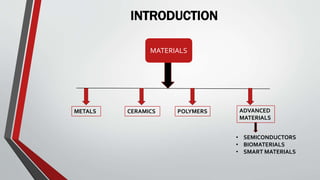
INTRODUCTION
MATERIALS
METALS CERAMICS POLYMERS ADVANCED
MATERIALS
• SEMICONDUCTORS
• BIOMATERIALS
• SMART MATERIALS
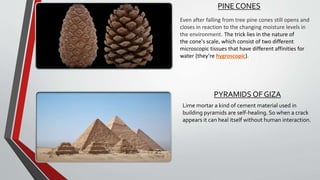
PINE CONES
Even after falling from tree pine cones still opens and
closes in reaction to the changing moisture levels in
the environment. The trick lies in the nature of
the cone's scale, which consist of two different
microscopic tissues that have different affinities for
water (they’re hygroscopic).
PYRAMIDS OF GIZA
Lime mortar a kind of cement material used in
building pyramids are self-healing. So when a crack
appears it can heal itself without human interaction.
What is
SMART
MATERIALS ?
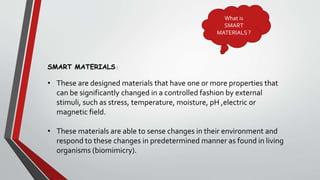
SMART MATERIALS :
• These are designed materials that have one or more properties that
can be significantly changed in a controlled fashion by external
stimuli, such as stress, temperature, moisture, pH ,electric or
magnetic field.
• These materials are able to sense changes in their environment and
respond to these changes in predetermined manner as found in living
organisms (biomimicry).
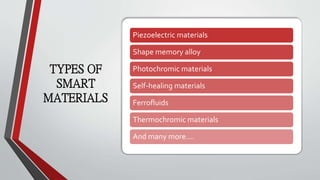
TYPES OF
SMART
MATERIALS
Piezoelectric materials
Shape memory alloy
Photochromic materials
Self-healing materials
Ferrofluids
Thermochromic materials
And many more....
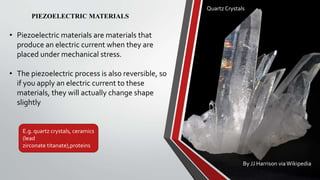
Quartz Crystals
By JJ Harrison viaWikipedia
PIEZOELECTRIC MATERIALS
• Piezoelectric materials are materials that
produce an electric current when they are
placed under mechanical stress.
• The piezoelectric process is also reversible, so
if you apply an electric current to these
materials, they will actually change shape
slightly
E.g. quartz crystals, ceramics
(lead
zirconate titanate),proteins
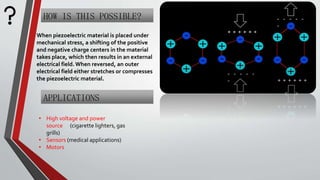
HOW IS THIS POSSIBLE?
When piezoelectric material is placed under
mechanical stress, a shifting of the positive
and negative charge centers in the material
takes place, which then results in an external
electrical field.When reversed, an outer
electrical field either stretches or compresses
the piezoelectric material.
APPLICATIONS
• High voltage and power
source (cigarette lighters, gas
grills)
• Sensors (medical applications)
• Motors
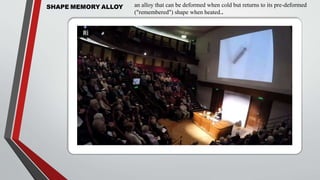
SHAPE MEMORY ALLOY an alloy that can be deformed when cold but returns to its pre-deformed
("remembered") shape when heated..
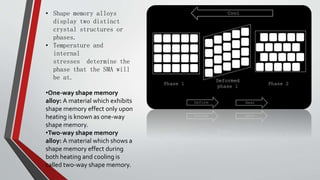
• Shape memory alloys
display two distinct
crystal structures or
phases.
• Temperature and
internal
stresses determine the
phase that the SMA will
be at.
•One-way shape memory
alloy: A material which exhibits
shape memory effect only upon
heating is known as one-way
shape memory.
•Two-way shape memory
alloy: A material which shows a
shape memory effect during
both heating and cooling is
called two-way shape memory.
APPLICATIONS
Orthodontic application
SMA Orthodontic Wires.
VascularApplication
Examples :Ni –Ti alloy (Nitinol)
Cu –Al –Ni alloy, Cu –Zn –A alloy
SMA stents
Aeronautical Applications
Space Applications
Civil Engineering
SHAPE MEMORY POLYMER
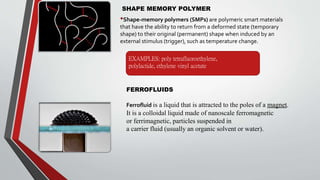
•Shape-memory polymers (SMPs) are polymeric smart materials
that have the ability to return from a deformed state (temporary
shape) to their original (permanent) shape when induced by an
external stimulus (trigger), such as temperature change.
FERROFLUIDS
Ferrofluid is a liquid that is attracted to the poles of a magnet.
It is a colloidal liquid made of nanoscale ferromagnetic
or ferrimagnetic, particles suspended in
a carrier fluid (usually an organic solvent or water).
EXAMPLES: poly tetrafluoroethylene,
polylactide, ethylene vinyl acetate
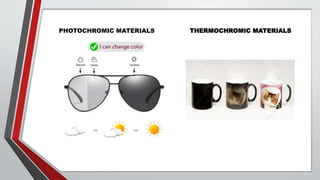
PHOTOCHROMIC MATERIALS THERMOCHROMIC MATERIALS
Limitations of
smart materials
•Too slow
•Toxic
•Unstable
•Difficult to control
•Expensive
•Performance can diminish over time
REFERENCES
 MATERIAL SCIENCEAND ENGINEERINGADAPTED BY R.BALASUBRAMANIAM
 https://youtu.be/4-_rwDgLMpk SMART MATERIALSOF FUTURE BY ANNA PLOSZAJSKI
 PIEZOELECTRIC MATERIALS BYTHE GREENAGE Piezoelectric Materials -TheGreenAge
 HAIR:A COMPOSITE BIOPOLYMERWITH SMART MEMORY PROPERTIES BY MANUEL GAMEZ
GRACIA
 Lorenza Petrini, Francesco Migliavacca, "Biomedical Applications of Shape Memory
Alloys", Journal of Metallurgy, vol. 2011, Article
ID 501483, 15 pages, 2011. https://doi.org/10.1155/2011/501483
THANKYOU

SMART MATERIALS.pptx

  • 1.
    SMART MATERIALS PRESENTED BY ANAGHASOJEN FIRST YEAR M.TECH MATERIAL SCIENCE
  • 2.
    Table OF Contents •INTRODUCTION • SMART MATERIALS • TYPES OF SMART MATERIALS • PIEZOELECTRIC EFFECT • SMART MEMORYALLOY • SMART MEMORY POLYMERAND FERROFLUID • PHOTOCHROMICANDTHERMOCHROMIC MATERIALS • LIMITATIONSOF SMART MATERIALS • REFERENCES
  • 3.
    INTRODUCTION MATERIALS METALS CERAMICS POLYMERSADVANCED MATERIALS • SEMICONDUCTORS • BIOMATERIALS • SMART MATERIALS
  • 4.
    PINE CONES Even afterfalling from tree pine cones still opens and closes in reaction to the changing moisture levels in the environment. The trick lies in the nature of the cone's scale, which consist of two different microscopic tissues that have different affinities for water (they’re hygroscopic). PYRAMIDS OF GIZA Lime mortar a kind of cement material used in building pyramids are self-healing. So when a crack appears it can heal itself without human interaction.
  • 5.
    What is SMART MATERIALS ? SMARTMATERIALS : • These are designed materials that have one or more properties that can be significantly changed in a controlled fashion by external stimuli, such as stress, temperature, moisture, pH ,electric or magnetic field. • These materials are able to sense changes in their environment and respond to these changes in predetermined manner as found in living organisms (biomimicry).
  • 6.
    TYPES OF SMART MATERIALS Piezoelectric materials Shapememory alloy Photochromic materials Self-healing materials Ferrofluids Thermochromic materials And many more....
  • 7.
    Quartz Crystals By JJHarrison viaWikipedia PIEZOELECTRIC MATERIALS • Piezoelectric materials are materials that produce an electric current when they are placed under mechanical stress. • The piezoelectric process is also reversible, so if you apply an electric current to these materials, they will actually change shape slightly E.g. quartz crystals, ceramics (lead zirconate titanate),proteins
  • 8.
    HOW IS THISPOSSIBLE? When piezoelectric material is placed under mechanical stress, a shifting of the positive and negative charge centers in the material takes place, which then results in an external electrical field.When reversed, an outer electrical field either stretches or compresses the piezoelectric material. APPLICATIONS • High voltage and power source (cigarette lighters, gas grills) • Sensors (medical applications) • Motors
  • 9.
    SHAPE MEMORY ALLOYan alloy that can be deformed when cold but returns to its pre-deformed ("remembered") shape when heated..
  • 10.
    • Shape memoryalloys display two distinct crystal structures or phases. • Temperature and internal stresses determine the phase that the SMA will be at. •One-way shape memory alloy: A material which exhibits shape memory effect only upon heating is known as one-way shape memory. •Two-way shape memory alloy: A material which shows a shape memory effect during both heating and cooling is called two-way shape memory.
  • 11.
    APPLICATIONS Orthodontic application SMA OrthodonticWires. VascularApplication Examples :Ni –Ti alloy (Nitinol) Cu –Al –Ni alloy, Cu –Zn –A alloy SMA stents Aeronautical Applications Space Applications Civil Engineering
  • 12.
    SHAPE MEMORY POLYMER •Shape-memorypolymers (SMPs) are polymeric smart materials that have the ability to return from a deformed state (temporary shape) to their original (permanent) shape when induced by an external stimulus (trigger), such as temperature change. FERROFLUIDS Ferrofluid is a liquid that is attracted to the poles of a magnet. It is a colloidal liquid made of nanoscale ferromagnetic or ferrimagnetic, particles suspended in a carrier fluid (usually an organic solvent or water). EXAMPLES: poly tetrafluoroethylene, polylactide, ethylene vinyl acetate
  • 13.
  • 14.
    Limitations of smart materials •Tooslow •Toxic •Unstable •Difficult to control •Expensive •Performance can diminish over time
  • 15.
    REFERENCES  MATERIAL SCIENCEANDENGINEERINGADAPTED BY R.BALASUBRAMANIAM  https://youtu.be/4-_rwDgLMpk SMART MATERIALSOF FUTURE BY ANNA PLOSZAJSKI  PIEZOELECTRIC MATERIALS BYTHE GREENAGE Piezoelectric Materials -TheGreenAge  HAIR:A COMPOSITE BIOPOLYMERWITH SMART MEMORY PROPERTIES BY MANUEL GAMEZ GRACIA  Lorenza Petrini, Francesco Migliavacca, "Biomedical Applications of Shape Memory Alloys", Journal of Metallurgy, vol. 2011, Article ID 501483, 15 pages, 2011. https://doi.org/10.1155/2011/501483
  • 16.