International Research Journal of Engineering and Technology (IRJET) e-ISSN: 2395-0056
Volume: 09 Issue: 07 | July 2022 www.irjet.net p-ISSN: 2395-0072
© 2022, IRJET | Impact Factor value: 7.529 | ISO 9001:2008 Certified Journal | Page 2055
SMART LATHE MACHINE
Chigullapalli Rahul1, Polu Sankeerth2, Kalimera Uttej3, Kukkada Arun4, K.Raja sekhar5
1 Student, Mechanical department, Sreyas Institute of Engineering and Technology, Telangana, India.
2,3,4 Students, Mechanical department, Sreyas Institute of Engineering and Technology, Telangana, India.
5 Associate Professor, Dept. of Mechanical Engineering, Sreyas Institute of Engineering and Technology.
---------------------------------------------------------------------***---------------------------------------------------------------------
Abstract - In the present scenario, thelathemachineplaysa
vital role in the engineering division of the manufacturing
industry. While the manual lathe machines are economical,
their accuracy and efficiency are not up to the mark.
Contrarily, CNC machines deliver the desired accuracy and
efficiency but demand a significant investment in capital. In
order to address this issue, a smart lathe machineapproachto
the traditional lathe machine hasbeendeveloped. Itmakesuse
of sensors and actuators that can be managed by the Arduino
UNO microcontroller and NodeMCU. Therefore, switching
from manual to smart lathe machines can significantly
improve accuracy and efficiency while also controlling
investment costs, giving the manufacturing industry a much-
needed boost. This configuration enables a machinist to
inspect the workpiece's dimensions without removing it, as
well as display the chuck's speed and other features. Industry
4.0-inspired digital technologies are driving a new business
environment that is increasinglysustainable. Purchasing new-
generation machinery makes it possible to take advantage of
the many advantages of digitalization, including increased
productivity, flexibility, efficiency, and quality, reduced
resource consumption, and improved worker safety. By
combining mechanical, electronic, and software technologies,
the traditional lathe machine is transformed into a smart
lathe machine. For the sake of novelty, accuracy, and time-
decreasing, a conventional lathe machine has been converted
into a smart lathe machine by retrofitting to show readings of
the dimensions of the workpiece, speed of the chuck, motor
temperature, and distance from the headstocktothetailstock,
and it can be accessed by the RFID tags only.
Key Words: Manufacturing, Industrial revolution, IoT, Lead
time, Accuracy, Retrofitting, Remodification.
1.INTRODUCTION
A lathe machine uses a cutting tool to remove material from
the workpiece's surface. The workpiece is held in the chuck,
and the tool feeds material onto the workpiece to perform
various operations like cutting, drilling, knurling,
deformation, turning, and facing. It is one of the most
adaptable and frequently used machines in workplaces,
workshops, and educational institutions.
Retrofitting describes the situation in which modern
features or technology are added to older systems to update
their components and enhance their functionality. This
definition covers nearly all of theinformationabouttheterm
"retrofitting" as it also refers to the integration of new
features or technology into older systems. When retrofitting
is used in reference to traditional lathes, it refers to
modernizing the lathe and enhancing its productivity.
Repairing or replacing mechanical parts to the original, as-
new factory specificationsis knownasremanufacturing. The
machine will be completely disassembled, cleaned,
examined, repaired, and painted. Updates will bemadeto all
electrical, hydraulic, and pneumatic systems. To adapt the
machine for a different use, it may also be modified or given
mechanical accessories.Remanufacturing will almostalways
happen at the remanufacturer's location. The main goal of
incorporating a smart lathe machine into an existing
conventional lathe machine is to enhance it with features
such as non-contact workpiecedimensionmeasurement and
condition monitoring of the electrical components of the
lathe. [1]
The goals of retrofitting consist of
 implementing new manufacturing techniques.
 minimizing machine idling.
 greater speeds.
 decreased tool costs
 friendly service.
 increased output and improved machine control.
 significantly greater repeatability
 to reduce lead time,
 very quick machining cycles.
 high precision.
Retrofitting should be much less expensive overall than
buying a new system.
2. Sequence of upgrading
The fig 1 shows the conversion of a conventional lathe into a
smart lathe in different stages. There are different stages,
from selecting the sensors to programming them and
implementing them on the lathe machine.
International Research Journal of Engineering and Technology (IRJET) e-ISSN: 2395-0056
Volume: 09 Issue: 07 | July 2022 www.irjet.net p-ISSN: 2395-0072
© 2022, IRJET | Impact Factor value: 7.529 | ISO 9001:2008 Certified Journal | Page 2056
Fig -1: Stages of smart lathe retrofitting procedure
2.1 Sensors and actuators
The fig 2, block diagram, explains the different sensors and
actuators connectedtotheprogrammable boardssuchasthe
Arduino UNO and NodeMCU. The actuators still require a
12V power source even though all the electronic parts are
connected to 5V. The microcontroller gathers the sensor
data and uses the I2C communication protocol to send it to
the LCD. An Internet of Things (IoT) device called NodeMCU
can send data in formats that are readable by humans over
Wi-Fi. [2]
Fig -2: Sensor connectivity to microcontrollers
2.2 Circuit diagram
Fig -3: Electronic component connection
The fig 3 represents the connections of sensors, actuators,
relays, and other electronic components connected to the
Arduino and Nodemcu.
2.3 Software
Arduino is an open-source platform for prototyping that is
built on user-friendly hardware and software. Arduino
boards have the ability to read inputs, such as light from a
sensor or pressure from a finger on a button, and convert
them into outputs, such as turning on a motor or an LED. By
sending a set of instructions to the microcontroller, the user
can instruct the board what to do. The user should dothis by
International Research Journal of Engineering and Technology (IRJET) e-ISSN: 2395-0056
Volume: 09 Issue: 07 | July 2022 www.irjet.net p-ISSN: 2395-0072
© 2022, IRJET | Impact Factor value: 7.529 | ISO 9001:2008 Certified Journal | Page 2057
utilizing the Arduino Software (IDE), which is based on
Processing, and the Wiring-based Arduino Programming
Language (based on Wiring). Based on theATmega328P,the
Uno is a microcontroller board.
Fig -4: Arduino IDE
2.3.1 Arduino UNO
The ATmega328P microcontroller is the foundation of the
Arduino UNO. Comparatively speaking, it is simpler to use
than other boards like the Arduino Mega board, etc. The
board is made up of shields, other circuits, and digital and
analog Input/Output (I/O) pins. The Arduino UNO has 14
digital pins, a USB port, a power jack, and an ICSP (In-Circuit
Serial Programming) header, in addition to 6 analog pin
inputs. An IDE, or integrated development environment, is
the platform on which it is programmed. Both online and
offline platforms are compatible with it. The FTDI USB-to-
serial driver chip is absent from the Uno, setting it apart
from all previous boards. Instead, it uses an Atmega16U2
(Atmega8U2 up to version R2) that has been configured as a
USB-to-serial converter. The USB ports on your computer
are shielded from shorts and overcurrent by the resettable
poly-fuse on the Uno.
.
Fig -5: Arduino UNO[5]
2.3.2 NodeMCU
A low-cost System-on-a-Chip (SoC) called the ESP8266
serves as the foundation of the NodeMCU (Node
Microcontroller Unit), an open-source environment for
developing both software and hardware. The Espressif
Systems-designed and -produced ESP8266 has all of the
essential components of a computer, including CPU, RAM,
networking (Wi-Fi), and even a contemporary operating
system and SDK. Because of this, it is a great option for all
types of Internet of Things (IoT) projects.
Fig -6: NodeMCU [6]
2.4 List of IoT features
The below figure 7 shows list of IoT features to be given fora
conventional lathe machine to upgrade it into a smart lathe
machine
International Research Journal of Engineering and Technology (IRJET) e-ISSN: 2395-0056
Volume: 09 Issue: 07 | July 2022 www.irjet.net p-ISSN: 2395-0072
© 2022, IRJET | Impact Factor value: 7.529 | ISO 9001:2008 Certified Journal | Page 2058
Fig -7: Smart features given to mechanical elements
2.5 Working algorithm
Step 1) The “Arduino Software IDE” is initializedasshownin
Figure 4.
Step 2) Based on the input parameters, the program is
written accordingly.
Step 3) Written code must have the requirements of all the
sensors that should also be mentioned in the void setup, and
sensor information and connectionsareinitializedabovethe
void setup.
Step 4) The actual working model shouldbe writtenina void
loop so as to repeat the process in a loop manner.
Step 5) Now the coding is compiled. so that it ensures the
sketch is free to upload.
Step 6) These codes are transmitted to the Arduinoboard by
means of a USB cable.
Step 7) In the case of Nodemcu, the output of the written
code is checked on the serial monitor for debugging
purposes.
Step 8) Meanwhile, the workpiece is mounted on the chuck
of the smart lathe as shown in Figure 3.
Step9) Now, the Arduino reads the program and, based on
the input of the lathe, shows the output ontheLCDdisplayto
the machinist.
Step10) When the procedure is complete, adjusting the
potentiometer to the left and right will show the values of
additional parameters, such as spindle speed, motor
temperature, etc. [3][4]
Fig -8: Controller device
3. Working model
Fig -9: Working model of smart lathe prototype
International Research Journal of Engineering and Technology (IRJET) e-ISSN: 2395-0056
Volume: 09 Issue: 07 | July 2022 www.irjet.net p-ISSN: 2395-0072
© 2022, IRJET | Impact Factor value: 7.529 | ISO 9001:2008 Certified Journal | Page 2059
The above activity diagram (fig 9) shows the working model
of the smart lathe machine. Firstly, it will be turned on by
RFID access. If there is no access, then the lathe will not turn
on. This is for security reasons and also to avoid unwanted
people from operating the lathe.
Fig -10: Access authorized
Fig -11: Authorization failed
Due to inadequate training, if someone uses the lathe
machine without authorization, they run the risk of
damaging it or becoming injured. Whentheusergainsaccess
to the machine, the LCD will turn on and display data from
various sensors, including temperature, spindle speed,
workpiece length, and distances between the headstock and
tailstock. The lathe machine continues to perform all the
tasks while it is in use and becomes heated. When the
machine's motor reaches a temperature of more than 80
degrees Celsius, it automatically shuts off and sounds a
buzzer to let the user know how things are going. The
ventilators are also activated at that time.
4. Comparison
Time saved by the smart lathe in comparison with
conventional lathe.
Table -1: Lead time with respect to lathe operations
When using the lathe machine to perform tasks like cutting,
drilling, facing, knurling, and turning, an aluminum
workpiece is taken into account. When comparing a
conventional lathe and a smart lathe, the time required for
these operations is noted as the time difference. The smart
lathe machine saves 20 minutes as shown in table 1. when
compared to a conventional lathe when performing all 5
operations, which takes 97 minutes as opposed to 77
minutes.
This process took the traditional lathe 1164 minutes (19.4
hours) to produce 12 pieces. Keeping the same time for the
smart lathe, it produced 15 pieces. which is almost 3 extra
pieces at the same time as shown in table 2.
Table -2: Workpiece quantity after 19.4hours
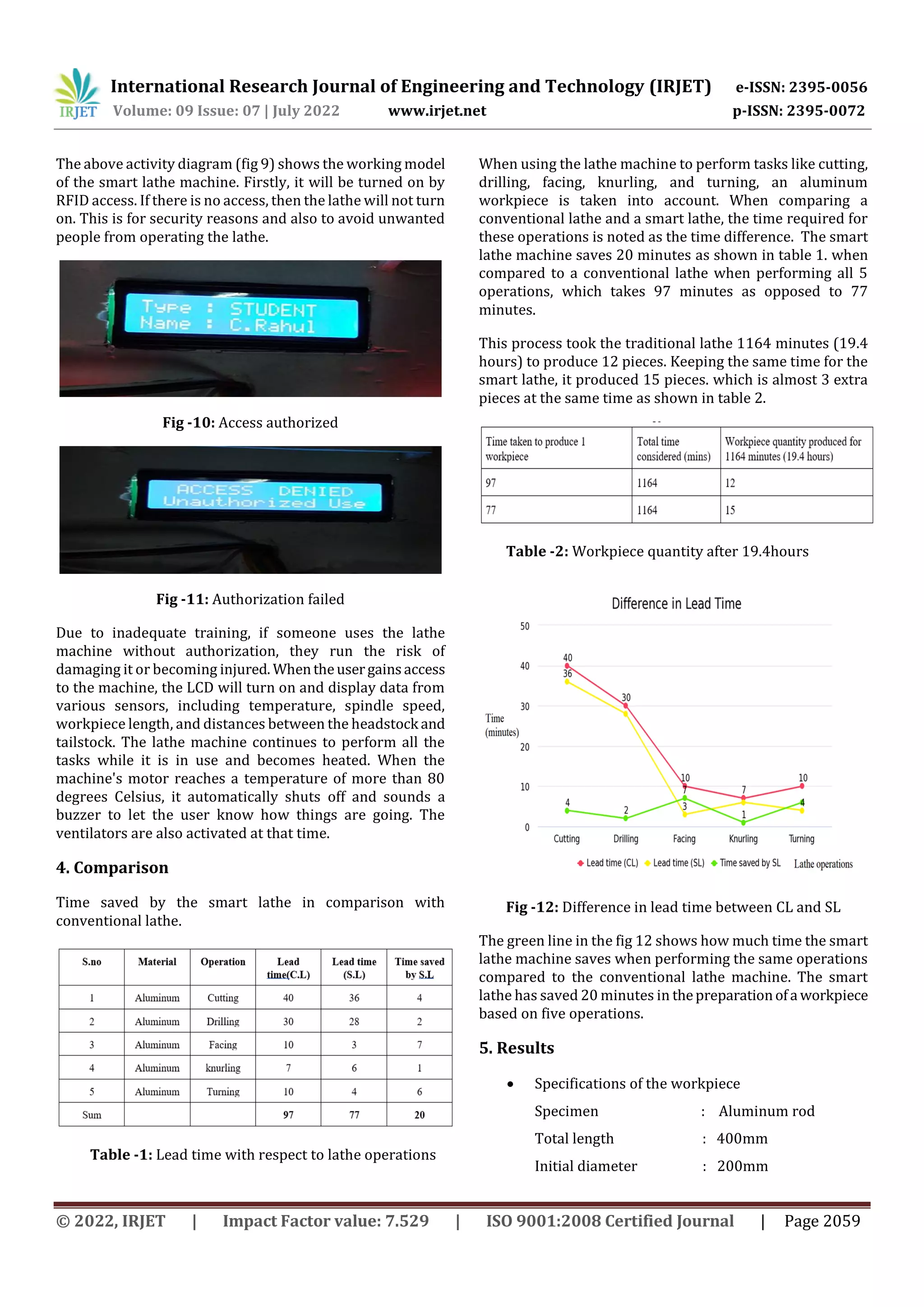
Fig -12: Difference in lead time between CL and SL
The green line in the fig 12 shows how much time the smart
lathe machine saves when performing the same operations
compared to the conventional lathe machine. The smart
lathe has saved 20 minutes in thepreparationofa workpiece
based on five operations.
5. Results
 Specifications of the workpiece
Specimen : Aluminum rod
Total length : 400mm
Initial diameter : 200mm
International Research Journal of Engineering and Technology (IRJET) e-ISSN: 2395-0056
Volume: 09 Issue: 07 | July 2022 www.irjet.net p-ISSN: 2395-0072
© 2022, IRJET | Impact Factor value: 7.529 | ISO 9001:2008 Certified Journal | Page 2060
Final diameter : 150mm
Removed diameter : 50mm
Depth of cut : 25mm
Cutting speed : 251.2 m/min
RPM : 500
Table -3: Parameter calculations
The above table 3 shows the calculations of the workpiece
before and after the machining. A 25mm depth of cut was
given to the specimen, and there was a huge difference in
production quantity from two lathes.
Table -4: Production difference between CL and SL
The table 4 illustrates the production differences between
conventional and smart lathe machines for machining
aluminum workpieces (quantity). For a smart lathe and a
traditional lathe, respectively, the maximum number of
workpieces that can be produced at 100% is 63 and 46. The
time required by traditional machines to place the
workpiece in the chuck, remove it again, and check the
workpiece's dimensions will be significantly greater. This is
where the two machinesare verydifferentfromoneanother.
The workpiece is once more placed into the chuck for
additional machining if the employee feels the desired
dimensions are not being achieved. However, there is no
need to take the workpiece out of the chuck when using a
smart lathe. Saving time is achieved bythesensor'sabilityto
display values without making contact. Workers will
eventually have the opportunity to machine another
workpiece as time permits, which will increase production.
Fig -13: Production difference of smart lathe vs
conventional lathe
Fig -14: LM35 sensor
Fig -15: Temperature values
Fig -16: Distance between head and tailstock
International Research Journal of Engineering and Technology (IRJET) e-ISSN: 2395-0056
Volume: 09 Issue: 07 | July 2022 www.irjet.net p-ISSN: 2395-0072
© 2022, IRJET | Impact Factor value: 7.529 | ISO 9001:2008 Certified Journal | Page 2061
Fig -17: IR Sensor attached to spindle
Fig -18: Speed of the chuck
Fig -19: Workpiece length values
Fig -20: Ultrasonic sensor placed on toolpost
Improvements: The improvements after the lathe machine
are upgraded to smart lathe are as follows
1) Worker safety
2) Lead time
3) Non-contact measurement
4) Production rate
5) Security to the lathe
6. Conclusion
Low labor costs and high-quality outputarebenefitsofusing
a smart lathe machine. The smart lathe machine allows a
machinist to control the temperature of the machine and
turn it off while he is away. The current work is anticipated
to be helpful for the manufacturing industry as well as the
research community with regard to cost basis. Through a
series of design changes and the use of a retrofitting
technique, a conventional lathe machine can be converted
into a smart lathe machine. As a result, NodeMCU and
Arduino were successful in creating the design for the smart
lathe. which, thanks to the collaboration of hardware
(Arduino UNO) and software (Arduino IDE), has led to the
development of a semi-automated approach to the
traditional lathe machine. By adding a few new features to
the existing lathe, the newly created Arduino lathe's setup
cost is increased; however, when compared to the fully
automated/CNC machine, the setup cost is significantly
lower. The repeatability and dimensional stability of the
manufactured part are achieved due to the relatively high
accuracy of the job manufactured in a semi-automatedlathe.
REFERENCES
[1] Parmar, Prakash & Mehta, Nirajkumar. (2014).
Investigation on Automation of Lathe Machine.
International Journal of Emerging Technology and
Advanced Engineering. 4. 524.
[2] Abd-Alrazzaq, Mohamed & Ahmed,Mahmoud&Younes,
Mohammad. (2019). A computer numerical control
(CNC) multi-pass spinning solution to a center lathe
retrofit. SN Applied Sciences. 1. 10.1007/s42452-018-
0007-x.
[3] Sakthi, S & Niresh, J & Vignesh, K & Raj, Goutom. (2018).
Development of Semi-Automatic Lathe by using
Intelligent Soft Computing Technique. IOP Conference
Series: Materials Science and Engineering. 324.012053.
10.1088/1757-899X/324/1/012053.
[4] Ilari, Serena & Carlo, Fabio & Ciarapica, Filippo
Emanuele & Bevilacqua, Maurizio.(2021).MachineTool
Transition from Industry 3.0 to 4.0: A Comparison
between Old Machine Retrofitting and the Purchase of
International Research Journal of Engineering and Technology (IRJET) e-ISSN: 2395-0056
Volume: 09 Issue: 07 | July 2022 www.irjet.net p-ISSN: 2395-0072
© 2022, IRJET | Impact Factor value: 7.529 | ISO 9001:2008 Certified Journal | Page 2062
New Machines from a Triple Bottom Line Perspective.
Sustainability. 13. 10441. 10.3390/su131810441.
[5] Arduino UNO - JavaTpoint
[6] NodeMCU ESP8266 Pinout, Specifications, Features &
Datasheet (components101.com)

SMART LATHE MACHINE

  • 1.
    International Research Journalof Engineering and Technology (IRJET) e-ISSN: 2395-0056 Volume: 09 Issue: 07 | July 2022 www.irjet.net p-ISSN: 2395-0072 © 2022, IRJET | Impact Factor value: 7.529 | ISO 9001:2008 Certified Journal | Page 2055 SMART LATHE MACHINE Chigullapalli Rahul1, Polu Sankeerth2, Kalimera Uttej3, Kukkada Arun4, K.Raja sekhar5 1 Student, Mechanical department, Sreyas Institute of Engineering and Technology, Telangana, India. 2,3,4 Students, Mechanical department, Sreyas Institute of Engineering and Technology, Telangana, India. 5 Associate Professor, Dept. of Mechanical Engineering, Sreyas Institute of Engineering and Technology. ---------------------------------------------------------------------***--------------------------------------------------------------------- Abstract - In the present scenario, thelathemachineplaysa vital role in the engineering division of the manufacturing industry. While the manual lathe machines are economical, their accuracy and efficiency are not up to the mark. Contrarily, CNC machines deliver the desired accuracy and efficiency but demand a significant investment in capital. In order to address this issue, a smart lathe machineapproachto the traditional lathe machine hasbeendeveloped. Itmakesuse of sensors and actuators that can be managed by the Arduino UNO microcontroller and NodeMCU. Therefore, switching from manual to smart lathe machines can significantly improve accuracy and efficiency while also controlling investment costs, giving the manufacturing industry a much- needed boost. This configuration enables a machinist to inspect the workpiece's dimensions without removing it, as well as display the chuck's speed and other features. Industry 4.0-inspired digital technologies are driving a new business environment that is increasinglysustainable. Purchasing new- generation machinery makes it possible to take advantage of the many advantages of digitalization, including increased productivity, flexibility, efficiency, and quality, reduced resource consumption, and improved worker safety. By combining mechanical, electronic, and software technologies, the traditional lathe machine is transformed into a smart lathe machine. For the sake of novelty, accuracy, and time- decreasing, a conventional lathe machine has been converted into a smart lathe machine by retrofitting to show readings of the dimensions of the workpiece, speed of the chuck, motor temperature, and distance from the headstocktothetailstock, and it can be accessed by the RFID tags only. Key Words: Manufacturing, Industrial revolution, IoT, Lead time, Accuracy, Retrofitting, Remodification. 1.INTRODUCTION A lathe machine uses a cutting tool to remove material from the workpiece's surface. The workpiece is held in the chuck, and the tool feeds material onto the workpiece to perform various operations like cutting, drilling, knurling, deformation, turning, and facing. It is one of the most adaptable and frequently used machines in workplaces, workshops, and educational institutions. Retrofitting describes the situation in which modern features or technology are added to older systems to update their components and enhance their functionality. This definition covers nearly all of theinformationabouttheterm "retrofitting" as it also refers to the integration of new features or technology into older systems. When retrofitting is used in reference to traditional lathes, it refers to modernizing the lathe and enhancing its productivity. Repairing or replacing mechanical parts to the original, as- new factory specificationsis knownasremanufacturing. The machine will be completely disassembled, cleaned, examined, repaired, and painted. Updates will bemadeto all electrical, hydraulic, and pneumatic systems. To adapt the machine for a different use, it may also be modified or given mechanical accessories.Remanufacturing will almostalways happen at the remanufacturer's location. The main goal of incorporating a smart lathe machine into an existing conventional lathe machine is to enhance it with features such as non-contact workpiecedimensionmeasurement and condition monitoring of the electrical components of the lathe. [1] The goals of retrofitting consist of  implementing new manufacturing techniques.  minimizing machine idling.  greater speeds.  decreased tool costs  friendly service.  increased output and improved machine control.  significantly greater repeatability  to reduce lead time,  very quick machining cycles.  high precision. Retrofitting should be much less expensive overall than buying a new system. 2. Sequence of upgrading The fig 1 shows the conversion of a conventional lathe into a smart lathe in different stages. There are different stages, from selecting the sensors to programming them and implementing them on the lathe machine.
  • 2.
    International Research Journalof Engineering and Technology (IRJET) e-ISSN: 2395-0056 Volume: 09 Issue: 07 | July 2022 www.irjet.net p-ISSN: 2395-0072 © 2022, IRJET | Impact Factor value: 7.529 | ISO 9001:2008 Certified Journal | Page 2056 Fig -1: Stages of smart lathe retrofitting procedure 2.1 Sensors and actuators The fig 2, block diagram, explains the different sensors and actuators connectedtotheprogrammable boardssuchasthe Arduino UNO and NodeMCU. The actuators still require a 12V power source even though all the electronic parts are connected to 5V. The microcontroller gathers the sensor data and uses the I2C communication protocol to send it to the LCD. An Internet of Things (IoT) device called NodeMCU can send data in formats that are readable by humans over Wi-Fi. [2] Fig -2: Sensor connectivity to microcontrollers 2.2 Circuit diagram Fig -3: Electronic component connection The fig 3 represents the connections of sensors, actuators, relays, and other electronic components connected to the Arduino and Nodemcu. 2.3 Software Arduino is an open-source platform for prototyping that is built on user-friendly hardware and software. Arduino boards have the ability to read inputs, such as light from a sensor or pressure from a finger on a button, and convert them into outputs, such as turning on a motor or an LED. By sending a set of instructions to the microcontroller, the user can instruct the board what to do. The user should dothis by
  • 3.
    International Research Journalof Engineering and Technology (IRJET) e-ISSN: 2395-0056 Volume: 09 Issue: 07 | July 2022 www.irjet.net p-ISSN: 2395-0072 © 2022, IRJET | Impact Factor value: 7.529 | ISO 9001:2008 Certified Journal | Page 2057 utilizing the Arduino Software (IDE), which is based on Processing, and the Wiring-based Arduino Programming Language (based on Wiring). Based on theATmega328P,the Uno is a microcontroller board. Fig -4: Arduino IDE 2.3.1 Arduino UNO The ATmega328P microcontroller is the foundation of the Arduino UNO. Comparatively speaking, it is simpler to use than other boards like the Arduino Mega board, etc. The board is made up of shields, other circuits, and digital and analog Input/Output (I/O) pins. The Arduino UNO has 14 digital pins, a USB port, a power jack, and an ICSP (In-Circuit Serial Programming) header, in addition to 6 analog pin inputs. An IDE, or integrated development environment, is the platform on which it is programmed. Both online and offline platforms are compatible with it. The FTDI USB-to- serial driver chip is absent from the Uno, setting it apart from all previous boards. Instead, it uses an Atmega16U2 (Atmega8U2 up to version R2) that has been configured as a USB-to-serial converter. The USB ports on your computer are shielded from shorts and overcurrent by the resettable poly-fuse on the Uno. . Fig -5: Arduino UNO[5] 2.3.2 NodeMCU A low-cost System-on-a-Chip (SoC) called the ESP8266 serves as the foundation of the NodeMCU (Node Microcontroller Unit), an open-source environment for developing both software and hardware. The Espressif Systems-designed and -produced ESP8266 has all of the essential components of a computer, including CPU, RAM, networking (Wi-Fi), and even a contemporary operating system and SDK. Because of this, it is a great option for all types of Internet of Things (IoT) projects. Fig -6: NodeMCU [6] 2.4 List of IoT features The below figure 7 shows list of IoT features to be given fora conventional lathe machine to upgrade it into a smart lathe machine
  • 4.
    International Research Journalof Engineering and Technology (IRJET) e-ISSN: 2395-0056 Volume: 09 Issue: 07 | July 2022 www.irjet.net p-ISSN: 2395-0072 © 2022, IRJET | Impact Factor value: 7.529 | ISO 9001:2008 Certified Journal | Page 2058 Fig -7: Smart features given to mechanical elements 2.5 Working algorithm Step 1) The “Arduino Software IDE” is initializedasshownin Figure 4. Step 2) Based on the input parameters, the program is written accordingly. Step 3) Written code must have the requirements of all the sensors that should also be mentioned in the void setup, and sensor information and connectionsareinitializedabovethe void setup. Step 4) The actual working model shouldbe writtenina void loop so as to repeat the process in a loop manner. Step 5) Now the coding is compiled. so that it ensures the sketch is free to upload. Step 6) These codes are transmitted to the Arduinoboard by means of a USB cable. Step 7) In the case of Nodemcu, the output of the written code is checked on the serial monitor for debugging purposes. Step 8) Meanwhile, the workpiece is mounted on the chuck of the smart lathe as shown in Figure 3. Step9) Now, the Arduino reads the program and, based on the input of the lathe, shows the output ontheLCDdisplayto the machinist. Step10) When the procedure is complete, adjusting the potentiometer to the left and right will show the values of additional parameters, such as spindle speed, motor temperature, etc. [3][4] Fig -8: Controller device 3. Working model Fig -9: Working model of smart lathe prototype
  • 5.
    International Research Journalof Engineering and Technology (IRJET) e-ISSN: 2395-0056 Volume: 09 Issue: 07 | July 2022 www.irjet.net p-ISSN: 2395-0072 © 2022, IRJET | Impact Factor value: 7.529 | ISO 9001:2008 Certified Journal | Page 2059 The above activity diagram (fig 9) shows the working model of the smart lathe machine. Firstly, it will be turned on by RFID access. If there is no access, then the lathe will not turn on. This is for security reasons and also to avoid unwanted people from operating the lathe. Fig -10: Access authorized Fig -11: Authorization failed Due to inadequate training, if someone uses the lathe machine without authorization, they run the risk of damaging it or becoming injured. Whentheusergainsaccess to the machine, the LCD will turn on and display data from various sensors, including temperature, spindle speed, workpiece length, and distances between the headstock and tailstock. The lathe machine continues to perform all the tasks while it is in use and becomes heated. When the machine's motor reaches a temperature of more than 80 degrees Celsius, it automatically shuts off and sounds a buzzer to let the user know how things are going. The ventilators are also activated at that time. 4. Comparison Time saved by the smart lathe in comparison with conventional lathe. Table -1: Lead time with respect to lathe operations When using the lathe machine to perform tasks like cutting, drilling, facing, knurling, and turning, an aluminum workpiece is taken into account. When comparing a conventional lathe and a smart lathe, the time required for these operations is noted as the time difference. The smart lathe machine saves 20 minutes as shown in table 1. when compared to a conventional lathe when performing all 5 operations, which takes 97 minutes as opposed to 77 minutes. This process took the traditional lathe 1164 minutes (19.4 hours) to produce 12 pieces. Keeping the same time for the smart lathe, it produced 15 pieces. which is almost 3 extra pieces at the same time as shown in table 2. Table -2: Workpiece quantity after 19.4hours Fig -12: Difference in lead time between CL and SL The green line in the fig 12 shows how much time the smart lathe machine saves when performing the same operations compared to the conventional lathe machine. The smart lathe has saved 20 minutes in thepreparationofa workpiece based on five operations. 5. Results  Specifications of the workpiece Specimen : Aluminum rod Total length : 400mm Initial diameter : 200mm
  • 6.
    International Research Journalof Engineering and Technology (IRJET) e-ISSN: 2395-0056 Volume: 09 Issue: 07 | July 2022 www.irjet.net p-ISSN: 2395-0072 © 2022, IRJET | Impact Factor value: 7.529 | ISO 9001:2008 Certified Journal | Page 2060 Final diameter : 150mm Removed diameter : 50mm Depth of cut : 25mm Cutting speed : 251.2 m/min RPM : 500 Table -3: Parameter calculations The above table 3 shows the calculations of the workpiece before and after the machining. A 25mm depth of cut was given to the specimen, and there was a huge difference in production quantity from two lathes. Table -4: Production difference between CL and SL The table 4 illustrates the production differences between conventional and smart lathe machines for machining aluminum workpieces (quantity). For a smart lathe and a traditional lathe, respectively, the maximum number of workpieces that can be produced at 100% is 63 and 46. The time required by traditional machines to place the workpiece in the chuck, remove it again, and check the workpiece's dimensions will be significantly greater. This is where the two machinesare verydifferentfromoneanother. The workpiece is once more placed into the chuck for additional machining if the employee feels the desired dimensions are not being achieved. However, there is no need to take the workpiece out of the chuck when using a smart lathe. Saving time is achieved bythesensor'sabilityto display values without making contact. Workers will eventually have the opportunity to machine another workpiece as time permits, which will increase production. Fig -13: Production difference of smart lathe vs conventional lathe Fig -14: LM35 sensor Fig -15: Temperature values Fig -16: Distance between head and tailstock
  • 7.
    International Research Journalof Engineering and Technology (IRJET) e-ISSN: 2395-0056 Volume: 09 Issue: 07 | July 2022 www.irjet.net p-ISSN: 2395-0072 © 2022, IRJET | Impact Factor value: 7.529 | ISO 9001:2008 Certified Journal | Page 2061 Fig -17: IR Sensor attached to spindle Fig -18: Speed of the chuck Fig -19: Workpiece length values Fig -20: Ultrasonic sensor placed on toolpost Improvements: The improvements after the lathe machine are upgraded to smart lathe are as follows 1) Worker safety 2) Lead time 3) Non-contact measurement 4) Production rate 5) Security to the lathe 6. Conclusion Low labor costs and high-quality outputarebenefitsofusing a smart lathe machine. The smart lathe machine allows a machinist to control the temperature of the machine and turn it off while he is away. The current work is anticipated to be helpful for the manufacturing industry as well as the research community with regard to cost basis. Through a series of design changes and the use of a retrofitting technique, a conventional lathe machine can be converted into a smart lathe machine. As a result, NodeMCU and Arduino were successful in creating the design for the smart lathe. which, thanks to the collaboration of hardware (Arduino UNO) and software (Arduino IDE), has led to the development of a semi-automated approach to the traditional lathe machine. By adding a few new features to the existing lathe, the newly created Arduino lathe's setup cost is increased; however, when compared to the fully automated/CNC machine, the setup cost is significantly lower. The repeatability and dimensional stability of the manufactured part are achieved due to the relatively high accuracy of the job manufactured in a semi-automatedlathe. REFERENCES [1] Parmar, Prakash & Mehta, Nirajkumar. (2014). Investigation on Automation of Lathe Machine. International Journal of Emerging Technology and Advanced Engineering. 4. 524. [2] Abd-Alrazzaq, Mohamed & Ahmed,Mahmoud&Younes, Mohammad. (2019). A computer numerical control (CNC) multi-pass spinning solution to a center lathe retrofit. SN Applied Sciences. 1. 10.1007/s42452-018- 0007-x. [3] Sakthi, S & Niresh, J & Vignesh, K & Raj, Goutom. (2018). Development of Semi-Automatic Lathe by using Intelligent Soft Computing Technique. IOP Conference Series: Materials Science and Engineering. 324.012053. 10.1088/1757-899X/324/1/012053. [4] Ilari, Serena & Carlo, Fabio & Ciarapica, Filippo Emanuele & Bevilacqua, Maurizio.(2021).MachineTool Transition from Industry 3.0 to 4.0: A Comparison between Old Machine Retrofitting and the Purchase of
  • 8.
    International Research Journalof Engineering and Technology (IRJET) e-ISSN: 2395-0056 Volume: 09 Issue: 07 | July 2022 www.irjet.net p-ISSN: 2395-0072 © 2022, IRJET | Impact Factor value: 7.529 | ISO 9001:2008 Certified Journal | Page 2062 New Machines from a Triple Bottom Line Perspective. Sustainability. 13. 10441. 10.3390/su131810441. [5] Arduino UNO - JavaTpoint [6] NodeMCU ESP8266 Pinout, Specifications, Features & Datasheet (components101.com)