

Small Church.
Big Potential.
In total, 60% of Protestant
churches have 100 or fewer
adults .
https://www.barna.org/barna-update/article/5-barna-update/126-small-churches-
struggle-to-grow-because-of-the-people-they-attract#.UjNVul_D_IU
Ten Questions to ask
your small church
1. Who are we?
You are not a large church. Don’t
try to be one! Pick one thing, and
do it with excellence. Be known in
the community for that one thing.
Promote it. Talk about it.
Encourage it. Take pride in it.
Discussion Questions
What’s the “one thing” our church
will be known for in our
community?
What will we do?
When will be do it?
How will we do it?
Who will do it?
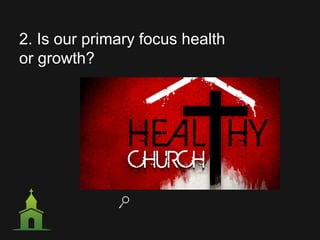
2. Is our primary focus health
or growth?
Healthy organisms grow. Many times a church won’t
grow not because it can’t, but because it won’t.
Internal strife and general unhealthiness is keeping
us stuck in neutral. People in the community are
already messed up, they don’t need any extra drama
in their life. When a person joins a dysfunctional
church and see all the unhealthiness they can
become inoculated for life against Christianity. Get
healthy. You will grow.
Discussion
1.Understanding that ALL churches have issues, what
are our main issues that could be holding us back?
2.What steps do we need to take to get healthy?
3. How do we treat guests?
One extreme is to smother guests. They are few and
far between, so when they do show up people want
them to join immediately and smother them with
information (sometimes some extreme information
like the evils of milk). Please don’t. Welcome them.
Love on them. The other extreme is to see guests as
intrusions. We may not verbalize this, but our lack of
attention to them, sends a strong message: “Thanks
for coming, but we are good here.”
Discussion
1.How do we treat guests?
2.What practical steps can we take to make their
experience better?
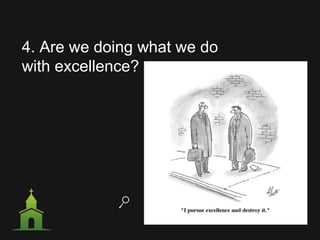
4. Are we doing what we do
with excellence?
Small doesn’t need to equal mediocre.
Excellence honors God and inspires
people. Sometimes the temptation
when part of a small church with few
helping hands is to give less than the
best and let the circumstances
determine the effort.
Discussion
1.If God would bring us 50 guests
today, what would they experience
when they show up?
2.What areas do we need to tidy up?
3.Which one will be concentrate on
first?
5. How is your attitude?
A consistent problem I run into are small
churches that constantly complain about the
pastor, the conference forgetting they exist,
the surrounding area that is experiencing
“young flight” and a host of others maladies. If
you are not careful, that attitude can become
visible, permanent and act as repellent to the
people you are trying to attract. Keep a smile
on your face. Life isn’t fair. God rewards
faithfulness, not sour grapes. Think about it:
who would want to stay in a church that is
always talking about how bad things are?
Discussion
1. Do you keep the service positive? Is the Sabbath
school director happy about the ones that are there, or
is complaining about the ones that aren’t?
2. When offering time comes, does it paint a picture of
vision and progress or is it a list of complaints about
bills, past dues and lack of commitment from
members? People give, are attracted to, and
inspired by a positive vision, not a litany of
complaints..
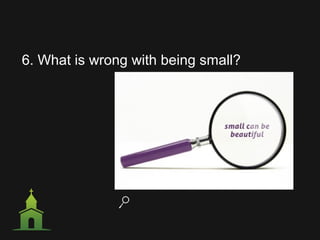
6. What is wrong with being small?
Nothing! Small doesn’t equal bad. Some of the
best restaurants I have ever eaten at were
holes in the wall. There are people out there
that are specifically looking for a small church.
They believe big churches are impersonal and
they want to make a bigger difference. There
are things a small church can offer than a big
church never could, and vice-versa. That’s ok.
We need churches of all sizes. If you are a
small church, be the best small church you
can be.
Discussion
1. How can we maximize our smallness to our
advantage?
2.. How can we promote our church so people that are
looking for a smaller church can find us?
7. How is your faith, hope
and love?
If the church is the key instrument that God
uses to share the good news with the world
then we must never lose three things: faith in
the God who founded it, hope in its success
and love for the community it serves. Meet
every week with expectation that regardless of
the past God is about to do a new work.
Prepare to receive the blessing that although
delayed, is not denied.
Discussion
1. On a level of 1-10, answering sincerely, how is my:
a.Faith
b.Hope
c.Love
8. How are your leaders?
Leadership makes the difference. One
word of caution. Since in a small church,
leaders are at a premium, the temptation
for the existing ones is to take on too
many responsibilities. That can either
burn you out, or can send the message
to new potential leaders that they are not
needed. . Continually advertise the
availability of leadership positions and
look at newcomers as contributors not
threats.
Discussion
1. What specific strategies are in place to identify,
empower, train and deploy newcomers?
2. How can we be more intentional in giving new
people an opportunity to lead?
9. Who is your church for?
If your church is for the frozen chosen, for the
founding members, for the people that already know
the good news, then let’s put up with clutter, drafty
windows, smelly bathrooms and a lifeless worship
service. But if church is for people that are far from
God, a keen interest should be taken so the
environment sends the message: We care about our
church because we care about the lost people God
will bring to it. A building that doesn’t smell is a great
start. Throw away the ingathering materials, it’s not
coming back. Paint it. Fix it. Make it look good. It’s all
for them.
Discussion
1. What message does the physical environment of
the church send to new people?
2. How does the church look, feel, smell?
10. When are you doing
evangelism?
People in your
community need Jesus.
Don’t give up on
evangelism. Expand it,
don’t eliminate it. Do it in
many forms, many ways.
Discussion
1. What would you do evangelistically if money was
not an issue?
2. When are we having our next evangelistic event?
“You can’t hand us a latte and then go
about business as usual and expect us to
stick around.
We’re not leaving the church because we
don’t find the cool factor there; we’re
leaving the church because we don’t find
Jesus there.”
http://religion.blogs.cnn.com/2013/07/27/why-millennials-are-leaving-the-church/

Small church big potential

  • 1.
  • 2.
    In total, 60%of Protestant churches have 100 or fewer adults . https://www.barna.org/barna-update/article/5-barna-update/126-small-churches- struggle-to-grow-because-of-the-people-they-attract#.UjNVul_D_IU
  • 3.
    Ten Questions toask your small church
  • 4.
  • 5.
    You are nota large church. Don’t try to be one! Pick one thing, and do it with excellence. Be known in the community for that one thing. Promote it. Talk about it. Encourage it. Take pride in it.
  • 6.
    Discussion Questions What’s the“one thing” our church will be known for in our community? What will we do? When will be do it? How will we do it? Who will do it?
  • 7.
    2. Is ourprimary focus health or growth?
  • 8.
    Healthy organisms grow.Many times a church won’t grow not because it can’t, but because it won’t. Internal strife and general unhealthiness is keeping us stuck in neutral. People in the community are already messed up, they don’t need any extra drama in their life. When a person joins a dysfunctional church and see all the unhealthiness they can become inoculated for life against Christianity. Get healthy. You will grow.
  • 9.
    Discussion 1.Understanding that ALLchurches have issues, what are our main issues that could be holding us back? 2.What steps do we need to take to get healthy?
  • 10.
    3. How dowe treat guests?
  • 11.
    One extreme isto smother guests. They are few and far between, so when they do show up people want them to join immediately and smother them with information (sometimes some extreme information like the evils of milk). Please don’t. Welcome them. Love on them. The other extreme is to see guests as intrusions. We may not verbalize this, but our lack of attention to them, sends a strong message: “Thanks for coming, but we are good here.”
  • 12.
    Discussion 1.How do wetreat guests? 2.What practical steps can we take to make their experience better?
  • 13.
    4. Are wedoing what we do with excellence?
  • 14.
    Small doesn’t needto equal mediocre. Excellence honors God and inspires people. Sometimes the temptation when part of a small church with few helping hands is to give less than the best and let the circumstances determine the effort.
  • 15.
    Discussion 1.If God wouldbring us 50 guests today, what would they experience when they show up? 2.What areas do we need to tidy up? 3.Which one will be concentrate on first?
  • 16.
    5. How isyour attitude?
  • 17.
    A consistent problemI run into are small churches that constantly complain about the pastor, the conference forgetting they exist, the surrounding area that is experiencing “young flight” and a host of others maladies. If you are not careful, that attitude can become visible, permanent and act as repellent to the people you are trying to attract. Keep a smile on your face. Life isn’t fair. God rewards faithfulness, not sour grapes. Think about it: who would want to stay in a church that is always talking about how bad things are?
  • 18.
    Discussion 1. Do youkeep the service positive? Is the Sabbath school director happy about the ones that are there, or is complaining about the ones that aren’t? 2. When offering time comes, does it paint a picture of vision and progress or is it a list of complaints about bills, past dues and lack of commitment from members? People give, are attracted to, and inspired by a positive vision, not a litany of complaints..
  • 19.
    6. What iswrong with being small?
  • 20.
    Nothing! Small doesn’tequal bad. Some of the best restaurants I have ever eaten at were holes in the wall. There are people out there that are specifically looking for a small church. They believe big churches are impersonal and they want to make a bigger difference. There are things a small church can offer than a big church never could, and vice-versa. That’s ok. We need churches of all sizes. If you are a small church, be the best small church you can be.
  • 21.
    Discussion 1. How canwe maximize our smallness to our advantage? 2.. How can we promote our church so people that are looking for a smaller church can find us?
  • 22.
    7. How isyour faith, hope and love?
  • 23.
    If the churchis the key instrument that God uses to share the good news with the world then we must never lose three things: faith in the God who founded it, hope in its success and love for the community it serves. Meet every week with expectation that regardless of the past God is about to do a new work. Prepare to receive the blessing that although delayed, is not denied.
  • 24.
    Discussion 1. On alevel of 1-10, answering sincerely, how is my: a.Faith b.Hope c.Love
  • 25.
    8. How areyour leaders?
  • 26.
    Leadership makes thedifference. One word of caution. Since in a small church, leaders are at a premium, the temptation for the existing ones is to take on too many responsibilities. That can either burn you out, or can send the message to new potential leaders that they are not needed. . Continually advertise the availability of leadership positions and look at newcomers as contributors not threats.
  • 27.
    Discussion 1. What specificstrategies are in place to identify, empower, train and deploy newcomers? 2. How can we be more intentional in giving new people an opportunity to lead?
  • 28.
    9. Who isyour church for?
  • 29.
    If your churchis for the frozen chosen, for the founding members, for the people that already know the good news, then let’s put up with clutter, drafty windows, smelly bathrooms and a lifeless worship service. But if church is for people that are far from God, a keen interest should be taken so the environment sends the message: We care about our church because we care about the lost people God will bring to it. A building that doesn’t smell is a great start. Throw away the ingathering materials, it’s not coming back. Paint it. Fix it. Make it look good. It’s all for them.
  • 30.
    Discussion 1. What messagedoes the physical environment of the church send to new people? 2. How does the church look, feel, smell?
  • 31.
    10. When areyou doing evangelism?
  • 32.
    People in your communityneed Jesus. Don’t give up on evangelism. Expand it, don’t eliminate it. Do it in many forms, many ways.
  • 33.
    Discussion 1. What wouldyou do evangelistically if money was not an issue? 2. When are we having our next evangelistic event?
  • 34.
    “You can’t handus a latte and then go about business as usual and expect us to stick around. We’re not leaving the church because we don’t find the cool factor there; we’re leaving the church because we don’t find Jesus there.” http://religion.blogs.cnn.com/2013/07/27/why-millennials-are-leaving-the-church/