CHAPTER 4:The Material Balance for Chemical Reactors
Copyright © 2022 by Nob Hill Publishing, LLC
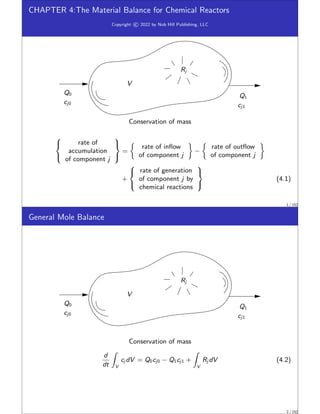
Rj
V
Q1
cj1
Q0
cj0
Conservation of mass



rate of
accumulation
of component j



=

rate of inflow
of component j

−

rate of outflow
of component j

+



rate of generation
of component j by
chemical reactions



(4.1)
1 / 152
General Mole Balance
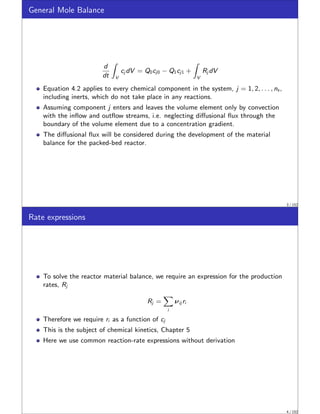
Rj
V
Q1
cj1
Q0
cj0
Conservation of mass
d
dt
Z
V
cj dV = Q0cj0 − Q1cj1 +
Z
V
Rj dV (4.2)
2 / 152
General Mole Balance
d
dt
Z
V
cj dV = Q0cj0 − Q1cj1 +
Z
V
Rj dV
Equation 4.2 applies to every chemical component in the system, j = 1, 2, . . . , ns ,
including inerts, which do not take place in any reactions.
Assuming component j enters and leaves the volume element only by convection
with the inflow and outflow streams, i.e. neglecting diffusional flux through the
boundary of the volume element due to a concentration gradient.
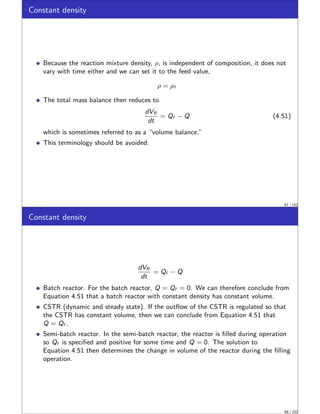
The diffusional flux will be considered during the development of the material
balance for the packed-bed reactor.
3 / 152
Rate expressions
To solve the reactor material balance, we require an expression for the production
rates, Rj
Rj =
X
i
νij ri
Therefore we require ri as a function of cj
This is the subject of chemical kinetics, Chapter 5
Here we use common reaction-rate expressions without derivation
4 / 152
The Batch Reactor
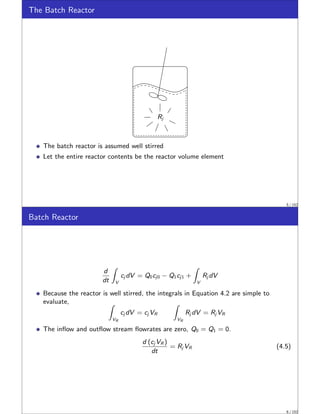
Rj
The batch reactor is assumed well stirred
Let the entire reactor contents be the reactor volume element
5 / 152
Batch Reactor
d
dt
Z
V
cj dV = Q0cj0 − Q1cj1 +
Z
V
Rj dV
Because the reactor is well stirred, the integrals in Equation 4.2 are simple to
evaluate, Z
VR
cj dV = cj VR
Z
VR
Rj dV = Rj VR
The inflow and outflow stream flowrates are zero, Q0 = Q1 = 0.
d (cj VR )
dt
= Rj VR (4.5)
6 / 152
Reactor Volume
Equation 4.5 applies whether the reactor volume is constant or changes during the
reaction.
If the reactor volume is constant (liquid-phase reactions)
dcj
dt
= Rj (4.6)
Use Equation 4.5 rather than Equation 4.6 if the reactor volume changes
significantly during the course of the reaction.
7 / 152
Analytical Solutions for Simple Rate Laws
In general the material balance must be solved numerically.
If the reactor is isothermal, we have few components, the rate expressions are
simple, then analytical solutions of the material balance are possible.
We next examine derive analytical solutions for some classic cases.
8 / 152
First-order, irreversible
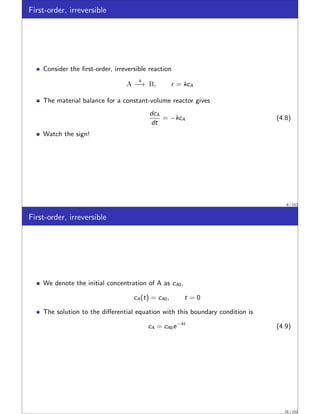
Consider the first-order, irreversible reaction
A
k
−→ B, r = kcA
The material balance for a constant-volume reactor gives
dcA
dt
= −kcA (4.8)
Watch the sign!
9 / 152
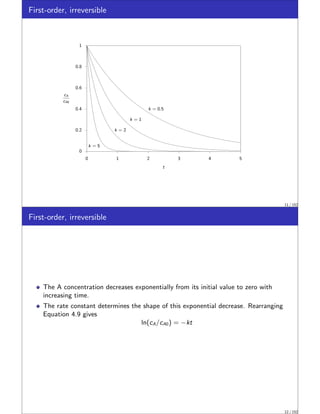
First-order, irreversible
We denote the initial concentration of A as cA0,
cA(t) = cA0, t = 0
The solution to the differential equation with this boundary condition is
cA = cA0e−kt
(4.9)
10 / 152
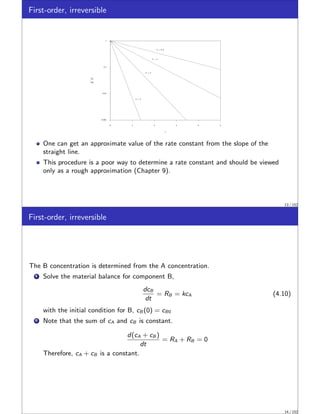
First-order, irreversible
0
0.2
0.4
0.6
0.8
1
0 1 2 3 4 5
k = 0.5
k = 1
k = 2
k = 5
cA
cA0
t
11 / 152
First-order, irreversible
The A concentration decreases exponentially from its initial value to zero with
increasing time.
The rate constant determines the shape of this exponential decrease. Rearranging
Equation 4.9 gives
ln(cA/cA0) = −kt
12 / 152
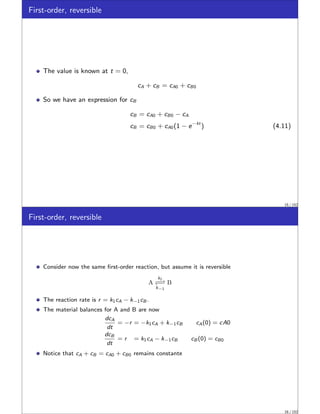
First-order, irreversible
0.001
0.01
0.1
1
0 1 2 3 4 5
k = 0.5
k = 1
k = 2
k = 5
cA
cA0
t
One can get an approximate value of the rate constant from the slope of the
straight line.
This procedure is a poor way to determine a rate constant and should be viewed
only as a rough approximation (Chapter 9).
13 / 152
First-order, irreversible
The B concentration is determined from the A concentration.
1 Solve the material balance for component B,
dcB
dt
= RB = kcA (4.10)
with the initial condition for B, cB (0) = cB0
2 Note that the sum of cA and cB is constant.
d(cA + cB )
dt
= RA + RB = 0
Therefore, cA + cB is a constant.
14 / 152
First-order, reversible
The value is known at t = 0,
cA + cB = cA0 + cB0
So we have an expression for cB
cB = cA0 + cB0 − cA
cB = cB0 + cA0(1 − e−kt
) (4.11)
15 / 152
First-order, reversible
Consider now the same first-order reaction, but assume it is reversible
A
k1
−⇀
↽−
k−1
B
The reaction rate is r = k1cA − k−1cB .
The material balances for A and B are now
dcA
dt
= −r = −k1cA + k−1cB cA(0) = cA0
dcB
dt
= r = k1cA − k−1cB cB (0) = cB0
Notice that cA + cB = cA0 + cB0 remains constante
16 / 152
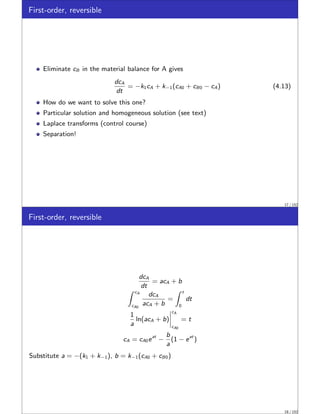
First-order, reversible
Eliminate cB in the material balance for A gives
dcA
dt
= −k1cA + k−1(cA0 + cB0 − cA) (4.13)
How do we want to solve this one?
Particular solution and homogeneous solution (see text)
Laplace transforms (control course)
Separation!
17 / 152
First-order, reversible
dcA
dt
= acA + b
Z cA
cA0
dcA
acA + b
=
Z t
0
dt
1
a
ln(acA + b)
cA
cA0
= t
cA = cA0eat
−
b
a
(1 − eat
)
Substitute a = −(k1 + k−1), b = k−1(cA0 + cB0)
18 / 152
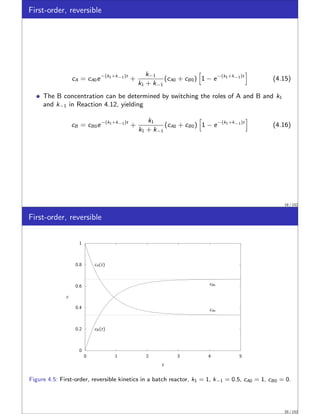
First-order, reversible
cA = cA0e−(k1+k−1)t
+
k−1
k1 + k−1
(cA0 + cB0)
h
1 − e−(k1+k−1)t
i
(4.15)
The B concentration can be determined by switching the roles of A and B and k1
and k−1 in Reaction 4.12, yielding
cB = cB0e−(k1+k−1)t
+
k1
k1 + k−1
(cA0 + cB0)
h
1 − e−(k1+k−1)t
i
(4.16)
19 / 152
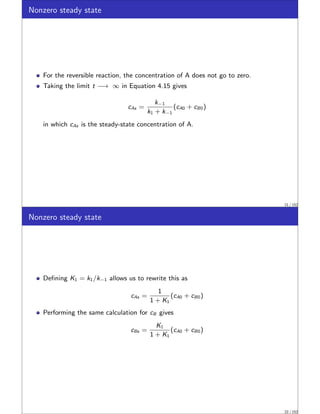
First-order, reversible
0
0.2
0.4
0.6
0.8
1
0 1 2 3 4 5
cB (t)
cA(t)
cAs
cBs
c
t
Figure 4.5: First-order, reversible kinetics in a batch reactor, k1 = 1, k−1 = 0.5, cA0 = 1, cB0 = 0.
20 / 152
Nonzero steady state
For the reversible reaction, the concentration of A does not go to zero.
Taking the limit t −→ ∞ in Equation 4.15 gives
cAs =
k−1
k1 + k−1
(cA0 + cB0)
in which cAs is the steady-state concentration of A.
21 / 152
Nonzero steady state
Defining K1 = k1/k−1 allows us to rewrite this as
cAs =
1
1 + K1
(cA0 + cB0)
Performing the same calculation for cB gives
cBs =
K1
1 + K1
(cA0 + cB0)
22 / 152
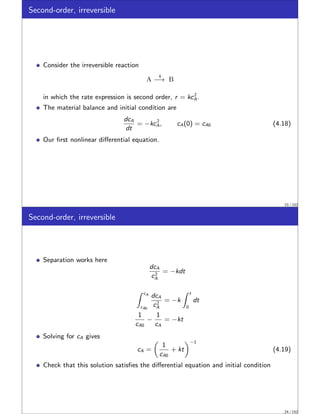
Second-order, irreversible
Consider the irreversible reaction
A
k
−→ B
in which the rate expression is second order, r = kc2
A.
The material balance and initial condition are
dcA
dt
= −kc2
A, cA(0) = cA0 (4.18)
Our first nonlinear differential equation.
23 / 152
Second-order, irreversible
Separation works here
dcA
c2
A
= −kdt
Z cA
cA0
dcA
c2
A
= −k
Z t
0
dt
1
cA0
−
1
cA
= −kt
Solving for cA gives
cA =

1
cA0
+ kt
−1
(4.19)
Check that this solution satisfies the differential equation and initial condition
24 / 152
Second-order, irreversible
0
0.1
0.2
0.3
0.4
0.5
0.6
0.7
0.8
0.9
1
0 1 2 3 4 5
first order
second order
cA
cA0
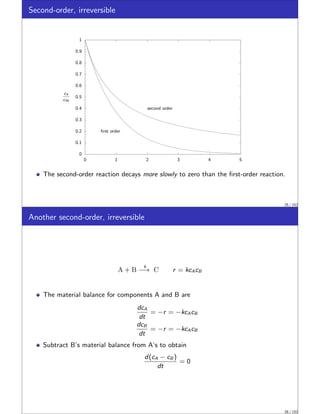
The second-order reaction decays more slowly to zero than the first-order reaction.
25 / 152
Another second-order, irreversible
A + B
k
−→ C r = kcAcB
The material balance for components A and B are
dcA
dt
= −r = −kcAcB
dcB
dt
= −r = −kcAcB
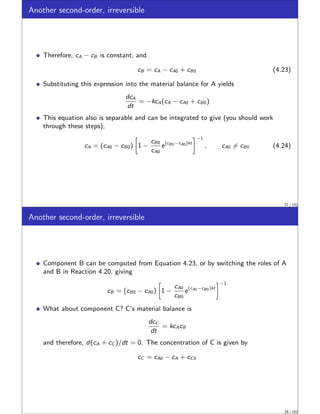
Subtract B’s material balance from A’s to obtain
d(cA − cB )
dt
= 0
26 / 152
Another second-order, irreversible
Therefore, cA − cB is constant, and
cB = cA − cA0 + cB0 (4.23)
Substituting this expression into the material balance for A yields
dcA
dt
= −kcA(cA − cA0 + cB0)
This equation also is separable and can be integrated to give (you should work
through these steps),
cA = (cA0 − cB0)

1 −
cB0
cA0
e(cB0−cA0)kt
−1
, cA0 ̸= cB0 (4.24)
27 / 152
Another second-order, irreversible
Component B can be computed from Equation 4.23, or by switching the roles of A
and B in Reaction 4.20, giving
cB = (cB0 − cA0)

1 −
cA0
cB0
e(cA0−cB0)kt
−1
What about component C? C’s material balance is
dcC
dt
= kcAcB
and therefore, d(cA + cC )/dt = 0. The concentration of C is given by
cC = cA0 − cA + cC0
28 / 152
Another second-order, irreversible
Notice that if cA0  cB0 (Excess A), the steady state
cAs = cA0 − cB0
cBs = 0
cCs = cB0 + cC0
For cB0  cA0 (Excess B), the steady state is
cAs = 0
cBs = cB0 − cA0
cCs = cA0 + cC0
29 / 152
nth-order, irreversible
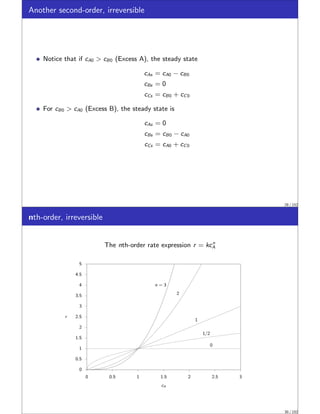
The nth-order rate expression r = kcn
A
0
0.5
1
1.5
2
2.5
3
3.5
4
4.5
5
0 0.5 1 1.5 2 2.5 3
r
n = 3
2
1
1/2
0
cA
30 / 152
nth-order, irreversible
A
k
−→ B r = kcn
A
dcA
dt
= −r = −kcn
A
This equation also is separable and can be rearranged to
dcA
cn
A
= −kdt
Performing the integration and solving for cA gives
cA =
h
c−n+1
A0 + (n − 1)kt
i 1
−n+1
, n ̸= 1
31 / 152
nth-order, irreversible
We can divide both sides by cA0 to obtain
cA
cA0
= [1 + (n − 1)k0t]
1
−n+1 , n ̸= 1 (4.25)
in which
k0 = kcn−1
A0
has units of inverse time.
32 / 152
nth-order, irreversible
0
0.2
0.4
0.6
0.8
1
0 1 2 3 4 5
1
2
3
4
n = 5
cA
cA0
t
The larger the value of n, the more slowly the A concentration approaches zero at
large time.
33 / 152
nth-order, irreversible
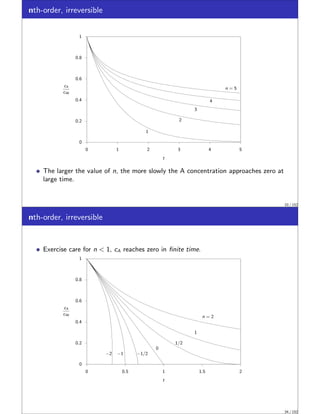
Exercise care for n  1, cA reaches zero in finite time.
0
0.2
0.4
0.6
0.8
1
0 0.5 1 1.5 2
cA
cA0
n = 2
1
1/2
0
−1/2
−1
−2
t
34 / 152
Negative order, inhibition
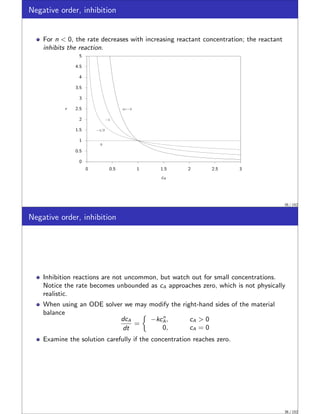
For n  0, the rate decreases with increasing reactant concentration; the reactant
inhibits the reaction.
0
0.5
1
1.5
2
2.5
3
3.5
4
4.5
5
0 0.5 1 1.5 2 2.5 3
r
0
−1/2
−1
n=−2
cA
35 / 152
Negative order, inhibition
Inhibition reactions are not uncommon, but watch out for small concentrations.
Notice the rate becomes unbounded as cA approaches zero, which is not physically
realistic.
When using an ODE solver we may modify the right-hand sides of the material
balance
dcA
dt
=

−kcn
A, cA  0
0, cA = 0
Examine the solution carefully if the concentration reaches zero.
36 / 152
Two reactions in series
Consider the following two irreversible reactions,
A
k1
−→ B
B
k2
−→ C
Reactant A decomposes to form an intermediate B that can further react to form a
final product C.
Let the reaction rates be given by simple first-order rate expressions in the
corresponding reactants,
r1 = k1cA
r2 = k2cB
37 / 152
Two reactions in series
The material balances for the three components are
dcA
dt
= RA = −r1 = −k1cA
dcB
dt
= RB = r1 − r2 = k1cA − k2cB
dcC
dt
= RC = r2 = k2cB
The material balance for component A can be solved immediately to give
cA = cA0e−k1t
as before.
38 / 152
Two reactions in series – B
The material balance for B becomes
dcB
dt
+ k2cB = k1cA0e−k1t
Oops, not separable, now what?
Either Laplace transform or particular solution, homogeneous equation approach
produces
cB = cB0e−k2t
+ cA0
k1
k2 − k1
h
e−k1t
− e−k2t
i
, k1 ̸= k2 (4.30)
39 / 152
Two reactions in series – C
To determine the C concentration, notice from the material balances that
d(cA + cB + cC )/dt = 0. Therefore, cC is
cC = cA0 + cB0 + cC0 − cA − cB
40 / 152
Two reactions in series
0
0.2
0.4
0.6
0.8
1
0 1 2 3 4 5
cA(t)
cB (t)
cC (t)
c
t
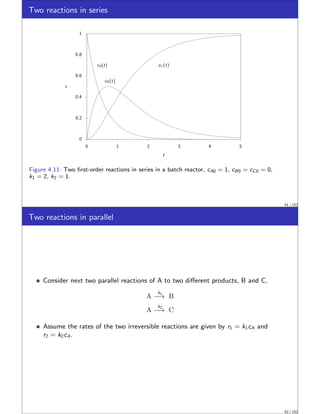
Figure 4.11: Two first-order reactions in series in a batch reactor, cA0 = 1, cB0 = cC0 = 0,
k1 = 2, k2 = 1.
41 / 152
Two reactions in parallel
Consider next two parallel reactions of A to two different products, B and C,
A
k1
−→ B
A
k2
−→ C
Assume the rates of the two irreversible reactions are given by r1 = k1cA and
r2 = k2cA.
42 / 152
Two reactions in parallel
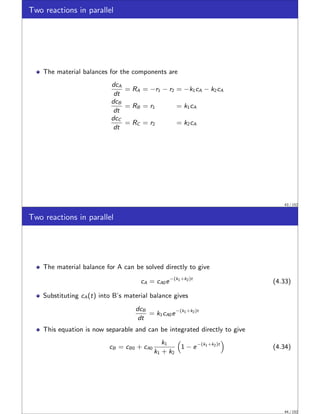
The material balances for the components are
dcA
dt
= RA = −r1 − r2 = −k1cA − k2cA
dcB
dt
= RB = r1 = k1cA
dcC
dt
= RC = r2 = k2cA
43 / 152
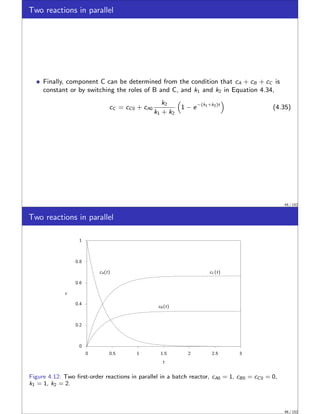
Two reactions in parallel
The material balance for A can be solved directly to give
cA = cA0e−(k1+k2)t
(4.33)
Substituting cA(t) into B’s material balance gives
dcB
dt
= k1cA0e−(k1+k2)t
This equation is now separable and can be integrated directly to give
cB = cB0 + cA0
k1
k1 + k2

1 − e−(k1+k2)t

(4.34)
44 / 152
Two reactions in parallel
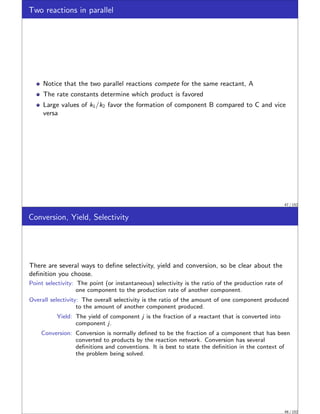
Finally, component C can be determined from the condition that cA + cB + cC is
constant or by switching the roles of B and C, and k1 and k2 in Equation 4.34,
cC = cC0 + cA0
k2
k1 + k2

1 − e−(k1+k2)t

(4.35)
45 / 152
Two reactions in parallel
0
0.2
0.4
0.6
0.8
1
0 0.5 1 1.5 2 2.5 3
cA(t)
cB (t)
cC (t)
c
t
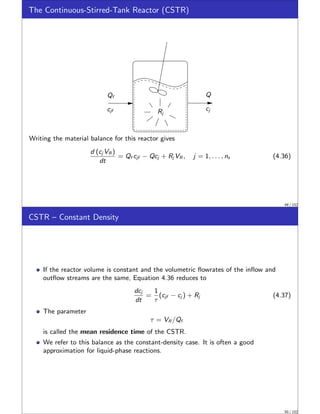
Figure 4.12: Two first-order reactions in parallel in a batch reactor, cA0 = 1, cB0 = cC0 = 0,
k1 = 1, k2 = 2.
46 / 152
Two reactions in parallel
Notice that the two parallel reactions compete for the same reactant, A
The rate constants determine which product is favored
Large values of k1/k2 favor the formation of component B compared to C and vice
versa
47 / 152
Conversion, Yield, Selectivity
There are several ways to define selectivity, yield and conversion, so be clear about the
definition you choose.
Point selectivity: The point (or instantaneous) selectivity is the ratio of the production rate of
one component to the production rate of another component.
Overall selectivity: The overall selectivity is the ratio of the amount of one component produced
to the amount of another component produced.
Yield: The yield of component j is the fraction of a reactant that is converted into
component j.
Conversion: Conversion is normally defined to be the fraction of a component that has been
converted to products by the reaction network. Conversion has several
definitions and conventions. It is best to state the definition in the context of
the problem being solved.
48 / 152
The Continuous-Stirred-Tank Reactor (CSTR)
Q
cj
Qf
cjf Rj
Writing the material balance for this reactor gives
d (cj VR )
dt
= Qf cjf − Qcj + Rj VR , j = 1, . . . , ns (4.36)
49 / 152
CSTR – Constant Density
If the reactor volume is constant and the volumetric flowrates of the inflow and
outflow streams are the same, Equation 4.36 reduces to
dcj
dt
=
1
τ
(cjf − cj ) + Rj (4.37)
The parameter
τ = VR /Qf
is called the mean residence time of the CSTR.
We refer to this balance as the constant-density case. It is often a good
approximation for liquid-phase reactions.
50 / 152
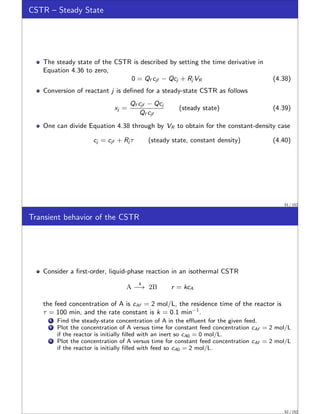
CSTR – Steady State
The steady state of the CSTR is described by setting the time derivative in
Equation 4.36 to zero,
0 = Qf cjf − Qcj + Rj VR (4.38)
Conversion of reactant j is defined for a steady-state CSTR as follows
xj =
Qf cjf − Qcj
Qf cjf
(steady state) (4.39)
One can divide Equation 4.38 through by VR to obtain for the constant-density case
cj = cjf + Rj τ (steady state, constant density) (4.40)
51 / 152
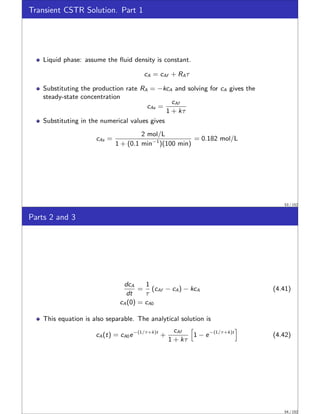
Transient behavior of the CSTR
Consider a first-order, liquid-phase reaction in an isothermal CSTR
A
k
−→ 2B r = kcA
the feed concentration of A is cAf = 2 mol/L, the residence time of the reactor is
τ = 100 min, and the rate constant is k = 0.1 min−1
.
1 Find the steady-state concentration of A in the effluent for the given feed.
2 Plot the concentration of A versus time for constant feed concentration cAf = 2 mol/L
if the reactor is initially filled with an inert so cA0 = 0 mol/L.
3 Plot the concentration of A versus time for constant feed concentration cAf = 2 mol/L
if the reactor is initially filled with feed so cA0 = 2 mol/L.
52 / 152
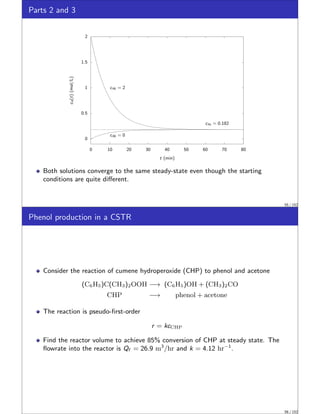
Transient CSTR Solution. Part 1
Liquid phase: assume the fluid density is constant.
cA = cAf + RAτ
Substituting the production rate RA = −kcA and solving for cA gives the
steady-state concentration
cAs =
cAf
1 + kτ
Substituting in the numerical values gives
cAs =
2 mol/L
1 + (0.1 min−1
)(100 min)
= 0.182 mol/L
53 / 152
Parts 2 and 3
dcA
dt
=
1
τ
(cAf − cA) − kcA (4.41)
cA(0) = cA0
This equation is also separable. The analytical solution is
cA(t) = cA0e−(1/τ+k)t
+
cAf
1 + kτ
h
1 − e−(1/τ+k)t
i
(4.42)
54 / 152
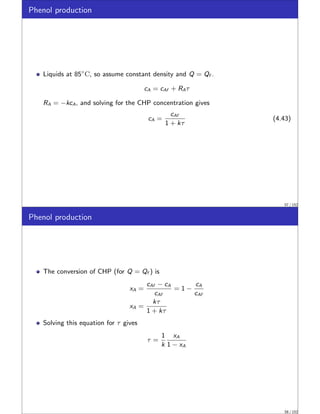
Parts 2 and 3
0
0.5
1
1.5
2
0 10 20 30 40 50 60 70 80
cA0 = 0
cA0 = 2
cAs = 0.182
c
A
(t)
(mol/L)
t (min)
Both solutions converge to the same steady-state even though the starting
conditions are quite different.
55 / 152
Phenol production in a CSTR
Consider the reaction of cumene hydroperoxide (CHP) to phenol and acetone
(C6H5)C(CH3)2OOH −→ (C6H5)OH + (CH3)2CO
CHP −→ phenol + acetone
The reaction is pseudo-first-order
r = kcCHP
Find the reactor volume to achieve 85% conversion of CHP at steady state. The
flowrate into the reactor is Qf = 26.9 m3
/hr and k = 4.12 hr−1
.
56 / 152
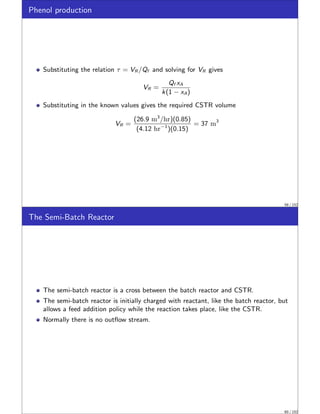
Phenol production
Liquids at 85◦
C, so assume constant density and Q = Qf .
cA = cAf + RAτ
RA = −kcA, and solving for the CHP concentration gives
cA =
cAf
1 + kτ
(4.43)
57 / 152
Phenol production
The conversion of CHP (for Q = Qf ) is
xA =
cAf − cA
cAf
= 1 −
cA
cAf
xA =
kτ
1 + kτ
Solving this equation for τ gives
τ =
1
k
xA
1 − xA
58 / 152
Phenol production
Substituting the relation τ = VR /Qf and solving for VR gives
VR =
Qf xA
k(1 − xA)
Substituting in the known values gives the required CSTR volume
VR =
(26.9 m3
/hr)(0.85)
(4.12 hr−1
)(0.15)
= 37 m3
59 / 152
The Semi-Batch Reactor
The semi-batch reactor is a cross between the batch reactor and CSTR.
The semi-batch reactor is initially charged with reactant, like the batch reactor, but
allows a feed addition policy while the reaction takes place, like the CSTR.
Normally there is no outflow stream.
60 / 152
The Semi-Batch Reactor
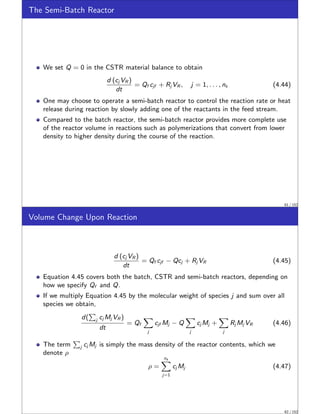
We set Q = 0 in the CSTR material balance to obtain
d (cj VR )
dt
= Qf cjf + Rj VR , j = 1, . . . , ns (4.44)
One may choose to operate a semi-batch reactor to control the reaction rate or heat
release during reaction by slowly adding one of the reactants in the feed stream.
Compared to the batch reactor, the semi-batch reactor provides more complete use
of the reactor volume in reactions such as polymerizations that convert from lower
density to higher density during the course of the reaction.
61 / 152
Volume Change Upon Reaction
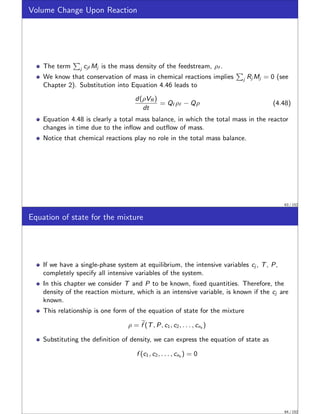
d (cj VR )
dt
= Qf cjf − Qcj + Rj VR (4.45)
Equation 4.45 covers both the batch, CSTR and semi-batch reactors, depending on
how we specify Qf and Q.
If we multiply Equation 4.45 by the molecular weight of species j and sum over all
species we obtain,
d(
P
j cj Mj VR )
dt
= Qf
X
j
cjf Mj − Q
X
j
cj Mj +
X
j
Rj Mj VR (4.46)
The term
P
j cj Mj is simply the mass density of the reactor contents, which we
denote ρ
ρ =
ns
X
j=1
cj Mj (4.47)
62 / 152
Volume Change Upon Reaction
The term
P
j cjf Mj is the mass density of the feedstream, ρf .
We know that conservation of mass in chemical reactions implies
P
j Rj Mj = 0 (see
Chapter 2). Substitution into Equation 4.46 leads to
d(ρVR )
dt
= Qf ρf − Qρ (4.48)
Equation 4.48 is clearly a total mass balance, in which the total mass in the reactor
changes in time due to the inflow and outflow of mass.
Notice that chemical reactions play no role in the total mass balance.
63 / 152
Equation of state for the mixture
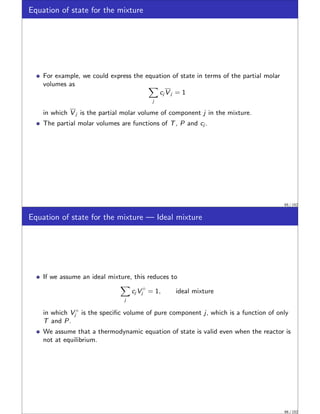
If we have a single-phase system at equilibrium, the intensive variables cj , T, P,
completely specify all intensive variables of the system.
In this chapter we consider T and P to be known, fixed quantities. Therefore, the
density of the reaction mixture, which is an intensive variable, is known if the cj are
known.
This relationship is one form of the equation of state for the mixture
ρ = e
f (T, P, c1, c2, . . . , cns )
Substituting the definition of density, we can express the equation of state as
f (c1, c2, . . . , cns ) = 0
64 / 152
Equation of state for the mixture
For example, we could express the equation of state in terms of the partial molar
volumes as X
j
cj V j = 1
in which V j is the partial molar volume of component j in the mixture.
The partial molar volumes are functions of T, P and cj .
65 / 152
Equation of state for the mixture — Ideal mixture
If we assume an ideal mixture, this reduces to
X
j
cj V ◦
j = 1, ideal mixture
in which V ◦
j is the specific volume of pure component j, which is a function of only
T and P.
We assume that a thermodynamic equation of state is valid even when the reactor is
not at equilibrium.
66 / 152
Constant density
Because the reaction mixture density, ρ, is independent of composition, it does not
vary with time either and we can set it to the feed value,
ρ = ρf
The total mass balance then reduces to
dVR
dt
= Qf − Q (4.51)
which is sometimes referred to as a “volume balance.”
This terminology should be avoided.
67 / 152
Constant density
dVR
dt
= Qf − Q
Batch reactor. For the batch reactor, Q = Qf = 0. We can therefore conclude from
Equation 4.51 that a batch reactor with constant density has constant volume.
CSTR (dynamic and steady state). If the outflow of the CSTR is regulated so that
the CSTR has constant volume, then we can conclude from Equation 4.51 that
Q = Qf .
Semi-batch reactor. In the semi-batch reactor, the reactor is filled during operation
so Qf is specified and positive for some time and Q = 0. The solution to
Equation 4.51 then determines the change in volume of the reactor during the filling
operation.
68 / 152
Nonconstant density
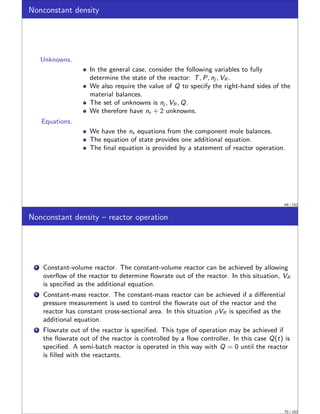
Unknowns.
In the general case, consider the following variables to fully
determine the state of the reactor: T, P, nj , VR .
We also require the value of Q to specify the right-hand sides of the
material balances.
The set of unknowns is nj , VR , Q.
We therefore have ns + 2 unknowns.
Equations.
We have the ns equations from the component mole balances.
The equation of state provides one additional equation.
The final equation is provided by a statement of reactor operation.
69 / 152
Nonconstant density – reactor operation
1 Constant-volume reactor. The constant-volume reactor can be achieved by allowing
overflow of the reactor to determine flowrate out of the reactor. In this situation, VR
is specified as the additional equation.
2 Constant-mass reactor. The constant-mass reactor can be achieved if a differential
pressure measurement is used to control the flowrate out of the reactor and the
reactor has constant cross-sectional area. In this situation ρVR is specified as the
additional equation.
3 Flowrate out of the reactor is specified. This type of operation may be achieved if
the flowrate out of the reactor is controlled by a flow controller. In this case Q(t) is
specified. A semi-batch reactor is operated in this way with Q = 0 until the reactor
is filled with the reactants.
70 / 152
Nonconstant density – reactor operation
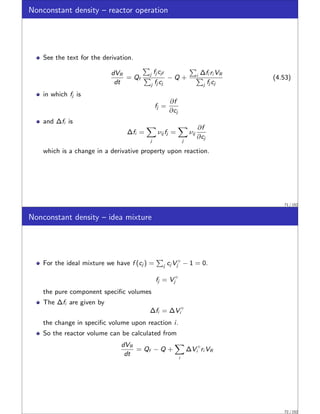
See the text for the derivation.
dVR
dt
= Qf
P
j fj cjf
P
j fj cj
− Q +
P
i ∆fi ri VR
P
j fj cj
(4.53)
in which fj is
fj =
∂f
∂cj
and ∆fi is
∆fi =
X
j
νij fj =
X
j
νij
∂f
∂cj
which is a change in a derivative property upon reaction.
71 / 152
Nonconstant density – idea mixture
For the ideal mixture we have f (cj ) =
P
j cj V ◦
j − 1 = 0.
fj = V ◦
j
the pure component specific volumes
The ∆fi are given by
∆fi = ∆V ◦
i
the change in specific volume upon reaction i.
So the reactor volume can be calculated from
dVR
dt
= Qf − Q +
X
i
∆V ◦
i ri VR
72 / 152
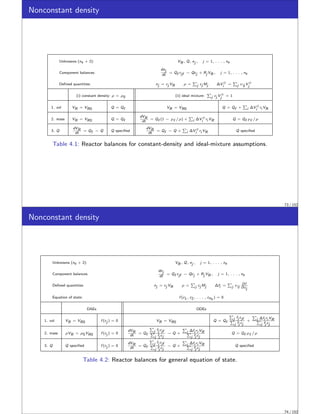
Nonconstant density
Unknowns (ns + 2): VR , Q, nj , j = 1, . . . , ns
Component balances:
dnj
dt
= Qf cjf − Qcj + Rj VR , j = 1, . . . , ns
Defined quantities: nj = cj VR ρ =
P
j cj Mj ∆V ◦
i =
P
j νij V ◦
j
(i) constant density: ρ = ρ0 (ii) ideal mixture:
P
j cj V ◦
j = 1
1. vol VR = VR0 Q = Qf VR = VR0 Q = Qf +
P
i ∆V ◦
i ri VR
2. mass VR = VR0 Q = Qf
dVR
dt
= Qf (1 − ρf /ρ) +
P
i ∆V ◦
i ri VR Q = Qf ρf /ρ
3. Q
dVR
dt
= Qf − Q Q specified
dVR
dt
= Qf − Q +
P
i ∆V ◦
i ri VR Q specified
Table 4.1: Reactor balances for constant-density and ideal-mixture assumptions.
73 / 152
Nonconstant density
Unknowns (ns + 2): VR , Q, nj , j = 1, . . . , ns
Component balances:
dnj
dt
= Qf cjf − Qcj + Rj VR , j = 1, . . . , ns
Defined quantities: nj = cj VR ρ =
P
j cj Mj ∆fi =
P
j νij
∂f
∂cj
Equation of state: f (c1, c2, . . . , cns ) = 0
DAEs ODEs
1. vol VR = VR0 f (cj ) = 0 VR = VR0 Q = Qf
P
j fj cjf
P
j fj cj
+
P
i ∆fi ri VR
P
j fj cj
2. mass ρVR = ρ0VR0 f (cj ) = 0
dVR
dt
= Qf
P
j fj cjf
P
j fj cj
− Q +
P
i ∆fi ri VR
P
j fj cj
Q = Qf ρf /ρ
3. Q Q specified f (cj ) = 0
dVR
dt
= Qf
P
j fj cjf
P
j fj cj
− Q +
P
i ∆fi ri VR
P
j fj cj
Q specified
Table 4.2: Reactor balances for general equation of state.
74 / 152
Semi-batch polymerization
Consider a solution polymerization reaction, which can be modeled as a first-order,
irreversible reaction
M
k
−→ P r = kcM
A 20 m3
semi-batch reactor is initially charged with solvent and initiator to half its
total volume.
A pure monomer feed is slowly added at flowrate Qf 0 = 1 m3
/min to fill the reactor
in semi-batch operation to control the heat release.
75 / 152
Semi-batch polymerization
Consider two cases for the subsequent reactor operation.
1 The monomer feed is shut off and the reaction goes to completion.
2 The monomer feed is adjusted to keep the reactor filled while the reaction goes to
completion.
Calculate the total polymer mass production, and the percentage increase in
polymer production achieved in the second operation.
76 / 152
The physical properties
You may assume an ideal mixture
The densities of monomer and polymer are
ρM = 800 kg/m3
ρP = 1100 kg/m3
The monomer molecular weight is MM = 100 kg/kmol
The rate constant is k = 0.1 min−1
.
77 / 152
Semi-batch polymerization
While the reactor is filling, the monomer mole balance is
d(cM VR )
dt
= Qf 0cMf − kcM VR
in which cMf = ρM /MM is given, and Qf = Qf 0 is constant during the filling
operation.
We denote the total number of moles of monomer by M = cM VR , and can write the
monomer balance as
dM
dt
= Qf 0cMf − kM (4.54)
M(0) = 0
78 / 152
Semi-batch polymerization
For an ideal mixture, the volume is given by
dVR
dt
= Qf 0 + ∆VkM (4.55)
VR (0) = 10 m3
in which ∆V = (1/ρP − 1/ρM ) MM
79 / 152
The polymer mass production
To compute the polymer mass, we note from the stoichiometry that the mass
production rate of polymer e
RP is
e
RP = −RM MM
The mass balance for total polymer e
P is given by
d e
P
dt
= e
RpVR = kcM MM VR = (kMM )M (4.56)
80 / 152
Semi-batch polymerization
The text solves this problem analytically. Instead, let’s solve it numerically.
Let t1 be the time that the reactor fills.
We need an ODE solver that is smart enough to stop when the reactor fills, because
we do not know this time t1. The ODE solver needs to find it for us.
dasrt is an ODE solver with the added capability to find the time at which some
event of interest occurs.
81 / 152
Finding the time for filling the reactor
The ODE solver finds the time at which VR = 20 m3
t1 = 11.2 min
Note the reactor would have filled in 10 min if the density were constant.
The extra time reflects the available volume created by converting some of the
monomer to polymer during filling.
After t1 we consider the two operations.
82 / 152
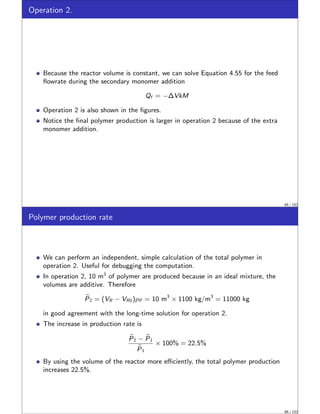
Operation 1.
In the first operation, Qf = 0 after t1.
Notice the reactor volume decreases after t1 because ∆V is negative.
83 / 152
Semi-batch polymerization
0
5
10
15
20
0 10 20 30 40 50
V
R
(m
3
)
2
1
time (min)
Figure 4.15: Semi-batch reactor volume for primary monomer addition (operation 1) and primary
plus secondary monomer additions (operation 2).
84 / 152
Operation 2.
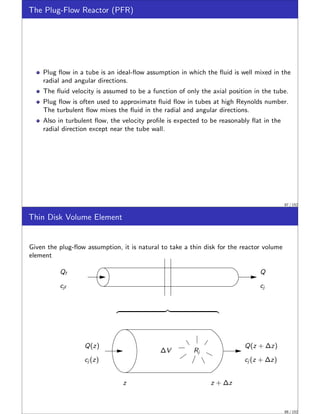
Because the reactor volume is constant, we can solve Equation 4.55 for the feed
flowrate during the secondary monomer addition
Qf = −∆VkM
Operation 2 is also shown in the figures.
Notice the final polymer production is larger in operation 2 because of the extra
monomer addition.
85 / 152
Polymer production rate
We can perform an independent, simple calculation of the total polymer in
operation 2. Useful for debugging the computation.
In operation 2, 10 m3
of polymer are produced because in an ideal mixture, the
volumes are additive. Therefore
e
P2 = (VR − VR0)ρP = 10 m3
× 1100 kg/m3
= 11000 kg
in good agreement with the long-time solution for operation 2.
The increase in production rate is
e
P2 − e
P1
e
P1
× 100% = 22.5%
By using the volume of the reactor more efficiently, the total polymer production
increases 22.5%.
86 / 152
The Plug-Flow Reactor (PFR)
Plug flow in a tube is an ideal-flow assumption in which the fluid is well mixed in the
radial and angular directions.
The fluid velocity is assumed to be a function of only the axial position in the tube.
Plug flow is often used to approximate fluid flow in tubes at high Reynolds number.
The turbulent flow mixes the fluid in the radial and angular directions.
Also in turbulent flow, the velocity profile is expected to be reasonably flat in the
radial direction except near the tube wall.
87 / 152
Thin Disk Volume Element
Given the plug-flow assumption, it is natural to take a thin disk for the reactor volume
element
Q
cj
Q(z + ∆z)
cj (z + ∆z)
Q(z)
cj (z)
Qf
cjf
z
Rj
∆V
z + ∆z
z }| {
88 / 152
Thin Disk Volume Element
Expressing the material balance for the volume element
∂ (cj ∆V )
∂t
= cj Q|z − cj Q|z+∆z + Rj ∆V
Dividing the above equation by ∆V and taking the limit as ∆V goes to zero yields,
∂cj
∂t
|{z}
accumulation
= −
∂ (cj Q)
∂V
| {z }
convection
+ Rj
|{z}
reaction
(4.64)
89 / 152
Length or volume as independent variable
If the tube has constant cross section, Ac , then velocity, v, is related to volumetric
flowrate by v = Q/Ac , and axial length is related to tube volume by z = V /Ac ,
Equation 4.64 can be rearranged to the familiar form [1, p.584]
∂cj
∂t
= −
∂ (cj v)
∂z
+ Rj (4.65)
90 / 152
Steady-State Operation
Setting the time derivative in Equation 4.64 to zero gives,
d(cj Q)
dV
= Rj (4.66)
The product cj Q = Nj is the total molar flow of component j. One also can express
the PFR mole balance in terms of the molar flow,
dNj
dV
= Rj (4.67)
91 / 152
Volumetric Flowrate for Gas-Phase Reactions
To use Equation 4.67 for designing a gas-phase reactor, one has to be able to relate
the volumetric flowrate, Q, to the molar flows, Nj , j = 1, 2, . . . , ns .
The important piece of information tying these quantities together is, again, the
equation of state for the reaction mixture, f (T, P, cj ) = 0.
Because the molar flow and concentration are simply related,
Nj = cj Q (4.68)
the equation of state is also a relation between temperature, pressure, molar flows,
and volumetric flowrate.
92 / 152
Ideal Gas Equation of State
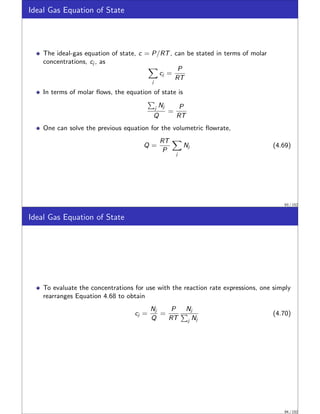
The ideal-gas equation of state, c = P/RT, can be stated in terms of molar
concentrations, cj , as
X
j
cj =
P
RT
In terms of molar flows, the equation of state is
P
j Nj
Q
=
P
RT
One can solve the previous equation for the volumetric flowrate,
Q =
RT
P
X
j
Nj (4.69)
93 / 152
Ideal Gas Equation of State
To evaluate the concentrations for use with the reaction rate expressions, one simply
rearranges Equation 4.68 to obtain
cj =
Nj
Q
=
P
RT
Nj
P
j Nj
(4.70)
94 / 152
Volumetric Flowrate for Liquid-Phase Reactions
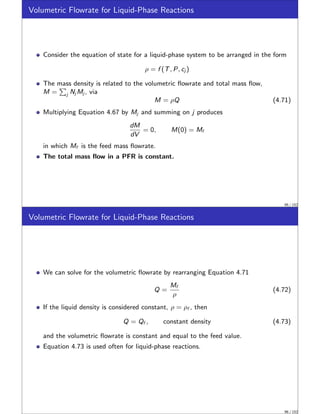
Consider the equation of state for a liquid-phase system to be arranged in the form
ρ = f (T, P, cj )
The mass density is related to the volumetric flowrate and total mass flow,
M =
P
j Nj Mj , via
M = ρQ (4.71)
Multiplying Equation 4.67 by Mj and summing on j produces
dM
dV
= 0, M(0) = Mf
in which Mf is the feed mass flowrate.
The total mass flow in a PFR is constant.
95 / 152
Volumetric Flowrate for Liquid-Phase Reactions
We can solve for the volumetric flowrate by rearranging Equation 4.71
Q =
Mf
ρ
(4.72)
If the liquid density is considered constant, ρ = ρf , then
Q = Qf , constant density (4.73)
and the volumetric flowrate is constant and equal to the feed value.
Equation 4.73 is used often for liquid-phase reactions.
96 / 152
Volumetric Flowrate for Liquid-Phase Reactions
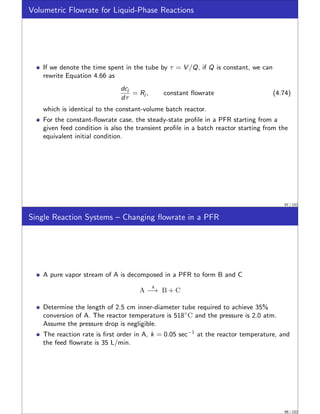
If we denote the time spent in the tube by τ = V /Q, if Q is constant, we can
rewrite Equation 4.66 as
dcj
dτ
= Rj , constant flowrate (4.74)
which is identical to the constant-volume batch reactor.
For the constant-flowrate case, the steady-state profile in a PFR starting from a
given feed condition is also the transient profile in a batch reactor starting from the
equivalent initial condition.
97 / 152
Single Reaction Systems – Changing flowrate in a PFR
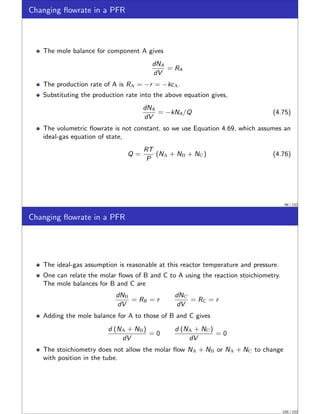
A pure vapor stream of A is decomposed in a PFR to form B and C
A
k
−→ B + C
Determine the length of 2.5 cm inner-diameter tube required to achieve 35%
conversion of A. The reactor temperature is 518◦
C and the pressure is 2.0 atm.
Assume the pressure drop is negligible.
The reaction rate is first order in A, k = 0.05 sec−1
at the reactor temperature, and
the feed flowrate is 35 L/min.
98 / 152
Changing flowrate in a PFR
The mole balance for component A gives
dNA
dV
= RA
The production rate of A is RA = −r = −kcA.
Substituting the production rate into the above equation gives,
dNA
dV
= −kNA/Q (4.75)
The volumetric flowrate is not constant, so we use Equation 4.69, which assumes an
ideal-gas equation of state,
Q =
RT
P
(NA + NB + NC) (4.76)
99 / 152
Changing flowrate in a PFR
The ideal-gas assumption is reasonable at this reactor temperature and pressure.
One can relate the molar flows of B and C to A using the reaction stoichiometry.
The mole balances for B and C are
dNB
dV
= RB = r
dNC
dV
= RC = r
Adding the mole balance for A to those of B and C gives
d (NA + NB)
dV
= 0
d (NA + NC)
dV
= 0
The stoichiometry does not allow the molar flow NA + NB or NA + NC to change
with position in the tube.
100 / 152
Changing flowrate in a PFR
Because NA + NB and NB + NC are known at the tube entrance, one can relate NB
and NC to NA,
NA + NB = NAf + NBf
NA + NC = NAf + NCf
Rearranging the previous equations gives,
NB = NAf + NBf − NA
NC = NAf + NCf − NA
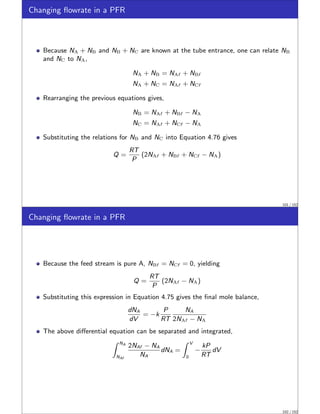
Substituting the relations for NB and NC into Equation 4.76 gives
Q =
RT
P
(2NAf + NBf + NCf − NA)
101 / 152
Changing flowrate in a PFR
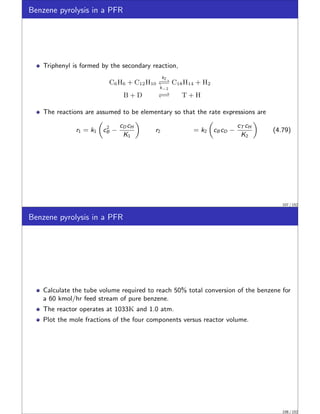
Because the feed stream is pure A, NBf = NCf = 0, yielding
Q =
RT
P
(2NAf − NA)
Substituting this expression in Equation 4.75 gives the final mole balance,
dNA
dV
= −k
P
RT
NA
2NAf − NA
The above differential equation can be separated and integrated,
Z NA
NAf
2NAf − NA
NA
dNA =
Z V
0
−
kP
RT
dV
102 / 152
Changing flowrate in a PFR
Performing the integration gives,
2NAf ln (NA/NAf ) + (NAf − NA) = −
kP
RT
V
The conversion of component j for a plug-flow reactor operating at steady state is
defined as
xj =
Njf − Nj
Njf
Because we are interested in the V corresponding to 35% conversion of A, we
substitute NA = (1 − xA)NAf into the previous equation and solve for V,
V = −
RT
kP
NAf [2 ln(1 − xA) + xA]
103 / 152
Changing flowrate in a PFR
Because Qf = NAf RT/P is given in the problem statement and the tube length is
desired, it is convenient to rearrange the previous equation to obtain
z = −
Qf
kAc
[2 ln(1 − xA) + xA]
Substituting in the known values gives
z = −

35 × 103
cm3
/min
0.05 sec−1 60 sec/min
 
4
π(2.5 cm)2

[2 ln(1 − .35) + .35]
z = 1216 cm = 12.2 m
104 / 152
Multiple-Reaction Systems
The modeler has some freedom in setting up the material balances for a plug-flow
reactor with several reactions.
The most straightforward method is to write the material balance relation for every
component,
dNj
dV
= Rj , j = 1, 2, . . . , ns
Rj =
nr
X
i=1
νij ri , j = 1, 2, . . . , ns
The reaction rates are expressed in terms of the species concentrations.
The cj are calculated from the molar flows with Equation 4.68
Q is calculated from Equation 4.69, if an ideal-gas mixture is assumed.
105 / 152
Benzene pyrolysis in a PFR I
Hougen and Watson [3] analyzed the rate data for the pyrolysis of benzene by the
following two reactions.
Diphenyl is produced by the dehydrogenation of benzene,
2C6H6
k1
−⇀
↽−
k−1
C12H10 + H2
2B −⇀
↽− D + H
106 / 152
Benzene pyrolysis in a PFR
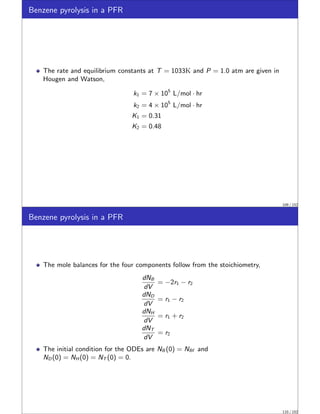
Triphenyl is formed by the secondary reaction,
C6H6 + C12H10
k2
−⇀
↽−
k−2
C18H14 + H2
B + D −⇀
↽− T + H
The reactions are assumed to be elementary so that the rate expressions are
r1 = k1

c2
B −
cD cH
K1

r2 = k2

cB cD −
cT cH
K2

(4.79)
107 / 152
Benzene pyrolysis in a PFR
Calculate the tube volume required to reach 50% total conversion of the benzene for
a 60 kmol/hr feed stream of pure benzene.
The reactor operates at 1033K and 1.0 atm.
Plot the mole fractions of the four components versus reactor volume.
108 / 152
Benzene pyrolysis in a PFR
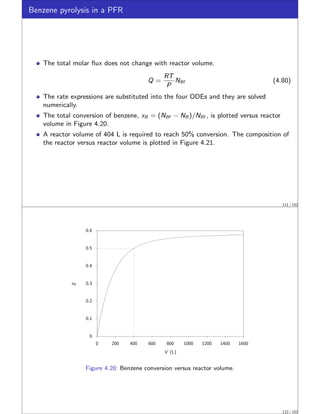
The rate and equilibrium constants at T = 1033K and P = 1.0 atm are given in
Hougen and Watson,
k1 = 7 × 10⁵
L/mol · hr
k2 = 4 × 10⁵
L/mol · hr
K1 = 0.31
K2 = 0.48
109 / 152
Benzene pyrolysis in a PFR
The mole balances for the four components follow from the stoichiometry,
dNB
dV
= −2r1 − r2
dND
dV
= r1 − r2
dNH
dV
= r1 + r2
dNT
dV
= r2
The initial condition for the ODEs are NB (0) = NBf and
ND (0) = NH (0) = NT (0) = 0.
110 / 152
Benzene pyrolysis in a PFR
The total molar flux does not change with reactor volume.
Q =
RT
P
NBf (4.80)
The rate expressions are substituted into the four ODEs and they are solved
numerically.
The total conversion of benzene, xB = (NBf − NB )/NBf , is plotted versus reactor
volume in Figure 4.20.
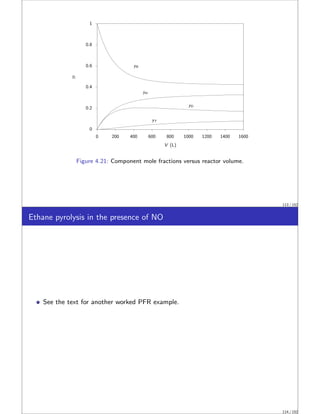
A reactor volume of 404 L is required to reach 50% conversion. The composition of
the reactor versus reactor volume is plotted in Figure 4.21.
111 / 152
0
0.1
0.2
0.3
0.4
0.5
0.6
0 200 400 600 800 1000 1200 1400 1600
xB
V (L)
Figure 4.20: Benzene conversion versus reactor volume.
112 / 152
0
0.2
0.4
0.6
0.8
1
0 200 400 600 800 1000 1200 1400 1600
yB
yH
yT
yD
yj
V (L)
Figure 4.21: Component mole fractions versus reactor volume.
113 / 152
Ethane pyrolysis in the presence of NO
See the text for another worked PFR example.
114 / 152
Some PFR-CSTR Comparisons
We have two continuous reactors in this chapter: the CSTR and the PFR.
Let’s compare their steady-state efficiencies in converting reactants to products.
For simplicity, consider a constant-density, liquid
A
k
−→ B r = kcn
A
For this situation, the steady-state PFR material balance is given by Equation 4.74
dcA
dτ
= −r(cA)
115 / 152
Some PFR-CSTR Comparisons
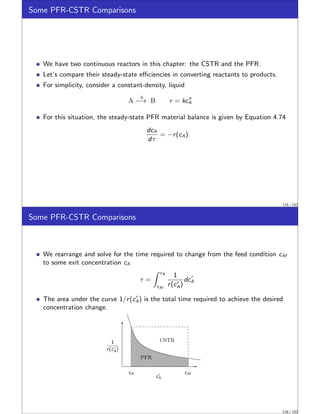
We rearrange and solve for the time required to change from the feed condition cAf
to some exit concentration cA
τ =
Z cA
cAf
1
r(c′
A)
dc′
A
The area under the curve 1/r(c′
A) is the total time required to achieve the desired
concentration change.
1
r(c′
A)
cAf
cA
c′
A
PFR
CSTR
116 / 152
Some PFR-CSTR Comparisons
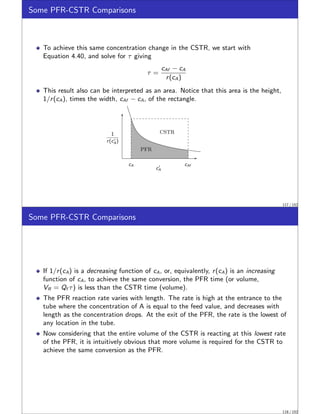
To achieve this same concentration change in the CSTR, we start with
Equation 4.40, and solve for τ giving
τ =
cAf − cA
r(cA)
This result also can be interpreted as an area. Notice that this area is the height,
1/r(cA), times the width, cAf − cA, of the rectangle.
1
r(c′
A)
cAf
cA
c′
A
PFR
CSTR
117 / 152
Some PFR-CSTR Comparisons
If 1/r(cA) is a decreasing function of cA, or, equivalently, r(cA) is an increasing
function of cA, to achieve the same conversion, the PFR time (or volume,
VR = Qf τ) is less than the CSTR time (volume).
The PFR reaction rate varies with length. The rate is high at the entrance to the
tube where the concentration of A is equal to the feed value, and decreases with
length as the concentration drops. At the exit of the PFR, the rate is the lowest of
any location in the tube.
Now considering that the entire volume of the CSTR is reacting at this lowest rate
of the PFR, it is intuitively obvious that more volume is required for the CSTR to
achieve the same conversion as the PFR.
118 / 152
Some PFR-CSTR Comparisons
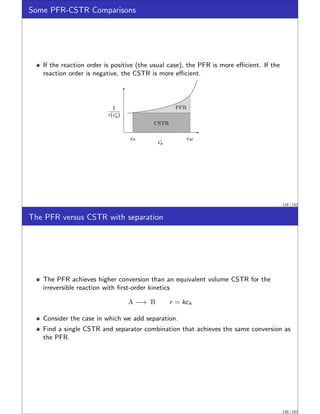
If the reaction order is positive (the usual case), the PFR is more efficient. If the
reaction order is negative, the CSTR is more efficient.
1
r(c′
A)
cAf
cA
c′
A
CSTR
PFR
119 / 152
The PFR versus CSTR with separation
The PFR achieves higher conversion than an equivalent volume CSTR for the
irreversible reaction with first-order kinetics
A −→ B r = kcA
Consider the case in which we add separation.
Find a single CSTR and separator combination that achieves the same conversion as
the PFR.
120 / 152
The PFR versus CSTR with separation
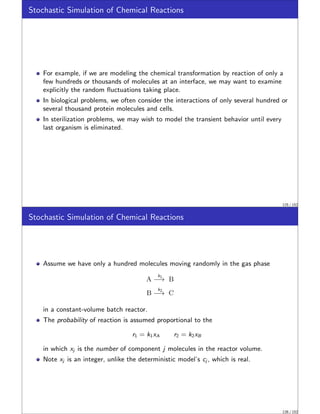
The issue is to increase the CSTR achievable conversion using separation.
Education in chemical engineering principles leads one immediately to consider
recycle of the unreacted A as a means to increase this conversion.
121 / 152
The PFR versus CSTR with separation
NA0 NA1 NA2 NA
NA0 NA
αNA2
αNA2
pure B
VR
VR
In the text, we show how to find the recycle flowrate so this system achieves the
PFR conversion.
122 / 152
CSTR Equivalence Principle.
This example was motivated by a recent result of Feinberg and Ellison called the
CSTR Equivalence Principle of Reactor-Separator Systems [2].
This surprising principle states:
For a given reaction network with ni linearly independent reactions, any steady
state that is achievable by any reactor-separator design with total reactor volume
V is achievable by a design with not more than ni + 1 CSTRs, also of total
reactor volume V . Moreover the concentrations, temperatures and pressures in
the CSTRs are arbitrarily close to those occurring in the reactors of the original
design.
123 / 152
Stochastic Simulation of Chemical Reactions
We wish to introduce next a topic of increasing importance to chemical engineers,
stochastic (random) simulation.
In stochastic models we simulate quite directly the random nature of the molecules.
We will see that the deterministic rate laws and material balances presented in the
previous sections can be captured in the stochastic approach by allowing the
numbers of molecules in the simulation to become large.
The stochastic modeling approach is appropriate if the random nature of the system
is one of the important features to be captured in the model.
These situations are becoming increasingly important to chemical engineers as we
explore reactions at smaller and smaller length scales.
124 / 152
Stochastic Simulation of Chemical Reactions
For example, if we are modeling the chemical transformation by reaction of only a
few hundreds or thousands of molecules at an interface, we may want to examine
explicitly the random fluctuations taking place.
In biological problems, we often consider the interactions of only several hundred or
several thousand protein molecules and cells.
In sterilization problems, we may wish to model the transient behavior until every
last organism is eliminated.
125 / 152
Stochastic Simulation of Chemical Reactions
Assume we have only a hundred molecules moving randomly in the gas phase
A
k1
−→ B
B
k2
−→ C
in a constant-volume batch reactor.
The probability of reaction is assumed proportional to the
r1 = k1xA r2 = k2xB
in which xj is the number of component j molecules in the reactor volume.
Note xj is an integer, unlike the deterministic model’s cj , which is real.
126 / 152
Stochastic Simulation of Chemical Reactions
The basic idea of the Gillespie algorithm is to: (i) choose randomly the time at which the
next reaction occurs, and (ii) choose randomly which reactions occurs at that time.
1 Initialize. Set integer counter n to zero. Set the initial species numbers,
xj (0), j = 1, . . . ns . Determine stoichiometric matrix ν and reaction probability laws
(rate expressions)
ri = ki h(xj )
for all reactions.
2 Compute reaction probabilities, ri = ki h(xj ). Compute total reaction probability
rtot =
P
i ri .
127 / 152
Stochastic Simulation of Chemical Reactions
1 Select two random numbers, p1, p2, from a uniform distribution on the interval
(0, 1). Let the time interval until the next reaction be
e
t = − ln(p1)/rtot (4.85)
128 / 152
Stochastic Simulation of Chemical Reactions
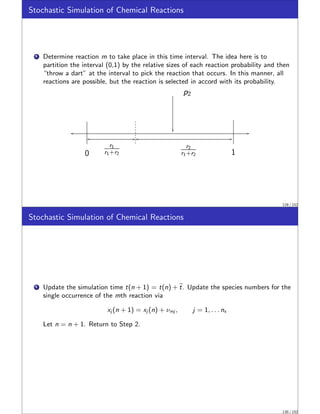
1 Determine reaction m to take place in this time interval. The idea here is to
partition the interval (0,1) by the relative sizes of each reaction probability and then
“throw a dart” at the interval to pick the reaction that occurs. In this manner, all
reactions are possible, but the reaction is selected in accord with its probability.
p2
r1
r1+r2
r2
r1+r2
0 1
129 / 152
Stochastic Simulation of Chemical Reactions
1 Update the simulation time t(n + 1) = t(n) + e
t. Update the species numbers for the
single occurrence of the mth reaction via
xj (n + 1) = xj (n) + νmj , j = 1, . . . ns
Let n = n + 1. Return to Step 2.
130 / 152
Stochastic Simulation of Chemical Reactions
If rtot is the total probability for reaction, e−rtote
t
is the probability that a reaction has
not occurred during time interval e
t.
We will derive this fact in Chapter 8 when we develop the residence-time distribution
for a CSTR.
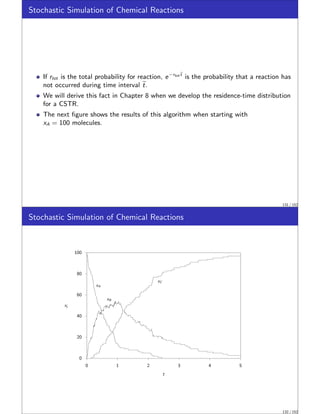
The next figure shows the results of this algorithm when starting with
xA = 100 molecules.
131 / 152
Stochastic Simulation of Chemical Reactions
0
20
40
60
80
100
0 1 2 3 4 5
xA
xB
xC
xj
t
132 / 152
Stochastic Simulation of Chemical Reactions
Notice the random aspect of the simulation gives a rough appearance to the number
of molecules versus time, which is quite unlike any of the deterministic simulations.
Because the number of molecules is an integer, the simulation is actually
discontinuous with jumps between simulation times.
But in spite of the roughness, we already can make out the classic behavior of the
series reaction: loss of starting material A, appearance and then disappearance of
the intermediate species B, and slow increase in final product C.
133 / 152
Stochastic Simulation of Chemical Reactions
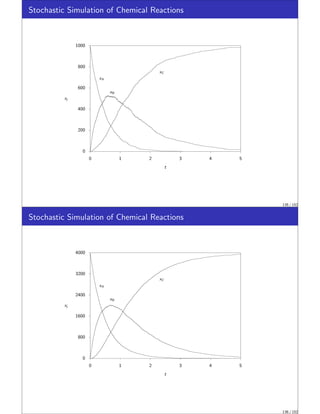
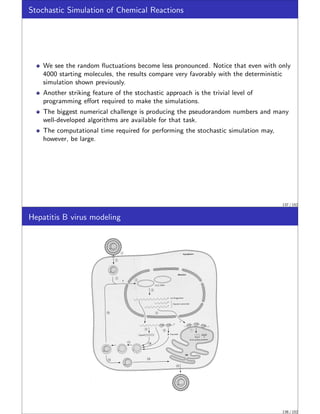
Next we explore the effect of increasing the initial number of A molecules on a single
simulation. The results for 1000 and 4000 initial A molecules are shown in the next
figures.
134 / 152
Stochastic Simulation of Chemical Reactions
0
200
400
600
800
1000
0 1 2 3 4 5
xA
xB
xC
xj
t
135 / 152
Stochastic Simulation of Chemical Reactions
0
800
1600
2400
3200
4000
0 1 2 3 4 5
xA
xB
xC
xj
t
136 / 152
Stochastic Simulation of Chemical Reactions
We see the random fluctuations become less pronounced. Notice that even with only
4000 starting molecules, the results compare very favorably with the deterministic
simulation shown previously.
Another striking feature of the stochastic approach is the trivial level of
programming effort required to make the simulations.
The biggest numerical challenge is producing the pseudorandom numbers and many
well-developed algorithms are available for that task.
The computational time required for performing the stochastic simulation may,
however, be large.
137 / 152
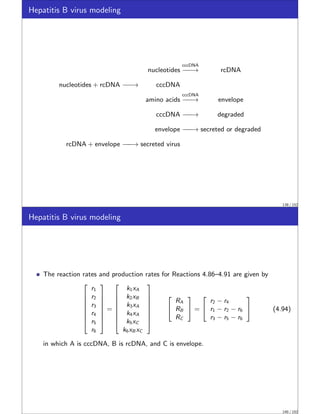
Hepatitis B virus modeling
138 / 152
Hepatitis B virus modeling
nucleotides
cccDNA
−
−
−
−
−
→ rcDNA
nucleotides + rcDNA −
−
−
−
−
→ cccDNA
amino acids
cccDNA
−
−
−
−
−
→ envelope
cccDNA −
−
−
−
−
→ degraded
envelope −
−
−
−
−
→ secreted or degraded
rcDNA + envelope −
−
−
−
−
→ secreted virus
139 / 152
Hepatitis B virus modeling
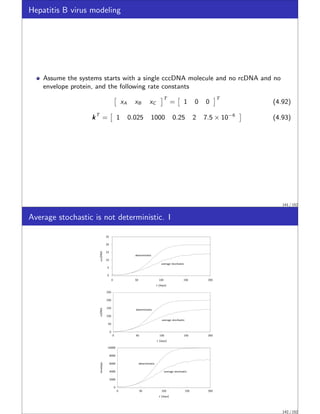
The reaction rates and production rates for Reactions 4.86–4.91 are given by








r1
r2
r3
r4
r5
r6








=








k1xA
k2xB
k3xA
k4xA
k5xC
k6xB xC










RA
RB
RC

 =


r2 − r4
r1 − r2 − r6
r3 − r5 − r6

 (4.94)
in which A is cccDNA, B is rcDNA, and C is envelope.
140 / 152
Hepatitis B virus modeling
Assume the systems starts with a single cccDNA molecule and no rcDNA and no
envelope protein, and the following rate constants

xA xB xC
T
=

1 0 0
T
(4.92)
kT
=

1 0.025 1000 0.25 2 7.5 × 10⁻⁶

(4.93)
141 / 152
Average stochastic is not deterministic. I
0
5
10
15
20
25
0 50 100 150 200
cccDNA
deterministic
average stochastic
t (days)
0
50
100
150
200
250
0 50 100 150 200
rcDNA
deterministic
average stochastic
t (days)
0
2000
4000
6000
8000
10000
0 50 100 150 200
envelope
deterministic
average stochastic
t (days)
142 / 152
Hepatitis B virus modeling
0
5
10
15
20
25
30
35
0 50 100 150 200
cccDNA
deterministic
stochastic 1
stochastic 2
t (days)
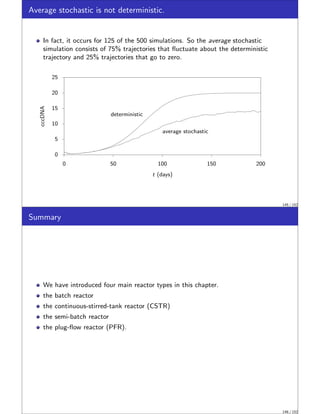
Figure 4.35: Species cccDNA versus time for hepatitis B virus model; two representative
stochastic trajectories.
143 / 152
Hepatitis B virus modeling
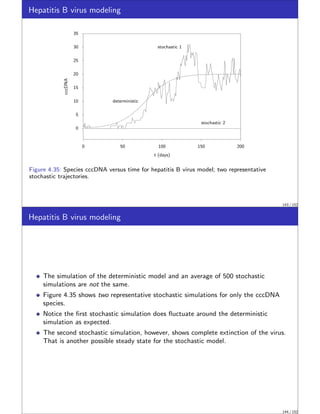
The simulation of the deterministic model and an average of 500 stochastic
simulations are not the same.
Figure 4.35 shows two representative stochastic simulations for only the cccDNA
species.
Notice the first stochastic simulation does fluctuate around the deterministic
simulation as expected.
The second stochastic simulation, however, shows complete extinction of the virus.
That is another possible steady state for the stochastic model.
144 / 152
Average stochastic is not deterministic.
In fact, it occurs for 125 of the 500 simulations. So the average stochastic
simulation consists of 75% trajectories that fluctuate about the deterministic
trajectory and 25% trajectories that go to zero.
0
5
10
15
20
25
0 50 100 150 200
cccDNA
deterministic
average stochastic
t (days)
145 / 152
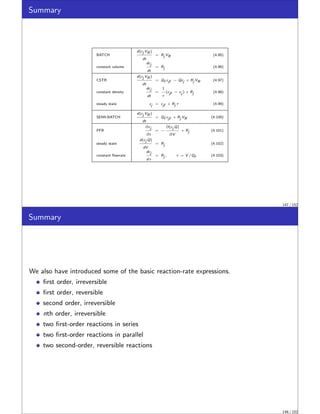
Summary
We have introduced four main reactor types in this chapter.
the batch reactor
the continuous-stirred-tank reactor (CSTR)
the semi-batch reactor
the plug-flow reactor (PFR).
146 / 152
Summary
BATCH
d(cj VR )
dt
= Rj VR (4.95)
constant volume
dcj
dt
= Rj (4.96)
CSTR
d(cj VR )
dt
= Qf cjf − Qcj + Rj VR (4.97)
constant density
dcj
dt
=
1
τ
(cjf − cj ) + Rj (4.98)
steady state cj = cjf + Rj τ (4.99)
SEMI-BATCH
d(cj VR )
dt
= Qf cjf + Rj VR (4.100)
PFR
∂cj
∂t
= −
∂(cj Q)
∂V
+ Rj (4.101)
steady state
d(cj Q)
dV
= Rj (4.102)
constant flowrate
dcj
dτ
= Rj , τ = V /Qf (4.103)
147 / 152
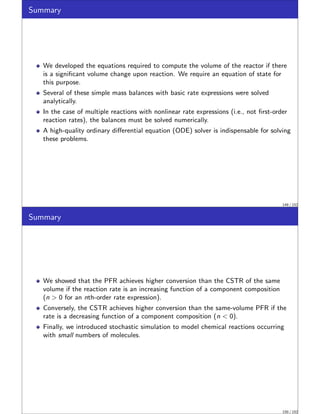
Summary
We also have introduced some of the basic reaction-rate expressions.
first order, irreversible
first order, reversible
second order, irreversible
nth order, irreversible
two first-order reactions in series
two first-order reactions in parallel
two second-order, reversible reactions
148 / 152
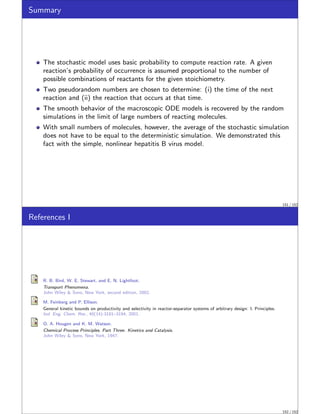
Summary
We developed the equations required to compute the volume of the reactor if there
is a significant volume change upon reaction. We require an equation of state for
this purpose.
Several of these simple mass balances with basic rate expressions were solved
analytically.
In the case of multiple reactions with nonlinear rate expressions (i.e., not first-order
reaction rates), the balances must be solved numerically.
A high-quality ordinary differential equation (ODE) solver is indispensable for solving
these problems.
149 / 152
Summary
We showed that the PFR achieves higher conversion than the CSTR of the same
volume if the reaction rate is an increasing function of a component composition
(n  0 for an nth-order rate expression).
Conversely, the CSTR achieves higher conversion than the same-volume PFR if the
rate is a decreasing function of a component composition (n  0).
Finally, we introduced stochastic simulation to model chemical reactions occurring
with small numbers of molecules.
150 / 152
Summary
The stochastic model uses basic probability to compute reaction rate. A given
reaction’s probability of occurrence is assumed proportional to the number of
possible combinations of reactants for the given stoichiometry.
Two pseudorandom numbers are chosen to determine: (i) the time of the next
reaction and (ii) the reaction that occurs at that time.
The smooth behavior of the macroscopic ODE models is recovered by the random
simulations in the limit of large numbers of reacting molecules.
With small numbers of molecules, however, the average of the stochastic simulation
does not have to be equal to the deterministic simulation. We demonstrated this
fact with the simple, nonlinear hepatitis B virus model.
151 / 152
References I
R. B. Bird, W. E. Stewart, and E. N. Lightfoot.
Transport Phenomena.
John Wiley  Sons, New York, second edition, 2002.
M. Feinberg and P. Ellison.
General kinetic bounds on productivity and selectivity in reactor-separator systems of arbitrary design: I. Principles.
Ind. Eng. Chem. Res., 40(14):3181–3194, 2001.
O. A. Hougen and K. M. Watson.
Chemical Process Principles. Part Three: Kinetics and Catalysis.
John Wiley  Sons, New York, 1947.
152 / 152

slides-matbal-2up.pdf

  • 1.
    CHAPTER 4:The MaterialBalance for Chemical Reactors Copyright © 2022 by Nob Hill Publishing, LLC Rj V Q1 cj1 Q0 cj0 Conservation of mass    rate of accumulation of component j    = rate of inflow of component j − rate of outflow of component j +    rate of generation of component j by chemical reactions    (4.1) 1 / 152 General Mole Balance Rj V Q1 cj1 Q0 cj0 Conservation of mass d dt Z V cj dV = Q0cj0 − Q1cj1 + Z V Rj dV (4.2) 2 / 152
  • 2.
    General Mole Balance d dt Z V cjdV = Q0cj0 − Q1cj1 + Z V Rj dV Equation 4.2 applies to every chemical component in the system, j = 1, 2, . . . , ns , including inerts, which do not take place in any reactions. Assuming component j enters and leaves the volume element only by convection with the inflow and outflow streams, i.e. neglecting diffusional flux through the boundary of the volume element due to a concentration gradient. The diffusional flux will be considered during the development of the material balance for the packed-bed reactor. 3 / 152 Rate expressions To solve the reactor material balance, we require an expression for the production rates, Rj Rj = X i νij ri Therefore we require ri as a function of cj This is the subject of chemical kinetics, Chapter 5 Here we use common reaction-rate expressions without derivation 4 / 152
  • 3.
    The Batch Reactor Rj Thebatch reactor is assumed well stirred Let the entire reactor contents be the reactor volume element 5 / 152 Batch Reactor d dt Z V cj dV = Q0cj0 − Q1cj1 + Z V Rj dV Because the reactor is well stirred, the integrals in Equation 4.2 are simple to evaluate, Z VR cj dV = cj VR Z VR Rj dV = Rj VR The inflow and outflow stream flowrates are zero, Q0 = Q1 = 0. d (cj VR ) dt = Rj VR (4.5) 6 / 152
  • 4.
    Reactor Volume Equation 4.5applies whether the reactor volume is constant or changes during the reaction. If the reactor volume is constant (liquid-phase reactions) dcj dt = Rj (4.6) Use Equation 4.5 rather than Equation 4.6 if the reactor volume changes significantly during the course of the reaction. 7 / 152 Analytical Solutions for Simple Rate Laws In general the material balance must be solved numerically. If the reactor is isothermal, we have few components, the rate expressions are simple, then analytical solutions of the material balance are possible. We next examine derive analytical solutions for some classic cases. 8 / 152
  • 5.
    First-order, irreversible Consider thefirst-order, irreversible reaction A k −→ B, r = kcA The material balance for a constant-volume reactor gives dcA dt = −kcA (4.8) Watch the sign! 9 / 152 First-order, irreversible We denote the initial concentration of A as cA0, cA(t) = cA0, t = 0 The solution to the differential equation with this boundary condition is cA = cA0e−kt (4.9) 10 / 152
  • 6.
    First-order, irreversible 0 0.2 0.4 0.6 0.8 1 0 12 3 4 5 k = 0.5 k = 1 k = 2 k = 5 cA cA0 t 11 / 152 First-order, irreversible The A concentration decreases exponentially from its initial value to zero with increasing time. The rate constant determines the shape of this exponential decrease. Rearranging Equation 4.9 gives ln(cA/cA0) = −kt 12 / 152
  • 7.
    First-order, irreversible 0.001 0.01 0.1 1 0 12 3 4 5 k = 0.5 k = 1 k = 2 k = 5 cA cA0 t One can get an approximate value of the rate constant from the slope of the straight line. This procedure is a poor way to determine a rate constant and should be viewed only as a rough approximation (Chapter 9). 13 / 152 First-order, irreversible The B concentration is determined from the A concentration. 1 Solve the material balance for component B, dcB dt = RB = kcA (4.10) with the initial condition for B, cB (0) = cB0 2 Note that the sum of cA and cB is constant. d(cA + cB ) dt = RA + RB = 0 Therefore, cA + cB is a constant. 14 / 152
  • 8.
    First-order, reversible The valueis known at t = 0, cA + cB = cA0 + cB0 So we have an expression for cB cB = cA0 + cB0 − cA cB = cB0 + cA0(1 − e−kt ) (4.11) 15 / 152 First-order, reversible Consider now the same first-order reaction, but assume it is reversible A k1 −⇀ ↽− k−1 B The reaction rate is r = k1cA − k−1cB . The material balances for A and B are now dcA dt = −r = −k1cA + k−1cB cA(0) = cA0 dcB dt = r = k1cA − k−1cB cB (0) = cB0 Notice that cA + cB = cA0 + cB0 remains constante 16 / 152
  • 9.
    First-order, reversible Eliminate cBin the material balance for A gives dcA dt = −k1cA + k−1(cA0 + cB0 − cA) (4.13) How do we want to solve this one? Particular solution and homogeneous solution (see text) Laplace transforms (control course) Separation! 17 / 152 First-order, reversible dcA dt = acA + b Z cA cA0 dcA acA + b = Z t 0 dt 1 a ln(acA + b) cA cA0 = t cA = cA0eat − b a (1 − eat ) Substitute a = −(k1 + k−1), b = k−1(cA0 + cB0) 18 / 152
  • 10.
    First-order, reversible cA =cA0e−(k1+k−1)t + k−1 k1 + k−1 (cA0 + cB0) h 1 − e−(k1+k−1)t i (4.15) The B concentration can be determined by switching the roles of A and B and k1 and k−1 in Reaction 4.12, yielding cB = cB0e−(k1+k−1)t + k1 k1 + k−1 (cA0 + cB0) h 1 − e−(k1+k−1)t i (4.16) 19 / 152 First-order, reversible 0 0.2 0.4 0.6 0.8 1 0 1 2 3 4 5 cB (t) cA(t) cAs cBs c t Figure 4.5: First-order, reversible kinetics in a batch reactor, k1 = 1, k−1 = 0.5, cA0 = 1, cB0 = 0. 20 / 152
  • 11.
    Nonzero steady state Forthe reversible reaction, the concentration of A does not go to zero. Taking the limit t −→ ∞ in Equation 4.15 gives cAs = k−1 k1 + k−1 (cA0 + cB0) in which cAs is the steady-state concentration of A. 21 / 152 Nonzero steady state Defining K1 = k1/k−1 allows us to rewrite this as cAs = 1 1 + K1 (cA0 + cB0) Performing the same calculation for cB gives cBs = K1 1 + K1 (cA0 + cB0) 22 / 152
  • 12.
    Second-order, irreversible Consider theirreversible reaction A k −→ B in which the rate expression is second order, r = kc2 A. The material balance and initial condition are dcA dt = −kc2 A, cA(0) = cA0 (4.18) Our first nonlinear differential equation. 23 / 152 Second-order, irreversible Separation works here dcA c2 A = −kdt Z cA cA0 dcA c2 A = −k Z t 0 dt 1 cA0 − 1 cA = −kt Solving for cA gives cA = 1 cA0 + kt −1 (4.19) Check that this solution satisfies the differential equation and initial condition 24 / 152
  • 13.
    Second-order, irreversible 0 0.1 0.2 0.3 0.4 0.5 0.6 0.7 0.8 0.9 1 0 12 3 4 5 first order second order cA cA0 The second-order reaction decays more slowly to zero than the first-order reaction. 25 / 152 Another second-order, irreversible A + B k −→ C r = kcAcB The material balance for components A and B are dcA dt = −r = −kcAcB dcB dt = −r = −kcAcB Subtract B’s material balance from A’s to obtain d(cA − cB ) dt = 0 26 / 152
  • 14.
    Another second-order, irreversible Therefore,cA − cB is constant, and cB = cA − cA0 + cB0 (4.23) Substituting this expression into the material balance for A yields dcA dt = −kcA(cA − cA0 + cB0) This equation also is separable and can be integrated to give (you should work through these steps), cA = (cA0 − cB0) 1 − cB0 cA0 e(cB0−cA0)kt −1 , cA0 ̸= cB0 (4.24) 27 / 152 Another second-order, irreversible Component B can be computed from Equation 4.23, or by switching the roles of A and B in Reaction 4.20, giving cB = (cB0 − cA0) 1 − cA0 cB0 e(cA0−cB0)kt −1 What about component C? C’s material balance is dcC dt = kcAcB and therefore, d(cA + cC )/dt = 0. The concentration of C is given by cC = cA0 − cA + cC0 28 / 152
  • 15.
    Another second-order, irreversible Noticethat if cA0 cB0 (Excess A), the steady state cAs = cA0 − cB0 cBs = 0 cCs = cB0 + cC0 For cB0 cA0 (Excess B), the steady state is cAs = 0 cBs = cB0 − cA0 cCs = cA0 + cC0 29 / 152 nth-order, irreversible The nth-order rate expression r = kcn A 0 0.5 1 1.5 2 2.5 3 3.5 4 4.5 5 0 0.5 1 1.5 2 2.5 3 r n = 3 2 1 1/2 0 cA 30 / 152
  • 16.
    nth-order, irreversible A k −→ Br = kcn A dcA dt = −r = −kcn A This equation also is separable and can be rearranged to dcA cn A = −kdt Performing the integration and solving for cA gives cA = h c−n+1 A0 + (n − 1)kt i 1 −n+1 , n ̸= 1 31 / 152 nth-order, irreversible We can divide both sides by cA0 to obtain cA cA0 = [1 + (n − 1)k0t] 1 −n+1 , n ̸= 1 (4.25) in which k0 = kcn−1 A0 has units of inverse time. 32 / 152
  • 17.
    nth-order, irreversible 0 0.2 0.4 0.6 0.8 1 0 12 3 4 5 1 2 3 4 n = 5 cA cA0 t The larger the value of n, the more slowly the A concentration approaches zero at large time. 33 / 152 nth-order, irreversible Exercise care for n 1, cA reaches zero in finite time. 0 0.2 0.4 0.6 0.8 1 0 0.5 1 1.5 2 cA cA0 n = 2 1 1/2 0 −1/2 −1 −2 t 34 / 152
  • 18.
    Negative order, inhibition Forn 0, the rate decreases with increasing reactant concentration; the reactant inhibits the reaction. 0 0.5 1 1.5 2 2.5 3 3.5 4 4.5 5 0 0.5 1 1.5 2 2.5 3 r 0 −1/2 −1 n=−2 cA 35 / 152 Negative order, inhibition Inhibition reactions are not uncommon, but watch out for small concentrations. Notice the rate becomes unbounded as cA approaches zero, which is not physically realistic. When using an ODE solver we may modify the right-hand sides of the material balance dcA dt = −kcn A, cA 0 0, cA = 0 Examine the solution carefully if the concentration reaches zero. 36 / 152
  • 19.
    Two reactions inseries Consider the following two irreversible reactions, A k1 −→ B B k2 −→ C Reactant A decomposes to form an intermediate B that can further react to form a final product C. Let the reaction rates be given by simple first-order rate expressions in the corresponding reactants, r1 = k1cA r2 = k2cB 37 / 152 Two reactions in series The material balances for the three components are dcA dt = RA = −r1 = −k1cA dcB dt = RB = r1 − r2 = k1cA − k2cB dcC dt = RC = r2 = k2cB The material balance for component A can be solved immediately to give cA = cA0e−k1t as before. 38 / 152
  • 20.
    Two reactions inseries – B The material balance for B becomes dcB dt + k2cB = k1cA0e−k1t Oops, not separable, now what? Either Laplace transform or particular solution, homogeneous equation approach produces cB = cB0e−k2t + cA0 k1 k2 − k1 h e−k1t − e−k2t i , k1 ̸= k2 (4.30) 39 / 152 Two reactions in series – C To determine the C concentration, notice from the material balances that d(cA + cB + cC )/dt = 0. Therefore, cC is cC = cA0 + cB0 + cC0 − cA − cB 40 / 152
  • 21.
    Two reactions inseries 0 0.2 0.4 0.6 0.8 1 0 1 2 3 4 5 cA(t) cB (t) cC (t) c t Figure 4.11: Two first-order reactions in series in a batch reactor, cA0 = 1, cB0 = cC0 = 0, k1 = 2, k2 = 1. 41 / 152 Two reactions in parallel Consider next two parallel reactions of A to two different products, B and C, A k1 −→ B A k2 −→ C Assume the rates of the two irreversible reactions are given by r1 = k1cA and r2 = k2cA. 42 / 152
  • 22.
    Two reactions inparallel The material balances for the components are dcA dt = RA = −r1 − r2 = −k1cA − k2cA dcB dt = RB = r1 = k1cA dcC dt = RC = r2 = k2cA 43 / 152 Two reactions in parallel The material balance for A can be solved directly to give cA = cA0e−(k1+k2)t (4.33) Substituting cA(t) into B’s material balance gives dcB dt = k1cA0e−(k1+k2)t This equation is now separable and can be integrated directly to give cB = cB0 + cA0 k1 k1 + k2 1 − e−(k1+k2)t (4.34) 44 / 152
  • 23.
    Two reactions inparallel Finally, component C can be determined from the condition that cA + cB + cC is constant or by switching the roles of B and C, and k1 and k2 in Equation 4.34, cC = cC0 + cA0 k2 k1 + k2 1 − e−(k1+k2)t (4.35) 45 / 152 Two reactions in parallel 0 0.2 0.4 0.6 0.8 1 0 0.5 1 1.5 2 2.5 3 cA(t) cB (t) cC (t) c t Figure 4.12: Two first-order reactions in parallel in a batch reactor, cA0 = 1, cB0 = cC0 = 0, k1 = 1, k2 = 2. 46 / 152
  • 24.
    Two reactions inparallel Notice that the two parallel reactions compete for the same reactant, A The rate constants determine which product is favored Large values of k1/k2 favor the formation of component B compared to C and vice versa 47 / 152 Conversion, Yield, Selectivity There are several ways to define selectivity, yield and conversion, so be clear about the definition you choose. Point selectivity: The point (or instantaneous) selectivity is the ratio of the production rate of one component to the production rate of another component. Overall selectivity: The overall selectivity is the ratio of the amount of one component produced to the amount of another component produced. Yield: The yield of component j is the fraction of a reactant that is converted into component j. Conversion: Conversion is normally defined to be the fraction of a component that has been converted to products by the reaction network. Conversion has several definitions and conventions. It is best to state the definition in the context of the problem being solved. 48 / 152
  • 25.
    The Continuous-Stirred-Tank Reactor(CSTR) Q cj Qf cjf Rj Writing the material balance for this reactor gives d (cj VR ) dt = Qf cjf − Qcj + Rj VR , j = 1, . . . , ns (4.36) 49 / 152 CSTR – Constant Density If the reactor volume is constant and the volumetric flowrates of the inflow and outflow streams are the same, Equation 4.36 reduces to dcj dt = 1 τ (cjf − cj ) + Rj (4.37) The parameter τ = VR /Qf is called the mean residence time of the CSTR. We refer to this balance as the constant-density case. It is often a good approximation for liquid-phase reactions. 50 / 152
  • 26.
    CSTR – SteadyState The steady state of the CSTR is described by setting the time derivative in Equation 4.36 to zero, 0 = Qf cjf − Qcj + Rj VR (4.38) Conversion of reactant j is defined for a steady-state CSTR as follows xj = Qf cjf − Qcj Qf cjf (steady state) (4.39) One can divide Equation 4.38 through by VR to obtain for the constant-density case cj = cjf + Rj τ (steady state, constant density) (4.40) 51 / 152 Transient behavior of the CSTR Consider a first-order, liquid-phase reaction in an isothermal CSTR A k −→ 2B r = kcA the feed concentration of A is cAf = 2 mol/L, the residence time of the reactor is τ = 100 min, and the rate constant is k = 0.1 min−1 . 1 Find the steady-state concentration of A in the effluent for the given feed. 2 Plot the concentration of A versus time for constant feed concentration cAf = 2 mol/L if the reactor is initially filled with an inert so cA0 = 0 mol/L. 3 Plot the concentration of A versus time for constant feed concentration cAf = 2 mol/L if the reactor is initially filled with feed so cA0 = 2 mol/L. 52 / 152
  • 27.
    Transient CSTR Solution.Part 1 Liquid phase: assume the fluid density is constant. cA = cAf + RAτ Substituting the production rate RA = −kcA and solving for cA gives the steady-state concentration cAs = cAf 1 + kτ Substituting in the numerical values gives cAs = 2 mol/L 1 + (0.1 min−1 )(100 min) = 0.182 mol/L 53 / 152 Parts 2 and 3 dcA dt = 1 τ (cAf − cA) − kcA (4.41) cA(0) = cA0 This equation is also separable. The analytical solution is cA(t) = cA0e−(1/τ+k)t + cAf 1 + kτ h 1 − e−(1/τ+k)t i (4.42) 54 / 152
  • 28.
    Parts 2 and3 0 0.5 1 1.5 2 0 10 20 30 40 50 60 70 80 cA0 = 0 cA0 = 2 cAs = 0.182 c A (t) (mol/L) t (min) Both solutions converge to the same steady-state even though the starting conditions are quite different. 55 / 152 Phenol production in a CSTR Consider the reaction of cumene hydroperoxide (CHP) to phenol and acetone (C6H5)C(CH3)2OOH −→ (C6H5)OH + (CH3)2CO CHP −→ phenol + acetone The reaction is pseudo-first-order r = kcCHP Find the reactor volume to achieve 85% conversion of CHP at steady state. The flowrate into the reactor is Qf = 26.9 m3 /hr and k = 4.12 hr−1 . 56 / 152
  • 29.
    Phenol production Liquids at85◦ C, so assume constant density and Q = Qf . cA = cAf + RAτ RA = −kcA, and solving for the CHP concentration gives cA = cAf 1 + kτ (4.43) 57 / 152 Phenol production The conversion of CHP (for Q = Qf ) is xA = cAf − cA cAf = 1 − cA cAf xA = kτ 1 + kτ Solving this equation for τ gives τ = 1 k xA 1 − xA 58 / 152
  • 30.
    Phenol production Substituting therelation τ = VR /Qf and solving for VR gives VR = Qf xA k(1 − xA) Substituting in the known values gives the required CSTR volume VR = (26.9 m3 /hr)(0.85) (4.12 hr−1 )(0.15) = 37 m3 59 / 152 The Semi-Batch Reactor The semi-batch reactor is a cross between the batch reactor and CSTR. The semi-batch reactor is initially charged with reactant, like the batch reactor, but allows a feed addition policy while the reaction takes place, like the CSTR. Normally there is no outflow stream. 60 / 152
  • 31.
    The Semi-Batch Reactor Weset Q = 0 in the CSTR material balance to obtain d (cj VR ) dt = Qf cjf + Rj VR , j = 1, . . . , ns (4.44) One may choose to operate a semi-batch reactor to control the reaction rate or heat release during reaction by slowly adding one of the reactants in the feed stream. Compared to the batch reactor, the semi-batch reactor provides more complete use of the reactor volume in reactions such as polymerizations that convert from lower density to higher density during the course of the reaction. 61 / 152 Volume Change Upon Reaction d (cj VR ) dt = Qf cjf − Qcj + Rj VR (4.45) Equation 4.45 covers both the batch, CSTR and semi-batch reactors, depending on how we specify Qf and Q. If we multiply Equation 4.45 by the molecular weight of species j and sum over all species we obtain, d( P j cj Mj VR ) dt = Qf X j cjf Mj − Q X j cj Mj + X j Rj Mj VR (4.46) The term P j cj Mj is simply the mass density of the reactor contents, which we denote ρ ρ = ns X j=1 cj Mj (4.47) 62 / 152
  • 32.
    Volume Change UponReaction The term P j cjf Mj is the mass density of the feedstream, ρf . We know that conservation of mass in chemical reactions implies P j Rj Mj = 0 (see Chapter 2). Substitution into Equation 4.46 leads to d(ρVR ) dt = Qf ρf − Qρ (4.48) Equation 4.48 is clearly a total mass balance, in which the total mass in the reactor changes in time due to the inflow and outflow of mass. Notice that chemical reactions play no role in the total mass balance. 63 / 152 Equation of state for the mixture If we have a single-phase system at equilibrium, the intensive variables cj , T, P, completely specify all intensive variables of the system. In this chapter we consider T and P to be known, fixed quantities. Therefore, the density of the reaction mixture, which is an intensive variable, is known if the cj are known. This relationship is one form of the equation of state for the mixture ρ = e f (T, P, c1, c2, . . . , cns ) Substituting the definition of density, we can express the equation of state as f (c1, c2, . . . , cns ) = 0 64 / 152
  • 33.
    Equation of statefor the mixture For example, we could express the equation of state in terms of the partial molar volumes as X j cj V j = 1 in which V j is the partial molar volume of component j in the mixture. The partial molar volumes are functions of T, P and cj . 65 / 152 Equation of state for the mixture — Ideal mixture If we assume an ideal mixture, this reduces to X j cj V ◦ j = 1, ideal mixture in which V ◦ j is the specific volume of pure component j, which is a function of only T and P. We assume that a thermodynamic equation of state is valid even when the reactor is not at equilibrium. 66 / 152
  • 34.
    Constant density Because thereaction mixture density, ρ, is independent of composition, it does not vary with time either and we can set it to the feed value, ρ = ρf The total mass balance then reduces to dVR dt = Qf − Q (4.51) which is sometimes referred to as a “volume balance.” This terminology should be avoided. 67 / 152 Constant density dVR dt = Qf − Q Batch reactor. For the batch reactor, Q = Qf = 0. We can therefore conclude from Equation 4.51 that a batch reactor with constant density has constant volume. CSTR (dynamic and steady state). If the outflow of the CSTR is regulated so that the CSTR has constant volume, then we can conclude from Equation 4.51 that Q = Qf . Semi-batch reactor. In the semi-batch reactor, the reactor is filled during operation so Qf is specified and positive for some time and Q = 0. The solution to Equation 4.51 then determines the change in volume of the reactor during the filling operation. 68 / 152
  • 35.
    Nonconstant density Unknowns. In thegeneral case, consider the following variables to fully determine the state of the reactor: T, P, nj , VR . We also require the value of Q to specify the right-hand sides of the material balances. The set of unknowns is nj , VR , Q. We therefore have ns + 2 unknowns. Equations. We have the ns equations from the component mole balances. The equation of state provides one additional equation. The final equation is provided by a statement of reactor operation. 69 / 152 Nonconstant density – reactor operation 1 Constant-volume reactor. The constant-volume reactor can be achieved by allowing overflow of the reactor to determine flowrate out of the reactor. In this situation, VR is specified as the additional equation. 2 Constant-mass reactor. The constant-mass reactor can be achieved if a differential pressure measurement is used to control the flowrate out of the reactor and the reactor has constant cross-sectional area. In this situation ρVR is specified as the additional equation. 3 Flowrate out of the reactor is specified. This type of operation may be achieved if the flowrate out of the reactor is controlled by a flow controller. In this case Q(t) is specified. A semi-batch reactor is operated in this way with Q = 0 until the reactor is filled with the reactants. 70 / 152
  • 36.
    Nonconstant density –reactor operation See the text for the derivation. dVR dt = Qf P j fj cjf P j fj cj − Q + P i ∆fi ri VR P j fj cj (4.53) in which fj is fj = ∂f ∂cj and ∆fi is ∆fi = X j νij fj = X j νij ∂f ∂cj which is a change in a derivative property upon reaction. 71 / 152 Nonconstant density – idea mixture For the ideal mixture we have f (cj ) = P j cj V ◦ j − 1 = 0. fj = V ◦ j the pure component specific volumes The ∆fi are given by ∆fi = ∆V ◦ i the change in specific volume upon reaction i. So the reactor volume can be calculated from dVR dt = Qf − Q + X i ∆V ◦ i ri VR 72 / 152
  • 37.
    Nonconstant density Unknowns (ns+ 2): VR , Q, nj , j = 1, . . . , ns Component balances: dnj dt = Qf cjf − Qcj + Rj VR , j = 1, . . . , ns Defined quantities: nj = cj VR ρ = P j cj Mj ∆V ◦ i = P j νij V ◦ j (i) constant density: ρ = ρ0 (ii) ideal mixture: P j cj V ◦ j = 1 1. vol VR = VR0 Q = Qf VR = VR0 Q = Qf + P i ∆V ◦ i ri VR 2. mass VR = VR0 Q = Qf dVR dt = Qf (1 − ρf /ρ) + P i ∆V ◦ i ri VR Q = Qf ρf /ρ 3. Q dVR dt = Qf − Q Q specified dVR dt = Qf − Q + P i ∆V ◦ i ri VR Q specified Table 4.1: Reactor balances for constant-density and ideal-mixture assumptions. 73 / 152 Nonconstant density Unknowns (ns + 2): VR , Q, nj , j = 1, . . . , ns Component balances: dnj dt = Qf cjf − Qcj + Rj VR , j = 1, . . . , ns Defined quantities: nj = cj VR ρ = P j cj Mj ∆fi = P j νij ∂f ∂cj Equation of state: f (c1, c2, . . . , cns ) = 0 DAEs ODEs 1. vol VR = VR0 f (cj ) = 0 VR = VR0 Q = Qf P j fj cjf P j fj cj + P i ∆fi ri VR P j fj cj 2. mass ρVR = ρ0VR0 f (cj ) = 0 dVR dt = Qf P j fj cjf P j fj cj − Q + P i ∆fi ri VR P j fj cj Q = Qf ρf /ρ 3. Q Q specified f (cj ) = 0 dVR dt = Qf P j fj cjf P j fj cj − Q + P i ∆fi ri VR P j fj cj Q specified Table 4.2: Reactor balances for general equation of state. 74 / 152
  • 38.
    Semi-batch polymerization Consider asolution polymerization reaction, which can be modeled as a first-order, irreversible reaction M k −→ P r = kcM A 20 m3 semi-batch reactor is initially charged with solvent and initiator to half its total volume. A pure monomer feed is slowly added at flowrate Qf 0 = 1 m3 /min to fill the reactor in semi-batch operation to control the heat release. 75 / 152 Semi-batch polymerization Consider two cases for the subsequent reactor operation. 1 The monomer feed is shut off and the reaction goes to completion. 2 The monomer feed is adjusted to keep the reactor filled while the reaction goes to completion. Calculate the total polymer mass production, and the percentage increase in polymer production achieved in the second operation. 76 / 152
  • 39.
    The physical properties Youmay assume an ideal mixture The densities of monomer and polymer are ρM = 800 kg/m3 ρP = 1100 kg/m3 The monomer molecular weight is MM = 100 kg/kmol The rate constant is k = 0.1 min−1 . 77 / 152 Semi-batch polymerization While the reactor is filling, the monomer mole balance is d(cM VR ) dt = Qf 0cMf − kcM VR in which cMf = ρM /MM is given, and Qf = Qf 0 is constant during the filling operation. We denote the total number of moles of monomer by M = cM VR , and can write the monomer balance as dM dt = Qf 0cMf − kM (4.54) M(0) = 0 78 / 152
  • 40.
    Semi-batch polymerization For anideal mixture, the volume is given by dVR dt = Qf 0 + ∆VkM (4.55) VR (0) = 10 m3 in which ∆V = (1/ρP − 1/ρM ) MM 79 / 152 The polymer mass production To compute the polymer mass, we note from the stoichiometry that the mass production rate of polymer e RP is e RP = −RM MM The mass balance for total polymer e P is given by d e P dt = e RpVR = kcM MM VR = (kMM )M (4.56) 80 / 152
  • 41.
    Semi-batch polymerization The textsolves this problem analytically. Instead, let’s solve it numerically. Let t1 be the time that the reactor fills. We need an ODE solver that is smart enough to stop when the reactor fills, because we do not know this time t1. The ODE solver needs to find it for us. dasrt is an ODE solver with the added capability to find the time at which some event of interest occurs. 81 / 152 Finding the time for filling the reactor The ODE solver finds the time at which VR = 20 m3 t1 = 11.2 min Note the reactor would have filled in 10 min if the density were constant. The extra time reflects the available volume created by converting some of the monomer to polymer during filling. After t1 we consider the two operations. 82 / 152
  • 42.
    Operation 1. In thefirst operation, Qf = 0 after t1. Notice the reactor volume decreases after t1 because ∆V is negative. 83 / 152 Semi-batch polymerization 0 5 10 15 20 0 10 20 30 40 50 V R (m 3 ) 2 1 time (min) Figure 4.15: Semi-batch reactor volume for primary monomer addition (operation 1) and primary plus secondary monomer additions (operation 2). 84 / 152
  • 43.
    Operation 2. Because thereactor volume is constant, we can solve Equation 4.55 for the feed flowrate during the secondary monomer addition Qf = −∆VkM Operation 2 is also shown in the figures. Notice the final polymer production is larger in operation 2 because of the extra monomer addition. 85 / 152 Polymer production rate We can perform an independent, simple calculation of the total polymer in operation 2. Useful for debugging the computation. In operation 2, 10 m3 of polymer are produced because in an ideal mixture, the volumes are additive. Therefore e P2 = (VR − VR0)ρP = 10 m3 × 1100 kg/m3 = 11000 kg in good agreement with the long-time solution for operation 2. The increase in production rate is e P2 − e P1 e P1 × 100% = 22.5% By using the volume of the reactor more efficiently, the total polymer production increases 22.5%. 86 / 152
  • 44.
    The Plug-Flow Reactor(PFR) Plug flow in a tube is an ideal-flow assumption in which the fluid is well mixed in the radial and angular directions. The fluid velocity is assumed to be a function of only the axial position in the tube. Plug flow is often used to approximate fluid flow in tubes at high Reynolds number. The turbulent flow mixes the fluid in the radial and angular directions. Also in turbulent flow, the velocity profile is expected to be reasonably flat in the radial direction except near the tube wall. 87 / 152 Thin Disk Volume Element Given the plug-flow assumption, it is natural to take a thin disk for the reactor volume element Q cj Q(z + ∆z) cj (z + ∆z) Q(z) cj (z) Qf cjf z Rj ∆V z + ∆z z }| { 88 / 152
  • 45.
    Thin Disk VolumeElement Expressing the material balance for the volume element ∂ (cj ∆V ) ∂t = cj Q|z − cj Q|z+∆z + Rj ∆V Dividing the above equation by ∆V and taking the limit as ∆V goes to zero yields, ∂cj ∂t |{z} accumulation = − ∂ (cj Q) ∂V | {z } convection + Rj |{z} reaction (4.64) 89 / 152 Length or volume as independent variable If the tube has constant cross section, Ac , then velocity, v, is related to volumetric flowrate by v = Q/Ac , and axial length is related to tube volume by z = V /Ac , Equation 4.64 can be rearranged to the familiar form [1, p.584] ∂cj ∂t = − ∂ (cj v) ∂z + Rj (4.65) 90 / 152
  • 46.
    Steady-State Operation Setting thetime derivative in Equation 4.64 to zero gives, d(cj Q) dV = Rj (4.66) The product cj Q = Nj is the total molar flow of component j. One also can express the PFR mole balance in terms of the molar flow, dNj dV = Rj (4.67) 91 / 152 Volumetric Flowrate for Gas-Phase Reactions To use Equation 4.67 for designing a gas-phase reactor, one has to be able to relate the volumetric flowrate, Q, to the molar flows, Nj , j = 1, 2, . . . , ns . The important piece of information tying these quantities together is, again, the equation of state for the reaction mixture, f (T, P, cj ) = 0. Because the molar flow and concentration are simply related, Nj = cj Q (4.68) the equation of state is also a relation between temperature, pressure, molar flows, and volumetric flowrate. 92 / 152
  • 47.
    Ideal Gas Equationof State The ideal-gas equation of state, c = P/RT, can be stated in terms of molar concentrations, cj , as X j cj = P RT In terms of molar flows, the equation of state is P j Nj Q = P RT One can solve the previous equation for the volumetric flowrate, Q = RT P X j Nj (4.69) 93 / 152 Ideal Gas Equation of State To evaluate the concentrations for use with the reaction rate expressions, one simply rearranges Equation 4.68 to obtain cj = Nj Q = P RT Nj P j Nj (4.70) 94 / 152
  • 48.
    Volumetric Flowrate forLiquid-Phase Reactions Consider the equation of state for a liquid-phase system to be arranged in the form ρ = f (T, P, cj ) The mass density is related to the volumetric flowrate and total mass flow, M = P j Nj Mj , via M = ρQ (4.71) Multiplying Equation 4.67 by Mj and summing on j produces dM dV = 0, M(0) = Mf in which Mf is the feed mass flowrate. The total mass flow in a PFR is constant. 95 / 152 Volumetric Flowrate for Liquid-Phase Reactions We can solve for the volumetric flowrate by rearranging Equation 4.71 Q = Mf ρ (4.72) If the liquid density is considered constant, ρ = ρf , then Q = Qf , constant density (4.73) and the volumetric flowrate is constant and equal to the feed value. Equation 4.73 is used often for liquid-phase reactions. 96 / 152
  • 49.
    Volumetric Flowrate forLiquid-Phase Reactions If we denote the time spent in the tube by τ = V /Q, if Q is constant, we can rewrite Equation 4.66 as dcj dτ = Rj , constant flowrate (4.74) which is identical to the constant-volume batch reactor. For the constant-flowrate case, the steady-state profile in a PFR starting from a given feed condition is also the transient profile in a batch reactor starting from the equivalent initial condition. 97 / 152 Single Reaction Systems – Changing flowrate in a PFR A pure vapor stream of A is decomposed in a PFR to form B and C A k −→ B + C Determine the length of 2.5 cm inner-diameter tube required to achieve 35% conversion of A. The reactor temperature is 518◦ C and the pressure is 2.0 atm. Assume the pressure drop is negligible. The reaction rate is first order in A, k = 0.05 sec−1 at the reactor temperature, and the feed flowrate is 35 L/min. 98 / 152
  • 50.
    Changing flowrate ina PFR The mole balance for component A gives dNA dV = RA The production rate of A is RA = −r = −kcA. Substituting the production rate into the above equation gives, dNA dV = −kNA/Q (4.75) The volumetric flowrate is not constant, so we use Equation 4.69, which assumes an ideal-gas equation of state, Q = RT P (NA + NB + NC) (4.76) 99 / 152 Changing flowrate in a PFR The ideal-gas assumption is reasonable at this reactor temperature and pressure. One can relate the molar flows of B and C to A using the reaction stoichiometry. The mole balances for B and C are dNB dV = RB = r dNC dV = RC = r Adding the mole balance for A to those of B and C gives d (NA + NB) dV = 0 d (NA + NC) dV = 0 The stoichiometry does not allow the molar flow NA + NB or NA + NC to change with position in the tube. 100 / 152
  • 51.
    Changing flowrate ina PFR Because NA + NB and NB + NC are known at the tube entrance, one can relate NB and NC to NA, NA + NB = NAf + NBf NA + NC = NAf + NCf Rearranging the previous equations gives, NB = NAf + NBf − NA NC = NAf + NCf − NA Substituting the relations for NB and NC into Equation 4.76 gives Q = RT P (2NAf + NBf + NCf − NA) 101 / 152 Changing flowrate in a PFR Because the feed stream is pure A, NBf = NCf = 0, yielding Q = RT P (2NAf − NA) Substituting this expression in Equation 4.75 gives the final mole balance, dNA dV = −k P RT NA 2NAf − NA The above differential equation can be separated and integrated, Z NA NAf 2NAf − NA NA dNA = Z V 0 − kP RT dV 102 / 152
  • 52.
    Changing flowrate ina PFR Performing the integration gives, 2NAf ln (NA/NAf ) + (NAf − NA) = − kP RT V The conversion of component j for a plug-flow reactor operating at steady state is defined as xj = Njf − Nj Njf Because we are interested in the V corresponding to 35% conversion of A, we substitute NA = (1 − xA)NAf into the previous equation and solve for V, V = − RT kP NAf [2 ln(1 − xA) + xA] 103 / 152 Changing flowrate in a PFR Because Qf = NAf RT/P is given in the problem statement and the tube length is desired, it is convenient to rearrange the previous equation to obtain z = − Qf kAc [2 ln(1 − xA) + xA] Substituting in the known values gives z = − 35 × 103 cm3 /min 0.05 sec−1 60 sec/min 4 π(2.5 cm)2 [2 ln(1 − .35) + .35] z = 1216 cm = 12.2 m 104 / 152
  • 53.
    Multiple-Reaction Systems The modelerhas some freedom in setting up the material balances for a plug-flow reactor with several reactions. The most straightforward method is to write the material balance relation for every component, dNj dV = Rj , j = 1, 2, . . . , ns Rj = nr X i=1 νij ri , j = 1, 2, . . . , ns The reaction rates are expressed in terms of the species concentrations. The cj are calculated from the molar flows with Equation 4.68 Q is calculated from Equation 4.69, if an ideal-gas mixture is assumed. 105 / 152 Benzene pyrolysis in a PFR I Hougen and Watson [3] analyzed the rate data for the pyrolysis of benzene by the following two reactions. Diphenyl is produced by the dehydrogenation of benzene, 2C6H6 k1 −⇀ ↽− k−1 C12H10 + H2 2B −⇀ ↽− D + H 106 / 152
  • 54.
    Benzene pyrolysis ina PFR Triphenyl is formed by the secondary reaction, C6H6 + C12H10 k2 −⇀ ↽− k−2 C18H14 + H2 B + D −⇀ ↽− T + H The reactions are assumed to be elementary so that the rate expressions are r1 = k1 c2 B − cD cH K1 r2 = k2 cB cD − cT cH K2 (4.79) 107 / 152 Benzene pyrolysis in a PFR Calculate the tube volume required to reach 50% total conversion of the benzene for a 60 kmol/hr feed stream of pure benzene. The reactor operates at 1033K and 1.0 atm. Plot the mole fractions of the four components versus reactor volume. 108 / 152
  • 55.
    Benzene pyrolysis ina PFR The rate and equilibrium constants at T = 1033K and P = 1.0 atm are given in Hougen and Watson, k1 = 7 × 10⁵ L/mol · hr k2 = 4 × 10⁵ L/mol · hr K1 = 0.31 K2 = 0.48 109 / 152 Benzene pyrolysis in a PFR The mole balances for the four components follow from the stoichiometry, dNB dV = −2r1 − r2 dND dV = r1 − r2 dNH dV = r1 + r2 dNT dV = r2 The initial condition for the ODEs are NB (0) = NBf and ND (0) = NH (0) = NT (0) = 0. 110 / 152
  • 56.
    Benzene pyrolysis ina PFR The total molar flux does not change with reactor volume. Q = RT P NBf (4.80) The rate expressions are substituted into the four ODEs and they are solved numerically. The total conversion of benzene, xB = (NBf − NB )/NBf , is plotted versus reactor volume in Figure 4.20. A reactor volume of 404 L is required to reach 50% conversion. The composition of the reactor versus reactor volume is plotted in Figure 4.21. 111 / 152 0 0.1 0.2 0.3 0.4 0.5 0.6 0 200 400 600 800 1000 1200 1400 1600 xB V (L) Figure 4.20: Benzene conversion versus reactor volume. 112 / 152
  • 57.
    0 0.2 0.4 0.6 0.8 1 0 200 400600 800 1000 1200 1400 1600 yB yH yT yD yj V (L) Figure 4.21: Component mole fractions versus reactor volume. 113 / 152 Ethane pyrolysis in the presence of NO See the text for another worked PFR example. 114 / 152
  • 58.
    Some PFR-CSTR Comparisons Wehave two continuous reactors in this chapter: the CSTR and the PFR. Let’s compare their steady-state efficiencies in converting reactants to products. For simplicity, consider a constant-density, liquid A k −→ B r = kcn A For this situation, the steady-state PFR material balance is given by Equation 4.74 dcA dτ = −r(cA) 115 / 152 Some PFR-CSTR Comparisons We rearrange and solve for the time required to change from the feed condition cAf to some exit concentration cA τ = Z cA cAf 1 r(c′ A) dc′ A The area under the curve 1/r(c′ A) is the total time required to achieve the desired concentration change. 1 r(c′ A) cAf cA c′ A PFR CSTR 116 / 152
  • 59.
    Some PFR-CSTR Comparisons Toachieve this same concentration change in the CSTR, we start with Equation 4.40, and solve for τ giving τ = cAf − cA r(cA) This result also can be interpreted as an area. Notice that this area is the height, 1/r(cA), times the width, cAf − cA, of the rectangle. 1 r(c′ A) cAf cA c′ A PFR CSTR 117 / 152 Some PFR-CSTR Comparisons If 1/r(cA) is a decreasing function of cA, or, equivalently, r(cA) is an increasing function of cA, to achieve the same conversion, the PFR time (or volume, VR = Qf τ) is less than the CSTR time (volume). The PFR reaction rate varies with length. The rate is high at the entrance to the tube where the concentration of A is equal to the feed value, and decreases with length as the concentration drops. At the exit of the PFR, the rate is the lowest of any location in the tube. Now considering that the entire volume of the CSTR is reacting at this lowest rate of the PFR, it is intuitively obvious that more volume is required for the CSTR to achieve the same conversion as the PFR. 118 / 152
  • 60.
    Some PFR-CSTR Comparisons Ifthe reaction order is positive (the usual case), the PFR is more efficient. If the reaction order is negative, the CSTR is more efficient. 1 r(c′ A) cAf cA c′ A CSTR PFR 119 / 152 The PFR versus CSTR with separation The PFR achieves higher conversion than an equivalent volume CSTR for the irreversible reaction with first-order kinetics A −→ B r = kcA Consider the case in which we add separation. Find a single CSTR and separator combination that achieves the same conversion as the PFR. 120 / 152
  • 61.
    The PFR versusCSTR with separation The issue is to increase the CSTR achievable conversion using separation. Education in chemical engineering principles leads one immediately to consider recycle of the unreacted A as a means to increase this conversion. 121 / 152 The PFR versus CSTR with separation NA0 NA1 NA2 NA NA0 NA αNA2 αNA2 pure B VR VR In the text, we show how to find the recycle flowrate so this system achieves the PFR conversion. 122 / 152
  • 62.
    CSTR Equivalence Principle. Thisexample was motivated by a recent result of Feinberg and Ellison called the CSTR Equivalence Principle of Reactor-Separator Systems [2]. This surprising principle states: For a given reaction network with ni linearly independent reactions, any steady state that is achievable by any reactor-separator design with total reactor volume V is achievable by a design with not more than ni + 1 CSTRs, also of total reactor volume V . Moreover the concentrations, temperatures and pressures in the CSTRs are arbitrarily close to those occurring in the reactors of the original design. 123 / 152 Stochastic Simulation of Chemical Reactions We wish to introduce next a topic of increasing importance to chemical engineers, stochastic (random) simulation. In stochastic models we simulate quite directly the random nature of the molecules. We will see that the deterministic rate laws and material balances presented in the previous sections can be captured in the stochastic approach by allowing the numbers of molecules in the simulation to become large. The stochastic modeling approach is appropriate if the random nature of the system is one of the important features to be captured in the model. These situations are becoming increasingly important to chemical engineers as we explore reactions at smaller and smaller length scales. 124 / 152
  • 63.
    Stochastic Simulation ofChemical Reactions For example, if we are modeling the chemical transformation by reaction of only a few hundreds or thousands of molecules at an interface, we may want to examine explicitly the random fluctuations taking place. In biological problems, we often consider the interactions of only several hundred or several thousand protein molecules and cells. In sterilization problems, we may wish to model the transient behavior until every last organism is eliminated. 125 / 152 Stochastic Simulation of Chemical Reactions Assume we have only a hundred molecules moving randomly in the gas phase A k1 −→ B B k2 −→ C in a constant-volume batch reactor. The probability of reaction is assumed proportional to the r1 = k1xA r2 = k2xB in which xj is the number of component j molecules in the reactor volume. Note xj is an integer, unlike the deterministic model’s cj , which is real. 126 / 152
  • 64.
    Stochastic Simulation ofChemical Reactions The basic idea of the Gillespie algorithm is to: (i) choose randomly the time at which the next reaction occurs, and (ii) choose randomly which reactions occurs at that time. 1 Initialize. Set integer counter n to zero. Set the initial species numbers, xj (0), j = 1, . . . ns . Determine stoichiometric matrix ν and reaction probability laws (rate expressions) ri = ki h(xj ) for all reactions. 2 Compute reaction probabilities, ri = ki h(xj ). Compute total reaction probability rtot = P i ri . 127 / 152 Stochastic Simulation of Chemical Reactions 1 Select two random numbers, p1, p2, from a uniform distribution on the interval (0, 1). Let the time interval until the next reaction be e t = − ln(p1)/rtot (4.85) 128 / 152
  • 65.
    Stochastic Simulation ofChemical Reactions 1 Determine reaction m to take place in this time interval. The idea here is to partition the interval (0,1) by the relative sizes of each reaction probability and then “throw a dart” at the interval to pick the reaction that occurs. In this manner, all reactions are possible, but the reaction is selected in accord with its probability. p2 r1 r1+r2 r2 r1+r2 0 1 129 / 152 Stochastic Simulation of Chemical Reactions 1 Update the simulation time t(n + 1) = t(n) + e t. Update the species numbers for the single occurrence of the mth reaction via xj (n + 1) = xj (n) + νmj , j = 1, . . . ns Let n = n + 1. Return to Step 2. 130 / 152
  • 66.
    Stochastic Simulation ofChemical Reactions If rtot is the total probability for reaction, e−rtote t is the probability that a reaction has not occurred during time interval e t. We will derive this fact in Chapter 8 when we develop the residence-time distribution for a CSTR. The next figure shows the results of this algorithm when starting with xA = 100 molecules. 131 / 152 Stochastic Simulation of Chemical Reactions 0 20 40 60 80 100 0 1 2 3 4 5 xA xB xC xj t 132 / 152
  • 67.
    Stochastic Simulation ofChemical Reactions Notice the random aspect of the simulation gives a rough appearance to the number of molecules versus time, which is quite unlike any of the deterministic simulations. Because the number of molecules is an integer, the simulation is actually discontinuous with jumps between simulation times. But in spite of the roughness, we already can make out the classic behavior of the series reaction: loss of starting material A, appearance and then disappearance of the intermediate species B, and slow increase in final product C. 133 / 152 Stochastic Simulation of Chemical Reactions Next we explore the effect of increasing the initial number of A molecules on a single simulation. The results for 1000 and 4000 initial A molecules are shown in the next figures. 134 / 152
  • 68.
    Stochastic Simulation ofChemical Reactions 0 200 400 600 800 1000 0 1 2 3 4 5 xA xB xC xj t 135 / 152 Stochastic Simulation of Chemical Reactions 0 800 1600 2400 3200 4000 0 1 2 3 4 5 xA xB xC xj t 136 / 152
  • 69.
    Stochastic Simulation ofChemical Reactions We see the random fluctuations become less pronounced. Notice that even with only 4000 starting molecules, the results compare very favorably with the deterministic simulation shown previously. Another striking feature of the stochastic approach is the trivial level of programming effort required to make the simulations. The biggest numerical challenge is producing the pseudorandom numbers and many well-developed algorithms are available for that task. The computational time required for performing the stochastic simulation may, however, be large. 137 / 152 Hepatitis B virus modeling 138 / 152
  • 70.
    Hepatitis B virusmodeling nucleotides cccDNA − − − − − → rcDNA nucleotides + rcDNA − − − − − → cccDNA amino acids cccDNA − − − − − → envelope cccDNA − − − − − → degraded envelope − − − − − → secreted or degraded rcDNA + envelope − − − − − → secreted virus 139 / 152 Hepatitis B virus modeling The reaction rates and production rates for Reactions 4.86–4.91 are given by         r1 r2 r3 r4 r5 r6         =         k1xA k2xB k3xA k4xA k5xC k6xB xC           RA RB RC   =   r2 − r4 r1 − r2 − r6 r3 − r5 − r6   (4.94) in which A is cccDNA, B is rcDNA, and C is envelope. 140 / 152
  • 71.
    Hepatitis B virusmodeling Assume the systems starts with a single cccDNA molecule and no rcDNA and no envelope protein, and the following rate constants xA xB xC T = 1 0 0 T (4.92) kT = 1 0.025 1000 0.25 2 7.5 × 10⁻⁶ (4.93) 141 / 152 Average stochastic is not deterministic. I 0 5 10 15 20 25 0 50 100 150 200 cccDNA deterministic average stochastic t (days) 0 50 100 150 200 250 0 50 100 150 200 rcDNA deterministic average stochastic t (days) 0 2000 4000 6000 8000 10000 0 50 100 150 200 envelope deterministic average stochastic t (days) 142 / 152
  • 72.
    Hepatitis B virusmodeling 0 5 10 15 20 25 30 35 0 50 100 150 200 cccDNA deterministic stochastic 1 stochastic 2 t (days) Figure 4.35: Species cccDNA versus time for hepatitis B virus model; two representative stochastic trajectories. 143 / 152 Hepatitis B virus modeling The simulation of the deterministic model and an average of 500 stochastic simulations are not the same. Figure 4.35 shows two representative stochastic simulations for only the cccDNA species. Notice the first stochastic simulation does fluctuate around the deterministic simulation as expected. The second stochastic simulation, however, shows complete extinction of the virus. That is another possible steady state for the stochastic model. 144 / 152
  • 73.
    Average stochastic isnot deterministic. In fact, it occurs for 125 of the 500 simulations. So the average stochastic simulation consists of 75% trajectories that fluctuate about the deterministic trajectory and 25% trajectories that go to zero. 0 5 10 15 20 25 0 50 100 150 200 cccDNA deterministic average stochastic t (days) 145 / 152 Summary We have introduced four main reactor types in this chapter. the batch reactor the continuous-stirred-tank reactor (CSTR) the semi-batch reactor the plug-flow reactor (PFR). 146 / 152
  • 74.
    Summary BATCH d(cj VR ) dt =Rj VR (4.95) constant volume dcj dt = Rj (4.96) CSTR d(cj VR ) dt = Qf cjf − Qcj + Rj VR (4.97) constant density dcj dt = 1 τ (cjf − cj ) + Rj (4.98) steady state cj = cjf + Rj τ (4.99) SEMI-BATCH d(cj VR ) dt = Qf cjf + Rj VR (4.100) PFR ∂cj ∂t = − ∂(cj Q) ∂V + Rj (4.101) steady state d(cj Q) dV = Rj (4.102) constant flowrate dcj dτ = Rj , τ = V /Qf (4.103) 147 / 152 Summary We also have introduced some of the basic reaction-rate expressions. first order, irreversible first order, reversible second order, irreversible nth order, irreversible two first-order reactions in series two first-order reactions in parallel two second-order, reversible reactions 148 / 152
  • 75.
    Summary We developed theequations required to compute the volume of the reactor if there is a significant volume change upon reaction. We require an equation of state for this purpose. Several of these simple mass balances with basic rate expressions were solved analytically. In the case of multiple reactions with nonlinear rate expressions (i.e., not first-order reaction rates), the balances must be solved numerically. A high-quality ordinary differential equation (ODE) solver is indispensable for solving these problems. 149 / 152 Summary We showed that the PFR achieves higher conversion than the CSTR of the same volume if the reaction rate is an increasing function of a component composition (n 0 for an nth-order rate expression). Conversely, the CSTR achieves higher conversion than the same-volume PFR if the rate is a decreasing function of a component composition (n 0). Finally, we introduced stochastic simulation to model chemical reactions occurring with small numbers of molecules. 150 / 152
  • 76.
    Summary The stochastic modeluses basic probability to compute reaction rate. A given reaction’s probability of occurrence is assumed proportional to the number of possible combinations of reactants for the given stoichiometry. Two pseudorandom numbers are chosen to determine: (i) the time of the next reaction and (ii) the reaction that occurs at that time. The smooth behavior of the macroscopic ODE models is recovered by the random simulations in the limit of large numbers of reacting molecules. With small numbers of molecules, however, the average of the stochastic simulation does not have to be equal to the deterministic simulation. We demonstrated this fact with the simple, nonlinear hepatitis B virus model. 151 / 152 References I R. B. Bird, W. E. Stewart, and E. N. Lightfoot. Transport Phenomena. John Wiley Sons, New York, second edition, 2002. M. Feinberg and P. Ellison. General kinetic bounds on productivity and selectivity in reactor-separator systems of arbitrary design: I. Principles. Ind. Eng. Chem. Res., 40(14):3181–3194, 2001. O. A. Hougen and K. M. Watson. Chemical Process Principles. Part Three: Kinetics and Catalysis. John Wiley Sons, New York, 1947. 152 / 152