An exposure to system
dynamics modeling
A System Dynamics Society
seminar series presentation
Len Malczynski
Mindseye Computing
20 October 2021
Will I learn the system dynamics
method in this session?
• NO!
• Learning will require practicing the method
• We all learn differently
• Good news
• There are many places to learn – Google
search of “system dynamics” About
424,000,000 results (run on October 8,
2021)
• Links will be provided later in this
presentation
2
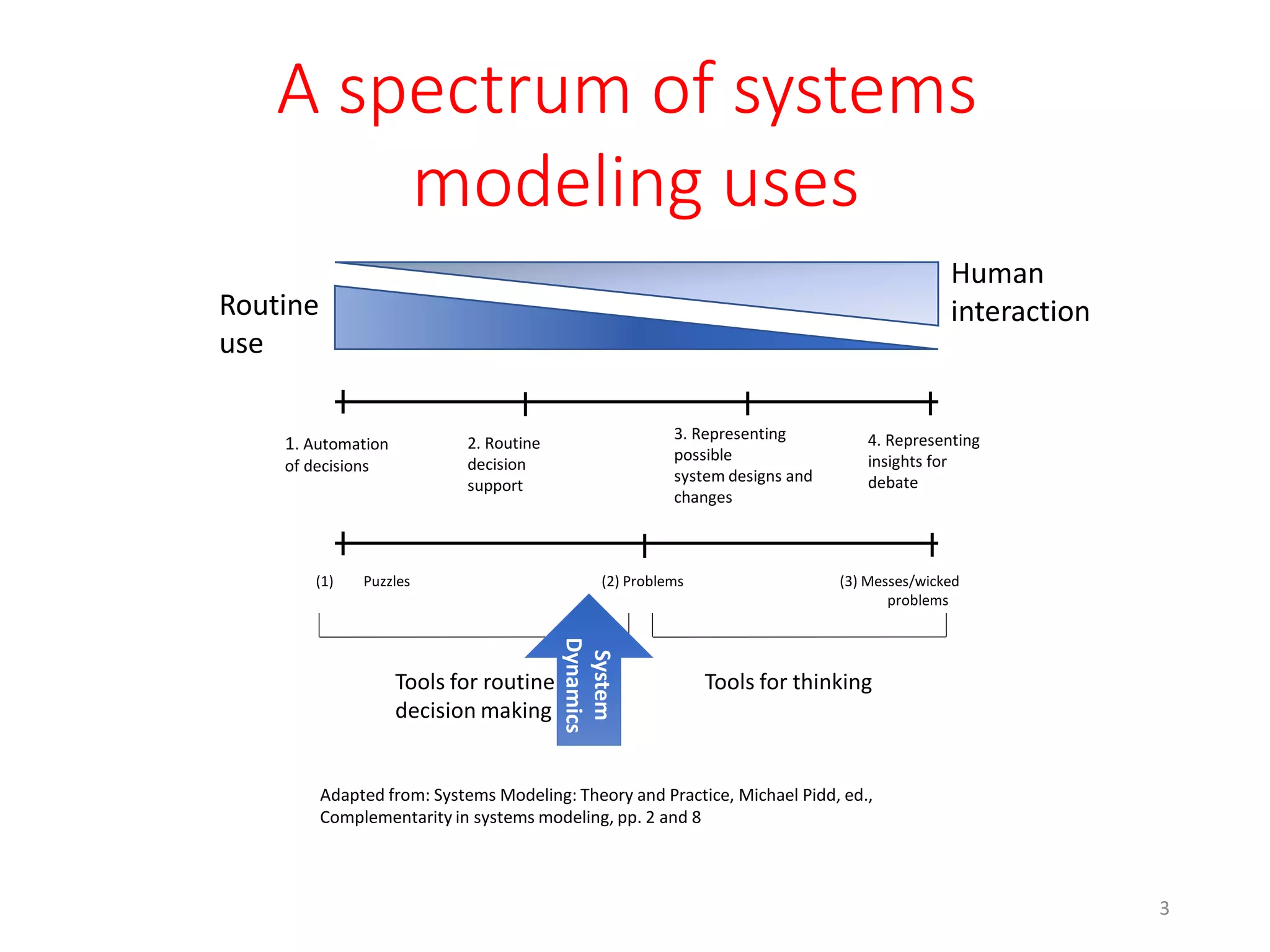
Adapted from: Systems Modeling: Theory and Practice, Michael Pidd, ed.,
Complementarity in systems modeling, pp. 2 and 8
Routine
use
Human
interaction
2. Routine
decision
support
3. Representing
possible
system designs and
changes
4. Representing
insights for
debate
Tools for routine
decision making
Tools for thinking
A spectrum of systems
modeling uses
(1) Puzzles (2) Problems (3) Messes/wicked
problems
System
Dynamics
1. Automation
of decisions
3
4
The beginning: Industrial Dynamics
In Industrial Dynamics[1], Jay Forrester (1961) presents a type of
model structure. He indicated that a model should have the
following characteristics:
• Be able to describe any statement of cause-effect relationships that we
may wish to include.
• Be simple in mathematical nature.
• Be closely synonymous in nomenclature to industrial, economic and
social terminology.
• Be extendable to large numbers of variables (thousands) without
exceeding the practical limits of digital computers.
• Be able to handle “continuous” interactions in the sense that any artificial
discontinuities introduced by solution-time intervals will not affect the
results. It should, however, be able to generate discontinuous changes in
decisions when these are needed.
[1] Now commonly termed System Dynamics.
The original article was in the Harvard Business Review, July-August 1958,
“Industrial Dynamics a major breakthrough for decision makers”
5
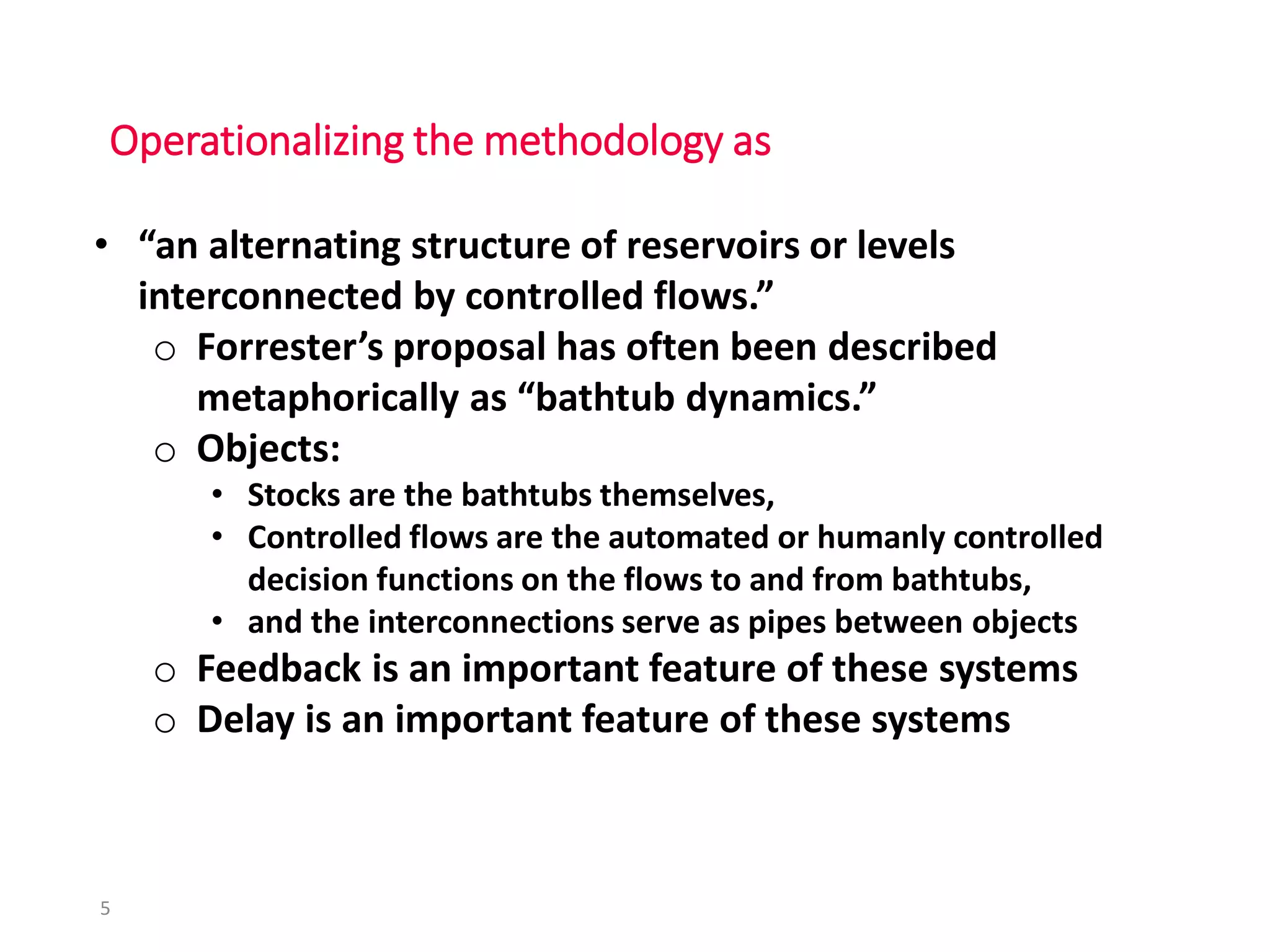
Operationalizing the methodology as
• “an alternating structure of reservoirs or levels
interconnected by controlled flows.”
o Forrester’s proposal has often been described
metaphorically as “bathtub dynamics.”
o Objects:
• Stocks are the bathtubs themselves,
• Controlled flows are the automated or humanly controlled
decision functions on the flows to and from bathtubs,
• and the interconnections serve as pipes between objects
o Feedback is an important feature of these systems
o Delay is an important feature of these systems
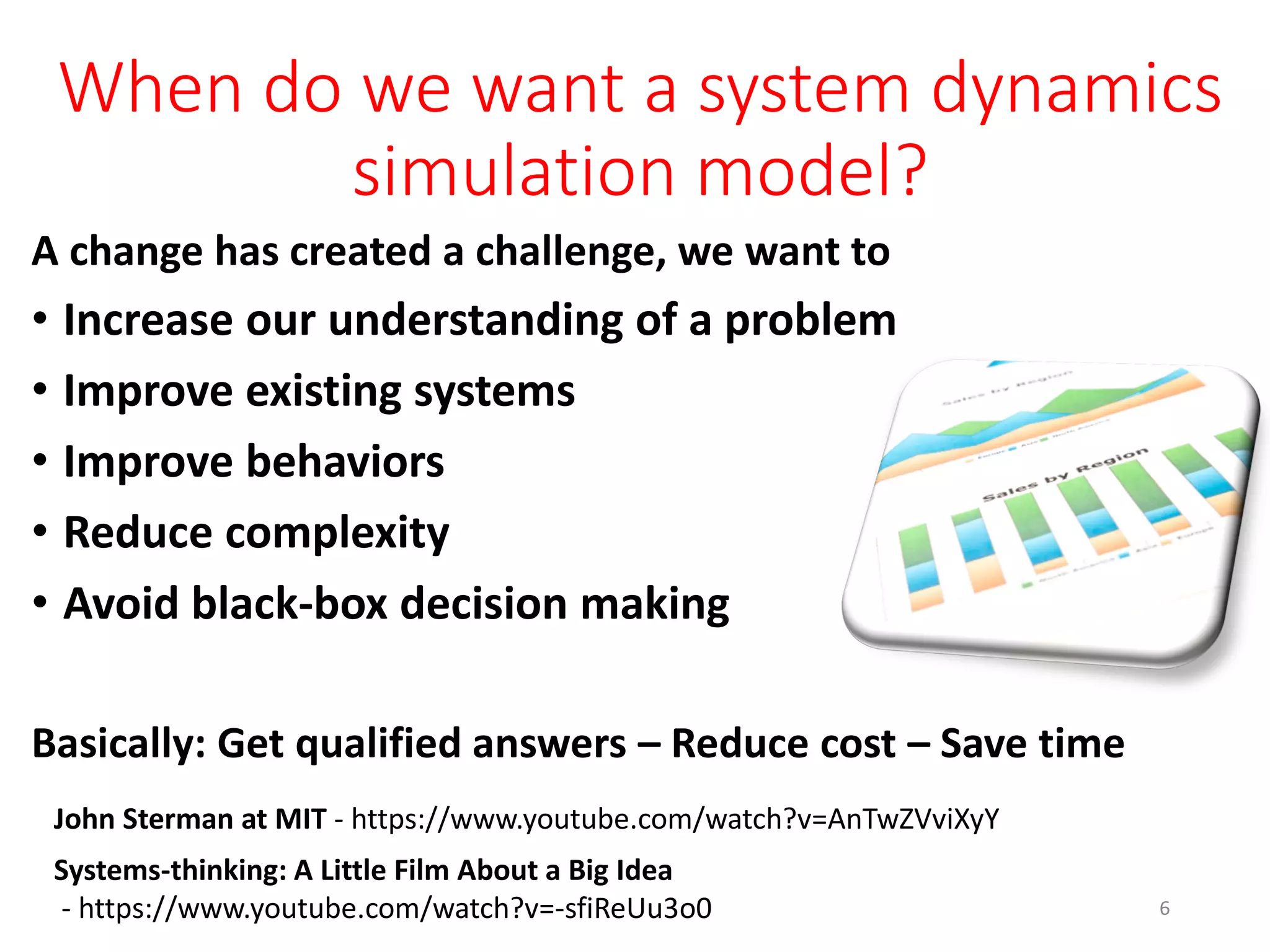
When do we want a system dynamics
simulation model?
A change has created a challenge, we want to
• Increase our understanding of a problem
• Improve existing systems
• Improve behaviors
• Reduce complexity
• Avoid black-box decision making
Basically: Get qualified answers – Reduce cost – Save time
6
John Sterman at MIT - https://www.youtube.com/watch?v=AnTwZVviXyY
Systems-thinking: A Little Film About a Big Idea
- https://www.youtube.com/watch?v=-sfiReUu3o0
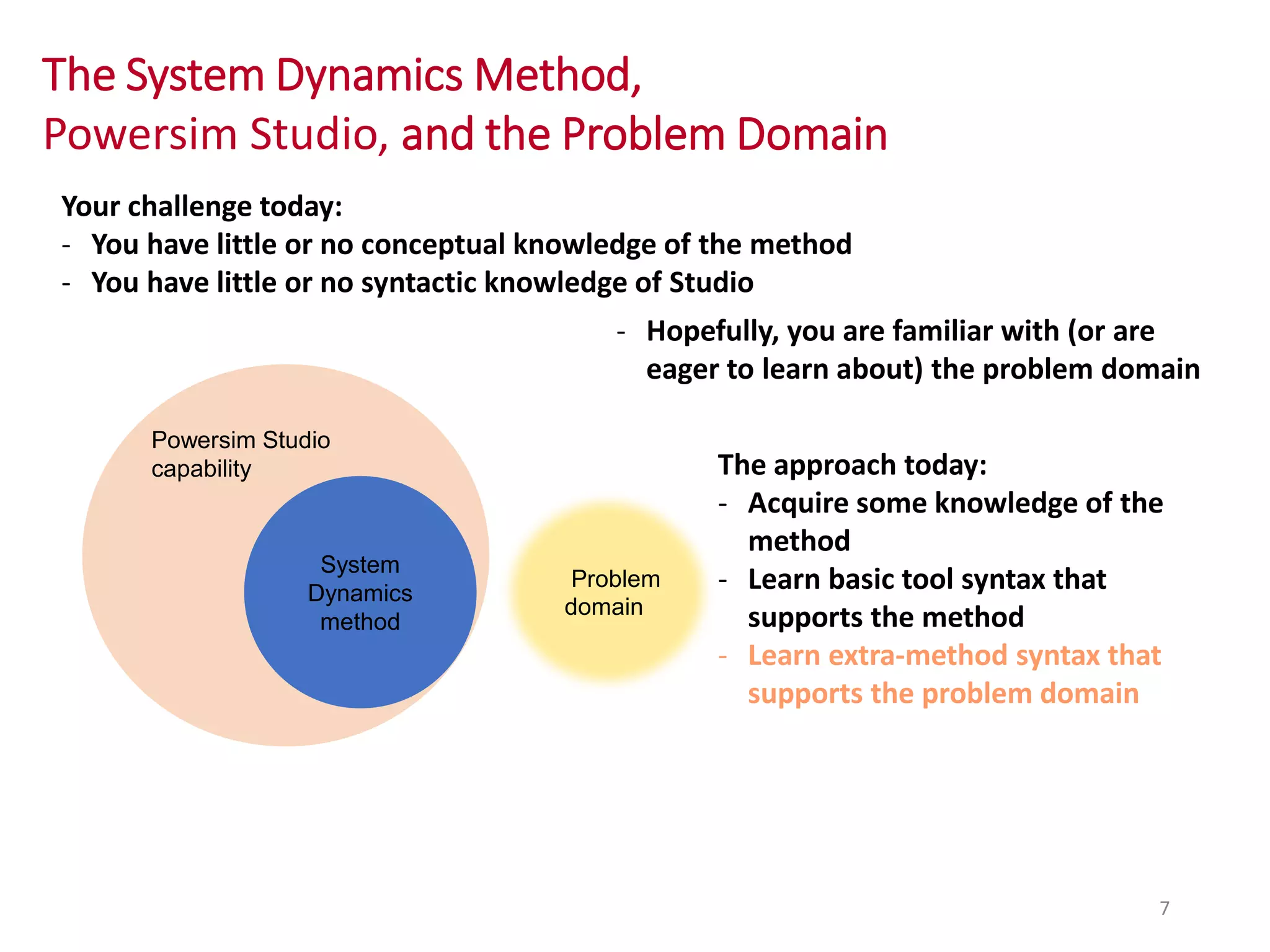
The System Dynamics Method,
Powersim Studio, and the Problem Domain
Powersim Studio
capability
Your challenge today:
- You have little or no conceptual knowledge of the method
- You have little or no syntactic knowledge of Studio
The approach today:
- Acquire some knowledge of the
method
- Learn basic tool syntax that
supports the method
- Learn extra-method syntax that
supports the problem domain
- Hopefully, you are familiar with (or are
eager to learn about) the problem domain
System
Dynamics
method
Problem
domain
7
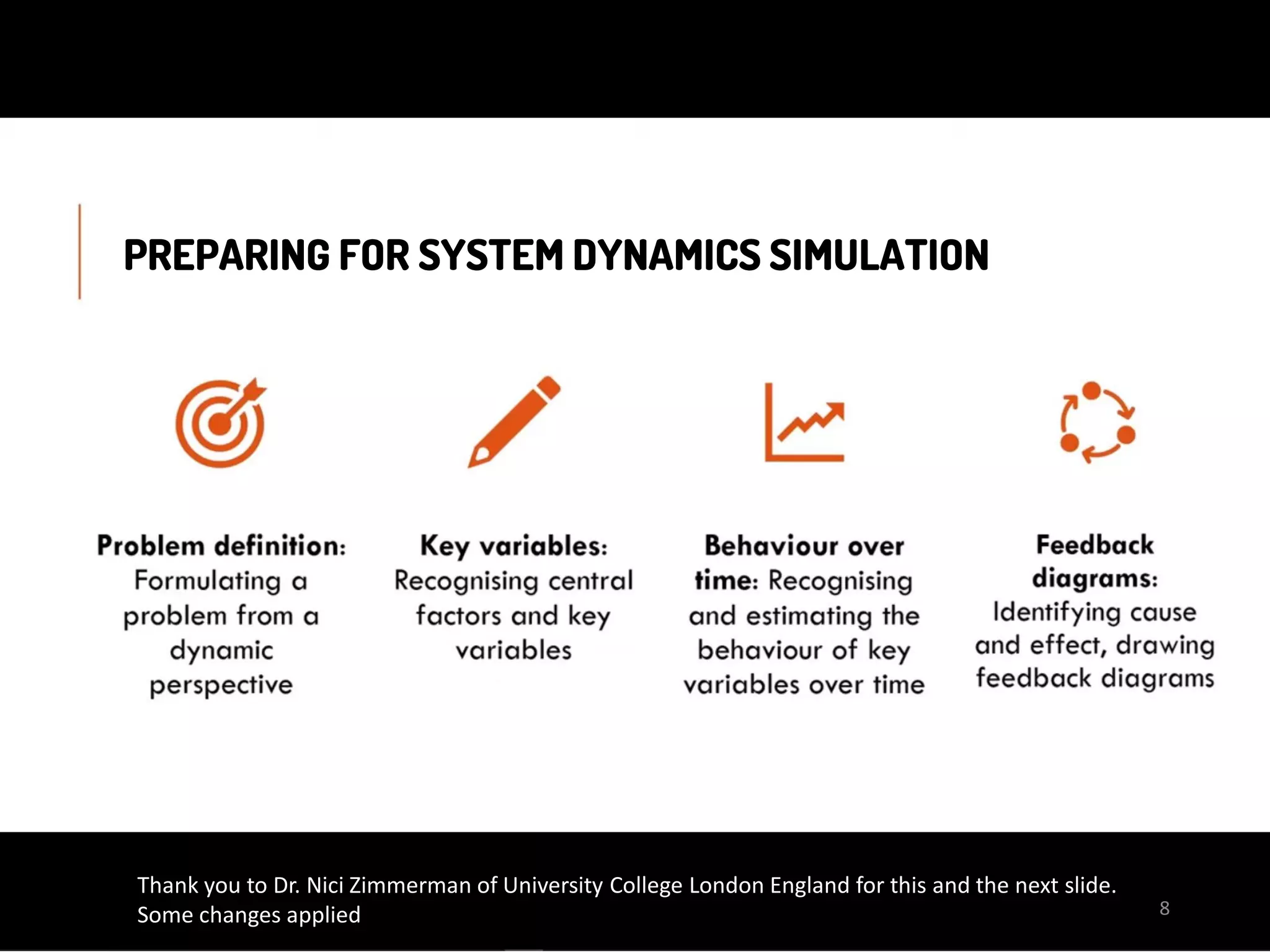
Nici’s slides
Thank you to Dr. Nici Zimmerman of University College London England for this and the next slide.
Some changes applied 8
PREPARING FOR SYSTEM DYNAMICS SIMULATION
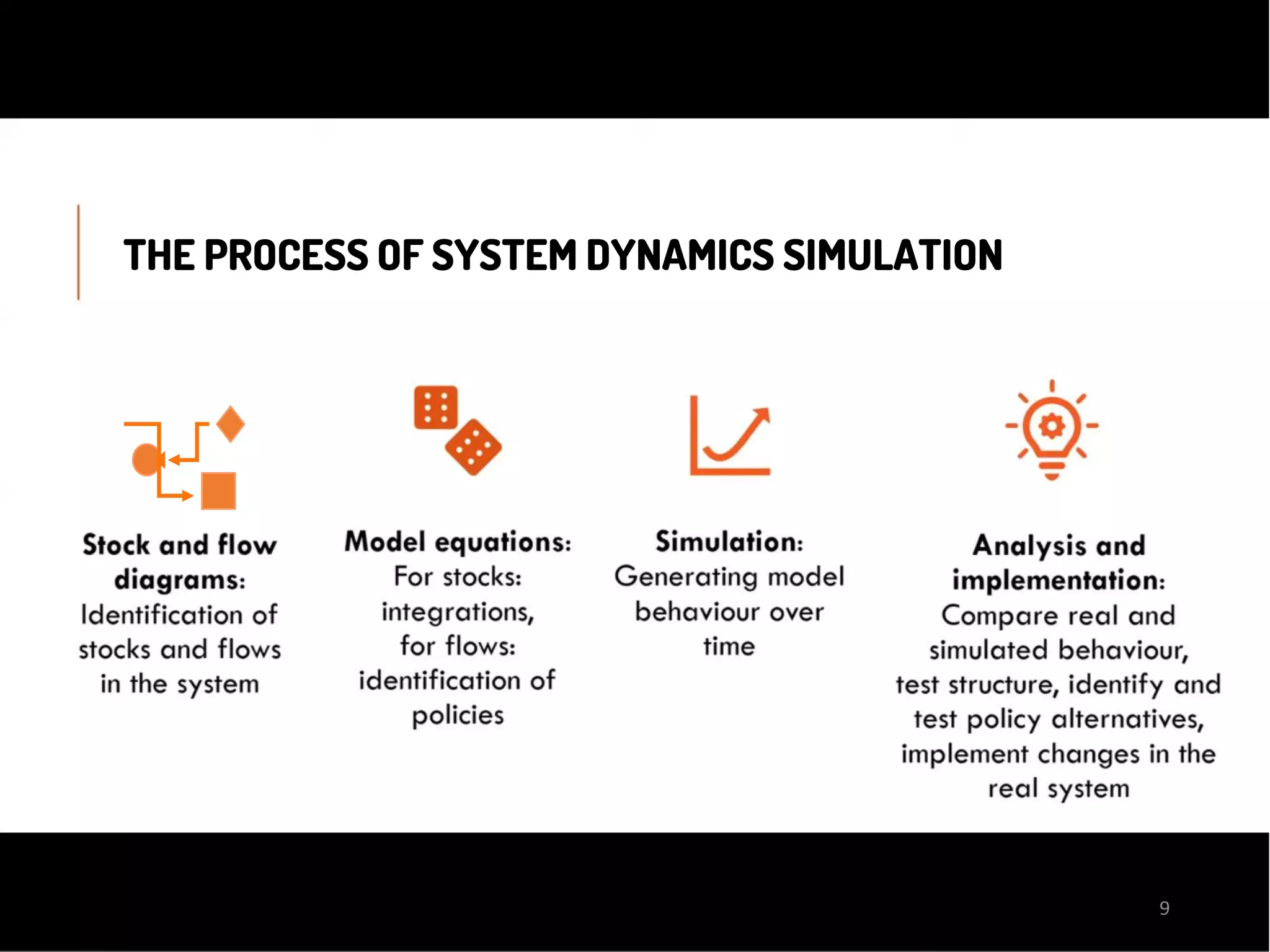
9
THE PROCESS OF SYSTEM DYNAMICS SIMULATION
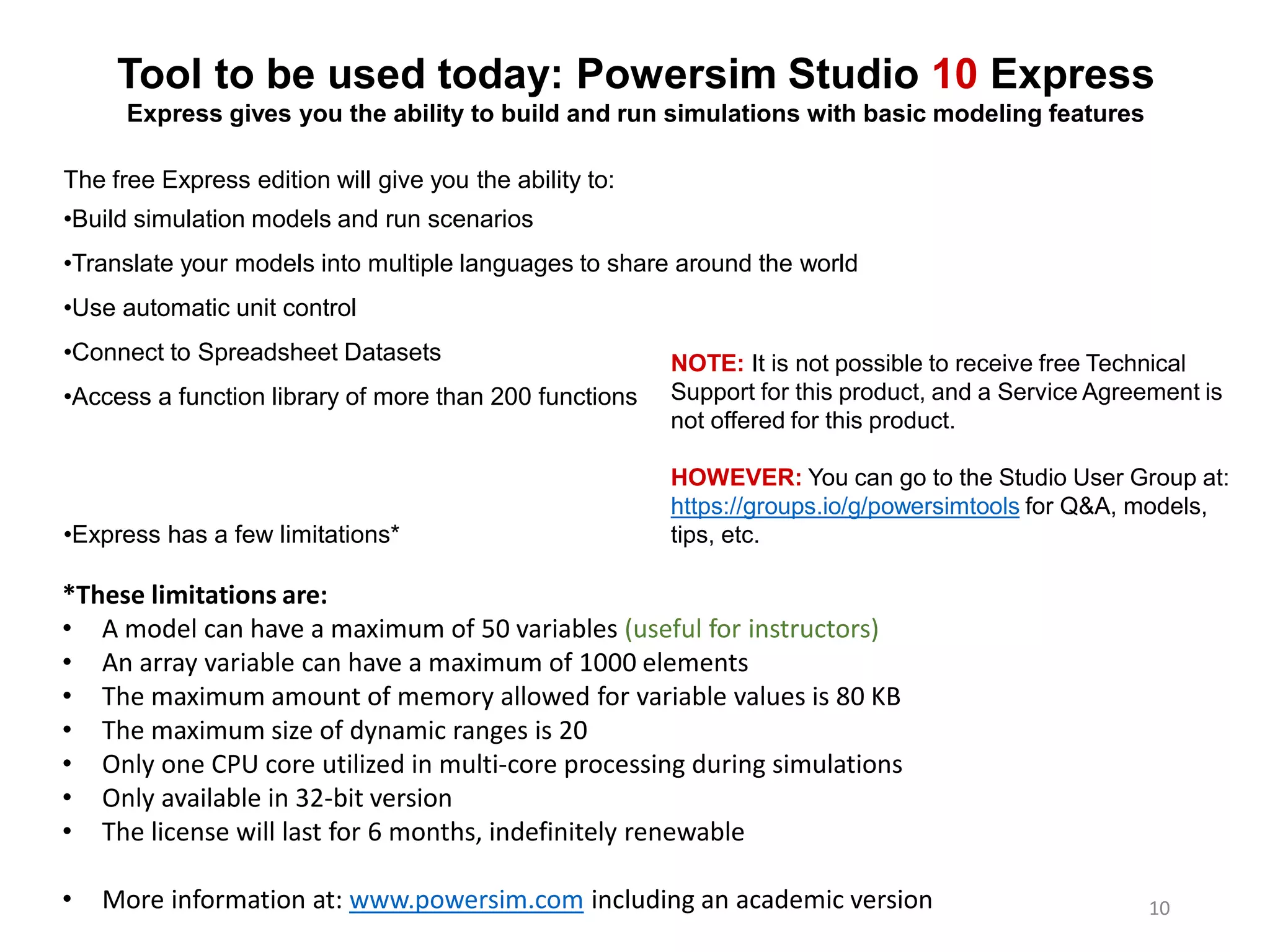
Tool to be used today: Powersim Studio 10 Express
Express gives you the ability to build and run simulations with basic modeling features
NOTE: It is not possible to receive free Technical
Support for this product, and a Service Agreement is
not offered for this product.
HOWEVER: You can go to the Studio User Group at:
https://groups.io/g/powersimtools for Q&A, models,
tips, etc.
*These limitations are:
• A model can have a maximum of 50 variables (useful for instructors)
• An array variable can have a maximum of 1000 elements
• The maximum amount of memory allowed for variable values is 80 KB
• The maximum size of dynamic ranges is 20
• Only one CPU core utilized in multi-core processing during simulations
• Only available in 32-bit version
• The license will last for 6 months, indefinitely renewable
• More information at: www.powersim.com including an academic version
The free Express edition will give you the ability to:
•Build simulation models and run scenarios
•Translate your models into multiple languages to share around the world
•Use automatic unit control
•Connect to Spreadsheet Datasets
•Access a function library of more than 200 functions
•Express has a few limitations*
10
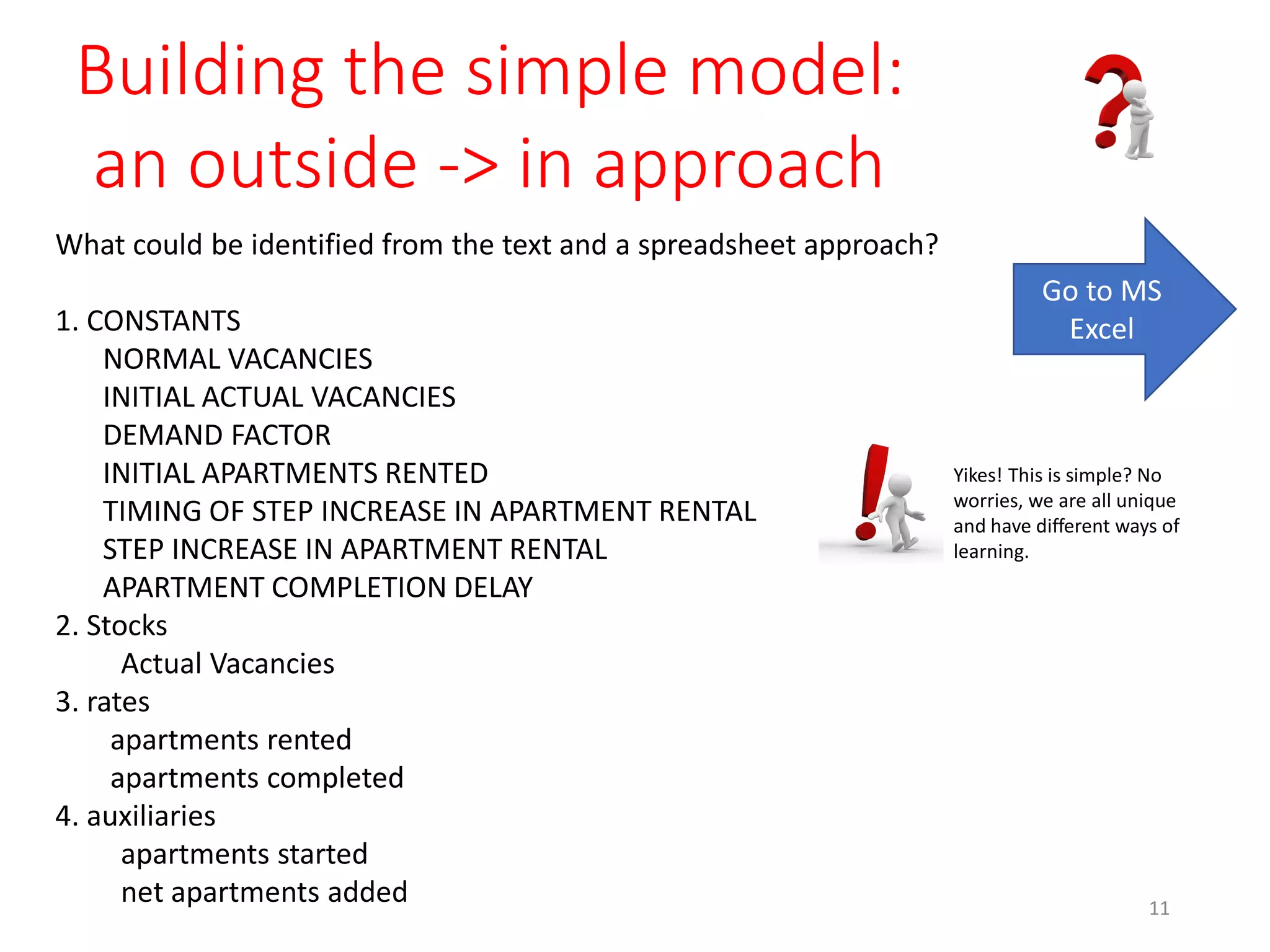
What could be identified from the text and a spreadsheet approach?
1. CONSTANTS
NORMAL VACANCIES
INITIAL ACTUAL VACANCIES
DEMAND FACTOR
INITIAL APARTMENTS RENTED
TIMING OF STEP INCREASE IN APARTMENT RENTAL
STEP INCREASE IN APARTMENT RENTAL
APARTMENT COMPLETION DELAY
2. Stocks
Actual Vacancies
3. rates
apartments rented
apartments completed
4. auxiliaries
apartments started
net apartments added
Building the simple model:
an outside -> in approach
11
Yikes! This is simple? No
worries, we are all unique
and have different ways of
learning.
Go to MS
Excel
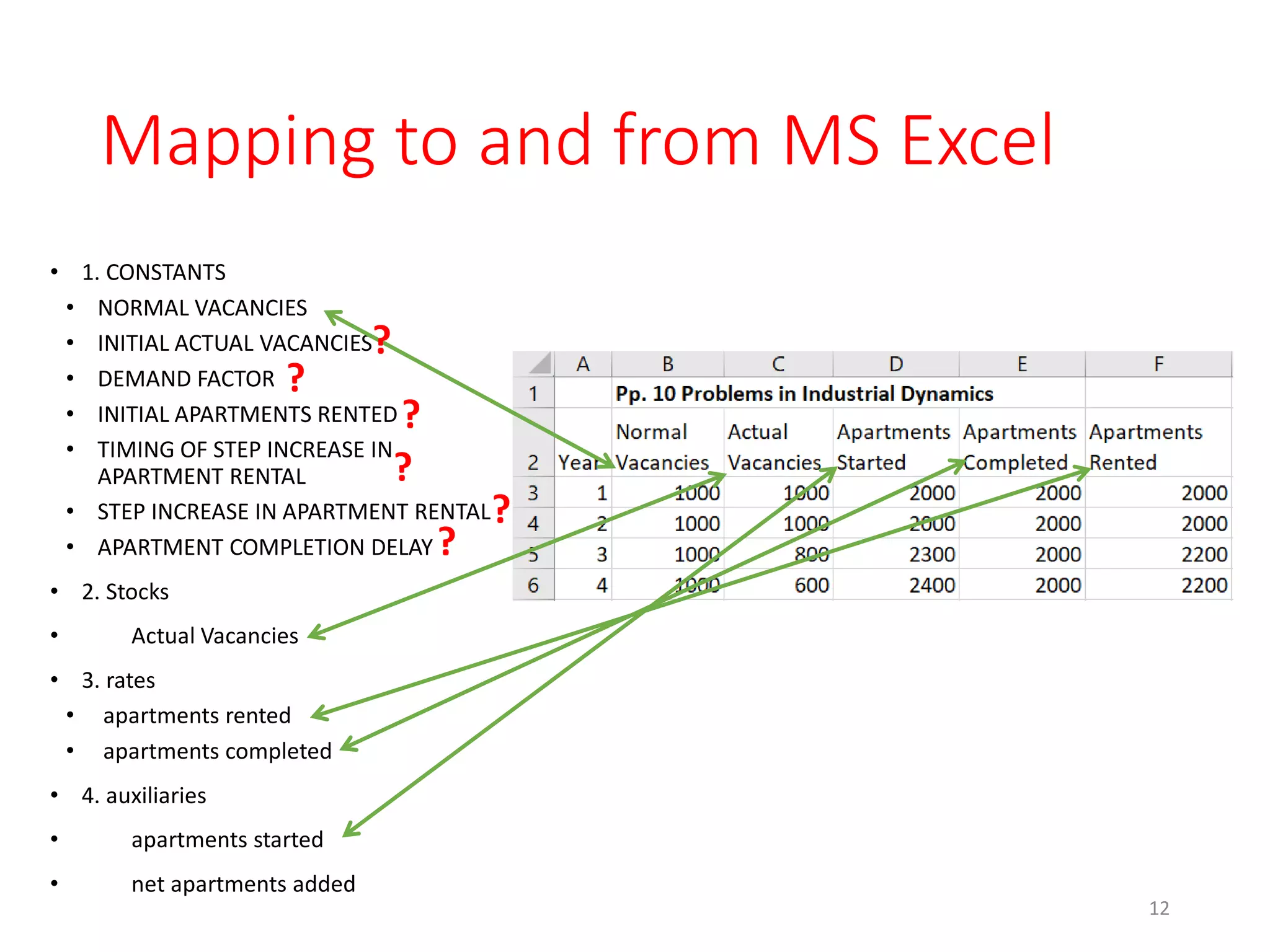
Mapping to and from MS Excel
• 1. CONSTANTS
• NORMAL VACANCIES
• INITIAL ACTUAL VACANCIES
• DEMAND FACTOR
• INITIAL APARTMENTS RENTED
• TIMING OF STEP INCREASE IN
APARTMENT RENTAL
• STEP INCREASE IN APARTMENT RENTAL
• APARTMENT COMPLETION DELAY
• 2. Stocks
• Actual Vacancies
• 3. rates
• apartments rented
• apartments completed
• 4. auxiliaries
• apartments started
• net apartments added
12
?
?
?
?
?
?
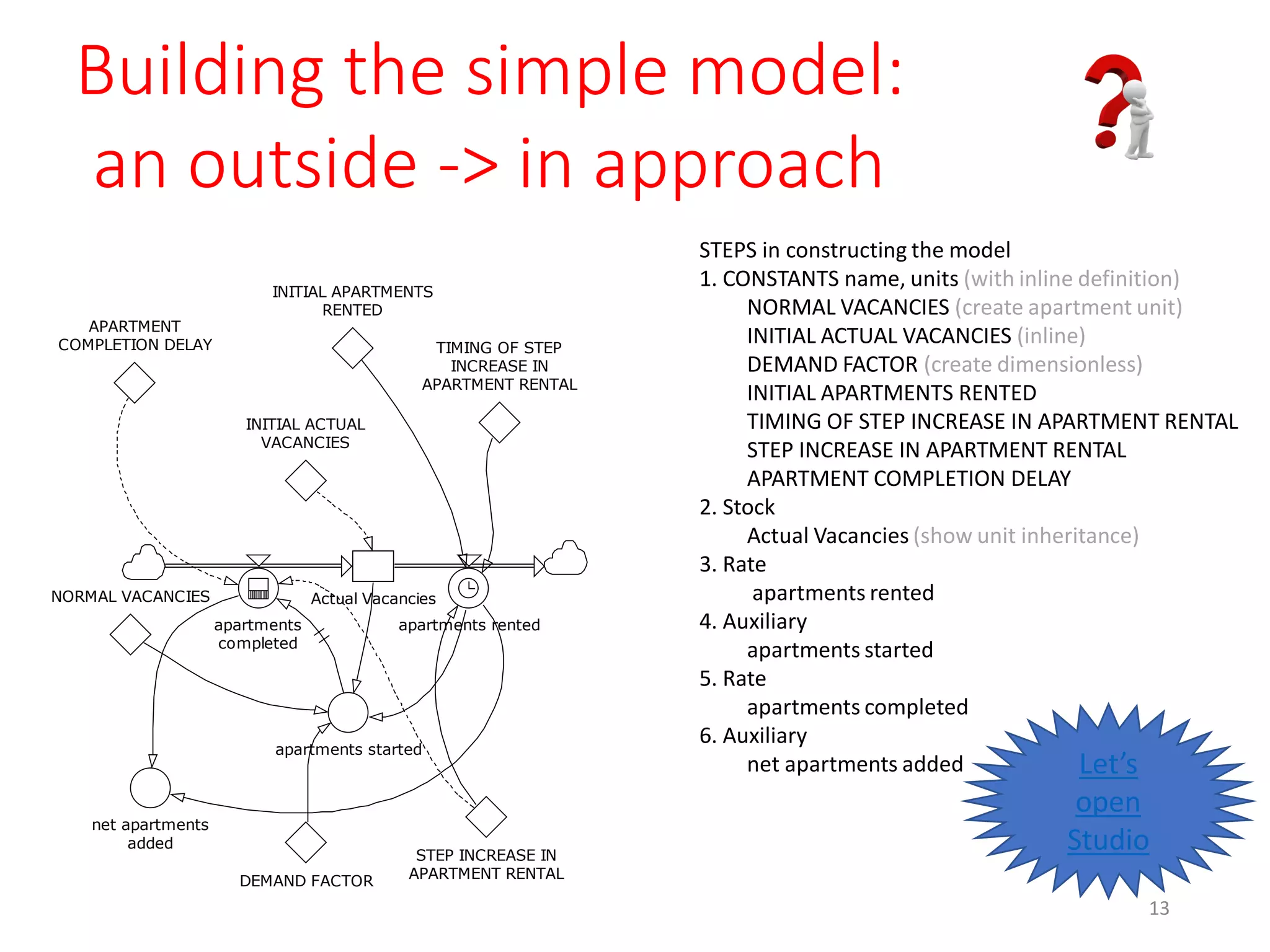
STEPS in constructing the model
1. CONSTANTS name, units (with inline definition)
NORMAL VACANCIES (create apartment unit)
INITIAL ACTUAL VACANCIES (inline)
DEMAND FACTOR (create dimensionless)
INITIAL APARTMENTS RENTED
TIMING OF STEP INCREASE IN APARTMENT RENTAL
STEP INCREASE IN APARTMENT RENTAL
APARTMENT COMPLETION DELAY
2. Stock
Actual Vacancies (show unit inheritance)
3. Rate
apartments rented
4. Auxiliary
apartments started
5. Rate
apartments completed
6. Auxiliary
net apartments added
Building the simple model:
an outside -> in approach
Let’s
open
Studio
NORMAL VACANCIES Actual Vacancies
apartments started
apartments
completed
apartments rented
DEMAND FACTOR
net apartments
added
INITIAL ACTUAL
VACANCIES
INITIAL APARTMENTS
RENTED
STEP INCREASE IN
APARTMENT RENTAL
TIMING OF STEP
INCREASE IN
APARTMENT RENTAL
APARTMENT
COMPLETION DELAY
13
Outside -> in approach: the
advantages when using Studio
1. Adding constants first helps to
1. distinguish the exogenous from the endogenous
variables,
2. indicate potential opportunities to grow model scope,
3. highlight potential policy variables, and
4. determine model units
2. Adding stocks next enables
1. unit inheritance when setting initial values and
2. model transparency
3. Iterating through auxiliaries and rates helps to
1. manage model logic,
2. reinforce unit inheritance, and
3. enforce the system dynamics methodology
14
Wait a minute!
• Is this the only approach to the problem?
• No, there may be other equally valid models
• Ideally you would work with the appropriate stakeholders
• However
• This approach is based upon the text (Problems in Industrial
Dynamics) to have a common problem definition
• The approach and results can be compared to the text
• This approach follows best practices in model construction *
* D-Memo (D-4851, 01/15/2001) System Dynamics Model Checklist
Best Practices for System Dynamics Model Design and Construction with Powersim Studio,
SANDIA REPORT, SAND2011-4108, Unlimited Release, June 2011
15
STUDIO hands-on
16
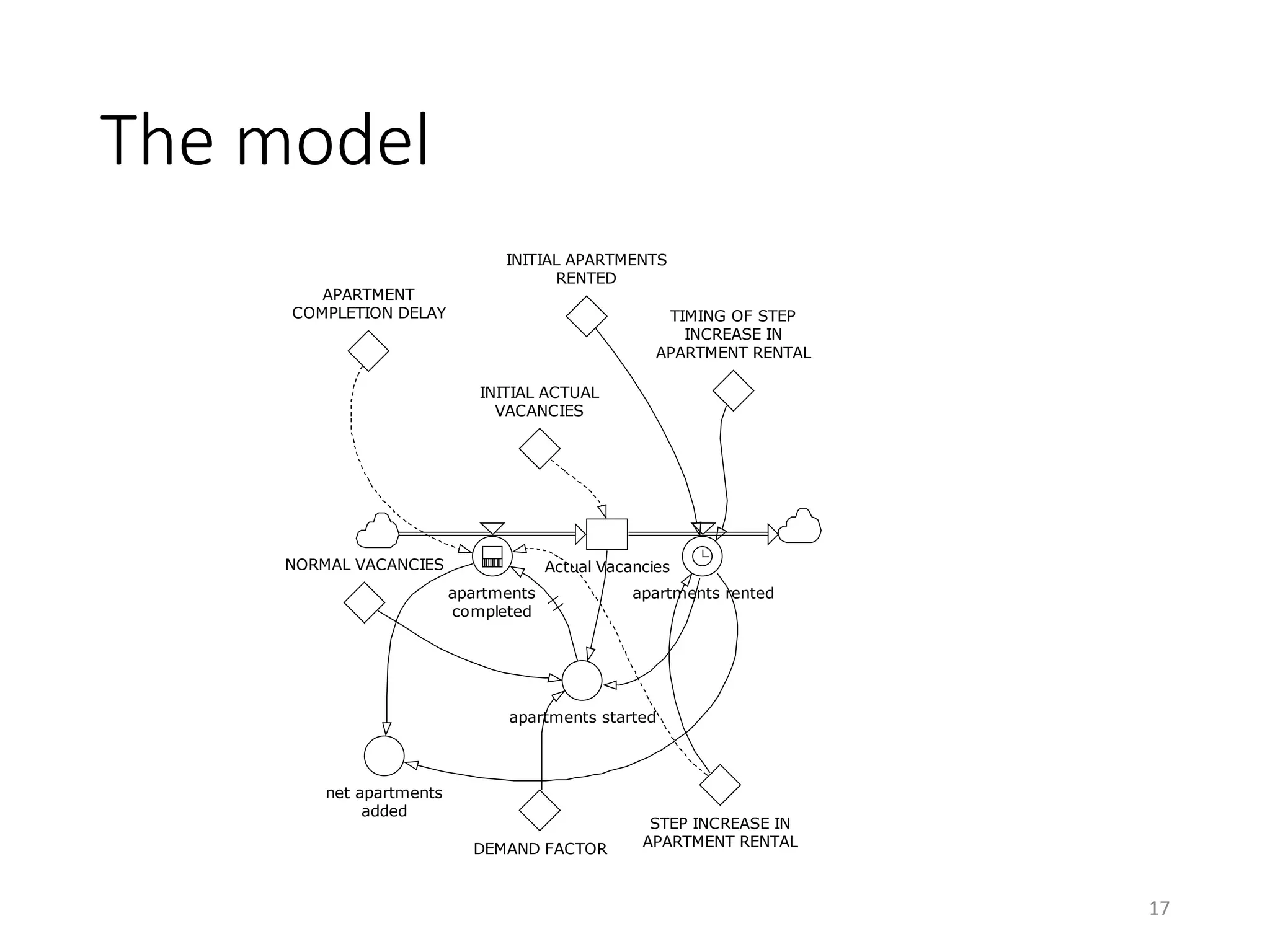
The model
17
NORMAL VACANCIES Actual Vacancies
apartments started
apartments
completed
apartments rented
DEMAND FACTOR
net apartments
added
INITIAL ACTUAL
VACANCIES
INITIAL APARTMENTS
RENTED
STEP INCREASE IN
APARTMENT RENTAL
TIMING OF STEP
INCREASE IN
APARTMENT RENTAL
APARTMENT
COMPLETION DELAY
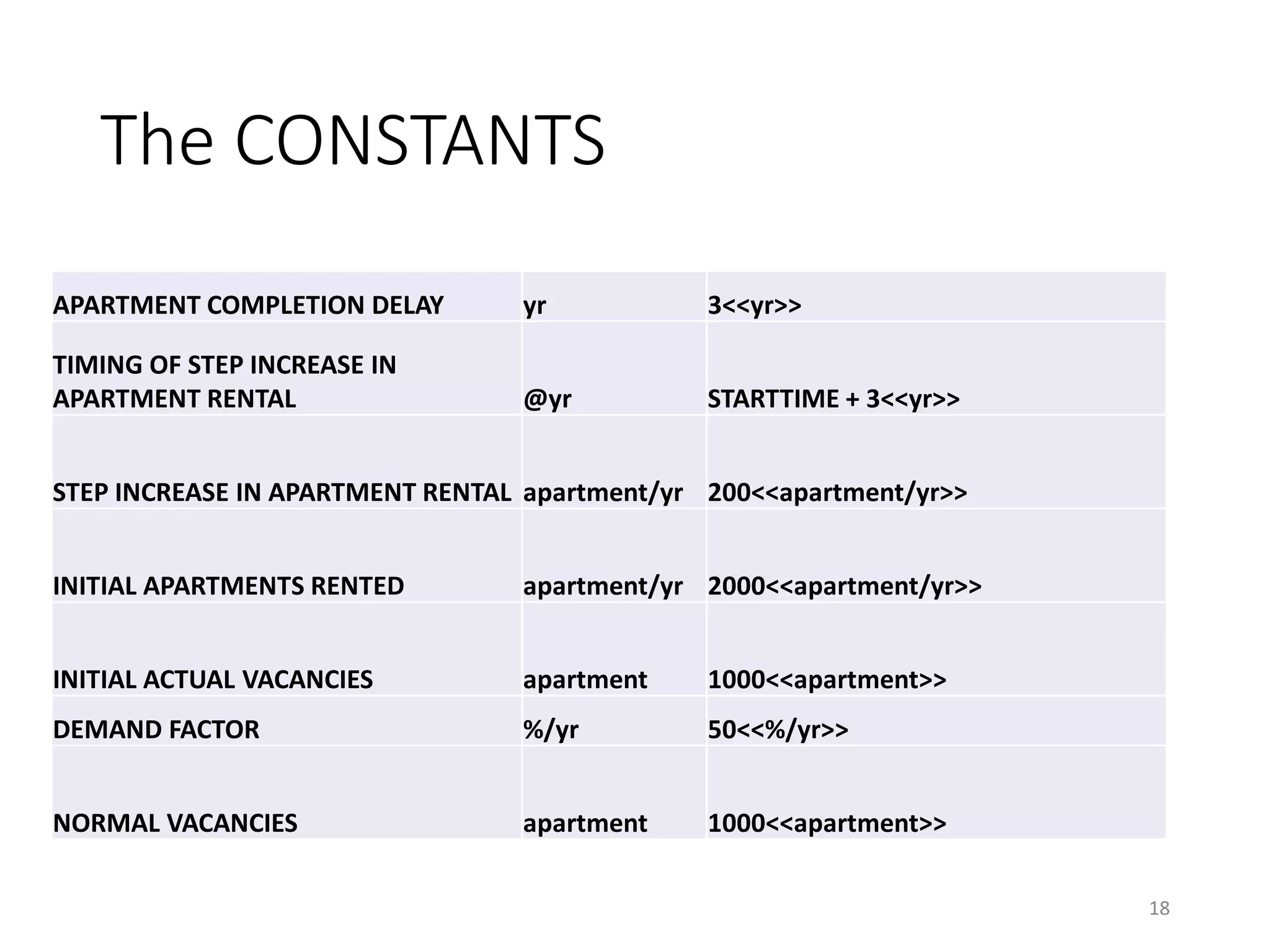
The CONSTANTS
APARTMENT COMPLETION DELAY yr 3<<yr>>
TIMING OF STEP INCREASE IN
APARTMENT RENTAL @yr STARTTIME + 3<<yr>>
STEP INCREASE IN APARTMENT RENTAL apartment/yr 200<<apartment/yr>>
INITIAL APARTMENTS RENTED apartment/yr 2000<<apartment/yr>>
INITIAL ACTUAL VACANCIES apartment 1000<<apartment>>
DEMAND FACTOR %/yr 50<<%/yr>>
NORMAL VACANCIES apartment 1000<<apartment>>
18
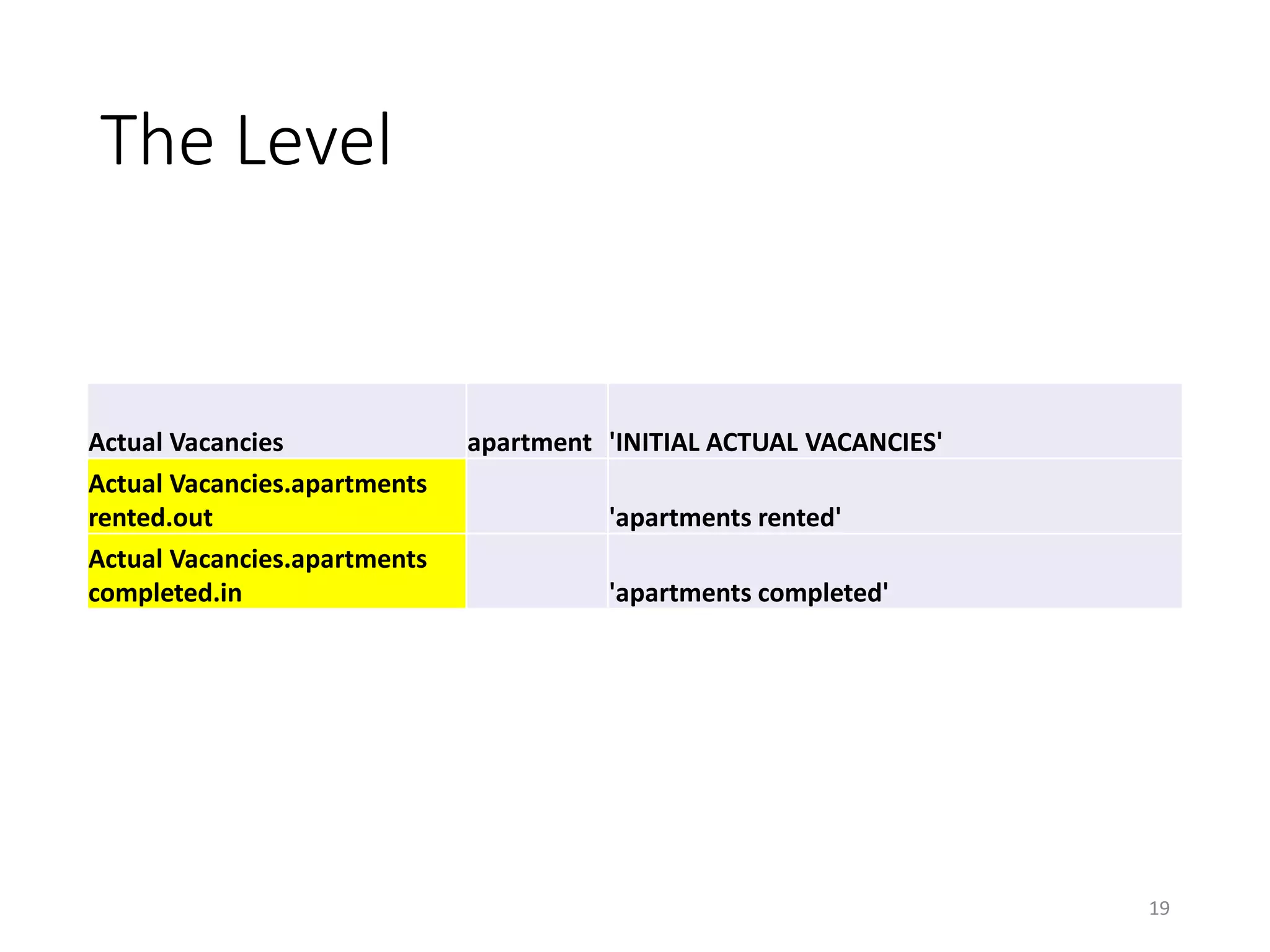
The Level
Actual Vacancies apartment 'INITIAL ACTUAL VACANCIES'
Actual Vacancies.apartments
rented.out 'apartments rented'
Actual Vacancies.apartments
completed.in 'apartments completed'
19
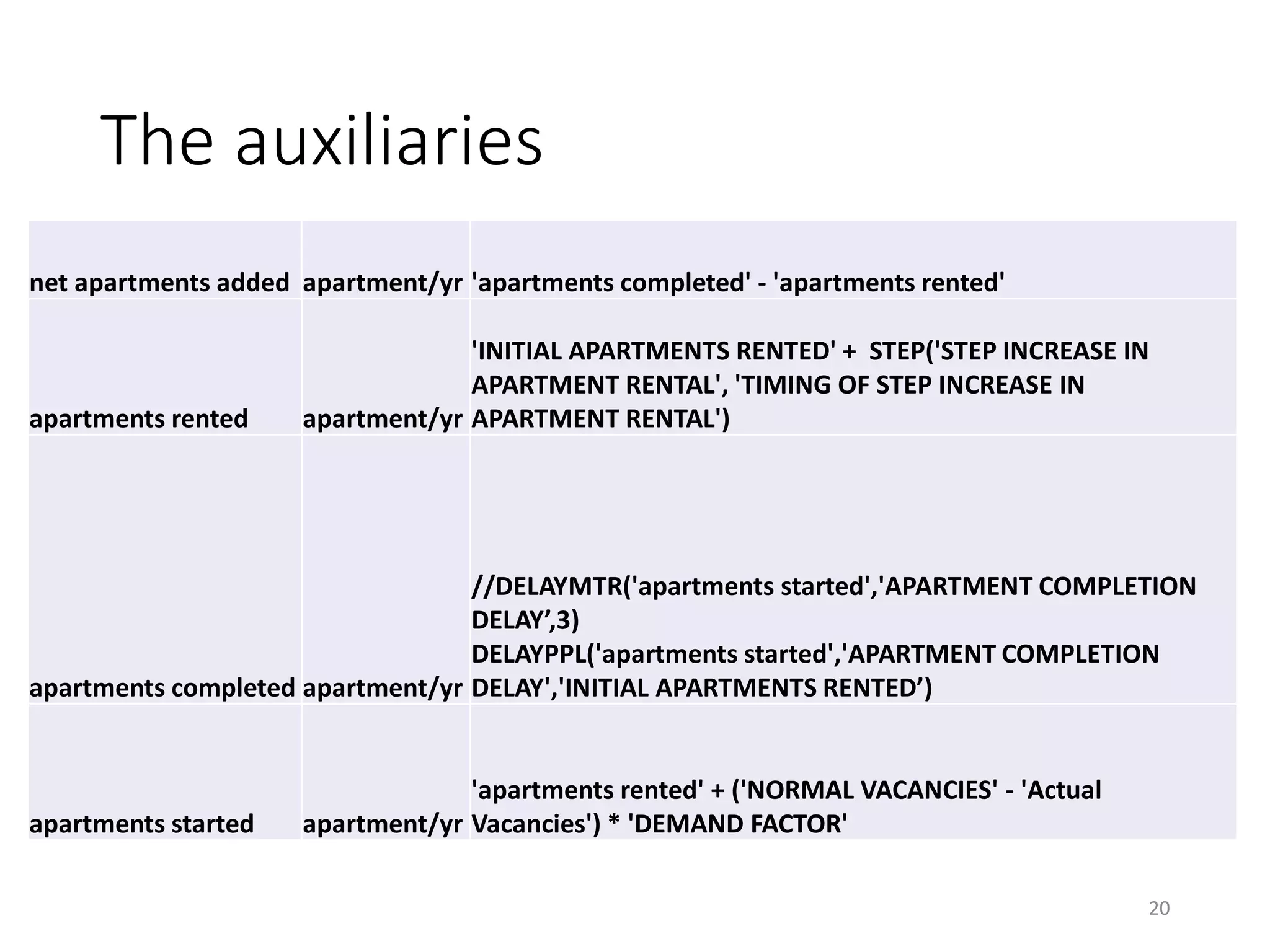
The auxiliaries
net apartments added apartment/yr 'apartments completed' - 'apartments rented'
apartments rented apartment/yr
'INITIAL APARTMENTS RENTED' + STEP('STEP INCREASE IN
APARTMENT RENTAL', 'TIMING OF STEP INCREASE IN
APARTMENT RENTAL')
apartments completed apartment/yr
//DELAYMTR('apartments started','APARTMENT COMPLETION
DELAY’,3)
DELAYPPL('apartments started','APARTMENT COMPLETION
DELAY','INITIAL APARTMENTS RENTED’)
apartments started apartment/yr
'apartments rented' + ('NORMAL VACANCIES' - 'Actual
Vacancies') * 'DEMAND FACTOR'
20
NYT October 15, 2021
• Rising Rents Are Fueling Inflation, Posing Trouble for
the Fed
• Economic policymakers have said inflation will prove
temporary, but rising rents may challenge that view and
pressure Washington to react.
• https://www.nytimes.com/2021/10/15/business/econo
my/rent-
inflation.html?campaign_id=9&emc=edit_nn_2021101
5&instance_id=42913&nl=the-
morning&regi_id=144854885&segment_id=71712&te=
1&user_id=a3257c2532ed6706a3777afa04be15ab
21
21587 days after the problem description article
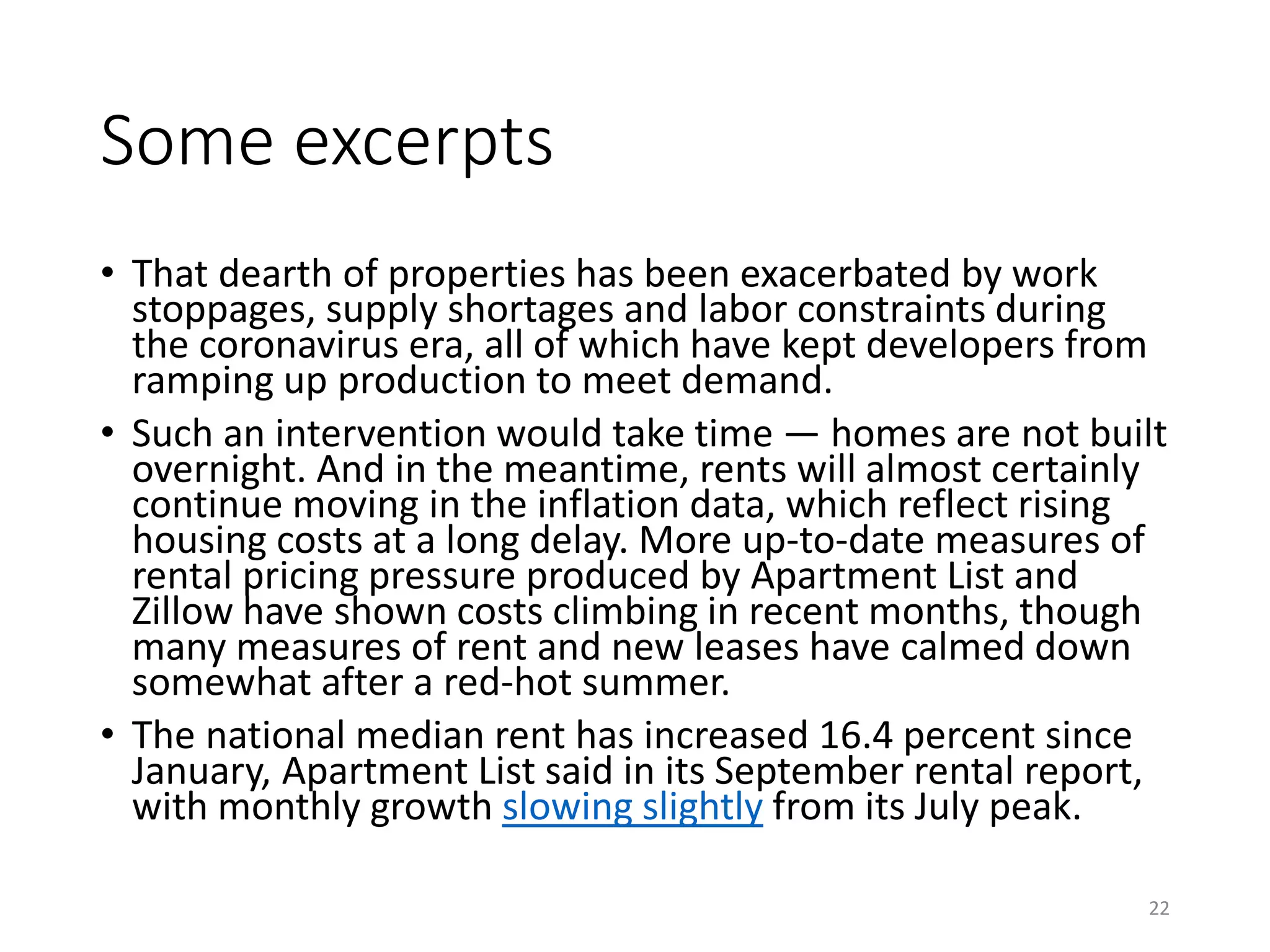
Some excerpts
• That dearth of properties has been exacerbated by work
stoppages, supply shortages and labor constraints during
the coronavirus era, all of which have kept developers from
ramping up production to meet demand.
• Such an intervention would take time — homes are not built
overnight. And in the meantime, rents will almost certainly
continue moving in the inflation data, which reflect rising
housing costs at a long delay. More up-to-date measures of
rental pricing pressure produced by Apartment List and
Zillow have shown costs climbing in recent months, though
many measures of rent and new leases have calmed down
somewhat after a red-hot summer.
• The national median rent has increased 16.4 percent since
January, Apartment List said in its September rental report,
with monthly growth slowing slightly from its July peak.
22

Slides-Introduction-to-System-Dynamics-Modeling-October-20-2021.pdf

  • 1.
    An exposure tosystem dynamics modeling A System Dynamics Society seminar series presentation Len Malczynski Mindseye Computing 20 October 2021
  • 2.
    Will I learnthe system dynamics method in this session? • NO! • Learning will require practicing the method • We all learn differently • Good news • There are many places to learn – Google search of “system dynamics” About 424,000,000 results (run on October 8, 2021) • Links will be provided later in this presentation 2
  • 3.
    Adapted from: SystemsModeling: Theory and Practice, Michael Pidd, ed., Complementarity in systems modeling, pp. 2 and 8 Routine use Human interaction 2. Routine decision support 3. Representing possible system designs and changes 4. Representing insights for debate Tools for routine decision making Tools for thinking A spectrum of systems modeling uses (1) Puzzles (2) Problems (3) Messes/wicked problems System Dynamics 1. Automation of decisions 3
  • 4.
    4 The beginning: IndustrialDynamics In Industrial Dynamics[1], Jay Forrester (1961) presents a type of model structure. He indicated that a model should have the following characteristics: • Be able to describe any statement of cause-effect relationships that we may wish to include. • Be simple in mathematical nature. • Be closely synonymous in nomenclature to industrial, economic and social terminology. • Be extendable to large numbers of variables (thousands) without exceeding the practical limits of digital computers. • Be able to handle “continuous” interactions in the sense that any artificial discontinuities introduced by solution-time intervals will not affect the results. It should, however, be able to generate discontinuous changes in decisions when these are needed. [1] Now commonly termed System Dynamics. The original article was in the Harvard Business Review, July-August 1958, “Industrial Dynamics a major breakthrough for decision makers”
  • 5.
    5 Operationalizing the methodologyas • “an alternating structure of reservoirs or levels interconnected by controlled flows.” o Forrester’s proposal has often been described metaphorically as “bathtub dynamics.” o Objects: • Stocks are the bathtubs themselves, • Controlled flows are the automated or humanly controlled decision functions on the flows to and from bathtubs, • and the interconnections serve as pipes between objects o Feedback is an important feature of these systems o Delay is an important feature of these systems
  • 6.
    When do wewant a system dynamics simulation model? A change has created a challenge, we want to • Increase our understanding of a problem • Improve existing systems • Improve behaviors • Reduce complexity • Avoid black-box decision making Basically: Get qualified answers – Reduce cost – Save time 6 John Sterman at MIT - https://www.youtube.com/watch?v=AnTwZVviXyY Systems-thinking: A Little Film About a Big Idea - https://www.youtube.com/watch?v=-sfiReUu3o0
  • 7.
    The System DynamicsMethod, Powersim Studio, and the Problem Domain Powersim Studio capability Your challenge today: - You have little or no conceptual knowledge of the method - You have little or no syntactic knowledge of Studio The approach today: - Acquire some knowledge of the method - Learn basic tool syntax that supports the method - Learn extra-method syntax that supports the problem domain - Hopefully, you are familiar with (or are eager to learn about) the problem domain System Dynamics method Problem domain 7
  • 8.
    Nici’s slides Thank youto Dr. Nici Zimmerman of University College London England for this and the next slide. Some changes applied 8 PREPARING FOR SYSTEM DYNAMICS SIMULATION
  • 9.
    9 THE PROCESS OFSYSTEM DYNAMICS SIMULATION
  • 10.
    Tool to beused today: Powersim Studio 10 Express Express gives you the ability to build and run simulations with basic modeling features NOTE: It is not possible to receive free Technical Support for this product, and a Service Agreement is not offered for this product. HOWEVER: You can go to the Studio User Group at: https://groups.io/g/powersimtools for Q&A, models, tips, etc. *These limitations are: • A model can have a maximum of 50 variables (useful for instructors) • An array variable can have a maximum of 1000 elements • The maximum amount of memory allowed for variable values is 80 KB • The maximum size of dynamic ranges is 20 • Only one CPU core utilized in multi-core processing during simulations • Only available in 32-bit version • The license will last for 6 months, indefinitely renewable • More information at: www.powersim.com including an academic version The free Express edition will give you the ability to: •Build simulation models and run scenarios •Translate your models into multiple languages to share around the world •Use automatic unit control •Connect to Spreadsheet Datasets •Access a function library of more than 200 functions •Express has a few limitations* 10
  • 11.
    What could beidentified from the text and a spreadsheet approach? 1. CONSTANTS NORMAL VACANCIES INITIAL ACTUAL VACANCIES DEMAND FACTOR INITIAL APARTMENTS RENTED TIMING OF STEP INCREASE IN APARTMENT RENTAL STEP INCREASE IN APARTMENT RENTAL APARTMENT COMPLETION DELAY 2. Stocks Actual Vacancies 3. rates apartments rented apartments completed 4. auxiliaries apartments started net apartments added Building the simple model: an outside -> in approach 11 Yikes! This is simple? No worries, we are all unique and have different ways of learning. Go to MS Excel
  • 12.
    Mapping to andfrom MS Excel • 1. CONSTANTS • NORMAL VACANCIES • INITIAL ACTUAL VACANCIES • DEMAND FACTOR • INITIAL APARTMENTS RENTED • TIMING OF STEP INCREASE IN APARTMENT RENTAL • STEP INCREASE IN APARTMENT RENTAL • APARTMENT COMPLETION DELAY • 2. Stocks • Actual Vacancies • 3. rates • apartments rented • apartments completed • 4. auxiliaries • apartments started • net apartments added 12 ? ? ? ? ? ?
  • 13.
    STEPS in constructingthe model 1. CONSTANTS name, units (with inline definition) NORMAL VACANCIES (create apartment unit) INITIAL ACTUAL VACANCIES (inline) DEMAND FACTOR (create dimensionless) INITIAL APARTMENTS RENTED TIMING OF STEP INCREASE IN APARTMENT RENTAL STEP INCREASE IN APARTMENT RENTAL APARTMENT COMPLETION DELAY 2. Stock Actual Vacancies (show unit inheritance) 3. Rate apartments rented 4. Auxiliary apartments started 5. Rate apartments completed 6. Auxiliary net apartments added Building the simple model: an outside -> in approach Let’s open Studio NORMAL VACANCIES Actual Vacancies apartments started apartments completed apartments rented DEMAND FACTOR net apartments added INITIAL ACTUAL VACANCIES INITIAL APARTMENTS RENTED STEP INCREASE IN APARTMENT RENTAL TIMING OF STEP INCREASE IN APARTMENT RENTAL APARTMENT COMPLETION DELAY 13
  • 14.
    Outside -> inapproach: the advantages when using Studio 1. Adding constants first helps to 1. distinguish the exogenous from the endogenous variables, 2. indicate potential opportunities to grow model scope, 3. highlight potential policy variables, and 4. determine model units 2. Adding stocks next enables 1. unit inheritance when setting initial values and 2. model transparency 3. Iterating through auxiliaries and rates helps to 1. manage model logic, 2. reinforce unit inheritance, and 3. enforce the system dynamics methodology 14
  • 15.
    Wait a minute! •Is this the only approach to the problem? • No, there may be other equally valid models • Ideally you would work with the appropriate stakeholders • However • This approach is based upon the text (Problems in Industrial Dynamics) to have a common problem definition • The approach and results can be compared to the text • This approach follows best practices in model construction * * D-Memo (D-4851, 01/15/2001) System Dynamics Model Checklist Best Practices for System Dynamics Model Design and Construction with Powersim Studio, SANDIA REPORT, SAND2011-4108, Unlimited Release, June 2011 15
  • 16.
  • 17.
    The model 17 NORMAL VACANCIESActual Vacancies apartments started apartments completed apartments rented DEMAND FACTOR net apartments added INITIAL ACTUAL VACANCIES INITIAL APARTMENTS RENTED STEP INCREASE IN APARTMENT RENTAL TIMING OF STEP INCREASE IN APARTMENT RENTAL APARTMENT COMPLETION DELAY
  • 18.
    The CONSTANTS APARTMENT COMPLETIONDELAY yr 3<<yr>> TIMING OF STEP INCREASE IN APARTMENT RENTAL @yr STARTTIME + 3<<yr>> STEP INCREASE IN APARTMENT RENTAL apartment/yr 200<<apartment/yr>> INITIAL APARTMENTS RENTED apartment/yr 2000<<apartment/yr>> INITIAL ACTUAL VACANCIES apartment 1000<<apartment>> DEMAND FACTOR %/yr 50<<%/yr>> NORMAL VACANCIES apartment 1000<<apartment>> 18
  • 19.
    The Level Actual Vacanciesapartment 'INITIAL ACTUAL VACANCIES' Actual Vacancies.apartments rented.out 'apartments rented' Actual Vacancies.apartments completed.in 'apartments completed' 19
  • 20.
    The auxiliaries net apartmentsadded apartment/yr 'apartments completed' - 'apartments rented' apartments rented apartment/yr 'INITIAL APARTMENTS RENTED' + STEP('STEP INCREASE IN APARTMENT RENTAL', 'TIMING OF STEP INCREASE IN APARTMENT RENTAL') apartments completed apartment/yr //DELAYMTR('apartments started','APARTMENT COMPLETION DELAY’,3) DELAYPPL('apartments started','APARTMENT COMPLETION DELAY','INITIAL APARTMENTS RENTED’) apartments started apartment/yr 'apartments rented' + ('NORMAL VACANCIES' - 'Actual Vacancies') * 'DEMAND FACTOR' 20
  • 21.
    NYT October 15,2021 • Rising Rents Are Fueling Inflation, Posing Trouble for the Fed • Economic policymakers have said inflation will prove temporary, but rising rents may challenge that view and pressure Washington to react. • https://www.nytimes.com/2021/10/15/business/econo my/rent- inflation.html?campaign_id=9&emc=edit_nn_2021101 5&instance_id=42913&nl=the- morning&regi_id=144854885&segment_id=71712&te= 1&user_id=a3257c2532ed6706a3777afa04be15ab 21 21587 days after the problem description article
  • 22.
    Some excerpts • Thatdearth of properties has been exacerbated by work stoppages, supply shortages and labor constraints during the coronavirus era, all of which have kept developers from ramping up production to meet demand. • Such an intervention would take time — homes are not built overnight. And in the meantime, rents will almost certainly continue moving in the inflation data, which reflect rising housing costs at a long delay. More up-to-date measures of rental pricing pressure produced by Apartment List and Zillow have shown costs climbing in recent months, though many measures of rent and new leases have calmed down somewhat after a red-hot summer. • The national median rent has increased 16.4 percent since January, Apartment List said in its September rental report, with monthly growth slowing slightly from its July peak. 22