ETHICS
KEY FEATURES FOR
WHISTLEBLOWING
SYSTEMS
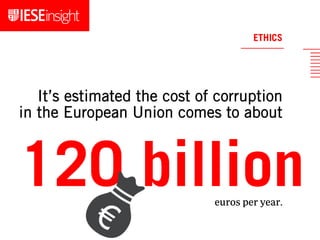
It’s estimated the cost of corruption
in the European Union comes to about
euros per year.
ETHICS
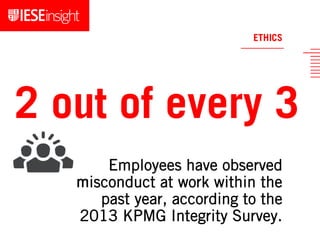
2 out of every 3
Employees have observed
misconduct at work within the
past year, according to the
2013 KPMG Integrity Survey.
ETHICS
And any whistleblowing policy
should have the following
components in place:
These data points make it clear:
Companies should strive
to create a culture promoting
transparency and dialogue.
ETHICS
Originally, whistleblowing
policies focused on financial
and accounting issues.
Nowadays they include fraud,
sexual harassment, bullying,
and dangers to health, safety
and the environment.
DEFINED SCOPE
ETHICS
Dedicated telephone tip lines, mailing
addresses, emails and online
software can be enabled. Although
calls are still the most popular way to
report wrongdoing, combining email
and software puts the internet ahead
as whistleblowers' channel of choice.
REPORTING CHANNELS
ETHICS
These are two critical features that go
hand in hand, and yet only 14% of all
matters currently reported have
anonymous sources. Using an
external provider can help protect a
whistleblower's identity and keep the
process confidential.
ANONYMITY & CONFIDENTIALITY
ETHICS
Employees should be aware of the
moral reasons for reporting (e.g.,
ensuring public safety and
corporate sustainability), and
training programs can help.
MORAL INCENTIVES
ETHICS
Consider monetary rewards.
For example, the U.S.
Securities and Exchange
Commission pays
whistleblowers 10-30% of the
sanction’s value for fines over
$1 million.
FINANCIAL INCENTIVES
ETHICS
Employees must be made aware of the
company's whistleblowing policy.
The board and top executives
must set the right tone.
The system must be evaluated regularly to
adapt to organizational changes and to make
sure the reporting channels actually work.
And on top of all this ...
ETHICS
More information is available in the
technical note “Whistleblowing Systems
and Policies,” by Antonino Vaccaro,
Gianmichele Potito and Enrique Aznar.
Visit

Key features for whistleblowing systems

  • 1.
  • 2.
    It’s estimated thecost of corruption in the European Union comes to about euros per year. ETHICS
  • 3.
    2 out ofevery 3 Employees have observed misconduct at work within the past year, according to the 2013 KPMG Integrity Survey. ETHICS
  • 4.
    And any whistleblowingpolicy should have the following components in place: These data points make it clear: Companies should strive to create a culture promoting transparency and dialogue. ETHICS
  • 5.
    Originally, whistleblowing policies focusedon financial and accounting issues. Nowadays they include fraud, sexual harassment, bullying, and dangers to health, safety and the environment. DEFINED SCOPE ETHICS
  • 6.
    Dedicated telephone tiplines, mailing addresses, emails and online software can be enabled. Although calls are still the most popular way to report wrongdoing, combining email and software puts the internet ahead as whistleblowers' channel of choice. REPORTING CHANNELS ETHICS
  • 7.
    These are twocritical features that go hand in hand, and yet only 14% of all matters currently reported have anonymous sources. Using an external provider can help protect a whistleblower's identity and keep the process confidential. ANONYMITY & CONFIDENTIALITY ETHICS
  • 8.
    Employees should beaware of the moral reasons for reporting (e.g., ensuring public safety and corporate sustainability), and training programs can help. MORAL INCENTIVES ETHICS
  • 9.
    Consider monetary rewards. Forexample, the U.S. Securities and Exchange Commission pays whistleblowers 10-30% of the sanction’s value for fines over $1 million. FINANCIAL INCENTIVES ETHICS
  • 10.
    Employees must bemade aware of the company's whistleblowing policy. The board and top executives must set the right tone. The system must be evaluated regularly to adapt to organizational changes and to make sure the reporting channels actually work. And on top of all this ... ETHICS
  • 11.
    More information isavailable in the technical note “Whistleblowing Systems and Policies,” by Antonino Vaccaro, Gianmichele Potito and Enrique Aznar. Visit