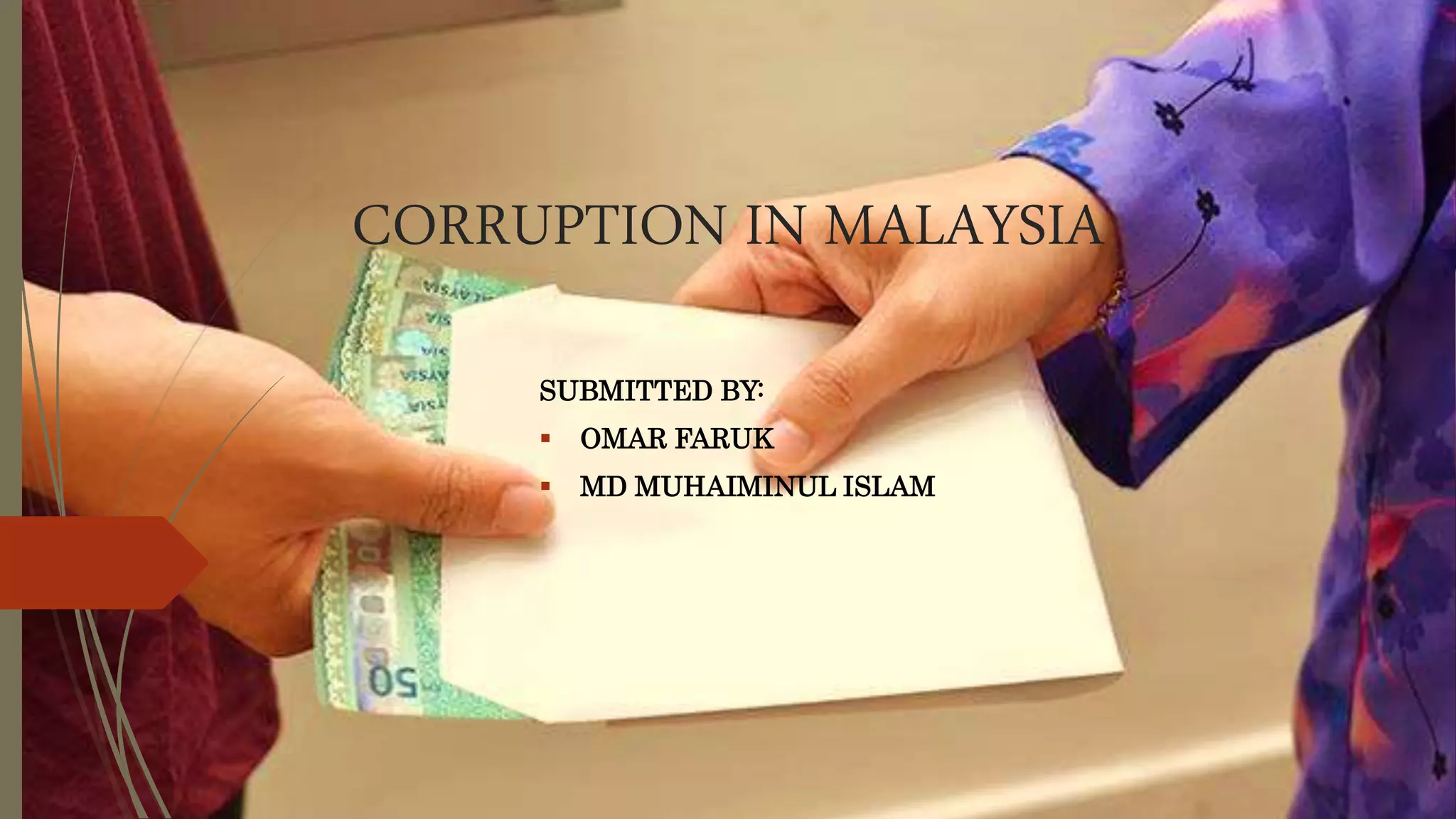


CORRUPTION IN MALAYSIA
SUBMITTED BY:
 OMAR FARUK
 MD MUHAIMINUL ISLAM
CONTENT
 DEFINITION
 TYPES OF CORRUPTION
 CAUSES FOR CORRUPTION
 EXAMPLE OF CORRUPTION
 OUR OPINION TO STOP CORRUPTION
 CONCLUSION
DEFINATION
Corruption is a form of dishonest or unethical conduct by a
person entrusted with a position of authority, often to acquire
personal benefit. Corruption may include many activities
including bribery and embezzlement, though it may also
involve practices that are legal in many
countries. Government, or 'political', corruption occurs when
an office-holder or other governmental employee acts in an
official capacity for personal gain.
TYPES OF CORRUPTION
 SYSTEMETIC CORRUPTION
 SPORADIC (INDIVIDUAL) CORRUPTION
 POLITICAL CORRUPTION
 ADMINISTRATIVE CORRUPTION
 PROFESSIONAL CORRUPTION
SYSTEMIC CORRUPTION
Systemic corruption (or endemic corruption) is corruption which is primarily due to the
weaknesses of an organization or process. It can be contrasted with individual officials or agents
act corruptly within the system.
INDIVIDUAL CORRUPTION
Sporadic corruption is the opposite of systematic corruption. Sporadic corruption occurs
irregularly and therefore it does not threaten the mechanisms of control nor the economy as such.
is not crippling, but it can seriously undermine morale and sap the economy of resources.
POLITICAL CORRUPTION
It includes kidnapping, murder, violence, injustice etc. To win in election, political leaders are
using wine, women, wealth and everything among the people. Political corruption not only leads
the misallocation of resources, but it also perverts the manner in which decisions are made.
ADMINISTRATIVE CORRUPTION
It includes persons like higher authorities, officers, police
officers, clerks, peons, etc. For example, If we give money, then
we can get anything difficult, easily.
PROFESSIONAL CORRUPTION
It means related to business. It includes duplicating
medicines, duplicating import items/theft items, duplicating
hygienic products, mixture in eatables etc.
CAUSES FOR CORRUPTION
 Absolute authority
 Ineffective anti-corruption mechanisms
 Lack of employment
 Privatization, Liberalization and Globalization
 Lack of awareness.
 Low literacy rate.
RECENT CORRUPTION
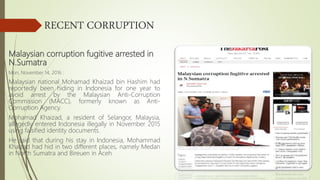
Malaysian corruption fugitive arrested in
N.Sumatra
Mon, November 14, 2016 :
Malaysian national Mohamad Khaizad bin Hashim had
reportedly been hiding in Indonesia for one year to
avoid arrest by the Malaysian Anti-Corruption
Commission (MACC), formerly known as Anti-
Corruption Agency.
Mohamad Khaizad, a resident of Selangor, Malaysia,
allegedly entered Indonesia illegally in November 2015
using falsified identity documents.
He said that during his stay in Indonesia, Mohammad
Khaizad had hid in two different places, namely Medan
in North Sumatra and Bireuen in Aceh
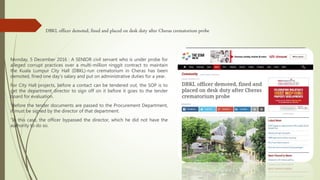
DBKL officer demoted, fined and placed on desk duty after Cheras crematorium probe
Monday, 5 December 2016 : A SENIOR civil servant who is under probe for
alleged corrupt practices over a multi-million ringgit contract to maintain
the Kuala Lumpur City Hall (DBKL)-run crematorium in Cheras has been
demoted, fined one day’s salary and put on administrative duties for a year.
For City Hall projects, before a contact can be tendered out, the SOP is to
get the department director to sign off on it before it goes to the tender
board for evaluation.
“Before the tender documents are passed to the Procurement Department,
it must be signed by the director of that department.
“In this case, the officer bypassed the director, which he did not have the
authority to do so.
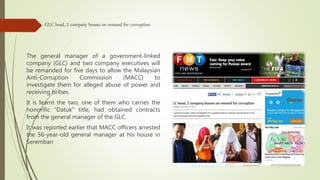
GLC head, 2 company bosses on remand for corruption
The general manager of a government-linked
company (GLC) and two company executives will
be remanded for five days to allow the Malaysian
Anti-Corruption Commission (MACC) to
investigate them for alleged abuse of power and
receiving bribes.
It is learnt the two, one of them who carries the
honorific “Datuk” title, had obtained contracts
from the general manager of the GLC.
It was reported earlier that MACC officers arrested
the 56-year-old general manager at his house in
Seremban
HOW CAN WE STOP CORRUPTION
There is no silver bullet for fighting corruption. Many countries have made significant progress in
curbing corruption, however practitioners are always on the lookout for solutions and evidence of
impact. Here are few ways that citizens and governments can make progress in the fight against
corruption:
 END IMPUNITY
Effective law enforcement is essential to ensure the corrupt are punished and break the cycle of
impunity, or freedom from punishment or loss. Successful enforcement approaches are supported by
a strong legal framework, law enforcement branches and an independent and effective court system.
 EMPOWER CITIZENS
Strengthening citizens demand for anti-corruption and empowering them to hold government
accountable is a sustainable approach that helps to build mutual trust between citizens and
government. For example, community monitoring initiatives have in some cases contributed to the
detection of corruption.
 REFORM PUBLIC ADMINISTRATION AND FINANCE MANAGEMENT
Reforms focusing on improving financial management and strengthening the role of auditing
agencies have in many countries achieved greater impact than public sector reforms on curbing
corruption. One such reform is the disclosure of budget information, which prevents waste and
misappropriation of resources
 PROMOTE TRANSPARENCY AND ACCESS TO INFORMATION
Countries successful at curbing corruption have a long tradition of government openness,
freedom of the press, transparency and access to information. Access to information increases the
responsiveness of government bodies, while simultaneously having a positive effect on the levels
public participation in a country.
Conclusion
Corruption is an intractable problem. It is like diabetes, can only be controlled, but not totally eliminated.
It may not be possible to root out corruption completely at all levels but it is possible to contain it within
tolerable limits.
Without access to the international financial system, corrupt public officials throughout the world would
not be able to launder and hide the proceeds of looted state assets. Major financial centers urgently
need to put in place ways to stop their banks and cooperating offshore financial centers from absorbing
illicit flows of money.
Thank you

Corruption in-malaysia

  • 1.
    CORRUPTION IN MALAYSIA SUBMITTEDBY:  OMAR FARUK  MD MUHAIMINUL ISLAM
  • 2.
    CONTENT  DEFINITION  TYPESOF CORRUPTION  CAUSES FOR CORRUPTION  EXAMPLE OF CORRUPTION  OUR OPINION TO STOP CORRUPTION  CONCLUSION
  • 3.
    DEFINATION Corruption is aform of dishonest or unethical conduct by a person entrusted with a position of authority, often to acquire personal benefit. Corruption may include many activities including bribery and embezzlement, though it may also involve practices that are legal in many countries. Government, or 'political', corruption occurs when an office-holder or other governmental employee acts in an official capacity for personal gain.
  • 4.
    TYPES OF CORRUPTION SYSTEMETIC CORRUPTION  SPORADIC (INDIVIDUAL) CORRUPTION  POLITICAL CORRUPTION  ADMINISTRATIVE CORRUPTION  PROFESSIONAL CORRUPTION
  • 5.
    SYSTEMIC CORRUPTION Systemic corruption(or endemic corruption) is corruption which is primarily due to the weaknesses of an organization or process. It can be contrasted with individual officials or agents act corruptly within the system. INDIVIDUAL CORRUPTION Sporadic corruption is the opposite of systematic corruption. Sporadic corruption occurs irregularly and therefore it does not threaten the mechanisms of control nor the economy as such. is not crippling, but it can seriously undermine morale and sap the economy of resources.
  • 6.
    POLITICAL CORRUPTION It includeskidnapping, murder, violence, injustice etc. To win in election, political leaders are using wine, women, wealth and everything among the people. Political corruption not only leads the misallocation of resources, but it also perverts the manner in which decisions are made.
  • 7.
    ADMINISTRATIVE CORRUPTION It includespersons like higher authorities, officers, police officers, clerks, peons, etc. For example, If we give money, then we can get anything difficult, easily. PROFESSIONAL CORRUPTION It means related to business. It includes duplicating medicines, duplicating import items/theft items, duplicating hygienic products, mixture in eatables etc.
  • 8.
    CAUSES FOR CORRUPTION Absolute authority  Ineffective anti-corruption mechanisms  Lack of employment  Privatization, Liberalization and Globalization  Lack of awareness.  Low literacy rate.
  • 9.
    RECENT CORRUPTION Malaysian corruptionfugitive arrested in N.Sumatra Mon, November 14, 2016 : Malaysian national Mohamad Khaizad bin Hashim had reportedly been hiding in Indonesia for one year to avoid arrest by the Malaysian Anti-Corruption Commission (MACC), formerly known as Anti- Corruption Agency. Mohamad Khaizad, a resident of Selangor, Malaysia, allegedly entered Indonesia illegally in November 2015 using falsified identity documents. He said that during his stay in Indonesia, Mohammad Khaizad had hid in two different places, namely Medan in North Sumatra and Bireuen in Aceh
  • 10.
    DBKL officer demoted,fined and placed on desk duty after Cheras crematorium probe Monday, 5 December 2016 : A SENIOR civil servant who is under probe for alleged corrupt practices over a multi-million ringgit contract to maintain the Kuala Lumpur City Hall (DBKL)-run crematorium in Cheras has been demoted, fined one day’s salary and put on administrative duties for a year. For City Hall projects, before a contact can be tendered out, the SOP is to get the department director to sign off on it before it goes to the tender board for evaluation. “Before the tender documents are passed to the Procurement Department, it must be signed by the director of that department. “In this case, the officer bypassed the director, which he did not have the authority to do so.
  • 11.
    GLC head, 2company bosses on remand for corruption The general manager of a government-linked company (GLC) and two company executives will be remanded for five days to allow the Malaysian Anti-Corruption Commission (MACC) to investigate them for alleged abuse of power and receiving bribes. It is learnt the two, one of them who carries the honorific “Datuk” title, had obtained contracts from the general manager of the GLC. It was reported earlier that MACC officers arrested the 56-year-old general manager at his house in Seremban
  • 12.
    HOW CAN WESTOP CORRUPTION There is no silver bullet for fighting corruption. Many countries have made significant progress in curbing corruption, however practitioners are always on the lookout for solutions and evidence of impact. Here are few ways that citizens and governments can make progress in the fight against corruption:  END IMPUNITY Effective law enforcement is essential to ensure the corrupt are punished and break the cycle of impunity, or freedom from punishment or loss. Successful enforcement approaches are supported by a strong legal framework, law enforcement branches and an independent and effective court system.  EMPOWER CITIZENS Strengthening citizens demand for anti-corruption and empowering them to hold government accountable is a sustainable approach that helps to build mutual trust between citizens and government. For example, community monitoring initiatives have in some cases contributed to the detection of corruption.
  • 13.
     REFORM PUBLICADMINISTRATION AND FINANCE MANAGEMENT Reforms focusing on improving financial management and strengthening the role of auditing agencies have in many countries achieved greater impact than public sector reforms on curbing corruption. One such reform is the disclosure of budget information, which prevents waste and misappropriation of resources  PROMOTE TRANSPARENCY AND ACCESS TO INFORMATION Countries successful at curbing corruption have a long tradition of government openness, freedom of the press, transparency and access to information. Access to information increases the responsiveness of government bodies, while simultaneously having a positive effect on the levels public participation in a country.
  • 14.
    Conclusion Corruption is anintractable problem. It is like diabetes, can only be controlled, but not totally eliminated. It may not be possible to root out corruption completely at all levels but it is possible to contain it within tolerable limits. Without access to the international financial system, corrupt public officials throughout the world would not be able to launder and hide the proceeds of looted state assets. Major financial centers urgently need to put in place ways to stop their banks and cooperating offshore financial centers from absorbing illicit flows of money.
  • 15.