Valladeau Christel Negotiation courses
1
CHAPTER 1 - UNDERSTANDING INTERPERSONAL
COMMUNICATION
I. DEFINITION
We speak of interpersonal communication when at least two people are involved.
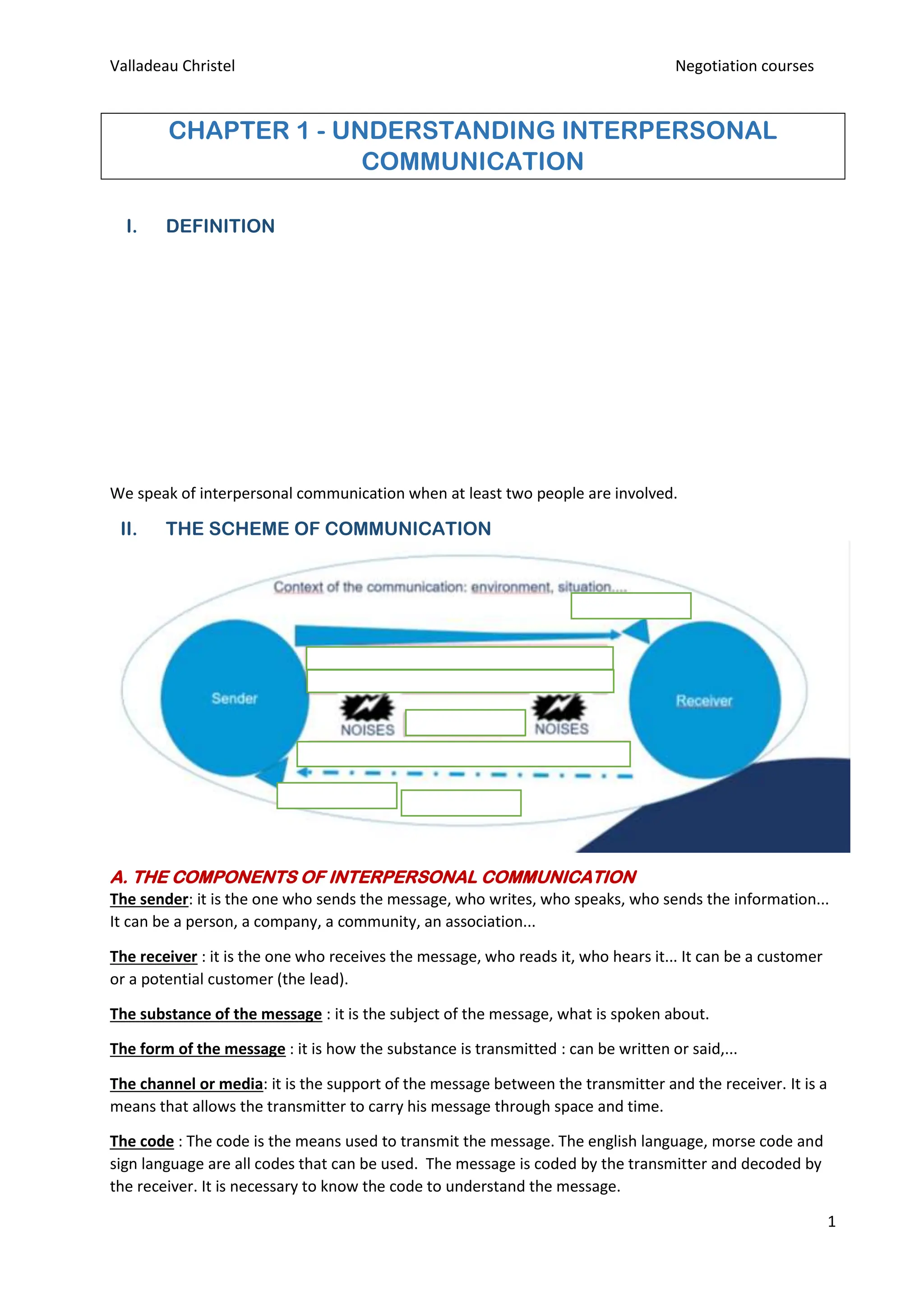
II. THE SCHEME OF COMMUNICATION
A. THE COMPONENTS OF INTERPERSONAL COMMUNICATION
The sender: it is the one who sends the message, who writes, who speaks, who sends the information...
It can be a person, a company, a community, an association...
The receiver : it is the one who receives the message, who reads it, who hears it... It can be a customer
or a potential customer (the lead).
The substance of the message : it is the subject of the message, what is spoken about.
The form of the message : it is how the substance is transmitted : can be written or said,...
The channel or media: it is the support of the message between the transmitter and the receiver. It is a
means that allows the transmitter to carry his message through space and time.
The code : The code is the means used to transmit the message. The english language, morse code and
sign language are all codes that can be used. The message is coded by the transmitter and decoded by
the receiver. It is necessary to know the code to understand the message.
Communication consists in transmitting information, ideas and emotions to others.
- To inform and be informed
- To understand
Message (substance)
Message (Form)
Encoding Code Decoding
Channel
Filters Feedback
Filters
Valladeau Christel Negotiation courses
2
The context : this is everything that accompanies the communication, it is the environment. We mainly
differentiate
- the relational context: professional, friendly...
- the spatial context: place of the communication
- the temporal context: it includes both the moment and the duration of the communication;
The noise : it is all that disturbs the communication : the parasites in a radio communication, the noise
of the street during a conversation, a bad quality of paper or printing which does not allow to read a text
well...
The filters : there are many filters that prevent the full message from getting to the receiver, that is why
the feed back is essential.
The feedback is : When the message has reached the receiver, the latter receives it according to his
personality, his positive or negative perception of the message, his behavior. This impact of the message
encourages him to respond to the sender. The receiver in turn becomes a sender who sends back a
message related to the one he has just received.
B. THE COMMUNICATION FILTERS
There are many types of filters: neurological, cultural and personal that interpose themselves between
the "reality" and the experience that we have of it.
➔ The neurological filter or bias
The universe as it appears to us through our senses is the result of structures specific to our brain and
our nervous system.
➔ The socio-cultural filter
The socio-cultural frame of reference in which we evolve considerably influences our own frame of
reference. Through myths, rites, values, beliefs, languages...
➔ Personal Filters
The environment in which we have lived, the education we have received, the influence exerted by our
parents and important people, the multiple experiences we have had as children and then as adults
have influenced our way of conceiving things in a particular way.
All these filters influence the encoding and decoding of information. Interpretation is an ongoing
process in human communication.
Consequences of these filters :
Feedback is the simplest
III. FORMS OF COMMUNICATION
According to an American researcher, Albert Mehrabian, 55% of oral communication is based on
behavioral codes (gestures, mimicry, attitudes), 38% on intonational codes and only 7% on verbal codes.
A. VERBAL COMMUNICATION
It is the whole of the words used (said, read or heard). Verbal communication makes it possible to
define the content of the relationship (e.g.: feeling, idea).
and most necessary quality control tool in a communication process.
1. Our view of the world is not the world
2. This vision varies from one individual to another.
lot of losses in communication is an oral message.
Valladeau Christel Negotiation courses
3
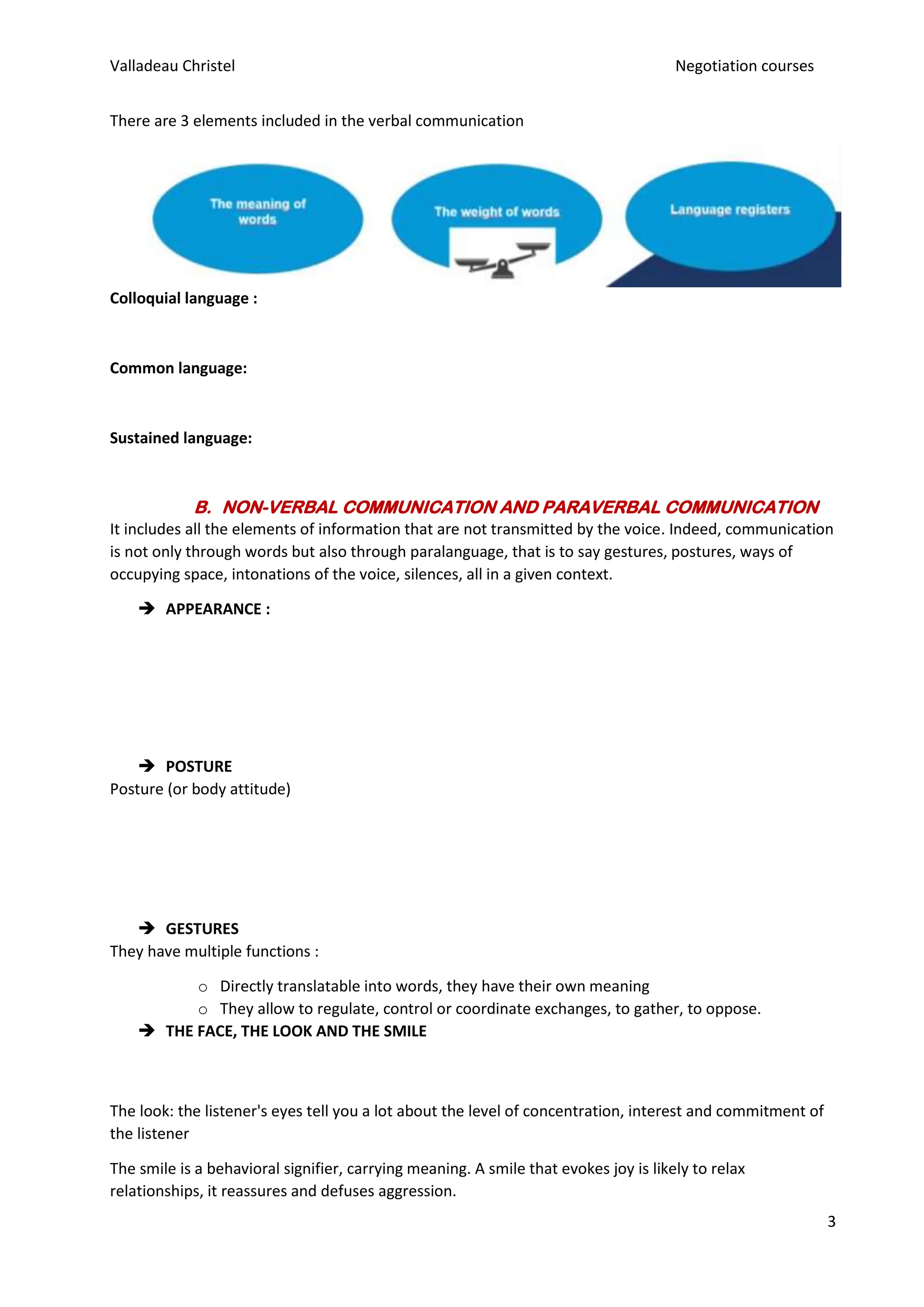
There are 3 elements included in the verbal communication
Colloquial language :
Common language:
Sustained language:
B. NON-VERBAL COMMUNICATION AND PARAVERBAL COMMUNICATION
It includes all the elements of information that are not transmitted by the voice. Indeed, communication
is not only through words but also through paralanguage, that is to say gestures, postures, ways of
occupying space, intonations of the voice, silences, all in a given context.
➔ APPEARANCE :
➔ POSTURE
Posture (or body attitude)
➔ GESTURES
They have multiple functions :
o Directly translatable into words, they have their own meaning
o They allow to regulate, control or coordinate exchanges, to gather, to oppose.
➔ THE FACE, THE LOOK AND THE SMILE
These are essential elements in all direct communication situations. The face, through mimics, can
express the most basic emotions : surprise, sadness, disgust, anger, joy or fear.
The look: the listener's eyes tell you a lot about the level of concentration, interest and commitment of
the listener
The smile is a behavioral signifier, carrying meaning. A smile that evokes joy is likely to relax
relationships, it reassures and defuses aggression.
the transmitter uses words or popular expressions whicj are proscribed in theprofessional
environment.
this is the useal language. He used a correct syntaxis and a simple vocabulary.
this corresponds to written literary language. It uses a syntax and a sophisticated vocalbulary less
used in everyday life.
The clothes or accessories we choose speak about us, wherether we like it or not.
The appearnce depends on the situation, which clothes will be most appropriate for
The various signs linked to posture, wherether voluntary or not, inform other people about emotional states and the
diesires to communicate or not.
often conveys the degree of sociability at a given moment
Barrier gesture:
Perturbing gestures: they are out of sync with the message you are trying to get accross
These are essential elements in all direct communication situations. the face, through mimics, can express the most
basic emotions: surprise, sadness, disgust, anger, joy or fear.
Even with the mask , we can see when peple are smilling: in the eues expression but also when the person start to speak
-> The smile is heard when you are on the phone.
Valladeau Christel Negotiation courses
4
➔ THE VOCAL DIMENSION OF SPEECH : the para verbal comunication
The timbre : According to the individuals, the tone of voice will be very different.
The intensity or volume: This is the sound level of the voice. It is necessary to adapt this level to the size
of the space, to the disposition of the public, and to the number of people present.
Intonation: This is the melodic movement of the voice, characterized by variations in pitch. As in music,
it is necessary to find one's score and play on different notes.
Flow : This is the number of words per minute.
Silences are also part of communication.
Conclusion :
In order to communicate more effectively, speech and body expression must be congruent (i.e. in
agreement) and express the same thing. We are congruent when what we show (behavior) and what we
feel (internal state) are in agreement with what we say.
According to the individuals, the tone of voice will be very different.
This is the melodic movement of the voice, characterized by variations in pitch.
This is the sound level of the voice.
This is the number of words per minute.
Silence: Silences are also part of communication.
They give the speaker time to think, to transfer the word to the interlocutor.
They divide the speech into understandable units.
They can give weight to what has been said.
Conclusion
In order to communicate more effectively, speech and body expression must be congruent (i.e. in agreement) and
express the same thing.
We are congruent when what we show (behavior) and what we feel (internal state) are in agreement with what we say.
CHAPTER 2- MASTERING THE INTERPERSONAL COMMUNICATION
So when communicating, you have to be aware that certain elements can slow down the circulation of
the message.
 What are the elements that influence communication situations ?
 What are the tools to adopt to better convince.
I. Analysis of the context of the interpersonal communication situation
A. The status and role of the actors
In an interpersonal communication situation, it is necessary to take into account :
 the status of the interlocutor, i.e. his position in the organization, the hierarchy or the social
structure ;
 his role, i.e. what society expects of him, the behaviors or conduct he should adopt in relation to
his status.
B. Personality
DEFINITION : An individual’s personality is a set of behaviours, attitude and emotional characteristics
which make them different and distinctive.
It is difficult to identify the personality of your interlocutor althoughs it is very useful. But there are
some methods that may help you (PCM model)
The personality results from the combination of several character traits like :
 Extraversion: applies to individuals who are enthusiastic, sociable, like to interact and express
themselves. Its opposite is introversion.
 Autonomy: applies to people who are independent, who do not need others and who like to
undertake, who are dominant. Its opposite is submission.
 Stability: individuals who are calm, relaxed, self-controlled, and trustworthy because their
behavior is consistent. Its opposite is instability.
 Logical: people who think before they act, who let themselves be guided by their reason and not
by their emotions; someone who is not logical is said to be emotional.
Thanks to a close observation of the communication process, you can adapt our message to the
personality of our interlocutor.
II. THE PERSONAL ELEMENTS TO TAKE INTO ACCOUNT
 Knowing yourself
Each person's personality is expressed through a combination of emotional characteristics, attitudes
(what we feel, what we think) and behaviors (how we are, how we act or react).
The character traits (adaptability, sociability, combativeness, etc.) and the emotions of each person have
an impact on the exchange between the actors.
 Behave professionally
All professional environments have their own codes that must be adhered to and adapted to in order to
be able to hold one's own in all circumstances and be effective and credible.
For example in face to face meeting , it is important to respect the customs and codes related to face-to-
face exchanges : rituals of politeness (handshake), questioning, listening and rephrasing of the
interlocutor's words.
By phone, when receiving or making a call, the salesperson must adopt a professional approach by being
prepared both materially (a quiet desk, mastered scripts, contact sheets and notepads within reach) and
psychologically, since a smile can be heard on the telephone.
In written exchanges, the style must be adapted to the target and the media used, clear, concise,
punchy and lively in order to catch the attention of the people targeted, to invite them to "react"
positively to the proposals made... Spelling must be impeccable.
III. TOOLS/TECHNIQUES TO CONVINCE
Commitment : To take an active part in the situation, first of all, the negotiator must be commited by
defending his positions and by controlling his emotions.
Secondly he must show empathy.
Empathy is the understanding and the recognition of the feelings, beliefs and emotions of another
individual. It is the ability to get on the same "wavelength" as the person you are talking to adapt to his
or her mode of communication
The empathetic salesperson will make the difference by being able to synchronize with the customer
and find the right arguments to answer objections and enhance the value of the offer. Being empathetic
will allow a strong adaptability to different buyer profiles.
Finally he must be able to listen actively :
Active listening is the ability to listen to others without judging them, to question them and to
reformulate their words in order to clarify the meaning of their words and intentions and to avoid
distortions ans generalizations.
Active listening requires the following attitudes :
Openness
Showing a real interest of the speaker in what the other person says
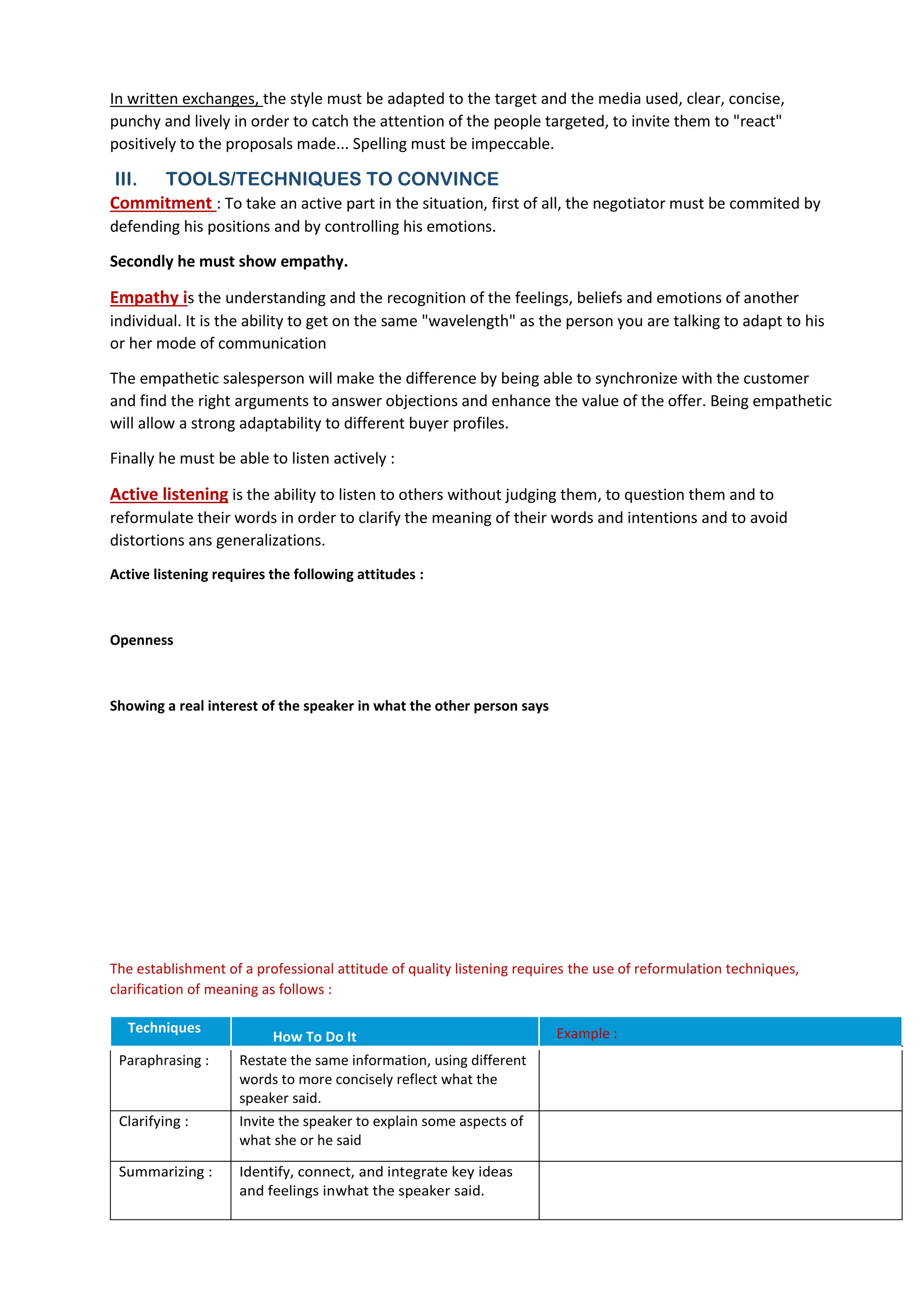
The establishment of a professional attitude of quality listening requires the use of reformulation techniques,
clarification of meaning as follows :
Techniques
How To Do It Example :
Paraphrasing : Restate the same information, using different
words to more concisely reflect what the
speaker said.
Clarifying : Invite the speaker to explain some aspects of
what she or he said
Summarizing : Identify, connect, and integrate key ideas
and feelings inwhat the speaker said.
No judgement Neutrality ( no negative or positive judgement)
- Let the other person speak without interrupting,
- Give regular visual signs of interest and encouragement
- Ask questions and/ or use rẻomulation techniques
- Ignore distractions
- Take notes
" What I'm hearing is...."
" It sounds like what's most important to you is.."
"i am not sure i quite understand or do you mean that.."
" You have given me a lot of information, let me if I've
got it all..."
" Let me summarize what I heard so far..."
"So, on one the hand..but on the other hand.."
1
Chapter 3- Identifying a new source of revenue growth.
Most of the time, in order to survive, companies need to generate growth and the sales force ‘s task is
to contribute to this mission.
How to do that ?
I. KNOWLEDGE OF THE PRODUCTS AND THE TARGET
Faced with very diverse banking markets - the retail market, the corporate market, the farmers'
market - and with clients with heterogeneous needs and characteristics, the bank cannot offer a single
product for all its potential clients. It is therefore necessary to segment the clientele so that each
group can find in the bank the products that are adapted to its activities.
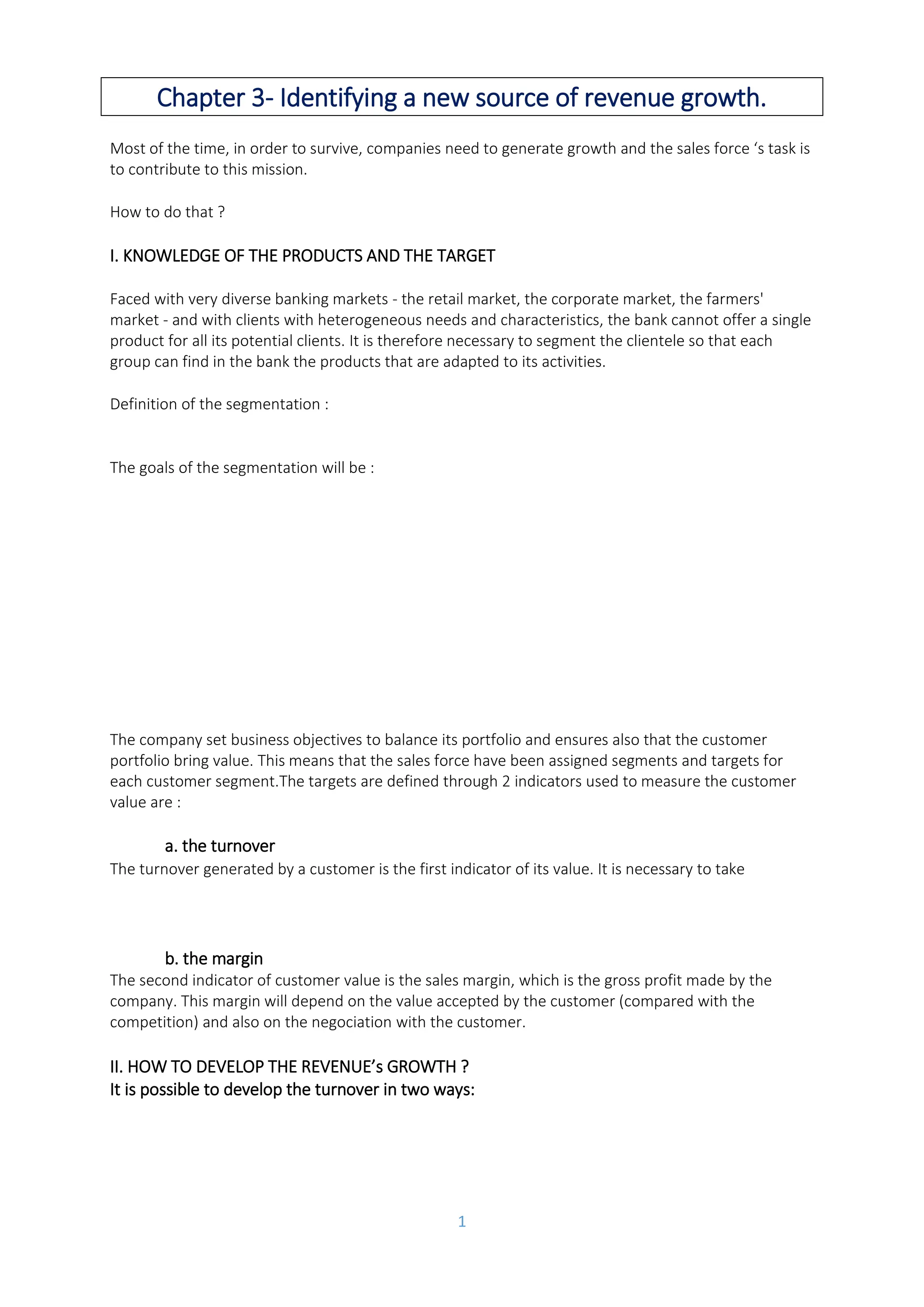
Definition of the segmentation : dividing all clients and prospects into a certain number of market
subsets that have homogeneous characteristics, .
The goals of the segmentation will be :
• To create products specific to the segment's clientele that best meet their specific
needs
• To define a specific commercial policy for the segment, thus obtaining an obvious
competitive advantage over competing institutions.
• To better communicate with the segment's clientele.
• And ultimately to optimize the bank's commercial strategy.
The company set business objectives to balance its portfolio and ensures also that the customer
portfolio bring value. This means that the sales force have been assigned segments and targets for
each customer segment.The targets are defined through 2 indicators used to measure the customer
value are :
a. the turnover
The turnover generated by a customer is the first indicator of its value. It is necessary to take into
account the actual turnover but also the potential turnover, which corresponds to the
projected volume of purchase of the good or service sold by the company.
b. the margin
The second indicator of customer value is the sales margin, which is the gross profit made by the
company. This margin will depend on the value accepted by the customer (compared with the
competition) and also on the negociation with the customer.
II. HOW TO DEVELOP THE REVENUE’s GROWTH ?
It is possible to develop the turnover in two ways:
➔ by developing customer loyalty, by optimizing the consumption or the number of
goods/services held by the customer;
- To create products specific to the segment's clientele that best meet their specific needs.
- To define a specific commercial policy for the segment , thus obtaining an obviuos competive adcantage over
competing institutions.
- To better communicate with the segment's clientele.
- And ultimately to optmize the bank's commercial strategy.
Segmentation simply consists in dividing all clients and prospects into a certain number of market subsets that have
homogeneous characteristics.
It is necessary to take into account the actual turnover but also the potential turnover, which
corresponds to the projected volume of purchase of the good or service sold by the company.
It is possible to develop the turnover and sometimes the margin in two ways:
-by developing customer loyalty, by optimizing the consumption or the number of goods/ services
held by the custoner;
- by conquest, by developing the turnover towards a new target or by taking market shares from the
competition.
2
➔ by conquest, by developing the turnover towards a new target or by taking market
shares from the competition, that means the potential customers.
The company's potential customers include current (or actual) consumers of the competitors and
the relative non-consumers (the ones that do not have an account now).
To develop revenue ‘s growth, a detailed knowledge of the customer makes it possible to adapt
the company's offer in order to sell it better, and sometimes even to anticipate the customer's
needs and thus increase the customer satisfaction rate and the loyalty rate.
All large companies have understood this, as shown by the strong development of the
customer-centric approach and the development of commercial IT systems.
Qualified databases offer powerful information processing possibilities (e.g.: data analysis
according to multiple criteria, sorting, filtering, extraction of profiles common to a group of
customers).
Collecting and centralizing data in a CRM (Customer Relationship Management) software
allows to better understand customers' needs, to better serve them and to improve the
relationship with them.
The basic information to open a bank account is necessarily stored in the customer database but
these one must be enriched and completed during or after each appointment.
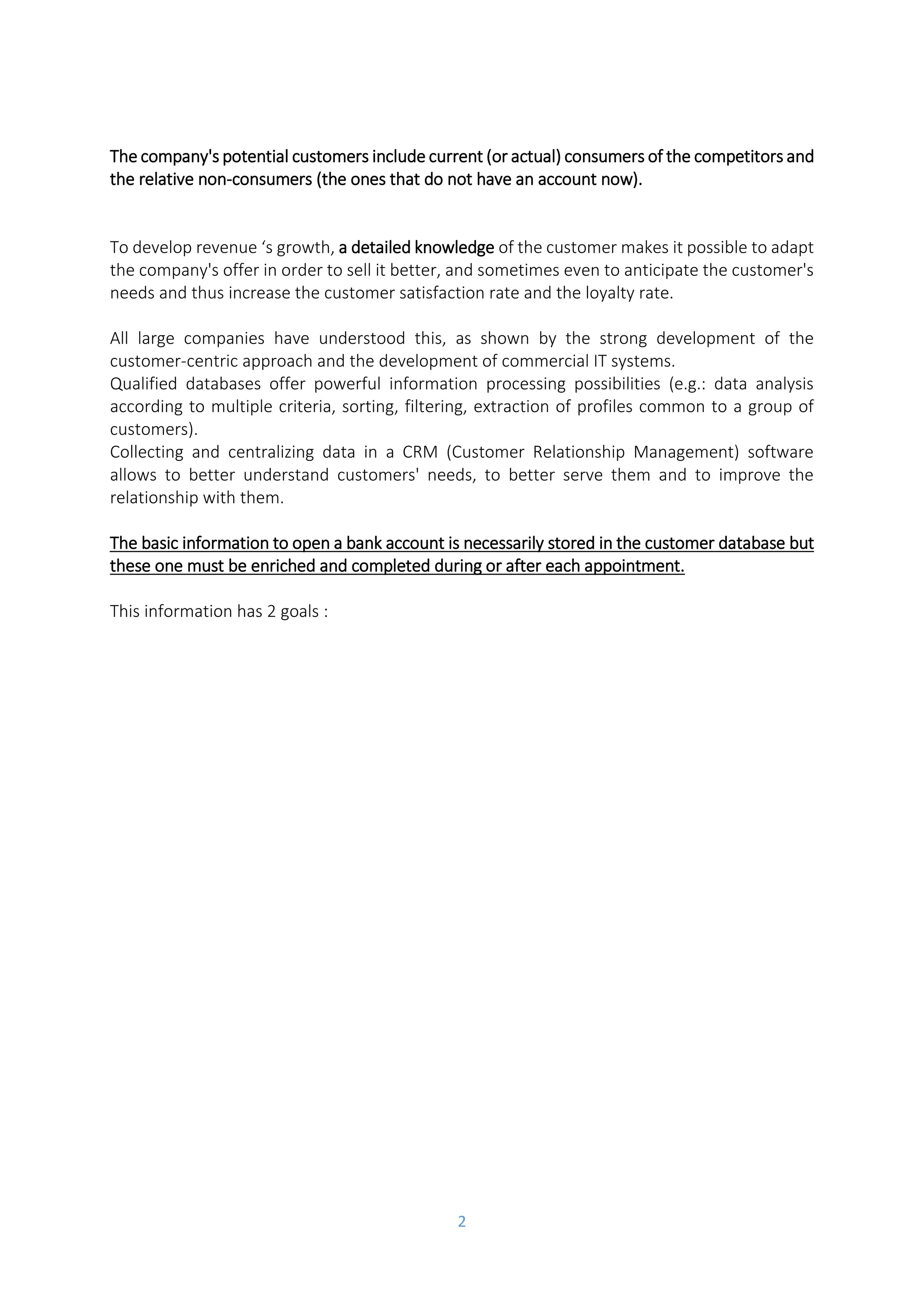
This information has 2 goals :
➔ To prepare the negotiation or phone call in order to propose an adapted offer to the
customer,
➔ To measure the contribution of each customer to the company's profitability and then
define the priority targets, on which it will concentrate its resources.
-> prospection actions
- To prepare the negotiation or phone call in order to propose an adapted offer to the customer;
- To measure the contribution of each customer to the company's profitability and then define the
priority targets, on which it will concentrate its resources.
1
CHAPTER 4 - THE SALES TOOS TO GET READY.
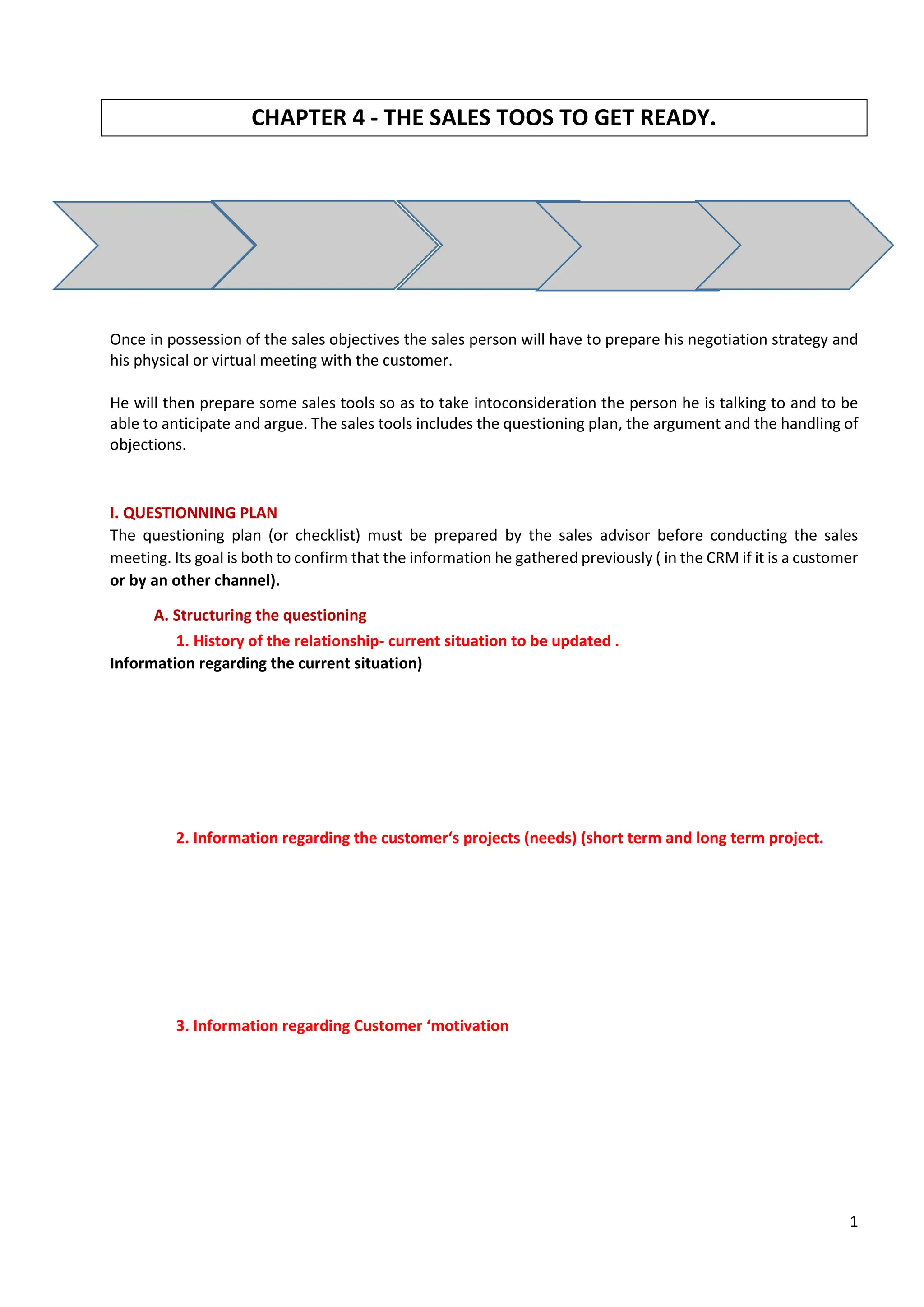
Once in possession of the sales objectives the sales person will have to prepare his negotiation strategy and
his physical or virtual meeting with the customer.
He will then prepare some sales tools so as to take intoconsideration the person he is talking to and to be
able to anticipate and argue. The sales tools includes the questioning plan, the argument and the handling of
objections.
I. QUESTIONNING PLAN
The questioning plan (or checklist) must be prepared by the sales advisor before conducting the sales
meeting. Its goal is both to confirm that the information he gathered previously ( in the CRM if it is a customer
or by an other channel).
A. Structuring the questioning
1. History of the relationship- current situation to be updated .
Information regarding the current situation)
2. Information regarding the customer‘s projects (needs) (short term and long term project.
3. Information regarding Customer ‘motivation
Knowledge
of your
segment
knowledge of the
products
are right and also to make sure the sales advisor will get the information
needed
Extraction of the database (if customer) + questions
if missing information.
-> Questions about his or her function, role,
environment, constraints,...
Start with the information you know
Check and update
Example if historical customer:
How is your work going?
-> To find out the real needs and motivation of the Lead or Customer
-> The reason of the appointment
-> Questions on the short term projects and long-term projects
-> What is he expected from us in the future?
-> To define the customer profile and his/ her expectation
-> To argue
-Search for information on the motivations and expectations of the client or the lead.
The 4 essential questions:
- What is the most important thing for you with a bank?
- What is a good product for you?
- What does being well insured mean to you?
- What makes you want to change of Bank?
-Ask finally a technical question related to your initial request with a fundamental question
-> What is the main gurantee for you in this contract?
The answer will be used in the argurmentation
2
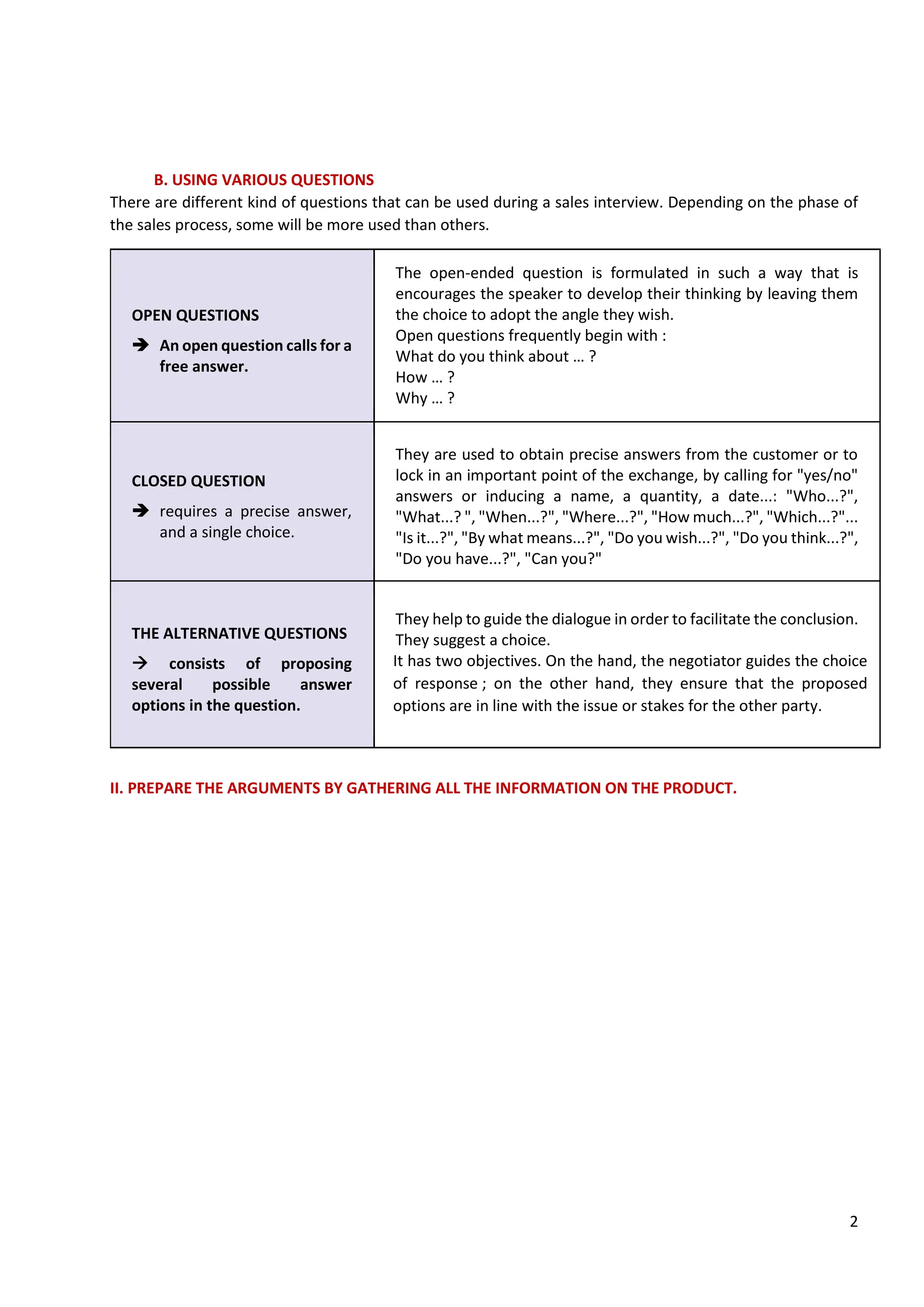
B. USING VARIOUS QUESTIONS
There are different kind of questions that can be used during a sales interview. Depending on the phase of
the sales process, some will be more used than others.
OPEN QUESTIONS
➔ An open question calls for a
free answer.
The open-ended question is formulated in such a way that is
encourages the speaker to develop their thinking by leaving them
the choice to adopt the angle they wish.
Open questions frequently begin with :
What do you think about … ?
How … ?
Why … ?
CLOSED QUESTION
➔ requires a precise answer,
and a single choice.
They are used to obtain precise answers from the customer or to
lock in an important point of the exchange, by calling for "yes/no"
answers or inducing a name, a quantity, a date...: "Who...?",
"What...? ", "When...?", "Where...?", "How much...?", "Which...?"...
"Is it...?", "By what means...?", "Do you wish...?", "Do you think...?",
"Do you have...?", "Can you?"
THE ALTERNATIVE QUESTIONS
→ consists of proposing
several possible answer
options in the question.
They help to guide the dialogue in order to facilitate the conclusion.
They suggest a choice.
It has two objectives. On the hand, the negotiator guides the choice
of response ; on the other hand, they ensure that the proposed
options are in line with the issue or stakes for the other party.
II. PREPARE THE ARGUMENTS BY GATHERING ALL THE INFORMATION ON THE PRODUCT.
The sales advisor must know all the characteristics of the products so as to be able to propose the right
product/service to the customer.
- A characteristic corresponds to an intrinsic property of the good or service.
With the knowledge of the products, the sales advisor will be able to prepare his arguments.
A sales argument is a sentence that aims to convince the customer that the proposed solution meets his
needs and motivations. Arguments highlight and prove the advantages that the characteristics of the good
or service will provide to the customer.
An argument is built around three elements according to the CAP or CAB method:
Argument = Characteristic + Advantage + Proof or Characteristics + Advantage + Benefits.
- An advantage is an exposure of the positive points and the added values
- A benefit is what it will brings to the customer. It is a matter of presenting to the buyer the positive
consequences of the identified characteristics.
In oder to prepare the sales negotiation, the sales advisor....
A sales argument is a sentence that aims to convince the customer that proposed solution meets his needs
and motivations
Arguments highlight and prove the advantages that the characteristics of the good or service will provide to
the customer
An argument is built around three elements accordng to the CAP or CAB method:
Argument= Characteristic + Advantage + Proof (CAP)
or Characteristics + Advantage + Benefits (CAB)
An advantage is an exposure of the positive points and the added values for the customer
A proof is a means to support the benefits presented. It can be a demonstration, a trial, customer testiminials,
press articles, comparative studies....
A benefit is what it will bring to the customer.
To convince the customer we have to adapt our comminication yo the customer
-> Then give appropriate arguments according to his buying motivations.
3
- A proof is a means to support the positive points presented. It can be a demonstration, a trial, customer
testimonials, press articles, comparative studies...
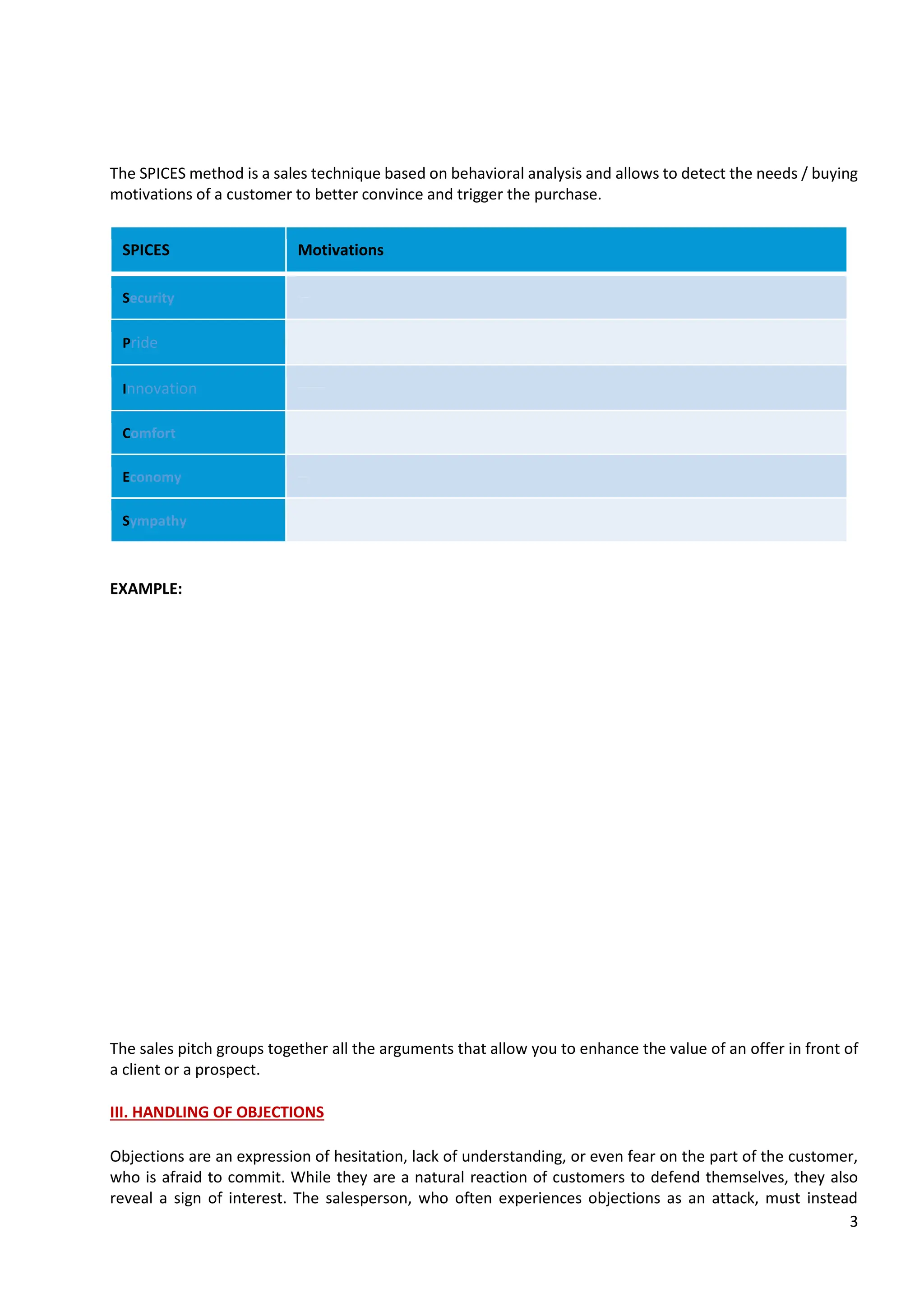
The SPICES method is a sales technique based on behavioral analysis and allows to detect the needs / buying
motivations of a customer to better convince and trigger the purchase.
SPICES Motivations
Security Low risk or no risk, …
Pride Premium services, high rang e, unique products
Innovation Innovation, use of the last new technology
Comfort Easy to use, easy to understand
Economy Interesting price,
Sympathy To please somebody else
EXAMPLE: building an argument with the CAB method
Characteristics : With the Medical Care Insurance
Advantages : We can give you and your loved ones 5 affordable Medical Care Insurance plans
Benefit : your family will be protected
→ Profile : SYMPATHY
The sales pitch groups together all the arguments that allow you to enhance the value of an offer in front of
a client or a prospect.
III. HANDLING OF OBJECTIONS
Objections are an expression of hesitation, lack of understanding, or even fear on the part of the customer,
who is afraid to commit. While they are a natural reaction of customers to defend themselves, they also
reveal a sign of interest. The salesperson, who often experiences objections as an attack, must instead
security
Low rish or
no risk,...
Price
Premium services, high
range, unique products
Innovation Innovation, use of the
last new technology
Comfort Easy to use, easy to
understand
Economy
Interesting price
Sympathy To please somebody else
Comfortable profile:
Our dress is made with linen in case of high heat, you will feel comfortable, you are protected
Economy profile:
Our dress has 10% saving until nest Tuesday it is a very good deal for this quality.
Differentiation from others (trendy, original, even expensive produets) to
distinguish oneself, generate a feeling of power or domination.
Search for new products, solutions or materials, bringing new
possibilities (on the lookout for new technologies).
Search for well-being, through products that are easy to use,
multi-purpose and that make lite easier.
Money Search for the cheapest products, with the best quality/price ratio,
giving priority to robust and inexpensive products.
Willingness to please or to please oneself (purchase for others or to
favour a particular salesperson because of his or her good advice)
Research of its own protection and that of others (reliable products)
4
perceive them as a springboard for rallying the customer or prospect to his or her position and bringing him
or her to the conclusion of the sale.
A. List the objections
In order not to be caught off guard in front of the customer, it is important to anticipate objections. Before
the meeting, the salesperson should try to identify all possible objections.
B. Responding to objections ADRA TECHNIC
To answer an objection correctly, the salesperson must follow several steps.
1. Approve the objection
First, the salesperson lets the other person express himself without interrupting. He then shows
understanding, without devaluing the objection (this would be tantamount to devaluing the customer). It is
therefore important to avoid expressions such as: "You're wrong", "That's not true!
On the contrary, it is recommended to start with a sentence like: "You are right", "I understand you very
well", "You are right to draw my attention to...".
2. Discover the real obstacle to buying
The sales person should dig deeper and discover the deep nature of the sales objection.
To do this, he should use open-ended questions in order to invite the interlocutor to express himself and to
develop his comments.
Examples of discovery questions when faced with an objection
➔ What makes you think or say that?
This will allow the salesman to bring to light all the problematic elements in order to provide specific business
solutions later on.
➔ Is there anything else you are concerned about?
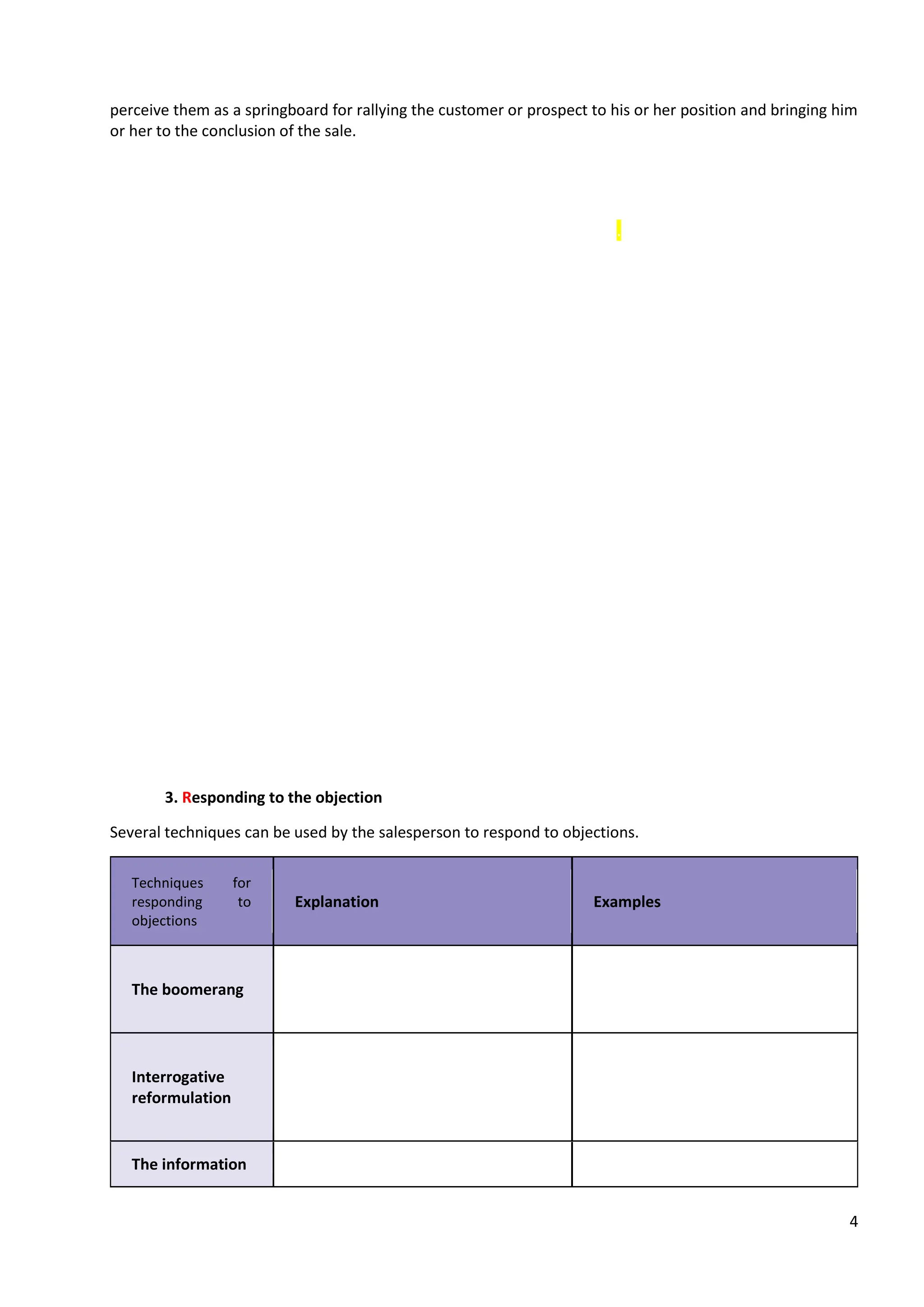
3. Responding to the objection
Several techniques can be used by the salesperson to respond to objections.
Techniques for
responding to
objections
Explanation Examples
The boomerang
This technique consists of answering
the objection based on what the
customer or prospect has just said.
Interrogative
reformulation
By taking up the objection in the
form of a question, the customer or
prospect is invited to express himself
and to deepen his objection.
The information
5
When faced with an unfounded but
sincere objection, the salesperson
can provide additional information
that will allow the customer or
prospect to better understand the
suitability of the offer to his needs.
4.-Check the customer's Acceptance
For effective objection handling, systematically check the acceptance of the objections !
This is the principle of commitment and consistency that will facilitate the realization of the sale
Let's see how to proceed according to the different categories of objections.
Check the acceptance of the evidence put forward, with a question like:
• Are you reassured on this point?
1, The boomerang
- This technique consists of answering the objection based on what the customer or prospect has just said.
Example:
Objection: "I am sastisfied with my current insurance company"
Answer: " That's why I'm offering you a comparative study with no commitment on your part."
2, Interrogative reformulation
By taking up the objection in the form of a question, the customer or prospect is invited to express himself and to deepen his
objection.
Objection: "I'm not interested"
Response: "May I ask what you are not interested in?"
3, The information
The salesperson can provide additional information that will allow the customer or prospect to better understand the suitability of
the offer to his needs.
Objection: " I don't understand how your product with solve my cash flow problem.."
Response: " I suggest you loot at the results if we run a simulation with your company's numbers from last year."
4, Check the customer's Acceptance
For effective objection hadling, systematically check the acceptance of the objections!
This is the principle of commitment and consistency that will facilitatw the realization of the sale
Check the acceptance of the evidence but forward, with a question like:
-> Are you reassured on this point?
-> Can we close the deal now?
If not, ask your interlocutor what evidence would be able to convice him.
For example, you can rebound with a formulation such as:
-> In view of all the elements seen together, and give all the benefits I havelisted for you, do you agree with me that this blocking
point is not a major obstacle to our doing businiess together?
1
CHAPTER 5- MAKING CONTACT AND DISCOVERING THE
CUSTOMER'S NEEDS
The salesperson must be able to work with all types of customers (B to B, B to C), whatever the form of
the customer relationship (face-to-face, remote, e-relationship) and in all its complexity. Indeed the
relationship with the bank is going digital. Customers carry out their daily banking operations on cell
phones, obtain information on products via the Internet,
The salesperson accompanies in all cases the customer throughout the sales process
I. MAKING CONTACT, Remote and face-to-face
The sales representative must, from the very first moment of contact - whether by telephone, e-
relationship or face-to-face - try to create a link with his interlocutors in an efficient way.
The salesperson must present himself as a partner to facilitate contact, regularly offering information
content that will influence the buyer during the buying process. He must succeed in capturing the
interest of the potential buyer by making him understand the added value of his company.
The salesperson must prepare the first contact with the customer well because it is decisive. The
objective is to establish a warm climate of trust, then the following steps must be respected.
1. The salesperson introduces himself/herself personally by handing over his/her business card.
2. In order to avoid any confusion and waste of time, he identifies his contact and, if necessary,
his function, making sure that he is the decision-maker.
3. Generate interest : A few kind words adapted to the context help to relax the prospect who,
at this stage, may still be vary- The salesperson must make a catchphrase that values the
person he is talking to and/or his concerns.
4. Eventually inform about the duration of the meeting - The salesperson quickly specifies the
duration and the purpose of the interview to mobilize the prospect's attention and interest.
II - Carrying out the customer diagnosis face-to-face
Use of discovery funnel
The objective is to establish a warm climate of trust.
1) Introduce yourself with the business card, presents the company your role in this company
2) Identify the contract and, if necessary, his function, making sure that he is the decision-marker
3) A few kind words adapted to help relaxing the customer- Must then arouse a real ...
2
The notes taken during the questionning plan enables the sales advisor to reformulate and finally
synthesize.
There are 2 kind of formulation :
• The "deductive reformulation", which advances the discovery process;
• The "summary reformulation", to close a part of the interview and address another
point.
Before proposing the product, you should synthetize all the information you have just had.
The objective is to carry out a judicious assessment of the customer diagnosis phase, already
oriented towards the solution that the sales assistant will propose to the customer during the
argument.
Example: The customer: " I have lost so much money in the stock market taht I want to close my accounts..
The sales assistant: " So it would be a question of finding a less risky solutions.
Example: " You hve just told me that you are looking for this and that. I would now like to suggest that we look
together at..."
Example: " So, if I understand you correctly, you want..."
1
Chapter 6 - Negotiating and Selling a Customer Solution
I. Arguing with the client
The objective of the argumentation is to convince the customer that the offer meets his
needs. A good argumentation requires a selection of arguments and the adoption of a
positive attitude.
During the argumentation, the sales assistant selects the arguments that correspond to
the type of customer (individuals, professionals,), to their needs, to their interests and to
their « SPICES » profile.
During the argument, he speaks in a positive way by eliminating negative formulations.
He uses the present tense or the future tense to involve and project the customer,
avoiding the conditional tense.
Finally during the argumentation phase, the salesperson must be attentive to the
customer's reactions in order to control his or her interest in the proposed solution. He must
obtain validations from his interlocutor by asking him control questions such as:
II. Addressing the price and dealing with objections
During his argumentation, the advisor may have to deal with the objections. He
will use the preparation he has made by considering all possible objections.
Sometimes the price can be difficult to present. It is advisable to present the price
by pointing out one or more advantages.
The salesperson must master the techniques necessary to respond to the price
objections of his interlocutor while preserving the quality of his relationship with
him and his chances of getting him to sign. He will follow the following steps:
1. Isolate the price
After the customer or prospect has objected to the price, the sales
representative must first make sure that the service is suitable for the person he is
talking to by asking a question.
EXAMPLE :
2. Understanding the customer or prospect
The sales representative must try to understand why the person is thinking the price is too high by
asking him questions.
EXAMPLES :
2
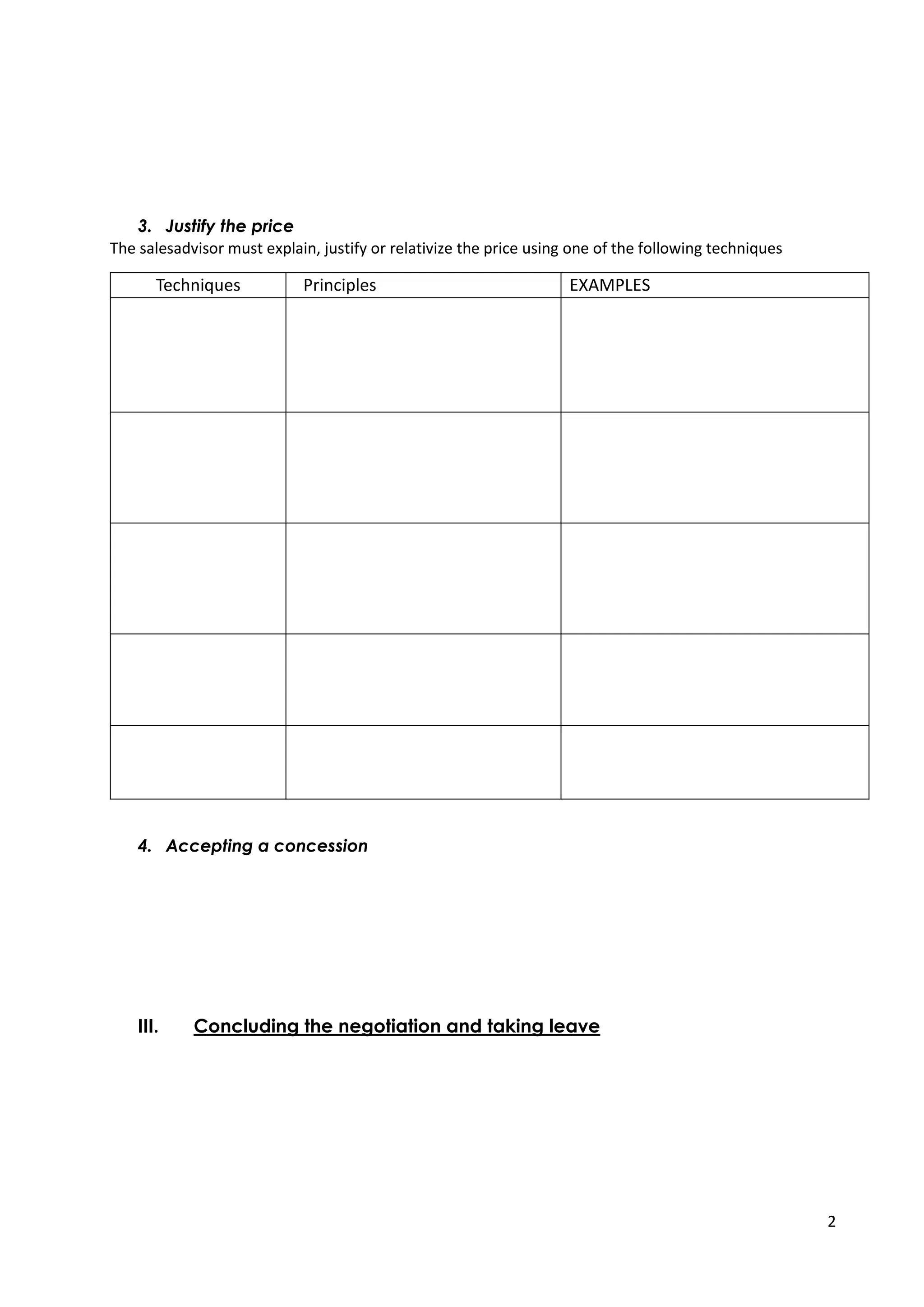
3. Justify the price
The salesadvisor must explain, justify or relativize the price using one of the following techniques
Techniques Principles EXAMPLES
The addition
Add up the benefits to justify
the price.
The subtraction Show that what the customer
or prospect will lose by not
buying is more important than
the price.
The multiplication
Multiply the benefits of the
product by its duration of use.
The division
Divide the price of the product
by a time or a quantity.
The positioning Justify the price by the high-
end positioning or the quality
of the solution presented.
4. Accepting a concession
If, in spite of the explanations, the customer or prospect continues to object to
the price, the sales representative should consider making a discount.
The manager oftern give some negotiation power to the sales advisor by giving
him the possibility to reduce the prices by a certain percentage.
III. Concluding the negotiation and taking leave
The conclusion of the sale translates into an agreement between the seller and the
buyer. It is the outcome of the negotiation, after the argumentation and objection
handling phase, once the customer no longer objects and has understood the interest
of the proposed solution.
3
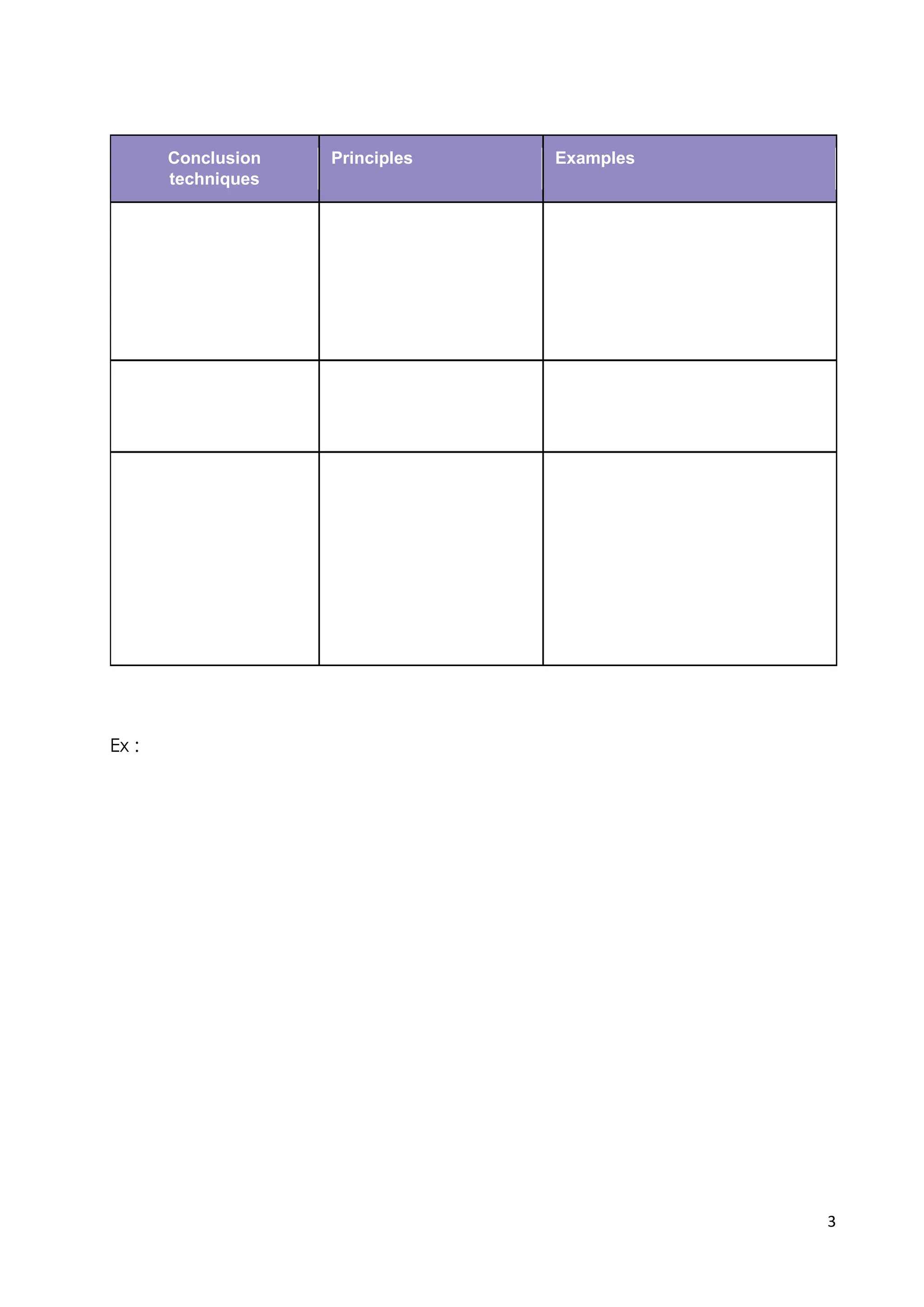
There are 3 conclusion techniques
Conclusion
techniques
Principles Examples
The direct conclusion The salesperson makes
the proposal directly to
the other person.
The alternative
conclusion
The seller offers two
solutions to the
customer.
The staircase
conclusion
The salesperson asks
the customer a series of
questions in order to
obtain a series of
positive answers that will
lead to the final decision.
When the salesman has obtained the customer's agreement on the main sale, he can
try to make additional sales.
Ex :
Whether the sale is successful or not, the salesperson must leave a good impression
when taking leave. The objective is to prepare for the continuation of the relationship.
A successful exit follows these steps:
NEGOTATION COURSE IN BANKING INDUSTRY - 30 HOURS – Teacher Ms Valladeau Christel
-
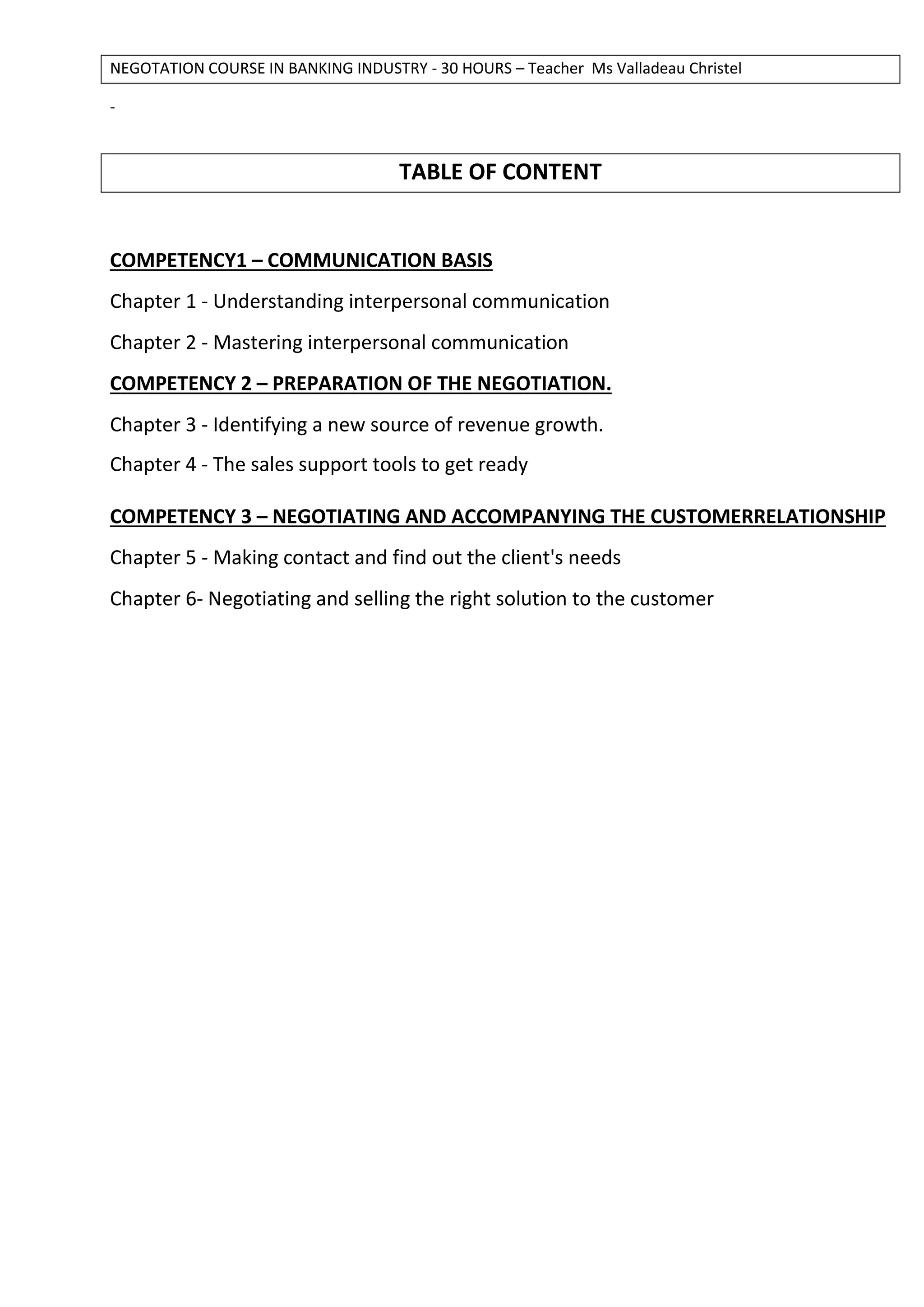
TABLE OF CONTENT
COMPETENCY1 – COMMUNICATION BASIS
Chapter 1 - Understanding interpersonal communication
Chapter 2 - Mastering interpersonal communication
COMPETENCY 2 – PREPARATION OF THE NEGOTIATION.
Chapter 3 - Identifying a new source of revenue growth.
Chapter 4 - The sales support tools to get ready
COMPETENCY 3 – NEGOTIATING AND ACCOMPANYING THE CUSTOMERRELATIONSHIP
Chapter 5 - Making contact and find out the client's needs
Chapter 6- Negotiating and selling the right solution to the customer
NEGOTATION COURSE IN BANKING INDUSTRY - 30 HOURS – Teacher Ms Valladeau Christel
-
INTRODUCTION
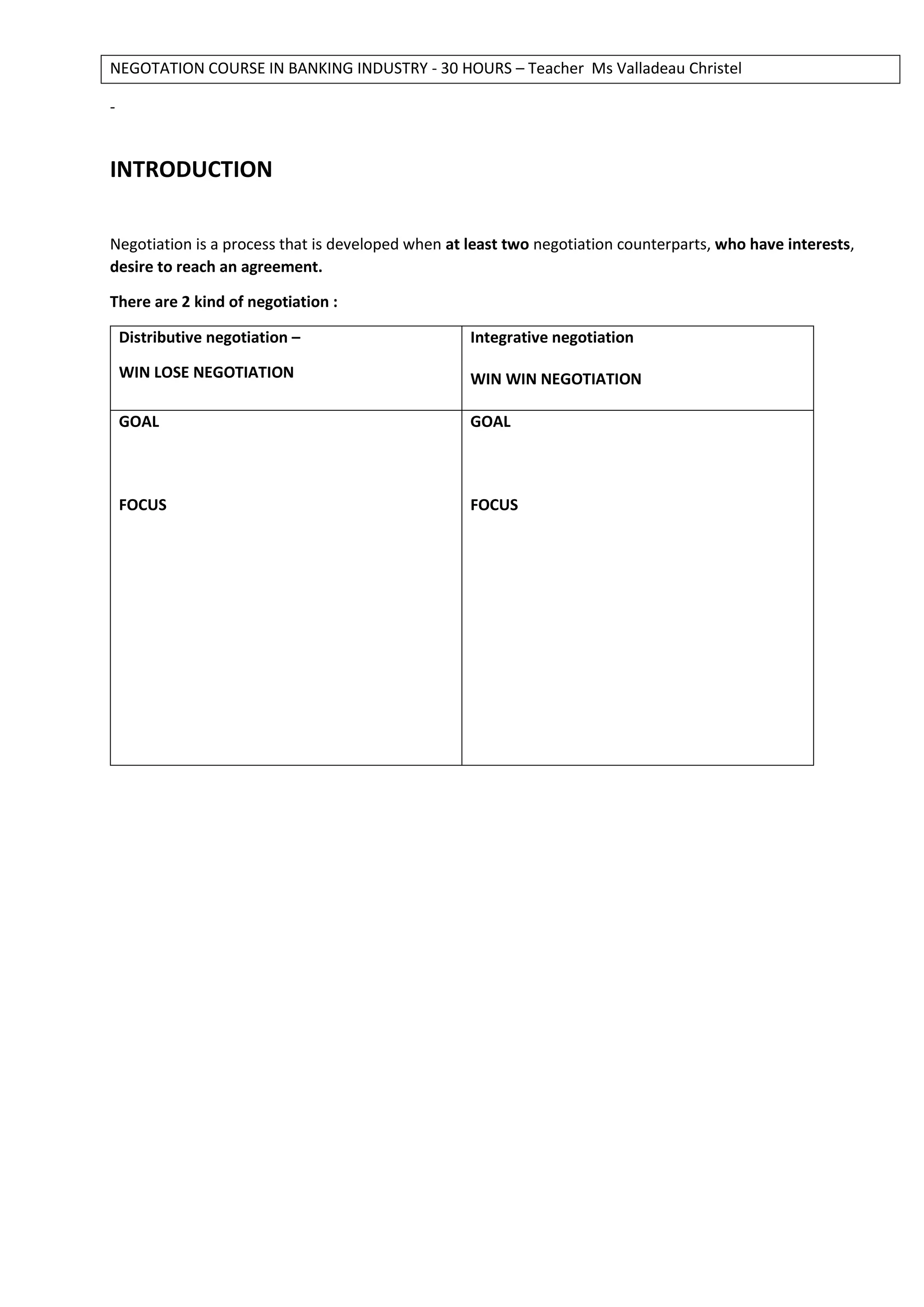
Negotiation is a process that is developed when at least two negotiation counterparts, who have interests,
desire to reach an agreement.
There are 2 kind of negotiation :
Distributive negotiation –
WIN LOSE NEGOTIATION
Integrative negotiation
WIN WIN NEGOTIATION
GOAL
FOCUS
GOAL
FOCUS

SLIDE negotiation of communication skill.pdf

  • 1.
    Valladeau Christel Negotiationcourses 1 CHAPTER 1 - UNDERSTANDING INTERPERSONAL COMMUNICATION I. DEFINITION We speak of interpersonal communication when at least two people are involved. II. THE SCHEME OF COMMUNICATION A. THE COMPONENTS OF INTERPERSONAL COMMUNICATION The sender: it is the one who sends the message, who writes, who speaks, who sends the information... It can be a person, a company, a community, an association... The receiver : it is the one who receives the message, who reads it, who hears it... It can be a customer or a potential customer (the lead). The substance of the message : it is the subject of the message, what is spoken about. The form of the message : it is how the substance is transmitted : can be written or said,... The channel or media: it is the support of the message between the transmitter and the receiver. It is a means that allows the transmitter to carry his message through space and time. The code : The code is the means used to transmit the message. The english language, morse code and sign language are all codes that can be used. The message is coded by the transmitter and decoded by the receiver. It is necessary to know the code to understand the message. Communication consists in transmitting information, ideas and emotions to others. - To inform and be informed - To understand Message (substance) Message (Form) Encoding Code Decoding Channel Filters Feedback Filters
  • 2.
    Valladeau Christel Negotiationcourses 2 The context : this is everything that accompanies the communication, it is the environment. We mainly differentiate - the relational context: professional, friendly... - the spatial context: place of the communication - the temporal context: it includes both the moment and the duration of the communication; The noise : it is all that disturbs the communication : the parasites in a radio communication, the noise of the street during a conversation, a bad quality of paper or printing which does not allow to read a text well... The filters : there are many filters that prevent the full message from getting to the receiver, that is why the feed back is essential. The feedback is : When the message has reached the receiver, the latter receives it according to his personality, his positive or negative perception of the message, his behavior. This impact of the message encourages him to respond to the sender. The receiver in turn becomes a sender who sends back a message related to the one he has just received. B. THE COMMUNICATION FILTERS There are many types of filters: neurological, cultural and personal that interpose themselves between the "reality" and the experience that we have of it. ➔ The neurological filter or bias The universe as it appears to us through our senses is the result of structures specific to our brain and our nervous system. ➔ The socio-cultural filter The socio-cultural frame of reference in which we evolve considerably influences our own frame of reference. Through myths, rites, values, beliefs, languages... ➔ Personal Filters The environment in which we have lived, the education we have received, the influence exerted by our parents and important people, the multiple experiences we have had as children and then as adults have influenced our way of conceiving things in a particular way. All these filters influence the encoding and decoding of information. Interpretation is an ongoing process in human communication. Consequences of these filters : Feedback is the simplest III. FORMS OF COMMUNICATION According to an American researcher, Albert Mehrabian, 55% of oral communication is based on behavioral codes (gestures, mimicry, attitudes), 38% on intonational codes and only 7% on verbal codes. A. VERBAL COMMUNICATION It is the whole of the words used (said, read or heard). Verbal communication makes it possible to define the content of the relationship (e.g.: feeling, idea). and most necessary quality control tool in a communication process. 1. Our view of the world is not the world 2. This vision varies from one individual to another. lot of losses in communication is an oral message.
  • 3.
    Valladeau Christel Negotiationcourses 3 There are 3 elements included in the verbal communication Colloquial language : Common language: Sustained language: B. NON-VERBAL COMMUNICATION AND PARAVERBAL COMMUNICATION It includes all the elements of information that are not transmitted by the voice. Indeed, communication is not only through words but also through paralanguage, that is to say gestures, postures, ways of occupying space, intonations of the voice, silences, all in a given context. ➔ APPEARANCE : ➔ POSTURE Posture (or body attitude) ➔ GESTURES They have multiple functions : o Directly translatable into words, they have their own meaning o They allow to regulate, control or coordinate exchanges, to gather, to oppose. ➔ THE FACE, THE LOOK AND THE SMILE These are essential elements in all direct communication situations. The face, through mimics, can express the most basic emotions : surprise, sadness, disgust, anger, joy or fear. The look: the listener's eyes tell you a lot about the level of concentration, interest and commitment of the listener The smile is a behavioral signifier, carrying meaning. A smile that evokes joy is likely to relax relationships, it reassures and defuses aggression. the transmitter uses words or popular expressions whicj are proscribed in theprofessional environment. this is the useal language. He used a correct syntaxis and a simple vocabulary. this corresponds to written literary language. It uses a syntax and a sophisticated vocalbulary less used in everyday life. The clothes or accessories we choose speak about us, wherether we like it or not. The appearnce depends on the situation, which clothes will be most appropriate for The various signs linked to posture, wherether voluntary or not, inform other people about emotional states and the diesires to communicate or not. often conveys the degree of sociability at a given moment Barrier gesture: Perturbing gestures: they are out of sync with the message you are trying to get accross These are essential elements in all direct communication situations. the face, through mimics, can express the most basic emotions: surprise, sadness, disgust, anger, joy or fear. Even with the mask , we can see when peple are smilling: in the eues expression but also when the person start to speak -> The smile is heard when you are on the phone.
  • 4.
    Valladeau Christel Negotiationcourses 4 ➔ THE VOCAL DIMENSION OF SPEECH : the para verbal comunication The timbre : According to the individuals, the tone of voice will be very different. The intensity or volume: This is the sound level of the voice. It is necessary to adapt this level to the size of the space, to the disposition of the public, and to the number of people present. Intonation: This is the melodic movement of the voice, characterized by variations in pitch. As in music, it is necessary to find one's score and play on different notes. Flow : This is the number of words per minute. Silences are also part of communication. Conclusion : In order to communicate more effectively, speech and body expression must be congruent (i.e. in agreement) and express the same thing. We are congruent when what we show (behavior) and what we feel (internal state) are in agreement with what we say. According to the individuals, the tone of voice will be very different. This is the melodic movement of the voice, characterized by variations in pitch. This is the sound level of the voice. This is the number of words per minute. Silence: Silences are also part of communication. They give the speaker time to think, to transfer the word to the interlocutor. They divide the speech into understandable units. They can give weight to what has been said. Conclusion In order to communicate more effectively, speech and body expression must be congruent (i.e. in agreement) and express the same thing. We are congruent when what we show (behavior) and what we feel (internal state) are in agreement with what we say.
  • 5.
    CHAPTER 2- MASTERINGTHE INTERPERSONAL COMMUNICATION So when communicating, you have to be aware that certain elements can slow down the circulation of the message.  What are the elements that influence communication situations ?  What are the tools to adopt to better convince. I. Analysis of the context of the interpersonal communication situation A. The status and role of the actors In an interpersonal communication situation, it is necessary to take into account :  the status of the interlocutor, i.e. his position in the organization, the hierarchy or the social structure ;  his role, i.e. what society expects of him, the behaviors or conduct he should adopt in relation to his status. B. Personality DEFINITION : An individual’s personality is a set of behaviours, attitude and emotional characteristics which make them different and distinctive. It is difficult to identify the personality of your interlocutor althoughs it is very useful. But there are some methods that may help you (PCM model) The personality results from the combination of several character traits like :  Extraversion: applies to individuals who are enthusiastic, sociable, like to interact and express themselves. Its opposite is introversion.  Autonomy: applies to people who are independent, who do not need others and who like to undertake, who are dominant. Its opposite is submission.  Stability: individuals who are calm, relaxed, self-controlled, and trustworthy because their behavior is consistent. Its opposite is instability.  Logical: people who think before they act, who let themselves be guided by their reason and not by their emotions; someone who is not logical is said to be emotional. Thanks to a close observation of the communication process, you can adapt our message to the personality of our interlocutor. II. THE PERSONAL ELEMENTS TO TAKE INTO ACCOUNT  Knowing yourself Each person's personality is expressed through a combination of emotional characteristics, attitudes (what we feel, what we think) and behaviors (how we are, how we act or react). The character traits (adaptability, sociability, combativeness, etc.) and the emotions of each person have an impact on the exchange between the actors.  Behave professionally All professional environments have their own codes that must be adhered to and adapted to in order to be able to hold one's own in all circumstances and be effective and credible. For example in face to face meeting , it is important to respect the customs and codes related to face-to- face exchanges : rituals of politeness (handshake), questioning, listening and rephrasing of the interlocutor's words. By phone, when receiving or making a call, the salesperson must adopt a professional approach by being prepared both materially (a quiet desk, mastered scripts, contact sheets and notepads within reach) and psychologically, since a smile can be heard on the telephone.
  • 6.
    In written exchanges,the style must be adapted to the target and the media used, clear, concise, punchy and lively in order to catch the attention of the people targeted, to invite them to "react" positively to the proposals made... Spelling must be impeccable. III. TOOLS/TECHNIQUES TO CONVINCE Commitment : To take an active part in the situation, first of all, the negotiator must be commited by defending his positions and by controlling his emotions. Secondly he must show empathy. Empathy is the understanding and the recognition of the feelings, beliefs and emotions of another individual. It is the ability to get on the same "wavelength" as the person you are talking to adapt to his or her mode of communication The empathetic salesperson will make the difference by being able to synchronize with the customer and find the right arguments to answer objections and enhance the value of the offer. Being empathetic will allow a strong adaptability to different buyer profiles. Finally he must be able to listen actively : Active listening is the ability to listen to others without judging them, to question them and to reformulate their words in order to clarify the meaning of their words and intentions and to avoid distortions ans generalizations. Active listening requires the following attitudes : Openness Showing a real interest of the speaker in what the other person says The establishment of a professional attitude of quality listening requires the use of reformulation techniques, clarification of meaning as follows : Techniques How To Do It Example : Paraphrasing : Restate the same information, using different words to more concisely reflect what the speaker said. Clarifying : Invite the speaker to explain some aspects of what she or he said Summarizing : Identify, connect, and integrate key ideas and feelings inwhat the speaker said. No judgement Neutrality ( no negative or positive judgement) - Let the other person speak without interrupting, - Give regular visual signs of interest and encouragement - Ask questions and/ or use rẻomulation techniques - Ignore distractions - Take notes " What I'm hearing is...." " It sounds like what's most important to you is.." "i am not sure i quite understand or do you mean that.." " You have given me a lot of information, let me if I've got it all..." " Let me summarize what I heard so far..." "So, on one the hand..but on the other hand.."
  • 7.
    1 Chapter 3- Identifyinga new source of revenue growth. Most of the time, in order to survive, companies need to generate growth and the sales force ‘s task is to contribute to this mission. How to do that ? I. KNOWLEDGE OF THE PRODUCTS AND THE TARGET Faced with very diverse banking markets - the retail market, the corporate market, the farmers' market - and with clients with heterogeneous needs and characteristics, the bank cannot offer a single product for all its potential clients. It is therefore necessary to segment the clientele so that each group can find in the bank the products that are adapted to its activities. Definition of the segmentation : dividing all clients and prospects into a certain number of market subsets that have homogeneous characteristics, . The goals of the segmentation will be : • To create products specific to the segment's clientele that best meet their specific needs • To define a specific commercial policy for the segment, thus obtaining an obvious competitive advantage over competing institutions. • To better communicate with the segment's clientele. • And ultimately to optimize the bank's commercial strategy. The company set business objectives to balance its portfolio and ensures also that the customer portfolio bring value. This means that the sales force have been assigned segments and targets for each customer segment.The targets are defined through 2 indicators used to measure the customer value are : a. the turnover The turnover generated by a customer is the first indicator of its value. It is necessary to take into account the actual turnover but also the potential turnover, which corresponds to the projected volume of purchase of the good or service sold by the company. b. the margin The second indicator of customer value is the sales margin, which is the gross profit made by the company. This margin will depend on the value accepted by the customer (compared with the competition) and also on the negociation with the customer. II. HOW TO DEVELOP THE REVENUE’s GROWTH ? It is possible to develop the turnover in two ways: ➔ by developing customer loyalty, by optimizing the consumption or the number of goods/services held by the customer; - To create products specific to the segment's clientele that best meet their specific needs. - To define a specific commercial policy for the segment , thus obtaining an obviuos competive adcantage over competing institutions. - To better communicate with the segment's clientele. - And ultimately to optmize the bank's commercial strategy. Segmentation simply consists in dividing all clients and prospects into a certain number of market subsets that have homogeneous characteristics. It is necessary to take into account the actual turnover but also the potential turnover, which corresponds to the projected volume of purchase of the good or service sold by the company. It is possible to develop the turnover and sometimes the margin in two ways: -by developing customer loyalty, by optimizing the consumption or the number of goods/ services held by the custoner; - by conquest, by developing the turnover towards a new target or by taking market shares from the competition.
  • 8.
    2 ➔ by conquest,by developing the turnover towards a new target or by taking market shares from the competition, that means the potential customers. The company's potential customers include current (or actual) consumers of the competitors and the relative non-consumers (the ones that do not have an account now). To develop revenue ‘s growth, a detailed knowledge of the customer makes it possible to adapt the company's offer in order to sell it better, and sometimes even to anticipate the customer's needs and thus increase the customer satisfaction rate and the loyalty rate. All large companies have understood this, as shown by the strong development of the customer-centric approach and the development of commercial IT systems. Qualified databases offer powerful information processing possibilities (e.g.: data analysis according to multiple criteria, sorting, filtering, extraction of profiles common to a group of customers). Collecting and centralizing data in a CRM (Customer Relationship Management) software allows to better understand customers' needs, to better serve them and to improve the relationship with them. The basic information to open a bank account is necessarily stored in the customer database but these one must be enriched and completed during or after each appointment. This information has 2 goals : ➔ To prepare the negotiation or phone call in order to propose an adapted offer to the customer, ➔ To measure the contribution of each customer to the company's profitability and then define the priority targets, on which it will concentrate its resources. -> prospection actions - To prepare the negotiation or phone call in order to propose an adapted offer to the customer; - To measure the contribution of each customer to the company's profitability and then define the priority targets, on which it will concentrate its resources.
  • 9.
    1 CHAPTER 4 -THE SALES TOOS TO GET READY. Once in possession of the sales objectives the sales person will have to prepare his negotiation strategy and his physical or virtual meeting with the customer. He will then prepare some sales tools so as to take intoconsideration the person he is talking to and to be able to anticipate and argue. The sales tools includes the questioning plan, the argument and the handling of objections. I. QUESTIONNING PLAN The questioning plan (or checklist) must be prepared by the sales advisor before conducting the sales meeting. Its goal is both to confirm that the information he gathered previously ( in the CRM if it is a customer or by an other channel). A. Structuring the questioning 1. History of the relationship- current situation to be updated . Information regarding the current situation) 2. Information regarding the customer‘s projects (needs) (short term and long term project. 3. Information regarding Customer ‘motivation Knowledge of your segment knowledge of the products are right and also to make sure the sales advisor will get the information needed Extraction of the database (if customer) + questions if missing information. -> Questions about his or her function, role, environment, constraints,... Start with the information you know Check and update Example if historical customer: How is your work going? -> To find out the real needs and motivation of the Lead or Customer -> The reason of the appointment -> Questions on the short term projects and long-term projects -> What is he expected from us in the future? -> To define the customer profile and his/ her expectation -> To argue -Search for information on the motivations and expectations of the client or the lead. The 4 essential questions: - What is the most important thing for you with a bank? - What is a good product for you? - What does being well insured mean to you? - What makes you want to change of Bank? -Ask finally a technical question related to your initial request with a fundamental question -> What is the main gurantee for you in this contract? The answer will be used in the argurmentation
  • 10.
    2 B. USING VARIOUSQUESTIONS There are different kind of questions that can be used during a sales interview. Depending on the phase of the sales process, some will be more used than others. OPEN QUESTIONS ➔ An open question calls for a free answer. The open-ended question is formulated in such a way that is encourages the speaker to develop their thinking by leaving them the choice to adopt the angle they wish. Open questions frequently begin with : What do you think about … ? How … ? Why … ? CLOSED QUESTION ➔ requires a precise answer, and a single choice. They are used to obtain precise answers from the customer or to lock in an important point of the exchange, by calling for "yes/no" answers or inducing a name, a quantity, a date...: "Who...?", "What...? ", "When...?", "Where...?", "How much...?", "Which...?"... "Is it...?", "By what means...?", "Do you wish...?", "Do you think...?", "Do you have...?", "Can you?" THE ALTERNATIVE QUESTIONS → consists of proposing several possible answer options in the question. They help to guide the dialogue in order to facilitate the conclusion. They suggest a choice. It has two objectives. On the hand, the negotiator guides the choice of response ; on the other hand, they ensure that the proposed options are in line with the issue or stakes for the other party. II. PREPARE THE ARGUMENTS BY GATHERING ALL THE INFORMATION ON THE PRODUCT. The sales advisor must know all the characteristics of the products so as to be able to propose the right product/service to the customer. - A characteristic corresponds to an intrinsic property of the good or service. With the knowledge of the products, the sales advisor will be able to prepare his arguments. A sales argument is a sentence that aims to convince the customer that the proposed solution meets his needs and motivations. Arguments highlight and prove the advantages that the characteristics of the good or service will provide to the customer. An argument is built around three elements according to the CAP or CAB method: Argument = Characteristic + Advantage + Proof or Characteristics + Advantage + Benefits. - An advantage is an exposure of the positive points and the added values - A benefit is what it will brings to the customer. It is a matter of presenting to the buyer the positive consequences of the identified characteristics. In oder to prepare the sales negotiation, the sales advisor.... A sales argument is a sentence that aims to convince the customer that proposed solution meets his needs and motivations Arguments highlight and prove the advantages that the characteristics of the good or service will provide to the customer An argument is built around three elements accordng to the CAP or CAB method: Argument= Characteristic + Advantage + Proof (CAP) or Characteristics + Advantage + Benefits (CAB) An advantage is an exposure of the positive points and the added values for the customer A proof is a means to support the benefits presented. It can be a demonstration, a trial, customer testiminials, press articles, comparative studies.... A benefit is what it will bring to the customer. To convince the customer we have to adapt our comminication yo the customer -> Then give appropriate arguments according to his buying motivations.
  • 11.
    3 - A proofis a means to support the positive points presented. It can be a demonstration, a trial, customer testimonials, press articles, comparative studies... The SPICES method is a sales technique based on behavioral analysis and allows to detect the needs / buying motivations of a customer to better convince and trigger the purchase. SPICES Motivations Security Low risk or no risk, … Pride Premium services, high rang e, unique products Innovation Innovation, use of the last new technology Comfort Easy to use, easy to understand Economy Interesting price, Sympathy To please somebody else EXAMPLE: building an argument with the CAB method Characteristics : With the Medical Care Insurance Advantages : We can give you and your loved ones 5 affordable Medical Care Insurance plans Benefit : your family will be protected → Profile : SYMPATHY The sales pitch groups together all the arguments that allow you to enhance the value of an offer in front of a client or a prospect. III. HANDLING OF OBJECTIONS Objections are an expression of hesitation, lack of understanding, or even fear on the part of the customer, who is afraid to commit. While they are a natural reaction of customers to defend themselves, they also reveal a sign of interest. The salesperson, who often experiences objections as an attack, must instead security Low rish or no risk,... Price Premium services, high range, unique products Innovation Innovation, use of the last new technology Comfort Easy to use, easy to understand Economy Interesting price Sympathy To please somebody else Comfortable profile: Our dress is made with linen in case of high heat, you will feel comfortable, you are protected Economy profile: Our dress has 10% saving until nest Tuesday it is a very good deal for this quality. Differentiation from others (trendy, original, even expensive produets) to distinguish oneself, generate a feeling of power or domination. Search for new products, solutions or materials, bringing new possibilities (on the lookout for new technologies). Search for well-being, through products that are easy to use, multi-purpose and that make lite easier. Money Search for the cheapest products, with the best quality/price ratio, giving priority to robust and inexpensive products. Willingness to please or to please oneself (purchase for others or to favour a particular salesperson because of his or her good advice) Research of its own protection and that of others (reliable products)
  • 12.
    4 perceive them asa springboard for rallying the customer or prospect to his or her position and bringing him or her to the conclusion of the sale. A. List the objections In order not to be caught off guard in front of the customer, it is important to anticipate objections. Before the meeting, the salesperson should try to identify all possible objections. B. Responding to objections ADRA TECHNIC To answer an objection correctly, the salesperson must follow several steps. 1. Approve the objection First, the salesperson lets the other person express himself without interrupting. He then shows understanding, without devaluing the objection (this would be tantamount to devaluing the customer). It is therefore important to avoid expressions such as: "You're wrong", "That's not true! On the contrary, it is recommended to start with a sentence like: "You are right", "I understand you very well", "You are right to draw my attention to...". 2. Discover the real obstacle to buying The sales person should dig deeper and discover the deep nature of the sales objection. To do this, he should use open-ended questions in order to invite the interlocutor to express himself and to develop his comments. Examples of discovery questions when faced with an objection ➔ What makes you think or say that? This will allow the salesman to bring to light all the problematic elements in order to provide specific business solutions later on. ➔ Is there anything else you are concerned about? 3. Responding to the objection Several techniques can be used by the salesperson to respond to objections. Techniques for responding to objections Explanation Examples The boomerang This technique consists of answering the objection based on what the customer or prospect has just said. Interrogative reformulation By taking up the objection in the form of a question, the customer or prospect is invited to express himself and to deepen his objection. The information
  • 13.
    5 When faced withan unfounded but sincere objection, the salesperson can provide additional information that will allow the customer or prospect to better understand the suitability of the offer to his needs. 4.-Check the customer's Acceptance For effective objection handling, systematically check the acceptance of the objections ! This is the principle of commitment and consistency that will facilitate the realization of the sale Let's see how to proceed according to the different categories of objections. Check the acceptance of the evidence put forward, with a question like: • Are you reassured on this point? 1, The boomerang - This technique consists of answering the objection based on what the customer or prospect has just said. Example: Objection: "I am sastisfied with my current insurance company" Answer: " That's why I'm offering you a comparative study with no commitment on your part." 2, Interrogative reformulation By taking up the objection in the form of a question, the customer or prospect is invited to express himself and to deepen his objection. Objection: "I'm not interested" Response: "May I ask what you are not interested in?" 3, The information The salesperson can provide additional information that will allow the customer or prospect to better understand the suitability of the offer to his needs. Objection: " I don't understand how your product with solve my cash flow problem.." Response: " I suggest you loot at the results if we run a simulation with your company's numbers from last year." 4, Check the customer's Acceptance For effective objection hadling, systematically check the acceptance of the objections! This is the principle of commitment and consistency that will facilitatw the realization of the sale Check the acceptance of the evidence but forward, with a question like: -> Are you reassured on this point? -> Can we close the deal now? If not, ask your interlocutor what evidence would be able to convice him. For example, you can rebound with a formulation such as: -> In view of all the elements seen together, and give all the benefits I havelisted for you, do you agree with me that this blocking point is not a major obstacle to our doing businiess together?
  • 14.
    1 CHAPTER 5- MAKINGCONTACT AND DISCOVERING THE CUSTOMER'S NEEDS The salesperson must be able to work with all types of customers (B to B, B to C), whatever the form of the customer relationship (face-to-face, remote, e-relationship) and in all its complexity. Indeed the relationship with the bank is going digital. Customers carry out their daily banking operations on cell phones, obtain information on products via the Internet, The salesperson accompanies in all cases the customer throughout the sales process I. MAKING CONTACT, Remote and face-to-face The sales representative must, from the very first moment of contact - whether by telephone, e- relationship or face-to-face - try to create a link with his interlocutors in an efficient way. The salesperson must present himself as a partner to facilitate contact, regularly offering information content that will influence the buyer during the buying process. He must succeed in capturing the interest of the potential buyer by making him understand the added value of his company. The salesperson must prepare the first contact with the customer well because it is decisive. The objective is to establish a warm climate of trust, then the following steps must be respected. 1. The salesperson introduces himself/herself personally by handing over his/her business card. 2. In order to avoid any confusion and waste of time, he identifies his contact and, if necessary, his function, making sure that he is the decision-maker. 3. Generate interest : A few kind words adapted to the context help to relax the prospect who, at this stage, may still be vary- The salesperson must make a catchphrase that values the person he is talking to and/or his concerns. 4. Eventually inform about the duration of the meeting - The salesperson quickly specifies the duration and the purpose of the interview to mobilize the prospect's attention and interest. II - Carrying out the customer diagnosis face-to-face Use of discovery funnel The objective is to establish a warm climate of trust. 1) Introduce yourself with the business card, presents the company your role in this company 2) Identify the contract and, if necessary, his function, making sure that he is the decision-marker 3) A few kind words adapted to help relaxing the customer- Must then arouse a real ...
  • 15.
    2 The notes takenduring the questionning plan enables the sales advisor to reformulate and finally synthesize. There are 2 kind of formulation : • The "deductive reformulation", which advances the discovery process; • The "summary reformulation", to close a part of the interview and address another point. Before proposing the product, you should synthetize all the information you have just had. The objective is to carry out a judicious assessment of the customer diagnosis phase, already oriented towards the solution that the sales assistant will propose to the customer during the argument. Example: The customer: " I have lost so much money in the stock market taht I want to close my accounts.. The sales assistant: " So it would be a question of finding a less risky solutions. Example: " You hve just told me that you are looking for this and that. I would now like to suggest that we look together at..." Example: " So, if I understand you correctly, you want..."
  • 16.
    1 Chapter 6 -Negotiating and Selling a Customer Solution I. Arguing with the client The objective of the argumentation is to convince the customer that the offer meets his needs. A good argumentation requires a selection of arguments and the adoption of a positive attitude. During the argumentation, the sales assistant selects the arguments that correspond to the type of customer (individuals, professionals,), to their needs, to their interests and to their « SPICES » profile. During the argument, he speaks in a positive way by eliminating negative formulations. He uses the present tense or the future tense to involve and project the customer, avoiding the conditional tense. Finally during the argumentation phase, the salesperson must be attentive to the customer's reactions in order to control his or her interest in the proposed solution. He must obtain validations from his interlocutor by asking him control questions such as: II. Addressing the price and dealing with objections During his argumentation, the advisor may have to deal with the objections. He will use the preparation he has made by considering all possible objections. Sometimes the price can be difficult to present. It is advisable to present the price by pointing out one or more advantages. The salesperson must master the techniques necessary to respond to the price objections of his interlocutor while preserving the quality of his relationship with him and his chances of getting him to sign. He will follow the following steps: 1. Isolate the price After the customer or prospect has objected to the price, the sales representative must first make sure that the service is suitable for the person he is talking to by asking a question. EXAMPLE : 2. Understanding the customer or prospect The sales representative must try to understand why the person is thinking the price is too high by asking him questions. EXAMPLES :
  • 17.
    2 3. Justify theprice The salesadvisor must explain, justify or relativize the price using one of the following techniques Techniques Principles EXAMPLES The addition Add up the benefits to justify the price. The subtraction Show that what the customer or prospect will lose by not buying is more important than the price. The multiplication Multiply the benefits of the product by its duration of use. The division Divide the price of the product by a time or a quantity. The positioning Justify the price by the high- end positioning or the quality of the solution presented. 4. Accepting a concession If, in spite of the explanations, the customer or prospect continues to object to the price, the sales representative should consider making a discount. The manager oftern give some negotiation power to the sales advisor by giving him the possibility to reduce the prices by a certain percentage. III. Concluding the negotiation and taking leave The conclusion of the sale translates into an agreement between the seller and the buyer. It is the outcome of the negotiation, after the argumentation and objection handling phase, once the customer no longer objects and has understood the interest of the proposed solution.
  • 18.
    3 There are 3conclusion techniques Conclusion techniques Principles Examples The direct conclusion The salesperson makes the proposal directly to the other person. The alternative conclusion The seller offers two solutions to the customer. The staircase conclusion The salesperson asks the customer a series of questions in order to obtain a series of positive answers that will lead to the final decision. When the salesman has obtained the customer's agreement on the main sale, he can try to make additional sales. Ex : Whether the sale is successful or not, the salesperson must leave a good impression when taking leave. The objective is to prepare for the continuation of the relationship. A successful exit follows these steps:
  • 19.
    NEGOTATION COURSE INBANKING INDUSTRY - 30 HOURS – Teacher Ms Valladeau Christel - TABLE OF CONTENT COMPETENCY1 – COMMUNICATION BASIS Chapter 1 - Understanding interpersonal communication Chapter 2 - Mastering interpersonal communication COMPETENCY 2 – PREPARATION OF THE NEGOTIATION. Chapter 3 - Identifying a new source of revenue growth. Chapter 4 - The sales support tools to get ready COMPETENCY 3 – NEGOTIATING AND ACCOMPANYING THE CUSTOMERRELATIONSHIP Chapter 5 - Making contact and find out the client's needs Chapter 6- Negotiating and selling the right solution to the customer
  • 20.
    NEGOTATION COURSE INBANKING INDUSTRY - 30 HOURS – Teacher Ms Valladeau Christel - INTRODUCTION Negotiation is a process that is developed when at least two negotiation counterparts, who have interests, desire to reach an agreement. There are 2 kind of negotiation : Distributive negotiation – WIN LOSE NEGOTIATION Integrative negotiation WIN WIN NEGOTIATION GOAL FOCUS GOAL FOCUS